
1. A Centimetre of Clay
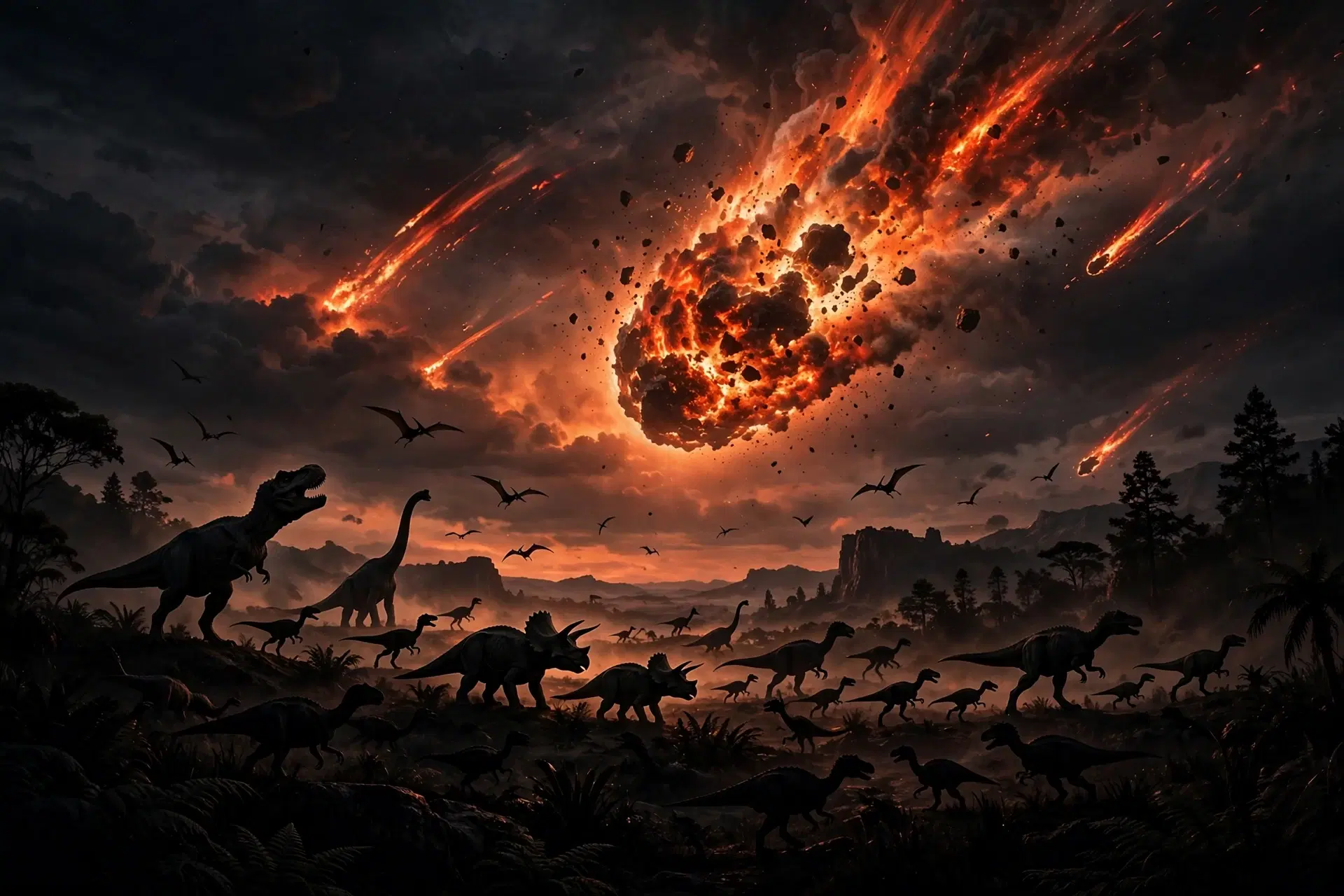
A single centimetre of clay in an Italian gorge divides the age of dinosaurs from the world that followed. That thin line, rich in a metal rare on Earth, told two scientists that something from space had struck the planet. This section follows that clue into the story of mass extinctions — the moments when life on Earth nearly ended.
I still remember the first time I stood in front of a museum case holding a slab of rock split cleanly along a dark, hair-thin seam. The label said little. Below the line, the rock was crowded with the shells of tiny sea creatures. Above it, almost nothing. A docent passing by said, almost as an aside, that the line marked the end of the dinosaurs. I laughed at the time. One thin line could not possibly hold that much history.
It can. That line, or one very much like it, runs through rocks all over the world.
1.1 The gorge at Gubbio
The story starts in the Bottaccione Gorge, near the town of Gubbio in the Umbrian Apennines of Italy. There, pink limestone laid down on an ancient deep seafloor rises in cliffs hundreds of metres thick, holding a nearly unbroken record of microscopic fossils across the boundary between the Cretaceous and the Paleogene periods.
Walter Alvarez, then a young geologist at the University of California, Berkeley, was working there in the 1970s. He wanted to measure how long a thin clay bed at the boundary had taken to form. The bed was only about a centimetre thick. It sat exactly where the fossils changed: below it, the limestone teemed with diverse planktonic foraminifera, single-celled sea creatures with elaborate shells; above it, those fossils were sparse, tiny, and few in kind.
Walter asked his father, Luis Alvarez, a Nobel Prize-winning physicist, for help. Luis suggested measuring iridium in the clay. Iridium is a platinum-group metal, rare in Earth's crust because most of it sank into the core when the planet formed, yet far more common in asteroids. If the clay had taken thousands of years to settle, the slow rain of cosmic dust should have left only a trace. If it had formed quickly, there should have been almost none at all.
The result fit neither expectation. At the boundary, iridium jumped to about 9 parts per billion, against a background of roughly 0.3 parts per billion in the limestones above and below — about thirty times the normal level. The same spike turned up at Stevns Klint in Denmark and in sections in New Zealand. It was worldwide.
1.2 A father, a son, and an impossible idea
In June 1980, Luis and Walter Alvarez, with chemists Frank Asaro and Helen Michel, published their answer in the journal Science: an asteroid roughly 10 kilometres across had struck Earth 66 million years ago, throwing up a global cloud of dust and debris. The clay was its fallout.
The idea met fierce resistance. Most geologists of the day explained extinctions with slow causes: changing climate, shifting sea level, gradual competition. An asteroid sounded like science fiction. It took a decade of further evidence — shocked quartz, glass spherules, soot, and finally the buried Chicxulub crater beneath Mexico's Yucatán Peninsula — before the impact explanation became the consensus. The Natural History Museum, London, summarises the evidence, from the iridium anomaly to the Chicxulub crater, about 180 kilometres wide, and an asteroid as wide as 15 kilometres.
That is why the clay matters so much. It is proof that mass extinctions can turn on a layer thinner than your fingernail: below it, a world ruled by dinosaurs; above it, a world where mammals would take their place. Life had already faced such turnings four times before, and those earlier mass extinctions are the subject of this article. The long road from the first cells to the complex Ordovician seas is told in our companion article on the origin of life.
2. What Are Mass Extinctions?
Mass extinctions are not simply bad times for life. They are sharp, planet-wide collapses in which at least three quarters of species vanish in under about two million years. This section sets out that definition, separates it from everyday background extinction, and introduces the five mass extinctions scientists call the Big Five.
Extinction is normal. Species appear, persist for a while, and disappear. That steady background loss is part of evolution itself: without it, there would be no room for new species to arise. The fossil record suggests that, left alone, roughly 10 percent of species are lost every million years, 30 percent every 10 million years, and 65 percent every 100 million years. Those numbers sound large, but they are spread so thinly across time that ecosystems can absorb them.
A mass extinction breaks that rhythm. Losses pile up far faster than new species can replace them. Whole groups that had dominated the seas or the land for tens of millions of years vanish together, and food webs unravel from the bottom up.
2.1 The 75 percent rule
Scientists define a mass extinction by two measures taken together: magnitude, the share of species lost, and rate, how quickly the loss happens. Either one alone is not enough. A slow trickle that removes three quarters of species over a hundred million years is background loss stretched out. A sharp shock that kills a tenth of species in a year is a disaster, but not a mass extinction either.
"In a mass extinction, at least 75% of species go extinct within a relatively (by geological standard) short period of time. Typically less than two million years."
That working definition, set out by Our World in Data, draws on a long tradition in palaeontology. The 75 percent line is a convention, not a law of nature. Some researchers argue about where exactly to draw it, and some events sit close to the border. Yet the convention is useful: it separates the five truly exceptional mass extinctions in the last 500 million years from the many smaller dips in diversity that fill the fossil record.
Two million years deserves a pause. To a human life, it is an abyss. To a geologist, it is a blink — less than half of one percent of Earth's history. The rocks compress a million-year catastrophe into a thin band, and that compression is part of why reading the record is so hard, as the next section shows.
2.2 Background extinction and the Big Five
The five mass extinctions that clear the bar are called the Big Five. The name comes from a 1982 analysis by palaeontologists Jack Sepkoski and David M. Raup, who plotted the diversity of marine animal families through time and found four extinction spikes statistically distinct from background, with a fifth, in the Devonian, standing out but not reaching statistical significance in their data. Later work, using genera and species rather than families, confirmed the same five mass extinctions, though the exact percentages shifted with the counting method.
That last point matters, and it is a common source of confusion. A genus groups closely related species, and a family groups related genera. When a crisis kills 86 percent of species, it may kill only about half the genera, because a genus survives if even one of its species pulls through. For the end-Ordovician extinction, estimates put the loss at roughly 49 to 61 percent of genera, against about 86 percent of species. The numbers in this article are species losses unless stated otherwise.
Here are the five, oldest first:
Event | When | Species lost | Main cause |
|---|---|---|---|
End Ordovician | 444 million years ago | 86% | Gondwana glaciation and large sea-level swings |
Late Devonian | 360 million years ago | 75% | Cooling, ocean anoxia, and the spread of land plants |
End Permian | 252 million years ago | 96% of marine species | Siberian Traps volcanism, warming, and ocean acidification |
End Triassic | 201 million years ago | 80% | Central Atlantic Magmatic Province volcanism |
End Cretaceous | 66 million years ago | 76% | Chicxulub asteroid impact in Yucatán, Mexico |
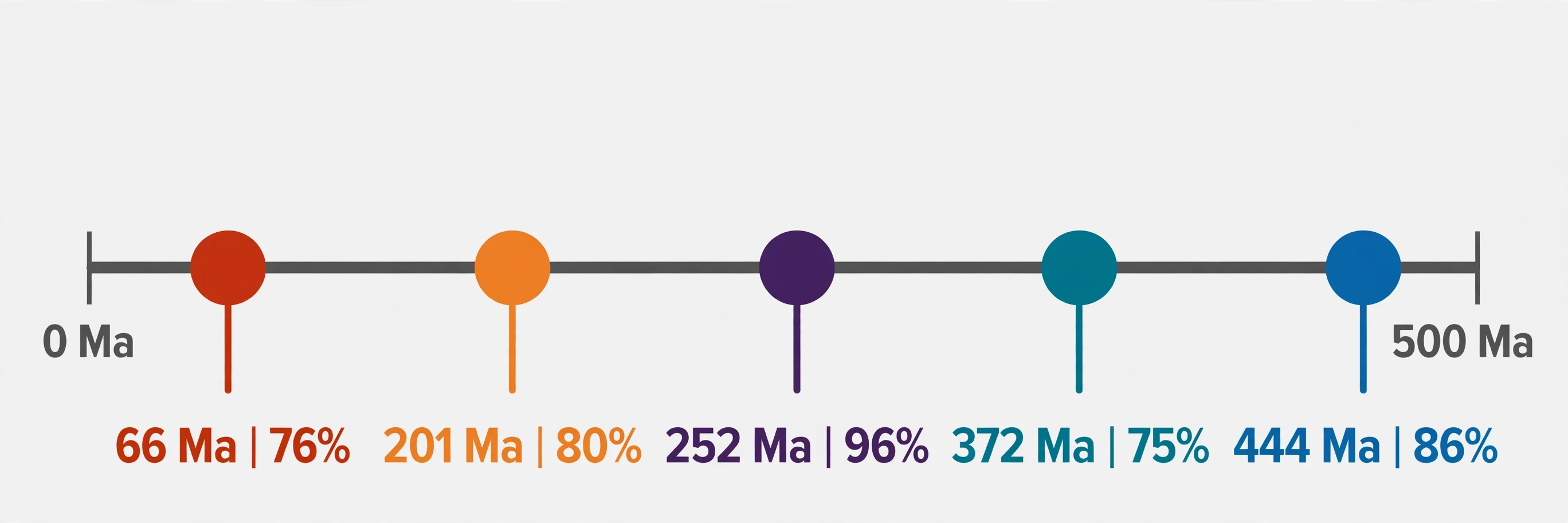
Read the table from the top down and a pattern emerges. Four of the five were driven, at least in part, by colossal volcanism or by an impact from space. The odd one out, the end-Ordovician, was driven by ice. Yet every one of them worked through the same middlemen: climate swings, seas that rose or fell, and oceans that lost their oxygen or turned acidic. A concise summary of the five mass extinctions, with their dates and species losses, is given by Our World in Data.
2.3 Why the definition matters
Definitions are not pedantry here. They decide the biggest question this article will ask at the end: are humans causing a sixth mass extinction? If the bar is 75 percent of species in under two million years, then the answer depends on rates, not only on losses so far. What matters is the speed at which losses are running compared with the background rate, and whether that speed, if it holds, would carry us over the bar.
That is also why the distinction between species and populations matters. A species can lose 90 percent of its individuals and still survive as a species, clinging on in a refuge. In the fossil record, such a species would count as a survivor. In the living world, it may be functionally gone — too rare to play its old role in its ecosystem. Palaeontologists count species. Conservationists count populations too.
There is one more reason to be careful with the definition. Natural selection works on the survivors. After mass extinctions, the traits that matter are often not the ones that made a species successful in the old world. Small size, a generalist diet, the ability to burrow — these unglamorous traits decide who inherits the emptied Earth.
3. How Do We Know? Reading the Fossil Record
We were not there to watch the mass extinctions, so how can anyone claim that 86 percent of species vanished 444 million years ago? The answer lies in rocks: layered sediments, fossils counted bed by bed, and chemical fingerprints left by impacts and volcanoes. This section explains how that detective work is done, and where it can mislead.
Nobody has a census of Ordovician life. Nobody ever will. What we have is a record written in stone by accident, preserved by luck, and read by inference. Yet the record is far richer than most people imagine: millions of fossils, collected over two centuries, now sit in museum drawers and in databases that let researchers count diversity through time, layer by layer.
3.1 Layers are pages
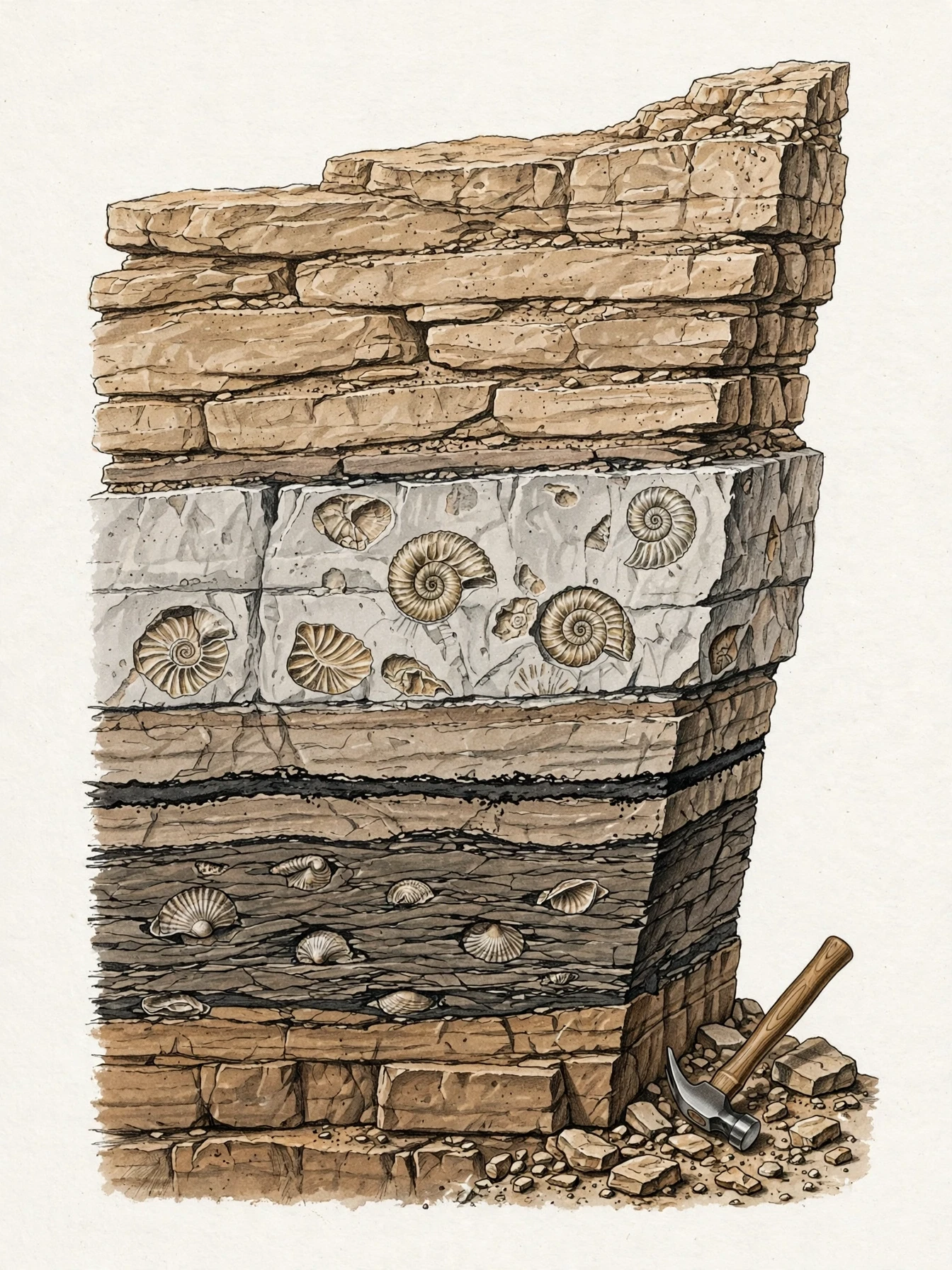
The first principle is the oldest in geology: in an undisturbed stack of sedimentary rock, younger layers lie on top of older ones. A cliff face is a book with its pages in order. Geologists call this stratigraphy, and it gives every fossil an address in time.
The pages are not evenly spaced. A metre of limestone might represent ten thousand years of slow accumulation, while a metre of sandstone could be a single storm deposit laid down in a day. To turn thickness into time, geologists use radiometric dating of volcanic ash beds sandwiched between fossil layers. An ash bed is a timestamp.
Fossils themselves help with the dating. Some groups evolved fast and spread widely, so a particular species marks a narrow slice of time wherever it is found. Graptolites, the tiny colonial animals that dominate Ordovician rocks, are a classic example. Their rapid evolution lets geologists match rock layers in Wales, China, and Nevada to the same few hundred thousand years.
The moving of continents adds another layer of context. The rocks that record the end-Ordovician extinction were laid down while Gondwana sat over the South Pole, moved there by the forces described in our article on plate tectonics, and what happens deep inside the planet is told in our companion piece on the inside of Earth.
3.2 A record full of holes
For all its richness, the fossil record is incomplete in ways that matter. Most organisms never fossilise at all. Soft-bodied animals rot, shells dissolve in acidic seawater, and whole environments rarely leave sediments behind. Even where sediments do accumulate, later erosion can strip them away.
That means the fossil record is biased toward the durable and the marine. Hard-shelled sea creatures that lived in shallow, muddy seas are over-represented. Insects, birds, soft worms, and forest-floor animals are under-represented or missing.
The gaps also distort timing. This is the Signor–Lipps effect, named for palaeontologists Philip Signor and Jere Lipps, who described it in 1982. Because fossilisation is a matter of chance, the last fossil found of a species is almost certainly not the last individual that ever lived. Spread across hundreds of species, that bias smears a sudden extinction into a gradual-looking decline.
The classic cautionary tale is the coelacanth. Its fossils vanish from rocks of the late Cretaceous, and for decades it was listed as extinct — until, in 1938, a living one was hauled up off South Africa. A species can be a "Lazarus taxon": dead in the rocks, alive in the sea.
3.3 Chemical fingerprints
If fossils alone can mislead, chemistry provides an independent check. Rocks remember events that left no bones behind.
Iridium is the most famous fingerprint. As the Gubbio story shows, a thin clay layer carrying thirty times the normal iridium, found at the same boundary on several continents, points to an extraterrestrial source. No Earth process concentrates iridium that way across the whole planet at once. Shocked quartz is another: quartz grains carrying microscopic fractures that form only under the immense pressures of a collision. Volcanoes cannot make them.
Isotopes add a third line of evidence. Carbon isotopes in limestone shift when the carbon cycle is disrupted. The end-Ordovician rocks carry a large positive carbon-isotope excursion, a chemical scar of the glaciation and the dying that went with it. Oxygen isotopes in fossil shells track seawater temperature, and sulphur isotopes hint at anoxic, sulphide-rich waters.
No single clue proves a cause on its own. The end-Cretaceous case is strong because the fossils, the crater, and the timing line up across independent kinds of evidence, on every continent where the boundary is preserved.
3.4 Counting the dead
How, then, do researchers arrive at a number like 86 percent for past mass extinctions? They compile the fossil occurrences of species, genera, and families from a time interval, count how many are present before an event and how many are still present after it, and calculate the share that disappears.
The method has honest limits, and good researchers state them plainly:
The record favours marine animals with hard parts. Land extinctions are harder to measure, so percentages for the Permian and Cretaceous lean on marine figures.
Rare species are easily missed. A species known from a single fossil cannot be tracked reliably, so counts are restricted to better-sampled groups and treated as estimates, not exact tallies.
Sampling effort varies by place and time. Rocks from well-studied regions dominate the databases, and no statistical correction for uneven sampling is perfect.
Dating is never exact. A boundary dated to 444 million years ago carries an uncertainty of a million years or more, so pulses separated by less than that can blur into one event.
These limits do not make the Big Five mass extinctions a guess. They make the percentages approximate. When several methods, fossil groups, and continents all point to a loss of roughly three quarters or more, the conclusion is robust. The honest statement is not "exactly 86 percent died" but "about 86 percent of species in the groups we can measure disappeared."
4. The First Catastrophe: End-Ordovician
The first of the Big Five mass extinctions struck 444 million years ago, when almost all life still lived in the sea. Ice sheets grew over the southern supercontinent Gondwana, sea level fell, then the ice melted and the seas turned hostile. This section traces those two pulses and the animals that did not survive them.
Picture Earth in the Late Ordovician. The continents are scattered and strange. Gondwana, a giant landmass carrying what would become South America, Africa, Antarctica, and Australia, sits astride the South Pole, while Laurentia, Baltica, and Siberia drift in tropical waters. There are no trees, no grass, no birdsong. The land is mostly bare rock, though the first small plants are beginning to creep along damp shorelines.
The sea is where the action is. Shallow, sunlit seas flood the continents, and they teem with life: trilobites scuttling across the seafloor, brachiopods carpeting the bottom in dense beds, graptolites drifting in saw-blade colonies, corals and sponges raising reefs in the shallows. It is a rich, stable world — and then, in geological terms, it ends almost overnight.
4.1 Pulse one: the ice comes
The first pulse began at the boundary between the Katian and Hirnantian stages of the Late Ordovician, about 445 million years ago. The trigger, in the standard account, was glaciation. Ice sheets spread across Gondwana as the supercontinent sat over the pole, and the planet flipped from a greenhouse climate to an icehouse one.
As water was locked up in ice, sea level fell — probably by tens of metres, perhaps more. The shallow continental seas, the richest habitats on the planet, drained away like water from a shallow dish. Vast areas of seafloor were left exposed to the air. Animals adapted to warm, shallow water found their homes gone. Reefs dried. Feeding grounds vanished.
The victims of this first pulse were the plankton and swimmers of the open water, and the warm-water reef dwellers. Graptolites suffered heavily, as did many trilobite families and the free-swimming conodont animals. A distinctive cool-water community, the Hirnantia fauna — brachiopods and trilobites adapted to the new cold — spread across the seafloor in the early Hirnantian, a sign that the old world was already gone.
4.2 Pulse two: the ice melts
The second pulse came about a million years later, in the later Hirnantian, as the glaciation abruptly receded and warm conditions returned. At first glance, warming sounds like relief. It was not.
Melting ice poured water back into the oceans, and sea level rose fast, drowning the cold-adapted communities that had settled on the newly exposed shelves. Worse, the returning warm waters were starved of oxygen. Deep, oxygen-poor water spread onto the shelves, and in places it turned euxinic — anoxic and loaded with toxic hydrogen sulphide.
This second pulse struck the bottom-dwellers hardest, including the Hirnantia fauna itself. It had flourished for barely a million years and then vanished, a brief cold-water experiment erased by the warming. The combined toll of the two pulses reached about 86 percent of species, with roughly 49 to 61 percent of genera and roughly a fifth of families gone. By the count of genera, it ranks as the second most severe of the Big Five mass extinctions.
4.3 Who died, and who carried on
The losses in the first of the mass extinctions were not evenly spread. Reef-building organisms were hit hard, and reefs took millions of years to recover their former complexity. Many trilobite groups never regained their Ordovician diversity, though trilobites as a whole survived for another 200 million years. Graptolites rebuilt slowly from a handful of surviving lineages, and conodonts were thinned sharply.
Yet the first of the mass extinctions was selective in a way that matters for the story of evolution. Jawless fishes, the ancestors of the vertebrates, survived, as did the early jawed fishes. In the Silurian seas that followed, those fishes would diversify into forms that would eventually give rise to everything with a backbone — including us.
There is also an honest debate worth naming. Some researchers, notably in a 2020 study by David Bond and Stephen Grasby, have argued that volcanism and warming, rather than cooling and glaciation, drove both pulses, pointing to mercury spikes in boundary rocks. The glaciation account remains the standard explanation, supported by glacial deposits across Gondwana and the scale of the sea-level fall.
4.4 Why the first extinction still matters
The end-Ordovician is the odd one out among the Big Five mass extinctions, and that is exactly why it matters. The other four were driven by heat: volcanoes, impacts, greenhouse warming. This one was driven, at least at first, by cold. It proves that life is vulnerable at both ends of the climate dial, and that the killing blow is often not the temperature itself but what temperature does to sea level and to ocean chemistry.
It also shows how fast a stable world can come apart. Two pulses, about a million years apart, removed most of the Ordovician seas' species, and the Silurian world that emerged was different in composition, not merely a thinner version of the old one. The pattern will repeat: in the Late Devonian the seas will die again, and in the Permian the dying will be worse than anything before or since.
5. The Longest Dying: Late Devonian
The Late Devonian dying was not a single catastrophe but a slow unravelling spread across some 13 million years, from about 372 to 359 million years ago. Two sharp pulses — the Kellwasser and Hangenberg events — bookend a long decline that destroyed the great reef systems and wiped out roughly three quarters of marine species.
It is the odd one out among the Big Five mass extinctions: the other mass extinctions each have a clear villain, while the Devonian has suspects but no conviction. That uncertainty is exactly what makes it worth studying — life can collapse without a single dramatic trigger, when stresses accumulate slowly.
5.1 A world of reefs and armoured fish
Picture the Devonian oceans and you picture reefs. Not the coral reefs we know today, but vast structures built by stromatoporoid sponges and by rugose and tabulate corals, stretching for hundreds of kilometres across warm, shallow seas. These reefs were the apartment blocks of the Palaeozoic ocean, sheltering brachiopods, trilobites, crinoids, and the armoured fish that ruled the water.
On land, something new was happening. Plants had crept ashore in low, mossy forms during the Ordovician, but by the Late Devonian they had grown roots, seeds, and water-transport systems that let them stand tall away from permanent wet ground, and the first real forests spread across the highlands. Their roots broke rock into soil, changing the planet's surface in ways no organism had before.
5.2 Two pulses, thirteen million years apart
The first blow fell at the boundary between the Frasnian and Famennian ages, about 372 million years ago. This is the Kellwasser event, named after the Kellwassertal valley in Germany where its dark shale layers were first studied. The second came at the very end of the Devonian, about 359 million years ago: the Hangenberg event, which closed the period and opened the Carboniferous.
Between the two pulses, the fossil record shows a long, ragged decline rather than a clean recovery. Estimates of the whole episode's duration range from half a million years to 25 million years, depending on where you draw the lines. Either way, it was the longest dying of the Big Five mass extinctions — a drawn-out crisis, not a single bad day.
The Kellwasser event hit the reefs hardest: the great reef-builders — stromatoporoids, rugose corals, tabulate corals — were almost completely wiped out, and reefs would not recover their Middle Devonian extent until the Mesozoic, more than a hundred million years later. Brachiopods and trilobites suffered badly too, and the placoderms were finished off entirely by the Hangenberg event.
What makes the Devonian strange is who escaped. The dying struck marine life almost exclusively: land plants kept growing, insects kept crawling, and most jawed vertebrates other than the placoderms came through in reasonable shape.
5.3 What killed the reefs?
The rocks themselves give the clearest clue. Across the Kellwasser and Hangenberg horizons, geologists find black shales — sediments laid down in water so starved of oxygen that dead organic matter could not rot. This is the signature of ocean anoxia, and it appears worldwide. Something drained the oxygen from the Devonian seas, again and again.
Why the oceans lost their oxygen is still argued over — sea-level swings, global cooling, and volcanism are all candidates, and an impact has been suggested too, though the evidence for it is thin.
Then there is the land-plant hypothesis, and it is the most intriguing suspect of all. The idea, developed by Thomas Algeo and colleagues, runs like this: the first deep-rooted forests pulled enormous amounts of carbon dioxide out of the air, cooling the planet, while their roots weathered rock and washed nutrients into the rivers. Those nutrients fed algal blooms in the shallow seas. When the algae died and sank, bacteria feasting on them consumed the water's oxygen. Forests, in other words, may have accidentally poisoned the oceans that had nurtured them.
Parts of it are well supported: atmospheric carbon dioxide did fall sharply during the Middle Devonian as land plants spread, and the climate did cool. But it is not settled — critics note that river-borne nutrients would mainly fertilise coastal waters, not the open ocean where much of the anoxia appears. The hypothesis remains debated: a leading explanation, not a verdict.
There is a quieter lesson here. The Devonian dying shows that mass extinctions do not need a villain from space or a volcano the size of a continent. A biosphere can wound itself: life's own success — forests spreading, soils deepening, chemistry shifting — can push the system past a threshold it cannot come back from. The reefs did not die in a day. They died because the world they were built for slowly stopped existing. For a closer look at the deep ocean environments where this anoxia played out, see our guide to the deep sea.
6. The Great Dying: End-Permian
The end-Permian extinction, 252 million years ago, was the worst catastrophe in the history of life. About 96 percent of marine species vanished, along with roughly 70 percent of land vertebrates. Trilobites, which had survived for nearly 270 million years and weathered two earlier mass extinctions, finally disappeared. Nothing else in the fossil record comes close.
It was not one blow but a cascade. Volcanoes in Siberia set off a chain reaction — warming, suffocating seas, acid water — that kept killing for millions of years after the eruptions themselves had ended. Recovery took roughly 5 to 10 million years, the slowest of any of the mass extinctions, and even that figure depends on what you count as recovered.
6.1 The Siberian Traps
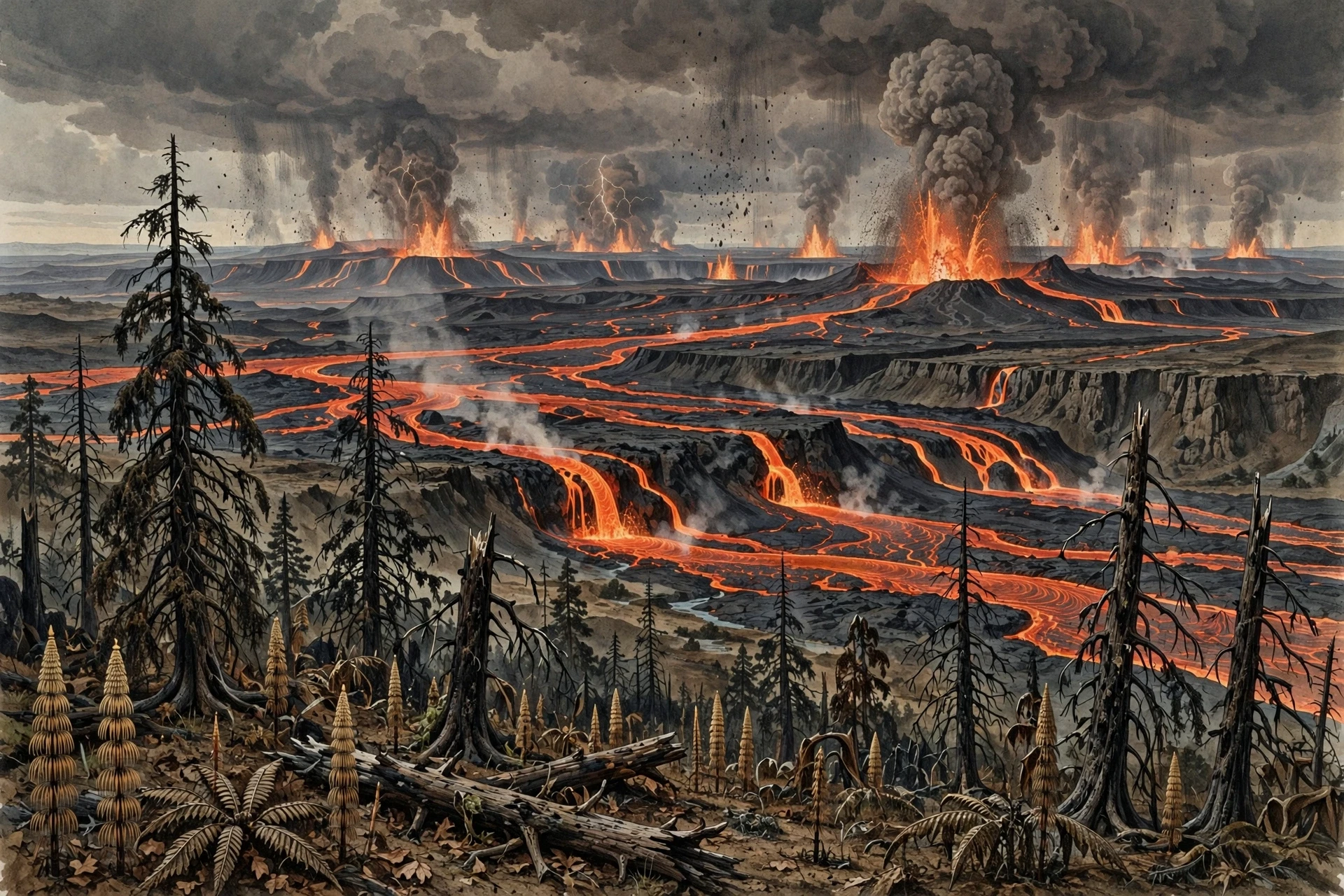
The trigger of the worst of the mass extinctions was a volcanic province of almost unimaginable scale. In what is now Siberia, lava poured out across an area estimated at up to 7 million square kilometres — roughly the size of Australia — building layer upon layer of basalt in a series of eruptions that lasted around a million years, with the most intense phase spanning less than a million years around the Permian–Triassic boundary. The volume of lava is estimated at 1 to 4 million cubic kilometres.
These were not neat cone volcanoes: flood basalts erupt through cracks in the crust, and the lava spreads like spilled syrup. Worse, the Siberian lava rose through thick beds of coal, salt, and carbonate rock, which released enormous quantities of carbon dioxide, methane, sulfur dioxide, and toxic gases when heated — far more than the lava alone could have produced. The volcanoes lit a fuse, and the rocks beneath them supplied the explosives.
The lava was only the visible part. The invisible part — the gases — did the real damage. To understand how volcanoes like these work, see our article on volcanoes.
6.2 The kill cascade
The gases set off a chain of disasters, each one feeding the next. Geologists call it a kill cascade, and the end-Permian version is the most complete example we know.
First came the warming. Carbon dioxide and methane trapped heat, and isotope studies suggest temperatures rose by 8 to 10 degrees Celsius at the boundary, with equatorial seas reaching 32 to 35 degrees. For animals adapted to cooler water, that alone was lethal.
Warm water holds less oxygen than cold water, and warming slowed the ocean's circulation, so oxygen-rich surface water stopped sinking. At the same time, animals' metabolisms sped up in the heat, demanding more oxygen just as less was available. The result was anoxia on a planetary scale, and in places the water turned euxinic, loaded with toxic hydrogen sulfide. Models suggest warming and deoxygenation constricted habitable marine habitat by about 80 percent.
Then the acid arrived. Carbon dioxide dissolving into seawater made the oceans more acidic, attacking the shells and skeletons of anything built from calcium carbonate. On land, acid rain damaged plants, and the loss of vegetation exposed soils to erosion.
Each link in the chain made the next one worse. Warming caused anoxia, anoxia released more hydrogen sulfide, and acidification weakened the creatures that might have ridden out the heat. There was no single killer to dodge. The end-Permian extinction was so thorough because it did not strike one habitat or one group — it struck the chemistry of the planet itself. The carbon cycle sits at the heart of this story — the same cycle that moves carbon between air, ocean, and rock today was pushed violently out of balance. And the warming that drove it is the ancient mirror of the climate change we measure now.
6.3 The victims, and the last trilobite
The sea floor was the worst place to be: reef-builders, brachiopods, crinoids, and bryozoans were devastated. The trilobites deserve a pause. They had appeared in the Cambrian, more than 500 million years earlier, and survived the Ordovician and Devonian crises — yet at the end of the Permian, the last of them vanished. When a group that durable finally goes, you know the rules of the game have changed.
On land, the losses were just as severe. About 70 percent of land vertebrate species died, including most of the big mammal-like reptiles that had dominated Permian ecosystems. Insects — almost untouched by the other mass extinctions — suffered badly, the only one of the Big Five to hit them hard. Forests collapsed across much of the planet.
What survived was a thin remnant. In the seas, a few hardy molluscs and small generalist species carried on. On land, one stocky, tusked herbivore called Lystrosaurus became so common in the aftermath that its fossils dominate earliest Triassic rocks.
6.4 The slowest recovery
The commonly cited range for recovery after the end-Permian extinction is roughly 5 to 10 million years, and the range deserves care. A 1999 study in the Proceedings of the National Academy of Sciences put the reappearance of diverse marine ecosystems at about 5 million years, while a 2012 review in Nature Geoscience by Zhong-Qiang Chen and Michael Benton concluded that full recovery took eight to nine million years, because grim conditions — repeated carbon and oxygen crises, more warming — kept returning for five or six million years after the first wave of extinction. Both numbers are defensible; they measure slightly different things.
And even 10 million years may be too kind. A study of land tetrapods by Sarda Sahney and Michael Benton found that although animal numbers bounced back, the complex communities — the layered food webs, the specialist niches — did not fully recover until about 30 million years later. Recovery is not one event: species counts recover first, and ecosystems take far longer.
Why so slow? Partly because the killing did not stop: the early Triassic was a world of repeated heat spikes and oxygen crises, each one knocking back whatever had started to rebuild. Partly because so little was left to rebuild with — when 96 percent of marine species are gone, the genetic raw material for new diversity is desperately thin.
The Our World in Data summary of the Big Five puts the end-Permian loss at 96 percent of species, the highest of the five by a wide margin. The recovery evidence is reviewed in Phys.org's report on Chen and Benton's 2012 study, and the earlier, shorter estimate is in the Proceedings of the National Academy of Sciences paper on the tempo of extinction and recovery.
7. The Triassic Reset: End-Triassic
The end-Triassic extinction, 201 million years ago, is the least famous of the Big Five mass extinctions, and the most consequential for us. It cleared the stage for the dinosaurs. Without it, the age of dinosaurs might never have happened — and without the dinosaurs' long reign, the world that produced mammals, primates, and us would look very different.
About 80 percent of species were lost, though the toll varied wildly by group. In the seas, roughly a quarter to a third of marine genera disappeared, with reef-builders and shellfish hit hardest. On land, the victims were the animals that had ruled the Triassic. The survivors were the ones history remembers.
7.1 CAMP: the volcanoes that split a supercontinent
The trigger was volcanism again, this time in the Central Atlantic Magmatic Province — CAMP for short. As the supercontinent Pangaea began to split apart, lava poured out across what is now the eastern Americas, western Africa, and Europe, an area spanning four continents. The eruptions released enormous volumes of carbon dioxide and sulfur dioxide, along with toxic mercury that shows up as a spike in sediments worldwide — a volcanic fingerprint preserved in the rocks.
The traditional story was that the carbon dioxide caused runaway warming and ocean acidification, and that killed the victims. That story is still part of the picture, but new research has complicated it. A 2024 study in the Proceedings of the National Academy of Sciences, led by Dennis Kent of Columbia University's Lamont-Doherty Earth Observatory, found that the first CAMP lava pulses were astonishingly fast — five pulses spread over about 40,000 years, each one erupting in less than a century. In such a short burst, sunlight-reflecting sulfate particles would have dominated, plunging the planet into sudden cold rather than heat.
Cold, not warmth, may have been the first killer. That does not discard the warming story: over the longer term, the carbon dioxide still accumulated and the oceans still acidified. But the new work suggests the extinction opened with a series of volcanic winters, and the picture now is a one-two punch: sudden cooling first, then prolonged warming and acid seas. For the details, see the Lamont-Doherty report on the Kent study. And for the basics of how such eruptions work, see our article on volcanoes.
7.2 Who died
The casualty list reads like a roll call of Triassic power. On land, the great amphibians — the temnospondyls, crocodile-sized animals with broad flat heads — were wiped out or reduced to shadows. The phytosaurs, long-snouted semi-aquatic reptiles that looked like crocodiles but were not, went from abundant to extinct. All the large crurotarsans, the non-dinosaurian archosaurs that had been the dominant land predators, died. Several groups of early archosaurs vanished entirely.
In the seas, the conodonts — small eel-like animals whose tooth-like fossils are so useful for dating rocks that geologists mourn them professionally — were completely wiped out, ending a lineage more than 300 million years old. Reef-builders collapsed again, as they had in the Devonian and the Permian. Corals, bivalves, brachiopods, and radiolarians all suffered severe losses.
7.3 The dinosaurs inherit the Earth
The dinosaurs had been around for tens of millions of years before the end-Triassic, but they were bit players: small, feathered, mostly two-legged animals living in the shadow of the crurotarsans and the great amphibians. The extinction changed everything. With their competitors gone and whole ecological niches standing empty, the dinosaurs radiated — spreading into the roles of large herbivore and top predator, growing bigger with each generation, and eventually dominating the land for the next 135 million years.
Crocodylomorphs, pterosaurs, turtles, true lizards, and early mammals also survived, largely because they were small and could shelter in burrows. But it was the dinosaurs that took the largest share of the empty world.
There is a temptation to call this a triumph of the dinosaurs, as if they earned their dominance. They did not. They survived partly by luck — small bodies, burrows, flexible diets — and walked into a world that had been emptied for them. The Triassic reset is the clearest proof that mass extinctions do not reward the best. They reward the survivors, and then evolution does the rest.
8. The Day the Dinosaurs Died: End-Cretaceous
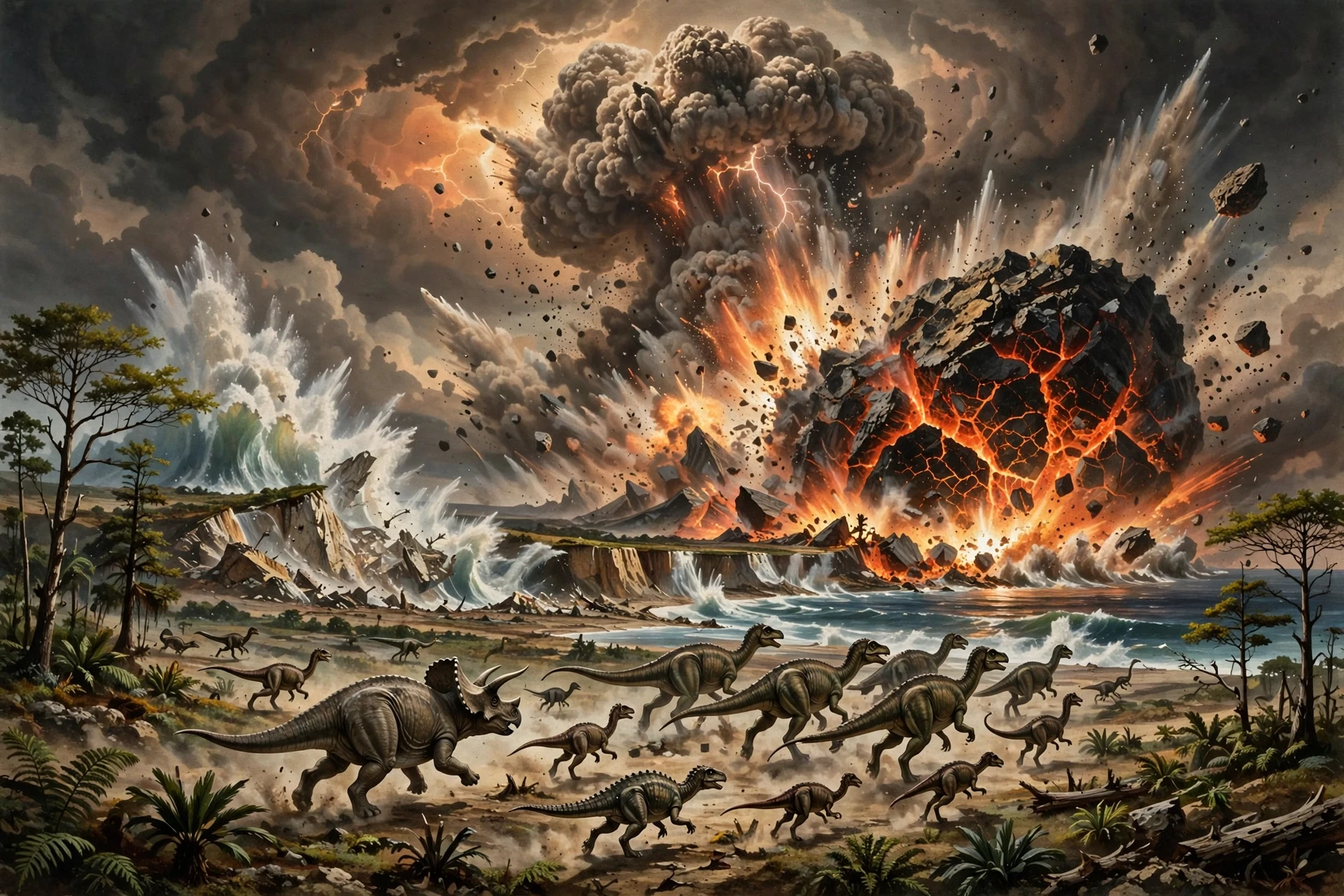
Sixty-six million years ago, an asteroid about 10 to 15 kilometres wide struck the Yucatán Peninsula in Mexico. Within hours, the age of dinosaurs was ending. Within months, most of the planet's forests were gone, photosynthesis had stalled, and food chains were collapsing worldwide. About 76 percent of species died, including every non-avian dinosaur.
This is the best-understood of the mass extinctions, because the evidence is so complete: a crater, a global chemical fingerprint, and a sharp line in the rocks that can be traced across the planet. It is also the one where the debate about causes is most finely balanced, because a second catastrophe — enormous volcanic eruptions in India — was happening at the same time.
8.1 The iridium clue
The story begins not with a crater but with a thin layer of clay. In the late 1970s, geologist Walter Alvarez was studying limestone at Gubbio, in Italy, where a band of clay a few centimetres thick marks the boundary between Cretaceous rocks below and Palaeogene rocks above. Below the clay, dinosaur fossils and diverse microscopic plankton; above it, almost nothing. Walter asked his father Luis, a Nobel Prize-winning physicist, to help measure the clay's chemistry. What they found, published in 1980 with chemists Frank Asaro and Helen Michel, was iridium at about 9 parts per billion — roughly thirty times the level in the limestone above and below.
Iridium is rare on Earth's surface but common in asteroids. The Alvarezes proposed a radical explanation: a huge asteroid had struck the Earth, vaporised, and spread a layer of iridium-rich dust around the globe. The evidence kept accumulating. The iridium layer was found at more than 350 sites worldwide, and shocked quartz — crystals deformed by extreme pressure — turned up in the same layer. Then, in 1991, the crater itself was identified: Chicxulub, buried beneath the Yucatán Peninsula, a structure about 180 kilometres across, exactly the same age as the extinction. Drilling into its peak ring in 2016 confirmed the impact beyond reasonable doubt. The Natural History Museum in London gives a clear account of how the evidence came together.
8.2 A day-by-day catastrophe
I have stood in a museum dinosaur hall and looked up at a skeleton the size of a bus, and felt the usual awe. Then I imagined the last day of the animal it belonged to, and the awe turned into something else. The end of the dinosaurs was not a slow decline. It was a day.
The asteroid struck limestone and sulfate-rich rock at tens of thousands of kilometres per hour. The impact vaporised rock and asteroid alike, excavated the Chicxulub crater, and threw a plume of debris high into the atmosphere. Within minutes, a pulse of thermal radiation scorched the surface for thousands of kilometres around, and a giant tsunami swept across the Gulf of Mexico.
The longer damage was worse. Dust, sulfur aerosols, and soot from burning forests blocked the sunlight, temperatures plunged, and darkness lasted for months. Photosynthesis stopped on land and in the oceans; plants died first, then the plant-eaters, then the meat-eaters. In the seas, the plankton at the base of marine food chains collapsed, and with them the ammonites, the mosasaurs, and the great marine reptiles.
8.3 The Deccan Traps: accomplice or coincidence?
Here the story gets complicated. At the same time as the impact, enormous volcanic eruptions were underway in what is now western India — the Deccan Traps, a flood-basalt province covering about 500,000 square kilometres today (originally perhaps 1.5 million square kilometres), with a volume of over a million cubic kilometres. The main eruptions began roughly 250,000 years before the extinction and released more than a million cubic kilometres of lava over about 750,000 years, and volcanic gases would have warmed the climate, acidified the oceans, and stressed ecosystems for a long time before the asteroid arrived.
So which killed the dinosaurs: the rock from space, or the volcanoes? The current consensus is clear. In 2010, an international panel of 41 scientists reviewed two decades of evidence and formally endorsed the Chicxulub impact as the cause, ruling out volcanism as the primary driver. The timing is decisive: the extinction horizon matches the impact layer precisely, worldwide, while argon–argon dating (Sprain et al. 2019) indicates about three quarters of the Deccan lava erupted after the extinction — though uranium–lead dating (Schoene et al. 2019) resolves four eruptive pulses straddling the boundary, so the exact split is still debated.
But the debate is not closed. Some researchers, notably palaeontologist Gerta Keller, have argued that Deccan volcanism deserves more weight, pointing to signs of ecological stress before the impact. More recent work proposes a middle position: the impact may have intensified the Deccan eruptions, making the two mechanisms connected rather than rivals. Even in the impact-centred view, the volcanoes probably mattered — strained ecosystems absorb a blow less well, and the eruptions that continued afterwards likely slowed the recovery.
The fair summary: the asteroid was the trigger and the main killer; the Deccan Traps were a contributing stress that may have weakened the world before the blow and hindered its healing after it. The balance of the evidence is the same: the Deccan Traps were erupting at the time but were likely not the ultimate cause. For the wider story of these visitors from space, see our article on comets and asteroids.
8.4 What survived, and why
The survivors share a pattern, and it is the same pattern we saw at the end of the Triassic: small, flexible, sheltered.
Birds survived — the only dinosaurs that did. But not all birds made it: the tree-dwelling species, which lost their forests, mostly died. The survivors were largely ground-dwelling birds, ancestors of today's ducks, chickens, and ostriches — and seeds, a food source that stays edible long after green plants are gone, were still available to them.
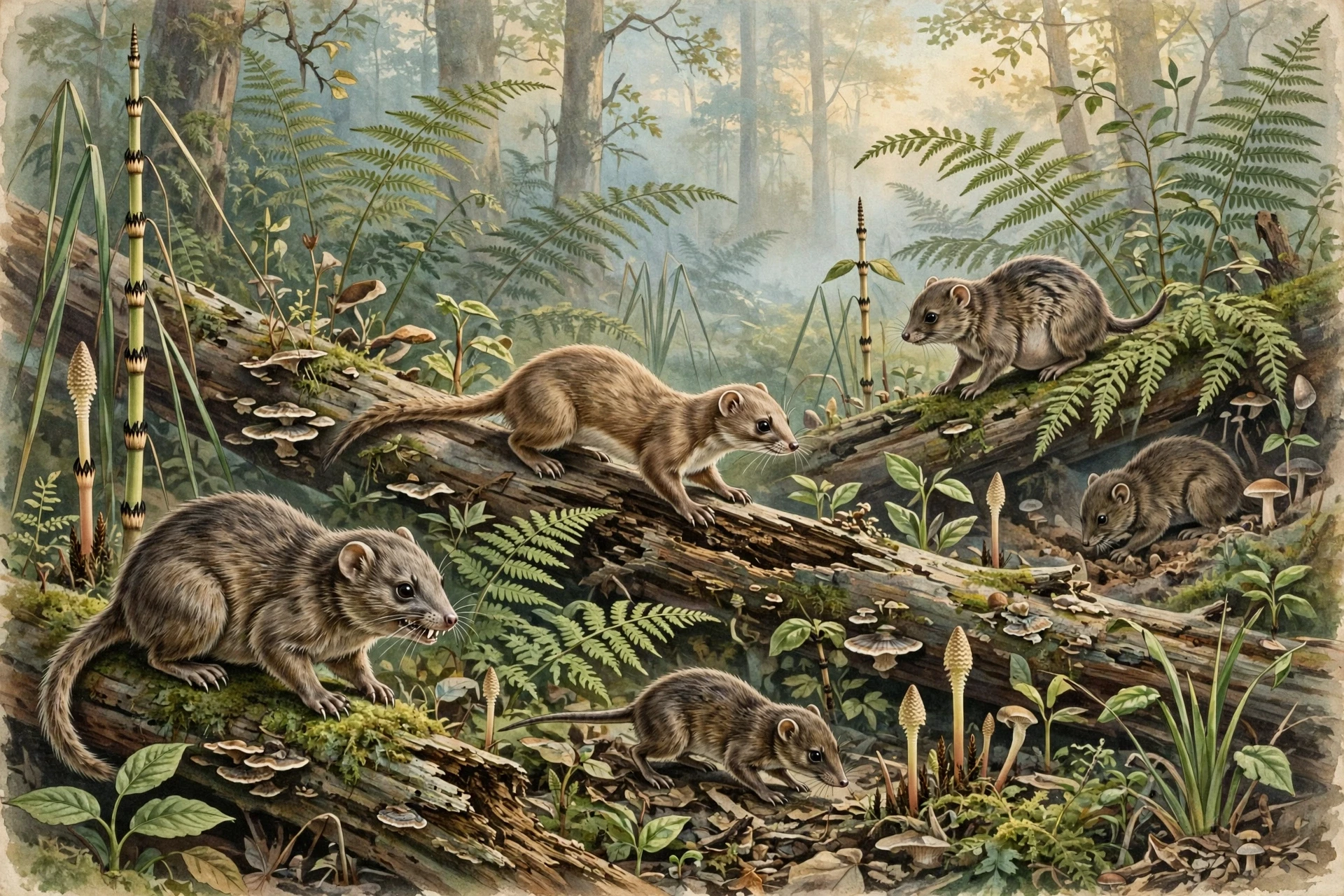
Mammals survived because they were small, many of them nocturnal, and some could burrow underground. A shrew-sized animal needs little food, can hide from heat and cold, and can eat insects, seeds, and roots when nothing else is available — though survival was far from guaranteed: one fossil study of North American mammals found that only four of 59 recorded species made it across the boundary.
Crocodiles survived because they live partly in water, which buffers temperature swings. As cold-blooded animals they need far less food than warm-blooded ones, and can go months without eating. Their food chains were based on detritus — dead organic matter washing into rivers and lakes — rather than living plants, so they had something to eat while photosynthesis was stalled. The same detritus-based food chains protected turtles, frogs, and many freshwater fish.
And then, in the silence that followed, the mammals did what the dinosaurs had done after the Triassic: they walked into an empty world and filled it. Within a few million years they were growing larger, diversifying into every niche the dinosaurs had left behind. We are the descendants of those small, burrowing survivors — every human alive today owes their existence to a shrew-sized animal that could hide, wait, and eat seeds in the dark. That is the strangest fact in the whole story of mass extinctions: the worst day in the history of life was also, by a very long chain of consequence, the day that made us possible.
9. What Kills a Planet? The Kill Mechanisms
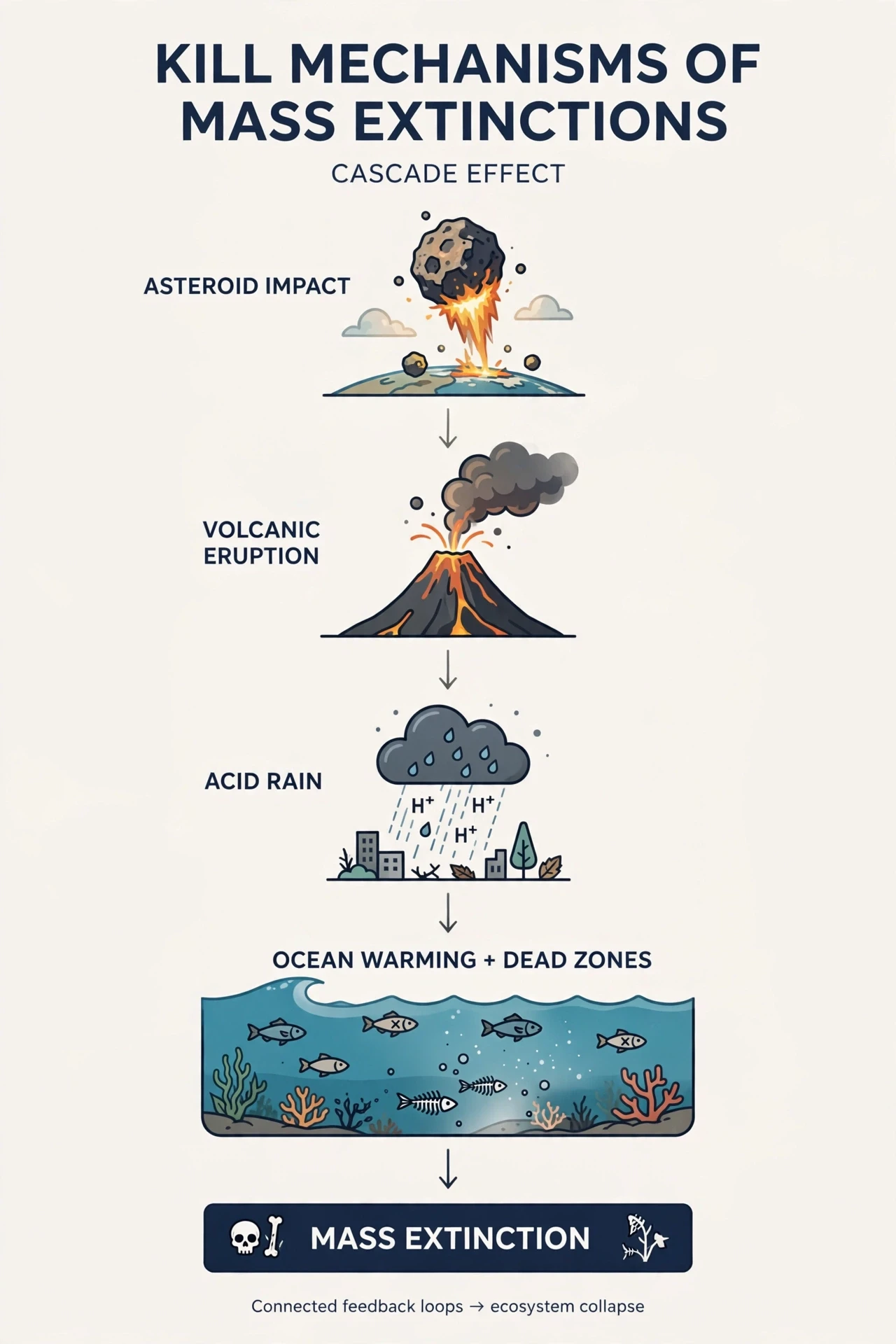
No single weapon kills a planet. Mass extinctions are caused by triggers — volcanoes, asteroids, climate swings — that set off chains of secondary disasters in the oceans and on land, and it is the chain, not the first blow, that does most of the killing.
Ask what killed the dinosaurs, or what killed almost everything at the end of the Permian, and you will get a short answer that sounds complete. An asteroid. A volcano. Neither answer, on its own, explains the pattern of death. Why did some groups vanish while close relatives survived? Why did the dying go on long after the trigger? The fossil record keeps giving the same reply: the trigger starts the story, and the cascade finishes it.
9.1 Volcanoes That Lasted a Million Years
The deadliest volcanoes behind mass extinctions were nothing like the cone-shaped mountains most of us picture. Flood basalts erupt through cracks in the crust, pouring lava across whole continents for hundreds of thousands of years. The Siberian Traps, the prime suspect in the end-Permian extinction, covered about seven million square kilometres of basalt, and the eruptions went on for roughly a million years.
Lava alone did not kill 96 per cent of marine species. The gases did. Carbon dioxide warmed the planet — estimates put the warming at roughly eight to ten degrees Celsius at the end of the Permian — while sulfur dioxide formed sulfate aerosols that cooled the surface briefly, then fell as acid rain. Volcanic gases also attacked the ozone layer, and where hot magma met coal beds, still more greenhouse gas poured into the air. The Central Atlantic Magmatic Province did something similar at the end of the Triassic, around 201 million years ago, wiping out about 80 per cent of species.
9.2 The Impact: Fast, Brutal, and Global
An asteroid strike works on the opposite timescale. The Chicxulub impactor, ten to fifteen kilometres wide, hit the Yucatán Peninsula 66 million years ago and released its energy in seconds. The blast, the tsunamis, and the wildfires were local horrors. What made it a global killer was what went up into the sky: pulverised rock and sulfur-rich vapour that spread around the planet, blocking sunlight. Photosynthesis faltered, temperatures dropped sharply for months to years — an impact winter — and food chains collapsed from the top and the bottom at once.
Yet an impact, like a volcano, rarely kills alone — which is why mass extinctions are so hard to pin on a single cause. The Deccan Traps in India were erupting around the same time as Chicxulub, and researchers still argue about how much they contributed. The current consensus is that the impact was the decisive blow for the dinosaurs, with volcanism possibly stressing ecosystems beforehand.
9.3 The Oceans Turn Hostile
Most mass extinctions hit the sea hardest. Warm water holds less dissolved oxygen than cold water, so as the climate warms, oxygen drains out of the oceans. Extra nutrients washing off the land feed algal blooms; when the algae die and sink, bacteria consume still more oxygen as they rot. The result is anoxia — dead zones where almost nothing with gills can live.
Ocean acidification works in parallel. Carbon dioxide dissolving in seawater forms carbonic acid, which makes it harder for corals, shellfish, and plankton to build shells of calcium carbonate. Reef builders are among the first to go, and reefs are the nurseries of the sea. Lose the reef, and you lose the species that depended on it. Oceanography shows how tightly currents, chemistry, and life are bound together — change one, and the others follow. Sea level adds another twist: when ice sheets grew during the end-Ordovician glaciation around 444 million years ago, shallow seas drained off the continents, and the rich shelf habitats where most marine species lived simply disappeared.
9.4 The Cascade: Why One Trigger Is Never the Whole Story
A trigger changes the climate. The climate changes the oceans. The oceans change the chemistry. The chemistry starves the base of the food web, and the collapse climbs upward, species by species. Ecosystems are webs, not piles — pull one thread hard enough, and the whole structure distorts. The table below compares the main kill mechanisms. Notice how many appear in more than one extinction. The Big Five mass extinctions had different triggers, yet they killed through a small, recurring set of mechanisms. Our World in Data sets out the five events, their dates, and their proposed causes in the same terms.
Kill mechanism | How it kills | Main victims | Seen in |
|---|---|---|---|
Large-scale volcanism | Greenhouse warming, acid rain, ozone damage | Reef builders, tropical species, land plants | End-Permian, End-Triassic |
Asteroid impact | Impact winter, darkness, collapse of photosynthesis | Large land animals, plankton food webs | End-Cretaceous |
Ocean anoxia | Warm water loses dissolved oxygen; dead zones spread | Marine animals, especially bottom-dwellers | End-Permian, Late Devonian |
Ocean acidification | Carbon dioxide makes shell-building difficult | Corals, shellfish, shelled plankton | End-Permian, End-Triassic |
Climate swings | Rapid warming or cooling beyond tolerance | Species with narrow temperature ranges | All five |
Sea-level change | Falling seas drain shallow shelf habitats | Shallow-marine species, reef communities | End-Ordovician, Late Devonian |
Food-web collapse | Loss of plankton or plants starves everything above | Large predators, specialists | All five |
10. After the Fall: How Life Recovers
Recovery after mass extinctions is slow, uneven, and strange. Simple opportunists take over first, diversity returns over millions of years, and the world that emerges is never the world that was lost. The Permian took millions of years to heal, the Cretaceous was faster, and in both cases different species filled the empty niches.
Recovery does not start with a grand rebuilding. It starts with weeds. After a catastrophe, the species that thrive are the tough generalists — small, fast-breeding, unfussy about food — that can live in a broken world. Palaeontologists call them disaster taxa, the ecological equivalent of dandelions pushing through cracked pavement. Recovery has no single speed, and it never means return. Extinct species do not come back. The niches they left are filled by different animals, with different bodies, living different lives. Life recovers by becoming something new.
10.1 The Age of the Opportunists
I still remember standing in front of a museum display of Early Triassic fossils and feeling how empty it looked. Case after case held the same few animals, over and over — above all Lystrosaurus, a barrel-chested, pig-sized plant-eater with a beak and tusks, a distant relative of mammals. In the Permian it had been a minor player. After the Great Dying, it was everywhere, dominating the land vertebrate record of the Early Triassic while almost everything else was gone.
Lystrosaurus is often called a disaster taxon, but that label does not quite fit: Lystrosaurus could burrow, eat a wide range of plants, and live where pickier animals could not. It did not win a contest. It inherited a world where the contest had been cancelled. Modesto (2020) concluded the genus does not meet the strict definition of a disaster taxon — its abundance peaked during recovery rather than in the immediate survival interval — so it is better described as an opportunistic survivor. The broader picture stands. The first chapter after a catastrophe belongs to generalists. In the sea, small, simple bivalves spread across empty seafloors, and microbial reefs replaced the coral reefs that had taken millions of years to build.
10.2 How Long Does Recovery Take?
It depends on what you measure. If you count species numbers, recovery after mass extinctions can look quick. If you count complex, stable ecosystems with predators, prey, and reef builders all in place, it looks very slow indeed.
The end-Permian extinction is the slowest case we know. Ammonoids and some other fast-evolving groups diversified again within one to three million years. But extinctions kept happening through the Early Triassic, and a stable, complex ecosystem did not re-emerge until the beginning of the Middle Triassic, roughly eight to nine million years after the crisis, according to a review by Zhong-Qiang Chen and Michael Benton. Full recovery took some eight to nine million years in the sea, and the same or longer on land. Reefs were gone for roughly ten million years.
The end-Cretaceous recovery was faster, and the contrast is instructive. Within about 100,000 years after the impact, the number of mammal species at Corral Bluffs in Colorado had doubled, and mammals had almost regained the size of their pre-extinction ancestors. Within 700,000 years, some mammals were about 100 times as heavy as the small survivors of the impact. Why the difference? Severity matters: the Permian removed about 96 per cent of marine species, leaving almost nothing to rebuild from, while the Cretaceous removed about 76 per cent, leaving survivors in most major groups. Duration matters too. The Siberian Traps kept erupting for millions of years after the first deaths. Chicxulub was one terrible day, followed by a world that could begin to settle.
10.3 Empty Niches and the Mammal Inheritance
A niche is not a job posting waiting to be filled. It is a way of life: a food source, a habitat, a time of day, a body size. When dinosaurs vanished, they left behind the daytime, large-bodied ways of life that small, mostly nocturnal mammals had never been able to occupy. Mammals did not suddenly become better animals. They became freer ones.
With the big predators gone, mammal lineages split and specialised at a remarkable pace. Rates of morphological evolution in placental mammals in the five million years immediately after the extinction were about three times higher than background Cretaceous rates. Over the next millions of years, their descendants became whales, bats, horses, elephants — and, much later, primates. Speciation is the engine of that filling-in: isolated populations adapting to different niches until they can no longer interbreed. The fossil evidence for this rapid rise is reviewed in The rise of the mammals.
There is a quiet warning here. If recovery from the worst extinction took eight to ten million years, and even the "fast" recovery after the dinosaurs took hundreds of thousands of years, then the diversity we lose now is not coming back on any timescale that matters to us.
11. Extinction Is Not Always Bad? What Mass Extinctions Teach Evolution
Mass extinctions destroy, and that destruction has repeatedly redirected evolution. Without the asteroid that ended the dinosaurs, mammals would likely never have risen — and neither would we. That does not make extinction good, but it does make it a powerful filter, and understanding what it selects for explains why our own existence was contingent, not inevitable.
That claim makes people uncomfortable, and it should. It sounds as if mass death were somehow good, or justified, or part of a plan. It is none of those things. Extinction is not a moral teacher. It is a filter, and a blind one. But filters shape what passes through them, and the history of life cannot be understood without asking what the filter selected for — and what it selected against.
The key idea is contingency: the outcome of evolution depends on history, not just on which traits are "best" in some abstract sense. A trait that is useless in a stable world can be the difference between life and death when the world breaks. A lineage that dominated for about 135 million years can vanish in a geological instant. Evolution is not a march toward perfection. It is a walk through accidents, and mass extinctions are the biggest accidents of all.
11.1 Replaying the Tape
Stephen Jay Gould, the palaeontologist and writer, gave this idea its most famous image in his 1989 book Wonderful Life. Rewind the tape of life, he said, erase everything that happened, and play it again. Would you get the same world? Gould doubted it. "Replay the tape a million times from a Burgess beginning," he mused, "and I doubt that anything like Homo sapiens would ever evolve again."
The argument is not that evolution is random. Natural selection is a real, directional force. The argument is that selection can only work with the survivors history hands it. If a different set of small animals had survived the end-Cretaceous extinction, selection would have shaped them into a different world. The rules would be the same. The players would not. Small-scale replays of evolution — in laboratory bacteria, in island lizards — often produce similar solutions again, so some outcomes are repeatable. But the big branch points decided by mass extinctions look far less repeatable: one asteroid reversed about 135 million years of dinosaur dominance, and a rock missing its target by a few hours could have left our era to someone else entirely.
11.2 Creative Destruction — With the Emphasis on Destruction
Economists have a phrase, creative destruction, for how new industries replace old ones. Palaeontologists borrowed it, cautiously, for mass extinctions. The old rulers die. New groups radiate into the empty space. Diversity eventually exceeds what came before. The pattern is real — as long as the word "creative" never makes us forget the cost.
Each of the Big Five mass extinctions cleared space the same way: the Great Dying ended the trilobites and opened the Triassic to the archosaurs — the group that would produce dinosaurs — and, eventually, mammals; the end-Triassic removed the dinosaurs' competitors; the end-Cretaceous did the same for mammals.
None of this was progress in the sense of a ladder. It was replacement. The new groups were not "better" in any absolute sense; they were better suited to the new world, or simply present when the old world ended. And the replacement took millions of years of low diversity and fragile ecosystems before anything like richness returned. Calling that "good" would be like calling a house fire good because the rebuilt house has a nicer kitchen.
11.3 What Mass Extinctions Select For
If mass extinctions are filters, what passes through them? The fossil record gives a surprisingly consistent answer, and it is humbling for anyone who likes to think of evolution as a contest of strength. Small bodies pass through more easily than large ones, because small animals need less food. Generalist diets beat specialist ones, because the specialist's one food source may vanish. Burrowing, hibernation, and living in water all help, because they buffer an animal from heat, cold, and darkness. Wide geographic ranges help, and fast reproduction helps, because a population that can rebuild quickly has a second chance that a slow-breeding one does not.
Notice what is missing from that list: intelligence, speed, power, beauty. The traits that dominate nature documentaries are the traits that mass extinctions punish most. The largest, most specialised predators are usually the first to go. The survivors are the modest, the flexible, the ones that can eat almost anything and live almost anywhere. Resilience looks less like a lion than like a rat, a cockroach, or a fern.
That is also why mass extinctions matter for understanding our own story. Human evolution begins, in a real sense, with a small, shrew-like mammal surviving a catastrophe it could not have understood, eating insects and seeds while giants died around it. We are not the inevitable crown of creation. We are the descendants of a survivor. And speciation after the extinction — the splitting of mammal lineages into new species over millions of years — is what turned that survivor into whales, bats, horses, and eventually us. Contingency made us possible. It did not make us inevitable.
12. The Sixth Extinction: Are We in One?
The numbers say extinction rates are far above the background rate — one of the patterns that defines mass extinctions — with vertebrate losses running up to 100 times faster than expected, and one million species threatened. Whether that adds up to a sixth mass extinction is a real scientific debate, and the honest answer depends on how the term is defined.
This is the section where the article stops being only about the deep past. The first five mass extinctions were caused by volcanoes, asteroids, and ice ages. The possible sixth has a different cause, and we know its name, because it is us. That makes the question personal in a way the others are not — which is exactly why it needs care.
12.1 What Ceballos and Colleagues Actually Found
In 2015, Gerardo Ceballos and colleagues published a study in Science Advances that deliberately stacked the deck against its own conclusion. They used a background extinction rate of 2 extinctions per million species per year — twice as high as widely used earlier estimates — so that any excess they found could not be dismissed as an artefact of a low background rate.
The result was stark. Even under those cautious assumptions, the average rate of vertebrate species loss over the last century was up to 100 times higher than the background rate. Under the background rate, the species that have gone extinct in the last century would have taken between 800 and 10,000 years to disappear, depending on the vertebrate group. The study counted 338 vertebrate extinctions documented since 1500, and 617 when species listed as extinct in the wild or possibly extinct were included. Since 1900 alone, 468 more vertebrates went extinct than would have been expected if the background rate had persisted.
"Even under our assumptions, which would tend to minimize evidence of an incipient mass extinction, the average rate of vertebrate species loss over the last century is up to 100 times higher than the background rate." — Ceballos et al., Science Advances, 2015
The full study is freely available through PubMed Central.
12.2 The IPBES Assessment: One Million Species at Risk
Four years later, the Intergovernmental Science-Policy Platform on Biodiversity and Ecosystem Services — IPBES — published the most comprehensive assessment of nature ever completed. It was compiled by 145 expert authors from 50 countries, drawing on about 15,000 scientific and government sources. Its findings, released in May 2019, put the Ceballos numbers into a wider picture.
The headline finding was that around one million animal and plant species are now threatened with extinction, many within decades — more than ever before in human history. The current rate of global species extinction is tens to hundreds of times higher than the average over the past 10 million years, and the rate is accelerating.
Those numbers are about threat, not yet about completed extinctions, and the distinction matters. A threatened species is not an extinct species. The IPBES figure means that a million species are on a path that could end in extinction if present pressures continue — habitat loss, overexploitation, climate change, pollution, and invasive species. You can read the assessment itself at IPBES, and the United Nations summary at the UN.
12.3 The Honest Debate
So are we in a sixth mass extinction? Here is where honesty requires slowing down. The case for "yes" rests on rates: modern extinction rates, measured against the background rate, are elevated to a degree seen only during mass extinctions. The case for "not yet" rests on magnitude: a mass extinction, by the usual definition, means losing at least 75 per cent of species in a geologically short time, and we have not lost anything close to that fraction of known species. Less than 0.1 per cent of Earth's known species have gone extinct in the last 500 years, according to critics of the label.
Both sides have a point, and both sides are partly talking past each other. The argument turns on three questions.
Rates or totals? If mass extinctions are defined by how fast species are being lost relative to the background, the modern rate already qualifies. If it is defined by the total share of species lost so far, it does not — yet.
Species or populations? Documented species extinctions are only the visible tip. Population losses — local extinctions that erode a species' range, genetic diversity, and ecological role — are far more widespread. A critic can fairly say that species counts understate the damage; a sceptic can fairly reply that population loss is not the same as species loss.
Projection or observation? Barnosky and colleagues, in a widely cited 2011 Nature paper, concluded that recent species loss was dramatic and serious but not yet in the mass extinction category — while warning that if currently threatened species actually went extinct, and that rate continued, the sixth mass extinction could arrive within centuries. That "could" is doing a lot of work. It depends on what we do next, which is precisely what makes the debate different from arguing about the Permian. The Permian is finished. This one is still being written.
A 2025 critique in Trends in Ecology and Evolution pressed the sceptical case further, arguing that no plausible scenario for 75 per cent species loss has been proposed, and that overstating the claim risks the credibility of conservation science. Their full argument is available as a PDF.
Where does that leave us? With a distinction that is less satisfying than a slogan, but closer to the truth. By the rate criterion, we are in mass-extinction territory. By the magnitude criterion, we are not there yet — we are on the road toward it, moving fast, with the destination still avoidable. That is not a comfortable place to stand. It is the only honest one.
13. The Human Drivers
The five drivers behind today's losses are not mysterious forces. They are things people do every day: clearing land, taking too much, warming the climate, fouling water and soil, and moving species where they do not belong. The IPBES Global Assessment of 2019 ranked them, and the ranking still holds.
13.1 Land- and Sea-Use Change
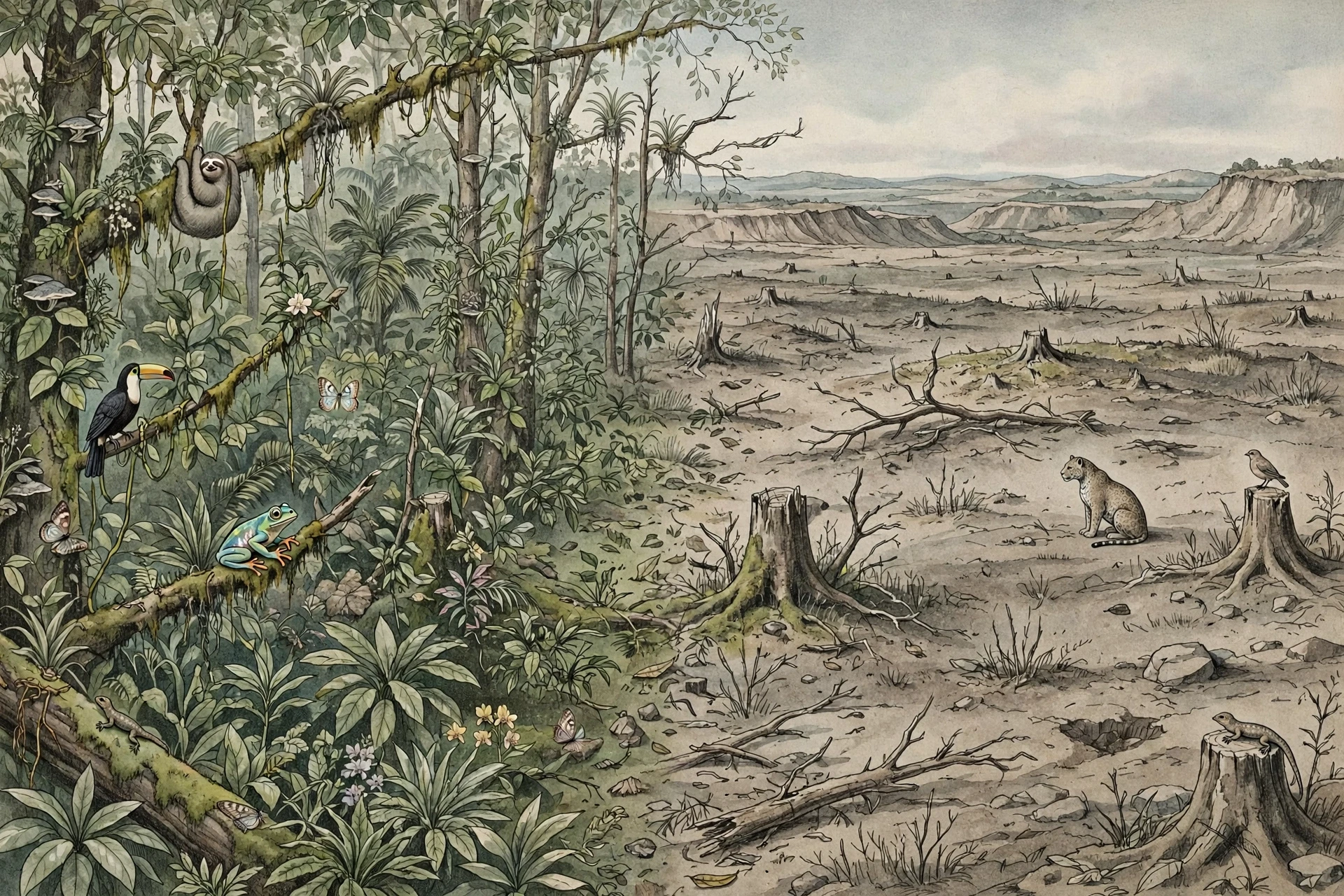
The largest driver is also the most visible. Forests fall for farms, cattle pasture, palm oil, and cities. Grasslands are ploughed. Wetlands are drained. At sea, trawlers drag nets across the seabed and scrape away habitats that took centuries to grow. When a habitat shrinks, the species that need it shrink with it, and the ones that need large, unbroken ranges go first.
I have stood at a forest edge where the trees simply stopped, as if cut with a ruler, and the silence on the cleared side was the first thing I noticed. No birdsong. No insects humming. That edge is where extinction begins — not with a dramatic event, but with a boundary drawn across a home range.
Tropical rainforests carry the heaviest losses because they hold the most species in the smallest areas. Clear one such valley and its unique species have nowhere to go. Habitat loss is the driver that makes all the others worse, because a species with nowhere to live cannot survive a drought, a disease, or a new predator.
13.2 Direct Exploitation
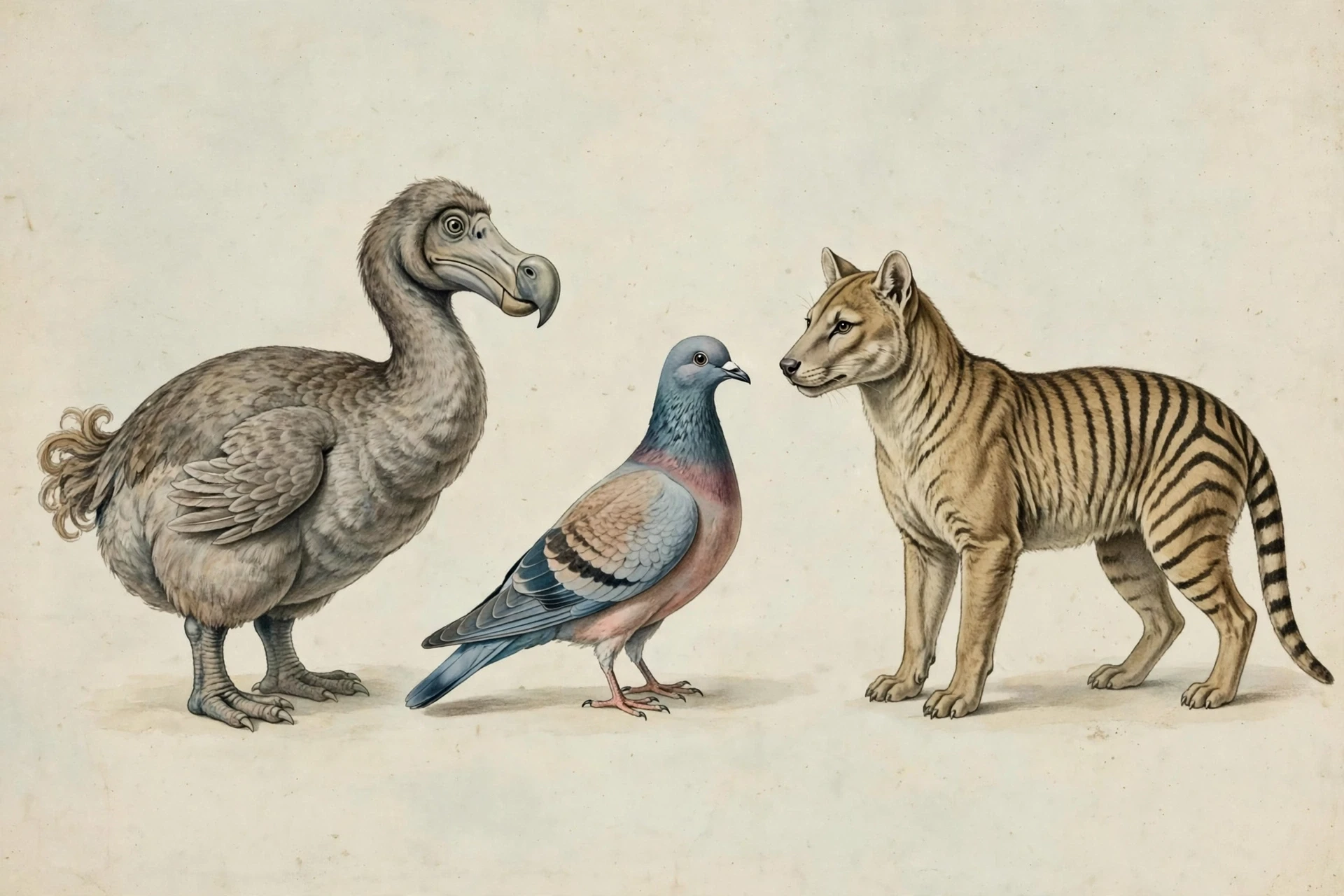
The second driver is taking too much, too fast. Hunting, fishing, logging, and the wildlife trade have emptied landscapes that once seemed inexhaustible. The passenger pigeon is the starkest case. Flocks once numbered in the billions. Market hunters shot them by the wagonload. The last wild birds were gone by around 1900, and Martha, the last known individual, died in the Cincinnati Zoo on 1 September 1914.
The thylacine, the striped marsupial wolf of Tasmania, followed a similar path. Bounties paid for dead animals, on top of habitat loss, drove it down until the last known individual died in Hobart Zoo on 7 September 1936. The dodo went earlier and faster: flightless, fearless, and confined to Mauritius, it was last reliably seen in 1662, within decades of Dutch sailors first landing there. Hunting finished some, but the rats, pigs, and monkeys sailors brought ashore ate the eggs and chicks.
Overfishing works the same way underwater, only less visibly. A fishery can look healthy while the biggest, oldest fish are stripped out, until the breeding stock collapses and the catch falls off a cliff. Direct exploitation is the driver we have controlled most successfully where laws are enforced.
13.3 Climate Change
Climate change is the driver that reaches everywhere, even places no one has cleared or hunted. Warmer seas bleach coral reefs: stressed corals expel the algae that feed them and turn bone white. NOAA confirmed the fourth global bleaching event in April 2024, and by the time it likely ended in mid-2025, bleaching-level heat stress had touched about 84 percent of the world's coral reef area, in all three ocean basins.
The golden toad of Costa Rica shows how climate can kill in subtler ways. This small, bright-orange amphibian lived only in the Monteverde cloud forest. After a dry, warm spell in the late 1980s, its breeding pools failed — and a fungal disease, chytridiomycosis, swept through the weakened population. Climate change is widely blamed, though researchers still debate whether warming or the fungus's own spread was the decisive factor. The last one was seen on 15 May 1989. No one hunted it. No one cleared its forest. The weather changed, the disease followed, and a species that had lived in one small valley for thousands of years was gone.
Warming also moves the goalposts. Read how warming reshapes living systems in our climate change article. Climate change rarely acts alone: it weakens populations already stressed by habitat loss, then a heatwave or disease finishes the job.
13.4 Pollution
Pollution kills in ways that are easy to miss because the damage is often invisible. Fertilisers wash off fields into rivers and coastal seas, feeding algal blooms that suck oxygen from the water and leave dead zones where fish cannot breathe. Pesticides poison pollinating insects; plastics fill the stomachs of seabirds and turtles.
The most famous pollution story is also a hopeful one. The pesticide DDT thinned the eggs of bald eagles and peregrine falcons until their populations crashed across North America. When DDT was banned, the birds came back. That is the pattern with pollution: it is often reversible, once the source is stopped. New chemicals keep arriving faster than they are tested, and many do not break down at all.
13.5 Invasive Alien Species
The final driver is the species we carry with us. Rats on islands, cats in Australia, cane toads, zebra mussels in the Great Lakes, lionfish in the Caribbean: each one arrived because people moved it, deliberately or by accident, and each one found a place with no predators and no defences against it. Island species are the most vulnerable, having evolved without such predators.
On Guam, the brown tree snake has wiped out most native forest birds, and in Australia feral cats kill millions of native animals every night. Once an invasive species is established, removing it is brutally hard and sometimes impossible.
The five drivers rarely work alone. A forest is cleared, fragments dry out, an invasive grass moves in, a fire follows. That is why IPBES lists them together. The variety of life under threat is the subject of our biodiversity article, and the pattern is the same everywhere: the pressures stack.
14. Counting the Losses: How Bad Is It, Really?
The headline numbers behind the mass extinctions debate are stark: about one million species at risk of extinction, and roughly a quarter of assessed plant and animal species threatened. Those figures come from IPBES, and they are the best estimates we have. They are also easy to misunderstand, so this section takes them apart carefully.
14.1 The Headline Numbers
The IPBES Global Assessment of 2019 estimated that around one million animal and plant species are threatened with extinction, many within decades, unless the drivers of loss are reduced. Across the groups assessed in enough detail, about 25 percent of species are threatened, and IPBES applied that share to the estimated eight million animal and plant species on Earth, using a lower figure for insects, where data are sparse.
The IUCN Red List gives the same picture in sharper focus. In its update of 10 October 2025, the Red List included 172,620 assessed species, of which 48,646 were threatened with extinction — listed as Vulnerable, Endangered, or Critically Endangered, about 28 percent of assessed species. The Red List homepage has since passed 49,500 threatened species, out of more than 175,900 assessed. Amphibians (about 41 percent threatened), reef-forming corals (44 percent), and cycads (71 percent) are hit hardest.
14.2 The Living Planet Index
The Living Planet Index, published by WWF with the Zoological Society of London, measures something different: not how many species are threatened, but how populations are doing. The 2024 Living Planet Report found that the average size of monitored wildlife populations fell by 73 percent between 1970 and 2020. The index tracks almost 35,000 population trends across 5,495 vertebrate species.
That 73 percent figure is widely quoted and widely misread. It does not mean that 73 percent of animals have died, or that 73 percent of species are gone. It means that the average monitored population is now less than a third of the size it was in 1970. Freshwater populations fell most, down 85 percent; terrestrial fell 69 percent, marine 56 percent, and Latin America and the Caribbean recorded the steepest regional decline, at 95 percent.
The index matters because it catches trouble early: a population shrunk to a tenth of its former size is far more vulnerable to the next drought, disease, or storm. Population decline is the warning light; extinction is what happens when it is ignored.
14.3 What the Numbers Do and Do Not Prove
Big numbers persuade, and they also mislead. The one-million figure is an estimate built on an estimate: the total number of species on Earth is itself uncertain, and the share threatened is extrapolated from the groups we know best. IPBES chose cautious assumptions, and its authors said so plainly.
The Red List numbers have the opposite bias. They count only species that have been assessed, and assessment favours species we already suspect are in trouble. That pushes the threatened share up. At the same time, thousands of species go extinct before anyone assesses them, especially in tropical forests and the deep sea, and those losses never enter the count. The two biases pull in opposite directions.
What the numbers do prove is the direction and the speed. Every independent measure — Red List assessments, population trends, habitat loss, extinction rates measured against the fossil background — points the same way, and the rate is far above background. The Ceballos team showed in 2015 that vertebrate losses in the last century ran up to a hundred times the background rate, even under deliberately cautious assumptions. The debate is about how far above background we are, and whether the label "sixth mass extinction" fits yet. It is not about whether the losses are real.
14.4 Defaunation: Why Population Losses Matter as Much as Species Losses
There is a quieter crisis behind the extinction numbers, and it has its own name: defaunation, the emptying of landscapes of their animals. A forest can keep all its tree species and still be empty — no monkeys, no hornbills, no big cats — because hunting and fragmentation have stripped the animals out while the trees stand. Ecologists call these "empty forests," and they are spreading.
Defaunation matters because animals do work: fruit-eaters spread seeds, and without them the trees that depend on them fail to regenerate. Predators keep herbivores in check; without them, grazers strip the vegetation. Lose the animals and the ecosystem unravels from the inside, even if no species has formally gone extinct.
This is why population losses deserve as much attention as species losses: a species reduced to a few hundred individuals in one reserve is technically alive, but it has stopped doing its job in the wild. The goal is living, working populations in living landscapes — the same variety of life explored in our biodiversity article — and the coral reefs that support a quarter of marine life show what is at stake when those populations collapse.
15. Can We Stop It? Conservation That Works
Yes — partly, and only if we are honest about what works, what does not, and what it costs. Conservation has real wins behind it, and they share a pattern: the threat was identified, the action was sustained for decades, and someone kept paying for it.
15.1 Protected Areas: The First Line of Defence
Protected areas are the oldest tool in conservation, and still the most important. A well-managed reserve keeps habitat intact, and intact habitat keeps species alive. The evidence is clear: species inside well-managed protected areas do better than the same species outside them.
But a line on a map is not protection. Many reserves exist only on paper, with no staff, no budget, and no enforcement — "paper parks" that are logged, poached, and mined as if the boundary did not exist. Others are too small or isolated for wide-ranging animals to find food or mates. The best reserves are large, connected to other wild areas by corridors, and managed with the people who live nearby, not against them. Where local communities benefit, protection lasts; where they are excluded, it does not.
15.2 Captive Breeding and Rewilding
When a species has fallen too far for habitat protection alone, captive breeding can buy time. The California condor is the most famous case. In 1987 the entire species stood at 27 birds, all in captivity, after the last wild bird was captured for breeding. As of 31 December 2025, the world population stood at 607 birds, with 392 flying free. That is a genuine rescue — and a warning: wild condors still die faster than they breed, largely from lead in hunter-shot carcasses, and the flocks grow only because more birds are released each year.
The black-footed ferret tells a similar story on a smaller scale. A small population found in Wyoming in 1981 supplied 18 animals captured for captive breeding between 1985 and 1987. Today several hundred live in the wild across dozens of reintroduction sites, all descended from just seven breeding founders, and the recovery goal is three thousand free-ranging breeding adults.
Rewilding goes a step further: putting species back where they were lost, so they can resume their ecological work. The grey wolf's return to Yellowstone is the textbook case. Fourteen wolves were brought from Canada in January 1995, and 17 more followed in 1996, 31 in total. Within a few years the population was growing and elk behaviour changed, letting streamside willows and aspens recover. The scale of that cascade is still argued over — some early claims were overstated — but the wolves themselves are firmly back, and the park is wilder for it.
15.3 The 30×30 Target
In December 2022, governments adopted the Kunming-Montreal Global Biodiversity Framework, and its best-known commitment is Target 3: conserve at least 30 percent of land, inland waters, and oceans by 2030, through protected areas and other effective conservation measures. It is known as 30×30, and it is the most ambitious conservation target ever agreed.
Progress is real but slow: as of September 2026, protected and conserved areas covered about 18.45 percent of land and inland waters and about 10 percent of marine and coastal areas, leaving a large gap — widest at sea. The target also demands that the 30 percent be well chosen — the places that matter most for species, connected to each other, and governed fairly, with Indigenous peoples' rights respected.
15.4 What Works, What Does Not, and What It Costs
What works is now well documented. Protecting habitat works. Removing invasive predators from islands works. Banning a poison works, as DDT showed. Paying local people to protect wildlife works better than fencing them out. Captive breeding works when it is a bridge back to the wild, not a permanent zoo population.
What does not work is also documented. One-off releases without follow-up fail. Reserves without staff fail. Plans that ignore the people who live with the wildlife fail. And conservation that protects a species while its habitat is destroyed around it is a holding action, not a solution. The condor and the ferret both show the same lesson: breeding animals is the easy part. Fixing the reason they declined — lead, plague, lost prairie — is the hard part, and it never ends.
The cost is large and, in the scheme of things, small: protecting nature properly would take at least two hundred billion dollars a year by 2030 under the Kunming-Montreal Framework — a large sum, but a fraction of the roughly five hundred billion dollars a year governments spend on subsidies that damage nature. The money exists. What is missing, most of the time, is the decision to spend it on living systems rather than on the activities that destroy them.
16. Six Misconceptions About Mass Extinctions
Mass extinctions attract confident wrong ideas. Some come from films, some from careless headlines, and some from honest confusion about deep time. Six of them do the most damage, because each one makes the present crisis look smaller than it is.
16.1 The Asteroid Killed the Dinosaurs Instantly, and Everything Died
The impact was sudden, but the extinction was not a single moment. The asteroid struck, the sky darkened, and the world went cold and dark for months. Animals that needed constant food — large dinosaurs, and the plants they ate — died quickly. Nor did everything die. About three quarters of species vanished, which means a quarter survived: birds, mammals, crocodiles, turtles, frogs, and many plants. Instant death for every dinosaur is a film scene. The real story is messier, slower, and more interesting — and it is why the survivors, not the victims, are the ones that matter for what came next.
16.2 Mass Extinctions Are So Rare We Need Not Worry
Five in 500 million years sounds reassuring until you look at what "rare" means. Each one reshaped life on Earth for millions of years afterwards. The Permian extinction, the worst of the mass extinctions, took life roughly five to ten million years to recover from in any real sense. Rarity is not safety. The argument also gets the present backwards: the question is not whether a natural mass extinction is due, but whether we are causing one ourselves. Waiting for a sixth extinction to be officially declared before acting is like waiting for a house to burn down before buying a smoke alarm.
16.3 The Sixth Extinction Is a Hoax
This claim usually rests on a real observation stretched too far. It is true that only a few hundred vertebrate species are documented as extinct in the last few centuries, a small number beside the thousands lost in the Big Five. But the argument collapses when you look at the rates rather than the totals. Ceballos and colleagues showed that the species lost in the last century would have taken 800 to 10,000 years to disappear at the background rate. The label is debatable — we have not yet lost 75 percent of species — but that is an argument about a word, not evidence that the losses are small.
16.4 Recovery Is Quick
Life bounces back, the story goes, so even a bad extinction is only a temporary setback. The fossil record disagrees. After the Permian extinction, reefs took millions of years to return, and the full variety of marine life took roughly five to ten million years to rebuild. After the last of the Big Five mass extinctions, mammal richness rebounded fast at sites like Corral Bluffs, but full ecological diversity — the range of body sizes and niches — took millions of years to rebuild, and the mammals that filled the world were not the same kinds that had lived before. Recovery is not a return. It is the slow building of something new, from whatever survived, over timescales that dwarf human history.
16.5 Humans Are Too Clever to Go Extinct
Technology has carried humans through famines, plagues, and ice ages, so the reasoning goes, and it will carry us through this one too. There is a grain of truth in it: humans are adaptable, and no other species has our ability to change its behaviour quickly. But cleverness is not immunity. Civilisations have collapsed when the ecosystems they depended on failed, and our civilisation depends on pollinators, fisheries, forests, and a stable climate in ways that no technology has yet replaced. Mass extinctions do not need to kill every human to be catastrophic for humans. They only need to break enough of the systems we depend on.
16.6 Extinction Is Always Bad for Evolution
This one is half true, which is why it survives. Mass extinctions did open the way for new groups: mammals rose after the dinosaurs fell, and flowering plants spread after earlier crises. Extinction clears space, and evolution fills it. But the claim confuses a long-term effect with a present good. The mammals that inherited the Earth after the last of the mass extinctions did so after millions of years of recovery. Every extinction removes a unique genetic lineage that took millions of years to evolve and cannot be rebuilt. Evolution will continue after us, whatever we do. The question is whether the world it inherits will be rich or impoverished, and that part is ours to decide.
17. Why Mass Extinctions Matter — and What We Still Do Not Know
Mass extinctions are the moments when the story of life changes direction. Most of evolution is slow, patient work. Then something breaks, and in a geological instant the rules change. The survivors inherit the Earth, and everything that follows traces back to who lived and who died.
We are here because a small, furry, nocturnal mammal survived a bad day 66 million years ago. That is the literal shape of our history. That deep-time view cuts two ways. It humbles us: our species is a recent arrival, a twig on a tree that has been pruned five times. And it charges us: for the first time in Earth's history, one species can see a mass extinction coming and can choose to slow it. The drivers are ours, and so is the choice. The mass extinctions of the past were tragedies without an author. This one would have one, and it would be us.
Much is still unknown, and the gaps are worth naming honestly. We still do not know what triggered the Late Devonian mass extinctions with confidence — land plants, volcanism, sea-level change, and anoxia all have their defenders. We still do not understand the Permian recovery in detail: why some groups bounced back quickly while reefs and forests lagged for millions of years. We do not know how many species there really are, which means the one-million figure rests on an estimate of an estimate. We do not know how much warming coral reefs can take before recovery becomes impossible.
These are open questions, not excuses: every measure we have points the same way. The fossil record of past mass extinctions tells us what happens when the losses go too far: the world does not end, but it changes, and the change takes millions of years to undo. Life will go on after us, whatever we do. The open question is whether we will be part of the story it tells next, and whether the world we hand on will be one worth inheriting.
Frequently Asked Questions
What are the five mass extinctions?
The five mass extinctions, known as the Big Five, are the End-Ordovician (about 444 million years ago), the Late Devonian (about 372 to 359 million years ago), the End-Permian (about 252 million years ago), the End-Triassic (about 201 million years ago), and the End-Cretaceous (about 66 million years ago). Each wiped out at least 75 percent of species in a geologically short time. The End-Permian was the worst, removing about 96 percent of marine species, while the End-Cretaceous is the most famous because it ended the non-avian dinosaurs.
What caused the mass extinctions?
Different triggers caused each of the mass extinctions, but the kill mechanisms rhyme: rapid climate change, ocean anoxia, acidification, and collapsing food webs. The End-Ordovician followed glaciation and sea-level swings. The End-Permian was driven by the Siberian Traps volcanoes. The End-Triassic followed volcanism in the Central Atlantic Magmatic Province. The End-Cretaceous was caused mainly by the Chicxulub asteroid impact, with Deccan Traps volcanism erupting at the same time. In every case a trigger set off a cascade, and the cascade did the killing.
Are we in a sixth mass extinction?
We are in a period of exceptionally rapid biodiversity loss, but whether it already counts as a sixth mass extinction is debated. Modern vertebrate extinction rates run up to a hundred times the background rate, about one million species are estimated to be at risk, and monitored wildlife populations have fallen by 73 percent since 1970. That is mass-extinction territory by rate. But we have not yet lost 75 percent of species, which is the usual definition of a mass extinction, so some researchers say the label is premature. The losses are real either way; the argument is about the word.
What killed the dinosaurs?
An asteroid about 10 to 15 kilometres wide struck the Yucatán Peninsula in Mexico 66 million years ago, forming the Chicxulub crater. The impact threw dust and sulphur into the atmosphere, blocking sunlight for months, collapsing photosynthesis and food webs, and cooling the planet sharply. Wildfires, tsunamis, and acid rain followed. The Deccan Traps volcanoes in India were erupting at the same time and may have added stress, but the current consensus is that the impact was the main cause. Birds, the surviving dinosaurs, lived on, along with mammals, crocodiles, and turtles.
How long does it take life to recover after a mass extinction?
Recovery takes millions of years, and it is never a return to the old world. After the End-Cretaceous extinction, mammal diversity took millions of years to rebuild, and the mammals that filled the world were new kinds. After the End-Permian extinction, the worst of the five mass extinctions, full recovery took roughly five to ten million years, with reefs and forests among the slowest to return. Short-lived, fast-breeding species recover first; complex ecosystems, reefs, and forests take far longer. A cleared forest may regrow in a century, but its lost species do not come back on any timescale that matters to us.
What is the difference between background extinction and mass extinction?
Background extinction is the normal, ongoing rate at which species disappear — roughly 0.1 to 1 extinctions per million species per year — as species are replaced by new ones through evolution. It is slow, scattered, and roughly balanced by the appearance of new species. Mass extinctions are sharp spikes far above that rate, in which at least 75 percent of species vanish in a geologically short time, usually under two million years. The difference is one of rate and scale: background extinction is the everyday turnover of life, while a mass extinction is a planetary reset.
Can mass extinctions be prevented?
Past mass extinctions could not have been prevented — no one was there to stop an asteroid or a flood-basalt eruption. The current crisis is different, because its drivers are human choices: habitat destruction, overexploitation, climate change, pollution, and invasive species. Those can be slowed and, in some cases, reversed. Protected areas, captive breeding, invasive-species removal, and pollution controls have all saved species. Prevention does not mean stopping every extinction, which is impossible, but keeping the rate close to background — and that is still within reach if the drivers are tackled together.
Sources
Our World in Data — There have been five mass extinctions in Earth's history
IPBES — Global Assessment Report on Biodiversity and Ecosystem Services (2019)
UN News — World is "on notice" as major UN report shows one million species face extinction
Barnosky et al. (2011) — Has the Earth's sixth mass extinction already arrived? Nature
Alvarez et al. (1980) — Extraterrestrial cause for the Cretaceous-Tertiary extinction, Science
U.S. Fish and Wildlife Service — California Condor Recovery Program: 2025 Annual Population Status
National Park Service — Yellowstone Wolf Project: Biennial Report 1995 and 1996
UK Government — From commitment to conservation: Delivering 30by30 for nature and people
NOAA — World's fourth mass coral bleaching event likely ended in 2025
Natural History Museum, London — Dinosaur-killing Chicxulub asteroid came from edge of solar system
Natural History Museum, London — How an asteroid caused the extinction of the dinosaurs
Phys.org — Report on Chen and Benton's 2012 study of recovery after the end-Permian extinction
Bowring et al. (1999) — The tempo of mass extinction and recovery: The end-Permian example, PNAS
Wiens & Saban (2025) — Questioning the sixth mass extinction, Trends in Ecology & Evolution
Wiens & Saban (2025) — Questioning the sixth mass extinction (full text PDF)
Halliday, Upchurch & Goswami (2016), Proceedings of the Royal Society B 283:20153026
Sciory — Biodiversity: Definition, Importance and Ecological Roles