

Introduction
The tide was going out, and I was eight years old, crouched over a rock pool with my knees in wet sand and my face inches from the water. Inside that small pocket of sea, no bigger than a kitchen sink, an entire world was getting on with its business. A hermit crab dragged a borrowed shell across the floor. Tiny green anemones opened and closed like slow flowers. A shrimp flicked backwards and vanished under a ledge. I remember thinking, with the absolute certainty only a child can manage, that this was a complete place — that everything in it belonged to everything else, and that if I took one thing away, the rest would notice.
I was right, and I did not know how right. That rock pool was an ecosystem: a community of living things and the non-living world around them, locked together by flows of energy and cycles of matter. This guide is about those flows and cycles — how ecosystems work, from a single tide pool to the whole planet, and why the connections matter more than any single species in them.
An ecosystem is not a list of creatures. It is a working system. Sunlight comes in and is caught by plants and algae. That captured energy moves up through eaters, leaking away as heat at every step, until nothing is left to pass on. Meanwhile the atoms themselves — carbon, nitrogen, phosphorus, water — are used, reused, and used again, passing from soil to leaf to animal to microbe and back to soil. Nothing in the system lives alone. The wolf needs the elk, the elk needs the grass, the grass needs the soil, and the soil needs the microbes that only exist because dead things keep falling into it.
That is the first surprise of ecology: the living world is less like a collection of separate animals and more like a single household, where every resident depends on chores done by someone else. And like any household, it can be disrupted by the loss of one member, the arrival of an uninvited guest, or a change in the weather outside. Understanding ecosystems means understanding those dependencies — and, increasingly, understanding our own place inside them, because we are not visitors to the system. We are part of it.
1. What an Ecosystem Actually Is
1.1 More than a place, more than a list
Ask ten people what an ecosystem is and you will get ten answers, most of them half right. A forest. A coral reef. A pond. All of those can be ecosystems, but none of them is the definition. An ecosystem is a community of organisms — plants, animals, fungi, and microbes — interacting with each other and with their physical environment as one functioning unit, as National Geographic's ecosystem resource explains. The key word is interacting. A list of species in a place is not an ecosystem. The relationships between them, and between them and the sunlight, water, soil, and air, are what make it one.
That is why an ecosystem has no fixed size. A rotting log on a forest floor is an ecosystem, complete with fungi, beetles, bacteria, and the moisture trapped in its bark. So is a pond, a coral reef, a grassland, and the entire ocean. Ecologists sometimes study a single tide pool for years, and sometimes study the whole Earth as one giant ecosystem, the biosphere. The boundary is drawn by the question being asked, not by nature. Nature does not put fences around ecosystems; we do, for convenience, and then we have to remember we drew them.
1.2 The word itself has a history
The term "ecosystem" is younger than most people think. It was coined in 1935 by the British ecologist Arthur Tansley, who was frustrated by the way biologists talked about plant communities as if they were organisms in their own right — as if a forest were a single creature with a life cycle. Tansley wanted a word that treated the living community and its physical surroundings together, as one system of interacting parts. He chose "ecosystem" deliberately: eco from the Greek oikos, meaning household, and system, meaning things working together.
I like that Tansley reached for the word household. A household is not its furniture. It is the people, the food, the heating, the plumbing, and the arguments about who does the washing-up, all functioning together. Take away the heating and the household changes. Take away a person and it changes differently. Tansley's point was that you cannot understand a forest by studying trees alone, any more than you can understand a household by studying chairs.
The idea caught on slowly and then all at once. By the 1940s and 1950s, ecologists like Raymond Lindeman were measuring how energy moved through a Minnesota lake, and Eugene Odum was writing the textbooks that turned ecosystem science into a discipline. What began as a new word became a new way of seeing: the living world as a set of nested systems, each one feeding into the next.
1.3 Ecosystems nest inside each other
One of the most useful ways to picture ecosystems is as Russian dolls. A single leaf hosts an ecosystem of microbes on its surface. The tree that holds the leaf is part of a forest ecosystem. The forest is part of a watershed, which is part of a landscape, which is part of a biome — a large region defined by climate and vegetation, like a desert or a rainforest — and all the biomes together make up the biosphere. Each level has its own patterns, but energy and matter flow between the levels constantly. A salmon that swims upstream from the ocean to spawn in a forest stream carries ocean nutrients into the forest in its body, and when bears eat the salmon and leave the remains in the woods, the forest itself is fertilised by the sea.
That nesting is why local changes can have distant effects. Drain a wetland and you do not just lose the wetland; you lose the flood control it gave the river downstream, the nursery it gave the fish, and the carbon it stored in its soil. The system is connected in ways that only become visible when a connection breaks.
2. The Parts of an Ecosystem: Biotic and Abiotic
2.1 Two kinds of parts, one working system
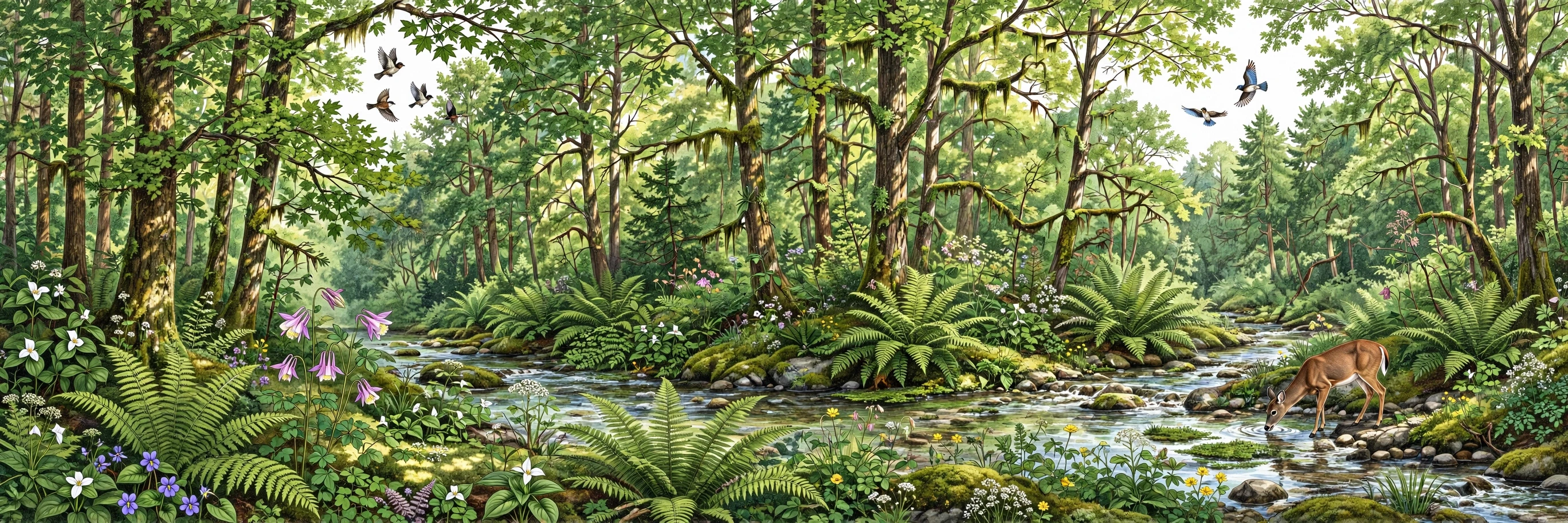
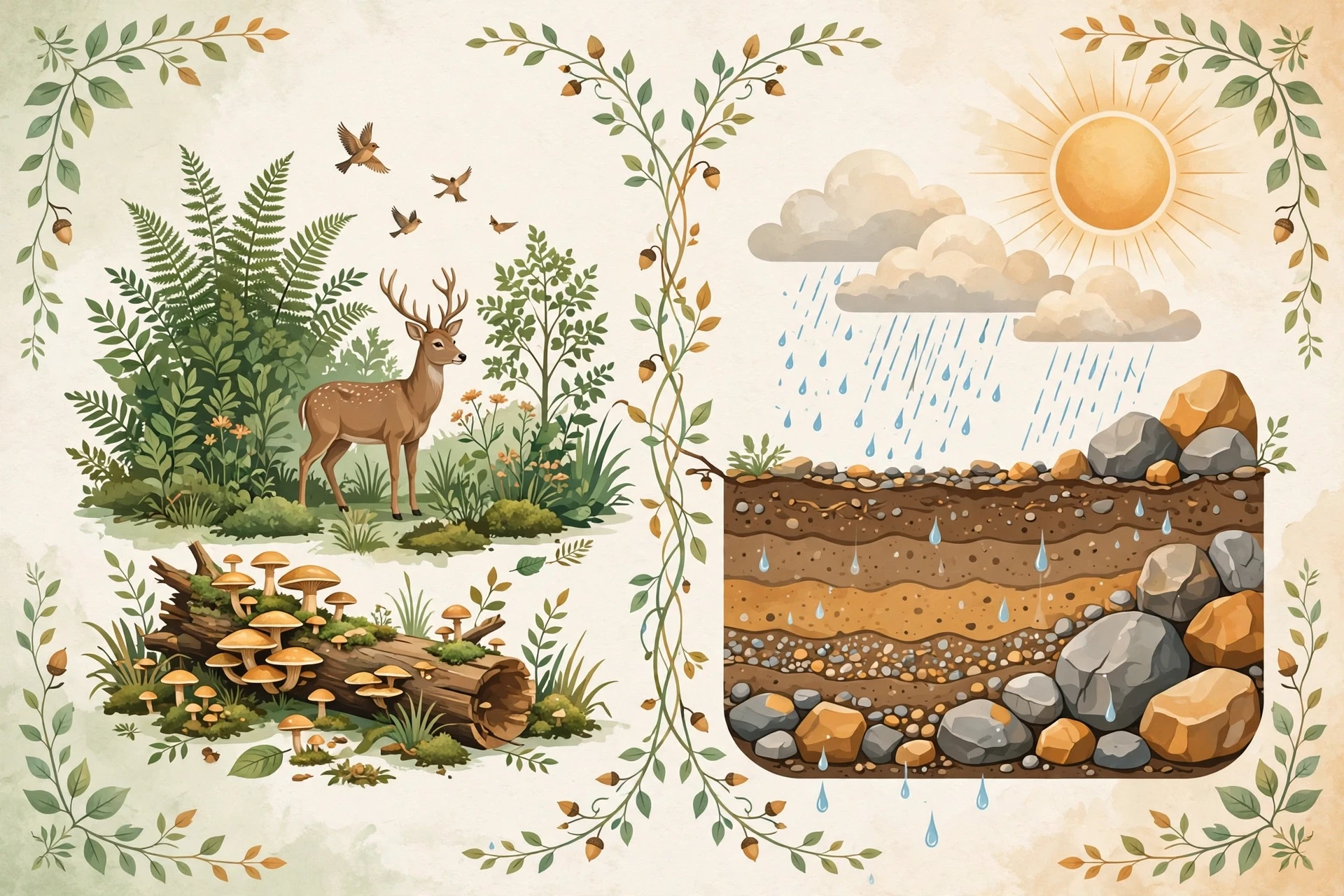
Every ecosystem, from a tide pool to a rainforest, is built from two kinds of parts. Biotic parts are the living ones: every plant, animal, fungus, and microbe. Abiotic parts are the non-living ones: sunlight, water, air, temperature, soil, rocks, and minerals. Neither works alone. The living parts depend on the non-living parts for energy and raw materials, and the non-living parts are constantly changed by the living ones — soil is built by dead organisms, oxygen in the air is maintained by photosynthesis, and the temperature of a forest floor is set by the shade of its trees.
I learned how inseparable the two halves are during a field season in a mountain meadow, when a late frost killed the first flush of wildflowers. The flowers were biotic, the frost was abiotic, but the consequences rippled through the living community for the rest of the summer: fewer flowers meant fewer bees, fewer bees meant fewer seeds, and fewer seeds meant fewer mice the following spring. A single cold night, a non-living event, rewrote the living story of that meadow for a year. That is the abiotic world doing what it always does — setting the terms on which life operates.
2.2 Producers: the ones who make food from light
At the base of almost every ecosystem stand the producers: organisms that make their own food. Green plants, algae, and some bacteria capture sunlight and use it to build sugars from water and carbon dioxide, through photosynthesis. On land, the producers are mostly plants. In the ocean, they are mostly phytoplankton — microscopic algae drifting near the surface — and they produce a huge share of the oxygen we breathe. Sciory's guide to Photosynthesis Explained: Process & Equation walks through that chemistry step by step; here, what matters is the role: producers are the only members of the community that can bring new energy in from outside.
There are exceptions, and they are wonderful. Around deep-sea hydrothermal vents, where no sunlight reaches, bacteria make food from chemicals dissolved in the hot vent water — a process called chemosynthesis. Entire animal communities, including giant tube worms and pale crabs, live on those bacteria in permanent darkness. The first time I read a description of a vent community, I had to sit with it for a while: a whole ecosystem running on chemistry instead of sunlight, two kilometres under the sea. It is a reminder that the rules of ecosystems are about energy flow, not about sunlight specifically. Sunlight is simply the most common source.
2.3 Consumers: the eaters, at every level
Consumers are organisms that cannot make their own food and must eat other organisms. They come in layers, called trophic levels. Herbivores, the primary consumers, eat producers: deer eat grass, caterpillars eat leaves, zooplankton eat phytoplankton. Secondary consumers eat the herbivores: a frog eats insects, a small fish eats zooplankton. Tertiary consumers eat the secondary consumers: a heron eats the frog, a shark eats the small fish. At the top sit apex predators — wolves, lions, orcas — with few or no natural predators of their own.
But the tidy ladder is a simplification, and every ecologist knows it. Real animals eat at several levels. A bear eats berries, fish, insects, and carrion — producer, consumer, and decomposer food all in one animal. An omnivorous bird might eat seeds in winter and insects in summer. That is why ecologists prefer to talk about food webs rather than food chains: the feeding relationships in a real ecosystem tangle together like a net, not a ladder, and that tangling is part of what makes ecosystems resilient. Cut one thread of a net and the net holds. Cut one rung of a ladder and everything above it falls.
2.4 Decomposers: the recyclers nobody thanks
The least glamorous members of the ecosystem are also among the most essential. Decomposers — fungi, bacteria, earthworms, and other detritivores — break down dead organisms and waste, returning nutrients to the soil and water where producers can use them again. Without them, dead leaves would pile up forever, nutrients would stay locked in corpses, and the whole system would slowly starve in the middle of plenty.
Most people assume decomposers are a cleanup crew — useful, but secondary. What the data actually shows is the opposite: decomposition is the engine that keeps nutrient cycles turning, and in many ecosystems the detrital food web, built on dead matter, moves as much energy as the grazing food web built on living plants. In a forest, more energy can flow through fallen leaves and the fungi that eat them than through the deer that eat the living trees. The next time you kick through autumn leaves, remember that beneath your feet, fungi are doing the work that makes next spring possible.
2.5 The abiotic stage
Sunlight, temperature, water, soil, and air set the limits of what can live where. A cactus and a water lily are both plants, but they cannot swap habitats, because the abiotic conditions decide. Temperature sets the pace of chemical reactions; water availability sets how much photosynthesis is possible; soil chemistry sets which nutrients are available; light sets how deep in a lake or ocean producers can live.
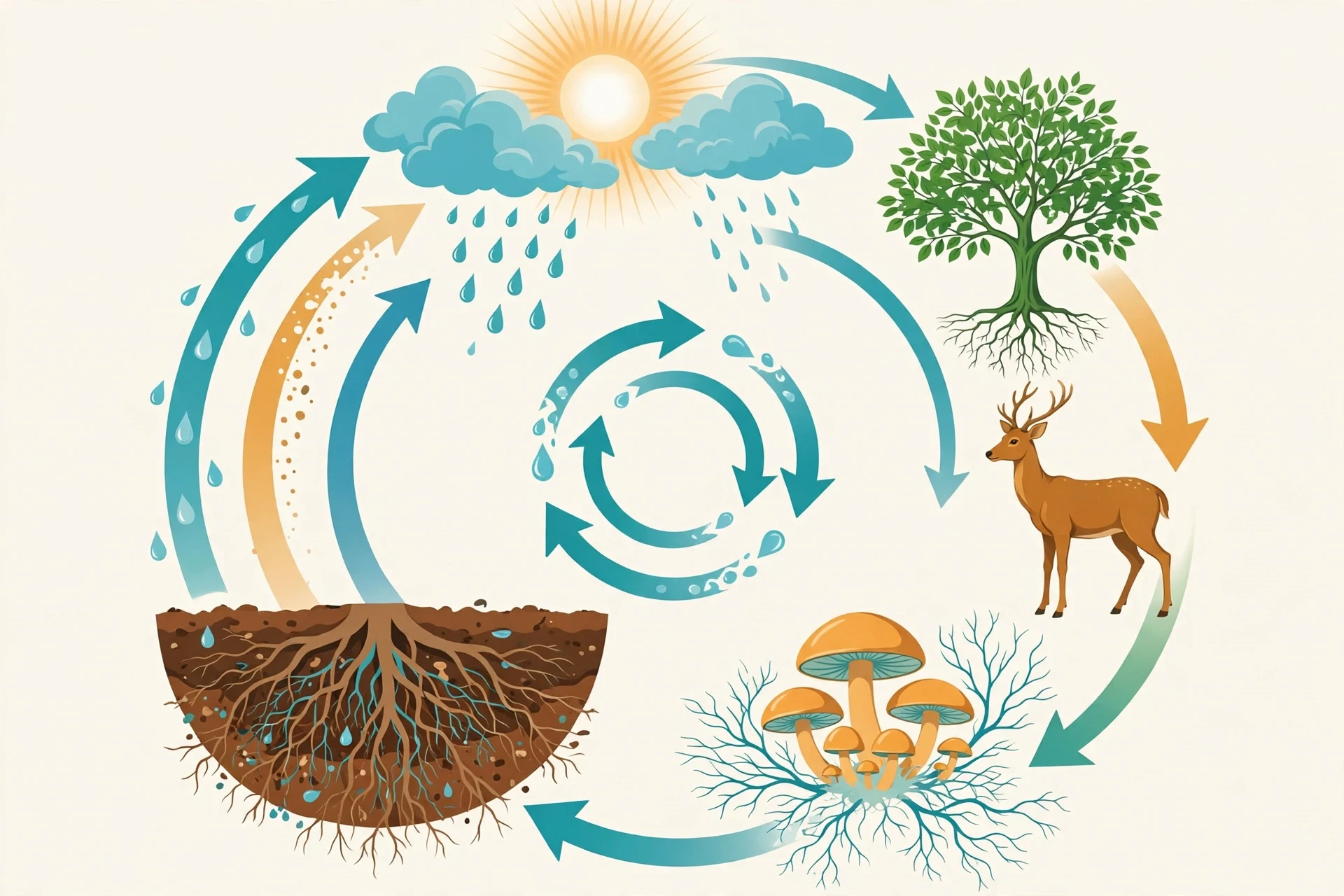
Water deserves special attention, because it carries nutrients, shapes landscapes, and connects ecosystems to each other. The journey of water through evaporation, condensation, and precipitation — the water cycle — is one of the great abiotic engines of the planet, and Sciory's The Water Cycle: Processes, Impacts & Importance explains it in full. In ecosystem terms, water is both a resource and a transport system: rivers carry nutrients from mountains to seas, and rain delivers them back to the land.
3. Energy Flow: The One-Way River
3.1 Energy enters, energy leaves, and it never comes back
Here is the single most important fact about energy in ecosystems: it flows one way. Sunlight enters, producers capture a small fraction of it, eaters pass it along, and at every step most of it is lost as heat. Energy is never recycled. A leaf cannot re-eat the heat a caterpillar gave off. The system keeps running only because the Sun keeps supplying more.
This is different from matter, and confusing the two is the most common mistake students make. Carbon atoms cycle round and round; energy does not. The same carbon atom might be in a leaf this year, a deer next year, a fungus the year after, and the soil after that. The energy that powered those transformations is gone, radiated away as heat, and must be replaced by fresh sunlight. An ecosystem is like a river that never flows backwards: it needs a constant source upstream, or it stops.
3.2 From sunlight to supper: the food web
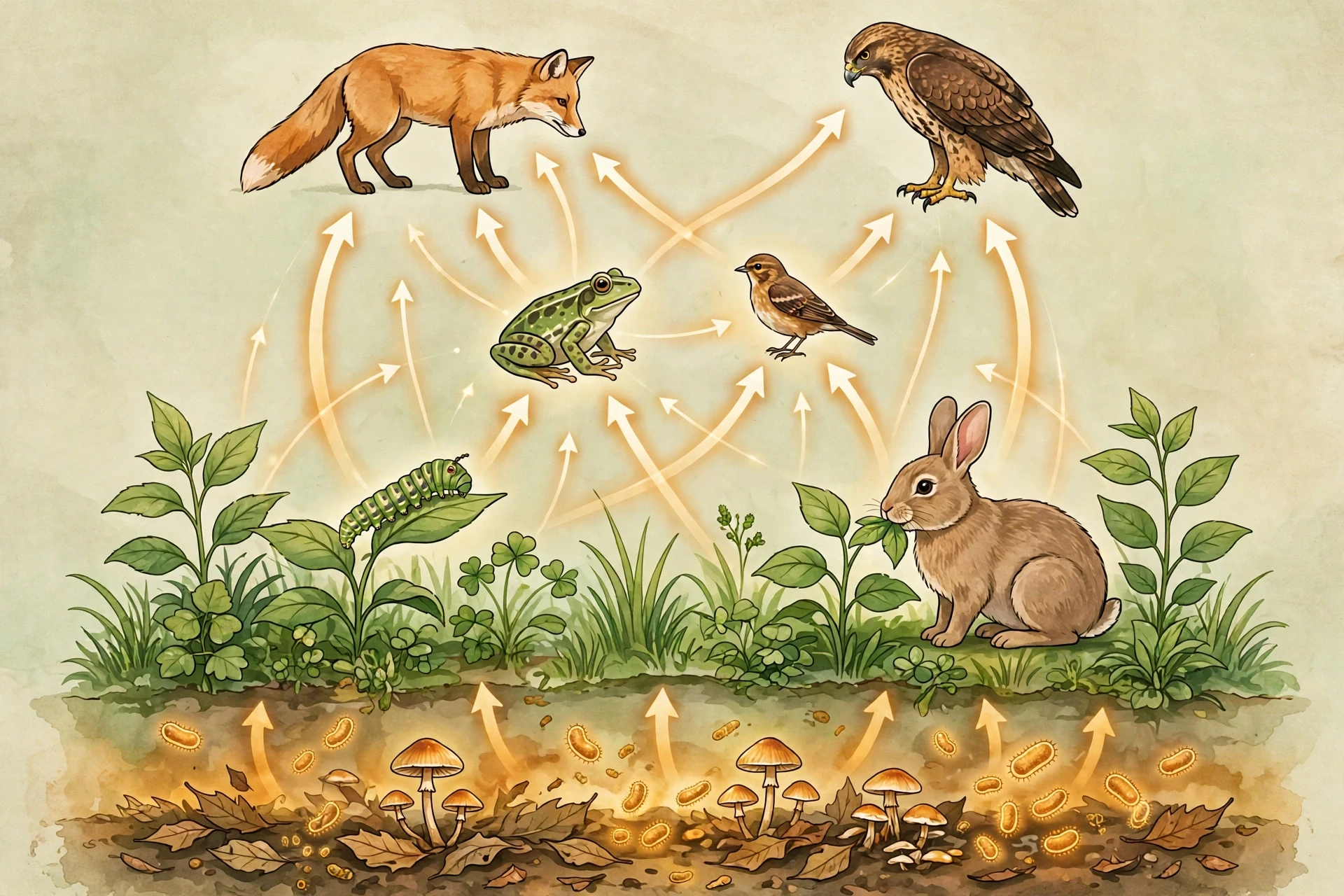
Energy moves through an ecosystem inside food. A plant stores solar energy in the chemical bonds of sugars and starches. A caterpillar eats the leaf and breaks those bonds apart, using the released energy to move, grow, and stay warm. A bird eats the caterpillar and does the same. At each step, the energy is passed on in the body of the eater — which is why, in food-web diagrams, the arrows point toward the eater, in the direction the energy travels.
A food chain is one straight line of who eats whom: grass, grasshopper, frog, heron. A food web is the whole tangle of chains in a place, with each species connected to many others. Real ecosystems are webs, and that matters. In a web, energy can reach a top predator along several routes, so the loss of one prey species does not necessarily starve the predator — it can switch to another. Webs are resilient in a way chains are not, and that resilience is one of the reasons biodiversity matters so much, a theme Sciory explores in Biodiversity: Definition, Importance, and Ecological Roles.
3.3 The 10% rule — and what it gets wrong
The textbook version goes like this: only about 10% of the energy at one trophic level makes it to the next. The rest is lost — some of the food is never eaten, some passes through undigested, and most of what is digested is burned just staying alive. The rule, first described in quantitative form by Raymond Lindeman in his 1942 study of a Minnesota lake, is a useful rule of thumb, and OpenStax Biology 2e explains how energy flows through food webs and trophic levels, and it explains a lot: why there are always fewer predators than prey, why food chains rarely have more than four or five links, and why a kilogram of beef requires far more plant energy to produce than a kilogram of beans.
But the 10% figure is an average, not a law, and treating it as exact is a mistake I have seen in textbooks, classrooms, and even research proposals. Real transfer efficiencies vary widely — roughly 5% to 20% depending on the organisms and the habitat — and a global synthesis of measured food webs puts the average closer to 6%. Warm-blooded predators lose more energy keeping warm than cold-blooded ones; insects convert food to body tissue far more efficiently than mammals do. The principle is solid — most energy is lost at each step — but the number is a rough guide, and any ecologist who quotes "10%" as if nature had signed a contract is oversimplifying.
3.4 The energy pyramid
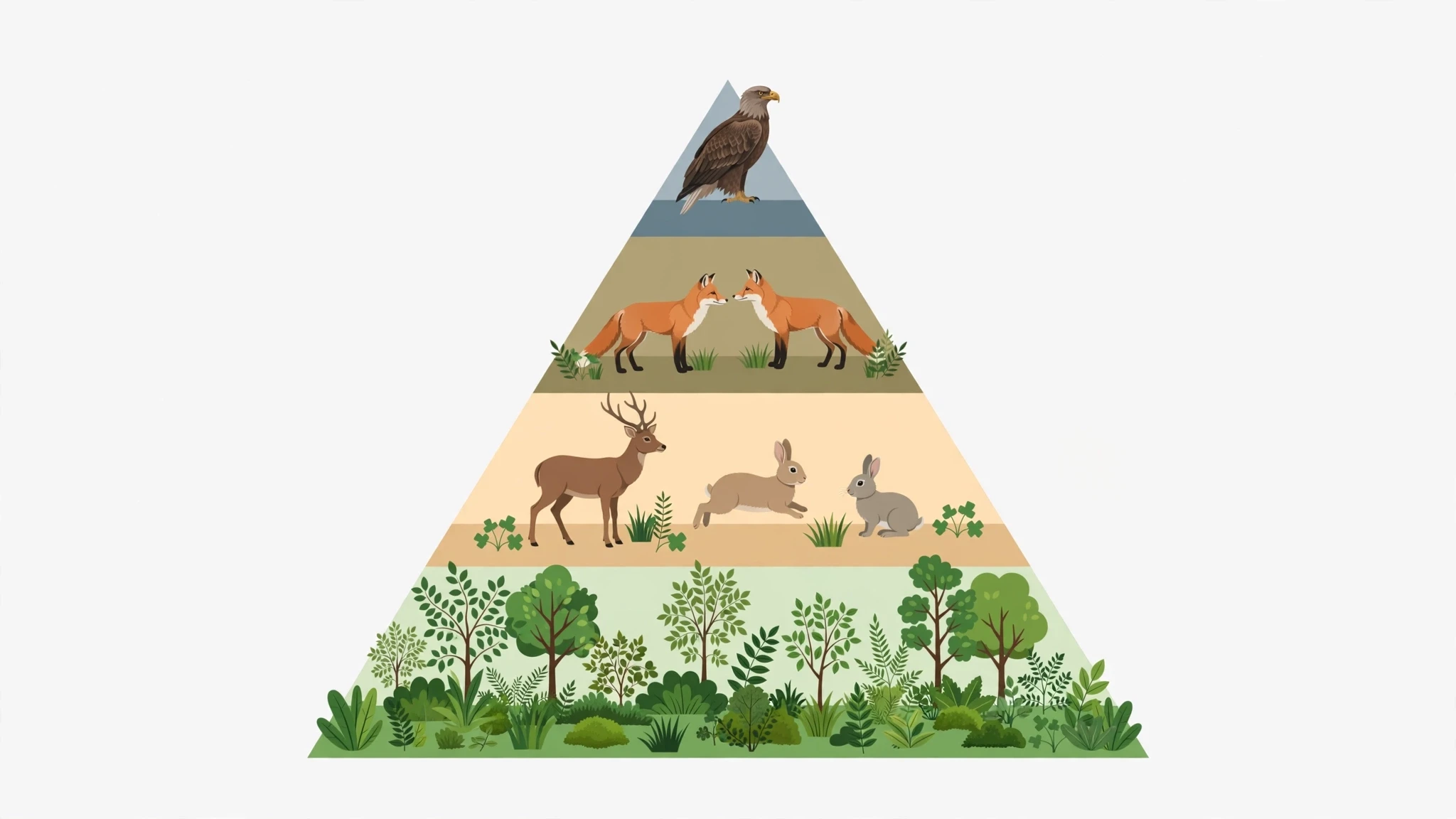
Because energy is lost at every step, the total energy available shrinks as you go up the food web. Ecologists draw this as an energy pyramid: a wide base of producers, a narrower layer of herbivores, a narrower layer of small carnivores, and a tiny tip of top predators. The pyramid also explains why the largest animals are not always at the top — a blue whale, the largest animal that has ever lived, feeds low on the food web, on tiny krill, and that short chain is part of how it can grow so enormous on such small food.
Trophic level | Who lives there | Examples | What happens to the energy |
|---|---|---|---|
Producers | Organisms that capture sunlight or chemicals | Grasses, trees, algae, phytoplankton | Capture solar energy as chemical energy in sugars |
Primary consumers | Herbivores that eat producers | Deer, caterpillars, zooplankton, rabbits | Use most energy staying alive; about a tenth becomes new body tissue |
Secondary consumers | Carnivores that eat herbivores | Frogs, small fish, spiders, foxes | Same losses again; only a fraction passes upward |
Tertiary consumers | Carnivores that eat other carnivores | Herons, sharks, owls, wolves | Very little energy reaches this level |
Decomposers | Organisms that break down dead matter | Fungi, bacteria, earthworms | Release nutrients back to producers; energy is lost as heat |
4. Nutrient Cycles: Matter That Never Leaves
4.1 Energy flows, matter cycles
If energy is the one-way river, matter is the water in a closed loop — used, returned, and used again. The carbon in a leaf today might have been in the air last year, in a dinosaur's bone millions of years ago, and in a limestone cliff before that. The atoms are ancient; only their arrangements change. Decomposers and the chemistry of soil, water, and air keep the loops turning, and without them the loops would stall and the ecosystem would grind to a halt.
There are three great nutrient cycles every ecology student learns, and each one runs on a different partnership between living things and the non-living world. Together they explain how a forest can grow for centuries on the same patch of soil without running out of raw materials.
4.2 The carbon cycle
Carbon moves between the atmosphere, living things, soil, and oceans. Producers pull carbon dioxide from the air during photosynthesis and lock it into sugars, wood, and leaves. Consumers eat the producers and release carbon back as carbon dioxide when they breathe. Decomposers release more as they break down dead matter. Some carbon is buried for millions of years as fossil fuels or limestone, and some dissolves in the ocean, where marine organisms build shells from it.
Human beings have now become a major force in this cycle. By burning fossil fuels, we move carbon from long-term underground storage into the atmosphere far faster than natural processes can remove it, and the oceans absorb much of the excess, becoming more acidic as they do. NASA's Earth-observing satellites now measure the planet's net primary production — the balance between carbon taken in by photosynthesis and carbon given off by respiration — every few days, giving scientists a near-real-time picture of how the world's ecosystems are breathing. The NASA-ISRO radar mission NISAR, launched to track forests and wetlands, is designed to measure how changes in those ecosystems affect the global carbon cycle, because forests hold carbon in their wood and wetlands store it in their soil, and losing either one releases it back to the air.
4.3 The nitrogen cycle
Nitrogen is the great paradox of ecosystems: it makes up about 78% of the air, yet most organisms cannot use it in that form. Plants need nitrogen to build proteins and DNA, but they can only take it up as nitrate or ammonium from the soil. The conversion is done by bacteria — nitrogen-fixing bacteria in soil and in the root nodules of legumes turn atmospheric nitrogen into ammonia, other bacteria convert it to nitrate, and still others return it to the air as nitrogen gas. Without those microbes, the nitrogen cycle stops, and with it, plant growth.
I once watched a farmer explain this to a school group by pointing at a clover field and saying the plants were "hiring bacteria to do their shopping." It is a good image. The plant feeds the bacteria sugars; the bacteria supply the plant with usable nitrogen. It is a trade, and it is one of the oldest partnerships on Earth. Lightning also fixes a little nitrogen, and so do human fertilisers — but fertiliser runoff has a cost: excess nitrogen washes into rivers and coastal waters, feeding algal blooms that suffocate fish. The cycle is a loop, and pushing too hard on one part of it bends the whole loop out of shape.
4.4 The water and phosphorus cycles
Water cycles through evaporation, condensation, precipitation, and runoff, carrying dissolved nutrients with it wherever it goes. A raindrop that falls on a mountain may pass through soil, a stream, a fish, and a cloud before it reaches the sea. Phosphorus, by contrast, has no convenient gas phase — it moves slowly, from rocks weathered by rain into soil and water, through organisms, and eventually back to sediments. Because it moves so slowly, phosphorus is often the limiting nutrient in lakes: add a little extra, from fertiliser or sewage, and algae explode into blooms that drain the oxygen from the water.
"The same carbon atom can be in a leaf, then a deer, then a fungus, then the soil, then back in the air. Two patterns, one ecosystem: energy flows through, matter cycles round."
5. Relationships: Who Needs Whom
5.1 Competition and predation
Within every ecosystem, species interact constantly, and those interactions shape who survives. Competition happens when two species want the same limited resource — food, water, light, space, or mates. Two tree species competing for light will grow taller; two birds competing for the same seeds will specialise on different sizes. Over evolutionary time, competition drives adaptation, and it is one of the engines behind the diversity of life that Darwin's Theory of Evolution: Evidence Explained describes.
Predation is the most visible interaction: one organism eats another. Predators control prey populations, and prey drive predator evolution in return — faster prey select for faster predators, better camouflage selects for sharper senses. The relationship looks violent from the outside, but at the ecosystem level it is regulatory. Remove the predators and the prey multiply, overgraze, and crash. Yellowstone National Park learned this the hard way, and then learned the reverse, as we will see in section 8.
5.2 Helping each other: mutualism, commensalism, and parasitism
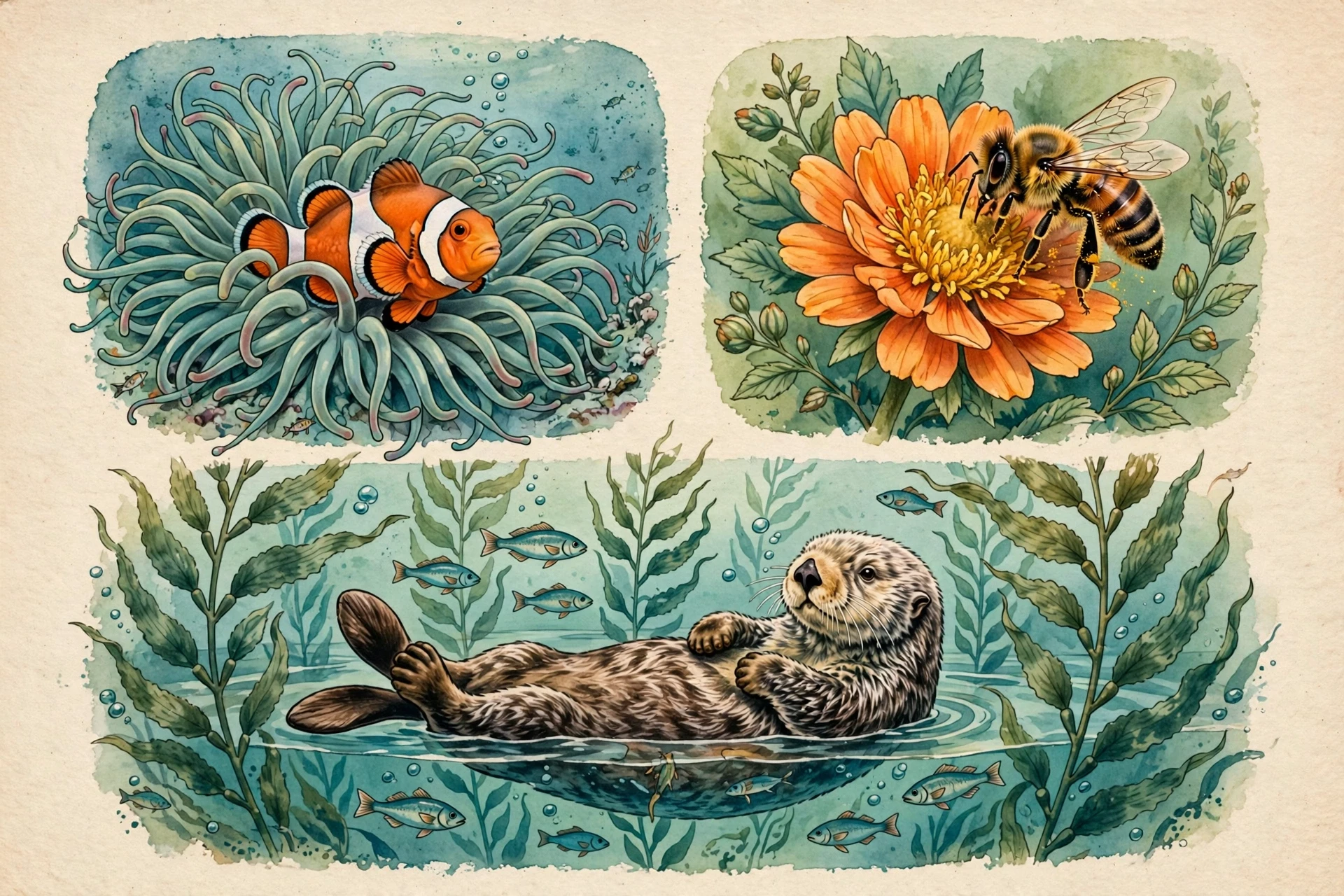
Not all interactions are hostile. In mutualism, both species benefit: bees get nectar and flowers get pollinated; the clownfish gets shelter among a sea anemone's stinging tentacles, and the anemone gets scraps of the clownfish's food and protection from polyp-eating fish. In commensalism, one benefits and the other is unaffected: barnacles ride on a whale's skin, gaining transport and food without harming the whale. In parasitism, one benefits at the other's expense: a tick feeds on a deer's blood, a cuckoo lays its egg in another bird's nest.
These relationships are not fixed categories so much as points on a spectrum, and they can shift. A fungus that helps a tree absorb nutrients in good years can become a drain on the tree in bad ones. A relationship that looks like parasitism at one scale can look like regulation at another. The point is not to sort every interaction into a box; it is to see that species are bound to each other by a web of deals, thefts, and partnerships, and that the web is the ecosystem.
5.3 Keystone species: small numbers, outsized power
Some species matter far out of proportion to their numbers. Ecologists call them keystone species, after the stone at the top of an arch that holds the whole structure together. Remove the keystone and the arch falls, even though the stone itself is small.
The classic example is the sea otter. Otters eat sea urchins; urchins eat kelp. When otters were hunted nearly to extinction for their fur, urchin populations exploded and kelp forests — underwater forests that shelter fish, crabs, and seabirds — were grazed to bare rock. When otters returned, the kelp returned too. A single predator species, by eating one prey, held an entire forest in place. The lesson is that ecosystems are not democracies where every species has an equal vote. Some species carry more weight than others, and losing one of them can rewrite the whole system.
6. Types of Ecosystems
6.1 On land: forests, grasslands, deserts, and tundra
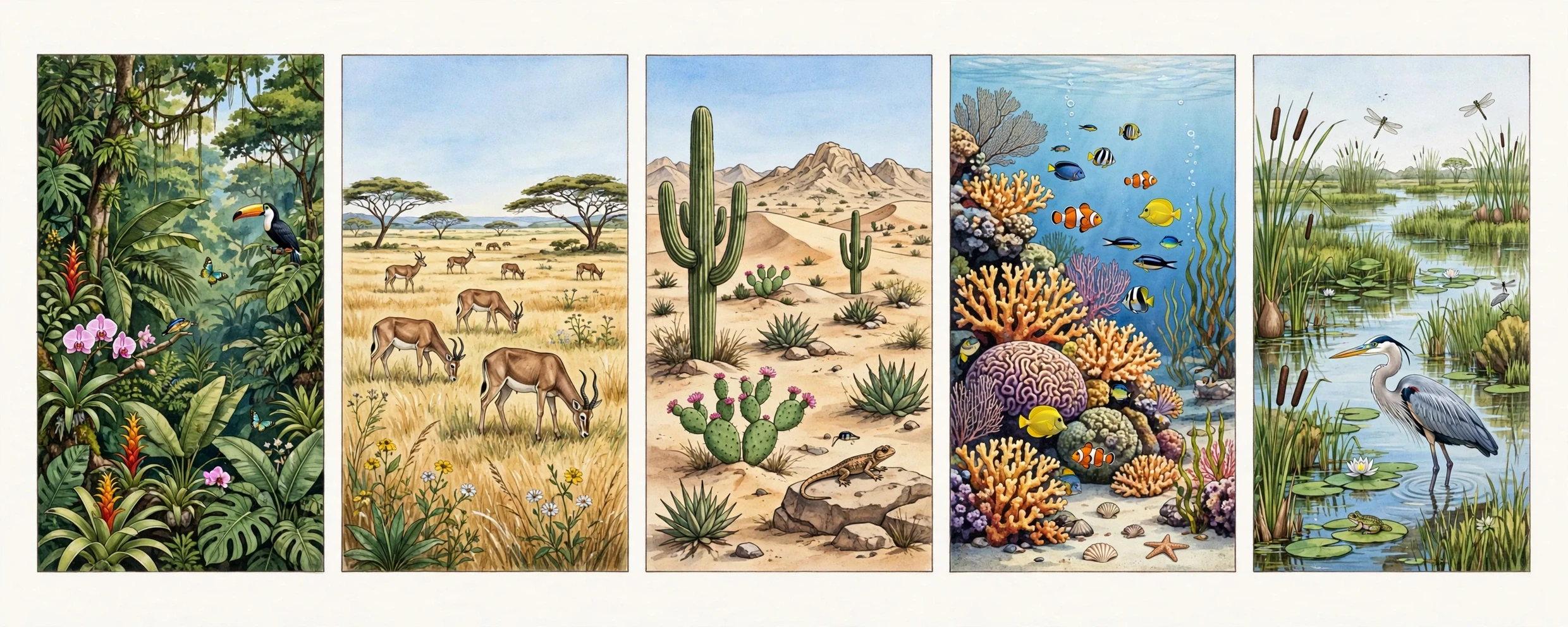
Terrestrial ecosystems are shaped above all by climate — temperature and rainfall. Tropical rainforests, warm and wet year-round, hold more species per square kilometre than any other land ecosystem; a single hectare can contain hundreds of tree species. Temperate forests have seasons, and their trees drop leaves in winter to survive the cold. Grasslands, with seasonal rain and frequent fire, support vast herds of grazers and the predators that follow them. Deserts, defined by scarcity of water, support life that is sparse but exquisitely adapted — plants that store water, animals that are active only at night. Tundra, cold and treeless, runs on a short summer burst of growth and a long frozen wait.
Each type has its own structure. A rainforest is layered — emergent trees, canopy, understory, forest floor — and each layer is its own small world, with its own light, humidity, and inhabitants. A grassland is built horizontally, with most of its biomass underground in roots. The layers and the roots are not decoration; they are how the ecosystem captures energy and stores nutrients in the conditions it has.
6.2 Fresh water: ponds, lakes, rivers, and wetlands
Freshwater ecosystems cover only a small fraction of Earth's surface, but they hold a disproportionate share of species and provide water, fish, and flood control to people. A pond is a classic textbook ecosystem: phytoplankton and water plants produce, zooplankton and snails graze, dragonfly nymphs and frogs hunt, and bacteria in the mud recycle everything that dies. Rivers are different — they are flowing systems, constantly importing nutrients from upstream and exporting them downstream, and their life is organised around the current. Wetlands — marshes, swamps, bogs — sit between land and water, and they are among the most productive ecosystems on Earth, storing carbon in their soils and filtering water as it passes through.
6.3 The sea: reefs, open ocean, and the deep
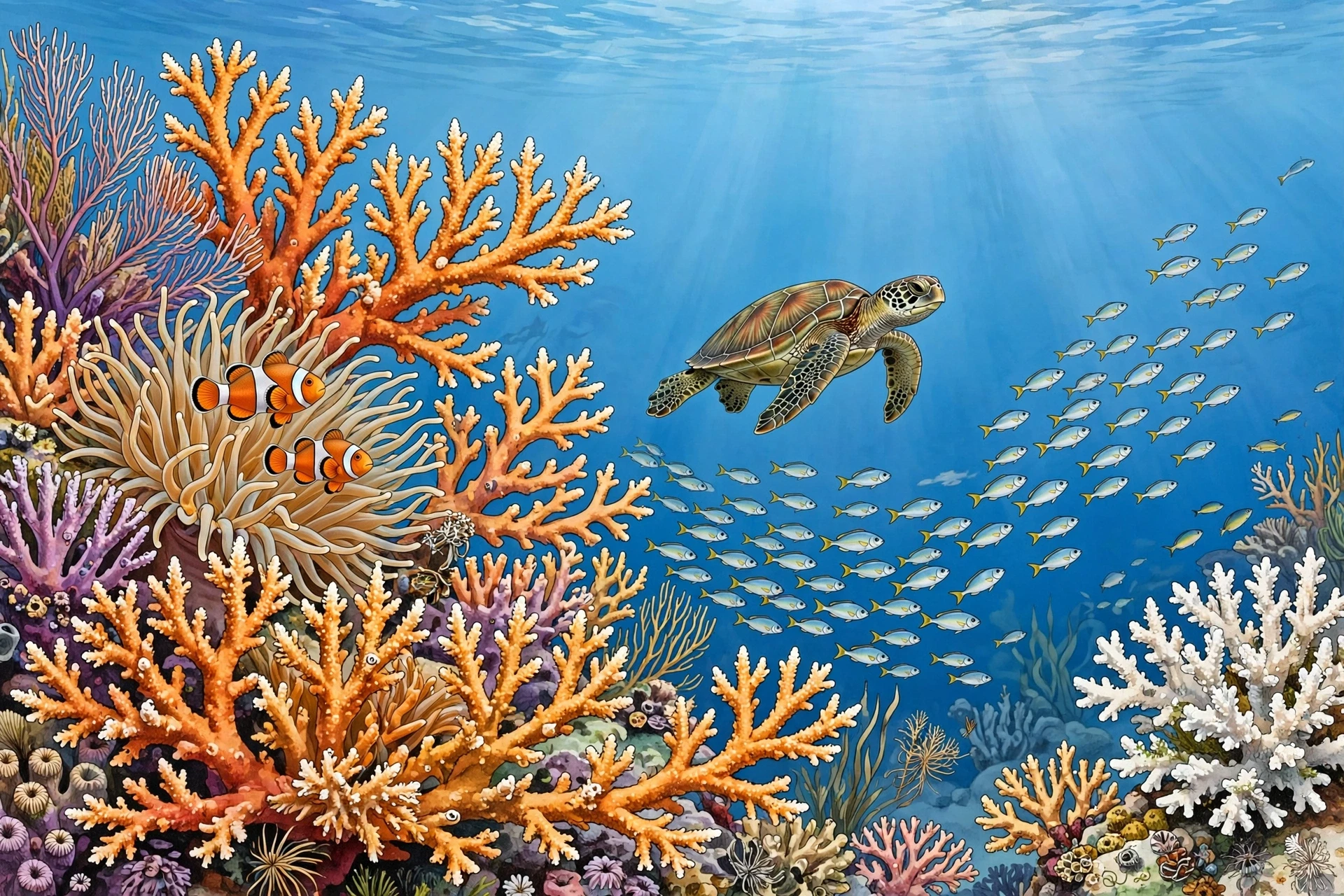
Marine ecosystems cover most of the planet. Coral reefs occupy less than 1% of the ocean floor, yet they support roughly a quarter of all marine species. A reef is built by tiny animals, the corals, in partnership with algae living inside their tissues — the algae photosynthesise and feed the coral, the coral gives the algae shelter and nutrients. It is one of the great mutualisms of the natural world, and one of the most fragile: when the water warms, corals expel their algae and turn white, a process called bleaching, and if the stress continues, the reef dies. NOAA describes coral reefs as one of Earth's most valuable ecosystems, providing food, coastal protection, and tourism, while facing threats from climate change, unsustainable fishing, and land-based pollution.
The open ocean is a different world: vast, deep, and driven by phytoplankton so small you need a microscope to see them, yet collectively producing a huge share of the planet's oxygen and food. And in the deep sea, beyond sunlight, ecosystems run on falling debris from above and on chemical energy from vents — proof that life finds a way to build an ecosystem wherever energy of any kind is available.
6.4 Ecosystems people build
Not all ecosystems are wild. Farms, gardens, city parks, and even aquariums are ecosystems too — simplified, managed ones, but ecosystems all the same, with producers, consumers, decomposers, energy flow, and nutrient cycles. A wheat field is an ecosystem dominated by a single producer species, which is exactly why it needs constant human input: without the diversity that stabilises a wild grassland, pests and nutrient loss have to be managed by hand. Cities are ecosystems as well, with their own strange food webs — pigeons, rats, foxes, street trees, and the microbes in the soil beneath the pavement — and urban ecologists now study them seriously, because most humans live in them.
Ecosystem type | Where it is | Main producers | Key feature |
|---|---|---|---|
Tropical rainforest | Warm, wet tropics | Tall trees, layered canopy | Highest land biodiversity; rapid nutrient cycling |
Temperate forest | Mid-latitudes, four seasons | Deciduous and coniferous trees | Seasonal leaf fall feeds soil decomposers |
Grassland | Seasonal rainfall, open plains | Grasses with deep roots | Fire and grazing maintain the open landscape |
Desert | Very low rainfall | Cacti, succulents, sparse shrubs | Life adapted to water scarcity and heat |
Tundra | Cold far north and high mountains | Mosses, lichens, low shrubs | Short growing season; carbon stored in permafrost |
Freshwater (ponds, lakes, rivers) | Inland waters | Phytoplankton, water plants | Water flow and depth shape zoned communities |
Wetland | Land-water margins | Reeds, sedges, mangroves | Carbon storage, water filtering, fish nurseries |
Coral reef | Warm shallow seas | Zooxanthellae algae in corals | Tiny area, enormous marine diversity |
Open ocean | Deep sea away from coasts | Phytoplankton | Vast scale; food webs built on microscopic producers |
7. Balance, Disturbance, and Succession
7.1 The "balance of nature" is a half-truth
People often talk about the "balance of nature" as if ecosystems sat still, perfectly poised, until humans came along and disturbed them. That picture is comforting and mostly wrong. Ecosystems are always changing. Storms knock down trees, fires sweep grasslands, floods rearrange rivers, and populations boom and crash on their own. What looks like balance from a distance is usually a dynamic pattern — a system that absorbs disturbance and keeps functioning, not a system that never moves.
I first felt this properly on a walk through a forest a year after a windstorm had flattened a large patch of it. The fallen trees looked like destruction, and in one sense they were. But in the gaps where light now reached the forest floor, seedlings were shooting up, woodpeckers were working the dead trunks, and fungi were already turning the timber into soil. The forest had not been destroyed. It had been reset, and the reset was part of how the forest renewed itself. Disturbance is not always damage. Sometimes it is the mechanism of renewal.
7.2 Succession: how ecosystems rebuild
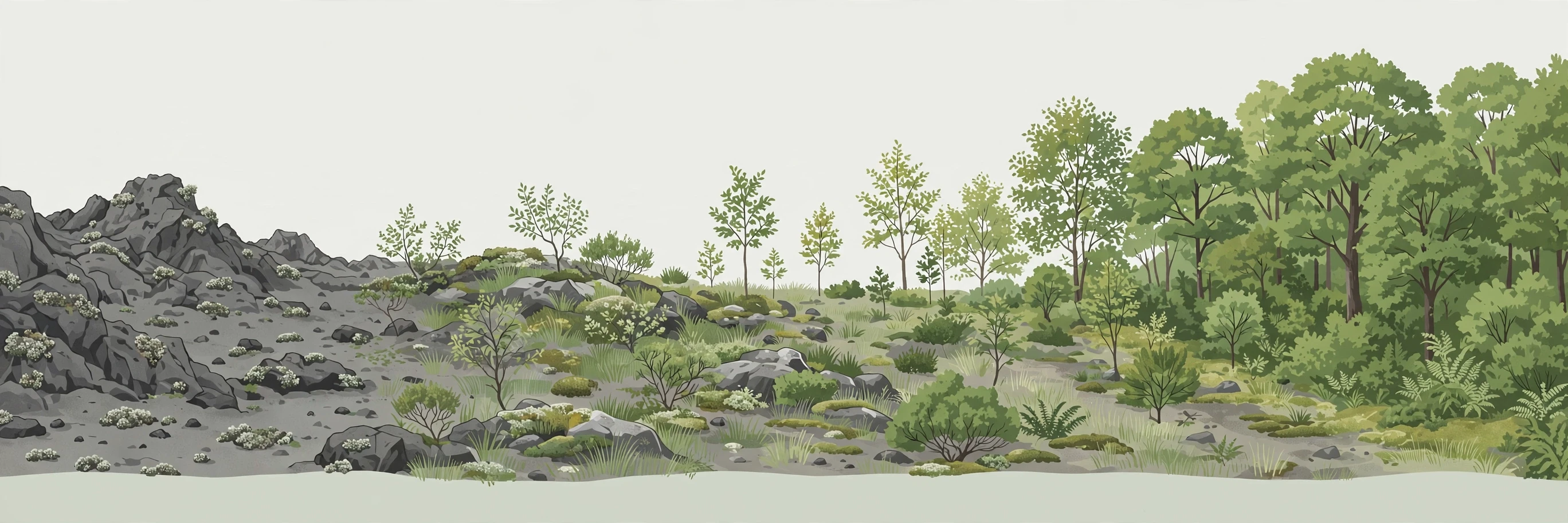
When a bare surface — new rock from a volcano, a sand dune, a field abandoned by farmers — is colonised by life, the process is called ecological succession. Pioneer species arrive first: lichens and mosses on bare rock, fast-growing grasses on bare soil. They change the conditions — breaking rock into soil, adding organic matter, holding moisture — and in doing so make the place suitable for the next wave of species, which eventually replace them. Over decades or centuries, the community changes in a rough sequence until it reaches a relatively stable stage, often called a climax community.
Mount St. Helens is the most famous modern example. When the volcano erupted in 1980, it buried the surrounding landscape under ash and debris, and many people assumed the area would stay lifeless for generations. Within months, plants were sprouting in the ash; within years, animals were returning. Ecologists who had expected a slow, orderly sequence instead found a messy, creative recovery, with surviving pockets of life — seeds, burrowing animals, roots sheltered under snow — seeding the regrowth far faster than the textbooks predicted. The story of that eruption, and of how volcanoes reshape landscapes, is told in Sciory's Volcanoes: How They Form, Types, and Eruptions Explained. Succession is real, but it is opportunistic, not a timetable.
7.3 Resilience: how much can a system take?
Resilience is an ecosystem's ability to absorb disturbance and keep its basic structure and function. A diverse ecosystem is usually more resilient than a simple one, because it has more ways to do each job: if one pollinator species disappears, another may take over; if one tree species succumbs to disease, others fill the canopy. This is the practical argument for biodiversity — not just that variety is beautiful, but that it is insurance. A system with many parts can lose a few and keep working. A system with one part cannot.
But resilience has limits. Push a system past a tipping point — a lake overloaded with nutrients, a reef bleached too often, a forest fragmented into patches too small to support its wildlife — and it can flip into a different state that is hard to reverse. A clear lake can become a murky, algae-choked one and stay that way even after the nutrient input stops. Recognising those thresholds before crossing them is one of the central tasks of modern ecology.
8. When Ecosystems Break — and When They Heal
8.1 Invasive species: the uninvited guest
An invasive species is one that arrives in a new ecosystem — usually carried there by people — and spreads in ways that harm the native community. Without the predators, diseases, and competitors that held it in check at home, it can multiply unchecked. Cane toads in Australia, introduced to control beetles, instead poisoned native predators that tried to eat them. Zebra mussels in North American lakes filtered the water so thoroughly that they starved native plankton and clogged water pipes. Kudzu, the "vine that ate the South," smothers whole forests in the southeastern United States.
Invasions are a reminder that ecosystems are held together by relationships built over long evolutionary time. A new arrival has no history with the locals, and that novelty is exactly what makes it dangerous.
8.2 Climate change and the bleaching reef
Climate change is now the largest disturbance most ecosystems face. Warming shifts the ranges of species, changes the timing of flowering and migration, melts the ice that polar ecosystems depend on, and acidifies the oceans. Coral reefs show the damage most visibly: when sea temperatures rise even a degree or two above normal for a few weeks, corals expel the algae that feed them and bleach white. A bleached coral is not yet dead, and it can recover if temperatures fall — but bleaching events are now happening so often that many reefs get no time to recover between them. NOAA's coral reef programme documents the pattern: climate change, unsustainable fishing, and land-based pollution together are pressing on reefs from every side.
8.3 Habitat loss: the quietest catastrophe
The largest cause of species loss today is not hunting or pollution, but the simple removal of habitat: forests cleared for farms, wetlands drained for building, grasslands ploughed, rivers dammed. A species can survive hunting if its home remains; it cannot survive the loss of its home. Fragmentation makes the problem worse — a forest cut into small patches loses its interior species, its large predators, and the connections that let animals move between patches. The total area of forest may look respectable on a map, but a hundred small fragments are not the same as one large forest.
8.4 The wolves of Yellowstone: a repair in progress
There is a hopeful counter-story, and it comes from Yellowstone National Park. Wolves were wiped out there by the 1920s, and in their absence elk multiplied and overgrazed the riverbanks, stripping the willows and aspens that beavers, birds, and fish depended on. In 1995, wolves were reintroduced. The elk changed their behaviour, avoiding risky riverbanks; the willows recovered; beavers returned and built dams that created wetlands; songbirds and fish followed. The change even reshaped the rivers themselves, as stabilised banks narrowed the channels.
The story is often told as a simple cascade — wolves fix rivers — and the reality is more complicated than the popular version, with drought, hunting, and other factors playing their part. But the core lesson stands: restoring a missing keystone species can let an ecosystem repair itself, because the relationships that hold the system together are still there, waiting to be switched back on. That is the most hopeful fact in ecology: ecosystems are not fragile glass. They are resilient systems, and given a chance, they heal.
9. What Ecosystems Do for Us
9.1 Ecosystem services: nature's unpaid work
Ecologists call the benefits ecosystems provide "ecosystem services," and the list is long: pollination of crops by bees and other insects, purification of water by wetlands, storage of carbon by forests and soils, control of pests by predators, protection of coasts by mangroves and reefs, and the sheer beauty and recreation that wild places offer. These services are not luxuries. Pollinators alone are involved in the production of a large share of the world's food crops, and without them harvests would shrink dramatically.
The trouble is that these services are mostly unpaid and unpriced, so they are invisible in the accounts that decide how land is used. A wetland that filters water for free looks worthless on a balance sheet next to a housing development — until the water treatment plant has to be built to replace it. Economists have tried to put numbers on the total value of the world's ecosystem services, and the figures are enormous, in the tens of trillions of dollars a year. The exact number matters less than the point: we are running a civilisation on services we do not pay for, and we are degrading the providers.
9.2 Food, medicine, and the library of life
Beyond the services, ecosystems are a storehouse. Most of the world's food comes from a handful of crops and livestock, but their wild relatives — the ancestors and cousins growing in forests and grasslands — carry the genetic diversity that breeders need to develop disease-resistant and drought-tolerant varieties. Medicines, too, come from ecosystems: many drugs are derived from compounds first found in plants, fungi, and marine organisms. Every species lost is a page torn from a library we have barely begun to read. The elements themselves cycle through these systems — carbon, nitrogen, and phosphorus moving between rock, soil, water, and life — and the chemistry of those cycles is built on the elements of the periodic table, whose story is told in Sciory's Periodic Table of Elements: Structure & Trends.
9.3 Why protecting ecosystems is practical, not sentimental
Protecting ecosystems is often framed as a matter of sentiment — saving beautiful places because they are beautiful. Beauty is a fine reason, but it is not the strongest one. The strongest reason is practical: ecosystems are infrastructure. They store water, clean air, pollinate crops, buffer floods, and hold the carbon that would otherwise warm the planet. Losing them is like tearing out the plumbing of a house and then being surprised when the taps run dry. Conservation, seen this way, is not a luxury for rich countries. It is maintenance.
"We are not visitors to the ecosystem. We are part of it — and the services it provides are the infrastructure our civilisation runs on."
10. The Latest Research: Watching Ecosystems from Space and from a Drop of Water
10.1 Eyes in orbit
One of the biggest changes in ecology in the last twenty years is that scientists can now watch ecosystems from space. Satellites measure the greenness of vegetation, the temperature of the sea surface, the extent of forests and wetlands, and the carbon moving through the atmosphere, across the whole planet, every few days. NASA's Earth-observing fleet produces global maps of net primary production — the rate at which plant life absorbs carbon — updated every eight days, turning the planet's metabolism into something measurable. The NISAR radar mission, a joint NASA-ISRO project, scans nearly all land and ice surfaces twice every twelve days, tracking how forests and wetlands change and how those changes affect the carbon cycle.
This is a genuine revolution in the science. Ecology used to be a science of small plots and long field seasons. It still is — there is no substitute for standing in a forest and counting what is there — but now the small plots can be placed inside a planetary picture. A researcher studying one wetland can see how it fits into the carbon budget of a continent.
10.2 Reading ecosystems from a water sample
Another revolution is environmental DNA, or eDNA. Every organism sheds DNA into its surroundings — skin cells, scales, faeces, pollen. Scoop up a litre of river water, filter it, sequence the DNA, and you can list many of the species that have recently been there, including rare and elusive ones that no survey team would ever spot. eDNA is now used to track invasive species, to find endangered fish, and to survey whole communities without catching or disturbing a single animal. It is not perfect — DNA can drift downstream, and a detection does not prove a species is breeding there — but it has turned a water sample into a census.
10.3 Rewilding and the microbiome
Two more frontiers are worth watching. Rewilding — the deliberate restoration of missing species and natural processes, from wolves in Yellowstone to beavers in Britain — is moving from experiment to policy in several countries, and the early results suggest ecosystems respond faster than expected when their keystone parts are restored. And beneath all of it, the microbiome revolution is rewriting what an ecosystem is: the microbes in soil, in water, and inside every animal's gut turn out to be essential partners, shaping nutrient cycles, plant growth, and even animal behaviour. The ecosystem, it turns out, extends inward as well as outward — every animal is itself a small ecosystem, carrying a community of microbes that it cannot live without.
11. Common Misconceptions About Ecosystems — Corrected
Most people carry a few wrong ideas about ecosystems, and they are worth correcting directly, because they shape how we treat the living world.
"Nature is in perfect balance." No — ecosystems are dynamic, always changing through disturbance, succession, and population cycles. What they have is resilience, not stillness.
"A food chain is how nature works." Real feeding relationships form webs, not chains. Most species eat at several levels, and that tangling is what makes ecosystems stable.
"Only about 10% of energy passes up each level, exactly." The 10% rule is a rough average. Real transfer efficiencies vary from roughly 5% to 20%, and the global average is closer to 6%.
"Decomposers are just the cleanup crew." Decomposition drives the nutrient cycles that everything else depends on. In many ecosystems, the detrital food web moves as much energy as the grazing one.
"Humans are outside ecosystems." We are inside them — we eat their products, breathe their oxygen, drink their filtered water, and depend on their services every day.
"A climax community lasts forever." No community is permanent. Climate shifts, species arrive, and disturbance resets the sequence. Stability is always temporary.
"Saving one species saves the ecosystem." Sometimes, when the species is a keystone. But most of the time, what matters is the web of relationships — and that means protecting habitats and processes, not just individual species.
Conclusion
An ecosystem is a household, a river, and a loop, all at once. It is a household because its members depend on each other's work. It is a river because energy flows through it one way, from sunlight to heat, and must be constantly renewed. It is a loop because the matter in it — carbon, nitrogen, water, phosphorus — is used and reused endlessly, with decomposers keeping the circle turning.
The child crouched over the rock pool had the essential idea right: everything in it belonged to everything else. The science since then has filled in the details — the trophic levels, the 10% rule and its limits, the nutrient cycles, the keystone species, the tipping points — but it has not changed the core insight. Ecosystems are systems, and systems are understood by their connections, not by their parts alone.
That is also why the subject matters beyond the classroom. We live inside ecosystems, we depend on their services, and we are now the largest force disturbing them. The hopeful part of the story is that ecosystems heal when given the chance: wolves return and rivers recover, reefs can regrow when the water cools, and a forest cut down can, given time and protection, become a forest again. Understanding how ecosystems work is the first step toward giving them that chance — and toward recognising that our own future is tied to theirs, not separate from it.
Frequently Asked Questions
What is an ecosystem?
An ecosystem is a community of living organisms — plants, animals, fungi, and microbes — interacting with each other and with their non-living environment (sunlight, water, soil, air) as one functioning system. It is defined by the interactions and the flows of energy and nutrients, not just by the list of species in a place.
What are the main components of an ecosystem?
The two main components are biotic (living) and abiotic (non-living). Biotic parts include producers, consumers, and decomposers. Abiotic parts include sunlight, temperature, water, soil, air, and minerals. Both halves are essential — the living parts depend on the non-living ones for energy and raw materials, and the non-living parts are constantly shaped by life.
How does energy flow through an ecosystem?
Energy flows one way: sunlight is captured by producers through photosynthesis, passed to herbivores, then to carnivores, and lost as heat at every step. It is never recycled. Only a small fraction — roughly 5% to 20% at each step, often quoted as about 10% — becomes new body tissue available to the next level.
What is the difference between a food chain and a food web?
A food chain is a single straight line of who eats whom, such as grass, grasshopper, frog, heron. A food web is the whole tangle of feeding relationships in an ecosystem, with each species connected to many others. Real ecosystems are webs, and the tangling makes them more resilient when one prey species declines.
What are the types of ecosystems?
Ecologists usually group ecosystems into terrestrial (forests, grasslands, deserts, tundra), freshwater (ponds, lakes, rivers, wetlands), and marine (coral reefs, open ocean, deep sea). Human-managed systems such as farms, gardens, and cities are ecosystems too, though simplified ones.
What is a keystone species?
A keystone species is one that has an outsized effect on its ecosystem relative to its numbers — like the keystone of an arch. Sea otters are the classic example: by eating sea urchins, they protect the kelp forests that shelter many other species. Remove the otters and the whole forest can collapse.
How do nutrients cycle in an ecosystem?
Nutrients such as carbon, nitrogen, and phosphorus move in loops between living things and the non-living environment. Producers take them up, consumers eat the producers, and decomposers break down dead matter and return the nutrients to the soil and water. Unlike energy, which flows one way, matter is recycled again and again.
What is ecological succession?
Ecological succession is the process by which a community of organisms colonises a bare surface and changes over time — pioneers such as lichens and grasses arrive first, build soil, and are replaced by shrubs and then trees, until a relatively stable community forms. Mount St. Helens showed that recovery can be faster and messier than the tidy textbook sequence suggests.
How are humans affecting ecosystems?
Humans affect ecosystems through habitat loss, invasive species, pollution, overfishing, and climate change. Coral reefs are a visible example: warming seas cause bleaching, while pollution and unsustainable fishing add further stress. Habitat loss is the largest driver of species decline worldwide.
Why are ecosystems important to people?
Ecosystems provide services we depend on every day: pollination of crops, purification of water, storage of carbon, flood control, coastal protection, food, and medicines. They are practical infrastructure, not just beautiful places, and protecting them is maintenance of the systems our civilisation runs on.
Sources
OpenStax, Biology 2e, Chapter 46: Ecosystems — Introduction to Ecosystems (ecosystem dynamics, the 1993 hantavirus outbreak as an ecosystem story, and the importance of understanding how ecosystems respond to change)
OpenStax, Biology 2e, 46.2 Energy Flow through Ecosystems — Energy Flow through Ecosystems (food webs, trophic levels, ecological pyramids, transfer efficiency)
National Geographic Education, Ecosystem — Ecosystem resource (definition, biotic and abiotic factors, biomes)
NOAA, Coral Reefs: Essential and Threatened — NOAA coral reef explainer (reef diversity, threats from climate change, fishing, and pollution)
NASA Science, NASA-ISRO Radar Mission to Provide Dynamic View of Forests, Wetlands — NISAR mission overview (forest and wetland ecosystems, carbon cycle, NISAR measurements)
NASA Earth Observatory, NASA Satellites Measure Earth's Metabolism — Net primary production from space (satellite measurement of global plant productivity and the carbon cycle)
U.S. National Park Service, Exploring Park Ecosystems (Cuyahoga Valley) — Park ecosystems (ecosystem connections, the Sun as the starting source of energy)