

Introduction
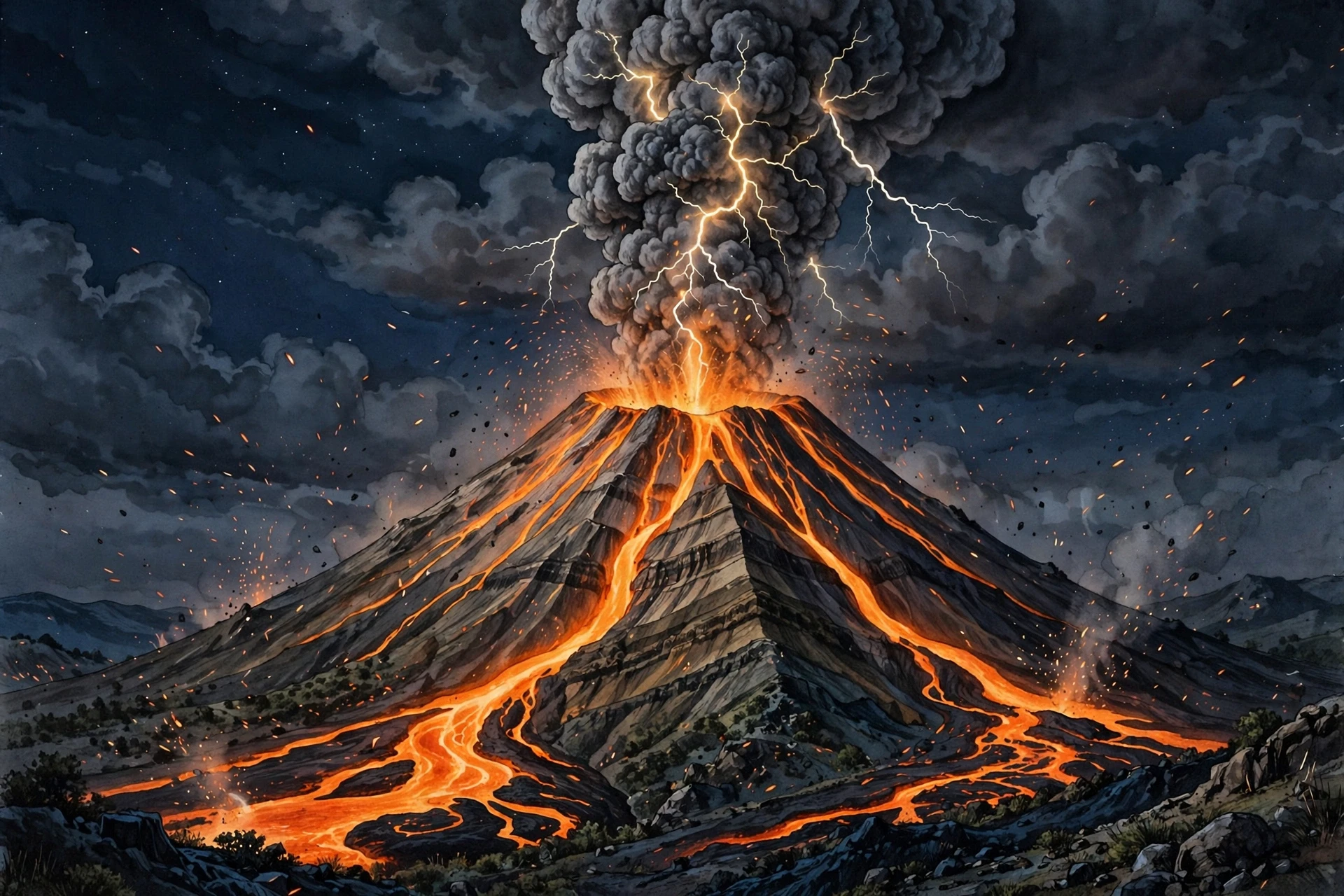
The ground was humming. Not shaking, exactly — humming, low and steady, like a refrigerator heard through a wall. I was standing on the rim of Kilauea after dark, and below me a lake of lava pulsed orange against black rock. Every few seconds a bubble rose, swelled, and burst, throwing a spray of sparks into the air. The heat pressed against my face from a hundred metres away.
I had read about volcanoes for years before that night. I knew the diagrams, the vocabulary, the chemistry. None of it had prepared me for the sound. A volcano is not only something you see. It is something you feel in your chest, the way you feel a bass note at a concert. That night I understood why people have built myths, cities, and whole sciences around these mountains. A volcano is the one place on Earth where you can watch the planet remake itself in real time.
This guide follows that remaking from start to finish. We begin deep underground, where solid rock turns to liquid, follow magma as it rises, see how it builds different kinds of volcanoes, and then watch what happens when pressure finally wins. Along the way we meet the volcanoes that changed history — Vesuvius, Krakatau, Mount St. Helens — and the scientists who learned, often at great cost, how to read the warnings a volcano gives before it erupts. The story of volcanoes is the story of Earth itself: violent, creative, and far from finished.
1. What Volcanoes Actually Are
A volcano is an opening in the crust of Earth — or another planet — through which molten rock, hot fragments, and gases escape to the surface. That is the strict definition, and it matters, because the word volcano is used for two different things. It means the vent itself, and it also means the mountain that grows around the vent from the material that piles up there. When people say Mauna Loa is a volcano, they usually mean the mountain. When a geologist says magma erupts from a volcano, they usually mean the vent.
The distinction sounds fussy. It stops being fussy the first time you stand on a lava field and realise the ground under your boots was once liquid rock, poured out of a crack in the Earth. The mountain is not the cause of the eruption. The mountain is the result of it, built eruption by eruption over thousands of years.
Volcanoes are the surface expression of heat escaping from inside the planet. Earth is hot inside — hot enough that rock melts, in places, into a thick liquid called magma. That heat has to get out somehow. Most of it escapes slowly, by conduction through rock. Some of it escapes violently, by convection: hot rock rises, melts further, and pushes its way to the surface. A volcano is where that escape route reaches daylight.
The study of volcanoes is called volcanology, but no single science owns it. Geophysicists listen to the tremors inside a volcano. Geochemists read the gases it breathes out. Geologists read its past eruptions in layers of ash and lava. Each of them sees a different volcano, and all of them are right. The Encyclopaedia Britannica overview of volcanoes makes the same point in its own way: volcanoes sit at the meeting point of plate tectonics, chemistry, climate, and human history.
1.1 Magma, lava, and the difference that matters
Magma is molten rock beneath the surface. Lava is the same material once it reaches the surface. The name changes at the boundary, and so does the behaviour. Underground, magma is under enormous pressure, and gases stay dissolved in it the way carbon dioxide stays dissolved in a sealed bottle of fizzy water. Once the magma reaches the surface, the pressure drops, the gases come out of solution, and the liquid can foam, fragment, and explode. Open the bottle and you get the idea. Shake it first and you get a better one.
Two properties decide almost everything a volcano will do: how runny the magma is, and how much gas it holds. Geologists call the runniness viscosity. Runny magma flows easily and lets gas escape gently. Thick, sticky magma traps gas until the pressure becomes unbearable, and then it breaks apart. The chemistry behind viscosity is mostly silica. Basaltic magma, low in silica, is fluid, like warm honey. Rhyolitic magma, high in silica, is stiff, like cold tar. Temperature matters too: hotter magma flows more easily than cooler magma of the same composition.
I learned how much viscosity matters by holding the two extremes in my hands. In one hand I had a piece of pumice, so light it felt like a sponge made of stone, full of frozen bubbles where gas had escaped from frothy magma. In the other, a piece of obsidian, black volcanic glass, smooth and sharp as a broken bottle, formed when lava cooled so fast that crystals never had time to grow. Same planet, same basic ingredients, two completely different rocks. The difference was gas and cooling — nothing else.
1.2 The anatomy of a volcano
A volcano has a set of parts, and each one does a job. The magma chamber is a reservoir of molten rock a few kilometres below the surface, where magma collects and waits. The conduit is the pipe that connects the chamber to the surface. The vent is the opening at the top. The crater is the bowl-shaped depression around the vent. On the flanks you may find fissures, cracks that let lava out sideways, and parasitic cones, small secondary volcanoes growing on the side of the main one.
When the top of a volcano collapses after a huge eruption, the depression left behind is called a caldera. Calderas can be enormous — kilometres across — and they are a sign that a very large volume of magma was emptied in a single event. Crater Lake in Oregon is a caldera filled with water, and it is one of the most beautiful places in North America. It is also a reminder: the beauty is the scar of a catastrophe.
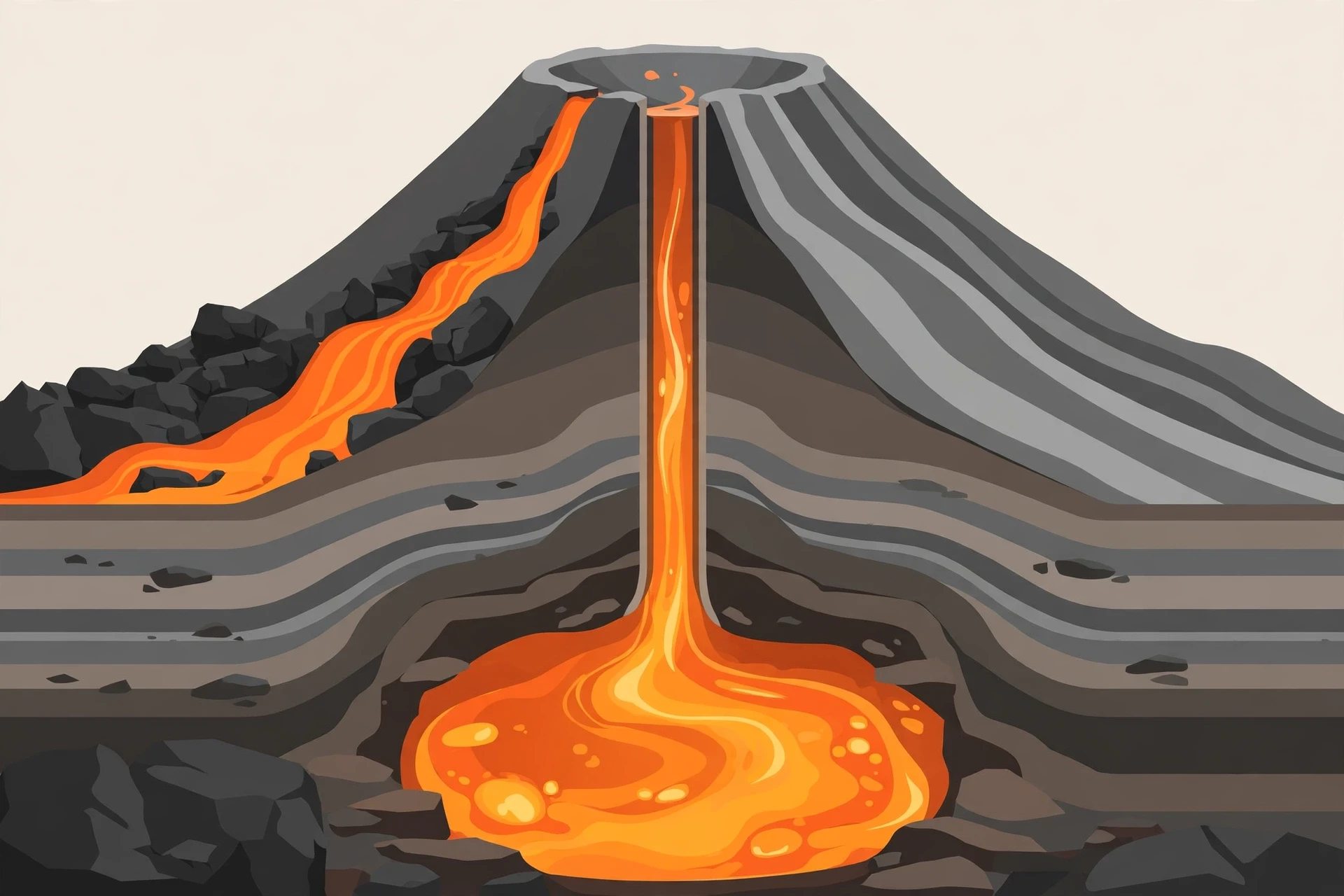
The shape of a volcano is a record of its eruptions. Fluid lava builds wide, gentle slopes. Sticky lava and ash build steep, narrow cones. Explosive eruptions leave craters and calderas. If you can read the shape, you can read the history — and make a reasonable guess about the future.
2. How Volcanoes Form: Magma, Plates, and Hotspots
Volcanoes do not appear at random. Most of them sit in three kinds of places, and each one tells a different story about how magma forms. The first step in all three is the same: solid rock must melt. That sounds simple, but rock deep underground is under so much pressure that it stays solid even at temperatures that would melt it on the surface. Melting happens when something changes — the temperature rises, the pressure falls, or water is added. Each of the three settings changes one of those things.
2.1 Plate boundaries: where the crust pulls apart and pushes together
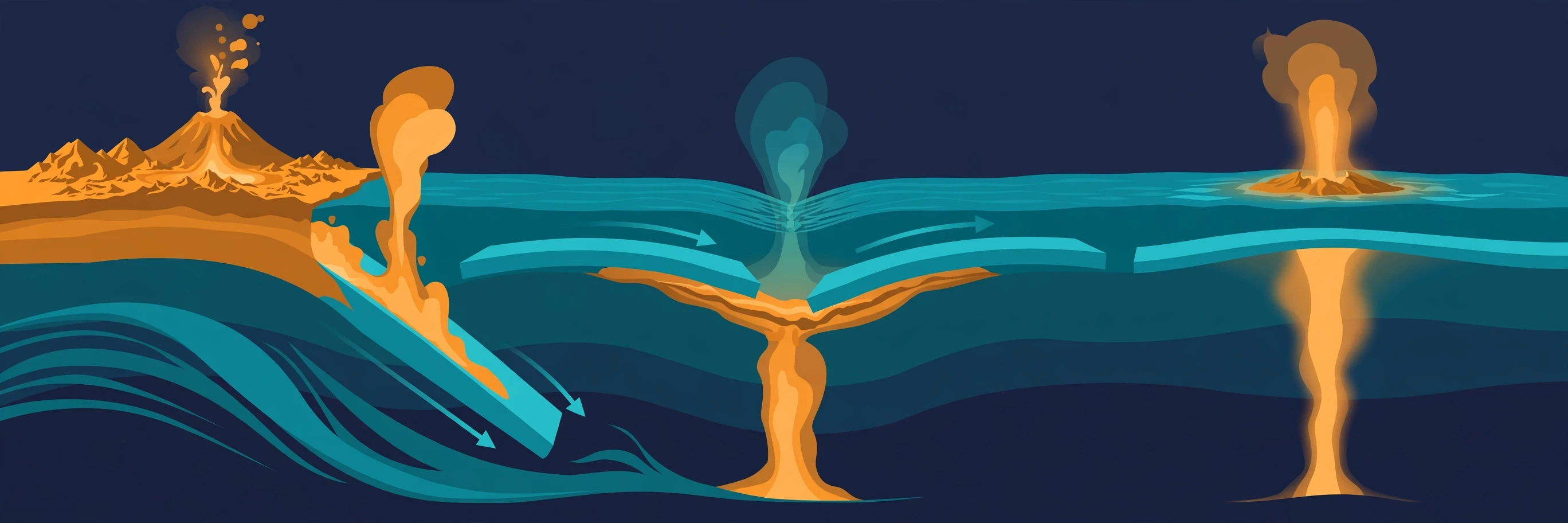
Most volcanoes form at plate boundaries, the edges of the great slabs of rock that make up Earth's surface. At divergent boundaries, two plates pull apart, the pressure drops, and the mantle below melts. This is how volcanoes form along mid-ocean ridges, and in rift valleys like the one running through Iceland. The magma here is usually basaltic and fluid, so eruptions tend to be gentle, producing lava flows rather than explosions.
At convergent boundaries, one plate slides beneath another in a process called subduction. As the sinking plate descends, it carries water and other volatile materials down with it. That water lowers the melting point of the rock above, and magma forms. These are the volcanoes of the Pacific Ring of Fire — the chain of volcanoes around the Pacific Ocean that includes Japan, the Philippines, Indonesia, and the Cascade Range of North America. The magma here is often richer in silica and gas, so eruptions can be explosive.
The Ring of Fire is not a metaphor. It is a real ring of fire, and it holds most of the world's active volcanoes. The Smithsonian Global Volcanism Program keeps the count: roughly 40 to 50 volcanoes are erupting at any given time, and about 1,214 volcanoes have been active in the past 12,000 years, with 687 of them — more than half — in the Pacific region.
2.2 Hotspots: volcanoes in the middle of nowhere
Some volcanoes ignore plate boundaries entirely. Hawaii sits in the middle of the Pacific Plate, thousands of kilometres from the nearest boundary, yet it hosts some of the most active volcanoes on Earth. The explanation is a hotspot: a plume of hot rock rising from deep in the mantle, melting as it rises, and punching through the plate above it.
A hotspot stays roughly still while the plate moves over it. The result is a chain of volcanoes, each one younger than the last, like a trail of footprints. The Hawaiian Islands are that trail. The oldest islands, to the northwest, are worn down and extinct. The youngest, the Big Island of Hawaii, is still growing. Kilauea and Mauna Loa, its two great shield volcanoes, are among the most studied volcanoes in the world, and the USGS Volcano Hazards Program monitors them continuously.
Yellowstone is a hotspot too, but a very different one. The magma beneath Yellowstone is rich in silica, and it sits under a continent, not an ocean. The result is not a gentle shield but a vast caldera system, capable of eruptions far larger than anything in recorded history. Yellowstone has not had a super-eruption in about 640,000 years, and researchers who study it are careful with their words: the system is active, it is monitored, and a large eruption is not expected in the near future. That is the honest answer, and it is also the reason monitoring matters.
2.3 From melt to magma chamber
Magma does not rise in one rush. It collects in pockets, merges, and slowly works its way upward, melting and fracturing the rock in its path. Some of it never reaches the surface at all. It cools underground and becomes granite or gabbro, the rocks of mountains and ocean floors. Only a fraction erupts — but that fraction is the part we see, and the part that changes landscapes.
As magma sits in a chamber, it changes. Crystals form and settle. Gas bubbles grow. New magma may arrive from below and mix with the old. Each of these changes alters the next eruption. That is why the same volcano can erupt quietly for decades and then, without any obvious warning to a casual observer, explode. The volcano did not change its mind. Its magma changed its chemistry.
The elements in magma connect volcanoes to the rest of chemistry. Silica, iron, magnesium, calcium, and the gases water and carbon dioxide are the main players — the same elements whose patterns Sciory's Periodic Table of Elements: Structure & Trends lays out. A volcano is chemistry, heated and pressurised, looking for a way out.
3. Inside an Eruption: What Happens When Magma Reaches the Surface
An eruption begins when the pressure in the magma chamber exceeds the strength of the rock above it. Magma forces its way up the conduit, and as it rises the pressure on it falls. Dissolved gases begin to form bubbles, the way bubbles form when you open a shaken bottle. If the magma is runny, the bubbles escape easily and the lava flows out. If the magma is thick, the bubbles cannot escape. They grow, the pressure builds, and the magma shatters into fragments. That shattering is an explosive eruption.
A volcano does not erupt because it is angry. It erupts because pressure, gas, and viscosity reach a point where the rock above can no longer hold them back.
The products of an eruption fall into three groups. Lava is molten rock that flows on the surface. Tephra is the solid fragments thrown into the air: ash, cinders, blocks, and bombs, ranging from dust fine enough to circle the globe to boulders the size of cars. Gas is mostly water vapour and carbon dioxide, with smaller amounts of sulfur dioxide and other gases. The gas is invisible and easy to ignore, and it is the most dangerous part of the story for climate, because sulfur dioxide can reach the stratosphere and cool the planet.
3.1 Effusive eruptions: lava that flows
In an effusive eruption, lava pours out and flows across the landscape. Basaltic lava can travel for kilometres, sometimes tens of kilometres, before it cools and stops. On the surface it takes two famous forms, both named in Hawaiian. Pahoehoe is smooth and ropy, like folded cloth. Aa is rough and jagged, like a field of broken glass. The difference is how fast the lava cools and how much it is stirred as it flows. I have walked on both, and the difference is not academic: pahoehoe lets you walk with care, aa makes you watch every step.
Lava flows destroy what they cover, but they rarely outrun a person on foot. That is a small comfort, and it is also the reason effusive eruptions, for all their drama, kill far fewer people than explosive ones.
3.2 Explosive eruptions: when gas wins
In an explosive eruption, the magma fragments. The fragments mix with gas and rise as an eruption column that can reach tens of kilometres into the sky. The column collapses, or the gas escapes sideways, and a pyroclastic flow forms: a fast-moving cloud of hot gas and particles that sweeps down the flanks of the volcano at hundreds of kilometres per hour, incinerating everything in its path. Nothing outruns a pyroclastic flow. The town of St. Pierre in Martinique was destroyed by one in 1902, and the lesson has been written into every volcano safety plan since.
Ash is the other great hazard of explosive eruptions. Volcanic ash is not like wood ash. It is made of tiny shards of glass and rock, hard and abrasive. It collapses roofs, kills crops, clogs engines, and damages lungs. It can also travel far: the ash from the 2010 eruption of Eyjafjallajokull in Iceland shut down air travel across Europe for days, not because the eruption was enormous, but because the ash was in exactly the wrong place for the wind.
3.3 The Volcanic Explosivity Index
Scientists measure eruption size with the Volcanic Explosivity Index, or VEI, a scale from 0 to 8. Each step up the scale means roughly ten times more material erupted. A VEI 0 eruption is a gentle lava flow. A VEI 5 eruption, like Mount St. Helens in 1980, ejects about a cubic kilometre of material. A VEI 8 eruption is a super-eruption, ejecting more than a thousand cubic kilometres. The scale is logarithmic, which means the difference between a VEI 5 and a VEI 6 is not a little more — it is ten times more.
4. Types of Volcanoes: Four Shapes, Four Personalities
Geologists group volcanoes into four main kinds, and the grouping is not arbitrary. Each type is built by a different kind of magma, and each one erupts in its own way. Learn the shape and you can predict the danger. The USGS guide to the principal types of volcanoes describes all four, and the descriptions below follow that classification.
Type | Shape and size | Typical magma | Eruption style | Example |
|---|---|---|---|---|
Shield volcano | Broad, gentle slopes; the largest volcanoes | Basaltic, fluid | Effusive lava flows | Mauna Loa, Hawaii |
Stratovolcano (composite) | Steep, symmetrical cone; up to about 8,000 feet above its base | Andesitic to rhyolitic | Explosive, alternating lava and ash | Mount Fuji, Japan |
Cinder cone | Small, steep cone, rarely more than about 1,000 feet high | Basaltic, gas-rich | Short explosive bursts | Paricutin, Mexico |
Lava dome | Bulbous mound of stiff lava over the vent | Rhyolitic, viscous | Slow growth, sudden collapse | Novarupta Dome, Alaska |
4.1 Shield volcanoes: the gentle giants
Shield volcanoes are built almost entirely of fluid lava flows. Flow after flow pours out in all directions from a central vent, building a broad, gently sloping cone with a profile like a warrior's shield lying on the ground. They are the largest volcanoes on Earth. Mauna Loa in Hawaii rises about 13,677 feet above sea level, and its base sits more than 15,000 feet below the ocean surface, making the whole mountain over 28,000 feet tall from base to summit — taller than Mount Everest measured the same way.
Shield volcanoes erupt often, and they erupt gently, by volcanic standards. Their lava is basaltic and runny, so gas escapes easily and explosions are rare. That does not make them safe. Their lava flows can cover towns, and their flanks can collapse into the sea. But for a volcano, a shield is the friendliest kind to live near — which is why Hawaii is inhabited, farmed, and visited by millions of people a year.
4.2 Stratovolcanoes: the beautiful, dangerous cones
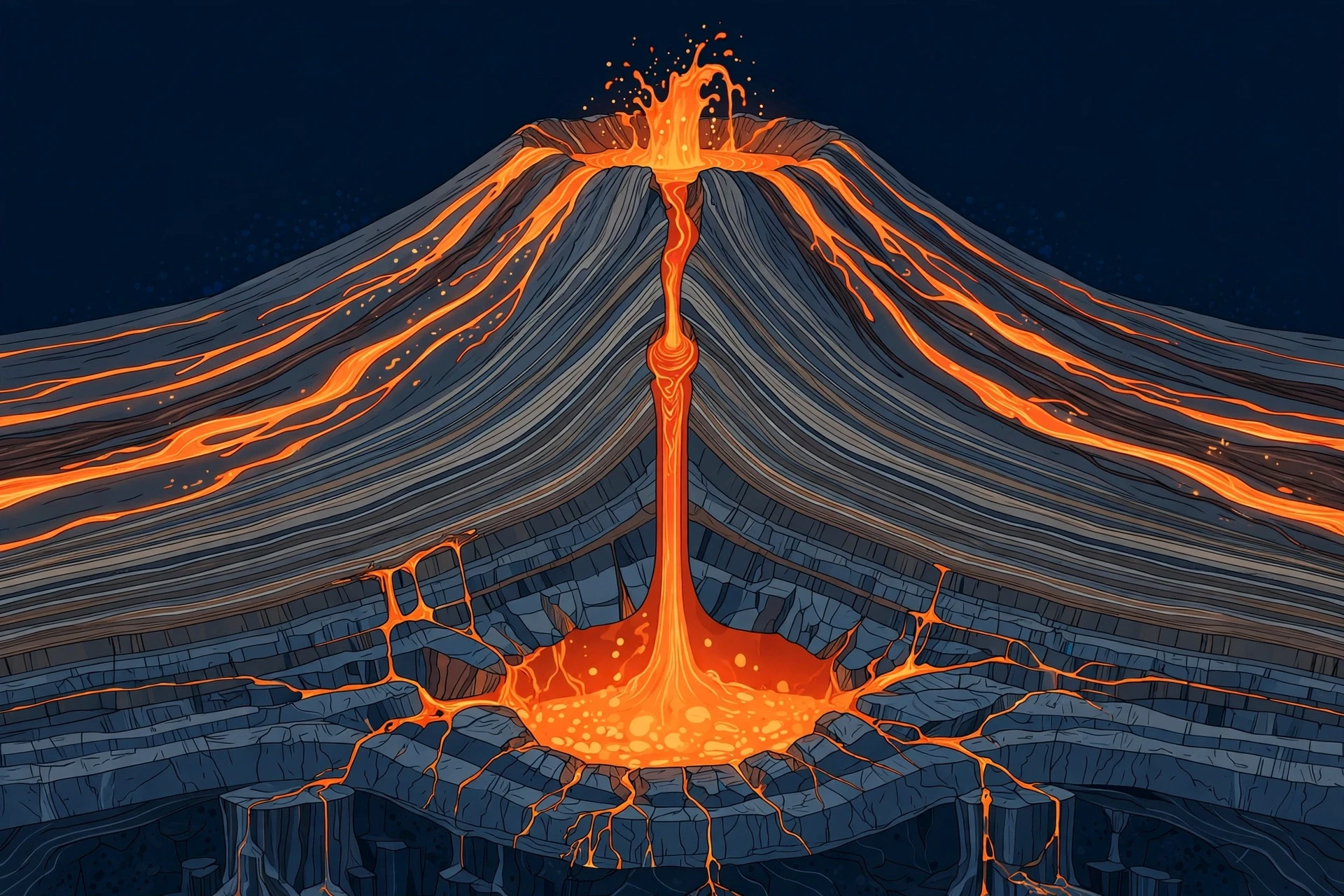
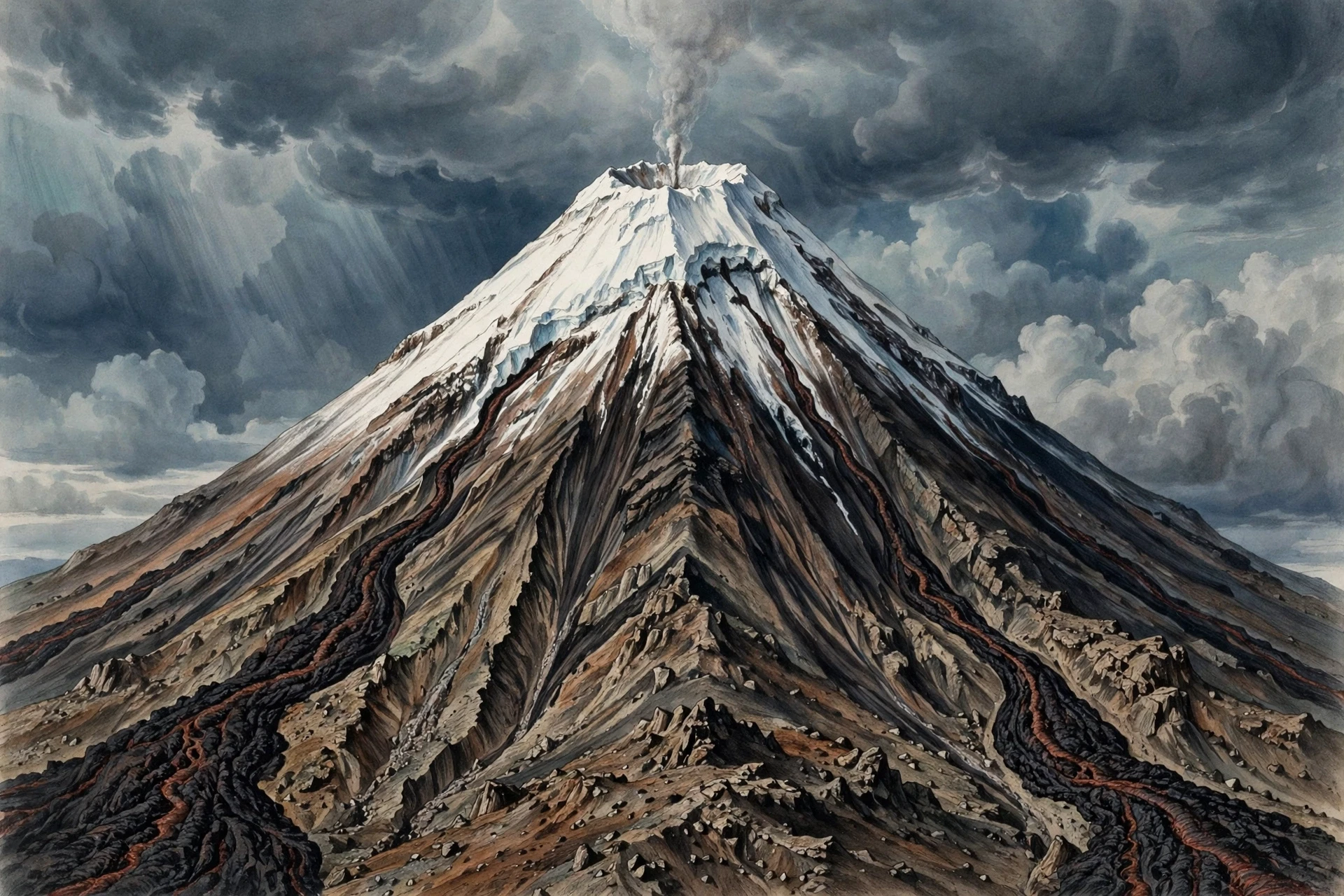
Stratovolcanoes, also called composite volcanoes, are the classic volcano shape: steep-sided, symmetrical cones built of alternating layers of lava flows, ash, cinders, and blocks. Mount Fuji in Japan, Mount Shasta in California, and Mount St. Helens in Washington are all stratovolcanoes. They are beautiful, and they are the most dangerous kind of volcano to live near.
Their danger comes from their magma. Stratovolcano magma is richer in silica and gas than shield volcano magma, so it is thicker and more explosive. It also builds up over a long time, and the cone is held together by dikes — sheets of solidified magma that act like ribs. When a stratovolcano erupts, it can do so for weeks, producing ash falls, pyroclastic flows, lava flows, and lahars, sometimes all in the same eruption. The 1991 eruption of Mount Pinatubo in the Philippines was a stratovolcano eruption, and it was one of the largest of the twentieth century.
4.3 Cinder cones and lava domes: small, fast, and deceptive
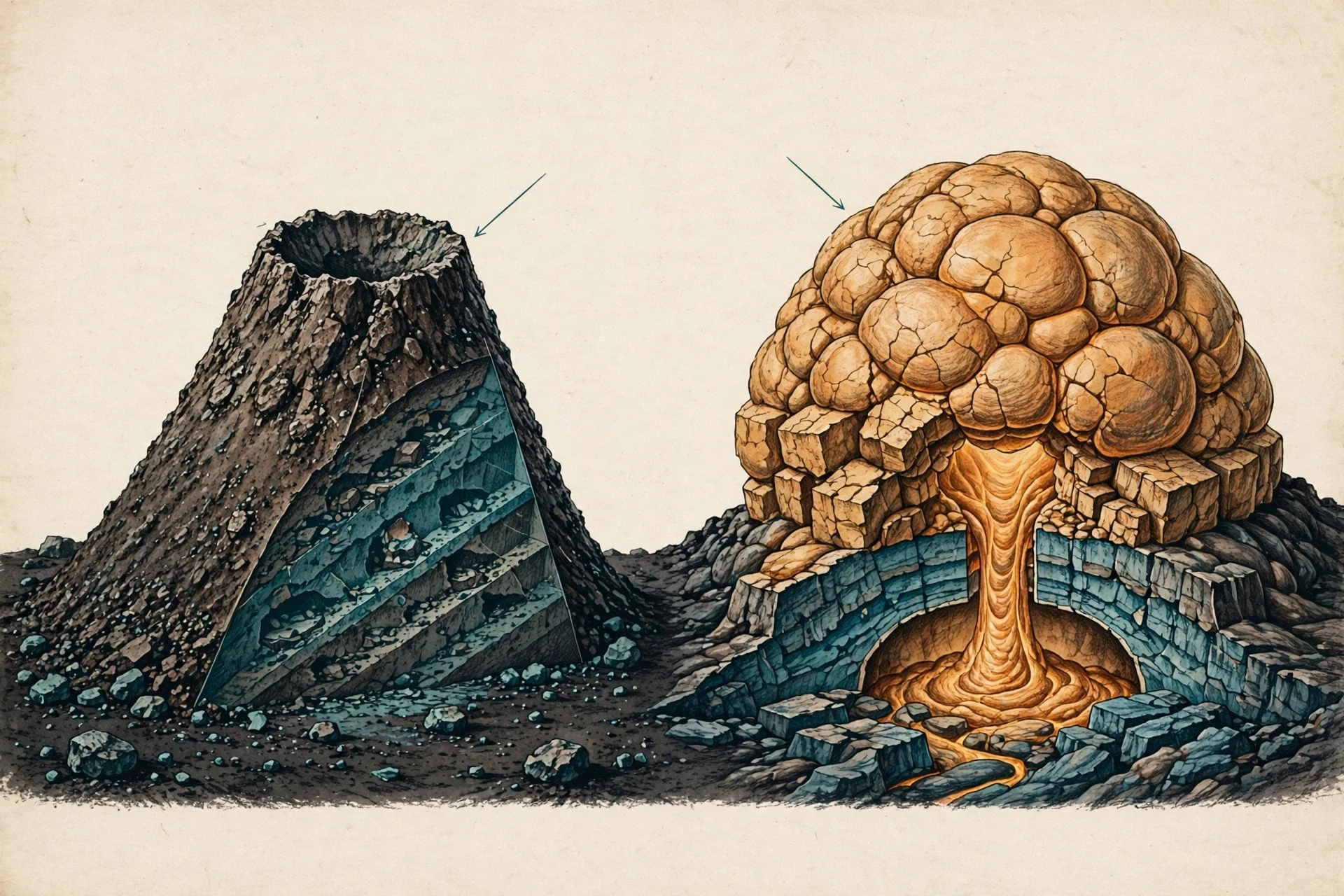
Cinder cones are the simplest volcanoes. They are built from particles and blobs of lava ejected from a single vent. The gas-charged lava is blown into the air, breaks into fragments, and falls back around the vent as cinders. Most cinder cones have a bowl-shaped crater at the summit and rarely rise more than a thousand feet above their surroundings. They are also the fastest volcanoes to grow. In 1943, a cinder cone called Paricutin began growing in a farmer's field in Mexico. Over nine years it built a cone 1,200 feet high, covered about 100 square miles with ash, and destroyed the town of San Juan. The farmer watched his own field become a volcano.
Lava domes are different again. They form when lava is too viscous to flow, so it piles up over and around its vent like toothpaste squeezed from a tube. A dome grows slowly, from within, its outer surface cooling and shattering as it expands. The danger is collapse: when a dome grows too steep, part of it can fall, and the hot interior can explode into a pyroclastic flow. The dome that grew inside Mount St. Helens after the 1980 eruption did exactly that, repeatedly, for years.
4.4 Calderas and supervolcanoes
When a very large eruption empties a magma chamber, the ground above it can collapse, forming a caldera — a large, steep-walled depression, sometimes tens of kilometres across. Calderas are the scars of the biggest eruptions. Yellowstone, Toba in Indonesia, and Taupo in New Zealand are caldera systems. The word "supervolcano" is not a formal geological term, but it is used for caldera systems capable of VEI 8 eruptions. The last super-eruption on Earth was Toba, about 74,000 years ago, and it left a layer of ash that can still be found across Asia. Researchers still debate how much it affected the global climate and early human populations, and that debate is honest: the evidence is real, and the conclusions are not settled.
5. Eruption Processes: How an Eruption Unfolds
An eruption is not a single event. It is a sequence, and scientists have learned to read the sequence the way a doctor reads symptoms. First comes unrest: earthquakes increase, the ground swells, gas emissions change. Then comes the eruption itself, which can last hours, days, or years. Then comes the aftermath, when the volcano quiets down — or does not.
5.1 Eruption styles: from fountains to columns
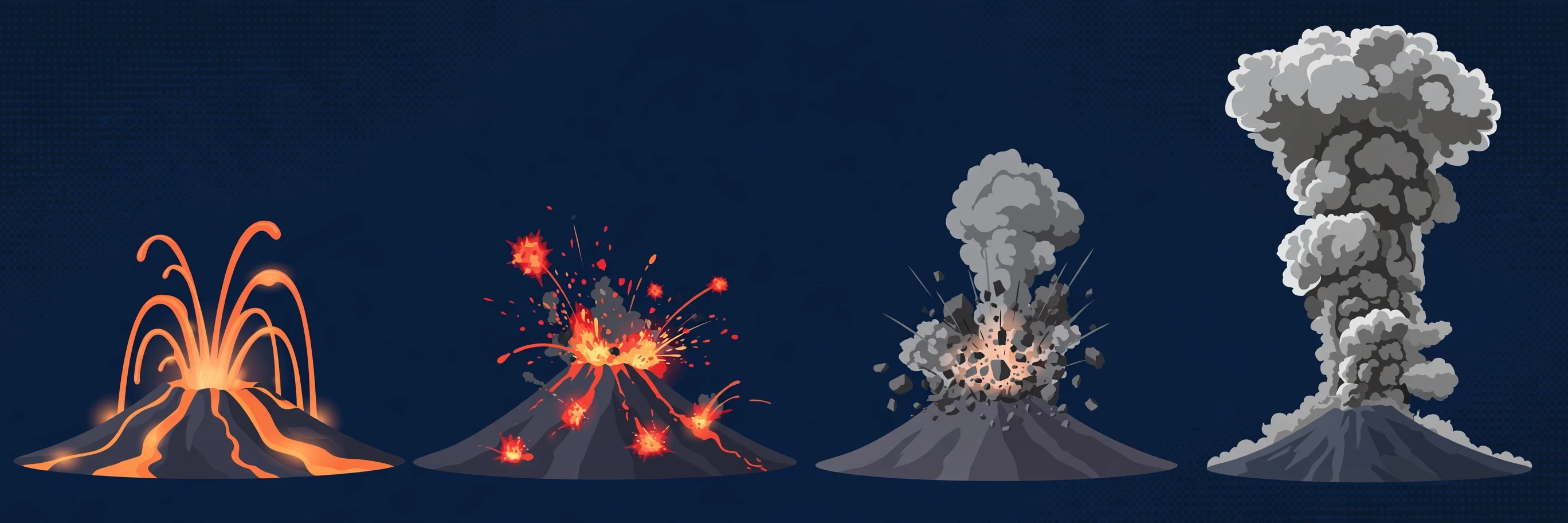
Volcanologists name eruption styles after the volcanoes where they were first described. Hawaiian eruptions produce lava fountains and flows, with little ash. Strombolian eruptions throw out bursts of glowing fragments at regular intervals, like a firework show. Vulcanian eruptions are short, violent explosions that clear a blocked vent. Plinian eruptions, named after Pliny the Younger, who described the eruption of Vesuvius in 79 CE, produce towering columns of ash and gas that can reach the stratosphere.
The style is not a personality trait. It is a consequence of magma chemistry, gas content, and the state of the vent. The same volcano can erupt in different styles at different times, and it can switch styles during a single eruption. That is why monitoring is continuous: the volcano tells you what it is doing, but only if you are listening.
5.2 The day Mount St. Helens blew sideways
I use Mount St. Helens when I teach eruption processes, because it broke every expectation. On the morning of 18 May 1980, the volcano had been swelling for weeks. A bulge had grown on its north flank, pushed outward by magma rising inside. Then an earthquake shook the mountain, and the whole north flank slid away in the largest landslide in recorded history. With the weight of the flank suddenly gone, the magma inside decompressed in an instant, and the volcano exploded sideways.
The lateral blast flattened forest for kilometres, killed 57 people, and removed the top 1,300 feet of the mountain. It also taught volcanology a lesson that has saved lives since: a volcano does not only erupt upward. It can erupt sideways, and the hazard zone is not a circle around the summit. It is a shape that depends on the mountain itself.
The eruption was watched, measured, and recorded by scientists who were there because they had been monitoring the volcano for months. Their data — the earthquakes, the swelling, the gas — became the template for volcano monitoring everywhere. St. Helens was a tragedy, and it was also a classroom.
5.3 What controls how big an eruption gets
Three things decide the size of an eruption: how much magma is in the chamber, how much gas it holds, and how easily that gas can escape. A large chamber full of gas-rich, sticky magma is a recipe for a large explosive eruption. A small chamber of runny magma makes a small effusive one. The rock above the chamber matters too: a strong roof holds pressure longer, and when it finally fails, the release is bigger.
There is no simple formula, and that is the point. Volcanoes are complex systems, and forecasting them is like forecasting the weather: you can say a lot about the next few days, and very little about the next few years, and you must always say how sure you are.
6. Volcanic Hazards: What Actually Kills People
Most people picture lava when they think of volcanic danger. Lava is spectacular, and it is the least of it. The hazards that kill people are the ones that move fast, travel far, and arrive without warning.
Pyroclastic flows — hot gas and particles moving at hundreds of kilometres per hour. The most deadly hazard of all. There is no outrunning them and no shelter that holds against them.
Lahars — volcanic mudflows, formed when ash mixes with water from rain, snow, or a crater lake. Lahars can travel for tens of kilometres down river valleys, burying everything in their path. The 1985 eruption of Nevado del Ruiz in Colombia produced lahars that killed more than 20,000 people in the town of Armero, most of whom had no warning.
Ash fall — ash can collapse roofs, destroy crops, contaminate water, and damage aircraft engines. It is also a health hazard: the tiny glass shards irritate lungs, especially in children and people with breathing problems.
Volcanic gases — sulfur dioxide, carbon dioxide, and other gases can poison the air in low-lying areas. Carbon dioxide is heavier than air, and it can pool in valleys and suffocate people and animals silently.
Lava flows — slow, destructive, and usually survivable if you leave in time. They destroy homes, roads, and farmland, and they can start fires.
Tsunamis — when a volcano collapses into the sea, or an underwater eruption displaces water, a tsunami can follow. The 1883 eruption of Krakatau produced tsunamis that killed tens of thousands of people around the Sunda Strait.
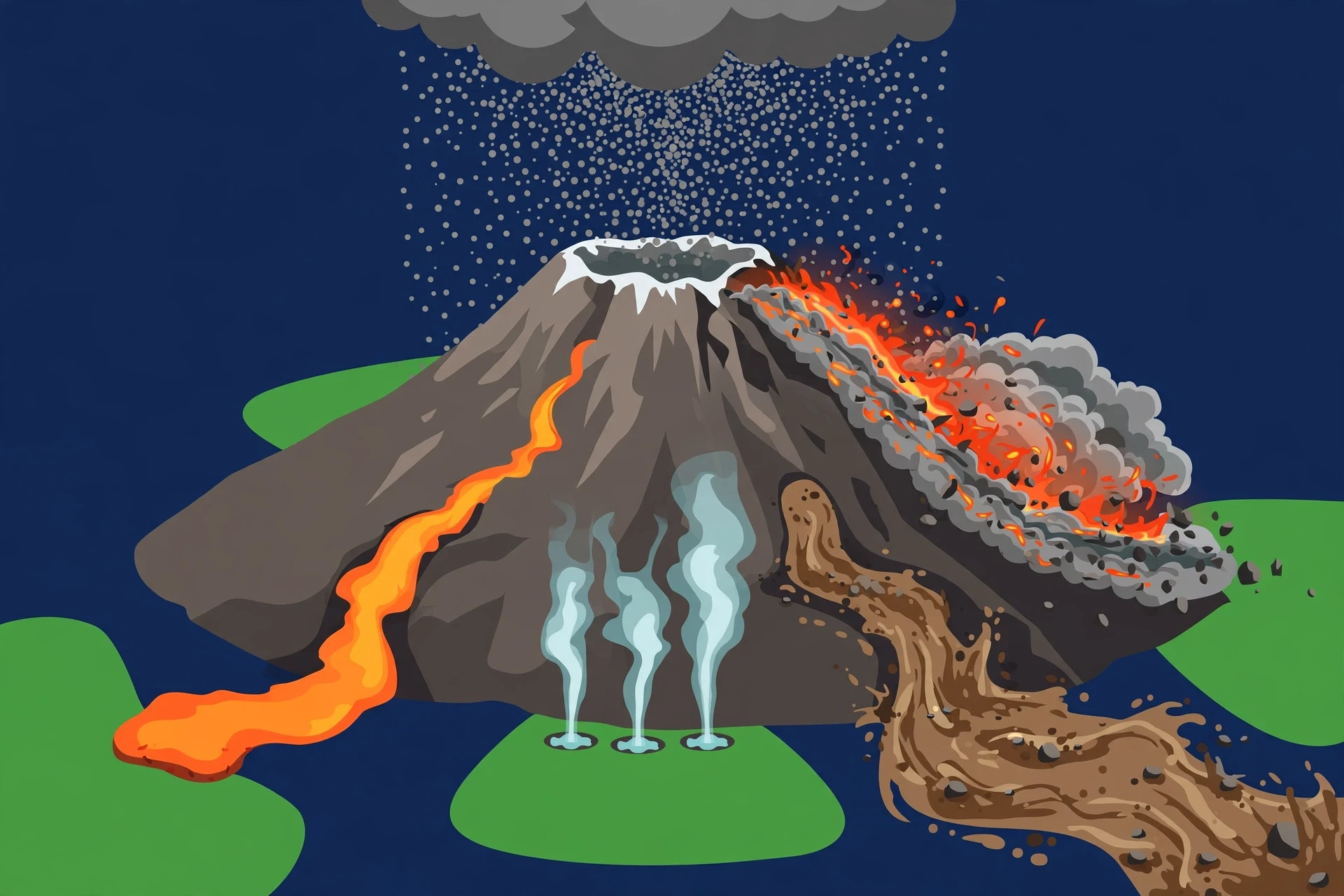
The pattern is clear, and it is worth saying plainly: most people assume lava is the main danger, but what the data actually show is that pyroclastic flows, lahars, and ash kill far more people. That is why hazard maps, evacuation routes, and early warning systems focus on those hazards first. If you live near a volcano, the most useful thing you can know is not where the lava will go. It is where the mud will go, and how fast.
Water is a recurring character in volcanic hazards, and it connects volcanoes to the wider Earth system. Rain turns ash into lahars. Snow and ice melt into floods. The ocean turns a collapse into a tsunami. Sciory's The Water Cycle: Processes, Impacts & Importance explains the system that moves that water around the planet — the same system that, on a volcano, turns a hazard into a disaster.
7. Famous Volcanoes: The Eruptions That Changed History
Some volcanoes are famous because they are beautiful. Others are famous because they changed the world. This section is the second kind.
7.1 Vesuvius, 79 CE: a city frozen in time
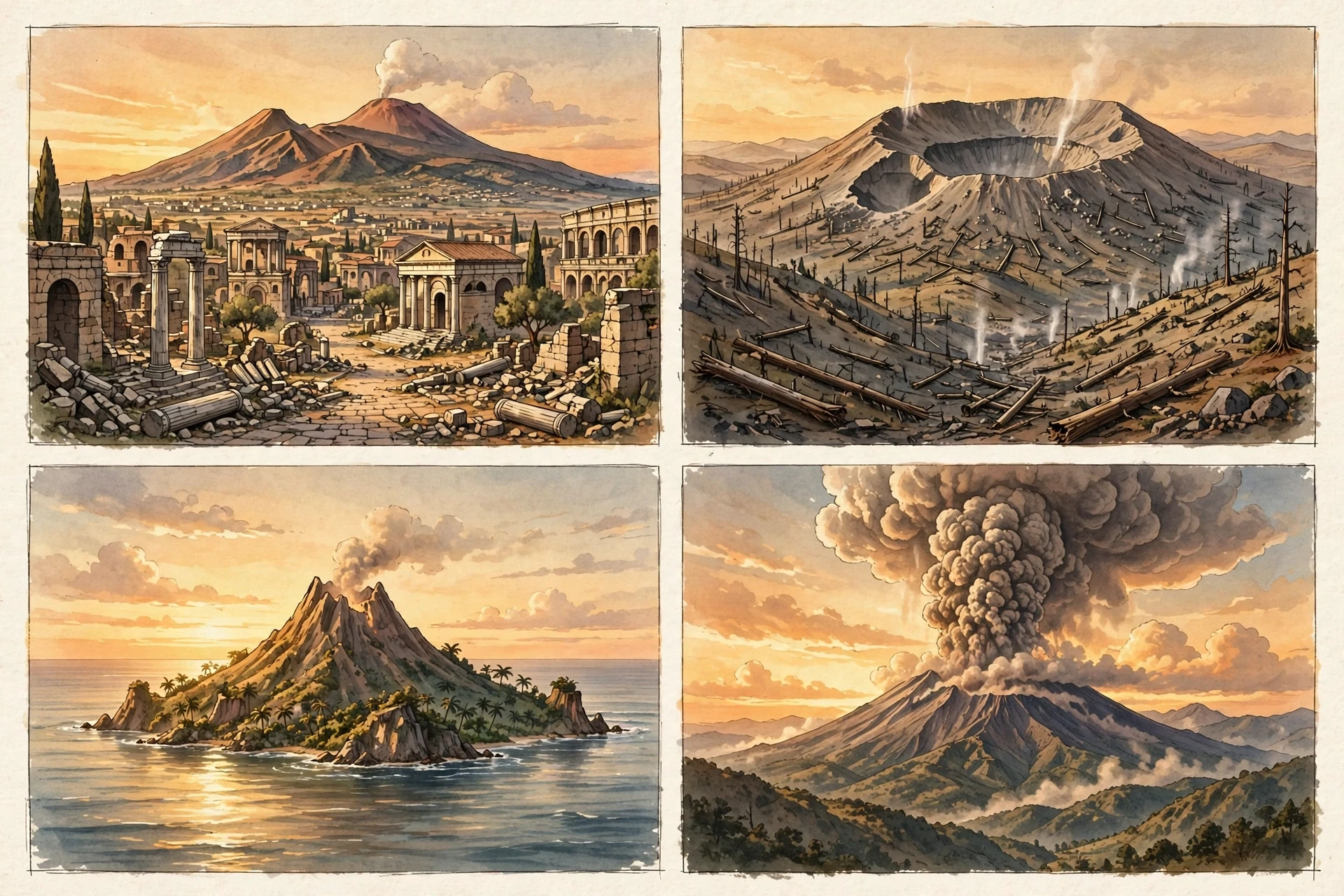
In 79 CE, Mount Vesuvius erupted and buried the Roman cities of Pompeii and Herculaneum under metres of ash and pyroclastic deposits. Pliny the Younger watched from across the Bay of Naples and wrote down what he saw, in a letter that is still read today. His uncle, Pliny the Elder, sailed toward the eruption to help and died there. The cities were lost for more than 1,500 years, and when they were dug up, they gave archaeologists a Roman town preserved almost exactly as it had been on the morning of the eruption — bread still in the ovens, paint still on the walls.
Vesuvius is still active, and more than a million people now live around it. It is one of the most closely monitored volcanoes on Earth, and it is also one of the most dangerous, because the hazard is not only the volcano. It is the city that grew up around it.
7.2 Krakatau, 1883, and Tambora, 1815: eruptions that changed the climate
In 1883, Krakatau in Indonesia exploded with a sound heard thousands of kilometres away. The eruption destroyed most of the island, produced tsunamis that killed tens of thousands of people, and threw so much ash and sulfur into the atmosphere that sunsets around the world turned red for months. The volcano has since rebuilt itself as Anak Krakatau, the "child of Krakatau", which is still growing and still erupting.
Tambora, also in Indonesia, erupted in 1815 in the largest eruption of the last thousand years. The following year, 1816, became known as the "Year Without a Summer": crops failed across Europe and North America, famine followed, and the global climate cooled measurably. The connection between a volcano in Indonesia and a failed harvest in Switzerland is not a metaphor. It is a physical chain: sulfur dioxide reaches the stratosphere, forms tiny droplets that reflect sunlight, and the planet cools until the droplets fall out.
7.3 Pinatubo, 1991: the eruption that proved monitoring works
Mount Pinatubo in the Philippines had been quiet for centuries when it began to stir in 1991. Scientists monitored it, mapped the hazard zones, and recommended evacuations. When it erupted in June 1991, one of the largest eruptions of the twentieth century, tens of thousands of people had already been moved out of the danger zone. Pinatubo is the case study every volcanology student learns: monitoring does not prevent eruptions, but it saves lives. NASA's Earth Observatory has tracked the aftermath of eruptions like Pinatubo from space, showing how ash and sulfur spread around the globe.
8. Monitoring Volcanoes: Listening to the Mountain
A volcano gives warnings. The problem is that the warnings are subtle, and they look like other things. An earthquake swarm can mean magma is moving — or it can mean a fault is slipping. The ground can swell because magma is rising — or because groundwater is changing. Gas can increase because an eruption is coming — or because the wind changed. Monitoring is the art of putting all of those signals together and deciding what they mean.
Scientists watch volcanoes with a set of tools that would have seemed like science fiction a century ago — and all of those tools, from seismometers to satellites, run on electricity, the same principles Sciory's Fundamentals of Electricity: From Circuits to Electromagnetism explains:
Seismometers listen for earthquakes inside the volcano, including the special tremors that mean magma is on the move.
GPS and satellite radar measure ground deformation to the millimetre, showing where the ground is swelling and by how much.
Gas sensors measure sulfur dioxide and carbon dioxide coming out of vents and fumaroles.
Thermal cameras and satellites watch for hot spots and changes in heat.
Tiltmeters detect the tiny tilting of the ground as a magma chamber fills or empties.
No single signal is enough. Together, they form a picture. When the earthquakes, the swelling, and the gas all move in the same direction, volcanologists raise the alert level. When they disagree, the answer is to watch more closely and say so honestly. The USGS Volcano Hazards Program runs this kind of monitoring at volcanoes across the United States, and its early warning system is the reason towns near active volcanoes have evacuation plans at all.
Prediction is not the same as forecasting. Volcanologists can say that an eruption is likely in the coming days or weeks, and they can say where the hazards will go. They cannot say the exact hour, and they cannot say exactly how big it will be. Anyone who claims otherwise is selling something. The honest version is less dramatic, and it is the one that saves lives: watch, measure, warn early, and move people out of the way.
9. The Other Side of Volcanoes: What They Give Us
Volcanoes destroy, and they also give. The same ash that buries a field breaks down into some of the richest soil on Earth, which is why people farm on the slopes of active volcanoes despite the risk. Volcanic soils grow coffee in Indonesia, grapes in Italy, and vegetables in Iceland. The risk is real, and so is the reward, and people have weighed the two for thousands of years.
Volcanoes also give us geothermal energy: heat from the Earth used to make electricity and warm homes. Iceland runs much of its energy system on it. They give us minerals, from sulfur to gold, concentrated by hot fluids moving through rock. They give us new land: the island of Surtsey rose out of the sea off Iceland in 1963, and scientists have watched life colonise it from scratch — a small, live example of how life spreads and evolves on a changing planet, the larger story Sciory's Darwin's Theory of Evolution: Evidence Explained tells.
Over geological time, volcanoes gave us more than soil and energy. They helped build the atmosphere and the oceans. The gases released by early volcanoes — water vapour, carbon dioxide, nitrogen — were the raw material of the air we breathe and the seas we swim in. Life itself depends on volcanoes in a way that is easy to forget: the planet's chemistry, including the cycles that move carbon and water around, was set in motion by volcanic outgassing billions of years ago. The oxygen in the air came later, from Photosynthesis Explained: Process & Equation, but the stage was built by volcanoes.
That does not make volcanoes safe. It makes them necessary. A planet without volcanoes would be a planet without new land, without fertile soil, and without the long-term recycling of the materials life needs. The danger and the gift are the same process, seen from different distances.
10. Common Misconceptions About Volcanoes — Corrected
"Lava is the main killer." Lava is slow and visible. Pyroclastic flows, lahars, and ash kill far more people, and they move far faster.
"Volcanoes only erupt upward." Mount St. Helens erupted sideways. Flank collapses, lateral blasts, and lahars can strike far from the summit.
"A dormant volcano is safe." Dormant means it has not erupted recently. It does not mean it will never erupt again. Vesuvius was quiet for centuries before 79 CE.
"Scientists can predict eruptions exactly." They can forecast the likelihood and the hazard zones, not the exact hour or size. Monitoring is a warning system, not a crystal ball.
"All volcanoes are the same." Shield, stratovolcano, cinder cone, and lava dome differ in magma, shape, and danger. The shape tells you the story.
"Volcanic ash is like wood ash." Volcanic ash is made of sharp glass and rock fragments. It damages lungs, engines, and roofs in ways wood ash never could.
"Volcanoes are only destructive." They also build land, enrich soil, provide geothermal energy, and helped create the atmosphere and oceans.
10.1 Current research and open questions
Researchers still disagree on important questions. How much magma is stored beneath a volcano, and how is it connected? Why do some volcanoes switch eruption style without warning? How long does a super-eruption take to build, and what, if anything, would warn us in time? Satellites, better sensors, and computer models are improving the answers, but the answers are not finished.
Conclusion: Fire That Builds
Volcanoes begin as heat, deep underground. That heat melts rock, the rock rises, and where it reaches the surface it builds a mountain — or destroys one. The mountain's shape tells you what kind of magma built it. The magma's chemistry tells you how it will erupt. The eruption's products tell you who is in danger, and how far away they need to be.
The next time you see a volcano in a photograph — a perfect cone against the sky, a plume rising into the stratosphere — look twice. The beauty is real, and so is the danger, and both come from the same source: a planet that is still hot inside, still moving, still remaking itself. We live on the thin, cool crust of that planet, and volcanoes are the places where the crust is thinnest of all. They remind us, politely and sometimes not so politely, that the ground beneath our feet is not as solid as it feels.
Frequently Asked Questions
How do volcanoes form?
Volcanoes form when magma — molten rock from beneath Earth's crust — rises to the surface and erupts. Most form at plate boundaries, where plates pull apart or one slides beneath another, or over hotspots, where a plume of hot rock rises from deep in the mantle.
What are the main types of volcanoes?
The four main types are shield volcanoes, stratovolcanoes (composite volcanoes), cinder cones, and lava domes. They differ in shape, size, magma type, and eruption style. Shield volcanoes are broad and gentle; stratovolcanoes are steep and explosive; cinder cones are small and steep; lava domes are bulbous mounds of stiff lava.
What is the difference between magma and lava?
Magma is molten rock beneath Earth's surface. Lava is the same material once it has erupted onto the surface. The main difference is location — and pressure: underground, gases stay dissolved in magma, while at the surface they escape, which can make eruptions explosive.
What causes a volcanic eruption?
An eruption happens when pressure in a magma chamber exceeds the strength of the rock above it. Magma rises up the conduit, gases form bubbles as pressure falls, and the magma either flows out as lava or fragments into ash and gas. Gas content and magma viscosity decide how explosive the eruption is.
What is the most dangerous type of volcanic eruption?
Explosive eruptions that produce pyroclastic flows are the most dangerous. Pyroclastic flows are fast-moving clouds of hot gas and particles that can travel at hundreds of kilometres per hour and destroy everything in their path. Lahars and ash falls are also major killers.
Can scientists predict volcanic eruptions?
Scientists can forecast that an eruption is likely in the coming days or weeks, using earthquakes, ground swelling, and gas measurements, but they cannot predict the exact hour or size. Monitoring and early warning systems save lives by giving people time to evacuate.
What is the Ring of Fire?
The Ring of Fire is the chain of volcanoes around the Pacific Ocean, where most of the world's active volcanoes sit. It follows the plate boundaries around the Pacific, including Japan, Indonesia, the Philippines, and the Cascade Range in North America.
What is a supervolcano?
A supervolcano is a caldera system capable of an extremely large eruption — a VEI 8 event, ejecting more than a thousand cubic kilometres of material. Yellowstone, Toba, and Taupo are examples. The last super-eruption was Toba, about 74,000 years ago.
Are volcanoes good for anything?
Yes. Volcanic ash breaks down into fertile soil, volcanoes provide geothermal energy and minerals, they build new land, and over geological time volcanic gases helped form the atmosphere and oceans.
What should I do if I live near a volcano?
Know your hazard zone and evacuation routes, follow the advice of your local volcano observatory and emergency services, and leave early if an evacuation is ordered. Do not wait to see the eruption — pyroclastic flows and lahars can arrive faster than you can outrun them.
Sources / Further Reading
USGS Volcano Hazards Program — monitoring, hazards, and early warning in the United States
Smithsonian Institution, Global Volcanism Program — eruption records and the Volcanoes of the World database
USGS, Volcanoes: Principal Types of Volcanoes — cinder cones, composite volcanoes, shield volcanoes, and lava domes
Encyclopaedia Britannica, Volcano — definition, formation, types, and effects
NASA Earth Observatory, Volcanoes — satellite images and stories of eruptions from space