

Introduction
The bus driver braked hard, and my body kept going — my first real lesson in Newton's laws of motion. I was sixteen, standing in the aisle with a school bag slung over one shoulder, and in that half-second before my hands found the rail, I understood something no textbook had ever made me feel. The bus had stopped. I had not. My feet were planted on a floor that was no longer moving, but the rest of me was still travelling at the speed the bus had been doing a moment earlier, and it took a real force — my arms, the rail, a jolt through my shoulders — to change that.
That jolt was Newton's laws of motion in action — the first law, inertia — and I had just met it in person. Years later, as a physics teacher and researcher, I have watched the same look cross hundreds of faces: the small shock of recognition when an abstract rule turns out to be something your own body already knows. Newton's laws of motion are like that. They sound like classroom rules, but they run your morning commute, your football game, the flight of a rocket, and the slow swing of the Moon around the Earth. They were written down by one man in 1687, and they still predict, to astonishing precision, how almost everything you will ever touch actually moves.
This guide follows Newton's laws of motion from the apple orchard story everyone half-remembers, through each law in turn, and out into the places where they do real work: car safety, sport, bridges, spacecraft, and the orbits of planets. It also faces the places where the laws stop working, because a good guide should tell you where the map ends. You will find worked numbers you can check with a calculator, everyday examples you can try at home, and the human story behind the equations — including the parts Newton got from other people, and the parts he fought over bitterly.
1. What Newton's Laws of Motion Actually Are
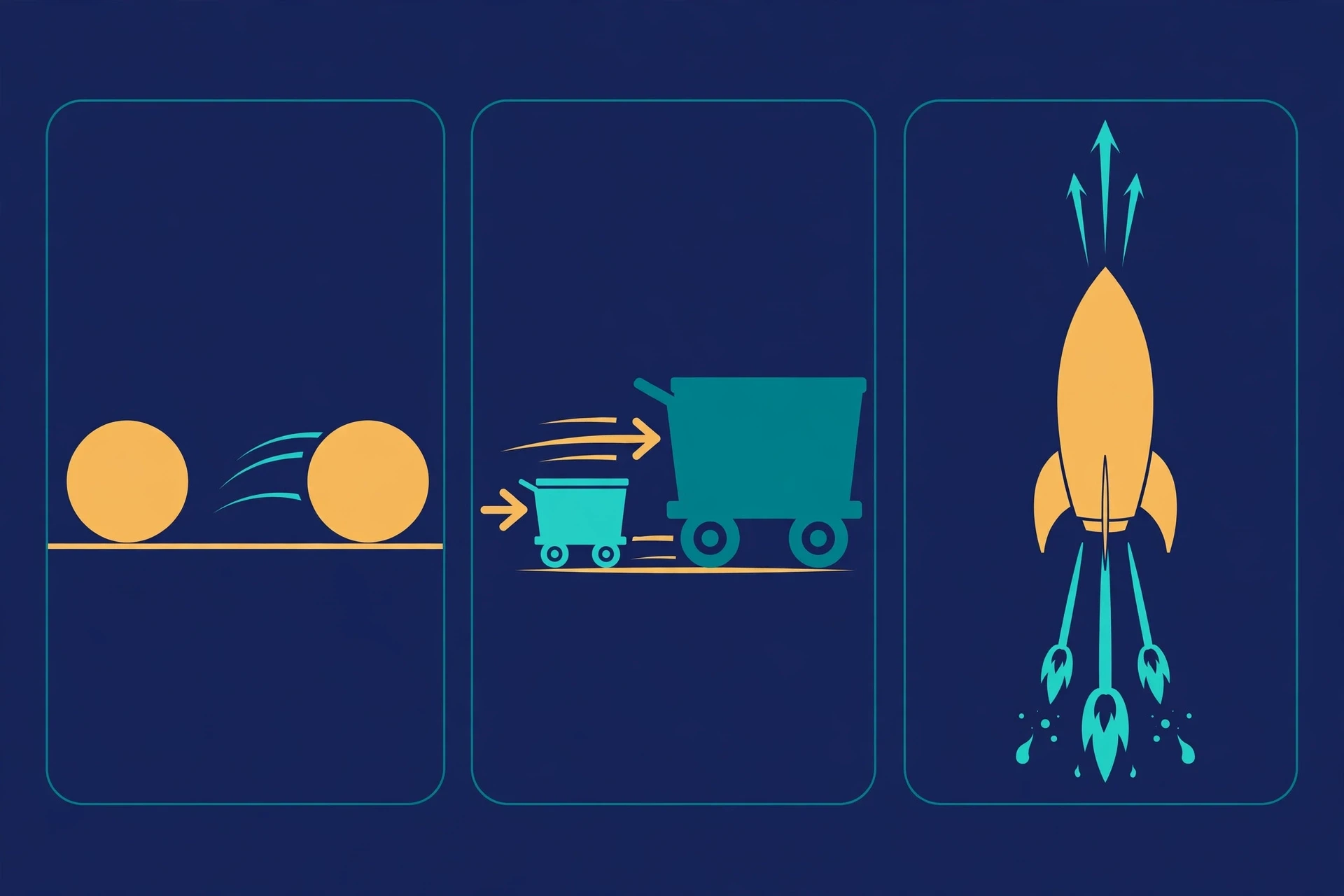
Newton's laws of motion are three rules that connect forces to motion. A force is a push or a pull. Motion is how an object's position and velocity change over time. The laws say, in short: motion does not change by itself; when it does change, the change is proportional to the force and inversely proportional to the mass; and forces always come in pairs, acting on two different objects.
That sounds simple, and the sentences are short. The depth is in what they replace. Before Newton, the common-sense view — the one Aristotle had taught for nearly two thousand years — was that things naturally slow down and stop, and that a constant push is needed to keep anything moving at a steady speed. Watch a cart on a rough road and that seems right: stop pushing and the cart stops. What Newton saw, building on Galileo's experiments, was that the cart stops because of friction and air resistance, not because motion itself needs a push. Take those forces away, and motion carries on by itself. Rest and steady motion in a straight line are the same state, seen from different points of view. That was a genuine break with two thousand years of intuition, and it still trips people up today.
The three laws were published in 1687 in Newton's Philosophiæ Naturalis Principia Mathematica, usually called the Principia. Newton wrote them in Latin, in a dense, geometrical style that modern readers find forbidding, but the ideas underneath are plain enough to state in a sentence each:
First law (inertia): an object keeps its velocity — its speed and direction — unless a net external force acts on it.
Second law (F = ma): the net force on an object equals its mass times its acceleration. Push harder, and it speeds up faster. Push the same on something heavier, and it speeds up more slowly.
Third law (action and reaction): when one object exerts a force on another, the second exerts an equal force back on the first, in the opposite direction.
A word that matters in all three laws is net. It means the total after adding up every force, taking direction into account. A car cruising at a steady 100 kilometres per hour has plenty of forces on it: the engine pushing forward through the tyres, air drag and rolling resistance pushing back, gravity pulling down, and the road pushing up. When those add up to zero, the car's velocity does not change. The first law is not about having no forces at all. It is about having no unbalanced force. That distinction is the key to using the laws properly, and it is the one most students miss on their first try.
NASA's Glenn Research Center states the three laws in plain language and ties each one to flight, which is a good place to start if you want the official short version alongside this guide: NASA Glenn Research Center, Newton's Laws of Motion.
1.1 Force, mass, and acceleration — the three words you need
Before the laws can do any work, three words need sharp definitions, because everyday language blurs them.
Force is measured in newtons (N). One newton is the force needed to accelerate one kilogram of mass by one metre per second squared: 1 N = 1 kg·m/s². Push a shopping trolley with about 10 N and you feel a light shove. A strong adult can push with several hundred newtons for a short burst. A jet engine produces hundreds of thousands of newtons of thrust.
Mass is measured in kilograms, and it is not the same as weight. Mass is how much matter an object contains, and how much it resists being accelerated. Weight is the force of gravity on that mass, and it changes with location: your mass is the same on the Moon as on Earth, but your weight there is about one-sixth as much, because the Moon's gravity is weaker. People mix these up constantly, and physics teachers spend a surprising amount of time untangling them. OpenStax's University Physics textbook opens its chapter on Newton's laws with exactly this distinction, using a bridge as its example: the forces on a bridge are in equilibrium, so it stays put, while the force from a car engine changes the car's motion — and the whole chapter builds from there: OpenStax, University Physics Volume 1, Chapter 5 Introduction.
Acceleration is any change in velocity, and velocity includes direction. A car going around a roundabout at a constant 30 km/h is accelerating, because its direction keeps changing, even though its speed does not. A car braking in a straight line is accelerating too, in the opposite direction to its motion. This is why the second law talks about acceleration, not speed: a force changes how velocity changes, not how fast something is already going.
1.2 Where the laws hold — and the frame that matters
Newton's laws of motion work in inertial reference frames: frames that are not accelerating. A train moving at a steady speed on a straight track is close enough to inertial for everyday purposes. A braking bus is not. Inside a braking bus, a ball on the floor appears to roll forward by itself, with no visible push. It is not breaking the laws. The bus is the frame that is accelerating, so the laws, as stated, need a correction — what physicists call a fictitious force — to describe what you see from inside.
For most of daily life, the Earth's surface is a good enough inertial frame, even though the Earth is spinning and orbiting the Sun. The corrections are tiny for a car, a ball, or a bridge. They matter for weather systems, for long-range artillery, and for spacecraft, where the frame must be chosen with care. The laws also assume speeds far below the speed of light and objects far larger than atoms. Near light speed, Einstein's relativity takes over — a story told in Sciory's Einstein's Theory of Relativity: Special and General Explained — and at atomic scales, quantum mechanics rules, as described in Understanding Quantum Mechanics: Principles, Paradoxes, Real-World Applications & 2026 Breakthroughs (Ultimate Guide). Section 9 of this guide comes back to those limits in detail.
2. Before Newton: Aristotle, Galileo, and the Long Argument
Newton did not invent the study of motion from nothing. He stood, as he famously wrote, on the shoulders of giants, and the giant who mattered most was Galileo Galilei, who died in 1642, the year Newton was born.
Aristotle's picture of motion had ruled for two millennia. In it, heavy things fell faster than light ones, rest was the natural state of things, and a constant force was needed to keep anything moving. It matched everyday experience on a rough, friction-filled Earth, which is why it lasted so long. It was also wrong in the ways that matter.
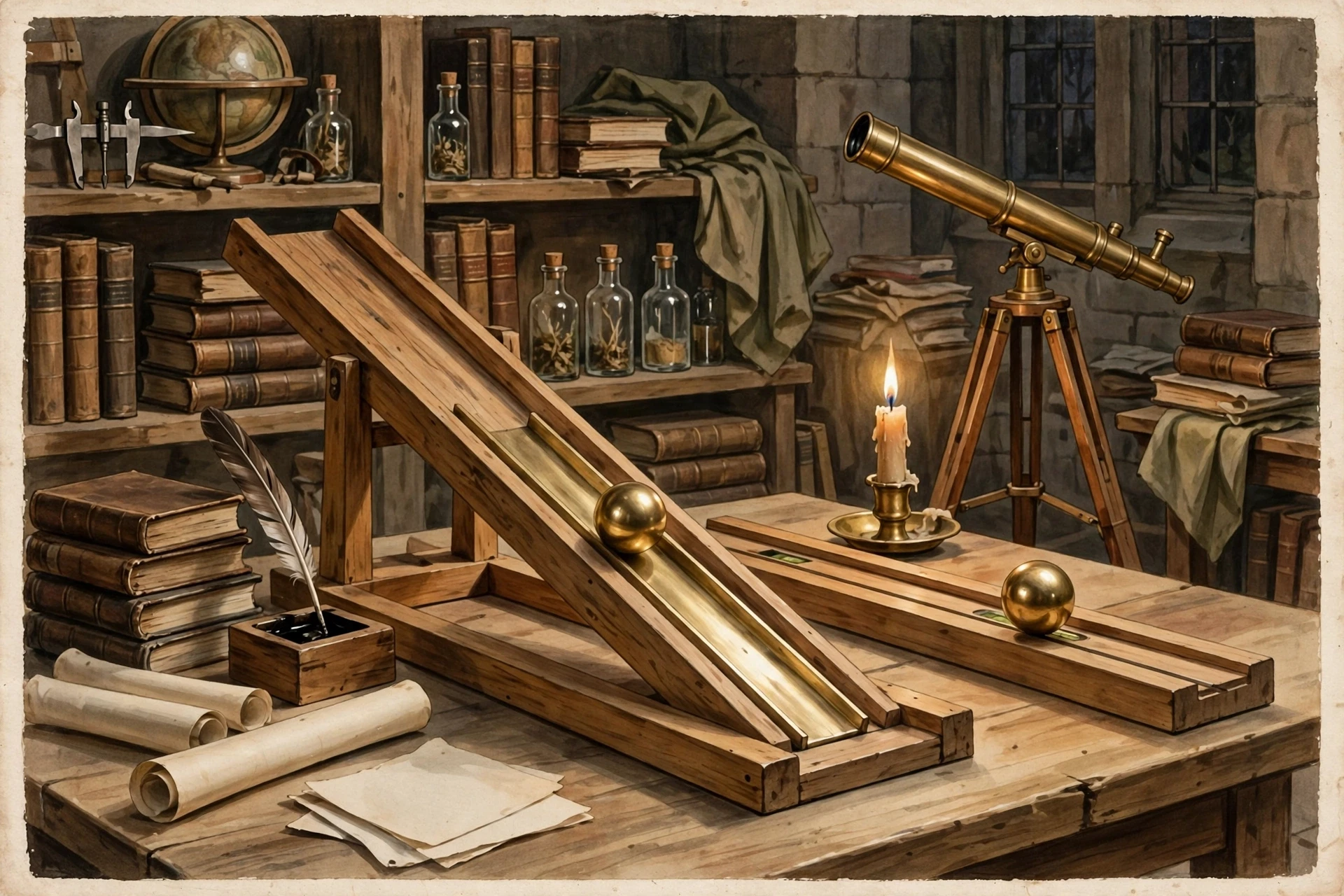
Galileo broke it with experiments that were simple enough to describe and hard enough to believe. He rolled balls down inclined planes and timed them, and found that the distance travelled grew with the square of the time — a pattern that pointed to constant acceleration, not to speed depending on weight. He argued, in a thought experiment that no one could quite perform at the time, that a ball rolling on a perfectly smooth, level surface would keep rolling forever, because nothing would be there to stop it. Friction was the villain all along, not motion itself. He also dropped objects — the famous story of the Leaning Tower of Pisa may be legend, but the experiments with inclined planes were real — and showed that objects of different weights fall at nearly the same rate when air resistance is taken out of the picture.
I still run a version of Galileo's inclined-plane experiment with students, using a track, a steel ball, and a phone stopwatch, and I still enjoy the moment when the numbers refuse to fit the Aristotle in their heads. A student will say, "But the heavier ball should be faster," and then the stopwatch says otherwise, and there is a short silence while a two-thousand-year-old idea gives way. That silence is the sound of science working.
Newton took Galileo's insight about inertia, added his own mathematics, and turned it into a complete system. He also added the law of universal gravitation, which explained why the Moon stays in orbit and why an apple falls — the same force, acting at different distances. The apple story is probably embellished: Newton told friends late in life that the idea of gravitation came to him while watching an apple fall in his mother's garden at Woolsthorpe, and the story grew in the telling. What is true is that the Principia joined the motion of falling apples to the motion of planets in one set of equations, and that joining changed science permanently. The planets and their moons are described in Sciory's Our Solar System: Planets, Moons, and Celestial Dynamics, and the same gravitational force that holds them in orbit is the one that pulls a dropped pen to the floor.
2.1 The Principia and the fight over credit
The Principia was published in 1687 after Edmond Halley — the astronomer of the comet — talked Newton into writing it up and paid for the printing himself. Newton had been sitting on the work for years, reluctant to publish, partly because he disliked argument and partly because he knew the claims would be fought over. He was right to worry. Robert Hooke claimed Newton had taken the inverse-square idea for gravitation from him, and the two men quarrelled for the rest of their lives. Newton also fought a long, bitter priority dispute with Gottfried Leibniz over who had invented calculus, the mathematics the Principia needed.
These fights are not gossip laid on top of the science. They are part of how the science happened. Newton's reluctance to publish meant the laws reached the world later than they might have. His rivalry with Hooke meant some ideas were sharpened in argument and others were buried in spite. And the Principia itself was written in a deliberately difficult style — Newton later admitted he had made it hard to read so that it would not be "baited by little smatterers in mathematics." A modern textbook says the same things more clearly, but the Principia is where the laws first appeared as a complete system, and it is still worth knowing that they arrived through argument, delay, and stubbornness, not as a single flash of genius under a tree.
3. The First Law: Inertia — Why Things Keep Doing What They Are Doing
3.1 What the first law says
Newton's first law says that an object at rest stays at rest, and an object moving at a constant velocity keeps moving at that velocity in a straight line, unless a net external force acts on it. The tendency of matter to resist a change in its motion is called inertia, and the bigger an object's mass, the more inertia it has.
This is the law that contradicts everyday experience most directly, because everyday experience is full of friction. A football rolling across grass slows down and stops. A book pushed across a table stops when your hand leaves it. It looks as if motion dies on its own. It does not. Friction with the ground and drag from the air are forces, and they are doing the stopping. On ice, the same football rolls much farther. In space, where there is almost no friction or air resistance, a spacecraft keeps moving at the same velocity for years with its engines off. Voyager 1, launched in 1977, is still coasting outward through interstellar space on the motion it was given decades ago, with no engine pushing it. That is the first law, running at the largest scale we have ever tested.
Britannica's account of the laws puts the point well: in classical mechanics there is no important distinction between rest and uniform motion in a straight line — they are the same state, seen by observers moving at different constant velocities: Britannica, Newton's laws of motion. Once you accept that, the rest of mechanics starts to fall into place.
3.2 Inertia in your own body
The first time I taught the first law to a class of sixteen-year-olds, I did not start with a definition. I started with a bus. I asked them to remember the last time a bus braked suddenly, and what their bodies did. Everyone knew. You lurch forward. Your bag slides off the seat. A bottle rolls down the aisle. Then I asked the question that makes the law click: who pushed you forward? Nobody did. Your body was moving at the bus's speed, and when the bus slowed down, your body tried to keep going at the old speed. The seatbelt, the seat in front of you, or your own hands on the rail supplied the force that changed your motion. Without them, you would have kept going until something else stopped you.
That is why seatbelts exist, and why they save lives. In a crash, the car stops in a fraction of a second, but the people inside keep moving at the car's old speed until a force stops them. A seatbelt spreads that force over the strong parts of the body and over a longer time than a dashboard or a windscreen would. The physics is the first law; the engineering is the belt, the airbag, and the crumple zone, which are covered in Section 8.
Other everyday moments show the same law:
A tablecloth can be pulled from under a set of dishes, if it is pulled fast enough, because the dishes' inertia keeps them in place while the cloth slides out from under them. Pull slowly and friction drags the dishes along.
A coin on a card over a glass drops straight into the glass when the card is flicked away quickly. The coin's inertia keeps it where it was, and gravity pulls it down.
A table fan keeps spinning for a while after you switch it off. Nothing is driving it any more, but its rotating parts keep their motion until friction in the bearings stops them.
A heavy piece of furniture is hard to start moving and hard to stop once it is sliding, because its large mass gives it large inertia in both directions.
3.3 Inertia is not a force
One mistake I correct every year is the idea that inertia is a force pushing back. It is not. Inertia is a property — a resistance to change — not a push. When a car accelerates forward, you feel pressed back into your seat, and it is tempting to say that inertia is pushing you. What is actually happening is that the seat is pushing you forward, accelerating you along with the car, and your body resists that change. The feeling of being pressed back is the seat doing its job. There is no extra force called inertia hiding in the car. Keeping that straight matters, because free-body diagrams — the engineer's way of drawing every force on an object — go badly wrong if you add a force that does not exist.
3.4 Why the first law is not just a special case of the second
A sharp student will eventually ask: if the second law says F = ma, then when the net force is zero, the acceleration is zero, and the velocity does not change. Is the first law not just the second law with F = 0? It looks that way, and some textbooks present it as a corollary. But the first law does more work than that. It defines the frames in which the other laws hold — the inertial frames. It says: there exist frames in which an object with no net force on it moves at constant velocity. That is a claim about the world, not a piece of algebra, and without it the second law would have no frame to stand in. Newton put it first for a reason.
4. The Second Law: F = ma — How Much Force, How Much Change
4.1 What the second law says
Newton's second law is the workhorse of the three. It says that the acceleration of an object is directly proportional to the net external force acting on it, and inversely proportional to its mass. In the form everyone learns, for a constant mass:
F = ma — net force equals mass times acceleration.
Double the force on the same object and you double its acceleration. Keep the force the same and double the mass, and the acceleration halves. Push an empty shopping trolley and a full one with the same effort, and the empty one shoots away while the full one lumbers forward. That is the second law in a supermarket aisle.
The law is a vector law: force and acceleration have direction as well as size, and the acceleration points in the same direction as the net force. Push a ball to the right and it accelerates to the right. Push it up and it accelerates up. When several forces act at once, it is their vector sum — the net force — that decides the acceleration. Two people pushing a stalled car from behind add their forces together. One person pushing from the front cancels part of the other person's push. OpenStax works through exactly this example, with two students pushing a car and then a tow truck producing a larger force on the same mass, to show how the net force, not any single push, decides what happens: OpenStax, University Physics Volume 1, Newton's Second Law.
Newton's own statement of the law was about momentum, not acceleration: the rate of change of momentum equals the applied force. Momentum is mass times velocity, and for an object whose mass does not change, the two statements are the same. The momentum form is the more general one, and it is the one engineers need for rockets, where mass drops as fuel burns. NASA's Glenn page derives F = ma from the momentum form step by step, showing where the constant-mass assumption enters and where it breaks down for a rocket: NASA Glenn Research Center, Newton's Laws of Motion.
4.2 Worked examples you can check
The second law is at its best when you run the numbers. Here are three, worked out in full, with units shown at each step so you can check them with a calculator.
Example 1 — a car accelerating. A car with a mass of 1,500 kg accelerates from rest to 27 m/s (about 97 km/h) in 9 seconds. What net force is needed?
Acceleration a = change in velocity ÷ time = 27 ÷ 9 = 3 m/s². Force F = m × a = 1,500 × 3 = 4,500 N. That is the net forward force — the engine's push through the tyres, minus air drag and rolling resistance. The engine itself must produce more than this, because some of its force is spent fighting drag.
Example 2 — the same force, different masses. The same 20 N push is applied to a 5 kg block and to a 50 kg crate on a frictionless surface. The block accelerates at a = F ÷ m = 20 ÷ 5 = 4 m/s². The crate accelerates at 20 ÷ 50 = 0.4 m/s² — ten times less, because its mass is ten times greater. This is why a sports car with a powerful engine and a light body accelerates faster than a lorry with a similar engine: the ratio of force to mass is what matters.
Example 3 — catching a ball. A cricket fielder catches a ball of mass 0.16 kg travelling at 30 m/s and brings it to rest in 0.1 seconds by pulling his hands back as he catches. The change in velocity is 30 m/s, so the acceleration is 30 ÷ 0.1 = 300 m/s², and the average force is F = 0.16 × 300 = 48 N. If he stopped the ball in 0.02 seconds instead — stiff hands, no give — the force would be five times larger, about 240 N, and his hands would sting. The trick is time: spreading the same change in momentum over a longer time means a smaller force. That is the same physics as a crumple zone and an airbag, and it is the reason coaches teach soft hands.
The second law is a recipe, not just a slogan. If you know any two of force, mass, and acceleration, you can find the third — and that is enough to design a brake, size a rocket engine, or work out whether a bridge cable will hold.

4.3 Mass, weight, and the newton
A common mix-up deserves a table, because it causes more errors in first-year physics than any other single confusion.
Quantity | Symbol | Unit | What it is | Does it change on the Moon? |
|---|---|---|---|---|
Mass | m | kilogram (kg) | Amount of matter; resistance to acceleration | No — same mass |
Weight | W | newton (N) | Force of gravity on the mass (W = mg) | Yes — about one-sixth of Earth weight |
Force | F | newton (N) | Any push or pull; F = ma | Depends on the situation |
Acceleration | a | m/s² | Rate of change of velocity | Depends on net force and mass |
Momentum | p | kg·m/s | Mass times velocity (p = mv) | Depends on velocity |
Near the Earth's surface, the acceleration due to gravity is about 9.8 m/s², so a 70 kg person weighs about 70 × 9.8 = 686 N. On the Moon, gravity is about 1.6 m/s², so the same person weighs about 112 N — but still has a mass of 70 kg, and still needs the same force to accelerate by the same amount in a horizontal direction. Astronauts on the Moon discovered this the hard way: they could jump high, because their weight was low, but a heavy tool still needed a strong push to get moving, because its mass had not changed.
4.4 The second law in one picture: the free-body diagram
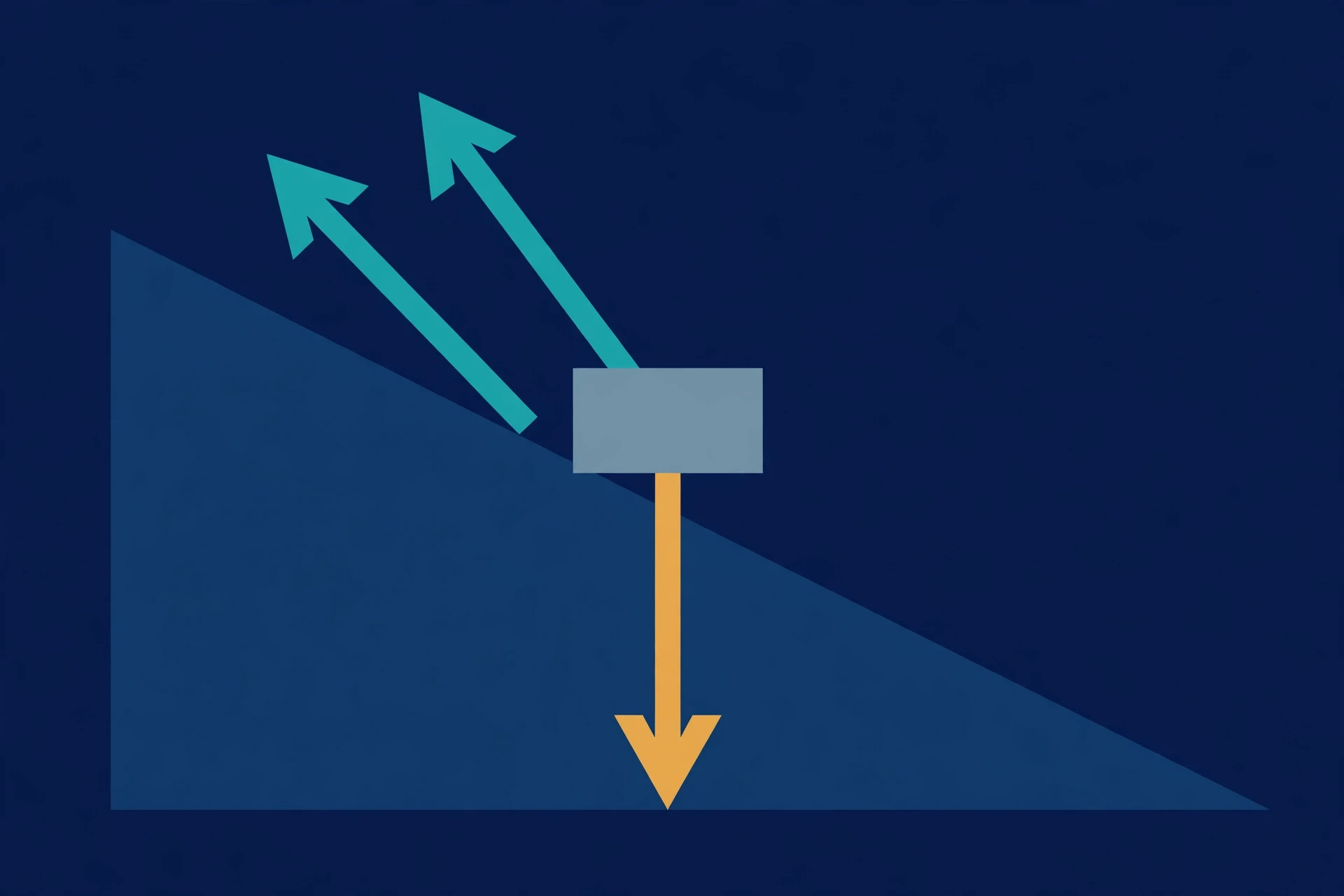
Engineers rarely solve a mechanics problem by staring at the object. They draw a free-body diagram: a dot for the object, with an arrow for every force acting on it, labelled with its size and direction. The diagram turns a messy real situation into a clean accounting problem. Add the arrows up, and you have the net force. Divide by the mass, and you have the acceleration.
I learned the value of this the slow way, as a student, by trying to solve a block-on-a-slope problem in my head and getting the direction of friction wrong three times in a row. My tutor made me draw the diagram before writing a single number. Weight straight down. Normal force perpendicular to the slope. Friction up the slope, opposing the slide. Once the arrows were on the page, the answer was obvious. I have made students draw the diagram first ever since, and the error rate drops by half. The diagram is not decoration. It is the thinking.
5. The Third Law: Action and Reaction — Forces Always Come in Pairs
5.1 What the third law says
Newton's third law says that when one object exerts a force on another, the second object exerts an equal and opposite force on the first. The two forces are equal in size, opposite in direction, and — the part people forget — they act on different objects.
Walk, and your foot pushes backward on the ground. The ground pushes forward on your foot, with the same size of force, and that forward push is what actually moves you. Swim, and your hands push water backward; the water pushes you forward. Jump, and your legs push down on the Earth; the Earth pushes up on you, and you leave the ground. The Earth, being enormously more massive than you, accelerates downward by an amount too small to measure — but the force on it is exactly equal to the force on you. The law does not care about size. It applies to a foot and a planet just as it does to two billiard balls.
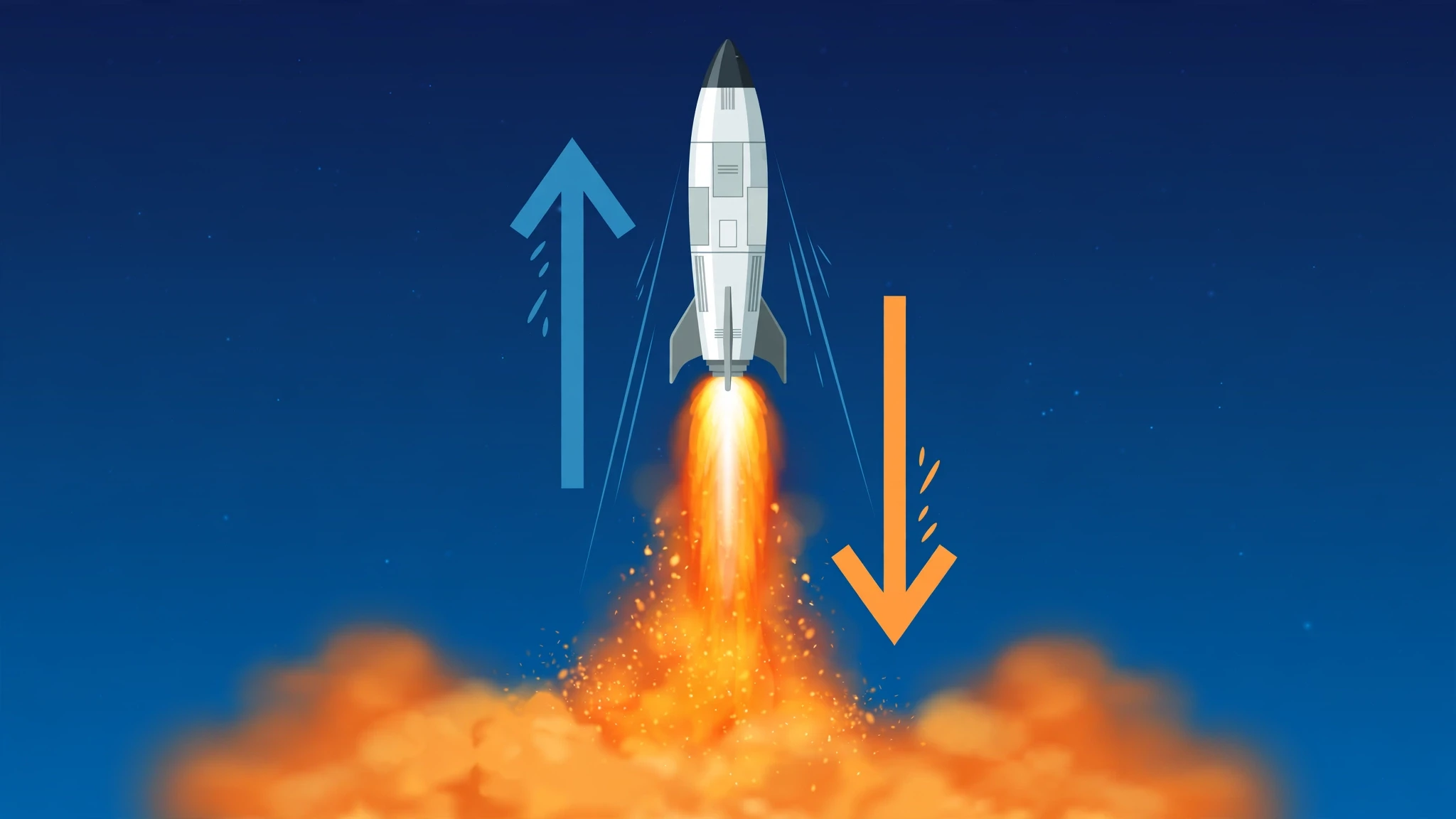
A rocket is the third law in its purest form. The rocket pushes hot exhaust gases downward at great speed. The gases push the rocket upward with an equal and opposite force. The rocket does not need air to push against, and it does not need a ground to stand on. That is why rockets work in the vacuum of space, where there is nothing to push against except the exhaust itself. A surprising number of people, including some otherwise well-educated adults, think a rocket needs air to push off. It does not. It carries its own reaction mass with it, in the form of fuel, and throws it out the back. The faster and heavier the exhaust it throws, the harder the push back.
5.2 The mistake almost everyone makes
Most people assume that action and reaction cancel each other out, because they are equal and opposite. They do not cancel, because they act on different objects. Cancellation only happens when two forces act on the same object. The force of your foot on the ground and the force of the ground on your foot are a pair, but they belong to two different free-body diagrams: one for you, one for the ground. Inside your own diagram, only the ground's push on you appears, and it is that push that accelerates you forward.
Here is a test I give students. A horse pulls a cart forward. The cart pulls back on the horse with an equal and opposite force. So why does the cart move at all? The answer is that the two forces act on different bodies. The cart moves because the horse's pull on the cart is larger than the friction and drag holding the cart back — the net force on the cart is forward. The horse moves because the ground pushes forward on its hooves harder than the cart pulls back — the net force on the horse is forward. The pair never meets in a single diagram, so it never cancels. Once a student can draw both diagrams and see that, the third law stops being a riddle and starts being a tool.
5.3 Action and reaction in sport, flight, and space
Rowing: the oar pushes water backward; the water pushes the boat forward.
A jet engine: hot gases rush out the back; the engine, and the aeroplane attached to it, are pushed forward. NASA's Glenn page uses the jet engine as its third-law example, and the same page shows how lift comes from a wing deflecting air downward and being pushed upward in return: NASA Glenn Research Center, Newton's Laws of Motion.
A balloon: let go of an inflated balloon and the air rushes out one way while the balloon shoots the other. It is a rocket in miniature, and it is the best classroom demonstration of the third law I know. I have launched hundreds of balloon rockets along a string in classrooms, and the cheer when the balloon crosses the room never gets old.
A gun's recoil: the bullet is pushed forward; the gun is pushed back. The bullet is light and fast; the gun is heavy and slow, so the same momentum is shared very unevenly — which is why the recoil is a kick and not a catastrophe.
The Moon and the Earth: the Earth pulls the Moon into its orbit, and the Moon pulls the Earth back with an equal force. That pull is what raises the tides. The force is mutual, and so is the motion: both bodies orbit their common centre of mass, though the Earth's wobble is small because the Earth is so much heavier.
6. The Forces You Actually Meet: Gravity, Friction, and the Normal Force
Newton's laws are about forces in general, but in practice a handful of forces do most of the work in everyday problems. Knowing them by name, and knowing which way each one points, is half of mechanics.
Gravity (weight): pulls every mass toward the centre of the Earth, straight down, with a force W = mg. It acts at a distance, without contact, and it is the same force that holds the Moon in orbit — a point Newton was the first to make in a single system.
Normal force: the push a surface gives to an object resting on it, perpendicular to the surface. A book on a table is pushed up by the table with a force exactly equal to its weight, so the net force is zero and it stays put. The name comes from "normal" in the geometrical sense: at right angles to the surface.
Friction: opposes motion between two surfaces in contact. Static friction holds a parked car on a hill and lets you walk without slipping. Kinetic friction slows a sliding box. Friction is not a fixed number; it adjusts itself up to a maximum that depends on the surfaces and on how hard they are pressed together. That is why a heavy box is harder to push than a light one, even on the same floor.
Air resistance (drag): a form of friction with the air, growing roughly with the square of speed. It is why a feather falls slowly and why a skydiver reaches a terminal velocity — the point where drag upward equals weight downward, the net force becomes zero, and the faller stops accelerating.
Tension: the pull in a rope, cable, or string. A rope can only pull, never push, and in a simple problem the tension is the same all along the rope. Bridge cables, elevator cables, and tow ropes are all tension problems.
Applied force: any push or pull from a person, an engine, or a muscle. In a free-body diagram it is just another arrow, and the second law does not care where it came from.
6.1 Why things slide, roll, and stop
Friction deserves a closer look, because it is the force that makes Newton's first law look wrong to the naked eye. Without friction, walking would be impossible: your foot would slip backward and you would stay in place. Cars would not be able to start, stop, or turn, because all three depend on friction between the tyres and the road. At the same time, friction is what wastes energy in engines, wears out bearings, and brings every rolling ball to a stop.
Engineers spend their careers managing this trade-off. They add tread to tyres and grit to roads where grip matters, and they add oil to bearings and polish to surfaces where it does not. The anti-lock braking system in a modern car is a friction manager: it keeps the tyres rolling rather than skidding, because rolling friction grips better than sliding friction, and a rolling tyre can still steer. The second law explains the numbers; friction explains why the numbers look the way they do on a real road.
6.2 Terminal velocity and the skydiver's lesson
A skydiver jumping from an aeroplane accelerates at first, then stops accelerating, then falls at a steady speed of about 55 m/s belly-down, or over 90 m/s head-down. This is not a failure of the second law. It is the second law, with drag included. As speed rises, drag rises. When drag grows to equal weight, the net force is zero, and by the first law the velocity stops changing. The faller has reached terminal velocity. Open the parachute and the drag area jumps, drag exceeds weight, the net force points upward, and the faller decelerates — the second law again, with a new net force. The same balance of forces decides how fast rain falls, how a seed drifts on the wind, and how a spacecraft's heat shield slows it during re-entry.
7. The Three Laws Together: Orbits, Rockets, Cars, and Sport
The laws are most powerful when they work together, and the best examples are the ones where all three show up at once.
7.1 Why the Moon does not fall down — and why it does
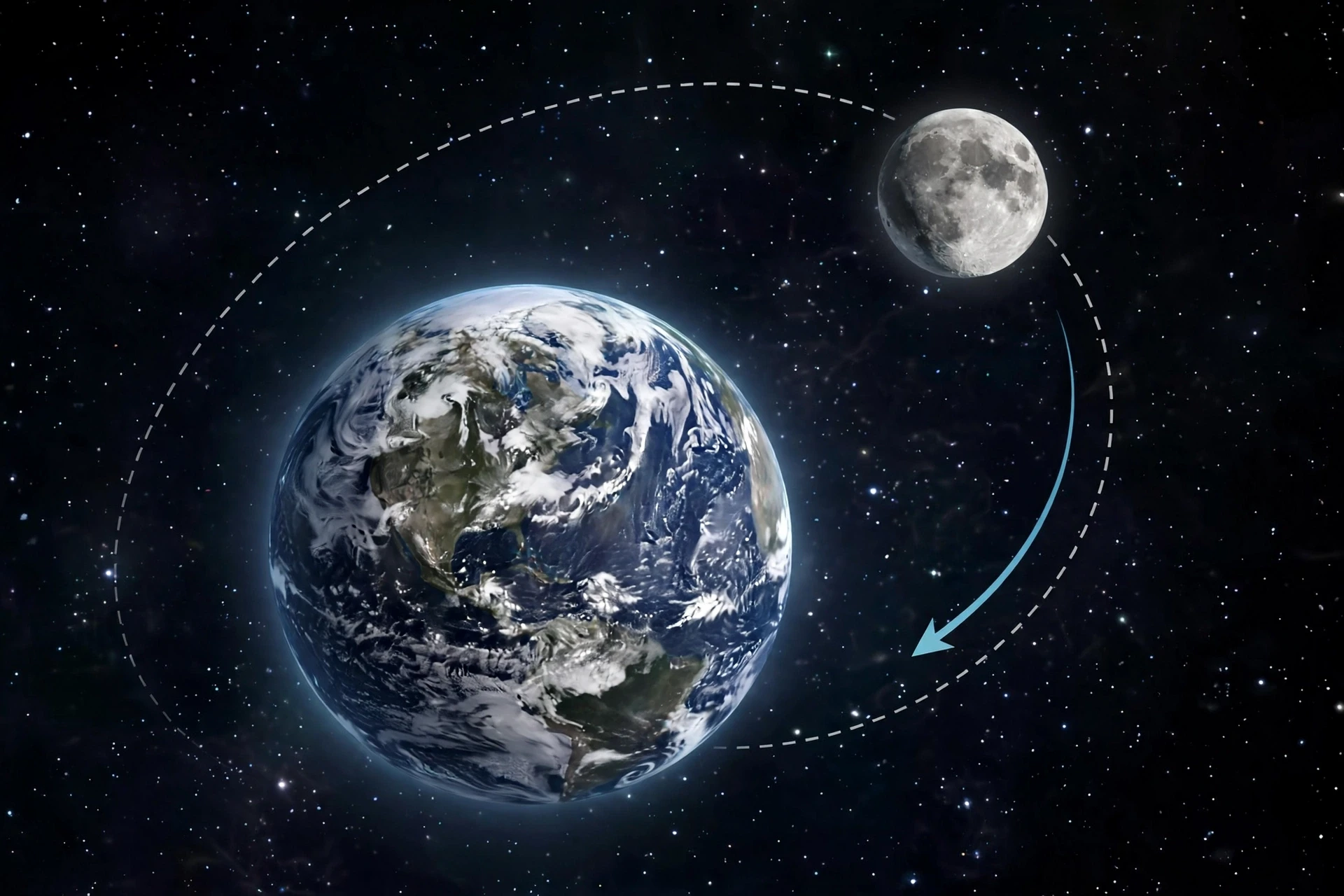
The Moon is falling toward the Earth all the time. Gravity pulls it inward, and by the second law that pull produces an acceleration toward the Earth. But the Moon is also moving sideways, fast — about 1 km every second — and by the first law it would keep going straight if nothing acted on it. The combination is an orbit: the Moon keeps falling toward the Earth and keeps missing it, because its sideways motion carries it past. Newton was the first to see that the force pulling an apple to the ground and the force holding the Moon in its path were the same force, acting at different distances. The inverse-square law of gravitation says the force weakens with the square of the distance, and that single rule, with the three laws of motion, predicts the elliptical orbits Kepler had described decades earlier. NASA's guide to the planets gives the plain facts behind the picture — eight planets, five recognised dwarf planets, and orbits that follow the same gravitational rules: NASA Science, About the Planets.
A satellite in low Earth orbit travels at about 7.8 km/s, circling the planet roughly every 90 minutes. It is in continuous free fall, and so is everything inside it — which is why astronauts float. They are not beyond gravity. At the altitude of the International Space Station, gravity is still about 90% as strong as at the surface. The astronauts float because they and the station are falling together, at the same rate, around the Earth. Weightlessness is not the absence of gravity. It is the absence of a floor pushing back.
7.2 Rockets and the tyranny of mass
A rocket launch is a second-law problem with a cruel twist: most of the rocket's mass is fuel, and as the fuel burns, the mass falls, so the same thrust produces a larger acceleration. That sounds helpful, and it is, but the fuel must first be lifted, which needs more fuel, which needs more thrust. Engineers call this the tyranny of the rocket equation, and it is why rockets are staged: empty tanks are dropped as they are used, so the remaining mass is smaller and the remaining fuel goes further. The Saturn V, which carried Apollo astronauts to the Moon, weighed about 2,800 tonnes at launch and produced about 34 million newtons of thrust from its five first-stage engines. The third law supplied the thrust; the second law decided how fast the enormous mass would accelerate; the first law explains why, once in space, the spacecraft could coast to the Moon with its engines off.
7.3 Cars, braking, and the distance that saves lives
Stopping distance has two parts: the distance travelled while the driver reacts, and the braking distance while the brakes work. Reaction distance grows in direct proportion to speed. Braking distance grows with the square of speed, because the kinetic energy that the brakes must remove grows with the square of the speed, and the work the brakes can do over a given distance is limited by friction. Double your speed from 30 to 60 km/h and your braking distance roughly quadruples. That is a second-law result with life-or-death consequences, and it is the physics behind every speed limit and every following-distance rule.
7.4 Sport is applied mechanics
Sprinting: a sprinter pushes backward on the starting blocks; the blocks push forward on the sprinter. The first few steps are about maximising that third-law push while keeping the body low, so the force points forward rather than up.
Jumping: a high jumper converts a run-up into vertical velocity at take-off. The height reached depends on the take-off speed and on how the body is arranged over the bar — the Fosbury flop lets the centre of mass pass under the bar while the body arches over it.
Throwing: a javelin thrower, a shot-putter, and a cricketer bowling a fast ball are all solving the same second-law problem: apply the largest force you can, over the longest distance you can, to the mass you have. The run-up, the turn, and the follow-through all exist to lengthen the time and distance over which the force acts.
Catching: the fielder in Section 4 who pulls his hands back is using the second law in reverse, lengthening the time of the catch to lower the force. A wicketkeeper does the same thing with gloves that give, and a gymnast lands with bent knees for the same reason.
8. Practical Applications: Where the Laws Earn Their Keep
8.1 Car safety: crumple zones, airbags, and seatbelts
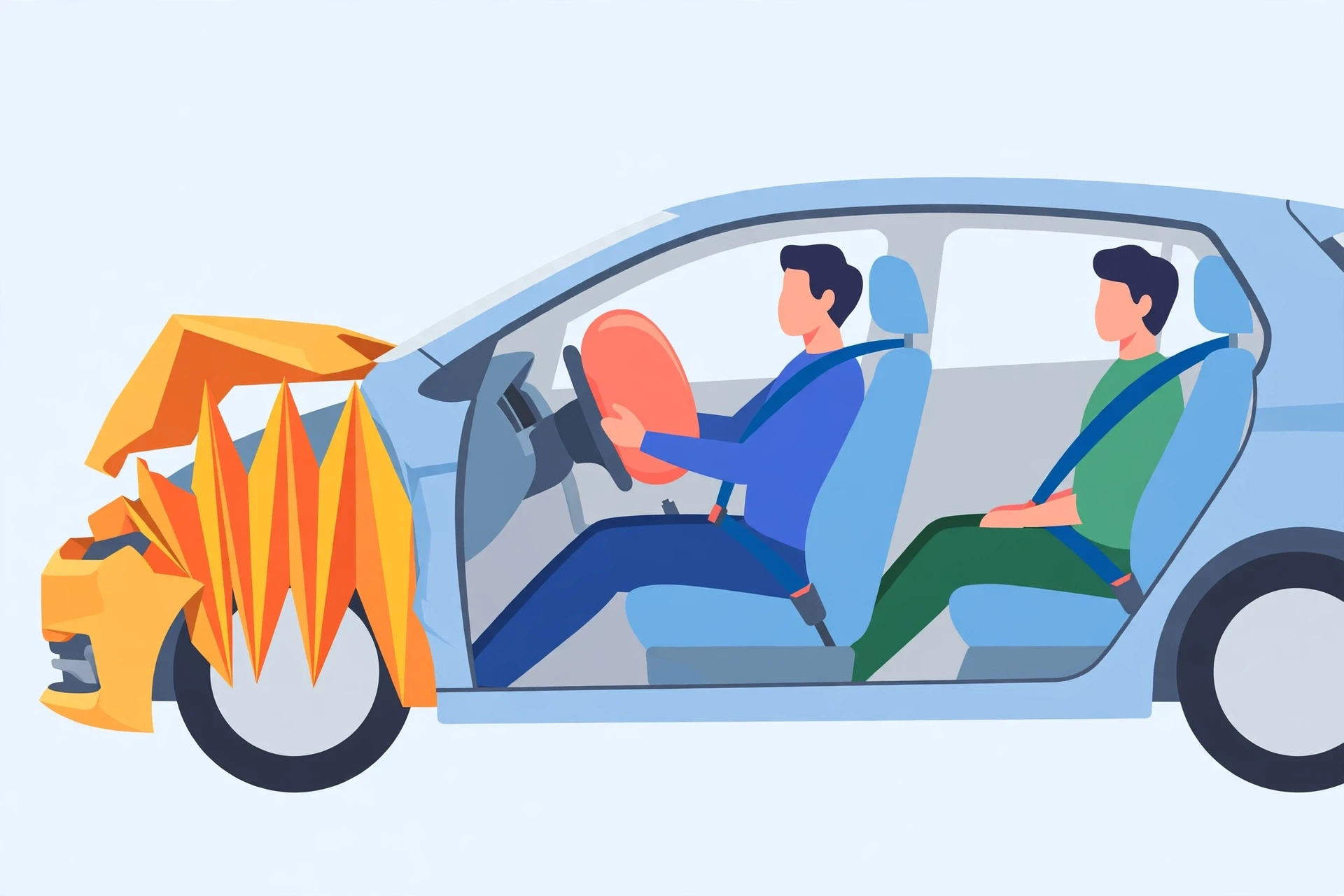
A car crash is a second-law event compressed into a tenth of a second. The car goes from 50 km/h to zero, and everything inside it must do the same. The question is how the change in momentum is spread out. A crumple zone is a part of the car designed to fold up in a controlled way, lengthening the time and distance over which the car stops, and so lowering the average force on the people inside. An airbag does the same thing for the head and chest: it spreads the stopping force over a larger area and a longer time than a steering wheel would. A seatbelt does it for the whole body. All three are the same physics — force equals the rate of change of momentum — turned into engineering.
The first law explains why these devices are needed at all: in a crash, the car stops, but the people do not, until something stops them. The devices exist to make sure that something is a belt and a bag, and not a windscreen.
8.2 Bridges, buildings, and the quiet first law
A bridge standing still is a first-law object: the net force on it is zero. Gravity pulls it down; the towers, cables, and ground push it up; the forces balance. Engineers design for the cases where the balance is threatened: wind, traffic, earthquakes, and the slow creep of metal fatigue. The Golden Gate Bridge, which OpenStax uses to open its chapter on Newton's laws, is a study in balanced forces — its towers, cables, and ground interacting to hold a roadway in the air against gravity and wind: OpenStax, University Physics Volume 1, Chapter 5 Introduction. Every building you have ever stood in is the same achievement, repeated at a smaller scale: forces balanced, net force zero, nothing moving.
Elevators are a second-law laboratory you ride every day. When an elevator accelerates upward, the floor must push up on you with a force greater than your weight, so you feel heavier. When it accelerates downward, the floor pushes less, and you feel lighter. When it moves at a steady speed, the floor pushes with exactly your weight, and you feel normal — even though you are moving. The feeling in your stomach is the second law, reporting for duty.
8.3 Spaceflight and the navigation of the solar system
Spacecraft navigate by Newton's laws of motion, with small corrections from relativity where the precision demands it. A course correction is a burn: a thruster fires for a measured time, changing the spacecraft's velocity by a calculated amount, and then the craft coasts on its new path, by the first law, until the next burn. Gravity assists — flybys of planets that steal a little of the planet's momentum to speed a spacecraft up or slow it down — are third-law exchanges on a planetary scale: the spacecraft gains momentum and the planet loses an equal amount, though the planet is so massive that the loss is unmeasurable.
The same laws govern the electricity that powers a spacecraft and the instruments that guide it, a connection explored in Sciory's Fundamentals of Electricity: From Circuits to Electromagnetism. And the planets a spacecraft visits follow the same gravitational rules that Newton wrote down, as described in Our Solar System: Planets, Moons, and Celestial Dynamics.
8.4 Medicine, robotics, and everyday engineering
The laws reach further than transport. In medicine, the force on a joint during a jump or a fall is a second-law calculation, and it decides how prosthetic limbs are designed and how physiotherapists plan rehabilitation. In robotics, every joint of a robot arm is a small second-law problem, solved thousands of times a second by a control system that measures position, works out the force needed, and applies it. In manufacturing, the force a press must exert to shape metal, the torque a bolt must be tightened to, and the load a crane can lift are all Newton's laws with numbers attached. The laws are not museum pieces. They are the working mathematics of the built world.
9. Where Newton's Laws Stop Working: Relativity and the Quantum World
A guide that pretends Newton's laws of motion work everywhere would be dishonest. They work superbly for everyday speeds and sizes, and they fail, in known and interesting ways, at the extremes.
9.1 Near the speed of light
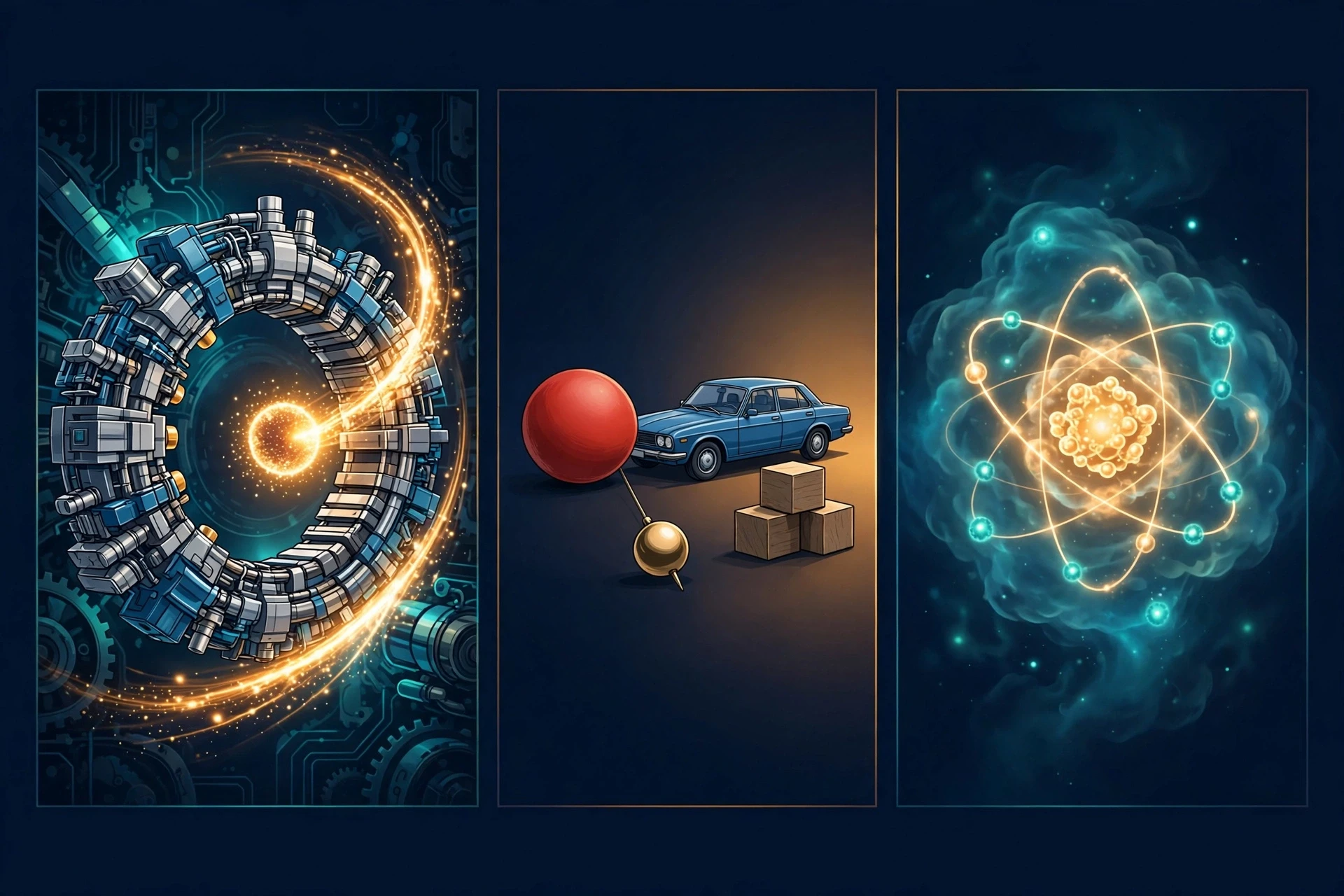
As an object's speed approaches the speed of light — about 300,000 km/s — its momentum grows faster than Newton's F = ma predicts, and its mass, in the old language, appears to increase. At a tenth of light speed, the Newtonian prediction is off by about half a percent. At 90% of light speed, it is off by more than a factor of two. Particle accelerators, which push protons to 99.999999% of light speed, must use Einstein's relativity to work at all: the magnets are set using relativistic momentum, not Newtonian momentum, and the machines would not function if the engineers used Newton's equations. For a full account of what replaces them, see Sciory's Einstein's Theory of Relativity: Special and General Explained.
9.2 At the scale of atoms
At atomic scales, objects do not have a definite position and velocity at the same time, and the idea of a particle following a single path under a force breaks down. Quantum mechanics replaces it with probabilities, wavefunctions, and uncertainty. An electron in an atom does not orbit like a planet. It exists as a cloud of probability, and Newton's laws cannot describe it. For that world, see Sciory's Understanding Quantum Mechanics: Principles, Paradoxes, Real-World Applications & 2026 Breakthroughs (Ultimate Guide).
9.3 Gravity itself, and the orbit of Mercury
Newton's law of gravitation predicts the orbits of the planets almost perfectly — almost. The orbit of Mercury shifts, or precesses, by a tiny amount more than Newton's equations predict: about 43 arcseconds per century. For two centuries astronomers looked for a missing planet, Vulcan, to explain the gap. The explanation turned out to be Einstein's general relativity, in which gravity is the curvature of spacetime, not a force acting at a distance. The correction is tiny for Mercury and negligible for a car, which is why engineers still use Newton for almost everything. But the gap matters, because it shows that Newton's laws of motion are an approximation — a superb one, with a known range — and not the last word. Where gravity grows far stronger still, around black holes, even the language of forces gives way to curved spacetime, as described in Sciory's Black Holes Explained: Formation & Properties.
9.4 What this means for the reader
"If I have seen further it is by standing on the shoulders of Giants." — Isaac Newton, in a letter to Robert Hooke, 1676
None of this makes Newton's laws wrong in the sense that matters for daily life. A bridge built with Newton's laws of motion stands. A car braked with Newton's laws stops. A spacecraft navigated with Newton's laws of motion arrives. The laws are the right tool for their range, and knowing the range is part of knowing the tool. Science advances by finding the edges of its best ideas, not by throwing the ideas away.
10. Common Misconceptions About Newton's Laws — Corrected
Most people assume that heavier objects fall faster than light ones. What we actually see in the data is that they fall at the same rate when air resistance is removed — a feather and a hammer dropped together on the Moon, where there is no air, hit the ground at the same time, as the Apollo 15 astronauts showed in 1971. On Earth, the feather falls slowly because of air resistance, not because of its weight. The misconception survives because everyday experience is full of air, and air hides the underlying rule.
Here are the other corrections I make most often, in the order I usually meet them:
"A constant force is needed to keep something moving at a steady speed." No. A constant net force produces acceleration. Steady speed needs zero net force. The push you feel when pushing a box at a steady speed is fighting friction, not maintaining motion.
"Action and reaction cancel out, so nothing should move." They act on different objects, so they never cancel in a single object's force balance. The horse and cart in Section 5 show why.
"Inertia is a force." It is a property, not a push. No free-body diagram should contain an arrow labelled "inertia."
"The third law means the forces are equal, so a small object pushes a large one just as hard." Yes — and that is exactly right. A mosquito hitting a windscreen pushes the car just as hard as the car pushes the mosquito. The car barely notices because its mass is enormous; the mosquito does not survive because its mass is tiny. Equal force, wildly unequal acceleration.
"Rockets push against the air." They push against their own exhaust. Rockets work better in a vacuum, where there is no air drag to fight.
"Astronauts float because there is no gravity in space." Gravity at the space station's altitude is about 90% of surface gravity. Astronauts float because they are in free fall, falling around the Earth with the station.
"F = ma means force causes mass, or that a bigger mass always means a bigger force." The equation relates three quantities. A bigger mass needs a bigger force for the same acceleration, but the force itself depends on the situation, not on the mass alone.
"Newton's laws are outdated because Einstein replaced them." Einstein extended them. For everyday speeds and sizes, Newton's laws of motion remain the equations engineers actually use, because they are simpler and their error is far below any measurement that matters.

Conclusion
Three short rules, written down in 1687, still run the world you live in. The first law says motion carries on unless a force changes it, and that is why a bus braking throws you forward and why Voyager 1 is still coasting through interstellar space. The second law says the change is proportional to the force and inversely proportional to the mass, and that is why a crumple zone saves lives, why a rocket needs staging, and why doubling your speed quadruples your braking distance. The third law says forces always come in pairs, and that is why you can walk, why a rocket climbs, and why the Moon raises the tides.
Newton did not hand us a finished picture of the universe. He handed us a tool — a way of turning a push into a prediction — and the tool has held up for more than three centuries, across every scale from a shopping trolley to a spacecraft. Its edges are known: near light speed, and at the scale of atoms, other theories take over. Inside its range, nothing has replaced it, and nothing looks likely to. The next time a bus brakes and your body keeps going, you will know what is happening. You will also know the name of the man who first wrote it down, the long argument that came before him, and the reason the feeling in your shoulders is not a mystery but a measurement.
Frequently Asked Questions
What are Newton's laws of motion?
Newton's laws of motion are three rules connecting forces to motion: an object keeps its velocity unless a net force acts on it (first law, inertia); net force equals mass times acceleration, F = ma (second law); and when one object exerts a force on another, the second exerts an equal and opposite force back (third law). They were published by Isaac Newton in 1687 in the Principia and remain the foundation of classical mechanics.
What is Newton's first law in simple terms?
An object at rest stays at rest, and an object moving in a straight line keeps moving at the same speed, unless a net force acts on it. The property that resists the change is called inertia. A football rolls to a stop because of friction and air resistance, not because motion dies on its own — in space, with almost no friction, motion carries on for years.
What is Newton's second law, F = ma?
The second law says the net force on an object equals its mass times its acceleration. Double the force and the acceleration doubles; double the mass and the acceleration halves for the same force. For example, a 1,500 kg car accelerating at 3 m/s² needs a net forward force of 4,500 N. The law is a vector law: the acceleration points in the same direction as the net force.
What is Newton's third law in simple terms?
For every action there is an equal and opposite reaction: when object A pushes on object B, object B pushes back on object A with a force of the same size in the opposite direction. The two forces act on different objects, so they do not cancel each other. Walking, swimming, and rocket propulsion all work this way.
What are real-life examples of Newton's first law?
A passenger lurching forward when a bus brakes, a tablecloth pulled from under dishes, a coin dropping into a glass when its card is flicked away, and a spacecraft coasting through space with its engines off are all first-law examples. Seatbelts exist because of this law: in a crash the car stops, but the people inside keep moving until a force stops them.
What are real-life examples of Newton's second law?
Pushing an empty shopping trolley versus a full one, a sports car accelerating faster than a lorry with a similar engine, a fielder pulling his hands back to catch a ball softly, and a rocket's acceleration rising as it burns fuel are all second-law examples. In each case, the acceleration depends on the net force divided by the mass.
What are real-life examples of Newton's third law?
A rocket pushing exhaust gases down and being pushed up, a swimmer pushing water back and moving forward, a gun recoiling as its bullet flies forward, and your foot pushing back on the ground while the ground pushes you forward are all third-law examples. The forces are equal in size, opposite in direction, and act on different objects.
Why do heavier objects not fall faster than light ones?
In the absence of air resistance, all objects fall at the same rate, because the gravitational force on an object is proportional to its mass, and the acceleration is force divided by mass — so the mass cancels out. On Earth, a feather falls slowly because air resistance, not weight, holds it back. The Apollo 15 astronauts dropped a hammer and a feather together on the Moon, where there is no air, and they hit the ground at the same time.
Where do Newton's laws not work?
Newton's laws of motion break down near the speed of light, where Einstein's relativity takes over, and at atomic scales, where quantum mechanics rules. They also fail to explain the tiny extra shift in Mercury's orbit, which general relativity explains. For everyday speeds and sizes, the error is far below anything that matters, which is why engineers still use Newton's laws for cars, bridges, and most spacecraft navigation.
How are Newton's laws of motion used in everyday engineering?
Car safety is the clearest case: crumple zones, airbags, and seatbelts all spread a change in momentum over a longer time, lowering the force on the body. Bridges and buildings are designed so the forces on them balance to zero. Elevators, cranes, robot arms, and prosthetic limbs are all designed with second-law calculations of the forces and accelerations involved.
Sources / Further Reading
NASA Glenn Research Center — Newton's Laws of Motion. Plain-language statement of all three laws with flight examples. https://www1.grc.nasa.gov/beginners-guide-to-aeronautics/newtons-laws-of-motion/
OpenStax, University Physics Volume 1, Chapter 5 Introduction — Newton's laws, forces, and equilibrium, with a bridge as the opening example. https://openstax.org/books/university-physics-volume-1/pages/5-introduction
OpenStax, University Physics Volume 1, Section 5.3, Newton's Second Law — the derivation of F = ma from momentum, with worked examples. https://openstax.org/books/university-physics-volume-1/pages/5-3-newtons-second-law
Britannica — Newton's laws of motion. Definitions, history, and the Galileo connection. https://www.britannica.com/science/Newtons-laws-of-motion
NASA Science — About the Planets. The eight planets, dwarf planets, and the orbits Newton's gravitation predicts. https://science.nasa.gov/solar-system/planets/