

Introduction
I was nine the first time someone pointed a telescope at Saturn for me. It was a cold, clear night in a field far from any town, and the man at the eyepiece — a neighbour who owned a battered reflector and an endless supply of patience — kept saying, "Wait. Let your eye settle. It is really there." Then the blur sharpened, and there it was: a small, perfect, golden disc with a ring around it, hanging in blackness like a jewel someone had left floating. I laughed out loud. I had read about Saturn in school books, but nothing had prepared me for how real it looked — how close, and how far, at the same time.
That night is the reason this guide exists. Our solar system is not an abstract diagram on a classroom wall. It is a real place, and a strange one: a star that holds 99.8 percent of everything in it, eight planets that could not be more different from one another, more than 200 moons, and a swarm of smaller bodies that still carry the raw material the whole system was built from. It is also a system in motion — planets racing around the Sun, moons tugging on their planets, comets falling in from the dark edge and swinging back out again, all of it held together by gravity and by the momentum of a collapse that happened about 4.6 billion years ago.
This guide walks the whole system, planet by planet, and then steps back to look at how it moves. We will start with the Sun, visit the rocky worlds close to it, cross the asteroid belt to the giants, and finish at the cold edge, where the Sun is only the brightest star in the sky. Along the way, we will meet the moons that may hold oceans, the spacecraft that have flown farther than any human-made object in history, and the simple laws that make all of this motion predictable — most of the time.
1. Our Solar System at a Glance
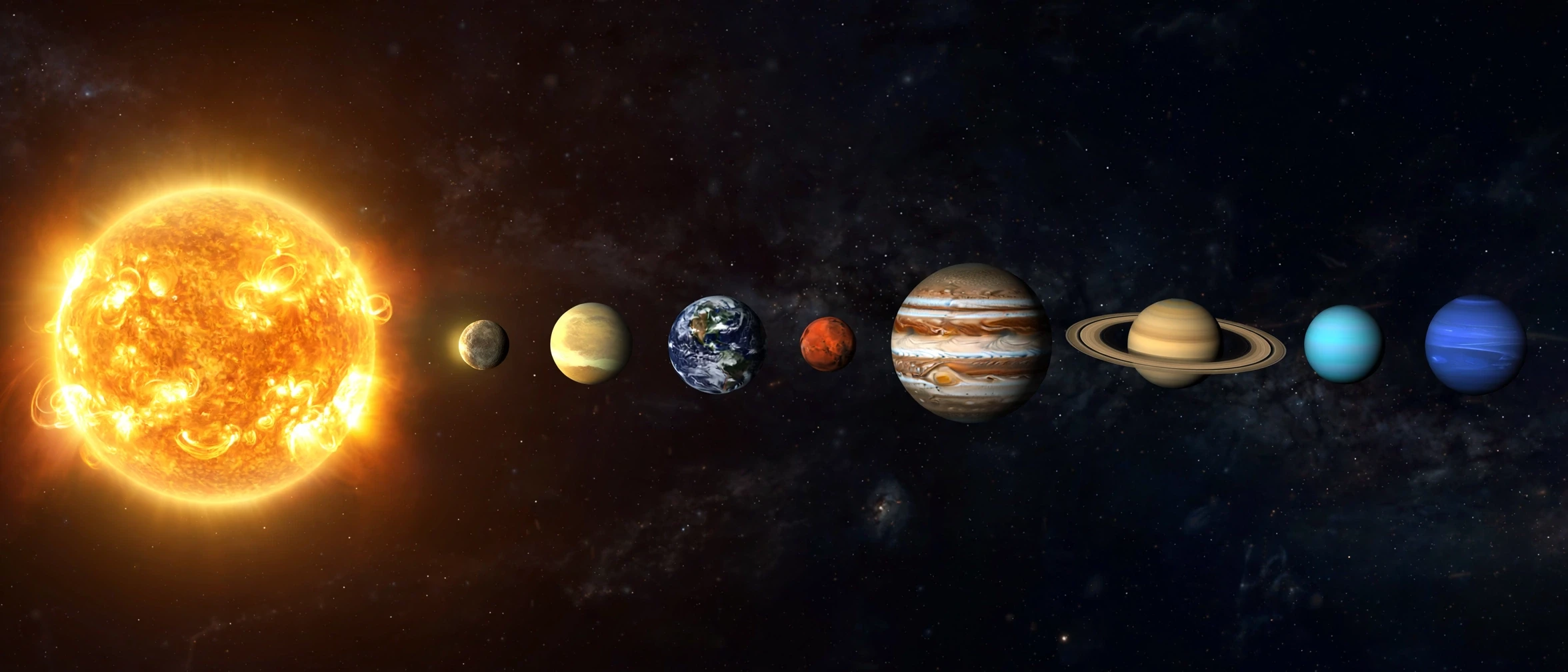
Our solar system is the Sun and everything bound to it by gravity: eight planets, five officially named dwarf planets, hundreds of moons, and thousands of asteroids and comets. It sits in a small, partial arm of the Milky Way called the Orion Arm, between the Sagittarius and Perseus arms, and it orbits the centre of the galaxy at about 515,000 miles per hour. One full trip around the galaxy takes roughly 230 million years. NASA's overview of the solar system puts these numbers plainly, and they are worth sitting with for a moment: we are riding a star around a galaxy, and we have been doing it for billions of years.
The family has a clear shape. Close to the Sun are four small, rocky planets — Mercury, Venus, Earth, and Mars. Beyond them, past the asteroid belt, are four giants — Jupiter and Saturn, made mostly of hydrogen and helium, and Uranus and Neptune, the ice giants, rich in water, ammonia, and methane ices. Beyond Neptune lies the Kuiper Belt, a ring of icy bodies that includes the dwarf planet Pluto. And beyond that, far beyond anything we can see directly, lies the Oort Cloud, a spherical shell of icy debris that marks the edge of the Sun's gravitational reach. NASA's in-depth guide to our solar system describes the Oort Cloud as extending from about 5,000 to 100,000 astronomical units out — one astronomical unit being the distance from the Sun to Earth, about 93 million miles.
1.1 How big is it, really?
Scale is the hardest thing to get right about the solar system, because our pictures lie to us. In most diagrams, the planets are drawn far too large and far too close together, or the whole system would not fit on the page. A better way to feel the scale is to walk it. If the Sun were the size of a grapefruit, Earth would be a peppercorn about 15 metres away, and Neptune would be another peppercorn more than 400 metres away. Pluto would be a grain of dust nearly a kilometre out. I have done this walk with students in a school field, placing printed planets along a running track, and the reaction is always the same: disbelief, then a long silence, then someone saying, "So space is mostly... nothing?" Yes. Mostly nothing — and that nothing is part of the story.
1.2 The eight planets in one table
The table below gives the headline numbers for each planet. Diameters and distances are from NASA's planetary fact sheets, rounded for readability; moon counts are approximate, because new small moons are still being found around the giant planets.
Planet | Diameter (km) | Distance from the Sun (million km) | Year (orbital period) | Moons (known, approx.) |
|---|---|---|---|---|
Mercury | 4,879 | 57.9 | 88 Earth days | 0 |
Venus | 12,104 | 108.2 | 225 Earth days | 0 |
Earth | 12,742 | 149.6 | 365.25 days | 1 |
Mars | 6,779 | 227.9 | 687 Earth days | 2 |
Jupiter | 139,820 | 778.5 | 11.9 Earth years | 95 |
Saturn | 116,460 | 1,434 | 29.4 Earth years | 146 |
Uranus | 50,724 | 2,871 | 84 Earth years | 28 |
Neptune | 49,244 | 4,495 | 164.8 Earth years | 16 |
Read the table from top to bottom and a pattern jumps out: the planets get bigger as you go out, then smaller again at the far edge; the years get longer in a steady march; and the moons pile up around the giants. Those patterns are not accidents. They are the fingerprints of how the system formed.
2. How Our Solar System Was Born
2.1 The solar nebula
About 4.6 billion years ago, there was no Sun and no Earth — only a vast, cold cloud of gas and dust drifting in the Milky Way. Something disturbed it. NASA's account of the solar system's formation says the cloud may have been squeezed by the shockwave of a nearby exploding star, a supernova. The cloud began to collapse under its own gravity, and as it collapsed it spun faster and flattened into a disc — the same way a figure skater spins faster when she pulls her arms in. At the centre, material piled up, pressure built, and hydrogen atoms began to fuse into helium. The Sun was born, and it took more than 99 percent of all the material in the disc with it.
What was left over became everything else. Dust grains stuck together, then pebbles, then boulders, then bodies kilometres across called planetesimals. Over millions of years, those bodies collided and merged, growing into planets. Close to the young Sun, it was too hot for ice and gas to survive, so only rock and metal could condense — that is why the inner planets are small and rocky. Farther out, where it was cold, water, ammonia, and methane could freeze solid, and the young giants swept up huge amounts of gas and ice. The same physics that made a skater spin faster made the whole disc spin in one direction, which is why the planets all orbit the Sun in the same direction, and mostly in the same flat plane.
2.2 Leftover building material
Not everything became a planet. The asteroid belt, between Mars and Jupiter, is made of bits and pieces of the early solar system that never quite came together — Jupiter's gravity stirred them up so much that they kept smashing each other apart instead of merging. Comets are the other leftovers: icy bodies from the cold outer reaches that have barely changed since the system formed. Studying asteroids and comets is like opening a time capsule from 4.6 billion years ago, and it is one of the reasons spacecraft keep visiting them.
I sometimes think of the solar system's birth as a kitchen accident that turned out beautifully. A cloud fell in on itself, a star lit up in the middle, and the crumbs that were left over arranged themselves into worlds. It took hundreds of millions of years, and it was violent — collisions, meltdowns, whole planets being rearranged — but out of that violence came a system stable enough for life to appear on at least one world.
3. The Sun: The Star That Owns the System
3.1 A yellow dwarf with a giant's mass
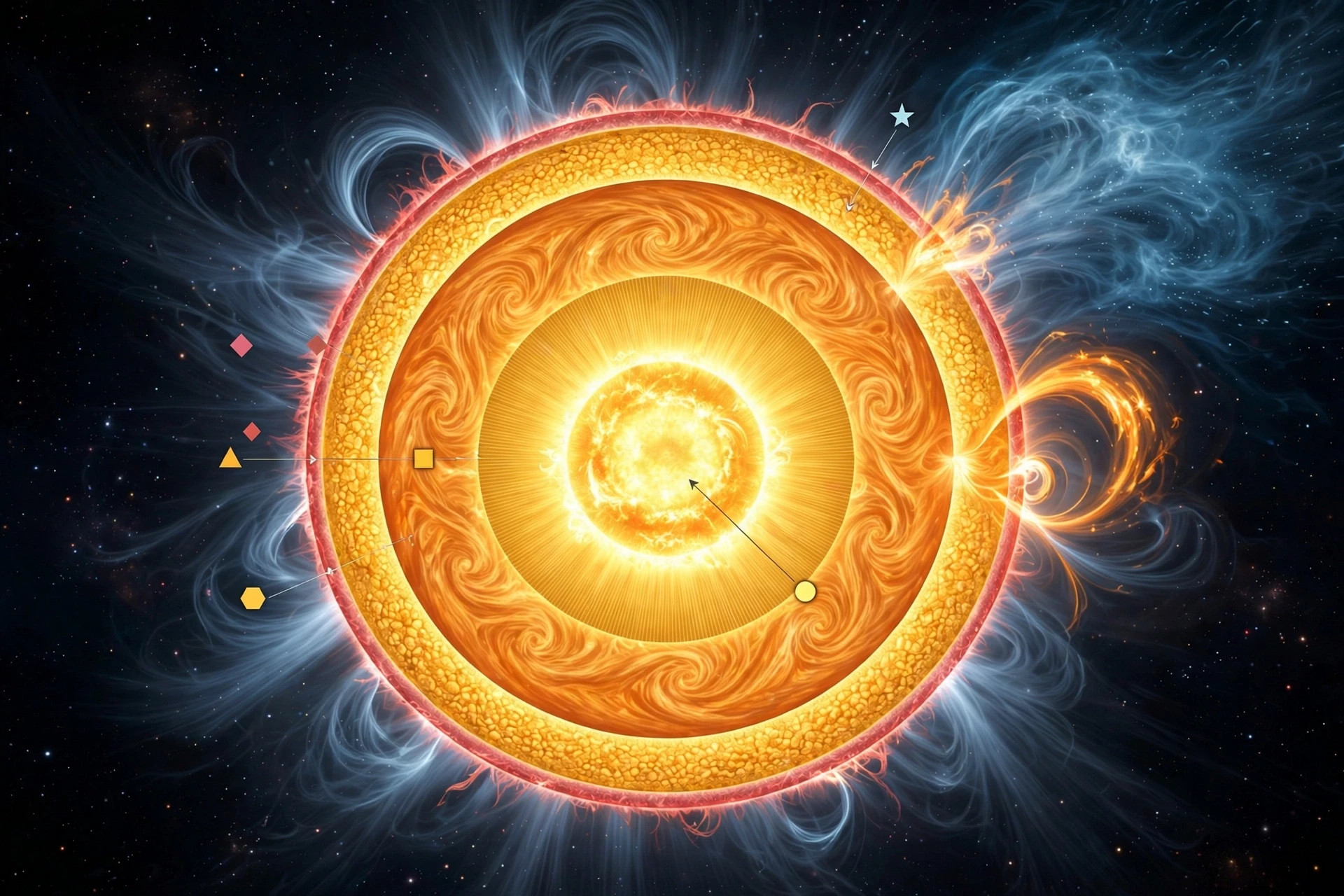
The Sun is a 4.5-billion-year-old yellow dwarf star, a hot ball of hydrogen and helium at the centre of our solar system, about 93 million miles from Earth. NASA's Sun facts page gives the scale in a way that stops me every time I read it: the Sun is about 100 times wider than Earth, holds 99.8 percent of the solar system's mass, and would take more than 330,000 Earths to match its mass. About 1.3 million Earths could fit inside its volume. It is the only star in our solar system, and its gravity holds everything together.
The Sun's core is about 27 million degrees Fahrenheit (15 million degrees Celsius), hot enough for nuclear fusion — hydrogen fusing into helium, releasing the energy that becomes sunlight. That energy takes a long, slow journey outward: radiation bounces around the radiative zone for roughly 170,000 years before it reaches the convection zone, where bubbles of hot plasma carry it to the surface. The surface we see, the photosphere, is a comparatively cool 10,000 degrees Fahrenheit. Eight minutes after light leaves the photosphere, it reaches Earth. Every photon that warms your face on a summer day began its journey in the Sun's core before humans existed as a species — a thought I find quietly staggering.
3.2 The Sun's moods: sunspots, flares, and the solar wind
The Sun is not a steady light bulb. It has weather. Dark sunspots come and go on its surface, flares erupt, and coronal mass ejections hurl billions of tons of charged particles into space. The stream of charged particles blowing outward in all directions is the solar wind, and it inflates a huge magnetic bubble around the solar system called the heliosphere. We live inside the Sun's atmosphere, in a sense — the heliosphere extends beyond the orbits of the planets.
The Sun goes through an activity cycle of about 11 years, during which its magnetic poles swap. At solar maximum, solar storms are common, and they can disrupt satellites, power grids, and radio communications on Earth. They can also paint the sky: the auroras — the northern and southern lights — are solar wind particles colliding with Earth's upper atmosphere. The same physics that lights up the polar sky also protects us: Earth's magnetic field deflects most of the solar wind, and without it, our atmosphere would have been stripped away long ago.
3.3 The Sun's future
The Sun is a little less than halfway through its life. In about 5 billion years, it will run low on hydrogen in its core, swell into a red giant, and engulf Mercury and Venus — and possibly Earth. After that, it will shed its outer layers and settle down as a white dwarf, a hot, dense ember slowly cooling over billions of years. That sounds bleak, but it is also a reminder of how generous our timing is: we live in the long, stable middle of the Sun's life, when its light is steady enough for oceans to stay liquid and for life to evolve. The Sun's story is the solar system's story, and ours too.
4. Mercury and Venus: Two Worlds That Went Wrong
4.1 Mercury: scorched, cratered, and shrinking
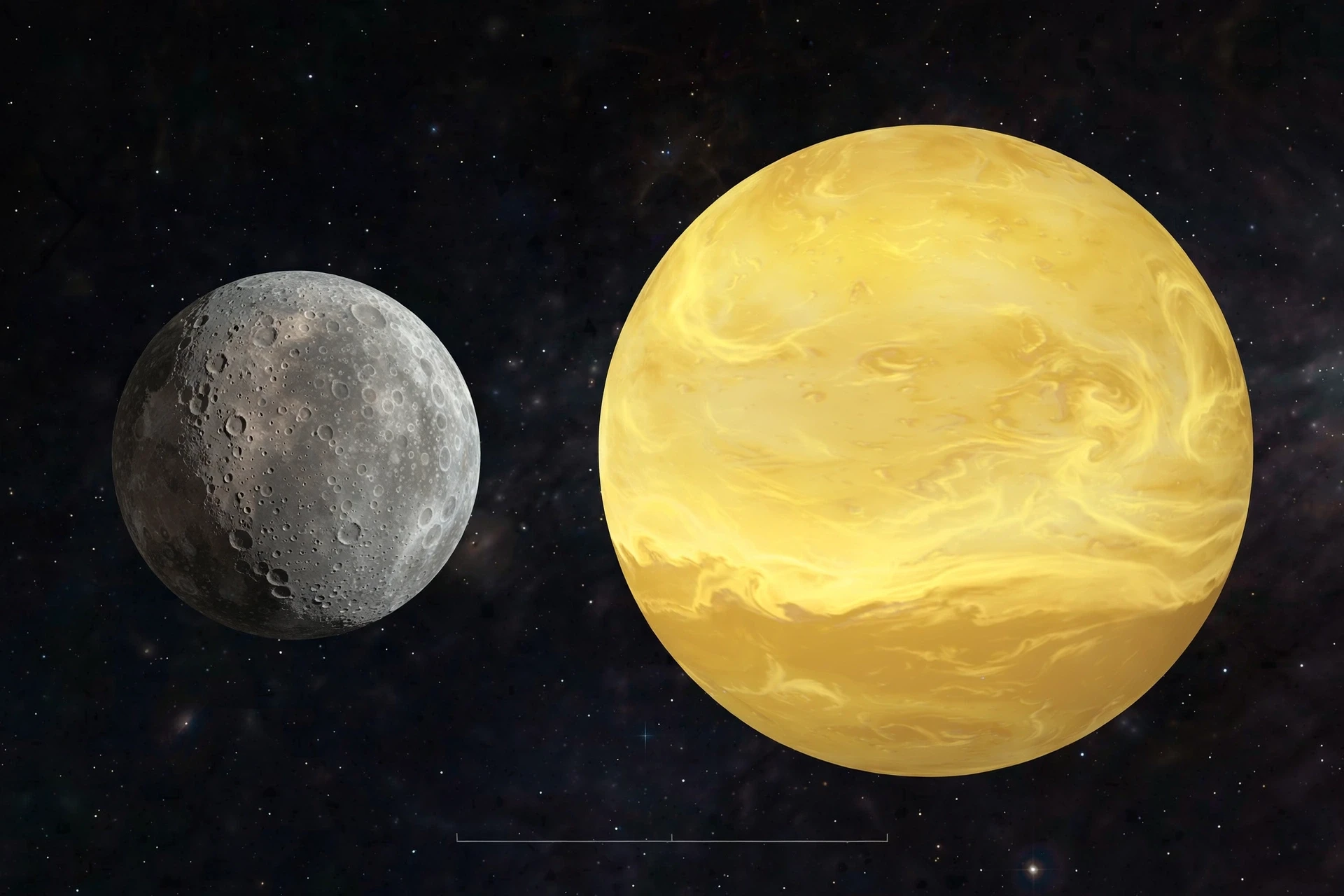
Mercury is the smallest planet and the closest to the Sun, a world of extremes. Its days are long — one solar day on Mercury lasts about 176 Earth days — and its temperature swings are the wildest in the solar system: from about 800 degrees Fahrenheit (430 degrees Celsius) in daylight to minus 290 degrees Fahrenheit (minus 180 degrees Celsius) at night. With almost no atmosphere to hold heat, Mercury has nothing to smooth out the difference.
Mercury looks like our Moon: cratered, grey, airless. But it holds surprises. NASA's MESSENGER spacecraft, which orbited Mercury from 2011 to 2015, found water ice hiding in permanently shadowed craters at the poles — ice, on the closest planet to the Sun. It also found that Mercury is shrinking as its huge iron core cools, wrinkling its surface like a drying apple. Mercury is mostly core: iron makes up about 85 percent of its radius, far more than any other planet. Why is a puzzle researchers still argue about — perhaps a giant collision stripped away much of its rocky outer layer early on.
4.2 Venus: Earth's twin, ruined by heat
Venus is almost the same size as Earth, and it is the hottest planet in the solar system — hotter than Mercury, even though it is farther from the Sun. The reason is its atmosphere: thick clouds of carbon dioxide and sulfuric acid that trap heat in a runaway greenhouse effect. The surface temperature is about 867 degrees Fahrenheit (464 degrees Celsius), hot enough to melt lead, and the air pressure at the surface is about 92 times Earth's — like being nearly a kilometre underwater.
Venus also spins backwards, and slowly: one day on Venus lasts longer than its year. A day there is about 243 Earth days, while a year is only 225. And the spin is retrograde — the Sun rises in the west and sets in the east. Something, probably a giant collision long ago, knocked Venus over. Under its clouds, radar mapping has revealed volcanoes, vast lava plains, and mountains. Venus may still be volcanically active today.
Most people assume Venus failed because it is close to the Sun. What we actually see in the data is more unsettling: Venus probably started out much more like Earth, with oceans, and then lost them. The greenhouse effect ran away, the water boiled off and was broken apart by sunlight, and the hydrogen escaped to space. Venus is not a different kind of planet from Earth. It is a warning about what can happen to a planet like Earth. That is why scientists study it so carefully — and why it matters for understanding how planets keep, or lose, their habitability. The chemistry of its atmosphere also connects to the elements that build worlds: the carbon, oxygen, and sulfur in Venus's air are the same elements whose patterns Sciory's Periodic Table of Elements: Structure & Trends lays out.
5. Earth and the Moon: The Only Known Home of Life
5.1 Earth: the blue exception
Earth is the only world we know that has life, and the only one with liquid water on its surface. That is not a small thing. Of all the planets, Earth sits in the narrow zone where water can be liquid — not so close to the Sun that it boils away, like on Venus, and not so far that it freezes solid, like on Mars. But distance alone does not explain Earth. Its magnetic field shields the atmosphere from the solar wind, its plate tectonics recycle carbon and keep the climate stable over millions of years, and its large Moon steadies its tilt, keeping the seasons regular. Take away any one of those, and Earth would be a different, harsher place.
I have spent nights looking at Earth from the other side, in a sense — looking at photographs taken by spacecraft looking back at our planet, a blue marble hanging in blackness. The first time I saw the "Earthrise" photograph properly, not as a poster but as a real image with its story attached, I understood something I had missed in textbooks: Earth is not the centre of the solar system, but it is the only place in it that is blue, and green, and alive. That is worth protecting, and it is worth studying how rare it is.
5.2 The Moon: our constant companion
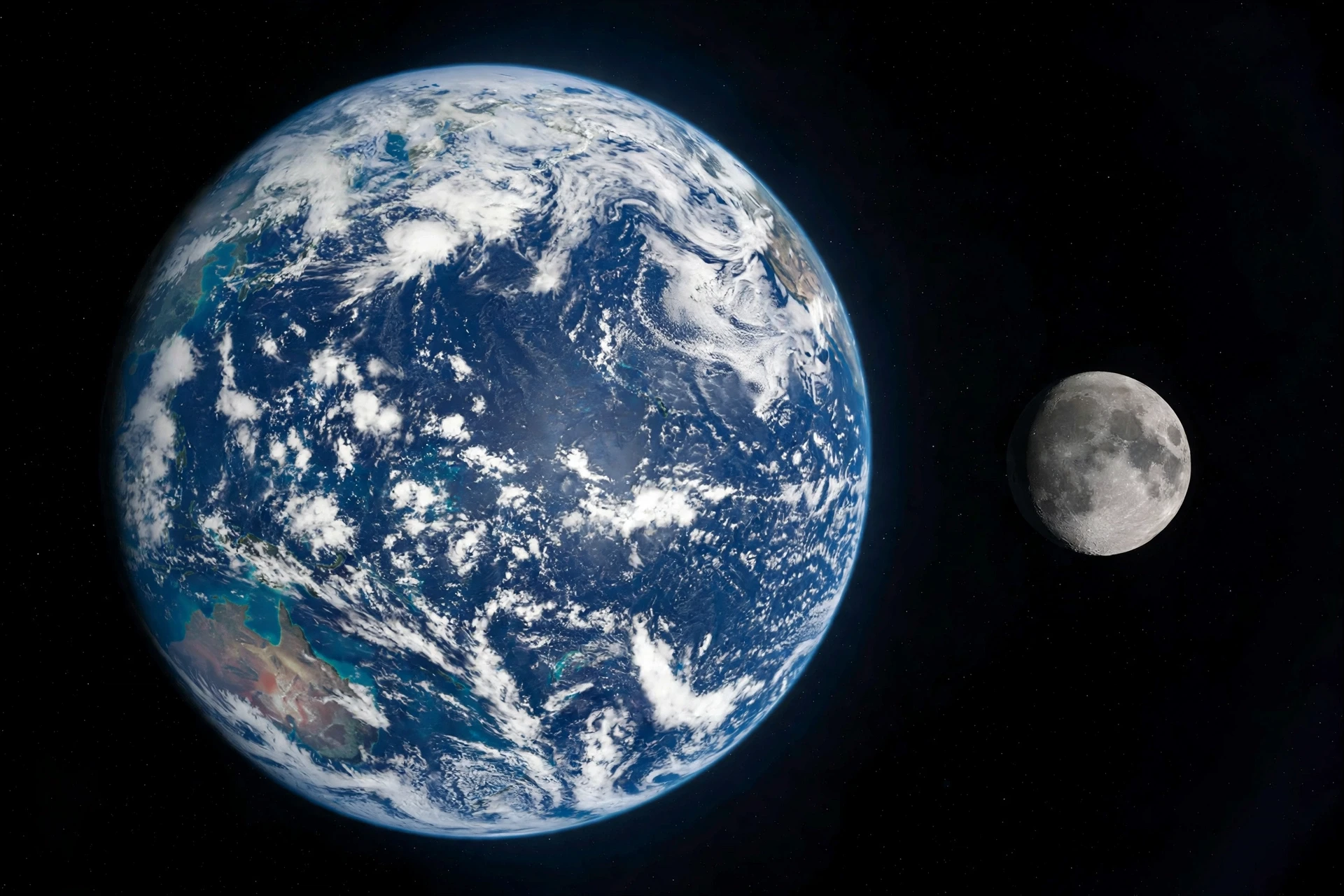
The Moon is Earth's only natural satellite, about a quarter the diameter of Earth, and it is the most familiar object in the night sky. It formed, most researchers believe, in a giant impact about 4.5 billion years ago, when a Mars-sized body struck the young Earth and threw debris into orbit that slowly gathered into the Moon. The Moon is moving away from us, by about 1.5 inches (3.8 centimetres) a year — the same rate your fingernails grow.
The Moon does real work for us. Its gravity raises the tides, it stabilises Earth's axial tilt, and it has acted as a shield, taking impacts that might otherwise have hit Earth. The Moon's phases, its eclipses, and its pull on the oceans have shaped human calendars, stories, and navigation for thousands of years. Twelve people have walked on its surface, all of them during NASA's Apollo programme between 1969 and 1972, and new missions are now returning — robotic landers, orbiters, and, in the coming years, astronauts again, this time aiming to stay longer and to use the Moon as a stepping stone to Mars. The Moon also matters for understanding how planets and moons form generally: the same impact physics that made our Moon probably made many of the moons we see around other planets.
6. Mars: The Red Planet and the Search for Life
6.1 A cold desert with a wet past
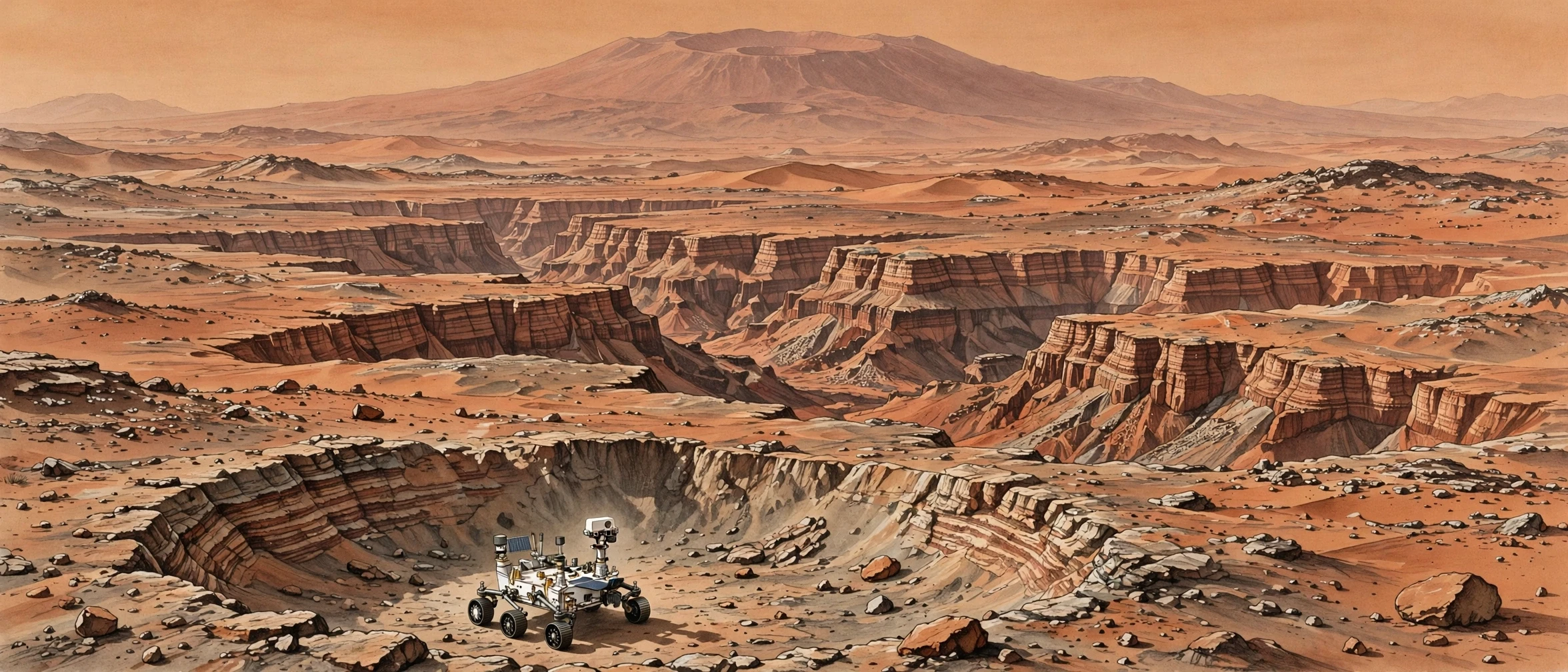
Mars is half the diameter of Earth, cold, dry, and red — the colour comes from iron oxide, rust, covering its surface. But Mars was not always like this. It has the tallest volcano in the solar system, Olympus Mons, about two and a half times the height of Mount Everest. It has Valles Marineris, a canyon system that would stretch across the United States. It has polar ice caps, seasons, dust storms that can cover the whole planet, and, most importantly, clear evidence that liquid water once flowed on its surface: river valleys, lake beds, and deltas carved into rock billions of years ago.
The question that drives Mars exploration is simple: did life ever exist there? NASA's Perseverance rover has been working on that question in Jezero Crater, an ancient lake bed. At a rock called Wildcat Ridge, Perseverance found evidence of an ancient lake environment — sediments deposited in standing water that would have been habitable for ancient microbial life. The rover has also collected samples of rock for a possible future return to Earth, and its MOXIE instrument made oxygen from carbon dioxide in the Martian atmosphere for the first time — a small step toward future human exploration.
6.2 Why Mars lost its water
Mars probably had a thicker atmosphere and a magnetic field early on, like Earth. Then its core cooled, the magnetic field faded, and the solar wind began stripping the atmosphere away. Without a thick atmosphere, liquid water could not stay on the surface: it either froze or evaporated. The planet dried out. This is the same physics that makes Earth's magnetic field so important, and it is a second warning, alongside Venus: habitability is not permanent. Planets can lose it.
I watched the Perseverance landing live with a group of students, and the room went silent when the first images came back — a dusty, orange landscape, with the rover's wheels already leaving tracks. One student whispered, "It looks like home, but wrong." That is Mars in a sentence: familiar enough to recognise, different enough to remind us how lucky Earth is. The search for ancient life on Mars is really a search for how common life might be, and how easily a world can go from wet to dry.
6.3 Mars's two small moons
Mars has two tiny, irregular moons, Phobos and Deimos, probably captured asteroids. Phobos is slowly spiralling inward and will, in tens of millions of years, either crash into Mars or break apart into a ring. They are small footnotes next to the giant moons of Jupiter and Saturn, but they remind us that moons come in many sizes, and that the solar system is still changing.
7. Jupiter and Saturn: The Giants That Rule the System
7.1 Jupiter: the king, and the shield
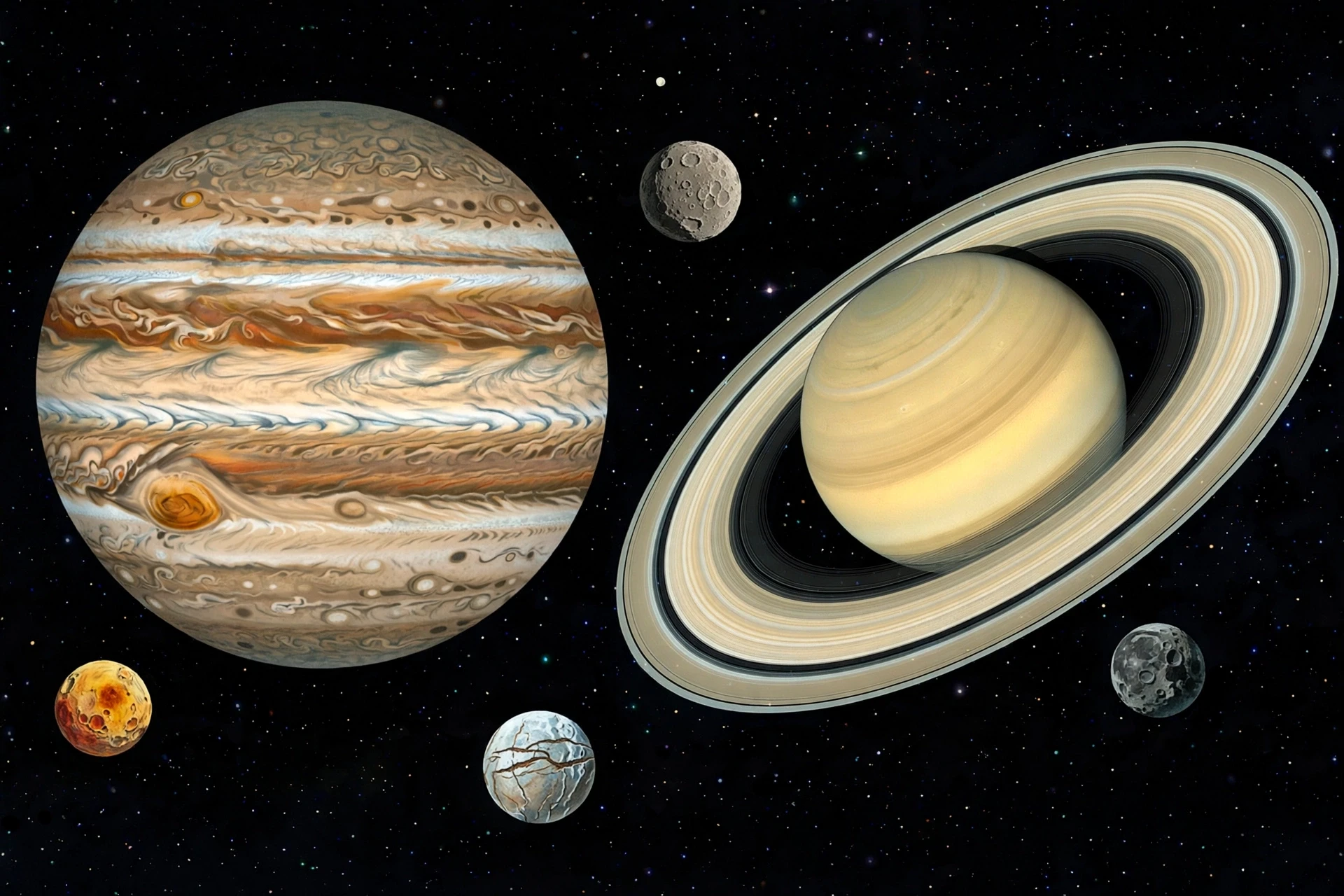
Jupiter is the largest planet in our solar system — more than twice as massive as all the other planets combined. It is a gas giant, made mostly of hydrogen and helium, with no solid surface to stand on: the deeper you go, the hotter and denser the gas becomes, until it behaves like a liquid. Jupiter's most famous feature is the Great Red Spot, a storm larger than Earth that has been raging for at least 300 years. It is also a world of extremes in another way: its magnetic field is the strongest of any planet, and it has dozens of moons, including the four large Galilean moons discovered by Galileo in 1610 — Io, Europa, Ganymede, and Callisto.
Jupiter does something important for the inner solar system: its gravity deflects comets and asteroids, acting as a kind of shield. Without Jupiter, Earth might have been hit far more often. That is a debated point — some researchers argue Jupiter can also fling objects inward — but there is no doubt that the giant planets shape the traffic of small bodies in the solar system. The giant planets are also the reason the asteroid belt exists at all: Jupiter's gravity prevented a planet from forming there.
The energy that drives Jupiter's weather does not come only from the Sun. Jupiter gives off more heat than it receives, leftover warmth from its formation still leaking out. Its bands of cloud — pale zones and dark belts — are winds blowing in opposite directions at hundreds of miles per hour. I have watched Jupiter through a small telescope on a good night and seen those bands clearly, and the four Galilean moons as tiny points of light in a line. Galileo saw the same thing in 1610, and it changed astronomy forever: here were objects orbiting something other than Earth. That single observation broke the old idea that everything in the heavens circled our planet.
7.2 Saturn: the jewel, and the ring-maker
Saturn is the second-largest planet, and the most beautiful — at least, that is what everyone says when they first see its rings through a telescope. The rings are made of countless chunks of ice and rock, from grains of sand to house-sized boulders, orbiting Saturn in a thin disc. They are only about 10 metres thick in places, yet they stretch more than 280,000 kilometres across. All four giant planets have rings, but Saturn's are by far the most spectacular.
Saturn is the least dense planet: if you could find a bathtub big enough, Saturn would float. It is also the planet with the most known moons — about 146 — including Titan, a moon larger than Mercury, with a thick atmosphere and lakes of liquid methane, and Enceladus, a small icy moon that sprays salty water from geysers at its south pole. That spray comes from a global ocean beneath the ice, and it is one of the most exciting places in the solar system for the search for life.
Saturn's story also connects to the deepest questions about how planets form. Its rings may be relatively young — perhaps only a few hundred million years old — formed when an icy moon was torn apart by Saturn's gravity, or when a comet passed too close. The rings are slowly raining down into Saturn and will disappear in a few hundred million years. We are lucky to be alive at a time when Saturn wears them. The physics of rings also connects to the physics of discs around young stars, and to the way moons form — the same gravity that holds Saturn's rings together also shapes the orbits of its moons.
8. Uranus and Neptune: The Tilted and the Windy
8.1 Uranus: the planet on its side
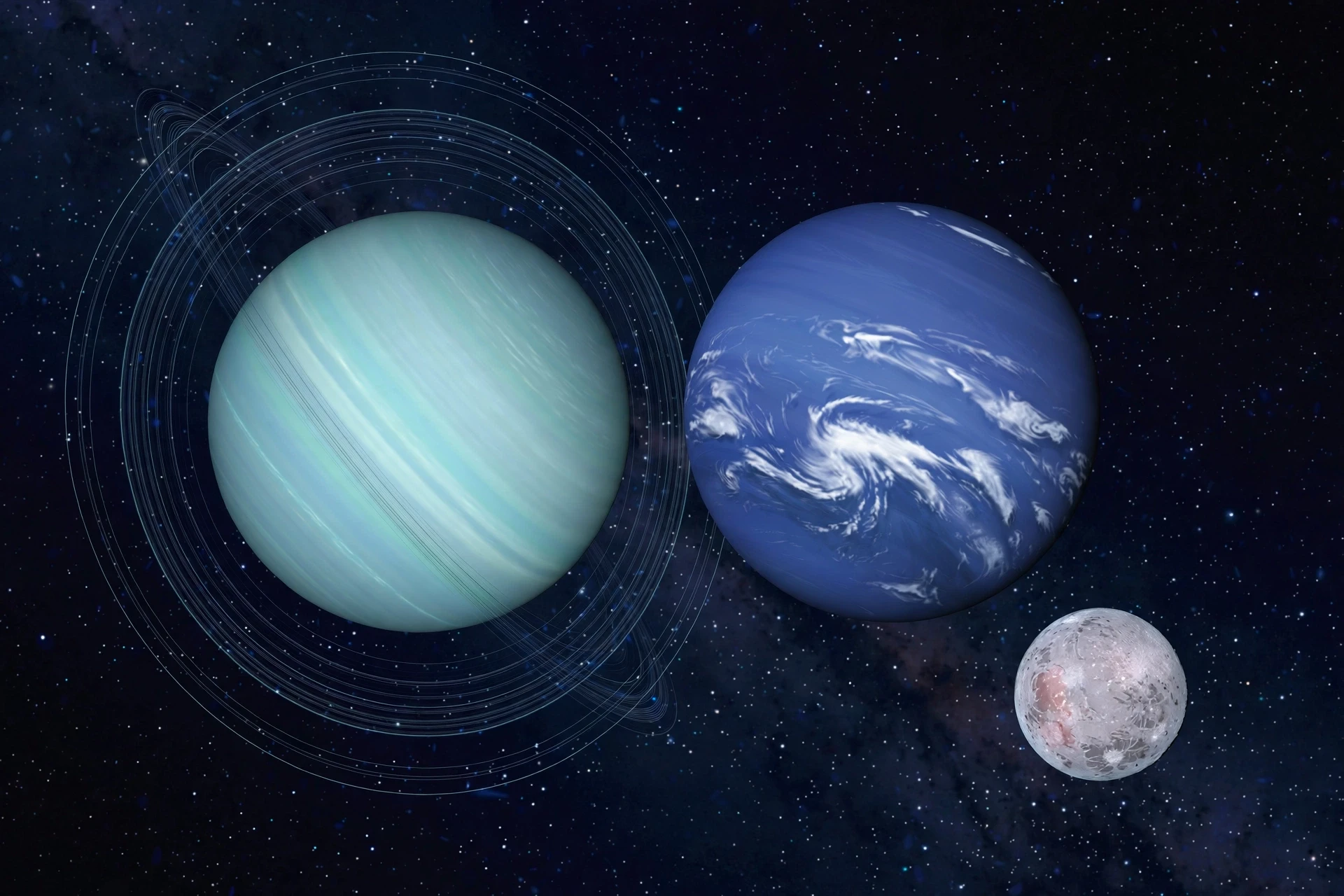
Uranus is the odd one out. It is an ice giant, made mostly of water, ammonia, and methane ices, with a hydrogen and helium atmosphere. The methane gives it a pale blue-green colour. But its strangest feature is its tilt: Uranus spins on its side, with its axis tilted about 98 degrees to its orbit. Each pole spends 21 years in continuous sunlight, followed by 21 years of darkness. Something enormous must have hit Uranus early in its history and knocked it over — a collision with an Earth-sized object is the leading idea.
Uranus was the first planet discovered with a telescope, by William Herschel in 1781. Before that, everyone thought there were only six planets. Herschel's discovery doubled the known size of the solar system overnight and showed that the sky still held surprises. Uranus has 28 known moons and a faint set of rings, much darker and thinner than Saturn's. It is also the coldest planet in the solar system by temperature, despite not being the farthest from the Sun — its atmosphere is so still, with so little internal heat leaking out, that it cools to about minus 224 degrees Celsius.
8.2 Neptune: the windiest world
Neptune is the farthest planet from the Sun, a deep blue ice giant with the fastest winds in the solar system — supersonic winds reaching about 2,100 kilometres per hour. It was discovered in 1846 not by looking, but by mathematics: astronomers noticed that Uranus's orbit was being pulled off course by something unseen, calculated where that something must be, and pointed a telescope there. Neptune was found almost exactly where the maths said it would be. It is one of the great triumphs of celestial mechanics — the subject of Section 11 — and it is worth remembering: the solar system is predictable enough that we can find a planet with a pencil before we see it with a telescope.
Neptune has 16 known moons, the largest of which is Triton, a strange world that orbits backwards. Triton was probably a Kuiper Belt object captured by Neptune's gravity, and it has geysers that spray nitrogen gas. Triton's surface is one of the coldest in the solar system. Neptune also has a Great Dark Spot, a storm like Jupiter's Red Spot, though it comes and goes. Voyager 2 flew past Neptune in 1989 — the only spacecraft ever to visit it — and no mission has returned since. Neptune remains the least explored planet, and that is part of its appeal: there is still a whole world out there that we have only seen once, from a passing spacecraft.
9. Moons: Worlds in Their Own Right
9.1 More than 200 moons, and counting
There are more than 200 known moons in our solar system, and several more are waiting for confirmation. Mercury and Venus have none. Earth has one. Mars has two. Jupiter and Saturn lead the count, with dozens each, and in some ways their moon systems resemble miniature solar systems: moons orbiting a giant planet, with their own orbits, tides, and weather. Pluto, smaller than our Moon, has five moons, including Charon, a moon so large that Pluto and Charon orbit each other like a pair. NASA's solar system facts page lists these counts, and they keep growing as telescopes get better.
Moons form in different ways. Some, like Earth's Moon, probably formed in giant impacts. Some, like the Galilean moons, probably formed from a disc of material around their planet, just as planets formed around the Sun. Some, like Triton and many of the small, irregular moons of Jupiter and Saturn, were captured asteroids or Kuiper Belt objects. And some moons are still being made: Saturn's rings are constantly clumping into small moonlets and being torn apart again.
9.2 Ocean worlds: Europa, Enceladus, Titan, and Ganymede
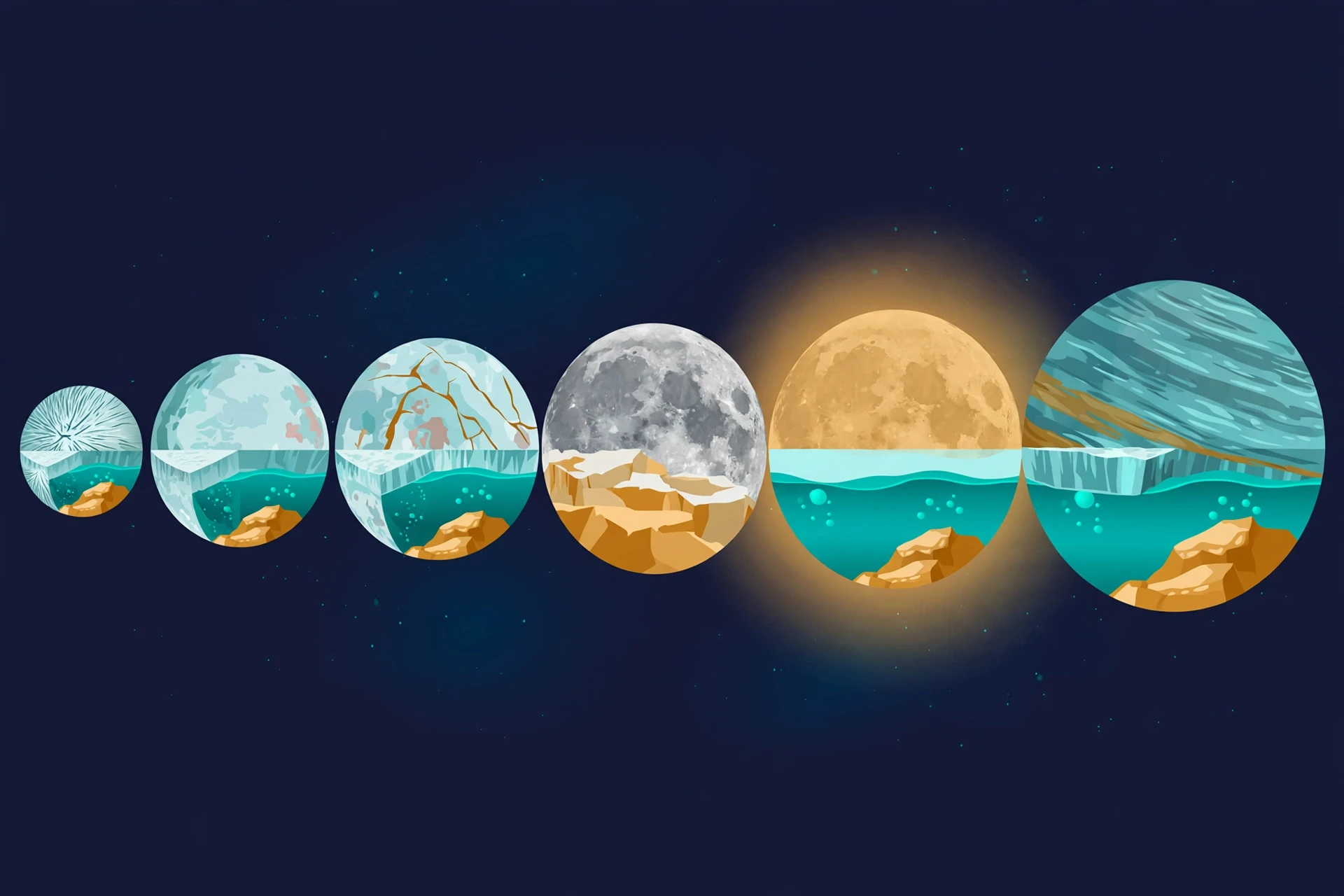
The most exciting moons are the ocean worlds. Beneath the ice shells of Europa, Ganymede, Callisto, Enceladus, and Titan, there are oceans of liquid water — kept liquid by tidal heating, as their planets' gravity squeezes and stretches them. Europa's ocean may hold twice as much water as all of Earth's oceans combined. Enceladus sprays its ocean into space through geysers, and NASA's Cassini spacecraft flew through that spray and tasted it: salty water, with organic molecules and molecular hydrogen — the ingredients and the energy that life needs.
NASA's Europa Clipper mission, launched in October 2024, is now on its way to Jupiter to study Europa in detail. The spacecraft — the largest NASA has ever built for a planetary mission — will orbit Jupiter and make nearly 50 flybys of Europa to measure the thickness of its ice shell, investigate its composition, and characterise its geology. It is scheduled to reach Jupiter in 2030. ESA's JUICE mission, launched in 2023, is heading for the same system, and will eventually orbit Ganymede. Titan, meanwhile, will get its own visitor: NASA's Dragonfly, a rotorcraft that will fly around Titan's surface, exploring its methane lakes and its chemistry. These missions are not just sightseeing. They are asking the biggest question in planetary science: is life common, or is Earth alone?
The moons taught us to stop asking which planets have oceans, and start asking which moons do. The answer changed where we look for life.
9.3 Why moons matter for planets
Moons do more than orbit. They stabilise their planets, raise tides, drive geological activity through tidal heating, and protect atmospheres. Without the Moon, Earth's tilt would wobble wildly over millions of years, and the climate would swing with it. Without tidal heating, Europa's ocean would freeze solid. The story of the solar system is not just a story of planets — it is a story of planets and moons together, each shaping the other. The same gravity that holds a moon in orbit also kneads it from the inside, and that kneading can keep water liquid in places where sunlight never reaches.
10. The Small Bodies: Asteroids, Comets, and the Edge of the System
10.1 The asteroid belt
Between Mars and Jupiter lies the asteroid belt, a ring of rocky bodies ranging from dust to the dwarf planet Ceres, about 940 kilometres across. The belt holds millions of objects, but if you gathered them all together, they would make a body smaller than the Moon. Most asteroids are harmless, orbiting quietly for billions of years. A few, called near-Earth asteroids, cross Earth's orbit, and astronomers track them carefully. In 2022, NASA's DART mission proved we can change an asteroid's orbit: it crashed a spacecraft into the asteroid Dimorphos and measurably shortened its orbit around its companion. Planetary defence, once science fiction, is now a tested technology.
Asteroids are also time capsules. Some are rich in metals, some in carbon and water. The sample-return missions OSIRIS-REx (from the asteroid Bennu) and Hayabusa2 (from Ryugu) brought pieces of asteroids back to Earth, and those samples contain organic molecules and water-bearing minerals — the raw ingredients of planets and, possibly, of life.
10.2 Comets, the Kuiper Belt, and the Oort Cloud
Comets are icy bodies that spend most of their lives in the cold outer solar system, then fall toward the Sun, warm up, and grow glowing tails of gas and dust. The most famous, Halley's Comet, returns every 76 years. Comets probably delivered much of Earth's water early in its history, when the young planet was still hot and dry.
Beyond Neptune, the Kuiper Belt holds Pluto, Haumea, Makemake, and Eris, along with thousands of smaller icy bodies. Pluto was reclassified as a dwarf planet in 2006 — a decision that still sparks arguments at dinner tables — but whatever we call it, Pluto is a real world, with mountains of water ice, a thin nitrogen atmosphere, and a heart-shaped glacier of frozen nitrogen. NASA's New Horizons spacecraft flew past Pluto in 2015 and sent back images that stunned everyone: a world far more active and beautiful than anyone had expected.
Beyond the Kuiper Belt lies the Oort Cloud, a spherical shell of icy bodies stretching up to 100,000 astronomical units from the Sun. It has never been directly observed, but its existence is predicted by mathematics and by the orbits of long-period comets. The Oort Cloud is the edge of the Sun's gravitational influence — and, in a sense, the edge of our solar system itself. The Voyager spacecraft, launched in 1977, have crossed into interstellar space, but it will take them thousands of years to cross the Oort Cloud. They carry a golden record with sounds and images from Earth, in case anyone ever finds them. That record is a message in a bottle, thrown into a cosmic ocean.
11. Celestial Dynamics: The Laws That Move the Worlds
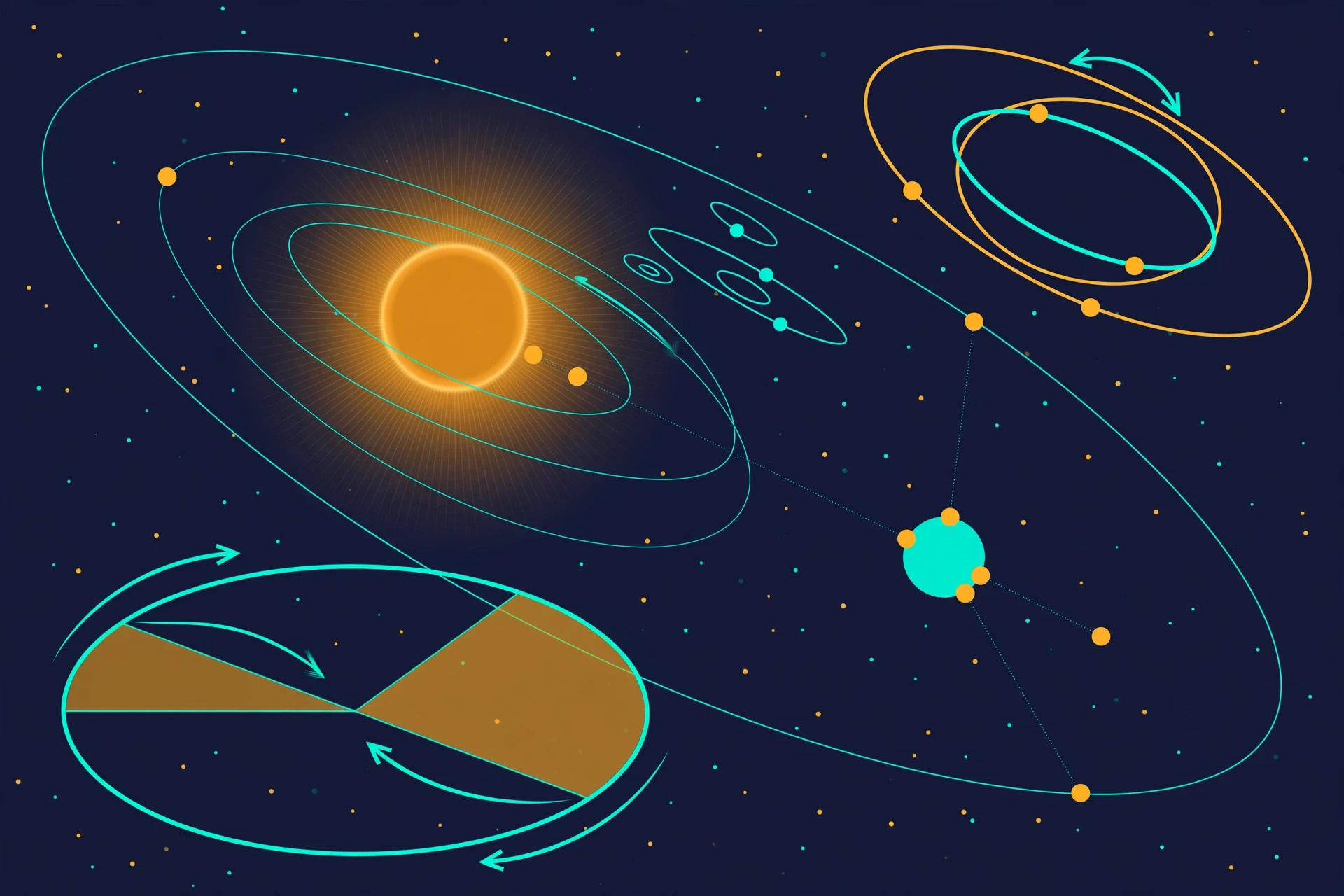
11.1 Kepler's three laws
The motion of the planets is not random. In the early 1600s, Johannes Kepler, working with the meticulous observations of Tycho Brahe, discovered three laws that describe how planets move:
Planets move in ellipses, not circles, with the Sun at one focus of the ellipse. The orbits are nearly circular, but not quite — and that small difference matters.
A planet sweeps out equal areas in equal times. That means a planet moves faster when it is close to the Sun and slower when it is far away. Earth moves fastest in early January, when it is closest to the Sun, and slowest in early July.
The square of a planet's orbital period is proportional to the cube of its average distance from the Sun. Farther planets take longer to go around, in a precise mathematical relationship. Neptune, 30 times farther from the Sun than Earth, takes about 165 years to complete one orbit.
Kepler found these laws by staring at data for years, and he did it without knowing why they were true. The "why" came a generation later, from Isaac Newton, who showed that a single law — universal gravitation, the force that pulls every mass toward every other mass — explains Kepler's laws, the Moon's orbit, and the fall of an apple. That is one of the great unifications in science: the heavens and the Earth obey the same physics.
I once built a Kepler model with students using string, pins, and a piece of cardboard, and watched a teenager draw an ellipse for the first time and realise that the Sun was not in the middle of it. "But that's wrong," she said. "The Sun should be in the centre." That moment — the discomfort of a beautiful idea being slightly wrong — is what science feels like. The Sun is not in the centre of the ellipse. It is at one focus. And that small correction is the difference between a picture and a law.
11.2 Gravity, resonances, and Lagrange points
Gravity does more than hold planets in orbit. It creates resonances: when two bodies' orbital periods form a simple ratio, like 2:1 or 3:2, they tug on each other in a regular rhythm. Pluto and Neptune are in a 3:2 resonance — Pluto orbits the Sun twice for every three orbits of Neptune — and that resonance keeps them from ever colliding, even though their orbits cross. The moons of Jupiter — Io, Europa, and Ganymede — are locked in a 1:2:4 resonance, and that rhythm drives the tidal heating that keeps Europa's ocean liquid.
Gravity also creates Lagrange points: five special places in a planet's orbit where the gravitational pulls of the Sun and the planet balance, so a small object can sit there stably. The James Webb Space Telescope sits at the Sun-Earth L2 point, about 1.5 million kilometres from Earth, where it can keep its sunshield pointed at the Sun and its telescope pointed at the cold dark sky. Spacecraft, asteroids, and dust gather at Lagrange points like ships anchoring in a calm harbour.
The same gravity that holds a planet in orbit also bends light, slows time, and shapes galaxies. The bending of starlight by the Sun's gravity, predicted by Einstein's general theory of relativity and confirmed during a solar eclipse in 1919, is one of the most famous experiments in science — and Sciory's Understanding Quantum Mechanics: Principles, Paradoxes, Real-World Applications & 2026 Breakthroughs explores the quantum side of the same universe, where gravity meets the very small. At the extreme end of gravity lie black holes, where gravity wins completely — Sciory's Black Holes Explained: Formation & Properties covers how they form and what they do to space and time. The physics that moves the planets and the physics that moves electrons are different chapters of one story, and the elements that make up the planets — iron, silicon, oxygen, hydrogen — are the same elements whose patterns Sciory's Periodic Table of Elements: Structure & Trends lays out.
11.3 Chaos, stability, and the long future
For all its predictability, the solar system is not perfectly stable. Over millions of years, the planets' orbits wobble and shift, tugged by each other's gravity. Mercury's orbit is the most chaotic: there is a small chance, over billions of years, that it could be flung into the Sun or collide with Venus. The solar system as a whole, though, is stable enough to have lasted 4.6 billion years, and it will probably last for billions more — until the Sun itself changes everything, swelling into a red giant in about 5 billion years.
That long stability is what made life possible. A system that changed too fast would never have given evolution time. A system that never changed at all would never have made planets in the first place. The solar system sits in a sweet spot between chaos and order, and we are the lucky beneficiaries.
12. Exploring Our Solar System: How We Know What We Know
12.1 From telescopes to spacecraft
Everything in this guide comes from looking — first with eyes, then with telescopes, then with spacecraft. Galileo's telescope showed the moons of Jupiter. Herschel's telescope found Uranus. Mathematics found Neptune. Photography, spectroscopy, and radar mapped the surfaces of worlds we could never touch. And then, in the second half of the twentieth century, we started going there: flybys, orbiters, landers, rovers, and sample-return missions.
The numbers tell the story of that effort. Voyager 1, launched in 1977, is now more than 15 billion miles from Earth, in interstellar space, still sending back data. Parker Solar Probe has flown closer to the Sun than any spacecraft before it, through the corona itself. Perseverance is collecting samples on Mars. Europa Clipper is on its way to Jupiter. And the James Webb Space Telescope, parked at a Lagrange point, is looking outward — but it also looks back at our own solar system, studying the atmospheres of planets and moons with a clarity no telescope on Earth can match.
12.2 What exploration is for
Exploration is not only about curiosity, though curiosity is reason enough. It is also about survival and perspective. Studying Venus tells us how a planet loses its habitability. Studying Mars tells us how a wet world dries out. Studying the Moon tells us how Earth formed. Studying the giants tells us how planets are born. And studying the small bodies tells us where we came from, because we are made of the same stuff they are: the calcium in your bones, the iron in your blood, the oxygen you are breathing right now were all forged in stars that died before the Sun was born. The solar system is not just where we live. It is what we are made of.
The electricity that powers a spacecraft's instruments, the solar panels that drink sunlight on a rover, and the radio waves that carry data across billions of miles are the same physics Sciory's Fundamentals of Electricity: From Circuits to Electromagnetism explains. And the photosynthesis that feeds life on Earth — the process that turns sunlight into food — depends on the same Sun that holds the solar system together, as Sciory's Photosynthesis Explained: Process & Equation describes. Astronomy, chemistry, biology, and physics are not separate subjects. They are one story, told from different angles.
13. Common Misconceptions About Our Solar System — Corrected
"The Sun is the biggest star." It is not. The Sun is an average-sized star. Stars up to 100 times larger have been found. The Sun looks big because it is close.
"The seasons are caused by Earth being closer to the Sun in summer." They are not. Earth is actually closest to the Sun in early January, during the northern hemisphere's winter. Seasons are caused by the tilt of Earth's axis.
"There are nine planets." There are eight. Pluto was reclassified as a dwarf planet in 2006 because it has not cleared its orbit of other objects. It is still a fascinating world — just not a planet by the current definition.
"The asteroid belt is crowded and dangerous to fly through." It is not. Asteroids are spread over a huge volume of space, and spacecraft fly through the belt routinely without incident.
"The Moon has a dark side that never sees sunlight." Every part of the Moon gets sunlight over the course of a month. The "far side" is the side we never see from Earth — not a side that is always dark.
"Jupiter protects Earth from all asteroids and comets." Jupiter's gravity deflects many objects, but it can also fling some inward. The picture is more complicated than a simple shield.
"Space is completely empty." It is not. Space is filled with dust, gas, the solar wind, magnetic fields, and cosmic rays. It is emptier than any vacuum we can make on Earth, but it is not nothing.
13.1 What we still do not know
For all we have learned, the solar system still holds real mysteries. We do not know exactly how Uranus was knocked on its side, or why Venus's surface is so young, or whether there is life in Europa's ocean. We do not know if a large, undiscovered planet — sometimes called Planet Nine — lurks far beyond Neptune, or if the Oort Cloud holds objects we have never imagined. Researchers still disagree on how much of Mars's water escaped to space and how much is locked away underground as ice. Those disagreements are not failures. They are the edges of the map, and they are where the next discoveries will come from.
Conclusion: A Neighbourhood Worth Knowing
Our solar system is a star, eight planets, more than 200 moons, and a swarm of smaller bodies, all moving to laws we can write down on a page and test with a telescope. It was born from a collapsing cloud 4.6 billion years ago, it will change again when the Sun swells into a red giant, and in between it has given us a blue planet with oceans, a Moon that steadies our seasons, and neighbours that range from the scorched rock of Mercury to the supersonic winds of Neptune.
The next clear night, go outside and look up. Find Jupiter if you can — it is the bright, steady "star" that does not twinkle the way stars do. Find the Moon. Remember that the light from the Sun left eight minutes ago, the light from Jupiter left about forty minutes ago, and the light from the stars left years ago. You are looking at the past, in real time, with your own eyes. That is what our solar system offers: a neighbourhood you can actually see, and a story that is still being written.
Frequently Asked Questions
What is our solar system?
Our solar system is the Sun and everything bound to it by gravity: eight planets, five officially named dwarf planets, hundreds of moons, and thousands of asteroids and comets. It formed about 4.6 billion years ago from a collapsing cloud of gas and dust, and it sits in the Orion Arm of the Milky Way galaxy.
How many planets are in our solar system?
There are eight planets: Mercury, Venus, Earth, Mars, Jupiter, Saturn, Uranus, and Neptune, in order from the Sun. Pluto is a dwarf planet, not a planet, since its reclassification in 2006.
What is the largest planet in our solar system?
Jupiter is the largest planet. It is more than twice as massive as all the other planets combined, and about 139,820 kilometres across — roughly 11 times the diameter of Earth.
How many moons does our solar system have?
There are more than 200 known moons in our solar system, and more are still being found. Mercury and Venus have none, Earth has one, and the giant planets Jupiter and Saturn have dozens each.
What is the Sun made of?
The Sun is a ball of hydrogen and helium held together by its own gravity. In its core, hydrogen fuses into helium, releasing the energy that becomes sunlight. The Sun holds 99.8 percent of all the mass in our solar system.
How did our solar system form?
Our solar system formed about 4.6 billion years ago from a dense cloud of interstellar gas and dust. The cloud collapsed, possibly after the shockwave of a nearby supernova, flattened into a disc, and the Sun formed at the centre. The leftover material clumped together into planets, moons, asteroids, and comets.
Which moons might have oceans?
Europa, Ganymede, Callisto, Enceladus, and Titan are all thought to hide oceans of liquid water beneath their icy surfaces, kept liquid by tidal heating. Europa's ocean may hold twice as much water as all of Earth's oceans combined.
Why is Venus the hottest planet?
Venus is the hottest planet because of its thick carbon dioxide atmosphere, which traps heat in a runaway greenhouse effect. Its surface is about 867 degrees Fahrenheit (464 degrees Celsius), hotter than Mercury, even though Venus is farther from the Sun.
What is a dwarf planet?
A dwarf planet is a round object that orbits the Sun but has not cleared its orbit of other objects. The five officially named dwarf planets are Ceres, Pluto, Haumea, Makemake, and Eris.
How far is the edge of our solar system?
The solar system extends past Neptune to the Kuiper Belt, and beyond that to the Oort Cloud, a spherical shell of icy bodies up to 100,000 astronomical units from the Sun. The Voyager spacecraft have crossed into interstellar space, but it will take them thousands of years to cross the Oort Cloud.