

Introduction
I was on a night train once, watching the lights of a station slide past the window, when a student sitting opposite me asked a question I still remember word for word. "If I throw a ball forward on this train, and the train is moving, does the ball go faster than if I threw it standing still?" I said yes, of course — speeds add up. Then she asked the follow-up that has undone every confident physics teacher since 1905: "What if I shine a torch forward instead?"
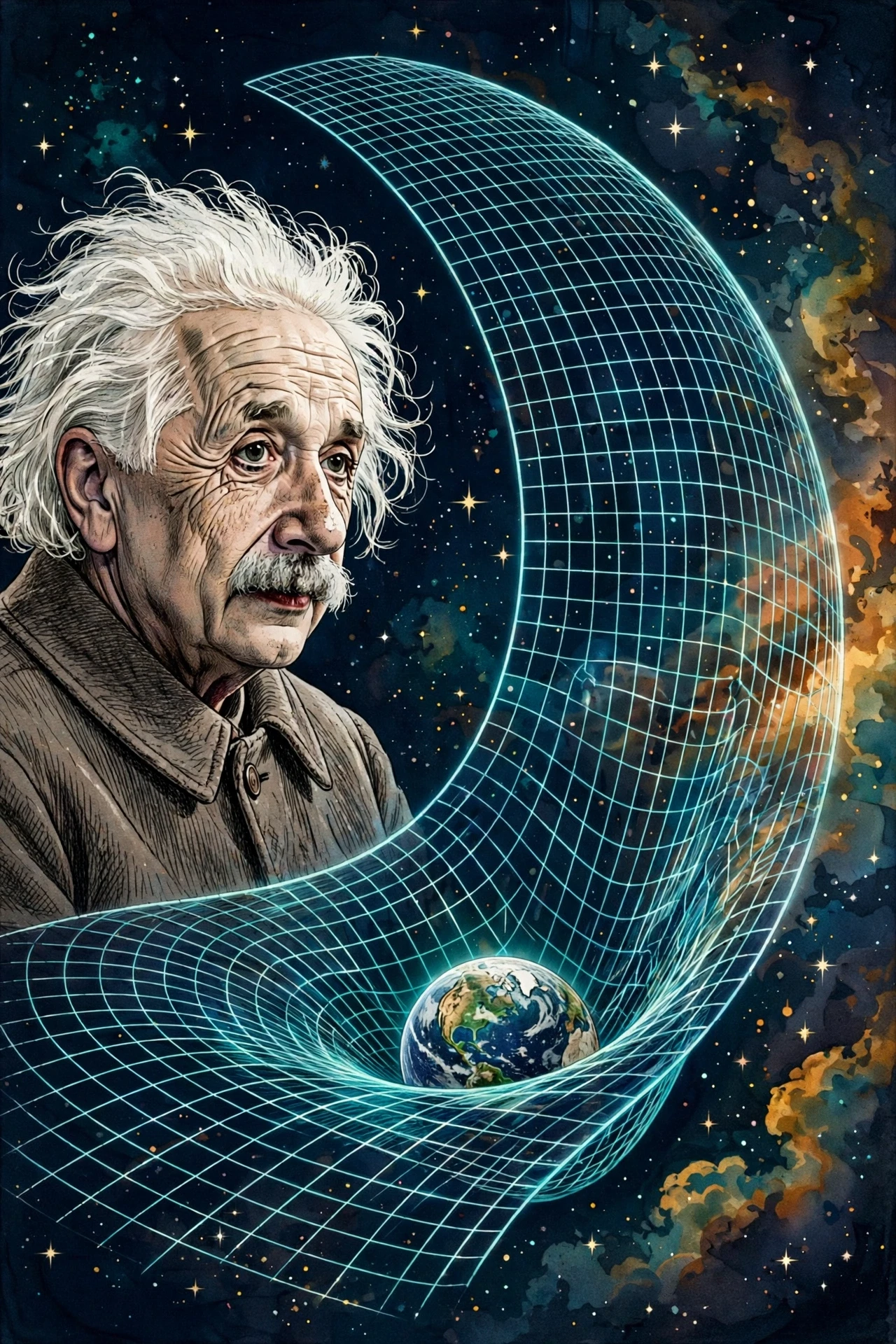
That is the question the theory of relativity answers, and it is also the question that broke the old picture of the universe. Light does not behave like a ball. No matter how fast you chase it, a beam of light always moves at the same speed relative to you: about 299,792 kilometres per second. Everything else in Einstein's work follows from that one stubborn fact, and from a second one he added ten years later: gravity is not a force pulling things down, but a curve in the fabric of space and time.
This guide explains both halves of the story. Special relativity, from 1905, tells us what happens when things move close to the speed of light: time slows, lengths shrink, and mass and energy turn out to be two forms of the same thing. General relativity, from 1915, tells us what gravity really is: mass and energy bending spacetime, and everything else — planets, light, even clocks — following the curves. We will meet the experiments that tested each idea, the everyday technology that quietly depends on them, and the questions they still cannot answer.
1. Before Einstein: Newton, Light, and a Problem Nobody Could Solve
1.1 Newton's clockwork universe
For more than two centuries, Isaac Newton's picture of the world had worked beautifully. Space was a fixed stage, time was a single clock ticking the same for everyone, and gravity was an invisible force that pulled masses toward each other across empty space. Drop an apple, and it falls. Watch the Moon, and it stays in orbit because Earth's gravity pulls it inward just enough to keep it curving around us. The maths was clean, the predictions were exact, and engineers still use Newton's laws today for most ordinary jobs, from building bridges to flying aeroplanes.
That picture was so successful that few people thought to question its foundations. The trouble was not that Newton was wrong about everyday life. The trouble was that light refused to play by his rules, and nobody had a good explanation for why.
1.2 The speed of light refuses to behave
By the late 1800s, physicists had measured the speed of light with growing precision, and they had found something strange. Light always travels at the same speed in a vacuum, about 300,000 kilometres per second, no matter how its source is moving and no matter how the observer is moving. A lamp on a fast train does not produce light that moves faster than a lamp standing still. A beam fired forward from a speeding rocket does not outrun a beam fired backward.
That should have been impossible under Newton's rules. If speeds add, then light from a moving source should go faster. It does not. The most famous attempt to catch the difference was the Michelson-Morley experiment of 1887, which tried to measure Earth's motion through the supposed "aether" — the invisible medium physicists thought light travelled through. The experiment found nothing. No aether wind, no change in light's speed, no matter which direction the apparatus pointed.
I still use that result in class, because it shows how science actually moves. The experiment did not give the answer its designers wanted. It gave a stubborn zero, and that zero forced everyone to rethink what space and time were. A failed measurement became the doorway to a new physics.
1.3 The patent clerk who kept asking "what if?"
Albert Einstein was twenty-six in 1905, working as a technical expert at the Swiss patent office in Bern. He was not a professor. He had no laboratory and no research team. What he had was a habit of thought experiments — careful, visual questions he could run in his head. What would the world look like if you rode alongside a beam of light? What would happen to a clock on a fast train? What if you were falling from a roof and let go of a stone — would it float beside you?
In that one year, often called his miracle year, Einstein published four papers that each changed physics. One explained the photoelectric effect, the work that would later win him the Nobel Prize. One explained Brownian motion, the jitter of tiny particles in water. One introduced special relativity. And a short follow-up paper gave the world E=mc². The Nobel Prize, when it came, was not for relativity at all — it was for the photoelectric effect, as the Nobel Prize record for 1921 makes clear. Relativity was, at the time, too strange and too untested for the committee to reward.
2. The Theory of Relativity Begins: Special Relativity
2.1 Two postulates, and nothing else
Special relativity rests on two simple statements. Einstein called them postulates, which is a careful word: they are starting assumptions, not conclusions, and everything else in the theory is derived from them.
The first postulate says the laws of physics are the same for everyone moving at a steady speed in a straight line. There is no special, privileged frame of reference. An experiment done in a smoothly moving train gives the same result as the same experiment done on the platform, as long as neither is speeding up or slowing down.
The second postulate says the speed of light in a vacuum is the same for all observers, no matter how the light source or the observer is moving. That is the stubborn fact from the previous section, now promoted to a law of nature.
2.2 The light clock: why moving clocks run slow
The clearest way to see time dilation is the light clock, a thought experiment Einstein himself loved. Picture a clock made of two mirrors facing each other, with a pulse of light bouncing up and down between them. Each round trip is one tick.
Now put that clock on a fast train, and watch it from the platform. From the train, the light goes straight up and down. From the platform, the clock is moving sideways while the light travels, so the light has to follow a longer, diagonal path to get from one mirror to the other. Light always travels at the same speed, so a longer path takes more time. The moving clock ticks more slowly — not because its machinery is faulty, but because time itself runs more slowly for the moving clock as seen from the platform.
The effect is called time dilation, and it is real. It has been measured with atomic clocks flown around the world, with particles in accelerators, and with clocks on satellites. At everyday speeds the effect is far too small to notice. At speeds close to light, it becomes enormous. If you could travel at 99.5% of the speed of light, your clock would tick about ten times more slowly than a clock left on Earth.

2.3 Length contraction: moving things get shorter
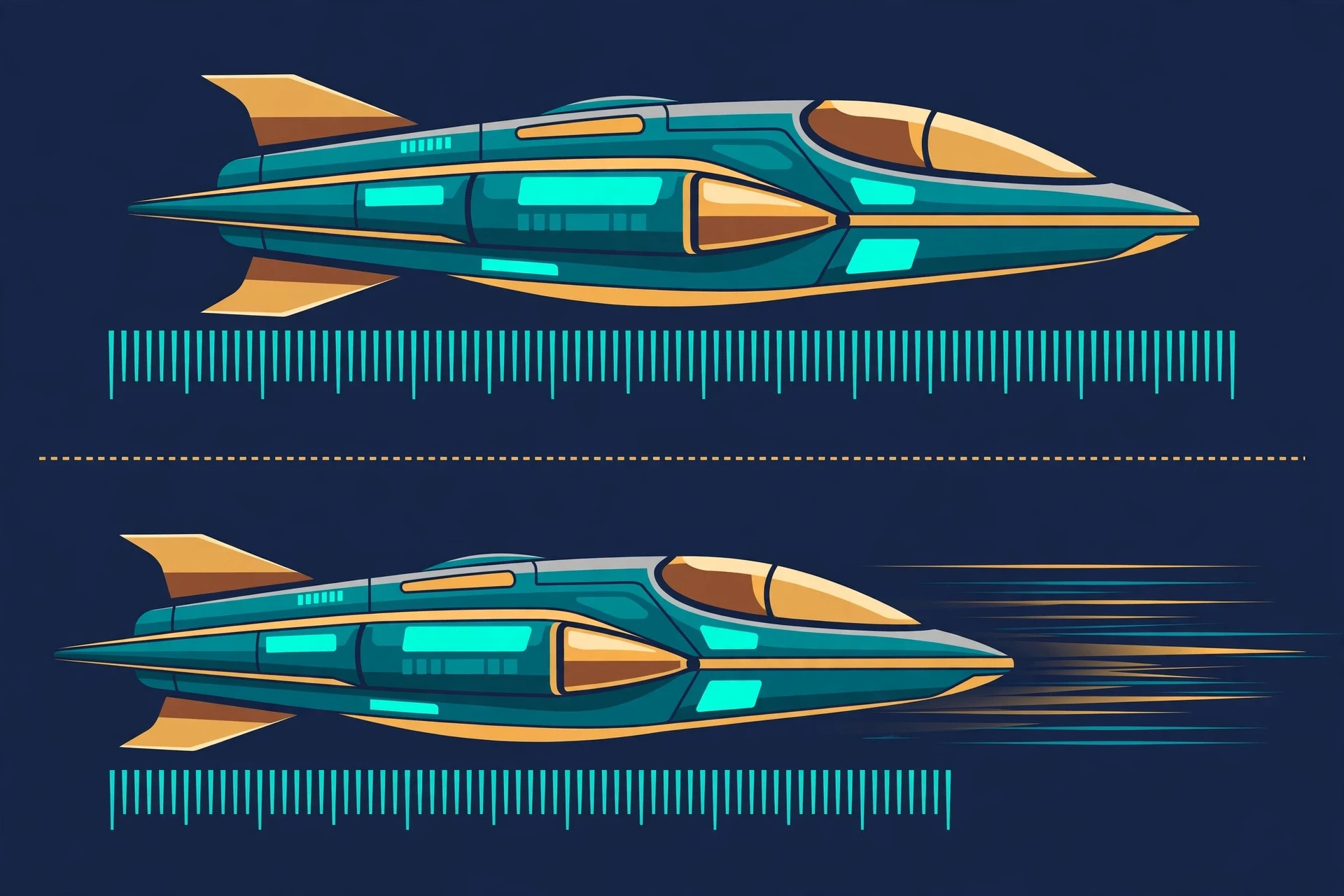
Time is not the only thing that changes. A moving object also looks shorter along the direction it is moving, as measured by someone it is passing. This is length contraction, and it is the partner of time dilation. The two effects fit together so that the speed of light stays constant for everyone.
Think of it this way: if time stretches for a moving observer, distances must shrink, or the numbers for light's speed would not add up. A spaceship travelling at 90% of the speed of light would measure about 44% shorter in the direction of travel to an observer on Earth, while its height and width would stay the same. The crew inside would notice nothing odd — their rulers shrink with them, and their clocks slow in exactly the way that keeps their own measurements consistent.
2.4 Simultaneity: "at the same time" depends on where you stand
Here is the strangest consequence of all. Two events that happen at the same time for one observer may not happen at the same time for another. Imagine lightning striking the front and the back of a moving train. An observer standing in the middle of the train, with the strikes equidistant, sees both flashes at the same moment and calls them simultaneous. An observer on the platform sees the train moving toward one flash and away from the other, so one flash reaches them first. For the platform observer, the strikes were not simultaneous.
Neither observer is wrong. There is no universal "now" that stretches across the whole universe. Each observer has their own slice of simultaneity, tilted by their motion. That is a hard idea to accept, because our brains evolved in a world where light seemed instant and "now" seemed shared. In the real universe, "now" is local, and the speed of light sets the limit on how fast any signal — and therefore any news — can travel.
The speed of light is not just a fast number. It is the speed limit of cause and effect, and it forces time, length, and simultaneity to bend around it.
3. E=mc²: Mass, Energy, and the Most Famous Equation
3.1 What the equation actually says
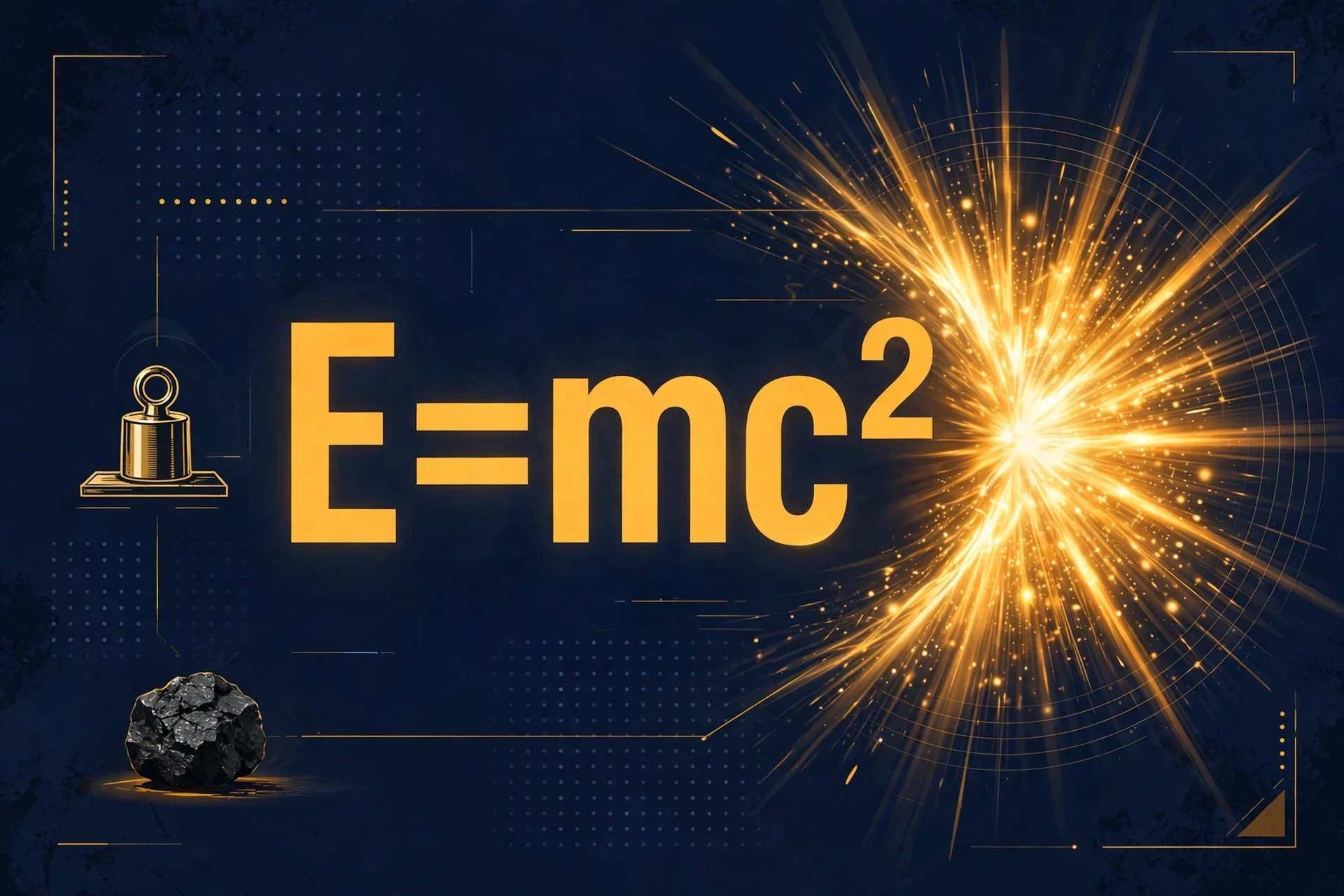
E=mc² is the most famous equation in science, and also one of the most misunderstood. In plain words, it says that mass and energy are two forms of the same thing, and they can convert into each other. E stands for energy, m stands for mass, and c is the speed of light — a very large number, about 300,000 kilometres per second. Because c is squared in the equation, even a small amount of mass holds an enormous amount of energy.
3.2 A worked example: how much energy is in a gram?
The numbers are worth seeing once, because they explain why this equation changed the world. One gram of matter, if fully converted to energy, releases about 90 trillion joules — roughly the energy of a large power station running for a day, or many thousands of tonnes of coal burned at once. The Sun turns about four million tonnes of its own mass into light and heat every second, which is why it can shine for billions of years while slowly, measurably, losing weight.
That is also why nuclear reactions are so powerful compared with chemical ones. A chemical reaction rearranges atoms and releases a small fraction of their mass-energy. A nuclear reaction rearranges the nucleus itself and releases a far larger share — and the atoms involved are the elements whose patterns Sciory's Periodic Table of Elements: Structure & Trends lays out, from hydrogen to uranium. The same physics explains both the energy of the Sun and the energy of a nuclear reactor — and, soberingly, of a nuclear weapon. Einstein understood that implication early, and he spent much of his later life arguing that the knowledge should be used with restraint. The equation itself is neutral. What people do with it is not.
3.3 What E=mc² does not mean
Most people assume the equation means you can turn any object into pure energy whenever you like, like a magic trick. What we actually see in nature is narrower. Full conversion of mass into energy happens in specific processes — matter meeting antimatter, or nuclear reactions that release a fraction of the mass as energy. You cannot turn a chair into a flash of light by wishing, because there is no process in ordinary life that does that conversion.
A second confusion is the idea that the equation is about speed. It is not about moving fast. A stationary object still has rest energy, E₀ = mc², simply because it has mass. Motion adds kinetic energy on top of that. The equation is a statement about what mass is, not about how fast something is going.
4. From Special to General: The Happiest Thought
4.1 The falling lift, and the equivalence principle
Ten years after special relativity, Einstein was still bothered by a gap in it. Special relativity only dealt with motion at a steady speed in a straight line. It said nothing about acceleration, and nothing about gravity. Then, in 1907, he had the idea he later called the happiest thought of his life.
Picture yourself in a lift, with no windows. If the lift is falling freely toward the ground, you feel weightless — a dropped ball floats beside you, exactly as it would in empty space far from any planet. If the lift is sitting on Earth, you feel your weight pressing into the floor. If the lift is in deep space, far from gravity, but accelerating upward at the same rate as Earth's gravity, you feel exactly the same weight as you do on Earth, and a dropped ball falls to the floor in exactly the same way.
Einstein's conclusion was that there is no experiment you can do inside a sealed box that tells you whether you are sitting in a gravitational field or accelerating through empty space. Gravity and acceleration are, locally, the same thing. That is the equivalence principle, and it is the foundation of general relativity. It also explains why all objects fall at the same rate in a vacuum, whatever their mass: gravity is not a force pulling harder on heavier things, but a feature of the environment that affects all things equally.
4.2 Spacetime: space and time woven together
Special relativity had already merged space and time into a single four-dimensional fabric called spacetime. An event is not just a place; it is a place and a time — a point in spacetime. You move through spacetime at a fixed total rate, and the split between "moving through space" and "moving through time" depends on your motion. Move faster through space, and you move more slowly through time. That is time dilation, restated in the language of spacetime.
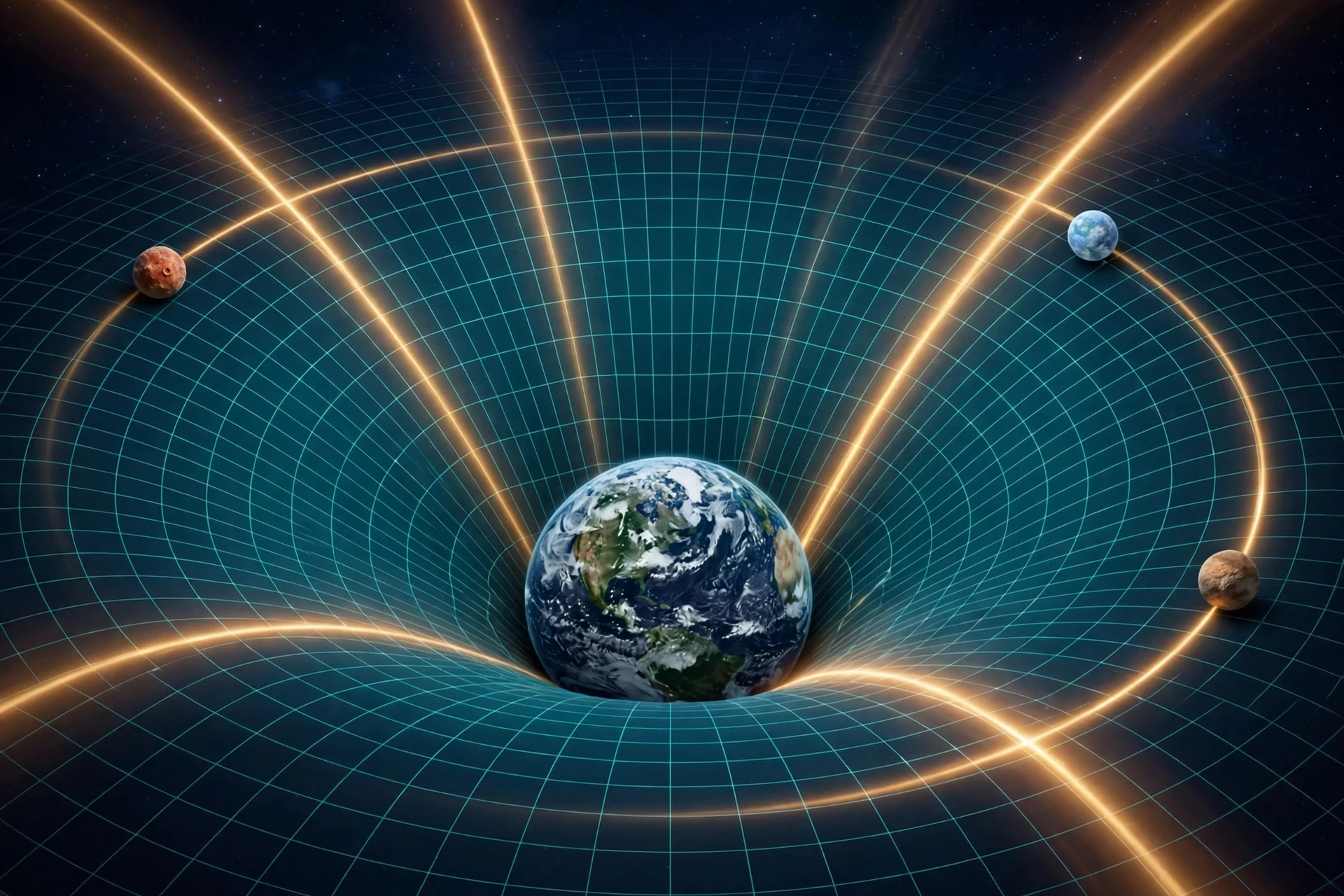
General relativity adds the next step: spacetime is not a rigid stage. It can bend, stretch, and ripple. Mass and energy tell spacetime how to curve, and curved spacetime tells matter how to move. That sentence, often credited to the physicist John Archibald Wheeler, is the whole of general relativity in one line. There is no separate force of gravity reaching out and pulling. There is a curved geometry, and things follow the straightest possible paths through that geometry — paths that look curved to us because the geometry itself is curved.
4.3 Curved spacetime: the gravity well
The classic image of general relativity is the gravity well: a heavy object, like the Sun, sitting in the middle of a stretched sheet and denting it downward, while planets roll around the dent in orbits. Light, too, follows the curves. A beam passing near a massive object does not travel in a straight line; it follows the curve of spacetime, and bends toward the mass.
That bending is not an optical illusion. It is a real change in the path of light, and it was the first prediction of general relativity to be tested in the field. It also means something that still surprises people when they first hear it: light is affected by gravity, even though light has no mass. In Newton's picture, that should be impossible — gravity pulls on mass, and light has none. In Einstein's picture, it is natural, because gravity is not pulling on the light at all. The light is simply travelling straight through a curved region, and straight looks bent from the outside.
5. What General Relativity Predicts — and How We Tested It
5.1 Mercury's orbit: the first clue
Long before Einstein, astronomers had a puzzle on their hands. Mercury, the planet closest to the Sun, does not quite follow the orbit Newton's laws predict. Its orbit slowly rotates — the point of closest approach to the Sun, the perihelion, shifts by a small amount each century, and about 43 arcseconds of that shift per century could not be explained by the pull of the other planets. An arcsecond is a tiny angle, 1/3600 of a degree, so 43 of them per century is a whisper of a discrepancy. But it was a real one, and it had resisted explanation for decades. Sciory's Our Solar System: Planets, Moons, and Celestial Dynamics walks through Mercury's extremes and the other planets in detail.
General relativity explained it at once. In curved spacetime near the Sun, Mercury's orbit does exactly what is observed: the perihelion advances by that extra amount.
5.2 Bending light: the 1919 eclipse and Einstein rings
The most dramatic early test came in 1919, during a total solar eclipse. Two expeditions, led by Arthur Eddington and Frank Dyson, photographed stars whose light passed close to the Sun during the eclipse, when the Sun's glare was blocked by the Moon. If Einstein was right, the stars would appear slightly shifted from their normal positions, because their light had bent around the Sun. The measurements matched Einstein's prediction, and not Newton's — Newton, with light treated as particles, predicted about half the bending Einstein did.
The result made Einstein world-famous overnight. Newspapers that had never printed a physics story put his face on the front page. The eclipse test also gave science a template for how to settle a great debate: take two theories that predict different numbers, find a place where the difference is measurable, and measure it.
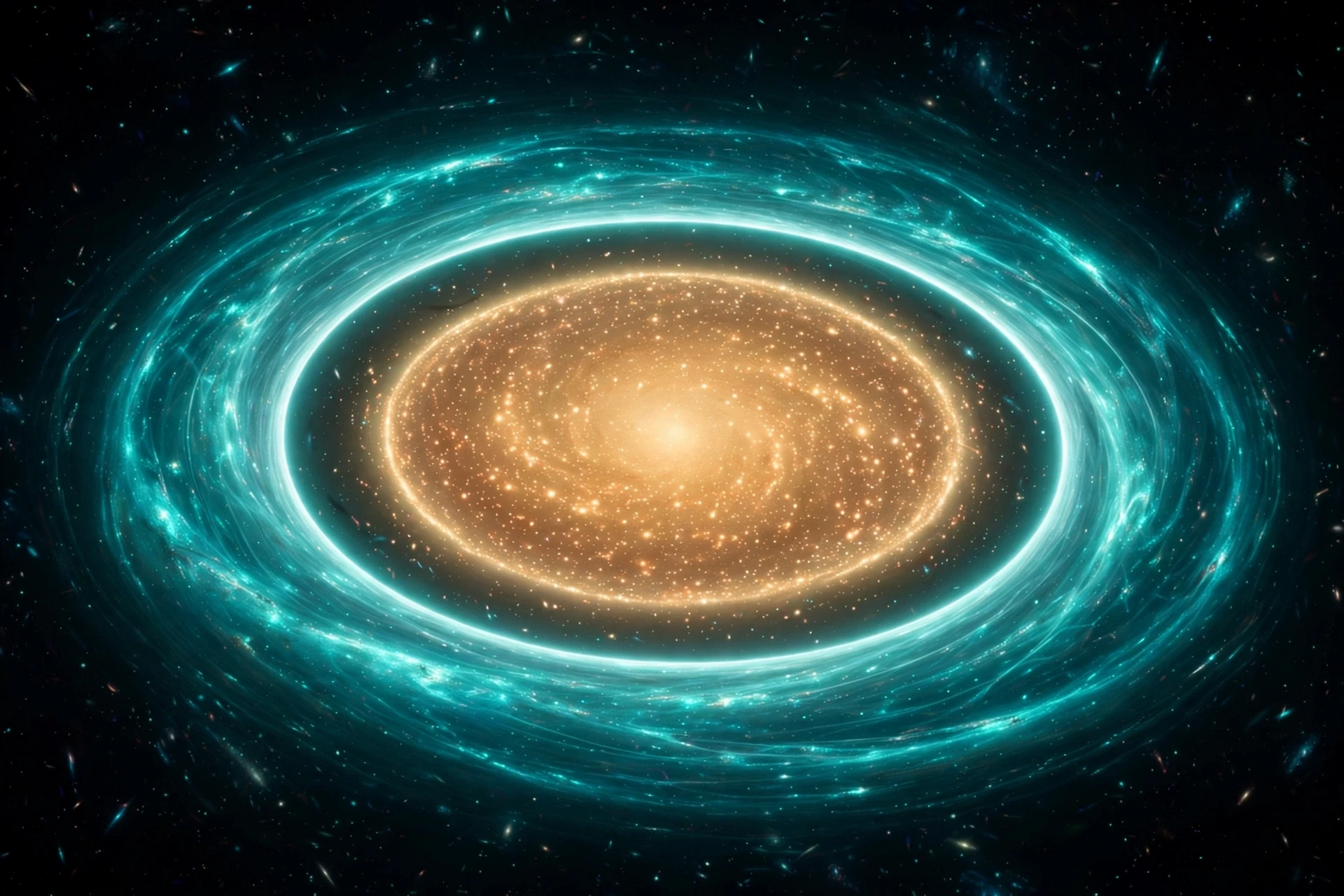
The same bending shows up on a far grander scale today. When a distant galaxy, a massive foreground galaxy, and Earth line up just right, the foreground galaxy's gravity bends the background galaxy's light into a near-perfect circle, called an Einstein ring. The James Webb Space Telescope has photographed such rings, including a striking one around an elliptical galaxy in the cluster SMACSJ0028.2-7537, where the light of a distant galaxy is stretched into a glowing circle by the mass in front of it. Each ring is a direct, visible confirmation that mass bends light — and a tool astronomers use to study galaxies too faint and distant to see any other way.
5.3 Gravitational time dilation, and your phone
General relativity also says that time runs more slowly where gravity is stronger. A clock on the ground floor of a tall building ticks a touch more slowly than an identical clock on the roof, because the ground-floor clock sits deeper in Earth's gravitational well. The difference over a lifetime is tiny — billionths of a second — but atomic clocks are now precise enough to measure it over a height difference of about a foot. In 2010, researchers at NIST compared two optical clocks separated by about 33 centimetres in height and found the higher clock ticking measurably faster, exactly as Einstein predicted. The National Institute of Standards and Technology describes the full story of these clock tests, from aeroplanes to satellites to mountain tops, in its account of putting Einstein to the test.
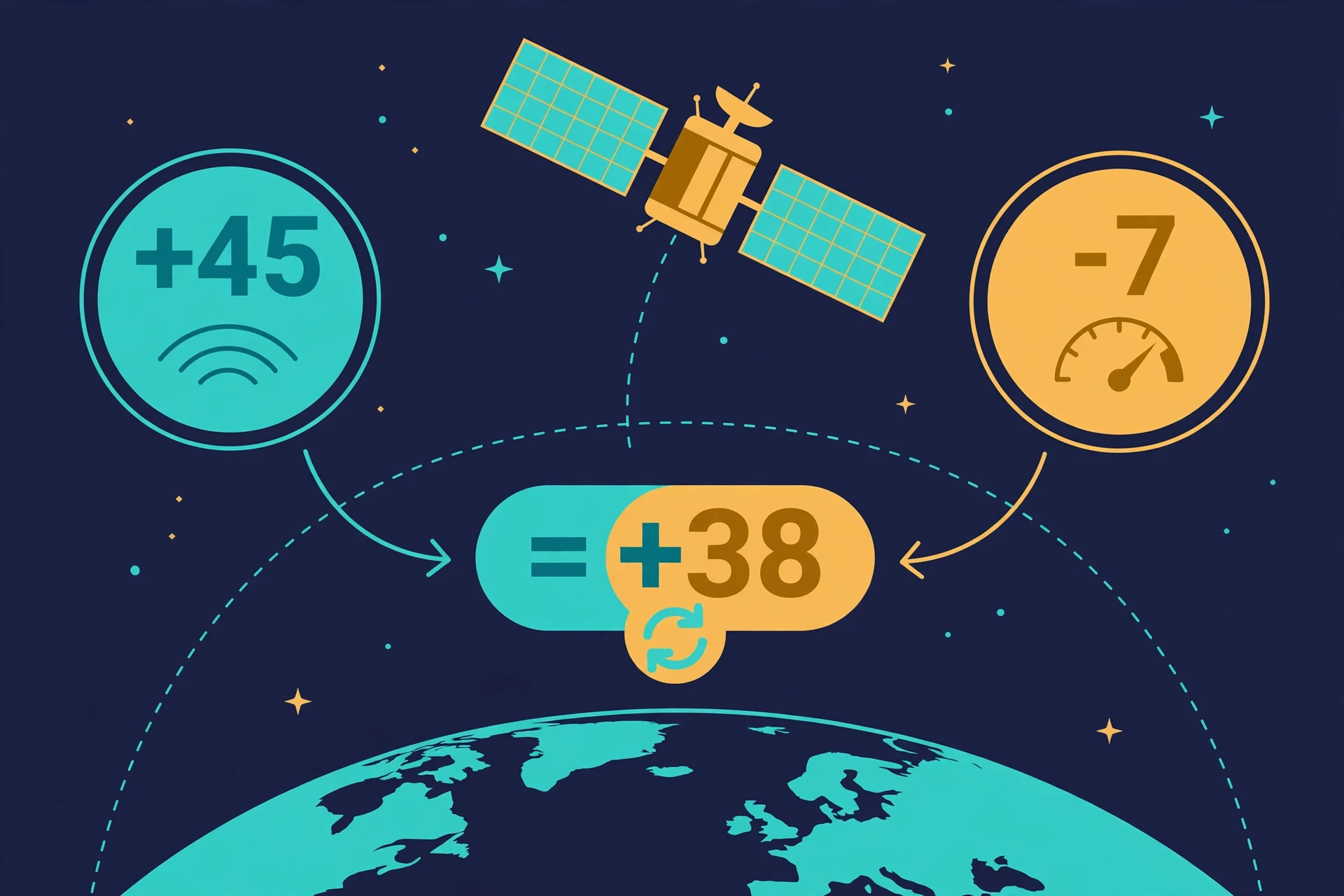
That is not just a laboratory curiosity. It is built into the phone in your pocket. GPS satellites orbit about 20,200 kilometres above Earth, where gravity is weaker and their clocks run faster — about 45 microseconds per day faster than clocks on the ground, by general relativity. Their orbital speed works the other way, slowing their clocks by about 7 microseconds per day, by special relativity. The net effect is about 38 microseconds per day fast. Light travels about 300 metres in a microsecond, so an uncorrected drift of 38 microseconds a day would throw your position off by roughly 10 kilometres in a single day. GPS engineers correct for both effects before launch, tuning each satellite clock to run slightly slow on the ground so that relativity speeds it up to the right rate in orbit. Your blue dot on the map is, quietly, a daily test of Einstein's theories.
5.4 Gravitational waves: ripples in spacetime
If spacetime can bend, Einstein reasoned in 1916, it should also be able to ripple — and violent events, like two black holes colliding, should send those ripples outward at the speed of light. Those ripples are gravitational waves. For a century they remained a prediction without a direct detection, because the ripples are unimaginably faint by the time they reach Earth.
That changed on 14 September 2015. The Laser Interferometer Gravitational-Wave Observatory, LIGO, with two detectors in Hanford, Washington, and Livingston, Louisiana, recorded a signal lasting about two-tenths of a second, sweeping upward in frequency from about 35 to 150 hertz. The signal, named GW150914, matched the pattern general relativity predicts for two black holes — about 36 and 29 times the mass of the Sun — spiralling together and merging into a single black hole of about 62 solar masses, with about three solar masses converted into gravitational-wave energy in a fraction of a second. The LIGO Scientific Collaboration's own account of the first direct detection of gravitational waves describes the event, the two detectors, and how the signal was matched against waveforms computed from Einstein's equations. The discovery won the 2017 Nobel Prize in Physics for the leaders of the LIGO project, and it opened a new way of observing the universe — not with light, but with the shaking of spacetime itself.
5.5 Black holes: where the theory points at its own edge
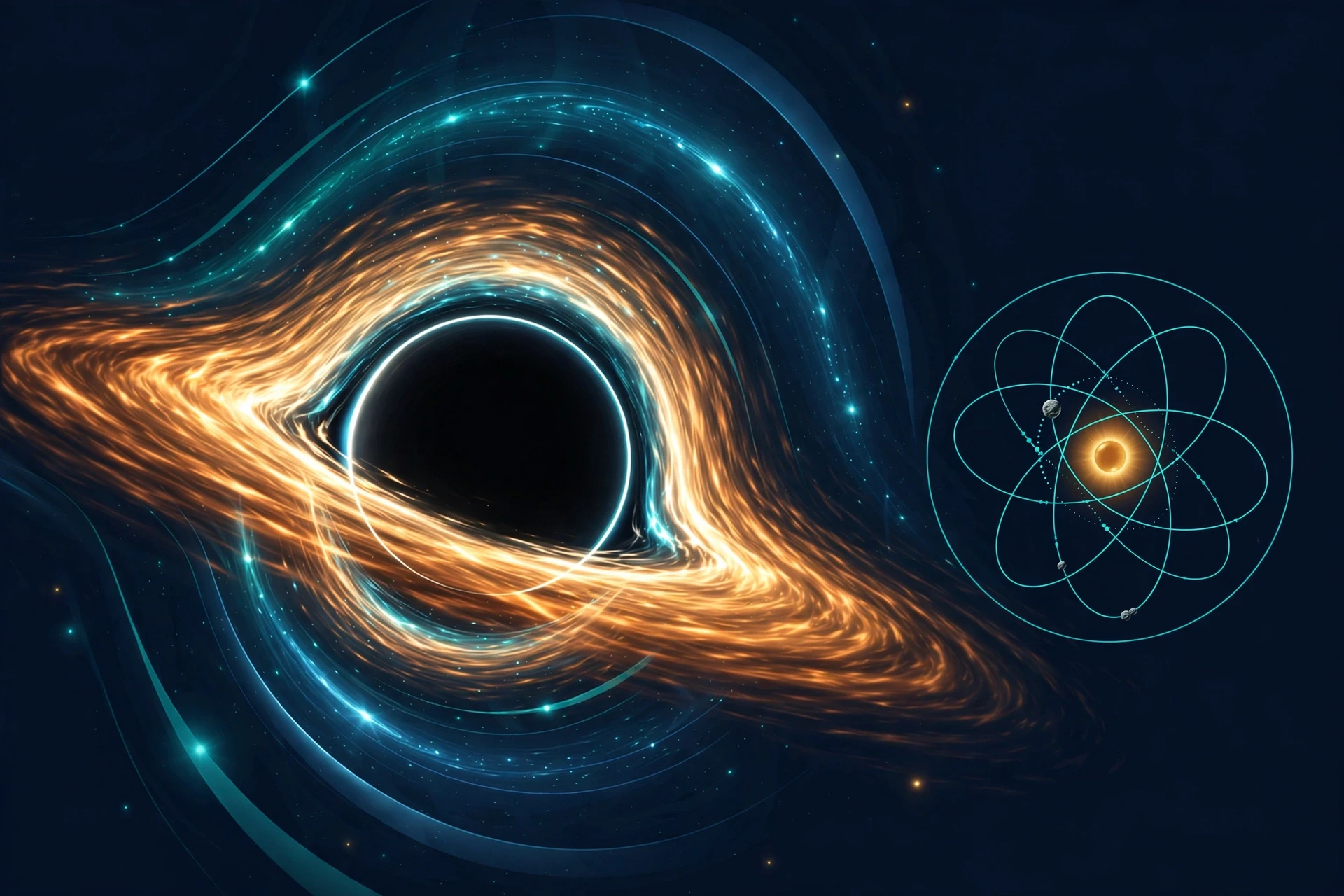
Black holes are the most extreme prediction of general relativity. If enough mass collapses into a small enough region, spacetime curves so steeply that nothing, not even light, can escape from inside a boundary called the event horizon. The idea fell out of Einstein's equations within months of their publication, when Karl Schwarzschild found a solution describing the spacetime around a spherical mass. Einstein himself doubted that such objects could really exist in nature.
They do. Astronomers have now weighed black holes across the universe, from stellar-mass black holes left behind by dying stars to supermassive black holes millions or billions of times the mass of the Sun, sitting at the centres of galaxies. NASA's X-ray observatories test general relativity in the extreme gravity near black holes and neutron stars, where the predictions include gravitational redshift, frame-dragging, and innermost stable orbits — effects with no Newtonian equivalent, as NASA's Imagine the Universe! relativity page explains. Sciory's Black Holes Explained: Formation & Properties covers how these objects form and what we know about them, and the story only makes sense once you have seen the curved-spacetime picture behind it.
6. Special vs General: A Side-by-Side Comparison
Feature | Special relativity (1905) | General relativity (1915) |
|---|---|---|
Main subject | Motion, space, and time at high speeds | Gravity, acceleration, and curved spacetime |
Key idea | The speed of light is the same for all observers | Mass and energy curve spacetime; matter follows the curves |
What it explains | Time dilation, length contraction, E=mc² | Orbits, bending of light, gravitational time dilation, black holes |
Applies when | Constant velocity, no gravity | Any motion, including acceleration and strong gravity |
Everyday test | Particle accelerators, atomic clocks on planes | GPS clocks, Mercury's orbit, gravitational lensing |
Famous prediction | A moving clock runs slow | Gravitational waves ripple through spacetime |
7. Relativity in Everyday Life
Relativity is often presented as a theory about the far away and the unimaginably fast, and it is that. But it is also, quietly, a theory about the ordinary. Particle accelerators are the clearest example. At CERN and other laboratories, protons are pushed to more than 99.99% of the speed of light, and at those speeds their behaviour only makes sense with relativity. Their mass-energy grows, their clocks slow, and the particles they produce live longer than they would at rest — exactly as time dilation predicts. Without relativity, accelerator physicists could not design the machines, predict what comes out of a collision, or interpret the results. Those machines are, at heart, enormous electrical devices — magnets steering charged particles with electric fields — and the principles behind them are the ones in Sciory's Fundamentals of Electricity: From Circuits to Electromagnetism. The quantum world, too, only fits together with relativity once the two are combined, which is why Sciory's Understanding Quantum Mechanics: Principles, Paradoxes, Real-World Applications & 2026 Breakthroughs keeps returning to the same boundary where the two theories meet.
Medicine uses relativity as well. Positron emission tomography, the PET scan, works because of antimatter: a positron emitted by a radioactive tracer meets an electron in the body, and the two annihilate, converting their mass into two gamma-ray photons flying in opposite directions. Detectors catch those photons and reconstruct where the annihilation happened. That is E=mc², turned into a picture of a tumour or a brain.
8. The Twin Paradox, Explained Properly
8.1 The setup
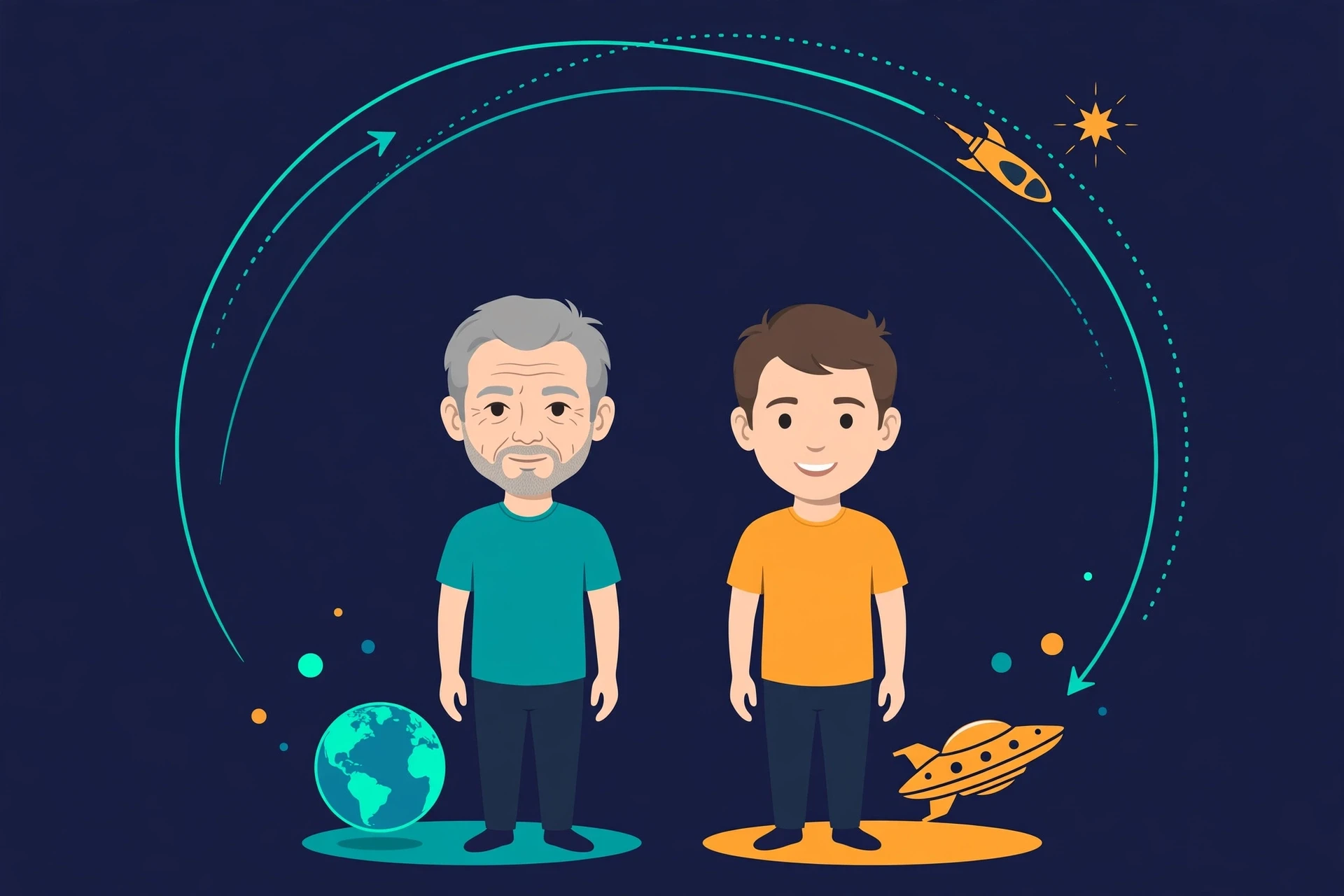
Two twins, one stays on Earth, one boards a spaceship that flies away at close to the speed of light, turns around, and comes back. The travelling twin's clock runs slow by time dilation, so she returns younger than her sister. That much is clear. The puzzle is the symmetry: from the traveller's point of view, is it not Earth that is moving, and therefore the Earth twin's clock that should run slow? Why is the traveller the younger one, and not the stay-at-home twin?
This is the twin paradox, and it has confused generations of students — including, I confess, me, the first time I tried to explain it without notes and found myself going in circles at the whiteboard. The resolution is not a trick. It is a real asymmetry, and it is hidden in the turn-around.
8.2 Why the traveller really is younger
The key is that the two twins do not have the same kind of journey. The Earth twin stays in one inertial frame — one steady, unchanging state of motion — the whole time. The travelling twin does not. She speeds up, coasts, turns around, and slows down. Turning around means changing direction, which means accelerating, and acceleration breaks the symmetry. During the turn, the traveller's idea of "now" on Earth swings forward by a large amount, and that swing is where the missing time goes.
Put numbers on it and the paradox dissolves. Suppose the traveller goes to a star four light-years away at 80% of the speed of light, then comes straight back. From Earth's point of view the round trip takes ten years. From the traveller's point of view, time dilation makes the trip take only six years. She returns four years younger than her twin. Both clocks are right, because they took different paths through spacetime — and in relativity, the time a clock records depends on the path it takes, not just on where it starts and ends.
8.3 What the paradox teaches us
The twin paradox is not a flaw in relativity. It is a feature, and it teaches the deepest lesson of the theory: time is not a single river everyone floats down together. It is a path-dependent quantity, like distance. Two people who take different routes between the same two cities travel different distances; two clocks that take different routes between the same two events record different times. Once you accept that, the paradox stops being a puzzle and starts being a tool — a way to feel, in a concrete story, what spacetime really means.
9. Common Misconceptions About Relativity — Corrected
"Relativity means everything is relative, so there are no facts." The name is misleading. The theory is built on things that are absolute: the speed of light is the same for everyone, and the spacetime interval between two events is the same for all observers. What is relative is the split of that interval into "space" and "time" — and that split depends on the observer. Relativity is a theory of invariants, not of "anything goes."
"Einstein proved Newton wrong." He did not. Newton's laws are still correct within their domain — slow speeds, weak gravity — and engineers use them every day. Einstein showed that Newton's picture is a limit of a deeper picture, the way a flat map of a city is a good approximation until you need to navigate a whole planet. Newton was not wrong; he was incomplete.
"You can travel faster than light if you try hard enough." As far as we know, no. As an object with mass approaches the speed of light, the energy needed to speed it up further grows without limit. Reaching light speed would take infinite energy. Particles of light, photons, travel at light speed because they have no mass. Everything else is stuck below it.
"Time dilation is just a trick of clocks." It is not. Time dilation affects all physical processes equally — atomic clocks, particle decays, chemical reactions, and human ageing. A fast-moving muon lives longer before decaying, not because its clock is broken, but because less time passes for it. Time itself is what changes.
"General relativity says gravity is not real." It says gravity is not a force in Newton's sense. It is very real as curvature. Drop a ball and it falls — that is not an illusion. What changes is the explanation: the ball is following the straightest path through curved spacetime, and that path leads downward.
"Einstein won the Nobel Prize for relativity." He did not. His 1921 Nobel Prize in Physics was awarded for the photoelectric effect, and he received it in 1922. Relativity was, at the time, still controversial and untested enough that the committee chose safer ground — a reminder that even the greatest ideas have to wait for the evidence to catch up with them.
10. What Relativity Cannot Do Yet
10.1 The quantum problem
For all its success, general relativity has a boundary it cannot cross: the quantum world. General relativity describes gravity as smooth, continuous curvature. Quantum mechanics describes the other forces as discrete, jittery, and probabilistic. The two descriptions work beautifully in their own domains, and they clash where those domains overlap — inside a black hole, or in the first moments of the universe. Physicists have been trying to build a quantum theory of gravity for decades, with candidates like string theory and loop quantum gravity, and none has yet produced a testable prediction that has been confirmed. The failure is not a sign that relativity is wrong. It is a sign that it is incomplete, in exactly the way Newton's theory was incomplete before it.
OpenStax's comparison of Newton's law of gravitation and Einstein's general relativity puts the point plainly: Einstein's theory explains things Newton's cannot, and still leaves questions that neither theory answers. That honesty is part of what makes the science trustworthy. A theory that claims to explain everything is a theory that has stopped listening to nature.
10.2 Dark matter, dark energy, and the expanding universe
Two more puzzles sit at the edge of the picture. Galaxies rotate as if they contain far more mass than we can see, which astronomers call dark matter — mass that bends spacetime and holds galaxies together, but does not shine. And the expansion of the universe is speeding up, driven by something called dark energy, which acts like a repulsive force on the largest scales. General relativity can accommodate both, by adding them to its equations, but it does not explain what they are. They are placeholders for ignorance, honestly labelled as such, and they are among the biggest open questions in science.
Conclusion: Two Theories, One New Universe
The theory of relativity did not just add a few corrections to Newton's physics. It replaced the stage itself. Space and time, which Newton treated as a fixed background, turned out to be a flexible fabric, woven together as spacetime, bent by mass and energy, and rippled by the most violent events in the universe. Time slows for the fast-moving and the deeply buried in gravity. Lengths shrink along the direction of motion. Mass and energy trade places. Light bends around stars. Clocks on satellites tick at a different rate from clocks on the ground, and your phone corrects for the difference every time it finds your position.
That is a lot to take in, and it is worth taking in slowly. Start with the two postulates, follow the light clock, and let the rest follow. The mathematics behind relativity is demanding, but the ideas are not hidden behind it. They are, at heart, simple: light's speed is fixed, and everything else — time, length, simultaneity, gravity — bends to keep it so. Once you see that, the universe never looks quite the same again. A train window, a falling lift, a ticking clock, a bent beam of starlight — each one is a small, everyday doorway into the same deep structure. Einstein found the door. The rest of us get to walk through it.
Frequently Asked Questions
What is the theory of relativity in simple terms?
The theory of relativity is Einstein's description of space, time, and gravity. Special relativity says the speed of light is the same for everyone, so time slows and lengths shrink for fast-moving objects. General relativity says mass and energy curve spacetime, and that curvature is what we experience as gravity.
What is the difference between special and general relativity?
Special relativity, from 1905, deals with motion at constant speed and says time and length change near light speed. General relativity, from 1915, deals with gravity and acceleration, and says gravity is the curvature of spacetime. General relativity includes special relativity as the case where gravity is negligible.
What is time dilation?
Time dilation is the slowing of time for a moving clock, or for a clock in a strong gravitational field, as measured by someone else. A clock on a fast spaceship ticks more slowly than an identical clock on Earth, and a clock on the ground ticks more slowly than one on a high mountain. The effect has been measured with atomic clocks, particles, and GPS satellites.
What does E=mc² mean?
E=mc² means mass and energy are two forms of the same thing and can convert into each other. E is energy, m is mass, and c is the speed of light. Because c is so large, a small amount of mass holds an enormous amount of energy, which is why the Sun shines and why nuclear reactions release so much energy.
What is spacetime?
Spacetime is the four-dimensional fabric that combines the three dimensions of space with the dimension of time. In relativity, an event is a point in spacetime, and the distance between events depends on both space and time. Mass and energy curve spacetime, and that curvature is gravity.
How was general relativity tested?
General relativity was tested by Mercury's orbit, which it explains to the arcsecond; by the bending of starlight during the 1919 solar eclipse; by gravitational lensing and Einstein rings; by atomic clocks showing gravitational time dilation; and by LIGO's direct detection of gravitational waves in 2015, from two merging black holes.
Why does GPS need relativity?
GPS satellites carry atomic clocks that run about 38 microseconds per day faster than clocks on Earth — about 45 microseconds faster from weaker gravity, minus about 7 microseconds slower from orbital speed. Without correcting for both effects, GPS positions would drift by roughly 10 kilometres per day.
What is the twin paradox?
The twin paradox is a thought experiment in which one twin travels at near light speed and returns younger than the twin who stayed on Earth. It is not a contradiction: the travelling twin accelerates and turns around, breaking the symmetry, and her clock records a shorter path through spacetime.
Did Einstein win the Nobel Prize for relativity?
No. Einstein's 1921 Nobel Prize in Physics was awarded for his discovery of the law of the photoelectric effect, and he received it in 1922. Relativity was not mentioned in the prize citation.
Is time travel possible under relativity?
Relativity allows time to pass at different rates, which is a limited form of time travel into the future — astronauts already age a fraction more slowly than people on Earth. Travelling into the past is a different matter, and no known physical process allows it. The theory does not forbid all such ideas, but none has any experimental support.
Sources / Further Reading
NASA — X-ray Astronomy Puts Einstein to the Test — general relativity, black holes, gravitational lensing, frame-dragging, and X-ray tests of Einstein's predictions
Nobel Prize — The Nobel Prize in Physics 1921 — Einstein's prize was for the photoelectric effect, received in 1922
LIGO Scientific Collaboration — Observation of Gravitational Waves from a Binary Black Hole Merger — GW150914, detected 14 September 2015, two black holes of about 36 and 29 solar masses
NIST — Putting Einstein to the Test — atomic clocks, GPS time corrections (minus 7, plus 45, net plus 38 microseconds per day), and gravitational time dilation
OpenStax Physics — Newton's Law of Universal Gravitation and Einstein's Theory of General Relativity — Newton vs Einstein, the equivalence principle, and the 1919 eclipse test