

Stand on any beach at low tide and press your palm flat against the wet sand. The ground feels solid, finished, done. It is nothing of the sort. Under that thin skin of sand and rock, our planet is still sorting itself out, still cooling, still churning, still carrying heat left over from its violent birth more than four and a half billion years ago. The layers of the earth are not a neat stack of shelves in a museum. They are a living machine, and almost everything dramatic that happens at the surface — the volcano that splits a mountainside, the earthquake that rattles a city at 3 a.m., the slow drift of continents — starts down there, in the dark.
I first felt the strangeness of that idea not in a lecture hall but on a field trip, standing on a slab of dark green rock that had once been part of the mantle. It had been shoved up to the surface by forces I could not see, and it sat there in the rain, cool to the touch, ordinary-looking, wrong in every way. A piece of the deep Earth, just lying there. I picked it up and it was heavier than I expected. That weight stayed with me. The ground under our feet is only the beginning of the story.
Here is the puzzle that makes the layers of the earth so fascinating: nobody has ever seen them. The deepest hole humans have ever drilled reaches about 12 kilometres down. Earth is 6,371 kilometres to its centre. We have scratched the paint and yet we can describe, with real confidence, what sits thousands of kilometres below us — how hot it is, whether it is solid or liquid, even roughly what it is made of. How? Because the planet talks. Every earthquake sends waves racing through the interior, and those waves change speed, bend, bounce and vanish in ways that spell out the structure they passed through. Reading those waves is a bit like tapping the wall of a dark room and working out where the furniture is. Seismologists have been doing it for more than a century, and the picture they have built is one of the great achievements of science.
This article walks you through that picture, layer by layer, from the crust you are standing on to the iron heart at the centre. You will meet the two very different kinds of crust, the mantle that flows like cold honey over millions of years, the liquid outer core that acts as a planet-sized electrical generator, and the inner core — a ball of solid iron, hotter than the surface of the Sun, that stays solid only because the pressure down there is almost beyond imagining. You will learn how we know all this, why the deepest mines and boreholes barely dent the surface, and what the layers of the earth mean for the volcanoes, earthquakes and moving plates that shape the world we live on.
1. What Are the Layers of the Earth?
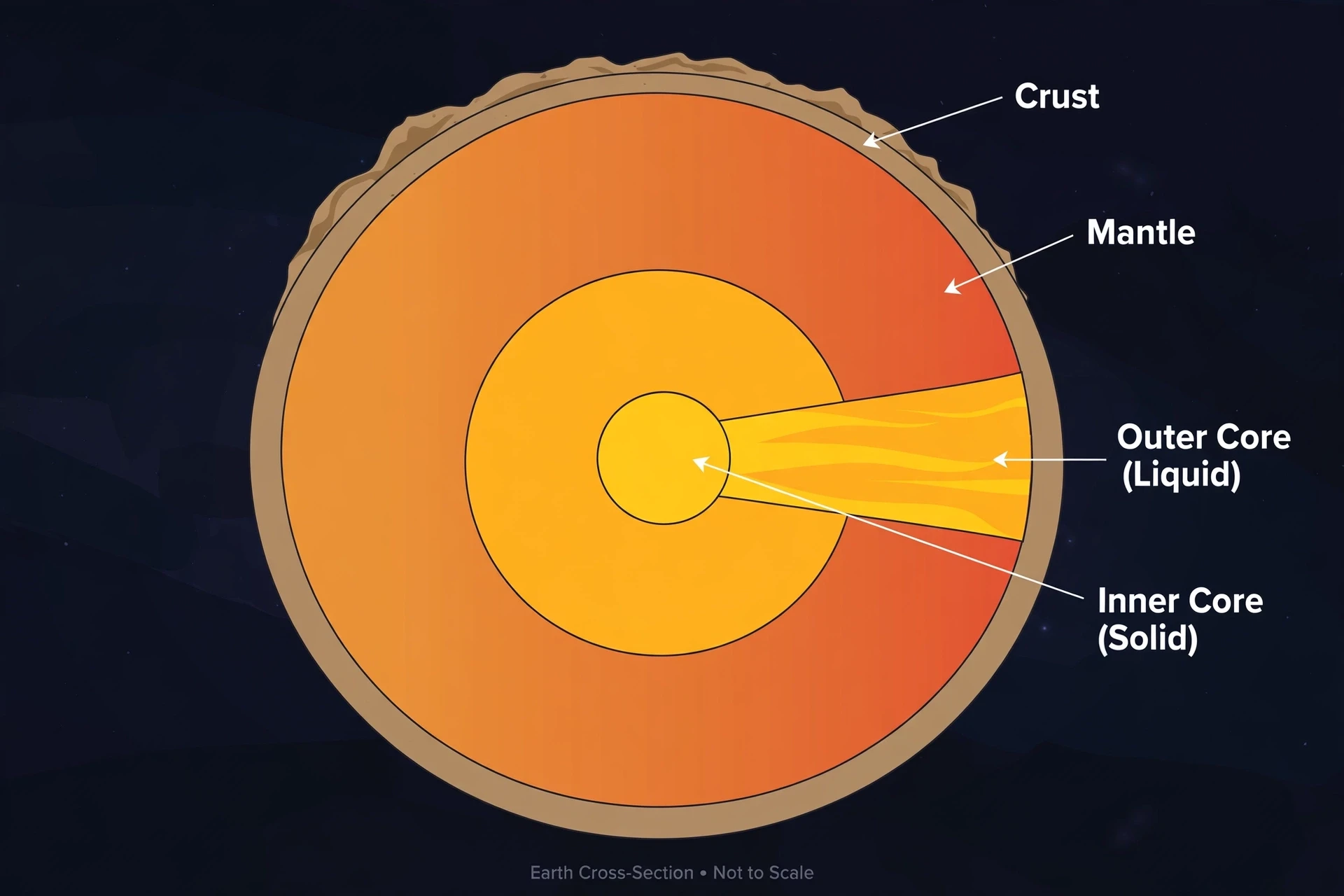
Ask a child to draw the inside of the Earth and you will usually get the same picture: a red-hot ball with a few wavy lines. The real answer is richer, stranger and far more useful. The layers of the earth are usually described in two different ways at once, and keeping those two ways straight is the key to everything that follows.
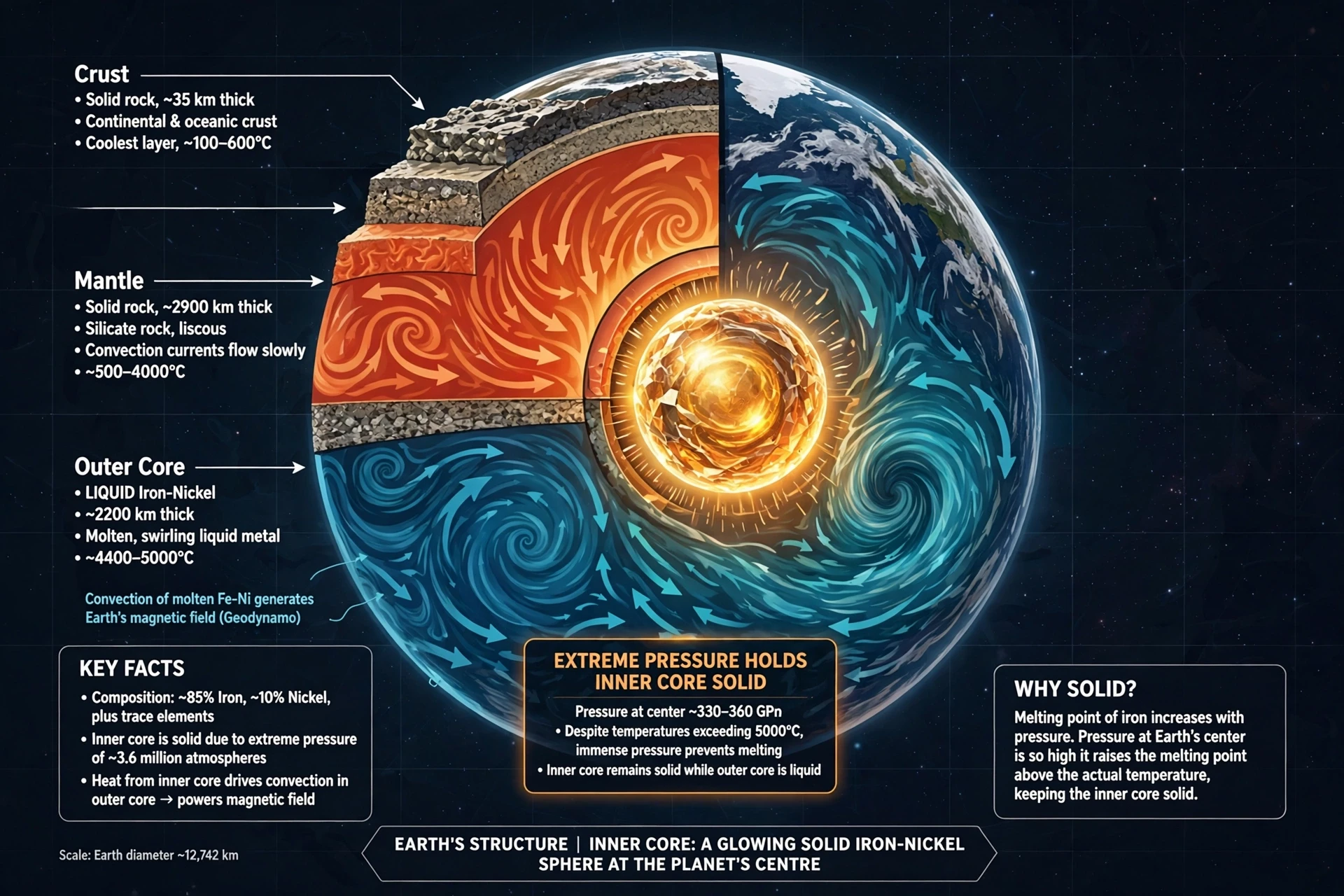
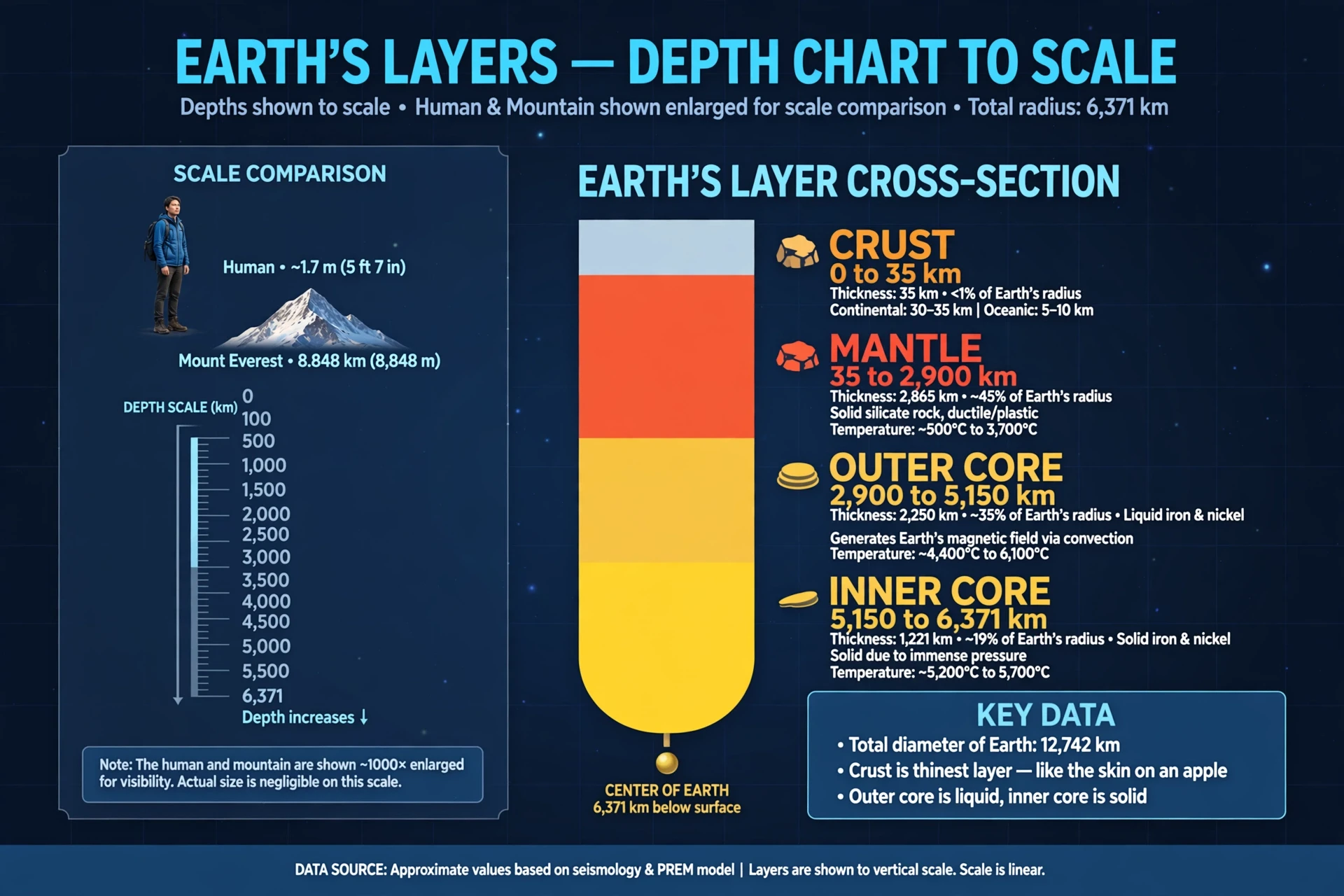
The first way sorts the planet by chemistry — what each layer is made of. By that sorting there are three main parts: the crust, a thin shell of rocky material; the mantle, a thick layer of dense silicate rock; and the core, made mostly of iron and nickel. The core itself splits into two parts, a liquid outer core and a solid inner core, so the chemical picture gives us four layers in total.
The second way sorts the planet by behaviour — how each layer responds when you push it, squeeze it or heat it. By that sorting there are five physical layers: the lithosphere, the asthenosphere, the mesosphere (the lower mantle), the outer core and the inner core. The lithosphere is the rigid outer skin, made of the crust plus the stiff uppermost slice of the mantle, welded together. Below it, the asthenosphere is weak enough to flow. The two sortings overlap and cross-cut each other, which confuses people at first, but it is exactly like describing a house both by its materials (brick, wood, steel) and by its rooms (kitchen, bedroom, hallway). Both descriptions are true. You just need to know which one you are using.
Why is Earth layered at all? The short answer is gravity and heat. When the young Earth was mostly molten, heavy materials sank toward the centre and light materials floated upward — a process called differentiation. Iron, the heaviest common ingredient, sank and formed the core. Lighter silicate rock stayed outside and formed the mantle and crust. The planet has been cooling ever since, but it cools slowly, because rock is a poor conductor of heat and the interior is enormous. The heat still trapped inside drives almost everything in this article: the slow flow of the mantle, the churning of the outer core, the movement of plates, the eruption of volcanoes.
A sense of scale helps. If Earth were shrunk to the size of an apple, the crust would be thinner than the apple's skin. The mantle would be most of the flesh. The core would be the pips at the centre — small in size, but holding a surprising share of the weight. In real numbers, the mantle makes up about 84 percent of Earth's volume, the core about 15 percent, and the crust barely 1 percent, as summarised in the open textbook Physical Geology — Earth's Interior. Yet that 1 percent is where every mountain, ocean, city and person sits. The thinness of our home layer is worth remembering every time the ground shakes: we live on a skin.
The deepest hole ever drilled reaches about 12 kilometres down. The centre of the Earth is 6,371 kilometres away. Everything we know about the deep interior comes from indirect evidence — and it is some of the most reliable indirect evidence in all of science.
1.1 Two ways to slice a planet
The chemical layers answer the question "what is it made of?" The crust is mostly oxygen, silicon and aluminium in its light, continental form, and oxygen, silicon, magnesium and iron in its darker, oceanic form. The mantle is mostly silicate minerals rich in iron and magnesium — the rock called peridotite dominates the upper mantle. The core is iron with about 5 percent nickel and a few percent of lighter elements such as oxygen, sulphur or silicon mixed in.
The physical layers answer a different question: "does it bend, break or flow?" The lithosphere breaks — it is brittle, and when it fails, we get earthquakes. The asthenosphere flows — slowly, over geological time, like a very stiff syrup. The lower mantle is stronger again, squeezed so hard by the weight above it that it resists flow even though it is hot. The outer core flows freely because it is liquid. The inner core is solid and rigid. Notice that "solid" does not always mean "rigid and unmoving" here: the mantle is solid rock, yet it creeps. And "liquid" does not mean "thin like water": the outer core is a liquid metal, dense and sluggish on human timescales, violent on geological ones.
1.2 How thick is each layer?
The numbers below are rounded averages. Real depths vary from place to place, especially in the crust, and scientists still argue about the exact boundaries in the deep mantle. But the overall shape is settled, confirmed by thousands of earthquake records and by laboratory experiments that squeeze minerals to the pressures of the deep Earth.
Layer | Depth range | Thickness | Main composition | State |
|---|---|---|---|---|
Crust (oceanic) | 0–10 km | 5–10 km | Basalt, rich in iron and magnesium | Solid, brittle |
Crust (continental) | 0–70 km | 30–70 km | Granite-like, rich in silica | Solid, brittle |
Mantle (upper + lower) | ~10–2,900 km | ~2,900 km | Peridotite and high-pressure silicates | Solid, but slowly flowing |
Outer core | 2,900–5,150 km | ~2,250 km | Liquid iron and nickel | Liquid |
Inner core | 5,150–6,371 km | ~1,220 km radius | Solid iron and nickel | Solid |
Look at that table and let the proportions sink in. The crust you live on is, at most, about 1 percent of the distance to the centre. The mantle is the giant of the story. The core is smaller but far denser, which is why it holds about a third of Earth's mass in only a sixth of its volume. Density is the quiet hero of this article: again and again, the layers of the earth are arranged by density, heaviest at the bottom, lightest at the top, and that simple arrangement explains why the planet behaves the way it does.
2. The Crust: Earth's Thin, Cracked Skin
The crust is the only layer of the earth anyone has ever touched directly, and it is also the most misleading. It feels permanent. Mountains look eternal. Coastlines look fixed. They are not. The crust is a thin, cold, brittle shell, broken into plates, floating on the hot mantle below — and it is constantly being made, moved and destroyed.
I remember the first time a geology teacher showed me a piece of oceanic crust — a dark, heavy chunk of basalt, full of tiny holes where gas bubbles had frozen in place. Then she showed me a piece of continental crust, a pale speckled granite. The two rocks could hardly have looked more different, and yet both were "the crust". That contrast is the first big idea of this section: there are two kinds of crust, and the difference between them shapes oceans, continents, volcanoes and the history of the whole planet.
2.1 Oceanic crust: thin, dense and young
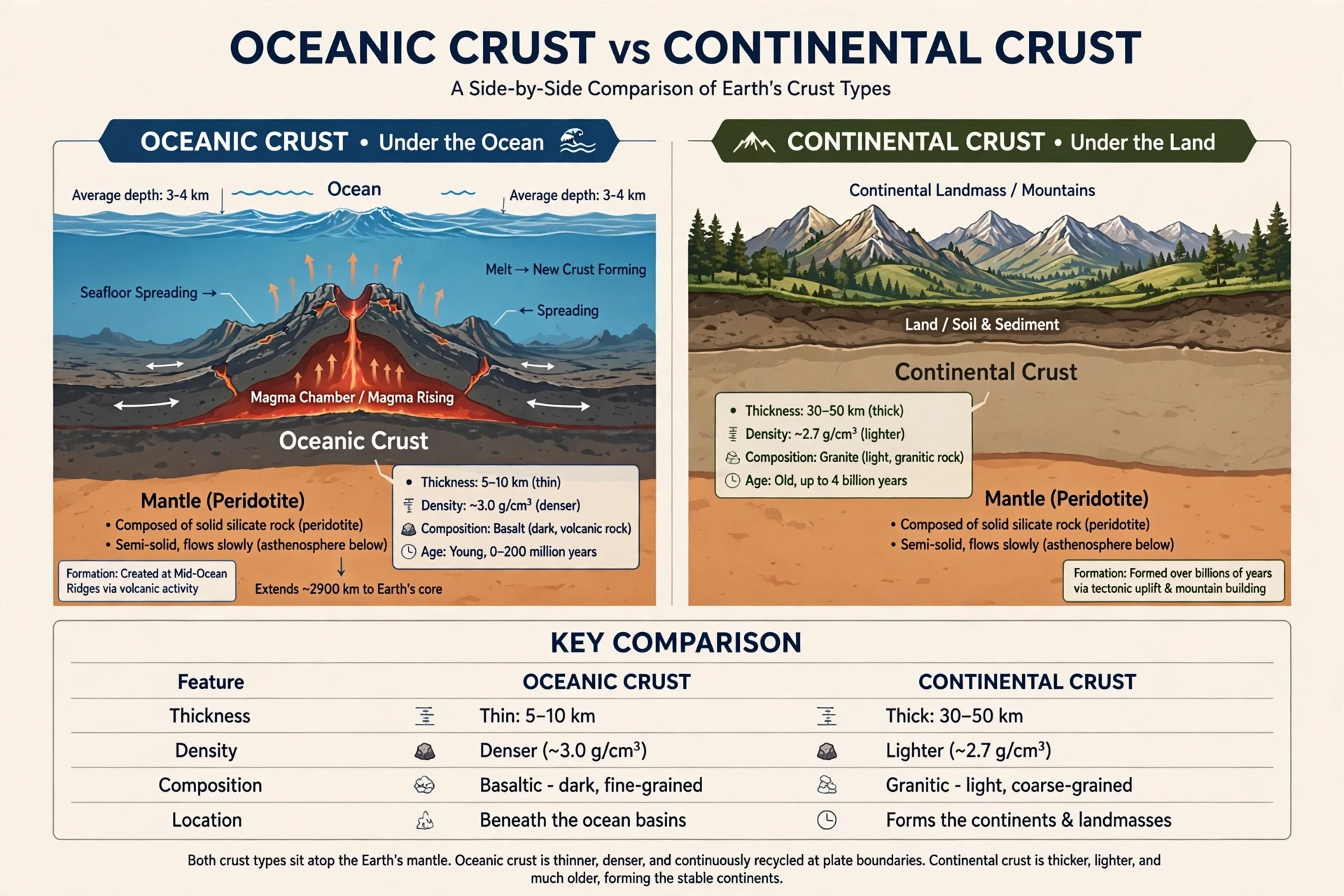
Oceanic crust is the floor of the oceans. It is thin — typically 5 to 10 kilometres — dense, dark and young. Young is the surprising part. No part of the ocean floor is older than about 200 million years, which sounds ancient until you remember Earth is about 4,500 million years old. Oceanic crust is constantly being created at mid-ocean ridges, where plates pull apart and magma rises to fill the gap, and constantly being destroyed at subduction zones, where it dives back into the mantle. It is a conveyor belt, not a foundation.
Its main rock is basalt, rich in iron and magnesium, with a density of about 3.0 grams per cubic centimetre. That density matters. Because oceanic crust is dense, it sits low — which is why oceans are where they are. The crust floats on the mantle the way a loaded boat sits lower in the water than an empty one, a balance called isostasy. Push extra weight onto the crust and it sinks a little; remove weight and it rebounds. Scandinavia is still rising today, millimetres per year, after the weight of Ice Age glaciers melted away thousands of years ago. The crust remembers.
2.2 Continental crust: thick, light and ancient
Continental crust is the opposite in almost every way. It is thick — 30 to 70 kilometres, reaching its greatest thickness under mountain ranges like the Himalayas. It is light, with a density of about 2.7 grams per cubic centimetre, because it is rich in silica and aluminium and poor in iron and magnesium. Its main rock is granite and rocks like it, pale and speckled with quartz and feldspar. And it is ancient: some continental rocks are more than 4 billion years old. Continents are not recycled the way ocean floor is. They are too light and buoyant to sink into the mantle, so they survive, collide, crumple into mountains, erode, and get rebuilt — but they are rarely destroyed outright.
That difference explains the most basic fact of Earth's geography: continents stand high and ocean basins sit low. Light crust floats high on the mantle; dense crust floats low. It also explains why the oldest rocks on Earth are found on continents, in the ancient cores called cratons, while the ocean floor is geologically young everywhere. If you want to read Earth's earliest history, you go to the continents. If you want to see the planet's recycling system at work, you look at the oceans.
2.3 The Moho: where the crust ends
How do we know where the crust stops and the mantle begins? The answer comes from a Croatian seismologist named Andrija Mohorovicic, who in 1909 noticed something odd in the records of an earthquake near Zagreb. Seismic waves arriving at nearby stations came in two sets: one that had travelled straight through the crust, and a faster set that had dived deeper, sped up, and come back to the surface. The only way to explain the faster waves was a boundary below the crust where rock suddenly became denser and waves suddenly travelled faster. That boundary is now called the Mohorovicic discontinuity — the Moho, for short.
The Moho sits about 5 to 10 kilometres below the ocean floor and 30 to 70 kilometres below the continents. It is not a sharp line you could see with your eyes; it is a change in rock type and wave speed. Above it, crustal rocks. Below it, the mantle rock peridotite. Crossing the Moho in a drill hole is one of the great unfinished goals of geology — nobody has ever drilled through it, despite decades of trying, which tells you how hard it is to dig through even the thinnest part of our planet.
2.4 Why the crust cracks
The crust is cold and brittle, which means it breaks instead of bending when it is stressed. Those breaks are faults, and the plates of the crust — the lithospheric plates — are bounded by them. There are seven or eight major plates and many smaller ones, and they move a few centimetres a year, about as fast as your fingernails grow. That sounds trivial until you multiply it by millions of years: at that rate, the Atlantic Ocean has widened by thousands of kilometres since the continents split apart.
The crust also records the history of everything that has happened to it. A cliff face can show layers of sediment laid down in ancient seas, twisted by mountain-building, cut by a fault, and topped by a lava flow. Learning to read those rocks is learning to read time. I once spent an afternoon with a group of students tracing a single fault line across a hillside, following the offset in a distinctive band of rock. By the end of the day we could say how far the ground had moved, and in which direction, from nothing more than careful looking. The crust keeps receipts.
Most people assume the ground beneath their feet is solid all the way down. What the data actually show is a thin, cracked shell floating on hot rock that flows — and the shell itself is slowly moving, breaking and being rebuilt.
3. The Mantle: A Slow Ocean of Rock
If the crust is the skin, the mantle is the body. It is the largest of the layers of the earth, stretching from the base of the crust down to about 2,900 kilometres, and it holds about 84 percent of the planet's volume and roughly two-thirds of its mass. Almost everything about Earth's surface behaviour is decided in the mantle, because the mantle is where heat from the deep interior is carried upward, slowly and relentlessly, toward the surface.
The strangest thing about the mantle is that it is solid and it flows. Both. At the same time. That sounds like a contradiction until you think about a glacier: ice is solid, yet glaciers flow downhill. Or think about the way a block of cold pitch or tar will sag over years. Mantle rock is like that, only far slower and far hotter. Over millions of years, under immense pressure and temperature, solid rock creeps. It does not need to melt to move. And that slow creep is the engine of plate tectonics.
3.1 The upper mantle and the transition zone
The upper mantle runs from the Moho down to about 660 kilometres. Its top part, together with the crust, forms the rigid lithosphere. Below the lithosphere lies the asthenosphere, the soft layer we will come to in a moment. Deeper in the upper mantle, between about 410 and 660 kilometres, sits the transition zone, where the pressure becomes so great that the minerals in the rock rearrange themselves into denser crystal structures. Olivine, the main mineral of the upper mantle, transforms into denser forms called wadsleyite and then ringwoodite. These are not different rocks arriving from somewhere else; they are the same ingredients squeezed into tighter packing. Seismic waves speed up as they pass through the transition zone, and seismologists can map its top and bottom precisely, like reading the floors of a building from the echo of a shout.
The temperatures in the upper mantle range from roughly 500 degrees Celsius near the top to about 1,600 degrees near the bottom of the transition zone. Those numbers are estimates, pieced together from laboratory experiments that recreate mantle pressures in diamond-anvil cells — tiny samples squeezed between two diamonds to pressures found hundreds of kilometres down — and from the chemistry of rocks that have been carried up from the mantle by volcanoes.
3.2 The asthenosphere: the soft layer that lets plates move
The asthenosphere is the most important layer most people have never heard of. It lies below the lithosphere, roughly 100 to 200 kilometres down at its top and extending to about 660 kilometres, and it is weak. Not liquid — that is the common mistake — but weak enough to flow. A tiny fraction of its rock is molten, perhaps a percent or two, spread in thin films between mineral grains, and that is enough to soften it dramatically. The rigid plates of the lithosphere ride on the asthenosphere the way a raft rides on a slow river: not because the river is fast, but because the raft cannot grip it.
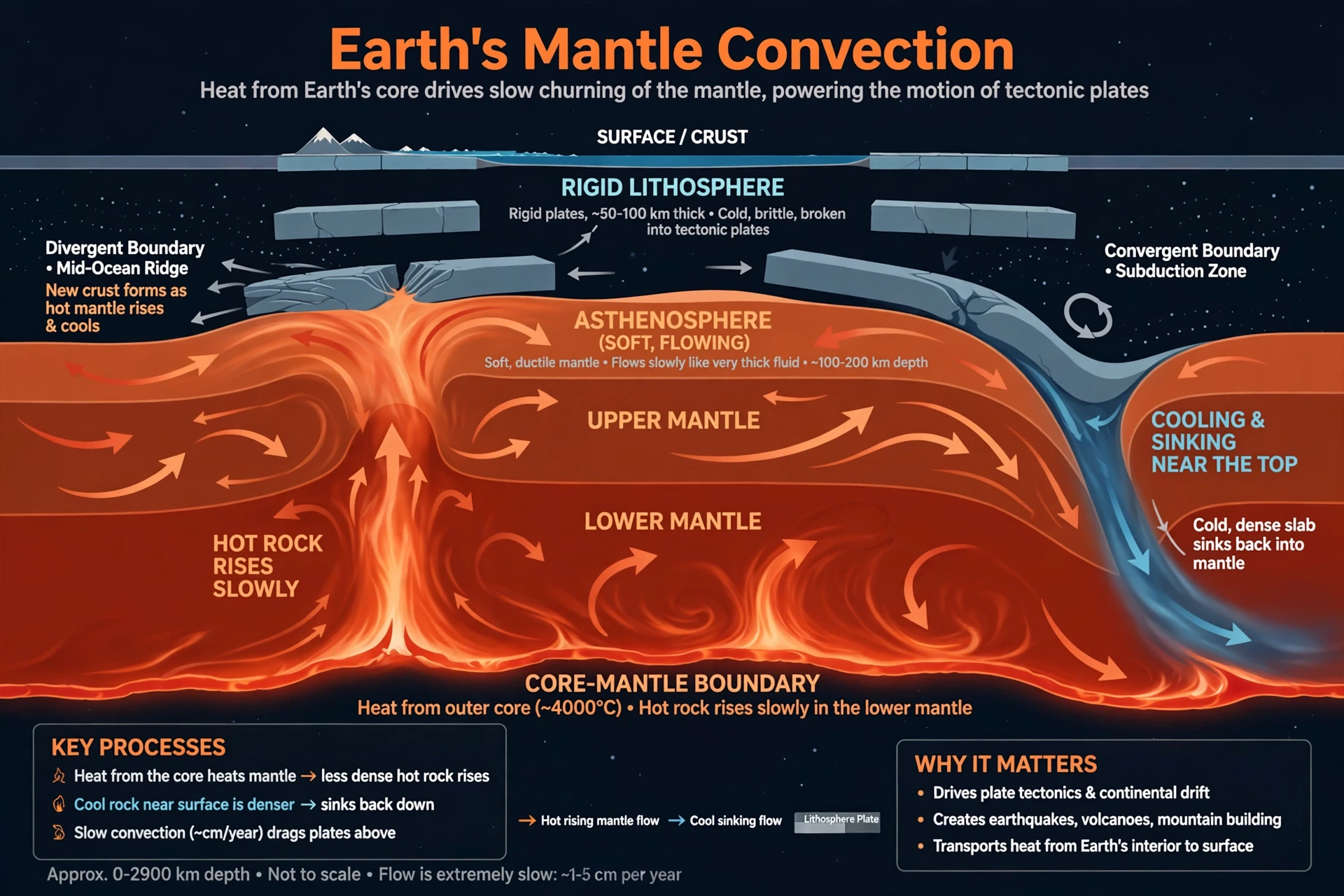
Without the asthenosphere, plate tectonics would seize up. The plates need a soft layer to slide over. When scientists talk about the mantle "convecting", they are largely talking about slow circulation in and below the asthenosphere: hot material rising, cooling near the top, sinking again, in loops that take tens or hundreds of millions of years to complete. The motion is almost unimaginably slow on a human scale — centimetres per year — and yet it carries continents.
I once watched a demonstration in a teaching lab that finally made the asthenosphere click for me. The instructor put a block of a soft, putty-like material on a table and pressed a rigid board down on top of it. When she pushed the board sideways, the putty underneath deformed and let it slide. Then she did the same thing with a rigid block underneath instead of the putty, and the board would not move at all. Same push, different result — all because of what lay beneath. That is the asthenosphere's job. It is the layer that says yes to movement.
3.3 The lower mantle: the mesosphere
Below about 660 kilometres, the mantle changes character again. The lower mantle, sometimes called the mesosphere, runs down to the core-mantle boundary at 2,900 kilometres. Here the pressure is so great that the rock is stronger and more rigid than the asthenosphere above it, even though it is hotter — temperatures climb toward 3,700 degrees Celsius at the bottom. The minerals change too: the dominant mineral becomes bridgmanite, a dense silicate that only exists at these extreme pressures and was only confirmed in nature when it was found inside a meteorite.
The lower mantle flows even more slowly than the upper mantle, but it does flow, and it carries heat upward from the core. In its deepest 200 kilometres, just above the core, sits a strange region called the D-double-prime layer (D″), where seismic wave speeds do odd things and temperatures are at their highest. Some scientists think the D″ layer is where plumes of hot material begin their long rise to the surface — the plumes that feed hotspot volcanoes like Hawaii and Iceland. The details are still being worked out, and researchers still disagree about how much material actually crosses the boundary between the upper and lower mantle. That disagreement is honest science: the deep mantle is hard to see, and different models fit the data in different ways.
3.4 Mantle convection: the engine room
Convection is the process that ties the mantle together. Hot rock near the core-mantle boundary is slightly less dense than the cooler rock above it, so it rises — very slowly. As it rises it cools, becomes denser, and eventually sinks again. The pattern is a bit like the slow circulation in a pot of thick soup on a low heat, except the pot is 2,900 kilometres deep and one loop takes longer than the entire history of complex life on Earth.
Does convection drive the plates, or do the plates drive convection? That is one of the liveliest debates in geology. The older picture had convection currents dragging the plates along like luggage on a conveyor belt. The newer picture gives the plates themselves a bigger role: cold, dense oceanic plates sinking at subduction zones — a process called slab pull — may be the main force pulling plates along, with convection helping rather than leading. The truth is probably a partnership, with both forces mattering. What is not in doubt is that the mantle's slow circulation is the engine room of the planet, and that without it Earth would be a dead, cratered ball like Mars or the Moon.
4. The Outer Core: A Liquid Iron Ocean That Powers Earth's Magnetic Shield
Drop down through the mantle for 2,900 kilometres and you arrive at the most dramatic boundary inside the planet. The rock ends. The metal begins. The outer core is a layer of liquid iron and nickel about 2,250 kilometres thick, hotter than the surface of the Sun in places, churning and swirling under the influence of Earth's rotation. It is the only fully liquid layer among the layers of the earth, and it does something no other layer can do: it generates the magnetic field that shields the whole planet.
4.1 Why the outer core is liquid
The outer core is liquid because it is hot enough to melt iron at the pressures found there — roughly 4,000 to 5,000 degrees Celsius — but not under so much pressure that melting becomes impossible. That balance tips the other way deeper down, in the inner core, as the next section explains. The outer core's composition is mostly iron, with about 5 percent nickel and a few percent of lighter elements like oxygen, sulphur and silicon. Those light elements matter: they lower the melting point of the iron mixture and they play a key role in driving convection, because as the inner core slowly freezes, it squeezes light elements out into the liquid above, making that liquid buoyant so it rises.
The outer core is also dense — about 10 to 12 grams per cubic centimetre, three to four times denser than surface rock. If you could hold a litre of it, it would weigh as much as a small bowling ball. It flows, but it is not thin like water. Think of it more like liquid metal in a foundry: heavy, glowing, and moving in great slow swirls. Those swirls are the whole story of Earth's magnetic field.
4.2 The geodynamo: a planet-sized generator
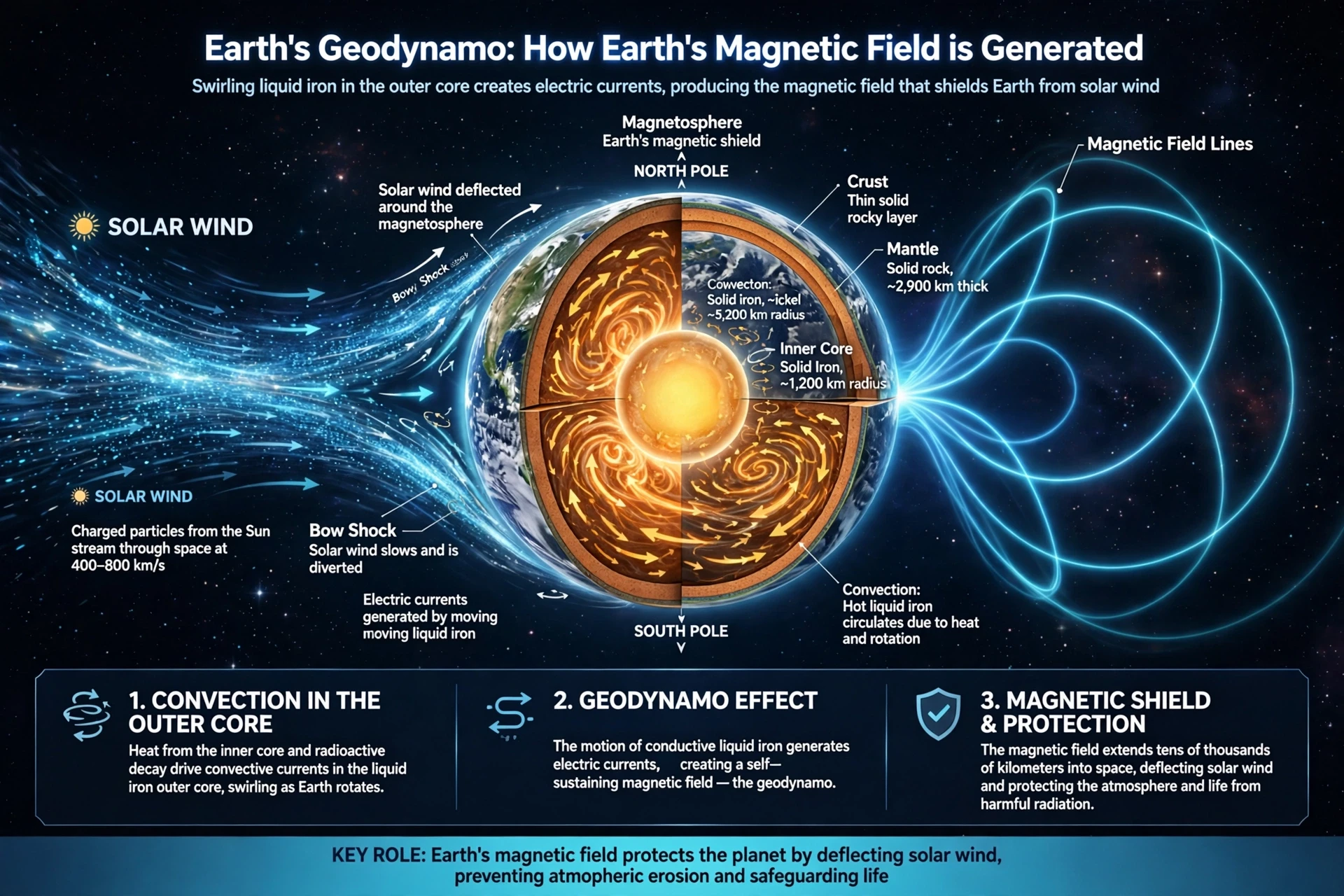
Here is the idea in one sentence: a moving, electrically conducting fluid, stirred inside a rotating planet, can generate and sustain a magnetic field. That process is called the geodynamo, and the outer core is where it happens.
The steps are worth spelling out, because the geodynamo is one of the most elegant mechanisms in science. First, heat escapes from the core into the mantle, and the inner core slowly freezes, releasing light elements. Both effects make the liquid iron buoyant, so it rises. Second, Earth's rotation twists those rising currents through the Coriolis effect — the same effect that makes hurricanes spin — organising the flow into columns and spirals aligned with the rotation axis. Third, because liquid iron conducts electricity, this moving conductor, threading through whatever weak magnetic field already exists, generates electric currents. Fourth, those electric currents generate their own magnetic field, which reinforces the original field. It is a self-sustaining loop: motion makes magnetism, magnetism organises motion. As long as the core keeps cooling and Earth keeps spinning, the dynamo keeps running.
NASA's Earth science pages describe how the magnetic field produced this way extends far into space, forming the magnetosphere — a vast bubble that deflects much of the charged particle flow from the Sun and traps some radiation in the Van Allen belts. Without it, the solar wind would strip away at the atmosphere, and the surface would be bathed in far more charged-particle radiation. Mars lost its global magnetic field long ago, and its atmosphere thinned dramatically as a result. Earth's field is not a luxury; it is one of the reasons the planet stayed habitable.
4.3 What the magnetic field does for us
The most visible gift of the magnetic field is the aurora. When charged particles from the Sun slip into the magnetosphere near the poles, they collide with gases in the upper atmosphere and make the sky glow green, red and purple. It is beautiful, and it is also a diagnostic: auroras are the magnetic field made visible, the place where the shield flexes under pressure.
The practical gifts are quieter but just as real. Compasses work because of the field. Animals from sea turtles to migratory birds navigate by it. Power grids, satellites and radio communications are all affected when the field is disturbed by solar storms — which is why space-weather forecasters watch the Sun and the magnetosphere the way meteorologists watch hurricanes. The field is not fixed, either. It wanders: the magnetic north pole has been drifting faster in recent decades, and the field's strength varies from place to place. And over geological time it flips entirely, north becoming south, in events called reversals. The last full reversal was about 780,000 years ago. Rocks that cooled and solidified during past reversals carry a frozen record of the field's direction, like tiny compasses locked in stone — and that record is one of the key pieces of evidence for plate tectonics and for the age of the ocean floor.
The magnetic field is not a bar magnet buried in the Earth. It is a living process — liquid iron in motion, organised by spin, generating electricity, generating magnetism — and it can weaken, wander and even reverse.
4.4 How we know the outer core is liquid
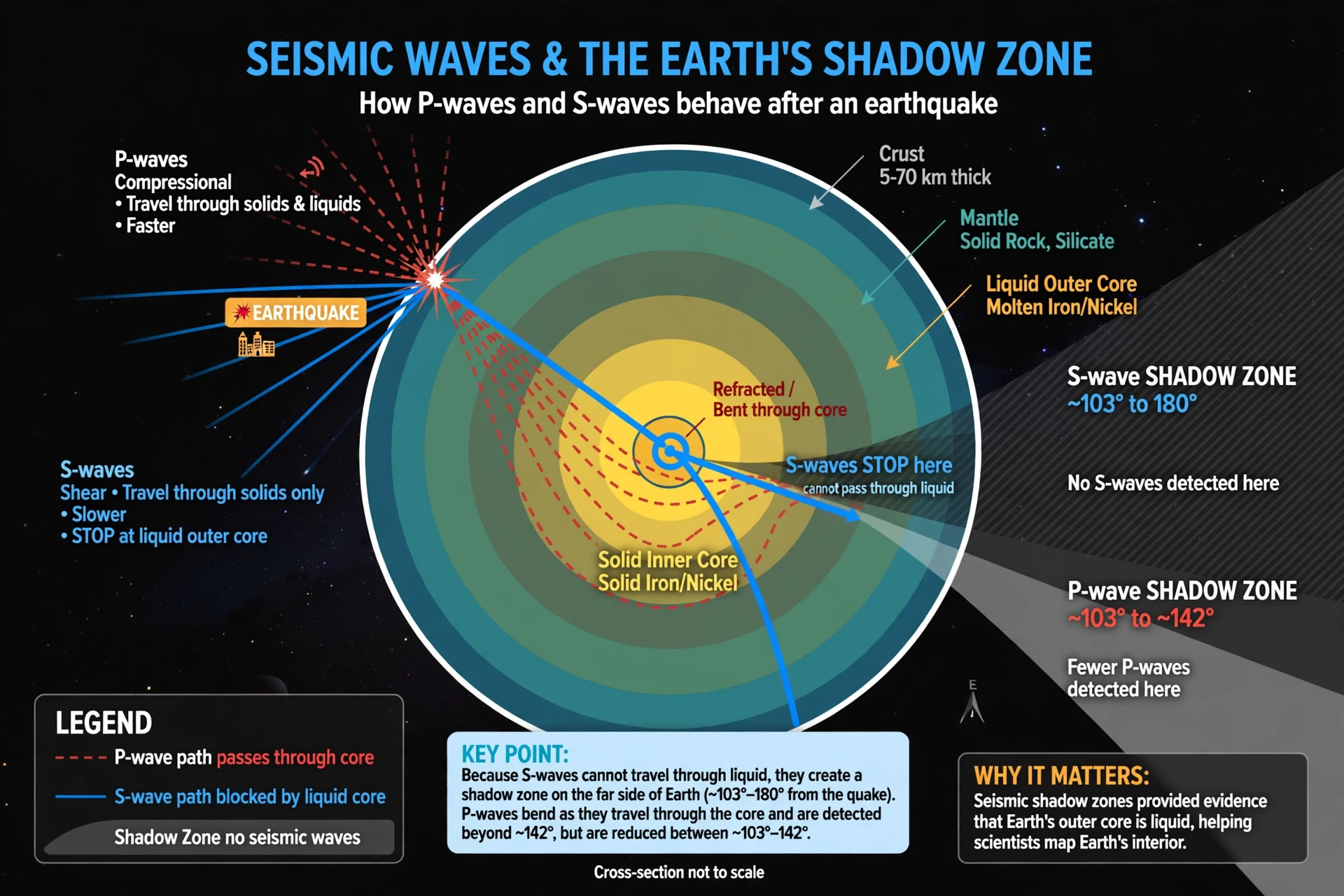
The proof is beautifully simple, and it comes from earthquakes. There are two main kinds of body waves that travel through the Earth: P waves, which compress and stretch rock in the direction they travel, and S waves, which shake rock from side to side. P waves can travel through solids and liquids. S waves can only travel through solids — a liquid cannot transmit a sideways shake, because it has no shear strength to carry it. When seismologists looked at earthquake records from the far side of the planet, they found that S waves never arrived through the core. They simply stopped. P waves arrived, but bent and slowed. The only explanation that fits is a liquid layer in the way. That layer is the outer core. It was the S-wave shadow that gave the game away, and it remains one of the cleanest deductions in science: a missing signal can be just as informative as a signal that arrives.
5. The Inner Core: Solid Iron Hotter Than the Sun's Surface
At the centre of the planet sits something that should not, by everyday intuition, exist at all: a ball of solid iron about 1,220 kilometres in radius, with a temperature estimated at 5,000 to 6,000 degrees Celsius — roughly as hot as the surface of the Sun — that is solid. Not liquid. Solid. The inner core is the deepest of the layers of the earth, and it is the best illustration in this whole article of how pressure changes the rules.
5.1 Why solid, despite the heat?
The answer is pressure. At the centre of the Earth, the pressure is about 3.6 million times atmospheric pressure — around 360 gigapascals. Pressure raises the melting point of iron. Down in the inner core, the melting point has been pushed so high that even at Sun-surface temperatures, the iron cannot melt. It stays crystalline, solid, locked in place by the weight of the entire planet pressing down on it.
It helps to think of a pressure cooker, but taken to an extreme. Water in a pressure cooker boils at a higher temperature than water in an open pot, because the pressure holds it liquid longer. In the inner core, the same principle operates at a scale that makes a kitchen pressure cooker look like a toy. The iron is hot enough to be liquid at the surface — but it is not at the surface. It is under the weight of 6,371 kilometres of rock and metal, and that weight wins.
There is a second twist. The boundary between the inner and outer core is not fixed. The inner core is slowly growing. As Earth cools, a little more iron freezes onto the inner core each year, and the boundary creeps outward. The growth is slow — estimates vary, but a millimetre or so per year is a reasonable picture — yet over billions of years it adds up. The inner core may be relatively young in geological terms, perhaps around a billion years old or less, which is one reason scientists think Earth's magnetic field may have been weaker before the inner core formed and then strengthened as the freezing began to drive stronger convection in the outer core.
5.2 How the inner core was discovered
The inner core was discovered by a Danish seismologist named Inge Lehmann, working in 1936 with earthquake records from around the world. She noticed something the standard model could not explain: faint P waves were arriving inside the P-wave shadow zone, the region where waves were supposed to be blocked by the liquid core. Those waves could only be explained if they had bounced off something solid deep inside the liquid — a solid inner core reflecting them back toward the surface. Lehmann's paper proposed a solid inner core, and it turned out to be right. It is worth pausing on that: a scientist working with paper records of distant earthquakes, in an era before computers, deduced the existence of a solid ball of iron at the centre of the planet, thousands of kilometres down, from faint wiggles in a shadow zone. That is the power of careful observation — and it is how the deepest of the layers of the earth was found without anyone ever going there.
I keep a mental picture of Lehmann's discovery whenever I am tempted to think science is only about big machines. Sometimes it is about one person, looking at the data everyone else has already seen, and noticing the faint signal that does not fit.
5.3 What the inner core is like
The inner core is mostly iron and nickel, like the outer core, but solid and slightly different in composition — the freezing process concentrates some elements and expels others, which is what drives the compositional convection in the liquid above. Its density is about 13 grams per cubic centimetre, the densest material in the planet. Seismic waves travel through it faster than through the outer core, and they travel slightly faster in one direction than another — a property called anisotropy — which suggests the iron crystals in the inner core are aligned, perhaps by the flow patterns of the dynamo or by the slow growth of the core itself.
Does the inner core rotate? Seismologists have found hints that it spins slightly faster than the rest of the planet, perhaps by a fraction of a degree per year, though the evidence is subtle and the rate is debated. There are also hints that its rotation rate may vary over decades. These are frontier questions, and they matter because the inner core's motion is tied to the magnetic field and to the length of the day itself. The centre of the Earth is not a dead weight. It is an active, moving part of the machine.
There is also a genuine mystery here. Some recent seismic studies have suggested the inner core may have a distinct innermost core — a core within the core — with different crystal alignment. The evidence is intriguing but not yet settled. Researchers still disagree about how many distinct regions the inner core really has, and that disagreement is a reminder that the deepest layer is also the hardest to see. We are reading it through waves that have travelled through 6,000 kilometres of planet. The fact that we can say anything at all about it is remarkable; the fact that some details are still contested is normal.
5.4 The core-mantle boundary: the most important interface you cannot see
Between the mantle and the outer core, at 2,900 kilometres down, lies the core-mantle boundary — the largest contrast in the planet. Above it, solid silicate rock. Below it, liquid metal. The temperature jumps, the density jumps, and the seismic wave speeds jump. It is here that heat from the core enters the mantle, and it is here that many scientists think mantle plumes are born. It is also the place where the magnetic field, generated in the core, is filtered and shaped as it passes upward through the mantle to the surface. The boundary itself is not smooth: seismic studies show it has bumps and valleys, like a landscape, with some regions where the boundary seems to dip or rise by kilometres. We cannot visit it, but we can map its topography from the way waves reflect off it — and what we are finding is that the bottom of the mantle is as varied and interesting as the surface of the Earth.
6. How We Know: Seismic Waves, the Moho and the Shadow Zones
Every claim in this article rests on evidence, and the most important evidence is also the most ingenious. We cannot dig to the mantle, let alone the core. We cannot send a camera down. We cannot take a sample from the outer core and hold it up to the light. So how do we know the layers of the earth exist at all, let alone their thickness, temperature and composition? The answer is that the planet is constantly sending us signals, in the form of seismic waves, and we have learned to read them.
6.1 P waves and S waves: the planet's ultrasound
An earthquake is, among other things, a very loud shout into the Earth. It releases energy that travels outward in waves, and those waves pass through the whole planet. Seismometers — sensitive instruments that record ground motion — sit on every continent and on many ocean islands, listening. When a big earthquake happens, stations all over the world record the waves as they arrive, and the pattern of arrival times tells a story.
There are two kinds of body waves. P waves (primary waves) are compressional: they push and pull the rock in the direction they travel, like the pulse that runs down a slinky when you shove one end. They are the fastest seismic waves, and they can travel through solids, liquids and gases. S waves (secondary waves) are shear waves: they shake the rock from side to side, at right angles to their direction of travel, like shaking a rope. They are slower than P waves — roughly half the speed — and they can only travel through solids.
That one difference, P through anything and S through solids only, is the key that unlocks the interior. Where S waves disappear, there must be liquid. Where waves speed up suddenly, there must be a boundary into denser rock. Where waves bend, the material must be changing with depth. By timing thousands of earthquakes at hundreds of stations, seismologists have built a three-dimensional map of wave speeds inside the Earth — a technique called seismic tomography, which works a bit like a medical CT scan, building a picture from many views through the body — the Geosciences LibreTexts guide to the layers of the Earth explains how the chemical and physical layer systems fit together.
I once watched a seismogram being read in a teaching lab, the wiggly line scrolling across the screen after a distant earthquake. The first small arrival, the P wave. Then a bigger one, the S wave. Then the long rolling surface waves. It looked like a mess until the instructor walked us through it, and then suddenly the mess resolved into a story: distance, depth, the layers the waves had crossed. I have never forgotten how ordinary the raw data looked and how much it contained.
6.2 Shadow zones: what missing waves reveal
The most famous piece of evidence is the shadow zone. When an earthquake happens, P waves radiate outward in all directions. Some travel straight through the mantle and arrive at stations nearby. Others dive deeper, hit the liquid outer core, and are bent sharply — refracted — because waves slow down when they enter the core. The bending is so strong that P waves cannot reach the surface at all between about 104 degrees and 140 degrees of angular distance from the earthquake. That band is the P-wave shadow zone: a region where direct P waves simply do not arrive. Seismometers there record only faint P waves that have taken a longer path, bouncing off the inner core — the very waves that led Inge Lehmann to the inner core in 1936.
The S-wave shadow zone is even bigger: S waves cannot pass through the liquid outer core at all, so they never arrive at stations more than about 104 degrees away. Together, the two shadow zones are a kind of negative photograph of the core. They tell us its size (the shadow zones end where geometry says they should for a core of a certain radius), its state (liquid, because S waves stop), and its depth (about 2,900 kilometres, where the bending begins). It is detective work of the highest order: the absence of a signal, measured precisely, becomes a measurement.
Other boundaries leave their own fingerprints. The Moho was found from a jump in wave speed, as described earlier. The boundary between the inner and outer core shows up as a reflection. The transition zone in the mantle shows up as a pair of smaller jumps at 410 and 660 kilometres. Each boundary is a place where the rules change, and the waves notice.
6.3 Density, meteorites and laboratory experiments
Seismic waves are not the only line of evidence, and they would not be enough on their own. Three other kinds of evidence confirm and extend the seismic picture.
First, density. Earth's average density is about 5.5 grams per cubic centimetre, but the rocks at the surface average only about 2.7 to 3.0. Something much denser must be hiding inside. The only way to get the average up to 5.5 is a dense core, and iron is the only abundant element dense enough to do the job. The mass of the core, about a third of Earth's total mass, follows from the same calculation.
Second, meteorites. Iron meteorites are fragments of the cores of small planets that broke apart early in solar system history, and they are made of iron and nickel in proportions very similar to what the seismic evidence predicts for Earth's core. Stony meteorites, meanwhile, match the composition of the mantle. Meteorites are the closest thing we have to free samples from other planets' interiors, and they agree with the seismic story.
Third, laboratory experiments. Scientists recreate the pressures and temperatures of the deep Earth in diamond-anvil cells, squeezing tiny mineral samples between two diamonds, and in large presses, and they measure how minerals behave: when they change crystal structure, when they melt, how fast seismic waves travel through them. Those measurements let us translate wave speeds into compositions and temperatures. When a lab experiment says olivine transforms into a denser mineral at the pressure found 410 kilometres down, and seismology finds a boundary at 410 kilometres down, the two lines of evidence lock together.
6.4 What we still do not know
Honesty matters here. The broad picture of the layers of the earth is settled — the crust, mantle, outer core and inner core are real, and their basic properties are known. But many details are still open. Researchers still disagree about how much material crosses between the upper and lower mantle, about the exact composition of the light elements in the core, about whether the inner core has an innermost core, and about how mantle plumes really start. The deep mantle has regions where seismic waves travel unusually slowly — the large low-shear-velocity provinces, two continent-sized blobs at the base of the mantle under Africa and the Pacific — and nobody fully agrees on what they are. They might be piles of ancient, chemically distinct rock. They might be hot, partially molten regions. They might be the graveyards of old subducted plates. The debate is active, and it is a sign of a healthy science, not a failing one.
7. The Deepest Holes Ever Drilled: How Far Down Have We Really Been?
If the layers of the earth are so well mapped, why have we not simply drilled down and looked? The honest answer is that drilling through rock is hard, and it gets harder with every kilometre. Heat, pressure and the sheer mechanics of keeping a hole open defeat every attempt long before the mantle is reached. The story of deep drilling is a story of ambition colliding with physics — and it is a wonderful way to feel the true scale of the planet.
7.1 The Kola Superdeep Borehole
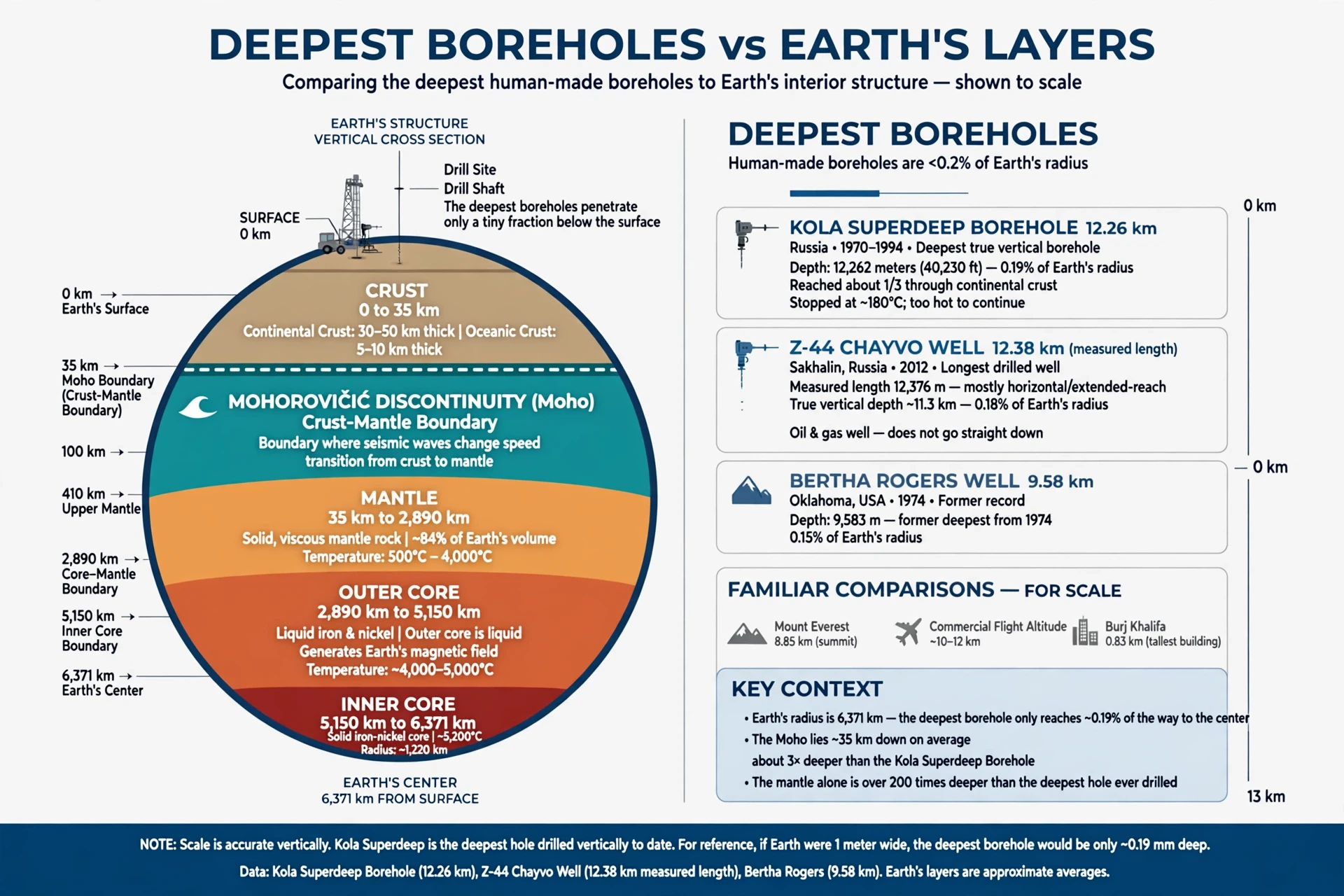
The deepest hole ever drilled is the Kola Superdeep Borehole, on the Kola Peninsula in Russia. Soviet scientists began drilling in 1970, aiming to reach 15 kilometres and, if possible, the Moho. They reached 12,262 metres in 1989 — about 12.3 kilometres — and that record still stands. The project ran into trouble that no amount of determination could fix. At that depth the temperature was about 180 degrees Celsius, far hotter than predicted, because the rocks were generating more heat from radioactive decay than expected. The rock itself began to behave plastically, squeezing back into the hole. Drill bits wore out, broke and got stuck. The hole was eventually abandoned in the early 1990s, and the site is now a sealed, quiet ruin.
Twelve kilometres sounds deep until you compare it with the planet. It is about 0.2 percent of the way to the centre. It is less than the cruising altitude of a passenger jet is high, turned upside down. If Earth were an apple again, the Kola hole would not even have broken the skin. And yet it taught us a great deal: it showed that the deep crust is hotter and wetter than expected, that seismic boundaries in the crust are changes in rock type rather than simple cracks, and that our models of the deep crust needed revising. Failure, in science, is still data.
7.2 Mines, oceans and the Moho
The deepest mines go nearly 4 kilometres down — the Mponeng gold mine in South Africa reaches about 3.9 kilometres below the surface, where the rock temperature is around 60 degrees Celsius and miners work in refrigerated air. The deepest point humans have reached in the ocean, the Challenger Deep in the Mariana Trench, is about 10.9 kilometres below sea level — but that is water depth, not rock depth, and the ocean floor there is still crust, far above the mantle.
The most promising route to the mantle has always been through the oceans, where the crust is thinnest — only 5 to 10 kilometres — and the Moho is closest to the surface. Several projects have tried to drill through oceanic crust to the Moho, from the 1960s Project Mohole onward, and none has yet succeeded. The technical challenge is enormous: drilling from a ship in deep water, through kilometres of hard basalt, keeping the hole stable and the drill working in extreme heat. It remains one of geology's great unfinished goals, and every attempt teaches the next one something new.
Here is a comparison that puts the scale in perspective. Mount Everest rises 8.8 kilometres above sea level. The Kola borehole goes 12.3 kilometres below the surface. The Moho under the oceans is 5 to 10 kilometres below the sea floor. The mantle is 2,900 kilometres thick. The centre of the Earth is 6,371 kilometres away. We have explored the top sliver of the top sliver, and everything else we know comes from waves, rocks that came up on their own, meteorites and laboratory experiments. The layers of the earth are, in the end, a triumph of indirect knowledge.
Depth milestone | Depth | What it reached |
|---|---|---|
Deepest gold mine (Mponeng, South Africa) | ~3.9 km | Deep crust, hot rock, refrigerated tunnels |
Tallest mountain (Everest, for scale) | 8.8 km above sea level | High crust, not a depth at all |
Deepest ocean (Challenger Deep) | ~10.9 km below sea level | Ocean water above oceanic crust |
Deepest borehole (Kola, Russia) | 12.3 km | Deep continental crust, 180°C rock |
Moho under the oceans | 5–10 km below sea floor | Crust–mantle boundary, never drilled through |
Centre of the Earth | 6,371 km | Solid inner core |
7.3 Rocks that came up on their own
If we cannot go down to the mantle, sometimes the mantle comes up to us. Volcanoes occasionally carry up fragments of mantle rock called xenoliths — literally "foreign rocks" — embedded in lava. The most famous are peridotite xenoliths, dark green rocks rich in olivine, torn from the upper mantle and carried to the surface in a matter of hours or days by rising magma. Holding one is holding a piece of the mantle. That was the green rock on my field trip: heavy, dark, ordinary-looking, and utterly extraordinary once you knew where it had come from.
Other samples arrive by a slower route. In places where tectonic plates have collided and been pushed up, slices of old ocean floor and upper mantle are exposed on land — ophiolites, as geologists call them. The island of Cyprus and parts of Oman have famous ophiolites, where you can walk across what was once the boundary between crust and mantle. These rocks are the closest thing to a direct sample of the deep Earth we will ever hold, and they anchor the whole seismic picture in real, touchable material.
8. What the Layers Mean for Volcanoes, Earthquakes and Plate Tectonics
So far this article has been a tour of the deep. Now comes the question that matters most to anyone living on the surface: what do the layers of the earth actually do to us? The answer is that they do almost everything. The heat and motion of the interior drive the plates, the plates make the earthquakes and volcanoes, and the earthquakes and volcanoes build and reshape the surface. The layers are not a curiosity buried out of sight. They are the reason the ground moves at all.
8.1 Plate tectonics: the surface expression of the deep Earth
The lithosphere is broken into plates, and those plates move over the asthenosphere. Where plates pull apart, new crust is made. Where they collide, mountains rise and old crust is destroyed. Where they slide past each other, faults grind and store stress. That is plate tectonics in one paragraph, and it is the unifying theory of geology — the framework that explains the distribution of volcanoes, earthquakes, mountain ranges and ocean basins.
The engine is a partnership. Heat from the interior drives convection in the mantle. The sinking of cold, dense oceanic plates at subduction zones — slab pull — drags the plates along. The pushing of new crust at mid-ocean ridges — ridge push — helps. The result is a surface in constant, slow motion. The Atlantic is widening by a few centimetres a year. The Pacific is shrinking as its floor dives beneath the continents around it. India is still pushing into Asia, raising the Himalayas by millimetres a year. None of this would happen without the mantle's slow flow and the asthenosphere's softness. Read more about the surface story in our guide to plate tectonics.
Gravity plays its own quiet role in all of this. The density differences between the layers — light crust floating on denser mantle, dense plates sinking into it — are gravity at work on a planetary scale. Heavy things sink, light things float, and the whole layered structure of the planet is gravity's doing, from the iron core at the centre to the continents standing high. Our article on how gravity works explains the force behind that sorting.
8.2 Volcanoes: windows into the mantle
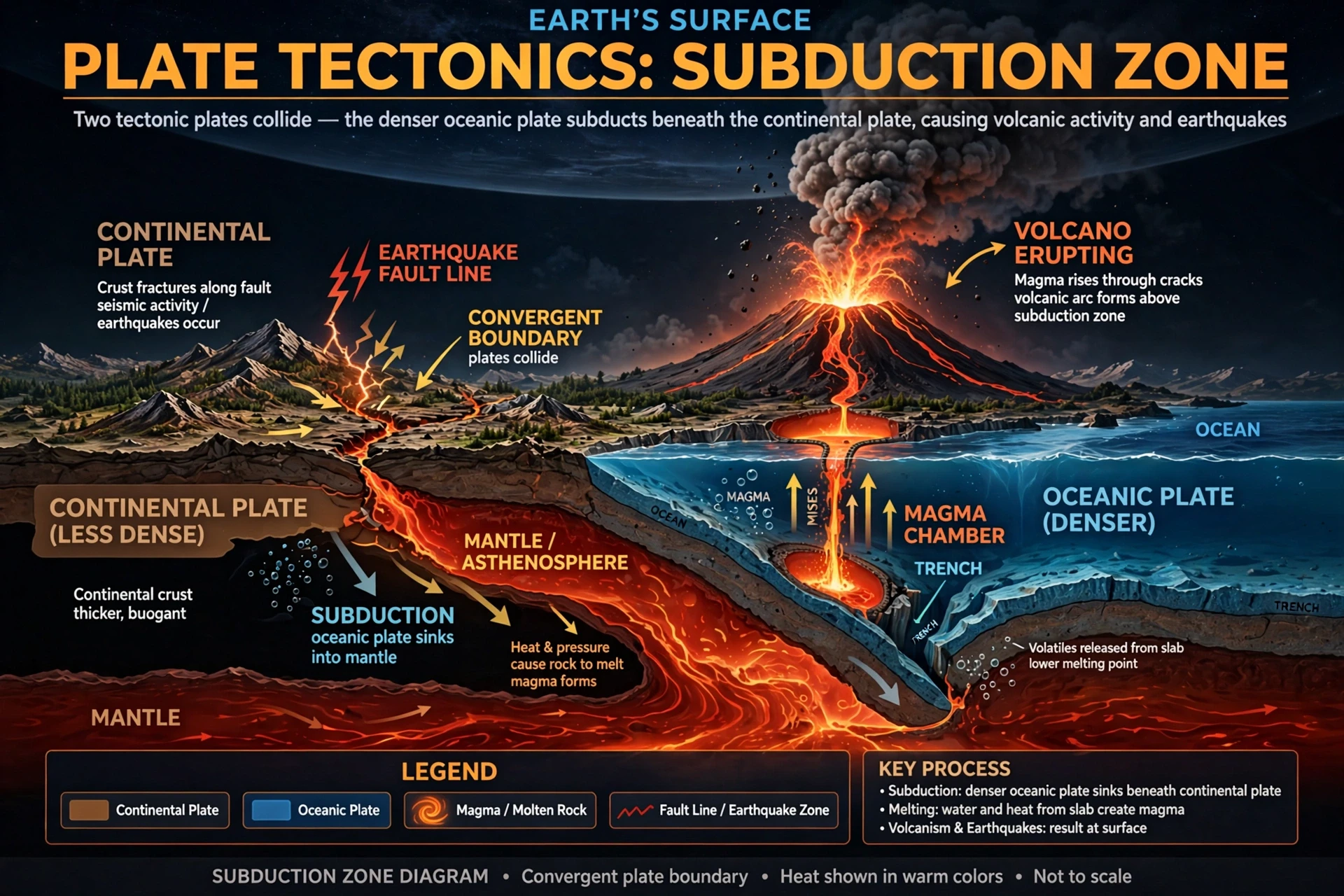
A volcano is, in the simplest sense, a place where material from below reaches the surface. Most volcanoes sit at plate boundaries: at mid-ocean ridges, where plates pull apart and mantle rock rises and melts as the pressure drops; and at subduction zones, where a sinking plate carries water down into the mantle, lowering the melting point of the rock above it and generating magma that rises to feed explosive volcanoes like those of the Pacific Ring of Fire.
A smaller number of volcanoes sit in the middle of plates, far from any boundary. Hawaii is the classic example. The best explanation for these hotspot volcanoes is a mantle plume: a column of hot material rising from deep in the mantle, perhaps from the core-mantle boundary itself, punching through the moving plate above. As the plate drifts over the stationary plume, a chain of volcanoes forms — the Hawaiian island chain is a textbook case, with the youngest island over the hotspot and older islands trailing away to the northwest. Plumes are still debated in detail, but the basic picture — deep heat rising in narrow columns — ties the surface directly to the deepest mantle.
What erupts also tells us about the layer it came from. Basalt, the dark lava of ocean islands and mid-ocean ridges, comes from melting mantle peridotite. The pale, silica-rich magma of continental volcanoes is different: it forms when basaltic magma stalls in the thick continental crust, melts some of it, and evolves into something lighter and more explosive. The volcano is the messenger. Its lava is the message, written in chemistry. For the full story of how volcanoes form and why they erupt the way they do, see our article on volcanoes.
8.3 Earthquakes: the brittle crust breaking
Earthquakes happen where the brittle lithosphere breaks. Most occur at plate boundaries, where plates grind past each other, collide or pull apart, and stress builds up over years or decades until the rock fails suddenly and the stored energy is released as seismic waves. The largest earthquakes happen at subduction zones, where one plate dives beneath another and the contact between them can lock for centuries before slipping by metres in a few minutes.
But earthquakes are not only a plate-boundary phenomenon. They also happen inside plates, where old faults are reactivated, and they happen in the sinking plates themselves, deep in the mantle, as the cold slab descends and deforms. Deep earthquakes, down to about 660 kilometres, outline the shape of subducting slabs in three dimensions — another way the interior reveals itself through seismic waves. The depth limit is telling: below about 660 kilometres, the mantle is hot enough and the pressure high enough that rock flows rather than breaking, so deep earthquakes stop. The transition zone is not only a mineral boundary; it is the bottom of the earthquake world.
The seismic waves from earthquakes do double duty. They are the hazard, shaking buildings and triggering tsunamis, and they are also the tool we use to image the interior. Every earthquake is both a disaster and a data point. That is a strange duality, and it is why seismology grew up as a science of both protection and discovery. Our guide to earthquakes explains how they are caused, how their waves travel, and how they are measured.
8.4 Mountains, oceans and the long recycling of crust
Put the layers together and you get a planet that recycles itself. Oceanic crust is born at ridges, travels across the ocean floor, and dives back into the mantle at subduction zones, carrying water and sediments down with it. Continental crust resists subduction, so continents grow by accretion — by collecting island arcs, fragments of other continents and volcanic material at their edges — and they are sculpted by erosion and mountain-building. The mantle supplies the heat and the motion. The core supplies the heat that keeps the mantle moving and the magnetic field that shields the surface. The crust is the stage where all of it plays out.
That recycling has a deep consequence: Earth stays geologically alive. Mars, smaller and cooler, lost its internal heat faster, and its plate tectonics — if it ever had them — shut down long ago. Venus, similar in size to Earth, has a very different surface history. Earth is the planet where the layers stayed hot enough, wet enough and active enough to keep the whole system running for billions of years. The ground under your feet is not a finished product. It is a work in progress, and the layers of the earth are the workers.
9. Common Misconceptions About the Layers of the Earth
A subject this deep — literally — collects misunderstandings. Here are the ones I hear most often, and what the evidence actually says.
9.1 "The mantle is a sea of molten lava"
This is the most common picture, and it is wrong. The mantle is almost entirely solid rock. It flows, but it flows the way a glacier flows — slowly, as a solid. Only a tiny fraction is molten at any given time, in pockets and thin films, mostly in the asthenosphere and in places where melting is happening beneath volcanoes. If the mantle were liquid, seismic S waves could not travel through it. They do, all the way down to the core-mantle boundary. The mantle is solid, hot, and creeping — and that distinction matters, because a solid mantle convects differently from a liquid one, and its slow creep is what moves the plates.
9.2 "The inner core is liquid because it is the hottest part"
It is the hottest part, and it is solid. The heat is real — 5,000 to 6,000 degrees Celsius — but the pressure is stronger. At 3.6 million atmospheres, iron cannot melt at that temperature. The outer core is liquid because it is hot enough to melt at its pressure. The inner core is solid because, at its pressure, it is not. Same material, same planet, different outcome — because pressure, not temperature alone, decides whether something melts. The two cores are a perfect lesson in not reasoning from one variable at a time.
9.3 "We have drilled to the mantle"
No one has. The deepest borehole, the Kola Superdeep, reached 12.3 kilometres into continental crust, where the crust is 30 to 70 kilometres thick. The Moho — the boundary with the mantle — has never been drilled through, on land or under the oceans. Every direct sample of the mantle we have came up on its own, carried by volcanoes or exposed by tectonic uplift. That is not a failure of effort. It is a measure of how hard the planet is to dig through, and how hot and mechanically hostile the deep crust becomes.
9.4 "Earth's magnetic field comes from a giant bar magnet inside the Earth"
There is no bar magnet. A permanent magnet would lose its magnetism at the temperatures inside the Earth — the Curie point, above which iron stops being magnetic, is far below core temperatures. The field is generated, continuously, by the motion of liquid iron in the outer core: the geodynamo. Stop the motion and the field would fade. That is why the field can wander, weaken and reverse, and why a planet like Mars, whose core dynamo shut down, lost its global field. Magnetism in a planet is a process, not an object.
9.5 "The layers are neat, smooth shells like an onion"
The onion picture is a useful starting point, and then it breaks down. The real boundaries are bumpy. The Moho's depth varies. The core-mantle boundary has topography. The mantle has continent-sized regions where waves travel slowly. The crust is broken into plates with ragged edges. The inner core may have regions with different crystal alignment. The layers of the earth are real, but they are rough, dynamic and full of structure at every scale. The planet is less like an onion and more like a living body: organised into layers, yes, but with texture, variation and constant motion inside each one.
9.6 "The centre of the Earth is the hottest place, so heat always flows straight up"
Heat does flow outward overall, from the hot interior to the cold surface, but the path is not a simple straight line. Convection carries heat sideways and in loops. Plumes rise in narrow columns. Cold slabs sink in sheets. The D″ layer at the base of the mantle may trap and channel heat in complicated ways. The planet cools unevenly, in three dimensions, and that unevenness is exactly what drives the motion of the layers of the earth. A simple "hot below, cold above" picture is true in outline and misleading in detail.
Frequently Asked Questions
How many layers does the Earth have?
Earth has four chemical layers — crust, mantle, outer core and inner core — and five physical layers — lithosphere, asthenosphere, mesosphere (lower mantle), outer core and inner core. The two counts describe the same planet in different ways: chemistry asks what each layer is made of, physics asks how it behaves. The crust is the thin rocky shell, the mantle is the thick layer of hot solid rock, the outer core is liquid iron and nickel, and the inner core is solid iron and nickel.
What are the layers of the earth in order from the surface down?
From the surface down, the layers of the earth are: the crust (5–70 kilometres thick), the mantle (down to about 2,900 kilometres), the outer core (2,900–5,150 kilometres) and the inner core (5,150–6,371 kilometres, the centre). The crust itself comes in two kinds — thin, dense oceanic crust and thick, light continental crust — and the mantle divides into the upper mantle, the transition zone and the lower mantle. The lithosphere, the rigid outer layer, is the crust plus the top of the mantle.
How hot is each layer of the Earth?
Temperatures rise with depth. The crust ranges from surface temperatures to roughly 500 degrees Celsius at its base. The upper mantle is about 500–1,600 degrees, and the lower mantle reaches about 3,700 degrees near the core-mantle boundary. The outer core is roughly 4,000–5,000 degrees Celsius, and the inner core is about 5,000–6,000 degrees — roughly as hot as the surface of the Sun. These are estimates from laboratory experiments and seismic data, not direct measurements, because no thermometer has ever been to those depths.
Why is the inner core solid if it is so hot?
The inner core is solid because the pressure at the centre of the Earth — about 3.6 million times atmospheric pressure — raises the melting point of iron above the actual temperature there. Pressure wins over heat. The outer core, under less pressure, is hot enough to melt, so it is liquid. The inner core grows slowly as Earth cools and more iron freezes onto it, and that freezing helps drive convection in the liquid outer core, which powers the magnetic field.
How do scientists know what is inside the Earth if they cannot dig there?
Scientists know the layers of the earth mainly from seismic waves. Earthquakes send P waves and S waves through the planet, and the waves change speed, bend, reflect and disappear in ways that reveal the layers they passed through. S waves cannot travel through liquid, so their absence beyond the outer core proves it is liquid. Shadow zones map the core's size and depth. Density calculations, iron meteorites, rocks carried up from the mantle by volcanoes, and laboratory experiments at high pressure all confirm the seismic picture.
What is the deepest humans have ever drilled?
The deepest hole ever drilled is the Kola Superdeep Borehole in Russia, which reached 12,262 metres — about 12.3 kilometres — in 1989. It stopped in hot, deep continental crust at about 180 degrees Celsius, far short of the mantle. The deepest mine reaches about 3.9 kilometres, and the deepest ocean trench is about 10.9 kilometres below sea level. Compared with the 6,371 kilometres to the centre of the Earth, all of these are shallow scratches, which is why most of what we know about the deep interior comes from seismic waves rather than drilling.
Do the layers of the Earth cause earthquakes and volcanoes?
Yes, indirectly but decisively. Heat from the interior drives convection in the mantle, which moves the tectonic plates. Earthquakes happen when the brittle crust and lithosphere break under the stress of plate motion, mostly at plate boundaries. Volcanoes happen where mantle rock melts — at mid-ocean ridges, at subduction zones, and above hot mantle plumes — and the magma rises to the surface. The liquid outer core also generates the magnetic field that shields the surface. Without the layered, hot, moving interior, Earth would have no plate tectonics, no volcanoes and no earthquakes — and probably no magnetic shield either.