

The first time I slipped off a boat and put my face into the water above a reef, I forgot how to swim. Not because I was in danger. Because the seafloor below me was not a floor at all. It was a city. Branching corals reached up like antlers, brain corals sat in heavy domes, and fish moved through the streets between them in colours I had only ever seen in paint tins: electric blue, lemon yellow, a flash of orange that vanished behind a fan coral and reappeared somewhere else entirely. I had read about coral reefs for years before that day. Nothing I had read about coral reefs had prepared me for the noise of them — the constant clicking and scraping, the sense that every square metre was occupied, busy, alive.
That is the first thing to understand about coral reefs. They look like scenery. They behave like infrastructure. A reef is a structure built by animals, grain by grain, over centuries, and it ends up sheltering more kinds of life per square metre than almost anywhere else on Earth. Tropical rainforests get the nickname "lungs of the planet" and the postcards. Coral reefs quietly do a comparable job in the sea, on less than one percent of the ocean floor, while feeding hundreds of millions of people and shielding coastlines from storms.
This article explains how that is possible. We will look at what a coral actually is — an animal, not a plant and not a rock — and at the tiny algae living inside it that make the whole system work. We will follow a reef as it grows, centimetre by centimetre, into fringing reefs, barrier reefs and atolls. We will visit the Great Barrier Reef, count some of the life that depends on reefs, and weigh what reefs give us: fish, coastlines, medicines and livelihoods. Then we will face the hard part honestly: bleaching, ocean acidification, and the question of whether restoration can buy reefs enough time.
You do not need a biology degree to follow this. You need curiosity, and a willingness to look closely at something most of us only ever see in photographs.
1. What Is a Coral, Really?
Most people assume a coral is a plant, or a rock, or some kind of underwater flower. The assumption is understandable. Corals sit still. They branch like trees. They come in greens and browns that look photosynthetic. But what the data actually shows is something stranger and more interesting: a coral is an animal, a close cousin of jellyfish and sea anemones, and the reef it builds is the skeleton it leaves behind.
A coral belongs to the phylum Cnidaria, the same group as jellyfish. Like its cousins, it carries stinging cells called nematocysts, tiny harpoons it fires to catch food. Unlike a jellyfish, it does not drift. It settles, builds a home of limestone, and stays there for life. That single decision — to stay put and build — is what makes coral reefs possible.
1.1 The polyp: one animal, many mouths
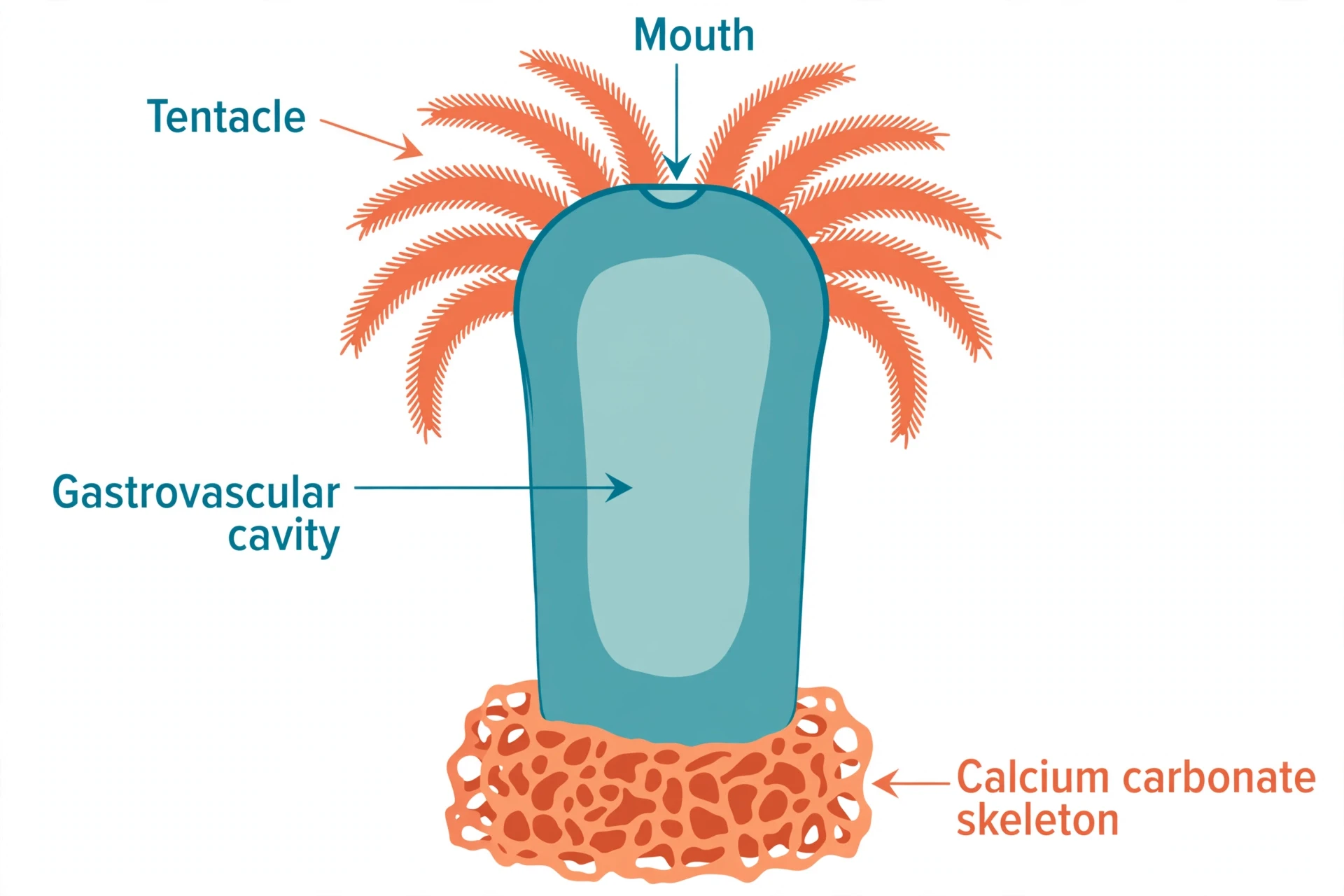
The basic unit of a coral is the polyp. Picture a tiny sea anemone, usually only a few millimetres across, sitting in a cup of stone it secreted itself. At its top is a mouth ringed by tentacles. At night, those tentacles reach out and snatch plankton drifting past. During the day, most reef-building corals pull their tentacles in and rely on a very different food supply, which we will meet in the next section.
I once spent an evening watching a tank of corals under a red lamp, the kind of light that does not disturb them, and the change from day to night was startling. By daylight the colony looked like a rock with a bumpy surface. After dark, it bloomed. Thousands of tiny tentacles opened at once, each one feeling the water, each one a mouth waiting for dinner. It was the first time I really understood that a reef is not a thing. It is a crowd.
A single polyp is small and fragile. A reef is what happens when polyps live together. Most reef-building corals are colonial: one polyp buds, the bud stays attached, and the colony grows into a shape — branching, massive, plate-like, encrusting — that depends on the species and on the water around it. The polyps share food through connected tissue, so the colony acts, in many ways, like a single organism with thousands of mouths.
1.2 How a colony becomes a reef
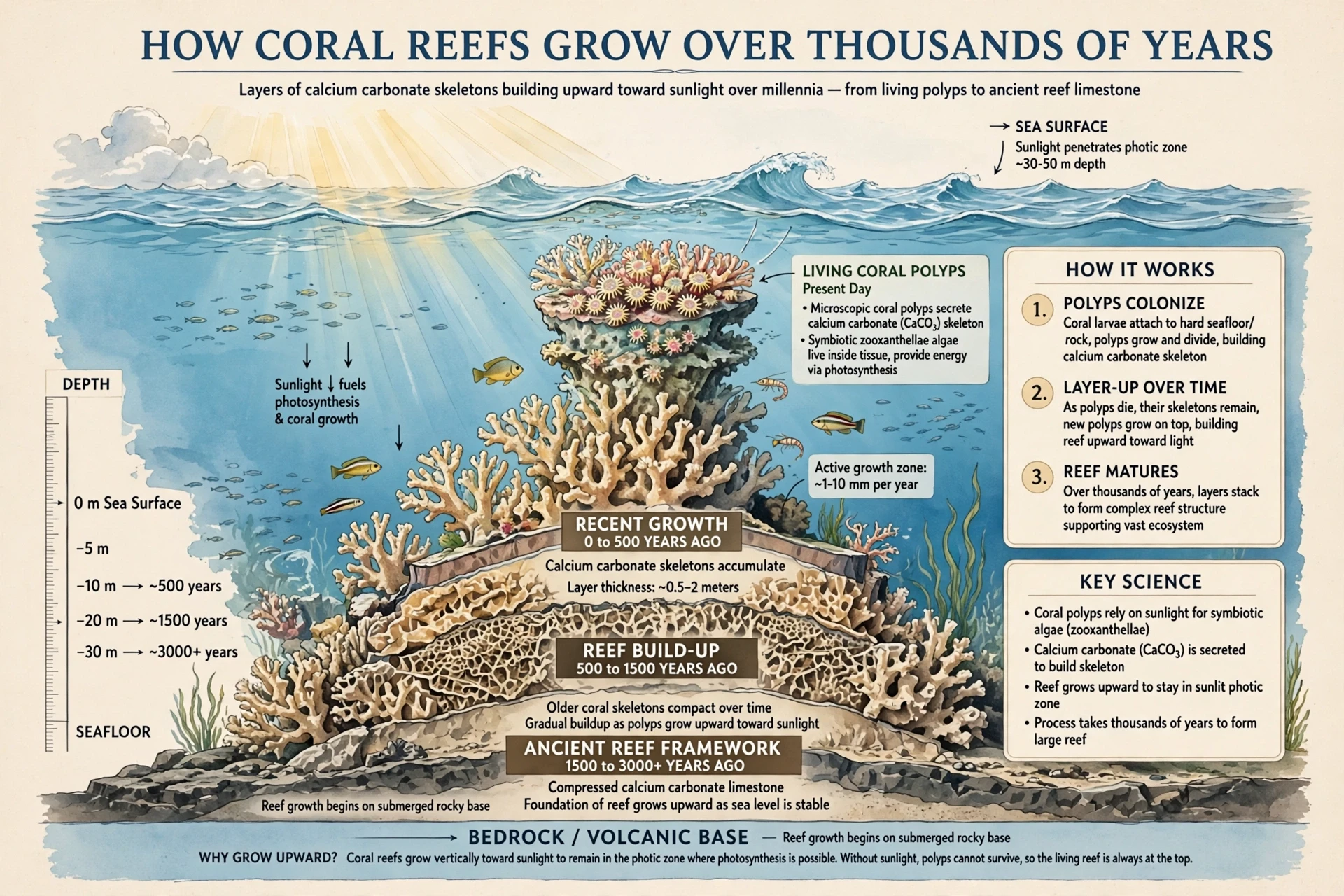
The polyp's great trick is calcification. It pulls calcium and carbonate ions from seawater and lays them down as calcium carbonate, the same mineral as chalk and limestone, forming a hard cup beneath its soft body. When a polyp dies, its cup remains. New polyps grow on top of the old cups. Layer upon layer, generation upon generation, the limestone accumulates.
That is why reefs are so slow and so old. A fast-growing branching coral might extend ten centimetres or more in a good year. A massive brain coral might grow less than a centimetre a year. A reef as a whole, balancing growth against erosion by waves, boring sponges and grazing fish, may rise only a few millimetres a year. The structures we snorkel over today began growing thousands of years ago, when sea levels were lower and the coastlines were somewhere else entirely.
1.3 Hard corals, soft corals, and the ones that do not build reefs
Not every coral builds a reef. Hard corals, also called stony corals, secrete the limestone skeletons that accumulate into reef structures. Soft corals — sea fans, sea whips, leather corals — have tiny internal spicules instead of a massive skeleton, and they bend with the current rather than building rock. Both are corals. Only the hard corals build reefs.
There are also cold-water corals living in the deep, dark ocean, far from sunlight, building reefs hundreds of metres down where no tourist will ever snorkel. They grow even more slowly than their tropical cousins, and they remind us that the reef story is bigger than the postcard version. This article focuses on the warm, shallow, tropical coral reefs most people mean when they say "coral reefs", but the deep reefs deserve a mention, because they show that corals are tougher and more widespread than the sunny image suggests.
One more distinction matters. A reef is the structure; the corals are the builders; and the reef community is everything that lives on, in and around the structure. When people say "coral reefs are dying", they usually mean the living coral cover is shrinking, even though the limestone structure can stand for a long time after the polyps are gone. That difference — between a living reef and a dead limestone hill — sits at the heart of the bleaching story later in this article.
2. The Partnership That Powers Coral Reefs
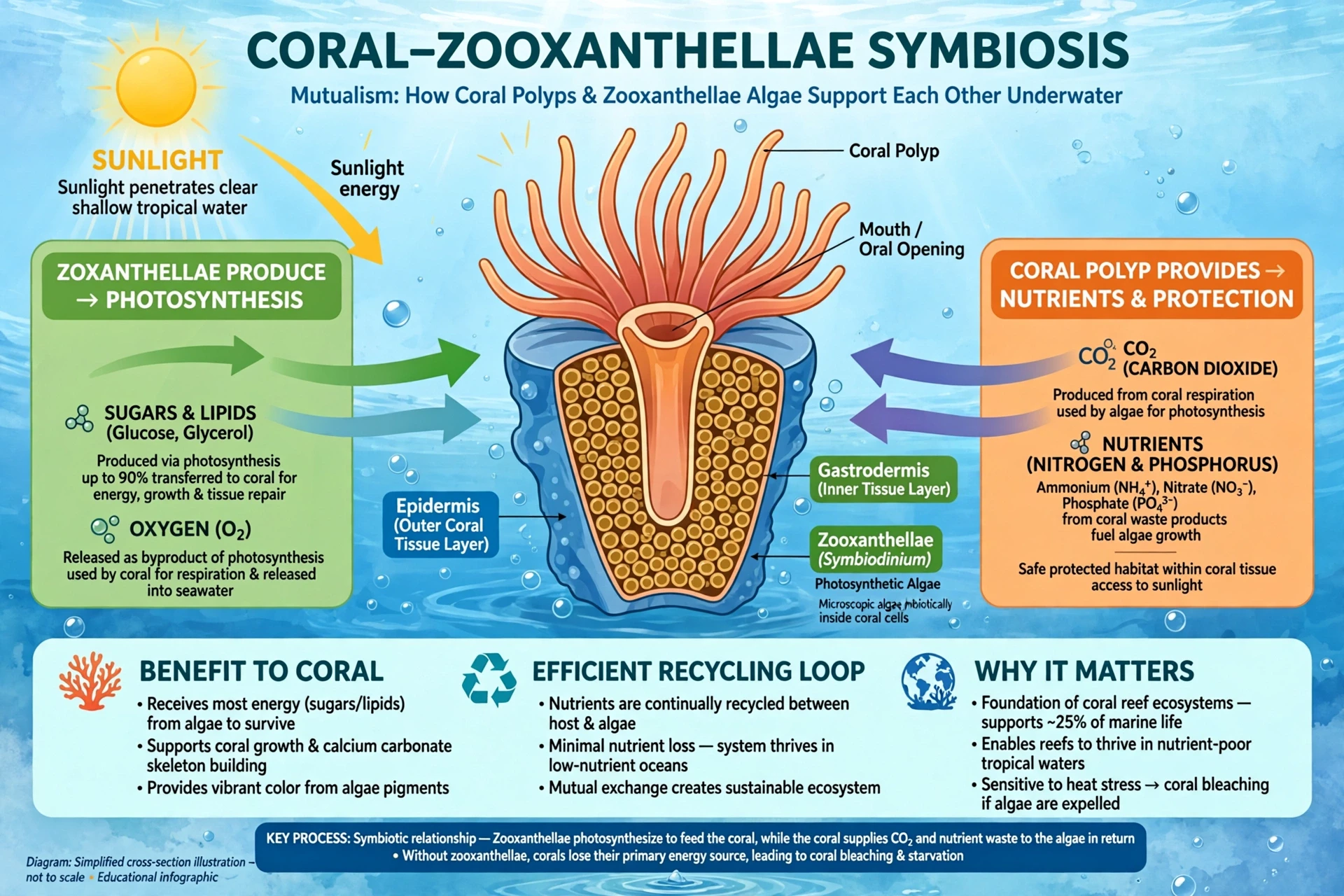
If a coral polyp were on its own, catching plankton with its tentacles, it could survive. It could not build a reef. Plankton alone does not supply enough energy to lay down limestone at reef-building speed. The secret of coral reefs is a partnership — one of the most productive alliances in nature — between the coral animal and a microscopic alga called zooxanthellae.
2.1 Zooxanthellae: solar panels inside an animal
Zooxanthellae are single-celled dinoflagellate algae that live inside the coral's tissue, sometimes a million or more of them in a single square centimetre. They photosynthesise, using sunlight to turn carbon dioxide and water into sugars and oxygen. The coral gives them a safe home, carbon dioxide from its respiration, and nutrients such as nitrogen and phosphorus from its waste. The algae give the coral up to 90 percent of the energy it needs. It is a trade, and both sides profit.
This is also why reef-building corals live in shallow, clear, sunlit water. No light, no photosynthesis, no energy surplus, no reef. It is why coral reefs cluster in the tropics, in water usually between about 23 and 29 degrees Celsius, and why a reef in murky or cloudy water grows slowly or not at all. The algae set the address.
The algae also give corals much of their colour. A healthy coral's browns, greens and golds are largely the colour of its zooxanthellae showing through its translucent tissue. Some of the brighter pinks, purples and blues come from pigments the coral itself makes, possibly as a kind of sunscreen. When people picture a neon reef, they are picturing, in large part, an algae farm.
2.2 Why clear, nutrient-poor water grows the richest reefs
Here is a puzzle that surprises most first-time students of reefs. Tropical surface waters are famously nutrient-poor — oceanographers call them marine deserts. Yet coral reefs in those same waters are among the most productive ecosystems on Earth. How?
The answer is recycling. The zooxanthellae partnership is a closed loop: the coral's waste feeds the algae, the algae's products feed the coral, and very little leaks away. Add to that the reef's talent for catching passing plankton, trapping nutrients in its nooks, and hosting a whole community of recyclers — sponges, worms, bacteria — and you get an oasis that runs on sunlight and thrift. Scientists sometimes call this Darwin's paradox, after Charles Darwin, who noticed it during his voyage on the Beagle: how could such abundance exist in such empty water? The partnership is a large part of the answer.
That thrift has a dark side. Because the system is tuned to low nutrients, a sudden flood of nutrients — sewage, fertiliser runoff from farms — can throw it off balance. Algae in the water column bloom, smothering corals; fleshy seaweeds grow faster than corals and take over the space. A reef that evolved to be frugal does not cope well with excess.
2.3 What happens when the partnership breaks
The partnership is sensitive to temperature. When the water gets too warm for too long, the algae start producing harmful oxygen compounds instead of useful sugars. The coral, under stress, expels the algae. That is bleaching, and we will examine it in full in Section 8. For now, note the logic: bleaching is not the coral dying on the spot. It is the coral evicting its food source. A bleached coral can survive for weeks on its fat reserves and on plankton it catches. If the water cools, it can take the algae back and recover. If the heat lasts, it starves.
I remember a reef guide in a small boat pointing at a patch of white coral and saying, almost apologetically, that the reef had "lost its colour". He was right in a way that was worse than he knew. The colour was the algae. The white was the limestone skeleton showing through transparent, starving tissue. The reef had not lost a coat of paint. It had lost its kitchen.
3. How Coral Reefs Grow
Reefs grow the way cities grow: slowly, unevenly, and only where conditions allow. The raw material is limestone. The workforce is polyps. The constraints are light, temperature, water chemistry and space. Change any one of those, and growth stalls or reverses.
3.1 Calcification: turning seawater into stone
Calcification is the chemical heart of reef building. The polyp takes calcium ions and bicarbonate from seawater and deposits calcium carbonate — aragonite, in the case of reef-building corals — beneath its tissue. The process costs energy, which is why the zooxanthellae matter so much: photosynthesis supplies the fuel, and it also helps by removing carbon dioxide, which shifts the local chemistry in favour of laying down stone.
Growth rates vary enormously by species and by place. Branching corals such as staghorn and elkhorn are the sprinters: in warm, clear, well-lit water they can extend 10 to 20 centimetres a year. Massive corals such as brain corals and star corals are the marathon runners: a centimetre a year, sometimes less, but they live for centuries and their dense skeletons resist storms that shatter the sprinters. A reef needs both — fast growers to claim space quickly, slow growers to give the structure its backbone.
Coral growth form | Typical growth rate | Strengths | Weaknesses |
|---|---|---|---|
Branching (staghorn, elkhorn) | 10–20 cm per year | Fast space capture, complex shelter for fish | Fragile in storms, sensitive to heat |
Massive (brain, star coral) | Less than 1 cm per year | Storm-resistant, can live for centuries | Slow to recover after damage |
Plate and table corals | Several cm per year | Maximise light capture in deeper water | Shading can kill corals below them |
Encrusting corals | Millimetres per year | Cement loose rubble, stabilise the reef | Contribute little vertical growth |
3.2 The reef budget: growth versus erosion
A reef is never simply growing. At every moment, builders add limestone and eroders take it away. Waves smash fragile branches into rubble. Parrotfish bite off chunks of coral and grind them into sand — a single large parrotfish can produce hundreds of kilograms of sand a year, and tropical beaches owe much of their white sand to this unglamorous work. Boring sponges, worms and molluscs drill into the skeleton. Sea urchins scrape it. The net result — growth minus erosion — is the reef budget, and a healthy reef runs a small surplus, rising slowly toward the surface.
That surplus is why reefs can keep up with sea-level rise, within limits. As the sea rose after the last ice age, reefs grew upward, tracking the light. If the sea rises faster than the reef can grow, the reef drowns in deeper, darker water. If the sea falls, the reef is left exposed and dies back. Reefs have survived sea-level changes before, but they did so over thousands of years, not decades.
3.3 Light, temperature, and the chemistry of the water
Reef-building corals are picky tenants. They want warm water, roughly 23 to 29 degrees Celsius, though some survive a little outside that range. They want clear water, so sunlight reaches them. They want normal ocean salinity, and they want water that is slightly alkaline, with plenty of carbonate ions available for building skeletons. They also want some water movement, which brings food and oxygen and carries waste away, but not so much that they are battered apart.
Oceanography shapes all of this. Currents deliver larvae to new sites and carry heat away from or toward a reef. Depth zones decide where light is enough for the zooxanthellae. Upwelling can bring cold, nutrient-rich water that stresses corals, or food that sustains them, depending on the season. A reef is not separate from the ocean around it. It is a local expression of the ocean's physics and chemistry.
3.4 Reading a reef's history in its skeleton
Massive corals keep a diary. Like trees, they lay down annual growth bands in their skeletons — dense bands in one season, less dense in another — and the chemistry of each band records the water it grew in: its temperature, its salinity, even past floods and droughts on the nearby land. Scientists drill cores from old brain corals and read centuries of ocean history from them, reconstructing sea temperatures from long before thermometers existed.
That archive is one more reason coral reefs matter to science beyond their beauty. Long coral cores have helped researchers understand how tropical oceans behaved during past warm periods and past El Niño events, which in turn helps them test the models used to predict what warming will do next. When a centuries-old coral dies, we lose not only a reef builder but a witness. Protecting old, massive corals is protecting a record that cannot be re-created once it is gone.
A reef is not built in a year, or a decade. It is the savings account of thousands of generations of tiny animals, each one depositing a grain of stone and trusting the next generation to build on it.
4. Three Shapes of Reef: Fringing, Barrier, and Atoll
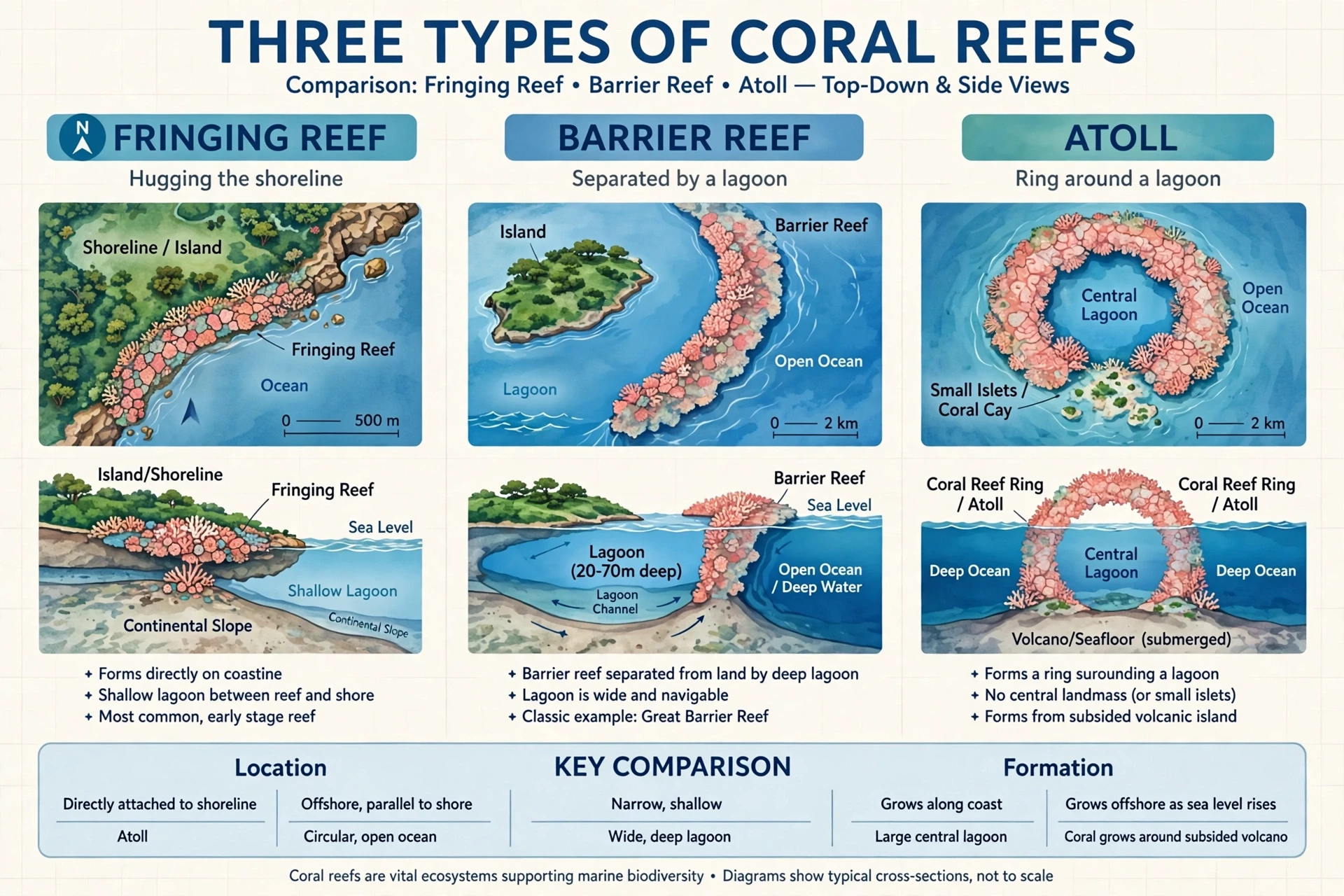
If you fly over tropical coasts, coral reefs come in three classic shapes. The classification comes from Charles Darwin, who worked it out during the voyage of the Beagle and published it in 1842, long before anyone could drill into a reef to check. Modern drilling has confirmed the broad picture he drew. It remains one of the elegant ideas in marine science: three shapes, one process, separated by time.
4.1 Fringing reefs: hugging the shore
A fringing reef grows directly against a shoreline, with little or no lagoon between reef and land. It is the youngest shape, and the most common. You can often walk to one at low tide, stepping carefully over the reef flat — the broad, shallow platform that is exposed when the tide drops. Fringing reefs are the reefs most people first meet, and the most exposed to what happens on land: runoff, sewage, construction sediment, and feet.
4.2 Barrier reefs: the reef with a lagoon
Given time, and a slowly sinking island or rising sea, a fringing reef grows upward and outward while the land behind it subsides. A lagoon opens between the reef and the shore. The reef becomes a barrier reef, separated from land by a stretch of calm, shallow water. Barrier reefs are bigger, more complex, and better at sheltering the coast, because the reef crest breaks the waves offshore and the lagoon absorbs what is left.
4.3 Atolls: a ring with no island left
Keep the process going. The island sinks completely beneath the waves, or the sea rises past it. What remains is a ring of reef around a central lagoon, with perhaps a few low sand islands on the rim. That is an atoll — a reef that has outlived its island. Darwin's insight was that an atoll is not a different kind of reef. It is an old fringing reef whose island has drowned. Drilling on Pacific atolls in the twentieth century found volcanic rock hundreds of metres below the reef limestone, exactly where Darwin's theory said it should be.
Atolls matter far beyond their beauty. Low-lying atoll nations live on reef-built sand, a few metres above sea level at most. Their fresh water sits as a thin lens floating on salt water beneath the sand. Their food, their coastlines, their very land are reef products. When reefs weaken, atoll nations feel it first.
4.4 Patch reefs, reef flats, and the rest of the neighbourhood
The three classic types are not the whole story. Patch reefs are small, isolated reef outcrops rising from a sandy lagoon floor. Reef flats are the shallow platforms behind the reef crest. Spur-and-groove formations — alternating ridges of coral and channels of sand — let waves drain off the reef face without tearing it apart. A real reef is a mosaic of these zones, each with its own light, depth, wave energy and community. That zoning is part of why reefs hold so many species: there are many different neighbourhoods packed into a small area.
5. The Great Barrier Reef
No article about coral reefs can skip the Great Barrier Reef. It is the largest living structure on Earth, visible from space, and it is also the place where the modern reef story — wonder, science, and warning — is told most clearly.
5.1 A structure bigger than a country
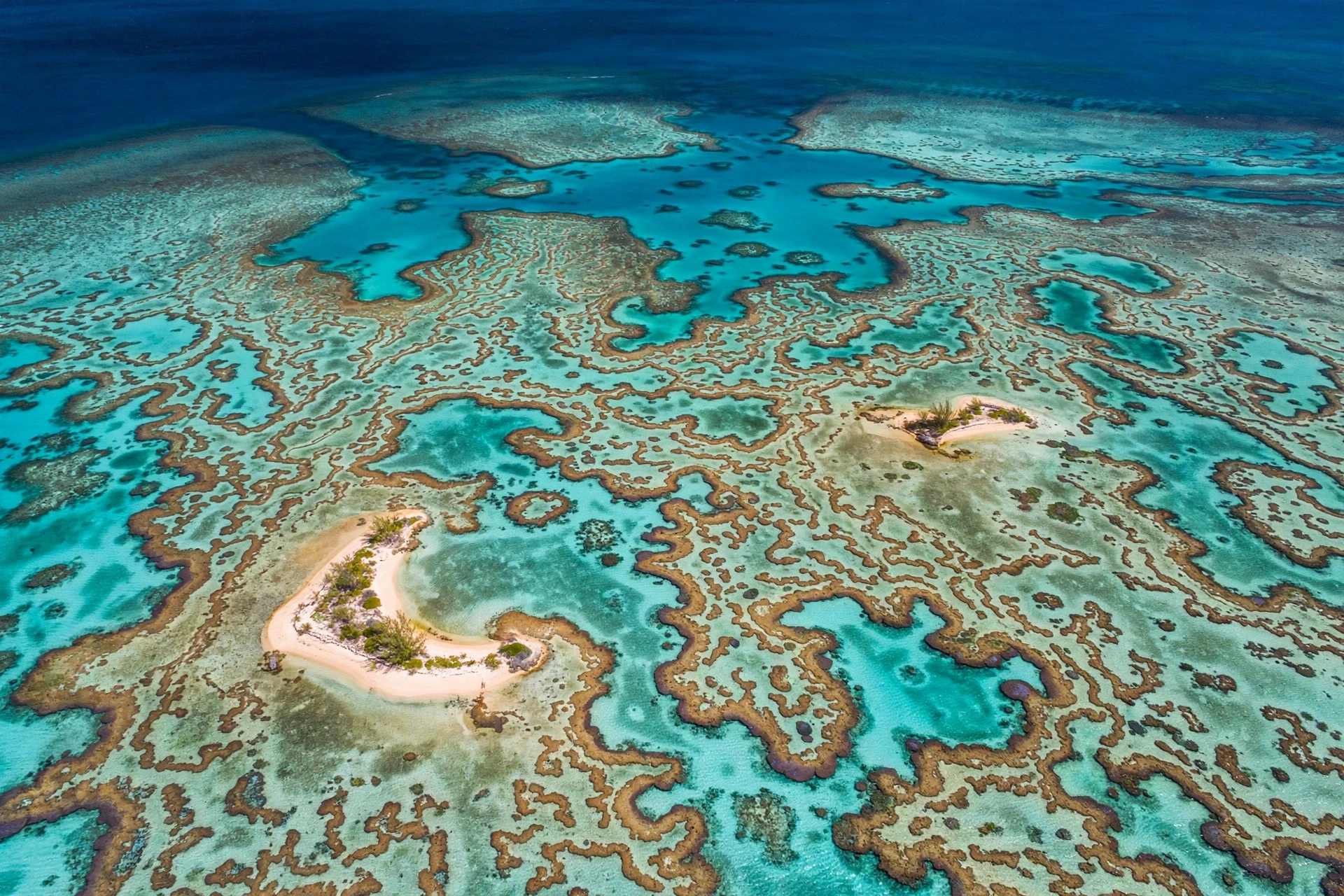
The Great Barrier Reef stretches more than 2,300 kilometres along the coast of Queensland, Australia, and covers roughly 344,000 square kilometres. It is not a single reef. It is a system of nearly 3,000 individual reefs and about 900 islands, built by hundreds of coral species over thousands of years. To call it a reef is a bit like calling a mountain range a mountain. It is a region, a system, a world.
Its scale makes it a natural laboratory. Researchers can study reefs that are pristine and reefs that are heavily used, warm northern reefs and cooler southern ones, inshore reefs bathed in river runoff and offshore reefs in clear ocean water — all within one system. That range is also why the Great Barrier Reef features so often in the news: when something happens there, it is a signal about reefs everywhere.
5.2 What lives there
The numbers are hard to hold in the mind at once. The Great Barrier Reef is home to around 400 coral species, more than 1,500 fish species, and thousands of other animals: molluscs, crustaceans, sea snakes, turtles, dugongs, sharks and whales. Six of the world's seven sea turtle species feed or nest there. It is, by any measure, one of the most diverse places on the planet.
But the Great Barrier Reef is not only a wildlife spectacle. It supports a tourism industry worth billions of dollars a year, a fishing industry, and the sea country of Aboriginal and Torres Strait Islander peoples, whose connection to the reef stretches back tens of thousands of years — far longer than modern science has studied it. That human history matters. The reef is not a wilderness without people. It is a place people have lived with, fished, navigated and cared for since long before it had an English name.
5.3 A reef in the headlines
In recent years the Great Barrier Reef has become famous for a sadder reason: mass bleaching. Severe bleaching events have struck the reef repeatedly, and surveys have found that large areas lost much of their shallow-water coral cover in the worst events, with recovery underway in some areas between events. The pattern — heat, bleaching, partial recovery, heat again — is the central drama of modern reef science. The reef is not dead. It is not fine, either. It is in a race between damage and recovery, and the intervals between damaging events are getting shorter.
I once met a researcher who had surveyed the same stretch of reef for over a decade. She described it the way a doctor might describe a patient who keeps getting ill before fully recovering from the last bout. "The reef still surprises me," she said. "It comes back in places I had written off. But it comes back thinner, younger, less varied." That sentence has stayed with me, because it captures the real risk: not a single dramatic death, but a slow thinning — fewer species, younger corals, less of the three-dimensional complexity that makes a reef a reef.
6. A City Under Water: Reef Biodiversity
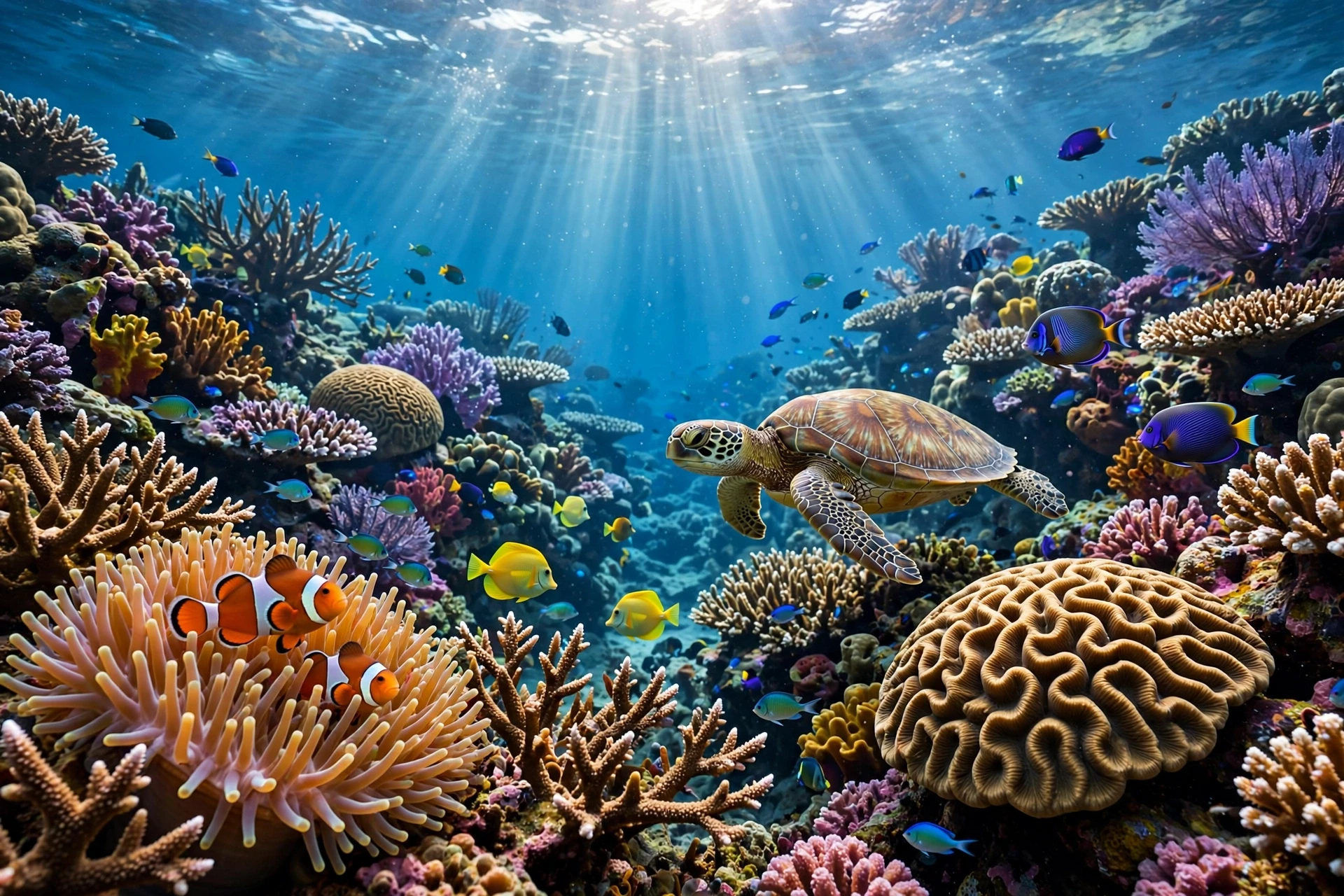
Coral reefs cover less than one percent of the ocean floor. They are home to roughly a quarter of all marine species. That single contrast explains why biologists call reefs the rainforests of the sea, and why losing them would be a loss far out of proportion to their area.
6.1 Why so many species in so little space?
The answer is structure. A reef is not a flat surface. It is a three-dimensional maze of branches, caves, overhangs, crevices and sand patches. Every hole is a home, every surface a feeding ground, every depth a different light level. A flat sandy bottom offers a few ways to make a living. A reef offers thousands.
Biodiversity on a reef works the way it works in a rainforest: many species, each one specialised, each one using a slightly different slice of the habitat. A few reef residents and their jobs:
Cleaner fish run stations where bigger fish queue for a wash.
Parrotfish scrape algae off coral, keeping the reef surface clear for new polyps.
Damselfish farm tiny algae gardens and defend them fiercely.
Moray eels hunt in crevices that other predators cannot reach.
Octopuses change colour and texture to vanish against the coral. At night, a different shift takes over: crustaceans, worms and hunting fish emerge while the daytime fish sleep in crevices.
6.2 The food web, from plankton to shark
A reef food web starts small. Plankton drift in on the current. Corals, sponges and other filter feeders catch them. Small fish eat the plankton and the algae. Bigger fish eat the smaller fish. Sharks and other apex predators patrol the edges. Detritus — dead matter, waste, broken coral — feeds scavengers and decomposers, whose nutrients return to the system. Nothing is wasted for long.
What makes reef food webs unusual is how much of the energy comes from the reef itself rather than from outside. The zooxanthellae fix carbon. The corals leak some of it as mucus, which feeds bacteria, which feed small animals, which feed fish. It is an economy that manufactures much of its own wealth, which is why a reef can be so productive in nutrient-poor water.
6.3 Species you would miss if you blinked
The famous reef animals — clownfish, turtles, reef sharks — are a small part of the story. Much of reef diversity is small, hidden or nocturnal: gobies the size of a fingernail, nudibranchs in colours that look invented, pistol shrimp that snap their claws hard enough to stun prey, Christmas tree worms that vanish into their tubes at the shadow of a diver. Scientists regularly discover new reef species, and many reef species are still undescribed. We are losing parts of a library we have not finished reading.
6.4 Reefs as nurseries
Many reef fish do not spend their whole lives on the reef. Their larvae drift in the open ocean, then settle on a reef as juveniles. Mangroves and seagrass beds nearby act as nurseries for young fish, which later move to the reef as adults. Damage the reef, and you damage the nursery. Damage the mangroves, and the reef loses its recruits. The connections run both ways, which is why conservation that protects only the reef itself, and ignores the coast around it, often falls short. Ecosystems rarely respect the boundaries we draw on maps.
7. Why Coral Reefs Matter to People
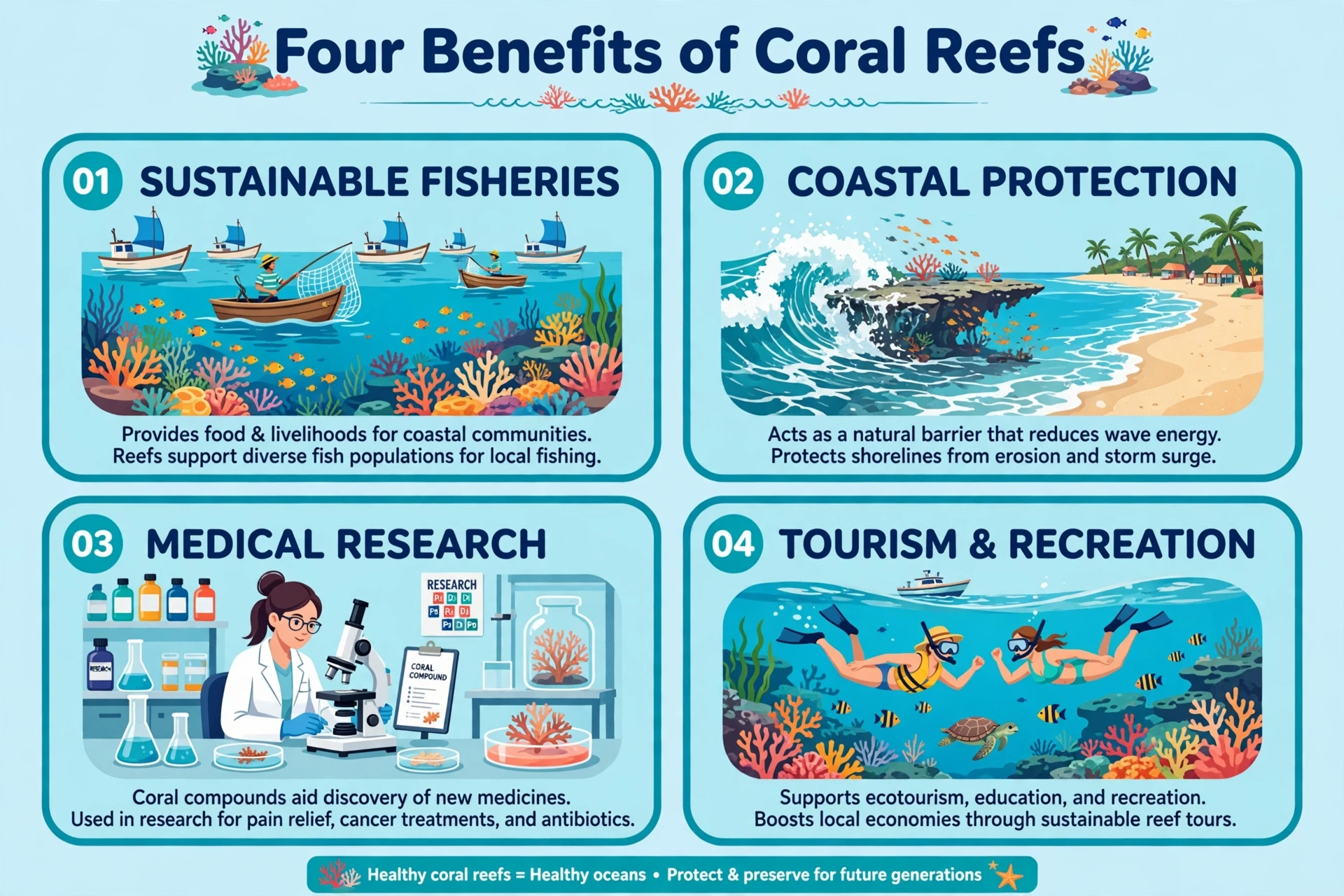
It is easy to talk about reefs as if they were a luxury — beautiful, remote, optional. The numbers say otherwise. Around half a billion people live near coral reefs and depend on them for food, income, coastal protection or some combination of the three. Reefs are not decoration. They are infrastructure that happens to be alive.
7.1 Food and fisheries
Reef fisheries feed people who have few alternatives. In many tropical coastal communities, reef fish are the main source of animal protein. Small-scale fishers working from canoes and small boats catch a large share of the world's reef fish, and the catch feeds families directly rather than passing through distant markets. When a reef degrades, the catch falls, the fish get smaller, and families that were already living close to the edge feel it first.
The value is not only in the fish caught on the reef itself. Reefs support fisheries far beyond their boundaries, because many commercially important fish spend part of their lives on reefs. Lose the reef habitat, and the adult fish elsewhere in the ocean have nowhere to grow up.
7.2 Coastlines: the living breakwater
A healthy reef is a breakwater that repairs itself. As waves approach a reef, the reef crest forces them to break and lose energy. Studies of wave energy across reefs have found that reefs can dissipate a large share of incoming wave energy — often the great majority of it — before it reaches the shore. The lagoon behind the reef is calm water, and the beach behind the lagoon erodes far more slowly than an exposed beach would.
That protection has a price tag. Coastal flooding and erosion would be far worse, and far more expensive, without reefs. After storms, communities behind healthy reefs routinely report less damage than communities behind degraded ones. The reef does not stop a hurricane. It takes the edge off it, and for a low-lying coastline, the edge is often the difference between a bad day and a disaster.
7.3 Medicine from the reef
Reefs are a pharmacy we have barely opened. The same chemical warfare that reef animals use to compete for space — toxins, antibiotics, anti-inflammatory compounds — has yielded drugs, including treatments derived from marine organisms that are used in cancer and pain medicine. The cone snail's venom, for instance, gave rise to a pain drug used when other treatments fail. Sponges and soft corals produce compounds that researchers are studying for a range of diseases.
Every species lost to reef decline is a compound never tested, a molecule never described. The medical case for protecting reefs is not sentimental. It is practical: we are burning a library of chemistry before we have read the catalogue.
7.4 Tourism, jobs, and culture
Reef tourism — diving, snorkelling, glass-bottom boats, island resorts — supports jobs and economies in dozens of countries. The Great Barrier Reef alone supports tens of thousands of jobs and billions of dollars in tourism value each year. For many small island nations, reef tourism is one of the few industries that can grow without paving over the thing that makes the place worth visiting.
Tourism is a double-edged sword. Too many visitors, careless anchoring, sunscreen chemicals and poorly managed resorts can damage the reef that draws them. Done well, with limits, mooring buoys instead of anchors, and local people employed as guides and guardians, tourism can pay for protection. Done badly, it eats its own foundation.
7.5 Coral reefs and the climate
Coral reefs do not store carbon the way forests do — a reef's limestone is a carbon store of a different kind, and reef building itself releases some carbon dioxide even as photosynthesis absorbs it. The climate value of coral reefs lies elsewhere: in the coastlines they protect from storms that are growing stronger, in the fisheries that feed people as other food sources come under pressure, and in the mangroves and seagrass beds that grow alongside them and do store large amounts of carbon. Lose the reef, and the whole coastal system — reef, mangrove, seagrass — unravels together, taking its storm protection and its fish nurseries with it. That is why climate policy and reef policy are the same conversation, not two separate ones.
What reefs provide | Who benefits | What happens when reefs decline |
|---|---|---|
Fisheries and protein | Coastal communities, small-scale fishers | Smaller catches, less protein, lost income |
Coastal protection | Everyone living behind a reef | More wave damage, erosion and flooding |
Medicines and compounds | Patients, researchers, drug developers | Lost chemical diversity, fewer leads |
Tourism and jobs | Dive operators, hotels, island economies | Fewer visitors, lost livelihoods |
Culture and identity | Indigenous and island peoples | Loss of heritage, fishing grounds and sea country |
8. Coral Bleaching and Ocean Acidification
This is the section nobody enjoys writing, and nobody should skip. Coral reefs are in trouble, and the trouble has a clear cause. The science here is not genuinely disputed among reef researchers. What is debated is how fast the damage will unfold, and how much can still be saved.
8.1 Bleaching: what it is, and what it is not
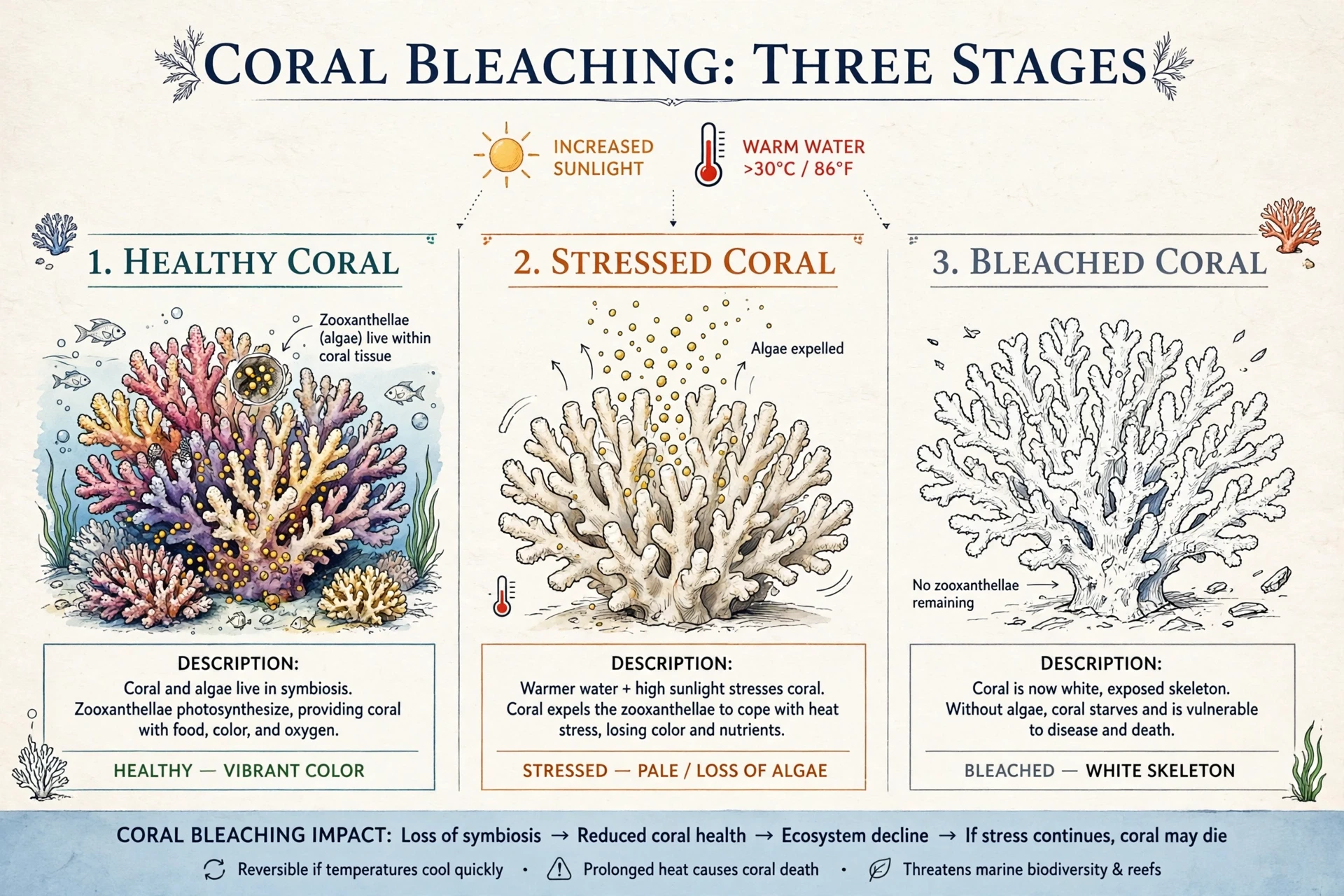
Bleaching happens when corals expel their zooxanthellae. The trigger is usually heat: water temperatures a degree or two above the local summer maximum, sustained for weeks. The algae, stressed by heat and bright light, begin producing toxic oxygen compounds. The coral ejects them. Without the algae, the coral's tissue turns transparent, and the white limestone skeleton shows through. The coral looks bleached, like a white bone.
A bleached coral is not dead yet. It is starving and vulnerable to disease. If temperatures fall within a few weeks, the coral can take up new algae from the water and recover, though recovery takes months and the coral grows slowly while it does. If the heat persists, the coral dies, and algae and seaweed colonise the skeleton. The reef keeps its shape for a while, but the living cover is gone.
I returned once to a reef I had visited two years earlier, a place I remembered as a riot of colour. The structure was still there — the same bommies, the same channels — but the colour was gone, and the fish were fewer and warier. It felt like visiting a street where the shops had closed but the buildings still stood. That is what mass bleaching does. It does not level the city. It empties it.
8.2 How often is too often?
Corals have bleached before, in warm years, and recovered. The problem now is frequency. Major global bleaching events have struck repeatedly in recent decades, and the gaps between them have shrunk. A reef that bleaches every few years does not have time to regrow the slow, massive corals that give it structure. It recovers with fast-growing, heat-sensitive species instead, or with seaweed. Each event leaves the reef a little simpler, a little younger, a little less able to withstand the next one.
The NOAA Coral Reef Conservation Program tracks bleaching and works on reef resilience, and its pages are a good starting point for anyone who wants the current picture rather than a snapshot from one year. NOAA Coral Reef Conservation Program NOAA Coral Reef Conservation Program — about the program
8.3 Ocean acidification: the quieter threat
Bleaching gets the photographs. Ocean acidification gets less attention, and it may be just as important. The ocean absorbs a large share of the carbon dioxide humans release into the atmosphere. That sounds helpful — the ocean is taking the gas out of the air — but the chemistry has a cost. Carbon dioxide dissolved in seawater forms carbonic acid, which lowers the water's pH and reduces the availability of carbonate ions. Corals need those ions to build their skeletons.
The effect is like trying to build a house while someone keeps stealing your bricks. Calcification slows. Skeletons grow thinner and more fragile. In the most acidic conditions studied, some corals struggle to lay down skeleton at all, and existing skeletons can begin to dissolve. Acidification also affects other reef builders — crustose coralline algae, which cement the reef together, and shell-forming animals from oysters to plankton.
Acidification and warming act together, and the combination is worse than either alone. A coral that is spending energy coping with heat has less energy for calcification. A coral with a thin skeleton is more easily broken by the next storm. The threats stack.
Bleaching is the reef's alarm bell. Acidification is the slow leak in the foundations. One is loud and visible; the other is quiet and structural. Both need the same thing: cooler water, and water that is not becoming more acidic.
8.4 Local stressors make global stress worse
Global warming and acidification are the big drivers, but local damage decides which reefs survive them. A reef smothered by sediment from coastal construction, poisoned by sewage, or stripped of its grazing fish by overfishing is less able to recover from bleaching. A reef with healthy fish populations, clean water and intact mangroves nearby has a better chance. That is the hopeful part of a grim story: local action genuinely helps. We cannot fix the ocean's temperature from a single coastline, but we can stop the sewage, protect the grazers, and give the reef its best chance to survive the heat.
9. Reef Restoration: Can We Rebuild a Reef?
Faced with the damage, scientists and coastal communities have begun asking a practical question: can we help reefs recover, the way foresters replant a forest? The field is called reef restoration, and it is growing fast — and it is honest about its limits.
9.1 Coral gardening: farming fragments
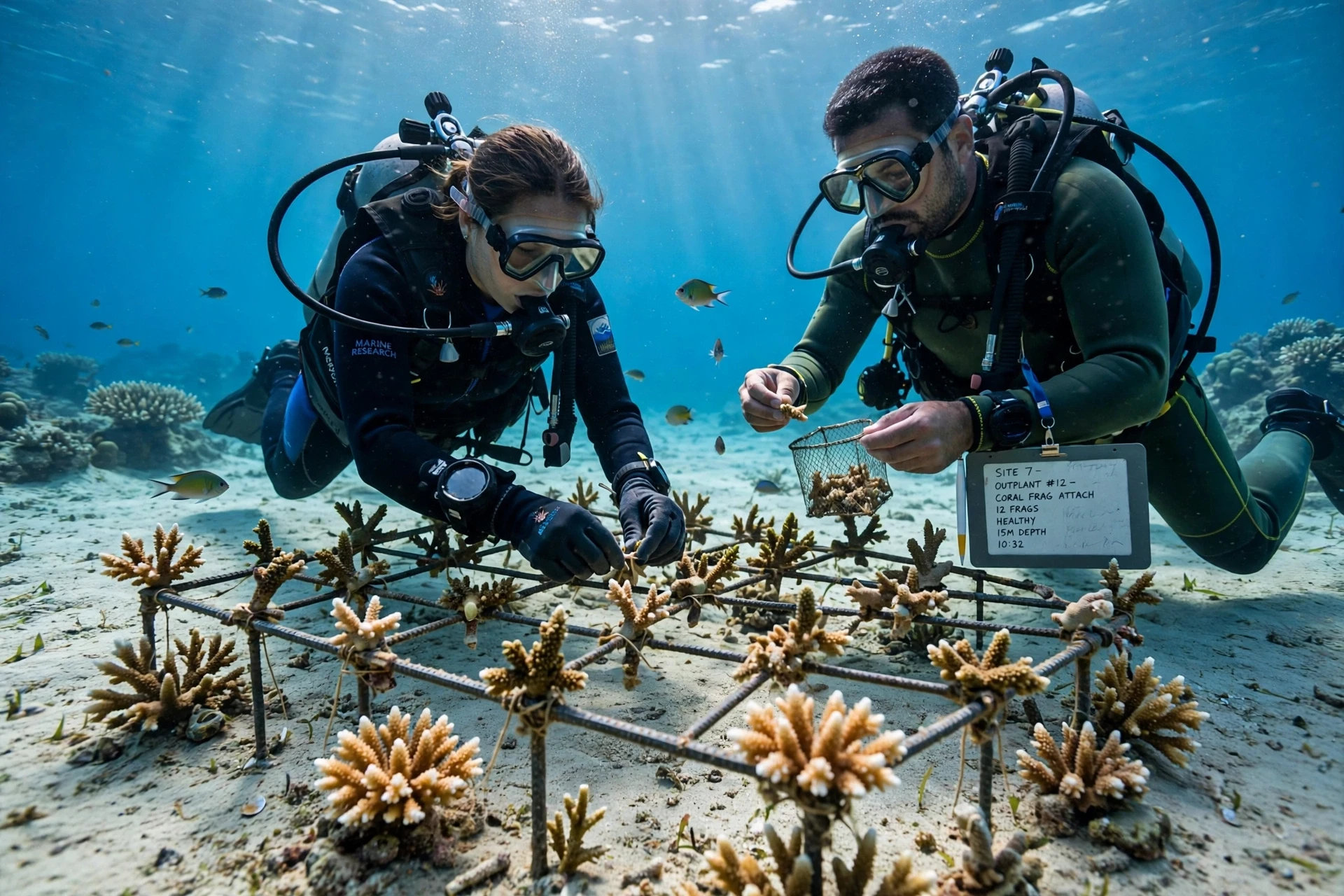
The best-established technique is coral gardening. It follows a simple sequence:
Divers collect small fragments broken from healthy corals, by storms or deliberately, in a way the donor colony can survive.
The fragments grow in underwater nurseries, often on frames or ropes suspended in the water.
When the fragments are large enough, they are transplanted onto a degraded reef and attached with cement or ties.
In good conditions, they grow, branch, and begin to reproduce.
In good conditions, restored patches can regain coral cover, attract fish, and start building structure again. The technique has been used in the Caribbean, the Pacific, and elsewhere, and local teams have become skilled at it. The problem is scale. A reef system covers thousands of square kilometres. Coral gardening covers hectares. It is the difference between planting a garden and reforesting a country.
9.2 Breeding tougher corals
A newer approach tries to breed or select corals that can handle warmer water. Researchers cross corals from warm reefs with corals from cooler ones, or select the survivors of bleaching events as parents for the next generation. Others work with the zooxanthellae themselves, finding strains that tolerate heat better. The idea is assisted evolution: give natural selection a nudge, and produce corals that can survive the water temperatures of the coming decades.
The idea is promising and contested. Critics worry about unintended consequences — moving genes around an ecosystem is not a step to take lightly — and about the risk that restoration becomes an excuse to delay cutting the emissions that are heating the water in the first place. Supporters reply that we do not have the luxury of waiting for a perfect solution. Both sides have a point. Restoration without addressing the cause is like bailing a boat without plugging the hole. But plugging the hole takes time, and the boat is taking on water now.
9.3 Larval reseeding and the scale problem
Another technique, larval reseeding, collects coral spawn — the eggs and sperm corals release in a synchronised spawning event — fertilises them, grows the larvae, and settles them onto degraded coral reefs in large numbers. A single spawning can produce millions of larvae, which makes this approach more scalable than gardening fragment by fragment. Early trials have shown that settled larvae can survive and grow, though survival rates are still low and the work is labour-intensive.
The honest summary of restoration today is this: it can repair damage locally, it can protect high-value sites such as a tourist reef or a culturally important area, and it can buy time. It cannot, on its own, save coral reefs at a global scale. Nothing can do that except stopping the warming and acidification that are causing the damage. Restoration is a bridge, not a destination.
9.4 What actually protects a reef
If restoration is the ambulance, protection is the public health system. Marine protected areas — zones where fishing is limited or banned — give fish populations a chance to recover, and grazing fish keep seaweed from smothering young corals. Catchment management — controlling runoff, sewage and sediment from the land — keeps the water clear. And the largest lever of all is global: reducing greenhouse gas emissions so the ocean stops warming and acidifying so fast.
The U.S. Environmental Protection Agency's coral reef pages explain the range of threats and the actions taken to reduce them, and the NOAA Ocean Service's coral tutorial is a clear introduction to how reefs work for readers who want to go deeper. U.S. Environmental Protection Agency — coral reefs NOAA Ocean Service — coral tutorial
10. Common Misconceptions About Coral Reefs
Reefs attract myths. Some are harmless. Some shape policy and personal behaviour in ways that matter. Here are the ones I hear most often, and what the evidence actually says.
10.1 "Corals are plants" — no, they are animals
This is the most common mistake, and the most forgivable. Corals look like plants, sit still like plants, and depend on sunlight like plants. But they are animals that host photosynthetic algae inside them. The sunlight is harvested by the algae, not by the coral itself. A coral without its algae is a hungry animal, not a plant in the shade.
10.2 "A bleached reef is a dead reef" — not always
Bleaching is a stress response, not a death sentence. A bleached coral can recover if conditions improve quickly. The tragedy of mass bleaching is not that every bleached coral dies — many recover — but that bleaching is happening so often, and so widely, that recovery keeps getting interrupted. A reef that bleaches once a decade can bounce back. A reef that bleaches every two or three years cannot.
10.3 "Reefs only matter to divers and tourists" — no
Divers see reefs most clearly, but the people who depend on reefs most are often the ones who never dive for fun: the fisher whose catch feeds her family, the family whose house sits behind a reef that breaks the waves, the patient whose medicine came from a reef organism. Tourism is the visible economy. Food and coastal protection are the larger one.
10.4 "Coral reefs are only in Australia" — no
The Great Barrier Reef is the most famous, but coral reefs ring the tropics: the Coral Triangle in Southeast Asia, which holds the highest reef diversity on Earth; the Caribbean; the Red Sea; East Africa; the Pacific islands. The Coral Triangle alone — the waters of Indonesia, the Philippines, Malaysia, Papua New Guinea, the Solomon Islands and Timor-Leste — holds more coral species than anywhere else. Reefs are a global heritage, not a single country's attraction.
10.5 "We can just replant reefs later" — not at global scale
Restoration works locally, as Section 9 showed. It does not scale to whole reef systems, and it does not work at all if the water stays too warm for the transplanted corals to survive. Planting corals into water that will bleach them again next summer is not a plan. It is a gesture. Restoration matters most when it is paired with protection and with action on the causes of warming.
11. The Reef's Future Is Still Being Written
It would be easy to end this article with despair. The data gives reasons for it: repeated mass bleaching, warming water, acidifying seas, reefs thinning year by year. But the data also gives reasons to keep working. Reefs have recovered from past bleaching when given time and clean water. Protected reefs with healthy fish populations recover faster than unprotected ones. Restoration techniques improve every year. And the public understanding of reefs — what they are, why they matter — has never been better.
The future of coral reefs will be decided by two things happening at once. The first is global: how quickly the world reduces the greenhouse gas emissions that are warming and acidifying the ocean. The second is local: how well we protect the reefs we still have — clean water, sustainable fishing, protected areas, careful tourism — so that they are as strong as possible when the heat comes.
Neither is enough alone. Together, they give reefs a fighting chance.
If you visit a reef, go gently. Do not stand on coral. Do not touch it — the oils on skin and the scrape of a fin can damage tissue that took years to grow. Use reef-safe sunscreen, or better, a rash guard. Choose operators who use mooring buoys instead of anchors and who employ local guides. And if you never visit a reef, you still have a stake in it: the fish on your plate, the medicines in your cabinet, the climate that shapes your weather all run, in part, through the shallow tropical seas where coral reefs grow.
The reef I first saw from that boat, the city under the water, is still there. It has changed — some corals I remember are gone, and new ones have grown in their place. That is the nature of a living system. It is not a museum. It is a city, and cities can be damaged, and cities can be rebuilt, and the people who live in them and around them decide which of those things happens.
A reef is a promise that tiny animals make to the future: a grain of stone at a time, for thousands of years. Whether that promise is kept is now, for the first time in the reef's long history, up to us.
Frequently Asked Questions
What are coral reefs?
Coral reefs are large underwater structures built from the limestone skeletons of reef-building corals. They are made by colonies of tiny animals called polyps, which secrete calcium carbonate cups and live on top of the skeletons left by earlier generations. Coral reefs provide habitat, food and shelter for roughly a quarter of all marine species, despite covering less than one percent of the ocean floor.
Are corals animals or plants?
Corals are animals. They belong to the phylum Cnidaria, related to jellyfish and sea anemones, and they catch food with stinging tentacles. They look plant-like because they host microscopic algae called zooxanthellae inside their tissue. The algae photosynthesise and share sugars with the coral, but the coral itself is an animal, not a plant.
How do coral reefs grow?
Coral reefs grow when coral polyps extract calcium and carbonate from seawater and deposit it as limestone skeletons. New polyps grow on the skeletons of dead ones, so the reef builds upward layer by layer. Growth is slow — branching corals may grow 10 to 20 centimetres a year, while massive corals grow less than a centimetre a year — and a large reef may have been growing for thousands of years.
What causes coral bleaching?
Coral bleaching is caused mainly by unusually warm water sustained for weeks. Heat stresses the zooxanthellae algae living inside corals, and the coral expels them. Without the algae, the coral loses its colour and its main food source, and the white skeleton shows through its transparent tissue. Bleached corals can recover if the water cools quickly, but they starve and die if the heat lasts.
Where is the Great Barrier Reef?
The Great Barrier Reef is off the north-east coast of Australia, in the Coral Sea along Queensland. It stretches more than 2,300 kilometres and covers about 344,000 square kilometres, comprising nearly 3,000 individual reefs and around 900 islands. It is the largest living structure on Earth and is visible from space.
Why are coral reefs important?
Coral reefs matter because they feed people, protect coastlines, support tourism and supply medicines. Around half a billion people depend on reefs for food, income or coastal protection. Reefs shelter about a quarter of marine species, break wave energy before it reaches the shore, and produce chemical compounds used in medicine. Their loss would hit food security, coastal safety and biodiversity at once.
Can coral reefs recover from bleaching?
Yes, coral reefs can recover from bleaching if conditions improve and the damage is not repeated too soon. Corals can take up new zooxanthellae and regrow, and reefs with clean water, healthy fish populations and nearby mangroves recover fastest. Recovery takes years, and repeated bleaching events make full recovery harder. Restoration techniques such as coral gardening can help locally, but lasting recovery depends on cooler water and reduced local stress.