

Introduction
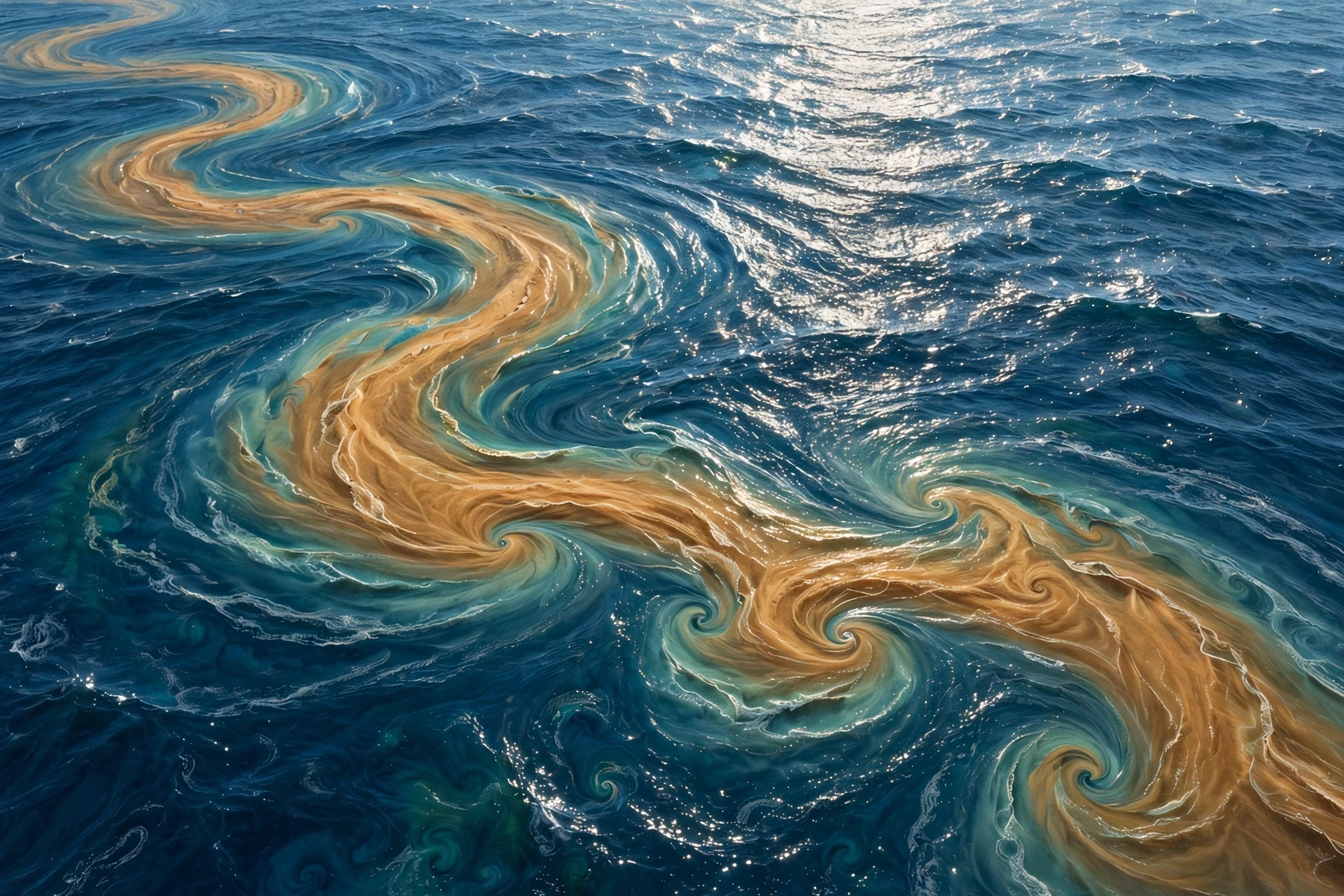
The first time the ocean stopped being scenery for me, I was standing on the deck of a small research vessel at two in the morning, somewhere off the continental shelf, holding a bucket of seawater that glowed. The ship's lights were off, the sky was black, and every time the water in the bucket moved, it lit up with tiny blue sparks — plankton, flashing when they were disturbed. I had read about bioluminescence in textbooks. I had even lectured on it. But I had never stood in the dark with a bucket of living light in my hands, and in that moment the whole subject rearranged itself in my head. Oceanography is not the study of a big blue expanse. It is the study of a moving, layered, living machine — one that covers most of our planet, sets the weather over our heads, and holds more life, in more strange forms, than anywhere else on Earth.
That machine runs on a few simple ingredients: salt water, sunlight, wind, and the spin of the Earth itself. From those ingredients it builds rivers wider than continents, deserts of empty blue water, reefs as crowded as cities, and trenches so deep that the pressure there would crush a car flat. It moves heat from the equator to the poles, it stores carbon for centuries, and it feeds about half the oxygen you are breathing right now — not from forests, but from microscopic plants drifting in the sunlit surface. This guide follows that machine from the surface to the seafloor: how ocean currents work, how marine ecosystems are put together, and what lives in each depth zone, from the bright shallows to the hadal trenches where no sunlight has ever reached.
You do not need a science degree to follow it. You need curiosity, and a willingness to let go of one picture most of us carry around: the ocean as a single, uniform bathtub of blue water. It is nothing like that. It is layered like a cake, it flows like a river system, and it changes, metre by metre, as you sink down through it. By the end of this guide, you will be able to look at a satellite map of sea temperature, a tide table, or a photograph of a coral reef and read it the way an oceanographer does — as evidence of a system in motion.
1. What Oceanography Is — and Why the Ocean Runs the Planet
1.1 Four sciences in one
Oceanography is the science of the sea, and it is really four sciences braided together. Physical oceanography studies how water moves — currents, waves, tides, and the temperature and saltiness of the sea. Chemical oceanography studies what the water is made of — dissolved gases, nutrients, and the chemistry that decides whether a coral can build its skeleton or a plankton cell can grow. Biological oceanography studies the life in the water, from bacteria to blue whales. Geological oceanography studies the seafloor itself — the ridges, trenches, and volcanoes that shape the basins the water fills. No one of these tells the whole story. A current is physics, but it carries nutrients, which is chemistry, which feeds plankton, which is biology, which sinks and becomes sediment, which is geology.
The ocean itself is worth the effort. It covers about 71 percent of the Earth's surface and holds about 97 percent of all the water on the planet. Its average depth is close to 3,700 metres, and its deepest point — Challenger Deep in the Mariana Trench — drops to nearly 11,000 metres, deeper than Mount Everest is tall. If you could drain the sea, you would see a landscape as dramatic as any continent: mountain ranges longer than the Andes, canyons deeper than the Grand Canyon, and flat abyssal plains that stretch for thousands of kilometres. We live on the dry parts of a water planet, and most of what happens on that planet happens out of sight, under water.
1.2 The ocean sets the weather
Most people think of the weather as something the sky does. In truth, the ocean does much of it. Water holds heat far better than air does, so the sea soaks up sunshine in the tropics and releases it slowly, smoothing out the seasons and carrying warmth toward the poles. The Gulf Stream alone carries warm water north along the east coast of North America and on toward Europe, and it is a large part of the reason winters in London are far milder than winters at the same latitude in Labrador. When the ocean's surface warms or cools by a degree or two in the tropical Pacific, the effects ripple through the atmosphere as El Niño or La Niña, shifting rainfall across continents and deciding whether a harvest fails or a fishery booms.
The ocean also breathes for the planet. It absorbs carbon dioxide from the air, and the microscopic plants of the surface — the phytoplankton — take up carbon as they grow, in the same photosynthetic bargain that land plants make. When those tiny organisms die, some of them sink, carrying carbon down into the deep ocean, where it can stay locked away for centuries. Sciory's guide to the water cycle follows the same water as it evaporates, falls as rain, and returns to the sea — and the ocean is where most of that cycle begins and ends.
1.3 A short history of looking down
Humans have sailed the ocean for thousands of years, but oceanography as a science is young. The turning point was the voyage of HMS Challenger, a British research ship that circled the globe between 1872 and 1876, lowering weighted lines and dredges into water no one had ever sampled. The crew sounded depths, measured temperatures, and hauled up strange animals from the deep — and proved, against the expectations of the time, that life existed at every depth they could reach. Their report ran to fifty volumes and took twenty years to publish. It is still, in a real sense, the founding document of the field.
The next leaps came with technology: echo sounders that mapped the seafloor in the twentieth century, satellites that began watching sea temperature and sea level from space in the 1970s, and the fleet of drifting Argo floats that now profile the upper two kilometres of the ocean in near real time. Each new instrument did the same thing the Challenger did — it showed us that the ocean was stranger and more structured than we had assumed. That pattern has not stopped. In my own working life, I have watched instruments I once thought of as futuristic become routine, and I have watched each of them hand us a new surprise.
2. The Water Itself: Salt, Temperature, and Density
2.1 What seawater is
Seawater is not just salty water. It is a solution carrying dissolved salts — mostly sodium chloride, the same salt on a dinner table, but also magnesium, calcium, potassium, and a long list of trace elements — at an average of about 35 grams of salt per litre. The elements dissolved in the sea are the same ones arranged in Sciory's guide to the periodic table, and their proportions in seawater are remarkably steady wherever you sample it, a fact oceanographers call the principle of constant proportions. That saltiness, called salinity, is not the same everywhere. Rain and river water freshen the sea near coasts and in the tropics. Evaporation in the subtropics leaves the water saltier. Sea ice freezing in the polar regions squeezes salt out of the ice and into the water below, making it saltier still. The result is a patchwork of saltiness across the surface, and that patchwork matters, because salt changes the density of water — and density is what drives the deep ocean.
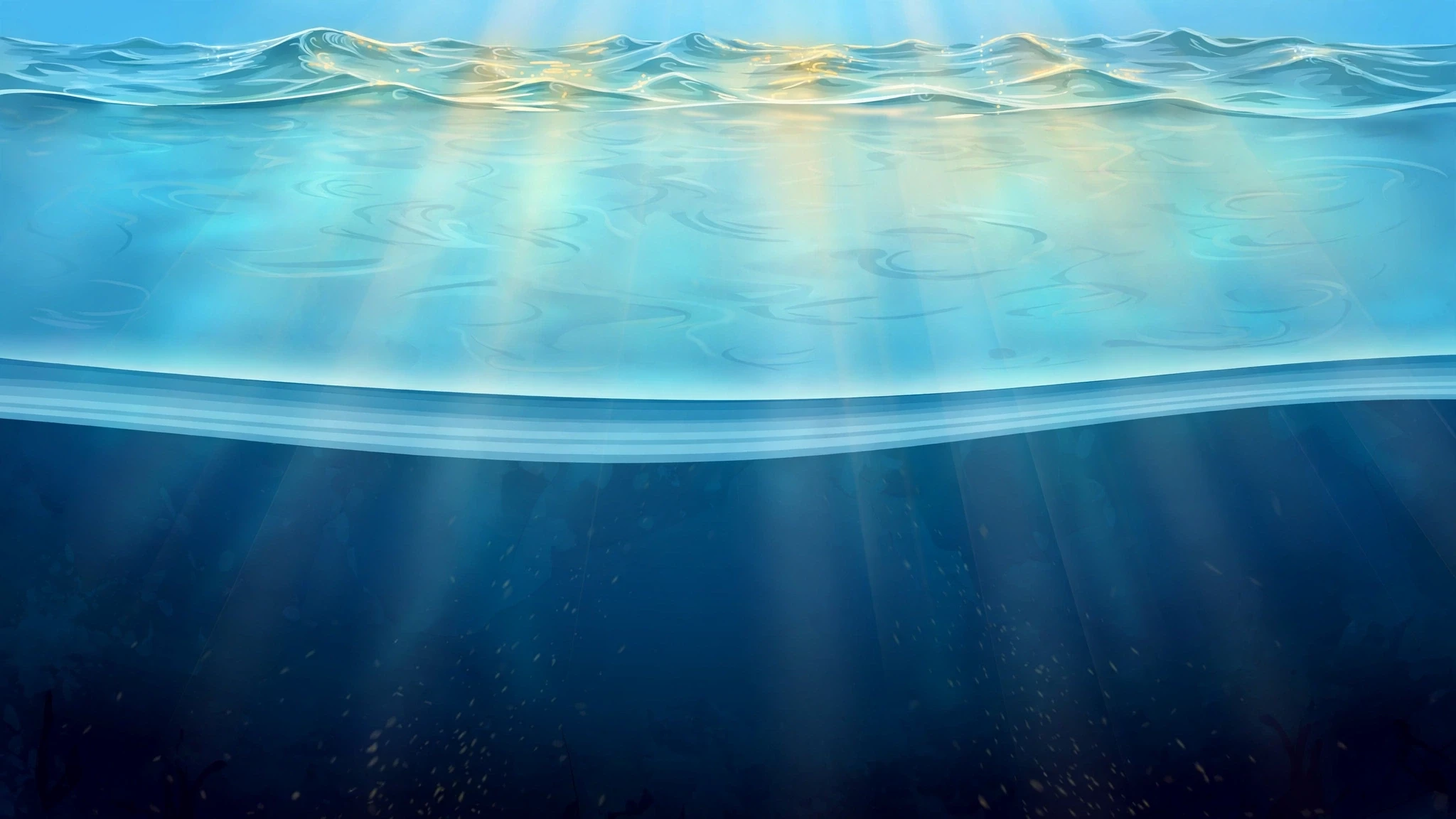
Temperature matters just as much. The surface ocean ranges from near freezing at the poles to above 30°C in the tropical shallows, while the deep ocean, below about a kilometre, sits quietly between 0 and 4°C almost everywhere on Earth. Sunlight warms only the top layer. Below it, the water is cold, dark, and barely mixed with the surface at all. That separation is one of the most important facts in oceanography, and it is easy to miss if you think of the sea as one mixed body of water. It is not. It is a warm skin stretched over a cold, dark interior, and the boundary between the two — the thermocline — is where much of the ocean's story happens.
2.2 Density: the hidden engine
Warm water is light; cold water is heavy. Fresh water is light; salty water is heavy. Put the two together and you have the rule that runs the deep sea: water sinks when it gets cold enough, or salty enough, to be denser than the water beneath it. That simple rule drives a circulation that takes a thousand years to complete a loop, and it is the reason the deep ocean is not a stagnant pond. It is a slow, planetary-scale overturning, powered by cooling and freezing at the poles.
I learned how counter-intuitive density can be during a field course early in my career, when a student asked why the coldest, saltiest water in the North Atlantic sinks instead of just sitting there, cold and salty, on top. We set up a tank with two layers — warm fresh water on top, cold salty water dyed blue below — and then cooled the surface. The moment the surface water got dense enough, it plunged in a thin, blue finger, straight down through the warm layer, as if someone had pulled a plug. The student laughed. "It just falls," she said. "It falls through water." That is exactly what happens in the real ocean, on a scale of whole seas. Cold, salty water in the North Atlantic and around Antarctica falls, and in falling, it pulls the whole deep circulation behind it.
2.3 The layers of the sea
Oceanographers divide the water column into layers by how temperature changes with depth. At the top is the surface mixed layer, usually the top few dozen to two hundred metres, stirred by wind and waves so that its temperature and salinity stay fairly uniform. Below it lies the thermocline, a band where the temperature drops sharply with depth — often by ten degrees or more over a few hundred metres. Below the thermocline, the deep ocean stretches down to the seafloor, cold and nearly uniform. In the tropics, the thermocline is sharp and shallow, and it acts like a lid: warm, nutrient-poor water sits on top of cold, nutrient-rich water, and the two barely mix. In polar waters, where the surface is already cold, there is almost no thermocline at all, and the water column can mix from top to bottom.
This layering is why the same ocean can look so different from place to place. Tropical surface waters are warm, clear, and blue — and often poor in nutrients, because the thermocline keeps the deep nutrients locked away. Polar waters are cold, green, and rich, because winter mixing brings nutrients up to the light. If you have ever wondered why the clearest tropical water holds the fewest fish, while the murky green water of a cold coast teems with them, the thermocline is a large part of the answer.
3. Surface Currents and the Great Gyres
3.1 Wind draws the map
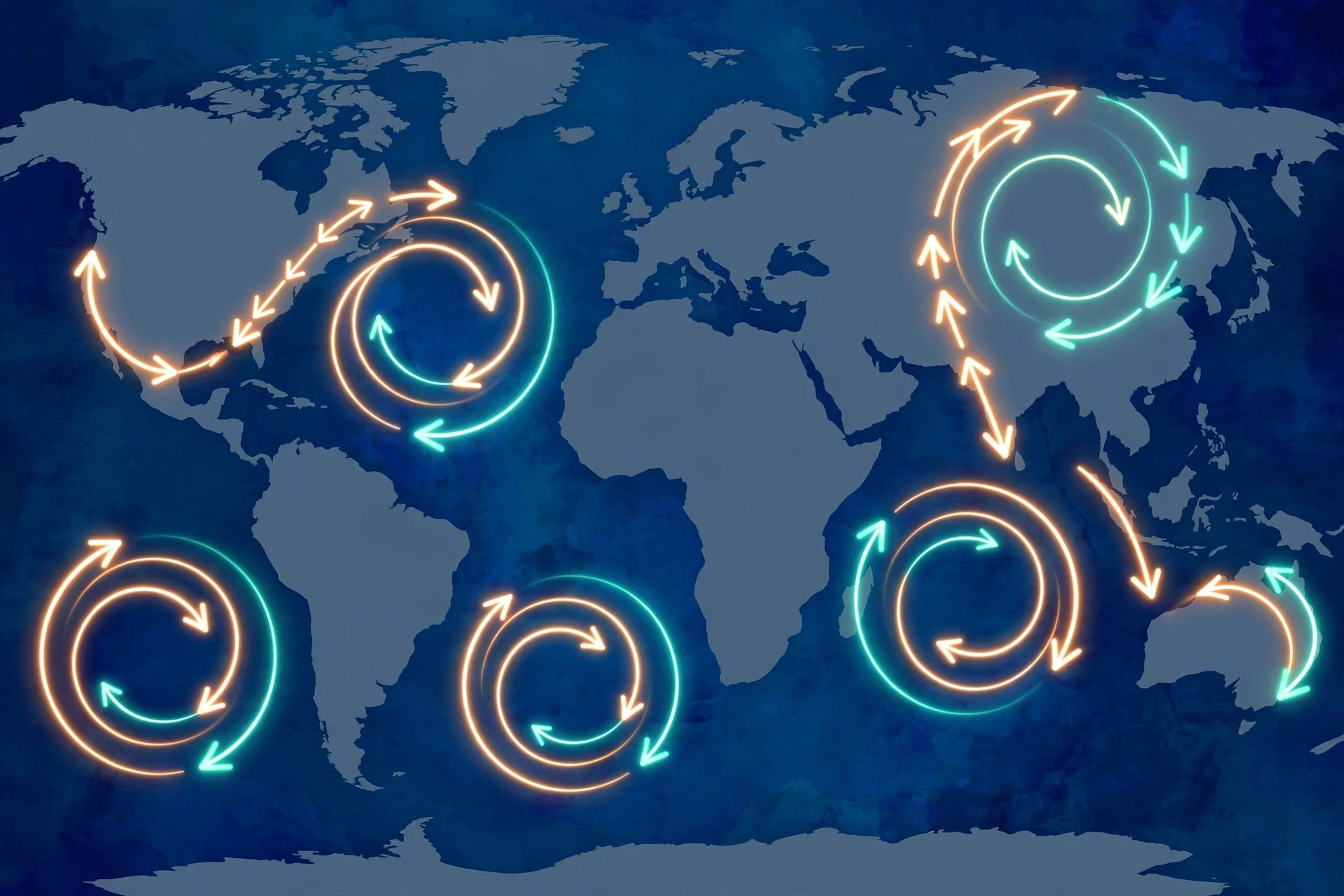
The surface of the ocean is moved mainly by wind. Trade winds blow steadily toward the equator, westerlies blow toward the poles, and where those winds drag across the water, they push the top hundred metres or so along with them. But the water does not move in the same direction as the wind. The Earth's rotation deflects moving water — to the right in the Northern Hemisphere and to the left in the Southern Hemisphere — in what is called the Coriolis effect. The result is that surface water moves at an angle to the wind, and over a whole ocean basin, the deflected flows curl into vast, slow spirals called gyres.
There are five great subtropical gyres: the North and South Atlantic, the North and South Pacific, and the Indian Ocean gyre. Each one is a loop thousands of kilometres across, turning clockwise in the north and anticlockwise in the south. The water in the middle of a gyre barely moves at all, and it is often the clearest, emptiest blue water on Earth — the Sargasso Sea, in the middle of the North Atlantic gyre, is so still and clear that sailors once feared their ships would be trapped in its weed. Around the edges of each gyre, the currents run fast and narrow, like rivers.
3.2 The Gulf Stream: a river in the sea
The most famous of those fast edge currents is the Gulf Stream. It begins in the Gulf of Mexico, squeezes through the Strait of Florida, and then runs north along the east coast of North America at speeds of up to two metres per second — faster than most rivers — before turning east across the Atlantic toward Europe. At its strongest, it carries roughly thirty times as much water as all the world's rivers combined, and it carries heat with it: warm tropical water, released into the air as it travels north, warming the coasts it passes.
The Woods Hole Oceanographic Institution describes ocean circulation as the flow of water throughout the world's oceans, a fundamental driver of Earth's climate that redistributes heat, cycles nutrients for marine life, and shapes the structure and health of ocean ecosystems: Woods Hole Oceanographic Institution — Ocean circulation. That is the right way to think about the Gulf Stream. It is not a curiosity for sailors. It is a climate machine, and its behaviour — where it meanders, where it sheds eddies, how fast it runs — shows up in weather forecasts, in fisheries, and in sea level along the American east coast.
I once tried to explain the Coriolis effect to a class using a spinning office chair and a ball, and the ball went everywhere except where I intended. The students laughed, and then one of them said the thing that actually made the idea click for everyone else: "So the Earth is turning underneath the water while the water tries to go straight." That is the heart of it. The water tries to go straight, the planet turns beneath it, and the mismatch bends the whole ocean into gyres. A simple idea, and it draws the map of every ocean on Earth.
3.3 Western boundary currents and their cold partners
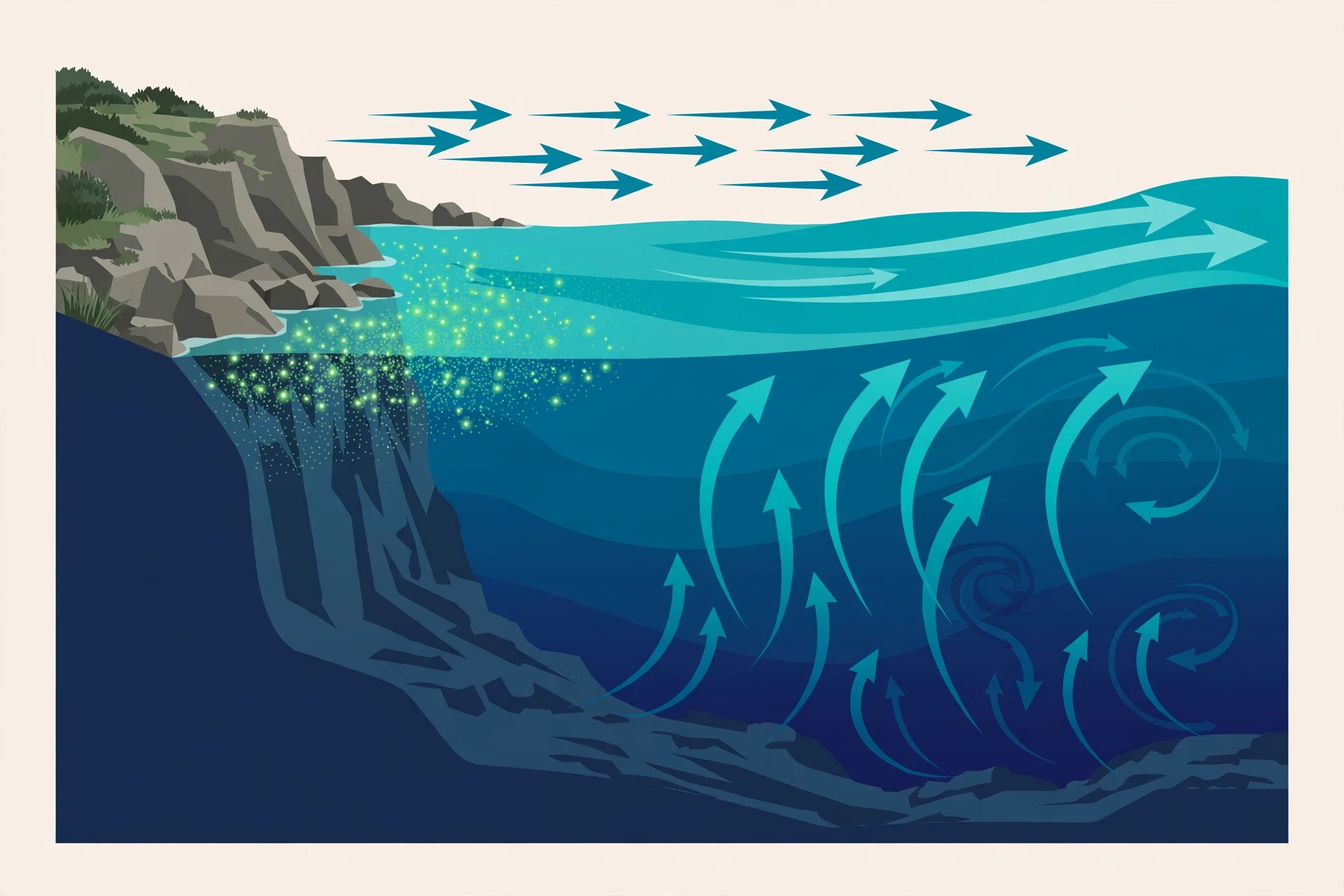
Every gyre has a fast, narrow current on its western edge and a slow, broad current on its eastern edge. The fast ones — the Gulf Stream in the Atlantic, the Kuroshio off Japan, the Brazil Current, the Agulhas off southern Africa, the East Australian Current — are warm, deep, and strong. The slow eastern ones — the Canary, the California, the Peru (Humboldt), and the Benguela currents — are cold, shallow, and wide. The cold ones matter enormously for life, because they bring deep water up toward the surface along coasts, and that upwelling feeds some of the richest fisheries on Earth, off Peru and California and Namibia.
There is a common misunderstanding here worth correcting directly. Most people assume ocean currents are mostly driven by wind, and that the wind is the whole story. The wind is the story of the surface, and only the surface. Below a few hundred metres, the wind barely reaches, and the ocean is moved by density — by cold, salty water sinking and by the slow pull of that sinking on the rest of the basin. The surface gyres and the deep circulation are two different machines, running at two different speeds, and they are connected in ways we are still working out. A guide that only talks about wind is telling half the story.
Current | Ocean and side | Warm or cold | What it does |
|---|---|---|---|
Gulf Stream | North Atlantic, west | Warm | Carries tropical heat north; warms western Europe |
Kuroshio | North Pacific, west | Warm | Carries heat past Japan; shapes East Asian weather |
California Current | North Pacific, east | Cold | Brings cool water south; supports rich fisheries |
Peru (Humboldt) Current | South Pacific, east | Cold | Drives upwelling; feeds the anchovy fishery |
Antarctic Circumpolar Current | Southern Ocean | Cold | The largest current on Earth; circles Antarctica |
4. The Deep Circulation: The Global Conveyor Belt
4.1 Water that falls
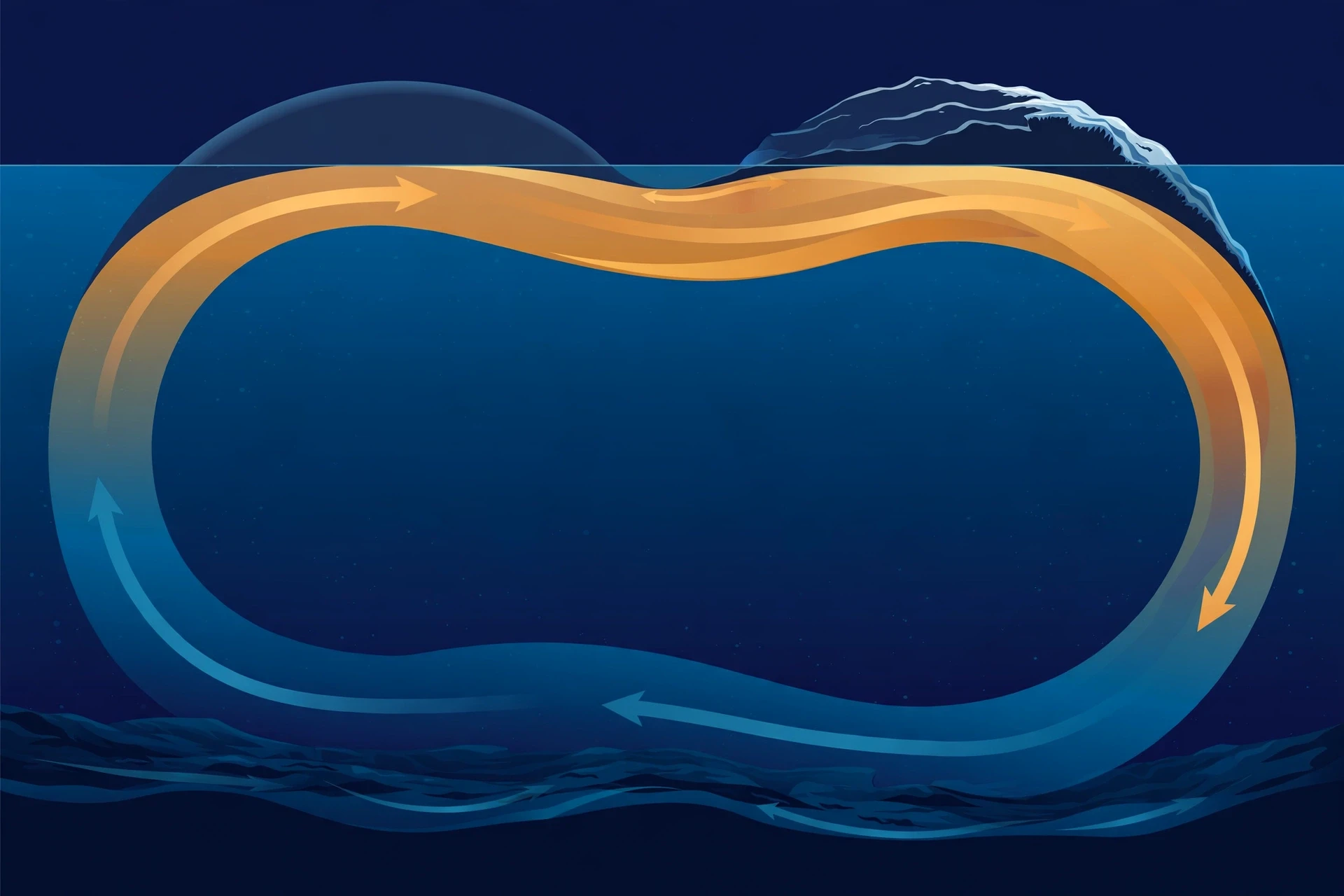
The deep circulation begins where surface water gets dense enough to sink. In the North Atlantic, near Greenland and in the Labrador Sea, winter cooling and the salt left behind when sea ice forms make surface water cold and salty — and heavy. It sinks, sometimes two or three kilometres down, and begins a slow journey south along the ocean floor, across the equator, and around the Southern Ocean, before rising again in the Pacific and Indian Oceans. In the Antarctic, similar sinking happens around the continent. The whole loop is called thermohaline circulation — thermo for temperature, haline for salt — and it is often drawn as a single great conveyor belt circling the globe.
The conveyor is slow. A parcel of water that sinks in the North Atlantic today may not return to the surface for a thousand years. That slowness is its power. As deep water creeps along the seafloor, it carries oxygen down into the dark, and it carries carbon and nutrients with it. When it finally rises again, far away and centuries later, it brings those nutrients back to the sunlit surface, where plankton can use them. The deep ocean is not a separate world from the surface. It is the same water, on a very long journey.
4.2 The Atlantic overturning — and why people worry about it
The Atlantic part of this system has its own name: the Atlantic Meridional Overturning Circulation, or AMOC. It is the engine that carries warm water north and returns cold water south, and it is one of the most watched systems in climate science. Measurements over the past decades suggest it has weakened, and models suggest that warming and freshening — from melting ice and extra rainfall in the far north — could weaken it further. If it slowed sharply, northern Europe would cool, tropical rainfall patterns would shift, and sea level along the American east coast would rise faster. How much, and how fast, is still being argued over, and the argument matters: the AMOC is one of the few parts of the climate system that could change abruptly rather than gradually.
I have sat in conference rooms where oceanographers argued about the AMOC with the intensity usually reserved for politics, and I understand why. The data are noisy, the system is huge, and the stakes are real. What struck me most was not the disagreement but the shared caution: nobody in that room wanted to be the person who cried wolf, and nobody wanted to be the person who missed the warning. Good oceanography lives in that tension — between what the measurements say and what they do not yet prove.
4.3 A thousand-year memory
Because the deep circulation is so slow, the deep ocean has a long memory. The water at three kilometres down today last saw the surface centuries ago, when the air above it held less carbon dioxide and the world was cooler. That is both a gift and a warning. It is a gift because the deep ocean has been quietly absorbing heat and carbon from the surface for decades, buffering the warming we would otherwise feel. It is a warning because that buffering is not free: the heat and carbon do not disappear. They are stored, and they will come back — slowly, over centuries — in water that rises to the surface warmer and more acidic than it was. The ocean remembers what we put into it, on timescales longer than a human life.
5. Waves, Tides, and Upwelling
5.1 Waves: energy travelling through water
A wave is not water moving forward. It is energy moving forward through water. Watch a floating bottle in a swell and you will see it rise and fall in place, going around in a small circle, while the wave itself rolls on. The water barely travels; the shape does. Most waves are made by wind blowing across the surface, and the longer and harder the wind blows, the bigger the waves get. A storm in the Southern Ocean can send swells across an entire ocean basin, arriving days later on a distant beach as smooth, rolling surf.
The biggest waves are not wind waves at all. Tsunamis are made when an earthquake or landslide suddenly moves a huge volume of water, and they travel at the speed of a jet aircraft across the open ocean, barely noticeable in deep water, before rearing up as they reach shallow coasts. Rogue waves — single waves far taller than those around them — were once dismissed as sailor's tales, and are now confirmed by satellite and buoy data. The ocean is honest about its extremes only when we measure them.
5.2 Tides: the Moon pulling the sea
Tides are the ocean's response to gravity — mostly the Moon's gravity, with a smaller contribution from the Sun. The Moon pulls the water on the side of the Earth facing it into a bulge, and inertia creates a second bulge on the opposite side, and as the Earth turns through those bulges, coasts see two high tides and two low tides each day. When the Sun, Moon, and Earth line up, at new and full moons, their pulls add together and the tides are at their highest and lowest — spring tides. When they are at right angles, the tides are at their smallest — neap tides.
The size of a tide depends on the shape of the coast as much as on the Moon. In the Bay of Fundy in Canada, the funnelling shape of the bay amplifies the tide to more than fifteen metres — the largest in the world — while in the Mediterranean, the tide barely moves a few tens of centimetres. Sciory's guide to our solar system follows the Moon itself, whose gravity does this pulling, and whose distance and orbit set the rhythm of every tide on Earth.
5.3 Upwelling: the ocean feeding itself
Where wind blows surface water away from a coast, cold deep water rises to replace it. That is upwelling, and it is one of the most productive processes in the sea. The rising water brings dissolved nutrients — nitrate, phosphate, silicate — from the dark depths into the sunlight, where phytoplankton bloom, zooplankton graze, and fish gather in numbers that support whole fishing industries. The waters off Peru, California, Namibia, and the Arabian Sea are upwelling zones, and though they cover a tiny fraction of the ocean's surface, they produce a large share of the world's fish catch.
Upwelling is also fragile. During El Niño, the winds off Peru weaken, upwelling slows, the surface warms, and the anchovy fishery — one of the largest on Earth — can collapse within a season. Seabirds starve, fishing boats sit idle, and the effects ripple through the food web to the penguins and sea lions that depend on the same fish. I have watched fisheries scientists explain this to fishing communities, and the hardest part of the conversation is always the same: the fish did not leave because anyone overfished them that year. They left because the wind changed, thousands of kilometres away, and the ocean stopped feeding them.
6. The Depth Zones: From Sunlight to the Trenches
6.1 How light dies with depth
Sunlight is the first thing the ocean takes away. In clear water, useful light reaches about two hundred metres down. Below that, it fades fast — red light goes first, within the top few metres, which is why everything looks blue-green to a diver, and why a red fish at depth looks black. By a thousand metres, the last faint trace of sunlight is gone. Below that, the ocean is in permanent night, lit only by the animals themselves.
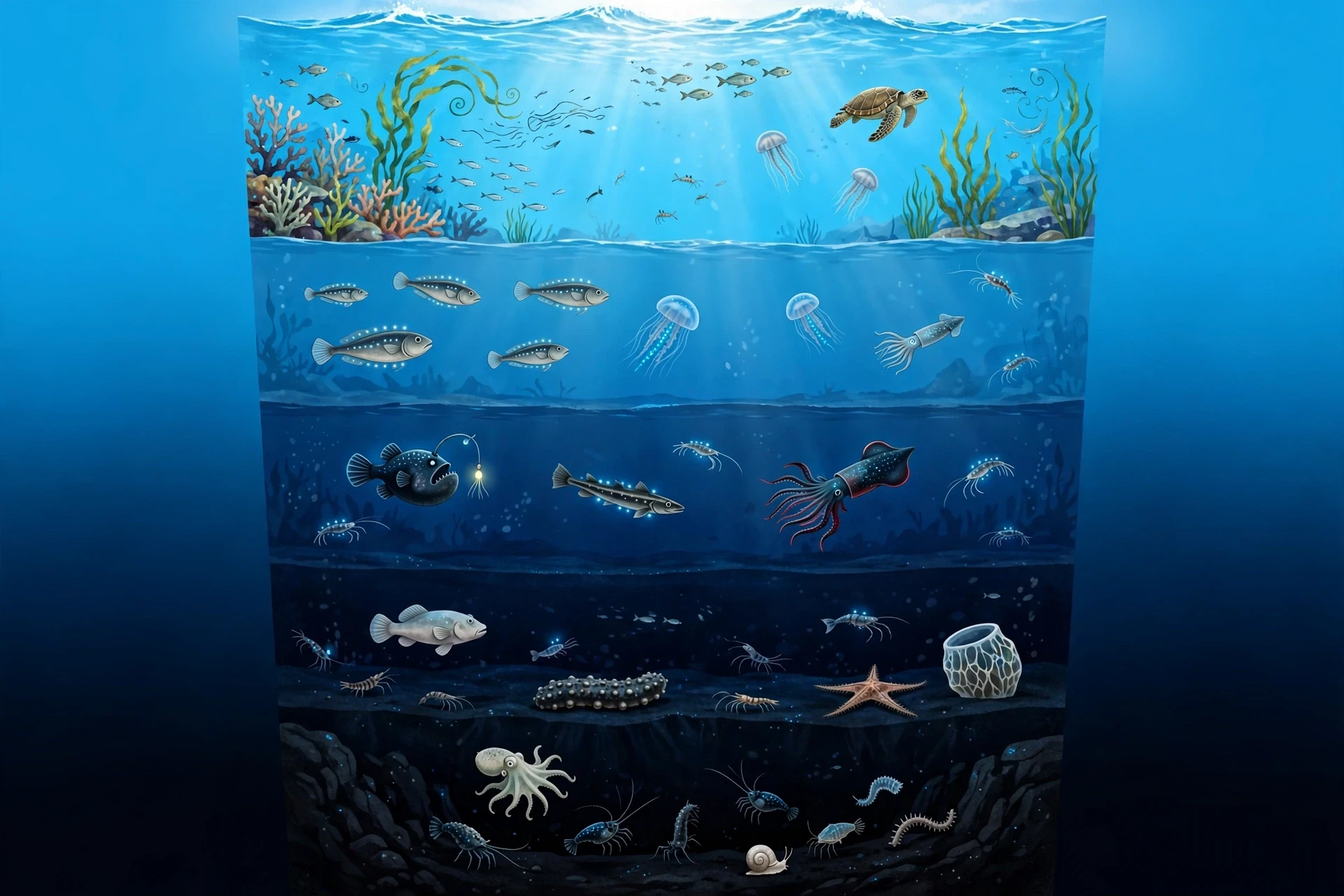
Oceanographers divide the open water — the pelagic zone — into five depth bands, each with its own light, temperature, pressure, and community of life. The names are worth learning, because they are the map of the ocean's vertical world: the epipelagic (sunlight) zone, the mesopelagic (twilight) zone, the bathypelagic (midnight) zone, the abyssopelagic (abyssal) zone, and the hadopelagic (hadal) zone of the trenches. Pressure rises by about one atmosphere for every ten metres of depth, so a creature in the midnight zone lives under a hundred times the pressure at the surface, and one in Challenger Deep under more than a thousand times — roughly the weight of fifty jumbo jets pressing on a person, if a person could survive there at all.
6.2 The zones, one by one
The epipelagic zone, from the surface to 200 metres, is the sunlight zone. It holds only about two percent of the ocean's volume, but it holds almost all of its photosynthesis, and nearly all of the life we ever see. Phytoplankton drift here, fish school here, whales feed here, and coral reefs grow here. It is warm, bright, and mixed by wind — and it is also where humans do almost all of our fishing, swimming, and damage.
The mesopelagic zone, from 200 to 1,000 metres, is the twilight zone. Light is faint, blue, and too weak for photosynthesis, but enough for eyes to work by. This is the world of the daily vertical migration — the largest migration on Earth, happening every night, in silence. Lanternfish and krill and squid rise hundreds of metres to feed in the rich surface waters under cover of darkness, then sink back down at dawn to hide from predators. The total mass of animals making that journey each night is staggering, and it is a major route by which carbon is carried from the surface into the deep.
The bathypelagic zone, from 1,000 to 4,000 metres, is the midnight zone. No sunlight at all. Temperatures hover around 4°C. Food is scarce, arriving mainly as marine snow — the slow rain of dead plankton, faecal pellets, and debris drifting down from above. Animals here are often black or red (invisible in the dark), many make their own light, and many have enormous mouths and expandable stomachs, because a meal may not come again for weeks. Anglerfish dangle glowing lures in front of jaws full of teeth. Gulper eels unhinge their jaws to swallow prey larger than themselves.
The abyssopelagic zone, from 4,000 to 6,000 metres, is the abyss — the vast, flat floor of the deep sea, cold, dark, and under crushing pressure. Life is sparse but persistent: sea cucumbers, brittle stars, and strange, slow-moving fish pick through the sediment for whatever falls from above. And the hadopelagic zone, below 6,000 metres, is the world of the trenches — narrow, steep-sided canyons in the seafloor, including Challenger Deep at nearly 11,000 metres. Only a handful of people have ever been there, in submersibles built like small spacecraft, and what they found was not emptiness: amphipods, snailfish, and microbes, living in water that has never seen the sun.
The deep sea is not a desert. It is a different kind of abundance — slow, sparse, and patient, built on falling snow instead of sunlight, and it covers more of the planet's surface than all the land put together.
Depth zone | Depth | Light | Temperature | Typical life |
|---|---|---|---|---|
Epipelagic (sunlight) | 0–200 m | Full sunlight | Warm, varies | Phytoplankton, coral reefs, most fish, whales |
Mesopelagic (twilight) | 200–1,000 m | Faint blue light | Falling fast | Lanternfish, krill, squid, bioluminescent animals |
Bathypelagic (midnight) | 1,000–4,000 m | None | Around 4°C | Anglerfish, gulper eels, viperfish, jellyfish |
Abyssopelagic (abyssal) | 4,000–6,000 m | None | Near freezing | Sea cucumbers, brittle stars, rattail fish |
Hadopelagic (hadal) | Below 6,000 m | None | Near freezing | Amphipods, snailfish, microbes in trenches |
6.3 The seafloor zones
The depth zones of the open water have a counterpart on the bottom. The continental shelf, the gently sloping edge of the continents, lies under less than 200 metres of water and is the most productive part of the seafloor. Beyond the shelf break, the continental slope drops steeply to the abyssal plain — a vast, flat expanse three to six kilometres down that covers more of the Earth's surface than all the continents combined. Rising from the plains are seamounts, underwater volcanoes that act as oases, gathering currents and life around their slopes. And cutting through the plains are the trenches, where one tectonic plate dives beneath another, carrying water and sediment down into the Earth itself.
7. Marine Ecosystems: Where Life Gathers
7.1 The base of everything: plankton
Every marine ecosystem, from a coral reef to a trench, rests on the same foundation: plankton. Phytoplankton — microscopic, single-celled plants — drift in the sunlight zone and turn sunlight, carbon dioxide, and nutrients into living matter. They produce roughly half the oxygen in the atmosphere, and they are the first link in nearly every ocean food chain. Zooplankton — tiny animals, from copepods to the larvae of fish and crabs — graze on them. Small fish eat the zooplankton, bigger fish eat the small fish, and so the chain runs upward to tuna, sharks, and whales.
The chemistry of that first step is photosynthesis, the same process that powers a forest, running in cells too small to see. Sciory's guide to photosynthesis follows the equation and the machinery in detail — and the ocean is where that machinery does most of its work on Earth, in a volume of water so large that its total production rivals all the land plants put together.
7.2 Coral reefs: cities in the shallows
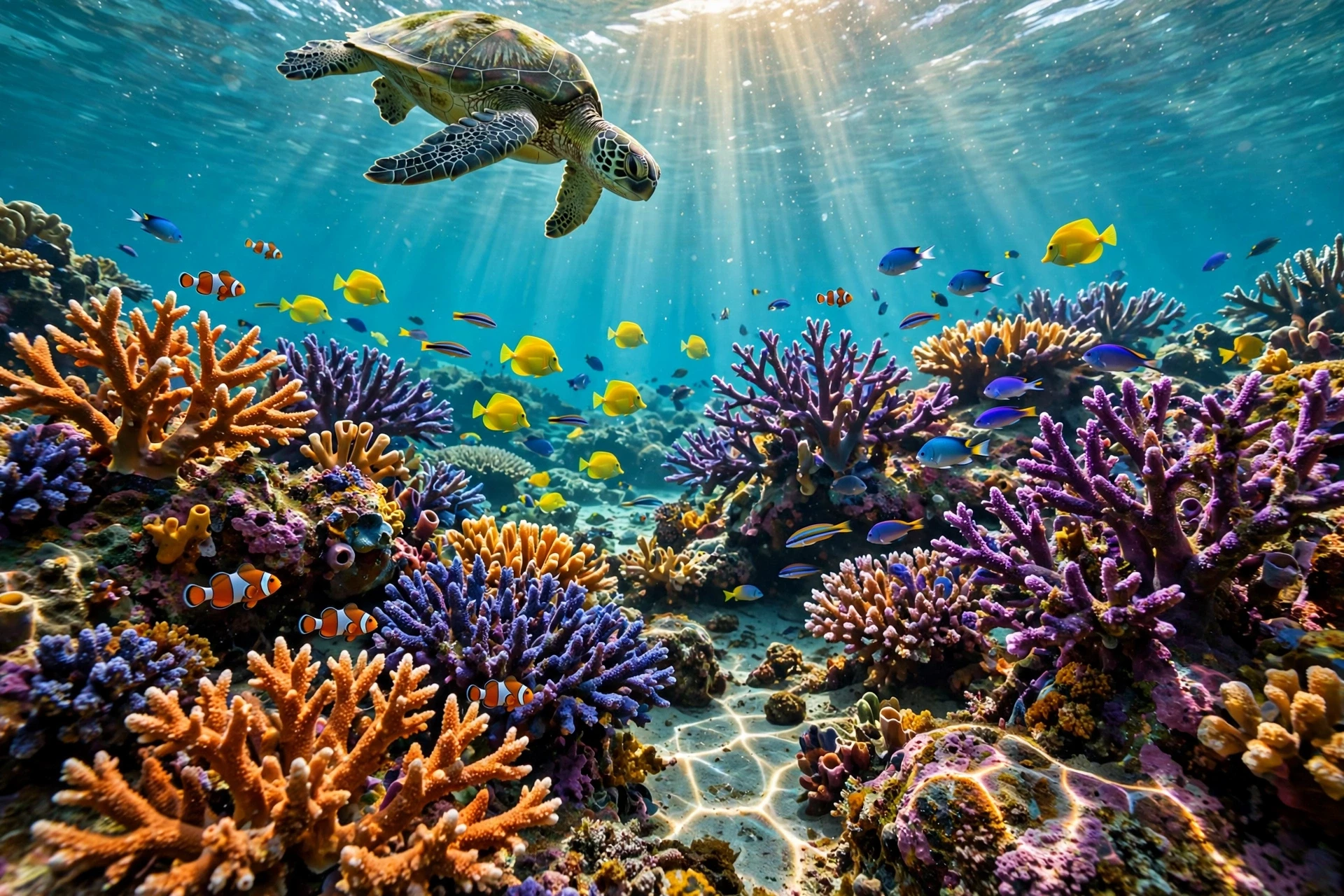
Coral reefs are the most diverse marine ecosystems on Earth, and they are built by animals. A coral is a colony of tiny polyps, each one secreting a limestone skeleton, and together they build structures large enough to be seen from space. The Great Barrier Reef stretches for more than 2,300 kilometres. Reefs cover less than one percent of the ocean floor, yet they support about a quarter of all marine species — a concentration of life unmatched anywhere else in the sea.
The secret of a reef is a partnership. Coral polyps host microscopic algae, zooxanthellae, inside their tissues. The algae photosynthesise and share sugars with the coral; the coral provides shelter and nutrients in return. That is why reefs grow only in warm, clear, sunlit shallows: the algae need light. And it is why reefs are so vulnerable. When the water gets too warm, the coral expels its algae, turns white — bleaching — and if the heat lasts, it starves. NOAA's fisheries scientists describe coral reefs as home to a quarter of all marine species while covering only about one percent of the planet, and warn that warming seas are driving bleaching and destruction of these vital habitats: NOAA Fisheries — Understanding Our Changing Climate. Restoration work is now under way on reefs around the world, from coral gardening to breeding heat-tolerant corals, and NOAA's coral restoration programme lays out why that work matters — reefs provide food, livelihoods, and coastal protection for hundreds of millions of people: NOAA Fisheries — Restoring Coral Reefs.
I snorkelled over a reef for the first time as a student, and I remember the shock of the noise as much as the colour — the reef was loud, crackling with the sound of shrimp and fish, like a radio tuned between stations. Years later I returned to a reef I had loved and found it pale and silent, bleached by a heatwave. The contrast was the most direct lesson in climate change I have ever had. It was not a graph. It was a place I knew, gone quiet.
7.3 Kelp forests, mangroves, and the open ocean
Reefs are not the only crowded neighbourhoods. Kelp forests grow along cold, rocky coasts, their fronds rising thirty metres from the seafloor like an underwater forest, sheltering sea otters, abalones, and schools of fish. Mangrove forests grow where land meets sea in the tropics, their roots trapping sediment and sheltering the young of reef fish. Seagrass meadows, less famous, store carbon in their sediments at rates that rival forests on land.
The open ocean, by contrast, is a desert with oases. The surface waters of the subtropical gyres are clear, blue, and nearly empty of life — there is sunlight, but almost no nutrients. The oases are where currents meet, where upwelling brings nutrients up, and where fronts — boundaries between water masses — gather plankton and the animals that eat them. Whales, tuna, and seabirds all know where the fronts are. They follow them the way land animals follow rivers.
7.4 How many species, and how little we know
The variety of life in the sea is still being counted. Sciory's guide to biodiversity sets out what biodiversity means and why it matters — and the ocean is where that variety is at its strangest. About 230,000 marine species have been formally described, and researchers estimate the true number may be several times that. New species are described every year, many from the deep sea, where a single submersible dive can bring back animals no one has ever seen. The deep sea is the largest habitat on Earth, and it is also the least explored: more of the Moon's surface has been mapped in detail than the ocean floor.
8. The Deep Sea: Vents, Darkness, and Life Without Sunlight
8.1 The discovery that rewrote biology
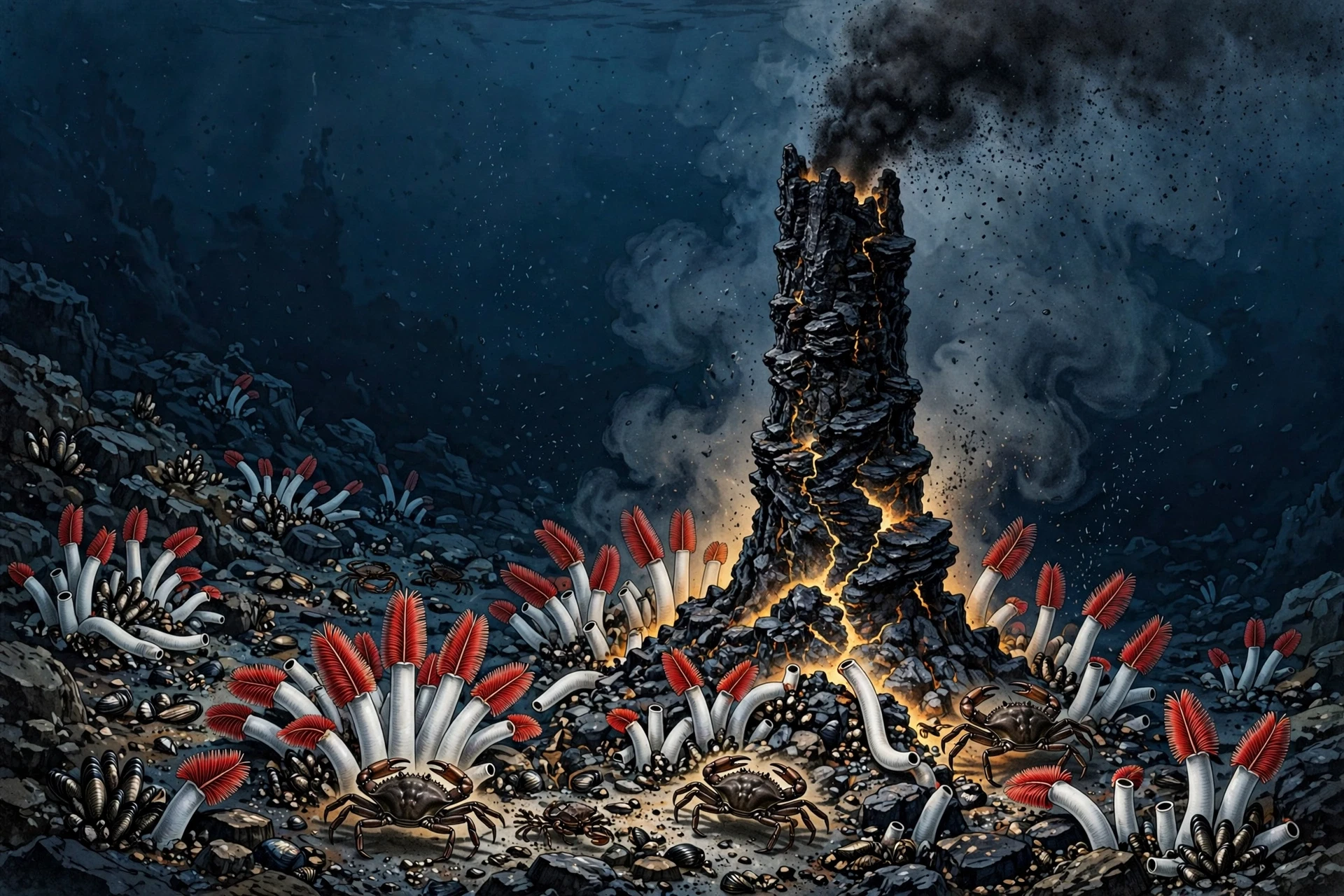
In 1977, scientists aboard the submersible Alvin were exploring a spreading ridge near the Galápagos Islands, looking for hot water venting from the seafloor. What they found instead rewrote biology. At a depth of 2,500 metres, in water that had never seen sunlight, they found dense communities of giant tube worms, huge clams, mussels, and crabs, clustered around chimneys of black, mineral-rich water. The discovery was so unexpected that the crew, who had brought no biologist and no specimen preservatives, reportedly used vodka from the ship's stores to preserve their samples. NOAA Ocean Exploration records that the 1977 sighting near the Galápagos was one of the most significant discoveries in the history of ocean science, and that the vents were surrounded by large numbers of organisms never before seen, thriving without sunlight: NOAA Ocean Exploration — Hydrothermal Vents.
The animals were not living on food drifting down from the surface. They were living on chemistry. Bacteria at the vents use hydrogen sulfide from the vent water as an energy source, turning carbon dioxide into organic matter in a process called chemosynthesis — the dark equivalent of photosynthesis. Those bacteria are the base of the vent food web, and they feed tube worms that have no mouth and no stomach, crabs, shrimp, and fish. The tube worm Riftia pachyptila, which can grow more than two metres long, has no digestive system at all: it houses chemosynthetic bacteria inside its body and lives off what they produce.
8.2 Black smokers and the plumbing of the planet
A hydrothermal vent forms where seawater seeps down through cracks in the ocean crust near a spreading ridge, is heated by magma to 300–400°C, and rises again, carrying dissolved minerals. When that superheated water meets cold seawater, the minerals precipitate out, building chimneys that can rise fifty metres from the seafloor and venting fluid that looks like black smoke — hence "black smokers". The water is so hot it would boil at the surface, but the pressure at that depth keeps it liquid.
Vents are also part of the planet's plumbing. Seawater circulates through the hot crust, exchanging chemicals with the rock, and the entire volume of the ocean is thought to pass through vent systems every ten to twenty million years. Vents regulate ocean chemistry, they helped form some of the great mineral deposits on land, and they are a reminder that the seafloor is not a passive floor. It is an active, volcanic landscape, and its story belongs with the volcanoes: Sciory's guide to volcanoes follows the same forces — magma, pressure, and eruption — where they break the surface on land.
8.3 The most common misconception about the deep sea
Most people assume the deep sea is a lifeless desert, a cold empty place where nothing much happens. What the data actually show is the opposite. The deep sea is the largest ecosystem on Earth, and it is full of life — just life that runs slowly, on a different energy budget. A single whale fall — a dead whale sinking to the seafloor — can feed a community of scavengers, worms, and bone-eating bacteria for decades. Cold seeps, where methane and oil leak from the sediment, support chemosynthetic communities of their own. Seamounts gather life around them. The deep sea is not empty. It is patient, and it is mostly unexplored, which is not the same thing at all.
Life does not need sunlight. It needs an energy gradient — a difference it can exploit — and the deep sea offers heat, chemistry, and falling food in place of light.
9. The Ocean and the Climate
9.1 The great heat store
The ocean has absorbed more than ninety percent of the extra heat trapped by greenhouse gases since the 1970s. Without it, the air would have warmed far faster than it has. The surface ocean has warmed by roughly a degree in places, and the warming is now reaching deeper, year by year. That stored heat does not vanish. It raises sea level as water expands, it fuels stronger storms, and it shifts the currents and ecosystems described in this guide.
Sea level is rising for two reasons at once: water expands as it warms, and land ice melts and runs into the sea. The rate has accelerated in recent decades, and it is now measured by satellites to the millimetre. For low-lying coasts and island nations, a few tens of centimetres is the difference between a habitable shoreline and a flooded one. The ocean is not rising everywhere at the same rate, either: currents, winds, and the gravitational pull of melting ice sheets all make the rise uneven, so some coasts see more than the global average and some see less.
9.2 Carbon, acid, and the changing chemistry
The ocean absorbs about a quarter of the carbon dioxide humans release, and that absorption comes at a chemical cost. Dissolved carbon dioxide forms carbonic acid, and seawater pH has fallen measurably since the industrial era began — a change called ocean acidification. The shift sounds small, a tenth of a pH unit or so, but pH is a logarithmic scale, and the change means the water is about a quarter more acidic than it was. For corals, shellfish, and the plankton that build shells from calcium carbonate, that makes life measurably harder: shells grow thinner, skeletons grow slower, and in the most affected waters, shells can begin to dissolve.
The biological pump is the ocean's other carbon service. Phytoplankton take up carbon at the surface, and when they die or are eaten and excreted, some of that carbon sinks into the deep ocean, where it stays for centuries. Anything that changes the plankton — warming, acidification, changes in nutrient supply — changes how much carbon the ocean can store. The ocean is not a passive sponge. It is a living system, and its capacity to help us is tied to its health.
9.3 El Niño, La Niña, and the ocean's moods
The tropical Pacific swings between two states. In El Niño, the trade winds weaken, warm water spreads east across the Pacific, upwelling off South America slows, and rainfall patterns shift worldwide — drought in some places, floods in others. In La Niña, the winds strengthen, cold water wells up, and the pattern flips. These swings happen every few years, they are natural, and they are the largest year-to-year influence on global weather. They are also a preview of how sensitive the whole system is to a degree or two of ocean temperature: a small change in the sea, a large change in the sky.
10. How Oceanographers Study the Sea
10.1 Ships, floats, and satellites
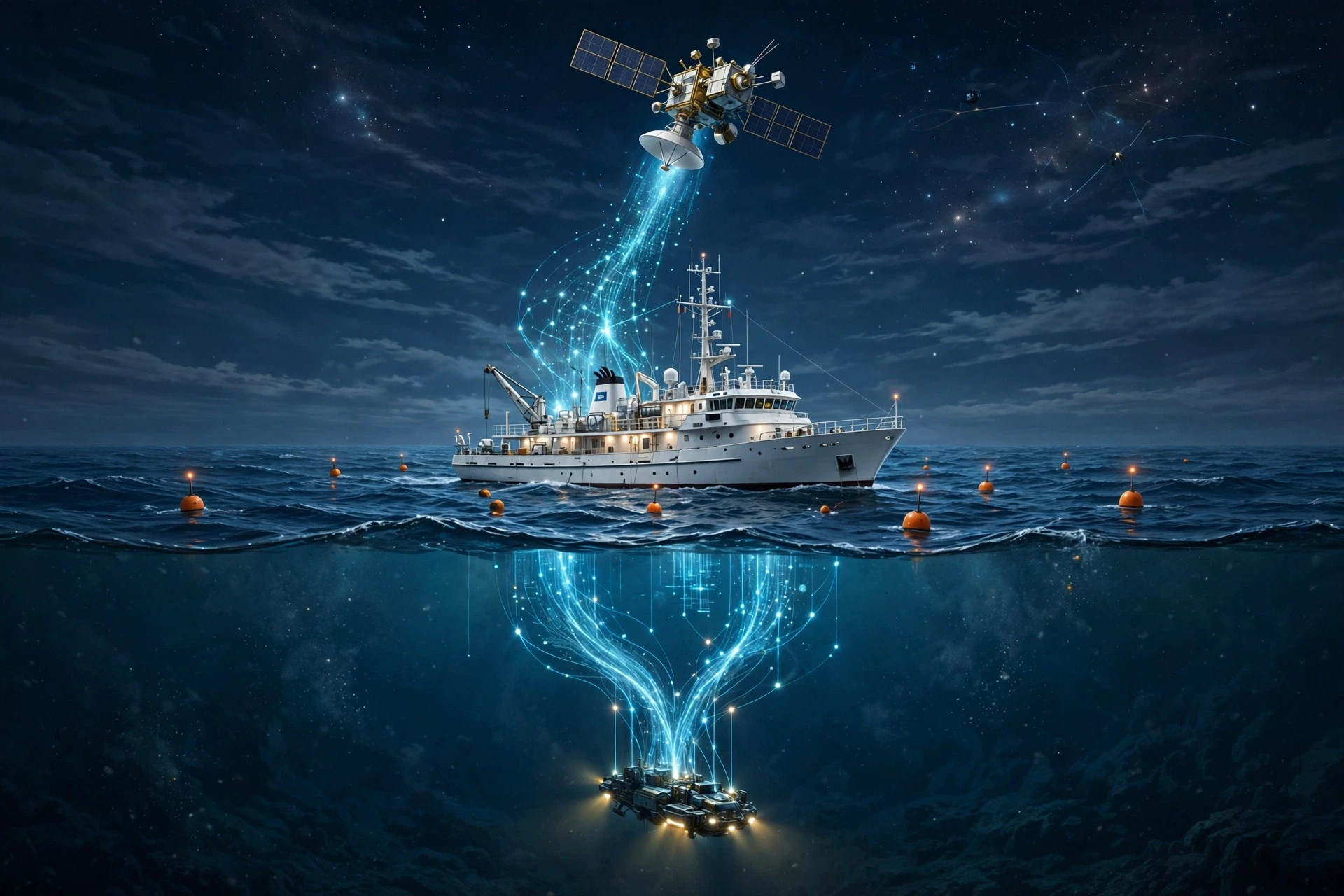
Modern oceanography runs on three kinds of eyes. Research ships still do the hard work: lowering instruments on cables, taking water samples, and putting people and submersibles into the water. But ships are expensive and slow, so most of the ocean is now watched by robots. The Argo fleet — nearly four thousand free-drifting floats — sinks to two kilometres, drifts for ten days, then rises, measuring temperature and salinity as it goes, and phones the data home by satellite. Together they profile the upper ocean every ten days, everywhere, in all weather.
From space, satellites measure sea surface temperature, sea level, ocean colour, and wind. Ocean colour is a direct window into life: satellites can see the green of chlorophyll in the surface water, and map plankton blooms as they spread and fade across whole ocean basins. Every one of those instruments — the floats, the satellites, the sensors on a ship's cable — runs on the same physics of charge and current that Sciory's guide to fundamentals of electricity explains, from the batteries in an Argo float to the solar panels on a research vessel. NASA's oceanography programme describes how satellite data and modelling now allow global mapping of seasonal changes in currents, phytoplankton, sea ice, and sea surface temperature — a view of the living ocean that no ship could ever give. The combination of ship, float, and satellite is what turned oceanography from a science of scattered expeditions into a science of continuous, planet-wide observation.
10.2 Submersibles and the last frontier
The deep sea is still visited mainly by machines. Remotely operated vehicles, tethered to a ship by a cable, carry cameras and manipulator arms to depths of six kilometres. Human-occupied submersibles — Alvin, and the newer vehicles that have reached Challenger Deep — carry scientists themselves down into the dark. Each dive still brings surprises: in 2023, researchers using the remotely operated vehicle Doc Ricketts found a colony of more than six thousand octopuses brooding their eggs around warm springs on an extinct volcano off California, a nursery no one had known existed. The deep sea keeps answering questions we have not yet learned to ask.
I watched a live feed from a remotely operated vehicle once, during a night shift in a shore-based control room, as the camera drifted over a seamount and a field of glass sponges came into view — animals like spun glass, standing in the dark, filtering water that had not seen the surface for centuries. Nobody in the room said anything for a while. Then someone whispered, "We are the first people to ever see this." That is the feeling that keeps oceanographers going back: the sense that the map still has blank spaces, and that the blank spaces are full of life.
11. Common Misconceptions About the Ocean — Corrected
"The ocean is one big, uniform body of water." It is layered, patchy, and structured — warm skin over cold depths, salty and fresh regions, currents like rivers, and zones that change completely within a few hundred metres of depth.
"Ocean currents are just wind." Wind drives the surface gyres, but the deep circulation is driven by density — cold, salty water sinking at the poles — and it moves on timescales of centuries, not days.
"The deep sea is a lifeless desert." It is the largest ecosystem on Earth, full of life adapted to darkness and pressure, from bioluminescent fish to chemosynthetic vent communities that never see the sun.
"Coral reefs are rocks or plants." Corals are animals, and reefs are built by colonies of tiny polyps in partnership with algae. They are living structures, and they can die.
"The ocean is too big for humans to change." The ocean has absorbed most of the extra heat and about a quarter of the carbon dioxide from human activity. It is changing measurably — warming, acidifying, and rising — and those changes are already visible in reefs, fisheries, and coasts.
"All the oxygen we breathe comes from forests." About half of it comes from the ocean — from phytoplankton, the microscopic plants drifting in the sunlit surface. The sea breathes for the planet as surely as any forest.
"We have explored the ocean." We have mapped the Moon in more detail than the ocean floor, and the deep sea remains the least explored habitat on Earth. Most of it has never been seen by anyone.
11.1 The questions that keep oceanographers awake
Three questions, above all, keep the field moving. How fast will the deep circulation change as the planet warms — gradually, or all at once? How much carbon can the ocean keep storing, and what happens to its ecosystems as it acidifies? And what lives in the deep sea that we have not yet found — how much of the largest habitat on Earth is still unknown? None of these has a final answer. All of them have ships, floats, satellites, and submersibles aimed at them right now. That is the honest state of the science, and it is also the exciting part. A finished science would have nothing left to discover. Oceanography is not finished.
Conclusion: A Planet Run by Water
The ocean is not scenery. It is the system that moves heat around the planet, breathes for the atmosphere, stores carbon for centuries, and holds more life — in stranger forms — than any other habitat on Earth. Its currents are rivers wider than continents. Its depth zones are worlds stacked on top of each other, each with its own light, pressure, and community. Its ecosystems run from sunlit reefs that you can snorkel over to vents in permanent darkness where life eats chemistry instead of light.
The next time you stand at the shore, look past the waves. Beneath the surface, a warm current may be carrying tropical heat toward a distant coast. A thousand metres down, lanternfish may be rising toward the surface for their nightly feed. Three kilometres down, water that last saw the sky centuries ago may be creeping along the seafloor, carrying oxygen and carbon on a journey that will not end for another thousand years. And somewhere in the dark, around a chimney of black smoke, tube worms with no mouths may be feeding on bacteria that eat sulfur. The ocean is the largest part of our planet, and we are only just learning to read it. That is not a reason for despair. It is the best reason there is to keep looking down.
Frequently Asked Questions
What is oceanography?
Oceanography is the scientific study of the ocean — its physics, chemistry, biology, and geology. It covers how ocean currents move, what seawater is made of, what lives in the sea, and how the seafloor is shaped, as well as how the ocean affects climate and weather.
How do ocean currents work?
Ocean currents are continuous movements of seawater driven by wind, temperature, salinity, and the Earth's rotation. Wind drives surface currents into great loops called gyres, while differences in temperature and salinity drive the deep circulation, where cold, dense water sinks at the poles and creeps along the ocean floor.
What is the Gulf Stream?
The Gulf Stream is a fast, warm western boundary current in the North Atlantic. It carries warm water from the Gulf of Mexico north along the east coast of North America and on toward Europe, warming the climates of the coasts it passes and strongly influencing weather in the North Atlantic region.
What are the five ocean depth zones?
The five pelagic depth zones are the epipelagic or sunlight zone (0–200 m), the mesopelagic or twilight zone (200–1,000 m), the bathypelagic or midnight zone (1,000–4,000 m), the abyssopelagic or abyssal zone (4,000–6,000 m), and the hadopelagic or hadal zone (below 6,000 m), which covers the deep trenches.
What lives in the midnight zone?
The midnight zone, from 1,000 to 4,000 metres, is home to animals adapted to total darkness and high pressure, including anglerfish with glowing lures, gulper eels, viperfish, and many bioluminescent jellyfish and squid. Food is scarce, so many animals have large mouths and expandable stomachs.
How does the ocean affect the climate?
The ocean absorbs and stores heat, moves warm water from the tropics toward the poles through currents like the Gulf Stream, absorbs about a quarter of human carbon dioxide emissions, and drives weather patterns through events like El Niño and La Niña. It has taken up more than ninety percent of the extra heat trapped by greenhouse gases.
What is a hydrothermal vent?
A hydrothermal vent is an opening on the seafloor where superheated, mineral-rich water rises from the ocean crust, often building tall chimneys called black smokers. Bacteria at vents use chemicals from the vent water to make food by chemosynthesis, supporting whole ecosystems in total darkness without any sunlight.
Why are coral reefs important?
Coral reefs cover less than one percent of the ocean floor but support about a quarter of all marine species. They provide food, livelihoods, and coastal storm protection for hundreds of millions of people, and they are among the most diverse ecosystems on Earth.
What is ocean acidification?
Ocean acidification is the fall in seawater pH caused by the ocean absorbing carbon dioxide from the atmosphere. The water has become measurably more acidic since the industrial era began, which makes it harder for corals, shellfish, and some plankton to build their calcium carbonate shells and skeletons.
How much of the ocean have we explored?
Very little of it in detail. More of the Moon's surface has been mapped than the ocean floor, and the deep sea remains the least explored habitat on Earth. Most of the deep ocean has never been directly observed, and new species are still discovered on nearly every research expedition.
Sources / Further Reading
Woods Hole Oceanographic Institution — Ocean circulation: https://www.whoi.edu/know-your-ocean/ocean-topics/how-the-ocean-works/ocean-circulation/
NOAA Ocean Exploration — Hydrothermal Vents: https://oceanexplorer.noaa.gov/fact-sheet/hydrothermal-vents-fact-sheet/
NOAA Fisheries — Understanding Our Changing Climate: https://www.fisheries.noaa.gov/insight/understanding-our-changing-climate
NOAA Fisheries — Restoring Coral Reefs: https://www.fisheries.noaa.gov/national/habitat-conservation/restoring-coral-reefs
Woods Hole Oceanographic Institution — Galápagos Rift vent discovery, 25th anniversary: https://www.whoi.edu/press-room/news-release/major-cruise-to-galapagos-rift-marks-25th-anniversary-of-deep-sea-hydrothermal-vent-discovery/