

Introduction
I was seven years old, standing at the top of a stone staircase in my grandmother's house, when I first ran a proper experiment on gravity — though I did not know that word for it yet. I held a tennis ball in one hand and a heavy iron key in the other, leaned over the banister, and let go of both at the same moment. I was certain the key would win. It was heavier, denser, obviously more serious about falling. Both hit the floor together with a single flat sound, and I stood there feeling cheated. Something I was sure I knew about the world had just turned out to be wrong, and the wrongness was delicious. I ran the test again. And again. Same result every time.
That small staircase test is the doorway into the strangest story in physics. How gravity works is a question with two great answers, given 228 years apart, and both of them are still in daily use. Isaac Newton told us how much gravity pulls, with a law so precise that we still steer spacecraft with it. Albert Einstein told us what gravity is, and his answer rewrote space and time themselves. Neither man finished the story. Physicists today are still trying to fit gravity together with quantum mechanics, still listening for ripples in space-time, and still arguing about what most of the universe's gravity is actually coming from.
This guide follows the whole arc. We will start with falling balls and the Moon, work through Newton's law and the tiny number that governs it, then step into Einstein's curved space-time, where planets orbit because they are following the straightest possible path through a bent universe. Along the way we will meet tides that rise twice a day, clocks that tick at different speeds depending on how high they sit, black holes where gravity wins completely, and a pair of detectors in Louisiana and Washington that heard two black holes collide 1.3 billion years ago. Gravity is the weakest of nature's forces, and it is also the one that built everything you can see.
1. How Gravity Works: The Short Answer
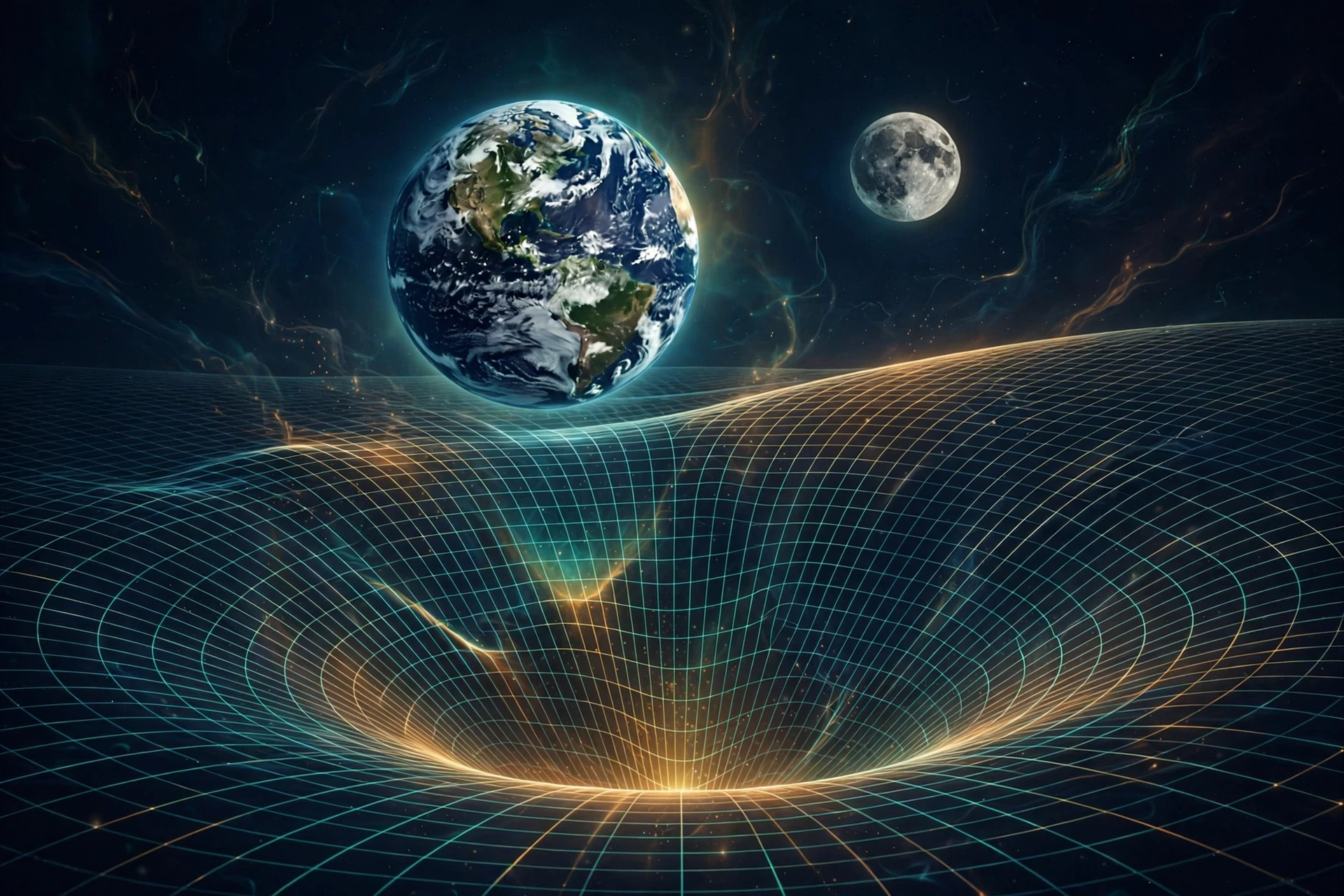
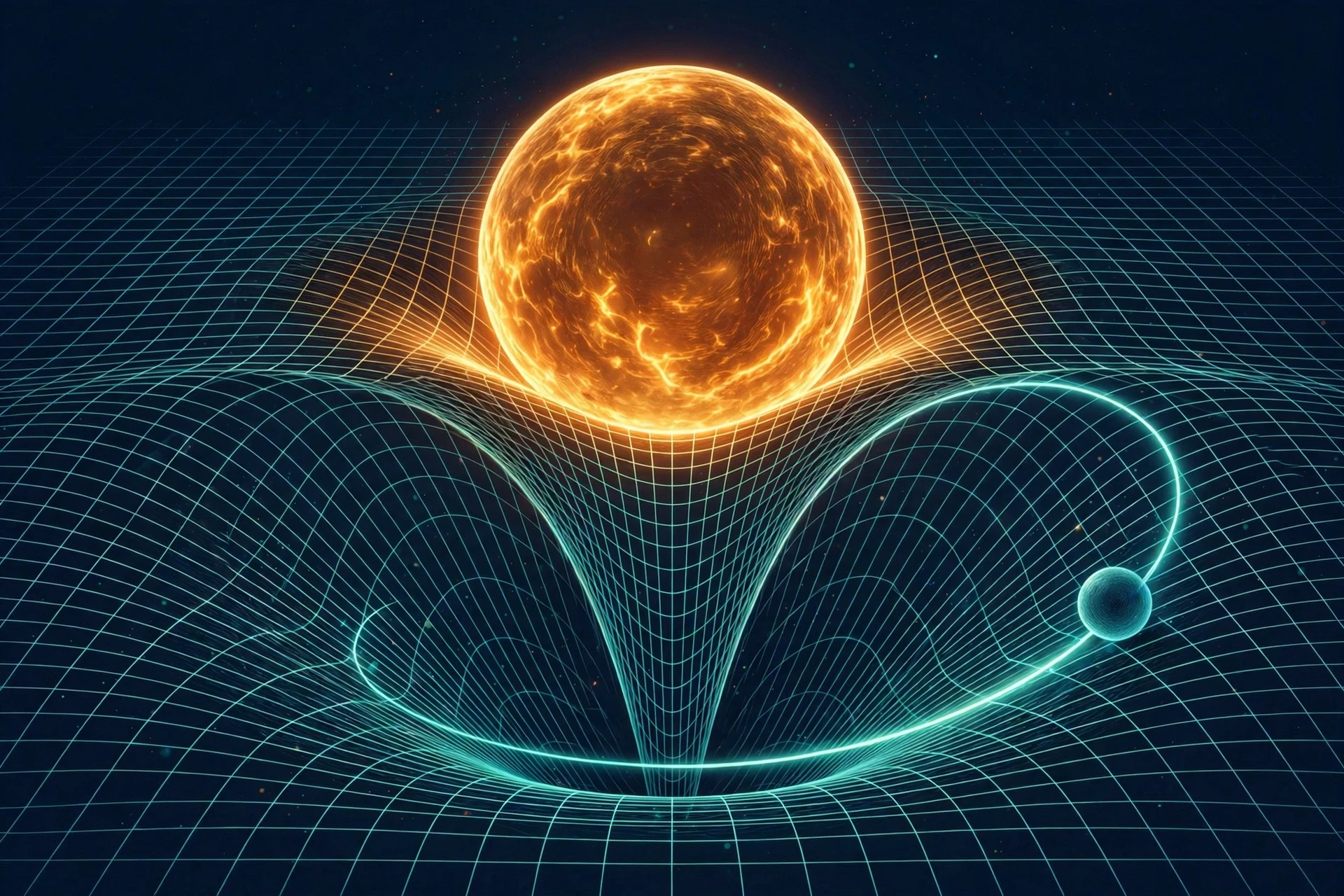
If you want the one-paragraph version before we go deeper, here it is. How gravity works depends on which layer of the story you ask about. In Newton's layer, every mass attracts every other mass, and the strength of that pull grows with the masses involved and shrinks fast — with the square of the distance — as they move apart. In Einstein's layer, that attraction is not a force reaching across empty space at all. Mass and energy curve space-time, and objects move along the curves. A planet does not orbit because the Sun is tugging on it like a rope. It orbits because the Sun has bent the space around it, and the planet is following the straightest path it can through bent space.
Both descriptions are true in their own domain, and that is the first surprise worth holding on to. Newton's law is not wrong; it is a limit of Einstein's theory, the version you get when gravity is weak and speeds are slow compared with light. Engineers planning a trip to Mars use Newton, because the numbers come out the same to many decimal places and the arithmetic is far simpler. Physicists pointing a telescope at a black hole use Einstein, because near a black hole Newton's numbers stop matching what the sky actually does.
Gravity is also, by a huge margin, the weakest of the four fundamental forces. A small fridge magnet can lift a paperclip off a table, beating the gravitational pull of the entire Earth on that clip. The reason gravity still rules the universe is that it has two properties no other force shares: it only ever attracts, never repels, and its reach never runs out. Electric charges cancel each other out in bulk matter, which is why large objects are electrically neutral. Mass never cancels. Add more mass and you only ever add more pull. Given enough mass and enough distance, gravity is the only force left standing, and it is the one that gathers gas into stars, stars into galaxies, and galaxies into clusters.
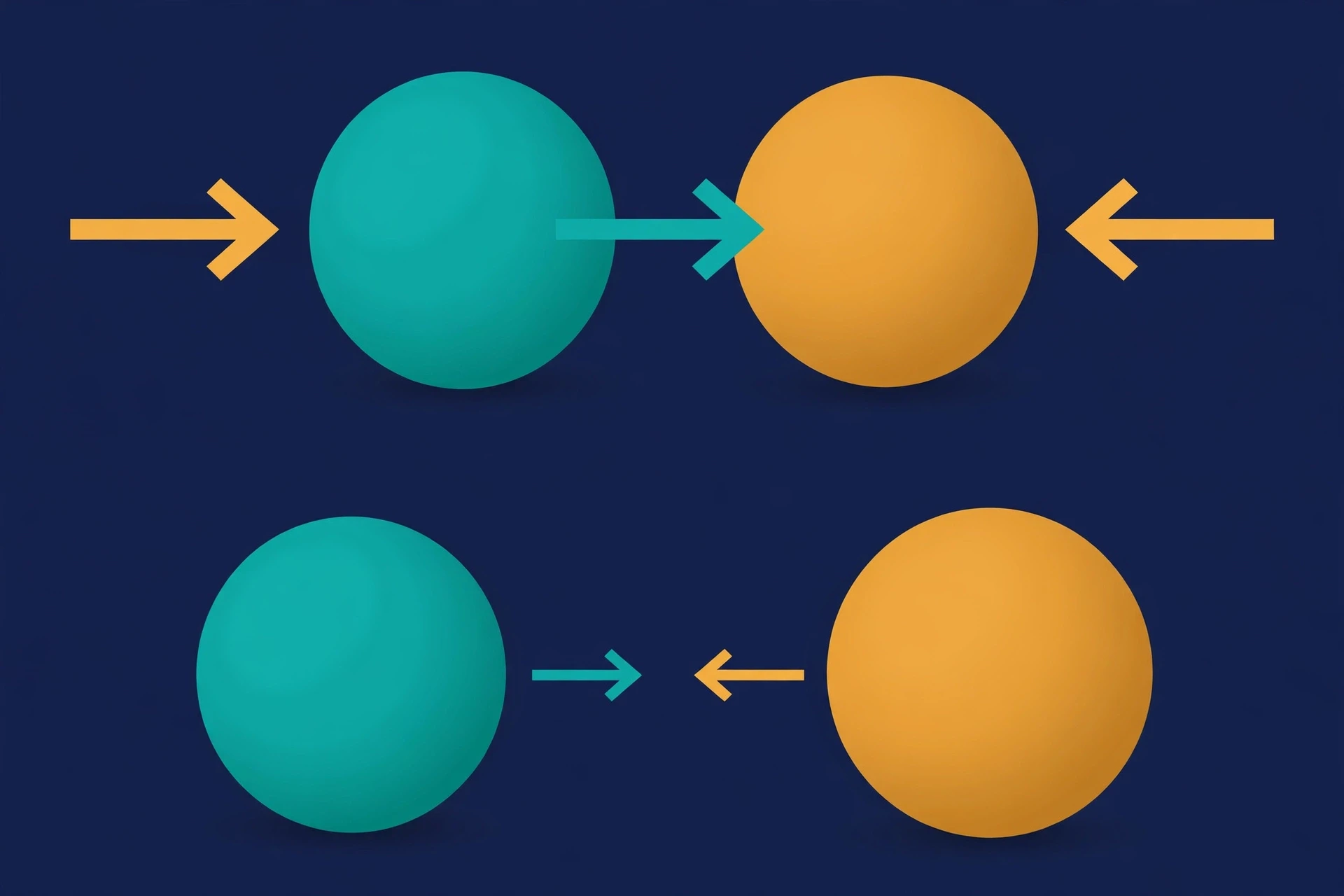
Mass sets how strongly an object curves space-time or pulls on its neighbours. Double the mass, double the pull.
Distance sets how fast that pull fades. Double the distance, and the pull drops to one quarter.
Everything with mass feels it. You pull on the Earth exactly as hard as the Earth pulls on you. You simply do not notice, because the Earth is so much heavier that almost all of the visible motion is yours.
2. Before Newton: Falling Things, Wandering Planets, and a Puzzle Nobody Could Solve
2.1 Aristotle's natural places
For nearly two thousand years, the best available answer to why things fall came from Aristotle. He taught that heavy objects have a natural place — the centre of the universe, which he took to be the centre of the Earth — and that they fall because they are seeking it. Fire rises because its natural place is up. It was a tidy, commonsense picture, and it matched what you see if you never measure anything carefully: heavy stones do fall faster than feathers, after all. The trouble was the air. A feather falls slowly because the air holds it up, not because it is less eager to reach the ground. Nobody in Aristotle's time had a vacuum pump to test that, so the picture survived on the strength of looking right.
I keep a version of that mistake in mind whenever I teach, because it is a useful warning. A theory can feel obvious, fit everyday experience, and still be wrong in the part that matters. Aristotle was not foolish. He simply did not have the tools to separate the pull of gravity from the push of air, and no one had yet thought to ask whether the Moon was falling too.
2.2 Galileo and the staircase test, done properly
Galileo Galilei did the experiment my seven-year-old self was fumbling toward, and he did it with a scientist's patience. Around 1600, he rolled balls down inclined planes — a way of slowing a fall down enough to time it with the crude clocks of the day — and found that the distance a ball travels grows with the square of the time it has been falling. Double the time, quadruple the distance. That pattern held whatever the ball was made of. Heavy and light balls accelerated at the same rate, once you allowed for air resistance. The famous story about him dropping balls from the Leaning Tower of Pisa may be legend, but the result is not: in the absence of air, a hammer and a feather fall side by side. Astronaut David Scott proved it on the Moon in 1971, dropping a hammer and a feather in the lunar vacuum and watching them land together on live television.
Galileo also turned his telescope to the sky and found moons circling Jupiter — four small points of light that changed position from night to night. That mattered more than it sounds. Here were bodies plainly orbiting something other than the Earth. The heavens were not a separate realm with separate rules. Whatever held Jupiter's moons in their paths might be the same kind of thing that held a stone to the ground.
2.3 Kepler's ellipses
Johannes Kepler, working from the painstaking naked-eye observations of Tycho Brahe, found the shape of planetary motion. Planets do not move in circles, as everyone had assumed since antiquity. They move in ellipses, sweeping out equal areas in equal times, and the square of a planet's orbital period is proportional to the cube of its average distance from the Sun. Kepler could describe the motion beautifully. He could not say why it happened. He guessed at a magnetic influence from the Sun, a force that weakened with distance, and he was reaching in the right direction. The mathematics to turn that guess into a law did not exist yet. Newton would have to invent it.
3. Newton: One Law for the Apple and the Moon
3.1 The leap
The story everyone knows is the apple. Newton, sitting in a garden at Woolsthorpe in 1666, watched an apple fall and wondered whether the force that pulled it down might reach all the way to the Moon. The story is probably embellished — Newton told versions of it late in life, and apple trees make good theatre — but the idea behind it is the real breakthrough. If the Moon is in free fall around the Earth, constantly falling toward us yet moving sideways fast enough to keep missing, then the apple and the Moon obey the same law. The sky and the ground are one system.
I still use that image in the first week of any course on gravity, because it does what a good scientific idea should do: it takes two things that looked unrelated and shows they are one thing. The first time I watched a class of students work through the numbers themselves — the Moon is about 60 Earth radii away, its inward acceleration is about 3,600 times smaller than the acceleration of a falling apple, and 60 squared is 3,600 — I saw the same look on their faces that I must have had on that staircase. A pattern clicks, and the world gets simpler and stranger at the same time.
3.2 The law itself
Newton published his law in 1687, in the Principia, and it can be written in one line:
F = G × (m1 × m2) / r²
The force between two masses is proportional to the product of their masses and inversely proportional to the square of the distance between their centres. The symbol G is the universal gravitational constant, a number so small — about 6.674 × 10⁻¹¹ in standard units — that the attraction between two people standing a metre apart is far too weak to feel. OpenStax's University Physics text walks through the same reasoning Newton used, from the Moon's orbit to the inverse-square rule, and it is worth reading alongside this section for the worked numbers: OpenStax — Newton's Law of Universal Gravitation.
Two consequences of that one line do most of the work in this article, so they are worth fixing in memory:
The inverse-square rule. Move twice as far away and the pull drops to a quarter. Move three times as far and it drops to a ninth. This is not a quirk of gravity; it is geometry. The influence of a point spreads over the surface of a sphere, and the area of that sphere grows with the square of its radius.
Equal and opposite. The Earth pulls on you with exactly the same force you pull on the Earth. The difference is acceleration: force divided by mass. Your mass is tiny, so you accelerate visibly. The Earth's mass is enormous, so its answering motion is immeasurably small — but it is real.
3.3 Weighing the Earth: Cavendish
Newton's law had a hole in it for more than a century. Nobody knew the value of G, so nobody could use the law to weigh the Earth or the Sun. In 1797–98, Henry Cavendish filled the hole with one of the most delicate experiments in the history of science. He hung small lead balls from a fine wire, placed large lead spheres near them, and measured the tiny twist the gravitational attraction produced in the wire. The forces involved were roughly the weight of a grain of sand. Passing carts outside his laboratory could swamp the signal. Cavendish worked in a sealed room, read his instruments through a telescope from outside, and got a value for G within about one per cent of the modern figure. With G known, the mass of the Earth followed at once: about 5.97 × 10²⁴ kilograms.
Cavendish called it "weighing the Earth," and the phrase is fair. Once you know G and the Earth's radius, the mass of the planet is arithmetic. The same trick, run in reverse, lets astronomers weigh the Sun, the planets, and distant stars, by watching how fast things orbit them. Every mass in astronomy is, at bottom, a Cavendish-style measurement: watch the orbit, apply Newton's law, read off the mass.
3.4 What Newton got right — and what he left unanswered
Newton's law explained the tides, the orbits of the planets, the return of Halley's comet (predicted for 1758, fifty years after Newton, and it came back on schedule), and the shape of the Earth itself, slightly flattened at the poles by its spin. It was the first theory in history to unite heaven and Earth under a single rule, and it worked so well that for two centuries it looked final.
Newton himself was less satisfied than his admirers. He could describe the pull with exquisite precision, but he could not say how it crossed empty space. How does the Sun pull on the Earth across 150 million kilometres of nothing, instantly, with no rope and no medium? He refused to invent an answer, writing in Latin that he framed no hypotheses about the mechanism. That honesty is one of the great moments in science: a theory can be exactly right about what happens and silent about why, and the silence is a problem worth leaving open for the next century to solve.
4. Weight, Mass, and the Art of Falling Without Landing
4.1 Weight is not mass
Most people use the words weight and mass as if they were the same thing. In physics they are different, and the difference is the key to everything that follows. Your mass is the amount of matter in you; it is the same on Earth, on the Moon, and in deep space. Your weight is the force gravity exerts on that mass, and it changes with where you stand. On the Moon, where gravity is about one-sixth as strong as on Earth, you would weigh one-sixth as much and be able to leap six times as high, while your mass stayed exactly the same.
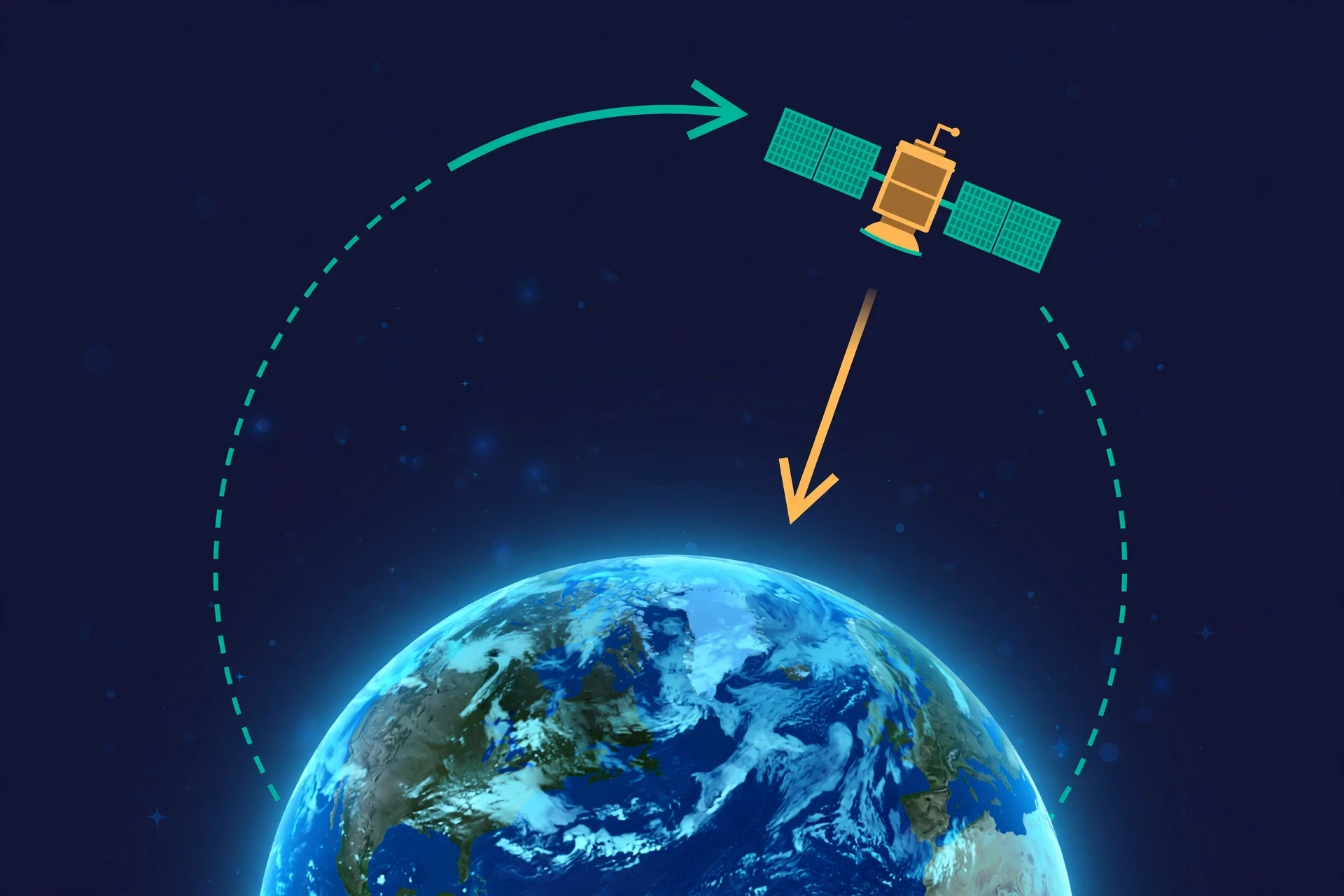
This is also why astronauts in orbit are weightless without being free of gravity. The International Space Station circles the Earth at about 400 kilometres up, where gravity is still roughly 90 per cent as strong as at the surface. The astronauts float because they are in free fall — falling toward the Earth at exactly the rate the station falls, so nothing presses them against a floor. Weightlessness is not the absence of gravity. It is falling without ever landing.
4.2 Orbits are falling — sideways
Here is the picture that makes orbits click, and it is worth pausing on. Imagine throwing a ball. It arcs and lands. Throw it harder and it lands farther away. Now imagine throwing it so hard, from high enough up, that as it falls toward the Earth the ground curves away beneath it at exactly the same rate. The ball keeps falling forever and never lands. That is an orbit. The Moon is falling toward the Earth right now, at about 2.7 millimetres per second squared, and it has been falling for four and a half billion years without ever arriving, because its sideways speed of about a kilometre per second keeps it missing.
I once watched a student stare at that idea for a full minute in silence, then say, "So the Moon is falling up?" Not quite — but the confusion was the right kind. The Moon is falling, and its fall is a circle. Once you see it, you cannot unsee it, and every satellite, every planet, every star in a galaxy becomes the same story told at a different scale.
The full tour of the system gravity holds together is in Sciory's Our Solar System: Planets, Moons, and Celestial Dynamics, where the same falling-sideways logic explains everything from Mercury's tight loop to the long drift of the Voyager probes.
5. Einstein: Gravity Is Not a Force — It Is Geometry
5.1 The happiest thought
In 1907, working as a patent clerk in Bern, Einstein had what he later called the happiest thought of his life. A person falling from a roof would not feel their own weight. In free fall, gravity seems to vanish. That sounds like a small observation. It is the seed of general relativity.
The principle behind it is called the equivalence principle: in a small sealed room, you cannot tell whether you are sitting still in Earth's gravity or accelerating through empty space at 9.8 metres per second squared. Drop a ball in either room and it falls to the floor the same way. Shine a light across the room in the accelerating one and the beam bends, because the floor rises to meet it while the light is in flight. If acceleration bends light, Einstein reasoned, then gravity must bend light too. And if gravity bends light, then gravity is not a force pulling on things. It is a bending of the stage itself.
I disagree with the way this is often taught, by the way — with the claim that Einstein simply "replaced" Newton, as if Newton were a mistake to be corrected. That is not what happened. Newton gave us a law of force that works brilliantly almost everywhere. Einstein gave us a deeper picture of which Newton's law is a close approximation. Saying Einstein replaced Newton is like saying a map of the whole country replaced a map of your town. The town map is still the right tool for getting to the shops.
5.2 The trampoline — and where it breaks
The standard picture is the trampoline, or the rubber sheet. A heavy ball placed on a stretched sheet makes a dent; a marble rolled nearby curves around the dent instead of travelling straight. The Sun dents space-time, and the Earth rolls around the rim of that dent. It is a useful picture, and I use it myself, but it has a flaw that is worth naming honestly: the trampoline uses gravity to explain gravity. The marble curves because Earth's gravity pulls it down into the dent. The real universe has no sheet and no "down" beneath it. The curvature is in four dimensions — three of space and one of time — and the part that matters most for everyday gravity is the bending of time, not of space. Your head ages very slightly faster than your feet, because your feet sit deeper in Earth's gravity well, and that difference in the flow of time is what we experience as falling.
NASA's Ask an Astrophysicist pages put the core of it plainly: general relativity says gravity arises when mass warps space-time, and it is not a force acting at a distance — a statement worth reading in full at NASA — Ask an Astrophysicist: Relativity.
5.3 Three tests that made Einstein famous
General relativity made predictions Newton's law could not, and within a few years the sky began confirming them.
Mercury's orbit. Mercury's elliptical orbit slowly rotates — its closest point to the Sun, the perihelion, advances by about 43 arcseconds per century more than Newton's law predicts. Astronomers had known about the discrepancy for decades and had even invented a hypothetical planet, Vulcan, to explain it. Einstein's equations produced the extra 43 arcseconds exactly, with no extra planet needed. He later wrote that the result gave him palpitations.
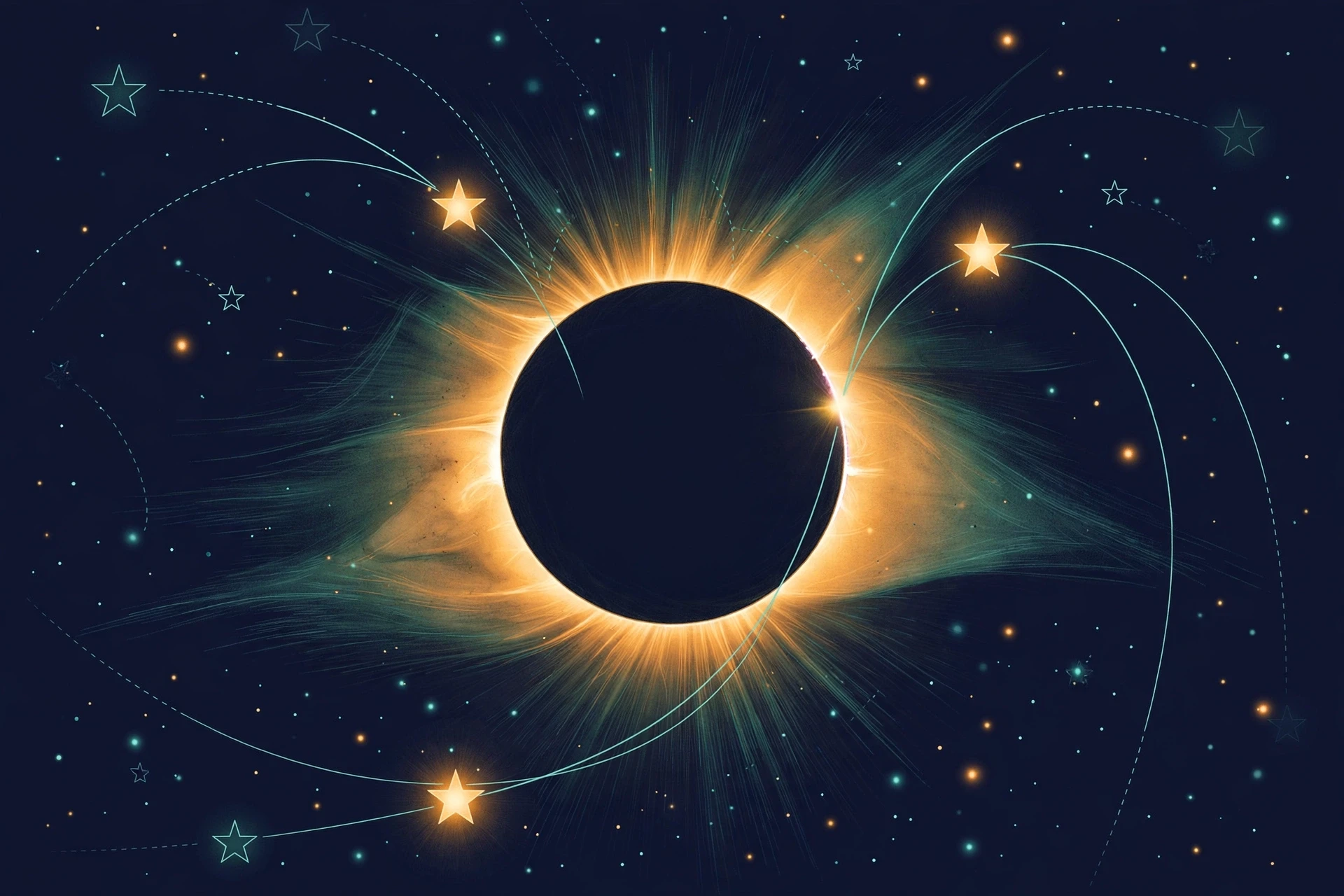
Bending starlight. Einstein predicted that starlight grazing the Sun would bend by 1.75 arcseconds, twice the value Newton's framework suggested. During the total solar eclipse of 29 May 1919, Arthur Eddington's expeditions measured the shift in the apparent positions of stars near the eclipsed Sun and found Einstein's value. The news made Einstein a celebrity overnight. The deeper story of relativity — special and general together — is told in Sciory's Einstein's Theory of Relativity: Special and General Explained.
Gravitational redshift. Light climbing out of a strong gravitational field loses energy and shifts toward the red. This was confirmed in a Harvard tower in 1959 by Pound and Rebka, who measured gamma rays climbing just 22.5 metres and found the shift Einstein predicted. The same effect means clocks run slower deep in a gravity well — and that is not a curiosity. It is engineering.
5.4 Your phone proves Einstein right every day
The most practical test of general relativity sits in your pocket. GPS satellites orbit about 20,200 kilometres up, moving at roughly 3.9 kilometres per second. Two relativistic effects pull their clocks in opposite directions: their speed makes their clocks run slow by about 7 microseconds a day, while the weaker gravity up there makes them run fast by about 45 microseconds a day. The net result is that a GPS clock gains about 38 microseconds a day on a clock on the ground. Light travels about 30 centimetres in a nanosecond, so an uncorrected error of 38 microseconds would put your position out by roughly 10 kilometres within a day. Engineers build the correction into the satellites before launch, setting their clocks to tick slightly slow on the ground so that they tick correctly in orbit. Every time your phone finds your street, it is quietly confirming that time runs at different speeds at different heights.
"Matter tells space-time how to curve, and curved space-time tells matter how to move." — John Archibald Wheeler's one-sentence summary of general relativity, and still the best one I know.
6. What Gravity Builds: Stars, Galaxies, and Tides
6.1 From gas to stars
Gravity is a builder before it is anything else. A cloud of hydrogen gas in space, left alone, will slowly collapse under its own weight. As it shrinks it heats up, and if it is massive enough the core grows hot and dense enough for hydrogen nuclei to fuse into helium. A star is born: a long standoff between gravity pulling inward and the pressure of fusion pushing outward. That balance holds for billions of years in a star like the Sun, and when the fuel runs low gravity wins the argument again, collapsing the core into a white dwarf, a neutron star, or — for the most massive stars — a black hole.
The same process, repeated on a larger scale, gathers stars into galaxies and galaxies into clusters. The visible universe is a web of filaments and voids, and the web's shape is gravity's handwriting. Computer simulations that start with a nearly uniform early universe and apply nothing but gravity reproduce the pattern of galaxies we actually observe. The story of how the universe itself began, and how gravity shaped its first structures, is in Sciory's The Big Bang Theory Explained: How the Universe Began and Evolved.
6.2 Tides: the Moon pulls the near side harder
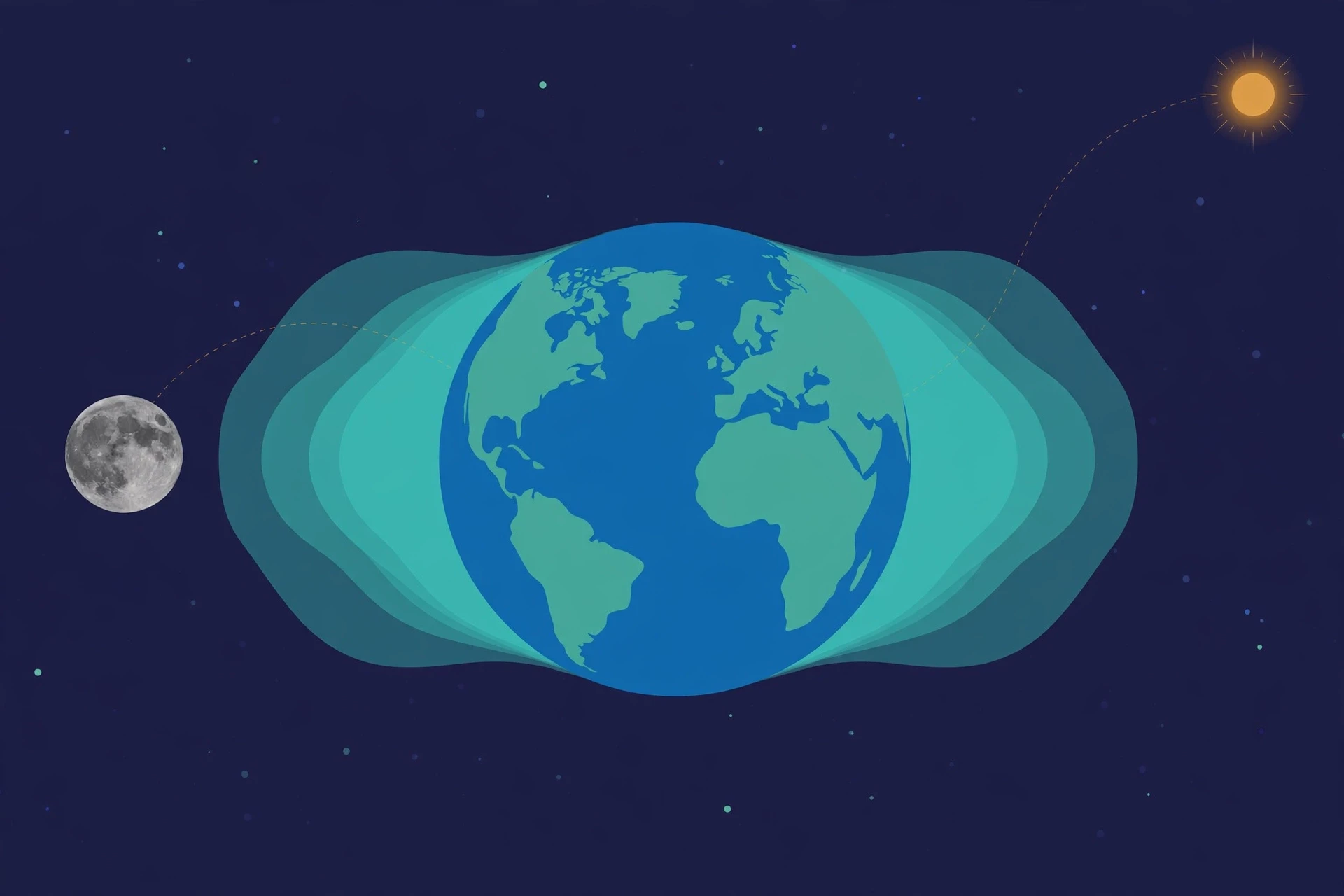
Twice a day, the sea rises and falls, and the cause is a difference, not a force. The Moon's gravity pulls on the near side of the Earth more strongly than on the far side, because the near side is closer. The difference stretches the oceans into a bulge on the side facing the Moon — and, less obviously, into a second bulge on the far side, where the Earth itself is pulled toward the Moon more strongly than the far-side water is. As the Earth rotates through these two bulges, most coastlines see two high tides and two low tides a day. The Sun contributes too, and when Sun and Moon line up at new and full Moon their pulls add up into the higher spring tides; when they sit at right angles the tides are smaller, the neap tides.
The Moon is also slowly stealing energy from the Earth's spin. Tidal friction is braking our rotation — days are getting longer by about 1.7 milliseconds per century — and the Moon is drifting away from us by about 3.8 centimetres a year, a rate measured precisely by laser reflectors left on the lunar surface by the Apollo astronauts. The tides you watch at the beach are the visible edge of a gravitational transaction that is reshaping the Earth–Moon system.
6.3 Black holes: where gravity wins completely
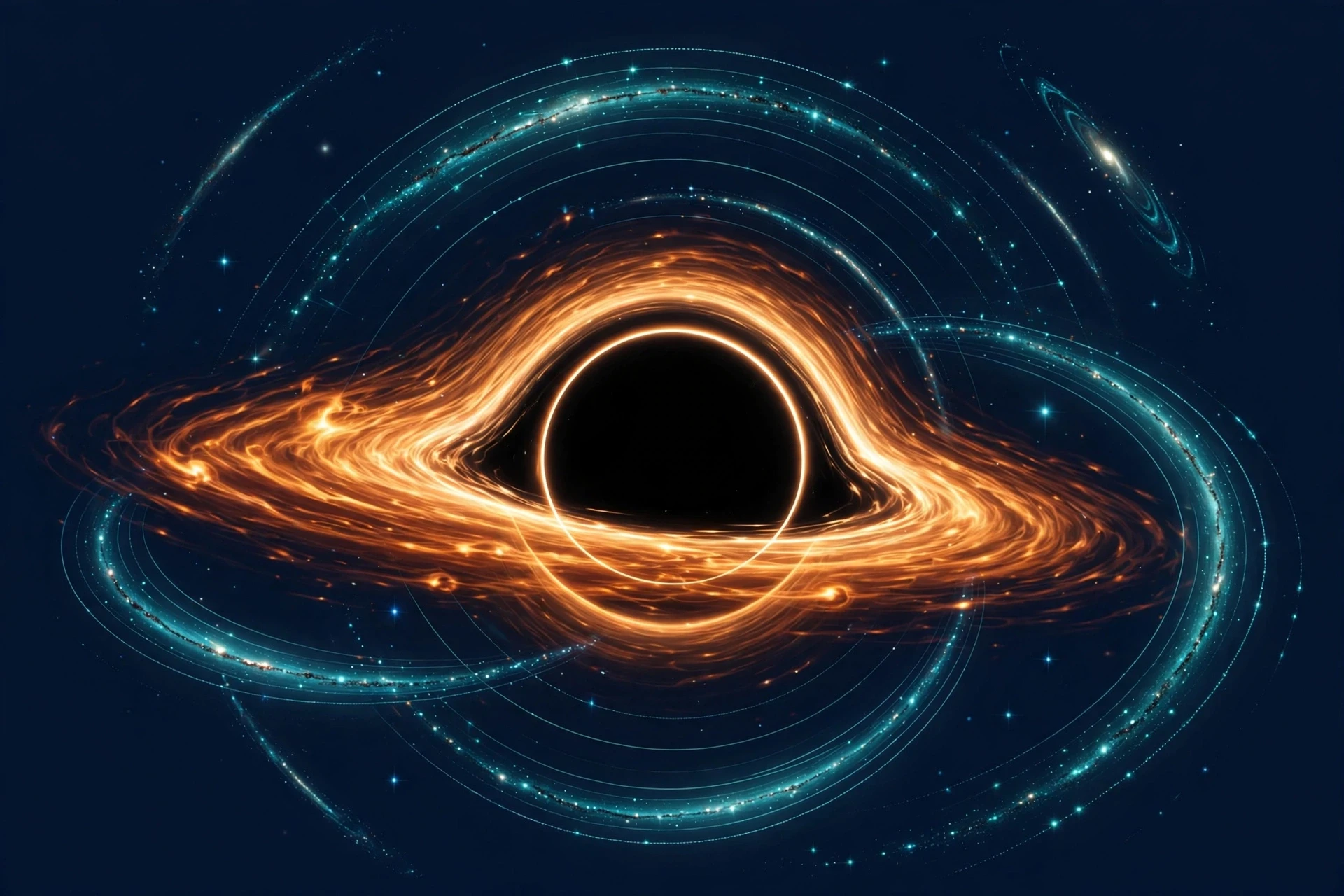
Keep adding mass, and there comes a point where no pressure in the universe can hold gravity back. The core collapses past the point where even light can escape, and what is left is a black hole: a region of space-time curved so steeply that all paths lead inward. The boundary of that region is the event horizon. Cross it, and no signal, no rocket, no light can ever come back out.
Black holes are not cosmic vacuum cleaners. Far away, a black hole's gravity behaves like any other mass of the same size; if the Sun were replaced by a black hole of the same mass, the Earth's orbit would not change at all. What is extreme is the region close in, where orbits become unstable and time slows dramatically for an outside observer watching something fall in. The first image of a black hole's shadow, released in 2019, showed the glowing ring of hot gas around the black hole in the galaxy M87, bent into a circle by the black hole's own gravity — light itself following curved paths. For the full story of how black holes form and what happens near them, see Sciory's Black Holes Explained: Formation & Properties.
7. Gravitational Waves: Listening to Space-Time Ripple
7.1 A prediction a century in the making
Einstein's equations predicted something even stranger than bent light: when massive objects accelerate, they should send ripples through space-time itself, travelling outward at the speed of light. These gravitational waves are unimaginably faint by the time they reach us. A passing wave stretches and squeezes space by less than the width of a proton over kilometres. Einstein himself doubted they could ever be detected.
The first indirect evidence came from a pair of neutron stars discovered in 1974 by Russell Hulse and Joseph Taylor. Their orbit was shrinking exactly as general relativity predicted it would if the pair were losing energy to gravitational waves. Hulse and Taylor won the Nobel Prize in 1993 for that measurement. Direct detection took another two decades and one of the most sensitive instruments ever built.
7.2 LIGO hears two black holes collide
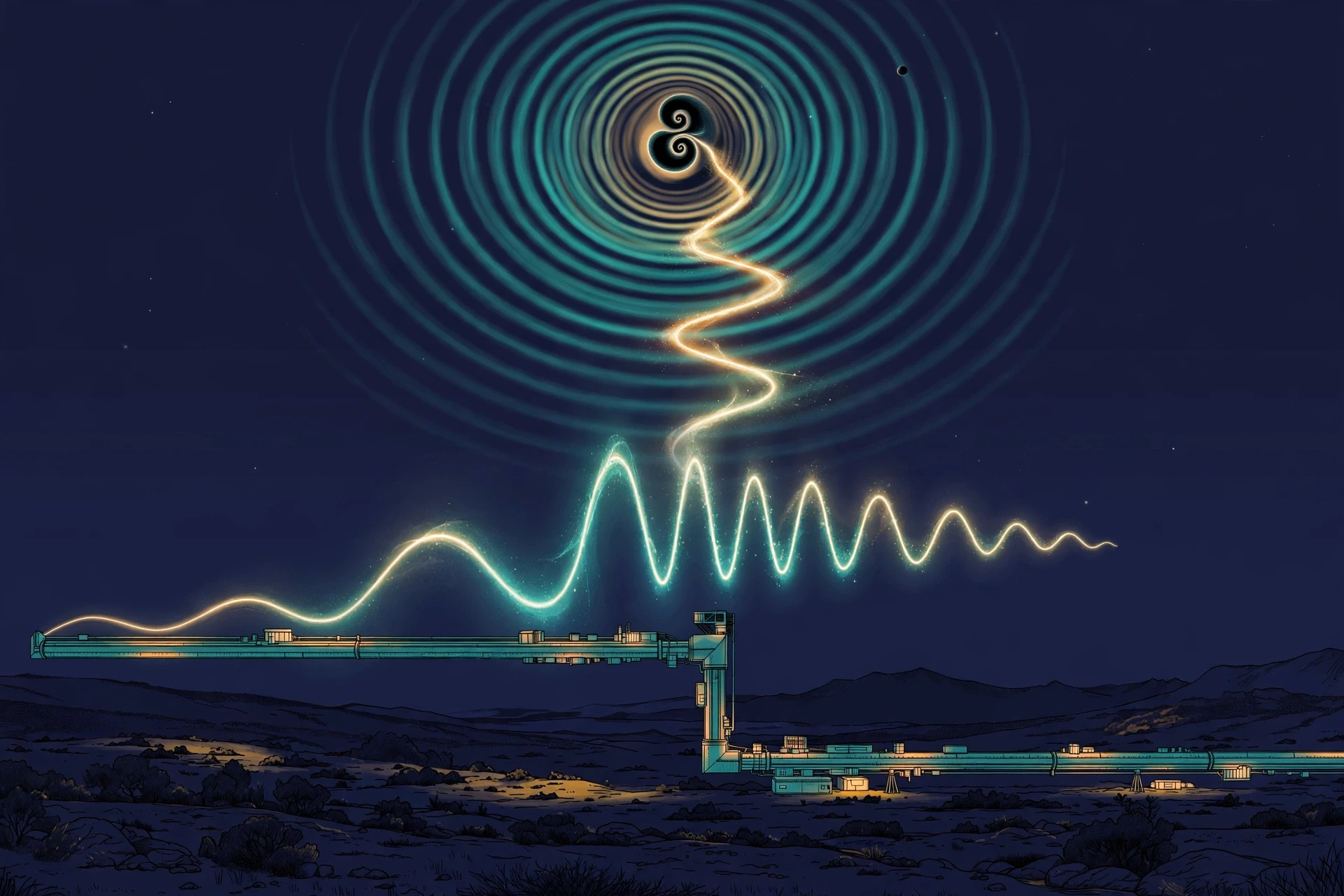
On 14 September 2015, at 5:51 a.m. Eastern time, the twin LIGO detectors in Livingston, Louisiana, and Hanford, Washington, both recorded a signal that lasted two-tenths of a second and rose in pitch like a chirp. It was the final fraction of a second of two black holes — about 29 and 36 times the mass of the Sun — spiralling together and merging 1.3 billion years ago. About three Suns' worth of mass was converted into gravitational waves in that instant, with a peak power output roughly fifty times that of the whole visible universe. LIGO's own announcement tells the story with the raw numbers: LIGO — GW150914 Press Release.
I remember where I was when the announcement came, in February 2016, and I remember the room going quiet in a way I had never heard before. We had spent a century testing Einstein's theory with light. Now, for the first time, we were listening to the universe with gravity itself — and the universe turned out to be full of colliding black holes we had never been able to see. Since then the LIGO, Virgo, and KAGRA detectors have recorded around a hundred such events, including the 2017 merger of two neutron stars, which was seen by telescopes across the spectrum and confirmed that such mergers forge heavy elements like gold and platinum.
7.3 The next ears: LISA and the space-based future
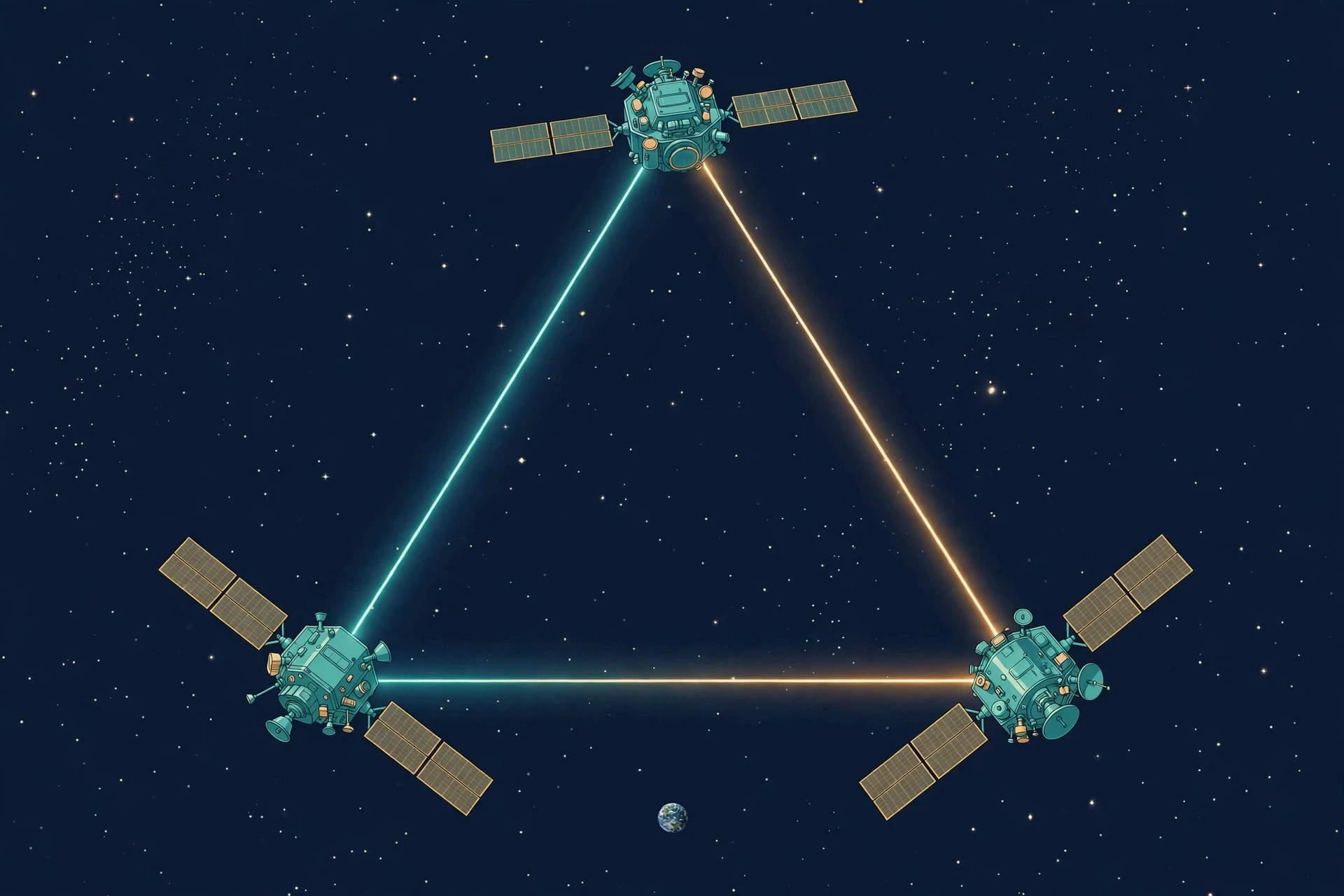
Ground-based detectors are limited by the rumble of the Earth itself. The next step is to go to space. ESA's LISA mission — three spacecraft flying in a triangle 2.5 million kilometres apart, trailing the Earth around the Sun — will be the first space-based gravitational wave observatory, listening for the slow, deep ripples from merging supermassive black holes that ground detectors cannot hear. It was adopted by ESA in 2024, construction began in 2025, and launch is planned for 2035: ESA — LISA, the first space-based gravitational wave observatory.
8. Gravity in Everyday Life: What It Does for You
Gravity is not only an astronomical subject. It is running quietly underneath ordinary life, and once you start looking you see it everywhere.
Navigation. GPS, as above, is applied relativity. Without the gravitational time correction, satellite navigation would drift by kilometres a day.
Spaceflight. Every interplanetary mission is a gravity calculation. Spacecraft use gravitational slingshots — stealing a little of a planet's orbital energy as they swing past — to reach the outer solar system without carrying impossible amounts of fuel. The Voyager probes, now in interstellar space, got there on borrowed planetary momentum.
Tides and power. Tidal power stations in places like the Rance estuary in France turn the Moon's pull into electricity, and tide tables — computed from the Moon and Sun's gravity — decide when ships can enter shallow harbours.
Medicine and the body. Your blood pressure, your balance, and your bones all evolved under Earth's gravity. Astronauts returning from long missions lose bone density because their skeletons no longer have weight to resist, and their hearts and muscles weaken for the same reason. Gravity is a load your body expects.
Weighing the invisible. Astronomers weigh galaxies by how fast their stars orbit, weigh planets by their moons, and weigh the universe itself by how gravity bends the light of distant galaxies. Most of what we know about the mass of the cosmos is a gravity measurement in disguise.
Where gravity acts | What it does | Why it matters |
|---|---|---|
Your phone's GPS | Clocks run faster in weaker gravity, slower at orbital speed | Without relativity corrections, positions would drift by kilometres per day |
Ocean tides | The Moon's uneven pull stretches Earth's oceans into two bulges | Two high tides a day; tidal power and harbour timetables depend on them |
Spacecraft routes | Planets lend orbital energy in gravitational slingshots | Voyager reached interstellar space on borrowed momentum |
Stars and galaxies | Gravity gathers gas into stars and stars into galaxies | Every star you see is a balance between gravity and fusion pressure |
Black hole mergers | Colliding black holes ripple space-time itself | LIGO hears events light could never show us |
9. Newton vs Einstein: Two Pictures, One Reality
The honest way to compare the two theories is not to ask which is right but to ask where each one works. Newton treats gravity as a force acting instantly across space. Einstein treats it as the curvature of space-time, with changes travelling at the speed of light. Newton's picture is simpler and, for weak gravity and slow speeds, it gives the same answers as Einstein's to far more decimal places than any engineer needs. Einstein's picture is needed when gravity is strong, speeds are high, or precision is extreme — near black holes, in the bending of light, in the ticking of satellite clocks, and in the slow advance of Mercury's orbit.
Question | Newton (1687) | Einstein (1915) |
|---|---|---|
What is gravity? | A force of attraction between masses | Curvature of space-time caused by mass and energy |
How fast does it act? | Instantly, across any distance | Changes travel at the speed of light |
Does it bend light? | Not in his theory (a later estimate gave half the true value) | Yes — starlight bends by 1.75 arcseconds at the Sun's edge |
Does it affect time? | No — time is the same everywhere | Yes — clocks run slower deep in a gravity well |
Does it make waves? | No | Yes — gravitational waves, detected by LIGO in 2015 |
Where it is used today | Spacecraft navigation, tides, everyday engineering | GPS corrections, black holes, cosmology, gravitational waves |
A third picture is still missing. Quantum mechanics, which describes the very small with astonishing accuracy, has no working theory of gravity inside it. Gravity at the scale of atoms is far too weak to measure directly, and every attempt to quantise it — to describe it as particles called gravitons, or as vibrating strings, or as loops of space itself — remains unconfirmed. The small-scale world is covered in Sciory's Understanding Quantum Mechanics: Principles, Paradoxes, Real-World Applications, and the place where the two theories meet is the most important open problem in physics.
The deepest question in physics is not whether Newton or Einstein was right. Both were right, in the places where their pictures apply. The question is what picture holds where neither applies — inside a black hole, and at the birth of the universe itself.
10. Common Misconceptions About Gravity — Corrected
"Gravity is a strong force." It is the weakest of the four fundamental forces, by an enormous margin. It dominates the cosmos only because it never cancels and never runs out of range.
"There is no gravity in space." There is. The space station is held in orbit by Earth's gravity, and the Moon is held by the same pull that holds you to the ground. Astronauts float because they are falling, not because gravity has switched off.
"Heavy things fall faster than light things." In air, a feather falls slowly because air resistance holds it back. In a vacuum, a hammer and a feather fall together, as the Apollo 15 demonstration showed. What matters is not the mass but the air in the way.
"The Earth pulls on you, but you don't pull on the Earth." You do, with exactly the same force. The Earth simply does not move measurably in response, because its mass is so much larger than yours.
"Black holes suck everything in." At a distance, a black hole pulls exactly like any other object of the same mass. What is special is the region close to the event horizon, where escape velocity exceeds the speed of light. You would have to get very close to be in trouble.
"Einstein proved Newton wrong." He did not. Newton's law is the weak-field, slow-speed limit of general relativity, and it remains the tool of choice for most practical work in spaceflight and engineering.
"Gravity travels instantly." In Newton's theory it does, and that was one of the theory's known weaknesses. In general relativity, changes in gravity travel at the speed of light — which is why LIGO could detect a merger 1.3 billion light-years away as a wave arriving after a 1.3-billion-year journey.
11. Latest Research: What We Still Do Not Know
Gravity is the oldest subject in physics and one of the least finished. Three open questions dominate the research of the 2020s.
First, quantum gravity. Nobody has a tested theory that describes gravity at the scale where quantum effects matter. Candidate ideas — string theory, loop quantum gravity, and others — make predictions that are still beyond the reach of experiments. The most promising tests may come from the sky: the faint pattern of gravitational waves from the early universe, if it can be detected, would carry information about gravity at energies no particle accelerator can reach.
Second, dark matter and dark energy. Galaxies spin too fast, and galaxy clusters hold together too tightly, for the gravity of their visible stars and gas to explain. Something unseen provides most of the gravitational pull in the universe — about 85 per cent of its matter, by the best estimates. And the expansion of the universe is accelerating, as if a repulsive energy were pushing space apart. Dark matter and dark energy are names for our ignorance, and they are also the biggest clue that our picture of gravity, at the largest scales, is incomplete.
Third, testing Einstein to the limit. Every new instrument is a new test. The Event Horizon Telescope is imaging black hole shadows in finer detail. Pulsar timing arrays are listening for the slow gravitational-wave hum of supermassive black hole pairs across the universe. LISA, when it flies in the 2030s, will test general relativity in regimes no Earth-bound instrument can reach. So far Einstein has passed every test. Physicists keep testing anyway, because the day a test fails is the day we learn something new — and that is the whole point.
Conclusion
Gravity began, for me, as a tennis ball and an iron key hitting a floor together, and a feeling of being cheated by the world. It ends, for now, as the force that holds galaxies together, slows clocks, bends starlight, and ripples through space-time when black holes collide. The story runs from a staircase to a pair of laser detectors in Louisiana and Washington, from an apple in a garden in 1666 to three spacecraft flying in formation 2.5 million kilometres apart in the 2030s, and every step of it is the same question asked better: what pulls things together, and why?
Newton answered how much. Einstein answered what it is. The next answer — the one that joins gravity to the quantum world, and explains the dark majority of the universe's mass — is still being written. When it arrives, it will probably start the same way the last two did: with someone noticing that something they were sure they knew about the world had just turned out to be wrong, and finding the wrongness delicious.
Frequently Asked Questions
How does gravity work?
Gravity works in two layers. In Newton's picture, every mass attracts every other mass, with a pull that grows with mass and falls with the square of distance. In Einstein's picture, mass and energy curve space-time, and objects follow the curves — planets orbit because the Sun has bent the space around it. Newton's law is the everyday, weak-gravity version of Einstein's deeper geometry.
What causes gravity?
Mass and energy cause gravity. In general relativity, mass and energy curve space-time, and that curvature is what we experience as gravity. Why mass curves space-time at the deepest level is still an open question — it is one of the reasons physicists are searching for a theory of quantum gravity.
Is gravity a force?
It depends on the picture you use. In Newton's physics, gravity is a force of attraction between masses, and that picture works well for almost all everyday and engineering purposes. In Einstein's general relativity, gravity is not a force at all but the curvature of space-time. Both descriptions give the same answers where gravity is weak and speeds are slow.
Why do objects fall at the same rate regardless of mass?
Because gravitational mass and inertial mass are the same thing. A heavier object feels a stronger gravitational pull, but it also has more inertia — more resistance to being accelerated. The two effects cancel exactly, so all objects accelerate at the same rate in the same gravitational field. This equality is the equivalence principle, and it is the foundation of general relativity.
How strong is gravity compared to other forces?
Gravity is by far the weakest of the four fundamental forces. A small magnet can overcome the gravitational pull of the whole Earth on a paperclip. Gravity dominates the universe anyway because it only attracts, never repels, and its range is unlimited — while electric charges cancel out in bulk matter, mass never cancels.
Why does the Moon not fall into the Earth?
It is falling into the Earth — constantly. The Moon's sideways speed of about a kilometre per second means that as it falls, the Earth's surface curves away beneath it at the same rate, so it keeps missing. An orbit is a fall that never lands. The same falling-sideways logic holds satellites, planets, and stars in their paths.
Does gravity affect time?
Yes. Clocks run slower in stronger gravity, an effect called gravitational time dilation. A clock on the ground ticks slightly more slowly than one on a high mountain, and GPS satellite clocks gain about 38 microseconds a day relative to ground clocks because they sit in weaker gravity — a difference engineers must correct for, or navigation would drift by kilometres a day.
What is a gravitational wave?
A gravitational wave is a ripple in space-time itself, produced when massive objects accelerate — most dramatically when black holes or neutron stars collide. The waves travel at the speed of light, stretching and squeezing space by less than a proton's width over kilometres. LIGO detected the first one directly in 2015, from two merging black holes 1.3 billion light-years away.
What is the difference between Newton and Einstein on gravity?
Newton described gravity as an instantaneous force between masses, given by F = G × (m1 × m2) / r². Einstein described it as the curvature of space-time, with changes travelling at the speed of light. Einstein's picture explains things Newton's cannot — the bending of light, the advance of Mercury's orbit, gravitational time dilation, and gravitational waves — while Newton's law remains the simpler, accurate limit for weak gravity and slow speeds.
Can gravity be turned off or blocked?
No. There is no known way to shield against gravity, and no material blocks it. Every mass attracts every other mass, always. Weightlessness in orbit is not gravity switched off — it is free fall, the same falling that holds the Moon in its orbit. Shielding gravity would require new physics that no experiment has ever found.
Sources / Further Reading
OpenStax, University Physics Volume 1 — Newton's Law of Universal Gravitation: https://openstax.org/books/university-physics-volume-1/pages/13-1-newtons-law-of-universal-gravitation
NASA, Ask an Astrophysicist — Relativity: https://imagine.gsfc.nasa.gov/ask_astro/relativity.html
LIGO Laboratory, Caltech — GW150914 Press Release: https://www.ligo.caltech.edu/page/press-release-gw150914
European Space Agency — LISA, the first space-based gravitational wave observatory: https://www.esa.int/missions/about-us/directorates/science/lisa/lisa
NASA Science — The Universe's History: https://science.nasa.gov/universe/overview/