

Introduction
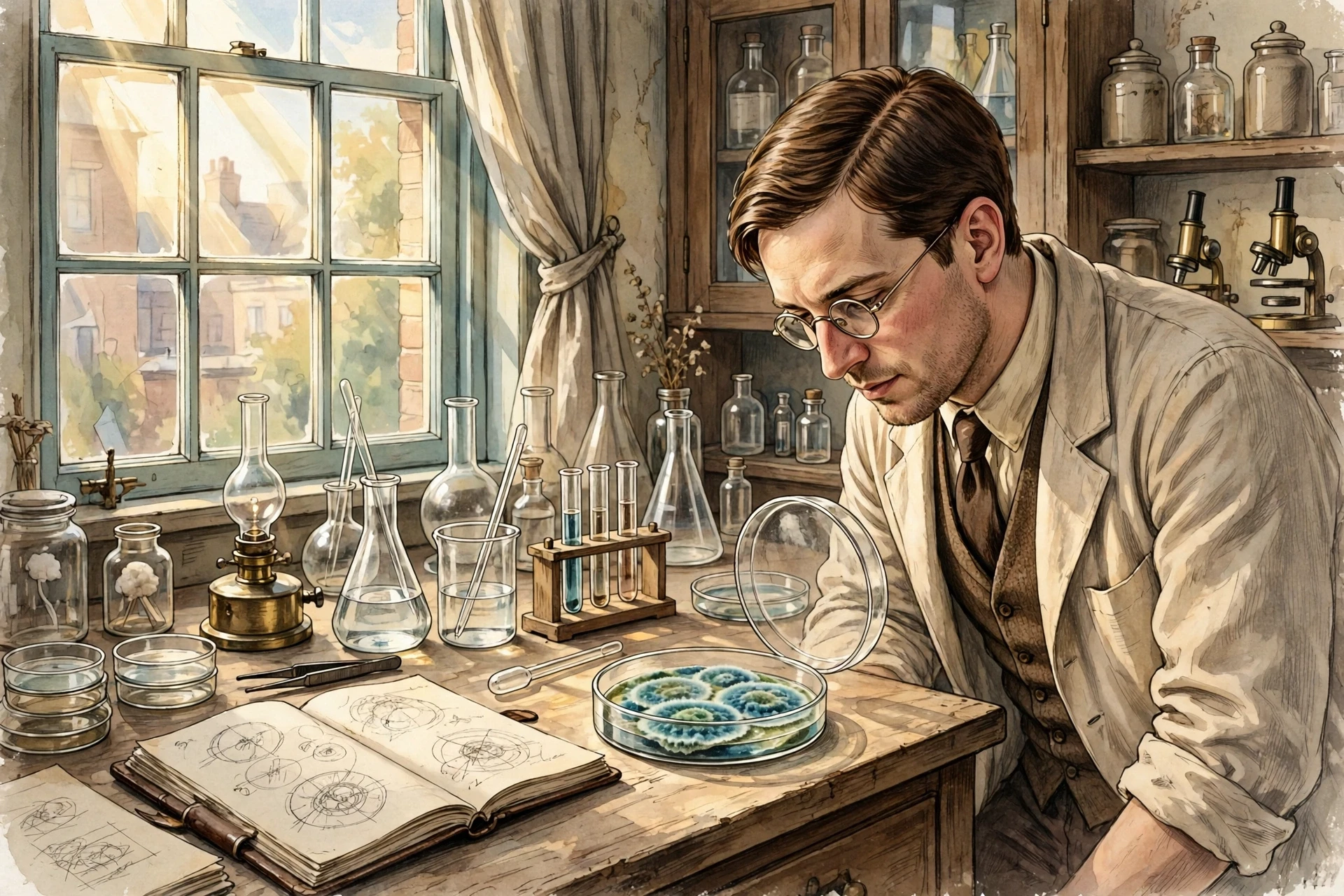
It was a September morning in 1928, and Alexander Fleming came back from holiday to a laboratory bench he had left in a mess. The Petri dishes of Staphylococcus bacteria he had been growing were supposed to be thrown away. One of them had gone mouldy. Around the green-blue mould, the bacteria had died, leaving a clear ring where nothing grew. Most people would have scrubbed the dish and started again, but the scientific method begins with noticing instead of cleaning up. Fleming stopped and stared. He asked a question that changed medicine: what was the mould doing to the bacteria?
That pause — noticing something odd, asking a question about it, and then testing the answer instead of guessing — is the scientific method in miniature. The mould turned out to be Penicillium notatum, and the substance it made became penicillin, the first widely used antibiotic. Fleming did not set out to discover a wonder drug. He followed a habit of mind that scientists had been sharpening for centuries: observe carefully, form an idea that can be tested, test it, and let the result change your mind.
The scientific method is that habit, written down as a set of steps. It is how we learned that germs cause disease, that the Earth moves around the Sun, that species change over time, and that the universe is expanding. It is also how a cook figures out why a cake sank, how a doctor decides whether a new drug works, and how an engineer finds out why a bridge cracked. The method belongs to no single subject. It is a way of asking questions so that nature, not our wishes, gets the final word.
This guide follows the scientific method from its beginnings in ancient Greece and the medieval Islamic world, through the Scientific Revolution, to the laboratories, hospitals, and computer models of today. You will see each step in action, meet the people who argued over how science should work, learn where the method breaks down, and find out how to use it yourself — in the lab, at work, and in everyday life.
1. What the Scientific Method Actually Is
Ask ten textbooks what the scientific method is and you will get ten slightly different lists. One says six steps, another says seven, a third says five. That disagreement is not a weakness. It is a clue. The scientific method is not a recipe card taped to a laboratory wall. It is a set of principles for testing ideas against evidence, and different fields apply those principles in different ways. A physicist can run the same experiment a hundred times in a day. A geologist studying a single earthquake cannot rerun the Earth. An astronomer cannot put a star in a test tube. All three still do science, because all three test their ideas against what they can observe.
At its heart, the method rests on a few simple commitments. First, claims about the natural world should be checked against observations, not accepted because an authority said them. Second, an idea should be stated clearly enough that it could be shown wrong. Third, the test should be fair: change one thing at a time, keep the rest steady, and write down what happened so someone else can repeat it. Fourth, the result — whatever it is — should be shared, so other scientists can pick it apart. OpenStax's Biology textbook puts the core of it in one sentence: the scientific method is a method of research with defined steps that include experiments and careful observation, and its most important aspect is the testing of hypotheses by means of repeatable experiments. You can read that account alongside this guide: OpenStax Biology 2e, The Science of Biology.
1.1 A cycle, not a straight line
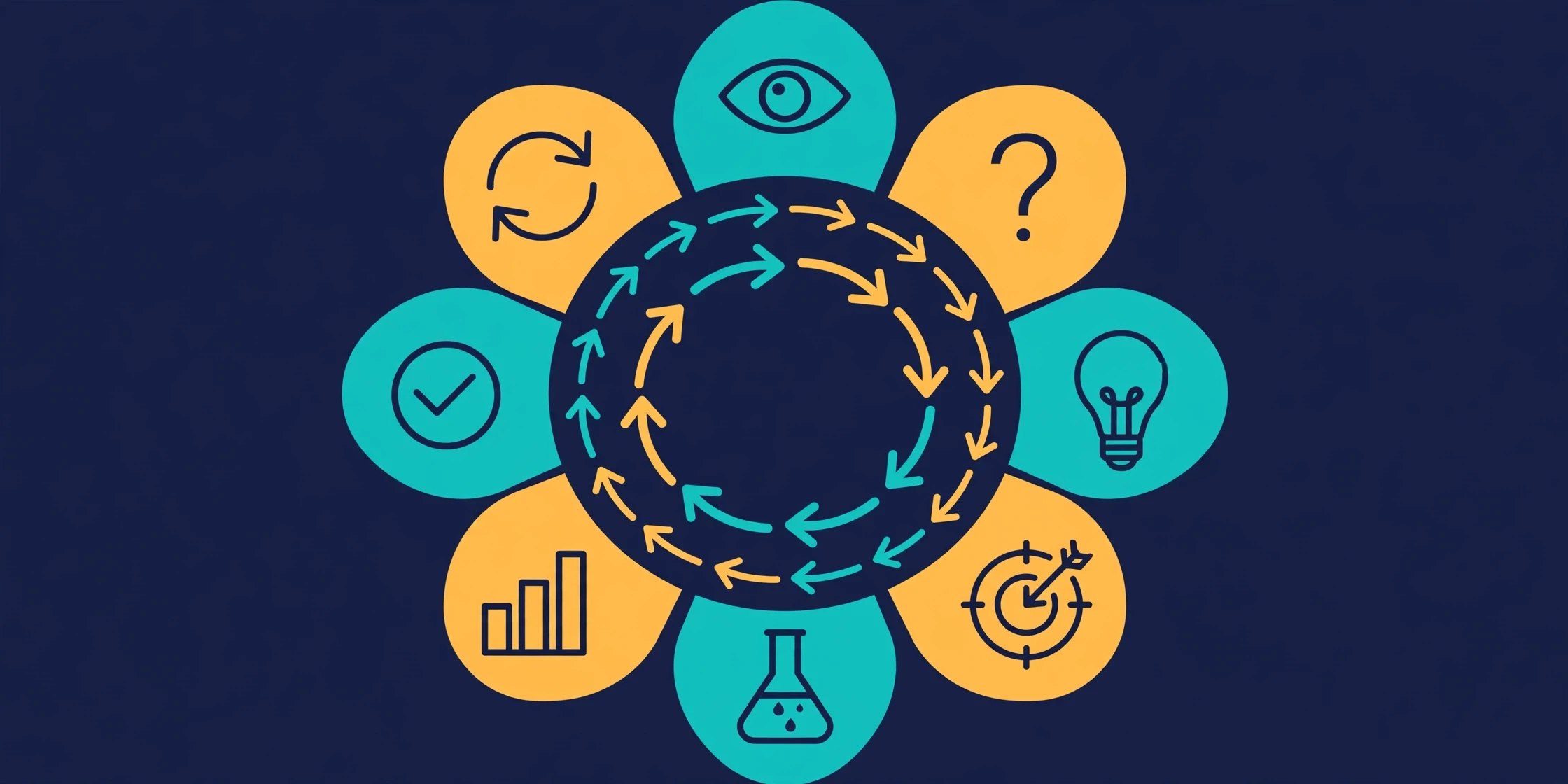
The textbook diagram usually shows the method as a loop: observation, question, hypothesis, prediction, experiment, analysis, conclusion — and then back to observation. The loop matters more than the list. Real research rarely marches through the steps in order and stops. An experiment gives a strange result, and the scientist goes back to observe more carefully. A new instrument opens a new kind of observation, and old questions get asked again. A failed prediction does not end the story; it starts a new one, with a better hypothesis.
I learned that the messy way, early in my own training, when a set of cell cultures I had been tending for weeks turned cloudy overnight. My first thought was that I had made a mistake — contaminated the flasks, used the wrong medium, left the incubator door open. I nearly threw them out. My supervisor stopped me and said, "Write down exactly what you see before you decide what it means." The cloudiness turned out to be a contamination, and I did lose the cultures. But the habit stuck: observe first, explain second. Years later, when a student's experiment gave a result that contradicted everything we expected, that same habit saved us from dismissing it. The result was real, our assumption was wrong, and the paper we eventually wrote was better for it.
1.2 Why it works when guessing does not
Human brains are pattern-finding machines, and that is both our gift and our trap. We see faces in clouds, hear messages in static, and remember the one time a remedy seemed to work while forgetting the ten times it did not. We also fall in love with our own ideas. A scientist who has spent three years on a hypothesis does not want to hear that it is wrong. The scientific method exists because good intentions are not enough. It builds checks against our own biases into the work itself: controls, blinding, replication, statistics, and peer review. Each check answers a different way we fool ourselves.
Think of it like a courtroom. A hypothesis is a claim. The experiment is the trial. The control group is the witness who was not at the scene. Statistics are the rules of evidence. Peer review is the appeal. No single part guarantees the truth, but together they make it much harder for a wrong idea to survive unchallenged. That is why science, for all its mistakes and dead ends, has a track record no other way of knowing can match. It is the only system that is designed to correct itself.
1.3 Science, pseudoscience, and the line between them
Most people assume the line between science and pseudoscience is about the subject — astronomy is science, astrology is not. The real line is about the method. Astrology makes claims that are vague enough to fit anything and never risks being wrong. Astronomy makes precise predictions — where a planet will be on a given night, when an eclipse will happen — and invites anyone to check. The philosopher Karl Popper, whom we will meet in Section 2, made this the centre of his account of science: a claim is scientific only if it is falsifiable, only if some possible observation could show it to be false. A horoscope that says "you will face a challenge today" cannot be falsified, because almost any day contains a challenge. A hypothesis that says "this drug lowers blood pressure by at least 10 points in eight weeks" can be. That difference — testability — is the line.
That does not mean every falsifiable claim is true, or that every unfalsifiable claim is worthless. Poetry, ethics, and faith ask questions science cannot answer. But when a claim is about how the natural world works, and it refuses to be tested, it is not doing science, whatever language it borrows.
2. A Short History of How We Learned to Test Ideas
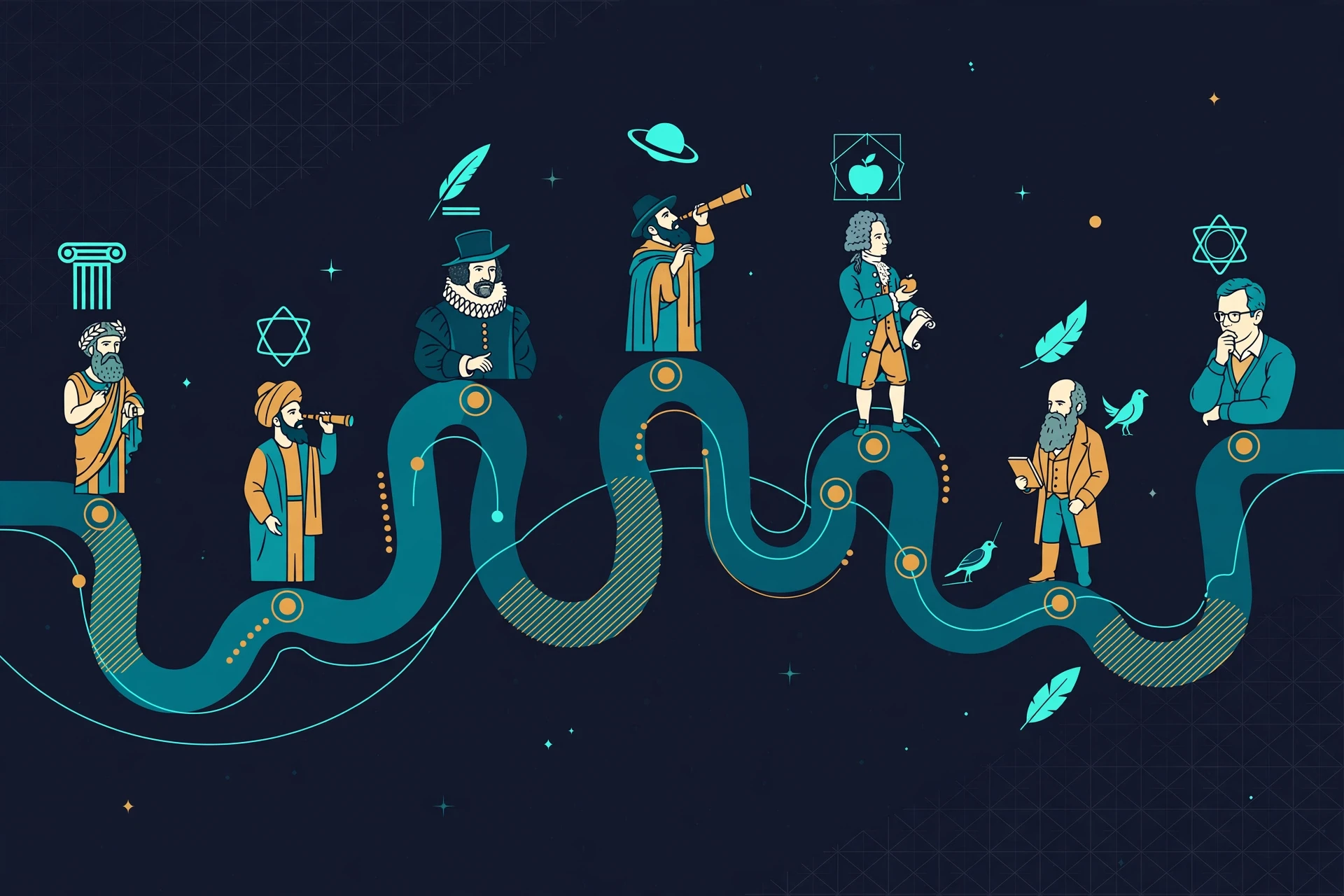
The scientific method was not invented in a single year by a single person. It grew, piece by piece, over more than two thousand years, as thinkers in different cultures argued about what counts as good evidence. The Stanford Encyclopedia of Philosophy traces this long argument from Aristotle through the Scientific Revolution to the twentieth-century debates about falsification and practice, and it is the best single survey I know for readers who want the full story: Stanford Encyclopedia of Philosophy, Scientific Method.
2.1 Aristotle and the art of careful observation
In the fourth century BCE, Aristotle laid down a framework that shaped science for nearly two thousand years. He insisted that knowledge of nature must start with careful observation, and that observations should be arranged into explanations by their causes. His logic — the syllogism, the careful sorting of arguments into valid and invalid forms — gave later thinkers tools for reasoning clearly. But Aristotle's science had a gap that would take centuries to fill: he observed, but he rarely experimented. He watched things happen and reasoned about why. He did not, as a rule, set up controlled tests to decide between competing explanations. His authority was so great that for centuries, scholars quoted him instead of checking nature for themselves. When a claim conflicted with Aristotle, the claim usually lost.
2.2 Alhazen and the first experiments
A thousand years later, in the Islamic Golden Age, the scholar Ibn al-Haytham — known in the West as Alhazen — did something strikingly modern. Working in Cairo around the year 1000, he studied light and vision, and he did not trust either ancient authority or his own eyes alone. He built dark rooms, used pinholes and mirrors, changed one variable at a time, and recorded what happened. He showed, against the ancient idea that the eye sends out rays, that light enters the eye from outside. His Book of Optics combined mathematics, controlled experiment, and a willingness to be wrong. Historians still argue about how much of the modern method he invented, and the argument itself is instructive: the method grew in many places, and credit is rarely as tidy as textbooks suggest.
2.3 Bacon, Galileo, and the Scientific Revolution
The sixteenth and seventeenth centuries turned scattered practices into a movement. Francis Bacon, writing his Novum Organum in 1620, attacked the old habit of leaping from a few observations to grand conclusions. He proposed a slower climb: gather observations methodically, watch for the systematic errors he called "idols" — the biases of the tribe, the cave, the marketplace, and the theatre — and rise gradually to general claims. Bacon's own method was too rigid for working scientists, and few followed it literally. But his insistence that knowledge should be built from experience, not from authority, changed the conversation for good.
Galileo Galilei did what Bacon described, and more. He rolled balls down inclined planes, timed them with water clocks, and used mathematics to describe what he saw. He pointed a telescope at Jupiter and found moons orbiting it — a direct blow to the idea that everything in the heavens circled the Earth. When the evidence contradicted the accepted picture, he trusted the evidence. That cost him dearly: he spent his last years under house arrest. The lesson of Galileo's life is not only about telescopes. It is about what happens when a method that lets nature answer back meets institutions that prefer the old answers.
Isaac Newton, a generation later, gave the method its most powerful form. His Principia (1687) showed that the same law of gravitation could explain both a falling apple and the orbit of the Moon. Newton combined precise observation, mathematical modelling, and experiment, and he wrote down rules for reasoning in science — his "Rules of Philosophising" — that insisted on starting from phenomena rather than from first principles. After Newton, no one could seriously argue that science was only about collecting facts. It was about finding laws that predicted new facts.
2.4 Darwin, the laboratory, and the method goes everywhere
In the nineteenth century, the method spread into fields where controlled experiments were hard or impossible. Charles Darwin spent decades collecting observations — finches on the Galápagos, pigeons bred by fanciers, fossils in South America — and built from them a theory that no single experiment could prove in a day. His work showed that the scientific method is not only about laboratory benches. It is about gathering evidence from many sources, looking for a pattern that explains them all, and testing that pattern against new observations. Sciory's guide to his theory traces how that evidence accumulated: Darwin's Theory of Evolution: Evidence Explained.
The same century saw the laboratory become the centre of science. Louis Pasteur tested whether microbes caused fermentation and disease by designing experiments with controls — flasks with bent necks that let air in but kept dust out — that settled arguments no amount of debate could. Gregor Mendel counted pea plants, thousands of them, and found ratios in their traits that revealed the laws of heredity. The double helix of DNA, discovered in 1953, was itself the product of methodical model-building tested against X-ray images — a story told in Sciory's DNA: Structure, Replication, and Role in Heredity.
2.5 Popper, Kuhn, and the twentieth-century argument
By the twentieth century, philosophers were asking a harder question: not just how scientists work, but how we know when science is working well. Karl Popper argued that science advances not by confirming theories but by trying to falsify them. A theory that survives serious attempts to break it earns our trust — provisionally, always provisionally. No amount of white swans proves that all swans are white; a single black swan refutes it. Popper's idea explains why scientists design experiments that could go wrong. An experiment that cannot fail teaches nothing.
Thomas Kuhn, writing in 1962, pushed back. He argued that most science is not revolutionary testing but "normal science" — puzzle-solving inside a shared framework, or paradigm, that scientists mostly take for granted. Revolutions happen when anomalies pile up and a new framework replaces the old one. Kuhn's picture is messier than Popper's, and most working scientists live somewhere between the two: they trust their framework enough to work inside it, and they keep an eye out for the anomaly that might break it.
The Stanford Encyclopedia's survey makes one point that I wish more textbooks made: there is no single method that all sciences share in every detail. What they share is a family of practices — observation, testing, modelling, criticism — applied differently in different fields. That variety is a strength, not a flaw. It is why the method keeps working in new territory, from particle physics to climate science to the study of the human brain.
3. The Steps of the Scientific Method, in Detail
Here is the method as it is usually taught, with each step explained the way working scientists actually use it. The steps are numbered for clarity. In real research they loop, overlap, and repeat. Keep that in mind as you read: the list is a map, not the territory.
3.1 Step 1 — Observe
Everything starts with noticing. An observation can be qualitative — the sky turned green before the storm, the culture turned cloudy — or quantitative — the temperature rose by 4 degrees, the iridium in a rock layer was 30 times normal. Good observation is active, not passive. It means looking carefully, measuring where you can, and writing down what you saw before you decide what it means.
The best observations are often the ones nobody was looking for. Fleming's mould, Penzias and Wilson's mysterious hiss from the sky, the unexpected glow in a darkened laboratory — discoveries begin when someone notices that something does not fit. But noticing takes training. A beginner and an expert can look at the same Petri dish and see different things, because the expert knows what "normal" looks like and can spot the departure. That is why scientists spend years learning to observe in their field: the eye must be educated before it can be trusted.
A practical habit: keep a notebook, and record observations in plain language with dates, numbers, and sketches. Memory is a poor laboratory instrument. It edits, flatters, and forgets. A notebook does not.
3.2 Step 2 — Ask a question
An observation becomes science when it turns into a question that can be investigated. "Why is the classroom so warm?" is a scientific question. "Is this classroom the best classroom?" is not — it depends on what "best" means, and no measurement can settle it. Good scientific questions are specific, and they point toward a test. OpenStax uses exactly that warm-classroom example to show how a vague discomfort becomes a research question, and it is worth working through: OpenStax Biology 2e, The Science of Biology.
I once watched a student turn a failed experiment into a better question than the one we started with. We had been testing whether a particular nutrient made seedlings grow faster. The seedlings in one tray grew tall and pale, while the others stayed short and green. The student asked, "Are they growing faster, or are they stretching toward the light?" That question split our single idea into two testable ones, and the answer — they were stretching, not growing — changed the whole experiment. A good question does that: it sharpens the problem until a test becomes possible.
3.3 Step 3 — Form a hypothesis
A hypothesis is a tentative explanation for what you observed — a proposed answer to your question, stated clearly enough to be tested. "The classroom is warm because no one turned on the air conditioning" is a hypothesis. "The classroom is warm because of bad vibes" is not, because there is no test that could show it wrong.
Strong hypotheses have three qualities. They are specific: they say what will happen, under what conditions. They are testable: there is an observation or experiment that could support or refute them. And they are falsifiable: it is possible, in principle, for evidence to show them wrong. They also explain why, not just what. "If I turn on the air conditioning, the room will cool" is a prediction. "The room is warm because the air conditioning is off, so turning it on will cool the room" is a hypothesis with a reason built in.
Scientists often carry several competing hypotheses at once. Darwin did. So did the researchers who argued over what killed the dinosaurs — a volcanic eruption, an asteroid impact, or a slow climate change. Holding rival ideas side by side, and designing tests that separate them, is one of the most powerful moves in science. It stops you from falling in love with your first idea.
3.4 Step 4 — Make a prediction
A prediction follows from the hypothesis in "if… then…" form. If the hypothesis is true, then a specific thing should happen when you test it. If the classroom is warm because the air conditioning is off, then turning it on should cool the room. If a new drug lowers blood pressure, then patients who take it should show lower readings than patients who take a placebo.
Predictions are where hypotheses meet the world. A vague hypothesis produces vague predictions, and vague predictions cannot be tested. The discipline of writing the prediction down before the experiment matters enormously. It stops the very human habit of looking at the results first and then inventing a prediction that fits them — a practice researchers call HARKing, hypothesizing after the results are known. A prediction written after the fact is not a prediction. It is a story.
3.5 Step 5 — Design and run an experiment
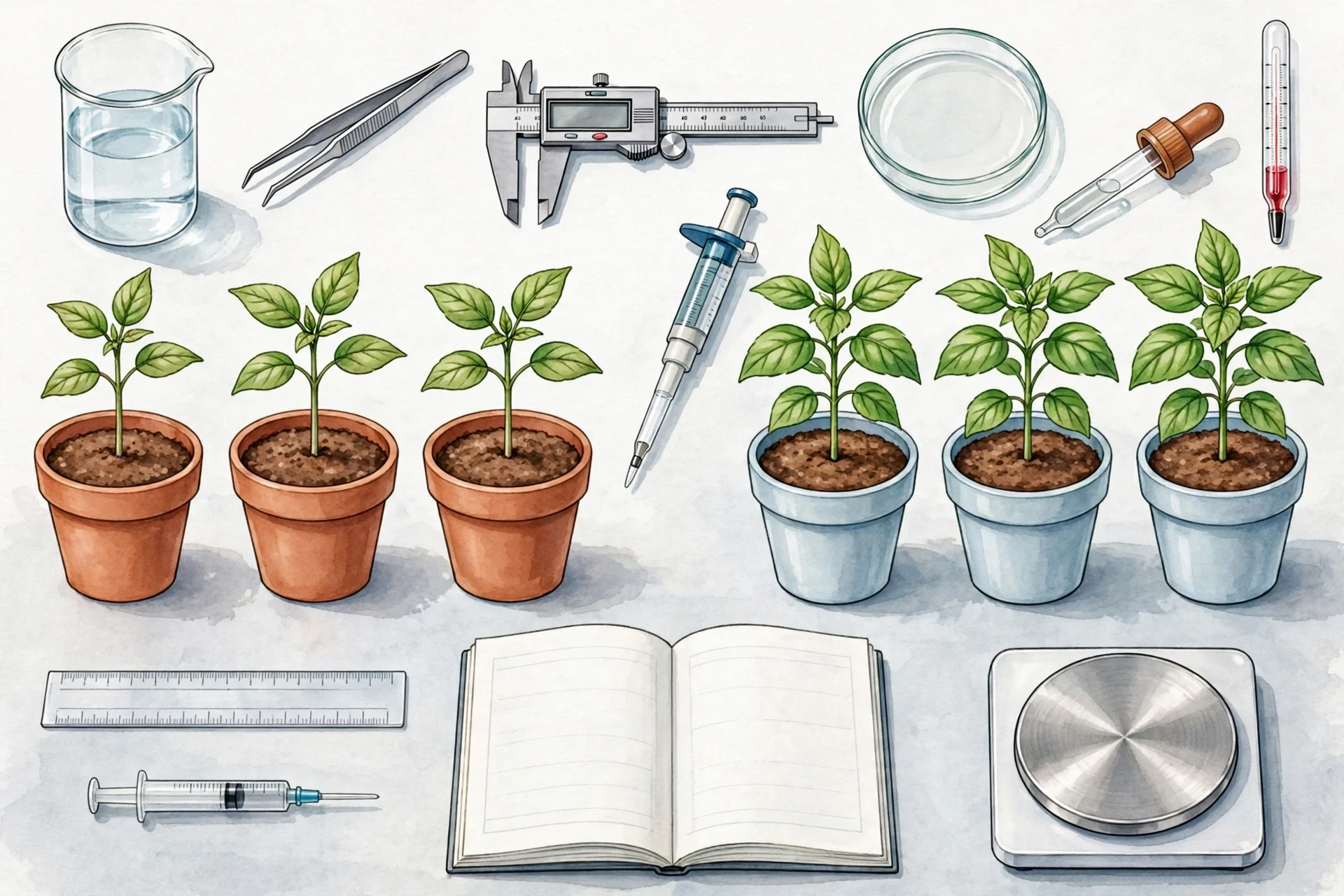
An experiment is a test designed to check the prediction while keeping everything else as steady as possible. The key ideas are variables and controls. A variable is anything that can change. The independent variable is the one you deliberately change — the dose of a drug, the amount of light, the temperature. The dependent variable is what you measure in response — blood pressure, plant height, reaction rate. A control group is identical to the experimental group in every way except that it does not receive the treatment. If the two groups differ, the difference must be due to the treatment, not to something else.
Good design also means thinking about sample size, randomisation, and blinding. A test on three plants proves little; a test on three hundred, chosen at random, proves much more. Blinding — keeping the people who measure the results from knowing which group is which — guards against unconscious bias. In a drug trial, neither the patients nor the doctors know who got the real drug and who got the placebo until the trial is over. That double-blind design exists because scientists learned, the hard way, that expectation alone can change results.
Not all science uses experiments in this narrow sense. Astronomers cannot randomise galaxies. Geologists cannot rerun an earthquake. They use observations, natural experiments, and models instead. The principle is the same — compare what the hypothesis predicts with what is actually observed — but the tools differ. The method is a family, not a single instrument.
3.6 Step 6 — Analyse the data
Data rarely speak for themselves. They need to be organised, graphed, and analysed, and the analysis needs to be honest about uncertainty. A result is not "the drug worked" but "blood pressure fell by an average of 8 points, with a range that suggests the true effect is probably between 5 and 11 points." Statistics give that precision. They also give a discipline: decide in advance what counts as evidence, and do not go fishing through the data afterwards for a pattern that looks interesting.
This is where many studies go wrong. If you test twenty things at once, one of them will look significant by chance alone. If you stop collecting data the moment the result looks good, you will overstate the effect. If you report only the analyses that worked and hide the ones that did not, the published record becomes a hall of mirrors. The replication crisis of the 2010s — when researchers found that many published findings in psychology and medicine could not be reproduced — was largely a crisis of analysis, not of honesty. The fixes that followed, like preregistration and sharing raw data, are the method correcting itself, which is exactly what it is supposed to do.
3.7 Step 7 — Draw a conclusion
A conclusion says whether the data support the hypothesis, refute it, or are unclear — and what should happen next. A supported hypothesis is not "proven." Science rarely proves anything in the absolute sense. It builds confidence, step by step, as independent tests point the same way. A refuted hypothesis is not a failure. It is information. It tells the next researcher where not to look, and it often points toward a better idea. Some of the most valuable experiments in history are the ones that gave the "wrong" answer. The Michelson–Morley experiment, which failed to find the ether that physicists expected light to travel through, cleared the way for Einstein's relativity. Sciory's guide to that revolution shows how a failed expectation can remake physics: Einstein's Theory of Relativity: Special and General Explained.
A good conclusion also states its limits. What was the sample? What could have gone wrong? What would you do differently next time? That honesty is not modesty for its own sake. It is what lets the next scientist build on your work instead of repeating your mistakes.
3.8 Step 8 — Share, peer review, and replicate
Science is a collective enterprise, and a result that no one else has seen is barely a result at all. Researchers write up their methods and findings and submit them to journals, where other experts — peer reviewers — read them critically before publication. Reviewers check the design, the analysis, and the reasoning. They ask for missing controls, point out alternative explanations, and sometimes reject the paper outright. Peer review is slow, imperfect, and occasionally unfair. It is also the best filter we have.
Publication is not the end. Other laboratories try to repeat the work. If they get the same result, confidence grows. If they do not, the field has to ask why. Replication is the method's immune system. A single striking study, however exciting, is a claim. A finding that survives independent replication is knowledge.
I still remember my first peer review — not as an author, but as a reviewer. I was asked to judge a paper in a field adjacent to mine, and I found a flaw in the controls that the authors had missed. I wrote it up carefully, expecting the authors to be angry. They were grateful. They fixed the experiment, reran it, and the paper came out stronger. That is peer review working as it should: not as gatekeeping, but as a second pair of eyes on work that matters.
4. Two Kinds of Reasoning: Induction and Deduction
Every step of the method uses two kinds of reasoning, and confusing them is one of the commonest mistakes in science teaching. Inductive reasoning moves from particular observations to a general conclusion: you see a hundred white swans, and you infer that all swans are white. Deductive reasoning moves the other way: from a general principle to a specific prediction. If all swans are white, then the next swan you see should be white.
Inductive reasoning is how new ideas are born. A biologist watches many brains light up in the same region during a task and infers that the region controls that task. A climate scientist watches temperatures rise as carbon dioxide rises and infers a link. But induction is never certain. The next observation could break the pattern — and in science, that is a feature, not a bug. Deductive reasoning is how ideas are tested. From a general hypothesis, you deduce a specific, checkable prediction, and then you go and look. OpenStax explains the pair with clear examples from brain studies and climate change, and shows how most real research uses both in tandem: OpenStax Biology 2e, The Science of Biology.
A useful image: induction is climbing up from the ground to a viewpoint; deduction is walking back down from the viewpoint to check whether the path you imagined actually exists. Science needs both directions. A field that only induces collects facts without explanations. A field that only deduces spins theories without checking them against the world.
5. Hypothesis, Theory, and Law — Words Science Uses Differently
Few misunderstandings cause more trouble than the everyday meanings of "hypothesis," "theory," and "law." In ordinary speech, a theory is a guess. In science, a theory is the opposite of a guess: it is a well-tested explanation, supported by a large body of evidence, that ties together many observations and makes successful predictions. The theory of evolution, the germ theory of disease, and the theory of general relativity are not hunches waiting to be confirmed. They are the frameworks inside which thousands of confirmed findings fit together.
A law, by contrast, describes what happens, usually in mathematical form, without explaining why. The law of definite proportions says a chemical compound always contains the same proportions of its elements by mass. It does not say why. A theory says why. Laws can be folded into theories, and theories can give rise to laws, but neither one "grows up" into the other. A hypothesis is the starting point: a single testable idea. If it survives testing, and joins with other tested ideas, it can contribute to a theory. If it fails, it is discarded or revised. That is the whole arc of the method, from a single guess to a body of knowledge.
A theory is not a guess waiting to become a fact. In science, a theory is what a guess becomes after it has survived every serious attempt to break it — and kept predicting things nobody had seen yet.
Term | What it means in science | Example |
|---|---|---|
Hypothesis | A specific, testable explanation for an observation | Plants grow taller with more sunlight |
Theory | A broad, well-tested explanation supported by much evidence | Theory of evolution by natural selection |
Law | A description of what happens, often mathematical | Law of universal gravitation |
Model | A simplified representation used to make predictions | A climate model of future warming |
Fact | An observation confirmed repeatedly | DNA carries genetic information |
The LibreTexts chemistry course lays out this ladder — observation, hypothesis, experiment, law, theory — with the dinosaur extinction as a running example, showing how a hypothesis that cannot be tested directly can still be checked against new evidence: LibreTexts Chemistry, The Scientific Method.
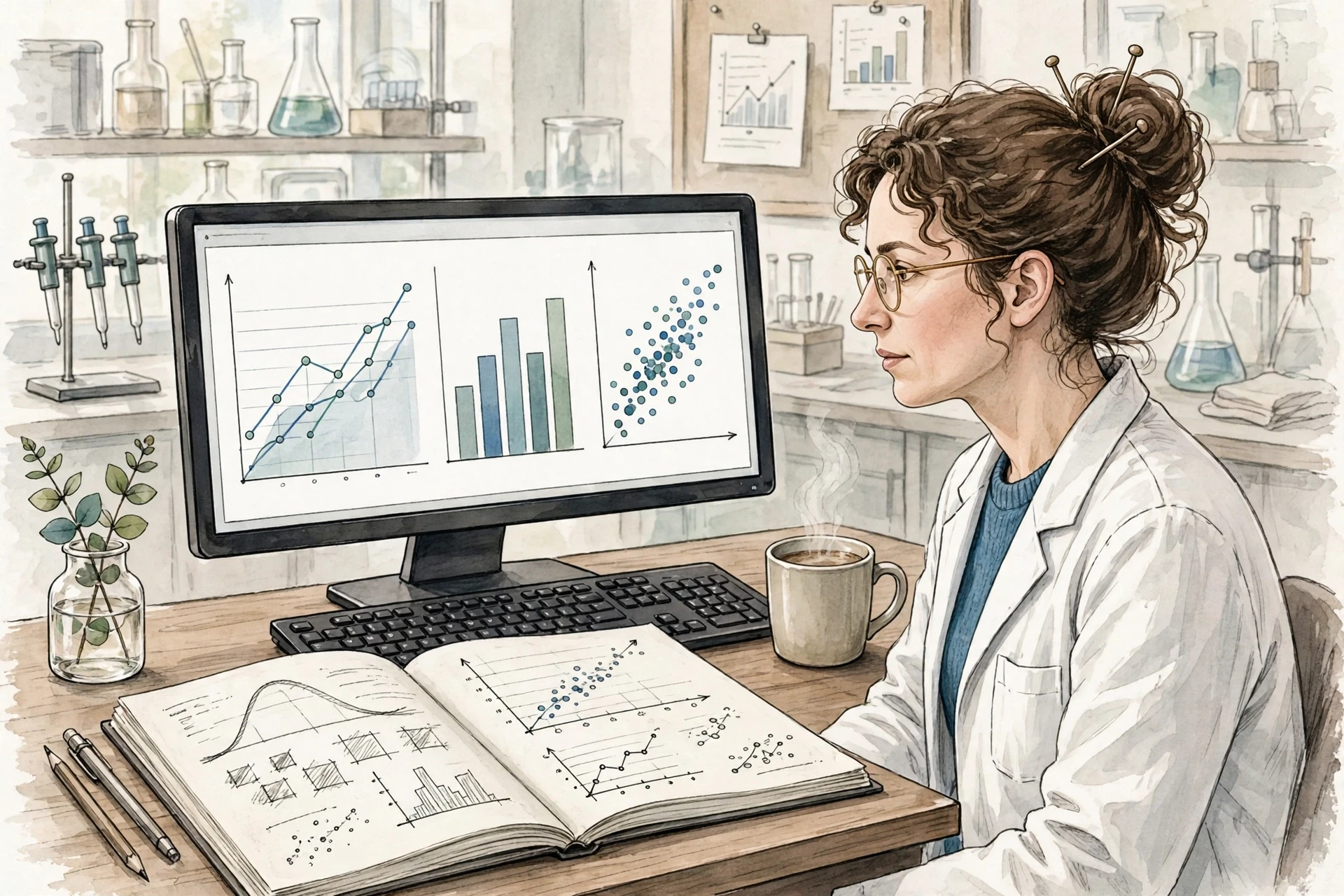
6. The Scientific Method in Action: Four Case Studies
The method is easiest to understand through stories where it worked, failed, and worked again. Each case below follows the same loop, in a different field, with different tools.
6.1 Medicine: Semmelweis and the washing of hands
In the 1840s, in a Vienna maternity hospital, women were dying of childbed fever at terrifying rates — in one ward, about one in ten. Ignaz Semmelweis, a young Hungarian doctor, noticed a strange pattern: the ward staffed by doctors and medical students had far more deaths than the ward staffed by midwives. He asked why. His hypothesis: doctors were carrying something on their hands from the autopsy room to the delivery room. He made a prediction: if doctors washed their hands in a chlorine solution before examining patients, deaths would fall. He tested it. Deaths fell from over 10 percent to about 1 percent.
Semmelweis had followed the method perfectly — and he was ignored. His colleagues were offended by the suggestion that their hands were unclean. He had no germ theory to explain why handwashing worked, and the medical establishment of his day did not accept what it could not explain. He died, largely unrecognised, in 1865. Twenty years later, Pasteur and Lister gave the mechanism, and handwashing became standard practice. The story is a warning: the method can produce the right answer and still lose, if the community is not ready to hear it. It is also a triumph: the evidence was there, in the numbers, waiting for the world to catch up.
Today, the same loop runs in every clinical trial. A new drug is tested against a placebo, in randomised, double-blind trials, with preregistered outcomes, because medicine learned — from Semmelweis and from a century of mistakes — that hope is not evidence. Sciory's guide to the immune system shows how that evidence is used to understand the body's defences: How the Human Immune System Works: Components, Responses, and Defenses.
6.2 Astronomy: from Ptolemy to the expanding universe
For fourteen centuries, the accepted picture of the heavens was Ptolemy's: the Earth at the centre, the planets moving in circles upon circles. It was a clever model, and it predicted planetary positions reasonably well. But it grew more complicated with every correction, and it could not explain what Galileo saw through his telescope in 1610: moons orbiting Jupiter, phases of Venus, spots on the Sun. Copernicus had proposed a Sun-centred model decades earlier, on grounds of simplicity. Galileo gave it evidence. Kepler gave it mathematics — elliptical orbits, not circles. Newton gave it a physical cause — gravity. Each step followed the same loop: a prediction failed, a new hypothesis was tested, the picture changed.
The same loop remade astronomy again in the twentieth century. Edwin Hubble's observation that distant galaxies are moving away from us led to the big bang theory, and the cosmic microwave background — the afterglow of the hot early universe — confirmed it. Sciory's account of that story follows the evidence from Hubble's redshift to the James Webb Space Telescope: The Big Bang Theory Explained: How the Universe Began and Evolved. And the solar system itself, from the Sun's fusion to the moons that may hide oceans, is a catalogue of hypotheses tested by spacecraft: Our Solar System: Planets, Moons, and Celestial Dynamics.
6.3 Biology: Darwin, DNA, and the tree of life
Darwin's theory of evolution by natural selection is the largest-scale test the method has ever run. It began with observations — the finches of the Galápagos, the fossils of South America, the pigeons of English breeders — and a question: why do species resemble each other in patterns that match geography and geology? The hypothesis: species change over time, and the changes that help survival and reproduction are passed on. The predictions: the fossil record should show gradual change, island species should resemble mainland relatives, and all life should share a common ancestry. Over a century and a half, each prediction has been checked, and each has held up — most dramatically when DNA, discovered long after Darwin's death, showed that all living things share the same genetic code, with differences that match the family tree Darwin drew from anatomy alone. That is the method at its most powerful: a hypothesis made before the decisive evidence existed, confirmed by evidence its author could never have imagined.
6.4 Physics: electricity, quantum mechanics, and the power of a failed prediction
Physics gives the cleanest examples of the method, because its experiments can be repeated with such precision. The study of electricity — from amber rubbed with fur to the circuits and electromagnetic waves that power the modern world — advanced by a long series of hypotheses tested with instruments: Fundamentals of Electricity: From Circuits to Electromagnetism. Quantum mechanics, stranger still, was built from experiments whose results made no sense under the old rules — light behaving as both wave and particle, particles that seem to know what is happening to their partners far away — and yet the theory that emerged predicts the behaviour of matter with astonishing accuracy: Understanding Quantum Mechanics: Principles, Paradoxes, Real-World Applications & 2026 Breakthroughs (Ultimate Guide).
My favourite example of a failed prediction in physics is the one I mentioned earlier: the Michelson–Morley experiment of 1887. Physicists expected light to travel at different speeds depending on the Earth's motion through the "ether," a supposed medium filling space. They measured no difference at all. The experiment "failed" — and that failure forced physics to rethink space and time themselves, leading to relativity. A method that only confirms what you already believe is not a method. It is a mirror.
7. Where the Method Goes Wrong — and How Science Fixes Itself
The scientific method is the best tool we have for learning about nature. It is not a guarantee. It is used by human beings, and human beings cut corners, chase funding, and fall in love with their ideas. The honest account of the method includes its failures, because the fixes for those failures are part of the method too.
7.1 Bias, before and after the experiment
Bias creeps in at every step. Confirmation bias makes us notice the evidence that supports our idea and overlook the evidence that does not. Publication bias means journals prefer exciting positive results to careful null results, so the published record looks more certain than it is. Funding bias means questions that attract money get studied more than questions that do not. None of these are solved by good intentions. They are solved by design: preregistering a study's methods and predictions before the data are collected, so the plan cannot be quietly changed; sharing data and code, so others can check the analysis; and publishing null results, so the record reflects what was actually found.
7.2 The replication crisis
In the 2010s, researchers in psychology, medicine, and other fields tried to repeat a sample of published studies and found that many did not replicate. The reasons were not mainly fraud. They were small samples, flexible analysis, and the habit of reporting only the analyses that gave a striking result. The field's response is a model of the method correcting itself: larger samples, preregistration, open data, and replication studies now count as real contributions. The crisis did not show that science is broken. It showed that science has a working immune system — slow, painful, and effective.
7.3 Common misconceptions, corrected
Most people assume the scientific method is a rigid recipe that every scientist follows in the same order. What we actually see in the data — in laboratory notebooks, in the history of discoveries, in the Stanford Encyclopedia's survey — is a flexible family of practices, used differently in different fields, and often out of order. The recipe is a teaching tool. The reality is a loop, and scientists enter it wherever they can.
Most people also assume that a single experiment can prove a theory true. It cannot. A single experiment can support a theory, and a single well-designed experiment can refute one, but proof in the absolute sense belongs to mathematics, not to science. What science offers instead is something better than certainty: a body of evidence that has survived repeated, independent testing, and that keeps making correct predictions about things nobody had seen before.
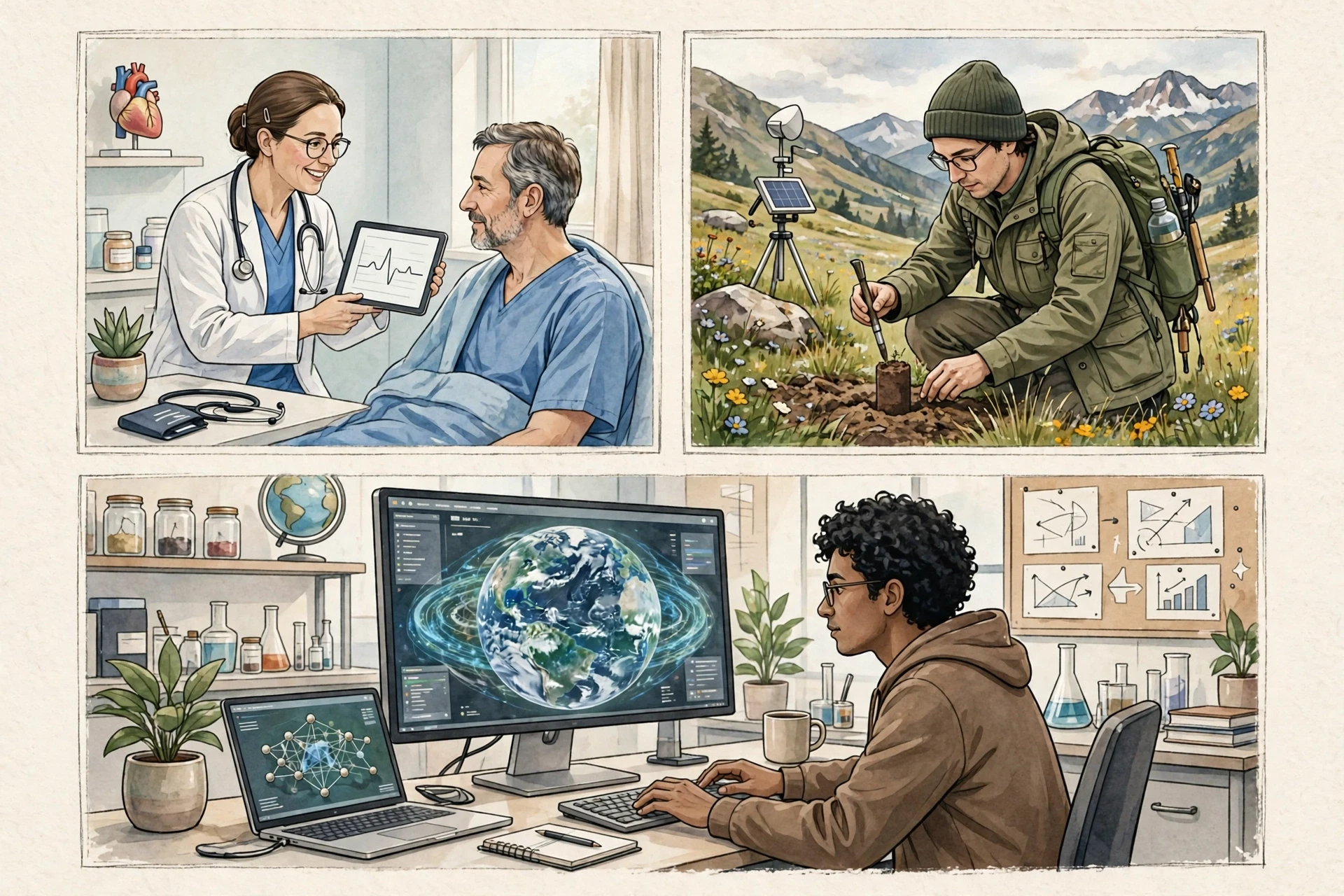
A third misconception is that science is only about the laboratory. The method applies wherever a claim about the world can be tested: in a hospital ward, in a forest, in a survey, in a computer simulation. The tools change. The logic does not.
Science is not a collection of facts. It is a way of arguing with nature — and losing gracefully, in public, when nature disagrees.

8. The Method in Everyday Life and Modern Research
You do not need a laboratory to use the scientific method. You use a version of it every time you troubleshoot a problem instead of guessing. The car will not start. You observe: the lights are dim. You ask: is the battery dead? You hypothesise: the battery is flat. You predict: jump-starting it should work. You test: you jump-start it. If it works, you have support for the hypothesis. If it does not, you move to the next hypothesis — the starter motor, the fuel — and test that. The difference between a good mechanic and a frustrated one is often just this discipline: test one thing at a time, and write down what happened.
The same logic applies to bigger decisions. A teacher who tries a new way of teaching one class and compares the results with another class, keeping everything else the same, is running an experiment. A business that tests two versions of a web page and measures which one more visitors use is running an experiment. A person who changes one habit at a time — sleep, exercise, diet — and tracks how they feel is running an experiment on themselves. The method is not a professional credential. It is a habit of thinking.
8.1 Open science: preregistration, open data, and AI
The newest chapter in the method's history is about transparency. Preregistration — publicly recording a study's hypotheses, methods, and analysis plan before collecting data — stops researchers from quietly changing the plan after seeing the results. Open data and open code let anyone check the work. Preprints let findings be shared and criticised before formal publication, speeding up the conversation. These are not new principles. They are old principles — honesty, sharing, checking — given new tools.
Artificial intelligence is adding another layer. Machine learning can find patterns in data too large for any human to read, from protein structures to climate records. But it also raises new questions for the method: how do you test a model whose reasoning you cannot follow? How do you avoid training an algorithm on biased data and then treating its output as neutral? The answers are still being worked out, and they will be worked out the same way every other question in science has been: by testing, by arguing, and by letting the evidence decide.
8.2 What the method cannot do
The method is powerful within its domain, and honest about its limits. It cannot tell you what is right or wrong — only what is true about the natural world. It cannot answer questions that have no testable consequences. It cannot work without good observations, and good observations need good instruments, good training, and time. And it cannot replace judgement. Deciding which questions matter, which risks are acceptable, and how to use what we learn — those are human decisions, made with values as well as evidence. The method tells us how the world works. What we do with that knowledge is up to us.
9. How to Use the Scientific Method Yourself
If you want to put the method to work — for a school project, a work problem, or a question of your own — here is a practical sequence, drawn from the steps above and from the mistakes I have watched students make most often.
Start with a real observation, not a textbook question. Write down what you actually saw, with numbers and dates.
Turn it into one specific question. If your question has more than one answer, split it until each part can be tested separately.
Read what is already known. A quick search of trusted sources — OpenStax, university pages, the Stanford Encyclopedia — will often show that someone has already tested part of your idea, and will save you from repeating their mistakes.
Write down your hypothesis and your prediction before you test. Use "if… then…" form. Date it. This is the single most valuable habit in the whole method.
Design a fair test. Change one variable. Keep a control. Decide in advance how many measurements you will take and what will count as evidence.
Record everything, including what went wrong. A failed run is data. A missing note is a hole no one can fill later.
Analyse honestly. Graph the data. Look at the spread, not just the average. Ask what else could explain the pattern.
Share the result, whatever it is. Tell someone what you did, what you found, and what you would do differently. That conversation is peer review in miniature.
The most common mistake I see is step 4 — skipping the written prediction. Students run the experiment, look at the results, and then write a hypothesis that matches them. It feels like success. It teaches nothing. The second most common mistake is changing two things at once and then not knowing which one mattered. Patience at the design stage saves confusion at the analysis stage. Every time.

10. Latest Research and Open Questions
The method itself is a subject of research, and it is changing faster now than at any time since the seventeenth century. Three developments stand out.
First, the open-science movement has moved from the margins to the mainstream. Major journals now require data sharing. Funders require preregistration for clinical trials. Replication studies, once dismissed as unoriginal, are published and cited. The result is a slower, more careful literature — and a more trustworthy one.
Second, the rise of very large data sets — genomics, astronomy surveys, climate records — has changed what "observation" means. A scientist today may never look through a telescope or a microscope; they may write code that sifts through millions of measurements. The method's logic is unchanged, but its practice now includes skills that Bacon and Galileo could not have imagined: statistics at scale, machine learning, and the careful handling of data that no single person can inspect by eye.
Third, philosophers and scientists are still arguing about the method itself. Is falsification enough, or do we need a richer account of how theories are confirmed? How should science handle findings that are statistically significant but practically tiny? What counts as replication when the original study used a unique instrument or a once-in-a-century event? These are live questions, debated in journals and conferences, and they are a sign of health. A method that cannot be questioned is a dogma. A method that questions itself is science.
One question I am asked more than any other is whether the scientific method will ever be replaced by something better — by artificial intelligence, perhaps, or by a new philosophy. My answer is that the method is not a machine that could be swapped out. It is a set of commitments: look carefully, say what you expect, test fairly, share honestly, and change your mind when the evidence demands it. Any future science that abandons those commitments will not be better science. It will not be science at all.

Conclusion
Four hundred years ago, a handful of thinkers in Europe began to insist on a strange idea: that the way to learn about nature is not to argue from authority, but to ask nature a question in a form it can answer, and then to listen to the answer even when it is not the one you wanted. That idea became the scientific method. It gave us penicillin and the theory of evolution, the expanding universe and the double helix, vaccines and the computer in your pocket. It also gave us something less visible and more valuable: a way of being wrong in public, correcting the error, and moving on — together.
The method is not a recipe, and it is not a guarantee. It is a discipline. Observe carefully. Ask a question that can be tested. State your idea clearly enough that it could be wrong. Predict what should happen. Test it fairly. Analyse honestly. Share what you found, and let others check it. Then do it again, with a better question.
Fleming's mouldy dish is the image I return to, because it captures the whole thing in a single moment. A careful observer, a question asked instead of a mess cleaned up, a test, and a result that changed the world. The next such moment is waiting somewhere — in a laboratory, in a hospital, in a field, or in your own kitchen. The method is how you will recognise it when it arrives, and how you will find out whether it is real.
Frequently Asked Questions
What is the scientific method in simple terms?
The scientific method is a step-by-step way of testing ideas about the natural world: observe something, ask a question about it, form a testable hypothesis, predict what should happen, run a fair experiment, analyse the results, and share the conclusion so others can check it.
What are the steps of the scientific method?
The usual steps are observation, question, hypothesis, prediction, experiment, data analysis, conclusion, and peer review with replication. In real research the steps loop and repeat rather than running in a straight line, and scientists often enter the cycle at different points.
Who invented the scientific method?
No single person invented it. Aristotle laid down the logic of observation and reasoning, Alhazen pioneered controlled experiments around the year 1000, Francis Bacon and Galileo shaped it during the Scientific Revolution, Newton added mathematical modelling, and Karl Popper refined it in the twentieth century with the idea of falsification.
What is a hypothesis?
A hypothesis is a specific, testable explanation for an observation — a proposed answer to a scientific question. A good hypothesis is clear enough that an experiment or observation could show it to be wrong, and it explains why something happens, not just what happens.
What is the difference between a hypothesis and a theory?
A hypothesis is a single testable idea. A theory is a broad, well-tested explanation supported by a large body of evidence from many independent tests — such as the theory of evolution or the germ theory of disease. A theory is not a guess; in science it is the highest status an explanation can reach.
What is the difference between a theory and a law?
A law describes what happens, often in mathematical form, without explaining why — for example, the law of universal gravitation. A theory explains why things happen, tying together many observations and laws into a coherent account. Neither one grows up into the other.
What does falsifiable mean?
Falsifiable means that an idea is stated clearly enough that some possible observation could show it to be false. Karl Popper argued that this is what makes a claim scientific. A horoscope that fits any outcome is not falsifiable; a drug trial with a measured outcome is.
Can the scientific method prove something true?
Not in the absolute sense. Science builds confidence through repeated, independent testing, and a theory that survives many serious attempts to refute it earns our trust. A single experiment can refute a hypothesis, but no single experiment proves a theory true for all time — new evidence can always refine or replace it.
Is the scientific method the same in every science?
No. The core principles — observe, test, share, replicate — are shared, but the tools differ. Physicists run controlled experiments, astronomers observe what they cannot manipulate, geologists study unique events, and social scientists use surveys and statistical models. The method is a family of practices, not a single rigid recipe.
How can I use the scientific method in everyday life?
Use it whenever you troubleshoot a problem: observe carefully, ask one specific question, write down your hypothesis and prediction before you test, change one thing at a time, record the result, and share what you found. The same discipline works for cooking, fixing things, studying, and making decisions at work.
Sources
Stanford Encyclopedia of Philosophy — Scientific Method. https://plato.stanford.edu/entries/scientific-method/
OpenStax Biology 2e — 1.1 The Science of Biology. https://openstax.org/books/biology-2e/pages/1-1-the-science-of-biology
Encyclopaedia Britannica — Scientific Method: Definition, Steps, & Application. https://www.britannica.com/science/scientific-method
LibreTexts Chemistry — 1.2: The Scientific Method. https://chem.libretexts.org/Courses/Barstow_Community_College/Survey_of_Chemistry_and_Physics/01%3A_Introduction_to_Science/1.02%3A_The_Scientific_Method