

Introduction
I was seven years old, sitting at the kitchen table on a summer afternoon, watching an ice cube die. My glass of water had gone warm, and the cube in it was shrinking by the minute, its sharp corners rounding off, its edges turning to mist and then to nothing at all. I remember poking it with my finger and asking my mother where it had gone — where had all its atoms and molecules gone? "It is still there," she said. "It just changed." That answer annoyed me for years. How could something still be there when I could no longer see it, hold it, or hear it clink against the glass?
The answer, which took me the better part of a lifetime in laboratories to really feel in my bones, is that the ice cube never left. It changed its arrangement. The same tiny particles that had been locked in a rigid crystal loosened their grip on one another, slid past each other, and became liquid. Nothing was added. Nothing was taken away. The atoms and molecules were the same; only their dance had changed.
That is what this guide is about: the smallest pieces of matter, how they are built, how they join together, and how their behaviour gives us everything we can see and touch — the glass, the water, the table, your hand around the glass, and the air you are breathing as you read this. Atoms and molecules are not abstract textbook drawings. They are the reason ice melts, salt dissolves, iron rusts, bread rises, and medicines work. Once you can picture them, the everyday world stops looking solid and starts looking busy — a crowd of particles, constantly moving, constantly negotiating with one another through the push and pull of electric charge.
We will start inside a single atom, travel through the history of how we found out atoms exist at all, and end with the newest tools that let scientists watch individual atoms and molecules at work. Along the way we will meet the people who got it wrong in useful ways, the experiments that settled arguments, and the ideas that still trip up students — and plenty of working scientists — today.
1. Atoms and Molecules at a Glance
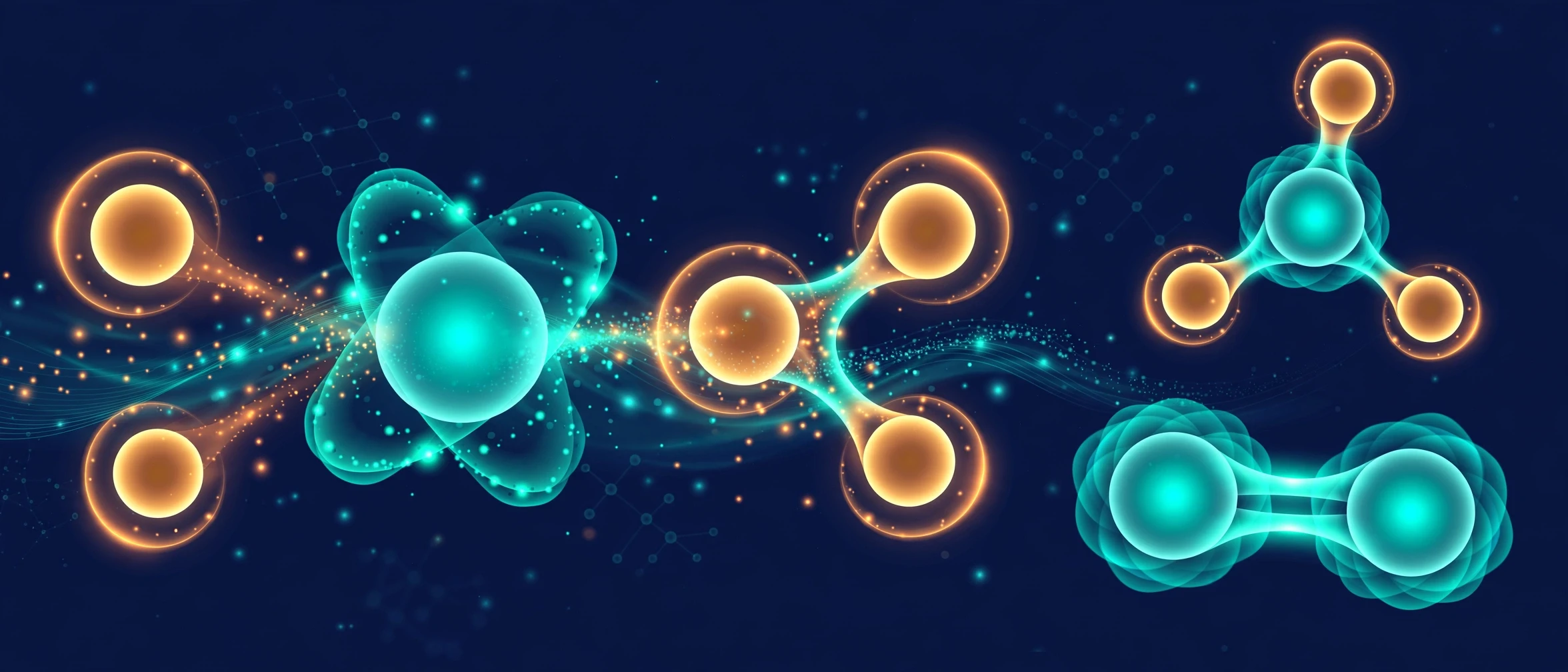
An atom is the smallest unit of an element that still behaves like that element. Cut a piece of gold in half, and you still have gold. Keep cutting — in your imagination, with finer and finer tools — and eventually you reach a single gold atom. Cut that, and you no longer have gold at all. You have protons, neutrons, and electrons, the subatomic particles that build every atom in the universe. A molecule is two or more atoms held together by chemical bonds. Oxygen gas in the air is a molecule of two oxygen atoms. Water is a molecule of two hydrogen atoms and one oxygen atom. A molecule of DNA contains billions of atoms, arranged in a double helix that stores the instructions for building a living thing.
The scale is hard to hold in your head, and that is part of the problem with teaching this subject. A single grain of sand contains roughly a million billion billion atoms — a number so large that comparisons break down. Here is the one I use in lectures, because students remember it: if an atom were the size of a football stadium, its nucleus would be a marble sitting at the centre spot, and the electrons would be gnats buzzing somewhere up in the stands. An atom is almost entirely empty space. The reason your hand does not pass through the table is not that the table is solid in the way a brick wall is solid. It is that the electrons in your hand and the electrons in the table repel each other electrically, and that repulsion is strong enough to hold you up.
That emptiness is the first surprise, and it sets the tone for everything that follows. Matter feels solid because of forces, not because of stuff. The forces are electrical, they act over tiny distances, and they are what chemical bonding is all about.
1.1 Elements, compounds, and mixtures — three words that get mixed up
Three words cause most of the early confusion in chemistry, so let us fix them now.
An element is a pure substance made of only one kind of atom. Hydrogen, oxygen, carbon, iron, and gold are elements. There are 118 known elements, and each one is defined by the number of protons in its atoms.
A compound is a substance made of two or more different elements joined by chemical bonds in a fixed ratio. Water is a compound. So is table salt, carbon dioxide, and the sugar in your tea. A compound has properties of its own, different from the elements that made it. Sodium is a metal that bursts into flame in water; chlorine is a poisonous green gas; together, as sodium chloride, they are the salt on your food.
A mixture is a physical blend of substances that are not chemically bonded. Air is a mixture of nitrogen, oxygen, and other gases. Sand on a beach is a mixture. You can separate a mixture by physical means — filtering, boiling, picking things apart — but a compound can only be separated by breaking chemical bonds.
The difference matters because it is the difference between a crowd and a team. In a mixture, the particles happen to be in the same place. In a compound, they are committed to each other.
1.2 How many atoms are we talking about?
Chemists count atoms the way bakers count eggs: by the dozen, except the chemist's dozen is enormous. One mole of anything contains about 6.022 × 10²³ particles — Avogadro's number, named for the Italian scientist Amedeo Avogadro, who first proposed in 1811 that equal volumes of gases contain equal numbers of particles. A mole of water weighs 18 grams, about a tablespoon, and contains that many water molecules. A mole of carbon weighs 12 grams. The mole lets chemists weigh out atoms on a kitchen scale, in effect, and it is one of the most practical ideas in all of science.
I first grasped the size of Avogadro's number not in a lecture but in a laboratory, weighing out a white powder for a reaction and realising that the few grams in my weighing boat contained more molecules than there are stars in the observable universe. It was a humbling moment. The invisible world is not small in number. It is small in size and vast in count, and that combination is why chemistry works at the scale of grams and litres while being decided at the scale of atoms.
NIST, the US National Institute of Standards and Technology, maintains the authoritative tables of atomic weights and isotopic compositions that chemists use to turn those counts into real masses: NIST Atomic Weights and Isotopic Compositions. Every atomic weight on the periodic table traces back to measurements like these.
2. Inside the Atom: Protons, Neutrons, and Electrons
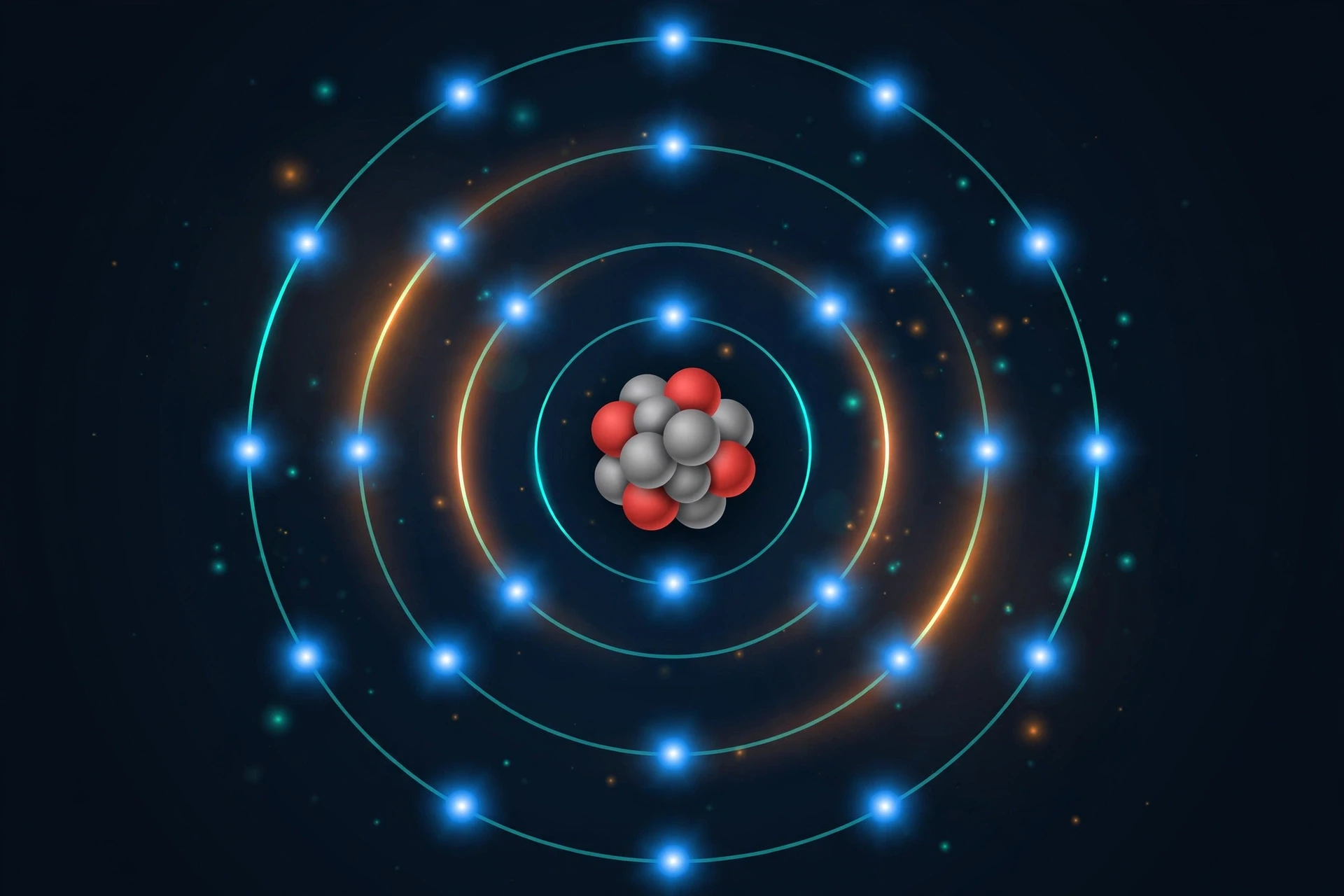
Every atom has the same basic architecture: a tiny, dense nucleus at the centre, and electrons moving in the space around it. The nucleus holds the protons, which carry a positive electric charge, and the neutrons, which carry no charge. The electrons carry a negative charge. A neutral atom has the same number of protons and electrons, so the charges cancel out.
The numbers are what make chemistry work. The number of protons — the atomic number — decides which element an atom is. One proton: hydrogen. Six protons: carbon. Seventy-nine protons: gold. Change the number of protons and you change the element itself. The number of neutrons can vary without changing the element; atoms of the same element with different numbers of neutrons are called isotopes. Carbon-12, with six neutrons, is the common, stable form of carbon. Carbon-14, with eight neutrons, is radioactive and decays slowly — which is why archaeologists can use it to date ancient wood and bone. The total of protons plus neutrons is the mass number, and it is what the familiar atomic weight on the periodic table is built from.
2.1 The nucleus: a marble with the mass of a mountain
The nucleus is absurdly small and absurdly dense. If you could gather all the empty space out of the atoms in a human body, the remaining matter would fit in a volume smaller than a grain of sand — though it would weigh as much as the person. The protons in the nucleus repel each other, since like charges repel, and they are held together by the strong nuclear force, the strongest force in nature, acting over distances smaller than an atom's nucleus. It is a violent, crowded place, and it is where the energy of the Sun and of nuclear power comes from.
I once watched a student hold a lead brick in a radiation laboratory and ask, with genuine worry, whether the heaviness of it meant the atoms inside were packed tighter. The answer is more interesting than that: lead feels heavy because each of its atoms is heavy — 82 protons and around 125 neutrons apiece — not because the atoms are squeezed together. Density is a story about the nucleus as much as it is about packing.
2.2 Electrons: the part of the atom that does the chemistry
If the nucleus is the atom's identity, the electrons are its social life — and the social life of atoms and molecules is what chemistry is. Electrons occupy regions of space around the nucleus called shells or energy levels, and within those, orbitals — fuzzy regions where an electron is likely to be found. The old schoolbook picture of electrons orbiting the nucleus like planets around the Sun is a useful first sketch, and it is wrong in an important way. Electrons do not travel in neat circular tracks. They exist as clouds of probability, and the shape of those clouds decides how an atom bonds, what shape its molecules take, and what colour its compounds are.
The outermost electrons, the valence electrons, are the ones that take part in bonding. An atom with a full outer shell — like the noble gases neon and argon — is content and rarely reacts. An atom with one electron in its outer shell, like sodium, will give it away at the first opportunity. An atom one electron short of a full shell, like chlorine, will grab one wherever it can. That simple hunger for a full outer shell is the engine of almost all chemistry. The quantum-mechanical picture of shells and orbitals, with its rules about which electrons can share a space, is laid out in NIST's atomic spectroscopy reference: NIST Atomic States, Shells, and Configurations.
An atom is almost entirely empty space. What makes matter feel solid is not stuff, but force — the electrical repulsion between electron clouds, strong enough to hold up a building and gentle enough to let you turn a page.
2.3 Isotopes, ions, and why the details matter
An atom that gains or loses electrons becomes an ion — a charged particle. Lose electrons and it becomes positively charged, a cation. Gain electrons and it becomes negatively charged, an anion. Your nerves fire because sodium and potassium ions rush across cell membranes. Your bones are built from calcium ions locked into a crystal. The chemistry of life is, to a large extent, the chemistry of ions moving where they are needed and staying where they belong.
Isotopes matter in a different way. Most elements are a mixture of isotopes in fixed proportions, and those proportions are fingerprints. The ratio of oxygen isotopes in an ice core tells scientists about the temperature of the Earth thousands of years ago. The ratio of carbon isotopes in a sample tells a forensic chemist whether a substance came from a plant, a fossil fuel, or a laboratory. Atoms remember where they have been, in the language of their nuclei.
3. How We Learned Atoms Are Real
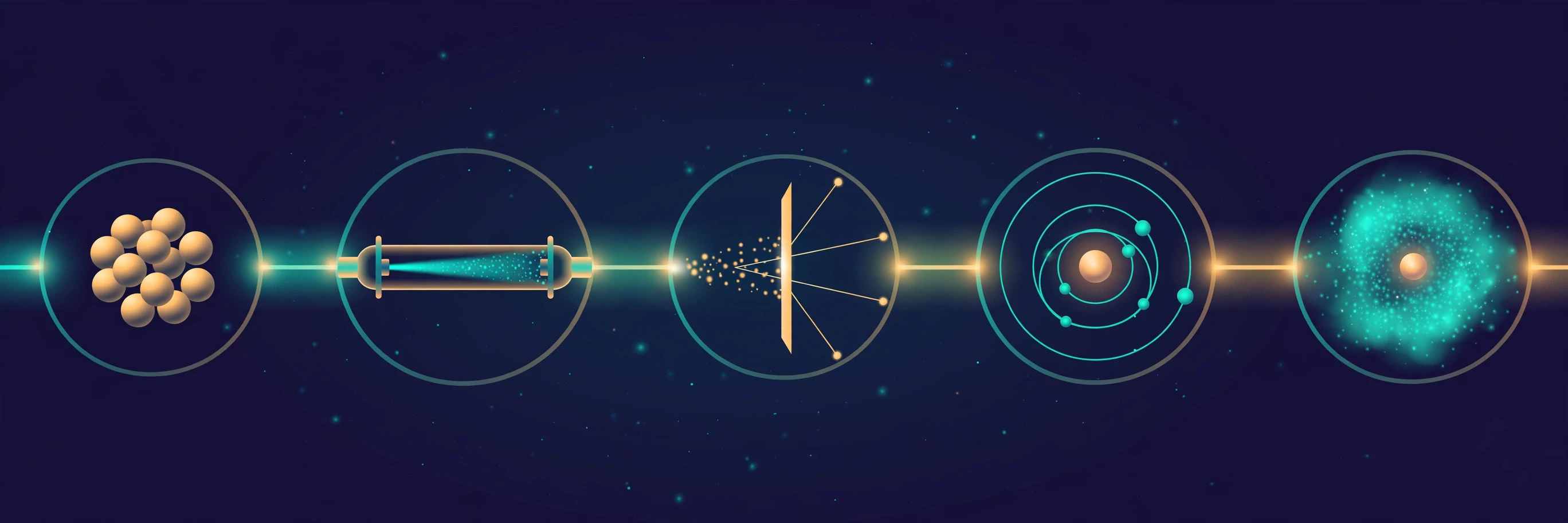
Nobody has ever seen an atom with the naked eye, and for most of human history the idea of atoms was philosophy, not science. The Greek thinker Democritus proposed, around 400 BCE, that everything was made of tiny indivisible pieces he called atomos — uncuttable. It was a brilliant guess and, for two thousand years, it stayed a guess. The story of how a guess became a measured fact is one of the best stories in science, because it was not one experiment. It was a relay race, with each runner correcting the last.
3.1 Dalton and the first real theory
In the early 1800s, the English schoolteacher and meteorologist John Dalton noticed something curious. When elements combined to form compounds, they always did so in simple whole-number ratios by weight. Carbon and oxygen could make carbon monoxide or carbon dioxide, but never anything in between. Dalton's explanation was that matter was made of atoms, that all atoms of an element were identical, and that compounds formed when atoms joined in simple ratios. It was the first atomic theory that made testable predictions, and it worked. Dalton was a Quaker who kept meticulous weather diaries for 57 years, recording over 200,000 observations, and he brought the same stubborn patience to chemistry. His theory was not right in every detail — atoms of an element are not all identical, as isotopes later showed — but the core idea survived every test that followed.
3.2 Thomson finds the electron, Rutherford finds the nucleus
In 1897, J. J. Thomson was studying cathode rays — glowing streams inside vacuum tubes — and showed that they were made of particles far lighter than any atom, each carrying a negative charge. He had found the electron, the first subatomic particle, and with it the first proof that atoms were not indivisible after all. Thomson pictured the atom as a positively charged pudding with electrons stuck in it like plums. It was a reasonable picture, and it was wrong.
The correction came in 1909, from Ernest Rutherford's laboratory in Manchester. Rutherford's students, Hans Geiger and Ernest Marsden, fired tiny alpha particles at a sheet of gold foil only a few atoms thick, expecting them to pass straight through Thomson's pudding. Most did. But a few — about one in eight thousand — bounced straight back, as if they had hit something hard and tiny. Rutherford later said it was the most incredible event of his life, "almost as if you fired a 15-inch shell at a piece of tissue paper and it came back and hit you." The atom, he realised, was mostly empty space, with its mass and positive charge concentrated in a nucleus a hundred thousand times smaller than the atom itself.
3.3 Bohr, the quantum model, and the atom we use today
Niels Bohr, working in Rutherford's laboratory, took the next step in 1913. He proposed that electrons could only occupy certain allowed energy levels, like rungs on a ladder, and that they jumped between rungs by absorbing or emitting light of a precise colour. His model explained the exact pattern of colours hydrogen gives off when heated — its spectrum — which no earlier model could do. Bohr's atom was still a sketch, but it was a sketch that predicted measurements, and that is what separates science from storytelling.
The modern picture came in the 1920s, from quantum mechanics: electrons as standing waves, orbitals as probability clouds, and the rules of the Pauli exclusion principle, which says no two electrons in an atom can share the same set of quantum numbers. That principle is why the periodic table has the shape it does, why chemistry has rules at all, and — in a roundabout way — why you cannot walk through walls. The story of how the quantum model replaced the planetary picture is told in Sciory's Understanding Quantum Mechanics, which follows the same experiments from the side of physics rather than chemistry.
3.4 Seeing atoms, at last
For a long time, atoms were believed in the way a detective believes in a culprit: from evidence, not from sight. That changed in the 1980s with the scanning tunnelling microscope, which can image individual atoms on a surface, and it has changed again in recent years, as electron microscopes have grown sharp enough to show single atoms and even the bonds between them. In 1989, researchers at IBM spelled out the letters "IBM" using 35 individual xenon atoms, moved one by one with the tip of a microscope. It was a stunt, but it was also a proof: atoms are real, countable, movable things, not just useful fictions. Today, scientists can watch a single molecule change shape as it reacts, and that ability is rewriting chemistry from the inside out.
4. The Periodic Table: A Map of the Atoms
If atoms are the letters of matter, the periodic table is the dictionary. Dmitri Mendeleev arranged the known elements by atomic weight in 1869 and noticed that their properties repeated in a pattern — a period — every so often. He left gaps where the pattern demanded an element nobody had found, and he predicted what those missing elements would weigh and how they would behave. When gallium and germanium were discovered years later, matching his predictions almost exactly, the table stopped being a filing system and became a theory.
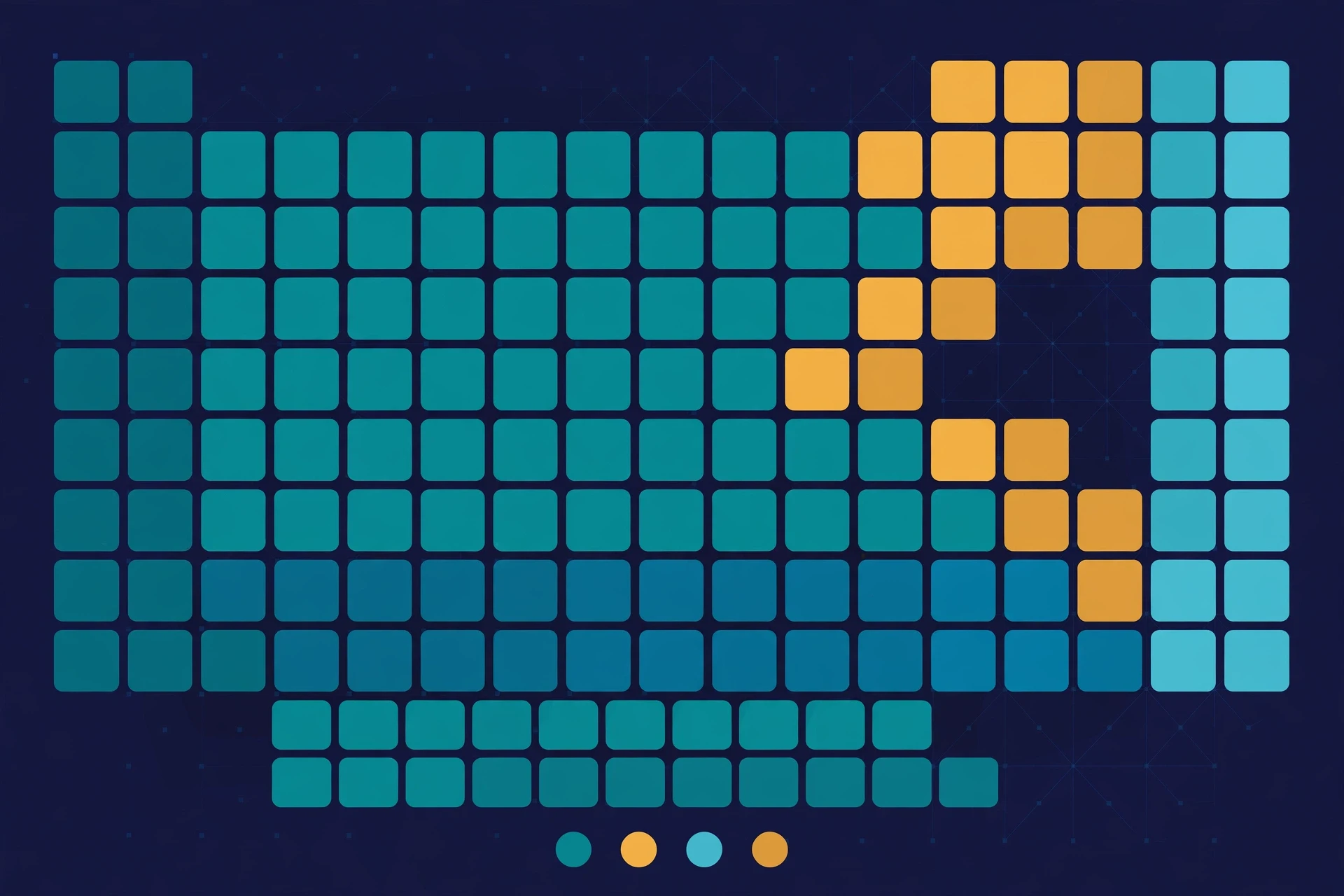
The modern table is arranged by atomic number — the number of protons — and it is organised into rows called periods and columns called groups. Elements in the same group share the same number of valence electrons, and so they behave in similar ways. The alkali metals in group 1 all have one outer electron and all react violently with water. The noble gases in group 18 all have full outer shells and barely react at all. The halogens in group 17 are all one electron short of a full shell, and all of them are eager to grab one.
4.1 Reading the table like a chemist
A chemist does not memorise the table. She reads it. The left side holds the metals — shiny, conductive, willing to lose electrons. The right side holds the nonmetals — brittle or gaseous, eager to gain or share electrons. Between them runs a staircase of metalloids, elements like silicon and boron that behave like a bit of both and that the electronics industry is built on. The two detached rows at the bottom, the lanthanides and actinides, are the f-block elements, heavy and often radioactive, and they include the materials inside lasers, phone screens, and nuclear reactors.
The table also tells a story about the universe. Hydrogen and helium were made in the first minutes after the Big Bang. Everything heavier — the carbon in your body, the iron in your blood, the gold in a wedding ring — was forged inside stars and scattered when those stars died, a story Sciory follows in The Big Bang Theory Explained. The periodic table is, in that sense, a history book written in elements. For the full structure and trends, element by element, see Sciory's Periodic Table of Elements: Structure & Trends.
4.2 Why only some combinations work
The table explains why sodium bonds with chlorine but not with argon, why carbon can form millions of compounds and helium forms almost none, and why oxygen is everywhere in chemistry while gold sits quietly in a vault. It comes back, every time, to the outer electrons. An atom's chemistry is its valence electrons' biography: how many there are, how tightly they are held, and how badly the atom wants more or fewer of them. The rest of the atom — the nucleus, the inner electrons — matters for mass, for radioactivity, for the colour of a flame, but the bonding is decided at the edge.
5. Electrons and Why Atoms Bond
Atoms bond because a bonded state is usually a lower-energy, more stable state than two atoms alone. That is the whole secret of how atoms and molecules hold together, and it is worth saying plainly: bonding is not about atoms "wanting" anything. Atoms do not want. They fall into lower-energy arrangements the way a ball rolls downhill. The language of wanting is a teaching shortcut, and it is a shortcut that causes trouble later, because students start to imagine atoms making decisions. They do not. Energy does the deciding, and the electrons are the part of the atom that feels the energy difference.
The rule of thumb that captures most of this is the octet rule: atoms tend to gain, lose, or share electrons until their outer shell holds eight electrons, the stable arrangement of the noble gases. Hydrogen is the exception that proves the rule — it is content with two. The octet rule is a guide, not a law. Plenty of molecules break it, and the exceptions are interesting in their own right. But as a first map of why atoms join up, it is remarkably good.
5.1 Electronegativity: the tug-of-war
Not all atoms pull on electrons equally. Electronegativity is a measure of how strongly an atom attracts shared electrons, and it rises across a row of the periodic table and falls down a column. Fluorine, at the top right, is the strongest puller of all. Caesium, at the bottom left, is one of the weakest. When two atoms with similar electronegativity meet, they share electrons fairly, and the bond is nonpolar covalent. When their electronegativities differ a lot, one atom hogs the electrons, the bond becomes polar, and the molecule ends up with a slightly positive end and a slightly negative end. When the difference is very large — a metal meeting a nonmetal — the electron is not shared at all. It is transferred, and the result is an ionic bond.
I learned electronegativity the hard way, in my first year as a student, by getting a question wrong on an exam. I had written that the bond in hydrogen fluoride was ionic, because fluorine is so greedy. My tutor circled it and wrote, in the margin, "Greedy, yes. But not a thief." The distinction stuck with me for thirty years: sharing unevenly is still sharing. That is the difference between a polar covalent bond and an ionic one, and it is a difference of degree, not of kind. Real bonds sit on a spectrum, and the neat categories in textbooks are signposts on that spectrum, not fences.
5.2 Energy levels and why some atoms are restless
Electrons fill shells in order of increasing energy, and the pattern of filling is what the periodic table records. The first shell holds two electrons. The second holds eight. The third holds eight in its outer part, and so on, with the inner shells of heavier elements filling in a more complicated order that quantum mechanics predicts exactly. An atom with a half-empty outer shell is restless in the energetic sense: there is a lower-energy arrangement available if it can gain, lose, or share electrons with a neighbour. An atom with a full shell has nowhere lower to go, so it sits out the chemistry. That is why argon does not rust, why neon signs glow without reacting, and why the air you breathe is four-fifths nitrogen — a gas so unreactive that it mostly watches the chemistry of life happen around it.
6. Covalent Bonds: Sharing Electrons
The most important bond in the living world is the covalent bond, in which two atoms share one or more pairs of electrons. Each atom contributes one electron to the shared pair, and the pair spends its time between the two nuclei, pulling them together. It is a joint custody arrangement, and it works because the shared electrons are attracted to both positive nuclei at once, and that attraction outweighs the repulsion between the nuclei themselves.
The simplest molecule of all is hydrogen gas, H₂: two hydrogen atoms, each with one electron, sharing the pair so that each atom effectively has the two electrons it needs for a full shell. Oxygen gas, O₂, shares two pairs — a double bond. Nitrogen gas, N₂, shares three pairs, a triple bond, and that triple bond is so strong that nitrogen gas barely reacts with anything, which is why most of the nitrogen in the air passes through your lungs unchanged with every breath.
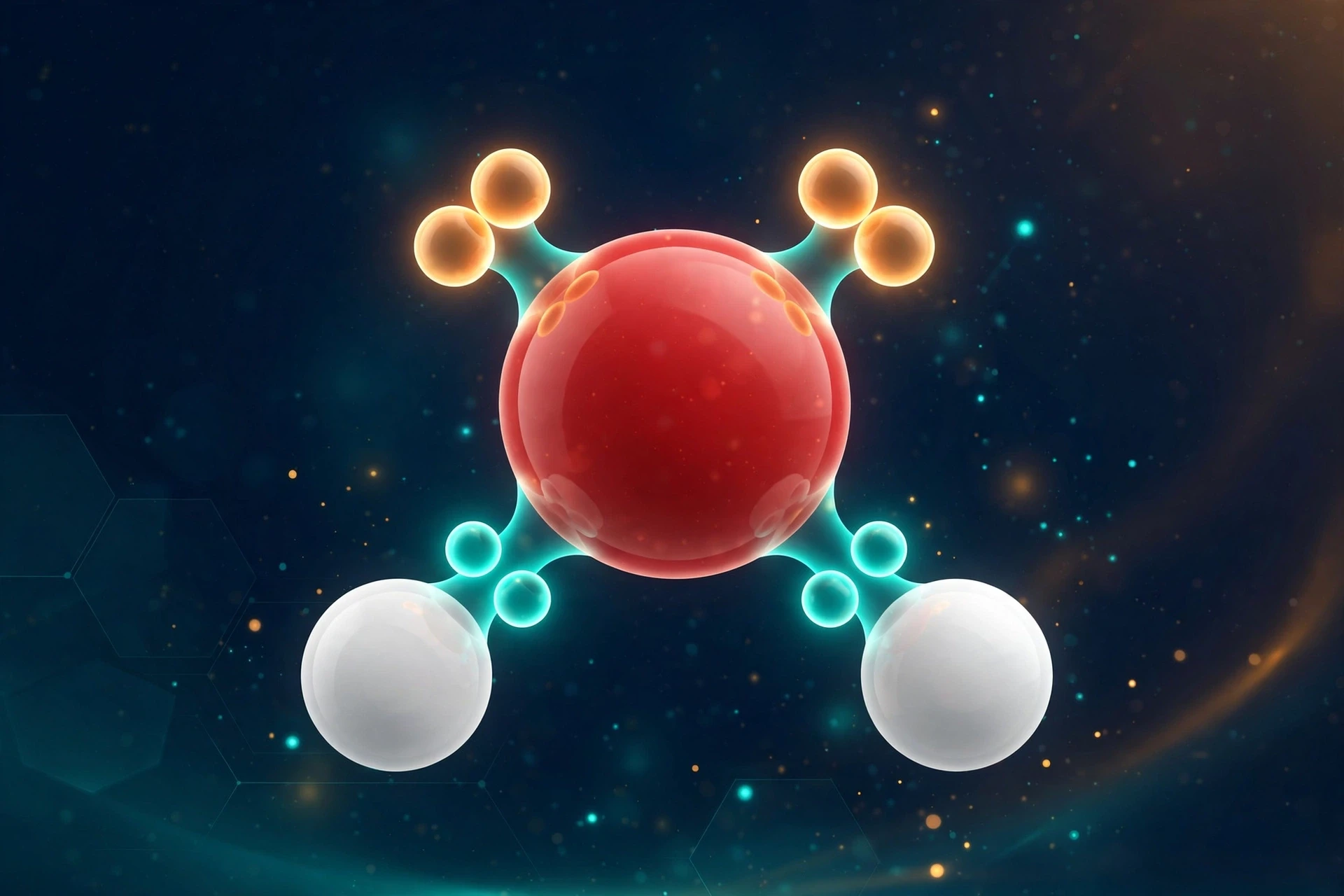
Water is the covalent molecule that matters most to us. An oxygen atom shares one pair of electrons with each of two hydrogen atoms, giving the water molecule its familiar H₂O formula. The LibreTexts chemistry text lays out how covalent molecules and compounds are represented, from molecular formulas to structural formulas: LibreTexts Chemistry, Molecules and Molecular Compounds. But oxygen pulls harder on the shared electrons than hydrogen does, so the electrons spend more time near the oxygen end. The oxygen end of the molecule becomes slightly negative, the hydrogen ends slightly positive, and water becomes a polar molecule — a tiny magnet with two ends. That polarity is the reason water dissolves salt, carries nutrients through your blood, and climbs up the thin tubes inside a plant. Photosynthesis, the process that feeds nearly all life on Earth, begins with water molecules being split apart inside a leaf — a story told in detail in Sciory's Photosynthesis Explained.
6.1 Single, double, and triple bonds
A single bond shares one pair of electrons. A double bond shares two pairs, and a triple bond shares three. More shared pairs mean a shorter, stronger bond — but also a stiffer one. A double bond cannot twist the way a single bond can, and that stiffness is what gives some molecules their shape and their function. The fats in your diet are a case in point: saturated fats have only single bonds between their carbon atoms and pack tightly together, while unsaturated fats contain double bonds that put kinks in the chain and keep the fat liquid at room temperature. The difference between butter and olive oil is, at bottom, a difference in bonding.
Carbon deserves a paragraph of its own, because carbon is the great sharer. With four valence electrons, it can form four covalent bonds, and it can bond to other carbon atoms in chains, rings, and branching networks of almost unlimited variety. That is why there are millions of known carbon compounds and why all known life is carbon-based. Silicon, directly below carbon in the periodic table, can also form four bonds — but silicon-silicon bonds are weaker, and silicon dioxide is a rock, not a gas. The difference between a living world and a mineral one turns on a single row of the periodic table.
6.2 Giant covalent structures: when sharing never stops
Some covalent bonds do not stop at a single molecule. In diamond, every carbon atom is bonded to four others in a three-dimensional network that extends through the whole crystal. There is no separate molecule to point to — the entire diamond is, in a sense, one molecule. That is why diamond is the hardest natural material known: scratching it means breaking covalent bonds across a whole network. Graphite, the soft grey stuff in pencils, is also pure carbon, but its atoms are bonded in flat sheets that slide over one another. Diamond and graphite are the same element, the same atoms, arranged differently — and the arrangement changes everything. It is one of the cleanest demonstrations in science that structure, not just composition, decides what a material is.
7. Ionic Bonds: Giving and Taking
Where covalent bonds share, ionic bonds transfer. When a metal meets a nonmetal with a large difference in electronegativity, the metal gives up one or more electrons entirely, and the nonmetal takes them. Both atoms end up with full outer shells — and with opposite electric charges. The positive metal ion and the negative nonmetal ion attract each other strongly, and that electrostatic attraction is the ionic bond.
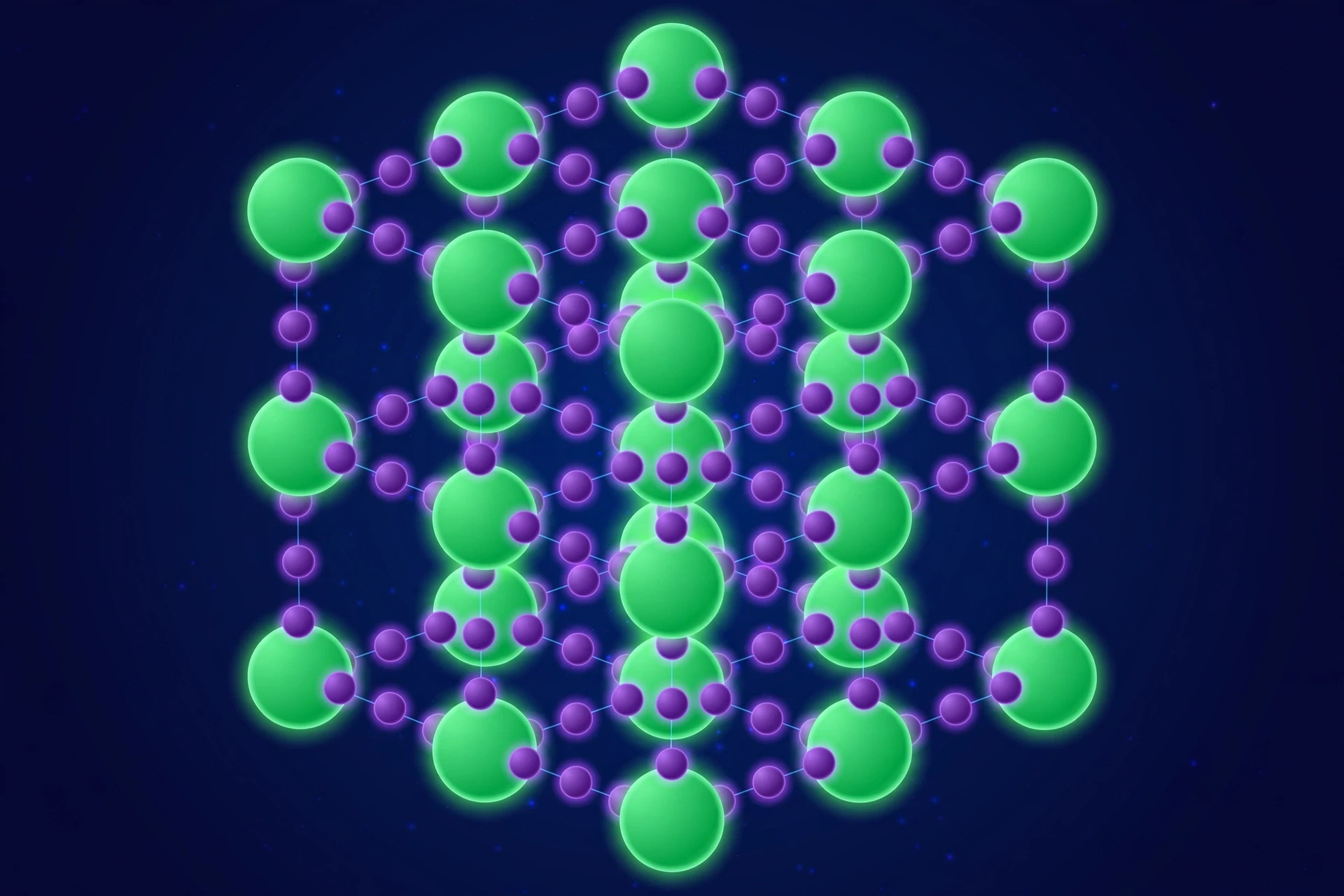
Table salt is the classic example. A sodium atom gives its single outer electron to a chlorine atom. Sodium becomes Na⁺, chlorine becomes Cl⁻, and the two ions lock together. But they do not stop at a pair. Each sodium ion attracts six chloride ions around it, each chloride attracts six sodium ions, and the result is a vast, regular crystal lattice — a repeating three-dimensional pattern that extends through the whole grain of salt. That lattice is why salt crystals are cubic, why salt has such a high melting point (801 °C), and why solid salt does not conduct electricity while molten salt and salt water do: in the solid, the ions are locked in place; melt it or dissolve it, and they are free to move and carry charge.
7.1 Why ionic compounds behave the way they do
The properties of ionic compounds follow directly from the lattice. They are hard but brittle — hit a salt crystal and whole layers of ions shift, bringing like charges next to each other, and the crystal shatters along a clean plane. They dissolve in water because water molecules, being polar, surround each ion and pull it out of the lattice one by one. And they conduct electricity only when their ions can move. That last fact is not a curiosity. It is the basis of electrochemistry, of batteries, and of the electrical signals in your nervous system — and it is why Sciory's Fundamentals of Electricity begins, as it must, with charge.
I still remember the first time I melted salt in a teaching laboratory and watched a light bulb glow when the circuit was dipped into the molten liquid, then go dark again as the salt froze. A student whispered, "It is the same stuff." She was right, and she was wrong. The atoms were the same. What had changed was whether the ions were free to move. Chemistry is often a story about freedom of movement, and ionic bonding is the clearest chapter of that story.
7.2 Ionic bonds in the body and the Earth
Ionic compounds are everywhere in the living world. Your bones are a composite of collagen protein and hydroxyapatite, a calcium phosphate mineral held together by ionic bonds. Your stomach acid is hydrochloric acid, which exists as hydrogen and chloride ions in water. The oceans are salty because rivers have been carrying dissolved ions from weathered rocks into the sea for billions of years, and the sea has nowhere to drain. The water cycle that carries those ions — evaporation, rain, rivers, and back to the sea — is described in Sciory's The Water Cycle. Every glass of seawater is a museum of ionic chemistry, holding the dissolved history of mountains.
8. Metallic Bonds and the Forces Between Molecules
Not every bond fits the covalent or ionic pattern, and the exceptions run the modern world. In a metal, the outer electrons are not shared between two atoms or transferred from one to another. They are delocalised — free to wander through the whole piece of metal, forming a "sea" of electrons around a lattice of positive metal ions. That electron sea is why metals conduct electricity and heat so well, why they are shiny (the free electrons reflect light), and why they can be bent and hammered without shattering: when a layer of ions shifts, the electron sea simply flows around the new arrangement and holds it together.
8.1 Hydrogen bonds: weak, numerous, and essential
The most consequential weak force in chemistry is the hydrogen bond. It is not a bond inside a molecule at all. It is an attraction between molecules: a hydrogen atom already bonded to a strongly electronegative atom — oxygen, nitrogen, or fluorine — is attracted to a lone pair of electrons on a nearby electronegative atom. LibreTexts Biology explains the same picture — ions, ionic and covalent bonds, and hydrogen bonds between molecules — in a compact chapter: LibreTexts Biology, Bonding. Each hydrogen bond is only about a twentieth as strong as a covalent bond, but there are vast numbers of them, and together they decide the properties of water, the shape of proteins, and the structure of DNA.
Water would be a gas at room temperature without hydrogen bonds. Each water molecule forms hydrogen bonds with its neighbours, and that network is why water has such a high boiling point for so small a molecule, why ice floats (the hydrogen-bonded network in ice holds molecules further apart than in liquid water), and why water can absorb so much heat without warming quickly — the reason coastal climates are mild and the reason your body can regulate its temperature by sweating. The two strands of the DNA double helix are held together by hydrogen bonds between matching base pairs, weak enough to be unzipped when a cell needs to copy its genetic instructions, strong enough to keep the code safe the rest of the time. The full story of that molecule is in Sciory's DNA: Structure, Replication, and Role in Heredity.
8.2 Van der Waals forces: the weakest grip, and the gecko's secret
The weakest attractions of all are the van der Waals forces: fleeting, momentary imbalances in electron clouds that create temporary dipoles, which then attract neighbouring atoms. Individually they are almost negligible. Collectively, they are what holds a gecko to a ceiling. A gecko's foot is covered in millions of microscopic hairs, each splitting into hundreds of tinier tips, and each tip makes such close contact with the surface that van der Waals forces add up to a grip strong enough to hold the animal's weight. Engineers are now copying that trick to make reusable adhesives that work without glue. It is a good reminder that in chemistry, "weak" is a relative term. Enough weak forces, acting together, can hold up a lizard — or a building.
Bond or force | What happens to electrons | Typical strength | Example |
|---|---|---|---|
Covalent | Shared between atoms | Strong | Water, DNA, diamond |
Ionic | Transferred from one atom to another | Strong | Table salt, limestone |
Metallic | Delocalised in an electron sea | Strong, variable | Copper wire, steel, gold |
Hydrogen bond | Attraction between molecules | Weak to moderate | Water, DNA base pairs |
Van der Waals | Temporary electron-cloud imbalance | Very weak | Gecko feet, noble gases liquefying |
9. From Atoms to Molecules: Why Shape Matters
A molecule's formula tells you what atoms it contains. Its shape tells you what it can do. Two molecules can have the same atoms in the same numbers and behave completely differently because their atoms are arranged differently — and even the same arrangement can behave differently if its angles change. Shape is chemistry's third dimension, and it is where the subject turns from accounting into architecture.
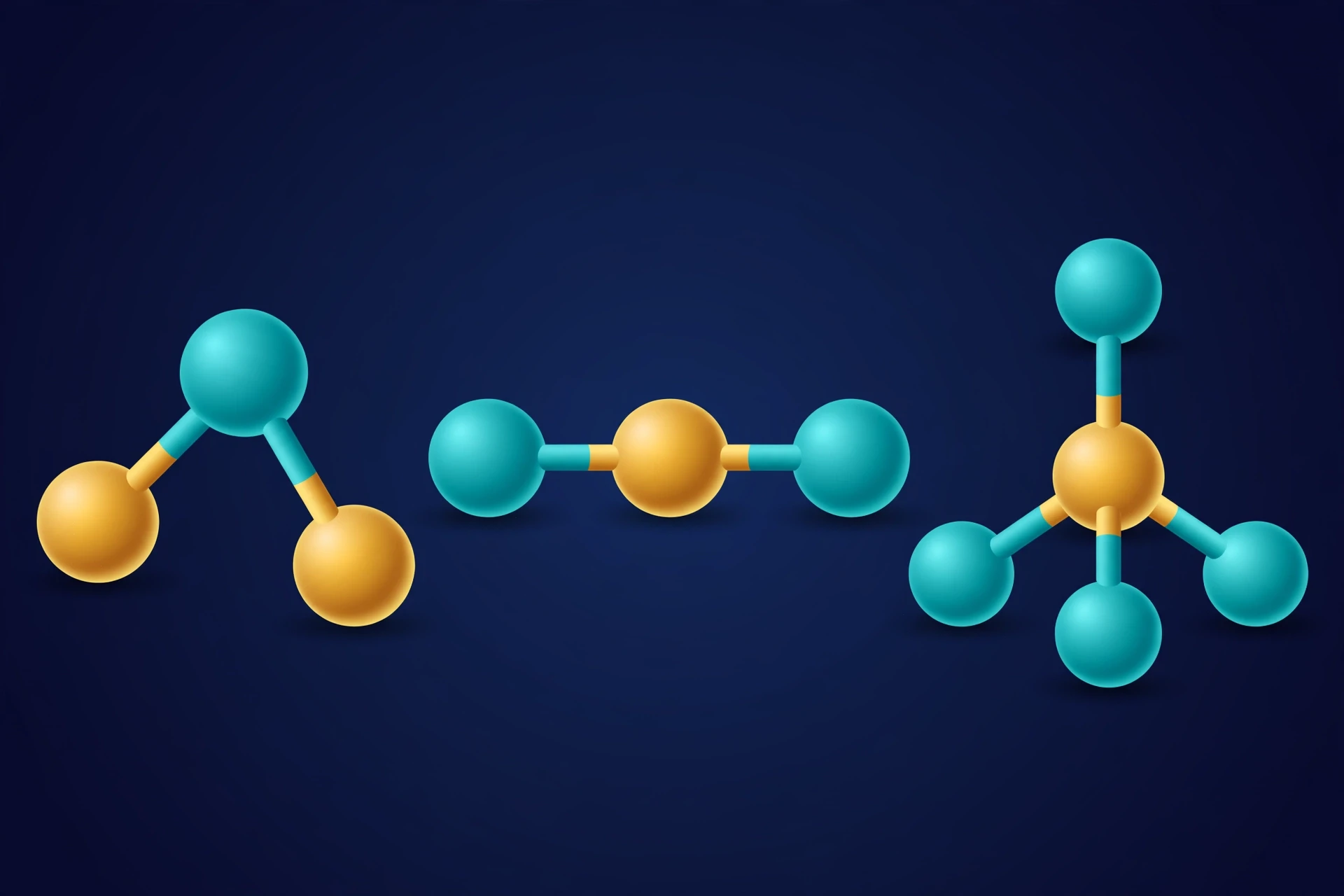
The rules of shape come from repulsion. Electron pairs around a central atom push each other away, and a molecule settles into the shape that keeps those pairs as far apart as possible. That is the VSEPR model — valence shell electron pair repulsion — and it predicts shapes with surprising accuracy. Two pairs around a central atom give a straight line. Three pairs give a flat triangle. Four pairs give a tetrahedron, a pyramid with a triangular base. Water has four electron pairs around its oxygen — two bonding pairs and two lone pairs — and the lone pairs squeeze the hydrogen atoms closer together, giving water its bent shape, with an angle of about 104.5 degrees. That bend is what makes water polar, and water's polarity is what makes life possible. A straight water molecule would be a different substance, and the Earth would be a different planet.
9.1 The same atoms, a different molecule
Consider carbon dioxide and silicon dioxide. Both have the same formula pattern — one atom of the group 14 element, two of oxygen — but carbon dioxide is a gas you breathe out, and silicon dioxide is quartz, sand, and most of the Earth's crust. The difference is bonding and shape: carbon dioxide exists as separate, linear O=C=O molecules, while silicon dioxide forms a giant network in which every silicon is bonded to four oxygens. Same pattern, different architecture, different world.
The same lesson holds in biology. The smell of a spearmint leaf and a caraway seed comes from two molecules — carvone — that are mirror images of each other. Your nose can tell them apart because the receptors in it are chiral, handed, like a left glove and a right glove. Shape is not decoration. It is information, and living things read it with exquisite precision.
9.2 Molecules that change shape to work
Some molecules are machines. The proteins in your muscles change shape to contract. The haemoglobin in your blood changes shape when it picks up oxygen in your lungs and changes back when it delivers oxygen to your tissues. Enzymes, the catalysts that run every chemical reaction in your body, work by gripping a molecule and bending it into a shape where the reaction can happen more easily — then letting go and doing it again, thousands of times a second. A molecule that cannot change shape cannot work, and a molecule that changes shape at the wrong time is the cause of diseases from Alzheimer's to cystic fibrosis, in which a single misfolded protein derails a whole system. Chemistry at this level is not about formulas on a page. It is about moving parts, and the parts move because bonds bend, stretch, and twist while holding the whole together.
10. States of Matter: The Same Particles, a Different Dance
Return to the ice cube. The same water molecules exist in ice, in liquid water, and in steam — but they behave so differently that for centuries people treated solid, liquid, and gas as different kinds of stuff. They are not. They are different arrangements of the same atoms and molecules, decided by a contest between two things: the attractions between particles, which try to hold them together, and the particles' kinetic energy — their energy of motion — which tries to pull them apart. Temperature is, in effect, a measure of that motion. Heat a substance and its particles move faster. Cool it and they slow down. At some point, the balance tips, and the substance changes state.
10.1 Solids, liquids, gases — and plasma
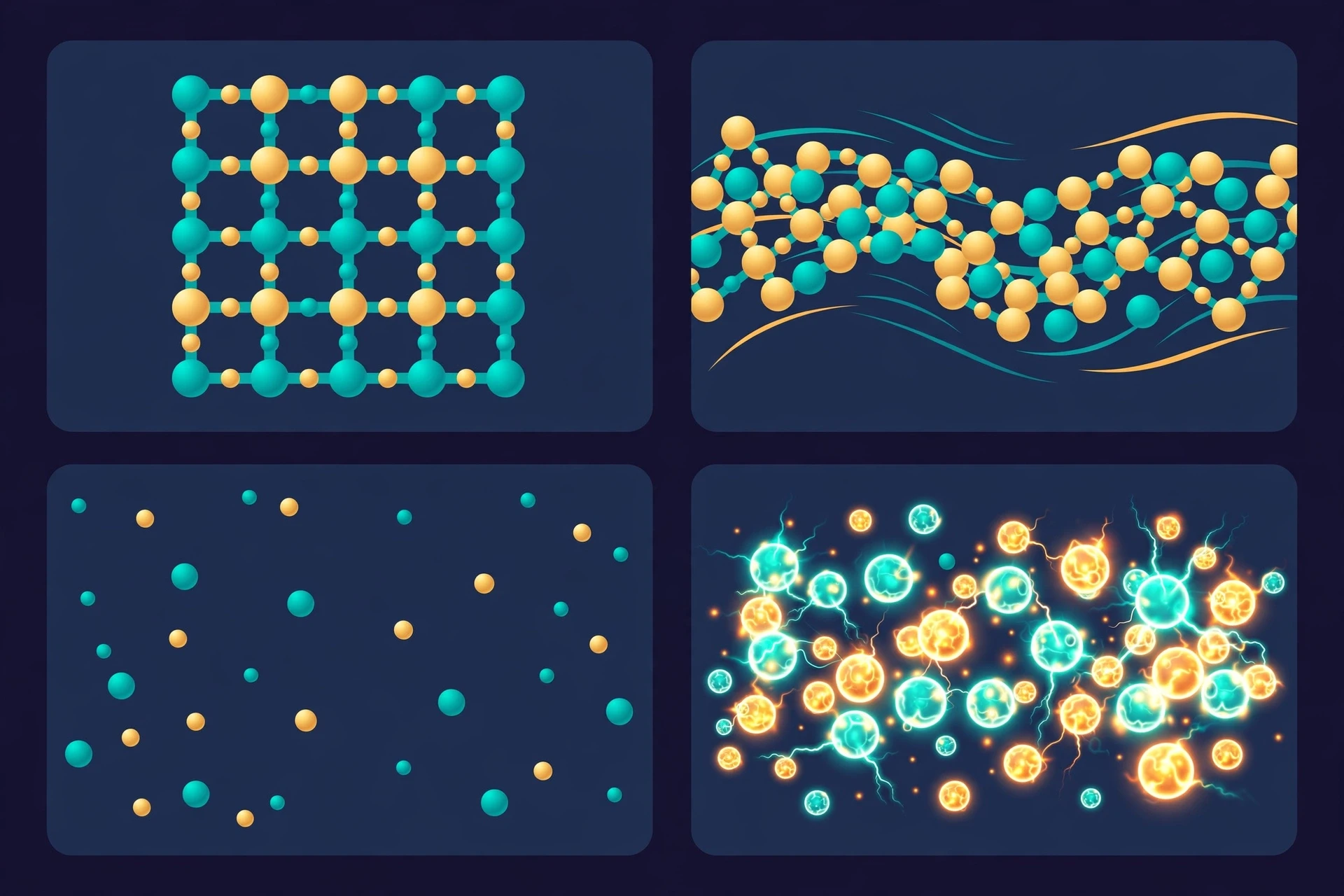
In a solid, particles vibrate in fixed positions, held in a regular pattern by strong attractions. The solid keeps its shape and its volume. In a liquid, the particles have enough energy to break free of fixed positions but not enough to escape each other entirely. They slide past one another, so a liquid flows and takes the shape of its container while keeping its volume. In a gas, the particles have enough energy to overcome the attractions almost completely. They fly freely, fill any container, and can be compressed easily. And there is a fourth state, plasma, in which the gas is so hot that electrons are stripped from their atoms, leaving a soup of ions and free electrons. Plasma is the state of the Sun, of lightning, and of neon signs — and, by mass, it is the most common state of matter in the visible universe, since stars are made of it.
The changes between states have names worth knowing, because they show up everywhere: melting (solid to liquid), freezing (liquid to solid), evaporation and boiling (liquid to gas), condensation (gas to liquid), sublimation (solid straight to gas, as dry ice does), and deposition (gas straight to solid, as frost forms on a cold window). Each change absorbs or releases a precise amount of energy — the latent heat — and that energy does not change the temperature while the change is happening. It goes into rearranging the particles. That is why a pot of boiling water stays at 100 °C no matter how high you turn the flame: the extra heat is being spent turning liquid into gas, not making the water hotter.
10.2 Why water breaks the rules
Water is the great exception to the rules of states of matter, and life depends on the exceptions. Most substances shrink when they freeze. Water expands, because its hydrogen-bonded network locks the molecules into an open, spacious arrangement in ice. That is why ice floats, why lakes freeze from the top down instead of from the bottom up, and why fish survive winter under a lid of ice. If water behaved like other liquids, lakes would freeze solid from the bottom, and aquatic life in cold climates would be impossible.
Water also has an unusually high specific heat capacity — it takes a lot of energy to warm it — which is why oceans moderate the Earth's climate and why your body, which is about 60% water, can absorb the heat of exercise without cooking itself. The US Department of Energy's training handbook for radiological technicians gives a clear, plain-language account of the three classical states and the atomic structure behind them, and it remains a useful reference for the basics: DOE Handbook, Physical Sciences: States of Matter and the Atom.
10.3 Phase changes in everyday life
You meet phase changes constantly, usually without noticing. Sweat cools you because evaporation carries heat away from your skin. A refrigerator works by evaporating and condensing a fluid in a loop, moving heat from inside the box to outside it. A pressure cooker raises the boiling point of water so food cooks faster. Dry ice fogs a stage because solid carbon dioxide sublimates directly into gas. Even the weather is a phase-change machine: water evaporates from the oceans, condenses into clouds, and falls as rain or snow, carrying energy around the planet as it goes. The chemistry of states of matter is not confined to a laboratory. It is the weather forecast.
State | Particle arrangement | Particle motion | Shape | Volume | Example |
|---|---|---|---|---|---|
Solid | Regular, tightly packed | Vibrate in place | Fixed | Fixed | Ice, iron, diamond |
Liquid | Close, but disordered | Slide past each other | Takes container shape | Fixed | Water, oil, mercury |
Gas | Far apart, random | Move freely, fast | Fills container | Fills container | Steam, oxygen, helium |
Plasma | Ions and free electrons | Move freely, very fast | Fills container | Fills container | Lightning, the Sun, neon signs |
11. What Molecules Do in the Real World
It is easy to treat atoms and molecules as a chapter in a textbook and then close the book. The truth is the opposite: almost every technology you use is applied molecular science, and almost every problem we face is a problem about atoms and molecules in disguise.
11.1 Materials: building with bonds
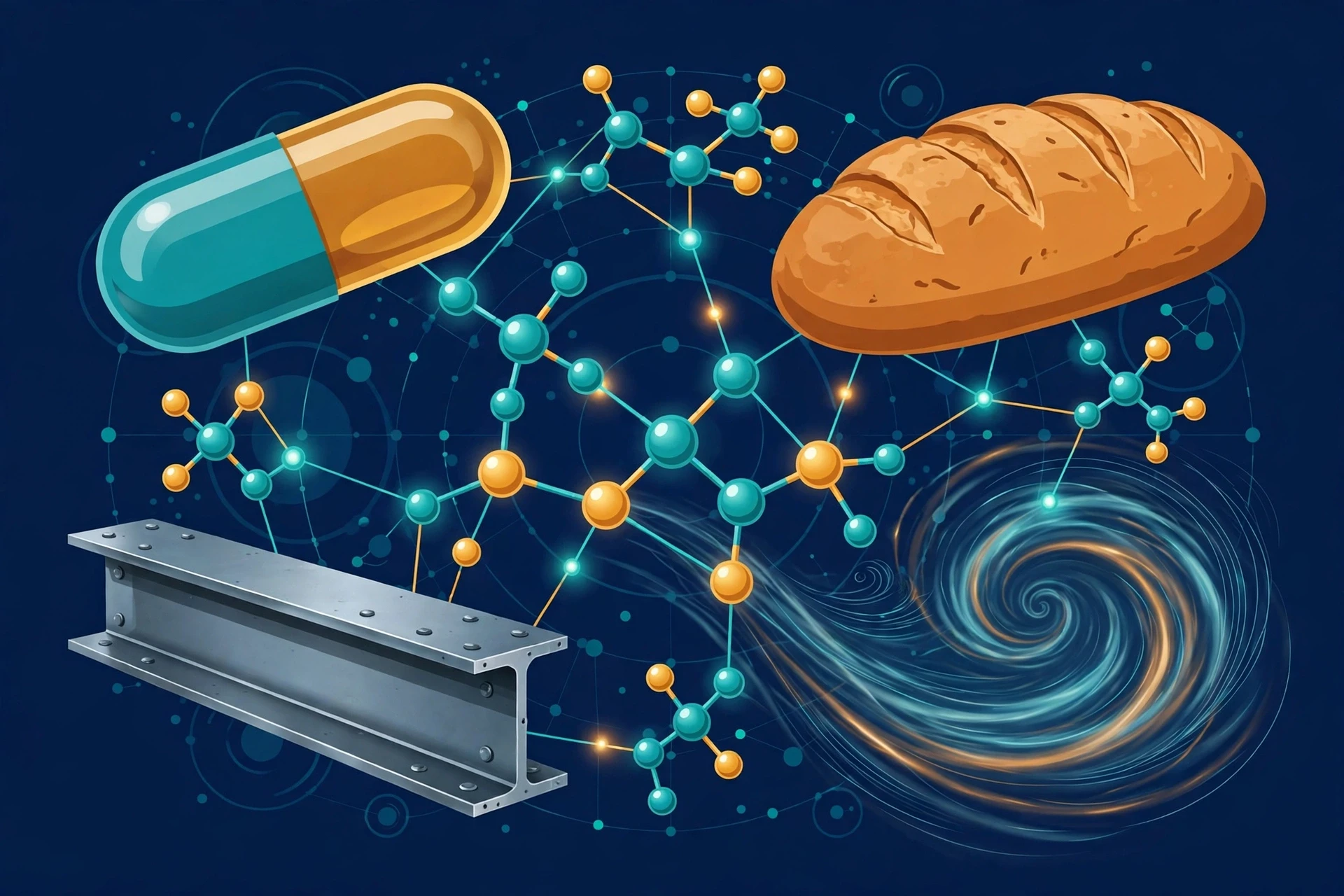
The materials of modern life are choices about bonding. Steel is iron with a small amount of carbon dissolved in its metallic lattice, and that small addition transforms a soft metal into a structural material that holds up bridges. Glass is silicon dioxide cooled so quickly that its atoms never settle into a crystal, leaving a rigid liquid with the transparency of a solid. Plastics are long chains of carbon-based molecules — polymers — whose properties depend on how the chains are linked: loosely linked chains make a soft bag, tightly cross-linked chains make a hard epoxy. The newest materials go further still. Graphene, a single layer of carbon atoms in a honeycomb lattice, is stronger than steel and conducts electricity better than copper. Aerogels, which are mostly air held in a wispy solid network, are the lightest solids ever made and insulate better than anything else. Each of these is a decision about atoms, made deliberately, at the molecular scale.
11.2 Medicine: molecules that fit
Modern medicine is molecular matchmaking. A drug is a molecule shaped to fit a target in the body — an enzyme, a receptor, a channel — the way a key fits a lock. Aspirin blocks an enzyme involved in inflammation. Penicillin blocks the enzyme bacteria use to build their cell walls. The newest cancer drugs are molecules designed to fit the exact shape of a mutated protein, leaving healthy proteins alone. The field has been transformed by tools that show scientists the shape of their targets: cryo-electron microscopy, which freezes molecules in place and images them atom by atom, has revealed the structures of proteins that were mysteries for decades, and it is now routine enough that a graduate student can solve a protein structure that would have won a Nobel Prize a generation ago.
I watched this change happen over my own career. When I started, designing a drug was mostly trial and error — make a hundred similar molecules, test them all, and hope one worked. Today, a researcher can look at the three-dimensional shape of a protein on a screen, design a molecule to fit its pocket, and test the fit in a computer before ever touching a flask. The trial and error has not gone away. It has moved to a place where it is faster, cheaper, and far more precise.
11.3 Food, air, and the air you breathe
Cooking is chemistry with a deadline. Heat breaks bonds in proteins, unravelling them in a process called denaturation — that is what happens when an egg white turns from clear to white in a hot pan. The Maillard reaction, the browning of bread crust and seared meat, is a cascade of reactions between sugars and amino acids that creates hundreds of new flavour molecules. Baking powder releases carbon dioxide gas when it meets moisture and heat, and those gas bubbles are what make a cake rise. Every recipe is a set of instructions for molecules, written in the language of grams and minutes.
The air, too, is molecular. The oxygen you breathe is O₂, two atoms sharing a double bond. The carbon dioxide you breathe out is CO₂, and its concentration in the atmosphere — now above 420 parts per million — is the central number in the climate story, because CO₂ molecules absorb infrared radiation that would otherwise escape to space. That absorption is a molecular property, a consequence of the way the CO₂ molecule vibrates. Climate change, at its root, is a story about a molecule's shape.
12. Latest Research: Watching Atoms and Molecules at Work
The most exciting change in this field is not a single discovery. It is a change in what scientists can see. For most of the history of chemistry, atoms and molecules were inferred — from weights, from spectra, from the colours of flames. Now they can be watched directly, and watching has changed what is possible.
12.1 Seeing single atoms and bonds
Modern electron microscopes can image individual atoms and, in the best instruments, the bonds between them. In 2024 and 2025, research groups reported imaging single molecules as they reacted, frame by frame, and watching catalysts — the substances that speed up reactions without being consumed — work atom by atom on a surface. That matters because catalysts run the chemical industry: the fertilisers that feed half the world, the fuels in our tanks, and the plastics in our homes all depend on catalysts, and most catalysts were found by trial and error. Seeing how they work, atom by atom, is the first step toward designing them on purpose.
12.2 Attosecond science: filming electrons
The 2023 Nobel Prize in Physics went to Pierre Agostini, Ferenc Krausz, and Anne L'Huillier for attosecond pulses of light — flashes so short, a billionth of a billionth of a second, that they can freeze the motion of electrons inside atoms and molecules. For the first time, scientists can watch an electron move from one atom to another during a chemical reaction, rather than inferring that it must have done so. It is the difference between seeing a photograph of a race and seeing the race itself. The technique is young, and its instruments are still rare and expensive, but it has already changed how chemists think about the first instants of a reaction — the moments when bonds break and form, and when the outcome of a reaction is decided.
12.3 Molecular machines and designed molecules
The 2016 Nobel Prize in Chemistry recognised molecular machines — molecules designed to move, rotate, and perform tasks when given energy, like the parts of a tiny engine. Since then, researchers have built molecular motors that spin in one direction, molecular shuttles that carry cargo along a track, and molecules that open and close like scissors. The practical uses are still emerging, but the direction is clear: chemistry is moving from making substances to making devices, one molecule at a time.
At the same time, artificial intelligence is learning to design molecules. Given a target protein, machine-learning models can now propose molecules that might fit it, and given a desired property — a better battery electrolyte, a more efficient solar cell material — they can suggest candidates a human chemist might never have thought of. The models are not replacing chemists. They are giving chemists a far larger map of the possible, and the chemists are still the ones who decide which roads on that map are worth walking. NIST's physical reference data — the atomic and molecular databases that underpin this whole enterprise, from spectroscopy to thermophysical properties — are collected here: NIST Physical Reference Data.
We spent two centuries proving atoms exist. We now spend our time watching them work — one atom, one bond, one electron at a time — and the view is changing chemistry faster than any theory ever did.
12.4 What is still unknown
Honesty requires saying what we do not know. We still cannot predict, from first principles, the exact structure a large protein will take in a cell, though AI tools have made that problem far more tractable in recent years. We still do not fully understand how water — the most studied liquid in history — behaves at interfaces, in tiny pores, and inside cells. We still cannot build a catalyst as efficient as the enzymes in a leaf, which split water using sunlight at room temperature. The frontier of this field is not a lack of facts. It is the gap between knowing the parts and understanding the whole, and that gap is where the next generation of chemists will spend their careers.
13. Common Misconceptions About Atoms and Molecules — Corrected
Most people assume atoms are tiny solid balls, like miniature marbles. What we actually see in the data is something stranger: an atom is mostly empty space, a small dense nucleus surrounded by a cloud of probability, and its "size" is really the size of the region its electrons are likely to occupy. The marble picture is useful for counting atoms. It is misleading for understanding what they are.
Misconception 1: Atoms are solid, indivisible spheres. Atoms are divisible — they contain protons, neutrons, and electrons, and those particles are themselves made of still smaller parts. The word "atom" means uncuttable, and it is a name we kept after learning it was wrong.
Misconception 2: Electrons orbit the nucleus like planets around the Sun. Electrons occupy orbitals — fuzzy regions of probability — not fixed tracks. The planetary picture predicts the wrong shapes, the wrong energies, and the wrong chemistry. It survives in textbooks because it is easy to draw, not because it is true.
Misconception 3: Molecules and compounds are the same thing. A molecule is two or more atoms bonded together. A compound is a molecule made of different elements in a fixed ratio. Oxygen gas (O₂) is a molecule but not a compound. Water (H₂O) is both. The distinction matters because it decides what counts as a pure substance and what counts as a mixture.
Misconception 4: Atoms "want" full outer shells. Atoms do not want anything. Bonding happens because a bonded arrangement has lower energy than the separate atoms. The language of wanting is a metaphor, and like all metaphors it helps until it does not. When it starts to sound as if atoms make choices, the metaphor has gone too far.
Misconception 5: A chemical bond is a physical stick holding atoms together. Bonds are not sticks. They are attractions between charged particles — nuclei and electrons — and their strength comes from the balance of attraction and repulsion. Draw a line between two atoms if it helps you count bonds, but do not mistake the line for a thing.
Misconception 6: Solids, liquids, and gases are different kinds of matter. They are the same particles in different arrangements. Ice, water, and steam are all H₂O. What changes is how much energy the particles have and how strongly they hold on to each other.
Misconception 7: All molecules are tiny. Some molecules are enormous. A single molecule of DNA in a human cell contains billions of atoms and, stretched out, would be about two metres long. A molecule of a polymer plastic can contain hundreds of thousands of atoms. Size is not what makes something a molecule. Bonding is.
Conclusion
The ice cube in my kitchen glass was not a mystery to be solved once and then forgotten. It was an invitation. The same particles that made the ice make the glass, the water, the table, and the hand that lifts it. They are built from three kinds of subatomic particles, arranged by rules that fit on a single page of the periodic table, and joined by bonds that are nothing more than the push and pull of electric charge. From those humble beginnings come the hardness of diamond and the softness of graphite, the salt on your food and the oxygen in your blood, the smell of rain and the colour of a sunset.
What strikes me most, after years of working with these ideas, is how much of the world becomes legible once you can picture atoms and molecules at work. A melting ice cube is a change in a dance. A rusting nail is oxygen stealing electrons from iron. A loaf of bread rising is carbon dioxide gas, made by yeast, getting trapped in a web of gluten protein. The world does not become less wonderful when you understand it at this scale. It becomes more wonderful, because the explanations are not separate from the wonder. They are the wonder, written in the smallest handwriting there is.
The next time you watch an ice cube melt, do not look away. Watch it shrink, and remember what is happening: the same molecules, loosening their grip, sliding past one another, becoming liquid — and staying, all the while, exactly what they were. Matter does not disappear. It rearranges. And in that rearrangement is everything.
Frequently Asked Questions
What are atoms and molecules?
Atoms are the smallest units of an element that still behave like that element, built from protons, neutrons, and electrons. Molecules are two or more atoms held together by chemical bonds. Oxygen gas (O₂) and water (H₂O) are molecules; a single gold atom is not a molecule, because it is only one atom.
What is the difference between an atom and a molecule?
An atom is a single unit of an element, defined by its number of protons. A molecule is a group of two or more atoms joined by chemical bonds, and it can be made of the same element (like O₂) or different elements (like H₂O). Every molecule is made of atoms, but not every atom is part of a molecule.
What are the three subatomic particles?
The three subatomic particles are protons, which carry a positive charge and sit in the nucleus; neutrons, which carry no charge and also sit in the nucleus; and electrons, which carry a negative charge and occupy shells around the nucleus. Protons decide the element, neutrons decide the isotope, and electrons decide the chemistry.
What is a chemical bond?
A chemical bond is an attraction between atoms that holds them together, caused by the electrical forces between nuclei and electrons. The main types are covalent bonds (electrons shared), ionic bonds (electrons transferred), and metallic bonds (electrons delocalised in a sea). Weaker forces between molecules, like hydrogen bonds, also matter enormously.
How do atoms form molecules?
Atoms form molecules by gaining, losing, or sharing electrons to reach a lower-energy, more stable arrangement, usually with a full outer shell of electrons. Two hydrogen atoms share electrons to form H₂; sodium gives an electron to chlorine to form the ions in salt; carbon shares electrons with other carbons to build chains, rings, and diamonds.
What is the difference between a molecule and a compound?
A molecule is any group of two or more bonded atoms. A compound is a molecule made of two or more different elements in a fixed ratio. All compounds are molecules, but not all molecules are compounds — O₂ is a molecule of one element, so it is not a compound, while H₂O is both a molecule and a compound.
What are the states of matter?
The states of matter are solid, liquid, gas, and plasma. In a solid, particles vibrate in fixed positions; in a liquid, they slide past each other; in a gas, they move freely; in plasma, electrons are stripped from atoms. The state depends on the balance between the attractions holding particles together and their kinetic energy, which rises with temperature.
Why does ice float on water?
Ice floats because water expands when it freezes. In ice, hydrogen bonds lock water molecules into an open, spacious network that takes up more room than the same molecules do in liquid water. Ice is therefore less dense than liquid water, so it floats — and that is why lakes freeze from the top down and fish survive winter beneath the ice.
Are atoms really mostly empty space?
Yes. An atom's nucleus is about a hundred thousand times smaller than the atom itself, and the rest is the region where electrons are likely to be found. Matter feels solid because the electrons in one object repel the electrons in another, and that electrical repulsion is strong enough to hold you up when you sit on a chair.
Can scientists see individual atoms?
Yes. Scanning tunnelling microscopes and advanced electron microscopes can image individual atoms on a surface, and researchers have moved single atoms one by one — famously spelling "IBM" with 35 xenon atoms in 1989. Modern instruments can even watch single molecules change shape as they react, and attosecond light pulses can track electrons moving between atoms.
Sources / Further Reading
NIST — Atomic Weights and Isotopic Compositions for All Elements: https://physics.nist.gov/cgi-bin/Compositions/stand_alone.pl?ele=&all=all&ascii=ascii&isotype=some
NIST — Atomic States, Shells, and Configurations: https://physics.nist.gov/Pubs/AtSpec/node03.html
NIST — Physical Reference Data (atomic and molecular databases): https://www.nist.gov/pml/productsservices/physical-reference-data
LibreTexts Biology — Bonding: https://bio.libretexts.org/Courses/University_of_Massachusetts_Boston/BIOL_111_Spring_2026/02%3A_The_chemical_Basis_of_Life/2.04%3A_Bonding
LibreTexts Chemistry — Molecules and Molecular Compounds: https://chem.libretexts.org/@api/deki/pages/44782/pdf/2.6%253A%2bMolecules%2band%2bMolecular%2bCompounds.pdf
US Department of Energy — Handbook, Physical Sciences: States of Matter and the Atom: https://energy.gov/documents/doe-hdbk-1122-99studyguidemodule103pdf