

Introduction
The tide was going out on a rocky shore in Maine, and I was crouched over a pool the size of a dinner plate, watching a creature I could not name — a small lesson in animal classification. It looked like a flower, then it moved like an animal, then it closed up like a fist when my shadow fell across it. A sea anemone. Beside it, a tiny crab picked its way across a mussel shell, and a purple starfish clung to the rock as if it had been glued there. Three animals, three completely different ways of being alive, all in one puddle — and my first puzzle in animal classification. I had spent years studying biology by then, and I still felt the same jolt I had felt as a child turning over stones in a garden: how can one word — animal — hold all of this?
That question is what animal classification tries to answer. It is the science of sorting the bewildering variety of animal life into groups that reflect real family relationships, not just surface resemblance. A whale and a bat look nothing alike, yet both are mammals. A spider and a crab look like distant cousins, and they are — both are arthropods. A starfish and a sea urchin look like ornaments, yet they are closer to you, in evolutionary terms, than an insect is. Classification is the map that makes sense of those surprises. Without it, biology would be a warehouse with no shelves: millions of species, no way to find anything, no way to say what anything is related to.
This guide walks that map from the top down. We start with what makes an animal an animal, then meet the Swedish botanist who gave us the filing system, then climb down the ranks from kingdom to species, phylum by phylum, from sponges that barely move to the vertebrates that run, fly, and think. Along the way we will see how DNA rewrote parts of the tree, why the definition of a species is still argued over, and why getting the name right matters far beyond the classroom — for medicine, for farming, and for deciding which creatures we try to save.
1. Animal Classification at a Glance
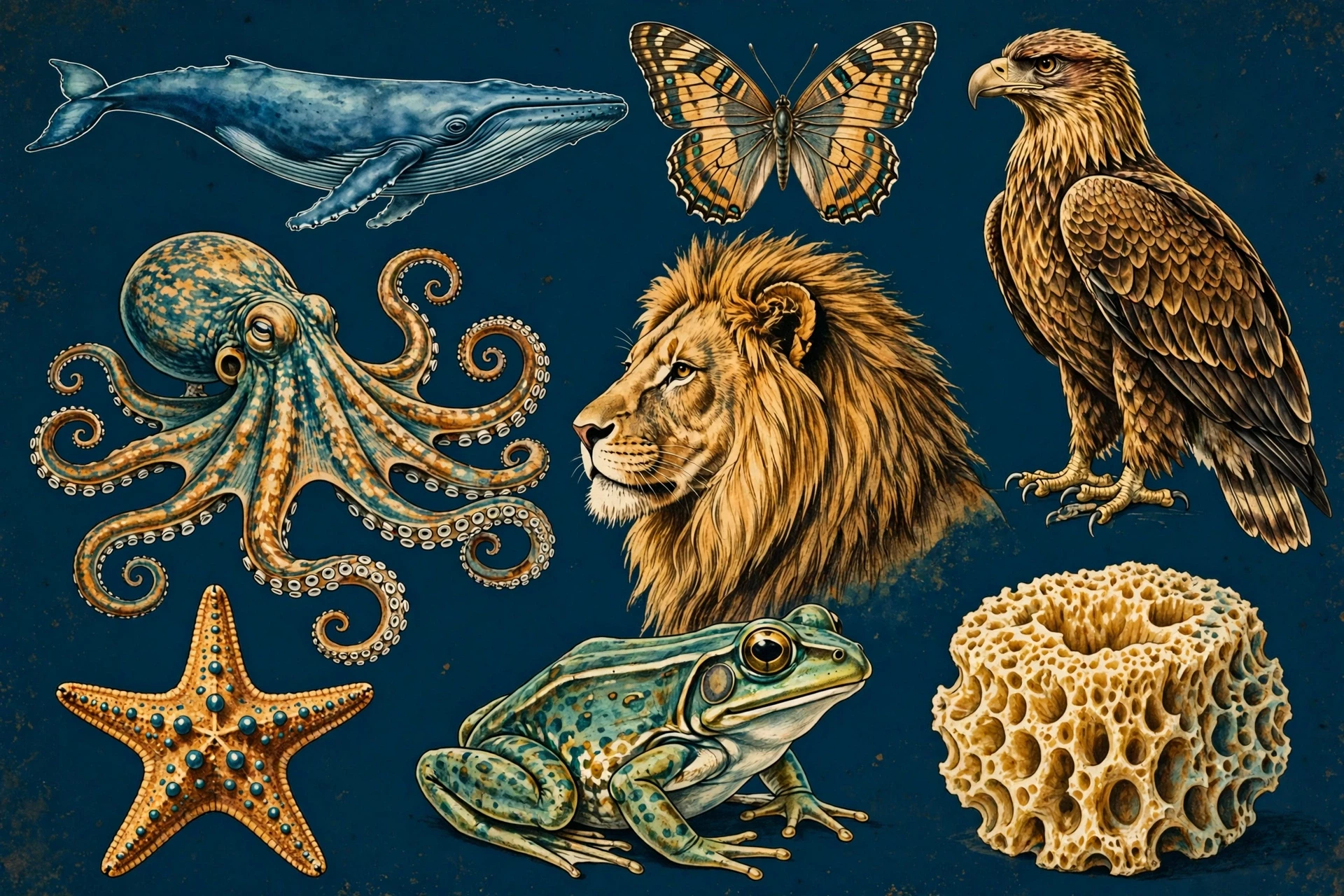
Animal classification is the system biologists use to group animals by shared ancestry. The basic idea is simple: animals that share a recent common ancestor belong together, and the more recent the ancestor, the tighter the group. A lion and a tiger share a recent ancestor, so they sit close together. A lion and a shark share an ancestor much further back, so they sit far apart — in different classes, though still in the same phylum. The system is a family tree drawn as a filing cabinet, with drawers inside drawers.
The full ladder, from broadest to narrowest, runs like this: domain, kingdom, phylum, class, order, family, genus, species. Every animal has a place on every rung. You are Homo sapiens: domain Eukarya, kingdom Animalia, phylum Chordata, class Mammalia, order Primates, family Hominidae, genus Homo, species sapiens. A house dog is Canis lupus familiaris, a subspecies of the wolf Canis lupus. The same ladder holds for a jellyfish, a beetle, and a blue whale. That shared framework is what lets a researcher in Tokyo and a researcher in Nairobi talk about the same animal without confusion.
Three words do most of the work in this field, and they are worth keeping straight. Taxonomy is the science of naming and classifying organisms. Systematics is the wider study of how organisms are related through evolution. Phylogeny is the actual evolutionary history — the tree itself. Taxonomy builds the labels; systematics studies the branches; phylogeny is the tree the labels are hung on. OpenStax Biology explains the same ladder with the dog as its worked example, showing how each level narrows the group until only one kind of animal is left: OpenStax Biology 2e — Organizing Life on Earth.
The numbers give the scale of the job. More than 2.1 million species have been formally described and named, according to the Natural History Museum in London, and most scientists think the true total is far higher — commonly estimated at around 5 to 10 million species, not counting microbes. Animals make up the largest share of the described species, and most of them are invertebrates: animals without backbones. Vertebrates — fish, amphibians, reptiles, birds, and mammals — are a small minority of animal species, even though they dominate our attention, our stories, and our zoos. That mismatch is one of the first things classification teaches you: the animal kingdom is mostly small, mostly spineless, and mostly still unnamed.
"A species is a distinct group of organisms and the most basic unit used to measure life on Earth. However, there is no single definition of a species, meaning this vital concept in biology can be difficult to understand." — Natural History Museum, London
1.1 Why sort animals at all?
Imagine a hospital that receives a patient bitten by a snake. The treatment depends entirely on which snake it was. A bite from a harmless garter snake and a bite from a rattlesnake demand different responses, and the wrong guess can be fatal. The name is not academic decoration. It is the key that unlocks everything known about that animal: its venom, its behaviour, its habitat, its relatives.
The same logic runs through farming, fishing, medicine, and conservation. A farmer who cannot tell a pest insect from a pollinator will spray the wrong one. A doctor testing a drug needs to know exactly which animal model was used, because a mouse and a rat are not interchangeable. A conservation law that protects one species of frog cannot work if nobody can tell that frog from its lookalike neighbour. Classification turns a bewildering crowd into a usable catalogue, and the catalogue turns into action.
I learned that lesson the hard way on a field trip early in my career, when our team spent a whole afternoon arguing over two frogs that looked identical to me. One of the senior researchers finally settled it by listening: the males called at different pitches, and the calls never overlapped. Same pond, same colour, same size — two species, separated by a song. I had been sorting by eyesight. The frogs were sorting by ear. That afternoon changed how I think about identity in biology. What looks the same is not always the same, and what looks different is not always different.
1.2 A map, not a museum
One more point before we climb the tree: classification is a working map, and working maps get redrawn. New species are described every year. DNA evidence moves whole groups from one branch to another. A phylum that looked solid for a century can split in two when genetic data arrives. That is not a failure of the science. It is the science working as it should. A classification that never changed would be a classification that had stopped listening to evidence.
This matters for how you read the rest of this guide. The ranks and phyla described here reflect the current broad consensus, the version taught in textbooks and used by databases like the Catalogue of Life. Where experts still disagree — and they do, in several places — I will say so plainly, rather than pretending the argument is settled.
2. What Makes an Animal an Animal?
Before you can classify animals, you need to know what counts as one. The definition sounds simple, and it mostly is: animals are multicellular eukaryotes — organisms made of many cells, each with a nucleus — that eat other organisms for food, rather than making their own the way plants do through photosynthesis, and that usually move at some point in their lives. They have no rigid cell walls, unlike plants and fungi. Most develop from an embryo, and most have specialised tissues: muscle, nerve, gut, skin.
Simple, until you meet the exceptions. Sponges are animals, yet an adult sponge never moves, has no nerves, no muscles, and no gut — it filters food from water through pores. Corals are animals, yet they sit fixed to the reef like plants and build limestone skeletons. A few animals, like the sea slug that steals chloroplasts from algae, can photosynthesise for a while. And some animals spend their whole adult lives as parasites inside another creature, barely moving at all. The definition holds because it is about ancestry and development, not about a checklist that every animal must pass in full.
The best way to think about it is as a family resemblance. Animals share a common ancestor that lived more than 600 million years ago, probably a tiny single-celled organism that ate other cells. Every animal alive today descends from that ancestor, and the traits they share — multicellular bodies, eating rather than photosynthesising, embryos that develop through recognisable stages — are the family likeness. Some members of the family have lost a trait here or there, the way a family can have one member who cannot roll their tongue. The likeness is in the lineage, not in any single feature.
That lineage is what separates animals from their neighbours. Plants make their food from sunlight. Fungi absorb food from dead matter. Bacteria and archaea are single-celled and lack a nucleus. Animals eat, move, sense, and respond — and they do it with bodies built from cells that work together as tissues and organs. The Natural History Museum's guide to species explains why even the most basic unit of this system, the species, is harder to pin down than most people expect: Natural History Museum — What is a species?
2.1 The five-kingdom picture, and what came after
For much of the twentieth century, school biology taught five kingdoms: Monera (bacteria), Protista (single-celled eukaryotes), Fungi, Plantae, and Animalia. It was a clean picture, proposed by Robert Whittaker in 1969, and it still appears in many textbooks. It grouped life by cell structure, body organisation, and how organisms get food — and for animals, it worked well enough.
Then DNA sequencing arrived, and the picture cracked open. The single-celled world turned out to be far more diverse than anyone had guessed, and the deepest split in life was not between plants and animals but between three great domains: Bacteria, Archaea, and Eukarya. Animals sit inside Eukarya, on a small branch, alongside plants, fungi, and a host of single-celled relatives. The five-kingdom picture was not wrong about animals — Animalia survived the revision almost untouched. It was wrong about how much of life it had squeezed into the other kingdoms.
This is a pattern you will see again and again in this guide: the animal kingdom itself is stable, but the branches inside it keep being rearranged as new evidence arrives. The kingdom is old and well-defined. The family tree inside it is a living document.
2.2 How many animals are there, really?
Nobody knows the exact number, and that uncertainty is itself informative. The described species — the ones with formal scientific names — number a little over 2 million across all life, and animals are the majority of those. But the undescribed species, the ones nobody has named yet, are probably several times more numerous. Most of them are small: insects in tropical forests, worms in deep-sea mud, tiny crustaceans in caves. A single expedition to a poorly studied forest can return with dozens of new species.
The practical consequence is that every number in this guide is a snapshot, not a final count. When I write that arthropods are the largest phylum, that is solid — they dominate the described species by a wide margin. When I write that there are about 35 recognised animal phyla, that is the current consensus, with the exact count depending on which authority you ask. The Catalogue of Life, the most complete authoritative list of the world's species, maintained by hundreds of taxonomists, is the place to check the current count: Catalogue of Life. The list grows every year, and that growth is good news. It means the map is still being drawn.
3. Linnaeus and the Filing Cabinet
Every classification system has a human story behind it, and this one begins with a stubborn Swedish botanist who could not stand disorder. Carl Linnaeus — Carolus Linnaeus in Latin — was born in 1707, and by the time he was thirty he had decided that nature needed a filing system as rigorous as a library catalogue. Before him, a single animal might have a dozen different names in a dozen different languages, and a "name" could be a whole sentence of description in Latin. A wolf might be called Canis cauda longa, auribus erectis — dog with a long tail and upright ears — and a slightly different wolf would get a slightly different sentence. It was chaos, and Linnaeus hated chaos.
His answer, published in Systema Naturae in 1735 and refined over decades, was twofold. First, a hierarchy of nested groups — kingdom, class, order, genus, species, with phylum and family added later by others. Second, binomial nomenclature: every species gets exactly two names, a genus name and a species name, both in Latin, both italicised, the genus capitalised and the species not. Homo sapiens. Panthera leo. Drosophila melanogaster. Two words, and a scientist anywhere in the world knows exactly which animal you mean. It was one of the most practical inventions in the history of science, and it is still in use, almost unchanged, nearly three centuries later.
Linnaeus himself was not always right about where things belonged. He put whales among the fishes, because they swim in the sea — a mistake that took decades to correct, once anatomists looked inside a whale and found lungs, warm blood, and milk glands. He put humans in the order Primates alongside monkeys and apes, which scandalised his contemporaries far more than the whale error did. And he classified by visible structure, not by evolution, because evolution as a theory did not exist yet. He thought he was describing a fixed, divine order. He was, without knowing it, sketching the shape of a family tree.
3.1 The rules of naming
Naming a species is not a casual act. It follows a formal code — the International Code of Zoological Nomenclature — and the rules are strict. The first published name wins. The name must be in Latin form, even if it is built from a modern word. The description must be published, and a type specimen — a preserved individual that serves as the reference for the name — must be deposited in a museum collection. If two scientists name the same animal, the older name stands and the newer one becomes a synonym. If one name turns out to cover two species, the group splits and one half gets a new name.
The system also records history in its names. The person who first described a species has their name attached to it in the formal citation, so Panthera leo (Linnaeus, 1758) tells you who named the lion and when. Some names are jokes, some are tributes, some are descriptive. A tiny wasp is named after a character in a novel. A deep-sea worm is named after a rock band. The code allows it, as long as the name follows the rules. I once spent a morning in a museum collection reading drawer labels from the 1800s, and the handwriting alone told a story: careful copperplate for the famous species, hurried scrawl for the ones the collector clearly found boring.
3.2 Why Latin, and why it still works
Latin is a dead language, and that is exactly the point. A dead language does not change. English words shift meaning every generation; Latin words stay put. A name coined in 1758 means the same thing in 2026. Latin is also nobody's native language, which makes it neutral ground — a Japanese, Brazilian, and Kenyan researcher all use the same two words for the same animal, without any of them having to borrow the other's everyday language.
The names also carry meaning if you learn to read them. Sapiens means wise. Melanogaster means black-bellied. Giganteus means giant. A student who learns a little Latin suddenly finds that scientific names are not random codes but short descriptions. A blue whale is Balaenoptera musculus — the winged whale with muscles. A monarch butterfly is Danaus plexippus, named for a figure from Greek myth. The filing cabinet, it turns out, has poetry in its labels.
4. The Eight Ranks: From Kingdom to Species
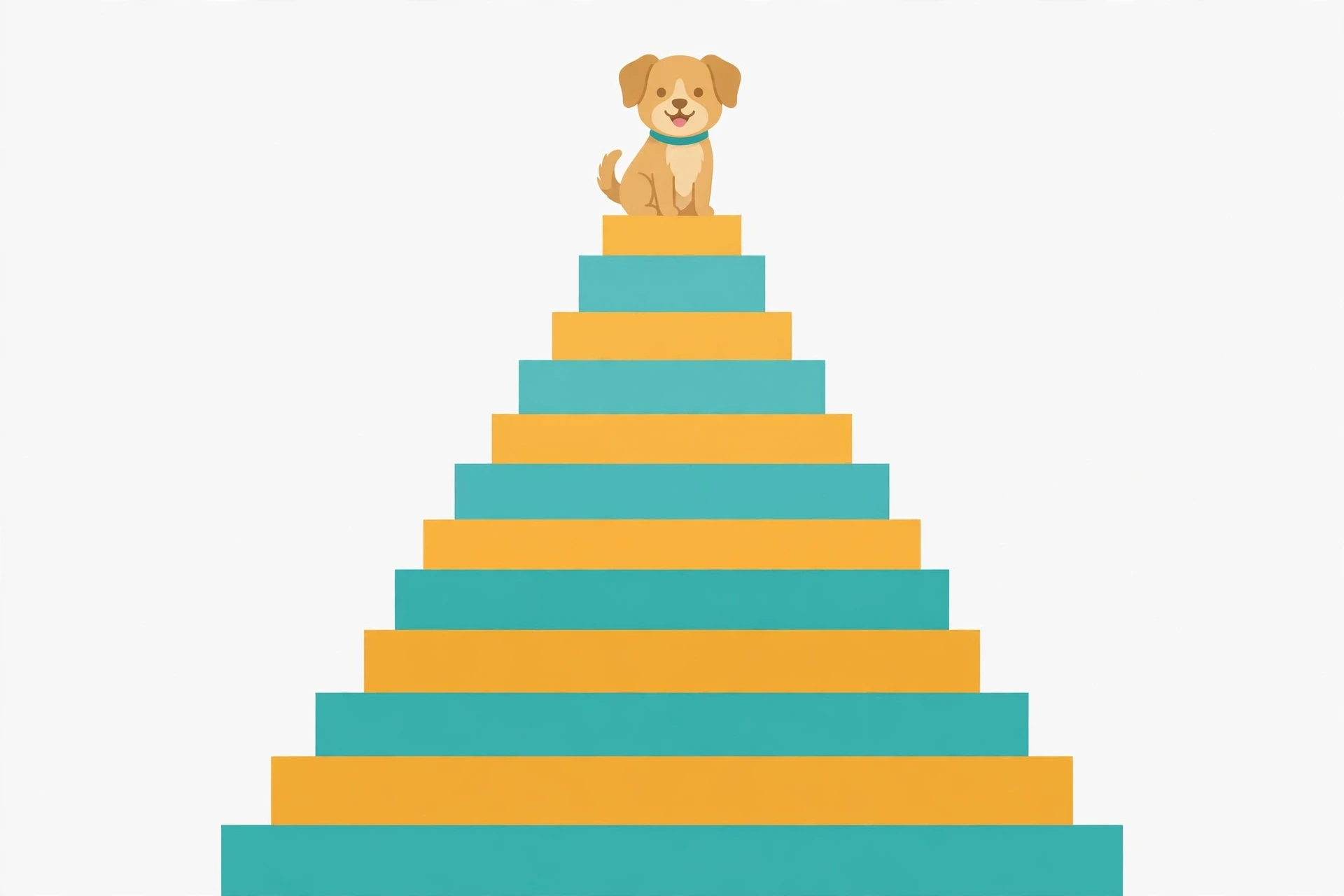
The hierarchy is the heart of animal classification, so it is worth walking down it slowly, with a familiar animal as our guide. Take the domestic dog. At the top, the domain Eukarya: cells with nuclei. Then the kingdom Animalia: multicellular, eats other organisms. Then the phylum Chordata: animals with a notochord at some stage of life. Then the class Mammalia: warm-blooded, hairy, milk-producing. Then the order Carnivora: meat-eating mammals with shearing teeth. Then the family Canidae: dogs, wolves, foxes, jackals. Then the genus Canis: the dog-like canids. Then the species lupus: the wolf. And the dog itself is a subspecies, Canis lupus familiaris — the tame wolf.
Each step down narrows the group and adds shared traits. At the kingdom level, a dog shares a group with a jellyfish. At the family level, it shares a group only with other canids. At the species level, it shares a group only with wolves. The hierarchy is a series of "and also" statements: a dog is an animal, and also a chordate, and also a mammal, and also a carnivoran, and also a canid, and also a Canis, and also a wolf. Every rung adds a trait that the animal shares with a smaller, tighter circle of relatives.
4.1 A mnemonic that actually helps
Students have invented many memory aids for the order, and the classic one — "Dear King Philip Came Over For Good Soup" — works because it is silly enough to stick. Domain, Kingdom, Phylum, Class, Order, Family, Genus, Species. I have heard students invent their own versions on the spot, each more ridiculous than the last, and the ridiculous ones are the ones they remember a year later. There is a lesson in that for teaching: the hierarchy is abstract, and a joke gives the brain a hook to hang it on.
But the mnemonic is only a ladder. The real skill is knowing what each rung means. A phylum is not just a smaller kingdom. It is a group defined by a deep body plan — a fundamental way of building an animal. A class is a variation on that plan. An order is a variation on the class. The further down you go, the more the differences are about details: tooth shape, foot structure, the number of toes. The further up you go, the more the differences are about the whole architecture of the body.
4.2 Clades: the tree behind the ladder
Modern biologists also use a second way of grouping animals, alongside the ranks: the clade. A clade is a group that contains a common ancestor and all of its descendants — nothing left out, nothing extra added in. Birds are a clade. Mammals are a clade. The group "reptiles" in the old sense is not a clade, because it leaves out birds, even though birds descend from the same ancestor as crocodiles and dinosaurs. A clade is defined by ancestry, not by a rank, and it can sit at any level of the tree.
This matters because the old ranks sometimes cut across the tree in awkward ways. The rank "class" was invented before anyone knew about evolution, so some classes are true clades and some are not. Cladistics — the method of grouping by shared derived traits — is how modern systematists decide what belongs together. When DNA evidence shows that two animals share a recent ancestor, they go in the same clade, whatever their old rank said. The ranks are still used, because they are practical and familiar, but the tree is the authority. When the two disagree, the tree wins.
Rank | What it groups | Dog | Human | Octopus |
|---|---|---|---|---|
Domain | Cells with or without a nucleus | Eukarya | Eukarya | Eukarya |
Kingdom | Broad way of life | Animalia | Animalia | Animalia |
Phylum | Deep body plan | Chordata | Chordata | Mollusca |
Class | Variation on the body plan | Mammalia | Mammalia | Cephalopoda |
Order | Major lifestyle group | Carnivora | Primates | Octopoda |
Family | Close relatives | Canidae | Hominidae | Octopodidae |
Genus | Very close relatives | Canis | Homo | Octopus |
Species | One kind of organism | Canis lupus | Homo sapiens | Octopus vulgaris |
Table 1. The eight ranks, shown for three very different animals. A dog and a human share every rank down to class, then diverge. An octopus parts company at the phylum — its body plan is built on a completely different architecture.
5. The First Branches: Sponges, Jellies, and Flatworms
The deepest branches of the animal tree are the simplest animals, and they are also the ones that most challenge our idea of what an animal is. They are worth meeting first, because they show how little you need to be an animal — and how much variety even the simplest body plans can produce.
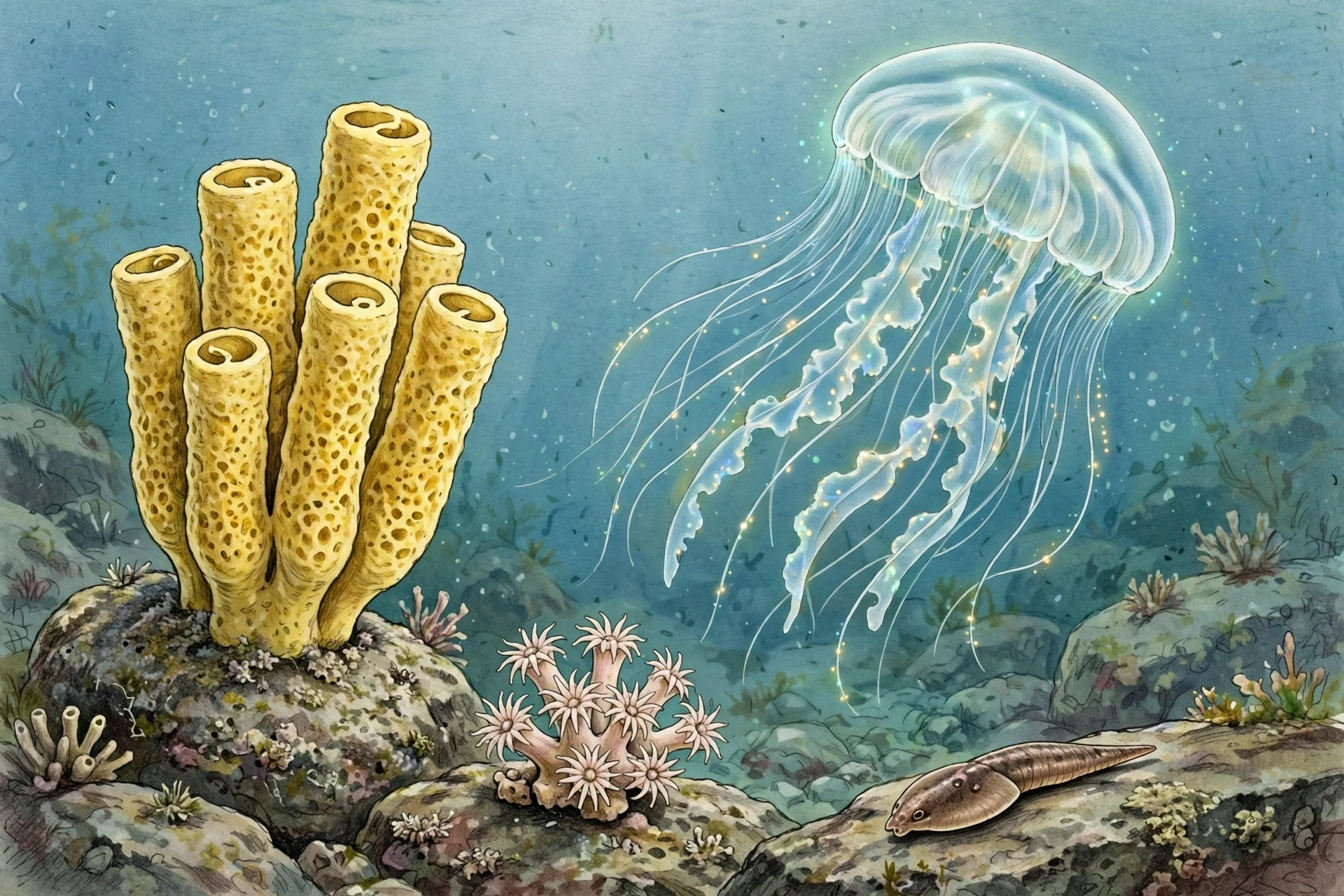
Porifera, the sponges, are the most ancient living animal phylum. A sponge is a colony of cells organised around a system of pores and canals, pumping water through its body and filtering out food particles. It has no tissues in the proper sense, no nerves, no muscles, no gut, no symmetry to speak of. And yet it is an animal, descended from the same ancestor as you are. Sponges have survived for more than 600 million years with a body plan that looks, to a casual eye, like a plant that got lost underwater. Their success is a reminder that evolution does not reward complexity for its own sake. It rewards whatever works.
Cnidaria — jellyfish, corals, sea anemones, and hydras — added the first real tissues and the first nerves. A cnidarian has a simple gut with a single opening, tentacles armed with stinging cells called cnidocytes, and a nerve net rather than a brain. A jellyfish can sense light and gravity, pulse its bell, and catch prey. A coral polyp can build a reef that is visible from space. The phylum also includes some of the longest animals on Earth: a lion's mane jellyfish can trail tentacles more than 30 metres long. Cnidarians show the first great innovation in animal history: specialised cells doing different jobs, coordinated by a nervous system, however simple.
Platyhelminthes, the flatworms, added bilateral symmetry — a left and a right, a front and a back — and a head with sense organs concentrated at the front. A flatworm has a simple brain, eyespots that detect light, and a gut that branches through its flat body. Many flatworms are free-living hunters in ponds and seas. Others are parasites: tapeworms and flukes that live inside other animals, sometimes for years. The parasitic flatworms are a reminder that classification is not a ranking of worth. A tapeworm is as much an animal as a tiger, and its body plan is a precise adaptation to a life inside another creature.
5.1 Symmetry, germ layers, and the coelom
Three features help biologists sort these early phyla, and they are worth learning because they recur through the rest of the tree. Symmetry is the first: sponges are asymmetrical, cnidarians are radially symmetrical (like a wheel, with parts arranged around a centre), and flatworms onward are bilaterally symmetrical (left and right mirror images). Bilateral symmetry goes with a front end that meets the world first, and with sense organs and a brain gathered at that front end. It is the body plan of animals that move with purpose.
Germ layers are the second. In the embryo, animals develop from layers of cells: ectoderm on the outside, endoderm on the inside, and — in most animals — mesoderm in the middle. Cnidarians have two layers. Flatworms and everything above them have three. That third layer is what makes complex muscles, blood, and internal organs possible. It is a small difference in the embryo with enormous consequences for the adult.
The coelom is the third: a fluid-filled body cavity that holds the internal organs. Flatworms have no coelom — their organs are packed solid. Roundworms have a partial cavity. Annelids, molluscs, arthropods, and chordates have a true coelom, which gives organs room to move, cushions them, and in worms acts as a hydrostatic skeleton. These three features — symmetry, germ layers, coelom — are the landmarks by which the early tree is mapped, and they are the reason a textbook can sort a sponge from a flatworm at a glance.
5.2 The worm phyla: simple, successful, everywhere
Between the flatworms and the great phyla that follow sit the worms: Nematoda (roundworms) and Annelida (segmented worms). Roundworms are among the most numerous animals on Earth — a single handful of soil can contain thousands of them, and the species Caenorhabditis elegans, a tiny roundworm barely a millimetre long, has become one of the most studied animals in science, because its body is transparent and every one of its roughly 1,000 cells has been mapped. Annelids — earthworms, leeches, and marine bristle worms — added segmentation: a body built from repeated units, each with its own muscles and nerves. Segmentation is a powerful idea, and it reappears in arthropods and in vertebrates, including in your own spine. The worms look humble. They are also, by numbers and by ecological importance, among the most successful animals that have ever lived.
6. The Great Invertebrate Phyla: Arthropods, Molluscs, and Their Neighbours
If the early phyla are the roots of the animal tree, the next three are its great spreading branches. Together, arthropods, molluscs, and their relatives account for the overwhelming majority of animal species — and they show how a single body plan, varied in a thousand ways, can conquer every habitat on Earth.
6.1 Arthropoda: the phylum that owns the planet
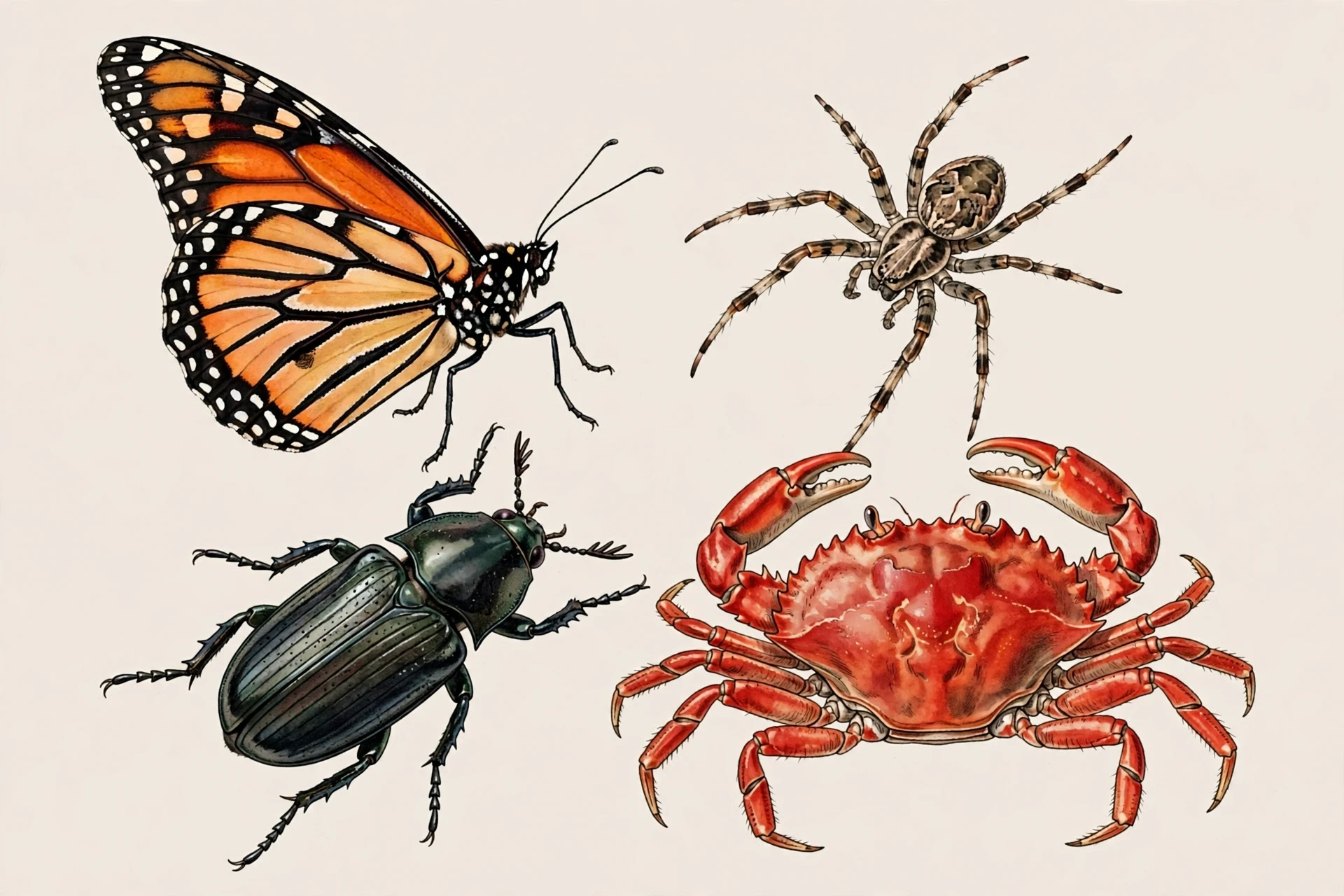
Arthropoda is the largest phylum in the animal kingdom by a wide margin. Insects alone account for more described species than all other animal groups combined, and arthropods as a whole — insects, spiders, crustaceans, centipedes, millipedes — make up well over half of all known animal species. The arthropod body plan is a winning formula: a segmented body, jointed legs, and a hard exoskeleton made of chitin that protects the animal and gives muscles something to pull against. The cost is that the animal must moult — shed its shell and grow a new one — every time it grows, a vulnerable moment that predators exploit.
The phylum splits into four great groups. Insects have six legs, three body parts, and usually wings; they pollinate most flowering plants, and without them, much of terrestrial life would collapse. Arachnids — spiders, scorpions, mites, ticks — have eight legs and no antennae; spiders alone keep insect populations in check on a scale no human effort could match. Crustaceans — crabs, lobsters, shrimp, barnacles — are mostly aquatic, and include the krill that feed the great whales. Myriapods — centipedes and millipedes — are the soil engineers, shredding dead leaves and turning them into humus. The same basic plan, four different lives.
I once watched a moulting crab in a rock pool, its old shell split open and the soft new animal easing itself out, pale and defenceless. A gull circled overhead, and I found myself holding my breath for a crab. That is the arthropod bargain in miniature: armour that must be abandoned to grow, and a few minutes of nakedness in a world full of hungry eyes. It is a bargain that has worked for more than 500 million years.
6.2 Mollusca: soft bodies, hard shells, sharp minds
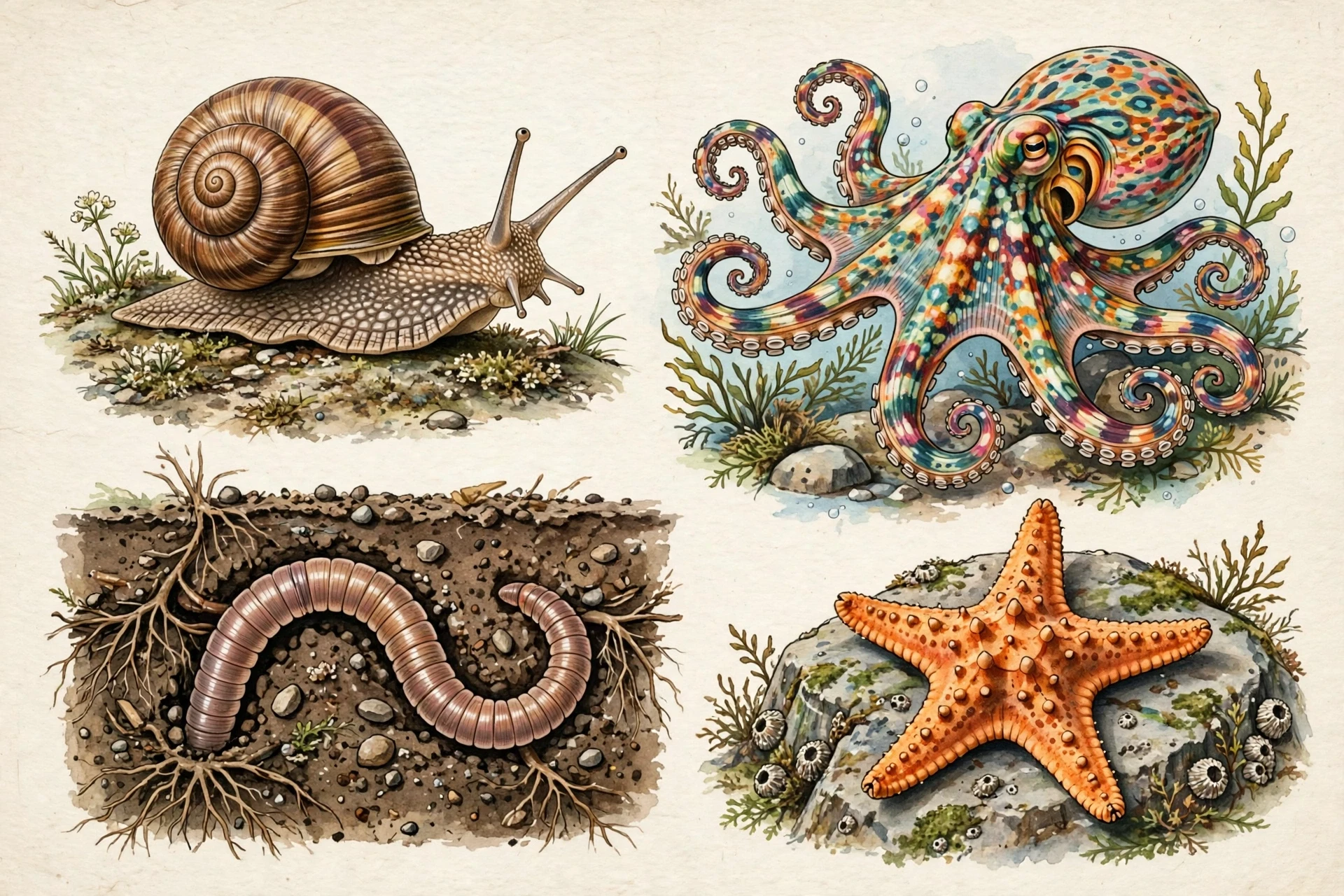
Mollusca is the second-largest phylum, and the most surprising. A mollusc is a soft-bodied animal, usually with a muscular foot, a mantle that can secrete a shell, and a feeding organ called a radula — a tongue covered in tiny teeth. That plan has produced snails, clams, oysters, squid, and octopuses, and the range between them is extraordinary. A clam sits buried in mud and filters food from water. A snail carries its house on its back. An octopus has no shell at all, three hearts, blue blood, and a brain that can solve puzzles, open jars, and — in laboratory tests — learn by watching other octopuses.
The octopus deserves a pause, because it breaks a common assumption: that intelligence belongs to vertebrates. An octopus has about 500 million neurons, most of them in its arms rather than in its central brain. Each arm can taste, touch, and make decisions partly on its own. An octopus can change colour and texture in a fraction of a second, squeeze through a gap the size of a coin, and remember the layout of its den. It lives only a few years, yet it learns fast. If classification teaches anything, it is that the same problems — finding food, avoiding predators, navigating a complex world — have been solved many times, in many ways, by many different body plans. The octopus solved them with a soft body and a distributed brain, and it solved them well.
Molluscs also matter to humans in direct ways. Oysters and mussels filter water and build reefs. Squid and clams feed millions of people. Snails carry parasites that cause disease. And the shells of molluscs, collected for centuries, were among the first objects that naturalists used to study variation — the same variation that Darwin would later explain. Our article on Darwin's Theory of Evolution follows that story from the Galápagos finches to the modern synthesis, and it is the natural companion to this guide: classification shows the pattern, and evolution explains it.
6.3 Annelida and Echinodermata: worms that segment, animals that rebuild
Annelida, the segmented worms, were introduced in the last section, but they deserve a second look here because of what they share with arthropods: segmentation. An earthworm's body is a chain of similar segments, each with muscles, nerves, and bristles. That repetition is a design that evolution has reused again and again. It also makes annelids ecologically vital. Earthworms turn over soil, aerate it, and mix nutrients through it. Without them, much of the world's farmland would be poorer and harder. Charles Darwin spent years studying earthworms, and his last book was about them — a fitting subject for a man who understood that small, slow forces can reshape the world.
Echinodermata — starfish, sea urchins, sea cucumbers, brittle stars — are the odd ones out in this group, and the most revealing. An adult starfish is radially symmetrical, like a cnidarian, yet its larvae are bilateral, like a worm. That mismatch was a puzzle for a century, until DNA and embryology showed the truth: echinoderms are deuterostomes, the same great branch as chordates. A starfish is more closely related to you than an insect is. Its fivefold symmetry is a secondary adaptation to a slow life on the sea floor, not a sign of primitive simplicity. It is one of the great surprises of animal classification, and a warning against judging relationships by adult appearance alone.
7. Chordata: The Phylum With a Backbone — and Without One
Chordata is the phylum most readers know best, because it contains us. But chordates are not only vertebrates. The phylum is defined by four features that appear at some stage of life: a notochord (a flexible rod that supports the body), a dorsal hollow nerve cord, pharyngeal slits (openings in the throat), and a post-anal tail. In many chordates, some of these features appear only in the embryo and vanish in the adult. In humans, the pharyngeal slits become parts of the ear and throat, and the tail is reduced to the coccyx. The notochord becomes the discs between the vertebrae. The features are still there in the blueprint, even when the finished building hides them.
The non-vertebrate chordates are easy to overlook, and they are the key to understanding the phylum. Lancelets are small, fish-like animals that burrow in sand and filter food from water, keeping a notochord for their whole lives. Tunicates — sea squirts — are stranger still: the adult is a sessile bag attached to a rock, filtering water, with no brain to speak of. But the larva is a free-swimming tadpole with a notochord, a nerve cord, and a tail. The larva shows the chordate blueprint clearly; the adult has traded it away for a sedentary life. If you only looked at adults, you would never guess that a sea squirt and a shark are cousins. The embryo gives it away.
7.1 The five vertebrate classes
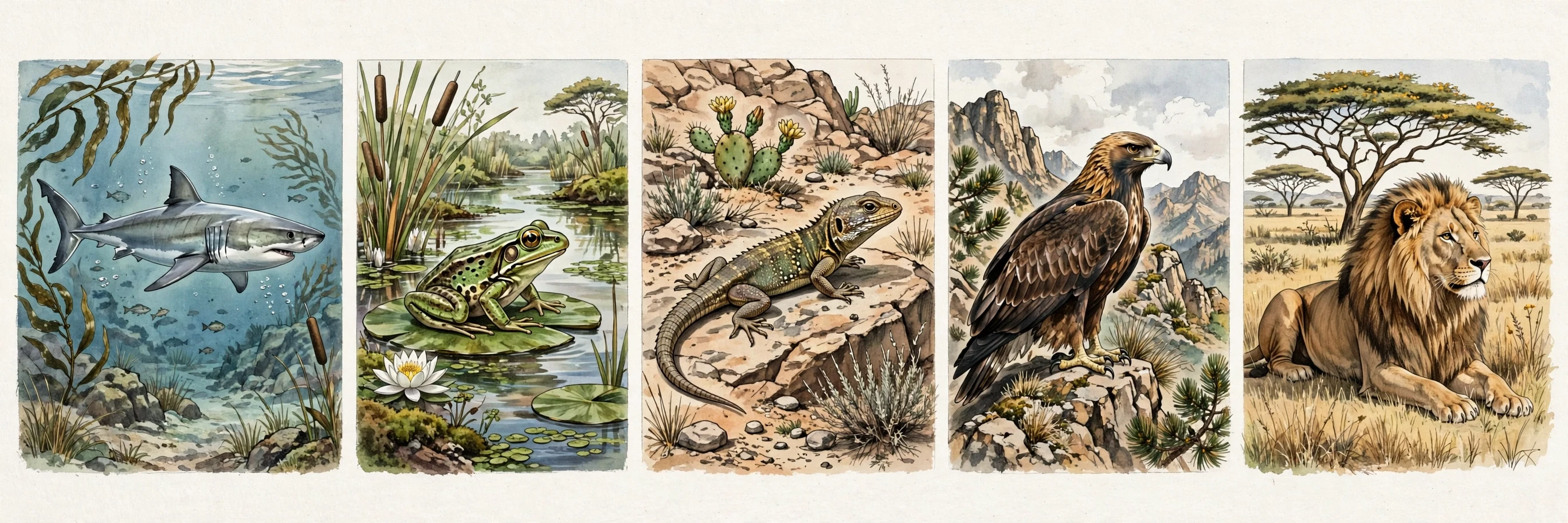
Vertebrates are chordates in which the notochord is replaced, wholly or partly, by a backbone of vertebrae. They split into five traditional classes, each defined by a way of life and a set of adaptations. The classes are not equal in size, and they are not a ladder from simple to advanced — they are five different solutions to the problem of being a large, active animal.
Fishes are the oldest and most diverse vertebrates, with more species than all other vertebrate classes combined. They breathe through gills, usually have fins, and live in water. The group includes jawless lampreys, cartilaginous sharks and rays, and the bony fishes that dominate the oceans, lakes, and rivers.
Amphibians — frogs, toads, salamanders, and caecilians — live a double life, typically starting as aquatic larvae with gills and becoming air-breathing adults with lungs. Their moist skin is both a breathing surface and a vulnerability, which is why amphibians are among the animals most sensitive to pollution and climate change.
Reptiles — snakes, lizards, turtles, crocodilians, and the tuatara — were the first vertebrates to cut the cord to water, laying shelled eggs on land and covering their skin in scales. Birds, by ancestry, belong with this group, though tradition keeps them separate.
Birds are feathered, warm-blooded, egg-laying vertebrates built for flight, with hollow bones, a four-chambered heart, and a respiratory system more efficient than any mammal's. They are living dinosaurs, descended from the same theropods that included Tyrannosaurus.
Mammals are warm-blooded, hairy, milk-producing vertebrates with a four-chambered heart and a large brain relative to body size. They include the egg-laying monotremes, the pouched marsupials, and the placental mammals — including us.
7.2 The brain, the body, and the cost of being big
Vertebrates pay a price for their size and activity: they need a lot of energy, a lot of oxygen, and a lot of coordination. That is why the vertebrate story is also a story of hearts, lungs, and brains getting better. Fish have a two-chambered heart. Amphibians and most reptiles have three chambers. Birds and mammals have four, which keeps oxygen-rich and oxygen-poor blood separate and lets the animal sustain high activity. Lungs get more efficient. Brains get larger and more folded. The human brain, with its folded cortex and its enormous energy appetite, is the extreme end of that trend — and our guide to Human Brain Anatomy and Functions follows the same story from the inside, structure by structure.
There is a temptation to read the five classes as a ladder, with fishes at the bottom and mammals at the top. Resist it. A shark is not a failed mammal. It is a superbly successful fish, with senses — electroreception, a lateral line that feels water movement — that no mammal possesses. A bird's lungs are better than yours. A frog can breathe through its skin. Each class is a complete answer to its own way of life, not a stepping stone to the next one. Classification is not a ranking. It is a map of relationships, and a map does not put one place above another.
8. How DNA Rewrote the Tree
For two hundred years, classification was built on what animals look like: their bones, their shells, their embryos, their behaviour. That evidence is real, and much of it still holds. But in the last few decades, a new kind of evidence has arrived, and it has rearranged the tree in ways that anatomy alone never could. That evidence is DNA.
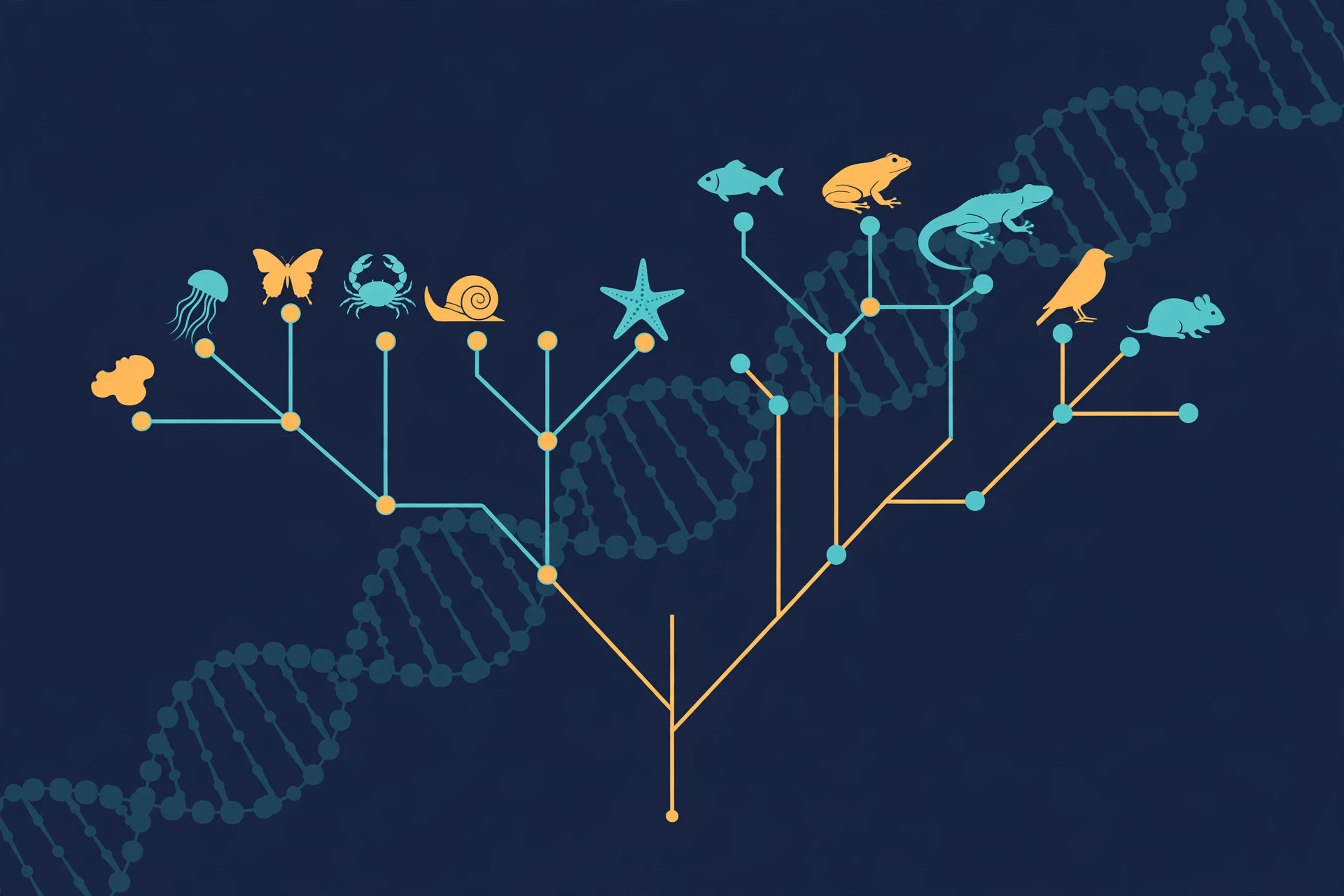
The logic is simple. Animals that share a recent ancestor share more of their DNA than animals whose ancestor lived long ago. By comparing the same genes across many species — the DNA that carries those genes — biologists can measure relatedness directly, rather than inferring it from shape. The results have confirmed many old groupings — mammals are a clade, birds are a clade, arthropods are a clade — and overturned others. The most famous overturning concerns the worms. Animals that look like worms turn out to belong to several different branches, and some "worms" are closer to molluscs while others are closer to arthropods. Shape, it turns out, can be a misleading guide when different lineages converge on the same simple form.
8.1 The great split: protostomes and deuterostomes
One of the deepest divisions in the animal tree, confirmed by DNA, is between protostomes and deuterostomes. The names come from embryonic development: in protostomes, the first opening in the embryo becomes the mouth; in deuterostomes, it becomes the anus, and the mouth forms second. It sounds like a small detail. It marks a split that happened more than 600 million years ago, and it divides the animal kingdom into two great camps.
Protostomes include arthropods, molluscs, annelids, flatworms, and roundworms — the great majority of animal species. Deuterostomes include echinoderms and chordates — starfish, sea urchins, and everything with a backbone, including us. The split explains the starfish surprise from the last section: a starfish and a human are both deuterostomes, so they share a more recent ancestor with each other than either does with an insect, even though the insect looks more like a "typical" animal to a casual eye. Embryology knew this before DNA did. DNA confirmed it, and made the case unanswerable.
8.2 When DNA and anatomy disagree
Disagreements still happen, and they are where the science is liveliest. A group called the ctenophores, or comb jellies, were long placed near the jellyfish, because they look like jellyfish and drift in the same waters. Some DNA studies have placed them as the earliest branching animal lineage — even earlier than sponges — which would mean that nerves and muscles evolved twice, or were lost in sponges. Other studies put sponges first. The argument is unresolved, and it matters, because it decides what the first animal looked like and how complex it was.
I find these arguments reassuring rather than worrying. A field that argues about its deepest branch is a field that is still learning, and the argument is conducted in the open, with data anyone can check. The tree will be redrawn again as new genomes are sequenced — especially from the small, obscure phyla that have been sequenced least. The Integrated Taxonomic Information System, a partnership of US federal agencies including the Smithsonian and the US Geological Survey, tracks those changes as they are accepted, and it is the reference I check when a name or a placement looks uncertain: Integrated Taxonomic Information System (ITIS).
8.3 The tree is a hypothesis
OpenStax Biology puts the point well: phylogenetic trees are hypotheses about the evolutionary past, and they will keep changing as researchers discover new types of life and learn new information. A tree is not a fact carved in stone. It is the best current reading of the evidence, and it is drawn to be tested. That is also why classification and evolution belong together. Darwin's Theory of Evolution explains the mechanism — natural selection acting on variation over vast stretches of time — and classification shows the pattern that mechanism produced. The two are not separate subjects. They are the same story told from two directions: one from the process, one from the result.
"Phylogenetic trees are hypotheses of the evolutionary past. Since phylogenetic trees are hypotheses, they will continue to change as researchers discover new types of life and learn new information." — OpenStax Biology 2e
9. The Species Problem: Where Do You Draw the Line?
If classification is a map, the species is its smallest unit — and it is the hardest to define. The most famous definition, the biological species concept, says a species is a group of organisms that can breed together and produce fertile offspring. It is the definition most people learn in school, and it works well for many animals. A horse and a donkey can produce a mule, but the mule is usually sterile, so horse and donkey are separate species. The definition draws a clean line.
Real animals keep crossing that line. Lions and tigers can produce fertile hybrids, ligers and tigons, in captivity. Different species of penguin interbreed and produce fertile chicks in the wild. More than 10% of bird species produce fertile hybrids. And for animals that reproduce asexually, or for fossils, the definition cannot even be applied — you cannot test whether two extinct animals could have interbred. The Natural History Museum's researchers put the difficulty plainly: there is no single definition of a species, and the biological concept, useful as it is, has fallen out of favour with many scientists because it is so hard to test in practice.
Other definitions exist, and each solves one problem while creating another. The morphological species concept groups animals by shape, which is the only option for fossils — but it struggles with species that look identical and differ only in DNA or behaviour. The genetic species concept defines species by DNA differences, which is precise but useless in the field, where a researcher cannot sequence a bird before deciding what it is. The ecological species concept groups animals by the niche they occupy, which works well for some groups and poorly for others.
9.1 How new species form
New species form when populations stop interbreeding and drift apart, a process called speciation. The most common route is geographic: a river, a mountain range, or a sea splits a population in two, and the two halves evolve separately until they can no longer interbreed even if they meet again. Darwin's finches on the Galápagos are the classic example — birds on different islands evolved different beak shapes to eat different foods, and over time they became different species. The same process can happen without a physical barrier: populations can split because they breed at different times, or because they prefer different habitats, or because their courtship songs diverge until one population no longer recognises the other's.
The process is slow by human standards and fast by geological ones. A small insect population split by a stream can diverge in thousands of years. A large mammal population split by a mountain range might take millions. And the line is drawn by us, not by nature. As one museum curator puts it, a species is best treated as the result of an ongoing process rather than a definable quality. The populations are real. The boundary between them is a judgement call, made with the best evidence available, and it can be revised when better evidence arrives.
9.2 Why the argument matters outside biology
This is not a debate for specialists only. Laws on food safety, biosecurity, and conservation all rely on identifying species correctly. If two frogs that look alike are actually two species, and only one of them is endangered, then a law that protects "the frog" may protect the common one and miss the rare one. If a fish sold in a market is labelled as one species but is actually another, consumers are misled and fisheries are mismanaged. If a disease-carrying mosquito is confused with a harmless relative, control efforts target the wrong insect. Getting the name right is the first step to getting the action right.
I saw this in a small way on a survey of a wetland, where our team found a dragonfly that none of us recognised. It took a week of checking specimens, photographs, and DNA barcodes to confirm it was a species that had not been recorded in that county before. One dragonfly, one county record, one line added to a database. It felt small at the time. But that database is what conservation officers consult when they decide which wetlands to protect, and a county record is a data point in that decision. Classification is infrastructure. It is invisible when it works, and everything depends on it.
10. Why Classification Matters: Medicine, Farming, and Conservation
Classification earns its keep in the practical world, in ways that are easy to miss until you look for them. Three examples show the range.
Medicine. The immune system does not care about common names. It cares about molecules, and molecules follow evolutionary relationships. A drug tested in a mouse works, or fails, in ways that depend on how closely the mouse's biology matches a human's. Knowing the exact species, and its place on the tree, tells researchers which animal models are valid and which are misleading. Venom research is the sharpest example: antivenom must match the snake species, and the species must be identified correctly, or the treatment fails. Our guide to How the Human Immune System Works describes the defences that classification helps medicine to study — the same system, examined from the side of the body rather than the side of the tree.
Farming and food. A farmer's pests and pollinators are often close relatives, and telling them apart is the difference between a harvest and a failure. Classification also guides breeding: the wild relatives of crops and livestock, identified through their taxonomic relationships, carry genes for drought resistance, disease resistance, and yield that breeders can use. The same logic applies to fisheries. A fish stock is managed by species, and if two species are confused, one can be fished to collapse while the other is thought to be abundant.
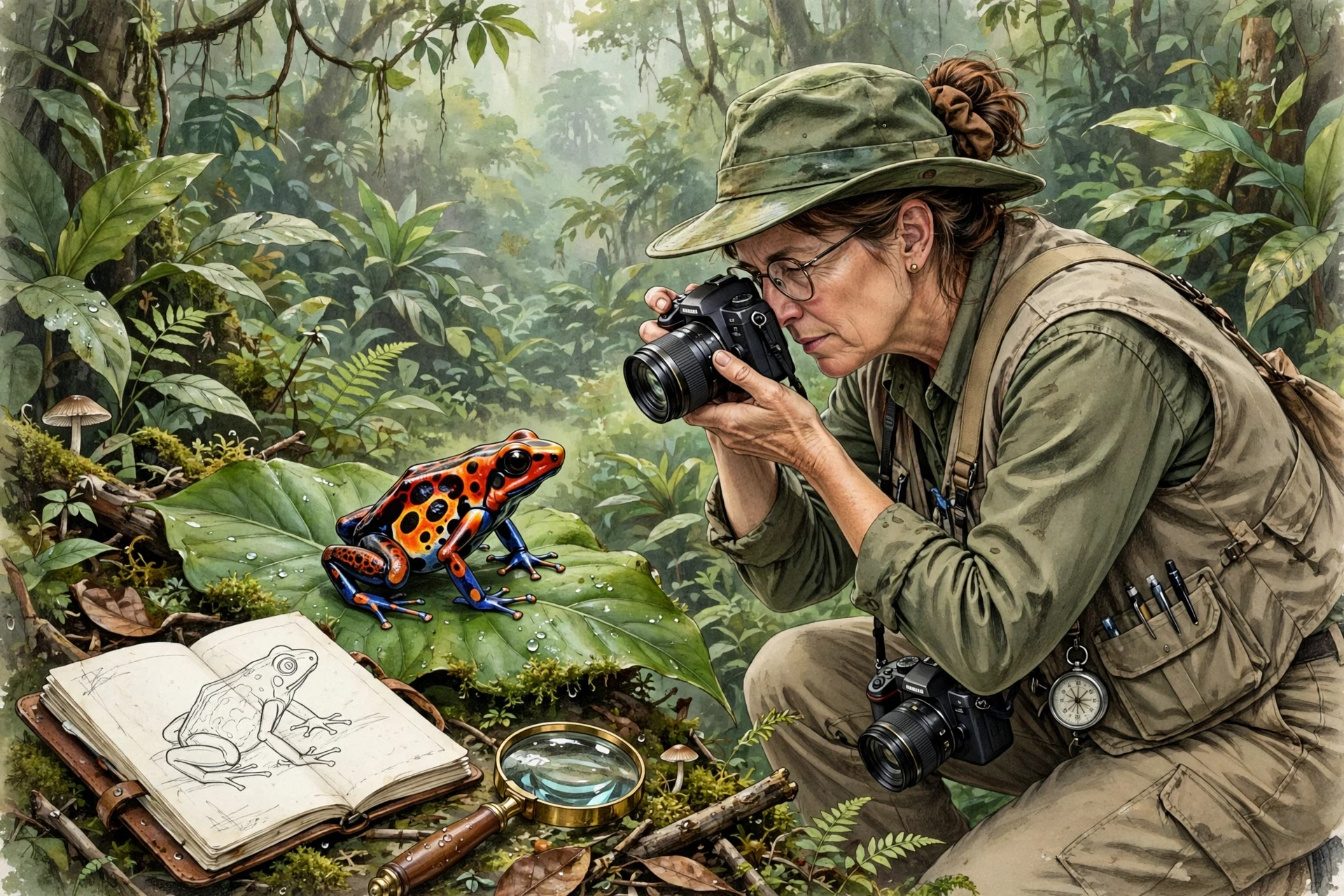
Conservation. You cannot protect what you cannot name. Biodiversity — the variety of life on Earth and the ecological roles it plays — is measured in species, and conservation priorities are set by counting them, mapping them, and tracking which ones are declining. A species that has not been described cannot be listed as endangered, cannot be protected by law, and cannot be counted in a biodiversity survey. Taxonomists, the scientists who describe and name species, are therefore conservation workers in the most literal sense: they make the invisible visible, so that it can be saved. The fieldwork that does this is slow, careful, and often unglamorous — a person with a net, a notebook, and a magnifying glass, in a forest that may not exist in twenty years.
10.1 Classification in everyday life
You use classification every day without noticing it. When you buy fish at a market, you are trusting a label that names a species. When you take a medicine tested on animals, you are trusting that the researchers knew which animals they used. When you visit a zoo and read a sign, you are reading a classification — the animal's common name, its scientific name, and often its family and its conservation status. Even a children's picture book that sorts animals into "farm animals" and "wild animals" is a classification, though a rough one. The scientific version is the same instinct, refined by centuries of evidence and argument: sort things by what they are, so that you can find them, understand them, and talk about them clearly.
Phylum | Key traits | Familiar examples | Approx. described species |
|---|---|---|---|
Porifera | No tissues, filter-feeding, pores | Sponges | ~9,000 |
Cnidaria | Stinging cells, two germ layers | Jellyfish, corals, anemones | ~11,000 |
Platyhelminthes | Flat, bilateral, three germ layers | Planarians, tapeworms | ~30,000 |
Nematoda | Round, unsegmented, pseudocoelom | Roundworms | ~25,000 described; far more unknown |
Annelida | Segmented, true coelom | Earthworms, leeches | ~22,000 |
Arthropoda | Jointed legs, exoskeleton | Insects, spiders, crabs | ~1,200,000+ |
Mollusca | Soft body, mantle, muscular foot | Snails, clams, octopuses | ~85,000 |
Echinodermata | Fivefold symmetry, water vascular system | Starfish, sea urchins | ~7,000 |
Chordata | Notochord, nerve cord, pharyngeal slits | Fish, birds, mammals | ~65,000 |
Table 2. The major animal phyla at a glance. Species counts are approximate and grow every year as new species are described; arthropods dominate by an order of magnitude.
11. Common Misconceptions About Animal Classification — Corrected
Most people carry a few wrong ideas about how animals are sorted, and the wrong ideas are stubborn because they feel sensible. Here are the ones I meet most often, corrected in plain language.
"Classification is just naming things, and the names never change." Wrong on both counts. Classification is about relationships, not labels, and the labels change whenever the evidence changes. A species can be split in two, two species can be merged into one, and a whole phylum can be moved to a different branch. The Catalogue of Life updates its list every year for exactly this reason.
"A fish is a fish, and a whale is a fish because it lives in the sea." A whale is a mammal, not a fish, and the mistake is instructive. Linnaeus made it himself. What matters is not where an animal lives but who its ancestors were and how its body is built. A whale breathes air, gives birth to live young, and nurses them with milk. A shark breathes through gills and lays eggs or gives birth without milk. Habitat is a clue, not a definition. The same logic explains why a bat is a mammal, not a bird, even though it flies, and why a penguin is a bird, not a fish, even though it swims.
"Humans are separate from the animal kingdom." Humans are animals, in the full biological sense: multicellular, heterotrophic, chordates, mammals, primates. The idea that we sit outside the animal kingdom is a cultural habit, not a scientific one. Our brains are remarkable, and our guide to the human brain explains just how remarkable — but a remarkable brain does not remove an animal from its phylum. It makes it an interesting mammal.
"The more complex an animal, the more evolved it is." Evolution has no direction toward complexity. A sponge is not a failed vertebrate. It is a successful sponge, and it has been successful for longer than vertebrates have existed. Parasites have lost organs their ancestors possessed, and they are not "less evolved" for it — they are adapted to a life inside another animal. Every living animal is equally evolved, in the sense that every living lineage has been evolving for the same length of time since the common ancestor. Some lineages got more complex. Some got simpler. Both are evolution working.
"There are only a few animal phyla, and we have found them all." There are around 35 recognised animal phyla, and new ones are still being described — the most recent, discovered in the deep sea and in microscopic habitats, were recognised only in the last few decades. Small, obscure phyla like Loricifera (tiny animals that live in marine sediment) and Micrognathozoa (a microscopic animal found in a Greenland spring) remind us that the tree still has branches we barely know. The map is not finished.
"DNA has made anatomy and fieldwork obsolete." DNA has changed classification, but it has not replaced the older evidence. A DNA sequence tells you about relatedness. It does not tell you what an animal looks like, how it lives, what it eats, or where it is found. Fieldwork, anatomy, embryology, and behaviour are still needed, and the best classifications combine all of them. A species described from DNA alone, with no specimen and no description of its life, is a weak species. The strongest classifications are the ones where molecules, morphology, and ecology agree.
Conclusion
Animal classification began as a filing system and became a family tree. Linnaeus gave us the drawers and the two-word names. Darwin gave us the reason the drawers were arranged the way they were. DNA gave us a way to check the arrangement, branch by branch, and to redraw it where the old evidence had misled us. The result is a map of more than two million named species — and probably several million more still unnamed — arranged by ancestry, from sponges that never move to birds that cross oceans, from octopuses that solve puzzles to humans who write guides about octopuses.
The map matters because it is how we talk about life precisely, how we treat a snakebite, how we breed a crop, and how we decide what to save. It also matters because it changes how you see the world. Once you know that a starfish is your distant cousin, that a whale is a mammal that returned to the sea, that an octopus thinks with its arms, the world stops looking like a collection of separate curiosities and starts looking like a family — a very large, very strange, very old family, of which you are one member. The tide pool I crouched over in Maine is still there, and the anemone is still closing when shadows fall across it. I know its name now, and its phylum, and its place on the tree. Knowing those things does not make the pool less wonderful. It makes it more so, because now I know what I am looking at — and what it is related to.
Frequently Asked Questions
What is animal classification?
Animal classification is the system biologists use to group animals by shared ancestry, from the broadest rank (kingdom) down to the narrowest (species). It places every animal in a hierarchy — domain, kingdom, phylum, class, order, family, genus, species — so that related animals sit together and scientists worldwide can refer to the same animal unambiguously.
How many animal phyla are there?
There are around 35 recognised animal phyla, though the exact count depends on the authority consulted. The best-known are Porifera (sponges), Cnidaria (jellyfish and corals), Platyhelminthes (flatworms), Nematoda (roundworms), Annelida (segmented worms), Arthropoda, Mollusca, Echinodermata, and Chordata. New phyla are still occasionally recognised as obscure groups are studied.
What is the largest animal phylum?
Arthropoda is by far the largest animal phylum, with well over a million described species — more than all other animal phyla combined. Insects alone account for most of that total. Mollusca is the second-largest phylum, with around 85,000 described species.
What makes an animal an animal?
Animals are multicellular eukaryotes that eat other organisms for food, lack rigid cell walls, and usually move at some point in their lives. Most develop from an embryo and have specialised tissues such as muscle and nerve. Exceptions exist — adult sponges do not move, and some animals photosynthesise briefly — but the definition rests on shared ancestry and development, not on a single trait.
What is the difference between taxonomy and phylogeny?
Taxonomy is the science of naming and classifying organisms. Phylogeny is the actual evolutionary history of those organisms — the tree itself. Systematics is the wider study of how organisms are related through evolution. Taxonomy builds the labels; phylogeny is the tree the labels describe.
Who invented animal classification?
Carl Linnaeus, a Swedish botanist, created the modern system in the 18th century, publishing it in Systema Naturae (1735). He introduced the hierarchy of ranks and binomial nomenclature — the two-word Latin scientific name, such as Homo sapiens. Later scientists added ranks (phylum, family, domain) and reinterpreted the system in evolutionary terms after Darwin.
Why do scientific names use Latin?
Latin is a dead language, so its meanings do not change, and it is nobody's native language, so it is neutral ground for scientists worldwide. A name coined in 1758 means the same thing today, and the same two words identify the same animal in every country.
Are humans animals?
Yes. Humans are animals in the full biological sense: kingdom Animalia, phylum Chordata, class Mammalia, order Primates, family Hominidae, genus Homo, species sapiens. A large brain does not remove an animal from its phylum.
What is a species, exactly?
There is no single agreed definition. The biological species concept defines a species as a group that can interbreed and produce fertile offspring, but it fails for asexual organisms, fossils, and many hybridising species. Scientists also use morphological, genetic, and ecological definitions, and often combine several lines of evidence. The Natural History Museum notes that defining a species remains difficult, even though the concept is essential for conservation and law.
Why does animal classification keep changing?
Because new evidence keeps arriving. DNA sequencing has moved whole groups to different branches, new species are described every year, and better data can split one species into two or merge two into one. Classification is a working hypothesis about the tree of life, and it is revised whenever the evidence demands it — which is how science is supposed to work.
Sources / Further Reading
OpenStax Biology 2e — Organizing Life on Earth: https://openstax.org/books/biology-2e/pages/20-1-organizing-life-on-earth
Natural History Museum, London — What is a species, and how many species are there?: https://www.nhm.ac.uk/discover/what-is-a-species.html
Integrated Taxonomic Information System (ITIS): https://www.itis.gov/
Catalogue of Life: https://www.catalogueoflife.org/