

Introduction
The first plant I ever killed was a basil seedling on a kitchen windowsill — my first, accidental lesson in plant biology. I was twelve, proud of the little green shoots, and certain that more care meant more water. I watered it every morning, then again after school, then once more before bed, just to be safe. Within a week the stem went soft at the base, the leaves yellowed, and the whole plant folded over as if someone had switched it off. My grandmother, who grew chillies and bitter gourd on a balcony with what looked like no effort at all, picked up the pot, sniffed the soil, and said, "You drowned it. Plants drink, but they also need to breathe." That sentence has stayed with me longer than most of my textbooks. A plant is not a green machine that takes in water and sunlight and spits out leaves. It is a living compromise — between drinking and breathing, between growing fast and surviving the dry season, between opening up to the air and keeping its water inside.
Plant biology is the science of that compromise. It asks how a seed knows which way is up, how water climbs a hundred metres up a tree with no pump at all, how a leaf makes sugar from air and light, and how the same basic body plan — root, stem, leaf — has been bent into cacti, orchids, mangroves, and the giant sequoias that were already old when the Roman Empire fell. This guide follows those questions from the inside of a single cell to the scale of whole forests, and from the first botanists who sliced stems under crude microscopes to the researchers now breeding crops that can stand hotter, drier summers.
If you have ever wondered why your houseplant leans toward the window, why grass keeps growing after you mow it, or why a tree drops its leaves in autumn instead of fighting the cold, you are already asking the questions plant biology exists to answer. The answers turn out to be stranger and more elegant than most people expect — and they matter far beyond the garden. Nearly everything we eat, much of what we wear, and the oxygen in every breath we take comes from plants doing the quiet chemistry this article describes.
1. What Plant Biology Is — and Why Plants Are Not Just Green Animals
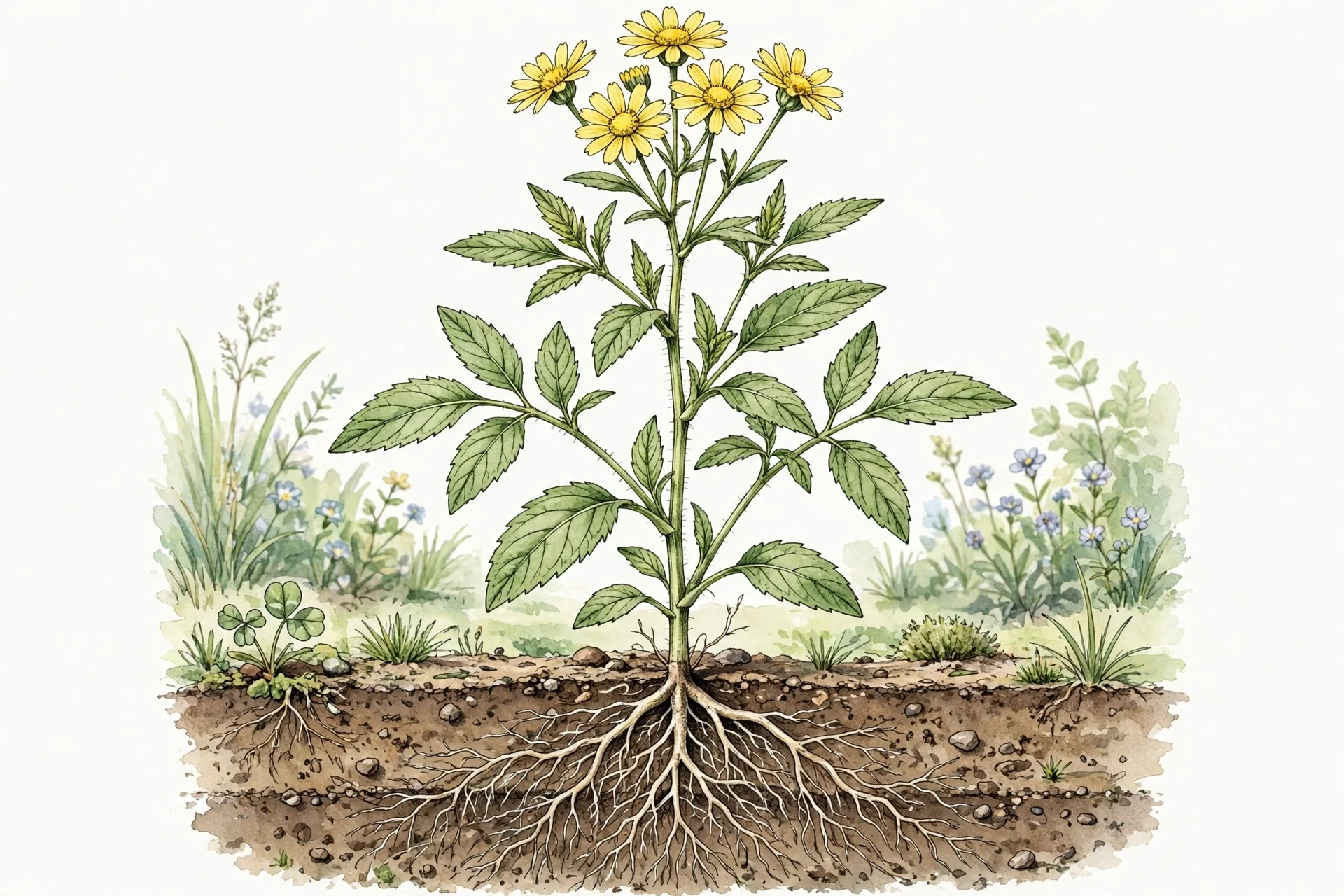
Plant biology, also called botany, is the study of how plants are built, how they work, and how they have changed over hundreds of millions of years. It covers the chemistry inside a leaf cell, the plumbing of a whole tree, the timing of a flower, and the ecology of a forest. A plant biologist might spend one week counting stomata under a microscope and the next week walking a mountainside to see where a species stops growing and why.
The first thing to unlearn is the habit of thinking of plants as slow, simple versions of animals. Plants do not have brains, muscles, or nerves, and yet they sense light, gravity, touch, temperature, and the chemical signals of neighbours. They remember — a seed that has felt a cold winter will flower only after that cold has passed, a trick called vernalisation. They communicate — when one plant is chewed by insects, it can release volatile chemicals into the air that warn nearby plants to raise their defences. They make decisions of a sort, every day, about where to spend their limited sugar: grow taller, grow deeper roots, make a flower, or store food for a hard season. None of this needs a brain. It needs chemistry, timing, and a body plan that has been refined by natural selection for roughly 500 million years.
That history matters. The earliest land plants were small, rootless, leafless things hugging damp ground, not much taller than your thumb. Over time, plants invented the root, the leaf, the seed, and the flower — each invention opening new ground. The seed let plants wait out bad times. The flower, arriving roughly 140 million years ago, let plants recruit animals as couriers for their pollen, and the partnership changed both kingdoms. When we talk about how plants are built today, we are talking about the survivors of those inventions.
"A plant is a solar-powered chemical factory that also has to be its own plumber, its own architect, and its own weather station — all at once, and without ever moving from the spot where it germinated."
I keep that sentence on a card above my desk, because it captures the central tension of plant biology. An animal can walk away from trouble. A plant cannot. Everything a plant needs — light, water, minerals, pollinators — has to come to it, or be reached by growing toward it. That single fact explains most of plant anatomy, most of plant behaviour, and most of the adaptations you will meet in this guide.
1.1 The questions this guide answers
This guide is organised around the questions a curious reader actually asks, in the order the science makes sense. First, the body: what a plant is made of, from cells to tissues to organs. Then growth: how plants get bigger without ever stopping, and why a tree can be thousands of years old while still adding new wood. Then transport: how water and sugar move through a body with no heart. Then food and energy: photosynthesis and respiration, and the balance between them. Then control: the hormones and movements that let a plant respond to light, gravity, and touch. Then reproduction: flowers, pollinators, seeds, and dispersal. Then adaptation: the desert, the floodplain, the shade, and the cold — and the strange solutions plants have found for each. Then the present: what plant biology is doing for farming, medicine, and a warming climate. A section on common misconceptions clears up the ideas that most often mislead people, including a few I believed myself for years.
1.2 A note on how we know what we know
Much of plant biology was worked out by experiments a reader could almost repeat at home. In the 1600s, Jan Baptista van Helmont grew a willow tree in a pot for five years, weighing the soil before and after, and found the tree had gained far more mass than the soil had lost — proof that most of a plant's body comes from somewhere other than the soil. In the 1770s, Joseph Priestley showed that a plant could restore air that a candle had spoiled. In the 1880s, Charles Darwin and his son Francis spent years watching seedlings bend toward light, and traced the bending to a signal travelling from the tip of the shoot. These were not grand instruments or billion-dollar machines. They were patient observations, careful weighing, and a willingness to be surprised. Modern plant biology adds gene sequencing, satellite tracking of forests, and sensors that listen to a tree's water flow — but the spirit is the same: watch closely, measure honestly, and let the plant correct you.
2. The Plant Body: Roots, Stems, Leaves, and Flowers
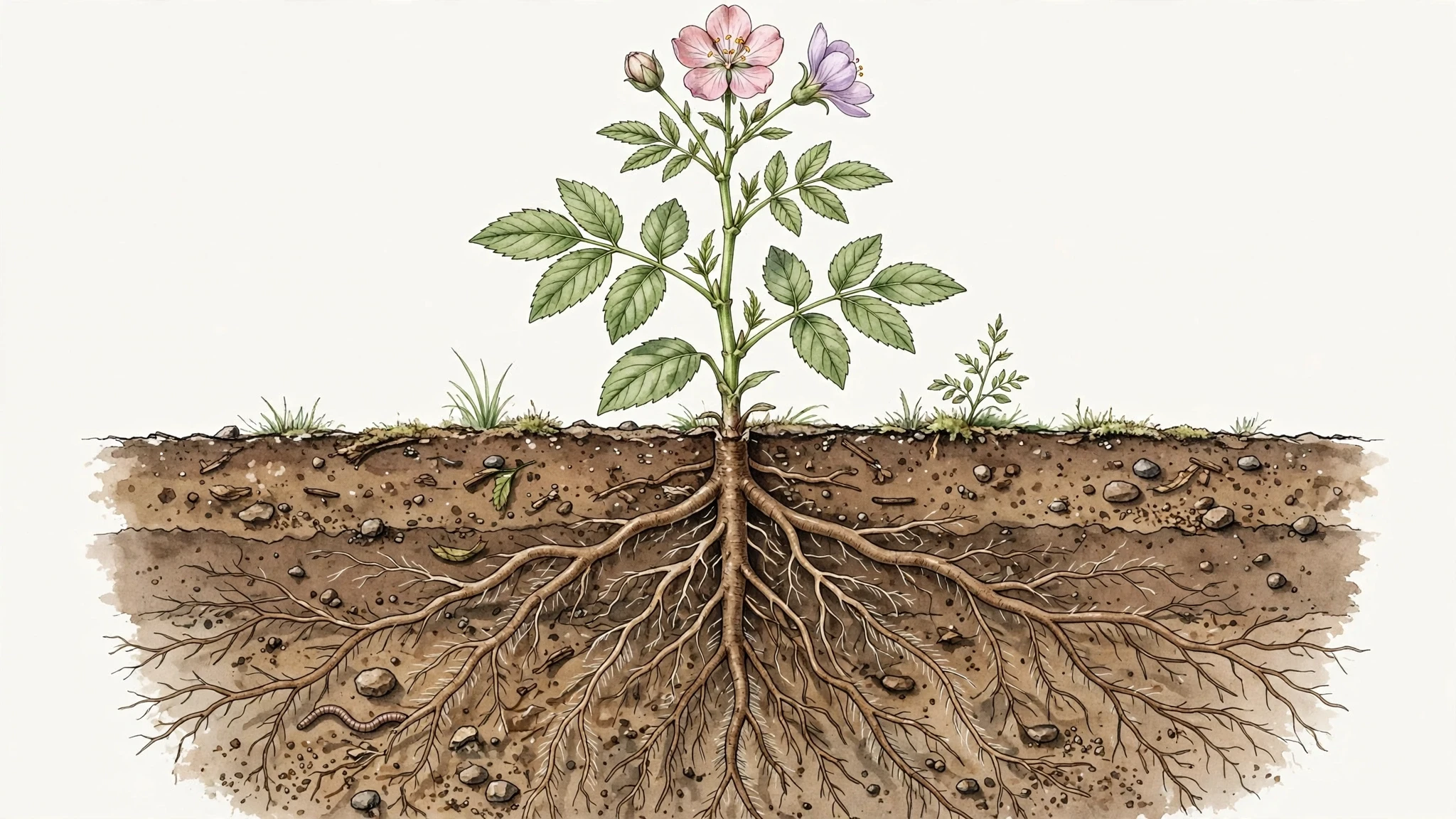
Look at any flowering plant and you will see the same basic arrangement: a root system below ground, and a shoot system above it — stem, leaves, flowers, and fruit. Botanists call these the plant's organ systems, in the same way a human body has a digestive system and a circulatory system. OpenStax Biology 2e describes the plant body in the same terms: the shoot system, vegetative and reproductive, above ground where it absorbs light, and the root system below, which supports the plant and absorbs water and minerals. The shoot system reaches for light and carbon dioxide. The root system reaches for water and minerals. The stem connects them and holds the whole arrangement up where the light is.
The division of labour is strict but flexible. A potato is a stem that learned to store starch underground. A cactus spine is a leaf that gave up photosynthesis to save water and deter hungry animals. A carrot is a root that became a pantry. The organs are not fixed job descriptions; they are a toolkit, and evolution has used the same tools to solve wildly different problems. That flexibility is one of the reasons there are roughly 400,000 known species of flowering plants, filling almost every habitat on land.
2.1 Roots: the hidden half
A plant's roots are usually the largest part of it that you never see. A single rye plant, grown in a box and carefully washed free of soil, was once found to have roots totalling hundreds of kilometres in length, with billions of tiny root hairs. The surface area was enormous — and that is the point. Roots are an absorption machine, and absorption is a surface-area game.
There are two main designs. A taproot system has one thick central root that drives down deep, with smaller branches coming off it — think of a carrot, an oak, or a dandelion. It is good at reaching deep water and anchoring a tall plant. A fibrous system has a dense mat of thin roots spreading sideways near the surface — think of grasses, wheat, or a palm. It is good at catching rain quickly and holding soil in place, which is why grasses are planted to stop erosion. Neither design is better in general. Each is a bet on what the local environment rewards.
At the tip of every growing root sits a root cap, a thimble of cells that protects the delicate growing point as it pushes through soil, and that senses gravity — which is how a root knows to grow down. Just behind the cap, in the zone of elongation, cells stretch and lengthen. Behind that, root hairs — tiny extensions of single cells — reach into the soil and absorb water and dissolved minerals. Root hairs live only a few days, but new ones are constantly made, so the absorbing surface keeps moving into fresh soil. I once dug up a seedling I had grown in a clear gel, expecting neat white threads, and found instead a fuzzy white halo around every root tip. That fuzz, the root hairs, was doing almost all of the drinking.
Roots also store food. The starch in a sweet potato or a beet is sugar made in the leaves and shipped down for later. And roots are not alone underground: most plants partner with fungi in structures called mycorrhizae, where fungal threads extend the root system far beyond what the plant could build itself, trading minerals and water for sugar. A forest, seen from below, is less a collection of separate trees than a network of roots and fungi sharing resources — a finding that has changed how ecologists think about competition and cooperation in woodland.
2.2 Stems: support, transport, and storage
A stem's job sounds simple — hold the leaves up and connect them to the roots — but the engineering is demanding. A stem has to be stiff enough to resist wind, flexible enough not to snap, and hollowed by transport pipes that run its whole length. In herbaceous plants, like a sunflower or a tomato, the stem is soft and green, supported largely by water pressure inside its cells. In woody plants, the stem becomes a trunk, and the support comes from wood — layer upon layer of dead, lignified xylem cells, built up year after year.
Stems are divided into nodes, the points where leaves attach, and internodes, the stretches between them. At each node sits a bud that can grow into a branch, a leaf, or a flower. The arrangement of leaves on a stem — their phyllotaxy — is not random. Leaves are spaced so that each one shades the ones below it as little as possible, often in a spiral pattern that follows the Fibonacci sequence. Stand under a tree on a sunny day and look up: the pattern is there, and it is a solution to a light-catching problem that mathematicians still admire.
Some stems have taken on entirely different jobs. Runners, like strawberry stolons, creep along the ground and root at intervals, cloning the parent plant. Rhizomes, like ginger, run underground and send up new shoots. Tubers, like potatoes, are swollen stem tips packed with starch. Tendrils, like those of a pea plant, are stems or leaves turned into grappling hooks that let a plant climb toward light without building a trunk. Each is the same organ, reshaped.
2.3 Leaves: solar panels with a breathing problem
Leaves are where the plant's energy business happens. A leaf is a thin, flat, green surface designed to catch light and take in carbon dioxide — and that design creates a dilemma. To take in carbon dioxide, a leaf must open pores, called stomata, to the air. Open pores leak water. Every leaf lives with this trade-off, all day, every day: open up and risk drying out, or close up and starve for carbon.
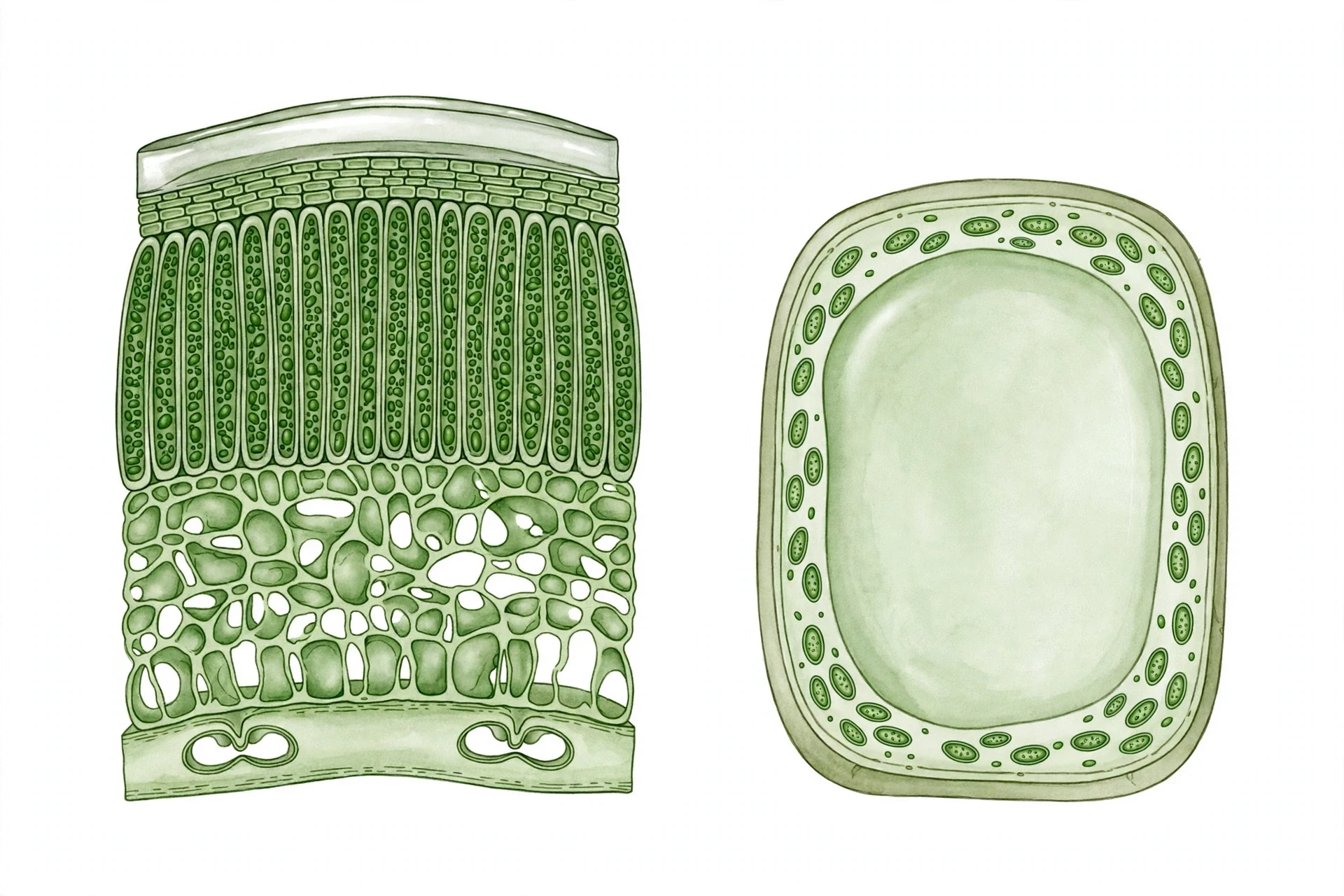
The anatomy of a leaf is a direct answer to that dilemma. The upper surface is protected by a waxy cuticle that slows water loss. Inside, the palisade mesophyll — tall, tightly packed cells stuffed with chloroplasts — does most of the photosynthesis. Below it, the spongy mesophyll has air spaces that let gases move around inside the leaf. The stomata, mostly on the lower surface where the air is cooler and stiller, are flanked by guard cells that open and close them like lips. The veins, the xylem and phloem, run through the leaf like plumbing, delivering water and carrying sugar away.
Leaf shapes tell the same story in different dialects. Broad, thin leaves catch maximum light in a shady forest. Needles, like a pine's, have a small surface and a thick cuticle, losing little water in cold, dry winters. The huge leaves of a banana plant catch light in the tropics but tear easily in wind — a cost the plant accepts. When I teach leaf anatomy, I ask students to pick up three leaves from outside and explain each one as a business decision. They always can. The leaf is the most honest organ in the plant: its shape is its strategy, written in green.
2.4 Flowers and fruit: the reproductive system
Flowers are the plant's way of outsourcing reproduction to animals, wind, or water. A typical flower has sepals that protect the bud, petals that advertise, stamens that make pollen, and a carpel that holds the ovules. Pollination — the transfer of pollen to the stigma — is only the start. After fertilisation, the ovule becomes a seed and the ovary often becomes a fruit, a package designed to get the seed somewhere new. A cherry is a bribe: eat me, carry the seed away. A dandelion clock is a parachute. A burdock burr is a hitchhiker. The variety of fruits is the variety of travel strategies, and it is one of the most delightful corners of plant biology.
3. Inside the Plant: Cells and Tissues
Zoom in from the whole plant and the next level of organisation is the tissue — groups of cells working together — and below that, the cell itself. Plant cells share the basics with animal cells: a nucleus, mitochondria, and the rest. They also have three features no animal cell has, and those three features explain a surprising amount of plant behaviour.
The first is the cell wall, a rigid box of cellulose around each cell. It gives the plant its stiffness and its shape, and it means plant cells cannot crawl around the way animal cells can. A plant grows by making new cells in the right place and inflating them, not by moving cells to where they are needed. The second is the chloroplast, the green organelle where photosynthesis happens — a former bacterium, captured long ago, that still carries its own small genome. The third is the large central vacuole, a water-filled sac that can take up most of the cell's volume. Fill it, and the cell becomes firm — turgid — like a blown-up balloon inside a box. Empty it, and the cell goes limp. That is what wilting is: not a lack of structure, but a loss of water pressure. Water your plant and the vacuoles refill; the leaves lift again within the hour, and you have watched cell biology happen in front of you.
3.1 The three tissue systems
Every organ of a plant is built from three tissue systems that run through the whole body, continuous from root tip to leaf tip. The dermal tissue is the skin: the epidermis, usually one cell thick, covered in a waxy cuticle, with stomata for gas exchange and root hairs for absorption. In woody plants the epidermis is replaced by bark — the periderm — a tougher, corky skin that protects the trunk for decades.
The vascular tissue is the plumbing: xylem and phloem, bundled together in vascular bundles in the stem, arranged as a central cylinder in the root, and branching into the veins of the leaf. Xylem carries water and minerals up from the roots; phloem carries sugar from where it is made to where it is needed. The two sit side by side everywhere, like the two directions of a road.
The ground tissue is everything else — the bulk of the plant. In a leaf, ground tissue is the mesophyll that photosynthesises. In a stem, it is the cortex and pith that store food and support the vascular bundles. In a root, it is the cortex that water must cross on its way to the xylem. Its cells are mostly parenchyma: thin-walled, living, versatile cells that can divide again if the plant is wounded. Cut a plant, and parenchyma cells near the wound divide and seal it. That ability is why cuttings work: a piece of stem, given water and time, can grow new roots from cells that remembered how to divide.
3.2 Cell types that do the heavy work
Within those tissues, a few cell types deserve names, because they do jobs nothing else can. Vessel elements and tracheids are the water pipes of the xylem — dead at maturity, hollow, with lignified walls, stacked end to end into long tubes. They are dead for a reason: a living cell could not hold the tension of a water column pulled up a tall tree, and its contents would clog the pipe. The plant builds the pipe, then the cell dies and leaves the pipe behind. It is a striking arrangement: part of a living tree is made of dead cells doing essential work.
Sieve tube elements, the sugar pipes of the phloem, are the opposite: alive, but stripped of their nucleus and most of their machinery, and kept alive by companion cells that sit beside them and do the metabolic work for both. Collenchyma cells give flexible support to young, growing stems — the strings in a celery stalk are collenchyma. Sclerenchyma cells, with thick, lignified walls, give rigid support and protection: the hard shell of a nut, the gritty cells in a pear, the fibres in a flax stem that we spin into linen. Each cell type is a trade-off between strength, flexibility, and cost, and the plant pays for each one in sugar.
4. How Plants Grow: Meristems, Primary Growth, and Wood
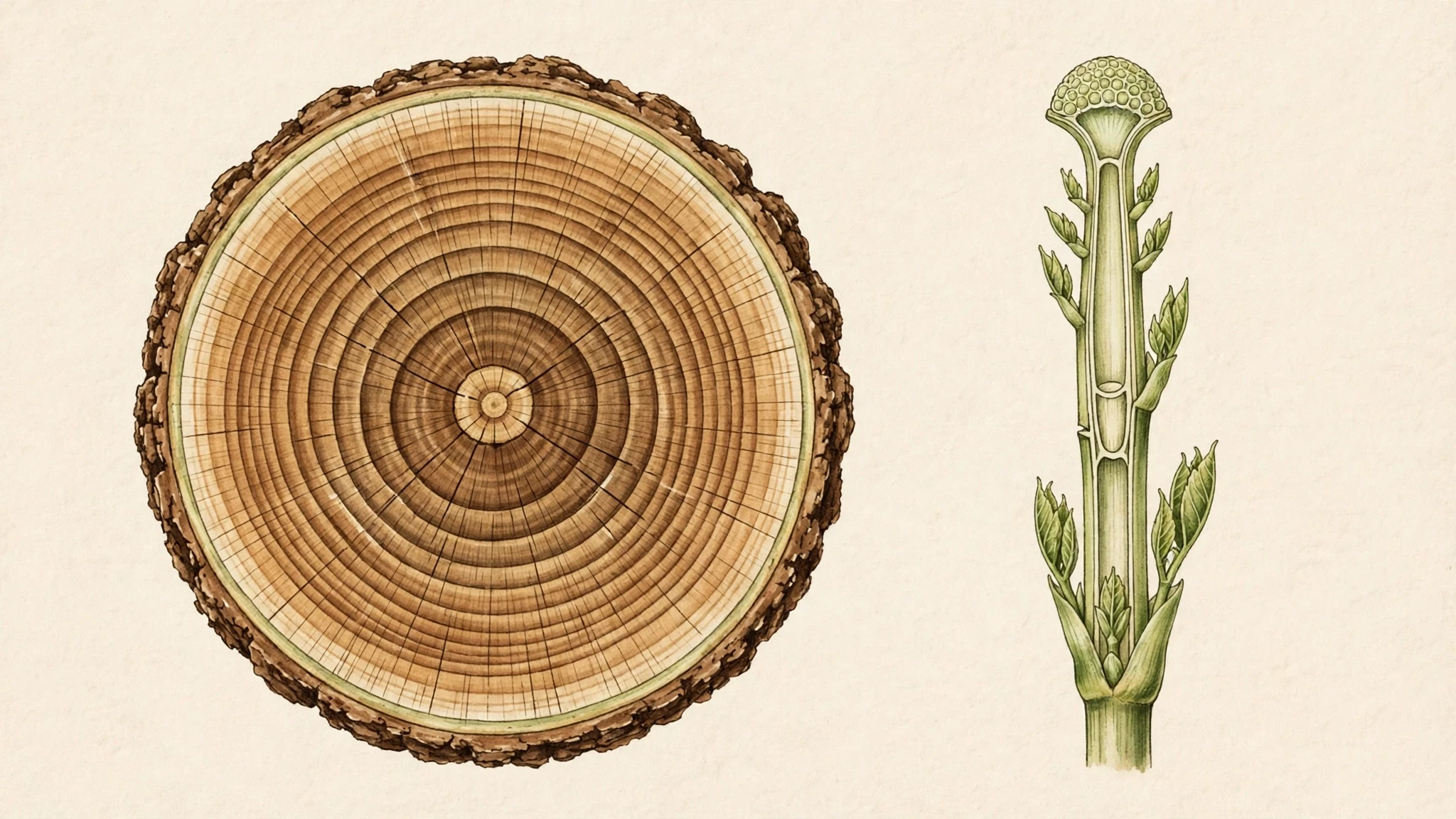
Animals grow for a while, then stop. Plants, in a sense, never stop. A tree that is a thousand years old is still growing — adding new shoots at its tips and new wood around its trunk — because plants keep small regions of permanently young, dividing cells throughout their lives. Those regions are called meristems, and they are the reason a plant can be both ancient and newborn at the same time.
I find meristems quietly astonishing. Every branch tip, every root tip, is a tiny factory of undifferentiated cells, dividing and handing their daughters over to become leaf, wood, or root. Damage a shoot tip and a side bud takes over. Cut a tree down to a stump and, in many species, new shoots sprout from dormant buds. The plant carries its future in these small, protected pockets of youth.
4.1 Primary growth: getting longer
Primary growth is growth in length, and it happens at the apical meristems — the tips of shoots and roots. In the shoot, the apical meristem produces new leaves and stem tissue, and a hormone called auxin, made at the tip, suppresses the side buds below it. That is why the tip grows fastest and the plant stays a single main stem until the tip is removed. Prune the tip of a hedge and the side buds wake up; the hedge bushes out. Gardeners have exploited this for centuries without knowing the chemistry. The science came later, and it confirmed the practice.
In the root, the apical meristem sits just behind the root cap, protected as the root pushes through soil. Cells divide there, then elongate in the zone just behind, pushing the tip forward. A root can grow several centimetres a day in good soil, navigating around stones and toward moisture, guided by gravity and by chemical signals from the soil. Grasses have an extra trick: intercalary meristems at the base of each leaf blade, which let the leaf keep growing from the bottom up. That is why a lawn survives mowing. You cut the top off; the growth zone is at the base, untouched.
4.2 Secondary growth: getting thicker
Woody plants also grow in thickness — secondary growth — driven by two lateral meristems. The vascular cambium is a thin cylinder of dividing cells between the xylem and the phloem. Each year it lays down new xylem (wood) on the inside and new phloem (inner bark) on the outside. The wood of one year forms a ring, and because spring wood has wide, thin-walled vessels and summer wood has narrow, thick-walled ones, the rings are visible. Count the rings and you count the years; read their widths and you read the weather of each year — wide rings for wet years, narrow rings for drought. Dendrochronology, the science of reading tree rings, has dated ancient buildings, reconstructed past climates, and even confirmed the dates of volcanic eruptions that dimmed the sun.
The second lateral meristem, the cork cambium, makes bark — the protective outer skin of a woody plant. Bark is not decoration. It keeps water in, keeps insects and fungi out, and insulates the living tissues beneath from fire and frost. Some trees, like the cork oak, make bark so thick and useful that we harvest it without killing the tree. Others, like the paperbark, shed bark in strips. A tree's bark is its armour, and like all armour, it is a compromise between protection and the need to let gases through.
4.3 The life cycle: annuals, biennials, and perennials
Not all plants play the long game. Annuals — wheat, marigolds, most vegetables — complete their whole life in one growing season: germinate, grow, flower, set seed, die. Their strategy is speed and numbers: put everything into seeds, and let the seeds wait for next year. Biennials — carrots, foxgloves — spend the first year building a root and a rosette of leaves, store food, survive the winter, and flower in the second year. Perennials — trees, shrubs, grasses — live for many years, flowering again and again, investing in a body that survives.
Seeds themselves are a marvel of timing. A seed is a plant in a box, with a food supply and a waterproof coat, waiting for the right signal: water, the right temperature, sometimes light, sometimes a period of cold, sometimes even smoke from a fire. I once kept a packet of seeds on a shelf for three years, convinced they were dead, then soaked them on a whim and watched them sprout within days. The seed had not been dead. It had been patient. Dormancy is not failure; it is a bet that the future will be better than the present.
Life cycle | Duration | Strategy | Examples |
|---|---|---|---|
Annual | One growing season | Fast growth, many seeds, die after seeding | Wheat, marigold, tomato, sunflower |
Biennial | Two growing seasons | Store food in year one, flower in year two | Carrot, beetroot, foxglove, parsley |
Herbaceous perennial | Many years; top dies back in winter | Survive underground, regrow each spring | Peony, hosta, mint, asparagus |
Woody perennial | Many years to centuries | Invest in wood; flower repeatedly | Oak, pine, apple tree, rose |
5. Water and Food on the Move: Xylem, Phloem, and Transpiration
A plant has no heart, no pump, and no muscles — and yet it moves water from its roots to its highest leaf, sometimes a hundred metres up, against gravity, all day long. It also moves sugar from its leaves down to its roots and up to its growing tips. How it does both is one of the most satisfying stories in plant biology, because the answer is not a machine. It is physics, used cleverly.
5.1 How water climbs a tree
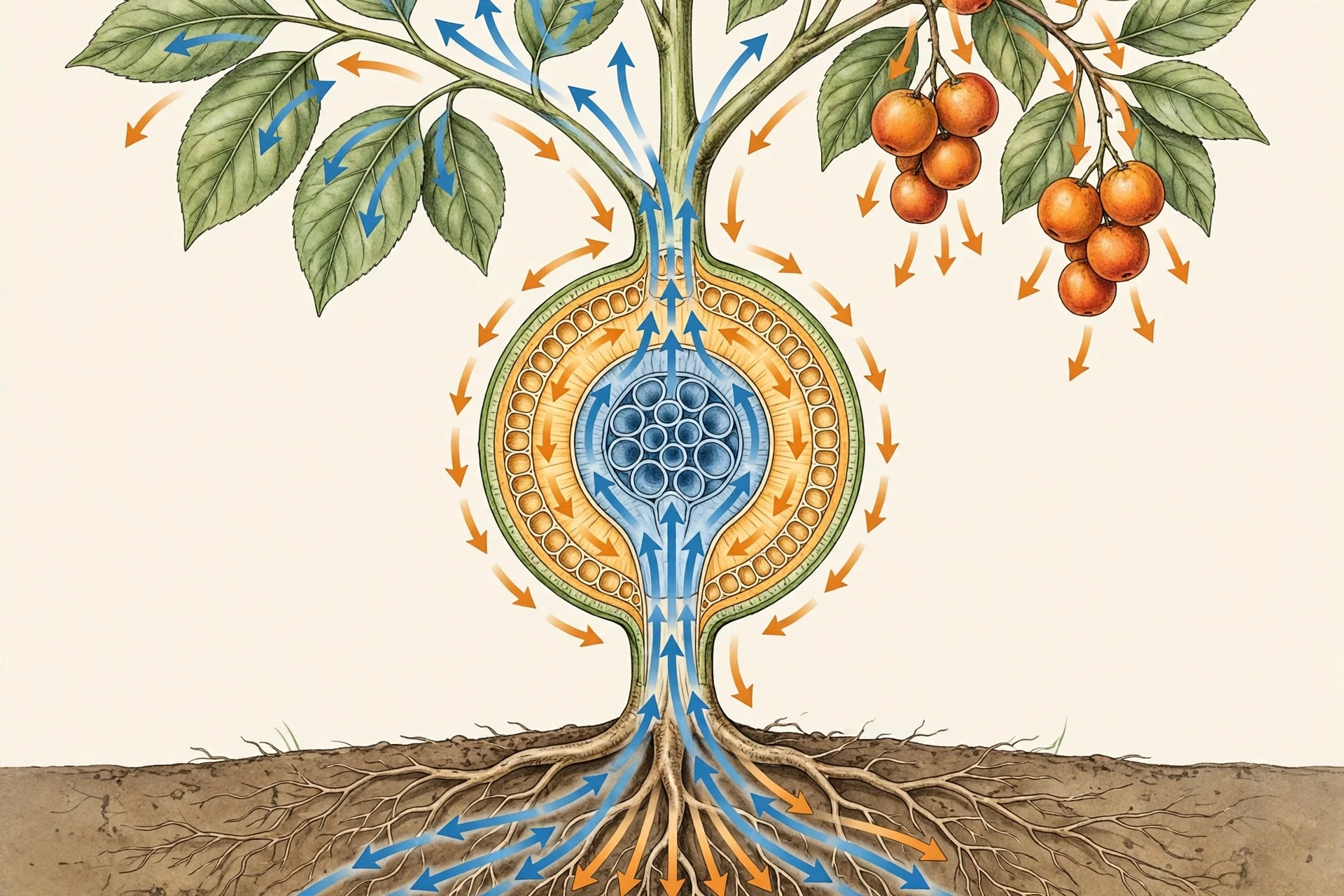
The main force lifting water is transpiration pull. Water evaporates from the leaves through the stomata — a process called transpiration — and each evaporating molecule tugs on the one below it. Water molecules stick to each other (cohesion) and to the walls of the xylem vessels (adhesion), so the tug travels down the whole column, all the way to the roots, pulling water up behind it like a rope. The evaporation at the top does the work; the sun provides the energy; the plant provides the pipes.
The numbers are startling. A large tree can transpire hundreds of litres of water on a hot day. Only a tiny fraction of that water — well under one percent — is actually used to build the plant's tissues or to make sugar. The rest is the cost of keeping the stomata open so carbon dioxide can get in. It is an extravagant-sounding system, and yet it works, because water is usually available and the alternative — closed stomata, no carbon — is starvation. This is the same trade-off from section 2.3, now seen at the scale of a whole tree.
How does water get into the xylem in the first place? Water and dissolved minerals enter through the root hairs, cross the root cortex, and must pass through a layer of cells called the endodermis, whose walls contain a waterproof band, the Casparian strip. The minerals they carry — nitrogen, phosphorus, potassium, calcium, and trace elements — are the same chemical elements arranged in the periodic table, and a shortage of any one of them shows up in the plant as a specific symptom: yellowed older leaves for nitrogen, purple stems for phosphorus, scorched leaf edges for potassium. The strip forces water to cross a cell membrane rather than slipping between cells — a checkpoint where the plant controls what gets in and what stays out. It is the root's customs desk. I remember the first time a colleague showed me a stained cross-section of a root with the Casparian strip glowing under the microscope: a thin, dark ring, doing the job of a border guard for the whole plant.
There is a second, smaller force: root pressure. At night, when transpiration stops, roots can push water up a short distance by pumping minerals into the xylem and letting water follow by osmosis. You can see it in the morning as drops of water on the tips of grass blades — guttation — water pushed out of tiny pores at the leaf edge. Root pressure alone could never lift water up a tall tree, but it helps small plants and refills vessels that have filled with air.
5.2 How sugar travels: the pressure-flow idea
Sugar moves by a different mechanism, called pressure flow. In a leaf, sugar made by photosynthesis is loaded into the phloem. Water follows by osmosis, building up pressure. At the other end — a growing root tip, a developing fruit, a storage organ — sugar is unloaded, water follows out, and the pressure drops. Sugar flows from high pressure to low pressure, from source to sink. The plant does not need to decide the route: the pressure gradient does it. Change what is growing, and the flow changes. In spring, a tree's buds are the sinks; in summer, the fruits; in autumn, the roots, stocking up for winter.
This is why ringing a tree — cutting a ring of bark all the way around the trunk — kills it. The cut severs the phloem, which sits just under the bark, and sugar can no longer travel down to the roots. The roots starve, the tree dies, even though water is still rising through the xylem inside. Foresters and gardeners have known this for centuries; the mechanism explains why. The USDA Forest Service's account of how a walnut tree makes, moves, and spends its sugars shows the same balance at work in a real tree: leaves as sources, nuts and roots as competing sinks, and drought or disease tipping the whole carbohydrate economy.
5.3 The water cycle, seen from a leaf
A plant's transpiration is not a private affair. The water a forest breathes out becomes the humidity of the air above it, and in places like the Amazon, a large share of the rainfall has been through a leaf at least once. Plants are a working part of the planet's water cycle — taking water from the soil, returning it to the air, and in doing so, moving heat and shaping weather. Sciory's guide to the water cycle follows that loop at planetary scale; what happens inside a leaf is where the loop begins.
Tissue | What it carries | Direction | Cells alive at maturity? | Driving force |
|---|---|---|---|---|
Xylem | Water and dissolved minerals | Roots → shoots | No — dead, hollow vessels | Transpiration pull, helped by root pressure |
Phloem | Sugars and other organic compounds | Source → sink (both directions) | Yes — sieve tubes with companion cells | Pressure flow from loading to unloading |
6. Making Food and Burning It: Photosynthesis and Respiration
Photosynthesis is the process that feeds almost all life on Earth, and it happens in the green parts of a plant — mostly the leaves. The equation is famously simple: carbon dioxide plus water, plus light energy, gives sugar and oxygen. The machinery behind it is anything but simple, and it is worth a closer look, because it is the foundation everything else in this guide rests on.
Inside a chloroplast, photosynthesis runs in two linked stages. The light-dependent reactions, on the thylakoid membranes, capture light energy with chlorophyll and use it to split water, releasing oxygen and producing energy-carrying molecules. The Calvin cycle, in the stroma, uses that energy to fix carbon dioxide into sugar. The oxygen we breathe is a by-product — waste gas from splitting water, released through the stomata. Every breath you take is, in that sense, a gift from a leaf.
The details matter for understanding why plants behave as they do. Photosynthesis needs light, carbon dioxide, and water at the same time. Take away any one and the process stalls. That is why a plant in a dark cupboard starves, why a plant with closed stomata on a hot, dry afternoon stops growing, and why a well-watered plant in bright light grows fast. Gardeners manage light, water, and air without always naming the chemistry; the chemistry is what they are managing.
Respiration is the other half of the balance. Plants burn sugar in their mitochondria to release energy for growth, transport, and repair — the same basic process animals use, running day and night in every living cell of the plant. A plant's growth is the difference between what photosynthesis makes and what respiration spends. On a bright day, photosynthesis wins by a wide margin. At night, or in deep shade, respiration can win, and the plant slowly loses mass. This is why seedlings stretched thin and pale on a dark windowsill are starving, not just stretching: they are burning more than they make.
For the full step-by-step account of the light reactions, the Calvin cycle, and the equation itself, Sciory's Photosynthesis Explained covers the process in depth. Here, the point to carry forward is the balance: a plant is a business that earns sugar in the light and spends it around the clock, and its anatomy, its timing, and its adaptations are all ways of keeping that business in profit.
6.1 Three ways to fix carbon — and why they matter
Most plants use the standard C3 pathway, fixing carbon dioxide directly into a three-carbon compound. It works well in cool, moist conditions. In hot, dry places, though, C3 plants lose too much water: their stomata must stay open to take in carbon dioxide, and the heat drives water out. Two other strategies have evolved to solve this.
C4 plants — maize, sugarcane, sorghum — first fix carbon dioxide into a four-carbon compound in one set of cells, then release it in a second set of cells where the Calvin cycle runs. The extra step concentrates carbon dioxide where it is needed, so the plant can keep its stomata partly closed and still photosynthesise efficiently in heat. C4 plants dominate tropical grasslands and feed much of humanity; maize alone is one of the world's most important crops, and its C4 machinery is part of why it yields so well in hot summers.
CAM plants — cacti, succulents, pineapples, orchids — take a different approach: they open their stomata at night, when it is cool and humid, take in carbon dioxide and store it as an acid, then close their stomata during the day and run photosynthesis on the stored carbon. It is slower, but it lets a plant live where daytime water loss would be fatal. A cactus is not a plant that gave up on photosynthesis. It is a plant that moved its breathing to the night shift.
7. Hormones and Movement: How a Plant Senses and Responds
A plant cannot run from danger or walk toward food, so it responds by growing — toward what it needs, away from what harms it, and at the right time. That growth is controlled by plant hormones: chemical messengers made in one part of the plant that act in another. Five classical hormones run most of the show, and each has a character worth knowing.
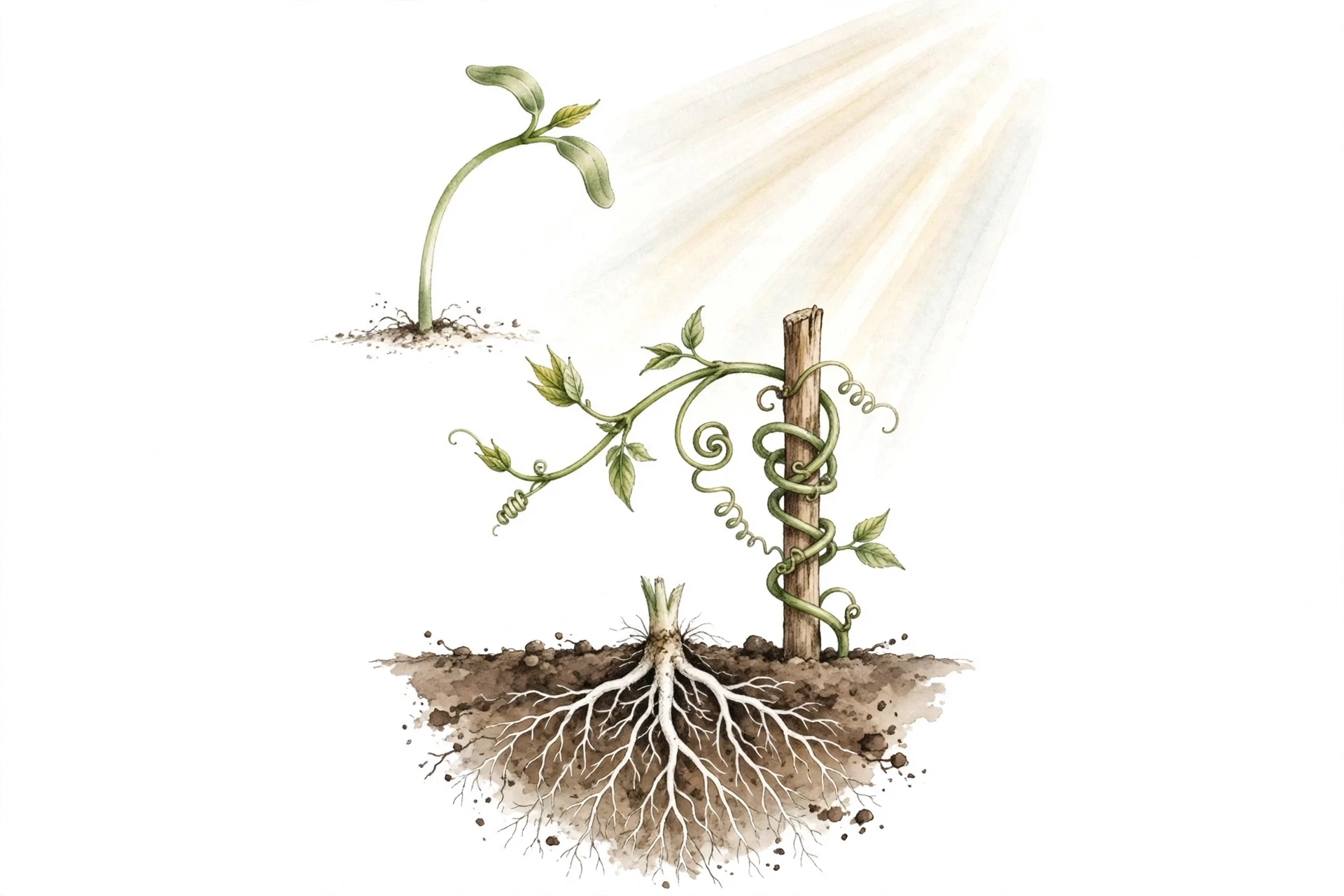
Auxin, made mainly in shoot tips, promotes cell elongation and suppresses side buds, as we saw in section 4.1. It also drives phototropism — the bending of a shoot toward light. Here is how it works: light causes auxin to accumulate on the shaded side of a shoot, and auxin makes those cells elongate faster, so the shoot bends toward the light. Darwin father and son showed in 1880 that the tip of the shoot senses the light and sends a signal downward; the signal turned out to be auxin, identified decades later. The experiment is a classic because it is so clean: cover the tip, and the bending stops. The plant sees with its tip and grows with its side.
Gibberellins promote stem elongation and seed germination. They were discovered through a disease: rice plants infected with a fungus grew absurdly tall and spindly — "foolish seedling" disease — and the fungus was making a chemical that forced the plant to grow. That chemical, gibberellin, is now sprayed on grapes to make them bigger and used to break seed dormancy. Cytokinins promote cell division and delay ageing in leaves; they work in balance with auxin, and the ratio between the two decides whether a cluster of cells becomes a shoot or a root — a ratio tissue-culture labs use every day to clone plants in jars.
Abscisic acid is the stress hormone. When water runs short, it signals the guard cells to close the stomata, and it keeps seeds dormant until conditions improve. Ethylene is a gas, and it promotes fruit ripening and leaf fall. One ripe banana in a bag with green ones will ripen the lot, because ethylene from the ripe fruit triggers ripening in its neighbours. Put a ripe banana next to unripe avocados and you are doing plant hormone science in your kitchen.
7.1 Tropisms: growth with a direction
A tropism is growth in response to a stimulus. Phototropism is growth toward light. Gravitropism is growth in response to gravity: shoots grow up, roots grow down, guided by dense starch grains in special cells that settle like ballast and tell the plant which way is down. Thigmotropism is growth in response to touch: a tendril that touches a support curls around it within minutes, and a tree grown in constant wind grows thicker and shorter, braced against the force.
These are slow movements by animal standards, but they are movements, and they are purposeful. A seedling buried in soil grows upward in the dark, guided by gravity alone, until it breaks the surface and light takes over. A vine finds a trellis by touch. A sunflower tracks the sun across the sky in a daily rhythm — and young sunflowers do it even on cloudy days, following an internal clock that anticipates where the sun should be. The plant is not passive. It is paying attention, in the only way it can: by growing.
7.2 Timing: clocks, seasons, and flowering
Plants keep time. Many have an internal circadian clock, a roughly 24-hour rhythm that runs even in constant light, controlling when stomata open, when leaves move, and when genes switch on. They also measure the length of the day — photoperiodism — to decide when to flower. Long-day plants, like spinach, flower when days lengthen in spring. Short-day plants, like chrysanthemums, flower when days shorten in autumn. Day-neutral plants, like tomatoes, flower when they are old enough, whatever the season.
This timing is why street lights can confuse a tree, why a warm spell in February can trick a fruit tree into flowering before the last frost, and why farmers and gardeners pay close attention to day length when they choose varieties. The plant's calendar is written in light, and a changing climate is rewriting it. Spring is arriving earlier in many places, and the plants are noticing before we do.
8. Reproduction: Flowers, Pollinators, Seeds, and Dispersal
If growth is how a plant survives, reproduction is how its lineage survives. Flowering plants have made reproduction into a partnership — and in many cases, into a piece of theatre.
8.1 The flower as an advertisement
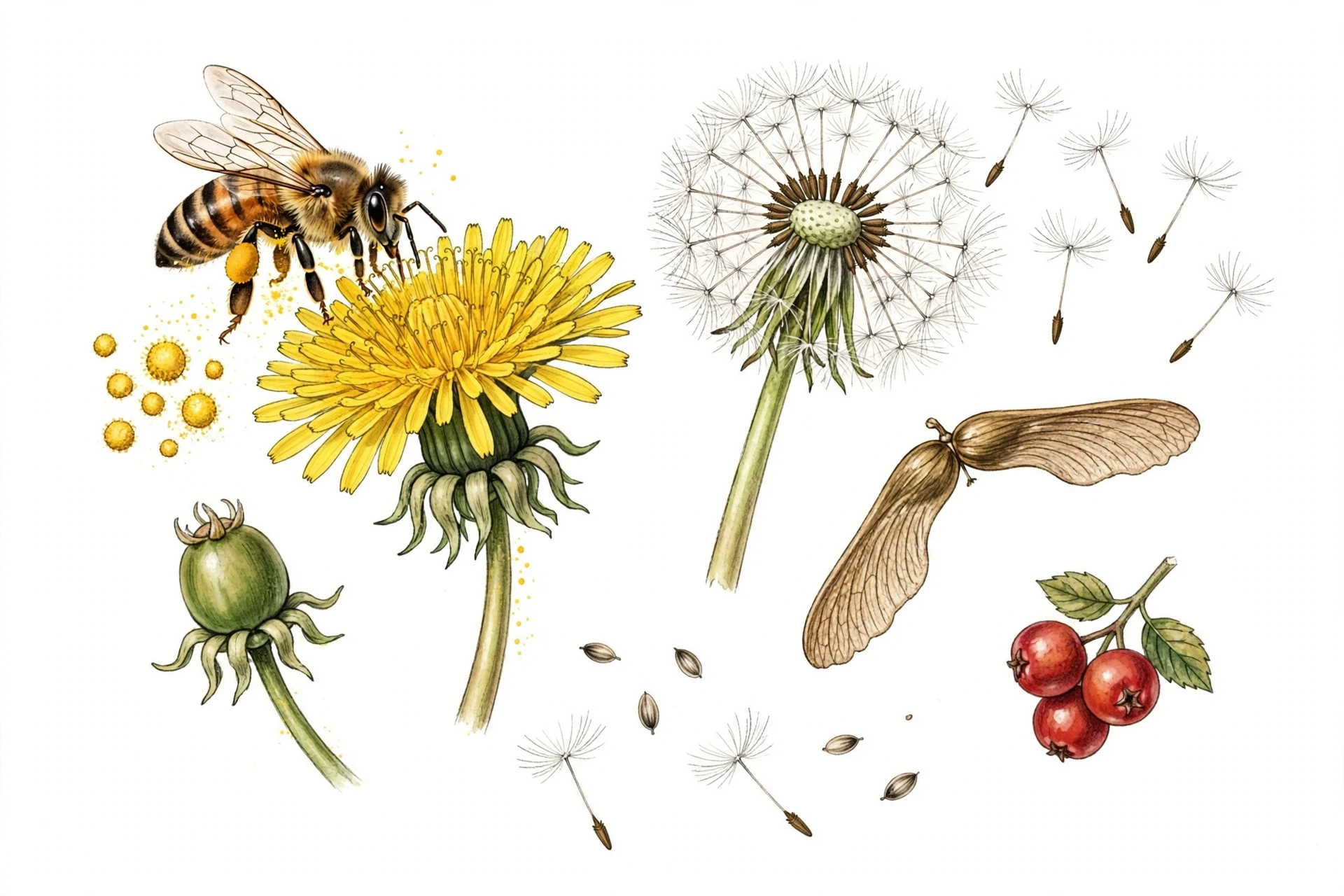
A flower is a reproductive structure and an advertisement at the same time. Its colour, scent, shape, and nectar are tuned to a particular audience. Bees see ultraviolet patterns on petals that are invisible to us — landing guides painted in light we cannot see. Moths visit pale, strongly scented flowers that open at night. Hummingbirds visit red, tubular flowers with no scent, because birds have a poor sense of smell and good colour vision. The carrion flower smells of rotting meat and is pollinated by flies. Each is a deal: the pollinator gets food, the plant gets its pollen delivered to another flower of the same species. The full structure of a flower — sepals, petals, stamens, and carpel — and the alternation of generations behind it are laid out clearly in OpenStax Biology 2e on plant reproduction.
This partnership is ancient and it is fragile. Roughly three quarters of the world's flowering plants depend on animal pollinators, and most of our food crops do too, at least in part. When pollinator numbers fall — through habitat loss, pesticides, and disease — yields fall with them. The decline of wild bees is not only a wildlife story; it is an agriculture story, and a food story. Plant biology and conservation meet here, in the flower.
8.2 Seeds and how they travel
After fertilisation, the plant invests in seeds, and then in getting them somewhere new. The strategies are a catalogue of ingenuity. Wind dispersal: the dandelion's parachute, the maple's spinning wing, the orchid's dust-like seeds that drift for kilometres. Water dispersal: the coconut, sealed and buoyant, that can cross an ocean. Animal dispersal: berries eaten and seeds dropped in droppings, burrs that hitchhike on fur, nuts buried by squirrels and forgotten — the forgotten ones become forests. Explosive dispersal: the touch-me-not, whose seed pods burst at a touch and fling seeds metres away.
The seed itself is a survival capsule: an embryo, a food store, and a protective coat. Some seeds need fire to germinate — the heat cracks the coat, or smoke chemicals trigger germination — which is why some forests regenerate best after a burn. Some need to pass through an animal's gut, the acids scarifying the coat. Some can wait decades in the soil, a seed bank of future plants, ready for the day the canopy opens and light reaches the ground.
8.3 Asexual reproduction: cloning without seeds
Many plants also reproduce without sex at all. Runners, rhizomes, bulbs, and tubers are all clones — genetically identical copies of the parent. A grove of aspens can be a single individual, tens of thousands of years old, connected underground by a shared root system, with each trunk a clone of the same original seedling. Gardeners clone plants by cuttings for the same reason: a cutting preserves the exact variety, while a seed shuffles the genes. The choice between sex and cloning is a choice between variety and certainty, and plants use both, as the situation demands.
9. Adaptation Strategies: Deserts, Water, Shade, and Cold
Every habitat on land is a problem set, and plants have solved each one many times, in different ways. Adaptation is not a single trait; it is a whole way of life, tuned to what is scarce and what is dangerous where the plant lives.
9.1 The desert: saving every drop
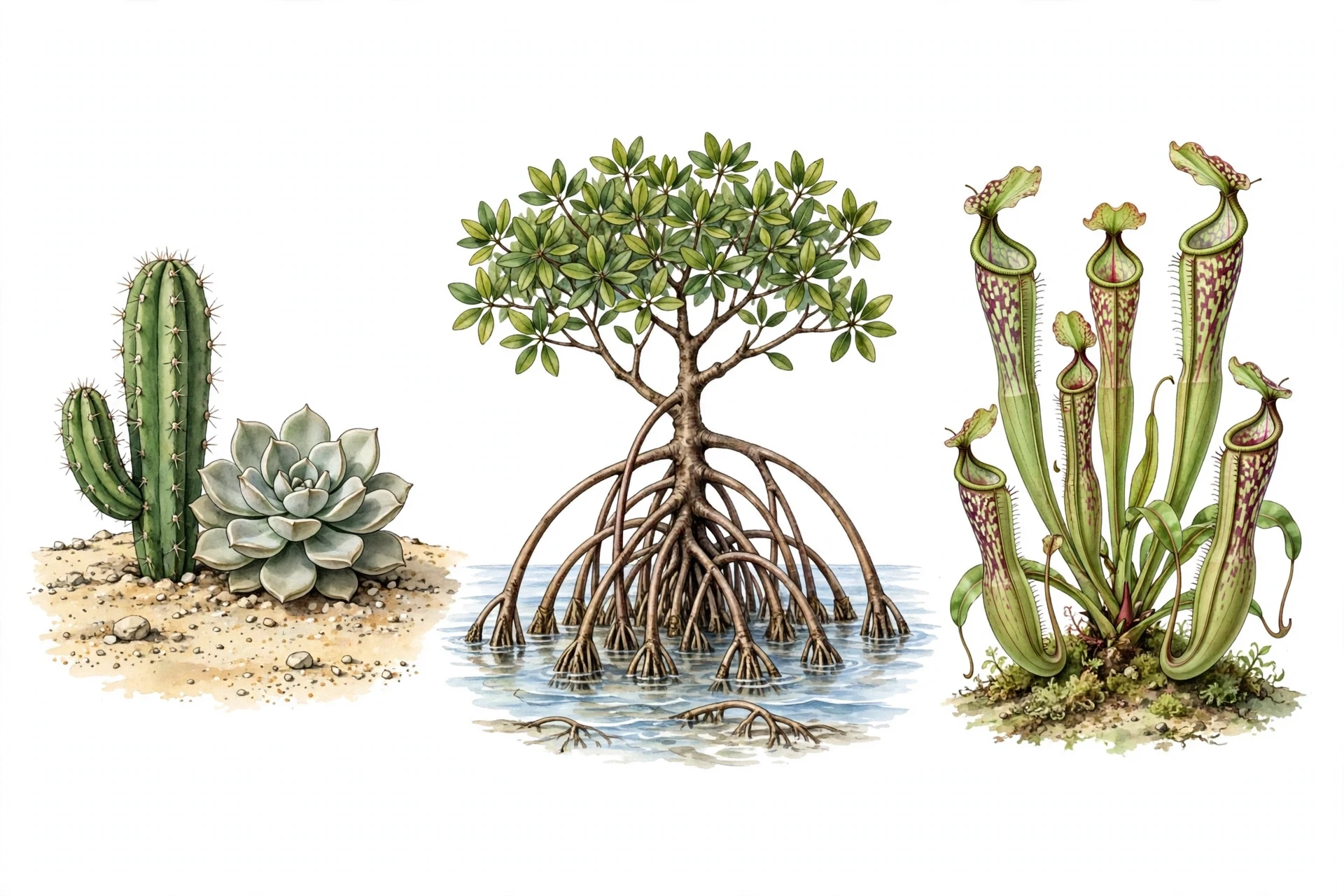
Desert plants, or xerophytes, face the harshest version of the leaf's dilemma: intense sun, dry air, and little water. Their solutions are a masterclass in trade-offs. Cacti have given up leaves altogether, photosynthesizing in their thick, fleshy stems, with spines — modified leaves — that shade the surface, trap still air, and deter animals. Succulents store water in swollen leaves or stems, wrapped in a thick, waxy cuticle. Many desert plants have deep taproots that reach groundwater, or wide, shallow roots that catch a brief rain before it evaporates. Some, like the creosote bush, drop their leaves in drought and wait, dormant, for rain that may be months away.
The CAM photosynthesis described in section 6.1 is part of the same answer: open the stomata at night, when the air is cool and the water loss is small. The welwitschia of the Namib Desert takes it further: a single plant lives for centuries with just two leaves that grow continuously from the base, shredding at the tips, drinking fog that condenses on its surface. It looks half dead. It is perfectly adapted.
9.2 Life in water: when the problem is too much of it
Water plants have the opposite problem: not too little water, but too little air. Roots underwater cannot get oxygen, and carbon dioxide moves slowly through water. Aquatic plants solve this with air spaces — aerenchyma — spongy tissue full of air channels that carry oxygen down to the roots like a snorkel. Mangroves, which grow in salty tidal mud, send up breathing roots — pneumatophores — that poke above the mud at low tide and take in air. Water lilies have stomata on the upper surface of their floating leaves, where the air is, and their stems are full of air channels.
Salt is another challenge. Mangroves either exclude salt at the roots or excrete it through glands on their leaves — you can see the salt crystals on a mangrove leaf on a hot day. Salt marsh plants do the same. These are not marginal curiosities: mangrove forests protect coasts from storms, store enormous amounts of carbon in their mud, and nurse the fish that coastal communities depend on. Their adaptations are ecosystem services, and losing mangroves costs far more than the trees themselves.
9.3 Shade, cold, and fire
In a forest, light is the scarce resource. Shade-tolerant plants grow large, thin leaves with more chlorophyll, catching what light filters through the canopy. Some, like spring ephemerals — the bluebells and trilliums of temperate woods — do their growing and flowering in the few weeks of spring before the canopy closes, then die back and wait underground for next year. Climbing plants — vines and lianas — cheat: they use other plants' trunks to reach the light, spending nothing on a trunk of their own.
Cold brings its own rules. Conifers keep their needles through winter, with a thick cuticle and antifreeze compounds in their cells, photosynthesizing on mild winter days. Deciduous trees drop their leaves in autumn, sealing the wound with a corky layer, and wait out the winter as bare branches — a strategy that costs a whole canopy each year but saves the water that frozen leaves would lose. Alpine plants grow low and tight, hugging the ground where the air is warmer, flowering fast in a short summer.
Fire, which looks like pure destruction, is a habitat some plants have embraced. The lodgepole pine holds its cones sealed with resin until a fire melts them open and releases the seeds onto the ash-rich ground. The banksias of Australia need fire to open their woody fruits. Grasses burn and regrow from buds at the base, protected underground. In fire-adapted landscapes, suppressing every fire can be as harmful as letting them all burn: the plants are waiting for the flames.
9.4 Carnivores, parasites, and other rule-breakers
Some plants break the rules of the textbook entirely. Carnivorous plants — the Venus flytrap, the pitcher plant, the sundew — live in soils so poor in nitrogen that they get it from insects instead. The flytrap counts touches: two touches on a trigger hair within seconds, and the trap snaps shut. Pitcher plants drown their prey in a pool of digestive fluid. Sundews glue insects to sticky tentacles and curl around them. They still photosynthesize; the insects are fertilizer, not food in the animal sense.
Parasitic plants go further. Dodder, a leafless orange vine, wraps around a host, sinks feeding structures into it, and steals water and sugar — having given up photosynthesis almost entirely. Mistletoe taps into a tree's xylem for water and minerals while keeping its own leaves. These plants remind us that the categories — producer, consumer, parasite — are human conveniences. Evolution uses whatever works.
"The most common mistake in plant biology is assuming a plant is passive. Watch a seedling for a week — really watch it — and the passivity disappears. It reaches, it turns, it waits, it decides. It just does all of it at a speed we are not built to notice."
9.5 Evolution's long view
All of these adaptations are the work of natural selection over deep time, and they connect plant biology directly to the story of evolution. A cactus and a euphorbia, on different continents, both became spiny, succulent, leafless columns — not because they are related, but because the desert rewards the same solution twice. That is convergent evolution, and it is one of the strongest kinds of evidence that adaptation is real and directional. Sciory's guide to Darwin's Theory of Evolution explains how that process works and what evidence supports it; the plants in this guide are the evidence, growing in deserts and forests all over the world.
10. Plants, People, and a Changing Climate
Plant biology is not only about wild plants. It is about the plants we eat, the crops we breed, the forests we manage, and the climate we are changing. The science in this guide is the same science that decides whether a harvest succeeds.
10.1 Feeding the world: crops and breeding
A handful of crops — wheat, rice, maize, potatoes, soybeans — feed most of humanity, and all of them are plants whose wild ancestors were reshaped by thousands of years of selection. Modern plant breeding adds genetics to that tradition: crossing varieties, selecting for drought tolerance, disease resistance, and yield, and increasingly using genetic tools to move single traits with precision. The work matters because the climate is shifting under farming. A wheat variety bred for the climate of 1980 may not suit the climate of 2030.
Plant biology also underpins the quieter revolution in how we grow food: understanding root architecture to breed crops that find water deeper in the soil, understanding stomatal behaviour to breed crops that waste less water, understanding the plant microbiome — the bacteria and fungi around roots — to reduce fertiliser use. None of this is glamorous. All of it decides what is on the table.
10.2 Forests, biodiversity, and carbon
Forests are the largest store of carbon on land that we can influence quickly, and they are also the richest reservoirs of plant diversity. A single hectare of tropical rainforest can hold more tree species than a whole temperate country. That diversity is not decoration: it is the raw material of adaptation, the genetic library from which future crops, medicines, and resilient forests will be drawn. Sciory's guide to biodiversity explains why that variety matters and what is lost when it disappears.
Plants also make many of our medicines — aspirin from willow bark, the antimalarial artemisinin from sweet wormwood, the cancer drug vincristine from the Madagascar periwinkle — and countless more compounds remain undiscovered in plants that have never been studied. Every species lost is a library burned before anyone read it.
10.3 What researchers are working on now
Plant biology today is moving fast. Researchers have mapped how the hormone auxin moves cell by cell through a growing root tip, and how that flow steers the root around obstacles. They have found that plants under attack release chemical signals that neighbouring plants detect and respond to — a kind of airborne warning system that is now being studied for use in farming, where a spray of the right signal might prime a whole field's defences. They have bred rice varieties that survive weeks underwater by switching on a gene that pauses growth during flooding, then resumes it when the water drains — a trait borrowed from a wild relative and now grown by millions of farmers.
The biggest open questions are the ones that matter most. How will forests respond as the air gets richer in carbon dioxide — will they grow faster, or will water and nutrients limit them? Can we breed crops that yield well with less water and less fertiliser? How do we protect the wild relatives of crops, whose genes may be the ones we need most in a hotter world? The answers will come from the same combination that built this science: patient observation, careful measurement, and a willingness to let the plant correct us.
10.4 What you can do with this knowledge
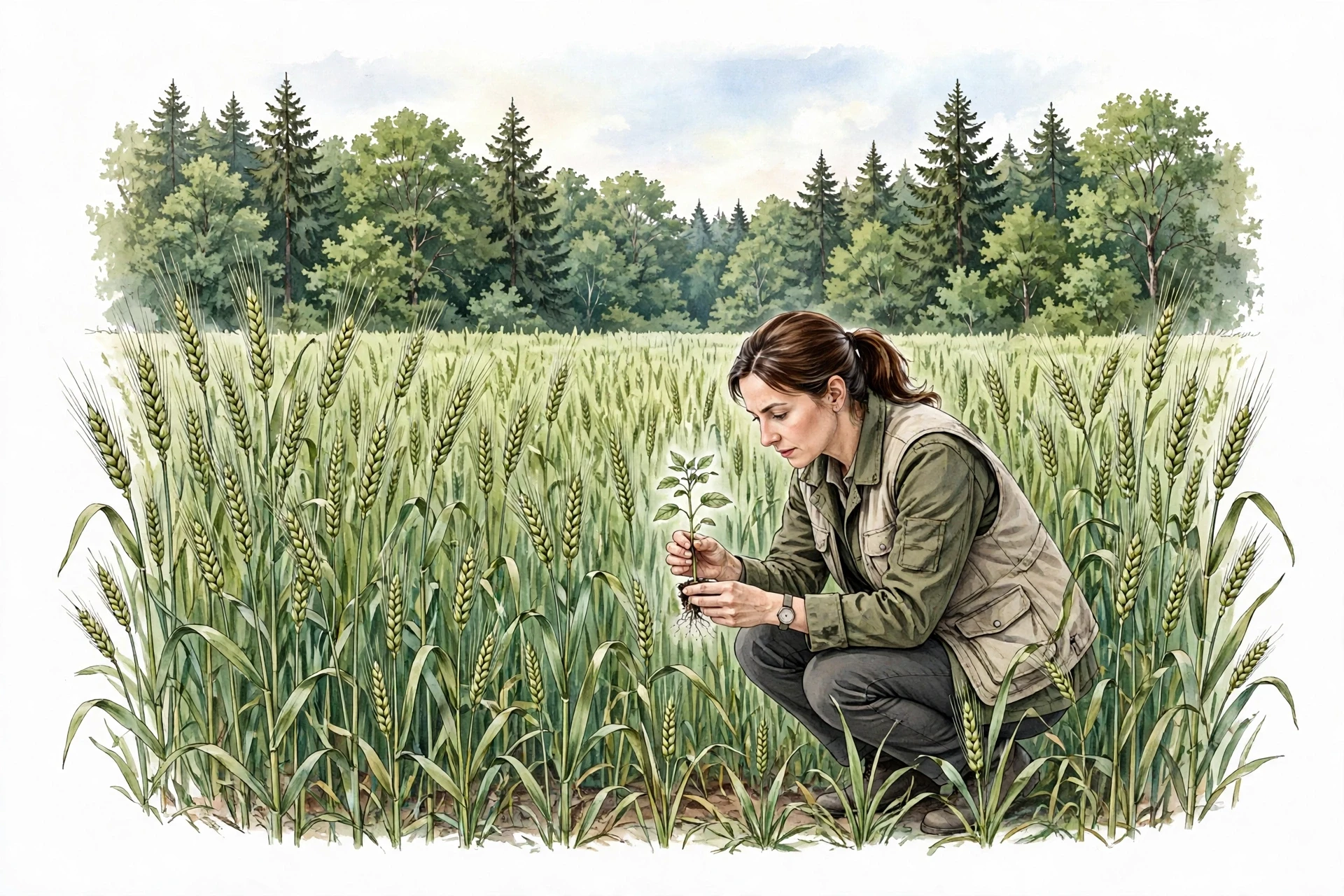
You do not need a laboratory to use plant biology. If you garden, you already are: choosing the right plant for the light and soil you have, watering deeply and less often so roots grow down instead of staying at the surface, pruning the tip to make a plant bush out, letting a plant wilt slightly before watering so its roots search deeper. If you keep houseplants, the rules are the same: light, water, and air, in balance, and the plant will tell you when the balance is wrong — yellow leaves, stretched stems, drooping. A quick checklist I give new gardeners:
Match the plant to the spot: sun-lovers in sun, shade plants in shade — no amount of care fixes the wrong address.
Water the soil, not the leaves, and water deeply but less often, so roots grow down.
Let the soil dry slightly between waterings; roots need air as well as water.
Prune the growing tip to make a plant branch out, and remove dead leaves promptly.
Watch the leaves: they are the plant's report card, and they change before the plant is in real trouble.
The plant is always communicating. Plant biology is learning to listen.
11. Common Misconceptions About Plant Biology — Corrected
"Plants get most of their mass from the soil." This is the oldest misconception in the subject, and it was disproved in the 1600s by van Helmont's willow experiment. Most of a plant's dry mass comes from the air — carbon dioxide fixed by photosynthesis — plus water. The soil contributes minerals, which are essential but small in mass. A tree is, quite literally, made mostly of air and sunlight.
"Plants don't move." They do, but at their own speed. Shoots bend toward light, roots grow toward water, tendrils curl around supports, leaves track the sun, and the Venus flytrap snaps shut in a fraction of a second. A time-lapse film of a growing plant looks like an animal in fast motion — because, in a sense, that is what it is.
"All plants need the same thing: sun and water." No. A cactus rots in wet soil. A water lily drowns on dry land. A shade plant scorches in full sun. Each species is tuned to a particular combination of light, water, temperature, and soil, and giving a plant "more" of something it does not need is often worse than giving it less. My drowned basil seedling taught me that lesson the hard way.
"A tree's rings count its age, always." Usually — but not always. A tree stressed by drought or defoliation can miss a ring, and a tree in a tropical climate with no strong seasons may not make clear rings at all. Tree-ring dating works best where seasons are sharp, and scientists cross-check rings between trees before trusting a date.
"Flowers are for beauty." Beauty is a side effect. Flowers are reproductive structures, and their colours and scents are advertisements aimed at pollinators. The beauty we see is the by-product of a deal between a plant and an animal, negotiated over millions of years.
"Plants breathe in carbon dioxide and breathe out oxygen, so they don't need oxygen." Plants do release oxygen during photosynthesis, but they also need oxygen for respiration, like animals. Roots in waterlogged soil suffocate for exactly this reason — which is why overwatering kills. A plant is both a producer of oxygen and a consumer of it, and the balance shifts between day and night.
"Bigger leaves mean a healthier plant." Not necessarily. Huge, soft leaves in low light are often a sign of a plant stretching for light, and they are vulnerable to wind and disease. Leaf size is a strategy, not a health score. Read the leaf in context: the light, the species, and the season.
Conclusion
A plant is easy to overlook. It stands still, it makes no sound, and it asks for nothing more than light, water, and air. Spend time with the science, though, and the stillness dissolves. Inside that quiet green body, water is being pulled a hundred metres up a trunk by evaporation alone, sugar is being pushed from leaf to root by pressure, hormones are steering growth toward light and away from gravity, and a flower is negotiating with a bee in a language of colour and scent that we are only beginning to read.
Plant biology matters because plants matter — not only as the base of every food chain and the source of the air we breathe, but as a reminder of how much a living thing can do without moving, without a brain, and without ever leaving the spot where it began. The next time you walk past a tree, a weed in a pavement crack, or a seedling on a windowsill, remember what is happening inside it. It is drinking and breathing at the same time, through the same small pores. It is growing in two directions at once, up toward the light and down toward the water. And it is doing all of it with a body plan invented half a billion years ago, refined ever since, and still — in the hands of researchers, farmers, and gardeners — being improved.
My grandmother was right about the basil. Plants drink, but they also need to breathe. Everything in plant biology is a version of that sentence: a balance, held by a living thing that cannot walk away from the problem, and so must solve it where it stands.
Frequently Asked Questions
What is plant biology?
Plant biology, also called botany, is the scientific study of plants — their structure, growth, reproduction, and adaptations. It covers everything from the chemistry inside a leaf cell to the ecology of whole forests, and it explains how plants make food, move water, sense their environment, and survive in deserts, wetlands, and cold mountains.
What are the main parts of a plant and their functions?
The main parts are the roots, stem, leaves, flowers, and fruit. Roots anchor the plant and absorb water and minerals. The stem supports the plant and transports water and sugar. Leaves make food by photosynthesis and exchange gases. Flowers handle reproduction through pollination, and fruit protects seeds and helps them disperse.
How do plants grow without ever stopping?
Plants keep regions of dividing cells called meristems at their shoot and root tips and, in woody plants, in a cylinder under the bark. Apical meristems add length (primary growth), while the vascular cambium adds thickness (secondary growth), laying down a new ring of wood each year.
How does water get to the top of a tall tree?
Mostly by transpiration pull: water evaporating from leaves through stomata tugs on the water column below it, and because water molecules stick together, the pull travels down the xylem all the way to the roots. Root pressure helps at night and in small plants, but it cannot lift water up a tall tree on its own.
What is the difference between xylem and phloem?
Xylem carries water and dissolved minerals upward from the roots, in dead, hollow vessels, driven by transpiration pull. Phloem carries sugars and other organic compounds from sources (usually leaves) to sinks (roots, fruits, growing tips), in living sieve tubes, driven by pressure flow.
Why do plants need sunlight?
Sunlight powers photosynthesis, the process by which plants turn carbon dioxide and water into sugar and oxygen. Without enough light, photosynthesis slows below the rate of respiration, and the plant starves — which is why seedlings in a dark room grow pale, stretched, and weak.
How do plants know which way to grow?
Plants sense light, gravity, and touch, and respond by growing. Auxin accumulates on the shaded side of a shoot and makes those cells elongate, bending the shoot toward light. Dense starch grains in special cells settle under gravity and tell roots to grow down and shoots to grow up.
What are plant hormones?
Plant hormones are chemical messengers that control growth and development. Auxin promotes elongation and bending toward light, gibberellins promote stem growth and germination, cytokinins promote cell division, abscisic acid closes stomata in drought, and ethylene ripens fruit and triggers leaf fall.
How do desert plants survive with so little water?
Desert plants save water in many ways: thick, waxy cuticles, reduced or absent leaves, water-storing stems, deep or wide-spreading roots, and CAM photosynthesis, which opens the stomata at night when it is cool instead of during the hot day.
Why do trees lose their leaves in autumn?
Deciduous trees drop their leaves before winter to save water and avoid damage: a broad leaf would lose water all winter while the ground is frozen and roots cannot replace it. Before the leaf falls, the tree reclaims valuable nutrients from it, and a corky layer seals the wound where the leaf was attached.
Sources / Further Reading
OpenStax Biology 2e — The Plant Body: https://openstax.org/books/biology-2e/pages/30-1-the-plant-body
OpenStax Biology 2e — Reproductive Development and Structure: https://openstax.org/books/biology-2e/pages/32-1-reproductive-development-and-structure
USDA Forest Service — Carbohydrate Assimilation, Translocation, and Utilization in Black Walnut: https://www.nrs.fs.usda.gov/pubs/misc/walnut/part3.pdf