

The lights of the submersible cut out, one by one, and the ocean closed over us like a door. I was watching footage from a research dive, not sitting in the vehicle myself, but the effect was the same: the blue thinned, the green vanished, and then there was nothing but black water pressing against the glass. At around 1,000 metres down, the last trace of sunlight gives up. Below that line, the deep sea begins in earnest — a world larger than all the continents combined, colder than a winter night, and so dark that the animals living there carry their own light.
Most of us will never go there. No human can dive to those depths unprotected; the pressure alone would crush a person flat. Yet the deep sea shapes our lives every day. It stores heat and carbon, it drives the currents that set our weather, and it holds creatures that rewrite what biologists thought was possible. It is the largest habitat on Earth, and it is also the least explored. We have mapped the surface of the Moon in finer detail than we have mapped the floor of our own ocean.
That gap is strange when you think about it. The deep sea is not far away — it starts a short boat ride from almost any coast — but the crushing pressure, freezing water and total darkness make every visit an expedition, and each new sample can take years to reach a laboratory.
I first fell for this place the way many people do: through a photograph. It showed a gulper eel — a huge mouth attached to a thin, trailing tail — drifting through black water with a tiny red light glowing at the end of its tail. I remember staring at it and thinking that it could not be real. It was real, of course. The deep sea is full of animals that look invented, because the rules that shape life up here barely apply down there. When there is no light, eyes become optional. When food is scarce, a mouth the size of your body is a good investment.
This article is a guided descent. We will pass through the ocean's depth zones one by one, from the bright surface waters to the hadal trenches, and meet the life that lives in each layer. We will look at how food reaches a place with no sunlight, how boiling vents on the seafloor support whole cities of animals without a single ray of sun, and why so many deep-sea creatures glow. We will meet giants, visit the Mariana Trench, and ride along — in spirit, at least — with the submersibles and robots that explore this world for us. We will end with the hardest question of all: what happens when mining companies and a warming climate reach a place we barely understand?
The deep sea rewards patience. It does not give up its secrets quickly. But the more we learn, the clearer it becomes that this dark world is not a distant curiosity. It is part of the same ocean that feeds us, steadies our climate, and holds more undiscovered species than any rainforest.
1. What Counts as the Deep Sea?
Ask ten oceanographers where the deep sea starts and you may get ten slightly different answers, because the ocean does not come with painted lines. The most useful boundary is light. Sunlight fades fast in seawater. By 200 metres down, only about one percent of surface light remains. Below 1,000 metres, there is effectively none. Scientists often call everything below 200 metres the deep sea, and everything below 1,000 metres the midnight zone, the realm of permanent night.
That definition matters because light is the engine of almost all life on land and near the surface. Plants and plankton use sunlight to build food, and nearly every food chain on Earth traces back to that process. Take the light away and the whole economy of life has to change. The deep sea runs on leftovers, on chemicals, and on patience.
Scale helps here. The average depth of the ocean is close to 3,700 metres. The deep sea — the water below 200 metres — makes up roughly 95 percent of the living space in the ocean, and about two-thirds of the volume of the entire biosphere. If you drained the ocean and looked at the living world as a three-dimensional map, the thin sunlit skin at the top would be a coat of paint on a vast dark building. We live on the roof. Almost everything else lives in the basement.
1.1 Why the deep sea stayed mysterious for so long
For most of human history, the deep sea was a rumour. Sailors knew the ocean was deep because their lines ran out before they found the bottom, but nobody knew what lived down there. In the 1800s, a respected naturalist named Edward Forbes proposed that life faded away with depth and stopped entirely below about 550 metres. He called it the azoic zone — the lifeless zone. The idea was wrong, but it was reasonable for its time. Nobody had ever seen the deep seafloor, and the pressure down there seemed impossible for any animal to survive.
The idea collapsed in the 1860s and 1870s, when dredging ships began hauling up starfish, worms and strange fish from depths of several kilometres. Then came the voyage of HMS Challenger from 1872 to 1876, the first great oceanographic expedition, whose crew sampled the deep ocean around the world and brought back thousands of species nobody had ever described. The lifeless zone turned out to be crowded. Forbes had been wrong in the most useful way possible: his mistake gave scientists a question worth answering, and the answer changed ocean science forever.
I think about Forbes whenever I read a confident claim about what cannot live somewhere. His error was not laziness; it was a guess made with the best data available, and the data were thin. The deep sea keeps teaching the same lesson: every time we build a better instrument and look a little deeper, we find life doing something we said it could not do.
1.2 Pressure, cold and darkness: the three great challenges
Life in the deep sea faces three linked problems, and every adaptation you will meet in this article is an answer to one of them.
Pressure is the first. At the surface, the air presses on you with about one atmosphere. Every 10 metres of water adds roughly another atmosphere. At 1,000 metres, the pressure is about 100 times what you feel right now. At the bottom of the Mariana Trench, close to 11,000 metres down, it is over 1,000 times surface pressure — roughly the weight of 50 jumbo jets balanced on a postage stamp. Deep-sea animals survive because their bodies are mostly water, which barely compresses, and their cells contain special molecules that keep their proteins working under pressure.
Cold is the second. Below the sunlit layer, ocean water sits at a steady 2 to 4 degrees Celsius all year, with no seasons. Animals cope by slowing down: metabolism runs at a crawl, growth is slow, and many deep-sea fish live far longer than their shallow-water cousins. A slow life is a cheap life, and cheap matters when food is scarce.
Darkness is the third, and in some ways the most interesting. Without light there is no vision as we know it, no photosynthesis, no day and night to set a rhythm. Animals navigate by touch, by smell, by sensing vibrations and electric fields, and — most famously — by making their own light. Darkness also removes one of the great costs of life at the surface: the need to hide from things that hunt by sight. In the deep sea, camouflage often means being transparent, or red, because red light does not travel far underwater and a red animal in the dark is effectively invisible.
These three challenges shape everything. They explain why deep-sea fish often look soft and flabby, why many animals are small and slow, and why a few — the giants we will meet later — grow to astonishing sizes. They also explain why the deep sea is so fragile. An animal built for a stable, cold, high-pressure world has little room to cope with change, and change is now arriving from above.
2. The Ocean's Depth Zones: From Sunlight to the Trenches
Oceanographers divide the open ocean into five stacked layers, each defined by how much light reaches it. The boundaries are not sharp — light fades gradually, and the animals move between layers — but the zones are a useful map for a world we cannot see. Think of them as floors of a building with no stairs, where the light dims a little more on every floor down.
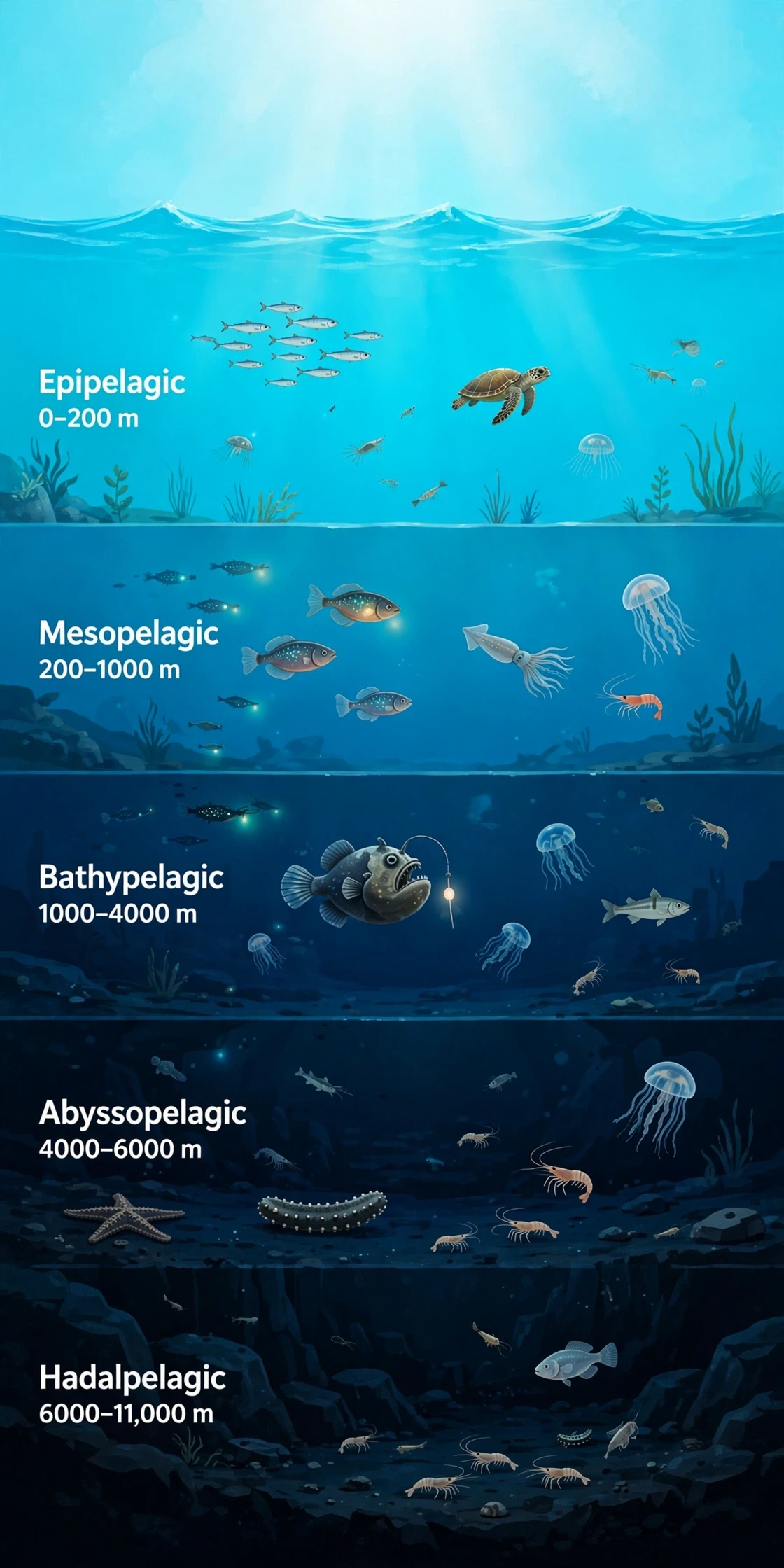
The top layer is the one we know. The epipelagic zone, from the surface to 200 metres, is the sunlit zone. Almost all ocean photosynthesis happens here, and so does almost all the fishing. Below it, the mesopelagic zone runs from 200 to 1,000 metres: the twilight zone, where light is dim and blue, and where the largest migration on Earth takes place every night. Then comes the bathypelagic zone, 1,000 to 4,000 metres, the midnight zone, where no sunlight reaches at all. Below that, the abyssopelagic zone runs from 4,000 to 6,000 metres, a vast plain of cold, dark water just above the seafloor. And finally, the hadalpelagic zone, named after Hades, covers the trenches deeper than 6,000 metres — narrow, crushing canyons that hold some of the most extreme life on the planet.
Zone | Depth | Light | Temperature | What lives there |
|---|---|---|---|---|
Epipelagic (sunlight zone) | 0–200 m | Full sunlight | Varies, up to 30°C | Phytoplankton, tuna, sharks, coral reefs |
Mesopelagic (twilight zone) | 200–1,000 m | Dim blue light | 4–20°C | Lanternfish, hatchetfish, krill, squid |
Bathypelagic (midnight zone) | 1,000–4,000 m | None | 2–4°C | Anglerfish, gulper eels, viperfish, jellyfish |
Abyssopelagic (abyss) | 4,000–6,000 m | None | 2–4°C | Sea cucumbers, brittle stars, tripod fish, amphipods |
Hadalpelagic (trenches) | 6,000–11,000 m | None | 1–4°C | Snailfish, amphipods, holothurians, microbes |
2.1 The sunlight zone: where the ocean's food is made
The epipelagic zone is thin — about 200 metres out of an average ocean depth of 3,700 — but it does almost all of the ocean's cooking. Microscopic phytoplankton drift here, catching sunlight and turning carbon dioxide and nutrients into living tissue. On land, plants do this job. In the ocean, it is mostly done by organisms too small to see, and the whole marine food web hangs on them.
Almost everything in the deep sea depends, in the end, on this thin layer. When phytoplankton die, or when the animals that eat them produce waste, tiny particles drift downward. That slow rain of dead matter is called marine snow, and it is the main food delivery service for a world with no sun. The surface is also where the ocean meets the atmosphere, exchanging heat and gases. The deep sea is not separate from the world we live in. It is the bottom of the same system.
2.2 The twilight zone: the ocean's great commuter belt
The mesopelagic zone, the twilight zone, is one of the most crowded places in the ocean, and one of the least seen. Light here is too weak for photosynthesis, but strong enough for some animals to see by. Lanternfish, bristlemouths and hatchetfish fill these waters in enormous numbers. By some estimates, the twilight zone holds more fish, by weight, than all the world's commercial fisheries combined. Most of them are small, and most of them have never been eaten by a human. They are too small, too deep, and too scattered for fishing boats to bother with — which may be exactly what saves them.
Every night, much of this community swims upward. This is the diel vertical migration, the largest migration on Earth by sheer number of animals, and it happens every single day. At dusk, trillions of small animals rise hundreds of metres to feed in the rich surface waters under cover of darkness. Before dawn, they sink back down to hide from predators in the dim twilight. It involves far more animals than the wildebeest migration, moves more biomass, and happens every night without anyone watching.
The migration matters for the whole planet. When these animals feed at the surface and then swim down, they carry carbon with them into the deep sea, where much of it stays locked away for centuries. Scientists call this the biological carbon pump, and the twilight zone is one of its main engines.
To learn more about how scientists divide and study these layers, the Woods Hole Oceanographic Institution's guide to ocean zones is a clear starting point. (Woods Hole Oceanographic Institution — Ocean Zones)
2.3 The midnight zone and below: a world without sun
Below 1,000 metres, the sun is gone for good. The bathypelagic zone — the midnight zone — is the largest of the ocean's zones by volume, and it is a world of near-total darkness, near-freezing water, and enormous pressure. Animals here cannot rely on vision in the way surface animals do. Many have no eyes at all, or eyes so reduced they can only sense the faintest glow. Others have enormous eyes, built to catch the light of bioluminescence, the only light that exists down there.
The abyssopelagic zone, from 4,000 to 6,000 metres, is quieter still. Food is scarcer, animals are sparser, and life runs at an even slower pace. The seafloor here — the abyssal plain — is the largest habitat on Earth, a flat expanse of soft sediment stretching across entire ocean basins. It looks empty from a submersible window, until a sea cucumber glides past or a tripod fish stands on its long fins, and you remember that empty is a matter of perspective.
The hadal zone is different again. Trenches are steep, narrow canyons, often formed where one tectonic plate dives beneath another. They cover a tiny fraction of the ocean floor, but they are the deepest places on Earth. We will visit the deepest of them all, the Mariana Trench, in its own section.
One thing the zone map hides is how connected these layers are. Water, animals and food move between them; the deep sea is a single column, not sealed boxes. That is also why it is vulnerable to what we do at the surface. Warming, acidification, plastic and pollution do not stop at 200 metres. They sink, just like everything else.
3. The Midnight Zone: Life in Total Darkness
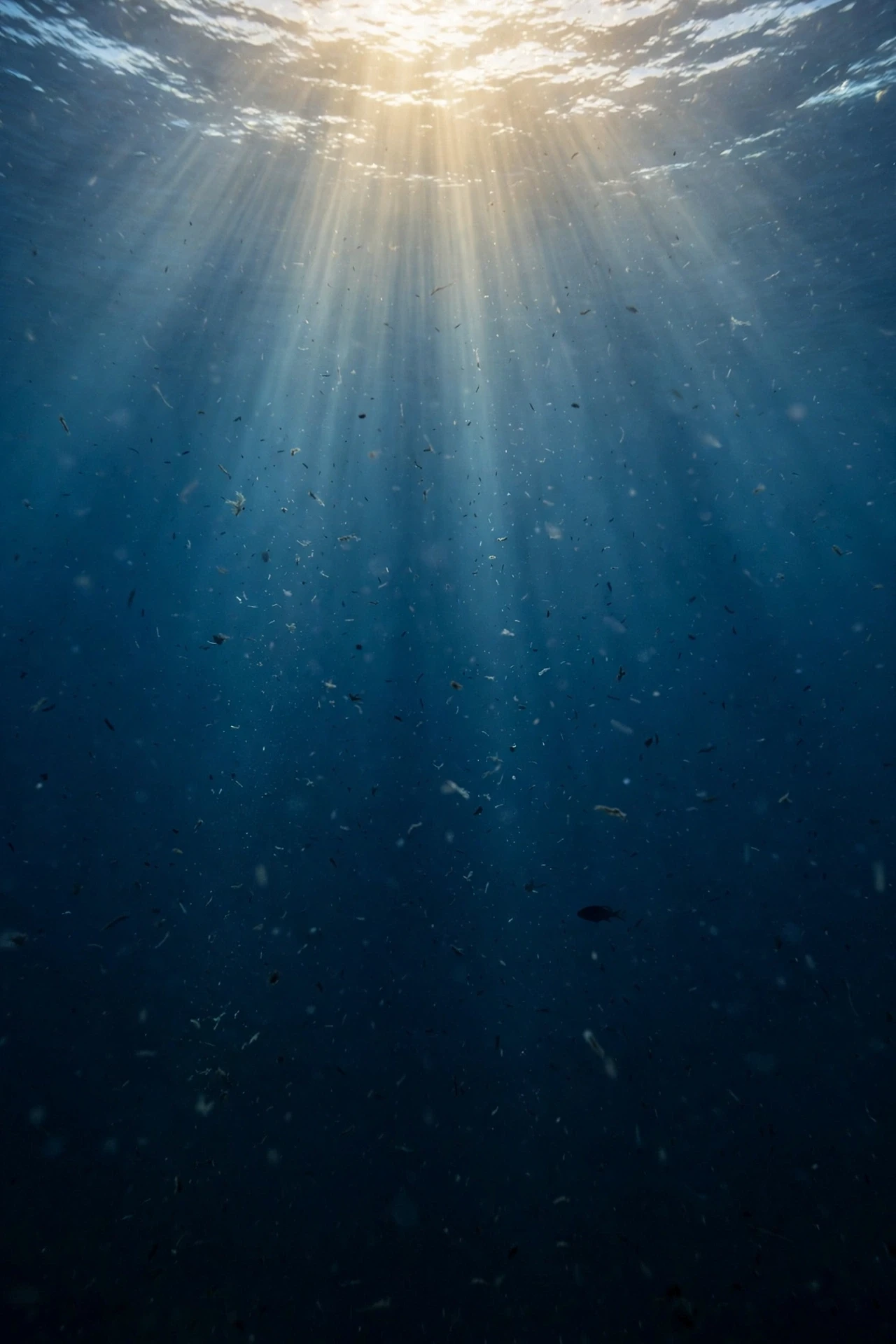
There is a depth in the ocean where the last photon of sunlight dies. Scientists put it at roughly 1,000 metres, though the exact number shifts with the clarity of the water and the time of day. Below that line, darkness is not a condition that comes and goes. It is permanent, complete, and absolute. No dawn ever arrives. No season changes the light. If you could sit at 2,000 metres with your eyes open, you would see nothing at all — unless something down there decided to glow.
I have never sat at 2,000 metres. Very few people have. But I have watched hours of footage from remotely operated vehicles working at those depths, and the first thing that strikes you is how the darkness changes your sense of scale. Without landmarks, without light, a jellyfish the size of a dinner plate and a fish the size of a finger look the same on camera until something gives you a reference. The darkness flattens everything. It also makes every flash of light feel like an event.
3.1 How darkness changes the rules of life
Darkness rewrites the senses. On land, and near the surface, vision dominates. Animals see predators coming, spot food from a distance, and use colour to signal and to hide. In the midnight zone, vision is a luxury few can afford. Many animals navigate by chemical cues instead, tasting the water for the faintest trace of food or a mate. Others sense pressure waves and vibrations through a lateral line, the same system fish use near the surface, tuned to a world where a twitch in the water may be the only warning of a predator.
Some animals keep their eyes and make them enormous. The telescopefish has tubular eyes that point upward, gathering what little light there is from bioluminescent animals above. The spookfish goes further: its eyes contain a mirror that focuses light, a trick more common in telescopes than in animals. Other animals abandon eyes altogether. Many deep-sea crustaceans are blind, and some deep-sea fish have eyes covered by skin. When light is absent, maintaining eyes costs energy that could be spent on finding food or making eggs, and evolution is ruthless about waste.
Colour changes its meaning too. At the surface, red is a warning or an advertisement. In the deep sea, red is the closest thing to invisible. Red light is the first to be absorbed by seawater, so a red animal at 1,000 metres reflects almost no light at all. That is why so many deep-sea shrimp, jellyfish and fish are deep red. They are not showing off. They are hiding in plain sight.
3.2 The animals that own the dark
The midnight zone has its own cast of characters, and they are some of the strangest animals on Earth. The anglerfish is the most famous: a fish with a glowing lure dangling in front of a mouth full of needle teeth. The lure is living bait, lit by bacteria that the fish farms in a special organ. Prey swims toward the light and is swallowed whole. Female anglerfish can be far larger than the males, and in some species the tiny male bites onto the female and fuses with her body. It sounds like science fiction. It is a sensible answer to a real problem: in a vast, dark ocean, finding a mate is hard, and once you find one, it pays not to let go.
The viperfish hangs in the dark with its mouth open, its lower jaw hinged so wide that it can swallow prey larger than its own head. Its teeth are so long that they curve back toward its eyes. Photophores along its belly break up its outline, and a glowing lure draws curious fish closer. The gulper eel takes the big-mouth strategy to its limit: its mouth makes up about a quarter of its body, and its stomach can stretch to hold meals far larger than the animal itself.
"The deep sea is the largest habitat on Earth, and it is also the least explored. We have mapped the Moon in finer detail than the floor of our own ocean."
4. Food from Nowhere: Marine Snow and the Deep-Sea Food Web
If there is no sunlight in the deep sea, and almost nothing grows there, what do the animals eat? The short answer is: leftovers from above. The long answer is one of the most elegant systems in ocean science, and it starts with something that looks like snowfall.
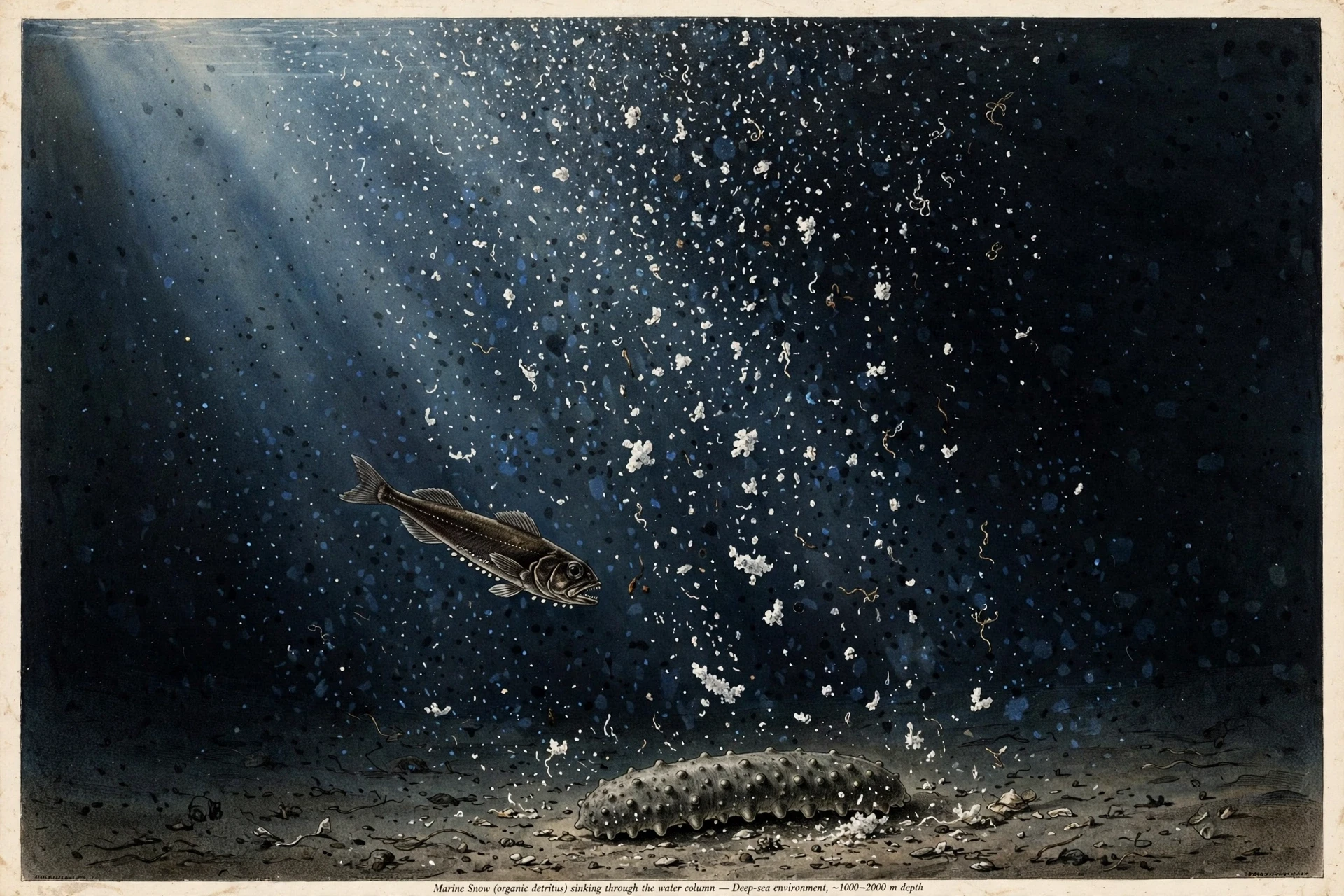
Marine snow is the name oceanographers give to the slow rain of organic particles drifting down from the surface. It is made of dead plankton, faecal pellets, discarded mucus, fragments of jellyfish, and the tiny remains of everything that lived and died in the sunlit zone. Under a microscope, a single flake is a small world — bacteria, algae, bits of shell, all stuck together in a clump. From a submersible, it looks like snow falling through a dark forest, endless and quiet.
Most of it never reaches the bottom. Bacteria and small animals intercept it on the way down, eating it, breaking it apart, and recycling its nutrients. What does reach the seafloor feeds the animals of the abyss: sea cucumbers that vacuum the sediment, brittle stars that wave their arms in the current, worms that burrow and sift. The whole deep-sea food web, outside of the vents we will meet next, runs on this falling snow. It is a thin diet, and it arrives slowly, which is why deep-sea animals grow slowly, live long, and rarely waste energy.
4.1 The biological carbon pump
Marine snow does more than feed deep-sea animals. It moves carbon. When phytoplankton at the surface take in carbon dioxide and are then eaten or die, some of that carbon sinks, and if it sinks deep enough, it stays out of the atmosphere for centuries. This is the biological carbon pump, and it is one reason the ocean is the planet's largest active store of carbon.
The pump is the sum of billions of small events: a waste pellet sinking, a dead diatom drifting down, a lanternfish carrying carbon in its gut as it migrates into the deep each morning. Researchers still disagree on the exact numbers — the deep sea is hard to measure — but nobody disagrees that it matters. A weaker pump would leave more carbon dioxide in the air. The deep sea, silently, helps set the climate we live in.
That is one reason oceanographers worry about changes at the surface. Warmer water holds less oxygen and changes which plankton grow, and that changes what sinks. If the supply of marine snow shrinks, or its composition changes, the animals of the deep sea feel it — slowly, because everything down there is slow, but surely. The deep sea does not respond to change quickly. That is not the same as not responding at all.
4.2 Whale falls: a feast in the desert
Every so often, the slow drizzle of marine snow is interrupted by a banquet. When a whale dies and sinks, its body delivers tonnes of flesh, bone and fat to the seafloor all at once, in a place where food is usually measured in crumbs. Scientists call this a whale fall, and it is one of the most remarkable ecological events in the ocean.
The feast happens in stages. First come the scavengers — hagfish, sleeper sharks, amphipods and crabs — which strip the soft tissue in months. Then come worms, snails and crustaceans that feed on the enriched sediment. Finally, for years or even decades, come the specialists: bone-eating worms of the genus Osedax, which root into the whale's bones and digest the fats inside with the help of symbiotic bacteria. A single whale fall can support hundreds of species, including animals found nowhere else.
I remember the first time I saw footage of a whale fall. The carcass lay on grey sediment in the dark, covered in life — white amphipods swarming like bees, pink worms spilling from the bones, fish circling in the gloom. It looked like a city built overnight in a desert. A whale fall is a temporary oasis, and when it is gone, the community it supported disperses or dies.
5. Hydrothermal Vents and Chemosynthesis: Life Without Sunlight
In 1977, a team of scientists exploring the Galápagos Rift in the submersible Alvin found something that should not have existed. On the seafloor, nearly 2,500 metres down, in total darkness, they found dense crowds of giant tube worms, clams and crabs clustered around cracks in the rock. The water around the cracks was hot — far too hot for most life — and it was full of chemicals. There was no sunlight, no plankton, no marine snow to speak of. And yet here was an oasis, thick with animals, in the middle of a desert.
The discovery changed biology. Until then, nearly every ecosystem on Earth was thought to run on sunlight, directly or indirectly. The vents ran on something else entirely: chemicals from inside the Earth. The process is called chemosynthesis, and it is the deep sea's second way of making a living.
5.1 How a vent works
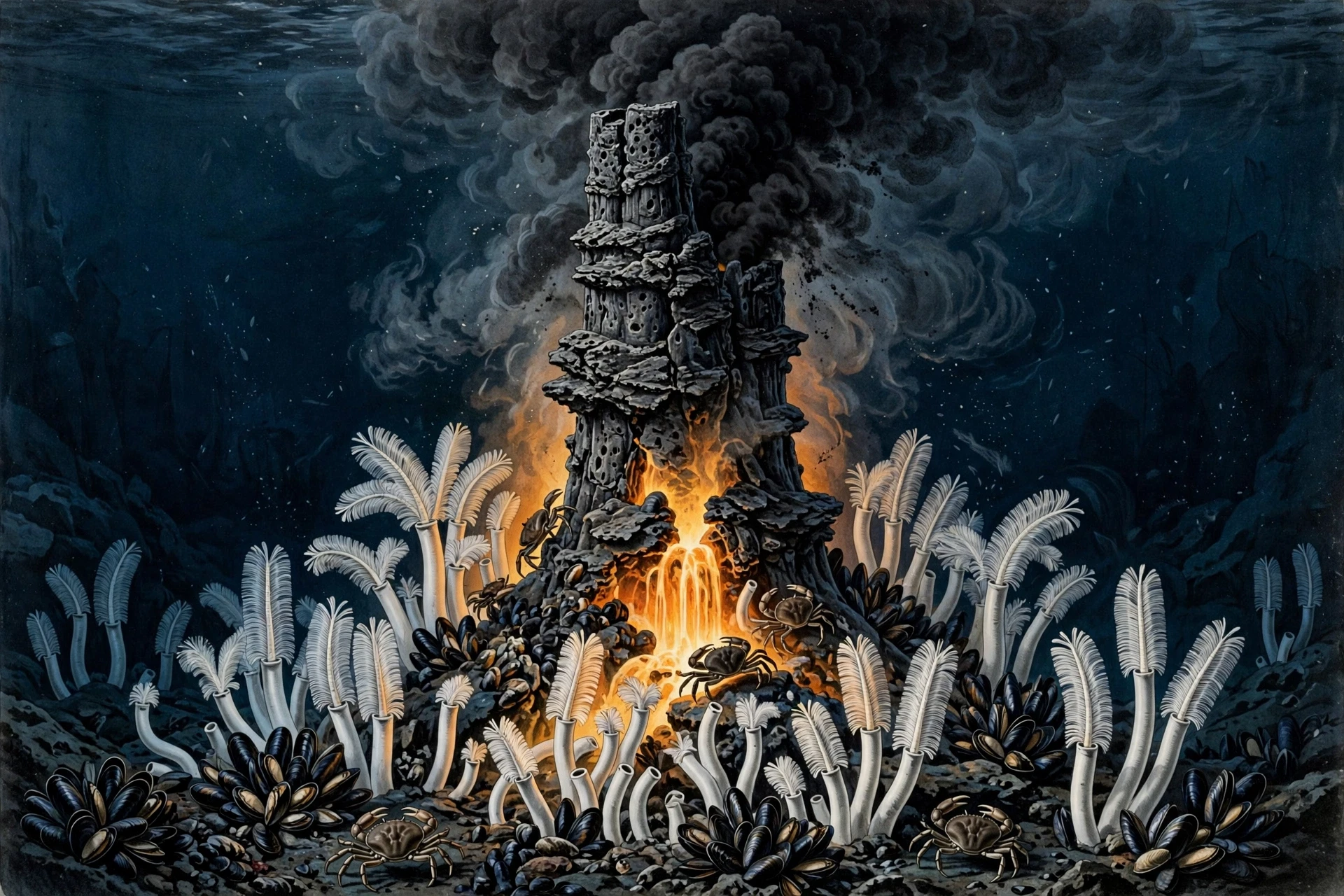
A hydrothermal vent forms where seawater seeps down through cracks in the ocean crust near a spreading ridge or a subduction zone, and is heated by magma below. The water grows hot — sometimes above 400 degrees Celsius — and as it rises back up, it dissolves minerals and gases from the rock: hydrogen sulfide, methane, iron, copper and more. When this superheated fluid bursts out of the seafloor and meets cold seawater, the minerals precipitate out, forming dark smoke and tall chimneys of mineral rock.
The water itself is toxic to most animals. Hydrogen sulfide is poisonous, the temperature would cook a fish, and the fluid is acidic. But for chemosynthetic bacteria, it is fuel. These microbes oxidise hydrogen sulfide and other chemicals, using the energy released to build sugars from carbon dioxide — the same end product as photosynthesis, reached by a completely different route. NOAA's chemosynthesis pages describe the process plainly: instead of sunlight, chemical energy is the power source, and the bacteria form the base of the food web at vents and cold seeps. (NOAA Pacific Marine Environmental Laboratory — Chemosynthesis)
5.2 The animals of the vents
The giant tube worm, Riftia pachyptila, is the poster animal of the vents. It has no mouth, no stomach and no gut, and does not eat at all. Instead, it houses chemosynthetic bacteria inside a special organ, and the bacteria feed it. The worm's bright red plume absorbs hydrogen sulfide and oxygen from the water and delivers them to the bacteria inside. It is one of the most extreme symbioses known, and tube worms can grow to more than two metres long in a place with no sunlight.
They are not alone. Vent mussels and clams also host chemosynthetic bacteria in their gills. Vent crabs, shrimp and snails graze on bacterial mats or scavenge what others leave. The shrimp Rimicaris exoculata swarms around vents in clouds of thousands, its back covered in bacteria that it farms and eats. Around the vents, the density of life is extraordinary — hundreds of times higher than on the surrounding seafloor. Step a few metres away from a vent, and the crowd thins to almost nothing. The oasis has sharp edges.
Vent communities are also fragile in a particular way: vents are short-lived. A vent field may stay active for decades, then go quiet as the plumbing below shifts. When it dies, the community that depended on it dies with it, or disperses. New vents open elsewhere, and larvae drifting in the currents colonise them. Life at the vents is a cycle of boom and dispersal, played out in darkness over decades.
5.3 Why vents matter beyond the deep sea
The discovery of chemosynthesis did more than add a chapter to biology textbooks. It changed how scientists think about where life can exist. If life can thrive in total darkness, at crushing pressure, feeding on chemicals from rock, then it might exist in other dark, cold places — beneath the ice of Europa, in the subsurface oceans of Enceladus, or in the deep rocks of Mars. Vents are not just a curiosity. They are a proof of concept for life itself.
They also matter for understanding the early Earth. When life first appeared, more than three and a half billion years ago, sunlight may not have been the first energy source it used. Some researchers think chemosynthesis at vents or seeps could resemble the conditions where life began. That idea is still debated, but the vents keep the question alive: the chemistry of life does not need the sun. It needs energy, carbon, water and time.
The deeper value of the vents is what they teach us: that the rules of life are broader than we thought, and that the deep sea, which we once called lifeless, holds some of the most inventive biology on the planet. NOAA Ocean Exploration's education pages on hydrothermal vents and volcanoes gather the key facts in one place. (NOAA Ocean Exploration — Hydrothermal Vents and Volcanoes)
6. Bioluminescence: Living Light in the Dark
If the deep sea has a signature, it is light made by living things. Bioluminescence — the production of light by a chemical reaction inside an animal — is rare on land. Fireflies do it, a few fungi do it, and that is nearly the whole list. In the ocean, it is everywhere. Roughly three-quarters of the animals in the deep sea can make light, and in the midnight zone the fraction is higher still. The dark ocean glows, not with sunlight, but with the light of its own inhabitants.
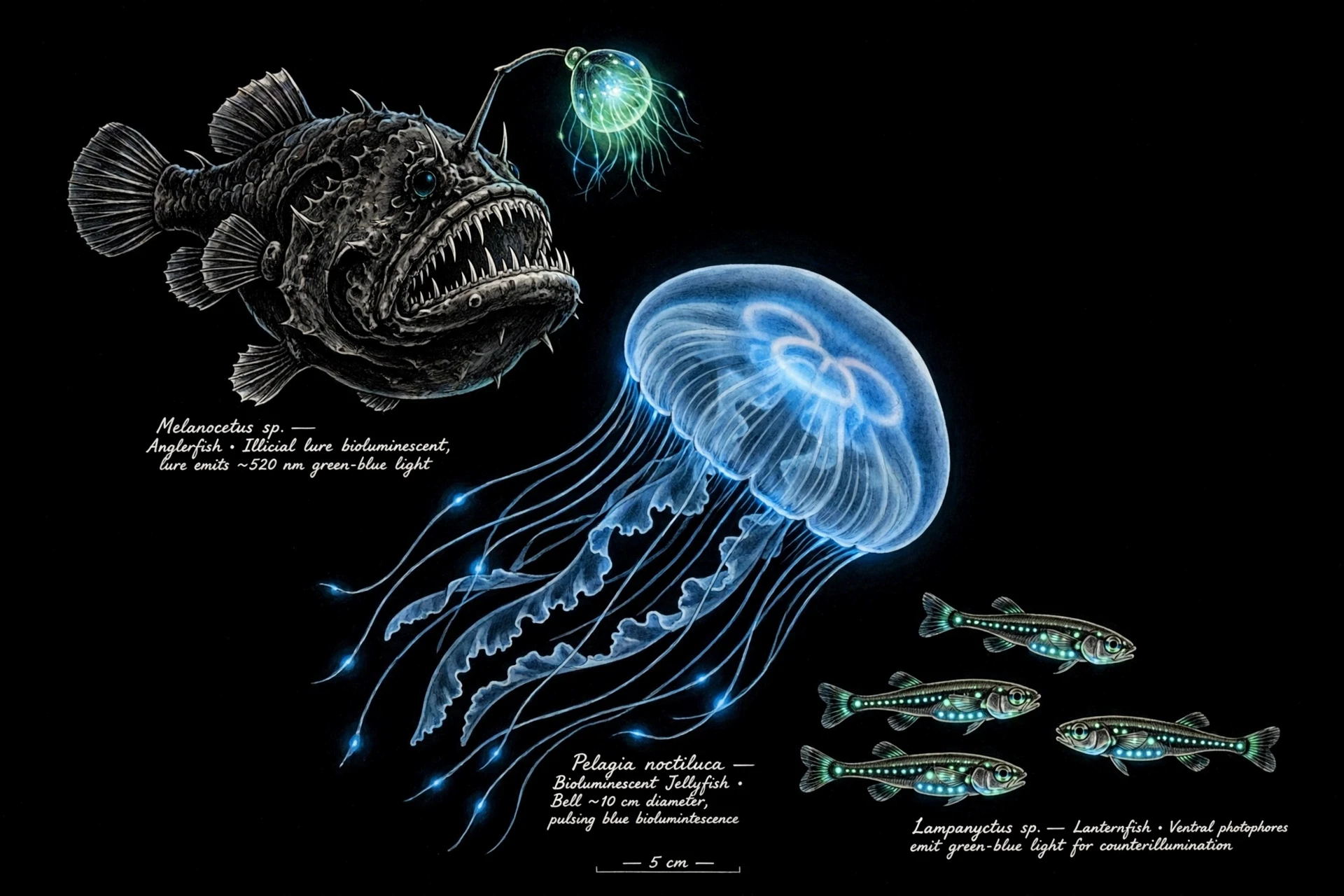
The chemistry is elegant. An animal produces a molecule called luciferin and an enzyme called luciferase. When the two meet in the presence of oxygen, the reaction releases energy as light, with almost no heat. It is cold light — efficient, controlled, and available on demand. Some animals make their own luciferin. Others get it from their food, or host glowing bacteria in special organs. The colour is usually blue or green, because those wavelengths travel furthest in seawater. A few animals make red light, which almost nothing else in the deep sea can see — a private channel, invisible to predators and prey alike.
6.1 Why glow? Hunting, hiding and talking
Bioluminescence has many jobs, and different animals use it in different ways. The anglerfish uses it as bait: a glowing lure, filled with light-making bacteria, dangles in front of its mouth, and curious prey swim straight into the trap. The viperfish uses a lure too, and photophores along its belly for camouflage. The cookiecutter shark uses light in a crueller way: a glowing patch on its belly looks like a small fish from below, and when a larger animal comes to investigate, the shark takes a neat, cookie-shaped bite and leaves.
Camouflage is the most common use. Counterillumination — matching the faint light from above with light from the belly — hides an animal's silhouette from predators looking up. The animal can adjust its brightness to match the conditions. Hatchetfish and lanternfish are masters of this trick, and it is one reason the twilight zone is so full of fish that predators struggle to find.
Light is also a language. Some animals flash in patterns to attract mates. Some use a sudden bright flash to startle a predator, then swim away in the dark while the predator is still dazzled. Some release glowing particles, like a squid releasing ink, to confuse whatever is chasing them. And some use light as a burglar alarm: a small animal, when bitten, flashes brightly, attracting a larger predator that may attack its attacker. It is a risky strategy — calling for help by lighting yourself up — but in a world where the biggest threat is being eaten quietly, a loud flash can be worth the gamble.
6.2 The green bombers and other surprises
The deep sea keeps producing examples that sound made up. One of my favourites is the "green bomber" worm, discovered by researchers at Scripps Institution of Oceanography. These swimming worms, found at depths between 1,800 and 3,700 metres, can release small body parts that burst into brilliant green light. The worms use the glowing sacs as decoys: a predator grabs the glowing bomb instead of the worm, and the worm swims away in the dark. Seven previously unknown species were described, a reminder of how much of the deep sea remains undescribed. (Scripps Institution of Oceanography — Bioluminescent 'Green Bombers')
Other animals take the idea further. The vampire squid, when threatened, releases a cloud of glowing mucus that hangs in the water like a luminous ghost while the squid slips away. Some jellyfish pulse with light when disturbed. The stoplight loosejaw produces red light — a wavelength almost no other deep-sea animal can see — which lets it hunt with what amounts to a private torch.
The deeper lesson is that bioluminescence is not decoration. It is a tool kit, and different animals have invented different tools from the same chemistry. That is evolution working the way it always works: taking what is available — in this case, a chemical reaction — and using it to solve the local problems of finding food, avoiding being eaten, and finding a mate. In the deep sea, the local problem is darkness, and light is the answer.
7. Giants of the Deep: Gigantism and Strange Adaptations
The deep sea is a place of extremes, and one of the most striking is size. Some animals down there grow far larger than their shallow-water relatives, a pattern called deep-sea gigantism or abyssal gigantism. Giant isopods — relatives of the woodlouse — can grow to more than 30 centimetres long, the size of a small cat, where their shallow-water cousins are the size of a fingernail. Giant amphipods in the trenches can reach 30 centimetres too. Giant tube worms grow longer than a person is tall. And then there is the giant squid, the animal that haunted sailors' stories for centuries before science caught up with it.
Why grow large in a place with so little food? The answers are still being worked out, and researchers disagree on the details, which is a healthy sign in a young field. One idea is that cold water and high pressure slow metabolism, so animals live longer and keep growing for more years. Another is that large size helps in a world where food arrives rarely: a big animal can store more energy, go longer between meals, and eat a wider range of prey. A third idea points to oxygen: cold deep water holds more dissolved oxygen than warm shallow water, and larger bodies may be easier to supply with oxygen when the water is cold and rich. The truth is probably a mix of all three, and it varies by species.
7.1 The giant squid: from sea monster to science
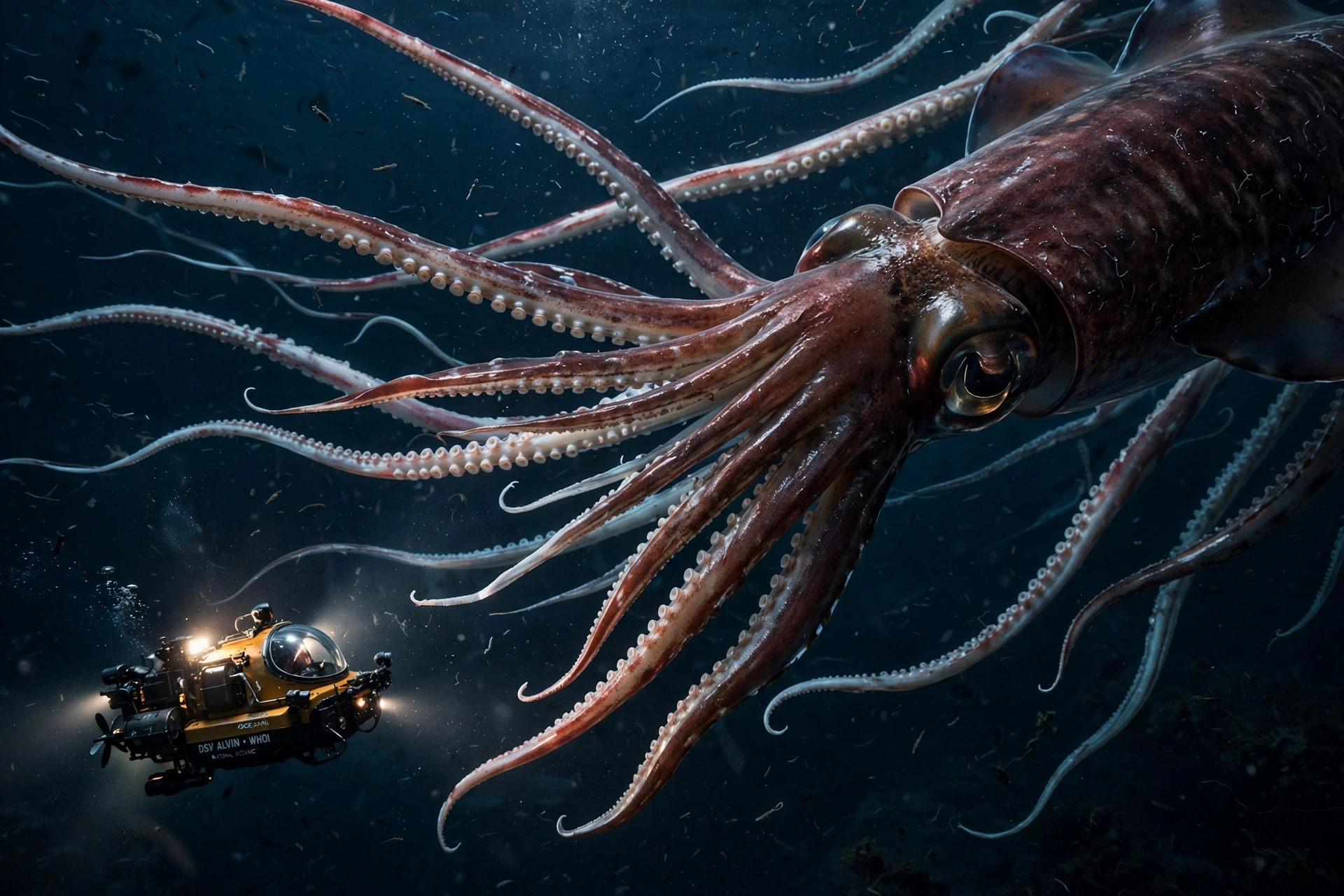
No deep-sea animal has a stranger history than the giant squid. For centuries, sailors told stories of the kraken, a monster that dragged ships down. Scientists were sceptical, and for good reason: the evidence was fragmentary — a tentacle here, a beak in a whale's stomach there, a carcass washed up on a beach. The giant squid was real, but it was almost never seen alive. The first photographs of a live giant squid in its natural habitat came only in 2004, and the first video in 2012. For an animal that can reach 13 metres long, with eyes the size of dinner plates — the largest eyes in the animal kingdom — that is a remarkable record of elusiveness.
Giant squid live in the deep sea around the world, probably at depths of 300 to 1,000 metres, hunting fish and other squid. They are preyed on by sperm whales, which dive to those depths to hunt them; the scars on whales' skin, round marks left by squid suckers, are a map of battles fought in the dark. The squid's huge eyes can spot the faint glow of bioluminescence, and the silhouette of a whale, from a long way off. In a place where seeing anything at all is hard, the biggest eyes win.
It is easy to call the giant squid a monster. It is harder, and more accurate, to call it a successful animal: a fast, intelligent predator, well adapted to a difficult habitat, that humans simply could not find for a very long time.
7.2 Small, slow and strange: the other end of the scale
Gigantism gets the headlines, but most deep-sea animals are small, and many are strange in ways that have nothing to do with size. The barreleye fish has a transparent head, and its tubular eyes sit inside the clear dome, looking upward through its own skull. The gulper eel has a mouth that takes up a quarter of its body. The tripod fish stands on fins like stilts. The vampire squid, which is neither a vampire nor a squid, trails two long filaments to catch marine snow, and turns itself inside out — cloaking itself in its own arms — when threatened.
Many deep-sea fish are also soft and flabby, with watery flesh and reduced skeletons. That is not a defect. It is an adaptation to pressure and to a life without fast swimming. A fish that does not need to chase prey at speed does not need dense muscle, and a light, flexible skeleton is cheaper to maintain than a heavy one. Some deep-sea fish have no scales at all. Some have stomachs that can stretch to hold prey larger than themselves.
7.3 Why deep-sea animals live so long — and grow so slowly
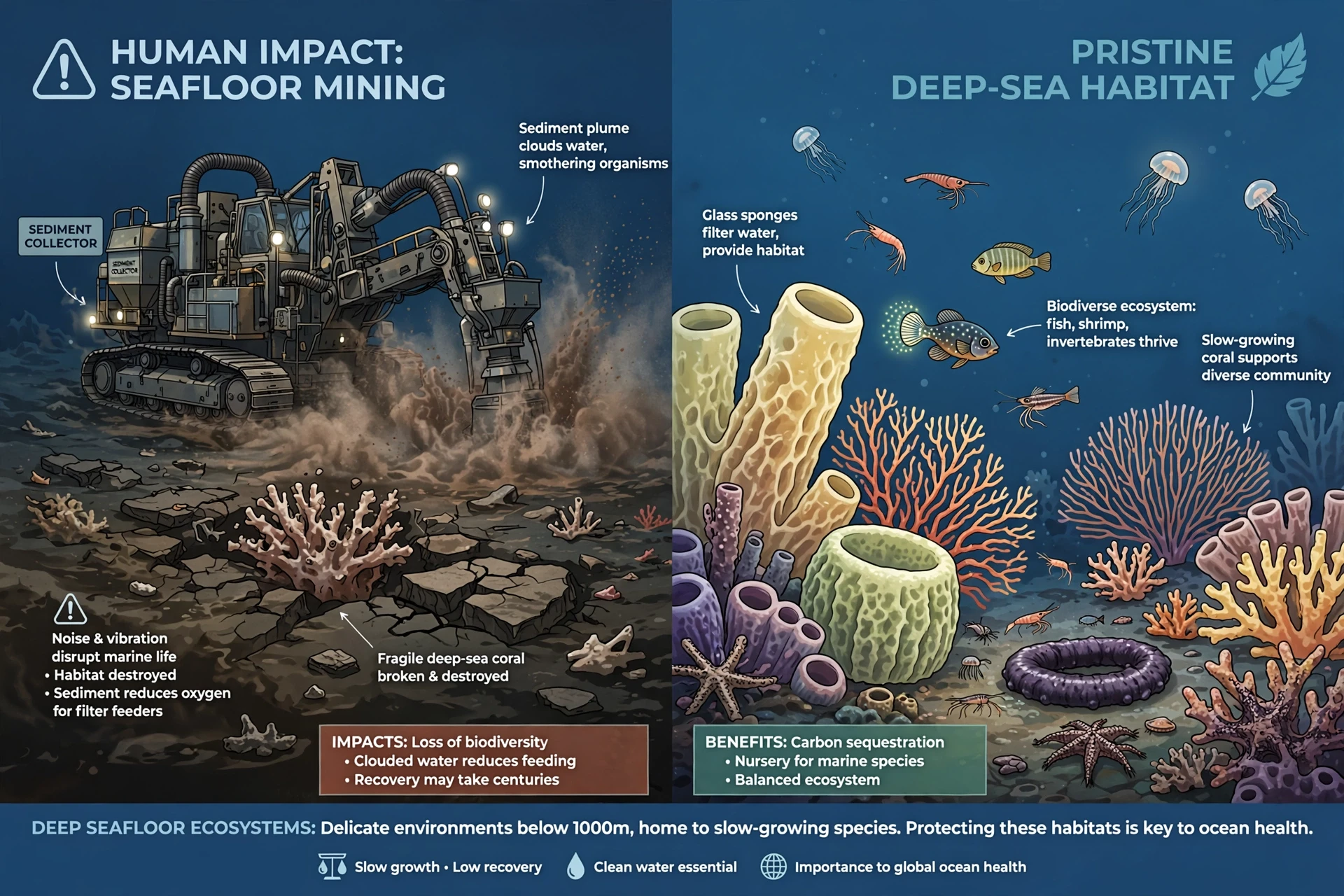
Slow living has a cost and a benefit. The benefit is efficiency: a slow metabolism needs less food, and less food means survival where meals are rare. The cost is vulnerability. A fish that takes decades to mature and produces few young cannot recover quickly if its population is reduced. Orange roughy, a deep-sea fish that can live for more than a century, was heavily fished before anyone understood how slowly it reproduced, and its stocks collapsed. Glass sponges can live for thousands of years. A single careless pass by a trawler can destroy animals older than the countries that sent the boat.
This is one of the most important facts about the deep sea, and one of the least appreciated. The animals there are not like the animals we are used to managing. They are slow, long-lived, and slow to reproduce. Damage that would be a setback in a shallow-water fishery can be a catastrophe in the deep sea, because recovery is measured in centuries, not years. Keep that in mind when we reach mining and conservation. It is the thread that ties the whole story together.
8. The Mariana Trench: Earth's Deepest Place
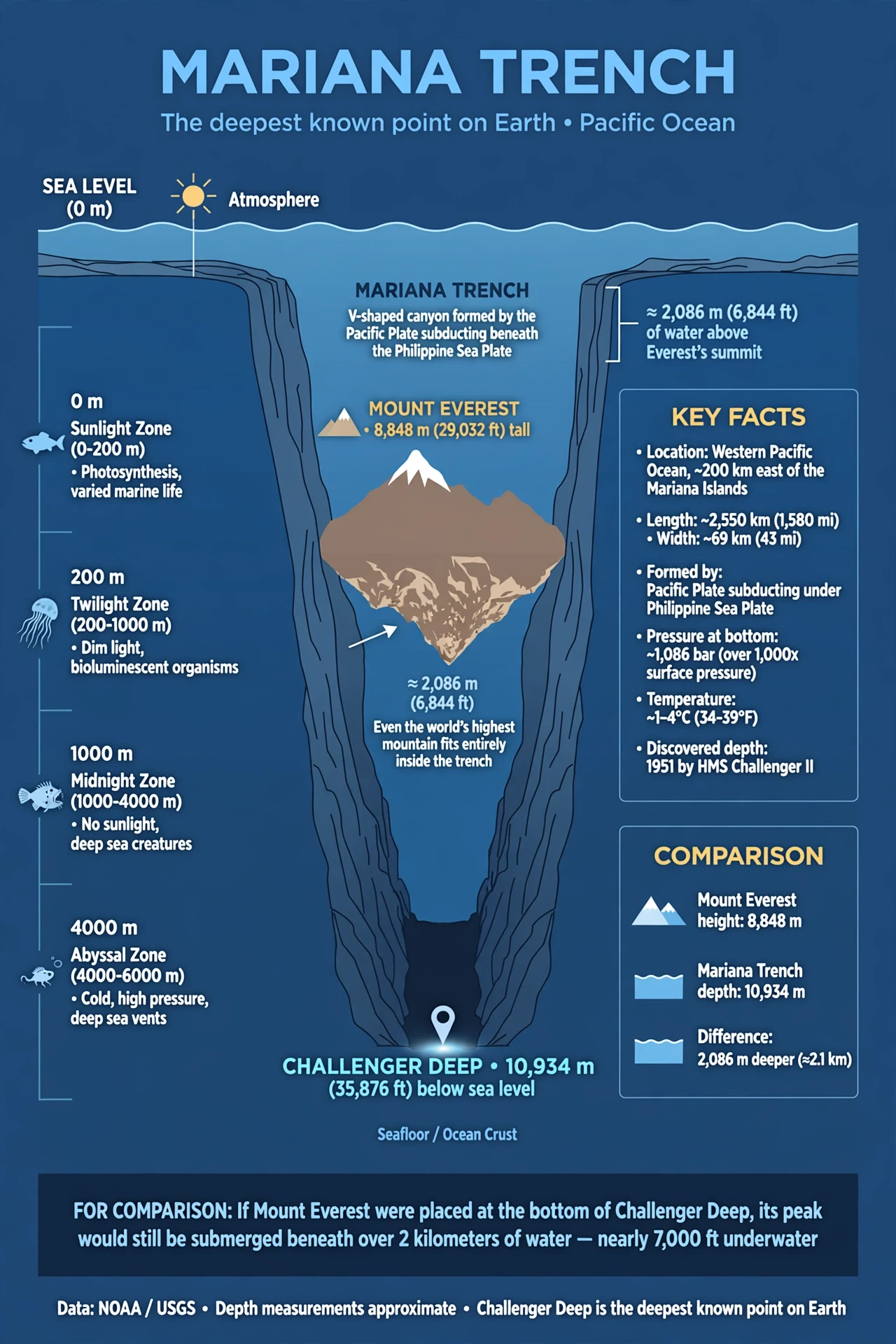
If the deep sea is the basement of the world, the Mariana Trench is the cellar beneath the basement. It is a crescent-shaped canyon in the western Pacific Ocean, stretching for more than 2,500 kilometres, and at its deepest point — a spot called Challenger Deep — the seafloor lies nearly 11,000 metres below the surface. That is deeper than Mount Everest is tall, with more than two kilometres to spare. If you put Everest into the trench, its peak would still be under more than 2,000 metres of water.
The trench formed where the Pacific tectonic plate dives beneath the Mariana plate, in a process called subduction. The descending plate bends the seafloor downward, creating a steep, narrow canyon. The pressure at the bottom is crushing: more than 1,000 times the pressure at sea level, around 1,100 atmospheres. The water is cold, just above freezing. There is no light at all. And yet, there is life.
8.1 The first descents
The first people to reach the bottom were Jacques Piccard and Don Walsh, who descended in the bathyscaphe Trieste in January 1960. The dive took nearly five hours down, and the two men spent only about twenty minutes on the bottom. They reported seeing a flatfish and a shrimp through the porthole, a claim doubted for years, but the larger point stands: even at the deepest place on Earth, the ocean was not empty.
For half a century, no one went back. The Trieste dive was a triumph of engineering, but it was also a one-off, and the technology to return safely did not exist in a practical form. Then, in 2012, film director and explorer James Cameron descended alone in the submersible Deepsea Challenger, reaching Challenger Deep and spending several hours on the bottom. Since then, a small number of crewed and uncrewed vehicles have visited, and each visit has added to a picture that is still mostly blank. Fewer people have visited Challenger Deep than have walked on the Moon.
That comparison captures how hard the trench is to reach. The Moon is 384,000 kilometres away, and twelve people have walked on it. Challenger Deep is a few hours by boat from Guam, and fewer people have visited its floor. Distance is not the problem. Pressure is. Building a vehicle that can survive 1,100 atmospheres and return is one of the hardest engineering problems in exploration.
8.2 Life in the trench
What lives at the bottom of the trench? Not much, by the standards of a coral reef — but far more than anyone expected. The most famous residents are snailfish, pale, tadpole-shaped fish that hold the record for the deepest fish ever found, living at depths beyond 8,000 metres. They have no scales, their bones are lightly built, and their bodies contain high levels of a molecule called trimethylamine N-oxide, which helps their proteins keep working under extreme pressure. They are soft, slow, and — by trench standards — successful.
Alongside them live amphipods, small shrimp-like crustaceans that scavenge whatever falls into the trench, including the remains of animals from above. Some trench amphipods grow to giant sizes, a case of deep-sea gigantism in its most extreme form. Sea cucumbers crawl across the sediment, vacuuming up organic matter. Microbes thrive in the sediment itself, in numbers that surprise researchers. And the trench, like the rest of the deep sea, receives marine snow — a slow rain of food from above, funnelled by the canyon walls into the deepest parts.
One discovery unsettled a comforting assumption. Researchers have found microplastics and chemical pollutants in animals from the trench, including in amphipods from Challenger Deep. The deepest place on Earth is not pristine. It is connected to the surface by the same falling particles that feed it, and what we put into the ocean at the top eventually reaches the bottom.
8.3 What the trench teaches us
The Mariana Trench matters for reasons that go beyond records and superlatives. It is a natural laboratory for the limits of life. The animals there survive pressures that would crush most proteins out of shape, and studying how they do it teaches biochemists about the flexibility of life's machinery. The microbes of the trench produce enzymes that work under conditions no industrial process can match, and some of those enzymes may have practical uses.
The trench also matters for geology: subduction zones are where earthquakes and tsunamis are born, and understanding how the plates move helps scientists understand the forces that shape the Earth's surface. Above all, the trench is a reminder of scale — we have visited its deepest point a handful of times, for a few hours each time, and the deepest place on Earth is also one of the least known.
9. How Scientists Explore the Deep Sea
Exploring the deep sea is an engineering problem before it is a scientific one. You cannot simply dive down and look around. The pressure, the cold and the dark defeat every ordinary approach. So scientists have built a toolkit of vehicles, sensors and robots, each suited to a different part of the job. Together, they are how we know anything at all about the deep sea.
9.1 Crewed submersibles: people in the deep
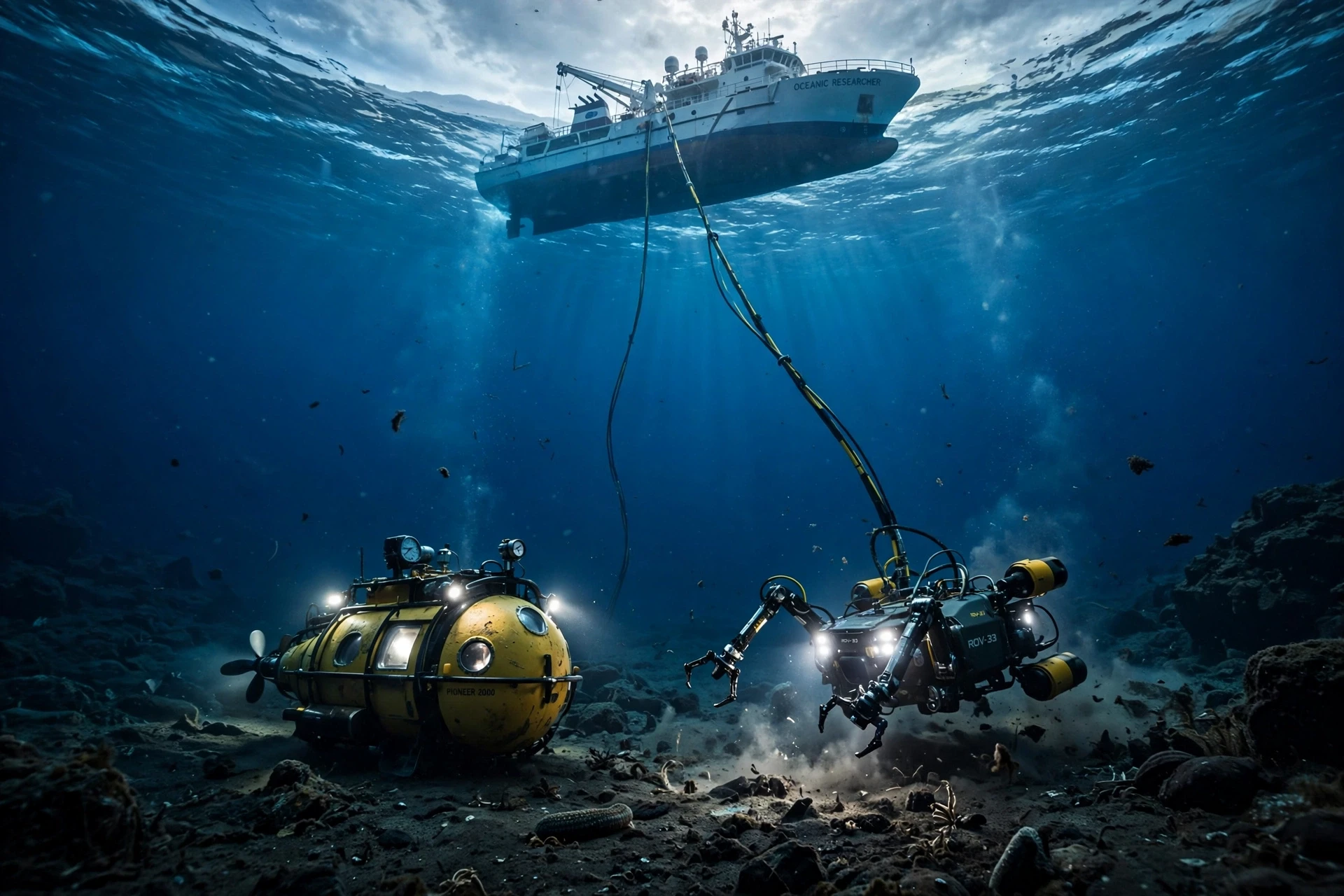
Crewed submersibles carry scientists directly into the deep sea, and there is still no substitute for having a person there. A human eye, looking through a porthole, notices things a camera misses. A scientist in a submersible can choose where to look, what to sample, and when to stay a little longer. The most famous research submersible is Alvin, operated by the Woods Hole Oceanographic Institution, which has been diving since the 1960s and was the vehicle that discovered hydrothermal vents in 1977. Alvin can carry three people to depths of 4,500 metres, and it has made thousands of dives.
A submersible is a small, strong sphere — usually titanium — wrapped in equipment: lights, cameras, robotic arms, sample boxes and sensors. The sphere is the only part that keeps the pressure out. A dive is slow and careful: the vehicle is launched from a support ship, sinks for an hour or two, works on the bottom for several hours, then drops weights and floats back up.
Crewed dives are expensive and limited. Only a handful of vehicles in the world can reach the deepest trenches, and each dive carries real risk. But they produce something no robot can fully replace: direct human observation, and the kind of intuition that comes from being in a place rather than watching it on a screen.
9.2 ROVs and AUVs: robots that do the long shifts
Most deep-sea exploration today is done by robots. A remotely operated vehicle, or ROV, is an uncrewed vehicle connected to a support ship by a long cable, or tether. The cable carries power down and video back up, and a pilot on the ship drives the vehicle with a joystick, watching the camera feed. ROVs can stay down for hours or days, work in conditions no human could survive, and carry heavy equipment — drills, suction samplers, manipulator arms that can pick up a rock or a clam with surprising delicacy.
An autonomous underwater vehicle, or AUV, is different: it has no tether and no pilot. It is programmed before the dive, swims a planned route on its own, and returns to the surface with its data. AUVs are ideal for mapping large areas of seafloor, taking photographs and sonar readings over kilometres of terrain. They cannot improvise the way a human pilot can, but they can cover ground no crewed vehicle could.
Together, ROVs and AUVs have transformed deep-sea science. They found new vent fields, filmed giant squid, mapped trenches, and collected samples from places no human has ever been. The vehicle Nereus, built at Woods Hole, reached the Mariana Trench in 2009, combining ROV and AUV capabilities in a single craft. Each generation of vehicles goes a little deeper, sees a little more clearly, and stays down a little longer.
9.3 Listening, mapping and sampling from above
Not all exploration happens underwater. Ships map the seafloor with sonar, bouncing sound waves off the bottom and building maps from the echoes. Multibeam sonar can map a wide strip of seafloor in fine detail, and it is how we know the shape of the trenches and the ridges. Satellites help too: by measuring tiny variations in the height of the sea surface, they can infer the shape of the seafloor below, because a seamount or a trench changes the pull of gravity just enough to raise or lower the water above it. It is an indirect method, and its resolution is coarse, but it has given us a rough map of the whole ocean floor — rough in the way a map drawn from memory is rough.
Sampling is the other half of the work. Scientists lower nets, traps, corers and bottles to collect water, sediment and animals. They also use newer tools: environmental DNA, or eDNA, which detects the genetic traces animals leave in the water, letting researchers find species without ever seeing them.
The honest truth is that we have sampled only a tiny fraction of the deep sea. The ocean is vast, the vehicles are few, and the cost of each expedition is high. Some estimates suggest we have explored less than five percent of the deep ocean in any detail. Every expedition still returns with species new to science. The deep sea is not a place we have finished exploring. It is a place we have barely started.
"Fewer people have visited the bottom of the Mariana Trench than have walked on the Moon — and the trench is only a few hours by boat from Guam."
10. Deep-Sea Mining and Conservation: The New Frontier
For most of human history, the deep sea was protected by its own inaccessibility. Nobody could reach it, so nobody could exploit it. That protection is ending. Technology has caught up with depth, and the minerals on the deep seafloor — metals used in batteries, electronics and renewable energy — have caught the attention of mining companies and governments. The question is no longer whether we can mine the deep sea. It is whether we should, and under what rules.
10.1 What miners want from the deep sea
There are three main targets. The first is polymetallic nodules: potato-sized lumps of manganese, nickel, cobalt and copper scattered across the abyssal plains, especially in the Clarion-Clipperton Zone of the Pacific. They grow incredibly slowly — a few millimetres per million years — by gathering metals from the seawater around them. The second is seafloor massive sulfides: deposits of copper, zinc, gold and silver that form around hydrothermal vents, where mineral-rich fluids build chimneys and mounds. The third is cobalt-rich crusts: layers of metal that coat seamounts, the underwater mountains that rise from the abyssal plains.
All three are attractive for the same reason: the metals they contain are essential for batteries, wind turbines and electronics, and demand is rising as the world shifts away from fossil fuels. Supporters argue that deep-sea minerals could supply the energy transition with less damage than opening new mines on land. Critics argue that the damage would simply move somewhere we cannot see it, and that the deep sea's slow recovery makes any damage effectively permanent.
10.2 What mining would do to the seafloor
Mining the deep sea is not like mining on land, where the damage is visible and the site can, in principle, be restored. On the abyssal plains, the animals are slow-growing, long-lived, and adapted to stable conditions. A mining machine that scrapes up nodules also scrapes up the top layer of sediment, destroying sponges, corals, worms and microbes that took centuries to grow. The sediment plume can drift for kilometres, smothering animals far from the mine site.
The recovery question is the heart of the debate. On land, a forest can regrow in decades. On the deep seafloor, recovery is measured in centuries or longer, if it happens at all. Experiments that disturbed small patches of abyssal seafloor decades ago found that the tracks were still visible years later, and the animal communities had barely begun to recover. Nodules take millions of years to form, so a mined area will not have nodules again on any human timescale. The habitat, in any meaningful sense, is not renewable.
Vent sites raise a separate concern. The animals around hydrothermal vents are found nowhere else, and many vent fields are small and isolated. Mining a vent field could wipe out species that exist only there, before scientists have even described them. That is not a hypothetical risk. New species are discovered at vents on nearly every expedition, and the pace of discovery is far slower than the pace at which mining interests are advancing.
10.3 Who decides, and what protection exists
The deep seafloor beyond national waters is governed by the International Seabed Authority, set up under the United Nations Convention on the Law of the Sea. It issues exploration licences and is writing the rules for commercial mining; within national waters, individual countries decide. The rules are still being written, and the science is still catching up. That is the core problem: decisions about mining are being made while our knowledge of the deep sea is still thin.
There has been progress. Some countries have called for a pause on deep-sea mining until the science is clearer, marine protected areas have been established in some deep-sea regions, and the high-seas treaty agreed in recent years gives countries a new tool to create protected areas in international waters. But protection is patchy, and the pressure to mine is growing.
The conservation case for the deep sea is not only about the animals that live there. It is about the services the deep sea provides: storing carbon, cycling nutrients, and supporting the food webs that feed the surface ocean. Damage the deep sea, and you damage those services, slowly and invisibly, over timescales that outlast any mining company. For readers who want the wider picture of how ocean systems connect, our guide to oceanography explains the currents, zones and ecosystems that link the surface to the deep. (Oceanography: Currents, Ecosystems and Depth Zones)
11. Common Misconceptions About the Deep Sea
The deep sea attracts myths the way the surface attracts weather. Some of them are harmless. Some of them shape policy. Here are the ones I hear most often, and what the evidence actually shows.
Misconception 1: The deep sea is empty and lifeless. This is the oldest myth, and it dates back to Edward Forbes and his azoic zone. It is wrong. The deep sea is the largest habitat on Earth, and it holds an enormous diversity of life — from microbes to giant squid, from glass sponges that live for thousands of years to fish that make their own light. The life is sparser than on a coral reef, and it runs more slowly, but empty it is not. Every expedition returns with new species.
Misconception 2: The deep sea is too remote to be affected by humans. Most people assume that a place thousands of metres down, far from any coast, must be pristine. It is not. Microplastics have been found in animals from the Mariana Trench, chemical pollutants in deep-sea sediments, and warming and acidification are reaching the deep ocean. The deep sea is connected to the surface by falling particles, sinking water and migrating animals. Remote is not the same as protected.
Misconception 3: Deep-sea animals are monsters. The anglerfish, the gulper eel, the giant squid — they look frightening to us, and popular media loves to present them as horrors. But "monster" is a judgement, not a description. These animals are well adapted to their habitat, and their strange features — huge mouths, glowing lures, transparent heads — are solutions to real problems: scarce food, total darkness, crushing pressure. Calling them monsters says more about our expectations than about the animals.
Misconception 4: There is no light at all in the deep sea. This one is half true. There is no sunlight below about 1,000 metres. But there is light — bioluminescence, made by the animals themselves, used for hunting, hiding, mating and communicating. The deep sea is not a black void. It is a dark room full of small, purposeful lights.
Misconception 5: We have explored the deep sea already. We have not. We have mapped the seafloor in rough detail, visited a small number of sites, and sampled a tiny fraction of the water column. Most of the deep sea has never been seen by human eyes, directly or through a camera. New species are discovered on nearly every expedition, and whole ecosystems — like the vents — were unknown until a few decades ago.
Misconception 6: Deep-sea mining is harmless because nothing lives where the minerals are. This is the newest myth, and the most consequential. Abyssal plains look barren on camera, but they are home to diverse communities of animals, many of them undescribed and slow to recover. Nodule fields are not empty deserts. They are habitats, and the nodules themselves are part of the habitat. Removing them removes the habitat.
Most people assume the deep sea is a separate world, cut off from ours, and that what happens down there stays down there. What we actually see in the data is the opposite: the deep sea is connected to everything — to the climate, to the food we eat, to the air we breathe. It stores carbon, it cycles nutrients, and it holds a share of the planet's biodiversity that we have barely begun to count. (Biodiversity: Definition, Importance and Ecological Roles) Treating it as a distant, empty place is not just wrong. It is the mistake that lets us damage it without noticing.
12. Why the Deep Sea Matters to Everyone
It is fair to ask why a place almost nobody will ever visit deserves our attention. The answer is that the deep sea is not a separate place. It is the largest part of the ocean, and the ocean is the largest part of the planet's life-support system. It regulates the climate, produces oxygen, stores carbon, and feeds billions of people. The deep sea does much of that work quietly, out of sight, over timescales that dwarf human history.
The deep sea stores carbon on a scale that matters for the climate. It cycles nutrients that eventually return to the surface and feed the plankton that feed the fish that feed us. It holds genetic diversity — enzymes, molecules, and adaptations — that science has barely begun to explore, and that may one day matter for medicine or for understanding life itself. And it holds a record of Earth's history in its sediments, going back millions of years.
It also matters for a simpler reason: it is part of the world, and it is extraordinary. The deep sea contains animals that glow, fish with transparent heads, worms that eat whale bones, and trenches deeper than the tallest mountain. To lose parts of that world before we have even seen them would be a loss we could not measure, because we would not know what we had lost.
The choices we make about the deep sea in the next decade will shape it for centuries. Mining rules are being written now. Climate change is reaching the deep ocean now. Fishing is moving deeper as shallow stocks decline. Each decision is made with incomplete knowledge, and each will be hard to reverse. The responsible course is the one science keeps pointing to: learn more before we act, protect what we do not yet understand, and treat the deep sea as what it is — not a wasteland to be used, but a living part of the planet we depend on.
I keep coming back to that footage of the submersible's lights going out, and the darkness closing in. It is easy to read that darkness as emptiness. It is harder, and truer, to read it as a world we have barely met — a world of slow lives, strange lights, and quiet, essential work. The deep sea does not ask for our attention. But it is part of our world, and what happens to it will, in time, happen to us. The least we can do is look, learn, and take care.
The ecosystems of the ocean, from the sunlit surface to the hadal trenches, form a single connected system, and understanding that connection is the first step toward protecting it. (Ecosystems Explained: Structure and Energy Flow)
Frequently Asked Questions
How deep is the deep sea?
The deep sea is generally defined as the ocean below 200 metres, where sunlight fades to about one percent of surface levels. The midnight zone, where no sunlight reaches at all, starts at about 1,000 metres. The average ocean depth is close to 3,700 metres, and the deepest point, Challenger Deep, is nearly 11,000 metres down.
What is the midnight zone?
The midnight zone is the bathypelagic zone, from 1,000 to 4,000 metres deep, where no sunlight penetrates and the water is in permanent darkness. Animals there live in near-freezing water under enormous pressure, and many of them produce their own light through bioluminescence. It is the largest ocean zone by volume.
How do deep-sea animals survive without sunlight?
Most deep-sea animals depend on food that falls from above, mainly marine snow — dead plankton, waste and fragments drifting down from the sunlit zone. Around hydrothermal vents and cold seeps, a second food source exists: chemosynthetic bacteria that make food from chemicals leaking out of the seafloor, without any sunlight.
What is chemosynthesis?
Chemosynthesis is the process by which certain microbes make food using chemical energy instead of sunlight. At hydrothermal vents, bacteria oxidise hydrogen sulfide and other chemicals from vent fluid, using the energy released to build sugars from carbon dioxide. These bacteria form the base of the vent food web, supporting tube worms, mussels, crabs and many other animals.
What is the Mariana Trench?
The Mariana Trench is a crescent-shaped canyon in the western Pacific Ocean, more than 2,500 kilometres long, and the deepest place on Earth. Its deepest point, Challenger Deep, lies nearly 11,000 metres below the surface — deeper than Mount Everest is tall. It formed where the Pacific tectonic plate dives beneath the Mariana plate, and it is home to snailfish, amphipods, sea cucumbers and microbes adapted to extreme pressure.
How do scientists explore the deep sea?
Scientists use crewed submersibles such as Alvin, remotely operated vehicles (ROVs) controlled from a support ship, and autonomous underwater vehicles (AUVs) that swim planned routes on their own. Ships map the seafloor with sonar, and newer tools such as environmental DNA detect species from genetic traces in the water. Even so, only a small fraction of the deep sea has been explored in detail.
Is deep-sea mining a threat to the ocean?
Deep-sea mining would scrape up nodules, sulfides or crusts from the seafloor, destroying the slow-growing animals that live there and raising sediment plumes that can smother life far from the mine site. Because deep-sea animals grow and reproduce slowly, recovery would take centuries or longer, and nodules take millions of years to form. Many scientists and several countries have called for a pause until the risks are better understood.