

1. The Lemon That Started It All
The first time I really thought about pH, I was not in a laboratory. I was in a kitchen, squeezing a lemon over a piece of fish, and watching my grandmother stop me with a raised hand. "Not yet," she said. "Let the fish rest first, then the lemon." I was maybe nine years old, and I had no idea why the order mattered. I only knew that lemon juice stung a cut on my finger, that it made my mouth pucker, and that the same sour liquid could somehow make a dull piece of fish taste bright and alive.
Years later, in my first chemistry class, I learned that the sting, the pucker, and the brightness all came from the same invisible thing: a crowd of tiny charged particles called hydrogen ions, swimming in the juice. The lemon was not simply "sour". It was acidic, and acidity could be measured. That measurement has a name most people have heard but few can explain. It is pH.
So what is pH? In the simplest possible terms, pH is a number that tells you how acidic or how basic (alkaline) a water-based solution is. The scale runs from 0 to 14. A pH below 7 means acidic. A pH of 7 means neutral. A pH above 7 means basic, or alkaline. Lemon juice sits around pH 2. Pure water sits at pH 7. Oven cleaner sits up near pH 13 or 14. One small number, and it describes everything from the sting in a cut to the chemistry of the ocean.
But that simple definition hides a much richer story. The pH scale is logarithmic, which means each whole-number step is ten times bigger than the last. It was invented by a Danish chemist who was trying to solve a practical problem in a brewery. It governs whether your stomach can digest lunch, whether a lake can support fish, whether a farmer's soil will grow wheat, and whether the blood in your veins keeps you alive. And it is measured with tools that range from a strip of paper that changes colour to an electronic probe that can read a solution to two decimal places.
This article answers the question properly: what pH is, what the numbers mean, how the scale works, how you measure it, how you calculate it, and where it shows up in ordinary life. Along the way, we will clear up the misconceptions that trip up almost everyone who meets this topic for the first time.
2. What Is pH? The Short Answer and the Real Answer
Ask ten people what pH means and you will get ten versions of the same half-answer: "It measures how acidic something is." That is true, but it leaves out the part that makes the whole idea click. pH does not measure "acidity" as some vague quality. It measures a specific thing: the concentration of hydrogen ions in a solution.
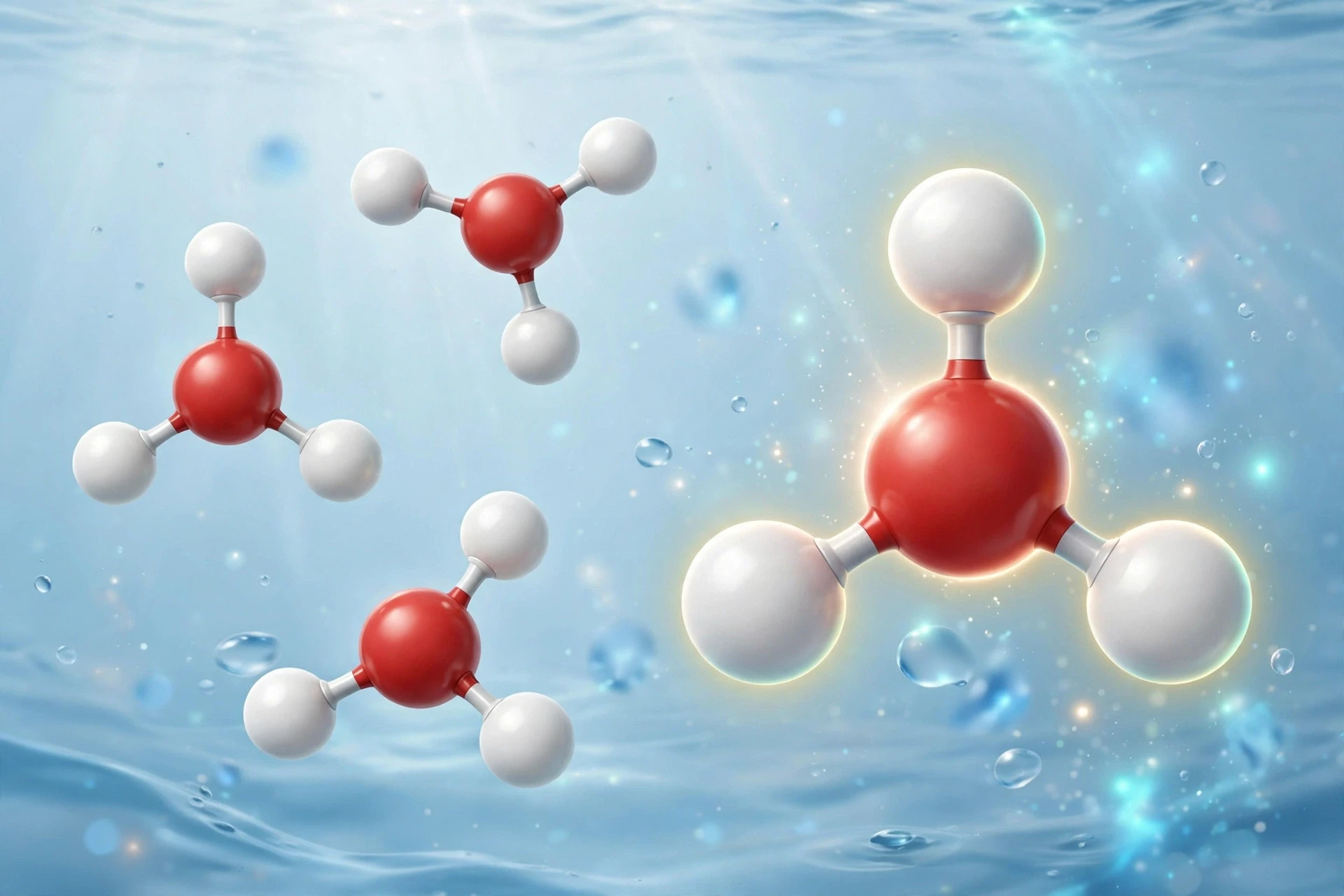
A hydrogen ion is a hydrogen atom that has lost its single electron, leaving behind a bare proton, written H⁺. In water, that proton does not float around alone for long. It attaches itself to a water molecule and forms a hydronium ion, H₃O⁺. Chemists usually write H⁺ for simplicity and mean the hydronium ion in practice. The more of these ions a solution contains, the more acidic it is, and the lower its pH.
The formal definition is a piece of mathematics: pH is the negative logarithm (base 10) of the hydrogen ion concentration, measured in moles per litre. Written as a formula, pH = −log₁₀[H⁺]. Do not let the formula scare you. It says something very ordinary: take the number of hydrogen ions in a litre of solution, take its logarithm, and flip the sign. The result is the pH.
Why go through all that trouble instead of just reporting the concentration directly? Because hydrogen ion concentrations in real solutions span an enormous range — from about 1 mole per litre in a strong acid down to 0.00000000000001 moles per litre in a strong base. That is a range of fourteen orders of magnitude. Writing those numbers out every time would be clumsy and hard to compare. The pH scale squeezes that whole range into the tidy numbers 0 to 14. It is a compression trick, and a brilliant one.
The letter "p" in pH stands for "power" — from the German word Potenz, meaning power, as in the power of ten in the logarithm. The "H" stands for hydrogen. So pH literally means "the power of hydrogen". The idea came from the Danish chemist Søren Sørensen, who proposed it in 1909 while working at the Carlsberg Laboratory in Copenhagen. He was not chasing a grand theory. He was trying to control the acidity of beer during brewing, because acidity affected how enzymes worked and how the beer tasted. A practical problem, solved with a piece of mathematics, that ended up reshaping chemistry.
3. The pH Scale Explained, Step by Step
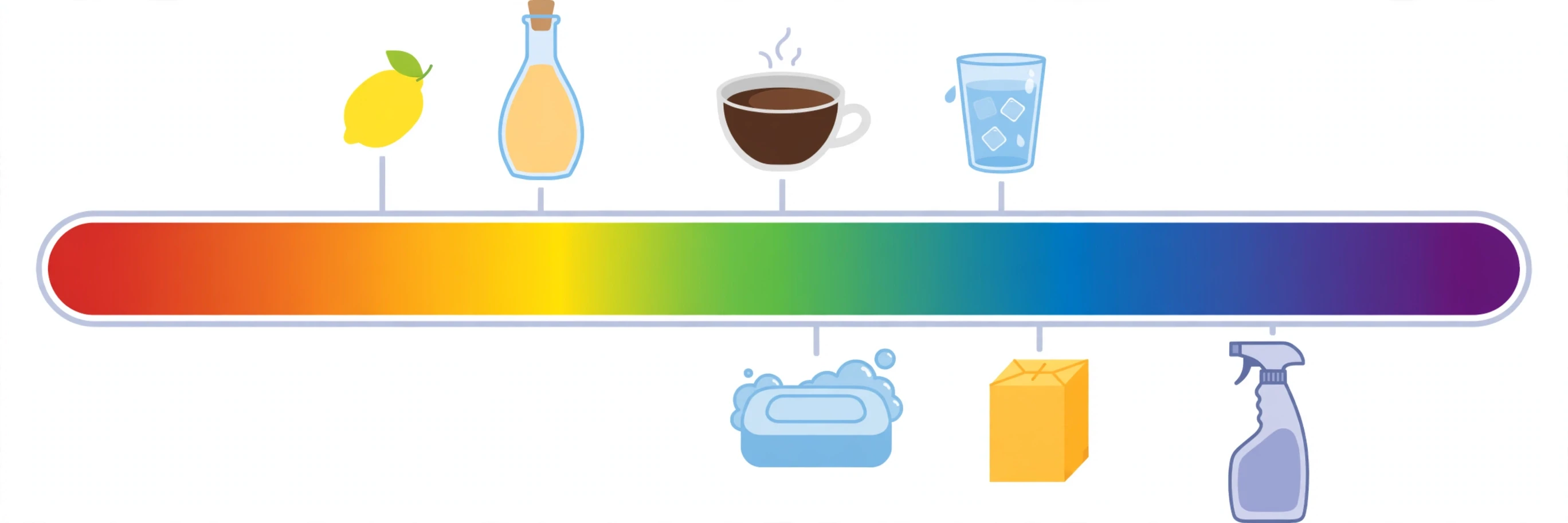
The pH scale is the part everyone remembers from school, usually as a coloured strip in a textbook: red on the left, green in the middle, purple on the right. When someone asks what is pH, that strip is usually the first thing they picture. It is worth understanding properly, because nearly every mistake people make about pH comes from reading it too casually.
3.1 Acidic: pH below 7
A solution is acidic when it contains more hydrogen ions than pure water does. Common acids include the citric acid in lemons, the acetic acid in vinegar, and the hydrochloric acid your stomach produces to digest food. The lower the number, the stronger the acid. A solution at pH 3 is ten times more acidic than a solution at pH 4, and a hundred times more acidic than one at pH 5. That ten-times-per-step rule is the part most people miss, and it matters enormously — it is the difference between a mild sting and a chemical burn.
3.2 Neutral: pH 7
Pure water at room temperature has a pH of exactly 7. That is the middle of the scale, the point where the concentration of hydrogen ions exactly balances the concentration of hydroxide ions (OH⁻), the particles that make a solution basic. Neutral does not mean "nothing is happening". Water is constantly splitting into H⁺ and OH⁻ and recombining again. At pH 7, the two are present in exactly equal amounts. It is a balance, not an absence.
3.3 Basic (alkaline): pH above 7
A solution is basic, also called alkaline, when it contains more hydroxide ions than hydrogen ions. Baking soda dissolved in water sits around pH 8 or 9. Soap is around pH 9 or 10. Household ammonia is around pH 11. The higher the number, the stronger the base. Strong bases are just as capable of harm as strong acids — oven cleaner at pH 13 or 14 can burn skin badly, which is why the same safety warnings apply at both ends of the scale.
3.4 The everyday substances table
The fastest way to get a feel for the scale is to see where familiar things sit on it. The table below gives approximate pH values for substances most people meet every week. These are typical values, not exact ones — the pH of a particular coffee or a particular soap varies with brand, concentration, and temperature — but they show the pattern clearly.
Substance | Approximate pH | Acidic, neutral or basic |
|---|---|---|
Stomach acid (gastric juice) | 1.5–2 | Strongly acidic |
Lemon juice | 2 | Strongly acidic |
Vinegar | 2.5–3 | Strongly acidic |
Orange juice | 3.5 | Acidic |
Black coffee | 5 | Mildly acidic |
Milk | 6.5–6.7 | Slightly acidic |
Pure water | 7 | Neutral |
Human blood | 7.35–7.45 | Slightly basic |
Baking soda solution | 8–9 | Mildly basic |
Soap and hand wash | 9–10 | Basic |
Household ammonia | 11 | Strongly basic |
Oven cleaner | 13–14 | Strongly basic |
Look at the table and notice two things. First, the substances we eat and drink cluster in the acidic half — our taste buds evolved to detect acids because sourness often signals unripe fruit or spoiled food. Second, the substances we use for cleaning cluster in the basic half — bases are good at breaking down grease and oils, which is exactly what a cleaner needs to do.
4. What pH Actually Measures: Hydrogen Ions in Water
Here is where the story gets properly interesting, because the answer to what is pH is not really about lemons or soap. It is about water itself, and about what water does when it is left alone.
4.1 Water splits itself apart
Pure water looks still and quiet. At the molecular level, it is anything but. A tiny fraction of water molecules are constantly breaking apart into a hydrogen ion (H⁺) and a hydroxide ion (OH⁻), and just as constantly snapping back together. Chemists write this as H₂O ⇌ H⁺ + OH⁻, where the double arrow means the reaction runs in both directions at once.
In a litre of pure water at 25 °C, only about one water molecule in every 550 million is split at any given moment. The concentration of hydrogen ions is 0.0000001 moles per litre, written 1 × 10⁻⁷ mol/L. The concentration of hydroxide ions is exactly the same. Multiply the two together and you get 1 × 10⁻¹⁴ — a constant called the ion product of water, Kw. That number is the hidden engine of the whole pH scale, because it means the two concentrations are locked together: if one goes up, the other must go down.
Add acid to water, and you flood it with hydrogen ions. The hydroxide concentration falls to keep the product constant. Add a base, and you flood it with hydroxide ions, and the hydrogen concentration falls. The pH number is simply a compact way of reporting where the solution sits on that seesaw. To understand the molecular players themselves — what atoms and molecules actually are — the atoms and molecules guide on Sciory builds the picture from the ground up.
4.2 Why chemists write H⁺ when they mean H₃O⁺
A bare proton in water is so reactive that it survives for only a vanishingly short time before grabbing onto the nearest water molecule. What actually drifts through the solution is the hydronium ion: a water molecule with an extra proton attached, carrying a positive charge. Strictly speaking, pH measures the activity of hydronium ions, not free protons. In practice, textbooks and laboratories write H⁺ as shorthand, and everyone understands it to mean the hydronium ion in water. It is one of those simplifications that chemistry runs on — a little imprecise, and entirely standard.
I remember the afternoon this finally clicked for me, in an undergraduate lab, when a demonstrator drew a single water molecule on the board and then drew a proton crashing into it. "It never travels alone," she said. "It always brings a water molecule with it." That one sentence cleared up a confusion I had carried for years about what an "H⁺ in solution" actually was. It is never a lonely proton. It is a proton with a partner.
4.3 The seesaw: more H⁺ means less OH⁻
Because the product of the two ion concentrations is fixed at 1 × 10⁻¹⁴, the pH scale and the pOH scale are mirror images. pOH is defined the same way as pH, but for hydroxide ions: pOH = −log₁₀[OH⁻]. And at room temperature, pH + pOH = 14, always. A solution at pH 3 has a pOH of 11. A solution at pH 12 has a pOH of 2. Knowing one tells you the other instantly. This is why chemists often switch between talking about acids and talking about bases without missing a beat — the two descriptions are two sides of the same number.
5. Why the Scale Is Logarithmic — and Why That Matters
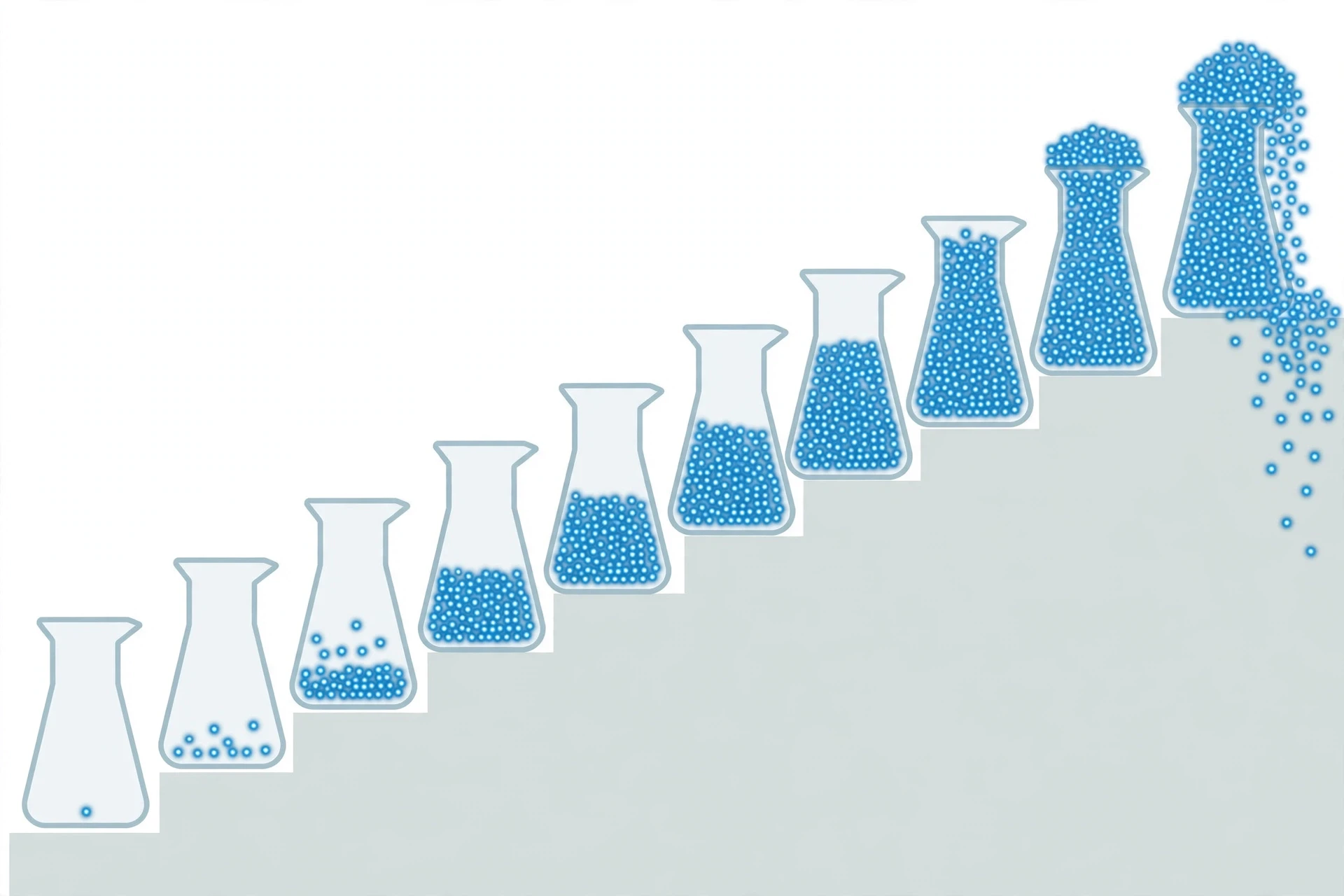
The logarithmic nature of pH is the single most important thing to understand about it, and the single most commonly misunderstood. A logarithmic scale is one where each step multiplies rather than adds. On the pH scale, a change of one unit means a tenfold change in hydrogen ion concentration. A change of two units means a hundredfold change. A change of three means a thousandfold change.
5.1 Powers of ten, in plain language
Think of it like the Richter scale for earthquakes, which works the same way: a magnitude 6 earthquake releases roughly ten times the energy of a magnitude 5. Small numbers on the scale, huge differences in reality. On the pH scale, the same logic applies to hydrogen ions:
pH 1 has ten times the hydrogen ions of pH 2.
pH 1 has a hundred times the hydrogen ions of pH 3.
pH 1 has a thousand times the hydrogen ions of pH 4.
pH 1 has ten million times the hydrogen ions of pH 8.
That last comparison is worth pausing on. Stomach acid at pH 2 and baking soda solution at pH 8 look like they are only six numbers apart. In terms of hydrogen ions, they are a million times apart. The scale compresses enormous differences into small, friendly numbers — which is its great strength and its great trap. People read "pH 5" and "pH 6" as neighbours. In chemical terms, they are a factor of ten apart.
5.2 A mistake I watched happen
Early in my lab training, I watched a student try to neutralise a spill of dilute acid by adding a roughly equal volume of dilute base, reasoning that "equal amounts cancel out". They did not — because the acid was ten times more concentrated than the base, even though the pH values looked close on paper. The mixture stayed acidic, the indicator stayed red, and the student stood there confused until a supervisor pointed at the numbers and said, "One unit. Ten times. Never forget it."
That is the practical lesson of the logarithm. When you are adjusting the pH of a swimming pool, a fish tank, or a batch of soil, a small change on the scale can mean a large change in chemistry. It is also why pH meters report two decimal places: the difference between pH 7.00 and pH 7.10 is a real, measurable change in ion concentration, not a rounding error.
5.3 Why a logarithm at all?
Sørensen chose the logarithm for the same reason mapmakers choose a scale: to fit something enormous onto something readable. Hydrogen ion concentrations run from about 1 mol/L down to 1 × 10⁻¹⁴ mol/L. No linear scale could show both ends usefully. The logarithm folds that range into fourteen neat steps. It also matches how our senses work — human perception of sourness, brightness, and loudness is itself roughly logarithmic, which is one reason the scale feels intuitive once you understand it, even though the numbers hide the true size of the jumps.
6. What Does pH 7 Mean?
Of all the questions people ask about pH, "what does pH 7 mean?" is the one that sounds simplest and turns out to be the most interesting. The short answer: pH 7 means neutral — the hydrogen ion concentration exactly equals the hydroxide ion concentration, both at 1 × 10⁻⁷ mol/L at 25 °C.
The longer answer is more useful. First, pH 7 is neutral only at room temperature. The ion product of water changes with temperature, because heat pushes more water molecules to split apart. At 0 °C, neutral pH is about 7.47. At 100 °C, neutral pH is about 6.14. The water is still neutral at both temperatures — the two ions are still equal — but the number that means "neutral" has moved. A student who memorises "7 is neutral" without the temperature footnote will be confused the first time they measure hot water and find it reading below 7.
Second, pH 7 is not the pH of most things we call neutral in everyday life. Rainwater is naturally slightly acidic, around pH 5.6, because carbon dioxide from the air dissolves in it and forms a weak acid. Milk is around pH 6.6. Human saliva sits between pH 6.2 and 7.6. Even distilled water left open on a bench will drift down from pH 7 toward pH 5.5 or so as it absorbs carbon dioxide from the air. Truly neutral water is a laboratory ideal, not something you meet in a glass.
Third, neutral does not mean harmless or inactive. A neutral solution can still be full of dissolved salts, and it can still conduct electricity. It simply has no excess of hydrogen or hydroxide ions. That balance is what makes pH 7 the reference point of the whole scale — the fulcrum of the seesaw — rather than a description of any particular substance.
Neutral is not the absence of chemistry. It is the exact balance point where two opposite chemistries hold each other still.
7. Acids and Bases: The Two Sides of the Scale
You cannot understand pH without understanding what acids and bases are, because pH is their measurement. An acid is a substance that donates hydrogen ions (protons) to a solution. A base is a substance that accepts them, or that supplies hydroxide ions. That is the Brønsted–Lowry definition, the one most chemistry courses teach, and it is the most useful way to think about the scale: acids push the number down, bases push it up.
The classic examples are worth knowing by name. Hydrochloric acid (HCl), the acid in your stomach, donates its proton readily and completely. Acetic acid (CH₃COOH), the acid in vinegar, donates its proton only partly. Sodium hydroxide (NaOH), the active ingredient in many drain cleaners, supplies hydroxide ions freely. Ammonia (NH₃) accepts protons from water and becomes ammonium (NH₄⁺), which is why a bottle of household ammonia smells sharp and cleans grease so well.
What makes one acid stronger than another is not how concentrated it is, but how willingly it gives up its protons. A strong acid dissociates almost completely in water. A weak acid dissociates only a little. The same goes for bases. This is why a dilute solution of a strong acid can have a lower pH than a concentrated solution of a weak acid — strength and concentration are different things, and confusing them is one of the classic errors in chemistry exams. The chemical reactions guide on Sciory explains the reaction types behind these exchanges, including the acid–base reactions that move protons from one molecule to another.
Acids and bases also have a long human history. People used vinegar to pickle food and sour milk to make cheese thousands of years before anyone knew what a hydrogen ion was. Lye made from wood ash was used to make soap. The word "alkaline" itself comes from al-qaly, the Arabic word for the ashes of saltwort plants, from which early chemists extracted potash. The science is modern; the substances are ancient.
8. How Do You Measure pH?
There are four main ways to measure pH, and they range from a strip of paper that costs pennies to an electronic instrument that costs hundreds. Each has its place, and knowing which to use is half the skill.
8.1 Litmus paper: the simplest test
Litmus is a dye extracted from lichens that changes colour depending on acidity. Blue litmus paper turns red in acid and stays blue in base. Red litmus paper turns blue in base and stays red in acid. It is a yes-or-no test: it tells you which side of neutral you are on, but not how far. School laboratories have used it for generations because it is cheap, instant, and almost impossible to use wrongly. Its limitation is obvious — it cannot tell pH 3 from pH 5, and that difference is a factor of a hundred.
8.2 Universal indicator and pH test strips
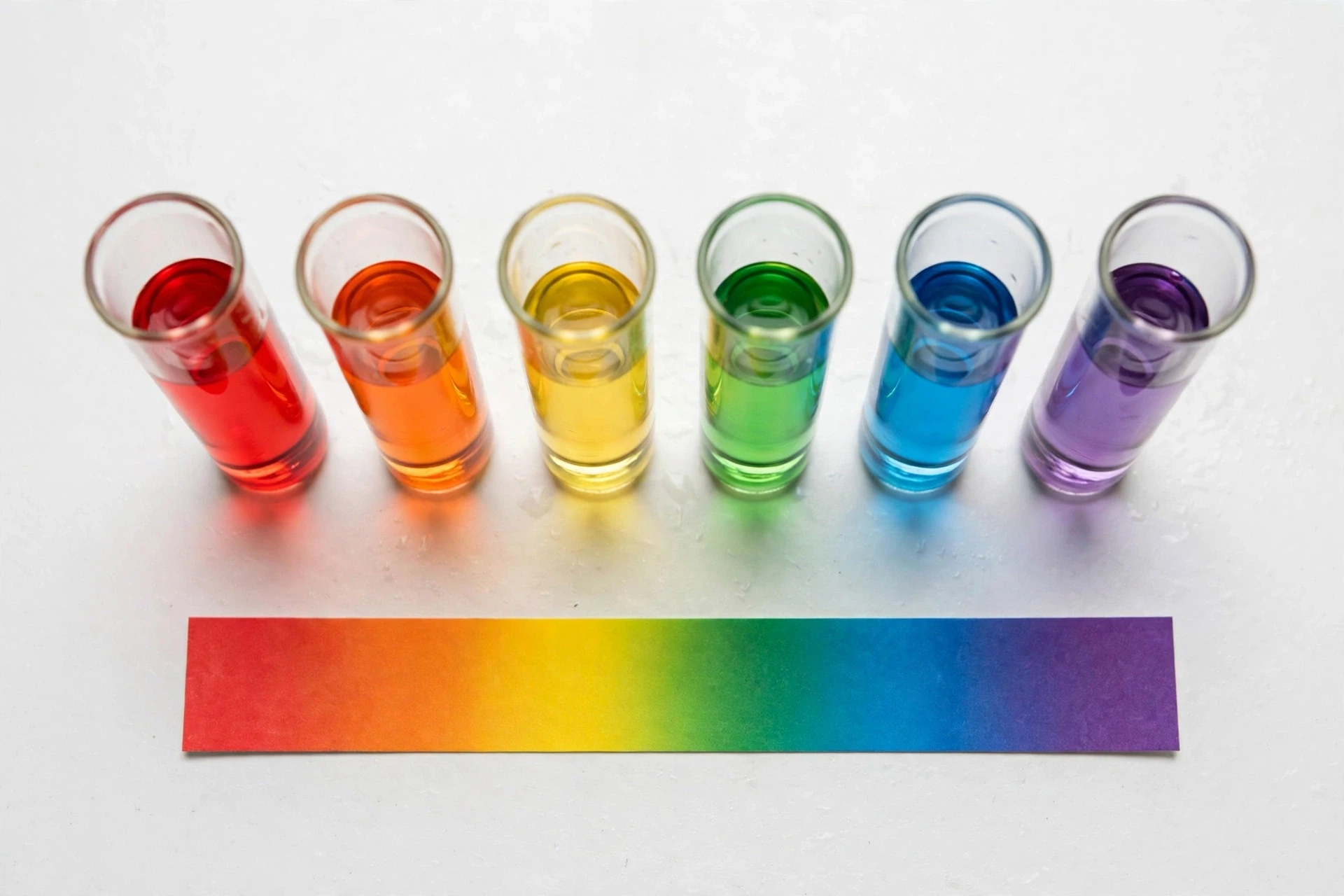
Universal indicator is a mixture of several dyes that changes colour gradually across the whole pH range, from red through orange, yellow, green, blue, and purple. It comes as a solution you can add drop by drop, or soaked into paper strips. Dip a strip, wait a few seconds, and compare the colour to the chart printed on the box. You can usually read the result to within about one pH unit, sometimes half a unit with a good chart and good light.
This is the method used by aquarium keepers, gardeners testing soil, and pool owners checking their water. It is fast and cheap, and for most everyday purposes it is accurate enough. Its weaknesses are that the colour reading is subjective — two people can disagree about whether a strip is "yellow-green" or "green-yellow" — and that coloured or cloudy solutions can mask the result.
8.3 The pH meter: the laboratory standard
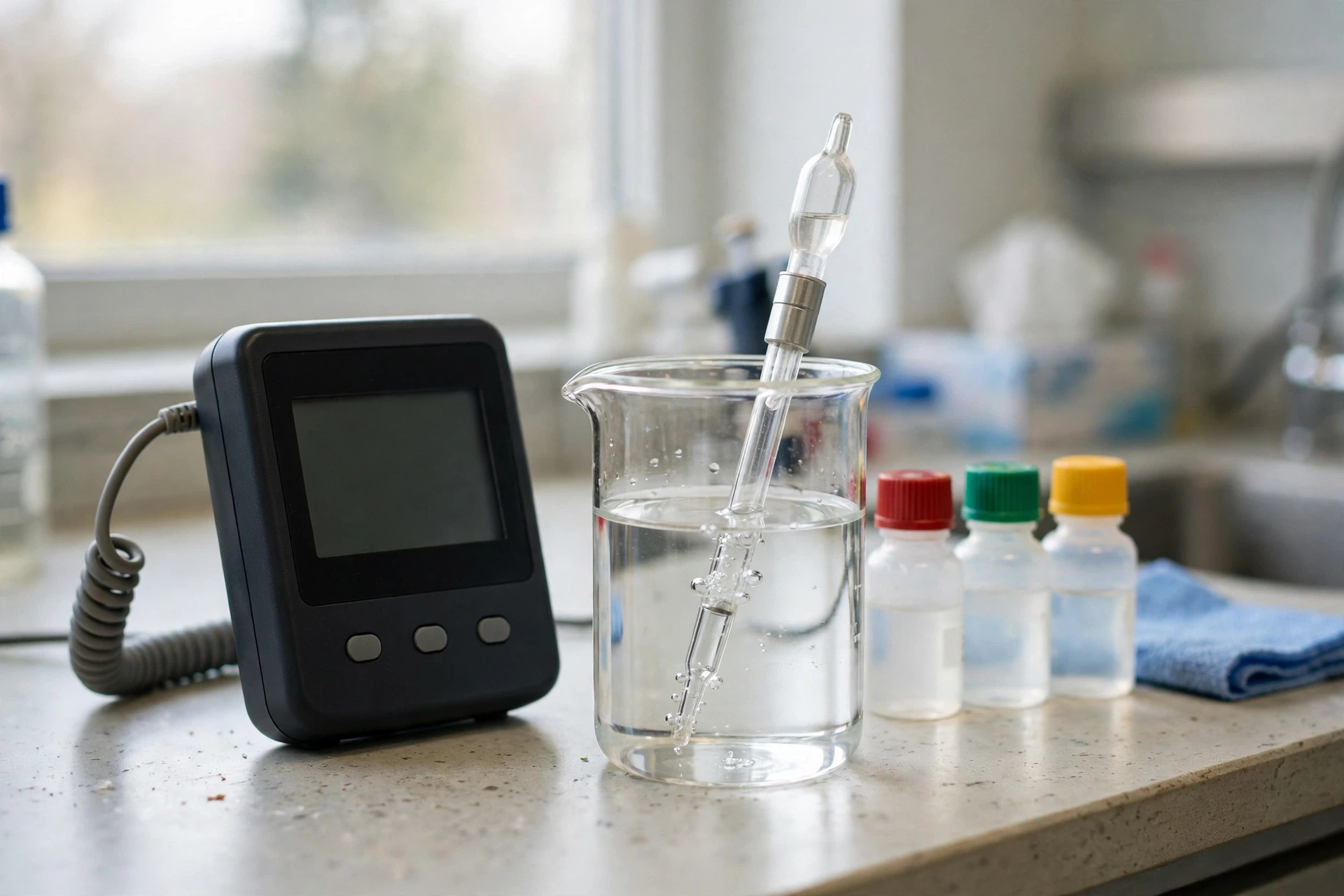
A pH meter is an electronic instrument that measures the voltage produced by a special glass electrode dipped in the solution. The voltage changes with the hydrogen ion concentration, and the meter converts it into a pH reading, usually to two decimal places. It is the standard tool in laboratories, food factories, water treatment plants, and hospitals, because it is fast, precise, and objective.
Using one well takes care. The electrode must be calibrated before use, usually with two buffer solutions of known pH — commonly pH 4 and pH 7, or pH 7 and pH 10. The electrode must be kept wet in storage solution, rinsed between measurements, and never allowed to dry out or be scratched. A poorly maintained electrode drifts, and a drifting electrode gives confident, precise, wrong answers — the worst kind.
I learned that lesson the expensive way, during a week of water-quality measurements in which every reading came out slightly high. We checked the samples, the temperature, the calculations, and finally the electrode — which had been stored dry over a weekend. A new electrode, a fresh calibration, and every number fell back into line. The instrument had not lied. It had simply been asked to work without the care it needed.
8.4 Which method should you use?
The honest answer depends on what the number is for. Testing a fish tank once a week? Test strips are fine. Adjusting the pH of a swimming pool that children will swim in? A meter or a good liquid test kit is better. Running a quality-control check in a food factory, where a wrong reading could mean a spoiled batch or a safety recall? A calibrated meter, checked against buffers every time. Precision costs money and effort; the trick is to match the tool to the stakes.
Method | Accuracy | Cost | Best for |
|---|---|---|---|
Litmus paper | Acid or base only | Very low | Quick yes-or-no checks in school labs |
Universal indicator strips | About ±0.5–1 pH unit | Low | Aquariums, gardens, pools, home use |
Liquid indicator kits | About ±0.2–0.5 pH unit | Low to moderate | Pools, spas, brewing, home testing |
pH meter | About ±0.01–0.05 pH unit | Moderate to high | Laboratories, food production, water treatment |
pH probe with data logger | About ±0.01 pH unit, continuous | High | Environmental monitoring, industrial processes |
9. Strong and Weak: Why Concentration Is Not Strength
This is the section that saves students the most marks in exams, because it clears up a confusion that textbooks often create by accident. Strength and concentration are two different properties, and pH depends on both.
Strength describes how completely an acid or base splits apart in water. Hydrochloric acid is strong because essentially every HCl molecule donates its proton. Acetic acid is weak because only a small fraction of its molecules do — most stay intact. The same distinction applies to bases: sodium hydroxide is a strong base, ammonia is a weak one.
Concentration describes how much of the substance is dissolved in a given volume of water. A concentrated solution has a lot of solute; a dilute solution has a little. You can have a concentrated weak acid and a dilute strong acid, and the dilute strong acid can still have the lower pH, because what matters is how many free hydrogen ions end up in the solution — and that depends on both how much acid is present and how willingly it donates protons.
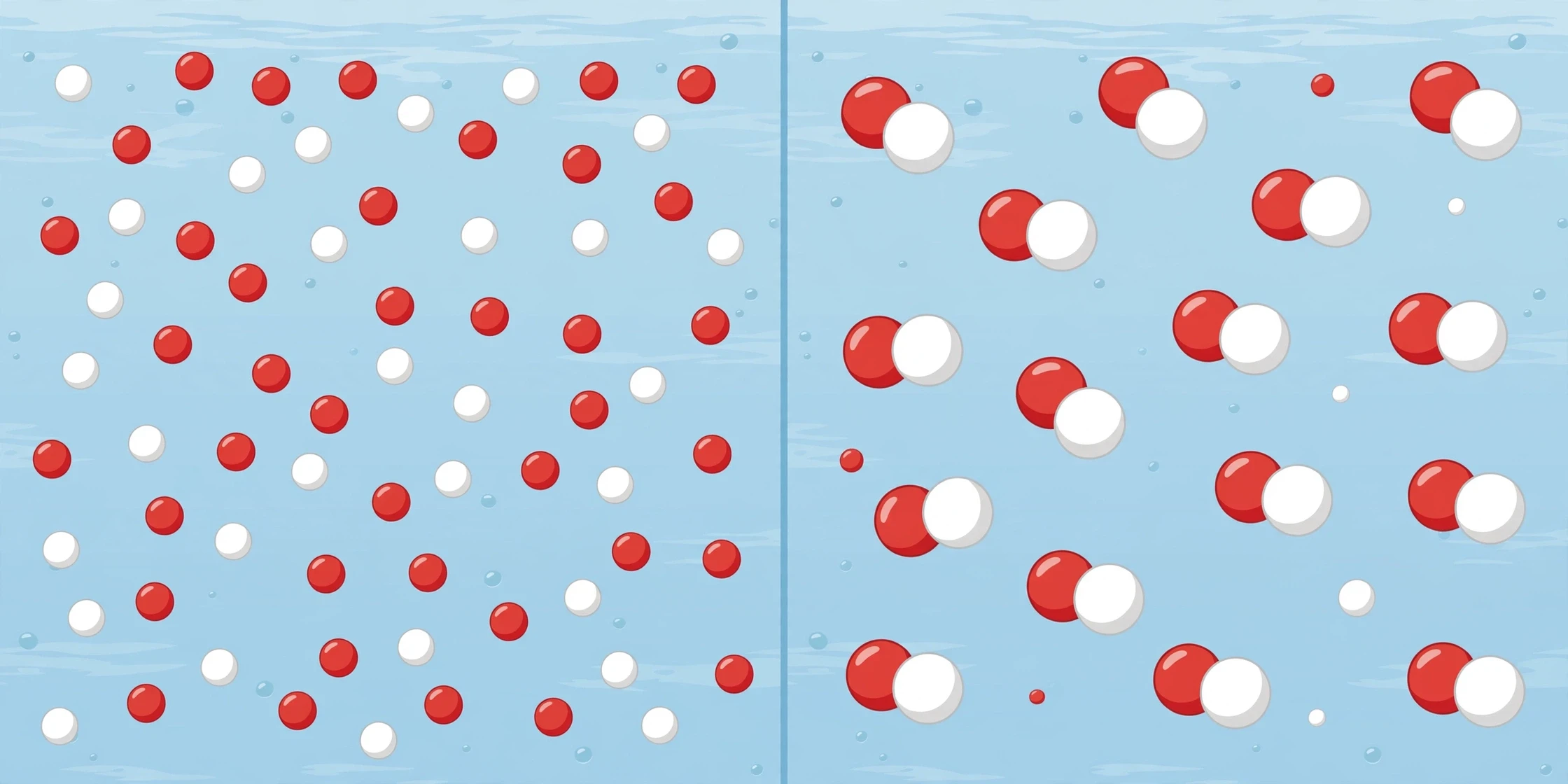
A useful everyday comparison: think of strength as how generously a person shares, and concentration as how many people are in the room. A room full of stingy sharers can still put less on the table than a room with a few generous ones. In chemistry, the "amount on the table" is the hydrogen ion concentration, and the pH is the number that reports it.
Weak acids matter enormously in real life precisely because they do not dissociate fully. Vinegar is safe to put on food because acetic acid is weak. The carbonic acid in sparkling water is weak, which is why fizzy drinks sting your tongue slightly rather than burning it. And the weak acids and bases in your blood are what make buffers possible — the subject of a later section, and one of the most elegant chemical systems in the human body.
10. How Do You Calculate pH?
Calculating pH is one of those skills that looks like pure mathematics until you do it twice, and then it becomes a habit. The formula is pH = −log₁₀[H⁺], where [H⁺] is the hydrogen ion concentration in moles per litre. The logarithm is base 10, and the minus sign flips the result positive, because the concentration is always a small decimal and its logarithm is always negative.
10.1 Worked example 1: a strong acid
Suppose you have a solution of hydrochloric acid with a hydrogen ion concentration of 0.01 mol/L. That is 1 × 10⁻² mol/L. The logarithm (base 10) of 10⁻² is −2. Change the sign, and the pH is 2. That is all there is to it: a concentration of 10⁻² gives pH 2, a concentration of 10⁻³ gives pH 3, and a concentration of 10⁻⁷ gives pH 7.
This is also why pH values are so easy to estimate for strong acids. If you know the concentration of a strong acid, and it dissociates completely, the hydrogen ion concentration is the same as the acid concentration. A 0.1 mol/L solution of hydrochloric acid has pH 1. A 0.001 mol/L solution has pH 3. The pattern is direct, and it is the first calculation every chemistry student learns.
10.2 Worked example 2: a concentration that is not a neat power of ten
Real life rarely hands you neat powers of ten. Suppose the hydrogen ion concentration is 3.2 × 10⁻⁵ mol/L. Take the logarithm: log₁₀(3.2 × 10⁻⁵) = log₁₀(3.2) + log₁₀(10⁻⁵) = 0.51 + (−5) = −4.49. Change the sign, and the pH is 4.49. In practice, you would do this on a calculator: type the concentration, press log, and change the sign. The answer, 4.49, tells you the solution is moderately acidic — in the range of tomato juice or black coffee.
10.3 Working backwards: from pH to concentration
The formula works in reverse too. If you know the pH, the hydrogen ion concentration is [H⁺] = 10^(−pH). A solution at pH 4 has a hydrogen ion concentration of 10⁻⁴ mol/L, or 0.0001 mol/L. A solution at pH 9 has a concentration of 10⁻⁹ mol/L. This reverse calculation is how water treatment plants translate a pH reading on a meter into the actual chemistry they need to manage.
10.4 Calculating pOH and the pH of bases
For bases, it is often easier to calculate pOH first. A solution of sodium hydroxide at 0.01 mol/L has a hydroxide concentration of 0.01 mol/L, so pOH = 2. Since pH + pOH = 14 at 25 °C, the pH is 12. The same logic works for weak bases, with one extra step: you need the base dissociation constant to find how much of the base actually dissociates, because a weak base does not release all of its hydroxide ions. That calculation belongs in a textbook chapter of its own, but the principle is the same — find the ion concentration, take the logarithm, flip the sign.
10.5 A note on activity versus concentration
Strictly speaking, the pH formula uses the activity of hydrogen ions, not their concentration. Activity is the "effective" concentration, adjusted for how ions interact with each other in solution. In dilute solutions — the kind you meet in school labs, kitchens, and fish tanks — activity and concentration are so close that the difference does not matter. In concentrated solutions, such as strong industrial acids, the difference grows, and pH meters report the activity while a simple concentration calculation would be slightly off. For everything in this article, concentration is the right way to think about it.
11. Neutralization: When Acid Meets Base
Mix an acid with a base in the right proportions and something satisfying happens: they cancel each other out. The hydrogen ions from the acid join the hydroxide ions from the base and form water. What is left behind is a salt — a compound made of the remaining ions. The classic school example is hydrochloric acid plus sodium hydroxide, which gives sodium chloride (ordinary table salt) and water: HCl + NaOH → NaCl + H₂O.
Neutralization is not only a classroom demonstration. It is how antacid tablets work: the tablet contains a mild base, such as magnesium hydroxide or calcium carbonate, which neutralises excess stomach acid and brings the pH of the stomach contents back up toward comfort. It is how farmers treat acidic soil, by spreading lime (calcium carbonate) to raise the pH so crops can grow. It is how wastewater treatment plants bring acidic or alkaline effluent back to neutral before releasing it into rivers.
The key word is "proportions". Neutralization is complete only at the equivalence point, the moment when exactly enough base has been added to react with all the acid. Add too little base and the mixture stays acidic. Add too much and it swings basic. In a laboratory titration, an indicator such as phenolphthalein marks the moment: the solution flips from colourless to pink in a single drop, and the chemist reads the volume from the burette. That single drop is the difference between acidic and basic — a vivid demonstration of how sharp the pH scale can be.
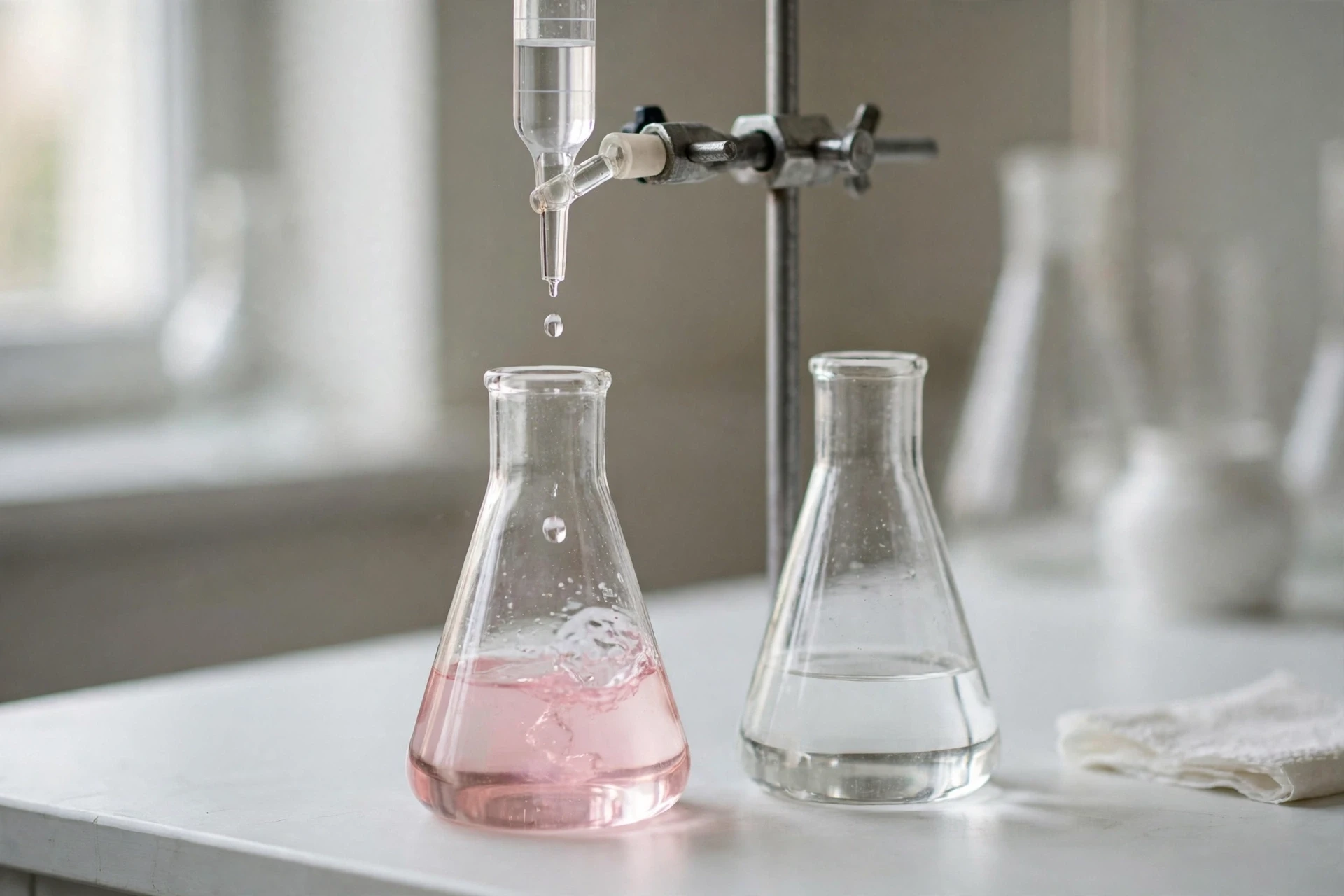
There is a subtlety worth knowing. Neutralization of a strong acid with a strong base ends at pH 7. But neutralization of a weak acid with a strong base ends above 7, and neutralization of a strong acid with a weak base ends below 7 — because the salt left behind can itself react slightly with water. This is why the "neutral" point of a titration is not always pH 7, and why choosing the right indicator for a given titration matters. Phenolphthalein, which changes colour around pH 8 to 10, suits a strong-acid–strong-base titration; methyl orange, which changes around pH 3 to 4, suits other combinations. The indicator is not decoration. It is the instrument that tells you when the reaction is done.
12. Buffers: How Your Blood Keeps Its pH
If pH is a seesaw, a buffer is the hand that holds the seesaw steady. A buffer is a solution that resists changes in pH when small amounts of acid or base are added to it. It is usually made of a weak acid and its conjugate base — a matched pair, such as carbonic acid (H₂CO₃) and bicarbonate (HCO₃⁻). When acid is added, the base part of the pair absorbs the extra hydrogen ions. When base is added, the acid part releases hydrogen ions to replace the ones that were taken. Either way, the pH barely moves.
Your blood is the most important buffer in your life. It is held between pH 7.35 and 7.45 — a band just 0.1 units wide — by the bicarbonate buffer system, with help from phosphate buffers and the proteins in blood itself. That narrow band matters because the enzymes that run your metabolism are exquisitely sensitive to pH. Drift below 7.35 and you are in acidosis; drift above 7.45 and you are in alkalosis. Either condition, if it goes far enough, disrupts enzyme function, nerve signalling, and muscle contraction, and can become life-threatening. Your lungs and kidneys work constantly to keep the balance: the lungs adjust how much carbon dioxide you breathe out, and the kidneys adjust how much bicarbonate and acid they excrete.
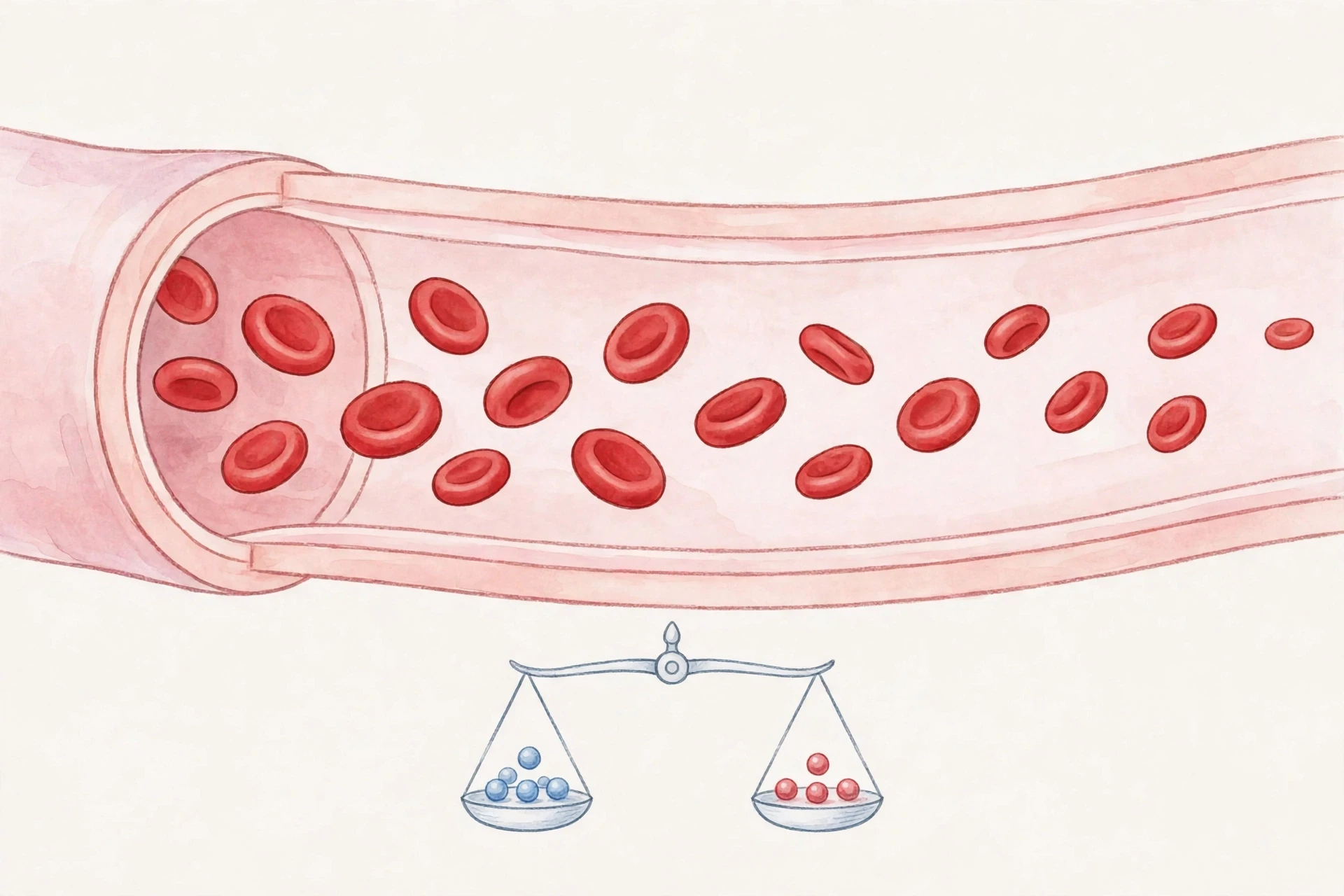
I first grasped how remarkable this is during a physiology practical, when a demonstrator added a drop of strong acid to a beaker of plain water and the pH crashed from 7 to 3 in seconds — then added the same drop to a beaker of blood plasma, and the needle barely moved. The plasma was not stronger. It was buffered. That quiet resistance is what keeps you alive between meals, during exercise, and through illness, and it is one of the best examples in all of science of chemistry doing invisible, essential work.
Buffers are everywhere once you know to look for them. Seawater is buffered by dissolved carbonate, which is why the ocean can absorb large amounts of carbon dioxide without its pH swinging wildly — though, as we will see, that capacity is not unlimited. Shampoos are buffered to stay near the pH of skin and hair. The soil in a garden is buffered by clay and organic matter, which is why a single rainstorm does not flip its pH overnight. Wherever stability matters, a buffer is usually doing the job.
A buffer does not prevent change. It absorbs change, quietly, so that the system it protects never has to feel it.
13. pH in Everyday Life
pH is not confined to laboratories. It shapes what you eat, how you clean, what grows in your garden, and what swims in your aquarium. Here is where the scale shows up in ordinary life.
13.1 Food and drink
Acidity is a flavour and a preservative. Pickling works because vinegar's low pH stops most bacteria from growing. Yoghurt and cheese are made by bacteria that produce lactic acid, lowering the pH until the milk proteins set. Sourdough bread rises because its starter culture produces acids that give the loaf its tang. Coffee tastes bright at pH 5 and flat if it drifts much higher; that is why roasters and baristas care about the acidity of their beans and their water. Even the fizz in a soft drink comes with chemistry: dissolved carbon dioxide forms carbonic acid, which is why most fizzy drinks sit between pH 2.5 and 4.
13.2 Skin, hair, and soap
Healthy skin is slightly acidic, with a pH around 4.5 to 5.5. This "acid mantle" is a thin film of sebum and sweat that discourages harmful bacteria and keeps the skin's barrier intact. Most traditional soaps are alkaline, around pH 9 or 10, which is why washing with strong soap can leave skin feeling tight and dry — the soap temporarily strips the acid mantle, and the skin needs time to restore it. Modern "pH-balanced" cleansers are formulated closer to pH 5.5 for exactly this reason. Hair, too, responds to pH: alkaline treatments open the hair cuticle, acidic rinses close it, which is why a vinegar rinse can leave hair looking shinier.
13.3 Cleaning
Bases are the workhorses of cleaning because they dissolve grease. Fats and oils are broken down by alkaline solutions in a process called saponification — the same reaction that makes soap from fat and lye. That is why oven cleaners, drain cleaners, and laundry detergents are all alkaline, and why they carry strong safety warnings. Acids have their cleaning uses too: vinegar and citric acid dissolve limescale, the crusty calcium carbonate deposit that builds up in kettles and taps in hard-water areas. The rule of thumb is simple — alkaline cleaners for grease, acidic cleaners for mineral deposits — and it follows directly from the chemistry of the pH scale.
13.4 Pools, aquariums, and hot tubs
Swimming pool water is kept between pH 7.2 and 7.8. Below that range, the water stings eyes and corrodes fittings, and chlorine disinfectant becomes too aggressive. Above it, chlorine stops working well, the water turns cloudy, and scale forms on surfaces. Aquarium keepers face a similar balancing act: most tropical freshwater fish prefer pH 6.5 to 7.5, while African cichlids from the Rift Valley lakes prefer 7.8 to 8.5. A fish that looks healthy in one tank can sicken in another purely because the pH is wrong — a reminder that the number is not an abstraction but a condition of life.
13.5 Gardening and soil
Soil pH controls which nutrients plants can absorb. Most vegetables and flowers grow best between pH 6.0 and 7.0. Blueberries and rhododendrons need acidic soil, around pH 4.5 to 5.5, and will yellow and fail in alkaline ground no matter how much fertiliser you add — because at high pH, iron becomes locked in the soil and unavailable to the roots. Gardeners test their soil with a probe or a kit, then add lime to raise the pH or sulphur to lower it, in small doses, over weeks. Soil is buffered, so it resists sudden change, which is both a protection and a frustration: it means a single treatment rarely works, and patience is part of the method.
14. pH in Nature: Soil, Rain, Rivers, and the Ocean
The question "what is pH" stops being a chemistry exam question and becomes a question about how the world works. Once you start seeing pH as a condition of life rather than a classroom number, it shows up everywhere in the natural world.
14.1 Rain and acid rain
Pure rainwater is naturally slightly acidic, around pH 5.6, because carbon dioxide dissolves in falling raindrops and forms carbonic acid. That is normal and harmless. Acid rain is something else: rain with a pH below about 5.0, caused mainly by sulphur dioxide and nitrogen oxides released by burning fossil fuels. These gases react with water in the atmosphere to form sulphuric and nitric acids, which fall with the rain.
The effects are well documented. Acid rain leaches aluminium from soil, which damages tree roots and stunts forests. It acidifies lakes and streams, and many fish species cannot reproduce below pH 5.5; some lakes in heavily affected regions lost their fish entirely before emissions controls were tightened. It also erodes stone buildings and statues, dissolving limestone and marble grain by grain. Emissions controls in North America and Europe have reduced the problem substantially since the 1980s, but acid rain remains a live issue in parts of Asia. The US Environmental Protection Agency explains the causes and effects of acid rain in its public guide, and it remains one of the clearest examples of how a chemistry number connects directly to environmental policy.
14.2 The ocean and ocean acidification
Seawater is slightly alkaline, around pH 8.1. That number is falling — slowly, but measurably — because the ocean absorbs roughly a quarter of the carbon dioxide humans release into the atmosphere. The dissolved CO₂ forms carbonic acid, which releases hydrogen ions and pushes the pH down. Since the start of the industrial era, average ocean surface pH has dropped by about 0.1 units. That sounds small until you remember the logarithm: a 0.1 drop means roughly a 26–30% increase in hydrogen ion concentration.
The consequences fall hardest on organisms that build shells and skeletons from calcium carbonate: corals, oysters, mussels, and tiny plankton called pteropods. As seawater becomes more acidic, carbonate ions become scarcer, and these organisms must spend more energy to build and maintain their shells. Coral reefs, already stressed by warming water, face a double burden. Ocean acidification is sometimes called climate change's "other" problem, and pH is the number that tracks it.
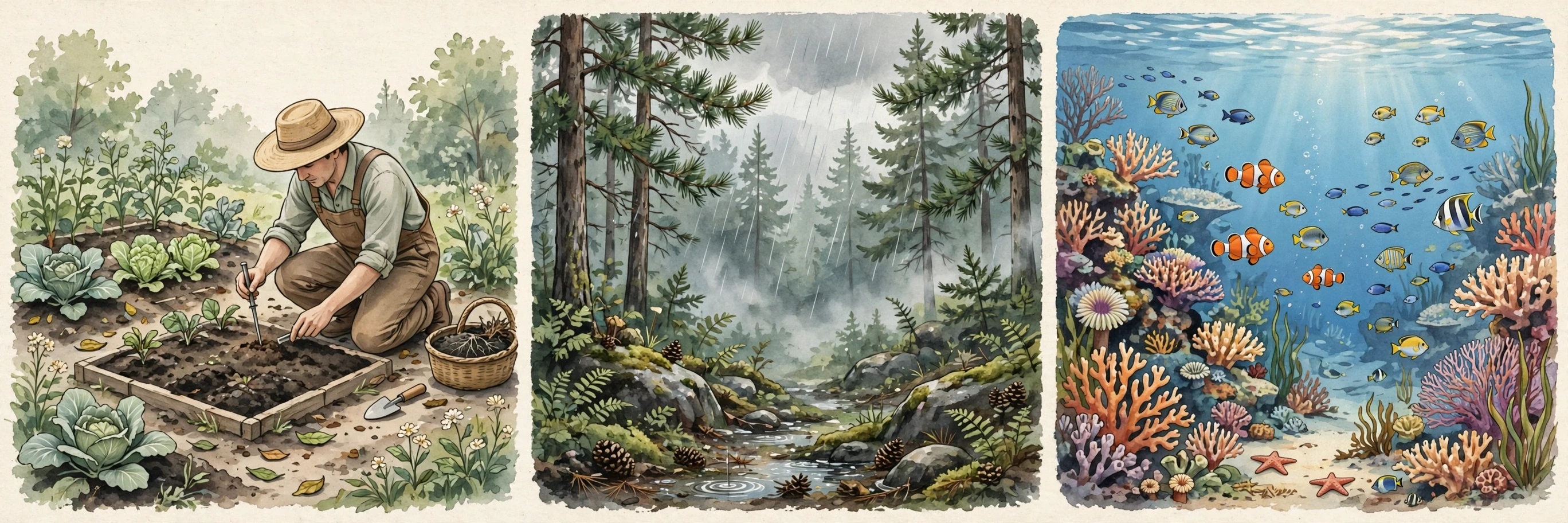
14.3 Rivers and lakes
Freshwater pH varies widely with geology. Rivers running over limestone are naturally alkaline, often pH 7.5 to 8.5, because the rock dissolves slightly and releases bicarbonate. Rivers running over granite or peat are often acidic, pH 5.5 to 6.5. Aquatic life has adapted to these local conditions over thousands of years, which is why a sudden change — a spill, a discharge, a surge of acid rain — can be devastating even when the absolute numbers look modest. The water cycle on Sciory traces how water moves through all of these environments, carrying its chemistry with it, and the water molecule guide explains why water behaves the way it does in the first place.
Water treatment plants monitor pH continuously, because almost every treatment step depends on it: coagulation works best in a narrow pH band, disinfection with chlorine is more effective at lower pH, and corrosion of pipes accelerates when the water is too acidic. The pH of your tap water is not an accident. It is a controlled parameter, adjusted deliberately before the water reaches your home.
15. Beyond 0 to 14: Negative pH and Superacids
The 0–14 scale is a convenient range, not a law of nature. It covers the hydrogen ion concentrations you meet in ordinary solutions, from about 1 mol/L down to 1 × 10⁻¹⁴ mol/L. But concentrated acids can exceed 1 mol/L. A 10 mol/L solution of hydrochloric acid has a calculated pH of −1. Such negative pH values are real and measurable with a suitably calibrated meter, though the simple concentration formula becomes less accurate at these extremes because ion activity diverges from concentration.
At the other end, concentrated bases can push pH above 14. A saturated solution of sodium hydroxide can reach pH 15 or beyond. And beyond the familiar acids entirely lie the superacids — mixtures such as fluoroantimonic acid that are billions of times stronger than concentrated sulphuric acid and can protonate substances that ordinary acids cannot touch. They are laboratory curiosities with industrial uses in petroleum refining, and they are far too dangerous to handle outside specialised equipment.
None of this changes the meaning of the scale. It simply reminds us that 0 and 14 are the edges of the map, not the edges of the territory. For everything in daily life, in school chemistry, and in most laboratories, the 0–14 range is the whole working world.
16. Common Mistakes and Misconceptions
Most people get pH wrong in the same few ways. Clearing them up is worth doing explicitly, because each one leads to a real error in the lab or the garden.
"A pH of 6 is almost the same as a pH of 7." No. It is ten times more acidic. The logarithmic scale means neighbouring numbers are never close in chemical terms. A swimming pool at pH 6.8 and a pool at pH 7.8 differ by a factor of ten in hydrogen ions, and the chlorine in the first pool is working far harder than the chlorine in the second.
"Pure water has a pH of 7, so anything at pH 7 is pure water." No. Seawater is not pH 7. Blood is not pH 7. A salt solution can be exactly pH 7 and still be full of dissolved minerals. Neutral describes the balance of hydrogen and hydroxide ions, nothing else.
"Acids are dangerous and bases are safe." No. Both ends of the scale can burn, blind, and corrode. Drain cleaner at pH 14 is every bit as hazardous as stomach acid at pH 2, and it deserves the same respect, the same gloves, and the same eye protection.
"Alkaline water is healthier because your body is alkaline." This is a popular claim with no scientific basis. Your blood pH is held at 7.35–7.45 by buffers, lungs, and kidneys, and drinking alkaline water does not change it — your stomach acid neutralises it first. The body is not a glass of water you can adjust by pouring something different into it. What is pH in the body is a tightly regulated condition, not a dial you can turn with a drink.
"pH measures how strong an acid is." Only partly. pH measures the hydrogen ion concentration in a particular solution, which depends on both the strength of the acid and its concentration. A dilute strong acid and a concentrated weak acid can have the same pH. Strength is a property of the molecule; pH is a property of the solution.
"You can taste pH." You can taste acidity, roughly — sourness tracks hydrogen ion concentration — but you cannot taste a number, and you cannot taste the difference between pH 4 and pH 5 reliably. Taste is a rough guide, not a measurement.
Most pH mistakes come from treating the scale as if it were a ruler. It is not a ruler. It is a staircase where every step is ten times higher than the last.
17. Why pH Deserves Its Place in Your Head
A hundred years after Sørensen proposed it, pH remains one of the most successful ideas in chemistry — not because it is complicated, but because it is simple in exactly the right way. It takes a range of concentrations spanning fourteen orders of magnitude and folds it into a number a schoolchild can read off a strip of paper. It connects the sting of a lemon to the chemistry of the ocean, the fizz of a soft drink to the buffering of blood, the soil in a garden to the water in a swimming pool.
If you remember only three things, make them these. First, pH measures hydrogen ion concentration, and the scale is logarithmic: one unit means ten times. Second, 7 is neutral at room temperature, below 7 is acidic, above 7 is basic — and both extremes demand respect. Third, the number is a condition of living systems, not just a laboratory reading: your blood, your food, your garden, and the sea all run on pH, and they all run best inside their own narrow bands.
The next time you squeeze a lemon over fish, taste the sourness and know what you are tasting: hydrogen ions, counted on a scale invented for a brewery, measuring a chemistry that runs the world. Ask what is pH in a laboratory and you will get a formula; ask it in a kitchen and you will get a lemon. Both answers are right. And once you see it, you will notice it everywhere.
Frequently Asked Questions
What is pH?
pH is a number from 0 to 14 that measures how acidic or basic a water-based solution is, based on its hydrogen ion concentration. A pH below 7 is acidic, pH 7 is neutral, and a pH above 7 is basic (alkaline). The scale is logarithmic, so each whole-number step means a tenfold change in hydrogen ion concentration.
How do you measure pH?
You can measure pH with litmus paper (acid or base only), universal indicator strips or liquid kits (accurate to about half a pH unit), or a digital pH meter (accurate to about 0.01 units). For everyday use such as aquariums, gardens, and pools, test strips are usually enough. For laboratory or industrial work, a calibrated pH meter is the standard.
What does pH 7 mean?
pH 7 means neutral at room temperature (25 °C): the hydrogen ion concentration exactly equals the hydroxide ion concentration, both at 1 × 10⁻⁷ moles per litre. Note that the neutral point shifts with temperature — at 100 °C it is about pH 6.14 — and that pure water left open to the air drifts below 7 as it absorbs carbon dioxide.
How do you calculate pH?
Use the formula pH = −log₁₀[H⁺], where [H⁺] is the hydrogen ion concentration in moles per litre. For example, a concentration of 0.01 mol/L (1 × 10⁻²) gives pH 2. For bases, calculate pOH first (pOH = −log₁₀[OH⁻]) and use pH + pOH = 14 at 25 °C. A calculator's log button does the heavy lifting.
What is the pH of human blood?
Human blood is held between pH 7.35 and 7.45 by the bicarbonate buffer system, with the lungs and kidneys adjusting continuously. Below 7.35 is acidosis and above 7.45 is alkalosis; both can become dangerous if they go far enough, because enzymes and nerve signalling depend on that narrow band.
Can pH be below 0 or above 14?
Yes. The 0–14 range covers ordinary solutions, but concentrated acids can have negative pH — for example, a 10 mol/L hydrochloric acid solution has a calculated pH of about −1 — and concentrated bases can exceed pH 14. Superacids go far beyond even that. Negative and above-14 values are real, just outside the range most people ever meet.
Why is the pH scale logarithmic?
Because hydrogen ion concentrations in real solutions span fourteen orders of magnitude, from about 1 mol/L to 1 × 10⁻¹⁴ mol/L. A linear scale could not show both ends usefully. The logarithm compresses that range into the numbers 0 to 14, and it also matches how human senses perceive sourness and intensity — roughly logarithmically rather than linearly.
Sources
LibreTexts — The pH Scale: https://chem.libretexts.org/Bookshelves/Physical_and_Theoretical_Chemistry_Textbook_Maps/Supplemental_Modules_(Physical_and_Theoretical_Chemistry)/Acids_and_Bases/Acids_and_Bases_in_Aqueous_Solutions/The_pH_Scale
OpenStax Chemistry 2e — pH and pOH: https://openstax.org/books/chemistry-2e/pages/14-2-ph-and-poh
American Chemical Society — ChemMatters, Acids, Bases, and pH: https://www.acs.org/education/resources/highschool/chemmatters/past-issues/archive-2013-2014/acids-bases-ph.html
Khan Academy — Introduction to pH: https://www.khanacademy.org/science/ap-chemistry-beta/x2eef969c74e0d802:acids-and-bases/x2eef969c74e0d802:ph-poh/v/introduction-to-ph
US Environmental Protection Agency — What Is Acid Rain?: https://www.epa.gov/acidrain/what-acid-rain
US Environmental Protection Agency — Water Quality Criteria Tables: https://www.epa.gov/wqc/national-recommended-water-quality-criteria-aquatic-life-criteria-table
Chemical Reactions: Types, Kinetics, and Examples — Sciory: https://www.sciory.com/blog/chemical-reactions-types-kinetics-examples
Atoms and Molecules Explained — Sciory: https://www.sciory.com/blog/atoms-molecules-explained
Why Water Is the Weirdest Molecule — Sciory: https://www.sciory.com/blog/why-water-is-weirdest-molecule
The Water Cycle — Sciory: https://www.sciory.com/blog/water-cycle