

Pick up a pinch of table salt and let it fall back into the shaker. Those tiny white crystals look simple, almost boring. Yet each one is a city of atoms held together by chemical bonds so strong that you would need a furnace running at hundreds of degrees to melt them apart — and so ready to fall apart in water that a single glass of it can take the whole crystal to pieces in seconds. That contradiction is the story of chemical bonds: invisible attractions between atoms that decide whether a substance is a hard crystal or a soft metal, a gas you breathe or a liquid you drink, a diamond or a lump of coal.
Chemical bonds are the reason the world has structure at all. Without them, atoms would drift past each other like strangers in a crowd, never joining up, never building anything. With them, a handful of elements — hydrogen, carbon, oxygen, nitrogen, and a few dozen more — combine into the millions of substances around us: the steel in a bridge, the water in your body, the DNA in every cell, the air you are breathing right now. This article explains chemical bonds from the ground up: what they are, the four types you need to know — ionic, covalent, metallic, and hydrogen bonds — how to tell them apart, and why they control the properties of everything you touch.
1. What Are Chemical Bonds?
A chemical bond is an attraction between atoms that holds them together in a molecule or a crystal. It forms because atoms can reach a lower, more stable energy state by joining up than by staying alone. That is the whole secret, stripped of jargon: atoms bond because together they are more stable than apart. When a bond forms, energy is released. When a bond breaks, energy has to be put in. That one rule explains why some substances are stubbornly hard to pull apart and others fall apart at a touch.
Think of two magnets on a table. Slide them close enough and they snap together with a click, settling into a position that is hard to disturb. Atoms behave in a similar spirit, though the forces at work are electrical. Every atom has a positively charged nucleus surrounded by negatively charged electrons, and chemical bonds are, at bottom, electrical attractions between those charges — electrons pulled toward nuclei, nuclei pulled toward electrons, all settling into the arrangement that wastes the least energy.
I still remember the first time that idea stopped being a diagram in a textbook and became something I could see. In a school chemistry lesson, a teacher dissolved table salt in water and passed an electric current through the solution, lighting a small bulb. Solid salt did nothing. Pure water did almost nothing. But salt water lit the bulb. Something in the salt had come apart in the water and was carrying charge. That demonstration was my first glimpse of chemical bonds in action — bonds forming, bonds breaking, and the properties of a substance changing completely as a result.
1.1 Why atoms bond at all
Atoms are built from protons, neutrons, and electrons, and the electrons sit in shells around the nucleus. The outermost shell, the valence shell, is the one that matters for bonding. Most atoms are most stable when their outer shell is full — usually with eight electrons, a pattern chemists call the octet rule. The noble gases, such as neon and argon, already have full outer shells, which is why they almost never bond with anything. Other atoms reach that stable arrangement by giving away, taking, or sharing electrons. That is the engine behind every chemical bond you will meet in this article.
A useful way to picture it is to think of atoms as players in a game where everyone wants a full hand of cards. Sodium has one electron in its outer shell and would love to lose it. Chlorine has seven and would love to gain one. Put them together and the trade is obvious. Carbon has four and tends to share. Metals have a few loose electrons they are happy to let wander. The details of chemical bonds differ, but the goal is the same: a full outer shell and a lower energy bill.
If you want a refresher on the particles themselves before going further, our guide to Atoms and Molecules covers atomic structure, electron shells, and how atoms join into molecules in more detail.
1.2 Energy, stability, and the bond
Every chemical bond stores a certain amount of energy, and chemists measure it as bond energy: the energy needed to break one mole of that bond. Strong bonds, like the carbon–carbon bonds in diamond, take a lot of energy to break, which is why diamond is so hard. Weak bonds break easily, which is why some substances melt at low temperatures or dissolve in water without a fuss. The energy of chemical bonds is not an abstract number on a chart. It is the reason a candle flame can break bonds in wax and release heat and light, and the reason your body can break bonds in food and use the released energy to keep you alive.
Bond length matters too. Atoms in a bond sit at a particular distance from each other — close enough for the attraction to be strong, far enough that their nuclei do not repel each other too hard. That distance is the bond length, and it is different for every pair of atoms. Short bonds are usually strong bonds. The oxygen–hydrogen bonds in water are short and strong, while the weak attractions between one water molecule and the next are long and easy to break, which is why water flows instead of sitting there like a solid block.
1.3 What are the types of chemical bonds?
So what are the types of chemical bonds? The short answer is that chemists recognise three main kinds of strong bond — ionic, covalent, and metallic — plus a family of weaker attractions between molecules, of which hydrogen bonding is the most important. Ionic bonds transfer electrons from one atom to another. Covalent bonds share electrons between atoms. Metallic bonds let electrons wander freely through a whole piece of metal. Hydrogen bonds are weaker attractions between molecules that contain hydrogen attached to oxygen, nitrogen, or fluorine. Each type produces substances with very different properties, and learning to recognise them is the key to predicting how a substance will behave.
There is also a spectrum to keep in mind. Real chemical bonds do not always fall neatly into one box. Some bonds are mostly ionic with a little covalent character, and some are mostly covalent with a little ionic character. The types are best thought of as regions on a sliding scale rather than four separate drawers. That idea will come back in section 7, where electronegativity explains exactly where a bond sits on the scale.
2. The Big Picture: Four Bonds, Four Personalities
Before diving into each bond type in detail, it helps to see the four of them side by side. Each type of chemical bond has a personality: a way of holding atoms together, a set of substances it builds, and a set of properties it produces. If you learn these personalities, you can look at a formula or a material and make a good guess about how it will behave — whether it will melt easily, conduct electricity, dissolve in water, or shatter when you hit it.
Ionic bonds — electron transfer between a metal and a non-metal. They build crystals such as table salt: hard, brittle, high-melting, and able to conduct electricity only when melted or dissolved.
Covalent bonds — electron sharing between non-metals. They build molecules such as water, carbon dioxide, and DNA: often low-melting, poor conductors, and enormously varied in shape.
Metallic bonds — electrons shared across a whole metal. They build copper wire, steel beams, and aluminium foil: shiny, bendable, and excellent conductors of heat and electricity.
Hydrogen bonds — weak attractions between molecules. They hold water together, shape proteins, and zip DNA into its double helix: individually weak, but collectively powerful.
That list is worth reading twice, because almost everything in this article is an expansion of it. The rest of the article takes each bond in turn, explains how it forms, shows where it appears in everyday life, and points out the mistakes students most often make about it.
3. Ionic Bonds: Give and Take
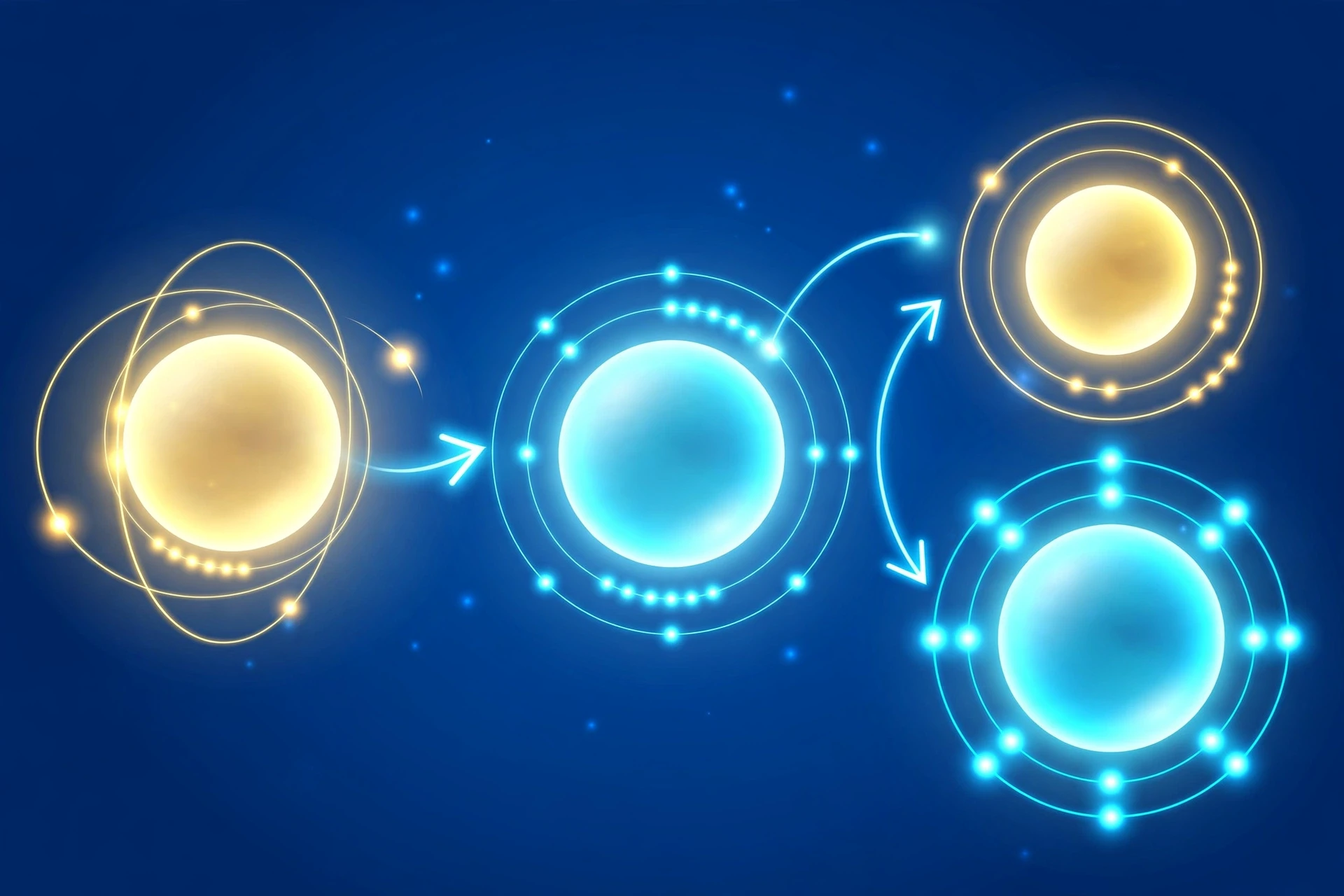
An ionic bond forms when one atom gives an electron to another atom. The atom that loses an electron becomes a positively charged ion, called a cation. The atom that gains the electron becomes a negatively charged ion, called an anion. Opposite charges attract, and that electrical attraction is the ionic bond. It is the simplest kind of chemical bond to picture: a clean trade, followed by a powerful attraction.
Table salt is the classic example. A sodium atom has one electron in its outer shell. A chlorine atom has seven and needs one more. Sodium gives its electron to chlorine. Sodium becomes Na⁺, chlorine becomes Cl⁻, and the two ions pull together into sodium chloride, NaCl. The energy released when the ions come together is large, which is why the resulting crystal is so stable.
3.1 From ions to crystals
Ionic bonds do not stop at pairs. A sodium ion attracts chloride ions in every direction, and each chloride ion attracts sodium ions in every direction, so the ions pack themselves into a regular three-dimensional pattern called a crystal lattice. That lattice is what you see when you look at a salt crystal: millions of ions arranged in neat rows, each one held in place by the attractions of its neighbours.
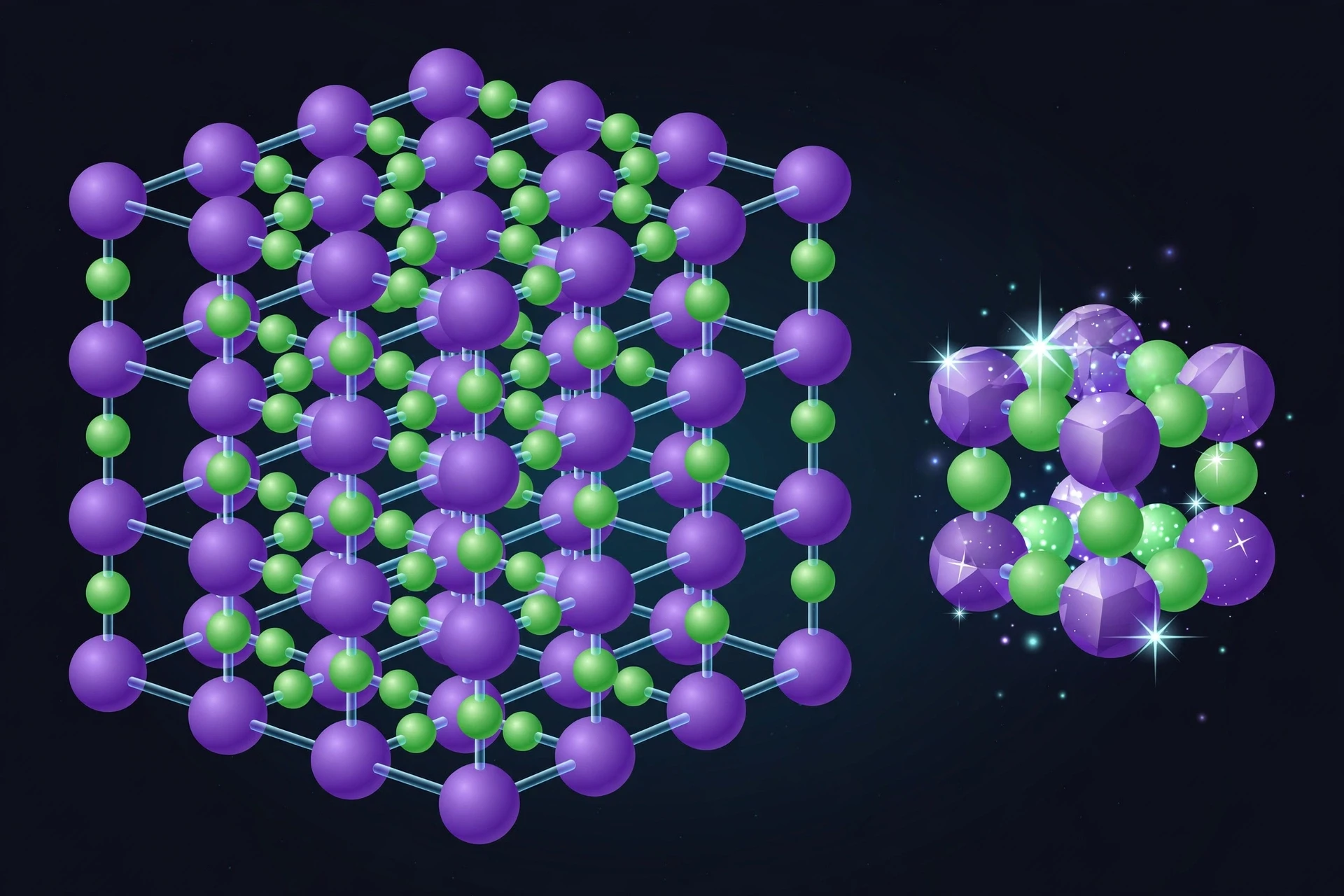
The lattice is the reason ionic compounds have the properties they do. Melting an ionic solid means pulling ions out of that strong, regular arrangement, which takes a great deal of heat — table salt melts at around 800 degrees Celsius. The lattice is also the reason ionic solids are brittle. Push the layers of a crystal sideways, even slightly, and ions of the same charge suddenly line up next to each other. Like charges repel, the crystal cracks along the fault line, and the whole piece shatters. That is why a salt crystal, held together by ionic chemical bonds, breaks cleanly instead of bending.
3.2 Why ionic compounds conduct electricity — sometimes
Here is a puzzle that catches many students out. Solid salt does not conduct electricity at all. Dissolve the same salt in water, or melt it, and suddenly it conducts well. Why? Because electricity in a solution is carried by moving charges, and in a solid ionic crystal the ions are locked in place. They cannot move, so they cannot carry charge. Melt the crystal or dissolve it, and the ions are free to move toward the electrodes, carrying charge as they go. Substances that conduct electricity when dissolved or melted are called electrolytes, and ionic compounds are the classic example.
I once watched a class try to light a bulb with a solid lump of salt pressed between two electrodes. Nothing happened. Then someone dropped the same lump into a beaker of water, stirred, and tried again — the bulb lit up. The salt had not changed its chemistry. Its ions had simply been set free. That is the difference between a bond and a property: the ionic bonds were there all along, but whether the substance conducts depends on whether its ions are free to move.
3.3 Where ionic bonds show up
Ionic compounds are everywhere in daily life, not just in the salt shaker. Calcium carbonate, CaCO₃, is the main ingredient in limestone, chalk, and seashells. Magnesium oxide is used in refractory bricks that line furnaces. Sodium hydroxide, better known as caustic soda, is used to make soap and to unblock drains. Many minerals are ionic compounds, and so are most of the salts dissolved in seawater. Whenever you see a metal combined with a non-metal in a formula — NaCl, KBr, MgO, CaF₂ — you are almost certainly looking at an ionic compound.
The OpenStax Chemistry textbook explains ionic bonding with clear diagrams of electron transfer and lattice formation, and it is a good place to check the details if you want to go deeper than this article.
3.4 Ionic bonding in one paragraph
An ionic bond is the electrical attraction between a positive ion and a negative ion after an electron has been transferred from a metal atom to a non-metal atom. The ions pack into a crystal lattice, which makes ionic compounds hard, brittle, and high-melting, and able to conduct electricity only when their ions are free to move. If you remember one image, make it the lattice: orderly, strong, and fragile in exactly the way that a neatly stacked wall of bricks is fragile when you push it sideways.
4. Covalent Bonds: Sharing Is Caring
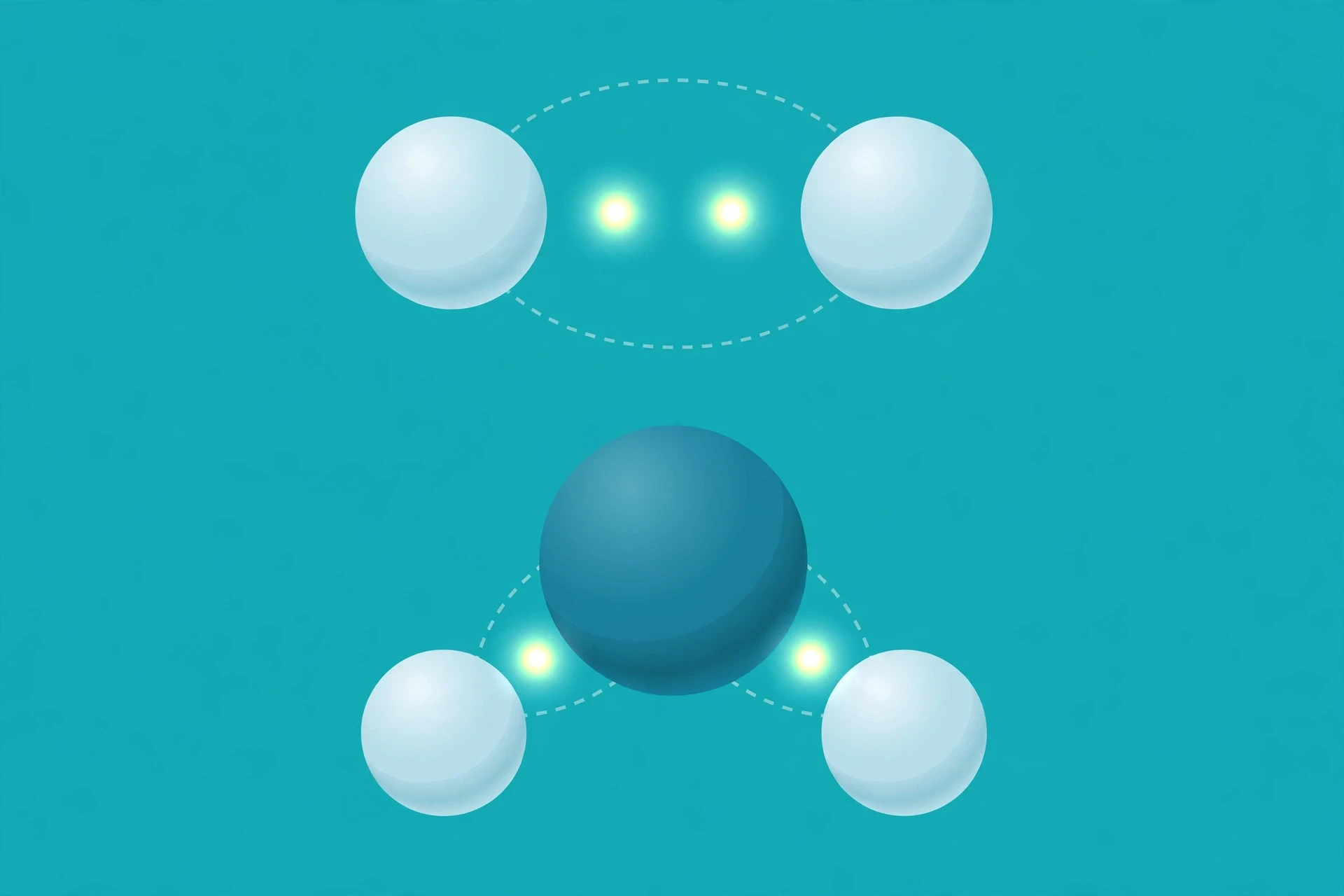
A covalent bond forms when two atoms share a pair of electrons. Instead of one atom giving and the other taking, both atoms contribute to a shared pair that spends time around both nuclei, holding them together. Covalent bonding is the chemical bond of the non-metals: hydrogen, oxygen, nitrogen, carbon, and their neighbours on the right-hand side of the periodic table, where atoms hold their electrons tightly and prefer to share rather than give them away.
The simplest covalent bond is in a hydrogen molecule, H₂. Each hydrogen atom has one electron and needs one more to fill its shell. The two atoms share their electrons, so each one effectively has two, and the shared pair holds the two nuclei together. Oxygen gas, O₂, works the same way, except the two oxygen atoms share two pairs of electrons — a double bond. Nitrogen gas, N₂, shares three pairs — a triple bond. The more pairs shared, the shorter and stronger the bond.
4.1 Single, double, and triple bonds
Covalent bonds come in strengths. A single bond shares one pair of electrons. A double bond shares two pairs. A triple bond shares three. Each extra shared pair pulls the atoms closer together and makes the bond harder to break. That is why nitrogen gas, with its triple bond, is so unreactive: breaking that bond takes a great deal of energy, so nitrogen mostly sits in the air doing nothing, even though it makes up most of the atmosphere.
Double bonds also change the shape of molecules. Carbon dioxide, CO₂, has two double bonds and is a straight molecule. Ethene, a simple hydrocarbon with a carbon–carbon double bond, is flat around that bond, and the two ends cannot twist past each other. That stiffness matters in biology: the shape of a molecule decides what it can fit into and what it can do, and double bonds are one of the tools nature uses to freeze a shape in place.
4.2 Polar and nonpolar covalent bonds
Not all sharing is fair. When two identical atoms share electrons — two hydrogens in H₂, two oxygens in O₂ — the sharing is perfectly equal, and the bond is called nonpolar covalent. But when two different atoms share, one of them usually pulls the shared electrons more strongly toward itself. The electrons spend more time near that atom, giving it a slight negative charge, while the other atom is left slightly positive. That is a polar covalent bond.
Water is the famous example. Oxygen pulls the shared electrons more strongly than hydrogen does, so each water molecule has a slightly negative oxygen end and slightly positive hydrogen ends. That uneven charge is what makes water such a good solvent and gives it so many of its strange properties, from its high boiling point to the way it expands when it freezes. Our article on Why Water Is the Weirdest Molecule explores those consequences in detail, and almost all of them trace back to the polar covalent bonds inside each water molecule and the hydrogen bonds between them.
A covalent bond is a shared pair of electrons, but sharing is rarely equal. The atom that pulls harder gets more than its fair share of the electrons, and that small imbalance shapes the whole personality of the molecule.
4.3 Lewis structures: drawing bonds on paper
Chemists draw covalent bonds with Lewis structures: dots for valence electrons and lines for shared pairs. A water molecule is drawn as an oxygen atom with two lines to two hydrogen atoms, plus two pairs of dots sitting on the oxygen that are not shared with anyone. Those unshared pairs are called lone pairs, and they matter more than they look: they push the bonds into a bent shape, which is why a water molecule is bent at an angle of about 104.5 degrees instead of straight.
Learning to draw Lewis structures is one of the most useful skills in chemistry, because a good Lewis structure tells you how many bonds an atom can make, where the lone pairs sit, and what shape the molecule is likely to have. The OpenStax guide to Lewis symbols and structures walks through the rules step by step with worked examples.
4.4 Molecules and their shapes
Covalent bonds do not just hold atoms together; they decide the shape of the molecule they build. Electrons repel each other, so the bonds and lone pairs around an atom spread out as far apart as they can. Four pairs spread into a tetrahedron, as in methane, CH₄. Three pairs spread into a flat triangle. Two pairs spread into a straight line. Add lone pairs and the shapes bend and pyramid: water is bent, ammonia is pyramidal. Chemists call this idea VSEPR theory — valence shell electron pair repulsion — and it is one of the most reliable predictive tools in chemistry.
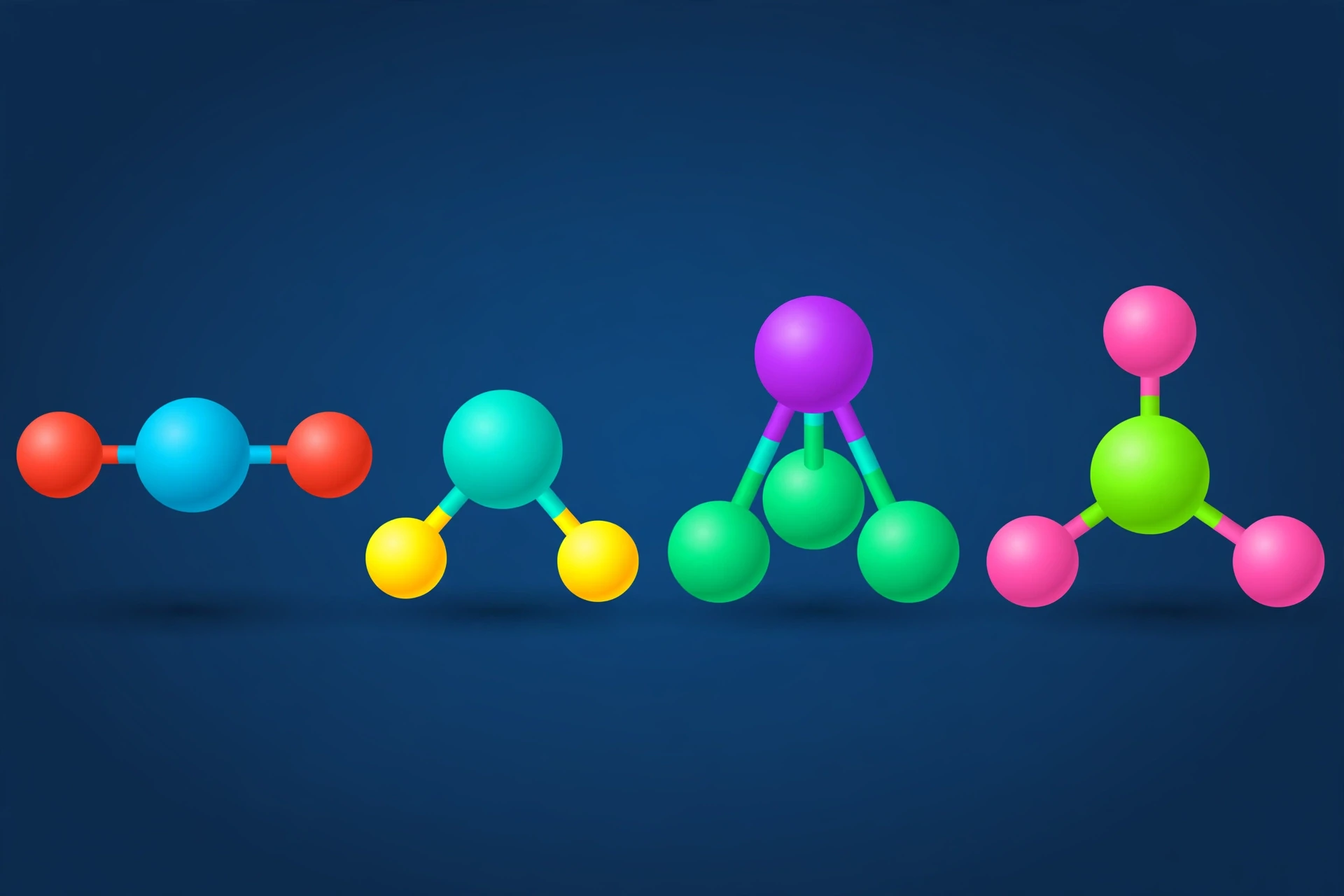
Shape matters because it decides how a molecule behaves. A bent water molecule has a positive end and a negative end, which is why it dissolves salts so well. A straight carbon dioxide molecule has no overall polarity, even though its individual bonds are polar, because the two ends cancel each other out. That is why carbon dioxide is a gas at room temperature while water is a liquid. Same atoms, different shapes, completely different substances.
4.5 Covalent networks: when molecules never end
Most covalent substances are made of separate small molecules — water, carbon dioxide, methane — and the forces between those molecules are weak, so the substances melt and boil easily. But a few covalent substances are different: their atoms are bonded into one enormous network that goes on and on, with no separate molecules at all. Diamond is the famous example. Every carbon atom in a diamond is bonded to four others in a tetrahedral network, and the whole crystal is effectively one giant molecule. That is why diamond is the hardest natural substance known and why it does not melt until extremely high temperatures. Graphite, the other form of pure carbon, is a network of flat sheets that slide over each other, which is why it feels slippery and works as pencil lead and as a lubricant.
Silicon dioxide, the main ingredient in sand and quartz, is another covalent network. Each silicon atom is bonded to four oxygens, each oxygen to two silicons, and the network extends through the whole grain of sand. Quartz crystals, sand on a beach, and the glass in a window are all built from the same endless covalent network, and their hardness and high melting points come from it.
5. Metallic Bonds: The Sea of Electrons
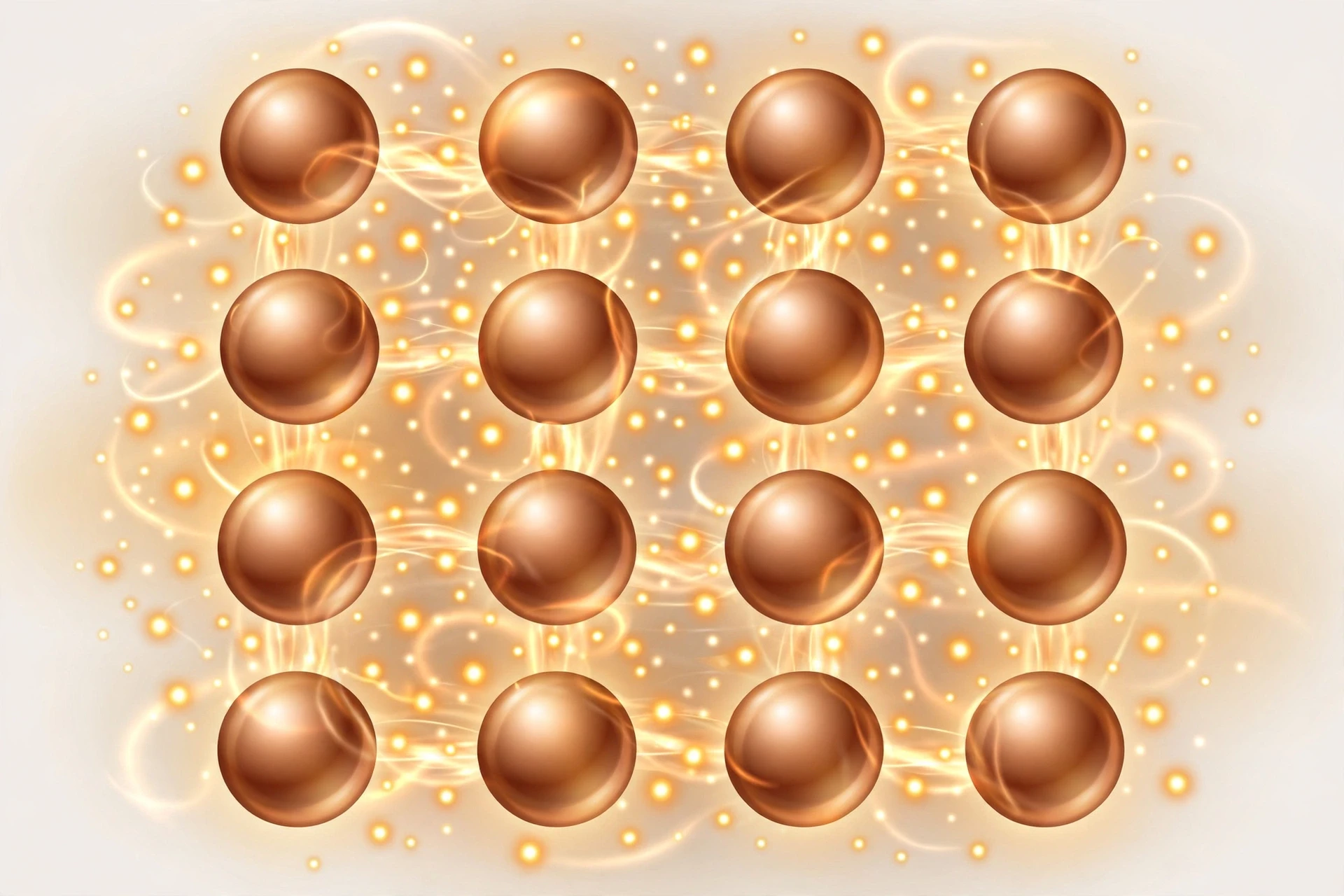
A metallic bond is a different kind of chemical bond from both ionic and covalent bonding. In a metal, the atoms give up their outer electrons not to one particular neighbour but to the whole piece of metal. Those electrons become delocalised — free to move through the entire structure — and the positive metal ions sit in a regular lattice, held together by their attraction to the shared sea of electrons. Chemists call this the "sea of electrons" model, and it explains almost everything about how metals behave.
5.1 Why do metals conduct electricity?
Why do metals conduct electricity? Because their electrons are already free. Apply a voltage to a copper wire and the delocalised electrons drift toward the positive end, carrying charge with them. No bonds need to break and no ions need to move. The electrons are simply there, waiting to flow. That is also why metals conduct heat so well: the free electrons carry thermal energy through the metal quickly, which is why a metal spoon in a hot drink gets hot at the handle end within seconds while a wooden spoon stays cool.
I learned this the hard way as a teenager, touching the metal handle of a pan that had been sitting on a stove. The handle was far from the flame, but the heat had travelled along it in moments. A wooden spoon in the same pan would have stayed cool enough to hold. The difference was not the temperature of the stove. It was the metallic bond: free electrons carrying energy through the metal, and no free electrons in the wood to do the same job.
5.2 Why metals bend instead of breaking
Metals are malleable and ductile: they can be hammered into sheets and drawn into wires without breaking. The sea of electrons explains that too. When you hammer a metal, the layers of ions slide past each other, but the electrons simply flow along with them, keeping the attraction going in the new position. There is no moment when like charges line up and repel, as there is in an ionic crystal. That is why you can bend a copper wire back and forth many times before it finally snaps, while a salt crystal shatters at the first tap.
Alloys make the point even clearer. Pure gold is so soft you can dent it with a fingernail, so jewellers mix it with copper or silver to make it harder. The foreign atoms disrupt the neat layers of the lattice and make it harder for the layers to slide, which makes the alloy stronger. Steel is iron with a small amount of carbon added, and that small addition changes the metal from something relatively soft into the backbone of bridges and skyscrapers. The chemistry of alloys is the chemistry of the metallic bond, tuned by mixing.
5.3 Metals in everyday life
Metallic bonding is behind the materials that built the modern world. Copper wiring carries electricity into every home. Aluminium, light and resistant to corrosion, frames aeroplanes and wraps food. Iron and steel hold up buildings and bridges. Gold and silver, which do not tarnish easily, have been used for jewellery and coins for thousands of years. Even the Periodic Table tells the story: most of the elements are metals, and their position on the left and in the middle of the table marks them out as elements that give up electrons easily and form metallic bonds.
6. Hydrogen Bonds: Weak Alone, Mighty Together
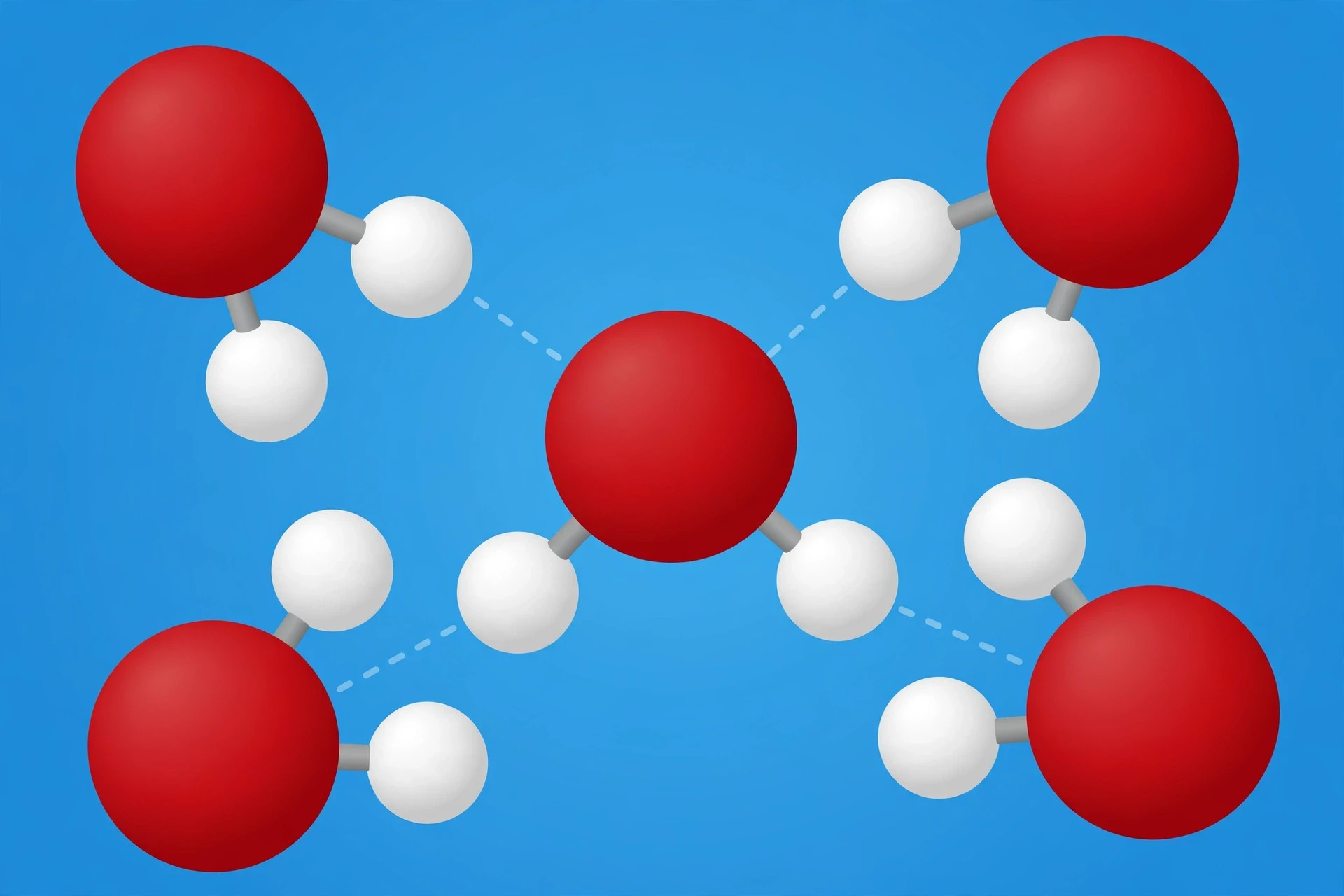
Hydrogen bonding is the odd one out among chemical bonds, because it is not a bond within a molecule at all. It is an attraction between molecules. A hydrogen bond forms when a hydrogen atom that is already covalently bonded to a very electronegative atom — oxygen, nitrogen, or fluorine — is attracted to a lone pair of electrons on another oxygen, nitrogen, or fluorine atom in a nearby molecule. The hydrogen carries a slight positive charge, the other atom carries a slight negative charge, and the two attract each other.
Each hydrogen bond is weak — roughly a tenth as strong as a covalent bond — and on its own it would not hold much together. But there are usually a great many of them, and together they add up to something powerful. A single water molecule can form up to four hydrogen bonds with its neighbours, and the network of hydrogen bonds in liquid water is the reason water boils at 100 degrees Celsius while similar-sized molecules without hydrogen bonding boil far below zero.
6.1 What is hydrogen bonding?
What is hydrogen bonding, in one sentence? It is the attraction between a hydrogen atom bonded to oxygen, nitrogen, or fluorine in one molecule and a lone pair of electrons on oxygen, nitrogen, or fluorine in another molecule. Three conditions have to be met: the hydrogen must be attached to one of those three highly electronegative atoms, the other atom must have a lone pair, and the two molecules must be close enough for the attraction to work. Hydrogen attached to carbon, for example, does not form hydrogen bonds, because carbon is not electronegative enough to leave the hydrogen with a strong partial positive charge.
That rule is the key to a classic exam question: why does water boil at a much higher temperature than hydrogen sulfide, H₂S, even though sulfur sits just below oxygen in the periodic table? The answer is hydrogen bonding. Water molecules are stitched together by hydrogen bonds, so a lot of heat is needed to pull them apart. Hydrogen sulfide molecules cannot form hydrogen bonds, so they separate easily and the substance is a gas at room temperature.
6.2 Hydrogen bonds in water, DNA, and proteins
Hydrogen bonding is the reason water behaves the way it does. It gives water its high boiling point, its high heat capacity — which is why the oceans moderate the climate — and its strange habit of expanding when it freezes, so that ice floats instead of sinking. If ice sank, lakes would freeze from the bottom up and aquatic life would have nowhere to survive the winter. The hydrogen bonds in water are, quietly, one of the reasons life on Earth is possible.
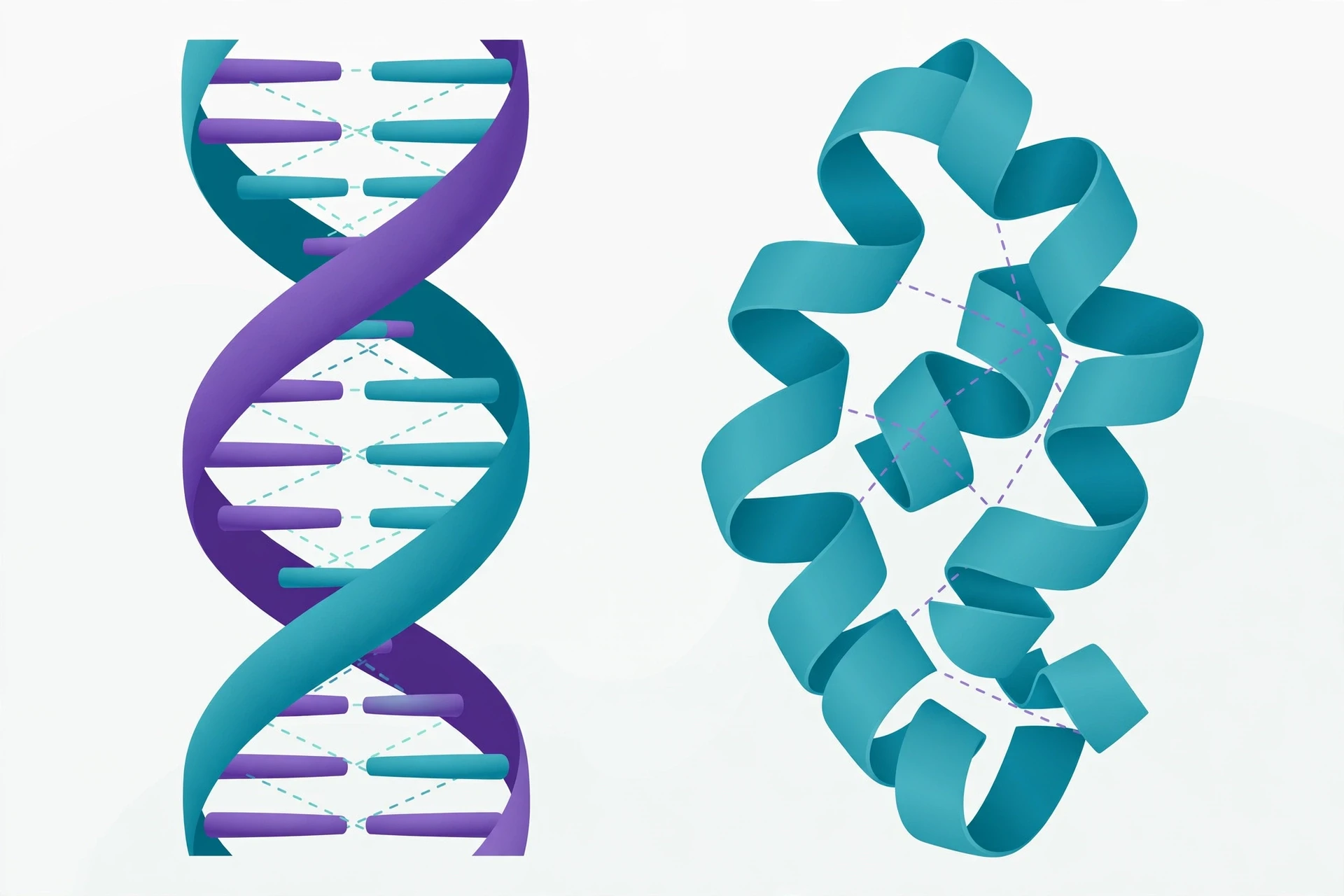
The same weak attraction does heavy work inside living things. The two strands of DNA are held together by hydrogen bonds between the base pairs: two hydrogen bonds between adenine and thymine, three between guanine and cytosine. Those bonds are strong enough to hold the double helix together and weak enough to be unzipped when the cell needs to copy its DNA. Proteins fold into their working shapes with the help of hydrogen bonds between different parts of the chain. If hydrogen bonds were as strong as covalent bonds, DNA could never be unzipped and proteins could never change shape. If they did not exist at all, DNA would fall apart and proteins would never fold. Life runs on the fact that hydrogen bonds are exactly as weak as they are.
6.3 Other attractions between molecules
Hydrogen bonding is the strongest of the attractions between molecules, but it is not the only one. All molecules attract each other weakly through van der Waals forces, which come from fleeting unevenness in their electron clouds. At any instant, the electrons in a molecule may be slightly more on one side than the other, creating a temporary partial charge that attracts a neighbouring molecule. These forces are weak, but in large molecules with many electrons they add up. They are the reason large hydrocarbons are liquids or solids while small ones are gases, and the reason geckos can stick to walls: millions of tiny hairs on their feet make close contact with the surface, and the van der Waals forces add up to enough grip to hold the animal's weight.
Polar molecules also attract each other through dipole–dipole forces: the positive end of one molecule attracted to the negative end of another. These are stronger than van der Waals forces but weaker than hydrogen bonds. Together, hydrogen bonds, dipole–dipole forces, and van der Waals forces are called intermolecular forces — attractions between molecules, as opposed to the chemical bonds within them. Keeping that distinction straight is one of the most important habits in chemistry: boiling water breaks hydrogen bonds between molecules, not the covalent bonds inside them. The water molecules survive boiling intact. They simply move apart.
Boiling a kettle does not break water molecules apart. It breaks the hydrogen bonds between them. The covalent bonds inside each water molecule stay exactly as they were — which is why steam is still H₂O, not a mixture of hydrogen and oxygen gas.
7. Electronegativity: The Scale That Decides the Bond
If there is one idea that ties this whole article together, it is electronegativity: a measure of how strongly an atom pulls shared electrons toward itself. Fluorine pulls hardest of all. Caesium pulls least. Oxygen, nitrogen, and chlorine pull hard. Metals pull weakly. When two atoms form a bond, the difference between their electronegativities decides what kind of bond it is — or, more precisely, where on the scale between pure covalent and pure ionic the bond sits.
The rule of thumb that textbooks use is simple. If the electronegativity difference between two atoms is small — roughly less than 0.5 — the bond is nonpolar covalent: the electrons are shared almost equally. If the difference is moderate — roughly 0.5 to 1.7 — the bond is polar covalent: the electrons are shared unequally. If the difference is large — roughly above 1.7 — the bond is ionic: the electron is effectively transferred. These cut-off points are guides, not laws of nature, and chemists argue about the exact numbers. What matters is the pattern: bigger difference, more ionic character.

7.1 Reading the periodic table for bond type
Electronegativity follows a clear pattern across the periodic table, and once you know the pattern you can predict a lot about a bond before you ever see the substance. Electronegativity increases across a period, from left to right, because the nucleus gains protons and pulls harder on the electrons. It decreases down a group, because the outer electrons are further from the nucleus and shielded by more inner shells. That means the most electronegative elements are in the top right of the table — fluorine, oxygen, nitrogen, chlorine — and the least electronegative are in the bottom left — caesium, francium, rubidium.
That pattern is why a metal on the far left and a non-metal on the far right make an ionic compound: their electronegativity difference is huge. It is why two non-metals on the right make a covalent compound: their difference is small. And it is why hydrogen, which sits in an awkward position at the top of the table, can bond covalently with non-metals and ionically with very reactive metals such as sodium and calcium. Our guide to the Periodic Table covers these trends in more detail, including the way electronegativity, atomic size, and ionisation energy all march in step across the table.
7.2 The continuum: no bond is purely one type
Here is a subtlety that textbooks sometimes gloss over. Even the most ionic bond has a little covalent character, and even the most covalent bond has a little ionic character. Sodium chloride is usually called ionic, and for most purposes that is right, but the electron is not completely transferred — the chloride ion's electron cloud is slightly distorted toward the sodium. Hydrogen fluoride is usually called polar covalent, but the bond is so uneven that it behaves almost like an ionic bond in some ways. Chemists accept this messiness. The categories are tools for thinking, not boxes that nature is obliged to respect.
That is also why the cut-off of 1.7 is only a guide. Aluminium chloride, AlCl₃, has an electronegativity difference that puts it near the ionic end, but it melts at a low temperature and behaves in many ways like a covalent compound. Tin(IV) chloride, SnCl₄, is a liquid at room temperature despite being a metal chloride. These awkward cases are not failures of the theory. They are reminders that bonding is a continuum, and that the interesting chemistry often happens in the grey areas between the categories.
8. How Chemical Bonds Shape Properties
The type of chemical bond in a substance decides its properties: how it melts, whether it conducts electricity, whether it dissolves in water, and whether it bends or breaks. This section is the payoff for everything so far. If you can connect bond type to property, you can look at an unfamiliar substance and predict how it will behave — which is exactly the skill exam papers test and the skill that makes chemistry useful in the real world.
8.1 Melting and boiling points
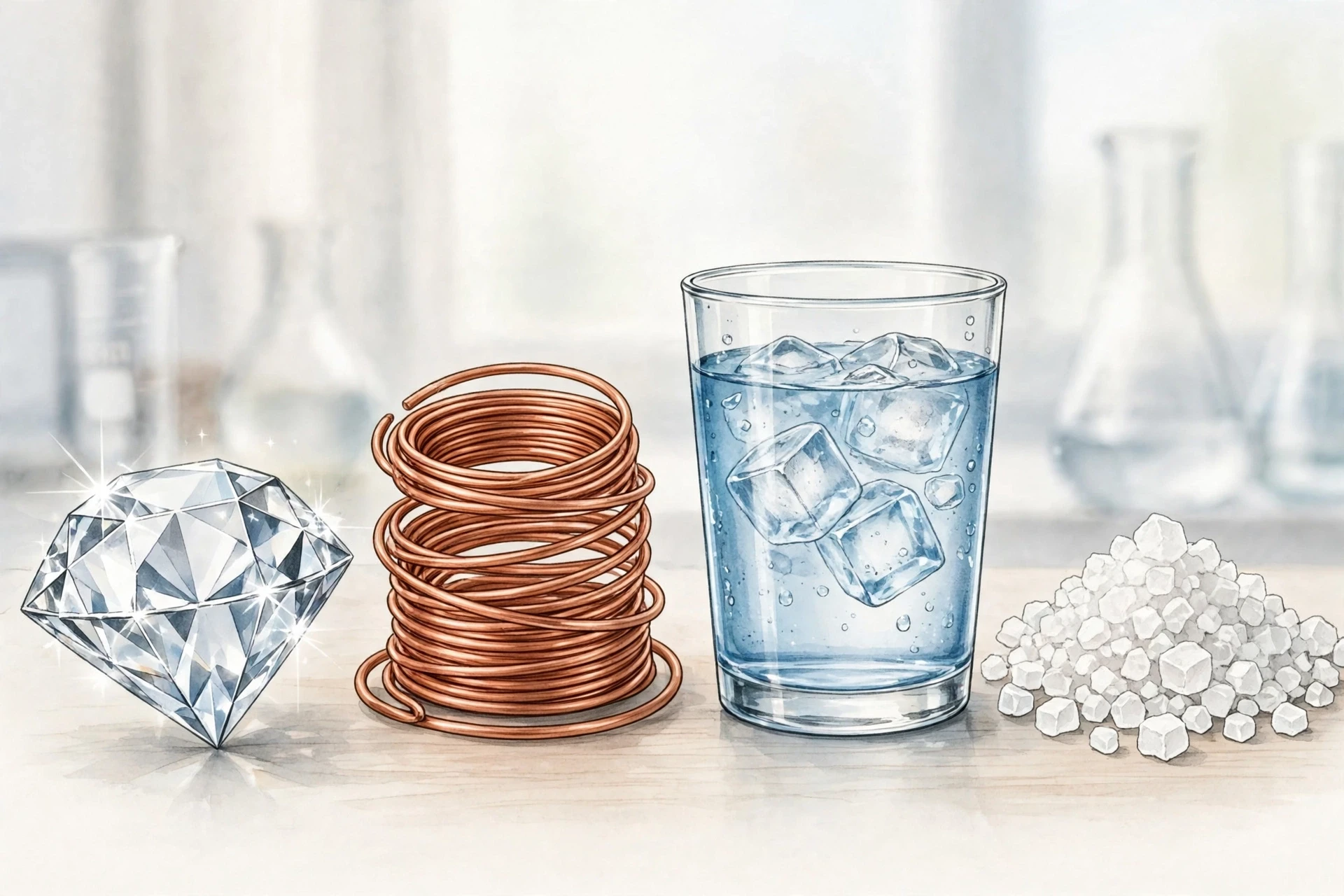
Melting and boiling points are a direct measure of how much energy it takes to pull particles apart, so they reveal the strength of the bonding. Ionic compounds and covalent networks have high melting points because their bonds are strong and extend through the whole structure. Diamond does not melt until well above 3,000 degrees Celsius. Table salt melts at around 800 degrees. Small covalent molecules, by contrast, melt and boil at low temperatures because only the weak attractions between molecules need to be broken, not the covalent bonds inside them. Water boils at 100 degrees Celsius, methane at far below zero, and carbon dioxide goes straight from solid to gas at about minus 78 degrees.
Hydrogen bonding breaks the pattern in an instructive way. Water should, by its size, boil at a temperature well below zero, like the similar molecules hydrogen sulfide and ammonia's neighbours. It boils at 100 degrees instead, because hydrogen bonds hold the molecules together. That single fact — a boiling point far higher than size alone would predict — is one of the clearest fingerprints of hydrogen bonding, and it is worth remembering whenever a question asks you to spot it.
8.2 Conductivity
Conductivity depends on whether charged particles are free to move. Metals conduct because their electrons are free. Ionic compounds conduct when molten or dissolved because their ions are free. Covalent substances almost never conduct, because their electrons are locked into shared pairs and there are no free ions. That gives a simple laboratory test: if a substance conducts electricity when melted, it is probably ionic or metallic. If it never conducts, it is probably covalent.
There are exceptions that prove the rule, and graphite is the best of them. Graphite is covalent, but it conducts electricity. The reason is its structure: each carbon atom in graphite is bonded to three others in flat sheets, leaving one electron per atom free to move within the sheet. Those delocalised electrons carry charge, just as the sea of electrons does in a metal. Graphite is the exception that shows the rule is really about free charges, not about the label on the bond.
8.3 Solubility: like dissolves like
Solubility follows a simple rule: like dissolves like. Polar substances dissolve in polar solvents, and nonpolar substances dissolve in nonpolar solvents. Water is polar, so it dissolves ionic compounds and polar molecules well. The slightly negative oxygen ends of water molecules surround positive ions, the slightly positive hydrogen ends surround negative ions, and the ions are pulled out of their lattice and into solution. That is why salt disappears in water and why sugar, a polar molecule covered in oxygen–hydrogen groups, dissolves so easily.
Oil, by contrast, is nonpolar, so it does not dissolve in water. Shake oil and water together and they separate into layers, because the water molecules would rather hydrogen-bond to each other than make room for nonpolar oil molecules. That is also why soap works: a soap molecule has a polar end that likes water and a nonpolar end that likes oil, so it can bridge the two and carry grease away. The chemistry of cleaning is, at bottom, the chemistry of chemical bonds and polarity.
8.4 Hardness, brittleness, and flexibility
Hardness and brittleness follow from the structure of the bonding. Ionic crystals are hard but brittle, because their lattice is strong and shatters when like charges line up. Covalent networks are hard and do not bend, because their bonds are directional and lock atoms into place. Metals are soft enough to bend, because their bonds are not directional — the sea of electrons holds the ions together whatever position they slide into. Small covalent molecules are soft and low-melting, because the molecules are held together only by weak attractions that give way easily.
Bond type | Structure | Melting point | Conducts electricity? | Typical examples |
|---|---|---|---|---|
Ionic | Crystal lattice of ions | High | When melted or dissolved | Sodium chloride, calcium carbonate, magnesium oxide |
Covalent (small molecules) | Separate molecules | Low | No | Water, carbon dioxide, methane, oxygen |
Covalent (network) | Giant network of atoms | Very high | No (except graphite) | Diamond, silicon dioxide, graphite |
Metallic | Lattice of ions in a sea of electrons | High (varies widely) | Yes, always | Copper, iron, aluminium, gold |
Hydrogen bonding | Attraction between molecules | Raises boiling point | No | Water, DNA base pairs, proteins |
The table above is worth memorising in outline, because it turns the four bond types into predictions. Given a substance, find its bond type, and the table tells you roughly what to expect. Given a property — a high melting point, say, or the ability to conduct — the table narrows down the bond type. That two-way thinking is the core skill of this topic.
9. Chemical Bonds in Everyday Life and in Living Things
Chemical bonds are not confined to textbooks. They are the reason bread rises, soap cleans, steel holds up bridges, and your body works at all. This section follows the bonds out of the classroom and into the kitchen, the workshop, and the cell, because that is where the ideas earn their keep.
9.1 In the kitchen
Cooking is applied bond chemistry. When you boil an egg, heat breaks hydrogen bonds and other weak attractions in the egg-white proteins, the proteins unfold, and then they form new bonds with each other, turning the clear liquid white and solid. That change cannot be undone by cooling the egg down, because new bonds have formed. When bread rises, yeast produces carbon dioxide, and the gas is trapped in a network of gluten proteins held together by hydrogen bonds and other attractions, giving the loaf its structure. When you dissolve sugar in tea, polar water molecules pull polar sugar molecules into solution. When you fry food in oil, the high temperature breaks bonds in the food and forms new ones, creating the flavours and the crisp crust.
Salt deserves a second mention here. It does more than season food. Its ions help to preserve food by drawing water out of microbes, it strengthens gluten in bread dough, and it controls the fermentation of pickles and cheese. All of that comes from a single ionic compound, NaCl, and the way its ions interact with water and with proteins.
9.2 In technology and materials
The materials of modern life are chosen for their bonding. Steel bridges rely on metallic bonding for strength and flexibility. Silicon chips rely on the covalent network of silicon, which can be doped with tiny amounts of other elements to control its electrical behaviour — the foundation of all electronics. Glass relies on the covalent network of silicon dioxide, which is transparent because its bonds do not absorb visible light. Diamond-tipped cutting tools rely on the covalent network of diamond, the hardest natural material. Teflon, the non-stick coating on pans, relies on carbon–fluorine covalent bonds, which are so strong and so unreactive that almost nothing sticks to them.
Batteries are bond chemistry in a box. A battery stores energy in chemical bonds and releases it as electricity when those bonds rearrange. Rechargeable batteries reverse the process, using electricity to rebuild the bonds. The lithium-ion batteries in phones and electric cars work by moving lithium ions back and forth between two electrodes, and the whole technology is a careful balancing act of bond energies: strong enough to store useful energy, weak enough to release it on demand.
9.3 In the human body
Your body is a chemical-bond machine. The proteins that do almost all the work in your cells — enzymes, antibodies, muscle fibres — fold into their shapes with the help of hydrogen bonds, and their activity depends on those shapes. DNA stores information in a sequence of covalent bonds and is held in its double helix by hydrogen bonds. The calcium phosphate in your bones is an ionic compound, hard and strong because of its lattice. The fats in your cell membranes are held together by weak attractions that let the membrane flow and flex. Even the act of breathing involves bonds: oxygen molecules are carried through your blood bound to iron atoms in haemoglobin, and the bond is weak enough to let the oxygen go when it reaches your tissues.
I remember the moment this clicked for me, years after the salt-water bulb demonstration. I was reading about how a single change in the shape of a protein — one hydrogen bond gained or lost — can be the difference between a working enzyme and a disease. The bonds are tiny and invisible, but their consequences are as large as anything in medicine. Chemistry is not a subject that stays in the laboratory. It is the subject that explains why bodies work and why they sometimes do not.
9.4 Bonds and chemical reactions
Chemical bonds are also the currency of chemical reactions. A reaction is, at its simplest, old bonds breaking and new bonds forming. Burn methane in air and the carbon–hydrogen and oxygen–oxygen bonds break, while carbon–oxygen and oxygen–hydrogen bonds form, releasing energy as heat and light. Digest food and enzymes break the bonds in starches and proteins, releasing energy your cells can use. Photosynthesis does the reverse, using sunlight to build new bonds in glucose. If you want to follow that thread further, our article on Chemical Reactions explains reaction types, rates, and energy changes in detail, and every reaction it describes is a story of bonds breaking and forming.
Every chemical reaction is a rearrangement of chemical bonds. Energy in, bonds break; bonds form, energy out. Follow the bonds and you can follow the reaction.
10. Common Mistakes About Chemical Bonds
Students make the same mistakes about chemical bonds year after year, and most of them come from mixing up ideas that sound similar. This section names the common ones plainly, because knowing what is wrong is often the fastest way to get something right.
10.1 "Ionic bonds share electrons"
No. Ionic bonds transfer electrons. Covalent bonds share them. Mixing the two up is the single most common error in this topic, and it usually comes from memorising the words without the picture. If you can picture sodium giving an electron to chlorine, and two hydrogens sharing a pair, you will not mix them up. The test is simple: ask whether an electron changes owner or whether it is shared. Transfer means ionic. Sharing means covalent.
10.2 "Hydrogen bonds are strong because water is hard to boil"
Hydrogen bonds are weak — roughly a tenth as strong as a covalent bond. Water is hard to boil not because each hydrogen bond is strong but because there are so many of them. Four hydrogen bonds per molecule, multiplied by a huge number of molecules, adds up to a large total energy. The strength is in the numbers, not in the individual bond. The same logic applies to DNA: each hydrogen bond between base pairs is weak, but thousands of them hold the helix together.
10.3 "Metals conduct because their ions move"
Metals conduct because their electrons move, not their ions. The ions in a metal are locked in a lattice and do not move. It is the delocalised electrons in the sea that carry the charge. Ionic compounds are the opposite: their electrons are locked into ions, and it is the ions themselves that move when the compound is melted or dissolved. Getting the moving particle right — electrons in metals, ions in electrolytes — is the difference between a correct answer and a wrong one.
10.4 "Breaking bonds releases energy"
This one is backwards, and it trips up even good students. Breaking a bond takes energy in. Forming a bond releases energy out. A reaction releases energy overall only when the bonds formed are stronger than the bonds broken. Burning fuel releases energy because the new bonds in carbon dioxide and water are stronger than the old bonds in the fuel and oxygen. The energy was not stored in the bonds that broke. It was released by the bonds that formed. Keep that sentence and the whole topic of energy in reactions becomes clearer.
10.5 "All compounds with a metal are ionic"
Mostly true, but not always. Aluminium chloride behaves like a covalent compound in many ways. Beryllium chloride is covalent. Tin(IV) chloride is a liquid. The reason is that small, highly charged metal ions can distort the electron clouds of their neighbours, pulling the bond toward the covalent end of the scale. The rule of thumb — metal plus non-metal means ionic — works for the common cases, and the exceptions are worth knowing about precisely because they show that the rule is a guide, not a law.
10.6 "Covalent compounds never conduct"
Almost never — but graphite does, as section 8 explained, because it has delocalised electrons. Molten aluminium chloride conducts a little. Some covalent substances conduct when dissolved in water because they react with the water to form ions: hydrogen chloride gas does not conduct, but dissolve it in water and it forms hydrochloric acid, which conducts well. The careful statement is that covalent substances do not conduct in their pure form, because they have no free charges. Add free charges, and the story changes.
11. How to Predict the Type of Chemical Bond
You can work out the likely bond type of a substance with a short sequence of questions. It is not a perfect method — the exceptions in section 10 prove that — but it gets the right answer for the substances you will meet most often.
Look at the elements involved. A metal plus a non-metal usually means an ionic bond. Two non-metals usually means a covalent bond. A single metal on its own means a metallic bond.
Check the electronegativity difference. A large difference points toward ionic. A small difference points toward nonpolar covalent. A middle difference points toward polar covalent. The Royal Society of Chemistry's introduction to chemical bonding is a clear, teacher-friendly guide to this step.
Look at the formula. A compound of a metal and a non-metal with a simple ratio, such as NaCl or MgO, is likely ionic. A compound of two non-metals, such as CO₂ or NH₃, is likely covalent.
Check the properties if you know them. A high melting point and conduction when melted point toward ionic. A low melting point and no conduction point toward covalent. Shiny, bendable, and conducting point toward metallic.
Ask about hydrogen bonding separately. If the substance contains hydrogen bonded to oxygen, nitrogen, or fluorine, expect hydrogen bonds between its molecules, whatever its main bond type is. Water, ammonia, and hydrogen fluoride all show hydrogen bonding, and so do alcohols and many biological molecules.
Work through an example. Sodium chloride: sodium is a metal, chlorine is a non-metal, the electronegativity difference is large, the melting point is high, and it conducts when melted. Every test points the same way: ionic. Water: hydrogen and oxygen are both non-metals, the difference is moderate, the melting point is low, it does not conduct when pure, and it contains hydrogen bonded to oxygen. Every test points the same way: polar covalent bonds inside the molecule, hydrogen bonds between molecules. That two-level answer — bonds within, attractions between — is the mark of someone who really understands the topic.
The LibreTexts guide to chemical bonds covers the same ground with more worked examples, and the American Chemical Society's ChemMatters article on chemical bonding explains it in plain language aimed at students. For a quick visual revision, the Khan Academy lesson on types of chemical bonds is a useful companion to this article.
12. Frequently Asked Questions
What are the types of chemical bonds?
The main types of chemical bonds are ionic, covalent, and metallic bonds, plus hydrogen bonding, which is a weaker attraction between molecules. Ionic bonds transfer electrons from a metal to a non-metal. Covalent bonds share electrons between non-metals. Metallic bonds let electrons move freely through a whole piece of metal. Hydrogen bonds form between molecules where hydrogen is attached to oxygen, nitrogen, or fluorine. Together, these four cover almost every substance you will meet.
What is the difference between ionic and covalent bonds?
The difference between ionic and covalent bonds is what happens to the electrons. In an ionic bond, one atom transfers an electron to another, creating a positive ion and a negative ion that attract each other. In a covalent bond, two atoms share a pair of electrons, and the shared pair holds them together. Ionic bonds usually form between a metal and a non-metal and build crystal lattices. Covalent bonds usually form between two non-metals and build molecules. Ionic compounds tend to have high melting points and conduct when melted or dissolved, while covalent molecular substances tend to have low melting points and do not conduct.
What is hydrogen bonding?
Hydrogen bonding is a weak attraction between molecules that forms when a hydrogen atom bonded to oxygen, nitrogen, or fluorine is attracted to a lone pair of electrons on another oxygen, nitrogen, or fluorine atom. Each hydrogen bond is weak, roughly a tenth as strong as a covalent bond, but large numbers of them together have big effects: they give water its high boiling point, hold the two strands of DNA together, and help proteins fold into their working shapes. Hydrogen bonding is an attraction between molecules, not a bond within a molecule, and it does not involve sharing or transferring electrons.
Why do metals conduct electricity?
Metals conduct electricity because their outer electrons are delocalised — free to move through the whole piece of metal in a "sea of electrons". When a voltage is applied, these free electrons drift toward the positive end and carry charge with them. The metal ions themselves stay locked in their lattice and do not move. That is why a copper wire conducts even at room temperature, and why metals also conduct heat well: the same free electrons carry thermal energy through the metal.
Why does salt dissolve in water but oil does not?
Salt dissolves in water because water is polar and salt is ionic. The slightly negative oxygen ends of water molecules surround the positive sodium ions, the slightly positive hydrogen ends surround the negative chloride ions, and the ions are pulled out of the crystal and into solution. Oil does not dissolve because it is nonpolar: water molecules would rather hydrogen-bond to each other than make room for oil molecules, so oil and water separate into layers. The rule is "like dissolves like": polar substances dissolve in polar solvents, nonpolar in nonpolar.
Which type of chemical bond is the strongest?
Covalent and ionic bonds are both strong, and which is stronger depends on the specific substances being compared. A carbon–carbon covalent bond in diamond is extremely strong, and the ionic bonds in a salt crystal are also very strong — that is why both diamond and salt have high melting points. Metallic bonds vary widely, from soft metals such as sodium to very strong ones such as tungsten. Hydrogen bonds are much weaker than any of the three main bond types, but large numbers of them together can hold big structures such as DNA together. There is no single "strongest bond" for all cases; the answer always depends on the substance.
How can you tell what type of bond a compound has?
Look at the elements first: metal plus non-metal usually means ionic, two non-metals usually means covalent, and a pure metal means metallic. Then check the electronegativity difference between the atoms: a large difference points toward ionic, a small one toward nonpolar covalent, and a middle value toward polar covalent. Finally, check the properties if you know them: high melting point and conduction when melted suggest ionic, low melting point and no conduction suggest covalent, and a shiny, bendable, conducting solid suggests metallic. If the compound contains hydrogen bonded to oxygen, nitrogen, or fluorine, expect hydrogen bonding between its molecules as well.