

The first time I watched a child taste a lemon, I learned more about chemistry than any textbook had managed to teach me up to that point. She was two years old, sitting in a high chair, and someone handed her a wedge as a joke. She bit down, her whole face folded in on itself, her eyes squeezed shut, and then — to everyone's surprise — she reached for another bite. That face — sour, startled, delighted — is the human body's oldest response to acids and bases. Long before anyone knew what a hydrogen ion was, people knew sour meant acid. Vinegar stung the tongue, unripe fruit made your mouth pucker, and spoiled milk turned sharp. On the other side of the kitchen, soap felt slippery between wet fingers, baking soda fizzed when it met vinegar, and a paste of baking soda and water soothed a bee sting. Acids and bases were part of daily life thousands of years before chemistry had names for them.
That is where this story begins: not in a laboratory, but in a kitchen, a garden, and a bathroom cabinet. Acids and bases are two of the most common kinds of chemicals on Earth, and they shape far more of your life than you probably realize. The coffee you drank this morning is mildly acidic. The soap you washed with is basic. Your stomach makes hydrochloric acid strong enough to dissolve metal, and your blood carries a chemical system that keeps its own acidity within a hair's breadth of neutral. The rain that falls on a forest, the fizz in a soft drink, the antacid tablet you reach for after a rich meal — all of them are chapters in the same story.
What makes acids and bases worth a long look is not just that they are everywhere. It is that they are opposites that complete each other. Mix an acid and a base in the right amounts and they cancel each other out, leaving salt and water. That single fact — called neutralization — sits behind antacid medicine, wastewater treatment, baking, farming, and the chemistry that keeps your blood alive. Once you see the pattern, you start spotting acids and bases everywhere: in the sting of a nettle, in the reason red cabbage changes color in different sauces, in the way limestone buildings slowly dissolve in city rain.
This guide explains acids and bases from the ground up. It starts with what you can see, taste, and feel, then works down to the particles doing the work — protons and hydroxide ions — and back up to the pH scale, the strength of acids, neutralization, and the everyday and industrial places where these ideas matter. You do not need a chemistry background to follow it. You only need curiosity, a lemon, and a willingness to look at familiar things with fresh eyes.
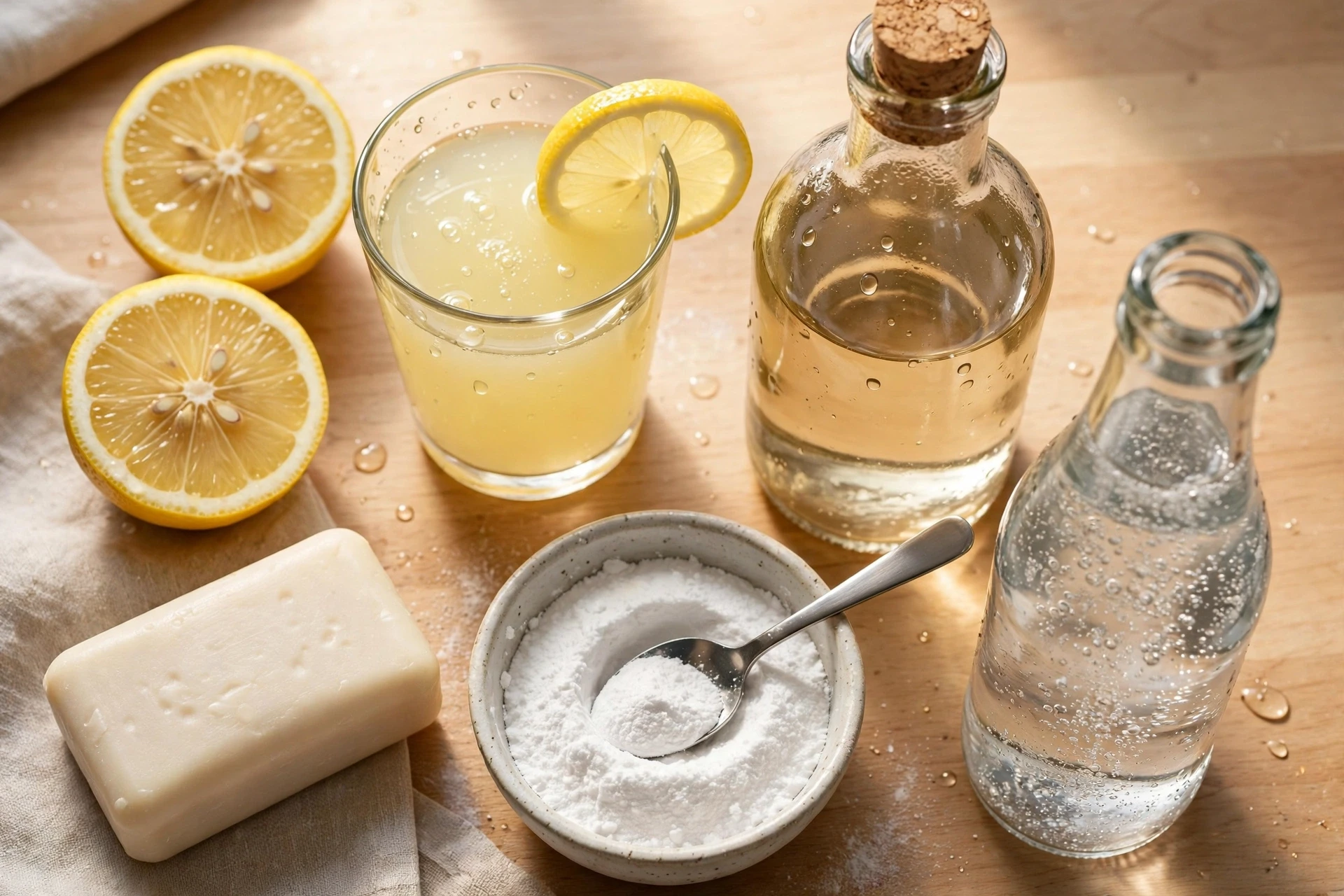
1. The Sour, the Slippery, and the Sting: Meeting Acids and Bases in Everyday Life
Before chemists had definitions, they had senses. An acid was something that tasted sour, reacted with metals to release a flammable gas, and turned certain plant dyes red. A base — once called an alkali — was something that felt slippery, tasted bitter, and turned the same dyes blue. Those rough tests worked surprisingly well, and they still work today. Squeeze lemon juice onto a piece of blue litmus paper and it turns red. Dip the same paper in a solution of washing soda and it turns blue. The kitchen tests of the seventeenth century were crude, but they were pointing at something real.
I keep a small mental catalogue of the acids and bases I meet before breakfast. The orange juice is acidic, which is why it stings a cut on the lip. The coffee is acidic too, mildly, and that acidity is part of its flavour — coffee without any acid tastes flat and dull. The toothpaste is slightly basic, which helps neutralize the acids that mouth bacteria produce overnight. The soap is basic, and that slippery feeling on wet skin is a base reacting with the oils on your hands, turning them into a kind of soap itself. None of this is exotic. Acids and bases are the background chemistry of an ordinary morning.
The word "acid" comes from the Latin acidus, meaning sour, and that tells you how people first met these substances: by taste. The word "base" has a different history. Early chemists thought of a base as the foundation, the substance that an acid acted upon — the thing that stayed behind when an acid reacted with a metal oxide or a carbonate. An alkali is a base that dissolves in water, and the word comes from the Arabic al-qali, the ashes of saltwort plants, from which early soap-makers extracted the alkaline substance they needed. That is why the two words are often used as if they mean the same thing, even though they do not quite: every alkali is a base, but not every base dissolves in water, so not every base is an alkali.
Here is a quick tour of the acids and bases hiding in plain sight. In the kitchen: vinegar (acetic acid), lemon and lime juice (citric acid), yoghurt and sour milk (lactic acid), fizzy drinks (carbonic acid), baking soda (sodium bicarbonate, a base), and baking powder (a mixture that contains both an acid and a base, waiting for water to set them off). In the bathroom: soap and shampoo (basic), toothpaste (basic), and some skin creams. In the garden: soil can be acidic or basic, and gardeners test it and add lime — a base — to sweeten acidic soil. In the garage: car batteries contain sulfuric acid, and oven cleaner is strongly basic. Each of these is doing chemistry in the background of ordinary life.
One of my favorite demonstrations of acids and bases needs nothing more than a red cabbage. Chop it, boil it in water, and the purple liquid you get is a natural indicator — a substance that changes color with acidity. Add a splash of vinegar and it turns pink-red. Add a spoonful of baking soda solution and it turns green, then yellow if you add enough. Children gasp at this, and so did I the first time I saw it, because it feels like magic. It is not magic. The pigment molecules in red cabbage change shape when they gain or lose a hydrogen ion, and the shape change changes the color. That color change is the same idea behind litmus paper and the pH strips used in laboratories and fish tanks all over the world.
Acids and bases also announce themselves by what they do to other things. Pour vinegar onto baking soda and the mixture foams furiously — that is carbon dioxide gas escaping as the acid and base react. Drop a piece of chalk, which is calcium carbonate, into vinegar and it fizzes and slowly dissolves. Leave a steel nail in vinegar for a few days and it will start to corrode, while the same nail in plain water rusts far more slowly. These are not party tricks. They are the same reactions that dissolve limescale from a kettle, clean a drain, and — on a much larger scale — wear away limestone cliffs and marble statues.
It is worth saying early on what this guide will not do. It will not pretend that acids are dangerous and bases are safe, or the other way round. Both can be harmless in dilute form and both can be dangerous when concentrated. Household vinegar is about 5 percent acetic acid and is safe to eat; concentrated acetic acid burns skin. Dilute soap solution is safe on your hands; concentrated oven cleaner, which is strongly basic, can cause serious chemical burns. Strength and concentration are different things, and confusing them is one of the most common mistakes people make about acids and bases — a mistake this guide will return to in detail.
2. What Is an Acid?
Ask a chemist what an acid is and you will get not one answer but three, each from a different century, each more general than the last. That is not a sign of confusion. It is a sign that the idea kept growing as chemists learned more. The three definitions — Arrhenius, Brønsted–Lowry, and Lewis — are like three lenses of increasing power, each showing more of the picture. To understand acids and bases properly, you need all three, and you need to know why each one was invented.
The oldest definition comes from the Swedish chemist Svante Arrhenius, working in the 1880s. Arrhenius said an acid is a substance that produces hydrogen ions (H⁺) when it dissolves in water, and a base is a substance that produces hydroxide ions (OH⁻) in water. Hydrochloric acid, HCl, splits in water into H⁺ and Cl⁻. Sodium hydroxide, NaOH, splits into Na⁺ and OH⁻. This definition explained a great deal: why acids turn litmus red, why they react with metals, why they neutralize bases. It had one serious limitation, though — it only worked in water. An acid dissolved in another liquid, or reacting as a gas, fell outside the definition entirely. Chemists needed something broader.
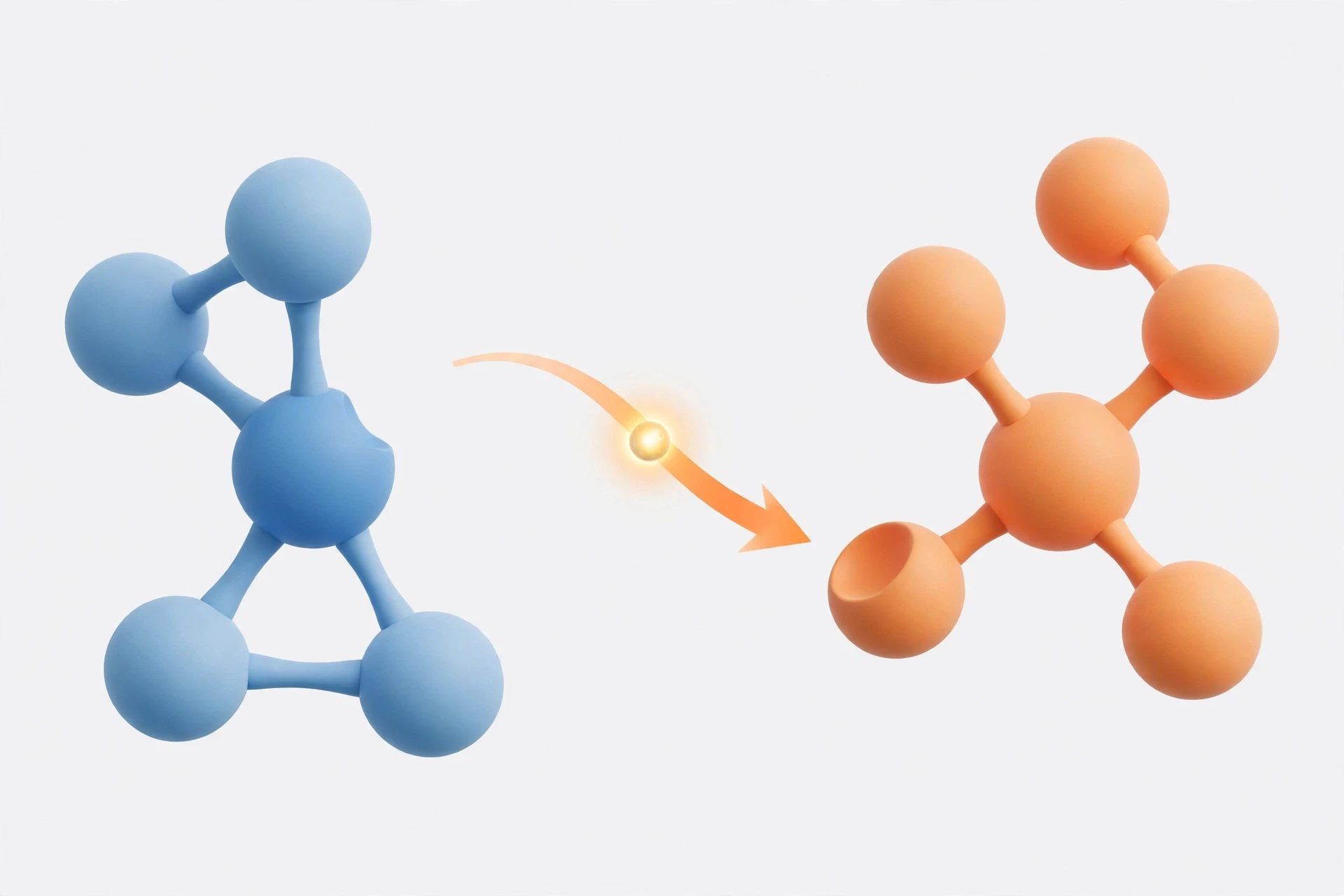
The second definition, from Johannes Brønsted and Thomas Lowry in 1923, is the one most textbooks still use as their main definition, and it is the one this guide leans on most. A Brønsted–Lowry acid is a proton donor — a substance that gives away a hydrogen ion (a proton) to another substance. A Brønsted–Lowry base is a proton acceptor — a substance that takes a proton. The beauty of this definition is that it describes a relationship, not a property of a substance on its own. Ammonia, NH₃, is a base because it accepts a proton to become NH₄⁺. Water is an acid when it donates a proton to ammonia, and a base when it accepts a proton from hydrogen chloride. The same molecule plays different roles depending on its partner, and the definition handles that gracefully.
The OpenStax Chemistry textbook's introduction to acids and bases lays out these definitions in the order chemists actually use them, and its chapter on Brønsted–Lowry acids and bases is one of the clearest free explanations available anywhere. If you want a second view, the LibreTexts guide to acids and bases covers the same ground with worked examples and is worth bookmarking.
The third definition, from Gilbert Lewis in the same year, 1923, goes further still. A Lewis acid is an electron-pair acceptor, and a Lewis base is an electron-pair donor. This definition does not mention protons at all. It covers reactions where no hydrogen is involved, such as boron trifluoride (BF₃) accepting an electron pair from ammonia. Lewis's definition is the most general, and it is the one working chemists reach for when they study catalysts and metal compounds. For everyday purposes, though, the Brønsted–Lowry picture — proton donation and acceptance — carries almost all the weight, and it is the picture this guide will use most.
I remember the afternoon the proton picture finally clicked for me, in a school laboratory with a bottle of dilute hydrochloric acid and a bottle of ammonia. The teacher held a glass rod dipped in each bottle near the other, and a white smoke appeared in the air between them — tiny crystals of ammonium chloride forming where the two vapours met. There was no liquid involved at all, no water, and yet an acid and a base had found each other across a gap of air and reacted. That little cloud of white smoke was the Brønsted–Lowry definition made visible: a proton moving from one molecule to another, with no water needed. The Arrhenius picture could not explain it. The proton picture could.
Every Brønsted–Lowry acid has a partner called its conjugate base — what is left after the acid gives away its proton. Hydrochloric acid (HCl) gives up a proton and becomes chloride (Cl⁻), its conjugate base. Acetic acid (CH₃COOH) becomes acetate (CH₃COO⁻). And every base has a conjugate acid: ammonia (NH₃) accepts a proton and becomes ammonium (NH₄⁺). The acid and its conjugate base always differ by exactly one proton. This pairing is more than bookkeeping. It explains why a strong acid has a weak conjugate base, and why the conjugate base of a weak acid is itself a base worth reckoning with — a fact that matters enormously when you try to understand buffers, the chemical systems that keep your blood at a steady pH.
2.1 Acids in the world around you
Acids are far more common than the word suggests. Your stomach produces hydrochloric acid to digest food and kill bacteria. Citrus fruits contain citric acid, apples contain malic acid, grapes contain tartaric acid, and vinegar is a dilute solution of acetic acid. Fizzy drinks contain carbonic acid, formed when carbon dioxide dissolves in water. Your muscles produce lactic acid when you exercise hard, and that burning feeling in your legs during a sprint is partly lactic acid building up faster than your blood can clear it. Even the air carries acids: carbon dioxide dissolves in rainwater to make a weak carbonic acid, which is why even clean rain is slightly acidic, and why limestone slowly dissolves over centuries.
Not all acids are alike, and the differences matter. Some acids, like hydrochloric, sulfuric, and nitric acid, are strong — they give up their protons almost completely in water. Others, like acetic acid and citric acid, are weak — they give up only a small fraction of their protons, holding most of them back. This distinction, strong versus weak, is one of the most important ideas in the whole subject, and it gets a full section of its own later. For now, remember only that "strong" describes how completely an acid lets go of its protons, not how concentrated it is. A dilute solution of a strong acid can be gentler than a concentrated solution of a weak one.
2.2 What acids do: the signature reactions
Acids have a family of characteristic reactions, and recognizing them is the fastest way to spot an acid at work. Acids react with metals such as zinc, magnesium, and iron to produce hydrogen gas and a salt — the classic school experiment of dropping zinc into dilute hydrochloric acid and watching it fizz is exactly this reaction. Acids react with carbonates, such as limestone or baking soda, to produce carbon dioxide, water, and a salt — the fizz when vinegar meets baking soda, and the slow dissolving of marble in acid rain, are both carbonate reactions. Acids react with metal oxides and hydroxides — bases — to produce salt and water, which is neutralization, the subject of its own section later.
3. What Is a Base?
If acids are proton donors, bases are proton acceptors — substances that take a proton from an acid. Under the Arrhenius definition, a base is a substance that produces hydroxide ions (OH⁻) in water. Sodium hydroxide and potassium hydroxide are classic examples: they dissolve in water and release OH⁻ directly. Under the broader Brønsted–Lowry definition, a base is anything that accepts a proton, whether or not it contains hydroxide. Ammonia is the textbook example: it has no OH⁻ group, yet it is a base because it accepts a proton from water to form ammonium (NH₄⁺) and hydroxide (OH⁻). That wider definition matters, because many of the most important bases in biology and everyday life — ammonia, the amino groups in proteins, the bicarbonate ion in your blood — contain no hydroxide at all.
Bases announce themselves in ways that are almost the mirror image of acids. Where acids taste sour, bases taste bitter. Where acids feel like nothing much on the skin until they sting, bases feel slippery or soapy, because they react with the oils on your skin. Where acids turn blue litmus red, bases turn red litmus blue. Soap is the most familiar base most people meet every day, and its slipperiness is not an accident: soap is made by reacting fats with a strong base, and the finished soap is itself mildly basic. That mild basicity is part of how soap works — it helps lift grease and dirt from skin.
The most familiar bases are the metal hydroxides. Sodium hydroxide (NaOH), also called caustic soda or lye, is used to make soap, paper, and drain cleaner. Potassium hydroxide (KOH) is used in liquid soaps and in some batteries. Calcium hydroxide (Ca(OH)₂), known as slaked lime, is used in building mortar, in treating acidic soil, and in food preparation — it is the limewater of school chemistry and the "cal" used to prepare corn for tortillas. Magnesium hydroxide (Mg(OH)₂) is the active ingredient in milk of magnesia, a gentle antacid. Ammonia (NH₃), dissolved in water as ammonium hydroxide, is a common household cleaner. Sodium bicarbonate (NaHCO₃), baking soda, is a mild base found in almost every kitchen.
One practical distinction is worth learning early: a base that dissolves in water is called an alkali, and its solution is called an alkaline solution. Sodium hydroxide and potassium hydroxide are alkalis. Calcium hydroxide is only slightly soluble, so it is a weak alkali at best, and magnesium hydroxide is so sparingly soluble that its solution is only mildly basic. Some bases, like copper oxide or iron oxide, do not dissolve in water at all — they are bases, but not alkalis, and they still neutralize acids when the two are mixed. The word "alkaline" is the one you will meet most often on product labels and in health writing, and it always means a solution with a pH above 7, which is the subject of the next sections.
Bases are not gentle by nature. Concentrated sodium hydroxide is corrosive: it can cause severe burns, damage eyes, and dissolve hair and grease — which is exactly why it is sold as drain cleaner. The danger of a strong base is easy to underestimate because it does not sting at once the way a strong acid does; it feels slippery first, and the damage follows. Anyone working with concentrated bases should wear gloves and eye protection, and spills should be washed off with plenty of running water. The safety rules for acids and bases are the same: dilute is usually safe, concentrated demands respect, and the eyes are the most vulnerable part of the body.
3.1 Bases in the body and in the home
Your body uses bases constantly, though it rarely calls them that. Bicarbonate (HCO₃⁻), a base, is one of the main buffers in your blood, soaking up extra acid and keeping your blood pH steady. Pancreatic juice is rich in bicarbonate, and it neutralizes stomach acid as food leaves the stomach and enters the small intestine — without that neutralization, the acid would damage the intestinal lining. Bile, made by the liver, is alkaline and helps digest fats. These are not exotic chemicals. They are the ordinary bases that keep digestion working, and when they fail, the results are familiar: heartburn, indigestion, and ulcers.
4. What Is the Difference Between an Acid and a Base?
This is the question most students ask first, and it deserves a direct answer. An acid donates a proton; a base accepts one. An acid increases the concentration of hydrogen ions in water; a base increases the concentration of hydroxide ions. An acid tastes sour and turns blue litmus red; a base tastes bitter, feels slippery, and turns red litmus blue. An acid reacts with a base to make salt and water; a base reacts with an acid to do the same thing from the other side. That is the core difference, and everything else follows from it.
The table below gathers the differences in one place, so you can see them side by side.
Property | Acid | Base |
|---|---|---|
Brønsted–Lowry definition | Proton donor (gives away H⁺) | Proton acceptor (takes H⁺) |
Arrhenius definition | Produces H⁺ ions in water | Produces OH⁻ ions in water |
Taste | Sour (lemon, vinegar) | Bitter (soap, tonic water) |
Feel on skin | Usually no special feel until it stings | Slippery or soapy |
Litmus paper | Turns blue litmus red | Turns red litmus blue |
pH of solution | Below 7 | Above 7 |
Reaction with metals | Often releases hydrogen gas | Usually no reaction |
Reaction with carbonates | Releases carbon dioxide | Usually no reaction |
Reaction with each other | Neutralizes a base to salt + water | Neutralizes an acid to salt + water |
Common examples | Hydrochloric, citric, acetic, sulfuric acid | Sodium hydroxide, ammonia, baking soda |
The table is useful, but it hides the most interesting fact about acids and bases: the same substance can be on either side depending on the situation. Water is the classic example. Put water with a strong acid like hydrogen chloride, and the water accepts a proton and acts as a base. Put water with a strong base like ammonia, and the water donates a proton and acts as an acid. Substances that can behave as either an acid or a base are called amphoteric, and water is the most important amphoteric substance in chemistry — and in life. The Atoms and Molecules article on Sciory explains how water's structure gives it this flexibility, and why that flexibility matters for almost every chemical reaction that happens in living things.
Another common confusion is between "acidic" and "acid", and between "basic", "alkaline", and "base". A substance is an acid; a solution is acidic if it contains more hydrogen ions than hydroxide ions. A base is a substance; a solution is basic or alkaline if it contains more hydroxide ions than hydrogen ions. "Alkaline" strictly means a solution of an alkali — a soluble base — but in everyday language it is used as a synonym for basic. None of this is worth memorising as vocabulary for its own sake. What matters is the behavior: does it donate protons, or accept them?
There is one more distinction that trips people up, and it is worth clearing up here because it returns later. An acid can be strong or weak, and a solution can be concentrated or dilute, and these are two different ideas. Strength is about how completely the acid gives up its protons. Concentration is about how much acid is dissolved in a given volume of water. A strong acid in a very dilute solution can be harmless — the hydrochloric acid in your stomach is strong, but it is also dilute, around 0.1 molar, and your stomach lining is protected by mucus. A weak acid in a concentrated solution can be dangerous — concentrated acetic acid, sometimes called glacial acetic acid, causes burns. The same is true of bases. Keep strength and concentration separate in your mind, and most of the confusing statements about acids and bases become clear.
5. The pH Scale: Measuring How Acidic or Basic Something Is
By the early twentieth century, chemists had a problem. Hydrogen ion concentrations in solutions span an enormous range — from more than 1 mole per litre in concentrated acid to less than a trillionth of a mole per litre in concentrated base. Writing those numbers out was clumsy, and comparing them was worse. In 1909, the Danish chemist Søren Sørensen proposed a simple fix: take the negative logarithm of the hydrogen ion concentration and call the result pH. A solution with a hydrogen ion concentration of 10⁻³ mol/L has a pH of 3. A solution with 10⁻⁷ mol/L has a pH of 7. The awkward range of fourteen orders of magnitude became a tidy scale from 0 to 14, and chemistry has used it ever since.
The pH scale works like this: a pH of 7 is neutral — equal amounts of hydrogen ions and hydroxide ions, as in pure water at room temperature. Below 7 is acidic, and the lower the number, the more acidic the solution. Above 7 is basic (or alkaline), and the higher the number, the more basic. Because the scale is logarithmic, each whole-number step means a tenfold change in hydrogen ion concentration. A solution at pH 3 is ten times more acidic than one at pH 4, and a hundred times more acidic than one at pH 5. That is why small differences in pH can mean large differences in chemistry: a lake dropping from pH 6.5 to pH 5.5 has not become slightly more acidic, it has become ten times more acidic, and fish feel the difference.
The pH scale is a compact way of writing an enormous range. Each step of one pH unit means the hydrogen ion concentration has changed tenfold — so a pH of 3 is a hundred times more acidic than a pH of 5, not just "two more".
Most substances you meet fall between pH 0 and pH 14, but the scale does not stop there. Very concentrated strong acids can have negative pH values, and very concentrated strong bases can exceed pH 14. Those extremes are rarely met outside industrial settings, and they are a reminder that the 0–14 scale is a convenient map, not a fence. It is also worth knowing that pH depends on temperature: the pH of pure water is 7.00 at 25°C, but it is about 6.14 at 100°C, because water dissociates more at higher temperatures. Pure water is still neutral at 100°C — neutral just means equal hydrogen and hydroxide ions, not pH 7 exactly — and that distinction catches out a surprising number of students.
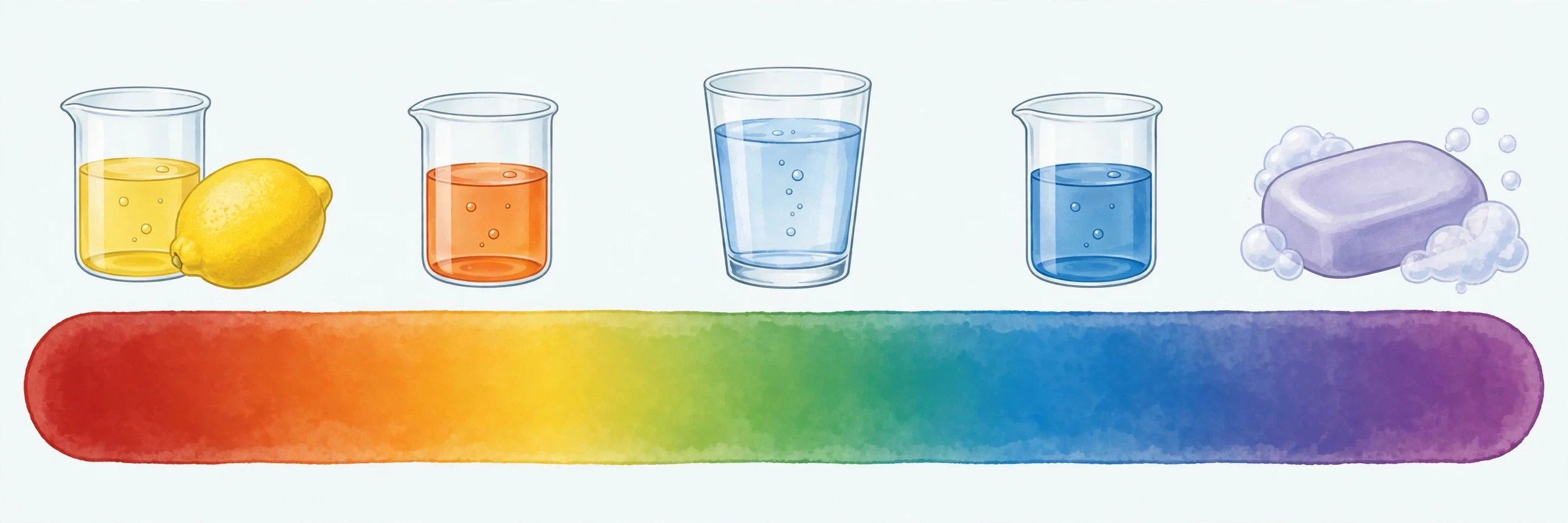
The table below shows the approximate pH of substances most people meet in daily life. These are typical values, not exact ones: the pH of coffee varies with the beans and the brewing, and the pH of a particular soap depends on its recipe. The pattern is what matters — where everyday things sit on the scale, and how wide the range of ordinary life really is.
Substance | Approximate pH | Acidic, neutral or basic |
|---|---|---|
Battery acid (sulfuric acid) | 0–1 | Strongly acidic |
Stomach acid | 1.5–2 | Strongly acidic |
Lemon juice | 2–3 | Acidic |
Vinegar | 2–3 | Acidic |
Fizzy drinks | 3–4 | Acidic |
Tomatoes | 4–4.5 | Acidic |
Coffee | 5 | Mildly acidic |
Milk | 6.5–6.8 | Slightly acidic |
Pure water | 7 | Neutral |
Blood | 7.35–7.45 | Slightly basic |
Baking soda solution | 8–9 | Basic |
Soap solution | 9–10 | Basic |
Household ammonia cleaner | 11–12 | Strongly basic |
Oven cleaner | 13–14 | Strongly basic |
5.1 How pH is measured
The simplest way to measure pH is with an indicator — a substance that changes color depending on acidity. Litmus paper is the oldest and simplest: blue litmus turns red in acid, red litmus turns blue in base, and neither changes in a neutral solution. Universal indicator paper, and the liquid universal indicator used in schools, goes further: it changes through a rainbow of colors from red at pH 1 to purple at pH 14, so you can estimate the pH to within a unit or so by matching the color. These paper tests are cheap and good enough for a garden soil test or a school experiment.
For accurate work, chemists use a pH meter — an electronic instrument with a glass electrode that measures the voltage produced by hydrogen ions in solution. A good pH meter reads to two decimal places, which matters in medicine, food production, and water treatment, where a difference of a tenth of a pH unit can be the difference between safe and unsafe. The OpenStax explanation of pH and pOH works through the maths carefully, including pOH, the parallel scale for hydroxide ions, and the relationship pH + pOH = 14 in water at room temperature. If the logarithmic maths feels intimidating, remember the intuition: pH is a shorthand for "how many hydrogen ions are in here", and a lower number means more of them.
I once watched a water-treatment engineer test the pH of a town's drinking water with a handheld meter, dipping it into sample after sample, writing down numbers with the focus of someone reading a medical chart. She explained that the target was a narrow band, roughly 6.5 to 8.5, and that drifting outside it could corrode pipes or make the water taste wrong. She was not thinking about protons and logarithms. She was thinking about a whole town's pipes, and the pH number was her early-warning system. That is what the pH scale is for most people who use it: not an abstract number, but a practical reading, like a temperature, that tells you whether a system is in its healthy range.
The pH of a solution controls which chemical reactions can happen in it, and that makes it important everywhere chemistry matters. Soil pH decides which nutrients plants can absorb: most crops grow best between pH 6 and 7, and blueberry bushes, which love acid soil, struggle in alkaline ground. Swimming pools are kept between pH 7.2 and 7.8, because below that the water stings eyes and corrodes fittings, and above it the chlorine disinfectant stops working properly. Aquariums, breweries, cheese-makers, and bakers all monitor pH, because yeast, bacteria, and enzymes each have a pH range where they work best. The human body, as the next sections show, is the most carefully pH-controlled system of all.
6. What Are Strong and Weak Acids?
Here is a question that confuses almost everyone who studies acids and bases: if hydrochloric acid and acetic acid are both acids, why does one burn through metal while the other seasons a salad? The answer is strength — and strength means one specific thing: how completely the acid gives up its protons when it dissolves in water. A strong acid lets go of essentially all of them. A weak acid lets go of only a few, and holds on to the rest.
Hydrochloric acid, HCl, is a strong acid. Dissolve it in water and essentially every HCl molecule splits into H⁺ and Cl⁻. There is almost no undissociated HCl left. Acetic acid, CH₃COOH, the acid in vinegar, is a weak acid. Dissolve it in water and only a small fraction of the molecules split — roughly one in a hundred in a typical solution — while the rest stay whole. The solution still contains acid molecules, it still tastes sour, and it still turns litmus red, but the concentration of free hydrogen ions is far lower than it would be for the same concentration of a strong acid. That is why vinegar is safe to eat and hydrochloric acid is not, even at the same concentration.
Chemists measure this with a number called the acid dissociation constant, Ka. A large Ka means the acid dissociates a lot — a strong acid. A small Ka means it dissociates a little — a weak acid. Because Ka values span many orders of magnitude, chemists often use pKa, the negative logarithm of Ka, the same way they use pH. A lower pKa means a stronger acid. Hydrochloric acid has a pKa around −7. Acetic acid has a pKa of about 4.76. The gap between those two numbers is the whole difference between an acid that dissolves metal and an acid that dresses a salad.
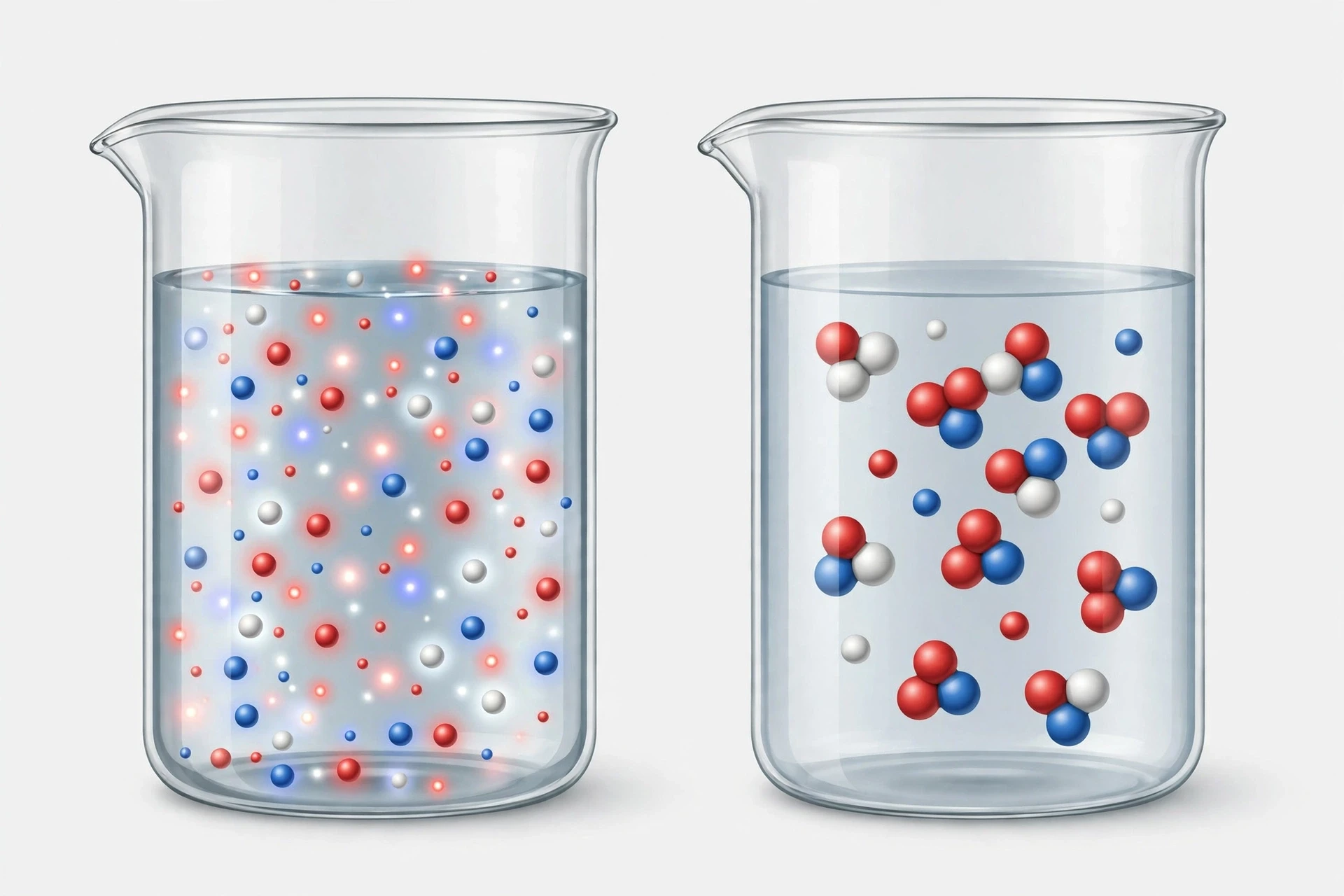
The same idea applies to bases. Sodium hydroxide is a strong base: it dissociates completely in water, releasing all of its hydroxide ions. Ammonia is a weak base: only a small fraction of ammonia molecules react with water to form ammonium and hydroxide ions, and most stay as plain NH₃. That is why household ammonia cleaner, though it smells sharp and must be handled with care, is far gentler than a drain cleaner made from sodium hydroxide. The table below lists the most common strong and weak acids and bases, so you can see which camp the familiar ones fall into.
Type | Examples | Behavior in water |
|---|---|---|
Strong acids | Hydrochloric acid (HCl), sulfuric acid (H₂SO₄), nitric acid (HNO₃), hydrobromic acid (HBr) | Dissociate almost completely; high H⁺ concentration |
Weak acids | Acetic acid (CH₃COOH), citric acid, carbonic acid (H₂CO₃), lactic acid, hydrofluoric acid (HF) | Dissociate only partly; most molecules stay whole |
Strong bases | Sodium hydroxide (NaOH), potassium hydroxide (KOH), calcium hydroxide (Ca(OH)₂) | Dissociate almost completely; high OH⁻ concentration |
Weak bases | Ammonia (NH₃), sodium bicarbonate (NaHCO₃), methylamine, pyridine | React with water only partly; low OH⁻ concentration |
A useful way to think about weak acids is that they are reversible. A weak acid in water is in equilibrium: molecules are splitting apart and recombining all the time, and at any moment most of them are whole. Add a base, and the base takes protons away, pulling the equilibrium forward so more acid molecules split. Add more acid, and the equilibrium shifts back. This reversibility is what makes weak acids and their conjugate bases so useful as buffers — solutions that resist changes in pH — and buffers are one of the most important ideas in all of biochemistry, as the section on the human body will show.
There is a trap here that catches many students, and it is worth naming plainly. People often say "strong acid" when they mean "concentrated acid", and "weak acid" when they mean "dilute acid". Those are different ideas, and mixing them up leads to real mistakes. A bottle of concentrated acetic acid can burn skin, even though acetic acid is a weak acid, because there is so much of it present. A very dilute solution of hydrochloric acid, a strong acid, can be harmless, because there are so few acid molecules in it. Strength is a property of the acid itself — how eagerly it lets go of protons. Concentration is a property of the solution — how much acid is dissolved in it. Both matter, and neither is a substitute for the other.
7. What Is Neutralization?
Mix an acid and a base, and something satisfying happens: they cancel each other out. The hydrogen ions from the acid join with the hydroxide ions from the base to make water, and the remaining ions join to make a salt. The reaction of hydrochloric acid with sodium hydroxide is the classic example: HCl + NaOH → NaCl + H₂O. Table salt and water — two of the most harmless substances on Earth — made from an acid that can dissolve metal and a base that can burn skin. That is neutralization, and it is one of the most useful reactions in all of chemistry.
The name is exact. A neutralization reaction moves the pH of a solution toward 7, toward neutral. Add a base to an acidic solution drop by drop and the pH climbs. Add an acid to a basic solution and the pH falls. When exactly the right amounts have been mixed — when the number of hydrogen ions equals the number of hydroxide ions — the solution is neutral, and the reaction is complete. Chemists call that point the equivalence point, and finding it precisely is the basis of titration, which the next section covers.
Neutralization is a type of chemical reaction, and it follows the same rules as any other: atoms are rearranged, not created or destroyed, and the equation must balance. In the HCl and NaOH example, the net ionic equation strips away the spectator ions — the sodium and chloride ions that appear unchanged on both sides — and leaves the heart of the reaction: H⁺ + OH⁻ → H₂O. A hydrogen ion and a hydroxide ion become a water molecule. That single step, repeated trillions of times, is what neutralization is at the molecular level. Everything else — the salt left behind, the heat released, the color change of an indicator — is a consequence of that step.
When an acid meets a base in the right proportions, the hydrogen ions and hydroxide ions join to make water, and what is left behind is a salt. The two opposites cancel each other — and the product is often harmless.
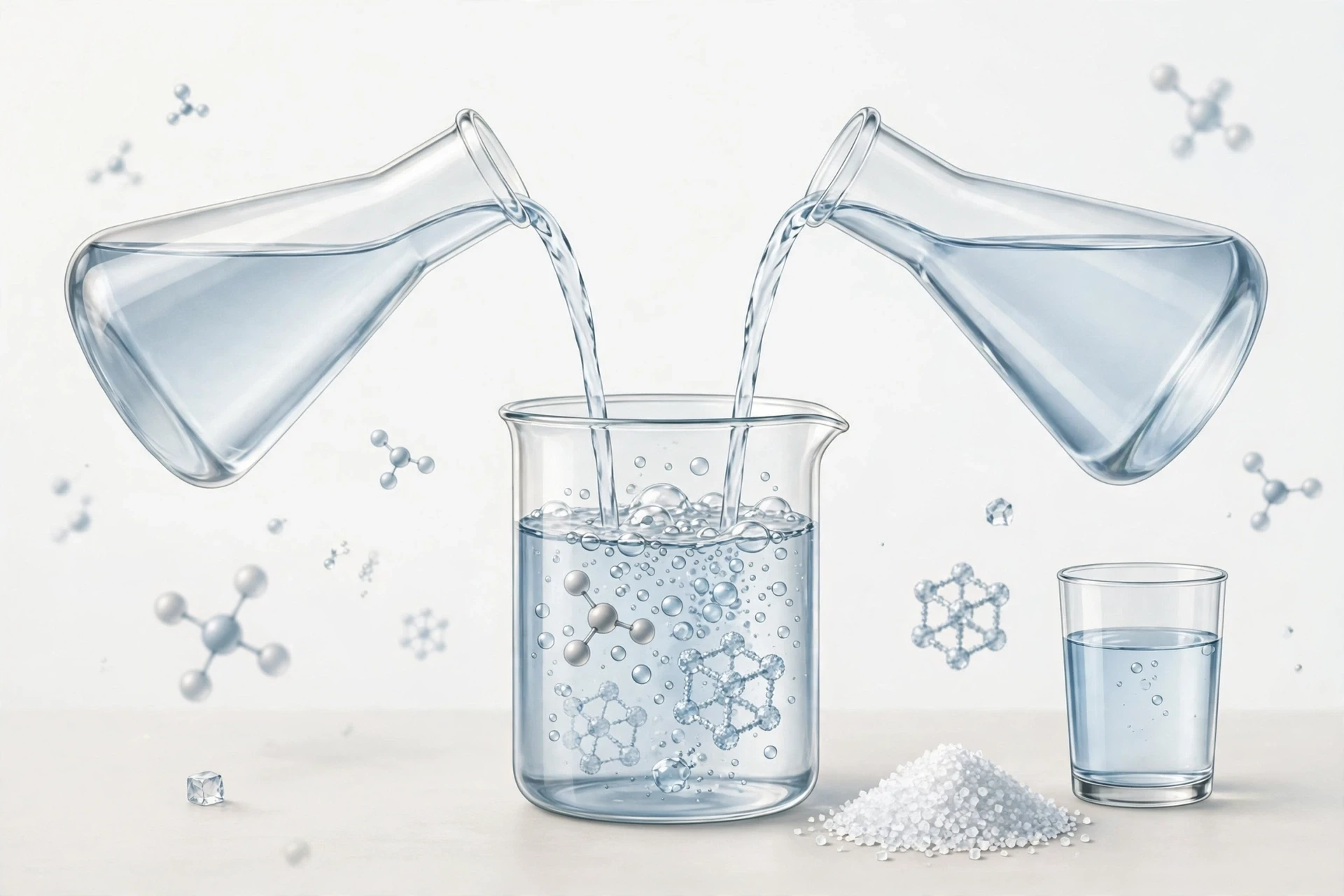
Neutralization is mildly exothermic — it releases heat. Mix a strong acid and a strong base in concentrated form and the mixture can get hot enough to boil and spit, which is why the two should always be mixed slowly, with stirring, and never poured together in large amounts at once. In dilute form the heat is barely noticeable, a slight warmth in the beaker. That warmth is real energy, though: the formation of water from hydrogen and hydroxide ions releases energy, and the same kind of energy release, on a different scale, is part of what drives many chemical reactions.
7.1 Neutralization in everyday life
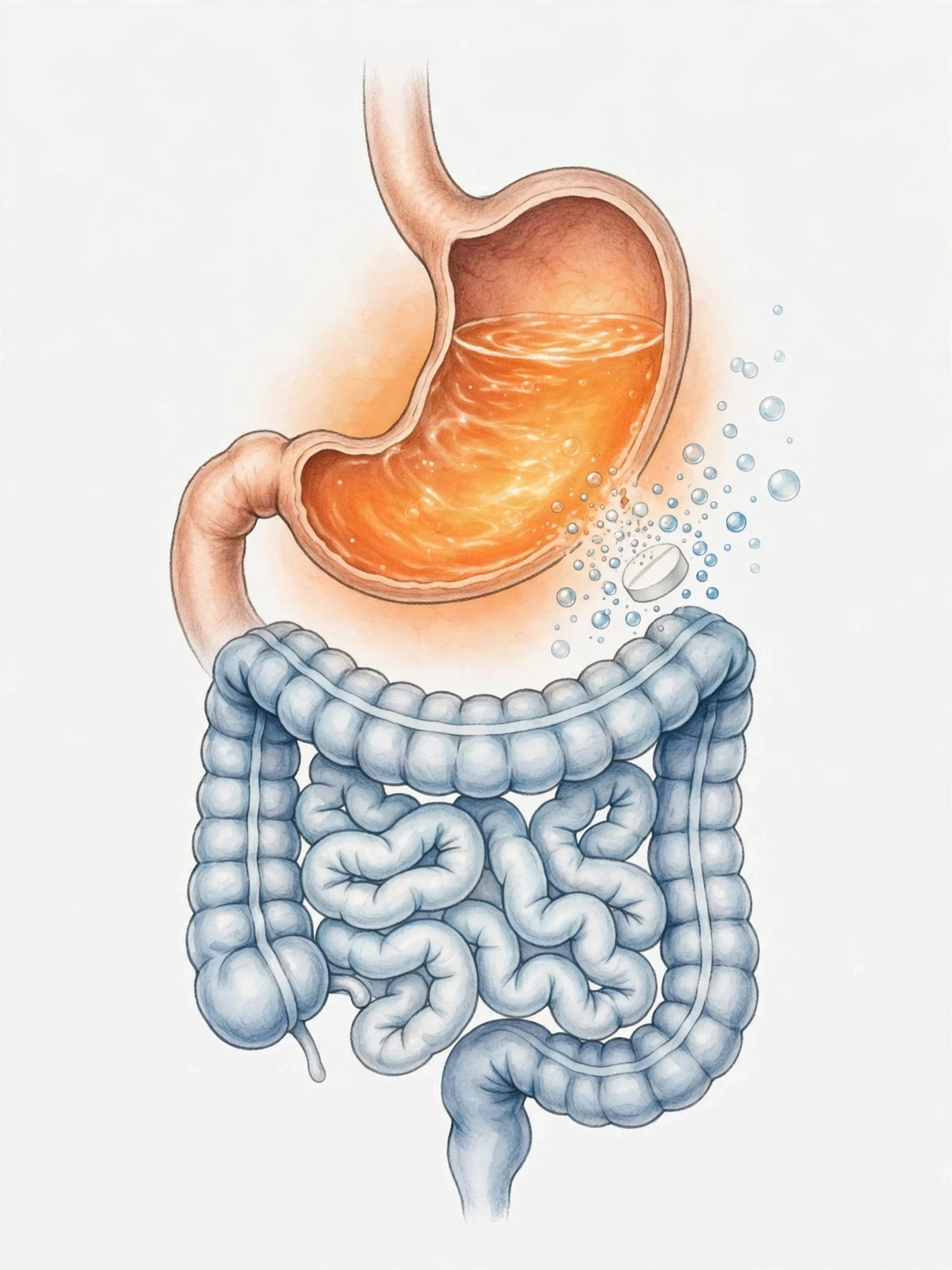
The most familiar neutralization reaction happens inside your own body every day. Your stomach produces hydrochloric acid to digest food, and when that acid splashes upward into the esophagus it causes the burning pain of heartburn. An antacid tablet — usually calcium carbonate, magnesium hydroxide, or sodium bicarbonate — neutralizes the excess acid. The carbonate reacts with stomach acid to make carbon dioxide, water, and a salt, which is why antacid tablets fizz. The magnesium hydroxide in milk of magnesia does the same thing without the fizz. The relief is chemistry, not magic: the acid is gone, converted into salt and water, and the burning stops.
Farmers use neutralization on a grand scale. Soil that has become too acidic — from rain, fertilizer, or the slow leaching of minerals — is treated with lime, calcium carbonate or calcium hydroxide, a base that neutralizes the soil acids and raises the pH toward the range most crops prefer. Without liming, acidic soil locks away nutrients like phosphorus and releases toxic aluminum, and yields fall. Gardeners do the same thing on a small scale with a bag of garden lime and a soil pH test. The chemistry is identical to the antacid tablet, only the patient is a field instead of a stomach.
Baking is neutralization you can eat. Baking soda is a base, and when it meets an acidic ingredient — buttermilk, yoghurt, lemon juice, vinegar, or the natural acids in cocoa — it reacts to release carbon dioxide gas, and those bubbles lift the batter and make the cake rise. Baking powder is a tidy package of the same idea: it contains both a base (baking soda) and a dry acid, which react only when water is added. If a recipe uses baking soda but has no acidic ingredient, the cake will taste soapy and flat, because the base has nothing to neutralize it. The chemistry of a good cake is, in part, the chemistry of getting the acid-base balance right.
8. Titration: Measuring Neutralization Precisely
Knowing that an acid and a base cancel each other out is useful. Knowing exactly how much of each is needed is powerful. Titration is the technique chemists use to find that exact amount, and it is one of the most elegant pieces of practical chemistry ever devised. It needs little equipment — a burette, a flask, an indicator — and it can measure the concentration of an unknown solution with remarkable accuracy. Students learn it in school, and professionals use it in food factories, water plants, and pharmaceutical laboratories every day.
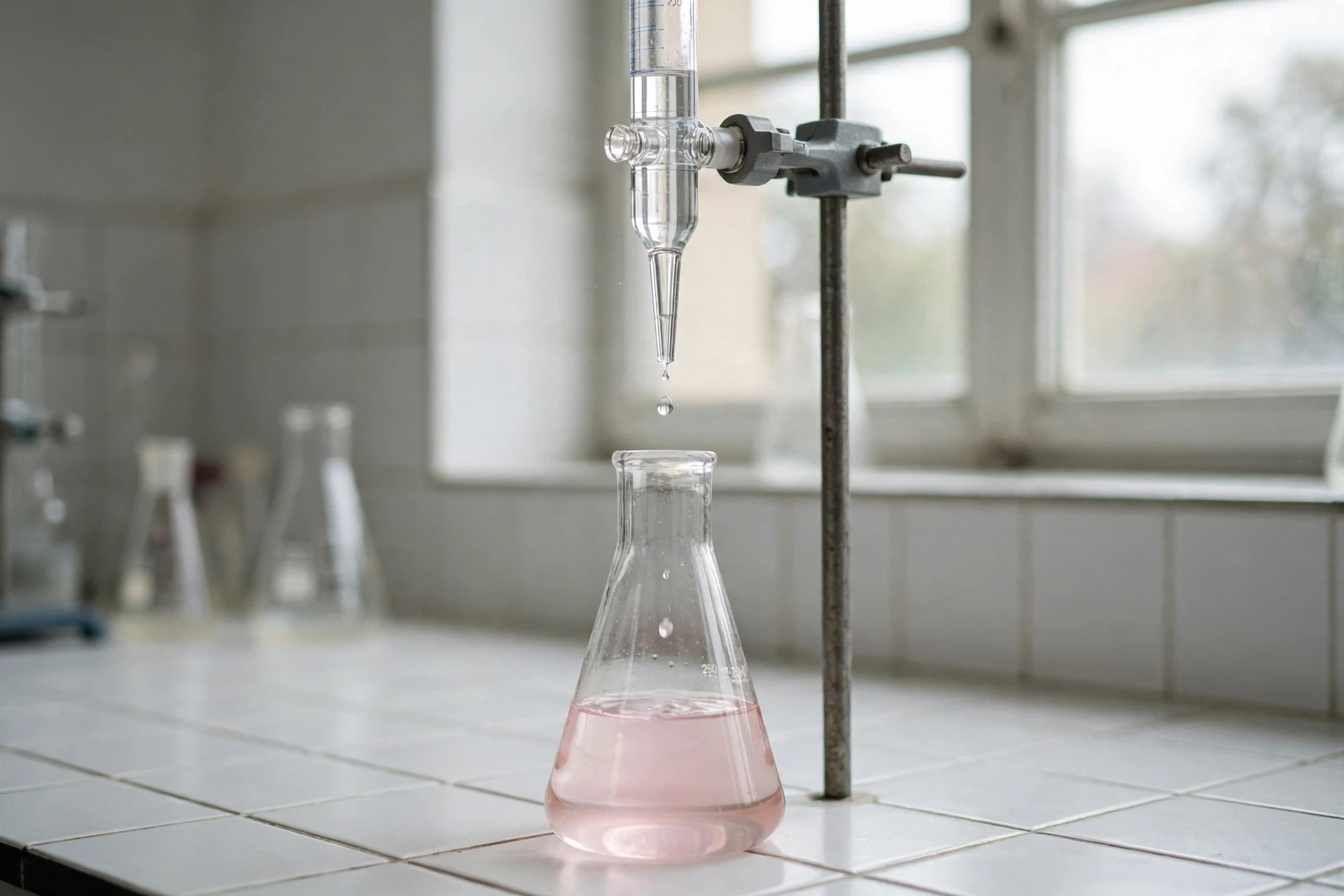
The setup is simple. A solution of known concentration, called the titrant, is placed in a burette — a tall, graduated tube with a tap at the bottom. A measured volume of the unknown solution is placed in a flask, with a few drops of an indicator such as phenolphthalein. The titrant is then added drop by drop, swirling the flask, until the indicator changes color. That color change marks the end point — the moment when the acid and base have just neutralized each other. The volume of titrant used, read off the burette, tells you exactly how much base was needed to neutralize the acid, and from that you can calculate the unknown concentration.
The choice of indicator matters, because different indicators change color at different pH values. Phenolphthalein is colorless in acid and pink in base, and it changes at around pH 8–10, which suits a strong acid–strong base titration, where the pH jumps sharply through that range at the equivalence point. Methyl orange changes from red to yellow between pH 3 and 4, and suits titrations where the equivalence point is acidic. Universal indicator gives a rainbow of colors across the whole scale, which is less precise but gives a visual picture of the whole titration. Choosing the wrong indicator is one of the classic student errors: the color change still happens, but it happens at the wrong point, and the result is wrong.
I still remember my first titration, and the frustration of it. The instructions said to add the base drop by drop near the end, and I, impatient, let it run in a stream. The flask flashed pink all at once, overshooting the end point, and my result was useless. My teacher made me start again, and the second time I added the base one drop at a time, swirling after each drop, watching the pink flash and vanish, flash and vanish, until one drop made the pink stay. That moment — the color holding, the flask swirling pink — was the first time I understood what precision in chemistry actually feels like. It is not a number on a screen. It is a color that stays.
Titration has uses far beyond the school laboratory. Food manufacturers titrate fruit juice to measure its acidity, which affects flavour and shelf life. Winemakers titrate wine to measure total acidity, one of the key numbers in winemaking. Water treatment plants titrate samples to measure alkalinity, the water's ability to resist pH change. Pharmaceutical companies titrate drug solutions to check their concentration before they are bottled. In each case the principle is the same: use a reaction you understand completely — neutralization — to measure something you do not yet know. It is a beautiful example of how a simple idea, applied carefully, becomes a precision instrument.
9. Acids and Bases in Your Body
Your body is a chemical system that runs on acids and bases, and it keeps them under tighter control than almost any laboratory. The most important number in this story is the pH of your blood: 7.35 to 7.45, slightly basic, and held within that narrow band by several overlapping systems. Drift below 7.35 and you are in acidosis; drift above 7.45 and you are in alkalosis; drift much further in either direction and the result is life-threatening. Your body defends that band with buffers, with breathing, and with the kidneys, and it does so every minute of your life without you noticing.
The first line of defence is the bicarbonate buffer system. Blood contains carbonic acid (H₂CO₃) and its conjugate base, bicarbonate (HCO₃⁻), in a balance that soaks up extra acid or base. Add acid to blood and the bicarbonate ions accept the extra protons, becoming carbonic acid, which the lungs then breathe out as carbon dioxide. Add base and the carbonic acid donates protons to neutralize it. The system is fast and it is always on, and it is the reason a meal, a workout, or a mild illness does not send your blood pH swinging wildly. Other buffers — phosphate in cells, proteins in blood — play supporting roles, and together they form a chemical safety net.
The second line of defence is breathing. When you exercise hard, your muscles produce lactic acid, and your blood becomes slightly more acidic. Your brain detects the change and tells you to breathe faster and deeper, blowing off more carbon dioxide, which pulls the bicarbonate equilibrium back toward neutral. That is why you pant after a sprint: you are not just catching your breath, you are correcting your blood chemistry. The third line of defence is the kidneys, which work more slowly — over hours — excreting excess acid in urine and reabsorbing bicarbonate. Three systems, three speeds, one target: a blood pH between 7.35 and 7.45.
Your stomach is the deliberate exception to all this careful neutrality. The stomach produces hydrochloric acid at a pH of about 1.5 to 2, strong enough to dissolve many metals, and it uses that acid to break down food and kill bacteria. The stomach protects itself with a thick layer of mucus and by renewing its lining cells rapidly — the lining is replaced so fast that it is effectively a new stomach every few days. When that protection fails, or when acid escapes upward into the esophagus, the result is gastritis, ulcers, or the burning pain of heartburn. The National Institute of Diabetes and Digestive and Kidney Diseases explains acid reflux and GERD in plain language, including when heartburn is a sign to see a doctor rather than reach for another antacid.
Even the food you eat changes your body's acid load, though not in the way some popular health writing suggests. The "alkaline diet" claims that eating alkaline foods can change your blood pH and cure disease. It cannot. Your blood pH is controlled by the buffer systems described above, and no food changes it — if food could change your blood pH, you would be in danger every time you ate a lemon. What diet does change is the pH of your urine, which reflects what your kidneys are excreting, not what your blood is doing. That distinction — blood pH versus urine pH — is one of the most widely misunderstood ideas in popular health writing, and it is worth stating clearly: your blood pH stays between 7.35 and 7.45 regardless of what you eat, and that is a sign your buffers are working, not a problem to fix.
10. Acids and Bases in the Kitchen, Garden, and Home
The kitchen is the best laboratory for acids and bases most people will ever own, because almost every recipe is an acid-base calculation in disguise. Buttermilk pancakes rise because the lactic acid in buttermilk reacts with baking soda to release carbon dioxide. Lemon juice stops cut apples from browning because its acidity slows the enzymes that cause browning. Vinegar pickles vegetables because its acidity creates an environment where spoilage bacteria cannot grow. Marinades tenderize meat partly because acids break down connective tissue. Even the flavour of food is shaped by acids and bases: the sharpness of a good tomato sauce, the tang of yoghurt, the bite of a mustard — all of them are acidity you can taste.
I once watched a neighbour ruin a marble worktop by cleaning it with vinegar, and the lesson stayed with me. Marble is calcium carbonate, and vinegar is acetic acid, and the two react — the surface fizzed faintly, and by the time she noticed, the polished finish was etched with dull patches that no amount of polishing would restore. She had done nothing careless; she had used a natural cleaner on a natural stone, and the chemistry had done exactly what chemistry does. The lesson is not to fear vinegar. It is to know what things are made of before you clean them: acid on limestone or marble is a slow-motion version of acid rain on a statue, and the result is the same.
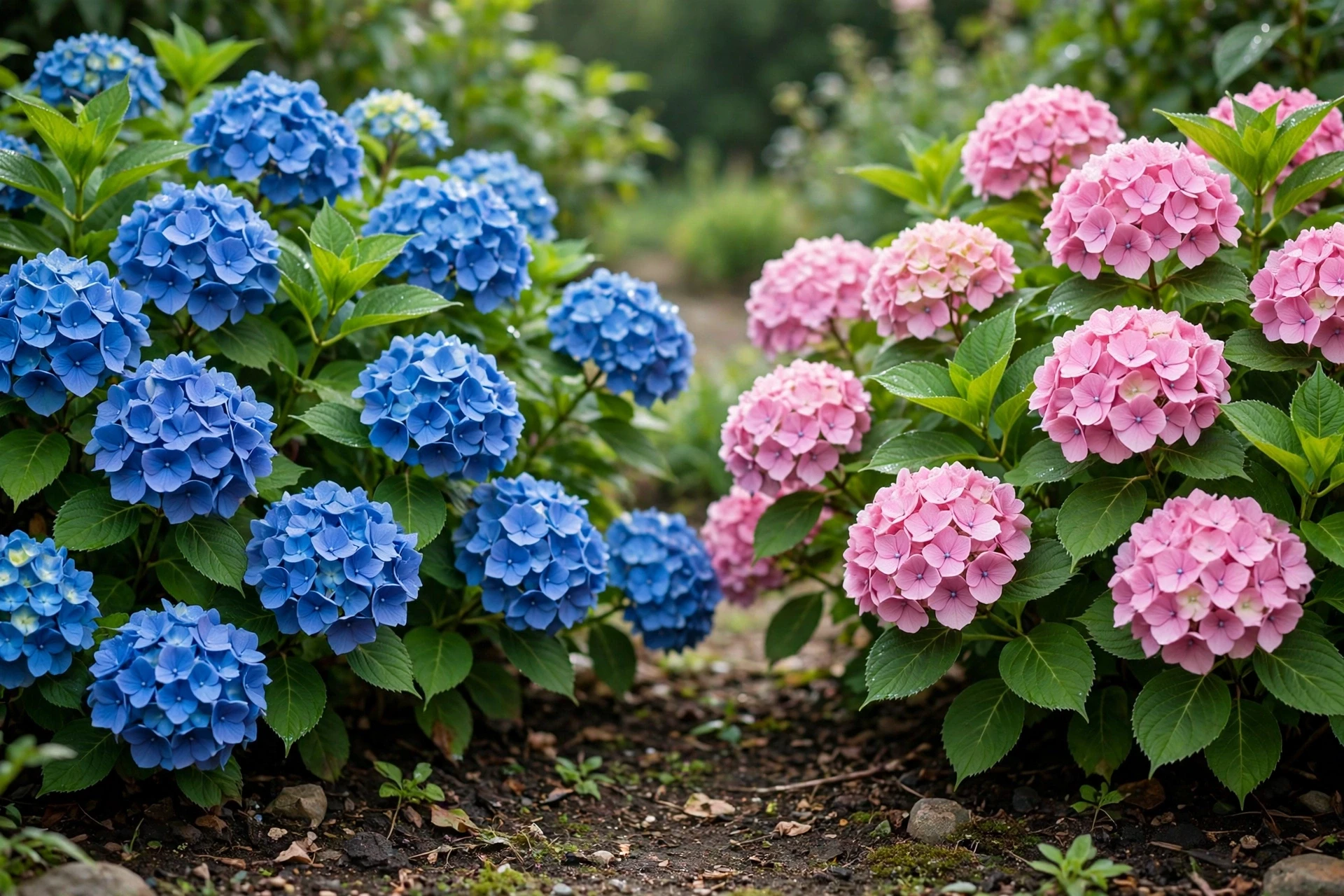
The garden is where acid-base chemistry meets living things most directly. Soil pH controls which nutrients plants can absorb, and different plants prefer different ranges. Most vegetables grow best between pH 6.0 and 7.0. Blueberries, azaleas, and rhododendrons prefer acidic soil, pH 4.5 to 5.5, and they sulk in alkaline ground. Lavender prefers the opposite, thriving in soil above pH 7. Gardeners test their soil with a kit or a meter, then adjust it: lime raises pH, sulfur lowers it. The most charming demonstration of soil pH is the hydrangea, whose flowers turn blue in acidic soil and pink in alkaline soil, because the availability of aluminum ions changes with pH. A hydrangea is a living pH indicator, planted in the garden.
11. Acids and Bases in Industry and the Environment
Scale up from the kitchen to the factory, and acids and bases become some of the most important chemicals in the world economy. Sulfuric acid is produced in greater quantity than almost any other chemical — hundreds of millions of tonnes a year worldwide — and it is used to make fertilizers, refine petroleum, process metals, and manufacture countless other chemicals. The production of sulfuric acid is so closely tied to industrial activity that economists have used it as a rough index of a country's industrial output. Hydrochloric acid is used to clean steel before it is galvanised, to produce plastics, and to process food. Nitric acid is used to make fertilizers and explosives. Sodium hydroxide is used to make paper, soap, textiles, and aluminum. These are not niche chemicals. They are the workhorses of modern industry.
The most famous environmental story about acids and bases is acid rain. When fossil fuels burn, they release sulfur dioxide and nitrogen oxides into the air. These gases react with water in the atmosphere to form sulfuric acid and nitric acid, which fall as rain, snow, or dry particles with a pH well below the natural value of about 5.6 for rainwater. Acid rain damages forests by leaching nutrients from soil and releasing toxic aluminum, kills fish in lakes that have lost their natural buffering, and dissolves limestone and marble buildings and statues — the same reaction as vinegar on a marble worktop, spread across whole cities. The US Environmental Protection Agency's guide to acid rain explains the causes, the effects, and the progress made in reducing it, including the sharp fall in sulfur dioxide emissions in many countries since the 1990s.

There is a hopeful side to this story. Acid rain was one of the first large-scale environmental problems to be tackled by international agreement, and in many regions it has improved dramatically. Power plants fitted with scrubbers — systems that spray an alkaline slurry through exhaust gases to neutralize the sulfur dioxide before it leaves the chimney — cut emissions sharply. The scrubber is neutralization on an industrial scale: a base sprayed into an acidic gas stream, producing a salt that can be collected. It is the same reaction as the antacid tablet and the limed field, scaled up to a smokestack. The lesson is that understanding acids and bases is not only useful for passing an exam; it is useful for fixing a damaged environment.
Acids and bases also shape the natural world without any human help. Ocean water absorbs carbon dioxide from the air, forming carbonic acid, and the ocean's pH has fallen as atmospheric carbon dioxide has risen — a process called ocean acidification. Even a small fall in ocean pH makes it harder for corals, shellfish, and some plankton to build their calcium carbonate shells, because the carbonate ions they need become scarcer in more acidic water. The Water Molecule article on Sciory explains why water is such an unusual solvent and why its acid-base behavior matters for life in the oceans. The chemistry is the same as in the rest of this guide: carbon dioxide plus water makes an acid, and that acid changes what can live in the water.
12. Common Mistakes and Misconceptions
Most people get acids and bases mostly right, and then get tripped up by a handful of persistent mistakes. Clearing them up is worth a whole section, because each one leads to a wrong decision somewhere — in the kitchen, the garden, or the exam hall.
The first mistake is thinking that all acids are dangerous and all bases are safe, or the reverse. Both can be harmless and both can be dangerous, depending on strength and concentration. Household vinegar is safe to eat. Concentrated acetic acid burns. Dilute soap is safe on skin. Concentrated sodium hydroxide is corrosive. The danger is not in the category; it is in the dose and the strength. Judge a chemical by its concentration and its dissociation, not by whether it is called an acid or a base.
The second mistake is confusing strong with concentrated, and weak with dilute. Strength is about dissociation — how completely the acid lets go of its protons. Concentration is about how much is dissolved. A strong acid can be dilute and harmless. A weak acid can be concentrated and dangerous. Keep the two ideas apart, and most of the confusing sentences about acids and bases become clear.
The third mistake is thinking that pH 7 is always neutral. It is neutral at room temperature, but neutral means equal hydrogen and hydroxide ions, and that balance point shifts with temperature. At 100°C, pure water has a pH of about 6.14, and it is still neutral. The number 7 is a fact about room temperature, not a law of nature.
The fourth mistake is believing that a substance is either an acid or a base, permanently. Water is both, depending on its partner. Amino acids can be either. The conjugate base of a weak acid is a base in its own right. Acids and bases are roles in a reaction, not permanent identities, and the same molecule can play either role.
The most common mistake in acid-base chemistry is treating the labels as permanent. Water is an acid with one partner and a base with another — acids and bases are roles in a reaction, not fixed identities.
The fifth mistake is the idea that "natural" means safe and "chemical" means dangerous. Citric acid is natural and can still damage tooth enamel if you bathe your teeth in lemon juice all day. Sodium hydroxide is a chemical, and it is also the substance that turns olives edible and makes traditional soap. The words natural and chemical describe where something comes from, not whether it is safe. Acids and bases do not care about those labels; they care about protons, concentration, and time.
Frequently Asked Questions
What is the difference between an acid and a base?
An acid is a proton donor — it gives away a hydrogen ion (H⁺) to another substance — while a base is a proton acceptor that takes a hydrogen ion. In water, acids increase the concentration of hydrogen ions and bases increase the concentration of hydroxide ions (OH⁻). Acids taste sour and turn blue litmus paper red; bases taste bitter, feel slippery, and turn red litmus paper blue. Acids have a pH below 7 and bases have a pH above 7. When they react, they neutralize each other to form salt and water.
What is neutralization?
Neutralization is the reaction between an acid and a base that produces a salt and water, and moves the pH toward 7. The core step is a hydrogen ion from the acid joining a hydroxide ion from the base to make a water molecule: H⁺ + OH⁻ → H₂O. Everyday examples include antacid tablets neutralising stomach acid, lime neutralising acidic soil, and baking soda reacting with acidic ingredients to make cakes rise. The reaction is complete at the equivalence point, when the amounts of acid and base exactly balance.
What are strong and weak acids?
A strong acid is one that dissociates almost completely in water, releasing nearly all of its protons — hydrochloric, sulfuric, and nitric acids are strong acids. A weak acid dissociates only partly, so most of its molecules stay whole — acetic acid (vinegar), citric acid, and carbonic acid are weak acids. Strength is measured by the acid dissociation constant, Ka, or its logarithm, pKa: a lower pKa means a stronger acid. Strength is not the same as concentration: a dilute strong acid can be harmless, while a concentrated weak acid can burn skin.
What is pH, and what does pH 7 mean?
pH is a scale from 0 to 14 that measures how acidic or basic a solution is, based on the concentration of hydrogen ions. It is logarithmic, so each whole-number step means a tenfold change: pH 3 is ten times more acidic than pH 4. A pH of 7 is neutral at room temperature, meaning the solution has equal concentrations of hydrogen and hydroxide ions, as in pure water. Below 7 is acidic and above 7 is basic. Blood is slightly basic at pH 7.35 to 7.45, lemon juice is acidic at around pH 2, and oven cleaner is strongly basic at around pH 13.
How do you measure pH?
The simplest way is with an indicator: litmus paper turns red in acid and blue in base, and universal indicator paper changes through a range of colors that can be matched to a pH chart. For accurate measurements, chemists use a pH meter, an electronic instrument with a glass electrode that reads to two decimal places. Gardeners test soil pH with kits or meters, water treatment plants monitor pH continuously, and doctors measure blood pH when a patient's acid-base balance is in doubt.
What is an alkali, and how is it different from a base?
An alkali is a base that dissolves in water. Every alkali is a base, but not every base is an alkali: some bases, like copper oxide, do not dissolve in water, so they are bases but not alkalis. Sodium hydroxide and potassium hydroxide are alkalis, and their solutions are called alkaline. In everyday language, "alkaline" is often used as a synonym for basic, meaning a solution with a pH above 7.
Are acids and bases dangerous?
Both can be dangerous or harmless depending on strength and concentration. Dilute household acids like vinegar and citric acid are safe to eat, and dilute bases like soap and baking soda are safe to use on skin. Concentrated strong acids and bases are corrosive and can cause serious burns, especially to the eyes. The safety rules are the same for both: wear gloves and eye protection with concentrated solutions, wash spills off with plenty of running water, and never mix cleaning products — in particular, never mix an acid cleaner with bleach, because the reaction can release toxic chlorine gas.