

The first time I ever smelled vanilla extract straight from the bottle, I was about nine, standing on a chair in my grandmother's kitchen, and the smell was so strong it made my eyes water. Sweet, warm, almost smoky. Years later, in a school lab, I learned that the smell came from a single molecule called vanillin — a handful of carbon, hydrogen, and oxygen atoms arranged in one exact shape. Change one atom in that shape and the smell changes with it. That is the quiet shock at the heart of organic chemistry: a few atoms, arranged differently, can smell like vanilla, or burn like petrol, or carry the instructions for building a human being.
Organic chemistry is the study of carbon compounds — the molecules built mostly from carbon and hydrogen, often with oxygen, nitrogen, and a few other elements mixed in. It sounds like a narrow subject. It is anything but. The food you ate today, the clothes you are wearing, the fuel in a car, the plastic in a phone, the medicines in a bathroom cabinet, and the DNA in every cell of your body are all made of organic molecules. Carbon is the scaffolding of the living world and of much of the manufactured world too. This article explains how that scaffolding works: what hydrocarbons are, how alkanes, alkenes, and alkynes differ, what functional groups do, and why a single element ended up running so much of chemistry.
1. What Is Organic Chemistry?
1.1 A definition that starts with carbon
Organic chemistry is the branch of chemistry that studies compounds containing carbon, usually bonded to hydrogen. That is the textbook definition, and it is mostly right. There are exceptions — carbon dioxide and carbonates are usually filed under inorganic chemistry, even though they contain carbon — but the spirit of the definition holds: if a molecule has carbon atoms linked to each other and to hydrogen, it belongs to organic chemistry.
The numbers tell you how big this field is. Chemists have identified well over ten million organic compounds, and the count keeps growing. New ones are made in labs every day. No other element comes close. Carbon's talent for linking to itself, over and over, in chains, branches, and rings, is what makes that vast library possible. Organic chemistry is, in a real sense, the study of what carbon can build.
If you want the foundations first, the Sciory article on atoms and molecules explains how atoms join together and why carbon's outer shell of four electrons matters so much. Everything in this article grows out of that one fact: carbon has four electrons to share, so it can form four bonds.
1.2 The old idea that life held a monopoly
For a long time, chemists believed organic compounds could only be made by living things. The idea had a name — vitalism — and it said that living organisms contained a special "vital force" that ordinary laboratory chemistry could never copy. An organic compound, in that view, was not just a molecule. It was a product of life itself.
That belief fell apart in 1828, in a German laboratory, when Friedrich Wöhler heated an inorganic salt called ammonium cyanate and found that it had turned into urea — a compound found in urine and unmistakably organic. Wöhler had made an organic molecule from inorganic starting materials, with no living thing involved. He wrote to his teacher Jöns Jacob Berzelius in excitement, and the letter is still famous among chemists today. Vitalism did not vanish overnight, but it never recovered. From that point on, organic chemistry stopped being the chemistry of living things and became the chemistry of carbon — and chemists began to build molecules that nature had never made.
I like to linger on that moment, because it shows how science actually moves. Nobody set out to destroy vitalism that day. Wöhler was doing a routine experiment, and the result refused to fit the theory. The theory had to go. Organic chemistry grew up around that kind of surprise, and it has kept surprising people ever since.
1.3 What organic chemistry actually covers
Walk through a single ordinary day and you walk through organic chemistry. The bread you toast contains starch, a giant molecule built from glucose units. The soap in the shower is made from fatty acids. The petrol in a car is a mixture of hydrocarbons. The painkiller in the medicine cabinet is a carefully shaped organic molecule designed to fit a target in the body. The screen you are reading this on is held together by polymers — long chains of carbon-based repeating units.
Organic chemistry covers all of that, and it covers the rules behind it: how carbon chains are named, how reactions break and form bonds, how the shape of a molecule decides what it can do, and how chemists design new molecules on purpose instead of finding them by luck. It is a practical science. Almost every medicine developed in the last hundred years came out of an organic chemistry lab, and so did most modern materials.
Organic chemistry is not really about carbon. It is about connection — about how one element learned to link to itself in endless patterns, and how those patterns became everything from fuel to flesh.
2. Why Carbon Is Special
2.1 Four bonds, endless shapes
Carbon sits in the middle of the periodic table with four electrons in its outer shell. It needs four more to be stable, and it gets them by sharing — forming four covalent bonds. That sounds simple, and it is the whole secret. Four bonds mean carbon can link to four different neighbours at once, and each of those neighbours can be another carbon. The result is chains that can stretch to thousands of atoms, branches that split off at any point, and rings that close back on themselves.
No other element does this so well. Silicon sits directly below carbon in the periodic table and also forms four bonds, but silicon-silicon chains fall apart in water and air. Carbon-carbon bonds are strong and stable at the temperatures of everyday life, which is why carbon became the backbone of living things instead of silicon. Life bet on carbon, and the bet paid off.
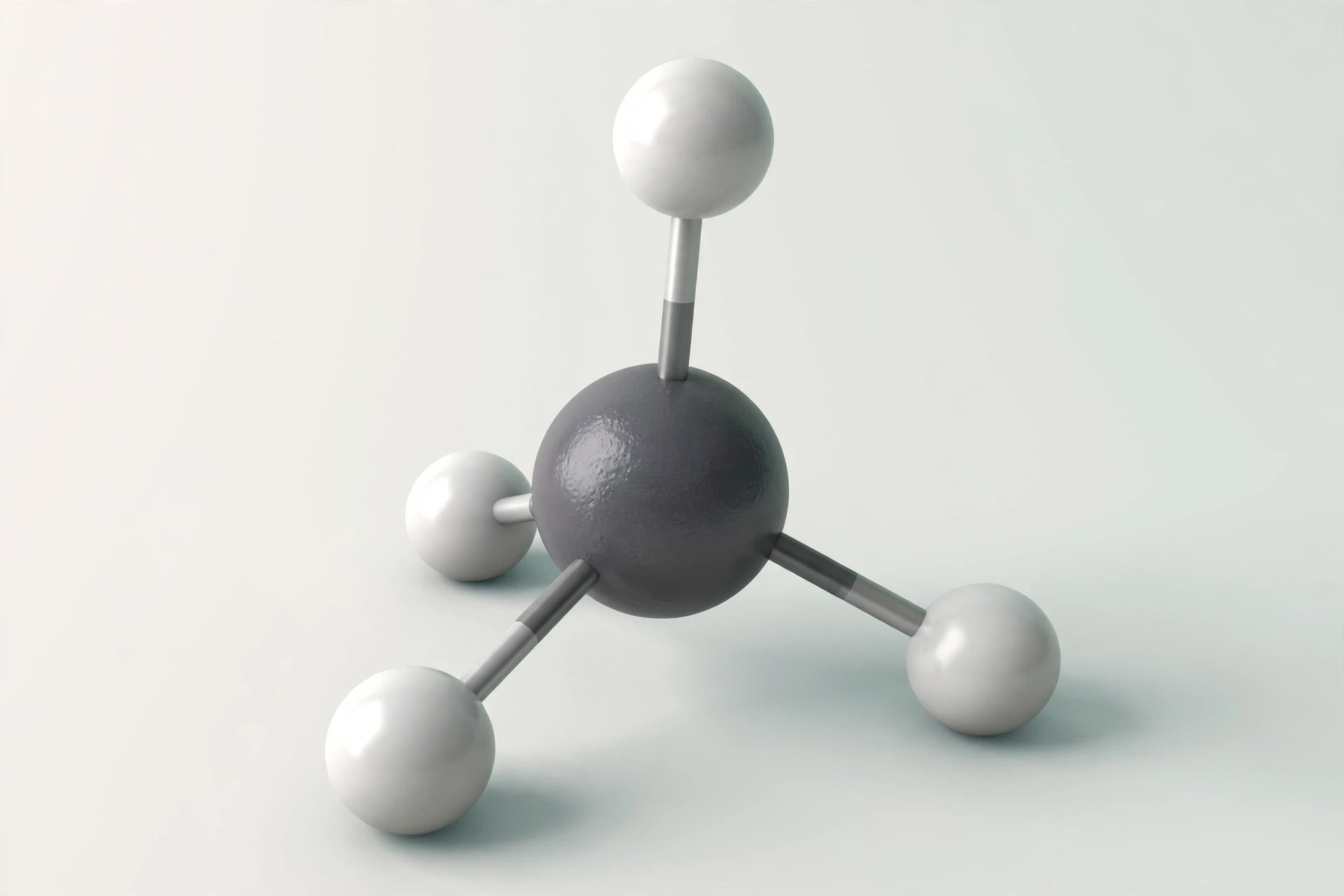
The four bonds point toward the corners of a tetrahedron — a pyramid with a triangular base — so a carbon atom with four single bonds holds its neighbours in a three-dimensional shape, not a flat one. That three-dimensional shape matters more than it sounds. Two molecules can contain exactly the same atoms and still behave differently if those atoms are arranged differently in space. Chemists call such molecules isomers, and the idea that arrangement is as important as composition is one of the great themes of organic chemistry.
2.2 Chains, branches, and rings
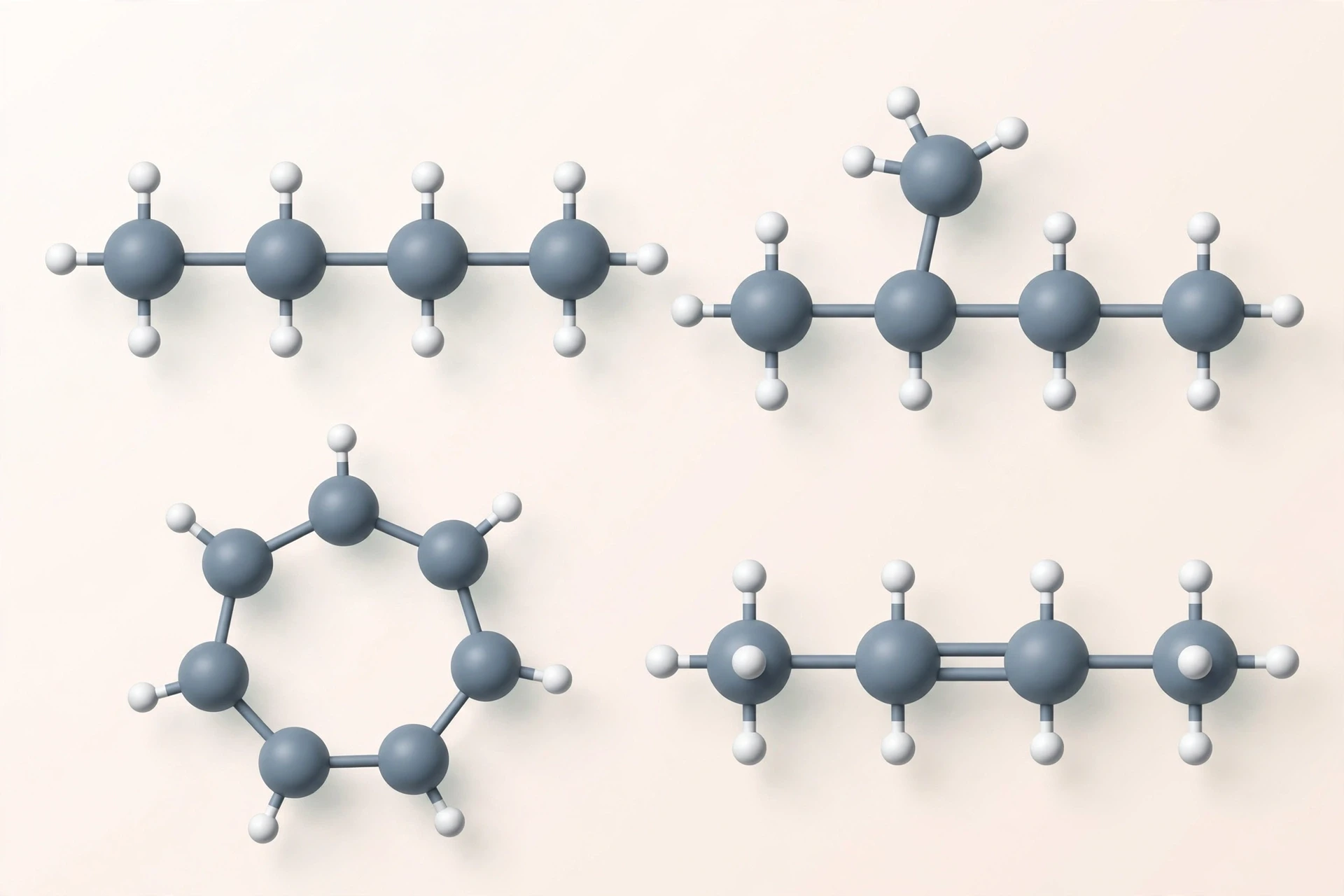
Give carbon a long enough run and it builds three basic architectures. Straight chains are the simplest: carbon after carbon after carbon, like beads on a string. Branched chains split off to the side, which changes how the molecule packs together and how easily it flows. Rings close the chain into a loop, which makes the molecule stiff and stable. The same set of atoms can appear in all three forms, and each form behaves differently.
Think of it like a train set. The same carriages can be arranged as one long train, as a train with a branch line, or as a circular track. The carriages are identical. The journey is not. In organic chemistry, the "journey" is the molecule's behaviour: how it melts, how it burns, how it reacts, and whether it fits into a living cell.
My first encounter with this idea came from a box of plastic molecular models in a school lab — coloured balls and sticks that clicked together with a satisfying snap. I built a straight chain of six carbons, then rebuilt the same six carbons as a branched shape, and my teacher asked which one I thought would boil first. I guessed wrong. The branched one boiled at a lower temperature, because its shape kept the molecules from snuggling close together. It was a small lesson, but it stuck: in organic chemistry, shape is a property, not a decoration.
2.3 The carbon cycle connection
Carbon does not stay in one place. It moves through the air, the oceans, the soil, and living things in a great loop that scientists call the carbon cycle. Plants pull carbon dioxide from the air and turn it into sugars. Animals eat the plants and breathe the carbon back out. Dead matter rots, and some of it is buried and compressed over millions of years into coal, oil, and gas. Burn those fuels and the carbon returns to the air as carbon dioxide, ready for the cycle to begin again.
That cycle is the reason organic chemistry and the environment are so tightly linked. The hydrocarbons we burn for energy are ancient sunlight, stored in carbon bonds by plants that lived long before humans existed. When we release that carbon quickly, the climate notices. Understanding organic chemistry is part of understanding why.
3. What Is a Hydrocarbon?
3.1 The simplest organic molecules
A hydrocarbon is a molecule made of only two elements: carbon and hydrogen. Nothing else. That is the whole definition, and it is the starting point for the rest of organic chemistry. Hydrocarbons are the simplest carbon compounds, and nearly every other organic molecule can be thought of as a hydrocarbon with something added or changed.
Methane, the main ingredient of natural gas, is the simplest hydrocarbon of all: one carbon atom holding four hydrogen atoms. Ethane has two carbons. Propane, the gas in camping stoves and barbecue tanks, has three. Butane, the fuel in a pocket lighter, has four. From there the family stretches upward without limit — pentane, hexane, heptane, octane, and on into molecules so long that they are solid waxes rather than gases or liquids.
Hydrocarbons fall into a few great families, sorted by the kind of bonds between their carbon atoms. Saturated hydrocarbons hold as much hydrogen as possible and have only single bonds. Unsaturated hydrocarbons have double or triple bonds, which means they hold less hydrogen. Aromatic hydrocarbons contain stable rings with a special kind of shared bonding. The next two sections walk through each family in turn, because telling them apart is the single most useful skill in organic chemistry.
3.2 Where hydrocarbons come from
Most of the hydrocarbons humans use come from crude oil and natural gas, the remains of ancient marine organisms buried under sediment and cooked by heat and pressure over millions of years. Crude oil is not one compound but a mixture of hundreds of different hydrocarbons, from light gases to heavy tars. Refineries separate that mixture into useful fractions — petrol, diesel, kerosene, lubricating oils, and the feedstocks for plastics — by boiling it and catching each part as it condenses at a different temperature. Section 7 looks at that process in detail.
Hydrocarbons also come from living things, right now. Plants make them: the scent of a pine forest comes from hydrocarbons called terpenes, and natural rubber is a hydrocarbon polymer made by rubber trees. Your own body makes a hydrocarbon called squalene, found in skin oil. And methane is produced by microbes in wetlands, in rice paddies, and in the guts of cattle. Hydrocarbons are not only a fuel story. They are a life story too.
3.3 Why hydrocarbons burn so well
A hydrocarbon is stored chemical energy. Its carbon-carbon and carbon-hydrogen bonds hold energy that is released when the molecule reacts with oxygen — combustion. Burn methane and you get carbon dioxide and water, plus heat and light. That reaction has warmed homes, cooked food, and powered engines for more than a century, and it is the reason hydrocarbons became the world's dominant fuels.
The same reaction is also the reason hydrocarbons are a climate problem. Every carbon atom in the fuel becomes a molecule of carbon dioxide in the air. There is no way to burn a hydrocarbon cleanly in the sense of avoiding carbon dioxide — the chemistry does not allow it. Cleaner burning can cut soot and other pollutants, but the carbon dioxide is built into the equation. That is a fact worth holding onto whenever anyone promises a "clean" fossil fuel. The chemical reactions article on Sciory explains combustion and other reaction types in more detail, including why some reactions release energy and others absorb it.
A hydrocarbon is a battery that nature charged over millions of years. Burning it spends that charge in seconds. The chemistry is simple. The consequences are not.
4. Alkanes, Alkenes, and Alkynes: What Is the Difference?
4.1 Alkanes — the saturated hydrocarbons
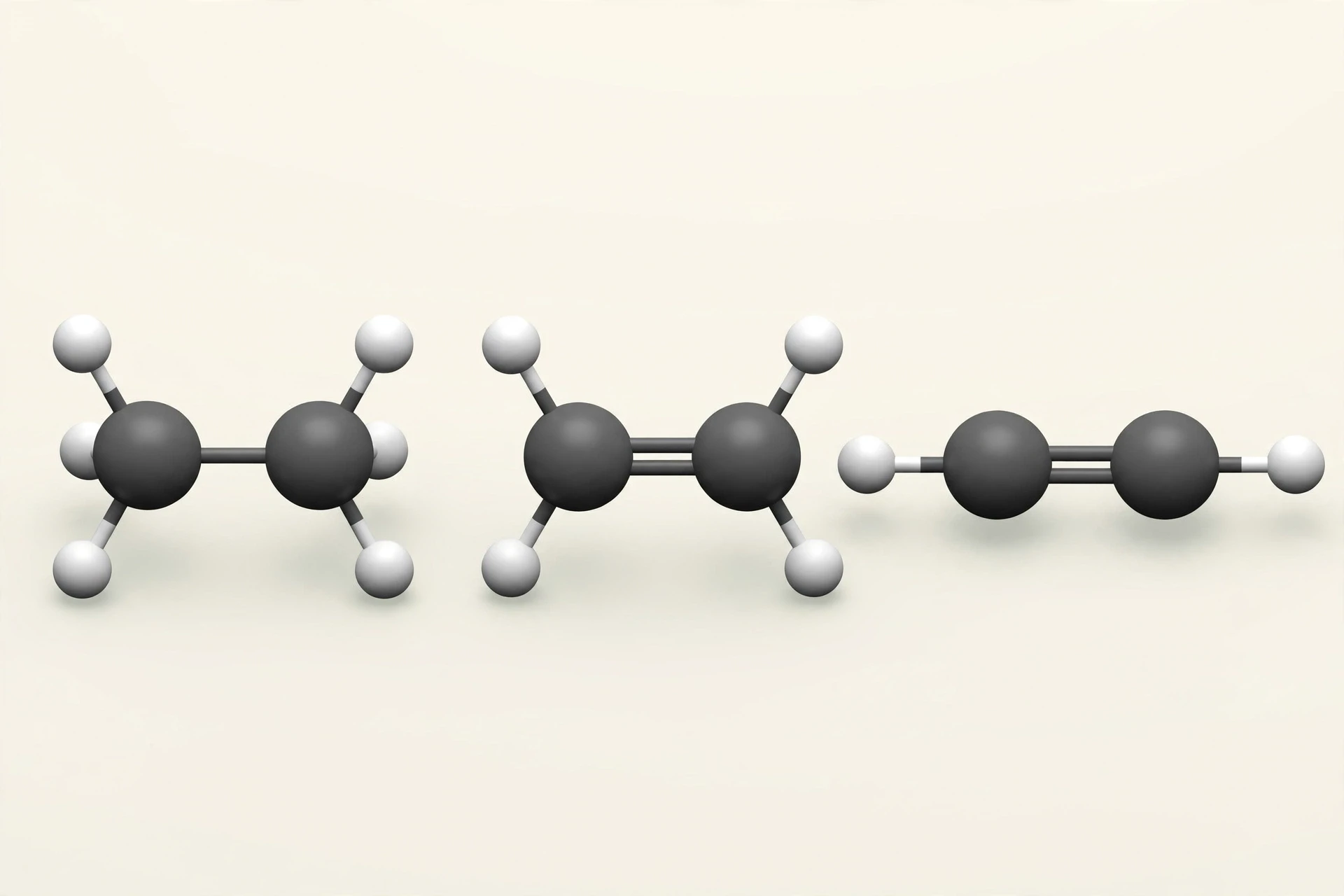
Alkanes are the simplest hydrocarbons. Every carbon-carbon bond is a single bond, and every carbon holds as many hydrogen atoms as it can. Chemists call them saturated, because they are saturated with hydrogen — there is no room for more. Their general formula is CₙH₂ₙ₊₂: a chain of n carbon atoms carries 2n + 2 hydrogen atoms.
The first ten alkanes are worth knowing by name, because their names are the alphabet of organic chemistry: methane, ethane, propane, butane, pentane, hexane, heptane, octane, nonane, decane. The endings stay the same; only the beginning changes with the number of carbons — meth- for one, eth- for two, prop- for three, but- for four, pent- for five, and so on. Once you know that pattern, you can read the name of an unfamiliar hydrocarbon and know its size at a glance.
Alkanes are famously unreactive. They do not dissolve in water, they do not react with most acids or bases, and they sit quietly in a bottle for years. That calm is why they make good fuels: they store energy without doing anything dangerous until you light them. It is also why the paraffin wax in a candle is an alkane mixture — it waits patiently until a flame arrives. The old name for alkanes, "paraffins," comes from the Latin for "little affinity," a nod to their reluctance to react with anything.
As alkane chains get longer, their properties change in a smooth, predictable pattern. Methane, ethane, propane, and butane are gases at room temperature. Pentane through hexadecane are liquids. Longer chains are waxy solids. Boiling points rise steadily with chain length, because longer molecules cling to each other more strongly. This smooth trend is one of the pleasures of organic chemistry: change one thing — the number of carbons — and the properties march along in step. The LibreTexts guide to the properties of alkanes lays out these trends with worked examples.
4.2 Alkenes — one double bond changes everything
Alkenes are hydrocarbons that contain at least one carbon-carbon double bond. That single change has big consequences. A double bond holds two pairs of shared electrons, which makes it a region of high electron density — a target for other molecules to attack. Alkenes are far more reactive than alkanes, and that reactivity is what makes them so useful.
The simplest alkene is ethene, also called ethylene: two carbon atoms joined by a double bond, each holding two hydrogens. Plants make ethene naturally, and they use it as a hormone. It is the reason a ripe banana can ripen the green fruit sitting next to it — the banana releases ethene gas, and the neighbouring fruit responds. Fruit sellers know this trick well: a bag of apples left beside unripe avocados will hurry them along. It is organic chemistry working quietly in a fruit bowl.
The general formula for an alkene with one double bond is CₙH₂ₙ. Compare that with an alkane, CₙH₂ₙ₊₂: the alkene holds two fewer hydrogens, because the double bond takes the place of two single bonds. Chemists say the alkene is unsaturated. That missing hydrogen is not a flaw. It is an opportunity. In an addition reaction, another molecule can add across the double bond, breaking it into a single bond and attaching new atoms to the carbons. This is how ethene becomes ethanol, how alkenes become plastics, and how the chemical industry builds larger molecules from small ones.
One more property of double bonds matters: they do not rotate freely. A single bond can spin like a wheel on an axle, but a double bond locks the molecule into a fixed shape. That lock creates a new kind of isomerism. Two molecules can have the same atoms and the same connections, yet differ in whether two groups sit on the same side of the double bond or on opposite sides. Those two versions — cis and trans — can behave very differently. The classic example is in fats: cis fats are the natural, bendy kind found in olive oil, while trans fats, with their straighter shape, pack tightly and behave more like saturated fats. Shape, again, is destiny.
4.3 Alkynes — the triple bond
Alkynes contain a carbon-carbon triple bond: three pairs of shared electrons between two carbons. Their general formula, for one triple bond, is CₙH₂ₙ₋₂. The simplest alkyne is ethyne, better known as acetylene. It burns with an extremely hot flame when mixed with oxygen — hot enough to cut steel — which is why oxy-acetylene torches are still used in welding and metalwork.
Alkynes are less common in everyday life than alkanes and alkenes, but they are important in industry and in the lab. Their triple bond is a concentrated store of reactivity, and chemists use it as a starting point for building complex molecules. Some alkynes also turn up in nature: certain fungi and plants make them as chemical defences. The LibreTexts pages on the properties of alkenes and the properties of alkynes give the details for readers who want to go further.
4.4 The three families side by side
The table below puts the three families next to each other. If you learn only one table from this article, make it this one.
Family | Carbon–carbon bond | General formula | Example | Reactivity | Everyday example |
|---|---|---|---|---|---|
Alkanes | Single | CₙH₂ₙ₊₂ | Ethane (C₂H₆) | Low — stable and unreactive | Natural gas, candle wax |
Alkenes | Double | CₙH₂ₙ | Ethene (C₂H₄) | Moderate — addition reactions | Ripening fruit, polyethylene |
Alkynes | Triple | CₙH₂ₙ₋₂ | Ethyne (C₂H₂) | High — very reactive | Welding torches |
A common exam question asks for the difference between alkanes, alkenes, and alkynes, and the honest answer has three parts: the bond type, the hydrogen count, and the reactivity. Alkanes hold the most hydrogen and react the least. Alkenes hold less hydrogen and react by addition across the double bond. Alkynes hold the least hydrogen and react the most eagerly. Learn that pattern and you can predict the behaviour of molecules you have never seen before — which is exactly what organic chemistry is for.
I still remember the afternoon a teacher handed me three unlabelled bottles and a bottle of brown bromine water, and asked me to sort them out. The alkane left the brown colour alone. The alkene and the alkyne both bleached it, the double and triple bonds grabbing the bromine for themselves. It felt like a magic trick, but it was only chemistry doing what chemistry does: the reactive bond revealing itself. That test — bromine water going colourless — is still used in school labs today, and it is still the fastest way to tell a saturated hydrocarbon from an unsaturated one.
5. What Are Functional Groups?
5.1 The reactive heart of the molecule
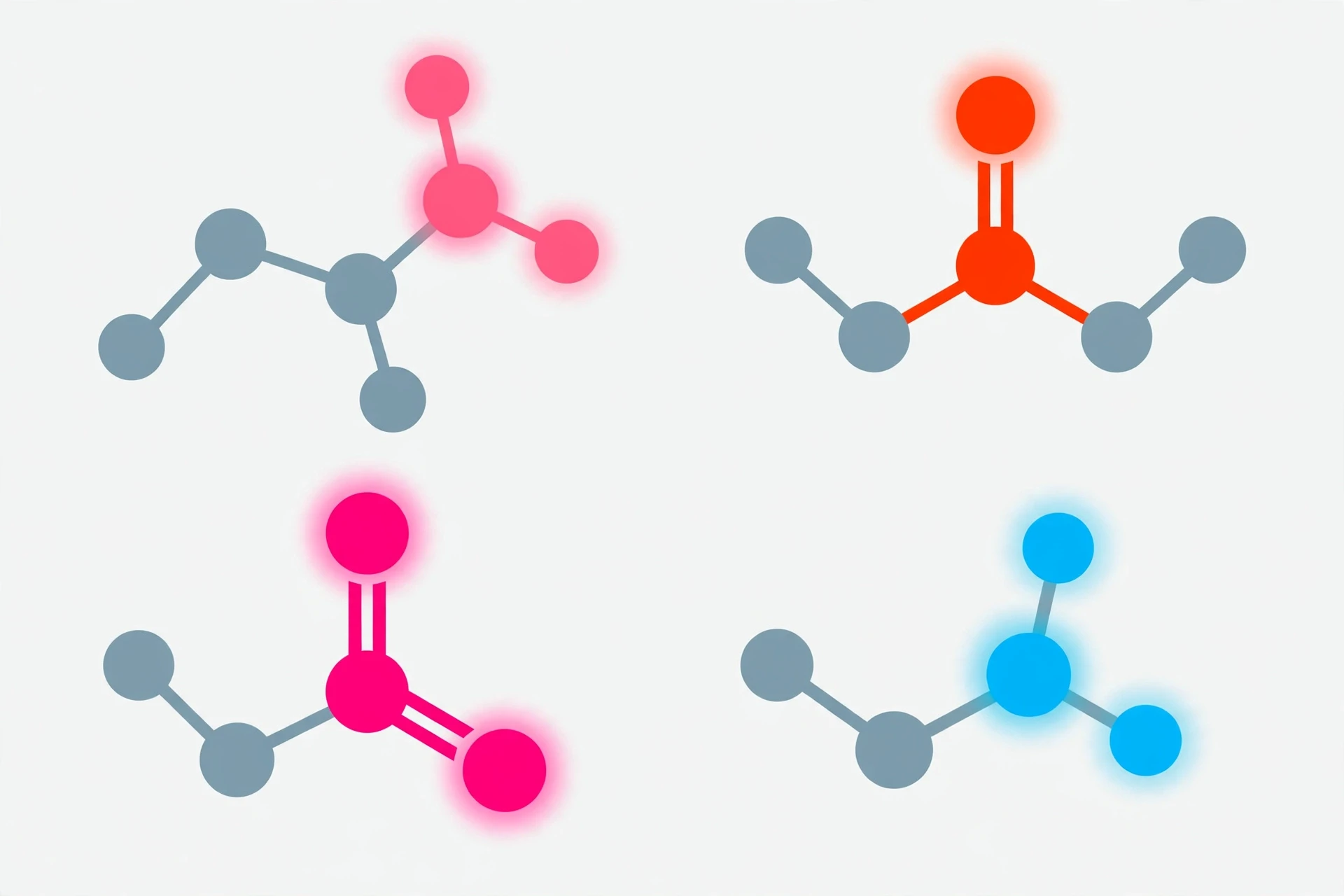
A functional group is a small cluster of atoms attached to a carbon chain that gives the molecule its characteristic chemical behaviour. The hydrocarbon chain is the skeleton. The functional group is the personality. Change the functional group and you change what the molecule does, even if the carbon skeleton stays exactly the same.
Take a two-carbon chain. Attach nothing special and you have ethane, a gas that burns. Attach a hydroxyl group (–OH) and you have ethanol, the alcohol in drinks and hand sanitiser. Replace that with a carboxyl group (–COOH) and you have ethanoic acid — vinegar. Same skeleton, three wildly different substances. That is the power of functional groups, and it is why organic chemistry is organised around them. Learn a dozen functional groups and you can make sense of millions of compounds, because the group, not the chain, usually decides the reaction.
This is also why organic chemistry feels learnable despite its size. The field looks endless from the outside, but it has a grammar. The carbon skeleton is the noun, the functional group is the verb, and once you know the verbs, you can read whole sentences you have never seen before.
5.2 The groups that matter most
Here are the functional groups a reader will meet most often, in plain language.
Alcohols (–OH). A hydroxyl group attached to a carbon makes an alcohol. Ethanol is the best-known example, but alcohols are everywhere: methanol in windscreen washer fluid, glycerol in skin creams, and the sugars in food, which carry several hydroxyl groups each. Alcohols dissolve in water more easily than hydrocarbons do, because the –OH group can form hydrogen bonds with water molecules. That is why ethanol mixes with water in any proportion while petrol floats on top of it. The LibreTexts guide to the properties of alcohols explains the trend in detail.
Carboxylic acids (–COOH). A carbon attached to both an oxygen by a double bond and a hydroxyl group forms a carboxyl group, and the molecule becomes an acid. Ethanoic acid gives vinegar its bite. Citric acid gives lemons their sourness. Fatty acids are the building blocks of fats and oils. Carboxylic acids donate a proton in water, which is what makes them acidic, and they react with bases to form salts — the reaction behind soap-making, which Section 9 returns to.
Aldehydes and ketones (C=O). A carbon-oxygen double bond is called a carbonyl group. When it sits at the end of a chain, the molecule is an aldehyde; when it sits in the middle, it is a ketone. Formaldehyde preserves specimens in biology labs. Acetone, the smell of nail polish remover, is a ketone and a powerful solvent. Vanillin, the vanilla molecule from the opening of this article, carries both an aldehyde group and a hydroxyl group — two functional groups on one small molecule, which is why its chemistry is so rich.
Amines (–NH2). Replace a hydrogen with a nitrogen group and you have an amine. Amines smell strongly — the smell of rotting fish comes from amines — but they are also essential to life. Every amino acid, the building block of proteins, carries an amine group. Many medicines, from antihistamines to local anaesthetics, are amines, because the nitrogen atom can pick up a proton and carry a positive charge, which changes how the molecule interacts with the body.
Esters (–COO–). An ester forms when a carboxylic acid reacts with an alcohol. Esters are the smell molecules of the fruit world: the smell of pineapple, banana, and strawberry in sweets and drinks comes mostly from esters. They are also the backbone of fats and oils, which are esters of glycerol and fatty acids, and of polyester fabric. If a scent smells fruity and artificial, an ester is usually responsible.
Halides (–F, –Cl, –Br, –I). A halogen atom attached to carbon makes an alkyl halide. These compounds are useful as solvents and as starting materials for making other molecules, and they have a complicated history: some, like the chlorofluorocarbons once used in fridges and spray cans, damaged the ozone layer and were phased out under international agreement. The story of CFCs is a reminder that a useful molecule can have consequences nobody foresaw.
5.3 The functional group table
Functional group | Structure | Example | Where you meet it |
|---|---|---|---|
Alcohol | –OH | Ethanol | Drinks, hand sanitiser, fuels |
Carboxylic acid | –COOH | Ethanoic acid | Vinegar, citrus fruit, fats |
Aldehyde | –CHO | Vanillin | Vanilla flavour, preservatives |
Ketone | C=O | Acetone | Nail polish remover, solvents |
Amine | –NH2 | Methylamine | Amino acids, medicines, fish smell |
Ester | –COO– | Ethyl ethanoate | Fruit flavours, fats, polyester |
Alkyl halide | –Cl, –Br | Chloroform | Solvents, refrigerants (older types) |
5.4 Naming: the system that never guesses
Organic molecules have names that describe their structure, and the naming system is international — a chemist in Tokyo and a chemist in Toronto use the same rules. The system is maintained by the International Union of Pure and Applied Chemistry, and its logic is simple once you see it: the beginning of the name tells you how many carbons there are, the middle tells you about the bonds, and the ending tells you the functional group.
Methane, ethane, propane — the prefixes count the carbons. The suffix -ane means single bonds only, -ene means a double bond, -yne means a triple bond. The suffix -ol marks an alcohol, -oic acid marks a carboxylic acid, -al marks an aldehyde, and -one marks a ketone. Ethanol is a two-carbon alcohol. Propanone is a three-carbon ketone. Once the code clicks, names stop being things to memorise and start being things to read.
The OpenStax chemistry textbook gives a clear introduction to hydrocarbons and their naming, and it is free to read online. It is a good next stop for anyone who wants to practise reading names as structures.
6. From Crude Oil to Everyday Life
6.1 Fractional distillation: sorting a mixture by boiling point
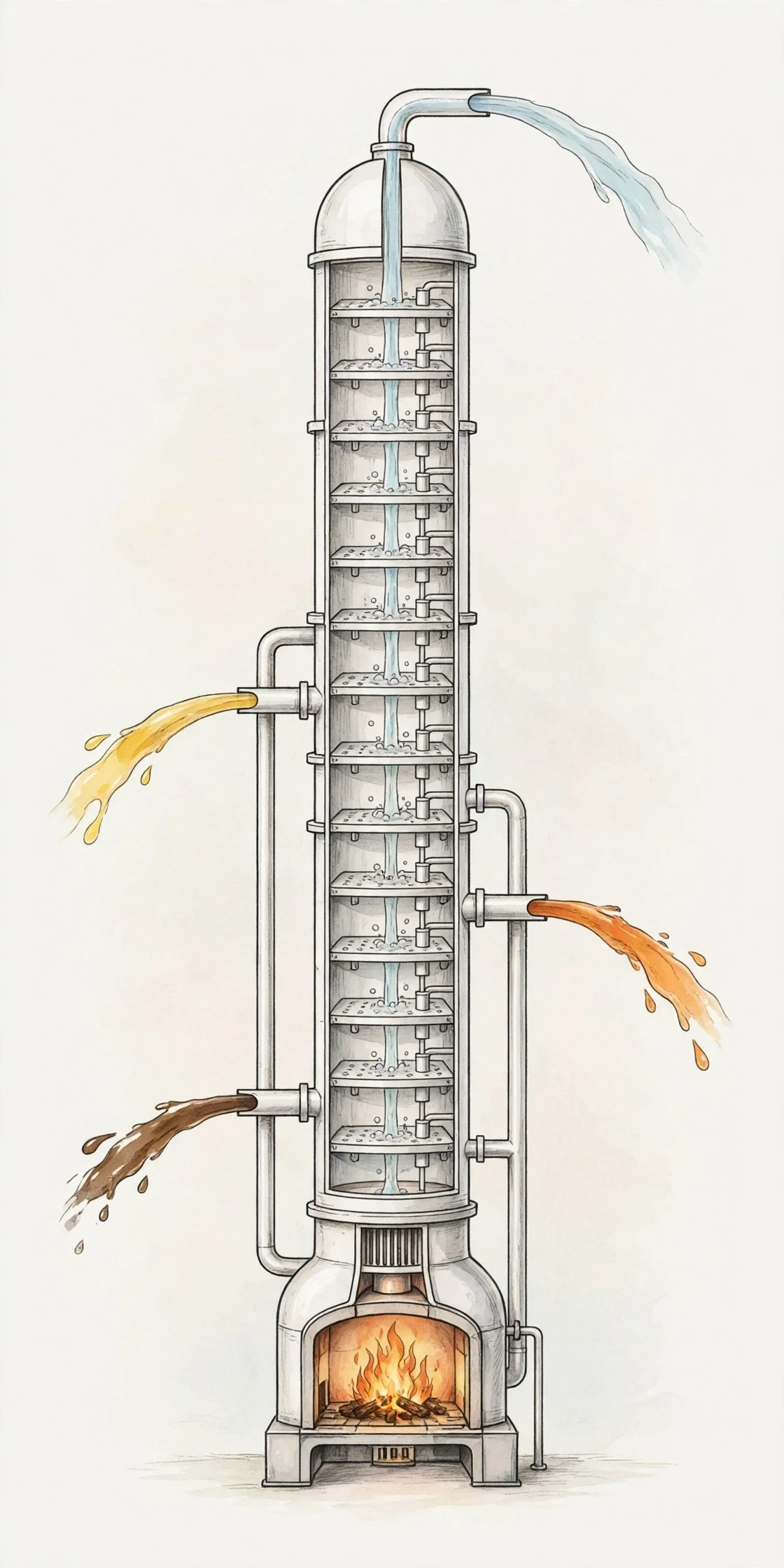
Crude oil arrives at a refinery as a thick, dark mixture of hundreds of hydrocarbons. Nobody uses it as it comes. The first job is to sort it, and the sorting tool is a tall steel tower called a fractionating column. The crude oil is heated until it vaporises, and the vapour rises through the column. As it climbs, the column gets cooler. Each hydrocarbon condenses back into liquid when it reaches the height where the temperature matches its boiling point, and it is drawn off through a pipe at that level.
Light molecules with low boiling points, like petrol, condense near the top. Heavier molecules, like diesel and lubricating oils, condense lower down. The heaviest residue, bitumen, never vaporises at all and is collected at the bottom for roads and roofing. It is a simple idea — sort by boiling point — and it works because boiling points rise smoothly with chain length, exactly as Section 4 described.
The first time I watched a small-scale distillation in a lab, I expected something dramatic. What I got was quieter and better: a clear liquid dripping, drop by drop, into a flask, while the thermometer held steady at one temperature. Then the temperature jumped, and a different liquid began to drip. The mixture was sorting itself in front of me, one fraction at a time. Industrial columns do the same thing on a scale of thousands of tonnes a day, but the principle is identical.
6.2 Cracking: breaking big molecules into useful ones
Refineries face a mismatch. The world wants far more petrol than crude oil naturally contains, and far less heavy fuel oil than it produces. The fix is cracking: heating long hydrocarbon chains until they break into shorter ones, often with a catalyst to help. A long, sluggish molecule that would have become fuel oil is split into two shorter molecules, one of which is the right size for petrol, and the other often an alkene that the plastics industry wants.
Cracking is a good example of organic chemistry as engineering. The chemists are not discovering a new reaction here; they are steering a known one — breaking carbon-carbon bonds with heat — to match what people actually need. Catalytic cracking, thermal cracking, and hydrocracking all do the same job in different ways, and together they let a refinery turn most of a barrel of crude oil into products someone will buy.
6.3 What a barrel of oil becomes
Petrol and diesel get the attention, but a barrel of crude oil becomes far more than fuel. The naphtha fraction feeds the petrochemical industry, which turns it into plastics, solvents, detergents, fertilisers, and medicines. Kerosene fuels jets. Lubricating oils keep engines alive. Waxes coat cheese and polish cars. Bitumen paves roads. Even the clothes in a wardrobe are often oil-derived: polyester, nylon, and acrylic are all made from petrochemical building blocks.
That breadth is worth remembering in debates about the future of oil. Fuels can be replaced by electricity, and increasingly they are. But the materials side — plastics, medicines, fertilisers — still depends on hydrocarbon feedstocks, and replacing those is a harder problem. Green chemistry, which tries to build the same molecules from plants and waste instead of oil, is one of the most active frontiers in organic chemistry today, and it is the subject of a later article in this cluster.
7. Aromatic Compounds: Benzene and the Ring
7.1 A ring that refused to behave
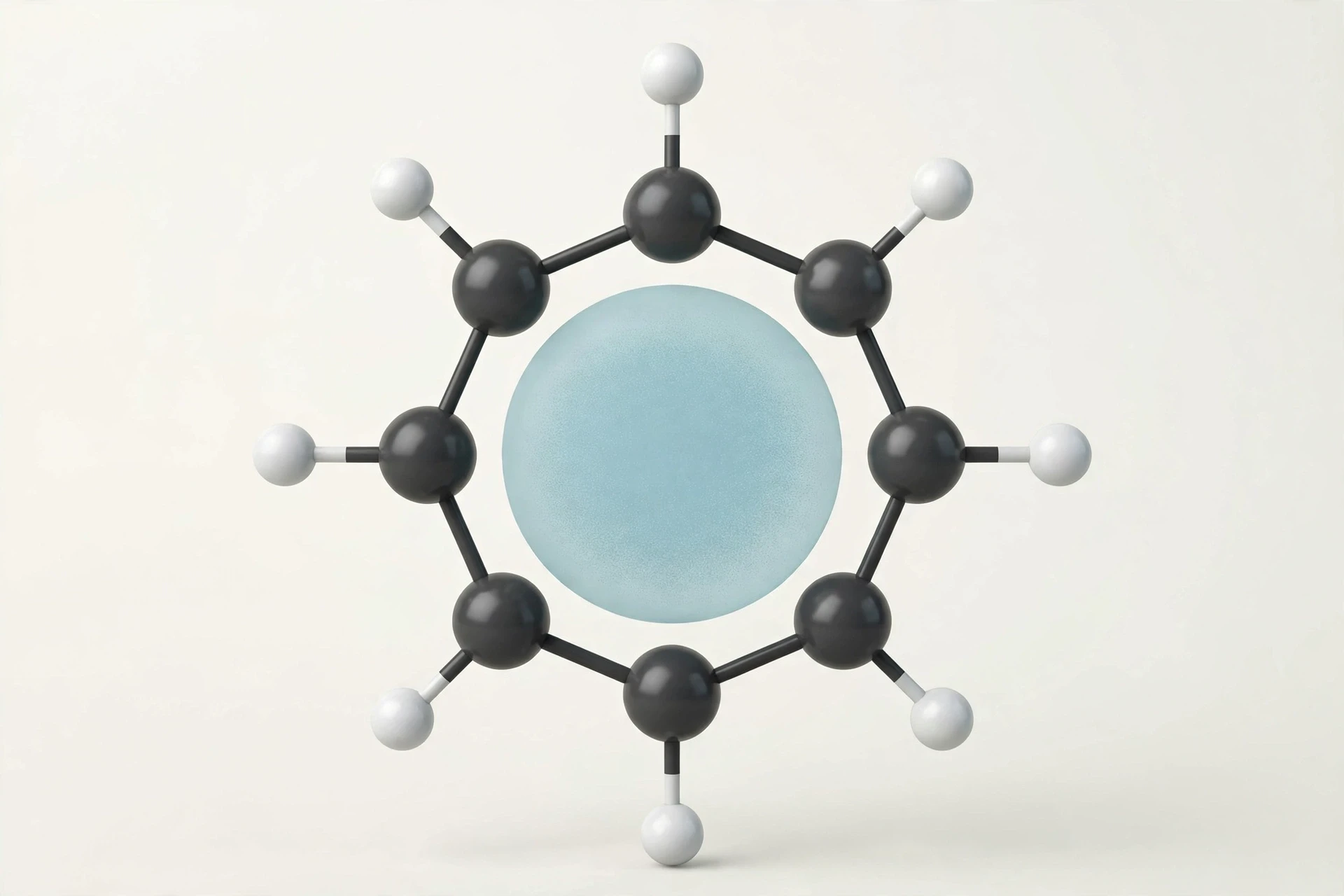
Benzene is a hydrocarbon with the formula C₆H₆: six carbons in a ring, each holding one hydrogen. By the formula alone it looks as if it should be extremely reactive — six carbons with only six hydrogens means a lot of unsaturation. But benzene is strangely calm. It does not react like an alkene. It resists addition reactions and prefers a different kind of reaction, substitution, in which one hydrogen is swapped for something else while the ring stays intact.
The explanation took decades to settle. The six electrons from the three double bonds are not fixed in place; they are shared around the whole ring, spread out in a loop above and below the flat hexagon. That sharing, called delocalisation, makes the ring unusually stable. Chemists draw benzene as a hexagon with a circle inside it, and the circle is the honest picture: the electrons belong to the ring, not to any one bond.
The story of how the ring structure was discovered is one of the most told tales in chemistry. According to the account August Kekulé himself gave years later, he was dozing by a fire in 1865 when he dreamed of atoms dancing, twisting, and finally biting their own tails like a snake. He woke up and sketched a ring. Whether the dream happened exactly that way is impossible to verify now, and historians argue about it. What is not in doubt is that the ring structure explained benzene's strange behaviour, and it opened the door to the whole family of aromatic compounds.
7.2 Where aromatics turn up
Aromatic compounds are everywhere, and not only in labs. The smell of almonds comes from benzaldehyde, an aromatic aldehyde. Vanilla's vanillin is aromatic too. Aspirin is built on a benzene ring. So are many dyes, many plastics — polystyrene is a polymer of an aromatic molecule called styrene — and the painkiller paracetamol. The flat, stable ring is a favourite building block for drug designers, because it is rigid: it holds the rest of the molecule in a fixed shape, which helps it fit its target in the body.
Some aromatic compounds are dangerous. Benzene itself is toxic and carcinogenic, and workers who handle it follow strict safety rules. Polycyclic aromatic hydrocarbons, formed when organic matter burns incompletely — in smoke, in grilled food, in exhaust — include some of the most studied carcinogens in chemistry. Aromatic chemistry is powerful precisely because these rings are so stable; that stability can be a benefit in a medicine and a hazard in a pollutant. Organic chemistry does not pick sides. It describes what molecules do, and people decide what to do with that knowledge.
7.3 Aromaticity in one paragraph
Chemists have a test for aromaticity, and it is worth knowing because it shows how organic chemistry thinks. A molecule is aromatic if it is cyclic, flat, fully conjugated — meaning every atom in the ring contributes an electron to the shared system — and carries a particular count of those shared electrons. The rule is called Hückel's rule, and it predicts which rings will be stable and which will not. It is a small rule with large consequences: it explains why benzene is stable, why some rings are anti-aromatic and violently reactive, and why the flat rings of DNA's bases stack neatly on top of each other. The details belong in a university course, but the shape of the idea belongs here: stability in organic chemistry is often a matter of electrons finding a comfortable arrangement, and the benzene ring is the most comfortable arrangement carbon ever found.
8. Polymers: The Long Chains That Changed the World
8.1 One small molecule, repeated a thousand times
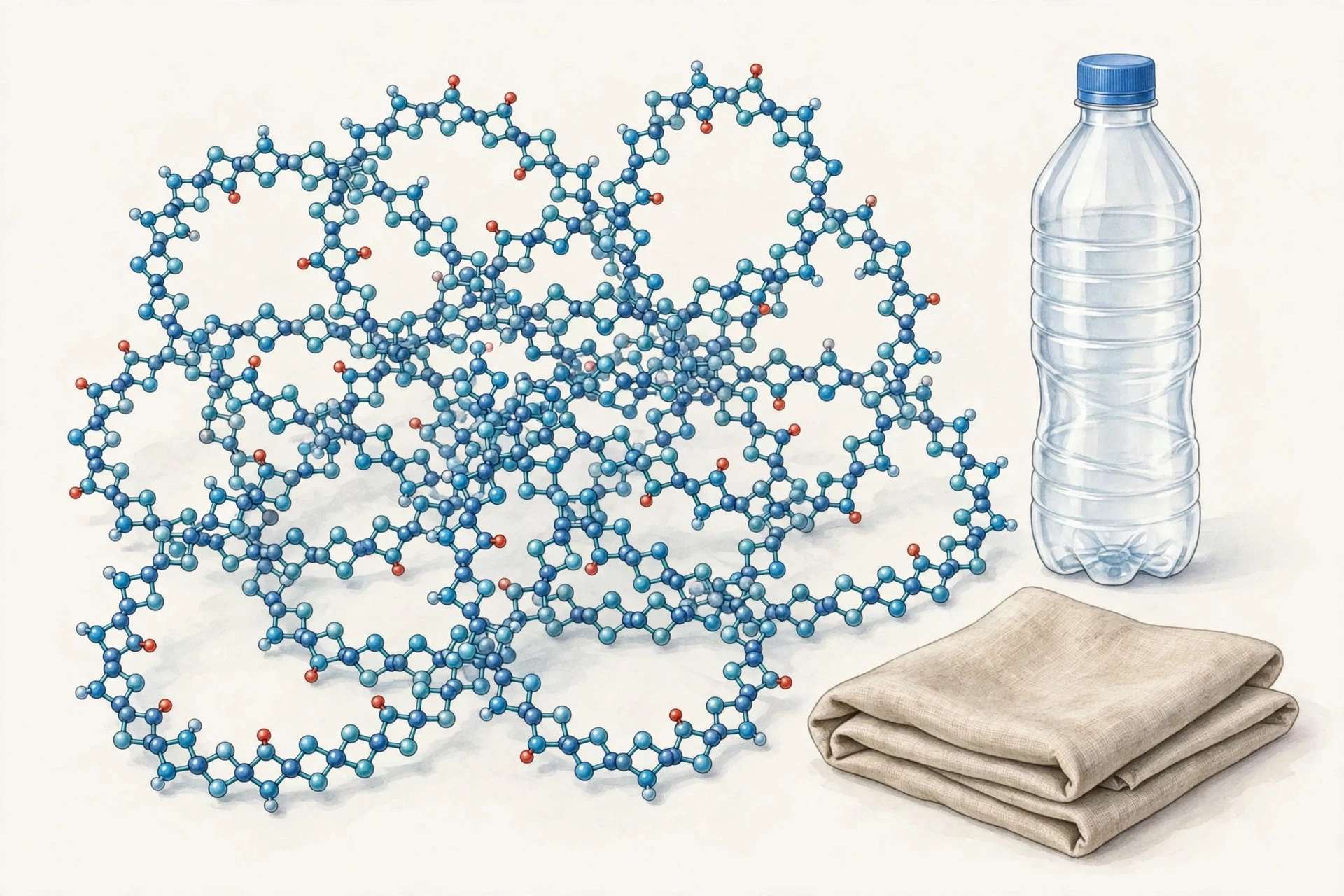
A polymer is a very long molecule made by joining many small repeating units, called monomers, into a chain. The word comes from the Greek for "many parts," and the idea is disarmingly simple: take ethene, a two-carbon gas, and join thousands of ethene molecules together, and you get polyethylene — the plastic in shopping bags, bottles, and food wrap. The monomer is a gas. The polymer is a tough, flexible solid. Nothing was added except more of the same.
Polymers form in two main ways. In addition polymerisation, monomers with double bonds join up by opening those bonds and linking to each other, like people joining hands in a chain. Polyethylene, polypropylene, and polystyrene all form this way. In condensation polymerisation, monomers join by giving off a small molecule — usually water — each time they link. Polyester and nylon form this way, and so do the proteins in your body, which are condensation polymers of amino acids. Nature invented polymers first. Humans copied the trick.
The length of the chain decides the properties. Short chains make soft waxes and oils. Medium chains make flexible films. Very long chains tangle together and make strong, tough materials. Cross-linking — tying the chains together with extra bonds — makes the material rigid and heat-resistant: that is how rubber is vulcanised and how epoxy resins harden. A polymer chemist's job is largely a matter of choosing the monomer, the chain length, and the amount of cross-linking, and then letting the properties follow.
8.2 The plastics in your pocket
Look around the room you are sitting in and count the polymers. The chair, the keyboard, the phone case, the carpet, the paint on the walls, the clothes you are wearing — most of them are polymers, either natural or synthetic. Natural polymers include cellulose in wood and cotton, starch in food, silk, wool, and rubber. Synthetic polymers include polyethylene, polypropylene, polystyrene, PVC, nylon, and polyester. The modern world is, to a large extent, a world built from long carbon chains.
That success has a shadow, and it is one of the biggest environmental problems of our time. Most synthetic polymers do not rot. A plastic bag can survive in the environment for decades, breaking into smaller and smaller fragments — microplastics — without ever truly disappearing. Chemists are working on the problem from several directions: polymers that biodegrade, polymers made from plants instead of oil, and better ways to recycle the polymers we already have. None of these is a complete answer yet, and anyone who promises one is selling something. But the work is real, and it is some of the most important organic chemistry being done anywhere.
8.3 Polymers that are not plastic
It is easy to forget that the most important polymers are not in a factory. They are in you. Proteins are polymers of amino acids. DNA is a polymer of nucleotides. Cellulose, the most abundant organic polymer on Earth, is a polymer of glucose, and it holds up every tree on the planet. Starch is also a polymer of glucose — the same building block, joined differently, giving a food store instead of a structural beam. The difference between a tree trunk and a potato is, at the molecular level, a difference in how glucose units are linked. Section 10 comes back to these living polymers, because they are where organic chemistry meets biology.
9. Organic Chemistry in the Kitchen and the Medicine Cabinet
9.1 Soap: a molecule with two faces
Soap is one of the oldest applications of organic chemistry, and one of the cleverest. A soap molecule has two ends with opposite personalities: one end is a long hydrocarbon tail that loves grease and hates water, and the other end is a charged, water-loving head. Put soap in dirty water and the tails dive into the grease while the heads stay in the water. The grease is lifted off the surface, surrounded by soap molecules, and rinsed away.
Soap is made by a reaction called saponification: fats or oils — which are esters — react with a strong base such as sodium hydroxide, and split into glycerol and the salts of fatty acids. Those salts are the soap. People have made it this way for thousands of years, boiling animal fat with wood ash. Modern soap-making uses the same chemistry with cleaner ingredients and better control, but the molecule at work is the same. When you wash your hands, you are running an organic chemistry experiment that predates written history.
I once watched a soap-maker pour a batch into wooden moulds, and what struck me was how ordinary the ingredients looked — oil, lye, water — and how completely the result had changed. The oil was gone. Something new stood in its place, something that could do a job none of its ingredients could do alone. That transformation, from greasy liquid to cleaning agent, is what organic reactions are: old bonds break, new bonds form, and the world gets a new substance.
9.2 Vinegar, alcohol, and the chemistry of flavour
The kitchen is an organic chemistry lab that never closes. Vinegar is ethanoic acid, made when bacteria oxidise ethanol. Wine left open turns to vinegar by exactly that route, which is why a good bottle goes bad once the air gets in. Ethanol itself is made by yeast fermenting sugars — another organic reaction, run by living cells, that humans have exploited for thousands of years.
Flavour is mostly organic chemistry too. The smell of cinnamon comes from cinnamaldehyde. The heat of chilli comes from capsaicin. The smell of fresh bread comes from dozens of volatile organic molecules made during baking. And the sweetness of sugar comes from the shape of sucrose molecules fitting into taste receptors on the tongue. Cooking is applied organic chemistry: heat breaks bonds, forms new ones, and turns raw ingredients into hundreds of new compounds. A roasted coffee bean contains over a thousand different organic molecules. A green, unroasted bean contains far fewer. Roasting is chemistry, and the smell of it is the evidence.
9.3 Medicines: molecules designed to fit
Most medicines are organic molecules, and they work because their shape fits a target in the body — an enzyme, a receptor, a channel — the way a key fits a lock. Aspirin, one of the oldest synthetic medicines, is acetylsalicylic acid, a small aromatic molecule that blocks enzymes involved in pain and inflammation. It was developed from salicin, a compound found in willow bark that people had used for pain relief for centuries. Chemists took the natural molecule, changed it slightly to make it gentler on the stomach, and created one of the most used drugs in history.
Modern drug design works the same way, with better tools. Chemists study the shape of a target protein, design a molecule that fits it, make the molecule in the lab, and test whether it works. Most candidates fail. The ones that succeed can take a decade and enormous effort to reach patients. The American Chemical Society's history of organic chemistry landmarks tells the story of how this field grew from Wöhler's urea to modern drug design, and it is a good place to see the human side of the science.
Every medicine is a conversation between a molecule and a body. Organic chemistry writes the molecule's side of that conversation, one atom at a time.
10. Organic Chemistry in Living Things
10.1 The four families of biomolecules
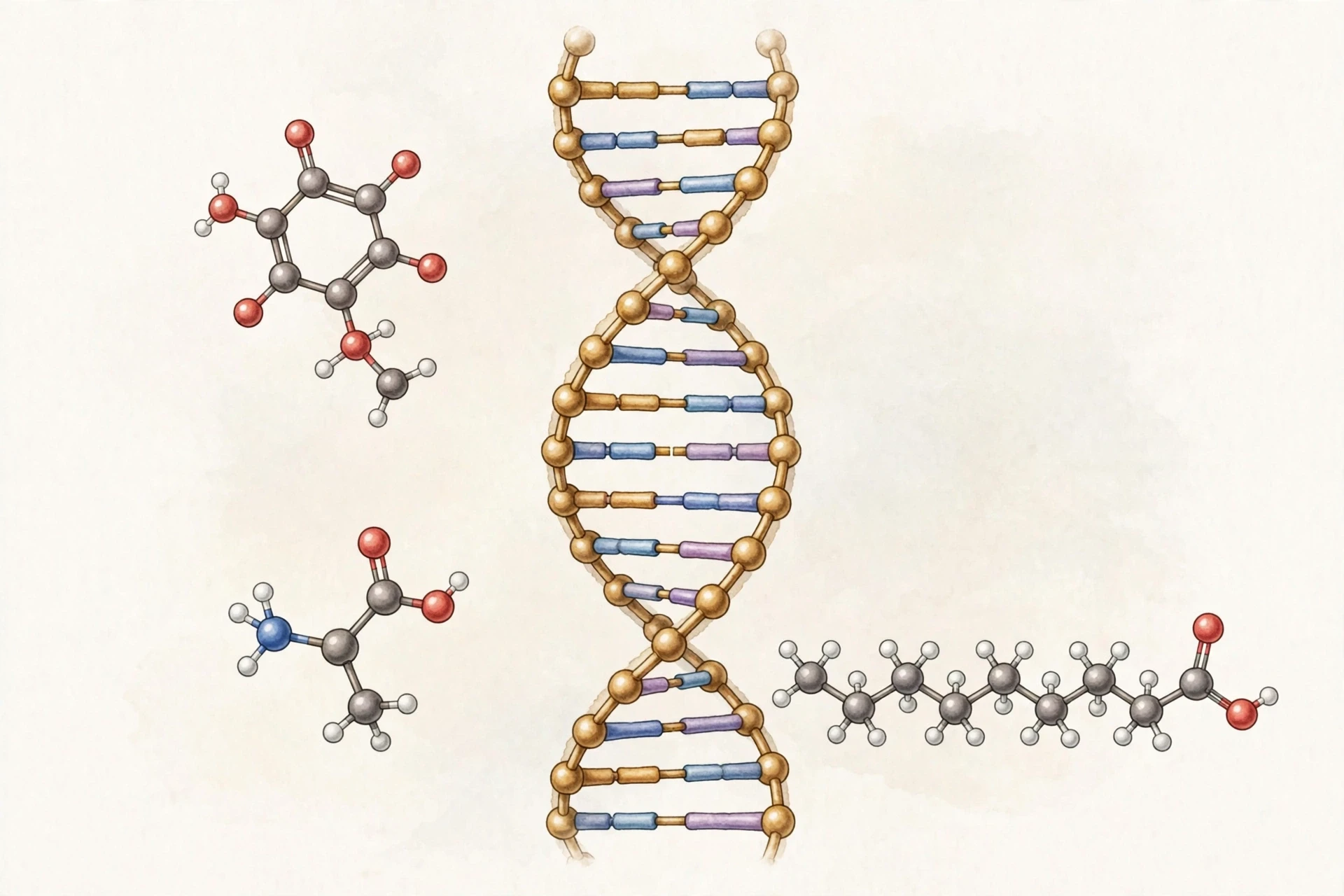
Life runs on four families of organic molecules. Carbohydrates, like glucose and starch, store and deliver energy. Lipids, like fats and oils, store energy for the long term and build cell membranes. Proteins, built from amino acids, do almost everything else: they catalyse reactions as enzymes, carry oxygen as haemoglobin, build muscle, and fight infection as antibodies. Nucleic acids — DNA and RNA — store and transmit the instructions for making all the rest.
Each family is built from a small set of repeating units, joined by the same kinds of reactions chemists use in a lab. Proteins are condensation polymers of twenty amino acids. DNA is a polymer of four nucleotides. Starch and cellulose are polymers of glucose. Life is economical: it builds enormous complexity from a small kit of parts, and the kit is organic chemistry.
The Sciory article on DNA structure, replication, and heredity explains how the four bases of DNA spell out instructions, and the article on photosynthesis explains how plants build sugars from carbon dioxide and water using sunlight. Both are organic chemistry stories at heart: photosynthesis builds carbon compounds from the air, and DNA stores information in the order of carbon-based units.
10.2 Enzymes: nature's catalysts
If organic chemistry is the study of carbon reactions, enzymes are its master practitioners. An enzyme is a protein that speeds up a specific reaction, often by an enormous factor, without being used up itself. The reactions of life would take years without enzymes; with them, they take milliseconds. Your body runs thousands of different enzyme-catalysed reactions at once, at body temperature, in water — conditions so gentle that a laboratory chemist would envy them.
Enzymes work by shape. Each enzyme has an active site, a pocket shaped to fit its target molecule, and the fit strains the target's bonds in just the right way to make the reaction happen. The fit is not rigid — the enzyme flexes around its target, a movement sometimes called induced fit. When the reaction is done, the products leave and the enzyme is ready for the next molecule. A single enzyme can process thousands of molecules per second.
The first time I grasped what enzymes really do, I was watching bread rise. Yeast cells were fermenting sugar into ethanol and carbon dioxide, and the carbon dioxide was inflating the dough. No heat, no pressure, no harsh chemicals — just enzymes, working at room temperature, doing chemistry that would need a furnace in a factory. It was the most convincing demonstration of organic chemistry I had ever seen, and it was happening in a bowl on a kitchen counter.
10.3 Why carbon, and not something else
It is worth asking the question directly: why is life built on carbon? The answer is a list of carbon's gifts. It forms strong bonds with itself, so it can build long, stable chains. It forms strong bonds with hydrogen, oxygen, and nitrogen, so it can build molecules with many different functional groups. Its bonds are strong enough to hold a molecule together, but not so strong that reactions cannot break and remake them. And its compounds can exist in water, the solvent of life, without falling apart.
Silicon, carbon's neighbour in the periodic table, fails on several of these counts. Its chains are weak in water, its double bonds are unstable, and its compounds tend to form rocks rather than flexible molecules. Science fiction sometimes imagines silicon-based life, but no silicon-based organism has ever been found, and the chemistry gives a clear reason why. Carbon is not the only element that could support complex chemistry. It is simply, by a wide margin, the best at it.
11. How Organic Reactions Work
11.1 Four reaction types that cover most of the field
Organic reactions look complicated, but most of them fall into four patterns. Learning the patterns is more useful than memorising individual reactions.
Addition. Two molecules join into one, usually across a double or triple bond. Ethene plus water gives ethanol. Ethene plus bromine gives a dibromide. Addition is how small molecules become bigger ones, and it is the reaction behind most plastics.
Substitution. One atom or group is swapped for another. A hydrogen on benzene is replaced by a nitro group, or a chlorine on an alkane is replaced by a hydroxyl group. Substitution is the workhorse of synthesis: it lets chemists change one part of a molecule while leaving the rest alone.
Elimination. A molecule loses a small piece, often forming a double bond in the process. An alcohol loses water to become an alkene. Elimination is the reverse of addition, and the two reactions are in constant competition — which one wins depends on the conditions.
Rearrangement. The atoms stay the same, but their connections change. The molecule reshapes itself into an isomer. Rearrangements are rarer, but they can be dramatic: a chain can fold into a ring, or a ring can open into a chain, and the product can behave very differently from the starting material.
11.2 Mechanisms: following the electrons
Chemists do not just record what goes in and what comes out. They trace how the electrons move, step by step, in a description called a mechanism. Mechanisms use curved arrows to show electron pairs moving from one place to another — from a bond that breaks to a bond that forms. Learning to read those arrows is like learning to read music: at first it is slow and confusing, and then suddenly the pattern is visible and the whole reaction makes sense.
Mechanisms matter because they let chemists predict. If you know how a reaction works, you can guess what will happen when you change the starting material, the solvent, or the temperature. That predictive power is what turns organic chemistry from a collection of recipes into a science. The Khan Academy course on organic chemistry teaches mechanisms with worked examples and practice problems, and it is free.
11.3 What controls whether a reaction happens
Three things decide whether an organic reaction runs, and how fast. The first is energy: reactions that release energy tend to run on their own, while reactions that absorb energy need a push. The second is the activation barrier — the energy hump the molecules must climb before the reaction can happen. Catalysts work by lowering that hump, not by changing the energy balance. The third is the shape and charge of the molecules involved: a reaction happens when the right atoms meet in the right orientation with enough energy, and most collisions fail on one of those counts.
Temperature matters because it raises the energy of the molecules and the frequency of their collisions. Concentration matters because more molecules mean more collisions. Solvents matter because they can stabilise or destabilise the charged intermediates that many reactions pass through. None of this is mysterious once the picture is clear: reactions are molecular encounters, and conditions decide how often those encounters succeed.
12. Common Mistakes and Misconceptions
12.1 "Organic means natural and safe"
This is the most common misunderstanding in organic chemistry, and the most dangerous one. In everyday language, "organic" on a food label means grown without synthetic pesticides or fertilisers. In chemistry, "organic" means a compound containing carbon. The two meanings have almost nothing to do with each other. An organic compound can be natural or synthetic, harmless or deadly. Cyanide is an organic compound. So is the poison in some mushrooms. So is sugar. The word tells you about the atoms, not about safety. Anyone who tells you a substance is safe because it is "organic" is using the wrong definition — or hoping you will.
12.2 "All hydrocarbons are the same"
Most people assume petrol, candle wax, and natural gas are basically the same stuff, because they all burn. They are not. They are mixtures of different hydrocarbons, with different chain lengths, different structures, and different properties. That is why petrol evaporates quickly and wax does not, why diesel engines and petrol engines work differently, and why a gas leak is dangerous in a way a candle is not. The differences between hydrocarbons are the differences that matter, and this article's tables exist to make them visible.
12.3 "Carbon compounds are too complex to understand"
Organic chemistry has a reputation for being the hardest course in science, and the reputation scares people away. The truth is kinder than the reputation. The field is large, but it is organised. A dozen functional groups, four reaction types, and a handful of patterns explain most of what happens. Students who struggle are usually trying to memorise thousands of individual reactions instead of learning the patterns underneath them. Learn the patterns — the bond types, the functional groups, the four reaction types — and the details start to fall into place. That is how working chemists think, and it is how this article is organised.
12.4 "Plastics are one material"
Plastic is not a substance. It is a family of thousands of different polymers, each with its own properties. Polyethylene is soft and flexible. Polystyrene is hard and brittle. Nylon is strong and stretchy. PVC is tough and weather-resistant. Lumping them together as "plastic" hides the chemistry that makes each one useful — and hides why recycling is hard. Different polymers cannot simply be melted together, because they do not mix. Sorting them is the first step in recycling, and it is a chemistry problem as much as a logistics one.
13. Frequently Asked Questions
What is organic chemistry?
Organic chemistry is the branch of chemistry that studies compounds containing carbon, usually bonded to hydrogen. It covers hydrocarbons, functional groups, and the reactions that build and transform carbon molecules — the chemistry behind fuels, plastics, medicines, food, and living things. The field began as the chemistry of substances from living organisms, but since Wöhler made urea from inorganic materials in 1828, it has been defined by carbon itself, not by life.
What is a hydrocarbon?
A hydrocarbon is a molecule made only of carbon and hydrogen. Methane, the main ingredient of natural gas, is the simplest hydrocarbon, with one carbon and four hydrogens. Hydrocarbons are sorted into families by their carbon-carbon bonds: alkanes have only single bonds, alkenes have at least one double bond, and alkynes have at least one triple bond. Most come from crude oil and natural gas, but plants and microbes make them too.
What is the difference between alkanes, alkenes, and alkynes?
The difference is the bond between carbon atoms and how much hydrogen the molecule holds. Alkanes have single bonds, the most hydrogen, and the lowest reactivity — they are saturated. Alkenes have a double bond, less hydrogen, and react by addition across that bond. Alkynes have a triple bond, the least hydrogen, and the highest reactivity. In short: single bond and stable, double bond and reactive, triple bond and most reactive.
What are functional groups?
A functional group is a small cluster of atoms attached to a carbon chain that gives the molecule its characteristic behaviour. The hydroxyl group (–OH) makes alcohols, the carboxyl group (–COOH) makes acids, the carbonyl group (C=O) makes aldehydes and ketones, and the amine group (–NH2) makes amines. Change the functional group and you change what the molecule does, even if the carbon skeleton stays the same. Learning the main functional groups is the fastest way to make sense of organic chemistry.
Why is carbon so important in organic chemistry?
Carbon forms four strong covalent bonds, links to itself in chains, branches, and rings, and bonds well with hydrogen, oxygen, and nitrogen. No other element combines all of these talents. Carbon chains are stable at everyday temperatures but reactive enough to break and reform, which is why carbon can build both fuels and living cells. Silicon, its neighbour in the periodic table, cannot match it — its chains fall apart in water.
What is the difference between organic and inorganic chemistry?
Organic chemistry studies carbon compounds, especially those with carbon-hydrogen bonds. Inorganic chemistry studies everything else: metals, salts, minerals, and the small number of carbon compounds, like carbon dioxide and carbonates, that are traditionally filed as inorganic. The boundary is a matter of convention rather than nature, but it is useful: organic chemistry has its own naming system, reaction patterns, and functional groups that inorganic chemistry does not share.
Is organic chemistry hard to learn?
It has a reputation for difficulty, but the subject is organised around a small set of patterns: a dozen functional groups, four reaction types, and the rules of naming. Students who struggle are usually memorising reactions one by one instead of learning the patterns underneath. Start with hydrocarbons, learn the functional groups, practise reading names as structures, and the rest follows. It takes steady work, but it does not take a special talent.
14. Sources
LibreTexts — Properties of Alkanes — https://chem.libretexts.org/Bookshelves/Organic_Chemistry/Supplemental_Modules_(Organic_Chemistry)/Alkanes/Properties_of_Alkanes
LibreTexts — Properties of Alkenes — https://chem.libretexts.org/Bookshelves/Organic_Chemistry/Supplemental_Modules_(Organic_Chemistry)/Alkenes/Properties_of_Alkenes
LibreTexts — Properties of Alkynes — https://chem.libretexts.org/Bookshelves/Organic_Chemistry/Supplemental_Modules_(Organic_Chemistry)/Alkynes/Properties_of_Alkynes
LibreTexts — Properties of Alcohols — https://chem.libretexts.org/Bookshelves/Organic_Chemistry/Supplemental_Modules_(Organic_Chemistry)/Alcohols/Properties_of_Alcohols
OpenStax Chemistry 2e — Hydrocarbons — https://openstax.org/books/chemistry-2e/pages/20-1-hydrocarbons
American Chemical Society — Organic Chemistry Landmarks — https://www.acs.org/education/whatischemistry/landmarks/organic-chemistry.html
Khan Academy — Organic Chemistry — https://www.khanacademy.org/science/organic-chemistry
Atoms and Molecules Explained — Sciory — https://www.sciory.com/blog/atoms-molecules-explained
Chemical Reactions Explained — Sciory — https://www.sciory.com/blog/chemical-reactions-types-kinetics-examples
DNA: Structure, Replication, and Role in Heredity — Sciory — https://www.sciory.com/blog/dna-structure-replication-heredity
Photosynthesis Explained — Sciory — https://www.sciory.com/blog/photosynthesis-process-explained