

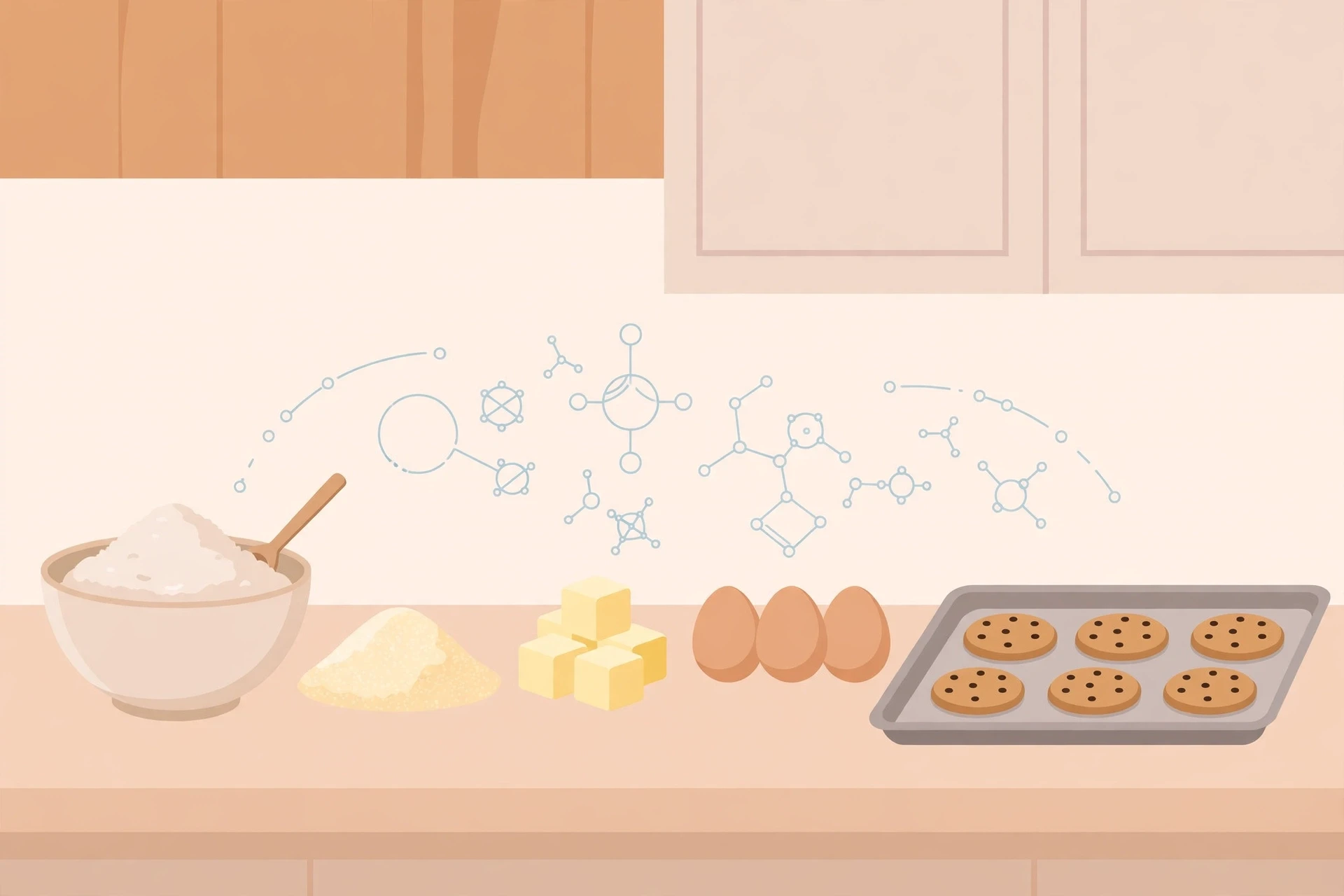
The first cake I ever baked on my own rose like a small brown hill and then sank in the middle, leaving a crater that smelled faintly of soap. I had followed the recipe, or so I thought. I had doubled the flour and the sugar because I wanted a bigger cake, but I had not doubled the baking powder, and I had poured in the milk by eye instead of measuring it. The result was a stoichiometry lesson I never forgot: in a kitchen, as in a laboratory, the amounts matter as much as the ingredients. A recipe is not a suggestion. It is a ratio, and when the ratio breaks, the product breaks with it.
That is what stoichiometry is about. It is the part of chemistry that answers the most practical question in the whole subject: how much? How much of each starting material do you need, how much product will you get, and what happens when one ingredient runs out before the others? Every tablet pressed in a pharmaceutical factory, every bag of fertiliser spread on a field, every airbag that inflates in a crash depends on someone having done this arithmetic correctly, in advance, on paper.
Stoichiometry sounds like a forbidding word, the kind of term that makes students close the textbook before they have read the first page. It comes from the Greek words stoicheion, meaning element, and metron, meaning measure. Element-measure. The measure of the elements. Once you know that, the subject loses much of its menace. It is measuring, nothing more mysterious than that — measuring things too small to see, in units built for the job, and following the ratios that a balanced chemical equation hands you. This article works through the whole subject from the ground up: the mole, molar mass, the conversions that link grams to particles, mole ratios, limiting reactants, and yield. Every idea comes with a worked calculation, step by step, so you can follow the arithmetic and then do it yourself.
1. What Is Stoichiometry?
Stoichiometry is the quantitative study of chemical reactions. Where the study of reaction types tells you what happens when substances meet, stoichiometry tells you how much of each substance is involved. It is the bookkeeping of chemistry: atoms are neither created nor destroyed in a chemical reaction, so every atom that goes in must come out somewhere, and stoichiometry is the art of keeping that ledger balanced.
Consider the simplest reaction most people know, the burning of hydrogen in oxygen to make water:
2H₂ + O₂ → 2H₂O
The equation says something precise. Two molecules of hydrogen react with one molecule of oxygen to produce two molecules of water. It also says something far more useful: two moles of hydrogen react with one mole of oxygen to produce two moles of water. The coefficients in a balanced equation are ratios, and those ratios work at any scale — molecules, moles, truckloads. That is the whole engine of stoichiometry. A balanced equation is a recipe written in the language of ratios, and stoichiometry is the skill of reading it.
The word itself was coined in the late eighteenth century by the German chemist Jeremias Benjamin Richter, who spent years measuring the exact masses of acids and bases that neutralised each other. Richter noticed something that still sits at the heart of the subject: elements combine in fixed, definite proportions. A given reaction always consumes its reactants in the same ratio, whether you run it in a test tube or in a factory vat. That regularity is what makes chemistry a predictive science rather than a catalogue of surprises. If you know the ratio, you can predict the outcome before you mix anything. The LibreTexts stoichiometry chapter builds the same idea from the ground up, starting with the mole and working through mass–mass and mass–volume problems.
That predictability is why stoichiometry matters outside the classroom. A drug manufacturer cannot afford to guess how much starting material becomes active ingredient; a batch that is ten percent short is a batch that fails quality control and gets destroyed. A farmer buying fertiliser needs to know how many kilograms of ammonia will actually deliver a given amount of nitrogen to the soil. An engineer designing a car airbag needs to know exactly how much gas a small pellet of solid must release in a fraction of a second. All of these are stoichiometry problems wearing different clothes.
The subject has a reputation for being the hardest part of introductory chemistry, and there is a reason for that reputation. Stoichiometry is not one idea but a chain of ideas, and a weak link anywhere in the chain — an unbalanced equation, a wrong molar mass, a confused unit — breaks the final answer. The good news is that the chain is short and every link can be practised separately. By the end of this article you will have met each link on its own, watched it work in a calculation, and then seen the whole chain run end to end.
1.1 Why ratios, not just amounts
A common first mistake is to think in grams when the equation thinks in moles. If a recipe calls for two cups of flour and one cup of sugar, doubling the flour alone does not double the cake; it makes a dry, crumbly failure. Chemical equations behave the same way. The coefficients 2, 1 and 2 in the hydrogen equation are counts of particles, not masses. Two grams of hydrogen and one gram of oxygen do not make two grams of water, because a hydrogen molecule and an oxygen molecule do not weigh the same. To use the ratio, you first have to convert the masses you can weigh into the particle counts the equation understands. That conversion is the job of the mole, and it is the subject of the next section.
1.2 The four questions stoichiometry answers
Almost every stoichiometry problem is one of four questions in disguise. First, how many moles or grams of a product form from a given amount of reactant? Second, how much reactant do you need to make a target amount of product? Third, which reactant runs out first, and how much of the other is left over? Fourth, how much product did you actually get compared with the most you could have got? The first two are mole-ratio problems. The third is a limiting-reactant problem. The fourth is a yield problem. This article takes them in that order, because each one builds on the one before it.
2. What Is a Mole?
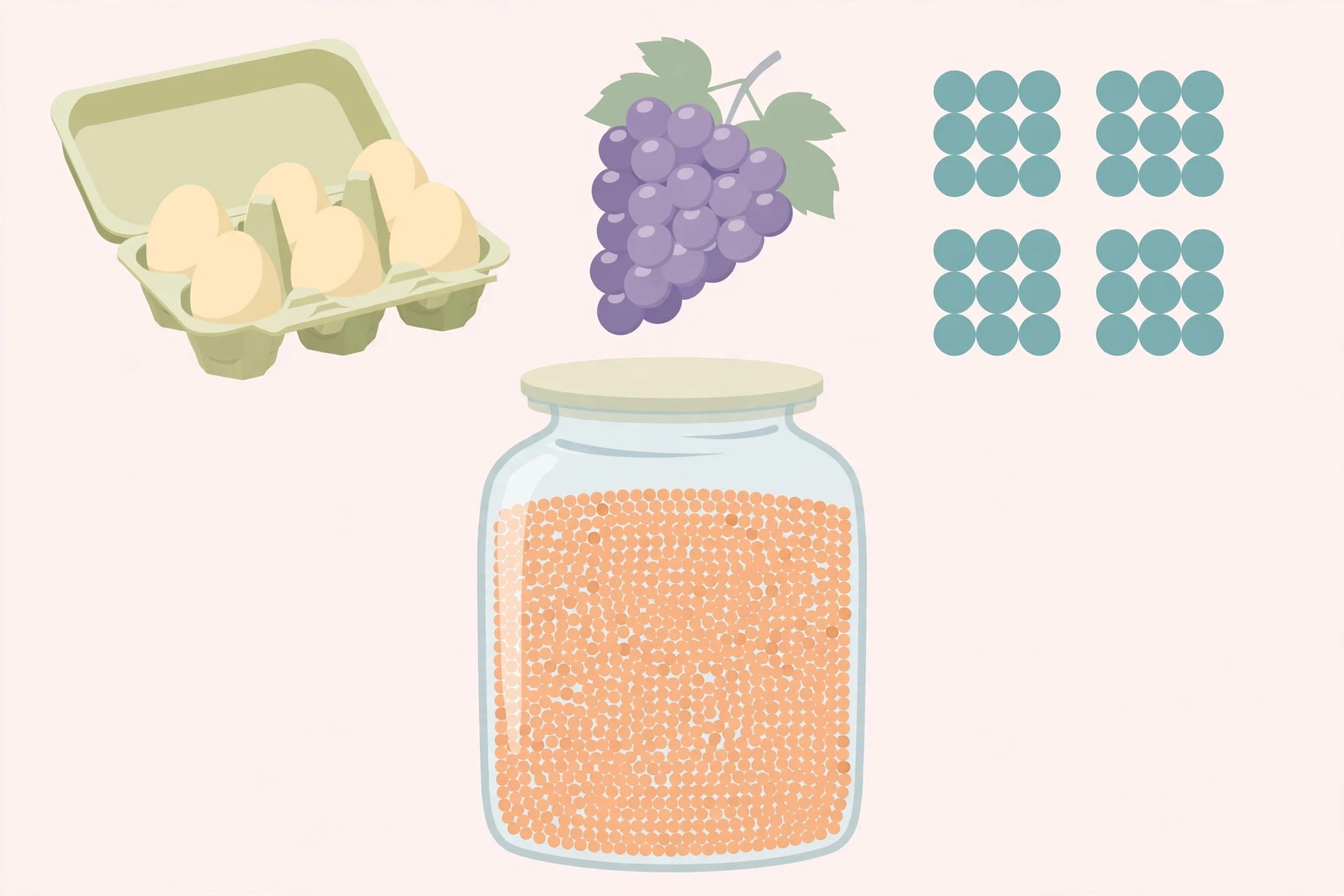
If stoichiometry is the bookkeeping of chemistry, the mole is its currency. The problem it solves is simple to state and impossible to ignore: atoms and molecules are far too small and far too numerous to count one by one. A single drop of water contains more molecules than there are stars in the observable universe, by an enormous margin. No one counts those. Chemists needed a counting unit the way a baker needs a dozen — a word that means a specific number of things, so that counting becomes weighing.
A dozen means twelve. A mole means 6.02214076 × 10²³. That number, Avogadro's number, is the number of entities in one mole of anything: atoms, molecules, ions, electrons. A mole of carbon atoms contains 6.02214076 × 10²³ carbon atoms. A mole of water molecules contains 6.02214076 × 10²³ water molecules. The number is exact by definition — since 2019, the mole has been defined in the International System of Units as exactly that many elementary entities, a definition maintained through the world's measurement standards and explained in the OpenStax guide to the mole concept.
Why that particular number? It was chosen so that the mole would connect the invisible world of atoms to the visible world of grams. One mole of carbon-12 atoms — the isotope that defines the scale — weighs exactly 12 grams. That single fact is the bridge between the two worlds. Weigh out 12 grams of carbon-12 and you are holding one mole of carbon atoms, 6.02214076 × 10²³ of them, without ever having counted a single one. Weigh out 18 grams of water and you are holding about one mole of water molecules. The scale was built so that the numbers chemists already knew — the atomic masses on the periodic table — would double as the masses of moles.
The man behind the number never knew its value. Amedeo Avogadro, an Italian physicist working in the early nineteenth century, proposed in 1811 that equal volumes of gases at the same temperature and pressure contain equal numbers of molecules. It was a bold guess, ignored for decades, and it took another half-century of work by others before the chemical world accepted it. The number itself was first estimated in the early twentieth century, once scientists could measure the charge of an electron and the mass of an atom. Avogadro's name was attached to it as a tribute, not because he measured it.
I remember the first time the mole genuinely clicked for me, and it was not in a lecture hall. I was standing in a teaching laboratory watching a student weigh out a white powder for a reaction, and she asked the question every beginner asks: how do you know this little pile is the right amount? Her demonstrator answered by pointing at the balance and then at the equation on the board, and something about the ordinariness of it struck me. There was nothing mystical happening. She was weighing a number. The balance was a counting machine, and the mole was the number it counted in. I have used that image ever since: the mole turns a balance into a particle counter.
A mole is not a mass and not a volume. It is a count — a chemist's dozen, fixed at 6.02214076 × 10²³ entities — and it is the one unit that lets a balance count particles it can never see.
2.1 The dozen analogy, taken seriously
The dozen analogy is worth pressing further, because it clears up the most common confusion about the mole. A dozen eggs and a dozen bowling balls are both twelve things, but they do not weigh the same. A mole of hydrogen atoms and a mole of lead atoms are both 6.02214076 × 10²³ atoms, but they do not weigh the same either: a mole of hydrogen weighs about 1 gram, and a mole of lead weighs about 207 grams. The count is the same; the mass follows from what is being counted. That is why chemists quote amounts in moles when they want to talk about how many particles are reacting, and in grams when they want to talk about what to weigh out. The two descriptions are linked by molar mass, which is the subject of Section 3.
The analogy also explains why the mole is so large. Atoms are so light that any practical amount of a substance contains an astronomical number of them. If a dozen is the right counting unit for eggs, the mole is the right counting unit for atoms — a number matched to the scale of the things being counted. A mole of sand grains would bury a beach; a mole of water molecules fits in a thimbleful of liquid. The unit is not arbitrary. It is sized to the job.
2.2 Avogadro's number in perspective
6.02214076 × 10²³ is hard to picture, and the usual comparisons barely help. It is roughly the number of grains of sand on all the beaches of the Earth, multiplied many times over. If you counted one atom per second, you would need about two thousand trillion times the current age of the universe to count a mole. If a mole of marbles were spread over the surface of the Earth, the layer would be several kilometres deep. These comparisons are fun, but they miss the point in one way: chemists never count to Avogadro's number. They weigh to it. The number is large because atoms are small, and the mole exists precisely so that no one ever has to deal with the number directly.
What matters in practice is not the size of the number but the fact that it is fixed. Because one mole always means the same count, the coefficients of a balanced equation can be read as moles, and the whole machinery of stoichiometry can run. The mole is the fixed exchange rate between the world of particles and the world of the balance.
2.3 Moles, molecules, and atoms — keeping the entity straight
One trap catches beginners again and again: a mole counts whatever entity you name, and the entity matters. A mole of hydrogen molecules, H₂, contains 6.02214076 × 10²³ molecules — and therefore twice as many hydrogen atoms, because each molecule holds two atoms. A mole of water molecules contains one mole of oxygen atoms and two moles of hydrogen atoms. When a problem says "moles of H₂", the entity is the molecule. When it says "moles of H atoms", the entity is the atom. Confusing the two is the single most common source of factor-of-two errors in stoichiometry, and it is worth slowing down for, every single time.
A useful habit is to write the entity down explicitly in your working, every time: "mol H₂ molecules", "mol H atoms", "mol H₂O molecules". It looks fussy. It prevents exactly the mistake that costs marks and, in a real laboratory, wastes material. The balanced equation tells you which entity each coefficient refers to, and your working should say the same thing.
2.4 Worked example: how many atoms are in 12.0 g of carbon-12?
This is the simplest mole calculation there is, and it shows the whole pattern: convert the given mass to moles, then convert moles to particles.
Given: 12.0 g of carbon-12. The molar mass of carbon-12 is exactly 12.0 g/mol by definition.
Step 1 — grams to moles. Divide the mass by the molar mass:
12.0 g ÷ 12.0 g/mol = 1.00 mol of carbon atoms.
Step 2 — moles to particles. Multiply by Avogadro's number:
1.00 mol × 6.022 × 10²³ atoms/mol = 6.022 × 10²³ atoms.
Answer: 12.0 g of carbon-12 contains 6.022 × 10²³ carbon atoms — one mole, by definition. The calculation is almost too easy, which is the point: the mole was designed to make this conversion trivial. Every harder problem in stoichiometry is this same two-step pattern with a mole ratio added in the middle.
3. Molar Mass: Weighing What You Cannot See
Molar mass is the mass of one mole of a substance, measured in grams per mole. It is the exchange rate between grams and moles, and it comes straight from the periodic table: the atomic mass of an element, read in grams per mole, is its molar mass. Carbon's atomic mass is 12.011, so one mole of carbon atoms weighs 12.011 grams. Oxygen's atomic mass is 15.999, so one mole of oxygen atoms weighs 15.999 grams. The numbers on the periodic table do double duty — they are relative masses of single atoms and, at the same time, the masses of moles of those atoms. That is the design of the scale, and it is what makes the whole subject workable with a balance and a table.
For a compound, the molar mass is the sum of the molar masses of its atoms. Water, H₂O, has two hydrogen atoms and one oxygen atom: 2 × 1.008 + 15.999 = 18.015 g/mol. Table salt, NaCl, is 22.990 + 35.45 = 58.44 g/mol. Carbon dioxide, CO₂, is 12.011 + 2 × 15.999 = 44.009 g/mol. The arithmetic is simple addition. The discipline is in reading the formula correctly: the subscript tells you how many atoms of each element are in one formula unit, and every one of them counts.
The periodic table deserves a closer look here, because it is the source of every molar mass you will ever use. The atomic masses printed on it are weighted averages of the naturally occurring isotopes of each element, which is why most of them are not whole numbers. Chlorine, for example, is listed as 35.45 because natural chlorine is a mixture of about three parts chlorine-35 and one part chlorine-37. Carbon is 12.011 rather than 12.000 for the same reason, even though carbon-12 itself defines the scale at exactly 12. For a deeper tour of how the table is organised and why its trends run the way they do, the Periodic Table article on this site walks through its structure element by element.
A practical point: atomic masses are measured, and measurement carries uncertainty, so published values change slightly as measurements improve. The differences are tiny — the fourth decimal place, usually — and they do not change any result a student or a working chemist would care about. What matters is consistency: use the values from one table for a whole calculation, and round your answer to match the least precise number you started with.
3.1 Worked example: the molar mass of glucose
Glucose, C₆H₁₂O₆, is the sugar that powers nearly every living cell, and its molar mass is a good test of careful formula reading.
Step 1 — list the atoms. 6 carbon, 12 hydrogen, 6 oxygen.
Step 2 — multiply each by its atomic mass. Carbon: 6 × 12.011 = 72.066 g/mol. Hydrogen: 12 × 1.008 = 12.096 g/mol. Oxygen: 6 × 15.999 = 95.994 g/mol.
Step 3 — add. 72.066 + 12.096 + 95.994 = 180.156 g/mol.
Answer: one mole of glucose weighs about 180.16 g. A single glucose molecule weighs about 180 atomic mass units; a mole of them weighs 180.16 grams. Same number, different scale — that is the mole at work again.
3.2 Worked example: grams to moles for table salt
Question: How many moles are in 146.1 g of sodium chloride, NaCl?
Step 1 — find the molar mass. NaCl = 22.990 + 35.45 = 58.44 g/mol.
Step 2 — divide mass by molar mass. 146.1 g ÷ 58.44 g/mol = 2.50 mol.
Answer: 146.1 g of table salt is 2.50 mol of NaCl formula units. Notice how the units cancel: grams divided by grams per mole leaves moles. Checking the units is the fastest way to catch a wrong step — if the units do not come out as moles, the arithmetic is wrong somewhere, no matter how tidy the numbers look.
3.3 Worked example: moles to grams for carbon dioxide
Question: What is the mass of 2.50 mol of carbon dioxide, CO₂?
Step 1 — find the molar mass. CO₂ = 12.011 + 2 × 15.999 = 44.009 g/mol.
Step 2 — multiply moles by molar mass. 2.50 mol × 44.009 g/mol = 110.0 g.
Answer: 2.50 mol of CO₂ weighs 110.0 g. The two worked examples in this section are mirror images — divide to go from grams to moles, multiply to go from moles to grams — and together they are half of everything stoichiometry asks you to do.

4. The Mole Map: Converting Between Mass, Moles, and Particles
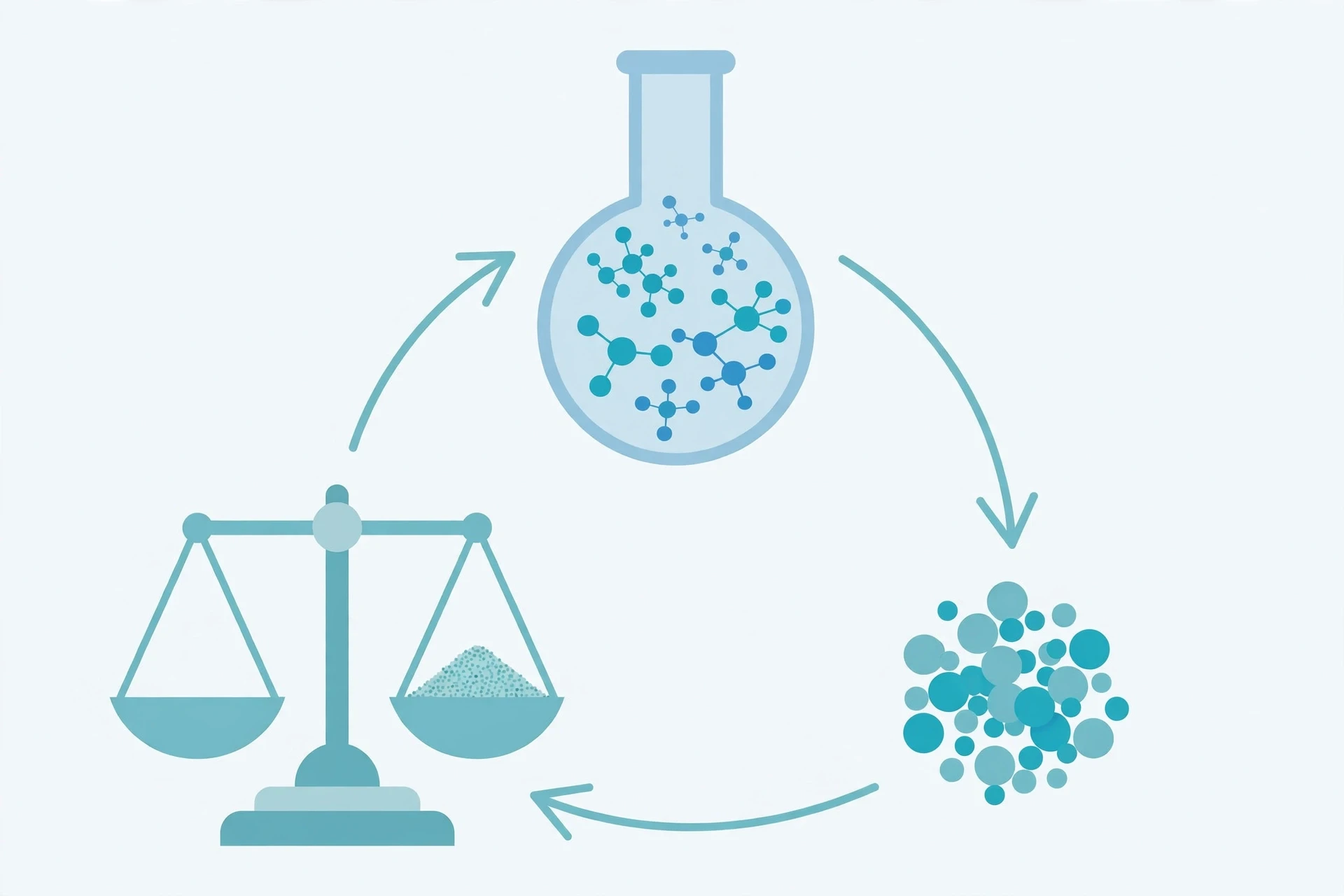
Every stoichiometry calculation is a journey across the same small map. At the centre sits the mole. From the mole you can travel in three directions: to mass, by multiplying by molar mass; to particle count, by multiplying by Avogadro's number; and to gas volume, by multiplying by the molar volume of a gas at a stated temperature and pressure. To travel in the opposite direction you divide instead of multiplying. The map is small, but students get lost on it constantly, usually because they try to jump straight from grams of one substance to grams of another without passing through moles. That jump is impossible. The mole is the only bridge between two different substances, because only the mole counts particles, and only particles react in fixed ratios.
The discipline, then, is always the same: convert what you are given into moles, use the mole ratio from the balanced equation to cross to the other substance, then convert moles into whatever the question asks for. Given grams, find moles. Use the ratio. Convert back. Three steps, in that order, every time. Problems that look complicated are almost always this same three-step pattern with larger numbers or an extra conversion at one end.
A second habit saves more marks than any other in this subject: write the units at every step and cancel them. "146.1 g ÷ 58.44 g/mol = 2.50 mol" is self-checking in a way that "146.1 ÷ 58.44 = 2.50" is not. If the units at the end of a step are not the units you expected, stop. The error is in that step, and it is cheaper to find it there than three steps later.
4.1 The three conversions
Mass to moles, and back. Divide mass in grams by molar mass to get moles. Multiply moles by molar mass to get mass in grams. This is the conversion you will use most, because laboratory work starts and ends with a balance.
Particles to moles, and back. Divide a particle count by Avogadro's number to get moles. Multiply moles by Avogadro's number to get a particle count. This conversion is rarer in the laboratory, because no one counts particles, but it appears constantly in exam questions and in any problem about the scale of the molecular world.
Gas volume to moles, and back. At standard temperature and pressure — 0 °C and 1 atmosphere — one mole of any ideal gas occupies 22.4 litres. This is the molar volume, and it follows from the ideal gas law, which is why it is the same for every gas: the volume of a gas is set by the number of particles and the conditions, not by what the particles are. At room temperature, about 25 °C, the molar volume is closer to 24.5 litres per mole. Always check which conditions a problem states before reaching for 22.4.
Quantity | To convert to moles | To convert from moles |
|---|---|---|
Mass (g) | divide by molar mass (g/mol) | multiply by molar mass (g/mol) |
Particles (atoms, molecules, ions) | divide by 6.022 × 10²³ | multiply by 6.022 × 10²³ |
Gas volume at STP (L) | divide by 22.4 L/mol | multiply by 22.4 L/mol |
Gas volume at 25 °C, 1 atm (L) | divide by 24.5 L/mol | multiply by 24.5 L/mol |
4.2 Worked example: how many water molecules are in a glass of water?
Question: A glass holds 180 g of water. How many water molecules does it contain?
Step 1 — grams to moles. The molar mass of water is 18.015 g/mol. 180 g ÷ 18.015 g/mol = 9.99 mol, about 10.0 mol.
Step 2 — moles to molecules. 10.0 mol × 6.022 × 10²³ molecules/mol = 6.02 × 10²⁴ molecules.
Answer: a single glass of water holds about six thousand billion billion molecules. The number is absurdly large, which is exactly why chemists count in moles: "10.0 mol" says the same thing in four characters.
4.3 Worked example: the volume of one mole of gas
Question: What volume does 2.00 mol of oxygen gas occupy at standard temperature and pressure?
Step 1 — identify the conversion. At STP, one mole of any gas occupies 22.4 L.
Step 2 — multiply. 2.00 mol × 22.4 L/mol = 44.8 L.
Answer: 44.8 litres. The identity of the gas does not matter — 2.00 mol of hydrogen, nitrogen, or carbon dioxide would occupy the same volume under the same conditions. That sameness is a direct consequence of Avogadro's hypothesis, the 1811 idea from Section 2: equal volumes of gases under the same conditions hold equal numbers of molecules.
4.4 The number that trips everyone up: formula units
Ionic compounds such as sodium chloride do not exist as molecules. A crystal of table salt is a vast lattice of sodium ions and chloride ions, not a collection of NaCl molecules. Chemists still speak of "moles of NaCl", but the entity being counted is the formula unit — one sodium ion paired with one chloride ion in the formula. The arithmetic is identical, and Avogadro's number still applies: one mole of NaCl contains 6.022 × 10²³ formula units, which means 6.022 × 10²³ sodium ions and 6.022 × 10²³ chloride ions. If a problem asks how many chloride ions are in 2.50 mol of NaCl, the answer is 2.50 × 6.022 × 10²³, or 1.51 × 10²⁴ ions. The word "formula unit" exists to keep the counting honest for compounds that have no molecules. It is worth using, because it stops a small conceptual slip from becoming a wrong answer.
5. Balanced Equations Are Recipes: Mole Ratios
A balanced chemical equation is a recipe, and its coefficients are the mole ratios in which the substances react. This is the central idea of stoichiometry, and everything after this section is an application of it. In the equation 2H₂ + O₂ → 2H₂O, the ratio of hydrogen to oxygen to water is 2 : 1 : 2. For every two moles of hydrogen that react, one mole of oxygen is consumed and two moles of water are produced. If four moles of hydrogen react, two moles of oxygen are consumed and four moles of water appear. The ratio never changes. It is fixed by the conservation of atoms: the equation is balanced, so the atoms on the left equal the atoms on the right, and any amount that obeys the ratio preserves that balance.
Getting to a balanced equation is a skill in its own right, and it comes before any stoichiometry can begin. An unbalanced equation is not a recipe; it is a shopping list with the quantities missing. The rule is simple and strict: you may change coefficients, never subscripts. Changing a subscript changes the substance itself — H₂O becomes H₂O₂, water becomes hydrogen peroxide, and the reaction you are describing is no longer the reaction that happens. Balancing is a matter of adjusting coefficients until every element appears the same number of times on both sides, and it is worth doing slowly and checking twice, because every later calculation inherits any error made here. The Chemical Reactions article on this site covers reaction types and the logic of balancing in detail, and it is the right place to firm up that skill before tackling the calculations below. The OpenStax guide to reaction stoichiometry works through the same mole-ratio method with further examples.
A balanced equation is a promise: the atoms on the left will be found on the right, in the same numbers, and the coefficients are the exact ratios in which the substances combine. Break the ratio and the promise breaks with it.
5.1 Reading a mole ratio
Mole ratios are read straight from the coefficients, and any pair of substances in the equation gives a ratio. In the combustion of methane:
CH₄ + 2O₂ → CO₂ + 2H₂O
The ratio of methane to oxygen is 1 : 2. The ratio of methane to carbon dioxide is 1 : 1. The ratio of oxygen to water is 2 : 2, which simplifies to 1 : 1. Each ratio is a conversion factor: to go from moles of one substance to moles of another, multiply by the ratio of their coefficients, with the wanted substance on top and the given substance underneath, so that the units cancel. That is the whole technique. The ratio is the bridge, and the mole is the road it crosses.
5.2 Worked example: burning hydrogen
Question: How many grams of water form when 4.0 g of hydrogen gas burns in excess oxygen?
Step 1 — balance the equation. 2H₂ + O₂ → 2H₂O. It is already balanced: four hydrogen atoms and two oxygen atoms on each side.
Step 2 — convert the given mass to moles. The molar mass of H₂ is 2 × 1.008 = 2.016 g/mol. 4.0 g ÷ 2.016 g/mol = 1.98 mol of H₂, about 2.0 mol.
Step 3 — use the mole ratio. The ratio of H₂O to H₂ is 2 : 2, or 1 : 1. So 2.0 mol of H₂ produces 2.0 mol of H₂O.
Step 4 — convert moles of product to grams. The molar mass of water is 18.015 g/mol. 2.0 mol × 18.015 g/mol = 36.0 g.
Answer: about 36 g of water. Notice what the calculation really did: it carried the amount through three changes of unit — grams of hydrogen, to moles of hydrogen, to moles of water, to grams of water — and the mole ratio was the only step that crossed from one substance to the other. That is the pattern for every problem in this subject.
5.3 Worked example: how much oxygen does a candle need?
Question: A small candle burns 16.0 g of methane, CH₄, in a camping lantern. How many grams of oxygen are consumed?
Step 1 — balance the equation. CH₄ + 2O₂ → CO₂ + 2H₂O.
Step 2 — convert methane to moles. The molar mass of CH₄ is 12.011 + 4 × 1.008 = 16.043 g/mol. 16.0 g ÷ 16.043 g/mol = 0.997 mol, about 1.00 mol.
Step 3 — use the mole ratio. The ratio of O₂ to CH₄ is 2 : 1, so 1.00 mol of methane needs 2.00 mol of oxygen.
Step 4 — convert to grams. The molar mass of O₂ is 2 × 15.999 = 31.998 g/mol. 2.00 mol × 31.998 g/mol = 64.0 g.
Answer: about 64 g of oxygen — four times the mass of the methane burned. That surprises most people the first time they see it, and it is worth pausing on: a fire consumes far more oxygen by mass than fuel, because oxygen is heavy and the reaction needs two oxygen molecules for every fuel molecule. It is also why a sealed room and a burning candle are a bad combination, and why ventilation matters more than the size of the flame.
6. What Is a Limiting Reactant?
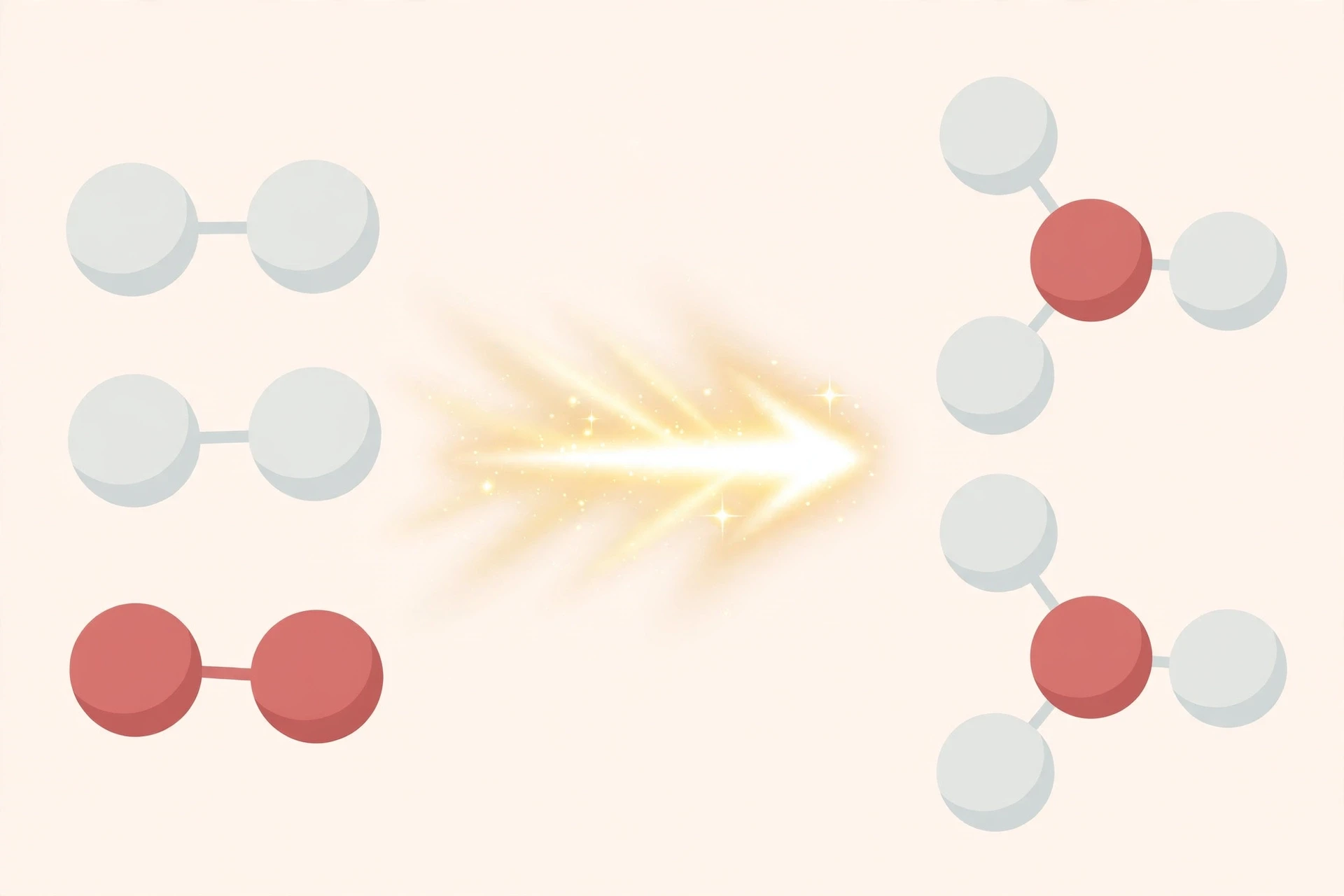
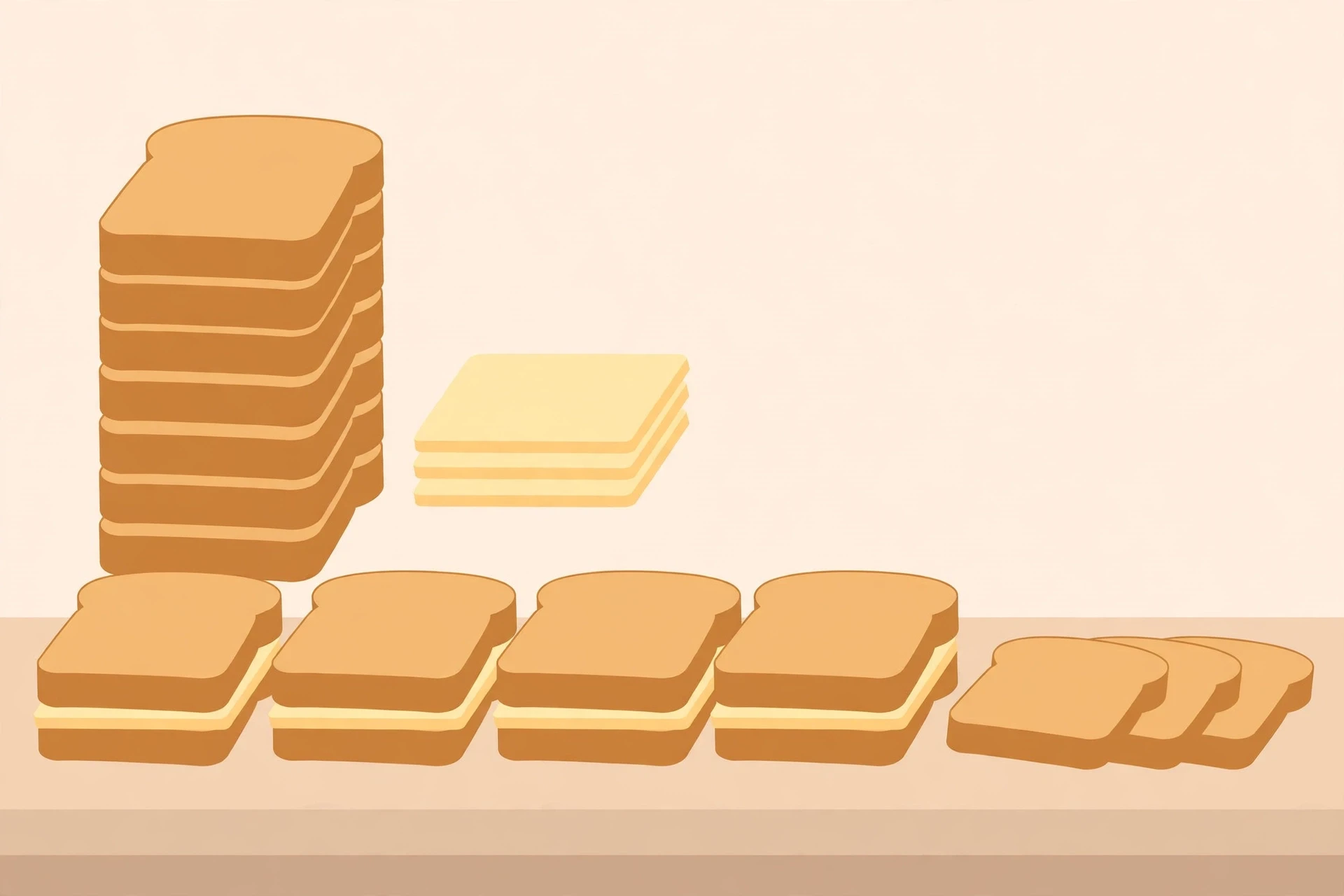
So far every example has assumed that one reactant was present in excess — that there was more than enough of it, so the other reactant decided how much product formed. Real reactions rarely work that way. Usually both reactants are present in finite amounts, and one of them runs out first. That reactant is the limiting reactant: it limits how much product can form, because once it is gone the reaction stops, no matter how much of the other reactant remains. The leftover reactant is the excess reactant, and it simply sits there, unused, when the reaction ends.
The sandwich analogy is the classic way to see it, and it survives because it is exact. Suppose each sandwich needs two slices of bread and one slice of cheese. You have ten slices of bread and three slices of cheese. How many sandwiches can you make? Three — because the cheese runs out after three sandwiches, leaving four slices of bread with nothing to pair with. The cheese is the limiting reactant. The bread is in excess. The number of sandwiches is decided by the scarcer ingredient relative to what the recipe demands, not by the ingredient you have most of.
The trap is that "scarcer" means scarcer relative to the ratio, not scarcer in absolute terms. A reactant can be present in a smaller mass or a smaller number of moles and still be in excess, if the equation needs very little of it. The only reliable test is to compare what you have with what the ratio demands, and there are two equivalent ways to do it. One way is to calculate how much product each reactant could make on its own, and take the smaller answer — the reactant that gives less product is the limiting one. The other way is to pick one reactant, calculate how much of the other it needs, and compare that with how much of the other you actually have. Both methods give the same answer, and both are worth knowing, because different problems make one or the other easier.
A second, quieter point: the limiting reactant is completely consumed, and the excess reactant is not. That asymmetry matters in the laboratory, because the leftover excess has to go somewhere — it must be separated from the product, disposed of, or recovered. Industrial chemists often deliberately use an excess of a cheap reactant to make sure an expensive one is fully consumed. The excess is not waste in that case; it is a strategy. But it is a strategy that only makes sense once you can calculate exactly how much excess you need.
6.1 Worked example: hydrogen and oxygen
Question: 10.0 g of hydrogen gas reacts with 64.0 g of oxygen gas. Which reactant is limiting, and how many grams of water form?
Step 1 — balance the equation. 2H₂ + O₂ → 2H₂O.
Step 2 — convert both reactants to moles. H₂: 10.0 g ÷ 2.016 g/mol = 4.96 mol, about 5.0 mol. O₂: 64.0 g ÷ 31.998 g/mol = 2.00 mol.
Step 3 — test each reactant. If all 5.0 mol of hydrogen reacted, it would need 2.5 mol of oxygen (the ratio is 2 : 1). Only 2.00 mol of oxygen is available, so the hydrogen cannot all react. Oxygen is the limiting reactant.
Step 4 — calculate the product from the limiting reactant. The ratio of H₂O to O₂ is 2 : 1, so 2.00 mol of oxygen produces 4.00 mol of water. 4.00 mol × 18.015 g/mol = 72.1 g.
Step 5 — find the leftover. The oxygen consumes 4.00 mol of hydrogen (2 × 2.00 mol), leaving 5.0 − 4.0 = 1.0 mol of hydrogen unused, about 2.0 g.
Answer: oxygen limits the reaction; 72.1 g of water forms, and about 2.0 g of hydrogen remains. Note the shape of the reasoning: the test in step 3 is the heart of the method, and everything after it is ordinary mole-ratio arithmetic from the limiting reactant alone.
6.2 Worked example: the Haber process
Question: A reactor is charged with 28.0 g of nitrogen and 8.0 g of hydrogen to make ammonia by the Haber process. Which reactant limits the reaction, and what mass of ammonia forms?
Step 1 — balance the equation. N₂ + 3H₂ → 2NH₃.
Step 2 — convert to moles. N₂: 28.0 g ÷ 28.014 g/mol = 1.00 mol. H₂: 8.0 g ÷ 2.016 g/mol = 3.97 mol, about 4.0 mol.
Step 3 — test. One mole of nitrogen needs three moles of hydrogen. We have about 4.0 mol of hydrogen, more than the 3.0 mol needed, so nitrogen is the limiting reactant and hydrogen is in excess.
Step 4 — calculate the product. The ratio of NH₃ to N₂ is 2 : 1, so 1.00 mol of nitrogen gives 2.00 mol of ammonia. The molar mass of NH₃ is 14.007 + 3 × 1.008 = 17.031 g/mol. 2.00 mol × 17.031 g/mol = 34.1 g.
Answer: nitrogen limits the reaction; 34.1 g of ammonia forms, and about 1.0 mol of hydrogen — roughly 2.0 g — is left over. This is the same calculation that runs, at vastly larger scale, in every ammonia plant on Earth, and it is the reason the Haber process changed the world: ammonia is the feedstock for most nitrogen fertiliser, and the ability to calculate its production exactly is what lets plants run at all. Khan Academy's stoichiometry lessons work through limiting-reactant problems of exactly this kind, with practice questions at each step.
I once watched a student lose a whole afternoon to a limiting-reactant problem because she had decided, before doing any arithmetic, that the reactant with the smaller mass must be the limiting one. It is an easy assumption to make and it is wrong in exactly the way that matters: the equation cares about moles and ratios, not about grams. In her problem the lighter reactant was needed only in small amounts, and it was in excess by a wide margin. She found the error only when her predicted product mass came out larger than the total mass of everything she had put in — which is impossible, and which is a useful final check on any stoichiometry answer. If the mass of your product exceeds the mass of your reactants, something has gone wrong. Atoms are conserved. The ledger must balance.
7. Theoretical Yield, Actual Yield, and Percent Yield
The limiting reactant tells you the most product a reaction can possibly make. That maximum is the theoretical yield: the mass of product predicted by stoichiometry if everything goes perfectly, every molecule of limiting reactant reacts, and nothing is lost along the way. In practice, things rarely go perfectly. The amount you actually isolate at the end is the actual yield, and it is almost always smaller than the theoretical yield. The percent yield compares the two:
Percent yield = (actual yield ÷ theoretical yield) × 100%
A percent yield of 75% means you obtained three quarters of the maximum the equation promised. A percent yield above 100% means something is wrong — your product is wet, impure, or you have weighed it with something extra in the dish — because you cannot create atoms that were never there.
Why does the actual yield fall short? The reasons are ordinary and numerous. Some product stays dissolved in the liquid it was made in and is poured away during filtration. Some sticks to the walls of the flask or the filter paper. Some evaporates. Some reactions do not go to completion and reach an equilibrium with reactants still present. Some of the starting material reacts down a side path to an unwanted product. And sometimes the product is simply hard to handle — a fine powder that blows away, a sticky oil that clings to glassware. In a teaching laboratory, a percent yield in the seventies or eighties is normal and respectable. In industry, where a single percentage point can be worth a fortune across a year of production, engineers spend careers closing the gap between actual and theoretical yield.
The theoretical yield is also the number that safety and economics depend on. If a process is designed to produce a certain mass of product per hour, that design starts from the theoretical yield and then applies a realistic percent yield from experience. If the percent yield drops unexpectedly, it is often the first sign that something has changed in the process — a contaminated feedstock, a failing catalyst, a temperature drift — and operators investigate the yield before they investigate anything else.
7.1 Worked example: percent yield in the Haber process
Question: The Haber reaction from Section 6.2 has a theoretical yield of 34.1 g of ammonia. If the plant actually collects 25.5 g, what is the percent yield?
Step 1 — write the formula. Percent yield = (actual yield ÷ theoretical yield) × 100%.
Step 2 — substitute. (25.5 g ÷ 34.1 g) × 100% = 74.8%.
Answer: about 75%. Three quarters of the ammonia the equation promised was actually collected. The missing quarter is not a mystery and not a failure of the equation — the equation describes the ideal, and the percent yield measures how close reality came to it.
7.2 Worked example: magnesium and hydrochloric acid
Question: 12.0 g of magnesium reacts with excess dilute hydrochloric acid: Mg + 2HCl → MgCl₂ + H₂. The theoretical yield of hydrogen is 0.995 g, and 0.85 g is actually collected. What is the percent yield?
Step 1 — check the theoretical yield. Mg: 12.0 g ÷ 24.305 g/mol = 0.494 mol. The ratio of H₂ to Mg is 1 : 1, so 0.494 mol of hydrogen forms. 0.494 mol × 2.016 g/mol = 0.996 g, about 1.00 g.
Step 2 — apply the formula. (0.85 g ÷ 0.996 g) × 100% = 85.3%.
Answer: about 85%. The missing hydrogen mostly escaped as tiny bubbles that never reached the collection tube, dissolved in the acid, or stayed trapped as foam on the surface. Every one of those losses is a lesson in laboratory technique, and the percent yield is the score that tells you how well the technique worked.
Theoretical yield is a promise the equation makes. Actual yield is what the laboratory delivers. Percent yield is the honest distance between the two — and in real chemistry, that distance is where the skill lives.
7.3 Why a yield above 100% is a warning, not a triumph
Every year, somewhere, a student reports a percent yield of 104% and celebrates. The celebration is premature. A yield above 100% cannot come from the reaction, because the reaction cannot produce atoms that were not in the reactants. It comes from the product: it is wet, and the extra mass is water; it contains unreacted starting material; it has picked up something from the air. The correct response is not to record 104% but to dry the product, check its purity, and repeat the measurement. A percent yield above 100% is a measurement telling you that it is wrong, and the honest chemist listens.
8. Atom Economy and Why Industry Cares About Waste
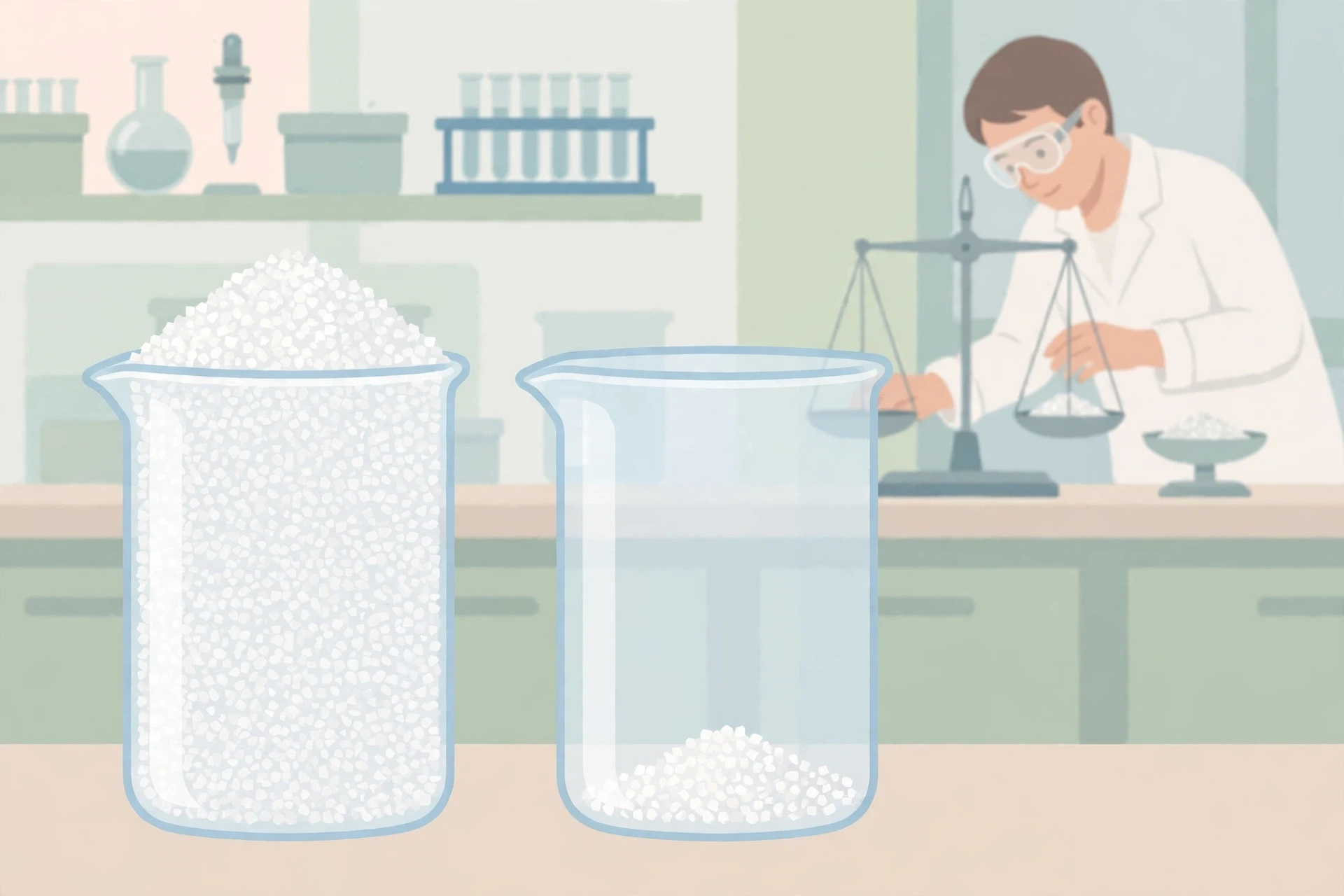
Percent yield measures how much of the possible product you obtained. Atom economy asks a different and, for industry, often more important question: how much of what you put in ended up in the product at all? A reaction can have a perfect percent yield and still be wasteful, if half the mass of the reactants is destined by the equation itself to become by-products rather than product. Atom economy is the fraction of the total mass of the reactants that appears in the desired product, and it is calculated from the balanced equation before a single experiment is run:
Atom economy = (molar mass of desired product ÷ total molar mass of all reactants) × 100%
The idea was popularised in the early 1990s by the chemist Barry Trost, as part of a broader movement toward green chemistry — the design of chemical processes that prevent waste rather than cleaning it up afterwards. Its force is that it cannot be improved by better technique. Percent yield improves when you filter more carefully and lose less product; atom economy improves only when you choose a different reaction. It judges the reaction itself, not the person running it. The Royal Society of Chemistry's stoichiometry resources include classroom material on exactly this kind of quantitative thinking, and the American Chemical Society's ChemMatters article on stoichiometry shows the same ideas at work in everyday contexts.
Consider two routes to the same product. In one, every atom of the reactants ends up in the product: an addition reaction, for instance, where two molecules simply join together. The atom economy is 100%. In the other, the product carries away half the reactant mass and the rest leaves as a by-product that must be separated, treated, and disposed of. The atom economy is 50%, and no amount of careful laboratory work will change that number. When a company chooses between routes, atom economy is often the deciding factor, because waste is not just an environmental problem — it is material bought and paid for, then thrown away.
This is also where stoichiometry meets the real economics of chemistry. A pharmaceutical synthesis might run through ten steps, each with a respectable 80% yield. The overall yield is 0.8 multiplied by itself ten times — about 11%. Nearly ninety percent of the starting material never becomes medicine. That is why drug companies care so intensely about reaction design, and why a new route with fewer steps or better atom economy can be worth far more than a marginal improvement in any single step. Stoichiometry, done carefully, is what makes those comparisons possible before any money is spent.
The most famous illustration of the principle is the manufacture of ibuprofen. The original industrial route ran through six steps with an atom economy of around 40%. A redesigned route, developed in the 1990s, runs through three steps with an atom economy of about 77%, and recycles its main by-product. The medicine is identical. The waste is not. The difference is stoichiometry applied at the design stage, and it is a reminder that this subject is not only about passing exams — it is about how the material world gets made.
9. Stoichiometry in the Real World
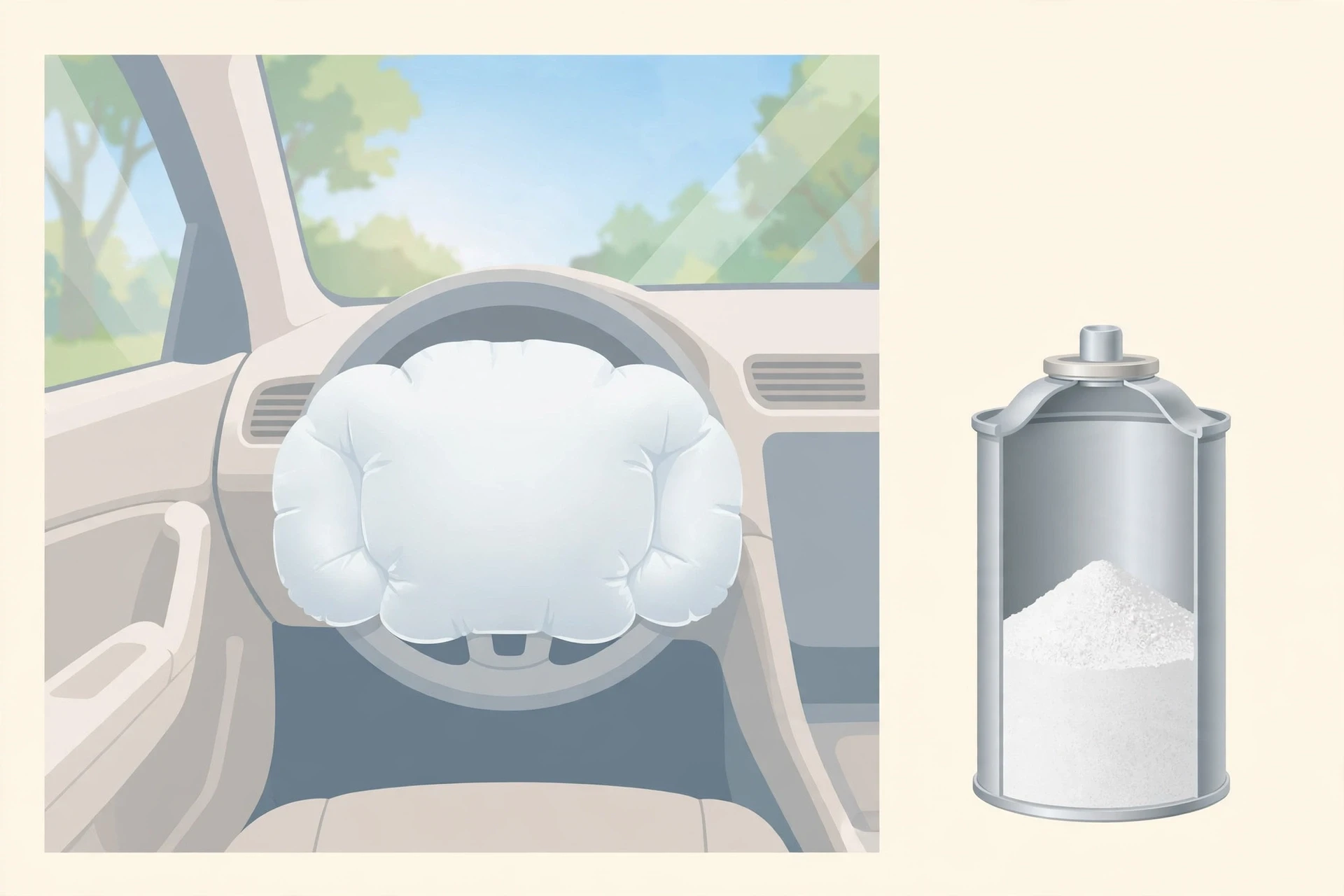
Stoichiometry leaves the textbook the moment you look for it. The clearest example sits in the steering wheel of almost every car on the road. An airbag must inflate in about 30 milliseconds — faster than a blink — and it does so with a chemical reaction, not a compressed-gas cylinder. The solid sodium azide, NaN₃, decomposes when triggered:
2NaN₃ → 2Na + 3N₂
The nitrogen gas produced fills the bag. The stoichiometry decides how much sodium azide the inflator must hold: too little and the bag under-inflates; too much and it bursts, or fills the cabin with excess heat. Engineers calculate the moles of nitrogen needed to fill a given bag volume at a given temperature, work backwards through the mole ratio to the moles of sodium azide, and convert to grams. A typical driver-side airbag needs roughly 50 litres of nitrogen gas, which at ordinary temperatures is about 2 moles, requiring about 1.3 moles of sodium azide — roughly 85 grams of solid. The whole safety system is a stoichiometry problem with a deadline of thirty milliseconds.
Antacid tablets are a gentler example, and one you can test at home. An antacid neutralises excess stomach acid — hydrochloric acid — and the active ingredient is usually calcium carbonate:
CaCO₃ + 2HCl → CaCl₂ + H₂O + CO₂
The equation says one mole of calcium carbonate neutralises two moles of hydrochloric acid. A standard tablet contains about 500 mg of calcium carbonate, or 0.005 mol, which neutralises 0.010 mol of acid. That is the whole basis of the dose printed on the packet: the manufacturer has done the stoichiometry, and the dose is the amount that neutralises a typical excess of acid without overshooting into alkalinity. The fizz you feel is the carbon dioxide escaping — the visible sign of a mole ratio at work.
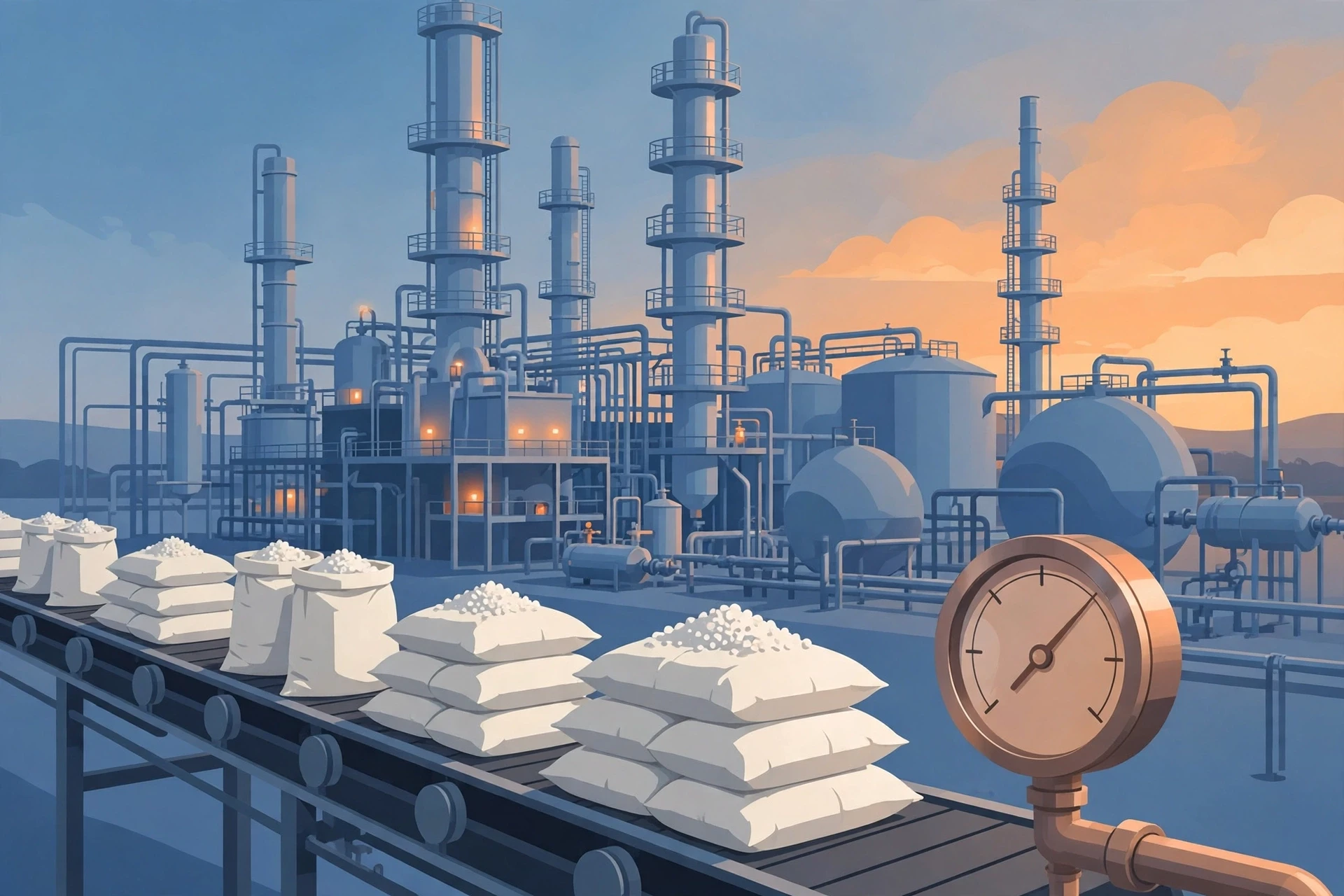
Fertiliser is the largest-scale example of all. The Haber process, met in Section 6, produces ammonia on a scale of hundreds of millions of tonnes a year, and every tonne of it is accounted for by stoichiometry: the moles of nitrogen and hydrogen in, the moles of ammonia out, the percent yield of the reactor, the atom economy of the process. The same accounting governs the conversion of ammonia into urea, ammonium nitrate, and the other fertilisers that feed roughly half the people on Earth. It is a strange thought, but it is a true one: the food on your plate depends, several steps back, on someone having balanced an equation and trusted the ratio.
Breathing, too, is stoichiometry. The air you exhale is about 4% carbon dioxide, and the oxygen you consumed became that carbon dioxide in a ratio fixed by the chemistry of respiration. Glucose and oxygen react in the ratio 1 : 6:
C₆H₁₂O₆ + 6O₂ → 6CO₂ + 6H₂O
For every mole of glucose your cells burn, six moles of oxygen are consumed and six moles of carbon dioxide are produced. Exercise physiologists use that ratio in reverse: by measuring the oxygen a person consumes and the carbon dioxide they produce, they can calculate how much glucose and fat the body is burning. The same equation that describes a candle flame describes, with different numbers, a marathon runner. The Atoms and Molecules article on this site explains the molecular side of this story — what atoms and molecules are, and how their bonds store and release the energy these reactions move around.
10. Common Mistakes and Misconceptions
Stoichiometry has a small set of traps, and nearly every wrong answer falls into one of them. Knowing the traps by name is half the defence.
Mistake 1: starting with an unbalanced equation. Every calculation downstream inherits the ratio, so an unbalanced equation poisons the answer before the arithmetic begins. Balance first, check the balance, and only then calculate.
Mistake 2: using grams where the equation wants moles. The coefficients are particle ratios, not mass ratios. Two grams of hydrogen and one gram of oxygen do not react in the ratio 2 : 1, because the equation counts particles. Convert to moles first, always.
Mistake 3: confusing the entity being counted. A mole of H₂ molecules is not a mole of H atoms — it is two moles of H atoms. Write the entity down: mol H₂, mol H, mol H₂O. The two extra words prevent the most common factor-of-two error in the subject.
Mistake 4: assuming the reactant with the smallest mass is limiting. The limiting reactant is the one that runs out first relative to what the ratio demands, and a small mass of a reactant the equation needs only a little of can still be in excess. Test, do not assume.
Mistake 5: forgetting that the limiting reactant decides the yield. Once you have found the limiting reactant, all product calculations use it alone. Using the excess reactant to calculate the product gives a number that is too large — and, as a check, if your calculated product mass exceeds the total mass of your reactants, the answer is certainly wrong.
Mistake 6: mixing up molar mass and atomic mass. They share a number but not a unit. The atomic mass of oxygen is 15.999 atomic mass units; the molar mass of oxygen atoms is 15.999 grams per mole; the molar mass of oxygen molecules, O₂, is 31.998 grams per mole. The subscript doubles the number, and forgetting that doubles the error.
Mistake 7: rounding too early. Keep two or three extra digits through the intermediate steps and round only at the end. Rounding 4.96 mol to 5.0 mol halfway through a calculation is harmless; rounding it to 5 mol and then multiplying by a molar mass of 18 can shift the answer by a visible amount. Let the calculator carry the precision and let your judgement do the rounding, once, at the end.
Most people assume stoichiometry is about being good at arithmetic. What the data actually shows, in classroom after classroom, is that it is about being careful with definitions: knowing what a mole counts, knowing which reactant limits, knowing what the equation's coefficients mean. The arithmetic is ordinary. The definitions are the subject. Get them straight, and the numbers follow.
11. A Complete Worked Problem, Start to Finish
Here is one problem that uses every idea in this article, in order. Work it yourself first, then check each step against the solution below.
Problem: Baking soda, sodium hydrogencarbonate (NaHCO₃), reacts with vinegar, ethanoic acid (CH₃COOH), in the classic volcano demonstration. The equation is:
NaHCO₃ + CH₃COOH → CO₂ + H₂O + CH₃COONa
If 8.4 g of baking soda reacts completely with excess vinegar, what mass and what volume (at STP) of carbon dioxide are produced?
Step 1 — check the balance. Sodium: 1 each side. Carbon: 2 each side (one in NaHCO₃, one in CH₃COOH; one in CO₂, one in CH₃COONa). Hydrogen: 5 each side. Oxygen: 4 each side. The equation is balanced.
Step 2 — molar mass of baking soda. NaHCO₃ = 22.990 + 1.008 + 12.011 + 3 × 15.999 = 84.006 g/mol, about 84.0 g/mol.
Step 3 — convert the given mass to moles. 8.4 g ÷ 84.0 g/mol = 0.100 mol of NaHCO₃.
Step 4 — use the mole ratio. The ratio of CO₂ to NaHCO₃ is 1 : 1, so 0.100 mol of carbon dioxide forms.
Step 5 — convert to grams. The molar mass of CO₂ is 44.009 g/mol. 0.100 mol × 44.009 g/mol = 4.4 g.
Step 6 — convert to volume at STP. 0.100 mol × 22.4 L/mol = 2.24 L.
Answer: 4.4 g of carbon dioxide, occupying 2.24 litres at standard temperature and pressure. That is the gas that foams the volcano, lifts the lid off a sealed bottle, and, on an industrial scale, carbonates drinks and puts out fires. One equation, one mole ratio, and the whole chain of conversions — that is stoichiometry, complete.
If you followed every step, you have done the subject. The rest is practice: more equations, messier numbers, limiting reactants, yields. The pattern never changes. Convert to moles, cross on the ratio, convert back. The mole is the bridge, the balanced equation is the map, and the arithmetic is just bookkeeping. Chemistry rewards the people who do the bookkeeping carefully, because the bookkeeping is what turns a reaction on paper into a product in the world.
Frequently Asked Questions
What is stoichiometry?
Stoichiometry is the quantitative study of chemical reactions — the part of chemistry that calculates how much of each reactant is needed and how much product will form. It is based on the balanced chemical equation: the coefficients give the mole ratios in which substances react, and the mole connects those ratios to masses you can weigh and volumes you can measure. In short, stoichiometry answers "how much?" for any chemical reaction.
What is a mole?
A mole is a counting unit for particles, defined as exactly 6.02214076 × 10²³ entities — Avogadro's number. One mole of carbon-12 atoms weighs exactly 12 grams, which is what connects the mole to the balance: weighing a substance in grams tells you how many moles, and therefore how many particles, you have. A mole is to chemistry what a dozen is to baking — a fixed count that makes counting practical.
What is a limiting reactant?
The limiting reactant is the reactant that runs out first in a chemical reaction, relative to the ratio demanded by the balanced equation. Once it is gone, the reaction stops, no matter how much of the other reactants remain. It decides how much product can form. The reactant left over is the excess reactant. To find the limiting reactant, convert all reactants to moles and compare what you have with what the mole ratio requires.
How do you calculate theoretical yield?
The theoretical yield is the maximum mass of product a reaction can produce, calculated from the limiting reactant. First convert the limiting reactant to moles, then use the mole ratio from the balanced equation to find the moles of product, then multiply by the product's molar mass. The result is the theoretical yield in grams. The actual yield is what you really collect, and percent yield is (actual ÷ theoretical) × 100%.
Why is the mole ratio different from the mass ratio?
Because the coefficients of a balanced equation count particles, not grams, and different particles have different masses. Two moles of hydrogen weigh about 4 grams, while one mole of oxygen weighs about 32 grams, yet they react in the ratio 2 : 1. The mole ratio and the mass ratio are only the same when the substances happen to have equal molar masses. Always convert masses to moles before applying the ratio.
Can the percent yield be more than 100%?
No — not from the reaction itself. A percent yield above 100% means the product is impure or wet, or that something extra was weighed with it, because a reaction cannot create atoms that were not in the reactants. A result above 100% is a warning to dry the product, check its purity, and repeat the measurement, not a success to report.
What is the difference between theoretical yield and actual yield?
Theoretical yield is the maximum product predicted by stoichiometry from the limiting reactant, assuming a perfect reaction with no losses. Actual yield is the mass of product you really obtain in the laboratory or plant. The actual yield is almost always lower, because of incomplete reaction, side reactions, and losses during filtration, transfer and purification. Percent yield measures the gap between the two.
Sources
LibreTexts, Introductory Chemistry (CK-12), Stoichiometry — https://chem.libretexts.org/Bookshelves/Introductory_Chemistry/Introductory_Chemistry_(CK-12)/12%3A_Stoichiometry
OpenStax, Chemistry 2e, 4.3 Reaction Stoichiometry — https://openstax.org/books/chemistry-2e/pages/4-3-reaction-stoichiometry
OpenStax, Chemistry 2e, 3.1 Formula Mass and the Mole Concept — https://openstax.org/books/chemistry-2e/pages/3-1-formula-mass-and-the-mole-concept
Khan Academy, Stoichiometry — https://www.khanacademy.org/science/ap-chemistry-beta/x2eef969c74e0d802:stoichiometry
American Chemical Society, ChemMatters, Stoichiometry — https://www.acs.org/education/resources/highschool/chemmatters/past-issues/2015-2016/october-2015/stoichiometry.html
Royal Society of Chemistry, Stoichiometry resources — https://edu.rsc.org/resources/stoichiometry/2078.article
National Institute of Standards and Technology, Weights and Measures — https://www.nist.gov/pml/weights-and-measures
Chemical Reactions Explained: Types, Kinetics, and Everyday Examples — Sciory — https://www.sciory.com/blog/chemical-reactions-types-kinetics-examples
Atoms and Molecules Explained: Structure, Bonding, and States of Matter — Sciory — https://www.sciory.com/blog/atoms-molecules-explained
Periodic Table of Elements: Structure & Trends — Sciory — https://www.sciory.com/blog/periodic-table-elements-structure-trends