

The first time I tried to teach a friend how to balance chemical equations, I made a mess of it. We were sitting at a kitchen table with a chemistry worksheet between us, two cold cups of tea going colder, and a single stubborn equation staring back at us: hydrogen plus oxygen makes water. It looked so simple that it felt insulting. Two gases in, one liquid out. What could possibly go wrong?
Everything, it turned out. My friend wrote H₂ + O₂ → H₂O, counted the atoms, and announced that the job was done. I pointed out that the left side had two oxygen atoms and the right side had one. She erased the subscript and wrote H₂O₂ instead, which fixed the oxygen count and broke something else entirely, because H₂O₂ is not water at all. It is hydrogen peroxide, the stuff you pour on a cut, and it stings for a reason. That was the moment the lesson actually began, and it is the moment this guide begins too: learning how to balance chemical equations is not about shuffling numbers until both sides match. It is about learning what those numbers are allowed to touch, and what they must never touch.
A chemical equation is a sentence. On the left sit the reactants, the substances you start with. On the right sit the products, the substances you end with. The arrow between them means "turns into" or "reacts to form." A balanced equation is a sentence that tells the truth about amounts: every atom that goes in must come out, in the same number and the same kind. Atoms are not created or destroyed in an ordinary chemical reaction. They are rearranged, like furniture moved between rooms. If your equation shows an atom vanishing, the equation is lying, and no amount of clever arithmetic will save it.
This guide works the way I wish someone had worked through it with me at that kitchen table. We will start with what an equation is actually saying, then learn the one rule that governs all balancing, then practise a method that works on nearly every equation a student meets. There are worked examples at every step, from the water reaction that tripped us up to combustion, rust, fertiliser chemistry, and photosynthesis. There are the mistakes almost everyone makes, a set of practice problems with full answers, and a short tour of the places where balanced equations quietly run the modern world. By the end, you should be able to look at an unbalanced equation and know exactly where to start, what to try next, and how to check your answer.
1. What a Chemical Equation Really Says
A chemical equation is shorthand, and like all shorthand it hides a surprising amount of meaning in a small space. Take the reaction that powers a gas stove. Methane, the main component of natural gas, burns in oxygen to give carbon dioxide and water:
CH₄ + 2O₂ → CO₂ + 2H₂O
Read it aloud and it says: one molecule of methane reacts with two molecules of oxygen to produce one molecule of carbon dioxide and two molecules of water. The little numbers tucked low after a symbol are subscripts, and they belong to the formula. The big numbers standing in front of a formula are coefficients, and they belong to the equation. That distinction is the whole game, and we will come back to it more than once, because confusing the two is the single most common error in balancing.
Notice also what the equation does not say. It does not say that one methane molecule politely waits its turn, or that the reaction happens in a single tidy step. Real combustion is a storm of fragments and fleeting intermediates, radicals colliding and recombining in fractions of a second. The equation is a bookkeeping summary, not a film of the event. It records only the starting materials and the final products, and the ratio in which they combine. That ratio is what makes the equation useful. A cook who knows that a recipe needs two cups of flour for every cup of sugar can scale it to feed a crowd or a single person. A chemist who knows that methane burns in a one-to-two ratio with oxygen can work out how much air a furnace needs, how much carbon dioxide a power station will emit, and how much heat the reaction will release. The balanced equation is the recipe card of chemistry, and every calculation that follows depends on it being right.
It helps to see how equations connect to the bigger picture of chemistry. A chemical reaction is a rearrangement of atoms, and the different families of reactions, from synthesis to decomposition to combustion, each have their own patterns. If you want the wider map before diving into the arithmetic, the Sciory guide to Chemical Reactions walks through the types of reactions, what drives them, and how fast they run. What follows here is the practical skill underneath all of that: writing each reaction down so that the atoms add up.
1.1 Reactants, products, and the arrow
Every equation has the same skeleton. Reactants stand on the left of the arrow, products on the right. A plus sign between two formulas means "and" or "reacts with." The arrow means "yields" or "produces." State symbols in brackets tell you the physical state of each substance: (s) for solid, (l) for liquid, (g) for gas, and (aq) for a substance dissolved in water. So the full, formal version of the water reaction is:
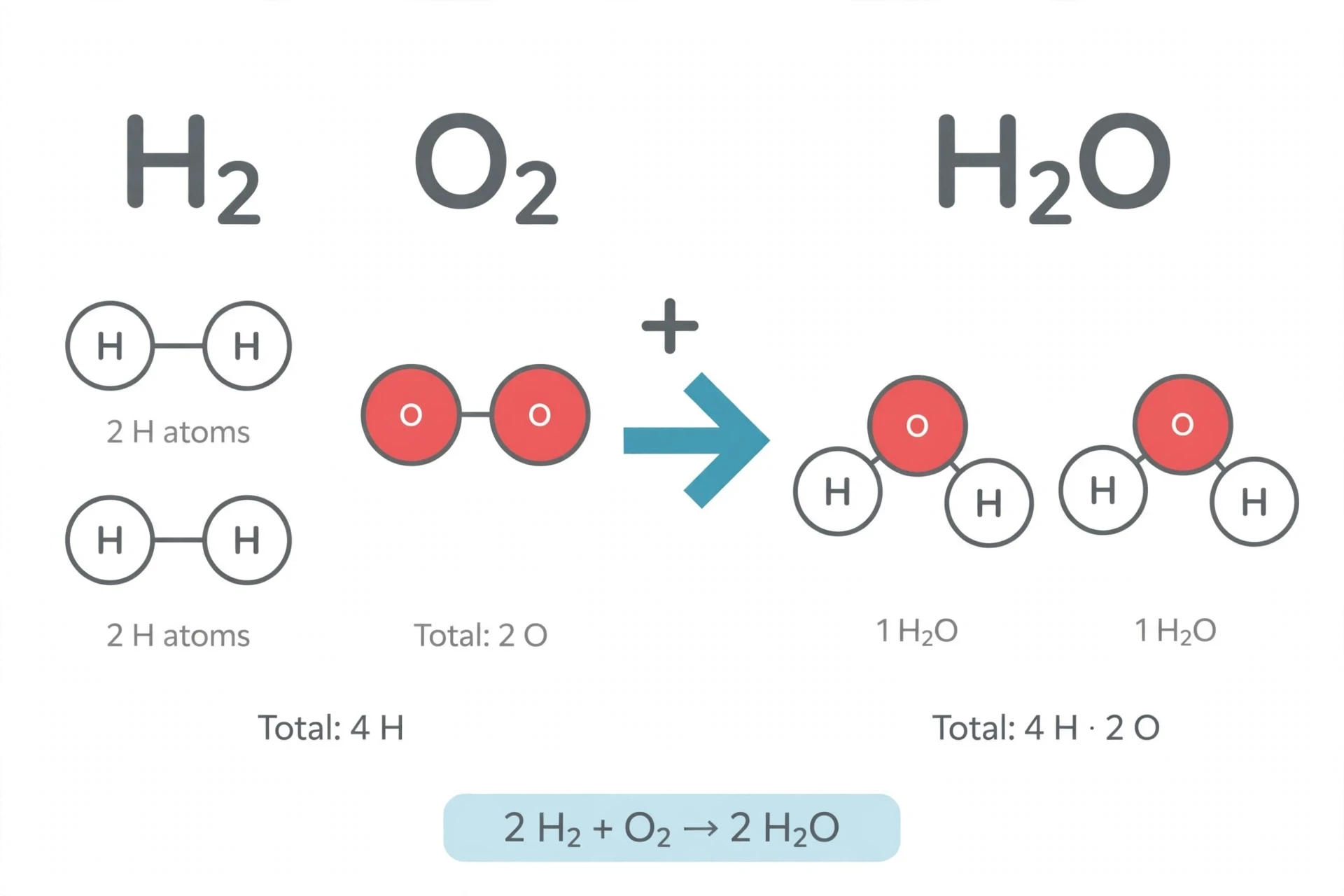
2H₂(g) + O₂(g) → 2H₂O(l)
State symbols do not change the balancing. They are labels, not numbers, and they never affect the atom count. But they do change what the equation means in the real world. Hydrogen and oxygen gases reacting to form liquid water is a different physical situation from forming water vapour, and the energy released differs between the two. For now, treat the state symbols as helpful notes and focus your counting on the atoms.
1.2 Reading an equation as a ratio
Here is a habit that makes everything easier: read every balanced equation as a ratio, not as a single event. The equation 2H₂ + O₂ → 2H₂O does not only describe two molecules of hydrogen meeting one molecule of oxygen. It also describes two moles of hydrogen meeting one mole of oxygen, or two thousand molecules meeting one thousand, or two truckloads meeting one truckload, as long as the ratio holds. Chemists usually work in moles, which are simply very large, standardised bunches of particles, and the coefficients in a balanced equation give the mole ratio directly. That is why balancing matters beyond the classroom. Once the ratio is right, you can scale a reaction up to industrial size or down to a single drop, and the chemistry stays the same.
I learned this the slow way, in a teaching lab where a student had balanced an equation correctly on paper and then used the wrong ratio to mix two solutions. The reaction still happened, exactly as chemistry promised, but one reactant ran out halfway and the yield was half of what it should have been. The equation had been right. The cooking had not followed it. A balanced equation is a promise about proportions, and the lab, the factory, and the furnace all keep that promise whether you do or not.
2. Why Equations Must Be Balanced: The Conservation of Mass
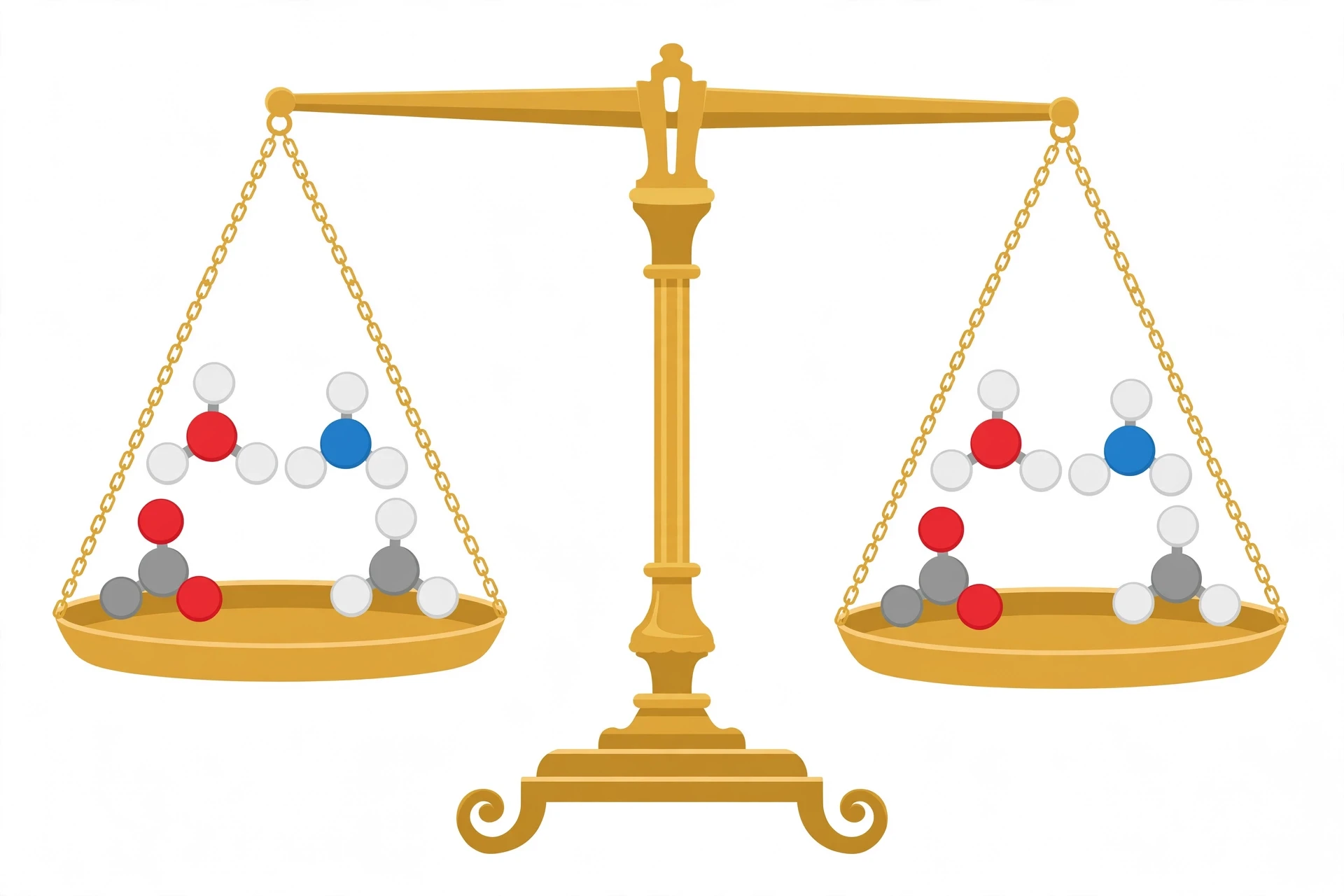
Nothing in chemistry is created from nothing. That sounds like philosophy, and in a sense it is, but it is also one of the most thoroughly tested facts in science. When wood burns in a fireplace, the smoke, ash, and gases that leave weigh exactly as much as the wood and the oxygen that went in, once you manage to catch and weigh everything. The mass seems to vanish only because the products drift away as invisible gases. Weigh them, and the books balance.
The person who turned this idea from a hunch into a law was Antoine Lavoisier, a French chemist working in the late 1700s. Lavoisier was obsessive about weighing things. He sealed reactions inside closed vessels, weighed the vessel before and after, and showed again and again that the total mass stayed the same. In one famous series of experiments he heated tin in a sealed flask, watched a crust of oxide form on the metal, and weighed the flask to show that the gain in the metal's weight exactly matched the loss of air inside the flask. Nothing had appeared from nowhere. The oxygen in the air had simply joined the tin.
Lavoisier's story ends badly; he was executed during the French Revolution, and the mathematician Lagrange is said to have remarked that it took only a moment to cut off his head, and a hundred years might not produce another like it. The law he left behind, the law of conservation of mass, is the reason we balance equations at all. A chemical equation that is not balanced is a claim that atoms appear or disappear, and that claim contradicts one of the best-tested regularities in science. Balancing an equation is how we make our shorthand obey the law.
"In a chemical reaction, matter is neither created nor destroyed. The atoms are simply rearranged, and the balanced equation is the record of that rearrangement."
There is one honest caveat, and it is worth stating plainly. In nuclear reactions, mass and energy can trade places, and the simple bookkeeping of atoms no longer holds. But ordinary chemical reactions, the kind in textbooks, kitchens, factories, and living cells, involve only the rearrangement of electrons and atoms. No nuclei change. For every equation in this guide, conservation of mass is the rule, and balancing is how we honour it.
2.1 What "balanced" actually means
An equation is balanced when every element appears the same number of times on both sides of the arrow. That is the entire definition, and it is worth memorising in that plain form. It does not mean the two sides have the same number of molecules. It does not mean the coefficients are equal. It means the atom inventory matches, element by element. The water equation 2H₂ + O₂ → 2H₂O is balanced because hydrogen appears four times on each side and oxygen appears twice on each side. The unbalanced version H₂ + O₂ → H₂O fails because oxygen appears twice on the left and once on the right.
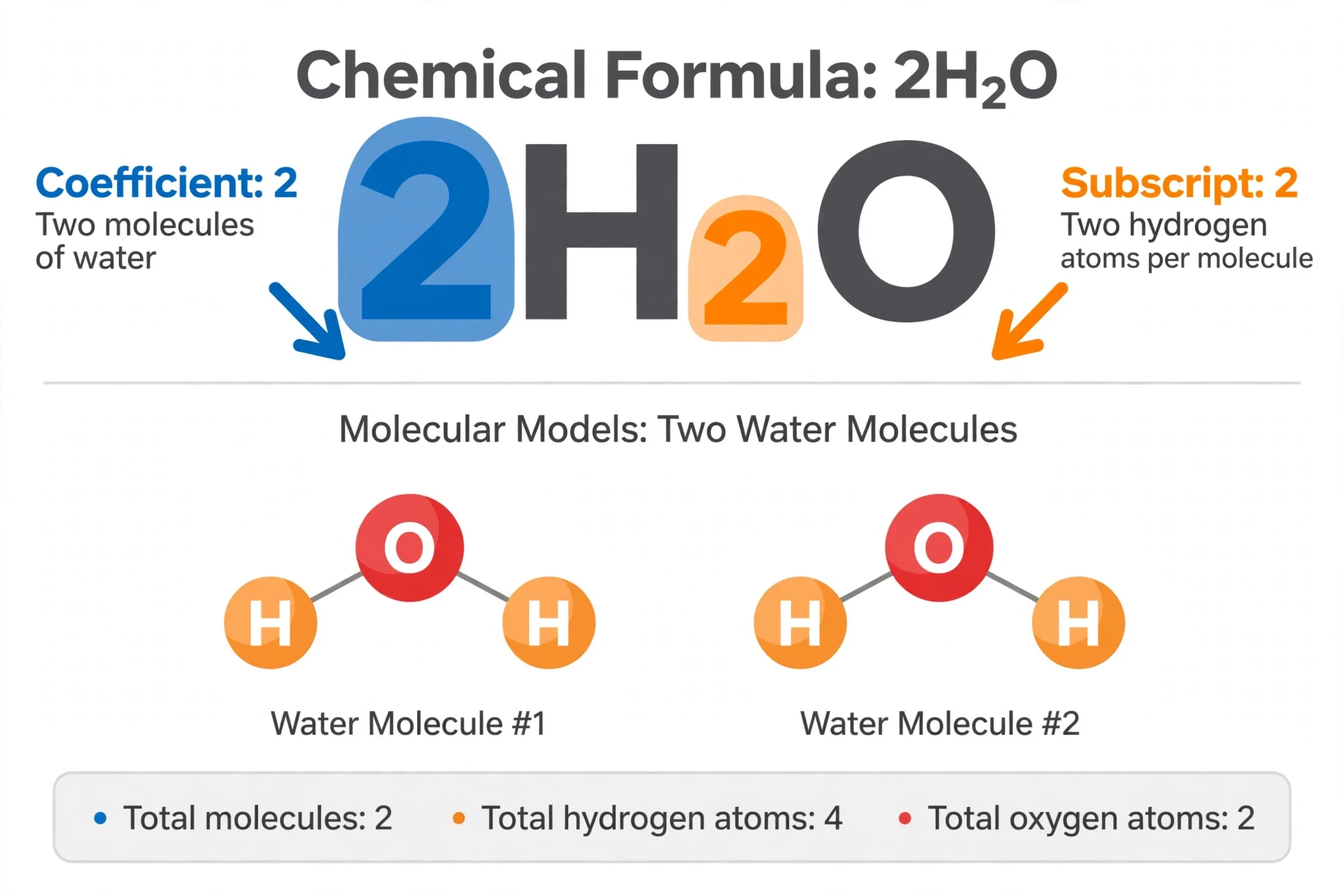
Counting is the core skill, and it is worth doing slowly at first. A coefficient multiplies everything in the formula that follows it. In 2H₂O, the coefficient 2 applies to the whole water molecule: two lots of H₂ and two lots of O, giving four hydrogen atoms and two oxygen atoms. A subscript applies only to the element immediately before it. In H₂O, the 2 belongs to hydrogen alone. When a formula contains brackets, as in Ca(OH)₂, the subscript outside the bracket multiplies everything inside it: one calcium, two oxygens, two hydrogens. We will practise each of these counting moves in the worked examples, because fluency here is what makes the rest of the method feel easy instead of fiddly.
2.2 The one rule that governs everything
Most people assume that balancing is mostly trial and error, and that any trick that makes the numbers match is fair game. What the data actually shows, in classroom after classroom, is that the students who improve fastest are the ones who learn the one hard rule first and let everything else follow from it: you may change coefficients, and you may change nothing else. Subscripts are part of a substance's identity. Change a subscript and you have invented a different substance, the way my friend at the kitchen table accidentally invented hydrogen peroxide when she meant water. Coefficients are the only numbers you are allowed to adjust, because they say how many molecules or formula units take part, not what those units are.
This rule has a practical consequence that surprises beginners. You cannot balance an equation by adding a new substance to one side, removing a product, or changing a formula to something more convenient. If the formulas are wrong, the equation cannot be fixed by balancing. It has to be rewritten with the right formulas first. That is why the first step of the method in section 4 is not counting at all. It is checking that every formula is correct, because no amount of coefficient juggling can rescue a wrong formula.
3. The Anatomy of a Chemical Equation
Before you balance anything, you need to be able to read the parts of an equation the way a musician reads a score: not as a blur of symbols, but as distinct marks that each mean something specific. The vocabulary is small. There are formulas, coefficients, subscripts, plus signs, an arrow, and state symbols. Six kinds of mark, and a whole subject built from them.
Formulas are the words of the language. H₂O is the formula for water, CO₂ for carbon dioxide, NaCl for common salt. A formula tells you which elements a substance contains and in what ratio. Water always has two hydrogens for every oxygen, whether it sits in a glass, a cloud, or a cell. That fixed ratio is the reason subscripts are untouchable: the subscript is the formula, and the formula is the substance.
Coefficients are the numbers in front of formulas. A coefficient of 2 in front of H₂O means two water molecules take part. A missing coefficient means 1, and chemists leave it unwritten by convention, the way you would write "a cup of flour" rather than "one cup of flour." Coefficients are the only numbers you change when you balance, and they are always whole numbers in a finished equation, with one exception we will meet in section 10, where a fraction appears as a temporary stepping stone.
Subscripts are the small numbers written low, after an element symbol. They count the atoms of that element inside one formula unit. The 2 in H₂ counts hydrogens in one water molecule. The 4 in CH₄ counts hydrogens in one methane molecule. Subscripts never change during balancing, for the reason above: changing one rewrites the substance.
3.1 What is a skeleton equation?
A skeleton equation is the first draft of a chemical equation. It has the correct formulas for every reactant and product, written in the right places, but the numbers do not add up yet. It is called a skeleton because it has the bones of the reaction but not the finished body. The skeleton equation for the combustion of methane is:
CH₄ + O₂ → CO₂ + H₂O
It is correct in every way except one: count the atoms and you will find four hydrogens on the left and two on the right, two oxygens on the left and three on the right. The skeleton tells you what reacts and what forms. Balancing tells you in what proportions. Every worked example in this guide begins with a skeleton equation, and the method in the next section is the procedure for turning that skeleton into a finished, balanced equation.
Writing the skeleton correctly is half the job, and it is a separate skill from balancing. It requires knowing the formula of each substance, which means knowing how elements combine: that sodium forms Na⁺ and chlorine forms Cl⁻, so salt is NaCl; that calcium forms Ca²⁺ and hydroxide is OH⁻, so calcium hydroxide is Ca(OH)₂. If you are unsure of a formula, that is where to spend your time, because a skeleton built from wrong formulas cannot be balanced into truth. The atoms and molecules behind those formulas are explained in the Sciory guide to Atoms and Molecules, which covers how atoms join into molecules and why formulas look the way they do.
3.2 State symbols and other marks
You will also meet a few extra marks in equations, and none of them affect balancing. A small triangle or the word "heat" written over the arrow means the reaction needs heating. The symbol (aq) means a substance is dissolved in water, which matters for reactions in solution, because ions drifting in water behave differently from the same ions locked in a crystal. A double arrow, with one arrow pointing each way, means the reaction is reversible and can run in both directions, reaching a balance point called equilibrium rather than running to completion. And in some equations you will see a catalyst written over the arrow: a substance that speeds the reaction up without being used up by it.
None of these marks change the atom count. When you balance, ignore them, balance the atoms, and then put the marks back exactly as they were. They are stage directions, not cast members.
4. How to Balance Chemical Equations: The Inspection Method
The method most chemists actually use, day to day, is called balancing by inspection. The name is honest about what it is: you look at the equation, count, adjust, and look again. It is sometimes called trial and error, which makes it sound random, and it is not. There is a disciplined order to it, and the order is what turns guessing into a reliable procedure. The steps below are the version taught in the LibreTexts guide to balancing chemical equations, and they match the approach in the OpenStax Chemistry chapter on writing and balancing equations.
Step 1. Write the skeleton equation. Put the correct formula for every reactant on the left and every product on the right. Double-check each formula before you count anything.
Step 2. Count the atoms of each element on both sides. Make a small inventory, element by element. Writing it down, even as a quick tally in the margin, is faster than holding it in your head, and it catches the arithmetic slips that derail most attempts.
Step 3. Balance the most complex substance first. Start with the formula that contains the most elements, or the element that appears in only one reactant and one product. Adjust its coefficient, and the coefficients around it, until that element matches on both sides.
Step 4. Balance polyatomic ions as single units where they appear unchanged on both sides. If a group such as sulfate or hydroxide survives the reaction intact, count the group, not its individual atoms. This one habit saves a remarkable amount of confusion.
Step 5. Balance the simplest substances last. Elements that appear on their own, such as O₂ or H₂, and hydrogen and oxygen in general, are usually easiest to fix at the end, because changing their coefficients does not disturb anything else.
Step 6. Clear any fractions, reduce to the smallest whole numbers, and check everything. Count every element on both sides one final time. Then look at the coefficients as a set: if they can all be divided by the same number, divide them, because a balanced equation should use the simplest whole-number ratio.
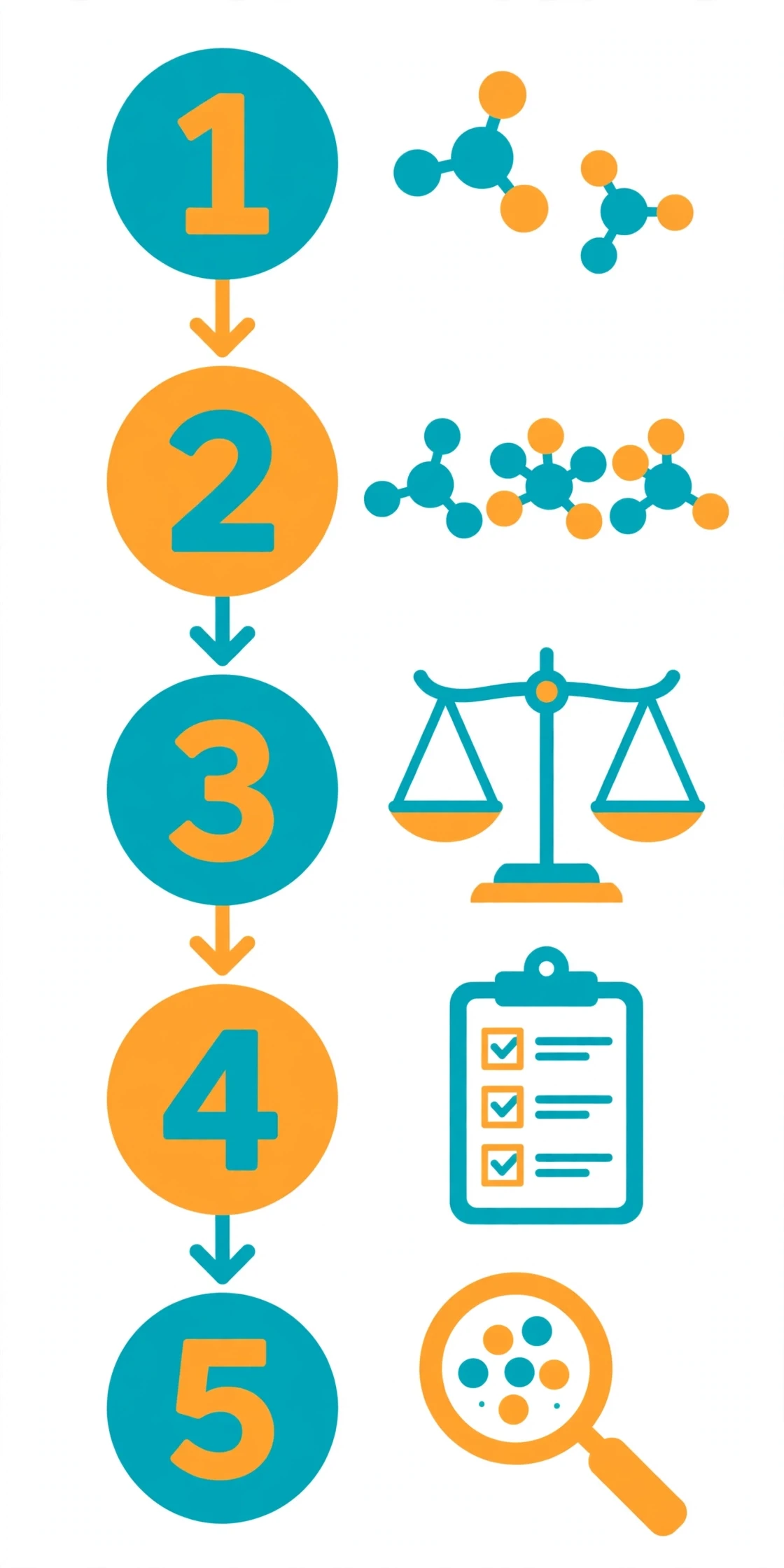
That is the whole method. Everything from here on is practice: applying those six steps to harder and harder equations until the order becomes a reflex. The next sections work through the examples one at a time, showing the counting at each stage, including the wrong turns, because the wrong turns are where the learning lives.
4.1 A counting trick worth learning early
Before the first example, one piece of arithmetic deserves its own paragraph, because it causes more errors than any other single thing. When a coefficient multiplies a formula, it multiplies every subscript inside that formula. In 2H₂O, the coefficient 2 meets the subscript 2 on hydrogen and gives 2 × 2 = 4 hydrogen atoms, and it meets the unwritten subscript 1 on oxygen and gives 2 × 1 = 2 oxygen atoms. When a subscript sits outside brackets, as in Ca(OH)₂, it multiplies everything inside the brackets: 1 × 2 = 2 oxygens and 1 × 2 = 2 hydrogens, plus the single calcium. And when both a coefficient and a bracket subscript appear, as in 2Ca(OH)₂, you multiply all three layers: 2 × 1 calcium = 2 calciums, 2 × 2 oxygens = 4 oxygens, 2 × 2 hydrogens = 4 hydrogens.
Slow down on this whenever a formula has brackets. Nearly every balancing error I have watched a student make, in exams and in labs, traces back to a bracket that was counted once instead of multiplied. Write the multiplication out in full until it feels automatic. Speed comes later, and it comes from accuracy, not from skipping steps.
5. Worked Example 1: Hydrogen and Oxygen Make Water
We begin where the kitchen-table lesson began, with the reaction that makes water. The skeleton equation is:
H₂ + O₂ → H₂O
Count. On the left: 2 hydrogen atoms, 2 oxygen atoms. On the right: 2 hydrogen atoms, 1 oxygen atom. Hydrogen matches. Oxygen does not: two on the left, one on the right.
Balance oxygen first. The oxygen on the right is trapped inside H₂O, and changing its subscript would change water into something else, so that is forbidden. The only move is to change a coefficient. If we put a 2 in front of H₂O, the right side becomes 2H₂O, which holds 2 oxygen atoms and 4 hydrogen atoms. Oxygen now matches. But hydrogen no longer does: the left side has 2 hydrogens, the right side has 4.
Balance hydrogen next. Put a 2 in front of H₂ on the left. The equation becomes:
2H₂ + O₂ → 2H₂O
Check. Left: 4 hydrogen, 2 oxygen. Right: 4 hydrogen, 2 oxygen. Every element matches, and the coefficients 2, 1, and 2 cannot be divided by a common number, so the ratio is already in its simplest form. The equation is balanced.
This example is the whole subject in miniature. You changed only coefficients, you fixed one element and then repaired the knock-on effect on another, and you finished by counting everything again. Every harder example in this guide is the same dance with more partners.
Notice one thing about the order. We balanced oxygen first because oxygen appeared in only one substance on each side, and because fixing it disturbed only hydrogen. If we had started with hydrogen, which already matched, we would have had nothing to fix. A useful rule of thumb: start with the element that is most out of balance, or the one that appears in the fewest formulas. Save hydrogen and oxygen for last when you can, because they appear almost everywhere and touching them early tends to disturb everything else. In this tiny example there was no choice to make, but in the examples ahead the order matters a great deal.
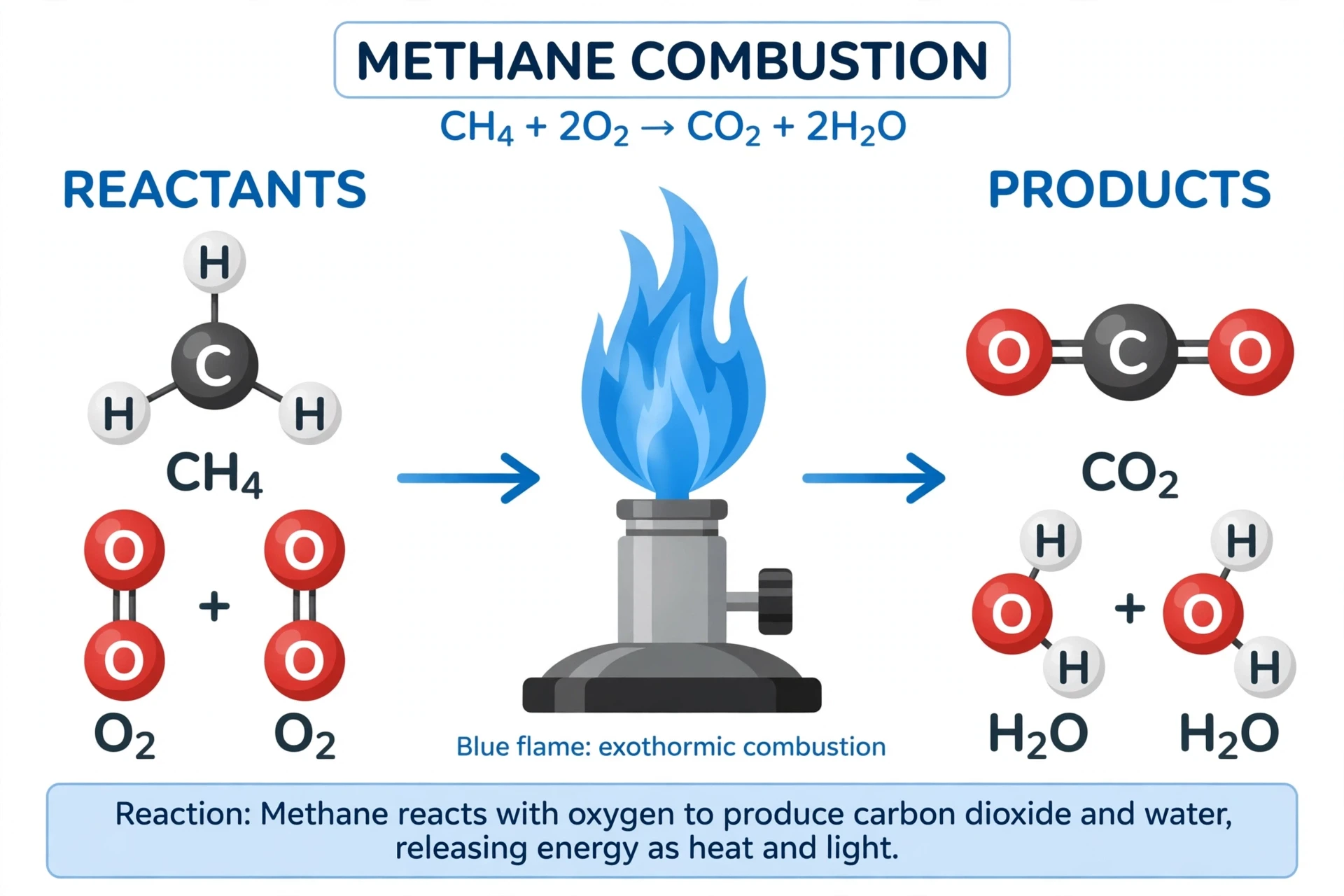
6. Worked Example 2: Burning Methane
Methane combustion is the reaction in a gas stove, a central-heating boiler, and a power station turbine. The skeleton equation is:
CH₄ + O₂ → CO₂ + H₂O
Count. Left: 1 carbon, 4 hydrogen, 2 oxygen. Right: 1 carbon, 2 hydrogen, 3 oxygen (2 in CO₂, 1 in H₂O). Carbon matches. Hydrogen and oxygen do not.
Balance carbon first, or rather, notice it is already balanced. Carbon appears once on each side, so leave it alone. That is step 3 in action: the most complex substance is methane, and its carbon is already fine.
Balance hydrogen next. There are 4 hydrogens on the left and 2 on the right. Put a 2 in front of H₂O. The equation becomes:
CH₄ + O₂ → CO₂ + 2H₂O
Now the right side holds 4 hydrogens, matching the left. But the oxygen count has changed: the right side now has 2 oxygens in CO₂ plus 2 in 2H₂O, making 4 in total, while the left still has 2.
Balance oxygen last. Oxygen appears on the left only in O₂, so changing its coefficient disturbs nothing else. Put a 2 in front of O₂:
CH₄ + 2O₂ → CO₂ + 2H₂O
Check. Left: 1 carbon, 4 hydrogen, 4 oxygen. Right: 1 carbon, 4 hydrogen, 4 oxygen. Balanced, and the coefficients 1, 2, 1, 2 are in their simplest ratio.
This pattern, hydrogen before oxygen, and the lone element last, will recur through the rest of the guide. It is not a law of nature. It is a habit that keeps the knock-on effects small, and habits like that are what turn a fiddly procedure into a smooth one.
6.1 Why the order matters
Imagine balancing the same equation in the opposite order, starting with oxygen. The skeleton has 2 oxygens on the left and 3 on the right. There is no whole-number coefficient you can put in front of O₂ to make 2 into 3, and no coefficient for H₂O that fixes oxygen without breaking hydrogen. You would end up reaching for fractions immediately, or going back and forth in circles. The method is not magic. It is sequencing: fix the elements that are locked inside complicated formulas first, while the free elements are still free to absorb the changes. Leave the simple, flexible pieces until the end, and they will mop up whatever is left.
7. Worked Example 3: Aluminium, Oxygen, and the Odd-Even Trick
Metals reacting with oxygen give oxides, and aluminium oxide is one of the most useful substances in the world: it is the coating that stops aluminium from corroding, the abrasive on sandpaper, and the material of spark plugs and artificial sapphires. The skeleton equation is:
Al + O₂ → Al₂O₃
Count. Left: 1 aluminium, 2 oxygen. Right: 2 aluminium, 3 oxygen. Nothing matches.
Balance aluminium first. Put a 2 in front of Al:
2Al + O₂ → Al₂O₃
Aluminium now matches, 2 on each side. Oxygen still does not: 2 on the left, 3 on the right.
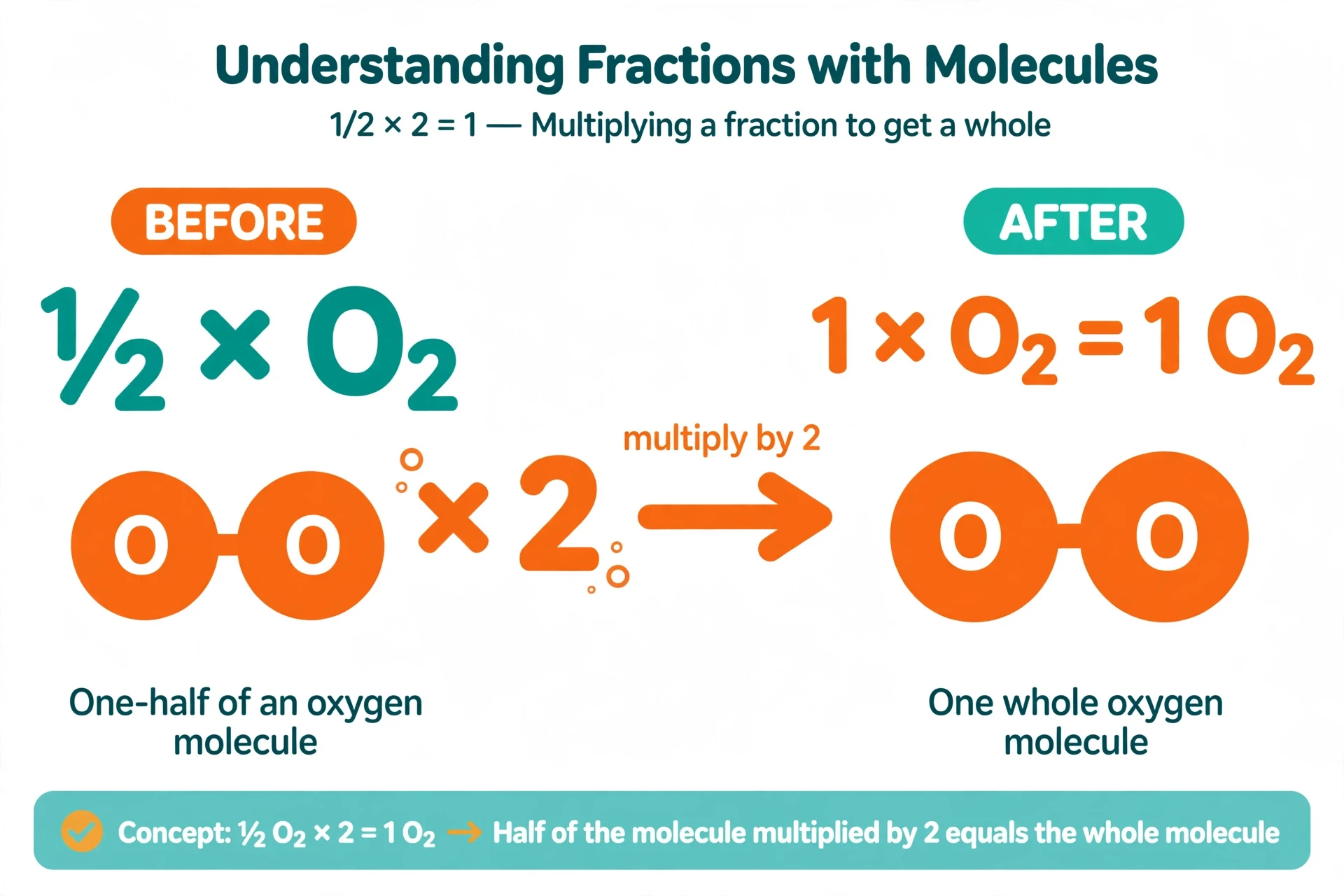
Oxygen is the problem. Oxygen appears as O₂ on the left, which always contributes an even number of atoms, and as part of Al₂O₃ on the right, which contributes 3. No whole-number coefficient on O₂ will ever give 3. This is the classic odd-even trap, and the standard escape is a fraction: use one half of an O₂ molecule, temporarily, and clear the fraction at the end.
Put 3/2 in front of O₂:
2Al + 3/2O₂ → Al₂O₃
Now the left has 2 × 3/2 = 3 oxygen atoms, matching the right. The equation is balanced in atoms, but it has a fraction, and finished equations use whole numbers.
Clear the fraction. Multiply every coefficient by 2:
4Al + 3O₂ → 2Al₂O₃
Check. Left: 4 aluminium, 6 oxygen. Right: 4 aluminium (2 × 2), 6 oxygen (2 × 3). Balanced, and the coefficients 4, 3, 2 share no common divisor.
There is a second way to reach the same answer, and it is worth knowing, because some students prefer it. Find the lowest common multiple of the two oxygen counts, 2 and 3, which is 6. Then ask what coefficient on each side gives 6 oxygens: 3 in front of O₂, and 2 in front of Al₂O₃. That gives 3O₂ → 2Al₂O₃, and the aluminium then needs a 4 on the left. Same result, no fractions. Use whichever route feels clearer. The lowest-common-multiple route is often faster once you are comfortable with it, and the fraction route is often easier to remember under exam pressure. Both are correct, and both end with the same check.
I once watched a student spend twenty minutes on this exact equation, changing the subscript in Al₂O₃ to Al₂O₂ to make the oxygen even. It balanced beautifully, and it was completely wrong, because Al₂O₂ is not a real substance. Aluminium oxide is Al₂O₃, fixed by the charges of the ions, and no exam answer and no real reaction will ever accept a rewritten formula. The odd-even trap is a trap precisely because the tempting escape, rewriting the formula, is forbidden. The legitimate escapes are fractions and lowest common multiples, and they are always available.
8. Worked Example 4: When Polyatomic Ions Stay Together
Some groups of atoms travel through a reaction as a single unit. The hydroxide group OH⁻, the sulfate group SO₄²⁻, the nitrate group NO₃⁻, and the phosphate group PO₄³⁻ often survive a reaction intact, the way a band stays together when it moves from one venue to another. When that happens, you can count the whole group as one item instead of counting its atoms separately, and the balancing becomes much simpler.
Consider the reaction between calcium hydroxide, the active ingredient in whitewash and a key material in cement, and phosphoric acid:
Ca(OH)₂ + H₃PO₄ → Ca₃(PO₄)₂ + H₂O
Count the groups first. On the left, the hydroxide group OH appears twice, inside Ca(OH)₂. On the right, there is no hydroxide at all: the product is water, H₂O, and calcium phosphate. So the hydroxide group does not survive here. It breaks apart, its oxygen and hydrogen going into water. That means the group-counting shortcut does not apply to hydroxide in this reaction. But the phosphate group PO₄ does survive: it appears once on the left, inside H₃PO₄, and twice on the right, inside Ca₃(PO₄)₂. Count it as a unit.
Balance phosphate as a unit. Put a 2 in front of H₃PO₄:
Ca(OH)₂ + 2H₃PO₄ → Ca₃(PO₄)₂ + H₂O
Phosphate now matches: 2 groups on each side. But calcium does not: 1 on the left, 3 on the right.
Balance calcium. Put a 3 in front of Ca(OH)₂:
3Ca(OH)₂ + 2H₃PO₄ → Ca₃(PO₄)₂ + H₂O
Calcium now matches at 3. Now count hydrogen and oxygen properly, atom by atom. On the left, the hydrogen comes from 3Ca(OH)₂, which holds 3 × 2 = 6 hydrogens, plus 2H₃PO₄, which holds 2 × 3 = 6 hydrogens: 12 hydrogens in total. On the right, H₂O currently holds 2. Put a 6 in front of H₂O:
3Ca(OH)₂ + 2H₃PO₄ → Ca₃(PO₄)₂ + 6H₂O
Check everything. Calcium: 3 and 3. Phosphate groups: 2 and 2. Hydrogen: 12 on the left, 12 on the right (6 × 2). Oxygen: on the left, 3 × 2 = 6 from the hydroxide plus 2 × 4 = 8 from the phosphoric acid, making 14. On the right, 2 × 4 = 8 in the calcium phosphate plus 6 × 1 = 6 in the water, making 14. Balanced.
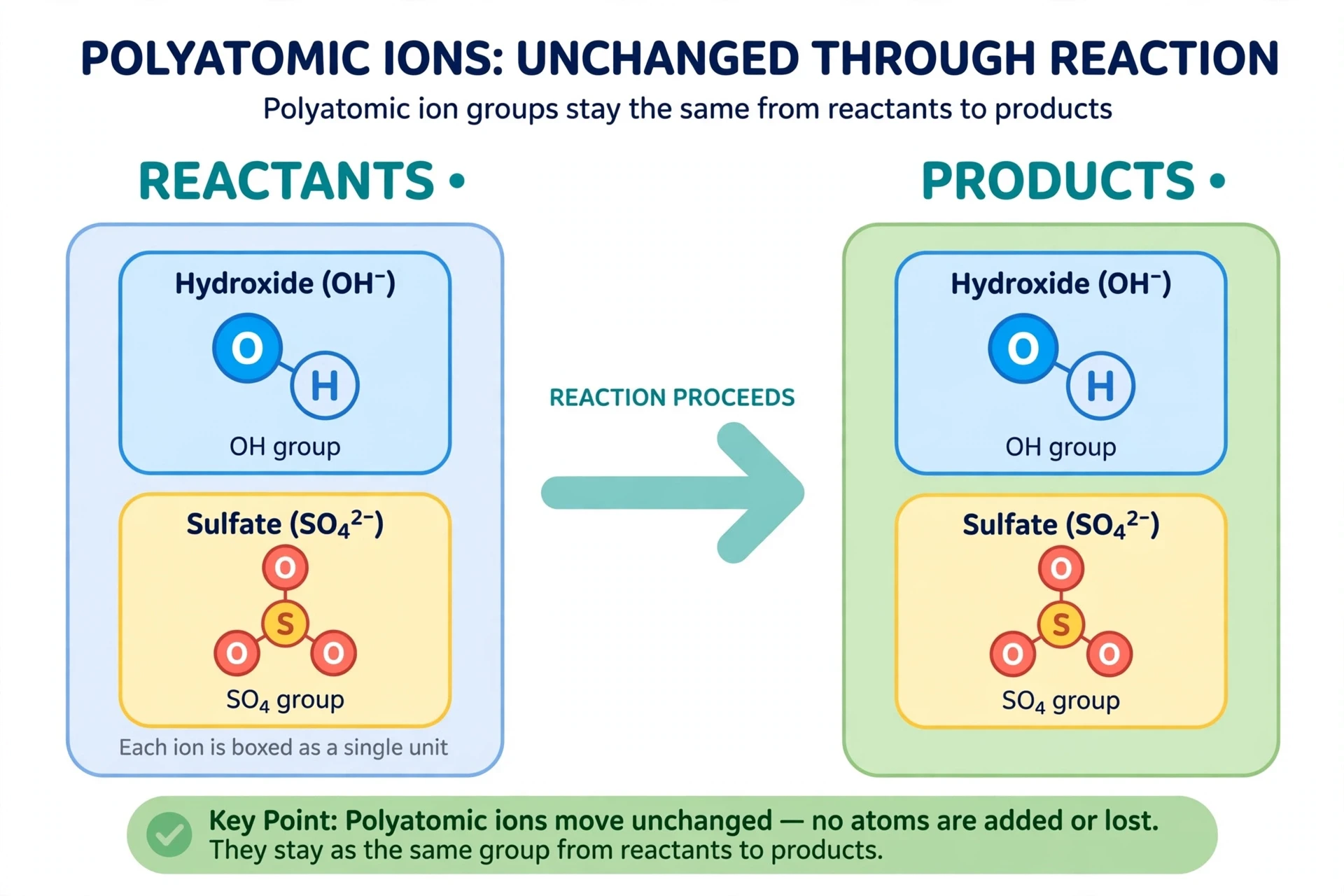
The lesson of this example is not the specific equation. It is the judgement call: look at each polyatomic group and ask whether it survives. If it appears unchanged on both sides, count it as one thing. If it breaks apart, count its atoms separately. Making that decision before you start adjusting coefficients will save you from the most tangled counting in balancing, and it is the step that separates students who can handle textbook equations from students who can handle real ones, where brackets and groups are everywhere.
9. Worked Example 5: Photosynthesis and the Glucose Equation
Photosynthesis is the most important chemical equation on Earth. Plants, algae, and some bacteria take carbon dioxide and water, add sunlight, and build glucose, the sugar that powers nearly all life, releasing oxygen as a by-product. The skeleton equation is:
CO₂ + H₂O → C₆H₁₂O₆ + O₂
Count. Left: 1 carbon, 2 hydrogen, 3 oxygen. Right: 6 carbon, 12 hydrogen, 8 oxygen (6 in glucose, 2 in O₂). Everything is out of balance, and glucose, with its 24 atoms, dominates the equation.
Balance carbon first. Glucose holds 6 carbons, so the left needs 6 CO₂:
6CO₂ + H₂O → C₆H₁₂O₆ + O₂
Balance hydrogen next. Glucose holds 12 hydrogens, so the left needs 6 H₂O:
6CO₂ + 6H₂O → C₆H₁₂O₆ + O₂
Balance oxygen last. Count the left: 6 × 2 = 12 from carbon dioxide, plus 6 × 1 = 6 from water, making 18 oxygens. The right has 6 in glucose, so the O₂ must supply 12 more, which means a coefficient of 6:
6CO₂ + 6H₂O → C₆H₁₂O₆ + 6O₂
Check. Carbon: 6 and 6. Hydrogen: 12 and 12. Oxygen: 18 and 18. Balanced.
There is a quiet elegance in this result. Six molecules of carbon dioxide and six of water become one glucose and six of oxygen, and the symmetry of the sixes is no coincidence. It reflects the chemistry: glucose is built from six carbon atoms, each arriving as a CO₂, and the water supplies the hydrogens. The equation for photosynthesis is covered in more depth in the Sciory guide to Photosynthesis, including the light-dependent reactions and the Calvin cycle that the single summary equation compresses into one line. The summary is a bookkeeping statement, not the mechanism, and knowing the difference is part of chemical literacy.
The reverse reaction is just as important. When a cell burns glucose for energy, in respiration, the equation runs backwards:
C₆H₁₂O₆ + 6O₂ → 6CO₂ + 6H₂O
Same atoms, same counts, opposite direction. Photosynthesis stores energy in glucose. Respiration releases it. The two equations are mirror images, and that mirroring is one of the great cycles of the living world: the oxygen you breathe out as waste in one process is the raw material of the other.
10. Fractional Coefficients: A Tool, Not a Mistake
Fractions make some students nervous, as if a half-molecule were a physical absurdity. It is not, or rather, it is a bookkeeping device, and a perfectly respectable one. A coefficient of 1/2 in front of O₂ does not claim that half an oxygen molecule floats around on its own. It claims that the ratio of oxygen molecules to the other substances is one half, which is a statement about proportions, not about individual molecules. Chemists use fractional coefficients routinely in thermochemistry, where equations are often written for exactly one mole of a substance, and a half or a third is the honest ratio.
The rule is simple: fractions are allowed while you work, and whole numbers are required when you finish. The aluminium example in section 7 used 3/2 as a stepping stone and cleared it by multiplying everything by 2. Here is another, the combustion of ethane, the second component of natural gas:
C₂H₆ + O₂ → CO₂ + H₂O
Count. Left: 2 carbon, 6 hydrogen, 2 oxygen. Right: 1 carbon, 2 hydrogen, 3 oxygen.
Balance carbon. Put a 2 in front of CO₂:
C₂H₆ + O₂ → 2CO₂ + H₂O
Balance hydrogen. Put a 3 in front of H₂O:
C₂H₆ + O₂ → 2CO₂ + 3H₂O
Balance oxygen. The right now holds 4 oxygens in CO₂ plus 3 in H₂O, making 7. The left must supply 7 oxygens from O₂, which needs a coefficient of 7/2:
C₂H₆ + 7/2O₂ → 2CO₂ + 3H₂O
Clear the fraction. Multiply every coefficient by 2:
2C₂H₆ + 7O₂ → 4CO₂ + 6H₂O
Check. Carbon: 4 and 4. Hydrogen: 12 and 12. Oxygen: 14 and 14. Balanced, in the smallest whole-number ratio.
10.1 When fractions are the answer, not the step
There is one situation where a fraction survives to the final answer. In thermochemistry, equations are often written to describe the formation of exactly one mole of a compound, and the coefficients are allowed to stay fractional so that the mole count stays at one. The formation of water, written as H₂ + 1/2O₂ → H₂O, is a standard example. You will not meet this in a school balancing exercise, where whole numbers are expected, but it is worth knowing that the fraction is not an error. It is a convention for a different job, and the same atom-counting check still applies: 2 hydrogens and 1 oxygen on each side.
11. A First Look at Redox: Balancing with Oxidation Numbers
Some equations resist the inspection method, not because the method is wrong, but because the reaction itself is more complicated. In redox reactions, short for reduction-oxidation reactions, electrons move from one substance to another. One substance loses electrons and is oxidised; the other gains electrons and is reduced. The atoms still balance, because conservation of mass still holds, but the electrons need balancing too, and counting atoms alone will not tell you how.
The classic example is the reaction between zinc metal and copper sulfate solution, the reaction at the heart of the Daniell cell, one of the earliest electric batteries:
Zn + CuSO₄ → ZnSO₄ + Cu
This one balances easily by inspection: one zinc, one copper, one sulfate on each side. The electron story is simple too. Zinc loses two electrons and becomes Zn²⁺, copper gains two electrons and becomes copper metal. The electrons handed over exactly match the electrons taken up.
A harder case is the reaction of copper metal with concentrated nitric acid, which produces nitrogen dioxide, a brown, choking gas:
Cu + HNO₃ → Cu(NO₃)₂ + NO₂ + H₂O
Try it by inspection and you will go around in circles, because the nitrogen appears in two different products, and the coefficients that fix nitrogen disturb the hydrogen and oxygen. The systematic fix is the half-reaction method: split the reaction into an oxidation half and a reduction half, balance each half separately, including its electrons, and then combine them so the electrons cancel. The sulfate group trick from section 8 helps here too, since nitrate appears as a group in the product.
Working through the half-reaction method in full is a topic of its own, and it belongs in a dedicated guide to redox reactions. What matters here is the boundary of the inspection method: it handles the great majority of equations a student meets, including combustion, neutralisation, precipitation, and decomposition. When an equation involves the same element in two products, or an element changing oxidation state in a complicated way, the half-reaction method is the right tool, and recognising that boundary is itself a skill. A balanced equation is the goal in both cases. The method changes; the definition of balanced does not.
"Balancing by inspection works on most equations you will meet. When it starts going in circles, that is not failure — it is the equation telling you it needs the half-reaction method instead."
12. More Worked Examples: Rust, Lime, and Baking Soda
Fluency comes from variety. The examples so far were chosen to teach one idea each. The ones below mix the ideas together, the way real exam questions do.
12.1 Rusting iron
Iron rusts when it reacts with oxygen and water, forming hydrated iron(III) oxide. The simplified skeleton, ignoring the water of hydration, is:
Fe + O₂ → Fe₂O₃
Balance iron first: 2Fe on the left. Then oxygen: 3 on the right, 2 on the left, the odd-even trap again. Use 3/2 O₂, then double everything:
4Fe + 3O₂ → 2Fe₂O₃
Check: 4 iron and 6 oxygen on each side. This is the same shape as the aluminium example, and that is no accident. Metals forming oxides with odd numbers of oxygen atoms in the formula almost always need the odd-even treatment, and recognising the family resemblance is faster than solving each one from scratch.
12.2 Making lime from limestone
Limestone, calcium carbonate, decomposes when heated to give calcium oxide, quicklime, and carbon dioxide:
CaCO₃ → CaO + CO₂
Count: 1 calcium, 1 carbon, 3 oxygen on the left; 1 calcium, 1 carbon, 3 oxygen on the right. It is already balanced. Not every equation needs work, and checking before you start changing coefficients is a habit worth keeping. The students who struggle most are often the ones who "fix" equations that were never broken.
12.3 Baking soda and vinegar
Sodium hydrogencarbonate, baking soda, reacts with ethanoic acid, vinegar, to give sodium ethanoate, carbon dioxide, and water:
NaHCO₃ + CH₃COOH → CH₃COONa + CO₂ + H₂O
Count carefully. Left: sodium 1, carbon 2 (1 + 1), hydrogen 5 (1 + 4), oxygen 5 (3 + 2). Right: sodium 1, carbon 3 (2 + 1), hydrogen 5 (3 + 2), oxygen 5 (2 + 2 + 1). Carbon does not match: 2 on the left, 3 on the right. Something is wrong, and the something is my skeleton: baking soda plus vinegar should give one carbon dioxide, but the carbon count says otherwise. Recount the left: NaHCO₃ has 1 carbon, CH₃COOH has 2 carbons, so the left has 3 carbons, not 2. I miscounted, and the recount fixes it. The equation is balanced as written: 3 carbons, 5 hydrogens, 5 oxygens, 1 sodium on each side.
I left that miscount in deliberately, because it is the most honest thing in this guide. Counting errors, not conceptual errors, are the main reason balanced equations come out wrong. The fix is never a cleverer method. It is a slower count, done twice, preferably written down. Every professional chemist I know still counts on paper for anything with brackets, and none of them is embarrassed about it.
12.4 A table of the worked examples
The table below collects the examples from this guide so you can compare them at a glance. Notice the pattern in the last column: the same few moves recur, and spotting the move is most of the skill.
Reaction | Balanced equation | Key move |
|---|---|---|
Hydrogen + oxygen → water | 2H₂ + O₂ → 2H₂O | Balance oxygen, then hydrogen |
Methane combustion | CH₄ + 2O₂ → CO₂ + 2H₂O | Carbon, then hydrogen, oxygen last |
Aluminium + oxygen | 4Al + 3O₂ → 2Al₂O₃ | Odd-even trick, clear the fraction |
Calcium hydroxide + phosphoric acid | 3Ca(OH)₂ + 2H₃PO₄ → Ca₃(PO₄)₂ + 6H₂O | Count phosphate as a unit |
Photosynthesis | 6CO₂ + 6H₂O → C₆H₁₂O₆ + 6O₂ | Balance the biggest formula first |
Ethane combustion | 2C₂H₆ + 7O₂ → 4CO₂ + 6H₂O | Fraction 7/2, then double |
Iron rusting | 4Fe + 3O₂ → 2Fe₂O₃ | Odd-even trick again |
Limestone decomposition | CaCO₃ → CaO + CO₂ | Already balanced; check first |
A second table is worth keeping nearby while you practise: the common polyatomic ions and their charges. These groups appear in a large share of balancing exercises, and knowing them by sight is faster than looking them up each time.
Ion | Formula | Charge |
|---|---|---|
Hydroxide | OH⁻ | 1− |
Nitrate | NO₃⁻ | 1− |
Carbonate | CO₃²⁻ | 2− |
Sulfate | SO₄²⁻ | 2− |
Phosphate | PO₄³⁻ | 3− |
Ammonium | NH₄⁺ | 1+ |
13. Common Mistakes When Learning How to Balance Chemical Equations
Every teacher of chemistry has a mental catalogue of the errors students make, because the same ones appear year after year, in every country, at every level. The list below is that catalogue, and it is worth reading before you practise rather than after, because recognising a mistake in advance is far cheaper than unlearning it later.
13.1 Changing subscripts instead of coefficients
This is the first mistake and the biggest one. Faced with H₂ + O₂ → H₂O, the tempting fix is to change the subscript in water to make H₂O₂, or to change the oxygen to O, a single atom that does not exist as a stable substance under ordinary conditions. Both fixes balance the numbers and break the chemistry. The rule is absolute: subscripts are part of the formula, and the formula is the substance. Only coefficients change. The Khan Academy introduction to balancing chemical equations makes the same point with a visual demonstration, and it is the first thing to check whenever an answer looks wrong.
13.2 Forgetting that a coefficient multiplies everything
In 2Ca(OH)₂ there are 2 calciums, 4 oxygens, and 4 hydrogens. The most common slip is to count 2 oxygens and 2 hydrogens, forgetting that the coefficient multiplies the bracket subscript as well. Write the multiplication out: 2 × (OH)₂ means two lots of two OH groups. Until this is automatic, write it out every time.
13.3 Balancing one element and forgetting to recheck the others
Balancing is a sequence of knock-on effects. Fixing oxygen in the methane example changed the hydrogen count, and fixing hydrogen changed the oxygen count. The students who get stuck are usually the ones who fix one element and stop, without recounting. The final full recount is not a formality. It is the step that catches the knock-on effects, and it should be done on the finished equation, from scratch, as if you had never seen it before.
13.4 Leaving coefficients that are not in the smallest ratio
The equation 4H₂ + 2O₂ → 4H₂O is balanced, in the strict sense that the atoms match, but it is not finished. Every coefficient divides by 2, giving 2H₂ + O₂ → 2H₂O. Always reduce at the end. An unreduced equation is like a fraction left as 4/8 instead of 1/2: correct, but unfinished, and an examiner will mark it down.
13.5 Adding or removing substances to make the numbers work
If the atoms will not balance, the skeleton is probably wrong, not the method. A missing product, a wrong formula, or a substance that does not take part will all make balancing impossible, and no coefficient can fix them. When you are truly stuck, stop adjusting numbers and re-examine the formulas. Check each one against what you know about the substances involved. The American Chemical Society's guide to balancing equations walks through this diagnostic thinking with everyday examples, and it is a useful second opinion when an equation refuses to cooperate.
14. Practice Problems: Try Them, Then Check
The only way to get good at balancing is to balance. The problems below are arranged from easy to hard, and they use the ideas from every section of this guide. Cover the answers, work each one with the method from section 4, and count everything twice before you look.
Problem 1. Magnesium burns in oxygen to form magnesium oxide. Mg + O₂ → MgO
Problem 2. Hydrogen and chlorine react to form hydrogen chloride. H₂ + Cl₂ → HCl
Problem 3. Propane burns in oxygen. C₃H₈ + O₂ → CO₂ + H₂O
Problem 4. Sodium reacts with water to give sodium hydroxide and hydrogen gas. Na + H₂O → NaOH + H₂
Problem 5. Zinc reacts with hydrochloric acid to give zinc chloride and hydrogen. Zn + HCl → ZnCl₂ + H₂
Problem 6. Potassium chlorate decomposes on heating to potassium chloride and oxygen. KClO₃ → KCl + O₂
Problem 7. Ammonia burns in oxygen to give nitrogen monoxide and water. NH₃ + O₂ → NO + H₂O
Problem 8. Aluminium reacts with sulfuric acid to give aluminium sulfate and hydrogen. Al + H₂SO₄ → Al₂(SO₄)₃ + H₂
Problem 9. Calcium carbonate reacts with hydrochloric acid to give calcium chloride, carbon dioxide, and water. CaCO₃ + HCl → CaCl₂ + CO₂ + H₂O
Problem 10. Glucose ferments to ethanol and carbon dioxide. C₆H₁₂O₆ → C₂H₅OH + CO₂
14.1 Answers, with the thinking shown
1. 2Mg + O₂ → 2MgO. The odd-even trick: magnesium needs a 2, oxygen needs a 2, then magnesium needs a 2 to match.
2. H₂ + Cl₂ → 2HCl. Two hydrogens and two chlorines on the left need two HCl on the right.
3. C₃H₈ + 5O₂ → 3CO₂ + 4H₂O. Carbon first: 3 CO₂. Hydrogen next: 4 H₂O. Oxygen last: 6 + 4 = 10 oxygens on the right, so 5 O₂ on the left.
4. 2Na + 2H₂O → 2NaOH + H₂. Balance sodium and hydroxide together, then hydrogen: 4 hydrogens on the left, 2 in the hydroxides plus 2 in H₂ on the right.
5. Zn + 2HCl → ZnCl₂ + H₂. Chlorine needs a 2 on the left, which fixes hydrogen at the same time.
6. 2KClO₃ → 2KCl + 3O₂. Oxygen: 6 on the left with 2 KClO₃, so 3 O₂ on the right. Potassium and chlorine then match at 2.
7. 4NH₃ + 5O₂ → 4NO + 6H₂O. Nitrogen first: 4 NO. Hydrogen next: 6 H₂O. Oxygen last: 4 + 6 = 10, so 5 O₂.
8. 2Al + 3H₂SO₄ → Al₂(SO₄)₃ + 3H₂. Count sulfate as a unit: 3 on the right, so 3 H₂SO₄ on the left. Aluminium needs a 2, and the 6 hydrogens on the left give 3 H₂.
9. CaCO₃ + 2HCl → CaCl₂ + CO₂ + H₂O. Chlorine needs a 2 on the left, which gives 2 hydrogens, matching the water. Carbonate survives as CO₂, so count carbon once.
10. C₆H₁₂O₆ → 2C₂H₅OH + 2CO₂. Carbon: 6 on the left, 4 in the ethanol plus 2 in the carbon dioxide. Hydrogen: 12 on the left, 12 in two ethanols. Oxygen: 6 on the left, 2 in the ethanols plus 4 in the carbon dioxide. This is the fermentation that makes bread rise and beer brew, and the equation is the reason both processes release carbon dioxide.
If you got most of these, the method is working. If one of them resisted, go back to the section that teaches its trick: the odd-even pattern, the polyatomic group, or the order of balancing. The problems are not a test. They are the practice that turns the method into a reflex.
15. Where Balanced Equations Run the Real World
Balancing is not a classroom exercise that stays in the classroom. Every industry that transforms one substance into another depends on balanced equations, and the dependence is not decorative. It is how engineers know how much raw material to buy, how much product to expect, and how much waste to handle.
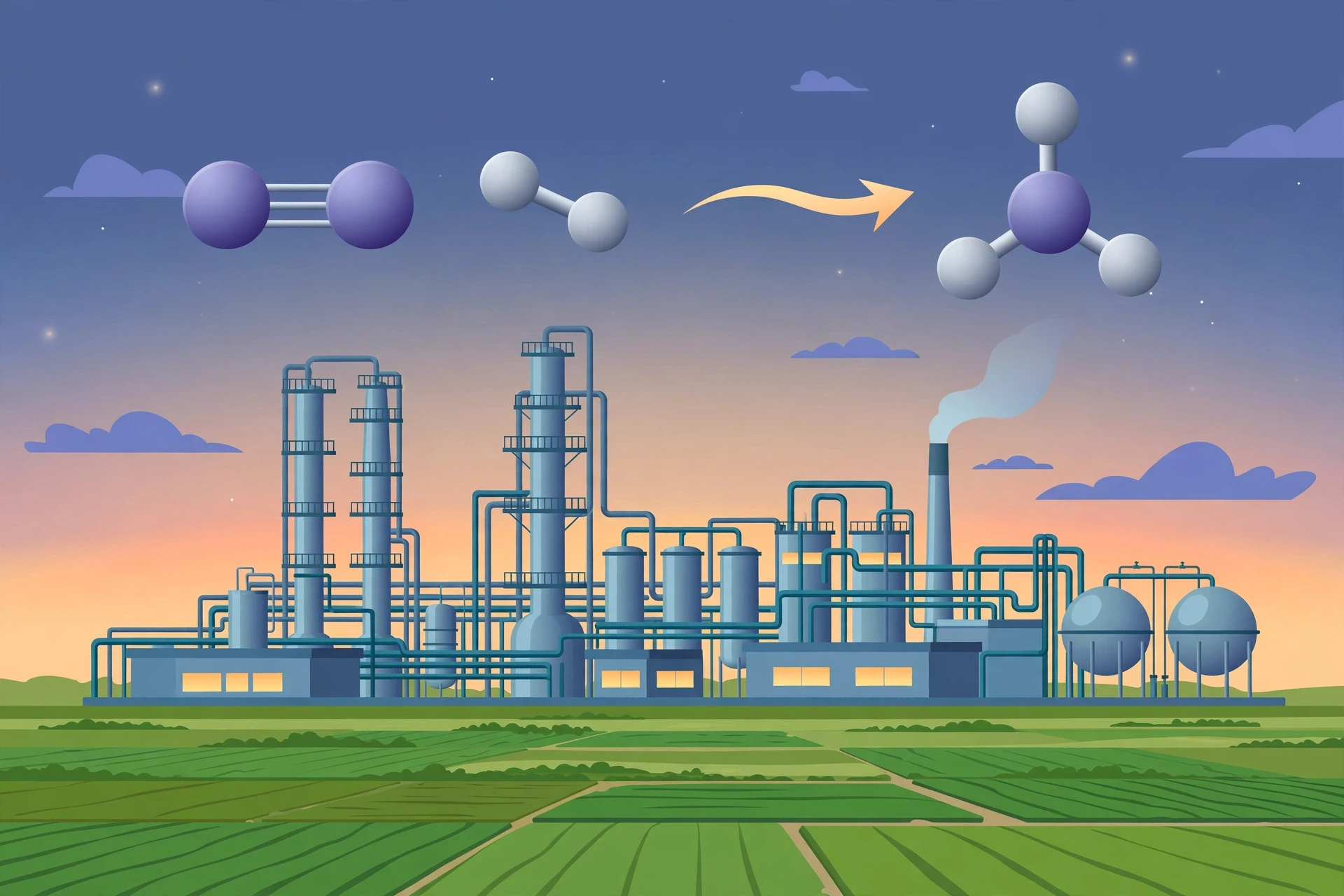
The Haber process, which makes ammonia for fertiliser, is the largest-scale chemical reaction on the planet, and its equation is a balancing exercise:
N₂ + 3H₂ → 2NH₃
One molecule of nitrogen and three of hydrogen give two of ammonia. That ratio decides how much hydrogen a fertiliser plant must produce, how much nitrogen it must pull from the air, and how much ammonia it can sell. The ammonia then feeds roughly half the people on Earth, through the fertiliser that grows their food. A wrong ratio in that equation would not be a lost exam mark. It would be a factory that buys the wrong amounts of everything, every day, at industrial scale.
Car exhausts tell a similar story. The catalytic converter in a car uses balanced reactions to turn carbon monoxide, nitrogen oxides, and unburned fuel into carbon dioxide, nitrogen, and water, and its design depends on knowing exactly how much of each pollutant a given amount of exhaust contains. Water treatment plants dose chlorine and other chemicals according to balanced equations, so that the water is safe without being over-treated. Pharmaceutical factories calculate yields from balanced equations, because a drug that should give 90 grams per batch and gives 45 has a problem somewhere, and the equation is the first place to look.
Even the air you are breathing now is governed by balanced equations. The oxygen in it was released by photosynthesis, in the ratio of six oxygens for every glucose built. The carbon dioxide you breathe out comes from respiration, the same equation run in reverse. The balance between those two processes, photosynthesis and respiration, is the balance of the living world, and it is written in coefficients.
"A balanced equation is a recipe, a promise, and a budget all at once. It tells you what goes in, what comes out, and in what proportions — and every factory, farm, and living cell on Earth keeps those proportions."
16. A Quick-Reference Checklist
When you sit down with a new equation, keep this short list beside you until you no longer need it.
Write the skeleton with correct formulas. Check every formula before counting.
Count every element on both sides and write the tally down.
Balance the most complex substance first, and the element that appears in the fewest formulas.
Count unchanged polyatomic ions as single units.
Save hydrogen, oxygen, and free elements for last.
Use a fraction if an odd-even clash appears, then multiply everything to clear it.
Reduce the coefficients to the smallest whole-number ratio.
Recount every element on both sides, from scratch, on the finished equation.
Learning how to balance chemical equations is, in the end, a small skill with a large payoff. The method fits on an index card, the rule fits in one sentence, and the practice takes an afternoon. What it unlocks is the whole of quantitative chemistry: the mole, the yield, the titration, the industrial process, and the living cell. Every one of those topics starts with the same quiet question, asked of a new equation: do the atoms add up? Once you can answer that question confidently, the rest of chemistry opens up, one balanced equation at a time.
Frequently Asked Questions
How do you balance a chemical equation?
Write the correct formulas for all reactants and products first, then count the atoms of each element on both sides. Change only the coefficients, starting with the most complex substance and the elements that appear in the fewest formulas, saving hydrogen and oxygen for last. If a fraction appears, multiply every coefficient to clear it, reduce to the smallest whole-number ratio, and recount every element on both sides to check. The full step-by-step method, with worked examples, is in section 4 of this guide.
Can you change subscripts to balance an equation?
No. Subscripts are part of a chemical formula, and the formula defines the substance. Changing the subscript in H₂O to make H₂O₂ turns water into hydrogen peroxide, a different substance with different properties. Only coefficients may change during balancing, because they say how many molecules or formula units take part, not what those units are. If the formulas are wrong, rewrite them first and then balance.
What is a skeleton equation?
A skeleton equation is the first draft of a chemical equation. It has the correct formulas for every reactant and product in the right places, but the atom counts do not match yet. For example, CH₄ + O₂ → CO₂ + H₂O is the skeleton equation for methane combustion. Balancing turns the skeleton into a finished equation, CH₄ + 2O₂ → CO₂ + 2H₂O, in which every element appears the same number of times on both sides.
Why must chemical equations be balanced?
Because atoms are neither created nor destroyed in an ordinary chemical reaction. This is the law of conservation of mass, established by Antoine Lavoisier in the late 1700s. An unbalanced equation claims that atoms appear or vanish, which contradicts that law. Balancing makes the equation honest about amounts, and it is what lets chemists use the equation to calculate quantities, yields, and ratios.
What is the easiest way to balance a chemical equation?
The inspection method: write the skeleton, count the atoms, balance the most complex substance first, count unchanged polyatomic ions as units, and finish with hydrogen, oxygen, and free elements. For most school and university equations this is the fastest reliable route. When an equation keeps going in circles, the lowest-common-multiple trick or a temporary fraction usually breaks the deadlock, and for redox reactions the half-reaction method is the systematic alternative.
Do coefficients affect the identity of a substance?
No. A coefficient says how many molecules or formula units are involved, and changing it changes the amount, not the substance. 2H₂O is two water molecules, still water. A subscript, by contrast, is part of the formula itself: H₂O₂ is hydrogen peroxide, not water. This is why balancing changes coefficients and never subscripts.
How do you know when an equation is balanced?
Count every element on both sides and compare. When each element appears the same number of times on the left and the right, and the coefficients are in their smallest whole-number ratio, the equation is balanced. Always do this final count on the finished equation, from scratch, rather than trusting the steps that got you there, because counting slips are the most common source of error.
Sources
Chemistry LibreTexts, American River College — Balancing Chemical Equations: https://chem.libretexts.org/Courses/American_River_College/CHEM_309%3A_Applied_Chemistry_for_the_Health_Sciences/05%3A_Reactions/5.03%3A_Balancing_Chemical_Equations
Chemistry LibreTexts, Anoka-Ramsey Community College — Balancing Chemical Equations: https://chem.libretexts.org/Courses/Anoka-Ramsey_Community_College/Introduction_to_Chemistry/07%3A_Chemical_Reactions/7.04%3A_Balancing_Chemical_Equations
OpenStax Chemistry 2e — Writing and Balancing Chemical Equations: https://openstax.org/books/chemistry-2e/pages/4-1-writing-and-balancing-chemical-equations
OpenStax Chemistry 2e — Classifying Chemical Reactions: https://openstax.org/books/chemistry-2e/pages/4-2-classifying-chemical-reactions
Khan Academy — Balancing Chemical Equations (introduction): https://www.khanacademy.org/science/ap-chemistry-beta/x2eef969c74e0d802:chemical-reactions/x2eef969c74e0d802:balancing-chemical-equations/v/balancing-chemical-equations-introduction
American Chemical Society, ChemMatters — How to Balance Chemical Equations: https://www.acs.org/education/resources/highschool/chemmatters/past-issues/2015-2016/october-2015/how-to-balance-chemical-equations.html
Chemical Reactions Explained: Types, Kinetics, and Everyday Examples — Sciory: https://www.sciory.com/blog/chemical-reactions-types-kinetics-examples
Atoms and Molecules Explained: Structure, Bonding, and States of Matter — Sciory: https://www.sciory.com/blog/atoms-molecules-explained
Photosynthesis Explained: Process and Equation — Sciory: https://www.sciory.com/blog/photosynthesis-process-explained