

The kettle had been on the stove for a few minutes when my grandmother lifted the lid, just a crack, and a white cloud burst out and vanished into the kitchen air. "Where did the water go?" she asked me, and I was eight years old, so I said the obvious thing: it disappeared. She shook her head. "Nothing disappears. It just changes its clothes." That was my first, clumsy lesson in the states of matter — the idea that the same stuff can wear different forms, and that the difference between a solid, a liquid, a gas, and plasma is not what something is made of, but how its particles behave.
Every object you have ever touched, every breath you have ever taken, and every star you have ever seen is matter in one of those forms. The ice in a glass, the water it melts into, the steam rising off a cup of tea, and the glowing gas inside a lightning bolt are four answers to a single question: how much energy do the particles have, and how tightly do they hold on to each other? Answer that question, and you can explain why a steel bridge stands firm in January and sags a little in July, why a balloon pops in a freezer, why the Sun shines, and why most of the universe is in a state of matter most people never think about at all.
This is a deep look at the states of matter: what each state really is at the level of atoms and molecules, how matter moves from one state to another, why water breaks some of the rules, and why plasma — the fourth state — turns out to be the most common state in the universe.
1. What Are the States of Matter?
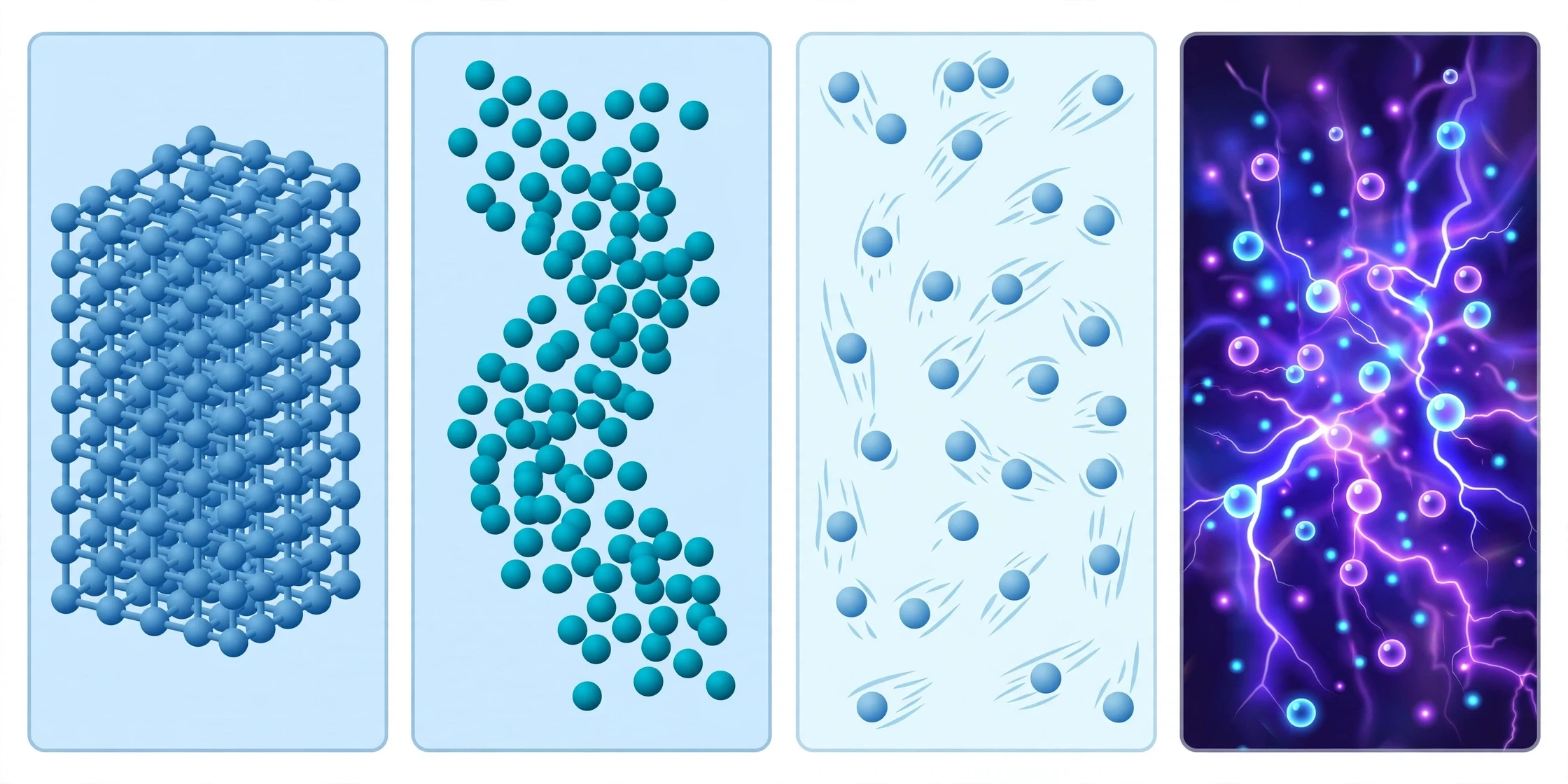
The states of matter are the distinct physical forms that matter takes, decided by the energy of its particles and the strength of the forces between them. Heat a solid and its particles jiggle faster until the bonds holding them in place give way; cool a gas and its particles slow down until they clump into a liquid. The particles themselves do not change. A water molecule is a water molecule whether it sits locked in an ice cube, flows in a river, or drifts as steam. What changes is the arrangement, the motion, and the freedom of those particles.
Textbooks usually list four states of matter: solid, liquid, gas, and plasma. That list is a good starting point, but it is worth knowing from the outset that it is not the whole story. Physicists have found more states under extreme conditions — the Bose-Einstein condensate, for instance, which appears only a fraction of a degree above absolute zero — and we will come to those later. The four familiar states, though, cover almost everything you meet in daily life, and they are the ones that shape weather, cooking, engineering, and the sky above us.
Two ideas run through everything that follows, and they are worth holding on to. The first is energy. Temperature is a measure of the average kinetic energy of particles — how fast they move and vibrate — and adding or removing energy is what drives matter from one state to another. The second is the tug-of-war between that motion and the forces pulling particles together. In a solid, the attractive forces win. In a gas, motion wins. Liquids and plasma sit in between, each with its own balance. Every property of every state — whether it holds its shape, whether it can be squeezed, whether it flows, whether it carries electricity — follows from that balance.
1.1 Matter is made of particles that never sit still
Everything around you is made of atoms and molecules, and those particles are always in motion. Even in a solid block of ice, the particles are not frozen in place; they vibrate around fixed positions, faster when the solid is warm and slower when it is cold. Warm a solid enough and the vibrations grow so violent that the particles break free of their positions. That moment is melting. Cool a gas enough and the particles lose energy until their mutual attraction can grab hold and pull them into a liquid. That moment is condensation.
If you want the full story of how atoms join into molecules and how those molecules hold together, our article on atoms and molecules covers the structure and the bonding in detail. This article is the dedicated deep dive into what happens to those particles as energy changes — the states they form and the transitions between them.
1.2 A simple way to picture the four states
Imagine a crowded dance floor. In a solid, the dancers are packed shoulder to shoulder in neat rows, swaying in place but never leaving their spot. In a liquid, the dancers are still close together, but they drift around the floor, sliding past each other and finding new partners. In a gas, the dancers have spread out across a huge hall, sprinting in every direction and bouncing off the walls. In plasma, the music has become so intense that the dancers are breaking apart — charged fragments flying free, colliding, glowing.
That picture is only an analogy, and like every analogy it has limits. Particles do not choose where to go, and the forces between them follow precise physical laws. But the dance floor captures the essential truth: the states of matter are about arrangement and motion, not about identity.
1.3 Why the old "three states" idea is incomplete
Most of us grew up learning that matter comes in three states: solid, liquid, and gas. That was the standard school answer for a long time, and it is easy to see why. Those are the three states we can hold, pour, and breathe. Plasma was identified as a distinct state in the late 1920s, when the chemist Irving Langmuir gave it its name, borrowing a word from biology for a substance that carries things within it. The name stuck, and so did the realisation that the glowing stuff inside neon signs, lightning, and the Sun was not a gas at all, but something with its own rules. Once you know plasma exists, the three-state picture looks thin: the stars, which make up nearly all the visible matter in the universe, are plasma.
2. Solids: Shape, Structure, and Strength
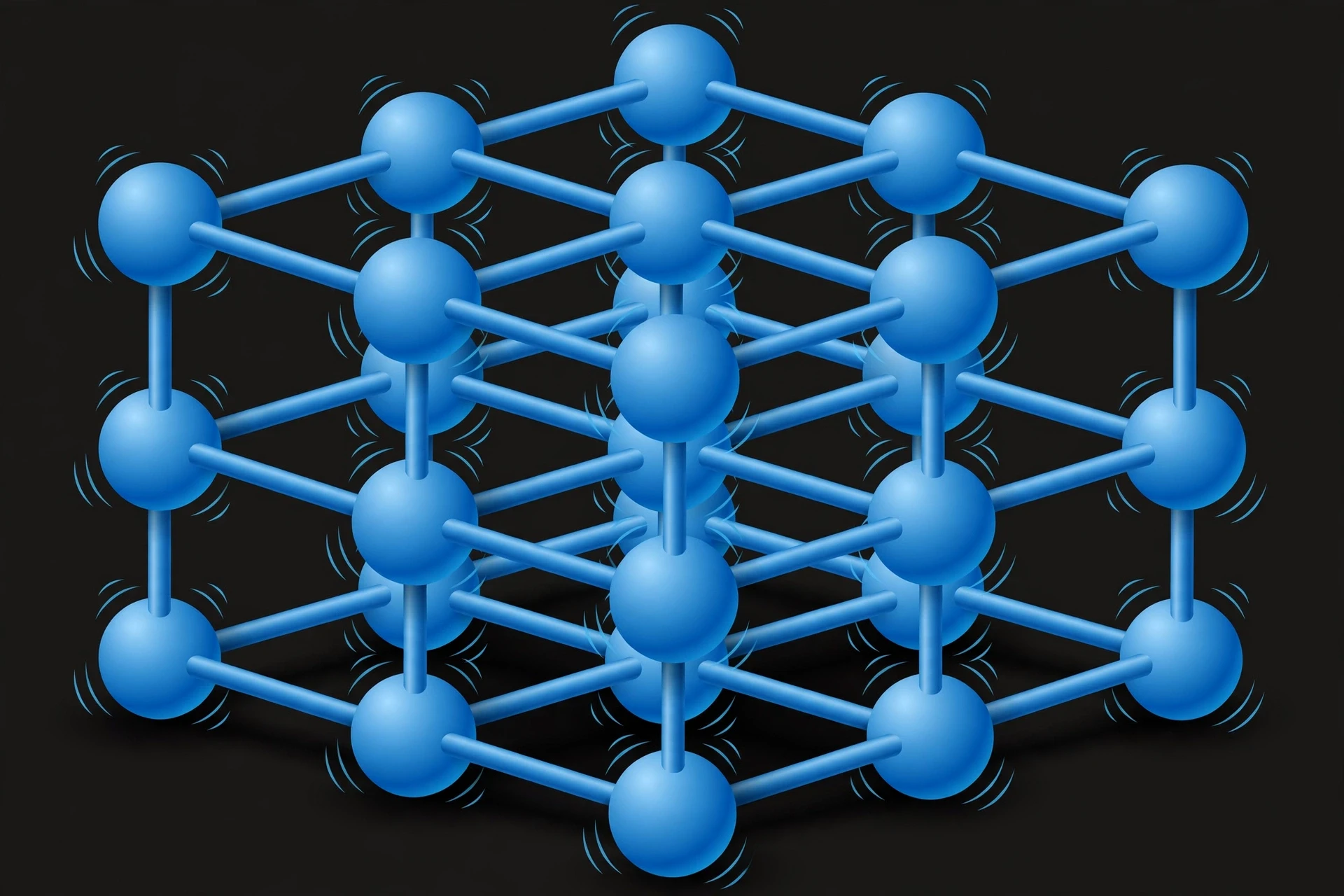
A solid is matter with a fixed shape and a fixed volume. Put a brick on a table and it stays a brick. Tip it, drop it, stack another brick on top — it keeps its shape because its particles are locked in place by strong attractive forces, vibrating around fixed positions but not wandering off. That is the defining fact of a solid, and almost everything else about solids follows from it.
I learned this the hard way in a school science class, watching a teacher heat a metal ball until it would not fit through a metal ring it had slipped through easily minutes before. The ball had not gained any mass. Its particles were simply vibrating harder and pushing slightly further apart, and the whole ball had expanded. It was the first time I understood that a solid is not a single rigid thing but a crowd of particles held in a pattern — a pattern that can stretch, bend, and, with enough energy, break apart entirely.
2.1 Crystalline and amorphous solids
Not all solids are built the same way. In a crystalline solid, the particles sit in a regular, repeating three-dimensional pattern called a lattice. Table salt is a crystal, and so are diamond, quartz, and the ice in your freezer. The regularity of the lattice is what gives crystals their sharp edges, their flat faces, and their precise melting points: when the temperature reaches the point where the lattice can no longer hold, the whole structure comes apart at once.
Amorphous solids have no such regular pattern. Glass is the classic example. Its particles are arranged more like a frozen liquid — disordered, with no repeating lattice — which is why glass softens gradually over a range of temperatures instead of melting sharply at one temperature. Plastics, rubber, and many waxes are amorphous too. The distinction matters in real life: a crystalline metal snaps cleanly along a plane, while an amorphous material tends to bend or shatter unevenly.
2.2 What makes solids strong — and brittle
The strength of a solid depends on the bonds between its particles. Diamond is hard because every carbon atom is locked to four neighbours by strong covalent bonds in a rigid network. Metals are strong in a different way: their atoms sit in a lattice surrounded by a shared sea of electrons, which lets metal bend without breaking — the layers can slide past each other while the electron sea holds everything together. That is why you can hammer copper into a sheet but cannot hammer a diamond; the diamond's bonds have nowhere to slide.
Temperature changes all of this. Heat a metal and its particles vibrate harder, the lattice expands, and the metal softens. Engineers who build bridges and railway tracks have to leave gaps for this thermal expansion, or the structure would buckle on a hot day. Cool a rubber ball in liquid nitrogen and it becomes brittle enough to shatter, because its particles have lost the energy to flex.
2.3 Solids that change without melting
Some solids skip the liquid stage entirely. Dry ice — frozen carbon dioxide — turns straight from a solid into a gas, a process called sublimation. The same thing happens slowly to the ice in a freezer, which is why old ice cubes shrink over weeks: their surface molecules escape directly into the air. Snow can do the same on a cold, dry, sunny day, vanishing from a field without a single puddle. The reverse process, deposition, is how frost forms on a window: water vapour in the air turns straight into ice crystals on the cold glass, without ever becoming liquid. These are phase transitions, and we will look at them in detail in section 6.
3. Liquids: Flow, Surface, and Shape-Shifting
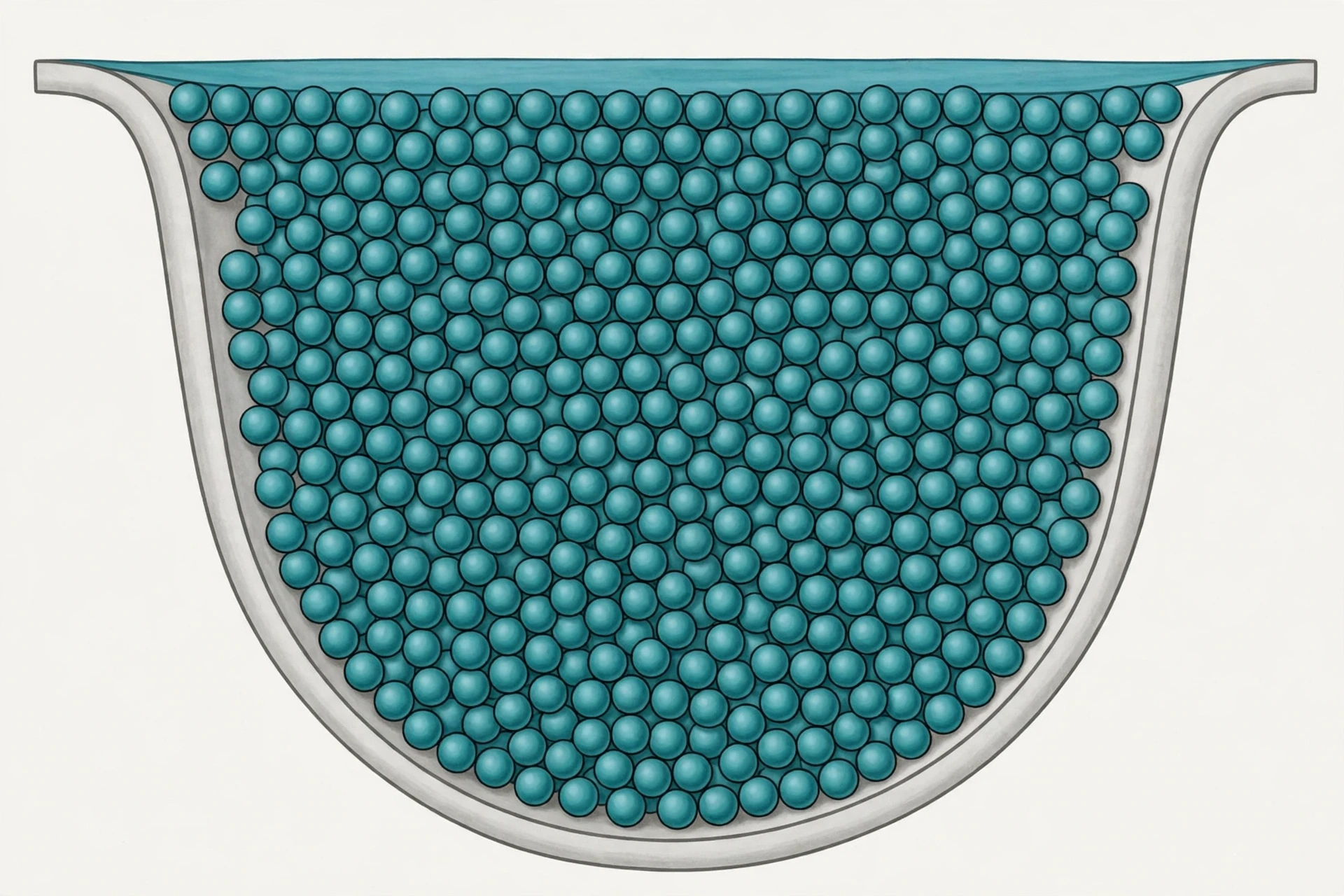
A liquid has a fixed volume but no fixed shape. Pour water into a jug and it takes the shape of the jug; pour it into a glass and it takes the shape of the glass. Its particles are close together — nearly as close as in a solid, which is why liquids are hard to compress — but they are free to slide past one another. That freedom is what makes a liquid flow, and it is also what makes liquids so useful, from the blood in your veins to the rivers that carve valleys.
The first time I really watched a liquid behave was not in a laboratory but in a kitchen, pouring honey from a jar. The honey moved slowly, folding over itself in thick ribbons, while water from the tap splashed and ran. Both were liquids, both took the shape of their containers, yet they flowed at completely different speeds. The difference was viscosity — the internal friction between the layers of a liquid — and it is one of the most important properties a liquid has. Honey is viscous because its large molecules tangle and grip each other. Water is runny because its small molecules slip past each other easily. Heat honey and it flows faster; cool it and it barely moves at all. Temperature changes viscosity because it changes how much energy the particles have to break free of their neighbours.
3.1 Why liquids keep their volume
Liquids are almost incompressible. Squeeze a sealed bottle of water and the water barely shrinks, because its particles are already packed nearly as tightly as they can be. This is why hydraulic systems work: press on a liquid in one place and the pressure is transmitted through the whole liquid, lifting a car in a garage or braking a truck. A gas would simply compress and absorb the push. A liquid passes it on.
At the same time, a liquid's surface behaves in a surprising way. The particles at the surface have no neighbours above them, so they are pulled sideways and downward by the particles below. The result is surface tension — the surface behaves like a stretched elastic skin. It is strong enough to let a water strider walk on a pond, and strong enough to pull a droplet of water into a sphere, the shape with the smallest possible surface. Add soap and the surface tension drops, which is why soapy water spreads and soaks into fabric instead of beading up.
3.2 Viscosity, flow, and the liquids inside us
Viscosity decides how a liquid behaves in motion. Water, alcohol, and petrol have low viscosity and flow freely. Honey, treacle, and motor oil have high viscosity and flow slowly. Blood is a liquid with a viscosity that has to stay within a narrow range: too thick and the heart struggles to pump it; too thin and it cannot carry its load properly. Doctors measure blood viscosity because it is a real signal about health, not a textbook curiosity.
Liquids also carry heat far better than gases do, because their particles are close enough to pass energy along quickly. That is why a hot bath warms you faster than hot air in a sauna at the same temperature, and why the oceans store and move enormous amounts of heat around the planet. The water cycle runs on this: liquid water in the oceans absorbs heat, evaporates, travels as vapour, and returns as rain, moving energy as well as water across the globe.
3.3 When liquids do strange things
Some liquids break the usual rules in interesting ways. Liquid helium, cooled close to absolute zero, becomes a superfluid that flows without any friction at all — it can climb the walls of its container and drip out on its own. Liquid crystals, the materials inside the screens of phones and televisions, flow like liquids but keep some of the ordered arrangement of a solid, which is what lets them switch light on and off in a display. And water itself is the strangest liquid of all, as we will see in section 8: it expands when it freezes, it has an unusually high boiling point for such a small molecule, and its surface tension is higher than almost any other common liquid. All of that comes from hydrogen bonding, the attraction between water molecules that also makes water such a good solvent. Our article on why water is the weirdest molecule goes into that story in full.
4. Gases: Pressure, Expansion, and Invisible Motion
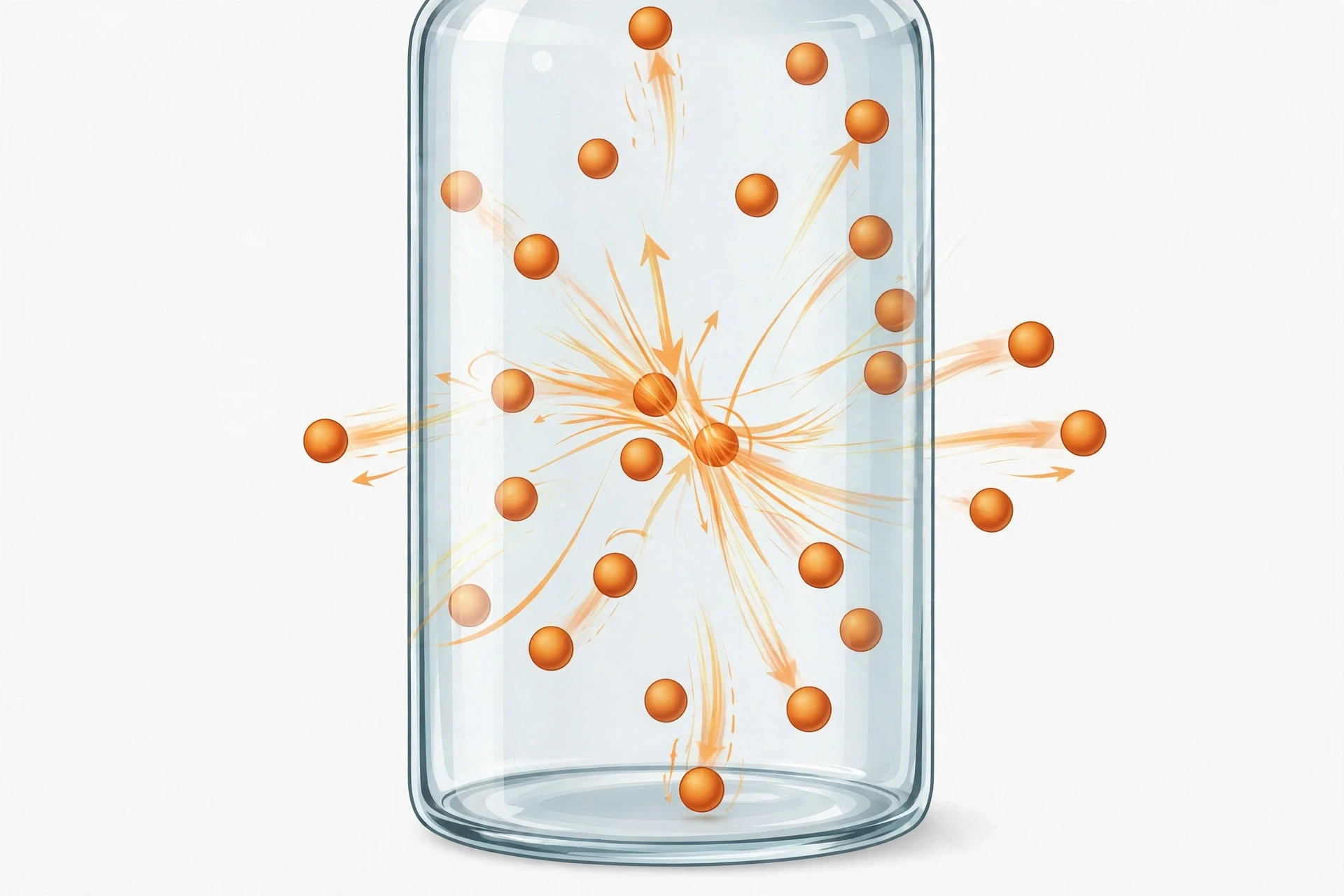
A gas has neither a fixed shape nor a fixed volume. It expands to fill whatever container holds it, and if there is no container, it spreads out into the open air. Its particles are far apart — in air at room temperature, the average gap between molecules is many times the size of the molecules themselves — and they move fast, colliding with each other and with the walls of their container hundreds of times every second. Those collisions are what we feel as pressure.
The classic demonstration is a balloon in a freezer. I still remember the first time I saw it done: a fully inflated balloon went into a cold box, and within minutes it had shrivelled to a sad, wrinkled version of itself. Nothing had leaked out. The gas particles inside had simply lost energy, slowed down, and hit the balloon's walls less often and less hard, so the pressure fell and the balloon shrank. Take it back out into the warm room and it swelled up again. It was pressure, volume, and temperature in a single visible experiment — the relationships that the gas laws describe.
4.1 The gas laws in plain language
Three relationships govern how a gas behaves, and they all follow from the particle picture. Squeeze a gas into a smaller volume and its particles hit the walls more often, so the pressure rises — that is Boyle's law, and it is why a bicycle pump gets hard to push as the tyre fills. Heat a gas at a fixed volume and its particles move faster and hit harder, so the pressure rises — that is why a sealed can left near a fire is dangerous. Heat a gas at a fixed pressure and it expands, because the faster particles push the walls outward — that is Charles's law, and it is why a hot-air balloon rises: the air inside is less dense than the cooler air outside.
Put together, these relationships form the ideal gas law, usually written as PV = nRT, where P is pressure, V is volume, n is the amount of gas, R is a constant, and T is the temperature in kelvin. Real gases deviate from the ideal at high pressure and low temperature, when their particles get close enough to attract each other and take up noticeable space, but for most everyday purposes the ideal gas law works remarkably well. It is the equation behind weather forecasting, scuba diving calculations, and the design of car engines.
4.2 Why gases mix and spread
Open a bottle of perfume in one corner of a room and within minutes someone across the room can smell it. That is diffusion: gas particles move randomly and spread from regions of high concentration to regions of low concentration until they are evenly mixed. Light gases diffuse faster than heavy ones, and warm gases faster than cold ones, because their particles move faster. The same process lets oxygen reach the depths of your lungs and lets the smell of rain travel ahead of a storm.
Gases are also easy to compress, which is both useful and dangerous. A scuba tank holds a large amount of air squeezed into a small steel cylinder at high pressure. A spray can holds a liquid and a gas under pressure, and warming it raises the pressure until the can can burst. Every compressed-gas container carries a warning for the same reason: the particles inside are pushing hard, and they want out.
4.3 The air we breathe is a mixture
The air around you is not one gas but a mixture — roughly four-fifths nitrogen, one-fifth oxygen, and small amounts of argon, carbon dioxide, and water vapour. Each gas in the mixture contributes its own share of the total pressure, a rule called Dalton's law of partial pressures. It matters for divers, who have to account for the partial pressure of nitrogen rising as they descend, and for climbers on high mountains, where the partial pressure of oxygen falls and breathing becomes harder even though the air is still one-fifth oxygen. The percentage does not change with altitude; the pressure does, and that changes how much oxygen each breath delivers.
The air in a room feels like nothing at all, yet it is a crowd of particles moving at hundreds of metres per second, colliding billions of times every second. Pressure is not a push from outside — it is the summed effect of those collisions, happening constantly, invisibly, on every surface.
5. Plasma: The Fourth State of Matter
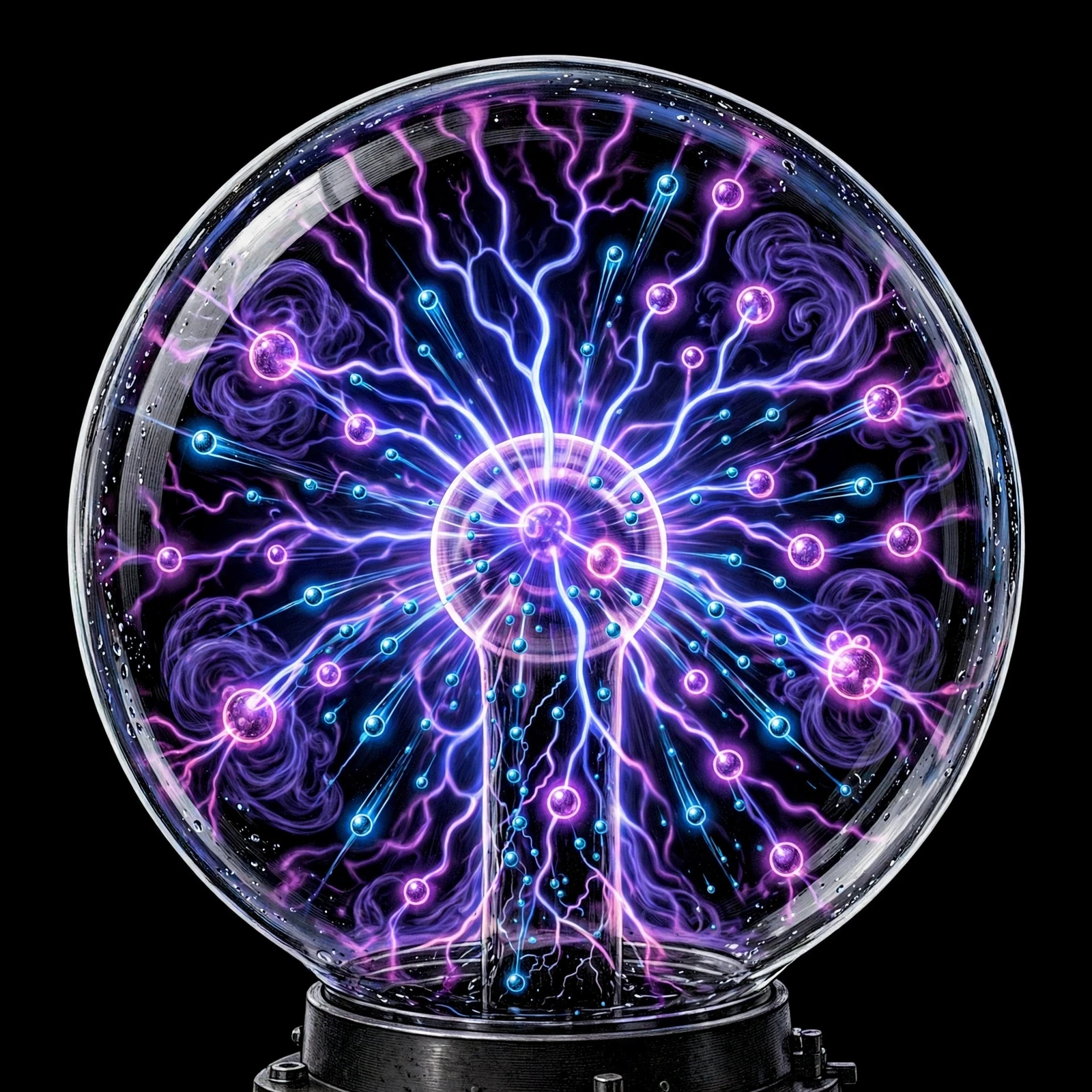
Plasma is a gas that has been heated or energised until its atoms lose electrons, leaving a swirling mixture of free electrons and positively charged ions. It is the fourth state of matter, and it behaves very differently from an ordinary gas. Because it is full of charged particles, plasma responds to electric and magnetic fields, it conducts electricity, and it glows. Lightning, neon signs, the glowing gas inside a fluorescent tube, and the Sun itself are all plasma.
So what is plasma, exactly? It is not a gas with a few extra electrons knocked loose. It is a distinct state in which enough atoms are ionised that the charged particles collectively shape how the whole substance behaves. A gas is electrically neutral and its particles ignore electric and magnetic fields. A plasma is alive with charge: its particles attract and repel each other over long distances, they form filaments and waves, and they can be steered and confined by magnets. That is why plasma is used to cut steel with a plasma torch, to etch the circuits on computer chips, and why researchers are trying to hold hot plasma in magnetic bottles to make fusion power work.
5.1 How plasma forms
Plasma forms when a gas gains enough energy for electrons to escape their atoms. The energy can come from heat, as in a flame hot enough to ionise the gases inside it, or from an electric field, as in a lightning strike or a neon tube, where a high voltage accelerates electrons until they smash into atoms and knock more electrons free. Once the process starts, it feeds itself: each freed electron can ionise another atom, and the cascade builds in a fraction of a second.
The temperature needed depends on the gas. The gas inside a fluorescent tube is a plasma at a relatively modest temperature, kept ionised by the electric current running through it. The plasma in a lightning channel is far hotter — tens of thousands of degrees — and it glows white-hot. The plasma at the centre of the Sun is hotter still, at millions of degrees, where hydrogen nuclei fuse into helium. In every case the same idea applies: add enough energy and the neat, neutral atoms of a gas come apart into charged pieces.
5.2 Plasma in everyday life
You have probably seen plasma more often than you realise. A neon sign is a glass tube filled with a noble gas — neon, argon, or a mixture — with electrodes at each end. Apply a voltage and the gas becomes plasma, and as the ions and electrons recombine they give off light in the gas's characteristic colour: neon glows red-orange, argon glows lavender-blue. Fluorescent tubes work the same way, with the ultraviolet light from the plasma converted to visible light by a coating on the inside of the tube. A plasma television, once a common sight, used thousands of tiny plasma cells, each one a miniature glowing gas discharge.
Lightning is the most dramatic natural plasma on Earth. A thundercloud builds up charge until the electric field between the cloud and the ground becomes strong enough to ionise the air, and a channel of plasma tears downward at enormous speed, heating the air so violently that it explodes outward as thunder. The flash you see is the plasma itself, glowing as its particles recombine and release light. The US Department of Energy's plain-language guide to plasma explains the physics and the research behind it, including the long-running effort to use plasma for fusion energy, and it is a good place to start for readers who want the official picture: DOE Explains: Plasma.
5.3 Why plasma is not just "hot gas"
Most people assume plasma is simply a very hot gas, but what we actually see in the data is something more specific. A hot gas at high temperature is still neutral: its atoms are intact, it does not conduct electricity, and a magnet does nothing to it. Plasma conducts electricity well, it can be confined by magnetic fields, and it shows collective behaviour — waves and instabilities that ripple through the whole substance at once. Spacecraft use plasma thrusters that exploit exactly this: an electric or magnetic field accelerates the charged particles out of the back of the engine, producing thrust with very little propellant. A hot gas could never do that.
There is a useful rule of thumb. If the gas is hot enough, or the electric field strong enough, that a significant fraction of its atoms are ionised, you are dealing with plasma. A candle flame contains a little plasma in its hottest, bluest part, but most of the flame is ordinary hot gas. The distinction is not a sharp line — ionisation grows gradually with temperature — but once the charged particles start to dominate the behaviour, the substance has crossed into a new state.
6. Phase Transitions: How Matter Changes State
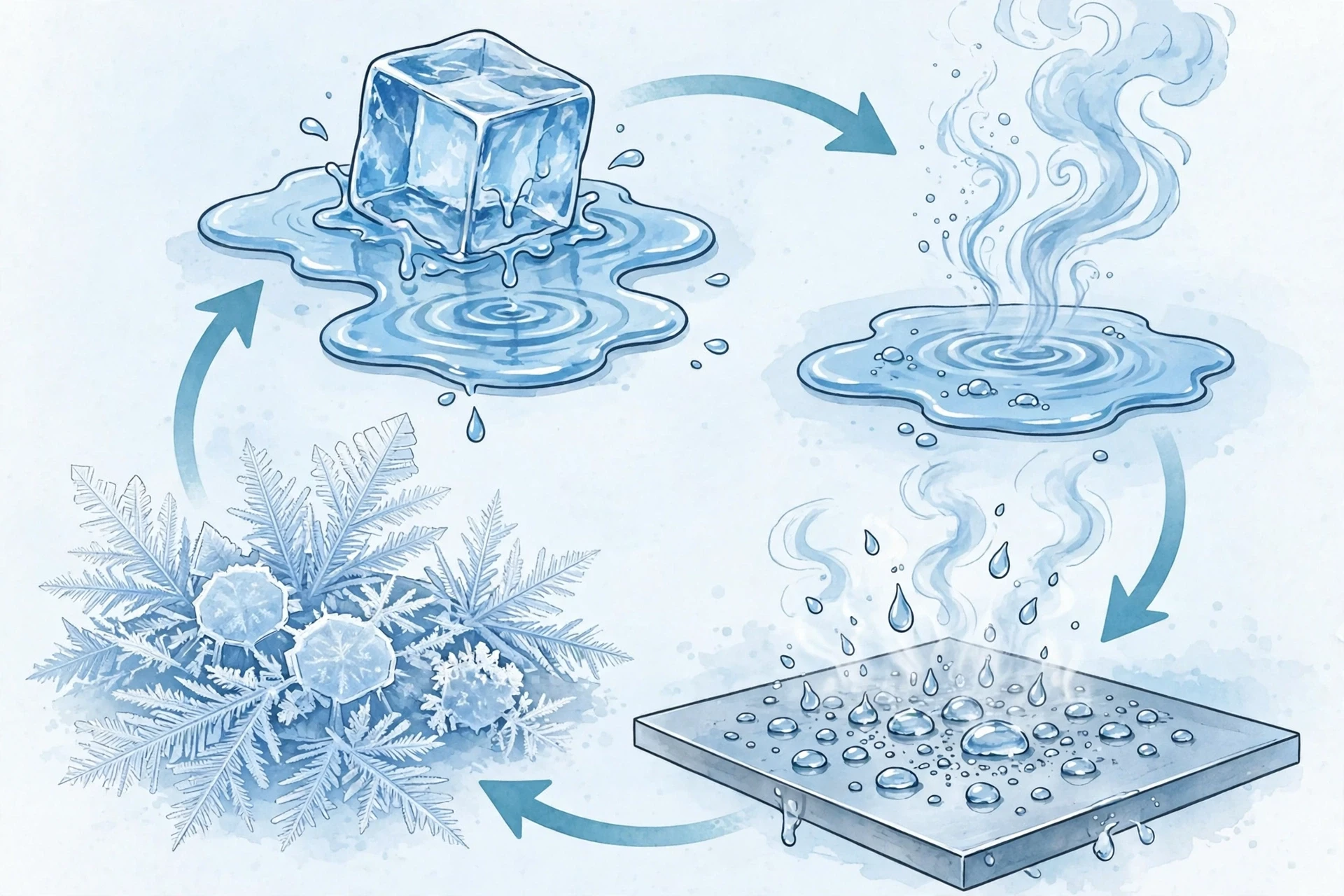
Phase transitions are the changes from one state of matter to another, and they are the moments when matter does its most interesting work. Melting, freezing, boiling, condensing, sublimating, depositing — each transition has a name, each one absorbs or releases energy, and each one happens at a temperature that depends on the substance and the pressure. The water cycle, the weather, cooking, and the freezing of a lake all run on phase transitions.
I once ruined a batch of chocolate by melting it too fast and letting it cool too quickly. It set dull and crumbly instead of glossy and snappy, and a pastry chef friend explained why: chocolate is not one solid but a mixture of cocoa butter crystals, and only one crystal form gives a good snap. Cooling it slowly through the right temperature lets the right crystals form. That is a phase transition with a memory — how you pass through the change decides what you get on the other side. Steelmakers know the same thing: quench hot steel in water and it becomes hard and brittle; cool it slowly and it becomes soft and workable. The transition is the same. The path matters.
6.1 The six classic transitions
Every change between solid, liquid, and gas has a name. Melting turns a solid into a liquid; freezing turns a liquid into a solid. Vaporisation turns a liquid into a gas; condensation turns a gas into a liquid. Sublimation turns a solid straight into a gas; deposition turns a gas straight into a solid. Add ionisation, which turns a gas into plasma, and recombination, which turns plasma back into a gas, and you have the full set.
Transition | From | To | Energy | Everyday example |
|---|---|---|---|---|
Melting | Solid | Liquid | Absorbed | Ice melting in a drink |
Freezing | Liquid | Solid | Released | Water freezing into ice cubes |
Vaporisation | Liquid | Gas | Absorbed | Water boiling in a kettle |
Condensation | Gas | Liquid | Released | Dew forming on morning grass |
Sublimation | Solid | Gas | Absorbed | Dry ice fogging on a stage |
Deposition | Gas | Solid | Released | Frost forming on a window |
Ionisation | Gas | Plasma | Absorbed | Lightning striking through air |
Recombination | Plasma | Gas | Released | A neon sign switching off |
6.2 Evaporation is not the same as boiling
Evaporation and boiling both turn a liquid into a gas, but they are different processes, and the difference trips up a lot of students. Boiling happens throughout the liquid, at a specific temperature — the boiling point — when bubbles of vapour can form inside the liquid. Evaporation happens only at the surface, at any temperature, when the fastest-moving molecules at the surface escape into the air. A puddle dries on a cool day because of evaporation, not boiling. The liquid never reaches 100 degrees Celsius; its fastest molecules simply leave, one by one, taking energy with them.
That energy loss is why evaporation cools. Sweat cools your skin because the water molecules that evaporate carry heat away with them. The fastest molecules leave first, so the ones left behind are, on average, slower and cooler. It is the same physics that makes a wet cloth feel cold on a hot day, and the same reason a refrigerator works: a liquid refrigerant evaporates inside the fridge, absorbing heat from the food compartment, and is then compressed and condensed outside, releasing that heat into the kitchen.
6.3 Latent heat: the energy that changes nothing — and everything
Here is a puzzle that catches almost everyone the first time they see it. Heat a block of ice at minus 10 degrees Celsius and its temperature climbs steadily until it reaches zero. Keep heating it and the ice starts to melt — but the temperature stops rising. It stays at zero until every last piece of ice has become water. Only then does the temperature start climbing again. The same thing happens at the other end: water at 100 degrees stays at 100 degrees while it boils away, no matter how hard you heat it.
The energy going in during those flat stretches is called latent heat, and it is not raising the temperature at all. It is being spent breaking the bonds between particles — pulling them out of the solid lattice, or freeing them from the liquid into the gas. Water's latent heat of fusion, the energy needed to melt ice, is about 334 joules per gram. Its latent heat of vaporisation, the energy needed to turn liquid water into steam, is about 2,260 joules per gram — nearly seven times more. That is why a steam burn is so much worse than a burn from boiling water at the same temperature: the steam carries all that extra latent heat, and it releases it onto your skin when it condenses.
Latent heat is also what keeps the climate from swinging wildly. When water evaporates from the oceans it absorbs enormous amounts of energy, and when it condenses into clouds it releases that energy high in the atmosphere. The water cycle is, at its heart, a planet-sized heat engine running on phase transitions. OpenStax's chemistry chapter on phase transitions walks through the heating curve and the latent heat values with clear diagrams, and it is worth reading alongside this section.
6.4 Pressure changes the rules
The temperature at which a phase transition happens depends on pressure. Water boils at 100 degrees Celsius at sea level, but at the top of a high mountain, where the air pressure is lower, it boils at a lower temperature — which is why pasta takes longer to cook at altitude: the water is boiling, but it is cooler. In a pressure cooker the opposite happens: the sealed pot raises the pressure, the water boils at a higher temperature, and food cooks faster.
Pressure can also force transitions that temperature alone cannot. Squeeze carbon dioxide gas hard enough at room temperature and it becomes a liquid. Cool it further and it becomes a solid — dry ice. There is a limit, though: above a substance's critical temperature, no amount of pressure will liquefy its gas, because the particles are moving too fast for their attractions to hold them together. For water, the critical temperature is 374 degrees Celsius. Above that, water exists as a supercritical fluid — neither quite a liquid nor quite a gas — which is used industrially to extract caffeine from coffee beans and to clean precision equipment.
At the other end of the scale, water has a triple point: a precise combination of temperature and pressure — 0.01 degrees Celsius and a very low pressure — where solid, liquid, and gas can all exist together in equilibrium. It is so precise and so reproducible that scientists once used it to define the kelvin, the unit of temperature. The phase diagram of a substance maps all of this out: temperature on one axis, pressure on the other, with lines marking where each transition happens and regions showing where each state is stable.
7. Energy, Temperature, and the Heating Curve
If you heat a substance steadily and plot its temperature against time, you get a heating curve — and that curve tells the whole story of the states of matter in a single picture. The temperature rises, then flattens while the substance changes state, then rises again, then flattens at the next transition. Each flat stretch is a phase transition absorbing latent heat. Each slope is a single state warming up. The curve is the same shape for almost every substance; only the temperatures and the lengths of the flat stretches differ.
That shape is why a pot of water on a stove can sit at a rolling boil for minutes without getting any hotter than 100 degrees. All the energy from the burner is going into turning liquid into gas, not into raising the temperature. Turn the burner up and the water boils faster, but it does not get hotter. The extra energy just makes more steam. Cooks know this instinctively: once water is boiling, a high flame wastes gas and changes nothing about the cooking temperature.
7.1 Comparing the four states side by side
The table below puts the key properties of the four states of matter next to each other. It is the kind of summary worth returning to whenever a new example comes up, because almost every question about a state — can it be compressed, does it conduct electricity, does it flow — has its answer here.
Property | Solid | Liquid | Gas | Plasma |
|---|---|---|---|---|
Shape | Fixed | Takes container shape | Fills container | Fills container |
Volume | Fixed | Fixed | Fills container | Fills container |
Particle spacing | Very close | Close | Far apart | Far apart |
Particle motion | Vibrate in place | Slide past each other | Move fast, randomly | Move very fast, charged |
Compressible? | Almost no | Almost no | Yes, easily | Yes |
Flows? | No | Yes | Yes | Yes |
Conducts electricity? | Usually no (metals yes) | Usually no (ions yes) | No | Yes |
Affected by magnets? | Usually no | Usually no | No | Yes, strongly |
7.2 Absolute zero and the bottom of the scale
Temperature has a bottom. At absolute zero — zero kelvin, or minus 273.15 degrees Celsius — particles have the minimum possible motion allowed by quantum mechanics. Nothing can be colder. Scientists have cooled matter to within billionths of a degree of absolute zero, and that is where some of the strangest states of matter appear, including the Bose-Einstein condensate we will meet in section 10. At the other extreme, the centre of the Sun reaches about 15 million degrees Celsius, and the plasma there is so energetic that atomic nuclei themselves fuse. The states of matter span that whole range, from near absolute zero to the heart of a star, and the same two ideas — energy and attraction — decide what form matter takes at every point along it.
Heat a substance and you are not adding a thing to it. You are giving its particles permission to move more freely, and watching, step by step, as each new freedom becomes a new state of matter.
8. Water: The Substance That Breaks the Rules
No article on the states of matter would be honest without a section on water, because water refuses to behave the way the simple rules predict. It is the substance we know best, and it is also one of the strangest. Its quirks are not trivia — they are the reason lakes do not freeze solid in winter, the reason life exists on Earth, and the reason the weather works the way it does.
Water is a small molecule, made of two hydrogen atoms and one oxygen atom, and by the usual rules it should be a gas at room temperature. Similar small molecules — methane, ammonia, hydrogen sulphide — are all gases. Water is a liquid because of hydrogen bonding: the oxygen atom of one water molecule attracts the hydrogen atoms of its neighbours, and those bonds hold the molecules together far more strongly than their size would suggest. The bonds are weak enough to break and reform constantly, so water flows, but strong enough to give water its unusually high boiling point, its high surface tension, and its enormous latent heat.
8.1 Why ice floats — and why that matters
Almost every substance is denser as a solid than as a liquid, because the particles pack more tightly when they lock into a lattice. Water does the opposite. When water freezes, its molecules arrange themselves into an open hexagonal crystal with empty space inside, and that structure takes up more room than the liquid did. Ice is about nine percent less dense than liquid water, so it floats.
That single fact shapes the whole planet. When a lake cools in winter, the surface water freezes and the ice forms a floating insulating lid. The water below stays liquid, at about 4 degrees Celsius — the temperature where water is densest — and fish, plants, and microbes survive the winter beneath it. If ice sank, lakes would freeze from the bottom up, and each winter would leave them frozen solid, killing almost everything inside. The floating ice is not a small detail. It is one of the reasons aquatic life survived the ice ages, and it is a direct consequence of the geometry of hydrogen bonds in the solid state.
8.2 Water's three states in the world around us
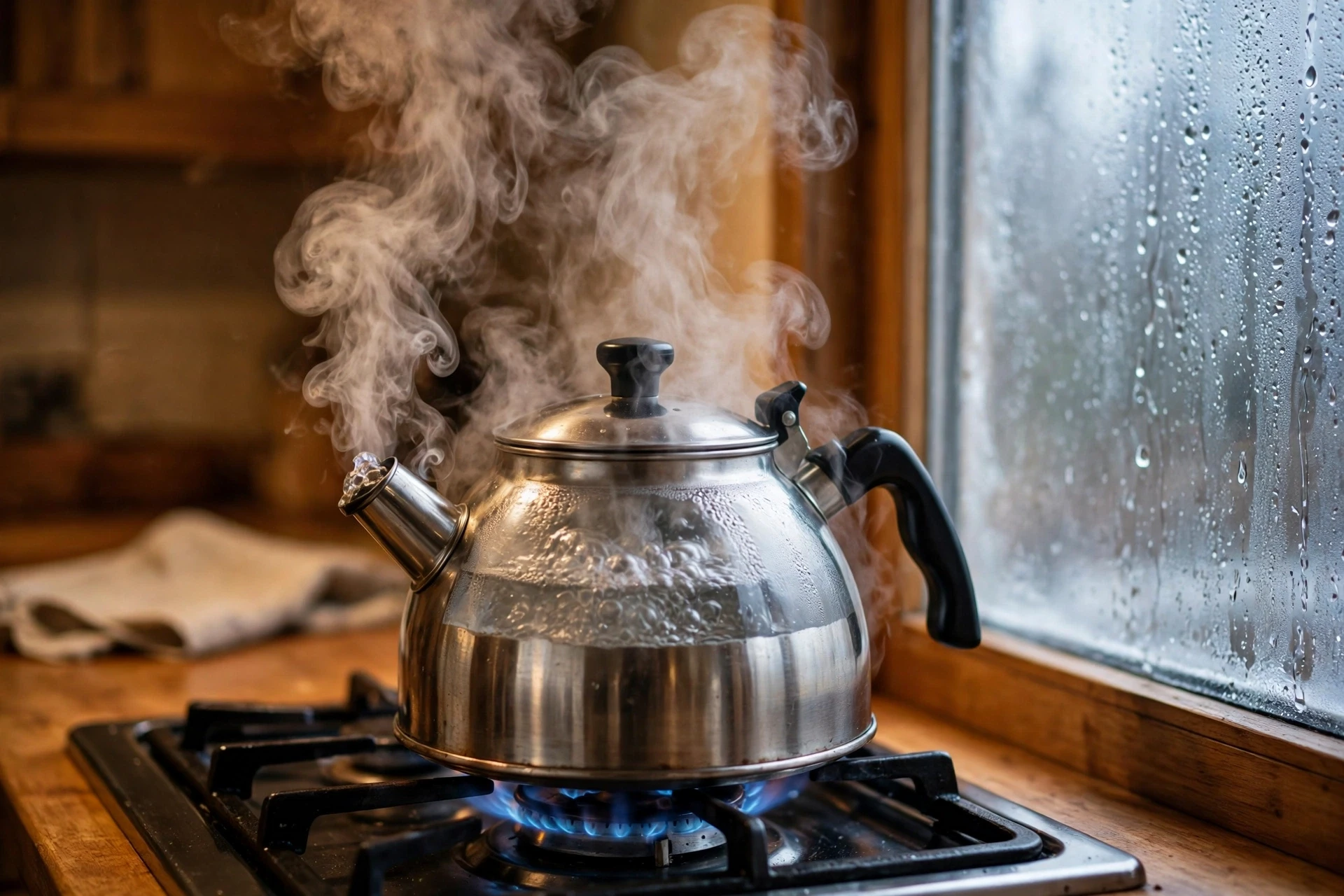
Water is the only common substance that exists naturally in all three classical states of matter on Earth's surface: ice in glaciers and polar caps, liquid water in oceans, rivers, and rain, and water vapour in the air. That is why the water cycle is so central to Earth's climate. The oceans absorb heat and evaporate, the vapour rises and cools and condenses into clouds, and the water falls as rain or snow, releasing the latent heat it absorbed at the surface. Every rainstorm is a phase transition on a continental scale.
Water's states also explain some familiar sights. The white cloud above a kettle is not steam — steam itself is invisible. The white cloud is liquid water: steam that has cooled and condensed into tiny droplets in the air. Fog is the same thing, on a larger scale. And the frost on a winter window is water vapour that skipped the liquid state entirely, depositing straight into ice crystals on the cold glass.
8.3 The weirdness goes deeper
Water has more anomalies than any other liquid. It takes more energy to heat than almost any other common substance, which is why coastal climates are milder than inland ones: the ocean absorbs heat in summer and releases it in winter, smoothing the seasons. It is an excellent solvent, which is why it is called the universal solvent — and why it carries dissolved minerals through rocks, soil, and living bodies. It expands when it freezes, it has its maximum density at 4 degrees Celsius rather than at its freezing point, and its surface tension is high enough for insects to walk on it. Each of these quirks traces back to the same cause: the hydrogen bonds between water molecules, and the open structure they create in ice. For the full story of why this one small molecule behaves so oddly, see our article on why water is the weirdest molecule.
9. Why Plasma Is the Most Common State in the Universe
Here is a fact that surprises almost everyone who first hears it: the matter you can see and touch — solids, liquids, and gases — makes up only a tiny fraction of the ordinary matter in the universe. The rest is plasma. The stars are plasma. The glowing gas between the stars is plasma. The solar wind streaming out from the Sun is plasma. By mass, more than 99 percent of the visible universe is in the plasma state, and the solid ground under your feet is the exception, not the rule.
That flips the usual picture upside down. We think of plasma as exotic because it is rare on Earth's surface, where temperatures are low and the air is cool. But Earth is a cold, dense little world. Out in space, where matter is hot and thin, plasma is the default. The universe is not mostly rock and water. It is mostly glowing, charged gas.
9.1 The Sun: a ball of plasma
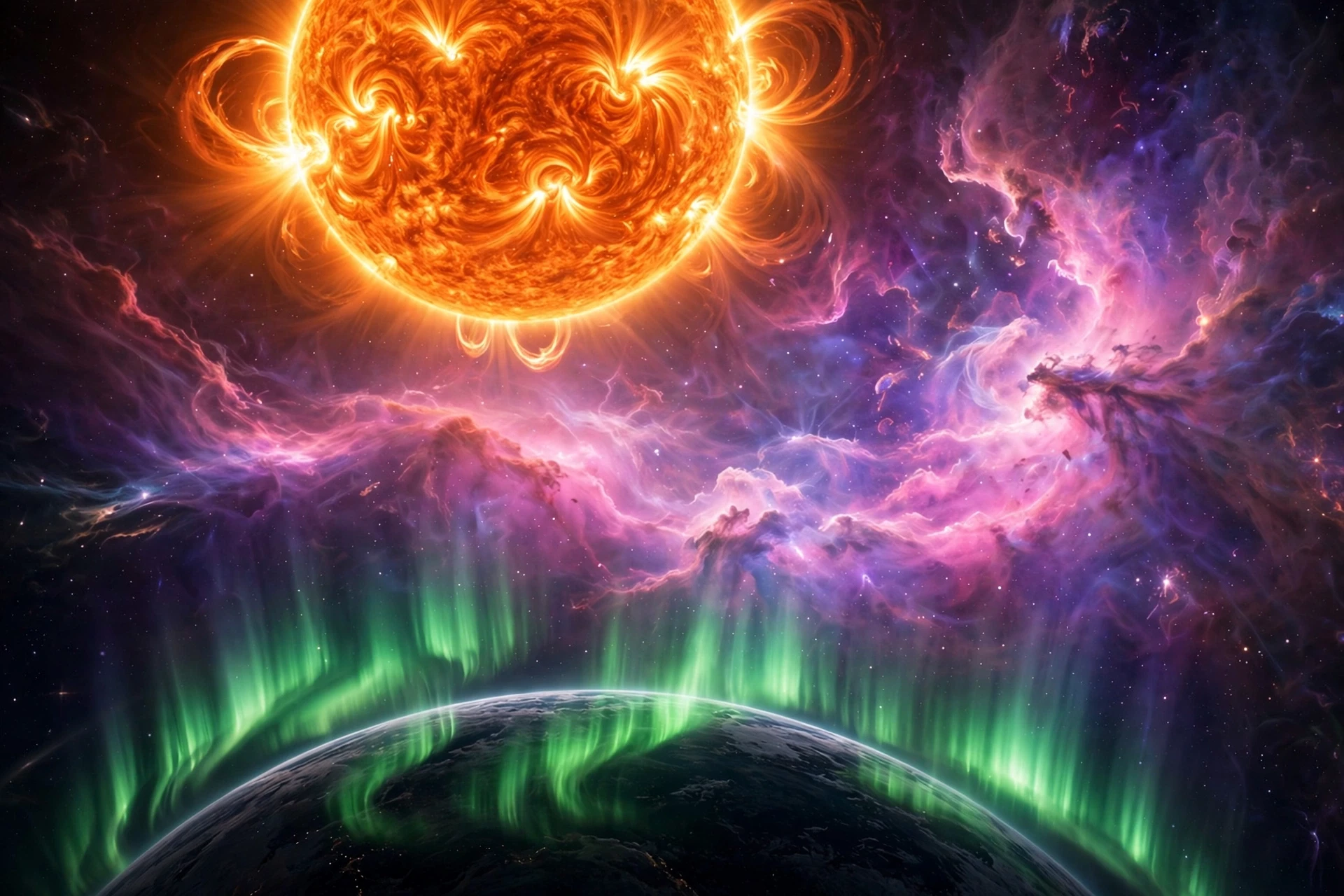
The Sun is the nearest and most important plasma in our lives. It is a sphere of plasma about 1.4 million kilometres across, held together by its own gravity, with a core temperature of about 15 million degrees Celsius. In that core, hydrogen nuclei fuse into helium, releasing the energy that has powered life on Earth for billions of years. The energy works its way outward through the Sun's layers, and at the surface — the photosphere, at about 5,500 degrees Celsius — it escapes as light.
The Sun's plasma is not calm. It churns, it boils, and it throws off loops and flares that dwarf the Earth. Solar flares are sudden releases of magnetic energy in the Sun's plasma, and coronal mass ejections hurl billions of tonnes of plasma into space. When that plasma reaches Earth, it collides with our magnetic field and produces the aurora — the northern and southern lights, which are themselves plasma glowing in the upper atmosphere. NASA's Sun science pages describe the structure of the Sun and the missions that study it, from the Parker Solar Probe flying through the solar corona to the Solar Dynamics Observatory watching the Sun around the clock: NASA Sun Science. For the full story of how our star works, see our article on how the Sun works.
9.2 Lightning, auroras, and the plasma above our heads
You do not need to leave Earth to see plasma. Lightning is plasma, and so is the aurora. The aurora forms when charged particles from the solar wind are funnelled by Earth's magnetic field toward the poles, where they collide with oxygen and nitrogen in the upper atmosphere. The collisions excite the atoms, and when they settle back down they release light — green from oxygen at lower altitudes, red from oxygen higher up, purple and blue from nitrogen. The curtains of light can stretch for hundreds of kilometres and dance across the sky for hours.
The upper atmosphere also contains a permanent layer of plasma called the ionosphere, starting about 60 kilometres up. Sunlight ionises the thin air there, and the resulting plasma reflects radio waves back to Earth, which is why shortwave radio can reach around the globe. It also bends the signals from GPS satellites, and space-weather forecasters watch it closely because a strong solar storm can disrupt it.
9.3 Plasma technology: from signs to fusion
Plasma is not only a wonder of the sky; it is a tool. Plasma torches cut through steel by blasting a jet of ionised gas hot enough to melt metal. Plasma etching carves the microscopic circuits on computer chips, one layer at a time. Plasma is used to sterilise medical instruments, to treat surfaces so that paint sticks better, and to clean the exhaust from industrial processes. In medicine, cold plasma is being tested for wound healing and for killing bacteria without harming healthy tissue.
The biggest prize is fusion power. A fusion reactor aims to do what the Sun does: hold plasma hot and dense enough for hydrogen nuclei to fuse, releasing far more energy than it takes to heat the plasma. The challenge is confinement — hot plasma wants to expand and cool, and it has to be held in place by powerful magnetic fields or by crushing it with lasers. Machines like the tokamaks at JET and ITER, and the laser facility at the National Ignition Facility, are all attempts to solve the same problem: keeping a star in a bottle long enough for fusion to pay for itself. It is one of the hardest engineering problems humans have ever attempted, and the states of matter are at the heart of it.
10. Beyond the Big Four: Exotic States of Matter
Four states cover almost everything in daily life, but physicists have found more, and they appear at the extremes — near absolute zero, at enormous pressures, or inside stars. These states are not textbook footnotes. They test the deepest ideas in physics, and some of them may one day become technologies.
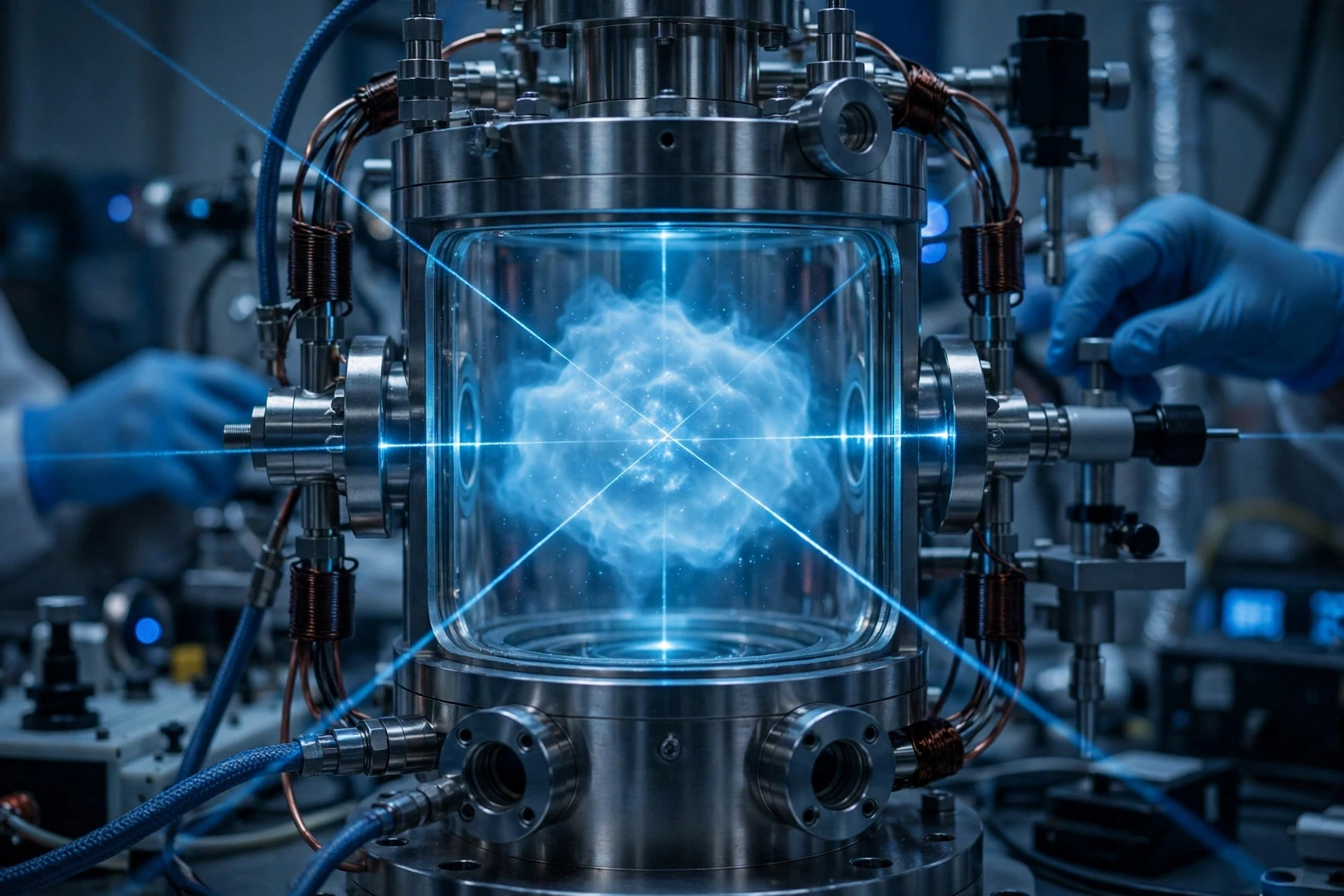
The most famous is the Bose-Einstein condensate. In 1995, researchers cooled a cloud of rubidium atoms to less than a millionth of a degree above absolute zero, and something extraordinary happened: thousands of atoms stopped behaving as individuals and merged into a single quantum state, moving as one giant "superatom". The work earned a Nobel Prize, and it opened a new field of physics in which matter waves can be seen directly, like ripples in a pond. A Bose-Einstein condensate is not a solid, a liquid, or a gas. It is a state in which the quantum nature of particles, usually hidden at the atomic scale, becomes visible to the eye.
10.1 Superfluids, liquid crystals, and other in-between states
Liquid helium below about 2.17 kelvin becomes a superfluid: a liquid with zero viscosity that flows without any friction, climbs walls, and conducts heat perfectly. It is one of the strangest substances known, and it is used to cool the superconducting magnets in particle accelerators and MRI machines. Fermionic condensates, made from atoms that obey different quantum rules, were created a few years after the first Bose-Einstein condensate and behave in related but distinct ways.
Liquid crystals sit between liquid and solid: they flow, but their molecules keep a degree of order, which lets them control light. That is the physics inside every LCD screen. Amorphous solids like glass sit between liquid and solid from the other direction. And at the highest energies of all, inside particle colliders, physicists create quark-gluon plasma — a state in which the protons and neutrons themselves melt into a soup of their constituent particles, recreating conditions that existed in the first microseconds after the Big Bang.
10.2 How many states are there, really?
There is no single agreed count. Some lists stop at four; others add the Bose-Einstein condensate and the fermionic condensate to make six; others add superfluids, supersolids, liquid crystals, and quark-gluon plasma, pushing the count into the dozens. The honest answer is that "state of matter" is a useful label, not a fixed law of nature. Matter can organise itself in many ways, and each new way we discover teaches us something about how particles interact. The four familiar states are the ones that matter most for everyday life, for weather, for cooking, and for engineering. The exotic states are the frontier, where new physics lives.
11. Common Misconceptions About the States of Matter
A topic taught to every schoolchild collects misunderstandings, and the states of matter are no exception. Clearing them up is worth doing properly, because each one hides a real insight.
"Gas and vapour are the same thing." They are related but not identical. A gas is a substance above its critical temperature, so it cannot be liquefied by pressure alone. A vapour is the gaseous form of a substance that is normally a liquid or solid at that temperature — water vapour, for example, is water in its gaseous state below its critical temperature, and it can be condensed back into liquid by pressure or cooling. Steam is water vapour. The distinction matters in engineering, where the behaviour of a vapour near its condensation point is very different from the behaviour of a permanent gas like nitrogen.
"Boiling water is always 100 degrees Celsius." Only at sea-level pressure. On a mountain it boils cooler, and in a pressure cooker it boils hotter. The boiling point is not a property of water alone; it is a property of water at a given pressure. The same goes for melting points, which shift slightly with pressure too — although for most solids the shift is small.
"Solids are completely still inside." Their particles vibrate constantly, and the vibrations grow with temperature. A solid at room temperature is a hive of microscopic motion. That motion is what carries heat through a metal spoon, and it is why solids expand when heated.
"Plasma is just very hot gas." As section 5 explained, plasma is defined by ionisation and by collective charged behaviour, not by temperature alone. A cool plasma in a fluorescent tube is still plasma, and a very hot neutral gas is still a gas. Temperature matters, but ionisation is the deciding factor.
"Steam is the white cloud above a kettle." The white cloud is liquid water — tiny droplets formed when invisible steam cools and condenses in the air. Real steam, water in its gaseous state, is invisible. The same is true of the "steam" rising from a hot shower: what you see is condensed droplets, not the gas itself.
"Ice is the only solid form of water." Water ice has many crystalline forms. The ice in your freezer is one of them, but under high pressure water freezes into different crystal structures with different densities, and some of them are denser than liquid water. Scientists have identified more than a dozen forms of ice, and the search for new ones continues in high-pressure laboratories.
Most people assume the states of matter are simple — solid, liquid, gas, done. What we actually see when we look closely is a spectrum of behaviour, with sharp transitions, strange exceptions, and new states still being discovered at the extremes of temperature and pressure.
12. States of Matter in Everyday Life
The states of matter are not abstract. They decide how your home works, how your food is made, and how your body functions.
In the kitchen, phase transitions are the whole craft. Water boils, steam cooks, ice freezes, fat melts, sugar caramelises. A pressure cooker raises the boiling point to cook faster. A freezer slows the motion of water molecules until they lock into ice, preserving food by stopping the chemistry of decay. Freeze-drying goes further: food is frozen, then the ice is sublimed away under low pressure, leaving a light, dry product that keeps for years and rehydrates with water. Instant coffee is made this way.
In the home, the states of matter are in the walls and the wiring. The water in the pipes is a liquid under pressure. The gas in a stove or a boiler burns as a gas. The air in a room is a gas that carries heat and sound. The insulation in the walls traps gas in tiny pockets, because still gas is a poor conductor of heat. Double glazing works the same way: a layer of gas between two panes slows the flow of heat out of a house.
In the body, the states of matter are the medium of life. Blood is a liquid carrying cells, gases, and dissolved chemicals. The air in the lungs is a gas exchanging oxygen and carbon dioxide across a wet membrane. The bones are solids built from a mineral lattice. Sweat is a liquid that cools by evaporation. Every breath is a gas exchange, every heartbeat is a liquid pumped through a system of tubes, and every thought depends on ions moving through liquids inside nerve cells.
In industry, the states of matter are tools. Liquefied natural gas is cooled until it becomes a liquid, shrinking its volume hundreds of times so it can be shipped across oceans in tankers. Oxygen for hospitals is stored as a liquid and evaporated as needed. Metals are melted, cast, and cooled through carefully chosen phase transitions to control their crystal structure and their strength. Semiconductors are built by depositing thin layers of solid from gases, one atomic layer at a time.
The American Chemical Society's ChemMatters magazine has a clear student-level explainer on the states of matter, with everyday examples and the particle picture, and it is a useful companion to this article: ACS ChemMatters: States of Matter. LibreTexts, the open textbook project used by university chemistry courses, covers the same ground in more depth, including the kinetic molecular theory behind gases and liquids: LibreTexts: States of Matter.
13. Bringing It Together
The states of matter are one of the oldest ideas in science and one of the most alive. The ancient Greeks argued about earth, air, fire, and water. Modern physics has replaced those elements with particles, energy, and forces — and found that the old intuition was not far off. Matter does come in a handful of great forms, and the transitions between them run the world.
Hold on to the particle picture. A solid is particles locked in place, vibrating. A liquid is particles close together, sliding past each other. A gas is particles far apart, moving fast and colliding. Plasma is particles broken into charged pieces, glowing and responding to magnets. Add energy and matter loosens; take energy away and it tightens. That single idea explains the ice in your drink, the steam from your kettle, the lightning in a storm, and the light of the Sun.
And remember the surprise at the heart of the story. The ground under your feet is the exception. Most of the universe is plasma — stars, nebulae, the solar wind, the glowing gas between galaxies. We live on a cold, dense island of solids and liquids in a universe of fire. The states of matter are not just a school topic. They are the map of what the universe is made of, and where we sit within it.
The next time you watch ice melt in a glass, or see steam curl from a cup, or catch a flash of lightning on the horizon, you are watching the same particles change their clothes. Nothing disappears. It just changes state — and now you know how, and why.
Frequently Asked Questions
What are the states of matter?
The states of matter are the physical forms matter takes: solid, liquid, gas, and plasma. In a solid, particles are locked in a fixed pattern and vibrate in place. In a liquid, particles stay close together but slide past each other, so the liquid flows. In a gas, particles are far apart and move fast, filling whatever space is available. In plasma, the particles are ionised into charged ions and free electrons, and the substance glows and conducts electricity. Which state matter is in depends on the energy of its particles and the strength of the forces between them. More states, such as the Bose-Einstein condensate, exist under extreme conditions.
What is plasma?
Plasma is a gas that has been energised until its atoms lose electrons, leaving a mixture of positively charged ions and free electrons. It is the fourth state of matter. Because it is full of charged particles, plasma conducts electricity, responds to magnetic fields, and glows. Lightning, neon signs, fluorescent tubes, auroras, and the Sun are all plasma. Plasma is not simply hot gas: a gas is electrically neutral and ignores magnets, while plasma is defined by ionisation and by collective charged behaviour.
What are phase transitions?
Phase transitions are the changes from one state of matter to another. The main ones are melting (solid to liquid), freezing (liquid to solid), vaporisation (liquid to gas), condensation (gas to liquid), sublimation (solid to gas), deposition (gas to solid), ionisation (gas to plasma), and recombination (plasma to gas). Each transition absorbs or releases energy called latent heat. Melting, vaporisation, sublimation, and ionisation absorb energy; freezing, condensation, deposition, and recombination release it. The temperature at which a transition happens depends on pressure as well as on the substance.
Why is plasma the most common state in the universe?
Plasma is the most common state in the universe because most of the visible matter in the universe is in stars, and stars are made of plasma. By mass, more than 99 percent of the visible matter in the universe is plasma: the Sun and other stars, the glowing gas of nebulae, the gas between stars, and the solar wind. Solids, liquids, and gases are common on Earth because Earth is a cold, dense planet, but out in space, where matter is hot and thin, plasma is the default state.
What is the difference between evaporation and boiling?
Evaporation happens only at the surface of a liquid, at any temperature, when the fastest-moving molecules escape into the air. Boiling happens throughout the liquid, at a specific temperature called the boiling point, when bubbles of vapour form inside the liquid. A puddle dries on a cool day through evaporation, not boiling. Evaporation cools the liquid left behind, because the molecules that escape carry energy away with them — which is why sweat cools your skin.
Why does ice float on water?
Ice floats because it is less dense than liquid water. When water freezes, its molecules arrange themselves into an open hexagonal crystal with empty space inside, so the solid takes up more room than the liquid did. Ice is about nine percent less dense than water, so it floats. This is unusual: almost every other substance is denser as a solid than as a liquid. Floating ice insulates lakes in winter, letting water below stay liquid so fish and other life can survive.
What are the exotic states of matter beyond the four main ones?
Beyond solid, liquid, gas, and plasma, physicists have found states that appear only under extreme conditions. The best known is the Bose-Einstein condensate, formed when atoms are cooled to a fraction of a degree above absolute zero and merge into a single quantum state. Others include superfluid helium, which flows without friction; liquid crystals, used in screens; and quark-gluon plasma, created in particle colliders at enormous energies. There is no single agreed count of the states of matter, because the label describes how particles organise themselves, and new forms are still being discovered.
Sources
LibreTexts, States of Matter — https://chem.libretexts.org/Bookshelves/Physical_and_Theoretical_Chemistry_Textbook_Maps/Supplemental_Modules_(Physical_and_Theoretical_Chemistry)/Physical_Properties_of_Matter/States_of_Matter
OpenStax Chemistry 2e, Phase Transitions — https://openstax.org/books/chemistry-2e/pages/10-3-phase-transitions
US Department of Energy, DOE Explains: Plasma — https://www.energy.gov/science/doe-explainsplasma
NASA, Sun Science — https://science.nasa.gov/sun/
American Chemical Society, ChemMatters: States of Matter — https://www.acs.org/education/resources/highschool/chemmatters/past-issues/2017-2018/october-2017/states-of-matter.html
OpenStax Chemistry: Atoms First 2e, Phase Transitions — https://openstax.org/books/chemistry-atoms-first-2e/pages/10-3-phase-transitions
Atoms and Molecules — Sciory — https://www.sciory.com/blog/atoms-molecules-explained
Why Water Is the Weirdest Molecule — Sciory — https://www.sciory.com/blog/why-water-is-weirdest-molecule
How the Sun Works — Sciory — https://www.sciory.com/blog/how-the-sun-works
The Water Cycle — Sciory — https://www.sciory.com/blog/water-cycle