

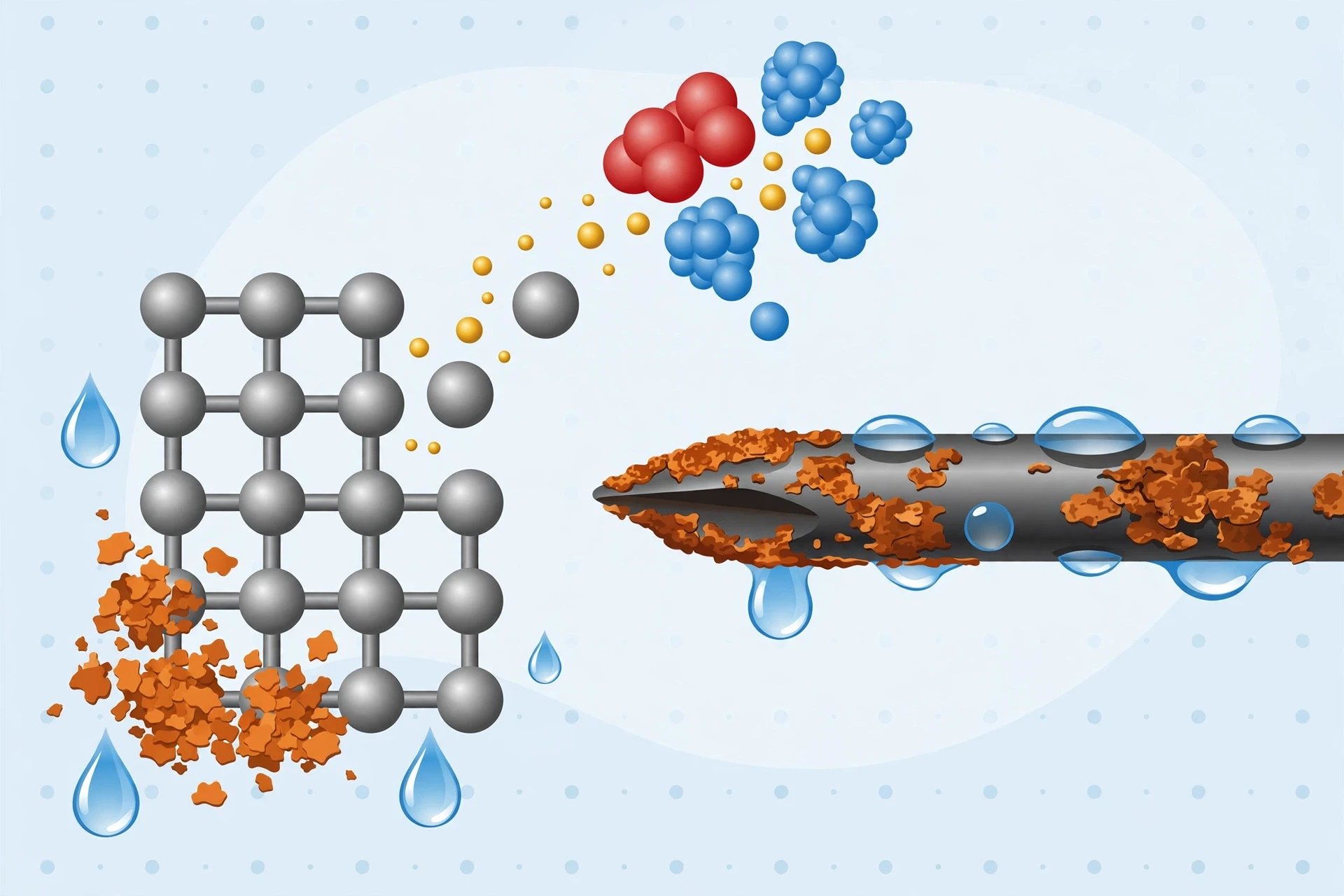
The gate at the end of my street was once painted a cheerful green. I remember it because I used to swing on it as a child, and the paint was smooth under my hands. One summer, after a long stretch of rain, I noticed a patch of orange creeping along the bottom bar. I rubbed at it with my thumb, expecting dirt. It did not come off. The metal underneath had changed. The gate was rusting, and that small patch of orange was my first, unknowing lesson in redox reactions.
Redox reactions are the quiet engine behind a surprising share of everyday life. They light fires, rust bridges, charge phones, bleach shirts, bake bread, and power every cell in your body. The word itself is a blend of two older words: reduction and oxidation. Together they describe a single event seen from two sides — electrons moving from one atom or molecule to another. When electrons move, chemistry happens. Energy is released or stored, new substances form, and old ones fall apart.
This article explains redox reactions from the ground up. You will learn what oxidation and reduction really mean, how to spot them, how to assign oxidation numbers step by step, how to split a reaction into half-reactions and balance it, and how to tell an oxidizing agent from a reducing agent. Along the way, we will visit a campfire, a rusting bridge, a leaf in sunlight, and the battery in your pocket. No prior chemistry beyond atoms and molecules is assumed, and every worked example is shown in full, so you can follow each step with a pencil in hand.
If you are new to how atoms join and break apart, the companion article on atoms and molecules covers the building blocks first. Redox reactions sit inside the wider family of chemical reactions, and this article is a deep dive into one of the most useful members of that family.
1. What Is Oxidation and Reduction?
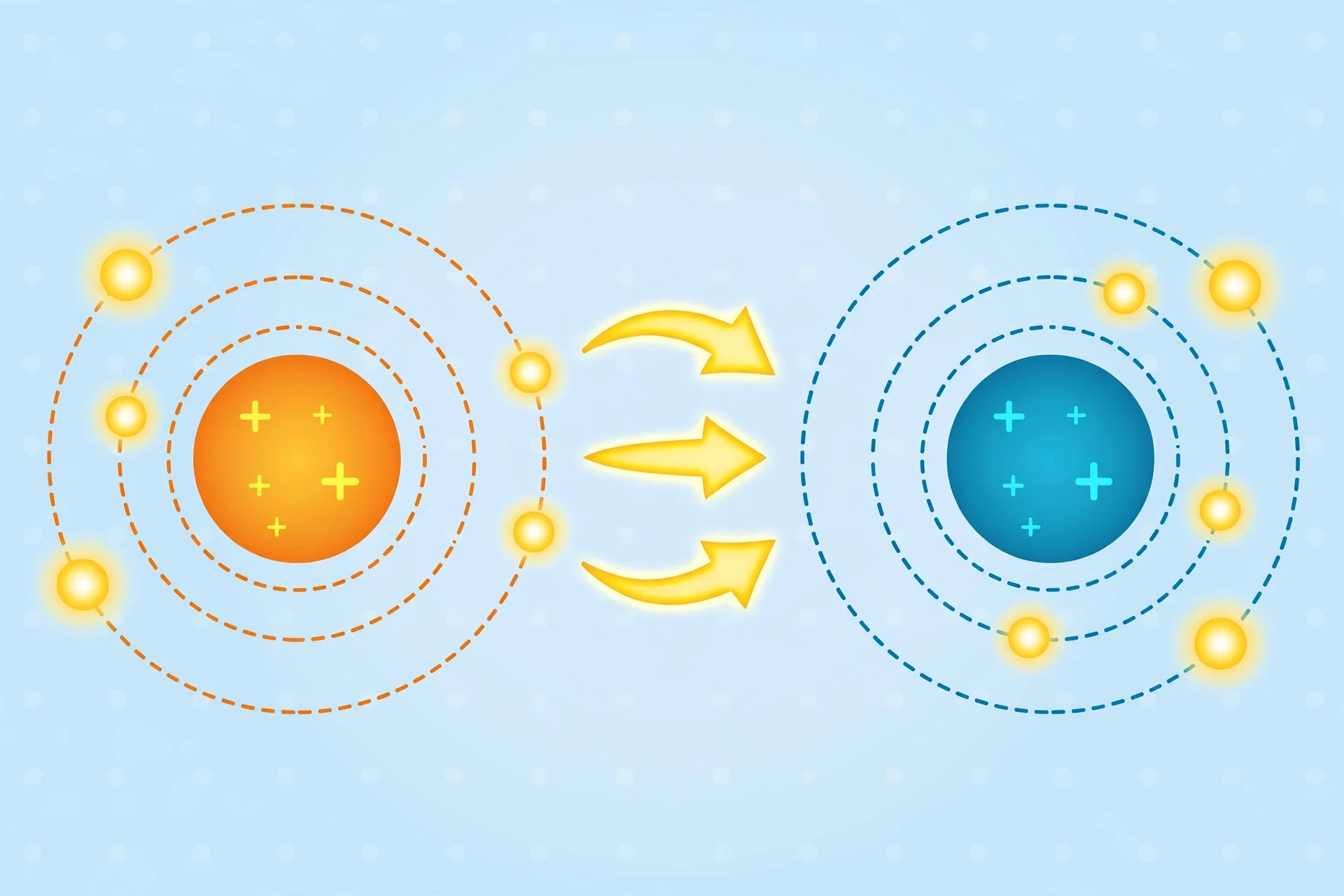
Oxidation and reduction are two halves of one transaction. Oxidation is the loss of electrons. Reduction is the gain of electrons. Neither half ever happens alone in a chemical reaction: if one atom loses electrons, another atom must gain them. That is why chemists talk about redox reactions as a pair, and why the two words are joined into one.
The original meanings were narrower. Oxidation once meant combining with oxygen, because early chemists first noticed the process in reactions with air — iron rusting, wood burning, a cut apple turning brown. Reduction once meant removing oxygen from a metal ore to get the pure metal back, as in smelting iron from its ore. Those early meanings still describe real cases, but the electron definition is broader and more useful. It covers reactions that involve no oxygen at all, such as sodium metal reacting with chlorine gas, or hydrogen reacting with fluorine.
Think of electrons as a kind of currency. Oxidation is spending: an atom hands electrons over. Reduction is receiving: an atom takes electrons in. The total amount of currency is conserved. Every electron lost by one species is gained by another, and the books always balance. That conservation is the key to balancing redox reactions, which we will do in detail later in this article.
A simple example makes the idea concrete. When magnesium metal burns in air, it produces a blinding white light and a white powder, magnesium oxide:
2Mg + O2 → 2MgO
Each magnesium atom starts with no charge. In the product, magnesium carries a 2+ charge, which means it has lost two electrons. Each oxygen atom starts neutral and ends with a 2− charge, which means it has gained two electrons. Magnesium is oxidized. Oxygen is reduced. The reaction is a redox reaction, and the electron bookkeeping tells the whole story.
Notice what the charges tell us. Losing a negatively charged electron makes an atom more positive. Gaining an electron makes an atom more negative. That is a useful check when you are working through an unfamiliar reaction: if an atom's charge goes up, it lost electrons; if its charge goes down, it gained them.
Redox reactions matter because electron movement is how chemistry stores and releases energy. When electrons fall from a high-energy arrangement to a lower-energy one, energy comes out — as heat in a fire, as light in a flame, as electricity in a battery. When energy is put in, electrons can be pushed the other way, storing energy for later — as in charging a battery or as in photosynthesis, where a plant stores sunlight energy in sugar. Almost every energy transaction in chemistry and in life runs on this principle.
1.1 Why the old oxygen definition is not enough
The oxygen definition still works for rust and fire, but it fails for many redox reactions that every chemistry student meets. Consider the reaction between hydrogen and chlorine:
H2 + Cl2 → 2HCl
No oxygen appears anywhere, yet hydrogen loses electrons and chlorine gains them. Hydrogen is oxidized; chlorine is reduced. Under the old definition, this would not count as oxidation at all, which shows how limiting that definition is. The electron definition catches it at once.
Another case is the reaction of sodium with chlorine to make table salt:
2Na + Cl2 → 2NaCl
Sodium atoms each lose one electron and become Na+ ions. Chlorine atoms each gain one electron and become Cl− ions. The product is held together by the attraction between opposite charges. This is a redox reaction with no oxygen in sight, and it is also the reaction that makes one of the most familiar substances on Earth.
The electron definition also explains why oxidation and reduction always come together. Electrons do not vanish. They have to go somewhere. So every oxidation has a matching reduction, in the same reaction, at the same time. Chemists sometimes say "oxidation and reduction are two sides of the same coin," and the coin is the electron itself.
1.2 Oxidation, reduction, and charge
Charge is the fastest way to spot what happened to an atom. An atom that loses one electron gains one unit of positive charge. An atom that gains one electron gains one unit of negative charge. Ions are simply atoms — or groups of atoms — with a charge that is not zero, and that charge is a record of electrons gained or lost.
Here is a small set of examples to keep in mind:
Na → Na+ + e−: sodium loses an electron, so sodium is oxidized.
Cl2 + 2e− → 2Cl−: chlorine gains electrons, so chlorine is reduced.
Fe2+ → Fe3+ + e−: iron(II) loses an electron to become iron(III), so iron(II) is oxidized.
Cu2+ + 2e− → Cu: copper(II) gains electrons to become copper metal, so copper(II) is reduced.
The symbol e− stands for an electron. Writing half-equations like these, with electrons shown explicitly, is the first step toward balancing redox reactions, and we will practise it thoroughly in section 5.
One common point of confusion deserves a clear answer now. Oxidation does not mean "adding oxygen," and reduction does not mean "making something smaller." Reduction means reducing the charge — making it more negative — by gaining electrons. The name comes from the old idea of reducing an ore to metal, but the modern meaning is about charge and electrons. Keep that in mind, and the rest of the topic becomes far easier.
2. What Is OIL RIG? The Memory Trick That Actually Works
Chemistry students have used the mnemonic OIL RIG for decades, and it survives because it is short, accurate, and hard to forget. It stands for:
OIL RIG: Oxidation Is Loss, Reduction Is Gain.
Oxidation is loss — loss of electrons. Reduction is gain — gain of electrons. Say it a few times, and you will carry the definitions with you into every exam and every lab.
There is a second mnemonic that some students prefer: LEO the lion says GER. LEO stands for "Lose Electrons, Oxidation," and GER stands for "Gain Electrons, Reduction." Both mnemonics say the same thing. Pick the one that sticks in your memory, and use it consistently. Mixing the two halfway through a problem is a reliable way to swap the answers, so choose one and stay with it.
I learned OIL RIG the hard way. In my first school chemistry exam, I had memorized the phrase but mixed up which half was which, and I wrote that the atom gaining electrons was oxidized. The question was worth several marks, and I lost them all on a single swapped word. After that, I wrote OIL RIG at the top of every exam paper before I answered anything else. It looked childish. It also worked, every time.
2.1 Using OIL RIG on a real reaction
Let us apply OIL RIG to the reaction between zinc metal and copper sulfate solution, a classic school experiment:
Zn + CuSO4 → ZnSO4 + Cu
Zinc starts as neutral metal, Zn, and ends as Zn2+ in zinc sulfate. Its charge has gone from 0 to +2, so it has lost two electrons. Oxidation is loss, so zinc is oxidized. Copper starts as Cu2+ in copper sulfate and ends as neutral copper metal, Cu. Its charge has gone from +2 to 0, so it has gained two electrons. Reduction is gain, so copper is reduced.
The sulfate ion, SO4 2−, appears on both sides unchanged. It is a spectator: it watches the electron transfer happen without taking part. Spotting spectators early saves time, because you can ignore them while you work out which atoms actually change.
Try the same test on the magnesium burning example from section 1. Magnesium goes from 0 to +2: it loses electrons, so it is oxidized. Oxygen goes from 0 to −2: it gains electrons, so it is reduced. OIL RIG gives the answer in seconds, and the charge change confirms it.
2.2 Why students mix oxidation and reduction up
The confusion usually comes from the everyday meanings of the words. In ordinary speech, "reducing" something means making it smaller, and "oxidizing" sounds like adding oxygen. Neither everyday meaning matches the chemistry. In chemistry, reduction makes the charge smaller — more negative — because electrons are added. Oxidation can happen with no oxygen present at all.
Another trap is the idea that the oxidizing agent is the thing that gets oxidized. It is the opposite, and this is the single most common error in redox questions. An oxidizing agent causes oxidation in something else, and it does so by taking electrons — which means the oxidizing agent itself is reduced. A reducing agent causes reduction in something else by giving electrons away — which means the reducing agent itself is oxidized. We will work through agents carefully in section 7, because this point is worth getting exactly right.
A third trap is treating the loss and gain as separate reactions. They are not separate. Redox reactions are single reactions with two half-events. If you write the oxidation half on its own, you have an incomplete picture; the electrons have nowhere to go. Always look for the partner half, and check that the electrons lost equal the electrons gained.
3. How Do You Assign Oxidation Numbers?
Oxidation numbers are the bookkeeping tool that makes redox reactions visible. An oxidation number, sometimes called an oxidation state, is the charge an atom would have if all its bonds were completely ionic — that is, if the more electronegative atom in each bond took all the shared electrons. It is a formal number, not a real measured charge, but it is enormously useful: when an atom's oxidation number goes up, the atom has been oxidized; when it goes down, the atom has been reduced.
The rules for assigning oxidation numbers are few, and they are worth learning in order. Work through them one at a time, and check each atom against the rules in sequence.
Rule | Statement | Example |
|---|---|---|
1 | The oxidation number of an atom in its elemental form is 0. | Fe, O2, Cl2, S8 all have oxidation number 0. |
2 | The oxidation number of a single-atom ion equals its charge. | Na+ is +1; Mg2+ is +2; Cl− is −1; O2− is −2. |
3 | Fluorine is always −1 in compounds. | In HF and in CF4, fluorine is −1. |
4 | Oxygen is usually −2, except in peroxides (−1) and in OF2 (+2). | In H2O oxygen is −2; in H2O2 oxygen is −1. |
5 | Hydrogen is usually +1, except in metal hydrides (−1). | In H2O hydrogen is +1; in NaH hydrogen is −1. |
6 | Group 1 metals are +1 and Group 2 metals are +2 in compounds. | In NaCl sodium is +1; in CaO calcium is +2. |
7 | The sum of oxidation numbers in a neutral compound is 0; in a polyatomic ion it equals the ion's charge. | In H2SO4 the numbers sum to 0; in SO4 2− they sum to −2. |
Rules 1 and 2 are the starting points. Rule 7 is the workhorse: it lets you solve for an unknown oxidation number once you know the others. Most worked examples use rules 4, 5, and 7 together.
3.1 Worked example: oxidation numbers in water and carbon dioxide
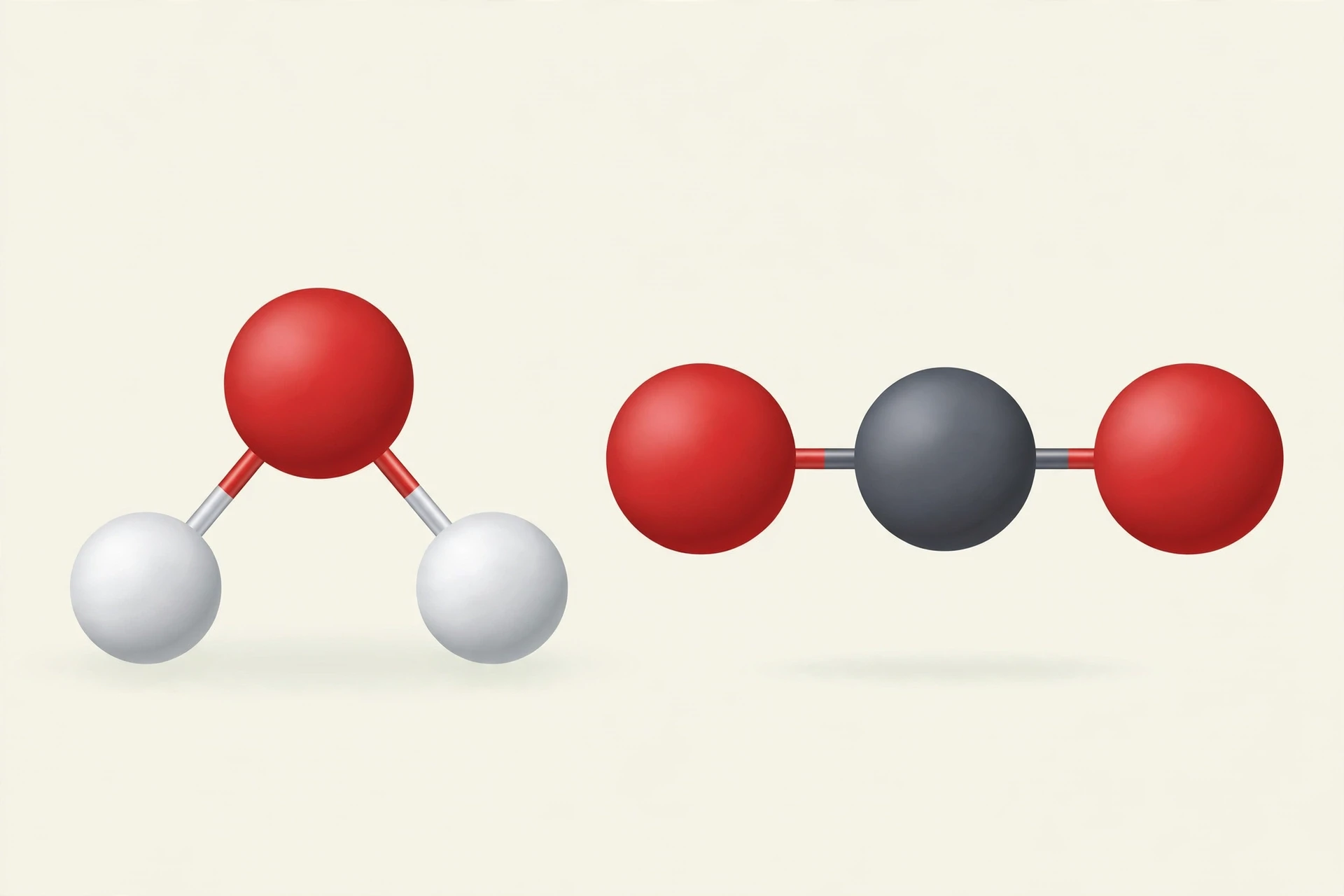
Take water, H2O. Hydrogen is +1 by rule 5, and there are two hydrogen atoms, contributing +2 in total. The molecule is neutral, so by rule 7 the oxidation numbers must sum to 0. Oxygen must therefore be −2. That matches rule 4, which is a good cross-check.
Now take carbon dioxide, CO2. Oxygen is −2 by rule 4, and there are two oxygen atoms, contributing −4. The molecule is neutral, so carbon must be +4 to bring the sum to 0. Carbon in carbon dioxide has oxidation number +4.
These two results will matter later. In photosynthesis, carbon goes from +4 in carbon dioxide to 0 in glucose — a reduction, because the oxidation number falls. In respiration, the reverse happens. Oxidation numbers turn a vague idea about "energy" into a precise, checkable statement.
3.2 Worked example: sulfur in sulfuric acid
Sulfuric acid, H2SO4, is a good test because sulfur's oxidation number is not obvious. Hydrogen is +1, and there are two hydrogens: +2. Oxygen is −2, and there are four oxygens: −8. Let sulfur's oxidation number be x. The molecule is neutral, so:
2(+1) + x + 4(−2) = 0
2 + x − 8 = 0, so x = +6. Sulfur in sulfuric acid has oxidation number +6. That is the highest common oxidation number for sulfur, which is one reason sulfuric acid is such a strong oxidizing agent: sulfur at +6 has a long way to fall, and it can accept electrons readily.
3.3 Worked example: chromium in dichromate
The dichromate ion, Cr2O7 2−, appears in many redox titrations, and students are often asked for chromium's oxidation number in it. Oxygen is −2, and there are seven oxygens: −14. Let each chromium be x; there are two chromiums: 2x. The ion carries a 2− charge, so by rule 7 the numbers must sum to −2:
2x + 7(−2) = −2
2x − 14 = −2, so 2x = +12, and x = +6. Chromium in dichromate is +6. When dichromate reacts, chromium typically falls to +3, gaining three electrons per chromium atom — a large electron gain, which is why dichromate is a powerful oxidizing agent.
3.4 Worked example: nitrogen in several compounds
Nitrogen is a good atom to practise on, because it takes many oxidation numbers. Work through these slowly:
In N2, nitrogen is in elemental form: 0 (rule 1).
In NH3, hydrogen is +1, three hydrogens give +3, and the molecule is neutral, so nitrogen is −3.
In NO, oxygen is −2 and the molecule is neutral, so nitrogen is +2.
In NO2, two oxygens give −4 and the molecule is neutral, so nitrogen is +4.
In HNO3, hydrogen is +1, three oxygens give −6, and the molecule is neutral: 1 + x − 6 = 0, so nitrogen is +5.
In NO3−, three oxygens give −6, and the ion charge is −1: x − 6 = −1, so nitrogen is +5.
Nitrogen runs from −3 to +5, a range of eight. That wide range is why nitrogen chemistry is so rich — and why fertilizers, explosives, and the nitrogen cycle all involve redox reactions. A single atom can be oxidized step by step through many states, or reduced step by step back down.
3.5 Common mistakes in assigning oxidation numbers
The most frequent error is forgetting that rule 7 uses the total charge, not zero, for ions. In SO4 2−, the numbers sum to −2, not 0. Forgetting that gives sulfur +8, which is impossible — sulfur has only six valence electrons and cannot reach +8.
The second error is applying the oxygen rule blindly in peroxides. In hydrogen peroxide, H2O2, oxygen is −1, not −2. If you use −2, hydrogen would have to be +2, which hydrogen cannot be in this compound. The peroxide exception exists because the two oxygen atoms share a bond with each other, and the bookkeeping works out differently.
The third error is confusing oxidation number with charge. In a covalent molecule such as CO2, carbon does not really carry a +4 charge — the bonds are shared, not fully ionic. The oxidation number is a formal accounting device. It is still the right tool for spotting redox reactions, but it should not be mistaken for a measurement of real charge on the atom.
Oxidation numbers are not real charges. They are a bookkeeping system — a way of tracking electrons that lets us see, at a glance, which atoms gain and which lose. Treat them as a map, not as the territory itself.
4. Spotting Redox Reactions in Any Equation
Once you can assign oxidation numbers, spotting redox reactions is straightforward: assign the oxidation number of every atom on both sides of the equation, and look for changes. If any atom's oxidation number changes, the reaction is a redox reaction. If nothing changes, it is not — it is probably an acid-base reaction, a precipitation, or another type that moves ions around without moving electrons between atoms.
This test is more reliable than looking for oxygen, or for a colour change, or for a flame. Some redox reactions are dramatic, but many are quiet. The oxidation-number test catches both.
4.1 Worked example: is this a redox reaction?
Consider the reaction of hydrochloric acid with sodium hydroxide:
HCl + NaOH → NaCl + H2O
Assign oxidation numbers. In HCl, hydrogen is +1 and chlorine is −1. In NaOH, sodium is +1, oxygen is −2, hydrogen is +1. In NaCl, sodium is +1 and chlorine is −1. In H2O, hydrogen is +1 and oxygen is −2. Nothing has changed. Hydrogen stays +1, chlorine stays −1, sodium stays +1, oxygen stays −2. This is an acid-base neutralization, not a redox reaction. No electrons changed hands; the ions simply rearranged their partners.
Now consider the reaction of zinc with hydrochloric acid:
Zn + 2HCl → ZnCl2 + H2
Zinc goes from 0 to +2: oxidized. Hydrogen goes from +1 to 0: reduced. Chlorine stays −1 throughout. This is a redox reaction, and it is also the reaction that produces hydrogen gas in many school labs — the fizzing you see is hydrogen being formed as it gains electrons.
4.2 Worked example: combustion of methane
Methane burning in oxygen is the reaction that heats many homes:
CH4 + 2O2 → CO2 + 2H2O
Carbon in methane: hydrogen is +1, four hydrogens give +4, the molecule is neutral, so carbon is −4. Carbon in carbon dioxide is +4, as we found in section 3. Carbon goes from −4 to +4: it loses eight electrons, so it is oxidized. Oxygen goes from 0 in O2 to −2 in both products: it gains electrons, so it is reduced. Hydrogen stays +1 throughout. The large change in carbon's oxidation number — eight units — is a clue to why methane releases so much energy when it burns: a large electron transfer goes with a large energy release.
4.3 Worked example: a reaction with no obvious change
Some reactions look like redox reactions but are not, and the oxidation-number test protects you from guessing wrong. The reaction of silver nitrate with sodium chloride gives a white precipitate of silver chloride:
AgNO3 + NaCl → AgCl + NaNO3
Silver stays +1, nitrogen stays +5, oxygen stays −2, sodium stays +1, chlorine stays −1. Nothing changes. This is a precipitation reaction, not a redox reaction. The white solid is new, but no electrons moved between atoms.
The lesson is simple: a new substance forming does not prove a redox reaction happened. Only a change in oxidation number proves it. Make the oxidation-number check a habit, and you will stop being fooled by appearances.
5. Half-Reactions: Splitting Redox Reactions in Two
A half-reaction is one half of a redox reaction, written on its own. The oxidation half-reaction shows the species losing electrons. The reduction half-reaction shows the species gaining electrons. Splitting a reaction this way does two things: it makes clear exactly which species is oxidized and which is reduced, and it gives you the pieces you need to balance the full equation.
To write a half-reaction, start with the species that changes, write it on one side, write its product on the other, and add electrons to balance the charge. Electrons appear on the right in an oxidation half-reaction (they are lost, so they are products) and on the left in a reduction half-reaction (they are gained, so they are reactants).
5.1 The zinc–copper reaction, split in two
Return to the zinc and copper sulfate reaction from section 2:
Zn + Cu2+ → Zn2+ + Cu
The oxidation half-reaction is:
Zn → Zn2+ + 2e−
Zinc metal loses two electrons to become the zinc ion. The reduction half-reaction is:
Cu2+ + 2e− → Cu
The copper ion gains two electrons to become copper metal. Add the two halves together, and the electrons cancel: two lost, two gained. The sum is the full equation. When the electrons cancel cleanly like this, the reaction is already balanced, and the half-reaction method has done its job in one step.
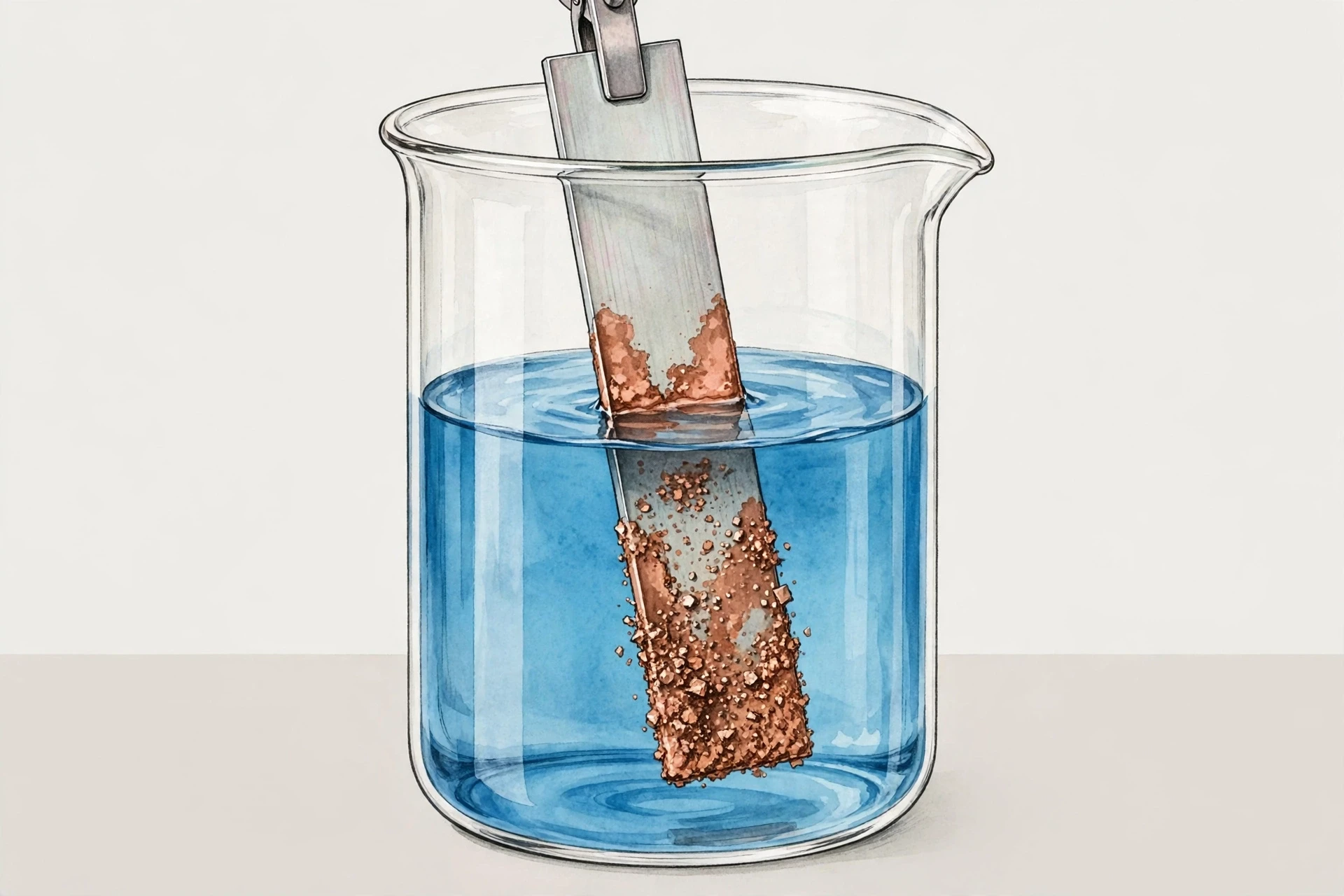
I still remember the first time I watched this reaction in a school lab. A grey strip of zinc went into a blue solution of copper sulfate, and within minutes the blue faded and a pink-brown coating of copper grew on the zinc. The colour change was the copper ions disappearing from solution as they gained electrons. I had read about electron transfer in a textbook, but seeing the blue drain away made it real in a way no diagram had.
5.2 Half-reactions with ions that carry oxygen
Many redox reactions involve oxygen-containing ions, such as permanganate (MnO4−) or dichromate (Cr2O7 2−). Writing their half-reactions needs two extra steps: balance the oxygen atoms with water molecules, and balance the hydrogen atoms with H+ ions. This is the standard method for acidic solution, and it is the method examiners expect.
Take the reduction of permanganate to manganese(II) in acid:
MnO4− → Mn2+
First, balance the atoms other than oxygen and hydrogen: manganese is already balanced, one on each side. Next, balance oxygen by adding water to the side that needs it. The left has four oxygens; the right has none, so add four water molecules to the right:
MnO4− → Mn2+ + 4H2O
Now balance hydrogen by adding H+ to the side that needs it. The right has eight hydrogens; the left has none, so add eight H+ to the left:
8H+ + MnO4− → Mn2+ + 4H2O
Finally, balance the charge with electrons. The left side has charge 8 − 1 = +7. The right side has charge +2. Add five electrons to the left to bring it to +2:
5e− + 8H+ + MnO4− → Mn2+ + 4H2O
Check: atoms balance (one manganese, four oxygens, eight hydrogens on each side), and charge balances (+2 on each side). The half-reaction is complete. Manganese goes from +7 in permanganate to +2, gaining five electrons — a reduction, as expected.
5.3 Half-reactions in alkaline solution
In alkaline solution, the same method works with one extra step at the end: for every H+ ion in the balanced half-reaction, add one OH− ion to both sides, and combine H+ and OH− into water where they appear together. Practise this conversion once, and it becomes routine.
Take the same permanganate reduction, balanced above for acid:
5e− + 8H+ + MnO4− → Mn2+ + 4H2O
Add eight OH− to both sides:
5e− + 8H+ + 8OH− + MnO4− → Mn2+ + 4H2O + 8OH−
Combine H+ and OH− into water on the left: 8H2O. Then cancel water that appears on both sides: four waters cancel, leaving four on the left:
5e− + 4H2O + MnO4− → Mn2+ + 8OH−
Check the charge: left is −5 − 1 = −6; right is +2 − 8 = −6. The atoms balance too. This is the alkaline form of the same half-reaction. Note that in strongly alkaline solution, permanganate often reduces to manganese(IV) oxide instead, but the balancing method is the same whatever the product.
6. Balancing Redox Reactions Step by Step
Balancing redox reactions by trial and error is slow and unreliable. The half-reaction method is systematic: split the reaction, balance each half, then combine the halves so the electrons cancel. Follow the steps in order, and check your answer at the end.
The steps for acidic solution are:
Assign oxidation numbers and identify which species is oxidized and which is reduced.
Write the two half-reactions.
Balance each half-reaction for atoms other than oxygen and hydrogen.
Balance oxygen with H2O.
Balance hydrogen with H+.
Balance charge with electrons.
Multiply the half-reactions so the electrons lost equal the electrons gained.
Add the half-reactions and cancel anything that appears on both sides.
Check that atoms and charge both balance in the final equation.
6.1 Worked example: copper and nitric acid
Copper metal reacts with dilute nitric acid to give copper nitrate, nitrogen dioxide, and water. The skeleton equation is:
Cu + HNO3 → Cu(NO3)2 + NO2 + H2O
Assign oxidation numbers. Copper goes from 0 to +2: oxidized. Nitrogen in HNO3 is +5; in NO2 it is +4: reduced. Some nitrogen stays +5 in the nitrate ions of the product, so not all the nitric acid is reduced — part of it simply supplies nitrate ions. This is normal, and it is why balancing by inspection is hard here.
Write the oxidation half-reaction:
Cu → Cu2+ + 2e−
Write the reduction half-reaction, starting with the nitrogen that changes:
HNO3 → NO2
Balance oxygen: the left has three oxygens, the right has two, so add one water to the right:
HNO3 → NO2 + H2O
Balance hydrogen: the right has two hydrogens, the left has one, so add one H+ to the left:
H+ + HNO3 → NO2 + H2O
Balance charge: the left has +1, the right has 0, so add one electron to the left:
e− + H+ + HNO3 → NO2 + H2O
Now equalize the electrons. The oxidation half gives two electrons; the reduction half takes one. Multiply the reduction half by two:
2e− + 2H+ + 2HNO3 → 2NO2 + 2H2O
Add the oxidation half:
Cu + 2e− + 2H+ + 2HNO3 → Cu2+ + 2e− + 2NO2 + 2H2O
Cancel the electrons, and combine the nitrate ions with the copper ion and the hydrogen ions with the remaining nitrate to give the molecular equation. Two more HNO3 molecules are needed to supply the two nitrate ions in Cu(NO3)2, so the full balanced equation is:
Cu + 4HNO3 → Cu(NO3)2 + 2NO2 + 2H2O
Check: copper 1 and 1, hydrogen 4 and 4, nitrogen 4 and 4, oxygen 12 and 12. The equation balances. Working through it slowly is the point — speed comes with practice, and every step has a reason.
6.2 Worked example: iron(II) and dichromate
The reaction between iron(II) ions and dichromate ions in acid is a standard titration, used to measure iron content. The skeleton is:
Fe2+ + Cr2O7 2− → Fe3+ + Cr3+
Iron goes from +2 to +3: oxidized, losing one electron. Chromium goes from +6 to +3: reduced, gaining three electrons per chromium, six per dichromate ion.
Oxidation half-reaction:
Fe2+ → Fe3+ + e−
Reduction half-reaction, from section 3.3 and the method in section 5.2:
Cr2O7 2− → 2Cr3+
Balance oxygen with water: seven oxygens on the left, none on the right, so add seven waters to the right:
Cr2O7 2− → 2Cr3+ + 7H2O
Balance hydrogen with H+: fourteen hydrogens on the right, none on the left, so add fourteen H+ to the left:
14H+ + Cr2O7 2− → 2Cr3+ + 7H2O
Balance charge: left is +14 − 2 = +12; right is +6. Add six electrons to the left:
6e− + 14H+ + Cr2O7 2− → 2Cr3+ + 7H2O
Equalize electrons: the oxidation half gives one electron, so multiply it by six:
6Fe2+ → 6Fe3+ + 6e−
Add the halves and cancel the electrons:
6Fe2+ + 14H+ + Cr2O7 2− → 6Fe3+ + 2Cr3+ + 7H2O
Check: iron 6 and 6, chromium 2 and 2, oxygen 7 and 7, hydrogen 14 and 14, charge +24 on the left (12 + 14 − 2) and +24 on the right (18 + 6). The equation balances, and the 6:1 ratio of iron to dichromate is exactly the ratio a titration uses.
6.3 Worked example: balancing in alkaline solution
Balance the reaction between chlorine and hydroxide ions, which gives chloride and chlorate ions — a disproportionation, where one species is both oxidized and reduced:
Cl2 + OH− → Cl− + ClO3− + H2O
Chlorine starts at 0. In chloride it is −1: reduced. In chlorate it is +5: oxidized. The same element plays both roles.
Oxidation half-reaction (chlorine to chlorate):
Cl2 → ClO3−
Balance chlorine: one chlorate needs one chlorine, so the left needs half a Cl2, or double everything to avoid fractions. Write it with two chlorates:
Cl2 → 2ClO3−
Balance oxygen with water: six oxygens on the right, so add six waters to the left:
Cl2 + 6H2O → 2ClO3−
Balance hydrogen with H+: twelve hydrogens on the left, so add twelve H+ to the right:
Cl2 + 6H2O → 2ClO3− + 12H+
Balance charge: left is 0, right is −2 + 12 = +10, so add ten electrons to the right:
Cl2 + 6H2O → 2ClO3− + 12H+ + 10e−
Reduction half-reaction:
Cl2 + 2e− → 2Cl−
Equalize electrons: the oxidation half gives ten electrons, the reduction half takes two, so multiply the reduction half by five:
5Cl2 + 10e− → 10Cl−
Add the halves:
6Cl2 + 6H2O → 2ClO3− + 12H+ + 10Cl−
Now convert to alkaline solution: add twelve OH− to both sides, combine H+ and OH− into water, and cancel:
6Cl2 + 6H2O + 12OH− → 2ClO3− + 12H2O + 10Cl−
Cancel six waters from both sides:
6Cl2 + 12OH− → 2ClO3− + 6H2O + 10Cl−
Divide by two:
3Cl2 + 6OH− → ClO3− + 3H2O + 5Cl−
Check: chlorine 6 and 6, oxygen 6 and 6, hydrogen 6 and 6, charge −6 and −6. The equation balances. Disproportionation looks strange the first time you meet it, but the half-reaction method handles it without any special tricks — you simply write both halves for the same element.
If your final equation does not balance in both atoms and charge, do not trust it. Go back to the half-reactions and check each step. Nine times out of ten, the error is a missed water molecule or a miscounted electron, and it is sitting in plain sight.
7. What Is a Reducing Agent? Oxidizing and Reducing Agents Explained
An oxidizing agent is a substance that causes another substance to be oxidized. It does this by accepting electrons. Because it gains electrons, the oxidizing agent itself is reduced in the process. A reducing agent is a substance that causes another substance to be reduced. It does this by donating electrons. Because it loses electrons, the reducing agent itself is oxidized.
That inversion catches almost everyone the first time. Say it slowly: the oxidizing agent gets reduced; the reducing agent gets oxidized. The agent does the opposite of what its name suggests to itself, and does what its name suggests to the other substance.
In the zinc–copper reaction, zinc is the reducing agent: it gives electrons to copper ions, reducing them to copper metal, and zinc itself is oxidized to Zn2+. Copper ions are the oxidizing agent: they take electrons from zinc, oxidizing it, and they are reduced to copper metal.
Agent | What it does to the other substance | What happens to the agent itself | Example |
|---|---|---|---|
Oxidizing agent | Oxidizes it (takes its electrons) | Is reduced (gains electrons) | Cu2+ in the zinc–copper reaction; O2 in burning |
Reducing agent | Reduces it (gives it electrons) | Is oxidized (loses electrons) | Zn in the zinc–copper reaction; H2 in many reductions |
7.1 Strong and weak agents
Some oxidizing agents are strong: they grab electrons eagerly. Oxygen, chlorine, fluorine, permanganate, and dichromate are all strong oxidizing agents. Fluorine is the strongest of all — it can oxidize almost anything, which is why fluorine chemistry needs such careful handling. Some reducing agents are strong too: alkali metals such as sodium and potassium give up electrons readily, as do hydrogen and carbon monoxide at high temperatures.
Strength is relative, and it depends on conditions. In acidic solution, permanganate is a stronger oxidizing agent than in alkaline solution. Temperature matters as well: carbon is a poor reducing agent at room temperature but an excellent one in a hot furnace, which is why it is used to extract iron from its ore. The reactivity series, which chemistry students learn early, is essentially a ranking of metals by how strongly they act as reducing agents — the metals at the top give up electrons most easily.
7.2 How to identify the agents in any equation
The procedure for redox reactions is mechanical. First, assign oxidation numbers and find which atoms change. The atom whose oxidation number increases is oxidized, and the substance containing it is the reducing agent. The atom whose oxidation number decreases is reduced, and the substance containing it is the oxidizing agent. Then check your answer against OIL RIG: the oxidized species lost electrons, so it must have given them to something — and that something is the oxidizing agent.
Work through the combustion of hydrogen:
2H2 + O2 → 2H2O
Hydrogen goes from 0 to +1: oxidized, so hydrogen is the reducing agent. Oxygen goes from 0 to −2: reduced, so oxygen is the oxidizing agent. The answer matches everyday language here — oxygen is the classic oxidizing agent, and hydrogen is a fuel, which is another way of saying it is a reducing agent that releases energy as it is oxidized.
Try a harder one: the reaction of chlorine with sodium bromide solution:
Cl2 + 2NaBr → 2NaCl + Br2
Chlorine goes from 0 to −1: reduced, so chlorine is the oxidizing agent. Bromine goes from −1 to 0: oxidized, so bromide is the reducing agent. Chlorine is a stronger oxidizing agent than bromine, which is why it can take electrons from bromide ions. The reverse reaction does not happen on its own: bromine cannot oxidize chloride ions, because chlorine holds its electrons more tightly.
8. Combustion: Redox Reactions That Release Heat and Light
Combustion is the most familiar redox reaction of all. A fuel — wood, gas, petrol, coal, or a candle — reacts with oxygen, and the products are usually carbon dioxide and water, plus heat and light. The fuel is oxidized, oxygen is reduced, and the energy released is the difference between the energy stored in the fuel's bonds and the energy stored in the products' bonds.
I learned how much energy combustion releases on a camping trip, when a single match lit a pile of dry twigs and, within minutes, the fire was hot enough to boil a kettle. The twigs had been storing sunlight energy for years in the form of cellulose. Burning them released that stored energy in minutes. A campfire is stored sunlight, let out all at once.

8.1 Complete and incomplete combustion
When oxygen is plentiful, combustion is complete: carbon burns fully to carbon dioxide, and hydrogen burns to water. The equation for methane is the one from section 4:
CH4 + 2O2 → CO2 + 2H2O
When oxygen is limited, combustion is incomplete. Carbon may burn only as far as carbon monoxide, a poisonous gas, or it may not burn at all and appear as soot — tiny particles of unburned carbon. Incomplete combustion wastes fuel and produces dangerous gases, which is why gas appliances need good ventilation and regular servicing, and why a yellow, sooty flame on a gas hob is a warning sign that the burner needs attention.
Incomplete combustion of carbon can be written as:
2C + O2 → 2CO
Carbon goes from 0 to +2 here, instead of +4 as in complete combustion. It is still oxidized, but only partly, and less energy is released. The difference between +2 and +4 is the difference between a safe flame and a dangerous one.
8.2 Why some things burn and others do not
A substance burns if its oxidation releases more energy than it costs to start the reaction, and if the reaction can sustain itself once started. Wood, paper, petrol, and natural gas all meet that test. Water does not burn, because its hydrogen is already at +1 and its oxygen at −2 — they are already oxidized and reduced as far as they normally go. Carbon dioxide does not burn for the same reason: its carbon is already at +4.
That is why carbon dioxide fire extinguishers work. They smother a fire with a gas that cannot burn and that pushes oxygen away from the fuel. Remove the oxidizing agent, and the redox reaction stops. Foam and powder extinguishers work on the same principle in different ways: they separate fuel from oxygen, or cool the fuel below the temperature where the reaction can sustain itself.
8.3 Fire, from the atom's point of view
A flame is not a substance; it is a region where redox reactions are happening fast. Fuel molecules break apart, atoms rearrange, and electrons shift into lower-energy arrangements. The light of a flame comes from excited atoms and molecules releasing energy as they fall back to lower energy states. The blue part of a gas flame is hotter and burns more completely than the yellow part, which is why a properly adjusted gas hob burns blue.
9. Redox Reactions in Living Things: Photosynthesis and Respiration
Redox reactions are not confined to labs and furnaces. They run every living cell. Photosynthesis and respiration are a matched pair of redox reactions, one storing energy and the other releasing it, and together they drive almost all life on Earth.
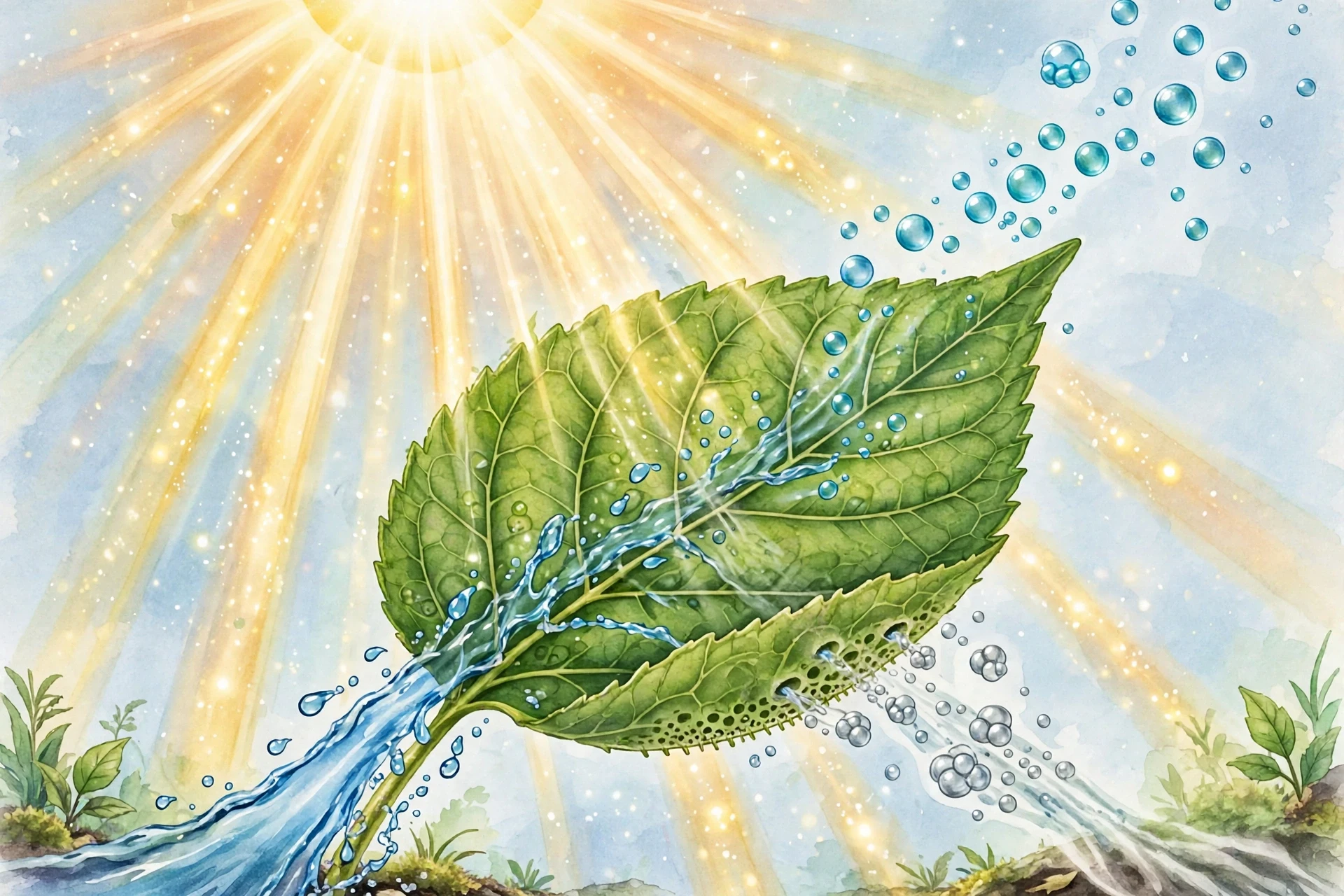
In photosynthesis, plants, algae, and some bacteria use sunlight to reduce carbon dioxide to glucose, while water is oxidized to oxygen. The overall equation is:
6CO2 + 6H2O → C6H12O6 + 6O2
Carbon goes from +4 in carbon dioxide to 0 in glucose: it gains electrons, so it is reduced. Oxygen in water goes from −2 to 0 in oxygen gas: it loses electrons, so it is oxidized. Light supplies the energy that drives these electrons uphill, from water to carbon dioxide, and the energy ends up stored in the chemical bonds of glucose.
Respiration is the reverse. Cells oxidize glucose back to carbon dioxide, and oxygen is reduced to water:
C6H12O6 + 6O2 → 6CO2 + 6H2O
Carbon goes from 0 to +4: oxidized. Oxygen goes from 0 to −2: reduced. The energy released powers everything a cell does — building proteins, pumping ions, dividing, moving. The two reactions form a cycle: photosynthesis stores energy, respiration releases it, and the carbon and oxygen atoms go round and round.
For a fuller account of the process, see the Sciory article on photosynthesis, which explains the light-dependent reactions and the Calvin cycle in detail. What matters here is the redox core: photosynthesis is a reduction driven by light, and respiration is the oxidation that pays the energy back.
9.1 Redox reactions inside your cells
Inside your cells, respiration does not happen in one step. Glucose is oxidized in a series of small steps, and the electrons it loses are carried by molecules called NADH and FADH2 to a chain of proteins in the mitochondria. At each step, the electrons fall to a slightly lower energy, and a little energy is captured. At the end of the chain, oxygen accepts the electrons and is reduced to water. This stepwise release is the reason respiration is efficient: burning glucose in one step would release all the energy as heat, but the cell captures much of it in a usable form.
The same principle explains why you breathe. Oxygen is the final electron acceptor in respiration — the oxidizing agent that makes the whole chain work. Without oxygen, the chain backs up, electrons have nowhere to go, and the cell must switch to less efficient ways of making energy. That is why sustained exercise leaves muscles aching: when oxygen cannot keep up, cells fall back on fermentation, and the by-products accumulate.
9.2 Antioxidants and the other side of oxidation
The word "antioxidant" is everywhere in food marketing, and the chemistry behind it is real. Some molecules in the body can be damaged by oxidation — by reactive species that steal their electrons. Antioxidants are reducing agents: they give up their own electrons readily, and in doing so they protect other molecules from being oxidized. Vitamin C, vitamin E, and many plant compounds work this way.
The marketing often goes further than the evidence. Eating foods rich in antioxidants is sensible, but the claim that a single food or supplement "fights oxidation" in a simple, direct way overstates what the science shows. The body has its own elaborate systems for managing oxidation, and a balanced diet supports them.
10. Corrosion, Rust, and How We Fight It
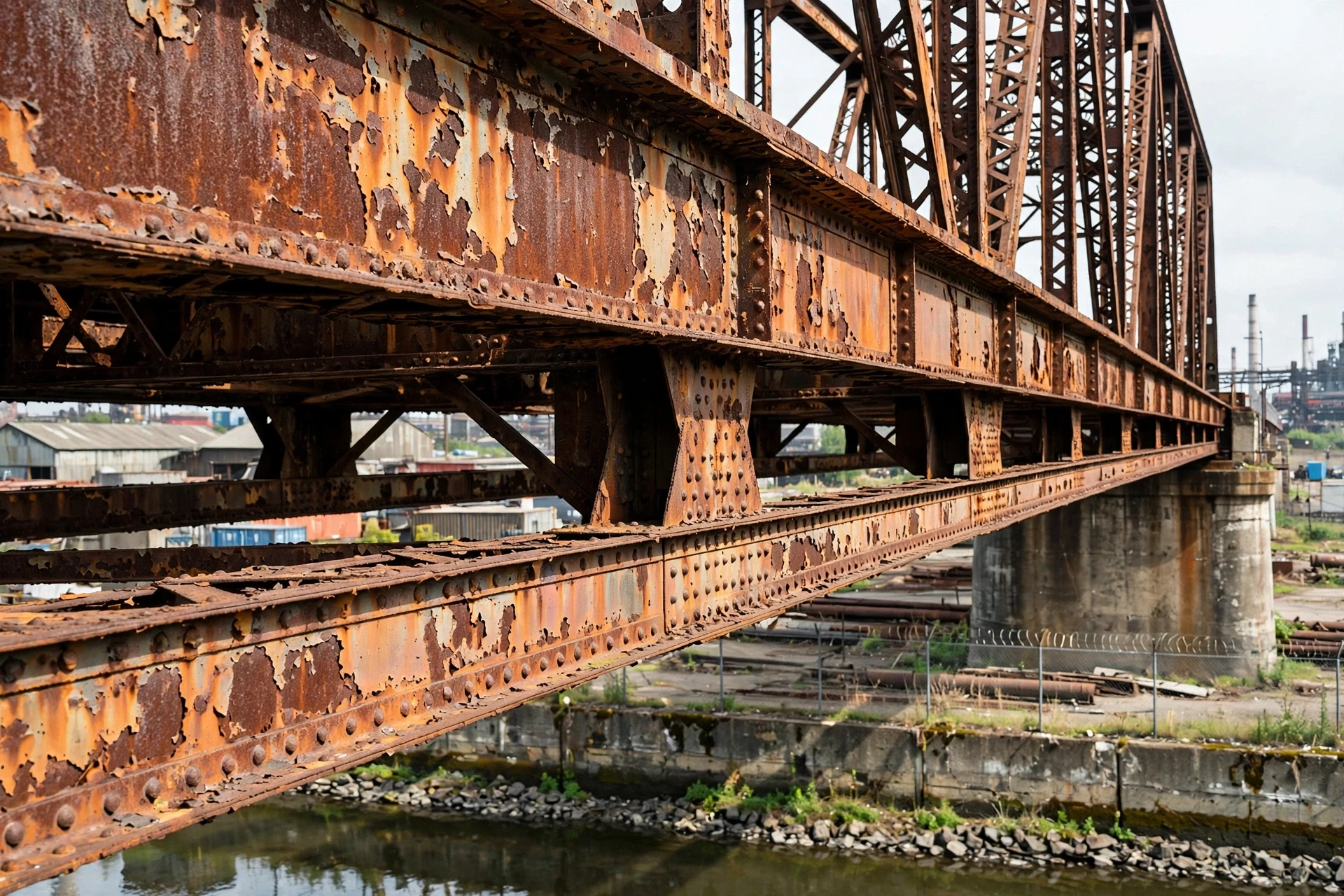
Rust is one of the redox reactions that costs the world a great deal. Iron and steel structures — bridges, ships, cars, pipelines — slowly lose metal to rust, and the damage must be repaired or the structure replaced. Understanding the redox chemistry of rust is the first step to preventing it.
Rust forms when iron, oxygen, and water are all present. Iron is oxidized to iron(II) ions, oxygen is reduced to hydroxide ions, and the iron(II) is then oxidized further to iron(III), which forms the hydrated iron(III) oxide we call rust. The overall process can be summarized as:
4Fe + 3O2 + 6H2O → 4Fe(OH)3
The product, iron(III) hydroxide, dehydrates to form rust, Fe2O3·xH2O. Rust is porous and flaky, unlike the thin, tough oxide layer that protects aluminium. Water and oxygen keep reaching fresh iron through the rust, so rusting continues until the metal is gone. That is why a rusted gate, left alone, eventually crumbles.
10.1 Why aluminium does not rust like iron
Aluminium is actually more reactive than iron — it loses electrons more readily. Yet aluminium objects do not crumble the way iron does. The reason is the oxide layer. When aluminium is exposed to air, it forms a thin, hard, tightly attached layer of aluminium oxide. That layer seals the metal underneath and stops further oxidation. Iron's oxide, rust, is loose and porous, so it offers no such protection.
This is a good example of how the same chemistry — metal oxidized by oxygen — can have very different outcomes depending on the properties of the product. The redox reaction is the same kind; the material behaviour is not.
10.2 Galvanizing, painting, and sacrificial protection
There are three main ways to protect iron from rust, and all three work by interfering with the redox reaction.
Painting and coating work by keeping oxygen and water away from the metal. No oxygen, no oxidizing agent, no rust. The weakness is obvious: a scratch in the paint exposes bare metal, and rust starts at the scratch. That is why I repainted that green gate every few years as a child — the paint was the only thing standing between the iron and the rain.
Galvanizing coats iron with zinc. Zinc is a stronger reducing agent than iron, so it oxidizes first. Even if the coating is scratched, the zinc near the scratch keeps protecting the iron, because zinc gives up its electrons before iron does. The zinc is sacrificed to save the iron.
Sacrificial protection uses the same idea on a larger scale. Ships and underground pipelines are fitted with blocks of magnesium or zinc, called sacrificial anodes. The anode corrodes instead of the structure, and it is replaced when it is used up. The structure itself stays intact because the anode is the reducing agent that takes the hit.
10.3 Rust in the wider world
Corrosion is not limited to iron. Copper roofs turn green as copper oxidizes to form a patina of copper carbonate — a layer that, like aluminium oxide, protects the metal underneath. Silver tarnishes as it reacts with sulfur compounds in the air. Each case is a redox reaction, and each one follows the same rules: some species loses electrons, some species gains them, and the product's properties decide whether the damage stops or continues.
Engineers who design bridges, ships, and pipelines spend much of their working lives on this chemistry. The choice of metal, the choice of coating, the decision to add a sacrificial anode — all of it rests on the redox principles in this article. A bridge that lasts a century is, in part, a redox reaction managed well.
11. Batteries and Everyday Redox Reactions
A battery is a box built around redox reactions, arranged so that the electrons travel through a wire instead of directly between the reactants. That detour is the whole point: electrons moving through a wire are an electric current, and a current can do work — light a bulb, spin a motor, power a phone.
In a simple zinc–copper cell, zinc is oxidized at one electrode and copper ions are reduced at the other. The electrodes are connected by a wire, and the solutions are connected by a salt bridge that lets ions move and keeps the charges balanced. Electrons flow from the zinc electrode, where they are produced, through the wire to the copper electrode, where they are consumed. The voltage of the cell is a measure of how strongly the reaction wants to run — how eagerly zinc gives up electrons and copper ions accept them.
11.1 How rechargeable batteries work
A rechargeable battery runs its redox reaction in reverse when it is charged. An external power supply pushes electrons back the other way, reversing the oxidation and reduction and restoring the original reactants. A lithium-ion battery, the kind in most phones and laptops, works by moving lithium ions between two electrodes as it charges and discharges, with electrons flowing through the external circuit to match.
I have watched my phone battery age over two years, holding less and less charge. That slow decline is redox chemistry too: side reactions gradually consume the materials that store lithium, and the battery's capacity falls. No battery lasts forever, because the reactions inside it are never perfectly reversible.
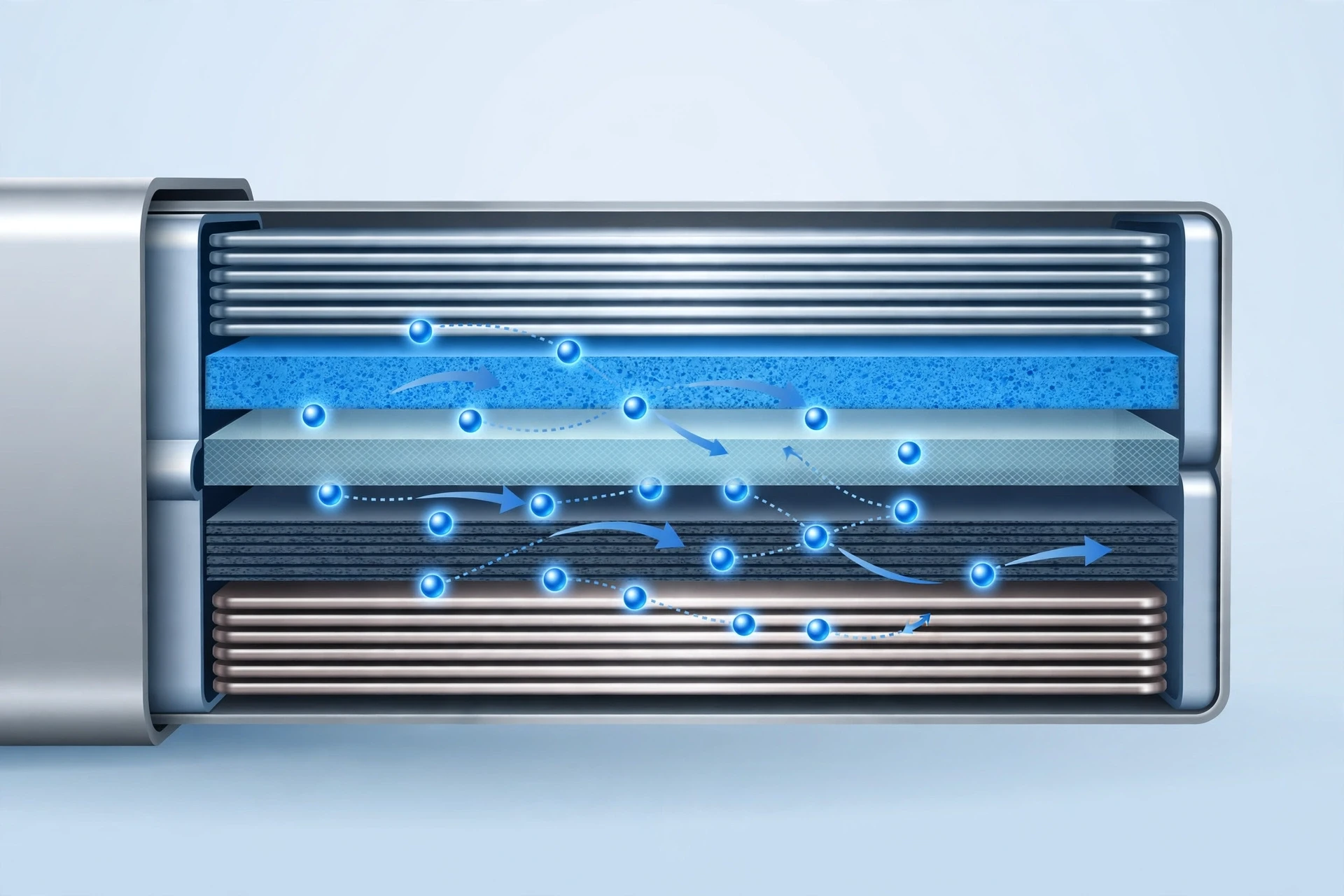
The United States Department of Energy explains how batteries store and release energy through these electron-transfer reactions, and its overview is a clear starting point for readers who want the engineering detail behind the chemistry.
11.2 Redox reactions around the house
Redox reactions are at work in ordinary household chemistry. Bleach, usually sodium hypochlorite solution, is an oxidizing agent: it kills germs and removes stains by oxidizing the molecules in them. That is why bleach fades coloured clothes — it oxidizes the dye molecules and breaks the structures that give them colour. It is also why bleach should never be mixed with other cleaners: mixing it with an acid releases chlorine gas, and mixing it with ammonia releases toxic chloramines. Both are redox reactions running out of control.

Hydrogen peroxide is another household redox chemical. It can act as an oxidizing agent, which is why it is used to disinfect small cuts and to bleach hair. It can also act as a reducing agent in some reactions, which is a reminder that "oxidizing agent" and "reducing agent" are roles a substance plays in a particular reaction, not permanent labels.
Even cooking involves redox reactions. Browning bread in a toaster, searing meat in a pan, and the darkening of a cut apple are all oxidation processes, some of them wanted and some not. Lemon juice slows the browning of a cut apple because its vitamin C is a reducing agent that is oxidized first, protecting the apple's own molecules. A squeeze of lemon is sacrificial protection, on a plate.
11.3 Redox reactions in industry
Industry runs on redox reactions at enormous scale. Iron is extracted from its ore in a blast furnace, where carbon monoxide reduces iron(III) oxide to iron metal. Aluminium is extracted by electrolysis, where electricity drives a redox reaction that would not happen on its own. Chlorine and sodium hydroxide are made by electrolysing brine. Fertilizers, plastics, medicines, and fuels all depend on redox steps somewhere in their production.
Electrolysis is the reverse of a battery: electricity is put in to force a redox reaction that would not run by itself. That is how aluminium, which is too reactive to extract by heating with carbon, is produced from its ore. The energy cost is high, which is one reason aluminium recycling matters so much — recycling aluminium uses far less energy than making it from ore, because the redox work has already been done.
12. Common Mistakes and Misconceptions About Redox Reactions
Most people assume that oxidation always involves oxygen. The name suggests it, and the earliest examples all involved air. What the data actually shows is different: oxidation is electron loss, and it happens in many reactions with no oxygen at all. Sodium reacting with chlorine, hydrogen reacting with fluorine, and zinc reacting with copper ions are all redox reactions without a single oxygen atom in the equation. Keep OIL RIG in mind, not the name's history.
A second misconception is that a reducing agent is reduced. It is not — it is oxidized. The names describe what the agent does to the other substance, not what happens to the agent itself. Write the two columns from section 7 on a card until the inversion feels natural: oxidizing agent, reduced; reducing agent, oxidized.
A third misconception is that oxidation numbers are real charges. They are not. In carbon dioxide, carbon does not carry a real +4 charge. The oxidation number is a formal bookkeeping number that assumes the bonds are fully ionic. It is useful because changes in the number track electron movement, but it should never be quoted as a measured property of the atom.
A fourth misconception is that redox reactions are always fast and dramatic. Some are — explosions and fires are fast redox reactions. Others are slow: rust takes months, the tarnishing of silver takes weeks, and the corrosion of a buried pipeline takes years. Speed is a separate question from whether electrons move, and slow redox reactions can do as much damage as fast ones.
A fifth misconception is that balancing redox reactions is a matter of trial and error. It is not. The half-reaction method in section 6 is systematic, and it works for every redox equation, however complicated. If balancing by inspection is not working, split the reaction into halves. The halves will show you exactly where the electrons are.
Most people assume oxidation means adding oxygen. What we actually see, reaction after reaction, is simpler and broader: oxidation means losing electrons, and it happens wherever electrons move — with oxygen, without oxygen, in a flame, in a battery, and in every cell of your body.
13. Why Redox Reactions Matter
Redox reactions matter because they are how chemistry moves energy around. Every fire, every battery, every breath, and every green leaf runs on electron transfer. When you understand redox reactions, you understand the mechanism behind energy storage and release in chemistry, in technology, and in life.
They matter for practical reasons too. Rust costs money and endangers structures. Batteries decide how far an electric car can travel. Bleach and disinfectants keep hospitals safe. Fertilizers feed the world, and their production depends on redox steps. The extraction of metals, the treatment of wastewater, the brewing of beer, and the baking of bread all involve redox reactions somewhere in the chain.
They also matter for how you think about chemistry. Once you can assign oxidation numbers and split a reaction into half-reactions, a large part of chemistry becomes legible. Equations that looked like random shuffling of symbols turn into stories about electrons moving from one atom to another. That is a satisfying shift, and it is one of the reasons redox reactions are taught in every chemistry course in the world.
The gate at the end of my street is gone now, replaced by a new one. The new gate is galvanized, and it has not rusted in years. I do not know whether the person who chose it knew the redox chemistry behind galvanizing, but the chemistry works whether or not anyone notices it. That is the quiet power of redox reactions: they run the world, in plain sight, whether we watch them or not. Learning to see them is learning to see chemistry itself.
Frequently Asked Questions
What is oxidation and reduction?
Oxidation is the loss of electrons, and reduction is the gain of electrons. In a redox reaction, one species loses electrons and is oxidized, while another gains those electrons and is reduced. The two processes always happen together, because electrons lost by one species must be gained by another.
How do you assign oxidation numbers?
Assign oxidation numbers using the standard rules in order: elements are 0, single-atom ions equal their charge, fluorine is −1, oxygen is usually −2, hydrogen is usually +1, Group 1 metals are +1 and Group 2 metals are +2, and the numbers in a neutral compound sum to 0 while in a polyatomic ion they sum to the ion's charge. Solve for the unknown atom last, using the sum rule.
What is OIL RIG?
OIL RIG is a mnemonic for the definitions: Oxidation Is Loss, Reduction Is Gain. Oxidation is the loss of electrons; reduction is the gain of electrons. A similar mnemonic is LEO the lion says GER — Lose Electrons, Oxidation; Gain Electrons, Reduction. Either one works; pick one and use it consistently.
What is a reducing agent?
A reducing agent is a substance that causes another substance to be reduced by donating electrons to it. Because it gives electrons away, the reducing agent itself is oxidized in the process. In the reaction of zinc with copper ions, zinc is the reducing agent: it gives electrons to copper ions and is oxidized to zinc ions.
What is an oxidizing agent?
An oxidizing agent is a substance that causes another substance to be oxidized by accepting electrons from it. Because it gains electrons, the oxidizing agent itself is reduced in the process. Oxygen is the classic oxidizing agent in combustion, and copper ions are the oxidizing agent in the zinc–copper reaction.
Is rusting a redox reaction?
Yes. Rusting is a redox reaction in which iron is oxidized and oxygen is reduced. Iron atoms lose electrons to form iron ions, oxygen gains electrons in the presence of water, and the product is hydrated iron(III) oxide — rust. Rust is porous, so oxygen and water keep reaching fresh iron, and the reaction continues until the metal is gone.
How do you balance a redox reaction?
Split the reaction into two half-reactions, one for oxidation and one for reduction, to balance redox reactions. Balance each half for atoms other than oxygen and hydrogen, then balance oxygen with water, hydrogen with H+ ions, and charge with electrons. Multiply the halves so the electrons lost equal the electrons gained, add them together, and cancel anything that appears on both sides. In alkaline solution, add OH− ions to convert H+ into water. Always check that atoms and charge both balance in the final equation.
Sources
LibreTexts — Oxidation-Reduction Reactions — https://chem.libretexts.org/Bookshelves/Analytical_Chemistry/Supplemental_Modules_(Analytical_Chemistry)/Electrochemistry/Redox_Chemistry/Oxidation-Reduction_Reactions
LibreTexts — Oxidation States (Oxidation Numbers) — https://chem.libretexts.org/Bookshelves/Analytical_Chemistry/Supplemental_Modules_(Analytical_Chemistry)/Electrochemistry/Redox_Chemistry/Oxidation_States_(Oxidation_Numbers)
Royal Society of Chemistry — Oxidation and Reduction — https://edu.rsc.org/resources/oxidation-and-reduction/2027.article
Khan Academy — Oxidation and Reduction — https://www.khanacademy.org/science/ap-chemistry-beta/x2eef969c74e0d802:chemical-reactions/x2eef969c74e0d802:oxidation-reduction/v/oxidation-and-reduction
U.S. Department of Energy — DOE Explains… Batteries — https://www.energy.gov/science/doe-explainsbatteries
American Chemical Society — The Lead-Acid Battery — https://www.acs.org/education/whatischemistry/landmarks/lead-acid-battery.html
Nature — Electrochemistry — https://www.nature.com/subjects/electrochemistry
Chemical Reactions Explained: Types, Kinetics, and Everyday Examples — Sciory — https://www.sciory.com/blog/chemical-reactions-types-kinetics-examples
Photosynthesis Explained: Process & Equation — Sciory — https://www.sciory.com/blog/photosynthesis-process-explained
Atoms and Molecules Explained: Structure, Bonding, and States of Matter — Sciory — https://www.sciory.com/blog/atoms-molecules-explained