

1. The Night the Lights Went Out
The torch died halfway down the stairs. One moment it threw a clean white circle onto the steps, and the next it faded to a dull orange glow, then nothing. I shook it, the way everyone shakes a dying torch, and for two seconds the light came back, weaker than before. Then it went out for good.
That small failure is electrochemistry in action. Inside that torch, a chemical reaction had been quietly handing electrons to a wire, and the wire had been turning that flow into light. When the chemicals ran out, the light stopped. Nothing about the torch had broken. Its fuel was simply spent.
I keep that dead torch in a drawer, because it is a useful reminder. We live surrounded by electrochemistry, and most of the time we never notice it. The phone in your pocket, the car that starts on a cold morning, the pacemaker that keeps a heart beating in rhythm, the rust eating a garden gate — all of them run on the same basic trade: electrons move from one substance to another, and chemistry turns into electricity, or electricity turns back into chemistry.
Electrochemistry is the branch of chemistry that studies that trade. It asks a simple question with enormous consequences: what happens when a chemical reaction produces or consumes electrons, and how can we put that movement to work? The answer fills our homes, our hospitals, our cars and our power grids. This article follows that answer from the first crude battery to the lithium-ion cells in your pocket, and from the rust on a nail to the fuel cells that may one day power a city.
2. What Is Electrochemistry?
Electrochemistry is the study of chemical reactions that involve the transfer of electrons, and of the electrical energy those reactions can produce or consume. Put more plainly, it is chemistry with a wire attached. Where ordinary chemistry watches atoms swap partners and rearrange bonds, electrochemistry watches the electrons themselves — where they go, how many move, and how much energy their journey releases or demands.
Every chemical reaction moves electrons around in some sense. In electrochemistry, that movement is the whole point. The electrons are not just shuffled inside a molecule. They travel, through a wire or through a solution, from one place to another. That travel is an electric current, and a current can do work: it can light a bulb, spin a motor, or charge a phone.
Electrochemistry splits naturally into two directions. In one direction, a spontaneous chemical reaction produces electricity. That is what a battery does. In the other direction, electricity from outside drives a chemical reaction that would not happen on its own. That is what happens when you recharge a battery, electroplate a piece of jewellery, or split water into hydrogen and oxygen. Both directions use the same rules. Only the direction of the energy flow changes.
I first met electrochemistry properly in a school laboratory, in a lesson that looked too simple to matter. My teacher put a strip of zinc into a beaker of blue copper sulfate solution. Nothing dramatic happened at first. Then, slowly, the blue colour faded, and a reddish coating formed on the zinc. The teacher said nothing for a full minute and let us watch. Then she asked: where had the copper gone? It had not vanished. It had taken electrons from the zinc and turned back into solid copper metal, plating itself onto the strip. The zinc, meanwhile, had dissolved. That quiet swap — invisible electrons changing hands — was the first electrochemical reaction I ever saw, and it stayed with me because nothing had been plugged in, heated, or stirred. The chemistry had done the work on its own.
Electrochemistry matters because it is the bridge between two worlds that students often meet separately: the world of chemical reactions, and the world of electric circuits. A chemical reaction stores energy in bonds. An electric circuit moves energy as a flow of charge. Electrochemistry is where one becomes the other. Without it, we would have no portable power at all. Every battery, every fuel cell, every electroplating bath and every corrosion problem is an electrochemical system, whether we call it that or not.
To understand the rest of this article, you need only one idea from this section: electrons move because one substance wants them more than another. That difference in appetite is the engine of electrochemistry. Everything else — cells, electrodes, voltages, charging cycles — is a way of arranging, measuring, and using that appetite.
3. Redox Reactions: The Electron Trade at the Heart of Electrochemistry
Before we can talk about batteries, we need the language of the electron trade. Chemists call it redox, short for reduction-oxidation. A redox reaction is any reaction in which electrons move from one substance to another. One substance loses electrons. Another gains them. The two halves always happen together, because electrons cannot simply disappear.
Oxidation is the loss of electrons. Reduction is the gain of electrons. Students remember this with the mnemonic OIL RIG: Oxidation Is Loss, Reduction Is Gain. It sounds like a joke, and it is, but it works. Another memory aid, LEO the lion says GER — Lose Electrons Oxidation, Gain Electrons Reduction — says the same thing in a different voice. Pick whichever sticks. The chemistry is identical either way.
Take the zinc and copper reaction from the last section. Zinc metal gives up two electrons and becomes a zinc ion in solution. That is oxidation: Zn becomes Zn²⁺ plus two electrons. A copper ion in solution takes those two electrons and becomes solid copper metal. That is reduction: Cu²⁺ plus two electrons becomes Cu. Neither half can happen alone. The zinc cannot lose electrons unless something is there to take them, and the copper ion cannot gain electrons unless something is there to give them. Together they make a complete redox reaction.
Here is a point worth pausing on, because it trips up a surprising number of students. Oxidation does not need oxygen. The name is a historical accident: early chemists first noticed these reactions when substances combined with oxygen, and the name stuck. Today oxidation means electron loss, full stop. A piece of sodium burning in chlorine gas is oxidised even though no oxygen is present. A metal rusting is oxidised. A battery discharging is full of oxidation and reduction, and no oxygen need be involved at all.
Oxidation numbers are the bookkeeping system chemists use to track this trade. An oxidation number is a number assigned to an atom that tells you, in effect, how many electrons it has gained or lost relative to its neutral state. When the number goes up, the atom has been oxidised. When it goes down, it has been reduced. The numbers are a fiction in one sense — electrons in a real bond are shared, not fully transferred — but they are a wonderfully useful fiction. They let you balance a complicated reaction and spot, at a glance, which substance is the oxidising agent (the one that takes electrons and causes oxidation) and which is the reducing agent (the one that gives electrons and causes reduction).

Redox reactions are not confined to batteries. They are everywhere. Burning wood is redox. Respiration — the way your cells extract energy from food — is a long, carefully controlled chain of redox reactions. Photosynthesis runs redox in reverse, using sunlight to push electrons uphill. Rust is redox. Bleach cleaning a stain is redox. Once you learn to see the electron trade, you start seeing it in every corner of chemistry. Electrochemistry is simply the branch that builds devices around it: devices that let the electron trade happen through a wire, where we can catch the current and use it.
That distinction matters. In the zinc and copper beaker, the electrons jump directly from zinc to copper ion at the metal surface. The energy is released as heat, and nobody can use it to light a bulb. In a battery, the two halves are separated. The electrons are forced to travel through an external wire to get from the zinc to the copper, and on that journey they pass through whatever device we connect. Same chemistry, different plumbing — and the plumbing is what turns a beaker into a power source.
For a clear, worked introduction to oxidation numbers and redox half-reactions, the LibreTexts electrochemistry chapter walks through the same zinc–copper system step by step. If you want to connect this to the wider world of reactions, Sciory's article on chemical reactions covers reaction types and kinetics, including the redox family.
4. How Do Batteries Work?
A battery is a device that turns chemical energy into electrical energy through a controlled redox reaction. That sentence is the whole answer, and the rest of this section unpacks it. A battery does not store electricity the way a bucket stores water. It stores chemicals that are ready to react, and it stores them in a separated state, so that when you connect a circuit, the reaction runs and the electrons are forced to travel through your device on their way from one chemical to the other.
Think of it like a hill with a ball at the top. The ball has gravitational potential energy because of where it sits. Let it go, and it rolls down, and you can use that motion to do work. A battery is similar, except the "hill" is a difference in electron appetite between two materials, and the "ball" is a crowd of electrons waiting to roll downhill from one electrode to the other. The wire is the slope. Your phone, torch, or motor sits on that slope and takes energy from the passing electrons.
Every battery has the same basic parts. Two electrodes — one where oxidation happens (the anode) and one where reduction happens (the cathode) — sit in or next to an electrolyte, a substance that lets ions move but does not let electrons pass directly. A separator keeps the electrodes from touching and short-circuiting. The outside of the battery has two terminals, positive and negative, which connect to the external circuit. When the circuit is closed, electrons leave the anode, travel through the wire and the device, and arrive at the cathode. Ions move through the electrolyte inside the battery to balance the charge. The two flows — electrons outside, ions inside — complete the loop.
That last detail is easy to miss and important to get right. A battery is not just a pump that pushes electrons around a wire. The circuit inside the battery is completed by ions, not electrons. If the ions could not move, charge would build up, the reaction would stop within a fraction of a second, and the battery would be useless. The electrolyte is what makes sustained current possible. It is the quiet partner in every battery, and a great deal of modern battery research is really electrolyte research: finding liquids or solids that let ions move fast, safely, and for thousands of cycles.
Most people assume a battery is a single thing, a sealed unit that either works or does not. What we actually see when we open one up — carefully, in a lab, never at home — is a carefully arranged chemical system with parts that each do a distinct job. The anode gives up electrons. The cathode accepts them. The electrolyte carries ions. The separator prevents a short circuit. The casing keeps everything contained and safe. Change any one of those parts and you change what the battery can do: how much voltage it gives, how much energy it stores, how fast it can deliver that energy, and how many times it can be recharged.
The voltage of a battery comes from the chemistry of its electrodes. A single zinc–carbon cell gives about 1.5 volts. A single lithium-ion cell gives about 3.7 volts. Connect cells in series — positive to negative, like a chain — and the voltages add up. That is why a 9-volt battery is really six small 1.5-volt cells in a single package, and why an electric car battery pack contains hundreds or thousands of cells wired together. The chemistry sets the voltage of one cell. The wiring sets the voltage of the pack.
The capacity of a battery — how long it lasts — comes from how much reactive material is inside. More material means more electrons to trade, which means more total charge. That is why a big car battery outlasts a small watch battery even though both might give a similar voltage. Capacity is usually measured in amp-hours or milliamp-hours: a 3,000 milliamp-hour phone battery can, in principle, deliver 3,000 milliamps for one hour, or 300 milliamps for ten hours, or any equivalent combination. Real life is messier — cold weather, old age, and high drain all cut into the total — but the idea holds: capacity is the size of the chemical fuel tank.
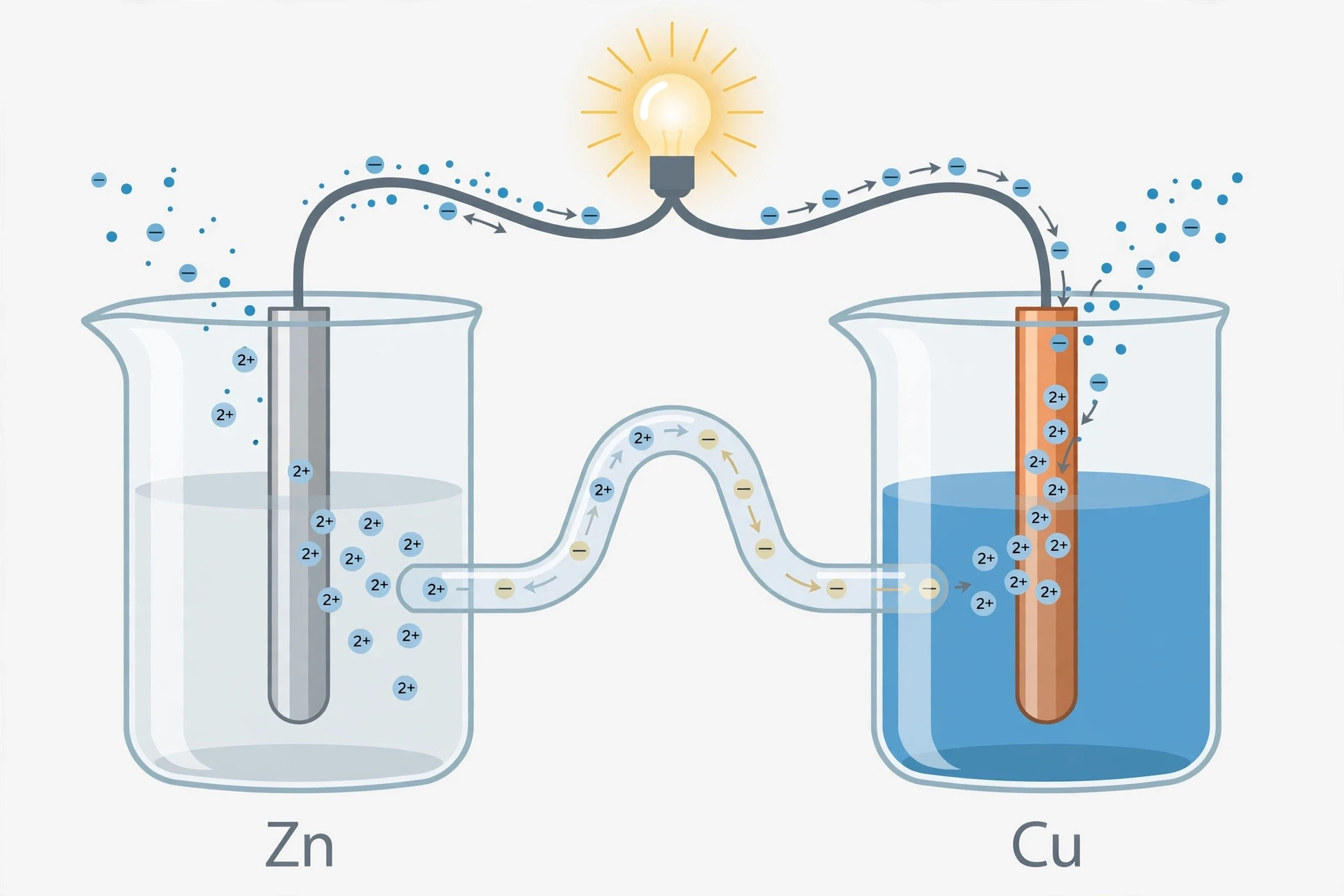
4.1 What happens inside when you switch something on
Close the circuit, and the reaction starts at once. At the anode, atoms give up electrons and enter the electrolyte as ions. Those electrons surge into the wire. They do not travel at anything like the speed of light as individual particles — the drift of individual electrons is actually slow — but the electrical signal propagates quickly, and the device feels the current immediately. At the cathode, ions from the electrolyte take up the arriving electrons and are transformed: plated out as metal, changed into a new compound, or tucked into the structure of the electrode material.
As the reaction proceeds, the anode is consumed and the cathode changes. In a zinc–copper cell, the zinc strip gets thinner and the copper strip gets thicker. In a disposable alkaline battery, the zinc powder inside is gradually converted to zinc oxide, and the manganese dioxide at the cathode is gradually reduced. The battery is, in a very literal sense, eating itself to power your device. When the reactive material is used up, the reaction stops, the voltage collapses, and the battery is dead. That is the whole story of why batteries run out, and section 7 will take it apart in detail.
If the physics of current and circuits feels unfamiliar, Sciory's fundamentals of electricity explains voltage, current, and resistance from the ground up. Electrochemistry builds directly on those ideas: voltage is the push, current is the flow, and the chemical reaction is the source of the push.
5. What Is a Galvanic Cell?
A galvanic cell — also called a voltaic cell — is a device that uses a spontaneous redox reaction to produce electricity. The name honours Luigi Galvani, the Italian physician whose experiments with frog legs and metal probes in the 1780s suggested that animal tissue could produce electricity, and Alessandro Volta, who showed a few years later that the electricity came from the metals themselves, not from the frog. The argument between them is one of the great stories in science: Galvani thought he had found "animal electricity", Volta thought the metals were the source, and Volta was right — but Galvani's wrong idea led directly to the first battery.
Volta's invention, announced in 1800, was the voltaic pile: a stack of alternating zinc and copper discs separated by cloth soaked in brine. Each pair of discs was a tiny cell. Stack them, and the voltages added up. Volta had built the first device that could deliver a steady electric current, and within months scientists across Europe were using piles to decompose water, to produce sparks, and to explore a brand new field. Before the pile, electricity meant static shocks and Leyden jars — brief, violent discharges. After the pile, electricity was a continuous flow that could be studied, measured, and put to work. Electrochemistry began, in a real sense, the day Volta stacked his discs.
The Daniell cell, invented by John Frederic Daniell in 1836, was the first practical improvement. Volta's pile had a flaw: hydrogen bubbles formed on the copper and choked the current, so the pile faded quickly. Daniell solved this by separating the two half-reactions into two beakers — zinc in zinc sulfate, copper in copper sulfate — joined by a salt bridge. The salt bridge let ions flow between the beakers while keeping the solutions from mixing. The Daniell cell gave a steady 1.1 volts for hours, and it became the standard power source for early telegraph networks. The American Chemical Society's account of the Daniell cell describes how it powered the telegraph and why its steady voltage mattered so much to the first long-distance communication networks.

A modern galvanic cell works on exactly the same principle as Daniell's, with better materials. It has two half-cells. In each half-cell, an electrode sits in an electrolyte containing ions of the same metal. The two half-cells are connected by a salt bridge or a porous separator that lets ions pass, and by an external wire that lets electrons pass. Oxidation happens at the anode, reduction at the cathode, electrons flow through the wire, ions flow through the bridge, and the device in the wire receives power. The OpenStax chapter on galvanic cells works through this arrangement with clear diagrams and the standard cell notation chemists use to write it down.
The voltage a galvanic cell produces is called its cell potential, measured in volts. It is the difference between the reduction potentials of the two half-reactions. You can look those potentials up in a table, subtract one from the other, and predict the voltage before you build the cell. When the predicted voltage is positive, the reaction is spontaneous and the cell works. When it is negative, the reaction will not run on its own — you would need to push electricity in from outside, which is exactly what an electrolytic cell does, as section 8 explains.
I once built a Daniell cell in a teaching lab with a group of students who were convinced it would not work. They had read about it, they had seen the diagram, but a beaker of blue liquid and a strip of grey metal did not look like a power source. We connected a small motor, and the propeller spun. The room went quiet for a moment, and then someone said, "It is actually doing something." That is the moment electrochemistry stops being a diagram and becomes real: a chemical reaction, visible as fading blue colour and growing copper, turning a motor that you can hear. I have seen that moment many times since, and it never gets old.
6. Inside a Lithium-Ion Battery
If the Daniell cell is the ancestor, the lithium-ion battery is the current champion. It powers phones, laptops, electric cars, and grid storage systems, and it won the 2019 Nobel Prize in Chemistry for the scientists who developed it — John Goodenough, Stanley Whittingham, and Akira Yoshino. The Nobel committee's summary of the 2019 chemistry prize explains why: lithium-ion batteries made the portable electronics revolution and the electric car possible, because they store more energy per kilogram than any practical rechargeable chemistry before them.
A lithium-ion cell has four main parts: a positive electrode (the cathode, usually a lithium metal oxide such as lithium cobalt oxide), a negative electrode (the anode, usually graphite), a separator, and an electrolyte (a lithium salt dissolved in an organic solvent). The name is a clue to how it works: lithium ions shuttle back and forth between the two electrodes. When the battery discharges, lithium ions move from the graphite anode through the electrolyte to the cathode, and electrons flow through the external circuit to meet them. When it charges, the process reverses: an external voltage pushes the lithium ions back into the graphite, ready for the next discharge.
That shuttling is why lithium-ion batteries are sometimes called rocking-chair batteries. The lithium ions rock back and forth between the two electrodes, and nothing is consumed in the ideal case. In a zinc–copper cell, the zinc is eaten away and the copper grows. In a lithium-ion cell, the electrodes are more like hotels: lithium ions check in and check out, and the hotel itself stays standing. That is a large part of why lithium-ion batteries can be recharged hundreds or thousands of times. The structure survives the traffic.
The details matter, though, and they are where the engineering lives. The graphite anode is made of layered sheets of carbon, and lithium ions slip between the layers like books on a shelf. The cathode is a crystal lattice that can accept lithium ions into its gaps. The electrolyte must let lithium ions move quickly but must not react with the electrodes, and it must not catch fire — a real challenge, because the organic solvents used are flammable, and a damaged or overheated cell can enter thermal runaway, a self-heating chain reaction. Battery makers spend enormous effort on separators that shut down if the cell gets too hot, on battery management systems that watch every cell's voltage and temperature, and on packaging that contains a failure if one happens.
Why lithium, of all elements? Because lithium is the lightest metal, and it gives up its electron very easily. Light weight means more energy per kilogram. A strong drive to give up electrons means a high voltage. Those two facts together make lithium the natural choice for anything that must be light and powerful: a phone, a laptop, a car. The trade-off is that lithium is reactive, the materials are expensive, and mining lithium and cobalt raises serious environmental and ethical questions — questions the industry is still working through, and which section 15 returns to.
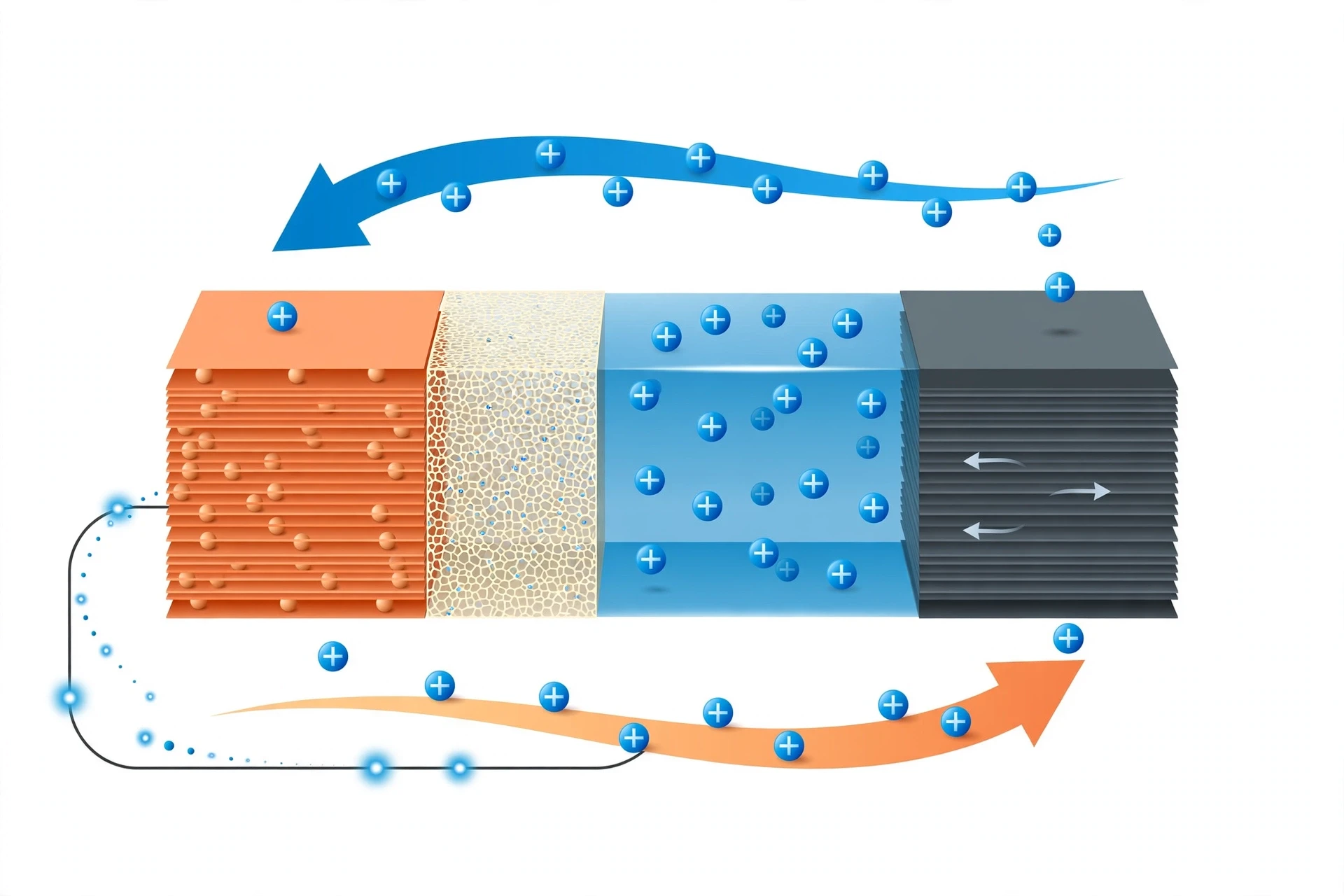
6.1 Charging, discharging, and the battery management system
Charging a lithium-ion battery is not just a matter of connecting it to a power supply. The charger must control the voltage and current carefully, in stages: a steady current first, then a steady voltage as the cell approaches full charge, tapering off at the end. Charge too fast, or push the voltage too high, and lithium metal can plate onto the anode instead of slipping between the graphite layers. That plating wastes capacity and can grow needle-like dendrites that pierce the separator and short the cell. Charge too slowly and nobody is happy either. The compromise is managed by the battery management system, a small computer that watches every cell, balances their charge, and stops the process if anything looks wrong.
That is also why your phone charges quickly to about 80 percent and then slows down. The last fifth of the charge is the delicate part, where the voltage is highest and the risk of damage is greatest. The phone is protecting its battery, and in doing so it is protecting you. Fast charging is a negotiation between speed and lifespan, and the battery management system is the negotiator.
7. Why Do Batteries Run Out?
A battery runs out when its reactive chemicals are used up, or when the materials inside have degraded so much that they can no longer carry the reaction properly. Those are two different kinds of "empty", and it helps to tell them apart.
In a disposable battery, the story is simple: the fuel is spent. An alkaline AA battery contains zinc powder and manganese dioxide. As it discharges, the zinc is oxidised to zinc oxide and the manganese dioxide is reduced. When the zinc is gone, or when the manganese dioxide has been reduced as far as it can go, the reaction stops. There is nothing left to trade electrons, so there is no current. You cannot refill it by plugging it in, because the reaction has gone too far: the products are stable, the structure has changed, and reversing it would take more than a charger can safely provide. Trying to recharge a disposable battery is not just useless; it can be dangerous, because the cell was never designed to take current in reverse.
In a rechargeable battery, running out is usually temporary. The chemicals are not consumed; they are transformed, and charging transforms them back. A flat phone battery still contains all its lithium — the ions have simply moved to the wrong electrode. Plug it in, and they move back. But rechargeable batteries also age, and ageing is permanent. Each cycle leaves a little damage behind: a thin layer called the solid electrolyte interphase grows on the anode and traps lithium ions, the cathode crystal cracks a little, the electrolyte slowly breaks down. After hundreds of cycles, enough lithium is trapped and enough material is damaged that the battery holds noticeably less charge than it did when new. That is why a three-year-old phone dies by mid-afternoon even though it worked fine when it was new. The electrochemistry inside has not vanished; it has simply degraded. The battery is not empty in the fuel sense. It is worn out.
Temperature speeds both kinds of failure. Cold slows the movement of ions through the electrolyte, so a battery delivers less current on a freezing morning — the chemistry is still there, but it cannot move fast enough. That is why a car can struggle to start in winter, and why a phone can shut down in the cold even with charge showing on the screen. Heat does the opposite damage: it speeds up the unwanted side reactions that age a battery, breaking down the electrolyte and growing the passivating layers that trap lithium. A battery kept hot ages faster, even if it is never used. The ideal life for most batteries is cool, dry, and partly charged — the boring middle ground that chemistry prefers.
Self-discharge is a third, quieter way batteries run out. Even with nothing connected, a battery slowly loses charge because tiny side reactions happen inside it all the time. An alkaline battery loses only a few percent of its charge per year, which is why the ones in a drawer still work after months. A rechargeable nickel-metal hydride battery loses charge much faster, which is why a rechargeable torch left in a drawer for a year can be flat when you need it. Lithium-ion batteries self-discharge slowly, a few percent per month, which is one more reason they dominate portable electronics.
A battery does not store electricity. It stores chemicals that are ready to react, and it stores them apart, so that the reaction can only complete itself through your device.
That sentence is worth memorising, because it clears up half the confusion people have about batteries. A dead battery is not an empty tank in the electrical sense. It is a chemical system that has reached equilibrium — a state where the forward reaction has run as far as it can, and nothing more can be gained without putting energy back in. Recharging is the act of pushing the system away from equilibrium again, storing energy in the separated chemicals, ready for the next discharge.
8. Galvanic vs Electrolytic Cells: The Same Chemistry in Reverse
Galvanic and electrolytic cells are mirror images. A galvanic cell uses a spontaneous chemical reaction to produce electricity. An electrolytic cell uses electricity from outside to drive a non-spontaneous chemical reaction. The hardware looks similar — two electrodes, an electrolyte, a power connection — but the energy flows in opposite directions, and the signs of the electrodes reverse.
This is the single most tested distinction in electrochemistry, and the single most confused one, so it is worth a table.
Feature | Galvanic cell | Electrolytic cell |
|---|---|---|
Energy flow | Chemical energy becomes electrical energy | Electrical energy becomes chemical energy |
Reaction | Spontaneous | Non-spontaneous, driven by an outside power source |
Anode | Negative terminal; oxidation happens here | Positive terminal; oxidation happens here |
Cathode | Positive terminal; reduction happens here | Negative terminal; reduction happens here |
Cell potential | Positive | Negative (energy must be supplied) |
Examples | Batteries, fuel cells | Recharging a battery, electroplating, splitting water |
Notice what stays the same across both columns: oxidation always happens at the anode, and reduction always happens at the cathode. That rule never changes. What changes is which terminal is positive and which is negative. In a galvanic cell, the anode is negative because it is the source of electrons. In an electrolytic cell, the anode is positive because it is connected to the positive terminal of the power supply, which pulls electrons away from it. Students who memorise "anode is negative" without the context will get half the questions wrong. Students who memorise "oxidation at the anode" will get them all right.
An electrolytic cell needs a power supply because it is doing something the chemicals would not do on their own. Splitting water into hydrogen and oxygen is the classic example. Water is stable. It does not fall apart by itself. But pass a current through it, with the right electrodes and a little electrolyte to help conduction, and hydrogen bubbles form at the cathode while oxygen bubbles form at the anode. You have spent electrical energy and stored it as chemical energy in the hydrogen and oxygen. That stored energy can later be released in a fuel cell, which is a galvanic cell running the same reaction in reverse. The pair — electrolyser and fuel cell — is a complete energy storage loop, and it is one of the ideas behind the hydrogen economy discussed in section 11.
The OpenStax chapter on electrolysis works through the water-splitting example and the quantitative side — how the amount of product depends on the current and the time — with the same clarity it brings to galvanic cells.
Oxidation always happens at the anode, and reduction always happens at the cathode. The terminal signs change when you switch from a galvanic to an electrolytic cell. That one rule never changes.
9. Electrolysis in Real Life: Plating, Purifying, and Splitting
Electrolysis is electrochemistry with a power supply, and it is one of the most useful industrial processes in the world. It does three big jobs: it coats things, it purifies metals, and it splits compounds into their elements. Each job uses the same principle — electricity driving a non-spontaneous reaction — and each one is worth understanding on its own.
Electroplating is the most visible of the three. A piece of jewellery, a car bumper, a tap in a bathroom: many of the shiny metal surfaces in daily life are thin layers of one metal electroplated onto another. The object to be plated is made the cathode in an electrolytic cell, and the plating metal is the anode, or the solution contains ions of the plating metal. Pass a current, and metal ions in the solution gain electrons at the cathode and plate out as a smooth, even layer. The thickness of the layer depends on the current and the time, which means it can be controlled precisely — a few micrometres for a decorative finish, more for a hard-wearing one. Chrome plating, gold plating, silver plating, and the zinc coating on galvanised steel all work this way.
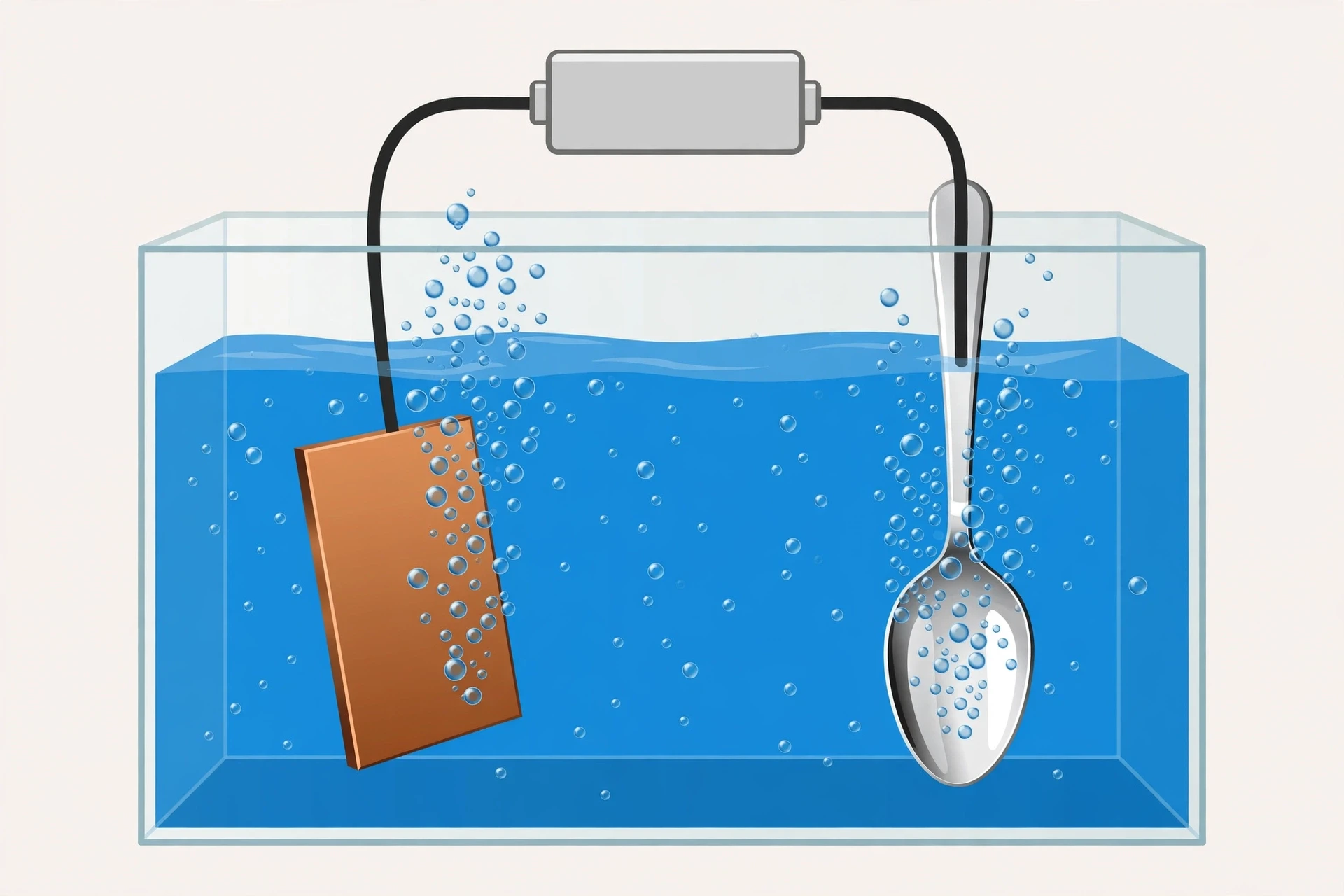
Electrorefining is the quiet industrial cousin of electroplating. Copper mined from the ground is impure, and impure copper conducts electricity poorly — a serious problem when copper's main job is carrying current. In electrorefining, impure copper is made the anode in a cell containing copper sulfate solution, and pure copper plates out on the cathode. The impurities fall to the bottom as a sludge, which is itself valuable: it often contains silver, gold, and platinum. The result is copper pure enough for wiring, and a useful by-product stream. Nearly all the copper in the world's wiring has been through this process.
The third job is splitting compounds. Aluminium is the classic case. Aluminium ore is aluminium oxide, a very stable compound, and aluminium metal is so reactive that it cannot be extracted by heating with carbon the way iron can. The industrial solution, the Hall–Héroult process, dissolves aluminium oxide in molten cryolite and passes a huge current through it. Aluminium ions gain electrons at the cathode and form liquid aluminium metal, which sinks to the bottom and is tapped off. The process uses enormous amounts of electricity — aluminium smelting is one of the largest industrial users of power in the world — which is why smelters are usually built near cheap hydroelectric power. Every aluminium can you have ever held was made this way, by electrolysis.
Water splitting is the same idea applied to the simplest compound of all. Pass a current through water with a little electrolyte, and hydrogen forms at the cathode and oxygen at the anode, in a two-to-one ratio by volume. The hydrogen can be stored and later burned or run through a fuel cell. The attraction is obvious: if the electricity comes from wind or solar power, the hydrogen is a clean fuel with no carbon in it at all. The difficulty is cost and efficiency: splitting water takes a lot of energy, and the catalysts that make it efficient — often platinum or iridium — are expensive. Research into cheaper catalysts is one of the liveliest areas in electrochemistry today.
10. Corrosion: Electrochemistry You Did Not Ask For
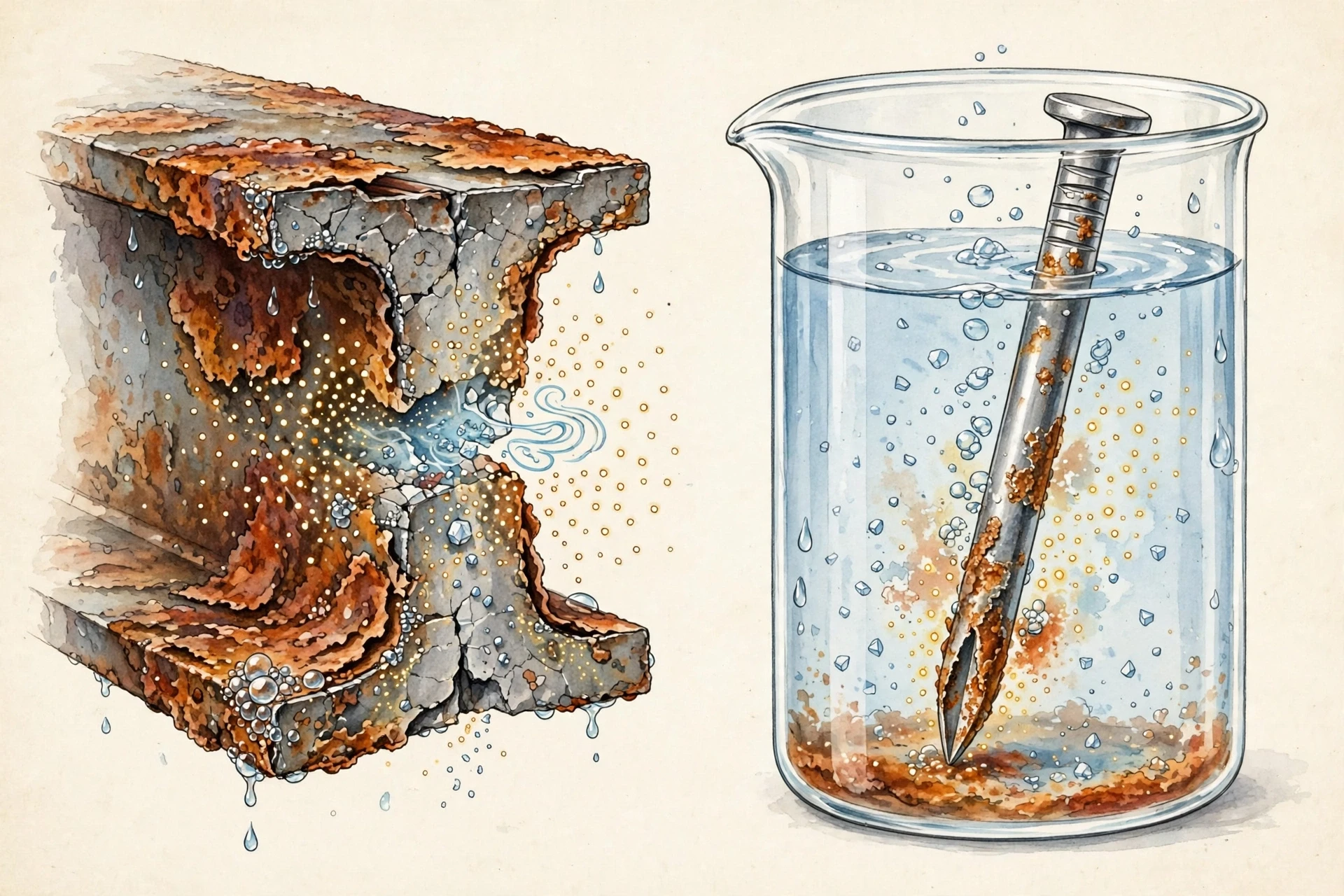
Rust is electrochemistry, and it is the most expensive kind. Corrosion costs economies vast sums every year in repairs, replacements, and lost service — bridges, ships, pipelines, cars, and buildings all suffer from it. And it is, at heart, a tiny galvanic cell running where nobody wants one.
Take an iron nail in salty water. Different parts of the nail's surface act as anode and cathode, because the surface is never perfectly uniform. At the anodic spots, iron atoms lose electrons and dissolve as iron ions. The electrons travel through the metal to cathodic spots, where oxygen dissolved in the water takes them up. The iron ions react with oxygen and water to form rust — hydrated iron oxide, a flaky orange-brown solid that does not protect the metal underneath. Unlike the thin oxide layer on aluminium, which seals the surface, rust is porous and crumbly. It lets water and oxygen through, so the corrosion continues underneath, eating deeper into the metal. That is why rust is so destructive: it does not stop itself.
Salt makes it worse, which is why cars rust faster near the sea and why road salt in winter is a mixed blessing. Salt water conducts electricity better than fresh water, so the tiny galvanic cells on the metal surface can run faster. Salt also helps break down any protective layers. The same chemistry explains why a scratch through paint is so dangerous: the scratch exposes bare metal, the surrounding painted area becomes the cathode, and the tiny exposed spot becomes the anode, corroding fast because all the attack is concentrated in one small place.
10.1 How we fight back
There are three main ways to fight corrosion, and all three are electrochemical. The first is to paint or coat the metal, keeping water and oxygen away from the surface. A coating works only as long as it is intact, which is why a scratched coating can be worse than none at all in the wrong place — but a good coating, maintained, is the simplest defence.
The second is to use a more reactive metal as a sacrificial anode. Bolt a block of zinc to a steel ship's hull, and the zinc corrodes instead of the steel, because zinc gives up electrons more easily than iron does. The zinc is sacrificed, slowly, to protect the steel. When the zinc is used up, it is replaced. The same idea protects underground pipelines and the steel in reinforced concrete. It is a galvanic cell run deliberately, with the cheap metal as the victim and the expensive structure as the protected cathode.
The third is to make the metal itself resistant. Stainless steel contains chromium, which forms a thin, tough oxide layer that seals the surface and repairs itself if scratched. Galvanised steel is coated with zinc, which protects in two ways at once: as a physical barrier, and as a sacrificial anode if the coating is breached. Aluminium protects itself with its own oxide layer, which is why an aluminium window frame can last for decades outdoors with no paint at all.
11. Fuel Cells and the Hydrogen Question
A fuel cell is a galvanic cell that never runs out — as long as you keep feeding it fuel. It takes a fuel, usually hydrogen, and an oxidant, usually oxygen from the air, and turns them directly into electricity and water, without burning anything. The chemistry is the same reaction as burning hydrogen, but the electrons are routed through an external circuit instead of being released as heat and light. The result is electricity, water, and nothing else — a neat piece of electrochemistry with no smoke and no moving parts. No smoke, no carbon dioxide, no moving parts.
The inside of a hydrogen fuel cell is elegant. Hydrogen gas enters at the anode, where a catalyst — usually platinum — splits each molecule into protons and electrons. The protons pass through a special membrane, the proton exchange membrane, which lets protons through but blocks electrons. The electrons, unable to follow, take the long way around, through the external circuit, where they do useful work. At the cathode, the electrons, the protons, and oxygen from the air meet and form water. The membrane is the key: it separates the charges, forces the electrons around the outside, and keeps the gases apart.
Fuel cells have been around for a long time. The first practical one was built by Francis Bacon in the 1950s, and fuel cells powered the Apollo spacecraft, providing both electricity and drinking water for the astronauts. They have never quite taken over the world, though, and the reasons are instructive. Hydrogen is hard to store — it is the lightest gas, it leaks through tiny gaps, and it needs either very high pressure or very low temperature to pack enough of it into a tank. The platinum catalyst is expensive. The membrane must stay wet to work, which complicates the design. And hydrogen itself must be made, usually from natural gas or by splitting water, which takes energy. A fuel cell is only as clean as the hydrogen that feeds it.
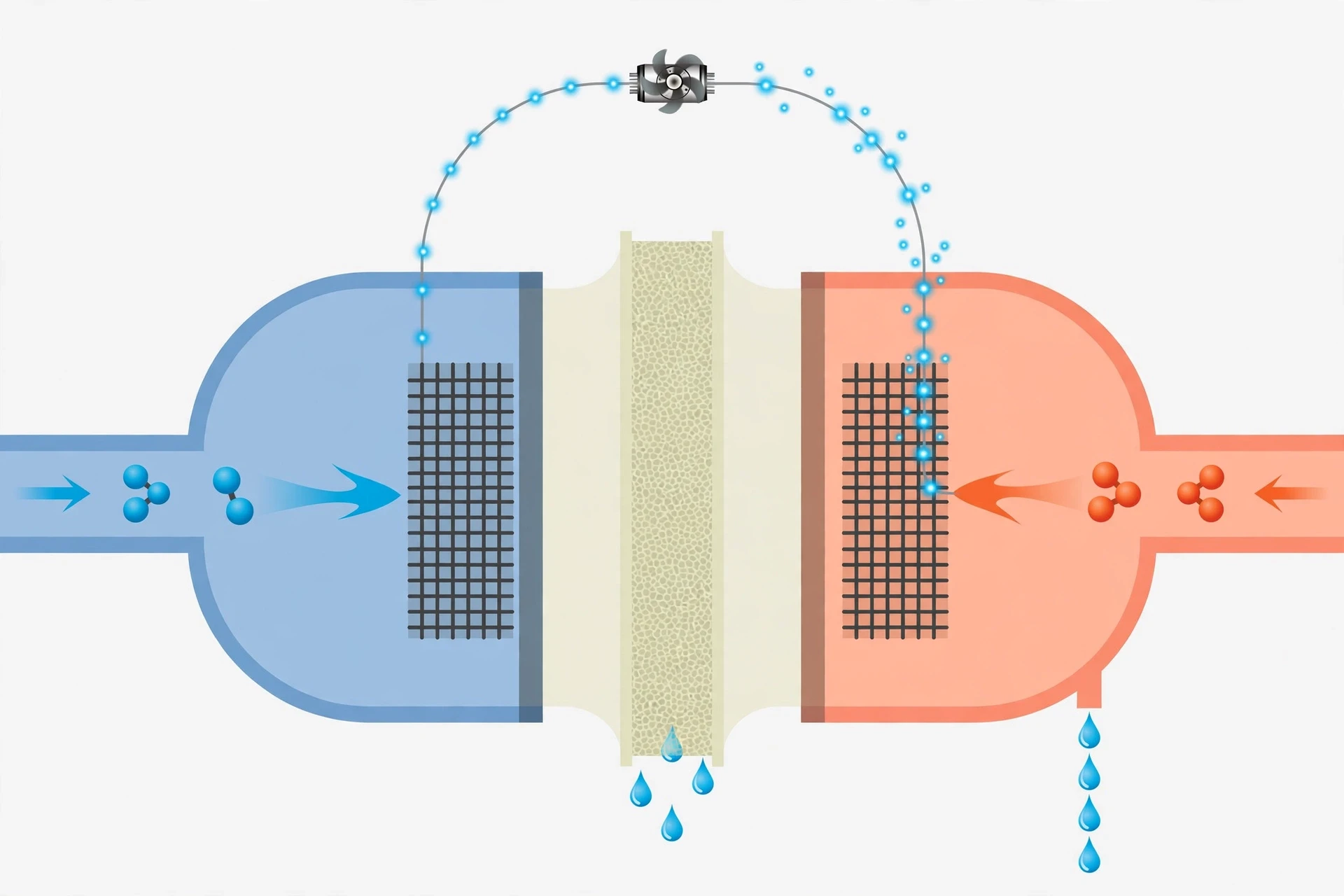
That last point is the heart of the hydrogen question. Hydrogen made from natural gas releases carbon dioxide, which defeats much of the purpose. Hydrogen made by splitting water with renewable electricity is clean, but it is expensive, and the round trip — electricity to hydrogen to electricity — loses energy at every step. A battery stores electricity directly and returns most of it. A hydrogen system stores it as a chemical fuel and returns less. For a car, the battery usually wins. For a ship, a plane, or a steel plant — places where batteries are too heavy or too slow to recharge — hydrogen may win instead. The honest answer is that both have a place, and the argument is not about which technology is better in general, but about which job each one fits.
12. Batteries That Power the World
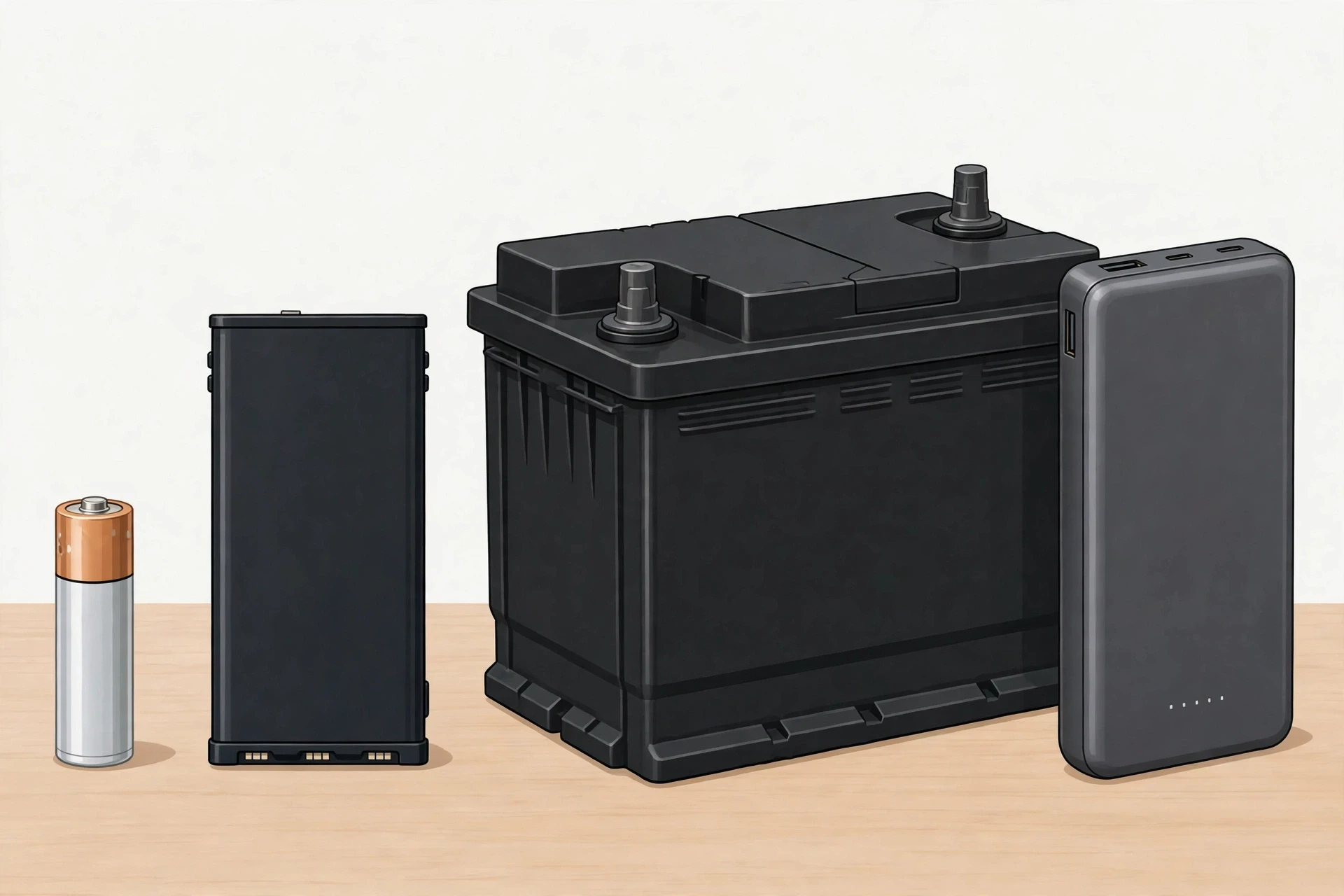
Not all batteries are the same, and choosing the right one is a matter of matching the chemistry to the job. A watch needs a tiny battery that lasts for years and never leaks. A phone needs a light battery that holds a lot of energy and recharges quickly. An electric car needs a huge battery that is safe, long-lived, and affordable. A power grid needs batteries that can store energy for hours and cycle thousands of times. No single chemistry does all of that well, which is why the world uses several.
Battery type | Typical voltage per cell | Rechargeable | Main uses |
|---|---|---|---|
Alkaline (zinc–manganese dioxide) | 1.5 V | No | Torches, remote controls, toys |
Lead-acid | 2.0 V | Yes | Car starting, backup power |
Nickel-metal hydride | 1.2 V | Yes | Rechargeable AA/AAA, older hybrid cars |
Lithium-ion | 3.7 V | Yes | Phones, laptops, electric cars, grid storage |
Lithium iron phosphate (LFP) | 3.2 V | Yes | Electric cars, home and grid storage |
Zinc–carbon | 1.5 V | No | Low-drain devices, clocks |
Lead-acid is the oldest rechargeable chemistry still in wide use, invented in 1859, and it survives because it is cheap, reliable, and almost completely recyclable. It is heavy, though, and it stores relatively little energy for its weight, which is why it starts cars — a short, powerful burst — rather than powering them for long distances. Nickel-metal hydride replaced nickel-cadmium in many uses because it avoids toxic cadmium, and it powered the first generation of hybrid cars. Lithium-ion, and its cousin lithium iron phosphate, now dominate wherever weight and energy density matter. LFP is slightly less energy-dense than other lithium-ion types, but it is cheaper, longer-lived, and safer, which is why it is increasingly the choice for electric cars and grid storage.
Electric cars are the most visible application of modern electrochemistry, and they show how far the field has come. An electric car battery pack is not one battery but hundreds or thousands of cells, grouped into modules, watched by a battery management system, cooled or heated to keep them in their happy temperature range, and protected by a strong casing. The pack stores enough energy to drive hundreds of kilometres, recharges in well under an hour at a fast charger, and is expected to last for years and hundreds of thousands of kilometres. That is an extraordinary achievement of electrochemistry and engineering together, and it is still improving: energy density rises, costs fall, and charging gets faster with each generation. The US Department of Energy's batteries pages explain how these packs are built and what researchers are working on next, and the Department's introduction to how batteries work is a clear, plain-language starting point for the whole topic. For the car around the battery, Sciory's article on how electric cars work covers motors, charging, and regenerative braking.
Grid storage is the quieter revolution. Wind and solar power are intermittent — the sun does not always shine, the wind does not always blow — and a grid that depends on them needs somewhere to put energy when it is plentiful and take it back when it is scarce. Large battery installations, built from the same lithium-ion cells as electric cars but packed into shipping-container-sized units, now do that job in many countries. They charge when electricity is cheap and plentiful, discharge when demand peaks, and respond in milliseconds — far faster than a gas turbine can start. They do not replace all other forms of storage, and they are not yet cheap enough to store energy for weeks or months, but for hours-long balancing they are already transforming how grids work.
13. Electrochemistry in Your Body and in Everyday Sensors
Electrochemistry is not only about power. It is also about measurement, and some of the most intimate uses of electrochemistry happen inside the human body — or just outside it, on the skin.
Your nerves run on electrochemistry. A nerve signal is not a flow of electrons through a wire. It is a wave of ions — sodium and potassium — moving across cell membranes, changing the voltage across the membrane as it goes. The resting voltage of a nerve cell is about minus 70 millivolts, maintained by pumps that push sodium out and potassium in. When the cell fires, channels open, sodium rushes in, the voltage flips, and the signal travels down the nerve. It is an electrochemical event, powered by the same principles as a battery: ions moving across a barrier, driven by differences in concentration and charge. The brain, in this sense, is an electrochemical machine, and every thought you have is, at some level, ions moving.
Medical sensors use the same science in a more deliberate way. A blood glucose meter — the device millions of people with diabetes use every day — is an electrochemical sensor. A drop of blood is placed on a test strip, and an enzyme on the strip reacts with the glucose, producing a small electric current. The meter measures that current and converts it into a glucose reading. The current is tiny, measured in microamps, but it is proportional to the glucose concentration, which makes it a reliable measurement. No blood test in a laboratory, no waiting: electrochemistry gives an answer in seconds
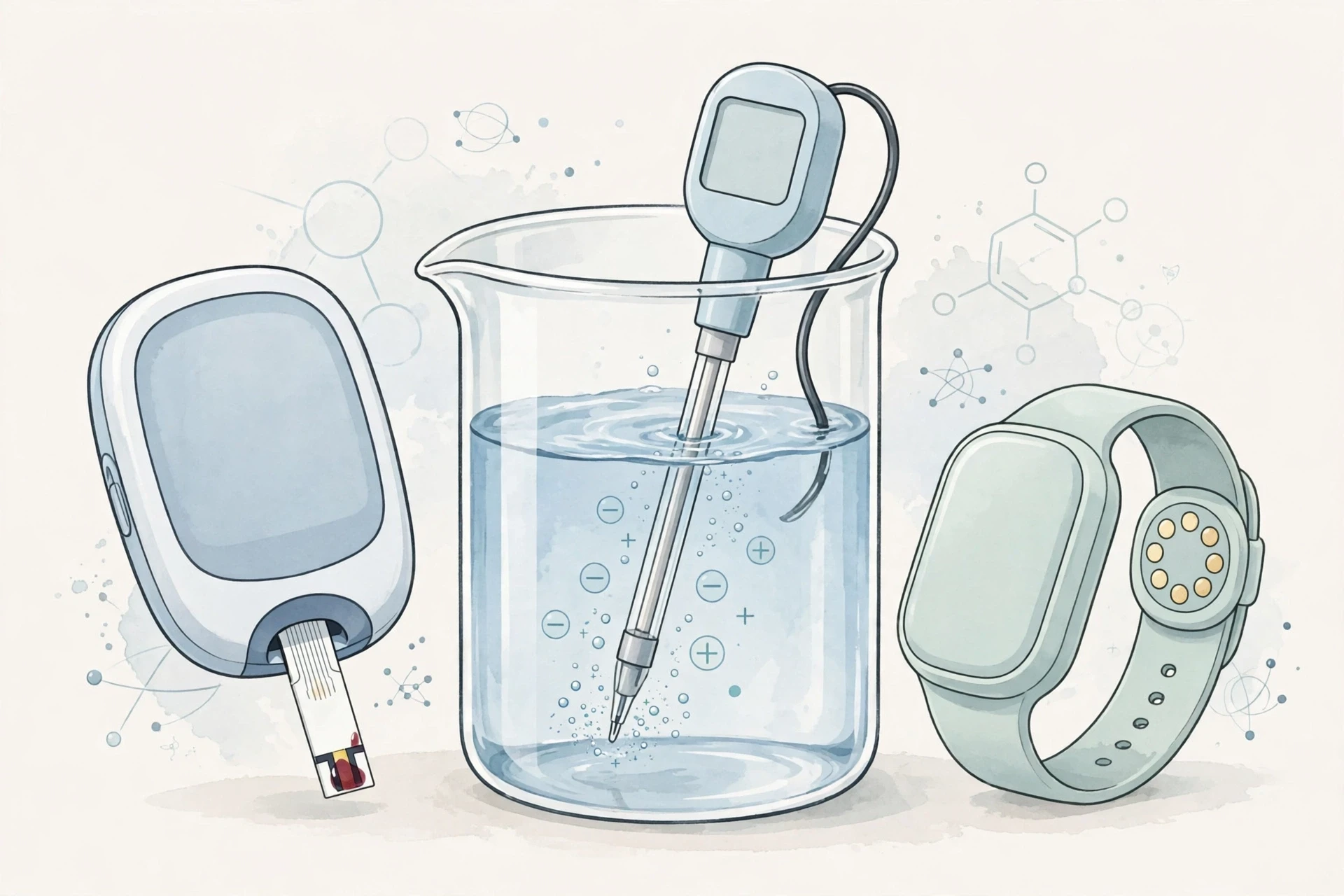
pH meters work the same way. A special glass electrode develops a voltage that depends on the concentration of hydrogen ions in the solution it touches. Measure the voltage, and you know the pH. That is how laboratories, breweries, swimming pools, and water treatment plants check acidity quickly and accurately. The glass looks ordinary, but its surface exchanges ions with the solution in a way that turns chemistry into a readable voltage. It is one of the oldest electrochemical sensors, and still one of the most useful.
I once watched a student use a pH meter for the first time and stare at the number as if it were magic. She had spent a week learning about acids and bases from a textbook, and the numbers had stayed abstract. Then she dipped the electrode into a glass of orange juice, watched the reading settle, and said, "It is actually measuring something." That is what a sensor does: it makes an invisible chemical fact visible as a number. Electrochemistry, at its best, is a way of listening to chemistry.
14. Common Mistakes and Misconceptions in Electrochemistry
Electrochemistry collects misconceptions the way a magnet collects iron filings. Here are the ones I meet most often, and what is actually true.
First, a battery does not store electricity. It stores chemicals. This is the misconception this whole article has been circling, and it is worth stating one last time, plainly: when you charge a battery, you are not pouring electricity into a container. You are using electricity to rebuild chemicals into a state that can later release electricity. The distinction matters because it explains why batteries have a limited capacity, why they age, and why they cannot be recharged forever.
Second, electrons do not flow through the electrolyte. They flow through the external wire. Ions flow through the electrolyte. Students who picture electrons swimming through the liquid inside a battery have the picture backwards, and the confusion spreads: they wonder why the battery does not short-circuit, and they cannot explain what the salt bridge does. Keep the two flows separate in your mind — electrons outside, ions inside — and the whole device makes sense.
Third, the anode is not always negative. Oxidation always happens at the anode, and that rule is absolute, but the sign of the anode depends on the cell. In a galvanic cell it is negative. In an electrolytic cell it is positive. Anyone who tells you otherwise has memorised half the rule. The same goes for the cathode: reduction always happens there, but its sign flips between the two kinds of cell.
Fourth, a bigger battery is not always a more powerful battery. Voltage and capacity are different things. A small lithium-ion cell and a large lead-acid battery can both deliver useful power, but for different reasons: one has high voltage and high energy density, the other has low cost and high current for short bursts. Matching the battery to the job matters more than picking the biggest one on the shelf.
Fifth, "dead" does not always mean empty. A battery can fail because its chemistry is spent, because it has aged, because it is too cold to deliver current, or because its internal resistance has risen. A phone that dies in the cold may work again when it warms up. A battery that shows charge but dies under load may be aged rather than empty. Diagnosis starts with asking which kind of failure you are looking at.
Most people assume that once a battery is flat, the chemistry inside is simply gone, as if a tank had run dry. What we actually see when we open up a worn-out rechargeable cell is something more interesting: the chemicals are still there, but they are trapped, damaged, or rearranged into forms that can no longer trade electrons freely. The battery has not run out of ingredients. It has run out of usable structure. That is a different kind of empty, and it is why recycling matters: the valuable materials are still inside, waiting to be recovered and rebuilt into a new battery.
15. What Comes Next: Solid-State, Sodium, and Recycling
The next decade of electrochemistry is likely to be defined by three words: solid-state, sodium, and recycling. Each one addresses a weakness of today's lithium-ion batteries, and each one is already moving from the laboratory toward the factory.
Solid-state batteries replace the liquid electrolyte with a solid one — a ceramic or a polymer that lets lithium ions move but cannot leak or catch fire. The promise is a safer battery that can use a lithium metal anode, which would store far more energy than graphite. The difficulty is the interface: solids do not meet each other as intimately as liquids do, and the contact between a solid electrolyte and an electrode can degrade with cycling. Tiny cracks, growing resistance, and dendrites that find their way through the solid are all active problems. Progress is real but slow, and the first solid-state batteries are likely to appear in small devices before they reach cars.
Sodium-ion batteries swap lithium for sodium, which is far more abundant and cheaper. Sodium is heavier than lithium and gives a lower voltage, so a sodium-ion battery stores less energy for the same weight. For a phone or a long-range car, that is a problem. For grid storage, where weight does not matter and cost does, it may be no problem at all. Sodium-ion batteries are already being built at scale for stationary storage, and they may become the workhorse of the grid while lithium keeps the portable and vehicle jobs.
Recycling is the third frontier, and it is the one that matters most for the long term. A lithium-ion battery contains lithium, cobalt, nickel, copper, and aluminium — valuable materials, mined at real environmental and human cost. Today, only a fraction of batteries are recycled, and the processes that exist are energy-intensive. Better recycling — processes that recover more material, more cleanly, and more cheaply — would reduce the need for new mining, cut costs, and make the whole battery economy more sustainable. It is electrochemistry in reverse, in a sense: taking a worn-out chemical system apart and recovering the ingredients for a new one.
16. The Current That Connects It All
We started with a torch dying on a staircase, and we end with a picture that is much larger than a torch. Electrochemistry is the science of the electron trade, and that trade powers the modern world. It lights our homes, starts our cars, runs our phones, and increasingly stores the energy of the wind and the sun. It also rusts our bridges, plates our jewellery, purifies our copper, and measures the sugar in a drop of blood. Electrochemistry is a science of opposites held together: oxidation and reduction, anode and cathode, charging and discharging, building up and breaking down.
The ideas in this article are not hard to hold onto, once you have them. Electrons move because one substance wants them more than another. Separate the two halves of the reaction, force the electrons through a wire, and you have a battery. Push electricity in from outside, and you can reverse the reaction, plate a metal, or split water. Let the reaction run where you do not want it, and you have corrosion. That is electrochemistry, in a paragraph.
What stays with me, after years of teaching and working with this science, is how physical it feels. You can watch a blue solution fade as copper plates out. You can feel a battery warm as it charges. You can hear a motor spin when a cell you built yourself closes its circuit. Electrochemistry is not an abstraction. It is chemistry you can see, hear, and hold in your hand — and once you have seen it work, the dead torch in the drawer stops looking like a failure. It looks like a small, spent chemical system that did its job, and is waiting, like every battery, to be understood rather than just replaced.
Frequently Asked Questions
How do batteries work?
A battery turns chemical energy into electrical energy through a controlled redox reaction. Inside the battery, one electrode gives up electrons (oxidation) and the other accepts them (reduction). The two halves are separated, so the electrons must travel through an external wire — through your device — to get from one side to the other. Ions move through the electrolyte inside the battery to complete the circuit. When the reactive chemicals are used up, the battery stops producing current.
What is a galvanic cell?
A galvanic cell, also called a voltaic cell, is a device that uses a spontaneous redox reaction to produce electricity. It has two half-cells, each with an electrode in an electrolyte, connected by a salt bridge that lets ions pass and by an external wire that lets electrons pass. Oxidation happens at the anode and reduction at the cathode. The classic example is the Daniell cell: zinc in zinc sulfate and copper in copper sulfate, giving about 1.1 volts. Every battery is, at heart, a galvanic cell or a set of them.
What is the difference between galvanic and electrolytic cells?
A galvanic cell uses a spontaneous chemical reaction to produce electricity, while an electrolytic cell uses electricity from outside to drive a non-spontaneous reaction. In both, oxidation happens at the anode and reduction at the cathode — that rule never changes. What changes is the sign of the electrodes: in a galvanic cell the anode is negative and the cathode is positive, while in an electrolytic cell the anode is positive and the cathode is negative. Batteries discharging are galvanic cells; batteries recharging, electroplating baths, and water-splitting cells are electrolytic cells.
Why do batteries run out?
A disposable battery runs out because its reactive chemicals are used up: the anode material is consumed and the cathode material is fully reduced, so the reaction stops. A rechargeable battery can run out temporarily when its chemicals have moved to the discharged state, and charging moves them back — but it also ages permanently, because each cycle traps a little lithium, cracks the electrodes slightly, and breaks down the electrolyte. Cold slows a battery down without emptying it, and self-discharge drains it slowly even when it is not being used.
Can you recharge a disposable battery?
No, you should not try. Disposable batteries such as alkaline cells are not designed to take current in reverse: their reactions produce stable products and their structures are not built to survive being rebuilt. Attempting to recharge one can cause leaking, overheating, or rupture. Only batteries labelled rechargeable — lithium-ion, nickel-metal hydride, lead-acid, and similar types — should ever be connected to a charger.
Why does my phone battery get worse over time?
A lithium-ion battery ages because each charge and discharge cycle leaves a little damage behind: a layer grows on the anode and traps lithium ions, the cathode crystal cracks slightly, and the electrolyte slowly breaks down. Heat and keeping the battery at 100 percent charge for long periods speed up that ageing. After hundreds of cycles, the battery holds noticeably less charge than when it was new, even though it still works. Keeping the battery cool and between roughly 20 and 80 percent charge slows the process down.
What is a fuel cell, and how is it different from a battery?
A fuel cell is a galvanic cell — a working piece of electrochemistry — that keeps producing electricity as long as it is supplied with fuel, usually hydrogen, and oxygen from the air. It turns hydrogen and oxygen directly into electricity and water, with no burning. A battery, by contrast, contains a fixed amount of reactive chemicals and runs out when they are used up; it must then be recharged or replaced. A fuel cell does not run out while fuel is supplied, but it needs a fuel supply, storage, and delivery system, which a battery does not.
Sources
LibreTexts — Electrochemistry (OpenStax Chemistry, Chapter 17): https://chem.libretexts.org/Bookshelves/General_Chemistry/Chemistry_1e_(OpenSTAX)/17%3A_Electrochemistry
OpenStax Chemistry 2e — Introduction to Electrochemistry: https://openstax.org/books/chemistry-2e/pages/17-introduction
OpenStax Chemistry 2e — Galvanic Cells: https://openstax.org/books/chemistry-2e/pages/17-2-galvanic-cells
OpenStax Chemistry 2e — Electrolysis: https://openstax.org/books/chemistry-2e/pages/17-7-electrolysis
American Chemical Society — The Daniell Cell: https://www.acs.org/education/whatischemistry/landmarks/daniell-cell.html
American Chemical Society ChemMatters — Batteries: https://www.acs.org/education/resources/highschool/chemmatters/past-issues/2015-2016/october-2015/batteries.html
US Department of Energy — Batteries for Electric Vehicles: https://www.energy.gov/eere/vehicles/batteries
US Department of Energy — DOE Explains Batteries: https://www.energy.gov/science/doe-explainsbatteries
Nobel Prize — The Nobel Prize in Chemistry 2019 (lithium-ion batteries): https://www.nobelprize.org/prizes/chemistry/2019/summary/
Fundamentals of Electricity — Sciory: https://www.sciory.com/blog/fundamentals-of-electricity
How Electric Cars Work — Sciory: https://www.sciory.com/blog/how-electric-cars-work
Chemical Reactions Explained — Sciory: https://www.sciory.com/blog/chemical-reactions-types-kinetics-examples