

1. The Spoonful That Disappeared
I was nine years old, standing on a chair in my grandmother's kitchen, stirring sugar into a glass of iced tea — my first, unknowing lesson in solutions and solubility. I watched the spoon go round and round, and the white crystals at the bottom got smaller and smaller until there was nothing left to see. I was convinced the sugar had vanished. I remember lifting the spoon, peering into the glass, and asking where it had gone. My grandmother laughed and told me to taste it. The tea was sweet. The sugar had not disappeared at all. It was still there, just spread out so finely through the water that my eyes could no longer find it.
That glass of tea was my first chemistry lesson — my first lesson in solutions and solubility — though nobody called it that. A solid had dissolved into a liquid, and the result was something new: a solution. Every cook, every nurse mixing an IV drip, every chemist in a laboratory, and every ocean on Earth works with the same idea. Solutions are everywhere, and once you learn to see them, you start noticing them in the most ordinary moments — the salt in soup, the fizz escaping a soda, the medicine dissolved in a spoonful of syrup.
This article is about solutions and solubility: what a solution really is, why some things dissolve and others refuse, how chemists measure exactly how much stuff is dissolved in a liquid, and why that measurement matters far beyond the classroom. We will work through real calculations, step by step, including molarity and dilution, so that by the end you can pick up a bottle of saline solution or a packet of powdered drink mix and understand exactly what its numbers mean.
2. What Is a Solution?
A solution is a homogeneous mixture: a mixture that looks the same all the way through. It is the first half of the story of solutions and solubility, and everything else in this article builds on it. When sugar dissolves in tea, every sip tastes equally sweet. There are no sugary pockets and no plain-water pockets. That uniformity is the defining feature of a solution, and it is what separates solutions from other mixtures like sand in water, where the sand sinks and the mixture looks different from top to bottom.
Every solution has two main parts. The solute is the substance that gets dissolved — the sugar, the salt, the oxygen gas in a fish tank. The solvent is the substance that does the dissolving, and it is usually present in the larger amount — the water in the tea, for instance. Chemists often describe solutions by their physical state, and the combinations are more varied than most people expect:
A solid dissolved in a liquid: salt in water, sugar in tea.
A liquid dissolved in a liquid: alcohol in water, vinegar in a salad dressing.
A gas dissolved in a liquid: carbon dioxide in soda, oxygen in a river.
A gas dissolved in a gas: the air around you, which is mostly nitrogen with oxygen and small amounts of other gases mixed in evenly.
A solid dissolved in a solid: brass, an alloy of copper and zinc, where zinc atoms sit evenly among copper atoms.
That last example surprises people. Alloys are solid solutions, and they behave like solutions in every way that matters: uniform composition, no visible boundary between the parts. The air is a gaseous solution. Seawater is a liquid solution carrying dozens of dissolved salts and gases. The word "solution" in chemistry is far bigger than a glass of salt water.
2.1 Why solutions look the same everywhere
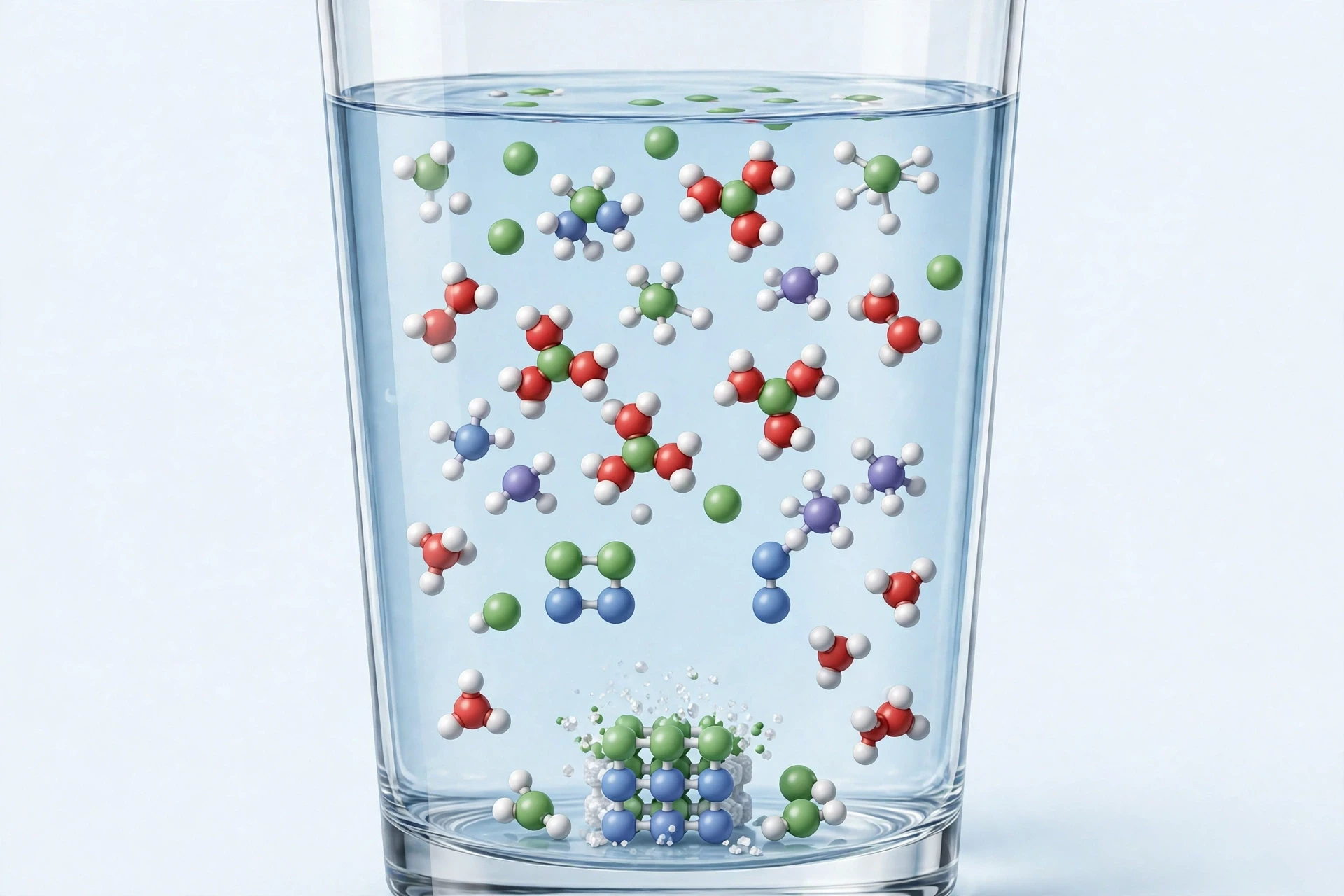
The reason a solution is uniform comes down to scale. When sugar dissolves, its crystals break apart into individual molecules that spread among the water molecules. These particles are so small — far smaller than the wavelength of visible light — that light passes through without scattering in the way it would off grains of sand. That is why a true solution is clear, even when it is coloured. A glass of salt water looks like plain water. A copper sulfate solution is bright blue, but it is still perfectly clear, with no particles visible no matter how closely you look.
There is a useful test for this. Shine a beam of light through a true solution and through a cloudy mixture like milk, and the difference is obvious. Milk scatters the light because its fat droplets are large enough to get in the way. Salt water does not scatter the beam at all. The particles are simply too small to interact with light that way.
A solution is a mixture that is uniform at the molecular level. If you can see the separate parts, or if they settle out when the mixture stands still, you are not looking at a solution.
2.2 The solvent matters more than people think
We tend to focus on the thing being dissolved, but the solvent does most of the work. Water is the most common solvent on Earth, and it is an extraordinary one, because its molecules are polar: one end carries a slight positive charge and the other a slight negative charge. That polarity lets water pull apart the charged particles in ionic compounds like salt, surrounding each ion and carrying it away into the liquid. The strange, wonderful behaviour of water molecules — their hydrogen bonds, their ability to dissolve so many substances — is exactly why water is often called the universal solvent, and it is worth reading more about in our article on why water is the weirdest molecule.
But water is not the only solvent that matters. Ethanol dissolves substances water cannot touch. Acetone strips nail polish because it dissolves the resins in it. Industrial chemists choose solvents the way a cook chooses a pan: the right tool changes everything about the result. And in the human body, the solvent is mostly water again — blood plasma is an aqueous solution carrying oxygen, nutrients, hormones, and waste products to and from every cell.
3. What Is Solubility?
Solubility is a number with a story behind it, and it is the second half of solutions and solubility: the limit that decides how much of a solute a solvent can hold. It tells you how much of a solute can dissolve in a given amount of solvent at a given temperature, before the solvent simply refuses to take any more. The usual way to state it is grams of solute per 100 grams of solvent, or sometimes grams per litre of solution, always with the temperature attached, because temperature changes the answer.
At room temperature, about 36 grams of table salt (sodium chloride) will dissolve in 100 grams of water. Add a 37th gram, and it will sit on the bottom, undissolved, no matter how long you stir. The solution has reached its limit. That limit is the solubility of salt in water at that temperature, and it is a property of the particular pair of substances, not a universal constant.
3.1 Unsaturated, saturated, and supersaturated
Chemists sort solutions into three categories, and the distinction matters in everything from making rock candy to understanding how kidney stones form.
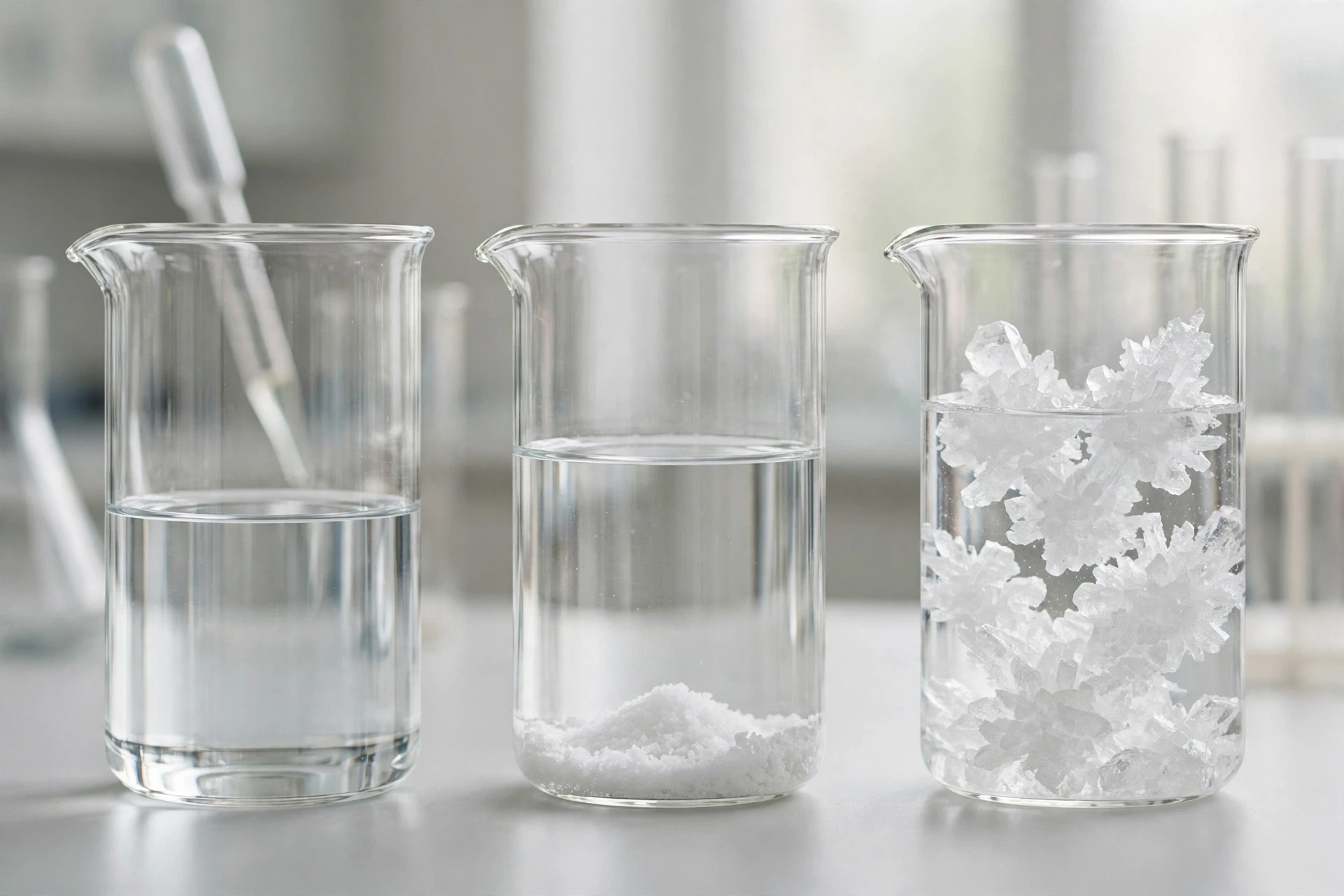
An unsaturated solution still has room. You can add more solute and it will dissolve. Your morning tea with one spoonful of sugar is unsaturated — a second spoonful would dissolve just as easily.
A saturated solution is full. It holds the maximum amount of solute at that temperature. Add more, and the extra simply sits there. The undissolved solid at the bottom of a saturated solution is not a failure; it is in a dynamic balance with the dissolved particles. Ions are leaving the solid and rejoining it at the same rate, so the amount dissolved stays constant even though the particles never stop moving.
A supersaturated solution holds more solute than it should be able to at that temperature. You can make one by dissolving a solute in hot water, where its solubility is higher, and then cooling the solution very slowly and carefully, without disturbing it. The extra solute stays dissolved in a fragile, temporary state — until something gives it an excuse to come out. Drop a single crystal into a supersaturated sugar solution and crystals will grow outward from that seed with startling speed, filling the glass. That is how rock candy is made, and it is also, in a much less pleasant form, how some crystals grow inside the body.
I once watched a student do this in a school laboratory, and the room went quiet. She had dissolved far more sodium acetate in hot water than cold water could hold, poured it into a beaker, and let it cool. Then she touched the surface with a glass rod, and the whole beaker turned solid in seconds, warming her hands as it crystallised. The heat released was the energy the solution had been holding. It looked like a magic trick. It was thermodynamics, doing exactly what the numbers said it would.
3.2 Solubility curves: reading the graph
Solubility changes with temperature, and the pattern depends on the solute. For most solids, solubility rises as the water gets warmer — hot water dissolves more sugar than cold water, which is why you stir sugar into hot tea rather than iced tea. But there are famous exceptions. Some salts, like cerium sulfate, become less soluble as the temperature rises. And gases behave in the opposite way to most solids: cold water holds more dissolved gas than warm water, which is why a warm soda goes flat faster and why fish struggle in overheated water.
A solubility curve is a graph with temperature on one axis and solubility on the other, and it lets you answer practical questions at a glance: how much potassium nitrate can I dissolve at 60 degrees, and how much will crystallise out if I cool the solution to 20 degrees? The difference between those two numbers is the mass of crystals you can harvest. Industrial crystallisation — the way pure chemicals are manufactured — is built on exactly this calculation.
Solute | Solubility at 20 °C (g per 100 g water) | Solubility at 60 °C (g per 100 g water) | Trend with temperature |
|---|---|---|---|
Sodium chloride (table salt) | About 36 | About 37 | Barely changes |
Sucrose (table sugar) | About 204 | About 287 | Rises sharply |
Potassium nitrate | About 32 | About 110 | Rises very sharply |
Cerium sulfate | About 16 | About 7 | Falls |
Oxygen gas | About 0.004 | About 0.002 | Falls |
These are rounded, widely quoted textbook values, given to show the pattern rather than to serve as laboratory reference data. The striking row is table salt: its solubility hardly moves with temperature, which is why you cannot purify salt by cooling a hot solution the way you can with potassium nitrate. The physics of each solute-solvent pair is different, and the curve is the fingerprint of that difference.
4. "Like Dissolves Like"
If there is one rule in solutions and solubility that explains the most everyday observations with the fewest words, it is this: like dissolves like. Polar substances dissolve in polar solvents. Nonpolar substances dissolve in nonpolar solvents. Polar and nonpolar do not mix.
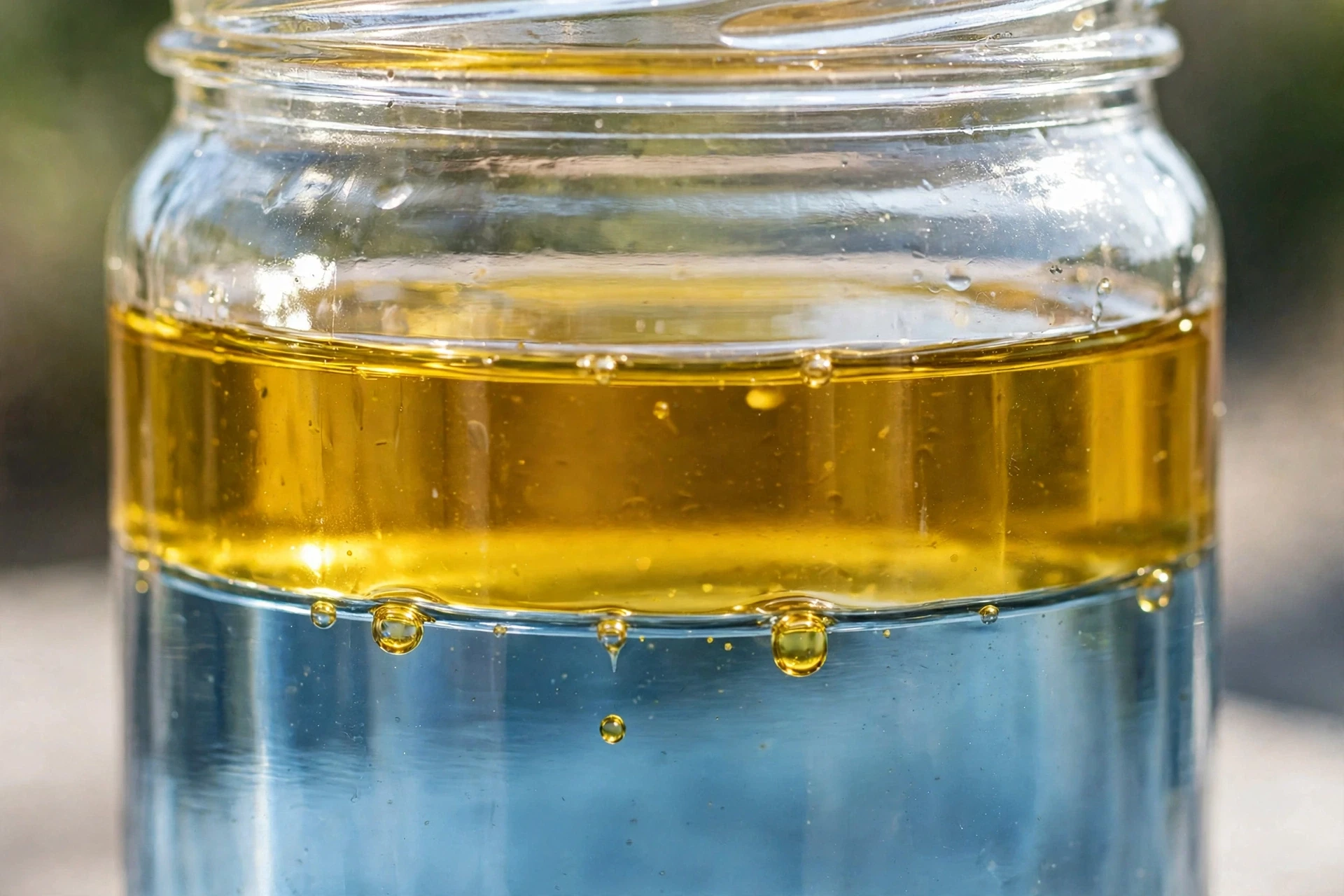
Water is polar, so it dissolves other polar substances and ionic compounds — salt, sugar, alcohol, vinegar. Oil is nonpolar, so it dissolves other nonpolar substances — grease, wax, the fats in butter. But oil and water do not mix, no matter how hard you shake them. They separate into layers within seconds, because water molecules would rather stick to each other through hydrogen bonds than make room for oil molecules, and oil molecules would rather stick to each other than break into the water.
4.1 Why oil and water refuse each other
This is not a matter of one substance being stubborn. It is a matter of energy. Water molecules attract each other strongly. For an oil molecule to enter water, water molecules would have to break apart from each other to make space, and the weak attraction between water and oil would not repay that energy cost. So the water squeezes the oil out. The oil, for its part, is perfectly happy staying with its own kind.
Most people assume oil and water do not mix because oil is "lighter" and floats. That is a misunderstanding, and it is worth correcting plainly: what we actually see in the data is a separation driven by molecular polarity, not by density. Density explains which layer ends up on top — oil floats because it is less dense — but polarity explains why there are two layers at all. If density were the cause, shaking would eventually blend them, and it never does.
The same rule explains why soap works. A soap molecule has two ends: one end is polar and loves water, and the other end is nonpolar and loves grease. When you wash your hands, the nonpolar ends grab the grease, the polar ends grab the water, and the grease gets carried away in tiny clusters called micelles. Soap is a translator between two worlds that refuse to speak to each other.
4.2 The chemistry of "like" in more detail
Polarity comes from how electrons are shared inside a molecule. In water, oxygen pulls electrons toward itself more strongly than hydrogen does, so the oxygen end carries a partial negative charge and the hydrogen ends carry partial positive charges. In an oil molecule, carbon and hydrogen share electrons almost equally, so there are no charged ends to speak of. The result is that water molecules can attract the charged ions in salt and pull them apart, while oil molecules cannot.
Hydrogen bonding deserves a special mention here, because it is the reason water is such a remarkable solvent. A hydrogen bond is an attraction between a hydrogen atom attached to oxygen, nitrogen, or fluorine in one molecule and a lone pair of electrons on a highly electronegative atom in another molecule. Each individual hydrogen bond is weak, but water forms vast networks of them, and together they give water its high boiling point, its surface tension, and its power to dissolve ionic compounds. The water molecule article on this site explores these quirks in depth, and it is worth reading alongside this one — nearly everything about solubility in water traces back to hydrogen bonding.
5. What Changes Solubility?
Three factors matter most in solutions and solubility: temperature, pressure, and the nature of the solute and solvent. Two other factors — stirring and surface area — are often confused with solubility, and the confusion is worth clearing up because it trips up students every year.
5.1 Temperature
For most solid solutes, warming the solvent increases solubility. The extra thermal energy helps break the bonds holding the solid together and helps the solvent molecules surround the freed particles. That is why sugar dissolves faster and in larger amounts in hot tea. For gases, the effect reverses: warming a liquid drives dissolved gas out. Open a warm bottle of sparkling water and it fizzes weakly, because much of the carbon dioxide has already escaped. Chill the same bottle and the fizz is vigorous.
There is a practical consequence for the natural world. The solubility of oxygen in water falls as water warms, so warm rivers and lakes hold less oxygen for fish. A heatwave can cause fish kills not because the heat itself is lethal, but because the water can no longer hold enough dissolved oxygen. Climate and chemistry meet in that single fact.
5.2 Pressure and Henry's law
Pressure has almost no effect on the solubility of solids and liquids, but it has a large effect on gases. The relationship is captured by Henry's law: the amount of gas dissolved in a liquid is directly proportional to the partial pressure of that gas above the liquid. Double the pressure, double the dissolved gas.
A soda bottle is a Henry's law demonstration you can hold in your hand. The drink is bottled under high-pressure carbon dioxide, so a large amount of gas dissolves. The moment you open the cap, the pressure drops to normal air pressure, the solubility drops with it, and the excess gas escapes as bubbles. The fizz is the solution rebalancing itself to the new pressure.
The same law matters in deep-sea diving. At depth, the pressure is high, so more nitrogen dissolves in a diver's blood than at the surface. If the diver rises too quickly, the pressure falls, the nitrogen comes out of solution inside the body, and bubbles form in the blood and tissues — decompression sickness, "the bends." Divers ascend slowly precisely so the dissolved gas can leave the blood gradually through the lungs instead of bubbling out inside them.
5.3 Stirring, surface area, and the great misconception
Here is the misconception I hear most often, and I believed it myself as a student: that stirring makes more sugar dissolve. It does not. Stirring makes sugar dissolve faster, but the final amount that can dissolve — the solubility — is unchanged. Stirring brings fresh solvent into contact with the solid and sweeps dissolved particles away from the surface, so the dissolving process speeds up. But once the solution is saturated, no amount of stirring will dissolve another gram.
The same is true of crushing a solid into a powder. A powder has more surface area, so it dissolves faster. The solubility limit stays exactly where it was. Rate and extent are different things, and keeping them apart is one of the most useful distinctions in chemistry. It is also the reason a sugar cube and a spoonful of granulated sugar sweeten a cup of tea to exactly the same degree in the end, even though the granulated sugar gets there first.
Stirring and crushing change how fast a solute dissolves, never how much can dissolve. Solubility is a property of the substances and the temperature; speed is a property of the process.
6. What Is Molarity?
Saying a solution is "salty" or "strong" is not enough for a chemist, a doctor, or a cook following a precise recipe. This is where the measurement side of solutions and solubility begins. We need a number that says exactly how much solute is in a given amount of solution. The most widely used measure is molarity, symbol M, defined as the number of moles of solute per litre of solution:
Molarity (M) = moles of solute / litres of solution
A 1 molar solution — written 1 M — contains one mole of solute in every litre of solution. A mole is simply a counting unit: one mole of any substance contains about 6.022 × 10²³ particles of it, a number called Avogadro's number. It is the chemist's dozen, scaled up to the size of atoms and molecules. The atoms and molecules article on this site explains the mole in full, and it is the foundation everything in this section rests on.
Molarity matters because chemistry happens mole by mole. When a doctor prescribes an intravenous fluid, its concentration is specified so that the patient's blood chemistry changes by a precise amount. When a chemist runs a reaction, the molarity of each reactant determines how much product forms. When a farmer dilutes a fertiliser, the molarity determines whether the plants are fed or burned. The unit looks abstract, but it is one of the most practical numbers in all of science.
6.1 Worked example 1: making a 1 M salt solution
Question: How many grams of sodium chloride (NaCl) do you need to make 1 litre of a 1.00 M solution?
Step 1 — Find the molar mass. Sodium has an atomic mass of about 22.99, and chlorine about 35.45. Add them: 22.99 + 35.45 = 58.44 grams per mole.
Step 2 — Use the molarity definition. We want 1.00 mole of solute in 1.00 litre of solution.
Step 3 — Convert moles to grams. 1.00 mol × 58.44 g/mol = 58.44 g.
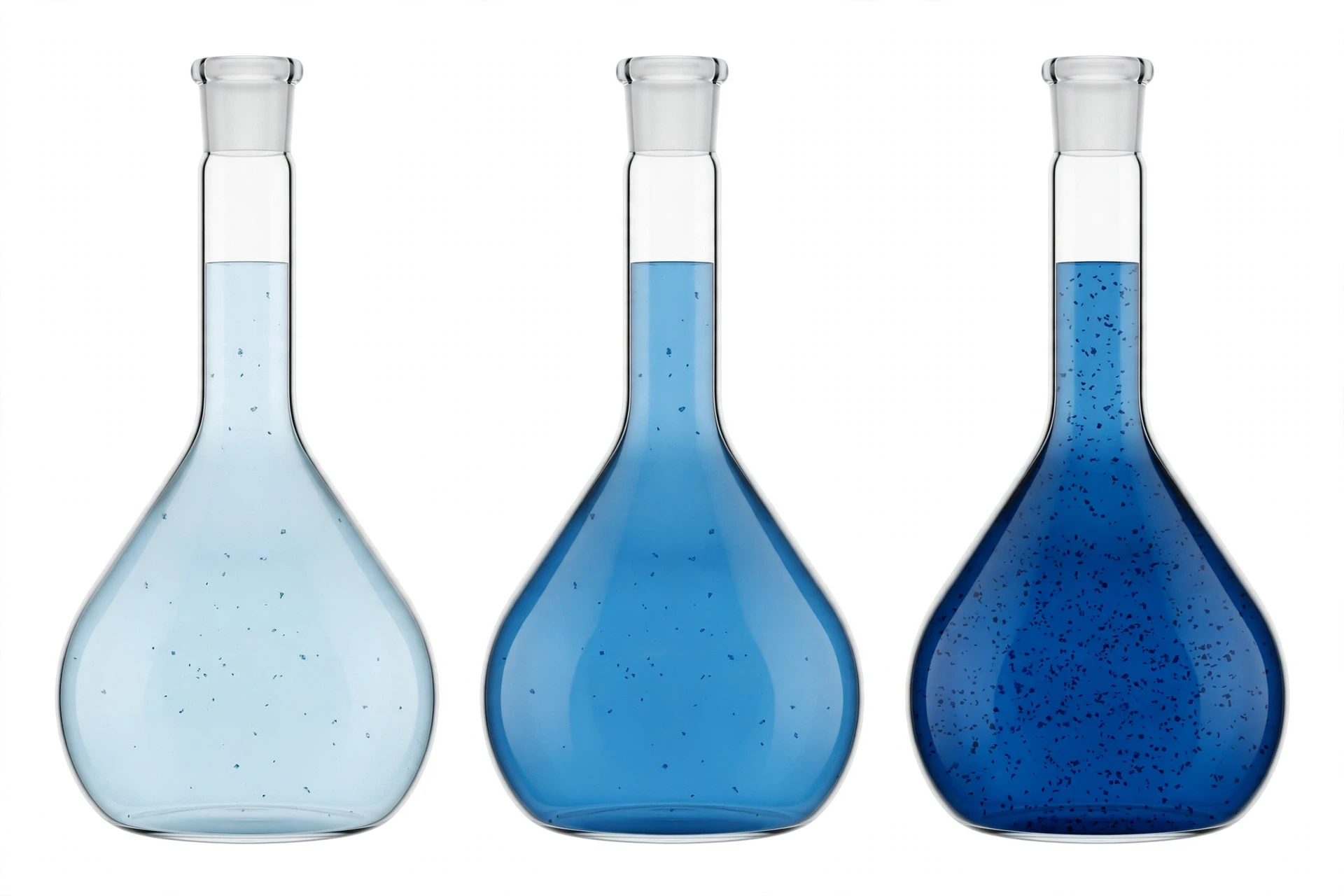
Answer: Dissolve 58.44 grams of salt in enough water to make exactly 1 litre of solution. Note the wording: "enough water to make 1 litre of solution," not "in 1 litre of water." The solute itself takes up space, so you dissolve the salt in somewhat less than a litre of water first, then top the mixture up to exactly the 1-litre mark in a volumetric flask. This is the single most common beginner mistake in molarity calculations, and it is worth stating plainly: the volume in the molarity formula is the volume of the solution, not the volume of the solvent.
6.2 Worked example 2: a smaller, more realistic volume
Question: What is the molarity of a solution made by dissolving 20.0 grams of sodium hydroxide (NaOH) in enough water to make 500 mL of solution?
Step 1 — Molar mass of NaOH. Sodium 22.99 + oxygen 16.00 + hydrogen 1.01 = 40.00 g/mol.
Step 2 — Convert grams to moles. 20.0 g ÷ 40.00 g/mol = 0.500 mol.
Step 3 — Convert the volume to litres. 500 mL = 0.500 L.
Step 4 — Divide moles by litres. 0.500 mol ÷ 0.500 L = 1.00 M.
Answer: 1.00 M sodium hydroxide. Notice how the numbers worked out neatly — that is no accident; textbook examples are built that way so you can check your method. In real laboratory work the numbers are rarely so tidy, which is exactly why the method matters more than any single answer.
6.3 Worked example 3: finding the mass from a target molarity
Question: How many grams of glucose (C₆H₁₂O₆) are needed to make 250 mL of a 0.200 M solution?
Step 1 — Molar mass of glucose. Carbon 12.01 × 6 = 72.06; hydrogen 1.01 × 12 = 12.12; oxygen 16.00 × 6 = 96.00. Total = 180.18 g/mol.
Step 2 — Moles needed. Molarity × volume in litres: 0.200 mol/L × 0.250 L = 0.0500 mol.
Step 3 — Convert to grams. 0.0500 mol × 180.18 g/mol = 9.01 g.
Answer: About 9.01 grams of glucose. This is the kind of calculation a laboratory technician does routinely when preparing the glucose solutions used in medical tests, and it is also the calculation behind the sugar concentration in a bottle of sports drink — though manufacturers usually quote grams per litre on the label rather than molarity.
6.4 Why molarity depends on temperature
Molarity has one quiet weakness: it depends on the volume of the solution, and liquids expand when they warm up. A solution that is exactly 1.00 M at 20 °C will be slightly less than 1.00 M at 40 °C, because the same number of moles now occupies a slightly larger volume. For most everyday and classroom purposes the change is tiny and can be ignored. For precise analytical work, chemists either control the temperature carefully or use a different concentration unit that does not depend on volume at all. That unit is molality, and it is the subject of the next section.
7. Other Ways to Measure Concentration
Molarity is the workhorse of solutions and solubility, but it is not the only way to describe how concentrated a solution is. Different situations call for different units, and knowing which one is in play matters — confusing two of them has caused real errors in laboratories.
7.1 Molality: moles per kilogram of solvent
Molality, symbol m (lowercase, to distinguish it from molarity's capital M), is the number of moles of solute per kilogram of solvent:
Molality (m) = moles of solute / kilograms of solvent
Notice the two differences from molarity. The denominator is a mass, not a volume, and it is the mass of the solvent alone, not the whole solution. Because mass does not change with temperature, molality does not change with temperature either. That makes it the unit of choice for experiments where temperature varies, such as measuring how much a solute lowers the freezing point of water — the principle behind spreading salt on icy roads.
Worked example: What is the molality of a solution made by dissolving 58.44 g (1.00 mol) of NaCl in 1.00 kg of water? Molality = 1.00 mol ÷ 1.00 kg = 1.00 m. In this dilute case the number happens to match the molarity, but that is a coincidence of the numbers chosen, not a general rule.
7.2 What is the difference between molarity and molality?
This is one of the most searched questions in solution chemistry, and the confusion is understandable: the words differ by a single letter, and for dilute aqueous solutions the numbers are often close. But they are different quantities, and the difference grows as solutions get more concentrated.
Feature | Molarity (M) | Molality (m) |
|---|---|---|
Definition | Moles of solute per litre of solution | Moles of solute per kilogram of solvent |
Denominator | Volume of the whole solution | Mass of the solvent only |
Temperature dependence | Changes with temperature (volume expands) | Independent of temperature |
Symbol | Capital M | Lowercase m |
Main use | Reaction stoichiometry, titrations, laboratory preparation | Colligative properties, freezing-point and boiling-point work |
A simple way to remember it: molarity is about the solution and its volume; molality is about the solvent and its mass. For a dilute solution in water, 1 litre of solution weighs close to 1 kilogram and the solvent is nearly all of it, so the two values are nearly the same. For a concentrated solution, or a solvent that is not water, they can differ substantially.
7.3 Mass percent, parts per million, and mole fraction
Not every concentration is expressed in moles. Some of the most common units in daily life are much simpler:
Mass percent is the mass of solute divided by the total mass of the solution, multiplied by 100. A saline drip labelled 0.9% sodium chloride contains 0.9 grams of salt in every 100 grams of solution. That 0.9% figure is not arbitrary: it matches the salt concentration of human blood plasma closely enough that the solution does not draw water into or out of red blood cells. Get the percentage wrong and the cells swell or shrink.
Parts per million (ppm) is used for very dilute solutions, especially in environmental science. One ppm means one part of solute per million parts of solution by mass. Drinking-water limits for contaminants are usually given in ppm or parts per billion (ppb), because the amounts involved are far too small to express sensibly as percentages.
Mole fraction is the number of moles of one component divided by the total number of moles of all components in the solution. It has no units, and it is especially useful in gas mixtures and in vapour-pressure calculations.
Each of these units answers a different question, and the skill lies in choosing the right one — and in converting between them when a problem demands it.

8. Dilution: Making a Weaker Solution from a Stronger One
Laboratories rarely keep every concentration they need on the shelf, and dilution is one of the most practical skills in solutions and solubility. Instead, they keep a concentrated stock solution and dilute it — add more solvent — whenever a weaker solution is required. Dilution changes the concentration but never changes the number of moles of solute. The solute you started with is all still there; it is simply spread through a larger volume.
That fact gives us the dilution equation:
M₁V₁ = M₂V₂
where M₁ and V₁ are the molarity and volume of the concentrated solution, and M₂ and V₂ are the molarity and volume of the diluted solution. The two volumes must be in the same units, and the equation works because the moles of solute are the same on both sides.
8.1 Worked example 1: a routine laboratory dilution
Question: How many millilitres of a 6.00 M hydrochloric acid stock solution are needed to make 500 mL of a 0.500 M solution?
Step 1 — Identify the knowns. M₁ = 6.00 M, M₂ = 0.500 M, V₂ = 500 mL. We need V₁.
Step 2 — Rearrange the equation. V₁ = (M₂ × V₂) ÷ M₁ = (0.500 × 500) ÷ 6.00 = 41.7 mL.
Answer: Measure 41.7 mL of the 6.00 M stock, add it to a flask containing some water, then add water until the total volume reaches 500 mL. The order matters: always add acid to water, never water to acid, because the dilution of a concentrated acid releases a great deal of heat, and adding water to acid can cause the mixture to spit and splash.
I learned that rule the practical way, as a young student, when a demonstrator stopped my hand mid-pour and explained, in a tone that left no room for argument, that I was about to do it backwards. I have never forgotten it. The mnemonic is simple: "Do as you oughta, add acid to water."
8.2 Worked example 2: diluting a drink concentrate
Question: A squash concentrate is 4.0 M in sugar. You pour 50 mL of concentrate into a glass and top it up with water to 250 mL. What is the sugar molarity of the finished drink?
Step 1 — Moles in the concentrate. 4.0 mol/L × 0.050 L = 0.20 mol.
Step 2 — New volume. 250 mL = 0.250 L.
Step 3 — New molarity. 0.20 mol ÷ 0.250 L = 0.80 M.
Answer: 0.80 M. The same equation, applied to a kitchen rather than a laboratory, gives the same result. Concentration is concentration, wherever you meet it.
8.3 Serial dilution: when one dilution is not enough
Sometimes a single dilution is not practical — the volume of stock needed would be too small to measure accurately. Suppose you need 100 mL of a 0.001 M solution from a 1 M stock. The dilution equation says you need 0.1 mL of stock, a volume no ordinary pipette measures well. The solution is a serial dilution: dilute in steps. First make 100 mL of 0.01 M solution (using 1.0 mL of stock), then take 10 mL of that and dilute it to 100 mL to get 0.001 M. Each step is easy to measure, and the errors stay small. Microbiologists use serial dilutions constantly to count bacteria, diluting a culture by factors of ten until the colonies on a plate can be counted one by one.
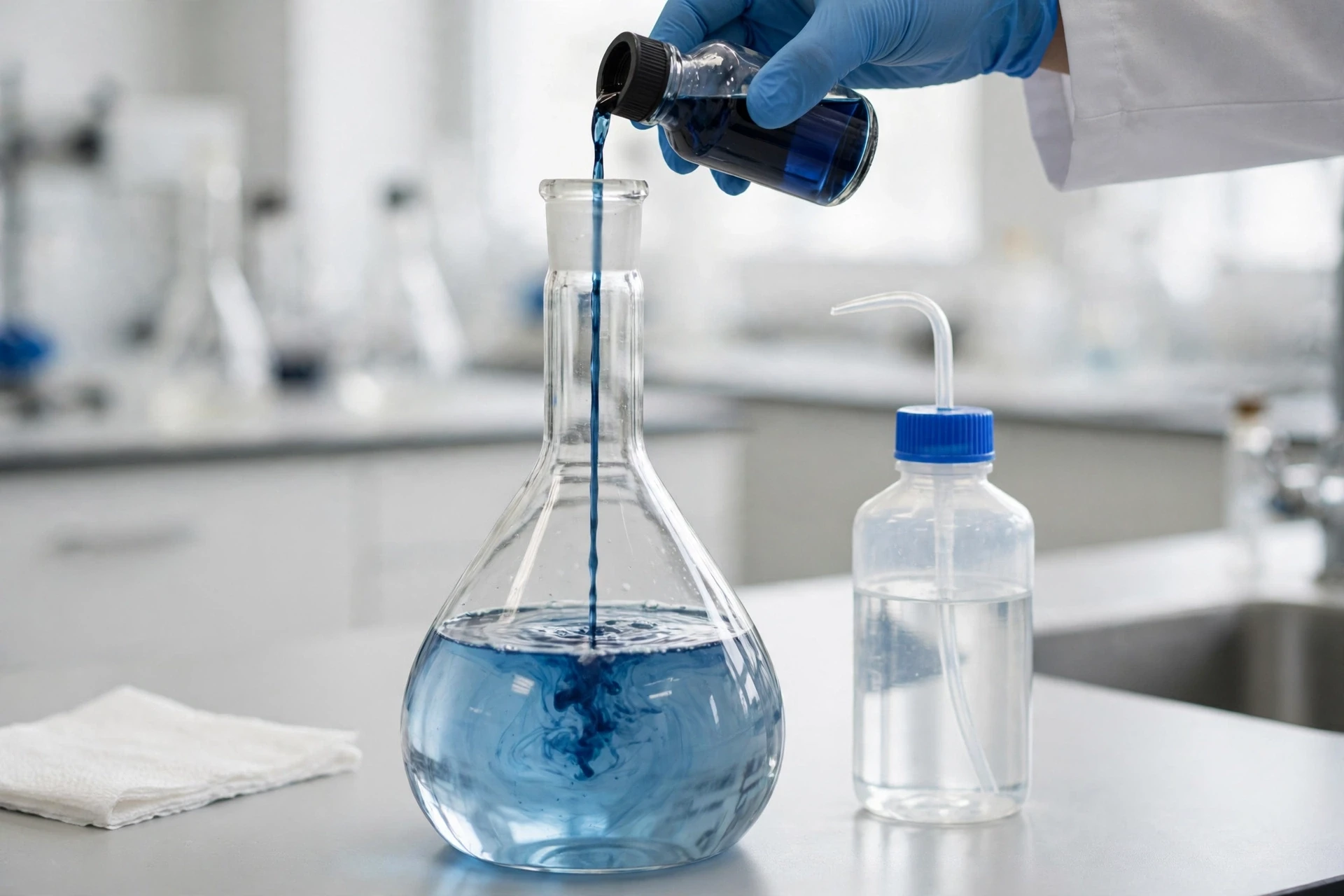
Dilution never changes how much solute you have — it only changes how much solvent it is spread through. That is why M₁V₁ = M₂V₂ works: both sides count the same moles.
9. Colligative Properties: When the Amount Matters, Not the Identity
Some properties of a solution depend only on how many solute particles are present, not on what those particles are — a corner of solutions and solubility where the identity of the solute stops mattering entirely. These are called colligative properties, and there are four of them: vapour-pressure lowering, boiling-point elevation, freezing-point depression, and osmotic pressure. A mole of sugar and a mole of salt lower the freezing point of water by the same amount — at least in the idealised picture — because the water molecules only notice how many foreign particles are in their way, not what they are called.
9.1 Why salt melts ice
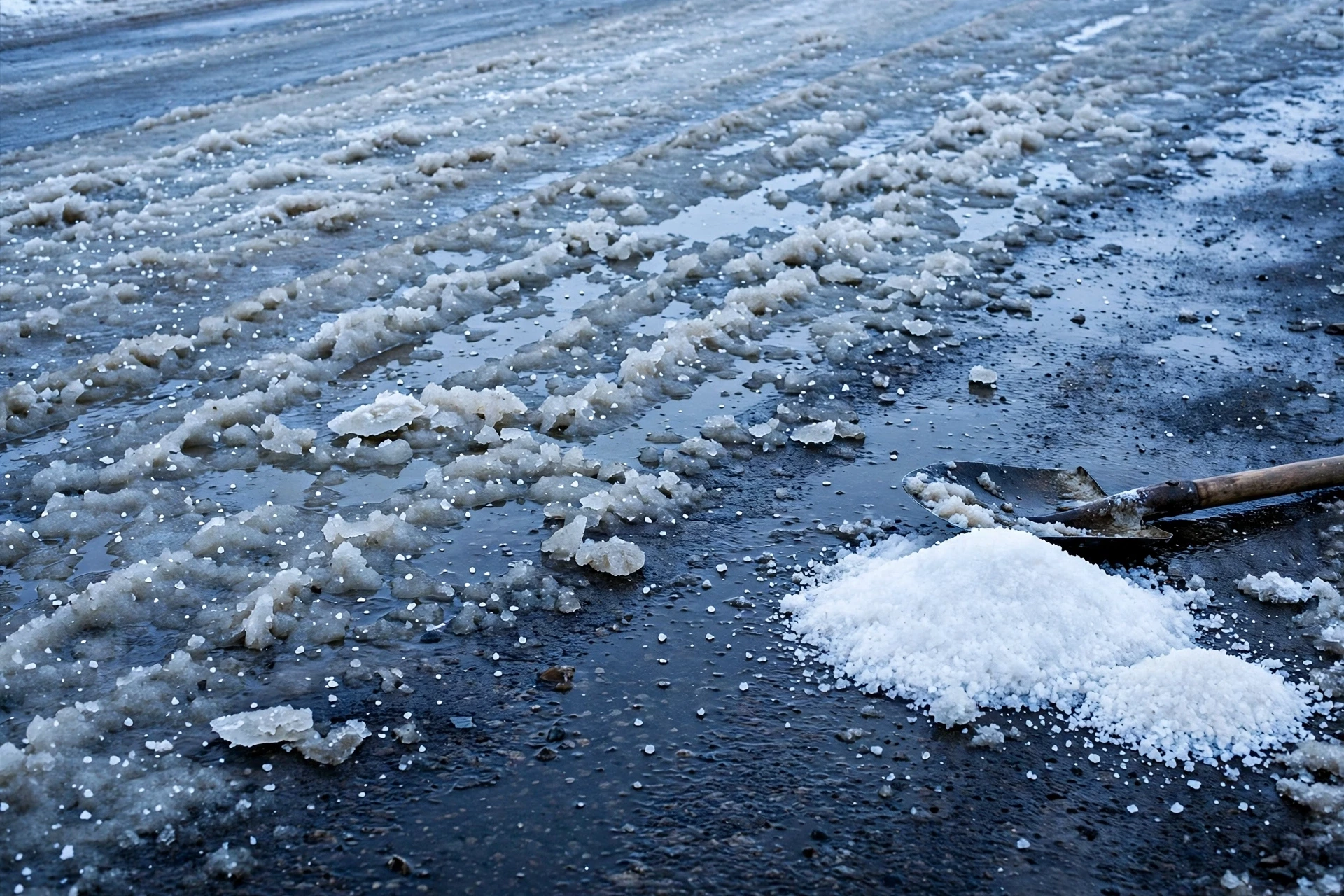
The most familiar colligative property is freezing-point depression. Pure water freezes at 0 °C. Dissolve salt in it, and the freezing point drops. The salt particles get in the way of water molecules as they try to arrange themselves into the orderly crystal structure of ice, so a lower temperature is needed before the ice can form. That is why gritters spread salt on roads in winter: the salt does not melt the ice by warming it, it melts the ice by lowering the temperature at which water can freeze.
There is a limit, though. As more salt dissolves, the freezing point keeps falling, but only until the solution itself becomes saturated. Beyond that, extra salt does nothing. And below about −21 °C, even a saturated salt solution freezes, because the freezing point cannot be depressed any further by sodium chloride. Road salt works well in a mild frost and fails in a deep freeze, and now you know why.
9.2 Why adding salt raises the boiling point (and why it barely matters for cooking)
Dissolved solute also raises the boiling point of a liquid, because the solute particles lower the vapour pressure — fewer solvent molecules escape from the surface, so a higher temperature is needed before the vapour pressure matches the pressure of the air above. The effect is real but small: dissolving a tablespoon of salt in a litre of water raises the boiling point by a fraction of a degree. Pasta cooks no faster in salted water because of the boiling point. The salt is there for flavour, not for physics, and any recipe that claims otherwise is repeating a myth.
9.3 Osmotic pressure and the cells in your body
Osmotic pressure is the pressure that builds up when a solvent moves across a semi-permeable membrane toward the side with more solute. It is the force that keeps your red blood cells at the right size. Put a red blood cell in pure water and water rushes in, because the inside of the cell is saltier than the water outside; the cell swells and can burst. Put the same cell in a very salty solution and water rushes out; the cell shrivels. Put it in a 0.9% saline solution — the same concentration as the fluid inside the cell — and nothing flows either way. The solution is isotonic, and the cell keeps its shape.
This is why hospitals use 0.9% saline for intravenous drips rather than pure water. The number is not a round-number convenience; it is a careful match to the chemistry of human blood, and getting it right is a matter of life and death. The same principle drives reverse-osmosis desalination plants, which push seawater through a membrane at high pressure to force pure water out, leaving the salt behind. The membrane lets water through and blocks the salt, and the pressure needed is the osmotic pressure of seawater, working in reverse.
10. Solutions in Everyday Life
It is easy to think of solutions and solubility as a classroom topic, but they run the world. The oceans are the largest solutions on Earth, carrying dissolved salts, gases, and minerals through currents that shape the climate. The water cycle — evaporation, condensation, precipitation — is a vast natural distillation and dilution process, and our article on the water cycle follows that journey in full. Every living cell is a tiny bag of aqueous solution, and the chemistry of life is, to a large extent, the chemistry of solutions.
10.1 The ocean: the biggest solution on Earth
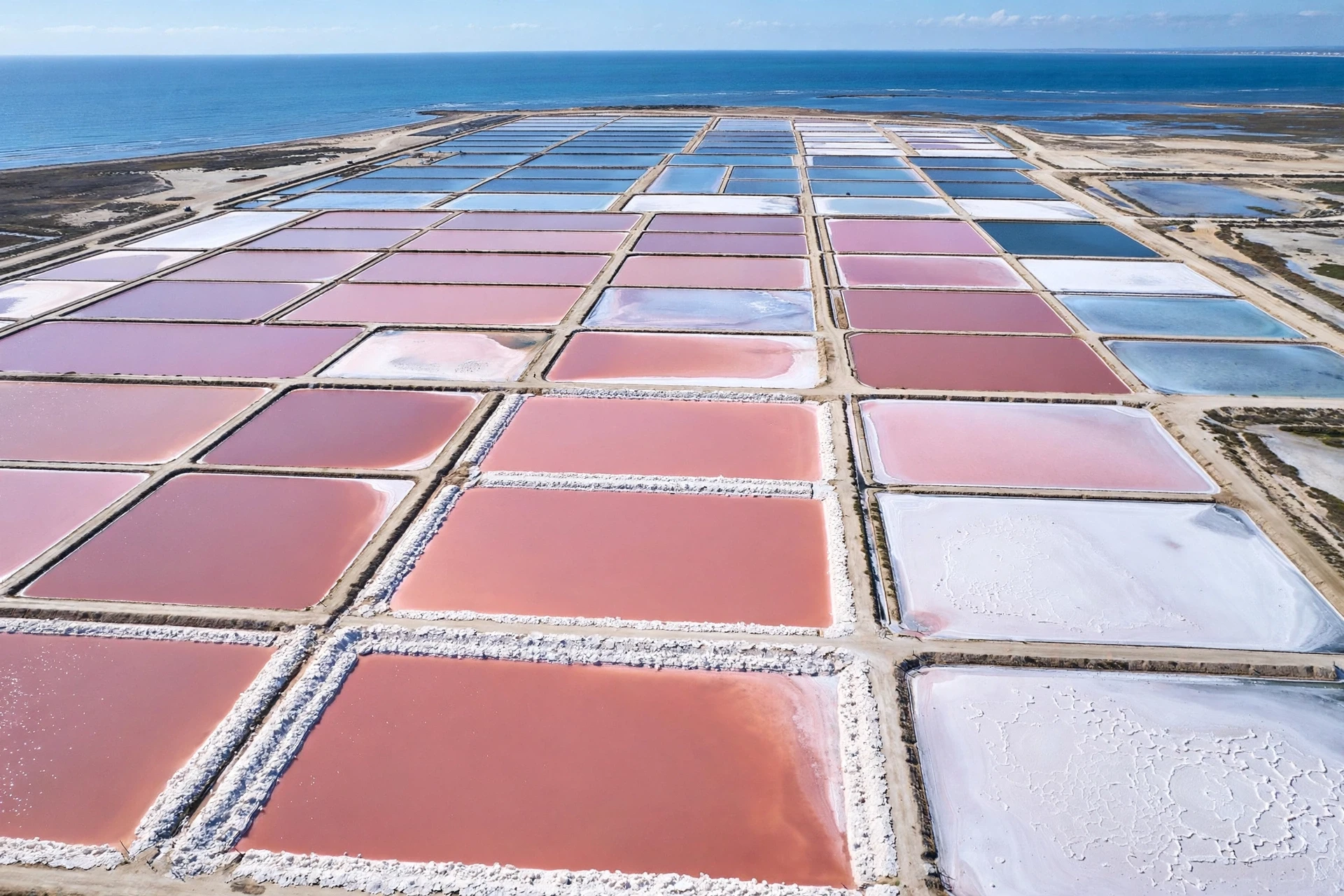
Seawater is about 3.5% dissolved salts by mass, mostly sodium chloride, with magnesium, calcium, potassium, and sulfate ions in smaller amounts, plus dissolved oxygen and carbon dioxide. Those dissolved gases matter enormously: marine life breathes the oxygen, and the carbon dioxide dissolved in the ocean is part of the global carbon cycle, absorbing a large share of the carbon dioxide humans release into the atmosphere. When seawater warms, it holds less dissolved gas, which is one reason warming oceans are a concern for marine ecosystems as well as for the climate.
The salinity of the ocean is not uniform. Where rivers pour fresh water into the sea, salinity falls. Where evaporation is intense and rainfall is scarce, as in the Mediterranean, salinity rises. These differences in salinity drive deep ocean currents, because saltier water is denser and sinks, carrying cold, oxygen-rich water into the deep ocean. The great conveyor belt of ocean circulation is, at its heart, a story about solutions.
10.2 Medicine: solutions measured to save lives
Almost every medicine that enters the body by injection is a solution, and its concentration is specified with great care. An anaesthetic that is too concentrated can stop a heart; one that is too dilute will not work. Chemotherapy drugs are prepared by dilution from concentrated stock solutions, using the same M₁V₁ = M₂V₂ equation a student uses in a school laboratory — except that in a hospital pharmacy, the answer has a patient's name on it, and a second person checks the calculation.
Oral medicines are solutions too, or suspensions that behave like them. A cough syrup is a concentrated sugar solution carrying the active drug; the sugar is not just there for taste, it also raises the viscosity so the syrup coats the throat, and it acts as a preservative by lowering the water activity so microbes cannot grow. The humble spoonful of syrup is a piece of applied solution chemistry.
10.3 Food, drink, and the kitchen laboratory
Your kitchen is a solution laboratory. When you make jam, you are creating a concentrated sugar solution that preserves fruit by drawing water out of microbial cells through osmosis. When you brine a chicken, salt solution moves into the meat by the same process, and the meat stays juicier when cooked. When you brew coffee, hot water extracts soluble compounds from the grounds — caffeine, acids, oils — and the balance of those dissolved substances is what you taste as flavour. Grind the coffee finer and the extraction is faster, because of the greater surface area; but the amount that can dissolve is still governed by solubility, and over-extraction pulls out bitter compounds that a shorter brew leaves behind.
Carbonated drinks are solutions of gas in liquid, held under pressure. Fizzy water, beer, and sparkling wine all depend on Henry's law. And the bubbles themselves are a lesson in nucleation: a gas needs a surface to form a bubble on, which is why a scratched glass fizzes more than a smooth one, and why dropping a mint into a bottle of soda produces a spectacular fountain — the mint's rough surface provides thousands of nucleation sites at once.
10.4 The environment: solutions we cannot see
Many of the most important environmental problems are solution problems. Fertilisers dissolve in rainwater and run off into rivers and lakes, where the dissolved nitrates and phosphates feed algal blooms that strip the water of oxygen. Heavy metals from mining dissolve in acidic water and travel far downstream. Ocean acidification is, chemically, the story of carbon dioxide dissolving in seawater and forming carbonic acid, which lowers the pH and makes it harder for corals and shellfish to build their skeletons.
On the hopeful side, solutions also offer the remedies. Water-treatment plants use coagulation and filtration to remove dissolved and suspended contaminants. Constructed wetlands use plants and microbes to pull dissolved nutrients out of wastewater. And the same solubility rules that let pollutants spread also let chemists design solvents that extract them again.

11. Common Mistakes and Misconceptions
After years of watching students wrestle with solutions and solubility, I have collected the mistakes that come up again and again. They are worth naming directly, because recognising them in advance is the best way to avoid them.
"Dissolving is the same as melting." It is not. Melting is a change of state caused by heat: ice becomes water. Dissolving is a mixing process: sugar becomes part of a solution. Salt dissolved in water has not melted; it has separated into ions and spread among the water molecules. If you evaporate the water, the salt comes back as a solid, unchanged.
"A clear liquid is a pure substance." It is not necessarily. Salt water is perfectly clear and perfectly mixed, yet it is a mixture of two substances. Clarity tells you the particles are small, not that there is only one kind of particle. Pure water and salt water look identical, and only a measurement — evaporating a sample, or testing its electrical conductivity — tells them apart.
"Solubility and rate of dissolving are the same thing." They are not, as section 5.3 explained. Stirring, crushing, and heating can all change the rate. Only temperature, pressure, and the identity of the substances change the solubility itself.
"Molarity and molality are interchangeable." They are not, except approximately, for dilute aqueous solutions. The units differ, the denominators differ, and one changes with temperature while the other does not. In an exam or a laboratory, using the wrong one is a real error, not a rounding issue.
"Adding salt to water always makes the water boil faster." It does not. Salt raises the boiling point slightly, so if anything the water takes a fraction longer to boil. What salt does change is the flavour of the food cooked in it.
"A saturated solution cannot dissolve any more of anything." It cannot dissolve more of the same solute at that temperature, but it can still dissolve a different solute. A saturated salt solution will happily dissolve sugar. Saturation is specific to each solute.
The thread running through all of these mistakes is the same: the words sound similar, so the ideas get blurred together. Chemistry rewards precision in language, and solutions are a topic where that precision pays off immediately.
12. What Solutions and Solubility Teach Us About the World
A glass of sugar water seems simple, and in one sense it is. But inside that glass are ideas that reach into medicine, cooking, climate science, and the deep ocean: polarity and hydrogen bonding, equilibrium and saturation, the mole and molarity, Henry's law and osmotic pressure. The same rules that explain why salt disappears into soup also explain why divers must ascend slowly, why roads are salted in winter, and why a hospital drip is exactly 0.9% salt.
The most useful thing to carry away from solutions and solubility is not any single formula, though the formulas matter. It is the habit of asking, whenever you meet a mixture, three questions: what is dissolved in what, how much is dissolved, and what would change that amount? Answer those three, and you can reason your way through almost any solution problem you will ever meet — in a laboratory, in a kitchen, or in a glass of iced tea on a summer afternoon.
I still think of that kitchen chair and the spoon going round in the glass. The sugar had not vanished. It had simply become part of something larger than itself, invisible and evenly spread, changing the whole glass without ever being seen again. That is what solutions do. They take separate things and make them one, and the world runs on the result.
Frequently Asked Questions
What is molarity?
Molarity is a measure of concentration: the number of moles of solute dissolved in one litre of solution, written with the symbol M. A 1 M solution contains one mole of solute per litre of solution. It is calculated as molarity = moles of solute ÷ litres of solution, and it is the concentration unit chemists use most often for reaction stoichiometry, titrations, and preparing laboratory solutions.
What is solubility?
Solubility is the maximum amount of a solute that can dissolve in a given amount of solvent at a given temperature, usually stated in grams of solute per 100 grams of solvent. It is the central number in solutions and solubility, because it sets the limit every solution must respect. Once a solution reaches its solubility limit it is saturated, and any extra solute remains undissolved. Solubility depends on the identities of the solute and solvent, and on temperature — and for gases, on pressure as well.
What is the difference between molarity and molality?
Molarity (capital M) is moles of solute per litre of solution, while molality (lowercase m) is moles of solute per kilogram of solvent. This is the distinction students most often blur in solutions and solubility, so it is worth stating plainly. Molarity changes with temperature because liquid volumes expand when warmed; molality does not, because mass is unaffected by temperature. For dilute aqueous solutions the two values are close, but for concentrated solutions they can differ substantially, so they are not interchangeable.
What does "like dissolves like" mean?
"Like dissolves like" is the rule that polar substances dissolve in polar solvents and nonpolar substances dissolve in nonpolar solvents. Water is polar, so it dissolves salt, sugar, and alcohol; oil is nonpolar, so it dissolves grease and wax. Oil and water do not mix because water molecules prefer to bond with each other rather than make room for nonpolar oil molecules, so the two liquids separate into layers.
Why does sugar dissolve faster in hot tea than in cold tea?
Hot water gives the sugar molecules and water molecules more kinetic energy, so the water molecules collide with the sugar crystal more often and more forcefully, pulling particles away faster. Heating also increases the solubility of most solids, so hot tea can hold more dissolved sugar in total. Both effects — faster rate and higher limit — work in the same direction, which is why stirring sugar into hot tea feels so much easier.
Does stirring make more salt dissolve?
No. Stirring makes salt dissolve faster by bringing fresh water into contact with the solid, but it does not change the solubility limit. Once a solution is saturated at a given temperature, no amount of stirring will dissolve another gram. Stirring changes the rate of dissolving, never the final amount that can dissolve.
What is a supersaturated solution?
A supersaturated solution holds more dissolved solute than the solubility limit allows at that temperature. It is usually made by dissolving a solute in hot solvent and cooling the solution slowly without disturbing it. The state is unstable: adding a seed crystal or even a speck of dust can trigger rapid crystallisation, as the excess solute comes out of solution all at once. This is how rock candy is grown.
Sources
OpenStax, Chemistry 2e, "The Dissolution Process" — https://openstax.org/books/chemistry-2e/pages/11-1-the-dissolution-process
OpenStax, Chemistry 2e, "Solubility" — https://openstax.org/books/chemistry-2e/pages/11-3-solubility
OpenStax, Chemistry 2e, "Molarity" — https://openstax.org/books/chemistry-2e/pages/3-3-molarity
OpenStax, Chemistry 2e, "Electrolytes" — https://openstax.org/books/chemistry-2e/pages/11-2-electrolytes
OpenStax, Chemistry 2e, "Colligative Properties" — https://openstax.org/books/chemistry-2e/pages/11-4-colligative-properties
LibreTexts, "Molarity" — https://chem.libretexts.org/Bookshelves/General_Chemistry/Book%3A_Chemistry_(OpenStax)/03%3A_Composition_of_Substances_and_Solutions/3.3%3A_Molarity
LibreTexts, "Solubility" — https://chem.libretexts.org/Bookshelves/Physical_and_Theoretical_Chemistry_Textbook_Maps/Supplemental_Modules_(Physical_and_Theoretical_Chemistry)/Equilibria/Solubilty
American Chemical Society, ChemMatters, "Why Does Salt Dissolve in Water?" — https://www.acs.org/education/resources/highschool/chemmatters/past-issues/archive-2013-2014/why-does-salt-dissolve-in-water.html
Royal Society of Chemistry, "Solubility and the Solubility Product" — https://edu.rsc.org/ideas/solubility-and-the-solubility-product/2020144.article
Why Water Is the Weirdest Molecule — Sciory — https://www.sciory.com/blog/why-water-is-weirdest-molecule
The Water Cycle: Processes, Impacts & Importance — Sciory — https://www.sciory.com/blog/water-cycle
Atoms and Molecules Explained: Structure, Bonding, and States of Matter — Sciory — https://www.sciory.com/blog/atoms-molecules-explained