

The first time I saw chemical equilibrium, I did not know what I was looking at. I was fifteen, standing at the back of a school laboratory while my teacher held up a sealed glass tube filled with a reddish-brown gas. She warmed it gently over a flame, and the brown deepened, as if the gas itself were blushing. Then she plunged the tube into ice water, and the colour faded almost to nothing. She did it again. Brown, pale, brown, pale. Nothing was added. Nothing was taken away. The tube stayed sealed the whole time, and yet the gas inside kept changing its mind.
That tube stayed in my head for years. It was my first, clumsy lesson in chemical equilibrium — the strange, busy stillness that sits at the heart of almost every chemical reaction that matters, from the fertiliser that feeds half the world to the blood moving through your body as you read this sentence. A reaction at equilibrium looks finished. The colour stops changing, the pressure stops moving, the concentrations settle. But under the surface, molecules are still reacting furiously in both directions, forward and backward, at exactly the same rate. It is not a truce. It is a dead heat.
This guide explains chemical equilibrium from the ground up: what it is, how the equilibrium constant K measures it, and how Le Chatelier's principle lets you predict what happens when you disturb it. We will change concentrations, squeeze gases, heat and cool reactions, and ask whether a catalyst changes anything at all. Then we will put it all to work in the Haber process, the industrial reaction that turns air into fertiliser, and in the quiet equilibria running inside your body and in the oceans. No step is skipped, and every idea is tied to something you can picture.
1. What Chemical Equilibrium Really Means
Most people picture a chemical reaction as a one-way street. You mix A and B, they become C and D, and the story ends. A great many reactions do behave that way, or close enough that nobody notices the difference. But a surprising number do not. In a reversible reaction, the products can react with each other to remake the starting materials. The arrow in the equation points both ways, and that second arrow changes everything.
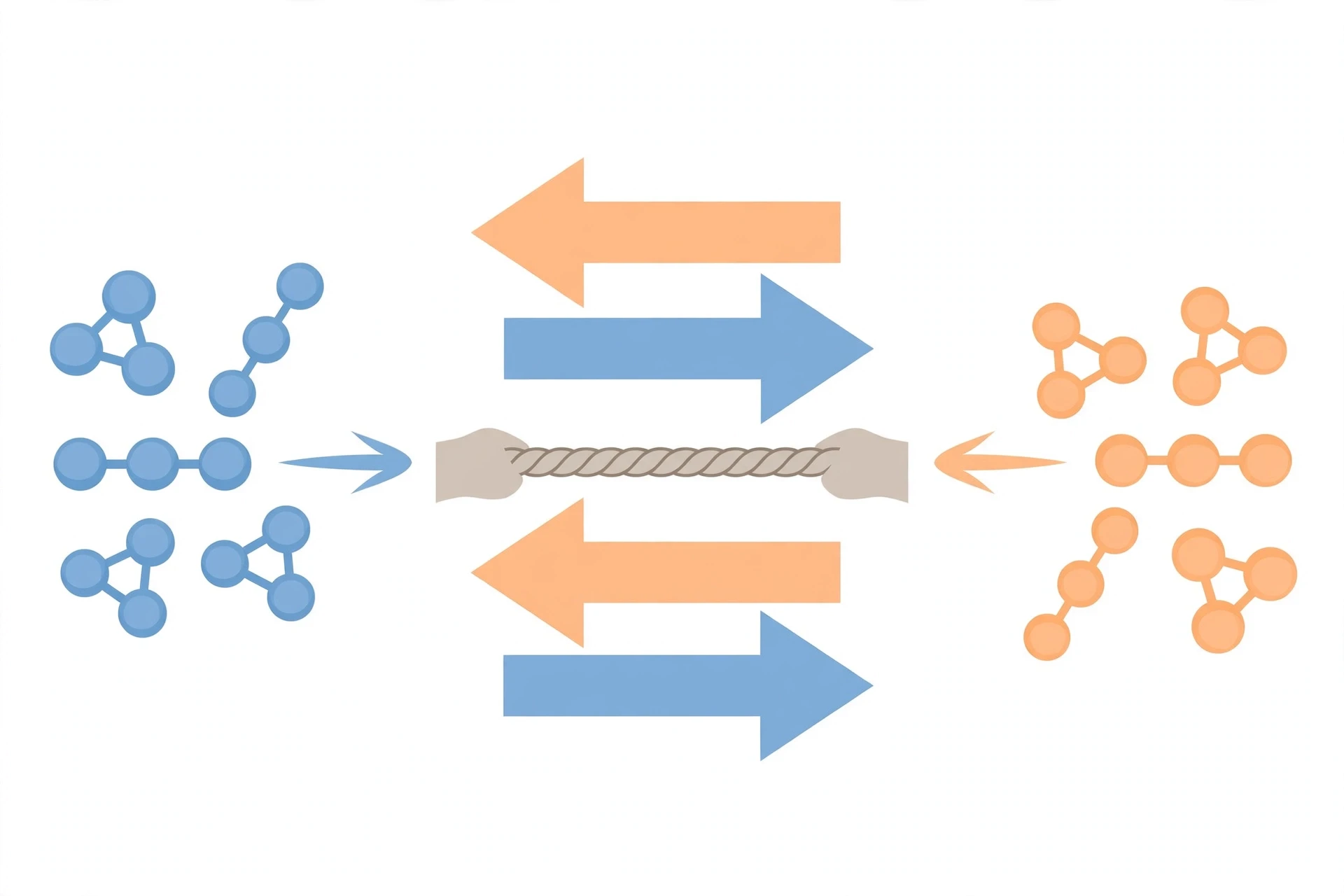
Write a simple reversible reaction as A + B ⇌ C + D, where the double arrow ⇌ means the reaction can run forward and backward. At the start, only A and B are present, so the forward reaction runs fast and the reverse reaction cannot run at all — there are no products yet to reverse. As C and D build up, the reverse reaction gathers speed while the forward reaction slows, because A and B are being used up. Sooner or later the two rates meet. From that moment on, every molecule of product made by the forward reaction is matched by a molecule of product unmade by the reverse reaction. The concentrations of A, B, C and D stop changing. The reaction has reached chemical equilibrium.
The word "dynamic" matters more than any other word in this article. Equilibrium is not a frozen pond. It is a busy railway station at rush hour, with exactly as many people arriving as leaving, so the crowd on the platform never grows and never shrinks. If you could watch individual molecules, you would see constant change. If you watch only the concentrations, you see nothing changing at all. Both views are true at the same time, and holding both in your head is the whole trick of this topic.
That is also why the most common misunderstanding about equilibrium is so stubborn. People hear "equilibrium" and picture equal amounts — half reactants, half products, a perfect split. It is not that at all. Equilibrium says nothing about the amounts being equal. It says only that the rates are equal. A reaction can sit at equilibrium with 99% products and 1% reactants, or with 99% reactants and 1% products, and both are perfectly good equilibria. Which one you get depends on the reaction itself, and that is exactly what the equilibrium constant measures, as we will see in section 4.
1.1 Reversible reactions are everywhere
Once you start looking, reversible reactions turn up in every corner of chemistry. The brown gas in my school laboratory was nitrogen dioxide, NO₂, pairing up into its colourless dimer, dinitrogen tetroxide, N₂O₄. The reaction 2NO₂ ⇌ N₂O₄ runs in both directions all the time inside that sealed tube. Heat it, and the brown colour deepens as the equilibrium shifts toward NO₂. Cool it, and the colour fades as more N₂O₄ forms. Nothing enters or leaves. The tube is a closed system, and that is a condition worth remembering: equilibrium needs a closed system. In an open beaker, a gas escapes, a product boils away, and the reaction can run to completion instead of settling.
Your own body runs on reversible reactions. Haemoglobin in your blood picks up oxygen in your lungs and releases it in your tissues — the same binding reaction running forward in one place and backward in another, driven by the local oxygen concentration. The carbon dioxide you breathe out sits in equilibrium with carbonic acid in your blood, and that equilibrium is part of how your blood keeps its pH steady. The oceans hold dissolved carbon dioxide in equilibrium with the air above them, which is why the chemistry of seawater shifts as the atmosphere changes. Equilibrium is not a laboratory curiosity. It is one of the operating principles of the living world.
1.2 Closed systems and the road to equilibrium
A system reaches equilibrium only when nothing is added or removed and the temperature stays steady. Give a reversible reaction those conditions and time, and it will settle by itself. How long that takes varies wildly. Some reactions reach equilibrium in a fraction of a second. Others take hours, days, or — in the case of some geological processes — thousands of years. The speed of the journey tells you nothing about the destination. A fast reaction and a slow reaction can end at exactly the same equilibrium position, just as a sprinter and a walker can both end up at the same finish line.
I learned that distinction the hard way in an undergraduate practical, watching a pale solution that was supposed to reach equilibrium in minutes. After half an hour nothing had visibly changed, and I was convinced I had made an error. My demonstrator glanced at the flask and told me to wait — and to start the analysis anyway, because the numbers would show the reaction was still creeping toward its endpoint. She was right. The reaction was slow, not broken. Equilibrium is a destination, and the rate at which you travel says nothing about where you will arrive. That lesson comes back later in this article, when we meet catalysts: they change how fast you get there, and nothing else.
2. The Brown Gas That Taught Chemistry a Lesson
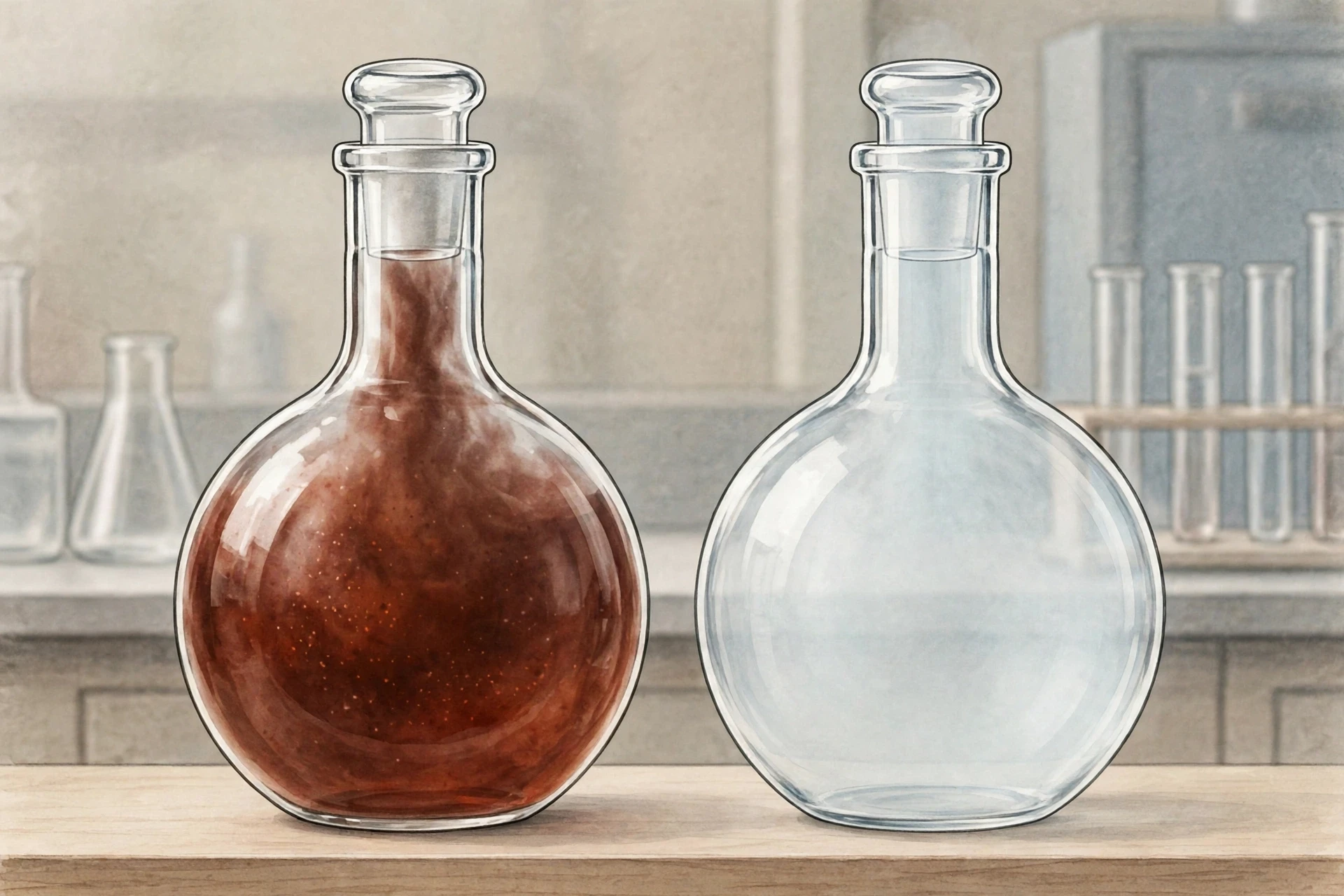
Let me take you back to that sealed tube, because it is the best single demonstration of chemical equilibrium ever devised, and it is still used in classrooms today. The reaction inside is 2NO₂ ⇌ N₂O₄. Nitrogen dioxide, NO₂, is a brown gas. Dinitrogen tetroxide, N₂O₄, is colourless. Put some NO₂ in a sealed tube and it starts pairing up into N₂O₄, and the brown colour fades. But it never fades completely. It settles at a particular shade of brown and stays there. That shade is the equilibrium position, written in colour.
Warm the tube and the brown deepens. More N₂O₄ splits apart into NO₂. Cool the tube and the brown fades toward colourless as NO₂ pairs up again. The tube is sealed, so no molecules enter or leave. The only thing changing is the balance between the two forms, and temperature tips that balance. Later we will explain exactly why heat favours the brown side of this reaction. For now, notice what the demonstration proves: a reaction can be genuinely reversible, it can settle at a point that is neither all-reactants nor all-products, and that point can be moved.
The NO₂/N₂O₄ system also shows why chemists write equilibrium with a double arrow rather than a single one. A single arrow would promise that NO₂ turns into N₂O₄ and the story ends. The double arrow promises something subtler and more honest: both things happen, all the time, and what you observe is the balance between them. That balance is different at every temperature, which is why the same sealed tube can be dark brown on a hot day and nearly colourless in an ice bath.
2.1 What the colour is really telling you
Colour is a concentration meter you can read with your eyes. The deeper the brown, the more NO₂ is present. When the colour stops changing, the concentration of NO₂ has stopped changing — and so has the concentration of N₂O₄. That is the experimental signature of chemical equilibrium: a measurable property that becomes constant over time. Chemists use the same logic with instruments instead of eyes, tracking concentration, pressure, pH or electrical conductivity until the reading holds steady.
There is a trap here, and it catches students every year. A constant reading does not prove the reaction has stopped. It proves the forward and reverse rates have become equal. The only way to prove the reaction is still running at equilibrium is a clever experiment: add a trace of a labelled atom, an isotope, to one side and watch it spread to the other side even though the concentrations never change. When chemists did that experiment, the label spread. The molecules never stop. The mixture only looks still.
3. How Equilibrium Is Reached: Rates, Not Stillness
Picture the start of a reaction between hydrogen and iodine: H₂ + I₂ ⇌ 2HI. At the first instant, the flask holds only H₂ and I₂. The forward reaction runs at full speed, making hydrogen iodide, HI. The reverse reaction cannot run at all, because there is no HI yet to break apart. But as HI accumulates, the reverse reaction begins, slowly at first and then faster as more HI becomes available. At the same time the forward reaction slows, because H₂ and I₂ are being consumed. The two rates approach each other like two trains on the same track, and when they meet, the system is at equilibrium.
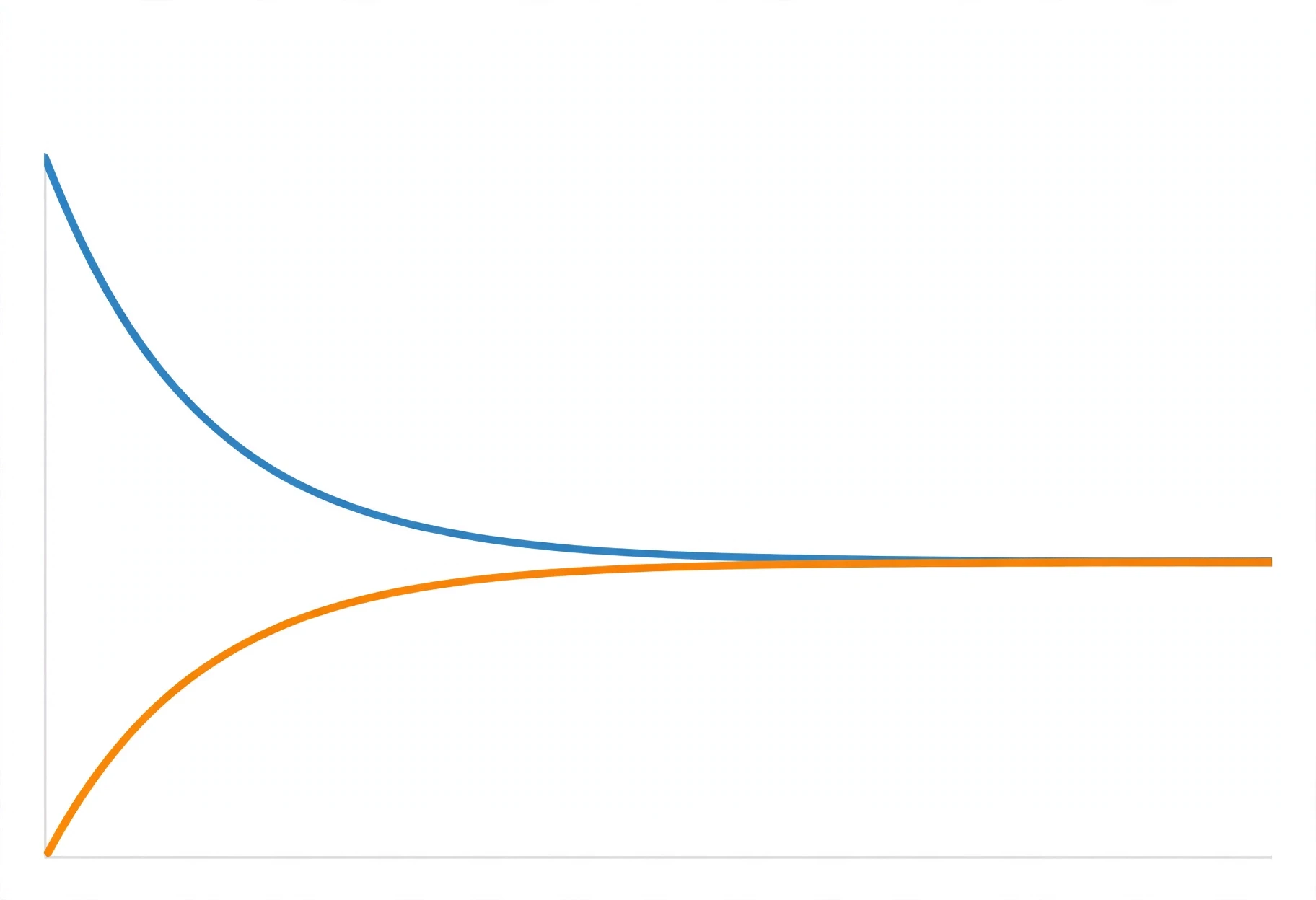
The graph in Figure 3 is the single most useful picture in this whole topic. Two curves bend toward each other and flatten. The flat part is equilibrium. Notice that the flat lines are not at the same height. The product line levels off higher than the reactant line in this example, which means this reaction sits at equilibrium with more product than reactant. In a different reaction, the lines could level off the other way around. The graph does not care. It only records where the balance fell.
3.1 Equilibrium from either direction
Here is a fact that surprises most people the first time they meet it: you can reach the same equilibrium starting from either side. Begin with pure H₂ and I₂, and the mixture settles at a particular set of concentrations. Begin instead with pure HI at the right total amount, and it breaks apart until it reaches exactly the same set of concentrations. The equilibrium position does not remember where you started. It depends only on the reaction, the temperature, and how much material is in the system in total.
That is a deep and useful property. It means equilibrium is a genuine state of the system, not an accident of history. It also means that if two chemists in different laboratories disagree about the equilibrium concentrations of a reaction, at least one of them has made a measurement error, because there is only one right answer for a given temperature and total composition.
3.2 A steady state is not the same thing
Students sometimes confuse equilibrium with a steady state, and the distinction is worth a short detour. A steady state also shows constant concentrations, but for a different reason: material flows in and out, and the inflow matches the outflow. A bathtub with the tap running and the plug pulled can hold a constant water level, but it is not at equilibrium — turn off the tap and the level falls. A chemical equilibrium needs no flow at all. It is a property of a closed system, maintained by two opposing reactions rather than by anything coming in from outside. Keep the two ideas apart and a whole family of exam questions becomes easy.
4. The Equilibrium Constant K: Measuring Where the Balance Falls
So far we have said that equilibrium can sit anywhere between almost-all-reactants and almost-all-products. The equilibrium constant, K, tells you where. For a general reaction aA + bB ⇌ cC + dD, the equilibrium constant in terms of concentrations is:
Kc = [C]ᶜ[D]ᵈ / [A]ᵃ[B]ᵇ
The square brackets mean molar concentration, and the exponents are the numbers from the balanced equation. For the hydrogen–iodine reaction, H₂ + I₂ ⇌ 2HI, the expression is Kc = [HI]² / ([H₂][I₂]). You measure the equilibrium concentrations, plug them in, and out comes a single number. That number is a property of the reaction at that temperature. Change the starting concentrations however you like, and the mixture will always settle at concentrations that give the same K. That is the law of mass action, and it is one of the most powerful regularities in all of chemistry.
A note on notation before we go further: chemists use Kc when the expression is written with concentrations, and Kp when it is written with partial pressures for gas reactions. The two are related but not identical, and the distinction matters in calculations. In this article, Kc is our default, and Kp appears only where pressure is the natural language, as in the Haber process. The OpenStax Chemistry textbook gives a clear, worked introduction to equilibrium constants and their expressions for anyone who wants to practise the algebra step by step.
4.1 What big and small K actually mean
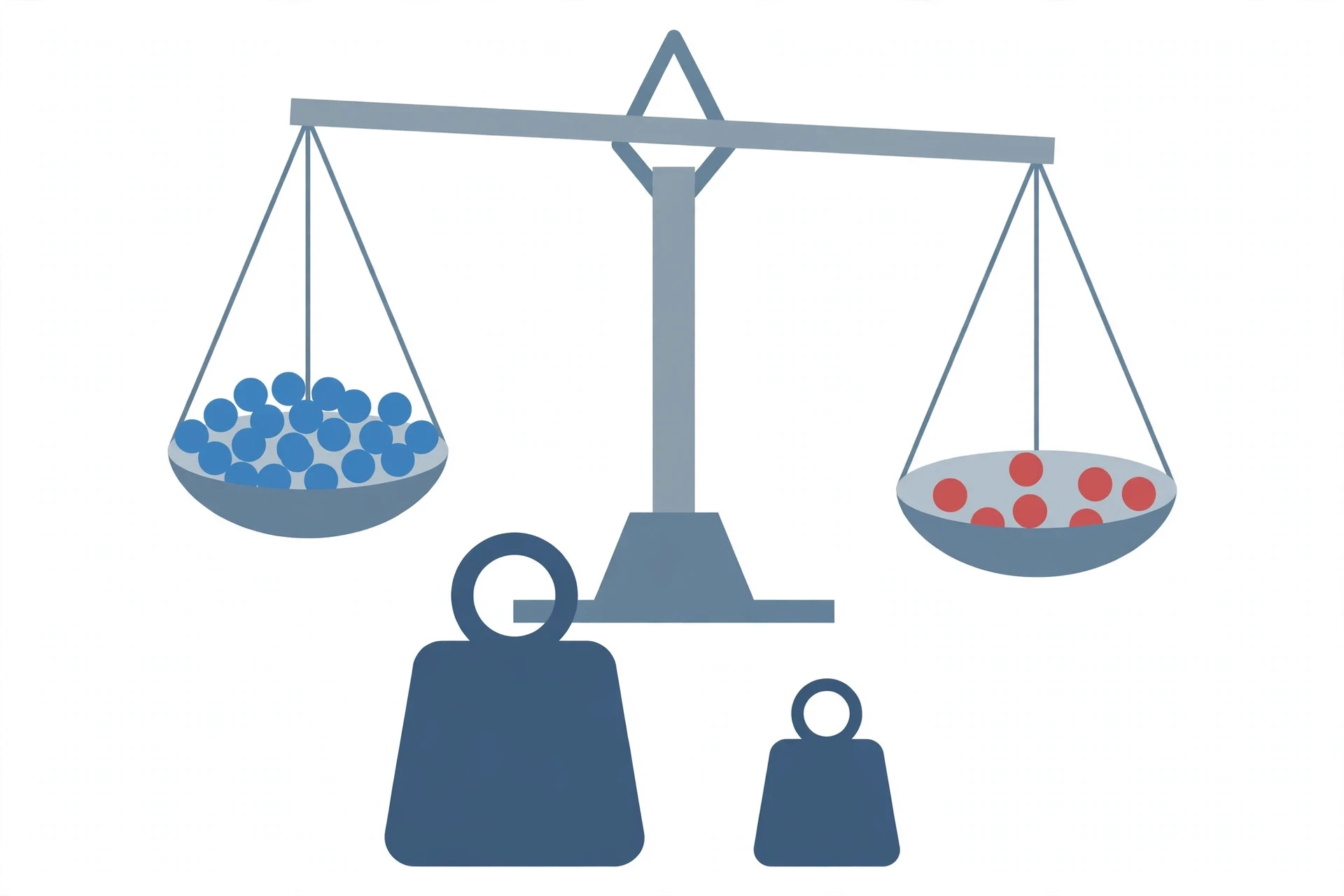
The size of K is a direct report on where the balance falls. If K is much larger than 1 — say 10⁴ or 10⁸ — the numerator of the expression dominates, which means products dominate at equilibrium. The reaction, for practical purposes, goes almost to completion. If K is much smaller than 1 — say 10⁻⁶ or 10⁻¹⁰ — the denominator dominates, reactants dominate, and barely any product forms. If K is close to 1, the mixture at equilibrium holds comparable amounts of reactants and products. None of these cases is "better" than the others. K simply reports what the molecules prefer at that temperature.
The table below gathers a few well-established equilibrium constants. These are textbook values, measured many times over, and they show the full range of behaviour in a single glance.
Reaction | Equilibrium constant | What it means |
|---|---|---|
H₂ + I₂ ⇌ 2HI | Kc ≈ 54 at 700 K | Products favoured, but plenty of reactants remain |
CH₃COOH + C₂H₅OH ⇌ CH₃COOC₂H₅ + H₂O | Kc ≈ 4 at room temperature | A genuine mixture: ester, water, acid and alcohol all present |
H₂O ⇌ H⁺ + OH⁻ | Kw = 1.0 × 10⁻¹⁴ at 25 °C | Water barely dissociates at all — a tiny K |
N₂ + 3H₂ ⇌ 2NH₃ | K is very large at room temperature, and falls sharply as temperature rises | Ammonia is strongly favoured when cold, much less so when hot |
Look at the last row. The Haber reaction has a large K at room temperature, which sounds like wonderful news for making ammonia — and it is, in one sense. But a large K says nothing about speed. At room temperature the Haber reaction is so slow that, without help, you could wait a lifetime for a measurable amount of ammonia. That gap between "favoured" and "fast" is the central tension of industrial chemistry, and it is the reason the Haber process looks the way it does. We will come back to it in section 11.
4.2 K depends on temperature — and on nothing else
This is a fact worth underlining, because it is the key to everything Le Chatelier's principle does. The value of K for a given reaction depends on temperature, and on nothing else. Change the concentrations, change the pressure, add a catalyst, stir the mixture, use a bigger flask — K does not move. Only temperature changes K. Everything else changes where the mixture sits relative to K, and the mixture then adjusts until the ratio matches K again.
Why should temperature be special? Because temperature changes the energy available to molecules, and the balance between reactants and products is ultimately an energy balance. Heating a reaction gives molecules more energy, and the side of the reaction that absorbs heat benefits more from that extra energy. Section 9 works through that logic in detail. For now, hold on to the rule: temperature is the only dial that moves K itself.
4.3 Solids and pure liquids do not appear in K
One more piece of bookkeeping, and it saves a great deal of confusion. Pure solids and pure liquids are left out of equilibrium constant expressions. Their concentrations do not change as the reaction proceeds — a lump of solid has the same concentration whether the lump is large or small — so they are folded into the value of K itself. For the decomposition of calcium carbonate, CaCO₃(s) ⇌ CaO(s) + CO₂(g), the expression is simply Kp = P(CO₂), the partial pressure of carbon dioxide. The solids vanish from the expression entirely. This is the rule behind the solubility product of a salt, and behind the way limestone caves form, which we meet again in section 12.
5. The Reaction Quotient Q: Knowing Which Way the Reaction Will Go
The equilibrium constant tells you where a reaction ends up at chemical equilibrium. The reaction quotient, Q, tells you where it is right now — and therefore which way it will move. Q is calculated with exactly the same formula as K, but with the concentrations at this moment rather than the concentrations at equilibrium. Compare the two numbers and the future is written:
If Q is smaller than K, the mixture holds too little product and too much reactant. The forward reaction runs faster, making more product, until Q rises to meet K.
If Q is larger than K, the mixture holds too much product. The reverse reaction runs faster, turning product back into reactant, until Q falls to meet K.
If Q equals K, the mixture is already at equilibrium, and nothing changes.
That is the whole machinery of Le Chatelier's principle in numerical form. Every disturbance you can apply to an equilibrium — adding a reactant, removing a product, squeezing the flask, heating it — works by changing Q, or by changing K, and the reaction then moves to close the gap between them. Keep Q and K in mind as you read the next sections, and every prediction will feel like arithmetic rather than magic.
A simple example makes it concrete. Take the esterification reaction from the table in section 4, with Kc ≈ 4. Suppose you mix acid and alcohol in equal amounts with no ester present at all. Q is zero, which is far below 4, so the forward reaction runs and ester forms. As ester and water build up, Q climbs. When Q reaches 4, the reaction stops changing. If you then dumped in a large extra dose of ester, Q would jump above 4, and the reverse reaction would take over, breaking ester back down into acid and alcohol until Q fell back to 4. The mixture always walks back to the same ratio. That walk is Le Chatelier's principle in action.
6. What Is Le Chatelier's Principle?
In 1884, the French chemist Henri Louis Le Chatelier put into words something chemists had been noticing for years: when you disturb a system at equilibrium, the system responds in the direction that opposes the disturbance. His principle, in its classic form, says that if a change of condition is applied to a system in equilibrium, the system shifts in a direction that tends to undo the change. Add more reactant, and the system uses some of it up by making more product. Take away product, and the system makes more of it. Squeeze a gas mixture, and the system shifts toward the side with fewer gas molecules, easing the pressure back down. Heat an exothermic reaction, and the system shifts toward the reactants, absorbing some of the heat you added.
Le Chatelier's principle is not a law of nature in the same sense as the conservation of energy. It is a summary of how equilibrium systems behave, and it works because every shift it predicts is the shift that restores the balance between Q and K.
The principle is a prediction tool, not an explanation. It tells you which way the equilibrium will shift, but it does not tell you how far, and it does not tell you why in molecular terms. The "why" lives in the rates and in the value of K. When you add a reactant, the forward rate jumps because there are more reactant molecules colliding, while the reverse rate is unchanged at first — so the forward reaction wins until the rates match again. When you change the temperature, you change K itself, and the mixture moves to a new balance point. The principle and the rate picture agree everywhere, because they are two descriptions of the same physics. Students who learn both never need to memorise which way a shift goes; they can work it out.
One caution before we apply the principle: it applies only to systems that are already at equilibrium, or close to it. It says nothing about how fast the shift happens. A system can be pushed toward a new equilibrium position and take hours to get there. The principle predicts the destination, never the journey time. That distinction is exactly where catalysts enter the story, in section 10.
6.1 The three kinds of disturbance
Every disturbance you can apply to a chemical equilibrium falls into one of three families, and each family gets its own section next. Changing a concentration changes Q. Changing the pressure or volume of a gas mixture changes Q by changing all the concentrations at once. Changing the temperature changes K itself. A catalyst, notably, does none of these things — it is not a disturbance at all in the Le Chatelier sense, which is why it deserves its own careful treatment. The table below is the whole of Le Chatelier's principle in one glance; the sections that follow explain each row with real reactions.
Disturbance | What changes | How the system responds |
|---|---|---|
Add a reactant (or remove a product) | Q falls below K | Shifts right, toward products |
Add a product (or remove a reactant) | Q rises above K | Shifts left, toward reactants |
Increase pressure / decrease volume (gases) | Concentrations all rise | Shifts toward the side with fewer gas molecules |
Decrease pressure / increase volume (gases) | Concentrations all fall | Shifts toward the side with more gas molecules |
Increase temperature | K itself changes | Shifts toward the endothermic direction |
Decrease temperature | K itself changes | Shifts toward the exothermic direction |
Add a catalyst | Nothing in Q or K | No shift — equilibrium reached faster |
7. Changing Concentration: Feeding One Side of the Balance
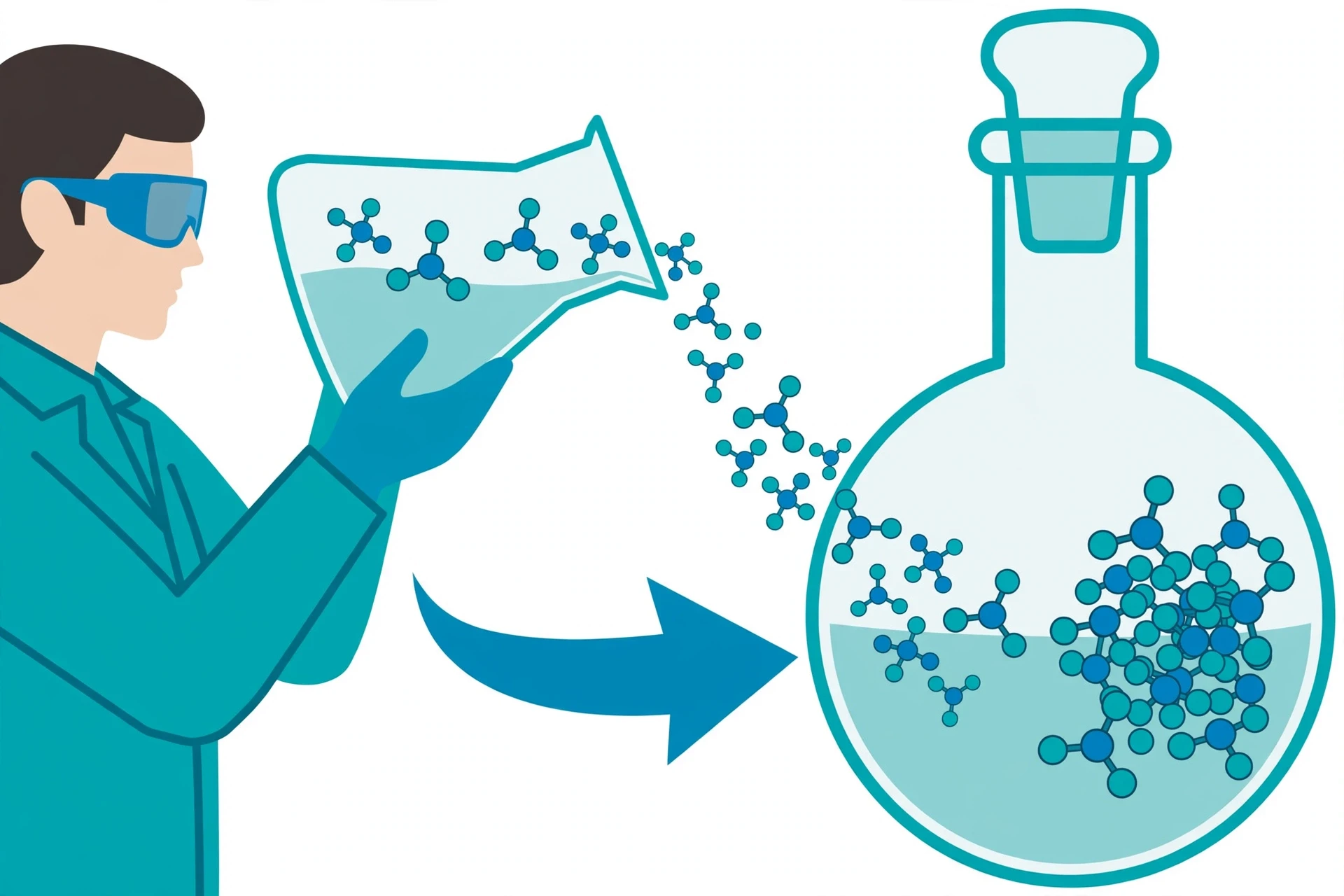
The most intuitive disturbance is also the most useful in the laboratory. Add more of a reactant to a mixture at chemical equilibrium, and the system responds by consuming some of it, making more product. Remove a product as fast as it forms, and the system keeps making more of it, trying to replace what you took. Both moves shift the equilibrium to the right. Add product instead, or remove reactant, and the equilibrium shifts left.
I watched this happen in an undergraduate practical that I still remember clearly, because the colour change was so dramatic. We had a flask of iron(III) thiocyanate, a deep blood-red complex formed by Fe³⁺ + SCN⁻ ⇌ FeSCN²⁺. The solution sat at equilibrium, a steady red. Then the demonstrator added a few drops of iron(III) solution, and the red deepened before our eyes — the extra Fe³⁺ had pushed the equilibrium toward more of the red complex. Then she added a few drops of a solution that binds Fe³⁺ tightly, pulling iron out of the game, and the red faded toward pale yellow. Same flask, same reaction, two opposite shifts, both predicted in advance by Le Chatelier's principle. It felt less like chemistry and more like a conversation: push the system, and it pushes back.
7.1 Why removing a product is so powerful
Removing a product is the single most powerful trick in industrial chemistry, because it never lets the reaction settle. If a product is continuously drawn off — by distillation, by precipitation, by absorption into another phase — then Q stays below K forever, and the forward reaction keeps running. The equilibrium never arrives, and the reaction is driven, in practice, to completion. This is how esterification is run in industry: the water produced is removed as it forms, and the reaction that would otherwise stop at Kc ≈ 4 is pushed almost all the way to pure ester.
The same logic runs in reverse for a reactant that is replenished continuously. Keep feeding reactant into a reactor and the equilibrium keeps shifting right, converting the feed into product as fast as it arrives. Continuous-flow reactors are built on exactly this idea, and the Haber process, which we meet in section 11, uses both tricks at once: ammonia is condensed out of the gas stream as it forms, and fresh nitrogen and hydrogen keep flowing in.
8. Changing Pressure and Volume: Squeezing a Gas Equilibrium
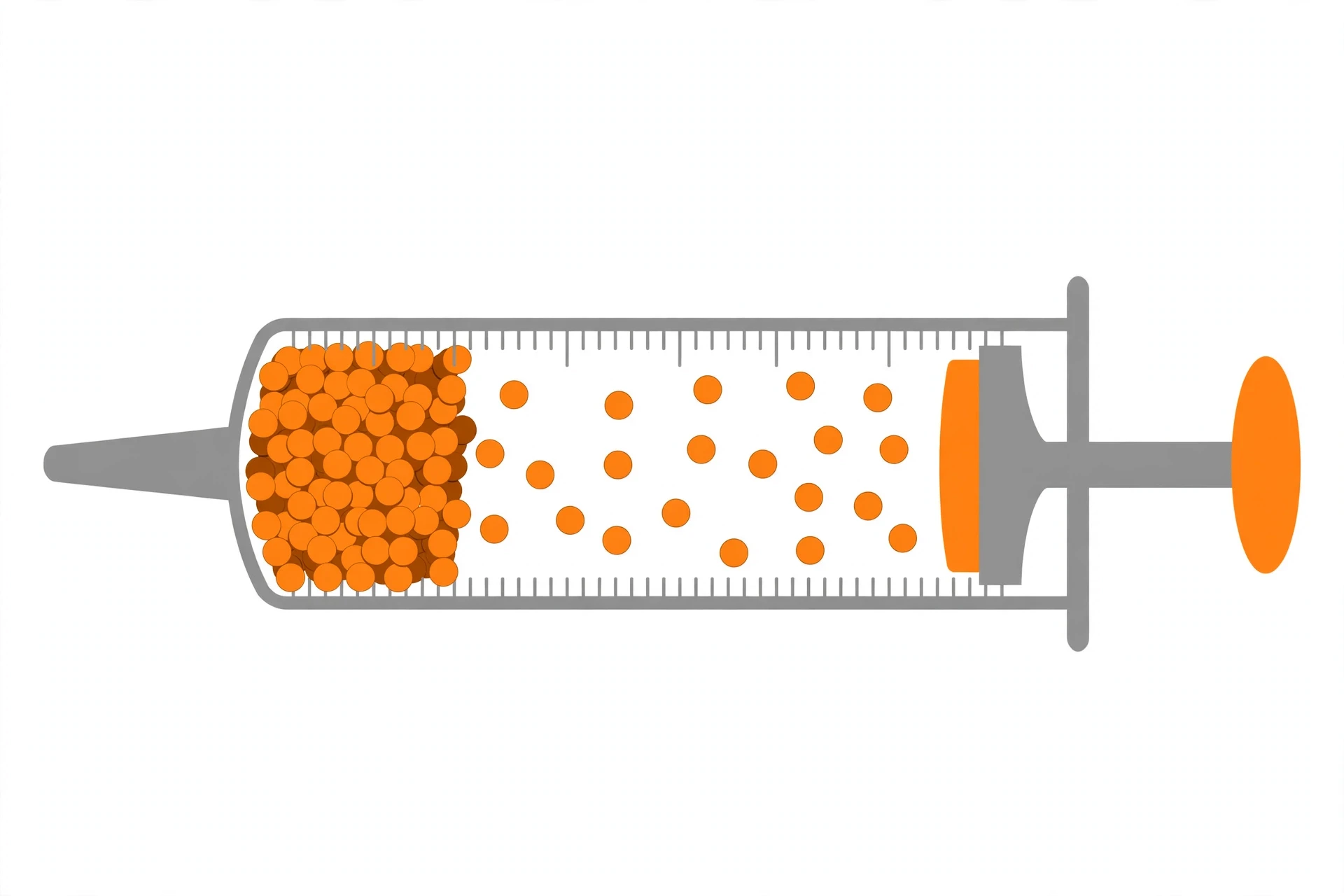
Pressure matters only for reactions involving gases, and only when the two sides of the equation have different numbers of gas molecules. The logic is simple. Squeeze a gas mixture into a smaller volume and its pressure rises. The system responds by shifting toward the side with fewer gas molecules, because fewer molecules means less pressure, which partly undoes the squeeze. Expand the volume instead, and the system shifts toward the side with more gas molecules, filling the new space.
Take the brown gas reaction again: 2NO₂ ⇌ N₂O₄. The left side has two gas molecules, the right side has one. Compress the mixture, and the equilibrium shifts right, toward N₂O₄, and the brown colour fades — not because of temperature this time, but because the system is shedding gas molecules to fight the pressure rise. Expand the mixture, and the equilibrium shifts left, toward NO₂, and the brown deepens. If both sides of an equation have the same number of gas molecules — as in H₂ + I₂ ⇌ 2HI, two molecules on each side — then pressure changes do nothing at all. Squeezing raises every concentration equally, Q does not change, and the equilibrium stays exactly where it was.
8.1 Pressure is a blunt tool
It is worth being honest about the limits of pressure as a control dial. Changing the pressure of a gas mixture changes the equilibrium position, but often not by much, and the engineering cost of very high pressures is enormous — thick steel, powerful compressors, serious safety systems. Industry uses pressure where it pays, as the Haber process does, but nobody squeezes a reaction just for fun. Pressure is also powerless over reactions in solution, where liquids barely compress at all. For a reaction dissolved in water, doubling the pressure changes almost nothing, and chemists do not bother trying.
There is one more subtlety worth knowing. Adding an inert gas — one that does not take part in the reaction — at constant volume changes nothing, because the partial pressures of the reacting gases do not change. Add the same inert gas at constant total pressure, though, and the volume must grow to make room, which dilutes the reacting gases and shifts the equilibrium toward the side with more molecules. Exam questions love this distinction, and it is a good test of whether you understand that what matters is partial pressure, not total pressure.
9. How Does Temperature Affect Equilibrium?
Temperature is the only disturbance that changes K itself, which makes it the most powerful dial you have — and the hardest to use well. The rule is straightforward once you know whether the reaction gives out heat or takes it in. For an exothermic reaction, one that releases heat, treat heat as a product: add heat by warming the mixture, and the equilibrium shifts left, toward the reactants, as if the system were trying to use up the extra product. For an endothermic reaction, one that absorbs heat, treat heat as a reactant: warm the mixture, and the equilibrium shifts right, toward the products.
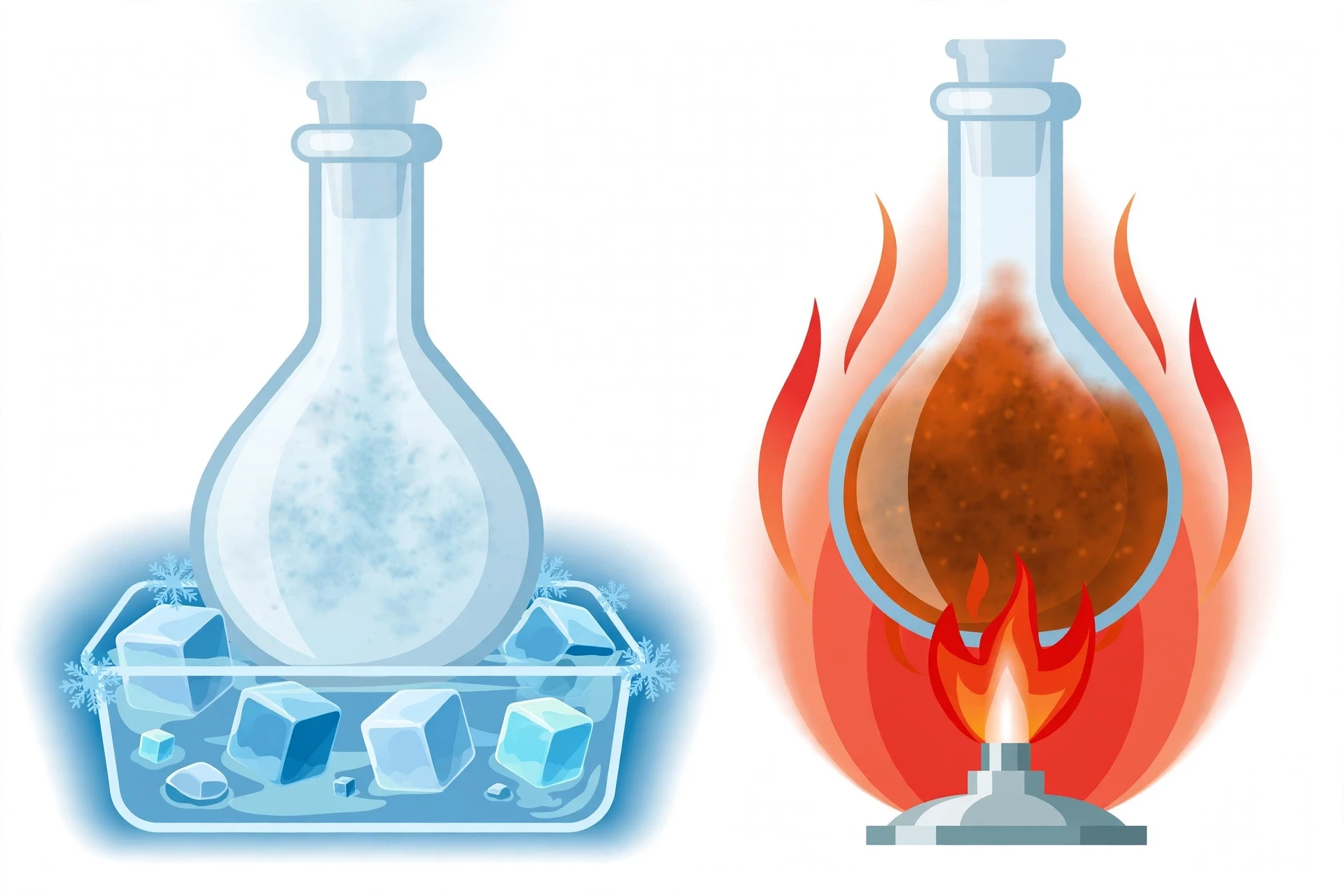
The brown gas reaction shows the rule in colour. The pairing reaction 2NO₂ → N₂O₄ is exothermic: it releases heat as NO₂ molecules join up. Warm the tube, and the equilibrium shifts left, toward NO₂, and the brown deepens. Cool the tube, and the equilibrium shifts right, toward colourless N₂O₄. The dimerisation of NO₂ releases about 57 kilojoules per mole, and that single number explains the whole demonstration. Heat is a product here, so adding heat pushes the reaction backward.
9.1 The van 't Hoff picture, in plain words
Behind the rule sits a quantitative relationship called the van 't Hoff equation, which connects the change in K to the enthalpy change of the reaction, ΔH. You do not need the equation to use the rule, but knowing it exists matters: temperature effects on equilibrium are not vague tendencies, they are precisely calculable. Given ΔH and K at one temperature, a chemist can predict K at any other temperature. The sign of ΔH decides the direction — negative for exothermic, positive for endothermic — and the size of ΔH decides how strongly K responds. A reaction with a large ΔH swings wildly with temperature. A reaction with a small ΔH barely notices.
This is why the Haber reaction is such a headache for industry, and such a good teaching example. Making ammonia releases heat, so it is exothermic, and cooling it would push the equilibrium toward more ammonia. But cooling it also slows the reaction to a crawl. The industrial process must choose a temperature that balances a favourable equilibrium against a usable speed, and that compromise — around 450 °C — is the heart of section 11.
9.2 Heating is not always the answer
There is a persistent instinct, in students and in industry alike, that heating a reaction makes everything better. For equilibrium, that instinct is wrong exactly half the time. Heat an exothermic reaction and you get less product, not more, however fast the reaction runs. The fastest reaction in the world is useless if its equilibrium sits on the wrong side. Chemists learn to ask two separate questions about every reaction: how fast does it go, and where does it end up? Temperature pushes those two answers in opposite directions for exothermic reactions, and the art of the subject is finding the point where both answers are good enough.
Temperature is the only dial that moves K itself. Concentration and pressure move the mixture; temperature moves the destination.
10. Does a Catalyst Affect Equilibrium?
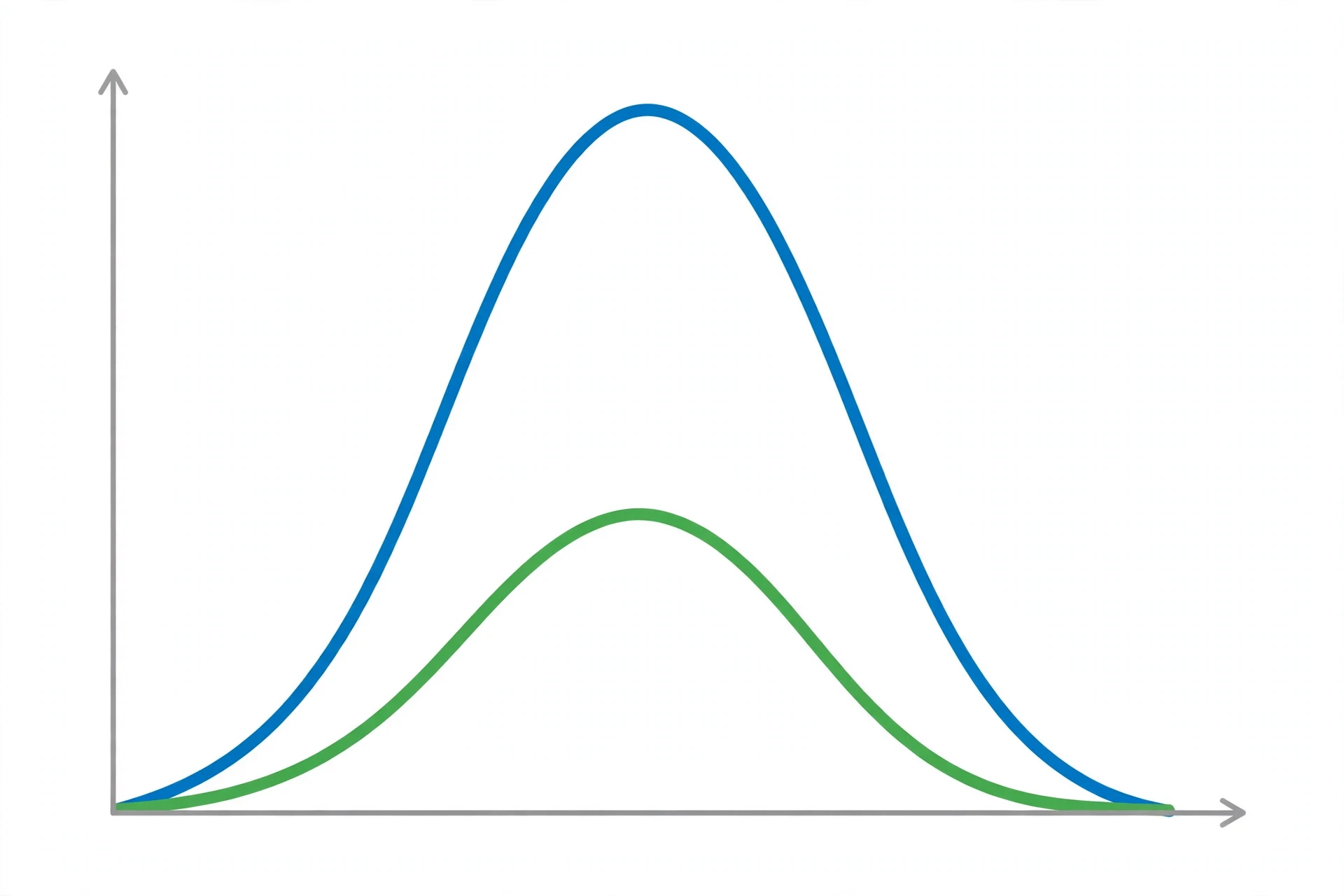
No. A catalyst does not affect the position of equilibrium, and it does not change K. It changes only how fast equilibrium is reached. This is one of the most commonly tested facts in chemistry, and one of the most commonly misunderstood, so it is worth saying plainly twice: a catalyst speeds up the forward and the reverse reaction by exactly the same factor, so the balance point stays exactly where it was, and the system simply arrives there sooner.
The reason lies in the energy profile of the reaction. A catalyst provides an alternative pathway with a lower activation energy — a lower hill for the molecules to climb. Crucially, it lowers the hill by the same amount in both directions. The starting energy of the reactants and the finishing energy of the products do not change, so the energy difference between them does not change, and the equilibrium constant, which depends on that difference, does not change either. Figure 8 shows the two pathways side by side: same start, same finish, lower hill in between.
10.1 Why catalysts still matter enormously
If a catalyst cannot change the equilibrium position, why does industry spend billions on them? Because reaching equilibrium in minutes instead of years is often the difference between a process that works and one that does not. The Haber reaction has a large K at room temperature, which means ammonia is strongly favoured — but without a catalyst, the reaction is so slow that the favour does not matter. An iron catalyst does not change the destination by a single molecule. It makes the journey fast enough to be useful. That is the whole job of a catalyst, and it is a job worth billions.
I saw the point made in a lecture demonstration that I have never forgotten. Two identical flasks held the same mixture, one with a pinch of catalyst and one without. The catalysed flask reached its final colour in under a minute. The other sat there, unchanged, for the whole hour of the lecture, and would have needed days to catch up. Both flasks were heading for the same equilibrium. Only one of them would get there in time to matter. Speed, not position, is what a catalyst sells.
10.2 Enzymes are catalysts too
The same rule governs the catalysts inside your body. Enzymes are biological catalysts, proteins that lower activation energies for the reactions of life, and they obey exactly the same principle: they accelerate the forward and reverse reactions equally, and they leave the equilibrium untouched. Your cells use enzymes to reach equilibrium quickly, and then they use other tricks — pumping products away, feeding in fresh reactants — to keep reactions moving in the direction they need. Life does not break the rules of equilibrium. It plays them brilliantly, using catalysts for speed and concentration changes for direction. For a fuller picture of how reactions run and what controls their speed, see the companion guide to chemical reactions, which covers reaction types and kinetics in depth.
11. What Is the Haber Process?
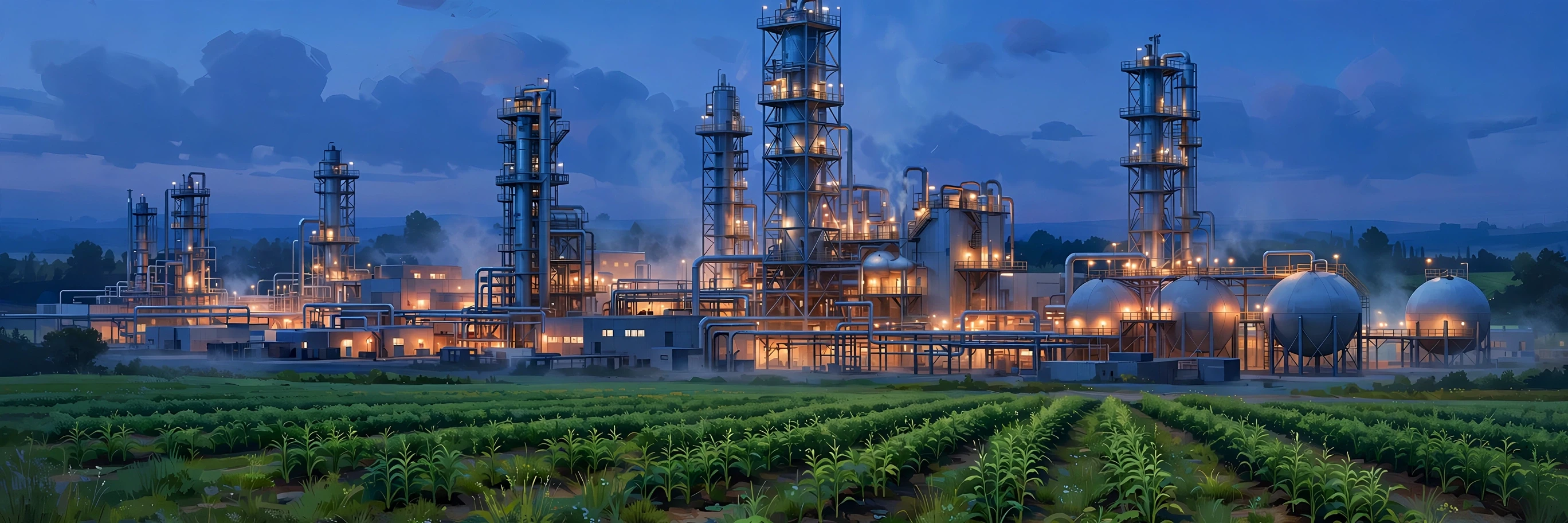
The Haber process is the single most important application of chemical equilibrium in human history, and the best way to see everything in this article working at once. The reaction is N₂ + 3H₂ ⇌ 2NH₃: nitrogen from the air plus hydrogen, making ammonia. Ammonia is the raw material for fertilisers, and fertilisers feed roughly half the people alive today. The process was developed by Fritz Haber in the early twentieth century and scaled up by Carl Bosch, and it is still, more than a century later, one of the largest chemical processes on Earth.
The equilibrium facts are these. The reaction is exothermic, releasing about 92 kilojoules per mole of ammonia formed, so low temperatures favour ammonia: K is large when cold and small when hot. The reaction also turns four gas molecules into two, so high pressure favours ammonia. Left to pure equilibrium logic, the ideal conditions would be the coldest temperature possible and the highest pressure possible. Reality refuses both.
At room temperature the reaction is so slow that almost no ammonia forms in any reasonable time, even with a catalyst. Raise the temperature to about 450 °C and the iron catalyst works well, but K has fallen sharply, so the equilibrium mixture holds only a modest fraction of ammonia — roughly 15% conversion per pass through the reactor at the pressures used. Raise the pressure to around 200 atmospheres and the equilibrium shifts right, improving the yield, but each extra atmosphere costs steel, energy and risk. So the industrial conditions are a compromise, chosen by balancing all three factors: about 450 °C, about 200 atmospheres, and an iron catalyst. The catalyst does not change the equilibrium. The temperature and pressure do, in opposite directions, and the plant lives with the trade-off.
11.1 The clever part: never letting equilibrium arrive
The most elegant feature of a Haber plant is not its temperature or its pressure. It is the way the plant refuses to let the reaction settle. The gas mixture passes over the catalyst bed, some ammonia forms, and then the gas is cooled. Ammonia condenses into a liquid and is drawn off, while the unreacted nitrogen and hydrogen are recycled back into the reactor with a fresh feed. Because the product is constantly removed, Q stays below K, and the forward reaction keeps running. The system is held permanently short of equilibrium, and that permanent shortfall is what makes the plant productive. It is Le Chatelier's principle run as a business model: remove the product, and the system makes more.
The same thinking applies to the hydrogen feed. Hydrogen for the Haber process is mostly made from natural gas, and that production step is itself an equilibrium reaction — the steam reforming of methane — run under conditions chosen the same way. Equilibrium is not one idea in this industry. It is the whole design language.
11.2 Why the compromise matters
It is tempting to look at the Haber conditions and wonder why chemists tolerate a process that converts only a fraction of its feed on each pass. The answer is that the alternative is worse. Run it cold and you get a wonderful equilibrium that you will never reach. Run it hot and you get a fast reaction that makes almost nothing. Run it at atmospheric pressure and the equilibrium sits too far left to be worth the trouble. The chosen conditions are the best available balance of three competing demands, and the recycle loop turns a modest per-pass conversion into a high overall yield. Understanding that compromise — not memorising the numbers — is the real lesson of the Haber process. Every industrial equilibrium process, from making methanol to making sulfuric acid, is the same negotiation in different clothes.
The Haber process does not beat chemical equilibrium. It bargains with it — and the bargain feeds half the world.
12. Equilibrium All Around You
Equilibrium is easy to treat as a chapter in a textbook, but it is running right now in your body, in your kitchen, and in the ground under your feet. A few examples show how wide the idea reaches.
Your blood is a masterpiece of equilibrium management. Carbon dioxide from your tissues dissolves in blood and sits in equilibrium with carbonic acid, which sits in equilibrium with bicarbonate and hydrogen ions: CO₂ + H₂O ⇌ H₂CO₃ ⇌ H⁺ + HCO₃⁻. That chain of equilibria holds your blood pH near 7.4, and your body defends it fiercely, because even a small drift is dangerous. Breathe faster and you blow off CO₂, shifting the equilibria and raising the pH. Breathe into a paper bag and you do the reverse. The chemistry is the same Le Chatelier logic as the brown gas tube, running inside you without your permission or attention.
The oceans hold an even larger version of the same system. Carbon dioxide from the air dissolves in seawater and enters the same carbonate equilibria, which is why the oceans have absorbed a large share of the carbon dioxide humanity has released. That absorption shifts the equilibria toward more hydrogen ions, lowering the pH of seawater — the process called ocean acidification — and making it harder for corals and shellfish to build their calcium carbonate skeletons. The chemistry is equilibrium chemistry. The consequences are ecological.
Open a bottle of fizzy drink and you run a pressure-shift experiment on your kitchen table. The drink was bottled under high pressure, with carbon dioxide dissolved in equilibrium with the gas above the liquid. Pop the cap and the pressure falls to atmospheric, the equilibrium shifts toward the gas side, and carbon dioxide bubbles out of solution. Leave the bottle open and warm, and it goes flat: the dissolved gas escapes until a new equilibrium is reached, this time with very little CO₂ left in the drink. Shake the bottle first and you give the escaping gas somewhere to start — the bubbles form faster, but the destination is the same.
Limestone caves are equilibrium written in stone. Rainwater picks up carbon dioxide from the air and the soil, forming weak carbonic acid, which dissolves limestone by the reaction CaCO₃ + CO₂ + H₂O ⇌ Ca²⁺ + 2HCO₃⁻. Drip by drip, over thousands of years, the acid water carves caves. Then the water drips from a cave ceiling into air with less carbon dioxide, the equilibrium shifts back, and calcium carbonate precipitates out — building stalactites and stalagmites one drop at a time. The same reaction, run in one direction, digs the cave; run in the other, it decorates it. The atoms and molecules behind all of this — what they are, how they bond, and how they behave in different states — are covered in the companion guide to atoms and molecules.
13. Common Mistakes and Misconceptions
Most people assume that equilibrium means the amounts of reactants and products are equal. What the data actually show is something else entirely: equilibrium means the rates are equal, and the amounts can sit almost anywhere. A reaction with K = 10⁶ sits at equilibrium with virtually all product. A reaction with K = 10⁻⁶ sits at equilibrium with virtually all reactant. Both are genuine equilibria, and calling either one "unbalanced" misses the point. The balance is in the rates, not in the amounts.
A second mistake is thinking that a reaction at chemical equilibrium has stopped. It has not. Molecules cross in both directions constantly, and the only thing that has stopped changing is the net composition. The isotope-labelling experiments mentioned in section 2 prove it, and the proof matters: if the reactions had stopped, a catalyst could not speed up the approach to equilibrium, because there would be nothing to speed up.
A third mistake is treating a catalyst as a way to shift an equilibrium. It is not. A catalyst changes the speed of both directions equally and leaves K untouched. If an exam question asks what a catalyst does to the yield of a reaction at equilibrium, the answer is nothing. If it asks what a catalyst does to the time taken to reach equilibrium, the answer is that it shortens it.
A fourth mistake is confusing K with the rate of reaction. K is a ratio of concentrations at equilibrium — a statement about the destination. The rate constant is a statement about speed — a statement about the journey. A reaction can have a huge K and a tiny rate constant, like the Haber reaction at room temperature, or a small K and a huge rate constant, like many acid-base reactions that finish in a blink but sit near the reactant side. Speed and position are independent facts, and every good chemist keeps them in separate boxes.
A final mistake is forgetting that solids and pure liquids are left out of K expressions. Students write them in, get a nonsense expression, and then wonder why their numbers disagree with the book. Leave them out from the start, and the expressions stay clean.
14. Worked Examples: Using ICE Tables
An ICE table — Initial, Change, Equilibrium — is the standard tool for turning a K value into actual concentrations. Worked through once, slowly, the method becomes routine. Here is a full example using the hydrogen–iodine reaction, with Kc = 54 at 700 K.
Example 1: Finding equilibrium concentrations. A flask is filled with H₂ and I₂, each at 1.00 mol/L, and no HI. The reaction H₂ + I₂ ⇌ 2HI runs until equilibrium is reached at 700 K, where Kc = 54. What are the equilibrium concentrations?
Set up the table, letting x be the amount of H₂ (and I₂) consumed:
H₂ | I₂ | HI | |
|---|---|---|---|
Initial (mol/L) | 1.00 | 1.00 | 0 |
Change (mol/L) | −x | −x | +2x |
Equilibrium (mol/L) | 1.00 − x | 1.00 − x | 2x |
Insert the equilibrium concentrations into the expression Kc = [HI]² / ([H₂][I₂]):
54 = (2x)² / (1.00 − x)²
Take the square root of both sides: 7.35 = 2x / (1.00 − x). Solving gives 7.35 − 7.35x = 2x, so 9.35x = 7.35, and x = 0.786. The equilibrium concentrations are therefore [H₂] = [I₂] = 1.00 − 0.786 = 0.21 mol/L, and [HI] = 2 × 0.786 = 1.57 mol/L. A quick check confirms it: (1.57)² / (0.21 × 0.21) = 2.46 / 0.044 = 54, matching Kc. The reaction sits far toward the product side, as a K of 54 promises, but a real amount of each reactant remains — equilibrium is a balance, not a victory.
Example 2: Predicting a shift. A mixture of N₂O₄ and NO₂ is at chemical equilibrium in a sealed flask: N₂O₄ ⇌ 2NO₂. A small extra amount of NO₂ is injected into the flask. Which way does the equilibrium shift, and what happens to the colour?
Adding NO₂ raises its concentration, so Q — here, [NO₂]² / [N₂O₄] — jumps above K. The reverse reaction now runs faster than the forward one, converting NO₂ back into N₂O₄ until Q falls back to K. The equilibrium shifts left, toward N₂O₄, and the brown colour fades as NO₂ is consumed. Le Chatelier's principle gives the same answer in one line: the system opposes the addition of NO₂ by using some of it up. The Q-and-K calculation shows why the principle works, and the colour shows it happening.
Frequently Asked Questions
What is Le Chatelier's principle?
Le Chatelier's principle states that when a system at equilibrium is disturbed — by a change in concentration, pressure or temperature — it shifts in the direction that opposes the disturbance. Add a reactant and the system makes more product to use it up; raise the pressure and the system shifts toward the side with fewer gas molecules; heat an exothermic reaction and the system shifts toward the reactants. The principle predicts the direction of the shift, not how far it goes or how fast it happens. The LibreTexts guide to Le Chatelier's principle gives the classic statement with worked examples.
How does temperature affect equilibrium?
Temperature is the only factor that changes the equilibrium constant K itself. For an exothermic reaction, which releases heat, raising the temperature shifts the equilibrium toward the reactants and lowers K, so less product forms. For an endothermic reaction, which absorbs heat, raising the temperature shifts the equilibrium toward the products and raises K, so more product forms. Cooling has the opposite effect in each case. Unlike concentration or pressure changes, a temperature change moves the destination itself, not just the mixture's position relative to it.
Does a catalyst affect equilibrium?
No. A catalyst speeds up the forward and reverse reactions by exactly the same factor, so the equilibrium position and the value of K stay unchanged. The system simply reaches the same equilibrium faster. A catalyst is useful because it makes a slow reaction fast enough to be practical — the iron catalyst in the Haber process is the classic example — but it cannot change the yield of a reaction at equilibrium. Anyone who promises a catalyst that improves the equilibrium yield is selling something that chemistry does not allow.
What is the Haber process?
The Haber process makes ammonia from nitrogen and hydrogen, N₂ + 3H₂ ⇌ 2NH₃, using an iron catalyst at around 450 °C and 200 atmospheres of pressure, with unreacted gases recycled and ammonia condensed out as it forms. The reaction is exothermic and turns four gas molecules into two, so low temperature and high pressure favour ammonia — but low temperature makes the reaction too slow, so the plant runs hot enough for the catalyst to work and accepts a modest conversion per pass. Ammonia from this process is the basis of most synthetic fertilisers, and the OpenStax chapter on shifting equilibria uses the Haber process as its central example of Le Chatelier's principle in industry.
What is the difference between equilibrium and completion?
A reaction that goes to completion uses up a reactant entirely, and only one direction matters. A reaction at chemical equilibrium stops changing even though both reactants and products remain, because the forward and reverse reactions run at equal rates. The difference is visible in the numbers: a completed reaction leaves zero of the limiting reactant, while an equilibrium mixture holds measurable amounts of everything. Most reactions in chemistry sit somewhere between these two extremes, and the equilibrium constant K tells you exactly where.
Can equilibrium be reached from either direction?
Yes. Starting from pure reactants or from pure products, a reversible reaction in a closed system settles at the same equilibrium concentrations, provided the temperature and the total amounts are the same. The equilibrium position does not remember where the mixture started. This is one of the strongest pieces of evidence that equilibrium is a genuine state of the system, and it is why chemists can measure K by approaching equilibrium from whichever side is more convenient.
What is the equilibrium constant K?
K is a number that reports where a reaction's equilibrium sits. For a reaction aA + bB ⇌ cC + dD, Kc = [C]ᶜ[D]ᵈ / [A]ᵃ[B]ᵇ, using the equilibrium concentrations. A K much larger than 1 means products dominate at equilibrium; a K much smaller than 1 means reactants dominate; a K near 1 means both are present in comparable amounts. K depends on temperature and on nothing else — not on concentrations, pressure, or catalysts. The OpenStax section on equilibrium constants explains the expression and its uses with worked calculations.