

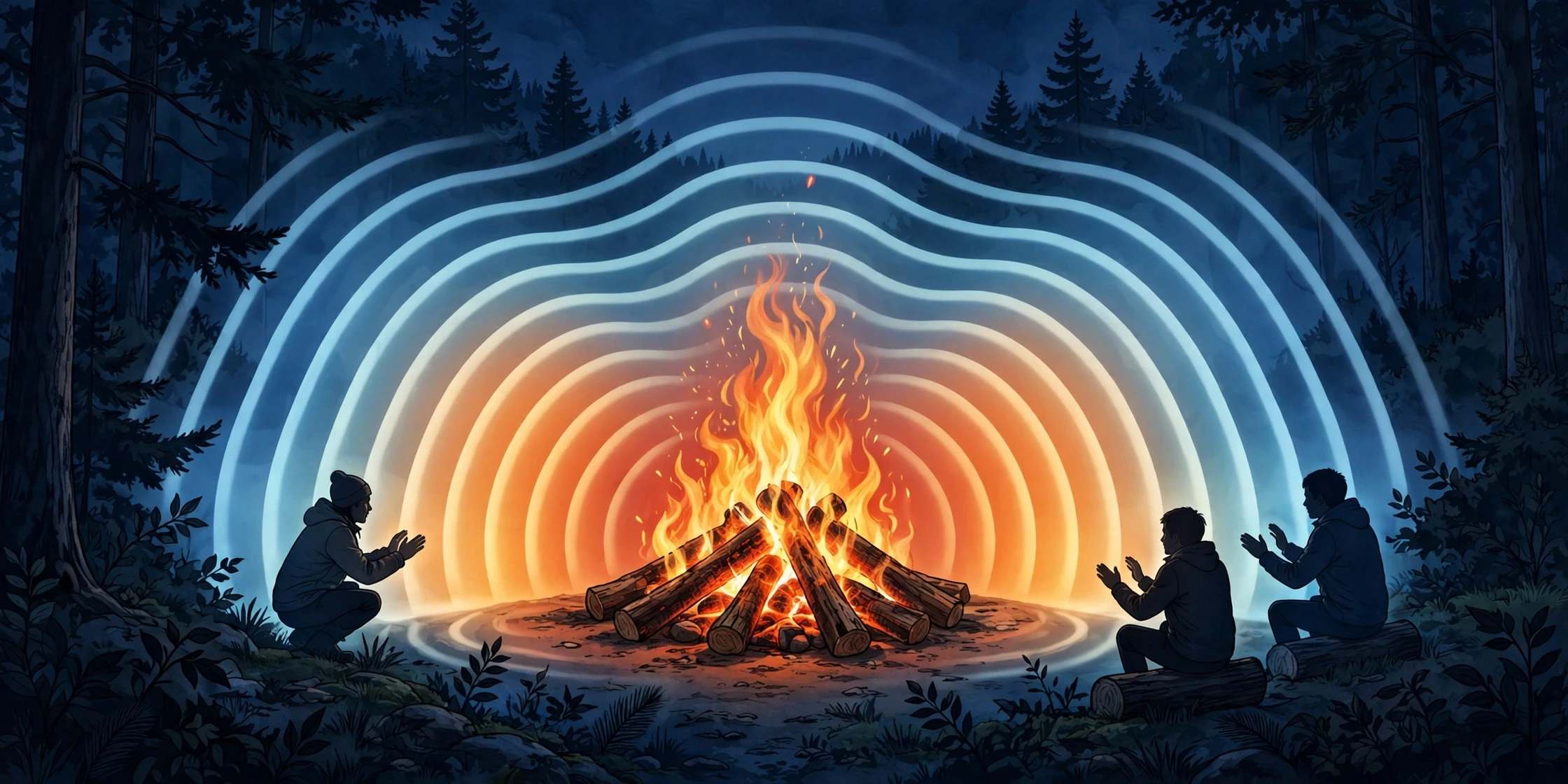
The fire started before I was ready for it — my first, clumsy lesson in thermochemistry, though I did not know the word then. I was sixteen, standing in a school field on a cold evening with a pile of damp wood, a box of matches, and a group of classmates who were all very sure that somebody else knew how to light a campfire. The wood smoked, sulked, and refused. Then someone tipped a little lighter fluid onto the logs, struck a match, and the whole pile went up with a soft whoomp that pushed warm air against our faces and made everyone step back at once. Nobody in that circle could have told you the enthalpy change of burning wood. Yet every one of us understood, in our skin, the thing thermochemistry exists to explain: chemical reactions move heat, and heat moves the world.
That evening stayed with me longer than most lessons from that year. Years later, in a university teaching laboratory, I watched a first-year student hold a thermometer over a beaker of dissolving ammonium nitrate and stare at the temperature falling, degree by degree, while the salt vanished into the water. "But nothing is burning," she said. "Where did the heat go?" It was the perfect question, and it was a thermochemistry question. The reaction was taking heat from the water to break its crystal lattice apart, and the water was getting colder to pay for it. No flame, no smoke, no drama — only a thermometer sliding downward and a whole branch of chemistry hiding inside that slide.
Thermochemistry is the study of heat in chemical reactions: how much heat a reaction releases or absorbs, why some reactions run on their own while others need a push, and how temperature tips the balance between order and disorder. It is the part of chemistry that explains why a campfire warms your hands, why your body can run on food, why ice melts on a warm day but never un-melts on a cold one, and why the Sun can pour out light for billions of years without ever being refuelled. The same three ideas sit underneath all of it — enthalpy, entropy, and Gibbs free energy — and once you can see them, you start noticing them everywhere: in a kettle, in a battery, in a glacier, in your own muscles after a run.
This article builds those three ideas from the ground up, in plain language, with worked numbers you can check yourself: the bookkeeping of energy, enthalpy as the heat of a reaction at constant pressure, calorimetry, Hess's law, entropy and the second law, and finally the Gibbs free energy equation, ΔG = ΔH − TΔS, used to predict whether a reaction will run on its own — with four fully worked examples, from burning methane to melting ice.
1. What Is Thermochemistry? The Heat Ledger of Chemistry
Thermochemistry is the branch of physical chemistry that studies the heat absorbed or released during chemical and physical changes. Every chemical reaction rearranges bonds, and rearranging bonds moves energy. When the products hold less chemical energy than the reactants, the leftover energy leaves as heat, and the reaction feels hot. When the products hold more, the reaction must take heat in from its surroundings, and things get cold. Thermochemistry is the accounting system that tracks those flows, with signs, units, and rules that let one chemist's measurement mean the same thing to another chemist on the other side of the world.
The field grew out of very practical questions. In the 1840s, the Russian chemist Germain Hess was studying the heat released by reactions and noticed something that still surprises students today: the total heat of a reaction does not depend on the path you take to get there. Burn carbon straight to carbon dioxide, or burn it first to carbon monoxide and then to carbon dioxide — the total heat released is the same. That observation became Hess's law, and it is one of the most useful tools in thermochemistry, because it lets us calculate heats for reactions that are too slow, too violent, or too messy to measure directly.
A decade later, the picture widened. Josiah Willard Gibbs, a quiet professor at Yale, worked out the mathematics that connects heat, disorder, and whether a process can happen by itself. His free energy equation is the single most useful formula in all of chemistry, and it appears in exam papers, in industrial reactor design, and in biochemistry textbooks alike. Gibbs published his work in the Transactions of the Connecticut Academy of Arts and Sciences, a journal so obscure that his ideas took years to spread — one of the great slow-burn stories in science, in which the most important thermodynamic thinker of the century was nearly missed because almost nobody read the journal he published in.
1.1 Systems, surroundings, and the boundary between them
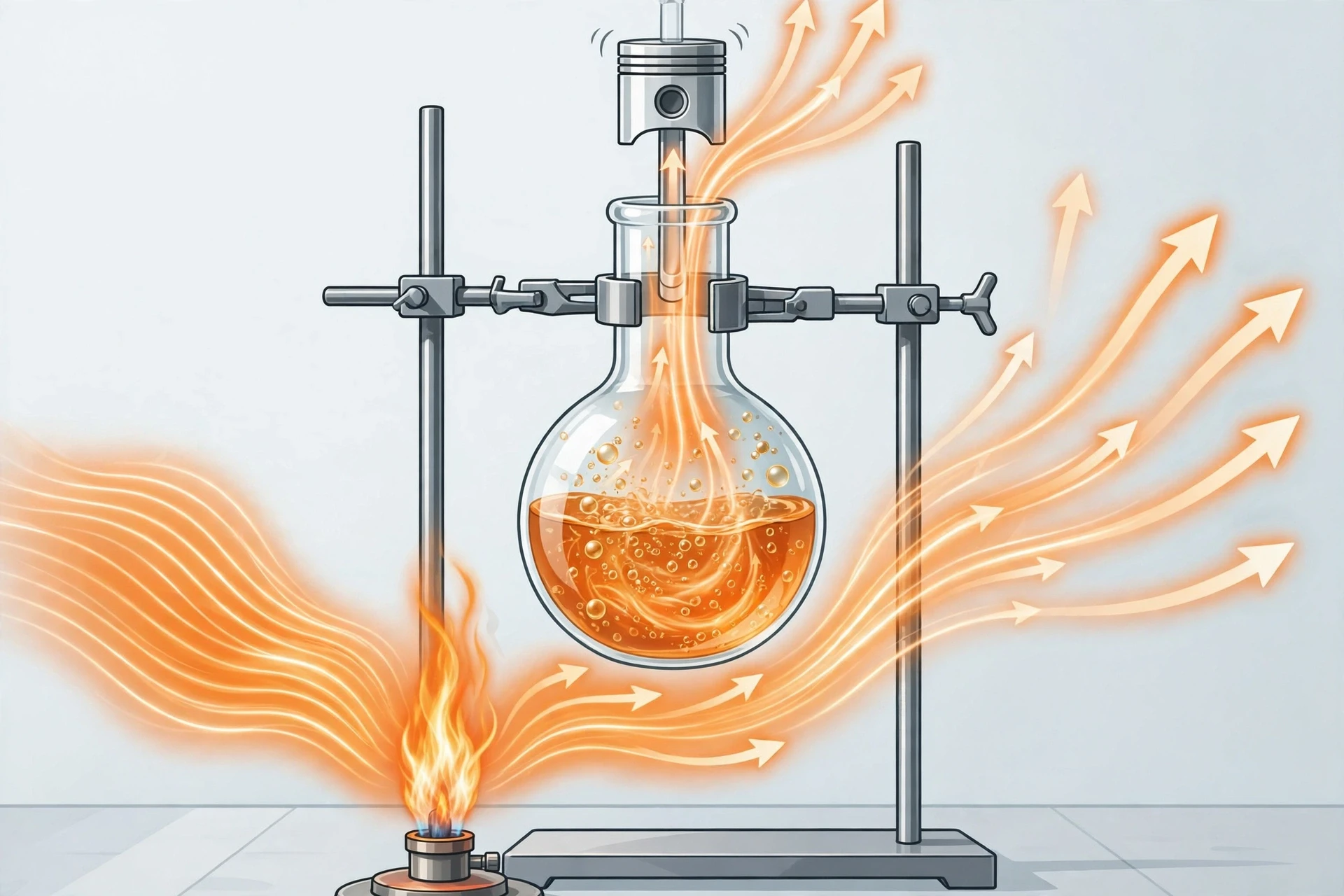
Every thermochemistry problem starts by drawing a line. On one side is the system: the part of the world we are studying, usually the reacting chemicals themselves. On the other side is the surroundings: everything else — the beaker, the air, the bench, the room. Energy crosses the boundary as heat or as work, and the first job of thermochemistry is to keep track of which direction it went.
An open system can exchange both matter and energy with its surroundings — a pot of boiling water on a stove, steam escaping into the kitchen. A closed system can exchange energy but not matter — a sealed flask, where heat passes through the glass but nothing leaves. An isolated system exchanges neither — a perfectly insulated flask, as close as we can get to a world unto itself. The universe as a whole is the one truly isolated system, and that fact is what makes the second law of thermodynamics so powerful.
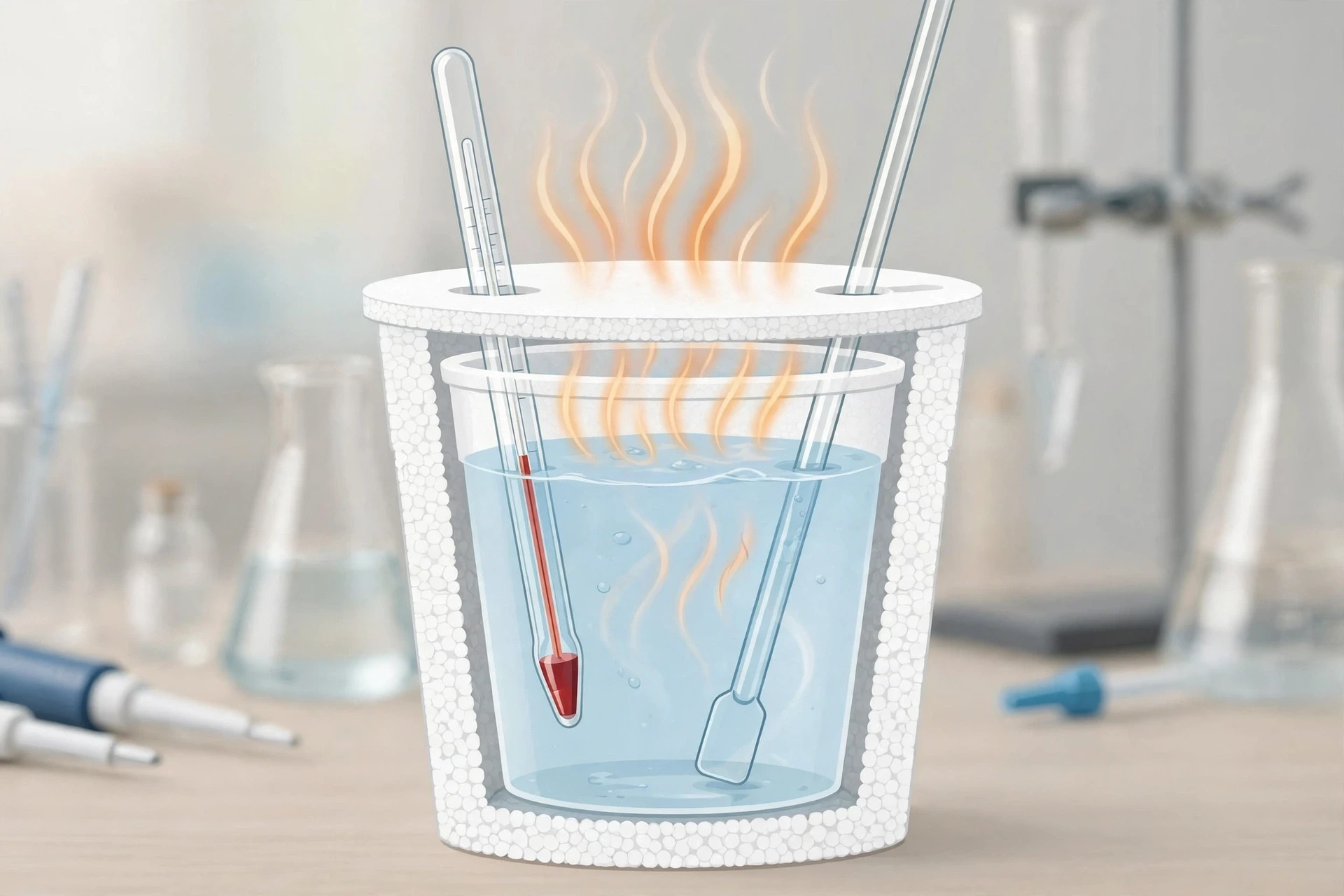
I learned the importance of drawing this line the embarrassing way. In my first year of teaching laboratory work, I set up a neutralisation experiment — hydrochloric acid plus sodium hydroxide, a classic heat-releasing reaction — and asked the class to measure the temperature rise. One group's thermometer barely moved. The problem was their beaker: they had used a thin metal cup sitting on a cold stone bench, and the heat was pouring out of the system into the surroundings faster than the thermometer could register it. They had measured the heat of the bench, not the heat of the reaction. We repeated the run in a polystyrene cup, and the temperature jumped by seven degrees. The chemistry had not changed. The boundary had.
1.2 Heat, temperature, and internal energy — three words that are not the same
Students mix up heat and temperature more than any other pair in thermochemistry, so let us settle it now. Temperature is a measure of the average kinetic energy of the particles in a substance — how fast, on average, its molecules are jiggling. Heat is energy in transit, flowing from a hotter body to a colder one because of a temperature difference. Internal energy, given the symbol U, is the total energy stored inside a system: the kinetic energy of all its moving particles plus the potential energy stored in its chemical bonds and in the attractions between its molecules.
A swimming pool and a cup of tea can both be at the same temperature, but the pool holds vastly more internal energy because it holds vastly more molecules. A spark from a sparkler can be hotter than a bath — its temperature is higher — yet the bath holds far more heat energy overall. Temperature is intensive: it does not depend on how much stuff you have. Internal energy and heat are extensive: double the amount, and you double the energy.
The unit that ties thermochemistry together is the joule, named for James Prescott Joule, the Manchester brewer who spent years stirring water with paddles and measuring, with obsessive precision, how much mechanical work it took to warm it by one degree. His experiments showed that heat and work are two forms of the same thing — energy — and the joule is now the standard unit for both. Chemists also use the kilojoule per mole (kJ/mol), which tells us the energy change for one mole of reaction as written. Older textbooks use calories, and food labels still do; one calorie is 4.184 joules.
2. The First Law: Energy Is Never Lost, Only Moved
The first law of thermodynamics is the law of conservation of energy, written for chemists: the change in a system's internal energy equals the heat added to the system plus the work done on the system. In symbols, ΔU = q + w. The Greek letter delta, Δ, means "change in," q stands for heat, and w stands for work. The sign convention matters and trips up everyone at first: heat absorbed by the system is positive, heat released by the system is negative; work done on the system is positive, work done by the system is negative.
Think of a system as a bank account. Heat and work are deposits and withdrawals. If the account balance goes up, energy came in from somewhere; if it goes down, energy went out somewhere. Nothing appears from nowhere and nothing vanishes. A campfire does not create energy: it converts the chemical energy stored in wood into heat and light. A refrigerator does not destroy heat: it moves heat from inside the fridge to the kitchen, and pays for the move with electrical work. The first law is a bookkeeping rule, and like all good bookkeeping rules it is boring, exact, and impossible to cheat.
The first law has a famous consequence for chemists. Because internal energy is a state function — its value depends only on the current state of the system, not on how the system got there — the change in internal energy for a reaction depends only on the starting materials and the products, never on the path between them. Climb a hill by the steep path or the winding path, and the height you gained is the same. Burn carbon in one step or in two, and the total energy change is the same. That path-independence is the deep reason Hess's law works, and it is what makes thermochemistry a predictive science rather than a catalogue of one-off measurements.
2.1 Work in chemistry: the gas that pushes back
Most of the work in chemistry is pressure–volume work: a gas expanding against the atmosphere and pushing it back, or being squeezed by it. When a reaction produces gas, the gas expands and does work on the surroundings, which costs the system energy. When a reaction consumes gas, the atmosphere does work on the system, delivering energy to it. The amount is w = −PΔV, where P is the external pressure and ΔV is the change in volume. The minus sign is the bookkeeping: expansion (positive ΔV) means work done by the system, which is negative in our convention.
When zinc reacts with acid in an open flask and hydrogen gas bubbles off, the escaping gas does work against the air — roughly 2.5 kJ for every mole of hydrogen at room temperature. For reactions involving only solids and liquids, the volume change is tiny and the work term is usually negligible. For reactions that make or consume gases, it matters, and it is the reason chemists invented enthalpy: a quantity that folds the pressure–volume work into the heat, so that the heat measured in an open flask at constant pressure has a clean meaning.
I once watched a student try to measure the heat of a gas-producing reaction in a sealed bottle, and the stopper popped off and bounced across the laboratory with a sound like a small firework. The student learned two lessons at once: gases do work, and a closed system that makes gas is a pressure vessel. We did the experiment again in an open flask. The first law was satisfied either way.
2.2 Why chemists usually work at constant pressure
Most chemistry happens in open beakers, flasks, and test tubes, under the steady pressure of the atmosphere. The pressure stays constant; the volume is free to change. Under those conditions, the heat exchanged with the surroundings is exactly equal to the change in a quantity called enthalpy, and that is why enthalpy, not internal energy, is the chemist's everyday tool. A reaction run at constant pressure that releases 100 kJ of heat has an enthalpy change of −100 kJ, full stop, no work correction needed, because the correction is already inside the definition.
A bomb calorimeter, the sealed steel vessel used to measure the energy content of foods and fuels, works at constant volume instead, and it measures the change in internal energy directly. The two numbers differ by the pressure–volume work term, and for reactions involving gases the difference is real. Food labels quote the constant-pressure value, the enthalpy of combustion, because that is the heat your body actually gets from the food at atmospheric pressure. The distinction is worth carrying in the back of your mind: enthalpy is heat at constant pressure, internal energy is heat at constant volume, and in everyday chemistry the first is the one we use.
The first law is a bookkeeping rule, and like all good bookkeeping rules it is boring, exact, and impossible to cheat. A campfire does not create energy: it converts the chemical energy stored in wood into heat and light.
3. What Is Enthalpy? The Heat of a Reaction
Enthalpy, symbol H, is the heat content of a system at constant pressure. More precisely, it is defined as H = U + PV, internal energy plus pressure times volume, and its change, ΔH, is the heat absorbed or released by a reaction run at constant pressure. That definition looks abstract, but its meaning is plain: when a reaction is carried out in an open container, ΔH is simply the heat you would measure with a thermometer.
The sign of ΔH tells the whole story at a glance. A negative ΔH means the reaction releases heat — it is exothermic. The system loses enthalpy, the surroundings warm up, and the products sit lower on the energy ladder than the reactants. Burning methane, rusting iron, and neutralising an acid are all exothermic. A positive ΔH means the reaction absorbs heat — it is endothermic. The system gains enthalpy, the surroundings cool down, and the products sit higher on the energy ladder than the reactants. Melting ice, evaporating water, and photosynthesis are all endothermic.
Picture a reaction as a hill. The reactants stand on one side, the products on the other, and the height difference between them is ΔH. In an exothermic reaction the products stand lower, and the reaction rolls downhill, giving out heat as it goes. In an endothermic reaction the products stand higher, and the reaction must be pushed uphill with heat supplied from outside. The hill picture also explains why the size of ΔH depends on how the reaction is written: double the amounts, and you double the hill. Enthalpy is an extensive property — it scales with the amount of substance, exactly as a bank balance scales with the number of deposits.
3.1 Standard enthalpy changes: giving every measurement the same starting line
Chemists compare enthalpy changes under standard conditions: a pressure of 1 bar (very close to 1 atmosphere), a stated temperature, usually 298 K (25 °C), and all substances in their standard states — pure solids and liquids, gases at 1 bar, and solutions at a concentration of 1 mol per litre. A standard enthalpy change carries the superscript °, as in ΔH°, and it means "measured, or calculated, under these agreed conditions." Without the standard, comparing two numbers from two laboratories would be like comparing the heights of two hills measured from different sea levels.
The most useful standard quantity is the standard enthalpy of formation, ΔHf°, the enthalpy change when one mole of a compound is formed from its elements in their standard states. By definition, the enthalpy of formation of an element in its standard state is zero, and every compound is measured relative to that. That single convention turns a sprawling catalogue of reactions into arithmetic: the enthalpy change of any reaction equals the sum of the enthalpies of formation of the products minus the sum of the enthalpies of formation of the reactants. It is the thermochemical equivalent of knowing the height of every town above sea level and working out the climb between any two of them by subtraction.
Some standard enthalpies of formation are worth knowing by feel, because they anchor so many calculations. Carbon dioxide gas sits at −393.5 kJ/mol, a deep well that explains why burning carbon releases so much heat. Liquid water sits at −285.8 kJ/mol, while water vapour sits higher, at −241.8 kJ/mol — the 44 kJ difference is the heat of vaporisation, the energy needed to pull liquid water apart into gas. Ammonia is −45.9 kJ/mol, a shallow well, which is why making ammonia from nitrogen and hydrogen releases only modest heat and why the Haber process needs such careful engineering to be worthwhile. Methane is −74.8 kJ/mol. These are standard textbook values, tabulated in reference works such as the NIST Chemistry WebBook.
3.2 Exothermic and endothermic reactions in everyday life
The distinction between exothermic and endothermic is not an exam abstraction; it is the difference between a hand warmer and a cold pack, and both are thermochemistry you can buy in a shop. A disposable hand warmer contains iron powder, salt, and water, and it warms up because iron oxidises — rusts — in an exothermic reaction, releasing heat slowly over hours. A sports cold pack contains ammonium nitrate and water in separate compartments; snap the pack, the salt dissolves, and the endothermic dissolution sucks heat out of your skin. One reaction gives, the other takes, and the only difference is the sign of ΔH.
Cooking is thermochemistry with better smells. An egg white sets because heat denatures its proteins, breaking weak bonds and letting new ones form. Bread rises because yeast ferments sugars and releases carbon dioxide, and browns because the Maillard reaction between sugars and amino acids releases flavour compounds and colour. A camping stove burns propane, whose enthalpy of combustion is about −2,220 kJ per mole. Every kitchen is a thermochemistry laboratory with the safety warnings removed.
The most consequential exothermic reaction on Earth is the one happening in the Sun, though it is nuclear rather than chemical: hydrogen fusing into helium releases energy on a scale no chemical reaction can approach, and that energy warms the Earth. The Sun's light drives photosynthesis, which stores solar energy in chemical bonds, and almost every exothermic reaction we use — burning wood, coal, oil, or gas — is simply that stored sunlight being released again. The Sun is the original source of the heat budget that thermochemistry keeps track of, and the greenhouse effect, which controls how much of that heat stays in the atmosphere, is itself a story about energy flows that greenhouse gases shape. The connection runs deeper than analogy: the same bookkeeping of energy in and energy out governs a campfire, a cell, and a planet.

3.3 Bond enthalpies: why breaking bonds costs and making bonds pays
There is a second way to estimate a reaction's enthalpy change, and it gives a physical reason for the sign. Every chemical bond stores energy, and breaking a bond always costs energy, while forming a bond always releases energy. A reaction's ΔH is the difference: the energy spent breaking the bonds of the reactants minus the energy released forming the bonds of the products. Or, more simply, energy in to break bonds, energy out to make bonds, and ΔH is what is left over.
Burning methane makes the point clearly. To burn one molecule of methane you must break four carbon–hydrogen bonds and two oxygen–oxygen double bonds — an expensive purchase. In return you form two carbon–oxygen double bonds in carbon dioxide and four oxygen–hydrogen bonds in water — a generous refund. The refund is bigger than the purchase by about 890 kJ per mole, so the reaction is strongly exothermic. The numbers come from average bond enthalpies, which are averages over many molecules, so this method gives an estimate rather than an exact value — but it explains why some reactions release heat and others absorb it, and that explanation is worth more than the last digit of precision.
This is also where a common misconception quietly lives. Most people assume that breaking bonds releases energy — the phrase "energy is released when bonds break" is everywhere in popular writing, and it is exactly backwards. Breaking a bond always requires an input of energy, like pulling apart two magnets. The energy released in burning comes from the new bonds formed in the products, which are stronger than the old bonds in the reactants. ATP, the energy currency of the cell, is misunderstood the same way: hydrolysing ATP releases energy not because a bond breaks, but because the products formed are more stable, and the new bonds they form pay out more than the breakage cost.
4. Measuring Heat: Calorimetry and the Coffee-Cup Experiment
Thermochemistry would be guesswork without calorimetry, the art of measuring heat by watching temperature change. A calorimeter is an insulated container with a thermometer, a stirrer, and a known amount of water or another substance whose heat capacity is known. Run a reaction inside it, measure the temperature change, and the heat released or absorbed follows from q = mcΔT: mass times specific heat capacity times temperature change. The insulation matters because every joule that leaks into the room is a joule your thermometer never sees.
The simplest version is the coffee-cup calorimeter, two polystyrene cups nested together with a lid and a thermometer poked through it. Polystyrene is a poor conductor of heat, so the cups act as cheap insulation, and the water inside absorbs the reaction's heat. It is the experiment every chemistry student meets, and it is genuinely good science: with care, a coffee-cup calorimeter can measure the enthalpy of neutralisation to within a few percent of the accepted value, about −57 kJ per mole of water formed. That number is one of the most reproducible in all of chemistry, because the reaction of a strong acid with a strong base is clean, fast, and complete.
I have run that experiment more times than I can count, and the moment that never gets old is the one where the temperature stops climbing and the class realises the reaction is over. The thermometer rises, steadies, and then — very slowly — begins to fall as heat leaks away despite the insulation. That slow fall is a small lesson in experimental reality: no calorimeter is perfect, and the best measurement is the one taken at the peak, before the losses begin. Students who plot temperature against time and extrapolate back to the moment of mixing get a better number than students who just read the highest value.
4.1 The bomb calorimeter: measuring fuels and foods
For reactions that burn, chemists use a bomb calorimeter: a thick-walled steel vessel, the "bomb," sealed inside an insulated water bath. A sample is ignited electrically in pure oxygen at high pressure, it burns completely, and the temperature rise of the surrounding water gives the heat of combustion. The vessel is built to withstand the pressure, and it is called a bomb for a reason — though in a well-run laboratory it is one of the safest instruments in the room, precisely because it is engineered for the job.
Bomb calorimetry is where food energy values come from: a sample of anything edible is burned in the bomb, the heat is measured, and the result is divided by the mass to give the energy content per gram. Nutrition labels trace back to measurements of this kind. It is also how fuels are certified: petrol, coal, and natural gas are graded, in part, by their heats of combustion, and the price of a fuel is never far from the energy it contains.
4.2 Specific heat capacity: why water is a thermal shock absorber
The specific heat capacity of a substance is the heat needed to raise one gram of it by one degree Celsius, and water's is famously high: 4.184 J/g·°C, higher than almost any common liquid. That single number shapes the climate of the planet. Oceans absorb enormous amounts of heat in summer and release it slowly in winter, softening the seasons for coastal regions. A desert, with dry sand at about 0.8 J/g·°C, swings from scorching days to freezing nights because the ground cannot store heat the way water can. Your body, which is mostly water, resists temperature swings for the same reason, and sweating works because evaporating water carries away 2,260 joules per gram — the enormous enthalpy of vaporisation paying for your cooling.
Specific heat capacity is also why calorimetry uses water: it absorbs a reaction's heat with only a modest temperature rise, keeping the measurement precise and the apparatus safe. The same property makes water the coolant in power stations and car engines, and the working fluid in steam turbines.
5. Hess's Law: Finding Heats You Cannot Measure
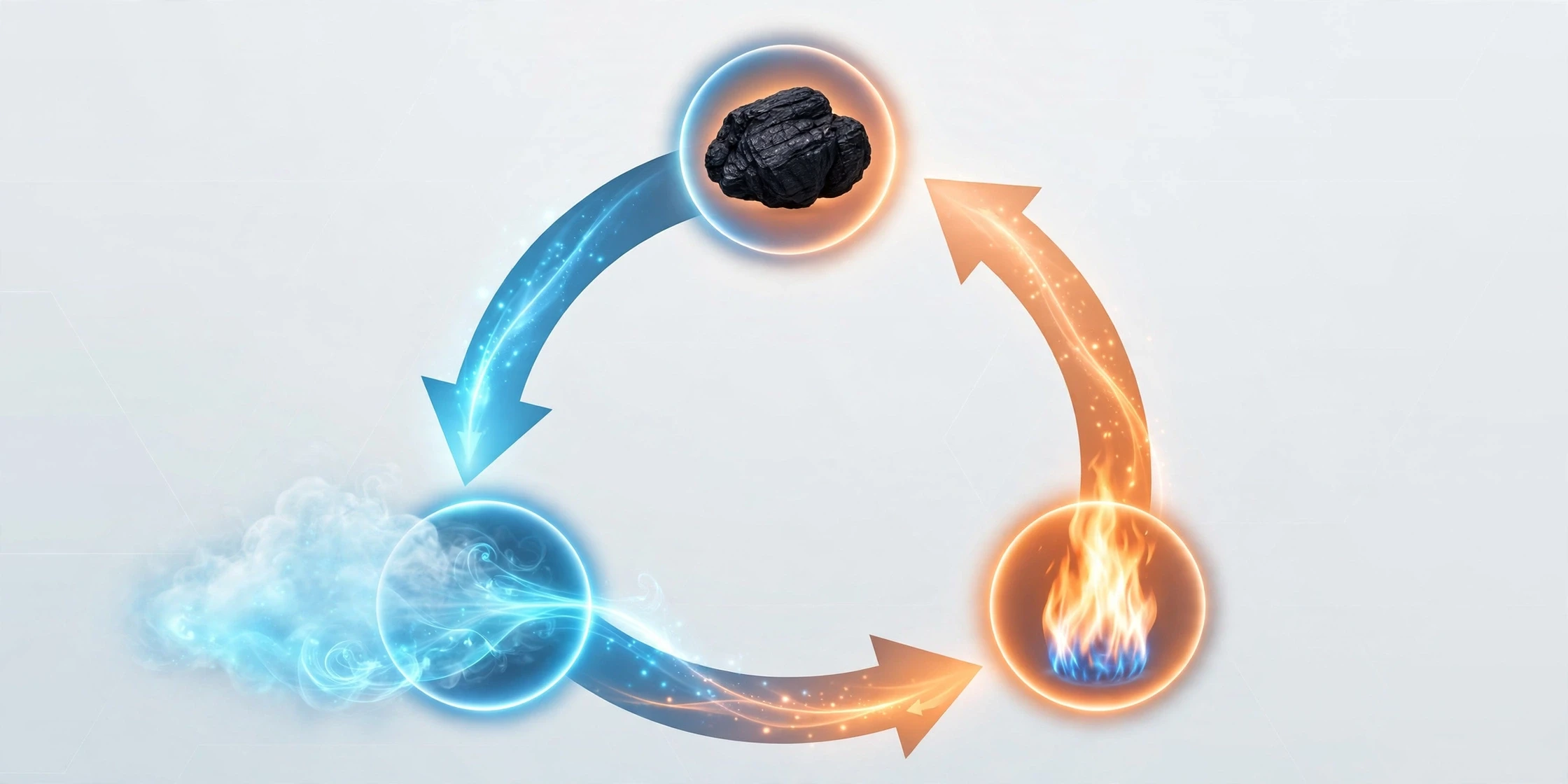
Germain Hess's law says that the enthalpy change of a reaction is the same regardless of the route taken, because enthalpy is a state function. If you can write a reaction as a sum of steps whose enthalpy changes you know, the enthalpy change of the whole reaction is the sum of the steps. The power of the law is that the steps do not have to be real. They can be imaginary detours, chosen purely because their numbers are known, and the answer still comes out right, because the start and the finish are the same.
The classic application is the enthalpy of formation of carbon monoxide. Burning carbon to carbon monoxide directly is hard to control — the reaction keeps going to carbon dioxide — so its heat is difficult to measure cleanly. But burning carbon all the way to carbon dioxide is easy to measure, and burning carbon monoxide to carbon dioxide is easy to measure too. Subtract the second from the first, and the enthalpy of formation of carbon monoxide falls out: −110.5 kJ/mol. The reaction that could not be measured has been measured by arithmetic.
5.1 Worked example: the enthalpy of combustion of methane from formation data
Let us put the formation-data method to work on the most important combustion reaction in the world: methane burning in oxygen.
CH4(g) + 2O2(g) → CO2(g) + 2H2O(l)
The rule is ΔH° = sum of ΔHf° of products minus sum of ΔHf° of reactants. The products are one mole of carbon dioxide (−393.5 kJ/mol) and two moles of liquid water (2 × −285.8 = −571.6 kJ/mol), giving −965.1 kJ/mol. The reactants are one mole of methane (−74.8 kJ/mol) and two moles of oxygen gas, whose enthalpy of formation is zero by definition, giving −74.8 kJ/mol. Subtract: −965.1 − (−74.8) = −890.3 kJ/mol. That is the standard enthalpy of combustion of methane, and it matches the calorimetric value of about −890 kJ/mol. One subtraction, using numbers measured in other experiments, has predicted the heat of a reaction we never ran.
Notice what happens if the water is produced as steam instead of liquid. The enthalpy of formation of water vapour is −241.8 kJ/mol, so the products total −393.5 + 2 × (−241.8) = −877.1 kJ/mol, and the reaction enthalpy becomes −802.3 kJ/mol. The difference, 88 kJ, is twice the enthalpy of vaporisation of water — the heat that stays locked up in the steam and is only released when the steam condenses. This is why condensing boilers, which capture that heat, are more efficient than ordinary boilers.
5.2 Hess's law cycles: the detour that pays
A Hess's law cycle is a diagram of the detour: the direct route across the top, the indirect route around the bottom, and the knowledge that both routes must add up to the same total. The most famous cycles involve the formation of compounds from their elements, and exam papers love them because they test whether a student can follow the arrows rather than memorise a formula. The rule for reading a cycle is simple: going with an arrow adds its enthalpy change; going against an arrow subtracts it. Follow the loop, add up the numbers, and the unknown step drops out.
The same idea scales up to industry: the enthalpy of formation of many chemicals cannot be measured directly, so chemists measure a web of related reactions — combustions, dissolutions, neutralisations — and solve the web with Hess's law. A few hundred carefully measured values, combined this way, generate the enthalpy change of almost any reaction a chemist might want to run.
Breaking a bond always requires an input of energy, like pulling apart two magnets. The energy released in burning comes from the new bonds formed in the products, which are stronger than the old bonds in the reactants.
6. What Is Entropy? Disorder, Dispersal, and the Arrow of Time
Entropy, symbol S, is the measure of how many ways the energy and particles of a system can be arranged. A system with high entropy has its energy spread out over many particles and many arrangements; a system with low entropy has its energy concentrated in few arrangements. The formal definition, S = k ln W, comes from Ludwig Boltzmann, who connected entropy to the number of microscopic arrangements, W, that produce the same observable state: entropy counts possibilities.
The everyday translation is "disorder," and it is useful as long as it is not taken too literally. A tidy desk and a messy desk are both made of the same objects; the messy one has higher entropy because there are far more ways to be messy than to be tidy. A gas has higher entropy than a liquid, and a liquid higher than a solid, because the particles in a gas can occupy vastly more positions and move at vastly more speeds. Dissolving a crystal in water raises entropy, because the ions spread through the whole solution instead of sitting in one ordered lattice. Heating a substance raises entropy, because hotter particles have more energy states available to them. In every case, entropy rises when energy and matter spread out into more possibilities.
The units of entropy are joules per mole per kelvin (J/mol·K), and standard molar entropies are tabulated for thousands of substances. A few anchor values help build intuition. Oxygen gas has a standard molar entropy of 205.2 J/mol·K; liquid water has 69.9 J/mol·K; ice has 41 J/mol·K. The progression is the story of freedom: gas, liquid, solid, each more constrained than the last, each with less entropy. Diamond, with its rigid, perfect lattice, has a standard molar entropy of just 2.4 J/mol·K — one of the lowest values known — while a large, floppy gas molecule can exceed 300 J/mol·K. Size, complexity, and freedom of motion all push entropy upward.
6.1 Predicting the sign of ΔS without a calculator
Before reaching for tables, chemists predict the sign of an entropy change by looking at the reaction and asking what happens to the freedom of the particles. Three rules of thumb cover most cases. First, if the number of moles of gas increases, entropy increases, because more gas molecules mean more ways to arrange them; if the number of moles of gas decreases, entropy decreases. Second, if a solid or liquid turns into a gas, entropy increases sharply. Third, if a substance dissolves and its particles disperse through a solution, or if a large molecule breaks into smaller pieces, entropy increases.
Consider the decomposition of calcium carbonate, the reaction that makes lime for cement: CaCO3(s) → CaO(s) + CO2(g). A solid turns into a solid plus a gas, so the number of gas moles rises from zero to one, and ΔS is positive — about +160 J/mol·K. Now consider the formation of ammonia: N2(g) + 3H2(g) → 2NH3(g). Four moles of gas become two, so ΔS is negative — about −199 J/mol·K. The reaction releases heat, but it pays for that release with a loss of disorder, and that trade-off is exactly what the Gibbs equation will weigh up in the next sections. The Haber process, which makes ammonia for fertiliser, fights this entropy penalty with high pressure, which pushes the equilibrium toward fewer gas molecules.
I keep a deck of cards on my desk when I teach entropy, and it is the best teaching aid I own. A new deck, sorted by suit and rank, is low entropy: one arrangement out of the vast number possible. Shuffle it a few times, and the order is gone — and the chance of shuffling it back into perfect order by accident is so small that the universe would end first. Nobody is surprised that a shuffled deck does not un-shuffle itself. The second law of thermodynamics is the same observation, written for molecules: there are vastly more disordered arrangements than ordered ones, so systems drift toward disorder, not because disorder is a force, but because disorder is where the numbers are.
6.2 Entropy in everyday life: melting, mixing, and mess
Ice melting in a drink is entropy in action. The water molecules in ice sit in a rigid crystal, each one locked in place; in liquid water they tumble and slide past each other, with far more arrangements available. The entropy of the water rises as it melts, and that rise is what makes melting possible at all, even though melting absorbs heat. The heat comes from the drink, which cools — and the entropy lost by the drink is smaller than the entropy gained by the ice, so the total entropy of the universe still rises. The drink gets colder, the ice disappears, and the second law is satisfied.
Mixing is entropy too. Open a bottle of perfume in a room, and the scent spreads until the whole room smells faintly of it. The perfume molecules had a small volume to occupy and now have a large one, with enormously more arrangements. They do not spread because something pushes them; they spread because there are more ways to be spread out than to be bunched up. The same logic governs the mixing of gases, the dissolving of salt, and a drop of ink spreading through water — none of them runs backwards on its own.

7. The Second and Third Laws: The Rules Nobody Breaks
The second law of thermodynamics says that the total entropy of the universe increases in every spontaneous process. In symbols, ΔS(universe) = ΔS(system) + ΔS(surroundings) > 0 for a spontaneous change, and equal to zero only for a perfectly reversible one, which never quite happens in practice. The law does not say that the entropy of a system cannot fall — it falls whenever water freezes or a crystal grows. It says that when a system's entropy falls, the entropy of the surroundings must rise by more, so that the total still goes up. Order can be created locally, but only by creating more disorder somewhere else. A freezer makes ice by warming the kitchen. A living cell builds ordered proteins by burning food and releasing heat and waste. The bill always comes due, and it is paid in entropy.
This is the law that gives time its direction. A dropped glass shatters; a shattered glass never reassembles itself and leaps back onto the table. A cup of coffee cools to room temperature; a cold cup never warms itself back up. Both directions are allowed by the first law — energy is conserved either way — but only one direction increases the entropy of the universe, and that is the direction that happens. The second law is sometimes called the most secure law in physics, because no experiment has ever found a violation, and every attempt to build a perpetual motion machine has run into it sooner or later.
The third law sets the zero of the entropy scale: the entropy of a perfect crystal at absolute zero, 0 K, is zero. At absolute zero every particle sits in its lowest energy state, there is exactly one arrangement, and S = k ln 1 = 0. Absolute zero can never quite be reached — the third law forbids it in practice, because each step toward it requires more effort than the last — but the definition gives every entropy value a fixed starting point. That is why standard molar entropies are absolute numbers, not relative ones like enthalpies: entropy has a true zero, enthalpy does not, and the tables reflect the difference.
7.1 Reversible and irreversible processes
A reversible process is one that can be run backwards by an infinitesimal change in conditions, with no net change in the universe. It is an idealisation: a gas expanding infinitely slowly against a piston, a reaction held exactly at equilibrium. Real processes are irreversible: they happen at a finite rate, with friction, turbulence, and mixing, and they generate entropy that cannot be recovered. A car engine is irreversible. A stirred cup of tea is irreversible. Your own metabolism is irreversible, and gloriously so — life runs on irreversible processes, extracting useful work from the flow of energy downhill while paying the entropy bill as heat.
The distinction matters because the maximum work a process can do is the work it would do if run reversibly. Real engines always do less, and the gap between the reversible ideal and the irreversible reality is entropy generated along the way.
7.2 Life, order, and the entropy bill
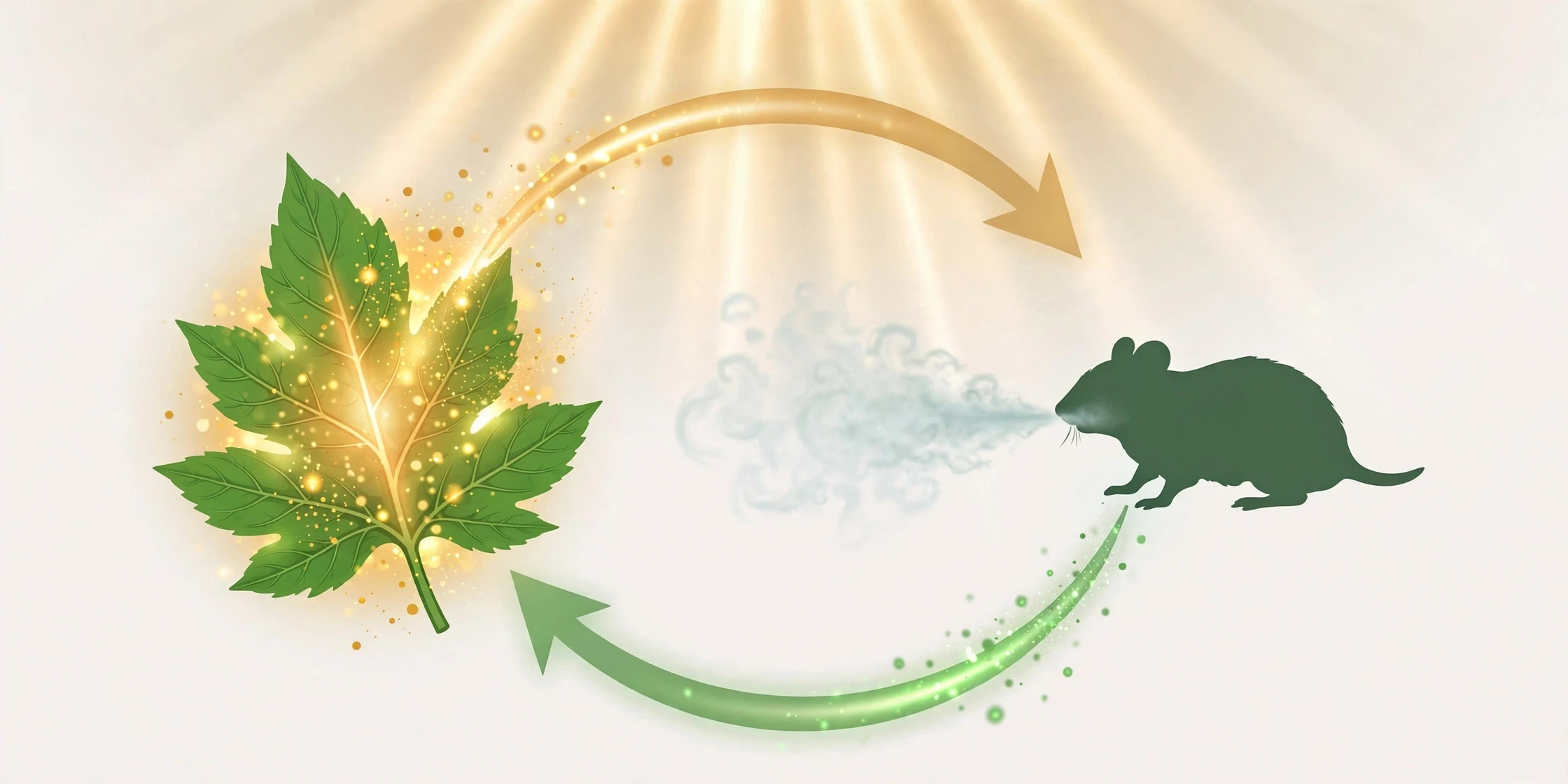
A living organism is the most ordered thing most of us will ever see, and it looks, at first glance, like a violation of the second law. A seed becomes a tree. A single cell becomes a person. How does order increase without breaking the law? The answer is that organisms are open systems, and they pay for their order with the disorder they export. A plant builds ordered sugars from carbon dioxide and water using sunlight, and releases oxygen; an animal burns those sugars, releasing carbon dioxide, water, and heat. The organism's local entropy falls while it grows, but the entropy of its surroundings rises by more. The universe keeps its profit.
The Earth is not an isolated system: it receives low-entropy energy from the Sun as visible light and radiates high-entropy energy back into space as infrared, and the difference pays for every ordered structure on the planet, from forests to cities to the reader of this article. The Sun is the engine, entropy is the exhaust, and life is what happens in between. The greenhouse effect is part of the same ledger: gases that absorb infrared slow the Earth's loss of heat to space, changing the rate at which the planet pays its entropy bill, and warming the surface in the process.
8. What Is Gibbs Free Energy? The Decider
Gibbs free energy, symbol G, is the quantity that decides whether a process will happen on its own. It is defined as G = H − TS, enthalpy minus temperature times entropy, and its change for a process at constant temperature and pressure is ΔG = ΔH − TΔS. The sign of ΔG is the verdict. If ΔG is negative, the process is spontaneous — it can happen without any input of work from outside. If ΔG is positive, the process is non-spontaneous — it will not happen on its own, though it can be driven by coupling it to a spontaneous process or by doing work on the system. If ΔG is exactly zero, the system is at equilibrium, and the forward and reverse processes balance.
The name "free energy" confuses people, because it sounds like energy that costs nothing. It does not. "Free" here means "available to do work": ΔG is the maximum useful work a process can deliver at constant temperature and pressure. A reaction with ΔG = −100 kJ/mol can, in principle, deliver up to 100 kJ of useful work per mole. Real devices deliver less, because real processes are irreversible, but the ceiling is set by ΔG, and no device can exceed it. Batteries, fuel cells, and muscles all live under this ceiling.
The equation itself is a tug-of-war. Enthalpy pulls toward reactions that release heat; entropy pulls toward reactions that increase disorder. Temperature sets the strength of the entropy side: at low temperature, the TΔS term is small and enthalpy dominates, so exothermic reactions win. At high temperature, the TΔS term is large and entropy dominates, so reactions that increase disorder win even if they absorb heat. That single fact explains why some reactions reverse direction as they are heated, why ice melts only above 0 °C, and why some industrial processes must run hot and others must run cold.
8.1 The four cases: reading the signs
Every reaction falls into one of four cases, depending on the signs of ΔH and ΔS, and the Gibbs equation predicts the outcome of each.
When ΔH is negative and ΔS is positive, both terms favour spontaneity: the reaction releases heat and increases disorder, so ΔG is negative at every temperature. Burning wood is of this kind — exothermic, and producing gases from solids — and it is spontaneous at any temperature.
When ΔH is positive and ΔS is negative, both terms oppose spontaneity: the reaction absorbs heat and decreases disorder, so ΔG is positive at every temperature. Such a reaction never runs on its own, at any temperature. The reverse reaction, of course, is spontaneous at every temperature.
When ΔH is negative and ΔS is negative, the two terms fight. At low temperature, the enthalpy term wins and ΔG is negative; at high temperature, the entropy term wins and ΔG turns positive. The reaction is spontaneous only below a crossover temperature, T = ΔH/ΔS. The formation of ammonia is of this kind: exothermic, but with a loss of gas molecules, so it is spontaneous only at lower temperatures — and the Haber process must balance that against the need for heat to make the reaction fast enough to be useful.
When ΔH is positive and ΔS is positive, the fight runs the other way. At low temperature the enthalpy term wins and ΔG is positive; at high temperature the entropy term wins and ΔG turns negative. The reaction becomes spontaneous only above the crossover temperature. Melting ice is of this kind: endothermic, but with an increase in disorder, so it is spontaneous only above 0 °C. The crossover temperature is the melting point itself, and the Gibbs equation is the reason a melting point exists at all.
8.2 Standard free energy and equilibrium
The standard Gibbs free energy change, ΔG°, is connected to the equilibrium constant by one of the most useful equations in chemistry: ΔG° = −RT ln K, where R is the gas constant and T is the temperature in kelvin. A large negative ΔG° means a large equilibrium constant, and the reaction goes almost to completion. A large positive ΔG° means a tiny equilibrium constant, and the reaction barely happens at all. A ΔG° near zero means an equilibrium constant near one, and a genuine mixture at equilibrium.
This connection is what makes ΔG° a practical tool rather than a piece of theory. Measure the equilibrium constant of a reaction, and you know its ΔG°. Know ΔG°, and you can predict the equilibrium constant before running the reaction. A reaction with ΔG° of −50 kJ/mol at room temperature has an equilibrium constant of about 10^8 — effectively complete — while one with ΔG° of +50 kJ/mol has a constant of about 10^−9 — effectively nothing.
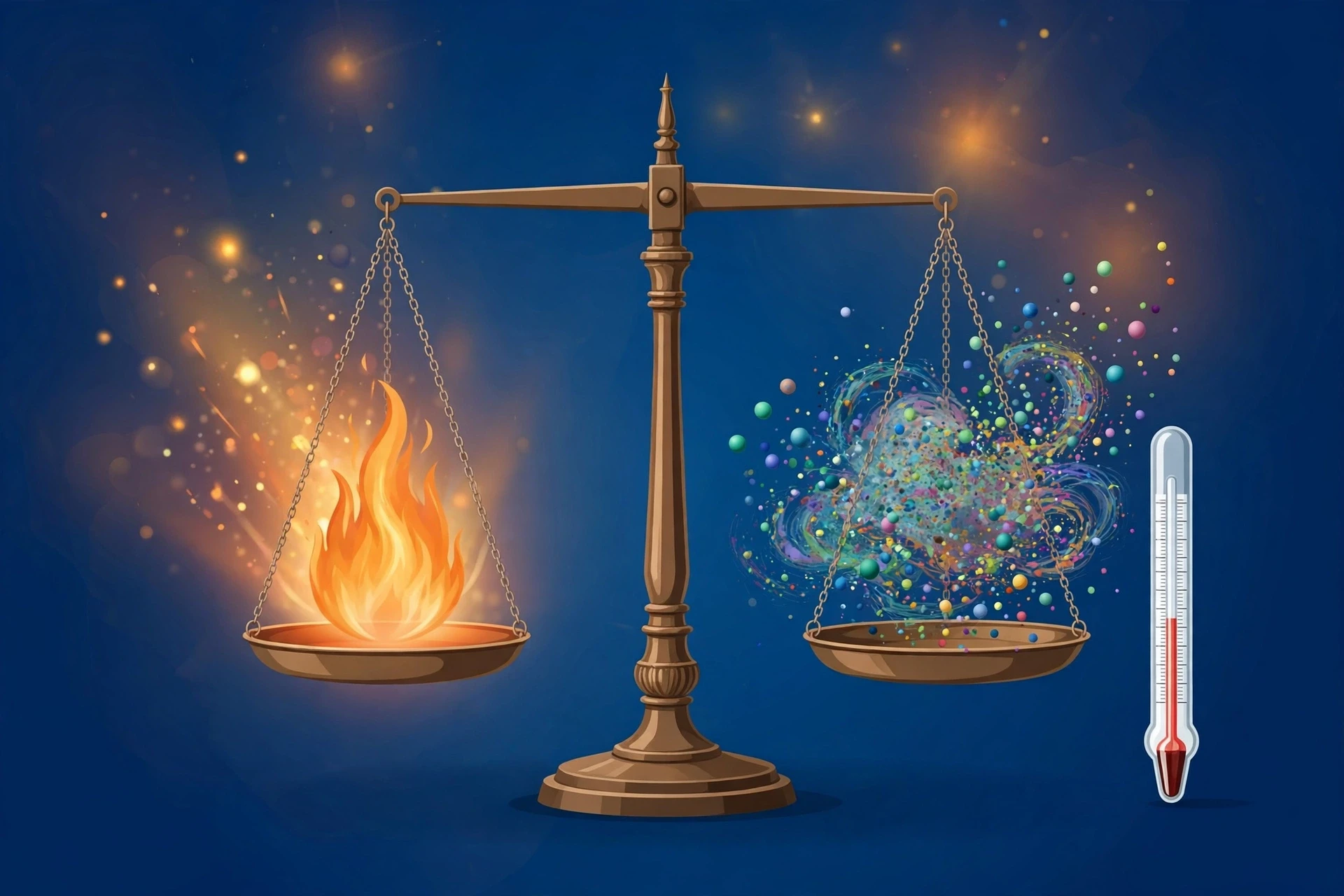
The second law does not say that the entropy of a system cannot fall — it falls whenever water freezes or a crystal grows. It says that when a system's entropy falls, the entropy of the surroundings must rise by more, so that the total still goes up.
9. How Do You Predict If a Reaction Is Spontaneous? Four Worked Examples
The Gibbs equation earns its keep when you use it on real numbers. Each example below follows the same three steps: find ΔH° and ΔS° from standard tables, convert ΔS° from joules to kilojoules so the units match, and compute ΔG° = ΔH° − TΔS° at 298 K. Watch the units — the most common error in thermochemistry is subtracting joules from kilojoules without converting.
Example 1: Burning methane. CH4(g) + 2O2(g) → CO2(g) + 2H2O(l). From §5, ΔH° = −890.3 kJ/mol. The entropy change uses standard molar entropies: S° is 186.3 J/mol·K for methane, 205.2 for oxygen, 213.8 for carbon dioxide, and 69.9 for liquid water. ΔS° = [213.8 + 2(69.9)] − [186.3 + 2(205.2)] = 353.6 − 596.7 = −243.1 J/mol·K, or −0.2431 kJ/mol·K. Then ΔG° = −890.3 − 298 × (−0.2431) = −890.3 + 72.4 = −817.9 kJ/mol. The reaction is strongly spontaneous. Notice something interesting: the entropy change opposes the reaction, because five moles of gas become three, yet the enthalpy term is so large that it wins easily. The fire does not need disorder's help.
Example 2: The cold pack. NH4NO3(s) → NH4+(aq) + NO3−(aq). The enthalpy of solution is +25.7 kJ/mol — endothermic — and the entropy change is +108.7 J/mol·K, because the ordered crystal disperses into solution. ΔG° = 25.7 − 298 × 0.1087 = 25.7 − 32.4 = −6.7 kJ/mol. The reaction is spontaneous even though it absorbs heat, because the entropy gain outweighs the enthalpy cost at room temperature. Below the crossover temperature, T = ΔH/ΔS = 25.7 / 0.1087 ≈ 236 K, the balance flips and the salt would not dissolve spontaneously. A cold pack works because your skin is warmer than 236 K — which, happily, it always is.
Example 3: Rusting iron. 4Fe(s) + 3O2(g) → 2Fe2O3(s). The enthalpy change is twice the enthalpy of formation of iron(III) oxide: 2 × (−824.2) = −1648.4 kJ. The entropy change is 2(87.4) − [4(27.3) + 3(205.2)] = 174.8 − 724.8 = −550.0 J/mol·K, a large loss, because three moles of gas vanish into a solid. ΔG° at 298 K = −1648.4 − 298 × (−0.550) = −1648.4 + 163.9 = −1484.5 kJ. Rusting is enormously spontaneous — which is why unprotected iron rusts and why protecting it is a billion-dollar industry. The crossover temperature is T = (−1648.4) / (−0.550) ≈ 3000 K, far above any temperature iron meets in service, so in practice rusting never reverses. The reaction is slow, not reluctant: kinetics, not thermodynamics, is what saves bridges.
Example 4: Melting ice. H2O(s) → H2O(l). The enthalpy of fusion is +6.01 kJ/mol and the entropy of fusion is +22.0 J/mol·K. At 298 K, ΔG = 6.01 − 298 × 0.0220 = 6.01 − 6.56 = −0.55 kJ/mol: melting is spontaneous, as any puddle in spring will confirm. At 263 K (−10 °C), ΔG = 6.01 − 263 × 0.0220 = 6.01 − 5.79 = +0.22 kJ/mol: melting is non-spontaneous, and ice stays ice. The crossover sits at T = 6010 / 22.0 = 273 K, exactly 0 °C. The melting point of ice is not an arbitrary fact about water; it is the temperature where the enthalpy cost of melting is exactly balanced by the entropy gain, and the Gibbs equation predicts it from two numbers measured in a calorimeter.
Reaction | ΔH° (kJ/mol) | ΔS° (J/mol·K) | ΔG° at 298 K (kJ/mol) | Spontaneous at 298 K? |
|---|---|---|---|---|
Burning methane | −890.3 | −243.1 | −817.9 | Yes, strongly |
Ammonium nitrate dissolving | +25.7 | +108.7 | −6.7 | Yes, driven by entropy |
Rusting iron | −1648.4 | −550.0 | −1484.5 | Yes, strongly |
Melting ice | +6.01 | +22.0 | −0.55 | Yes, just barely |

10. Thermochemistry in Real Life: From Batteries to Your Body
A lithium-ion battery is a controlled spontaneous reaction: lithium ions move between electrodes, ΔG is negative, and the free energy is drawn off as electrical work instead of heat. Recharging drives the reaction backwards with electrical work, and the heat lost to irreversibility is why a fast-charging phone gets warm. The battery's voltage is directly proportional to ΔG, through the equation ΔG = −nFE, where n is the number of electrons and F is Faraday's constant. A battery is, quite literally, Gibbs free energy you can hold in your hand.
Your body is a thermochemistry engine of a different kind. The food you eat is burned, in slow, enzyme-controlled steps, to carbon dioxide and water, releasing the same enthalpy a bomb calorimeter would measure — about 2,800 kJ per mole of glucose — but the body captures a large share of it as ATP rather than letting it all escape as heat. ATP hydrolysis has a standard free energy change of about −30.5 kJ/mol, and the cell couples that spontaneous reaction to non-spontaneous ones, such as building proteins and pumping ions, the way a waterfall drives a mill. The heat you give off, roughly 100 watts at rest, is the entropy bill: the price of staying ordered, warm, and alive.
Industry runs on the same ledger. The Haber process makes ammonia at high pressure and moderate temperature, balancing the entropy penalty against the need for speed. Cement kilns run near 1,450 °C because the decomposition of limestone only becomes spontaneous when the entropy term grows large enough to overcome its endothermic enthalpy. Refrigerators move heat against its natural direction by spending work, and their efficiency is capped by the second law. Every one of these is a chemical reaction whose feasibility was settled, before a single pipe was welded, by a ΔG calculation on paper.
11. Common Mistakes and Misconceptions
The mistakes students make in thermochemistry are consistent enough to be worth listing, because each one marks a place where intuition and the science part company. The first is the sign convention: heat released by the system is negative ΔH, and heat absorbed is positive. It feels backwards until you remember that ΔH describes the system, not the surroundings. The system loses heat, so its enthalpy falls, so the sign is negative. Say it out loud while you work — "the system lost heat, so ΔH is negative" — and the sign errors fade.
The second is confusing spontaneous with fast. A spontaneous reaction can be very slow: diamond turning into graphite has a negative ΔG, but your diamond ring will not turn into pencil lead in your lifetime, because the activation barrier is enormous. A non-spontaneous reaction can be made to happen quickly with enough work. Spontaneity is a statement about direction, not speed. Speed belongs to kinetics, and the two are separate questions that students keep trying to answer with one number.
The third is treating ΔG as the heat of the reaction. It is not. ΔH is the heat; ΔG is the maximum useful work. A reaction can release a great deal of heat and still have a small ΔG if its entropy change is unfavourable, and a reaction can absorb heat yet have a negative ΔG if its entropy gain is large. The cold pack proves the second case every time it is snapped. The fourth mistake is forgetting the units: ΔS is tabulated in joules per mole per kelvin, ΔH in kilojoules per mole, and the Gibbs equation needs them in the same units. Convert first, subtract second. And the fifth, the one I meet most often, is the belief that breaking bonds releases energy. It does not, and it never did: breaking costs, forming pays, and the difference is the heat you feel.
Most people assume that a reaction which absorbs heat cannot happen on its own — that cold means impossible. What the data actually show is the opposite: endothermic reactions happen all around us, from dissolving salts to melting ice to photosynthesis itself, because entropy pays the bill. Heat is only half the ledger. The moment you start reading ΔG instead of ΔH, the question changes from "does it release heat?" to the better question, "does the universe gain entropy overall?"
12. Putting It All Together
Thermochemistry began as a bookkeeping system for heat and became the science that decides what can happen. Enthalpy tells you which way the heat flows and how much of it moves. Entropy tells you which way disorder flows and how much the universe gains. Gibbs free energy weighs the two against each other at a given temperature and delivers the verdict: negative means go, positive means no, zero means balance. The equation ΔG = ΔH − TΔS fits on a single line, and it governs campfires and cold packs, batteries and bodies, rusting bridges and the melting of glaciers.
The campfire from the start of this article still burns in my memory, not because the chemistry was unusual but because it was so ordinary: wood, air, and a match — and out of them, heat, light, ash, and a circle of cold teenagers made warm. Everything in it was thermochemistry, doing quietly what it always does: moving energy from where it is stored to where it is needed, paying the entropy bill as it goes, and keeping the accounts balanced. Learn to read those accounts, and you can read the world.
Frequently Asked Questions
What is enthalpy?
Enthalpy, symbol H, is the heat content of a system at constant pressure. Its change, ΔH, is the heat absorbed or released by a reaction carried out in an open container. A negative ΔH means the reaction releases heat and is exothermic; a positive ΔH means it absorbs heat and is endothermic. Standard enthalpy changes, written ΔH°, are measured under standard conditions of 1 bar pressure and usually 298 K.
What is entropy?
Entropy, symbol S, measures how many ways the energy and particles of a system can be arranged — how spread out energy and matter are. Gases have higher entropy than liquids, and liquids higher than solids. The second law of thermodynamics says the total entropy of the universe increases in every spontaneous process, which is why heat flows from hot to cold and never the other way on its own.
What is Gibbs free energy?
Gibbs free energy, symbol G, is defined as G = H − TS, and its change, ΔG = ΔH − TΔS, predicts whether a process at constant temperature and pressure will happen on its own. A negative ΔG means the process is spontaneous; a positive ΔG means it is non-spontaneous; a ΔG of zero means the system is at equilibrium. ΔG is also the maximum useful work the process can deliver.
How do you predict if a reaction is spontaneous?
Find ΔH° and ΔS° for the reaction from standard tables, convert ΔS° to kilojoules per mole per kelvin, and compute ΔG° = ΔH° − TΔS° at the temperature of interest. If ΔG° is negative, the reaction is spontaneous; if positive, it is not. When ΔH and ΔS disagree in sign, the reaction becomes spontaneous only above or below the crossover temperature T = ΔH/ΔS.
What is the difference between exothermic and endothermic reactions?
An exothermic reaction releases heat to its surroundings and has a negative ΔH — burning, rusting, and neutralisation are examples. An endothermic reaction absorbs heat from its surroundings and has a positive ΔH — melting, evaporating, and photosynthesis are examples. Both kinds can be spontaneous: an endothermic reaction runs on its own when its entropy gain is large enough to make ΔG negative.
Why does ice melt above 0 °C but not below it?
Melting ice has ΔH = +6.01 kJ/mol and ΔS = +22.0 J/mol·K. At 298 K, ΔG = −0.55 kJ/mol, so melting is spontaneous; at 263 K, ΔG = +0.22 kJ/mol, so it is not. The crossover temperature, T = ΔH/ΔS = 273 K, is exactly 0 °C. Below that temperature the enthalpy cost wins; above it the entropy gain wins.
Is Gibbs free energy the same as the energy released as heat?
No. The heat released or absorbed by a reaction is ΔH, the enthalpy change. Gibbs free energy, ΔG, is the maximum useful work the reaction can deliver at constant temperature and pressure. The two differ by the entropy term, TΔS. A reaction can release heat yet have a small ΔG, and an endothermic reaction can have a negative ΔG if its entropy increase is large enough.
Sources
LibreTexts — Enthalpy — https://chem.libretexts.org/Bookshelves/Physical_and_Theoretical_Chemistry_Textbook_Maps/Supplemental_Modules_(Physical_and_Theoretical_Chemistry)/Thermodynamics/Energies_and_Potentials/enthalpy
LibreTexts — Entropy — https://chem.libretexts.org/Bookshelves/Physical_and_Theoretical_Chemistry_Textbook_Maps/Supplemental_Modules_(Physical_and_Theoretical_Chemistry)/Thermodynamics/Energies_and_Potentials/Entropy
OpenStax Chemistry 2e — Energy Basics — https://openstax.org/books/chemistry-2e/pages/5-1-energy-basics
OpenStax Chemistry 2e — Calorimetry — https://openstax.org/books/chemistry-2e/pages/5-2-calorimetry
OpenStax Chemistry 2e — Enthalpy — https://openstax.org/books/chemistry-2e/pages/5-3-enthalpy
OpenStax Chemistry 2e — Spontaneity — https://openstax.org/books/chemistry-2e/pages/16-1-spontaneity
OpenStax Chemistry 2e — The Second and Third Laws of Thermodynamics — https://openstax.org/books/chemistry-2e/pages/16-3-the-second-and-third-laws-of-thermodynamics
NIST Chemistry WebBook — Thermochemistry Data — https://webbook.nist.gov/chemistry/thermo/
Khan Academy — Thermodynamics — https://www.khanacademy.org/science/ap-chemistry-beta/x2eef969c74e0d802:thermodynamics
American Chemical Society — ChemMatters: Thermochemistry — https://www.acs.org/education/resources/highschool/chemmatters/past-issues/archive-2013-2014/thermochemistry.html
Chemical Reactions Explained — Sciory — https://www.sciory.com/blog/chemical-reactions-types-kinetics-examples
How the Sun Works — Sciory — https://www.sciory.com/blog/how-the-sun-works
Greenhouse Effect Explained — Sciory — https://www.sciory.com/blog/greenhouse-effect-explained