

Introduction: The Car That Cooked Lunch
On a bright July afternoon years ago, I left a sandwich on the passenger seat of my car while I ran into a shop for ten minutes. When I came back, the bread was warm, the cheese had gone soft, and the inside of the car felt like a small oven — even though the air outside was a pleasant 24°C. Nothing about the car had generated heat. The sun had done all the work, and the windows had simply refused to let that warmth escape.
That car was my first real lesson in the greenhouse effect, though I did not know its name at the time. The same trick — light gets in easily, heat struggles to get out — keeps our entire planet about 33°C warmer than it would otherwise be. Without it, Earth's average temperature would sit near −18°C, and the oceans would be sheets of ice. With it, we get liquid water, forests, farms, and everything alive reading this sentence.
The greenhouse effect is one of the most misunderstood ideas in science. Some people hear the phrase and picture a glass building. Others hear it and think of something harmful, a kind of pollution. Both pictures miss the point. The greenhouse effect is a piece of physics — sunlight, heat radiation, and a handful of gases that are very good at catching one kind of light and ignoring another. It is natural, it is essential, and it can be measured with instruments you could hold in your hands. Human activity has strengthened it, which is a different story from the mechanism itself, and one I will keep carefully separate here.
In this article, we will walk through the mechanism step by step: what sunlight actually is, what happens when it hits the ground, which gases catch the heat trying to leave, who first worked all this out, and how modern satellites and a lonely observatory on a Hawaiian volcano keep measuring the effect today.
1. What the Greenhouse Effect Actually Is
The greenhouse effect is the process by which certain gases in Earth's atmosphere absorb infrared radiation — heat — rising from the planet's surface, and then radiate some of that energy back downward. The net result is that Earth holds on to more heat than it would if its atmosphere were made only of gases that ignore infrared light. NASA puts it plainly: the greenhouse effect is the process through which heat is trapped near Earth's surface by substances known as greenhouse gases, and without it Earth's surface would be about 33°C colder.
That single number, 33°C, is worth sitting with. Earth's average surface temperature today is roughly 15°C. Strip away every greenhouse gas and leave the sunlight exactly as it is, and the average falls to about −18°C. The difference between those two numbers is the whole story of why Earth has oceans instead of ice fields, and why life could spread across nearly every corner of the planet.
The gases doing this work make up less than one percent of the air. The bulk of the atmosphere — nitrogen at about 78 percent and oxygen at about 21 percent — plays almost no role in trapping heat. The heavy lifting is done by trace gases: water vapor, carbon dioxide, methane, nitrous oxide, and ozone. A pinch of the right molecules changes everything, the way a pinch of salt changes a whole pot of soup.
1.1 A definition you can carry in your pocket
If you need one sentence, here it is: the greenhouse effect is the warming of a planet's surface because its atmosphere absorbs outgoing infrared radiation and sends part of it back down. Energy comes in as sunlight, leaves as heat, and the atmosphere slows the leaving. That is the whole mechanism. Everything else in this article is detail — important detail, but detail.
1.2 Why the name is misleading
Here is the first place where most people get tripped up, and I want to disagree with the common picture directly. A real glass greenhouse does not warm up mainly by trapping infrared radiation. It warms up mostly because the glass stops warm air from rising and blowing away — it blocks convection. The atmosphere does something different: it blocks radiation. The name stuck because the end result looks similar — a warmer space inside — but the physics is not the same. When John Tyndall and others worked this out in the 1800s, they borrowed a familiar word for an unfamiliar mechanism, and we have been gently correcting the analogy ever since.
A parked car is actually the closer everyday example, and it is the one I still use in lectures. Sunlight passes through the windows and warms the seats and dashboard. Those warm surfaces give off infrared radiation, which glass absorbs rather than transmits. The heat stays. The difference between the car and the planet is that the planet has no glass — it has gases that behave a little like glass for infrared light, and unlike glass for visible light.
2. Sunlight In, Heat Out: Earth's Energy Budget
Every temperature on Earth is a negotiation between energy arriving and energy leaving. The sun delivers the arriving part. The surface and the atmosphere deliver the leaving part. When the two balance, temperature holds steady. When they do not, temperature moves until they do.
2.1 What sunlight really is
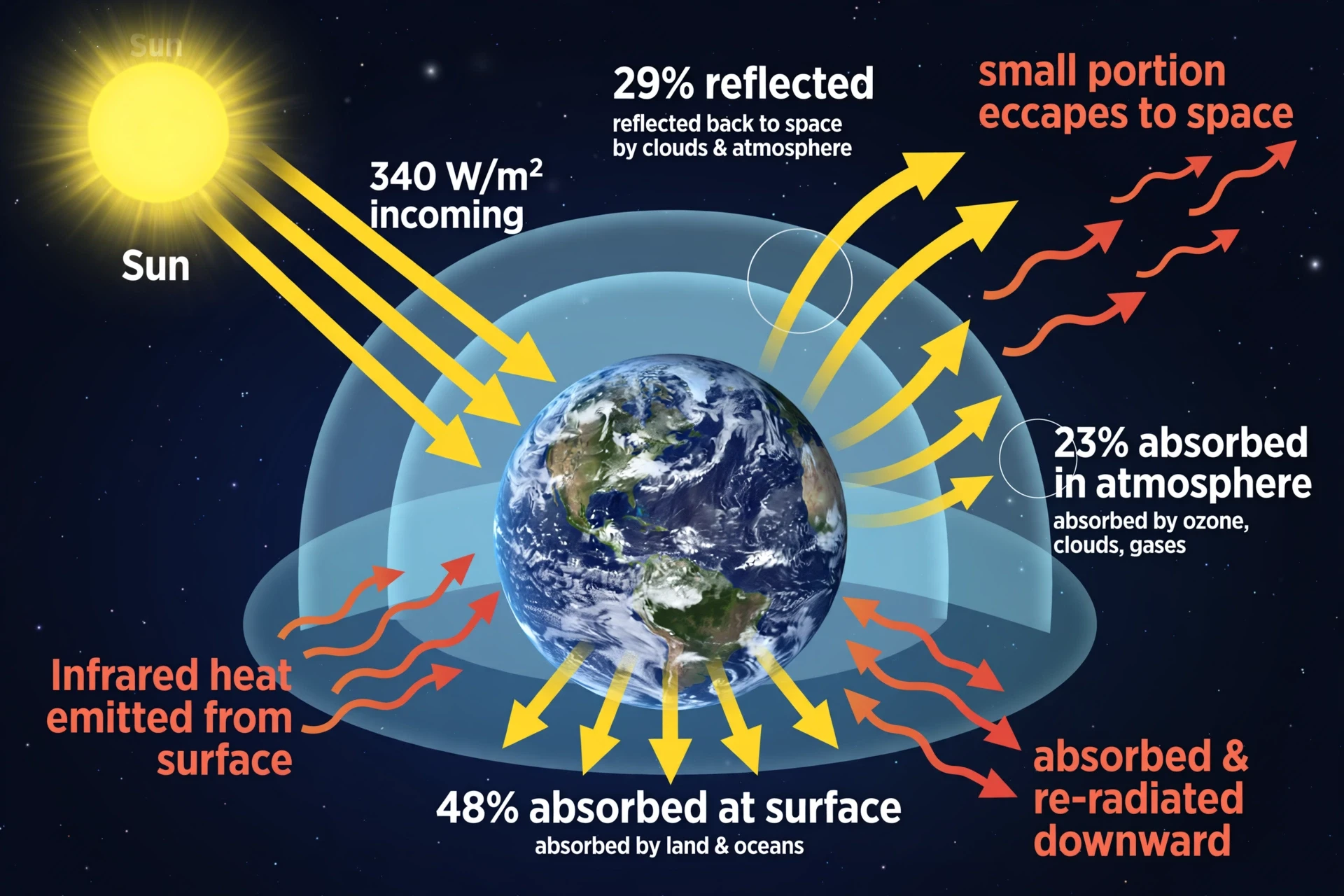
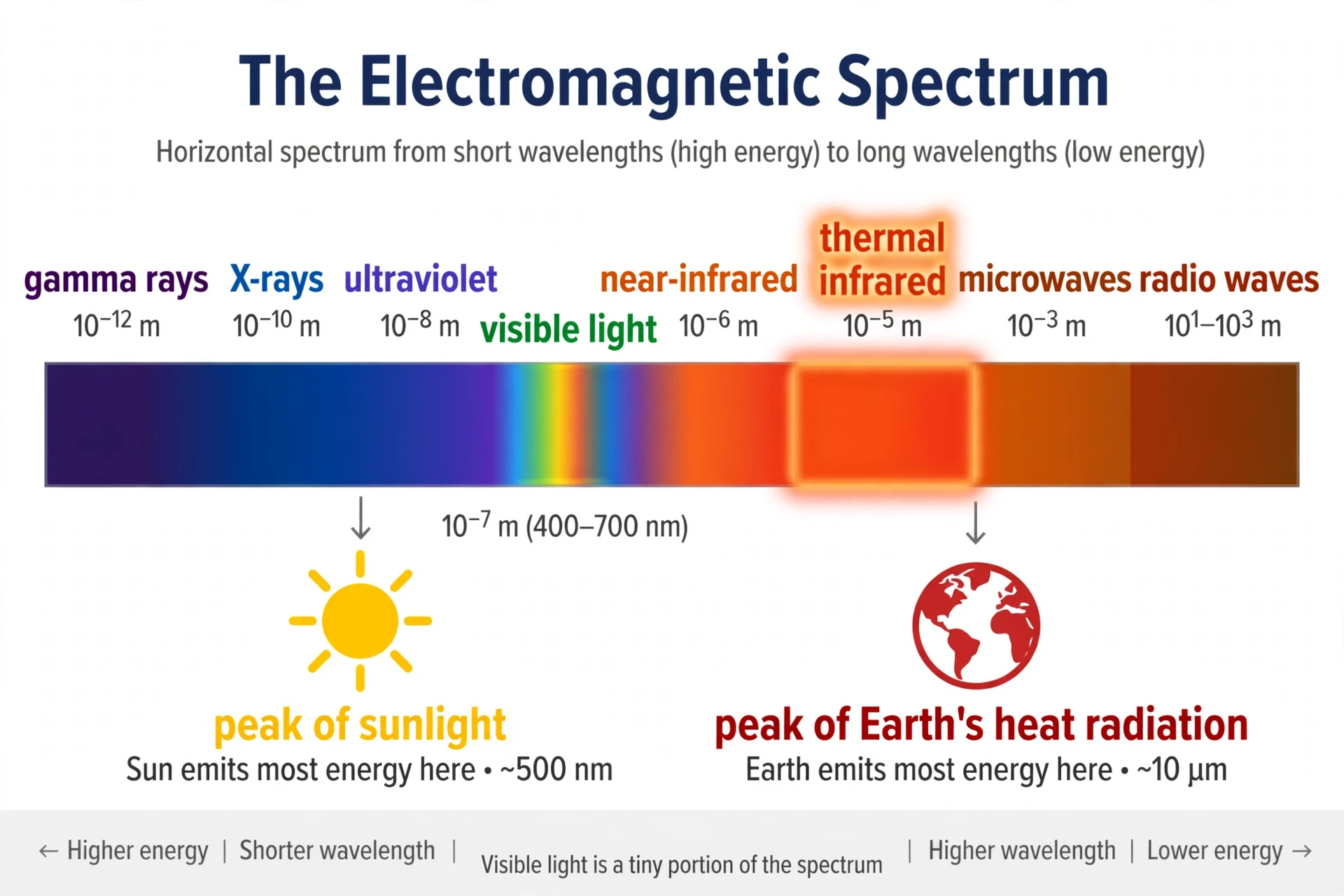
Sunlight is electromagnetic radiation, and like all such radiation it travels as waves. The waves our eyes can see — visible light — are only a thin slice of the full spectrum. The sun, with a surface near 5,800 Kelvin, pours out most of its energy as visible light and near-infrared. That light crosses 150 million kilometres of empty space and arrives at the top of Earth's atmosphere at an average intensity of about 340 watts per square metre, spread over the whole globe, day and night, poles and equator averaged together.
Here is the detail that matters for everything that follows: hotter objects radiate at shorter wavelengths. The sun is extremely hot, so its radiation peaks in the visible range. Earth is cool — about 15°C on average — so the radiation it gives off peaks far away in the spectrum, at thermal infrared wavelengths around 12.5 micrometres, far beyond anything our eyes can see. Two different temperatures, two different kinds of light. The greenhouse effect lives entirely in the gap between them.
2.2 The budget, in plain numbers
Picture 100 units of sunlight arriving at the top of the atmosphere. About 29 units bounce straight back to space, reflected by clouds, dust, and bright surfaces such as snow and sea ice. That reflected share is Earth's albedo, and it never warms anything. About 23 units are absorbed within the atmosphere itself, mostly by water vapor, dust, and ozone. The remaining 48 units reach the ground and are absorbed by land and oceans.
The surface cannot simply keep that energy. If it did, Earth would heat without limit, like a sink with the tap running and no drain. Instead the surface sheds energy in three ways: evaporation carries away about 25 units, warm air rising by convection carries about 5, and thermal infrared radiation carries the rest. NASA's Earth Observatory explains the balance in detail: the surface radiates a large upward flow of infrared, the atmosphere radiates a large downward flow back to the surface, and the small difference between them — a net of roughly 17 percent of incoming sunlight — is the heat that finally escapes. That escaping trickle is what balances the books.
Figure 1 shows this whole accounting at a glance: sunlight in, reflections out, absorption, and the infrared exchange between surface and sky.
2.3 The thermostat hidden in the physics
There is a self-correcting rule built into this system, and it is worth knowing because it explains why Earth does not run away to ever-higher temperatures. The amount of heat a surface radiates grows with the fourth power of its temperature. Double the absolute temperature and the radiated energy increases sixteenfold. So as Earth warms, it sheds heat to space far faster — a strong cooling response that keeps the planet's temperature near a stable point. The greenhouse effect does not switch this thermostat off. It shifts the setting: with greenhouse gases in the way, the surface must warm further before its outgoing radiation can push through the atmosphere and balance the incoming sunlight.
I first saw this law in action not in a textbook but in a laboratory, watching a heated metal plate glow brighter as its temperature crept upward. The plate was not producing new physics. It was obeying a rule that governs everything from a stove element to a planet. That is the kind of continuity that makes atmospheric science feel less like a collection of facts and more like one story told at different scales.
2.4 The role of the oceans and the land
The surface that absorbs those 48 units is not uniform. Oceans cover about 71 percent of the planet, and water stores heat far more patiently than rock or soil. When sunlight warms the sea surface, much of that energy sinks into the upper ocean and is carried around the globe by currents — the great conveyor described in our guide to oceanography. Land heats and cools quickly by comparison, which is one reason deserts swing between scorching days and cold nights while coastal regions stay mild. The greenhouse effect operates above both, but the surface beneath it shapes how the trapped heat is stored, moved, and eventually released.
3. Why Some Gases Trap Heat and Others Do Not
This is the heart of the whole subject, and it comes down to a question about shape. Why does carbon dioxide catch infrared radiation while nitrogen — which makes up most of the air — lets it pass straight through?
3.1 Molecules that can wiggle
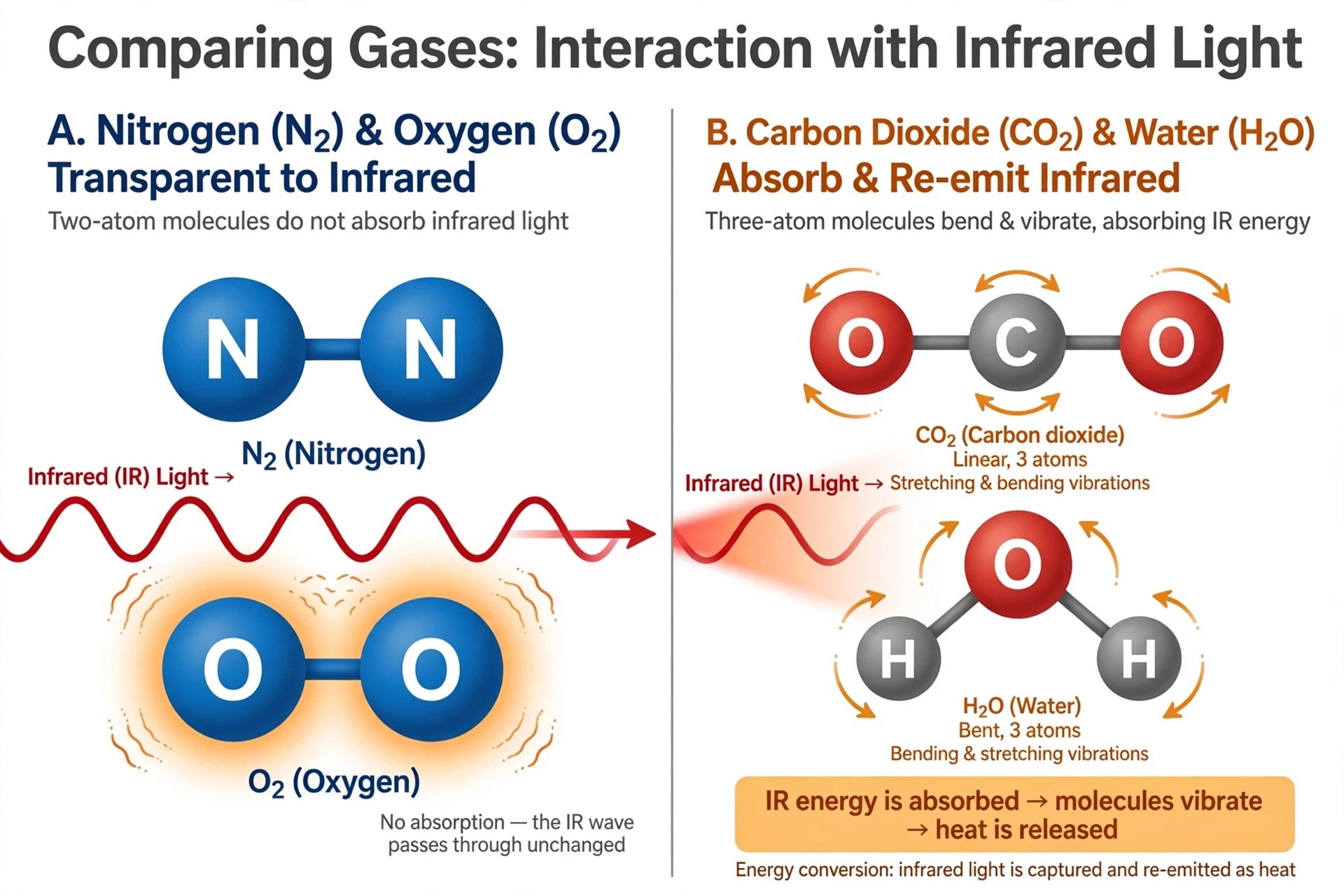
A gas molecule absorbs infrared radiation when the incoming wave can set the molecule vibrating. Think of a molecule as a tiny structure of balls joined by springs. Infrared light has just the right energy to make those springs stretch, bend, and wobble. When a molecule absorbs an infrared photon, it starts vibrating more energetically — it warms up — and a moment later it releases that energy again, radiating infrared in a random direction. Some of that re-radiated energy heads upward toward space. Some heads back down toward the ground. That downward share is the greenhouse effect, happening one molecule at a time, trillions of times a second.
Nitrogen and oxygen molecules are each made of just two identical atoms. They can vibrate in only one simple way, and that vibration does not match the energy of infrared light. So infrared passes through them almost untouched. Carbon dioxide and water vapor, by contrast, have three atoms each. Three atoms can bend, stretch asymmetrically, and waggle in several distinct patterns — and several of those patterns match infrared wavelengths exactly. As Professor Scott Denning of Colorado State University explains in a UCAR presentation, this is precisely why three-atom molecules are such effective greenhouse gases: they have more ways to vibrate, so they catch more infrared.
Methane has five atoms and even more vibrational modes, which helps explain why a single methane molecule is far more effective at absorbing infrared than a single carbon dioxide molecule, even though methane is much rarer in the air.
3.2 The light that passes through
The other half of the trick is what greenhouse gases do not absorb. Carbon dioxide, water vapor, and methane are nearly transparent to visible light. Sunlight streams through them and warms the ground unimpeded. It is only the outgoing infrared — the heat the ground gives off after absorbing sunlight — that gets caught. This one-way selectivity is the whole mechanism. If greenhouse gases absorbed visible light too, they would shade the planet and cool it. If they absorbed no infrared, the heat would escape freely and the planet would freeze. Their talent is narrow and specific: blind to the light coming in, greedy for the heat going out.
Figure 2 maps where each kind of radiation sits on the electromagnetic spectrum, and Figure 3 shows the molecular difference between a gas that traps heat and one that does not.
3.3 Absorption is not a wall
One image I always correct in my lectures is the idea of greenhouse gases forming a ceiling or a blanket that heat bounces off. The reality is messier and more interesting. Infrared photons do not bounce. They are absorbed by a molecule, and a new photon is radiated a moment later in a random direction. A photon leaving the surface might be absorbed and re-emitted half a dozen times by different molecules on its way up, each time with a chance of being sent back down. The atmosphere is less like a wall and more like a crowded room: the heat eventually gets out, but it takes a long, wandering path, and while it wanders, the lower atmosphere stays warmer than it would otherwise be. At an altitude of roughly five to six kilometres, the air becomes thin enough that infrared can finally radiate freely to space. That altitude — the effective radiating level — is where Earth finally loses its heat, and it is colder up there than at the surface, which is exactly why the surface must be warmer to push the same amount of energy out.
4. Meet the Greenhouse Gases
Not all greenhouse gases are equal. They differ in abundance, in how strongly each molecule absorbs infrared, and in how long they linger in the air. Here is the cast, in order of their contribution to the natural effect.
4.1 Water vapor: the biggest player, and a follower
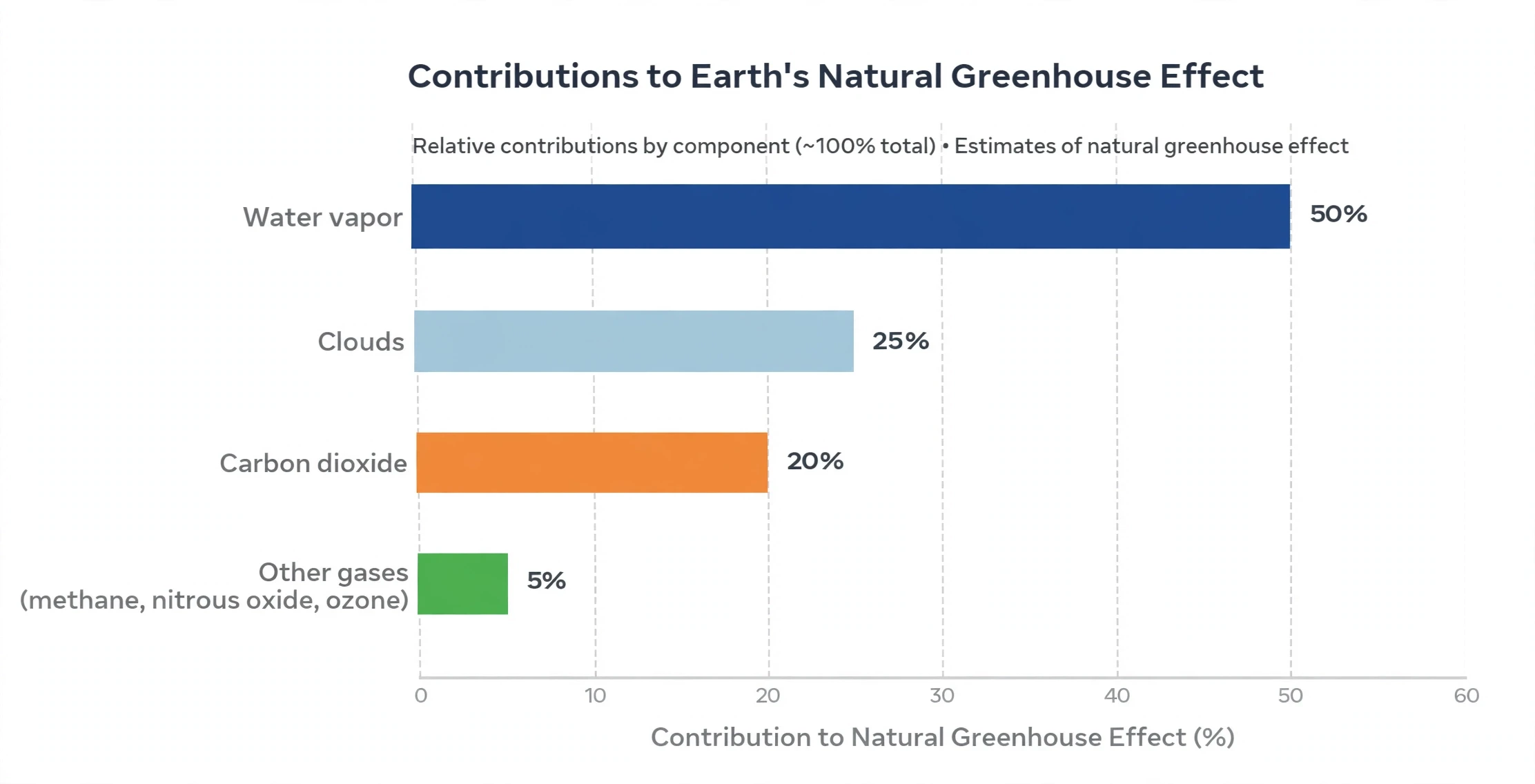
Water vapor is Earth's most abundant greenhouse gas and is responsible for roughly half of the total greenhouse effect. It is also the most changeable: warm air holds more moisture, so water vapor increases as the planet warms and decreases as it cools. A molecule of water vapor stays in the air for only about nine days on average before falling as rain or snow.
That short lifetime matters. Water vapor cannot drive long-term change by itself, because its concentration is set by temperature rather than the other way around. NASA describes it as a feedback, not a forcing: it amplifies warming that starts elsewhere. For every degree Celsius the atmosphere warms, it can hold about 7 percent more water vapor, and that extra vapor traps more heat, which warms the air further. Scientists estimate this feedback more than doubles the warming that carbon dioxide alone would cause. The water cycle is the engine behind this — evaporation from oceans and land, transport through the air, and return as precipitation.
4.2 Carbon dioxide: the control knob
Carbon dioxide contributes roughly a fifth of the natural greenhouse effect, yet it plays an outsized role in setting Earth's temperature over long timescales. The reason is persistence. A carbon dioxide molecule added to the air today can remain there for decades to centuries. Unlike water vapor, it does not rain out when the temperature drops. Atmospheric scientist Andrew Dessler of Texas A&M University has called carbon dioxide and the other non-condensing greenhouse gases the "control knobs" of the climate: turn them, and water vapor follows.
Carbon dioxide enters the air from natural sources — respiration, decomposition, volcanoes, and the slow breathing of the oceans — and is removed by photosynthesis and by dissolving into seawater. For hundreds of thousands of years before industrial times, its concentration hovered between about 180 and 300 parts per million. Direct measurements at Mauna Loa, discussed in Section 7, show it has now passed 425 parts per million.
4.3 Methane, nitrous oxide, and ozone
Methane is far scarcer than carbon dioxide, but each molecule is much more potent at absorbing infrared. It comes from wetlands, termites, and the digestive systems of grazing animals, as well as from human sources such as fossil fuel extraction, livestock, and landfills. It lasts roughly a decade in the atmosphere before chemical reactions break it down.
Nitrous oxide, released by soils, oceans, and fertilized farmland, is rarer still but lasts more than a century and is a powerful absorber. Ozone plays a double role: high in the stratosphere it shields life from ultraviolet light, while in the lower atmosphere it acts as a greenhouse gas, absorbing infrared near the ground where it matters most for surface temperature.
4.4 The gases in one table
Gas | Share of natural greenhouse effect | Typical lifetime in air | Main natural sources |
|---|---|---|---|
Water vapor (H₂O) | About 50% | About 9 days | Evaporation from oceans, lakes, land |
Carbon dioxide (CO₂) | About 20% | Decades to centuries | Respiration, volcanoes, ocean release |
Clouds | About 25% | Days | Condensed water droplets and ice |
Methane (CH₄) | Small, but potent per molecule | About 10 years | Wetlands, termites, grazing animals |
Nitrous oxide (N₂O) | Small, but potent per molecule | Over 100 years | Soils, oceans |
Ozone (O₃) | Small, but potent per molecule | Weeks to months | Formed by sunlight acting on oxygen |
Table: The main contributors to the greenhouse effect. Water vapor and clouds together account for about three-quarters of the total; carbon dioxide and the other long-lived gases make up most of the rest. Shares are approximate and vary with location and season.
Figure 4 shows the same picture as a chart, so the proportions are easy to compare at a glance.
5. How We Figured It Out: Four People and a Volcano
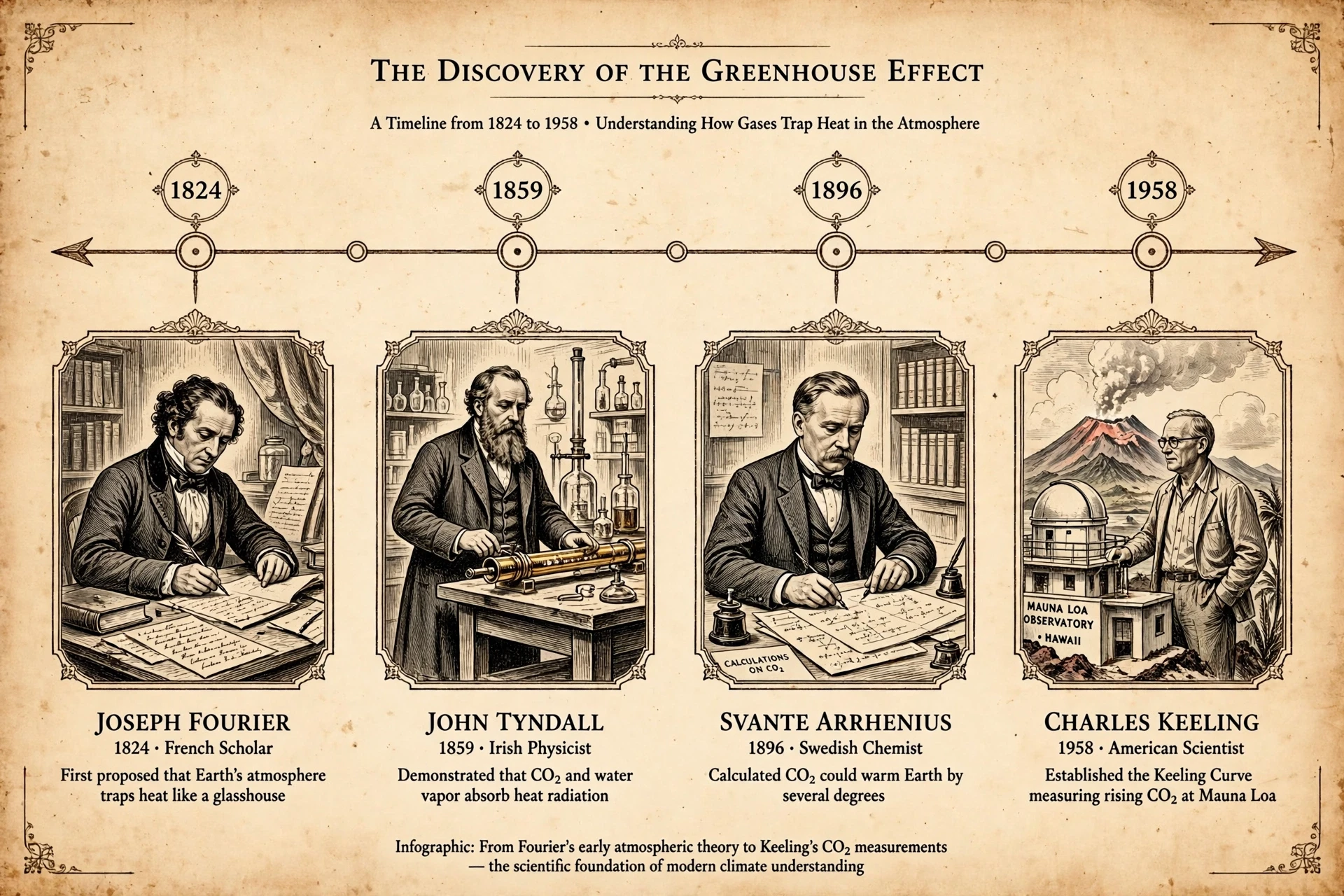
The greenhouse effect was not discovered in a single experiment. It was pieced together across more than a century, by people working with the crudest of instruments and the boldest of questions. Their story is worth telling, because it shows how science actually moves: a puzzle, a measurement, a calculation, and then a lonely vigil on a mountaintop.
5.1 Fourier asks why Earth is warm enough (1824)
The puzzle began with Joseph Fourier, a French mathematician and physicist. In the 1820s he calculated what Earth's temperature should be if the planet were warmed by sunlight alone, with no atmosphere to interfere. His answer was far colder than the world he lived in. Something was keeping Earth warm, and Fourier guessed that the atmosphere was acting like a pane of glass: transparent to incoming sunlight, opaque to the outgoing heat. He had no instrument that could prove it. He had arithmetic, and the courage to trust it.
5.2 Tyndall measures the invisible (1859)
Thirty-five years later, John Tyndall, an Irish physicist working in London, built the instrument Fourier lacked. He filled a long tube with different gases and passed infrared radiation — heat from a warm source — through it, measuring how much came out the other side. Oxygen and nitrogen let the heat pass almost untouched. Carbon dioxide and water vapor absorbed it strongly. Tyndall had shown, with his own hands, that the trace gases of the air had a property the bulk gases lacked. He also saw the implication immediately: changes in the amount of carbon dioxide or water vapor in the atmosphere would change the climate. In 1861 he wrote that such changes could explain the ice ages.
I have repeated a version of Tyndall's demonstration for students, shining an infrared lamp through a flask of air and then through a flask enriched with carbon dioxide, watching the temperature trace climb faster in the second. The first time I ran it, I checked the wiring twice, certain I had mixed up the flasks. I had not. A colourless, odourless gas was doing exactly what Tyndall said it would do, a century and a half after he first measured it.
5.3 Arrhenius does the arithmetic (1896)
The Swedish chemist Svante Arrhenius took Tyndall's laboratory result and turned it into a planetary calculation. Working by hand through thousands of arithmetic steps — this was decades before electronic computers — he estimated how much Earth's temperature would change if carbon dioxide doubled or halved. His answer: doubling carbon dioxide would warm the planet by roughly 5°C in the tropics, and cutting it by a third would cool the globe by about 3°C. His numbers were rough by modern standards, but the direction and the scale were right. Arrhenius also thought, at the time, that the warming might be a pleasant thing, a defence against a future ice age. He was doing physics, not prophecy, and he said so.
5.4 Keeling watches the air, year after year (1958–)
The final piece was not a theory but a measurement, and it required stubbornness more than brilliance. In 1958, Charles David Keeling of the Scripps Institution of Oceanography set up instruments on Mauna Loa, a volcano in Hawaii chosen because its air is clean and representative of the wider atmosphere. He measured carbon dioxide in the air, week after week, year after year, until his death in 2005. His colleagues and successors have kept the record going ever since.
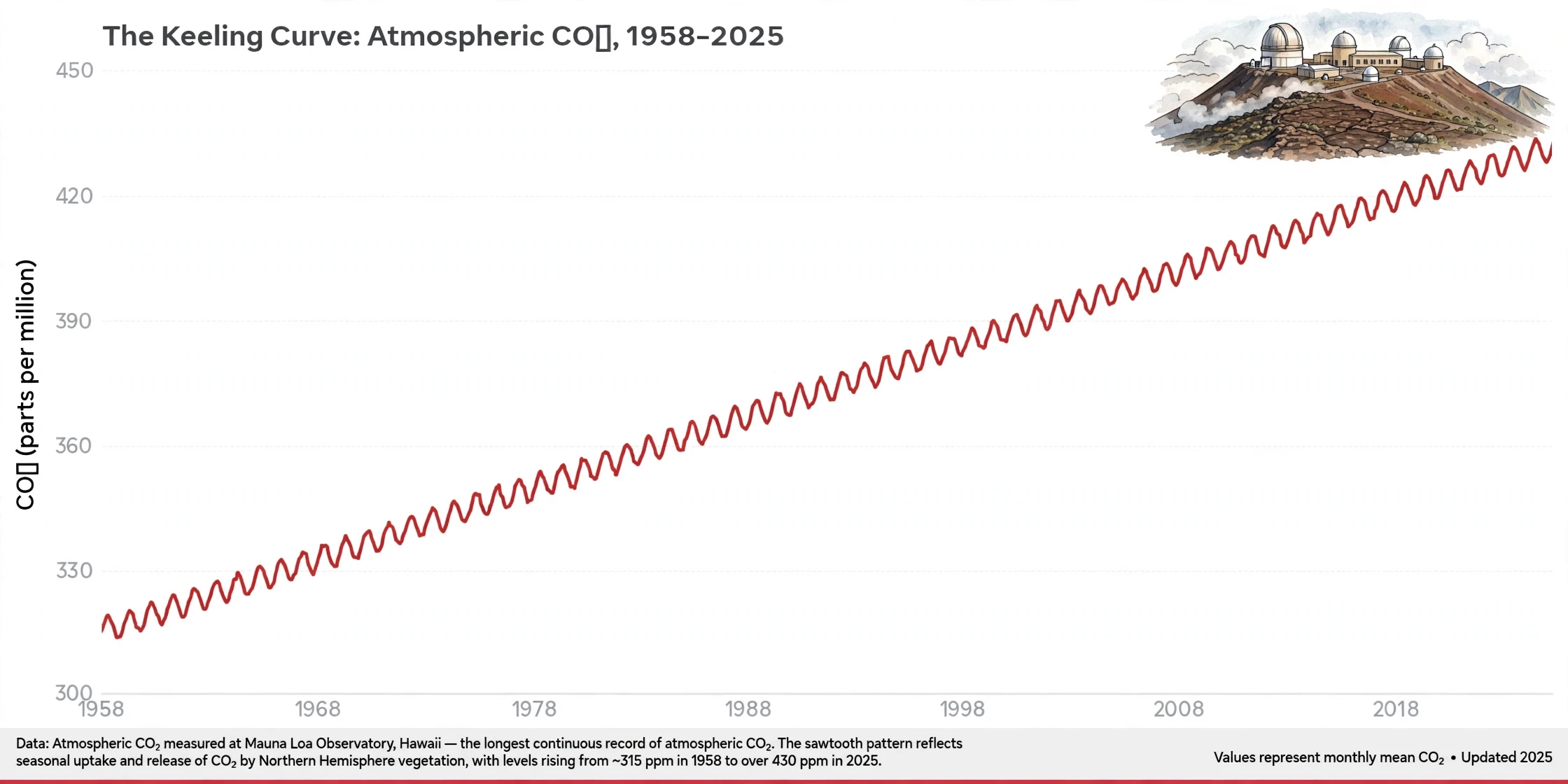
The result is the Keeling Curve, the longest continuous record of atmospheric carbon dioxide anywhere on Earth. It shows a sawtooth pattern — carbon dioxide falling each northern summer as forests and plants draw it down through photosynthesis, rising each winter as leaves fall and decay — climbing steadily underneath, from about 315 parts per million in 1958 to more than 430 parts per million in May 2025. The Scripps Institution of Oceanography, which runs the program with NOAA, calls it the world's longest unbroken record of atmospheric carbon dioxide concentrations. It is also, in my view, one of the most beautiful graphs in all of science: a single line that makes an invisible gas visible.
Figure 5 gathers the four investigators into one timeline, and the Keeling Curve itself appears in Section 7.
6. The Natural Greenhouse Effect: Why Earth Is Livable
Strip the story down to its simplest form and the natural greenhouse effect is a gift. It is the reason Earth sits in the narrow band of temperatures where water stays liquid, where chemistry runs at a pace life can use, and where ecosystems can build themselves into forests, reefs, and grasslands.
6.1 A world without it
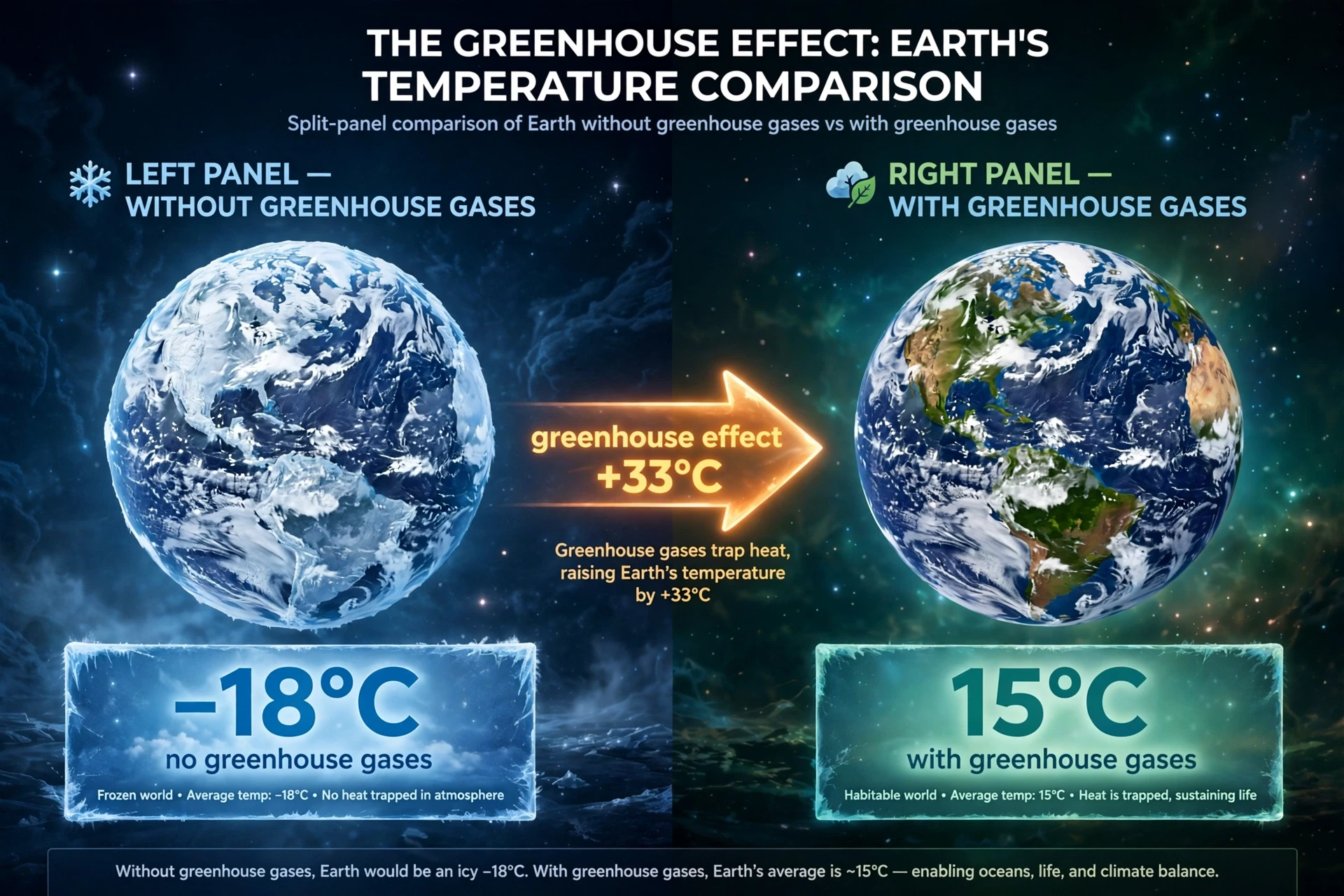
Imagine Earth with the same sunlight, the same oceans, the same spin — but with an atmosphere of pure nitrogen and oxygen, and not a single greenhouse gas. The surface would still absorb sunlight and radiate infrared, but nothing would slow the infrared on its way out. The average temperature would settle near −18°C. The oceans would freeze from the top down, though deep water might stay liquid beneath the ice, insulated and dark. Land would be a frozen desert. Life might persist in sheltered pockets, around volcanic vents or under the ice, but the green, loud, crowded planet we know would not exist.
This is not a hypothetical invented for effect. It is the straightforward result of the energy budget in Section 2, with the greenhouse gases removed. The 33°C difference between −18°C and 15°C is the measure of the natural greenhouse effect, and every living thing on Earth depends on it.
6.2 The neighbours that show the range
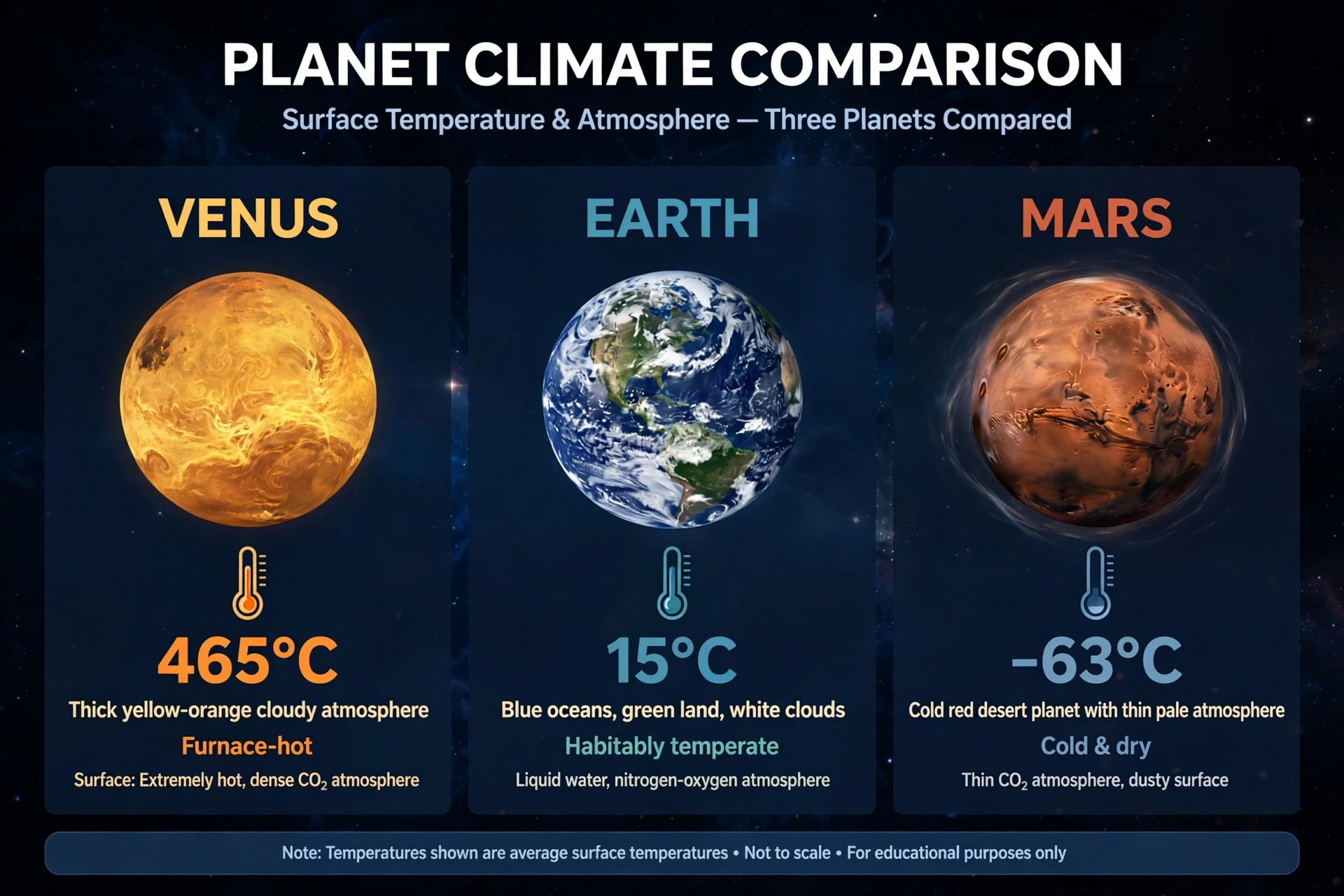
Earth's two nearest planetary neighbours show what happens when the same mechanism runs at different strengths. Venus has an atmosphere about 96 percent carbon dioxide, crushingly thick, and a runaway greenhouse effect that holds its surface near 465°C — hot enough to melt lead. Mars has a thin atmosphere with little carbon dioxide and almost no water vapor, and its surface averages about −63°C. Same sun, same physics, wildly different outcomes, set by the thickness and composition of the air.
Planet | Average surface temperature | Atmosphere | Greenhouse effect |
|---|---|---|---|
Venus | About 465°C | Thick, about 96% CO₂ | Extreme runaway warming |
Earth | About 15°C | Thin, trace greenhouse gases | Moderate, life-supporting |
Mars | About −63°C | Very thin, little water vapor | Weak, surface mostly frozen |
Table: Three planets, one mechanism. The greenhouse effect is not good or bad in itself — its strength decides whether a planet is a furnace, a freezer, or a home.
Figure 6 contrasts Earth with and without its greenhouse gases, and Figure 7 places the three planets side by side.
6.3 The effect is not itself "bad"
This is the second misconception I want to push back on, firmly. The greenhouse effect is not a pollutant, not a malfunction, and not something to eliminate. It is a natural feature of the planet, older than any life on it, and it is the reason life is possible at all. When people say "the greenhouse effect is causing problems," what they mean — or should mean — is that the effect has been strengthened beyond its natural level. The distinction matters, because it changes the question from "how do we get rid of this?" to "how much extra trapping can the system absorb?" The first question has no good answer. The second is one scientists can measure, and Section 8 takes it up.
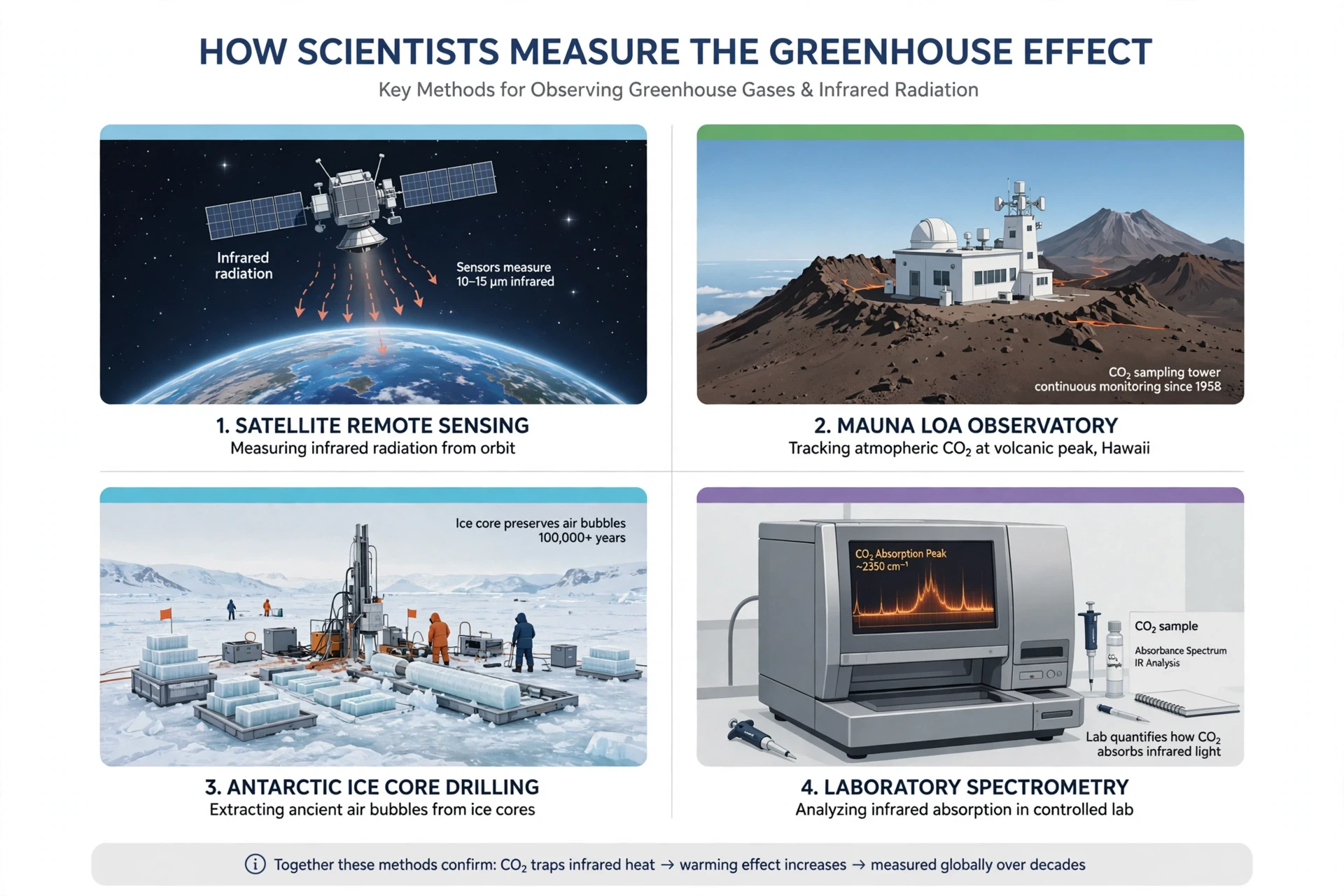
7. How Scientists Measure the Greenhouse Effect
A mechanism this important should not rest on theory alone, and it does not. The greenhouse effect is measured, daily, by instruments on the ground, in the air, and in orbit. Here are the main ways.
7.1 Satellites watch the heat leaving
NASA's CERES instruments — Clouds and the Earth's Radiant Energy System — fly aboard satellites and measure, with great precision, how much sunlight Earth reflects and how much infrared radiation escapes to space. They can watch the outgoing infrared spectrum directly, and in the wavelengths where carbon dioxide absorbs, the outgoing radiation is visibly dimmed — a fingerprint of the gas at work. As concentrations rise, that dimming deepens in exactly the bands where laboratory spectroscopy says carbon dioxide absorbs. It is Tyndall's tube experiment, repeated on a planetary scale, from orbit.
Satellites also measure the imbalance directly: slightly more energy is arriving than leaving, about nine-tenths of a watt per square metre on average, and most of that extra energy is accumulating in the oceans. The planet is, in the most literal sense, taking in more than it gives out.
7.2 The Keeling Curve and the air itself
The Mauna Loa record described in Section 5 is the gold standard for measuring the gas itself. Air is drawn into the observatory, and its carbon dioxide is measured by infrared analysers — instruments that use the very absorption property at the heart of the greenhouse effect to count the molecules. The same measurement is now repeated at roughly a hundred stations worldwide through NOAA's Global Greenhouse Gas Reference Network, and every one of them shows the same rising pattern. The sawtooth of the seasons and the steady climb beneath it are visible in Figure 8.
7.3 Ice cores: the air of the deep past
For times before 1958, scientists read the air trapped in ancient ice. In Antarctica and Greenland, snow buried year after year has compressed into ice containing tiny bubbles of the atmosphere as it was when the snow fell. By drilling cores and analysing those bubbles, researchers have reconstructed carbon dioxide levels back more than 800,000 years. Before the twentieth century, the concentration never exceeded 300 parts per million in that whole span. The ice also records temperature, from the ratios of oxygen isotopes in the ice itself, and the two records rise and fall together across the ice ages — exactly as Arrhenius's arithmetic said they should.
7.4 Laboratory spectroscopy: the fingerprints
Every greenhouse gas has a unique absorption spectrum — a set of wavelengths where it absorbs infrared and where it does not, as distinctive as a fingerprint. These spectra are measured in laboratories with spectrometers and are among the most precisely known quantities in atmospheric science. They are also why scientists can be specific about which gas is doing what: carbon dioxide absorbs strongly near 15 micrometres, methane near 7.7, ozone near 9.6. When a satellite looks down and sees less infrared escaping at 15 micrometres, it is seeing carbon dioxide at work, and nothing else explains that particular gap.
Figure 9 brings the measurement toolkit together: satellites, mountaintop observatories, ice cores, and laboratory instruments.
7.5 Weather, forecasts, and the same physics
The same radiative physics sits inside the models that produce your daily weather forecast. When meteorologists predict tomorrow's temperature, their models calculate sunlight, infrared radiation, clouds, and water vapor using the same absorption spectra that describe the greenhouse effect. Our guide to meteorology explains how those forecasts are built. The greenhouse effect is not a separate, exotic theory — it is the everyday physics of the sky, running inside the tools we already trust to tell us whether to carry an umbrella.
8. Natural Versus Human-Strengthened: The Difference That Matters
Everything so far has described the natural greenhouse effect — the one that has kept Earth habitable for billions of years. There is a second part to the story, and it is important to state it clearly without letting it swallow the mechanism itself.
8.1 The same mechanism, turned up
Adding more greenhouse gases to the atmosphere does not create a new process. It strengthens the existing one. More carbon dioxide means more molecules absorbing infrared at 15 micrometres, more re-radiation downward, and a warmer surface needed to restore the energy balance. The physics is identical to the natural effect; only the concentration has changed. This is why scientists speak of an "enhanced" greenhouse effect: the natural process, enhanced by additional gas.
The numbers are straightforward. Carbon dioxide has risen from about 280 parts per million before industrial times to more than 425 parts per million today — a rise of over 50 percent. Methane has risen by roughly 150 percent from its pre-industrial level. The extra trapping this produces is measured as radiative forcing, and the IPCC's Sixth Assessment Report puts the total human-caused effective radiative forcing since 1750 at about +2.72 watts per square metre, with carbon dioxide contributing the largest share. For scale, that is like adding a small LED bulb's worth of extra heating to every square metre of the planet, day and night.
8.2 Why carbon dioxide is the control knob
Water vapor contributes more to the total effect, so a fair question is why scientists focus on carbon dioxide. The answer returns to lifetime and control. Water vapor rains out within days; its amount is decided by temperature. Carbon dioxide stays for decades to centuries; its amount is decided by how much is emitted and how much the oceans and forests absorb. Push carbon dioxide up, and the temperature rises, and water vapor follows, amplifying the change. Push water vapor up alone, and it rains out within a week, leaving no lasting change. Carbon dioxide sets the level; water vapor multiplies it.
8.3 What this article does not cover
The causes of the rise, its effects on weather, ice, seas, and ecosystems, and what societies are doing about it are a much larger story, and they belong to a companion article on climate change, which covers causes, effects, and solutions in full. I have kept this article to the mechanism itself — how sunlight and infrared work, which gases absorb, how the effect is measured, and where the natural effect ends and the strengthened one begins — so that the physics stands on its own, clear and checkable, whatever a reader thinks about the rest.
9. Five Misconceptions, Corrected
9.1 "A greenhouse works the same way"
As Section 1 explained, it does not. A glass greenhouse warms mainly by blocking convection — warm air cannot rise away. The atmosphere warms by absorbing and re-emitting infrared radiation. The name is a metaphor, not a description.
9.2 "The greenhouse effect is bad"
It is not. Without it, Earth would average −18°C. The problem is not the effect but its strengthening beyond the natural level. Saying the greenhouse effect is bad is like saying blankets are bad because you can pile on too many.
9.3 "Carbon dioxide is only a tiny fraction of the air, so it cannot matter"
Carbon dioxide is about 0.04 percent of the atmosphere — a small share, and a fair reason to be sceptical at first glance. But infrared absorption does not work by majority vote. A gas matters if it absorbs at the wavelengths Earth radiates, and carbon dioxide absorbs strongly at exactly those wavelengths. Ozone is even scarcer and still matters. The relevant question is not how much of the air a gas makes up, but how greedily it catches infrared.
9.4 "Water vapor is the biggest greenhouse gas, so it must be the main driver"
Water vapor is indeed the biggest contributor, and this is a common source of confusion. The catch is that water vapor is a feedback, not a driver: its concentration follows temperature, and it rains out within days. It amplifies warming that starts elsewhere, but it cannot start a lasting warming on its own. Carbon dioxide, which persists for decades to centuries, is the knob that sets the level.
9.5 "The greenhouse effect traps heat like a lid"
Heat is not trapped under a lid. Infrared photons are absorbed and re-emitted, over and over, on a wandering path upward, until they finally escape from high in the atmosphere. The effect is a slowing of heat loss, not a sealing of it. The distinction matters, because a lid would imply heat building without limit, while the real mechanism reaches a new balance at a warmer temperature — and that balance is something scientists can calculate and measure.
10. Why This Mechanism Matters in Everyday Life
The greenhouse effect is not only a planetary abstraction. Its fingerprints are in ordinary days.
Cloudy nights are warmer than clear nights, because clouds — like greenhouse gases — absorb infrared rising from the ground and radiate some of it back down. Farmers have known this for centuries, and it is why a forecast of clear skies on a spring night means frost on the seedlings, while cloud cover means a reprieve. Deserts, with their dry air and almost no water vapor, swing wildly between day and night for the same reason: with little in the air to catch the outgoing infrared, the heat escapes fast after sunset.
Greenhouses and cold frames in a garden borrow the name honestly, even if the physics differs, and they work because the same sunlight that warms a field can be kept a little longer with a little help. And every time you step from shade into sunlight on a cold day, you feel the other half of the mechanism: visible light arriving unimpeded, warming your skin, and your body returning the favour as infrared you cannot see.
I keep a small ritual in my own teaching: on the first clear evening of a course, I ask students to stand outside and notice that the sky feels warm even after the sun has gone. It does, and it is not imagination. The air above them is radiating infrared back down, the way it has every night of their lives. Once you know the mechanism, you never quite look at a night sky the same way again.
The greenhouse effect is not a distant theory about a distant planet. It is the reason the night air feels warm after sunset, the reason a cloudy night is kinder to crops than a clear one, and the reason Earth is a home rather than a snowball.
Conclusion: A Mechanism Worth Knowing by Name
The greenhouse effect is simple enough to state in a sentence and rich enough to fill a career. Sunlight arrives as visible light, passes through the atmosphere, and warms the ground. The ground returns the energy as infrared radiation. A handful of gases — water vapor, carbon dioxide, methane, nitrous oxide, ozone — catch that infrared and send part of it back down. The result is a planet 33°C warmer than it would otherwise be, with liquid oceans and a climate life can use.
We know this because Fourier did the arithmetic, Tyndall measured the absorption, Arrhenius calculated the warming, and Keeling watched the gas rise — and because satellites, ice cores, and laboratory instruments keep confirming each of them. The mechanism is natural, measurable, and essential. Human activity has strengthened it, which is a separate question with its own evidence and its own article.
If you remember one thing, remember the car on the summer afternoon. Light gets in easily. Heat gets out slowly. Everything else — the habitability of Earth, the warmth of a cloudy night, the numbers on the Keeling Curve — follows from that.
Frequently Asked Questions
What is the greenhouse effect in simple terms?
The greenhouse effect is the warming of Earth's surface because certain gases in the atmosphere absorb heat (infrared radiation) rising from the ground and radiate some of it back down. Sunlight passes through these gases easily, but the heat trying to leave gets caught and partly returned, so the planet stays warmer than it would otherwise be.
What would Earth's temperature be without the greenhouse effect?
Without any greenhouse gases, Earth's average surface temperature would be about −18°C instead of today's roughly 15°C. The greenhouse effect adds about 33°C of warming, which is what keeps water liquid and the planet habitable.
Which gases cause the greenhouse effect?
The main greenhouse gases are water vapor, carbon dioxide, methane, nitrous oxide, and ozone. Water vapor contributes the most — roughly half of the total effect — followed by clouds at about a quarter and carbon dioxide at about a fifth. Nitrogen and oxygen, which make up 99 percent of the air, are not greenhouse gases because their molecules cannot absorb infrared radiation.
How does the greenhouse effect work step by step?
First, sunlight (mostly visible light) passes through the atmosphere and warms Earth's surface. Second, the warm surface radiates heat as infrared radiation. Third, greenhouse gas molecules absorb some of that infrared, vibrate more energetically, and re-radiate it in all directions — including back toward the ground. Fourth, this returned heat warms the surface further, until the planet radiates enough energy from high in the atmosphere to balance the incoming sunlight at a warmer temperature.
Is the greenhouse effect natural or caused by humans?
It is both, and the distinction matters. The natural greenhouse effect has kept Earth habitable for billions of years. Human activity has strengthened it by adding extra carbon dioxide, methane, and other gases to the atmosphere. The mechanism is the same in both cases; only the concentration of gases has changed.
Why is carbon dioxide so important if there is so little of it?
Carbon dioxide makes up only about 0.04 percent of the atmosphere, but what matters is not abundance — it is whether a gas absorbs infrared at the wavelengths Earth radiates. Carbon dioxide absorbs strongly at those wavelengths. It also persists in the air for decades to centuries, unlike water vapor, which rains out within days, so it sets the long-term level of the effect.
Does the greenhouse effect work like a real greenhouse?
Not exactly. A real glass greenhouse warms mostly by blocking convection — it stops warm air from rising and blowing away. The atmospheric greenhouse effect warms by absorbing and re-emitting infrared radiation. The name is a metaphor for the similar result, not a description of the same physics.
How do scientists measure the greenhouse effect?
In several independent ways: satellites such as NASA's CERES instruments measure outgoing infrared radiation and see it dimmed at the wavelengths carbon dioxide absorbs; the Mauna Loa Observatory measures carbon dioxide in the air directly, producing the Keeling Curve; ice cores reveal greenhouse gas levels going back more than 800,000 years; and laboratory spectroscopy measures each gas's exact absorption fingerprint.
What is the difference between the greenhouse effect and global warming?
The greenhouse effect is the physical mechanism — gases absorbing infrared and warming the surface. Global warming is the observed rise in Earth's average temperature, which happens when that mechanism is strengthened by additional greenhouse gases. The greenhouse effect itself is natural and necessary; the recent warming is the result of enhancing it.
Why do cloudy nights feel warmer than clear nights?
Clouds absorb infrared radiation rising from the ground and radiate some of it back down, acting much like greenhouse gases. On a clear night, heat escapes freely to space and the ground cools fast; on a cloudy night, the clouds slow that loss, so temperatures stay higher. It is the same mechanism, visible in a single evening.
Sources
NASA Science. What is the greenhouse effect?
NASA Earth Observatory. Climate and Earth's Energy Budget.
NASA Science. Steamy Relationships: How Atmospheric Water Vapor Amplifies Earth's Greenhouse Effect.
Scripps Institution of Oceanography, UC San Diego. FAQ: Carbon Dioxide and Climate Change (The Keeling Curve).
UCAR Center for Science Education. Greenhouse Effect Video — Scott Denning.
Chemistry LibreTexts. The Greenhouse Effect and Climate Change.