

You wake up. Light comes through the curtains, a bird calls outside, and for a moment you are not quite sure where you are — then, all at once, you are here. The warmth of the blanket, the faint ache in your shoulder, the plan forming for the day ahead: all of it arrives together, as one seamless experience. That arrival — the feeling of being someone, somewhere, aware of a world — is consciousness. It is the most familiar thing you will ever know, and the hardest thing science has ever tried to explain.
What is consciousness, in scientific terms? It is the state of having subjective experience: there is something it is like to be you, right now, reading these words. A camera can record a room, a computer can sort a million photographs, and a thermostat can react to temperature, but none of them, as far as we can tell, feels anything. Your brain does something extra. It does not only process information; it turns processing into experience. How it does that is the central puzzle of this article.
I first felt the weight of that puzzle not in a laboratory but at a hospital bedside, years ago, visiting a relative after surgery. The monitors beeped steadily, the chest rose and fell, and the nurses spoke in calm, practised voices. The body was plainly alive and working, yet the person I knew was not there to answer. When she finally woke, groggy and blinking, she described it as surfacing from deep water — no dreams, no darkness she could remember, just an absence, and then a return. I have never forgotten that gap. It taught me that consciousness is not a permanent possession. It can switch off, fade, return, and change its shape, and each of those changes is a clue.
This article follows those clues. We will define what scientists actually mean by consciousness, separate the questions we can answer from the one we cannot yet, walk through the brain systems that support awareness, compare the leading theories — Integrated Information Theory, Global Workspace Theory, predictive processing, and higher-order theories — and look at altered states, from sleep and anaesthesia to meditation and coma. We will also be honest about what remains unknown, because in this field, pretending to certainty would be the least scientific thing we could do.
1. What Is Consciousness? A Working Definition
Ask ten researchers to define consciousness and you may get ten answers that overlap but never quite match. That is not sloppiness; it is a sign that the word covers several related things. The Stanford Encyclopedia of Philosophy, the standard reference philosophers and scientists turn to, treats consciousness as an umbrella term for a family of mental phenomena, including wakefulness, awareness of particular things, self-awareness, and the raw feel of experience itself. Before we can explain consciousness, we need to say which part of it we mean.
1.1 Creature consciousness and state consciousness
Philosophers draw a useful line between creature consciousness and state consciousness. Creature consciousness describes a whole organism: a person, a dog, a crow is conscious in the sense of being a sentient creature, capable of sensing and responding to its world. State consciousness describes a particular mental state: this perception, this pain, this thought is conscious, while another process in the same brain runs quietly in the background.
Both ideas matter, because they can come apart. You can be a conscious creature who is currently unconscious — asleep in deep, dreamless sleep, or under general anaesthesia. And you can be awake while many of your mental states stay unconscious: your brain adjusts your posture, filters background noise, and reads the words on this page with processes you never notice. Consciousness is not everything the brain does. It is a particular way some of what the brain does shows up to you.
1.2 Qualia: the raw feel of experience
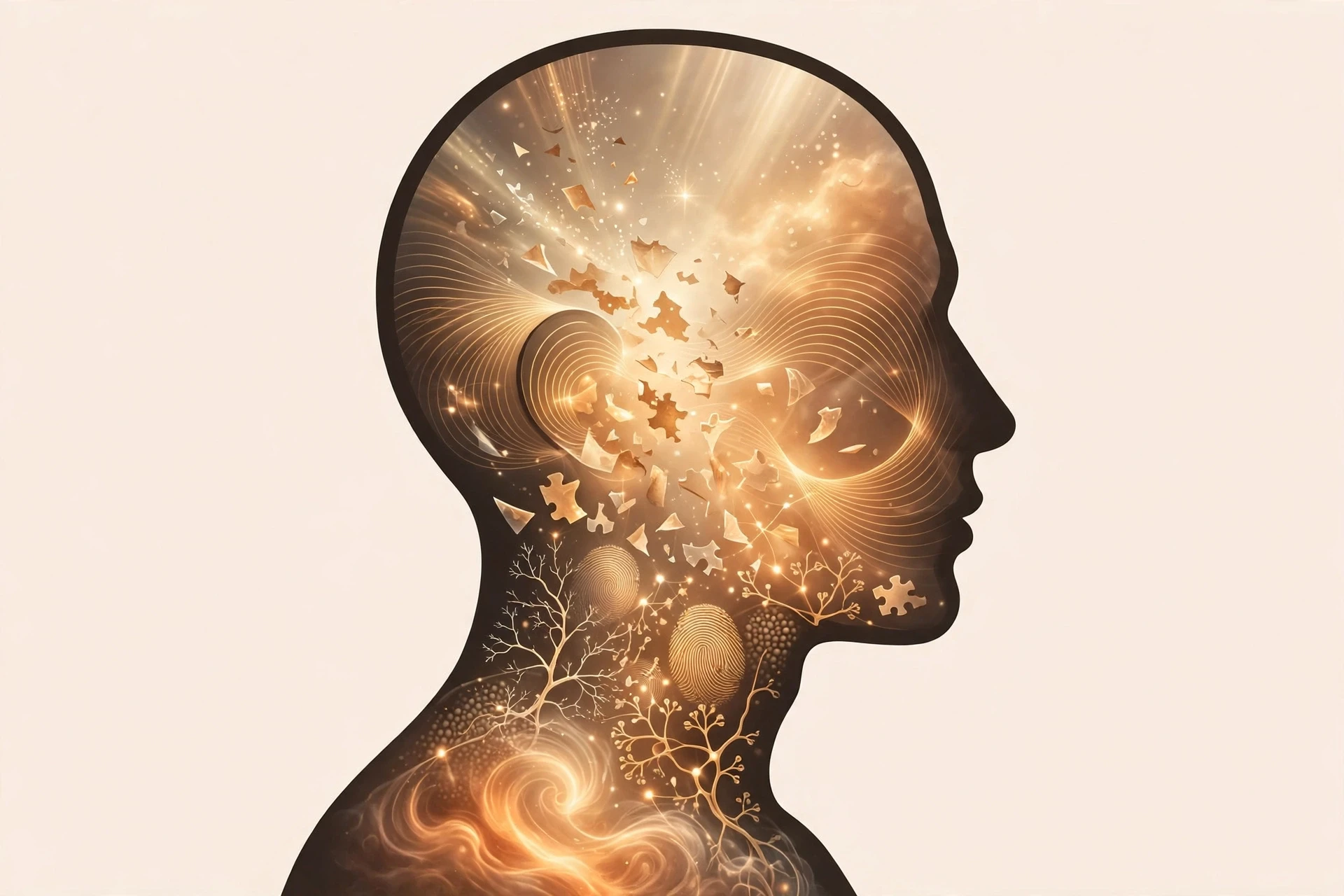
The philosopher Thomas Nagel captured the heart of the matter in 1974 with a simple test: a creature is conscious if there is something it is like to be that creature. There is something it is like to be a bat, navigating by echolocation, even though we can never know from the inside what that feels like. There is something it is like to taste coffee, to hear a familiar voice, to feel embarrassed. Philosophers call these raw feels qualia — the redness of red, the sting of cold water, the ache of a bruise.
Qualia are the reason consciousness resists easy explanation. We can describe the wavelength of red light, the firing of retinal cells, and the pattern of activity in the visual cortex with great precision. None of that description, on its own, tells us why seeing red feels like anything at all. That gap between a physical description and a felt experience is where the deepest argument in consciousness science lives, and we will return to it in Section 3.
1.3 Arousal and awareness: two ingredients, not one
Clinicians make a distinction that clears up a lot of confusion: arousal and awareness are two separate ingredients. Arousal is wakefulness — the brainstem-driven state of being switched on, eyes open, responsive to the world. Awareness is content — knowing what is around you, recognising a face, following a conversation. You need arousal to be aware, but arousal alone is not enough. A person in a vegetative state may open their eyes and appear awake, yet show no sign of awareness. A person in a minimally conscious state may drift in and out, following a moving object with their eyes one day and not the next.
I once watched a neurologist test this distinction with a patient who had suffered a severe brain injury. She held up a mirror and moved it slowly, watching the patient's eyes. Then she asked the patient to imagine playing tennis — a task that, in some unresponsive patients, lights up the motor areas of the brain on a scanner even when the body cannot move. The eyes did not follow the mirror that day. The scan, later, told a more complicated story. That is why modern medicine no longer trusts behaviour alone to judge whether someone is conscious, and why the NIH has made detecting consciousness in minimally responsive patients a research priority: the stakes, for families and for treatment decisions, could hardly be higher.
2. Levels and States of Consciousness
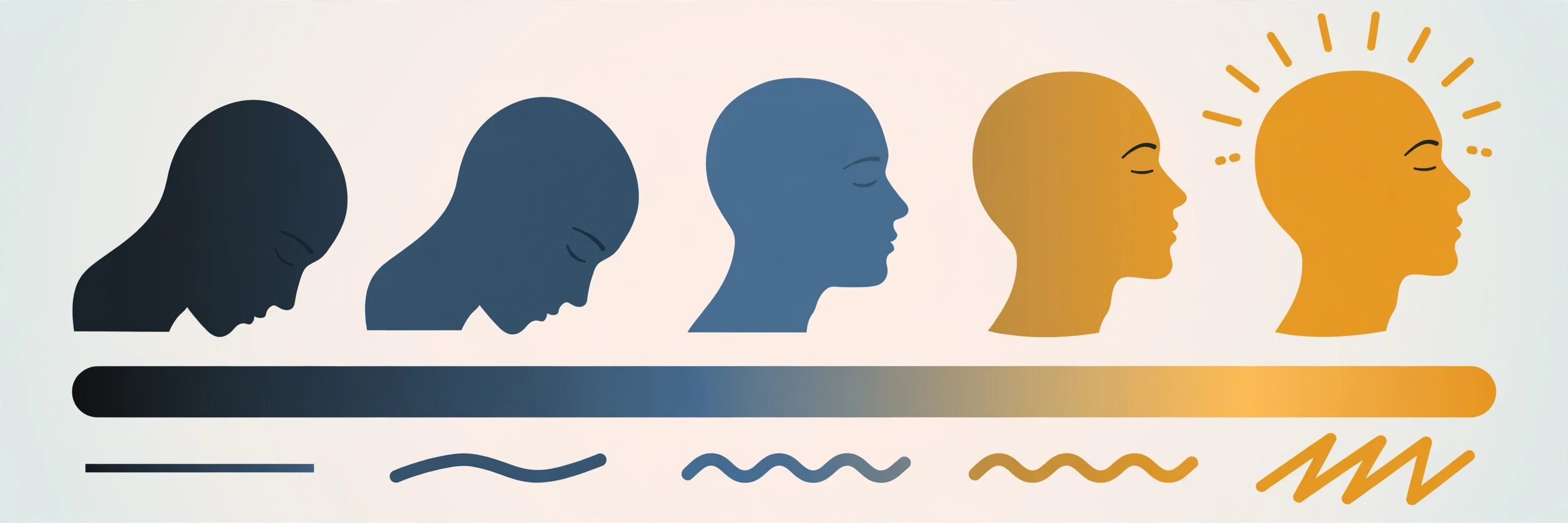
Consciousness is not an on-off switch. It is more like a dimmer, a radio dial, and a change of channel all at once. It varies in level — how awake and alert you are — and in content — what you are aware of. It also changes its character across the day and across a lifetime.
2.1 The spectrum from coma to full alertness
At one end of the spectrum lies coma: no wakefulness, no awareness, no response to pain or voice. Next comes the vegetative state, now often called unresponsive wakefulness syndrome, where the eyes may open and sleep-wake cycles return, but there is no sign of awareness. Then the minimally conscious state, where awareness flickers — a person may follow a command inconsistently, or smile at a familiar voice. Then full wakefulness, and beyond that, the heightened alertness of danger, excitement, or deep concentration.
This spectrum is not just a clinical ladder. It is evidence. If consciousness were a single thing produced by a single brain area, damage to that area would erase it cleanly. Instead, different injuries subtract different pieces: arousal without awareness, awareness without reliable communication, memory without a sense of self. Each subtraction tells researchers which systems are necessary, which are sufficient, and which merely help.
2.2 Sleep, dreaming, and the nightly disappearance
Every night, you practise losing consciousness and getting it back. In deep, slow-wave sleep, awareness largely fades; in dreaming sleep, it returns in a strange, vivid form — you see, feel, and fear, yet you cannot move your body, and the world you inhabit follows dream logic rather than physics. Dreaming shows that consciousness does not need the outside world. The brain can generate a whole experienced world from its own activity.
That nightly cycle is also why sleep research matters so much to consciousness science. If we can track, night after night, which brain patterns accompany the fading and return of experience, we can separate the neural activity that merely keeps the body running from the activity that goes with being aware. Readers who struggle with sleep will recognise how fragile this system is; our guide to the brain fog that follows poor sleep, and our article on chronic insomnia and the brain, explore what happens when the nightly reset goes wrong.
2.3 Attention is not the same as consciousness
Most people assume that whatever they pay attention to is what they are conscious of, and whatever they ignore is unconscious. The data say something messier. In classic experiments, people can be shown an image so briefly, or so carefully masked, that they swear they saw nothing — yet their behaviour shows their brain registered it. They may be faster to recognise a related word, or more likely to choose a related picture, without any awareness of why.
Attention and consciousness overlap, but they are not identical. Attention is a spotlight that selects information for further processing. Consciousness is the stage on which the selected information appears. Sometimes the spotlight moves without the stage lighting up, and sometimes — in a sudden pain, a loud noise, a vivid memory — something forces its way onto the stage without you choosing to attend to it at all. Keeping the two apart has been one of the quiet successes of the last thirty years of research, and it matters for every theory we will meet.
3. The Hard Problem and the Easy Problems
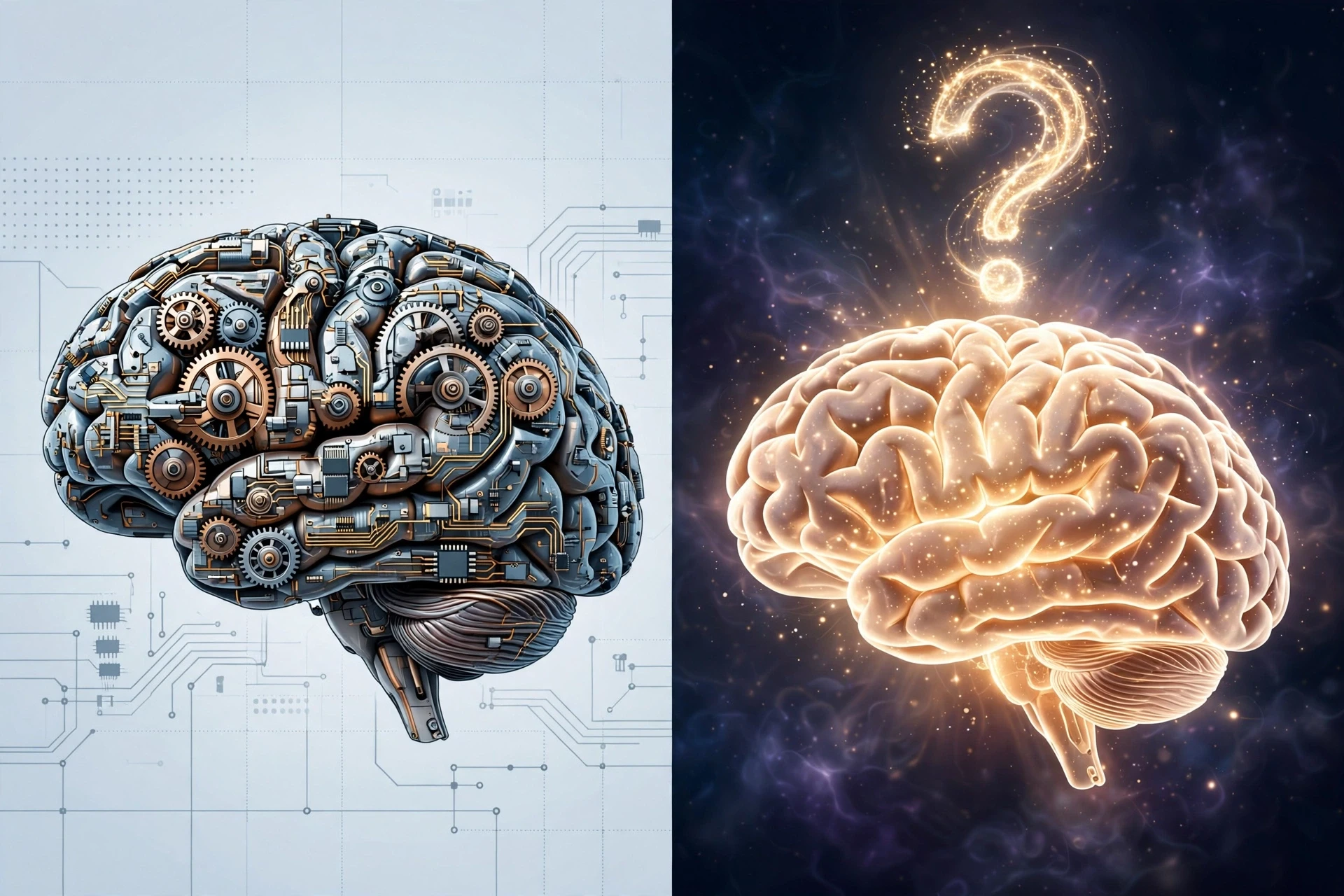
In 1995, the philosopher David Chalmers gave the field its most famous distinction. He divided the study of consciousness into the "easy problems" and the "hard problem." The labels are deliberately ironic: the easy problems are extraordinarily difficult, and the hard problem may be the hardest question in science.
3.1 The easy problems: how the brain does its jobs
The easy problems are the ones that look, in principle, solvable by ordinary neuroscience. How does the brain tell a face from a mask? How does it bind colour, shape, and motion into one object? How does it store a memory, direct attention, or produce a spoken report of what it sees? Each of these is a question about a mechanism — a job the brain performs — and each has seen real progress. We can trace visual information from the retina to the cortex, watch attention shift in brain scans, and decode, with surprising accuracy, what category of image a person is looking at from patterns of brain activity alone.
None of that progress should be dismissed. A generation ago, many scientists thought consciousness was too vague to study at all. Today, laboratories around the world measure it, manipulate it with anaesthesia and brain stimulation, and test predictions about it in hundreds of volunteers. The easy problems are hard, but they are the kind of hard that science knows how to work on.
3.2 The hard problem: why does it feel like anything?
The hard problem asks a different question: why should any of that processing feel like something? Why is there an inner life at all, rather than a brain that behaves exactly as ours does but experiences nothing — a philosophical zombie, in Chalmers' thought experiment? You could, in theory, build a machine that reports "I see red" when shown a red card, sorts colours correctly, and even describes red as warm and vivid, without it ever experiencing redness. What, if anything, would be missing?
"How it is that anything so remarkable as a state of consciousness comes about as a result of irritating nervous tissue, is just as unaccountable as the appearance of the Djin, when Aladdin rubbed his lamp." — T. H. Huxley, 1866, quoted in the Stanford Encyclopedia of Philosophy
Huxley wrote that in 1866, and the sentence still stings, because it names the explanatory gap: the distance between a physical description of neurons firing and a first-person description of what it feels like. Some philosophers argue the gap will close as neuroscience advances, the way the gap between "life" and chemistry closed once we understood DNA. Others argue it is a permanent feature of the question — that no amount of third-person data can, even in principle, add up to a first-person feeling. Science has not settled this. Any article that tells you it has is selling something.
3.3 Why the hard problem matters beyond philosophy
This is not an abstract debate. How we answer it shapes medicine, law, and technology. If consciousness is simply a matter of complex information processing, then a sufficiently complex artificial system might one day deserve moral consideration. If it requires a particular kind of biology, then it might not. If a patient in a minimally conscious state is experiencing pain, that changes how they should be cared for. If animals experience the world in rich ways, that changes how we treat them. The hard problem is the hinge on which all of those decisions turn, which is why researchers keep returning to it even when it refuses to yield.
4. How the Brain Produces Awareness
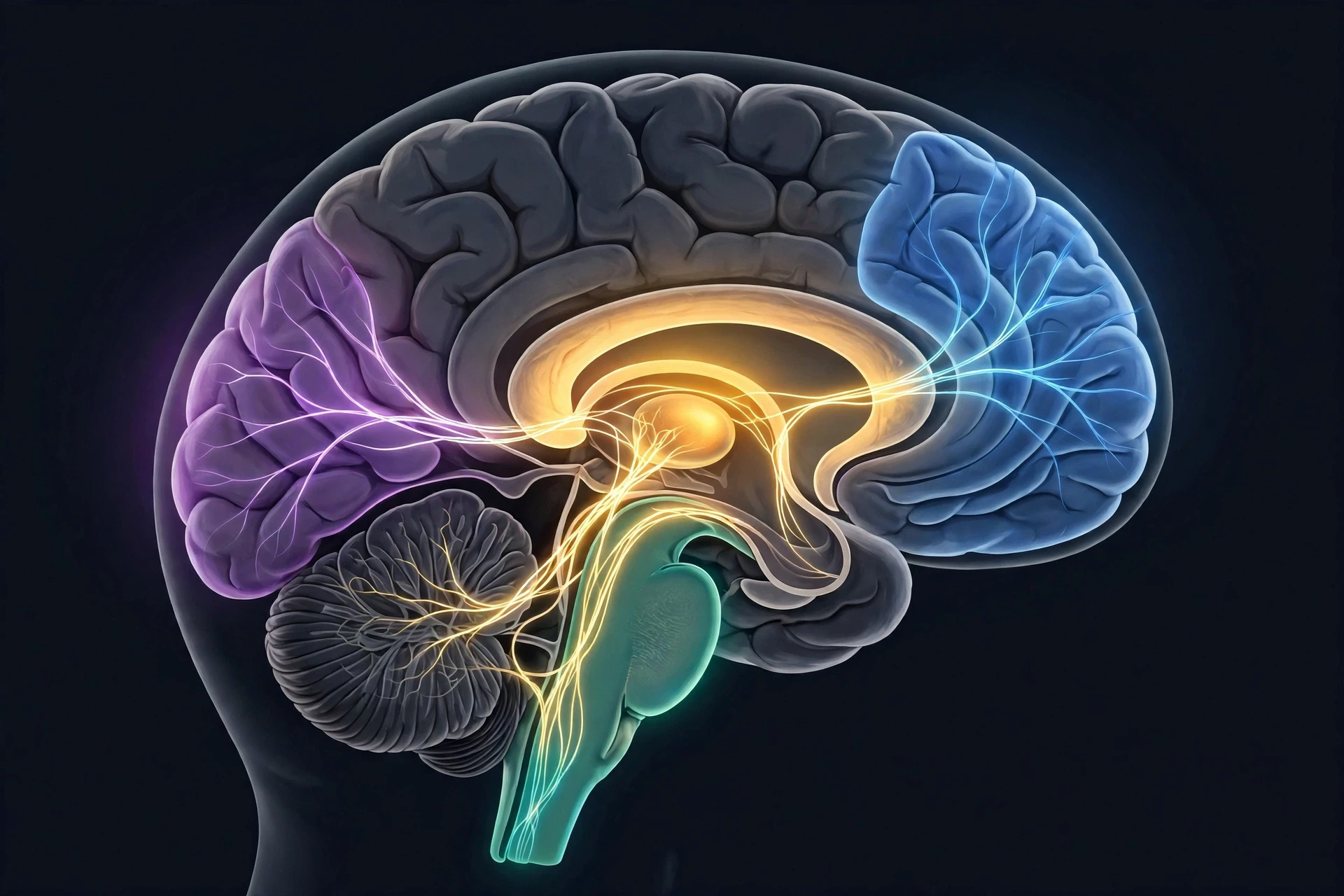
If consciousness is not a single switch, where does it live? The honest answer is that it does not live in one place. It depends on a network — a coalition of brain regions that must work together, and whose failure in different combinations produces different losses.
4.1 The brainstem and thalamus: the power supply
Deep in the brain, the brainstem houses the ascending arousal system: clusters of neurons that release chemicals like noradrenaline, serotonin, and acetylcholine, waking the cortex and keeping it responsive. Small lesions here can abolish consciousness entirely, even when the cortex is intact. Above the brainstem sits the thalamus, a relay station that routes sensory information to the cortex and helps coordinate activity across distant regions. Think of the brainstem as the power supply and the thalamus as the switchboard. Without power, nothing runs; without the switchboard, the parts cannot talk to each other.
Recent research has sharpened this picture. A 2025 study in Nature Communications, working with 40 patients with disorders of consciousness, found that deep brain stimulation was most effective when it engaged a network running from the thalamus through the brainstem and hypothalamus, and that improvements tracked with better-preserved grey matter in the striatum. Stimulating the right network, in the right patients, helped restore awareness — a finding that would have sounded like science fiction a generation ago.
4.2 The cortex: where content takes shape
The cortex — the wrinkled outer layer of the brain — is where the content of experience is built. Visual areas at the back construct what you see; auditory areas on the sides construct what you hear; the prefrontal cortex at the front holds plans, decisions, and the sense of self in mind. Damage to a small visual area can erase a specific piece of experience, like colour or the ability to recognise faces, while leaving the rest of awareness intact. That specificity is powerful evidence: content is not painted onto a blank screen by one general-purpose system. It is built, piece by piece, by specialised machinery.
For a fuller tour of these regions, see our guide to human brain anatomy and functions. What matters here is the division of labour: the back of the brain is rich in sensory content, the front is rich in planning and control, and consciousness seems to need both, talking to each other, in a particular rhythm.
4.3 Networks, rhythms, and the timing of awareness
A single neuron firing means little. Consciousness seems to depend on large groups of neurons firing together, in coordinated rhythms, across distant regions. When you become aware of a face, activity does not just rise in one spot; it synchronises across visual, memory, and decision areas, often in the gamma frequency range, and it stays synchronised for a few hundred milliseconds — long enough, researchers think, for the information to be shared and used.
I remember the first time I saw this in a laboratory demonstration, watching a volunteer's brain activity shift on a screen as a faint image crossed the threshold from unseen to seen. Nothing about the image changed. The volunteer's report changed — "now I see it" — and with that report, the pattern of activity across the brain changed too, from local flickers to a broad, coordinated wave. It was a small moment, and it stayed with me, because it made an abstract idea visible: awareness is not a place. It is a pattern of activity, spread across the brain, arriving together.
Timing matters as much as location. A stimulus that reaches the brain can be processed unconsciously in under a tenth of a second. Becoming conscious of it takes longer — roughly two to three tenths of a second — as if the brain needs that extra time to broadcast the information widely enough for it to enter experience. That delay is one of the clues the leading theories try to explain, and it is why anaesthesia, which disrupts long-range coordination, can switch consciousness off while leaving many local reflexes intact.
5. Global Workspace Theory: Consciousness as a Broadcast
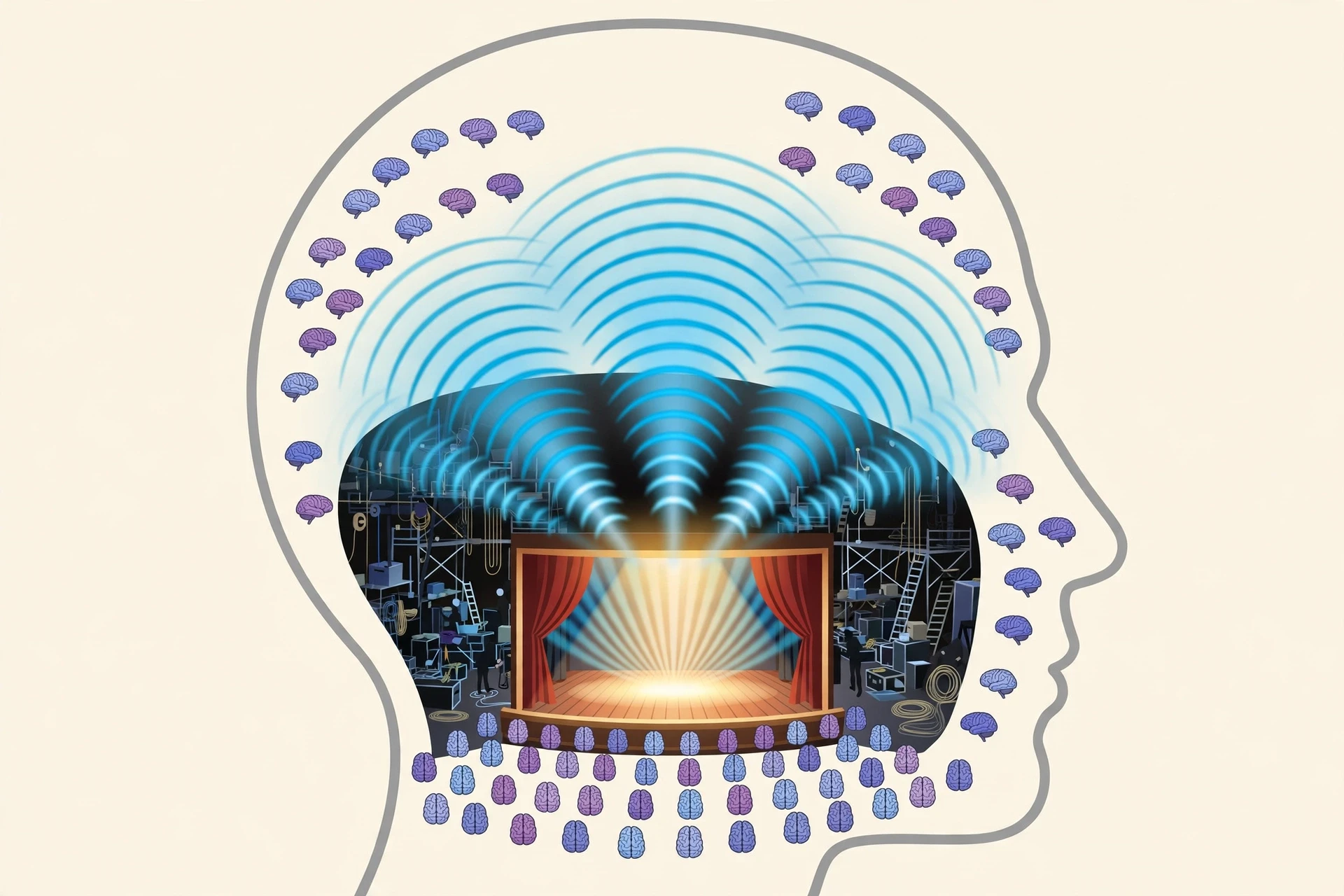
Of all the theories of consciousness, Global Workspace Theory is the easiest to picture, because its central image is a familiar one: a theatre. The cognitive scientist Bernard Baars proposed it in the 1980s, and neuroscientists including Stanislas Dehaene later developed it into the global neuronal workspace theory. Imagine the brain as a theatre. Most of the work happens backstage, in specialised, unconscious modules — vision, memory, language, motor control. Consciousness is the stage. When information is selected to appear on the stage, it is broadcast to the whole audience: every other system can hear it, use it, and respond to it.
5.1 Ignition: the moment information goes global
The theory makes a specific prediction. When a stimulus crosses into consciousness, there should be a sudden, nonlinear burst of activity — an "ignition" — spreading from sensory areas to prefrontal and parietal cortex, lasting a few hundred milliseconds. Unconscious stimuli, by contrast, should produce only local, fleeting activity. Brain imaging has found patterns that look very much like this: a face you consciously see triggers a broad wave of activity; the same face, masked so you do not see it, triggers only a local ripple.
The theatre image also explains a familiar limit: the stage is small. You can hold only a few items in conscious awareness at once — a phone number, a face, a sentence — while the backstage hums with far more. That bottleneck is not a flaw. It is the price of having one shared workspace where different systems can meet, compare notes, and coordinate a response. It is also why you cannot truly multitask two demanding conscious jobs at once; the stage can only hold one play at a time.
5.2 What the theory explains well, and where it struggles
Global workspace theory explains a lot: why conscious information is reportable, memorable, and usable for flexible reasoning, while unconscious information is narrow and short-lived. It explains why damage to prefrontal and parietal hubs can disrupt awareness, and why anaesthesia, which breaks long-range broadcasting, switches consciousness off. It has also guided practical tools, including measures that test whether a patient's brain can still broadcast information, even when they cannot speak or move.
Its critics ask a fair question: broadcasting explains how information becomes available to the rest of the brain, but does it explain why that availability feels like something? A computer network can broadcast data to every node without, as far as we know, experiencing anything. The theory's defenders reply that broadcasting is not the whole story — it is the mechanism by which a particular kind of integrated, flexible processing becomes possible, and that processing, in a biological brain, is what experience is. The argument continues, and it is a genuine one, not a misunderstanding.
6. Integrated Information Theory: Consciousness as Integration
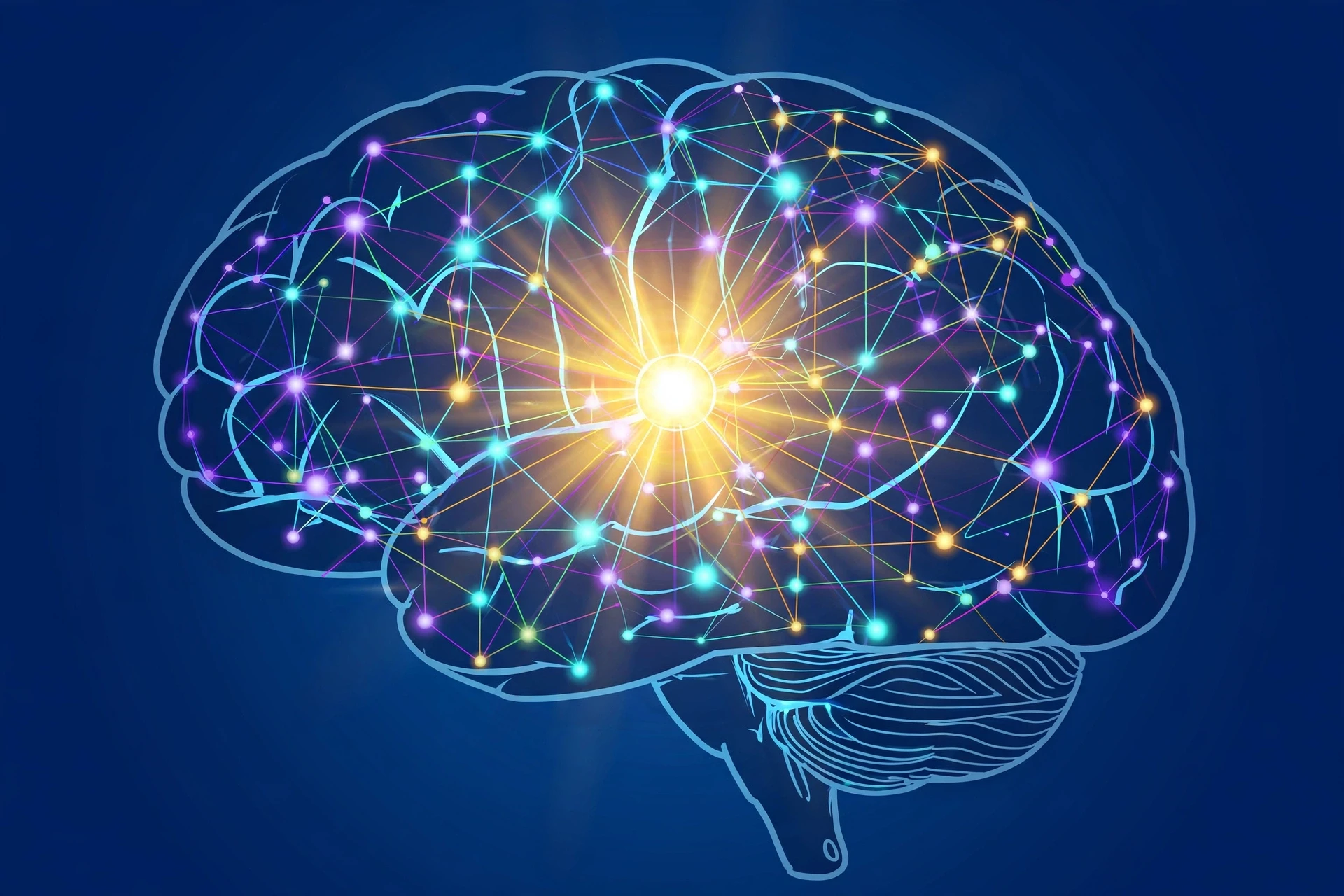
If global workspace theory starts with the brain's architecture, Integrated Information Theory, or IIT, starts with experience itself. Developed by the neuroscientist Giulio Tononi, IIT asks: what is conscious experience like, from the inside? Tononi's answer is five properties. Experience is intrinsic — it exists for itself, privately. It is structured — it contains many different things at once. It is informative — each experience differs from every other. It is integrated — it arrives as one unified whole, not as separate fragments. And it is definite — you have one experience at a time, not several overlapping ones.
6.1 Phi: measuring how much a system integrates
From those five properties, IIT derives a bold claim: a system is conscious to the extent that it generates integrated information — information that the whole produces over and above what its parts produce separately. That quantity is called phi, written Φ. A system with high phi, like a richly interconnected brain, has a rich experience. A system whose parts work independently, like a camera sensor with millions of pixels that never interact, has low phi, however much information it records. A system that is fully integrated but has only two states, like a light switch, also has low phi, because it cannot differentiate one experience from another.
IIT makes a striking anatomical prediction: the seat of consciousness should be the part of the brain with the highest phi, which Tononi and his colleagues locate in a "hot zone" in the posterior cortex — the back of the brain, where vision, hearing, and touch converge — rather than in the prefrontal cortex at the front. That prediction sets IIT directly against global workspace theory, which gives the prefrontal cortex a starring role.
6.2 The 2025 adversarial test
Science rarely gets a cleaner test than the one these two theories received. In a large adversarial collaboration published in Nature in 2025, proponents of IIT and global neuronal workspace theory agreed in advance on predictions, pass-or-fail criteria, and an experimental design, then handed data collection and analysis to theory-neutral teams. Across 256 participants, three brain-imaging methods, and six laboratories, the teams tested three predictions: where conscious content can be decoded, how it is maintained over time, and how brain regions connect during conscious perception.
The results, as the authors put it, aligned with some predictions of both theories while substantially challenging key tenets of both. Decoding of conscious content worked best in the posterior cortex, as IIT predicted, but the sustained synchronisation IIT expected there did not appear. The prefrontal ignition global workspace theory expected at stimulus onset and offset did not appear in the predicted form either. Neither theory was fully validated. That outcome disappointed partisans on both sides, and it delighted many other scientists, because a test that can actually challenge a theory is exactly what a young science needs. The NIH's new research network on consciousness, described in its 2026 concept paper, was set up in part to encourage exactly this kind of theory-neutral, shared-standards work.
7. Predictive Processing: The Brain as a Guessing Machine
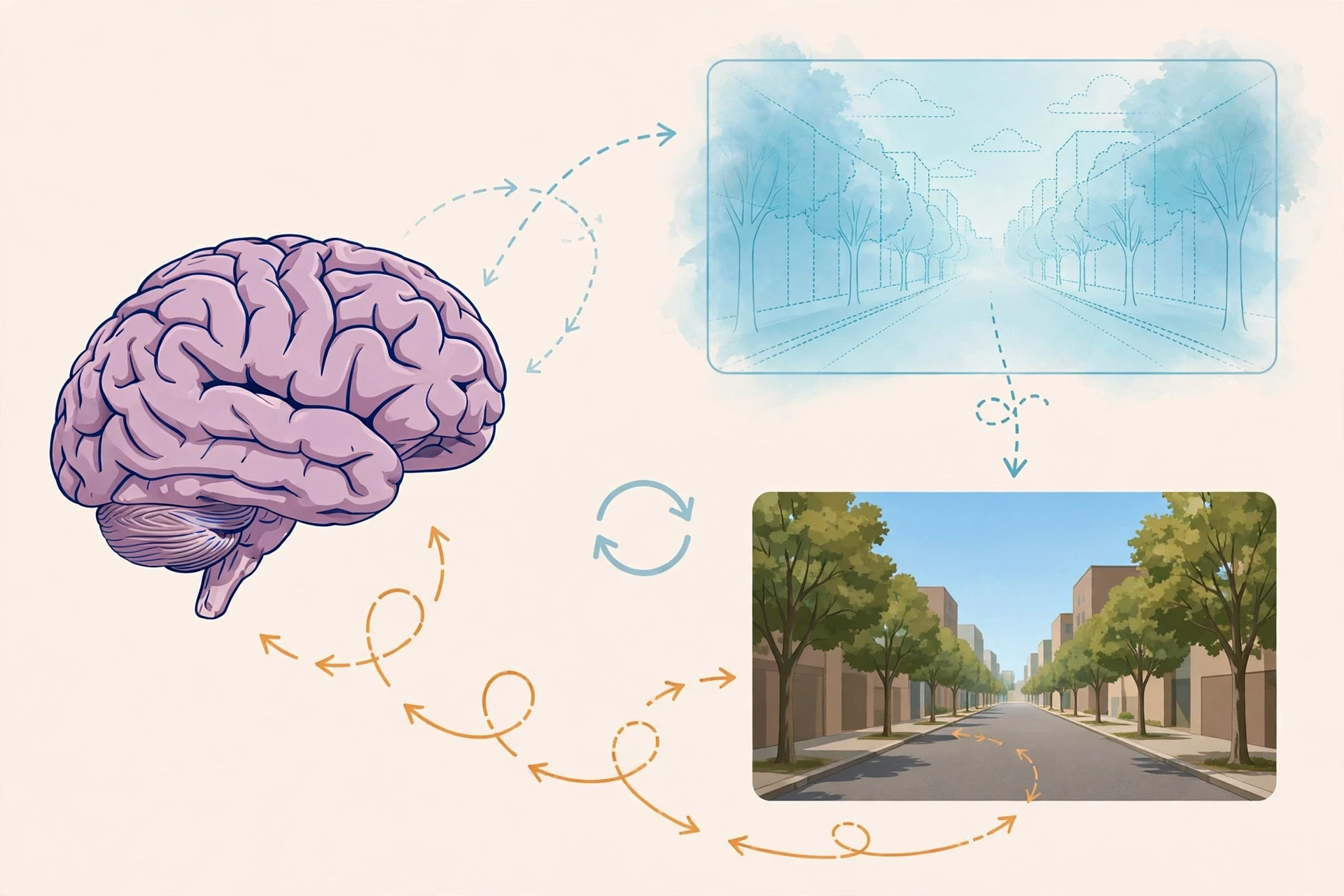
There is a third family of ideas that has reshaped how many neuroscientists think about the brain, and it starts from a surprising claim: your brain does not mainly react to the world. It predicts it. Predictive processing, also called predictive coding, pictures the brain as a guessing machine. It constantly generates predictions about what it is about to see, hear, and feel, compares those predictions with incoming sensory signals, and updates its model only where the prediction was wrong — where there is a prediction error.
7.1 Why prediction feels like perception
On this view, what you consciously experience is not a raw feed from your senses. It is your brain's best guess about the world, corrected by the senses. That explains a famous illusion: when you look at a hollow mask, your brain, which has spent a lifetime seeing convex faces, may insist the mask bulges outward, even when you know it does not. Your experience follows your prediction, not the light hitting your eyes. It also explains why familiar places feel stable and effortless, while a new city feels exhausting: in a new place, almost everything is a prediction error, and the brain must work hard to update its model.
I have a small, personal example I return to whenever I teach this idea. Years ago, I moved into a flat near a railway line. For the first week, every train rattled me awake. By the third week, I slept through them. Nothing about the trains had changed. My brain had learned to predict them, and once a sound is predicted, it stops demanding attention — it stops entering consciousness with the same force. Prediction is not just a clever computational trick. It is a filter that decides what you notice and what you do not.
7.2 Prediction, attention, and the self
Predictive processing also offers a fresh angle on the self. If the brain predicts the sensory consequences of its own actions — the feeling of your hand moving, the sound of your own voice — then it can label those consequences as "mine" and everything else as "the world." When that prediction goes wrong, the boundary blurs. Some researchers have proposed that certain symptoms in psychiatric conditions, such as hearing voices, involve a failure to predict the sensory consequences of one's own inner speech, so that self-generated thoughts are experienced as coming from outside.
The theory is powerful, but it is also broad, and breadth is its weakness as an explanation of consciousness specifically. A thermostat can be described as predicting temperature; a chess program predicts moves. Predictive processing may describe how the brain works in general, without by itself explaining why some predictions become conscious and others do not. Its defenders argue that consciousness arises when predictions are integrated across levels into a single, coherent model of the world and the self — a claim that brings it close, in spirit, to both IIT and global workspace theory. The three theories may be describing the same elephant from different sides. Or they may not. The data have not decided yet.
8. Higher-Order Theories and Recurrent Processing
Two more families of theory deserve attention, because they answer the question of consciousness in almost opposite ways — and both have evidence behind them.
8.1 Higher-order theories: a thought about a thought
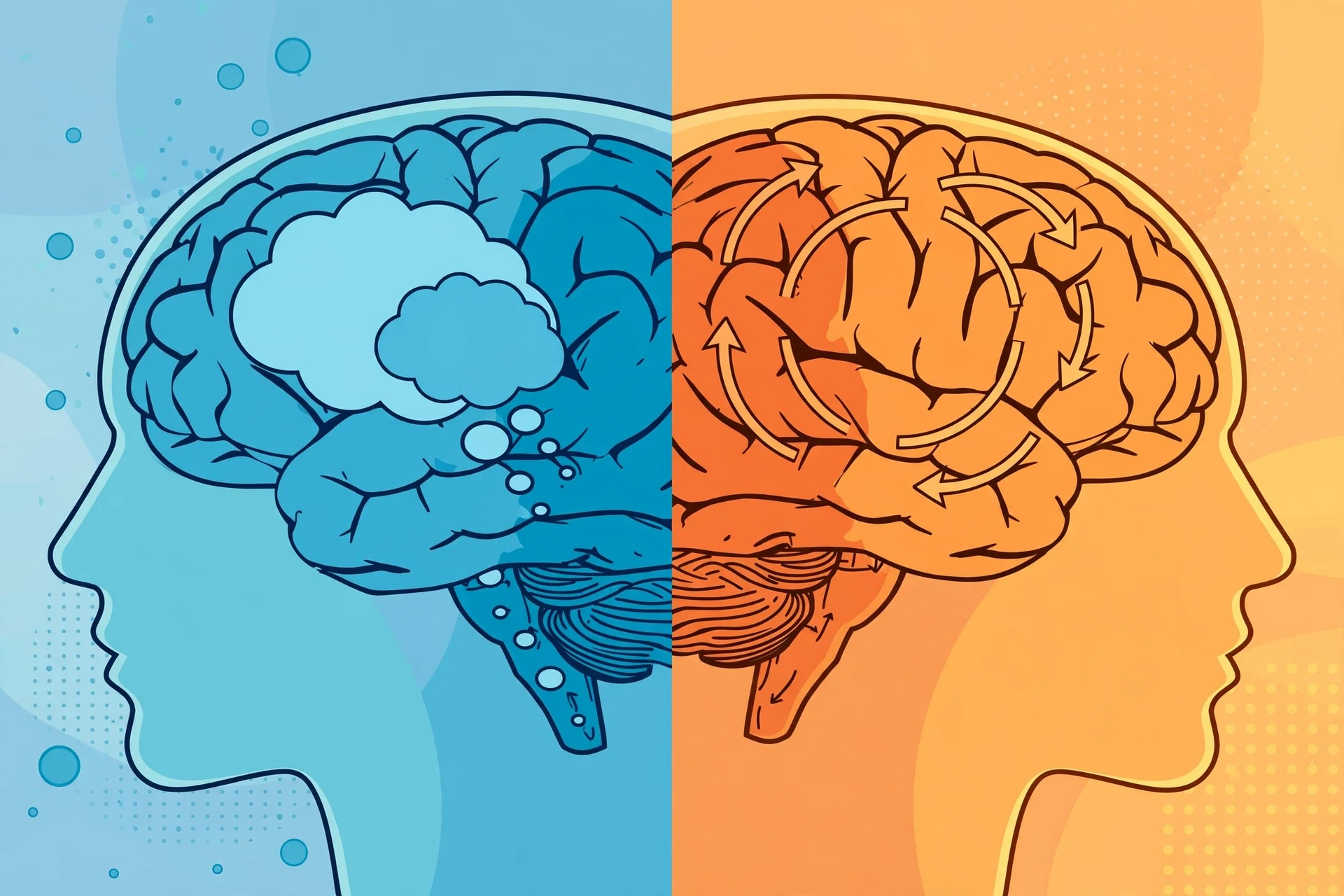
Higher-order theories, developed by philosophers and psychologists including David Rosenthal, propose that a mental state becomes conscious only when the mind forms a higher-order thought about it — a thought about the thought. You see a red apple, and that perception is unconscious until another part of your mind registers, in effect, "I am seeing a red apple." Consciousness, on this view, is the mind monitoring itself.
The idea fits a common experience: you can drive a familiar road for miles, steering and braking correctly, and then realise you have no memory of the journey. The perceptions were there, the actions were there, but the higher-order monitoring that makes them conscious was elsewhere — on a conversation, a worry, a song. It also fits the prefrontal cortex's role in self-monitoring, and it explains why damage to areas involved in monitoring can leave perception intact but awareness of it strangely absent, as in blindsight, where people who are blind in part of their visual field can still guess the location of objects there better than chance, while insisting they see nothing.
Critics ask what makes the higher-order thought itself conscious, and whether the theory simply pushes the mystery one level up. If a thought about a thought is what makes the first thought conscious, what makes the second thought conscious — a third thought, and then a fourth, in an endless regress? Higher-order theorists have answers to this, involving thoughts that need not themselves be conscious, but the question shows how hard it is to explain awareness without smuggling awareness into the explanation.
8.2 Recurrent processing: loops in the sensory cortex
Recurrent processing theory, associated with the neuroscientist Victor Lamme, takes the opposite route. It argues that consciousness does not need the prefrontal cortex or a higher-order monitor at all. It arises from recurrent loops — feedback connections — within sensory areas themselves. When visual information flows forward from the retina to higher visual areas and then loops back down, that recurrent activity is what makes a visual experience conscious. Feedforward activity alone, without the loop, stays unconscious.
The evidence here is elegant. In experiments where a stimulus is masked so quickly that only the feedforward sweep occurs, people report seeing nothing, even though their visual cortex registered the stimulus. When the stimulus lasts just long enough for recurrent feedback to begin, awareness appears. The theory also explains why animals with less developed prefrontal cortex may still be conscious, and why some patients with prefrontal damage retain vivid sensory experience.
The tension between these two families — higher-order theories pointing to the front of the brain, recurrent processing pointing to the back — is the same tension that ran through the 2025 adversarial test of IIT and global workspace theory. It may turn out that both are partly right: recurrent loops in sensory areas create the content of experience, while higher-order and workspace systems make that content available for thought, memory, and report. Or it may turn out that one of them is the real seat of awareness and the other is a helpful neighbour. For now, the honest summary is that the front-versus-back debate is unresolved, and it is one of the most productive arguments in neuroscience.
8.3 The leading theories side by side
No single table can settle which theory is right, but a side-by-side view makes their differences clear. Each theory starts from a different question, points to a different part of the brain, and struggles with a different weakness.
Theory | Core idea | Main brain focus | Main weakness |
|---|---|---|---|
Global Workspace Theory | Consciousness is information broadcast widely across the brain | Prefrontal and parietal cortex | Broadcasting explains availability, not why it feels like anything |
Integrated Information Theory | Consciousness is integrated information, measured as phi | Posterior cortex hot zone | Phi is hard to measure in a living brain; key predictions were challenged in 2025 |
Predictive processing | The brain predicts the world and updates from errors | Hierarchical networks across the cortex | Describes brain function broadly, not only consciousness |
Higher-order theories | A state is conscious when the mind monitors it | Prefrontal cortex | Risks an endless regress of thoughts about thoughts |
Recurrent processing | Feedback loops in sensory areas create awareness | Sensory cortex | May explain content but not report, memory, or self-awareness |
A word on quantum theories, because readers often ask. A small minority of researchers, most famously Roger Penrose and Stuart Hameroff with their Orchestrated Objective Reduction proposal, suggest that quantum processes inside neurons might play a role in consciousness. These ideas are speculative and contested, with no agreed experimental support, and they are not the explanation mainstream neuroscience currently favours. They are worth knowing about as a minority view, not as a settled answer. Readers curious about the physics itself — as distinct from claims about the mind — can start with our explainer on quantum mechanics.
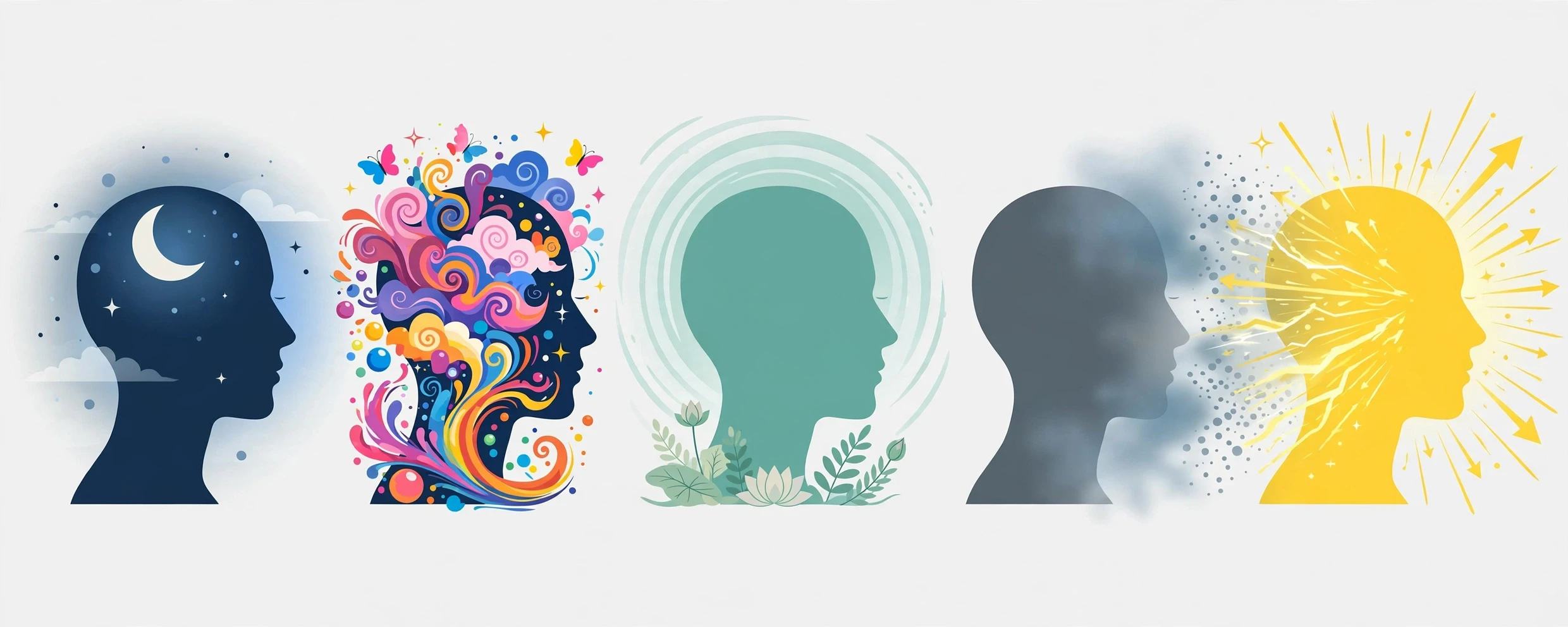
9. Altered States: Sleep, Anaesthesia, Meditation, and Psychedelics
If you want to understand a system, change it and watch what happens. Altered states of consciousness are natural experiments, and each one removes or rearranges a different piece of normal awareness.
9.1 Anaesthesia: switching consciousness off, and sometimes not
General anaesthesia is the most controlled way to switch consciousness off. Anaesthetic drugs disrupt long-range communication between brain regions, breaking the coordinated patterns that accompany awareness, while leaving many local processes running. That is why an anaesthetised patient can still have reflexes, and why their brain can still register sounds at a low level, without any experience of surgery.
Yet anaesthesia is not always clean. A small minority of patients report awareness during surgery — hearing voices, feeling pressure, unable to move or speak. These cases, rare and distressing, have driven better monitoring, including brain-activity monitors that track the depth of anaesthesia in real time. They also remind us that consciousness is not a single dial that anaesthesia turns to zero; it is a network that can be partly disrupted, with awareness returning in fragments before the whole system comes back online.
9.2 Meditation, flow, and the quieting of the self
Meditation offers a different kind of alteration: not a loss of awareness, but a change in its shape. Experienced meditators report a quieting of the usual chatter — the running commentary about the past and future — and a shift toward present-moment sensation. Brain imaging during meditation often shows reduced activity in the default mode network, a set of regions active during self-referential thought and mind-wandering, and increased activity in attention and sensory areas. The self does not vanish, exactly; it loosens its grip.
Flow states — the absorbed focus of an athlete, a musician, or a programmer lost in their work — show a similar pattern from the opposite direction. Attention narrows, self-consciousness fades, time seems to distort, and action feels effortless. The gut-brain connection plays a quieter role in these states than most people realise: the signals travelling between gut and brain shape mood, arousal, and the background feeling of the body that colours every conscious moment. Our article on the gut-brain connection explains how that two-way conversation works.
9.3 Psychedelics and the loosening of prediction
Psychedelic substances, studied in carefully controlled clinical settings, produce some of the most dramatic alterations of consciousness known: vivid imagery with eyes closed, a sense of unity or dissolution of the self, and a loosening of the usual boundaries between senses. Predictive processing offers a neat account: if the brain's predictions normally constrain experience tightly, psychedelics may relax those constraints, letting prediction errors flow more freely and allowing unusual patterns of activity to enter awareness.
These studies are early, small, and conducted under strict medical supervision; they are not a guide to self-experimentation, and the risks — especially for people with a personal or family history of psychosis — are real. Scientifically, though, they are valuable, because they show how much of ordinary consciousness is construction. Change the brain's chemistry a little, and the world you experience changes a lot. That fragility is itself a clue: consciousness is not a direct window onto reality. It is a model the brain builds, and the model can be rebuilt in different ways.
10. What Science Still Cannot Explain
After a century of research, and a decade of rapid progress, it is worth listing plainly what remains unknown. This is not a failure of the field. It is the field being honest about its frontier.
First, no theory has solved the hard problem. We can correlate brain activity with experience, predict reports of awareness from brain patterns, and switch consciousness off and on with drugs and stimulation. We cannot yet say why any of that activity should feel like anything, or derive the redness of red from the firing of neurons. Some researchers think a new conceptual framework is needed; others think the problem will dissolve as the easy problems are solved. Neither camp can prove its case yet.
Second, there is no agreed measure of consciousness. Researchers have proposed several — the perturbational complexity index, which measures how complex and integrated the brain's response is to a magnetic pulse, is one of the most promising — but none is accepted as a gold standard. That matters clinically: without a reliable measure, doctors must combine behaviour, brain scans, and stimulation tests, and still sometimes get it wrong.
Third, we do not know which animals are conscious, or in what way. The Cambridge Declaration on Consciousness in 2012, signed by leading neuroscientists, stated that the neural substrates of consciousness are not unique to humans, and that many non-human animals, including mammals, birds, and octopuses, likely experience awareness. That is a careful, evidence-based statement, not a proof, and the details — what a fish feels, what a bee experiences — remain open.
Fourth, we do not know whether artificial systems could be conscious. Current AI systems process information in ways that resemble some aspects of global workspace theory — broadcasting information between modules — but they lack the biology, the body, and the integrated, self-maintaining organisation of a brain. Whether any of that matters, or whether information processing alone is enough, is exactly the question the theories disagree about. Until the theories converge, claims about conscious machines are speculation, not science.
Finally, we do not know how consciousness evolved, or why. It may be an adaptation that helped animals plan, remember, and coordinate. It may be a by-product of complex brains that had other jobs to do. It may be something else entirely. Evolution leaves traces, but it does not leave a diary, and the inner lives of extinct animals are lost to us.
Most people assume that because we can scan the brain, we must be close to explaining consciousness. What the data actually show is something more interesting: we are close to mapping it, measuring it, and manipulating it, and still far from explaining why it exists at all. That distance is not a reason to stop. It is the reason the question is worth asking.
11. Why It Matters: Medicine, Ethics, and Everyday Life
Consciousness science is not only a puzzle for philosophers. It changes real decisions. In intensive care, better tests for hidden awareness can change a prognosis, a treatment plan, and a family's choices. In anaesthesia, better monitoring prevents the rare but real horror of waking during surgery. In psychiatry, understanding how the brain's predictive machinery goes wrong may lead to better treatments for conditions where the sense of self or reality is disturbed.
It also matters in ordinary life. Understanding that consciousness is constructed — that your brain predicts, filters, and edits — can make you a kinder observer of your own mind. The certainty you feel about a memory, a first impression, or a gut feeling is real as a feeling, but it is not proof that the feeling is accurate. Your brain is a good editor, not a perfect recorder. Knowing that does not make experience less vivid. It makes it more interesting, because you start to notice the editing as it happens: the moment a familiar face resolves out of a crowd, the moment a song pulls a memory forward whole, the moment you realise you have been awake for an hour without noticing the rain.
A last personal note. The relative I visited in hospital all those years ago recovered fully, and she remembers nothing of the days she was unconscious — no tunnel, no light, no dream. Just a gap, and then the world again. When I asked her what returning felt like, she said it was like a radio finding its station: static, then a voice, then music, then her own name. I think about that image whenever I read a new theory of consciousness. The theories are trying, each in its own language, to describe that radio — the circuits, the signal, the tuning — and to explain why, when it finds its station, there is someone there to listen.
12. Frequently Asked Questions
What is consciousness in simple terms?
Consciousness is the experience of being aware — having thoughts, feelings, and sensations that feel like something from the inside. It is what makes you a subject experiencing the world, rather than only a system processing information about it.
What is the hard problem of consciousness?
The hard problem, named by philosopher David Chalmers, asks why physical brain processes give rise to subjective experience at all. Science can explain how the brain processes colour, sound, and pain, but not yet why those processes feel like anything. That "why" is the hard problem.
Which theory of consciousness is most accepted?
No single theory is accepted by all researchers. The two most studied are Integrated Information Theory (IIT) and Global Workspace Theory (GNWT). A large 2025 adversarial test in Nature found that neither theory was fully supported by the results, and both need revision.
Where in the brain is consciousness located?
Consciousness does not live in one spot. It depends on a network: the brainstem and thalamus provide arousal and coordination, the posterior cortex builds sensory content, and the prefrontal cortex supports planning, memory, and self-monitoring. Damage to different parts subtracts different pieces of awareness.
Are animals conscious?
Most neuroscientists think many animals are conscious in some form. The Cambridge Declaration on Consciousness (2012) states that the neural basis of consciousness is not unique to humans and that mammals, birds, and octopuses likely experience awareness, though the richness of that experience is still debated.
Can science measure consciousness?
Partly. Researchers use behavioural tests, brain imaging, and measures such as the perturbational complexity index, which tracks how complex and integrated the brain's response is to stimulation. No single measure is yet accepted as a gold standard, especially for patients who cannot communicate.
What happens to consciousness under anaesthesia?
General anaesthesia disrupts long-range communication between brain regions, breaking the coordinated activity that accompanies awareness. Local reflexes and low-level processing can continue, but the unified experience of being aware fades, and usually returns as the drug wears off.
Is consciousness the same as attention?
No. Attention selects information for further processing; consciousness is the experience of that information. You can attend to something without becoming fully conscious of it, and something can enter consciousness — a sudden pain, a loud sound — without you choosing to attend to it.
Could a computer or AI become conscious?
Science does not know. Current AI systems process information in ways that resemble some aspects of consciousness theories, but they lack a brain's biology, body, and self-maintaining organisation. Whether that matters depends on which theory of consciousness turns out to be right, and that question is unresolved.
What is the difference between being awake and being conscious?
Wakefulness, or arousal, is being switched on and responsive. Consciousness also requires awareness — knowing what is around you and experiencing it. A person can be awake but unaware, as in a vegetative state, or aware in dreams while the body is asleep.
Sources
Stanford Encyclopedia of Philosophy — "Consciousness" (Van Gulick, R.): https://plato.stanford.edu/entries/consciousness/
Cogitate Consortium et al. — "Adversarial testing of global neuronal workspace and integrated information theories of consciousness", Nature (2025): https://doi.org/10.1038/s41586-025-08888-1
NIH / NCCIH — "NIH Blueprint for Neuroscience: Establishing a Research Network To Guide Foundational Research on Human Consciousness": https://www.nccih.nih.gov/grants/concept-nih-blueprint-for-neuroscience-establishing-a-research-network-to-guide-foundational-research-on-human-consciousness
Warren, A. E. L. et al. — "A human brain network linked to restoration of consciousness after deep brain stimulation", Nature Communications (2025): https://pubmed.ncbi.nlm.nih.gov/40691170/
Nagel, T. — "What Is It Like to Be a Bat?", The Philosophical Review (1974), discussed in the Stanford Encyclopedia of Philosophy entry above.
Chalmers, D. J. — "Facing Up to the Problem of Consciousness", Journal of Consciousness Studies (1995), discussed in the Stanford Encyclopedia of Philosophy entry above.