

Introduction
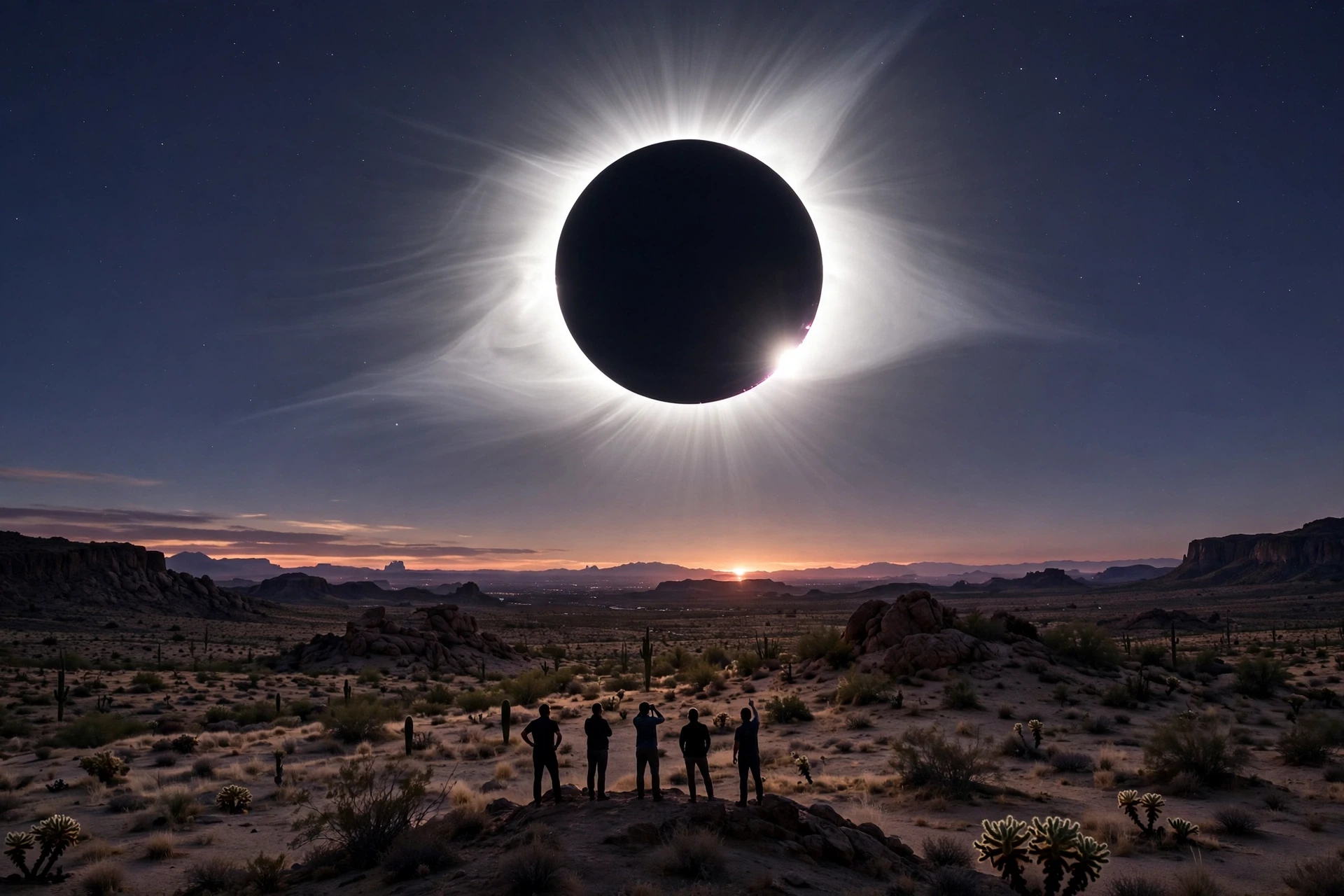
The sky went wrong in the middle of the day. I was standing in a field with a crowd of strangers, all of us wearing paper eclipse glasses that made us look faintly ridiculous, when the light began to thin. It did not feel like evening. Evening arrives gradually, with a long amber fade. This was different — the colour drained out of the grass, the temperature dropped a few degrees in minutes, and birds that had been singing all morning went quiet at once, as if someone had pressed a mute button on the world. Then the last bead of sunlight vanished, the crowd gasped, and there it was: a black disc ringed with pale, feathery fire, hanging in a dark blue sky at noon. The Sun's corona, the outer atmosphere I had only ever seen in photographs, was suddenly real and close enough to make my chest tighten.
I took my glasses off for those two minutes of totality, the way you are allowed to do and only then, and I understood something I had known as a fact for years but never felt in my bones. The Sun is not a lamp in the sky. It is a star — a vast, violent, magnetic furnace — and we live so close to it that its weather is our weather. Everything that follows in this article is an attempt to answer one question properly: how the sun works. Not the short version you get in a school textbook, but the full story, from the nuclear furnace at its centre to the stream of particles that brushes past Earth every second, and from the sunspots that march across its face to the fate that awaits it five billion years from now.
The Sun gives us almost everything. It powers the winds and the rain, grows the food we eat, and sets the rhythm of every day we have ever lived. Yet for most of human history, nobody knew what it was. People worshipped it, feared it, and guessed at it — a god's chariot, a hole in the sky, a ball of burning coal. The real answer turned out to be stranger than any of those guesses: the Sun is a ball of plasma held together by its own gravity, fusing hydrogen into helium in its core, and shining because a tiny fraction of its mass is being turned directly into energy, exactly as Einstein's famous equation says it must be. Understanding how the sun works means understanding that furnace, the layers of gas above it, the magnetic storms on its surface, and the invisible wind it blows across the whole solar system.
1. What the Sun Actually Is
1.1 A star, not a ball of fire
The first thing to get straight about how the sun works is what kind of object it is. The Sun is a star, and it is the only star in our solar system. It formed about 4.6 billion years ago from a collapsing cloud of gas and dust, and it now holds 99.8 percent of all the mass in the solar system. Everything else — all eight planets, every moon, every asteroid and comet — adds up to the remaining 0.2 percent. NASA's Sun facts page gives the scale in numbers that are hard to hold in your head all at once: the Sun is about 109 times wider than Earth, roughly 1.3 million Earths could fit inside it, and it would take more than 330,000 Earths to match its mass.
It is worth pausing on the word "star" because it carries a specific meaning in astronomy, and it is the first step in understanding how the sun works. A star is an object massive enough that the pressure and heat at its centre can sustain nuclear fusion — the joining of light atomic nuclei into heavier ones, releasing energy in the process. Planets cannot do this. Jupiter, the largest planet, is about a thousand times less massive than the Sun, and it never got hot enough inside to light up. The Sun did. That single difference is what makes the Sun shine and Jupiter merely reflect.
The Sun is classified as a G-type main-sequence star, sometimes called a yellow dwarf, and that classification is part of how the sun works as a middle-of-the-road star. The "yellow" part is a story in itself, and one we will come back to in the misconceptions section, because the Sun is not really yellow at all. The "dwarf" part is a comparison, not an insult: the Sun is a middle-of-the-road star, neither especially large nor especially small. It sits in the middle of the range of stars, and that ordinariness is part of what makes it so interesting. It is an average star, doing an average star's job, and yet it is the reason anything on Earth is alive.
1.2 A ball of plasma
If you could scoop up a piece of the Sun — you cannot, and please do not try — you would not find solid ground, liquid water, or even ordinary gas. You would find plasma, the fourth state of matter, in which atoms have been stripped of their electrons by the heat and move around as a soup of charged particles. About 73 percent of the Sun's mass is hydrogen, about 25 percent is helium, and the remaining 2 percent is everything else: oxygen, carbon, neon, nitrogen, iron, and a sprinkle of heavier elements. Astronomers call all of those heavier elements "metals", even oxygen and carbon, which is one of those habits of the field that confuses everyone at first and then becomes second nature.
Plasma matters because it behaves differently from ordinary gas. It responds to magnetic fields, and it conducts electricity. The Sun's magnetic field threads through its plasma the way a skeleton threads through a body, shaping sunspots, driving flares, and launching the solar wind. Much of how the sun works, especially the stormy parts, is really a story about plasma and magnetism, not about heat alone. I first saw this clearly years ago at a public solar observing day, when an astronomer pointed a small telescope fitted with a hydrogen-alpha filter at the Sun and let me look. Instead of a smooth yellow disc, I saw a boiling surface with dark filaments and bright, looping prominences arcing off the edge like flames. It looked alive. In a real sense, it is — not alive in the biological sense, but dynamic, restless, and constantly rearranging itself.
1.3 The Sun by the numbers
The headline figures give a sense of the scale before we go deeper. The Sun's diameter is about 1.39 million kilometres. Its surface temperature is around 5,500 degrees Celsius. Its core is about 15 million degrees Celsius. It spins on its axis, but not like a solid ball: because it is made of gas and plasma, its equator spins faster than its poles, completing a rotation in about 25 days at the equator and about 35 days near the poles. Light takes about eight minutes and twenty seconds to travel from the Sun to Earth, across a distance of about 150 million kilometres — one astronomical unit, the yardstick astronomers use for distances inside the solar system. That means the sunlight warming your face right now left the Sun eight minutes ago, though as we will see, the energy inside that light began its journey very much longer ago than that.
Property | Value |
|---|---|
Age | About 4.6 billion years |
Diameter | About 1,392,700 km (109 Earths) |
Mass | About 1.989 × 10^30 kg (333,000 Earths) |
Surface temperature | About 5,500 °C |
Core temperature | About 15 million °C |
Composition (by mass) | 73% hydrogen, 25% helium, 2% heavier elements |
Rotation period | About 25 days at the equator, 35 days at the poles |
Distance from Earth | About 150 million km (1 astronomical unit) |
Light travel time to Earth | About 8 minutes 20 seconds |
These numbers are worth keeping in mind because they set up the puzzle at the heart of this article. How does a ball of gas stay hot enough to shine for billions of years without burning out, cooling down, or blowing itself apart? The answer starts in the core.
2. How the Sun Works at Its Core: Nuclear Fusion
2.1 The proton-proton chain
At the centre of the Sun sits a furnace unlike anything humans have ever built. The core is a region about a quarter of the Sun's radius across, where the temperature reaches roughly 15 million degrees Celsius and the density is about 150 times that of water — denser than lead, yet made almost entirely of hydrogen gas squeezed by the weight of everything above it. Under those conditions, hydrogen nuclei — single protons — are moving so fast and packed so tightly that they sometimes overcome their natural electrical repulsion and fuse together. That fusion is the engine of the Sun, and understanding it is the heart of understanding how the sun works.
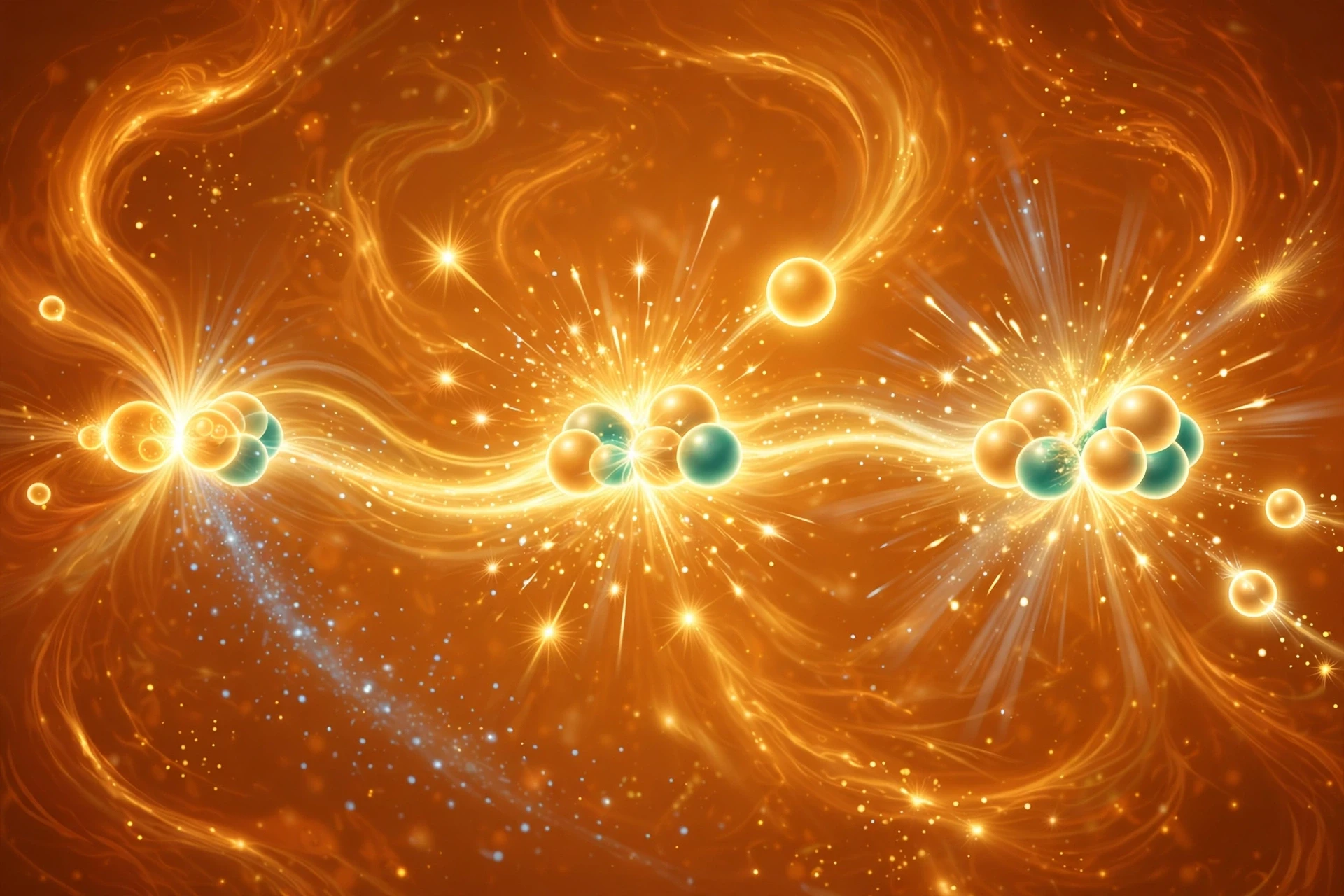
The main reaction is called the proton-proton chain, and it runs in steps. First, two protons fuse to form a deuterium nucleus — one proton and one neutron — releasing a positron and a neutrino. Then the deuterium fuses with another proton to make helium-3. Finally, two helium-3 nuclei fuse to form helium-4, the ordinary helium nucleus, and release two protons back into the mix. The net result is simple to state and staggering to think about: four hydrogen nuclei become one helium nucleus, and a small amount of mass goes missing. That missing mass becomes energy, in the form of light and heat, according to Einstein's equation E=mc².
The UCSD Earthguide page on the Sun's structure and nuclear fusion describes this chain plainly, and it is worth reading because it makes clear how modest each step is. No single fusion event releases much energy. What makes the Sun powerful is the sheer number of events: they happen in astronomical numbers, every second, in every cubic centimetre of the core. The OpenStax Astronomy textbook puts it the same way, describing the Sun as a nuclear powerhouse in which the proton-proton chain converts hydrogen to helium steadily and has done so for billions of years. You can read that account in OpenStax Astronomy on the structure of the Sun.
2.2 Six hundred million tons every second
The scale of the Sun's fusion is hard to exaggerate, so let me give you the number that stops me every time I say it out loud. Every second, the Sun fuses about 600 million tons of hydrogen into helium. Of that, about 4 million tons of mass simply disappears — converted directly into energy. That energy, radiated away as sunlight, is what powers everything on Earth. And the Sun can keep this up for billions of years because it started with an enormous supply of hydrogen: even at this rate, it has only burned through about half of the hydrogen in its core since it was born.
To feel what that means, imagine a mountain. Now imagine a mountain's worth of hydrogen vanishing into pure energy every single second, and the Sun doing that not for a day or a year but for 4.6 billion years, without ever pausing. It is the kind of number that makes ordinary comparisons fail, and that is exactly the point. The Sun's power output is about 3.8 × 10^26 watts — roughly 380 trillion trillion watts. Humanity's total energy use is about 18 trillion watts, which means the Sun puts out about twenty billion times more power than our entire civilisation consumes. Earth intercepts only a tiny fraction of it, about one two-billionth, and even that fraction is more than enough to drive the climate, the water cycle, and all of photosynthesis.
There is a famous piece of trivia that captures the core's energy output in a counterintuitive way: per cubic metre, the Sun's core produces less heat than a compost heap. That is true, and it is also deeply misleading if you stop there. The core produces very little energy per unit of volume because fusion is actually quite a slow, inefficient process at the level of individual protons — most protons in the core will wait billions of years before fusing. But the core is enormous, about 150,000 kilometres across, so a small amount per cubic metre adds up to a staggering total. The Sun is not a fierce little flame. It is a vast, gentle, patient furnace.
2.3 Why the Sun does not blow itself apart
Fusion releases energy, and energy pushes outward. Gravity pulls inward. The Sun's stability is a balance between the two, and it is one of the most elegant ideas in all of astronomy. If fusion ever ran a little too fast, the core would heat up and expand slightly, which would cool it and slow fusion down again. If fusion ran a little too slowly, gravity would squeeze the core slightly, heating it up and speeding fusion back up. This self-correcting balance is called hydrostatic equilibrium, and it is why the Sun has shone steadily for billions of years instead of flaring out or collapsing.
I think of it as a thermostat the size of a star. A thermostat in your home does the same thing on a small scale: it senses the temperature, turns the heating up or down, and keeps the room steady. The Sun's thermostat is made of physics rather than wires, but the logic is the same. It is also the reason the Sun's brightness has been so stable over the history of life on Earth. The Sun has brightened gradually — it is about 30 percent brighter now than when it was young — but the change has been slow enough for Earth's climate and life to adjust around it, most of the time.
There is a second balancing act worth knowing about, because it explains how the sun works as a star rather than as a fire. A fire burns fuel and gets smaller as it goes. The Sun's fusion does not "burn" in the chemical sense at all. There is no flame, no smoke, no ash, and no oxygen involved. Fusion is a nuclear process, and the Sun's fuel supply is so large that it can run for about ten billion years in total before the core hydrogen runs out. We are roughly halfway through that life, which sounds alarming until you remember that "halfway" still leaves about five billion years on the clock.
The Sun is not a fire that might go out tomorrow. It is a self-regulating nuclear furnace with a thermostat written into the laws of physics, and it has kept that balance for longer than Earth has existed.
2.4 Neutrinos: the messengers that escape
There is one more product of fusion that deserves a mention, because it gave scientists their first direct proof that fusion really happens in the Sun's core. The proton-proton chain produces neutrinos — ghostly particles with almost no mass and no electric charge, which pass through almost everything. Trillions of solar neutrinos pass through your body every second, and through the entire Earth, without interacting with anything at all. Physicists built enormous underground detectors filled with water or cleaning fluid just to catch a handful of them, and for decades they found only about a third as many as theory predicted. That "solar neutrino problem" puzzled physicists for years, until the answer turned out to be that neutrinos change flavour as they travel — they oscillate between three types, and the early detectors could only see one. When detectors were built that could see all three, the numbers matched. The neutrino story is a reminder of something I come back to again and again: the Sun is not just an object to look at. It is an object to listen to, in every channel we can build — light, particles, and magnetism — and each channel tells us something the others cannot.
3. The Sun's Layers, Inside Out
3.1 A map of the whole star
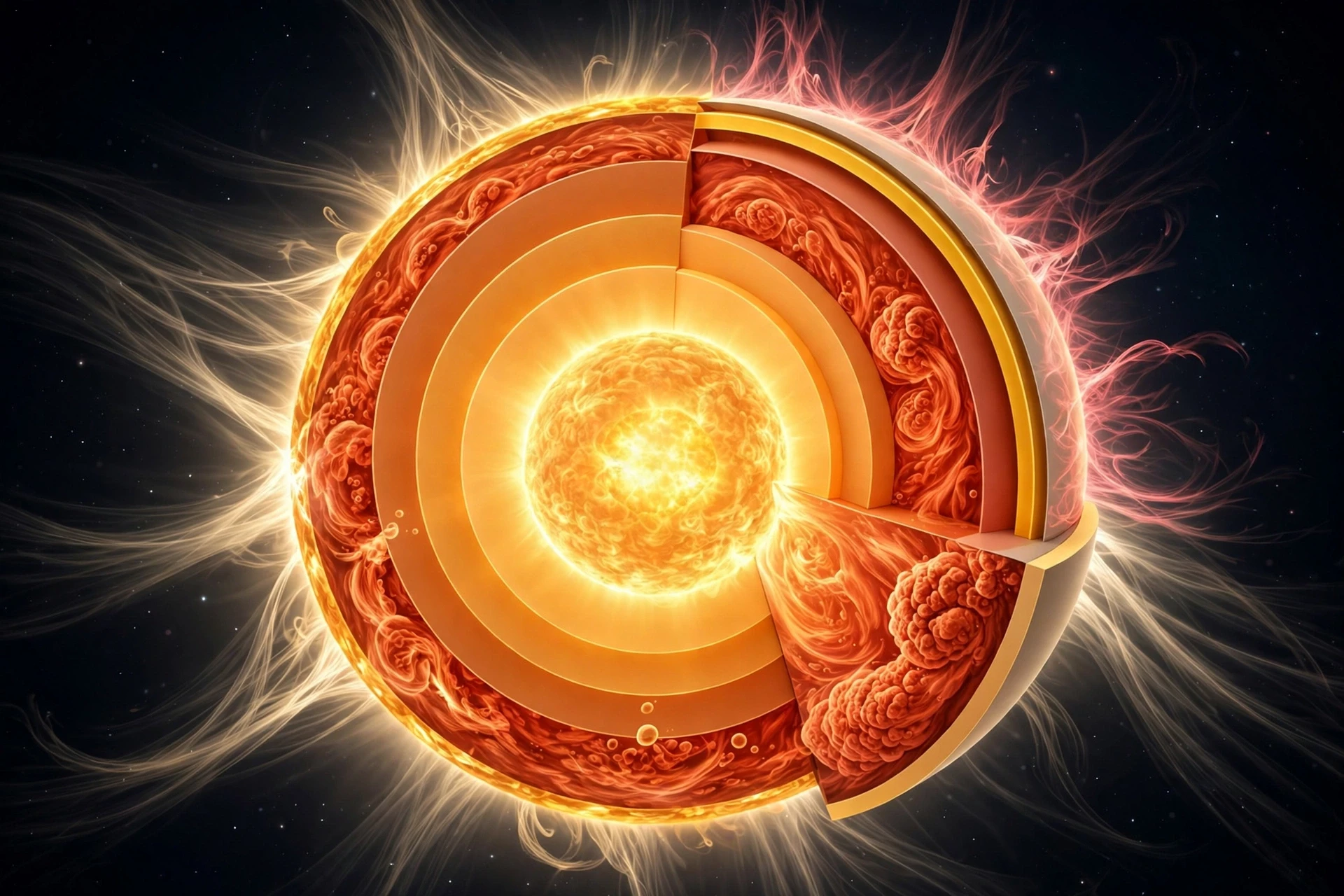
Above the core, the Sun is arranged in layers, each with its own temperature, density, and way of moving energy, and this layered structure is central to how the sun works. Learning how the sun works means learning this map, because almost everything you can see or feel from the Sun — the light, the sunspots, the flares, the wind — is produced in or by one of these layers. There are six of them, from the inside out: the core, the radiative zone, the convection zone, the photosphere, the chromosphere, and the corona. The first three are the interior. The last three are the atmosphere, and the photosphere is the part we normally think of as "the surface", even though it is not solid at all.
3.2 The radiative zone: where light gets lost
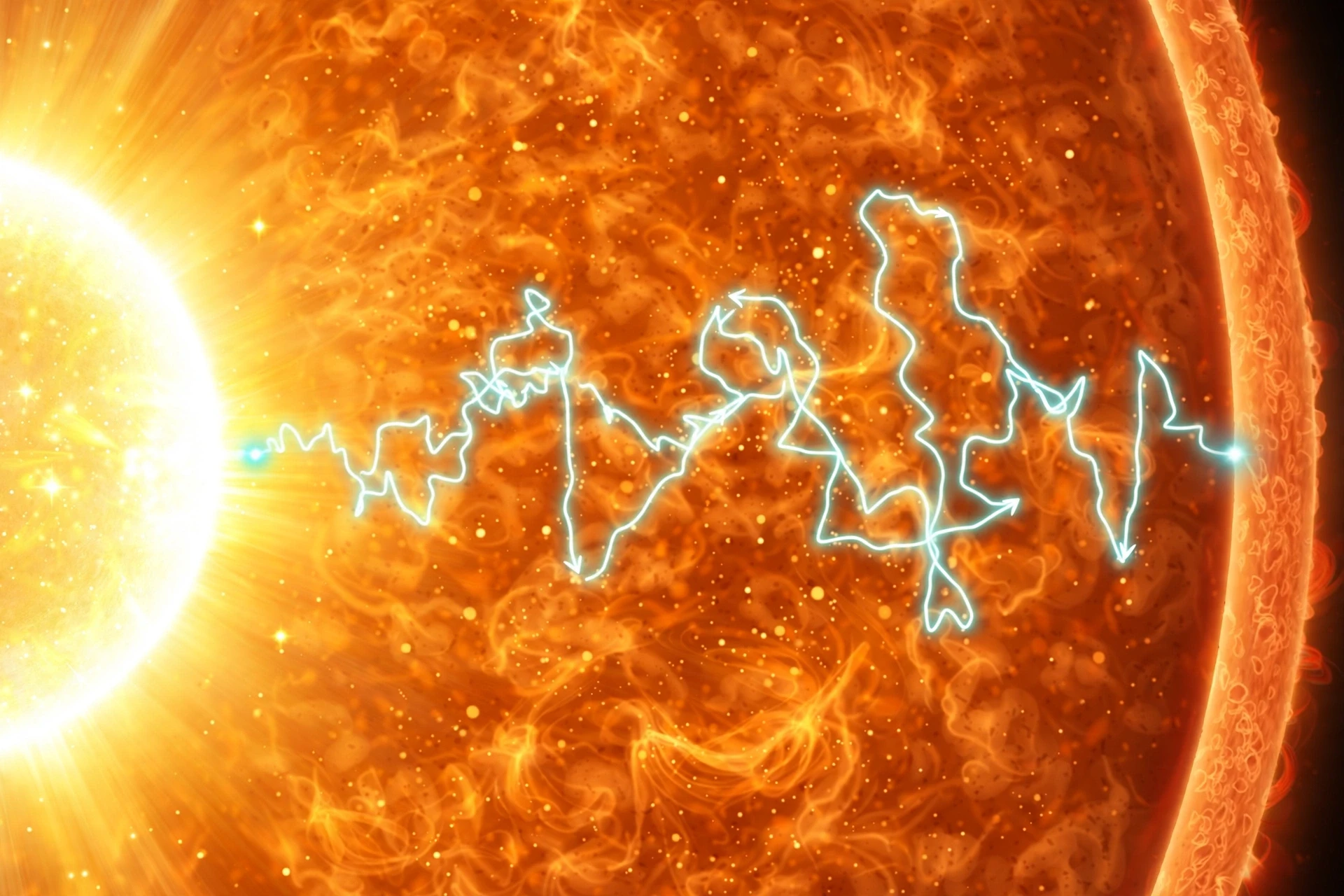
Outside the core lies the radiative zone, a vast shell stretching from about 25 percent to about 70 percent of the Sun's radius. Here the plasma is so dense that light cannot travel freely. A photon produced in the core does not shoot out into space. It travels a tiny distance — often less than a millimetre — before it is absorbed by an atom, and then a new photon is emitted in a random direction. It is absorbed again, and emitted again, over and over, in a slow, drunken zigzag toward the surface. This is called a random walk, and it is the reason the energy made in the core takes so long to escape.
Layer | Depth / extent | Temperature | What happens there |
|---|---|---|---|
Core | Centre to 25% of radius | About 15 million °C | Nuclear fusion: hydrogen becomes helium |
Radiative zone | 25% to 70% of radius | 7 million to 2 million °C | Energy creeps outward by photon random walk |
Convection zone | 70% of radius to the surface | 2 million to 5,500 °C | Hot plasma rises, cool plasma sinks, carrying energy |
Photosphere | About 500 km thick | About 5,500 °C | The visible "surface"; light escapes into space |
Chromosphere | About 2,000 km above the photosphere | 4,500 to 25,000 °C | Thin, reddish layer; spicules and prominences |
Corona | Millions of km outward | 1 to 3 million °C | The outer atmosphere; source of the solar wind |
3.3 The convection zone: a boiling pot
At about 70 percent of the way out, the plasma becomes cool enough and opaque enough that radiation alone can no longer carry the energy efficiently, and a different kind of transport takes over. The plasma begins to churn, like water coming to the boil in a pot. Hot bubbles of plasma rise toward the surface, cool as they release their heat, and sink back down to be reheated. This is the convection zone, and it is the largest layer of the Sun by volume. Its top is what we see as the photosphere, and the churning is visible in the granular pattern on the Sun's surface: each granule is the top of a rising column of hot plasma, about a thousand kilometres across, lasting only a few minutes before it dissolves and is replaced by another.
I have always liked the boiling-pot analogy because it is one of those rare cases where the everyday comparison is almost literally true. If you have ever watched a pot of soup come to the boil, you have watched convection: hot fluid rising in the middle, cool fluid sinking at the edges, the surface roiling. The Sun's convection zone does the same thing, except the pot is 200,000 kilometres deep, the soup is plasma at millions of degrees, and the granules on the surface are each the size of a country. The churning also matters for a reason that is easy to miss: the motion of electrically charged plasma in the convection zone is what generates the Sun's magnetic field, through a process called the solar dynamo. That magnetic field is the root cause of sunspots, flares, and the solar wind, so the boiling pot is where the Sun's stormy weather begins.
3.4 The photosphere: the surface we see
The photosphere is the layer we actually see when we look at the Sun — with proper eye protection, always — and it is only about 500 kilometres thick, a thin skin on a star 1.4 million kilometres across. It is where the plasma finally becomes transparent enough for light to escape freely into space. Its temperature is about 5,500 degrees Celsius, and it is the source of nearly all the light and heat Earth receives. The photosphere is not a hard surface. It is simply the depth at which the Sun stops being opaque and starts being transparent, the way the surface of a fog bank is not a wall but the place where the fog thins out.
3.5 The chromosphere: the thin red layer
Above the photosphere lies the chromosphere, a thin layer about 2,000 kilometres thick that is normally invisible because the photosphere outshines it. You can see it during a total solar eclipse as a thin pinkish-red rim around the black disc of the Moon, or through a telescope fitted with a hydrogen-alpha filter. The chromosphere is hotter than the photosphere above it, reaching tens of thousands of degrees, and it is full of jets of plasma called spicules that shoot upward like grass in a field, each one lasting only a few minutes. The word chromosphere means "colour sphere", and it was named for that red glow, which comes from hydrogen atoms emitting light at a particular red wavelength.
3.6 The corona: the impossible hot atmosphere
Above the chromosphere lies the corona, the Sun's outer atmosphere, and it is the strangest layer of all. The corona is extremely thin and wispy, yet it is heated to between one and three million degrees Celsius — hundreds of times hotter than the photosphere below it. That is the coronal heating problem, one of the great unsolved puzzles in solar physics: heat is supposed to flow from hot to cold, so how can the outer atmosphere be hotter than the surface beneath it? The leading explanations involve magnetic fields carrying energy upward and releasing it in countless tiny bursts called nanoflares, and waves rippling along magnetic field lines, but the full answer is still being worked out. NASA's Parker Solar Probe, which flies through the corona itself, is gathering the data that may finally settle the question, and we will come back to it later.
The corona extends millions of kilometres into space, and its outer edges merge into the solar wind. During a total eclipse it appears as a pearly white halo, with streamers and plumes shaped by the magnetic field. I think about that eclipse I watched, and the corona hanging in a darkened sky at noon, whenever someone asks me why solar physicists care so much about a layer of gas you cannot normally even see. It is beautiful, yes, but it is also the part of the Sun that reaches out and touches us. The solar wind comes from the corona. Solar storms are born in the corona. To understand space weather, you have to understand the corona first.
4. Why Sunlight Takes About 100,000 Years to Escape
4.1 The slowest part of the journey
Here is one of my favourite facts about how the sun works, and the one that most surprises people when I tell it at public talks. The sunlight hitting your face today began as fusion energy in the Sun's core roughly 100,000 years ago. It took that long for the energy to crawl through the radiative zone by random walk, and then it took only about eight minutes to cross the empty space from the Sun's surface to Earth. The journey is almost entirely spent inside the Sun, and almost none of it spent in space.
The reason is the density of the radiative zone. A photon inside it can only travel a fraction of a millimetre before it is absorbed and re-emitted in a random direction. It is like trying to cross a crowded room blindfolded while everyone keeps gently shoving you in a different direction: you make progress, but very slowly, and you take an enormous number of steps to get anywhere. Physicists estimate that a photon undergoes an immense number of absorptions and re-emissions on its way out, and the exact time is uncertain — estimates range from tens of thousands to hundreds of thousands of years, with 100,000 years the figure most often quoted. What matters is the order of magnitude: the energy is ancient by the time it leaves.
4.2 What this means for us
There is a quiet poetry in this fact that I have never quite got over. When you step outside on a sunny morning, the light on your skin was born in the Sun's core before the first cities were built, before agriculture, before the last ice age ended. The photons themselves are not the same ones that left the core — they were absorbed and reborn countless times along the way — but the energy is the same energy, carried outward step by step through a hundred thousand years of darkness before it finally broke free. And then, in the last eight minutes of its journey, it crossed 150 million kilometres of empty space at the fastest speed in the universe, and arrived exactly on time.
There is also a practical consequence. The Sun's light is a delayed message. If something changed in the core today, we would not see any difference in sunlight for roughly 100,000 years. The Sun's steady brightness is partly a result of this enormous thermal inertia: the radiative zone acts as a vast reservoir that smooths out any short-term flicker in the core. That stability is one of the reasons life on Earth has had such a long, mostly uninterrupted run. The Sun does change — it brightens slowly over billions of years, and its magnetic activity rises and falls in an 11-year cycle — but on human timescales, its light is a remarkably reliable constant.
5. Sunspots and the 11-Year Cycle
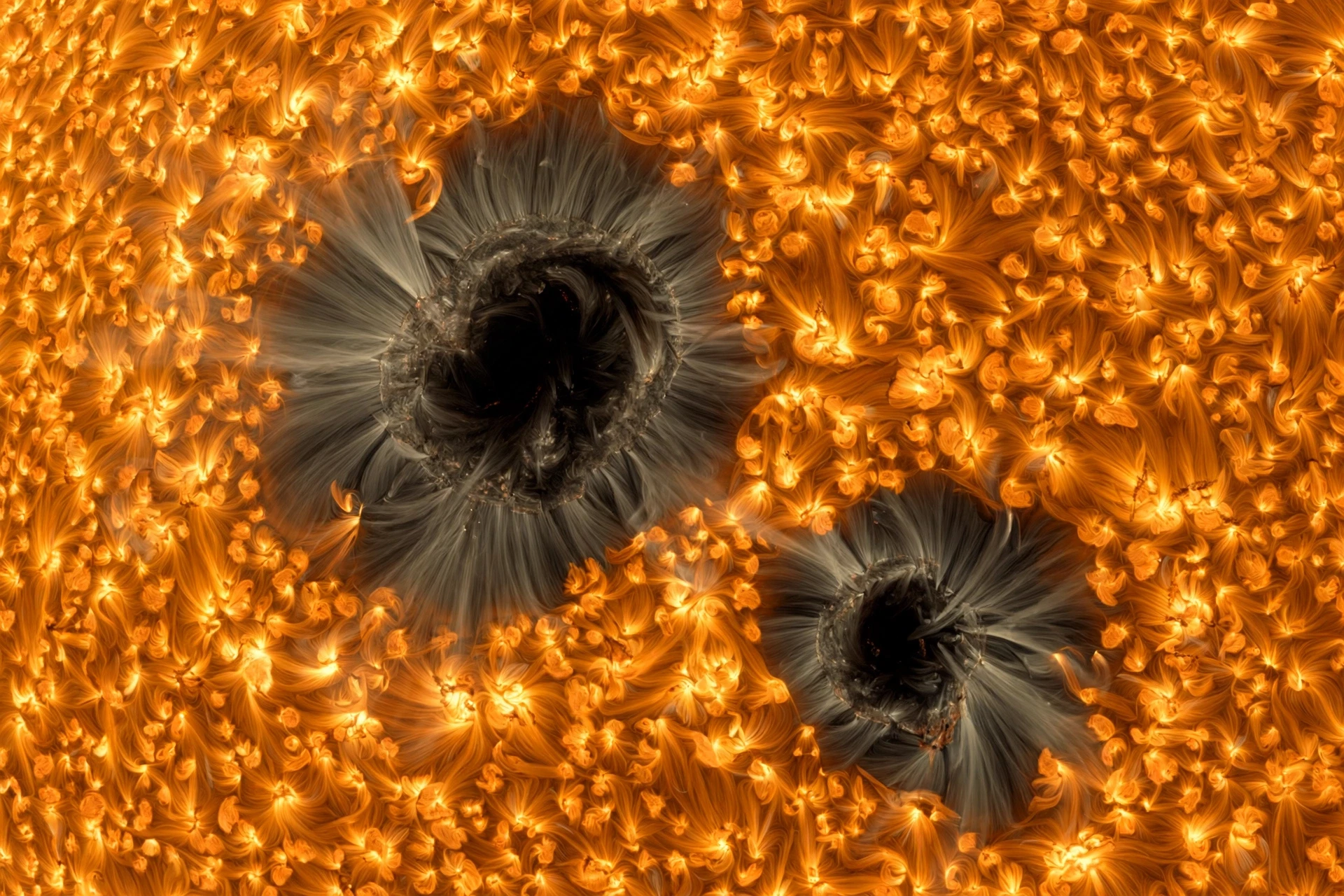
5.1 Dark spots that are not dark
Look at the Sun through a safe solar filter and you will often see dark blemishes on its face. These are sunspots, and they are one of the oldest known features of the Sun: Chinese astronomers recorded them more than two thousand years ago, and Galileo used them in 1610 to show that the Sun rotates. Sunspots look dark only by contrast, and they are one of the clearest visible clues to how the sun works beneath the surface. They are regions where the Sun's magnetic field has become so concentrated that it blocks the upward flow of hot plasma from below, so the spot cools to about 3,500 degrees Celsius instead of the usual 5,500. A sunspot is cooler than its surroundings, which makes it look black — but if you could somehow isolate a sunspot and hold it up against the night sky, it would still shine brighter than the full Moon. It is dark the way a shadow is dark: only by comparison with something brighter.
5.2 How the solar cycle works
Sunspots are not random. They come and go in a cycle that lasts about 11 years, discovered by the German astronomer Heinrich Schwabe in 1843 after seventeen years of patient daily observations. At solar minimum, the Sun's face may be almost spotless for weeks at a time. Then spots begin to appear, first at high latitudes, then closer and closer to the equator, until solar maximum, when the Sun can be freckled with dozens of spot groups. Then the numbers fall again, and the cycle repeats. The record of sunspot counts stretches back to the 1700s, and it is one of the longest continuous datasets in all of science.
What drives the cycle is the solar dynamo: the churning plasma of the convection zone, combined with the Sun's uneven rotation, winds the magnetic field up like a rubber band, tangling it until it bursts through the surface as sunspots. At the end of each cycle the magnetic field flips — the Sun's north magnetic pole becomes the south pole, and vice versa — so the full magnetic cycle is actually about 22 years long, two sunspot cycles back to back. The NOAA Space Weather Prediction Center tracks the cycle continuously and publishes forecasts, because the cycle sets the tempo for space weather: solar maximum brings more flares, more coronal mass ejections, and more aurorae.
5.3 The Maunder Minimum and the Little Ice Age
The cycle is not always regular. Between about 1645 and 1715, during a period called the Maunder Minimum, sunspots almost vanished for seventy years. Astronomers at the time recorded hardly any spots at all, and the period overlaps with the coldest part of the Little Ice Age in Europe, when the River Thames in London froze solid enough to hold frost fairs. It is tempting to draw a straight line between the two — fewer sunspots, colder Earth — and for a long time people did. The real story is more complicated: the Sun's total brightness varies by only about 0.1 percent over the solar cycle, which is far too small to explain the Little Ice Age on its own. Volcanic eruptions and natural climate variability almost certainly played larger roles. The Maunder Minimum is a useful caution against simple stories about the Sun and climate, and we will come back to that distinction when we talk about the Sun and Earth's climate in section 8.
5.4 How the sun works through magnetism
Here is the key idea that ties the whole article together so far. The Sun's energy comes from fusion, but its behaviour — its spots, its flares, its wind — comes from magnetism. The magnetic field is generated by moving plasma in the convection zone, carried to the surface by rising gas, and then tangled by the Sun's uneven rotation until it snaps and releases energy. Every storm the Sun throws at us begins as a magnetic knot. Keep that in mind, because the next two sections are the story of those knots coming undone.
6. Solar Flares and Coronal Mass Ejections
6.1 What a solar flare is
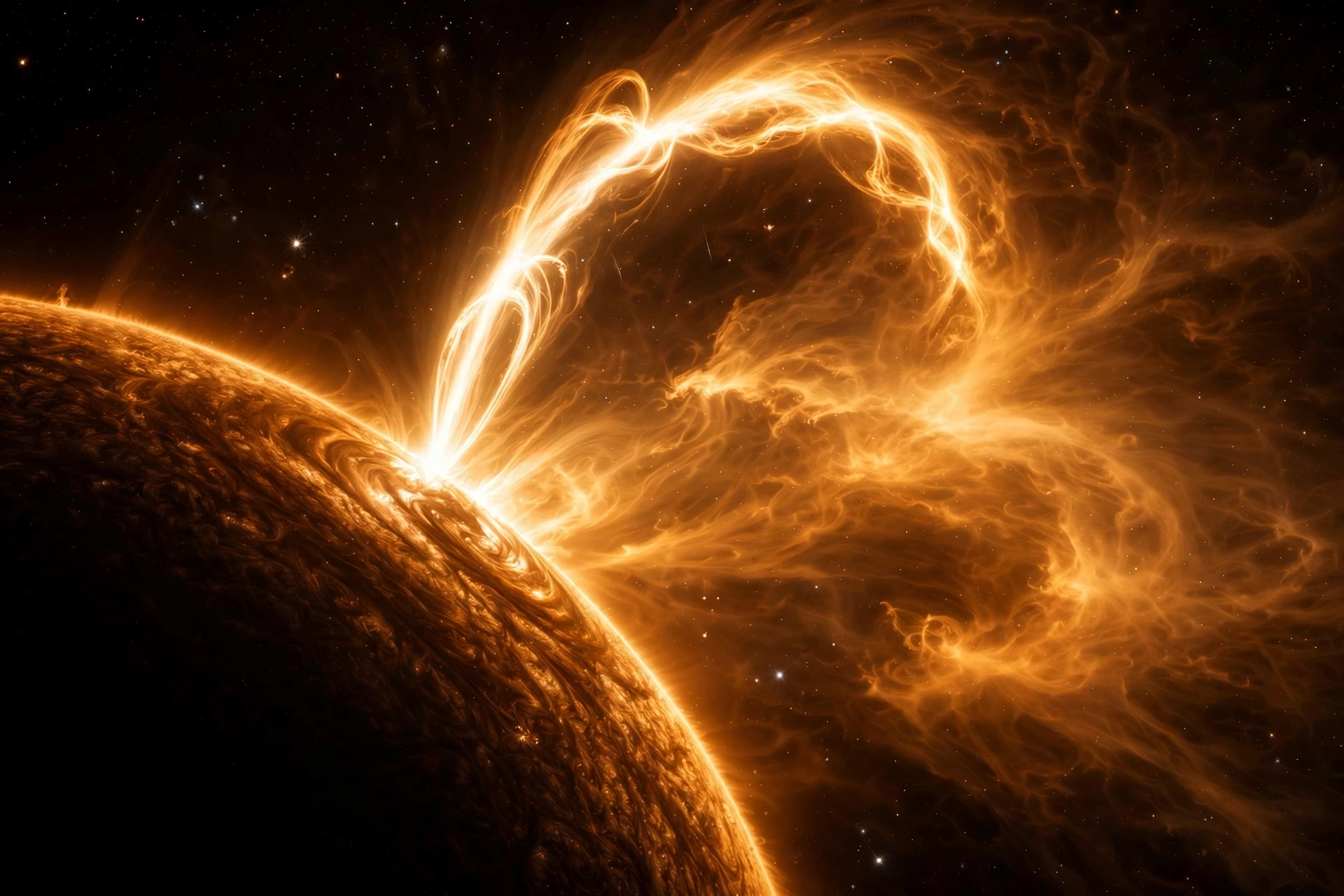
A solar flare is a sudden, violent release of energy from the Sun's atmosphere, and it is the most powerful kind of explosion in the solar system — and a vivid demonstration of how the sun works when its magnetic field snaps. It happens when magnetic field lines in the corona become twisted and stressed until they suddenly snap into a new shape — a process called magnetic reconnection — releasing in minutes the energy of billions of nuclear bombs. The flare heats plasma to tens of millions of degrees and floods space with X-rays and ultraviolet light. A large flare can be seen from Earth as a bright flash on the Sun's face, and its light reaches us in about eight minutes, at the speed of light.
Flares are classified by their X-ray brightness: A, B, and C are small, M is medium, and X is large, with each letter ten times stronger than the last. An X-class flare is the kind that makes the news, and the largest ever recorded was estimated at around X28 during the Halloween storms of 2003, so powerful that it saturated the sensors measuring it. I remember following those storms in the news and watching the aurora forecasts climb: people in places that almost never see the northern lights — including parts of the southern United States — were suddenly reporting green skies. That is the reach of a solar flare. It starts as a magnetic snap on a star 150 million kilometres away, and it ends with someone standing in a field in Texas, looking up in wonder.
6.2 Coronal mass ejections: the Sun throwing pieces of itself
A coronal mass ejection, or CME, is different from a flare, though the two often happen together. A CME is a huge cloud of plasma and magnetic field — billions of tons of it — hurled off the Sun and into space at speeds that can reach 3,000 kilometres per second. If a flare is a flash of light, a CME is a cannonball. It takes one to three days to cross the space between the Sun and Earth, and when it arrives, it can slam into Earth's magnetic field and set off a geomagnetic storm.
NOAA's explainer on coronal mass ejections describes them as the largest explosions in the solar system, and that is not an exaggeration. A single CME can carry the mass of a mountain range and the energy of a significant fraction of humanity's entire annual energy use, released in a matter of hours. Most CMEs miss Earth entirely, sailing off into empty space. The dangerous ones are the ones aimed at us, and forecasters at the Space Weather Prediction Center watch for them around the clock, using coronagraph images that block out the Sun's bright disc so the faint CME cloud can be seen leaving.
6.3 The Carrington Event and the Quebec blackout
The most famous solar storm in history is the Carrington Event of 1859, named after the British astronomer Richard Carrington, who watched a brilliant white flare erupt on the Sun's surface and then, about seventeen hours later, saw the skies light up with aurorae so bright that people in the tropics could read newspapers by them at midnight. Telegraph systems around the world went haywire: operators received electric shocks, telegraph paper caught fire, and some systems kept working even after their batteries were disconnected, powered by the storm itself. That was 1859, when the world's electrical infrastructure was a network of telegraph wires. A storm of the same size today would hit a world that runs on power grids, satellites, and GPS.
We got a smaller preview in March 1989, when a geomagnetic storm knocked out the power grid in Quebec, leaving six million people without electricity for nine hours. The same storm damaged transformers as far away as New Jersey and disrupted satellites. It was not a Carrington-level event, and it still caused billions of dollars in damage and disruption. That is why governments and power companies now take space weather seriously: the Sun is not just an object of scientific curiosity. It is a hazard that has to be forecast, the way meteorologists forecast hurricanes, and the forecasting starts with watching the Sun.
A solar flare is a flash. A coronal mass ejection is a punch. The flare's light arrives in eight minutes; the CME's plasma takes days. Knowing which one is coming, and when, is the difference between a light show and a blackout.
7. The Solar Wind and Space Weather
7.1 A wind made of star stuff
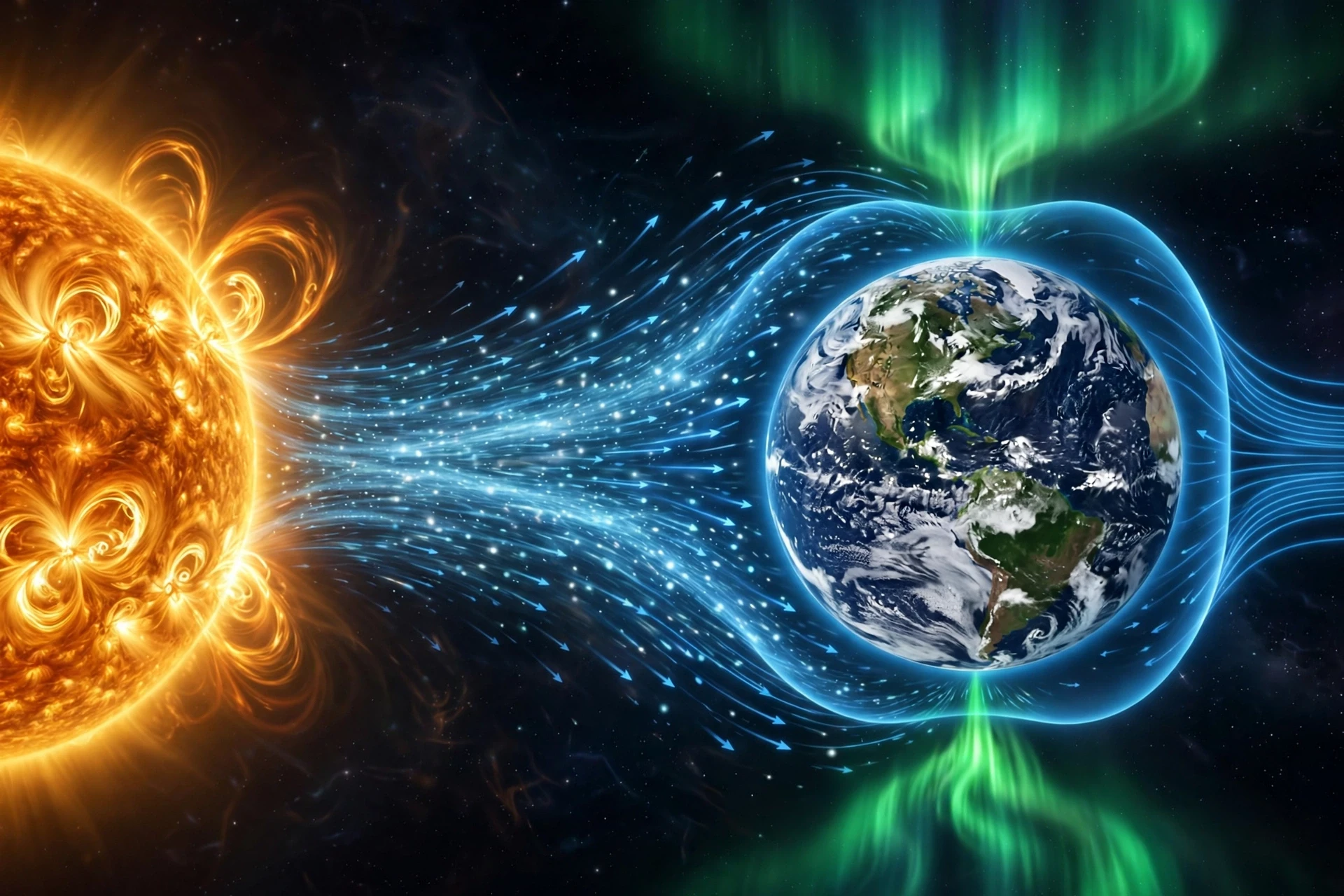
The Sun does not only shine. It also blows, and that wind is a core part of how the sun works as a star that shapes its whole system. The solar wind is a continuous stream of charged particles — mostly protons and electrons — flowing outward from the corona in all directions at speeds of roughly 400 to 800 kilometres per second. It is not a wind in the Earthly sense, with air and gusts and breezes. It is a wind of plasma, so thin that you would never feel it, yet so vast that it fills the entire solar system, pushing past the planets and out beyond Pluto, until it finally runs into the thin gas between the stars. The boundary where the solar wind gives way to interstellar space is called the heliopause, and the Voyager 1 spacecraft crossed it in 2012, becoming the first human-made object to leave the Sun's bubble.
Where does the solar wind come from? The corona is so hot that its particles have enough energy to escape the Sun's gravity, and the Sun's magnetic field guides them outward along open field lines. The wind is not uniform: fast wind streams out of dark regions in the corona called coronal holes, while slower, denser wind comes from the regions around the Sun's equator. NOAA's page on the solar wind explains the two types and how forecasters track the streams, because fast wind from a coronal hole can stir up geomagnetic activity when it reaches Earth, even without a flare or a CME.
7.2 The magnetosphere: Earth's shield
If the solar wind blew straight onto Earth's surface, it would strip away our atmosphere over time and make the surface a much harsher place. What saves us is Earth's magnetic field, which acts as a shield. The field deflects most of the solar wind around the planet, forming a protective bubble called the magnetosphere — a comet-shaped region with a rounded front facing the Sun and a long tail stretching away from it. The magnetosphere is invisible, but it is one of the most important features of our planet: without it, Earth would look much more like Mars, which lost most of its atmosphere long ago, partly because its global magnetic field died and the solar wind was free to scour its air away into space.
This is also where the story connects to how gravity works and to the life cycle of stars: the Sun's gravity holds the solar system together, its fusion sets the energy budget, and its wind shapes the environment every planet lives in. The planets that keep their atmospheres are, by and large, the ones with magnetic fields strong enough to stand up to the wind, or far enough away that the wind has thinned to a whisper by the time it arrives.
7.3 Space weather: the forecast that matters
"Space weather" is the name for the changing conditions in the space around Earth, driven by the Sun. It covers solar flares, CMEs, the solar wind, and the geomagnetic storms they cause, and it matters for reasons that would have sounded like science fiction a generation ago. Satellites can be damaged by charged particles and can lose altitude when the upper atmosphere heats up and expands during a storm. GPS signals can be degraded, which matters for aircraft navigation and for the timing systems that banks and power grids rely on. Radio communications, especially the high-frequency radio used by aircraft over the poles, can be blacked out. Astronauts on the International Space Station shelter in the most shielded parts of the station during major storms, and future crews travelling to the Moon or Mars will need storm shelters of their own.
Forecasting space weather is a young science, and it is harder than forecasting Earth's weather in one important way: we cannot put weather stations in space everywhere we would like them. Forecasters rely on a small number of satellites, including the Solar and Heliospheric Observatory (SOHO) and the Deep Space Climate Observatory, which sit at a gravitationally stable point between Earth and the Sun and give us about an hour's warning of an incoming CME. An hour is not much, but it is enough for power companies to reduce load on vulnerable transformers, for satellite operators to put spacecraft into safe mode, and for airlines to reroute polar flights. The goal is a forecast as routine and reliable as tomorrow's rain forecast, and we are getting closer to it every year.
8. How the Sun Shapes Life on Earth
8.1 Light, heat, and the sky we see
The most obvious way the Sun affects Earth is also the most important, and it follows directly from how the sun works: it supplies nearly all the energy that drives our planet's climate, weather, and life. Sunlight powers photosynthesis, which feeds almost every food chain on Earth. It heats the oceans and the land unevenly, and that uneven heating drives the winds and the water cycle. It sets the day-night cycle that every organism on Earth has evolved around, and the seasons that shape agriculture, migration, and reproduction. Without the Sun, Earth would be a frozen rock in about a week.
The Sun also shapes what we see. The blue of the sky is a direct result of sunlight interacting with Earth's atmosphere: air molecules scatter short blue wavelengths far more than long red ones, so the sky looks blue and sunsets look red. That is the short version of a story told in full in our article on why the sky is blue, and it is worth reading alongside this one, because the two together explain both the light and the air it travels through. The Sun provides the light; the atmosphere does the rest.
8.2 Aurorae: the Sun's light show
The most beautiful effect of the Sun on Earth is also the most direct. When charged particles from the solar wind or a CME slip past Earth's magnetic shield near the poles, they collide with oxygen and nitrogen atoms in the upper atmosphere, and those atoms glow. Oxygen glows green and red; nitrogen glows blue and purple. The result is the aurora borealis in the north and the aurora australis in the south — curtains, arcs, and ribbons of light that ripple across the sky in a display that has awed people for as long as there have been people to watch.
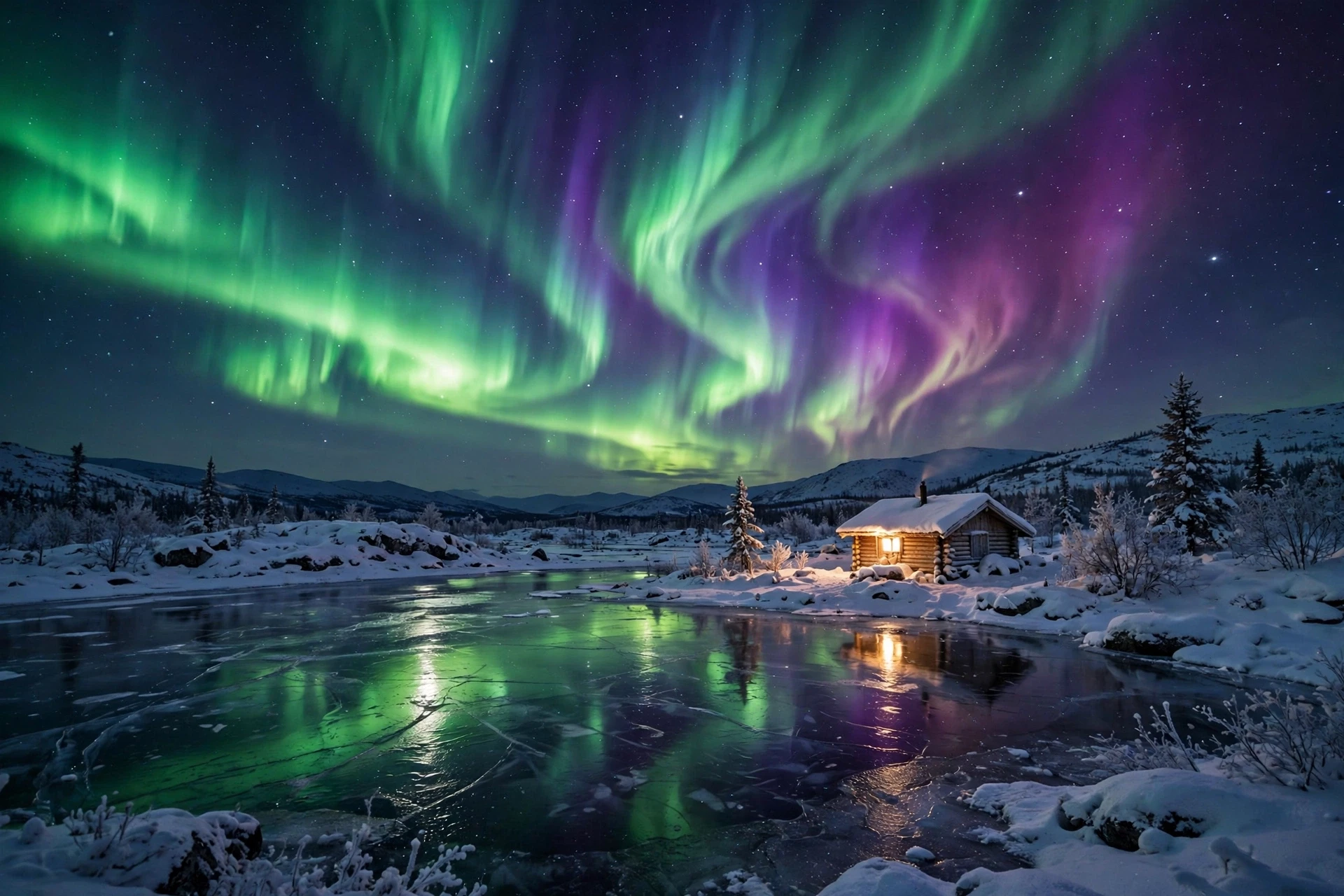
I have never seen a strong aurora in person, and I am honest about that rather than inventing a story. I have seen the photographs and the videos, and I have watched the aurora forecasts the way other people watch the weather, waiting for a solar storm strong enough to push the lights far enough south for me to see them. What strikes me most is that the aurora is a collision made visible: a stream of particles from a star, meeting the thin air of a planet, and turning into light. It is the solar wind, rendered as art, and it is the clearest proof that space weather is not an abstraction. It is something you can stand outside and watch.
Aurorae are also a useful diagnostic. When the aurora appears at unusually low latitudes, it means a major geomagnetic storm is under way, and forecasters take note. During the Carrington Event, aurorae were seen in Hawaii and the Caribbean. During the Halloween storms of 2003, they were seen in Texas and the Mediterranean. The farther south the lights reach, the stronger the storm.
8.3 The Sun and the climate: what it does and does not explain
This is the part where precision matters most, because the Sun's role in climate is one of the most misunderstood topics in all of science. The Sun is the main driver of Earth's climate system — that is not in doubt, and nobody who studies climate disputes it. What is also well established, from satellite measurements running since the late 1970s, is that the Sun's total energy output has not increased over the past few decades, while Earth's average temperature has risen sharply. The Sun's brightness varies by only about 0.1 percent over the 11-year solar cycle, and the cycle's ups and downs do not line up with the steady warming trend of the last fifty years. In fact, the most recent solar cycles have been weaker than average, while temperatures have continued to climb.
That distinction is explained carefully in our article on climate change, and it is worth stating plainly here: the Sun sets the climate's baseline, and small changes in its output have mattered in the past — the Maunder Minimum and the Little Ice Age are real examples — but the rapid warming of recent decades is driven by greenhouse gases trapping heat in the atmosphere, not by the Sun getting brighter. Confusing the two is one of the most common mistakes in public discussion of climate, and it is a mistake that dissolves the moment you look at the data: the Sun's output has been flat or slightly falling, and the temperature has gone up. Both facts can be true at once, because the Sun is not the only thing that sets Earth's temperature. The atmosphere's composition matters too, and it is the atmosphere that has changed.
9. The Sun's Future: From Steady Star to Red Giant
9.1 Five billion years of steady burning
The Sun is about 4.6 billion years old and roughly halfway through its main-sequence life. It will keep fusing hydrogen in its core for about another five billion years, growing slowly brighter as it goes. That slow brightening is already under way, and over the next billion years or so it will make Earth's climate progressively hotter — long before the Sun itself does anything dramatic, the oceans will begin to evaporate and the planet will become uninhabitable for complex life. That is a sobering thought on a cosmic scale, and a completely irrelevant one on any human scale: a billion years is two hundred times longer than complex life has existed on Earth.
9.2 The red giant phase
When the core hydrogen finally runs out, the Sun will change in a way that is hard to picture without seeing it. The core, now made mostly of helium, will contract and heat up, while the outer layers expand enormously. The Sun will become a red giant, swelling to perhaps two hundred times its current size — large enough to swallow Mercury and Venus, and possibly Earth as well. Its surface will cool to a deep red, but its total brightness will increase enormously because it will be so much larger. The story of the life cycle of stars tells this tale in full, and the Sun's version of it is the gentlest kind of stellar death there is: no supernova, no explosion, just a slow swelling and then a slow fading.
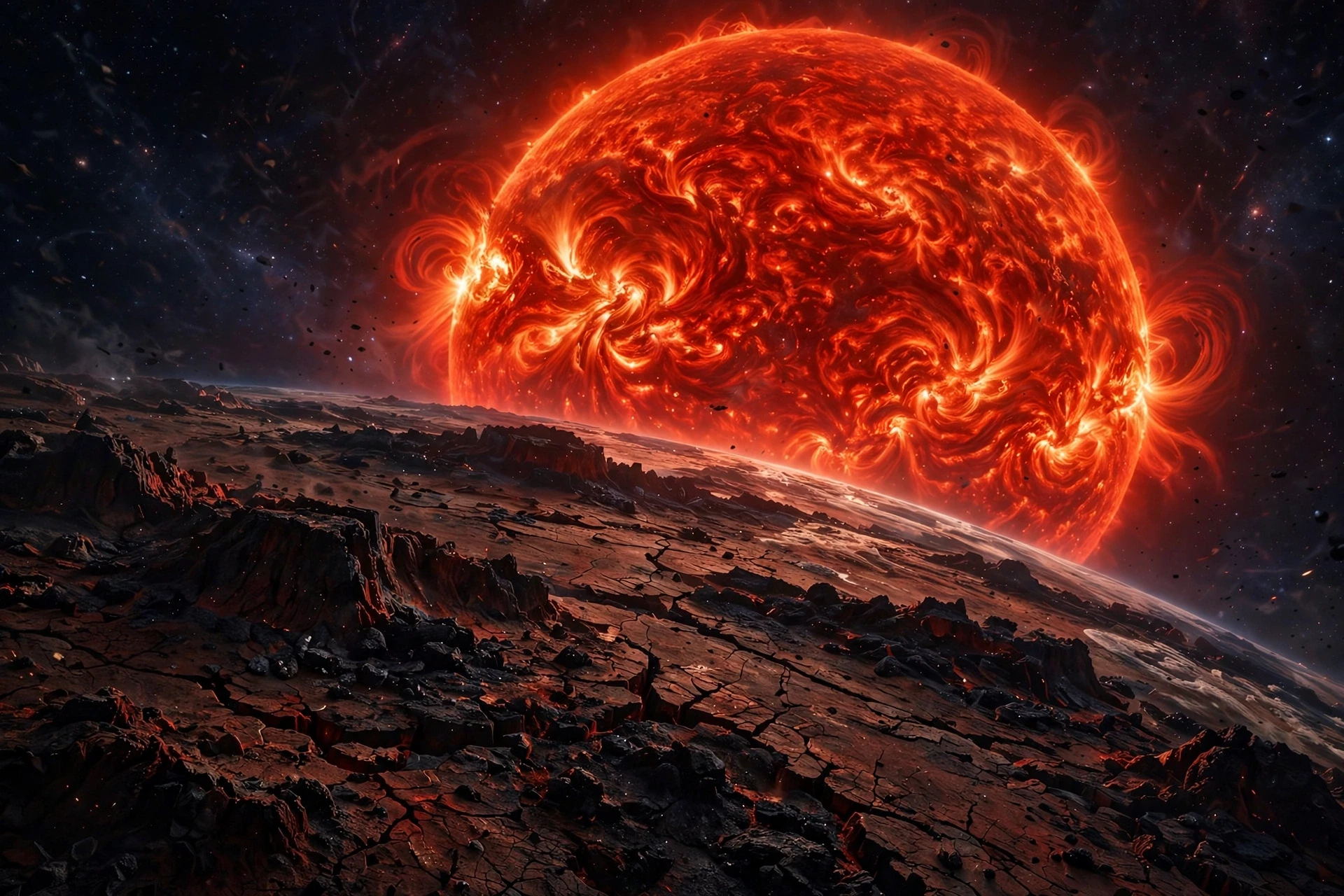
9.3 The white dwarf that remains
After the red giant phase, the Sun will shed its outer layers into space, forming a glowing shell called a planetary nebula — a beautiful, short-lived structure that has nothing to do with planets and everything to do with an old name that stuck. What remains will be the core: a white dwarf, a dense ember about the size of Earth, slowly cooling over billions of years until it fades to black. It will not shine by fusion any more. It will simply cool, like a coal taken out of a fire. The material the Sun sheds will drift into space and eventually become part of new stars, new planets, and perhaps new life. The Sun's atoms will outlive the Sun itself, which is a thought I find less sad than it sounds. Stars are recyclers, and the Sun is no exception.
10. How We Study the Sun
10.1 Watching from Earth
Humans have watched the Sun for as long as there have been humans, but serious solar science is only a few centuries old. Galileo's sunspot observations in 1610 showed the Sun rotates. The discovery of helium in 1868 came from studying sunlight during an eclipse — helium was found on the Sun before it was found on Earth, and it is named after the Greek word for the Sun, helios. Modern ground-based observatories, like the Daniel K. Inouye Solar Telescope in Hawaii, can resolve details on the Sun's surface just tens of kilometres across, and they watch the Sun every clear day.
10.2 SOHO and the view from space
The great leap came with space telescopes. The Solar and Heliospheric Observatory, or SOHO, launched in 1995 as a joint mission of the European Space Agency and NASA, sits at a stable point between Earth and the Sun and has watched the Sun continuously for three decades. Its coronagraph blocks the bright disc so the faint corona and outgoing CMEs can be seen, and it has discovered thousands of comets as a by-product of its constant watching. You can explore its mission and its images at the SOHO mission site, which is still one of the best places on the internet to see what the Sun is doing right now.
10.3 Parker Solar Probe: touching the Sun
The boldest solar mission of all is NASA's Parker Solar Probe, launched in 2018. It is the first spacecraft to fly through the Sun's corona, diving to within a few million kilometres of the surface — closer than any human-made object has ever been to a star. Its heat shield faces temperatures of about 1,400 degrees Celsius while its instruments, tucked safely behind, operate near room temperature. Parker is answering questions that could not be answered from a distance: how the solar wind is accelerated, how the corona is heated, and where the magnetic field lines that shape space weather actually begin. NASA's Parker Solar Probe mission page tells the story of the mission, named after Eugene Parker, the physicist who predicted the solar wind in 1958 and lived to see his prediction confirmed by a spacecraft bearing his name.
10.4 Why it matters
Solar science is not a luxury. Every satellite we launch, every power grid we build, and every astronaut we send beyond Earth's magnetic shield depends on understanding the Sun. The better we can forecast solar storms, the better we can protect the infrastructure that modern life runs on. And there is a deeper reason, too. The Sun is the only star we can study up close. Everything we learn about it — how fusion works, how magnetic fields behave in plasma, how a star's wind shapes its planets — applies to every other star in the universe. The Sun is our local laboratory for stellar physics, and it is open every day.
11. Common Misconceptions About the Sun
Some of the most widespread ideas about the Sun are wrong, and they are worth clearing up one by one, because each wrong idea hides a more interesting truth.
"The Sun is on fire." It is not. Fire is a chemical reaction that needs fuel and oxygen, and there is almost no oxygen on the Sun and no burning in the chemical sense. The Sun shines because of nuclear fusion in its core, a completely different process. A fire would burn out in thousands of years. Fusion has kept the Sun shining for billions.
"The Sun is yellow." It is not. The Sun's light is white: it emits across the whole visible spectrum, and from space, above Earth's atmosphere, it looks white. It looks yellow from the ground because the atmosphere scatters away some of the blue light on its way to our eyes, the same scattering that makes the sky blue. At sunset it looks orange or red for the same reason — the light has travelled through even more air.
"Sunspots are dark holes." They are not holes at all. They are cooler regions of the photosphere, about 2,000 degrees cooler than their surroundings, and they only look dark by contrast. A sunspot isolated from the bright surface around it would still blaze with light.
"The Sun is the biggest star." It is not even close. The Sun is a middle-sized star. Some stars are hundreds of times wider, and the largest known stars would swallow the entire solar system out past Jupiter if they were placed where the Sun is. The Sun looks big to us only because it is close.
"Sunlight reaches Earth instantly." It does not. Light takes about eight minutes and twenty seconds to travel from the Sun to Earth, and the energy in that light took roughly 100,000 years to escape from the core to the surface before it even started the trip.
"The Sun is solid." It is not solid, liquid, or ordinary gas. The Sun is plasma, and it has no hard surface anywhere. The "surface" we see is simply the depth where the gas becomes transparent enough for light to escape.
"Solar flares cause the seasons." They do not. The seasons are caused by Earth's axial tilt, not by the Sun changing its output. Summer happens when your hemisphere tilts toward the Sun, not when the Sun gets hotter.
12. The Star We Live With
Learning how the sun works changes the way you see an ordinary day. A sunrise stops being just a pretty picture and becomes the visible edge of a nuclear furnace, a magnetic storm system, and a wind that fills the solar system — all of it held in balance by physics, all of it eight minutes away by light and a hundred thousand years in the making. The Sun is the reason we are here, the reason the sky is blue, the reason the aurora dances, and the reason we need to watch the sky with instruments as well as with our eyes.
The Sun will outlast every human project, every civilisation, and every species alive today. It will keep shining long after we are gone, and then, in its own good time, it will swell into a red giant and fade into a white dwarf, scattering its atoms to become new stars. That is a long story, and we are lucky enough to live in the middle of it, on a planet with liquid water, a magnetic shield, and an atmosphere that turns starlight into a blue sky. The least we can do is understand the star that makes it all possible. Now you know how the sun works — not as a slogan, but as a machine: fusion in the core, a slow crawl through the radiative zone, a boiling convection zone, a glowing surface, a stormy magnetic atmosphere, and a wind that never stops blowing. Go outside on the next clear day, and look at it — safely, through proper glasses or a projection — and remember what you are looking at. It is a star, and it is ours.
Frequently Asked Questions
How does the Sun produce energy?
The Sun produces energy through nuclear fusion in its core, mainly by the proton-proton chain. Four hydrogen nuclei fuse into one helium nucleus, and the small amount of mass lost in the process is converted into energy, following Einstein's equation E=mc². Every second, the Sun fuses about 600 million tons of hydrogen, converting about 4 million tons of mass into energy.
Why does sunlight take 100,000 years to reach Earth?
The 100,000-year figure is the time the energy takes to escape from the Sun's core through the radiative zone, where photons are absorbed and re-emitted in a random walk. Once the energy reaches the photosphere and escapes as light, it takes only about eight minutes and twenty seconds to cross the 150 million kilometres to Earth.
What is the difference between a solar flare and a coronal mass ejection?
A solar flare is a sudden flash of light and X-rays caused by magnetic reconnection in the corona, and its light reaches Earth in about eight minutes. A coronal mass ejection is a huge cloud of plasma and magnetic field hurled off the Sun, travelling at hundreds to thousands of kilometres per second and taking one to three days to reach Earth. Flares are light; CMEs are matter. Both can disturb Earth's magnetic field, but CMEs are the main cause of major geomagnetic storms.
What causes sunspots?
Sunspots are caused by the Sun's magnetic field. Where the field becomes concentrated and pushes through the surface, it blocks the upward flow of hot plasma from below, so that patch of the photosphere cools by about 2,000 degrees and looks dark by contrast. Sunspots follow an 11-year cycle driven by the solar dynamo in the convection zone.
Can a solar storm damage the power grid?
Yes. A strong geomagnetic storm can induce electric currents in long power lines and pipelines, overheating transformers and tripping protective systems. The March 1989 storm blacked out Quebec for nine hours, and the Carrington Event of 1859 was far stronger. Power companies now monitor space weather forecasts and take protective measures when a major storm is expected.
Is the Sun getting hotter, and is it causing global warming?
The Sun's energy output varies by only about 0.1 percent over the 11-year solar cycle, and satellite measurements show it has not increased over the past few decades while Earth's temperature has risen sharply. The Sun sets the baseline of Earth's climate, but the rapid warming of recent decades is driven by greenhouse gases, not by a brighter Sun.
Will the Sun ever burn out?
The Sun will keep fusing hydrogen for about another five billion years. After that it will swell into a red giant, shed its outer layers, and end its life as a slowly cooling white dwarf. It will not explode as a supernova — it is not massive enough — and it will not simply switch off. Its end will be slow, spread over hundreds of millions of years.