

Introduction
The first time I watched a star die, I was not looking through a telescope. I was standing in a school hall in winter, watching a teacher switch off the lights one by one until only a single bulb glowed at the front of the room. "That," she said, "is what a star does when it runs out of fuel. It does not go out all at once. It changes." That night I did not know it yet, but I had just met the life cycle of stars. I was twelve, and I did not believe her. Stars, in my head, were fixed points, cold and permanent, pinned to the sky the way nails are pinned to a wall. The idea that they had birthdays and death days felt like a trick.
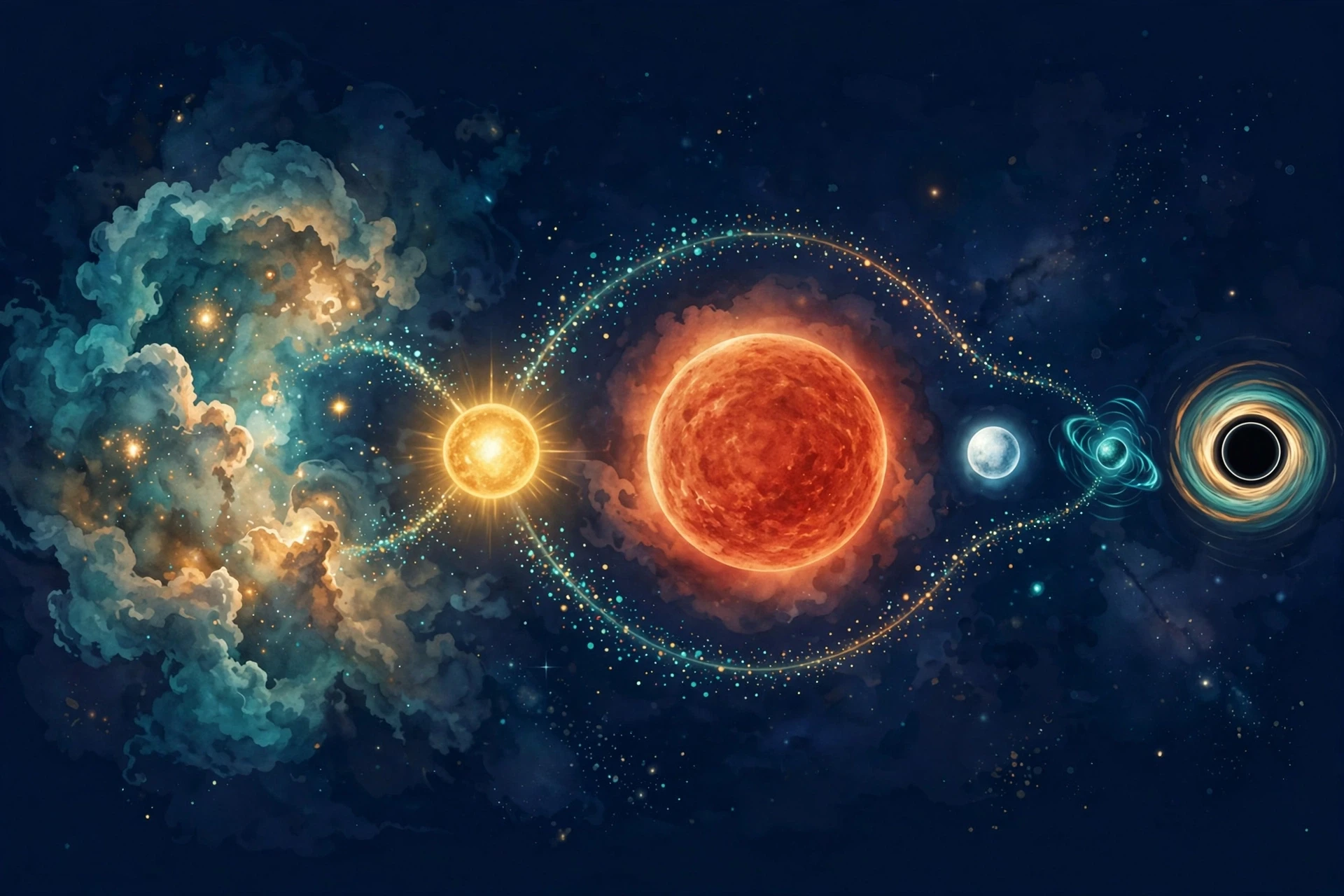
It was not a trick. The life cycle of stars is one of the best-tested stories in all of astronomy: stars are born in cold clouds of gas, spend most of their lives fusing hydrogen into helium, swell into giants when that fuel runs low, and die as white dwarfs, neutron stars, or black holes, depending on how much mass they started with. Nobody has watched a single star go through the whole journey — the shortest stellar lives last millions of years, the longest last trillions — yet we know the story in detail. We know it the way a naturalist knows the life of a forest: by looking at many trees at once, young saplings beside ancient fallen trunks, and reading the whole story from the crowd.
This guide follows that story from beginning to end. You will meet the stellar nurseries where stars are born, the long stable middle age called the main sequence, the dramatic swelling of red giants and red supergiants, and the three very different ways a star can end. Along the way, you will meet the people who worked the story out — the women who classified stars by the thousands, the physicists who realised that sunlight is nuclear fusion, and the observers who watched a star explode in a nearby galaxy in 1987 and checked their theories against the light in real time. You will also learn why the iron in your blood and the calcium in your bones could only have been made inside a star that died before the Sun was born.
1. What the Life Cycle of Stars Actually Means
1.1 A star is a battle that gravity keeps almost losing
A star is a sphere of gas held together by its own gravity. That short definition, from NASA's own introduction to stars, hides a fight. Gravity pulls every part of a star inward, all the time, trying to crush it. The star survives only because something pushes back. Early in its life, the push comes from heat left over from its collapse. Later, it comes from nuclear fusion in the core, where hydrogen nuclei are squeezed together to make helium, releasing the energy that becomes starlight. As long as the inward pull and the outward push balance — a state called hydrostatic equilibrium — the star holds its shape and shines steadily.
The whole life cycle of stars is the story of that balance being struck, lost, and struck again with a new source of energy, until no new source is left. Each time a fuel runs out, gravity wins a round: the core contracts, heats up, and either finds a new fusion reaction to burn or collapses for good. A star's life is not a slow fading. It is a series of truces, each shorter than the last, ending in a collapse that gravity finally wins.
I keep a small stone on my desk from a beach walk years ago, and I use it in teaching. "Hold this up," I tell students, "and feel its weight pulling down. Now imagine your hand is fusion, pushing up. As long as your hand pushes exactly as hard as the stone pulls, the stone stays put. Stop pushing, and it falls." It is a crude model, and the students always laugh at it, but it carries the central idea better than any equation on a slide: a star shines because it is falling, and being caught, at the same time.
1.2 Mass decides almost everything
If you remember one sentence from this guide, make it this one: a star's starting mass decides how long it lives, how brightly it shines, and how it dies. A star born with forty times the Sun's mass burns through its hydrogen in about a million years and ends in a supernova. The Sun, an ordinary middleweight, will spend about ten billion years on the main sequence and end quietly as a white dwarf. The smallest red dwarfs, with a tenth of the Sun's mass, sip their fuel so slowly that they are expected to live for trillions of years — far longer than the universe has existed so far, which is about 13.8 billion years. No red dwarf has ever died of old age. Every red dwarf ever born is still shining.
That rule feels backwards the first time you meet it. A bigger star has more fuel, so it should live longer, the way a bigger petrol tank should carry a car further. The catch is that a bigger star burns its fuel far faster than its extra supply can compensate for. A massive star's core is hotter and its gravity is stronger, so it must fuse hydrogen at a furious rate just to hold itself up. Luminosity rises steeply with mass — roughly as the mass to the power of three and a half — so a star ten times heavier than the Sun shines thousands of times brighter and dies young. The universe's brightest stars are its shortest-lived. The dimmest are its Methuselahs.
Astronomers sort stars by mass into three broad paths. Stars below about eight times the Sun's mass — the Sun included — end as white dwarfs. Stars between roughly eight and twenty solar masses end as neutron stars after a supernova. Stars above about twenty solar masses can end as black holes. The boundaries are approximate, and researchers still argue over the exact numbers, because a star's fate also depends on how much mass it sheds in winds during its life and whether it has a companion star stealing or donating material. The broad picture, though, is settled: mass writes the script, and the star spends its life acting it out.
1.3 How we know a story nobody has watched end to end
The obvious problem with stellar evolution is time. A human life is a blink against a star's billions of years. We cannot watch one star from birth to death. What we can do is look at many stars at once. The sky is full of stars at every stage: collapsing clouds, newborn stars still wrapped in dust, middle-aged stars like the Sun, swollen red giants, glowing planetary nebulae, and the faint embers of white dwarfs. Put them in order, the way you would arrange photographs of strangers by age, and the life story emerges.
Star clusters make the case even stronger. The stars in a cluster were born at about the same time, from the same cloud, with the same chemical mix. They differ mainly in mass. So a single cluster is a controlled experiment: look at which stars have already left the main sequence and which are still on it, and you can read off how mass controls the pace of evolution. OpenStax's Astronomy textbook puts it plainly — clusters provide one of the best tests of our calculations of what happens as stars age, because the turnoff point, where stars leave the main sequence, moves to lower masses as a cluster gets older. That test has been passed again and again, in clusters young and old. You can read the textbook's summary of the whole story here: OpenStax Astronomy, Stars from Adolescence to Old Age.
There is a second line of evidence, and it is the one that first convinced me as a student. The Hertzsprung–Russell diagram, or H–R diagram, plots stars by temperature against brightness. Stars do not scatter randomly across it. They fall into clear groups — the long diagonal band of the main sequence, the giants above it, the white dwarfs below it — and those groups are exactly where the theory of stellar evolution says stars should spend their time. A theory that predicts where stars will sit on a diagram, and then finds them sitting there, has earned its keep.
2. Birth: From Cold Cloud to Protostar
2.1 Stellar nurseries
Stars are born in giant molecular clouds: cold, dark regions of gas and dust, mostly hydrogen, that can span hundreds of light-years and hold thousands to millions of times the Sun's mass. They are cold — only about 10 to 20 kelvin, barely above absolute zero — and so thin that a cubic centimetre of one contains fewer atoms than the best vacuum we can make on Earth. Yet they are the busiest places in the galaxy. Almost every star you have ever seen was born in a cloud like this.
A cloud does not collapse all at once. It is stirred by turbulence, threaded by magnetic fields, and held up by its own feeble warmth. Something has to tip the balance: a shock wave from a nearby supernova, a collision with another cloud, or the pressure wave of a spiral arm sweeping through the galaxy. When a pocket of gas gets dense enough, gravity takes hold of it, and the pocket begins to fall inward on itself. The cloud fragments as it collapses, so one cloud makes not one star but a whole cluster — hundreds or thousands of siblings, born together, of different masses. That is why astronomers call these clouds stellar nurseries. They are not factories that make one product. They are neighbourhoods where many stars grow up at once.
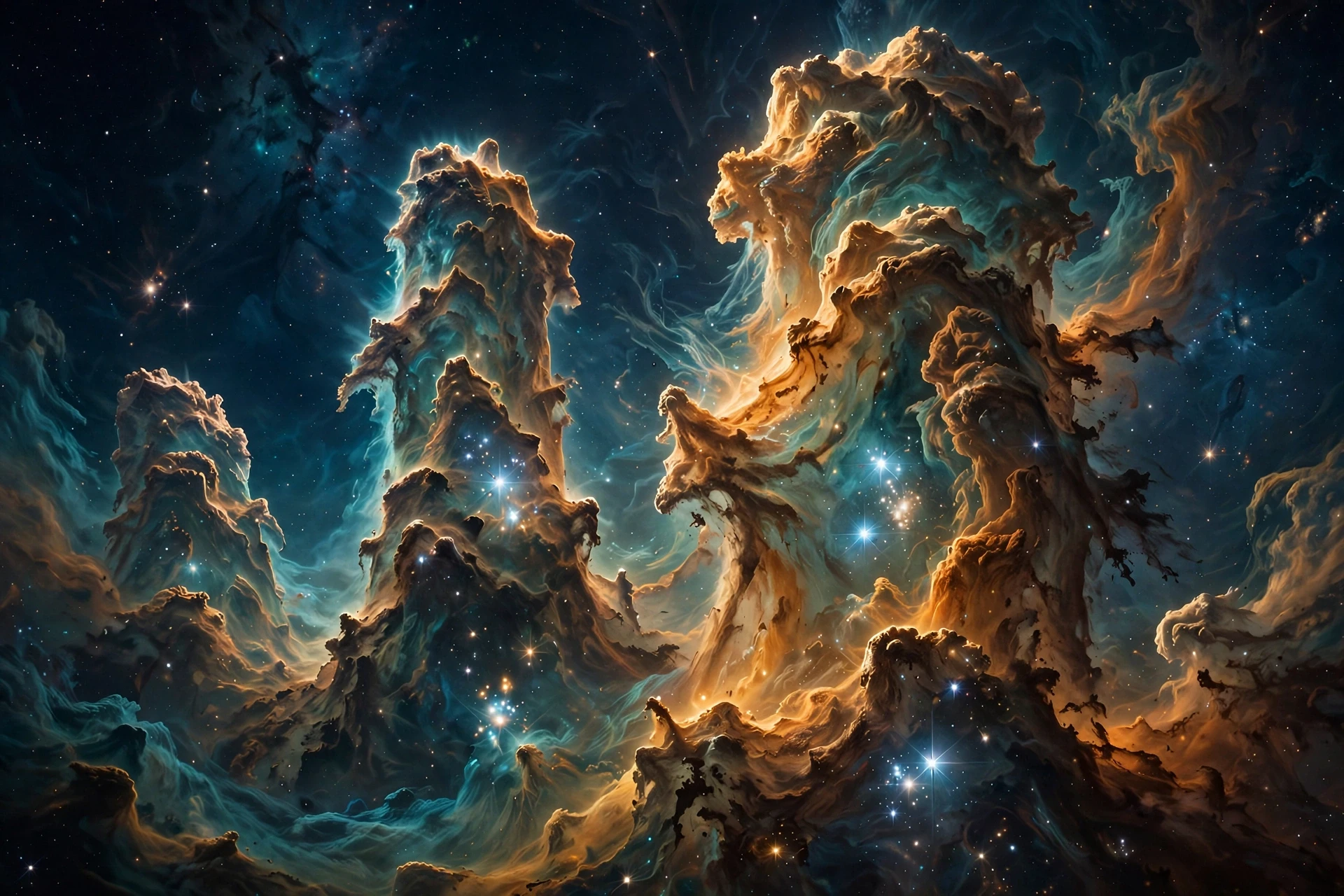
The most famous nursery is the Orion Nebula, a glowing cloud about 1,300 light-years away that you can see with the naked eye on a winter night, as the middle "star" in Orion's sword. The Pillars of Creation in the Eagle Nebula are another, and newer telescopes have changed how we see them. NASA's visualisation of the Pillars, built from Hubble, Webb, Spitzer, and Chandra data, follows the pillars from the scale of the whole Milky Way down to an embedded protostar at the top of the central pillar and jets from a hidden newborn star: NASA, The Pillars of Creation and the Interplay of Stars and Dust. What looks like solid rock in a photograph is gas and dust being sculpted — and slowly eaten away — by the light of the hot young stars at its centre.
2.2 The protostar: a star that is not yet a star
As a pocket of cloud collapses, its centre heats up. The falling gas gains speed, collides, and warms, the way a bicycle pump warms in your hand when you compress air. The hot, dense core at the centre is called a protostar. It is not yet a star in the strict sense, because its core is not yet hot or dense enough for hydrogen fusion. It shines anyway, glowing dull red from the heat of its own contraction, like a coal warming up before it catches.
A protostar is a messy, hungry object. Gas keeps falling onto it through a spinning disk, the same kind of disk that will later make planets — which is why the story of star birth is also the story of planet birth, and why Sciory's guide to Our Solar System: Planets, Moons, and Celestial Dynamics begins, in effect, in a collapsing cloud like this one. The protostar also throws material back out: powerful jets shoot from its poles, carving cavities in the surrounding cloud and carrying away spin, so the star can keep contracting instead of spinning itself apart. If you could watch a protostar for a hundred thousand years — the time a Sun-like protostar spends in this phase — you would see it shrink, heat, and brighten, while its disk thins and its jets fade.
I once spent a long night at an observatory open evening pointing a small telescope at the Orion Nebula while a queue of visitors waited in the cold. A child of about eight asked me where the stars in the nebula came from, and I told her they were being born right now, inside the cloud, hidden by dust. She was quiet for a moment, then said, "So the cloud is a hospital?" I have used her word ever since. A stellar nursery is a hospital, a school, and a building site all at once — and the dust that hides the birth is the same dust that will one day become planets.
2.3 T Tauri stars and the long road to ignition
Before fusion begins, a young Sun-like star passes through a restless phase named after its prototype, T Tauri, a young star in the constellation Taurus. T Tauri stars are variable and stormy: they flare, they flicker, and they blow strong winds that clear away the last of their birth cloud. Their light comes from contraction, not fusion. The star is still shrinking under its own weight, and the heat of that shrinking is what keeps it glowing.
This phase lasts a few million years for a Sun-like star, longer for smaller ones. At the end of it, the core reaches about 15 million kelvin — the temperature NASA's stellar-evolution pages give for the start of hydrogen fusion — and something new begins. Four hydrogen nuclei fuse into one helium nucleus, and a tiny fraction of their mass becomes energy, following Einstein's famous relation between mass and energy. The star stops contracting. It has found its long-term energy source. It has joined the main sequence, where it will spend most of its life. You can read NASA's step-by-step account of this whole journey, from molecular cloud to remnant, here: NASA, Stars — Imagine the Universe.
Not every collapsing pocket makes it. If the core never gets hot enough for sustained hydrogen fusion, the object stalls as a brown dwarf — too massive to be a planet, too light to be a star. Brown dwarfs glow faintly from contraction and from brief deuterium fusion, then cool and fade. They are the near-misses of star birth, and they are common: the galaxy may hold as many brown dwarfs as stars. Their existence tells us something useful about the boundary of stardom. Being a star is not about size alone. It is about reaching the temperature where fusion can carry the star's weight.
3. The Main Sequence: A Star's Long Middle Age
3.1 Fusion, the proton–proton chain, and the CNO cycle
The main sequence is the longest phase in the life cycle of stars, and it is where about nine in ten stars you can see are spending their lives right now, including the Sun. A main-sequence star fuses hydrogen into helium in its core. The details depend on mass. In stars up to about one and a half times the Sun's mass, hydrogen fuses mainly through the proton–proton chain: protons collide, step by step, building helium and releasing energy, with a small fraction of mass converted directly into light and heat. In heavier, hotter stars, a different route dominates, the CNO cycle, in which carbon, nitrogen, and oxygen act as catalysts, helping hydrogen fuse into helium without being used up themselves. The net result is the same — hydrogen becomes helium, mass becomes energy — but the CNO cycle is far more sensitive to temperature, which is one reason massive stars burn so fiercely.
The numbers are worth pausing over, because they show how wasteful and how generous fusion is at the same time. The Sun fuses about 600 million tonnes of hydrogen every second, and about four million tonnes of that mass simply disappears, becoming energy. That sounds enormous until you set it against the Sun's total mass: at that rate, the Sun will spend ten billion years on the main sequence and use only about a tenth of its hydrogen in the process. A star is not an efficient machine. It is a vast reservoir being drained through a narrow straw — and the straw is narrowest for the smallest stars, which is why they last so long.
Here is a common misconception I hear in almost every public talk, and it is worth correcting plainly: most people assume that stars shine because they are burning, the way a fire burns. They are not burning. Burning is chemistry — atoms rearranging their electrons and releasing a modest amount of energy. Fusion is nuclear — atomic nuclei joining together and releasing millions of times more energy per reaction. A star the size of the Sun, powered by chemical burning, would exhaust itself in thousands of years. Powered by fusion, it lasts billions. The difference between fire and fusion is the difference between a candle and a city power station, and it is the whole reason stars can live long enough for planets, and life, to appear around them.
3.2 The Hertzsprung–Russell diagram: the map of stellar lives
In the early 1900s, two astronomers working independently — Ejnar Hertzsprung in Denmark and Henry Norris Russell in the United States — plotted stars by their temperature and their brightness and found order where others had seen scatter. Hot stars are blue, cool stars are red, and most stars fall on a diagonal band running from hot, bright blue stars at the top left to cool, dim red stars at the bottom right. That band is the main sequence. Above it sit the giants and supergiants, below it the white dwarfs. The H–R diagram is still the single most useful map in stellar astronomy, because a star's position on it tells you its temperature, its brightness, its size, and — once you understand the theory — its stage of life.
The story of how the diagram was filled in belongs largely to women whose names were left out of the textbooks for decades. At Harvard Observatory, under Edward Pickering, a team of women computers — including Annie Jump Cannon, who classified hundreds of thousands of stars by their spectra, and Henrietta Swan Leavitt, whose work on variable stars gave astronomers a way to measure distances across the universe — did the patient, exacting work of sorting starlight. Cannon's spectral classes, O, B, A, F, G, K, M, from hottest to coolest, are still the alphabet of stellar astronomy. The Sun is a G-type star, yellow-white, middling in every way, and entirely typical — which is exactly why it is such a useful standard. When I teach the H–R diagram, I start with Cannon and Leavitt, because the map is only as good as the data behind it, and the data behind it was measured, classified, and checked by hand, star by star, by people who were paid a fraction of what their male colleagues earned and who changed astronomy anyway.
The H–R diagram is a map of stellar lives. A star enters it on the main sequence, leaves it as a giant, and ends below it as a remnant — and where it sits at any moment tells you how its story is going.
3.3 The Sun at middle age
The Sun is about 4.6 billion years old, and it is roughly halfway through its main-sequence life. That single fact frames everything about our own place in the story. The light that warms your face left the Sun's surface eight minutes ago, but the energy behind it was made in the core tens of thousands of years ago, taking that long to fight its way outward through the dense interior, absorbed and re-emitted countless times. The Sun you see is, in a real sense, an old photograph of its own core.
On the main sequence, the Sun is slowly changing even while it looks stable. As hydrogen fuses into helium, the core gets denser and hotter, and the Sun gets gradually brighter — about ten percent brighter every billion years. Four billion years ago, it shone about thirty percent fainter than it does now, a puzzle called the faint young Sun paradox, since the early Earth was warm enough for liquid water and, eventually, life. The resolution involves a thicker early atmosphere with more greenhouse gases, and it is a reminder that a star's life and a planet's climate are one coupled story, not two. The same slow brightening will shape the Earth's far future: in about a billion years, the Sun's extra light will likely boil the oceans away, long before the Sun itself leaves the main sequence. The end of habitability comes well before the end of the star.
The Sun's stability is what makes life possible, and it is also what makes the main sequence easy to take for granted. A main-sequence star looks unchanging from one human lifetime to the next, and it is tempting to think of it as static. It is not. It is a controlled, self-regulating furnace: if the core gets hotter, fusion speeds up, the star expands slightly and cools; if it gets cooler, fusion slows, the star contracts and heats. That thermostat is the reason the main sequence lasts so long. It is also the reason the thermostat's failure, when the fuel finally runs out, is so dramatic.
4. Leaving the Main Sequence: Red Giants and Red Supergiants
4.1 The core runs out of hydrogen
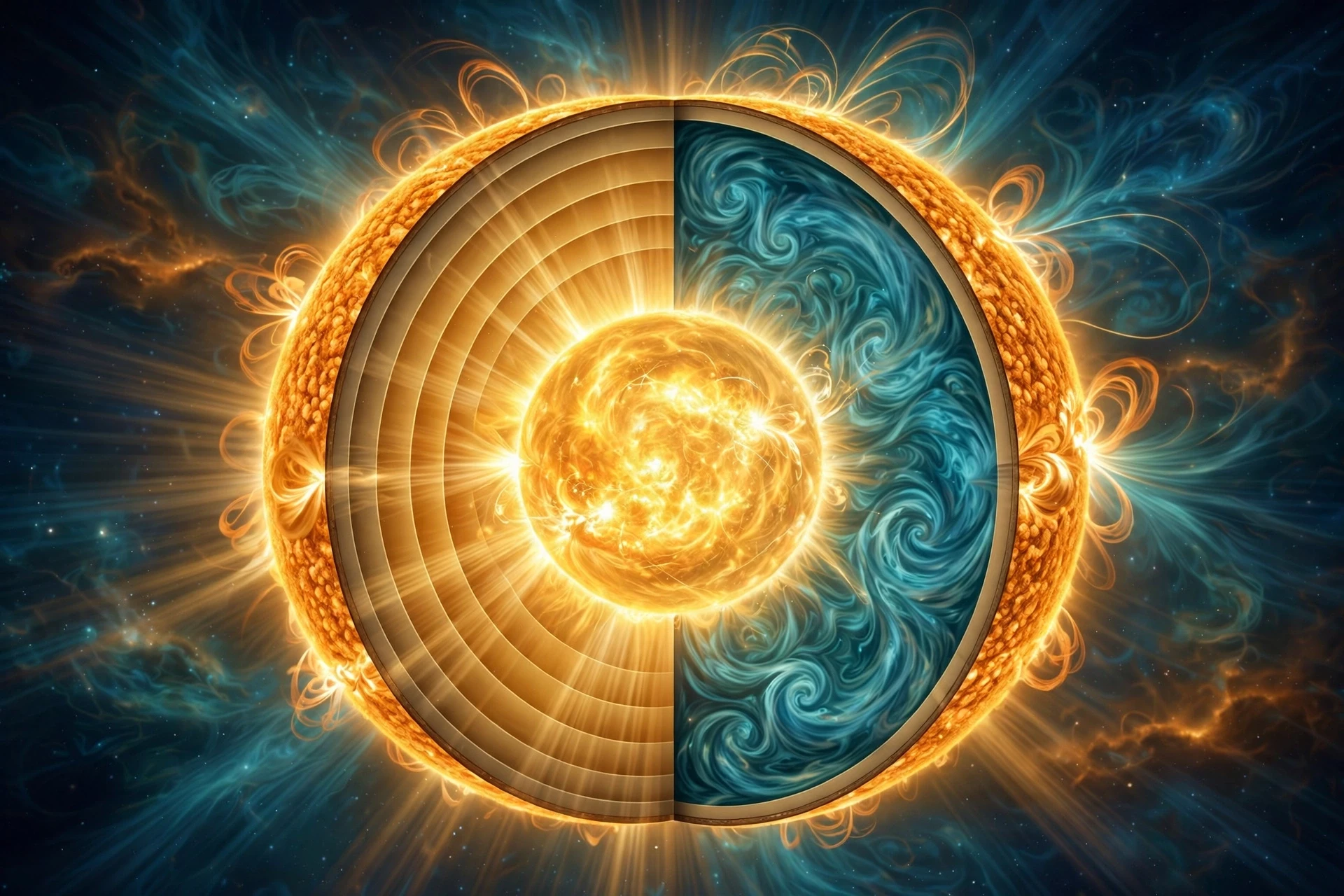
Every main-sequence star eventually faces the same crisis: the hydrogen in its core runs out. Hydrogen keeps fusing in a shell around the core, where fresh fuel remains, but the core itself is now mostly helium, and helium will not fuse at the temperatures a Sun-like core can reach. With no energy coming from the core, gravity takes a round back. The core contracts under its own weight, and as it contracts it heats up — the same way a bicycle pump warms when you squeeze it. The shell around it burns hotter. The extra energy pours into the star's outer layers, and they do something that still surprises students when they first hear it: they expand, and they cool.
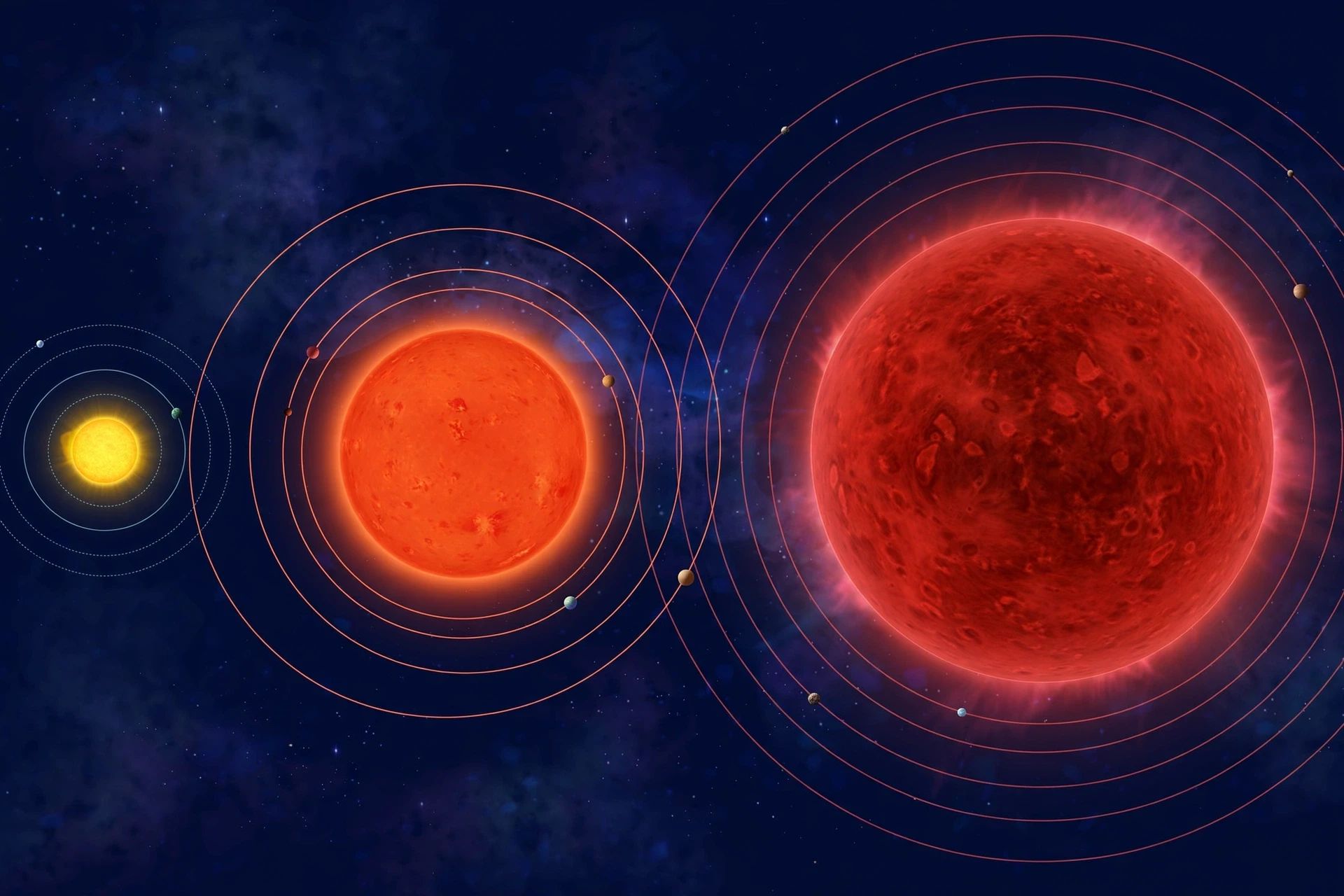
The result is a red giant. The star can swell to a hundred times its former size or more, while its surface cools to a reddish glow. It is far brighter than before, because its surface is so much larger, even though each square metre of it is cooler. The Sun, in about five billion years, will become a red giant large enough to swallow Mercury and Venus, and possibly Earth. That is not a distant abstraction. It is the forecast for our own star, written into the same physics that keeps it shining today.
I remember the first time I worked through the red-giant numbers as a student and realised that the Sun's surface, which is now about 5,800 kelvin, would cool to about 3,000 kelvin while the star grew a hundredfold. My first instinct was that cooling should mean dimming. It does not, because brightness depends on total surface area as well as temperature, and the area grows faster than the temperature falls. A red giant is a cool star that is brighter than the Sun. The colour of a star tells you its surface temperature, not its total power — a distinction that trips up almost everyone at first, and one worth holding onto whenever you look at the night sky.
4.2 Helium burning, the helium flash, and the asymptotic giant branch
For a Sun-like star, the contracting helium core eventually reaches about 100 million kelvin, hot enough for helium nuclei to fuse into carbon through the triple-alpha process — three helium nuclei joining to make one carbon nucleus. In a low-mass star, the core is supported by electron degeneracy pressure, a quantum effect that does not respond to temperature the way ordinary gas does, so the ignition of helium runs away briefly in an event called the helium flash. The core burns helium furiously for a few seconds, then settles into steady helium burning. The flash is invisible from outside; the star's outer layers barely notice. It is one of the quietest explosions in astronomy, and one of the strangest: a runaway nuclear reaction, contained, in the heart of a star, with no visible sign on the surface.
After helium burning, the star climbs the asymptotic giant branch, or AGB, swelling again, pulsing, and shedding mass in strong winds. It is in this phase that a Sun-like star makes most of the carbon and some of the oxygen that will later seed new stars and planets. The AGB star is also a factory for stardust: its cool outer layers are the right place for solid grains to condense, and those grains — literal specks of star stuff — are blown into space, where they will become part of the next generation of clouds. Some of the dust in meteorites that fall to Earth today can be traced, grain by grain, to AGB stars that died before the Sun was born.
4.3 The massive path: red supergiants and onion layers
A massive star, born with more than about eight times the Sun's mass, takes a different road after the main sequence. It swells into a red supergiant, a star so large that if you placed it where the Sun is, its surface would reach beyond the orbit of Jupiter. Betelgeuse, the orange-red star on Orion's shoulder, is the nearest and most famous example. It is about 700 light-years away, roughly fifteen times the Sun's mass, and thousands of times brighter. It is also a star in its late stages, burning helium in its core and heading, on a timescale of about a hundred thousand years, toward a supernova. NASA's account of Betelgeuse explains how its dramatic dimming in late 2019 — the Great Dimming, when it faded by about sixty percent — turned out to be a huge blob of surface material thrown into space, cooling into dust that blocked the star's light, rather than a sign that the explosion was imminent: NASA, What is Betelgeuse?.
Inside a red supergiant, fusion builds an onion-like structure: hydrogen burning in an outer shell, then helium, then carbon, then neon, oxygen, and silicon, each in its own layer, each burning faster than the one before. The last stages are frantic. Carbon burning lasts centuries. Neon burning lasts about a year. Oxygen burning lasts months. Silicon burning lasts about a day. The core is racing through its remaining fuels, and each stage leaves a heavier ash behind, until the core is iron. Iron is the end of the line for fusion as an energy source, because fusing iron takes energy in rather than giving it out. When the core turns to iron, the star has no more truces left to make. What happens next is the most violent event in the life of an ordinary star.
5. How a Sun-Like Star Dies: Planetary Nebulae and White Dwarfs
5.1 Shedding the envelope
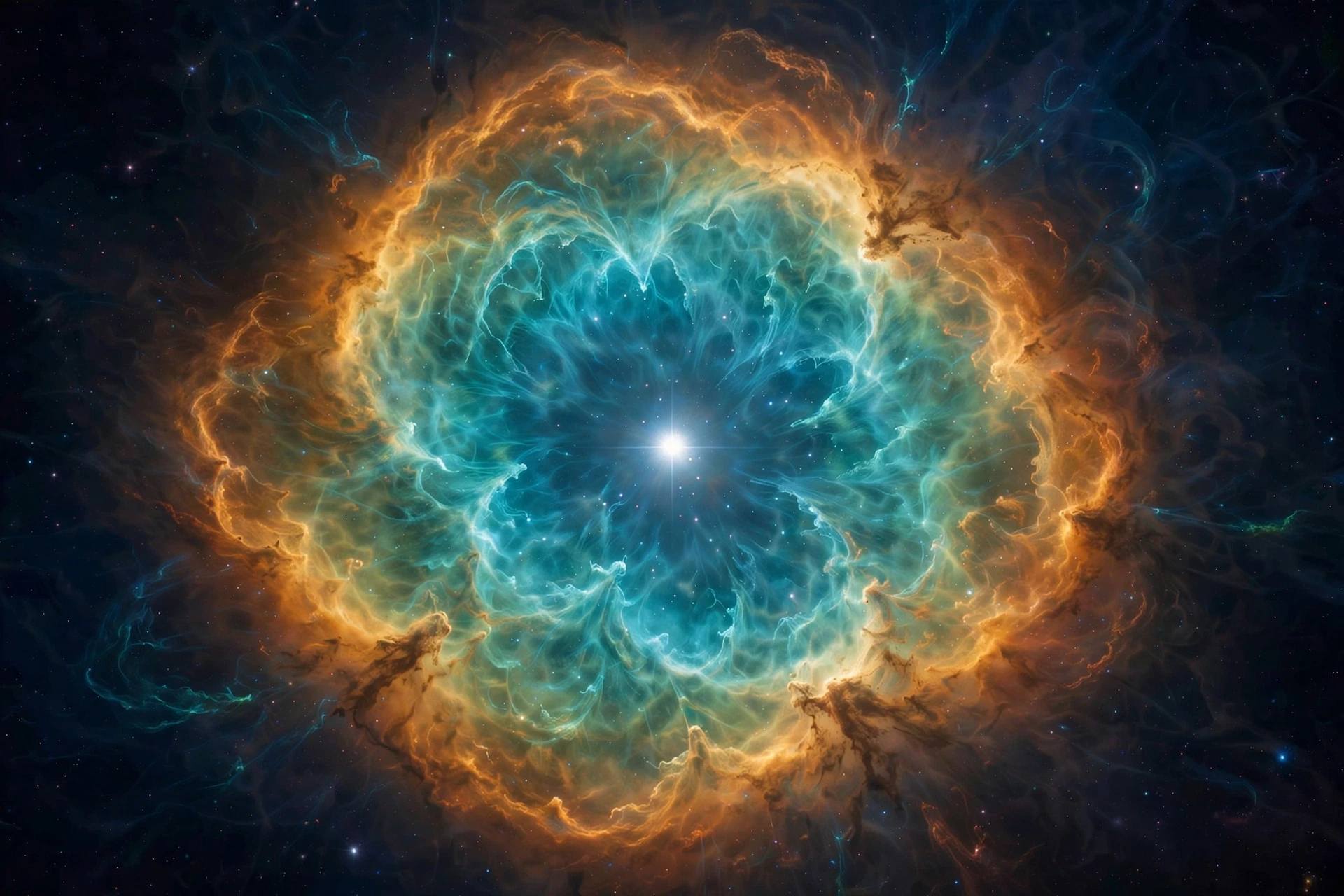
A Sun-like star does not explode. It exhales. On the asymptotic giant branch, its outer layers are only loosely held, and its pulsing winds strip them away over tens of thousands of years. The star loses as much as half its mass this way, and the ejected gas drifts outward, lit from within by the hot core that is being exposed. The result is a planetary nebula — a glowing shell of gas that has nothing to do with planets. The name is a historical accident: early telescopes showed these round, glowing objects, and astronomers thought they looked like planets. The name stuck, and the mistake is a useful reminder that astronomy's vocabulary was built by people looking through fog, doing their best.
Planetary nebulae are among the most beautiful objects in the sky, and they are also brief. A typical one lasts only a few tens of thousands of years before its gas disperses into the interstellar medium. The Ring Nebula, the Cat's Eye, the Helix — each is a star's outer layers, thrown off and lit up, expanding into space at tens of kilometres per second. The gas they carry is enriched with carbon, nitrogen, and oxygen made inside the star. That enrichment matters. The next generation of stars, and the planets around them, will be built from it.
5.2 The white dwarf: a star the size of Earth
What is left behind after the envelope departs is the star's core: a white dwarf, a ball of carbon and oxygen about the size of the Earth, containing about half the Sun's mass, packed into a volume a million times smaller than the star it came from. A teaspoon of white dwarf material would weigh about as much as a car. The white dwarf is held up not by fusion — there is none left — but by electron degeneracy pressure, the quantum rule that electrons cannot be squeezed into the same state. It is hot at first, tens of thousands of kelvin, glowing white from stored heat, and it cools slowly over billions of years, fading through yellow and red toward black.
A white dwarf is a stellar ember, and its cooling is so slow and so predictable that astronomers use white dwarfs as clocks, dating star clusters by the faintest, coolest white dwarfs they contain. The oldest white dwarfs in the galaxy are still warm. No white dwarf has had time to cool completely into a black dwarf — a cold, dark, inert cinder — because the universe is not old enough. The black dwarf is a prediction, not an observation. It is the final state of most stars, and it lies in a future so distant that the Sun's white dwarf will still be glowing when the Earth is long gone.
There is one more twist in the white dwarf's story, and it involves a limit discovered by a young physicist on a boat. In 1930, Subrahmanyan Chandrasekhar, a 19-year-old travelling from India to England, worked out that electron degeneracy pressure can only hold up so much mass: about 1.4 times the Sun's mass. A white dwarf heavier than that cannot exist in stable form. If a white dwarf in a binary system steals enough mass from its companion to cross the Chandrasekhar limit, it collapses and detonates as a Type Ia supernova, an explosion so consistently bright that astronomers use it as a standard candle to measure the expansion of the universe. It was these supernovae, found in distant galaxies in 1998, that revealed the expansion is speeding up — a discovery that won the Nobel Prize and rewrote cosmology, as told in Sciory's The Big Bang Theory Explained: How the Universe Began and Evolved. A quiet stellar ember, pushed past its limit, ended up changing our picture of the whole universe.
6. How a Massive Star Dies: Supernova, Neutron Star, Black Hole
6.1 Core collapse in less than a second
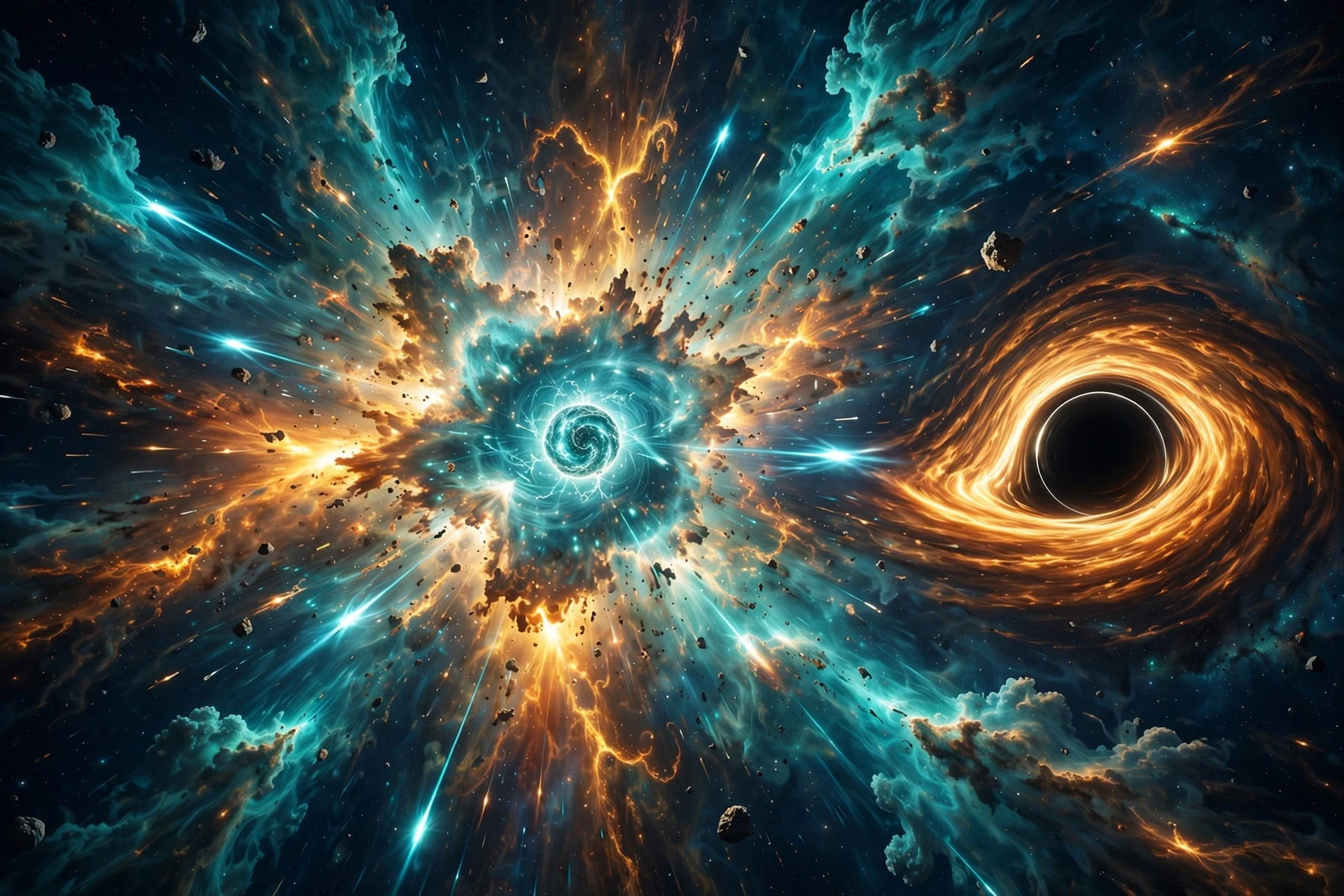
When a massive star's core turns to iron, the end comes fast. Iron fusion absorbs energy instead of releasing it, so the core loses its support in a fraction of a second. It collapses from a ball the size of the Earth to a ball about twenty kilometres across — roughly the size of a city — in less time than it takes to blink. The collapse stops only when the core becomes so dense that neutrons are pressed together and neutron degeneracy pressure, with help from the strong nuclear force, halts the fall. The infalling outer layers hit that suddenly rigid core and rebound, driving a shock wave outward that tears the star apart.
That rebound is a supernova, a core-collapse supernova, and it is one of the most energetic events in the universe. For a few weeks, a single exploding star can outshine its entire host galaxy. About three quarters of the star's mass is blasted into space at a tenth of the speed of light. The light, the heat, and the flood of neutrinos — nearly all the energy of the collapse escapes as neutrinos, ghostly particles that pass through almost everything — carry the news across the universe. In 1987, a supernova exploded in the Large Magellanic Cloud, a nearby galaxy, and it was close enough that neutrino detectors on Earth caught a burst of neutrinos hours before the light arrived. SN 1987A, as it was named, gave astronomers a live test of the core-collapse model, and the model passed: the neutrinos arrived when theory said they should, in the numbers theory predicted, from a star whose death had been forecast by its mass and its life story.
6.2 Neutron stars: a city with the mass of a Sun
If the collapsing core is between about 1.4 and 5 times the Sun's mass, it becomes a neutron star: a ball of neutrons about twenty kilometres across, holding more mass than the Sun. Its density is beyond everyday comparison — a teaspoon of neutron star material would weigh about a billion tonnes, roughly as much as a mountain. Its surface gravity is about two hundred billion times Earth's. Its magnetic field is trillions of times stronger than Earth's. And it spins, fast: a newborn neutron star can rotate hundreds of times a second, sweeping beams of radio waves around like a lighthouse. When those beams happen to point at Earth, we see a pulsar, flashing with clock-like regularity.
Pulsars are among the most precise clocks in nature. The first pulsar was found in 1967 by Jocelyn Bell Burnell, then a graduate student at Cambridge, who noticed a strange, regular pulsing signal in radio data that her colleagues at first dismissed as interference — and, for a time, half-jokingly, as a signal from little green men. Bell Burnell checked, re-checked, and insisted the signal was real and astronomical. It was the first neutron star ever found, and the Nobel Prize for the discovery went to her supervisor, not to her — a decision that is still discussed as one of the great injustices in the history of the prize. I tell this story every time I teach pulsars, because the science and the human story belong together. The signal was found by someone who was told, in effect, that she was seeing things, and who trusted her data anyway.
Neutron stars are not just curiosities. When two neutron stars collide, they make a kilonova, an explosion that forges heavy elements — gold, platinum, uranium — in a spray of neutrons and releases gravitational waves that we can now detect directly. The collision observed in 2017, GW170817, was seen in gravitational waves and in light across the spectrum, and it confirmed that neutron star mergers are a major source of the heaviest elements in the universe. The gold in a wedding ring was probably made in a collision like that, billions of years ago, before the Sun was born.
6.3 Black holes: when even neutrons give way
If the collapsing core is heavier still — roughly above five solar masses, though the exact boundary depends on the details — then not even neutron degeneracy pressure can hold it up. The collapse continues, and the core becomes a black hole: a region where gravity is so strong that nothing, not even light, can escape from inside its event horizon. The star that was once millions of times brighter than the Sun ends as darkness.
Black holes formed from dying stars are called stellar-mass black holes, and they are the smallest kind. They grow by swallowing gas and by merging with other black holes, and the mergers send gravitational waves rippling across the universe — waves first detected in 2015, a century after Einstein predicted them. The connection between stellar death and black holes is told in detail in Sciory's Black Holes Explained: Formation & Properties, and the quantum physics that governs the crushed matter at the heart of these objects links, in ways researchers are still working out, to the strange rules explored in Sciory's Understanding Quantum Mechanics. What a black hole does to the matter it swallows is still one of the open questions of physics. What we know is that the most massive stars end by vanishing behind a horizon, leaving behind only their gravity.
7. Remnants Compared: Three Ways to Be a Dead Star
The three remnants look nothing alike, and comparing them side by side shows how much a star's starting mass matters, even after the star is gone.
Remnant | Comes from | Size | Mass | What holds it up | Typical fate |
|---|---|---|---|---|---|
White dwarf | Stars below ~8 solar masses | About the size of Earth (~12,000 km) | Up to ~1.4 solar masses | Electron degeneracy pressure | Cools slowly over billions of years toward a black dwarf |
Neutron star | Stars of ~8–20 solar masses | About 20 km across — the size of a city | About 1.4–5 solar masses | Neutron degeneracy pressure | Spins as a pulsar, slows over millions of years; may merge in a kilonova |
Black hole | Stars above ~20 solar masses | Event horizon a few km to tens of km across | Above ~5 solar masses | Nothing escapes; gravity dominates completely | Grows by accretion and mergers; evaporates only over immense timescales |
The numbers in the table are approximate, and astronomers argue over the boundaries. The boundary between neutron star and black hole, in particular, depends on the physics of matter at densities we cannot reproduce on Earth, and new gravitational-wave detections keep refining it. That uncertainty is not a weakness of the story. It is the story working as science should: a clear framework, with edges that new data keeps sharpening.
One more comparison matters, because it corrects a picture many people carry in their heads. A white dwarf is not a failed star, and a neutron star is not a broken one. Each is a stable, long-lived object in its own right, held up by quantum rules that have no everyday equivalent. A white dwarf will outlive the Sun's red-giant phase by billions of years. A neutron star's magnetic field and spin make it one of the most extreme laboratories in nature. The remnants are not the leftovers of the story. They are its last chapter, and it is a long one.
8. Why Stellar Death Matters: We Are Made of Dead Stars
8.1 The elements in your body were forged in stars
The hydrogen in your body is ancient, made in the first minutes of the universe, as told in Sciory's The Big Bang Theory Explained: How the Universe Began and Evolved. Everything heavier was made in stars. The carbon in your cells was fused in a red giant. The oxygen you breathe was made in a massive star. The iron in your blood was forged in the last burning stages of a star that ended as a supernova, and the gold, silver, and uranium in the Earth's crust were made in the violence of supernovae and neutron star mergers. The calcium in your bones, the sodium in your nerves, the phosphorus in your DNA — all of it passed through a star.
This is the fact that makes the life cycle of stars personal, and it is why the chemical elements are arranged the way they are in Sciory's Periodic Table of Elements: Structure & Trends. The periodic table is, in part, a record of stellar history. The light elements are the oldest. The heavy ones are the newest, and the rarest, because they could only be made in the rarest and most violent events. When astronomers say we are made of star stuff, they are not being poetic. They are describing a supply chain: a star lived, died, scattered its contents, and that scattered material became the cloud that became the Sun, the Earth, and us.
8.2 Recycling: the next generation
Stellar death is also stellar birth, because the gas a dying star throws off does not vanish. It joins the interstellar medium, mixes with fresh gas, cools, and becomes part of the next generation of molecular clouds. Each generation of stars is a little richer in heavy elements than the last, which is why the Sun, a third-generation star by some reckoning, has enough carbon, oxygen, silicon, and iron to make rocky planets, while the first stars, born from almost pure hydrogen and helium, could make none. The first stars were enormous, brilliant, and short-lived, and they left no planets behind. We live in a later, richer universe because earlier stars died and gave their material back.
That recycling is not perfectly efficient. A supernova can also destroy: its shock wave can shred a nearby cloud, or trigger its collapse, depending on the geometry. The Pillars of Creation show both sides at once — starlight sculpting clouds into pillars, and the same light slowly eating those pillars away. New research keeps refining the balance. A 2025 study of Webb data on the Pillars, published in Nature Astronomy, found 253 young stellar object candidates embedded in and around the pillars, with signs that star formation there was recently boosted, suggesting that massive stars can trigger as well as suppress new births. The picture that emerges is not a simple cycle of birth and death, but a crowded, feedback-driven ecosystem, where each generation shapes the conditions for the next.
9. How We Watch Stars Live and Die Today
9.1 Telescopes that see through dust
Much of stellar birth is hidden by dust, and the great advance of the last few decades has been learning to see through it. Infrared light passes through dust far better than visible light, and the James Webb Space Telescope, launched in 2021, was built for exactly that job. Its infrared eyes peer into the hearts of stellar nurseries and find protostars, disks, and jets that Hubble could only guess at. In the Pillars of Creation, Webb's near-infrared view revealed newborn stars as bright red orbs along the pillar edges, and jets from stars still forming, while its mid-infrared view showed the dust itself glowing. The Chandra X-ray Observatory adds another layer, finding the young stars by their X-ray glow: in the Eagle Nebula alone, Chandra detected more than 1,700 X-ray sources, hundreds of them very young stars and protostars. You can read Chandra's account of the region here: Chandra X-ray Center, The Eagle Nebula in 3D.
The combination matters. No single telescope sees the whole story. Hubble sees the shapes, Webb sees through the dust, Chandra sees the hot young stars, and radio telescopes see the cold gas that has not yet collapsed. A modern study of star formation uses them all, and the result is a picture far richer than any one image. I have watched students' faces change when they see the same nebula in visible light and then in infrared — the dark, empty-looking cloud suddenly full of stars. It is the closest thing astronomy has to lifting a veil.
9.2 Latest research: what is new in 2025 and 2026
Stellar astronomy is moving fast, and three recent threads are worth knowing. First, the Pillars of Creation study mentioned above, published in Nature Astronomy in 2025, used Webb data to identify 253 young stellar object candidates and found evidence of triggered star formation — massive stars' feedback boosting, not just suppressing, new births, with a recent enhancement in the star-formation rate over the past million years. Second, Betelgeuse keeps surprising us: in July 2025, a team using the Gemini North telescope reported a probable direct glimpse of its long-suspected companion star, nicknamed Siwarha, and in January 2026, Hubble and ground-based observations found a wake of gas the companion leaves in Betelgeuse's outer atmosphere. The companion crosses in front of the star about every six years, and its next widest separation is expected in November 2027 — a date observers are already planning around. Third, gravitational-wave detectors keep finding black hole and neutron star mergers, each one a direct measurement of a stellar remnant's mass, tightening the boundaries in the table in Section 7 and testing our models of how massive stars die.
There are open questions too, and a good guide should name them. We do not fully understand how the most massive stars shed mass in their final stages, which is why the neutron-star-to-black-hole boundary is still fuzzy. We do not know exactly how the first stars formed, because none survive to be observed directly. And we still argue over the details of the supernova explosion itself — how a collapsing core's rebound becomes a successful explosion rather than a fizzle. These are not gaps in the story. They are the places where the story is still being written, and where the next generation of telescopes and detectors will do their work.
9.3 Practical applications: why stellar lives matter on Earth
The life cycle of stars is not only a story about distant lights. It is practical knowledge. The Sun is a star, and understanding how stars live and die is understanding how our own star will behave — when it will brighten, when it will swell, and what that means for the Earth. Space weather, driven by the Sun's activity, affects satellites, power grids, and communications, and the physics behind it is stellar physics. The same fusion that powers stars is the goal of fusion energy research on Earth: reactors that fuse hydrogen into helium, copying the Sun's core, promise a large, low-carbon energy source, and the plasma physics they depend on was worked out, in large part, by studying stars. The elements that stars make are the elements of chemistry, medicine, and industry — the iodine in a medical scan, the iron in a bridge, the silicon in a computer chip all trace back to stellar furnaces. And the clocks that white dwarfs and pulsars provide help us date the galaxy itself, giving context to the history of the Earth and the Solar System. To study stars is, in the end, to study the history of the matter we are made of and the future of the star we live beside.
10. Common Misconceptions About the Life Cycle of Stars — Corrected
Misconception 1: Stars burn like fires. As Section 3 explains, stars do not burn. Burning is chemistry. Stars shine by nuclear fusion, which releases millions of times more energy per reaction and is the reason a star can live for billions of years.
Misconception 2: The biggest stars live the longest because they have the most fuel. The opposite is true. Massive stars burn their fuel so much faster that they die young — millions of years against the Sun's billions and a red dwarf's trillions.
Misconception 3: A red giant is a star that has cooled down and is dying quietly. A red giant's surface is cooler, but the star is brighter than before, and its core is hotter than ever. The swelling is a sign of a new, fierce phase of burning, not a gentle fading.
Misconception 4: All stars end in a supernova explosion. Most stars do not explode. Only stars above about eight solar masses end as supernovae. The Sun, and most stars like it, will end quietly, shedding a planetary nebula and fading as a white dwarf.
Misconception 5: A black hole is a star that has been sucked into itself and vanished. A stellar-mass black hole is the remnant of a massive star's collapsed core. It has mass, gravity, and an event horizon, and it can be detected by its effect on nearby matter and by the gravitational waves it makes when it merges. It has not vanished. It is still there, pulling.
Misconception 6: Betelgeuse is about to explode any day now. Betelgeuse will explode one day, but NASA's assessment is that it is not likely to happen for about another 100,000 years. Its Great Dimming in 2019–2020 was dust from a surface eruption, not a warning of imminent collapse.
Conclusion
A star's life is a long argument with gravity, and gravity wins in the end — but the argument lasts billions of years, and it leaves the universe richer than it found it. A cold cloud collapses, a protostar ignites, and a star settles into the long, stable work of fusing hydrogen into helium. When that fuel runs low, the star swells, burns heavier elements, and sheds its outer layers or explodes, scattering the elements it made into space. What is left is a white dwarf cooling in the dark, a neutron star spinning like a lighthouse, or a black hole holding its mass behind a horizon. And the scattered gas becomes the next cloud, the next star, the next planet — and, in our case, us.
The next time you look up on a clear night, try reading the sky the way astronomers do: not as a fixed backdrop, but as a crowd of strangers at different ages. The bright blue stars are the young and the short-lived. The orange giants are the old. The faint white points are the embers of stars that have already lived their lives. Every one of them is somewhere in the story this guide has told. The Sun is halfway through its own chapter. The iron in your blood was made in a star that finished its story long ago. That is not a small thing to know about yourself. It is, as far as we can tell, the largest true story there is, and we are in it.
Frequently Asked Questions
How long is the life cycle of a star?
It depends almost entirely on mass. A star forty times the Sun's mass lives about a million years, the Sun lives about ten billion years on the main sequence, and the smallest red dwarfs are expected to live for trillions of years, longer than the universe has existed.
What is the life cycle of a star in order?
In order: a molecular cloud collapses, a protostar forms, the star joins the main sequence and fuses hydrogen into helium, it swells into a red giant or red supergiant when core hydrogen runs out, and it ends as a white dwarf, a neutron star, or a black hole, depending on its mass.
How are stars born?
Stars are born when a dense pocket inside a cold molecular cloud of gas and dust collapses under its own gravity. The centre heats up and becomes a protostar, and when its core reaches about 15 million kelvin, hydrogen fusion begins and the star is born.
What is a main-sequence star?
A main-sequence star is a star in the long, stable phase of its life when it fuses hydrogen into helium in its core. The Sun is a main-sequence star, and about nine in ten stars you can see are in this phase.
What happens when a star runs out of hydrogen?
When core hydrogen runs out, the core contracts and heats up, hydrogen burns in a shell around it, and the outer layers expand and cool. The star becomes a red giant, or a red supergiant if it is massive, and begins burning heavier elements.
Will the Sun become a red giant?
Yes. In about five billion years, the Sun will swell into a red giant large enough to swallow Mercury and Venus, and possibly Earth. Long before that, in about a billion years, its slow brightening will likely boil away the Earth's oceans.
What is the difference between a red giant and a red supergiant?
A red giant is the swollen late stage of a Sun-like star, up to about a hundred times the Sun's size. A red supergiant is the equivalent stage for a massive star, far larger — Betelgeuse, if placed where the Sun is, would reach beyond the orbit of Jupiter — and it ends in a supernova.
What is a supernova?
A supernova is the explosion of a massive star when its iron core collapses and rebounds. It briefly outshines its whole galaxy, blasts most of the star's mass into space, and leaves behind a neutron star or a black hole.
What is a white dwarf?
A white dwarf is the leftover core of a Sun-like star after it has shed its outer layers as a planetary nebula. It is about the size of Earth, very dense, held up by electron degeneracy pressure, and it cools slowly over billions of years.
What is a neutron star?
A neutron star is the collapsed core left after a massive star's supernova, about twenty kilometres across with more mass than the Sun. It is made mostly of neutrons, spins rapidly, and when its beams point at Earth we see it as a pulsar.
Sources
NASA, Imagine the Universe — Stars: https://imagine.gsfc.nasa.gov/science/objects/stars1.html
OpenStax Astronomy 2e — Stars from Adolescence to Old Age, Chapter 22 summary: https://openstax.org/books/astronomy/pages/22-summary
NASA — The Pillars of Creation and the Interplay of Stars and Dust: https://science.nasa.gov/asset/hubble/the-pillars-of-creation-and-the-interplay-of-stars-and-dust/
NASA — What is Betelgeuse? Inside the Strange, Volatile Star: https://science.nasa.gov/missions/hubble/what-is-betelgeuse-inside-the-strange-volatile-star/
Chandra X-ray Center — The Eagle Nebula in 3D: http://chandra.si.edu/deadstar/pillars.html