

Introduction
I was eleven the first time I tried to watch the Moon change. It started with a thin silver sliver low in the western sky just after sunset, so faint I almost missed it between the rooftops. My grandmother told me to look again the next night, and the next, and to draw what I saw in a small notebook. By the end of the week the sliver had thickened into a curve. By the end of the second week it was a bright half-disc. A few nights later it was round and full, rising as the Sun set, so bright it threw soft shadows across the garden. Then, night by night, it shrank again — first a little, then a lot — until it vanished altogether, and the sky felt oddly empty without it.
That month of looking changed how I thought about the sky. The Moon had not grown and shrunk. Nothing had been cut away from it, and nothing had been added. The moon phases we see are a trick of light and viewpoint, played out over about a month, and once you understand the trick you can never unsee it. You can predict, on any night, roughly what the Moon will look like and where it will be — and you can explain it to a child with a lamp and an orange.
This guide follows that month-long dance from start to finish. We will look at why the Moon appears to change shape, walk through the eight moon phases in order, clear up the most common misunderstanding about them — no, it is not Earth's shadow — and then go further: why we always see the same face of the Moon, how the Moon raises the tides, where the Moon came from, why it keeps Earth's seasons steady, what a supermoon or a blue moon really is, and which full-moon stories hold up and which do not. By the end, you will be able to step outside on any clear night, find the Moon, and read it like a calendar.
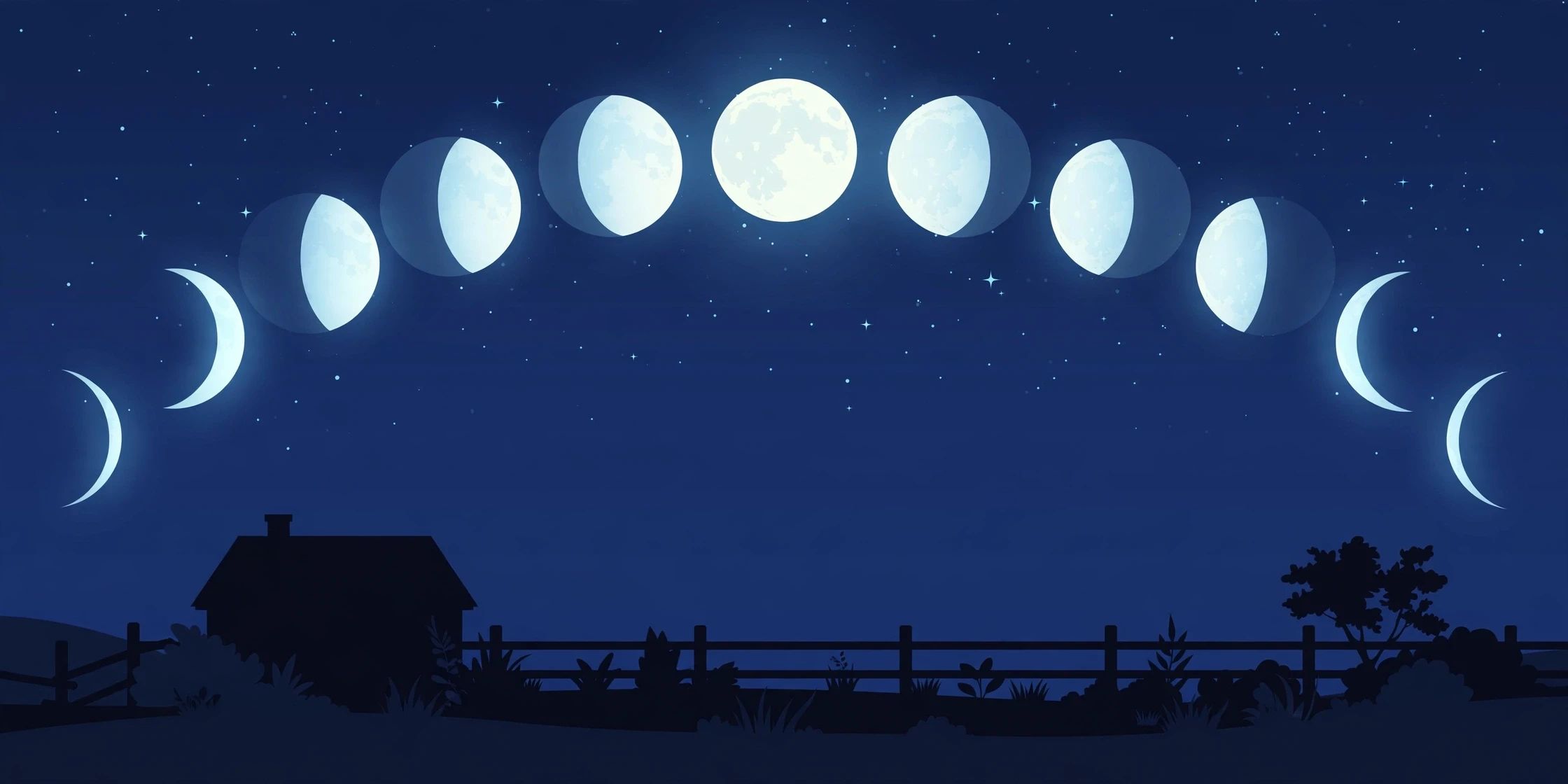
1. The Moon Never Changes Shape
Here is the fact that unlocks everything else in this article: the Moon is always a sphere, and the Sun always lights exactly half of it. Day and night exist on the Moon just as they do on Earth. At any moment, one half of the Moon faces the Sun and is in bright daylight, while the other half faces away and is in darkness. That lit half never moves with the Moon's orbit in the way people imagine — it always points toward the Sun.
What changes is our viewpoint. As the Moon travels around Earth, we see different amounts of its sunlit half. When the Moon sits between Earth and the Sun, its lit half faces away from us, and we see darkness: a new moon. When Earth sits between the Sun and the Moon, the lit half faces us fully, and we see a full moon. In between, we see a crescent, a half, or a bulging gibbous shape — a slice of the lit half, seen at an angle.
Think of it with a lamp and a ball. Put a lamp on a table in a dark room. Hold a ball out in front of you, between you and the lamp, and you see only its dark side. Walk slowly around the room, keeping the ball at arm's length, and more and more of the lit side comes into view. Walk halfway around and you see the whole lit side. Keep walking and the lit side shrinks again. You never changed the ball. You never moved the lamp. You only changed where you stood. The Moon, the Sun, and your eyes on Earth play exactly the same game, on a scale of hundreds of thousands of kilometres.
The word "phase" itself comes from this idea of appearance. A phase is not a thing the Moon does. It is a way the Moon looks from Earth at a particular point in its orbit. Astronomers count eight named moon phases, but the change itself is smooth and continuous — the Moon does not jump from crescent to half to full in steps. It glides, a little more lit each night on one half of the cycle, a little less each night on the other.
1.1 Two different months: 29.53 days and 27.32 days
If you time the Moon carefully, you find it keeps two different months, and the difference matters for the moon phases.
The synodic month — 29.53 days. This is the cycle of moon phases: new moon to new moon, or full moon to full moon. It is the month our calendars and our eyes actually follow.
The sidereal month — 27.32 days. This is the time the Moon takes to orbit Earth once against the background stars, returning to the same position relative to a distant star.
Why are they different? Because Earth is moving too. While the Moon completes one orbit, Earth has moved about one-twelfth of the way around the Sun. The Sun's direction, as seen from Earth, has shifted. The Moon has to travel a little farther — about two extra days — to catch up and line up with the Sun again in the same way. That extra travel is the difference between the two months.
NASA's Moon facts page gives both numbers plainly, along with the Moon's distance — about 384,400 kilometres (238,855 miles) from Earth on average — and its diameter, about 3,474 kilometres, roughly a quarter of Earth's. The Moon is the fifth-largest moon in the solar system, and by far the largest relative to its planet. That size is part of why it matters so much to Earth, as we will see when we reach the tides.
I learned the difference between the two months the hard way, as a student, when I tried to predict a full moon by counting 27 days from the last one and got the date wrong. A teacher pointed out, gently, that I had measured the wrong month. The stars had lined up, but the Sun had not. It was a small embarrassment and a useful lesson: in astronomy, the question is always "relative to what?"
1.2 How much of the Moon is lit, and how bright it looks
The fraction of the Moon's visible disc that appears lit — astronomers call it the illumination — runs from 0 percent at new moon to 100 percent at full moon, then back down to 0 percent. At first quarter and last quarter, exactly half the disc we see is lit. A crescent Moon may show only 10 or 20 percent lit; a gibbous Moon may show 80 or 90 percent.
Brightness does not follow illumination in a straight line. A full moon is far more than twice as bright as a half moon. At full moon, sunlight hits the lunar surface and bounces straight back toward Earth with almost no shadows, a brightening effect called the opposition surge. The Moon's rough, dusty surface — the regolith — also scatters light in a way that makes the full disc look strikingly bright. That is why a full moon can cast shadows and wash out faint stars, while a crescent Moon, beautiful as it is, barely lights the ground.
You can also sometimes see the whole disc of the Moon faintly even when only a thin crescent is lit. That ghostly glow is earthshine: sunlight reflected off Earth onto the Moon's dark side, then reflected back to us. Leonardo da Vinci worked out what it was more than 500 years ago, long before anyone had a telescope good enough to prove him right. On a clear night, earthshine is one of the loveliest sights in the sky — the Moon's dark half, lit by our own planet.
2. How Moon Phases Actually Work
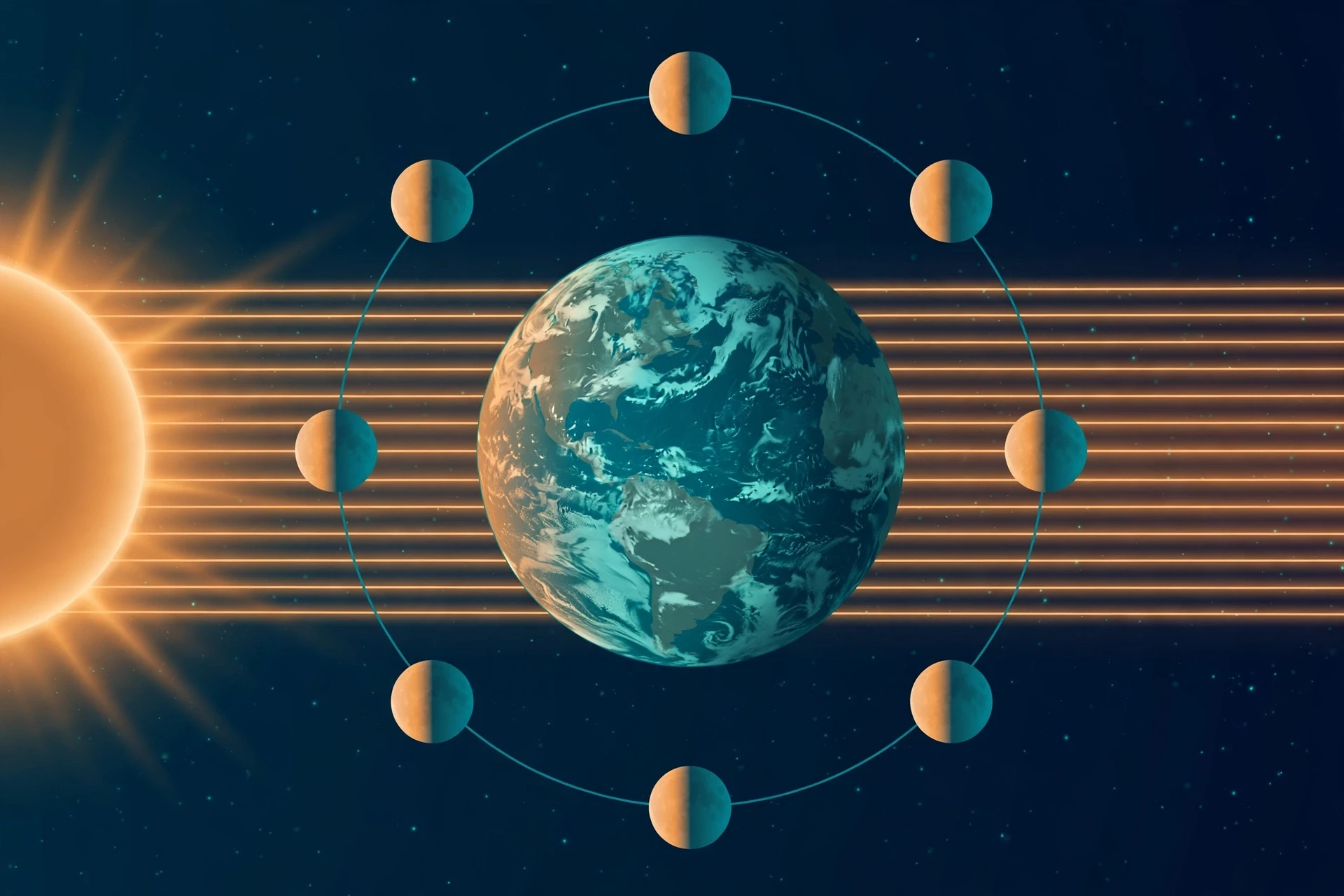
To see the whole mechanism at once, picture the Sun far off to one side, its light arriving in parallel rays. Earth sits in the middle. The Moon circles Earth, and at every point on its orbit, the half of the Moon facing the Sun is lit. Our view from Earth picks out a different slice of that lit half at each point. That is the whole engine behind the moon phases.
When the Moon is on the Sun's side of Earth — between us and the Sun — we look at its dark side. That is the new moon. It rises and sets with the Sun, which is why we almost never see it: it is up in the daytime sky, lost in the Sun's glare, and its dark side faces us anyway. A day or two later, the Moon has moved a little way along its orbit, and a thin sliver of its lit side peeks into view after sunset. That is the waxing crescent, the first phase most people notice.
As the Moon moves farther around, the sliver widens. After about a week it reaches first quarter: half lit, half dark, as seen from Earth. After about two weeks it is on the opposite side of Earth from the Sun, and we see the whole lit half: full moon. Then the process reverses. The lit part shrinks night by night — waning gibbous, last quarter, waning crescent — until the Moon is back between Earth and the Sun, and the cycle of moon phases begins again.
The geometry is simple, but it is worth pausing on, because it explains almost every question people ask about the Moon. Why is the Moon sometimes up in the daytime? Because its phase tells you where it is relative to the Sun, and a crescent or quarter Moon is often high in the sky while the Sun is still up. Why does the crescent Moon sometimes look like a smile and sometimes like a boat? Because the angle of the Sun's light changes with the seasons and with your latitude. Why can you see the Moon in the morning after a full moon? Because the full moon sets around sunrise, and the waning gibbous that follows it lingers into the morning sky.
2.1 The Sun does the lighting; Earth does the looking
It helps to keep the roles straight. The Sun is the lamp. The Moon is the ball. Earth is where the audience sits. Nothing about the Moon's shape changes, and the Sun's light does not flicker or move. The only thing that changes is the Moon's position in its orbit, and therefore the angle from which we see its lit half.
This is also why the moon phases are the same for everyone on Earth on a given night, with one small difference: the Moon looks tilted differently depending on where you stand. In the northern hemisphere, a waxing crescent looks like a backward letter "C" opening to the left, with the lit part on the right. In the southern hemisphere, it is flipped. The phase is the same; the orientation is not. Travellers who notice this for the first time often think something is wrong with the Moon. Nothing is wrong. They have simply walked to the other side of the ball.
2.2 Why the Moon is up at different times
Each phase comes with its own timetable, and once you know it, you can use the Moon as a rough clock.
New moon: rises around sunrise, sets around sunset. Invisible, up in the daytime sky.
Waxing crescent: rises in the morning, sets a few hours after sunset. Best seen in the early evening, low in the west.
First quarter: rises around noon, sets around midnight. High in the sky at sunset.
Waxing gibbous: rises in the afternoon, sets in the early hours after midnight.
Full moon: rises around sunset, sets around sunrise. Up all night.
Waning gibbous: rises in the evening, sets in the morning. Still visible after sunrise.
Last quarter: rises around midnight, sets around noon. High in the sky at sunrise.
Waning crescent: rises in the early hours, sets in the afternoon. Best seen just before dawn, low in the east.
I once used this timetable without thinking about it, on a camping trip, when a friend asked why the Moon was already high at sunset. It was a waxing gibbous, a few days from full, and it had been up since the afternoon. We had simply not looked. The Moon had been there all along, pale against the blue afternoon sky, waiting for the Sun to go down so we would notice it.
That daytime Moon surprises a lot of people. We think of the Moon as a night-time object, but it is up in the daytime about as often as it is up at night. The Sun is simply so bright that we only notice the Moon when the sky darkens — unless we know where to look. On a clear afternoon, a first-quarter Moon is easy to find if you look high in the south (from the northern hemisphere). It hangs there, white against blue, looking slightly out of place, as if it had arrived early for its own show.
3. The Eight Moon Phases in Order
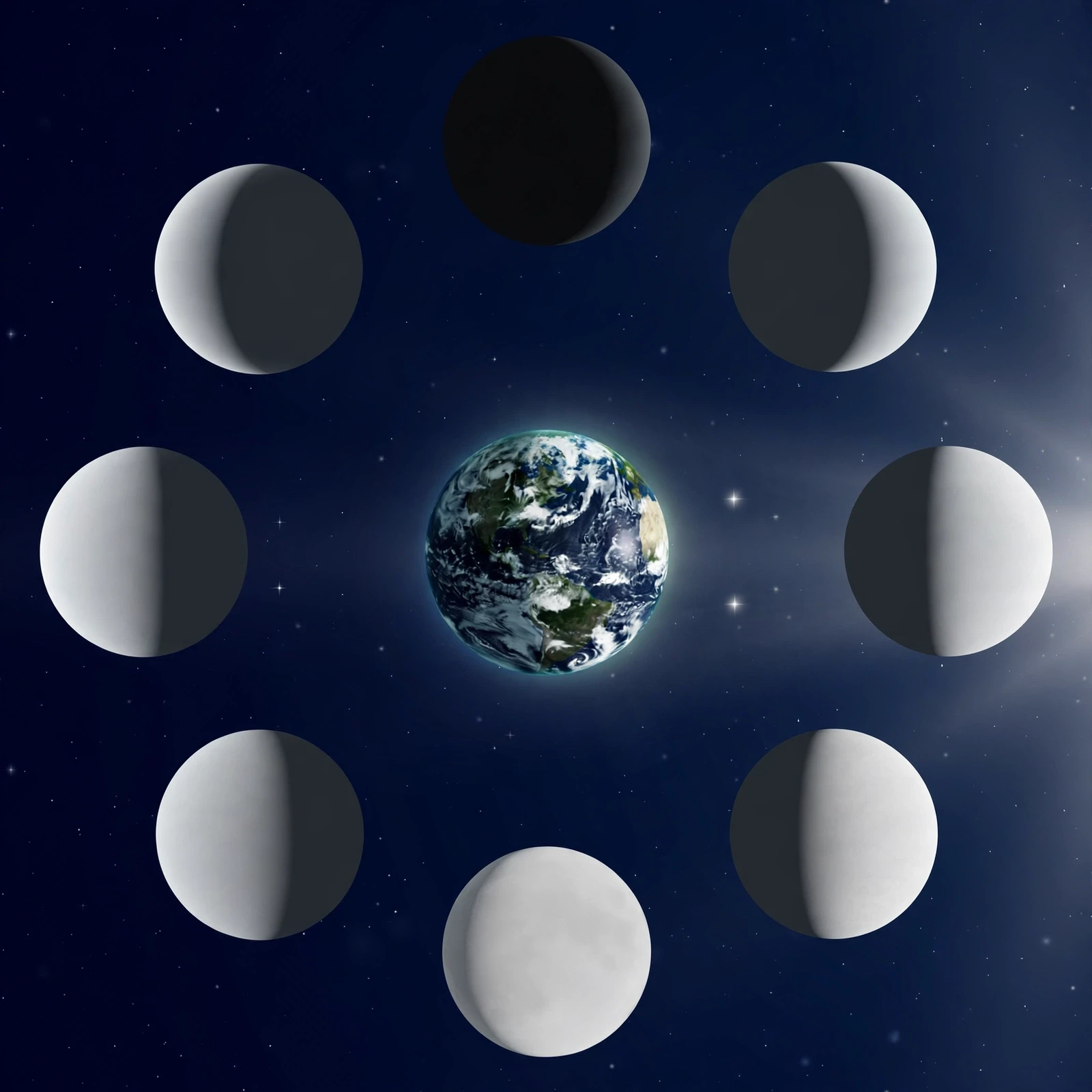
Here is the full cycle of moon phases, in the order it happens, starting from new moon. Each phase lasts about three and a half days, though the named moments — new, first quarter, full, last quarter — are single instants. The phases in between are stretches of time.
3.1 New moon
The Moon sits between Earth and the Sun. Its lit half faces away from us, so we see nothing — or, on a very clear night, a faint earthshine glow. The new moon is the start of the lunar cycle, and it is the phase that matters most to people who watch the sky for the youngest crescent: the first thin sliver after new moon is a traditional marker for the start of a month in several calendars, including the Islamic calendar.
3.2 Waxing crescent
A thin sliver of light appears on the right side (in the northern hemisphere), growing a little wider each evening. "Waxing" means growing. The crescent sets shortly after the Sun, so you have a short window to see it, low in the west after sunset. This is the Moon of my childhood notebook — the sliver I almost missed between the rooftops.
3.3 First quarter
Half the Moon's visible disc is lit, the right half in the northern hemisphere. The name confuses people: the Moon is not a quarter of the way lit, and it is not quarter-sized. It is a quarter of the way through its cycle — about 7.4 days after new moon — and half the disc we see is lit. First quarter is a wonderful phase for looking through a telescope or binoculars, because the line between light and dark, the terminator, throws long shadows across craters and mountains, and the surface looks three-dimensional.
3.4 Waxing gibbous
More than half lit, less than fully lit, still growing. "Gibbous" comes from a Latin word for humped or bulging, and that is what the Moon looks like: a bulging disc, bright and almost full, rising in the afternoon and dominating the evening sky. Most nights, the Moon you see is a gibbous Moon of one kind or another — the full moon itself lasts only an instant, and the nights around it are gibbous.
3.5 Full moon
The whole visible disc is lit. Earth sits between the Sun and the Moon, and the Moon rises as the Sun sets. The full moon is the brightest phase, the one that has filled stories, calendars, and festivals for thousands of years. It is also the phase that looks the flattest through a telescope, because the Sun is shining straight onto the face we see, and there are almost no shadows to give the craters depth.
3.6 Waning gibbous
The light begins to shrink, now from the right side in the northern hemisphere. "Waning" means shrinking. The Moon rises later each evening and is still up in the morning, fading into the blue daylight sky. If you are an early riser, the waning gibbous is your Moon — it is there when you wake, high and bright, slowly losing ground to the Sun.
3.7 Last quarter
Half lit again, but now the left half in the northern hemisphere. The Moon is three-quarters of the way through its cycle, about 22 days after new moon. Like first quarter, it is a fine phase for telescopes: the terminator has moved to the other side, and craters that were in darkness a fortnight ago are now lit from the opposite direction, throwing their shadows the other way.
3.8 Waning crescent
A thin sliver again, now on the left side, shrinking toward darkness. It rises in the early hours and is best seen just before dawn, low in the east. Then it vanishes into the Sun's glare, and the cycle begins again with a new moon. The old crescent, as it is sometimes called, is the Moon's last appearance before it disappears — a thin, pale curve in the morning sky, easy to miss if you are not looking.
Phase | Days after new moon | What you see | Best time to look |
|---|---|---|---|
New moon | 0 | Dark disc, invisible | Daytime sky, lost in sunlight |
Waxing crescent | 1–6 | Thin sliver, right side lit | Early evening, low in the west |
First quarter | ~7.4 | Right half lit | Sunset, high in the sky |
Waxing gibbous | 8–14 | More than half lit, growing | Evening, rising in the afternoon |
Full moon | ~14.8 | Whole disc lit | All night, rises at sunset |
Waning gibbous | 15–21 | More than half lit, shrinking | Late evening into morning |
Last quarter | ~22.1 | Left half lit | Sunrise, high in the sky |
Waning crescent | 23–29 | Thin sliver, left side lit | Before dawn, low in the east |
The table above is worth keeping beside a window. If you know today's phase, you know roughly when the Moon will rise, when it will set, and which side of it will be lit. The left-right details flip in the southern hemisphere, but the timing and the order stay the same everywhere on Earth.
4. Waxing and Waning, Gibbous and Quarter
The vocabulary of moon phases is small, but it trips people up, because the words are old and their meanings are not obvious. Four words do most of the work.
Waxing means the lit part is growing. It comes from an old word for increasing. A waxing Moon is on its way from new to full.
Waning means the lit part is shrinking. A waning Moon is on its way from full back to new.
Gibbous means more than half lit but not fully lit. There is a waxing gibbous (growing toward full) and a waning gibbous (shrinking away from full).
Quarter means a quarter of the way through the cycle, not a quarter of the Moon lit. First quarter is one quarter through; last quarter is three quarters through. In both cases, half the disc we see is lit.
A simple memory aid works in the northern hemisphere: the lit side is on the right while the Moon waxes, and on the left while it wanes. Light on the right, getting bigger — waxing. Light on the left, getting smaller — waning. In the southern hemisphere, the sides swap, but the rule still works if you flip it: the lit side moves the other way. The key is not to memorise left and right, but to notice the direction of change over two or three nights. If the lit part is growing, the Moon is waxing. If it is shrinking, it is waning. Two nights of looking will tell you more than any diagram.
4.1 The terminator: where the Moon looks most alive
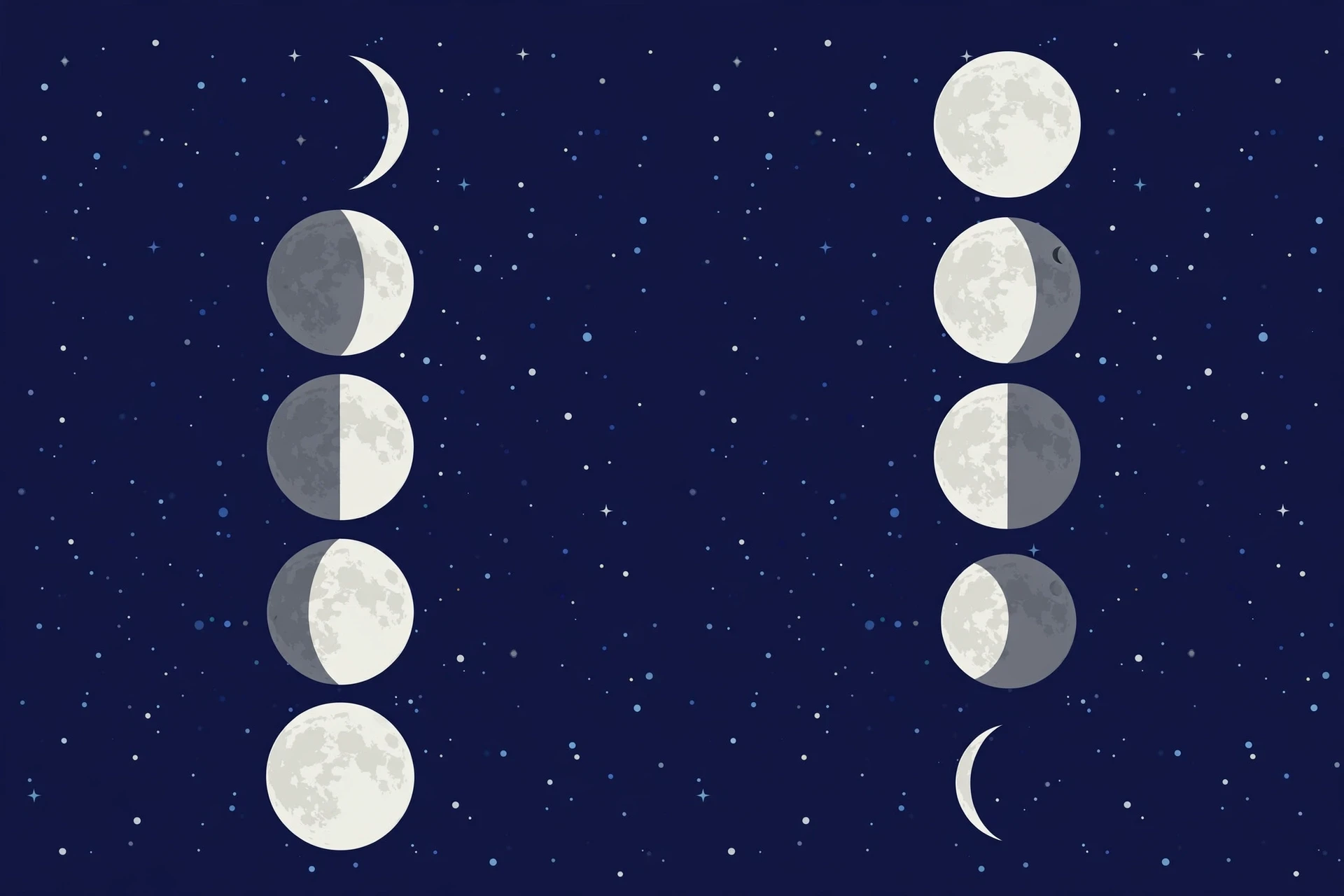
The line between the Moon's lit half and its dark half has a name: the terminator. It is not a sharp edge in the way a shadow on a wall is sharp. It is a line of sunrise or sunset, sweeping slowly across the lunar surface. At first quarter, the terminator is the line of lunar sunrise for the half we see; at last quarter, it is lunar sunset.
The terminator is where the Moon is most interesting to look at. Near it, the Sun is low in the lunar sky, and every crater rim, mountain peak, and ridge throws a long shadow. The surface stops looking flat and starts looking like a landscape. Away from the terminator, near the middle of the lit disc, the Sun is high overhead, shadows are short, and the surface looks washed out — which is why the full moon, for all its beauty, is the worst phase for seeing detail through a telescope. If you want to see mountains on the Moon, look at a quarter Moon, not a full one.
I remember the first time someone showed me this through a small telescope. It was a first-quarter Moon, and the terminator ran down the middle of the disc like a coastline. Craters near the line stood out in sharp relief, their floors still in shadow, their rims catching the light. The person at the telescope said, "That line is sunrise, happening right now, on the Moon." I have never forgotten that sentence. It turned a picture into a place.
4.2 Why the crescent Moon looks different through the year
The crescent Moon does not always tilt the same way. In spring evenings in the northern hemisphere, the waxing crescent stands more upright, like a bowl or a smile. In autumn evenings, it lies flatter, like a boat. The reason is the angle of the ecliptic — the path the Sun and Moon follow across the sky — relative to the horizon. In spring, the ecliptic stands steep at sunset, so the crescent's horns point up. In autumn, it lies shallow, so the crescent lies on its back.
The same geometry explains why the Moon's path across the sky changes with the seasons. In winter, the full moon rides high, because the full moon sits opposite the Sun, and the winter Sun is low. In summer, the full moon stays low, skimming the southern horizon. Ancient skywatchers knew this without knowing why, and they built it into their calendars and their festivals. The Harvest Moon, which we will meet later, is a direct consequence of this geometry.
5. Why It Is Not Earth's Shadow
If there is one idea to take away from this article and correct in every conversation you have about the Moon, it is this one: the moon phases are not caused by Earth's shadow.
Most people assume the moon phases are Earth's shadow falling on the Moon, eating away at it night by night. It is a natural guess — the dark part certainly looks like a shadow — but it is wrong, and the evidence against it is easy to see. If Earth's shadow caused the phases, the dark part would always be curved the same way, and the Moon would only change shape when Earth got in the way. In reality, the dark part of a crescent Moon is curved one way, the dark part of a gibbous Moon is curved the other way, and the Moon changes shape every night, whether Earth is anywhere near the line between the Sun and the Moon or not.
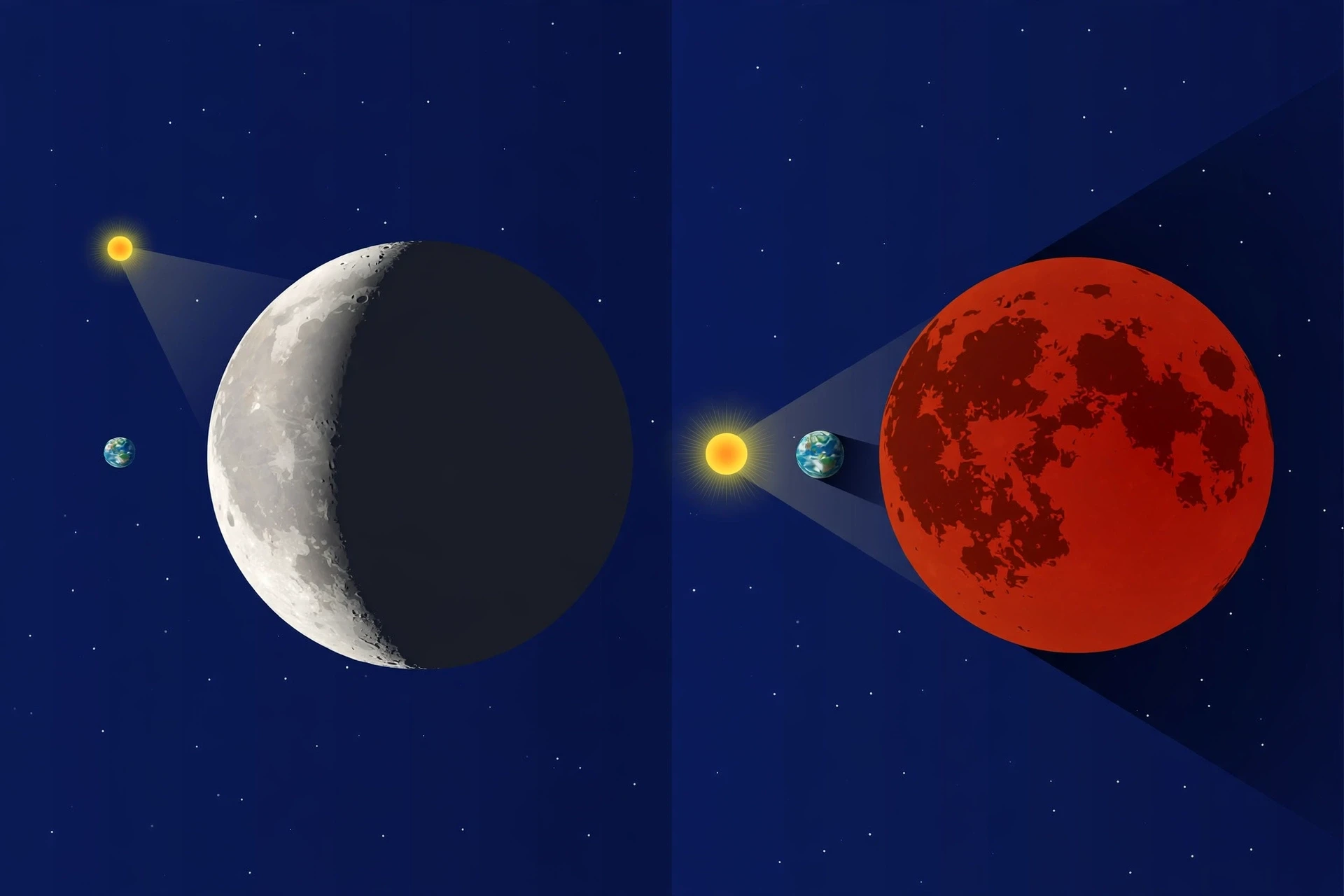
Earth's shadow does fall on the Moon sometimes. When it does, we call it a lunar eclipse, and it looks nothing like a phase. A lunar eclipse happens only at full moon, only when the Sun, Earth, and Moon line up almost exactly, and it lasts a few hours, not a month. The Moon turns a deep copper red as it passes through Earth's shadow — sunlight filtered through Earth's atmosphere, the light of every sunrise and sunset on Earth at once, projected onto the Moon. It is one of the most beautiful sights in astronomy, and it is rare precisely because the alignment has to be so exact.
NASA's eclipse pages explain the difference plainly: moon phases happen every month, because the Moon's orbit always changes our view of its lit half; eclipses happen only a few times a year, because the Moon's orbit is tilted about 5 degrees relative to Earth's orbit around the Sun, so the Moon usually passes above or below Earth's shadow. That tilt is the reason we do not have an eclipse every month. Most months, at full moon, the Moon sails just above or just below Earth's shadow, and nothing happens. Only when a full moon falls near one of the two points where the Moon's orbit crosses Earth's orbital plane — the nodes — does an eclipse occur.
The dark part of the Moon during its phases is not a shadow at all. It is simply the half of the Moon that the Sun is not lighting right now — the Moon's own night side, turned partly toward us.
The same test works for a solar eclipse, which is the Moon's shadow falling on Earth. A solar eclipse happens only at new moon, only when the alignment is exact, and only along a narrow path on Earth's surface. If phases were shadows, we would have eclipses every month. We do not, because the geometry is almost never exact enough. The Moon's orbit is tilted, the shadows usually miss, and the moon phases carry on regardless.
5.1 How to prove it to yourself in one evening
You do not need a telescope to settle this. Look at a crescent Moon and notice which side is lit. The lit side always points toward the Sun — toward where the Sun set, or toward where it will rise. If Earth's shadow were doing the work, the dark part would point toward Earth, not away from the Sun. The lit side follows the Sun, every time, in every phase. That is the whole mechanism, visible in a single glance.
A second test: watch the Moon for a week. Earth's shadow does not move across the Moon night by night in the smooth, steady way the moon phases do. The phases are a slow, regular turning of the Moon's lit face toward and away from us. An eclipse is a sudden, hours-long darkening, red and strange, and then it is over. Once you have seen a lunar eclipse, you will never confuse it with a phase again.
5.2 The Moon's orbit is tilted — and that tilt saves us from monthly eclipses
The Moon's orbit around Earth is tilted about 5.1 degrees to the plane of Earth's orbit around the Sun. That small tilt is enough. At most full moons, the Moon passes above or below Earth's shadow; at most new moons, its shadow passes above or below Earth. Eclipses happen only during eclipse seasons, roughly twice a year, when the line of nodes points toward the Sun. Each eclipse season lasts about a month, and during it, a lunar eclipse and a solar eclipse often come as a pair, about a fortnight apart.
This tilt also explains something else: why the Moon's path across the sky is not always the same. Sometimes the Moon rides high, sometimes low, and the difference over months is the tilt of its orbit combined with the tilt of Earth's axis. Ancient astronomers tracked this cycle — it takes about 18.6 years for the Moon's orbit to wobble through its full range — and built it into their predictions of eclipses. The Saros cycle, about 18 years and 11 days, lets astronomers predict eclipses far into the future, because after one Saros, the Sun, Earth, and Moon return to almost the same relative geometry. The eclipse that darkened the Moon over your town last year has a twin, 18 years later, darkening it over a different part of the world.
6. Why We Always See the Same Face
Here is the second great surprise about the Moon: we always see the same side of it. The face of the Moon — the pattern of dark patches people call the Man in the Moon, or the rabbit, or the face, depending on where they grew up — is the same face people saw a thousand years ago. The Moon spins on its axis, but it spins at exactly the rate it needs to keep one face toward Earth: one rotation per orbit, about 27.32 days. Astronomers call this synchronous rotation, or tidal locking.
The cause is tides — not the ocean tides we will meet in the next section, but tides in the Moon's own body. Long ago, the Moon spun faster. Earth's gravity raised bulges in the Moon, and because the Moon was spinning, those bulges were carried slightly out of line with Earth. Earth's gravity pulled back on the bulges, acting like a brake, slowing the Moon's spin. Over hundreds of millions of years, the braking stopped when the spin matched the orbit: one face locked toward Earth, forever. The same process is still happening to Earth, in reverse: the Moon's gravity is slowing Earth's spin, lengthening our day by a tiny amount — about 1.7 milliseconds per century — and pushing the Moon slowly away from us, about 3.8 centimetres a year.
The Moon is not perfectly locked. It wobbles slightly in its orbit, a motion called libration, and over a month we can peek around its edges a little — about 59 percent of its surface is visible from Earth over time, not just 50 percent. The wobble is small, a few degrees, but it is real, and patient observers with a telescope can watch features near the Moon's edge appear and disappear over the month. The Moon also nods up and down slightly, so we sometimes see a little more of its north pole, sometimes a little more of its south.
6.1 The far side is not the dark side
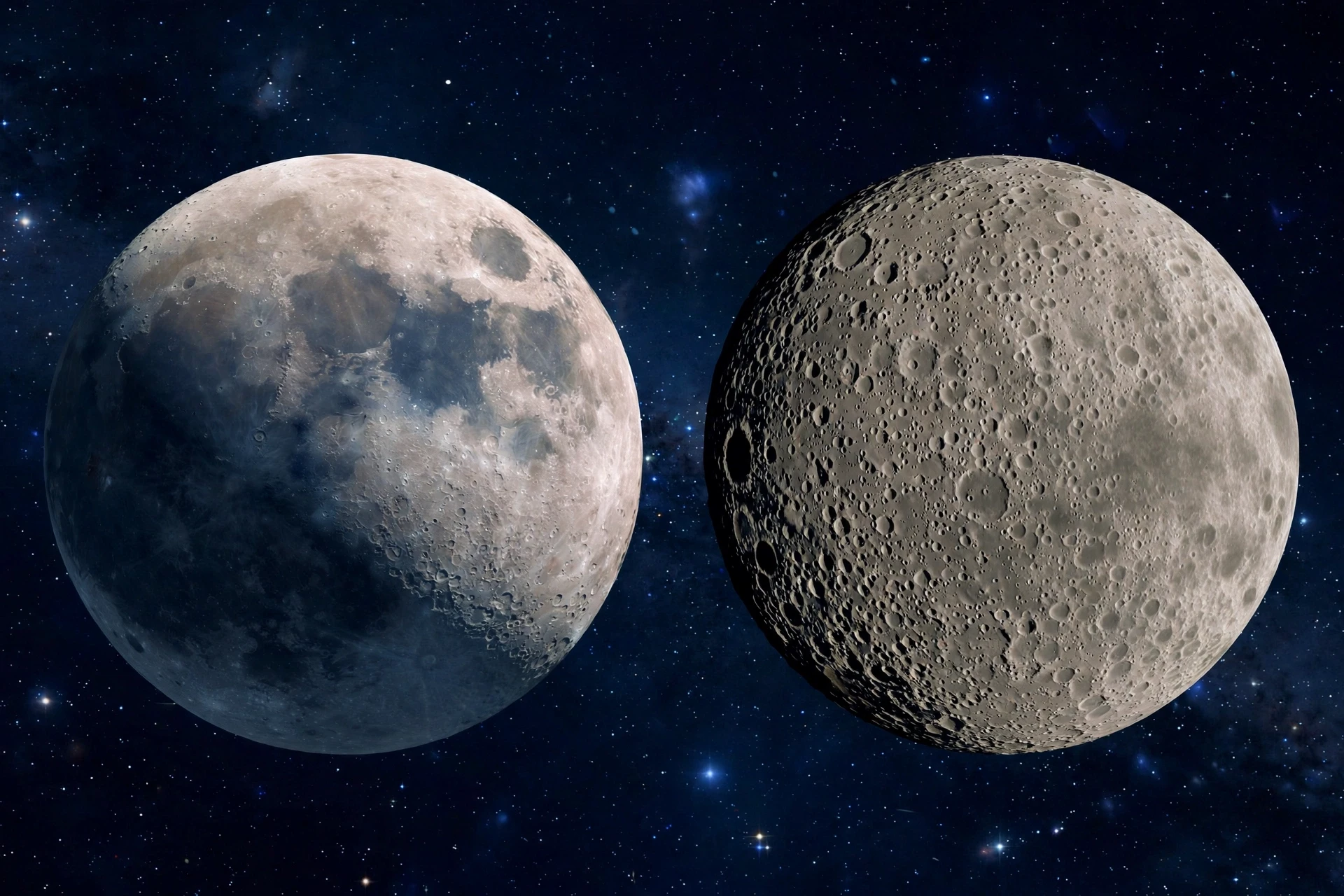
The far side of the Moon is often called the "dark side of the Moon," and the name is wrong in two ways. First, the far side gets just as much sunlight as the near side — it has its own day and night, lasting about two weeks each, as the Moon orbits. When we see a new moon, the far side is fully lit. When we see a full moon, the far side is in darkness. Second, the far side is not unknown any more. Spacecraft have photographed it in detail since 1959, when the Soviet probe Luna 3 sent back the first images, and astronauts on Apollo 8 were the first people to see it with their own eyes, on Christmas Eve 1968.
The far side looks different from the near side, and the difference is a clue to the Moon's history. The near side has large, dark, smooth plains called maria — Latin for "seas," though they are not seas at all, but ancient lava flows that filled huge impact basins billions of years ago. The far side has far fewer maria and is covered in craters, layer upon layer of them, because its crust is thicker and lava found it harder to break through. The Moon's two faces are a record of an early asymmetry — perhaps from the giant impact that made the Moon, perhaps from tidal heating when the Moon was young and close to Earth — that researchers are still working to explain.
The far side is also the quietest place in the inner solar system for radio astronomy, because the Moon's bulk shields it from Earth's radio noise. In 2019, China's Chang'e-4 lander became the first spacecraft to land there, in the South Pole-Aitken Basin, one of the largest impact craters in the solar system. Future telescopes on the far side could listen to the faint radio signals from the early universe, signals that Earth's own broadcasts drown out.
6.2 The Man in the Moon, and why we see faces
The dark patches on the Moon's near side — the maria — form a pattern that the human brain, built to find faces, reads as a face, or a rabbit, or a woman carrying a bundle, depending on the culture. In Europe and North America, it is the Man in the Moon. In East Asia, it is a rabbit pounding rice cakes, or the moon goddess Chang'e. In parts of Africa and South America, it is other figures again. The pattern is the same; the story changes with the storyteller.
This is not a flaw in how we see. It is how our brains work: we are pattern-finding animals, and the Moon gives us a large, stable, high-contrast pattern to read. The maria themselves are real — basalt lava, dark because it is rich in iron and magnesium, filling basins carved by enormous impacts between about 3.8 and 3.1 billion years ago, when the Moon was still volcanically active. The light areas around them are the lunar highlands, older, brighter, and more heavily cratered. When you look at the Moon with the naked eye, you are looking at a geological map, written in lava and craters, four billion years old.
7. The Moon and the Tides
The Moon's most practical effect on Earth is one you can feel with your feet on a beach: the tides. Twice a day, in most places, the sea rises and falls, and the Moon is the main reason. The physics is gravity, and it is subtler than it first looks — which is why the tides confuse so many people, and why they are worth explaining carefully.
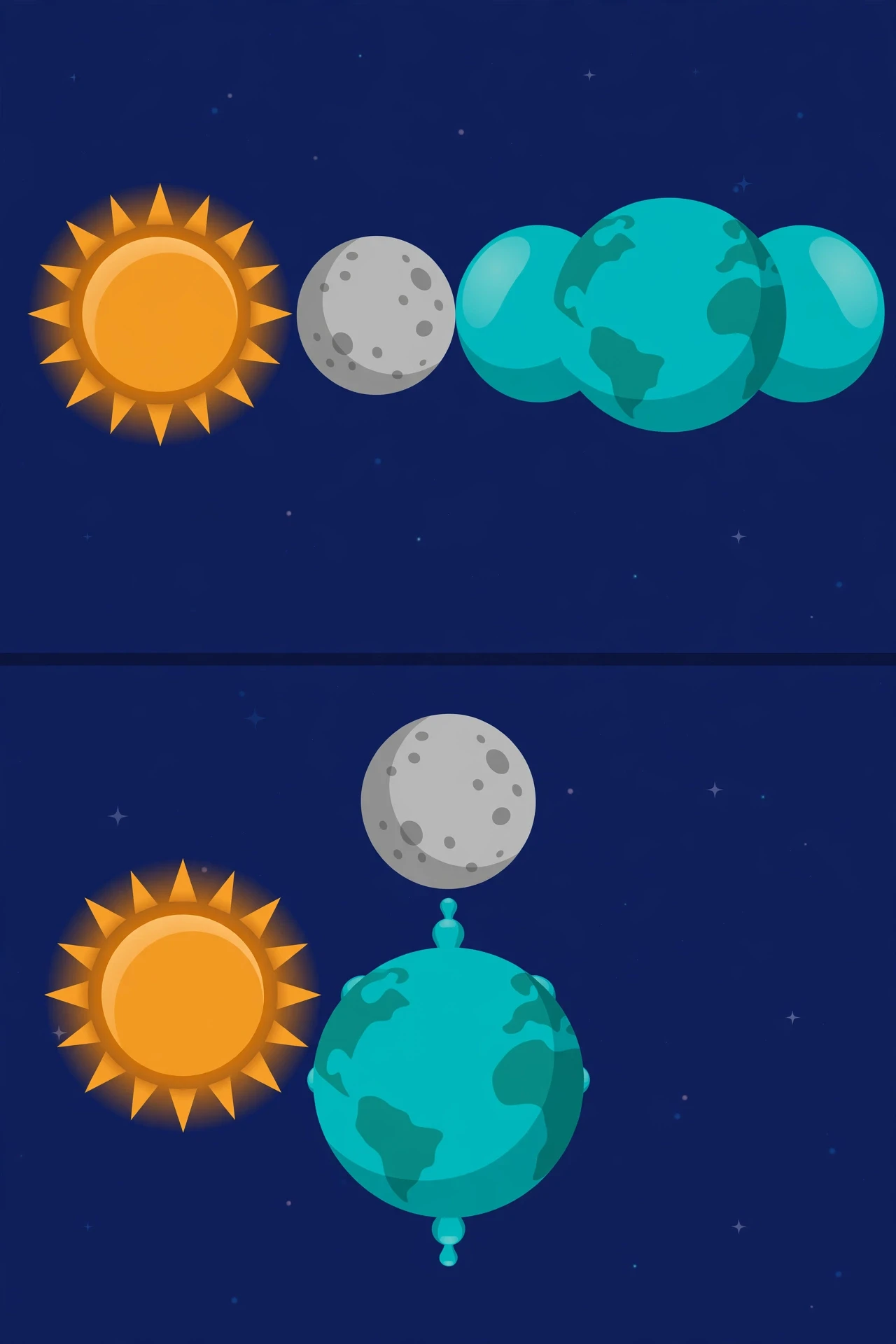
The Moon's gravity pulls on Earth, but it pulls more strongly on the side of Earth facing the Moon, because that side is closer. The water on the near side is pulled toward the Moon, piling up into a bulge — a high tide. At the same time, Earth itself is pulled toward the Moon more strongly than the water on the far side, so Earth is pulled away from that water, leaving a second bulge on the far side. The result is two bulges of water on opposite sides of Earth, and as Earth spins once a day inside those bulges, most coastlines pass through two high tides and two low tides every 24 hours and 50 minutes — a little longer than a day, because the Moon has moved along its orbit in the meantime.
The Sun also raises tides, but its effect is smaller — about half the Moon's — because although the Sun is far more massive, it is also far farther away, and tides depend on the difference in gravity across Earth's diameter, not on gravity itself. That difference falls off quickly with distance, so the nearer Moon wins.
For a fuller picture of how the Moon's pull fits into the ocean's larger movements, Sciory's Oceanography: Currents, Ecosystems and Depth Zones follows the water from the tides into the currents that carry heat around the planet. The tides are the ocean's daily rhythm; the currents are its long, slow circulation.
7.1 Spring tides and neap tides
The Sun's tides and the Moon's tides add up or cancel out depending on the phase of the Moon, and this is where the moon phases connect directly to the sea.
Spring tides happen at new moon and full moon, when the Sun, Moon, and Earth are lined up. The Sun's pull and the Moon's pull point in the same direction (or in exactly opposite directions, which still adds up, because tides work on both sides), and the tides are at their highest and lowest — the biggest difference between high and low water. "Spring" here has nothing to do with the season. It comes from an old word for rising up, as in a spring of water.
Neap tides happen at first quarter and last quarter, when the Sun and Moon pull at right angles to each other. Their pulls partly cancel, and the tides are at their smallest — the difference between high and low water is at its least. "Neap" comes from an old word for scarce or lacking.
The difference matters. Spring tides can flood low-lying coasts and expose wide stretches of beach at low water. Neap tides are gentler, and fishermen, sailors, and coastal engineers plan around them. The Bay of Fundy in Canada, where the shape of the bay amplifies the tides, can see a difference of more than 15 metres between high and low water at spring tides — the largest tidal range in the world. In the Mediterranean, where the sea is almost enclosed, the tides are barely noticeable. The Moon provides the rhythm; the shape of the coast decides how loud it plays.
NOAA's tide tutorial walks through this geometry step by step, and it is the clearest official explanation I know for why there are two high tides a day rather than one — the question almost everyone asks first, and the one most explanations get wrong by only mentioning the near-side bulge. OpenStax Astronomy covers the same ground, including how the Sun's tides combine with the Moon's at new and full moon.
7.2 Why the tides matter beyond the beach
Tides do more than move water up and down a beach. They stir the oceans, mixing nutrients from the deep into sunlit surface waters, and they shape coastal ecosystems — the intertidal zone, the strip of shore that is underwater at high tide and exposed at low tide, is one of the most productive and most stressful habitats on Earth, home to creatures that must survive being drowned and dried out twice a day. Tides also carry energy: tidal power stations, like the one at La Rance in France, turn the rise and fall of the sea into electricity, and engineers are testing tidal stream turbines that work like underwater windmills.
The tides are also, slowly, changing Earth's day and the Moon's orbit. The friction of the tides dragging across the ocean floor steals energy from Earth's spin, and that energy goes into pushing the Moon away — the same 3.8 centimetres a year mentioned earlier, measured precisely by laser reflectors left on the Moon by Apollo astronauts. Hundreds of millions of years ago, when the Moon was closer, the tides were far larger and Earth's day was much shorter — perhaps 18 hours long. The Moon is still, very slowly, leaving us. It will take billions of years before the change matters to anyone, but the direction is clear: the Moon is receding, the tides are weakening, and Earth's days are getting longer.
I once stood on a beach in Cornwall at low tide, watching the water retreat across a wide, flat expanse of sand, leaving rock pools behind, and a local fisherman told me he set his day by the tide table, not by the clock. "The clock tells you the time," he said. "The tide tells you when you can work." It was a reminder that the moon phases are not an abstract diagram. They are a timetable written in water, and people whose lives depend on the sea have read it for thousands of years.
8. Where the Moon Came From
The Moon is odd. It is far too large, relative to Earth, to have been captured the way many small moons are, and its composition is too similar to Earth's mantle to be a coincidence, yet too different in some elements — it has very little iron in its core, and almost no water — to have formed alongside Earth from the same material. For decades, these facts did not fit together. Then, in the 1970s, a new idea brought them into line: the giant impact hypothesis.
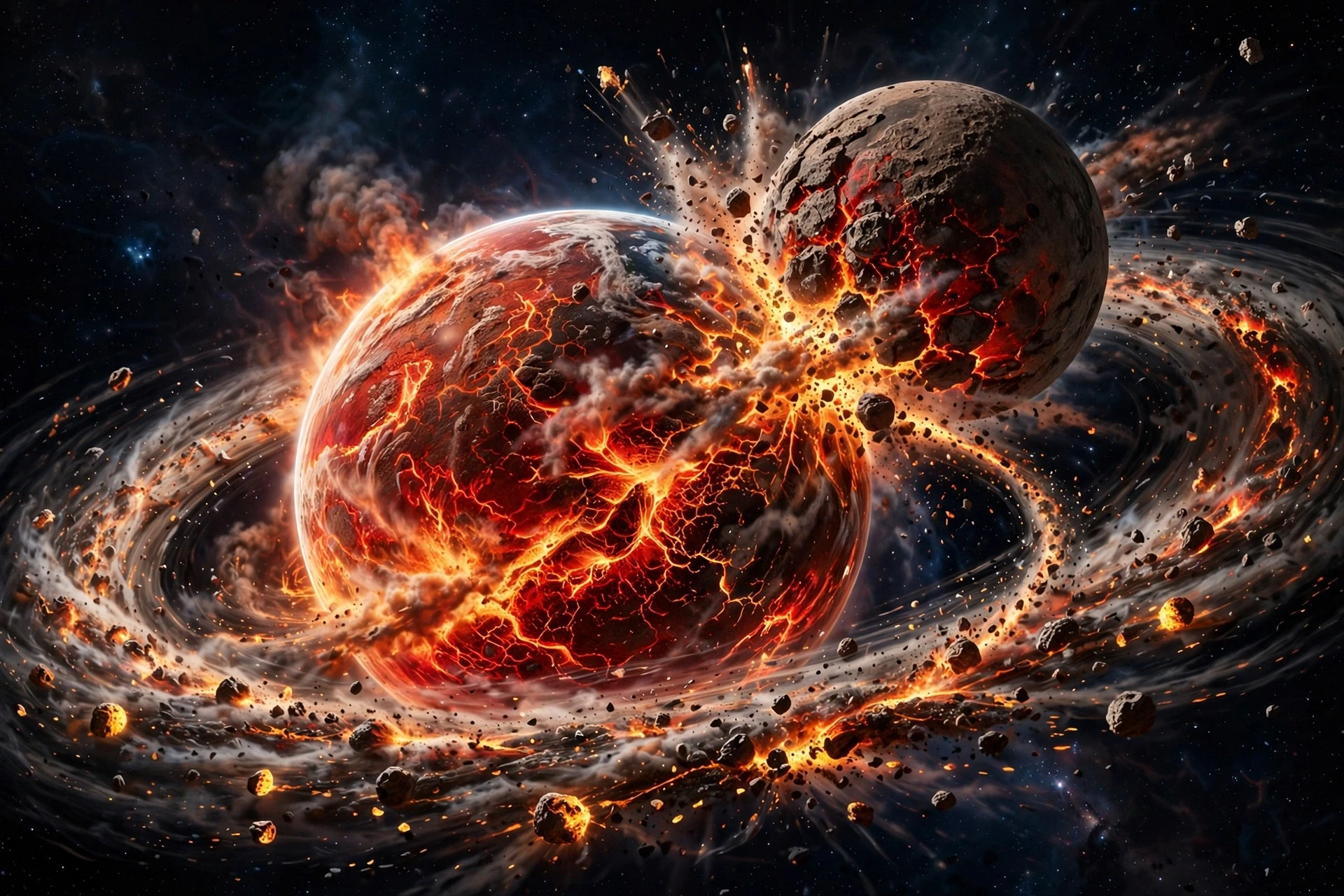
About 4.5 billion years ago, when Earth was young and still hot, a Mars-sized body — researchers call it Theia — struck Earth at an angle. The collision was enormous: it melted both bodies, threw a huge amount of debris into orbit around Earth, and tilted Earth's axis. Over a few hundred years, that debris gathered under its own gravity into the Moon. The Moon formed close to Earth — perhaps ten times closer than it is now — and has been drifting away ever since.
The evidence for this story is strong. Moon rocks brought back by Apollo astronauts have oxygen isotopes — the fingerprint of the atoms themselves — that match Earth's mantle almost exactly, as if the Moon were made from Earth's own material, mixed with Theia's. The Moon's small iron core fits the idea that most of Theia's iron sank into Earth's core during the collision, leaving the debris that became the Moon poor in iron. Computer simulations of the impact reproduce the Moon's mass, its orbit, and the tilt of Earth's axis. And the Moon's lack of water fits a collision hot enough to boil water away.
NASA's Moon facts page summarises the giant impact as the leading explanation. Researchers still argue about the details: how big Theia was, how fast it hit, how much of the Moon came from Earth and how much from Theia, and whether the impact happened once or in a series of smaller collisions. The broad picture, though, is settled enough that it appears in every modern astronomy textbook: the Moon was born in a collision.
8.1 The Moon steadies Earth's tilt — and its seasons
The giant impact did more than make the Moon. It tilted Earth's axis by about 23.5 degrees, and that tilt is what gives us seasons. It also left Earth with a large, close Moon, and that Moon's gravity now holds Earth's tilt steady. Without the Moon, Earth's axis would wobble far more over millions of years, swinging between almost no tilt and a tilt of 85 degrees, and the climate would swing with it — ice ages coming and going not over tens of thousands of years, but chaotically, over millions. Mars, which has only two tiny moons, wobbles exactly like that, and its climate has swung wildly as a result.
The Moon, in other words, is not decoration. It is a stabiliser. It keeps the seasons regular enough, over geological time, for complex life to evolve and persist. This is one of the reasons astronomers take an interest in moons around other planets: a large moon may be one of the things a planet needs to stay habitable over billions of years. The Moon also shields Earth from some impacts — its cratered face is a record of collisions that might otherwise have hit us — though its shielding effect is often overstated. The Moon is small, and most of the objects that could hit Earth would miss the Moon entirely. Its real gift is stability, not protection.
For the wider story of how Earth and the Moon fit into the solar system, Sciory's Our Solar System: Planets, Moons, and Celestial Dynamics sets the scene — the Sun, the eight planets, and the more than 200 moons, with our Moon as the one that matters most to us. And the force that holds the whole system together, and raises the tides, is explained in Sciory's How Gravity Works: the same gravity that keeps the Moon in orbit is the gravity that pulls the oceans toward it twice a day.
9. Supermoons, Blue Moons, and Harvest Moons
Some full moons get special names, and the names cause more confusion than the moons do. All three of the famous ones — supermoon, blue moon, harvest moon — are real, but none of them is as strange as it sounds.
9.1 Supermoon: a full moon at its closest
The Moon's orbit is not a perfect circle. It is an ellipse, so the Moon is sometimes closer to Earth and sometimes farther away. At its closest, perigee, it is about 356,500 kilometres away. At its farthest, apogee, it is about 406,700 kilometres away — a difference of about 50,000 kilometres, or about 14 percent. A full moon that happens near perigee is called a supermoon. It looks about 14 percent larger and about 30 percent brighter than a full moon at apogee — a real difference, but a modest one, and one most people would not notice unless they compared photographs side by side.
The word "supermoon" is not a scientific term. Astronomers call it a perigee-syzygy full moon, which is accurate and unusable in a headline. The popular name was coined by an astrologer in 1979 and took off in the 2010s, when photographers began sharing dramatic images of a huge Moon rising over skylines. Those photographs are real, but the Moon in them looks huge mostly because of the Moon illusion — the well-known effect that makes the Moon look larger near the horizon, next to buildings and trees, than it does high in the sky. The supermoon adds a little extra size on top of that illusion. It is worth going outside for, but it will not fill the sky, and it will not change anything on Earth. The tides at a supermoon are slightly stronger, because the Moon is closer, but the difference is a few centimetres, not a flood.
9.2 Blue moon: two full moons in one month
A blue moon is the second full moon in a single calendar month. It happens because a lunar cycle is 29.53 days, shorter than most calendar months, so every two or three years, a month contains two full moons instead of one. The Moon does not turn blue. The name probably comes from an old expression for something rare — "once in a blue moon" — and from a misreading of an old almanac rule about the third full moon in a season with four. There is a rarer, genuine blue-coloured Moon, when smoke or dust from a large volcanic eruption or forest fire scatters red light and lets blue through, but that is a different thing, and it has nothing to do with the calendar.
A blue moon is a quirk of our calendar, not of the Moon. It is a reminder that our months and the Moon's month do not line up neatly, and never have. The word "month" itself comes from "moon," and for most of human history the two were the same. Our modern calendar broke that link, and the blue moon is one of the places where the mismatch shows.
9.3 Harvest moon: the full moon nearest the autumn equinox
The Harvest Moon is the full moon closest to the autumn equinox, usually in September or early October in the northern hemisphere. It gets its name because, around the equinox, the Moon rises only a short time later each evening for several nights in a row — about 20 to 30 minutes later, instead of the usual 50 minutes. That happens because, near the equinox, the Moon's path makes a shallow angle with the horizon, so the Moon's daily motion along its orbit translates into very little delay in its rising time.
For farmers before electric light, that mattered. The bright Moon rose soon after sunset for several evenings, giving extra light to bring in the harvest after the Sun had gone down. The Hunter's Moon, the full moon that follows the Harvest Moon, got its name the same way: it gave light for hunting in the fields after the harvest was in. These names are not scientific terms either — they come from old almanacs and farming traditions — but they are rooted in real geometry, and you can watch the geometry work for yourself by timing the Moon's rising for a week around the autumn equinox.
A supermoon is a full moon near perigee, a blue moon is a second full moon in one calendar month, and a harvest moon is the full moon nearest the autumn equinox. None of them changes colour, none of them is dangerous, and all three are worth watching — for the geometry, not the drama.
10. Moon Myths: What the Evidence Actually Says
The Moon has collected more stories than any other object in the sky, and most of them are harmless. A few of them, though, are repeated as fact when the evidence says otherwise. Here are the main ones, and what researchers have actually found.
10.1 "The full moon makes people act strangely"
This is the oldest Moon myth, and the one with the most research behind it — and the research does not support it. The word "lunacy" comes from "luna," the Moon, and for centuries, people blamed the full moon for madness, crime, accidents, and strange behaviour. Hospitals, police stations, and emergency rooms still pass the story around: the full moon brings a busy night.
Dozens of studies have tested this, looking at hospital admissions, psychiatric emergencies, crime rates, road accidents, births, and even dog bites, comparing full-moon nights with other nights. The results are consistent: there is no reliable increase. A few early studies found small effects, but larger, better-controlled studies have not reproduced them, and reviews that pool many studies together find no effect at all. The myth survives because of confirmation bias — we remember the strange night that happened to fall on a full moon, and forget the strange nights that did not, and the quiet full moons that passed without incident. The Moon is bright and noticeable, so it makes a convenient explanation for a night that felt odd. The evidence says the night would have felt odd anyway.
10.2 Werewolves, and other transformations
There is no evidence that the Moon changes people into animals, or animals into anything else. The werewolf story is old and widespread, and it probably grew out of a mix of things: the way a full moon lights the night and makes the world look strange, the behaviour of wolves, which do howl more on bright nights because they can see better and hunt better, and the human habit of blaming the sky for things we do not understand. Wolves howl at the Moon because they are social animals calling to each other, and they are more active on bright nights. They are not calling to the Moon, and the Moon is not calling to them.
10.3 "The Moon affects your sleep"
This one is more interesting, because there is a grain of truth in it — but not the one people usually mean. A few studies have found that people sleep slightly less, and take slightly longer to fall asleep, around the full moon. The effect, where it appears, is small — minutes, not hours — and it is not consistent across studies. The most likely explanation is light, not gravity or magnetism: before electric light, a full moon was the brightest thing in the night, and it would have been harder to sleep under it. In the modern world, with curtains and street lights, the effect is smaller still, and many studies find nothing at all. If the full moon keeps you awake, it is probably because it is bright through your window, not because it is pulling on your body. The Moon's gravity does move the oceans, but its pull on a human body is far too small to feel — far smaller than the pull of a building you are standing next to.
10.4 "You can see the Moon landing sites with a telescope"
Not with any telescope you can buy. The Apollo landing sites are real, and the equipment left there — the descent stages, the rovers, the laser reflectors — is still there, photographed from orbit by NASA's Lunar Reconnaissance Orbiter. But the largest objects left on the Moon are only a few metres across, and from Earth, 384,400 kilometres away, they are far too small for any Earth-based telescope to resolve. The laser reflectors, though, are still in use: scientists bounce lasers off them to measure the Moon's distance to within millimetres, and that is how we know the Moon is receding by 3.8 centimetres a year. You cannot see the landing sites, but you can see the Moon they landed on, and you can know, from the reflectors, exactly how far away it is.
10.5 "The Moon is made of cheese, and other old stories"
The Moon is not made of cheese. It is made of rock — basalt, breccia, and anorthosite, the same kinds of rock you find in Earth's crust, formed in the same way, by volcanoes and impacts. The cheese story is a joke with a long history, and it is harmless, but it is a useful reminder: the Moon looks smooth and pale from Earth, and it is easy to imagine it as something soft. Up close, it is hard, sharp, and dusty, covered in a layer of fine, glassy dust called regolith that sticks to everything and smells, astronauts said, like spent gunpowder. The Moon is a world, not a food.
11. How to Observe the Phases Yourself
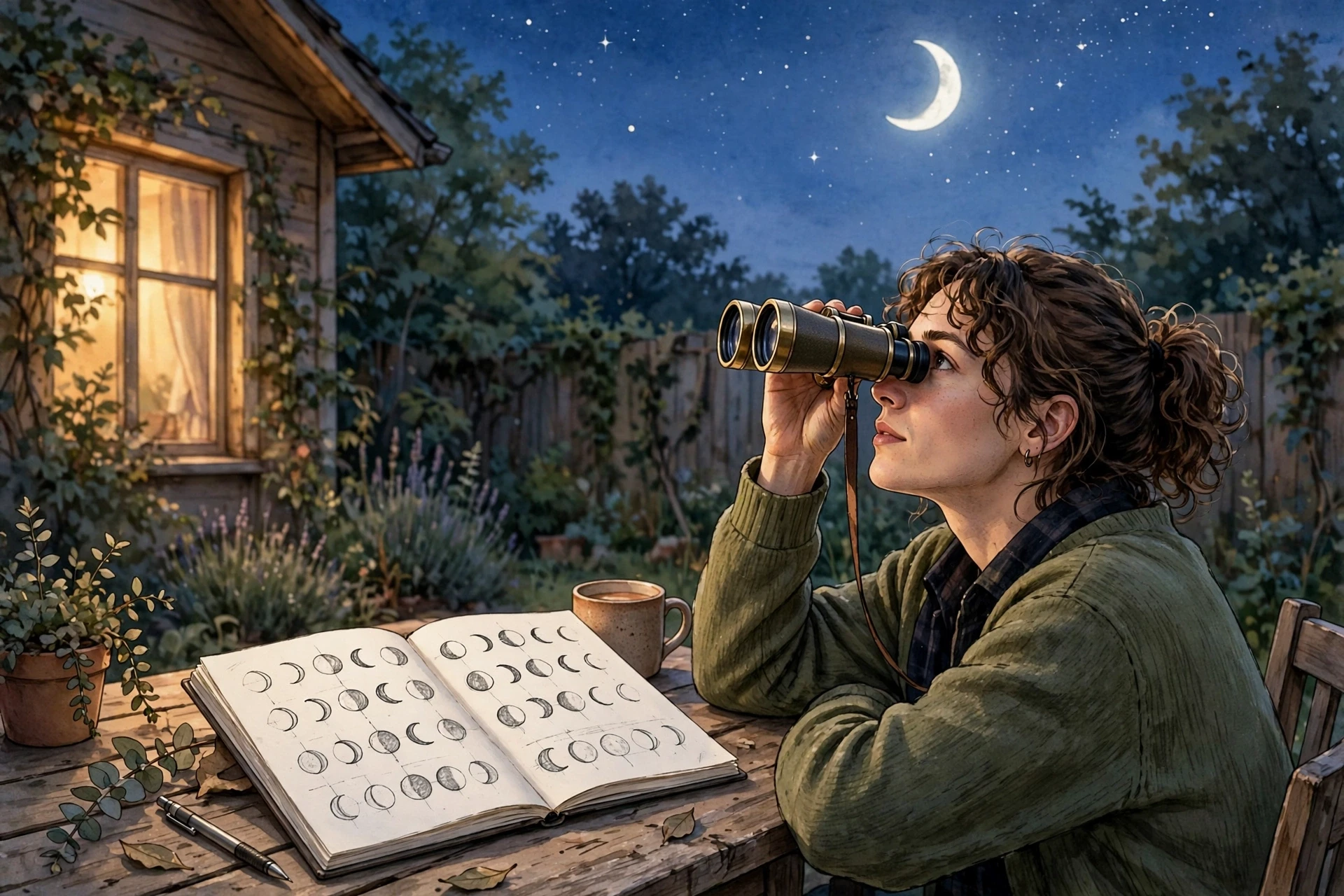
You do not need equipment to watch the moon phases. You need a clear sky, a few minutes a night, and a way to remember what you saw. Here is a plan that works, whether you are eleven with a notebook or an adult who has never really looked.
Pick a starting night. Any night will do, but a new moon is a good place to start, because you will watch the whole cycle of moon phases build from nothing. Check a Moon calendar or a weather app for the date of the next new moon.
Look at the same time each evening. Just after sunset is best for the waxing half of the cycle. Stand in the same place, facing west, and note where the Moon is and what shape it is.
Draw what you see. A quick sketch in a notebook — a circle, with the lit part shaded in — is better than a photograph for learning, because it forces you to look carefully. Write the date and time beside each sketch.
Keep going for a full month. You will see the crescent grow, the half Moon arrive, the gibbous swell, the full moon rise at sunset, and then the whole sequence run in reverse. At the end of the month, lay your sketches out in order. You will have drawn the lunar cycle yourself.
Try binoculars at first quarter and last quarter. Even a cheap pair of binoculars will show craters along the terminator, and the Moon's mountains casting shadows. Hold them steady — rest your elbows on a fence or a wall — and look at the line between light and dark.
Watch the Moon rise. On the night of a full moon, find a place with a clear view to the east, and watch the Moon come up as the Sun goes down. It is one of the simplest and most impressive sights in astronomy, and it costs nothing.
Notice the Moon in the daytime. Once you know the timetable, look for the Moon in the afternoon sky. A first-quarter Moon is easy to find in the daytime if you know where to look, and finding it feels like a small discovery every time.
11.1 What to look for through binoculars or a small telescope
With binoculars, the Moon stops being a flat disc and becomes a landscape. Start with the maria — the dark patches — and learn their names: Mare Imbrium, the Sea of Showers, and Mare Serenitatis, the Sea of Serenity, are two of the largest and easiest to find. Then look for the bright ray craters: Tycho, in the southern highlands, with bright rays spreading across the surface like splashed paint, and Copernicus, a large crater with terraced walls and a central peak, near the centre of the disc. Both are easiest to see near full moon, when the Sun is high and the rays stand out, while the craters along the terminator are easiest near quarter moon. A small telescope will show you the Apennine Mountains, a range that runs along the edge of Mare Imbrium, and the Straight Wall, a long, straight cliff that looks like a line drawn across the surface.
You do not need to learn all the names. The point is to look, and to notice that the Moon has a geography — mountains, valleys, plains, craters — and that the light moves across it, night by night, the way sunlight moves across a landscape on Earth. The Moon is the only world in the sky, apart from Earth, where you can watch the Sun rise and set over mountains with your own eyes, in real time, over a few nights.
11.2 Photographing the Moon with a phone
A phone camera can take a good picture of the Moon, but it needs a little help. The Moon is small and bright, and a phone's automatic settings will usually overexpose it into a white blob. Tap on the Moon on the screen to focus on it, then drag the exposure down until you can see detail — the dark maria, the bright highlands — instead of a featureless disc. If your phone has a night mode, turn it off for the Moon; it will try to brighten the sky and wash the Moon out. Hold the phone steady, or rest it on something solid, and take the picture when the Moon is near the horizon, next to a building or a tree, if you want a sense of scale. The photograph will not be as good as what you see with your eyes, but it will be yours, and it will be a record of a night you looked up.
For the wider sky, and for why the sky itself looks the way it does in the daytime, Sciory's Why Is the Sky Blue? explains the scattering of sunlight that makes the daytime sky blue and sunsets red — the same sunlight that lights the Moon, seen from the other side.
Conclusion: A Calendar You Can See
The Moon changes shape because we see a changing fraction of its sunlit half as it orbits Earth — nothing more, and nothing less. That is the whole explanation of the moon phases, and it has run, unbroken, for billions of years. The cycle takes 29.53 days, from new moon to new moon. It gave us our months, it gave us our tides, it steadied our seasons, and it gave our ancestors a calendar they could read without writing anything down.
That is what I think about now when I look at the Moon, all these years after my grandmother told me to draw it in a notebook. I do not see a disc that grows and shrinks. I see a sphere, half-lit by the Sun, turning slowly around us, showing us a little more of its daylight each night, then a little less, in a rhythm so regular you can set a calendar by it. I see the tides rising and falling on beaches I will never visit, the tilt of Earth held steady, and a world made in a collision, now drifting slowly away, still keeping time for us.
Go outside tonight, if the sky is clear, and find the Moon. Note its shape, note which side is lit, note where it is in the sky. Then look again tomorrow night, and the night after. In a month, you will have watched the whole cycle of moon phases, and you will know, from your own eyes, why the Moon changes shape. No diagram can replace that. The diagram can only tell you what to look for. The looking is the point.
Frequently Asked Questions
Why does the Moon change shape?
The Moon itself never changes shape. The Sun always lights half of it, and as the Moon orbits Earth, we see a changing fraction of that lit half — that changing view is what the moon phases are. At new moon we see its dark side, at full moon we see its fully lit side, and in between we see crescents, halves, and gibbous shapes. The cycle takes 29.53 days.
What are the 8 phases of the Moon in order?
In order, the moon phases are: new moon, waxing crescent, first quarter, waxing gibbous, full moon, waning gibbous, last quarter, and waning crescent. Each named phase lasts about three and a half days, and the full cycle from one new moon to the next takes 29.53 days.
Is the Moon's phase caused by Earth's shadow?
No. The moon phases are caused by our changing view of the Moon's sunlit half as it orbits Earth. Earth's shadow only falls on the Moon during a lunar eclipse, which happens only at full moon, only a few times a year, and lasts a few hours. The dark part of a crescent or gibbous Moon is the Moon's own night side, not a shadow.
How long is the lunar cycle?
The cycle of moon phases — the synodic month — is 29.53 days, from one new moon to the next. The Moon's orbit around Earth against the background stars — the sidereal month — is shorter, 27.32 days. The difference is because Earth moves around the Sun while the Moon orbits, so the Moon must travel a little farther to line up with the Sun again.
Why do we always see the same side of the Moon?
The Moon is tidally locked to Earth: it spins on its axis once per orbit, about every 27.32 days, so the same face always points toward us. Earth's gravity slowed the Moon's spin long ago until it matched its orbit. We can see about 59 percent of the Moon's surface over time because of a slight wobble called libration, but the far side is never visible from Earth.
What is the difference between a supermoon and a blue moon?
A supermoon is a full moon that happens when the Moon is near perigee, its closest point to Earth, so it looks about 14 percent larger and 30 percent brighter than a full moon at its farthest point. A blue moon is the second full moon in a single calendar month. The Moon does not turn blue in either case, and neither event is dangerous.
How does the Moon affect the tides?
The Moon's gravity pulls the ocean toward it, creating a bulge of water on the side of Earth facing the Moon, and Earth is pulled away from the water on the far side, creating a second bulge there. As Earth spins, most coastlines pass through two high tides and two low tides a day. At new and full moon, the Sun's pull lines up with the Moon's and produces spring tides; at the quarter moons, they pull at right angles and produce smaller neap tides.