

Introduction
On the night of 6 October 1995, two astronomers in Switzerland stared at a graph that should not have existed — the first exoplanet ever found around a Sun-like star was hiding in it. Michel Mayor and Didier Queloz had been watching a star called 51 Pegasi, a star much like our Sun, about 50 light-years away. Night after night, its light had shifted back and forth in a tiny, regular rhythm — a wobble that repeated every 4.2 days. The only explanation that fit was one of the first exoplanets: a planet roughly half the mass of Jupiter, racing around its star in just four days. A year on that world lasts less than a working week on Earth.
Nobody had expected that. The textbooks of the time said giant planets form far from their stars, where it is cold enough for gas to gather, and stay there. A Jupiter-sized world hugging its star, hotter than an oven, orbiting closer than Mercury orbits the Sun, broke the rules before the field had even begun. Some astronomers thought the team had made a mistake. Within weeks, other telescopes confirmed the wobble. The planet, 51 Pegasi b, was real. It was the first exoplanet ever found around a Sun-like star, and it won Mayor and Queloz the 2019 Nobel Prize in Physics.
I remember the first time I heard that story properly, not as a headline but as a scientist telling it in a crowded lecture hall, years after the discovery. He paused after describing the four-day orbit and said, almost quietly, "We had been looking for other Earths. The universe gave us something we had never imagined instead." That sentence stayed with me, because it captures the whole history of exoplanets in miniature: we set out with one picture in mind, and the sky kept answering with stranger ones.
Exoplanets are planets that orbit stars other than the Sun. As of 7 November 2026, the NASA Exoplanet Archive lists 6,464 confirmed exoplanets, with more than 8,000 additional candidates still waiting to be confirmed. The total passed 6,000 in September 2025, only three decades after 51 Pegasi b. Every one of those worlds was found without ever being seen clearly at first — most have never been photographed at all. They were found by their shadows, their tugs, and the faint fingerprints they leave in starlight.
This guide explains how that is possible. We will start with what exoplanets are and why they are so hard to see, then walk through the five detection methods one by one — the transit method, radial velocity, direct imaging, gravitational microlensing, and astrometry — and look at what each one can and cannot tell us. Then we will turn to the habitable zone, the famous systems that fill the headlines, and the James Webb Space Telescope, which is now reading the air of distant worlds molecule by molecule. Along the way, we will clear up the misconceptions that follow this subject everywhere, including the biggest one of all: that finding an "Earth-like" planet means finding a second Earth.
1. What Is an Exoplanet?
1.1 A simple definition with a sharp edge
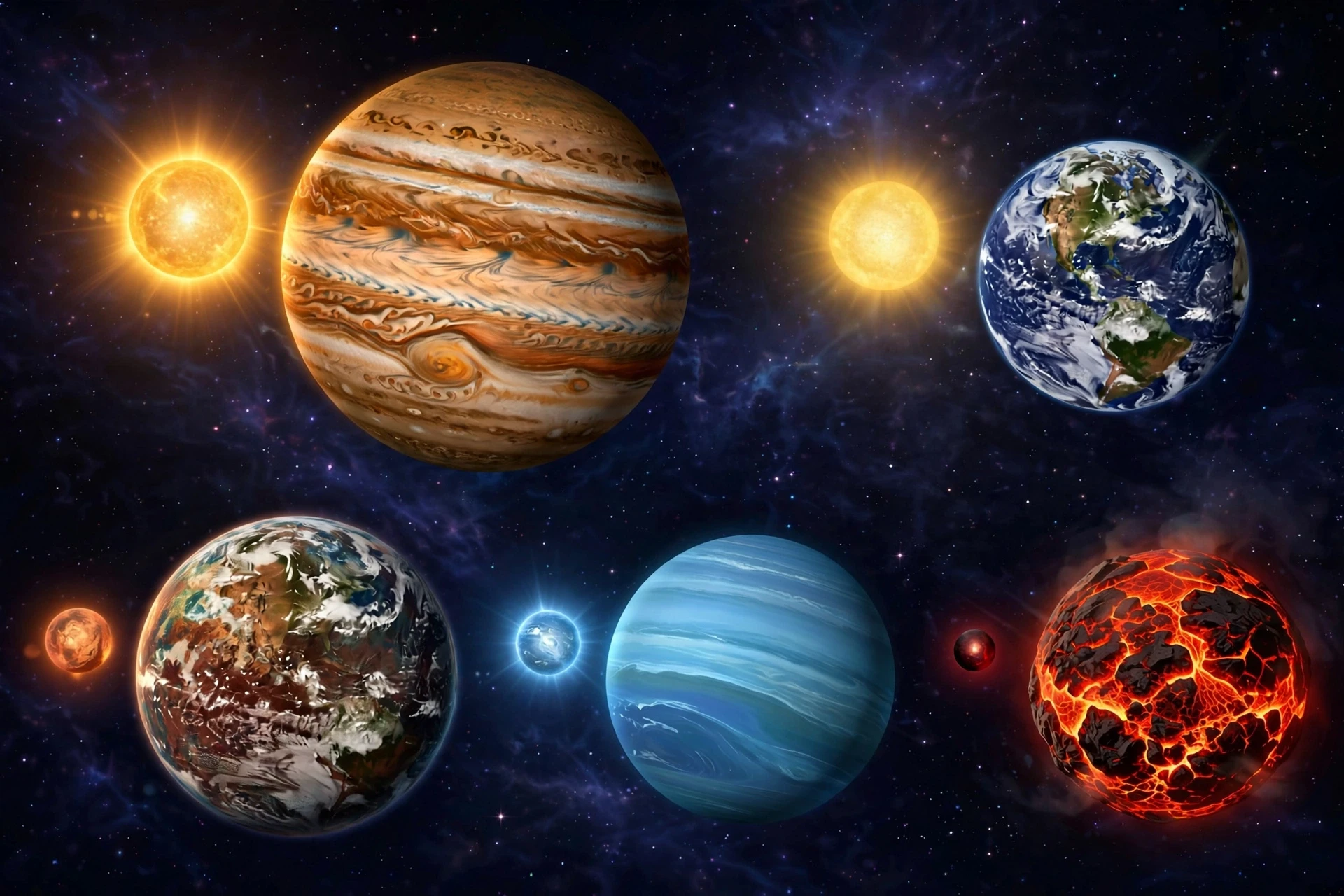
An exoplanet is a planet outside our solar system — a world that orbits a star other than the Sun, or in rare cases drifts through space with no star at all. The word itself is short for "extrasolar planet." The definition sounds simple, and it is, but the boundary at its edges is surprisingly fuzzy. Where does a planet end and a failed star begin? Astronomers draw the line at about 13 times the mass of Jupiter: above that, an object is heavy enough to fuse deuterium, a heavy form of hydrogen, in its core, and it counts as a brown dwarf rather than a planet. Below that line, it is a planet — even if it is far bigger than Jupiter, even if it orbits a dead star, even if it has no star at all.
Those starless worlds have a name of their own: rogue planets. They were probably thrown out of their birth systems by gravitational encounters with larger planets, and they now wander the galaxy alone, in the dark. We know they exist because microlensing surveys have caught their gravity bending the light of background stars. Nobody knows how many there are. Some estimates suggest there may be billions of them in the Milky Way, perhaps more rogue planets than stars. It is a strange thought: the galaxy may be full of worlds no sun ever shines on.
Most exoplanets, though, do have stars, and most of those stars are not like the Sun. The first exoplanets found around ordinary stars were gas giants, because giants are the easiest to detect. But as telescopes improved, the census filled in with smaller worlds. Today the confirmed catalogue includes rocky planets smaller than Earth, super-Earths between Earth and Neptune in size, Neptune-like worlds, and gas giants larger than Jupiter. NASA's overview of what an exoplanet is puts the variety plainly: exoplanets come in sizes and orbits that have no counterpart in our solar system, and the familiar layout of small rocky worlds inside and giants outside turns out to be only one arrangement among many.
1.2 How many exoplanets are there?
The honest answer has two parts: how many we have confirmed, and how many probably exist. The confirmed number, as noted above, stood at 6,464 on 7 November 2026 according to the NASA Exoplanet Archive, the catalogue maintained by NASA's Exoplanet Science Institute at Caltech. That number rises by a few hundred every year, in jumps, as batches of candidates are confirmed. It passed 5,000 in March 2022 and 6,000 in September 2025. The archive also lists thousands of candidates — signals that look like planets but have not yet passed the strict tests needed for confirmation.
The second number is far larger, and it comes from statistics rather than counting. Kepler, NASA's planet-hunting telescope, stared at one patch of sky for years and found that planets are common: on average, there is at least one planet for every star in the Milky Way. With something like 100 to 400 billion stars in our galaxy, that means hundreds of billions of planets. A substantial fraction of Sun-like stars appear to host a rocky planet in the habitable zone, though the exact fraction is still debated, because small, far-out planets are the hardest to find and the easiest to miss. The census we have is not a fair sample of the galaxy. It is a sample of the exoplanets that are easiest to detect, and everything we conclude from it has to carry that warning label.
"We had been looking for other Earths. The universe gave us something we had never imagined instead." That is the story of exoplanet science in one sentence: every time the telescopes improve, the picture gets stranger, and more interesting, than the one before it.
1.3 Why our solar system is a bad template
Before 1995, most astronomers assumed other planetary systems would look roughly like ours: small rocky planets close to the star, gas giants farther out, everything in near-circular orbits in a flat plane. It was a reasonable guess. It was also wrong in almost every detail that mattered.
The first exoplanets broke the template immediately. 51 Pegasi b was a gas giant where no gas giant should be. Then came planets on wildly stretched-out, elliptical orbits, planets orbiting their stars backwards, planets around two stars at once, and systems where giant planets crowd together closer than Mercury is to the Sun. Kepler later found systems with six or seven planets packed inside the orbit of Venus, all of them bigger than Earth, orbiting in neat, flat rows like commuters on a train. Nothing in our solar system looks like that.
Our solar system is now understood to be one outcome among many, not the standard design. If you want the home-team comparison, Sciory's guide to our solar system: its planets, moons, and celestial dynamics lays out the eight planets and the forces that move them — the baseline against which every exoplanet system is measured. That matters for more than curiosity. If we want to know how common Earth-like worlds are, we first have to admit that our own system may be unusual — perhaps in its calm history, perhaps in the way Jupiter shielded the inner planets, perhaps in nothing at all. The only way to find out is to keep counting, system by system, until the statistics speak clearly. That is what the exoplanet census is for.
2. The Night That Changed Astronomy: 51 Pegasi b
2.1 A wobble that should not have been there
The discovery of 51 Pegasi b did not begin with a photograph. It began with a spectrograph — an instrument that splits starlight into a rainbow and measures the exact colour of its lines. When a star moves towards us, its light shifts slightly towards the blue; when it moves away, it shifts towards the red. This is the Doppler effect, the same physics that makes an ambulance siren rise in pitch as it approaches and fall as it recedes. Mayor and Queloz were measuring the Doppler shift of 51 Pegasi with a new, exquisitely sensitive spectrograph called ELODIE at the Haute-Provence Observatory in southern France, looking for the tiny back-and-forth motion a planet would cause in its star.
What they found was a wobble with a period of 4.23 days and a speed of about 59 metres per second — roughly the speed of a car on a motorway. That speed told them the planet's minimum mass: about half of Jupiter's. The period told them its distance: about 0.05 astronomical units from its star, roughly one-twentieth of Earth's distance from the Sun. At that distance, the planet's dayside temperature would be around 1,000 degrees Celsius. It was a "hot Jupiter," a class of planet nobody had predicted, and it should not have been able to form where it was found. Gas giants need cold, distant regions to gather their gas. A Jupiter-mass world sitting almost on top of its star must have formed farther out and migrated inward, spiralling through the young planetary disc until it parked in a tight orbit.
I have always loved this part of the story, because it shows how science actually moves. The observers did not set out to find a hot Jupiter. They set out to test whether their instrument could find planets at all, and they expected to find something like Jupiter around a Sun-like star, far out, on a slow orbit. Instead, the first signal was so strong and so fast that they first suspected an error in the instrument. They checked, rechecked, and then watched the signal repeat, night after night, with clockwork regularity. The universe had other plans, and the observers were honest enough to follow the data instead of their expectations.
2.2 Why it took until 1995
People sometimes ask why exoplanets were not found earlier, since telescopes have existed for centuries. The answer is that the signals are absurdly small. A Jupiter-mass planet makes its star wobble at about 12 metres per second — a brisk walking pace, in a star that is itself racing through space at tens of kilometres per second. An Earth-mass planet makes its star wobble at less than 10 centimetres per second, slower than a tortoise. Measuring that requires splitting light with a precision that was simply not possible until the 1990s, when new spectrographs, stable to a fraction of a wavelength of light, finally arrived.
There were also two earlier claims that did not survive. In 1992, astronomers found the first confirmed exoplanets of any kind — two rocky worlds orbiting a pulsar, the dead, spinning remnant of an exploded star. Those planets are real, but they orbit a stellar corpse, in a place no one would call habitable, and their discovery did not launch the field the way 51 Pegasi b did. A planet around a normal, Sun-like star was the prize, because it meant planets around ordinary stars were normal — and that our own system was not a fluke. The NASA Exoplanet Exploration pages tell this history as a sequence of milestones, and 1995 is the one that changed everything: within a decade, dozens of exoplanets were known; within three decades, thousands.
2.3 The hot Jupiter puzzle, and what it taught us
Hot Jupiters forced astronomers to rethink how planets form and move. The leading explanation is migration: a giant planet forms beyond the "snow line," where water and other substances freeze solid and there is enough material to build a huge core, then loses orbital energy by interacting with the gas disc it was born in, spiralling inward over millions of years. Some hot Jupiters may have been flung inward by gravitational encounters with other planets and then had their orbits circularised by tides. Either way, migration is now a central idea in planetary science, and it changed how we think about our own history too — there is evidence that Jupiter itself wandered inward and then outward early in the solar system's life, in a journey sometimes called the Grand Tack, shaping the layout of the planets we see today.
The lesson of 51 Pegasi b is not just that strange planets exist. It is that the first example of anything is rarely typical. The first exoplanet around a Sun-like star was one of the weirdest planets we know, and it took years of patient survey work before the census filled in with the quieter, smaller, more Earth-like worlds that are far more common. If you remember one thing from this section, let it be this: in exoplanet science, the easy finds come first, and the easy finds are the oddballs.
3. Why Exoplanets Are So Hard to See
3.1 The billion-to-one problem
Here is the central difficulty of the whole field, and it can be stated in one number: a star outshines its planets by roughly a billion to one in visible light. The Sun is about a billion times brighter than Earth as seen from outside the solar system. Trying to photograph an exoplanet next to its star is like trying to spot a firefly hovering beside a lighthouse, from miles away, while the lighthouse beam is pointed at you. The planet does not make its own visible light — it only reflects a tiny fraction of its star's light — and it sits, from our point of view, almost on top of the star.
Distance makes it worse. The nearest star beyond the Sun, Proxima Centauri, is 4.24 light-years away. Its planet, Proxima b, sits about 0.05 astronomical units from its star — from Earth, that is an angle on the sky smaller than a coin seen from kilometres away. Even the largest telescopes on Earth blur starlight into a disc wider than that separation, because of the turbulence of our atmosphere and the fundamental limits of optics. Space telescopes do better, but the brightness contrast remains. This is why, of the more than 6,400 confirmed exoplanets, fewer than 100 have ever been directly photographed.
I once tried to explain this to a group of school students using a torch and a marble in a darkened hall. I held the torch at arm's length and asked them to find the marble I had placed beside it, without looking directly at the torch. They squinted, shielded their eyes, and mostly failed — and that was with a torch, not a star, at a distance of a few metres, not light-years. One student said, "So you have to block the torch out?" Exactly. That is what a coronagraph does, and it is one of the hardest optical tricks in astronomy.
3.2 What astronomers measure instead
Since direct pictures are so hard, exoplanet hunters measure effects rather than images. A planet tugs its star, making it wobble. A planet crosses in front of its star, making it dim by a fraction of a percent. A planet's gravity bends the light of a more distant star, making it briefly brighter. A planet's atmosphere filters starlight, leaving chemical fingerprints. Each of these effects is tiny, and each requires measuring starlight with extraordinary precision — brightness changes of one part in ten thousand, velocity changes of metres per second, position changes of millionths of a degree. The whole field is an exercise in measuring almost nothing, very carefully, and trusting the pattern that emerges when the almost-nothing repeats.
That is also why confirmation takes so long. A single dip in a star's brightness could be a planet, or a sunspot, or a binary star, or an instrument glitch. Astronomers demand that the signal repeat with a regular period, that it looks the same in different telescopes, and that other explanations be ruled out one by one. Thousands of candidates sit in the queue for years waiting for that work. The NASA Exoplanet Archive keeps the confirmed list separate from the candidate list for exactly this reason: a candidate is a suspicion, and a confirmed planet is a verdict.
3.3 The tools that made it possible
Three kinds of technology made the exoplanet revolution possible. The first was precision spectrographs, which measure Doppler shifts to metres per second and better. The second was space telescopes that stare at the same stars for years without blinking, free from clouds, daylight, and the shimmer of the atmosphere — Kepler, which watched 150,000 stars in one patch of sky from 2009 to 2018, and TESS, its successor, which is surveying the whole sky sector by sector. The third was computing: the light curves and spectra these telescopes produce are enormous, and finding a planet in them means searching millions of measurements for a repeating pattern a fraction of a percent deep. Some of the most productive planet hunters today are not people at telescopes but algorithms, and citizen scientists, sifting through data online.
The payoff is a new kind of astronomy. For most of history, astronomy was the study of light from stars. The study of exoplanets turned it into the study of worlds — their sizes, masses, orbits, temperatures, and, increasingly, their air. The rest of this guide is about how each method does that, and what it cannot do.
4. Method 1: The Transit Method — Catching a Planet's Shadow
4.1 How a transit works
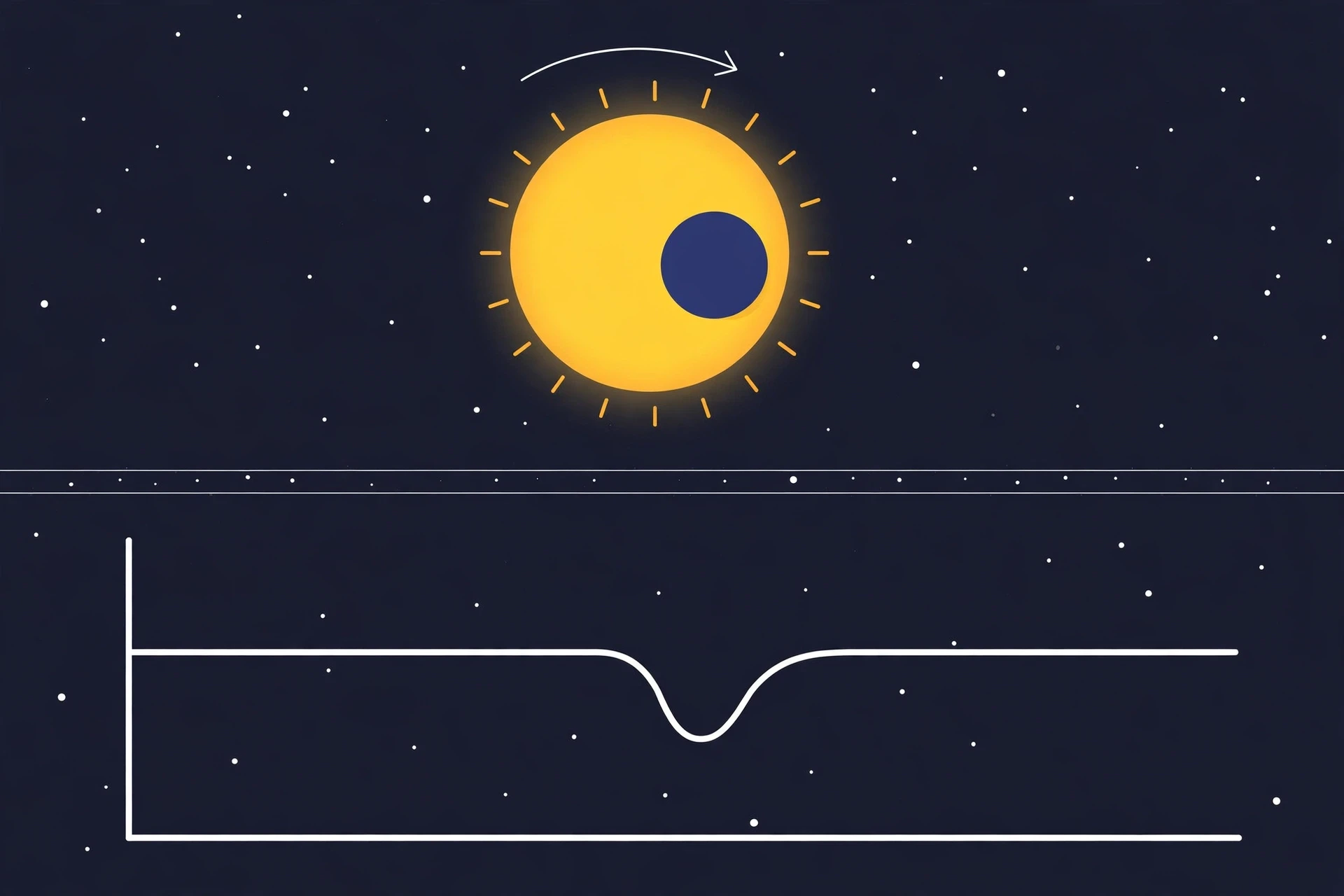
The transit method is the workhorse of exoplanet science, responsible for about three-quarters of all confirmed discoveries. The idea is simple. If a planet's orbit happens to be lined up edge-on to Earth, the planet will pass directly in front of its star once per orbit, blocking a tiny fraction of the star's light. For a Jupiter-sized planet crossing a Sun-sized star, the dip is about 1 percent. For an Earth-sized planet, it is about 0.01 percent — one part in ten thousand, like a fly crossing a car headlight. A telescope that measures the star's brightness continuously will see the light dip, recover, and then dip again exactly one orbital period later. Three or more evenly spaced dips, all the same depth and shape, is the signature of a transiting planet.
The geometry is unforgiving. For a planet in an Earth-like orbit, the chance that its orbit lines up edge-on is only about 0.5 percent. For a hot Jupiter in a tight orbit, the chance is closer to 10 percent, because the star looks bigger from close up. That is why transit surveys find so many hot Jupiters and so few true Earth analogues: the method is biased towards close-in planets, and the bias has to be corrected for before anyone can say how common Earth-sized worlds really are. Kepler dealt with this by watching a huge number of stars at once — 150,000 of them — so that even a 0.5 percent alignment chance still yielded thousands of planets.
4.2 What a transit reveals
A transit light curve is a remarkably informative thing. The depth of the dip tells you the planet's size relative to its star: a bigger planet blocks more light. The time between dips tells you the orbital period, and from the period and the star's mass you can calculate the distance from the star. The shape of the dip — how fast the light falls and rises, how long it stays flat — tells you about the orbit's angle and the star's own properties. And if you watch the transit in different colours of light, you can do something extraordinary: you can read the planet's atmosphere, because starlight filtering through the thin ring of air around the planet's edge is absorbed at wavelengths that match the molecules in that air. That technique, transmission spectroscopy, is the subject of Section 9.
Kepler alone confirmed more than 2,600 planets, and TESS, launched in 2018, has now passed 1,000 confirmed planets of its own, with thousands more candidates. Together they transformed the field from a collection of curiosities into a statistical science. Kepler's most famous result was not any single planet but a pattern: small planets are common, multi-planet systems are common, and planets between Earth and Neptune in size — super-Earths and mini-Neptunes — are the most common kind of planet in the galaxy, even though our solar system has none at all.
4.3 The limits of the transit method
Transits have three built-in limits, and honest reporting about exoplanets has to name them. First, the alignment problem: most planets never transit from our point of view, so transit surveys miss the majority of planets outright. Second, the method measures size, not mass. A planet's radius alone does not tell you what it is made of — a world 1.5 times Earth's size could be a rocky super-Earth or a small gas planet with a thick atmosphere, and the transit alone cannot tell you which. Third, the method favours close-in planets with short periods, because a planet that takes a year to orbit only transits once a year, and confirming it takes years of watching.
False positives are a constant headache. A pair of stars eclipsing each other can mimic a planetary transit, and so can a background eclipsing binary star lined up behind the target star. That is why every candidate goes through follow-up: radial velocity measurements to check for a planet's mass, high-resolution imaging to check for background stars, and statistical tests that weigh how likely each explanation is. The process is slow, and it is one reason the candidate list is so much longer than the confirmed list.
What transits measure: planet size, orbital period, orbital distance, and, with spectroscopy, atmospheric composition.
What transits cannot measure: planet mass on their own, or anything about a planet that never crosses its star from our viewpoint.
Best targets: close-in planets around small, bright stars, where dips are deep and frequent.
5. Method 2: Radial Velocity — Feeling the Star Wobble
5.1 The star moves too
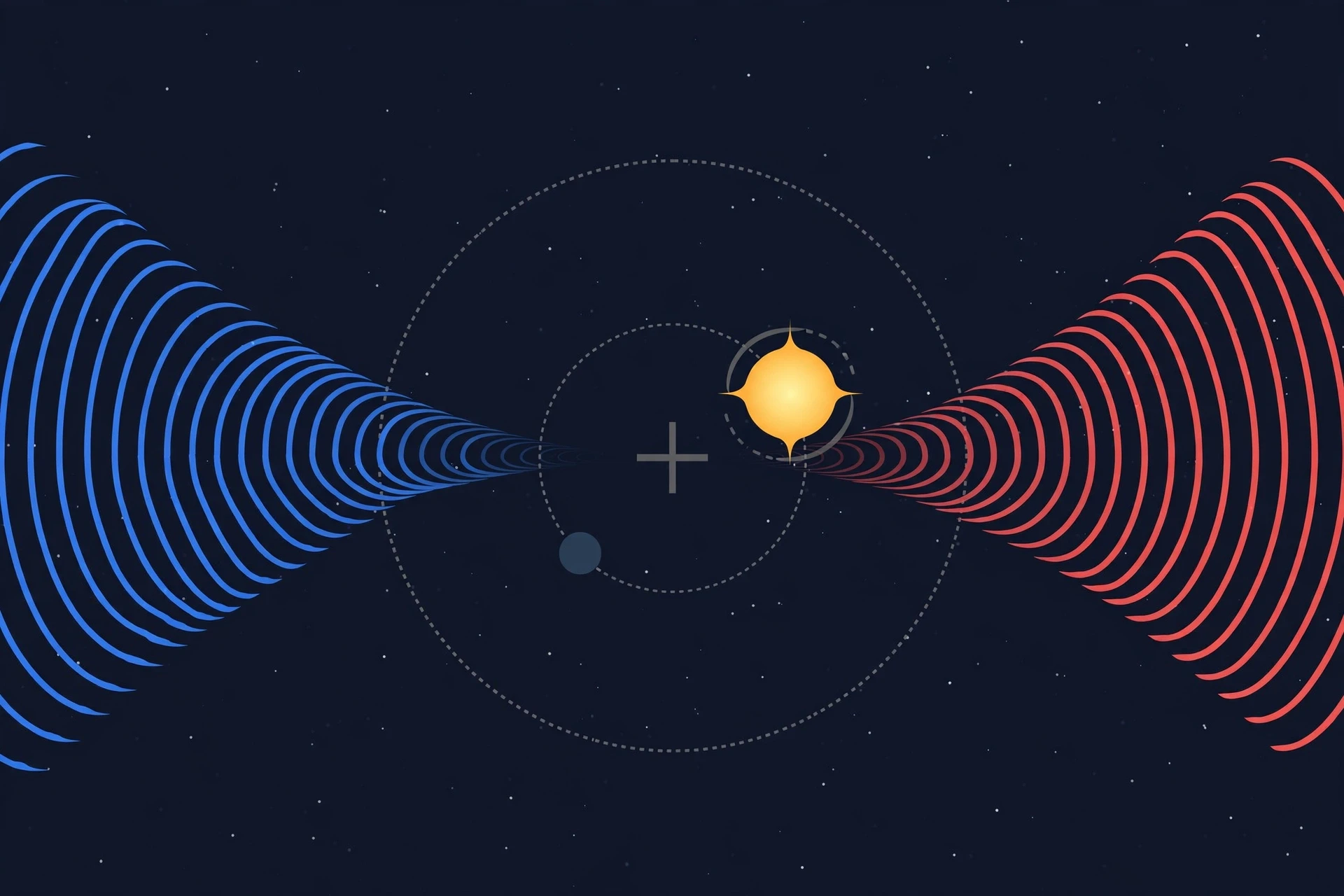
The radial velocity method, also called the Doppler method, is the technique that found 51 Pegasi b, and it remains the essential partner to transits. It rests on a fact that is easy to forget, and on how gravity works: a planet does not orbit its star while the star stands still. Both bodies orbit their common centre of mass. The star is far heavier, so its orbit is far smaller — but it still moves, tracing a tiny circle as the planet circles it. The Sun, tugged by Jupiter, moves at about 12 metres per second. Tugged by Earth, it moves at less than 10 centimetres per second.
That motion shows up in the star's spectrum. As the star moves towards us, its spectral lines shift towards the blue; as it moves away, they shift towards the red. Measuring that shift over months or years traces out a wave, and the wave's period gives the planet's orbital period while its height gives a minimum mass for the planet. It is a minimum, not the true mass, because the method measures only the motion along our line of sight: if the orbit is tilted, the true wobble is larger than the part we see, and the true mass is larger than the minimum. Combining radial velocity with a transit — which fixes the tilt, because a transiting planet's orbit must be edge-on — removes that ambiguity and gives the true mass. That combination is how astronomers calculate a planet's density, and density is what tells rock from gas.
5.2 What radial velocity is good at
Radial velocity is the method that finds planets around bright, nearby stars, and it works for planets that never transit. It is particularly good at finding massive planets in wide orbits, which transit surveys miss because their periods are long and their alignments are unlikely. It also gives mass, which is the single most important number for understanding what a planet is. Size without mass is a silhouette; mass without size is a weight without a shape; together, they give density, and density separates a rocky world from a puffball.
The method has driven some of the field's most famous discoveries. Proxima b, the nearest exoplanet to Earth, was found by radial velocity in 2016: a planet at least 1.1 times Earth's mass, orbiting in the habitable zone of Proxima Centauri, the closest star to the Sun, just 4.24 light-years away. It was found not by a space telescope but by patient ground-based spectrographs, watching a faint red dwarf star wobble by a few metres per second. That discovery made the nearest potentially habitable world a real place with a name, rather than a statistical abstraction.
5.3 The limits, and the noise problem
Radial velocity has a formidable enemy: the star itself. Stars are not smooth, steady light bulbs. They pulse, they flare, they rotate with dark spots and bright patches on their surfaces, and all of that activity shifts their spectral lines in ways that can mimic or hide a planet's signal. A starspot rotating across a star's face can produce a false wobble with a period equal to the star's rotation. For active young stars and small red dwarfs, this stellar noise can be larger than the signal of an Earth-mass planet.
The instruments have improved enormously — modern spectrographs like ESPRESSO on the Very Large Telescope can measure velocities to better than a metre per second — but the star's own restlessness sets a practical floor. Finding a true Earth twin, with a one-year orbit and a 10-centimetre-per-second wobble around a Sun-like star, is still beyond routine reach, and it is one of the great technical challenges of the next decade. New instruments, longer observing campaigns, and better ways of modelling stellar activity are all aimed at that floor, and the race to reach it is one of the most exciting contests in astronomy.
What radial velocity measures: planet minimum mass, orbital period, orbital shape.
What it cannot measure: planet size on its own, or the true mass without a transit to fix the tilt.
Best targets: massive planets around bright, quiet stars; nearby systems where follow-up is possible.
6. Method 3, 4 and 5: Direct Imaging, Microlensing, and Astrometry
6.1 Direct imaging — taking the photograph
Direct imaging is the method everyone imagines first and the one that has found the fewest planets: fewer than 100 of the confirmed total. The idea is to block out the star's light with a coronagraph — a mask inside the telescope — and photograph the faint planet beside it. It works best for young, hot, giant planets in wide orbits, because young planets still glow with the heat of their formation, and wide orbits put them far enough from the star's glare to be seen. The first directly imaged exoplanets, around the star HR 8799 in 2008, were four giant planets, each several times Jupiter's mass, orbiting at distances greater than Saturn's.
Direct imaging has one advantage no other method can match: it sees the planet itself. Its light can be split into a spectrum, revealing the molecules in its atmosphere directly, and repeated images over years can trace its orbit across the sky. Its disadvantage is the billion-to-one contrast problem in its purest form, and the fact that it favours exactly the planets least like Earth — big, young, and far from their stars. An Earth-sized planet in an Earth-like orbit around a Sun-like star is far beyond current direct imaging, though future telescopes like the planned Habitable Worlds Observatory are being designed precisely for that shot.
6.2 Gravitational microlensing — gravity as a lens
Microlensing uses gravity itself as a telescope. When one star passes directly in front of a more distant star, as seen from Earth, the nearer star's gravity bends and magnifies the background star's light, making it brighten for days or weeks. If the nearer star has a planet, the planet's gravity adds a brief extra spike of brightness — a signal lasting hours to days — on top of the main brightening. From that spike, astronomers can infer the planet's mass and its distance from its star.
Microlensing is the only method that routinely finds planets far from their stars, including cold planets beyond the snow line, and planets around stars thousands of light-years away, in regions of the galaxy other methods cannot reach. It is also the only method that finds rogue planets. Its great weakness is that each event happens once and never repeats: the alignment is a chance crossing, and once the stars have moved on, the planet can never be observed again. That makes follow-up impossible, and it means microlensing planets are known from a single brief signal. About 290 confirmed exoplanets have been found this way, with more expected from the Nancy Grace Roman Space Telescope, which is designed to run a large microlensing survey.
6.3 Astrometry — measuring the star's dance across the sky
Astrometry is the oldest idea in the field and the newest to deliver. It measures a star's position in the sky with extreme precision, watching for the tiny sideways wobble a planet causes as the star circles their common centre of mass. The effect is minuscule — for a Jupiter-like planet around a nearby star, the wobble is about the width of a coin seen from hundreds of kilometres away — and it took the Gaia space telescope, launched by the European Space Agency in 2013, to measure star positions precisely enough to find planets this way. Only a handful of exoplanets have been confirmed by astrometry so far, but Gaia's data releases are expected to add many more, including giant planets in wide orbits that other methods struggle to see.
Astrometry has a particular strength: unlike radial velocity, it measures the wobble in two dimensions on the sky, so it gives the planet's true mass directly, without the tilt ambiguity. It is also good at finding planets in wide orbits, where transits are unlikely and radial velocity signals are slow. Its weakness is time: a planet on a ten-year orbit needs a decade of measurements to trace its full wobble, and the precision required is at the very edge of what current telescopes can do.
Method | What it measures | Confirmed planets (Nov 2026) | Main strength | Main limit |
|---|---|---|---|---|
Transit | Size, period, atmosphere | About 4,800 | Finds small planets; reads atmospheres | Needs edge-on alignment; no mass alone |
Radial velocity | Minimum mass, period | About 1,200 | Gives mass; works without transits | Stellar noise; tilt ambiguity |
Direct imaging | Light, spectrum, orbit | Fewer than 100 | Sees the planet itself | Only young giants far from stars |
Microlensing | Mass, distance | About 290 | Finds cold and distant planets | One-off events; no follow-up |
Astrometry | True mass, orbit | A handful | True mass; wide orbits | Needs years of extreme precision |
The counts in this table come from the NASA Exoplanet Archive's breakdown by discovery method, as reported in November 2026; the numbers move as new planets are confirmed, and small differences between sources reflect different cut-off dates rather than disagreements. Read the table as a portrait of bias: each method sees a different slice of the galaxy's planets, and none of them sees the whole picture alone. That is why astronomers use them together.
7. The Habitable Zone — and What "Earth-Like" Really Means
7.1 The Goldilocks idea
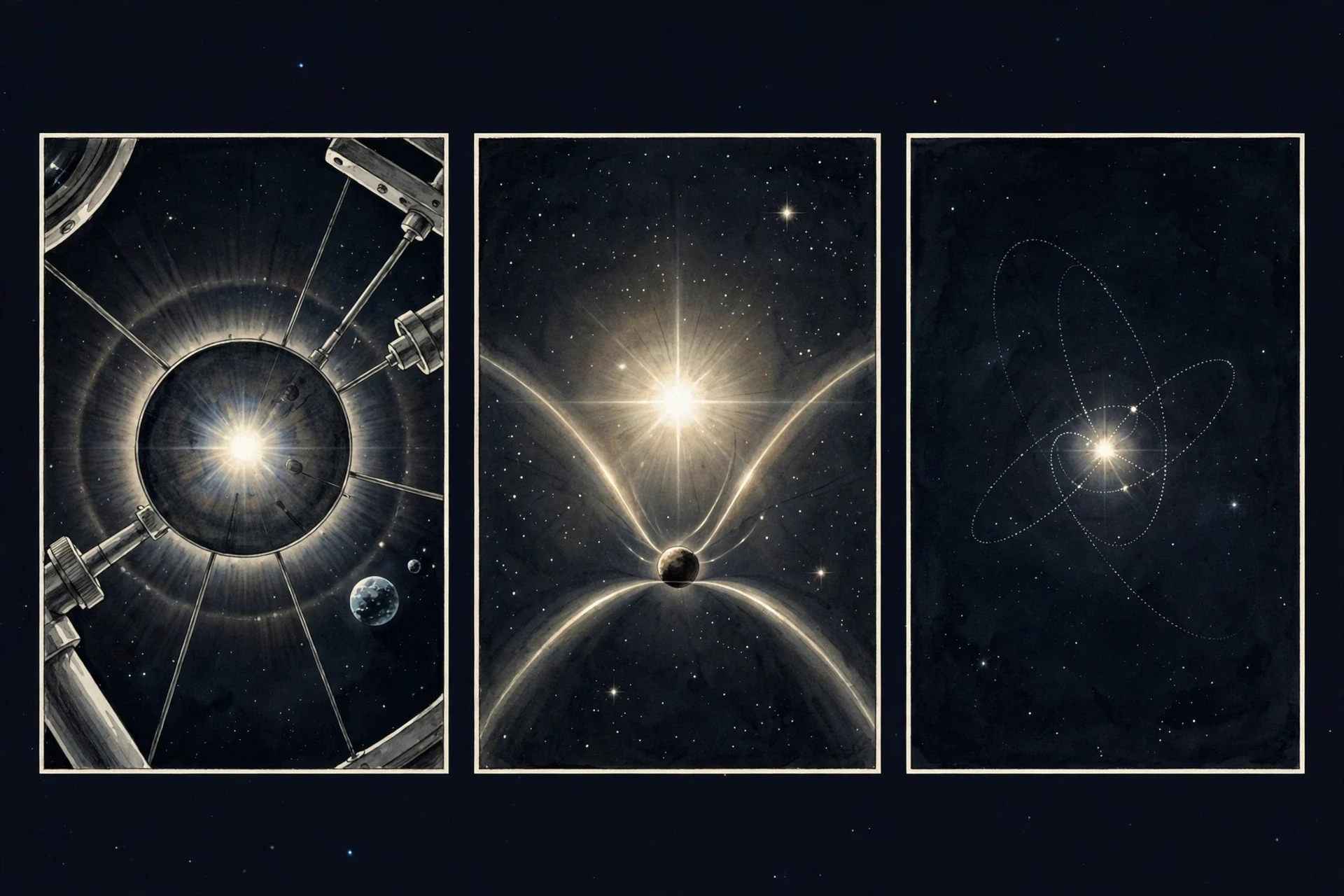
The habitable zone is the region around a star where a rocky planet with a suitable atmosphere could keep liquid water on its surface. Too close, and water boils away; too far, and it freezes solid. The name "Goldilocks zone" comes from the fairy tale — not too hot, not too cold — and it is a useful first picture, as long as it is not mistaken for the whole story. For our Sun, the habitable zone stretches roughly from just beyond Venus's orbit to just beyond Mars's. Earth sits comfortably inside it. Venus sits at its inner edge and Mars at its outer edge, and both are uninhabitable today, which already tells you that being in the zone is not enough.
The zone moves with the star. Around a small, cool red dwarf, the habitable zone is much closer in — so close that a planet there orbits in days or weeks rather than months. Around a hot, bright star, the zone is far out, and the planet's year is long. The zone also moves with time: as stars age and brighten, their habitable zones drift outward — one reason the life cycle of stars, from birth to red giant to remnant, matters so much to exoplanet hunters. A planet that is comfortable today may not have been a billion years ago, and may not be a billion years from now.
7.2 What the zone leaves out
Here is the point that gets lost in most headlines: the habitable zone is a statement about starlight, not about habitability. It says nothing about whether the planet has an atmosphere at all, or what that atmosphere is made of, or whether the planet has a magnetic field to protect it, or liquid water to begin with, or plate tectonics to recycle carbon, or a stable climate over billions of years. Venus, Earth, and Mars all sit in or near the Sun's habitable zone, and they could not be more different: one is a scorching greenhouse, one is alive, and one is a frozen desert.
Red dwarf stars make the problem sharper. Most habitable-zone planets found so far orbit red dwarfs, because red dwarfs are the most common stars and their habitable zones are close in, making transits likely and frequent. But red dwarfs are restless: they flare violently, bathing their close-in planets in ultraviolet light and charged particles that can strip atmospheres away. Their habitable-zone planets are also likely to be tidally locked, with one face permanently turned towards the star and the other in endless night. A tidally locked planet could still be habitable — thick air and oceans can carry heat to the night side — but it would be a very different kind of habitable from Earth, and we do not yet know whether such worlds can hold on to their air. That question is exactly what the James Webb Space Telescope is now testing, planet by planet.
7.3 How astronomers actually judge a planet
When astronomers call a planet "potentially habitable," they mean something narrow: it is rocky, it is roughly Earth-sized, and it receives roughly the right amount of starlight for liquid water. That is a starting point for further study, not a conclusion. The real judgement comes later, from the atmosphere: does the planet have one? What is it made of? Is there water vapour, carbon dioxide, methane, oxygen? Is the temperature consistent with liquid water? Each of those questions needs observations that are only now becoming possible, and for most planets the answers are still "we do not know yet."
I think of the habitable zone the way a doctor thinks of a waiting room: it tells you who is in the building, not who is healthy. The zone narrows the search from billions of planets to a manageable list of candidates. The hard work — the atmospheric detective work — starts after that. Anyone who tells you a planet is habitable because it sits in the zone is skipping the entire investigation.
8. Famous Systems: TRAPPIST-1, Proxima b, and K2-18 b
8.1 TRAPPIST-1 — seven Earth-sized worlds
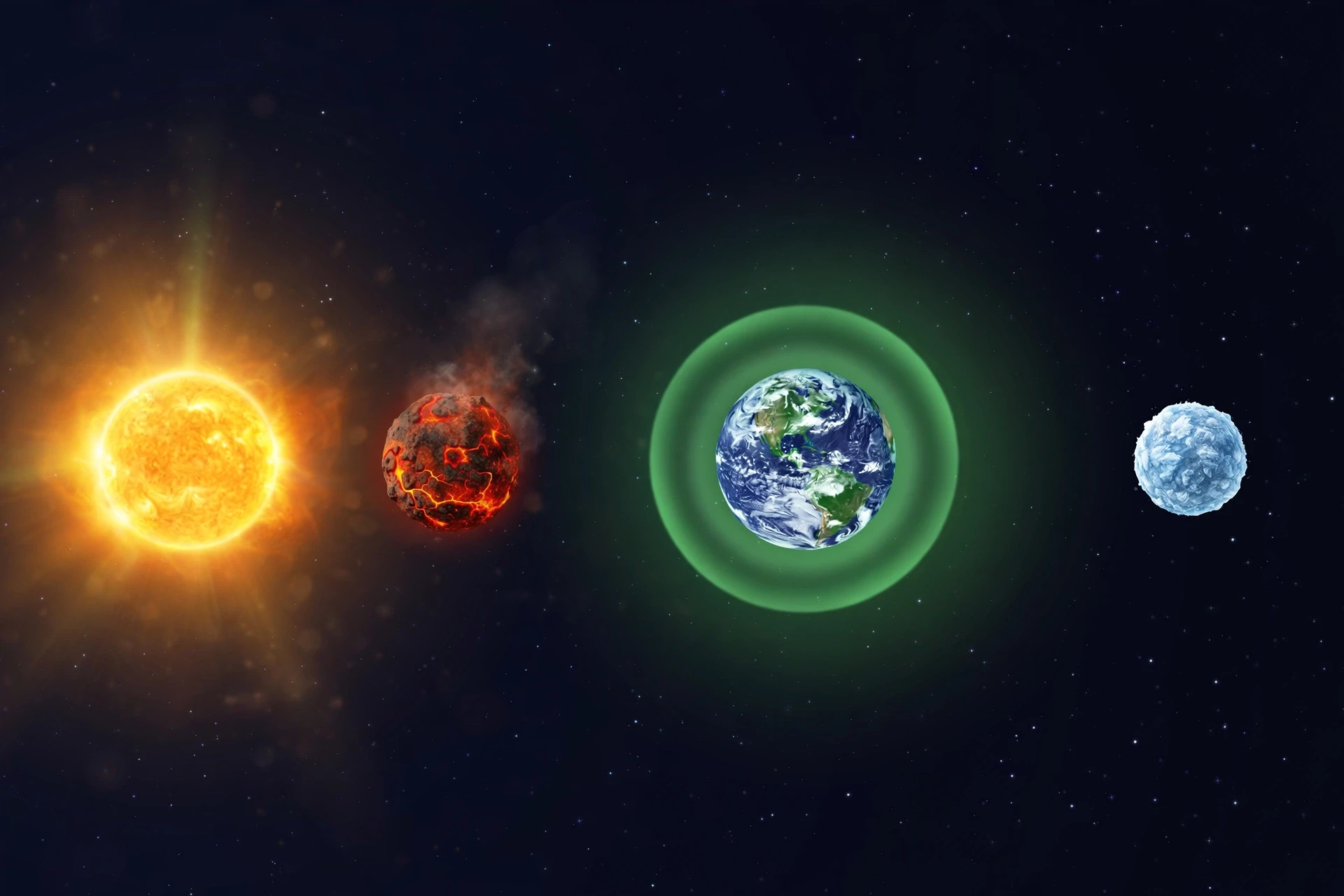
If one system captures the public imagination about exoplanets, it is TRAPPIST-1. The star is a small, cool red dwarf about 40 light-years away, barely bigger than Jupiter, and it hosts seven Earth-sized rocky planets, all of them orbiting closer to their star than Mercury orbits the Sun. Three of them — e, f, and g — sit in the habitable zone. The whole system would fit inside Mercury's orbit, and from the surface of one planet, the others would loom in the sky far larger than the Moon looks from Earth.
TRAPPIST-1 was announced in 2017, after observations from the ground-based TRAPPIST telescope and NASA's Spitzer Space Telescope, and it has been a prime target for the James Webb Space Telescope ever since. Webb's results so far are sobering in the best scientific sense: they are real answers, even when the answer is no. As of late 2025, Webb has found no sign of thick atmospheres on the two innermost planets, b and c, which look like bare rock. For the habitable-zone planet e, the data rule out a thick hydrogen atmosphere and make a carbon-dioxide-dominated one unlikely — but a thinner, nitrogen-rich atmosphere, or no atmosphere at all, remains possible, and observations are continuing. NASA's account of what Webb is revealing about TRAPPIST-1 reports these results plainly, and the message is clear: even the most promising system in the sky does not give up its secrets quickly.
8.2 Proxima b — the nearest exoplanet
Proxima b is the closest exoplanet to Earth, orbiting Proxima Centauri, the nearest star to the Sun at 4.24 light-years. It was found in 2016 by radial velocity, and it sits in its star's habitable zone, with a mass at least 1.1 times Earth's and an orbital period of just 11.2 days — short, because its star is so dim that the habitable zone is very close in. Proxima b is the planet we could, in principle, reach first: at a tenth of the speed of light, a probe could get there in about 40 years, and the Breakthrough Starshot project has proposed exactly such a mission, using tiny laser-pushed sails.
But Proxima b is also a cautionary tale. Its star, Proxima Centauri, is a flare star that regularly erupts with bursts of radiation far stronger than anything the Sun produces. In 2019, a flare was observed that was ten times more powerful than the largest solar flares ever recorded. Whether a planet so close to such a star can keep an atmosphere, let alone oceans, is an open question, and it may be that Proxima b is a scorched rock rather than a second Earth. We do not know yet, because Proxima b does not transit its star from our viewpoint, so Webb cannot study its atmosphere by the transit method. It remains a world we know by its tug alone.
8.3 K2-18 b — and the biosignature debate, told honestly
K2-18 b is a sub-Neptune — a planet smaller than Neptune but bigger than Earth — orbiting in the habitable zone of a red dwarf about 124 light-years away. In 2023, a team using Webb reported methane and carbon dioxide in its atmosphere, and a tentative hint of dimethyl sulfide, a gas that on Earth is produced mainly by marine life. In April 2025, the same team reported further evidence for dimethyl sulfide and its cousin dimethyl disulfide, at about three-sigma significance — a signal strong enough to be interesting, but well below the five-sigma standard normally required for a discovery.
What happened next is science working as it should, and it deserves to be told in full. Independent teams reanalysed the same Webb data and reached different conclusions. Some confirmed the methane but found no statistically significant evidence for carbon dioxide or dimethyl sulfide, and showed the spectrum could be explained by a small gas planet with no ocean and no life. Others found that ordinary molecules like ethane fit the data about as well as dimethyl sulfide, and that the signal depended on choices made during data processing. One estimate suggested about 25 more Webb transits would be needed for a decisive test. As of late 2026, the claim remains contested: the methane detection is firm, the dimethyl sulfide detection is not, and no one has found life on K2-18 b. The team that made the original claim has been careful to call it a hint, not a discovery, and the debate continues in the open literature.
I include this story at length because it is the most important lesson in the whole subject. A biosignature is not a single molecule. It is a claim that a molecule can only be explained by life, after every non-biological explanation has been tested and ruled out — and that bar is extremely high, because atmospheres are complicated, data are noisy, and molecules overlap in the spectrum. K2-18 b taught the field, and the public, that a headline about a "possible sign of life" is the beginning of an argument, not the end of one. That is not a failure. It is how a difficult measurement gets done properly.
9. How Webb Reads an Exoplanet's Atmosphere
9.1 Transmission spectroscopy, step by step
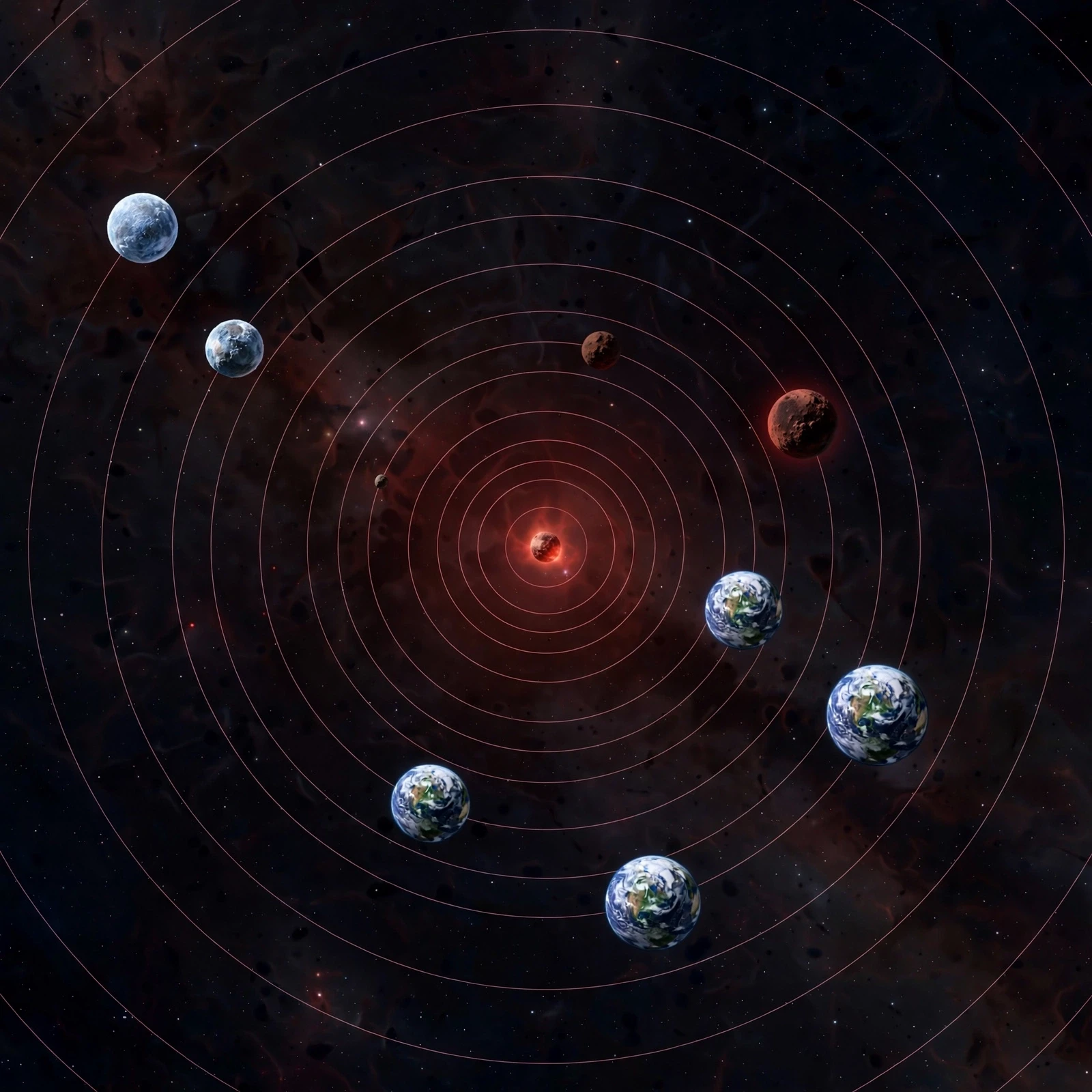
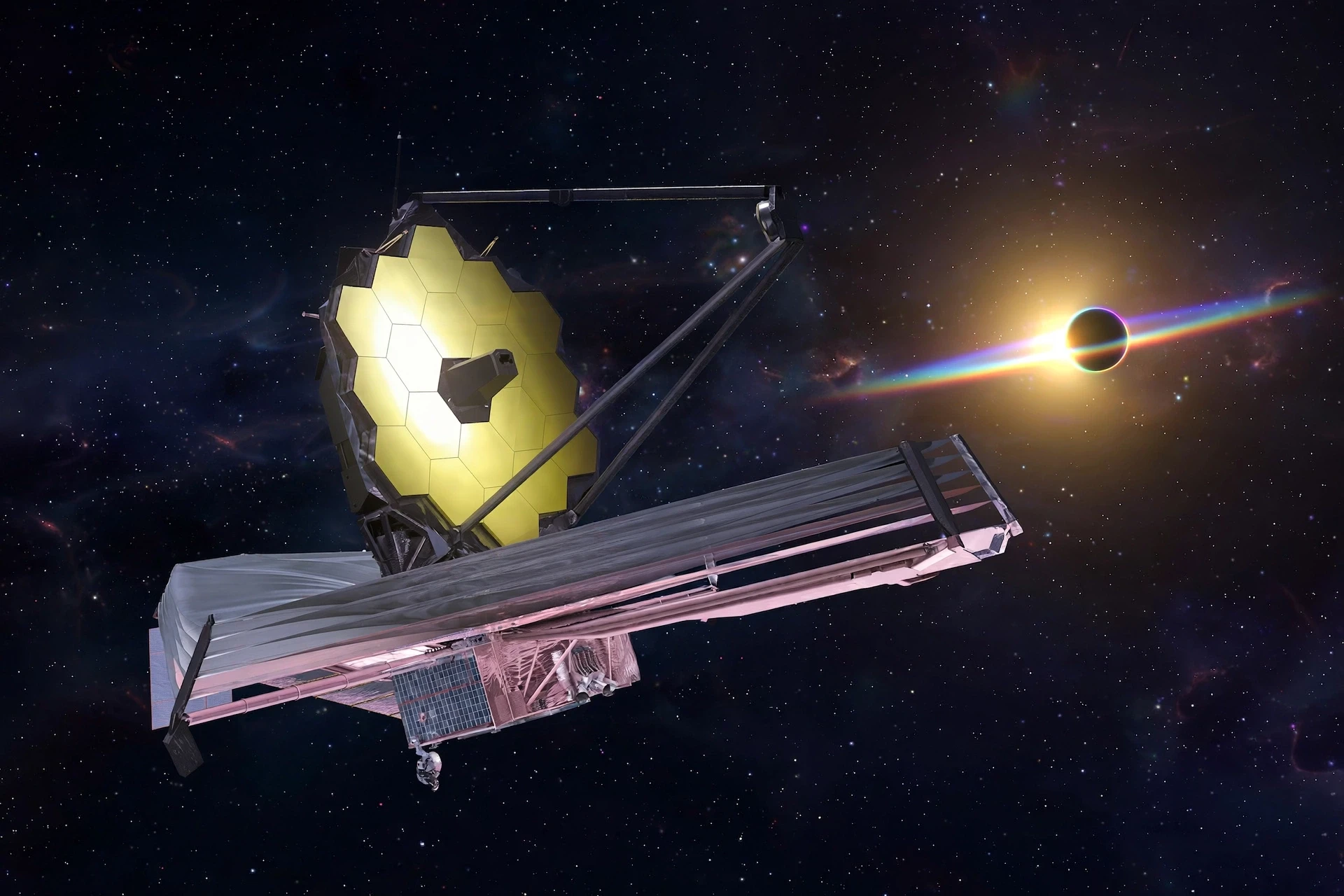
The James Webb Space Telescope, launched in December 2021, is the most powerful tool ever built for studying exoplanet atmospheres, and its method is transmission spectroscopy. When a planet transits its star, a thin ring of starlight passes through the planet's atmosphere on its way to us. Molecules in that air absorb light at specific wavelengths — each molecule has its own fingerprint — so the star looks slightly dimmer at those wavelengths during the transit than it does outside it. By measuring the star's spectrum in and out of transit, and subtracting one from the other, astronomers recover the spectrum of the planet's atmosphere alone.
The effect is astonishingly small. The atmosphere's signal is roughly a hundred times smaller than the transit dip itself, which is already only a fraction of a percent. Measuring it requires staring at the same star for hours, collecting photons one by one, and controlling the telescope's own tiny instabilities. Webb can do this because it observes in the infrared, where the molecular fingerprints of water, carbon dioxide, methane, and other gases are strongest, and because its mirror is large enough to gather the faint light of distant stars with the precision the measurement demands.
9.2 What Webb has found so far
Webb's first great result came in August 2022, when it detected carbon dioxide in the atmosphere of WASP-39 b, a hot gas giant about 700 light-years away — the first clear detection of carbon dioxide on any planet outside our solar system. NASA's report on that detection describes a small hill in the spectrum between 4.1 and 4.6 microns, the unmistakable signature of carbon dioxide absorbing starlight. Since then, Webb has found water vapour, carbon monoxide, sulfur dioxide, and methane in the atmospheres of hot Jupiters and sub-Neptunes, and it has measured differences between the morning and evening sides of planets, and between their day and night sides — weather, in other words, on worlds we will never visit.
For rocky planets, the results are harder and slower, and that is where the real frontier lies. Webb has ruled out thick atmospheres on the innermost TRAPPIST-1 planets, as described above, and it is working through the habitable-zone planets one transit at a time. Each transit of a small rocky planet yields only a whisper of a signal, so astronomers stack many transits together — ten, twenty, sometimes more — to build up enough light for a measurement. It is patient, expensive work, and it is the only way to answer the question everyone is asking: do rocky planets around red dwarfs keep their air?
9.3 What an atmosphere can — and cannot — prove
An atmosphere's chemistry can tell us a great deal: whether a planet has air at all, what that air is made of, whether it is thick or thin, whether it has clouds, and whether its temperature is consistent with liquid water. What it cannot do, on its own, is prove life. Oxygen, for example, is often called a biosignature, because on Earth almost all free oxygen comes from photosynthesis. But oxygen can also be made without life, by sunlight splitting water vapour, and a planet that lost its oceans could be left with an oxygen-rich atmosphere and no life at all. Methane can be made by microbes, but it can also be made by geology. The search for life will not be a single molecule in a single spectrum. It will be a pattern — several gases together, in amounts that are hard to explain without biology, on a planet whose temperature, water, and history all point the same way — confirmed by independent observations and independent teams.
A single molecule is a clue, not a verdict. The search for life on exoplanets will be won by patterns — several gases, in the wrong amounts for geology alone, on a world that could hold oceans — and by the patience to check every other explanation first.
10. The Search for Life — and Why "Earth-Like" Does Not Mean Inhabited
10.1 What we are actually looking for
The search for life on exoplanets is, at its core, a search for chemistry out of equilibrium — and it is the reason so many exoplanets in habitable zones are now watched so closely. Living things change their surroundings in ways that geology alone struggles to match: they produce gases, consume others, and maintain mixtures that should react away and disappear unless something keeps replenishing them. Earth's atmosphere is a good example — oxygen and methane coexist in it, and they should react with each other and vanish within years, yet both persist, because life keeps making them. A distant atmosphere showing the same kind of impossible mixture would be a strong hint, though never proof on its own.
But chemistry is only half the search. The other half is context. A biosignature on a planet with no liquid water, no stable climate, and a star that strips atmospheres would be suspect. A biosignature on a rocky planet in the habitable zone, with water vapour, carbon dioxide, and a temperature that allows oceans, would be far more compelling. This is why astronomers are so careful with their words: "potentially habitable" means the context looks right; "biosignature" means the chemistry looks alive; neither means "inhabited."
10.2 The Fermi question, reframed by data
For decades, the question "where is everybody?" — the Fermi paradox — was argued from ignorance: we did not know how many planets existed, so we could not say how many might host life. The exoplanet census has changed that calculation. We now know planets are common, rocky planets are common, and habitable-zone planets are not rare. That makes the silence more interesting, not less: if habitable worlds are everywhere, why have we heard nothing? The answers range from the mundane — life may be rare, or intelligence rarer, or civilisations short-lived — to the humbling: perhaps we have barely begun to listen, and the galaxy is larger and quieter than our instruments can yet probe.
I find the honest version of this question more exciting than any confident answer. The census tells us the real estate exists. It does not tell us whether anyone lives on it. That is a question for the next generation of telescopes, and for the atmospheric measurements described in the previous section, and it may take decades to answer. The search for life is not a sprint to a headline. It is a slow, careful census of air, one planet at a time.
10.3 What comes next
The next decade will bring tools designed specifically for this search. The Nancy Grace Roman Space Telescope, due to launch in the late 2020s, will survey the sky for microlensing planets and directly image giant planets with a coronagraph far more advanced than anything flown before. The European Space Agency's PLATO mission will find Earth-sized planets in Earth-like orbits around Sun-like stars, the very planets Kepler could barely reach. And the Habitable Worlds Observatory, NASA's next great flagship, is being designed with one goal above all: to photograph Earth-sized planets in the habitable zones of nearby Sun-like stars and to read their atmospheres for oxygen, water, and methane. The European Space Agency's exoplanet pages describe these missions as a sequence, each one answering the questions the last one raised, and that is the right way to think about them: no single telescope will find life. A generation of them, working together, might.
11. Common Misconceptions About Exoplanets
11.1 "We have photographed Earth 2.0"
We have not. No telescope has photographed an Earth-sized planet in an Earth-like orbit around a Sun-like star. The exoplanets that have been directly imaged are almost all giant planets, young and hot, far from their stars. The "Earth-like" planets in the news have been found by transits and radial velocity — by shadows and wobbles — and what we know about them is their size, their mass, their orbit, and, in a few cases, hints about their air. Artist's impressions, the beautiful images that accompany these stories, are illustrations based on data, not photographs, and they should be read as such. When a headline shows a blue planet with oceans and clouds, it is showing an idea, not an observation.
11.2 "The habitable zone guarantees habitability"
It does not, and Venus and Mars prove it. Both sit in or near the Sun's habitable zone, and neither is habitable today. The zone is a necessary condition for surface liquid water, not a sufficient one. A planet needs an atmosphere, a magnetic field, water to begin with, and a climate stable over billions of years — and we cannot confirm most of those things from orbit alone. An exoplanet in the habitable zone is a candidate worth studying, not a second Earth waiting for visitors.
11.3 "Finding a planet means we can visit it"
The nearest exoplanet, Proxima b, is 4.24 light-years away. At the speed of the fastest spacecraft ever launched, it would take tens of thousands of years to get there. Even the proposed laser-pushed sails of Breakthrough Starshot, travelling at a fifth of the speed of light, would need about 20 years for the journey and another four years for a signal to come back. For the foreseeable future, exoplanets are places we will know by light alone. That does not make them less real — it makes the light we collect from them more precious, because it is the only way we will ever know them.
11.4 "Every exoplanet was found by Kepler"
Kepler found the most, but it was one telescope among many. Ground-based spectrographs found the first exoplanets and still find many of the nearest ones. TESS is now finding planets around the brightest, nearest stars. Hubble studied exoplanet atmospheres for years before Webb. And the catalogue includes planets found by microlensing surveys, by direct imaging, and by astrometry — methods Kepler never used. The census is a team effort, built by dozens of telescopes and thousands of astronomers over three decades.
Misconception: "Earth-like" means Earth 2.0. Reality: It usually means "roughly Earth-sized and in the habitable zone." That is two facts, not a description of a world.
Misconception: A biosignature means life has been found. Reality: It means a gas that life could make has been detected, and every non-biological explanation still needs to be ruled out.
Misconception: Bigger telescopes will photograph alien cities. Reality: The next telescopes aim to photograph dots of light and read their air. Cities, if they exist, are far beyond our reach.
12. How Many Worlds Are Out There — and What We Still Do Not Know
12.1 The census in one paragraph
As of 7 November 2026, 6,464 exoplanets are confirmed, with more than 8,000 candidates waiting. About three-quarters were found by transits, about a fifth by radial velocity, and the rest by direct imaging, microlensing, and astrometry. The most common exoplanets in the galaxy are super-Earths and mini-Neptunes, sizes our solar system lacks entirely. All of these exoplanets orbit stars embedded in a galaxy whose mass is dominated by unseen material — the subject of Sciory's guide to dark matter and dark energy. Rocky planets in habitable zones are not rare, but truly Earth-like planets — Earth-sized, rocky, with a stable atmosphere and liquid water, around a Sun-like star — remain hard to find and harder to confirm, because they are small, slow, and faint. NASA's guide to how exoplanets are found and characterised summarises these methods and their trade-offs, and it is the best single starting point for readers who want to go deeper.
12.2 The questions that remain
The biggest open questions are the ones this guide has circled throughout: How common are rocky planets with atmospheres? Do planets around red dwarfs keep their air, or do flares strip it away? What are super-Earths and mini-Neptunes actually made of — are they rocky worlds with thick air, or small gas planets, or ocean worlds with no land at all? How did hot Jupiters get where they are, and how common is migration? And, above all, is there life on any world beyond Earth — and if so, how will we know it when we see it?
None of these questions has an answer yet, and that is the point. Thirty years ago, we did not know whether exoplanets existed around other stars at all. Today we know of thousands, we can measure their sizes and masses, and we can read the air of the largest ones. The next thirty years will be about the smallest ones — the rocky worlds, the temperate ones, the ones that might, just possibly, hold oceans. The story that began with a wobble in Switzerland in 1995 is still being written, and the most interesting chapters are the ones we have not reached yet.
Conclusion
Exoplanets began as a suspicion and became a census. A planet that should not have existed, orbiting its star in four days, forced astronomers to admit that planetary systems come in shapes no one had predicted. Since then, the count of confirmed exoplanets has grown from one to more than 6,400 worlds, found by shadows, wobbles, bent light, and patient spectroscopy. Each method sees a different slice of the galaxy, and each has its limits — transits need alignment, radial velocity needs quiet stars, direct imaging needs young giants, microlensing happens once and never repeats, and astrometry needs years of precision.
The habitable zone narrows the search, but it does not finish it. TRAPPIST-1 shows how much work a promising system still demands. Proxima b shows how close the nearest world is, and how little we know about it. K2-18 b shows how a genuine hint of something extraordinary becomes, under scrutiny, a debate — and how that debate is the science working, not failing. And Webb shows what comes next: atmospheres read molecule by molecule, on worlds we will never touch.
If you take one idea from this guide, let it be this: "Earth-like" is a beginning, not a destination. It means a planet is the right size, at the right distance, around a star that might allow oceans. Whether it has oceans, air, and life is a question for the telescopes now being built, and for the patient, unglamorous work of measuring almost nothing, very carefully, until a pattern emerges. The sky has already surprised us once, with a hot Jupiter no one expected. It will surprise us again.
Frequently Asked Questions
What is an exoplanet?
An exoplanet is a planet that orbits a star other than the Sun. More than 6,400 have been confirmed as of November 2026, ranging from rocky worlds smaller than Earth to gas giants larger than Jupiter, and they are found by their shadows, their gravitational tugs, and the fingerprints they leave in starlight rather than by direct photographs.
How do scientists find exoplanets?
Scientists find exoplanets mainly by five methods: the transit method, which watches for a star dimming as a planet crosses in front of it; radial velocity, which measures the star's wobble; direct imaging, which photographs the planet itself; gravitational microlensing, which uses gravity to magnify a distant star; and astrometry, which tracks a star's tiny sideways motion. Transits account for about three-quarters of all confirmed discoveries.
How many exoplanets have been discovered?
As of 7 November 2026, the NASA Exoplanet Archive lists 6,464 confirmed exoplanets, with more than 8,000 additional candidates awaiting confirmation. The total passed 6,000 in September 2025, and it grows by a few hundred planets every year as candidates are confirmed.
What is the habitable zone?
The habitable zone is the region around a star where a rocky planet with a suitable atmosphere could keep liquid water on its surface — not too hot, not too cold. It depends on the star: around a dim red dwarf it is close in, around a bright star it is far out. Being in the zone does not guarantee habitability, as Venus and Mars show: both sit in or near the Sun's habitable zone, and neither is habitable today.
What is TRAPPIST-1?
TRAPPIST-1 is a small red dwarf star about 40 light-years away with seven Earth-sized rocky planets, three of which — e, f, and g — sit in the habitable zone. The James Webb Space Telescope has found no thick atmospheres on the two innermost planets so far, and the habitable-zone planets are still being studied. No evidence of life has been found there.
Has Webb found signs of life on K2-18 b?
No. Webb detected methane and carbon dioxide in the atmosphere of K2-18 b, a sub-Neptune about 124 light-years away, and a team reported a tentative hint of dimethyl sulfide, a gas associated with marine life on Earth. Independent reanalyses of the same data found no statistically significant evidence for dimethyl sulfide, and the claim remains contested. More observations are needed before any conclusion can be drawn.
Can we visit an exoplanet?
Not with current technology. The nearest exoplanet, Proxima b, is 4.24 light-years away, and even the fastest spacecraft ever launched would take tens of thousands of years to reach it. Proposed laser-pushed probes could in principle make the journey in about 20 years, but no such mission has flown. For now, exoplanets are studied entirely by the light they block, bend, and filter.