

Imagine holding a map of your own city and discovering that it shows only one street in twenty. Every road you have ever driven, every building you have ever entered, every park you have ever walked through — all of it fits on a single sliver of the page. The rest of the map is blank, marked only with the words "something is here." That is where cosmology stands today. Everything astronomers have ever seen — every star, planet, nebula and galaxy — adds up to about five percent of the universe. The other ninety-five percent is invisible, and it has a name that sounds like a placeholder because, honestly, that is what it is: dark matter and dark energy.
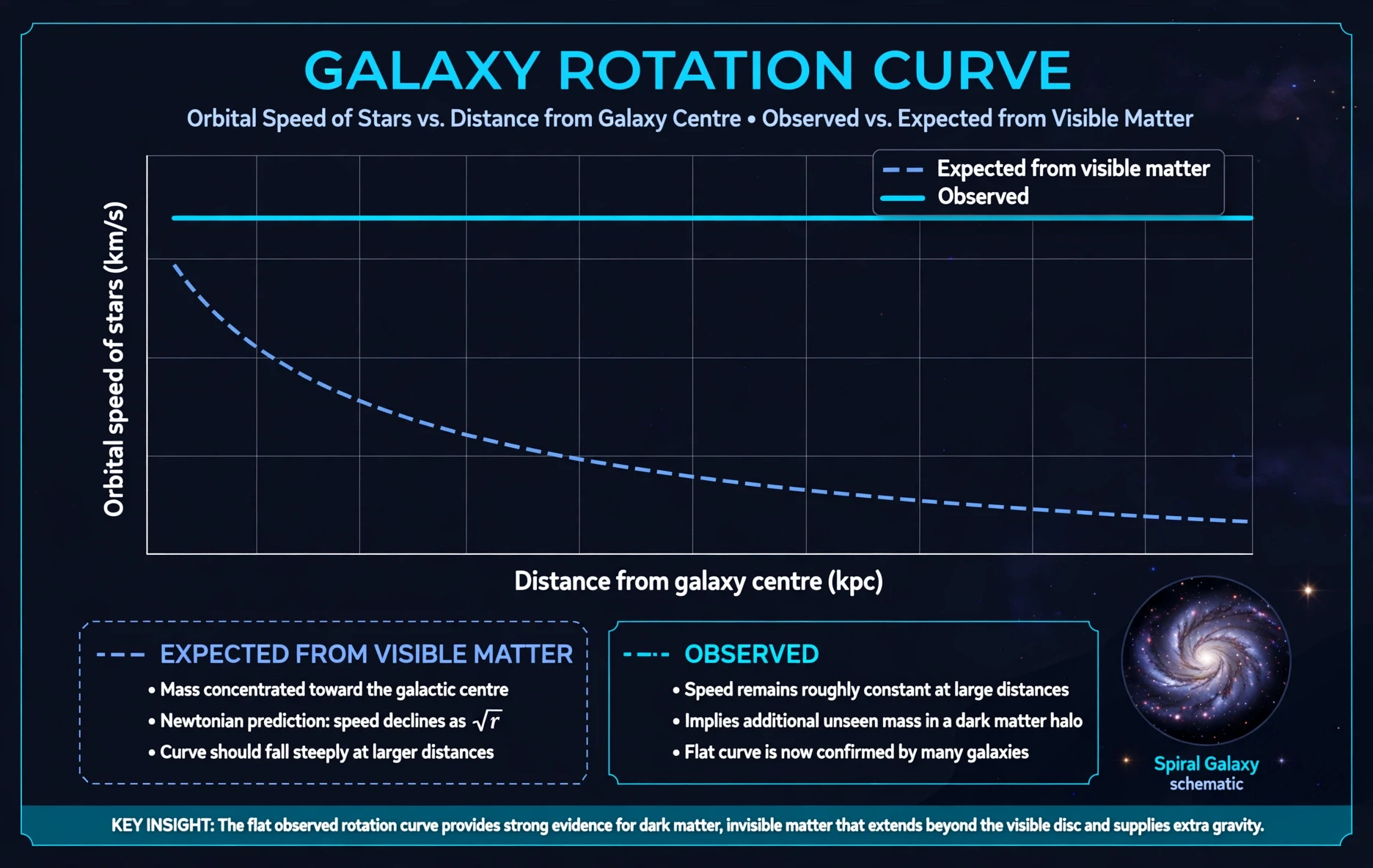
I still remember the afternoon a professor taped a simple graph to the blackboard and asked the class to explain it. The graph showed how fast stars orbit the centre of a galaxy. According to everything we knew about gravity, the line should have drooped downward at the edges, the way a spinning record slows at its rim. It did not droop. It stayed flat, stubbornly flat, all the way out. "Either our theory of gravity is wrong," the professor said, "or most of the galaxy is made of something we cannot see." The room went quiet. That flat line was my first meeting with dark matter, and it has never quite left me.
This article is a guided tour of the invisible ninety-five percent. We will look at the evidence that convinced sceptical astronomers that dark matter is real, meet the leading candidates for what it might be, and then turn to the even stranger story of dark energy — the force, or whatever it is, that is pushing the universe apart faster and faster. We will see how scientists measure things they cannot see, what the newest telescopes are finding, and where the honest gaps in our knowledge still sit. The story begins, as so many stories in astronomy do, with a scientist who was ignored for decades.
1. The 95% Problem: A Universe Mostly Made of Mystery
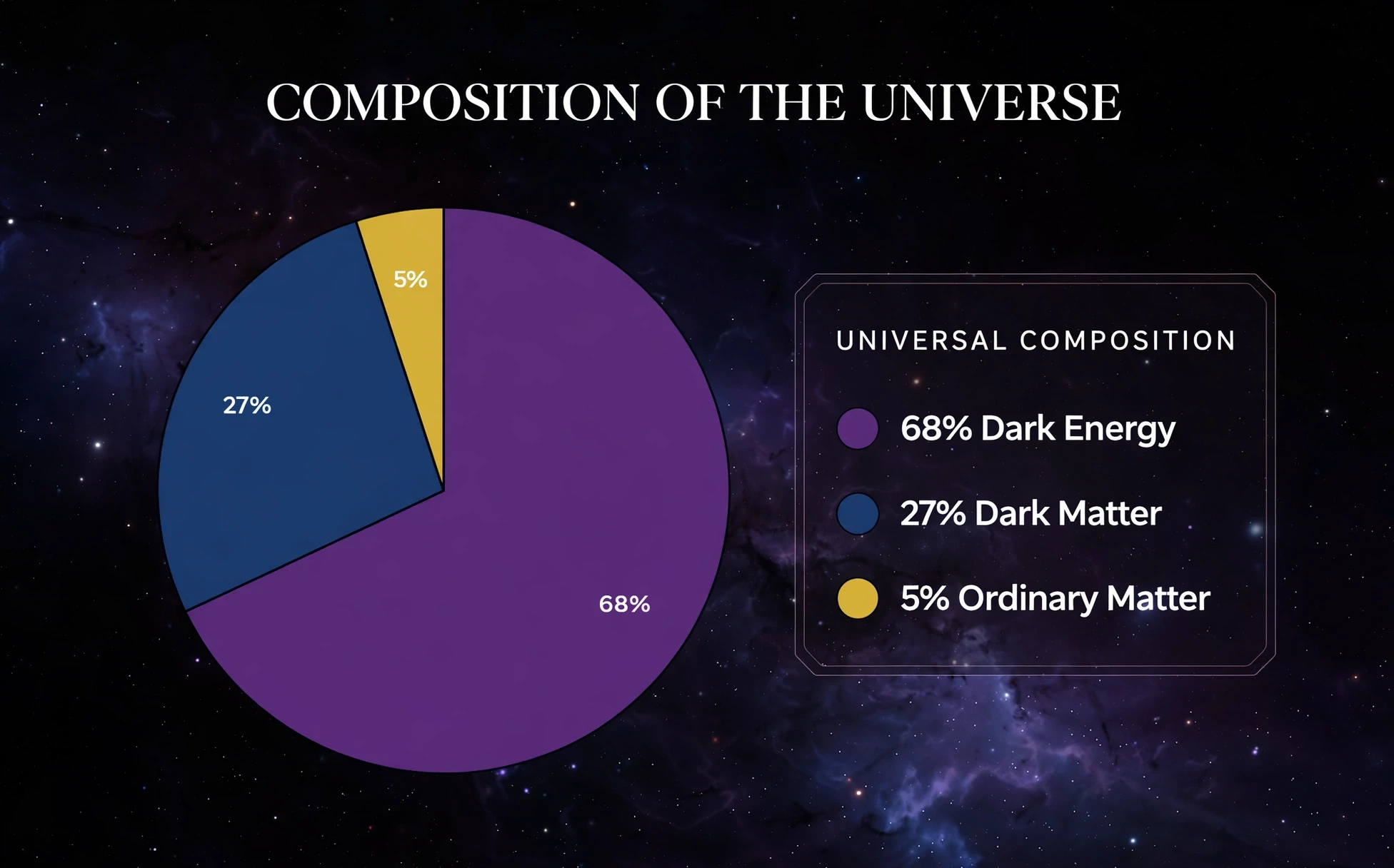
Every atom in your body, every grain of sand on every beach, every star in every galaxy — all of it is ordinary matter. Physicists call it baryonic matter, after baryons, the family of particles that includes protons and neutrons. It is the only kind of matter we have ever directly touched, weighed, or photographed. And according to the most precise measurements ever made of the early universe, it makes up just 4.9 percent of everything that exists.
The number comes from the Planck satellite, a European Space Agency mission that mapped the faint afterglow of the Big Bang — the cosmic microwave background — with extraordinary precision. Planck's final tally reads like an inventory taken by someone who has lost most of the stock: ordinary matter 4.9 percent, dark matter 26.8 percent, dark energy 68.3 percent. NASA's own summary of the universe's building blocks puts it the same way: normal matter is less than five percent of the total, and the rest is split between the two dark components (NASA).
Look at that breakdown for a moment, because it deserves to sink in. Dark matter outweighs everything we can see by more than five to one. Dark energy outweighs dark matter by more than two to one. The entire visible universe — the subject of every astronomy textbook, every telescope image, every planetarium show — is a thin frosting on a cake we have never seen.
The honest name for this situation is a crisis, and cosmologists know it. The standard model of particle physics, the most successful theory in the history of science, describes the five percent beautifully and says nothing at all about the other ninety-five. The standard model of cosmology, called Lambda-CDM, describes how the two dark components behave, but it cannot say what they are. Lambda stands for the cosmological constant, the simplest version of dark energy. CDM stands for cold dark matter. The model works. Its predictions match the data to astonishing precision. And at its heart sit two labels that mean, in plain language, "we do not know."
1.1 Why "dark"?
The word "dark" causes endless confusion, so let us clear it up early. Dark matter is not black. It is not shadowy, smoky, or dim. It is transparent in the most complete sense possible: it does not absorb light, reflect light, or emit light at any wavelength we have checked, from radio waves to gamma rays. A wall of dark matter would be perfectly invisible, and you could walk through it without feeling a thing. "Dark" is astronomers' shorthand for "we cannot see it with light." The name stuck because it is honest. It admits ignorance instead of dressing it up.
Dark energy is a different kind of invisible. It does not clump together the way matter does. It appears to be spread smoothly through all of space, and its effect is the opposite of gravity's: instead of pulling things together, it pushes space itself apart. The two share a word and almost nothing else. Mixing them up is the single most common mistake people make about this subject, and it is worth stating plainly: dark matter holds galaxies together; dark energy pulls the universe apart. They are not two flavours of one thing. As far as anyone can tell, they are two separate mysteries that happen to share an adjective.
1.2 How do we know something is there if we cannot see it?
This is the question every sceptic asks first, and it is a good one. The answer is that astronomers do not detect dark matter or dark energy directly. They detect what these things do. A detective who never sees the burglar can still be certain someone was in the house: the window is open, the safe is empty, the footprints are in the dust. Cosmology works the same way. Galaxies spin too fast. Clusters of galaxies hold together too tightly. Light from distant galaxies bends around empty-looking regions of space. The expansion of the universe speeds up when gravity says it should slow down. Each of these is a footprint. Taken one at a time, any of them might have a boring explanation. Taken together, they point in the same direction, and that direction is the subject of the next section.
2. Dark Matter: The Invisible Glue
If you want a one-sentence definition, here it is: dark matter is matter that has mass and gravity but does not interact with light. That is almost everything we know about it for certain. It takes up space, it has mass, and its gravity shapes the universe on the largest scales. Everything else — what particle it is made of, how heavy that particle is, whether there is one kind of it or several — is still open.
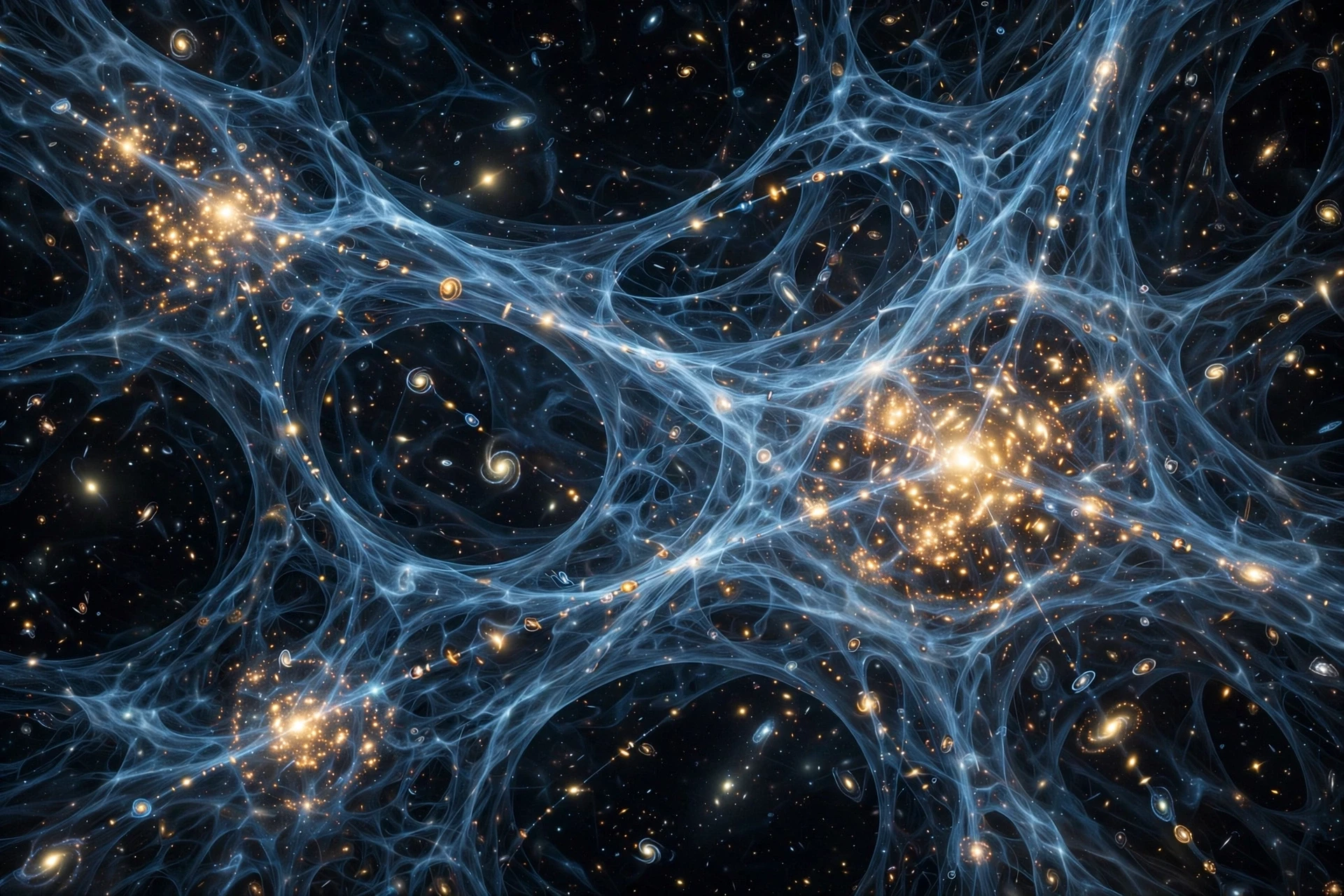
What we do know is that dark matter behaves like ordinary matter in one important respect and unlike it in every other. Like ordinary matter, it clumps under its own gravity. Unlike ordinary matter, it never forms stars, planets, or people, because it cannot lose energy by shining light away. Ordinary gas clouds collapse into stars because they can cool: they radiate heat as light and sink inward. Dark matter cannot cool, so it stays spread out in vast, diffuse haloes around galaxies and in long filaments stretching between them. Think of it as scaffolding. You never see scaffolding in a finished photograph of a building, but the building could not have been built without it.
2.1 What dark matter is not
Most people assume dark matter must be ordinary stuff that is simply hard to see — burnt-out stars, cold planets, black holes drifting between galaxies. That is a reasonable first guess, and it was the first guess astronomers tried. The data, though, rule it out, and this is worth saying clearly because the idea keeps coming back.
The problem is the recipe of the early universe. In the first few minutes after the Big Bang, the universe cooked up the lightest elements: hydrogen, helium, and traces of lithium and deuterium. The amounts of those elements we measure today tell us exactly how much ordinary matter the early universe contained. The answer is about five percent of the total. No more. If dark matter were made of ordinary matter — dead stars, rogue planets, cold gas — the element abundances would look completely different. They do not. So dark matter is not hidden ordinary matter. It is something else entirely, something no telescope has ever caught and no particle accelerator has ever produced.
That does not mean the search is hopeless. It means the search is a particle-physics problem as much as an astronomy problem, and we will meet the leading suspects in Section 4. First, the evidence.
3. The Evidence for Dark Matter
Dark matter earned its place in science the hard way: through four independent lines of evidence, gathered by different people, with different instruments, over nearly a century. Any one of them could, in principle, be a mistake. All four pointing the same way is much harder to dismiss. Here they are, in the order astronomers discovered them.
3.1 Galaxy rotation curves: Vera Rubin and the flat line
The first clue came in the 1930s, and the astronomer who found it was treated as a curiosity for most of his life. Fritz Zwicky, a Swiss astronomer working at Caltech, was studying the Coma Cluster, a swarm of more than a thousand galaxies. He measured how fast the galaxies inside the cluster were moving and did the arithmetic: the cluster's visible mass could not possibly supply enough gravity to hold such fast-moving galaxies together. They should have flown apart long ago. Zwicky concluded that some invisible mass must be present, and he called it "dunkle Materie" — dark matter. Few people listened. His numbers were rough, his manner was abrasive, and the idea sounded like science fiction.
Four decades later, Vera Rubin made the idea impossible to ignore. Working with Kent Ford at the Carnegie Institution, Rubin measured the speeds of stars orbiting inside individual spiral galaxies, including our neighbour Andromeda. The logic is simple and comes straight from how gravity works. In our own Solar System, the planets far from the Sun orbit slowly, because the Sun's gravity weakens with distance. Mercury races around the Sun; Neptune drifts. The same should happen inside a galaxy: stars near the crowded centre should orbit fast, and stars at the thin outer edge should crawl.
They do not crawl. Rubin's measurements showed that stars at the edge of a galaxy orbit almost as fast as stars near the centre. The rotation curve — a plot of orbital speed against distance from the centre — stays flat instead of falling. The only way to explain a flat curve is a huge amount of extra mass spread far beyond the visible disc of the galaxy, in a halo that extends well past the stars we can see. Rubin and Ford found the same flat curve in galaxy after galaxy. It was not an error. It was the signature of dark matter.
I once tried to explain rotation curves to a room of first-year students using a merry-go-round. I asked them to imagine horses at the rim moving as fast as horses near the centre. "Then the rim horses would fly off," one student said. Exactly. That is the point. The outer stars should fly off, and they do not. Something invisible is holding them in place, and whatever it is, there is about five times more of it than there is of everything shining.
3.2 Galaxy clusters and the Bullet Cluster
Zwicky's cluster argument grew stronger with better telescopes. Modern measurements of galaxy clusters use three separate methods — the speeds of member galaxies, the temperature of the hot gas between them, and the bending of light from galaxies behind them — and all three give the same answer: clusters contain roughly six times more dark matter than ordinary matter.
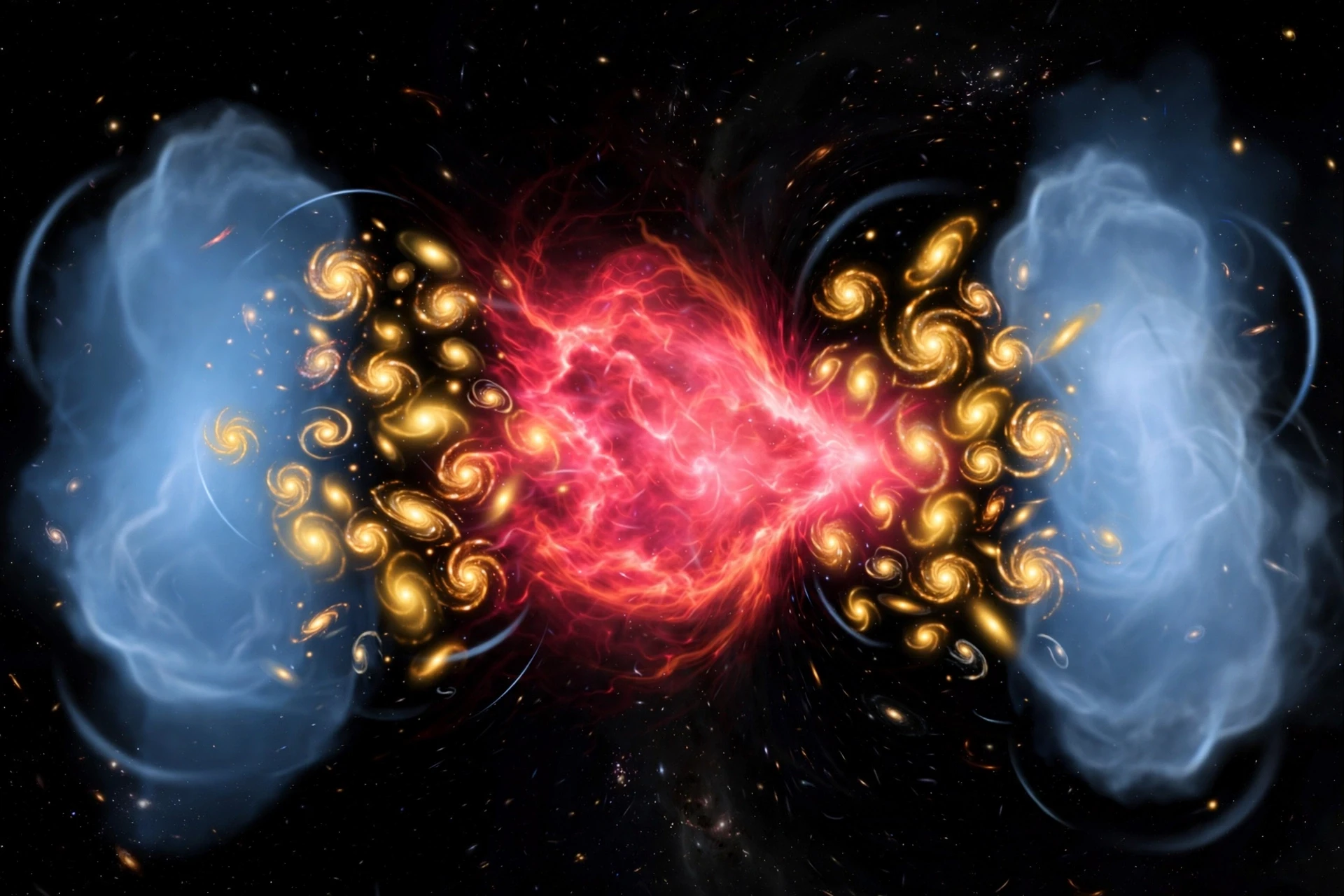
The most dramatic piece of evidence came in 2006, from a collision between two galaxy clusters known as the Bullet Cluster, about 3.8 billion light-years away. Two clusters smashed through each other at enormous speed. During the collision, the hot gas of each cluster — ordinary matter — slammed together, heated up, and got stuck in the middle, glowing in X-rays. The dark matter, though, passed straight through, because it barely interacts with anything, including itself. Astronomers mapped the dark matter by watching how its gravity bent the light of background galaxies, and found it sitting off to the sides, separated from the gas.
That separation is the key. If the extra gravity in clusters came from some misunderstanding of gravity itself, the gravity would stay where the ordinary matter is. It does not. The gravity went with the invisible stuff. NASA calls the Bullet Cluster some of the best direct evidence for dark matter, and it is hard to argue with the picture: pink clouds of hot gas in the middle, blue clouds of dark matter on either side, each going its own way after the crash (NASA).
3.3 Gravitational lensing: weighing what you cannot see
Gravity bends light. Einstein predicted it, and astronomers now use it as a scale. When light from a distant galaxy passes near a massive object on its way to Earth, the object's gravity bends the light's path, distorting and sometimes magnifying the background galaxy's image. By measuring the distortion, astronomers can weigh the object doing the bending — including mass that emits no light at all.
This technique, called gravitational lensing, has let astronomers draw maps of dark matter directly. The maps show dark matter gathered in haloes around galaxies and in the thick knots of galaxy clusters, exactly where the rotation curves and cluster dynamics say it should be. Weak lensing — the subtle stretching of thousands of background galaxies by foreground dark matter — has even revealed the cosmic web itself: long filaments of dark matter connecting the clusters, with ordinary galaxies strung along them like lights along a wire.
3.4 The cosmic microwave background: the baby picture of the universe
The fourth line of evidence comes from the oldest light in the universe. About 380,000 years after the Big Bang, the universe cooled enough for atoms to form, and light could finally travel freely. That light still fills the sky today, cooled to a faint microwave glow — the cosmic microwave background, or CMB. It is a baby picture of the universe, and it is covered in tiny temperature blotches, hotter and colder by a few millionths of a degree.
Those blotches are a fossil record of the early universe's density. Ordinary matter and dark matter left different fingerprints in them, because ordinary matter was still tangled up with light in the early universe while dark matter was already clumping freely. By measuring the exact pattern of blotches, the Planck satellite could weigh each ingredient of the universe separately. That is where the 4.9, 26.8 and 68.3 percent numbers come from. The CMB also tells us the age of the universe — 13.8 billion years — and it confirms that the universe's geometry is flat, which only works if dark energy supplies the missing energy (ESA Planck).
Four independent measurements, four different kinds of observation, one consistent answer. That is why the scientific community accepts dark matter as real even though nobody has ever seen a particle of it. The evidence is circumstantial in the way a fingerprint is circumstantial: nobody saw the hand, but the print matches, and it matches everywhere.
4. What Could Dark Matter Be?
Knowing that something exists is not the same as knowing what it is. Dark matter is a bit like a locked room in a house you own: you can hear things moving inside, you can weigh the door, you can measure the heat coming through the keyhole, but you have never seen what is in there. Here are the leading candidates, and the experiments hunting each one.
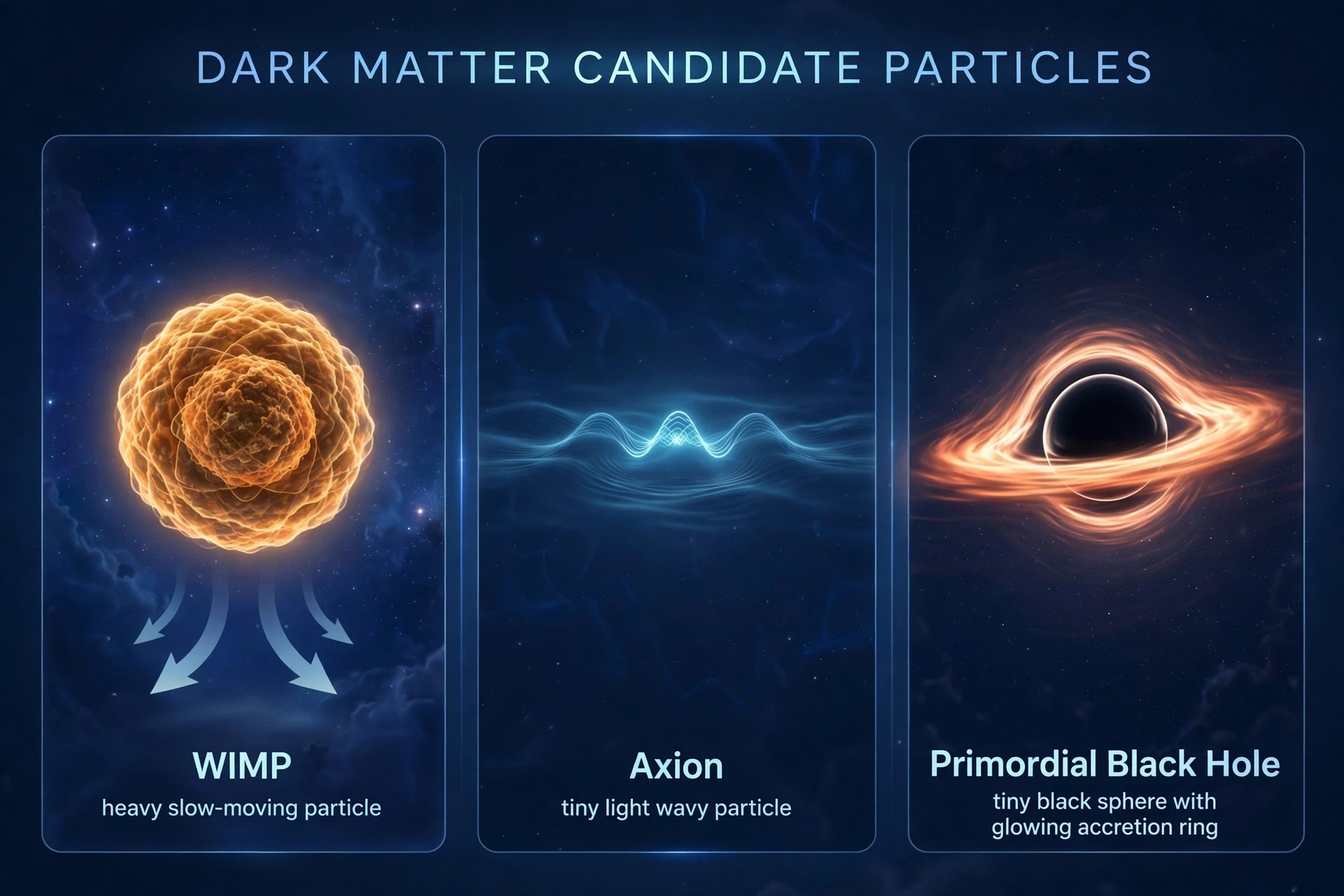
4.1 WIMPs: weakly interacting massive particles
The favourite candidate for decades has been the WIMP — a heavy particle that interacts with ordinary matter only through gravity and the weak nuclear force, and almost never. The idea is attractive because of a coincidence: if such particles were created in the hot early universe, they would naturally survive in about the right abundance to explain the dark matter we measure today. Physicists call this the "WIMP miracle," and it kept the idea alive through decades of failed searches.
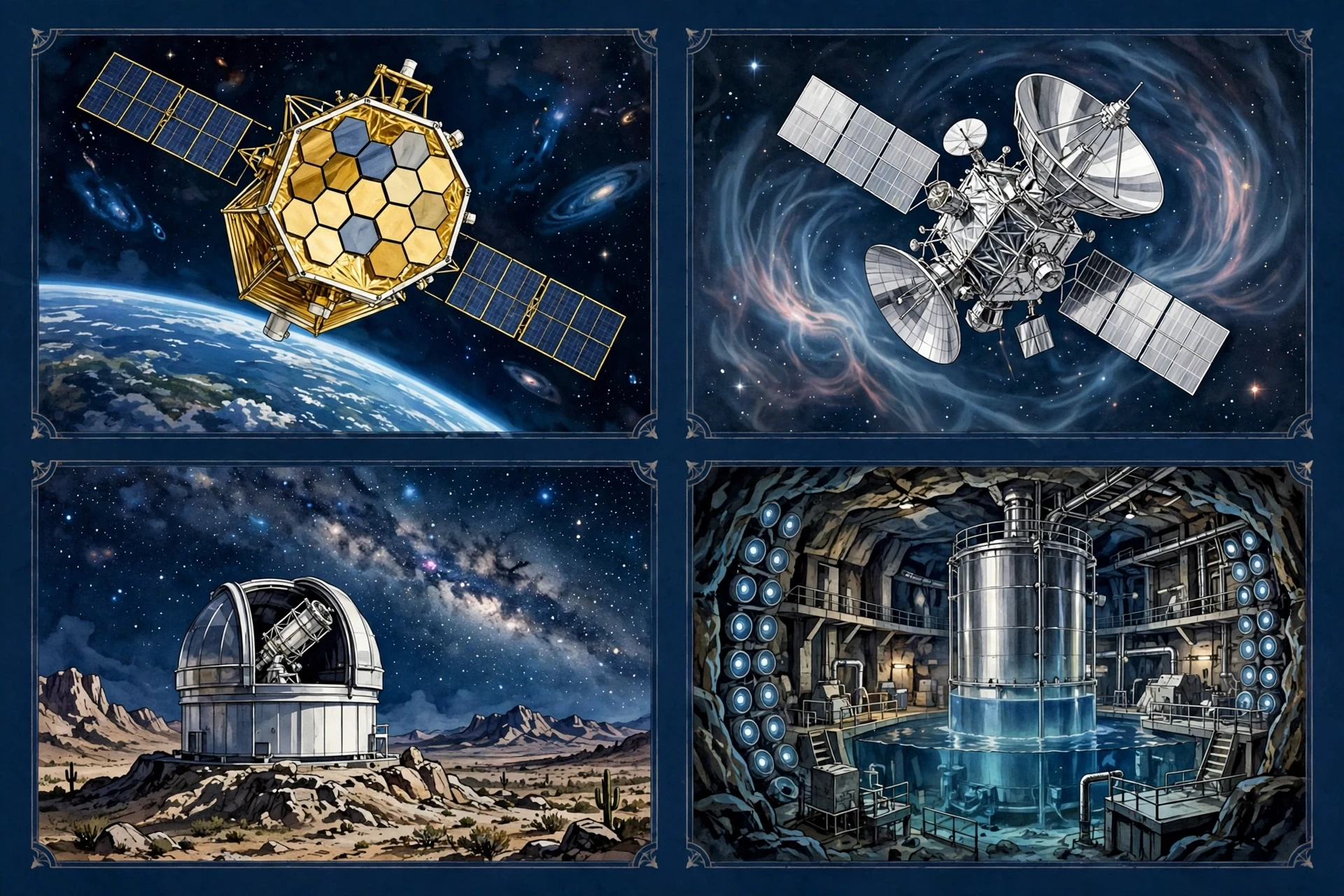
The hunt for WIMPs happens in three ways. Deep underground, in old mines shielded from cosmic rays, detectors made of liquid xenon or germanium crystals sit cooled to a fraction of a degree above absolute zero, waiting for a WIMP to bump into an atomic nucleus and make it shiver. At particle colliders like the Large Hadron Collider at CERN, physicists smash protons together and look for energy that goes missing — carried away by particles too shy to register in the detectors. And in space, telescopes search the sky for gamma rays that might be produced when two WIMPs collide and annihilate each other. The OpenStax astronomy textbook gives a vivid sense of the scale: if WIMPs are about sixty times the mass of a proton, roughly ten million of them pass through your outstretched hand every second, with absolutely no effect on you (OpenStax).
So far, none of these searches has found a WIMP. The detectors have grown larger and more sensitive, and the empty space where the signal should be has grown more informative — but it is still empty. That does not kill the idea. It narrows it. Each null result rules out a range of masses and interaction strengths, and the remaining hiding places are getting smaller. Some physicists are already moving on.
4.2 Axions: the featherweight alternative
Axions are almost the opposite of WIMPs: extremely light, extremely cold, and extremely numerous. They were first proposed in 1977 to solve a completely different puzzle in particle physics — the strong CP problem, a strange asymmetry in the behaviour of quarks — and it turned out that the same particle could also be dark matter. If axions exist, they would fill the universe like an invisible fog, and their combined mass would be enough to supply the missing gravity.
Axion searches use strong magnetic fields to coax the particles into converting into photons, a trick that works in principle because axions are predicted to interact faintly with light in a magnetic field. Experiments with names like ADMX, a giant microwave cavity tuned like a radio to listen for axions, have been scanning through possible masses for years. They have ruled out large stretches of the possibilities. They have not yet found the particle.
4.3 Primordial black holes and other candidates
A third idea is that dark matter is made of black holes formed in the first fraction of a second after the Big Bang — primordial black holes. Unlike the black holes left behind by dying stars, these could be as small as an atom or as large as a mountain. They would be dark, massive, and almost impossible to see directly. Observations of gravitational microlensing — the brief brightening of a background star as a black hole passes in front of it — have limited how much dark matter can be in this form, but they have not ruled it out entirely for every mass range.
Other candidates include sterile neutrinos, heavier cousins of the familiar neutrino that barely interact with anything, and the possibility that dark matter is not one particle at all but several, or that it interacts with itself through forces we have not yet discovered. There is also a minority view worth mentioning honestly: a small group of physicists argues that there is no dark matter, and that gravity itself behaves differently on galactic scales than Einstein described. The leading version of this idea is called MOND, for Modified Newtonian Dynamics. It can reproduce rotation curves, but it struggles with the Bullet Cluster and the cosmic microwave background, where the dark matter picture works cleanly. Most cosmologists consider the dark matter explanation far stronger, but the debate is real, and it is healthy. A theory that cannot be challenged is not science.
4.4 Why the search matters
It is fair to ask why anyone should care what an invisible particle is. The answer is that dark matter shaped everything we can see. In the early universe, dark matter clumped first, forming gravitational wells that pulled ordinary gas in after it. Without those wells, galaxies would have formed far too slowly — the gas was too hot and too spread out to collapse on its own. Our galaxy, our Sun, our planet, and we ourselves exist because dark matter built the scaffolding first. The life cycle of stars that fills the night sky began inside dark matter haloes. Finding the particle would not just solve a puzzle; it would complete the story of how the visible universe came to be.
5. Dark Energy: The Universe Is Speeding Up
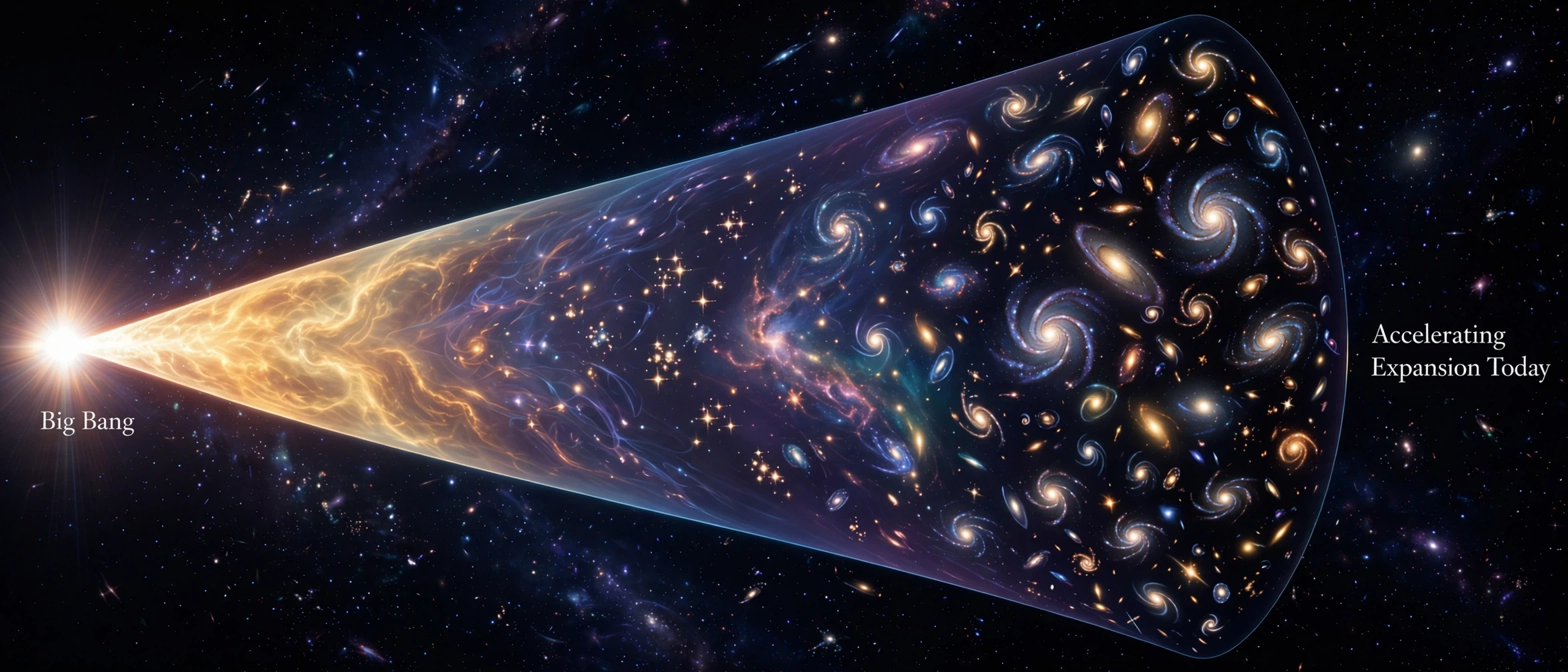
Dark matter was a slow discovery, built up over sixty years. Dark energy arrived like a thunderclap. In 1998, two teams of astronomers set out to measure how much the expansion of the universe was slowing down — and found, to their shock, that it was speeding up.
5.1 The 1998 supernova surprise
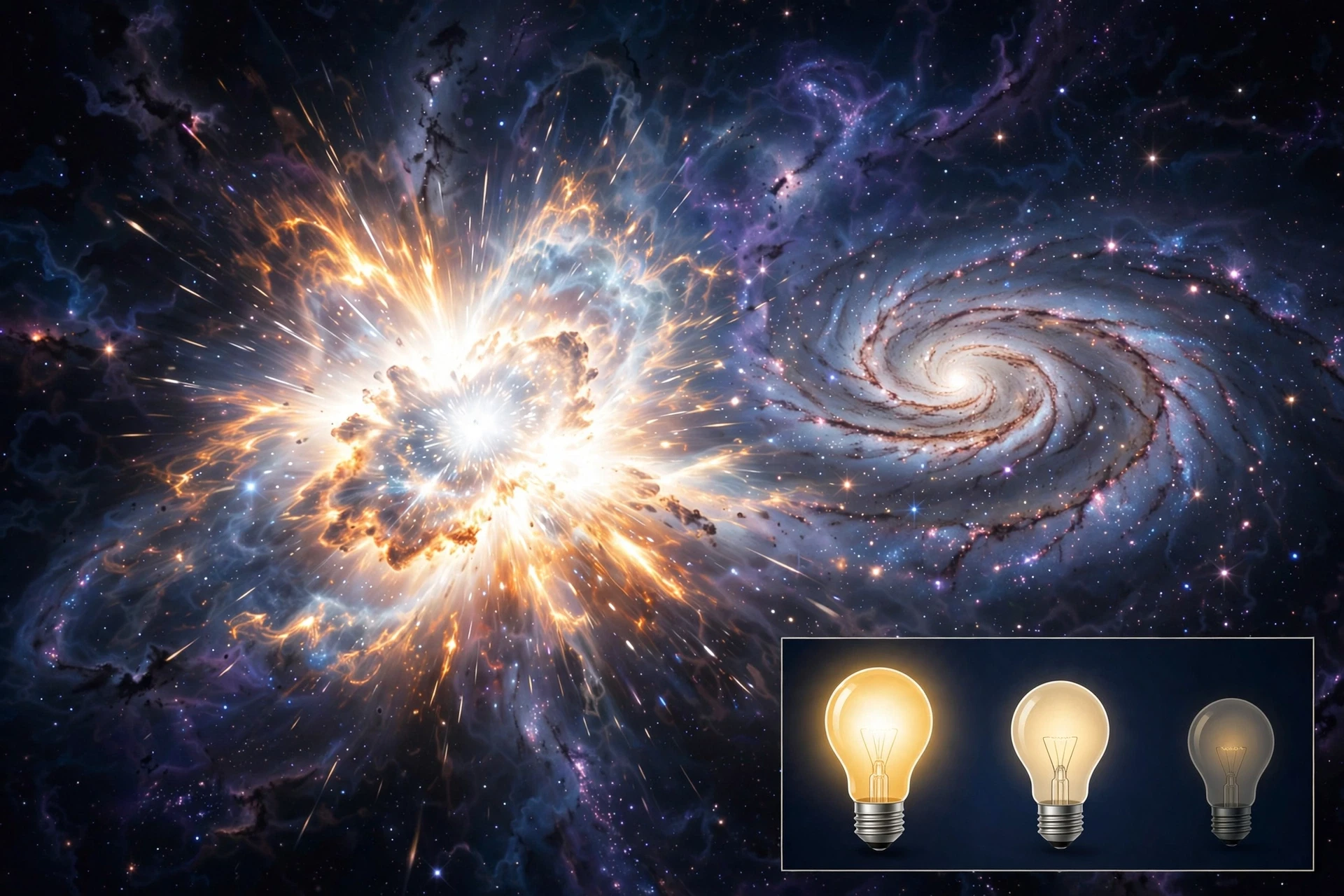
The story starts with Edwin Hubble's discovery in the 1920s that the universe is expanding: distant galaxies are flying away from us, and the farther away they are, the faster they recede. Everyone assumed gravity must be putting the brakes on that expansion, the way a thrown ball slows as it rises. Two teams — the Supernova Cosmology Project, led by Saul Perlmutter, and the High-Z Supernova Search Team, led by Brian Schmidt and Adam Riess — set out to measure the braking. Their tool was a Type Ia supernova, the explosion of a white dwarf star that has grown too massive to hold itself up. These explosions are remarkably consistent in brightness, which makes them standard candles: if you know how bright a light bulb really is, you can tell how far away it is by how dim it looks.
Both teams expected the distant supernovae to look slightly brighter than a steadily expanding universe would predict — the signature of a slowing expansion bringing them closer than expected. Instead, the distant supernovae looked dimmer. They were farther away than they should have been. The expansion was not slowing down. It was speeding up. The result was so unexpected that both teams spent months checking for errors — dust in the distant galaxies, faulty calibrations, anything that could fake the signal. The signal survived every check. In 2011, Perlmutter, Schmidt and Riess shared the Nobel Prize in Physics for the discovery (American Physical Society).
I remember reading about the result as a student and feeling the floor shift. Cosmology had spent a century assuming gravity ruled the universe's fate. Overnight, something else was in charge, something that pushed instead of pulled, and nobody had any idea what it was. Michael Turner coined the name "dark energy" the following year, and the name stuck, because like dark matter, it was a label for ignorance.
5.2 The balloon, the raisin bread, and what expansion really means
The expansion of the universe is easy to misunderstand, so the analogies matter. The classic one is a balloon with coins stuck to its surface. As you inflate the balloon, every coin moves away from every other coin, and coins farther apart move away faster. Nobody is at the centre of the expansion; the surface itself is stretching. Or picture raisin bread rising in an oven: the raisins do not move through the dough, the dough itself expands and carries them apart.
Now imagine the dough is being pushed apart by an invisible force that grows stronger as the loaf gets bigger. That is dark energy. It is not an explosion flinging galaxies through space. It is space itself stretching, faster and faster, and the galaxies are along for the ride. On small scales — inside a galaxy, inside a solar system, inside your kitchen — gravity and other forces easily overpower it. Dark energy only wins on the scale of billions of light-years, where matter is thin and gravity is weak. That is why you do not fly out of your chair. The push is there, in the room with you, but it is absurdly feeble compared with the forces holding you together.
There is a subtlety worth pausing on. Dark energy does not seem to dilute as space expands. Ordinary matter thins out as the universe grows — the same amount of stuff spread over a larger volume. Dark energy, if it is what the simplest model says it is, stays at the same density everywhere, all the time. As space expands, more of it appears, which drives more expansion, which creates more of it. That runaway logic is why the acceleration exists, and why it will only get stronger.
5.3 What could dark energy be?
The leading explanation is the cosmological constant, an idea Einstein introduced in 1917 and then abandoned. In this picture, dark energy is a fixed property of empty space itself: every cubic metre of vacuum contains the same tiny amount of energy, and that energy pushes space apart. It is the simplest model that fits the data, and it is built into Lambda-CDM. But it comes with an embarrassment. When physicists try to calculate how much vacuum energy quantum theory predicts, the answer comes out roughly 10^120 times larger than what astronomers measure — a mismatch so large it is often called the worst prediction in the history of physics. Something is deeply wrong with the calculation, or with the theory, and nobody knows what.
The main alternative is quintessence: a dynamic field, a bit like an invisible fluid, whose energy changes slowly over time. In some versions, dark energy was stronger in the past and is weakening now. In others it could grow, eventually tearing galaxies, stars, and atoms apart in a "Big Rip." A third possibility is that dark energy does not exist at all, and that gravity itself behaves differently on cosmic scales than general relativity predicts. Perlmutter himself has said this plainly: we do not know whether the answer will turn out to be a new energy in the universe or "an extra wrinkle in Einstein's Theory of Relativity." That uncertainty is not a failure. It is the honest state of the science.
6. How Scientists Measure the Dark Universe
You cannot point a telescope at dark matter or dark energy. What you can do is measure their effects with extraordinary precision, and astronomers have built an entire toolkit for exactly that. Each method probes a different aspect of the invisible universe, and the methods agree with each other — which is why cosmologists trust the picture even while the underlying nature of both components stays unknown.
Method | What it measures | What it tells us |
|---|---|---|
Galaxy rotation curves | Orbital speeds of stars in galaxies | Dark matter haloes surround every galaxy |
Gravitational lensing | Bending of light by mass | Maps of dark matter in clusters and the cosmic web |
Type Ia supernovae | Distances to exploding stars | Expansion is accelerating — dark energy exists |
Cosmic microwave background | Ancient light from 380,000 years after the Big Bang | Precise recipe: 4.9% / 26.8% / 68.3% |
Baryon acoustic oscillations | Frozen sound waves in galaxy distributions | Expansion history over 11 billion years |
Galaxy clustering surveys | Positions of millions of galaxies | How dark matter shaped large-scale structure |
Underground detectors | Tiny recoils in ultra-cold crystals | Direct search for dark matter particles |
The newest tool in the box is baryon acoustic oscillations, or BAO. In the hot early universe, sound waves rippled through the dense soup of matter and light. When the universe cooled, those ripples froze in place, leaving a preferred spacing between galaxies — a standard ruler about 500 million light-years long, imprinted across the sky. By measuring how that spacing has stretched over cosmic time, astronomers can trace the expansion history of the universe directly. The Dark Energy Spectroscopic Instrument, or DESI, mounted on the Mayall Telescope in Arizona, is doing this for tens of millions of galaxies, building the largest three-dimensional map of the universe ever made.
7. Dark Matter vs Dark Energy: Side by Side
Because the names sound alike, the two are constantly confused — in classrooms, in news articles, and in conversation. The table below is the fastest way to keep them straight. If you remember one thing from this article, remember this: they do opposite jobs.
Property | Dark Matter | Dark Energy |
|---|---|---|
Share of the universe | About 27% | About 68% |
Effect on the universe | Attractive — pulls things together | Repulsive — pushes space apart |
Where it is found | Clumped in haloes around galaxies and clusters | Spread smoothly through all of space |
What it does | Holds galaxies together; built the cosmic web | Speeds up the expansion of the universe |
Behaviour over time | Dilutes as the universe expands | Stays constant (in the simplest model) |
Leading explanation | Unknown particle (WIMP, axion, or other) | Cosmological constant, or a changing field |
Directly detected? | No — only through gravity | No — only through acceleration |
Key evidence | Rotation curves, lensing, Bullet Cluster, CMB | Distant supernovae, CMB, galaxy surveys |
A useful way to think about their relationship is a tug-of-war that changed hands. For the first few billion years after the Big Bang, matter — dark and ordinary together — dominated, and gravity slowed the expansion. But matter dilutes as space grows, while dark energy does not. About five billion years ago, dark energy's share of the cosmic budget passed matter's, and the expansion began to accelerate. Dark matter is still winning inside galaxies, where it is dense. Dark energy has already won on the scale of the universe as a whole. The tug-of-war is over at the largest scales, and the outcome shapes everything that follows.
8. The Latest Research: Cracks in the Simplest Picture
For twenty years, the simplest model — a constant dark energy plus cold dark matter — fitted every measurement thrown at it. In the last few years, that comfortable fit has started to show strain. The most interesting development comes from DESI. Its first-year results in 2024, and its three-year results released in March 2025, found hints that dark energy might not be constant after all. Combining DESI's galaxy map with the cosmic microwave background and supernova data, the analysis preferred a dark energy that changes over time — slightly stronger in the past, weakening today — at a statistical significance of 2.8 to 4.2 sigma, depending on which supernova data were included. That is intriguing but short of the 5-sigma standard physicists require before calling something a discovery. A 3-sigma hint has about a 0.3 percent chance of being a statistical fluke, and plenty of 3-sigma hints have faded with more data. DESI completed its planned five-year map in April 2026, surveying more than 47 million galaxies and quasars, and results from the full dataset are expected in 2027. They will show whether the hint grows into a discovery or dissolves (Berkeley Lab).
A second crack is the Hubble tension. The expansion rate of the universe today — the Hubble constant — comes out differently depending on how you measure it. The early-universe value, inferred from the cosmic microwave background, is about 67 kilometres per second per megaparsec. The late-universe value, measured from supernovae and other nearby yardsticks, is about 73. The gap is too large to be a rounding error, and it has survived years of increasingly careful measurement. Something is off — either in our understanding of the early universe, in the measurements, or in the model itself. Some physicists suspect the tension points to new physics in the dark sector: perhaps dark energy behaved differently in the early universe, or dark matter interacts with something we have not accounted for.
Meanwhile, new instruments are coming online. The European Space Agency's Euclid telescope, launched in 2023, is mapping the shapes of billions of galaxies to trace dark matter through weak lensing and to measure the expansion history. NASA's Nancy Grace Roman Space Telescope will survey more than a billion galaxies and catch thousands of distant supernovae. The Vera C. Rubin Observatory in Chile will photograph the entire southern sky every few nights for a decade, catching supernovae as they explode and mapping dark matter across the sky. And deep underground, the next generation of detectors — larger, colder, quieter — will push the WIMP search into corners it has never reached.
I have a colleague who keeps a small whiteboard in her office with a single sentence on it: "The universe is under no obligation to be simple." Every time a new result arrives, she erases it and writes it again. The DESI hint and the Hubble tension are the latest reminders. The simple model might survive. It might not. Either way, we will learn something.
9. What We Still Do Not Know
Honesty is the point of this section. Here is the list of things cosmology genuinely does not know, stated without softening.
First, we do not know what dark matter is made of. Not the particle, not its mass, not whether there is one kind or many. After forty years of searching, the most sensitive detectors on Earth have found nothing, and the most powerful collider ever built has produced nothing. It is possible the particle is lighter or heavier than anyone guessed, or interacts even more weakly, or that the whole particle picture is wrong.
Second, we do not know what dark energy is, or even whether it is an "it" at all. It might be vacuum energy. It might be a changing field. It might be a sign that general relativity needs revising on the largest scales. The DESI hints may resolve into a discovery, or they may vanish. Either outcome is progress, but neither is guaranteed soon.
Third, we do not know whether dark matter and dark energy are connected. Most models treat them as unrelated, but some theories propose a "dark sector" in which dark particles interact with each other through forces of their own, invisible to us. If that is true, the two mysteries might be two faces of one deeper structure — and our current picture, which treats them as separate line items, would be missing the plot.
Fourth, we do not know the fate of the universe. If dark energy is constant, the universe will expand forever, growing colder and emptier in a long heat death. If dark energy strengthens, the expansion could accelerate without limit until it tears galaxies, stars, planets and atoms apart — the Big Rip. If it weakens or reverses, gravity might eventually win again, and the universe could collapse in a Big Crunch. The data currently favour the long, cold ending, but the DESI results are a reminder that the favourite can change.
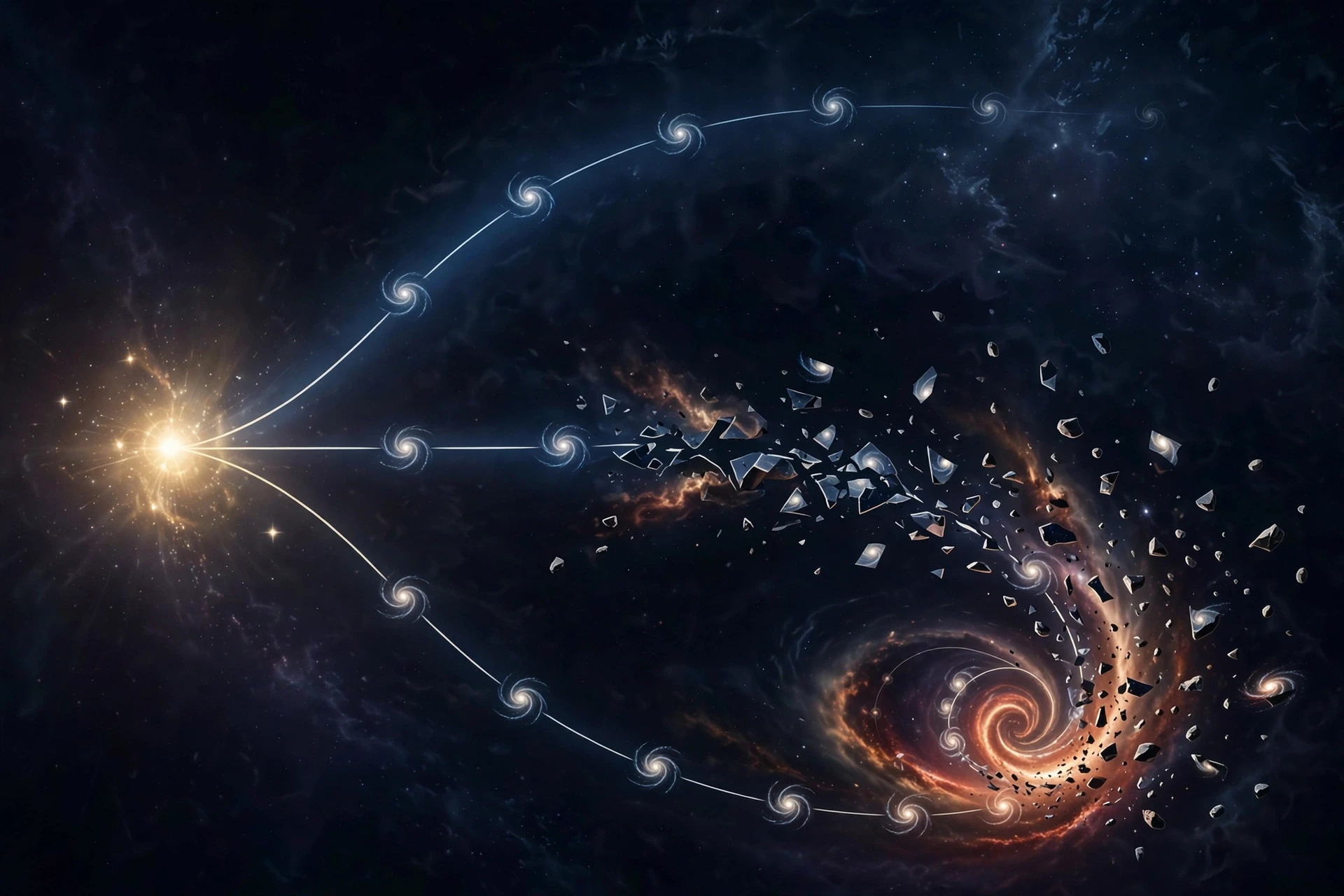
Finally, we do not know why the numbers are what they are. Why is dark energy 68 percent and not 99, or 1? Why did dark energy and matter trade dominance just a few billion years ago — roughly when life on Earth was getting started? This timing, called the coincidence problem, bothers cosmologists more than most people realise. It smells like a clue, but nobody knows what it points to.
10. Why the Dark Universe Matters to You
It is reasonable to ask what any of this has to do with daily life. The honest answer is that dark matter and dark energy will not change your commute, your cooking, or your health. No technology runs on them, and none is likely to soon. Their importance is different, and in a way larger.
First, they are the story of where we came from. Every galaxy, including the Milky Way, formed inside a dark matter halo. The carbon in your body was forged in stars that could only form because dark matter gathered the gas together first. You are, quite literally, a byproduct of invisible scaffolding.
Second, they are the story of where we are going. The fate of the universe — endless cold, violent tearing, or slow collapse — is decided by the balance between dark matter and dark energy. That is the largest question a species can ask, and we are the first generation with instruments good enough to ask it with data instead of poetry.
And third, they are a reminder of how science works at its best. Dark matter and dark energy were not found because someone wanted them to exist. They were found because measurements refused to match theory, and scientists trusted the measurements. Zwicky was ignored for forty years. Rubin was told her rotation curves must be wrong. The supernova teams spent months trying to prove themselves mistaken. Each time, the data won. That is worth remembering the next time someone tells you science is a matter of opinion. The universe does not care about our opinions. It leaves footprints, and footprints can be followed.
A student once asked me, after a lecture on all of this, whether it bothered me that we know so little. I told her the truth: it is the opposite of bothersome. It is the best part. We live in a universe where ninety-five percent of everything is still unknown, and we have built machines that can see the unknown's shadow. That is not a failure of science. That is science working exactly as it should.
11. Conclusion: Living in a Universe We Mostly Cannot See
Dark matter and dark energy are the two biggest open questions in modern science, and they are open at the same time, in the same universe, measured by the same instruments. Dark matter is the invisible glue that holds galaxies together and built the scaffolding on which every star and planet formed. Dark energy is the invisible push that is driving the universe apart faster and faster, deciding its fate. Together they make up about ninety-five percent of everything that exists, and we have never directly detected either one.
What we have instead is evidence: flat rotation curves, colliding clusters, bent light, a baby picture of the cosmos, and supernovae that were too dim. Four independent lines of evidence for dark matter. A Nobel Prize for dark energy. A model, Lambda-CDM, that fits the data with breathtaking precision while naming two ingredients it cannot explain. And now, fresh hints from DESI that even that model may need revising.
The next decade will be decisive. Euclid, Roman, Rubin, DESI's full dataset, and the next generation of underground detectors will either find the dark matter particle, confirm that dark energy changes, or tell us that our best ideas are wrong in interesting new ways. Whichever it is, the invisible ninety-five percent will not stay invisible forever. We are learning to see by its shadow, and the shadow is getting sharper every year.
Frequently Asked Questions
What is dark matter in simple terms?
Dark matter is invisible matter that has mass and gravity but does not emit, absorb, or reflect light. We know it exists because of its gravitational effects: it holds galaxies together, bends light from distant objects, and shaped the cosmic web. It makes up about 27% of the universe.
What is dark energy in simple terms?
Dark energy is the name for whatever is causing the expansion of the universe to accelerate. It appears to be spread evenly through all of space and pushes space apart. It makes up about 68% of the universe, and scientists know even less about it than they do about dark matter.
Are dark matter and dark energy the same thing?
No. Dark matter pulls things together through gravity and is clumped around galaxies. Dark energy pushes space apart and is spread smoothly through the universe. They do opposite jobs and are almost certainly unrelated, though both are invisible and both are unexplained.
How much of the universe is dark matter and dark energy?
Together they make up about 95% of the universe: roughly 27% dark matter and 68% dark energy. Ordinary matter — everything we can see, including all stars, planets, and people — accounts for only about 5%. These figures come from measurements of the cosmic microwave background by the Planck satellite.
Who discovered dark matter?
Fritz Zwicky first proposed dark matter in 1933 after studying the Coma Cluster of galaxies, but his work was largely ignored. Vera Rubin provided the decisive evidence in the 1970s by measuring flat rotation curves in spiral galaxies, showing that galaxies contain far more mass than we can see.
How was dark energy discovered?
In 1998, two teams studying distant Type Ia supernovae found that the supernovae were dimmer — and therefore farther away — than expected, meaning the universe's expansion is speeding up rather than slowing down. Saul Perlmutter, Brian Schmidt, and Adam Riess won the 2011 Nobel Prize in Physics for this discovery.
What is dark matter made of?
Nobody knows yet. The leading candidates are WIMPs (weakly interacting massive particles), axions (ultralight particles), and primordial black holes formed just after the Big Bang. Decades of searches in underground detectors, at the Large Hadron Collider, and with space telescopes have not yet found any of them.
Can dark matter be seen?
No. Dark matter does not interact with light at any wavelength, so no telescope can photograph it directly. Astronomers map it indirectly through gravitational lensing — the bending of light from background galaxies by dark matter's gravity — and through its effects on how galaxies rotate and cluster.
Will dark energy tear the universe apart?
Probably not, but it is not ruled out. If dark energy stays constant, the universe will expand forever and grow cold and empty. If it strengthens over time, it could eventually tear apart galaxies, stars, and atoms in a "Big Rip." Current data favour the slow, cold ending, but recent DESI results hint dark energy may change, so the question is still open.
What is the Hubble tension?
The Hubble tension is a disagreement between two ways of measuring how fast the universe is expanding today. Measurements based on the early universe give about 67 km/s per megaparsec, while measurements based on nearby supernovae give about 73. The gap is too large to be a measurement error, and it may point to new physics in the dark sector.
Sources
NASA Science, "Dark Matter" — the evidence for dark matter, Zwicky, Rubin, and the Bullet Cluster: https://science.nasa.gov/dark-matter/
NASA Science, "The Universe's Building Blocks" — the 5% / 27% / 68% breakdown of the universe: https://science.nasa.gov/universe/overview/building-blocks/
European Space Agency, "Planck Science Highlights" — Planck's cosmic recipe and the age of the universe: https://www.esa.int/articles/about-us/directorates/science/planck/planck-science-highlights
OpenStax Astronomy, "29.5 What Is the Universe Really Made Of?" — universe composition, WIMPs, and galaxy formation: https://openstax.org/books/astronomy/pages/29-5-what-is-the-universe-really-made-of
American Physical Society, "Nobels Honor Discoveries of Accelerating Universe" — the 2011 Nobel Prize and the 1998 supernova discovery: https://www.aps.org/apsnews/2011/11/nobels-honor-discoveries-of-accelerating-universe-quasicrystals
Lawrence Berkeley National Laboratory, "Berkeley Lab's Big Science Stories of 2025" — DESI results hinting dark energy may evolve: https://newscenter.lbl.gov/2025/12/17/berkeley-labs-big-science-stories-of-2025/