

Introduction
The sky went dark over the snowfield outside Tromsø, and for a long while nothing happened. I stood in boots that were slowly filling with cold, stamping my feet, watching my breath rise and fade, wondering whether the forecast had been wrong and whether the long drive north had been a waste of a night. Then a pale smudge appeared low in the north, so faint I thought it was a thin cloud catching town light. I stared at it. It thickened. It rose. And then, without any warning I could name, it began to move — a slow green curtain unrolling across the stars, folding over itself like silk in a wind I could not feel.
I laughed out loud, alone, in the snow. I had read about the aurora borealis for years. I knew the physics, or thought I did. None of that prepared me for the way it moved: not like a cloud, not like a flame, but like something alive and deliberate, rippling and brightening and then fading to a ghost of itself before surging back in a new shape. People around me — strangers who had driven just as far — went quiet. Someone whispered, and someone else put a hand on a friend's shoulder. We were all watching the same sky, and none of us could look away.
That night is the reason this article exists. The aurora borealis, the northern lights, is one of the few natural sights that still makes grown adults gasp. It is also one of the most misunderstood. It is not fire in the sky. It is not a trick of cold weather. It is not a rare miracle that only happens on special nights. It is the visible end of a long chain of events that starts 150 million kilometres away, on the surface of the Sun, and ends about 100 kilometres above your head, when a charged particle from space slams into an oxygen atom and the atom gives back the energy as light.
This article follows that whole chain, step by step. We will start with the Sun and its wind, cross the invisible shield that guards our planet, ride the magnetic field lines down to the poles, and arrive at the collisions that paint the sky green, red, purple and blue. Along the way we will look at why the lights form a ring around the poles, why they come and go with the Sun's 11-year cycle, how forecasters measure storms with the Kp index, what the southern lights are, where and when to see the display for yourself, and why Jupiter and Saturn wear auroras far grander than ours. We will also meet the people who first tried to explain the lights — a man who guessed at electricity in the 1700s, a Norwegian explorer who was mocked for a theory that turned out to be right — and we will clear away the myths that still cling to the aurora borealis like frost on a window.
1. What an Aurora Really Is
The aurora borealis is a glow in the upper atmosphere, produced when charged particles from space collide with the gases high above Earth. The particles carry energy. The gas atoms absorb that energy, get excited, and then release it as light. That is the whole trick, and it is worth saying plainly before the details pile up: the northern lights are not burning, not reflecting, and not shining from below. They are atoms glowing after being struck, the same basic physics that makes a neon sign glow, played out on a scale hundreds of kilometres wide.
The light usually appears between about 100 and 300 kilometres above the ground. That is far above the clouds, far above the cruising altitude of airliners, and far above the weather we live in. The air up there is thin — so thin that a breath of it would barely register — yet there is still enough oxygen and nitrogen for the collisions to happen in enormous numbers. It is a different kind of light from the blue of the daytime sky, which comes from sunlight scattering off air molecules; you can read why the sky is blue to see the contrast. A single bright display involves billions of collisions every second, spread across a curtain of light that can stretch for a thousand kilometres.
The name itself carries history. Galileo Galilei, the Italian astronomer, is credited with naming the phenomenon aurora borealis in the early 1600s: aurora for the Roman goddess of the dawn, borealis for the north wind. He thought the light was sunlight reflecting off the upper atmosphere. He was wrong about the cause, and right that it deserved a beautiful name. The southern version, aurora australis, got its name later, from the Latin for south. Together they are simply called auroras, and the physics behind them is the same at both ends of the planet.
1.1 Why the lights move like curtains
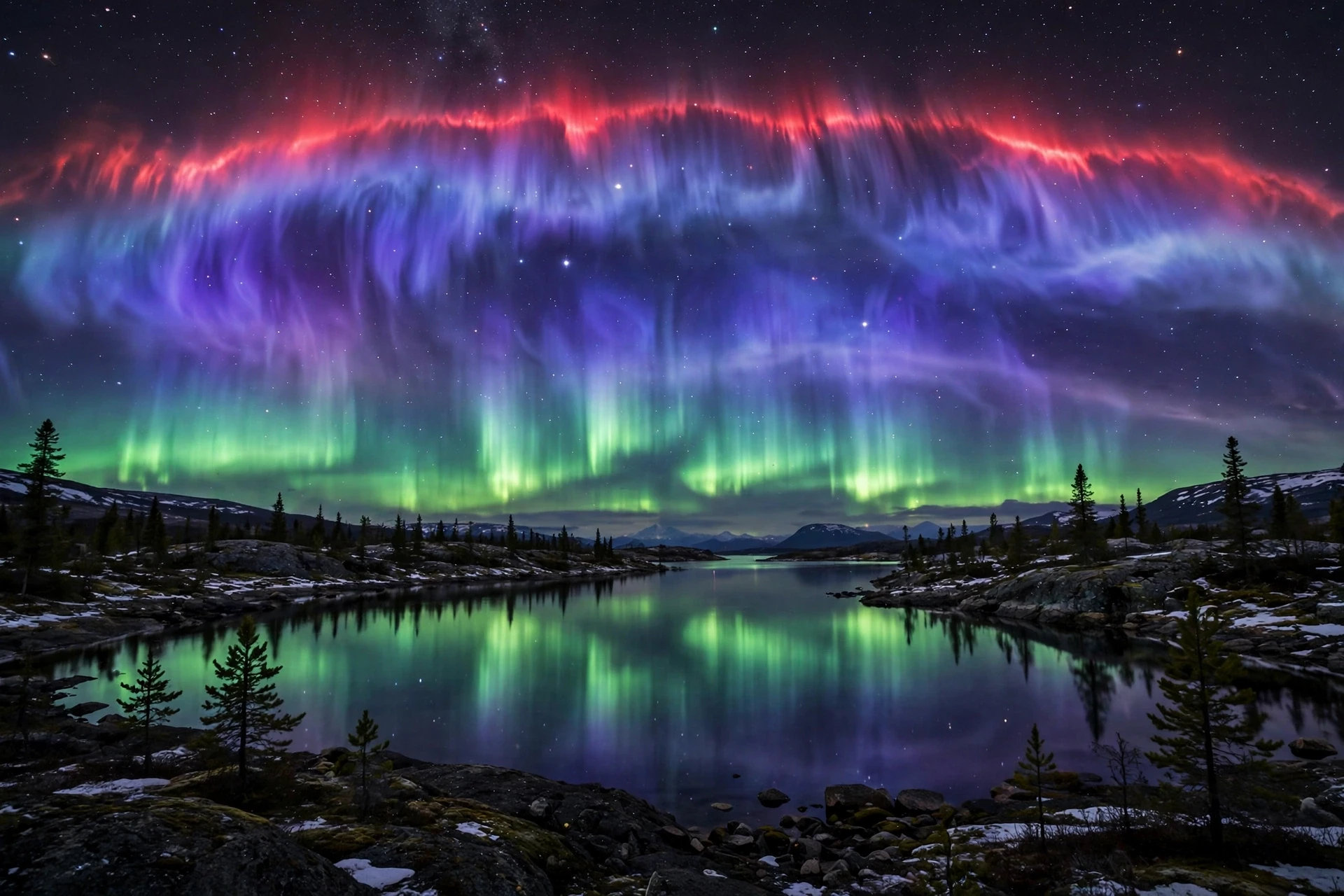
If you have only seen photographs, you might expect the aurora borealis to look like a still painting. In person, it moves. Curtains ripple. Arcs split into rays. Bands brighten, fade, and surge again in minutes. The movement comes from the magnetic field itself. The particles that make the light do not fall straight down like rain; they spiral along magnetic field lines, and those lines shift and wave as the solar wind pushes and pulls at them. When a burst of particles arrives, a new curtain lights up. When the flow changes, the curtain folds.
I learned this the hard way on that night in Tromsø. I set up a camera on a tripod, framed what I thought was a perfect shot, and by the time I pressed the shutter the brightest part of the display had moved to the other side of the sky. The aurora borealis does not pose. It is a process, not a picture — a live readout of what the Sun and Earth's magnetic field are doing to each other, right now, overhead.
The shapes have names, and watchers learn them the way sailors learn clouds. A quiet arc is a long, steady band across the sky. A band is a wavy ribbon. Rays are the vertical streaks that make a curtain look folded, like light shining through the slats of a blind. A corona is what you see when you stand directly under a display and the rays seem to converge overhead, streaming down toward you from a single point. On a strong night, all of these can appear within an hour, one shape melting into the next.
1.2 How high, how big, how bright
The scale of the aurora borealis is hard to hold in the mind, so here is a comparison that helps me. The bottom edge of a typical display sits about 100 kilometres up — roughly ten times higher than a cruising airliner. The top can reach 300 kilometres or more. A single curtain can be hundreds of kilometres long and only a few kilometres thick, like a sheet of paper held on its edge and stretched across a county. On a strong night, the whole oval of light around the pole can be thousands of kilometres across.
Brightness varies just as much. A faint aurora borealis looks like a pale grey-green smudge, easy to mistake for cloud, and your eyes may not register its colour at all. A strong display is unmistakably green, bright enough to read by on a dark night, and bright enough to cast a faint shadow on snow. Cameras pick up more colour than the human eye, because they gather light for seconds at a time while your eyes work in real time. That is why photographs often look more vivid than the night you remember — the camera is not lying, exactly, but it is seeing with more patience than you can.
The aurora borealis is not light reflected from somewhere else. It is light made on the spot, high above the ground, by atoms giving back energy they just received.
2. The Sun: Where Every Aurora Begins
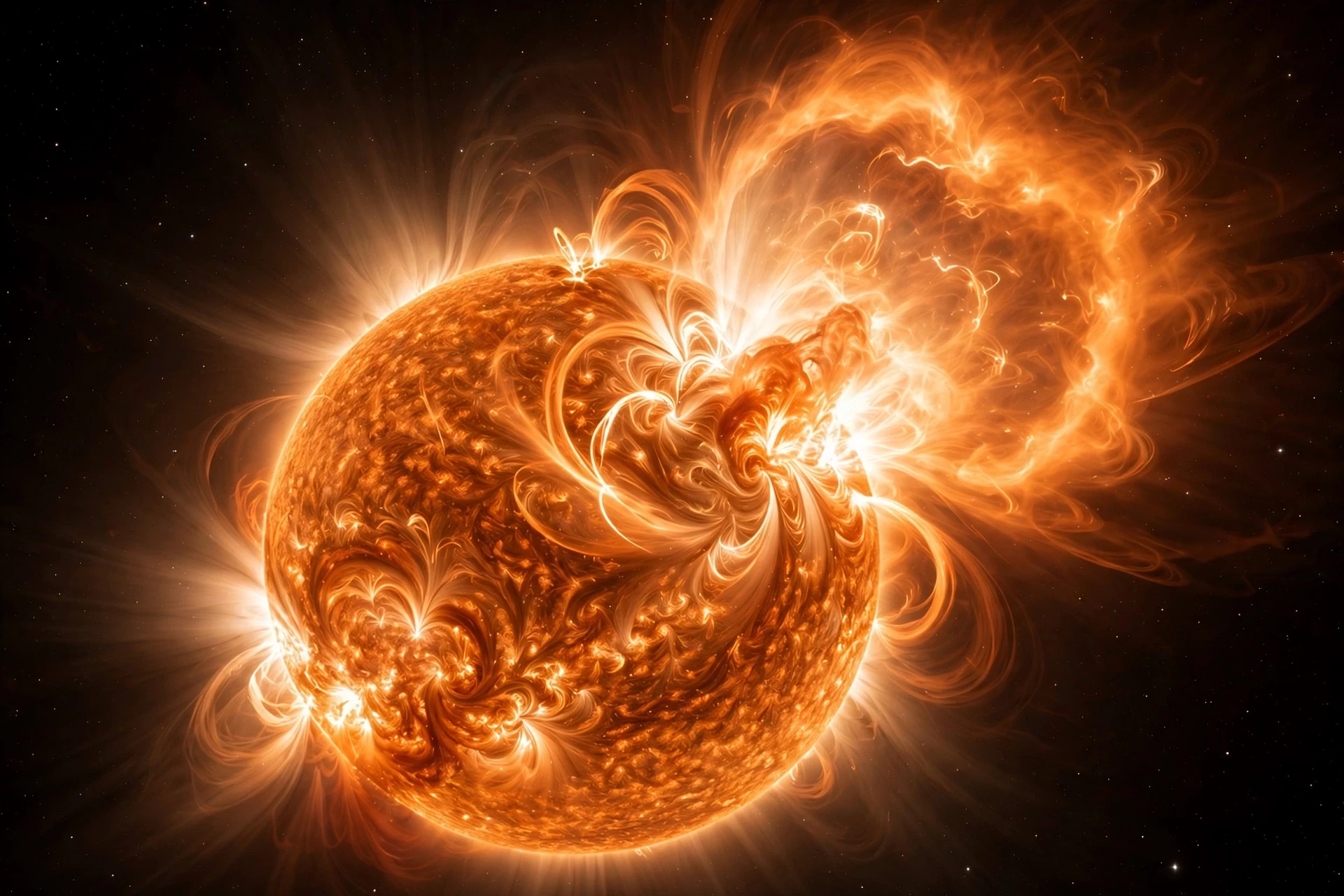
Nothing about the aurora borealis makes sense without starting at the Sun. Our star is not a calm, steady lamp. It is a restless ball of hot, electrically charged gas — plasma — churning, boiling, and throwing material into space. Two kinds of outflow matter for the northern lights: the steady solar wind, and the sudden storms called coronal mass ejections.
The solar wind is a stream of charged particles — mostly protons and electrons — blowing outward from the Sun in all directions, all the time. It moves fast, typically 400 to 800 kilometres per second, and it never stops. Think of it as the Sun breathing out, endlessly, a wind made of electricity rather than air. Earth sits in the path of that wind, and everything that follows in this article is a consequence of that simple fact: we live downstream of a star that is always blowing.
A coronal mass ejection, or CME, is something else again. It is a huge bubble of plasma and magnetic field that erupts from the Sun's outer atmosphere, the corona, carrying billions of tonnes of material. A large CME can travel at more than 1,000 kilometres per second and reach Earth in one to three days. When one hits, it squeezes Earth's magnetic field like a hand squeezing a balloon, and the aurora borealis can flare into a display visible far from the poles. The great aurora storms of history — the ones people saw from the tropics, the ones that lit up telegraph wires in the 1800s — were driven by CMEs.
2.1 Sunspots, flares, and the Sun's temper
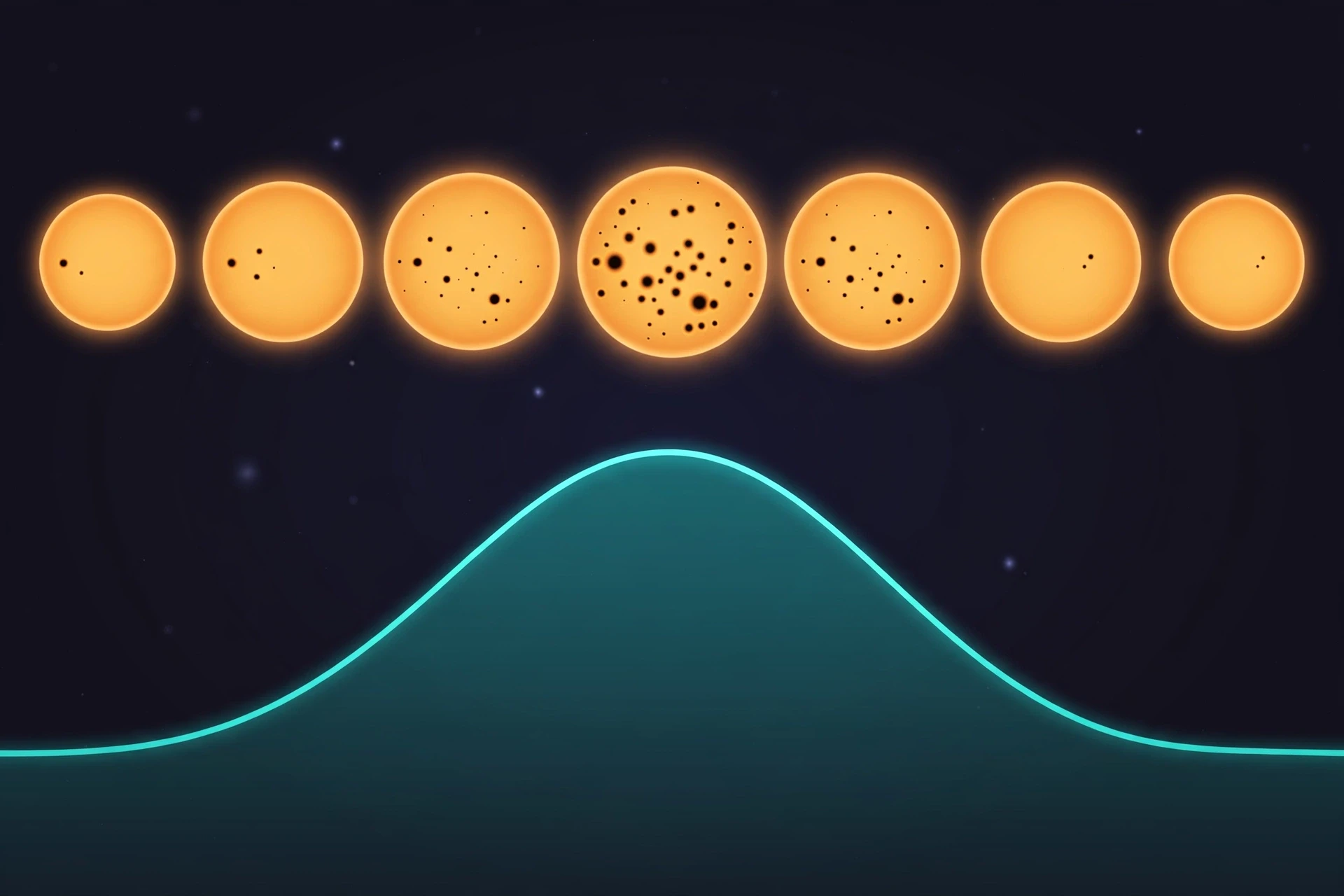
The Sun's activity is not constant. Dark patches called sunspots come and go on its surface, marking places where strong magnetic fields poke through. Around sunspots, the Sun is more likely to produce flares — sudden flashes of energy — and CMEs. More sunspots usually means a more active Sun, a stronger solar wind, and more frequent auroras. Fewer sunspots means a quieter Sun and quieter skies.
I once spent an evening at a public observatory watching a solar telescope image of the Sun's surface, and the astronomer on duty pointed to a cluster of sunspots and said, almost casually, "That one might give us a show in two days." Two days later, the aurora borealis flared over northern Europe. It felt like weather forecasting, except the weather was happening on a star. That is the right way to think about it: the Sun has weather, and the northern lights are Earth's weather report for it.
Solar flares deserve a careful distinction. A flare is a burst of light and radiation; it reaches Earth in about eight minutes, at the speed of light. A CME is a burst of matter; it takes days. Flares can disturb radio communications on the sunlit side of Earth almost at once. CMEs drive the auroras and the geomagnetic storms that follow. The two often happen together, from the same active region, which is why news reports sometimes blur them into one event. They are related, but they are not the same thing.
2.2 The journey across 150 million kilometres
A particle leaving the Sun on the solar wind takes roughly two to four days to reach Earth, crossing about 150 million kilometres of near-empty space. Along the way it is not alone. The wind carries with it a piece of the Sun's magnetic field, frozen into the plasma, and that interplanetary magnetic field matters enormously when the wind arrives. If its direction lines up against Earth's field, the two fields can join together in a process called magnetic reconnection, opening a door for solar wind energy to pour into Earth's magnetic environment. If the directions line up the other way, the door stays mostly shut.
This is why aurora forecasting is not just about how strong the solar wind is, but about which way its magnetic field points. A fast, dense wind with the wrong field direction can pass Earth with barely a flicker of light. A slower wind with the right direction can light up the sky. Forecasters watch this field direction the way sailors watch the wind: it decides everything that follows.
3. Earth's Magnetosphere: The Shield That Makes the Lights Possible
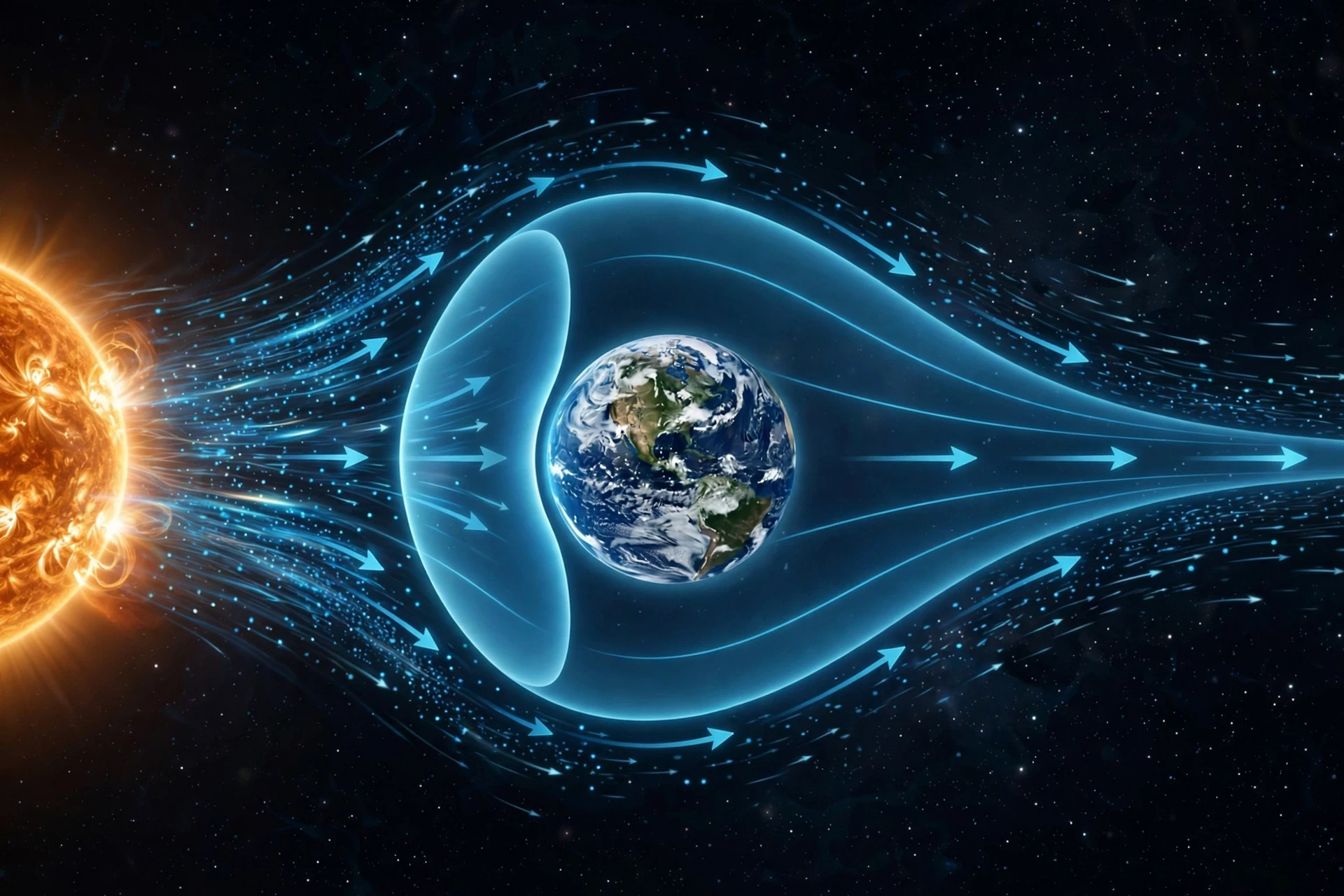
Earth has a magnetic field, generated deep inside the planet by the slow churning of molten iron in the outer core. That field reaches far into space, forming a vast, invisible bubble around the planet called the magnetosphere. It is our shield. Without it, the solar wind would strip away our atmosphere over time, as it seems to have done on Mars. With it, most of the wind is deflected around us, flowing past like water around a stone in a stream. The atmosphere itself stays in place because gravity holds it against the pull of space, and the magnetic field guards what gravity keeps.
The magnetosphere is not round. The solar wind presses on the side facing the Sun, squashing the field to about ten Earth radii — roughly 65,000 kilometres — on the day side. On the night side, the wind stretches the field out into a long tail, the magnetotail, that can reach hundreds of Earth radii into space. The whole structure is shaped like a comet, with Earth at the head and a long tail streaming away from the Sun. NASA's guide to auroras describes this tear-shaped field and how it traps and channels solar wind particles, and the picture it paints is worth holding in mind for the rest of this article.
3.1 A shield with a leak at the poles
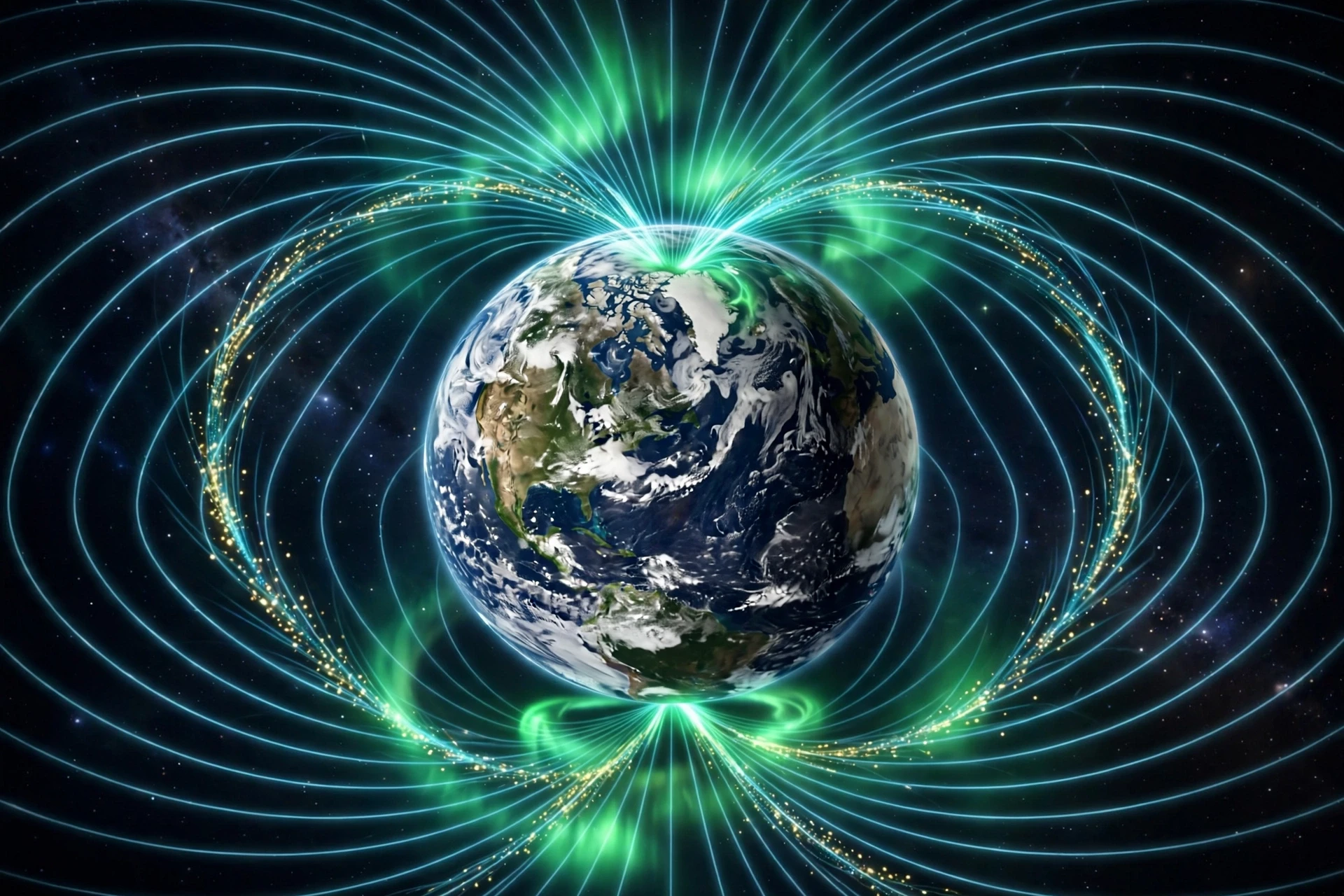
Here is the twist that makes the aurora borealis possible: the shield is not sealed. At the north and south magnetic poles, the field lines dive down into the planet instead of looping back around it. Particles can travel along those lines, like beads sliding down a wire, straight into the upper atmosphere. The magnetosphere protects us by deflecting most of the solar wind, and the aurora borealis is the visible sign of the small fraction that gets in through the poles.
Think of a house with a strong roof and two open chimneys. The roof keeps out the rain. The chimneys let a little smoke in — and in this case, the smoke glows. The polar regions are Earth's chimneys, and the light that comes down them is the price and the gift of having a magnetic field at all.
The field lines also act as a storage system. Energy from the solar wind builds up in the magnetotail, stretching the field like a rubber band, until something gives. The stored energy snaps back, accelerating trapped particles down toward the poles. This release is called a substorm, and it is the reason the aurora borealis often brightens suddenly after a quiet spell: the sky goes still, the arc hangs there, and then, in minutes, it erupts into rays and curtains and rapid motion. Watchers call this the breakup. It is the most exciting moment of any aurora night, and it is pure stored magnetic energy letting go.
3.2 Magnetic reconnection: the door that opens and closes
Magnetic reconnection is the process that lets solar wind energy into the magnetosphere, and it is worth a plain explanation because it sounds more mysterious than it is. Imagine two rubber bands stretched in opposite directions. Press them together and they can snap and rejoin in a new shape, releasing a burst of energy. Magnetic field lines do something similar. When the Sun's field and Earth's field meet pointing in opposite directions, they can break and reconnect, joining into new lines that link the Sun's field to Earth's. Energy and particles flow along those new lines into the magnetosphere.
When reconnection is strong, auroras strengthen. When it is weak, they fade. Spacecraft sitting upstream of Earth, between us and the Sun, measure the solar wind's field direction in real time, and that measurement is one of the main inputs to aurora forecasts. The NOAA Space Weather Prediction Center's aurora pages explain how forecasters use these measurements, and they are the first place to check when you want to know whether tonight is worth going out.
4. Down the Field Lines to the Poles
Once particles are inside the magnetosphere, they do not wander at random. Charged particles are bound to magnetic field lines; they spiral around them, trapped like beads on a wire, bouncing between the poles. Some of them are guided downward, funnelling toward the polar regions where the field lines converge and plunge into the atmosphere. This funnelling is the reason auroras ring the poles instead of appearing everywhere. The field lines gather the particles and deliver them to a narrow band of sky.
The particles that make the light are mostly electrons, with some protons mixed in. The electrons are light and fast, and they are the main actors. As they spiral down, they gain energy from the electric fields in the magnetosphere, arriving at the top of the atmosphere with energies of a few thousand electron volts — thousands of times more energetic than the particles in the air around them. That energy is what they hand over to the oxygen and nitrogen atoms they hit.
4.1 The last hundred kilometres
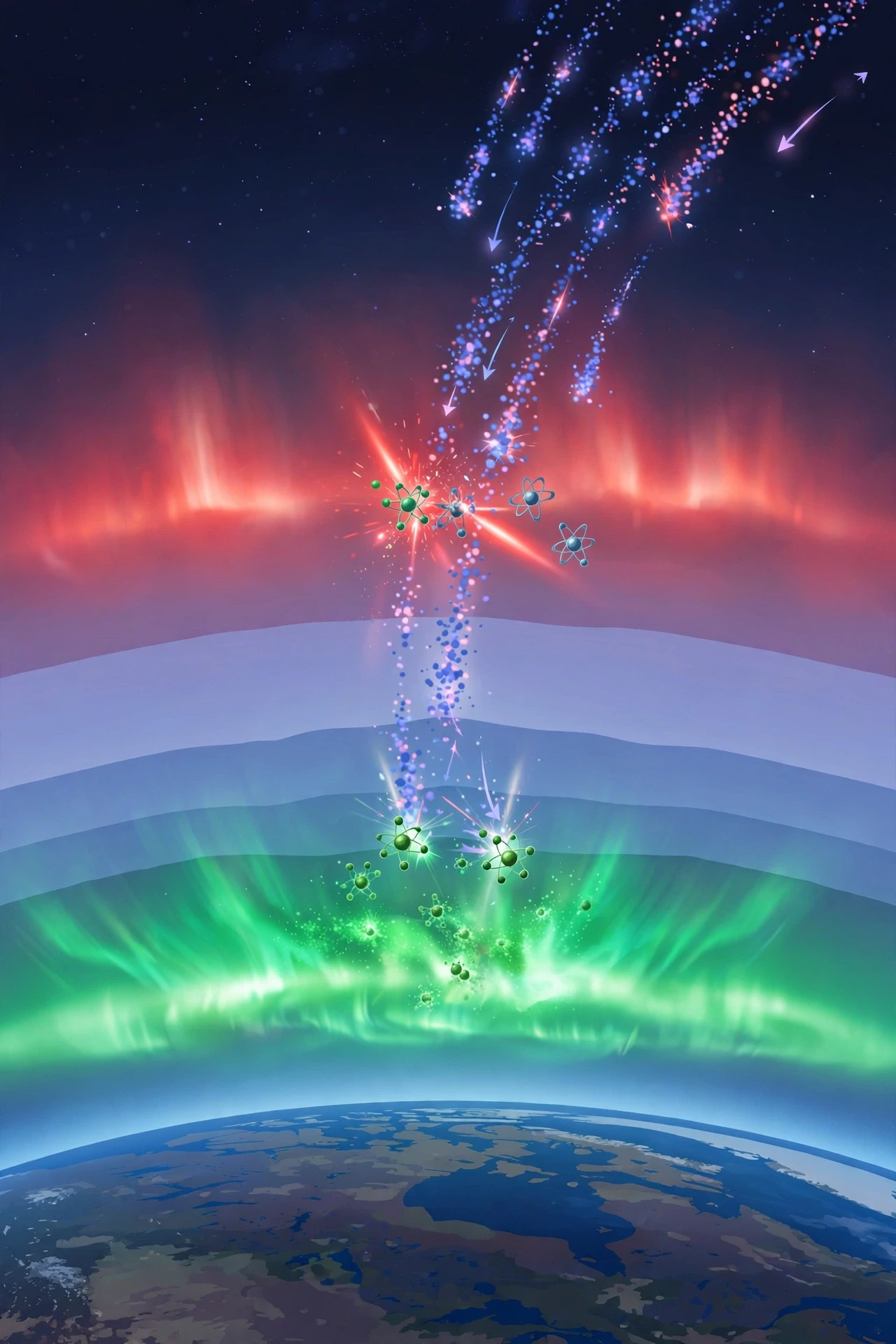
The final part of the journey is short and violent. A fast electron plunges into the upper atmosphere and collides with an oxygen or nitrogen atom. The collision hands energy to the atom, kicking one of its own electrons into a higher energy state. The atom is now excited, and it cannot stay that way. Within a fraction of a second — sometimes longer, depending on the atom and the altitude — it relaxes, and the extra energy leaves as a photon, a particle of light. That photon is what your eye sees.
One collision makes one photon. A display you can see with the naked eye needs billions of them, happening continuously, across a huge volume of sky. The brightness of the aurora borealis is a direct measure of how many particles are raining down and how much energy each one carries. More particles, more light. Faster particles, light from lower down, because they punch deeper into the atmosphere before they are stopped.
I keep a small gas discharge tube on a shelf in my study — the kind used in school physics lessons, a glass tube with a little gas inside that glows when you run a current through it. Switch it on and the gas lights up in a soft colour that depends on what is inside: one gas glows pink, another blue-green. Every time I look at it, I think of the aurora borealis. The sky is doing the same experiment, with oxygen and nitrogen instead of a sealed tube, and with the Sun providing the current. The physics is the same. Only the scale is different.
4.2 Why the lights appear at night — and happen all day
Auroras happen around the clock. The particles rain down in daylight just as they do at night. We simply cannot see the display in daylight because sunlight scattered in the lower atmosphere is far brighter than the auroral glow. The lights are drowned out, the way stars are drowned out at noon. This is one of the most common misunderstandings about the aurora borealis, and it matters for planning: the best time to look is not when the aurora is strongest, but when the sky is darkest. A moderate display on a dark winter night beats a strong display at twilight, because darkness is what lets you see it.
The same logic explains the seasons. Winter nights are long in the Arctic, which gives watchers more dark hours, but the aurora borealis does not care about the season. It happens in summer too — you just cannot see it through the midnight sun. Some researchers have found that auroras are slightly more frequent around the equinoxes, in March and September, possibly because of the angle between Earth's magnetic field and the solar wind at those times of year. The effect is real but modest. Darkness and solar activity matter far more than the month on the calendar.
5. The Collisions That Make Light
This is the heart of the whole story, so it deserves a slow walk-through. An atom is mostly empty space, with a small nucleus and electrons arranged in energy levels, like steps on a staircase. An electron sitting on a low step is calm. Give it a kick of energy and it jumps to a higher step. It does not like it there. It falls back down, and the energy it gained has to go somewhere — so it leaves as light, a photon whose colour depends on exactly how far the electron fell.
Different atoms have different staircases, so they give off different colours. Oxygen and nitrogen dominate the upper atmosphere, and they dominate the aurora borealis. Oxygen gives green and red. Nitrogen gives blue and purple. The exact colour you see depends on which atom was hit, how high up the collision happened, and how long the excited atom waited before giving off its light.
5.1 Green: the signature colour of oxygen
The most common aurora colour is green, and it comes from oxygen atoms about 100 kilometres up. When an oxygen atom is excited and then relaxes, it most often gives off light at a wavelength of 557.7 nanometres — a vivid green, right in the middle of the range our eyes are most sensitive to. That sensitivity is part of why green dominates what we see: our eyes are built to notice it.
The green light has a quirk. The excited oxygen atom that makes it can wait — about three quarters of a second — before releasing its photon. That is an eternity on atomic timescales, and at lower altitudes the atom would usually bump into another atom first and lose its energy without glowing at all. At 100 kilometres up, the air is thin enough that the atom often survives long enough to glow. This is why the green band sits where it does: high enough for the atoms to have room, low enough for the particles to reach in large numbers.
5.2 Red: oxygen higher up
The same oxygen atoms can also give off red light, at 630.0 nanometres, but only higher up, above about 200 kilometres. Up there the air is so thin that an excited oxygen atom can wait a full two minutes before releasing its photon, and it is almost never interrupted by a collision. The red glow is fainter and slower than the green, and it often appears as a soft red fringe along the top edge of a green curtain, like the glow above a fire. On very strong nights the red can spread across the whole sky. On most nights it is a quiet border, easy to miss unless you know to look for it.
5.3 Purple and blue: nitrogen joins in
Nitrogen, the most common gas in the air, adds the other colours. When nitrogen molecules are struck, they can give off blue and purple light, often along the lower edge of a curtain, below the green. The purple fringe is one of the most beautiful details of a strong display: a curtain of green with a violet hem, rippling over the snow. Nitrogen can also produce a deep red, but the blue-purple is what watchers notice most.
The colours blend in the eye and in the camera. A display that is mostly green with red above and purple below is the classic aurora borealis, and it tells you, at a glance, which atoms are being hit at which heights. The sky is not just pretty. It is a readout, written in colour, of the chemistry and physics of the upper atmosphere.
6. Why the Colours Differ: A Comparison
The table below brings the colour story together. Each row is one kind of light, with the atom that makes it, the height where it is strongest, and the wavelength that defines its colour. Wavelengths are in nanometres; a nanometre is a billionth of a metre, and visible light runs from about 380 nanometres (violet) to about 750 nanometres (red).
Colour seen | Atom or molecule | Typical altitude | Wavelength (nm) | How common |
|---|---|---|---|---|
Green | Oxygen | About 100 km | 557.7 | Most common |
Red | Oxygen | Above 200 km | 630.0 | Common on strong nights |
Blue | Nitrogen | Below 100 km | 427.8 | Less common |
Purple / violet | Nitrogen | Below 100 km | 391.4 | Seen on strong nights |
Pink | Nitrogen and oxygen mixed | About 90–100 km | Mixed | Occasional |
Read the table from top to bottom and a pattern appears: the higher the collision, the longer the wavelength and the redder the light, because the thin air up high lets oxygen atoms wait long enough to release their red photons. Lower down, the air is denser, collisions are more frequent, and the fast blue and purple light of nitrogen takes over. The green band in the middle is the sweet spot where oxygen is plentiful, the air is thin enough for the glow to survive, and the incoming particles are numerous.
If you can name the colour, you can name the atom and the altitude. The aurora borealis is a chemistry lesson written across the sky in light.
7. The Auroral Oval: Why the Lights Ring the Poles
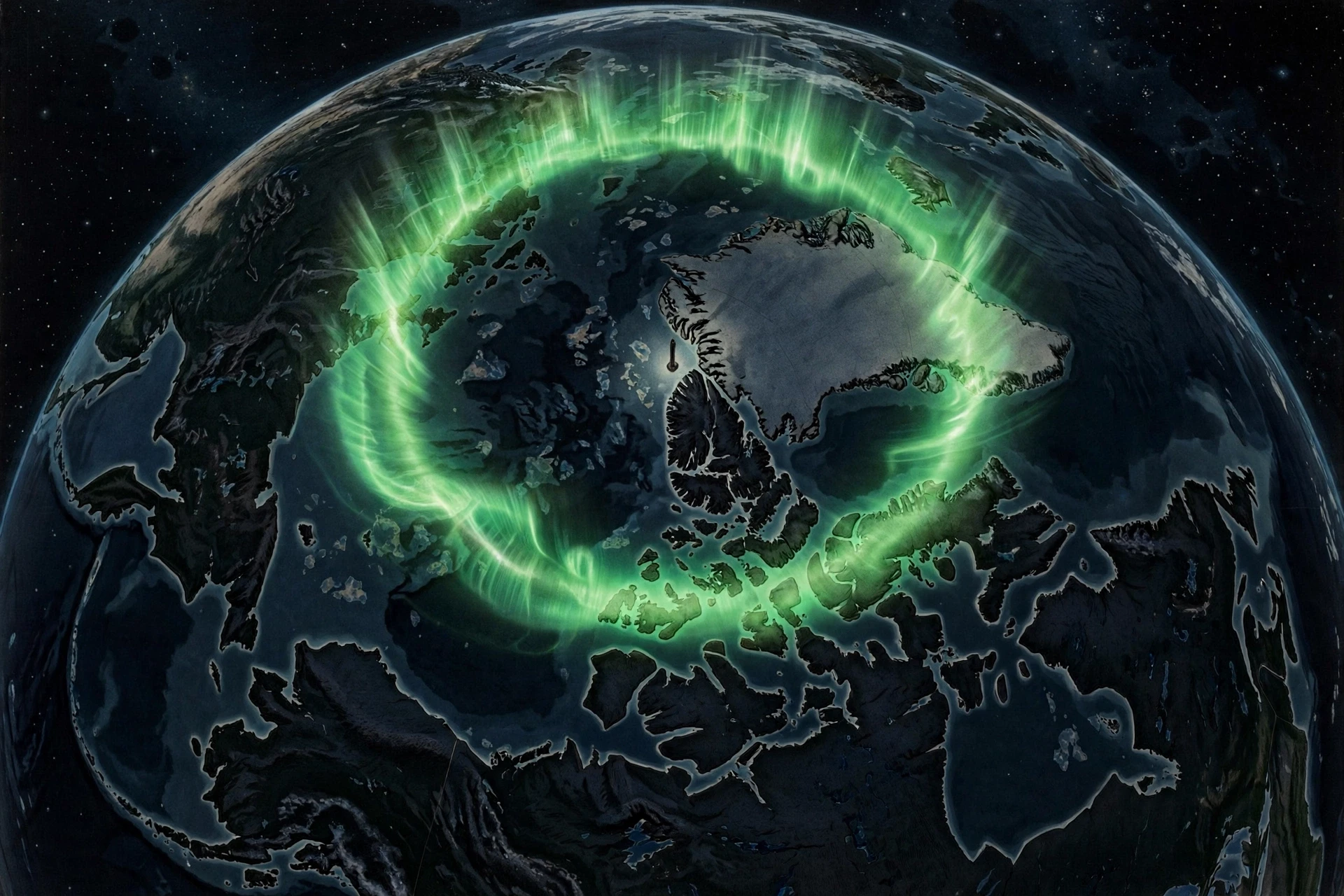
If auroras were simply caused by particles falling from space, you might expect them to appear everywhere, or directly over the poles. They do neither. They form a ring — the auroral oval — centred roughly on the magnetic pole, about 20 to 25 degrees of latitude away from it. On a quiet night the oval is narrow and sits over the high Arctic. On a stormy night it widens and pushes south, bringing the lights to places that rarely see them.
The ring shape comes from the geometry of the field lines. The particles that make the light travel down field lines that map to a ring-shaped region in the magnetosphere, not to a single point. Picture a funnel with a wide mouth: the mouth is the ring, and the light appears where the funnel meets the atmosphere. Directly over the magnetic pole, the field lines go straight down and the particle flow is actually weaker — the polar cap, inside the oval, is often dark while the ring around it glows.
7.1 When the oval moves south
The oval is not fixed. When the solar wind strengthens or a CME arrives, the oval expands and its southern edge moves toward the equator. That is how the aurora borealis, normally a high-latitude sight, has been seen from places as far south as the Mediterranean, the southern United States, and even the tropics during the greatest storms in history. The lights do not change their nature when they move south. The same physics is at work; the ring has simply grown larger.
This is why aurora forecasts are often drawn as maps of the oval rather than as a single number. A forecast map shows where the ring is expected to sit in the next 30 minutes, and whether your location falls under it. The NOAA 30-minute aurora forecast draws exactly this map, updated continuously, and it is the most practical tool a watcher has. If the oval's edge is over your town, go outside. If it is a thousand kilometres north, stay warm and wait for a stronger storm.
7.2 The view from above
Satellites see the oval in a way no one on the ground can: a glowing ring around the pole, sometimes complete, sometimes broken, always shifting. The first satellite images of the whole oval, taken in the 1970s and 1980s, changed how scientists thought about auroras. From the ground, the lights look like curtains and arcs. From above, they are a ring, and the ring is the signature of the magnetosphere itself — a shape you can only see by looking down on the whole system at once.
The oval is not a perfect circle. It is usually wider and brighter on the night side of Earth, where the magnetotail stores its energy, and thinner on the day side. It tilts and wobbles with the solar wind. Watching it from space is like watching a heartbeat: a slow, uneven pulse of light around the pole, quickening when the Sun is active and settling when it is calm.
8. The 11-Year Solar Cycle and Solar Cycle 25
The Sun runs on a cycle of about 11 years, swinging between quiet and active. At solar minimum, sunspots are rare, flares are few, and the aurora borealis is mostly a high-latitude sight. At solar maximum, sunspots crowd the Sun's surface, CMEs erupt often, and the lights appear more frequently and farther south. The cycle is driven by the Sun's magnetic field, which flips its polarity roughly every 11 years, so a full magnetic cycle actually takes about 22 years.
We are living through the peak of the current cycle, Solar Cycle 25, right now. Solar maximum arrived in October 2024, according to NOAA and NASA, and the years around a maximum are the best aurora years of the decade. The great displays of 2024 — the ones that turned skies purple over places that had not seen the aurora borealis in living memory — were no accident. They were the solar cycle doing what it does, on schedule. The cycle will fade toward its next minimum in the early 2030s, so the window for the best displays is open now and will narrow over the coming years.
That said, the cycle is a background rhythm, not a guarantee for any single night. Even near solar maximum, most nights are quiet. Even near solar minimum, a single large CME can produce a spectacular display. The cycle sets the odds. The solar wind on a given night decides the outcome. Anyone planning a trip around the cycle should think in terms of seasons and years, not dates: go in a maximum year, stay several nights, and let the odds work for you.
9. Geomagnetic Storms and the Kp Index
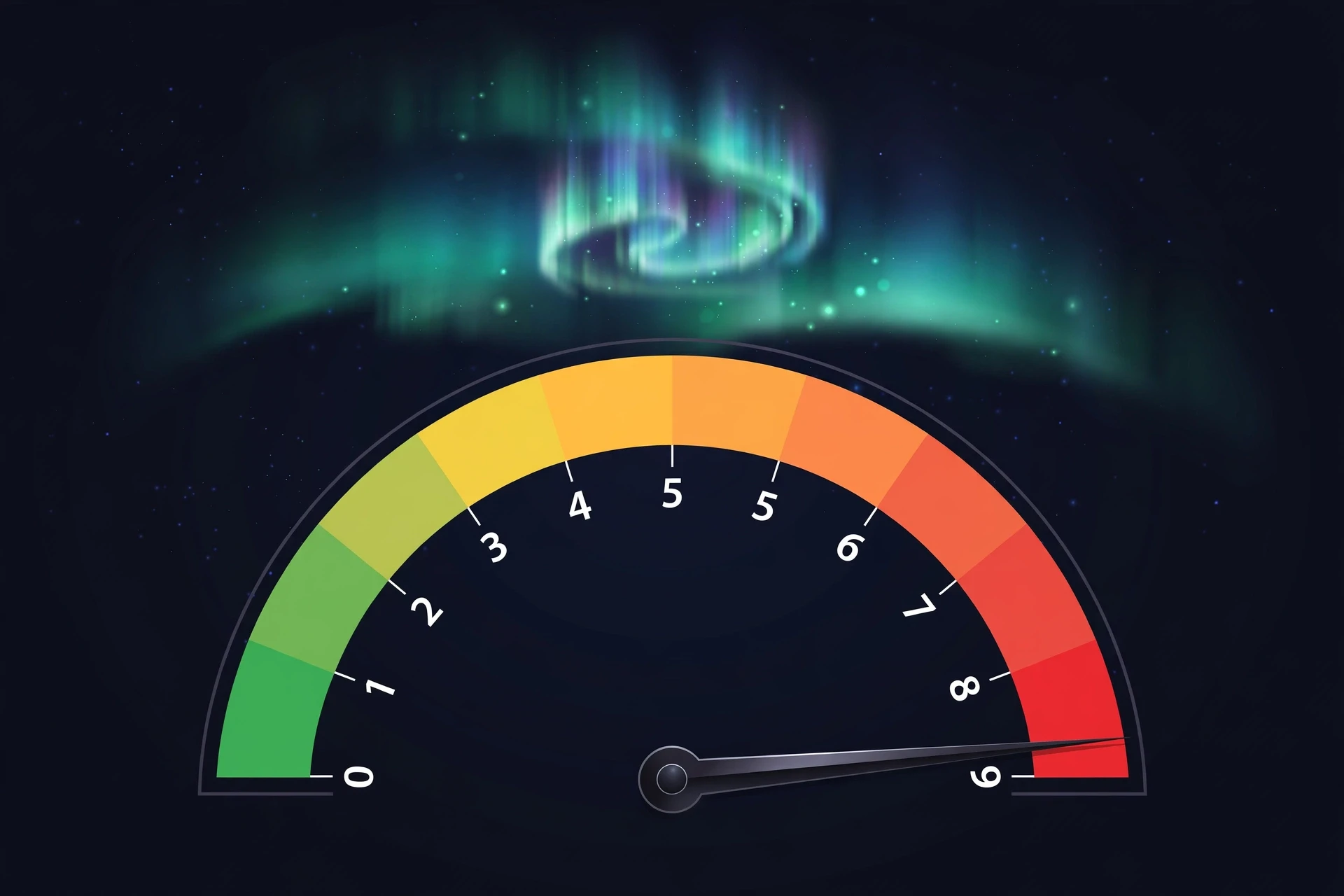
When a CME or a fast solar wind stream hits Earth, it disturbs the magnetic field. That disturbance is called a geomagnetic storm, and forecasters measure it with a scale called the Kp index. The Kp index runs from 0 to 9. Zero means the magnetic field is calm. Nine means a severe storm is in progress. The number is built from measurements at magnetometer stations around the world, updated every three hours, and it is the single most useful number in aurora forecasting.
The scale works like this in practice. At Kp 0 to 2, the aurora borealis stays far north, over the Arctic. At Kp 3 to 4, it brightens and moves a little south, becoming visible from northern Scotland, southern Alaska, and similar latitudes on a dark night. At Kp 5, a minor geomagnetic storm — classified as G1 on NOAA's storm scale — the lights can reach the northern United States and central Europe. At Kp 7 and above, a strong storm, the aurora borealis can appear over places that almost never see it, and the display overhead in the Arctic can be extraordinary. The NOAA explanation of its space weather scales sets out the full G-scale, from G1 to G5, and the planetary K-index page carries the current value.
Two cautions belong here. First, Kp is a global average, not a local forecast. A Kp of 5 does not guarantee lights over your town; it means the oval has expanded enough that your town is within reach, if the local sky is dark and clear. Second, Kp is measured over three-hour blocks, so it lags behind fast changes. A substorm breakup can light up the sky for twenty minutes while the Kp value barely moves. Use Kp to decide whether to go out. Use your eyes, and the 30-minute forecast map, to decide whether to stay.
Geomagnetic storms do more than paint the sky. Strong storms can disturb radio communications, confuse GPS signals, and induce electric currents in power lines and pipelines. The famous Carrington Event of 1859, the strongest geomagnetic storm on record, set telegraph wires sparking and lit the sky so brightly that people in the tropics read newspapers by auroral light. Modern power grids are more vulnerable, not less, because they are larger and more interconnected. This is why space weather forecasting is not just a hobby for aurora watchers. It is infrastructure protection, and the aurora borealis is its most beautiful warning sign.
10. Aurora Australis: The Southern Mirror
Everything in this article has a southern twin. The aurora australis, the southern lights, is the same phenomenon at the other end of the planet: charged particles funnelling down the same field lines, colliding with the same oxygen and nitrogen, glowing in the same colours. When the aurora borealis flares in the north, the aurora australis usually flares in the south at the same time, in a rough mirror image. The two displays are linked by the same field lines, like two ends of one conversation.
Seeing the southern lights is harder, for a simple geographical reason: there is very little land under the southern oval. The northern oval passes over Alaska, Canada, Iceland, Norway, Sweden, Finland, and Russia — places full of towns, roads, and watchers. The southern oval passes mostly over the Southern Ocean and Antarctica. The best land-based viewing spots are Tasmania, the southern tip of New Zealand, and the southern coast of Australia, and even there the lights are a rarer prize than in the north. The British Antarctic Survey's aurora pages describe the southern displays seen from Antarctic research stations, where the lights can fill the sky for months of polar night.
I have never seen the aurora australis myself. A friend who spent a winter at an Antarctic station told me it was the same and completely different: the same green curtains, the same slow ripple, but with no town lights anywhere, no roads, no other watchers — only the station, the ice, and the sky. I believed her. The physics is identical. The setting is the loneliest on Earth.
11. Where and When to See the Aurora Borealis
The best places to see the aurora borealis are the places under the oval on a normal night: northern Norway, Iceland, northern Sweden and Finland, Alaska, northern Canada, and Greenland. Tromsø in Norway, Abisko in Sweden, and Fairbanks in Alaska are the classic bases, with dark skies, good infrastructure, and long winter nights. Iceland adds black sand beaches and glaciers as a foreground, which is why so many photographs of the aurora borealis come from there.
The best time is a dark, clear night between late September and early April, when the Arctic nights are long. Within that window, the hours around midnight are usually best, because that is when your location sits under the night side of the oval. The Moon matters too: a full Moon washes out faint displays, so the days around the new Moon are best. Clouds are the real enemy. No forecast of solar activity can help you through an overcast sky, so check the cloud forecast as carefully as the space weather forecast.
Here is a practical checklist for a first aurora night:
Pick a location away from town lights, with a clear view to the north and a dark horizon.
Check the NOAA 30-minute aurora forecast and the Kp index before you go out, and again while you wait.
Dress far warmer than you think you need. You will be standing still in the cold for hours, and cold watchers go home early.
Give your eyes 20 minutes to adapt to the dark. Phone screens ruin night vision, so use them sparingly.
Bring a tripod if you want photographs. A phone on a long exposure can capture colour your eyes miss — but look up from the screen often, because the display changes while you fiddle with settings.
I broke my own rule about the screen on that night in Tromsø. I spent ten minutes trying to get a photograph, and when I finally looked up, the brightest curtain of the night had already faded. I have the photograph. I also have the memory of missing the best part of the show while staring at a small glowing rectangle. The photograph is fine. The lesson was better: watch first, photograph second.
12. Auroras on Other Planets
Earth is not the only world with auroras. Any planet with a magnetic field and an atmosphere can have them, and the gas giants put on a far grander show than we do. Jupiter has the most powerful auroras in the solar system, driven by its enormous magnetic field — about 20,000 times stronger than Earth's — and by volcanic material from its moon Io, which loads the magnetosphere with charged particles. You can place these worlds in context in our guide to the solar system and its planets. Jupiter's auroral ovals glow in ultraviolet, and they are so energetic that they heat the planet's upper atmosphere to hundreds of degrees. Saturn's auroras are also spectacular, forming rings around its poles that shift and pulse with the solar wind. Even Mars, which has no global magnetic field, has small, patchy auroras over regions where the crust itself is magnetised.
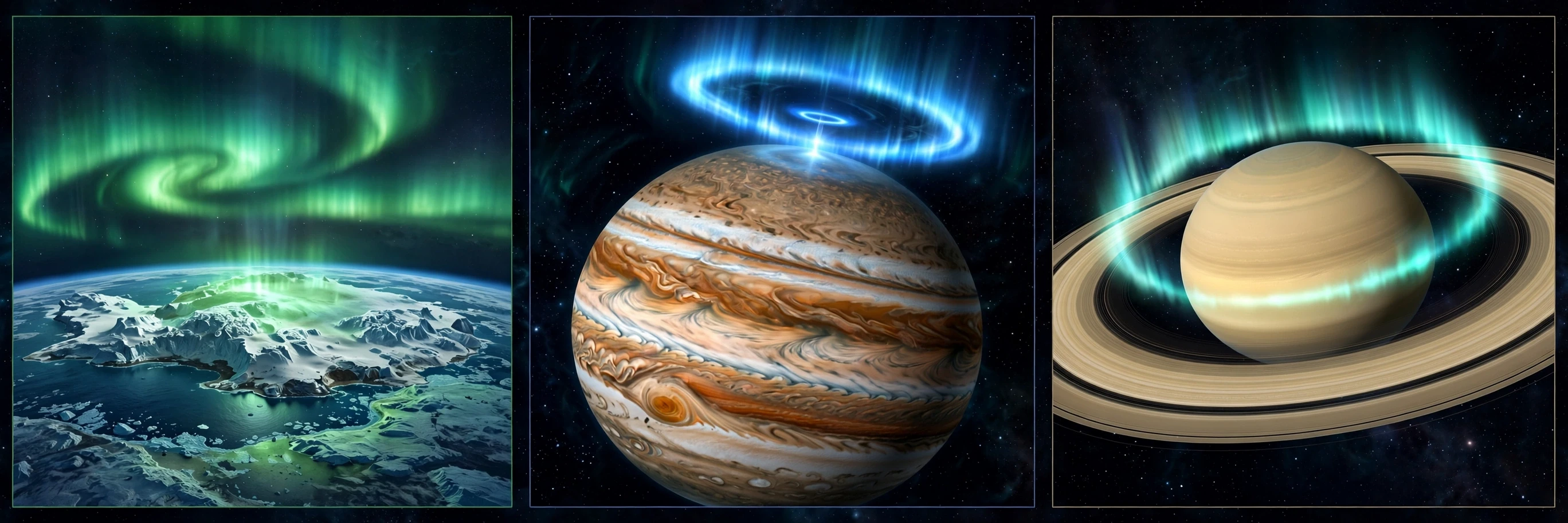
These alien auroras tell us something important about our own. The aurora borealis is not a quirk of Earth. It is what happens whenever a magnetic field, an atmosphere, and a stream of charged particles meet. The same physics lights up the poles of giant planets light-years away in principle, and it is one of the tools astronomers hope to use to detect magnetic fields on exoplanets: a planet with an aurora is a planet with a magnetic shield, and a magnetic shield is one of the things that makes a world more likely to hold onto its atmosphere — and, perhaps, its life.
13. A Short History of Explaining the Lights
People have watched the aurora borealis for as long as people have lived under northern skies, and they have explained it in the language of their time. Norse stories spoke of the lights as the armour of the Valkyries, or as a bridge between Earth and the heavens. Some Indigenous peoples of the Arctic saw the lights as the spirits of ancestors, or as animals playing in the sky. In medieval Europe, red auroras were read as omens of war and disaster — which is understandable, because a blood-red sky on a stormy night looks like the world ending.
The scientific story begins in the 1700s. Benjamin Franklin, who had already shown that lightning is electrical, guessed that the aurora borealis might be electrical too — light produced by electricity in the upper air. He had no way to prove it, and his guess sat largely untested for more than a century. In the early 1600s, Galileo had given the lights their name, thinking they were reflected sunlight. Both men were reaching for the right kind of explanation — light and electricity and the upper air — without the tools to close the case.
The man who did close it, or came closest, was the Norwegian physicist Kristian Birkeland. In the early 1900s, Birkeland proposed that charged particles from the Sun were guided by Earth's magnetic field into the polar atmosphere, where they produced the lights. He built a laboratory model — a magnetised sphere in a vacuum chamber, bombarded with charged particles — and watched glowing rings form around its poles. His colleagues thought the idea was far-fetched. It took decades, and the first satellites in the 1960s, to prove him right. Birkeland died in 1917, long before his vindication, which is one of the sadder stories in the history of space science: the man who understood the aurora borealis best never lived to see the world agree with him.
The modern era of aurora science began with the space age. Satellites mapped the oval, measured the particles, and watched the magnetosphere breathe. NASA's missions, from the early Explorers to the modern Magnetospheric Multiscale mission, have traced the whole chain from the Sun to the sky, and NASA's aurora pages gather that story in one place. What Birkeland guessed with a sphere in a chamber, we can now watch happening in real time, 100 kilometres overhead.
14. Myths About the Aurora Borealis
The aurora borealis attracts myths the way the north attracts cold, and most of them fall apart with a little physics. Three deserve a direct answer.
Myth 1: You need cold weather to see the northern lights. Cold and auroras often appear together, because the best viewing season is winter, when the nights are long. But the lights do not need cold. They happen at 100 kilometres up, where the temperature is a different question entirely, and they appear in summer too — you just cannot see them in the bright sky. A mild September night with a strong storm beats a bitter January night with a quiet Sun.
Myth 2: The lights are fire, or something burning in the sky. They are not. Nothing is burning. The light comes from atoms releasing energy as photons, with no combustion and no heat you could feel. The upper atmosphere where the aurora borealis glows is far too thin to support fire, and the light is cold in the strictest sense: it carries almost no heat at all.
Myth 3: Auroras only happen on special, rare nights. They happen every night, somewhere around the poles. What is rare is being in the right place, under a dark sky, with a strong enough display to see clearly. The lights are a permanent feature of the polar sky, as regular as the tides. The rarity is in the watching, not in the light.
There is a fourth claim worth a gentler correction: that you can hear the aurora borealis. Some watchers insist they have heard crackling or hissing during strong displays. Scientists have recorded sounds that seem to coincide with bright auroras, possibly from electrical discharges near the ground triggered by the same geomagnetic activity, but the sounds do not come from the lights themselves — the display is 100 kilometres away, far too far for sound to reach you. If you hear something on a bright aurora night, you may not be imagining it. You are just hearing something closer than the sky.
15. Watching the Sky With New Eyes
The aurora borealis is the most accessible piece of space weather there is. You do not need a telescope or a spacecraft. You need a dark sky, a little patience, and a willingness to stand in the cold and look up. Everything else — the solar wind, the magnetic field, the collisions 100 kilometres overhead — is already happening, whether you watch or not.
What stays with me from that night in Tromsø is not any single fact about the lights. It is the feeling of scale: the Sun throwing particles across 150 million kilometres, a magnetic shield bending them toward the poles, and atoms giving back the energy as a green curtain over a snowfield, all of it happening silently above a group of strangers who had driven for hours to stand in the dark and watch. The aurora borealis is physics, and it is also an invitation. The sky is doing something extraordinary, most nights, over the far north. Go and see it while the Sun is at its most active, and while the window of Solar Cycle 25 is still open. Dress warmly, check the forecast, give your eyes time to adjust — and when the first pale smudge appears low in the north, put the phone down and watch.
The lights will not wait for you. That is part of their charm. They are the Sun's weather, written in light across the polar sky, and for a few hours on a dark winter night, you get to read it.
Frequently Asked Questions
What causes the aurora borealis?
The aurora borealis is caused by charged particles from the Sun — carried by the solar wind and by coronal mass ejections — funnelling along Earth's magnetic field lines into the polar atmosphere, where they collide with oxygen and nitrogen atoms about 100 to 300 kilometres up. The atoms absorb energy from the collisions and release it as light, which we see as the northern lights.
Why is the aurora borealis green?
Green is the most common colour of the aurora borealis because oxygen atoms at about 100 kilometres altitude give off green light at a wavelength of 557.7 nanometres when they relax after being struck by charged particles. Our eyes are also most sensitive to green light, which makes the green band stand out even more.
When is the best time to see the northern lights?
The best time to see the aurora borealis is on a dark, clear night between late September and early April, usually around midnight, and ideally near the new Moon when moonlight is weakest. Activity is highest around solar maximum, and Solar Cycle 25 reached maximum in October 2024, so the mid-2020s are a strong period for viewing.
Where is the best place to see the aurora borealis?
The best places are under the auroral oval on a normal night: northern Norway, Iceland, northern Sweden and Finland, Alaska, northern Canada, and Greenland. Tromsø in Norway, Abisko in Sweden, and Fairbanks in Alaska are well-established bases with dark skies and long winter nights.
What does the Kp index mean?
The Kp index measures geomagnetic disturbance on a scale from 0 to 9, based on magnetometer readings around the world. Higher values mean a stronger storm and an aurora borealis visible farther from the poles. At Kp 5 the lights can reach the northern United States and central Europe; at Kp 7 and above they can appear much farther south.
What is the difference between the aurora borealis and the aurora australis?
The aurora borealis is the northern lights and the aurora australis is the southern lights. They are the same phenomenon at opposite ends of Earth, produced by the same solar wind particles travelling down the same magnetic field lines, and they often flare at the same time in a rough mirror image.
Do auroras happen on other planets?
Yes. Jupiter has the most powerful auroras in the solar system, driven by its enormous magnetic field, and Saturn has bright auroral rings around its poles. Even Mars has small, patchy auroras where its crust is magnetised. Any planet with a magnetic field and an atmosphere can produce auroras.