

1. The Night the Universe Came Into Focus
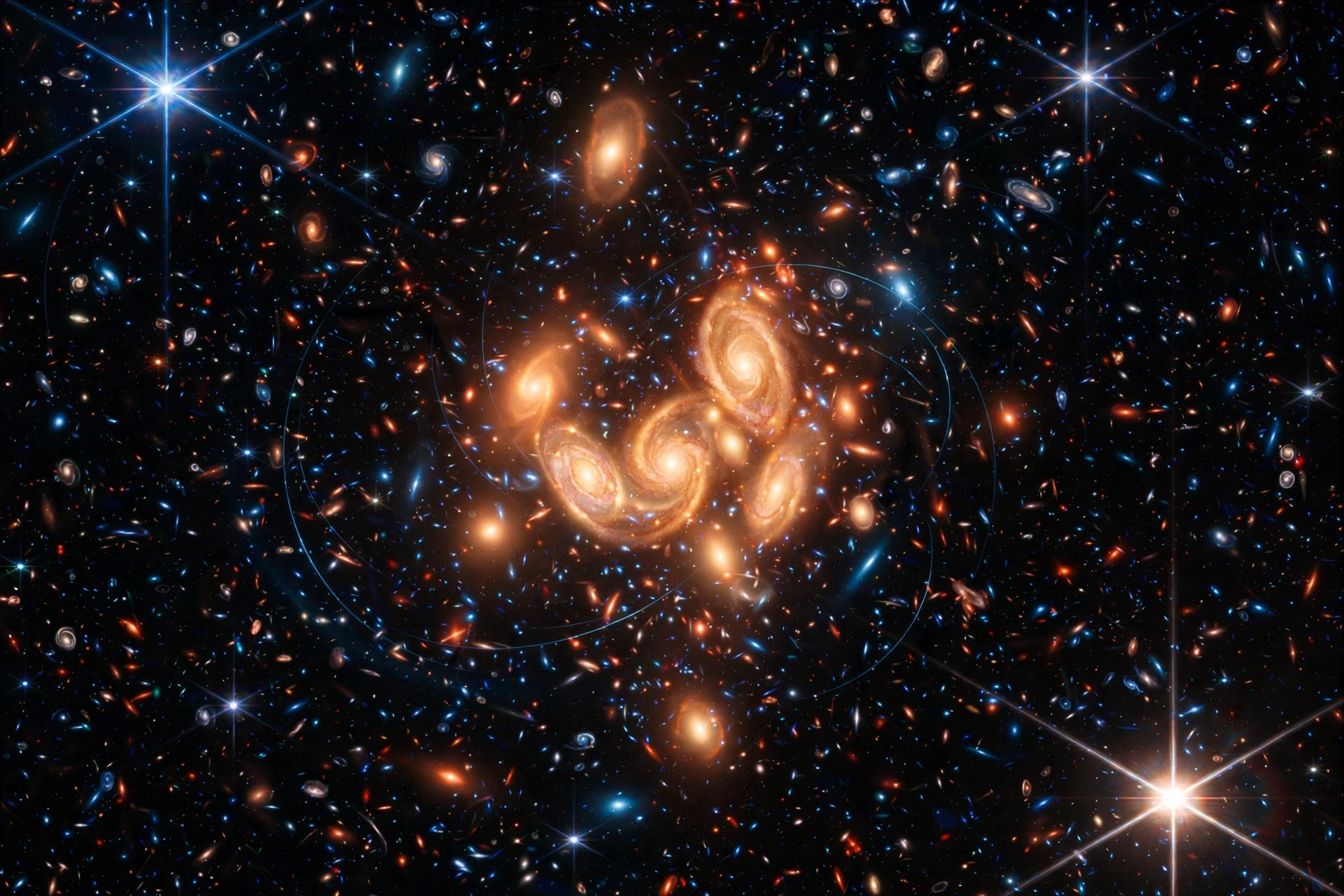
I stayed up late on July 12, 2022, the way you stay up for a launch or a landing — not because anyone asked me to, but because I knew I would regret sleeping through it. The screen filled, and for a few seconds I did not know what I was looking at. It looked like someone had spilled glitter across black velvet: thousands of tiny smudges of light, orange and blue and white, some stretched into thin arcs, some so faint they seemed to be barely holding on to existence.
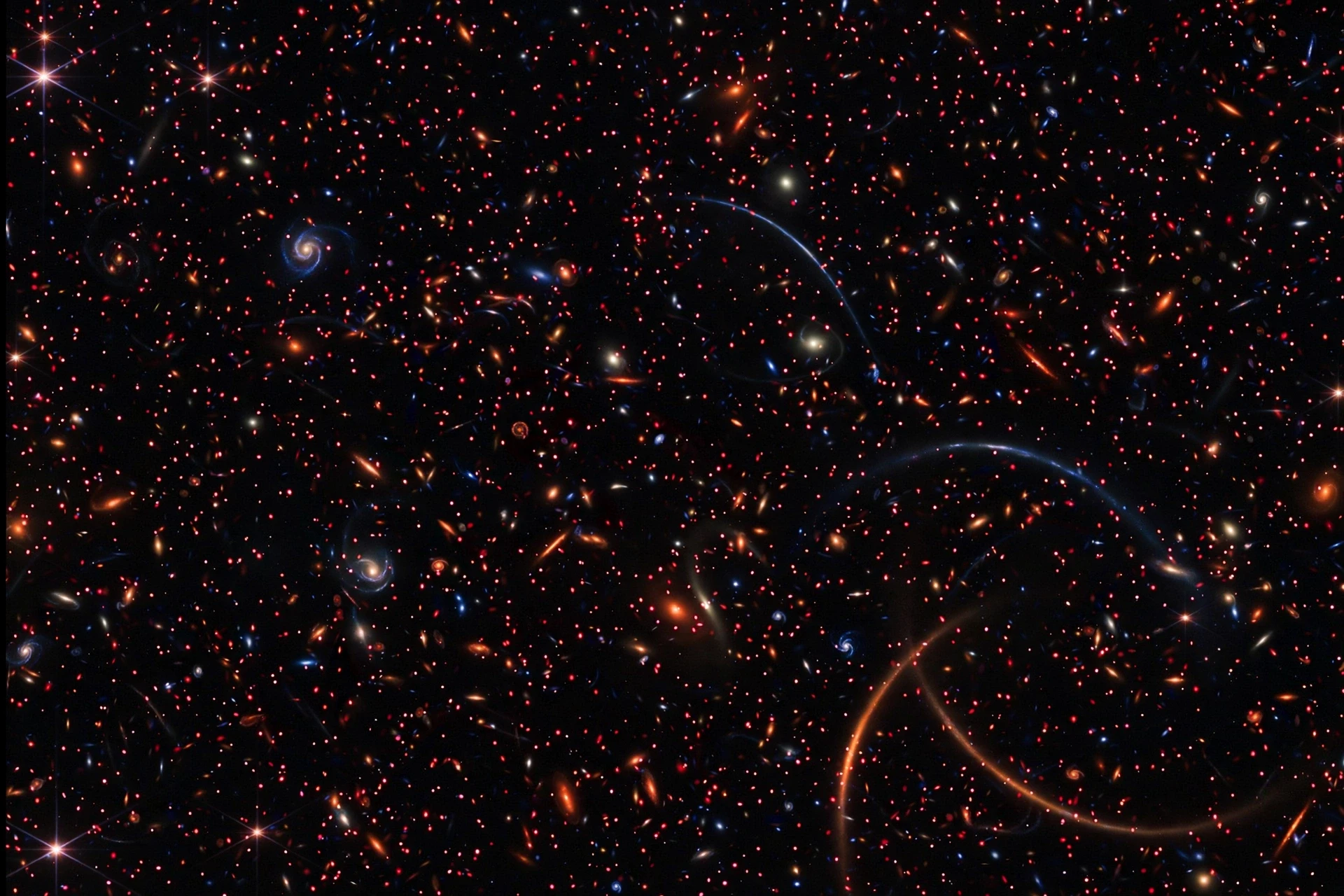
That image was Webb's First Deep Field, and it showed the galaxy cluster SMACS 0723, about 4.6 billion light-years away. The cluster's gravity bends the light of galaxies far behind it, the way a magnifying glass bends light, so the picture contains galaxies whose light left them more than 13 billion years ago — when the universe was less than a billion years old. Thousands of galaxies, in a patch of sky about the size of a grain of sand held at arm's length.
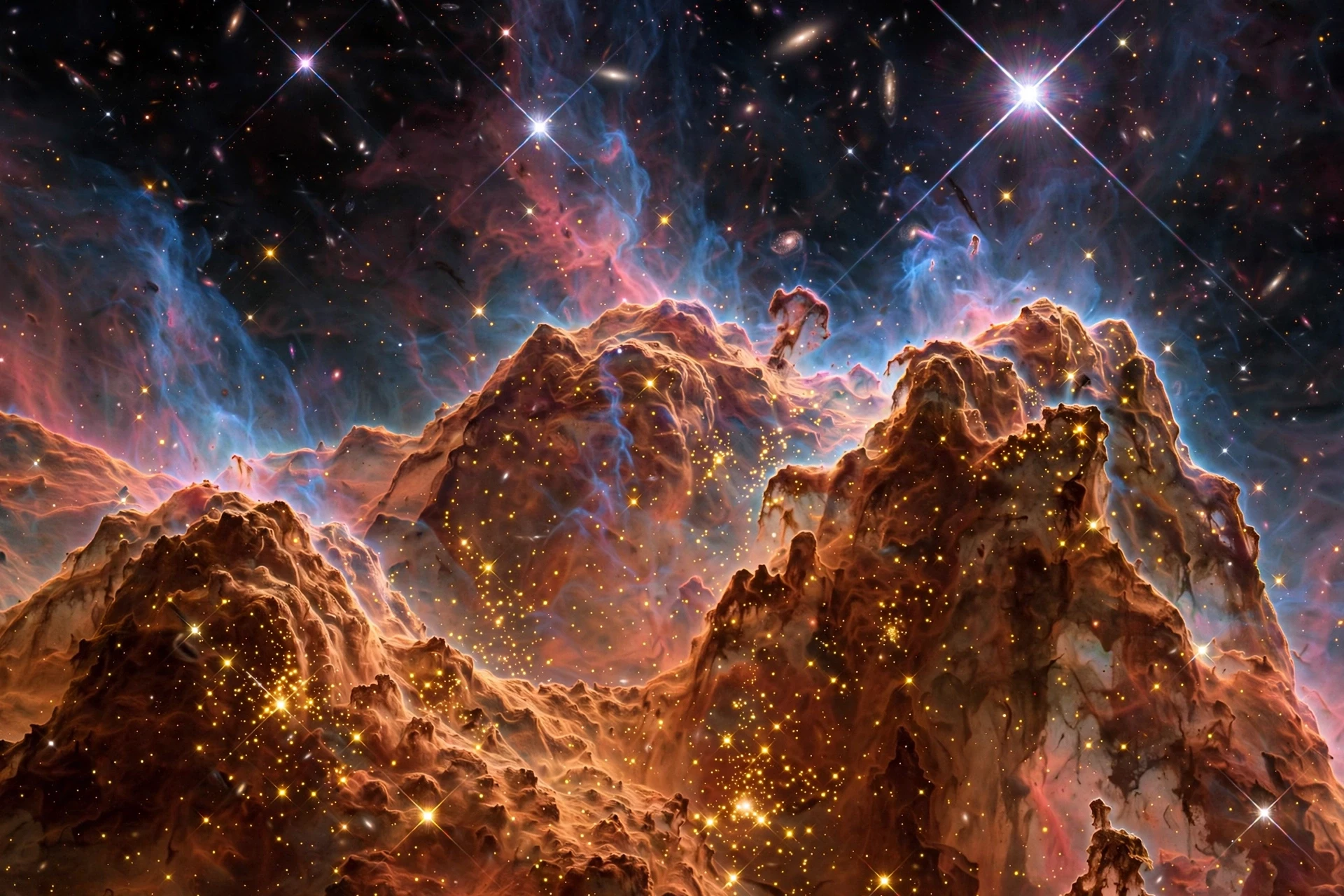
A day earlier, President Joe Biden had unveiled that single image at the White House. The next day NASA released the full set: the Cosmic Cliffs of the Carina Nebula, the dancing galaxies of Stephan's Quintet, the spectrum of an exoplanet's atmosphere, the dying star of the Southern Ring Nebula. The James Webb Space Telescope had been twenty-five years in the making, had cost about 10 billion dollars, had survived a launch, a month-long unfolding in space, and six months of careful commissioning. And in one week it changed what the sky looked like.
I remember a colleague messaging me that night with just three words: "Did you see?" I had. Everyone who follows astronomy had. The image was not only beautiful — Hubble had made beautiful images for thirty years. It was deep in a way that felt unfair. Webb had gathered that picture in about 12.5 hours of exposure. Hubble's deepest image, the eXtreme Deep Field, had taken weeks of staring at the same spot. Webb did in half a day what had once taken a month, and it saw further.
This article is about that machine: why it was built to see infrared light instead of visible light, how a 6.5-metre golden mirror and a sunshield the size of a tennis court keep it cold enough to work, what its four instruments actually do, and what it has discovered since that first week — the galaxies that should not exist yet, the little red dots nobody predicted, the chemistry of alien skies, and the places where it has found nothing at all. The empty results matter as much as the discoveries. Science moves forward on both.
2. Why Infrared? Seeing Through Dust and Back in Time
Every telescope is a bet on a kind of light. Hubble bet on visible light, the narrow band our eyes evolved to use. The James Webb Space Telescope bet on infrared — light with longer wavelengths than red, invisible to human eyes, but carrying information that visible light simply cannot.
There are two reasons for that bet, and both of them are beautiful in their logic. The first is dust. The second is time.
2.1 Dust Is Not Empty
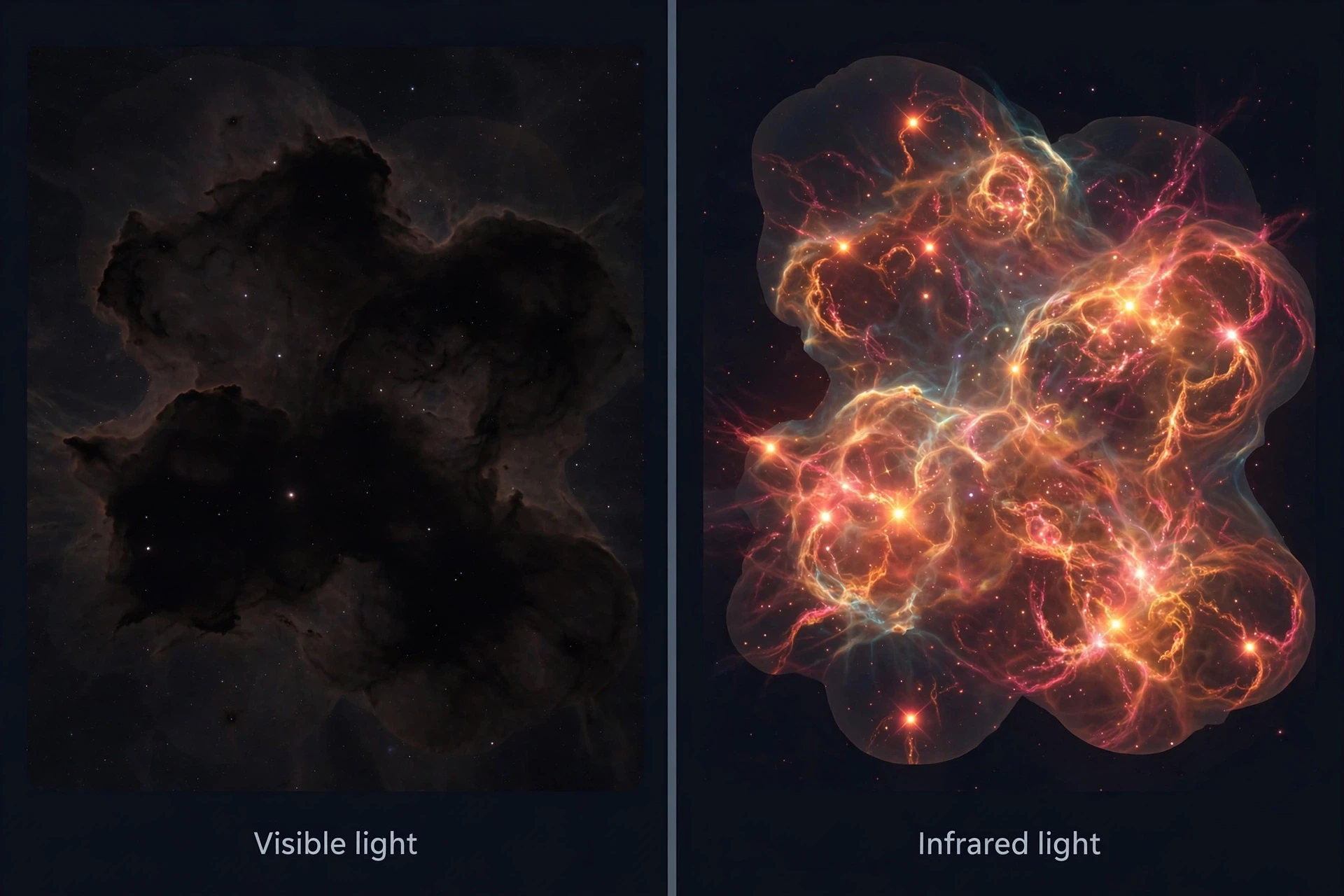
Between the stars there is dust — tiny grains of carbon and silicate, the soot of dead stars — and it blocks visible light the way smoke blocks a view. The centres of galaxies, the nurseries where stars are born, the discs around young stars where planets form: all of them are wrapped in dust. A visible-light telescope looking at a star-forming cloud sees a dark blob. An infrared telescope sees straight through it.
Think of it this way. On a foggy morning, your car's headlights scatter off the fog and blind you, but a thermal camera sees the warm engine of the car ahead through the mist. Long wavelengths slip past small particles. Infrared light does the same with cosmic dust: it passes through the grains that stop visible light, and it also picks up the faint heat glow of the dust itself, which is warmed by the newborn stars inside.
The first time I tried to explain this to a classroom, I used a kitchen analogy and it worked better than any diagram. Imagine a sealed oven with a cake baking inside. You cannot see the cake through the oven door if the glass is blacked out — but you can feel the heat on your hand, and an infrared camera would show you exactly where the cake is warmest. Webb is that camera, pointed at the universe's ovens.
2.2 Redshift: The Universe Stretches Light
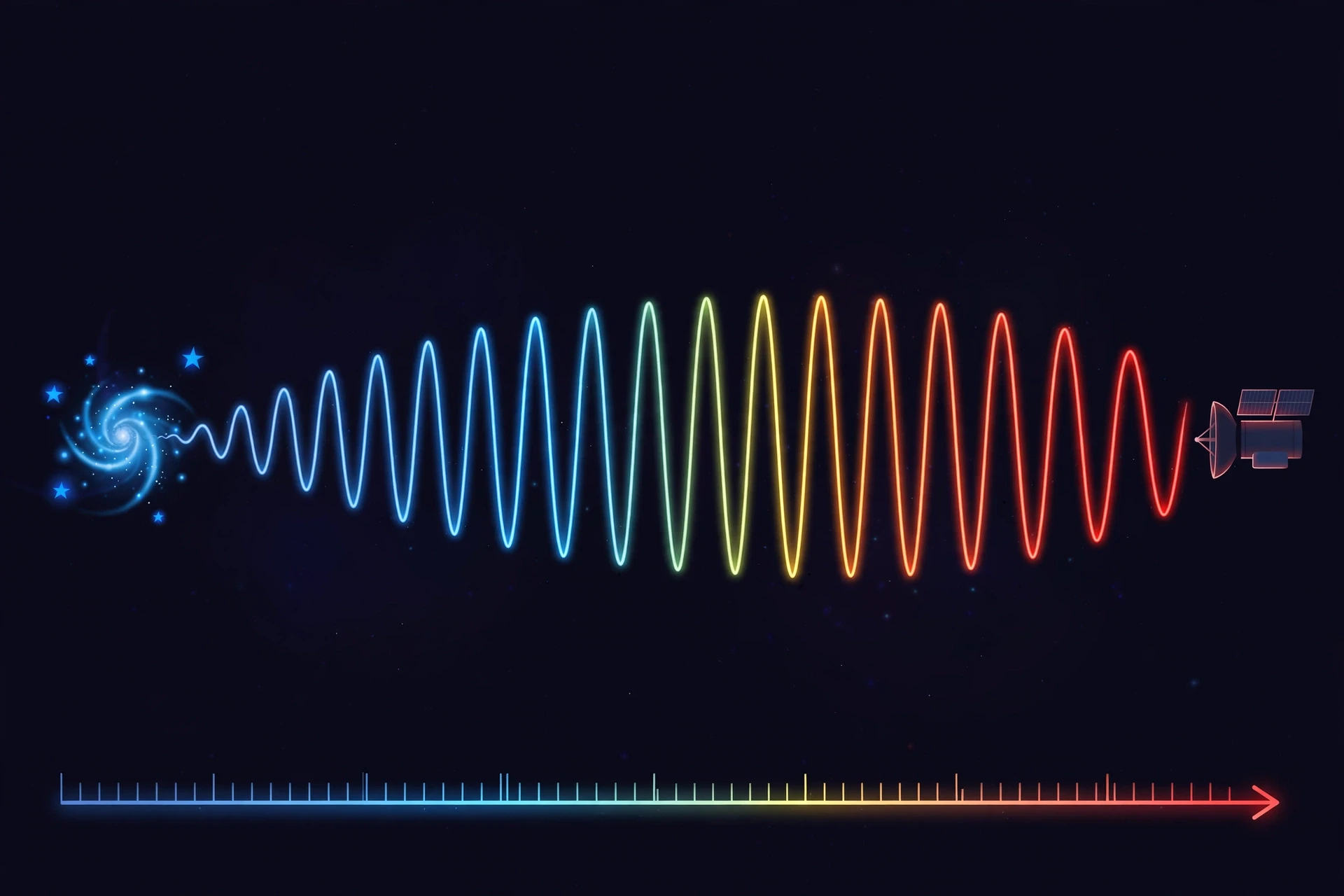
The second reason is stranger, and it is the reason Webb exists at all. The universe is expanding. Space itself is stretching, and as it stretches, it stretches the light travelling through it. Light that left a young galaxy as ultraviolet or blue visible light arrives at Earth stretched into red and infrared — a shift astronomers call redshift.
The further away a galaxy is, the longer its light has been travelling, the more the universe has expanded during the journey, and the further its light has been stretched toward the red. The very first galaxies, shining only a few hundred million years after the Big Bang, have their light stretched so far that it arrives as infrared. A telescope that only sees visible light is blind to them, not because they are faint, but because their light has moved out of its range. It is like trying to hear a radio station that has drifted off your dial.
I once watched a student have the penny drop on this in real time. "So the telescope is a time machine," she said, "because the light is old?" Yes — and the infrared part is what makes the machine reach far enough back. Every deep image Webb takes is a look at the universe as it was billions of years ago, because light takes time to travel and the oldest light has been stretched the furthest.
2.3 A Time Machine, Not a Metaphor
Astronomers sometimes call Webb a time machine, and the phrase is so overused that it is easy to miss how literal it is. When Webb photographs a galaxy 13 billion light-years away, the light in that photograph left the galaxy 13 billion years ago. The telescope is not looking at that galaxy as it is now. It is looking at it as it was when the universe was about 800 million years old — a baby picture of a galaxy that may have grown, merged, or died in the meantime.
That is why the mission's central goal was written the way it was: to see the first stars and galaxies forming after the Big Bang, a period called cosmic dawn. Hubble could reach back to about 400 or 500 million years after the Big Bang, and only barely, at the edge of its sensitivity. Webb was designed to push that boundary to within 100 to 250 million years of the beginning — close enough, in principle, to catch the very first generation of stars, the so-called Population III stars, which have never been seen by anyone.
3. The Machine: A Telescope That Had to Fold Itself Up
Here is the problem the engineers faced. To see the faintest, most distant infrared light, a telescope needs a huge mirror — much bigger than Hubble's 2.4-metre mirror — and it needs to be colder than the darkest winter night on Earth. But no rocket ever built has a cargo bay wide enough for a 6.5-metre mirror, and no telescope can stay cold if the Sun is shining on it.
The solution was a machine that launches folded up like origami and unfolds itself in space, a million and a half kilometres from Earth, with no one there to fix it if something sticks. It worked. Every one of the hundreds of single-point failures — the deployments that had to go right or the mission was over — went right.
3.1 The Golden Eye: 18 Segments of Beryllium
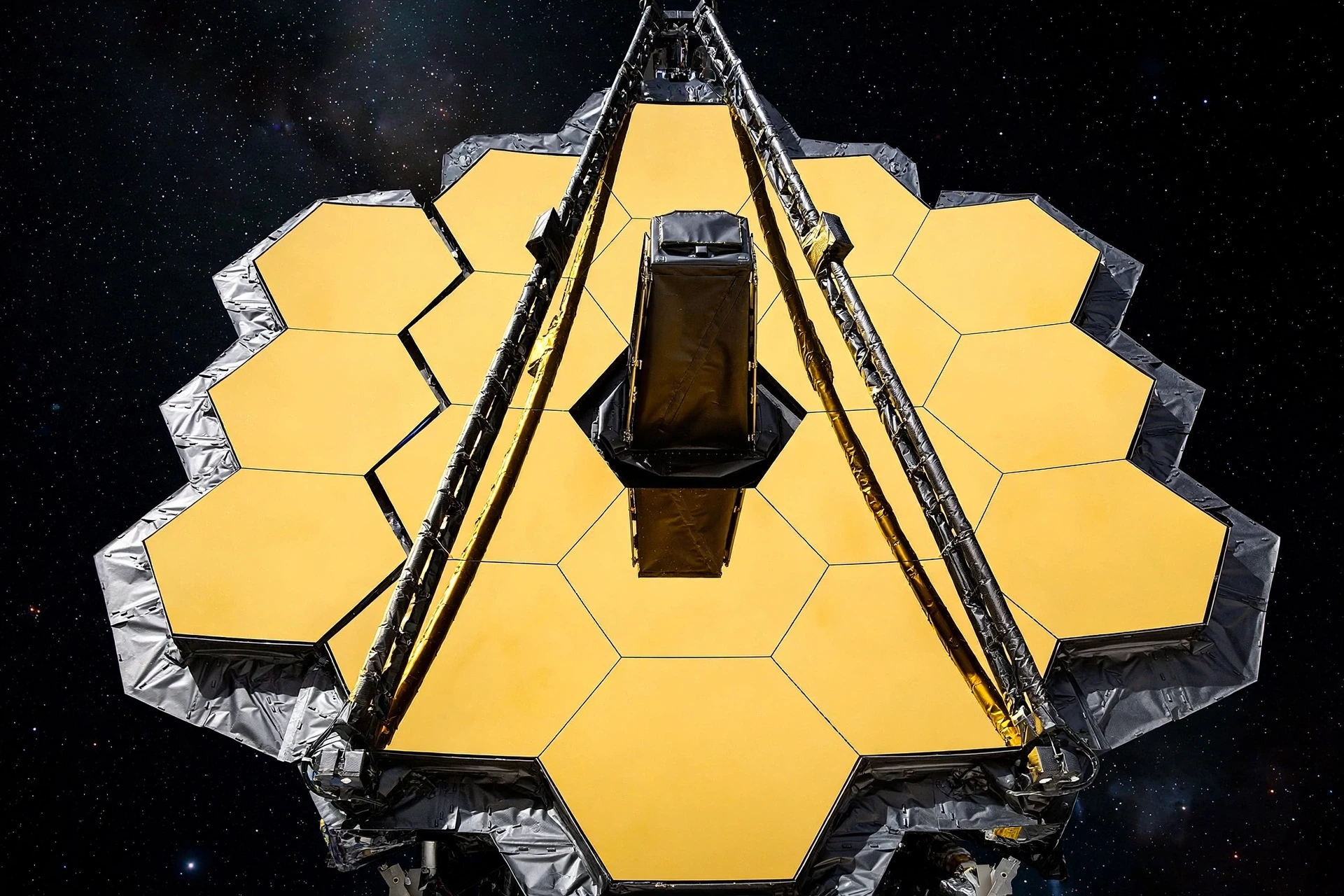
Webb's primary mirror is 6.5 metres across, made of 18 hexagonal segments of beryllium, each about 1.3 metres wide, coated with a layer of gold only about 100 nanometres thick — roughly a thousand times thinner than a human hair. The gold is there because gold reflects infrared light superbly. The beryllium is there because it is light, stiff, and barely changes shape when it gets cold.
Each segment sits on actuators that can adjust its position in steps smaller than the width of a human hair, and the segments were aligned in space to a precision of tens of nanometres — a process that took months after launch. The mirror gathers about six times as much light as Hubble's, which is what lets Webb see objects a hundred times fainter.
There is a detail I love about the mirror: it had to be folded for launch, with two wings tucked back, because the Ariane 5 rocket's fairing was only 5.4 metres wide. On December 25, 2021 — Christmas Day — the rocket lifted off from French Guiana. Two weeks later, the wings unfolded and latched. I watched the deployment livestream with the same held breath as everyone else in the field, because if a wing had jammed, there was no astronaut with a wrench a million kilometres away. It latched. The room at the Space Telescope Science Institute erupted.
3.2 The Kite: A Sunshield the Size of a Tennis Court
Below the mirror hangs the sunshield: five layers of a plastic film called Kapton, each coated with aluminium, about the size of a tennis court when fully spread — roughly 21 by 14 metres. It is the largest part of the spacecraft, and its job is simple and absolute: keep the Sun, Earth, and Moon on one side, and the telescope on the other, in permanent shadow.
Each layer is separated by a small gap, and each layer is slightly cooler than the one above it, so heat drops step by step from about 85 degrees Celsius on the hot Sun-facing side to below minus 233 degrees Celsius on the cold telescope side. The layers are shaped and tensioned so that heat radiates away into space between them instead of creeping around the edges. The middle layer has a special pinkish coating — a doped silicon layer — that helps it shed heat even faster.
The sunshield also had to fold. It launched compressed into a package the size of a small room and unfolded in space over several days, pulled taut by cables and booms, with 107 individual release mechanisms that all had to fire in the right order. When the final tensioning finished, the mission team knew the hard part was over. A telescope that warm cannot see infrared at all; its own heat would drown out the faint signals from the early universe. The sunshield is what makes the whole observatory possible.
3.3 A Million Miles From Home: Lagrange Point L2
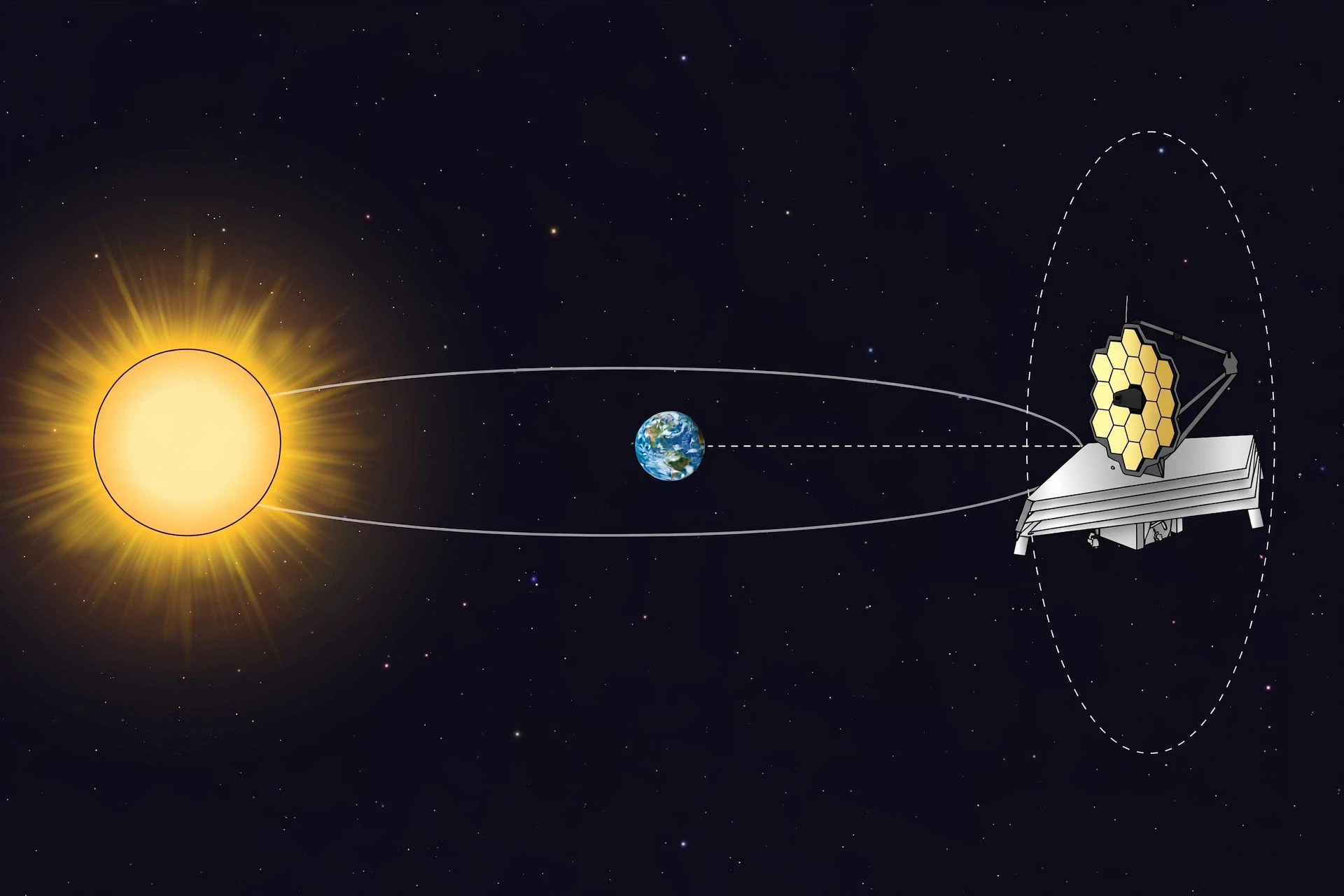
Webb does not orbit Earth the way Hubble does. It sits near the second Lagrange point, L2, about 1.5 million kilometres from Earth in the direction away from the Sun — roughly four times the distance to the Moon. At L2, the gravity of the Sun and Earth balance in such a way that a spacecraft can hold position with very little fuel, and — crucially — the Sun, Earth, and Moon all stay in the same direction in the sky, behind the sunshield, all the time.
That geometry is the whole trick. Hubble, in low Earth orbit, passes in and out of Earth's shadow every 90 minutes, warming and cooling with each orbit. Webb at L2 sits in steady, permanent shade, its temperature stable to a fraction of a degree, staring at the same dark sky for days or weeks at a time without interruption. The trade-off is distance: if something breaks, no one is going to fix it. Hubble was serviced five times by astronauts. Webb will never be serviced. It was built, tested, and tested again on the ground because there is no second chance a million and a half kilometres away.
Webb does not sit exactly at L2 — that point is unstable, like balancing a pencil on its tip. Instead it loops around L2 in a wide halo orbit, about 800,000 kilometres across, taking about six months per loop, firing tiny thrusters every few weeks to stay on track. It carries enough fuel for station-keeping for more than 20 years, and the precise launch by the Ariane 5 saved so much fuel that the mission's expected lifetime doubled from the planned 10 years.
3.4 Cold Enough to See
Infrared astronomy is a war against heat, because everything warm glows in infrared — including the telescope itself. Webb's instruments need to operate at temperatures between about minus 233 and minus 266 degrees Celsius. The near-infrared instruments are cooled passively by the sunshield alone. The Mid-Infrared Instrument, MIRI, goes further: it carries its own helium cryocooler, a small refrigerator that chills its detectors to minus 266 degrees Celsius, just 7 degrees above absolute zero.
Seven degrees above absolute zero. At that temperature, the atoms in the detector are barely moving, and the instrument can sense the whisper of heat from a galaxy 13 billion light-years away without being blinded by its own warmth. The cryocooler is one of the most demanding pieces of hardware ever flown, and it has worked flawlessly since launch.
4. Four Instruments, Four Ways of Listening
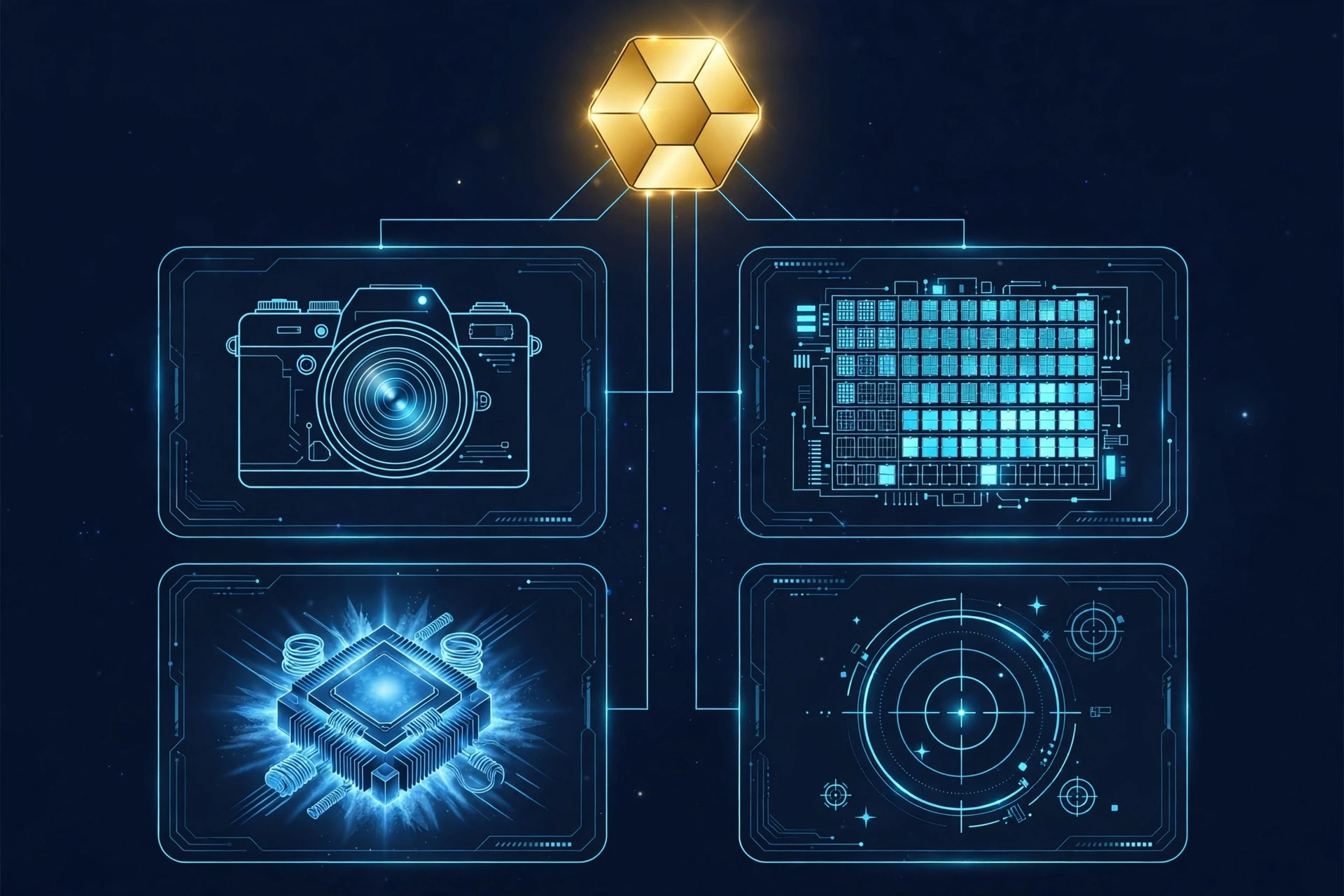
A telescope mirror collects light. The instruments decide what to do with it. Webb carries four, and each one is a different way of interrogating the light — taking pictures, splitting it into a spectrum, or staring at one object for hours while the universe does something interesting.
4.1 NIRCam: The Main Camera
The Near-Infrared Camera is Webb's workhorse and its main imager, covering wavelengths from 0.6 to 5 microns. It took the First Deep Field. It also doubles as the telescope's wavefront sensor — the instrument that measured the mirror segments and told the actuators how to align them into a single perfect surface. In other words, the camera that takes the pictures is also the tool that focused the telescope.
NIRCam can also do coronagraphy: blocking out the light of a bright star so that faint objects near it — planets, discs of dust — become visible. It is the instrument behind most of the images that made headlines, and it is the one that has pushed deepest into the early universe.
4.2 NIRSpec: The Spectrograph That Reads a Hundred Galaxies at Once
If NIRCam is the camera, NIRSpec is the laboratory. A spectrograph splits light into its component colours, like a prism splitting sunlight into a rainbow, and the pattern of bright and dark lines in that spectrum reveals what an object is made of, how hot it is, how fast it is moving, and how far away it is. A picture tells you something is there. A spectrum tells you what it is.
NIRSpec's signature trick is its microshutter array: about 250,000 tiny shutters, each the width of a human hair, that can open and close individually. Astronomers program the array to open shutters only on the galaxies they want to study and close the rest, so NIRSpec can take spectra of up to 100 objects at the same time in a single observation. Before Webb, getting a spectrum of one distant galaxy could take a whole night. Now a hundred can be done at once, which is why our census of the early universe has exploded in just a few years.
4.3 MIRI: The Cold Eye
The Mid-Infrared Instrument sees the longest wavelengths Webb can reach, from 5 to 28 microns — the light of cool dust, of forming planets, of galaxies whose light has been stretched the furthest. It is the only instrument that needs the cryocooler, because mid-infrared detectors must be colder than almost anything else on the spacecraft to work at all.
MIRI is both a camera and a spectrograph. It took the famous mid-infrared view of the Cosmic Cliffs, where the dusty pillars glow in colours no human eye will ever see. It also made the mid-infrared observations of K2-18 b that set off the biggest argument in exoplanet science in years — more on that in Section 6.
4.4 FGS/NIRISS: The Guide and the Specialist
The Fine Guidance Sensor keeps Webb pointed with extraordinary steadiness, locking onto guide stars and holding the telescope stable to a fraction of an arcsecond — the equivalent of holding a laser pointer steady on a coin several kilometres away. Without it, long exposures would smear.
Mounted with it is NIRISS, the Near-Infrared Imager and Slitless Spectrograph, contributed by the Canadian Space Agency. NIRISS specialises in wide-field imaging and in a technique called single-object slitless spectroscopy, which is particularly good for studying exoplanet atmospheres as they cross in front of their stars. It was NIRISS that confirmed some of the most distant galaxies in the First Deep Field, and it plays a central role in the exoplanet work.
5. The First Galaxies Broke the Models
Webb was built to find the first galaxies, and it found them — too many of them, too bright, too early. That sentence is the single most important result of the mission so far, and it is worth understanding properly, because it shows how science actually works when a new instrument opens a new window.
5.1 Brighter, Earlier Than Anyone Expected
The models said the first galaxies should be small, faint, and ragged — tiny collections of stars slowly assembling in the dark, taking hundreds of millions of years to grow. What Webb found instead, within its first year, were galaxies that were already bright, already massive, and already structured, shining less than 300 million years after the Big Bang. Some were as bright as galaxies that took billions of years to assemble in the models. One candidate, found in the JADES survey, appears to have formed within about 300 million years of the beginning and already holds as many stars as the Milky Way does today.
NASA's summary of the first three years of science put it plainly: Webb revealed "surprisingly bright galaxies that developed within 300 million years of the big bang," along with an infant galaxy much like the Milky Way when the universe was only 600 million years old, and fully formed spiral galaxies — grand-design spirals with clear arms — within 1.5 billion years.
This does not mean the Big Bang is wrong. The Big Bang itself is supported by overwhelming evidence, and Webb's results fit inside it. What is wrong — or at least incomplete — is our understanding of how fast gas can collapse into stars, how efficiently early galaxies turned gas into starlight, and perhaps how the first black holes helped or hindered the process. The models are being rewritten, which is exactly what a great telescope is supposed to force us to do.
5.2 Little Red Dots
Among the strangest things Webb found is a population of tiny, compact, intensely red objects that appear in deep images in large numbers, mostly at times when the universe was between about 600 million and 1.5 billion years old, and then largely disappear. Astronomers call them Little Red Dots.
Nobody predicted them. They are far too small to be ordinary galaxies and far too bright in the red to be ordinary stars. The leading explanations are that they are either very compact galaxies with furiously accreting black holes at their centres, buried in dust that reddens their light, or a new kind of object altogether — perhaps the seeds of the supermassive black holes that sit at the hearts of galaxies today, caught in the act of growing.
I find the Little Red Dots the most exciting kind of discovery: not an answer, but a new question mark that was not on anyone's list. Before Webb, nobody knew to ask what they were. Now hundreds of papers are trying to explain them, and the answer will probably change our picture of how black holes and galaxies grew up together.
5.3 Black Holes Too Big, Too Soon
Related to the bright early galaxies is a second puzzle: black holes that are far too massive for their age. In the nearby universe, a galaxy's central black hole typically holds about a thousandth of the mass of the galaxy's stars. In several of Webb's early galaxies, the black hole holds a tenth or more of the mass of its host — a hundred times the usual ratio — and it is already there less than a billion years after the Big Bang.
A black hole grows by eating gas, and there is a speed limit on how fast it can eat, set by the pressure of its own radiation. To reach a billion solar masses in under a billion years, a black hole would have to eat at the limit continuously from the very beginning, or start from an unusually large seed — perhaps a direct collapse of a huge gas cloud into a black hole of ten thousand or a hundred thousand solar masses, skipping the small-star stage entirely. Webb's data suggest that at least some black holes did start big, or grew faster than the textbooks allowed. Either way, the relationship between galaxies and their black holes was different in the early universe, and we are still working out why.
5.4 Galaxies That Grew Up Too Fast — and Some That Stopped
The surprises cut both ways. Webb has found galaxies that already look mature — settled discs, clear spiral arms, orderly rotation — when the universe was only about 1.5 billion years old, far earlier than models said such structure could appear. And it has also found galaxies that had already stopped forming stars entirely, "quenched" and quiet, within a billion years of the Big Bang — dead galaxies in a universe that was barely out of its infancy.
Both findings point the same way: the early universe was far more dynamic than we thought. Things happened faster — galaxies assembled faster, black holes grew faster, and some galaxies burned through their gas and shut down faster. The slow, stately picture of galaxy formation that came from Hubble-era data was partly a selection effect: Hubble could only see the brightest, most obvious objects at those distances, and it missed the full drama. Webb sees the whole cast.
"Webb was built with the promise of revolutionizing astronomy, of rewriting the textbooks. And by any measure, it has more than lived up to the hype — exceeding expectations to a degree that scientists had not dared imagine."
That is NASA's own verdict after three years of science, and it is unusually blunt language for a space agency. It reflects a genuine shock inside the field: the telescope did not merely confirm what astronomers hoped to see. It showed them a universe that was busier, brighter, and stranger than the models allowed.
6. Sniffing Alien Air: Exoplanet Atmospheres
If the early galaxies were Webb's first shock, the exoplanet atmospheres were its second — and in some ways the more personal one, because these are measurements of actual worlds, with air you could in principle describe, molecule by molecule, from 120 light-years away.
6.1 How Transit Spectroscopy Works
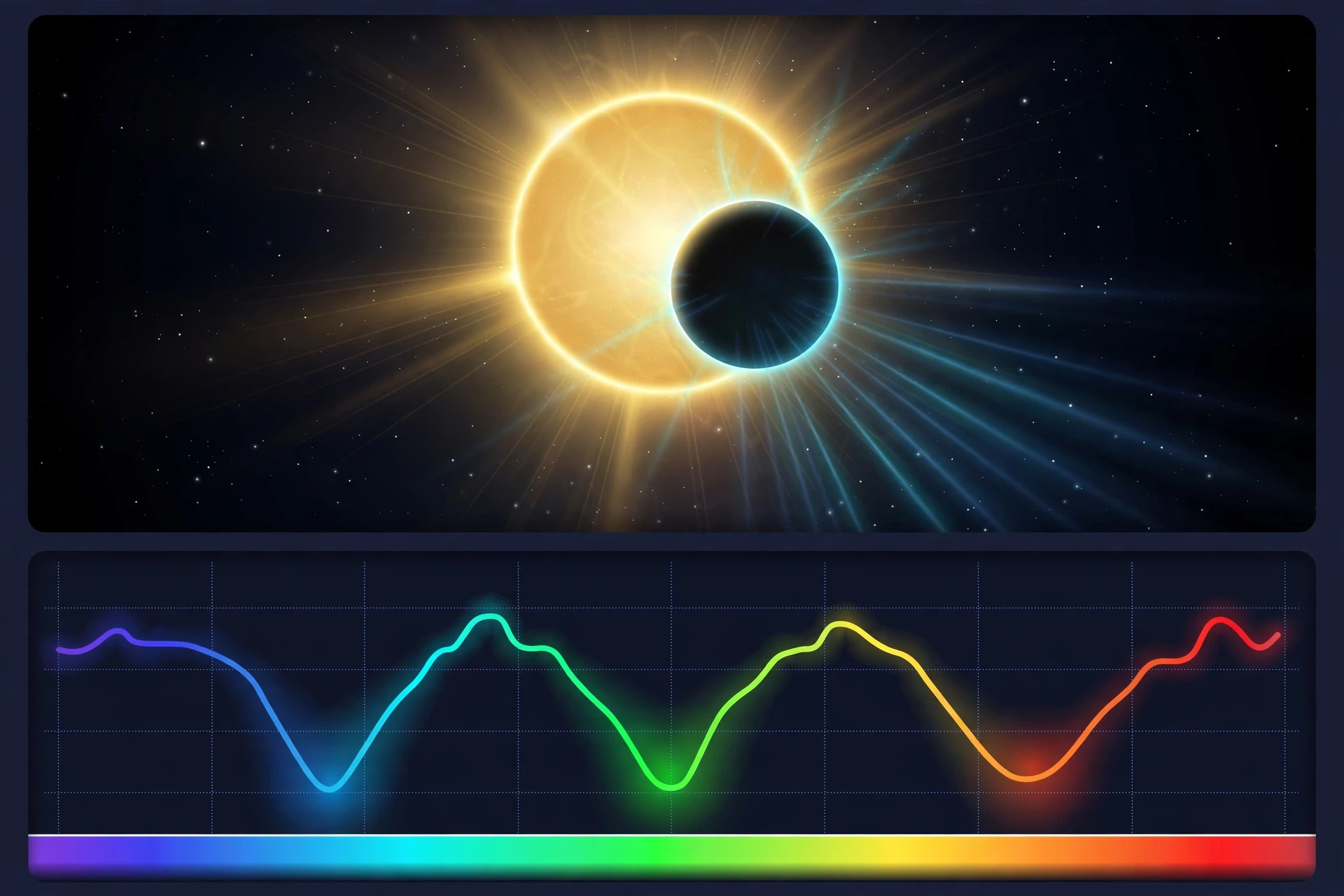
The method is elegant. When a planet passes in front of its star — a transit — a tiny fraction of the starlight filters through the thin skin of the planet's atmosphere on its way to us. Different molecules absorb light at different wavelengths, so the star looks very slightly dimmer at the wavelengths where the planet's air absorbs, and brighter where it does not. The result is a spectrum with dips and bumps that spell out the atmosphere's chemistry.
The effect is absurdly small. For an Earth-sized planet around a Sun-like star, the atmosphere blocks roughly one part in a million of the starlight. Measuring that requires a telescope that is both extremely sensitive and extremely stable — exactly what Webb was built to be. Before Webb, astronomers had managed only crude hints of exoplanet atmospheres. Webb turned the trick into routine chemistry.
A useful analogy: imagine shining a torch through a glass of water with a drop of ink in it, and trying to work out the ink's recipe from the colour of the light that comes out the other side — while the torch is a blazing star and the glass is a planet a hundred light-years away. That is the scale of the measurement, and it works.
6.2 WASP-39 b and the Sulfur Dioxide Surprise
The first exoplanet Webb studied in detail was WASP-39 b, a hot gas giant about 700 light-years away, a puffed-up world the size of Saturn but much less dense, orbiting its star in just four days. In 2022, Webb's spectrum of WASP-39 b showed carbon dioxide in an exoplanet atmosphere for the first time — a clear, unambiguous detection.
Then came the surprise: sulfur dioxide. Nobody had expected to see it, because sulfur dioxide is not something a planet is born with — it is made in the atmosphere itself, when starlight drives chemical reactions. Its presence was the first direct evidence of photochemistry — sunlight-driven chemistry — on a planet outside our solar system. It was also a proof of concept: if Webb can detect a molecule that is actively being manufactured in an alien sky, it can detect the chemical fingerprints of almost anything, including, one day, the gases that life produces.
NASA's three-year summary added more: Webb has now revealed a rich mix of chemicals in gas-giant atmospheres, including hydrogen sulfide, ammonia, carbon dioxide, methane, and sulfur dioxide — none of which had been clearly detected in an atmosphere outside our solar system before Webb.
6.3 K2-18 b and the Dimethyl Sulfide Argument
No Webb result has caused more argument than K2-18 b, a sub-Neptune about 120 light-years away in the constellation Leo, orbiting a cool red dwarf star in its habitable zone. In 2023, a team led by Nikku Madhusudhan at the University of Cambridge used Webb to study the planet's atmosphere and reported methane and carbon dioxide, with very little ammonia — a combination that fits a "Hycean" world, a planet with a deep liquid-water ocean beneath a hydrogen-rich atmosphere. They also reported a weak, tentative hint of dimethyl sulfide, or DMS.
On Earth, dimethyl sulfide is produced almost entirely by marine life, mostly ocean plankton. That is why the hint set off headlines about possible life on another world. But the hint was weak, and the story since then has been a textbook example of how science argues with itself in public.
In April 2025, the same team reported a stronger signal from Webb's mid-infrared instrument, which they said was consistent with DMS or its close relative dimethyl disulfide, at about three-sigma confidence — meaning roughly a one-in-several-hundred chance that pure noise would produce a signal that strong. But other teams reanalysing the same data reached different conclusions. One group reprocessed the near-infrared spectra in 60 different ways and found methane, but no reliable evidence for carbon dioxide or DMS. Another team combined all of Webb's data on the planet and found insufficient evidence for either sulfur molecule, showing that ordinary gases could fit the data just as well. A NASA-led reanalysis confirmed methane and carbon dioxide but judged the DMS signal not statistically significant.
Here is where I want to be careful, because this is exactly the kind of story that gets flattened into a false headline. The methane detection on K2-18 b is solid — several independent teams agree on it. The carbon dioxide is likely but less certain. The dimethyl sulfide is contested, not settled: the evidence is actively disputed in the published literature, and no team has shown that the molecule is definitely there, let alone that life made it. Even if DMS were confirmed, it can form without life in a hydrogen-rich atmosphere, as later work has shown. K2-18 b is a fascinating world and a genuine test case for the search for life — but it is not a detection of life, and anyone who tells you otherwise is selling something.
That argument is not a failure of Webb. It is Webb working exactly as it should: producing data good enough that different teams can disagree about it, in public, with numbers, until more observations settle the question. The telescope's job is to give us evidence sharp enough to argue over. It has done that.
6.4 Rocky Worlds: Mostly Bare So Far
The hardest prize in exoplanet science is the atmosphere of a small rocky planet — a world like Earth, around a star like the Sun, or around the small red dwarfs that are the most common stars in the galaxy. Webb has looked at several, and the results so far are mostly a story of absence.
The TRAPPIST-1 system, seven Earth-sized rocky planets around a tiny red dwarf just 40 light-years away, was one of the most anticipated targets. Webb has now observed the two innermost planets, TRAPPIST-1 b and c, and found no evidence of a thick atmosphere on either — both look like bare rock, their daysides baked by their star. The outer planets, including the ones in the habitable zone, are still to come, and they are the ones that matter most.
There is one tantalising exception. The lava world 55 Cancri e, a rocky planet orbiting a Sun-like star, shows hints of carbon monoxide or carbon dioxide in its atmosphere — possibly gas bubbling up from a magma ocean on its surface, constantly replenishing an atmosphere that its star keeps trying to strip away. If confirmed, it would be the first atmosphere detected on a rocky exoplanet, and a strange one: an atmosphere fed by a sea of lava.
The honest picture, three years in, is this: gas giants have rich, readable atmospheres, and Webb reads them beautifully. Rocky planets are harder, and most of the ones studied so far appear to have lost their air. That is not disappointing — it is information. It tells us which kinds of planets keep their atmospheres and which do not, and that knowledge is what will let us choose the right targets when we go looking for a world with breathable air.
7. Stars Being Born: The Cosmic Cliffs and Stephan's Quintet
Not all of Webb's work is about the distant past or distant worlds. Some of its most beloved images are of star formation happening right now, in our own galactic neighbourhood — and they show how much Hubble-era pictures were missing.
7.1 The Cosmic Cliffs of Carina
The Cosmic Cliffs are the edge of a giant cavity of gas in the Carina Nebula, about 7,600 light-years away, carved out by the ultraviolet light and winds of hot young stars. In Hubble's visible-light images, the cliffs looked like dark, solid mountains. In Webb's infrared view, they are translucent: you can see the newborn stars inside the pillars, the jets of gas shooting out of them, and the layers of the cloud being eaten away from the top down.
The image became an instant icon — NASA chose it as one of the five first images — because it does two things at once. It is gorgeous, in the way that a mountain range at sunset is gorgeous. And it is a physics diagram: the cliffs are a laboratory for how massive stars shape the clouds that made them, blowing bubbles, triggering new stars to form in the compressed gas at the edges, and then destroying the cloud that gave birth to them. The life cycle of stars is not a gentle process. It is violent, and Webb shows the violence in colour.
I keep coming back to a detail in the Carina image that most people miss: the tiny red dots scattered through the gas are not stars. Many of them are jets — narrow streams of gas fired out of newborn stars at hundreds of kilometres per second, visible because Webb's infrared eyes can see through the dust that hides them from Hubble. Each jet is a star being born, announcing itself.
7.2 Stephan's Quintet: Five Galaxies in a Slow Collision
Stephan's Quintet is a group of five galaxies about 290 million light-years away, four of which are locked in a slow gravitational dance that has been going on for hundreds of millions of years. Webb's image of the group — the largest image the telescope has released, covering about a fifth of the Moon's diameter — shows the collision in forensic detail: the shock wave where one galaxy has slammed through the group at high speed, heating gas to millions of degrees; the long tails of stars pulled out by tides; the regions where the collision has triggered bursts of new star formation.
The shock wave is the part that stays with me. It is a front of superheated gas, glowing in the infrared, where a galaxy that fell into the group is ploughing through the gas between the galaxies like a speedboat through water. Hubble could see the galaxies. Webb can see the water.
7.3 Closer to Home: Enceladus and the Asteroids
Webb has also turned its eye on our own solar system. Its most striking result there is the water plume of Enceladus, Saturn's ice-covered moon: Webb measured a vast fountain of water vapour erupting from the moon's south pole, feeding a huge torus of water around Saturn itself. The plume stretches thousands of kilometres, and Webb's measurement showed that it supplies water to the entire Saturnian system — a result that connects the chemistry of an ocean moon to the rings and atmosphere of its giant planet.
Webb has also been put to work on planetary defence. In 2024, astronomers found an asteroid with a possible Earth-impact trajectory, and Webb measured it quickly, determining it was about the size of a 15-storey building — information that matters enormously when you are deciding whether a space rock is a threat. It is a small part of Webb's time, but a useful one: the same sensitivity that sees the first galaxies can size up a rock that might one day matter to us.
8. What Webb Has Not Found (Yet)
A telescope's non-detections are as informative as its detections, and Webb has three famous empty-handed results that deserve honest reporting.
8.1 No Population III Stars Confirmed Yet
The very first stars — Population III — were made only of hydrogen and helium, the elements the Big Bang produced, with no heavier elements at all. They should have been enormous, blazing hot, and short-lived, and their light should be visible to Webb if they formed in clusters bright enough to see. So far, no confirmed Population III star or galaxy has been found.
There have been candidates — tantalising objects whose spectra look almost pristine — but every one has either turned out to have at least some heavier elements, or has not survived closer scrutiny. It is possible that Population III stars formed earlier than Webb can reach, or that they were too faint and too scattered to be seen even by Webb, or that they formed inside galaxies that already contained some heavier elements from earlier generations. The search continues, and it is one of the mission's highest-priority goals. The first stars are still out there, or their light is still too faint, and the difference matters.
8.2 No Definitive Biosignature
As the K2-18 b argument shows, Webb has found no molecule that can only be made by life. Methane, carbon dioxide, water, sulfur dioxide — all of them can be made without life, and all of them have been found on worlds without any evidence of biology. A true biosignature would need to be a gas, or a combination of gases, that has no plausible non-biological explanation, detected with high confidence, on a planet where the context makes sense.
Webb may never be the telescope that finds one. Its sensitivity is extraordinary, but the rocky planets in habitable zones are faint, their stars are noisy, and the signals are at the edge of what the instruments can do. The search will need many more observations, and probably the next generation of telescopes, before a claim of life can be made with the confidence it deserves. That is not a failure. It is a measure of how high the bar is — and how seriously scientists take the claim.
8.3 The Hubble Tension Persists
One of the deepest puzzles in cosmology is the Hubble tension: different ways of measuring how fast the universe is expanding give different answers, and the difference is too big to be a rounding error. The expansion rate measured from the early universe — from the cosmic microwave background — is about 67 kilometres per second per megaparsec. The rate measured from supernovae and pulsating stars in the nearby universe is about 73. The gap is around 8 percent, and it has survived a decade of scrutiny.
Webb was expected to help settle this, because it can measure the pulsating Cepheid variable stars used as distance markers far more precisely than Hubble could, separating them from the crowded starlight around them. The result, after three years, is that the tension is real: Webb's cleaner measurements agree with Hubble's, which means the discrepancy is not a measurement error. Something is missing from our understanding of the universe's expansion — perhaps a new kind of energy, perhaps new physics in the early universe — and dark matter and dark energy are part of that puzzle. Webb also found a gravitationally lensed supernova whose light arrives in three separate images at three different times, giving astronomers a new, independent way to measure the expansion rate. The tension has not been resolved. It has been confirmed, which is the first step toward solving it.
"This is the deepest, sharpest infrared image of the cosmos so far."
That was NASA Administrator Bill Nelson's description of Webb's First Deep Field on the day it was released, and it has held up. Three years later, no telescope has taken a deeper infrared picture of the universe. The sentence is a reminder that Webb's first week was not a fluke or a publicity stunt. It was the instrument doing exactly what it was built to do, on its first day at work.
9. James Webb Space Telescope vs Hubble: Partners, Not Rivals
The most common question I get about Webb is whether it replaced Hubble. It did not. The two telescopes are complementary instruments that see different slices of the universe, and Hubble is still doing world-class science — including work that Webb cannot do at all.
Feature | Hubble Space Telescope | James Webb Space Telescope |
|---|---|---|
Launched | 1990 | 2021 |
Primary mirror | 2.4 metres | 6.5 metres |
Main wavelengths | Visible and ultraviolet | Infrared (0.6–28 microns) |
Orbit | Low Earth orbit, about 540 km up | Lagrange point L2, 1.5 million km away |
Servicing | Serviced 5 times by astronauts | Cannot be serviced |
Operating temperature | Near room temperature | Below minus 233 degrees Celsius |
Best at | Sharp visible-light images, ultraviolet | Faint infrared, early universe, exoplanet air |
Expected lifetime | 35+ years and counting | 20+ years of fuel remaining |
Hubble sees visible and ultraviolet light, which Webb cannot see at all. Ultraviolet light is essential for studying hot young stars, the gas between galaxies, and the chemistry of the upper atmospheres of planets. Webb sees infrared, which Hubble can barely touch. Put together, they cover the spectrum from ultraviolet to mid-infrared — and astronomers routinely use both on the same object, combining Hubble's visible-light view with Webb's infrared view to get the full picture.
There is a practical difference too. Hubble orbits close to Earth, so it can be pointed quickly and serviced. Webb sits a million and a half kilometres away, and every observation is planned months in advance. Hubble is the nimble scout; Webb is the deep listener. The sky needs both.
10. What People Get Wrong About Webb
A telescope this famous collects myths. Here are the ones I hear most often, and what is actually true.
"Webb can see the Big Bang itself." It cannot. The Big Bang's own light has been stretched into microwaves, which is what the cosmic microwave background is — and that is a job for other telescopes. What Webb can see is the first few hundred million years after the Big Bang, when the first stars and galaxies lit up. That is close to the beginning, but it is not the beginning itself.
"Webb's images are photographs." They are not, in the ordinary sense. Webb's detectors record infrared light, which is invisible to human eyes. The images are built by assigning visible colours to infrared wavelengths — a process called false-colour imaging. The colours are chosen to represent real differences in the light, and they are chosen carefully, but a human eye floating next to the telescope would see nothing at all. The images are data, translated into colour so we can read them.
"Webb orbits the Earth." It does not. It orbits the Sun, in step with Earth, looping around the L2 point. From Webb's point of view, Earth is a small bright object always in the same direction as the Sun, behind the sunshield.
"Webb found aliens." It has not. It has found the chemistry of alien atmospheres, which is a different and more careful thing. Finding methane on a distant planet is a measurement. Finding life is a claim that requires far more evidence, and no such claim has survived scrutiny yet.
"Webb made Hubble obsolete." As Section 9 shows, the two telescopes see different light, and Hubble is still producing discoveries — including, in recent years, some of the most distant stars ever seen, magnified by gravitational lensing. The future of astronomy is not one telescope replacing another. It is a fleet of instruments, each seeing a different part of the story.
11. What Comes Next: Twenty More Years
Webb launched with a planned mission life of 10 years, set by its fuel supply. The Ariane 5 launch was so precise that it saved a large fraction of that fuel, and the mission now has enough propellant for more than 20 years of operations — possibly into the 2040s.
That matters because Webb's greatest discoveries are likely still ahead. The first three years were a sprint through the obvious targets: the deepest fields, the brightest early galaxies, the best-known exoplanets. The next decade will be slower and deeper. Astronomers have already been awarded time to chase the first stars, to map the atmospheres of rocky planets in habitable zones, to watch supernovae in the early universe, and to survey thousands of galaxies across cosmic time.
There is also a quieter revolution happening in the background: Webb's data are public. After a short proprietary period, every observation is released to the world, and anyone — a graduate student, a teacher, an amateur astronomer with a laptop — can download it and find something new. Several of the most surprising early-galaxy candidates were spotted not by the teams that proposed the observations, but by other researchers mining the public archive. The telescope belongs, in a real sense, to everyone who looks.
The questions that will define the next twenty years are already written down. How did the first black holes grow so fast? What are the Little Red Dots? Is there an atmosphere on a rocky planet in a habitable zone? What is causing the Hubble tension? And underneath all of them, the oldest question of all: are we alone? Webb cannot answer that last one by itself. But it has given us the tools to ask it properly for the first time in human history — not with speculation, but with spectra, measured molecule by molecule, from worlds a hundred light-years away.
12. The Sky Is Still Talking
On the night of July 12, 2022, I looked at an image of a grain of sand's worth of sky and saw thousands of galaxies. I was not the only one. Millions of people saw that image, and many of them had never thought much about astronomy before. That is the part of Webb's story that does not fit in a table or a spectrum: it made the universe feel close again, the way the Apollo photographs of Earth did in the 1960s.
The telescope itself is a machine — a golden mirror, a silver kite, four cold instruments, a million and a half kilometres from home. But what it does is older than any machine. It lets us look further back in time than any human has ever looked, and it shows us that the universe was busier, stranger, and more beautiful than we guessed. The first galaxies were too bright. The black holes were too big. The little red dots were not supposed to be there at all. And the sky keeps talking, one spectrum at a time, to anyone willing to listen.
Webb will keep listening for twenty more years. The discoveries of its first three years were the opening chapter. The rest of the book is still being written — in infrared light, a million and a half kilometres away, by a telescope that had to fold itself up to get there, and then unfolded, perfectly, in the dark.
Frequently Asked Questions
How far can the James Webb Space Telescope see?
The James Webb Space Telescope can see galaxies whose light has travelled for more than 13 billion years, from a time when the universe was less than 300 million years old. Its most distant confirmed galaxies shine from within the first few hundred million years after the Big Bang, and its deep-field images contain objects whose light left them over 13 billion years ago. It cannot see the Big Bang itself — that light has been stretched into microwaves.
Why does the James Webb Space Telescope use infrared light?
The James Webb Space Telescope uses infrared light for two reasons. First, infrared passes through the dust clouds that block visible light, revealing newborn stars and forming planets hidden inside. Second, the expansion of the universe stretches the light of the earliest galaxies from visible and ultraviolet into infrared, so only an infrared telescope can see them at all.
How cold does the James Webb Space Telescope get?
The James Webb Space Telescope's instruments operate between about minus 233 and minus 266 degrees Celsius. The five-layer sunshield keeps the telescope in permanent shadow, and the Mid-Infrared Instrument uses its own helium cryocooler to reach minus 266 degrees Celsius, just 7 degrees above absolute zero. At those temperatures the telescope's own heat does not drown out the faint infrared signals from distant objects.
What is Lagrange point L2 and why is Webb there?
Lagrange point L2 is a spot about 1.5 million kilometres from Earth, on the side away from the Sun, where the gravity of the Sun and Earth balance so a spacecraft can hold position with very little fuel. Webb orbits around L2 in a wide halo, which keeps the Sun, Earth, and Moon in the same direction in the sky at all times, so they stay behind the sunshield and the telescope remains cold and stable.
Has the James Webb Space Telescope found life on another planet?
No. The James Webb Space Telescope has detected methane, carbon dioxide, water, and sulfur dioxide in exoplanet atmospheres, and it has found a tentative, contested hint of dimethyl sulfide on the planet K2-18 b. Independent teams disagree on whether that molecule is present at all, and it can form without life. No biosignature — a molecule that could only be made by life — has been confirmed on any planet.
How is the James Webb Space Telescope different from Hubble?
The James Webb Space Telescope has a larger mirror (6.5 metres versus Hubble's 2.4), sees infrared light instead of visible and ultraviolet, operates at Lagrange point L2 instead of low Earth orbit, and runs far colder. Hubble is still essential: it sees ultraviolet light Webb cannot see, and the two telescopes are used together on the same objects to cover the full spectrum.
How long will the James Webb Space Telescope keep working?
The James Webb Space Telescope has enough fuel for more than 20 years of operations, thanks to a highly precise launch that saved propellant. It was designed for a 10-year mission, but it is expected to keep observing into the 2040s, as long as its instruments and spacecraft remain healthy.