

Introduction
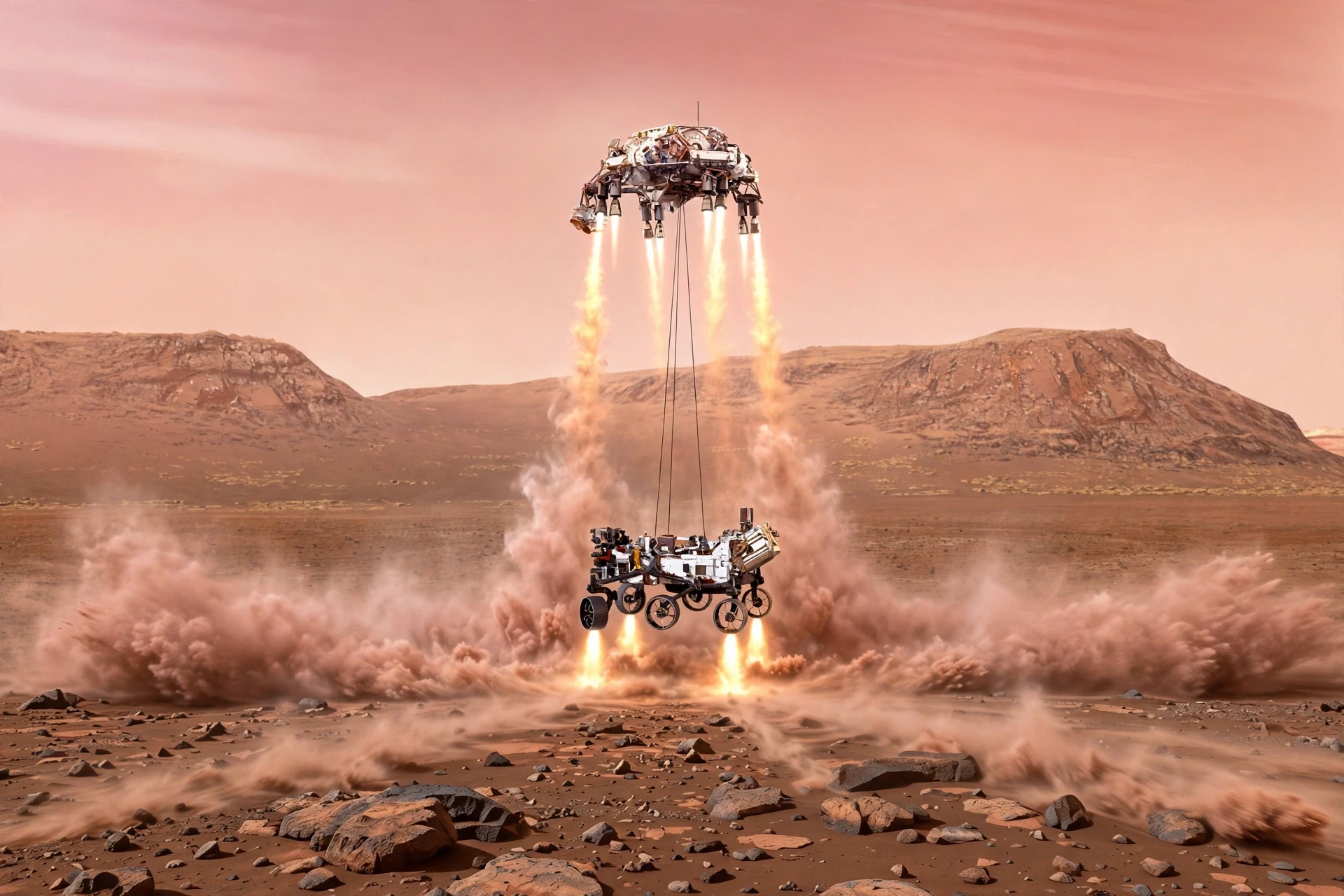
On 18 February 2021, a spacecraft the size of a small car fell out of the Martian sky at nearly 12,000 miles per hour, opened a parachute, fired rockets, and then — in a move no human had ever attempted before — lowered a one-tonne rover to the ground on cables, cut the cords, and flew away to crash at a safe distance. The whole landing took about seven minutes. For seven minutes, nobody on Earth could do anything to help. Radio signals take more than eleven minutes to travel from Mars to Earth, so by the time engineers in California saw the first signal that the spacecraft had entered the atmosphere, the rover was already either sitting safely on the surface or smashed into pieces. Engineers call those seven minutes "seven minutes of terror." It is the most honest name in spaceflight.
I remember watching the live feed that day with a group of students. We had the sound up, and the room went silent when the voice on the feed said, "Touchdown confirmed. Perseverance safely on the surface of the planet." A student next to me whispered, "It drove itself?" Not exactly — but close. The rover picked its own landing spot in the final seconds, steering away from rocks and cliffs with a camera and a computer, because no human could react fast enough from 130 million miles away. That landing is where this story starts, because it is also where the biggest question in science stands right now: was there ever life on the planet, and could there still be some?
The planet is the fourth planet from the Sun, a cold desert world about half the size of Earth, coloured a dusty orange-red by rust. It has the tallest volcano in the solar system, a canyon system that would stretch across the United States, polar ice caps, the largest dust storms in the solar system, and two small lumpy moons. Billions of years ago it was warm and wet, with rivers, lakes, and possibly an ocean. Today its air is so thin that liquid water cannot survive on the surface, and the ground is cold enough to freeze carbon dioxide out of the sky in winter. Yet we keep going back — with orbiters, landers, rovers, and even a helicopter — because Mars is the one place beyond Earth where life might have started, and where we might one day find proof that it did.
This guide covers the whole planet: what it is made of, why it is red, how it lost its air and water, what the rovers have found, and what stands between us and sending people there. Along the way, we will meet the scientists who argued over the first life-detection experiments in 1976 and are still arguing about them fifty years later, the little helicopter that was supposed to fly five times and flew seventy-two, and the samples sitting in sealed tubes on the Martian surface right now, waiting for a spacecraft that does not yet exist to bring them home.
1. Mars at a Glance
Mars sits about 142 million miles from the Sun on average, roughly one and a half times farther out than Earth. That extra distance matters. Sunlight there is only about 43 percent as strong as sunlight at Earth, and the planet's average temperature is around minus 85 degrees Fahrenheit (minus 65 degrees Celsius). On a warm summer afternoon near the equator, the temperature can climb to about 70 degrees Fahrenheit (20 degrees Celsius) — a pleasant day by Earth standards — but by nightfall it can plunge to minus 100 degrees Fahrenheit (minus 73 degrees Celsius). Pack for both.
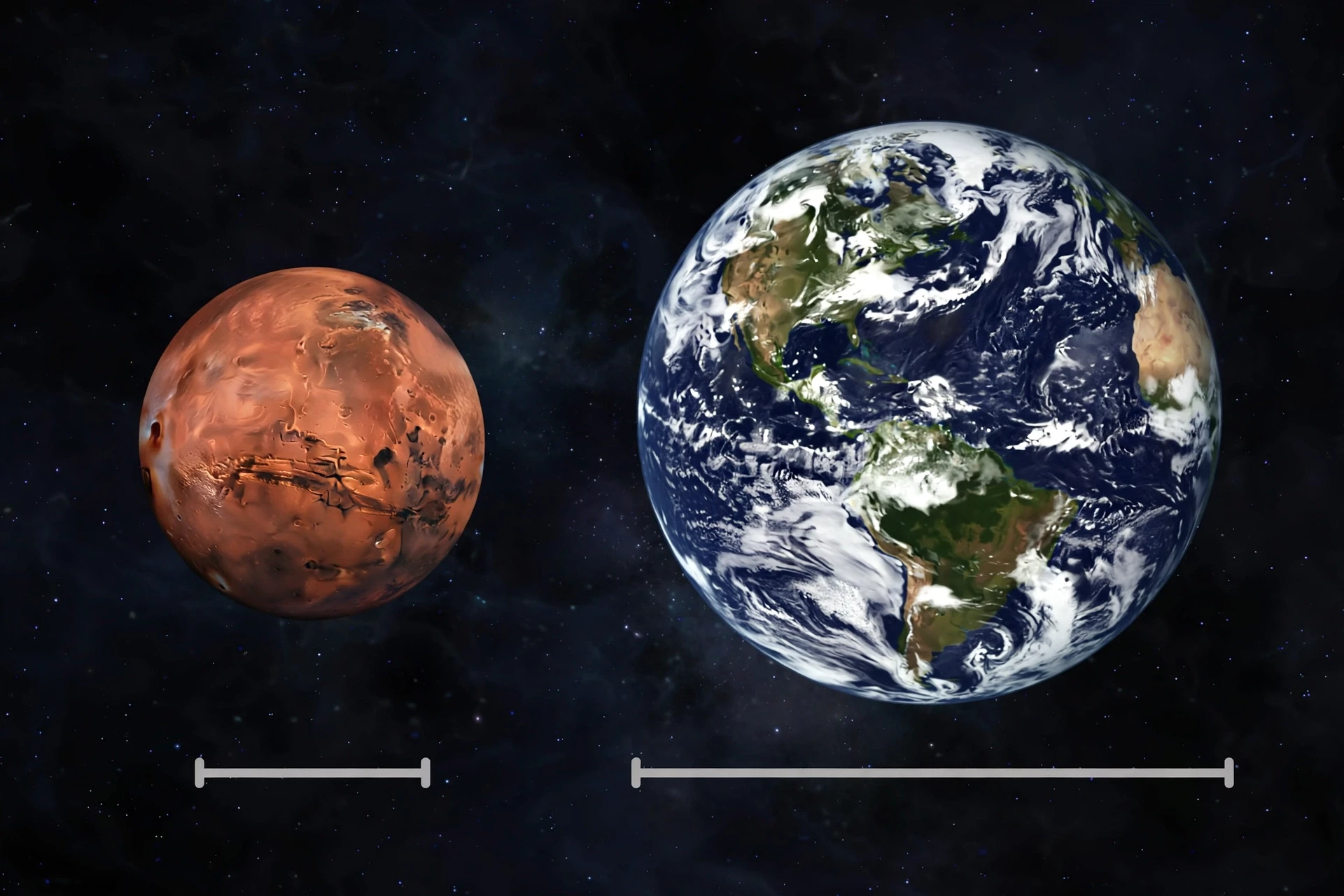
The planet is about 4,200 miles across, a little more than half Earth's diameter, with about one-tenth Earth's mass. Its gravity is about 38 percent of Earth's, so a person who weighs 150 pounds on Earth would weigh about 57 pounds on the planet. A day on the planet — called a sol — lasts 24 hours and 37 minutes, close enough to an Earth day that rover teams could almost live on Martian time, shifting their schedules by 37 minutes every day. A year on the planet lasts 687 Earth days, nearly twice as long as ours.
Mars turns on a tilted axis, 25.2 degrees, very close to Earth's 23.5-degree tilt. That tilt gives Mars seasons, just like Earth: spring, summer, autumn, winter, each lasting about twice as long as ours because the year is longer. The southern hemisphere has more extreme seasons than the northern one, because Mars follows an elliptical orbit. When the southern hemisphere has summer, Mars is at its closest to the Sun, so southern summers are shorter and hotter than northern ones. NASA's Mars facts page lays out these numbers plainly, and they add up to a world that feels strangely familiar and deeply strange at the same time.
1.1 A planet built like Earth, but smaller
Mars is a rocky planet, like Earth, Venus, and Mercury, and its interior is built in layers: a crust, a mantle, and a core. The crust is thicker than Earth's, somewhere between 30 and 80 kilometres deep, and the core is mostly iron and nickel with some sulphur, partly liquid. The planet formed about 4.6 billion years ago from the same swirling disc of gas and dust that made Earth, and for the first few hundred million years the two planets may not have looked all that different. Both had liquid water on the surface. Both had thicker atmospheres. Then their paths split, and the reason is mostly size.
A small planet cools faster than a big one. Mars cooled quickly, its interior slowed down, and the churning of liquid metal in its core that once generated a magnetic field faded away. That loss changed everything, as we will see in Section 4. Earth stayed hot inside, kept its magnetic field, kept its thick air, and kept its oceans. Mars became a cold desert. The story of the planet is, in a way, the story of what happens to an Earth-sized world that is just a little too small.
1.2 How far away is it, really?
The distance between Earth and Mars changes constantly, because both planets are moving. At their closest, during an opposition, Mars can be about 34 million miles away. At their farthest, when the Sun sits between them, the distance stretches to about 250 million miles. Light — and radio signals — take anywhere from about 3 minutes to about 22 minutes to cross that gap. That delay is why spacecraft at Mars must be able to think for themselves. When Perseverance landed, its landing sequence was fully automatic. There was nobody to steer it, nobody to press a button, nobody who could even watch it happen in real time. The rover had to be its own pilot.
That distance also sets the rhythm of the planet exploration. Spacecraft can only fly to the planet efficiently when the planets line up, which happens about every 26 months. Miss that window, and you wait more than two years for the next one. Every mission to the planet — every orbiter, lander, and rover — has been built around that calendar.
2. Why Mars Is Red
The first thing anyone notices about Mars is its colour. Through a telescope, it glows orange-red like a coal. From orbit, the surface is a dusty rust-red, broken by darker patches and pale pinkish plains. The red comes from iron oxide — rust. The dust and rocks on the planet are rich in iron, and over billions of years, that iron reacted with oxygen and water to form iron oxide minerals, the same chemistry that turns an old nail orange when it sits out in the rain.
On Earth, rust needs liquid water and oxygen. On Mars, the rusting happened long ago, when the planet was wetter and its air was thicker, and the rusty dust has been blowing around ever since. The dust is extremely fine, like talcum powder, and it coats nearly everything. When the wind blows, it lifts the dust into the air and tints the whole sky pinkish-orange. Sunsets on the planet are blue, because the fine dust scatters red light away and lets blue light through near the Sun — the opposite of an Earth sunset, where the sky turns red and the Sun looks orange.
I have a small jar of simulated Martian soil on my desk — a mix of iron-rich minerals made by researchers to match what the rovers have measured. It is a dull, brick-red powder, and if you rub a pinch between your fingers it stains your skin faintly orange. Holding it is a strange experience: the most Earth-like thing about it is how ordinary it feels, like garden soil, and the most alien thing is knowing that the real version is sitting on another planet, 140 million miles away, under a pink sky.
2.1 What the red dust hides
The dust is beautiful, but it is also a nuisance. It settles on solar panels and slowly starves rovers of power. The Spirit and Opportunity rovers were both solar-powered, and dust was one of the things that eventually ended them. Opportunity survived for nearly 15 years, far beyond its planned 90 days, partly because wind gusts — little dust devils — would sweep its panels clean from time to time. In 2018, a planet-wide dust storm blotted out the Sun over Opportunity's location for months, and the rover never woke up again. It was a quiet end for a machine that had driven 28 miles across an alien desert.
The dust also matters for the search for life. It coats rocks and buries them, and it can carry chemicals that confuse life-detection instruments. The Viking landers in 1976 ran into exactly this problem, as we will see in Section 6. Any future astronaut on the planet will have to deal with dust that gets into everything — suits, airlocks, lungs. It is fine enough to be a health hazard, and sharp enough to wear out seals and joints. The red dust is not just a colour. It is one of the practical problems of living on the planet.
3. Giants of the Landscape: Olympus Mons and Valles Marineris
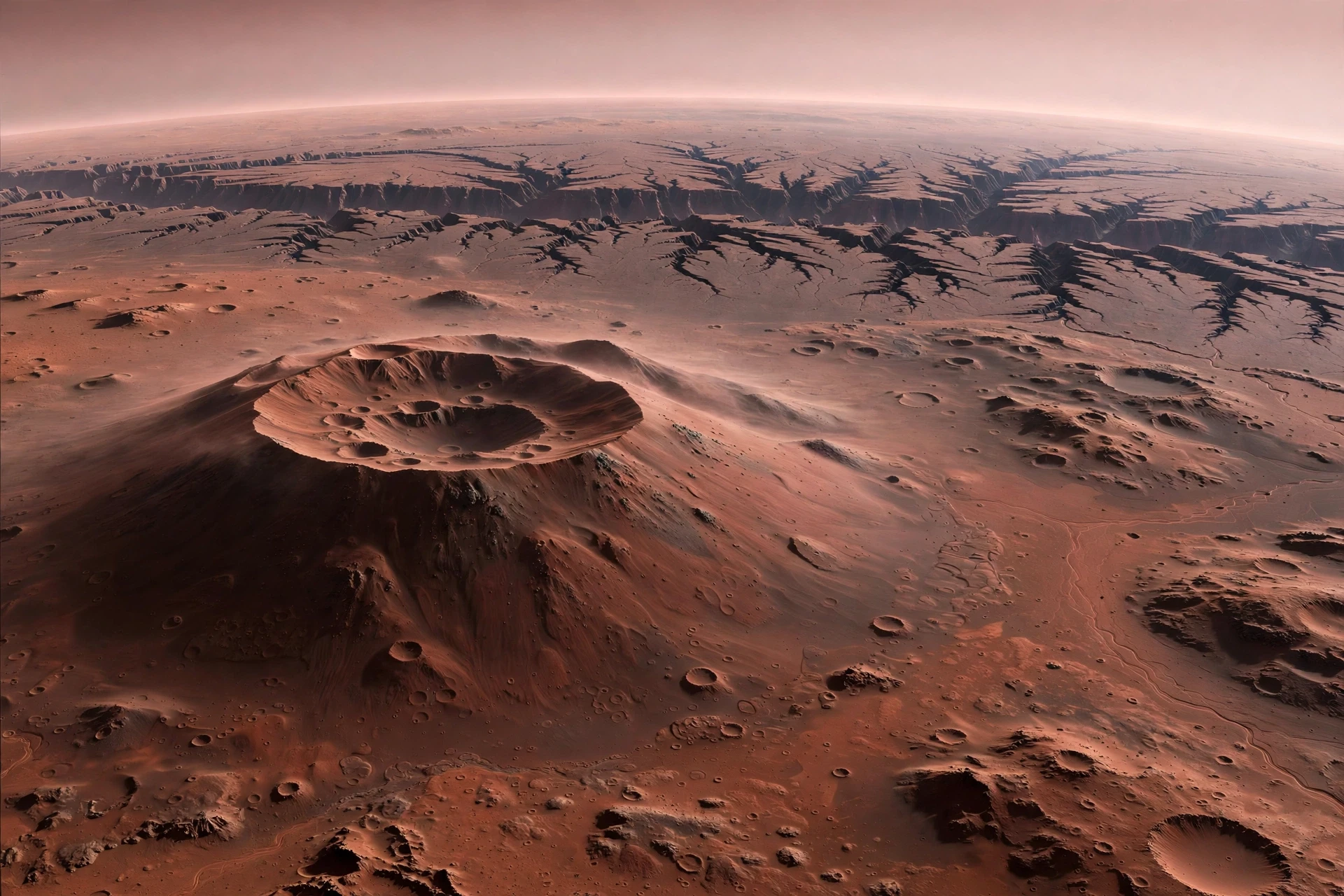
If you could stand on the planet and look at the horizon, the ground would look almost familiar — rolling plains, scattered rocks, low hills, dunes. Then you would notice the scale. Everything on the planet is bigger than its Earth equivalent, because the planet's lower gravity and thicker crust let geological features grow far larger than they ever could here.
3.1 Olympus Mons: the tallest volcano in the solar system
Olympus Mons is a shield volcano about 370 miles across — roughly the size of France — and about 14 miles high. That makes it about two and a half times the height of Mount Everest, and about three times the height of Mauna Kea in Hawaii, the tallest volcano on Earth when measured from the seafloor. Its slopes are so gentle, only about five degrees, that if you stood on its flank you might not realise you were climbing a mountain at all. The summit has a caldera, a collapsed crater, about 50 miles across.
Why so big? On Earth, plate tectonics carries volcanoes away from the hot spot feeding them, so no single volcano can keep growing in one place for very long. Hawaii is the exception that proves the rule: the Pacific Plate drifts over a hot spot, so each island is a volcano that grew, moved away, and stopped. On Mars, there are no moving plates. The crust sits still over its hot spots, so lava can keep piling up in the same place for billions of years. NASA's page on volcanoes on the planet and the agency's volcanoes overview describe this difference plainly. The result is a mountain so wide that it would be hard to see as a mountain from the ground — you would have to be in orbit to take in its full shape.
Olympus Mons is not alone. The planet has several other giant shield volcanoes in the Tharsis region, including Arsia Mons, Pavonis Mons, and Ascraeus Mons, each tens of thousands of feet high. They are mostly quiet now, but some may have erupted as recently as a few tens of millions of years ago — recent, in geological terms. Mars may not be entirely dead inside.
To understand volcanoes on the planet, it helps to compare them with Earth's. Our own article on how volcanoes form, their types, and eruptions explains shield volcanoes, hot spots, and why plate tectonics limits the size of Earth's mountains — the same physics, run to a different extreme on the planet.
3.2 Valles Marineris: a canyon that dwarfs the Grand Canyon
Running along the equator of the planet is Valles Marineris, a system of canyons about 2,500 miles long, up to 120 miles wide, and in places 4 miles deep. It would stretch from New York to Los Angeles, and the Grand Canyon would fit inside it many times over. It is the largest canyon system in the solar system, and it did not form the way the Grand Canyon did. There was no river carving it out. Instead, the crust of the planet stretched and cracked as the Tharsis volcanic region bulged upward, and the ground sank between the cracks. Landslides, wind, and possibly water widened the canyon over billions of years.
Standing at the edge of Valles Marineris, you would look across a gap so wide that the far side would be hidden by haze and curvature. The walls are layered like a cake, each layer a different chapter of Martian history: ancient lava flows, wind-blown dust, sediments laid down in water. Orbiters have photographed those layers in detail, and they tell us that Mars has had a long, varied climate, with wet periods and dry periods stretching back billions of years.
3.3 The two faces of the planet
The planet has a strange split personality. The northern hemisphere is mostly low, smooth plains, sitting several miles lower than the southern hemisphere, which is high, old, and heavily cratered. This is called the crustal dichotomy, and it is one of the biggest unsolved puzzles about Mars. One idea is that a giant impact early in the planet's history blasted out the northern lowlands. Another is that the southern crust simply grew thicker. A third is that a whole hemisphere of the planet was resurfaced by a vast ocean of lava. Nobody knows for sure yet, and it is the kind of question that makes planetary scientists argue happily for hours.
The dichotomy matters because it shapes where water went. If there was once an ocean in the northern lowlands, its shoreline would be one of the most important places to look for signs of past life — and some researchers think they have found traces of that shoreline in the orbiter images, though the evidence is still debated.
4. The Thin Air: How Mars Lost Its Atmosphere
Walk outside on Mars without a spacesuit and you would not be able to breathe — not because there is no air, but because the air is far too thin and has almost no oxygen. The atmosphere of the planet is about 95 percent carbon dioxide, with small amounts of nitrogen and argon, and only traces of oxygen and water vapour. Its pressure at the surface is less than one percent of Earth's sea-level pressure — roughly the same as the pressure 22 miles above Earth, far higher than any aeroplane flies. If you put a cup of water out on the Martian surface, it would boil and freeze at the same time: the low pressure lets it evaporate violently, while the cold freezes what is left.
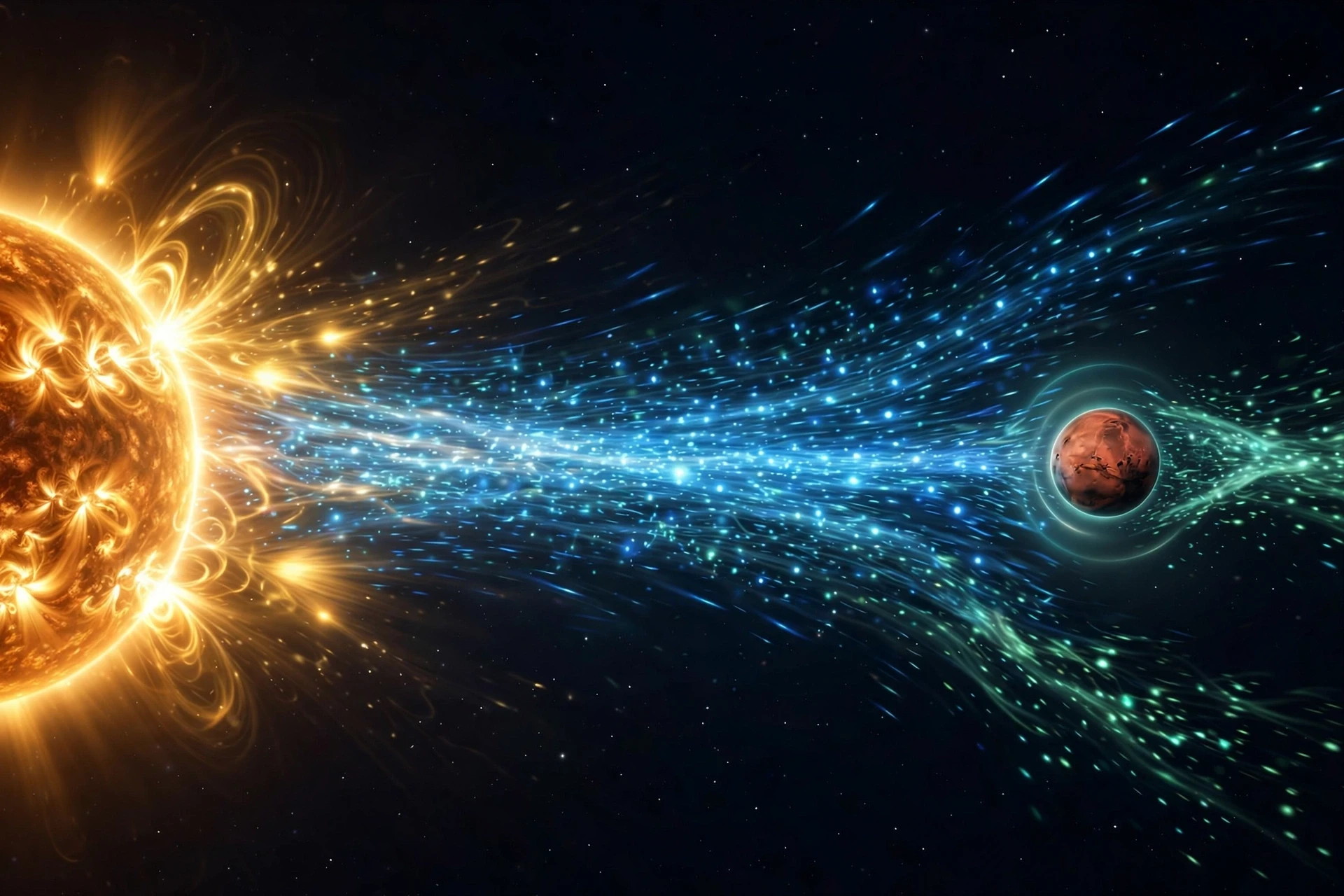
That thin air is not how Mars started. Billions of years ago, the atmosphere was much thicker, warm enough to keep liquid water flowing on the surface. Something stripped most of it away. The main suspect is the solar wind — the stream of charged particles blowing out from the Sun — and the reason the wind could do so much damage is that Mars lost its magnetic field.
4.1 The shield that vanished
Earth has a global magnetic field, generated by the churning of liquid iron in its outer core. That field acts like a shield, deflecting the solar wind around the planet and protecting the atmosphere. Mars once had a magnetic field too. Rocks on the southern highlands still carry a fossil magnetism, a record of a field that existed more than 4 billion years ago. Then the planet's interior cooled, the dynamo shut down, and the shield fell.
Without a magnetic field, the solar wind hits the upper atmosphere directly. Charged particles slam into gas molecules and knock them into space, a process called sputtering. Over billions of years, this slow leak removed most of the air. NASA's MAVEN mission page explains the process, and the spacecraft's measurements give it numbers: MAVEN has measured the rate at which gas is escaping today, and the numbers show that during solar storms the escape rate jumps dramatically. Early in the solar system's history, when the Sun was more active and threw off far more violent storms, the stripping would have been much faster.
4.2 What MAVEN found
MAVEN — the Mars Atmosphere and Volatile Evolution mission — arrived at Mars in 2014 to answer one question: where did the air go? It has spent years dipping into the upper atmosphere and measuring which gases are escaping and how fast. Its findings confirmed that the solar wind is stripping the atmosphere away, mostly carbon dioxide and oxygen, and that the loss was far greater in the past. The spacecraft also found that the atmosphere has layers and structures nobody expected, including a layer of metal ions from dust, and that the whole upper atmosphere puffs up and contracts with the seasons.
One of the most striking MAVEN results is that Mars is still losing air today, at a rate of about 100 grams per second — roughly the weight of a small apple every second. That sounds slow, and it is, but over billions of years it adds up to an ocean's worth of gas. When the Sun throws a major storm at Mars, the escape rate can jump ten to twenty times higher. The planet is still bleeding air into space, right now.
The loss of the atmosphere changed everything else. With less air, the greenhouse effect weakened and the planet cooled. Liquid water could no longer survive on the surface, so the rivers and lakes dried up or froze. What was once a warm, wet world became the cold desert we see today. The story of the planet is, more than anything, the story of a planet that lost its air.
5. Water on Mars: Rivers, Lakes, and Ice
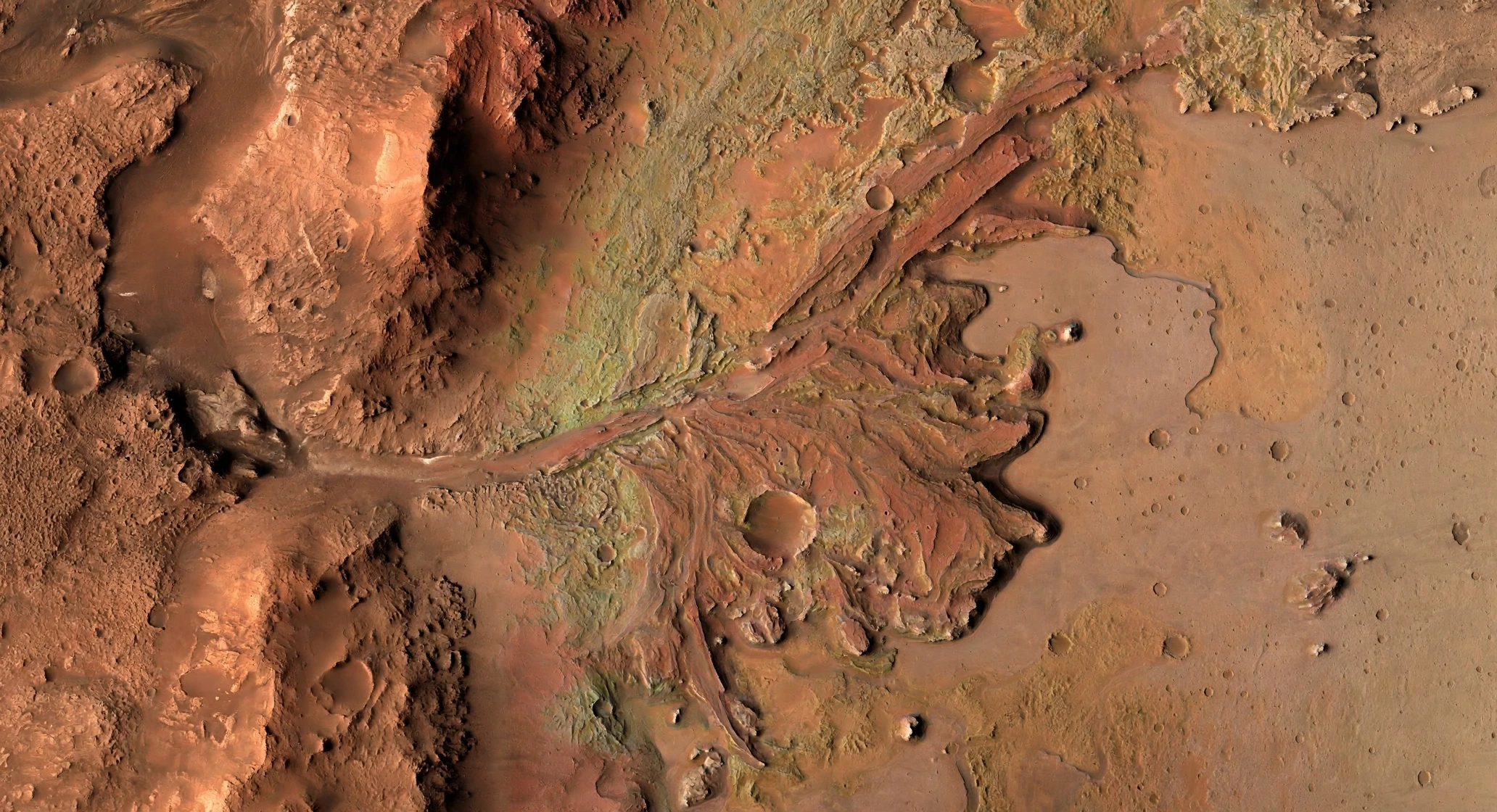
If there is one sentence that sums up modern Mars science, it is this: The planet was once wet. The evidence is everywhere, written across the surface in features that only flowing water can make. Dry river valleys branch across the highlands like the veins of a leaf. Deltas fan out where rivers once emptied into lakes. Shorelines curve around ancient basins. Minerals that only form in water — clays, sulphates, carbonates — sit in the rocks. Taken together, they paint a picture of a planet that had rivers, lakes, and possibly a northern ocean, roughly 3.5 to 4 billion years ago.
I still remember the first time I looked closely at a high-resolution orbiter image of a Martian valley network and realised I was looking at something I could have mistaken for a photograph of a desert on Earth — a dry riverbed in Arizona, say — except that it was on another planet. The channels branch and merge the way rivers do. They have tributaries. They cut through hills. There is no other process that makes that pattern. Water did that.
5.1 Jezero Crater: a lake that dried up
The best proof of ancient water on Mars is also the reason Perseverance landed where it did. Jezero Crater, about 28 miles across, was once a lake. A river flowed into it from the west, building a delta of sediment — the same kind of fan-shaped deposit you see where the Mississippi meets the Gulf of Mexico. Orbiters photographed that delta from above before anyone landed there, and the images were so clear that scientists could pick out individual channels in the delta front. When Perseverance landed in February 2021, it landed on the floor of that ancient lake, and it has been driving toward the delta ever since, reading the rocks like pages in a book.
Deltas are precious to scientists because they are natural traps for organic material. On Earth, river deltas bury dead plants and microbes in fine mud, preserving them for millions of years. A Martian delta could have done the same thing for any microbes that lived in Jezero's lake. That is why Perseverance has been drilling core samples from the delta rocks and sealing them in titanium tubes. Those tubes are the most valuable rocks in the solar system right now — if they ever make it back to Earth, they will be examined in laboratories far more capable than anything a rover can carry.
5.2 Where the water went
Mars did not lose all of its water. Some of it escaped to space along with the atmosphere. Some of it is still there, frozen. The polar caps hold a mixture of water ice and carbon dioxide ice, and the south polar cap alone contains enough water ice to cover the whole planet in a layer about 36 feet deep if it melted. Beneath the surface, in many places, there is ice mixed into the soil, sometimes just a few inches down. The Phoenix lander dug into the soil near the north pole in 2008 and found bright white ice in its trench — ice that slowly disappeared over a few days as it sublimated into the thin air.
In 2018, radar data from the European Space Agency's Mars Express orbiter suggested there might be a lake of liquid water buried under the south polar ice cap, kept liquid by salts and pressure. The claim is still debated — later studies have argued the radar signal could come from clay or volcanic rock instead — but it shows how hard scientists are looking, and how much is still uncertain. What is not in doubt is that Mars holds a lot of frozen water, and that water is the key to both the search for life and any future human mission.
Liquid water can still appear on Mars briefly, in special circumstances. Salty water has a lower freezing point, and in warm seasons, dark streaks called recurring slope lineae appear on steep slopes, growing in summer and fading in winter. Some researchers think these streaks are briny water seeping downhill; others think they are dry flows of sand. The debate is a reminder that on Mars, even the simplest observation can have two explanations, and the honest answer is sometimes "we do not know yet."
For a closer look at why water behaves so strangely — and why it matters so much for life — see our article on why water is the weirdest molecule in the universe. The chemistry that makes water essential for life on Earth is the same chemistry scientists are looking for on Mars.
5.3 The search for water today
Orbiters continue to map water ice across Mars. The Mars Reconnaissance Orbiter has found exposed ice in cliff faces at mid-latitudes, and its radar has mapped buried ice deposits. Knowing where the ice is matters for two reasons. First, ice is a record of past climate — layers of ice and dust at the poles record the planet's climate history the way tree rings record a forest's. Second, ice is a resource. Future astronauts will need water for drinking, for growing food, and for making rocket fuel, and hauling water from Earth would be enormously expensive. The first human missions to the planet will almost certainly land near accessible ice.
"Follow the water" has been the guiding rule of Mars exploration for more than two decades, and it has worked. Everywhere we have followed the water, we have found something interesting — ancient lake beds, minerals that formed in water, and rocks that could have preserved signs of life.
6. The Search for Life on Mars
This is the question that drives the whole Mars programme, and it is also the hardest question in science to answer. Life on Earth leaves traces — fossils, chemical signatures, patterns in rocks — but those traces are subtle, and they can be faked by geology. A mineral can make a shape that looks like a fossil. A chemical reaction with no life involved can make methane. The search for life on Mars is a long exercise in ruling out every non-living explanation before you dare to claim a living one.
6.1 Viking: the experiment that still divides scientists
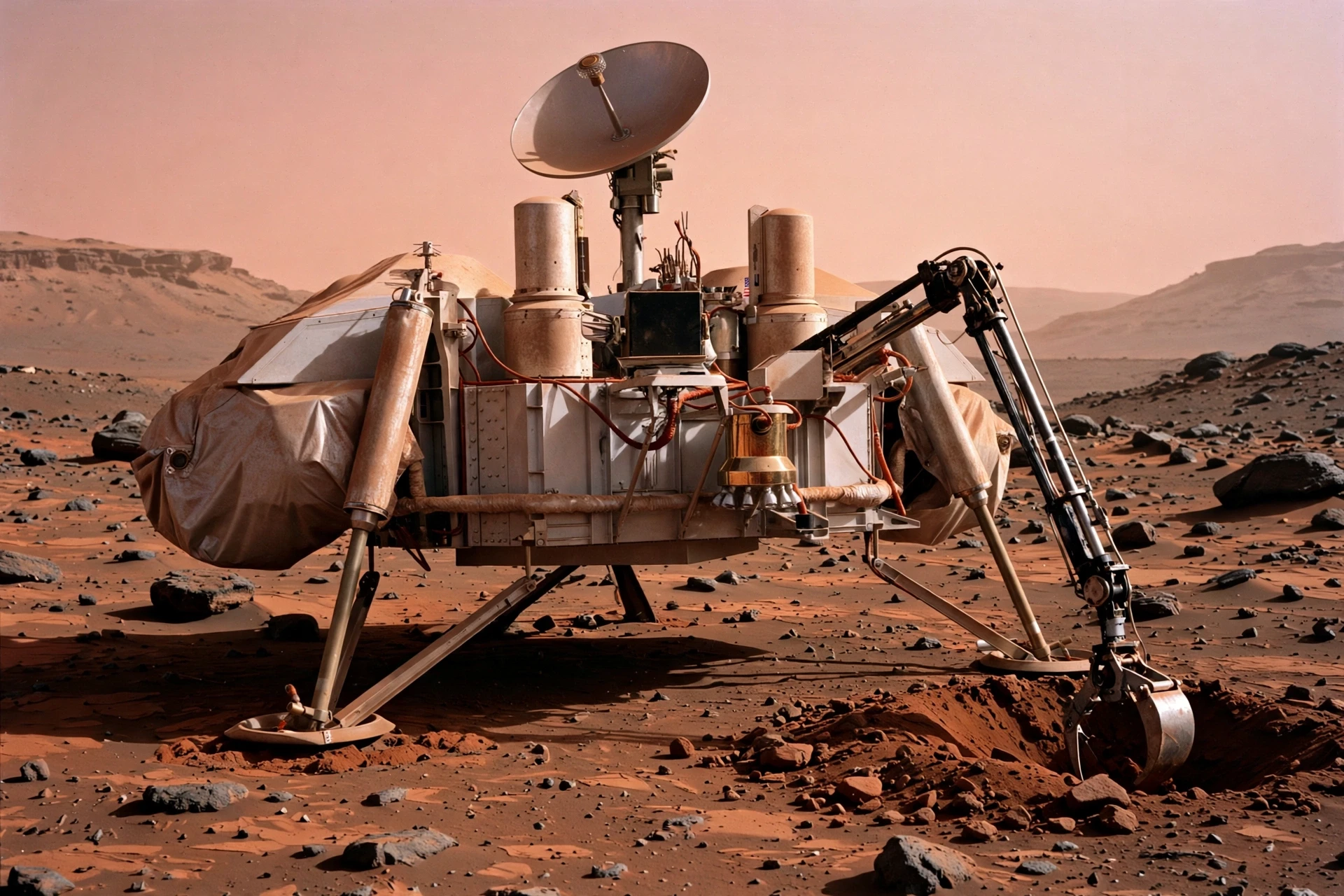
In 1976, NASA's two Viking landers touched down on Mars and ran the first — and still the only — experiments designed specifically to detect life on another planet. Each lander carried a set of biology experiments, including one called the Labeled Release experiment, which added a drop of nutrient broth spiked with radioactive carbon to a scoop of Martian soil and watched for radioactive carbon dioxide coming back out. If microbes in the soil ate the nutrients, they would breathe out the labelled gas.
The result was startling. The experiment gave a positive result — gas came out, quickly, in a pattern that looked like metabolism. The scientists celebrated. Then the other experiments reported in. The gas chromatograph-mass spectrometer, which looked for organic molecules in the soil, found none at all. And when the soil sample was heated to sterilise it, the Labeled Release reaction stopped — which is what you would expect if microbes were responsible, but also what you would expect if a chemical reaction was responsible. The team argued for months. In the end, the official conclusion was that the results were probably caused by unusual soil chemistry, not life. The lead scientist of the Labeled Release experiment, Gilbert Levin, disagreed for the rest of his life, arguing until his death in 2021 that Viking had found life and that NASA had talked itself out of the discovery.
Who was right? Fifty years later, we still do not know for certain. We now know that Martian soil contains perchlorates — chemicals that can destroy organic molecules when heated, which may explain why the Viking instrument found none. We also know that the soil chemistry is strange and reactive in ways nobody understood in 1976. The Viking results remain ambiguous, and they are a cautionary tale: on Mars, the difference between life and chemistry can be razor-thin, and one experiment is never enough.
6.2 Methane: a whiff of something, or nothing?
Methane is a gas that, on Earth, is mostly made by living things — microbes, cows, rotting plants. It can also be made by geology, by hot water reacting with rock, but biology is the biggest source. So when instruments on Mars detected methane in the atmosphere, it caused a stir. The Curiosity rover has measured seasonal spikes of methane in Gale Crater, with levels rising in summer and falling in winter. Orbiters have also reported methane, though not always in the same places or at the same times, and some measurements have found no methane at all where other instruments said there should be some.
The methane puzzle is a good example of how Mars science actually works. There is a signal, but it is faint, inconsistent, and could have more than one explanation. The methane could be leaking from underground reservoirs where microbes live today. It could be produced by water reacting with rock deep underground, with no life involved. It could be trapped in ice and released when the ice warms. Or some of the measurements could be wrong. The honest answer is that we do not know yet, and the only way to find out is to measure more carefully, from more places, over more time. The European ExoMars Trace Gas Orbiter, which arrived at Mars in 2016, was built specifically to settle this question — and so far, it has found almost no methane at all, which makes the puzzle even more interesting.
6.3 Organics: the building blocks are there
In 2018, Curiosity found organic molecules — carbon-based compounds — in ancient mudstone rocks in Gale Crater. These were not life itself. Organic molecules can form without life, and the ones Curiosity found are the kind that show up in meteorites. But they matter enormously, because they prove that the building blocks of life existed in a Martian lakebed billions of years ago, and that they survived in the rocks. The lake in Gale Crater had water, the right chemistry, and organic molecules. It had everything life needs except, as far as we know, life itself.
Perseverance has gone further, finding organic molecules in Jezero Crater too, in rocks that formed in a lake and a river delta. The rover's instruments can tell that organics are present, but not whether they were made by living things. That question will probably only be answered when the samples come back to Earth and can be examined in laboratories with instruments far more sensitive than anything that can be flown to the planet.
6.4 Mars Sample Return: the most ambitious plan in spaceflight
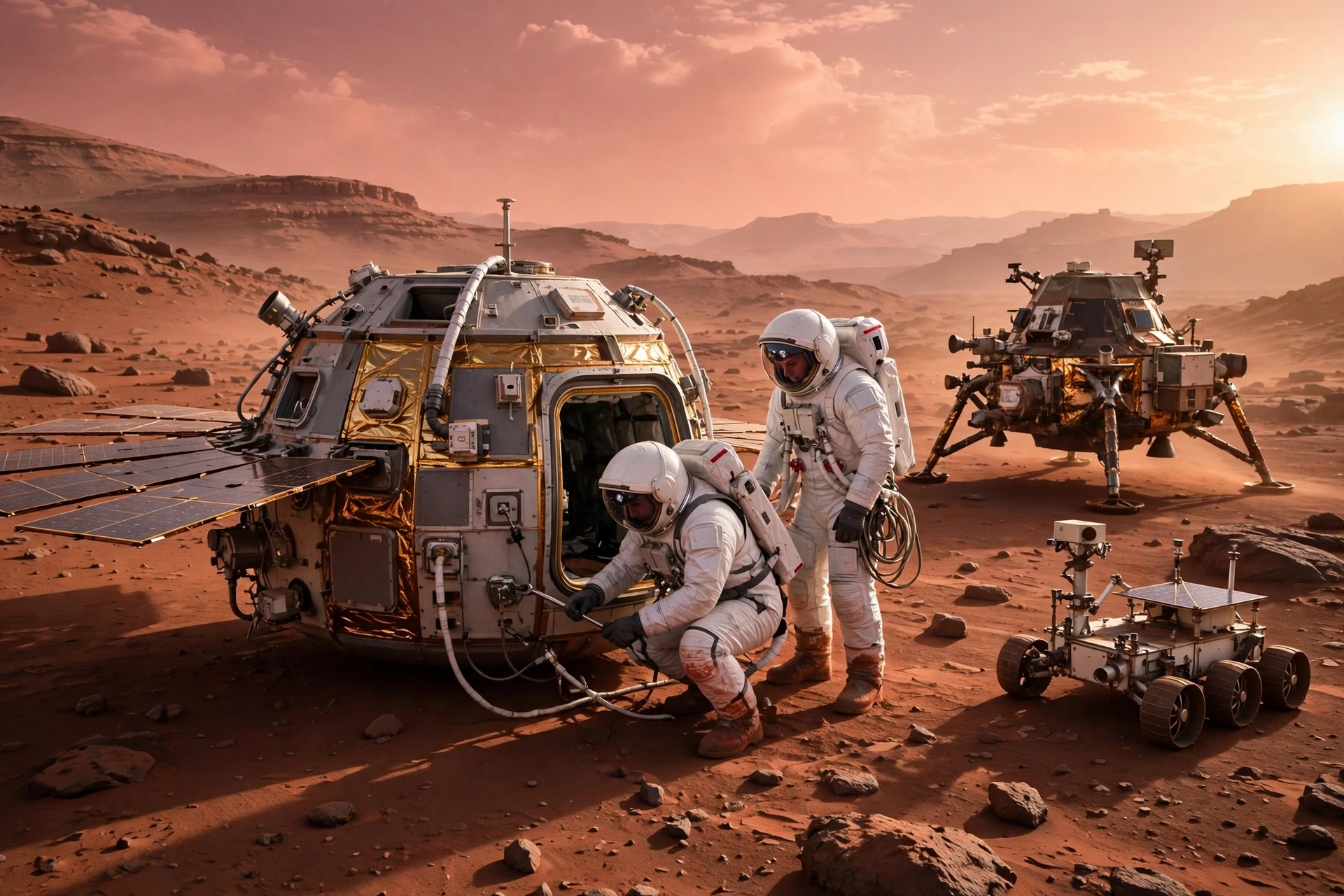
The plan to bring Martian rocks back to Earth is called Mars Sample Return, and it is the most complicated mission ever attempted. Perseverance has already done the first step: it has sealed more than two dozen sample tubes, some filled with rock cores, some with soil, and left a set of them in a depot on the surface. The next steps would involve landing a spacecraft near the depot, picking up the tubes (or having Perseverance deliver them), launching them into the planet orbit in a small rocket — the first rocket ever launched from another planet — catching them in orbit, and flying them back to Earth, where they would land in a sealed container and be taken to a high-containment laboratory.
The mission has run into delays and cost overruns, and NASA is now redesigning it to make it simpler and cheaper. But the scientific case has not weakened. A gram of Martian rock examined in an Earth laboratory could tell us more than a tonne of rock examined by a rover. It could settle, finally, whether Mars ever had life. NASA's Mars Sample Return pages describe the plan and its current status, and it remains the top priority of planetary science — a mission that, if it works, will answer one of the oldest questions humans have ever asked.
The search for life on Mars is not really about Mars. It is about us. If life started on two planets in one solar system, then life is probably common in the universe. If Mars had the right conditions and life never started there, then life may be rare, and Earth may be more precious than we can imagine. Either answer changes how we see ourselves.
7. Rovers and Orbiters: How We Explore Mars
No human has ever been to the planet, and no spacecraft has ever returned from it. Everything we know about the surface comes from robots. That makes the Mars exploration programme one of the greatest engineering achievements in history: machines built on Earth, flown hundreds of millions of miles, and operated by people who can only see what the machine sees, with a delay of minutes.
7.1 The rovers, from Sojourner to Perseverance
The first rover on Mars was Sojourner, a small six-wheeled machine about the size of a microwave oven, which landed in 1997 as part of the Mars Pathfinder mission. It was supposed to last a week. It lasted almost three months, driving about 100 metres and sending back pictures of rocks that scientists named after cartoon characters. Sojourner proved that a rover could work on Mars at all.
Then came Spirit and Opportunity, twin rovers that landed in January 2004. They were supposed to last 90 days. Spirit worked for six years, Opportunity for nearly fifteen. Opportunity drove 28 miles — a marathon on another planet — and found the first clear evidence that liquid water had once flowed across the surface. Both rovers were powered by the Sun, and both eventually died when dust and cold got the better of them. Their longevity changed the way NASA builds rovers: if a machine can survive that long, it is worth building it to do serious science.
Curiosity, which landed in 2012, is a different kind of machine. It is the size of a small car, weighs about 2,000 pounds, and is powered by a nuclear generator that will keep it running for years. It landed in Gale Crater using the same sky-crane system that Perseverance later used, and it has been climbing Mount Sharp, a mountain of layered rock in the middle of the crater, reading the history of water on Mars layer by layer. It found the organic molecules described in Section 6, and it found evidence of an ancient lake and stream system. It is still working today.
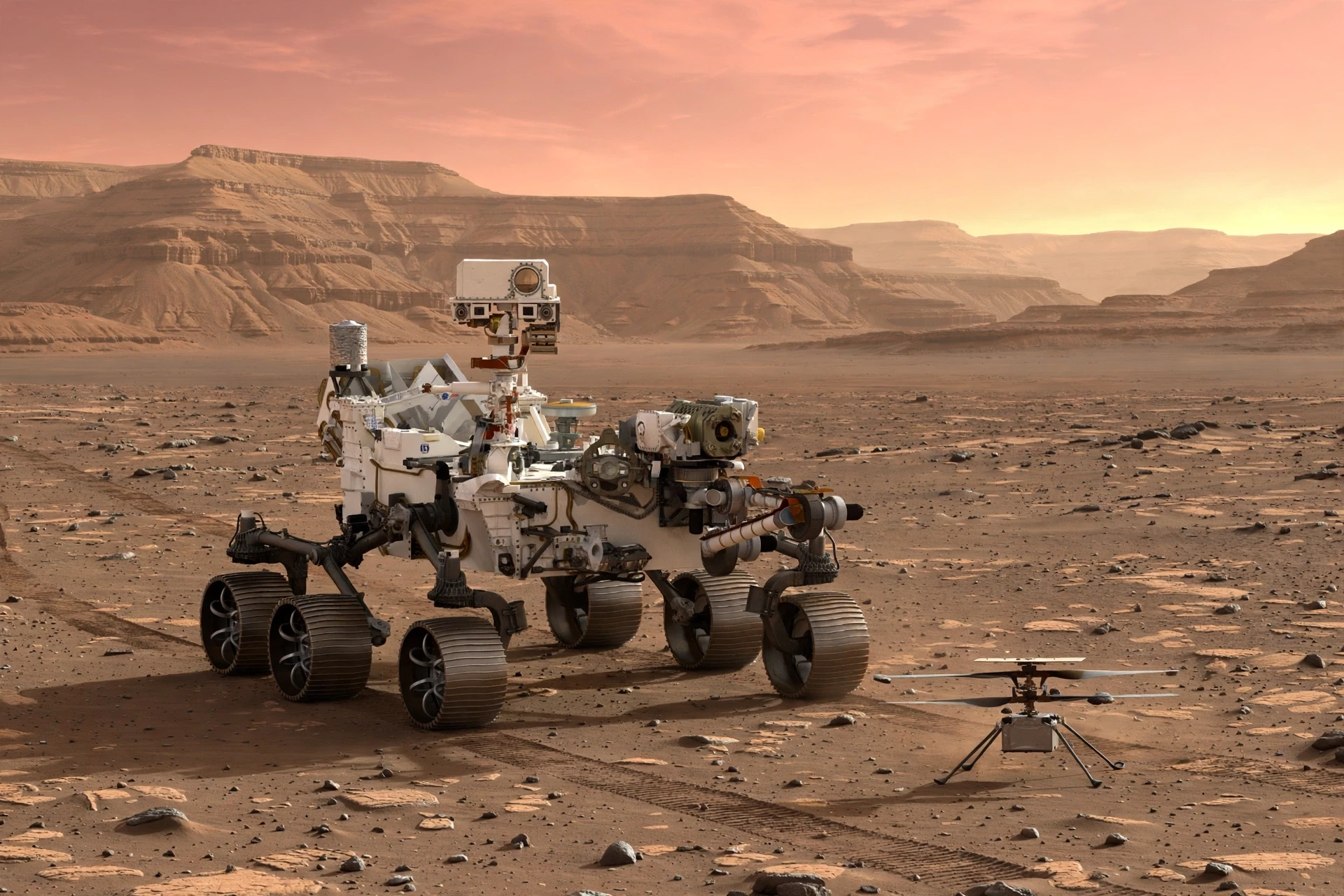
Perseverance, which landed in 2021, is Curiosity's sibling — same basic design, but with a different job. Its mission is to find signs of ancient life and to collect the samples that Mars Sample Return will one day bring home. It carries better cameras, a better drill, and a small helicopter that was supposed to be a side experiment. NASA's Perseverance mission page gives the full story of the rover, its instruments, and its samples.
7.2 Ingenuity: the little helicopter that could
Ingenuity was a technology demonstration, a small drone with four legs and two spinning rotors, carried to the planet tucked under Perseverance's belly. The plan was for it to fly five times over thirty days, proving that powered flight was possible in air as thin as the planet's. It flew seventy-two times over nearly three years, covering more than 10 miles, scouting ahead for the rover and photographing terrain from the air. It ended its career in January 2024 when one of its rotor blades was damaged on landing, but by then it had already changed the future of Mars exploration. Future missions will almost certainly carry flying machines.
I think Ingenuity is my favourite story in the whole Mars programme, because it was built by a small team on a tight budget, it was not supposed to matter much, and it turned out to be one of the most important machines ever sent to another planet. It is a reminder that in exploration, the side experiments sometimes become the main event.
7.3 The orbiters: eyes above the planet
The rovers get the glory, but the orbiters do much of the work. NASA's Mars Reconnaissance Orbiter has been photographing the surface in extraordinary detail since 2006 — it can spot objects as small as a table from orbit, and it has photographed every landing site, every rover track, and every parachute that ever landed on Mars. The European Space Agency's Mars Express has been orbiting since 2003, mapping minerals and finding evidence of water ice. ESA's Mars Express pages describe its discoveries, including the possible buried lake under the south polar cap. NASA's MAVEN studies the atmosphere, and the Trace Gas Orbiter sniffs the air for methane. Together, these spacecraft have mapped Mars more thoroughly than we have mapped parts of Earth's own seafloor.
Mission | Year | Type | Key achievement |
|---|---|---|---|
Sojourner (Pathfinder) | 1997 | Rover | First rover on Mars; proved roving was possible |
Spirit | 2004 | Rover | Found evidence of past water; worked 6 years |
Opportunity | 2004 | Rover | Marathon drive of 28 miles; found water evidence; worked ~15 years |
Phoenix | 2008 | Lander | Dug up water ice near the north pole |
Curiosity | 2012 | Rover | Found organics and an ancient lake in Gale Crater; still active |
InSight | 2018 | Lander | Measured marsquakes and the planet's interior |
Perseverance | 2021 | Rover | Collecting samples for return; hunting signs of ancient life |
Ingenuity | 2021 | Helicopter | First powered flight on another world; 72 flights |
8. Seasons, Dust Storms, and Two Small Moons
Mars has weather, and its weather can be spectacular. The planet's thin atmosphere still manages to produce clouds, frost, dust devils, and the biggest dust storms in the solar system. Understanding that weather matters for the rovers working there now and for the astronauts who will one day land there.
8.1 Dust storms that swallow the planet
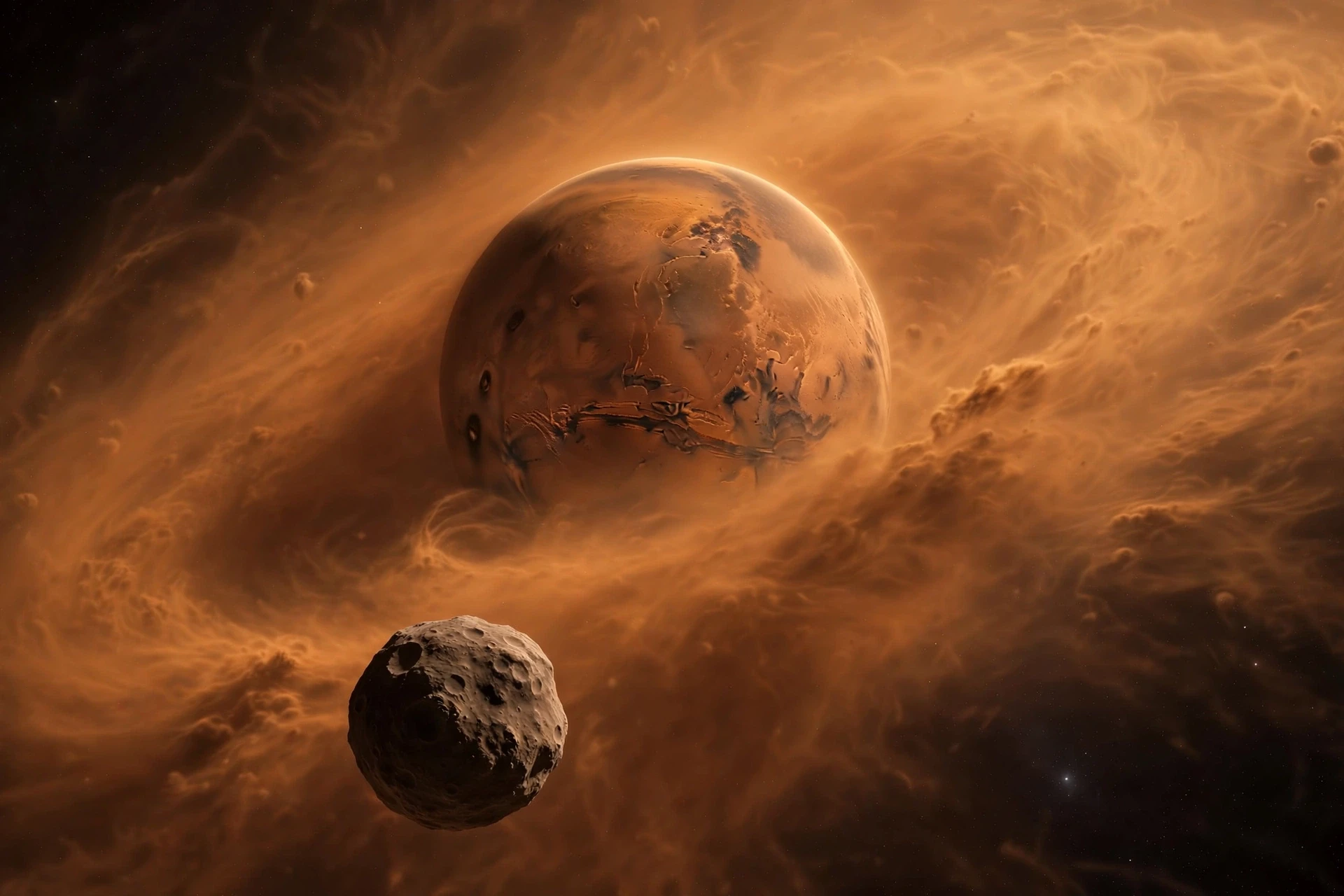
Every few years, Mars produces a dust storm large enough to cover the whole planet. The storms start small, in one region, and then grow, lifting dust high into the atmosphere until the sky turns dark and the Sun becomes a dim smudge. During a global storm, temperatures drop, winds blow at up to 60 miles per hour, and solar-powered machines on the surface go dark. The 2018 storm that ended Opportunity's mission lasted for months and covered the entire planet.
Why do the storms grow so large? The thin atmosphere cannot hold heat well, so temperature differences between regions build up quickly, driving strong winds. Dust lifted by those winds absorbs sunlight and warms the air, which drives stronger winds, which lift more dust — a feedback loop that can run away until the whole planet is wrapped in haze. The storms eventually calm down, the dust settles, and the sky clears. For a solar-powered rover, surviving a global storm is a matter of luck and battery life. For a future astronaut, it will be a matter of having enough power stored to ride it out.
Dust devils are the smaller, friendlier cousins of the big storms. These spinning columns of dust wander across the plains, sometimes hundreds of feet tall, and they occasionally sweep rover solar panels clean — a lucky accident that extended Opportunity's life by years. Orbiters have photographed dust devils from above, and rovers have photographed them from the side, and they look uncannily like the dust devils that spin across dry lake beds in the American southwest.
8.2 Frost, clouds, and the polar caps
In winter, carbon dioxide freezes out of the atmosphere and falls as snow at the poles, forming a seasonal cap that can extend hundreds of miles. In spring, the cap sublimates back into gas, and the edge of the cap retreats in a pattern that orbiters have watched year after year. Water ice lies underneath the seasonal carbon dioxide, forming permanent caps at both poles. The north polar cap is about 600 miles across and contains layered deposits of ice and dust that record the planet's climate history — a Martian ice core archive, waiting to be read.
Mars also has clouds, thin wisps of water ice that form high in the atmosphere, and morning fog in low-lying craters and valleys. Curiosity has photographed clouds drifting over Gale Crater, and the images are strangely beautiful: pale, thin clouds in a pink sky, over a red desert, on a planet where the air is too thin to breathe.
8.3 Phobos and Deimos: two lumpy moons
Mars has two moons, Phobos and Deimos, named after the Greek gods of fear and panic who accompanied Ares, the god of war, into battle. They are small, dark, and oddly shaped — Phobos is about 14 miles across, Deimos about 7.5 miles — and they look less like moons and more like captured asteroids. That is probably what they are: asteroids that wandered too close and were caught by the planet's gravity, though some researchers think they formed from debris thrown up by a giant impact.
Phobos is slowly spiralling inward, and in 30 to 50 million years it will either crash into the planet or be torn apart by the planet's gravity, forming a ring. Deimos is drifting slowly outward. Neither moon is much to look at from the surface — Phobos crosses the sky quickly, rising in the west and setting in the east, and it is too small to make a proper eclipse, though it does pass in front of the Sun and cast a small, fast shadow. Rovers have photographed those transits, and the images are oddly moving: a tiny moon, black against the Sun, over a red desert.
The moons matter for future exploration, too. Phobos is close to Mars, easy to reach, and its surface may hold water ice. Some mission plans suggest landing on Phobos first, using it as a base to explore Mars by teleoperation, before attempting a landing on the surface itself. For more on how moons work in general — and how different they can be — see our guide to the planets, moons, and celestial dynamics of the solar system.
9. Sending Humans to Mars
Every space agency and several private companies have plans to send people to Mars. It is the obvious next step after the Moon, and it is also one of the hardest engineering problems humans have ever attempted. The challenges are not just technical. They are human: radiation, isolation, distance, and time.
9.1 The journey: six to nine months each way
A trip to Mars takes six to nine months, depending on the route and the propulsion system. The crew would spend that time in a spacecraft smaller than a house, with no way to turn back once they leave Earth orbit, and no help if something breaks. During the journey, they would be exposed to cosmic radiation and solar storms, with no magnetic field and no thick atmosphere to protect them. On Earth, we are shielded by both. In deep space, the shielding has to come from the spacecraft itself, and shielding is heavy, which means it is expensive to launch.
Once the crew arrives, they would face the hardest part of the whole mission: landing. Mars has enough atmosphere to make a landing dangerous — the thin air creates heat and drag — but not enough atmosphere to slow a spacecraft down with parachutes alone. Everything that has landed on Mars so far has weighed less than about a tonne. A crewed spacecraft would weigh tens of tonnes. Landing something that heavy on Mars is a problem nobody has solved yet, though engineers are working on inflatable heat shields and supersonic retropropulsion — firing rockets while still moving faster than sound.
9.2 Living on Mars: radiation, food, and the return trip
On the surface, the crew would live in a habitat, probably buried under soil or built inside a lava tube for radiation protection. They would need to grow food, recycle water, and make oxygen — probably by splitting carbon dioxide from the atmosphere, a process Perseverance's MOXIE experiment has already demonstrated on a small scale. They would need to make rocket fuel from local resources, because carrying enough fuel for the return trip from Earth would be impossibly heavy. The most likely plan is to send the return fuel factory ahead of the crew, robotically, and only send people once the fuel is made and waiting.
Then there is the return trip: another six to nine months in space, after a year or more on the surface. A full Mars mission would last about two to three years, most of it far from Earth, with communication delays of up to 22 minutes each way. The crew would be on their own in a way no humans have ever been. The psychological challenge may be as hard as the engineering one.
Radiation: Cosmic rays and solar storms raise the risk of cancer and other health problems. Shielding, fast transits, and underground habitats are the main defences.
Distance: No resupply, no rescue, and no real-time help from Earth. The crew must be able to fix anything that breaks.
Landing heavy payloads: No crewed spacecraft has ever landed on Mars. The entry, descent, and landing system for a heavy crew vehicle does not exist yet.
The return trip: Fuel must be made on Mars, or carried all the way there and back. Either way, it is the hardest logistics problem in spaceflight.
Health: Months of low gravity weaken bones and muscles, and the long isolation affects mood, sleep, and decision-making.
9.3 Why go at all?
Given all of that, why go? The honest answer has several parts. First, science: a human geologist on Mars could do in a day what a rover does in a year — pick up rocks, read a cliff face, spot the one outcrop that matters. Second, the search for life: if there is life on Mars, humans are far more likely to find it than robots are. Third, the long view: learning to live on another planet is the only way humanity becomes a multi-planet species, and Mars is the only realistic candidate in the solar system. And fourth, something harder to measure: the same reason we climb mountains and cross oceans. Because it is there, and because doing it changes what we believe is possible.
I am cautious about timelines. People have been saying "humans on Mars in twenty years" for fifty years now, and the date keeps moving. The rovers have taught us how much we still do not know. But I am not cautious about the destination. We will go. The only question is when, and who gets there first.
10. Misconceptions About Mars
Mars has been misunderstood for as long as people have looked at it. Some of the misunderstandings were honest mistakes. Some were the result of wishful thinking. All of them are worth clearing up, because they still shape what people believe about the planet.
10.1 The canals that never existed
In 1877, the Italian astronomer Giovanni Schiaparelli looked at Mars through a telescope and drew a map covered with straight lines, which he called canali — Italian for "channels." In English, canali was translated as "canals," a word that implies something built. The American astronomer Percival Lowell picked up the idea and spent years arguing that Mars was covered with a network of canals built by an intelligent civilisation to carry water from the poles to the equator. He wrote books about it. The public loved it. It was completely wrong.
What Schiaparelli and Lowell saw was an optical illusion. Their telescopes were not good enough to resolve the surface, and the human brain is very good at connecting dots into lines. When better telescopes — and then spacecraft — looked at Mars, the canals vanished. There are no canals. There never were. There are river valleys and canyons, but no straight, artificial channels. The canal story is a lesson in how the brain fills in gaps, and how a mistranslation can create a civilisation out of nothing.
10.2 The face on Mars
In 1976, the Viking 1 orbiter photographed a mesa in the Cydonia region that, in that particular light, at that particular angle, looked like a human face staring up at the sky. The image became famous. Books were written about it. Some people claimed it was a monument built by an ancient civilisation. Later orbiters photographed the same mesa in higher resolution and in different light, and the "face" turned out to be an ordinary hill with shadows falling across it. It is a trick of light and the human tendency to see faces in random patterns — the same tendency that makes us see a face in the Moon or a shape in a cloud. The mesa is real. The face is not.
10.3 Mars is not Earth-like today
The most common misconception about Mars is the simplest one: that it is almost like Earth. It looks like Earth in photographs — a rocky desert, a pink sky, a horizon that could be Arizona. But the similarities end at the surface. The air is unbreathable and nearly a vacuum. The temperature swings are brutal. The radiation is dangerous. Liquid water cannot exist on the surface. You could not walk outside without a spacesuit for even a minute. Mars was once much more like Earth than it is now, and it could become more habitable again with enough work — but today, it is a desert that would kill an unprotected human in seconds. That is not a reason to stay away. It is a reason to go prepared.
10.4 Earth and Mars: a shared history
One thing people often get backwards is the relationship between the two planets. Mars is not a failed Earth. It is a different Earth — a planet that started with similar ingredients and took a different path because it was smaller and cooled faster. Studying Mars is not just about Mars. It is about understanding how planets work, including our own. The same physics that made Mars lose its atmosphere is a reminder of how much Earth's magnetic field and thick air protect us. And the same chemistry that might have made life on Mars is the chemistry that made life here.
To see how Mars fits into the wider story of rocky planets, our articles on plate tectonics and how volcanoes form explain the forces that shape worlds like Earth and Mars — and why the same forces produce such different results on different planets.
Frequently Asked Questions
Is there life on Mars?
There is no confirmed evidence of life on Mars, past or present. The Viking experiments in 1976 gave one positive result that is still debated, rovers have found organic molecules and seasonal methane, and ancient lake beds show Mars was once habitable. None of that proves life existed. The samples Perseverance is collecting may settle the question when they are brought back to Earth.
Was Mars once warm and wet?
Yes. Billions of years ago, Mars had rivers, lakes, and possibly an ocean. The evidence includes dry river valleys, deltas, lake-bed minerals, and rocks that only form in water. The planet lost most of its atmosphere to the solar wind after its magnetic field faded, and the surface water dried up or froze.
Why is Mars red?
Mars is red because its surface is covered in iron oxide — rust. The dust and rocks are rich in iron, which reacted with oxygen and water long ago to form rusty minerals. The fine dust blows into the air and tints the whole sky pinkish-orange.
How long does it take to get to Mars?
A spacecraft takes about six to nine months to travel from Earth to Mars, depending on the route and the launch window. The planets align for an efficient trip about every 26 months. Radio signals take between 3 and 22 minutes to travel between the two planets, so spacecraft at Mars must operate largely on their own.
What is the tallest mountain on Mars?
Olympus Mons, a shield volcano about 14 miles high and 370 miles across — roughly two and a half times the height of Mount Everest. It grew so large because Mars has no moving tectonic plates, so lava could keep piling up in the same place for billions of years.
Could humans live on Mars?
Not without a lot of help. Humans would need pressurised habitats, protection from radiation, and systems to make air, water, and fuel from local resources. The biggest challenges are the six-to-nine-month journey, landing a heavy crewed spacecraft, radiation exposure, and making fuel for the return trip. NASA and others are working on all of these problems, but no crewed mission has a firm date yet.
What has Perseverance found so far?
Perseverance has found organic molecules in Jezero Crater's rocks, evidence of an ancient lake and river delta, and rocks that formed in the presence of water. Its main job is collecting samples — more than two dozen sealed tubes so far — that a future mission, Mars Sample Return, is meant to bring back to Earth for detailed study.