

Introduction
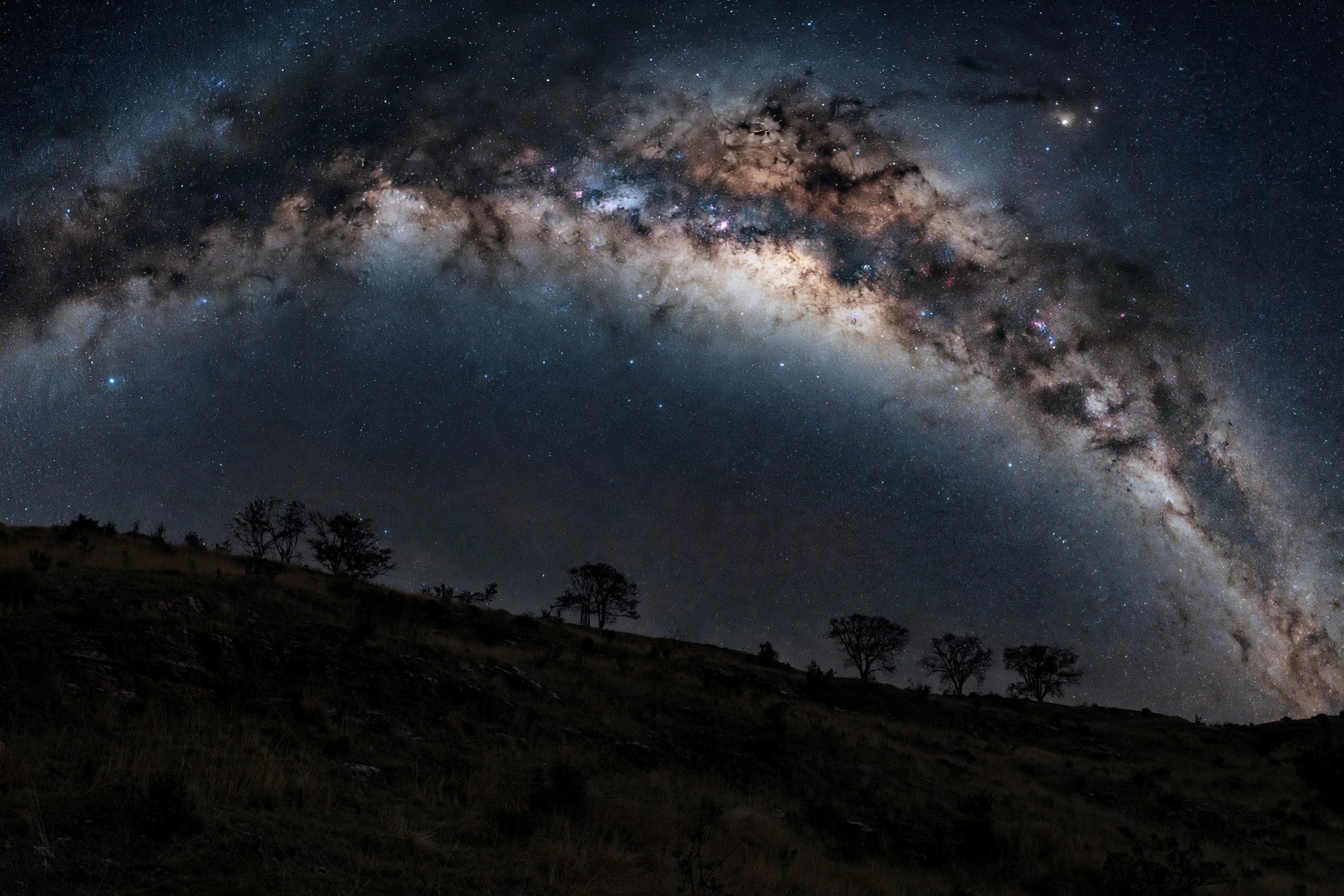
The first time I saw the Milky Way properly, I was standing on a cold hillside far from any town, and I had forgotten to bring a jacket. A friend had driven us out to a dark-sky site because the forecast promised clear air, and for the first hour I mostly complained about the cold and the midges. Then someone switched off the last torch, my eyes adjusted, and the sky changed completely — our own galaxy, one among billions of galaxies, arched overhead in plain sight. A pale, cloudy band arched overhead from one horizon to the other, thick with stars, split here and there by dark lanes of dust. It looked like spilled milk across black velvet. I stood there with my neck aching and my arms wrapped around myself, and I remember thinking something that sounds obvious now but felt like a discovery then: every one of those points of light is a star, and all of them belong to the same galaxy we live in. The band was our own home, seen from the inside.
That is the strange thing about galaxies. We live inside one, so we never get to step back and admire it the way we admire a photograph of a distant spiral. Instead, we see our galaxy edge-on, as a band of light, and we have to work out its shape the way you might work out the shape of a house while standing in one of its rooms. Astronomers spent centuries doing exactly that, and the story of how they did it — how they learned that the faint smudges in the night sky are entire island universes of their own, each holding billions of stars — is one of the great detective stories in science.
This article walks through that story in full. We will start with what a galaxy is and how big one can be, then meet the four main types of galaxies and the diagram astronomers still use to sort them. We will tour the Milky Way in detail, from the spiral arms to the black hole at its heart, and look ahead to the long, slow encounter with our neighbour Andromeda. Then we will ask how galaxies are born, why some of their cores blaze brighter than a trillion suns, how galaxies gather into clusters and lace themselves into the cosmic web, and how the James Webb Space Telescope has recently surprised everyone by finding galaxies that look too big, too bright, and too early. Along the way we will clear up the misconceptions that trip up almost everyone, including a few that tripped up astronomers themselves.
1. What a Galaxy Actually Is
A galaxy is a vast system of stars, gas, dust, and dark matter, all held together by gravity. That short definition hides a scale that is hard to hold in your head. The smallest galaxies, the dwarf galaxies, may hold only a few million stars. The largest, the giant ellipticals at the hearts of galaxy clusters, can hold trillions. Our own Milky Way sits somewhere in the middle of that range, with a few hundred billion stars, and even that number is so large that counting it star by star would take a lifetime. If you counted one star per second, without sleeping, you would need more than six thousand years to count the stars of the Milky Way alone.
Galaxies are the visible foundation of the universe, as NASA puts it in its overview of Hubble's galaxy science: each one a collection of stars, planets, gas, dust, and dark matter held together by gravity. The stars are the part we see, but they are not the whole story. Between the stars lies the interstellar medium — thin gas, mostly hydrogen, and fine dust grains — and that gas is the raw material for future stars. Around and through all of it sits a halo of dark matter, invisible stuff that reveals itself only through its gravity, and which outweighs all the visible matter in a galaxy by a large factor. A galaxy, in other words, is mostly things we cannot see directly: dark matter holding the shape, gas waiting to become stars, and a comparatively small sprinkle of shining stars that give the whole thing away.
1.1 How big is a galaxy?
It helps to anchor the numbers to something familiar. A light-year — the distance light travels in one year — is about 9.5 trillion kilometres. The Milky Way is roughly 100,000 light-years across. If you shrank the Milky Way down to the size of a dinner plate, the Sun would be a grain of sand about halfway out from the centre, and the nearest star to us would be another grain of sand a few centimetres away. The whole Solar System, out to Neptune, would be smaller than a pinhead. And the distance to Andromeda, our nearest large neighbour galaxy, would be a second dinner plate sitting across the room.
I tried a version of this scale walk with a group of students once, using a football field. We put a grapefruit at one end for the Milky Way's centre and walked out the spiral arms in chalk, placing marbles for star clusters. By the time we reached the edge of the disc, we had used the whole field, and someone asked where Andromeda would go. I pointed down the road, past the school gate, about two kilometres away. The silence that followed was the good kind — the kind that means a number has finally become a feeling.
Galaxies also vary enormously in size. Dwarf galaxies can be only a few thousand light-years across, while the biggest ellipticals stretch 300,000 light-years or more. The range matters because size and shape turn out to be clues to a galaxy's history: big, smooth ellipticals are often the merged remains of many smaller galaxies, while neat spirals are galaxies that have had a quieter life, growing steadily by pulling in gas and forming stars in an orderly disc.
1.2 What holds a galaxy together?
Gravity does the holding, but the details are worth a closer look, because a galaxy is not a solid object. It is a swarm. The stars in a galaxy do not touch each other; they orbit a common centre of mass the way planets orbit the Sun, except that the gravity comes from everything at once — stars, gas, and dark matter combined. In a spiral galaxy like ours, most stars move in the same direction around the centre, in a flattened disc. In an elliptical galaxy, the stars swarm in all directions, like bees around a hive, with no single direction of rotation dominating.
One of the first things that surprised me when I started learning this properly was how empty a galaxy is. The average distance between stars in our part of the Milky Way is measured in light-years, while the stars themselves are measured in hundreds of thousands of kilometres. If you picked a star at random and threw a dart at it from another star, you would almost never hit anything. That emptiness is why, as we will see in Section 5, two galaxies can pass through each other and almost no stars collide. It is also why a galaxy can keep its shape for billions of years without its stars crashing into each other: the swarm is held by gravity, but its members almost never meet.
The other thing holding a galaxy together is the dark matter halo. In the 1970s, astronomer Vera Rubin measured how fast stars orbit in spiral galaxies and found something odd: stars at the edge of a galaxy move almost as fast as stars near the centre, when the visible matter alone should make them slow down with distance. The only way to explain the flat rotation curves she measured was extra, invisible mass — a halo of dark matter surrounding each galaxy, outweighing the stars and gas several times over. Rubin's work was a turning point: galaxies are not just collections of stars; they are dark matter structures with stars embedded in them. You can read more about that invisible scaffolding in our companion article on dark matter and dark energy.
2. How We Learned Galaxies Are Real
For most of human history, nobody knew galaxies existed. People saw faint, cloudy patches in the sky — the Andromeda smudge, the Magellanic Clouds — and called them nebulae, from the Latin word for cloud. Some astronomers guessed they might be distant collections of stars, a guess the philosopher Immanuel Kant made as early as 1755 when he called them "island universes." But a guess is not a measurement, and for another century and a half, the question stayed open. Were those smudges clouds of gas inside our own galaxy, or were they separate galaxies far beyond it?
The answer came in 1924, from Edwin Hubble, working with the 100-inch telescope at Mount Wilson in California — then the largest telescope in the world. Hubble was studying a kind of star called a Cepheid variable in the Andromeda nebula. Cepheids brighten and dim in a regular rhythm, and the length of that rhythm tells you how bright the star truly is. Compare that true brightness with how faint the star looks from Earth, and you can work out its distance. It is the same logic as judging how far away a streetlight is by how dim it looks, once you know how bright streetlights are. Hubble's Cepheids in Andromeda turned out to be far too distant to be inside the Milky Way. Andromeda was not a cloud in our galaxy. It was a galaxy in its own right, about 2.5 million light-years away, and the universe suddenly became enormously larger than anyone had thought.
Hubble's measurement did more than settle an argument about one smudge in the sky. It moved humanity's address. Until 1924, the Milky Way was widely taken to be the whole universe. After 1924, it was one galaxy among many — and the universe had no known edge.
I still remember the first time I found Andromeda with my own eyes, through a small telescope on a frosty night. It was not much to look at: a faint, fuzzy oval, barely brighter than the sky around it. I had seen photographs of it a hundred times — grand spiral arms, blue star clouds, dark dust lanes — and the real thing through the eyepiece looked like a thumbprint on glass. But knowing what it was changed everything. That thumbprint was a trillion stars, seen from 2.5 million light-years away, and the light entering my eye had left Andromeda before modern humans existed. The gap between the photograph and the eyepiece is the gap between knowing a fact and feeling it, and it is worth crossing at least once.
Hubble went on to do something else that shaped the whole field: he sorted galaxies by their appearance. That sorting system, the Hubble sequence, is the subject of the next section, and astronomers still use a version of it today — not because it is perfect, but because shape turns out to be a useful shorthand for a galaxy's history.
3. The Types of Galaxies: Hubble's Tuning Fork
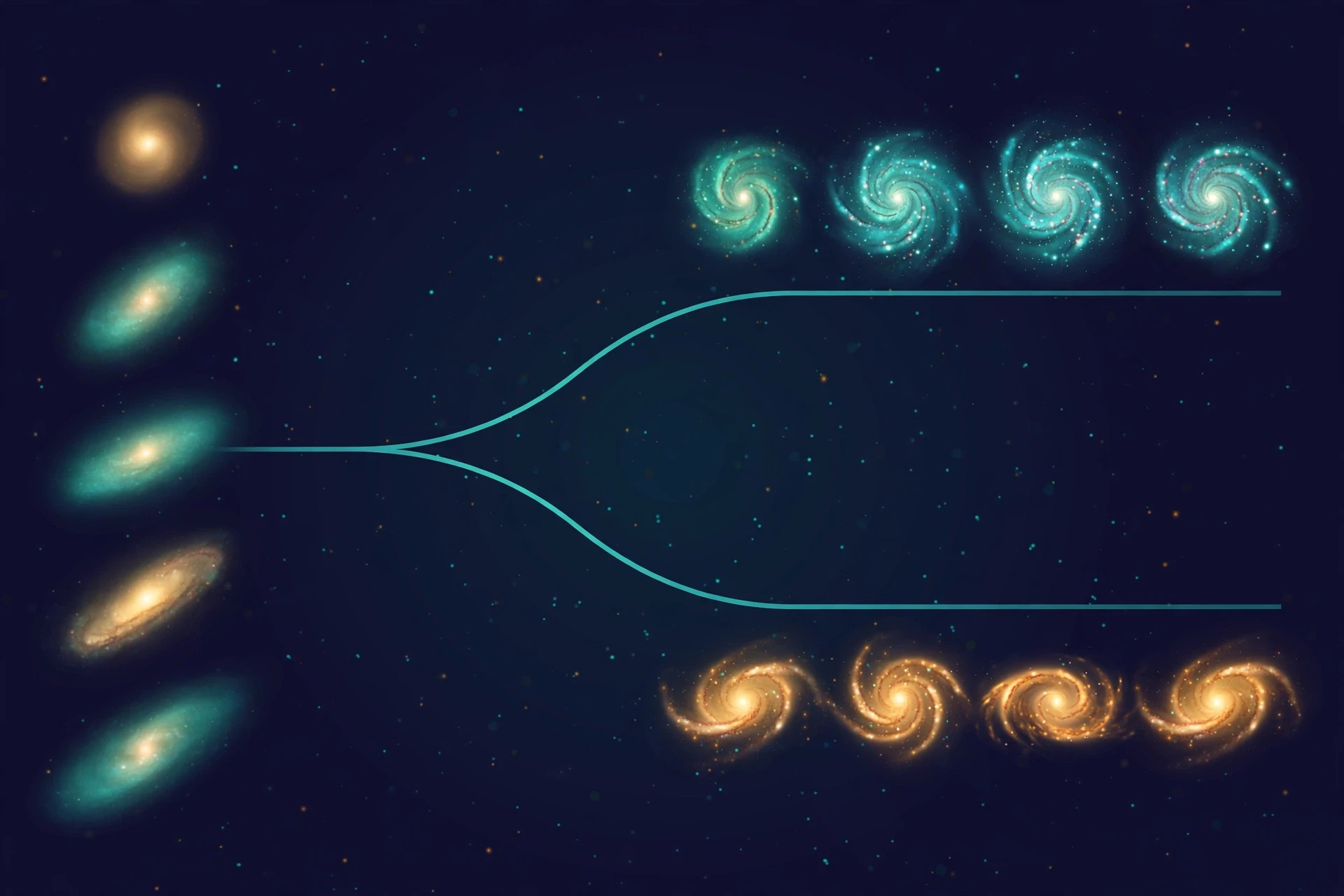
In the 1920s and 1930s, Hubble arranged the galaxies he could see into a diagram shaped like a tuning fork. Elliptical galaxies sit on the handle, and the fork splits into two prongs: ordinary spirals on one side, barred spirals on the other. Irregular galaxies — the ones that fit nowhere else — were left off the fork entirely, as a separate catch-all group. Astronomers now know the diagram is not an evolutionary sequence the way Hubble first suspected: galaxies do not simply march along the fork from elliptical to spiral as they age. But the shapes themselves are real, and they track real differences in gas content, star formation, and history.
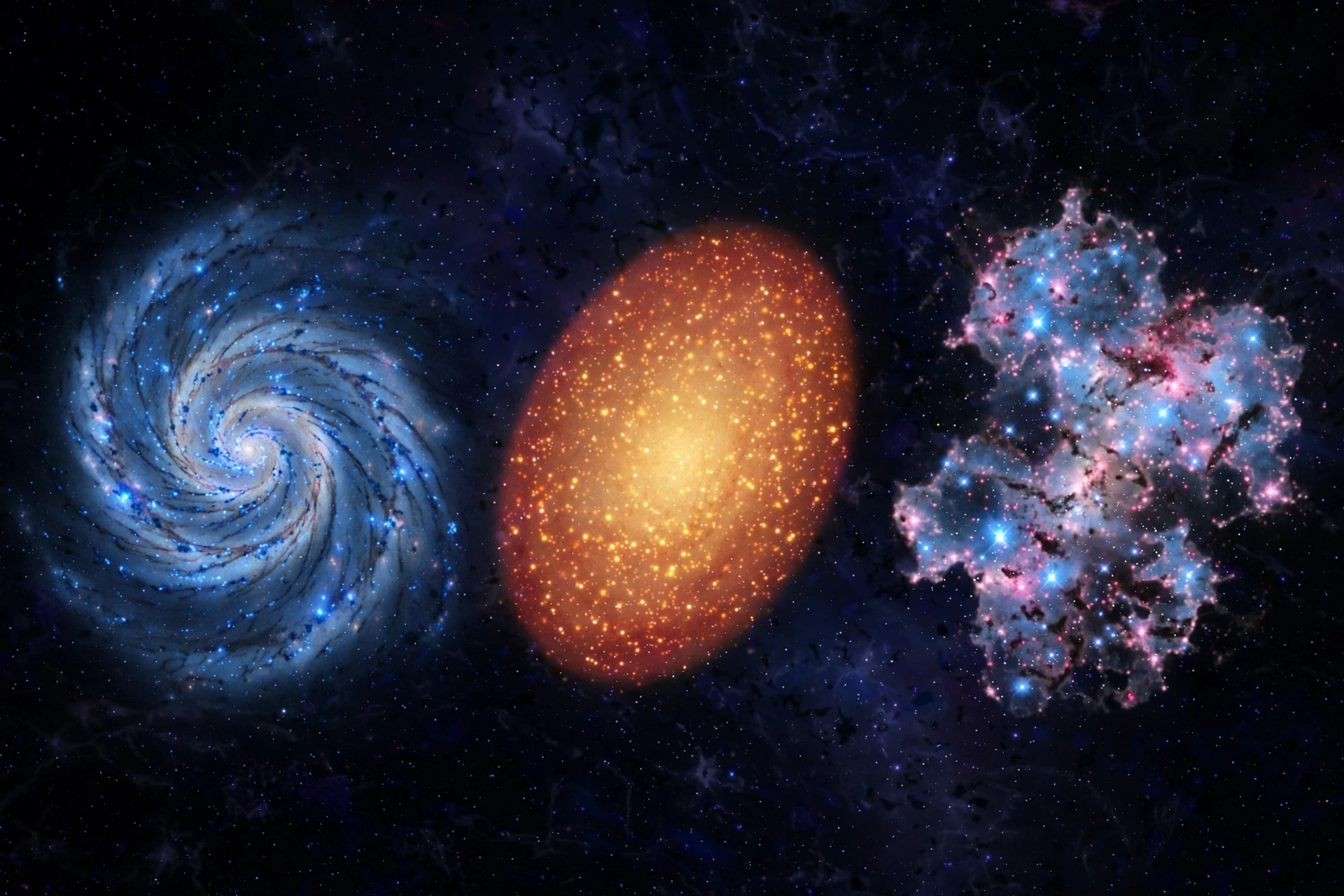
NASA's Hubble galaxy overview puts the modern classification plainly: astronomers generally classify galaxies into three major categories — spiral, like our Milky Way, elliptical, and irregular — with spirals split further into normal and barred types. The table at the end of this section gathers the comparison in one place.
3.1 Spiral galaxies
Spiral galaxies are the showpieces: a flat, rotating disc of stars, gas, and dust, with bright arms winding out from a central bulge. The arms are where the action is. They are packed with young, hot, blue stars and glowing clouds of hydrogen gas, and they are where most new stars are born. The central bulge holds older, yellower stars, packed tightly together. Around the whole disc sits a sparse, roughly spherical halo of old stars and globular clusters.
The arms themselves are a puzzle that took decades to solve. They are not fixed structures, like the arms of a pinwheel made of solid material. If they were, the galaxy's rotation would wind them up into a tight knot within a few hundred million years, and spiral galaxies are billions of years old. The accepted explanation is the density wave theory: the arms are traffic jams. Stars and gas move in and out of the arms as they orbit, slowing down and piling up as they pass through, the way cars bunch up in a slow stretch of motorway. The jam itself stays in place while the traffic flows through it. Gas squeezed in the jam collapses and forms new stars, which is why the arms glow blue with young stars — and why the most massive of those stars, which live fast and die young, are found almost only in the arms.
Spiral galaxies are divided by how tightly their arms are wound and how big their bulge is. Sa galaxies have large bulges and tightly wound, faint arms. Sc galaxies have small bulges and loose, bright, knotty arms. Sb galaxies sit in between. Our Milky Way is an Sb or SBb type — a middle-of-the-road spiral, neither the tightest nor the loosest.
3.2 Barred spiral galaxies
About two-thirds of nearby spiral galaxies, including our own, have a bar: a straight, elongated structure of stars running through the centre, with the spiral arms starting from the ends of the bar rather than from the centre itself. The classic example is NGC 1300, photographed by Hubble, whose bar is so clear that it looks drawn with a ruler. Bars are not decorations. They are engines. A bar funnels gas from the disc inward toward the centre, feeding star formation there and, in many cases, feeding the supermassive black hole at the galaxy's heart. Bars can also be temporary: they form, dissolve, and reform over billions of years as a galaxy's gas supply and gravitational balance change.
For a long time, astronomers were not sure whether the Milky Way had a bar at all, because we see our galaxy edge-on and the bar is hidden behind dust. Infrared surveys, which can see through dust, settled the question: the Milky Way is a barred spiral, with a bar a few thousand light-years long at its centre. That discovery changed how astronomers model our galaxy's centre, its star formation, and the orbits of stars near the Sun.
3.3 Elliptical galaxies
Elliptical galaxies are smooth, featureless ovals of old stars, ranging from nearly spherical to quite flattened, like a rugby ball. They contain very little gas and dust, and almost no new star formation. Their stars are mostly old, red, and yellow, and they swarm in random directions rather than rotating in an orderly disc. The largest galaxies known are giant ellipticals, some 300,000 light-years across, sitting at the centres of galaxy clusters. They are thought to be the end products of many mergers: smaller galaxies falling together and smearing their stars into a smooth, round pile.
Hubble graded ellipticals from E0 (round) to E7 (most flattened), based on how squashed they look. The grading is only apparent shape, though — a round-looking elliptical might be a flattened one seen face-on, and astronomers now sort ellipticals by their internal motions and star populations as well as their outline. The key point for a reader is the contrast with spirals: ellipticals are the retirement homes of the galaxy world. Their star-forming days are largely over, their gas is mostly gone, and their light comes from stars that have been shining, slowly and steadily, for billions of years.
3.4 Irregular and lenticular galaxies
Not every galaxy fits the fork. Irregular galaxies have no defined shape, no clear bulge, and no symmetrical arms. Many are small, gas-rich, and busy forming stars — often because a close encounter or collision with another galaxy has stirred them up. The two best-known examples are the Large and Small Magellanic Clouds, satellite galaxies of the Milky Way, visible from the Southern Hemisphere as faint clouds in the night sky. Irregular galaxies were far more common in the early universe, before spirals and ellipticals had time to settle into their shapes, and the Webb telescope's deep fields are full of them.
Between spirals and ellipticals sit the lenticular galaxies, labelled S0. They have a disc and a bulge like a spiral, but no spiral arms, and almost no star formation. They look like a spiral that has run out of gas — and in many cases, that is probably what they are: a spiral galaxy stripped of its gas by passing through a crowded cluster, or one that simply used its gas up. Lenticulars are a reminder that the tuning fork is a snapshot, not a life story: a galaxy can change type over its life, especially after a merger.
Feature | Spiral galaxies | Elliptical galaxies | Irregular galaxies |
|---|---|---|---|
Shape | Flat disc with spiral arms and a central bulge | Smooth oval, from round to flattened | No regular shape or symmetry |
Gas and dust | Plentiful, concentrated in the arms | Very little | Often gas-rich |
Star formation | Active, mostly in the arms | Almost none | Often intense and patchy |
Typical stars | Mix: young blue stars in arms, old yellow stars in bulge | Mostly old red and yellow stars | Mix, often with many young stars |
Stellar motion | Orderly rotation in the disc | Random swarming in all directions | Disorganised |
Examples | Milky Way, Andromeda, Whirlpool (M51) | M87, Centaurus A (mixed type) | Large and Small Magellanic Clouds |
Read across any row of that table and the story is the same: shape, gas, star formation, and stellar age all move together. A galaxy's appearance is not skin-deep. It is a record of what the galaxy has been doing — forming stars, merging, running out of gas — for billions of years.
4. The Milky Way, Our Home Galaxy
We live in a barred spiral galaxy about 100,000 light-years across, holding roughly 200 to 400 billion stars. The exact star count is uncertain because counting stars through dust, across 100,000 light-years, is genuinely hard — the range reflects real measurement uncertainty, not sloppiness. The Milky Way's disc is about 1,000 light-years thick in most places, thinner than a sheet of paper compared with its width, and it is surrounded by a much larger, sparse halo of old stars, globular clusters, and dark matter stretching hundreds of thousands of light-years out.
The name is old. The Greeks called the pale band across the sky the galaxias kyklos, the milky circle, and the word galaxy comes from gala, milk. For most of history, nobody knew the band was made of stars. Galileo's telescope resolved it in 1610: the milky glow broke up into countless individual points of light. It took another three centuries to work out the shape of the whole thing, and astronomers are still refining the map today.
4.1 Spiral arms and where the Sun sits
The Milky Way's disc is organised into spiral arms, though mapping them from inside is like mapping a forest while standing among the trees. The main arms, working outward from the centre, are called the Norma Arm, the Scutum-Centaurus Arm, the Sagittarius Arm, the Perseus Arm, and the Outer Arm. Our Sun sits in a smaller spur between the Sagittarius and Perseus arms, called the Orion Arm or Orion Spur, about 26,000 light-years from the galactic centre — roughly halfway out.
That halfway position matters more than it might seem. If the Sun sat deep in the crowded centre, the night sky would be brighter and the radiation harsher, and the Solar System would sweep through dense star clouds far more often. If it sat at the far edge, there would be fewer heavy elements around — the elements that planets and living things are made of, forged in earlier generations of stars. Our position is, by the standards of galactic real estate, a quiet suburb: enough heavy elements to build rocky planets, few enough neighbours to keep things stable for billions of years. Whether that is luck or a selection effect — we could only evolve in a place where evolution was possible — is a question astronomers and philosophers still argue about.
The Sun orbits the galactic centre at about 220 kilometres per second, completing one circuit — a galactic year — in roughly 230 million years. The Solar System has made about 20 such circuits since it formed. The last time the Sun was at this point in its orbit, dinosaurs were walking the Earth; the time before that, the first forests were spreading across the land. Galactic time makes human history look like a blink, and it should: the galaxy was old before the Sun was born.
4.2 The crowded centre and the quiet suburbs
The centre of the Milky Way is a dense, bright bulge of old stars, a few thousand light-years across, wrapped around a supermassive black hole. From our position in the disc, the centre lies in the direction of the constellation Sagittarius, and it is hidden from visible-light telescopes by thick lanes of interstellar dust. Infrared and radio telescopes can see through that dust, and what they show is a crowded, energetic region: dense star clusters, glowing gas clouds, magnetic filaments, and stars orbiting something dark and enormously massive at very high speeds.
Away from the centre, the disc thins out into the suburbs where we live. Here the stars are spread more thinly, the gas is cooler, and star formation happens in scattered clouds rather than in the furious bursts seen near the centre. The halo beyond the disc is older still: globular clusters, some of the oldest objects in the universe, orbit in the halo, their stars more than 12 billion years old. Studying those clusters is like digging up the galaxy's childhood photographs.
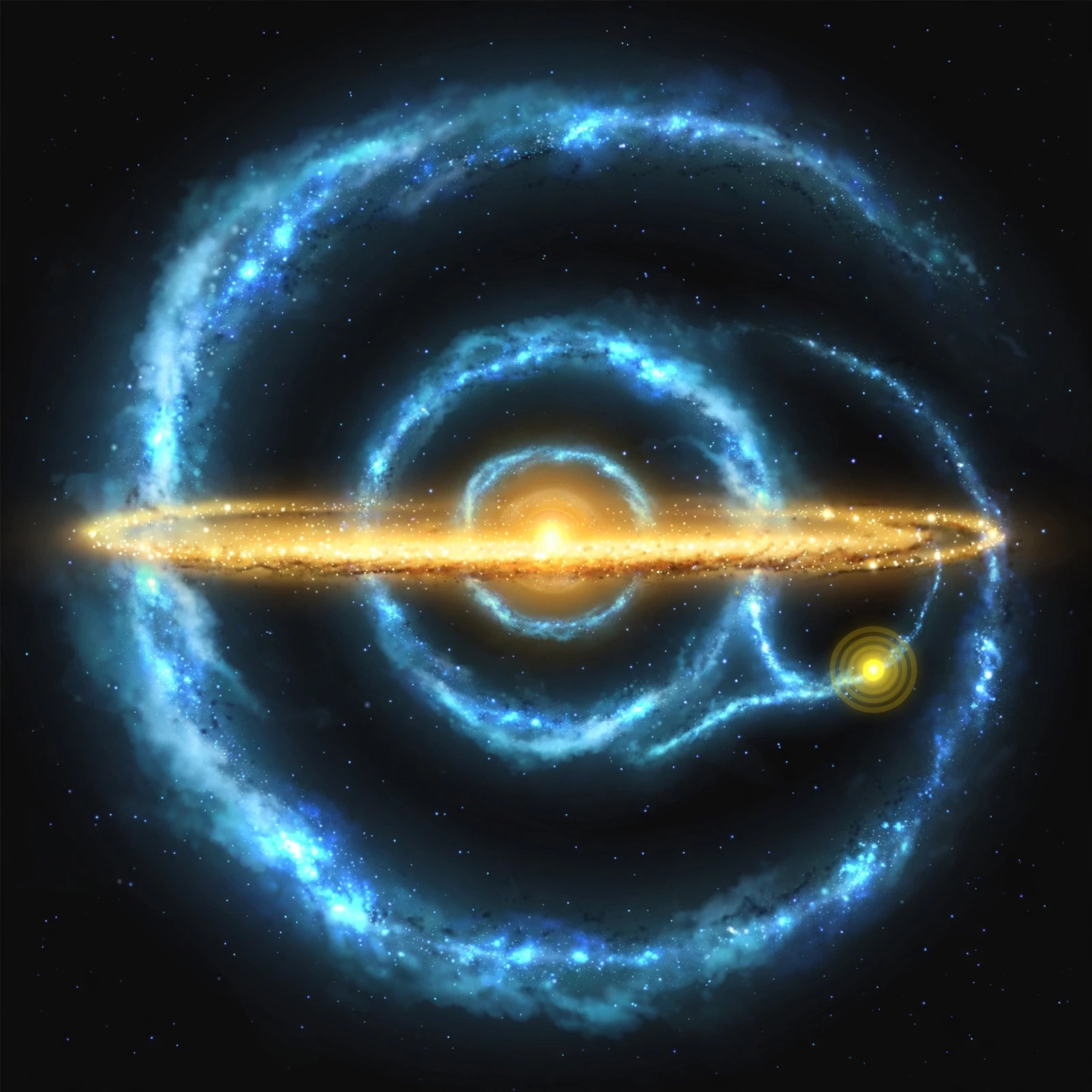
I once watched a planetarium show that flew the audience from Earth outward, past the Sun's neighbours, up out of the disc, and then turned the view around so we could see the Milky Way from above as a barred spiral. The whole room gasped — not at a fact, but at a perspective. That is the view we never get in real life, and it is worth remembering whenever the Milky Way looks like nothing more than a faint band: from the outside, our galaxy would be one of the most beautiful objects in the sky.
4.3 Sagittarius A: the black hole at the heart
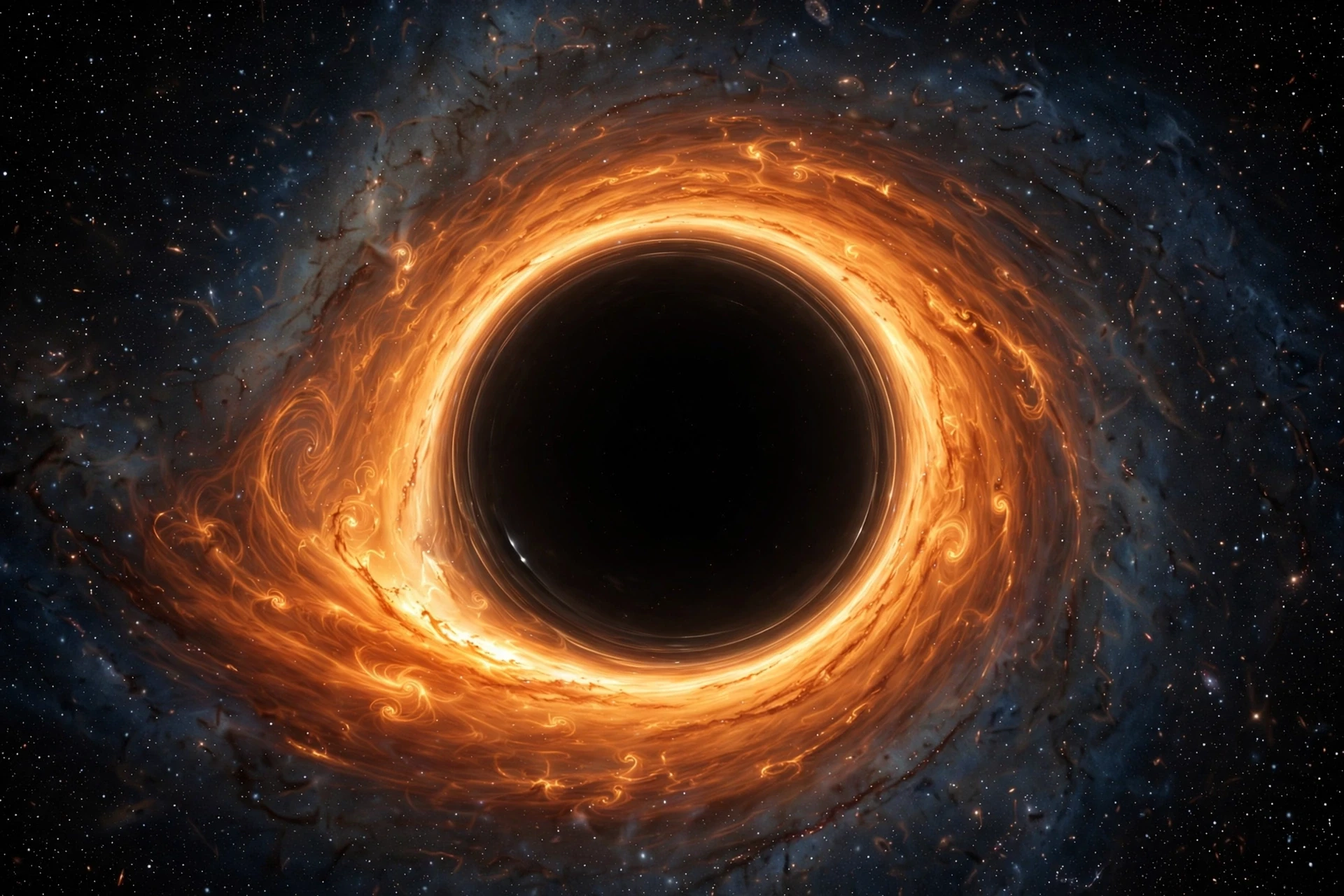
At the exact centre of the Milky Way sits Sagittarius A, a supermassive black hole with a mass of about 4 million Suns. Its presence was proved not by seeing it directly — black holes emit no light — but by watching stars whip around an invisible point. The star S2, for example, orbits the centre in just 16 years, swinging within a few light-hours of Sagittarius A at speeds of thousands of kilometres per second. Only an object of several million solar masses, packed into a tiny volume, can bend a star's path like that.
In May 2022, the Event Horizon Telescope collaboration produced the first direct image of Sagittarius A: a glowing ring of hot gas bent around a dark shadow, the black hole's silhouette. It was only the second black hole ever imaged directly, after the much larger one in the galaxy M87 in 2019. The image confirmed what the stellar orbits had implied, and it gave astronomers a way to test general relativity in the strongest gravity we can observe up close. The European Southern Observatory's release of the image, and the accompanying coverage in Nature, describe a ring about 52 microarcseconds across — an object the size of a donut on the Moon, seen from Earth.
Sagittarius A is quiet right now, by black hole standards. It is not greedily devouring gas, and it does not blaze like the active galactic nuclei described in Section 7. That quiet is probably temporary on cosmic timescales: past outbursts have left giant bubbles of gamma-ray-emitting gas, the Fermi bubbles, ballooning above and below the galactic plane. Our galaxy's centre has flared before, and it will flare again. For the story of black holes in general — how they form, how they grow, and what happens near their event horizons — see our article on black holes.
5. Andromeda and the Local Group
The Milky Way is not alone. It belongs to the Local Group, a small cluster of more than 50 galaxies (the count grows as fainter dwarfs are found) bound together by gravity and spanning about 10 million light-years. The two heavyweights are the Milky Way and Andromeda, with the Triangulum galaxy (M33) a smaller spiral in third place. The rest are mostly dwarfs, many of them satellites orbiting one of the big three. The Large and Small Magellanic Clouds are the Milky Way's brightest satellites, and they are slowly being pulled apart by our galaxy's gravity — in a few billion years, they may be absorbed entirely.
Andromeda, also called M31, is the nearest large galaxy to us: about 2.5 million light-years away, roughly 220,000 light-years across, and holding perhaps a trillion stars — more than the Milky Way. On a dark night, away from city lights, you can see it with the naked eye as a faint smudge in the constellation Andromeda. It is the most distant object most people will ever see without a telescope, and the photons hitting your eye left Andromeda when early humans were first learning to make stone tools. Through a telescope, its bright core and sweeping disc come into view; through the Hubble Space Telescope, its spiral arms resolve into individual stars, star clusters, and dust lanes, much like our own galaxy seen from outside.
5.1 A collision in slow motion
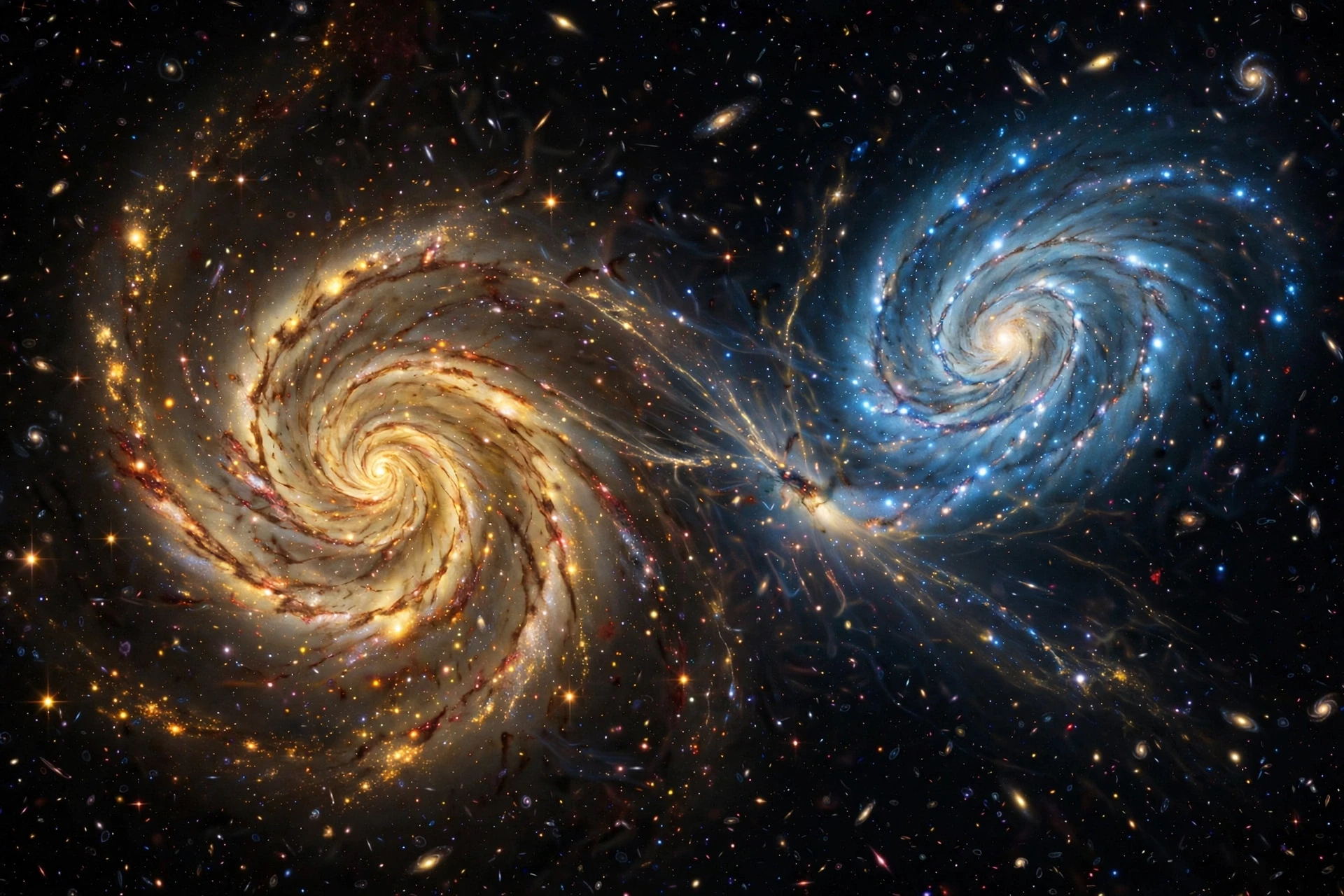
Andromeda is moving toward us at about 110 kilometres per second. That sounds fast — it is roughly 400,000 kilometres per hour — but at a distance of 2.5 million light-years, it will take billions of years to arrive. The classic prediction, based on Hubble Space Telescope measurements of Andromeda's sideways motion published in 2012, was a head-on encounter in about 4 billion years, with the two galaxies merging into a single elliptical galaxy roughly 2 billion years after that. Simulations of the encounter show the discs swinging past each other, throwing out long tidal tails of stars, and then falling back together, their spiral shapes destroyed and their stars mixed into a smooth, round swarm. The merged galaxy has been nicknamed Milkomeda.
Here is where honesty matters more than a tidy story. That 4-billion-year date was the best prediction available in 2012, but it is no longer certain. A 2025 study using data from Hubble and the Gaia space telescope, folding in the measurement uncertainties properly, found only about a 50-50 chance that the two galaxies will collide and merge within the next 10 billion years — with only a small chance of the head-on encounter in 4 to 5 billion years. The difference comes from Andromeda's sideways motion: a tiny sideways drift, hard to measure at 2.5 million light-years, decides whether the galaxies hit head-on or slide past each other. The forecast is sensitive to measurements that are still being refined, and later work may shift the odds again. What is not in doubt is that Andromeda is approaching, that the two galaxies are gravitationally bound, and that some kind of encounter — direct merger or close passage followed by later merging — is the most likely long-term outcome on timescales of billions of years.
5.2 A merger, not a smash
When people hear "galactic collision," they picture a car crash in space: stars smashing into each other, explosions everywhere. The reality is quieter and stranger. Stars are so small compared with the distances between them that, when two galaxies pass through each other, almost no stars collide at all. What collides is the gas. Clouds of gas slam into each other, compress, and collapse, triggering furious bursts of star formation — starburst galaxies, glowing blue with newborn stars. The galaxies' shapes are wrecked by tides, their discs stretched into tails and bridges, and their dark matter halos merge into one. The stars simply keep orbiting, rearranged, in a new and larger galaxy.
I find that image oddly reassuring. The most violent-sounding event in our galaxy's future is, for any individual star, a gentle affair. The Sun will likely be flung into a new orbit, perhaps farther from the new galactic centre, but it will not be destroyed, and neither will the Earth — at least, not by the merger. By the time the merger happens, the Sun will be near the end of its life anyway, swelling into a red giant. The merger is a story about the galaxy's shape, not about the survival of its stars.
6. How Galaxies Form and Grow
Galaxies were not born fully formed. They grew, over 13.8 billion years, from tiny ripples in the early universe into the grand structures we see today. The story has three main ingredients: dark matter, gas, and time — plus a healthy dose of collisions.
6.1 Dark matter halos: the scaffolding first
In the early universe, matter was spread almost evenly, with tiny variations in density — ripples left over from the Big Bang. Where matter was slightly denser, gravity pulled in more matter, and the dense patches grew. Dark matter, which does not interact with light and does not feel the pressure that pushes ordinary gas apart, could collapse first and fastest. It formed halos: roughly spherical clouds of dark matter, growing by pulling in more dark matter and by merging with other halos.
Ordinary matter — hydrogen and helium gas — fell into those halos, drawn by their gravity. As the gas fell in, it heated up, then cooled by radiating light, then sank toward the centre of the halo and flattened into a spinning disc. That disc is where stars formed. A galaxy, in this picture, is a dark matter halo that managed to collect gas, cool it, and turn some of it into stars. Halos that collected too little gas, or collected it too late, stayed dark, or made only a few stars: the dwarf galaxies. Halos that collected a lot of gas early made big galaxies fast. The link to the beginning of the universe is direct: the ripples that seeded galaxies were laid down in the first fraction of a second after the Big Bang, and our article on the Big Bang traces that story from the start.
6.2 Mergers: growth by eating neighbours
Once halos existed, they kept merging. Small halos fell into bigger ones, and their galaxies merged too. Mergers come in two flavours. Minor mergers — a big galaxy swallowing a small dwarf — are common and relatively gentle: the small galaxy is torn apart by tides and its stars are scattered into the big galaxy's halo, while its gas may trigger a modest burst of star formation. Major mergers — two galaxies of similar size colliding — are rarer and far more dramatic: they destroy spiral discs, trigger starbursts, and often leave behind an elliptical galaxy.
The Milky Way has done plenty of eating. Its halo is full of stellar streams — long ribbons of stars that are the shredded remains of dwarf galaxies it swallowed. The largest known recent meal is the Gaia-Enceladus galaxy, a dwarf about a quarter of the Milky Way's mass, absorbed roughly 10 billion years ago. Its stars are still recognisable today, moving through our halo on orbits that betray their foreign origin. Astronomers found them by sorting stars by their motion and chemistry, the way a detective sorts fingerprints. The Milky Way is still eating: the Sagittarius dwarf galaxy is currently being torn apart as it orbits through our disc, leaving a stream of stars wrapped around the galaxy.
6.3 Star formation, and why it stops
A galaxy forms stars as long as it has cold gas to make them from. Gas clouds collapse under gravity, heat up, and ignite into stars — the process described in our article on the life cycle of stars. But star formation does not run forever. Massive stars live fast and die as supernovae, and their explosions blast gas out of the galaxy or heat it so much that it cannot collapse again. This is stellar feedback: stars regulate their own birth rate. At the centre, the supermassive black hole can do the same thing on a larger scale, as Section 7 explains.
When a galaxy runs out of cold gas — because it used it up, because feedback blew it away, or because it was stripped away by passing through a crowded cluster — star formation stops, and the galaxy quenches. Its blue, short-lived stars die off, and only the long-lived red and yellow stars remain. That is why ellipticals look red: they are quenched galaxies, their star-forming days behind them. Spirals are still forming stars because they still have gas, much of it replenished by fresh gas falling in from the space between galaxies. The balance between gas coming in, stars forming, and gas being blown out decides a galaxy's colour, shape, and future.
7. Active Galaxies and Quasars: When Galactic Cores Blaze
Most galaxies are quiet. Their centres glow gently with the combined light of old stars, and nothing dramatic happens for millions of years at a time. But about one in ten galaxies is active: its core outshines the rest of the galaxy, sometimes by a factor of thousands, and pours out energy across the whole electromagnetic spectrum, from radio waves to X-rays. The engine behind that blaze is the supermassive black hole at the galaxy's centre, feeding on gas.
When gas falls toward a supermassive black hole, it does not drop straight in. It spirals inward, forming a hot, bright accretion disc, and friction in the disc heats the gas to millions of degrees. That heat is what we see: an active galactic nucleus, or AGN. In the most extreme cases, the black hole's feeding launches jets of particles at nearly the speed of light, shooting out in opposite directions for hundreds of thousands of light-years and lighting up the space around the galaxy in radio waves. In other cases, the disc itself is so bright that it outshines the entire galaxy around it.
Quasars are the brightest kind of active galaxy. The word is short for "quasi-stellar radio source": when they were first found in the 1960s, they looked like ordinary stars in photographs, but their spectra showed they were enormously distant — and therefore enormously luminous. A quasar can be brighter than a thousand Milky Ways combined, powered by a black hole of a billion solar masses or more, swallowing gas at a furious rate. Quasars were far more common in the young universe, when gas was plentiful and black holes were growing fast. Today, most supermassive black holes are quiet, including our own Sagittarius A, because the gas around them has thinned out or been blown away.
A quasar is not a different kind of object from a galaxy. It is a galaxy with its engine running at full throttle. The same black hole that sits quietly in the Milky Way today would blaze like a quasar if you dropped a fresh supply of gas onto it.
Astronomers now think the black hole and the galaxy grow together, linked by feedback. Gas falling in feeds the black hole and makes stars; the black hole's jets and radiation heat and push gas out, slowing star formation; and the balance between feeding and feedback sets the pace for both. The evidence is a tight relationship between the mass of a galaxy's central black hole and the mass of its bulge of stars: bigger bulges host bigger black holes, in a proportion that holds across many orders of magnitude. That relationship is hard to explain unless the black hole and the galaxy have been shaping each other for billions of years. Active galaxies, in other words, are not freaks. They are a phase — a hungry phase — that most big galaxies probably go through, sometimes more than once.
8. Galaxy Clusters and the Cosmic Web
Galaxies are social. They gather into groups and clusters, and those clusters lace together into the largest structure in the universe: the cosmic web.
A galaxy group is a small gathering, a few dozen members bound by gravity, like the Local Group. A galaxy cluster is bigger: hundreds or thousands of galaxies, plus enormous amounts of hot gas and dark matter, spanning millions of light-years. The Virgo Cluster, the nearest large cluster, holds more than a thousand galaxies and sits about 54 million light-years away. The Coma Cluster is larger still. In a cluster, member systems move at thousands of kilometres per second through a thin, million-degree gas called the intracluster medium, which glows in X-rays and outweighs all the stars in the cluster's galaxies combined.
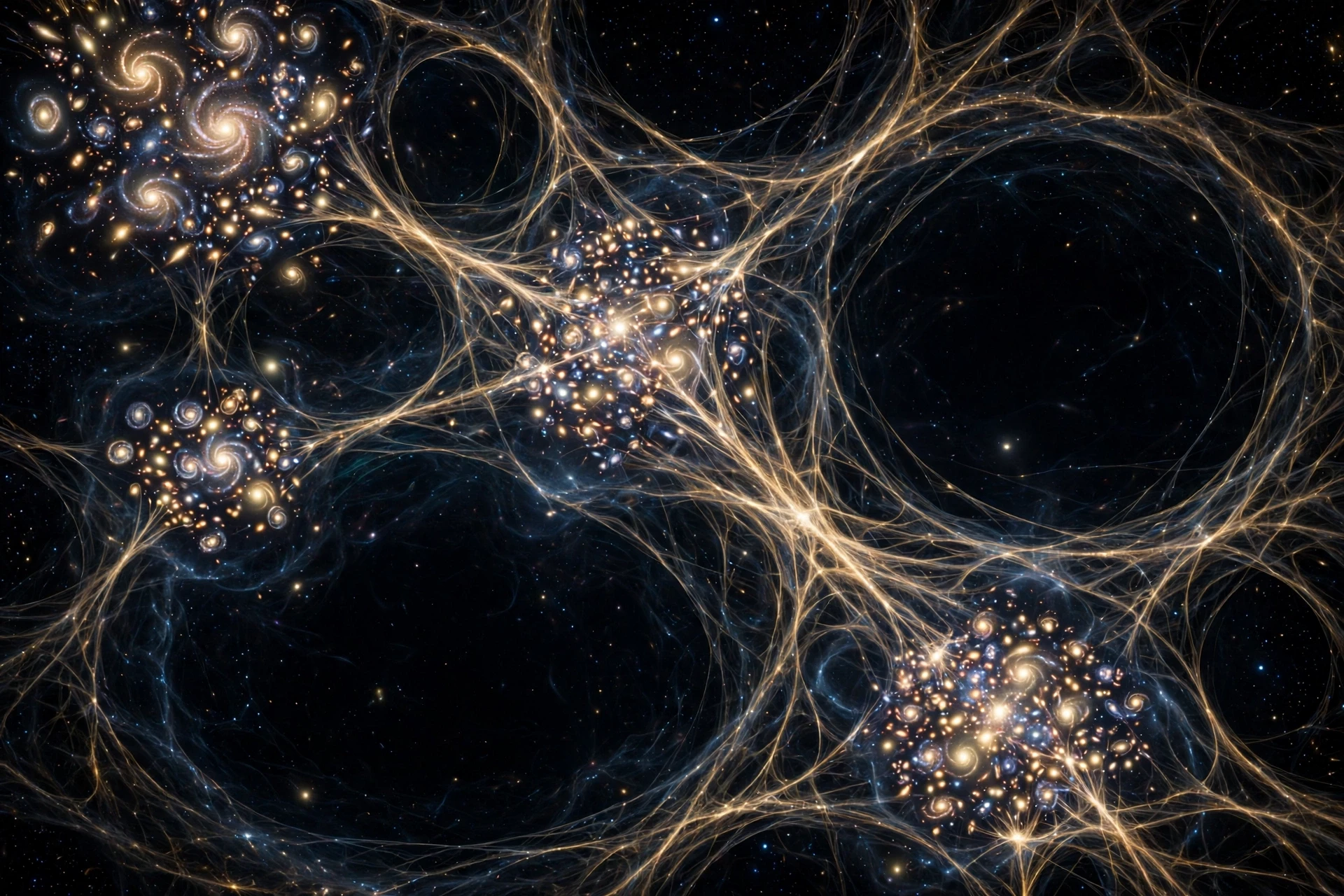
Clusters are not scattered at random. They sit at the knots of the cosmic web — a vast network of filaments of dark matter and gas, stretching across billions of light-years, with enormous empty voids between them. The web formed the same way galaxies did, from the tiny density ripples of the early universe, amplified by gravity over billions of years. Star systems form along the filaments and flow toward the knots, where clusters grow. Mapping the web is one of the great projects of modern astronomy, and surveys that measure the positions and distances of millions of star systems have traced it in detail: a foam-like structure, with galaxies strung along the walls of bubbles and almost nothing in the middle.
Our place in the web is modest. The Local Group sits on the edge of the Virgo Cluster's gravitational reach, in a filament that is itself part of a larger structure called the Laniakea Supercluster, a collection of about 100,000 galaxies spanning 500 million light-years. Laniakea, in turn, is one supercluster among many. The web has no centre and no edge that we can see — every knot is someone's neighbourhood, and every void is someone's empty sky.
9. How Many Galaxies Are There — and Webb's Surprises
How many galaxies are in the observable universe? The honest answer is that nobody knows exactly, and the estimate has changed as telescopes have improved. The Hubble Ultra Deep Field, a patch of sky about the size of a grain of sand held at arm's length, revealed more than 10,000 galaxies in a single deep exposure. Extrapolating from deep fields like that, astronomers long quoted a figure of about 200 billion star systems in the observable universe. A 2016 study that counted faint galaxies in Hubble images and corrected for the ones too faint to see pushed the estimate up to around 2 trillion. More recent work, with better data, has pulled it back down: the current best estimates sit in the range of a few hundred billion observable star systems. The uncertainty is real, and it comes from the faintest, smallest, most distant objects — the ones at the edge of what any telescope can see.
What is certain is that the number is enormous, and that the observable universe is only the part whose light has had time to reach us. Beyond it, the universe may go on much farther, with galaxies we will never see. The count is a reminder of scale: the Milky Way's few hundred billion stars are themselves one galaxy among hundreds of billions, each with its own hundreds of billions of stars. The total number of stars in the observable universe is somewhere around 10 to the power of 24 — a one followed by 24 zeroes — a number so large that comparing it with grains of sand on Earth, often quoted as about 10 to the power of 18, makes the beaches look empty by comparison.
Then the James Webb Space Telescope arrived, and the early universe turned out to be stranger than expected. Webb's infrared eyes can see the light of the first galaxies, stretched by the expansion of the universe into infrared wavelengths that Hubble could barely reach. Within its first years, Webb found galaxies that were unexpectedly bright and massive only a few hundred million years after the Big Bang — including JADES-GS-z14-0, confirmed at a redshift of 14.32, seen as it was about 290 million years after the Big Bang, and already more than 1,600 light-years across and shining brightly. The University of California's report on the discovery describes it as the most distinctive evidence yet for the rapid formation of large, massive galaxies in the early universe.
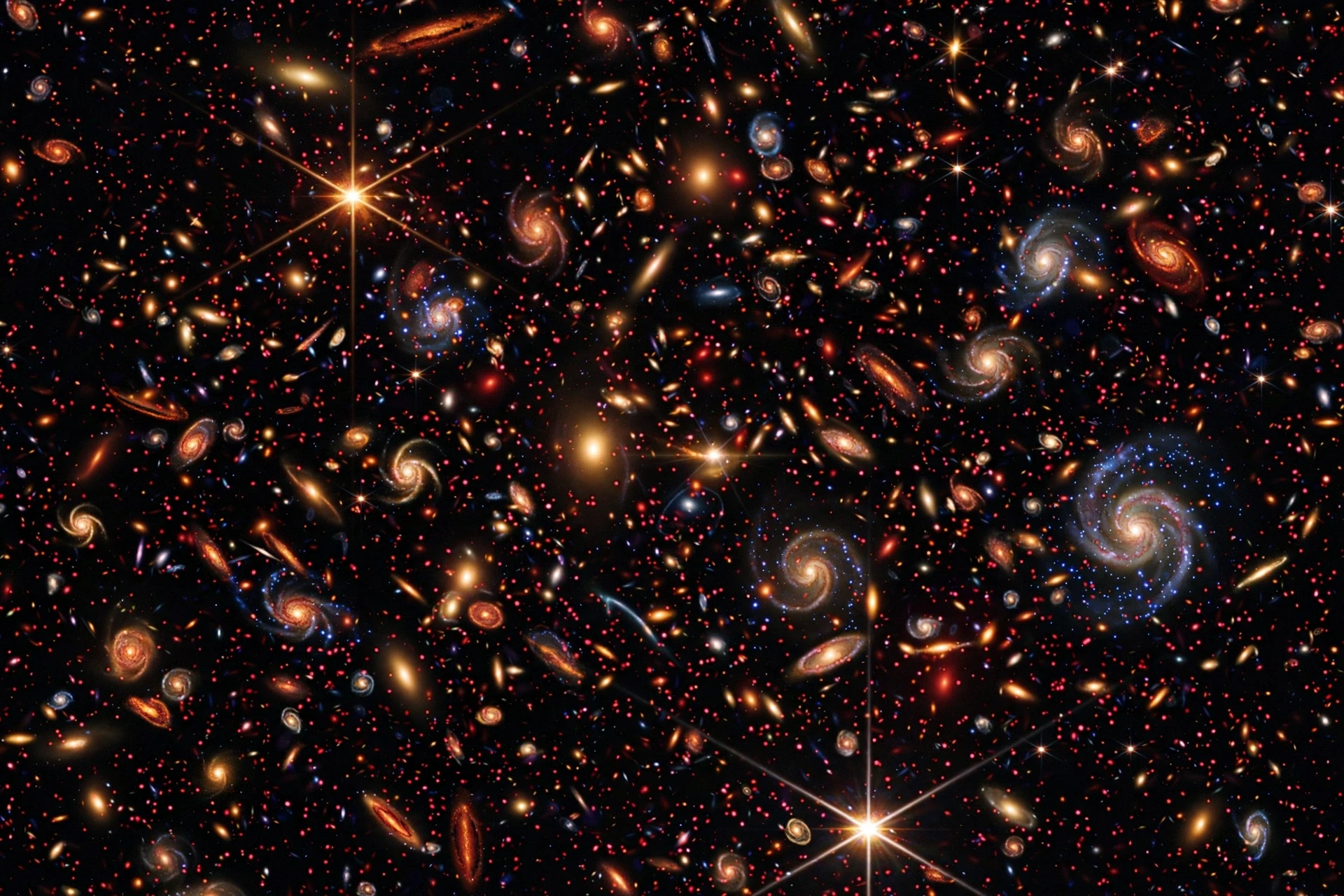
These early galaxies are a genuine puzzle. Standard models of galaxy formation said that, so soon after the Big Bang, there should not have been enough time for dark matter halos to grow big enough, or for gas to cool and form so many stars so quickly. The early Webb results suggested some galaxies were converting nearly all of their available gas into stars — far more efficiently than galaxies do today. Later work has softened the puzzle: some of the earliest mass estimates were inflated by light from active black holes, and some of the brightness comes from bursts of star formation that are bright precisely because they are brief. But the core surprise stands: galaxies got going earlier, and grew faster, than the models predicted. Astronomers are now revising those models — adding faster star formation in dense early gas, earlier black hole growth, and different feedback — and the argument is still running. That is how science is supposed to work: a new instrument opens a new window, the universe refuses to match the textbook, and the textbook gets rewritten.
10. How We Measure Galactic Distances
Everything in this article — the size of the Milky Way, the distance to Andromeda, the age of the earliest galaxies — depends on measuring distances across space, and distance is the hardest thing to measure in astronomy. You cannot stretch a tape measure to a galaxy. Instead, astronomers build a distance ladder, with each rung calibrated by the one below it.
The first rung is geometry. For nearby stars, astronomers measure parallax: the tiny shift in a star's apparent position as the Earth moves around the Sun. The Gaia space telescope has measured parallaxes for nearly two billion stars, giving distances across much of the Milky Way. The second rung is standard candles: objects whose true brightness is known, so that how faint they look tells you how far away they are. Cepheid variable stars, the tool Hubble used for Andromeda, are one standard candle. Type Ia supernovae — exploding white dwarf stars that all reach nearly the same peak brightness — are another, and they reach far enough to measure galaxies billions of light-years away. The third rung is redshift: the expansion of the universe stretches the light of distant galaxies toward longer, redder wavelengths, and the amount of stretching tells you how far away the galaxy is and how long its light has been travelling. A galaxy at redshift 14, like JADES-GS-z14-0, is seen as it was when the universe was only about 2 percent of its current age.
Each rung has its own errors, and the errors add up. That is why the distance to Andromeda is quoted as about 2.5 million light-years rather than an exact figure, and why the Hubble constant — the current expansion rate of the universe — is still argued about: different methods give answers that differ by a few percent, and nobody yet knows whether the difference is a measurement error or new physics. The distance ladder is also why the 2025 revision of the Andromeda collision forecast, discussed in Section 5, happened at all: better measurements of tiny sideways motions changed a prediction about billions of years from now. In astronomy, small angles have large consequences.
Parallax: geometry — the shift of a nearby star against distant background stars as Earth orbits the Sun. Works out to a few thousand light-years with ground telescopes, much farther with Gaia.
Cepheid variables: pulsating stars whose period reveals their true brightness. Hubble's tool for proving Andromeda is a separate galaxy.
Type Ia supernovae: exploding white dwarfs with a known peak brightness, visible across billions of light-years.
Redshift: the stretching of light by the expansion of the universe; the higher the redshift, the farther and earlier the galaxy.
The Tully-Fisher relation: in spiral galaxies, faster rotation means greater true brightness — a useful check on distances to spirals.
11. Common Misconceptions About Galaxies
Most people carry a few wrong ideas about galaxies, and some of them are surprisingly sticky. Here are the ones I hear most often, corrected in plain language.
"The Milky Way is the whole universe." This was the mainstream view among astronomers until 1924. Hubble's Cepheids in Andromeda proved otherwise: Andromeda is a separate galaxy, 2.5 million light-years away, and there are hundreds of billions more like it. The Milky Way is our neighbourhood, not the whole city.
"Galaxies are solid objects, like giant balls of stars." A galaxy is a swarm, not a solid. Its stars are separated by light-years of near-empty space, and the whole structure is held together by gravity, not by any physical connection. That is why galaxies can pass through each other with almost no stars colliding.
"The Big Bang was an explosion at the centre of the universe, and galaxies flew outward from it." There was no centre and no pre-existing space to explode into. Space itself expanded, carrying galaxies apart the way raisins in rising dough move apart without any raisin being the centre. Our article on the Big Bang explains this in detail, and it is worth reading if the dough analogy feels too neat — the reality is stranger than any analogy.
"When the Milky Way and Andromeda collide, stars will smash into each other." As Section 5 explains, they almost certainly will not. The collision is a collision of gas clouds and gravitational fields. The stars will pass through each other and settle into new orbits. The danger to any individual star is negligible; the change is to the galaxies' shapes.
"Black holes swallow their galaxies." They do not. A supermassive black hole is massive, but it is a tiny fraction of its galaxy's mass — Sagittarius A is about 4 million solar masses in a galaxy of hundreds of billions of stars — and its gravity dominates only the region very close to it. Stars in the outer galaxy orbit the galaxy's combined mass, not the black hole. Black holes shape their galaxies through feedback, not by eating them.
"We have photographed the whole Milky Way." We have not, and we cannot, from inside it. Every "photograph" of the Milky Way as a spiral is an artist's impression or a map built from measurements, like Figure 4 in this article. What we can photograph is the band of the Milky Way across our sky, and other galaxies that look like ours from the outside.
"All galaxies are spiral-shaped." Spirals are the most photogenic, so they dominate posters and textbooks, but ellipticals are the most common type of large galaxy in the nearby universe, and irregulars and dwarfs outnumber them all. The universe's star systems are far more varied than the famous photographs suggest.
What Galaxies Leave Us With
A galaxy is a place where the universe does its long, slow work: gas falls in, stars ignite, live, and die, black holes feed and sleep, and smaller galaxies are absorbed into larger ones. Our own galaxy has been doing that work for more than 13 billion years, and the Sun and Earth are late arrivals in its story — products of earlier generations of stars that lived and died in the same spiral arms we now orbit through.
The scale is humbling, but it is not distant. The band of the Milky Way overhead on a dark night is not a picture of somewhere else. It is a picture of home, seen from the inside, and every star in it is a sun, many of them with planets of their own. The faint smudge of Andromeda is a second home, a trillion stars away, slowly falling toward us. And the deepest images of the sky, the ones with ten thousand galaxies in a patch the size of a grain of sand, are a reminder that our home is one among hundreds of billions — each one a story of gravity, gas, and time, still being written.
If this article has done its job, the next clear night will feel different. Look up, find the band of the Milky Way if you can get away from city lights, and remember what you are looking at: not a cloud, not a backdrop, but the edge-on view of a barred spiral galaxy 100,000 light-years across, holding a few hundred billion stars — and one of them is ours.
Frequently Asked Questions
What is a galaxy?
A galaxy is a huge system of stars, gas, dust, and dark matter held together by gravity. They range from dwarf systems with a few million stars to giant ellipticals with trillions, and the Milky Way, with roughly 200 to 400 billion stars, sits in the middle of that range.
What are the types of galaxies?
The main types are spiral, barred spiral, elliptical, and irregular, plus lenticular systems in between spirals and ellipticals. Spirals have flat discs with arms and active star formation; ellipticals are smooth ovals of old stars with almost no new star formation; irregulars have no regular shape, often because a collision has disturbed them.
Is the Milky Way a spiral galaxy?
Yes — the Milky Way is a barred spiral galaxy, about 100,000 light-years across, with a bar of stars across its centre and spiral arms winding outward. The Sun sits in the Orion Spur, about 26,000 light-years from the centre, and orbits the centre once every roughly 230 million years.
How many stars are in the Milky Way?
Roughly 200 to 400 billion stars. The range reflects real measurement uncertainty: counting stars through dust across 100,000 light-years is hard, and different methods give different answers within that range.
Will the Milky Way collide with Andromeda?
Andromeda is moving toward the Milky Way, and the classic prediction from 2012 was a head-on encounter in about 4 billion years, merging into one elliptical galaxy about 2 billion years later. A 2025 study using Hubble and Gaia data found only about a 50-50 chance of a merger within the next 10 billion years, so the timing is now uncertain — but some form of encounter is still the most likely long-term outcome, and almost no individual stars would collide.
What is at the centre of the Milky Way?
A supermassive black hole called Sagittarius A, with about 4 million times the mass of the Sun. It was directly imaged for the first time in 2022 by the Event Horizon Telescope, showing a glowing ring of hot gas around a dark shadow. It is quiet at present, feeding only slowly.
How many star systems are in the universe?
There are hundreds of billions of star systems in the observable universe, by current estimates — the exact number is uncertain because the faintest, most distant ones are at the edge of what telescopes can detect. The James Webb Space Telescope keeps pushing that edge farther back, finding bright, massive galaxies only a few hundred million years after the Big Bang.
Sources
NASA Science, "Hubble's Galaxies" — spiral, elliptical and irregular types, the Milky Way as a barred spiral, and the Hubble Ultra Deep Field: https://science.nasa.gov/mission/hubble/science/universe-uncovered/hubble-galaxies/
NASA Science, "Galaxies" overview — what galaxies are and how they form and evolve: https://science.nasa.gov/universe/galaxies/
NASA Science, "NASA's Hubble Shows Milky Way is Destined for Head-on Collision with Andromeda Galaxy" — the 2012 prediction of an encounter in about 4 billion years: https://science.nasa.gov/missions/hubble/nasas-hubble-shows-milky-way-is-destined-for-head-on-collision-with-andromeda-galaxy/
NASA Science, "Apocalypse When? Hubble Casts Doubt on Certainty of Galactic Collision" — the 2025 Hubble and Gaia study finding about a 50-50 chance of a merger within 10 billion years: https://science.nasa.gov/missions/hubble/apocalypse-when-hubble-casts-doubt-on-certainty-of-galactic-collision/
OpenStax Astronomy 2e, "Types of Galaxies" — spiral, elliptical and irregular classification: https://openstax.org/books/astronomy-2e/pages/26-2-types-of-galaxies
University of California, "Earliest, most distant galaxy discovered with James Webb Space Telescope" — JADES-GS-z14-0, about 290 million years after the Big Bang: https://www.universityofcalifornia.edu/news/earliest-most-distant-galaxy-discovered-james-webb-space-telescope
Nature, "Black hole at the centre of our Galaxy imaged for the first time" — Sagittarius A imaged by the Event Horizon Telescope, 12 May 2022: https://www.nature.com/articles/d41586-022-01320-y
European Southern Observatory, "Astronomers reveal first image of the black hole at the heart of our galaxy" — the Sagittarius A* image release: https://www.eso.org/public/news/eso2210/
ESA/Hubble — Hubble Space Telescope galaxy images and science: https://esahubble.org/