

Introduction
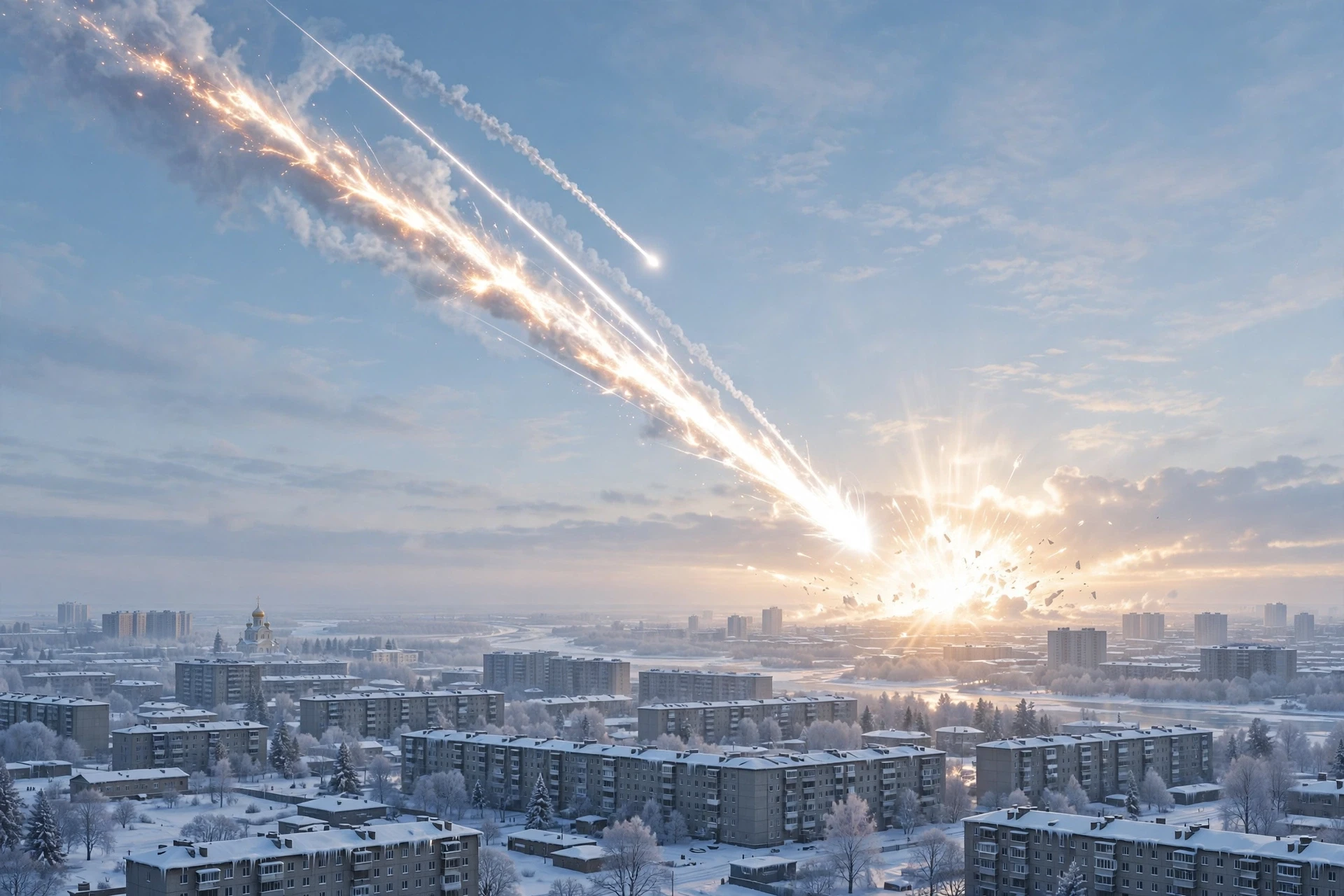
On the morning of 15 February 2013, the people of Chelyabinsk, a city in Russia, were driving to work and taking their children to school when the sky split open. It was a fragment of the ancient population of comets and asteroids that shares the solar system with us, arriving without warning. A rock about 20 metres across — roughly the size of a house — slammed into the atmosphere at around 60,000 kilometres per hour. Nobody had seen it coming. There had been no warning, no siren, no headline the night before. The rock burst apart about 30 kilometres above the ground, and the explosion released energy equal to roughly 500,000 tons of TNT. The flash was brighter than the Sun. Windows shattered across the city, car alarms screamed in empty streets, and about 1,500 people were hurt, mostly by flying glass. I remember watching the dashcam footage later that day, again and again, unable to look away. A streak of white fire, a silent bloom of light, and then the shockwave arriving seconds later, shaking the camera. It looked like something from a film. It was not a film. It was a Tuesday morning.
That rock was an asteroid, a small one, and it had been travelling through space for billions of years before its final few seconds above a Russian city. It is the reason this article exists, and the reason the question in the title matters. Comets and asteroids are the leftover building blocks of our solar system — ancient, battered, and mostly harmless. Yet every so often, one of them crosses Earth's path. Most burn up as shooting stars. A few do not. And one, 66 million years ago, ended the reign of the dinosaurs.
This guide explains comets and asteroids in full: what they are made of, where they live, how they differ, the famous ones humans have visited with spacecraft, how often impacts really happen, and what scientists are doing to make sure the next big one does not catch us by surprise. We will meet a comet that returns every 76 years like clockwork, a spacecraft that landed on a speeding snowball, a mission that deliberately crashed into an asteroid to nudge it off course, and the quiet teams of astronomers who watch the sky every night so that Chelyabinsk never happens again on a larger scale.
1. The Morning the Sky Exploded
1.1 Chelyabinsk, 15 February 2013
The Chelyabinsk meteor, as it came to be called, was not supposed to be dangerous. At about 20 metres across and weighing roughly 12,000 tons, it was far too small to reach the ground in one piece. What made it frightening was its speed and its silence. It approached from the direction of the Sun, which meant telescopes on Earth were effectively blind to it — you cannot spot a dark rock against the glare of the Sun. It entered the atmosphere at a shallow angle, heated up until the air around it glowed white-hot, and then broke apart under the enormous pressure. The explosion happened high in the sky, and that height is what saved the city. Had the same rock struck the ground, it would have dug a crater and flattened buildings. Instead, Chelyabinsk got a shockwave, a light show, and a lesson.
I spent an evening after the event reading the first scientific papers that came out of it, and one detail stayed with me. Researchers reconstructed the rock's path from the dashcam videos — dozens of ordinary drivers, filming their commutes, accidentally became the instruments of a scientific investigation. Their footage let scientists work out the rock's speed, its angle, and its size within days. It was citizen science by accident, and it worked beautifully. The rock itself turned out to be an ordinary chondrite, a stony meteorite of the kind that falls to Earth regularly, just bigger than most. Nothing exotic. Nothing alien. Just an old stone from the asteroid belt that happened to be in the wrong place at the wrong time.
1.2 Halley's Comet and the clockwork visitor
If Chelyabinsk was a warning, Halley's Comet is a promise. It is the most famous comet in history, and it returns to the inner solar system every 74 to 79 years, regular as a train timetable. It was last here in 1986, when I was still young enough to think that staying up late to look at the sky was the best kind of adventure, and it will be back in 2061. People have watched it for more than two thousand years. It appears in the Bayeux Embroidery, embroidered to tell the story of the Norman Conquest of England in 1066, where it hangs in the sky above a worried King Harold. It was recorded by Chinese astronomers in 240 BC. For most of human history, nobody knew what it was — a sword in the sky, an omen, a warning of disaster. Then, in 1705, the English astronomer Edmond Halley did the maths. He realised that comets seen in 1531, 1607, and 1682 were the same object returning on a long, stretched-out orbit, and he predicted it would come back in 1758. He died before it did. It came back on schedule.
Halley's Comet matters because it taught us that comets and asteroids are not random omens. They follow orbits. They obey gravity. They can be predicted, tracked, and understood. That shift — from fear to physics — is the story of this whole subject. Everything in this article follows from it.
1.3 Why these small bodies matter
Comets and asteroids are small compared with planets, and that is exactly why they matter. Planets have been cooked, crushed, and resurfaced by billions of years of geology. Their original material is buried, melted, or lost. Small bodies are different. Many of them have barely changed since the solar system formed about 4.6 billion years ago. They are time capsules. A comet's ice may be older than Earth itself. An asteroid's rock may carry the same minerals that were floating in the cloud of gas and dust that became the Sun. When scientists want to know what the young solar system was made of, they do not dig into Earth — they go to comets and asteroids.
There is a second reason, and it is the practical one. These bodies carry water, carbon, and metals. Some scientists think comets and asteroids may have delivered much of Earth's water, and the carbon chemistry that life later used, during a heavy bombardment billions of years ago. And in the future, the metals and water locked inside asteroids could be resources for spacecraft that never need to come home. First, though, we need to understand what these objects actually are — starting with the icy ones.
2. What Is a Comet?
A comet is a dirty snowball. That phrase was coined by the astronomer Fred Whipple in 1950, and it has stuck because it is almost exactly right. A comet's solid heart, its nucleus, is a lump of water ice, frozen carbon dioxide, ammonia, and methane, mixed through with dust and rock. It is dark — often darker than coal, because the dust coating absorbs sunlight — and it can be anything from a few hundred metres to tens of kilometres across. The nucleus of Halley's Comet is about 15 kilometres long and 8 kilometres wide, shaped a little like a peanut. The nucleus of comet 67P, which a European spacecraft visited in 2014, looks like a rubber duck.
When a comet is far from the Sun, out in the cold dark, it is quiet. It is just a frozen lump, drifting, invisible to all but the largest telescopes. Then its orbit brings it closer to the Sun, and everything changes. Sunlight warms the ice. The ice does not melt — in the vacuum of space, it sublimates, turning straight from solid ice into gas. That gas rushes off the surface, carrying dust with it, and the comet wakes up.
2.1 The nucleus, the coma, and the two tails
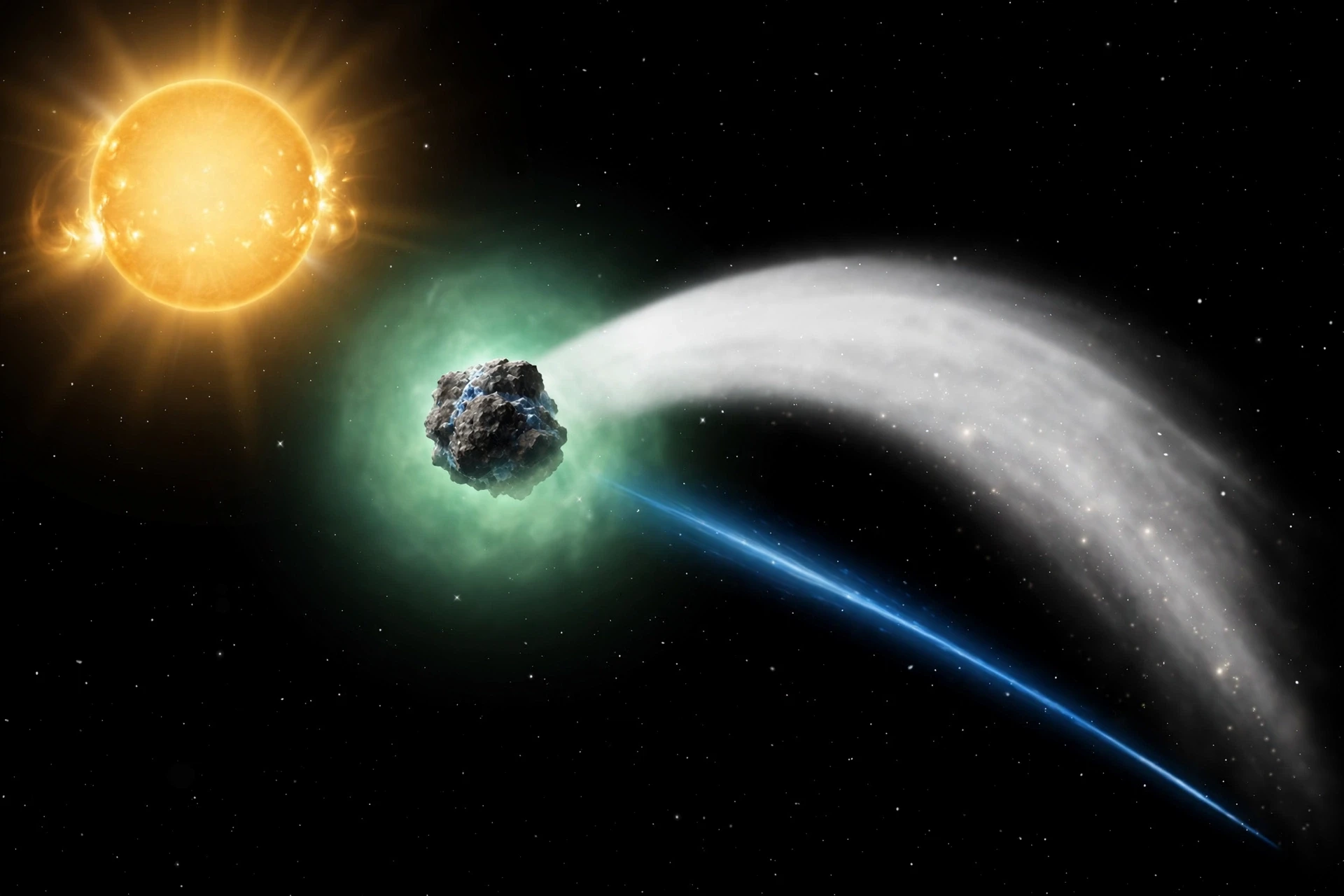
A comet near the Sun has three parts, and each one tells you something about how it works.
The nucleus is the solid core: ice, dust, and rock, usually just a few kilometres across. It is the only solid part of the comet, and it is the part spacecraft try to land on or fly past.
The coma is the glowing cloud of gas and dust around the nucleus, formed as ice sublimates. It can swell to hundreds of thousands of kilometres across — bigger than the Sun itself in some cases — and it is what makes a comet look fuzzy through a telescope, unlike the sharp point of a star.
The tails are the comet's most famous feature, and there are two of them, not one. The dust tail is made of tiny dust grains pushed gently away from the Sun by sunlight; it is broad, curved, and whitish. The ion tail is made of charged gas, blown straight away from the Sun by the solar wind; it is thin, straight, and often blue. Both tails always point away from the Sun, which leads to one of the great surprises of comet science — a comet's tails stream out in front of it as it travels away from the Sun. They do not trail behind it like smoke from a chimney. They point away from the Sun, whatever direction the comet is moving.
I once watched a comet through a small telescope on a cold hilltop, and the tail did not look like the pictures. The pictures show a dramatic sweep of light. Through the eyepiece, it was a faint smudge, barely there, and I had to look slightly to the side of it — using the more sensitive edge of my vision — to see it at all. Then it was there, pale and enormous, and I understood why people used to think comets were omens. A thing that big, that quiet, and that strange does not feel like it belongs to the ordinary sky.
NASA's guide to comets describes the nucleus as a frozen remnant from the formation of the solar system, and that framing is worth holding onto. Every time a comet swings past the Sun, it loses some of its ice. After enough trips, it may run out of ice altogether and go dark, becoming hard to tell apart from an asteroid. Some asteroids, scientists now suspect, are dead comets wearing a rocky disguise.
2.2 Comet orbits: long, stretched, and tilted
Comets do not travel in the neat, nearly circular orbits of the planets. Their orbits are stretched-out ellipses, long and narrow, and often tilted at steep angles to the plane of the planets. A short-period comet, like Halley, loops in from beyond Neptune and back out again in under 200 years. A long-period comet can take thousands or even millions of years to complete one orbit, falling in from the far edge of the solar system, whipping around the Sun once, and vanishing again for longer than human civilisation has existed.
This is why comets are hard to predict far in advance. A long-period comet may be discovered only months before it reaches its brightest, because it spends almost its whole life too far away and too faint to see. That unpredictability is part of what makes comets and asteroids so absorbing to study: some return on schedule, and some arrive once and never come back. The comet NEOWISE, which put on a lovely show in the summer of 2020, will not be back for about 6,800 years. The people who saw it were the only humans who ever will, at least in our lifetimes. That is a strange and wonderful thing to think about while standing under a dark sky.
2.3 Where comets come from
Comets are born in the cold outer reaches of the solar system, and they come from two great reservoirs. The Kuiper Belt, a ring of icy bodies beyond Neptune, supplies the short-period comets. The Oort Cloud, a vast spherical shell far beyond that, supplies the long-period ones. We will look at both in detail in section 5, because where comets and asteroids come from explains almost everything about how they behave.
3. What Is an Asteroid?
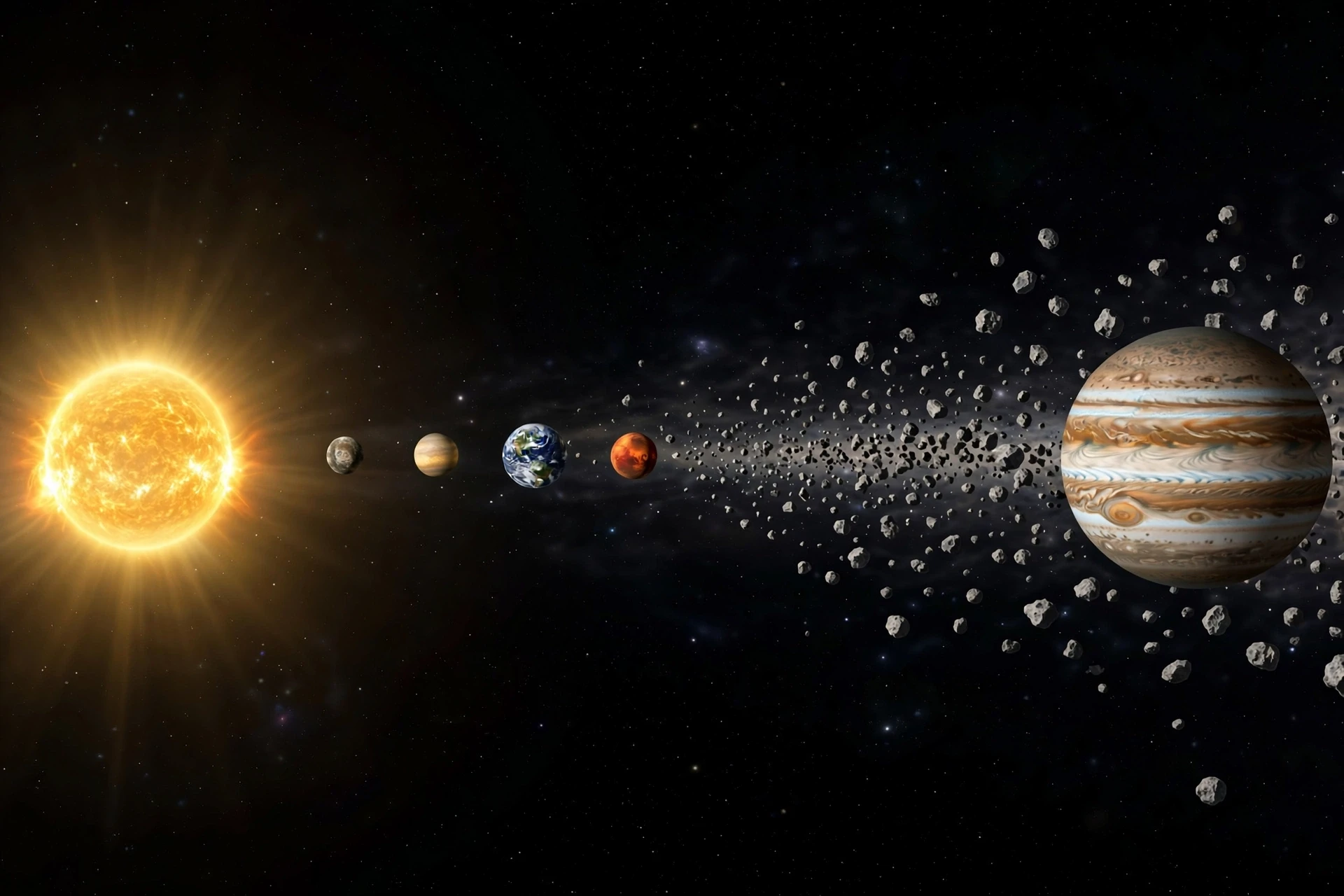
If a comet is a dirty snowball, an asteroid is a dry rock — or, sometimes, a lump of metal. Asteroids are the rocky and metallic leftovers of planet formation: pieces of material that never gathered into a planet. Most of them live in the main asteroid belt, a broad ring between the orbits of Mars and Jupiter, but they are found all over the solar system, including in orbits that cross Earth's. They range in size from tiny pebbles to the dwarf planet Ceres, which is about 940 kilometres across — big enough for its own gravity to have pulled it into a round shape.
NASA's guide to asteroids puts the known count at more than 1.3 million asteroids, with new ones being found every month. Most are small, just a few hundred metres across or less. Only a few hundred are larger than 100 kilometres. And here is the first surprise: despite the word "belt", the asteroid belt is not crowded. The total mass of everything in the belt is less than 5 percent of the Moon's mass, spread across an enormous ring of space. The average distance between asteroids in the belt is millions of kilometres. Spacecraft fly through it without dodging anything.
3.1 The main belt between Mars and Jupiter
The belt sits where a planet might have formed — and did not. Jupiter's gravity is the reason. As the solar system was forming, Jupiter's enormous pull stirred up the material in that region, speeding up collisions so that rocks smashed each other apart instead of gently sticking together. The result is a scattered population of rubble, some of it solid rock, some of it loose piles of gravel held together by little more than their own weak gravity. Scientists call the loose ones "rubble piles", and they are stranger than they sound: step onto one, and your foot might sink into gravel that has never been compacted. The asteroid Bennu, visited by NASA's OSIRIS-REx spacecraft, turned out to be so loosely packed that the spacecraft's sampling arm sank half a metre into its surface on contact, like a hand pressing into a ball pit.
The belt is not uniform. Its inner edge, closer to Mars, holds mostly bright, stony asteroids. Its outer edge, closer to Jupiter, holds darker, carbon-rich ones. That gradient is a fossil of the early solar system: closer to the Sun it was hotter, so only rock and metal could condense; farther out it was colder, so carbon compounds and even some water-bearing minerals could survive. It is one of the three great storehouses where comets and asteroids keep the solar system's oldest material. Reading the belt from inside to outside is like reading a temperature map of the solar system as it was 4.6 billion years ago.
3.2 Three kinds of asteroid
Asteroids are sorted into three broad types by what they are made of, and the type matters for everything from how they look through a telescope to how much damage one would do if it hit Earth.
C-type (carbonaceous) asteroids are dark, carbon-rich, and the most common — about 75 percent of known asteroids. They are the sooty, primitive ones, rich in carbon compounds and sometimes water-bearing minerals. They reflect very little sunlight, which makes them hard to spot.
S-type (silicaceous or stony) asteroids are brighter, made mostly of silicate rock mixed with nickel and iron. They make up about 17 percent of known asteroids and dominate the inner belt. The Chelyabinsk rock was an ordinary stony asteroid of this family.
M-type (metallic) asteroids are mostly iron and nickel, the exposed cores of ancient bodies that were once big enough to melt and separate into layers before being smashed apart. They are rarer, but they are dense, tough, and — if one ever hit Earth — the most likely to survive the trip through the atmosphere in one piece. NASA's Psyche mission, launched in 2023, is flying to the metallic asteroid 16 Psyche to study exactly this kind of object up close.
A useful everyday analogy: if the asteroid belt were a scrapyard, the C-types would be old charcoal briquettes, the S-types would be lumps of concrete, and the M-types would be solid ingots of iron. Same scrapyard, very different materials, and very different stories. Knowing the type matters, because comets and asteroids of different types behave very differently when they enter the atmosphere.
3.3 Near-Earth asteroids
Most asteroids stay safely in the belt. A minority do not. Through collisions and the slow gravitational nudges of the planets, some asteroids drift into orbits that bring them close to Earth. These are the near-Earth objects, or NEOs — asteroids (and comets) whose orbits bring them within about 48 million kilometres of Earth's orbit. NASA's planetary defence teams track more than 35,000 of them, and the count grows every year as telescopes improve. The vast majority are small. The ones that matter most are the ones larger than about 140 metres across — big enough to devastate a region if one struck land — and astronomers believe they have found more than 90 percent of the kilometre-sized ones, the kind that could threaten civilisation. The smaller ones, the city-killers in the 140-metre range, are only about 40 percent found. That gap is the reason new survey telescopes are being built.
4. Comets and Asteroids: How to Tell Them Apart
People mix up comets and asteroids all the time, and it is easy to see why. Both are small, rocky leftovers. Both orbit the Sun. Both can hit Earth. The differences are real, though, and they come down to what each object is made of and where it has spent its life.
4.1 The key differences at a glance
Feature | Comet | Asteroid |
|---|---|---|
Main ingredients | Ice (water, carbon dioxide, ammonia, methane) mixed with dust and rock | Rock and metal, with little or no ice |
Where it lives | Kuiper Belt and Oort Cloud, far from the Sun | Mainly the asteroid belt between Mars and Jupiter |
Orbit shape | Long, stretched ellipse, often steeply tilted | Mostly nearly circular, close to the plane of the planets |
Tail | Yes — coma and two tails when near the Sun | No tail; looks like a point of light or a dark rock |
What happens near the Sun | Ice sublimates, grows a coma and tails, loses material each pass | Almost nothing changes; it just gets warmer and brighter |
Typical size | Nucleus usually 1–20 km across | From pebbles to Ceres at about 940 km across |
Age of material | Pristine ice from the solar system's formation | Rock that may have been heated, melted, or smashed apart |
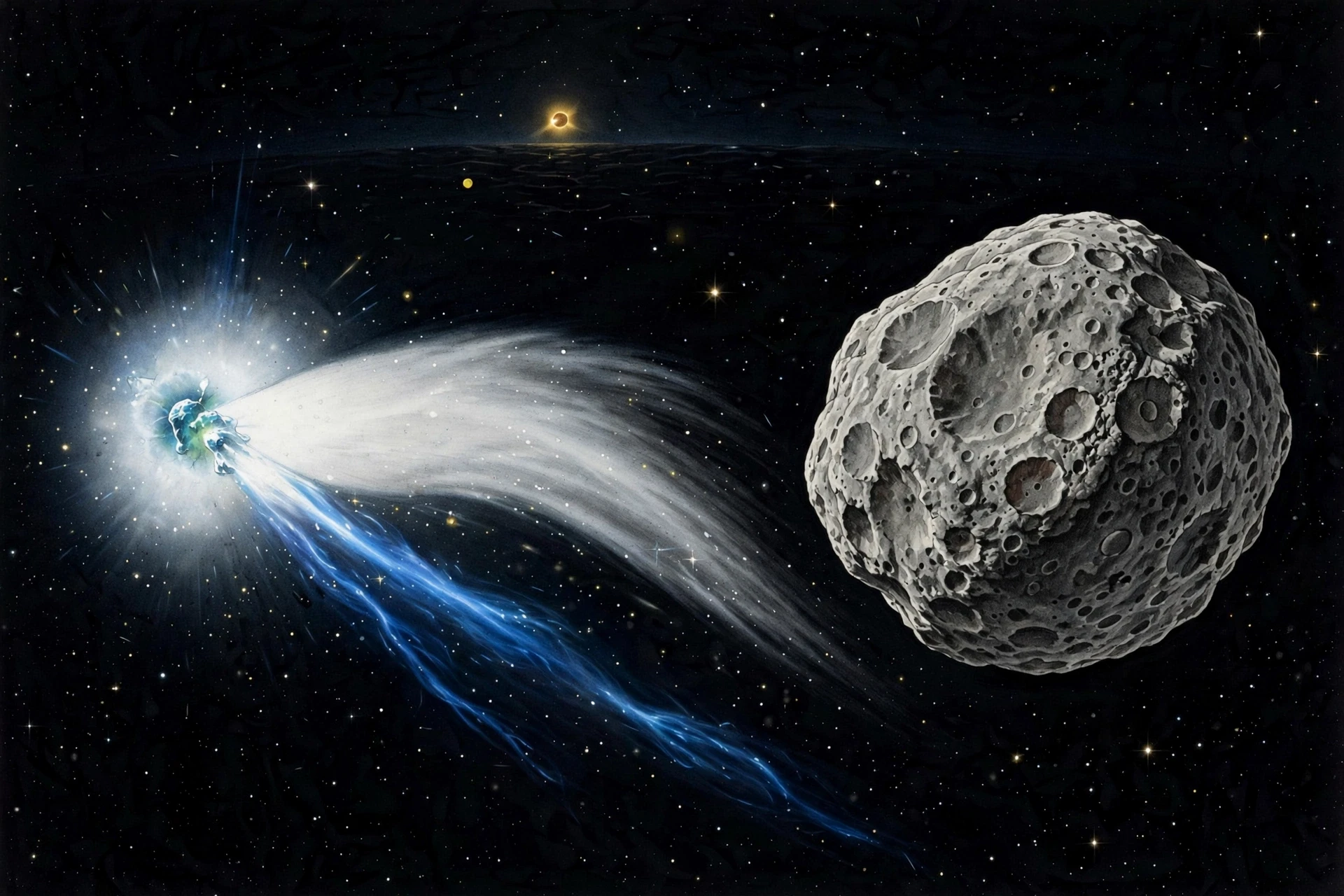
Read the table one row at a time and a simple rule emerges: ice is the dividing line. A comet is an icy body that puts on a show when it gets warm. An asteroid is a rocky or metallic body that stays quiet. The line blurs at the edges — a comet that has lost all its ice looks like an asteroid, and some asteroids in the outer belt contain ice — but for most objects, the test works.
4.2 The quick field test
If you ever find yourself arguing about whether a newly discovered object is a comet or an asteroid — and astronomers do this regularly — here is the sequence they follow:
Look at the orbit. A long, stretched, tilted orbit that dives in from far beyond Neptune points to a comet. A near-circular orbit in the belt points to an asteroid.
Look for a coma. A fuzzy glow around a solid core, or any sign of a tail, means ice is sublimating. That is a comet, whatever its orbit says.
Check the spectrum. Sunlight reflected off the surface carries fingerprints of its chemistry. Water ice, carbon dioxide, and organic molecules point to a comet. Dry silicates or bare metal point to an asteroid.
Watch it over time. A comet brightens dramatically as it nears the Sun and fades as it leaves. An asteroid's brightness changes only slowly, as its distance and angle change. That is how astronomers sort new discoveries into comets and asteroids with confidence.
Step two has produced some famous surprises. In 2006, astronomers found an object in the asteroid belt that was growing a tail. It turned out to be a "main-belt comet": an asteroid-belt body with buried ice that gets exposed by collisions or landslides. Since then, about a dozen more have been found. The neat categories we teach in school are real, but nature keeps a few objects in the grey area between them, and those grey-area objects are often the most interesting ones to study.
4.3 The movie myth: the crowded asteroid belt
Most people assume the asteroid belt looks like the movies: a dense field of tumbling boulders, millimetres apart, with a spaceship weaving between them while rocks smash into each other. The reality is the opposite. If you stood on one asteroid in the belt, you would probably not be able to see another one with your naked eye. The belt is mostly empty space — the rocks are spread across a ring hundreds of millions of kilometres wide. NASA's spacecraft have flown through it many times without steering around a single rock. The crowded-belt image is pure Hollywood, and it has done real damage to how people picture the solar system: it makes the belt sound dangerous to spacecraft and makes the space between the planets sound full, when it is almost unimaginably empty.
5. Where Comets and Asteroids Come From
Comets and asteroids are not scattered randomly. They come from three great storehouses, and each storehouse has its own history, its own temperature, and its own kind of object. Understanding the three reservoirs is understanding where the solar system keeps its oldest material.
5.1 The Kuiper Belt: the icy ring beyond Neptune
Beyond Neptune, between about 30 and 55 times Earth's distance from the Sun, lies the Kuiper Belt — a broad, flat ring of icy bodies left over from the solar system's formation. It is the home of Pluto, which was reclassified as a dwarf planet in 2006, along with its fellow dwarf planets Eris, Haumea, and Makemake. The belt holds millions of icy objects, and it is the source of the short-period comets: the ones that return every few decades or centuries, like Halley. A nudge from Neptune's gravity, or a collision between two Kuiper Belt objects, can send one of these icy bodies falling inward toward the Sun, where it warms up, grows a coma, and becomes the comet we see.
I find the Kuiper Belt quietly moving to think about. It is cold out there — around minus 220 degrees Celsius — and dark, with the Sun no brighter than a brilliant star. The objects out there have sat in that cold for 4.6 billion years, barely changing, while Earth went through the whole drama of oceans, continents, and life. When a Kuiper Belt comet finally falls toward the Sun, it is like a message arriving from the beginning of time, written in ice.
5.2 The Oort Cloud: the shell at the edge
Far beyond the Kuiper Belt, starting at roughly 2,000 times Earth's distance from the Sun and stretching out to perhaps 100,000 times that distance — a quarter of the way to the nearest star — lies the Oort Cloud. It is not a belt but a sphere, a vast shell of trillions of icy bodies surrounding the whole solar system in every direction. No spacecraft has ever been there, and no telescope has ever seen an individual Oort Cloud object directly. We know it exists because of the long-period comets: they arrive from every direction in the sky, on orbits that trace back to a spherical shell, not a flat ring. The Dutch astronomer Jan Oort proposed it in 1950, and the evidence has only grown stronger since.
The Oort Cloud is the most remote thing in our solar system, and the strangest. Its objects drift in near-total darkness, so far from the Sun that its gravity is barely stronger than the pull of passing stars. Every so often, a passing star, or the slow tug of the Milky Way itself, disturbs one of these bodies and sends it falling inward. The fall takes millions of years. When it finally arrives, it becomes one of the great long-period comets — bright, unpredictable, and gone again for longer than recorded history.
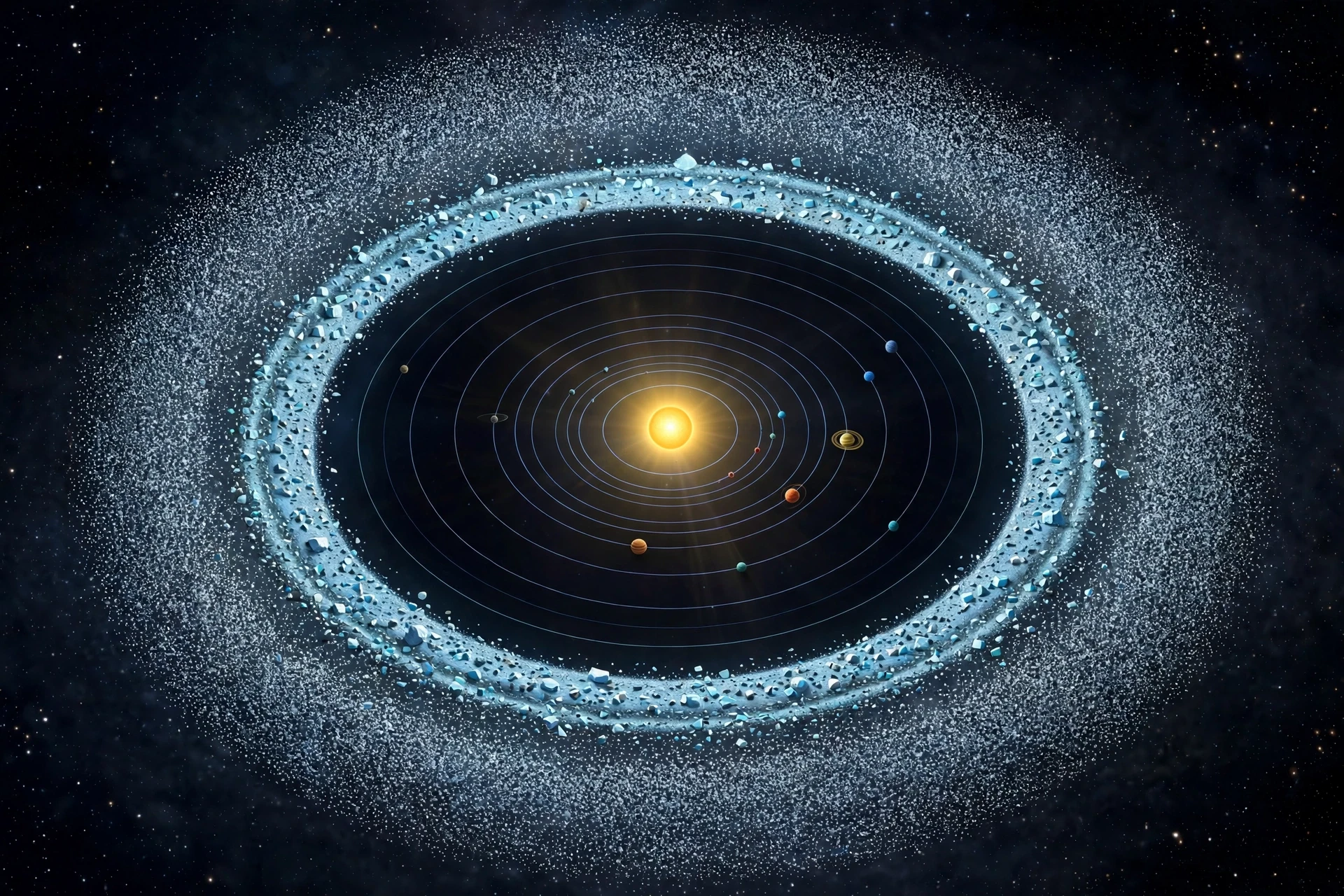
5.3 The main belt and the leftovers of planet formation
The third reservoir is the main asteroid belt, which we met in section 3. Unlike the Kuiper Belt and the Oort Cloud, which store ice, the belt stores rock and metal — the material that was too warm for ice to survive, and too stirred up by Jupiter to become a planet. Together, the three reservoirs hold the solar system's original ingredients, sorted by temperature and distance: rock near the Sun, ice farther out, and the coldest, most pristine ice at the very edge. When scientists study comets and asteroids, they are reading that sorting, layer by layer, like a history written in frozen chemistry.
6. Famous Comets and Asteroids
Names make these objects real. A comet is not just an icy body; it is Halley, returning on schedule for two thousand years. An asteroid is not just a rock; it is Bennu, a rubble pile that a spacecraft touched and sampled. Here are the comets and asteroids worth knowing, and what each one taught us.
6.1 Halley's Comet: the clockwork visitor
Halley is the only short-period comet that is regularly visible to the naked eye, and it has been watched longer than any other. Its nucleus is about 15 kilometres long, dark as coal, and it sheds about 100,000 tons of dust and gas every time it passes the Sun. In 1986, a fleet of spacecraft flew past it — including the European Space Agency's Giotto, which flew within 600 kilometres of the nucleus and sent back the first close-up images of a comet's heart. Giotto was hit by dust particles and spun away, damaged, but it survived long enough to show the world what a comet nucleus actually looks like: not a ball of glowing ice, but a dark, lumpy, peanut-shaped rock, jetting gas from bright patches on its surface. The 1986 visit was a disappointment to many skywatchers, because the comet stayed on the far side of the Sun from Earth and never became spectacular. Its next visit, in 2061, will be much better placed. Mark it on a calendar, if you plan to be around.
6.2 Hale-Bopp: the great comet of 1997
Hale-Bopp was the opposite of Halley in 1986: bright, obvious, and visible for months. Discovered in 1995 while it was still beyond Jupiter, it became visible to the naked eye for a record 18 months and was seen by more people than any comet in history. It had two tails that were easy to see even from a city — a white dust tail and a blue ion tail, side by side in the sky. I watched it from a rooftop with friends, and none of us needed a telescope. It hung there, night after night, like a searchlight that had been left on in the sky. Hale-Bopp's nucleus is unusually large, about 60 kilometres across, which is why it was so bright and so long-lived. It will not return for about 2,400 years.
6.3 Comet 67P and Rosetta: landing on a speeding snowball
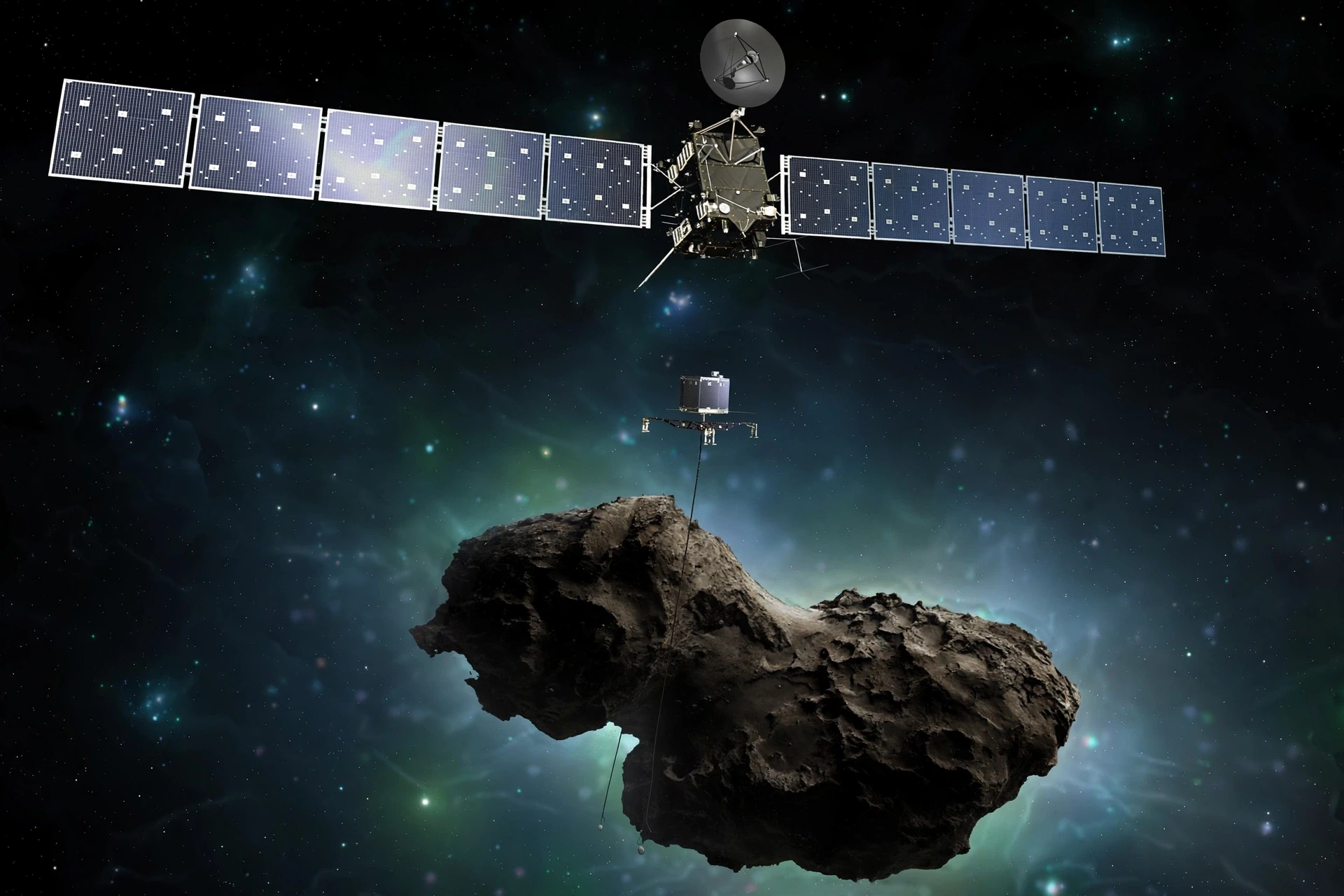
The most daring comet mission ever flown was the European Space Agency's Rosetta, which spent two years orbiting comet 67P/Churyumov–Gerasimenko and, in November 2014, dropped a small lander called Philae onto its surface. Think about what that meant: a spacecraft that had travelled for ten years and 6.4 billion kilometres, matching speed with a lump of ice tumbling through space at about 135,000 kilometres per hour, and then releasing a washing-machine-sized robot to fall gently onto a surface with almost no gravity. Philae bounced — twice — before settling in the shadow of a cliff, where its solar panels could not get enough sunlight. It sent back data for about 60 hours, then fell silent. It woke briefly months later, then went quiet for good.
Rosetta itself kept working, and what it found changed comet science. The water on 67P turned out to have a different chemical signature from Earth's oceans, which weakened the idea that comets like 67P delivered most of Earth's water. The comet's surface was covered in organic molecules, the carbon-rich chemistry that life is built from. And the nucleus was not solid ice at all, but a porous, fluffy structure, more like a sponge than a snowball. ESA's Rosetta mission pages carry the full story, including the images Philae sent from the surface — the first ever taken from the surface of a comet.
6.4 Ceres and Vesta: the belt's big two
The asteroid belt has two giants worth knowing. Ceres, about 940 kilometres across, is the largest object in the belt and is classed as a dwarf planet. NASA's Dawn spacecraft orbited it in 2015 and found bright white spots in a crater called Occator — deposits of salt left behind by briny water that once welled up from below. Ceres may hold a buried ocean of salty water under its crust, which makes it one of the more interesting places in the solar system for the search for habitable environments. Vesta, about 525 kilometres across, is the brightest asteroid and the only one sometimes visible to the naked eye. Dawn visited it first, in 2011, and found a world with a basalt surface like a lava plain, a giant crater at its south pole, and a history of violent impacts. Meteorites from Vesta have been found on Earth, which means pieces of Vesta are sitting in museum collections right now — the only asteroid we can hold in our hands and study in a laboratory. Dawn's two targets show the range of worlds hiding among the comets and asteroids of the inner solar system. If you want to understand how the rocky planets formed, Vesta is a useful stand-in: it melted, separated into a core and a crust, and froze again, like a planet that never finished growing.
6.5 Bennu and OSIRIS-REx: bringing a piece home
In September 2023, a capsule parachuted into the Utah desert carrying about 250 grams of dust and rock from the asteroid Bennu — the largest sample ever returned from space, and the first from an asteroid by NASA. The OSIRIS-REx spacecraft had spent two years studying Bennu, a dark, carbon-rich asteroid about 500 metres across, before reaching out with a robotic arm and touching its surface for a few seconds in October 2020. The surface was so loosely packed that the arm sank half a metre in, and the spacecraft collected far more material than planned. Bennu turned out to be a rubble pile, a loose collection of boulders held together by weak gravity, and its rocks are rich in carbon and water-bearing minerals — the same kind of material that may have seeded Earth with the ingredients of life. NASA's OSIRIS-REx mission pages describe the sample return and what scientists are learning from it. The sample is now being studied in laboratories around the world, and it will be analysed for decades.
6.6 Ryugu: Japan's sample return
Japan's space agency, JAXA, did the same thing first, and twice. Its Hayabusa2 spacecraft visited the asteroid Ryugu, a dark, spinning-top-shaped rock, and brought samples home in December 2020. Ryugu's material turned out to be among the most primitive ever studied — dark, carbon-rich, and nearly unchanged since the solar system's birth. Between them, Bennu and Ryugu have given scientists two different samples of the same story: the early solar system was full of dark, carbon-rich rock, and that rock carried water and organic molecules to the young planets. The two missions also proved something practical: landing on, sampling, and returning from an asteroid is now routine engineering, not science fiction. That matters for planetary defence, as we will see in section 10.
7. The Day the Dinosaurs Died
7.1 Chicxulub, 66 million years ago
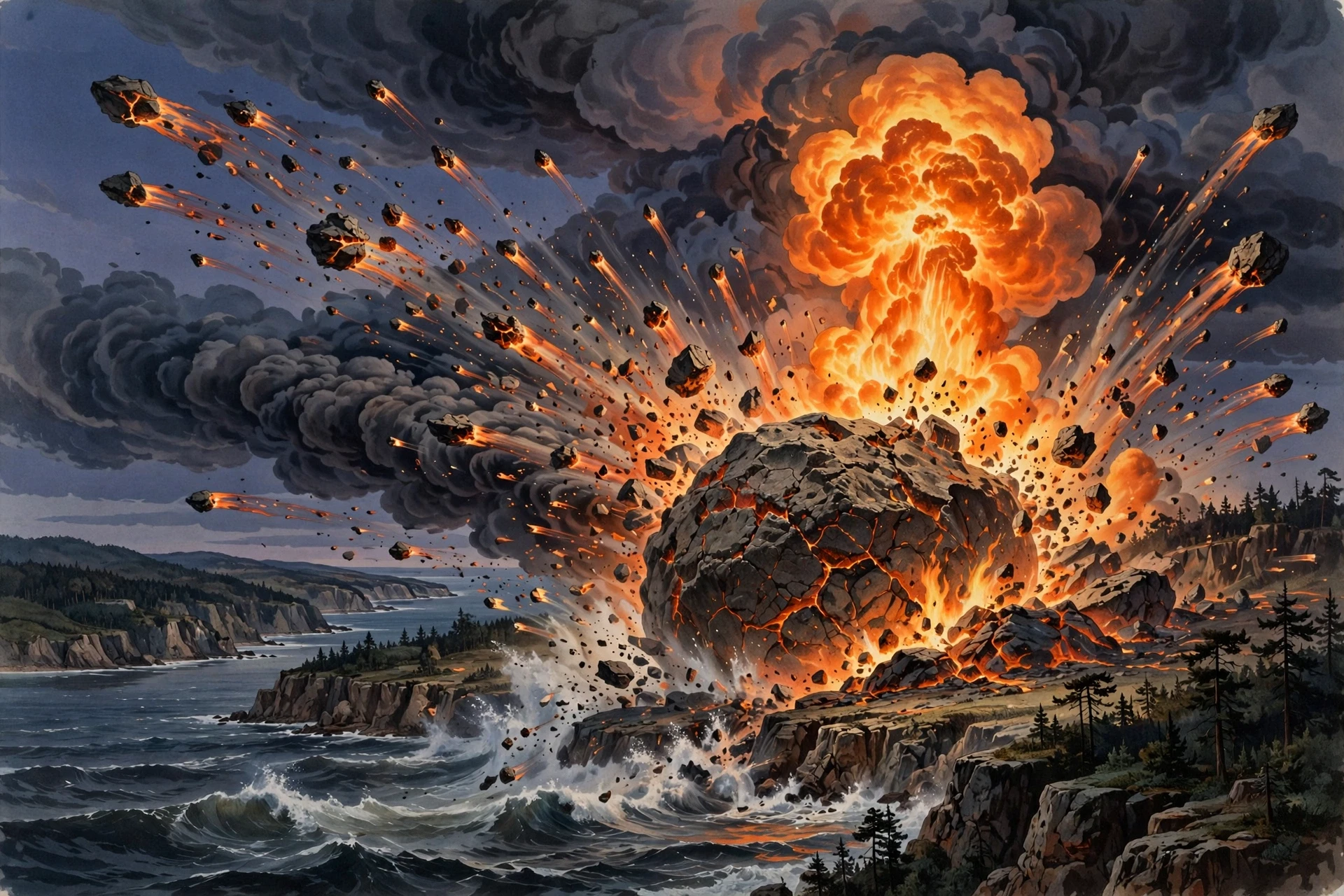
About 66 million years ago, an asteroid roughly 10 kilometres across — about the size of a small city — struck the Earth near what is now the Yucatán Peninsula in Mexico. It hit at roughly 72,000 kilometres per hour, punched a crater about 180 kilometres wide, and released energy equivalent to billions of atomic bombs. The impact vaporised rock, threw a cloud of dust and sulphur into the atmosphere, and set off wildfires across continents. The dust blocked the sunlight for months or years. Plants died. The animals that depended on them died. The dinosaurs, which had ruled the Earth for more than 160 million years, vanished — all except the birds, their feathered descendants, which still fly above us today.
The crater, called Chicxulub after a nearby town, was only confirmed in the 1990s, when geologists found the buried ring structure and the layer of iridium — a metal rare on Earth but common in asteroids — that marks the boundary between the age of dinosaurs and the age of mammals in rocks all over the world.
The dinosaurs did not die because the sky fell. They died because the Sun went away, and the food chain went with it.
I find that layer of iridium strangely moving. It is a thin dark line in a cliff face, millimetres thick, and it marks the worst day in the history of life on Earth. You can walk up to such a cliff in places like Italy and Spain, put your finger on the line, and touch the moment the world changed. Below the line: dinosaurs. Above it: mammals, and eventually us.
7.2 What the impact actually did
The damage came in waves, and understanding them matters for planetary defence today, because the same physics applies to any large impact.
The fireball and the blast. The impact itself vaporised the asteroid and a huge volume of rock, creating a fireball and a blast wave that flattened everything for hundreds of kilometres.
The ejecta. Shattered rock was thrown up into space and rained back down around the planet, heating the upper atmosphere and starting wildfires on multiple continents.
The dust and sulphur. Fine dust and sulphur compounds stayed in the atmosphere for months to years, blocking sunlight. Global temperatures fell sharply, in what scientists call an impact winter.
The collapse. With sunlight cut off, photosynthesis stopped. Plants died, herbivores starved, and the food chain collapsed from the bottom up. About 75 percent of species on Earth went extinct.
Small mammals survived — burrowing, nocturnal, able to live on seeds and insects — and from them came everything that followed, including us. The Chicxulub impact is the reason mammals got their chance. It is also a warning: the same kind of object is still out there, and the solar system has not run out of them.
7.3 Could it happen again?
Yes — but not soon, and not without warning. Objects the size of the Chicxulub asteroid, about 10 kilometres across, strike Earth roughly once every 100 million years on average. That is a long time by human standards, and astronomers believe they have found nearly all the near-Earth asteroids of that size: there are about 15 of them, and none is on a collision course with Earth in the next century. The real risk is not the giant we know about. It is the smaller one we have not found yet — and that is why the hunt for undiscovered comets and asteroids never stops.
8. How Often Do Impacts Happen?
The short answer is: constantly, at small sizes — and almost never, at large ones. Earth is hit by space debris every single day. Most of it is dust. Some of it is larger. The frequency drops steeply as the size grows, and that relationship is the key to thinking clearly about the risk.
8.1 Small ones: every day
Every day, about 40 to 100 tons of dust and small rock fall onto Earth from space, most of it burning up high in the atmosphere as meteors — shooting stars. Every one of those streaks is a tiny piece of the comets and asteroids that share our orbit around the Sun. A rock the size of a grain of sand makes a brief streak of light. A rock the size of a marble makes a bright fireball. These are harmless, and they are beautiful: on a dark night away from city lights, you can see a few meteors every hour even without a shower. Once or twice a year, a rock the size of a car enters the atmosphere and explodes with the energy of a small bomb, usually over an ocean or an uninhabited area, where nobody notices. Satellites and infrasound sensors record them, and astronomers log them, but they make no news.
8.2 City-killers: rare, but not impossible
A rock about 20 metres across, like Chelyabinsk, arrives roughly once every 50 to 100 years. It will explode in the atmosphere, not reach the ground, but it can injure people and damage buildings if it happens over a city. A rock about 50 metres across, like the one that flattened 2,000 square kilometres of Siberian forest at Tunguska in 1908, arrives roughly once every few hundred years. It would destroy a city if it hit one. A rock about 140 metres across — the size NASA tracks most carefully — would devastate a region, and one arrives roughly once every 10,000 to 20,000 years. A rock a kilometre across would cause global damage and arrives roughly once every 500,000 years or so. And a 10-kilometre rock, the dinosaur-killer, arrives roughly once every 100 million years.
The numbers tell a story that fear often hides: the things that happen often are too small to matter, and the things that matter happen so rarely that humanity has never experienced one. The danger sits in the middle — the 50-to-140-metre rocks that arrive every few centuries, are hard to spot, and could destroy a city without warning. Chelyabinsk was a reminder of that middle ground, and it is why the work in the next section matters.
8.3 What the odds mean for you
It helps to put the risk next to risks we live with every day. Your lifetime chance of being hurt by an asteroid impact is far lower than your chance of being hurt in a car accident, or by lightning, or even by a falling tree. That is not a reason to ignore the risk. It is a reason to treat it the way we treat other rare but serious risks: build the warning system, keep improving it, and do not panic about it. The difference between asteroids and earthquakes is worth noting here. Earthquakes, as explained in our guide to how they work, cannot be predicted in advance — we can only map the hazard and build for it. Asteroid impacts are the opposite: they can be predicted, sometimes years in advance, and, as we will see, they can now be prevented.
9. How We Watch the Sky
9.1 NASA's planetary defence
Planetary defence sounds like science fiction, but it is a real, funded, and quietly effective programme. NASA's Planetary Defense Coordination Office coordinates the search for near-Earth objects, tracks their orbits, and plans what to do if one is found heading our way. Telescopes around the world scan the sky every clear night, looking for the faint moving dots that betray an asteroid. When one is found, astronomers measure its position night after night, and the orbit gets more precise with every observation. Within days, they can usually say whether it will hit Earth — and the answer is almost always no.
The work is methodical and unglamorous, which is exactly how you want planetary defence to be. It is carried out by survey telescopes like Pan-STARRS in Hawaii and the Catalina Sky Survey in Arizona, and by the space-based NEOWISE telescope, which spotted asteroids in infrared light, where dark rocks show up better. Every clear night adds a few more comets and asteroids to the catalogue, and every one found is one less surprise. In the coming years, the Vera C. Rubin Observatory in Chile will scan the whole sky every few nights and is expected to find millions of new asteroids, including many of the smaller, harder-to-see ones that current surveys miss. NASA is also building the NEO Surveyor space telescope, designed specifically to find the asteroids that approach from the Sun's direction — the blind spot that hid Chelyabinsk.
9.2 Near-Earth objects and the Torino scale
When an asteroid is found, astronomers need a way to talk about how dangerous it is, and that is what the Torino scale is for. It runs from 0 to 10, combining the chance of impact with the size of the object and the damage it would cause. Level 0 means no hazard — the object will miss, or it is too small to matter. Levels 1 to 4 are routine discoveries that deserve watching but cause no concern. Levels 5 to 7 mean a close encounter that could cause regional or global damage, and would demand serious attention. Levels 8 to 10 mean a certain collision with devastating consequences — something that has never happened since the scale was created.
Almost every asteroid ever discovered has been rated 0. A handful have briefly reached level 1, and one, the asteroid Apophis, reached level 4 in 2004 before further observations ruled out any impact. That is the system working as intended: early observations are uncertain, the risk rating starts higher, and better data brings it down. The Torino scale is a communication tool as much as a scientific one — it exists so that astronomers, governments, and the public can talk about risk in the same language, instead of panicking over headlines.
9.3 Why some asteroids are hard to find
If we have found more than 90 percent of the kilometre-sized near-Earth asteroids, why did Chelyabinsk catch us by surprise? Because finding asteroids is harder than it looks. Small asteroids are faint. Dark, carbon-rich asteroids reflect as little as 3 percent of the sunlight that hits them — darker than a blackboard. And asteroids that approach from the direction of the Sun are hidden in its glare, invisible to ground telescopes. Chelyabinsk was all three: small, dark, and coming from the Sun's direction. The surveys are improving, and the new telescopes are designed to close exactly these gaps, but the lesson stands: the sky is big, the rocks are small and dark, and finding them all will take time. Closing that gap is the quiet, steady work of watching comets and asteroids, night after night, year after year. That is a reason for steady investment, not for fear.
10. Can We Stop One? The DART Mission
10.1 Crashing a spacecraft into an asteroid — on purpose
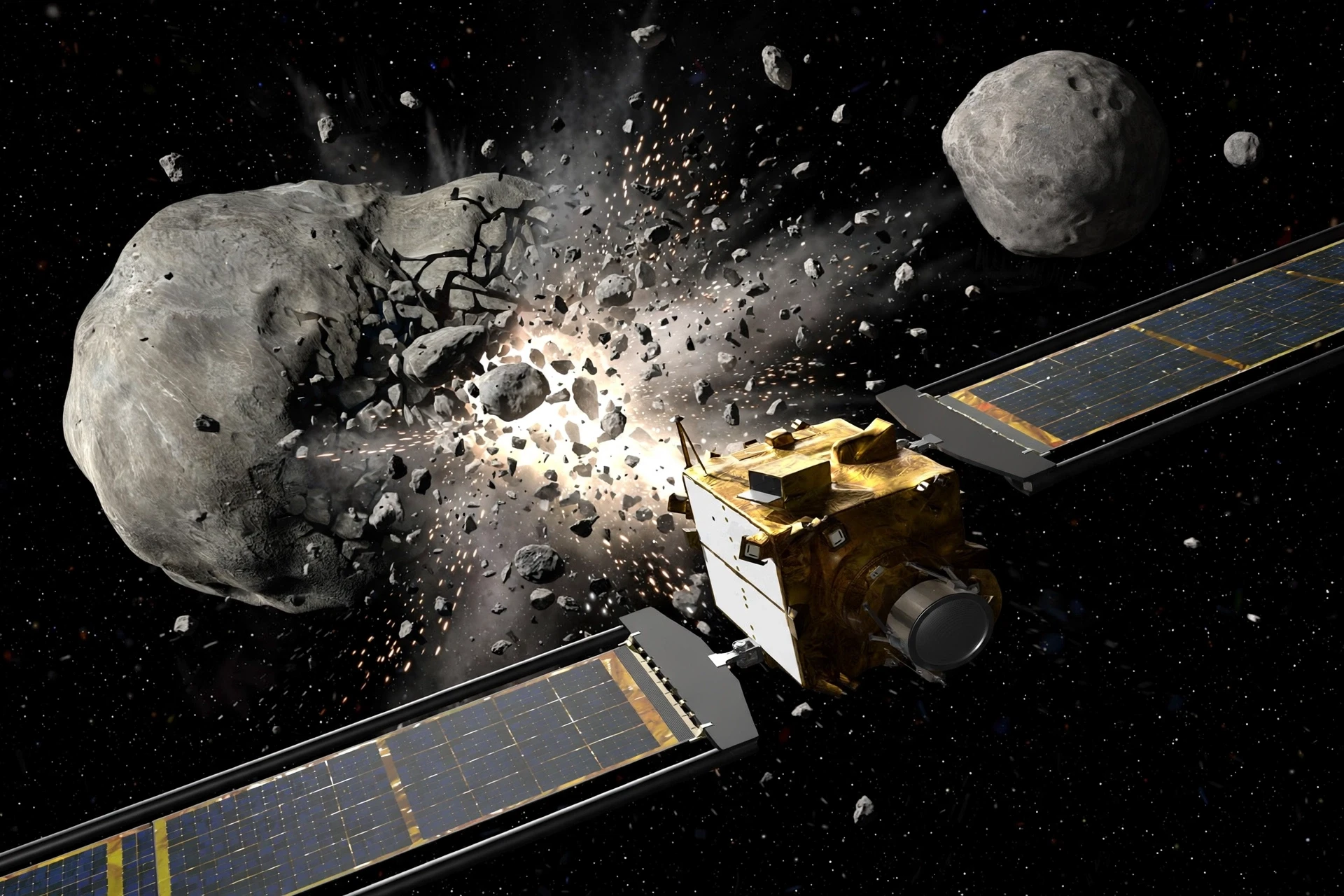
On 26 September 2022, NASA did something that had never been done before: it deliberately crashed a spacecraft into an asteroid to see if the impact would change the asteroid's orbit. The mission was called DART, the Double Asteroid Redirection Test, and its target was Dimorphos, a small moonlet about 160 metres across, orbiting a larger asteroid called Didymos. Dimorphos was chosen because it was not a threat to Earth — the test was about the technique, not about saving the planet — and because it orbited Didymos, which meant scientists could measure the change in its orbit by watching how long each lap took.
DART hit Dimorphos at about 22,500 kilometres per hour. The impact shortened Dimorphos's orbit around Didymos by 32 minutes — far more than the few minutes scientists had expected — because the collision threw off a huge cloud of debris, and the recoil from that debris pushed the asteroid further, like the kick of a rocket. NASA's DART mission pages report the result plainly: humanity's first test of asteroid deflection worked, and it worked better than predicted. For the first time in history, we can say, with evidence, that if we found a dangerous asteroid early enough, we could push it off course.
10.2 How much warning would we need?
DART proved the technique, but the technique needs time. A spacecraft like DART can only change an asteroid's speed by a tiny amount — centimetres per second. That is enough if you have years to work with, because a tiny change in speed, applied years before the encounter, adds up to a large change in position by the time the asteroid reaches Earth. With ten years of warning, a DART-style impact could deflect even a large asteroid by thousands of kilometres. With one year of warning, it might not be enough. With one month, it would be nearly useless. That is why the surveys in section 9 matter so much: the earlier we find a dangerous object, the easier it is to stop.
Planetary defence is not about fear. It is about homework: find the rocks early, and a gentle push is enough.
Planetary defence is really two things — watching the sky, and having a tested way to act on what the watching finds. Before DART, we only had the first. Now we have both.
10.3 What comes next
DART was a test, not a finished system. The European Space Agency's Hera mission, launched in October 2024, is flying to Didymos and Dimorphos to study the crater DART left behind and measure exactly how the impact changed the asteroid's structure — the data needed to make future deflections precise rather than approximate. Other ideas exist for the future: a "gravity tractor", a spacecraft that hovers near an asteroid for years and slowly pulls it off course with gravity alone; and, as a last resort for a very large object found very late, a nuclear device detonated near the asteroid to push it with radiation and debris. None of these is needed today, because no known asteroid threatens Earth. But the tools are being built and tested now, while there is time, rather than in a panic later. None of it would be possible without decades of patient work studying comets and asteroids up close. That is the right way to handle a risk that is rare, real, and preventable.
11. Meteor Showers: When Earth Drives Through Comet Debris
11.1 What a meteor shower really is
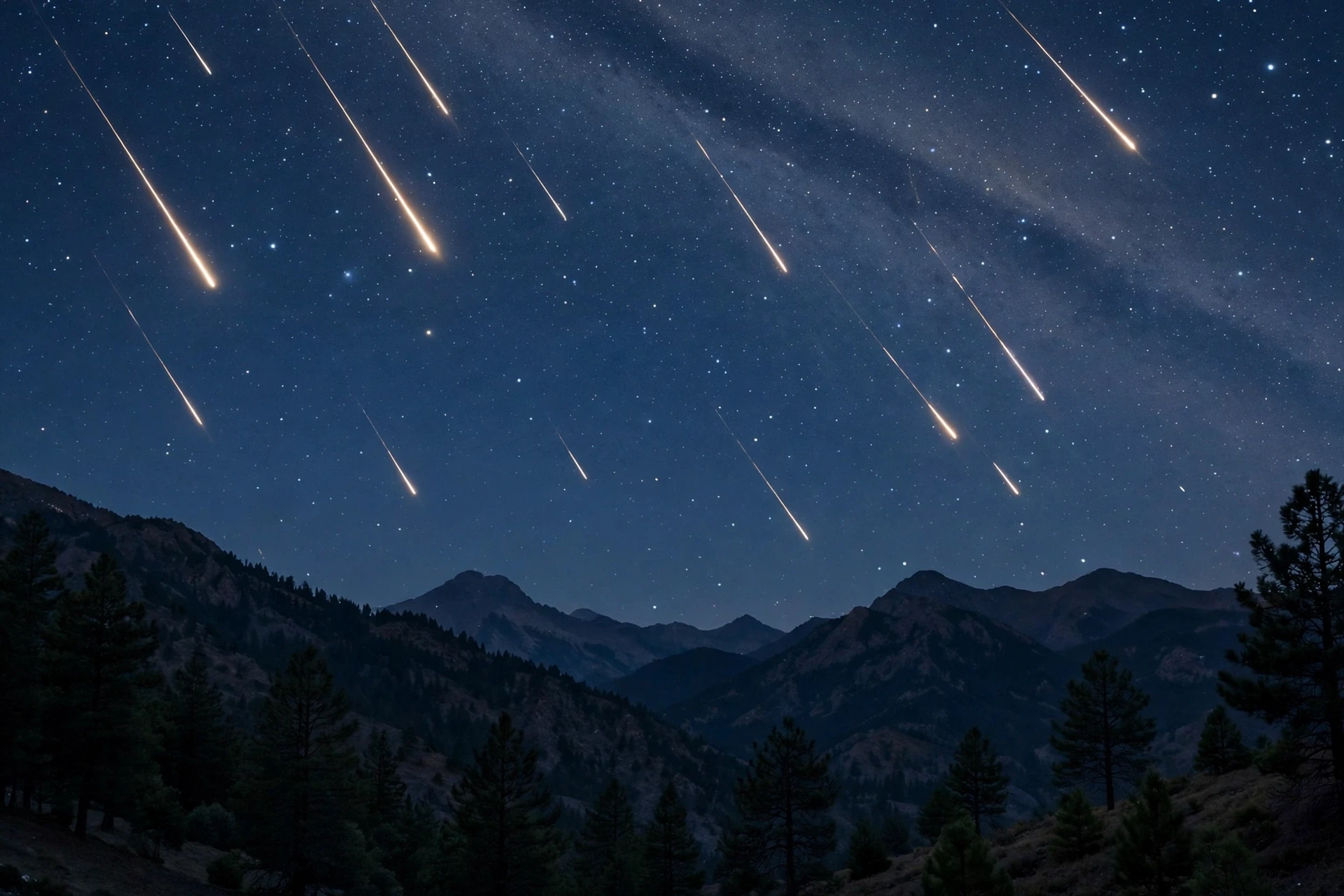
A meteor shower is what happens when Earth, on its yearly trip around the Sun, passes through a trail of dust left behind by a comet. The dust grains are tiny — most are the size of grains of sand — but they hit the atmosphere at tens of kilometres per second, burn up, and leave bright streaks across the sky. The shower happens at the same time every year because Earth crosses the same trail at the same point in its orbit, and the meteors all seem to come from the same point in the sky — the radiant — because they are travelling along parallel paths, like rain seen from a moving car. Each shower is a calendar reminder that comets and asteroids are not distant abstractions — they cross Earth's path every year.
The most famous showers are the Perseids, which peak every August and come from comet Swift-Tuttle, and the Geminids, which peak every December and come from an asteroid, 3200 Phaethon — a reminder that asteroids can shed dust too. On a good year, under a dark sky, the Perseids produce 60 to 100 meteors per hour. The Geminids can produce even more. I have watched the Perseids from a field with a blanket and a thermos, counting meteors with friends and losing count somewhere past fifty, and I can say from experience that it is one of the cheapest and best shows in astronomy. No telescope needed. Just darkness, patience, and a willingness to stay up late.
11.2 The best showers of the year
Quadrantids (early January): brief but intense, from the asteroid 2003 EH1, best in the hours before dawn.
Lyrids (late April): from comet Thatcher, modest but reliable, with occasional bright fireballs.
Perseids (mid-August): from comet Swift-Tuttle, the most popular shower of the year, with warm nights and high rates.
Orionids (late October): from Halley's Comet itself — the dust of Halley, burning up over your head.
Leonids (mid-November): from comet Tempel-Tuttle, usually modest, but every 33 years it can erupt into a storm of thousands per hour.
Geminids (mid-December): from the asteroid 3200 Phaethon, often the best shower of the year, with bright, slow meteors.
The Orionids deserve a special mention. When you watch them, you are watching pieces of Halley's Comet — the same object that appears in the Bayeux Embroidery — burning up in Earth's atmosphere. A comet that returns every 76 years leaves a trail that Earth crosses every single year. The comet is far away, out beyond Neptune, and its dust is still putting on a show for us. That is a lovely thought to carry into a cold October night.
11.3 How to watch one
You do not need equipment, but you do need darkness. Get away from city lights, let your eyes adapt for at least 20 minutes, lie flat, and look at a broad sweep of sky — not at the radiant itself, but about 45 degrees away from it, where the meteors appear longer. Bring a blanket, a warm drink, and patience. The best hours are usually after midnight, when your side of Earth is facing into the stream of dust. And remember what a meteor is: a grain of comet dust, older than the Earth, ending its journey in a flash of light above your head. The whole history of comets and asteroids is written in moments like that.
12. Common Misconceptions About Comets and Asteroids
12.1 "A comet's tail trails behind it like smoke"
This is the most common picture in people's heads, and it is wrong. A comet's tails always point away from the Sun, pushed by sunlight and the solar wind. When a comet is falling toward the Sun, the tails stream out behind it, and the picture looks right. When the comet has rounded the Sun and is heading back out, the tails stream out in front of it — the comet is flying tail-first, like a car reversing with its headlights on. The tails are not smoke trailing in the comet's wake. They are material being blown away from the Sun, and the Sun decides the direction, not the comet's motion.
12.2 "The asteroid belt is a dense field of rocks"
As section 4.3 explained, the belt is mostly empty space. The movie image of a spaceship dodging boulders every second is fiction. The real belt is so sparse that spacecraft cross it without steering. The danger in the belt is not crowding — it is time. The rocks have had billions of years to collide, slowly, and the dust from those collisions is part of what makes the belt hard to study.
12.3 "An asteroid impact would be like a nuclear bomb"
The comparison is tempting, and it is misleading. An impact releases enormous energy, but it does so in a different way: a fireball, a blast wave, and, for large impacts, a cloud of dust that changes the climate for months or years. There is no radiation, no fallout in the nuclear sense. The long-term danger of a big impact is not the explosion — it is the darkness that follows, when dust blocks the Sun and crops fail. That is why the Chicxulub impact killed so widely: not through the blast, but through the collapse of the food chain.
12.4 "We would see a big asteroid coming years in advance"
We probably would — for a big one. Astronomers have found more than 90 percent of the kilometre-sized near-Earth asteroids, and they track them all. For a 50-metre rock, the odds are worse: only a fraction have been found, and one could arrive with days of warning, or none at all, as Chelyabinsk showed. The honest statement is this: the bigger the asteroid, the earlier we will see it. The smaller ones are the ones that can still surprise us, and the new survey telescopes are being built to fix exactly that.
12.5 "Comets and asteroids are the same thing"
They are cousins, not twins. Both are leftovers from the formation of the solar system, and both can hit Earth — but a comet is an icy body that grows a coma and tails when warmed, while an asteroid is a rocky or metallic body that does not. The difference is written in their chemistry, their orbits, and their behaviour near the Sun. Confusing them is understandable, and it is also the reason this article has a whole section, and a table, devoted to telling them apart.
13. Why Comets and Asteroids Matter to Us
13.1 They may have brought us water and life's ingredients
Earth formed hot and dry, and it is still an open question where our oceans came from. One leading idea is that water arrived later, carried in by comets and asteroids during a heavy bombardment in the solar system's first few hundred million years. The evidence is mixed: the water on comet 67P does not match Earth's oceans, but the water in some carbon-rich asteroids does. The samples from Bennu and Ryugu are helping settle the question, because they let scientists measure the chemistry directly instead of guessing from a distance. Whatever the final answer, the ingredients of life — water, carbon, and organic molecules — are abundant in these small bodies. They are not just rocks and snowballs. They are the raw material of habitability, delivered to a young planet at the right time.
13.2 They are the history of the solar system
Every planet is a finished product, its early history buried under billions of years of geology. Comets and asteroids are the unfinished pieces — the offcuts from the workshop, still lying on the floor. Studying them is how scientists reconstruct what the solar system was made of, how the planets grew, and why Earth ended up with oceans and an atmosphere while Mars lost most of its air. Our guide to the planets, moons, and dynamics of the solar system tells the story of the finished planets; this article tells the story of the material they were built from, and of the pieces that never became planets at all.
13.3 They are the future, too
Asteroids hold metals — iron, nickel, and rarer elements — in concentrations that would be valuable on Earth, and water ice that could be turned into drinking water, breathable oxygen, or rocket fuel for spacecraft travelling deeper into space. Mining an asteroid is still decades away, and the economics are uncertain, but the physics is straightforward: the material is there, it is in orbit, and it does not need to be lifted out of Earth's gravity well. Whether or not asteroid mining ever becomes a business, the scientific value is already proven. Every sample return, every flyby, and every telescope survey adds to a picture of the solar system that is still being drawn — and comets and asteroids are at the centre of it.
Conclusion
The sky is not empty. It is full of ancient ice and rock, drifting on orbits laid down 4.6 billion years ago, and every so often one of those pieces crosses our path. Most burn up as shooting stars. A few, like the rock over Chelyabinsk, remind us that the solar system is still an active place. One, 66 million years ago, changed the course of life on Earth — and made room for the mammals, and eventually for us. That long chain, from a 10-kilometre rock to the world we live in, is worth sitting with. Darwin's theory of evolution explains how life changed after that impact; the impact itself explains why it got the chance.
The good news is that we are no longer helpless observers. We track the sky every night. We have found nearly all the civilisation-threatening asteroids, and none is heading our way. We have proved, with DART, that we can change an asteroid's orbit. And we have landed on comets, sampled asteroids, and brought pieces of them home to study. Comets and asteroids began as omens in the sky. They are now objects we understand, visit, and — if we ever need to — push aside. The next time you see a shooting star, remember what it is: a grain of dust from a comet, older than the Earth, finishing a journey that began before there was anyone here to watch it. And remember that somewhere, on a mountaintop in Hawaii or Chile, a telescope is watching the sky on your behalf, making sure the next big one does not arrive unannounced.
Frequently Asked Questions
What is the difference between a comet and an asteroid?
A comet is an icy body made of frozen water, carbon dioxide, and dust that grows a glowing coma and two tails when it nears the Sun, while an asteroid is a rocky or metallic body with little or no ice and no tail. Comets come from the Kuiper Belt and the Oort Cloud on long, stretched orbits; most asteroids live in the main belt between Mars and Jupiter on nearly circular orbits. The dividing line is ice: a comet shows a coma and tails when warmed, and an asteroid does not. That single test — does it grow a coma when warmed — is how astronomers sort comets and asteroids into their two families.
Could an asteroid hit Earth?
Yes, and small ones do so every day, burning up as meteors. A rock large enough to damage a city, about 50 metres across, arrives roughly once every few hundred years, and a civilisation-threatening rock a kilometre or more across arrives roughly once every 500,000 years or longer. Astronomers have found more than 90 percent of the kilometre-sized near-Earth asteroids, and none is on a collision course with Earth in the next century. The risk from a large asteroid is real but very low, and it is the only natural disaster we can predict years in advance — and now, after DART, deflect.
What are comets and asteroids made of?
Comets are made of water ice, frozen carbon dioxide, ammonia, and methane mixed with dust and rock — the "dirty snowball" model. Asteroids are made of rock and metal, and come in three main types: dark carbon-rich C-types, brighter stony S-types, and metallic M-types made mostly of iron and nickel. Some asteroids, especially carbon-rich ones, also contain water-bearing minerals and organic molecules, which is one reason scientists think they may have helped deliver water and life's ingredients to the young Earth. Between them, comets and asteroids carry nearly every ingredient the young Earth needed, frozen or locked in rock.
What is the Oort Cloud?
The Oort Cloud is a vast, spherical shell of trillions of icy bodies surrounding the solar system, starting roughly 2,000 times Earth's distance from the Sun and stretching out to perhaps 100,000 times that distance. It is the source of long-period comets, which arrive from every direction in the sky. No spacecraft has visited it and no telescope has seen an individual Oort Cloud object directly; we know it exists because the orbits of long-period comets trace back to a spherical shell rather than a flat ring.
What did NASA's DART mission do?
DART, the Double Asteroid Redirection Test, deliberately crashed a spacecraft into the asteroid Dimorphos on 26 September 2022 to test whether an impact could change an asteroid's orbit. It worked: the impact shortened Dimorphos's orbit around its companion asteroid Didymos by 32 minutes, far more than expected, because the debris thrown off by the crash added extra push. It was the first time humans changed the motion of a celestial object, and it proved that asteroid deflection is a real option if a dangerous asteroid is found early enough.
What causes a meteor shower?
A meteor shower happens when Earth passes through a trail of dust left behind by a comet (or, in a few cases, an asteroid). The dust grains, most no bigger than sand, hit the atmosphere at tens of kilometres per second and burn up as streaks of light. Because Earth crosses the same trail at the same time each year, showers repeat annually — the Perseids each August from comet Swift-Tuttle, the Geminids each December from the asteroid 3200 Phaethon, and the Orionids each October from dust shed by Halley's Comet.
Will Halley's Comet return in my lifetime?
Halley's Comet returns every 74 to 79 years and was last visible in 1986, so its next visit is expected in 2061. Whether you will see it depends on your age — anyone born after about 1990 has a good chance of being alive for it, and the 2061 visit will be much better placed for viewing from Earth than the disappointing 1986 one. If you cannot wait, you can see Halley's dust every October in the Orionid meteor shower.