

Introduction
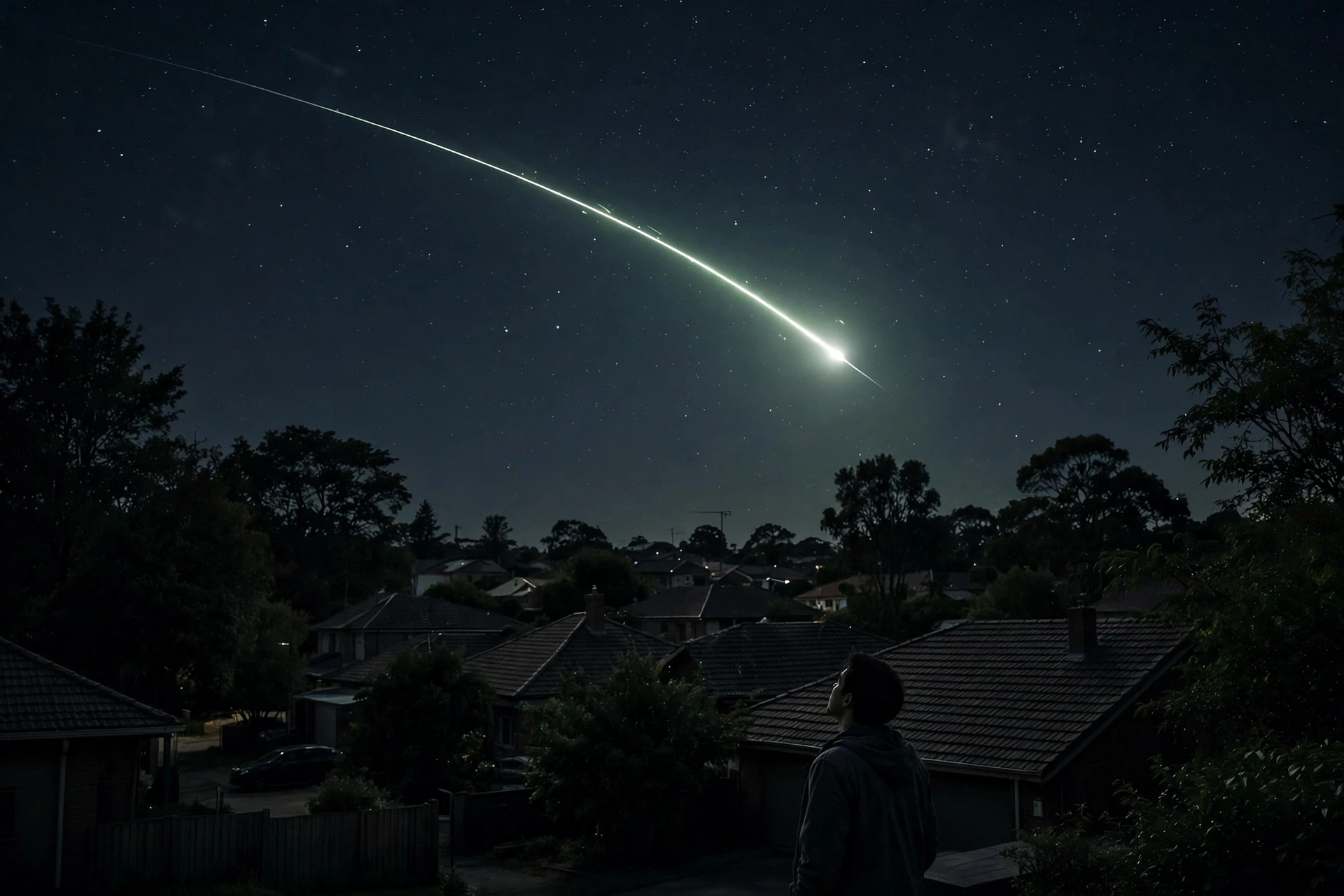
It was a clear night in late autumn, the kind of night when the air feels thin and the stars look close enough to touch. I was standing in a friend's garden, both of us craning our necks upward, when he said, "There. Watch that one. It doesn't twinkle." A bright point of light was sliding across the sky, steady and silent, faster than any aeroplane and far too smooth to be a shooting star. It crossed from one edge of the horizon to the other in about six minutes, and then it was gone, swallowed by Earth's shadow. "That was the International Space Station," he said. "There are people up there right now."
I have never forgotten the strangeness of that moment. A moving star, and inside it, seven people eating dinner, brushing their teeth, running on a treadmill, and looking down at the same planet I was standing on. The International Space Station is the most extraordinary address in human history: a home, a laboratory, and a spacecraft all at once, flying around Earth at 28,000 kilometres per hour, about 420 kilometres above our heads. It has been continuously occupied for more than a quarter of a century. No one alive today remembers a time when there were no people living in space.
This article explains the International Space Station the way you would explain a house to a visitor: what it is, how it was built, why it stays up, what daily life is like inside it, what science it makes possible, what can go wrong, and how it will end. Along the way, we will clear up the most common misunderstanding about spaceflight — that astronauts float because there is no gravity up there — and we will end with something practical: how you can step outside on the right evening and watch the station cross your own sky, with your own eyes, knowing that people are living inside that moving light.
1. What the International Space Station Is
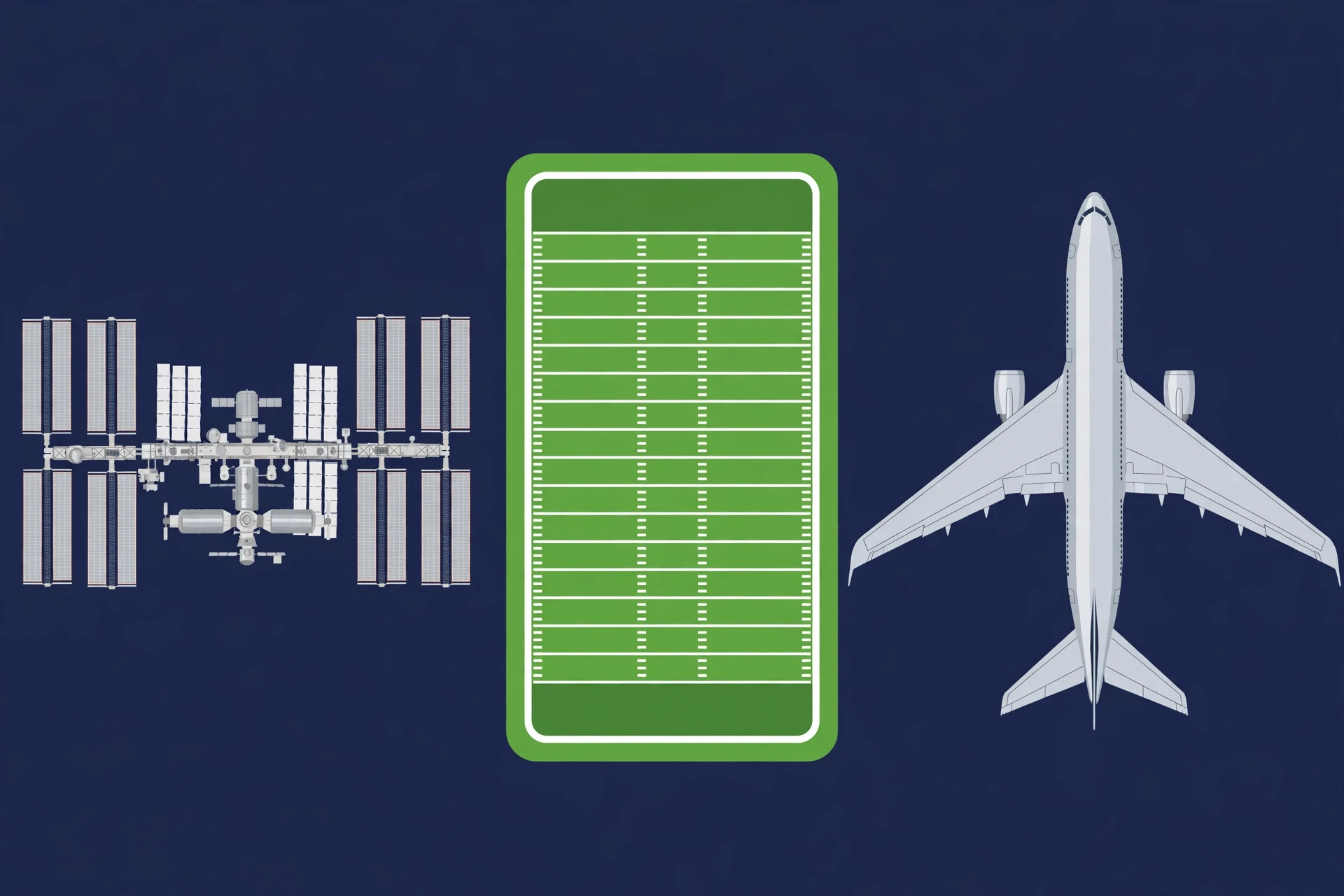
The International Space Station — the ISS, as almost everyone calls it — is a spacecraft the size of a football field that never lands. It is not a single ship that was launched whole. It is a collection of modules, trusses, solar panels, and radiators that were carried up piece by piece and bolted together in orbit, like a house built by people who could only deliver one room at a time, in a place where a dropped screw floats away forever.
The numbers are worth pausing over. The International Space Station is about 109 metres long from one end of its solar arrays to the other, and about 73 metres wide. Its pressurised volume — the space where people actually live and work — is roughly 916 cubic metres, about the same as a five-bedroom house, or a Boeing 747 with the seats taken out. It weighs around 419 tonnes, which is heavier than a fully loaded jumbo jet. It circles Earth once every 90 minutes, which means the crew sees 16 sunrises and 16 sunsets every day. And it has been continuously occupied since 2 November 2000, when the first long-duration crew — Expedition 1 — floated through the hatch. That unbroken chain of human presence in space is one of the quietest and most remarkable achievements of our time.
1.1 Five agencies, one station
No single country built the station. It is a partnership of five space agencies: NASA in the United States, Roscosmos in Russia, the European Space Agency (ESA), the Japan Aerospace Exploration Agency (JAXA), and the Canadian Space Agency (CSA). Fifteen nations have taken part in the programme in total. The station's modules carry names that reflect that mix: the Russian Zarya and Zvezda, the American Destiny and Harmony, the European Columbus, the Japanese Kibo — the largest single module, with its own exposed platform for experiments that need to sit in open space — and the Canadian robotic arm, Canadarm2, which has done much of the heavy lifting during assembly.
That partnership is not just symbolic. The International Space Station could not work without it. Russia provides much of the propulsion that keeps the station in its orbit and the Soyuz spacecraft that have carried crews for most of its life. The United States provides the bulk of the electrical power through its huge solar arrays. Europe and Japan provide laboratories. Canada provided the robotic arm. When politics on Earth has turned frosty, the station has kept flying, because nobody can run it alone. I find that fact as impressive as any of the engineering.
1.2 How big, how fast, how high
Fact | Value |
|---|---|
Length (solar array tip to tip) | About 109 metres |
Width | About 73 metres |
Mass | About 419 tonnes |
Pressurised volume | About 916 cubic metres |
Altitude | About 400–420 kilometres |
Speed | About 28,000 km/h (7.66 km per second) |
Orbit period | About 90 minutes |
Sunrises per day | 16 |
Continuously occupied since | 2 November 2000 |
Crew | Usually 7, sometimes more during handovers |
The altitude deserves a second look, because it surprises most people. Four hundred kilometres sounds far, but on the scale of the planet it is barely anything. If Earth were the size of a basketball, the station would be orbiting about 2 centimetres above its surface. It is not out in deep space. It is skimming the top of the atmosphere of Earth, the third planet from the Sun in our solar system, in a region called low Earth orbit, where the air is so thin that it barely counts as air — yet still thick enough to drag on the station and slowly pull it down, which is why the International Space Station needs regular boosts to stay up.
And the speed: 28,000 kilometres per hour is hard to picture, so here is a comparison I have used many times. A bullet from a rifle travels at roughly 1,000 metres per second. The International Space Station travels at about 7,660 metres per second — nearly eight times faster. It crosses the entire United States, coast to coast, in about ten minutes. At that speed, if you could somehow run alongside it, you would lap the planet in an hour and a half.
2. How the Station Was Built
The International Space Station was not built in a factory and launched. It was built in space, over thirteen years, in more than 40 assembly flights, by astronauts and robots working in the most hostile construction site ever attempted. The first piece, the Russian-built, American-funded Zarya module, went up in November 1998. The first crew arrived two years later, in 2000, and construction continued around them while they lived there — imagine moving into a house while builders are still adding rooms, except the builders are in spacesuits, the house is moving at 28,000 kilometres per hour, and outside the walls there is no air.
The space shuttle did most of the heavy lifting. Each shuttle flight brought up a truss segment, a laboratory, a solar array, or a radiator, and the crew bolted it into place during spacewalks that sometimes lasted eight hours. The main truss — the long backbone of the station — was assembled segment by segment, and the solar array wings were unfolded like enormous sails once they were in place. The last major American piece, the Alpha Magnetic Spectrometer, a particle-physics detector mounted on the outside of the International Space Station, arrived in 2011.
2.1 The modules, room by room
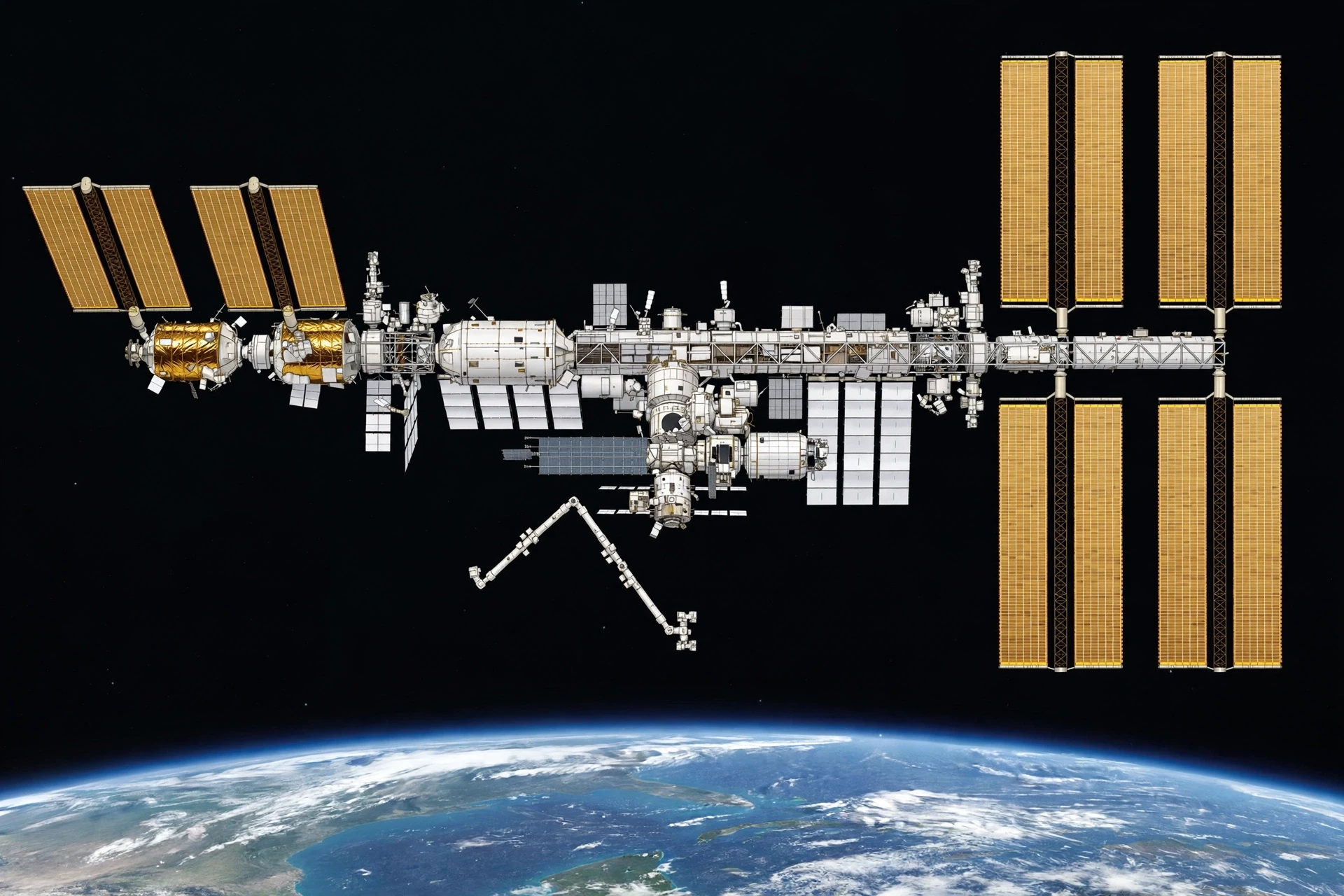
Walk through the International Space Station in your mind, and it feels less like a spaceship and more like a long, narrow house with many small rooms joined end to end. The Russian segment holds Zvezda, the service module, which provides living quarters, life support, and the station's main engines. The American segment holds Destiny, the first laboratory, where much of the research happens; Harmony, the connecting hub; and the cupola, the seven-windowed observation deck that we will come back to. Europe's Columbus laboratory sits on one side, Japan's Kibo on the other, with Kibo's exposed facility outside for experiments that need the vacuum of space itself.
Each module is a cylinder about 4 metres across — roughly the width of a small bedroom — and the crew floats through them along handrails, pushing off walls with a fingertip. There are no stairs, because there is no up and no down. There are sleeping compartments the size of phone booths, a tiny galley, a toilet the size of a small cupboard, and a gym that takes up a whole section of one module. Everything is bolted down, velcroed down, or bungeed down, because anything left loose becomes a floating hazard.
2.2 The robotic arm
Canadarm2, the station's 17-metre robotic arm, deserves a mention of its own, because it did work that no human could. It caught visiting cargo spacecraft as they drifted in close, grappled them gently, and berthed them to the station. It moved astronauts around the outside of the International Space Station during spacewalks, holding them steady while they worked. It even helped assemble the station itself, lifting truss segments that weighed tonnes and placing them with centimetre precision. An arm that can catch a spacecraft moving at orbital speed, softly, is a piece of engineering worth admiring on its own.
I once watched a recording of Canadarm2 catching a cargo ship, and the thing that struck me was how slow and careful it all looked. There is no rushing in orbit. Every movement is rehearsed, checked, and done at a pace that looks almost lazy — because a mistake at those speeds does not give you a second chance.
3. Why the Station Does Not Fall Down
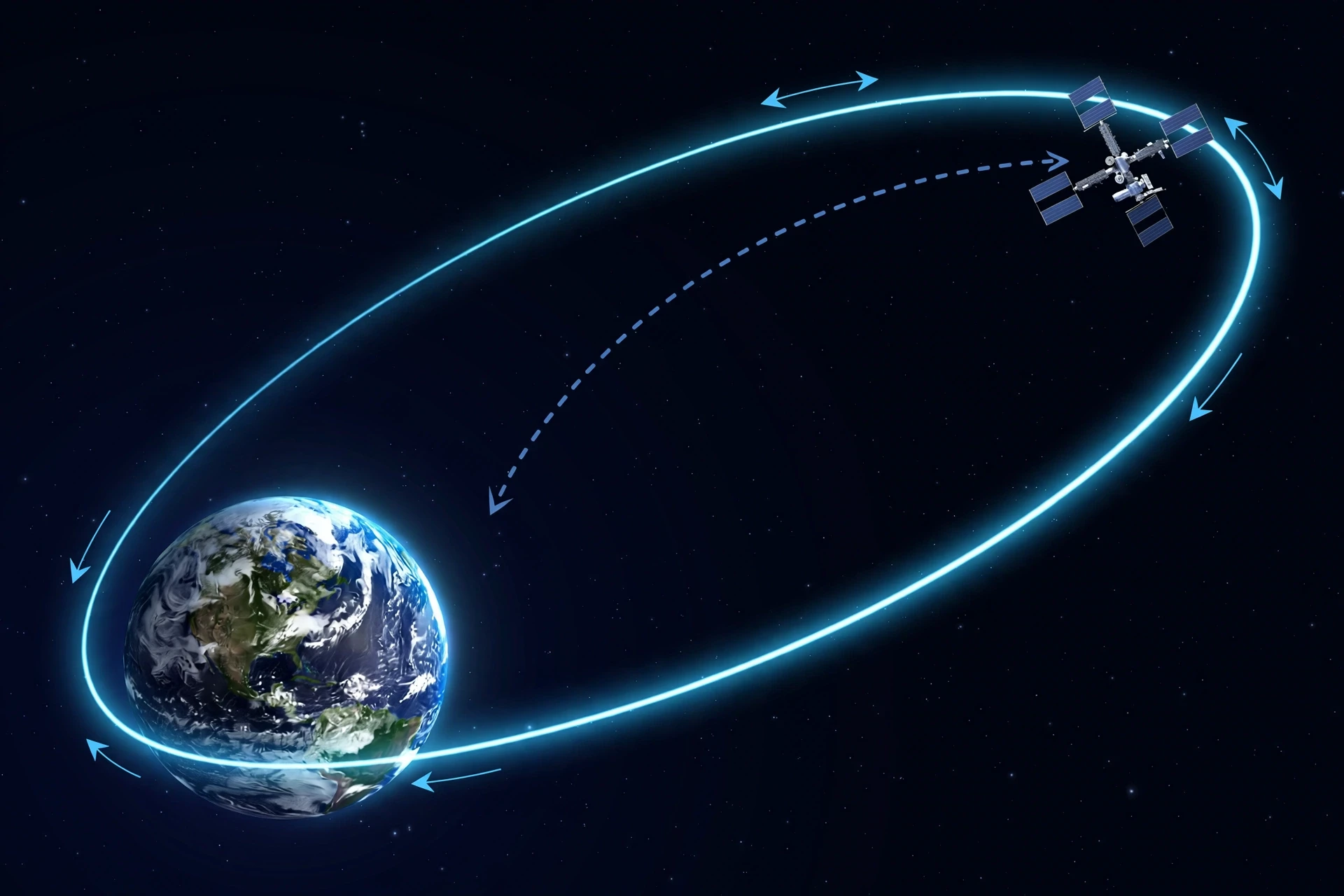
Here is the question almost everyone asks, and the answer is one of the most beautiful ideas in all of physics: the International Space Station is falling. It has been falling for more than 25 years, and it will keep falling for as long as it flies. It never hits the ground because it is also moving sideways so fast that the ground curves away beneath it at exactly the same rate. Orbit is falling and missing the Earth, forever.
The idea goes back to Isaac Newton, who imagined a cannon on top of a very tall mountain. Fire a cannonball, and it arcs down to the ground. Fire it faster, and it lands farther away. Fire it fast enough — about 7.9 kilometres per second, close to the station's speed — and the cannonball falls toward Earth at the same rate that Earth's surface curves away from it. It never lands. It just keeps falling around the planet. That is what the International Space Station does, once every 90 minutes.
Our guide to how gravity works explains the force behind all of this in more detail, but the short version is simple: gravity does not switch off at 400 kilometres up. It is still about 90 percent as strong there as it is on the ground. The International Space Station, and everything inside it, is in freefall — falling together, at the same rate, so nothing presses against anything else.
3.1 Microgravity is not zero gravity
Most people assume astronauts float because there is no gravity in space. What the data actually shows is the opposite: gravity is very much present, and it is doing the work. Astronauts float because they are in freefall, the same way you would feel weightless for a moment at the top of a roller-coaster drop, or in a lift whose cable had snapped. The difference is that on the International Space Station, the fall never ends.
Scientists call this microgravity rather than zero gravity, because tiny forces remain — the faint drag of the thin air, the vibrations of machinery, the push of a crew member against a wall. Those tiny forces matter for delicate experiments, which is why researchers measure them carefully. But for daily life, the effect is weightlessness: water forms floating spheres, a pen left in mid-air stays where you put it, and a person can push a 400-tonne station with one finger and actually move it a little.
"Weightlessness is not the absence of gravity. It is the absence of anything pushing back against gravity — the floor, the chair, the ground beneath your feet."
I have tried to explain this to students by asking them to imagine standing in a lift that is falling freely. Your feet would leave the floor. Your stomach would lurch. But gravity would still be pulling you down — you and the lift would just be falling together. Now stretch that fall out so it lasts for months, curve it around the planet, and you have the station.
3.2 Staying up takes work
The International Space Station's orbit is not permanent. At 400 kilometres up, the atmosphere is thin but not gone, and it drags on the station's huge solar panels like a hand trailing in water. Without regular boosts, the station would slowly sink and eventually burn up. So visiting spacecraft — Russian Progress freighters, and sometimes other vehicles — fire their engines to push the station back up to its proper altitude, a manoeuvre called a reboost. The station also has its own thrusters for dodging space debris, which we will come to later.
This is also why the International Space Station cannot simply be parked and left alone. It is an active, tended machine. Ground controllers in Houston and Moscow watch its orbit constantly, plan its boosts, and adjust its path when a piece of debris is predicted to pass too close. The International Space Station is flown, every day, by people on the ground as much as by the crew on board.
4. A Day in an Astronaut's Life
A day on the International Space Station is scheduled almost to the minute. The crew wakes at about 6:00 GMT, works from about 8:00 to 19:30, and goes to bed at about 21:30. They follow Greenwich Mean Time because the station crosses 16 time zones every 90 minutes, so local time is meaningless. Weekends are lighter — Saturday is mostly cleaning and personal time, Sunday is a day off — but the International Space Station never sleeps. Someone is always on watch, and experiments run around the clock.
Life in orbit has a rhythm that is both familiar and deeply strange. The crew eats three meals, works a full day, exercises, and sleeps. But every one of those ordinary things has to be reinvented for a place where up does not exist and water does not pour.
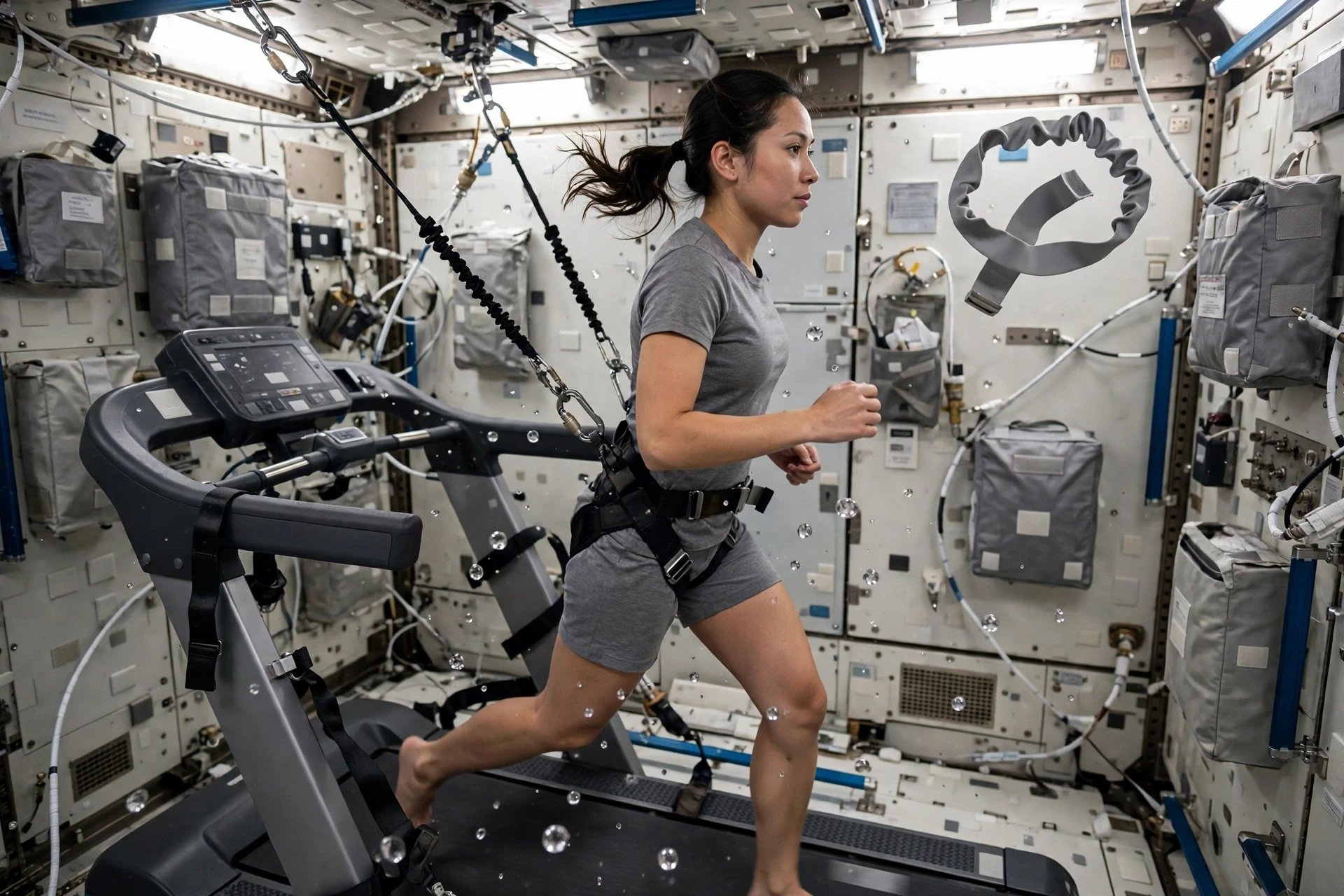
4.1 Exercise: two hours a day, every day
This is the part of station life that surprises people most, because it sounds like a luxury and it is actually medicine. Without gravity pulling on them, astronauts' bones lose density at a rate of about 1 to 2 percent per month in the spine and hips — roughly ten times faster than in a person with severe osteoporosis on Earth. Muscles shrink too, especially the muscles of the legs and back that normally work all day just holding us upright. After six months without exercise, an astronaut would come home barely able to walk.
So the crew exercises for about two hours every day, using three machines. The treadmill is the most famous: the astronaut wears a harness attached to bungee cords that pull them down onto the belt with a force roughly equal to their body weight, so their legs get a real workout. There is also a cycle ergometer — a stationary bike with no seat, because you do not need one when you float — and a resistance device called ARED, the Advanced Resistive Exercise Device, which uses vacuum cylinders to simulate lifting weights of up to about 270 kilograms. ARED is the main reason modern astronauts return home in much better shape than the early crews did.
The human heart changes in space too: without gravity, blood that normally pools in the legs spreads evenly through the body, the heart does not have to work as hard to pump blood upward, and it can shrink slightly and become more spherical. Exercise helps keep the cardiovascular system in shape, and doctors on the ground monitor the crew's health constantly.
I once spoke with a physiologist who works with returning astronauts, and she told me something that stayed with me: the first thing a returning crew member notices is not weakness, but weight. "They say their own arms feel heavy," she said. "Their head feels heavy. Everything feels heavy, because for six months nothing weighed anything at all." The body adapts to space quickly — and then has to adapt all over again to Earth.
4.2 Food: no crumbs allowed
Station food is better than it used to be — the early crews ate mostly from tubes and cubes — but it is still a long way from a home-cooked meal. Food arrives in sealed pouches and cans, much of it freeze-dried or thermostabilised, and the crew adds hot or cold water to rehydrate it. There are now more than 200 menu items, including shrimp cocktail, which has been a crew favourite since the earliest days, and tortillas, which replaced bread because bread makes crumbs. In weightlessness, crumbs do not fall to the floor. They float into equipment, into eyes, and into air filters. Tortillas do not crumble, so tortillas it is.
Meals are a social event. The crew gathers in the Unity node, floating around a small table, eating from pouches with spoons, trading items like children swapping packed lunches. Fresh food — apples, oranges, carrots — arrives occasionally on cargo ships and is eaten within days, because there is no refrigerator large enough to keep much fresh food for long. Coffee comes in a special pouch with a straw, because an open mug of coffee in weightlessness would become a floating brown sphere. I have seen a video of an astronaut squeezing a ball of coffee out of a pouch and catching it in his mouth, and it looked less like drinking and more like a magic trick.
Salt and pepper come as liquids, by the way. A shaker would be useless: the grains would drift away. So the crew seasons food with liquid salt water and liquid pepper oil, squeezed from small bottles.
4.3 Sleep: a bag on the wall
Astronauts sleep in small private compartments, each about the size of a phone booth, with a sleeping bag attached to the wall. They crawl in, zip themselves up so they do not float away, and close a small door for privacy. There is no bed, no pillow in the usual sense, and no "lying down" — you can sleep standing up, upside down, or sideways, and it makes no difference, because there is no up.
Sleeping in space is harder than it sounds. The station is noisy — fans and pumps run constantly to circulate air, because without gravity there is no natural convection and warm air does not rise. The crew sees a sunrise every 90 minutes, so their body clocks need help: the station's lights shift colour through the day, and the crew wear eye masks. And some astronauts report that their arms float up in front of their faces while they sleep, which is startling the first few times it happens. The science of sleep and dreams explains how the brain regulates sleep on Earth; in orbit, the same systems have to work without the cues — darkness, a horizontal body, a cool quiet room — that they evolved to rely on. Most crew members settle into a rhythm after a few days and sleep six to seven hours a night, a little less than they would at home.
4.4 Toilets, showers, and staying clean
The International Space Station's toilet is the piece of equipment that every visitor asks about, and the answer is a small triumph of engineering. Because there is no gravity to make things fall, the toilet uses airflow: a fan creates suction that pulls waste into a container. The seat is small, the funnel must be positioned precisely, and the crew train for it on Earth with a camera system that lets them practise their aim. Urine is not wasted — about 98 percent of the station's water is recycled, including urine and sweat, filtered and purified back into drinking water. The crew joke that yesterday's coffee is today's coffee. It is true, and the water is cleaner than most tap water on Earth.
There is no shower. Washing means wiping yourself with damp cloths and using rinseless shampoo — a special no-rinse shampoo that was developed for the station and later sold on Earth for hospital patients and campers. Haircuts are a two-person job: one person cuts, the other holds a vacuum hose next to the scissors to catch every floating hair. Laundry does not exist; clothes are worn for days and then thrown away on cargo ships that burn up in the atmosphere. A crew member's T-shirt may be worn for a week. Nobody complains, because everyone smells the same.
Daily life | On Earth | On the International Space Station |
|---|---|---|
Drinking water | Turn on a tap | Squeeze it from a pouch; it forms floating balls |
Eating | Plate and cutlery | Sealed pouches; tortillas instead of bread; no crumbs |
Sleeping | Lie in a bed | Zip into a sleeping bag attached to a wall |
Exercise | Optional | Two hours daily, medically required |
Washing | Shower or bath | Damp cloths and rinseless shampoo; no shower |
Toilet | Gravity and water | Airflow suction; urine recycled into drinking water |
Laundry | Washing machine | None — clothes worn for days, then discarded |
Day and night | One sunrise per day | 16 sunrises and 16 sunsets per day |
The table makes the point better than any paragraph: almost nothing about daily life survives the trip to orbit unchanged. The International Space Station is a machine for living in a place humans were never built to live — and the fact that people do it, for months at a time, and come home healthy, is the real achievement.
5. The Science Done on the Station
The International Space Station's real purpose is not to be a home. It is to be a laboratory — the only laboratory where gravity can be switched off for months at a time. Thousands of experiments from more than a hundred countries have run on the station, in fields from medicine to materials science to Earth observation. The results matter on Earth, not just in space, because gravity hides things. On Earth, a heavy liquid sinks and a light one floats; a flame is shaped by hot air rising; a crystal grows distorted by its own weight. Take gravity away, and you can see what the physics really looks like underneath.
NASA's research pages for the station keep a running account of this work, and the range of it is startling. Here are the fields that matter most.
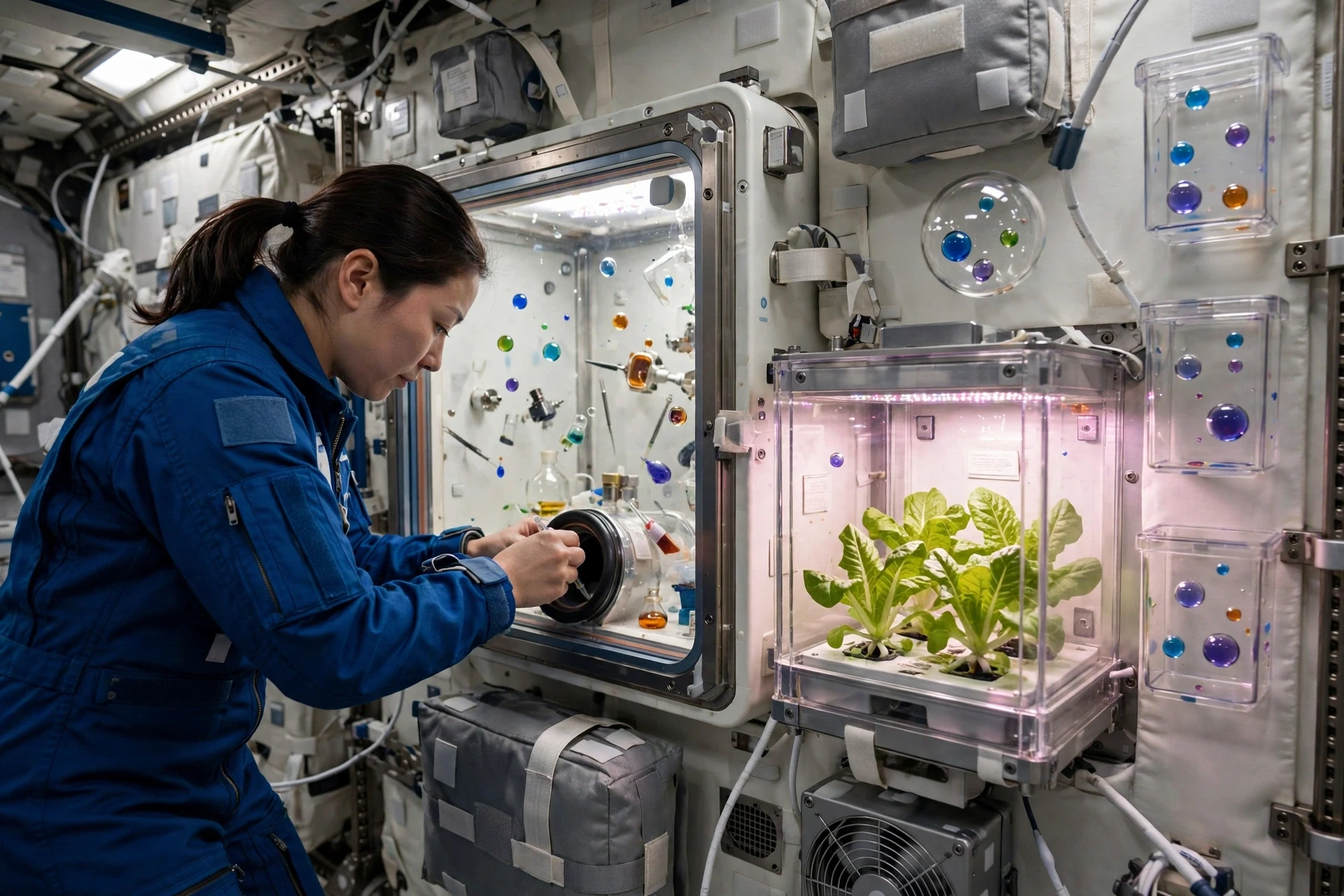
5.1 Protein crystals and new medicines
Some of the station's most valuable work is also the hardest to explain at a dinner party. Proteins are the machines of the body, and to design a drug that targets one, scientists need to know its exact three-dimensional shape. The best way to learn the shape is to grow a crystal of the protein and bounce X-rays off it. But on Earth, gravity distorts growing crystals: heavier parts sink, convection currents stir the solution, and the crystals come out flawed.
In microgravity, protein crystals grow larger and more perfectly ordered. Researchers have grown crystals of proteins involved in diseases including cancer, Alzheimer's disease, and Duchenne muscular dystrophy on the station, and the sharper structures they produced have helped drug designers understand their targets better. This is slow, patient work — a crystal can take weeks to grow — but it is exactly the kind of work that can only be done in orbit, and it is one of the strongest arguments for keeping a laboratory in space.
5.2 Fire without gravity
Fire behaves strangely in space, and studying it has made life safer on Earth. On the ground, a flame is tall and teardrop-shaped because hot air rises and fresh oxygen rushes in from below. In microgravity, there is no "up" for hot air to rise to, so flames become slow, round, blue spheres that burn cooler and can survive at oxygen levels that would snuff them out on Earth. Some station experiments have found flames that keep burning long after their Earth-bound equivalents would have died — and others that go out for reasons no one predicted.
That matters for two reasons. First, fire safety on spacecraft: you cannot open a window in space, so you need to know exactly how a fire would behave and how to put it out. Second, combustion on Earth: engines and power plants burn fuel in ways shaped by gravity, and understanding the underlying chemistry without gravity's interference has helped engineers design cleaner, more efficient burning. The International Space Station's combustion experiments have run for years, and they keep producing surprises.
5.3 Fluids, materials, and things that flow
Fluids are the station's favourite subject, because in microgravity, surface tension takes over from gravity as the force that shapes them. Water forms perfect spheres. Liquids crawl along walls. Two liquids that would separate on Earth can mix in unexpected ways. Researchers have studied how fluids move through porous materials, how droplets collide and merge, and how foams and emulsions behave — work that feeds into better detergents, better food processing, and better ways to handle liquids in spacecraft fuel tanks.
Materials science benefits too. Without gravity, metals can be mixed without the heavier elements sinking, and alloys come out more uniform. Researchers have studied how metals solidify, how semiconductors grow, and how soot forms — all with gravity removed from the equation. Some of this work points toward manufacturing in space itself, where the environment is the tool.
5.4 The human body as an experiment
Every astronaut is also a research subject. Before, during, and after flight, crews are measured in extraordinary detail: bone scans, blood samples, eye examinations, balance tests, cognitive tests, and samples of their gut bacteria. The results have built the most complete picture ever assembled of how the human body adapts to weightlessness — and how it recovers.
The findings have changed medicine on Earth. Bone-loss research from the station has informed treatments for osteoporosis. The fluid shifts that cause vision changes in astronauts have given doctors new insight into pressure inside the skull. Studies of the immune system in space, where it becomes less responsive, have helped immunologists understand how stress and confinement affect immunity. The International Space Station is, among other things, the world's most unusual hospital ward — and its patients keep coming home with data that helps the rest of us.
5.5 Watching Earth
The station is also an observatory pointed downward. From 400 kilometres up, the crew can see hurricanes forming, wildfires spreading, dust storms crossing oceans, and glaciers retreating. Astronauts take thousands of photographs, and automated instruments on the station's exterior measure things like ocean winds, lightning, and the health of vegetation. During disasters — floods, earthquakes, volcanic eruptions — the station's imagery has helped relief agencies on the ground see what is happening and where help is needed.
There is a human side to this too. Almost every astronaut who has lived on the station talks about the view, and about what it does to them. Seeing the whole planet — no borders, a thin blue line of atmosphere holding everything we know — changes how people think about Earth. Psychologists have a name for it, the overview effect, and the station is the only place where ordinary people can experience it for months at a time.
6. The Cupola: The Best Window in the World
If the station has a heart, it might be the cupola. Installed in 2010, the cupola is a small domed module with seven windows — one large round window in the centre, 80 centimetres across, ringed by six smaller ones — that looks straight down at Earth. It is the largest window ever flown in space, and it is the room where the crew goes to watch the planet, to photograph it, and to operate the robotic arm, which is controlled from inside the cupola.
ESA's page on the cupola describes it as the station's observation deck, and that is exactly what it feels like. Astronauts have described floating into the cupola in the morning with a coffee pouch and watching the sun rise over a coastline they recognise from maps. They have watched auroras ripple green below them — auroras seen from above, which look completely different from the ones we see from the ground. They have watched thunderstorms flash silently, lightning illuminating cloud tops from the inside like a lamp under a blanket.
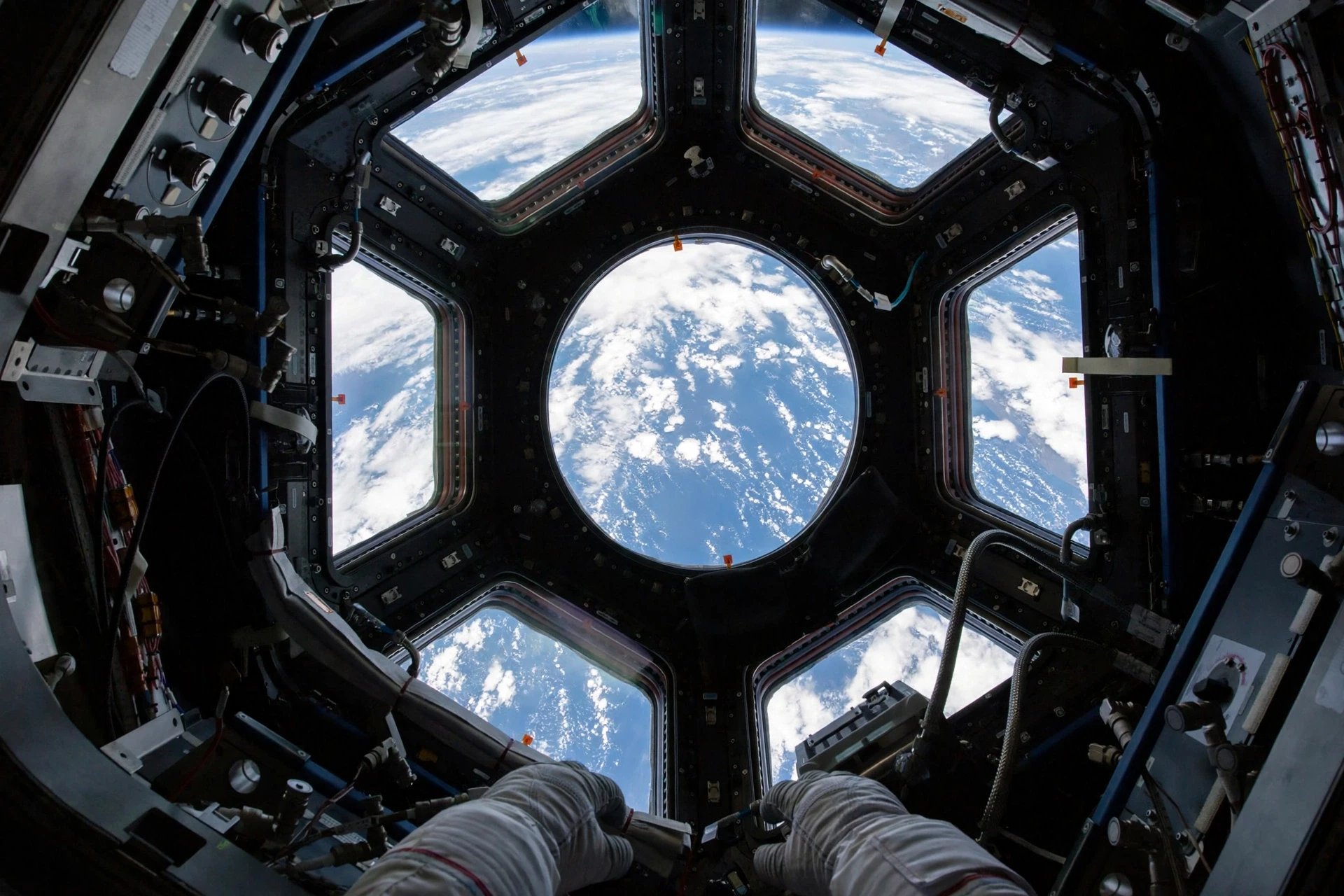
The windows are not ordinary glass. Each one is made of multiple layers of fused silica and borosilicate glass, built to survive impacts from tiny particles travelling at orbital speed, and each has a shutter that the crew closes when the cupola is not in use, to protect it from debris and from the harsh sunlight. When a shutter opens and Earth fills the window, first-time visitors to the cupola are said to go quiet. I can believe it. I have seen photographs taken through those windows — the blue of the ocean, the curve of the horizon, the thin line of the atmosphere — and even a photograph makes my breath catch. The real thing, filling your whole field of view, must be something else entirely.
The cupola is also a working room. From here, the crew drives Canadarm2 during cargo captures and spacewalks, watching the arm's cameras and the station's structure through the windows. It is the station's bridge and its front porch at the same time — a place for the hardest work and the quietest moments, in the same small dome.
"The cupola is where the crew goes to remember why they are there. Every astronaut who has floated in it says the same thing: the view does not get old. Not on day one, and not on day two hundred."
7. Spacewalks: Working Outside
Everything outside the station is done on a spacewalk — an EVA, or extravehicular activity — and it is the hardest, most dangerous, and most awe-inspiring work astronauts do. More than 270 spacewalks have been carried out at the station, adding up to well over 1,700 hours outside. They built the station, they maintain it, and they will be needed for as long as it flies.
A spacewalk is not a stroll. The astronaut wears a spacesuit that is really a small spacecraft in its own right: a self-contained world with its own oxygen, cooling, communications, and power, weighing about 145 kilograms on Earth — though in orbit, weight does not matter, and only mass does. The suit is stiff and bulky when pressurised, and every movement takes effort; astronauts say that simply closing a gloved hand feels like squeezing a tennis ball all day. Spacewalks typically last six to eight hours, and the crew prepares for hours beforehand, breathing pure oxygen to flush nitrogen from their blood so they do not get decompression sickness — the bends — when they step into the suit's lower pressure.
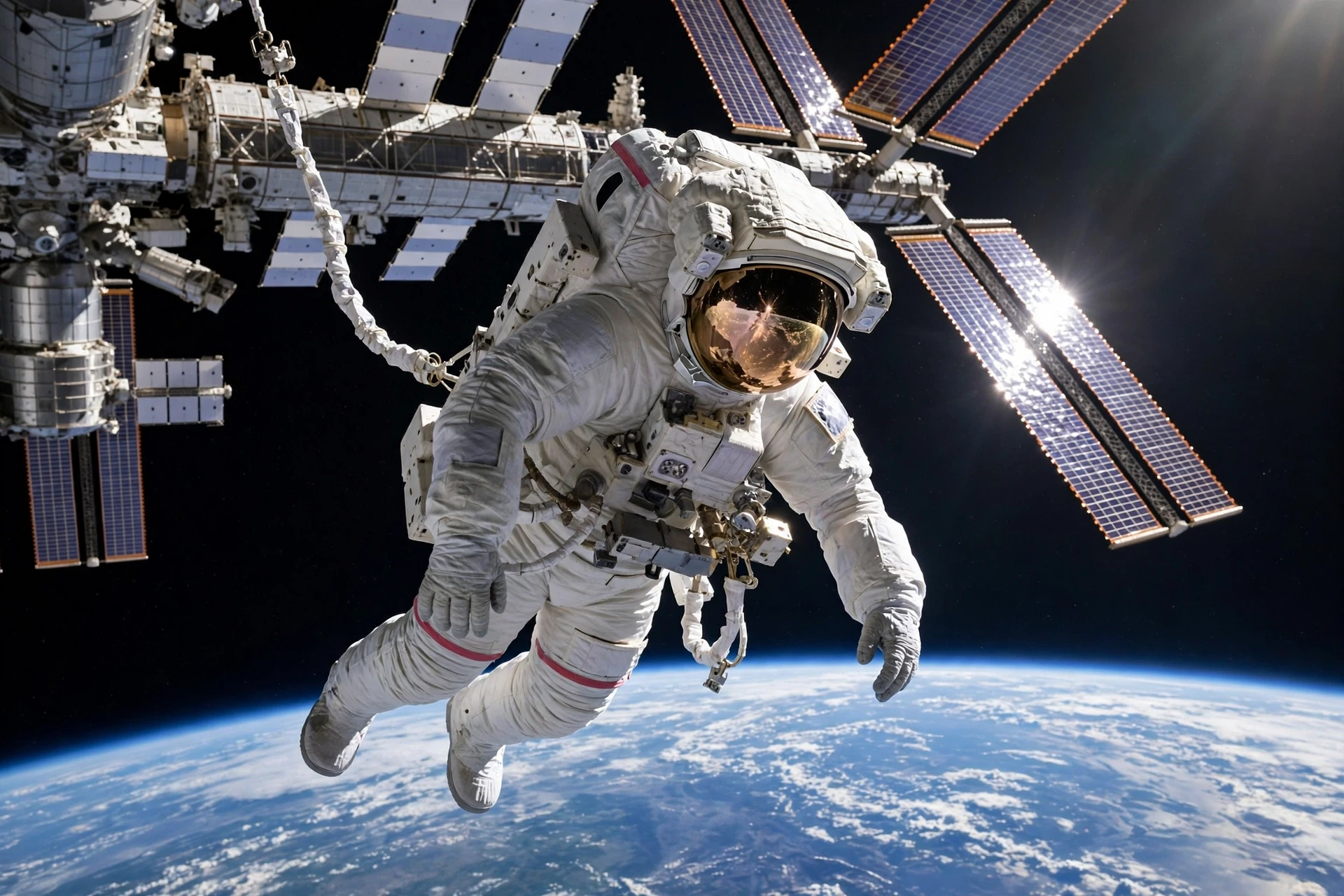
7.1 What spacewalkers actually do
Most spacewalks are maintenance: replacing a failed pump, installing a new solar array, lubricating a joint on the station's truss, fixing a cooling system. Some are upgrades: the station's solar arrays have been augmented with new, more efficient roll-out panels, delivered over several years and installed by spacewalking crews. A few are science: installing experiments on the outside of the station, or collecting samples of material exposed to space.
The work is slow and deliberate. A spacewalker moves along handrails, tethered to the station at all times — two tethers, so that one is always attached — and every tool is tethered too, because a dropped wrench in orbit becomes a small satellite that could come back around and hit the station. Ground controllers in Houston follow every step on a checklist, and the crew inside the station watches the spacewalkers' cameras and suit readings constantly. A spacewalk is a team effort involving dozens of people, even though only two are outside.
7.2 The risks of stepping out
Outside the station, the environment is merciless. In sunlight, the temperature can reach 120 degrees Celsius; in shadow, it drops to minus 150. The suit's cooling system handles that, but a cooling failure would be an emergency. Radiation is higher outside the station's shielding. And a micrometeoroid — a grain of sand travelling at 20 kilometres per second — could puncture a suit, though the suit's many layers are designed to stop exactly that.
There have been frightening moments. In 2013, an astronaut's helmet began filling with water from a leak in the suit's cooling system, and he had to be brought inside quickly, barely able to see or hear. He survived, and the suit was redesigned. Every spacewalk since has carried the lessons of that day. Spacewalking is safe only because it is treated as dangerous — rehearsed in a giant swimming pool on Earth, checked and rechecked, and never rushed.
8. The Dangers of Living in Orbit
The station is a safe place to live, but only because enormous effort goes into keeping it that way. The dangers are real, and they are unlike any dangers on Earth. Here are the main ones, and how the crew and ground teams handle them.
Radiation. Above most of Earth's atmosphere, the crew is exposed to cosmic rays and solar radiation. The station's shielding and Earth's magnetic field block much of it, but astronauts still receive a dose many times higher than on the ground — roughly the equivalent of several chest X-rays per day. The crew wear dosimeters, their exposure is tracked over their careers, and missions are timed to avoid the worst solar storms where possible. Long missions to the Moon or Mars will face far worse radiation, and the station is where we are learning how to deal with it.
Debris and micrometeoroids. Millions of pieces of debris orbit Earth: dead satellites, spent rocket stages, fragments from collisions, and natural micrometeoroids. Even a fleck of paint travelling at orbital speed can crack a window — and it has happened. The station's critical areas are shielded, ground radar tracks larger objects, and the station moves out of the way when a close approach is predicted. Smaller pieces cannot be tracked, and the crew have found small impact pits on the station's exterior many times.
Bone and muscle loss. As Section 4 described, weightlessness strips bone and muscle fast. Exercise and good nutrition hold the loss down, and most astronauts recover most of their strength within months of returning — but bone takes longer, and researchers are still studying whether repeated long missions carry lasting risks.
Vision changes. About two-thirds of long-duration astronauts develop some change in their vision, a condition called spaceflight-associated neuro-ocular syndrome. Fluid that normally pools in the legs spreads through the body in weightlessness, raising pressure inside the skull and flattening the back of the eyeball slightly. Some crew members need stronger glasses in orbit, and most recover after returning to Earth, but the condition is one of the biggest medical puzzles of long spaceflight, and solving it matters for any future mission to Mars.
Isolation and confinement. Seven people, in a space the size of a large house, for six months, with no way to step outside for a walk. The psychological load is real. Crews are chosen partly for how well they work in small teams, they keep in touch with family by video call, and they have private time built into their schedules. The station's long experience of confinement has taught space agencies a great deal about what future deep-space crews will need — and it has also produced useful lessons for life on Earth, from remote work to long winters in isolated research stations.
None of these dangers is hidden from the crew. Astronauts train for them, accept them, and manage them — and the station's 25-year safety record, with no crew member lost, is evidence that the management works.
9. The End of the Station — and What Comes Next
Nothing lasts forever, and the International Space Station is no exception. NASA's current plan is to operate the station through 2030, and then to bring it down in a controlled deorbit in early 2031. The station will be guided into the atmosphere over a remote stretch of the South Pacific Ocean — the spacecraft cemetery known as Point Nemo, the farthest point on Earth from any land — where most of it will burn up, and the surviving fragments will sink harmlessly into the sea.
It is worth saying plainly why the station is being retired rather than kept flying forever. The station is ageing. Its modules have been in space for decades, exposed to radiation, temperature swings, and micrometeoroid impacts. Maintenance costs grow with age. And NASA's priorities have shifted toward the Moon and Mars. Rather than spend its budget keeping an old station flying indefinitely, NASA plans to hand low Earth orbit to commercial companies.
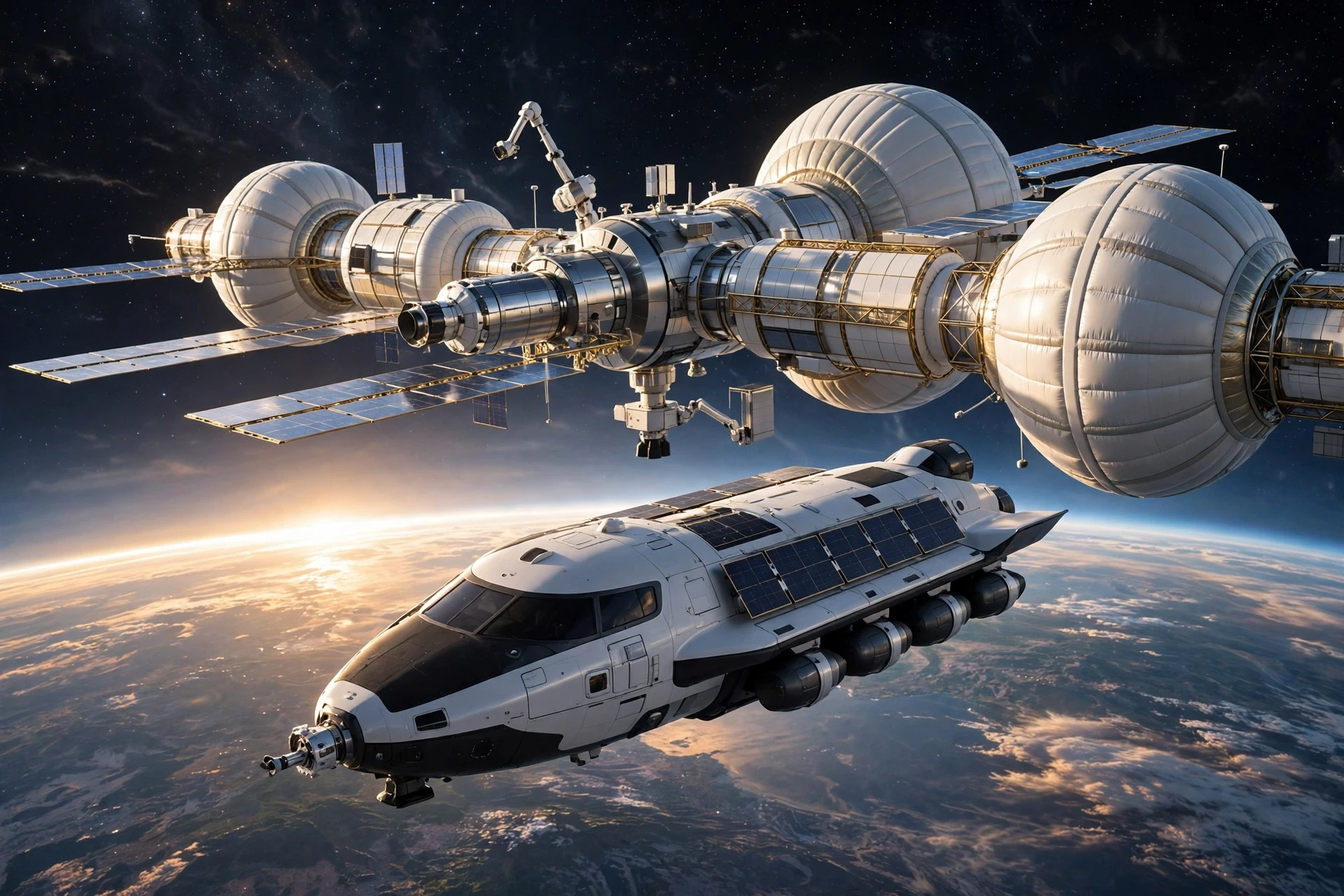
9.1 Commercial stations
Several companies are already building the station's successors, with NASA's support: stations designed from the start to be smaller, cheaper, and partly commercial — hosting research, manufacturing, and eventually tourists alongside government astronauts. The idea is that NASA buys time and services on these stations, the way it now buys cargo and crew transport from private companies, instead of owning and operating the whole facility. Whether the timeline holds — a new station ready before the old one comes down, so that the unbroken chain of people living in space, unbroken since November 2000, is never broken — is one of the most important questions in spaceflight today. A gap would be a loss: not just of science, but of the skills and habits of living in orbit that took a generation to build.
9.2 The legacy
Whatever comes next, the station's legacy is secure. It proved that countries that disagree on Earth can build and run something together in space, for decades. It proved that people can live and work in orbit for months at a time and come home healthy. It produced science that could not have been produced anywhere else, and it gave us the clearest view of our own planet that any generation has ever had. And it gave millions of people their first glimpse of spaceflight — not as a news clip, but as a bright light crossing their own sky, with people inside it.
10. How to Spot the Station Yourself
You do not need a telescope. You do not need to be an astronomer. You need a clear evening sky, a few minutes, and a prediction of when the station will pass over your home — and NASA gives those predictions away for free.
The station is visible because it is big, bright, and low. Sunlight glints off its solar panels, and from the ground it looks like a brilliant white star moving steadily across the sky — brighter than any star, and often brighter than Venus. It moves fast: it crosses the whole sky in a few minutes, and it does not blink or change direction, the way an aeroplane's lights do. The best time to see it is just after sunset or just before sunrise, when the sky is dark but the station, 400 kilometres up, is still catching the Sun.
NASA's Spot the Station service will tell you exactly when to look: enter your location, and it lists upcoming visible passes, with the time, the direction to look, and how high the station will climb in the sky. ESA's tracker shows where the station is right now, live. When the moment comes, go outside a few minutes early, let your eyes adjust, and look where the prediction says to look. Then wait. The light will appear, low on the horizon, and slide across the sky in a smooth, silent arc.
I still remember my first sighting, standing in that garden, watching a moving star and realising people were living inside it. If you watch it once, you will understand why astronauts say the view from up there changes people. The station is not an abstraction. It is a place, with an address — 400 kilometres up, moving at 28,000 kilometres per hour — and on the right evening, you can see it from your own backyard, and wave at the people who live there.
The Station Above Us
The International Space Station began as a drawing, became a construction site in the sky, and became a home — a home that has never been empty for more than 25 years. It taught us how to live without gravity, how to do science that gravity would not allow, and how to work together across borders in the hardest environment humans have ever inhabited. Its end is planned, its successors are being built, and its lessons will carry us to the Moon and to Mars.
But the station's simplest lesson is the one you can check for yourself tonight. Step outside when the sky is clear, find the time of the next pass, and watch. A bright light will cross the sky, steady and silent. Inside it, seven people will be eating dinner, running on a treadmill, looking down at the same planet you are standing on. They are the farthest-away neighbours humanity has ever had — and they are right above your head.
Frequently Asked Questions
How fast does the International Space Station travel?
The International Space Station travels at about 28,000 kilometres per hour — roughly 7.66 kilometres per second. At that speed it circles Earth once every 90 minutes, and the crew sees 16 sunrises and 16 sunsets every day. It crosses the entire United States, coast to coast, in about ten minutes.
Why do astronauts float on the International Space Station?
Astronauts float because the station is in freefall, not because there is no gravity. Gravity at the station's altitude is still about 90 percent as strong as on the ground. The station and everything inside it are falling toward Earth together, at the same rate, so nothing presses against anything else — and that feels like weightlessness. The station's sideways speed of 28,000 km/h keeps it falling around the planet instead of into it.
How long do astronauts stay on the International Space Station?
A typical stay is about six months, though some missions have lasted close to a year. Crews arrive and depart on spacecraft such as Russia's Soyuz and SpaceX's Crew Dragon, and the station usually holds seven people at a time, with more during crew handovers. The station has been continuously occupied since 2 November 2000.
What do astronauts eat on the International Space Station?
Astronauts eat food from sealed pouches and cans — much of it freeze-dried or heat-treated, rehydrated with hot or cold water. The menu has more than 200 items, including shrimp cocktail and tortillas, which replaced bread because bread makes crumbs that float into equipment. Fresh fruit and vegetables arrive occasionally on cargo ships. Coffee is drunk from a pouch with a straw, and salt and pepper are liquids.
Can you see the International Space Station from Earth?
Yes — with the naked eye, no telescope needed. The station looks like a bright, steady white star moving quickly across the sky, and it is often the third-brightest object in the night sky after the Sun and the Moon. The best times are just after sunset or just before sunrise. NASA's Spot the Station service lists exact pass times for your location.
What happens to the International Space Station when it retires?
NASA plans to operate the station through 2030 and then deorbit it in a controlled re-entry in early 2031, guiding it into the atmosphere over a remote part of the South Pacific Ocean near Point Nemo. Most of the station will burn up on re-entry, and any surviving fragments will fall into the sea. Commercial space stations are being built to take over low Earth orbit research.
How big is the International Space Station?
The International Space Station is about 109 metres long from one end of its solar arrays to the other and about 73 metres wide — roughly the size of an American football field. Its pressurised living and working volume is about 916 cubic metres, similar to a five-bedroom house, and it weighs about 419 tonnes.