

A few years ago, I watched a friend's seven-year-old talk to a voice assistant on a kitchen counter. She asked it to tell her a story about a dragon who was afraid of fire. The assistant paused for a second, then spun out a tale — a nervous dragon, a candle, a brave little mouse — that made the child laugh out loud. My friend turned to me and whispered the question that sits behind this whole article: "How does it know how to do that?"
That is the question this article answers. Understanding how artificial intelligence works does not require a computer science degree. It requires a clear picture of a few core ideas: machines that learn from examples, networks of simple mathematical units that find patterns, and training processes that adjust millions — sometimes billions — of tiny dials until the machine's guesses get good enough to be useful. Once you see those ideas clearly, the rest of AI stops looking like magic and starts looking like engineering. Clever engineering, and sometimes startling engineering, but engineering all the same.
This is a long guide, because the topic deserves one. We will start with what AI actually is, walk through a short history of false starts and breakthroughs, then look inside the machinery: machine learning, neural networks, deep learning, transformers, and generative AI. We will separate training from inference, look at what AI does well in medicine, science, and everyday life, and then face the honest limits — hallucinations, bias, and the question of whether AI "thinks" at all. By the end, you will know how artificial intelligence works well enough to judge its claims, use its tools wisely, and spot the hype.
1. What Artificial Intelligence Actually Is
1.1 A working definition
Artificial intelligence is the field of building machines that perform tasks which, when a person does them, seem to require intelligence: recognizing a face, translating a sentence, diagnosing a rash, writing a poem, or winning at chess. The word "artificial" matters. It signals that the intelligence is constructed, not grown. And the word "intelligence" is doing a lot of heavy lifting, because nobody agrees on exactly what intelligence is. What Is Intelligence? explores that debate in depth — the short version is that intelligence in humans covers many abilities at once, while AI systems are usually brilliant at one narrow thing and helpless at everything else.
That narrowness is the first thing to understand about how artificial intelligence works. A system that can beat the best human players at chess cannot make a cup of tea. A system that can translate between fifty languages cannot tie a shoelace. AI today is narrow AI: specialized tools, each built for a particular job. The general, flexible intelligence of a human — the kind that lets a child learn to ride a bicycle, comfort a friend, and invent a game, all in one afternoon — is called artificial general intelligence, and no system today has it.
1.2 AI, machine learning, and deep learning are not the same thing
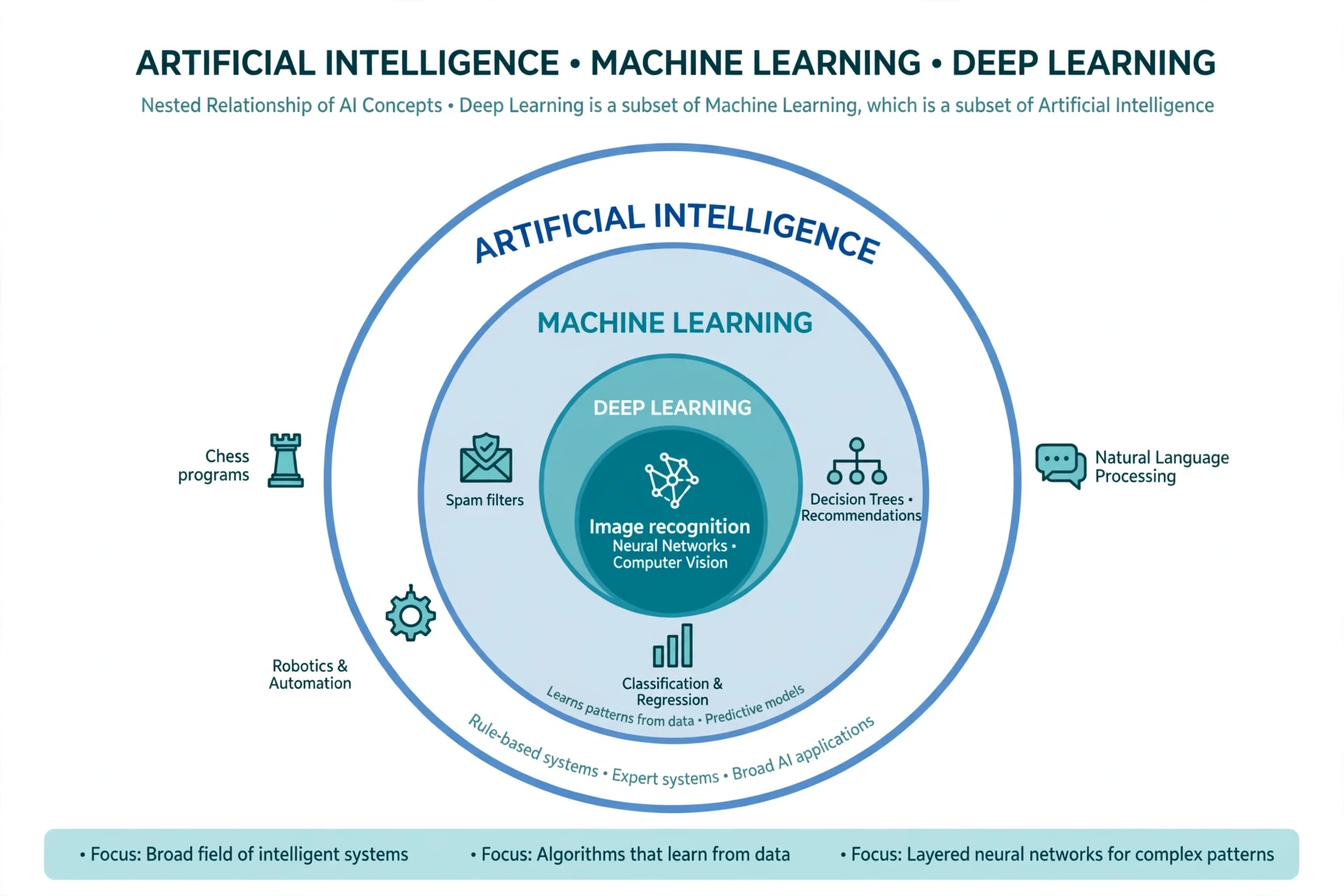
People use these three terms as if they were synonyms. They are not. Think of them as nested circles: AI is the biggest circle, machine learning sits inside it, and deep learning sits inside machine learning. A useful everyday analogy is cooking. AI is the whole kitchen — every way of preparing food. Machine learning is one approach to cooking: learning recipes by tasting thousands of dishes and noticing patterns, rather than following a rigid set of written instructions. Deep learning is a particular style within that approach, using layered networks that can handle very complex patterns.
Older AI worked differently. In the 1970s and 1980s, programmers wrote explicit rules: if the patient has a fever and a rash, consider measles; if the chess piece is a knight, it can move in an L-shape. These "expert systems" could be impressive, but they broke whenever reality refused to fit the rules. Nobody could write down all the rules for recognizing a cat in a photograph, because we do not consciously know the rules we use to recognize a cat. We just look and know. That gap — between what we can do and what we can explain in rules — is exactly where machine learning stepped in.
1.3 What AI does, in one sentence
Strip away the jargon and most AI systems do one thing: they take an input, run it through a mathematical model built from data, and produce an output — a prediction, a classification, a generated sentence, or a decision. A spam filter takes an email as input and outputs "spam" or "not spam." A translation system takes a French sentence and outputs an English one. A chatbot takes your question and outputs the next most likely sequence of words. Everything else — the scale, the cleverness, the occasional eeriness — comes from how that model was built and how much data it learned from.
I remember the first time this clicked for me. I was watching a demonstration where a researcher fed a program thousands of photographs of handwritten digits, each labeled with the correct number. After training, the program could read new, unseen handwriting with near-human accuracy. Nobody had taught it the rules of what a "7" looks like. It had found the patterns itself, in the pixels. That moment — watching a machine learn a skill nobody had written down for it — is the heart of how artificial intelligence works.
2. A Short History: Winters, Springs, and the Big Breakthrough
2.1 The dream begins
The story starts in 1950, when the mathematician Alan Turing asked a question that still shapes the field: instead of asking whether machines can think, he proposed, ask whether a machine can imitate a human well enough in conversation that a judge cannot tell them apart. Six years later, at a workshop at Dartmouth College in the United States, researchers coined the term "artificial intelligence" and set out, with enormous optimism, to build thinking machines within a generation.
The early decades delivered real achievements. Programs played checkers and chess, proved mathematical theorems, and solved puzzles. But the optimism outran the hardware and the methods. By the 1970s, funding dried up in what became known as the first "AI winter" — a period when promises had outpaced results and the money moved elsewhere. A second winter followed in the late 1980s, when expensive expert systems failed to live up to their billing.
2.2 Why the thaw finally came
Three things changed, and they changed together. First, computing power exploded — the same chips built for video games turned out to be excellent at the parallel arithmetic that AI needs. Second, the internet produced oceans of data: photographs, text, speech, video, all labeled, directly or indirectly, by human activity. Third, researchers revived and refined an old idea — the neural network — and discovered that with enough data and enough computing power, it worked far better than anyone had expected.
The turning point most researchers point to came in 2012, when a neural network called AlexNet won an image-recognition contest by a margin so large that the field changed direction almost overnight. Within a few years, neural networks were beating humans at recognizing images, transcribing speech, and playing the board game Go — a game with more possible positions than there are atoms in the observable universe, long considered a stronghold of human intuition. Then, in 2017, researchers at Google published a paper called "Attention Is All You Need," introducing the transformer architecture. That paper is the direct ancestor of the chatbots and image generators most people meet today.
The history of AI is a story of the same good idea waiting for the world to catch up with it. Neural networks were invented in the 1940s and 1950s. They needed sixty years of faster chips and bigger datasets before they could show what they could do.
2.3 The scale of modern AI
Modern AI systems are built at a scale that would have been unimaginable to the Dartmouth researchers. The largest language models are trained on trillions of words and contain hundreds of billions of adjustable values, called parameters. Training one can take months and consume as much electricity as a small town. That scale is part of how artificial intelligence works today — and part of the debate about it, because scale brings capability and cost in equal measure.
3. Machine Learning: How AI Learns from Examples
3.1 Learning without being explicitly programmed
Machine learning is the branch of AI in which systems improve at a task through experience — through data — rather than through hand-written rules. The classic definition, given by the computer scientist Arthur Samuel in 1959, is that machine learning gives computers "the ability to learn without being explicitly programmed." Samuel proved the point with a checkers program that improved by playing against itself.
Here is the everyday analogy I use most often. Imagine teaching a child to tell a dog from a cat. You do not hand the child a list of rules about ear shapes and tail lengths. You point at animals and say "dog" and "cat," over and over, until the child gets it. Machine learning works the same way: show the system many labeled examples, let it adjust itself until its guesses match the labels, and it gradually learns the pattern. How Learning Works describes the human version of this process — practice, feedback, and gradual improvement — and the machine version follows a strikingly similar rhythm.
3.2 Supervised learning: learning with a teacher
The most common form of machine learning is supervised learning, where every training example comes with the right answer attached. A dataset of emails labeled spam or not spam. A set of X-ray images labeled healthy or diseased. A collection of house prices with their features. The system studies the examples, makes predictions, checks them against the labels, and adjusts itself to reduce its errors. Repeat that loop millions of times and the system gets good.
Supervised learning powers a surprising share of everyday AI: email filters, fraud detection, medical image screening, speech transcription, and recommendation systems all lean on it. Its strength is also its limit: it can only learn what its labels teach, and labeling data takes human time and judgment. A model trained on biased or sloppy labels will learn the bias and the sloppiness along with everything else.
3.3 Unsupervised and reinforcement learning
Not all learning needs labels. In unsupervised learning, the system is given raw data with no answers and asked to find structure — groups of similar customers, topics hiding in a pile of documents, anomalies in a stream of sensor readings. It is like handing someone a jigsaw puzzle with no picture on the box and asking them to sort the pieces by color and edge shape. The machine finds the clusters; humans decide what the clusters mean.
Reinforcement learning works differently again. Here the system learns by doing: it takes actions in an environment, receives rewards or penalties, and gradually discovers a strategy that earns the most reward. This is how AI learned to play Go at superhuman level, how robots learn to grasp unfamiliar objects, and how some systems learn to manage energy in buildings or data centers. The analogy is a child learning to ride a bicycle — not from a manual, but from wobbling, falling, and slowly keeping balance longer each time. I once watched a reinforcement-learning agent learn to play a simple video game from scratch: for the first hour it flailed at random, then it began to survive a few seconds, then a minute, and by the end of the day it was playing better than I could. Nobody taught it a single rule of the game. It learned from the score alone.
3.4 The machine learning workflow
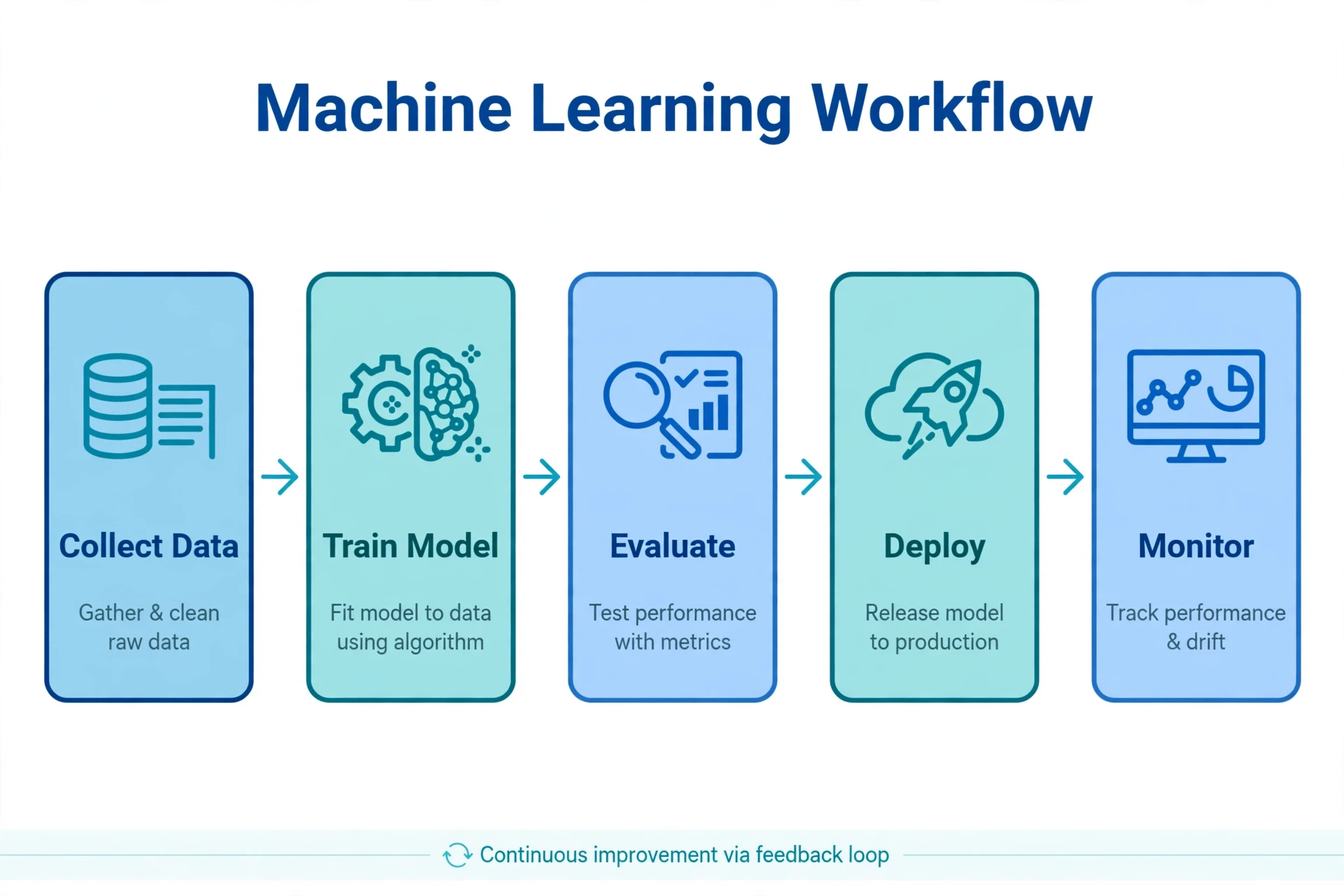
Every machine learning project follows roughly the same steps, and seeing them laid out is the fastest way to grasp how artificial intelligence works in practice. First comes data collection: gathering examples of the task, and cleaning them — fixing errors, filling gaps, removing duplicates. Then comes training, where the system studies the data and adjusts its internal settings. Then comes evaluation, where the trained model is tested on fresh examples it has never seen, to check whether it genuinely learned or simply memorized the training set. Finally comes deployment, where the model is put to work, and monitoring, where its performance is watched over time because the real world keeps changing.
The evaluation step deserves emphasis, because it guards against the most common trap in machine learning: overfitting. A model that memorizes its training data can score perfectly on examples it has already seen and fail badly on new ones — like a student who memorizes past exam papers without understanding the subject. Good practice always holds back a test set the model never sees during training, and judges it only on that fresh data.
Learning type | What the system gets | What it learns | Everyday example |
|---|---|---|---|
Supervised learning | Examples with correct answers | Mapping inputs to known outputs | Spam filter, medical image screening |
Unsupervised learning | Raw data, no labels | Hidden groups and structure | Customer segments, topic discovery |
Reinforcement learning | Rewards and penalties for actions | A strategy that earns the most reward | Game playing, robot control |
Self-supervised learning | Data with labels made from itself | General patterns in language or images | Language models, image models |
3.5 Self-supervised learning: the trick behind modern AI
The newest and most consequential form of learning is self-supervised learning. Instead of needing humans to label every example, the system creates its own labels from the data itself. For text, the classic trick is hiding a word and asking the model to predict it: "The cat sat on the ___." For images, it might mean hiding part of a picture and asking the model to fill it in. Because the labels come free, the system can train on enormous amounts of unlabelled data — essentially, much of the text and imagery on the public internet. This trick is what made today's large language models possible, and it is the reason AI improved so dramatically in the last decade.
4. Neural Networks: The Engine Inside Modern AI
4.1 Inspired by the brain, not a copy of it
A neural network is a mathematical structure loosely inspired by the brain. Your brain contains about 86 billion neurons, each connected to thousands of others, passing signals that add up to perception, memory, and thought. An artificial neural network borrows the shape of that idea — layers of simple units connected by adjustable links — but the resemblance stops there. Artificial neurons are not cells. They are numbers. They do arithmetic, not biology. How the Human Brain Forms Memories shows how different the real thing is: biological memory involves chemistry, sleep, emotion, and the hippocampus working together, while an artificial network's "memory" is a set of numbers stored on a disk.
Still, the borrowed shape turns out to be powerful. Each artificial neuron receives several numbers as inputs, multiplies each by a weight — a number that says how much that input matters — adds them up, and passes the result through a simple function that decides how strongly to fire. One neuron does almost nothing interesting. Thousands of them, arranged in layers and connected together, can recognize faces, translate languages, and predict the shape of a protein.
4.2 Layers: input, hidden, output
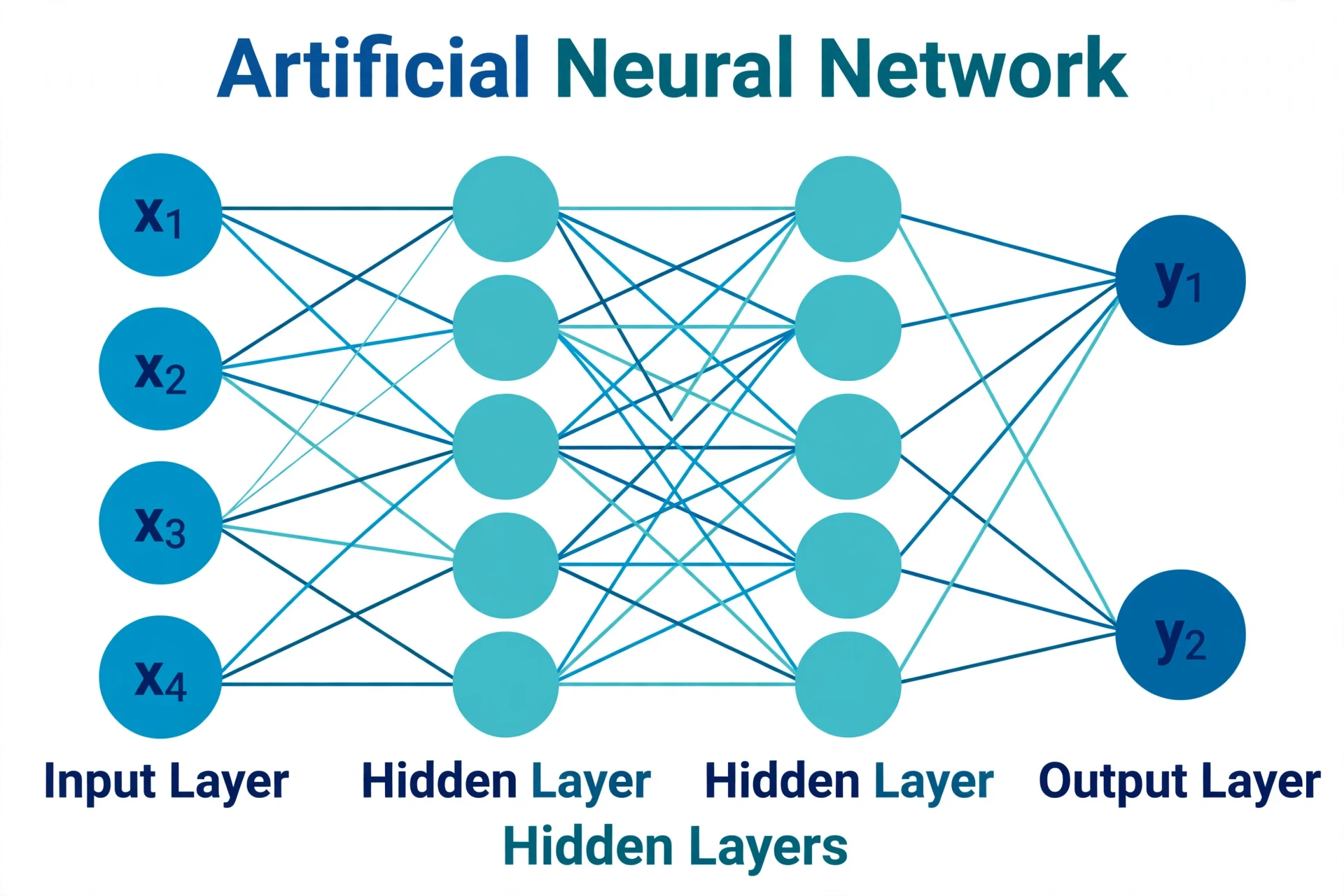
A typical neural network has three kinds of layers. The input layer receives the raw data — the brightness of each pixel in an image, say, or the numbers representing words in a sentence. The hidden layers sit in between, and this is where the real work happens: each hidden layer transforms the data, detecting progressively more complex features. The output layer produces the answer: a label, a probability, or a predicted next word.
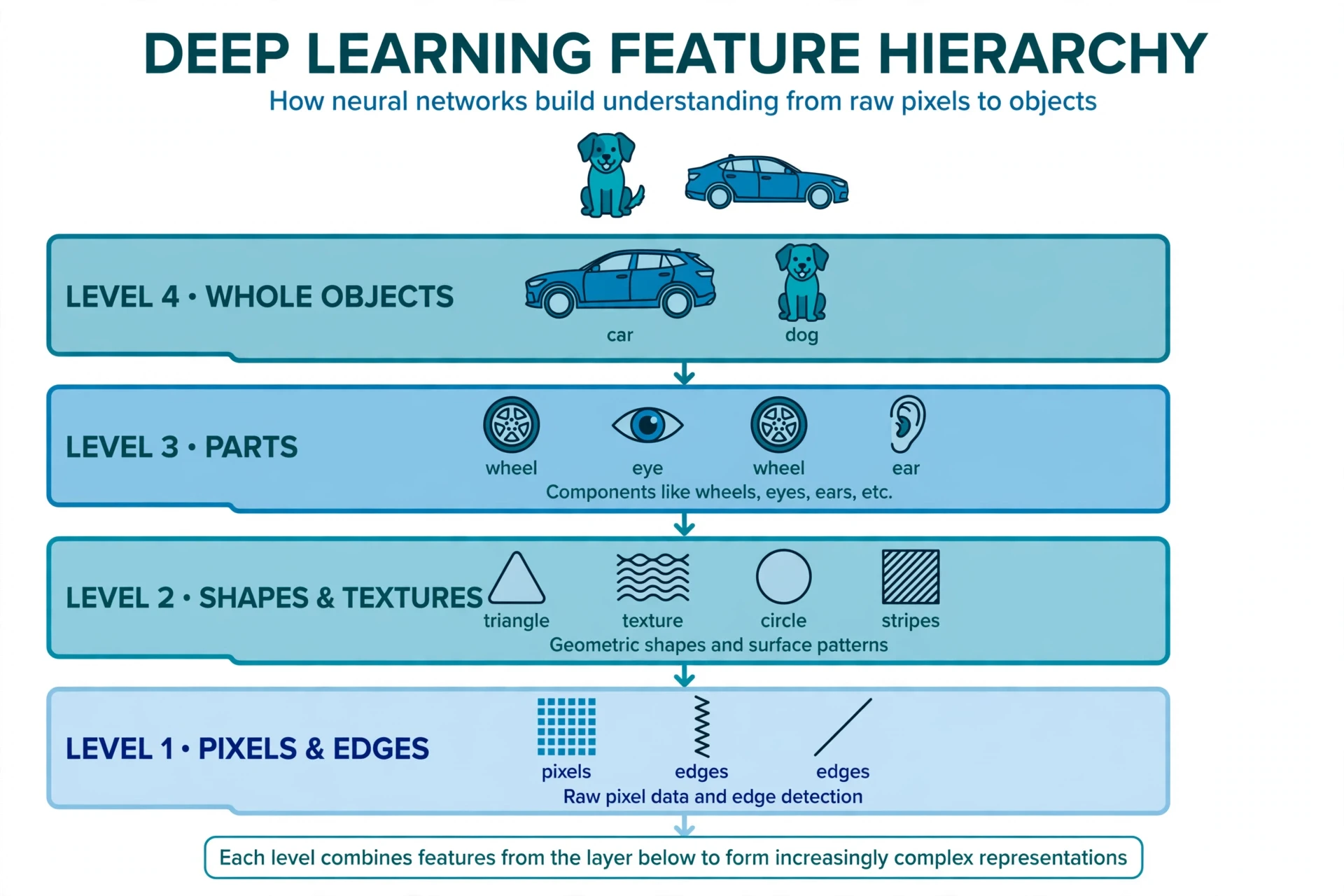
The magic is in what the hidden layers learn. In an image network, the first hidden layer might respond to edges and contrasts. The next might combine edges into shapes — circles, corners, textures. Deeper layers might respond to eyes, wheels, or leaves. Nobody programs these detectors. They emerge during training, because detecting them helps the network get the right answer. When I first saw a visualization of what individual neurons in an image network had learned — one neuron firing for dog faces, another for car wheels, another for the texture of fur — it felt like looking at a brain scan of a mind that had taught itself to see.
4.3 Weights, bias, and the loss function
Every connection in a network has a weight, and every neuron has a bias — a small adjustable offset. Together, the weights and biases are the network's knowledge. A network with a million connections has a million weights; a large language model has hundreds of billions. At the start of training, those weights are random, and the network's guesses are garbage. Training is the process of adjusting them, little by little, until the guesses improve.
How does the network know which way to adjust? It uses a loss function — a measure of how wrong its predictions are. Predict "cat" when the label says "dog," and the loss is high. Predict correctly, and the loss is low. Training is, at its core, a search for the set of weights that makes the total loss as small as possible across all the training examples. That search is guided by an algorithm called backpropagation, which works out how much each weight contributed to the error and nudges it in the direction that reduces it. Imagine tuning thousands of knobs on a vast machine, each nudge guided by a precise measurement of what went wrong. That is backpropagation, repeated millions of times.
4.4 Why networks need so much data
A network learns patterns from examples, so the quality and quantity of examples set a ceiling on what it can learn. Show it ten photographs of cats and it will learn almost nothing useful. Show it ten million and it can learn the difference between a cat and a small dog, in rain, at night, half-hidden behind a sofa. But data alone is not enough: the data must cover the range of cases the system will meet in real life. A medical AI trained only on images from one hospital, one scanner, one population, may fail badly on patients from anywhere else. This is not a footnote. It is one of the main reasons AI systems stumble when they leave the laboratory. Anyone who wants to understand how artificial intelligence works in the real world has to start with the data, because the data sets the ceiling on everything the model can learn.
5. Deep Learning: When Networks Get Deep
5.1 What "deep" means
Deep learning simply means neural networks with many hidden layers — sometimes dozens, sometimes more than a hundred. The word "deep" refers to depth, the number of layers, not to depth of understanding. Each additional layer lets the network build more abstract features from simpler ones: pixels into edges, edges into shapes, shapes into objects, objects into scenes. That hierarchy is the reason deep networks are so good at messy, real-world data like photographs, speech, and natural language, where the useful patterns are layered and tangled.
The idea is older than the success. Researchers built deep networks in the 1980s and 1990s, but training them was slow and unreliable, and the results did not justify the effort. What changed was not a single invention but a combination: faster hardware, much larger datasets, better training tricks, and the patience to let the networks train for days and weeks instead of hours.
5.2 Feature hierarchies: how depth builds understanding
Think of how you recognize a friend in a crowd. You do not scan for a single feature. Your visual system picks up edges and contrasts, assembles them into a face shape, notices the eyes and the smile, and matches the whole pattern to memory. A deep network does something structurally similar, layer by layer. The first layers learn simple, general features. Middle layers learn parts — a wheel, a window, a snout. The deepest layers learn whole concepts — a car, a house, a dog.
This layered learning explains one of deep learning's most surprising properties: transfer learning. A network trained to recognize everyday objects can be reused for a medical task, because its early layers already know about edges, textures, and shapes. Researchers take a pre-trained network, keep most of its layers, and retrain only the final ones on the new task — like hiring a chef who already knows knife skills and teaching them one new cuisine. That reuse is a big reason AI spread so fast into fields like medicine, agriculture, and astronomy. It is also a good illustration of how artificial intelligence works as a whole: general patterns learned once, then specialised for a new job.
5.3 Convolutional networks and the vision revolution
One special kind of deep network deserves a mention: the convolutional neural network, or CNN. CNNs are designed for images. Instead of treating every pixel independently, they scan the image with small filters that detect local patterns — an edge here, a curve there — and they reuse the same filter across the whole image. That design mirrors something real about vision: a diagonal edge is a diagonal edge wherever it appears. CNNs powered the image-recognition breakthroughs of the 2010s and still sit behind face recognition, medical imaging, satellite analysis, and the cameras in self-driving cars.
5.4 The cost of depth
Depth has a price. Deep networks need vast amounts of data, enormous computing power, and careful tuning. Training a large model can take weeks on thousands of specialized chips, and the electricity involved has become a genuine environmental question. Deep networks are also hard to interpret: with millions of weights spread across dozens of layers, explaining exactly why a network made a particular decision is difficult. Researchers call this the "black box" problem, and it matters most where the stakes are highest — medicine, criminal justice, finance — because a decision you cannot explain is a decision you cannot easily challenge or fix.
6. Transformers and Language Models: How AI Learned Language
6.1 The attention breakthrough
In 2017, a team at Google published a paper with a bold title: "Attention Is All You Need." Its proposal, the transformer, changed how artificial intelligence works with language — and then with almost everything else. Before transformers, language models processed text one word at a time, in order, like someone reading with a narrow flashlight. That made long-range connections hard: the model would forget the beginning of a sentence by the time it reached the end.
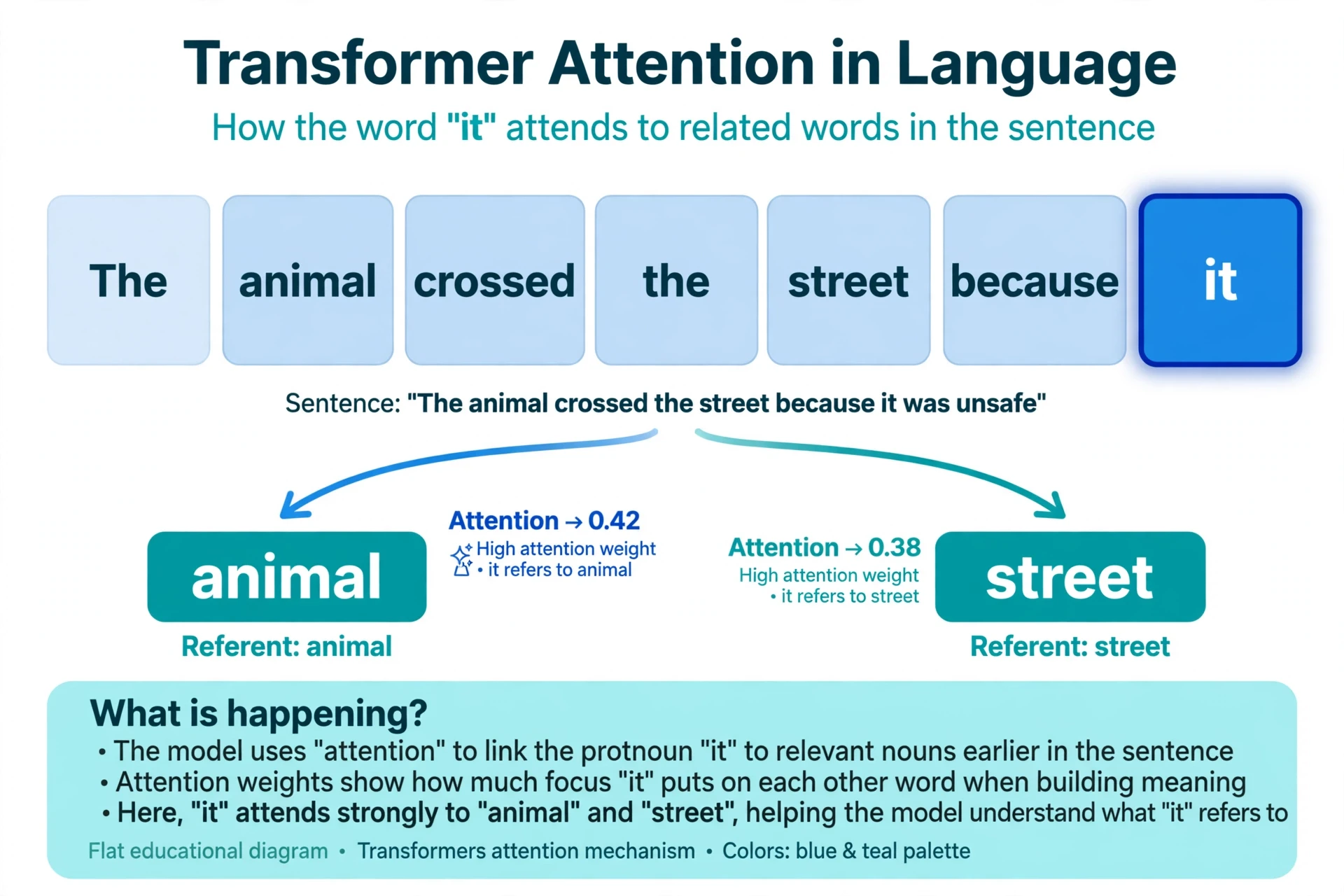
The transformer introduced a mechanism called attention. Instead of reading word by word, it looks at a whole passage at once and learns which words matter most to each other. In the sentence "The animal didn't cross the street because it was too tired," attention lets the model connect "it" to "the animal." In "The animal didn't cross the street because it was too wide," the same mechanism connects "it" to "the street." The model does not know grammar rules. It learns, from billions of examples, which connections predict the text correctly. That single idea — letting the model weigh the relevance of every word to every other word — unlocked a leap in language ability. Attention is the mechanism at the centre of how artificial intelligence works with language today.
6.2 How a language model predicts the next word
A large language model is, at its core, a next-word prediction machine. Given a sequence of words, it estimates the probability of every possible next word and picks one — usually the most likely, sometimes a slightly surprising one to keep the text varied. That sounds trivial. It is not. To predict the next word well across every topic a human might write about, the model has to learn grammar, facts, reasoning patterns, style, and something that looks very much like common sense, all compressed into its weights.
This is the part most people get wrong about how artificial intelligence works in chatbots. The model is not looking up answers in a database, and it is not reasoning the way a person reasons. It is generating text one piece at a time, each piece chosen because, given everything before it, that piece is statistically likely. The fluency is real. The understanding behind it is a subject of fierce debate among researchers, and honest experts will tell you the debate is unresolved. What is not in doubt is that next-word prediction, scaled up enormously, produces systems that can write essays, draft code, summarize documents, and hold conversations that feel strikingly human.
6.3 Tokens: the units models actually read
Models do not read words the way we do. They read tokens — chunks of text that are usually parts of words. "Unbelievable" might be split into "un," "believ," and "able." A model with a context window of 100,000 tokens can consider roughly 75,000 words at once. The context window is the model's working memory: everything inside it shapes the next prediction, and everything outside it is forgotten. When a chatbot seems to "forget" something you said earlier in a long conversation, that is usually the context window filling up, not a failure of intelligence.
6.4 From language to everything else
The transformer turned out to be far more general than its inventors expected. The same architecture now powers image generators, protein-folding models, music composition, and robot control. The reason is that attention is a general-purpose tool for finding relationships in sequences — and almost everything, from a sentence to a melody to a chain of amino acids, can be treated as a sequence. The Stanford Institute for Human-Centered Artificial Intelligence tracks this expansion across fields, and its annual reports are a good place to see how far the transformer family has spread beyond language.
6.5 Pre-training and fine-tuning
A large language model is built in two main stages. First, pre-training: the model reads an enormous collection of text — books, articles, websites, code — and learns to predict the next token, over and over, billions of times. This stage builds the model's general knowledge of language and the world. Then comes fine-tuning: the model is trained further on smaller, carefully chosen datasets that teach it to follow instructions, answer questions helpfully, and refuse harmful requests. A third stage, often called reinforcement learning from human feedback, has humans rate the model's answers so it learns which responses people actually prefer. Each stage shapes the model differently, and each is a place where choices — about data, about values, about what counts as a good answer — quietly shape the final system.
7. Training vs Inference: Learning and Using Are Two Different Jobs
7.1 Training: the long, expensive part
Training is the process of building the model: feeding it data, measuring its errors, and adjusting its weights until it performs well. It is slow, expensive, and done relatively rarely. Training a large language model can take months, thousands of specialized processors running in parallel, and enough electricity to power a town. Smaller models train in hours on a single computer. Either way, training is where the learning happens, and where most of the cost sits.
I once trained a tiny image classifier on my own computer — a few thousand photographs, a small network, an afternoon of waiting. It reached decent accuracy, and I felt a small thrill watching the error rate fall, epoch by epoch. Then I read what training a frontier model involves and laughed at the scale of the gap. The principle is identical. The scale is not. That is worth remembering whenever someone describes AI as either trivial or magical: the ideas are understandable, and the engineering scale is genuinely immense.
7.2 Inference: the fast, everyday part
Inference is what happens when a trained model is actually used: you give it an input, it runs the calculation, and it returns an output. Inference is fast — usually a fraction of a second — and cheap compared to training. When you ask a chatbot a question, when your phone recognizes your face, when a translation app converts a street sign, that is inference. The model is not learning from your question. It is applying what it already learned, frozen into its weights.
This distinction clears up a common confusion about how artificial intelligence works. People sometimes imagine that every chatbot is learning from every conversation, growing smarter in real time. In most commercial systems, that is not happening: the model you talk to today is the same model that was trained weeks or months ago. Some systems do collect conversation data to improve future versions, under privacy policies that vary widely, but the model in front of you is not rewriting itself as you chat.
7.3 Why the distinction matters
The training-inference split matters for three practical reasons. First, cost: training is a capital expense, inference is a running cost, and companies price their products around both. Second, freshness: a model only knows what was in its training data, so its knowledge has a cutoff date — ask it about an event after that date and it will guess, or admit it does not know, depending on how it was built. Third, control: because the model is fixed during inference, its behavior can be tested, audited, and certified in ways a constantly changing system could not be. Regulators and safety researchers care about this a great deal, and the National Institute of Standards and Technology has published frameworks for measuring and managing AI risk that lean on exactly this kind of testability.
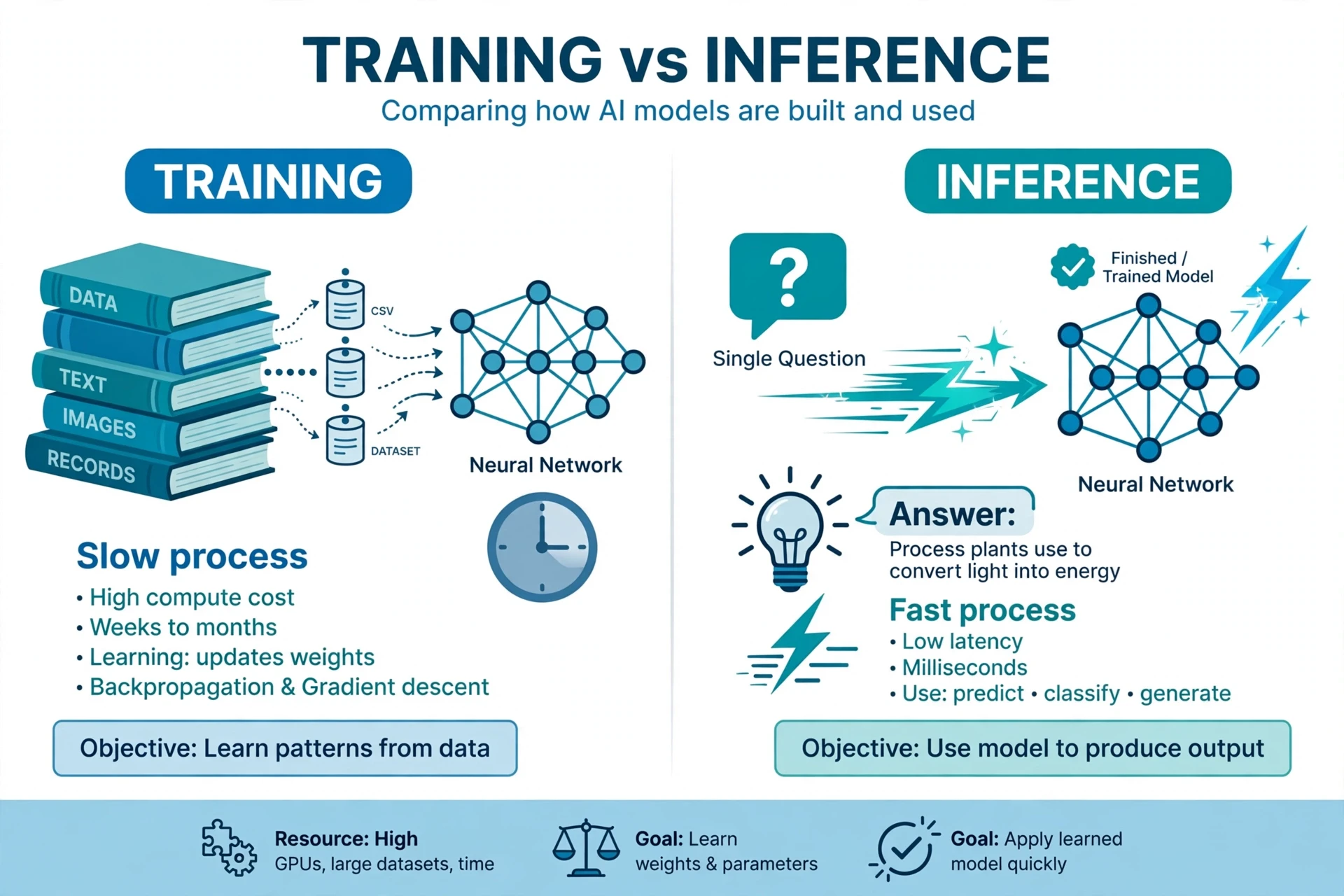
Training | Inference | |
|---|---|---|
What happens | Weights are adjusted by learning from data | Weights stay fixed; the model makes predictions |
How long it takes | Hours to months | Milliseconds to seconds |
Cost | Very high: data, compute, energy | Low per use, but adds up at scale |
How often | Once per model version | Every time a user asks something |
Example | Teaching a model on millions of images | Recognizing the cat in your photo |
8. Generative AI: How Machines Create Text, Images, and More
8.1 From prediction to creation
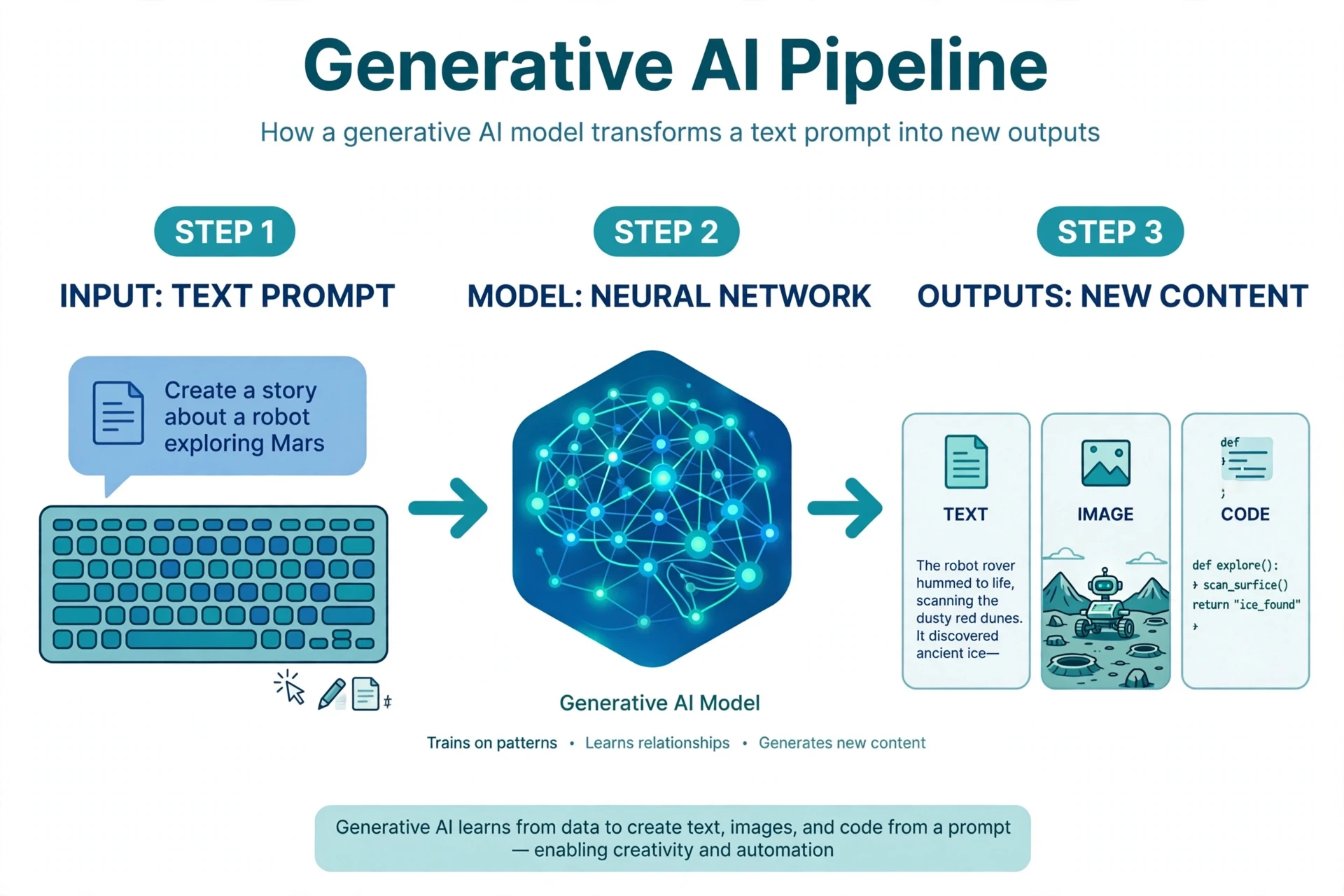
Generative AI is the branch that creates new content — text, images, music, video, code — rather than classifying or predicting. The shift from prediction to generation is smaller than it looks. A language model that predicts the next word, repeated hundreds of times, generates a paragraph. An image model that predicts how to remove noise from a blurry picture, repeated step by step, generates a photograph. Creation, in this world, is prediction done repeatedly, with a dash of randomness to keep the output fresh.
8.2 How image generators work
The most common image generators use a technique called diffusion. The training process takes a real image and gradually adds random noise until it becomes pure static, then teaches a neural network to reverse the process — to recover the image from the noise, step by step. Once trained, the model starts from pure noise and denoises it, guided by a text prompt, until a coherent image emerges. The prompt acts like a steering wheel: "a red bicycle leaning against a brick wall at sunset" nudges each denoising step toward images that match that description.
The results can be beautiful, and they can be subtly wrong. Count the fingers in an AI-generated image of a hand and you may find six. Look at the text on a generated shop sign and the letters may dissolve into nonsense. These flaws are clues to how the system works: it has learned what images look like statistically, not how hands are built or how spelling works. Knowing that makes you a sharper viewer of AI images, and a more honest user of them.
8.3 What generative AI is genuinely good at
Generative AI shines at drafting, brainstorming, and variation. It can produce ten opening paragraphs for an essay and let a human pick the best. It can draft routine code, summarize long documents, translate rough ideas into polished prose, and generate images for a presentation in minutes. For a student, a writer, or a small business, that is a real productivity gain. For scientists, generative models are also becoming research tools: predicting protein structures, proposing new molecules, and drafting hypotheses that humans then test. The MIT Computer Science and Artificial Intelligence Laboratory publishes work across exactly this range, from creative tools to scientific discovery.
Generative AI is best understood as a tireless drafting partner, not an oracle. It produces a first version fast, and the human decides what is true, what is good, and what survives.
8.4 The human stays in the loop
The most productive way to use generative AI, in my experience, is to treat it as a junior collaborator: fast, tireless, and occasionally confidently wrong. I have used language models to brainstorm outlines, to rephrase a tangled paragraph, and to summarize papers I needed to triage. Every time, the final judgment was mine. That is not a limitation to work around. It is the correct division of labor, because the model cannot check its own facts, cannot take responsibility for an error, and cannot know what matters to your reader. The human in the loop is not a bottleneck. The human in the loop is the point.
9. What AI Does Well: Real Uses in the World
9.1 Medicine and science
AI's most celebrated successes are in medicine and science. In 2020, the system AlphaFold solved a fifty-year-old problem in biology by predicting the three-dimensional shapes of proteins from their amino acid sequences — a result that has since accelerated research into diseases, drugs, and enzymes. In hospitals, AI helps radiologists spot tumors and fractures in scans, flags patients at risk of deterioration, and speeds up the analysis of pathology slides. In drug discovery, models propose candidate molecules that chemists then test in the laboratory. None of these systems replaces the doctor or the scientist. They extend what a human expert can see and how fast they can work — a clear example of how artificial intelligence works best, as an amplifier of human skill rather than a replacement for it.
9.2 Everyday life
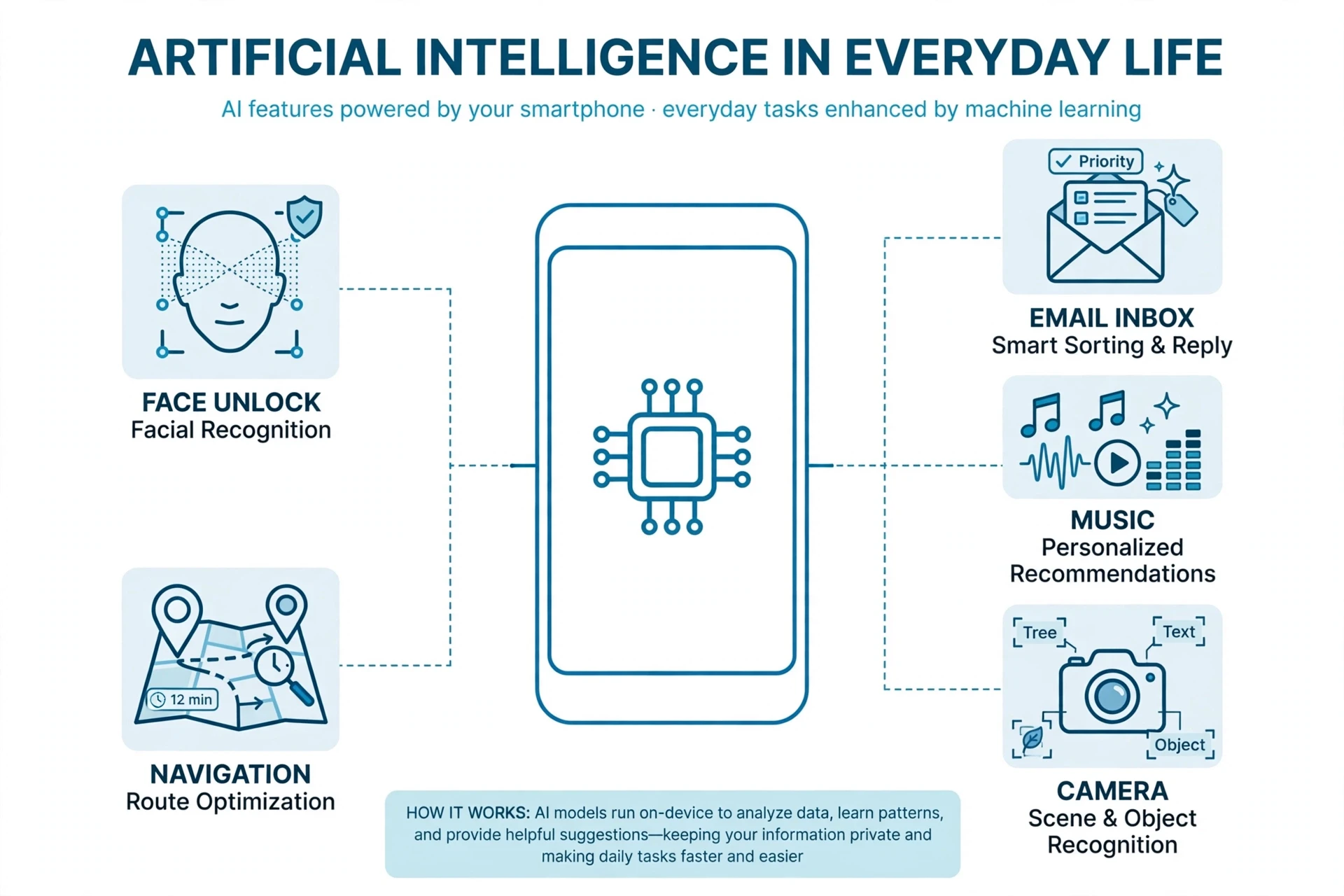
Most people meet AI long before they meet the word for it. Your phone unlocks with your face. Your email sorts itself. Your music app guesses what you want to hear next. Your map reroutes you around traffic it predicted from the phones of other drivers. Your camera recognizes the scene and adjusts its settings. Each of these is a narrow AI system doing one job well, invisibly, thousands of times a day. The reason AI feels sudden and new is not that it arrived all at once. It is that the visible part — chatbots that write like people — arrived after a decade of invisible parts. Seeing all these uses side by side is the clearest way to grasp how artificial intelligence works in practice: the same pattern — data in, model, prediction out — repeated across every part of daily life.
9.3 Language, access, and creativity
AI is also becoming a tool for access. Real-time translation lets people converse across languages. Speech recognition gives a voice to people who cannot type. Text-to-speech lets a blind reader hear a webpage. Image descriptions help a visually impaired person understand a photograph. These uses rarely make headlines, but they may be the most important thing AI does: lowering barriers between people and information, and between people and each other. Researchers at MIT News regularly cover work in this area, from translation for low-resource languages to assistive tools built with the communities they serve.
9.4 Climate, farming, and the planet
Beyond the headlines, AI helps farmers spot crop disease from drone photographs, helps grid operators balance renewable energy, helps researchers track deforestation from satellite images, and helps climate scientists model weather and ocean currents. These are pattern-recognition jobs at planetary scale — exactly the kind of task neural networks are built for. A satellite image is a picture; a field of wheat is a pattern; a changing climate is a signal hidden in noise. The same machinery that recognizes a cat can, retrained, recognize a failing crop.
10. The Limits: Hallucinations, Bias, and What AI Cannot Do
10.1 Hallucinations: confident, fluent, wrong
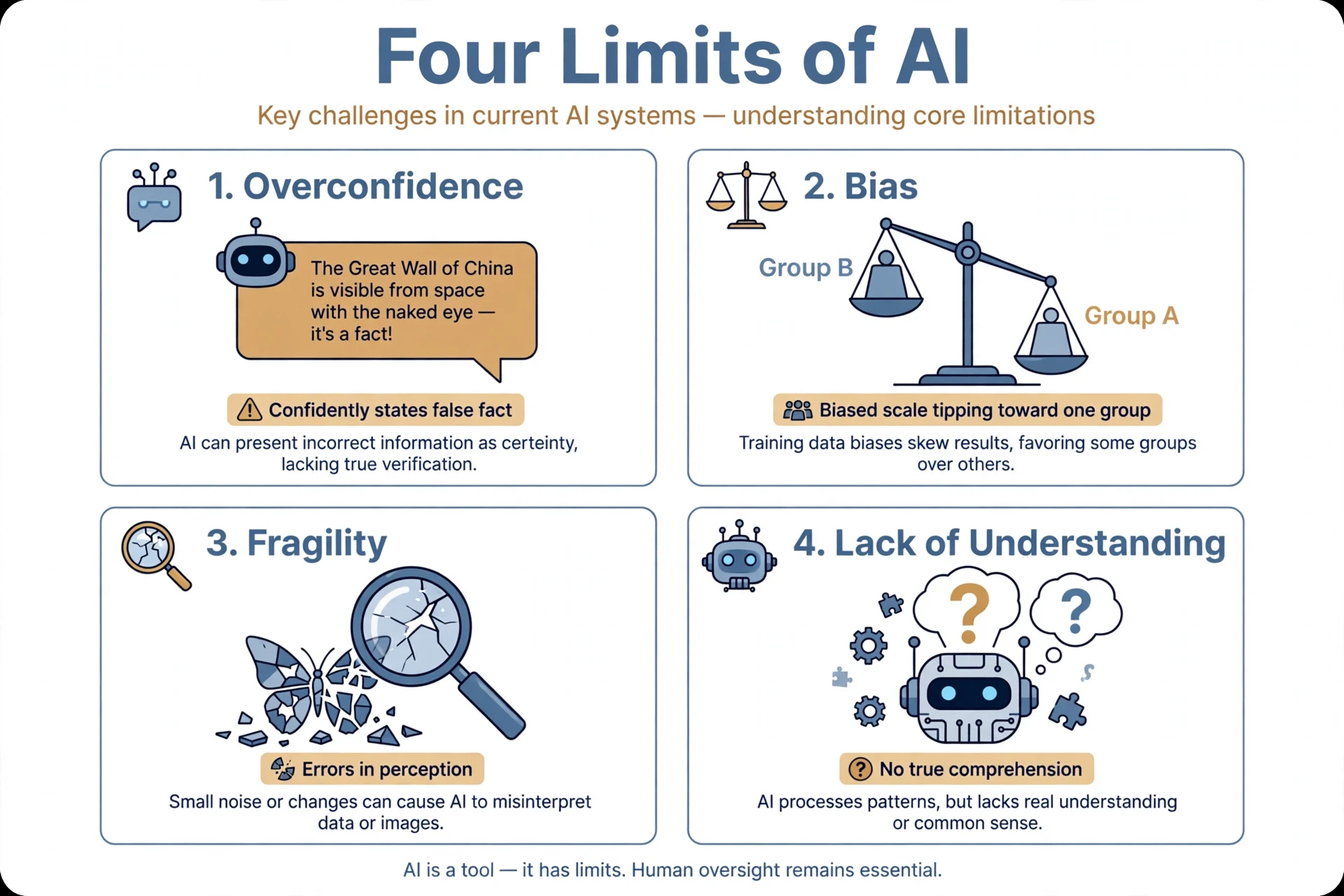
The most important limit to understand about how artificial intelligence works is that a language model is optimized to produce plausible text, not true text. When it does not know an answer, it often invents one — fluently, confidently, and with fake citations that look real. Researchers call these inventions hallucinations. They happen because the model has no internal fact-checker and no access to the truth; it has only patterns in its training data and the statistical pull of the next likely word.
Hallucinations are not a rare glitch. They are a built-in consequence of how the system is built. A model asked for a summary of a paper that does not exist may produce one. A model asked for a legal citation may invent a case number. The danger is not that AI makes mistakes — humans make mistakes too — but that its mistakes wear the smooth, authoritative costume of correct text. The defense is simple and non-negotiable: verify anything important against a trusted source, especially names, numbers, dates, and quotations. If a claim matters, check it yourself.
10.2 Bias: the data's fingerprints
A model learns from human data, and human data carries human history — including its prejudices. A hiring tool trained on past hiring decisions can learn to prefer the candidates companies used to prefer, for the wrong reasons. A facial-recognition system trained mostly on light-skinned faces can fail far more often on dark-skinned faces. A language model trained on the internet can reproduce stereotypes about gender, race, and nationality without anyone intending it to.
This is why understanding how artificial intelligence works has to include understanding where its data comes from. Bias in AI is rarely a villain writing a prejudiced rule. It is usually a dataset that underrepresents some people, a label that reflects an old decision, or a success metric that rewards the majority and ignores the minority. Fixing it means fixing the data, the labels, the evaluation, and the team that builds the system — not just tuning the model. Cognitive Biases describes the human side of this problem: our brains take shortcuts that feel like judgment, and the data we produce carries those shortcuts with it.
10.3 Reasoning, common sense, and the "understanding" question
Can AI reason? The honest answer is: partly, and nobody fully agrees on what counts. Large language models can solve multi-step maths problems, write working code, and answer questions that seem to require reasoning. They also fail at puzzles a child solves easily, contradict themselves within a single paragraph, and collapse when a familiar problem is reworded in an unfamiliar way. That pattern — brilliance on the familiar, fragility on the novel — suggests that what the model has learned is closer to a vast library of patterns than to the flexible, grounded reasoning humans use.
Most people assume that because a chatbot writes like a person, it thinks like a person. What the evidence actually shows is different: fluent language and genuine understanding can come apart. A model can produce a perfect paragraph about bicycles without knowing what it feels like to balance on one, without ever having seen a road, and without any stake in whether its answer is true. That does not make its output useless. It makes the human reader's judgment essential. Knowing how artificial intelligence works means knowing where its apparent understanding ends and your own begins.
10.4 Other hard limits
Several other limits deserve a plain statement. AI systems are brittle: small changes to an input — a few pixels in an image, a reworded question — can flip an output from right to wrong. They are data-hungry: they need far more examples than a human child needs to learn the same skill. They are energy-hungry: training and running large models consumes real electricity and water for cooling. They lack grounding: they learn from text and images about the world, not from living in it, so they miss the physical common sense that humans absorb by moving through rooms, dropping things, and getting wet in the rain. And they have no goals, desires, or awareness of their own — the science-fiction fear of a machine that wants something is not what today's systems are, and treating them as if they want things is a category error, not a safety plan.
A useful rule for reading AI output: treat it like a brilliant stranger who has read a million books but never left the library. Trust the phrasing, verify the facts, and never hand it a decision you would not hand to someone who cannot be held responsible for the result.
11. How to Use AI Well: A Practical Guide
11.1 Ask well, check everything
Getting good results from AI starts with the prompt. Be specific about what you want, give context, and say what a good answer looks like. "Explain photosynthesis to a twelve-year-old in under 200 words" beats "tell me about photosynthesis" every time. Then check the output. For anything factual, cross-check against a reliable source. A clear mental model of how artificial intelligence works makes all of this easier: once you know the machine predicts rather than verifies, checking its output becomes second nature. For anything creative, judge it by your own taste. For anything that affects another person — a medical question, a legal letter, a hiring decision — treat the AI's draft as a starting point and bring in a human expert before acting.
11.2 Know what to delegate and what to keep
A good rule of thumb is to delegate the draft and keep the judgment. Let AI summarize the long report, draft the routine email, brainstorm the options, and clean up the spreadsheet. Keep for yourself the decision about what is true, what is fair, and what matters. That division protects you from the two opposite mistakes: refusing a useful tool out of suspicion, and surrendering your judgment to a machine that has none. Understanding how artificial intelligence works is what makes that division possible — you cannot delegate wisely to a tool you do not understand.
11.3 Privacy, security, and common sense
Assume that anything you type into a public AI service may be stored, reviewed, or used to train future models, unless the service's terms say otherwise in plain language. Do not paste passwords, medical records, financial details, or other people's private information into a chatbot. Be skeptical of AI-generated messages that ask you to act urgently — voice cloning and realistic text have made impersonation scams cheaper and more convincing. The technology is neutral. The uses are not, and the same fluency that writes a beautiful poem can write a convincing lie.
11.4 The skills that stay human
As AI takes over more routine drafting, summarizing, and pattern-matching, the skills that stay distinctively human become more valuable, not less: asking the right question, knowing which problem is worth solving, judging whether an answer is true and fair, explaining an idea so another person actually understands it, and taking responsibility for a decision. Those are not things a next-word predictor can do for you. They are the reason learning how artificial intelligence works matters — not so you can compete with the machine at its own game, but so you can stay clearly in charge of yours.
12. Conclusion: A Tool, Not a Mind
We began with a child asking a voice assistant for a story about a nervous dragon. The machine answered, and it felt like a small miracle. Now you know what happened underneath that miracle: a model trained on vast amounts of text predicted one word after another, guided by patterns it had learned from examples, running on hardware built for exactly that arithmetic, and producing a story that was new in its arrangement even though every ingredient came from something it had read before.
That is how artificial intelligence works. It learns from examples instead of rules. It builds layered networks that detect patterns too subtle and too numerous for a human to write down. It predicts, generates, and classifies at a scale no person could match. And it does all of this without understanding, without experience, and without the common sense that a child brings to the same room. The wonder is real, and so are the limits. The systems are powerful tools, and like every powerful tool, they reward the people who understand them and punish the people who trust them blindly.
The best response to AI is neither awe nor fear. It is curiosity with standards: use the tools, check the output, learn the machinery, and keep the judgment where it belongs — with you.
Frequently Asked Questions
How does AI learn without being programmed with rules?
AI learns from examples through machine learning. Instead of a programmer writing rules, the system studies large datasets, makes predictions, measures its errors, and adjusts its internal settings — the weights in a neural network — to reduce those errors. Repeating that loop millions of times lets the system discover patterns on its own. This is the core of how artificial intelligence works: learning from data rather than from hand-written instructions.
What is a neural network in simple terms?
A neural network is a layered system of simple mathematical units, loosely inspired by the brain. Each unit takes numbers in, multiplies them by weights, adds them up, and passes the result on. The input layer receives raw data, hidden layers transform it into increasingly complex features, and the output layer produces the answer. Nobody programs what each layer detects — those features emerge during training.
How do chatbots like ChatGPT actually work?
Chatbots are built on large language models, which use the transformer architecture. During training, the model reads enormous amounts of text and learns to predict the next word or token. When you ask a question, it generates a reply one token at a time, each chosen because it is statistically likely given everything before it. The fluency comes from the scale of training, not from the model looking up answers or reasoning the way a person does.
Can AI think or understand what it says?
There is no settled answer, and experts disagree. Large models can solve complex problems and produce text that looks like reasoning, but they also fail at simple tasks a child handles easily, contradict themselves, and invent facts. Most researchers describe current AI as sophisticated pattern matching rather than genuine understanding. Knowing how artificial intelligence works helps you see the difference between fluent output and real comprehension.
Why does AI sometimes make things up?
Because a language model is optimized to produce plausible text, not verified truth. When it lacks the information to answer correctly, it often generates a confident-sounding answer anyway — a behavior called hallucination. It has no internal fact-checker. Always verify important claims, especially names, numbers, dates, and quotations, against a trusted source.
What is the difference between training and inference?
Training is the process of building the model: feeding it data and adjusting its weights until it performs well. It is slow and expensive, taking hours to months. Inference is using the finished model: giving it an input and getting an output, usually in a fraction of a second. The model does not learn during inference; it applies what training already taught it.
Will AI replace human jobs?
AI will change many jobs and replace some tasks within them, especially routine drafting, summarizing, data entry, and pattern recognition. Jobs that depend on judgment, creativity, physical skill, empathy, and responsibility are far harder to automate. History suggests the bigger effect is transformation rather than wholesale replacement — but that is small comfort to anyone whose specific tasks are automated, and societies will need real plans for retraining and support.