

A student cornered me after a public lecture a few years ago, phone in hand, eyes bright with the kind of hope you only see in someone about to hear a verdict. "I took an online IQ test," she said. "It says I'm 118. Is that good? Does it mean I'll be successful?" She had already decided, in the space of one number, what kind of life she was allowed to expect. I have thought about that conversation many times since, because it captures the strange power of a single idea: that something as vast and messy as a human mind can be reduced to three digits, and that those digits can tell you who you are.
They cannot. Not because IQ tests are useless — far from it — but because the question "what is intelligence?" turns out to be one of the hardest questions in psychology, and the answer is bigger, stranger, and more interesting than any single score. What is IQ, then, if not a measure of your worth? It is a snapshot of certain mental skills, taken under certain conditions, compared with other people your age. That snapshot predicts some real things — school performance, for one — and stays silent about many others: your kindness, your creativity, your grit, your ability to fix a broken engine at midnight with a flashlight between your teeth.
This article follows the science wherever it leads. We will meet Alfred Binet, who invented the first intelligence test to help struggling schoolchildren and would have been horrified by how his test was later used. We will look at the mysterious "g factor," the statistical ghost that haunts every mental test ever given. We will watch IQ scores climb across the twentieth century for reasons nobody fully understands, and we will meet the rebels — Gardner, Sternberg — who argued that intelligence is not one thing at all. By the end, you will know exactly what an IQ score can tell you, what it cannot, and why the most interesting question is not "how smart am I?" but "smart at what, and for what?"
1. What Is Intelligence, Really?
Ask ten psychologists to define intelligence and you will get eleven answers. That is not a joke about psychologists. It is the honest state of the science. The American Psychological Association defines intelligence as "the ability to derive information, learn from experience, adapt to the environment, understand, and correctly utilize thought and reason." It is a careful definition, and if you read it twice you will notice something: it describes a bundle of abilities, not one thing. Learning from experience. Adapting. Reasoning. Understanding. Each of those is a skill in its own right.
That bundle idea matters, because everyday language treats intelligence as if it were a single substance, like height. We say someone "has" a lot of it, as though it were poured into them at birth. The science says something subtler. Intelligence behaves more like athleticism. Nobody asks "how athletic is she?" and expects one number to capture sprinting, swimming, balance, and hand-eye coordination. We accept that a great sprinter can be a terrible swimmer. The mind works the same way: a person can be dazzling at verbal reasoning and ordinary at spatial puzzles, brilliant at mental arithmetic and hopeless at reading a room.
1.1 Why the definition keeps slipping away
Part of the problem is that intelligence is partly defined by what a culture values. A test built in Paris in 1905 rewarded the skills French schools prized: vocabulary, memory, following instructions. A test built by a community of Arctic hunters might reward reading weather, tracking animals, and remembering a landscape — skills a Parisian schoolchild would fail completely. Psychologists call this the problem of cultural loading, and it has haunted intelligence testing from the very beginning.
I learned this the uncomfortable way early in my training, watching a colleague test a bright teenager who spoke two languages at home and a third at school. The boy stumbled on vocabulary items most native speakers knew, then explained in perfect detail how his family's small shop balanced its books — mental arithmetic no worksheet had ever asked him to do. His test score said "below average." His life said otherwise.
1.2 The working definition scientists actually use
For all the disagreement, most researchers converge on a practical working definition: intelligence is the general ability to learn, to reason, and to solve new problems. Three words do most of the work there. Learn — take in new information and keep it. Reason — draw conclusions from what you know. Solve new problems — handle situations you have never seen before, without a rehearsed answer. Notice what is missing from that list: memorizing facts you were drilled on, reciting what a teacher said, or being quick at a video game you have played a thousand times. Those things matter, but they are not the core of what tests try to capture.
This is also why intelligence is not the same as knowledge. A person can know an enormous amount about medieval history and still struggle with a novel logic puzzle, and a child who knows almost nothing can spot a pattern in seconds. Knowledge is what you have stored. Intelligence is closer to what you can do with what you have stored — and with things you have never stored at all. That distinction shows up again and again in this story, so keep it in mind. It also touches a deeper question — how the mind's abilities relate to awareness itself — which Sciory explores in What Is Consciousness?.
For a deeper look at how the brain stores what it learns, see How the Human Brain Forms Memories, which explains encoding, consolidation, and why sleep matters for keeping what you learn.
2. A Short, Surprising History: From Binet to Stern
The IQ test was not invented to rank humanity. It was invented to help children. In 1904, the French government asked psychologist Alfred Binet to find a way to identify schoolchildren who needed extra help. Teachers knew some pupils were struggling, but nobody could say which ones needed tutoring and which ones simply needed time. Binet, working with Théodore Simon, built a set of tasks — following instructions, naming objects, repeating numbers, spotting the odd one out — and arranged them by the age at which most children could pass them. A child who could do the tasks of a typical eight-year-old had a "mental age" of eight. If that child was actually ten, the gap signaled a need for support.
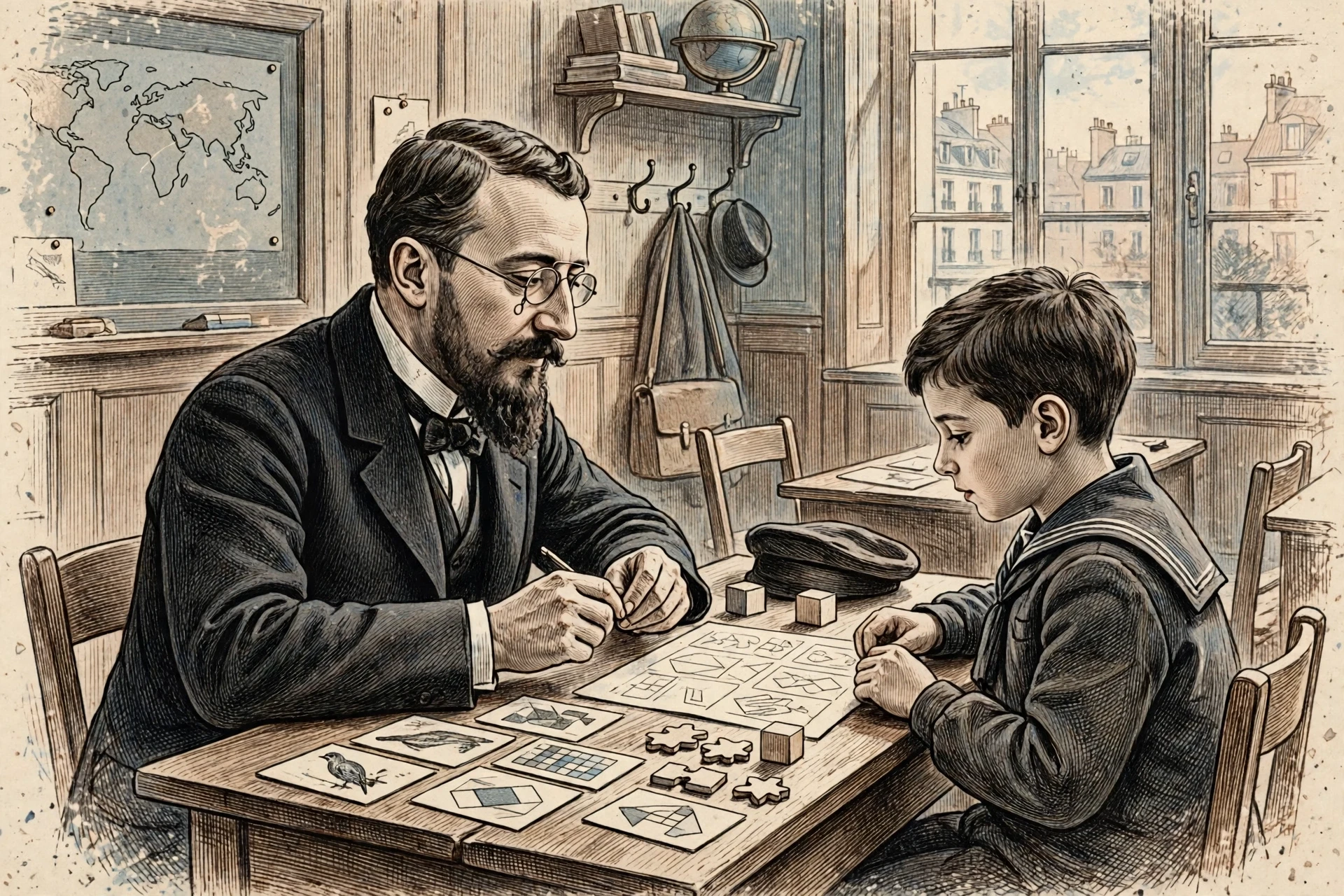
Binet was explicit about the limits of his own invention. He warned that his scale measured a child's current performance, not some fixed inner essence, and he insisted that intelligence could grow with teaching. He would have been appalled at what happened next. Within a few years, the test crossed the Atlantic, where it was taken up with an enthusiasm Binet never intended — and put to uses he would have condemned, including sorting immigrants at Ellis Island and justifying policies of forced sterilization. The history of intelligence testing carries this shadow, and any honest account has to say so plainly: the same instrument that was built to help children was used, for decades, to label and exclude people. Modern psychology has spent the better part of a century trying to repair that damage, and the repair is not finished.
2.1 Stern and the birth of the IQ
The number we call "IQ" came from German psychologist William Stern, who in 1912 proposed a simple ratio: divide mental age by chronological age and multiply by 100. A ten-year-old performing like a typical twelve-year-old scored 120. A ten-year-old performing like a typical eight-year-old scored 80. It was elegant, easy to explain, and — like many elegant ideas — it hid a problem. Mental age does not keep growing the way height does. A forty-year-old does not have a mental age of forty in any meaningful sense, so the ratio breaks down for adults.
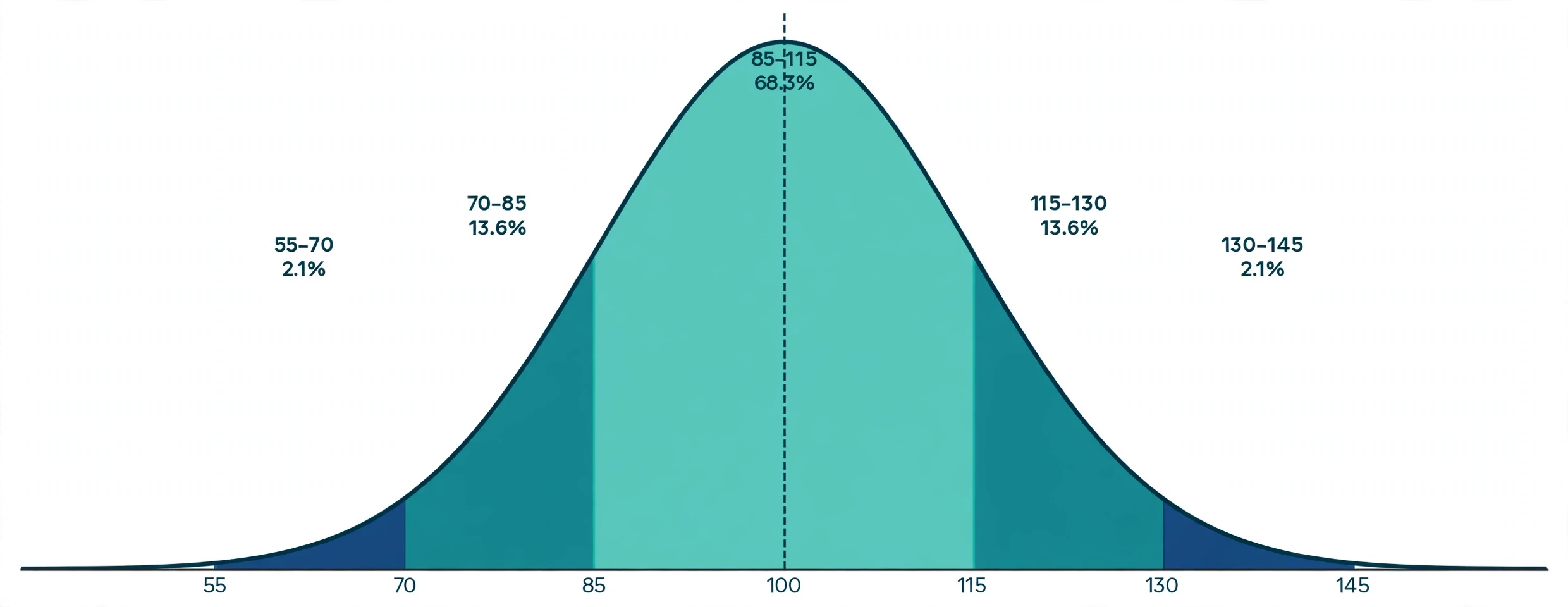
The solution, developed in the 1930s and 1940s by David Wechsler, was the deviation IQ: your score is compared with the average performance of people your own age, set at 100, with a standard deviation of 15 points. That is the system still used today. An IQ of 115 means you scored one standard deviation above the average for your age group; 85 means one below. Your score says where you stand in a crowd of your peers — a position in a crowd, not a measurement like weight — and that image explains almost everything confusing about IQ scores.
2.2 The Army tests and the test's troubled century
The first mass use of intelligence testing came during the First World War, when the United States Army tested nearly two million recruits. The results were used to assign men to roles, and the data — collected under rushed conditions, in a language many recruits barely spoke — were later cited for claims about entire groups of people that modern science rejects. Tests measure performance on a test, under particular conditions, on a particular day. Treating that performance as a complete portrait of a person is a category error, and it has caused real harm.
3. What Is IQ? The Number, the Bell Curve, and the 100
So what is IQ, in the plainest terms? An IQ score is a standardized score from a battery of cognitive tasks, normed so that the average for your age group is 100 and most people — about 68 percent — fall between 85 and 115. The scale is built on the bell curve, the smooth symmetrical hill that shows up whenever you measure a trait across a large population. Most people cluster near the middle. Fewer and fewer appear as you move toward either edge. About 2 percent of people score above 130, and about 2 percent score below 70.
3.1 Reading the bell curve without fooling yourself
The bell curve invites two opposite mistakes. The first is treating a small difference as a large one. A score of 108 and a score of 112 are, for practical purposes, the same score — the gap is smaller than the test's own margin of error, which is typically around three to five points. If you take the same test twice, your score will wobble by that much for reasons that have nothing to do with your brain: how you slept, whether you had breakfast, whether the room was noisy. The second mistake is the opposite: treating a large difference as if it meant nothing. A score of 130 and a score of 85 reflect genuinely different profiles of cognitive strengths, and pretending otherwise helps nobody. The honest position sits between those two errors: IQ scores carry real information, and they carry real uncertainty, at the same time.
3.2 Why 100 is not a grade
A score of 100 is not a pass mark, and a score of 90 is not a failing grade. One hundred is simply the middle of the crowd — the average. There is nothing magical about the number itself; if the tests were renormed tomorrow with a mean of 50, the same people would be in the same order. What matters is the comparison, and comparisons only make sense within the group the test was normed on. A score earned on a test normed in one country, in one decade, does not translate neatly to another country or another decade.
3.3 Online IQ tests: a word of warning
The test your friend shared on social media is almost certainly not a real IQ test. Genuine intelligence tests are given by trained professionals, take one to two hours, and are carefully guarded so people cannot practice the items. A ten-minute online quiz can be entertaining, but its number is not an IQ score — it is a marketing hook. If you genuinely want a cognitive assessment, the route is a licensed psychologist, not a website.
4. The g Factor: The Ghost in the Machine
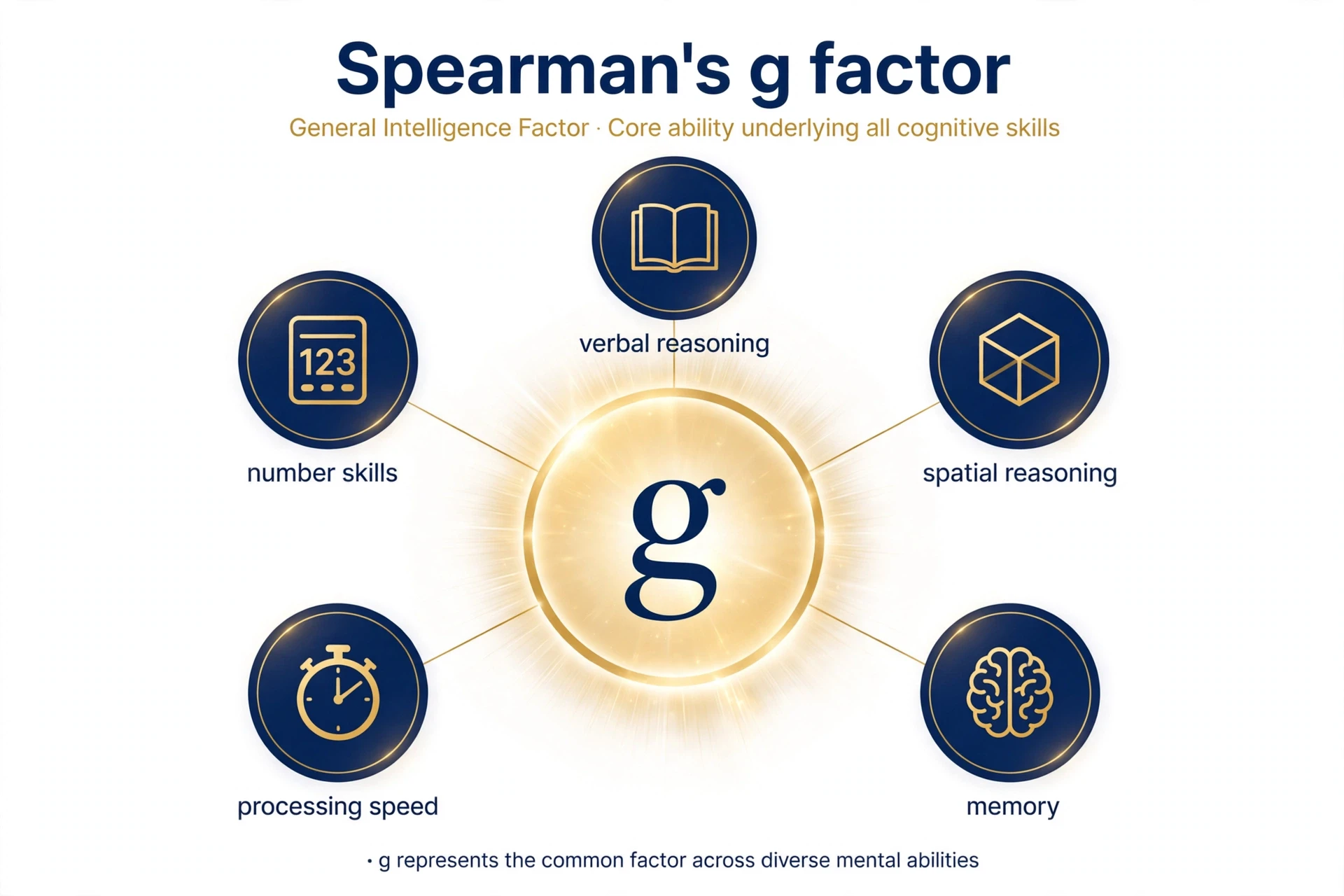
Here is the strangest finding in all of psychology, and the one that has kept researchers arguing for more than a century. Give a large group of people a dozen different mental tests — vocabulary, arithmetic, spatial puzzles, memory, pattern-spotting — and the scores are all positively correlated. People who do well on one test tend to do well on the others. People who struggle on one tend to struggle on the rest. This is not what you would expect if the mind were a set of independent tools. A great sprinter can be a poor swimmer, but a strong verbal reasoner is usually also a decent spatial reasoner. Something seems to run through all of them.
4.1 Spearman's discovery
In 1904, the same year Binet was building his first scale, British psychologist Charles Spearman noticed this pattern of positive correlations and proposed an explanation: a general mental ability, which he called g, contributes to performance on every cognitive task, while each task also draws on its own specific ability, s. Your vocabulary score reflects your g plus your verbal s; your puzzle score reflects your g plus your spatial s. The correlations between tests exist because g is in all of them. It was a bold idea, and it has survived more than a century of attempts to kill it. Every major model of intelligence since has had to reckon with the positive manifold — the name for this stubborn pattern of all-positive correlations.
4.2 What is g, really?
Nobody knows, and that honest admission is part of what makes the field interesting. Some researchers think g reflects the speed and efficiency of the brain's basic information processing. Others think it reflects working memory capacity: how much information you can hold in mind and manipulate at once. Still others suspect g is not a single thing in the brain at all, but a statistical summary of many overlapping processes, like the way "health" summarizes dozens of bodily systems without being a single organ. The debate matters because it decides what an IQ score is — and the research on "brain training" games, which mostly improves performance on the trained game itself, leans toward the view that no single training moves g much.
"The most replicated finding in the study of intelligence is also the most mysterious: every mental test correlates with every other, yet no one can point to the thing they all share."
4.3 The hierarchy: g, broad abilities, narrow skills
Modern psychometrics organizes intelligence as a hierarchy. At the top sits g. Below it sit broad abilities — fluid reasoning (solving new problems), crystallized knowledge (what you have learned), visual-spatial processing, short-term memory, processing speed, and a few others. Below those sit dozens of narrow skills. An IQ test samples from several levels at once, which is why a full test gives you not one number but a profile: a verbal score, a perceptual reasoning score, a working memory score, a processing speed score. Two people with the same overall IQ of 110 can have entirely different profiles — one verbal and slow, the other visual and fast — and those differences matter far more in real life than the shared total. A good psychologist reads the profile, not just the headline number.
5. Inside a Modern IQ Test: WAIS and Stanford-Binet
What actually happens in a testing room? The two most respected adult and child batteries are the Wechsler Adult Intelligence Scale (WAIS) and the Stanford-Binet. Both take one to two hours, both are given one-on-one by a trained examiner, and both are made of subtests that look nothing like school exams. Here is a tour of the main types of task you would meet.
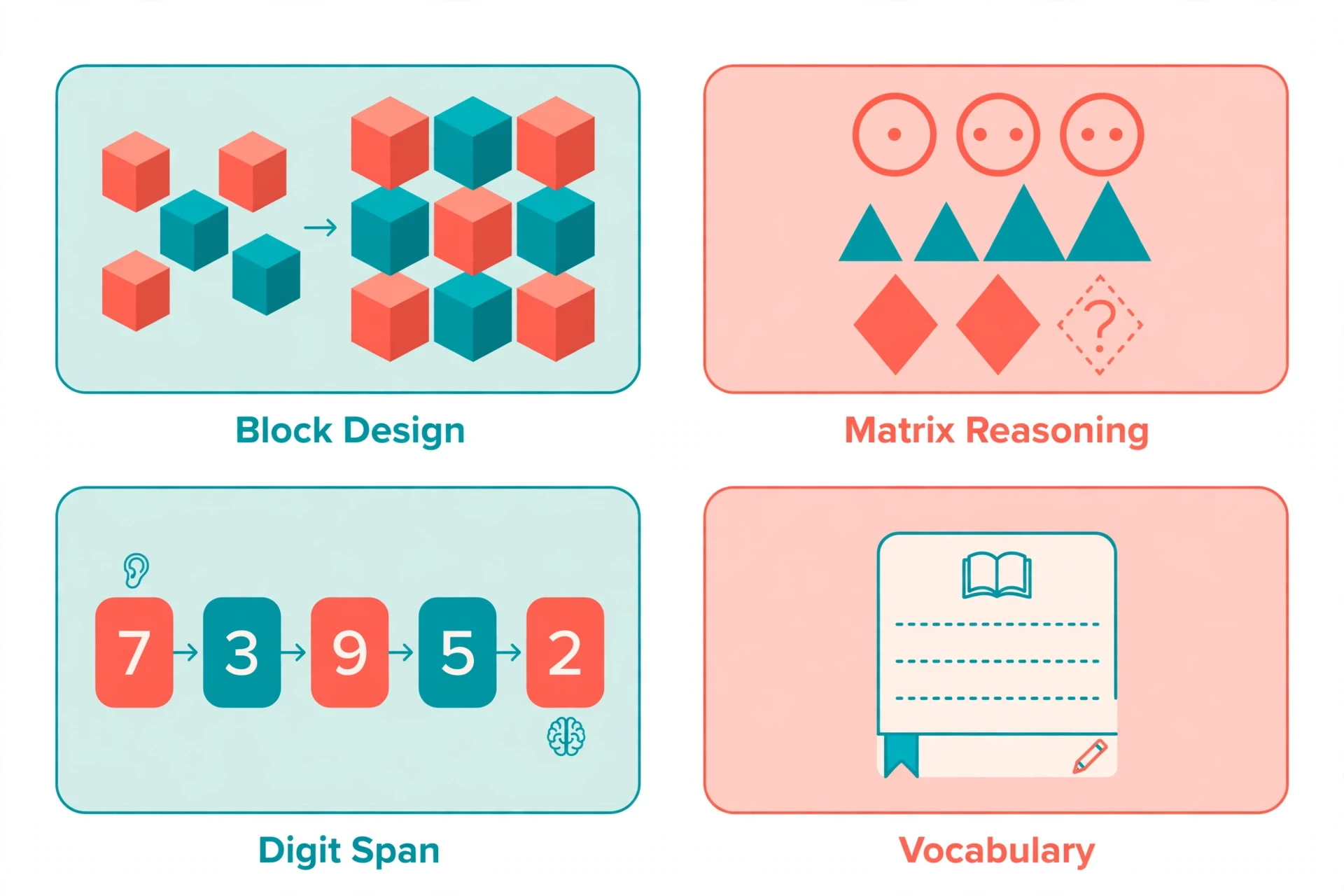
Block Design: You are given red-and-white cubes and asked to copy a pattern. It measures spatial visualization and the ability to break a whole into parts.
Matrix Reasoning: You see a grid of shapes with one piece missing and choose the piece that completes the pattern. This is the closest thing to a "pure" reasoning test, and it needs almost no language.
Digit Span: You repeat strings of numbers forwards, then backwards. It measures working memory — holding information in mind while you work with it.
Vocabulary: You define words. It measures crystallized knowledge — what you have learned from education and life.
Symbol Search and Coding: Timed tasks that ask you to scan and match symbols quickly. These measure processing speed.
Similarities: "How are an apple and a banana alike?" It measures abstract verbal reasoning — seeing the category above the examples.
5.1 Why the tasks look so strange
If you have ever wondered why an intelligence test asks you to arrange coloured blocks instead of, say, writing an essay, the answer is that the test is trying to separate reasoning from schooling. An essay rewards everything school teaches: vocabulary, grammar, background knowledge, confidence with the written word. A matrix puzzle rewards almost none of that. It asks: can you see the rule hiding in this pattern, and apply it to a case you have never seen? That is the heart of fluid reasoning, and it is the skill that predicts learning new things — the skill employers and universities care about most. The trade-off is that these tasks feel artificial, because they are. Real life rarely hands you a grid of abstract shapes. The test trades realism for precision, and that trade is both its strength and its limit.
I still remember the first time I watched a full WAIS administration as a trainee. The examinee, a quiet man in his forties being assessed after a head injury, sailed through the matrix puzzles and then froze on digit span backwards — he could hold the numbers, but reversing them while holding them was too much. His overall score was average. His profile told the real story: reasoning intact, working memory strained. The number alone would have missed everything that mattered for his rehabilitation. That afternoon taught me more about what intelligence really is than any textbook chapter: the profile is the person, the total is a summary.
5.2 What the scores mean in practice
Modern tests report an overall Full Scale IQ plus four or five index scores. The indexes are where the useful information lives. A high verbal index with a low processing speed index describes a thoughtful person who needs more time — a pattern common in gifted children who are misread as slow. A high perceptual reasoning index with a low working memory index describes someone who grasps complex ideas quickly but loses track of multi-step instructions. Teachers, clinicians, and employers who understand this use the profile to arrange support: extra time, written instructions, visual aids. Used this way, an IQ test is a tool for helping someone, exactly as Binet intended.
6. The Flynn Effect: The Whole World Got "Smarter"
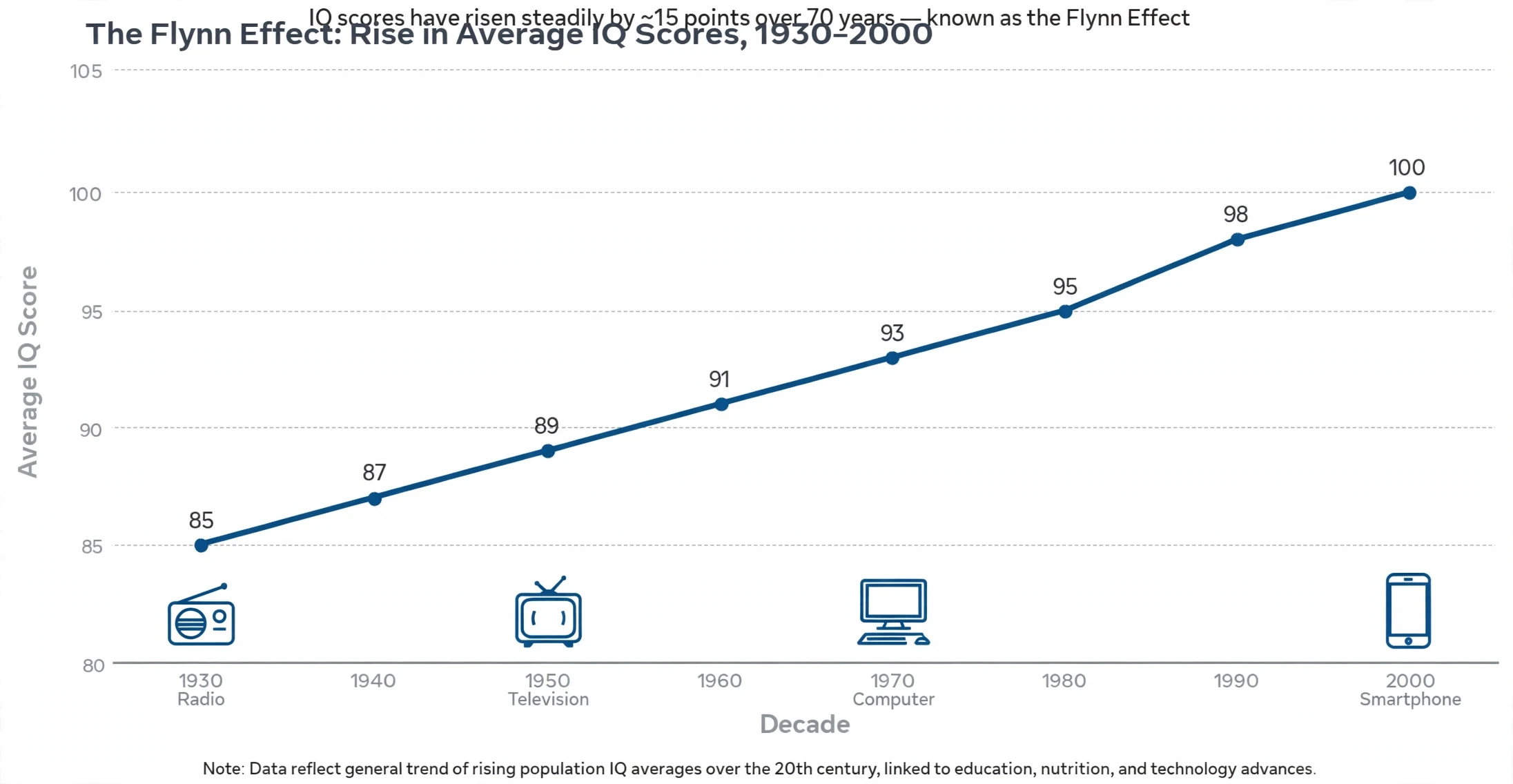
In the 1980s, political scientist James Flynn noticed something extraordinary: IQ scores had been rising, steadily, in every country with good data, for most of the twentieth century — by roughly three points per decade. A person who scored 100 in 1950 would score around 115 on a test normed in 1980, simply because the population average had moved. If you took a test normed in 1930 and scored 100 on it today, you would look like a genius by 1930 standards. The rise is called the Flynn effect, and it is one of the most important facts in the whole field, because it proves something profound: IQ scores are not fixed properties of human nature. They respond to the world people grow up in.
6.1 Why did scores rise?
Nobody has a complete answer, and the leading explanations are probably all partly right. Better nutrition and fewer childhood diseases gave developing brains a better start. More years of schooling trained abstract thinking. Smaller families meant more adult attention per child. And the modern world itself became more cognitively demanding: work shifted from farms and factories to offices and screens, leisure to puzzles, games, and devices that reward pattern-spotting. In short, the environment changed, and the scores followed — a hopeful finding, because it says intelligence, as measured, is not a fixed inheritance but something a society can raise. The American Psychological Association has covered this rise and the debate around it, and the National Center for Biotechnology Information's chapter on intelligence testing is a clear, authoritative reference on how the tests are constructed and normed.
6.2 The twist: the rise may be slowing — or reversing
In several wealthy countries, the Flynn effect has stalled or reversed since the 1990s. Scores in Norway, Denmark, and Finland have flattened or dipped slightly, and researchers debate the causes — changes in schooling, in media habits, in the tests themselves. What is settled is the lesson: if IQ can rise three points a decade for fifty years and then stop, the score is tracking something about societies, not just something about brains.
7. Is Intelligence One Thing, or Many? Gardner's Multiple Intelligences
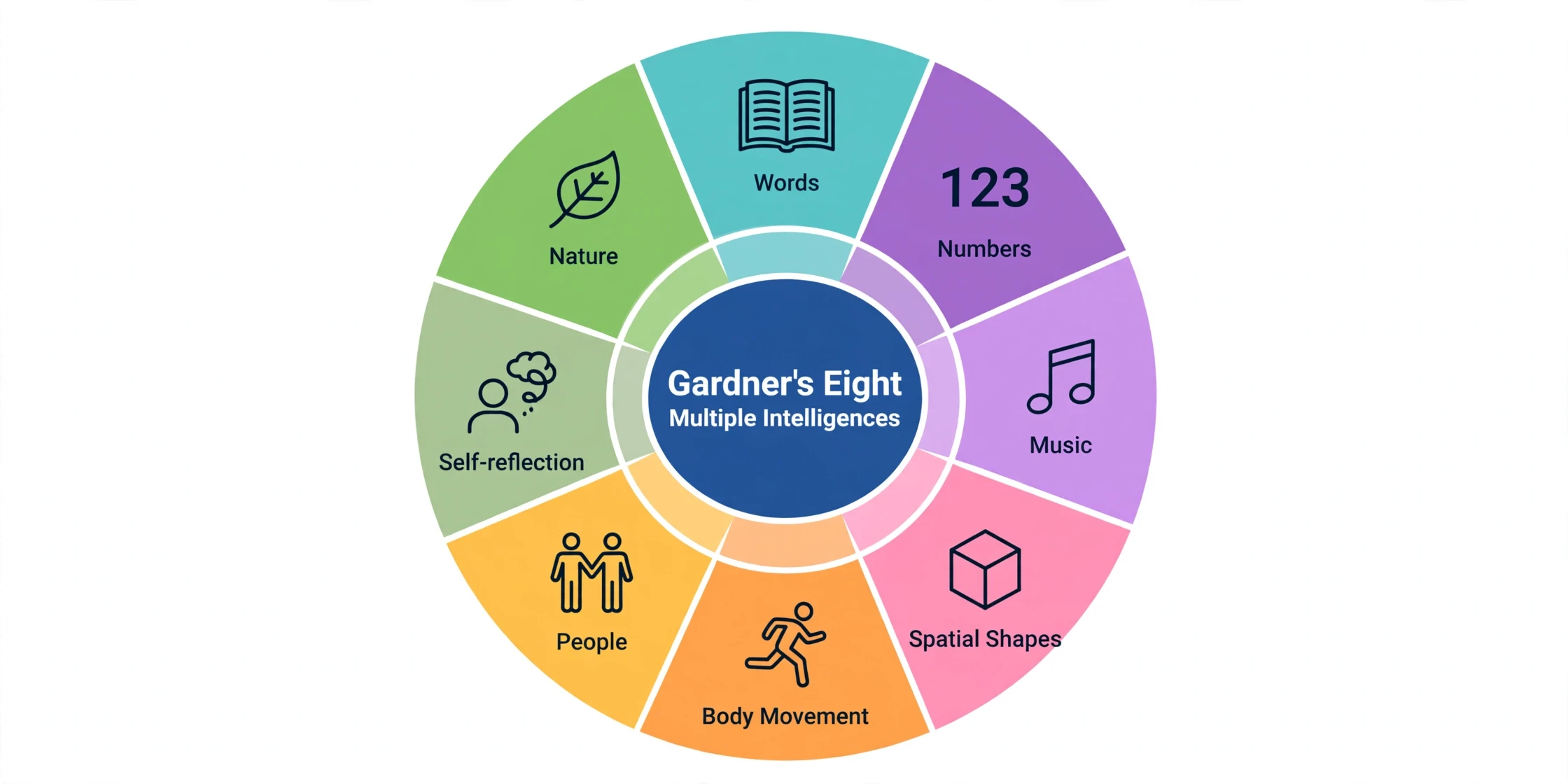
In 1983, Harvard psychologist Howard Gardner dropped a bomb on the field with Frames of Mind. Intelligence, he argued, is not one thing. It is at least seven — later eight — relatively independent intelligences: linguistic, logical-mathematical, spatial, musical, bodily-kinesthetic, interpersonal, intrapersonal, and naturalist. A poet and a mathematician are not high and low on the same scale; they are strong in different intelligences. A dancer's bodily intelligence is as real as a physicist's logical one. The theory was a critique of the single-number view, and it landed with enormous force — especially in education, where it gave teachers a language for valuing talents that tests ignored.
7.1 What Gardner got right
Gardner was right about something important: human talent is plural. Brain damage can wipe out language while leaving music untouched, or destroy spatial skill while sparing social grace — evidence that the mind is built from partly separate systems. He was also right that schools overvalue two intelligences, linguistic and logical-mathematical, and undervalue the rest. Anyone who has watched a gifted young mechanic, athlete, or mediator be treated as "not clever" because they are not bookish knows exactly what Gardner was fighting against. His theory changed how millions of teachers think about their students, and that alone makes it worth taking seriously.
7.2 Where the evidence pushes back
The hard part is that Gardner's intelligences do not behave the way independent abilities should. When researchers test people on tasks meant to tap the eight intelligences, the scores still correlate with each other — the positive manifold shows up again, and g reappears behind the curtain. That does not make Gardner's categories useless as a description of talents, but it weakens the claim that they are fully separate mental systems. Gardner himself has said the theory was never meant to be a psychometric model — it was a framework for thinking about human potential. The honest verdict is split: as a map of human talents, multiple intelligences is inspiring and largely right; as a scientific theory of separate mental capacities, it has not held up to testing.
Harvard's Graduate School of Education, where Gardner has spent his career, describes the theory as a critique of the idea that a single intelligence can be assessed by standard psychometric instruments — a framing worth remembering when you see the theory quoted as settled science.
8. Sternberg's Triarchic Theory: Analytical, Creative, Practical
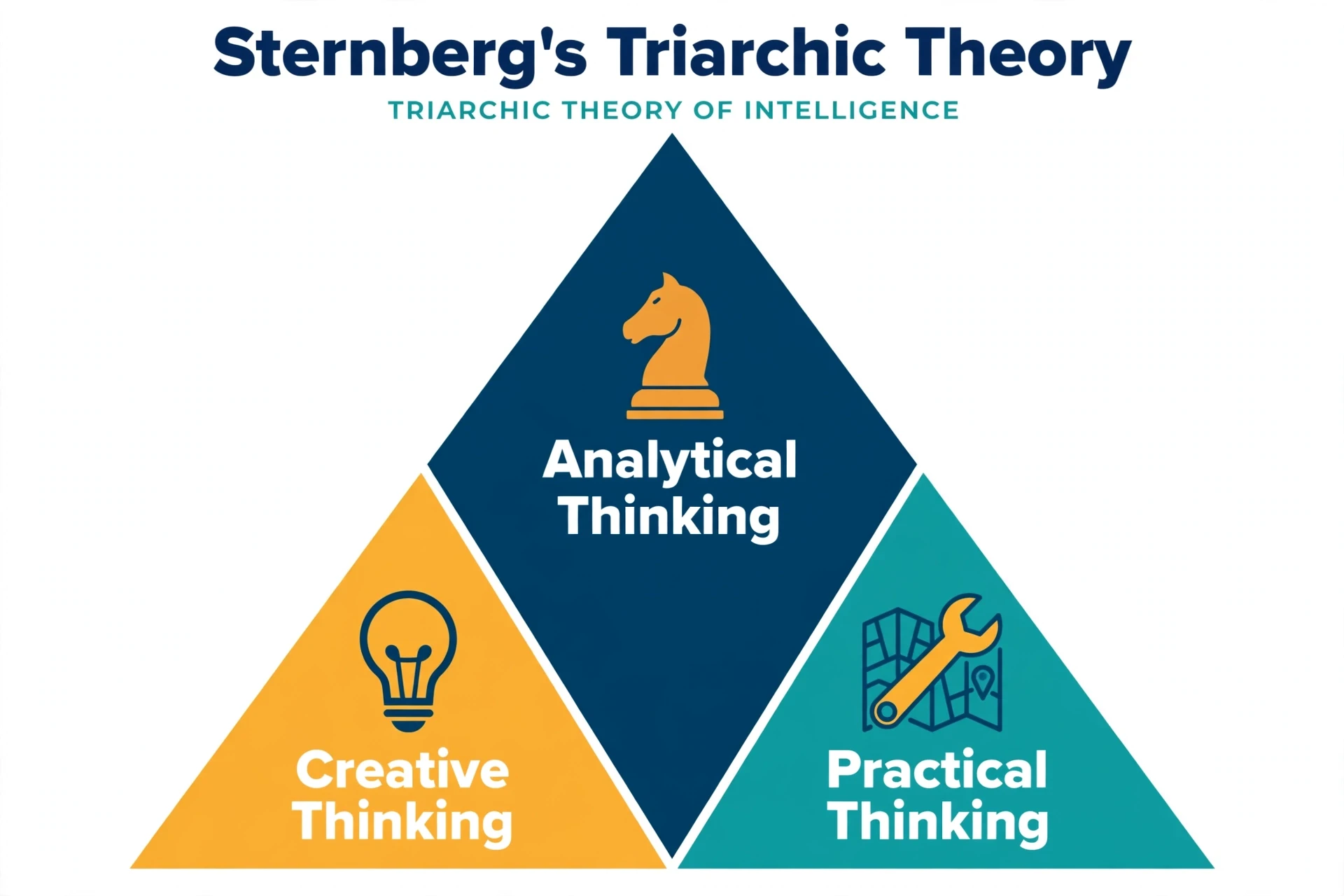
Robert Sternberg, another of the field's great dissenters, offered a different expansion. His triarchic theory says intelligence has three faces: analytical, creative, and practical. Analytical intelligence is what tests measure — solving familiar problems with logic. Creative intelligence is handling new situations and inventing solutions. Practical intelligence is the street-smart skill of adapting to your environment, reading people, and getting things done in the real world. Sternberg's favourite example was the difference between the student who aces exams and the one who can talk their way out of a parking ticket, fix a broken printer, and run a market stall — and his point was that the second student is not "less intelligent." They are intelligent in a way the test does not see.
8.1 Practical intelligence and the mechanic who out-thought me
I once watched a car mechanic diagnose a fault I had spent a weekend failing to find. He listened to the engine for ten seconds, tapped a hose, and said, "It's the vacuum line — it collapses when it gets hot." He was right. He had no degree, and I doubt he would have scored brilliantly on a matrix reasoning test. But what he did in those ten seconds was exactly what intelligence is supposed to be: he noticed a pattern, drew on years of stored experience, formed a hypothesis, and tested it. Sternberg's practical intelligence captures that. It also explains why IQ scores predict school grades far better than they predict job performance once you are past the hiring gate: school is mostly analytical, work is mostly practical, and the test only sees the first.
8.2 What the research says about the triarchic theory
Sternberg's theory has fared better in the laboratory than Gardner's, in the sense that analytical, creative, and practical tasks can be separated more cleanly — but it has not displaced g either. Creative and practical measures still correlate with general ability, and attempts to build tests that measure "practical intelligence" on their own have produced mixed results. The American Psychological Association's profile of Sternberg's work notes his central challenge to the field: that intelligence is broader than what tests capture, and that a science of intelligence should study success in life, not just success on tests.
9. Intelligence in the Brain: What Neuroscience Has Found
If intelligence lives anywhere, it lives in the brain — but where, exactly? Modern brain imaging has given a partial answer. The most consistent finding is that intelligence is linked not to one spot but to a network: the frontoparietal network, a set of regions in the frontal and parietal lobes that activate whenever people solve hard problems. People with stronger connectivity in this network tend to score higher on reasoning tests. Brain size also correlates with IQ — modestly, around 0.3 — which means it explains roughly a tenth of the variation between people. The rest comes from wiring, efficiency, and experience.
9.1 Genes, environment, and the 50-50 split that is not a split
Twin studies consistently find that about half the variation in IQ scores in a population is associated with genetic differences, and about half with environmental ones. The word "about" does a lot of work there, and the popular reading — "intelligence is 50 percent genetic" — is wrong in an important way. Heritability is a property of a population, not a person. Saying IQ is 50 percent heritable does not mean half of your intelligence came from your genes and half from your upbringing. It means that, in the population studied, genetic differences account for about half of the differences between people. Change the environment — give every child good nutrition, schooling, and safety — and heritability can go up, because the remaining differences are more likely to be genetic. Change it the other way, and heritability falls. Genes and environment are not two piles you can weigh separately; they are partners in a dance, and the music is the world a child grows up in.
The brain itself is the stage for that dance. For a guided tour of the regions involved, see Human Brain Anatomy and Functions and How the Nervous System Works, and for how experience physically reshapes the brain over time, How the Human Brain Forms Memories explains the mechanisms of plasticity and consolidation.
9.2 Can intelligence change?
Yes — within limits, and more in childhood than in adulthood. The Flynn effect is the large-scale proof. On a smaller scale, schooling itself raises IQ: each additional year of education is associated with a gain of roughly one to five IQ points, and the effect is causal — when schooling is interrupted, scores dip. What does not seem to work, despite a billion-dollar industry, is generic "brain training": practicing a memory game makes you better at that game, and the benefit rarely transfers to other tasks or to real life. The activities that do build cognitive ability are less glamorous: learning a language, learning an instrument, studying hard subjects, exercising, sleeping well.
10. What IQ Predicts — and What It Does Not
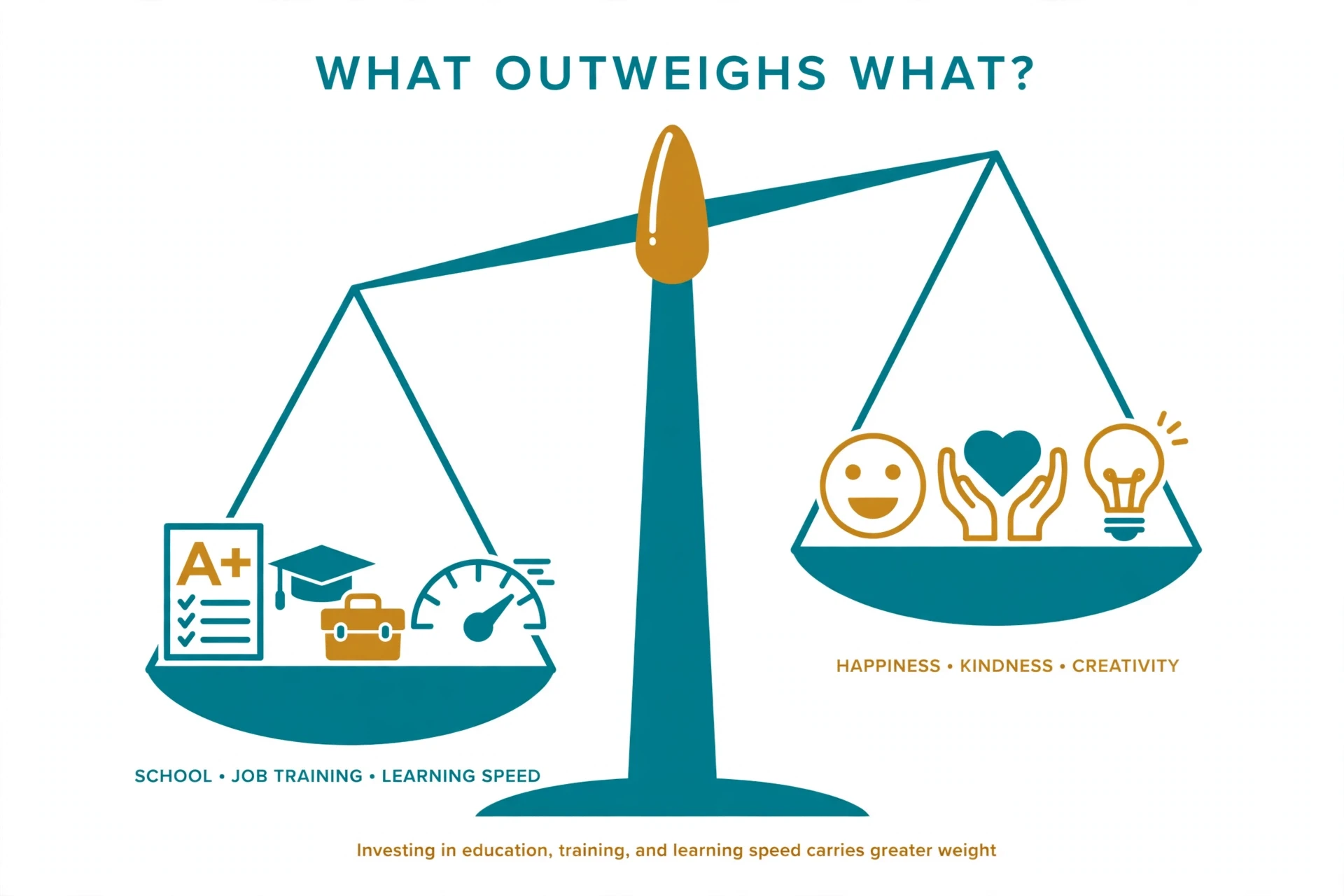
Here is where the science earns its keep, because this is the question most people actually care about. IQ scores predict some things well, some things modestly, and some things barely at all. The honest list is worth having, because both the fans and the critics of testing tend to exaggerate in opposite directions.
10.1 What IQ predicts well
School performance. IQ is the single best psychological predictor of grades, with correlations around 0.5 — substantial, but 0.5 explains only about a quarter of the variation in grades. The rest comes from effort, teaching, home support, health, and luck.
Job training success. IQ predicts how quickly people learn new job skills, with correlations around 0.4 to 0.5. It predicts job performance more modestly, around 0.2 to 0.3, and the link weakens with experience — after a few years on the job, knowledge and habits matter more than raw reasoning speed.
Health and longevity. Higher childhood IQ is associated with better health and longer life, largely because it tracks with education, income, and healthier choices.
10.2 What IQ predicts poorly — or not at all
Happiness and life satisfaction. The correlation is near zero. Brilliant people are not happier than anyone else, and the reasons are obvious once you say them: happiness runs on relationships, health, purpose, and security, none of which a reasoning test measures. Mental health matters far more than any score — see Anxiety and Depression Explained for what the science says about mood, and why it deserves attention on its own terms.
Creativity. IQ and creativity correlate up to a point — you need a certain level of reasoning ability to do creative work — but beyond an IQ of about 120, more points buy little extra creativity. Originality runs on curiosity, risk-taking, and knowledge, not on test speed.
Kindness, integrity, and character. No test of reasoning measures whether you will keep a promise, help a stranger, or tell the truth when lying would be easier. These are the qualities people actually judge each other by, and IQ is silent about them.
Success in the full sense. Income, status, and career achievement correlate with IQ at around 0.2 to 0.3 — real, but modest. The rest is explained by personality, social skills, opportunity, persistence, and chance. Conscientiousness — showing up, finishing things, keeping promises — predicts job success about as well as IQ does, and unlike IQ it can be deliberately built.
10.3 The comparison at a glance
Outcome | How well IQ predicts it | What matters as much or more |
|---|---|---|
School grades | Strong (about 0.5) | Effort, teaching quality, home support |
Learning a new job | Moderate to strong (0.4–0.5) | Prior knowledge, motivation |
Job performance (experienced) | Modest (0.2–0.3) | Conscientiousness, social skill, experience |
Creativity | Weak above IQ 120 | Curiosity, risk-taking, domain knowledge |
Happiness and life satisfaction | Near zero | Relationships, health, purpose, security |
Kindness and character | Not at all | Values, habits, community |
11. Common Misconceptions About Intelligence
Most people assume IQ is fixed at birth, like eye colour. What the data actually show is that IQ scores are stable enough to be useful — a child's score predicts their adult score reasonably well — but not so stable that change is impossible. Schooling raises scores, deprivation lowers them, and the Flynn effect moved the whole population. Stability and change coexist; the error is treating either one as the whole story.
"A high IQ means you are smart at everything." No. A high overall score can hide a weak spot — poor working memory, slow processing — that causes real trouble in daily life. The profile matters more than the total, and a single number hides the profile by design.
"A low IQ means you cannot learn." No. It means you may learn more slowly on the kinds of tasks the test samples, and that you may need different teaching, more time, or different formats. The score describes a level of support needed, not a verdict on a person's worth.
"Intelligence is one thing, and tests measure all of it." The g factor is real, but it is not the whole mind. Gardner and Sternberg were wrong about the details and right about the direction: the mind is wider than any test, and the skills tests miss — practical judgment, social understanding, creativity — are skills a full life needs.
"IQ tests are culturally fair now." They are fairer than they were in 1920, and still not fair. A test written in one dialect, built on one culture's school curriculum, will always favour children raised inside that culture. Modern tests reduce this bias; they do not eliminate it.
"Brain training games raise your IQ." The evidence says they raise your score on the game. Transfer to other tasks is small and fades quickly. The most reliable cognitive training is still the unglamorous kind: education, reading, exercise, and sleep. For more on the last of those, see Science of Sleep and Dreams Explained.
12. Using the Science Well: Practical Applications
So what should a reader do with all of this? A few conclusions follow directly from the evidence, and they are practical enough to use this week.
First, if you are a parent or a teacher, treat an IQ score as a map, not a label. Ask for the profile — the index scores — and ask what they suggest about how this child learns best. A child with strong reasoning and weak working memory needs instructions broken into steps and written down, not a lower set of expectations. A child with strong verbal skills and weak processing speed needs more time, not easier work. The score is a starting point for support, not a ceiling on potential.
Second, if you are choosing how to spend your own mental energy, invest in the things the research actually supports. Learn something hard. Read widely. Exercise regularly. Protect your sleep. Each of these has better evidence behind it than any app promising to raise your IQ in ten minutes a day. Sleep is where learning is consolidated — the brain replays and strengthens the day's lessons overnight, which is why an all-night study session is usually a bad trade. See Science of Sleep and Dreams Explained for the mechanism.
Third, if you are hiring or managing people, remember what IQ predicts and what it does not. Cognitive ability predicts trainability, which matters for complex roles. But conscientiousness, emotional skill, and practical judgment predict much of what makes someone good to work with, and none of those appear in an IQ score. The best selection systems use several measures, not one number.
Fourth, be sceptical of any single number offered as a summary of a person — including your own. The student who asked me whether 118 meant she would be successful deserved a better answer than the number gave her, and so do you. Your mind is not a score. It is a collection of abilities, habits, knowledge, and choices, and the choices are the part you control most.
12.1 The latest research: where the field is heading
Three directions are worth watching. First, genetics: large genome-wide studies have found hundreds of small genetic variants associated with cognitive performance, each contributing a tiny effect — confirming that intelligence is massively polygenic, not the product of a few "smart genes." Second, neuroscience: researchers are mapping how the frontoparietal network's efficiency relates to reasoning, and early work suggests that what matters most is not the size of any region but how flexibly networks reconfigure as a task gets harder. Third, the field is moving toward a broader science of human capability — one that studies practical intelligence, creativity, and wisdom alongside g, rather than treating the test score as the whole subject.
There is also a growing honesty about the field's history. Modern textbooks teach the misuse of early tests — the immigration screening, the sterilization laws — as part of the story, not as a footnote. That matters, because a science that forgets how its tools were abused is a science that will abuse them again. The ethical lesson of intelligence testing is inseparable from the scientific one: a measurement is only as good as the humility with which it is used.
"A test can tell you how someone performed on a set of tasks on a Tuesday morning. Only a life can tell you who they are."
Conclusion: Bigger Than One Number
What is intelligence? After a century of research, the best answer is still a bundle, not a point: the ability to learn, to reason, to adapt, and to solve problems you have never met before. What is IQ? A standardized snapshot of some of those abilities, compared with your age group, useful for predicting school learning and job training, and silent about most of what makes a life good. The g factor is real, and it runs through every mental test — but it is not the whole mind, and the rebels who argued for many intelligences were pointing at something true even when their theories wobbled.
The student who asked me about her 118 stopped checking her score against other people's and started asking a different question: what am I good at, what do I want to get better at, and what will it take? Last I heard, she was teaching. I do not know her IQ. I know she is good at her job, and that the number never told her she could be.
That is the real lesson of a century of intelligence research. The tests are useful. The number is real. And the person is bigger than both. Intelligence is not a score you carry. It is something you do — every time you learn, adapt, notice a pattern, or solve a problem you have never seen before. The test measures a shadow of that. The life is the thing itself.
Frequently Asked Questions
What is intelligence in simple terms?
Intelligence is the ability to learn from experience, reason logically, adapt to new situations, and solve problems you have never encountered before. Psychologists define it as a bundle of abilities — learning, reasoning, memory, and adaptation — rather than a single skill, which is why no one test can capture all of it.
What is IQ, and what does the number mean?
An IQ score is a standardized result from a battery of cognitive tasks, set so the average for your age group is 100 and most people fall between 85 and 115. It tells you where you stand compared with your peers on the skills the test measures — mainly reasoning, memory, and processing speed. It is a comparison, not a measurement like height or weight.
Is IQ fixed, or can it change?
IQ scores are fairly stable across a lifetime but they are not fixed. Schooling raises scores, the Flynn effect lifted whole populations by about three points per decade for much of the twentieth century, and deprivation or interrupted education lowers them. Change is slower and harder in adulthood, but the idea that your score is set at birth is false.
What is the g factor?
The g factor, or general intelligence, is the shared core that Charles Spearman proposed in 1904 to explain why scores on different mental tests are all positively correlated. People who do well on one kind of mental test tend to do well on others, suggesting a general ability running through them all. Researchers still debate what g is in the brain — processing speed, working memory, or a summary of many systems.
What is the Flynn effect?
The Flynn effect is the steady rise in average IQ scores — roughly three points per decade — observed through most of the twentieth century in every country with good data. It shows that IQ scores respond to environment: better nutrition, more schooling, and a more cognitively demanding world all played a role. In some wealthy countries the rise has recently stalled or reversed, and researchers are still debating why.
Are online IQ tests accurate?
No, not as IQ scores. Real intelligence tests take one to two hours, are given one-on-one by a trained professional, and are carefully normed and guarded. A ten-minute online quiz can be fun, but its number is not a valid IQ score. For a genuine assessment, see a licensed psychologist.
Does a high IQ mean you will be successful?
Not on its own. IQ predicts school grades and how quickly someone learns a new job, but it predicts overall career success, income, and happiness only modestly. Personality — especially conscientiousness — social skills, opportunity, and persistence matter at least as much. Success runs on many abilities, and IQ measures only some of them.
What is the difference between IQ and emotional intelligence?
IQ measures cognitive abilities such as reasoning, memory, and processing speed. Emotional intelligence is the ability to perceive, understand, and manage emotions — your own and other people's. The two are largely separate: a person can score high on one and average on the other, and each predicts different things in life.
Sources
American Psychological Association. Intelligence. https://www.apa.org/topics/intelligence
National Center for Biotechnology Information. Intelligence Testing (chapter in Psychological Testing in the Service of Disability Determination). https://www.ncbi.nlm.nih.gov/books/NBK20369/
American Psychological Association. The Flynn Effect (Monitor on Psychology). https://www.apa.org/monitor/2023/11/flynn-effect-iq-scores
American Psychological Association. Sternberg's Triarchic Theory of Intelligence. https://www.apa.org/science/about/psa/2003/12/sternberg
Harvard Graduate School of Education. Howard Gardner. https://www.gse.harvard.edu/directory/faculty/howard-gardner