

I once watched two brilliant scientists receive the same bad news in the same meeting. A grant we had worked on for a year had been rejected, and the room went quiet. The first scientist stood up, called the review process corrupt, and walked out. The second one sat still for a moment, looked around the table, and said, "Everyone here is angry, and some of us are scared about what this means for our jobs. Let's name that first, then decide what to do." The meeting did not become pleasant. But it became useful. Within an hour we had a plan. The difference between those two reactions was not intelligence in the ordinary sense. Both people had doctorates. Both had published widely. The difference was emotional intelligence — the ability to notice what emotions are doing, understand where they come from, and steer them instead of being steered by them.
That afternoon stayed with me because it made something abstract feel concrete. Emotional intelligence, or EQ, is one of the most talked-about ideas in psychology, and also one of the most misunderstood. It has been credited with predicting career success, saving marriages, and even mattering more than IQ. Some of those claims are true in a modest, well-supported way. Others are pure salesmanship dressed up as science. This article separates the two. You will learn what emotional intelligence actually is according to the researchers who defined it, how it works in the brain, how it is measured (and how it is often measured badly), what it can and cannot predict, and whether you can build more of it. By the end you will know exactly what EQ is — and what it is not.
1. What Emotional Intelligence Actually Is
1.1 A definition that holds up
The clearest definition comes from the two psychologists who coined the modern term, Peter Salovey of Yale University and John Mayer of the University of New Hampshire. In their 1990 paper, they defined emotional intelligence as the ability to monitor your own feelings and the feelings of other people, to tell different emotions apart, and to use that information to guide your thinking and your actions. Later they sharpened the idea further: emotional intelligence is the ability to reason about emotions and emotional information. That second version matters, because it puts EQ in the same family as other kinds of intelligence. It is not a personality trait, not a mood, and not a talent for being nice. It is a set of mental abilities — things you do with information, the way you solve a maths problem with numbers.
Think of it like this. Your emotions are constantly sending you data. A tight chest before a presentation, a flash of irritation when a colleague interrupts you, a sudden warmth when a friend walks in — each of these is a signal carrying information about what matters to you, what threatens you, and what you want. A person with high emotional intelligence reads those signals the way a good sailor reads the wind: not by denying the weather, but by understanding it well enough to adjust the sails. A person with low emotional intelligence either ignores the signals entirely or gets blown around by them.
The American Psychological Association describes emotional intelligence as the ability to perceive, use, understand, manage, and handle emotions — a definition that tracks closely with the research model you will meet in the next section. If you want the APA's own overview, it is a good starting point for the mainstream consensus.
1.2 A short history: from a quiet paper to a bestseller
Emotional intelligence did not begin with a bestseller. It began in 1990 with a journal article that almost nobody outside psychology read. Salovey and Mayer were interested in a simple puzzle: why did some people seem so much better than others at handling the emotional side of life, even when their test scores were similar? They proposed that there was a distinct kind of intelligence at work — one that dealt with emotional information the way verbal intelligence deals with words.
Five years later, journalist and psychologist Daniel Goleman published a book called Emotional Intelligence. It became a phenomenon. Goleman took the researchers' narrow idea and expanded it into something much bigger, folding in optimism, persistence, social skill, and character — qualities that are real and valuable, but not the same thing as an ability to reason about emotion. The book sold millions of copies, and the term EQ entered everyday language. That success was a mixed blessing. It made the public care about emotions, which was genuinely good. It also blurred the science, because from then on, almost anything positive about feelings could be sold under the label "EQ." Much of this article is about recovering the sharper, more useful version of the idea — the one the researchers actually built.
2. The Four-Branch Model: The Science's Best Map
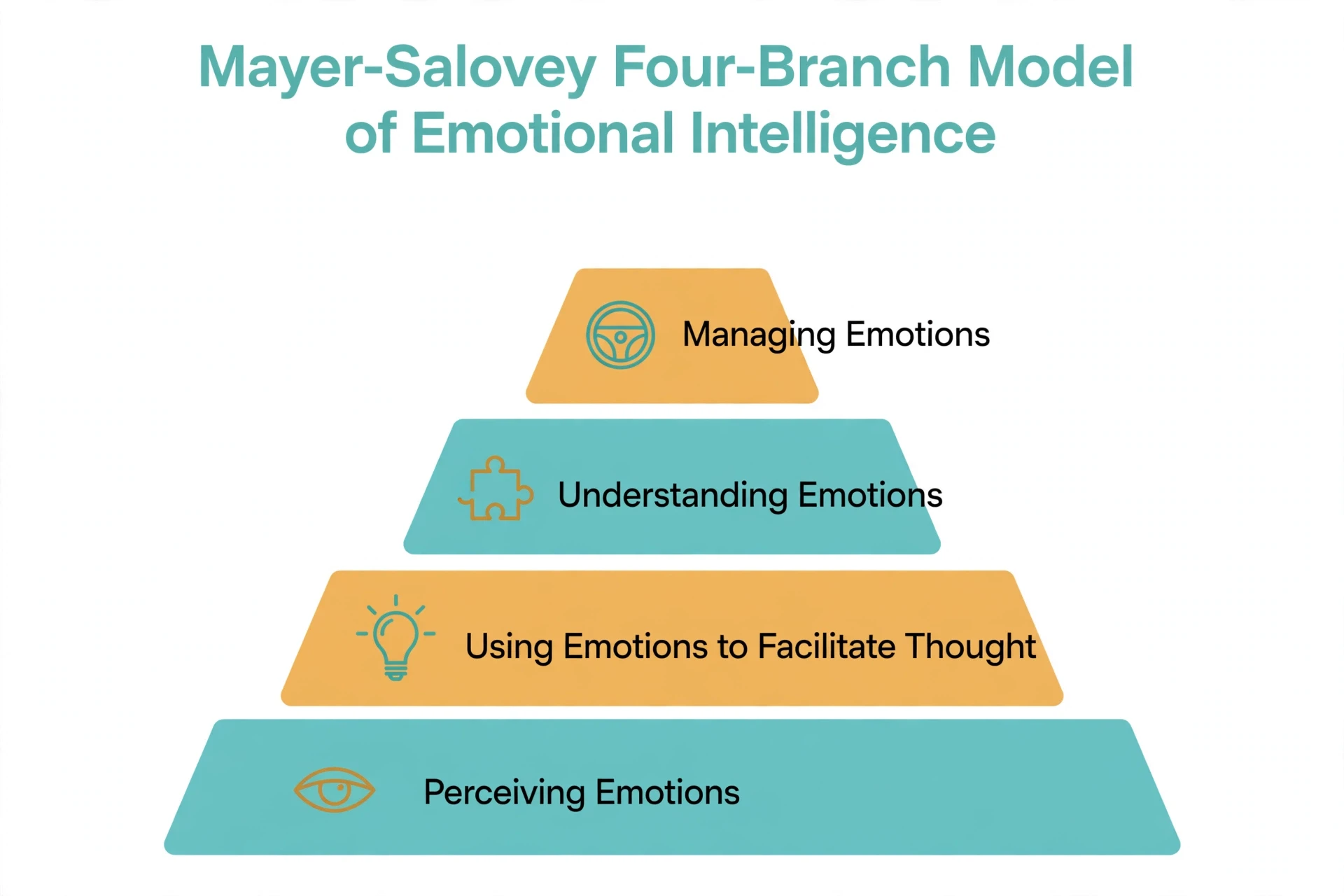
If there is one model worth learning, it is the four-branch model that Mayer and Salovey refined in 1997. It treats emotional intelligence as four connected abilities, arranged roughly like the rungs of a ladder. The lower rungs are simpler and more basic; the higher rungs build on them. You cannot manage an emotion you cannot even notice, and you cannot understand a feeling you have no words for. The model has held up well: a 2025 paper by Mayer and his colleague David Caruso, published in an American Psychological Association journal, reaffirmed the four-branch structure as the core of ability-based emotional intelligence, and distinguished it from the broader mix of traits that other versions of EQ include.
2.1 Branch 1: Perceiving emotions
The first branch is the ability to notice emotions accurately — in yourself, in other people, and even in things like a piece of music or a painting. This sounds easy until you try it. I learned this the hard way early in my teaching career. A graduate student of mine had gone silent in our weekly meetings. I assumed she was bored, maybe even disengaged, and I started preparing a polite talk about commitment. Then a colleague pointed out the obvious: the student was not bored, she was terrified. Her funding was about to run out and she was afraid to say so. I had read the emotion completely wrong, and I had nearly acted on a wrong reading. Perceiving emotions means catching the small signals — a tightened jaw, a voice that goes flat, a laugh that arrives half a second too late — and also noticing what is happening inside your own body before the feeling has a name.
2.2 Branch 2: Using emotions to help thinking
The second branch is the strangest and the most interesting. Emotions are not just noise that gets in the way of thinking; they can help thinking, if they are the right emotions at the right intensity. A little anxiety before an exam sharpens attention. A good mood makes you more creative and more willing to see the big picture. Sadness, for all its discomfort, can make you more careful and more detail-oriented — researchers have shown that people in a mildly sad mood are often better at spotting errors in a text. The skill here is letting an emotion inform your thinking without letting it take over. A surgeon I once interviewed put it perfectly: "I need a little fear before a hard operation. It keeps me careful. I just can't let it become panic." That is branch two in one sentence.
2.3 Branch 3: Understanding emotions
The third branch is knowledge: understanding how emotions work, how they blend, and how they change over time. Anger often grows out of feeling blocked or disrespected. Fear fades when you learn what actually caused it. Annoyance can ripen into anger, and anger can cool into contempt if it is left alone. People who are good at this branch have a rich emotional vocabulary. They do not just feel "bad" — they can tell the difference between frustrated, disappointed, embarrassed, and resentful, and each of those words points to a different cause and a different fix. This is where emotional intelligence starts to look like a language. And like any language, the more words you have, the more precisely you can think.
2.4 Branch 4: Managing emotions
The fourth branch is the one most people picture when they hear the term: managing emotions in yourself and in others. This does not mean suppressing them. Suppression is a poor strategy — the feeling usually leaks out somewhere else, often as a headache, a snapped reply, or a sleepless night. Real emotion management means choosing a strategy that fits the situation: stepping away for ten minutes before answering a hostile email, reframing a setback as a solvable problem, or calming a frightened child by getting down to their eye level and speaking slowly. In my own work, the single most useful moment of emotion management I ever practised was learning to pause. A collaborator once sent me a furious message about a paper we were writing together. My first draft of a reply was furious back. I left it unsent, went for a walk, and came back to find that his anger was mostly fear — he thought his contribution was being erased. One honest conversation fixed what a shouting match would have broken. That pause, that willingness to wait until the feeling had a name, is the fourth branch in action.
3. What Happens in the Brain When EQ Is at Work
Emotional intelligence is not a single spot in the brain. It is a conversation between brain regions, and the two most important speakers in that conversation are the amygdala and the prefrontal cortex.
The amygdala is a small almond-shaped structure deep in the brain that acts like an alarm system. It reacts to threats and rewards in milliseconds, long before you have consciously thought about anything. When you flinch at a loud noise or feel your stomach tighten at an angry face, that is the amygdala doing its job. It is fast, powerful, and not very subtle — it cannot tell the difference between a real danger and a rude email, at least not at first.
The prefrontal cortex, sitting just behind your forehead, is the slower, wiser partner. It can pause the alarm, check the evidence, and choose a response. When you feel the flash of anger and decide not to send the email, that is your prefrontal cortex stepping in. Research on emotion regulation consistently shows this pattern: the prefrontal cortex dampens amygdala activity when people rethink a situation or reinterpret what is happening. The stronger that connection, the better people tend to be at managing their emotions.
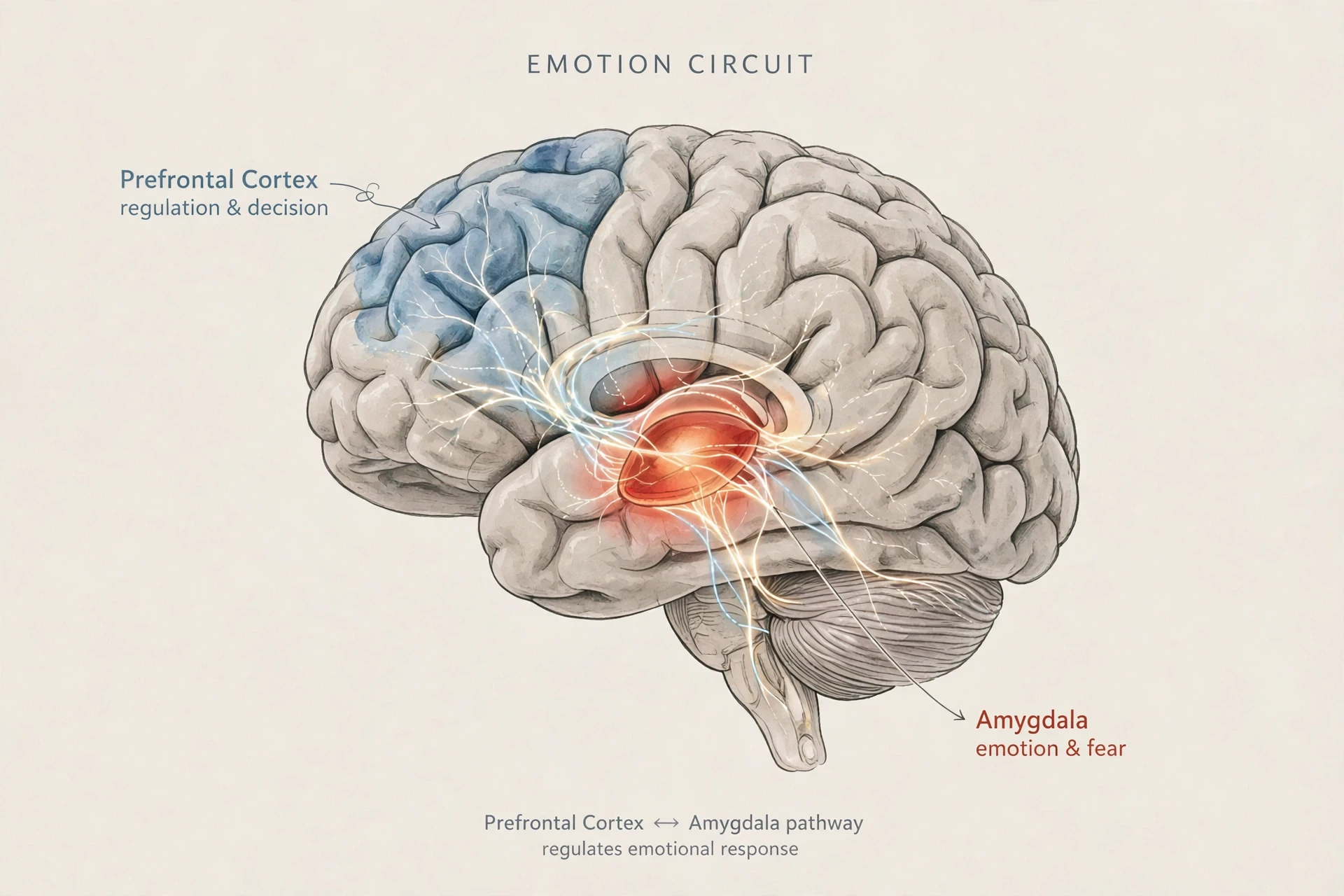
This is also why stress makes emotional intelligence harder to use. Under sustained stress, the stress hormone cortisol rises, and high cortisol can impair the prefrontal cortex while the amygdala stays on high alert. You have probably felt this: on a bad day, a small comment can feel like an insult, and a minor setback can feel like a catastrophe. That is not a character flaw. It is biology. Our article on high cortisol symptoms explains how chronic stress changes the body and the brain in exactly this way. Sleep matters here too: the brain consolidates emotional memories during sleep, and a tired brain is a worse reader of other people's feelings. That link between sleep and emotion is one reason our guide to the science of sleep and dreams keeps coming back to mood. For the full map of the regions involved, see our guide to human brain anatomy and functions.
One more thing the brain research makes clear: emotional intelligence is not about being unemotional. People with high EQ feel things just as strongly as anyone else. The difference is what happens next. Their brains are better at labelling the feeling, understanding its cause, and choosing what to do with it. The feeling is data, not a command.
4. EQ vs IQ: What Each One Measures, and What Each One Misses
Ask most people what IQ measures and they will say something like "how smart you are." Ask them what EQ measures and they will say something like "how well you handle people." Both answers are roughly right and importantly incomplete. IQ tests measure a bundle of cognitive abilities: reasoning with words and numbers, spotting patterns, holding information in mind, and solving new problems. EQ, in the ability sense, measures something else: reasoning with emotional information. The two are related but distinct. In research samples, the correlation between ability-based EQ scores and IQ scores is modest — positive, but small enough that knowing someone's IQ tells you very little about their EQ. You can be a brilliant mathematician who cannot tell when a friend is upset, and you can be a person of average test scores who reads a room like a novel.
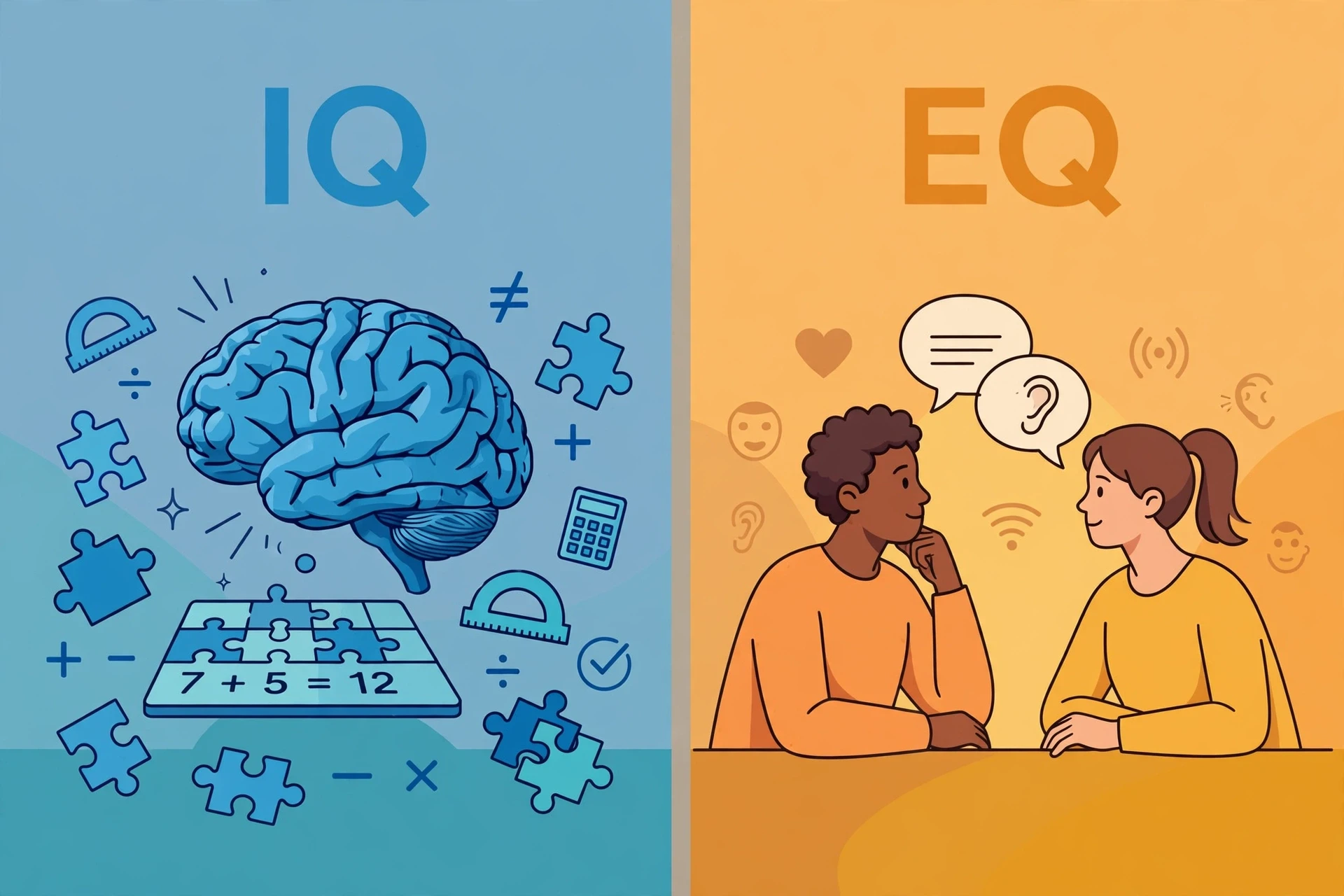
The table below lays out the comparison in the way researchers actually draw it. Notice what is missing: there is no row that says "which one matters more," because that question has no single answer. It depends entirely on what you are trying to predict.
Feature | IQ (cognitive intelligence) | EQ (emotional intelligence) |
|---|---|---|
What it measures | Reasoning with words, numbers, patterns and abstract problems | Reasoning with emotional information: perceiving, using, understanding and managing emotions |
Classic test | WAIS and Stanford-Binet IQ tests | MSCEIT (Mayer–Salovey–Caruso Emotional Intelligence Test) |
Stability over life | Fairly stable from childhood onward | More changeable; skills can improve with practice and training |
What it predicts best | Academic performance and complex problem-solving | Relationship quality, emotion regulation, and jobs with heavy emotional demands |
What it predicts poorly | How someone handles conflict, stress or other people | Technical problem-solving and academic test scores |
Can it be improved? | Hard to change substantially in adulthood | Yes — training studies show moderate, lasting gains |
The honest summary is this: IQ is the better predictor of school grades and technical performance. EQ is the better predictor of how well someone navigates the emotional side of life — keeping calm under pressure, resolving a disagreement, or noticing that a colleague is struggling before they say so. A good life needs both, and a good team needs people who are strong in each. Anyone selling you a single number that captures a whole person is selling something, not measuring something.
5. How Emotional Intelligence Is Measured — and How It Is Often Measured Badly
Here is where the science gets uncomfortable, and where you should pay close attention, because the gap between good measurement and bad measurement is the gap between real EQ and the version sold in airport bookshops.
5.1 Ability tests: problems with right and wrong answers
The gold standard in the research world is the MSCEIT — the Mayer–Salovey–Caruso Emotional Intelligence Test. It treats EQ like any other ability test: it gives you problems to solve, and some answers are better than others. You might be shown a photograph of a face and asked which emotion it shows. You might read a short story about a person whose plans have just fallen apart and be asked which emotional response would help them most. You might be asked to predict how someone's feelings will change as a situation unfolds. There are right answers, judged against expert consensus and large groups of test-takers. This is the crucial point: ability tests measure what you can actually do, not what you think you can do. And what they find is interesting — scores on the MSCEIT relate to real outcomes like better social relationships and fewer signs of problem behaviour, and the test predicts these outcomes even after accounting for IQ and personality.
5.2 Self-report questionnaires: the problem with asking people
Most EQ tests you will meet online are self-report questionnaires. They ask things like "I am good at understanding other people's feelings" and let you rate yourself from one to five. These are cheap, fast, and popular — and they have a serious weakness. They measure your opinion of yourself, not your ability. People who are overconfident score high. People who are modest score low. And there is a well-known trap: the people worst at reading emotions are often the least aware of that weakness, so they rate themselves generously. Researchers call these questionnaires measures of "trait EQ" or "emotional self-efficacy," and they do predict some things — especially how people feel about their own lives — but they are measuring something closer to personality than to ability. When a company tells you it measured your EQ with a ten-minute online quiz, this is almost certainly what it used.
5.3 360-degree feedback: asking the people around you
A third approach is to ask the people who actually live and work with you: colleagues, friends, managers. This is called 360-degree feedback, and it has a real advantage — other people can see your emotional blind spots in a way you cannot. It also has a real disadvantage: other people have their own biases, grudges, and friendships. Used carefully, as one source of information among several, it can be genuinely useful. Used alone, as a verdict on your character, it is unfair.

The practical takeaway is simple. If you ever take an EQ test, ask which kind it is. An ability test tells you something real about your skills. A self-report quiz tells you something real about your self-image. Both are interesting. They are not the same thing, and confusing them is how the field got into trouble.
6. The Mood Meter: A Tool That Makes Feelings Visible
One of the most practical inventions to come out of EQ research is the Mood Meter, developed at the Yale Center for Emotional Intelligence. It is a simple grid with two axes: how pleasant or unpleasant a feeling is, and how much energy it carries. That gives four quadrants. High energy and pleasant: excitement, joy, delight. High energy and unpleasant: anger, fear, anxiety. Low energy and unpleasant: sadness, boredom, disappointment. Low energy and pleasant: calm, contentment, serenity. The point of the grid is not to sort feelings into boxes. The point is to give people, especially children, a vocabulary precise enough to say what they actually feel. "I am in the red" means something different from "I am in the blue," and each quadrant suggests different strategies. A child in the red might need to move and burn off energy. A child in the blue might need rest or comfort.
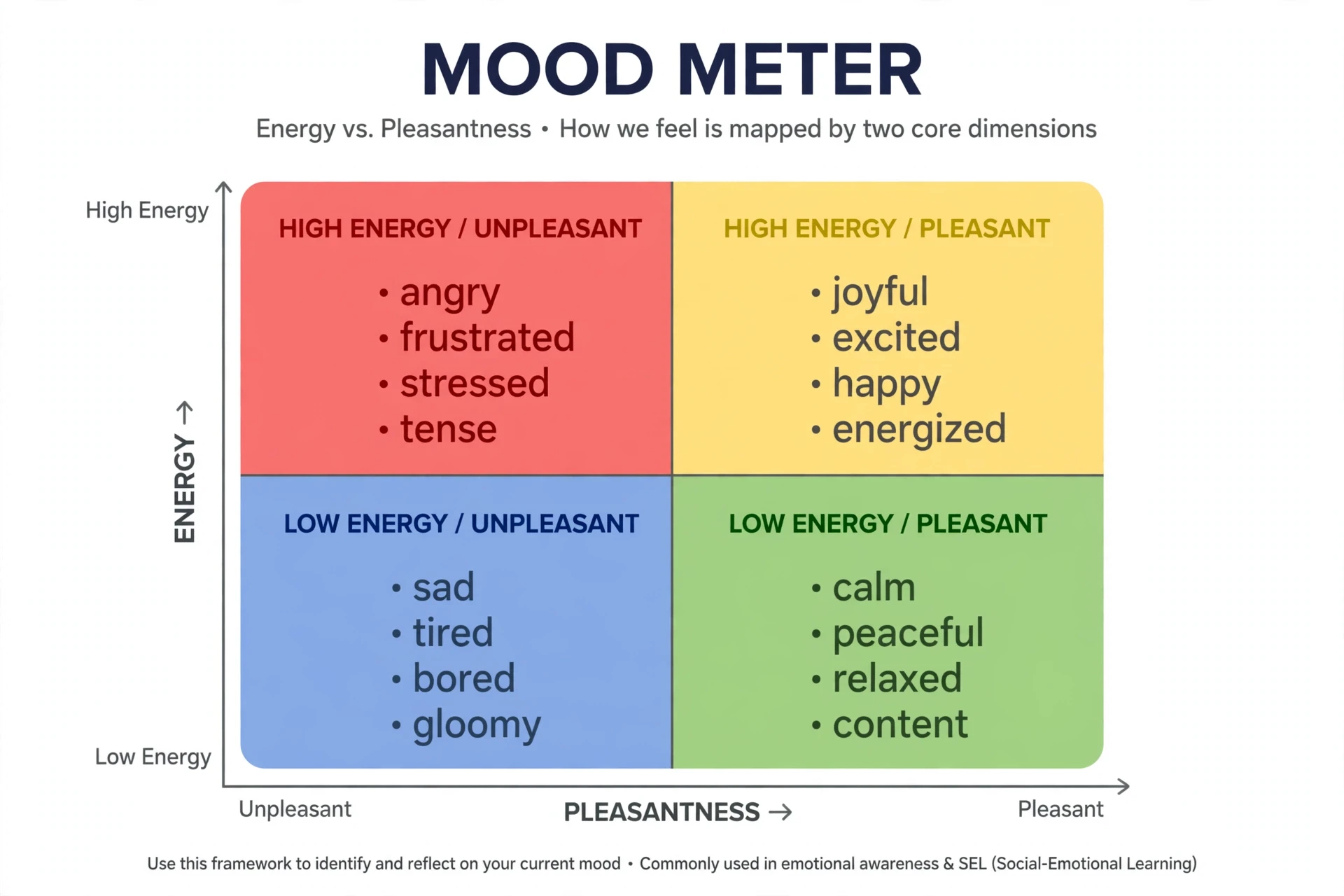
The Mood Meter is the centrepiece of RULER, Yale's approach to teaching emotional intelligence in schools. RULER is an acronym for the five skills it teaches: Recognizing emotions in yourself and others, Understanding their causes, Labelling them with precise words, Expressing them in ways that fit the situation, and Regulating them effectively. The programme now runs in thousands of schools and reaches millions of students, and it is one of the few EQ interventions with real implementation data behind it. Marc Brackett, the founding director of the Yale Center for Emotional Intelligence, describes the centre's work as twofold: research on the science of emotions, and building practical ways to teach these skills to children and the adults who raise them. That combination — science first, application second — is the standard every EQ programme should be held to.
7. What High Emotional Intelligence Looks Like in Real Life
Theory is useful, but EQ earns its keep in ordinary moments. Here is what it looks like when it is working.
In a disagreement. A person with high EQ notices their own rising frustration early, before it becomes shouting. They can say, "I am getting defensive, and that is making it hard for me to hear you," which is a sentence that can defuse almost any argument. They also listen for what the other person actually wants, which is often not victory but reassurance.
At work. Managers with strong emotion-management skills do not just give better feedback; they give feedback people can actually hear. They notice when a team member has gone quiet after a reorganisation, and they ask about it privately instead of waiting for a resignation letter. Research on workplace EQ consistently links these skills with better leadership ratings, more constructive conflict handling, and lower occupational stress. Our article on anxiety and depression covers what happens when stress and low mood go unmanaged at work — the territory EQ skills are designed to prevent.
In relationships. Partners who can label their feelings precisely argue better, because "I felt dismissed when you checked your phone" is a solvable problem, while "you never care about me" is a dead end. The ability to repair after a fight — to apologise well, to forgive well — depends heavily on the fourth branch.
With yourself. High EQ looks like catching a bad mood before it makes your decisions for you. It looks like knowing that you are hungry and tired, not genuinely furious at your partner, and eating something before you say anything you will regret. It looks like the pause I described earlier: the space between feeling and acting, where choice lives.

None of this requires being cheerful all the time. That is a common misunderstanding, and it matters. A person with high EQ can be angry, sad, or afraid — they simply know what they are feeling, why, and what to do with it. Emotional intelligence is not the absence of difficult feelings. It is the ability to work with them.
8. The "80% of Success" Myth — and Other Misconceptions
This is the section I most wanted to write, because the most famous claim about emotional intelligence is also the least true. You have probably heard it: "EQ accounts for 80% of success" or "EQ matters twice as much as IQ." It appears in training brochures, keynote speeches, and bestselling books. It is not supported by the evidence, and the story of where it came from is worth telling.
The claim traces back to loose readings of Goleman's 1995 book, which suggested that IQ accounts for roughly 20% of the factors that determine life success, leaving the rest to other things — including emotional intelligence. But that 20% figure was never a measured statistic. It was a rough, illustrative guess, and the leap from "IQ explains about a fifth" to "EQ explains the other four-fifths" was never justified. No study has ever found that emotional intelligence explains 80% of success. What the research actually finds is far more modest and far more interesting.
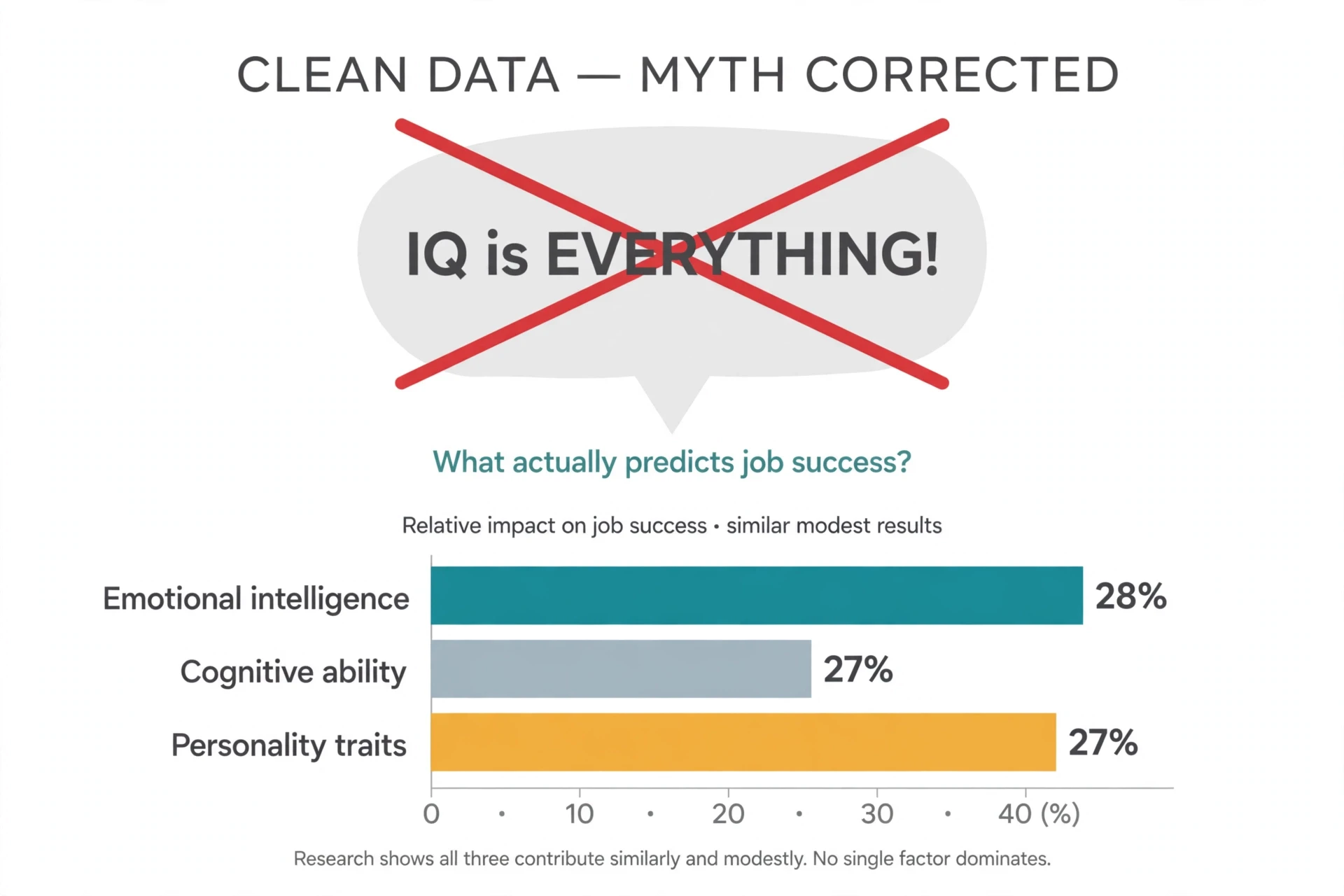
Meta-analyses that pool many studies find that ability-based EQ correlates with job performance at roughly 0.3 — a real, meaningful relationship, but one that leaves most of the variation in performance unexplained. It also matters more in some jobs than others. In work that is emotionally demanding — nursing, teaching, sales, leadership — EQ predicts performance noticeably better than it does in work that is mostly technical and solitary. And EQ adds predictive value on top of IQ and personality, rather than replacing them. The careful summary, which researchers have repeated for years, is that emotional intelligence is a useful piece of the puzzle, not the whole puzzle. Anyone who tells you otherwise is selling a training course.
Other misconceptions deserve the same honest treatment:
"High EQ means being nice." No. High EQ means understanding emotions and managing them well — and sometimes that means delivering hard news, setting a firm boundary, or saying no. A person who agrees with everything to avoid conflict is not showing emotional intelligence. They are showing avoidance.
"EQ is fixed, like eye colour." No. Unlike IQ, which is relatively stable across adulthood, emotional skills respond to practice. The evidence is covered in the next section.
"Women naturally have higher EQ than men." The research finds small average differences on some measures and none on others, and the differences are far smaller than the differences between individual people of the same sex. The stereotype does more harm than the data does good.
"Emotional intelligence is just common sense." Common sense is untested folk wisdom. EQ research tests its claims, measures its outcomes, and admits when the evidence is weak. That difference is the whole point of science.
"You can spot high EQ in a five-minute conversation." You cannot. Emotional skill shows itself over time, under pressure, and in private moments. First impressions measure charm, not EQ.
"The most dangerous thing about the 'EQ equals 80% of success' claim is not that it is wrong. It is that it is wrong in a way that makes people stop asking questions. A real science invites you to check. A slogan asks you to believe."
9. Can Emotional Intelligence Be Learned?
The short answer is yes — and the evidence for that yes is stronger than the evidence for most things in this field. A systematic review and meta-analysis published in 2024 pulled together 50 workplace training studies and found that training in emotional competencies produced moderate improvements, with effect sizes around 0.44 to 0.46, and the gains were still present more than three months after training ended. All professions benefited, and emotional intelligence training, empathy training, and emotion regulation training worked about equally well. The authors were careful to note the limitations — high variation between studies, and many studies of modest quality — but the overall direction is clear: these skills can be trained, and the training sticks for months, not days.
That is the research answer. Here is the practical answer — five habits that build the four branches, one small step at a time.
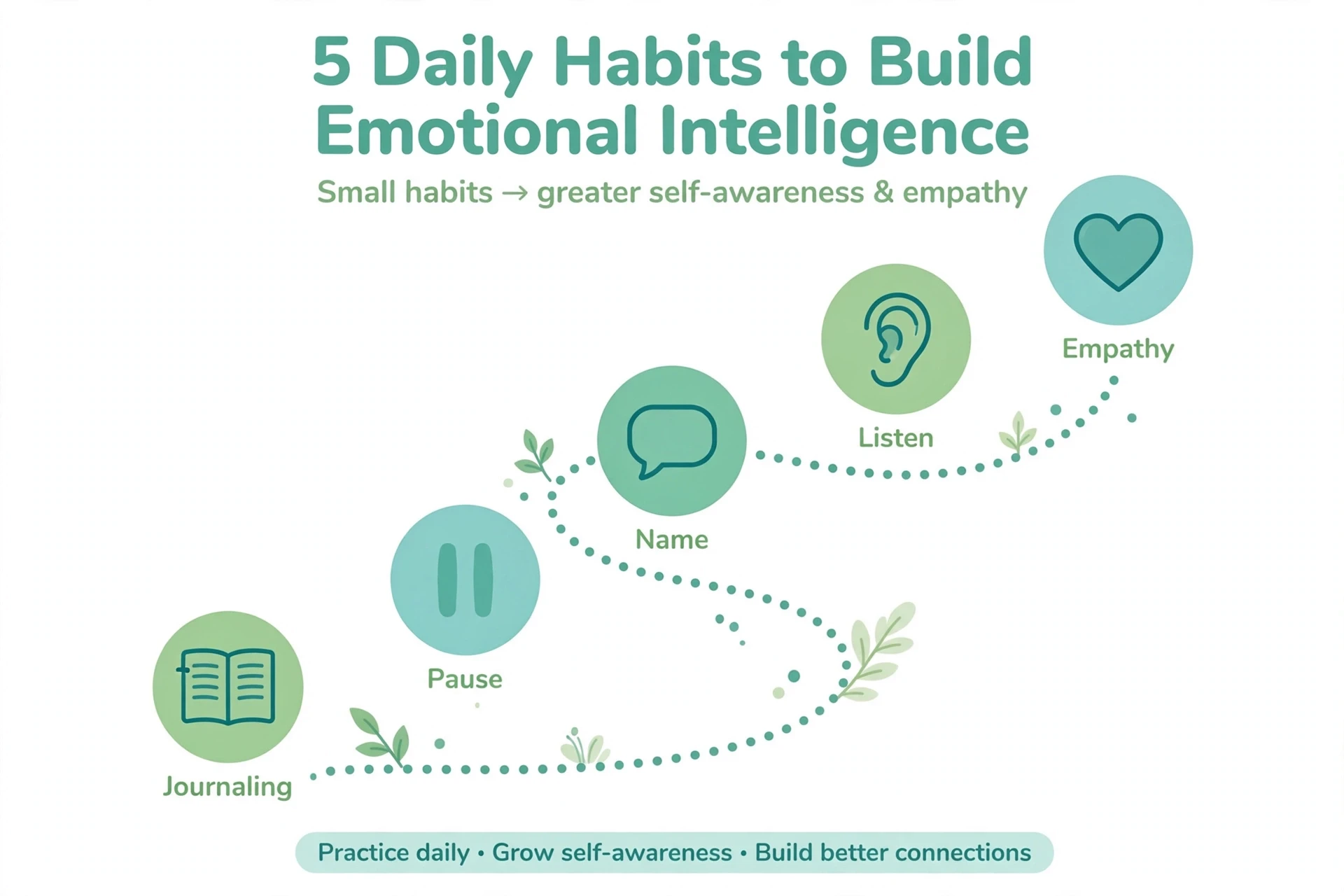
Name the feeling, precisely. Three times a day, pause and ask yourself what you are feeling — and push past "fine" or "stressed" to a specific word: frustrated, overlooked, anxious, hopeful. Research on affect labelling shows that naming an emotion reduces its intensity, partly because the act of labelling engages the prefrontal cortex. A bigger vocabulary is not showing off. It is a tool.
Take the six-second pause. When a strong emotion hits, wait before you act. Six seconds is enough for the first wave of the amygdala's alarm to pass and for your slower thinking to come online. Count, breathe, or simply put the phone down. Most of the emails people regret were sent inside those six seconds.
Ask what the feeling is for. Emotions carry information. Anger usually means a boundary was crossed. Anxiety usually means something matters and feels uncertain. Sadness usually means something valued was lost. Asking "what is this feeling telling me?" turns a reaction into a message.
Practise listening without fixing. In your next three conversations, try to understand before you respond. Reflect back what you heard — "so you felt ignored in that meeting" — and wait. Most people are not looking for a solution. They are looking to be understood, and understanding is the cheapest gift there is.
Review one emotional moment a day. In the evening, pick one moment when you felt something strongly and replay it: what triggered it, what you did, what you wish you had done. This is the same reflective practice athletes and surgeons use, and it works for the same reason: the brain learns from reviewed experience far faster than from experience alone. Memory plays a role here too — the way we store and retrieve emotional experiences shapes what we learn from them, as our guide to how the human brain forms memories explains in detail.
A word of caution: beware of any programme that promises to transform your EQ in a weekend. The training studies that work share two features — they practise real skills in real situations, and they last weeks, not hours. A weekend workshop can teach you the vocabulary. It cannot rewire a habit. That takes repetition, feedback, and time, like learning any skill worth having.
10. Emotional Intelligence in Children and Schools
If emotional intelligence can be learned, the best time to learn it is early. Children are not born knowing how to name their feelings or calm themselves down. They learn it the way they learn language: from the adults around them, and from practice. A toddler who throws a toy is not being difficult. They are showing you, in the only language they have, that they are overwhelmed. An adult who kneels down, names the feeling — "you are frustrated because the tower fell" — and waits, is teaching the first branch of emotional intelligence in a single sentence.
School programmes like RULER build on this systematically, and the research on social and emotional learning in schools is encouraging: students in well-run programmes tend to show better classroom behaviour, better relationships with teachers, and modest improvements in academic performance. The effects are not enormous, and they depend heavily on whether the programme is actually delivered well — a curriculum on a shelf changes nothing. But the direction of the evidence is consistent, and it matches what the brain science predicts: skills practised in childhood become habits in adulthood.

Parents do not need a curriculum to help. The most powerful thing a parent can do is model the skills: name your own feelings out loud ("I am feeling stressed, so I am going to take a deep breath"), apologise when you lose your temper, and treat your child's feelings as information rather than misbehaviour. Children copy what they see far more faithfully than they follow what they are told. The gut-brain connection is part of this story too — a child's mood, appetite, and digestion are linked in ways science is still mapping, as our article on the gut-brain connection describes — and a calm, regular routine helps the whole system settle.
11. What Emotional Intelligence Cannot Do
Honesty requires a final boundary. Emotional intelligence is a real, measurable set of abilities, and it helps in real ways. It is not a cure for everything. It does not fix an unfair workplace, a broken relationship on its own, or a mental health condition. If you are living with anxiety or depression, EQ skills can help you cope — but they are not a substitute for professional support, and anyone who tells you otherwise is doing you a disservice. Our article on anxiety and depression explains what the science says about treatment and where to find help. EQ also cannot overcome a lack of opportunity, resources, or fair treatment. A person can have superb emotional skills and still be held back by a system that does not reward them. Attributing success or failure to EQ alone ignores the world people live in — and that is the same mistake the "80% of success" myth makes, in a kinder disguise.
There is also a darker side worth naming. The same skills that let you understand other people's emotions can be used to manipulate them. A person who reads feelings well and uses that knowledge to deceive or control is not showing emotional intelligence in the sense researchers mean — the ability model is about reasoning accurately about emotions, not about weaponising them — but the skills overlap, and the field has not always been careful about the distinction. The honest answer is that emotional skill, like any skill, can be used well or badly. What makes it good is not the skill itself but the purpose it serves.
The Bottom Line
Emotional intelligence is the ability to reason about emotions: to notice them, use them, understand them, and manage them. That is the whole idea, and it is enough. It was defined by Salovey and Mayer in 1990, mapped into four branches in 1997, and it has survived three decades of testing far better than most ideas in psychology. It is measured best by ability tests like the MSCEIT, poorly by quick online quizzes, and usefully — with care — by the people around you. It predicts real outcomes, especially in emotionally demanding work and in relationships, but it explains a modest share of success, not 80% of it. And it can be learned: training works, practice works, and the skills you build in childhood or in a Tuesday-afternoon argument stay with you.
The afternoon I described at the start of this article ended with a plan, but it began with a sentence: "Everyone here is angry, and some of us are scared." That sentence did not fix the grant. It did something smaller and more important — it told the truth about what the room was feeling, and it gave everyone a place to stand. That is what emotional intelligence is for. Not to make feelings go away, and not to win at life, but to see clearly enough to choose well. The feelings will keep coming. The question is whether you will be able to read them — and that, more than any test score, is a skill worth building.
Frequently Asked Questions
What is emotional intelligence in simple terms?
Emotional intelligence is the ability to notice, understand, and manage emotions — your own and other people's. In the research definition, it means reasoning about emotional information: recognising what someone feels, understanding why, and choosing a helpful response instead of reacting on impulse.
What are the four branches of emotional intelligence?
The four branches of the Mayer–Salovey model are perceiving emotions, using emotions to facilitate thinking, understanding emotions, and managing emotions. They build on each other: you cannot manage an emotion you cannot notice, and you cannot understand a feeling you cannot name.
Is EQ more important than IQ?
Neither is more important in general — it depends on what you are predicting. IQ is the better predictor of academic performance and technical problem-solving. EQ is the better predictor of relationship quality, emotion regulation, and performance in emotionally demanding jobs. The claim that EQ accounts for 80% of success has no basis in the research; meta-analyses find a moderate correlation of around 0.3 between ability-based EQ and job performance.
Can emotional intelligence be learned?
Yes. A 2024 systematic review and meta-analysis of 50 workplace training studies found moderate, lasting improvements in emotional competencies after training, with effects still present more than three months later. Daily habits — naming feelings precisely, pausing before reacting, and reviewing emotional moments — also build the skills over time.
How is emotional intelligence measured?
The most respected method is an ability test such as the MSCEIT, which asks you to solve emotional problems with right and wrong answers — identifying emotions in faces, predicting how feelings change, and choosing helpful responses. Self-report questionnaires measure your opinion of yourself rather than your ability, and 360-degree feedback asks the people around you. Ability tests are the most valid measure of the skill itself.
Does high emotional intelligence mean being nice all the time?
No. High emotional intelligence means understanding and managing emotions well, and that sometimes means delivering difficult news, setting firm boundaries, or saying no. A person who agrees with everything to avoid conflict is showing avoidance, not emotional intelligence. Difficult feelings are part of the skill, not a failure of it.
Sources
American Psychological Association. "Emotional Intelligence." https://www.apa.org/topics/emotional-intelligence
Harvard Health Publishing, Harvard Medical School. "Emotional Intelligence." https://www.health.harvard.edu/mind-and-mood/emotional-intelligence
National Institute of Mental Health. "Health Topics." https://www.nimh.nih.gov/health/topics
Training emotional competencies at the workplace: a systematic review and meta-analysis (BMC Psychology, 2024). https://pmc.ncbi.nlm.nih.gov/articles/PMC11616120/
Yale School of Medicine. "Marc A. Brackett — Director, Yale Center for Emotional Intelligence." https://medicine.yale.edu/profile/marc-brackett/
Mayer, J. D., & Caruso, D. R. (2025). Emotional intelligence and socioemotional attributes: Distinct constructs and their uses. Consulting Psychology Journal. (via University of New Hampshire Scholars Repository)
Mayer, J. D., Salovey, P., & Caruso, D. R. (2008). Emotional intelligence: New ability or eclectic traits? American Psychologist, 63, 503–517.
Salovey, P., & Mayer, J. D. (1990). Emotional intelligence. Imagination, Cognition and Personality, 9, 185–211.
Mayer, J. D., & Salovey, P. (1997). What is emotional intelligence? In P. Salovey & D. Sluyter (Eds.), Emotional Development and Emotional Intelligence. Basic Books.