

Introduction: The Half-Second That Runs Your Life
I still remember the kitchen in my grandmother's house, the smell of fried fish in the air, and the exact moment my hand brushed the side of a hot pan. I did not think. I did not decide. My hand was back at my side before the thought "that is hot" had finished forming in my head. Later, in a physiology lab, I watched the same thing happen on a screen — a trace spiking, a muscle twitching — and I finally understood what had saved my fingers that day. The nervous system had done the thinking for me, faster than thought itself.
That is the quiet miracle at the centre of this article: how the nervous system works, from the brain in your skull to the spinal cord in your back and the nerves reaching into every fingertip. It is the network that lets you read this sentence, remember yesterday, feel a breeze, pull away from pain, and keep your heart beating while you sleep. It does all of that with cells that speak in electricity and chemistry, in a language older than words.
Most people picture the nervous system as a kind of wiring diagram, neat and still. The real thing is louder and stranger than that. It is a living conversation, billions of cells passing messages, arguing, adjusting, and learning as they go. Once you see how it works, ordinary moments — catching a ball, tasting coffee, waking from a dream — start to look like small feats of engineering.
1. What Is the Nervous System?
1.1 A definition that actually helps
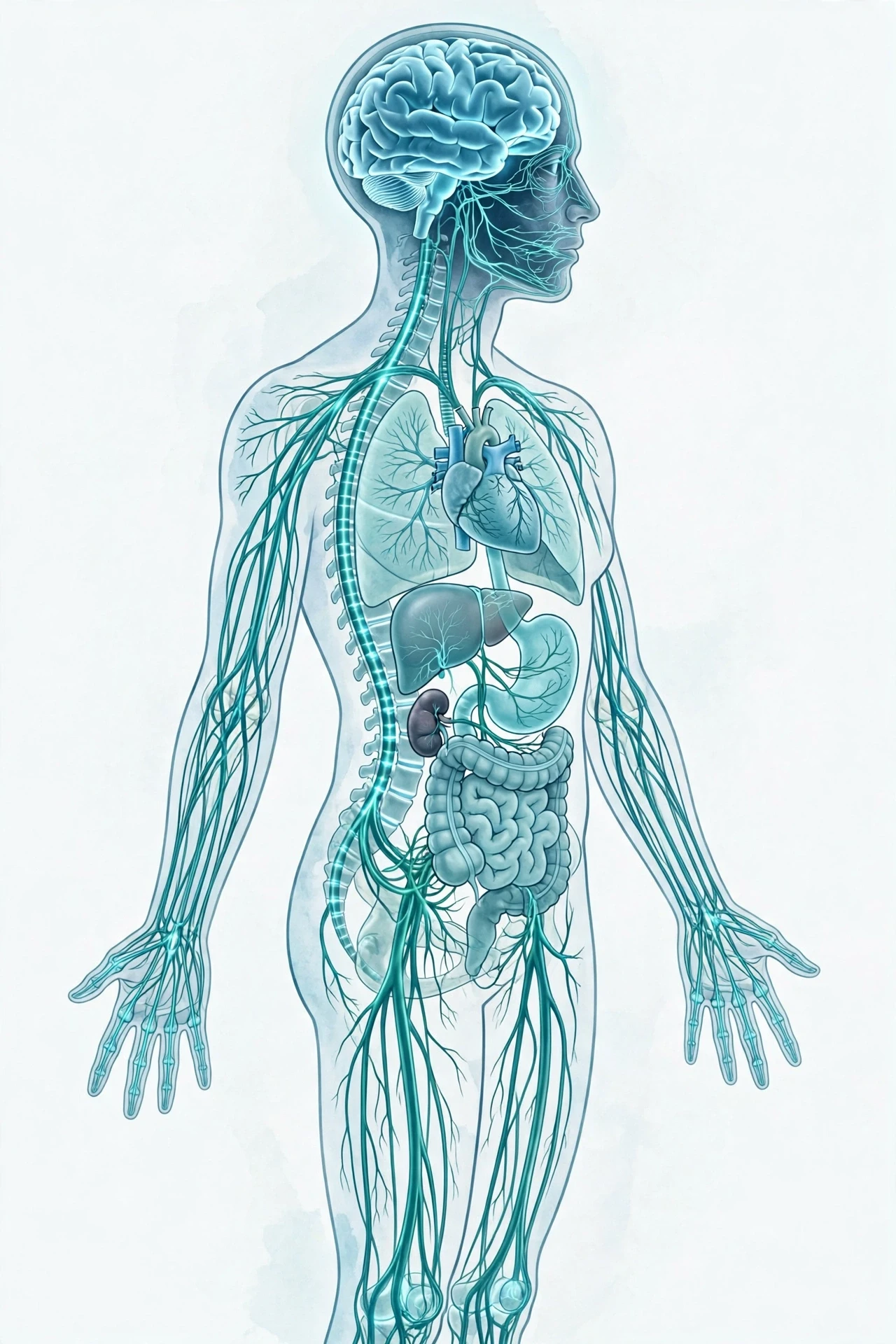
The nervous system is your body's communication and control network. It gathers information from inside your body and from the world around you, makes sense of it, and sends out instructions in reply. The Cleveland Clinic describes it plainly: your nervous system is made up of your brain, spinal cord and nerves, and it works by sending messages between your brain and all the other parts of your body. Those messages tell you to breathe, move, speak and see.
Think of a city at rush hour. The brain is the control room, the spinal cord is the main highway running through the middle, and the nerves are the side streets reaching every house, shop and park. Messages travel in both directions all day: reports coming in, orders going out. When the system works well, you never notice the traffic. You only notice it when something goes wrong — a numb finger, a forgotten word, a hand that pulls away from heat before you know why.
1.2 The three jobs it never stops doing
Every second, the nervous system does three things, over and over, in a loop:
Sensation. It collects information. Light hits your eyes, sound shakes tiny hairs in your ears, pressure bends receptors in your skin, chemicals drift across your tongue.
Integration. It sorts and interprets that information. Is this hot or warm? Is that sound a voice or a car? Does this matter, or can it be ignored?
Response. It acts. A muscle contracts, a gland releases a hormone, your heart beats a little faster, your hand lets go.
The loop is so fast that sensation and response can feel like one event. They are not. Between the burn and the flinch, a whole relay race has already run — and won.
"Your nervous system is your body's information processing and communication system. It receives messages, processes information, and then sends signals to the rest of your body telling it what to do." — MSD Manual, Overview of the Nervous System
1.3 Why it matters more than any single organ
Your heart can be helped by a machine. Your lungs can be helped by a ventilator. Your brain cannot be replaced by a spare. The nervous system is the only system that touches every other system: it steadies your heartbeat, nudges your digestion, sharpens your attention, and stores the memories that make you who you are. When I first held a preserved human brain in an anatomy lab — heavy, folded, quiet in my gloved hands — I felt a strange respect for it. This soft, grey-pink organ, about the size of two fists, held someone's jokes, their first love, their fear of the dark. Nothing else in the body carries that kind of cargo.
2. The Neuron: The Cell That Carries the Message
2.1 Meet the messenger
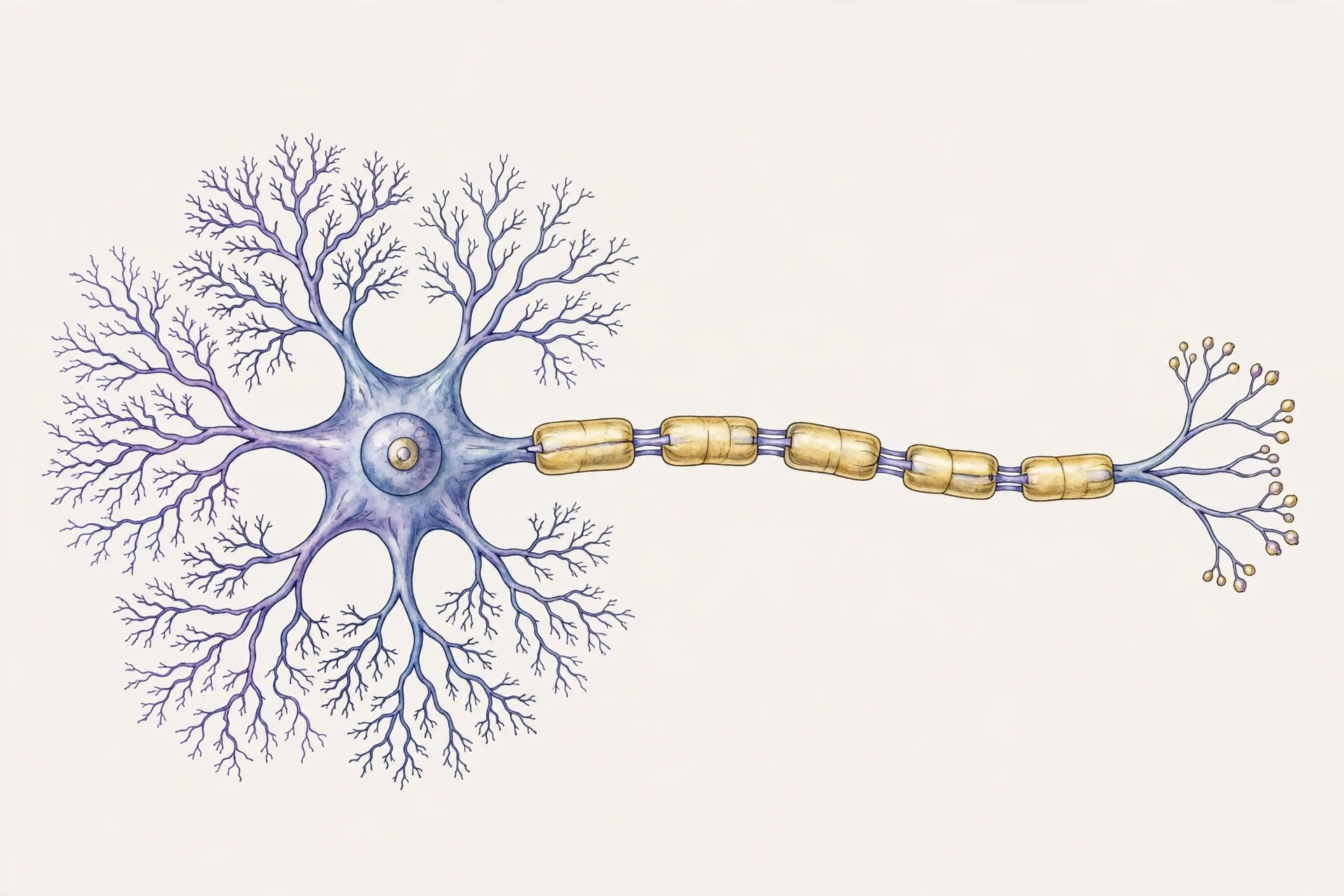
If the nervous system is a city, the neuron is the courier. A neuron is a specialised cell built almost entirely around one job: receiving a signal, carrying it, and passing it on. Your brain holds billions of them, and they come in many shapes, but most share the same basic parts.
Dendrites — short, branching arms that receive incoming signals, like antennae listening for a broadcast.
Cell body (soma) — the neuron's headquarters, holding the nucleus and the machinery that keeps the cell alive.
Axon — a single long fibre that carries the outgoing signal away from the cell body, sometimes over a metre long in the nerves of your legs.
Axon terminals — the end of the line, where the signal is handed to the next cell.
Around many axons sits a fatty wrapping called the myelin sheath. It works like the plastic coating on an electrical wire: it insulates the axon and lets the signal travel much faster. When myelin is damaged, as it is in multiple sclerosis, messages slow down or get blocked, and the effects can be felt across the whole body. MedlinePlus explains this plainly in its overview of the nervous system: myelin helps nerves send messages quickly, and when it is damaged, messages between brain and body slow down or get blocked.
2.2 Glia: the support crew nobody applauds
Neurons get the fame, but they could not work alone. Glial cells — from the Greek word for glue — support, feed, protect and clean up after neurons. Astrocytes feed neurons and help maintain the blood-brain barrier, the tight filter that decides what gets into the brain. Oligodendrocytes make myelin in the brain and spinal cord. Microglia act as the brain's immune guards, clearing debris and watching for trouble. For years, textbooks treated glia as packing material. Research now shows they shape how signals travel and how the brain learns. The support crew, it turns out, helps write the script.
I learned that lesson the slow way. In my early lab years, I treated glial cells as background noise in my preparations, something to wash away. A senior colleague stopped me one afternoon and said, simply, "You are throwing away half the story." She was right. The cleanest neuron preparation in the world tells you little if you ignore the cells that keep it alive.
2.3 How many neurons? A number worth getting right
You will often read that the brain has 100 billion neurons. That round number has been repeated so often that it feels like fact. Careful counting work suggests the real figure is closer to 86 billion neurons in the adult human brain, with roughly a similar number of glial cells beside them. The exact count matters less than the scale: tens of billions of cells, each connected to thousands of others, forming a network with more connections than there are stars in the Milky Way. That is the hardware your thoughts run on.
3. How a Signal Travels: Electricity, Then Chemistry, Then Electricity Again
3.1 The action potential, in plain language
A nerve signal is called an action potential. It is a brief wave of electrical change that races along the axon. Here is the short version of how it works, without the jargon getting in the way.
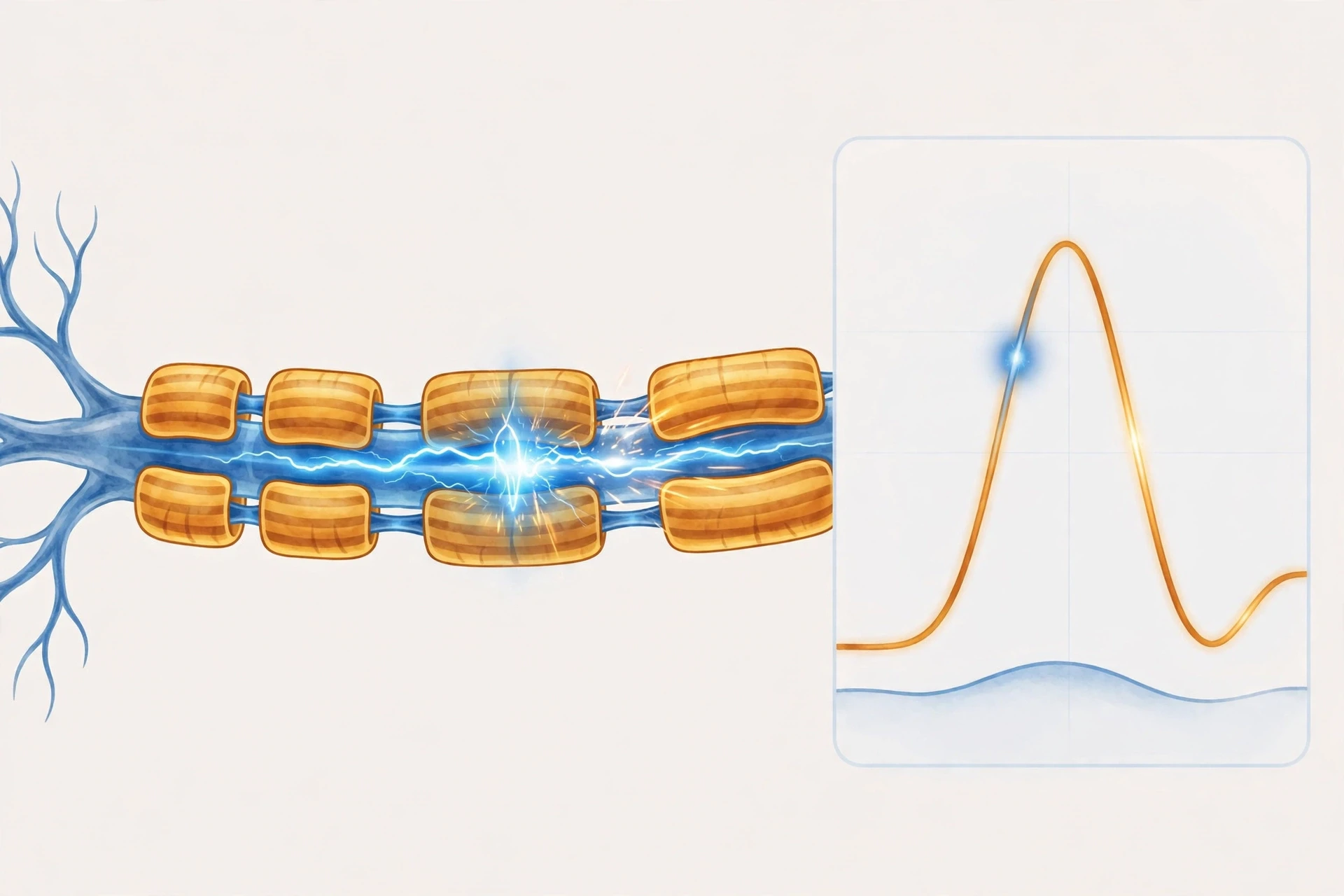
A resting neuron holds a small voltage across its membrane — the inside slightly negative compared with the outside, about −70 millivolts. Think of it as a stretched rubber band, holding energy, waiting. When a strong enough signal arrives, tiny gates in the membrane open. Sodium ions rush in, the voltage flips positive, and that flip triggers the next stretch of membrane to do the same. The wave runs down the axon like a line of dominoes falling, each one knocking over the next.
Then the membrane resets: potassium ions flow out, the voltage falls back, and the neuron is ready to fire again. The whole event takes about a millisecond. OpenStax Anatomy and Physiology describes this sequence in detail — depolarisation, repolarisation, and a brief overshoot — and notes that the signal travels as voltage-gated ion channels open in turn along the axon.
3.2 Why myelin makes signals fast
In an unmyelinated axon, the wave has to trigger every patch of membrane, step by step. It works, but it is slow. In a myelinated axon, the signal jumps from gap to gap in the myelin — small bare patches called nodes of Ranvier — in a process called saltatory conduction. The signal skips the insulated stretches and lands only where it needs to. The result is speed: some signals travel at over 100 metres per second, fast enough to cross your body in a blink.
That speed is why you can catch a ball you barely saw coming, and why the hot-pan reflex in my grandmother's kitchen finished before my conscious mind caught up. The wiring was built for urgency.
3.3 The synapse: where electricity becomes chemistry
Here is the part that surprises most people. Neurons do not touch each other. Between one neuron and the next sits a tiny gap called a synapse. When the electrical signal reaches the end of an axon, it triggers the release of chemical messengers called neurotransmitters. Those chemicals drift across the gap, dock onto receptors on the next cell, and start a new electrical signal there — or stop one from starting.
Some neurotransmitters excite the next neuron, urging it to fire. Others inhibit it, telling it to stay quiet. The balance between excitation and inhibition is what lets the brain think clearly instead of firing all at once, like a crowd shouting at the same time. Dopamine, serotonin, glutamate, GABA, acetylcholine — each has its own role, and each is a small chemical with an outsized job. When these chemicals are out of balance, mood, sleep, movement and memory can all shift. That is one reason the same brain can feel sharp one morning and foggy the next, a pattern explored in Sciory's guide to brain fog.
3.4 A signal's journey, step by step
Put it together, and a single touch on your fingertip runs like this:
A receptor in your skin detects pressure or heat and starts a signal.
A sensory neuron carries that signal toward the spinal cord and brain.
Interneurons in the spinal cord and brain process it and decide what it means.
A motor neuron carries the reply back out to a muscle.
The muscle contracts — your hand moves, your head turns, your mouth speaks.
Five steps, a fraction of a second, no conscious effort. You do this thousands of times a day without noticing any of it.
4. Two Halves of One System: Central and Peripheral
4.1 The map
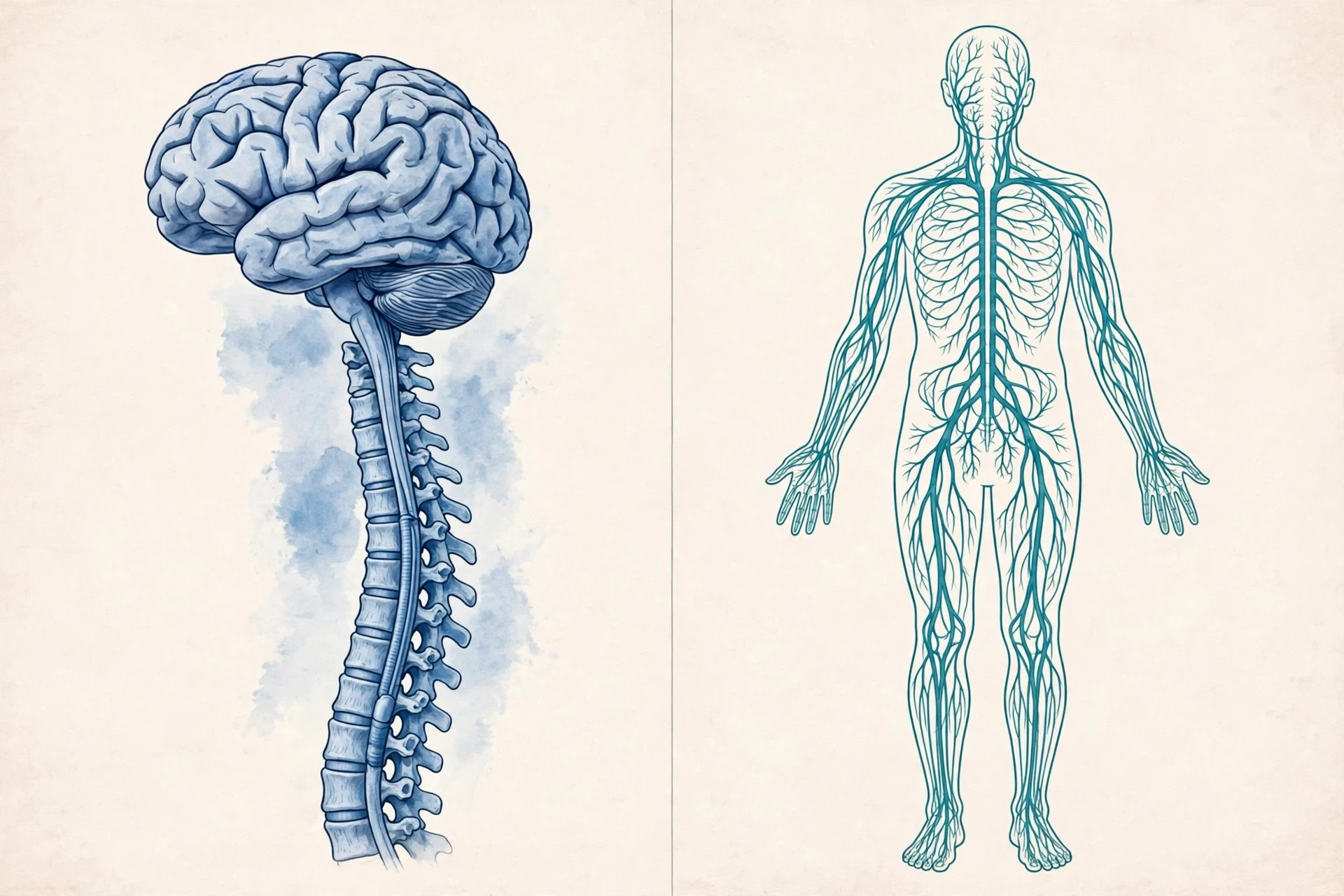
The nervous system is usually divided by location into two parts. The division is simple, but the teamwork between the halves is anything but.
Division | Parts | Main job | Analogy |
|---|---|---|---|
Central nervous system (CNS) | Brain and spinal cord | Processes information and issues commands | The control room |
Peripheral nervous system (PNS) | All nerves outside the brain and spinal cord | Carries signals between the CNS and the rest of the body | The roads and messengers |
Somatic (part of PNS) | Sensory and motor nerves to skin and skeletal muscle | Voluntary movement and conscious sensation | The driver at the wheel |
Autonomic (part of PNS) | Nerves to organs, glands and smooth muscle | Automatic functions: heartbeat, breathing, digestion | The autopilot |
4.2 The central nervous system: protected like treasure
The brain and spinal cord sit inside bone — the skull and the spine — and float in cerebrospinal fluid, a clear liquid that cushions them against knocks. Three layers of membrane, the meninges, wrap them for extra protection. The system is so well guarded because the stakes are so high: damage to the CNS heals slowly, if at all, and a small injury can change a life.
The brain and spinal cord also share a strict gatekeeper, the blood-brain barrier. It lets in oxygen, glucose and a few select molecules, and keeps out most toxins, germs and large molecules in the blood. That barrier protects the brain, and it also makes treating brain diseases harder, because many medicines cannot cross it. It is a trade-off the body accepted long ago: safety first, even when safety gets in the way.
4.3 The peripheral nervous system: the long reach
The PNS is everything else — the cranial nerves leaving the brain, the spinal nerves branching out from the spinal cord, and the fine nerve endings in your skin, muscles and organs. There are 12 pairs of cranial nerves, handling sight, smell, hearing, taste, facial movement and more, and 31 pairs of spinal nerves, each serving a band of the body.
The PNS splits by function as well as by location. The somatic division handles the things you choose to do: picking up a cup, walking across a room, turning your head. The autonomic division handles the things you do not choose: your heart beating, your stomach churning, your pupils widening in dim light. Both divisions run at the same time, on the same roads, without asking your permission.
5. The Brain: Four Lobes, One Conductor
5.1 A tour in four parts
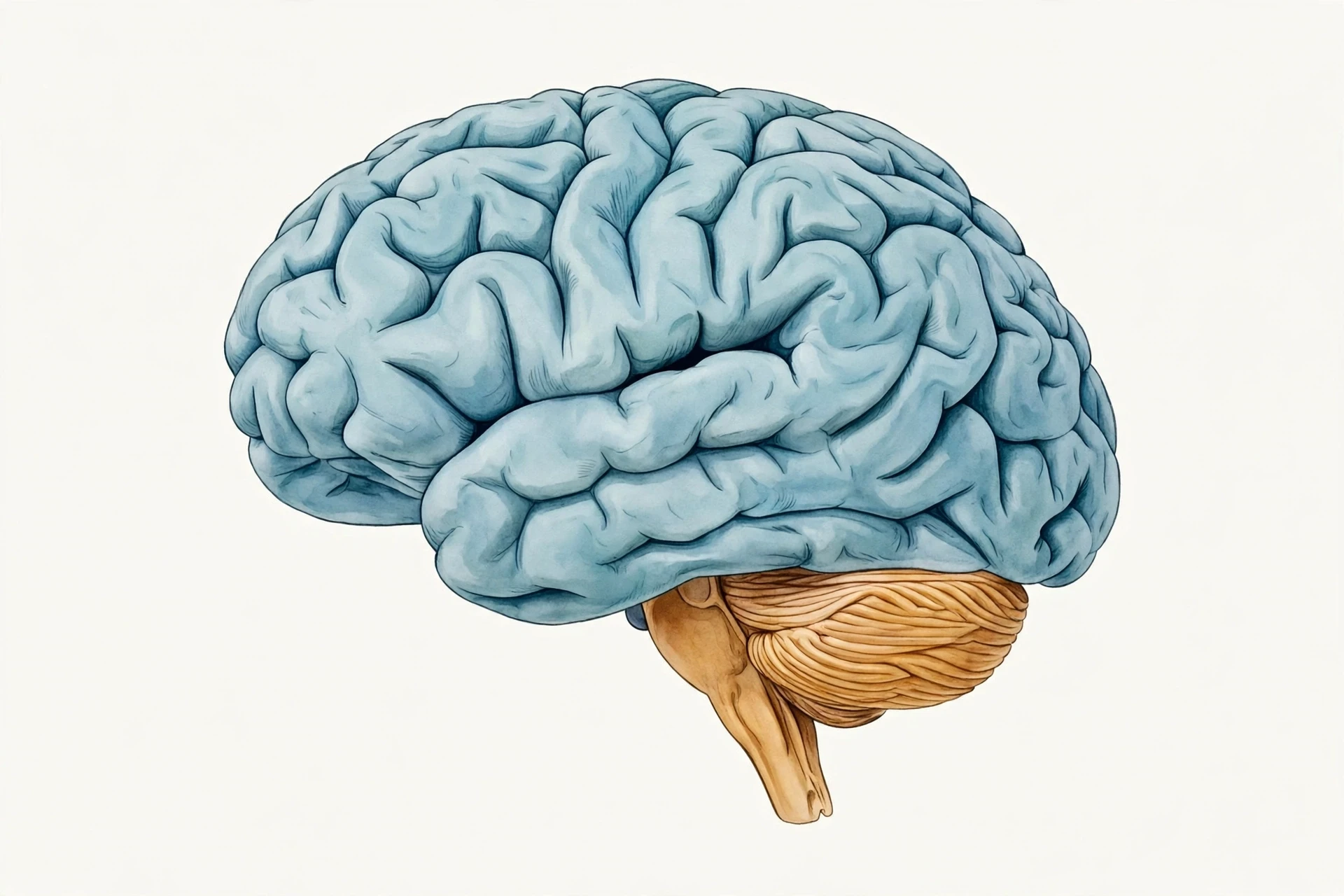
The brain is not one uniform blob. It has regions, and each region leans toward certain jobs, though no region works alone. The largest part, the cerebrum, is divided into two hemispheres and four lobes on each side:
Frontal lobe — planning, decision-making, personality, and voluntary movement. The part of you that weighs options and holds back a hasty reply.
Parietal lobe — touch, temperature, pain, and knowing where your body is in space. The part that tells you your hand is on the table without looking.
Temporal lobe — hearing, language, and memory. The part that recognises a familiar song in the first two notes.
Occipital lobe — vision. The part at the back of your head that turns light into the world you see.
Beneath the cerebrum sit the cerebellum, which fine-tunes movement and balance, and the brainstem, which runs the basics — breathing, heart rate, waking and sleeping. Deep inside, structures like the thalamus relay sensory signals, the hypothalamus links the nervous system to hormones, and the hippocampus helps form new memories. For a closer look at each region, see Sciory's human brain anatomy guide.
5.2 How the brain decides what matters
Your brain receives far more information than it can use. Right now, it is ignoring the feeling of your clothes against your skin, the hum of the room, and the pressure of the chair beneath you — until this sentence drew your attention to them. That filtering is not laziness. It is survival. A brain that noticed everything equally would be paralysed by noise.
Attention is the brain's way of turning up the volume on one signal and turning down the rest. Sleep, stress, hunger and mood all change where that volume knob sits, which is why a worried mind finds it hard to focus and a rested mind finds it easier. The link runs both ways: poor sleep clouds thinking, and a racing mind makes sleep harder, a loop described in Sciory's article on chronic insomnia and the brain.
I once spent a week in a sleep lab as a volunteer, wired up and watched while I tried to nap on command. The strangest part was not the electrodes. It was seeing my own brainwaves slow down on the monitor while I was still, subjectively, wide awake and thinking about lunch. My brain had started the descent into sleep before I had noticed. The monitor knew before I did.
5.3 Memory: the brain rewriting itself
Memory is not a recording. It is a reconstruction, rebuilt each time you recall it, and it changes a little with each rebuilding. When you learn something new, synapses strengthen or weaken, new connections form, and the network shifts. That shifting is called neuroplasticity, and it runs through your whole life, not just childhood. Practice a skill, and the circuits for it get faster and more reliable. Stop practising, and they fade.
That is hopeful news and a warning in one package. The brain you have tomorrow is shaped by what you do today — the sleep you get, the things you practise, the stress you carry. It is also why recovery after a brain injury, though slow, is sometimes possible: other regions can learn to take over some of the lost work.
6. The Spinal Cord: Highway, Relay Station, and Reflex Centre
6.1 More than a cable
People often describe the spinal cord as a cable carrying messages between brain and body. It is that, and it is more. The spinal cord is a thick bundle of nerve tissue, about 45 centimetres long in an adult, running from the brainstem down through the hollow centre of the spine. It carries signals up and down, and it also makes decisions on its own.
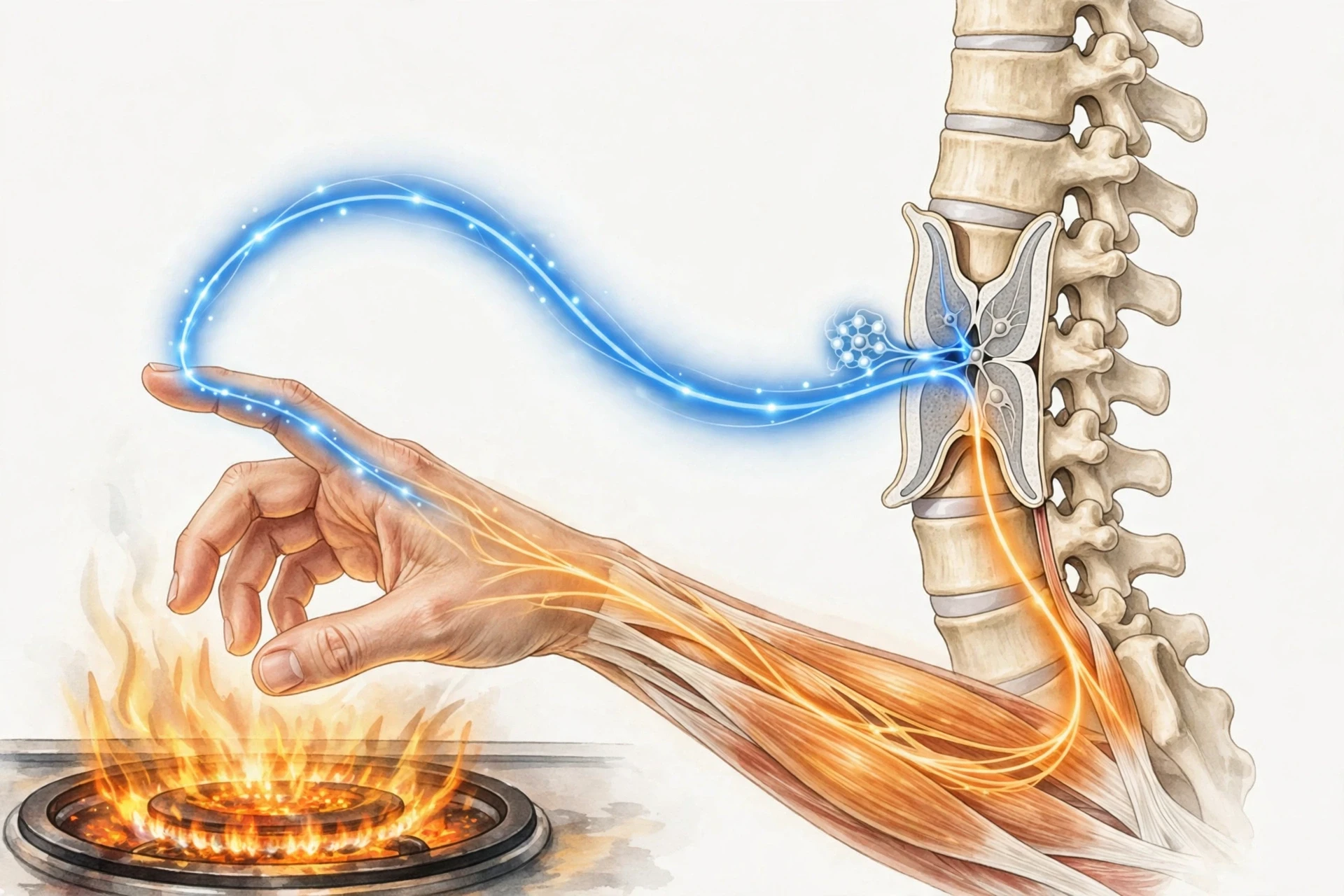
The cord has grey matter in the middle, shaped a little like a butterfly, where neuron cell bodies sit and process signals, and white matter around the outside, where myelinated axons run up and down like lanes on a motorway. Signals going up carry sensation toward the brain. Signals going down carry commands from the brain to the body. When the cord is injured, the messages below the injury can be cut off, which is why a spinal injury can take away movement and feeling in the parts of the body below it.
6.2 The reflex: thinking without thinking
The fastest decision your body makes is one your brain never hears about until afterwards. Touch something hot, and the signal travels to the spinal cord, jumps straight across to a motor neuron, and pulls your hand away — all before the signal reaches your brain and you feel the pain. That shortcut is a reflex arc, and it exists because speed matters more than thought when tissue is being damaged.
The knee-jerk reflex works the same way. A tap on the tendon below your kneecap stretches a muscle, a sensory neuron reports the stretch to the spinal cord, and a motor neuron fires the muscle into a small kick. Doctors test reflexes because they are a quick window into the health of the cord and the nerves: a missing reflex, or one that is too strong, can point to where a problem sits.
A reflex is not a shortcut around the nervous system. It is the nervous system doing its fastest, simplest work — sense, decide, act — without waiting for the brain to weigh in.
6.3 When the highway is damaged
A spinal cord injury does not just block messages. It changes the life of the person carrying it, and the lives of the people around them. Rehabilitation after such an injury is long, patient work — retraining muscles, learning new ways to move, and leaning on the nervous system's remaining plasticity. Research into spinal cord repair, from stem cells to electrical stimulation, is one of the most active areas in neuroscience, and it moves forward in small, hard-won steps rather than sudden breakthroughs. The honest picture is that there is no simple fix yet, and anyone who promises one is selling something other than science.
7. The Autonomic Nervous System: The Autopilot You Live With
7.1 Two branches, one balance
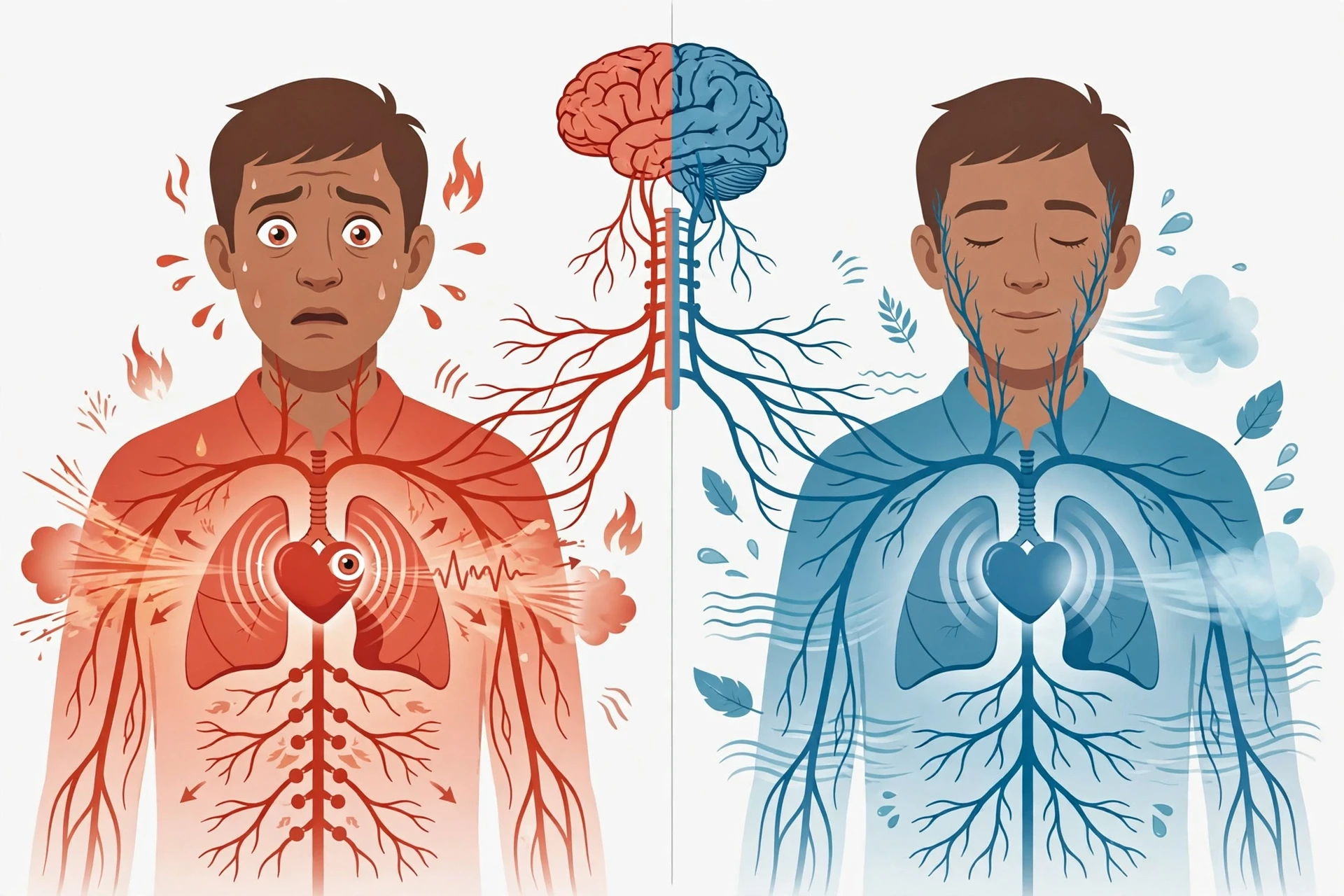
The autonomic nervous system runs the parts of life you do not consciously control. It has two branches that work like the two pedals of a car — one for speeding up, one for slowing down — and health depends on the balance between them.
Sympathetic branch — "fight or flight." Heart rate rises, breathing quickens, pupils widen, digestion pauses, glucose is released for energy. It prepares you to face a threat or run from it.
Parasympathetic branch — "rest and digest." Heart rate slows, breathing deepens, digestion resumes, the body repairs and restores. It is the branch that lets you fall asleep after a long day.
Neither branch is good or bad on its own. You need the sympathetic branch to catch a bus and to give a presentation. You need the parasympathetic branch to digest lunch and to sleep. Trouble starts when one branch stays switched on too long. A body that lives in fight-or-flight mode — always braced, always alert — pays for it in blood pressure, sleep, digestion and mood. That pattern is tied closely to chronic stress, and to the high cortisol levels described in Sciory's article on high cortisol symptoms.
7.2 Stress, calm, and the space between them
I used to think of calm as the absence of stress, a kind of blank state. Working with people under pressure taught me otherwise. Calm is active work: slow breathing, a steady heart rate, muscles letting go. It is the parasympathetic branch doing its job, and it can be trained. Slow, deep breathing is one of the simplest ways to nudge the balance back — a long exhale tells the brain, in its own language, that the danger has passed.
This is also where the gut enters the story. The gut has its own dense network of neurons, sometimes called the "second brain," and it talks with the brain constantly through the vagus nerve. Stress can upset digestion, and digestion can shape mood. Sciory's article on the gut-brain connection follows that two-way conversation in detail, and the deep dive on magnesium for anxiety and sleep looks at one nutrient often discussed in the context of calm and rest.
8. The Senses: How the World Gets In
8.1 Five doors, one hallway
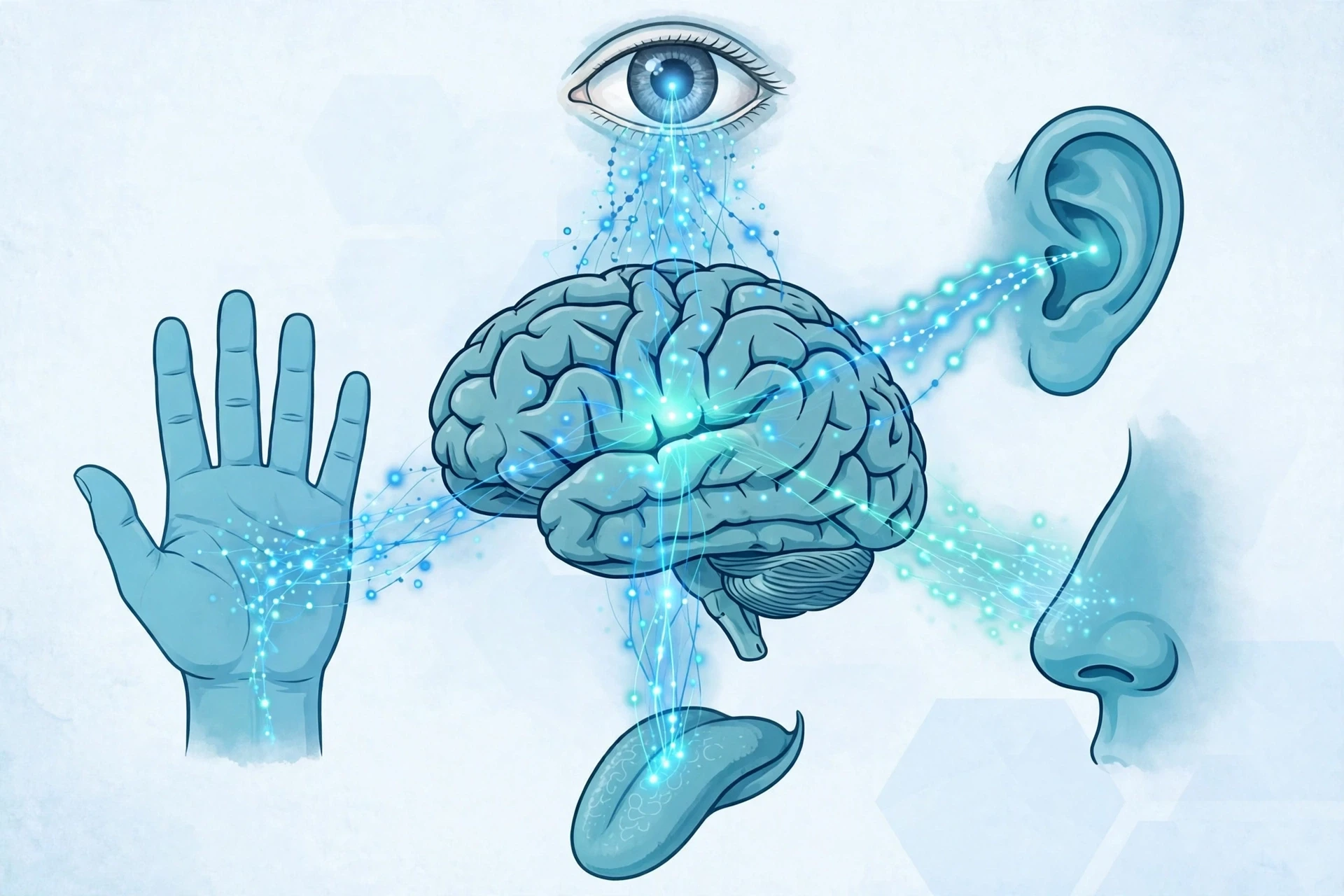
Your senses are the nervous system's way in. Each sense has its own receptors, its own nerve, and its own patch of brain — but the principle is the same everywhere: a physical event in the world becomes an electrical signal in a neuron.
Sight. Light passes through the lens of the eye and lands on the retina, where photoreceptors turn it into signals that travel along the optic nerve to the occipital lobe.
Hearing. Sound waves shake the eardrum and tiny bones in the ear, bending hair cells that turn movement into signals for the temporal lobe.
Smell. Odour molecules bind to receptors in the nose, sending signals straight to the brain's smell centres — the only sense with such a direct route, which is why a smell can unlock a memory in an instant.
Taste. Chemicals on the tongue activate taste buds, and the signals travel to the brain to be read as sweet, salty, sour, bitter or savoury.
Touch. Receptors in the skin report pressure, temperature, pain and vibration, and the signals travel up the spinal cord to the parietal lobe.
8.2 Pain: the sense nobody wants and everybody needs
Pain has a bad reputation, and it earns it. Yet a life without pain is dangerous. People born unable to feel pain often injure themselves without knowing — biting a tongue, breaking a bone, standing on a hot surface — because the alarm never rings. Pain is the nervous system's warning system, and like any alarm, it can malfunction. In chronic pain, the alarm keeps ringing long after the danger has passed, and the nervous system itself becomes more sensitive to signals that should be harmless. Treating chronic pain often means calming the nervous system, not just fixing the tissue where the pain seems to live.
I once met a patient in a research clinic who described her chronic pain as "a radio stuck between stations." The image stayed with me because it was accurate. The signal was real, the suffering was real, and the source was not a single damaged spot but a whole network turned up too loud.
9. Learning, Sleep, and the Latest Research
9.1 How the brain learns
Learning is physical. When you practise a language, a sport or an instrument, synapses involved in that skill strengthen, and new connections form. Neuroscientists call the strengthening "long-term potentiation," but the idea is simple: neurons that fire together wire together. Repetition, sleep and attention all help the process along. That is why cramming the night before an exam feels productive and then fades — the connections were never given time to settle.
9.2 What sleep does for the nervous system
Sleep is not the nervous system switching off. It is the nervous system doing maintenance. During sleep, the brain consolidates memories, clears waste products through the glymphatic system, and resets the sensitivity of its synapses for the next day. Short sleep leaves the system noisy: attention wanders, mood dips, reaction times slow, and the stress branch stays switched on longer than it should. Over weeks and months, poor sleep is linked with worse thinking and worse health, which is why sleep is one of the first things clinicians ask about when memory or mood slips.
9.3 Where the research is heading
Neuroscience is moving fast, and the honest summary is that the biggest questions are still open. Researchers are mapping the brain's wiring at finer and finer scale, learning how large networks of neurons coordinate, and testing new ways to help the nervous system repair itself. Brain-computer interfaces — devices that read neural signals and turn them into movement or speech — have helped people with paralysis communicate and control devices, though they remain experimental and limited. Work on neurodegenerative diseases is slowly untangling how proteins, inflammation and genes interact over decades. None of this is a finished story. The field is full of careful, incremental progress, and the researchers I know are the first to say how much they still do not understand. That humility is part of what makes the science trustworthy.
10. Common Misconceptions About the Nervous System
Most people assume the brain works like a computer, with files stored in folders and a processor running programs. What we actually see in the data is messier and more interesting: the brain is a network that rebuilds itself as it works, with no single centre in charge and no neat filing system. The computer analogy helps beginners, and then it starts to mislead.
A few other ideas worth correcting:
"We only use 10% of our brains." False. Brain imaging shows that almost all of the brain is active over the course of a day, with different regions active at different times. There is no dark, unused 90% waiting to be unlocked.
"Nerve cells cannot regrow." Mostly true for the brain and spinal cord, where regrowth is very limited — but the peripheral nerves can regrow slowly after injury, which is why feeling and movement sometimes return after a cut nerve heals.
"The left brain is logical and the right brain is creative." Oversimplified. Both hemispheres work together on almost every task, and the differences between them are subtler than the popular version suggests.
"A bigger brain means a smarter person." Not in any simple way. Brain size varies, and intelligence depends far more on connections, organisation and experience than on raw volume.
"Stress is all in your head." Stress is in your head and in your body at once — heart, gut, hormones and immune system included. The nervous system and the immune system talk to each other constantly, and stress reaches both.
11. When Things Go Wrong
11.1 A short, honest tour of disorders
The nervous system can fail in many ways, and the names can feel overwhelming. A few of the most common, in plain language:
Stroke. A blood vessel in the brain is blocked or bursts, and the brain tissue beyond it is starved of oxygen. Speed matters: the faster treatment starts, the more brain can be saved.
Multiple sclerosis (MS). The immune system attacks myelin, slowing or blocking signals. Symptoms depend on which nerves are affected and can come and go over years.
Parkinson's disease. Neurons that make dopamine die off over time, leading to tremor, stiffness and slower movement.
Alzheimer's disease. Memory and thinking decline gradually as brain cells are damaged, with plaques and tangles building up in brain tissue over years.
Epilepsy. Bursts of abnormal electrical activity in the brain cause seizures, which vary widely in form and severity.
Neuropathy. Nerves outside the brain and spinal cord are damaged, often causing numbness, tingling or pain in the hands and feet. Diabetes is a common cause.
This list is a map, not a diagnosis. Any persistent numbness, weakness, severe headache, sudden confusion, or change in speech or vision deserves prompt medical attention — not a web search and a wait-and-see.
11.2 Ageing and the nervous system
Ageing changes the nervous system, and most of those changes are gradual. MedlinePlus notes that as people age, the brain and spinal cord lose some nerve cells and weight, nerve cells may pass messages more slowly, and reflexes and sensation can fade a little. Slowing of thought and memory is a normal part of ageing. Dementia and severe memory loss are not a normal part of ageing, and they deserve medical attention when they appear. Staying active — physically, mentally and socially — is one of the best-supported ways to keep the nervous system working well for longer, though it is not a guarantee against disease.
12. Looking After Your Nervous System
12.1 What actually helps
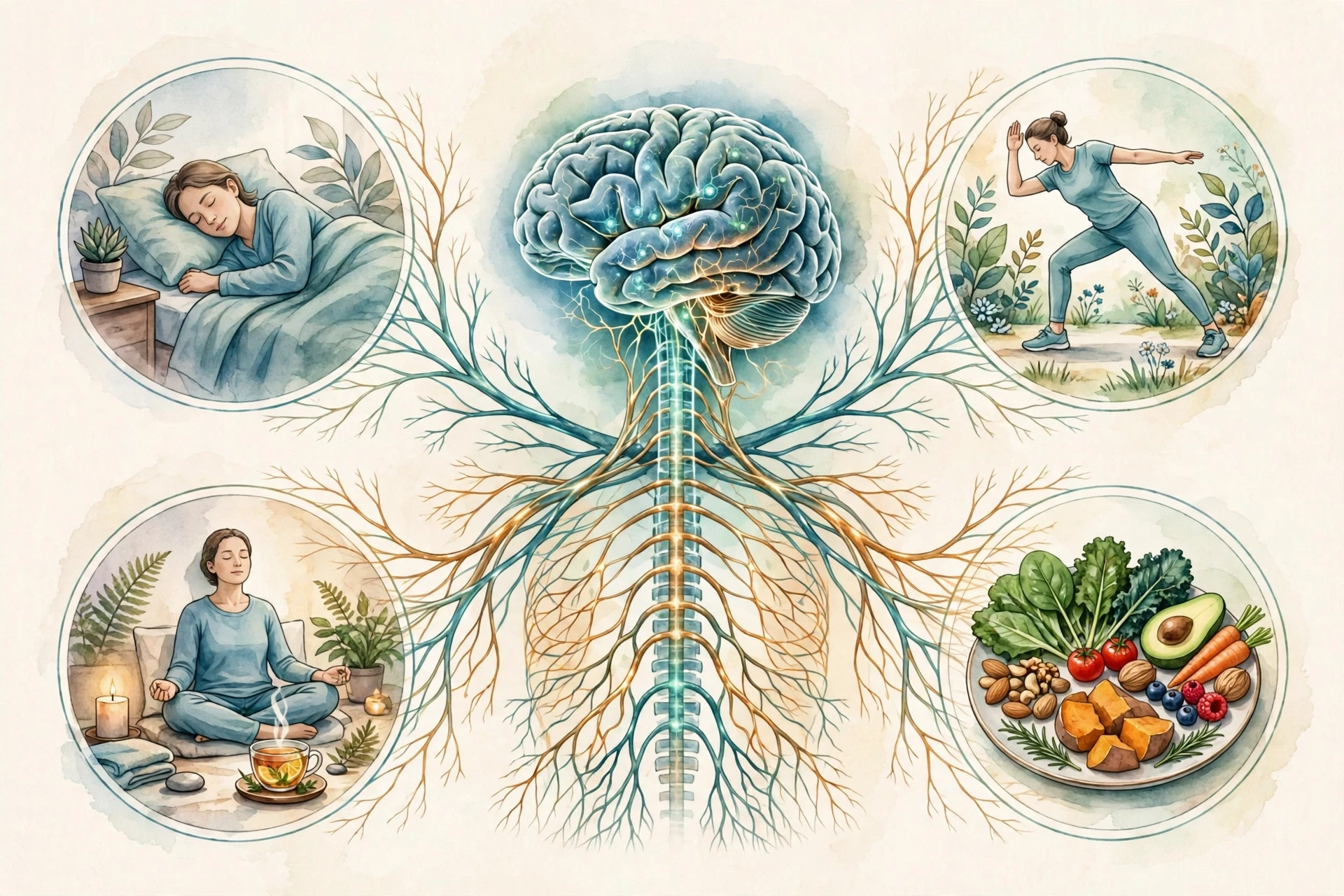
There is no single food, supplement or trick that "boosts" the nervous system on its own. What helps is the unglamorous list that helps almost everything else in the body — and the nervous system, more than most, rewards consistency:
Sleep 7–9 hours most nights. The brain does its maintenance work while you sleep, and short sleep leaves it noisy the next day.
Move regularly. Exercise supports blood flow to the brain and helps mood, sleep and memory.
Eat a varied, balanced diet. The brain is a hungry organ, using a large share of the body's energy, and it runs best on steady fuel.
Protect your head. Wear a helmet on a bike, a seatbelt in a car. A single serious head injury can change a nervous system for life.
Manage stress in small, daily ways. Slow breathing, time outdoors, regular breaks, and talking with people you trust all nudge the autonomic balance toward rest.
Keep learning. New skills, languages, music and conversation keep the brain's networks active and adaptable.
Avoid smoking and limit alcohol. Both damage nerves and blood vessels over time, and both make recovery from nerve injury harder.
I keep a short version of this list taped inside a lab notebook from years ago, next to a coffee stain and a half-finished diagram. It is not exciting. It is the list that works.
12.2 When to seek help
See a clinician promptly if you notice sudden weakness or numbness on one side, sudden trouble speaking or understanding speech, sudden vision loss, a severe headache unlike any before, a seizure, or a head injury with loss of consciousness. See a clinician soon — not as an emergency, but without delay — for persistent tingling, gradual weakness, memory changes that interfere with daily life, or mood changes that do not lift. Early attention gives the nervous system its best chance, and it gives you answers sooner.
Conclusion: The Network That Is You
The nervous system is not a machine inside you. It is you — the part that notices, remembers, decides and feels. It turns light into a face you love, sound into a song you cannot forget, and a hot pan into a hand pulled back before thought. It runs on electricity and chemistry, on cells that fire and chemicals that drift across tiny gaps, and it does all of it while you are busy living your life.
I think back to that kitchen, to the hand that moved before I understood why, and to the brain I once held in gloved hands in a lab. The first was instinct. The second was a person. The thread between them is the nervous system, and it is still the most remarkable network I have ever studied. Look after it. It is doing far more for you, right now, than you will ever notice — and that is exactly how it should work.
Frequently Asked Questions
How does the nervous system work in simple terms?
The nervous system works by sending electrical and chemical signals between your brain, spinal cord and nerves. Sensory nerves carry information in, the brain and spinal cord process it, and motor nerves carry instructions back out to muscles and organs. The whole loop — sense, process, respond — can take a fraction of a second.
What are the main parts of the nervous system?
The main parts are the brain, the spinal cord, and the nerves. The brain and spinal cord form the central nervous system, which processes information and issues commands. The nerves form the peripheral nervous system, which carries signals between the central nervous system and the rest of the body.
What is the difference between the central and peripheral nervous systems?
The central nervous system is the brain and spinal cord, protected inside bone, and it does the processing and decision-making. The peripheral nervous system is all the nerves outside the brain and spinal cord, and it carries messages in and out. The central system is the control room; the peripheral system is the roads.
How fast do nerve signals travel?
It depends on the nerve. Signals in myelinated axons can travel at over 100 metres per second, while signals in unmyelinated fibres are much slower. Myelin, the fatty wrapping around many axons, lets signals jump from gap to gap and travel far faster than they could otherwise.
What is a neuron, and what does it do?
A neuron is a nerve cell built to receive, carry and pass on signals. It has dendrites that receive signals, a cell body that processes them, and a long axon that carries the signal onward to the next cell. Neurons communicate across tiny gaps called synapses, using chemical messengers called neurotransmitters.
Can the nervous system heal itself?
It depends on where the damage is. Peripheral nerves can regrow slowly after injury, and some function can return. The brain and spinal cord heal very poorly, though the brain can sometimes rewire itself — a process called neuroplasticity — so that other regions take over some lost work. Recovery is usually slow and partial, not instant.
How can I keep my nervous system healthy?
Sleep 7–9 hours most nights, move regularly, eat a varied balanced diet, protect your head from injury, manage stress in small daily ways, keep learning new things, and avoid smoking while limiting alcohol. If you notice sudden weakness, numbness, speech trouble or severe headache, seek medical care promptly.
Sources
Cleveland Clinic — Nervous System: What It Is, Parts, Function & Disorders. https://my.clevelandclinic.org/health/body/21202-nervous-system
MedlinePlus (U.S. National Library of Medicine) — Neurosciences. https://medlineplus.gov/ency/article/007456.htm
OpenStax, Anatomy and Physiology 2e — Chapter 12: The Nervous System and Nervous Tissue, Introduction. https://openstax.org/books/anatomy-and-physiology-2e/pages/12-introduction
OpenStax, Anatomy and Physiology 2e — Chapter 12 Review. https://openstax.org/books/anatomy-and-physiology-2e/pages/12-chapter-review
MSD Manual — Overview of the Nervous System. https://www.msdmanuals.com/home/quick-facts-brain-spinal-cord-and-nerve-disorders/biology-of-the-nervous-system/overview-of-the-nervous-system
MedlinePlus (U.S. National Library of Medicine) — Aging Changes in the Nervous System. https://medlineplus.gov/ency/article/004023.htm