

I once spent an entire evening arguing with a friend about whether a popular diet really worked. I had read three articles that said it did, and I quoted them like a lawyer presenting evidence. My friend sent me two careful studies that said it did not. I skimmed them, found a small flaw in one, and declared victory. Hours later, alone in my kitchen, I realised something uncomfortable: I had not been searching for the truth at all. I had been searching for agreement — a textbook case of cognitive biases at work, though I did not know the name yet. My brain had done exactly what brains do — it had protected a belief I already held, and it had done it so smoothly that I never noticed the trick.
That quiet, invisible steering is the subject of this article. Cognitive biases are the systematic shortcuts and errors in thinking that shape how we judge, decide, remember, and act. They are not signs of stupidity. They are the side effects of a brain built for speed in a world that now demands accuracy. A doctor can fall for them. A judge can fall for them. I have fallen for them in my own lab, in front of students, with data I understood perfectly well — and that is the first thing to accept. Nobody is immune, and knowing the names of the cognitive biases does not switch them off. It only gives you a chance to notice them before they do damage.
In the pages that follow, you will meet twelve of the most important cognitive biases, each with the real experiment that exposed it, a real-life example you will probably recognise, and a practical note on how to catch it. We will start with the two psychologists who mapped this territory, then walk through biases that warp what we believe, biases that warp numbers and chances, biases that warp how we see ourselves, and biases that warp how we feel about other people. Along the way, we will look at why these errors exist at all — because the brain that tricks you is the same brain that lets you cross a street, read a face, and catch a ball without doing any maths.
1. What Is a Cognitive Bias?
A cognitive bias is a predictable pattern of thinking that departs from strict logic or statistics. The American Psychological Association's dictionary defines a cognitive bias as a systematic error in thinking that affects the decisions and judgements people make, and its overview of the topic is a good place to start for the formal wording (APA Dictionary of Psychology: cognitive bias; APA: Cognitive Biases). The key word in that definition is systematic. A random mistake is just a mistake. A bias is a mistake your brain makes in the same direction, again and again, for a reason.
Think of it this way. Your brain receives far more information every second than it could ever process carefully. The light hitting your eyes, the sounds around you, the half-remembered facts, the emotions attached to all of it — a full, careful analysis of everything would take forever. So the brain uses shortcuts. Psychologists call these shortcuts heuristics: fast rules of thumb that usually work well enough. Judge a stranger by how much they remind you of someone you know. Judge how common something is by how easily examples come to mind. Start from the first number you hear and adjust from there.
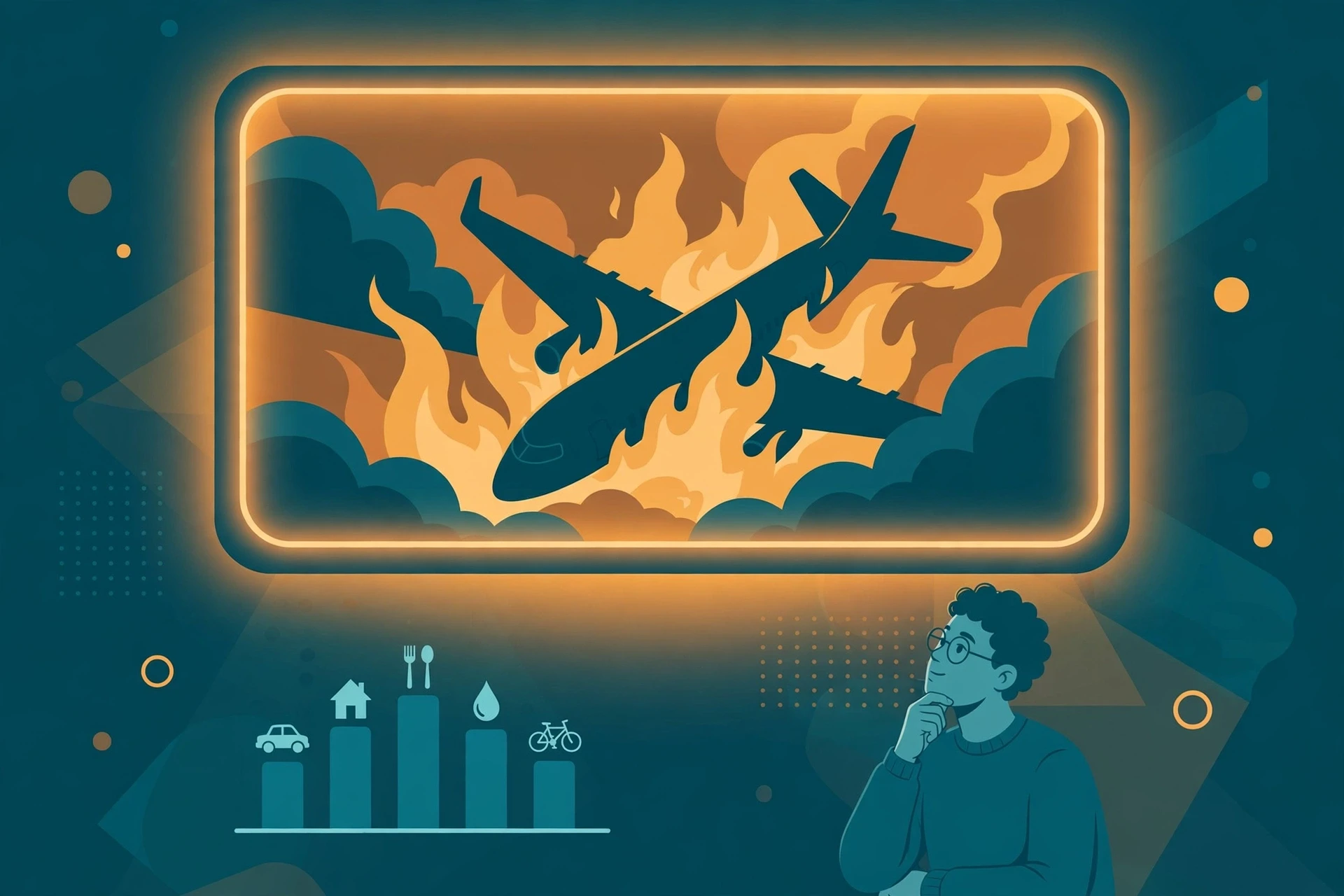
Heuristics are not the enemy. They are the reason you can decide in a split second whether a car is coming too fast, or whether a smile is friendly. The trouble starts when a shortcut that works in everyday life gets applied to a problem where it quietly fails. The shortcut is the heuristic. The predictable failure is the bias. A heuristic says, "things that come to mind easily are probably common." The availability bias is what happens when the evening news makes plane crashes feel more common than car crashes, even though the statistics say the opposite.
Researchers have now catalogued well over a hundred of these patterns, and the list keeps growing. That sounds overwhelming, but most of them are variations on a few themes: we favour what we already believe, we lean too hard on the first information we get, we trust vivid memories over dull statistics, we overrate our own abilities, and we follow the crowd. This article covers the twelve cognitive biases that show up most often in daily life — the ones that affect your money, your health, your relationships, and your vote.
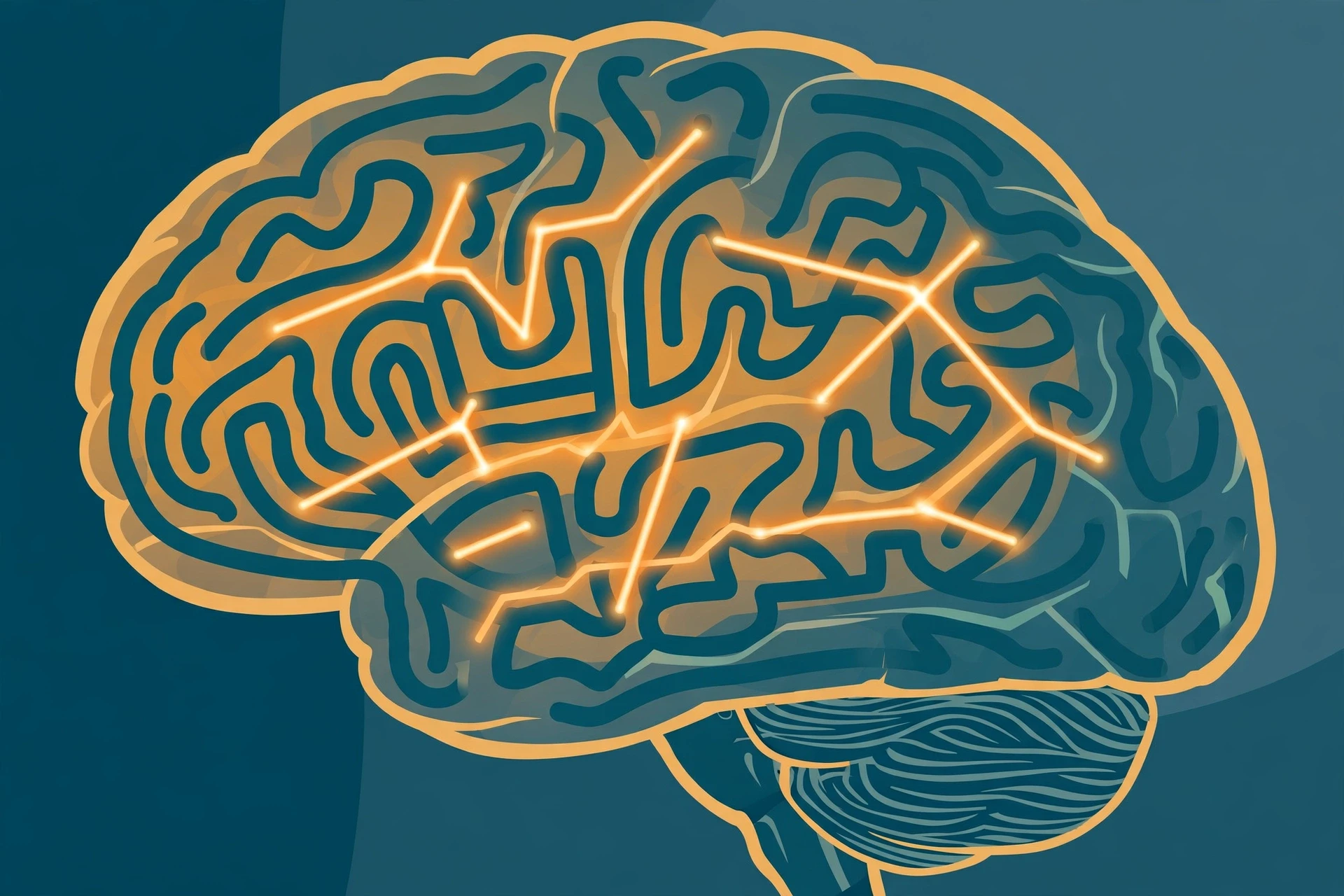
It helps to know one more thing before we meet them. A bias is not a flaw in your character. It is a feature of every human brain, built by evolution for a world of immediate dangers and small groups, not for a world of statistics, headlines, and investment portfolios. The same mental machinery that once helped our ancestors spot a predator in tall grass now makes us overreact to a scary headline. You cannot uninstall the machinery. You can learn to spot it working.
1.1 Heuristics, biases, and plain old errors
People sometimes use the words heuristic and bias as if they mean the same thing. They do not, and the difference matters for everything that follows.
A heuristic is the shortcut itself — the quick rule your brain applies.
A bias is the systematic error that the shortcut produces in a particular situation.
A random error is noise — a one-off slip with no pattern behind it.
A tired surgeon who misreads a chart has made an error. A surgeon who always trusts the first diagnosis and stops looking for alternatives is showing anchoring, a bias with a pattern. The first can be fixed with rest. The second needs a different way of thinking.
1.2 Why smart people fall for them too
One of the most stubborn myths about cognitive biases is that they only trap the uneducated or the careless. The experiments say otherwise. In study after study, doctors, judges, engineers, and professional forecasters show the same biases as everyone else — sometimes more strongly, because expertise brings confidence, and confidence shuts down double-checking. Intelligence helps you argue your way out of a bias after you notice it. It does very little to help you notice it in the first place. In fact, a sharp mind can be a liability: it is very good at building clever defences for a belief it already holds.
That is why this article leans on experiments rather than advice alone. Each cognitive bias below was caught in the act, in a laboratory, with real people making real mistakes under controlled conditions. Knowing the experiment is what makes the bias feel real — and what makes you pause the next time you catch yourself doing the same thing.
2. How Two Psychologists Mapped the Mind's Shortcuts
Every science has a moment when someone looks at a mess of separate observations and sees one pattern underneath. For the study of human error, that moment arrived in the early 1970s, in the partnership of two Israeli psychologists, Amos Tversky and Daniel Kahneman.
The two men could hardly have been more different in temperament. Tversky was brilliant, fast, and playful with ideas. Kahneman was careful, doubtful, and haunted by the ways his own mind misled him. What they shared was a fascination with a simple question: when people make judgements under uncertainty — about probabilities, risks, and values — do they follow the rules of logic and statistics, or do they follow something else?
They started asking people questions that looked simple and turned out not to be. They asked statisticians and doctors, not just students. And again and again, they found the same thing: highly intelligent people, including experts in statistics, made the same systematic mistakes. The errors were not random. They pointed in the same direction every time, like a compass needle pulled toward a magnet.
In 1974, they published their landmark paper, "Judgment under Uncertainty: Heuristics and Biases," in the journal Science. It laid out three great families of shortcuts — judging by similarity, judging by ease of recall, and judging from a starting number — and showed how each one produced its own family of errors. That paper became one of the most cited in the history of psychology, and it founded an entire field: the study of how real human judgement actually works, as opposed to how textbooks said it should work.
Tversky died in 1996, before the work received its highest honour. In 2002, Kahneman won the Nobel Prize in Economic Sciences for the research the two of them had done together — work that reshaped economics by showing that the "rational" decision-maker of economic theory does not exist in real life (Nobel Prize: The Prize in Economic Sciences 2002). The Nobel committee's press release tells the story plainly: Kahneman's work showed that human judgement follows its own rules, and those rules can be studied, predicted, and sometimes corrected.
The wheel-of-fortune experiment is the most famous demonstration of all, and it is worth telling in full because it shows how easily a mind can be steered by something it knows is irrelevant.
2.1 The wheel that changed people's minds
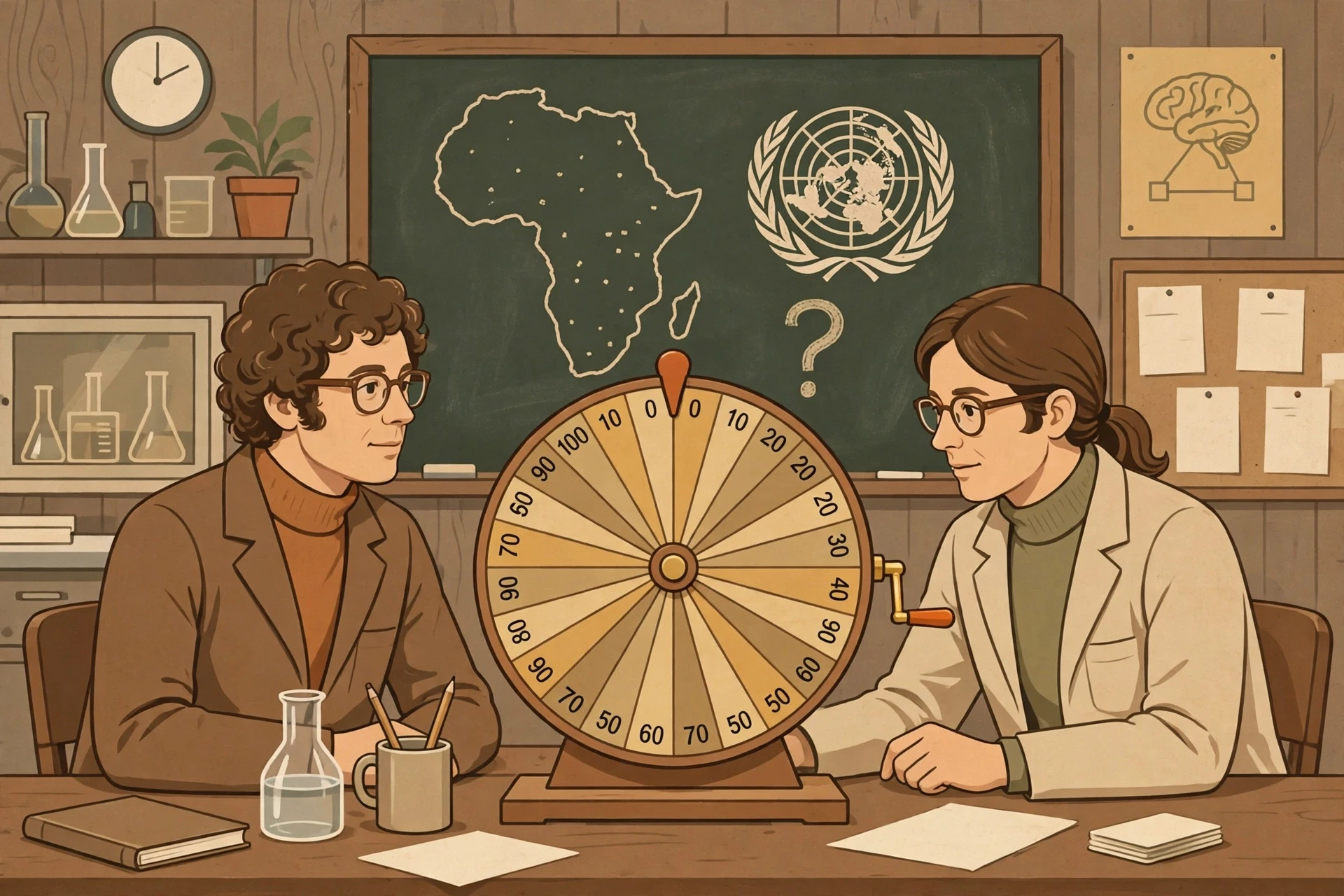
Tversky and Kahneman invited people into the lab and asked them to spin a wheel of fortune, rigged to stop at either 10 or 65. Then they asked a serious question: what percentage of African countries belong to the United Nations?
The wheel had nothing to do with the question. Everyone in the room could see that. The number was random. Yet the people who had spun a 10 gave a median estimate of 25 percent. The people who had spun a 65 gave a median estimate of 45 percent. A meaningless number, seen seconds earlier, had dragged their answers almost halfway toward itself.
I think about that experiment whenever I see a price tag. The first number you encounter — a house listing, a salary offer, a "was £200, now £120" label — does the same work as that wheel. It pulls your judgement toward itself, and it does so even when you know it is arbitrary. Knowing about the effect helps a little. It does not make you immune. The researchers themselves were surprised by how strong the pull was, and how little warning helped.
"The errors were not random. They pointed in the same direction every time, like a compass needle pulled toward a magnet."
That single insight is the thread running through this whole article. Cognitive biases are not chaos. They are order — the wrong kind of order, produced by a mind doing its best with limited time and information. Once you can see the pattern behind cognitive biases, you can start to work around them. The twelve cognitive biases below are the patterns that matter most.
3. Cognitive Biases That Warp What We Believe
The first family of cognitive biases attacks belief itself: what we accept as true, what we remember as having happened, and which stories survive to reach us. These are the cognitive biases that shape arguments at the dinner table, opinions about health, and the news we choose to read. They are also the hardest to notice, because a belief that feels obvious rarely gets questioned.
3.1 Confirmation bias: searching for agreement
The bias in one line: we seek out, remember, and favour information that confirms what we already believe, and we ignore or dismiss the rest.
The experiment. In 1960, the psychologist Peter Wason gave people a simple number puzzle. He showed them the sequence 2–4–6 and asked them to work out the rule behind it, by proposing their own sequences and being told whether each one fit the rule. Most people quickly guessed a rule — "numbers increasing by two" — and then spent the rest of the experiment proposing sequences that fit their guess: 8–10–12, 20–22–24, and so on. Each "yes" felt like proof. Only a small minority ever tried a sequence that would break their rule, such as 1–2–3, which would have shown them that the real rule was simply "any increasing numbers." They were not being lazy. They were testing their idea the way most of us test ideas: by looking for confirmation.
Real life. Confirmation bias is the engine of the modern information diet. If you believe a particular diet works, your searches will find success stories. If you believe a politician is honest, you will remember their good speeches and forget the scandals. Social media makes it worse: the algorithm learns what you click and shows you more of it, so your feed becomes a hall of mirrors. The American Psychological Association's dictionary defines confirmation bias as the tendency to gather evidence that confirms pre-existing expectations, typically by emphasising supporting evidence while dismissing contradictory evidence (APA Dictionary: confirmation bias), and its magazine has described how this habit quietly shapes professional judgement as well as everyday opinion (APA Monitor: confirmation bias).
How to catch it. Ask the question that Wason's successful solvers asked: "What would prove me wrong?" Before you share an article, search for the strongest argument against your position, not the weakest. If you cannot state the other side's best case fairly, you do not yet understand the issue — you only understand your own side of it. In science, this habit has a formal name: falsification. The scientific method is, at its core, a machine built to fight confirmation bias, by forcing every claim to survive attempts to break it.
3.2 Hindsight bias: "I knew it all along"
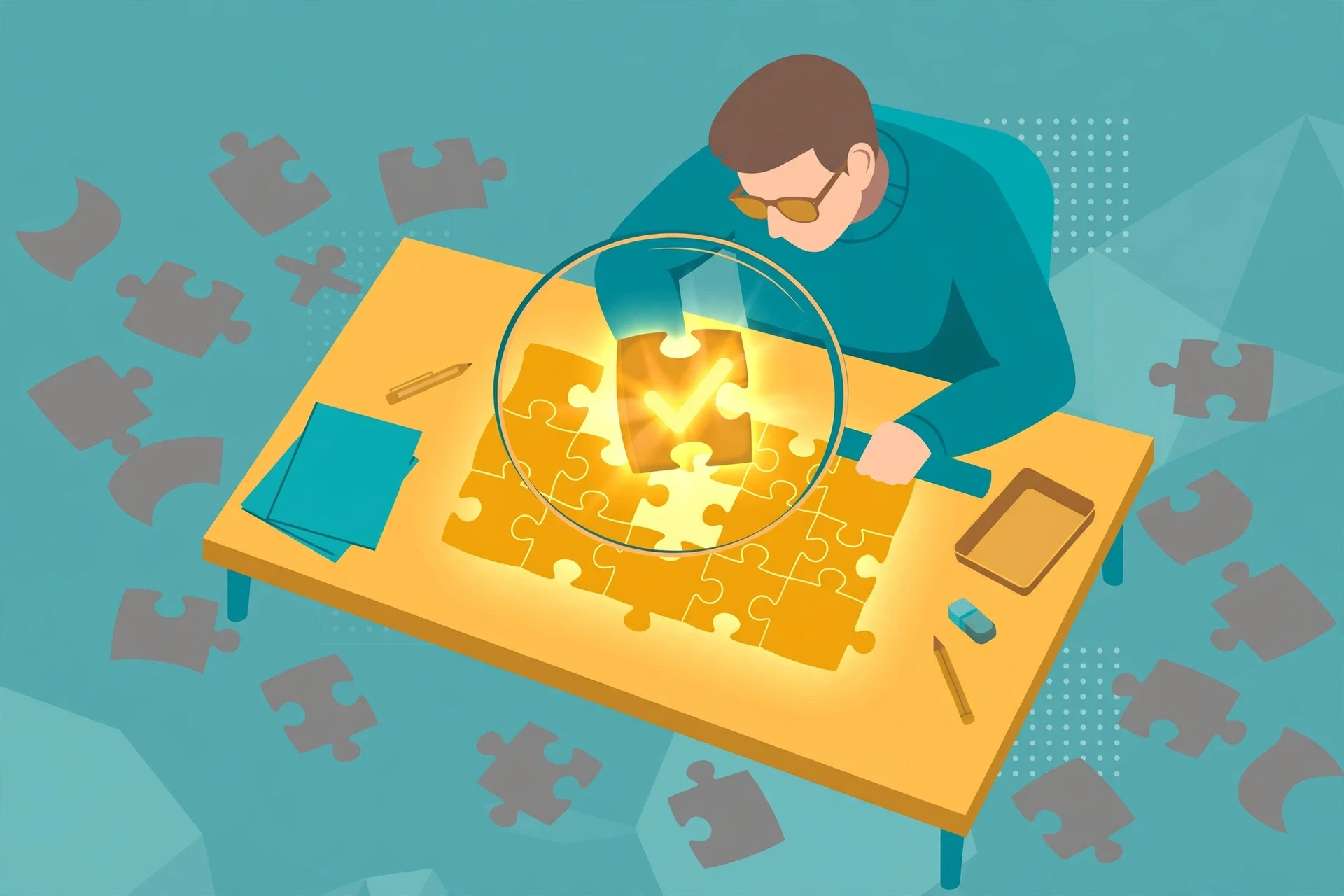
The bias in one line: after an event happens, we believe we knew it would happen — and we misremember how uncertain we were before.
The experiment. In 1975, the psychologist Baruch Fischhoff gave people short descriptions of historical events — a war, a diplomatic crisis — with four possible outcomes listed. One group was asked to predict which outcome was most likely. Another group was told which outcome had actually happened, and asked to say how likely they would have rated it before knowing. The second group consistently claimed they would have seen it coming. They rated the true outcome as far more predictable than the first group had. Once the answer is known, the brain quietly rewrites the past so that the outcome looks inevitable. Fischhoff called it "creeping determinism," and the phrase captures the feeling exactly: the future creeps backward and rewrites what we thought we knew.
Real life. Hindsight bias is everywhere after a disaster, an election, or a market crash. "Everyone knew the company was doomed." "It was obvious the team would lose." Usually, it was not obvious at all — the person saying so is remembering their own uncertainty through the lens of the outcome. The bias also punishes decision-makers unfairly: a doctor who made a reasonable call with the information available at the time can look careless once the outcome is known. And it flatters us: we walk away from every surprise believing we are better forecasters than we are, which means we never learn the lesson the surprise was trying to teach.
How to catch it. Keep a record. Before a big decision — a job choice, an investment, a medical treatment — write down what you expect and how sure you are. Months later, compare the prediction with what actually happened. The gap between the two is the honest measure of your foresight, and it is usually larger than you would like. Diaries, decision journals, and even old text messages are powerful antidotes, because they show you what you actually thought, not what you now remember thinking.
3.3 Survivorship bias: listening only to the winners
The bias in one line: we study the people and things that survived some process, and forget the ones that did not — so we draw the wrong lessons from success.
The experiment. The classic case is not a laboratory experiment but a wartime puzzle, and it is worth telling because it shows the bias in its purest form. During the Second World War, the statistician Abraham Wald was asked where to add armour to bomber planes. The military looked at the planes that returned from missions and saw bullet holes clustered in the wings and fuselage. The obvious answer was to armour those places. Wald said the opposite: armour the places with no bullet holes — the engines and the cockpit. The planes that came back had been hit where a plane can survive being hit. The planes that never came back had been hit where it mattered. The data the military was studying contained only survivors, and the survivors were telling a misleading story.
Real life. Survivorship bias is the hidden flaw in most success advice. We read books by billionaires and study the habits of famous founders, forgetting the thousands of people with identical habits who failed. We hear about the actor who dropped out of school and became a star, and not about the thousands who dropped out and did not. A study of "what successful companies do" that only looks at successful companies is studying half the picture. The failures — the companies with the same strategy that went bankrupt — were filtered out before the study began.
How to catch it. Whenever you hear a success story, ask: "Who is missing from this picture?" Look for the failures, the dropouts, and the ones who tried the same thing and vanished. If a diet, a business strategy, or a study method only shows you its winners, treat the lesson with suspicion. The full story includes the people who are not around to tell it.
4. Cognitive Biases That Warp Numbers and Chances
The second family of cognitive biases distorts our sense of probability and value. These are the cognitive biases that make us misjudge risks, overpay for things, and feel certain about statistics we have never actually checked. They were the original discoveries of Tversky and Kahneman, and they remain the most thoroughly tested cognitive biases in all of psychology.
4.1 Anchoring: the first number wins
The bias in one line: we lean too heavily on the first number we encounter, then adjust away from it too little.
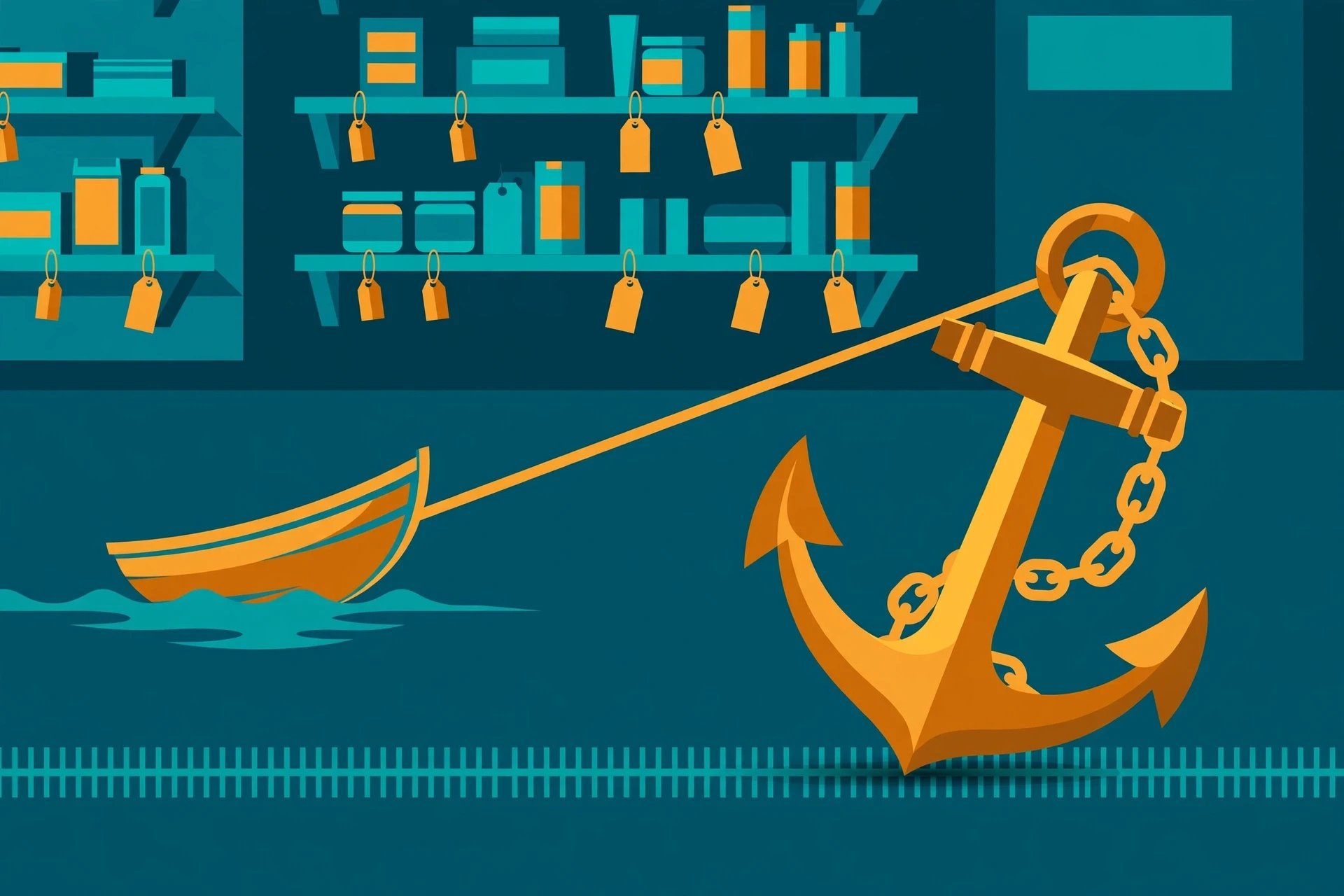
The experiment. You have already met the wheel-of-fortune study, where a random spin of 10 or 65 dragged estimates of UN membership from 25 percent to 45 percent. Anchoring shows up just as strongly outside the lab. In a classic 1987 study, real-estate agents were asked to value a house after being shown a listing price. Some saw a high listing price, others a low one. The agents' valuations followed the listing price closely — even though every one of them insisted that the listing price had not influenced them. Experts, with years of experience, were anchored by a number they knew was set by the seller.
Real life. I learned this one the expensive way, buying my first used car. The dealer opened with a price far above what the car was worth. I negotiated hard, felt proud of the discount I won, and drove away happy. Weeks later, I checked the market value and realised I had paid hundreds more than the car was worth. My "victory" had been measured against the dealer's opening number, not against the car's real value. The anchor had done its work, and my careful negotiation had only moved me a short distance away from it. The same trick appears in salary talks, in "was £200, now £120" sale tags, and in charity appeals that suggest a large first donation amount.
How to catch it. Before you hear any number, decide your own. Research the market value of a car, a house, or a salary before the negotiation starts, and write the figure down. When an anchor appears, name it out loud: "That is their opening number, not the value." And deliberately consider the opposite anchor — what would you think this was worth if the first price you had seen was half as much?
4.2 The availability heuristic: vivid beats common
The bias in one line: we judge how common or likely something is by how easily examples come to mind — and vivid, recent, emotional examples come to mind most easily.
The experiment. Tversky and Kahneman first demonstrated this in 1973. They asked people whether more English words begin with the letter K, or have K as their third letter. Most people said words beginning with K are more common — because it is far easier to think of words starting with K (kite, kitchen, kangaroo) than to search your memory for words with K in third place (ask, ankle, acknowledge). In fact, words with K as the third letter are roughly three times more common. The brain answered a hard question ("how frequent is this?") with an easy one ("how easily can I think of examples?"), and got it wrong.
A few years later, researchers asked people to estimate the number of deaths from different causes. People wildly overestimated deaths from dramatic, newsworthy causes — tornadoes, floods, homicide — and underestimated deaths from quiet, common causes such as diabetes, stroke, and stomach cancer. The causes that make the news feel common. The causes that fill hospital wards do not.
Real life. After a plane crash dominates the news for a week, people cancel flights and drive instead — even though driving the same distance is far more dangerous. After a shark attack makes headlines, beachgoers worry about sharks and ignore the far greater risk of drowning. The availability heuristic also shapes what we fear about our own health: a rare disease we read about feels more threatening than the common conditions that actually cause most deaths. Our sense of risk is not built from statistics. It is built from stories, and stories favour the dramatic.
How to catch it. When a risk feels large, ask for the base rate: "How many people does this actually affect each year, out of how many?" Look up the numbers instead of trusting the feeling. And notice your information diet. If your only source of examples is the news, your mental sample of the world is badly skewed — the news, by design, reports the unusual, not the typical. For a calmer sense of how the brain handles everyday mental load, our article on brain fog looks at what happens when attention and memory are stretched thin.
4.3 Representativeness and base-rate neglect: judging by resemblance
The bias in one line: we judge how likely something is by how much it resembles our mental picture of it, while ignoring how common it actually is.
The experiment. Tversky and Kahneman described a man called Steve: shy, withdrawn, helpful, with a passion for detail and little interest in people. Then they asked: is Steve more likely to be a librarian or a farmer? Most people said librarian. The description fits the stereotype of a librarian perfectly. But they had been told that the group contained far more farmers than librarians — and they ignored that information entirely. The resemblance was so compelling that the base rate, the actual frequency, simply dropped out of the judgement.
The most famous version is the Linda problem, from 1983. Linda is described as bright, outspoken, deeply concerned with social justice, and active in anti-nuclear demonstrations. Which is more probable: that Linda is a bank teller, or that Linda is a bank teller and active in the feminist movement? Most people choose the second option. It feels right — the description fits so well. But it cannot be right. Every feminist bank teller is also a bank teller, so the first option must always be at least as probable as the second. Adding a detail can make a story feel more likely while actually making it less likely. That error is called the conjunction fallacy, and it is one of the most reliable findings in psychology: even trained statisticians fall for it when the story is vivid enough.
Real life. Representativeness drives stereotyping in hiring, medicine, and everyday judgement. A job candidate who "looks like" a leader gets rated as more competent. A patient whose symptoms fit a rare disease gets tested for it while a common cause is overlooked. A start-up founder who matches the image of a successful entrepreneur attracts investment more easily than one who does not, regardless of the business plan. The brain loves a good match between a person and a pattern. The match feels like evidence. Often it is only a resemblance.
How to catch it. Whenever a description feels convincing, stop and ask: "How common is this, in the real world, before I heard the description?" That question — asking for the base rate — is the single most useful habit in this whole article. If librarians are rare and farmers are common, a shy man is probably a farmer, however well he fits the librarian picture. Statistics are boring. They are also usually right.
5. Cognitive Biases That Warp How We See Ourselves
The third family of cognitive biases turns inward. These are the errors that shape our self-image: how good we think we are, how likely we think good things are to happen to us, and how hard it is to walk away from something we have already invested in. They are flattering biases, mostly. That is what makes them so stubborn.
5.1 The Dunning–Kruger effect: the least skilled are the most certain
The bias in one line: people who lack skill in an area also lack the skill to recognise that they lack it — so they overestimate themselves the most.
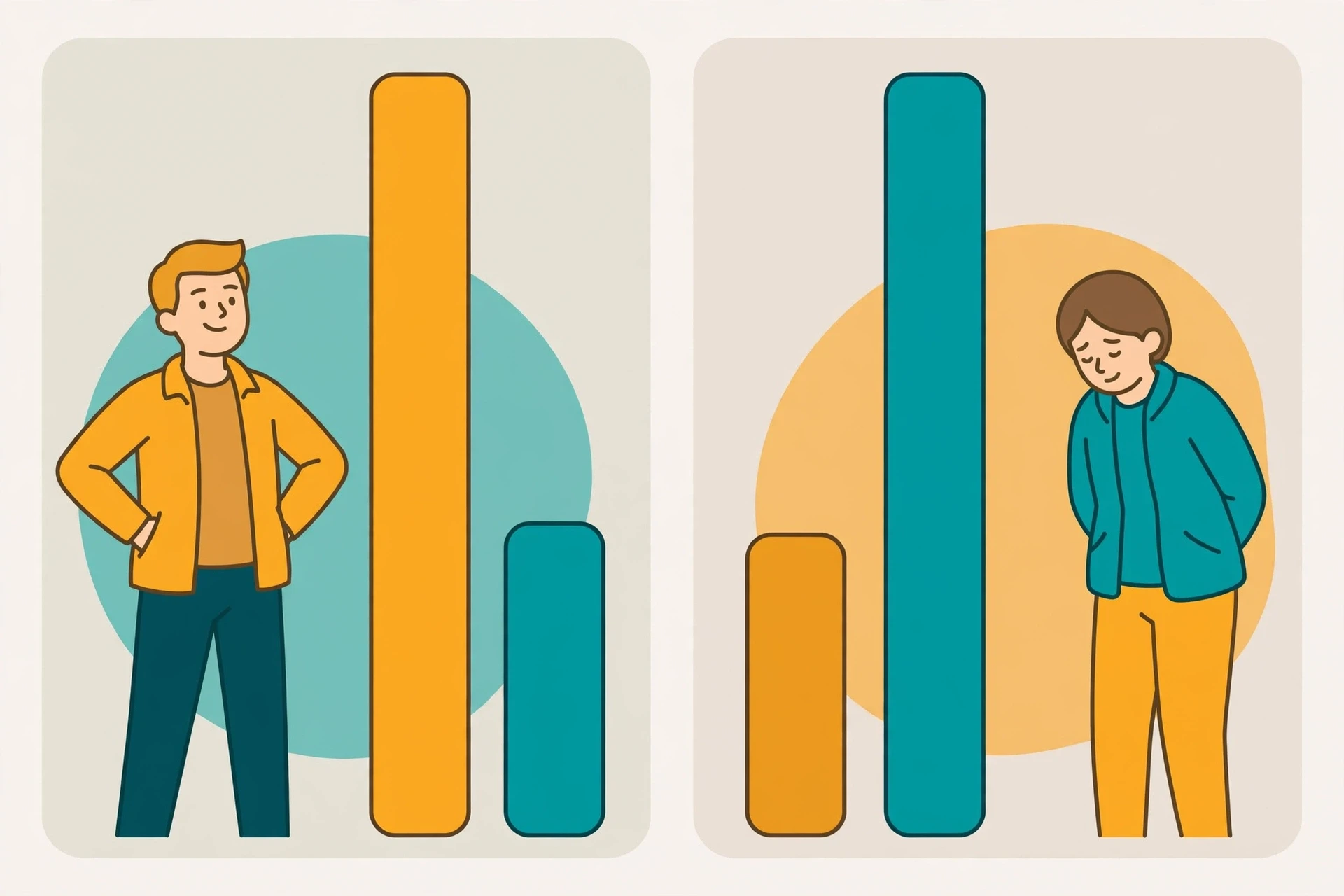
The experiment. In 1999, the Cornell psychologists David Dunning and Justin Kruger published a paper with a blunt title: "Unskilled and Unaware of It." Across four studies with 334 students, they tested humour, logical reasoning, and grammar, then asked each person to estimate how well they had done compared with their peers. The results were striking. People in the bottom quarter scored, on average, at the 12th percentile — yet they estimated themselves to be at the 62nd percentile, above average. The top performers showed the opposite error: they slightly underestimated themselves. The inspiration, famously, was a man named McArthur Wheeler, who robbed two banks with lemon juice smeared on his face, believing — because lemon juice can be used as invisible ink — that it would make him invisible to security cameras. Dunning and Kruger wondered how someone could be so wrong and so confident at the same time, and built an experiment to find out.
The hopeful part of the study is often forgotten. In the fourth experiment, the researchers gave the weakest performers a short training packet in logical reasoning. Afterwards, those students judged their own performance far more accurately. The cure for overconfidence was not humility. It was skill. Learning the subject gave people the tools to see their own mistakes.
Real life. The Dunning–Kruger effect explains why the least experienced person in a meeting is sometimes the loudest, and why a beginner who has just learned the basics of a subject feels ready to argue with experts. It also explains a quieter, kinder version of the same pattern: genuine experts who assume everyone else finds their subject as easy as they do, and so underestimate how much they know. Honest researchers have also pushed back on the popular version of this effect. In 2020, researchers including Gilles Gignac and Marcin Zajenkowski argued that part of the pattern is a statistical artefact — a natural consequence of how bounded scales and regression to the mean interact with noisy self-assessment. The debate is real, and it is a good reminder that even famous findings get re-examined. What survives the debate is the core observation: self-assessment is unreliable, and the people worst placed to judge their own skill are the people with the least of it.
How to catch it. Seek out feedback that can hurt a little. Ask someone skilled to review your work, and listen to what they say before defending yourself. Take a test with right and wrong answers, rather than relying on how confident you feel. And remember the training result: if you want to know how good you are at something, the fastest route is to get better at it. Confidence follows competence — it does not replace it.
5.2 Optimism bias and the planning fallacy: it will work out for me
The bias in one line: we believe good things are more likely to happen to us than to others, bad things less likely — and we underestimate how long our own projects will take.
The experiment. In 1980, the psychologist Neil Weinstein asked students to rate their chances of experiencing a long list of life events, compared with their classmates. The pattern was almost comically consistent. Students thought they were more likely than average to enjoy their post-graduation job, to own a home, and to live past eighty — and less likely than average to get divorced, to have a drinking problem, or to be fired. Almost everyone believed they were above average, which is mathematically impossible for everyone at once. This is unrealistic optimism: the quiet belief that the statistics apply to other people.
The planning fallacy is optimism bias applied to time. Kahneman and Tversky found that people estimate how long their own projects will take by imagining the best-case scenario — everything going smoothly — while ignoring how long similar projects took in the past. Students finishing a thesis, builders renovating a house, governments building a bridge: all of them predict a finish date far earlier than the one they actually hit. The inside view (my plan, my team, my situation) feels more relevant than the outside view (how long did this kind of thing take last time?), so the outside view gets ignored.
Real life. Optimism bias is why most of us do not buy enough insurance, why smokers believe they are less likely than other smokers to get ill, and why new businesses open every year in industries where most new businesses fail. It is also why your kitchen renovation takes twice as long as the contractor promised — the contractor was not lying. They were imagining the version of the job where nothing goes wrong, and that version almost never happens.
How to catch it. Use the outside view on purpose. Before you estimate a deadline, find three similar projects and look at how long they actually took. Before you assume a risk will skip you, ask: "What would the statistics say about a hundred people exactly like me?" Optimism itself is not the problem — it keeps us trying hard things. Unchecked optimism, without a glance at the record, is how good intentions turn into missed deadlines and nasty surprises.
5.3 The sunk-cost fallacy: throwing good money after bad
The bias in one line: we keep investing in a losing course of action because we have already invested so much in it — even though the past investment cannot be recovered.
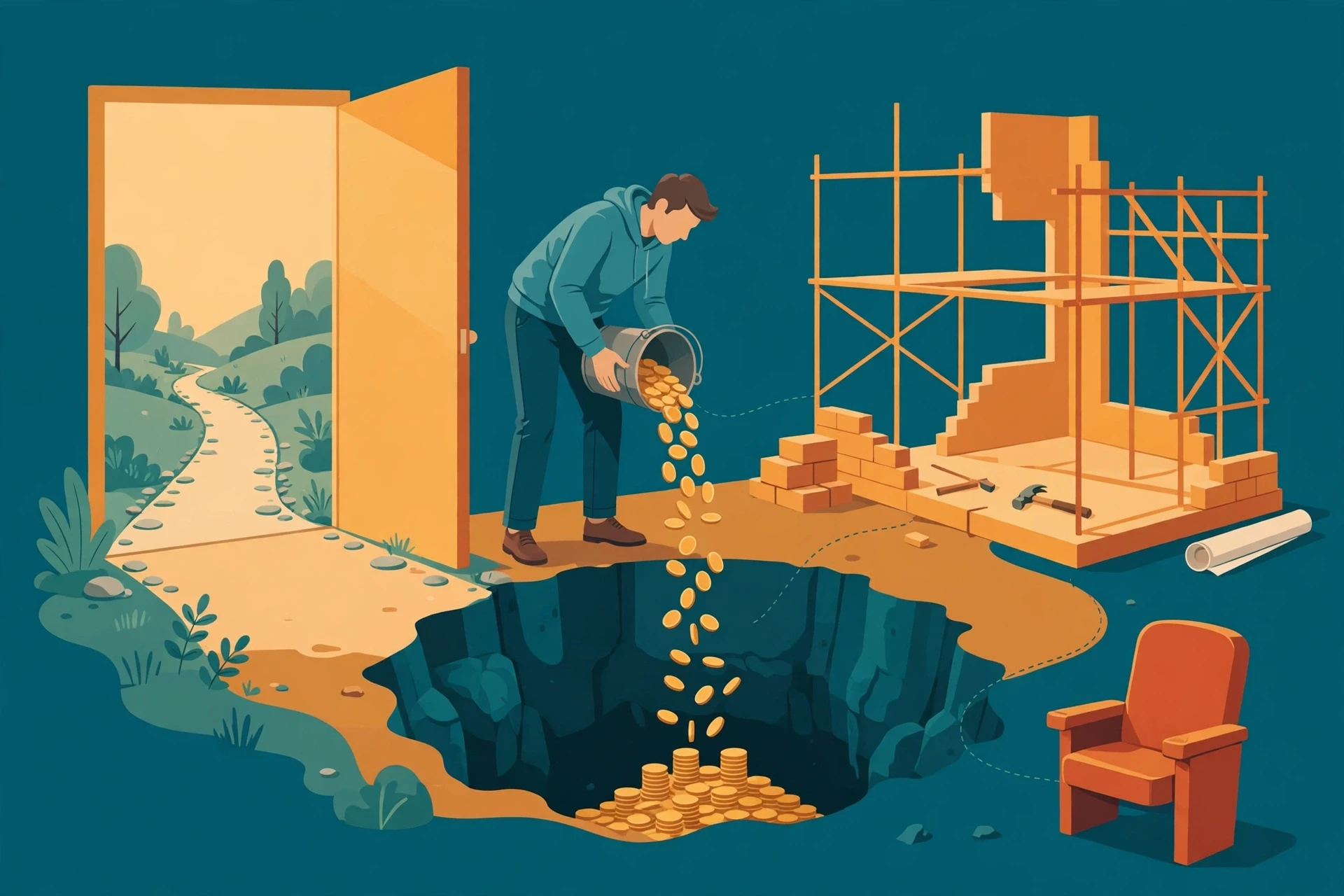
The experiment. In a classic 1985 study, the psychologists Hal Arkes and Catherine Blumer gave people a scenario: imagine you have paid for a season ticket to a theatre, and after the first few performances you realise you are not enjoying it. Do you keep going? Most people said yes — they had paid, so they felt they should use the tickets. In another scenario, a company had already spent millions developing a plane that its own engineers now believed would never fly properly. Most people advised finishing the plane anyway. The money already spent was treated as a reason to spend more, even though the money was gone either way. Rationally, only the future matters: will the next pound, hour, or effort bring a return? The past is irrelevant to that question. Emotionally, walking away feels like admitting the earlier spending was wasted — and that admission hurts.
Real life. I stayed in a cinema once through a film I disliked for a full hour, because I had paid for the ticket and did not want to "waste" it. The waste had already happened the moment I bought the ticket. Sitting through another hour of a bad film did not recover the money; it wasted my evening as well. The same logic keeps people in failing relationships ("we have been together for five years"), failing businesses ("I have put my savings into this"), and failing wars ("we cannot let the sacrifices be in vain"). The fallacy is powerful precisely because it dresses up as loyalty and perseverance. Sometimes staying is the right choice. But "because I have already spent so much" is never, on its own, a good reason.
How to catch it. Ask the question that cuts through the fallacy: "If I had spent nothing so far, and someone offered me this situation fresh today, would I still choose it?" If the answer is no, the past investment is the only thing keeping you there — and the past cannot be changed. Set decision points in advance: "I will give this project three more months, and if it has not reached this milestone, I will stop." A rule made before the emotions arrive is far easier to follow than a decision made in the middle of them.
6. Cognitive Biases That Warp Feelings and Crowds
The final family of cognitive biases works through emotion and social pressure. These are the cognitive biases that change how the same fact feels depending on how it is worded, how bad news outweighs good news, and how the group we belong to quietly edits what we see.
6.1 The framing effect: the same fact, a different feeling
The bias in one line: the way a choice is described changes our decision, even when the facts are identical.
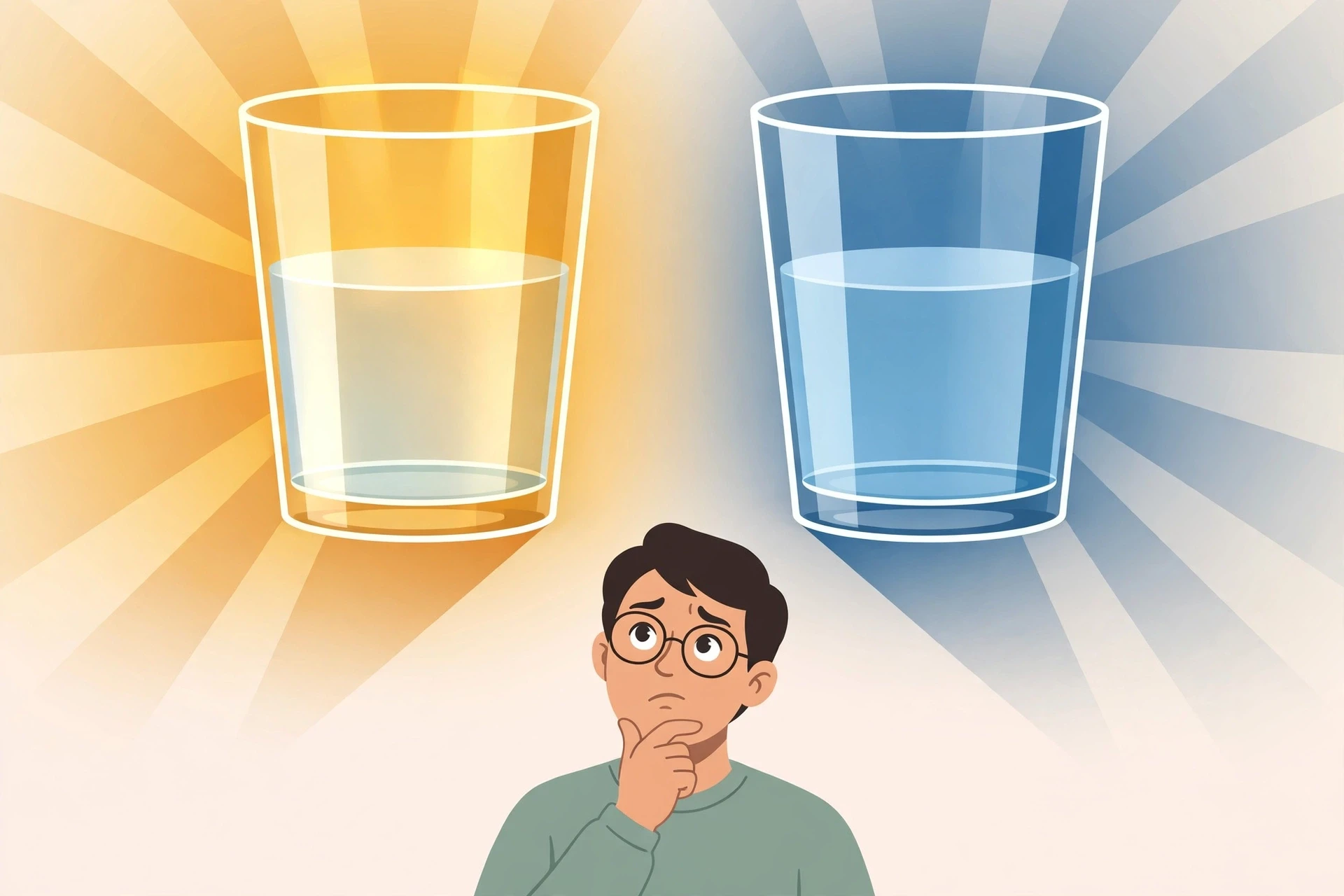
The experiment. In 1981, Tversky and Kahneman presented people with a famous scenario: an outbreak of disease is expected to kill 600 people. Program A will save 200 people for certain. Program B offers a one-in-three chance of saving all 600, and a two-in-three chance of saving nobody. Given that choice, about 72 percent of people chose the certain option, Program A. Then the researchers described the exact same options differently: Program C will mean 400 people die for certain; Program D offers a one-in-three chance that nobody dies, and a two-in-three chance that all 600 die. Now about 78 percent chose the gamble, Program D. The two pairs of programs are identical — saving 200 of 600 is the same as 400 dying. Only the words changed, from lives saved to lives lost. The frame flipped the choice.
Real life. Framing is the stock-in-trade of advertising, politics, and medicine. "90% fat-free" sells better than "10% fat," though they are the same product. A treatment described as having a "90% survival rate" feels safer than the same treatment described as having a "10% mortality rate." A tax described as a "penalty" meets resistance; the same amount described as a "discount for early payment" feels like a reward. None of this means framing is dishonest by definition. Every fact has to be described somehow, and some frame is always chosen. The bias is in us: we react to the frame as if it were part of the fact.
How to catch it. Reframe it yourself. When a choice is presented in positive terms, translate it into negative terms, and vice versa. "90% survival" becomes "10% die." "A 20% discount" becomes "you still pay 80%." If the two wordings make you feel differently, the frame is doing work that the facts are not — and the decision should be made on the facts, not the feeling the words create. (The deeper machinery of how gains and losses are valued differently is the subject of our companion article on how we make decisions, which explains the value system behind this effect rather than just the effect itself.)
6.2 Negativity bias: bad weighs more than good
The bias in one line: negative information affects us more strongly than positive information of the same strength.
The experiment. In a landmark 2001 review, the psychologist Roy Baumeister and his colleagues gathered evidence from across psychology — learning, memory, relationships, decision-making — and reached a blunt verdict: "Bad is stronger than good." A single harsh criticism outweighs several compliments. A traumatic event shapes memory more deeply than a happy one of equal intensity. In relationships, it takes roughly five positive interactions to balance one negative one, a finding from the marriage researcher John Gottman that has held up across many studies. The brain is not balanced in its bookkeeping. It keeps the losses in bold and the gains in small print.
Real life. Negativity bias is why one bad review can ruin a restaurant's reputation built on a hundred good ones, why a single argument can overshadow a happy holiday, and why the news feels like a catalogue of disasters — bad events are more attention-grabbing, so they get reported more, which makes the world feel worse than it is. It also explains why we remember our failures more clearly than our successes, and why a small loss hurts more than an equal gain pleases. This is not pessimism. It is the brain's threat system doing its job: in the ancestral world, ignoring a danger could kill you, while ignoring a pleasure merely cost you a good meal. The bias is a survival tool that now misfires in a world where most of our "threats" are emails and headlines.
How to catch it. Count deliberately. When a criticism stings, list three genuine strengths or successes alongside it before you act on the feeling. When the news makes the world feel hopeless, look up the long-term trends — many measures of health, poverty, and safety have improved steadily for decades, quietly, without headlines. And in relationships, remember the ratio: one careless remark needs several kind ones to balance it, so spend your positive words generously and your negative ones carefully.
6.3 In-group bias: my team sees clearly, yours does not
The bias in one line: we favour people in our own group and judge outsiders more harshly — even when the group is meaningless.
The experiment. In the early 1970s, the psychologist Henri Tajfel ran an experiment that still shocks people with its simplicity. He divided schoolboys into two groups based on something trivial — whether they preferred the paintings of Klee or Kandinsky, or even a coin toss — and then asked them to divide money between other boys. The boys consistently gave more money to members of their own group, even though the groups had no history, no rivalry, and no meaning at all. Simply being sorted into a group was enough to create favouritism. Tajfel called this the minimal group paradigm, and it showed that tribal loyalty does not need a reason. The mere fact of "us" and "them" is enough to tilt judgement.
Real life. In-group bias is the quiet force behind office politics, sports rivalries, nationalism, and the way online arguments escalate. We excuse mistakes by "our" politician that we condemn in "theirs." We trust a study more when it comes from our own university, our own profession, or our own country. We rate the same essay more highly when we believe the author shares our views. The bias is strongest when identity feels threatened — during elections, competitions, or conflicts — and it is exactly then that clear thinking matters most.
How to catch it. Imagine the roles reversed. Would you judge this action the same way if the other side had done it? Would you trust this source if it came from the group you disagree with? The reversal test is simple and brutally effective, because in-group bias hides inside our sense of fairness: we genuinely feel we are being fair while applying different standards. Another useful habit is to look for the shared group — the team, the town, the profession — that includes both sides. A bigger "us" shrinks the bias, because the brain's favouritism follows wherever the group boundary is drawn.
7. The Twelve Cognitive Biases at a Glance
The table below brings the whole catalogue together. Use it as a quick reference — and as a checklist to keep near any big decision.
Bias | What it does | Classic experiment | One-line catch |
|---|---|---|---|
Confirmation bias | Seeks evidence that agrees with what you already believe | Wason's 2–4–6 task (1960) | Ask what would prove you wrong |
Hindsight bias | Makes past events look predictable after they happen | Fischhoff's outcome studies (1975) | Write predictions down before the event |
Survivorship bias | Studies only the winners and forgets the losers | Wald's WWII bomber armour puzzle | Ask who is missing from the story |
Anchoring | Lets the first number drag every later estimate | Tversky & Kahneman's wheel of fortune (1974) | Decide your own number first |
Availability heuristic | Judges frequency by how easily examples come to mind | Tversky & Kahneman's letter-K study (1973) | Ask for the base rate |
Representativeness | Judges likelihood by resemblance, ignoring base rates | The Linda problem (1983) | Ask how common it is before the description |
Dunning–Kruger effect | The least skilled overestimate themselves most | Kruger & Dunning's four studies (1999) | Seek feedback that can hurt a little |
Optimism bias | Believes good things will happen to me, bad things to others | Weinstein's life-events study (1980) | Use the outside view: how did this go last time? |
Sunk-cost fallacy | Keeps investing because of what is already spent | Arkes & Blumer's theatre-ticket study (1985) | Would you start this fresh today? |
Framing effect | Changes the choice when the wording changes | Tversky & Kahneman's Asian disease problem (1981) | Reframe it yourself, both ways |
Negativity bias | Gives bad news more weight than equal good news | Baumeister's "bad is stronger than good" review (2001) | Count three positives before acting on one negative |
In-group bias | Favours our own group over outsiders | Tajfel's minimal group experiments (1971) | Imagine the roles reversed |
8. Why Does the Brain Produce Cognitive Biases?
If cognitive biases cause so much trouble, why has evolution not removed them? The short answer is that the cognitive biases are not broken machinery. They are the price of machinery that works very well for the job it was built to do.
Our ancestors did not need to calculate probabilities or weigh investment portfolios. They needed to decide, in seconds, whether a rustle in the grass was a predator, whether a stranger was friend or foe, and whether a food was safe to eat. A brain that paused to gather all the evidence before acting would have been eaten. A brain that jumped to a conclusion — that treated a vivid memory as a warning, that trusted its own group, that paid more attention to threats than to pleasures — survived. The shortcuts are fast, cheap, and usually right. In the modern world, the same shortcuts get applied to problems they were never designed for: medical statistics, financial markets, political arguments, and scientific evidence. They fail there not because they are stupid, but because the problems changed faster than the brain did.
There is a second reason biases persist: they often feel like good thinking. Confirmation bias feels like being well-informed. Anchoring feels like careful negotiation. Hindsight feels like wisdom. The brain does not label its shortcuts as shortcuts. It presents their conclusions as plain common sense, and common sense rarely gets questioned. That is why the most dangerous moment for bias is not when you feel confused — it is when you feel certain.
A third point is worth stating plainly. Cognitive biases are not all bad. Negativity bias keeps children away from danger. The availability heuristic lets a doctor recognise a familiar disease pattern in seconds. In-group loyalty holds families and communities together. The goal is not to eliminate these tendencies — you could not, even if you wanted to. The goal is to know when they are helping and when they are steering you wrong, and to build habits and systems that catch the errors that matter most. The fast, intuitive machinery that produces these errors is explained in depth in our companion article on how we make decisions; this article has stayed with the catalogue of cognitive biases themselves, and the catalogue is enough to start with.
9. A Practical Toolkit for Catching Your Own Cognitive Biases
Knowing the names of twelve cognitive biases is useful. Having a small set of habits that catch them in real time is far more useful. None of these habits requires special training. Each one takes seconds, and each one targets several biases at once.
Consider the opposite. Before deciding, spend sixty seconds arguing the other side. What would someone smart who disagrees with you say? This single habit fights confirmation bias, in-group bias, and overconfidence at the same time.
Ask for the base rate. How common is this, really? How long did similar projects take? How often does this treatment work? A single number from the real world beats a vivid story almost every time.
Write it down first. Predictions, estimates, and reasons, written before the outcome is known, are the only honest record of what you believed. They defeat hindsight bias and they expose optimism bias.
Slow down the big ones. For small decisions — what to eat, which route to take — let the shortcuts run. They are fast and usually fine. For decisions about money, health, relationships, and hiring, impose a pause. Sleep on it. Talk to someone who disagrees with you. The cognitive biases are strongest under time pressure, and a pause is their natural enemy.
Use a pre-mortem. Before starting a project, imagine it has failed, a year from now, and ask the team: "What went wrong?" People who will not criticise a plan to its face will happily explain its failure in the past tense. The exercise surfaces risks that optimism bias hides.
Check the source of the feeling. When a risk feels terrifying or a claim feels obviously true, ask where the feeling came from. A news story? A single vivid example? A number someone mentioned first? Feelings carry information, but they also carry the fingerprints of availability, anchoring, and framing.
Seek disconfirming feedback. Ask a skilled person to review your work, and ask them specifically for what is wrong with it. Praise feels good and teaches little. Criticism stings and teaches a lot.
One honest warning belongs here. Research on debiasing — the science of training people out of these errors — is mixed. Short lessons about biases produce short-lived improvements. What works better is changing the environment: checklists, second opinions, written records, and rules made in advance. A pilot does not rely on remembering to check the fuel; the checklist forces the check. Your thinking deserves the same kind of help. Design your decisions so that the bias has to get past a system, not just past your good intentions.
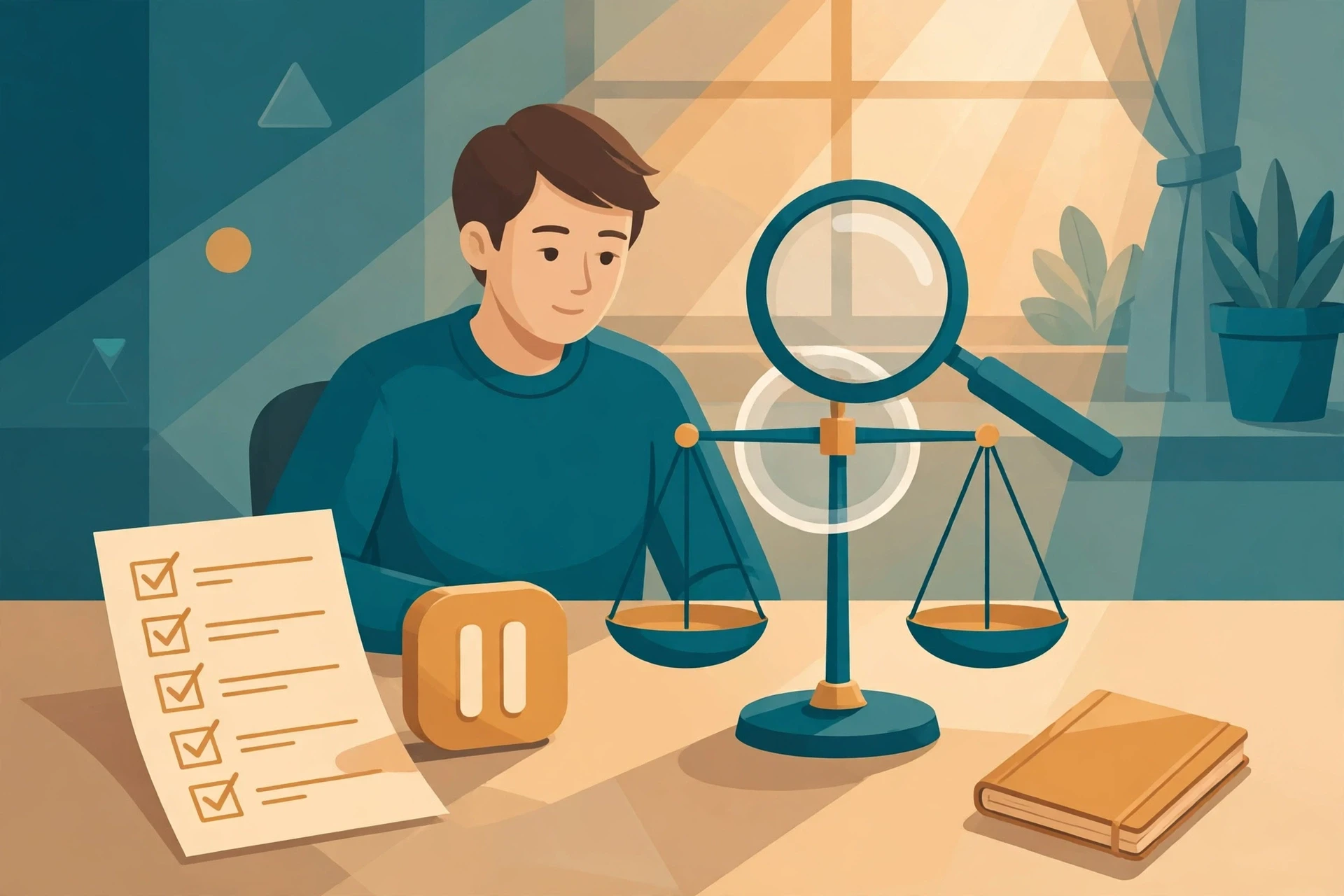
10. Common Misconceptions About Cognitive Biases
Most people assume that learning about cognitive biases makes them immune to cognitive bias. What the research actually shows is almost the opposite — and the gap between the assumption and the evidence is worth spelling out.
"Smart people don't have biases." Wrong. Studies of doctors, judges, and statisticians find the same biases as in the general population. Intelligence helps you defend a biased conclusion more eloquently. It does not stop the bias from forming.
"Knowing about a bias removes it." Wrong, mostly. Psychologists call this the bias blind spot: we easily spot cognitive biases in other people and remain convinced we are free of them ourselves. In one study, people rated themselves as less biased than the average person on every bias tested — which is itself a bias, the same above-average effect behind optimism bias. Awareness is the starting point, not the cure. Systems and habits do the real work.
"cognitive biases are always bad." Wrong. Many cognitive biases are useful shortcuts that save time and energy, and in the right context they are the best available strategy. The goal is not a bias-free mind. The goal is a mind that knows when a shortcut is safe and when it needs a second look.
"The Dunning–Kruger effect means confident people are incompetent." Wrong, and this is the most misused finding in the whole field. The original study says something narrower: people with low skill in a specific domain overestimate their performance in that domain. It says nothing about confidence in general, and nothing about intelligence. A confident surgeon may be exactly as good as she believes. The viral "mount stupid" curve that circulates online does not appear in the original paper at all.
"cognitive biases are the same as logical fallacies." Not quite. A logical fallacy is an error in an argument. A cognitive bias is an error in the thinking that produces the argument. The two overlap, but biases run deeper: they shape what evidence we notice, what we remember, and what feels true, long before any argument is made.
"If I just think harder, I'll get it right." Sometimes thinking harder makes it worse. Effort spent defending a belief you already hold produces better defences, not better beliefs. What helps is not more effort in the same direction — it is a different direction: the opposite view, the base rate, the outside evidence. Effort matters, but only when it is aimed at the right target.
11. What the Latest Research on Cognitive Biases Says
The study of cognitive biases is not a finished chapter. It is an active, sometimes quarrelsome field, and the last few years have sharpened the picture in useful ways.
First, the replication movement has tested the classic findings, and most of the big ones have held up. Anchoring, framing, availability, and the conjunction fallacy have been reproduced many times, in many countries, with large samples. A few famous effects have shrunk under re-testing, and researchers are now careful to distinguish the robust biases from the fragile ones. That is science working as it should: the strongest claims survive scrutiny, and the weaker ones get revised.
Second, the Dunning–Kruger debate has matured. The statistical critique — that part of the pattern comes from the maths of bounded scales rather than from psychology — is now taken seriously by researchers on both sides, and recent large-sample studies find a real but smaller effect than the popular version suggests. The lesson is not that the effect is fake. It is that a famous finding can be both real and exaggerated, and that the honest version is more interesting than the meme.
Third, researchers are paying more attention to when biases matter most. A bias that changes a laboratory answer by a few percent can change a medical diagnosis, a court verdict, or an election when it operates at scale. Recent work in medicine, for example, has documented how anchoring on an initial diagnosis leads doctors to miss alternative explanations, and how structured checklists and deliberate "diagnostic timeouts" reduce the error. The same logic is spreading to hiring, where structured interviews and blinded CV reviews are used to limit the influence of resemblance and in-group favouritism. The frontier of this field is no longer just naming biases. It is designing systems that work around them.
Fourth, there is growing interest in how biases operate online. Algorithms that show us more of what we already like amplify confirmation bias and in-group bias at a scale no earlier generation experienced. Researchers are studying whether simple interventions — showing people the other side's best argument, labelling disputed claims, or slowing down sharing — can reduce the effect. Early results are modest, and no single fix has emerged. The honest summary is that the digital environment makes old biases stronger, and the defences are still catching up.
Finally, the field has become more careful about its own language. Psychologists increasingly distinguish between bias (a systematic error) and heuristic (the shortcut that produces it), and between errors that come from limited information and errors that come from motivated reasoning — believing something because we want it to be true. That distinction matters for the cure. An information problem is fixed with better data. A motivation problem is fixed with better incentives and honest feedback. Knowing which one you are dealing with is half the battle.
For readers who want to go deeper, the APA's overview of decision-making research is a reliable entry point, and the Stanford Encyclopedia of Philosophy's entry on rationality lays out the philosophical background — what it means to think well, and where human thinking departs from the ideal. Our own article on what consciousness is explores the deeper question of how awareness itself works, and how the human brain forms memories explains the memory machinery that several of these cognitive biases — hindsight, availability, confirmation — quietly exploit. Sleep matters here too: the science of sleep and dreams shows how rest shapes the memory consolidation that biases feed on, and the anatomy and functions of the human brain gives the physical map behind the shortcuts described in this article.
12. Living With a Brain That Tricks You
Here is the truth I keep coming back to after years of reading this research and tripping over these errors in my own work: your brain is not broken. It is a shortcut machine, built for speed, running in a world that rewards accuracy. The twelve cognitive biases in this article are not twelve separate flaws. They are twelve faces of one design — a mind that guesses quickly, trusts what feels familiar, favours its own group, and tells itself a tidy story afterwards.
That design will not change. What can change is what you do with it. A written prediction defeats hindsight. A base rate defeats availability. A sixty-second argument with the other side defeats confirmation. A checklist defeats anchoring in a clinic. None of these habits is heroic. All of them work, a little, most of the time — and a little is enough, because most bad decisions are not caused by one enormous bias. They are caused by a small bias, unnoticed, at the wrong moment.
So the next time you feel certain — about a diagnosis, a hire, an investment, or an argument — pause for one second and ask the question that runs through this whole article: what would I think if I had seen the evidence in the opposite order? If the answer would be different, the bias is doing the talking. Listen to it, thank it for its speed, and then check the numbers yourself. That pause is the whole skill. Everything else in this article is just the reason to take it.
Frequently Asked Questions
What is a cognitive bias in simple terms?
A cognitive bias is a systematic, predictable error in thinking — a shortcut your brain takes that usually works but sometimes leads you to the wrong conclusion. Examples include confirmation bias (favouring information that agrees with you), anchoring (leaning on the first number you hear), and the availability heuristic (judging how common something is by how easily you can recall an example). They affect everyone, including experts.
How many cognitive biases are there?
Researchers have catalogued well over a hundred named cognitive biases, and the number grows as new ones are identified. This article covers the twelve cognitive biases that matter most in daily life: confirmation bias, hindsight bias, survivorship bias, anchoring, the availability heuristic, representativeness, the Dunning–Kruger effect, optimism bias, the sunk-cost fallacy, the framing effect, negativity bias, and in-group bias.
What is the most common cognitive bias?
Confirmation bias is usually ranked first, because it shapes almost everything else: what news we read, which evidence we accept, and which opinions we keep. Anchoring and the availability heuristic are close behind, because they operate in almost every judgement involving numbers or risk. In practice, the "most common" bias is whichever one is operating in the decision you are making right now.
Can cognitive biases be cured?
Not completely, and anyone who promises a cure is selling something. Awareness helps, but research shows that knowing about cognitive biases only weakly reduces their grip — a problem called the bias blind spot. What works better is changing the environment: checklists, written predictions, second opinions, base rates, and rules made in advance. You design around the bias instead of trying to think it away.
Are cognitive biases the same as logical fallacies?
No, though they overlap. A logical fallacy is an error in an argument — a flaw in reasoning that can be pointed out on paper. A cognitive bias is an error in the thinking that produces the argument: it shapes what evidence you notice, what you remember, and what feels true before any argument is made. Cognitive biases are deeper and harder to spot, which is why they need habits and systems rather than just better arguments.
Why did Kahneman win a Nobel Prize for psychology?
Daniel Kahneman won the 2002 Nobel Prize in Economic Sciences for his joint work with Amos Tversky on judgement and decision-making under uncertainty. Their research showed that people do not decide the way economic theory assumed — rationally, weighing all evidence — but instead use mental shortcuts that produce systematic, predictable errors. The work founded behavioural economics and changed how economists, doctors, judges, and policymakers think about human choice. Tversky had died in 1996 and Nobel Prizes are not awarded posthumously, so Kahneman received the prize alone for their shared work.
Sources
American Psychological Association. Cognitive Bias — APA Dictionary of Psychology. https://dictionary.apa.org/cognitive-bias
American Psychological Association. Confirmation Bias — APA Dictionary of Psychology. https://dictionary.apa.org/confirmation-bias
American Psychological Association. Cognitive Biases — topic overview. https://www.apa.org/topics/cognitive-biases
American Psychological Association. Confirmation Bias — APA Monitor on Psychology, March 2012. https://www.apa.org/monitor/2012/03/confirmation-bias
American Psychological Association. Decision Making — topic overview. https://www.apa.org/topics/decision-making
The Nobel Prize. The Prize in Economic Sciences 2002 — Press Release. https://www.nobelprize.org/prizes/economic-sciences/2002/press-release/
Stanford Encyclopedia of Philosophy. Rationality. https://plato.stanford.edu/entries/rationality/
Tversky, A., & Kahneman, D. (1974). Judgment under uncertainty: Heuristics and biases. Science, 185(4157), 1124–1131.
Tversky, A., & Kahneman, D. (1973). Availability: A heuristic for judging frequency and probability. Cognitive Psychology, 5(2), 207–232.
Tversky, A., & Kahneman, D. (1981). The framing of decisions and the psychology of choice. Science, 211(4481), 453–458.
Kruger, J., & Dunning, D. (1999). Unskilled and unaware of it: How difficulties in recognizing one's own incompetence lead to inflated self-assessments. Journal of Personality and Social Psychology, 77(6), 1121–1134.
Fischhoff, B. (1975). Hindsight is not equal to foresight: The effect of outcome knowledge on judgment under uncertainty. Journal of Experimental Psychology: Human Perception and Performance, 1(3), 288–299.
Wason, P. C. (1960). On the failure to eliminate hypotheses in a conceptual task. Quarterly Journal of Experimental Psychology, 12(3), 129–140.
Weinstein, N. D. (1980). Unrealistic optimism about future life events. Journal of Personality and Social Psychology, 39(5), 806–820.
Arkes, H. R., & Blumer, C. (1985). The psychology of sunk cost. Organizational Behavior and Human Decision Processes, 35(1), 124–140.
Baumeister, R. F., Bratslavsky, E., Finkenauer, C., & Vohs, K. D. (2001). Bad is stronger than good. Review of General Psychology, 5(4), 323–370.
Tajfel, H., Billig, M. G., Bundy, R. P., & Flament, C. (1971). Social categorization and intergroup behaviour. European Journal of Social Psychology, 1(2), 149–178.
Nickerson, R. S. (1998). Confirmation bias: A ubiquitous phenomenon in many guises. Review of General Psychology, 2(2), 175–220.
Gignac, G. E., & Zajenkowski, M. (2020). The Dunning–Kruger effect is (mostly) a statistical artefact. Intelligence, 80, 101449.