

A shipment of medicine left a factory in Hyderabad on a Tuesday morning. By Friday it had passed through three warehouses, two trucking companies, a port, and a customs office. Somewhere along the way, a box went missing — or was swapped. The paperwork said one thing. The warehouse log said another. The trucking company had a third version. Nobody could prove which record was right, because every party kept its own copy, and every copy could be edited after the fact.
That is the problem blockchain was built to solve. Not money, at first, and not speculation. Trust. How do strangers who have no reason to trust each other agree on a single shared record — and keep that record honest once it exists?
A blockchain is a shared, tamper-evident record book. Instead of one company holding the only copy, many computers each hold a copy. Instead of entries that can be quietly rewritten, new entries are grouped into blocks, sealed with cryptography, and chained to everything that came before. Change one old entry and the seal breaks — loudly, visibly, on every copy at once.
This article explains how that actually works, piece by piece: the blocks, the hashes, the consensus rules, the keys, and the smart contracts that sit on top. It also looks at where blockchain genuinely helps, where it is the wrong tool, and what its limits are. No investment advice follows. No price predictions either. The technology is interesting enough without them.
1. The Trust Problem Blockchain Tries to Solve
1.1 Why shared records are hard
Most of the records that run the world live in one place at a time. A bank keeps your balance. A land registry keeps property titles. A hospital keeps your medical history. That arrangement works well when you trust the keeper. It breaks down when you do not, or when several keepers each hold a different version of the same truth.
I first felt this in a small way years ago, trying to trace the origin of a batch of laboratory reagents. The supplier's certificate said one thing, the distributor's invoice said another, and the lab's own receiving log recorded a third date. Nothing was necessarily dishonest. Each system had simply been updated at a different time, by a different person, with a different shorthand. Yet the result was the same as if someone had lied: nobody could reconstruct what had actually happened.
Multiply that confusion across a supply chain, a voting system, or a financial market, and you get the core problem. When every participant keeps a separate ledger, reconciling them costs time, money, and arguments. When one participant controls the only ledger, everyone else must take its word for it.
1.2 What a distributed ledger changes
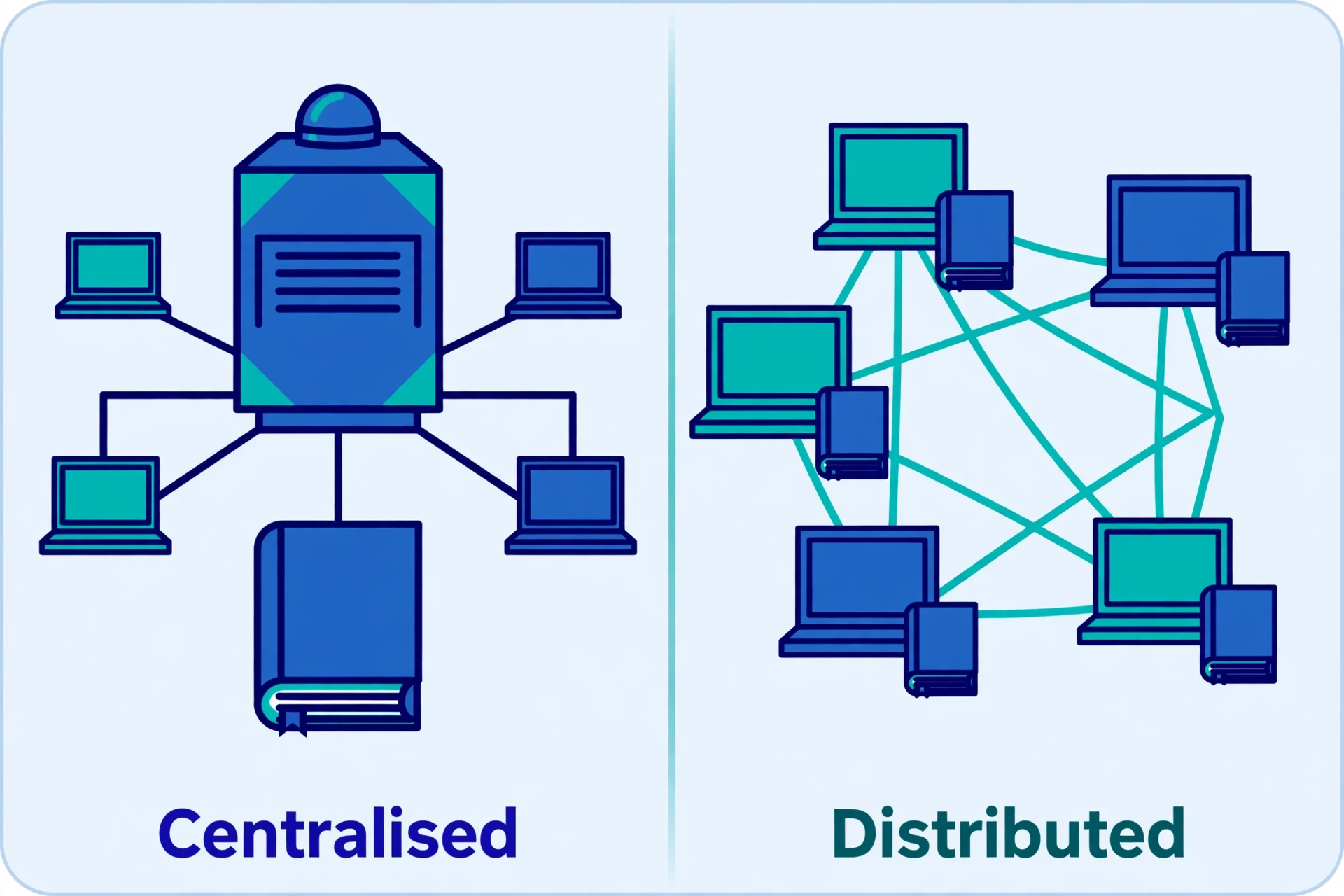
A distributed ledger turns that arrangement inside out. Every participant — or at least every node in the network — holds a copy of the same ledger. When a new transaction is added, every copy is updated. There is no single master version to edit in secret, because an edit to one copy would disagree with all the others.
That does not mean the ledger is magically honest. It means dishonesty becomes much harder to hide. To falsify a record, you would need to change it on most copies at once, and do it in a way that still passes the network's checks. The rest of this article explains what those checks are, and why they are hard to fool.
Think of it like a group of friends keeping a shared tally of who paid for dinner. If only one friend holds the notebook, they can quietly erase a line. If all ten friends hold identical notebooks and compare them after every meal, an erasure shows up at once. A blockchain is that idea, automated and secured with mathematics instead of memory.
1.3 A quick definition to carry forward
A blockchain is a distributed ledger in which transactions are grouped into blocks, each block is sealed with a cryptographic hash, and blocks are linked in order so that earlier entries cannot be changed without changing everything after them. New blocks are added only when the network agrees, under rules called consensus, that they are valid.
Keep that definition in mind. Every section that follows unpacks one part of it.
2. How a Blockchain Is Built: Blocks, Hashes, and Chains
2.1 What lives inside a block
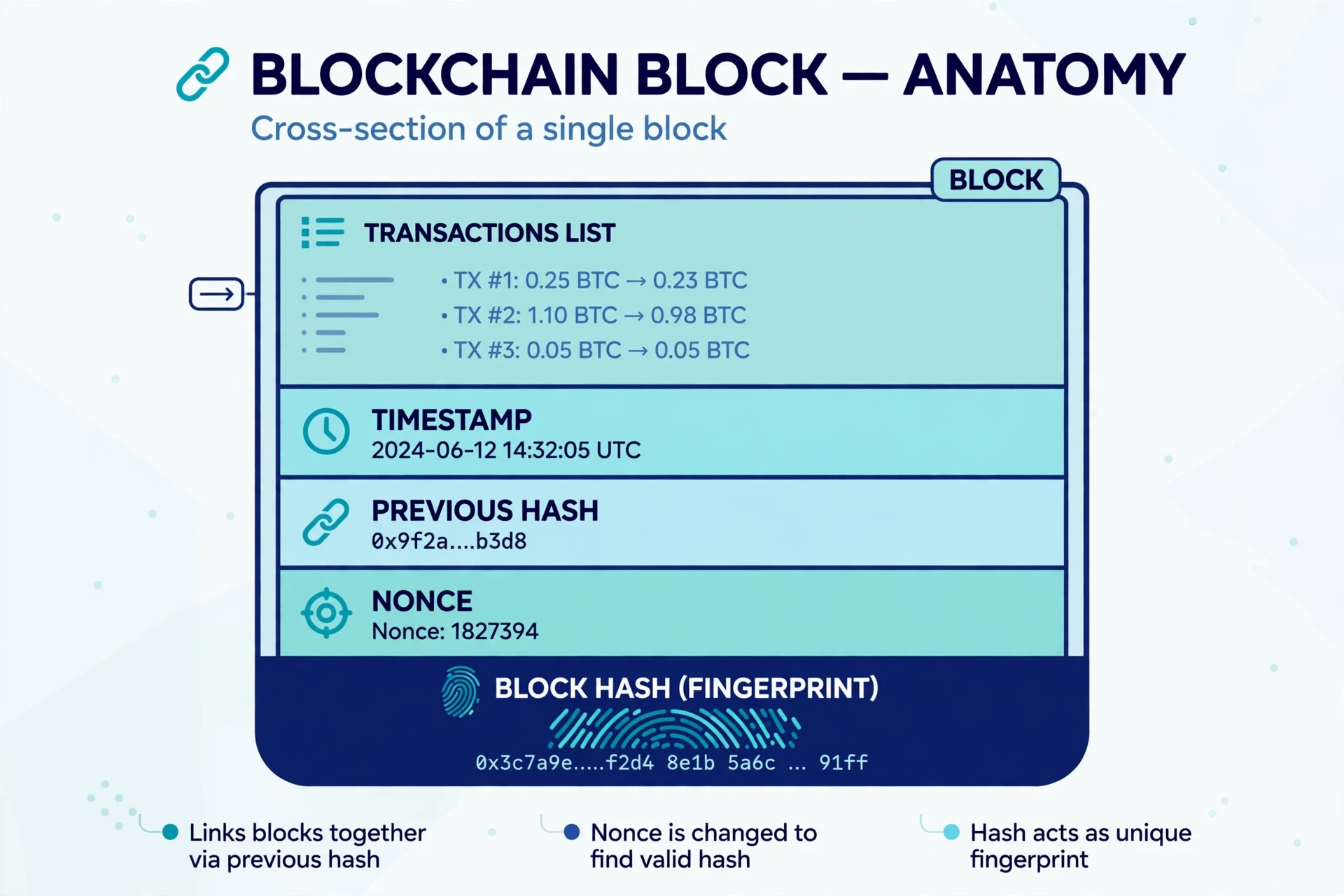
A block is a container. Inside it are the transactions that happened during a short window of time, plus some bookkeeping data: a timestamp, a reference to the previous block, and a number called a nonce that plays a role in mining, covered in Section 4.
The transactions themselves depend on the network. On a cryptocurrency network, a transaction might say that one account sent a certain amount to another. On a supply-chain network, a transaction might say that a crate of medicine changed hands at a warehouse. On a land registry, it might record a change of ownership. The container does not care what the entries mean. It only records them, in order, and seals them.
A useful everyday analogy is a page in a bound notebook. Each page holds several entries, written in ink, in the order they happened. You cannot tear a page out without leaving a visible gap, and you cannot rewrite a line without the ink showing. Blocks work the same way, except the "ink" is cryptography.
2.2 Hashes: the fingerprint of data
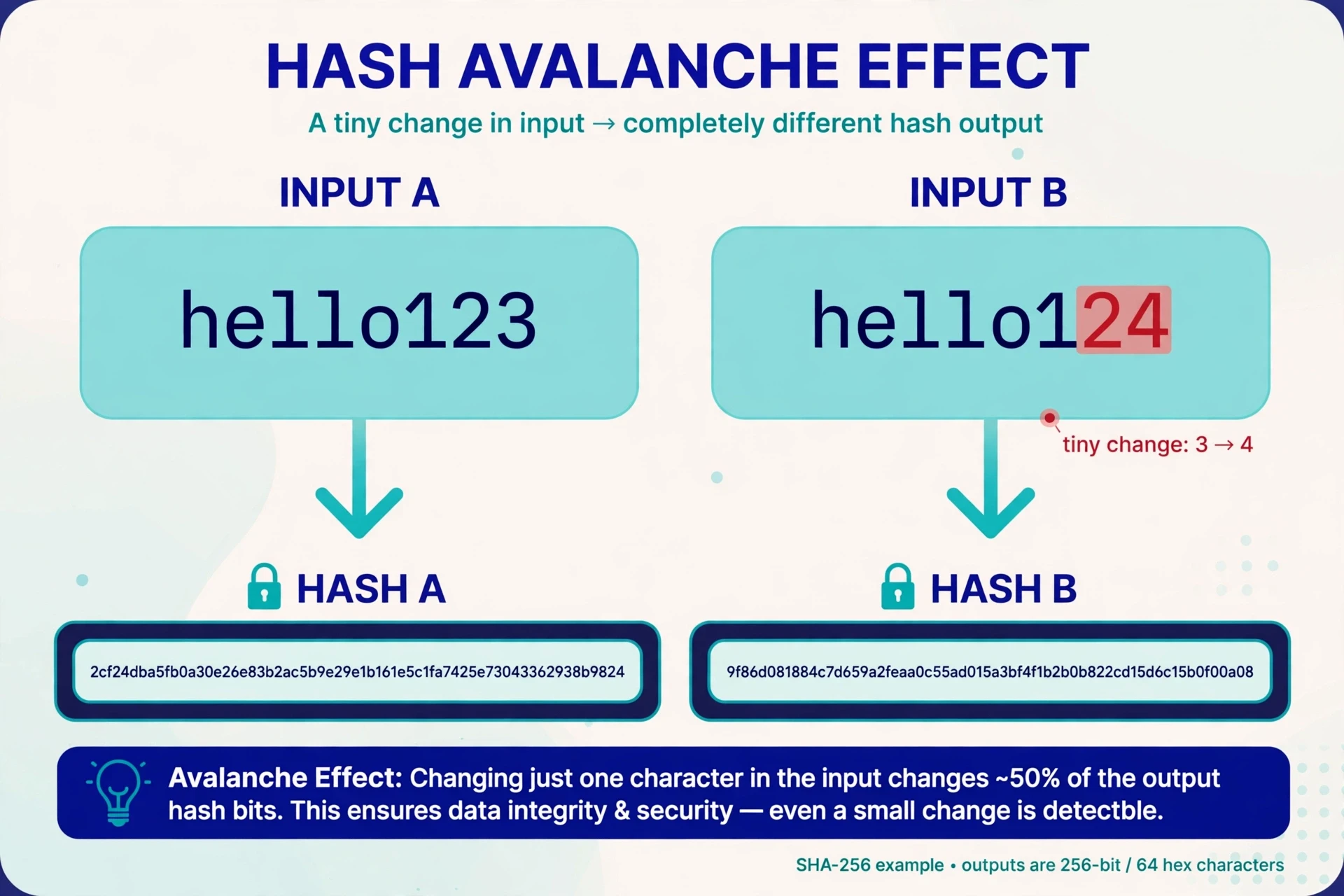
A hash is a fingerprint for digital information. Feed any piece of data — a sentence, a file, a whole block of transactions — into a hash function, and it returns a fixed-length string of characters. Change even one comma in the input, and the output changes completely. That property is called the avalanche effect, and it is what makes hashes so useful for spotting tampering.
Most blockchains use a hash function called SHA-256, which produces a 64-character string. The US National Institute of Standards and Technology (NIST) maintains guidance on hash functions and their role in securing digital records, and its blockchain overview explains how hashes bind blocks together in practice. You do not need to memorise the mathematics. You only need the intuition: a hash lets anyone check, in a fraction of a second, whether a piece of data is exactly the same as it was when it was hashed.
I remember the first time I tested this myself, feeding two nearly identical sentences into a hash calculator — one with a full stop, one without. The two outputs looked nothing alike. There was no resemblance, no partial match, no hint of what had changed. That is the point. A hash does not tell you what changed. It tells you, with near certainty, that something did.
2.3 Chaining blocks together
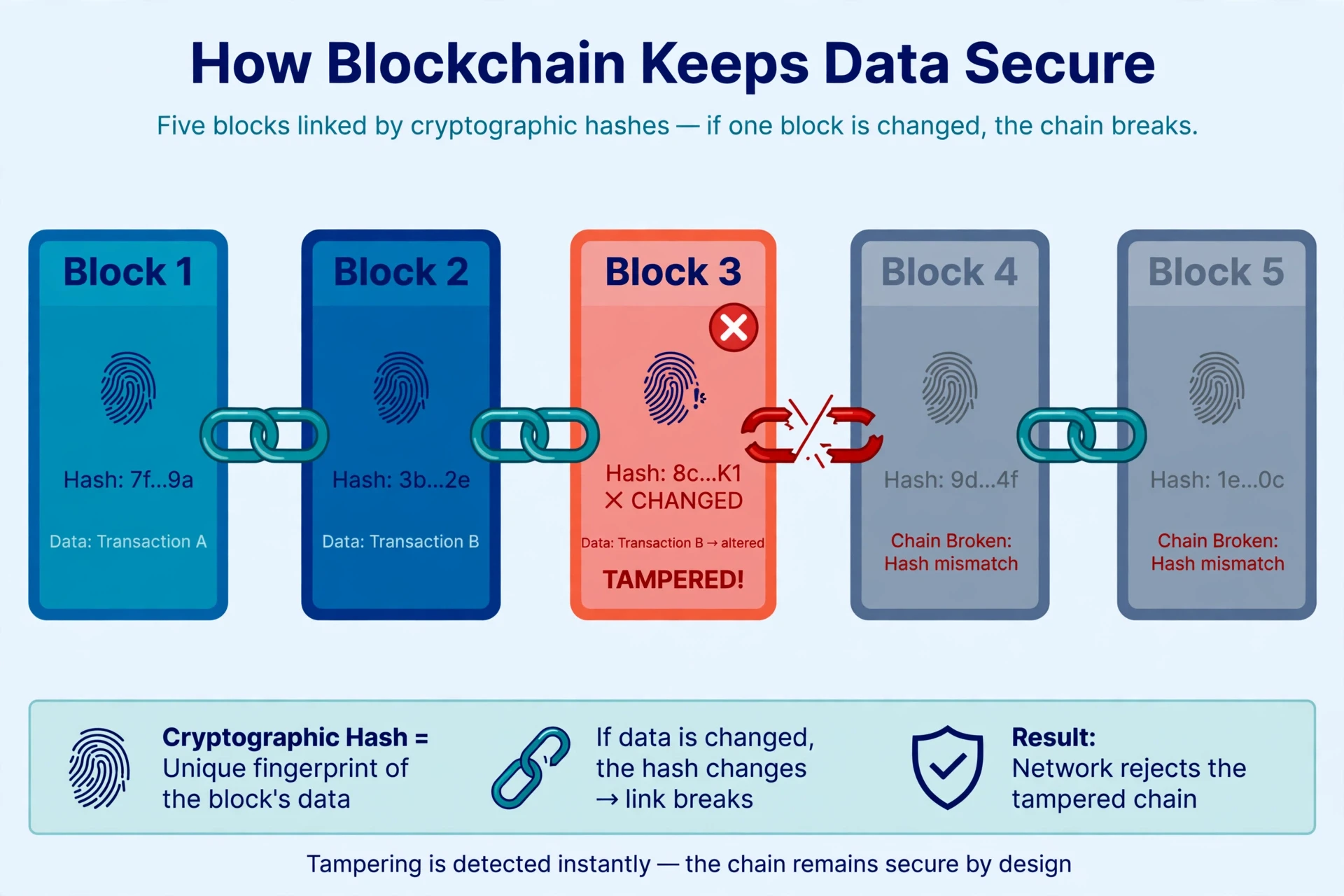
Here is where the chain in blockchain comes from. Each block contains the hash of the block before it. So block 2 contains the fingerprint of block 1. Block 3 contains the fingerprint of block 2, which itself contains the fingerprint of block 1. The links run all the way back to the very first block, often called the genesis block.
Now imagine someone tries to alter a transaction in block 50 of a chain with a thousand blocks. Changing that transaction changes block 50's hash. But block 51 contains the old hash of block 50. The two no longer match, so block 51 is now invalid. Fix block 51, and its hash changes, which breaks block 52. The tamperer would have to redo every block after the one they changed — and do it faster than the rest of the network adds honest blocks. On a large network, that is practically impossible.
This is why people call a blockchain tamper-evident rather than tamper-proof. Nothing in computing is truly impossible to break. But a blockchain makes tampering evident, expensive, and obvious to everyone watching.
3. Who Decides What Gets Added? Consensus
3.1 Why agreement is the hard part
Giving everyone a copy of the ledger solves one problem and creates another: who gets to write the next page? If anyone could add a block at any time, the copies would drift apart. One node might record that Alice paid Bob, while another records that Alice paid Carol with the same money. The network needs a rule for deciding which version counts.
That rule is called consensus. It is the set of procedures every node follows to agree on the next block, and to reject blocks that break the rules. Different blockchains use different consensus mechanisms, and the choice shapes everything about the network: how fast it is, how much energy it uses, and how secure it is.
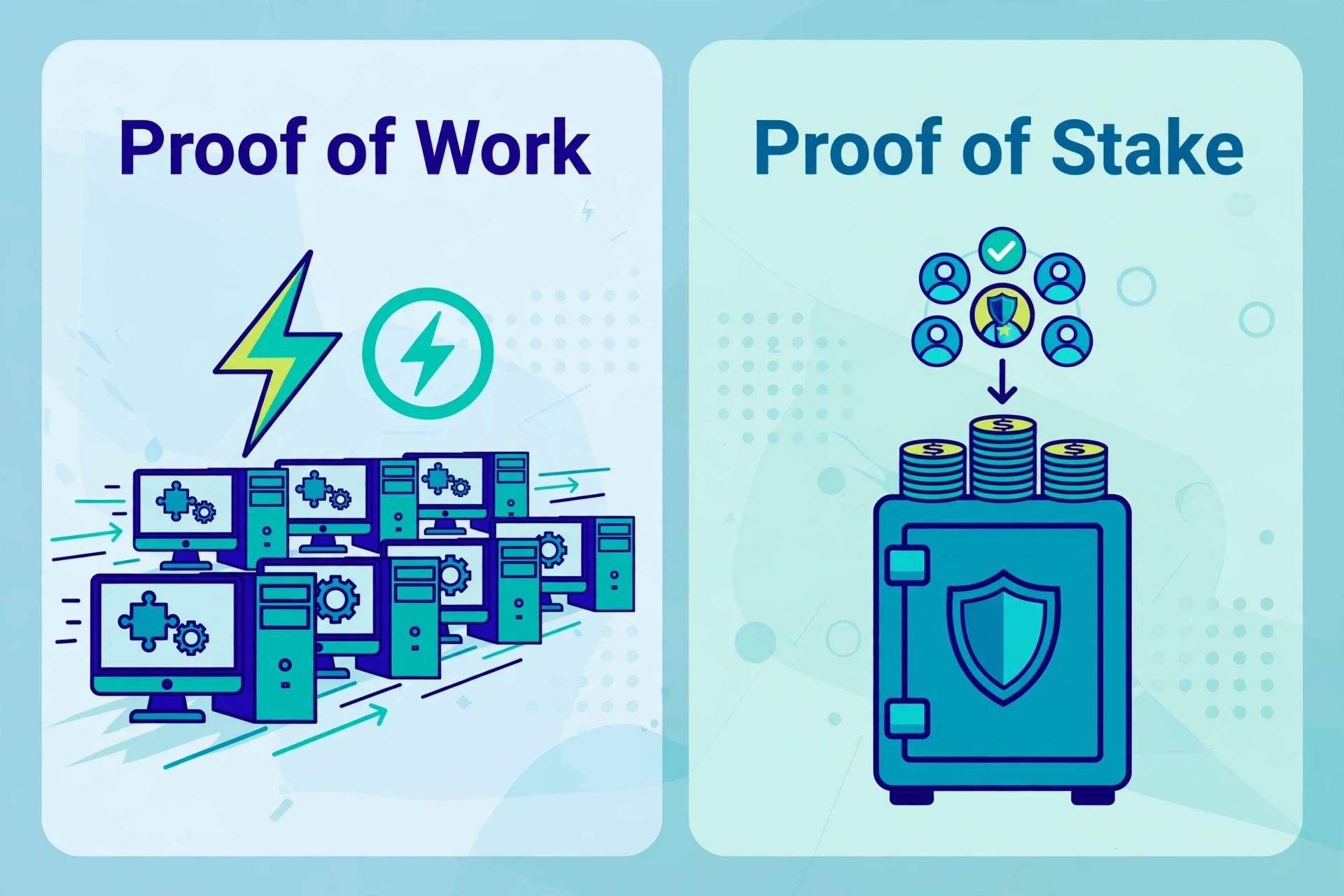
3.2 Proof of work: security through effort
The first widely used consensus mechanism was proof of work, introduced with Bitcoin. In proof of work, computers called miners compete to solve a puzzle: find a nonce — a number added to the block — that makes the block's hash start with a certain number of zeroes. There is no shortcut. The only way to find it is to try billions of guesses, very fast.
The first miner to find a valid nonce broadcasts the block, and the rest of the network checks it in an instant. Checking is cheap; finding is expensive. That asymmetry is the whole idea. Attacking the network would mean out-computing everyone else combined, which costs real electricity and hardware.
The original Bitcoin whitepaper, published by Satoshi Nakamoto in 2008 and still available from bitcoin.org, describes this design in nine pages that repay reading even now. Its core insight was not the puzzle itself, but the way the puzzle makes honest behaviour the profitable choice: miners earn rewards for adding valid blocks, and waste their effort if they try to cheat.
The cost is real, though. Proof-of-work networks consume large amounts of electricity, because thousands of machines are guessing nonces around the clock. That energy use is the most common — and fairest — criticism of the design, and it is covered in detail in Section 8.
3.3 Proof of stake: security through commitment
Proof of stake takes a different approach. Instead of proving they spent energy, participants prove they have something at stake: they lock up, or "stake," some of the network's own currency as collateral. The network then chooses validators — often partly at random, weighted by how much they staked — to propose and approve new blocks.
A validator that approves a fraudulent block can lose part of its stake. That penalty, called slashing, is meant to make cheating expensive in a different currency: not electricity, but the validator's own money. Honest validators earn rewards; dishonest ones lose their deposit.
Ethereum, the second-largest blockchain network, moved from proof of work to proof of stake in 2022 in an event called the Merge. Its own documentation explains the change as a way to cut energy use dramatically while keeping the network secure. Whether proof of stake is as battle-tested as proof of work over decades is still an open question among researchers — and honest writing should say so rather than pick a winner.
3.4 Proof of work versus proof of stake
The table below compares the two mechanisms on the points readers ask about most. Neither column is a verdict. Each design trades one strength for another, and the right choice depends on what the network is for.
Feature | Proof of Work | Proof of Stake |
|---|---|---|
What secures the network | Computing power and electricity spent solving puzzles | Currency locked up as collateral by validators |
Energy use | High — many machines compete continuously | Much lower — no puzzle race |
Who adds new blocks | Miners who solve the puzzle first | Validators chosen by the network, weighted by stake |
Penalty for cheating | Wasted electricity and hardware costs | Loss of staked funds (slashing) |
Track record | Running since 2009 on Bitcoin | Running at scale since Ethereum's Merge in 2022 |
Main criticism | Energy consumption and mining concentration | Wealth concentration and shorter track record |
Other consensus mechanisms exist too — proof of authority, where a small set of approved validators signs blocks, and delegated proof of stake, where token holders vote for validators. These tend to appear in private or consortium networks, where the participants already know and partly trust each other. The principle stays the same: the network needs an agreed rule for who writes next, and a cost for breaking it.
4. Keys, Wallets, and Digital Signatures
4.1 Public and private keys
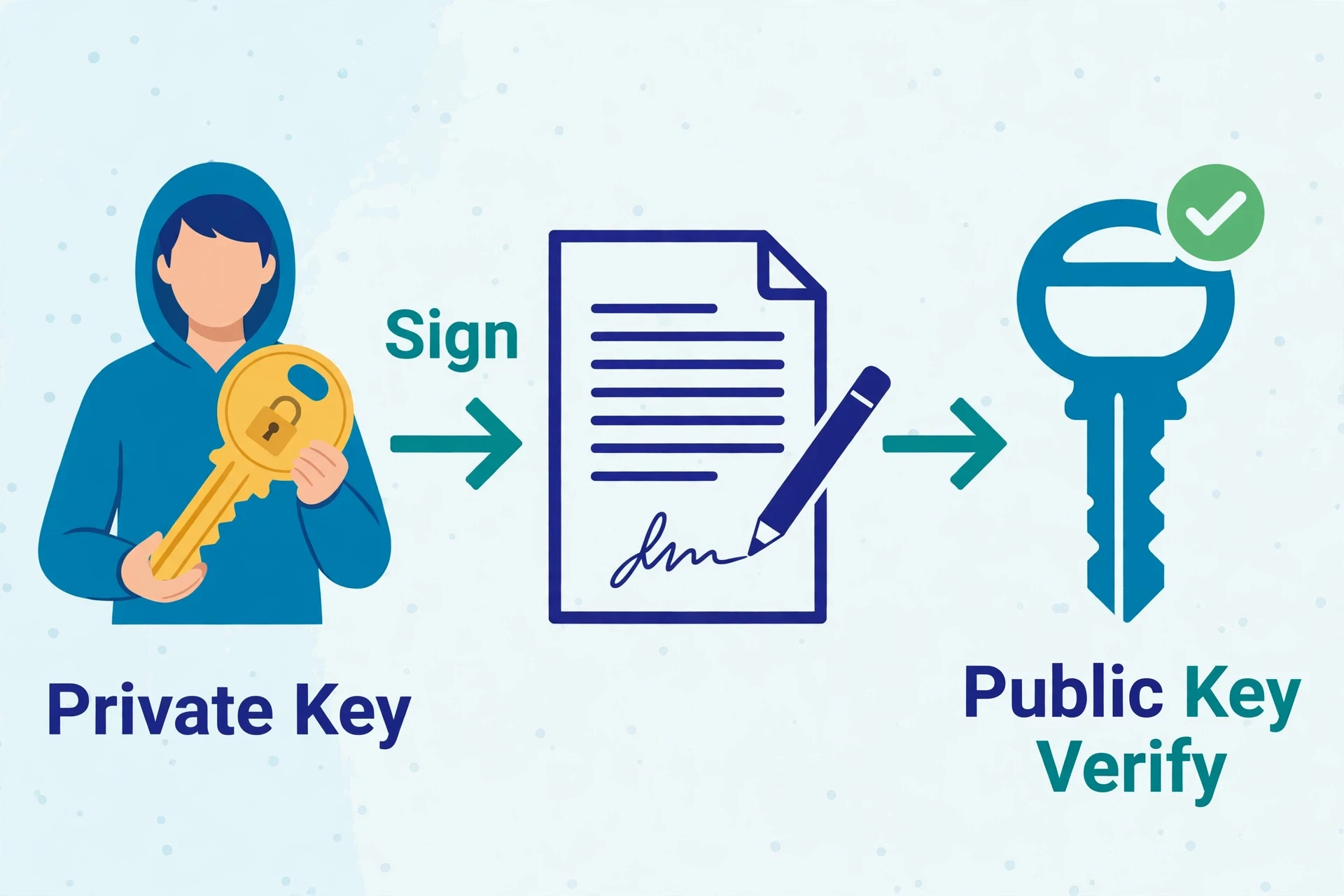
Every participant in a blockchain network has a pair of cryptographic keys. The public key is like a home address: you can share it freely, and people use it to send things to you. The private key is like the key to your front door: whoever holds it can open the house, so you guard it and never share it.
The two keys are mathematically linked. Data locked with one can only be unlocked with the other. That link is what makes digital signatures possible, and digital signatures are what make blockchain transactions trustworthy without a central authority checking identity documents.
If this sounds abstract, compare it with signing a cheque. Your signature on paper is hard to forge well, and a bank can compare it with the signature it has on file. A digital signature is stronger: it is tied to the exact contents of the transaction, so a signed payment cannot be altered after signing without breaking the signature.
4.2 How a transaction is signed
When you send a transaction, your wallet software uses your private key to sign it. That signature proves two things at once: that the transaction came from the holder of the private key, and that the transaction has not been changed since it was signed. Other nodes can verify the signature using your public key, without ever seeing your private key.
Lose your private key, and you lose access to whatever it controls. There is no password-reset button, no customer service desk that can restore it. That is both the strength and the harshness of the design. I once watched a colleague lose access to a test wallet containing nothing of value — and still spend an afternoon searching every backup drive he owned, because the finality of it felt unreal. On a blockchain, there is no "forgot password" link. That is a feature for security, and a real risk for ordinary users.
4.3 What a wallet actually is
A wallet does not hold coins the way a leather wallet holds notes. The coins, or tokens, live on the ledger itself. A wallet holds your keys, and the software that lets you sign transactions with them. Some wallets are apps on a phone. Some are small hardware devices that keep the private key offline. Some are pieces of paper with the key printed on them, stored in a safe.
That distinction matters, because headlines about "wallets being hacked" usually mean something else: a person's keys were stolen through phishing, a compromised app, or a careless backup — not that the blockchain itself was broken. The chain's cryptography has held up well. Human handling of keys has not always done so.
A blockchain does not know who you are. It knows only that someone holding a particular private key signed a particular transaction. Identity, in this system, is a key — not a name.
4.4 A worked example: sending a transaction, step by step
It helps to watch the whole machine run once, end to end. Suppose Maya wants to send a small amount to her friend Jon on a public network. First, Maya's wallet builds the transaction: her address as the sender, Jon's address as the receiver, the amount, and a small fee for the validator who will include it. Second, her wallet signs that transaction with her private key. The signature is attached, and the transaction is broadcast to the network.
Third, nodes that receive it check the basics. Is the signature valid? Does Maya's address hold enough funds? Has this exact transaction been recorded before, which would suggest someone is trying to spend the same money twice? If any check fails, the transaction is dropped and never reaches a block. If it passes, it waits in a holding area, often called a mempool, with other pending transactions.
Fourth, a miner or validator picks it up, bundles it with other pending transactions into a candidate block, and works through the consensus process described in Section 3 — solving the puzzle in proof of work, or being selected to propose in proof of stake. Fifth, the finished block is broadcast. Every other node verifies the signatures, the hashes, and the consensus proof, and, if everything checks out, adds the block to its own copy of the chain. Jon's balance updates on every copy at once.
Notice what did not happen. No bank approved the transfer. No clerk checked Maya's identity. No single computer decided the result. The trust came from the combination: a signature only Maya could produce, a public record anyone could audit, and a consensus rule that made cheating expensive. That combination, repeated millions of times a day, is the whole system in miniature.
5. Smart Contracts: Programs That Run on the Chain
5.1 Code that executes itself
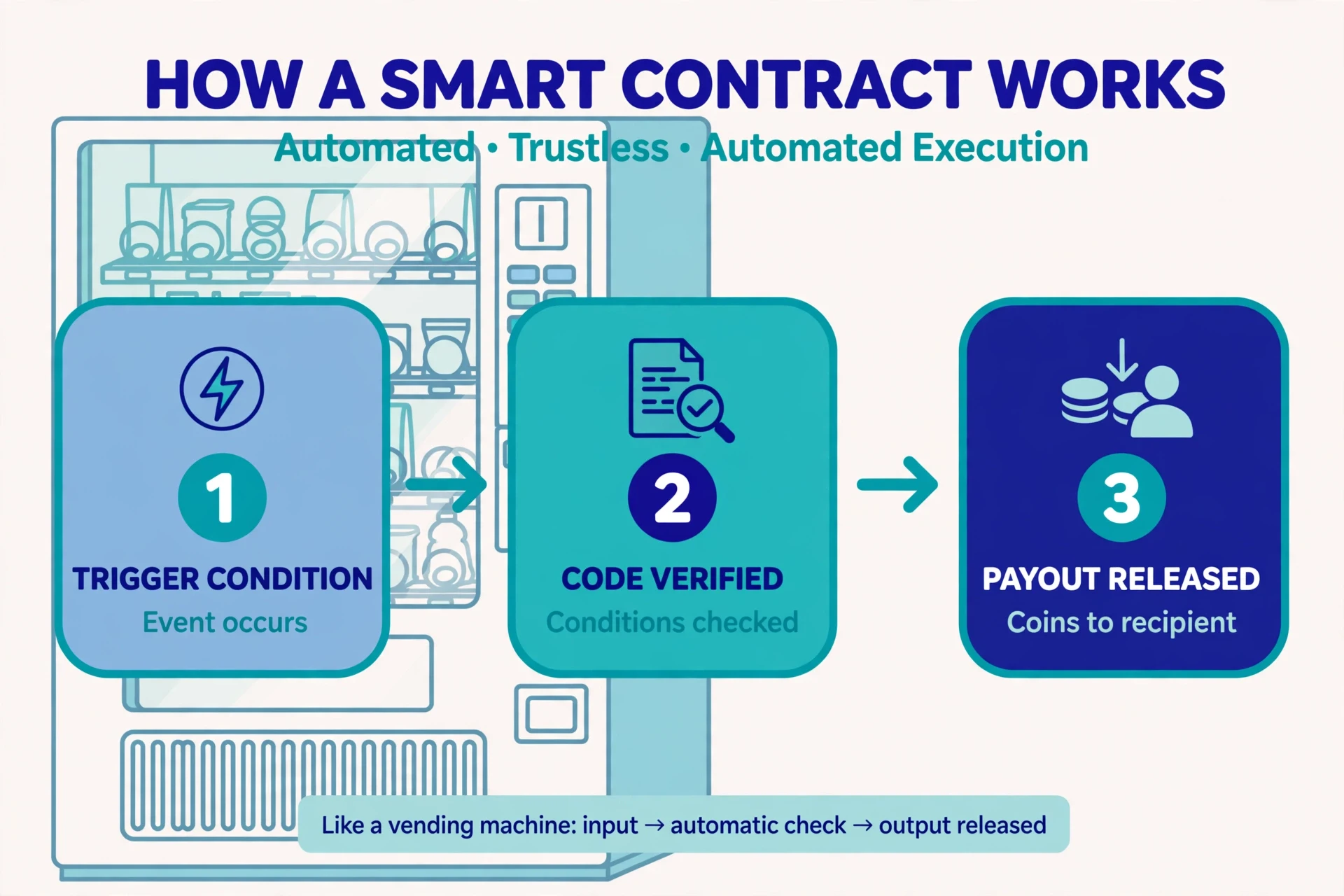
A smart contract is a program stored on a blockchain that runs automatically when its conditions are met. The name is older than the hype: computer scientist Nick Szabo described the idea in the 1990s, long before the first blockchain existed, using the example of a vending machine. Put in the right coins, and the machine dispenses the snack without a shopkeeper. A smart contract is a vending machine for agreements.
A simple example: a contract holds funds in escrow and releases them to a freelancer when a client confirms the work is done. No bank holds the money in between. No one can change the terms after both sides agreed, because the terms are the code, and the code is on the ledger.
5.2 Where smart contracts actually help
Smart contracts are most useful where the rules are clear, the inputs are verifiable, and the parties do not fully trust each other. Insurance payouts triggered by flight-delay data, royalty payments that split automatically when a song is streamed, and supply-chain payments released when a delivery is scanned — all of these are the same pattern: if this verifiable event happens, then do that transfer.
They are least useful where the rules are vague, the inputs are subjective, or a human judgement call is the whole point. A contract cannot decide whether a piece of creative work is "good enough." It can only check whether a box was ticked, a date passed, or a sensor reported a number.
5.3 The bug problem
Code is only as good as its author, and smart contracts have a sharp edge: once deployed, many of them cannot be changed. A bug in an ordinary app can be patched with an update. A bug in a smart contract may be frozen into the ledger, with real funds attached.
That is not a theoretical worry. In 2016, a flaw in a large smart-contract project called The DAO allowed an attacker to drain a large sum of ether, the currency of the Ethereum network. The community's response — splitting the chain to reverse the theft — remains controversial to this day, because it showed that even "unstoppable code" sometimes gets stopped by human decision. The lesson is not that smart contracts are useless. It is that code that moves money needs the same care as a legal contract, plus the testing discipline of safety-critical software.
6. Public, Private, and Consortium Blockchains
6.1 Not all blockchains are open to everyone
The word blockchain covers several different designs. A public blockchain, like Bitcoin or Ethereum, lets anyone join, read the ledger, and — under its consensus rules — help validate transactions. No permission is needed, and no central organisation controls membership.
A private blockchain is run by one organisation. It uses the same data structure — blocks, hashes, chaining — but only approved participants can read it or add to it. A hospital network might use one to share patient referral records between its own clinics, without exposing them to the public.
A consortium blockchain sits in between. Several organisations share control: a group of banks, for example, might jointly run a network for settling trades between them. No single bank controls it, but outsiders cannot join freely.
Which design fits depends on the trust problem. If the participants are strangers who do not trust each other at all, a public chain makes sense. If they are known organisations with legal agreements already in place, a private or consortium chain may be simpler, faster, and cheaper — though a sceptic might reasonably ask whether a shared database would do the same job for less effort. That question deserves a serious answer, and Section 9 gives one.
6.2 Permissioned versus permissionless
The technical term for this distinction is permissioned versus permissionless. Permissionless networks are open: anyone can run a node and take part in consensus. Permissioned networks restrict those roles to approved participants. The trade-off is familiar from the consensus discussion: openness buys censorship resistance and trust between strangers, but costs speed and efficiency. Restriction buys speed and control, but reintroduces the question of who controls the gatekeepers.
Most people assume a blockchain must be public to count as a blockchain. In practice, the data structure and the access policy are separate choices. What matters is whether the design matches the problem — and whether the people running it are honest about which properties they have kept and which they have given up.
7. Real Uses Beyond Cryptocurrency
7.1 Supply chains: following a product home
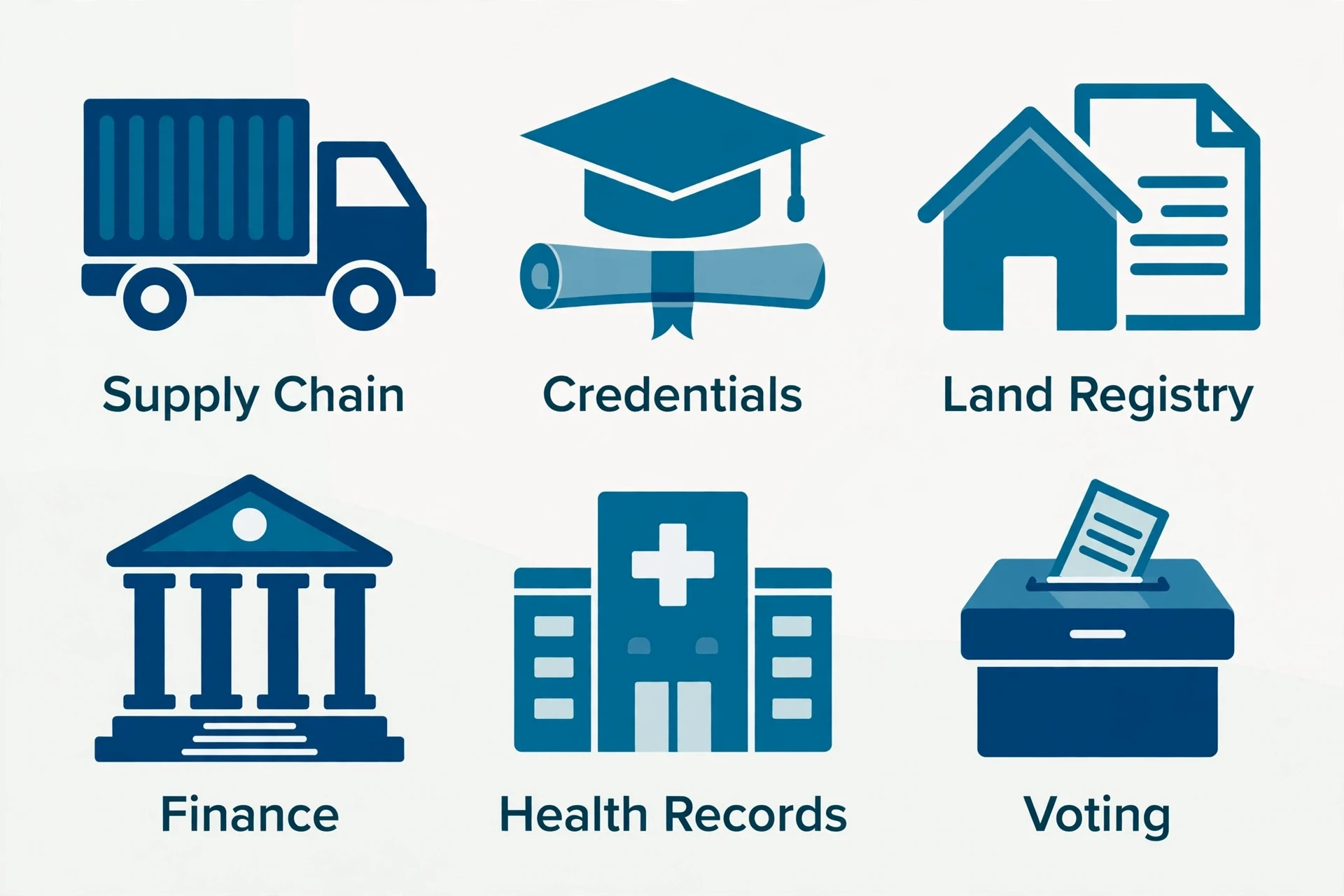
The medicine shipment from the introduction is not a hypothetical. Pharmaceutical companies, food producers, and luxury-goods makers have all tested blockchain records to trace products from origin to shelf. A crate of vaccines can be scanned at each handoff, and each scan becomes a transaction on the shared ledger. If a batch is recalled, the trail shows exactly where every crate went, in minutes rather than weeks.
The gain here is not magic. A well-run central database could also track crates. The gain is that no single party can rewrite the trail after a problem is found, and every party sees the same trail. When a food-safety scare hits, that shared, tamper-evident trail is worth real money — and real safety.
7.2 Identity and credentials
A university degree, a professional licence, or a vaccination record is a claim that someone, somewhere, verified a fact about you. Today those claims live in separate databases, and verifying them means calling the issuer and waiting. Several universities and governments have experimented with issuing credentials as blockchain records, so that an employer can verify a diploma instantly, without phoning the university, and without the graduate handing over a pile of personal data.
The idea is promising, but the details matter. A credential on a public ledger is visible forever, which raises privacy questions. Most serious designs therefore store only a hash of the credential on the chain, and keep the credential itself with the holder. The chain proves the credential has not been altered; it does not publish its contents.
7.3 Land, voting, and public records
Land registries are a natural fit in places where paper records are incomplete, disputed, or vulnerable to tampering. A blockchain record of ownership, linked to surveys and legal documents, can give people proof of title that no single official can quietly alter. Pilot projects have run in several countries, with mixed results — the technology works, but land disputes are usually political before they are technical, and no ledger can settle a boundary that two neighbours genuinely disagree about.
Voting is the most often proposed and most often misunderstood use. A blockchain could record votes in a way that anyone can audit. But voting also needs secrecy, and it needs voters to trust the devices they vote on — a blockchain secures the record after the vote is cast, not the phone or machine that casts it. Election-security researchers are generally cautious here, and their caution is worth hearing: the hardest part of voting is not counting the votes, it is making sure each vote was cast freely, secretly, and by the right person.
7.4 Finance, art, and digital ownership
Beyond currency, blockchains underpin a range of financial tools: cross-border payments that settle in minutes rather than days, trade finance where documents are shared between banks, and tokenised assets — digital representations of real things, from property shares to concert tickets. Non-fungible tokens, or NFTs, are one much-publicised form: a unique token that points to a piece of digital art or a collectible.
Here, a misconception needs correcting. Buying an NFT usually does not buy the copyright to the artwork, and it does not stop anyone else from copying the image. What it buys is a blockchain record saying that a particular token, linked to that artwork, sits in your account. Whether that record is worth anything is a market question, not a technical one — and markets have answered it very differently at different times. The technology is real. The value of any particular token is a separate matter, and this article makes no claim about it.
7.5 Health records and research data
Hospitals hold sensitive data that patients need to share selectively: with a specialist, with a pharmacist, with a researcher. Blockchain pilots in health care usually use the chain as an access log — a record of who looked at what, and when — rather than storing medical data on the chain itself. That way, a patient can see every access to their record, and a researcher can prove that a dataset has not been altered since it was collected, without exposing patient details to the whole network.
I once spent a week trying to reconcile two versions of a research dataset, one held by my team and one by a collaborating lab, after a file had been edited in both places. We eventually rebuilt the history from email timestamps. A tamper-evident log of dataset changes would have saved days — not because anyone was dishonest, but because honest people working in parallel create honest confusion. That is the use case I find most convincing: not replacing trust, but giving honest collaborators a shared memory.
8. The Honest Limits: Energy, Speed, and Hype
8.1 Energy use is a real cost
Proof-of-work mining uses a lot of electricity. Estimates vary by year and by method, but the scale is comparable to the electricity consumption of a medium-sized country for the Bitcoin network alone. That figure shocks people, and it should prompt a fair question: what is that electricity buying?
The honest answer has two parts. First, the electricity is the security budget: it is what makes rewriting history expensive. Second, whether that budget is worth it depends on what the network is used for. A global settlement network that no government can shut down may be worth a large energy bill to its users. A network tracking lunch orders would not be.
Proof-of-stake networks use far less energy — Ethereum's own estimates put the drop after the Merge at well over 99 percent — which is why the energy argument now applies mainly to proof-of-work chains. Readers weighing the issue should also know that electricity sources matter: a miner running on surplus hydroelectric power and one running on coal have very different climate footprints, even if they use the same number of kilowatt-hours. For the broader picture of how energy use connects to warming, see Climate Change Explained.
8.2 Speed and scale
A blockchain is slow compared with an ordinary database. Bitcoin processes a handful of transactions per second; a card-payment network processes thousands. The reason is structural: every node must check every transaction, and consensus takes time. Engineers have built workarounds — processing transactions off the main chain and settling the results later, a family of techniques called layer 2 — but each workaround adds complexity and new trust assumptions.
This is why the question "could a blockchain do this?" is less useful than "should it?" A shared spreadsheet, a database, or a simple signed document often does the job faster and cheaper. The blockchain earns its keep only when the participants do not trust each other, do not trust a central keeper, or need a record that outlives any one organisation.
8.3 The most common misconceptions
Most people assume a blockchain is anonymous. It is not. It is pseudonymous: transactions are tied to addresses, not names, but those addresses are visible to everyone, and patterns of activity can often be linked back to real people. Investigators have traced criminal transactions through public ledgers precisely because the record is permanent and public.
Most people also assume a blockchain is unhackable. It is not. Individual blockchains have been attacked, exchanges have been robbed, and smart contracts have been exploited. What has held up well is the core cryptography of the largest networks. What has failed repeatedly is everything around it: exchanges, wallets, bridges between chains, and hastily written code.
And most people assume that putting something on a blockchain makes it true. It does not. A blockchain can prove that a record has not changed since it was written. It cannot prove that the record was accurate when it was written. If someone records a false claim — a fake diploma, a counterfeit product, a wrong sensor reading — the chain will preserve that falsehood faithfully, forever. Computer scientists call this the oracle problem: the chain is only as truthful as the information fed into it.
A blockchain is a machine for preserving records, not for verifying the world. It can tell you that nobody changed the entry. It cannot tell you that the entry was true in the first place.
8.4 When not to use a blockchain
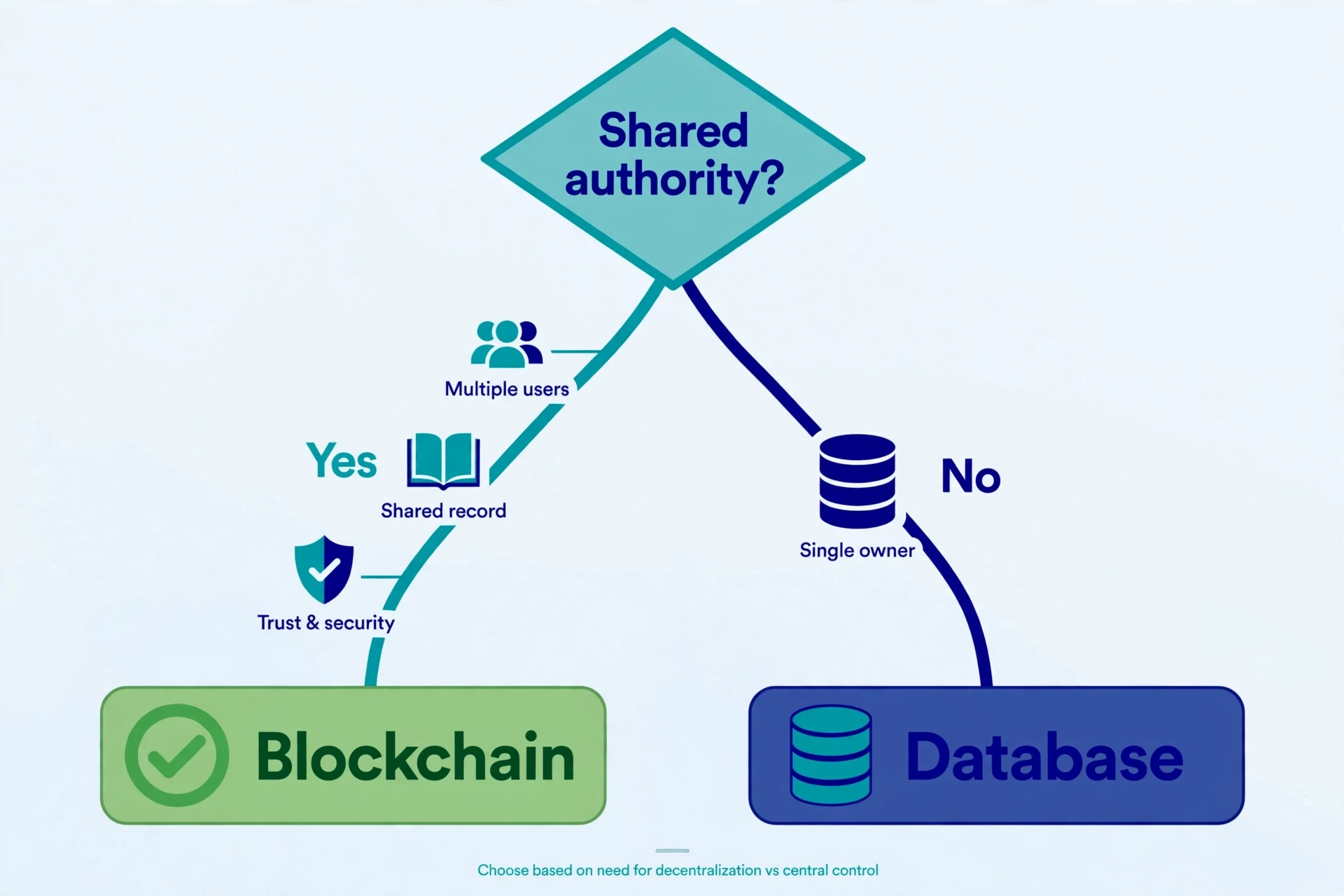
A simple test helps. If one organisation can be trusted to keep the record, use a database. If the data changes constantly and needs to be fast, use a database. If the data is private and should be deletable — as privacy law in some places requires — think very carefully before writing it to a ledger designed never to forget. If the participants already trust each other and have legal agreements, a shared database with access controls is almost always simpler.
Use a blockchain when several parties who do not fully trust each other need a shared record, when that record must survive any single party disappearing, and when the cost of the record being tampered with is higher than the cost of running the network. That is a narrower set of problems than the hype suggests. It is also a real set, and worth taking seriously.
9. How Blockchains Connect to the Rest of Science
9.1 The same tools, different questions
Blockchain rests on ideas that appear across science: hashing comes from computer science and cryptography, consensus draws on game theory and distributed-systems research, and the energy debate belongs to the same physics and climate science that explains why electricity has a carbon cost. Understanding one piece often illuminates another — the reason a hash changes completely when one character changes is the same avalanche property that makes a good checksum in any data system, and the reason consensus is hard is the same reason distributed databases are hard: machines fail, messages arrive late, and participants disagree.
Readers who enjoy tracing how a claim is tested will find the same habits useful here as anywhere in science: ask what the evidence is, ask who checked it, and ask what would change the answer. That is the spirit of The Scientific Method, and it applies to technology claims just as much as to laboratory ones. A whitepaper is a proposal, not a proof. A pilot project is evidence, not a verdict. A market price is a signal about demand, not a measure of technical merit.
9.2 What researchers are working on now
Current research clusters around a few open problems. One is scaling: how to process more transactions without giving up decentralisation or security — the so-called trilemma that says a network can optimise for two of the three, but not all at once. Another is privacy: how to prove a transaction is valid without revealing its contents, using techniques called zero-knowledge proofs. A third is interoperability: how to let different blockchains talk to each other safely, so that value and data are not trapped on separate islands.
There is also serious work on making consensus cheaper and fairer, on formal verification of smart contracts — proving mathematically that code does what it claims — and on the long-term threat of quantum computing, which could one day break the cryptography that today's blockchains rely on. Researchers are already designing quantum-resistant signatures, though practical quantum attacks remain a future concern rather than a present one. The field moves quickly, and any article on it, including this one, is a snapshot. Check the sources below for the current state of play.
9.3 A note on electricity and circuits
Underneath every blockchain is ordinary hardware: processors, memory, and networks, all running on electricity. The puzzles of proof of work are, at bottom, transistors switching billions of times a second, and the energy they consume follows the same physical laws as any other electrical load. Readers who want the foundations will find them in Fundamentals of Electricity. The technology may be new, but the physics is not.
10. What to Watch Next — and How to Think About It
10.1 Signals that matter
If you want to follow this field without drowning in hype, watch a few slow signals rather than daily prices. Are real institutions using blockchains for real records, or only announcing pilots? Are developers fixing the known problems — scaling, privacy, smart-contract safety — or just launching new tokens? Are regulators giving clear rules, or leaving the field in uncertainty? Are the largest networks becoming more decentralised over time, or more concentrated in a few large miners, validators, or exchanges?
Those questions are boring compared with a price chart. They are also the questions that determine whether the technology lasts.
10.2 A practical checklist for any blockchain claim
When you meet a new blockchain project, run it through a short checklist. What problem does it solve that a database cannot? Who writes to the ledger, and who can read it? What happens if a key is lost, a contract has a bug, or a participant cheats? Is the code open for anyone to inspect? Is there a working product, or only a promise? If the answers are vague, the project is probably selling a story rather than a solution.
I have learned to be suspicious of any claim that a technology will "revolutionise everything." Technologies rarely do. They solve some problems well, others badly, and most not at all. Blockchain is no exception. Its genuine achievement is narrower and more interesting than the slogans: it showed that strangers can agree on a shared record without appointing a boss. That idea will outlive any particular coin, company, or market cycle.
10.3 The bigger picture
Step back, and blockchain looks less like a financial invention and more like an experiment in coordination. Humans have always needed shared records — tally sticks, ledgers, registries, databases — and each new version changed who could be trusted, and how. A blockchain is the latest version: a record that no single party owns, that anyone can audit, and that is expensive to falsify. Whether that version becomes as ordinary as the database, or remains a specialised tool for specialised problems, will be decided by the slow work of engineers, researchers, regulators, and users — not by a single breakthrough.
The medicine shipment from the start of this article still matters. Somewhere, right now, a box is moving through a chain of hands, and several different records disagree about where it is. The question blockchain asks is simple: what if they all agreed, and what if that agreement could be checked by anyone? The technology's answer is incomplete, imperfect, and genuinely clever. Understanding it — really understanding it, hashes and all — is the best defence against both the hype and the dismissal that surround it.
Conclusion
A blockchain is a distributed ledger: transactions grouped into blocks, sealed with hashes, chained in order, and added only when the network agrees. Public and private keys let participants sign transactions without revealing their secrets. Smart contracts let code execute agreements automatically, with all the power and all the risk that implies. Real uses exist — supply chains, credentials, land records, finance, health data — alongside real limits: energy use, slow speed, the oracle problem, and the fact that a permanent record preserves mistakes as faithfully as truths.
None of that makes blockchain either a miracle or a fraud. It makes it a tool: powerful in the narrow set of problems it was designed for, wasteful outside them, and worth understanding on its own terms. If you remember one thing, let it be the test from Section 8: use a blockchain when distrusted parties need a shared, tamper-evident record — and reach for a database when they do not.
Frequently Asked Questions
What is blockchain in simple terms?
A blockchain is a shared digital record book that many computers hold copies of. New entries are grouped into blocks, sealed with cryptography, and linked to earlier blocks, so old entries cannot be changed without everyone noticing.
How is a blockchain different from a database?
A database is usually controlled by one organisation, which can edit it. A blockchain is distributed across many participants, and its entries are sealed with hashes and agreed by consensus, so no single party can quietly rewrite history. Databases are faster and simpler; blockchains are better when the participants do not trust each other or a central keeper.
Is blockchain the same as Bitcoin?
No. Bitcoin is one application that runs on a blockchain — the first and best known. Blockchain is the underlying record-keeping technology, and it can be used for many other things, from supply chains to credentials, with or without any cryptocurrency involved.
Is blockchain secure?
The core cryptography of large public blockchains has held up well, but the systems around them — exchanges, wallets, smart contracts, and bridges between chains — have been attacked repeatedly. Security depends on the whole system, including how people handle their private keys.
Why does blockchain use so much energy?
Proof-of-work blockchains secure themselves by making computers solve energy-intensive puzzles. That energy is the cost of making attacks expensive. Proof-of-stake networks use far less energy, because they secure themselves with locked-up funds instead of computing power.
Can blockchain records be changed or deleted?
In practice, changing an old record on a large public blockchain would mean redoing every block after it faster than the rest of the network — which is practically impossible. That permanence is a strength for audit trails and a problem for data that should be corrected or deleted, so sensitive or personal data is usually kept off the chain, with only its hash stored on it.
Should I invest in blockchain or cryptocurrency?
This article gives no investment advice and makes no price predictions. Anyone considering it should research the risks, understand that prices are volatile and losses are possible, and consider independent financial advice before deciding anything.