

On a January morning in northern Minnesota, the air is cold enough to hurt. The lake outside the cabin has frozen solid, a grey-white sheet thick enough to walk on, and under that ice, in water barely above freezing, fish are swimming. They will still be swimming in March. That simple fact has always stopped me in my tracks. If water behaved like almost every other liquid on Earth, that lake would have frozen from the bottom up, the ice would have sunk, and nothing underneath would have survived the winter. The reason it does not happen is hidden inside a molecule so small that a single drop of water holds more of them than there are stars in the observable universe — and that molecule, H₂O, breaks the rules so often that chemists have spent two centuries trying to explain why.
Water looks plain. It has no colour, no smell, and almost no taste. Yet it is the strangest and most important molecule on Earth, and this article is about why. Every odd property of water — the way it soaks up heat, the way ice floats, the way it climbs up a plant stem against gravity, the way it dissolves almost anything — traces back to one thing: the shape of the water molecule and the weak, restless bonds it forms with its neighbours. Once you see that connection, the whole planet starts to make sense, from the sweat on your skin to the climate of an entire ocean.
1. A Molecule That Breaks the Rules
Ask a chemist to name the weirdest common substance on Earth and many will answer without hesitating: water. It should not behave the way it does. Compare it with its chemical cousins and the strangeness jumps out. Hydrogen sulfide, H₂S, is built the same way — two hydrogen atoms stuck to one atom from the same column of the periodic table — and it is a stinking gas at room temperature. Water, with the lighter oxygen atom, should boil even more easily. Instead it stays liquid across the whole range of temperatures where life exists, boils at 100°C, and freezes at 0°C. Something about those three little atoms refuses to follow the script.
The numbers tell the story. Water has the highest specific heat capacity of any common liquid except ammonia, one of the highest heats of vaporization of any known substance, and a solid form that floats on its own liquid — a trick almost no other substance manages. It dissolves more chemicals than any other liquid. It has the highest surface tension of any common liquid except mercury. And it is the only substance that naturally exists as a solid, a liquid, and a gas under the normal conditions found on Earth's surface.
I first felt how odd this was in a school laboratory, long before I understood the chemistry. My teacher filled a beaker with water, heated it over a flame, and asked us to guess when it would boil. We watched the thermometer climb, then stop. The water sat at 100°C, bubbling furiously, while the thermometer refused to move a single degree higher. All that heat was going somewhere, but not into temperature. That stuck with me for years — the idea that a substance could swallow enormous amounts of energy and barely flinch. It turns out that quirk is one of the main reasons you are alive.
2. The Bent Shape That Changes Everything
2.1 Two hydrogens, one oxygen, one crooked angle
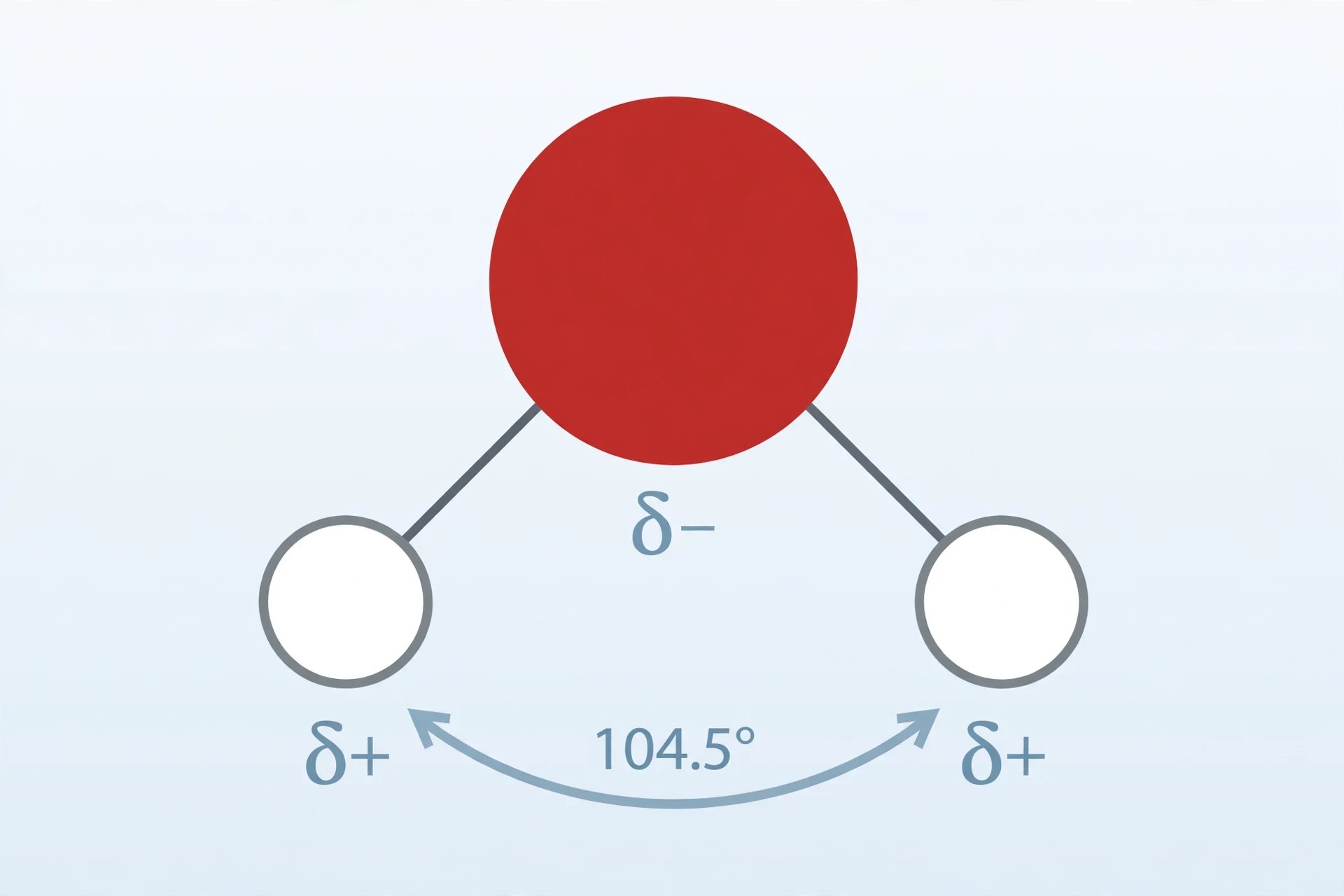
A water molecule is built from one oxygen atom and two hydrogen atoms, joined by covalent bonds — bonds in which the atoms share electrons. If you draw it on paper, it looks simple. In reality it is bent, like a tiny boomerang, with the two hydrogen atoms sitting about 104.5 degrees apart around the oxygen. That bend is everything.
Oxygen is greedy with electrons. It pulls the shared electrons in each O–H bond toward itself, so the oxygen end of the molecule carries a slight negative charge (written δ−) and each hydrogen end carries a slight positive charge (δ+). The molecule as a whole is electrically neutral — the charges balance — but the charge is not spread evenly. Chemists call this a polar molecule, and water is one of the most polar small molecules in nature.
2.2 Why the bend matters
If water were a straight molecule, like carbon dioxide, the two positive ends would cancel each other out and the molecule would be nonpolar. The bend stops that from happening. One side of the molecule is negative, the other side is positive, and the molecule behaves like a tiny magnet with two poles. That uneven charge is the seed from which every strange property of water grows.
Most people assume a molecule's shape is a minor detail, a diagram to memorize for an exam and forget. What the data actually show is the opposite: change that angle by a few degrees and you change the chemistry of the whole planet. The bent shape is why water molecules attract each other, why ice floats, and why your blood can carry dissolved salts and sugars to every cell in your body. Shape is destiny, at the molecular scale at least.
For the basics of how atoms join into molecules like this one, see our guide to atoms and molecules.
3. Hydrogen Bonds: Weak Alone, Mighty Together
3.1 A bond that is not quite a bond
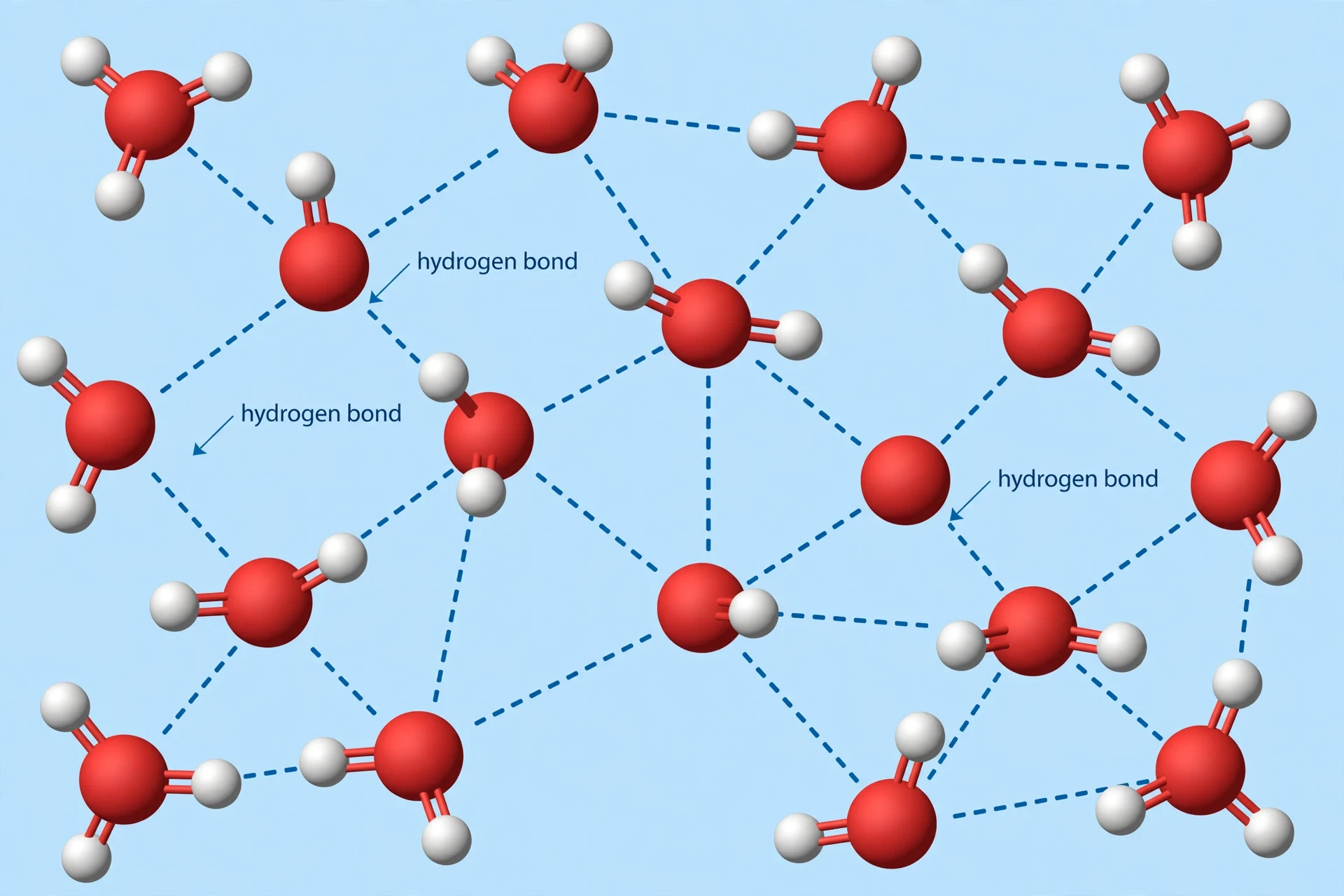
When the slightly positive hydrogen of one water molecule drifts near the slightly negative oxygen of another, the two attract. This attraction is called a hydrogen bond. It is not a true chemical bond — it is roughly twenty times weaker than the covalent bonds holding each water molecule together — and it lasts only a trillionth of a second before breaking and reforming somewhere else. In a glass of water at room temperature, hydrogen bonds are breaking and forming billions of times a second, a restless flickering network that never sits still.
One hydrogen bond is almost nothing. But each water molecule can form up to four of them at once — two through its hydrogen atoms, two through the oxygen's lone pairs of electrons — and a glass of water contains roughly 10²⁵ molecules. Weak bonds in astronomical numbers add up to something formidable. It is like a crowd linking arms: no single grip is strong, but the crowd as a whole is almost impossible to push through.
3.2 The network that runs the world
Here is the key idea of this whole article, and it is worth stating plainly: almost everything strange about water is hydrogen bonding, seen from different angles. Heat capacity? That is hydrogen bonds absorbing energy before the molecules can move faster. Ice floating? That is hydrogen bonds locking into an open lattice. Dissolving salt? That is hydrogen bonds pulling ions apart. Surface tension? Hydrogen bonds at the surface with nowhere to go but sideways. Learn this one mechanism and the rest of the article falls into place.
The discovery of hydrogen bonding was not a single eureka moment. In the early twentieth century, chemists kept running into substances whose boiling points made no sense — water, hydrogen fluoride, ammonia — all far higher than their molecular weights predicted. The explanation emerged slowly, through the work of many researchers piecing together why certain molecules cling to each other. It is a good reminder that science often advances not by one genius shouting in a laboratory, but by a community noticing the same stubborn anomaly again and again until the pattern becomes impossible to ignore.
4. The Heat Sponge: Why Water Resists Warming Up
4.1 Specific heat capacity, explained with a kettle
Specific heat capacity is the amount of energy needed to raise one gram of a substance by one degree Celsius. For water it is 4.184 joules per gram per degree — one of the highest values of any common substance. Sand needs about a fifth as much energy to warm by the same amount. Iron needs about a tenth.
The reason is hydrogen bonding again. When you heat water, much of the energy you add does not go into making the molecules move faster — which is what temperature measures. It goes into breaking hydrogen bonds first. Only once enough bonds are loosened do the molecules speed up and the temperature rise. Water absorbs the blow before it shows the effect.
I learned this the hard way on a camping trip years ago, trying to boil water for coffee over a small stove while my tent-mate's metal mug of sand — long story, he was drying out a sample — heated up in seconds and nearly burned his hand. The water took forever. That is not a flaw. That is a feature, and it is one of the most important features on the planet.
4.2 What this means for bodies and climates
Because water resists temperature change, your body — which is roughly 60 percent water — resists temperature change too. A fever of two degrees is a medical emergency; a desert lizard's body temperature can swing by ten degrees in a day. Water is your internal thermostat.
The same effect scales up to the whole planet. The oceans, which cover about 71 percent of Earth's surface, soak up heat in summer and release it slowly in winter. Coastal cities have mild winters and cool summers compared with inland deserts at the same latitude, and the difference is almost entirely water's heat capacity at work. NASA researchers describe the ocean as Earth's "biggest heat bucket": the top few metres of the ocean store as much heat as the entire atmosphere, and the ocean has absorbed around 90 percent of the extra heat trapped by rising greenhouse gases (NASA, Earth's Big Heat Bucket).
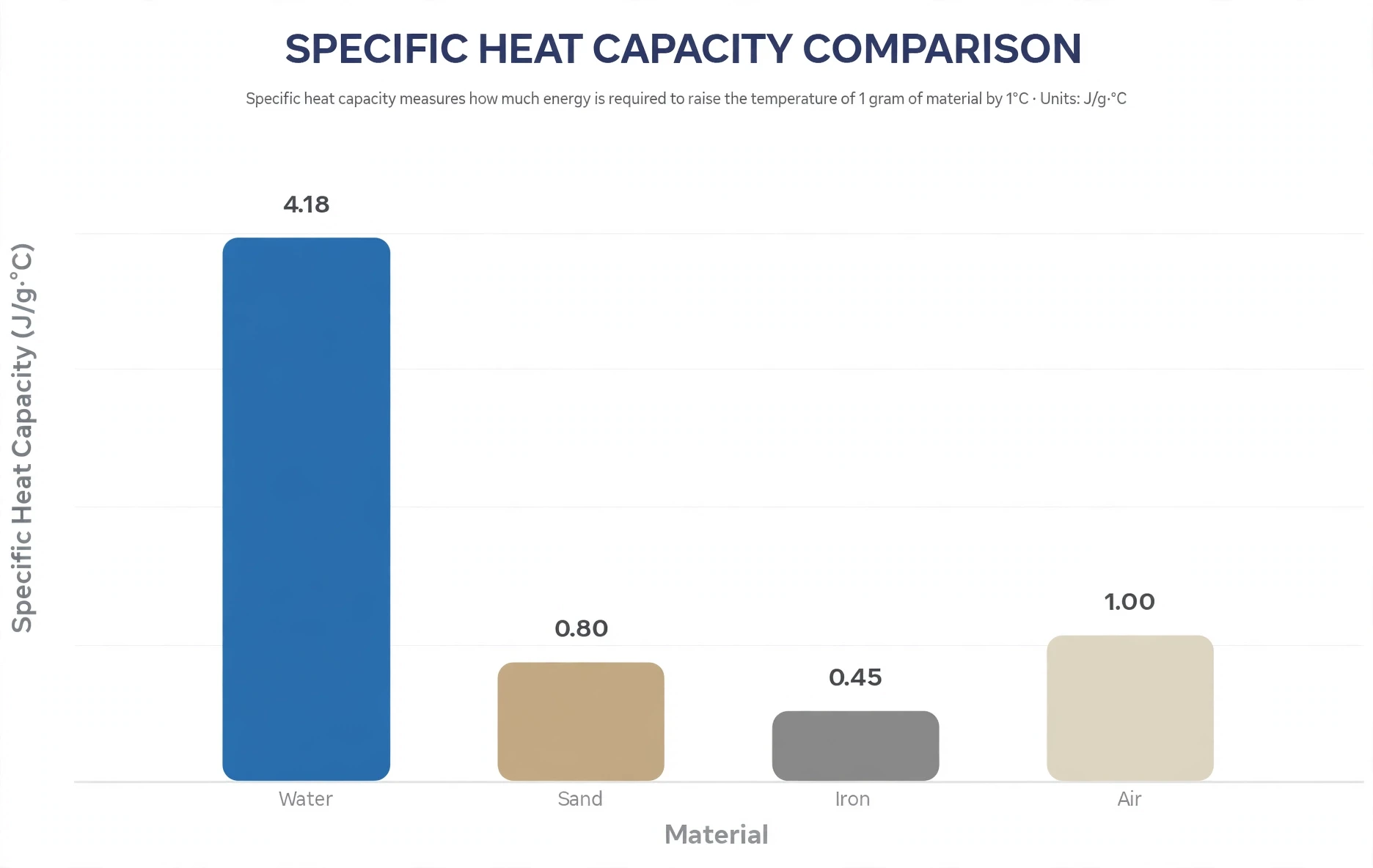
Substance | Specific heat capacity (J/g·°C) | What it means in practice |
|---|---|---|
Water | 4.184 | Heats and cools slowly; stabilises temperature |
Wet sand | ~0.8 | Beach sand scorches by midday, cools fast at night |
Iron | 0.45 | A pan heats in seconds — and burns just as fast |
Air | 1.0 | The atmosphere warms and cools quickly |
The table makes the point in numbers: water needs roughly four times as much energy as air, and nine times as much as iron, to warm by a single degree. That gap is the margin between a habitable planet and a furnace.
5. Sweat, Steam, and the Price of Evaporation
5.1 Heat of vaporization: the most expensive escape
Water's heat of vaporization — the energy needed to turn one gram of liquid water into vapour — is about 2,260 joules per gram, among the highest of any known substance. Evaporating water is expensive because every escaping molecule has to tear itself free of the hydrogen-bond network. That cost is exactly what makes evaporation such a powerful cooling system.
When you sweat, water spreads across your skin and evaporates, and each gram that leaves carries roughly 2,260 joules of heat away with it. Your body exploits this constantly: on a hot day you can lose more than a litre of sweat per hour, shedding heat that would otherwise cook you from the inside. Dogs pant for the same reason. So do the leaves of a tree, which cool themselves by transpiration — evaporation through tiny pores called stomata.
5.2 Why a pot of water boils but never gets hotter
Remember the thermometer that refused to climb past 100°C? That was the heat of vaporization at work. Once water reaches its boiling point, every extra joule of energy goes into breaking hydrogen bonds and freeing molecules as steam, not into raising the temperature. The water stays at 100°C until the last drop is gone. Cooks rely on this without thinking about it: simmering soup cannot burn hotter than boiling point, and steaming vegetables cook gently because the steam condenses and releases that same stored energy onto the food.
This also explains why steam burns are so much worse than hot-water burns at the same temperature. Steam carries all that hidden vaporisation energy, and it dumps it straight into your skin when it condenses.
6. The Solid That Floats: Water's Density Anomaly
6.1 The rule almost everything else follows
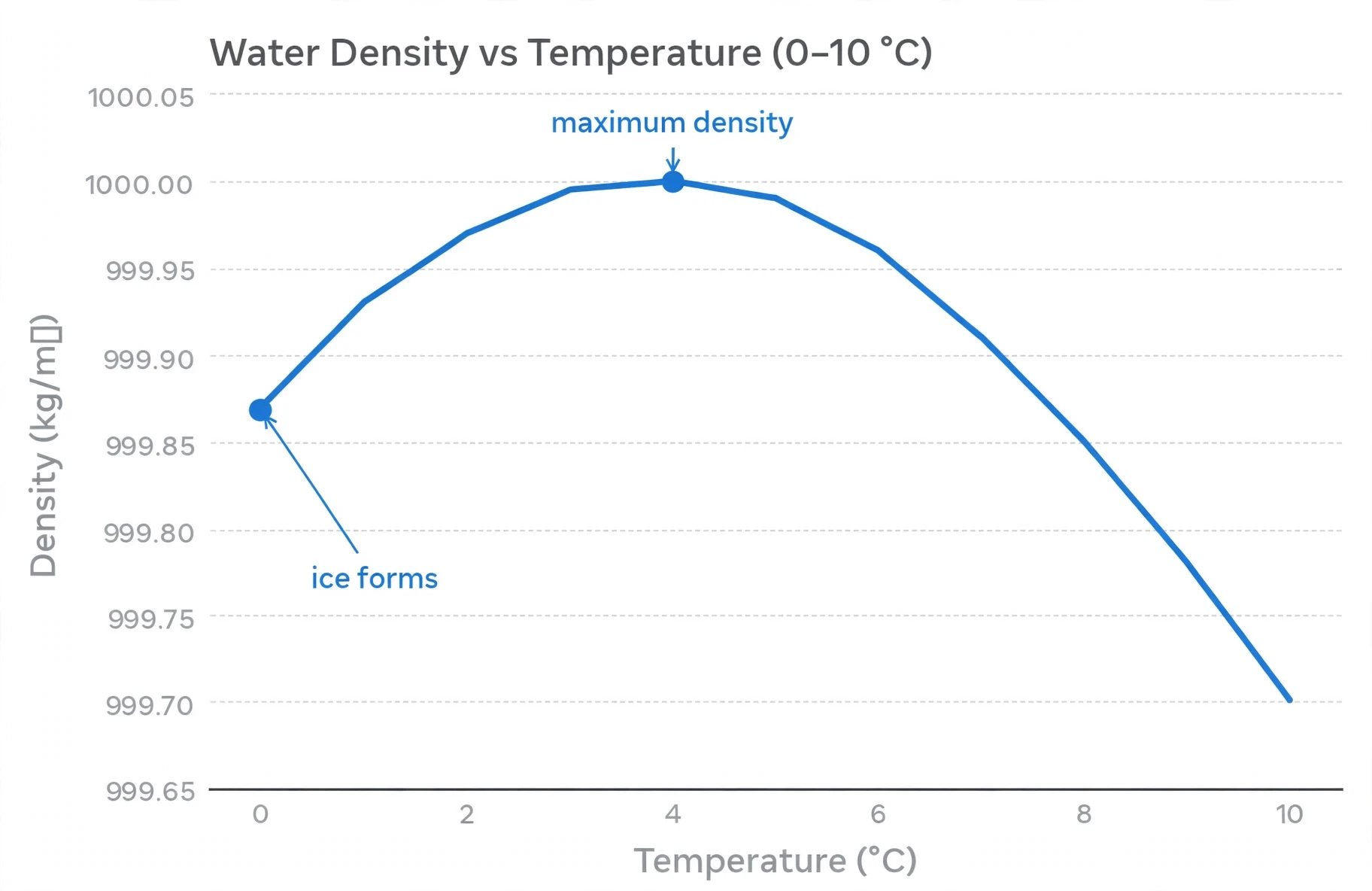
Cool almost any liquid and it gets denser. The molecules slow down, pack closer together, and eventually lock into a solid that is denser still — which is why a solid block of most substances sinks in its own melt. Water follows this rule down to 4°C. Then it breaks it.
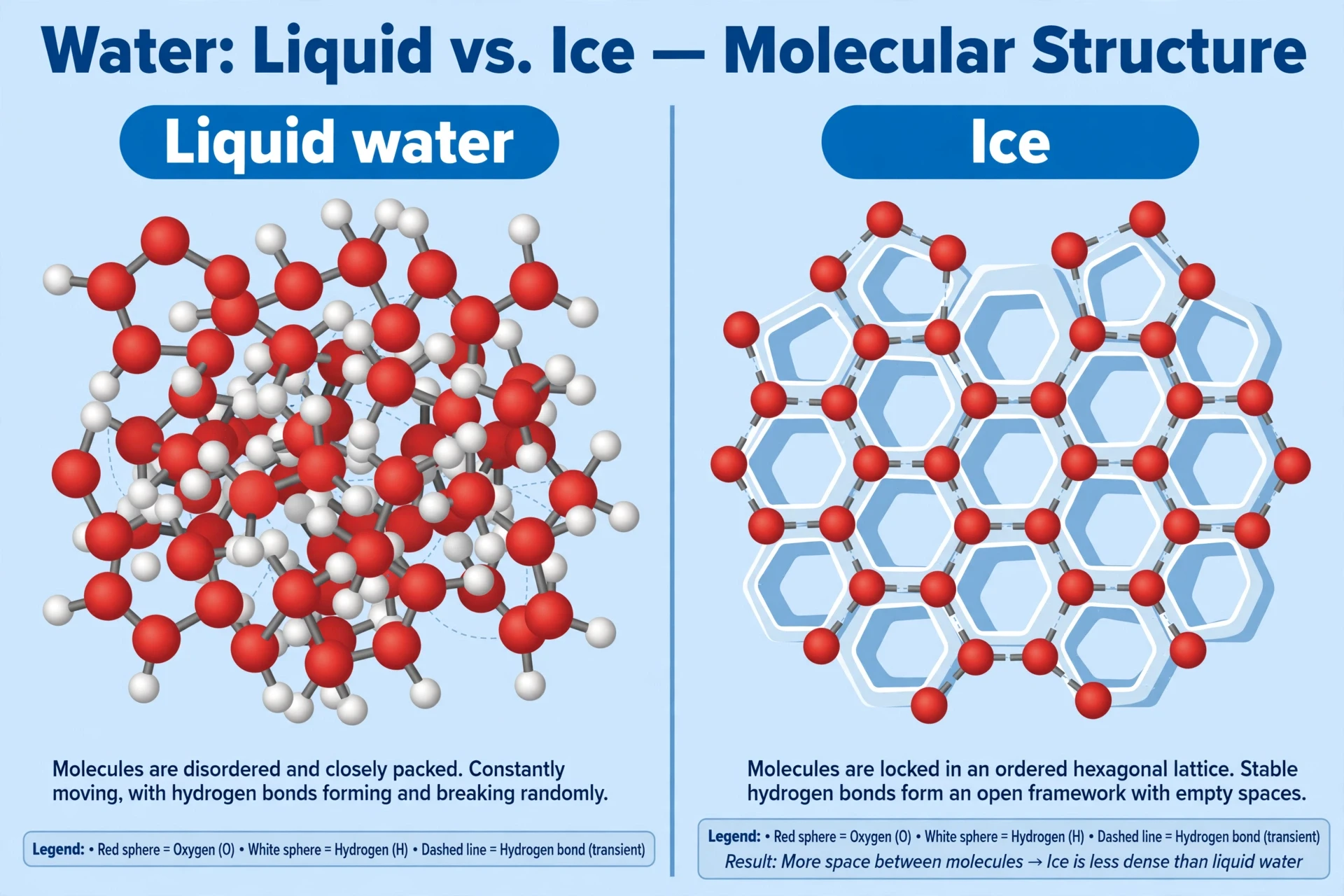
Below 4°C, water starts to expand again. By the time it freezes at 0°C, it has expanded by about 9 percent, and ice ends up about 9 percent less dense than liquid water — 0.92 grams per cubic centimetre against water's 1.0. So ice floats.
6.2 The open lattice of ice
The reason is hydrogen bonding, again, but this time in its most orderly form. In liquid water, hydrogen bonds break and reform constantly, letting molecules slide past each other and pack fairly tightly. In ice, the bonds lock into a rigid, open hexagonal lattice with a great deal of empty space between the molecules — like a scaffolding that holds everything apart. That empty space is what makes ice lighter than the water it came from.
6.3 Why a floating lid saves entire ecosystems
Think back to that frozen Minnesota lake. Because ice floats, it forms an insulating lid on the surface while the water beneath stays liquid at around 4°C — the temperature where water is densest, so the coldest water rises and the densest water sinks to the bottom. Fish, frogs, and microbes spend the winter in that dark, cold, but liquid refuge. Come spring, the ice melts from the top down and the lake wakes up.
Now imagine the alternative. If ice sank, lakes would freeze from the bottom up. Each winter, a little more ice would pile up on the lake bed, and in deep or cold enough lakes it would never fully melt. Over centuries, lakes and even oceans would freeze solid from the bottom, and aquatic life as we know it could never have evolved. The floating of ice is not a curiosity. It is one of the load-bearing facts of Earth's habitability, and it comes straight from the geometry of a hydrogen bond.
Geologists at Coastline College put it bluntly: if water behaved like other substances, the oceans would be frozen solid (LibreTexts, Properties of Water).
7. The Universal Solvent
7.1 How water pulls things apart
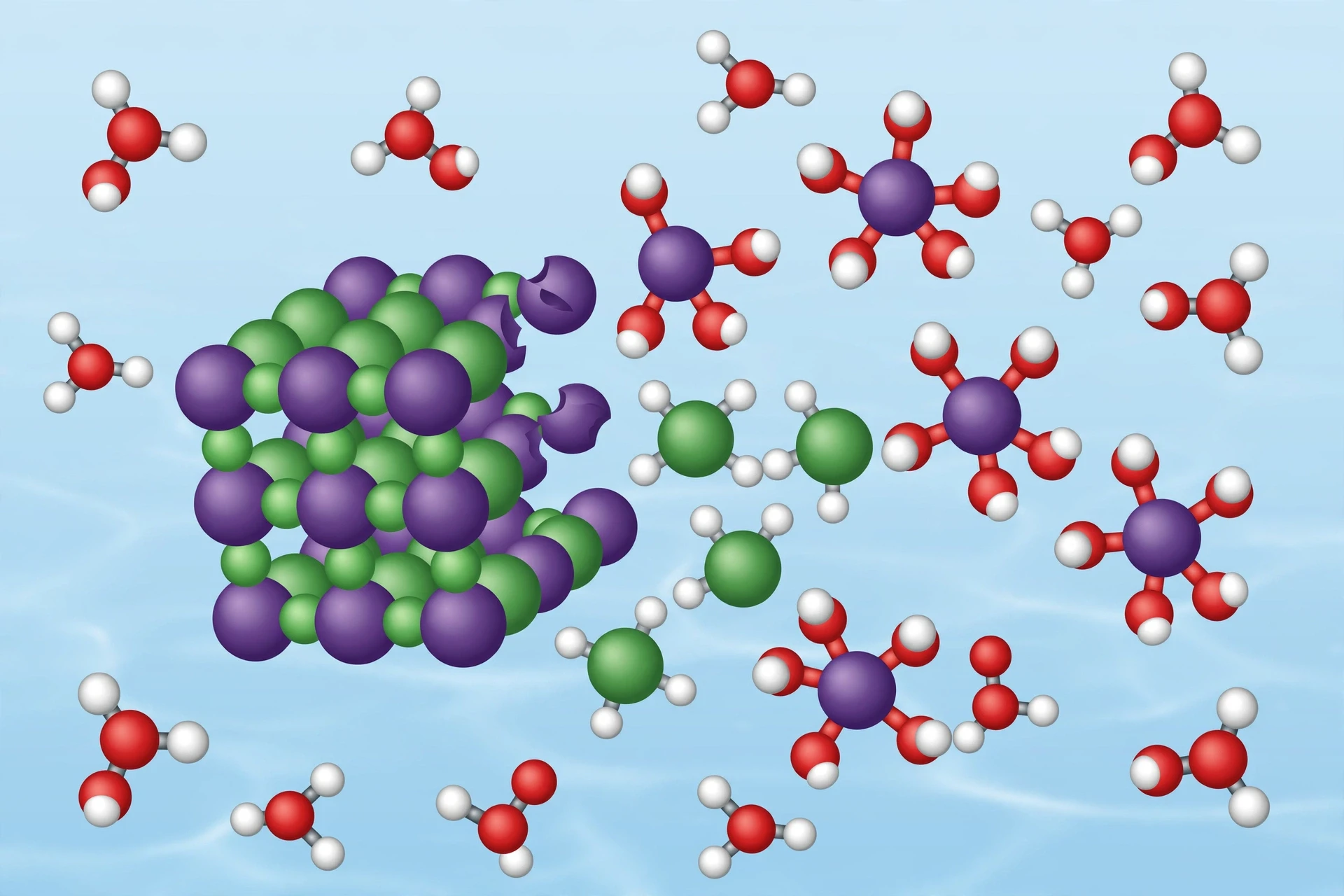
Drop a spoonful of salt into water and it vanishes. What is actually happening is a molecular mugging. Salt is a crystal of sodium ions (Na⁺) and chloride ions (Cl⁻) held together by electrical attraction. Water molecules, with their positive and negative ends, swarm the crystal: the negative oxygen ends surround the sodium ions, the positive hydrogen ends surround the chloride ions, and the ions are pried apart and wrapped in shells of water molecules called hydration shells. The crystal falls apart, ion by ion.
Water dissolves more substances than any other liquid, which is why chemists call it the universal solvent. It dissolves salts, sugars, gases like oxygen and carbon dioxide, and most of the polar molecules that biology runs on. That is not a small talent. It is the reason blood can carry nutrients, the reason your kidneys can filter waste, and the reason the oceans hold dissolved minerals that marine life depends on.
7.2 What water cannot dissolve — and why that matters too
Water's dissolving power has a limit, and the limit is just as important. Nonpolar substances — oils, fats, waxes — have no charge for water's poles to grab onto, so they do not dissolve. Oil and water famously refuse to mix. Your cell membranes exploit this: they are built from lipids that water cannot dissolve, forming a waterproof barrier that keeps the inside of a cell separate from the outside. If water dissolved everything, cells could not exist. Its selectivity is as vital as its power.
The same chemistry runs the reactions inside you. Most of the chemical reactions that keep you alive — breaking down food, building proteins, copying DNA — happen in water, and many of them directly use water as a reactant. Hydrolysis reactions split molecules apart using water; condensation reactions join molecules together and release water. To see how those reactions work in general, read our guide to chemical reactions.
8. Sticky Water: Cohesion, Adhesion, and Surface Tension
8.1 Cohesion: water sticking to itself
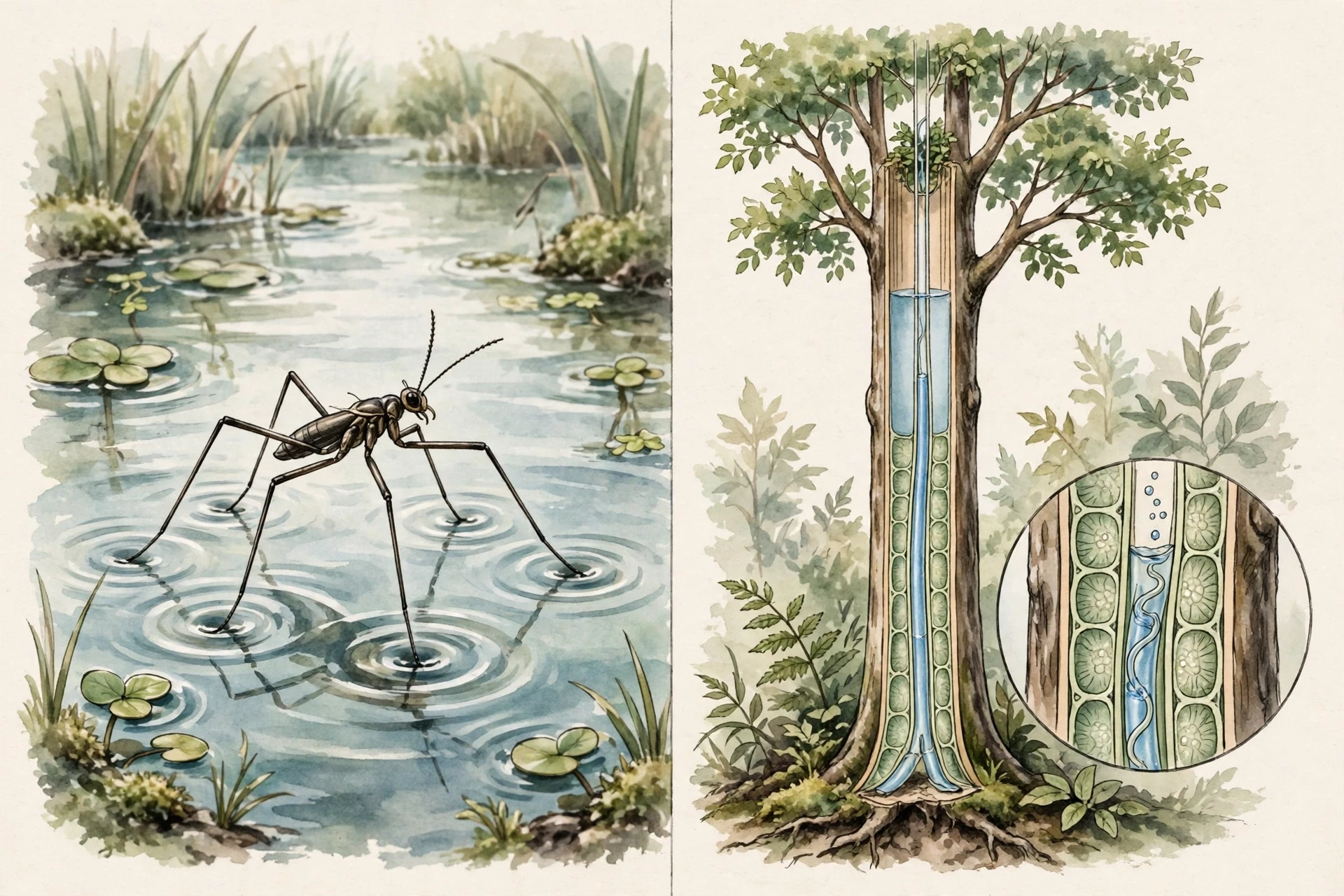
Cohesion is the attraction between water molecules themselves — hydrogen bonding, wearing a different name. It is why water forms droplets instead of spreading into a thin film, why a glass can be filled slightly above the brim without spilling, and why a paperclip can float on the surface of a glass of water even though steel is far denser than water.
That floating paperclip is a classic demonstration, and the first time I tried it in front of a class, I dropped the clip straight through the surface three times before getting it right. The trick is to lower it gently, on a small piece of tissue paper that then sinks away. The water's surface behaves like a stretched elastic skin because the molecules at the surface have no neighbours above them — they can only bond sideways and downwards, pulling inward and creating surface tension. Water's surface tension is higher than that of almost any other common liquid except mercury.
8.2 Adhesion and the climb up a tree
Adhesion is water's attraction to other substances — to glass, to soil, to the walls of a plant's vessels. Put a thin glass tube in water and the water climbs up the inside of the tube, higher than the surrounding surface. This is capillary action: adhesion pulls the water up the walls while cohesion holds the column together.
A redwood tree can be more than a hundred metres tall, and it has no pump. Water rises from its roots to its topmost leaves through a combination of capillary action in narrow vessels and the pull of evaporation from the leaves — a column of water held together by cohesion, hauled upward by adhesion and transpiration. It is one of the most impressive plumbing feats in nature, and it runs entirely on water's stickiness. The USGS notes that surface tension performs duties "vitally important to the environment and people," far beyond party tricks like floating paperclips (USGS Water Science School, Water Properties).
9. Water Inside You — and Inside Every Living Thing
9.1 The 60-percent solution
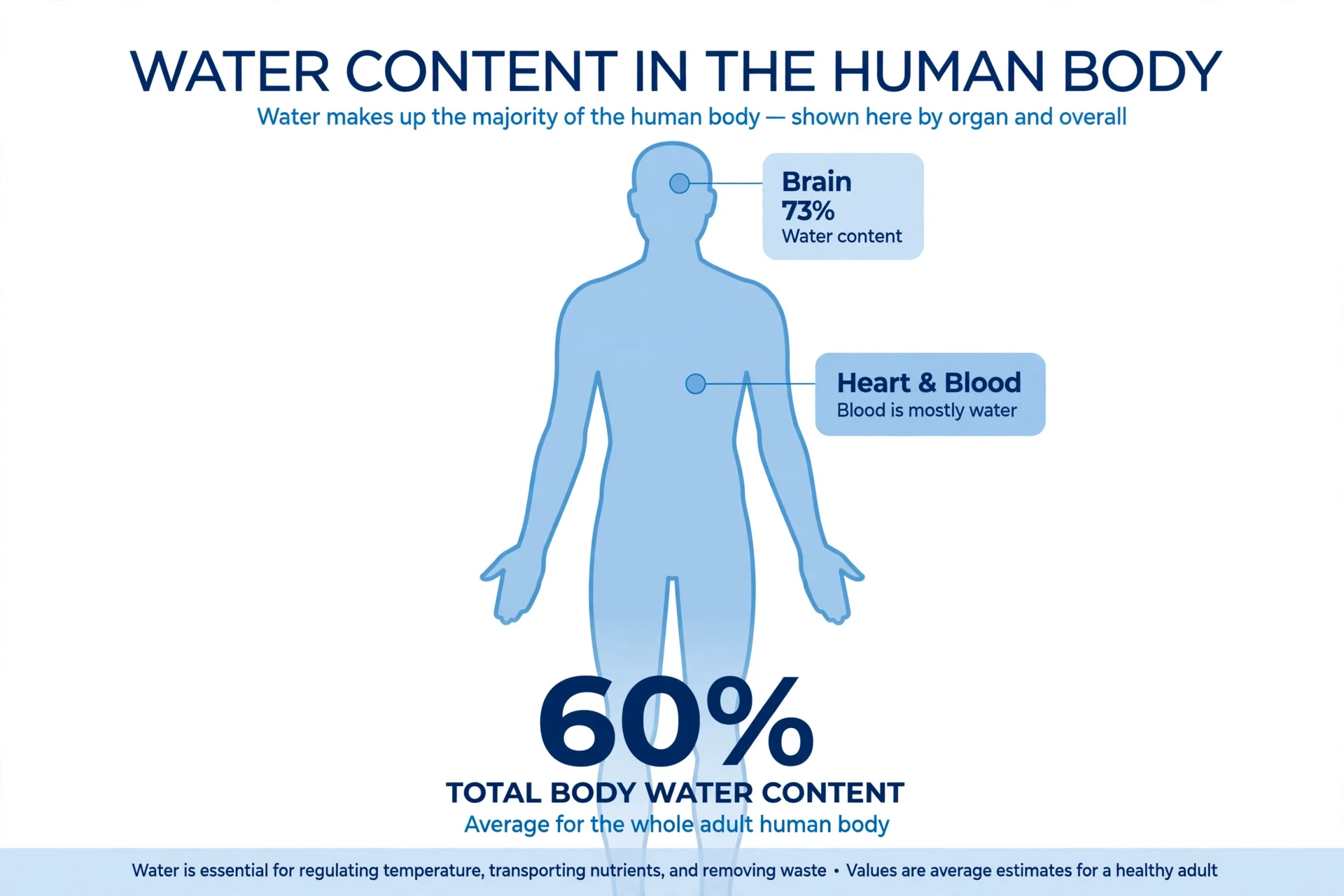
An adult human body is about 60 percent water by mass. Your brain is about 73 percent water. Your blood is about 83 percent water. Every cell is essentially a tiny bag of water with machinery floating in it. That is not a coincidence. Life on Earth began in water, and it never left — it just learned to carry its ocean around inside itself.
Inside a cell, water is far more than a passive filler. It is the medium in which molecules meet and react, the transport system that moves nutrients in and waste out, and a temperature buffer that keeps the delicate chemistry of life within a narrow range. Enzymes, the protein machines that run your metabolism, only work properly when they are surrounded by water in the right arrangement. Dry an enzyme out completely and it stops working; add water back and, in many cases, it restarts. Water is not just the stage for biochemistry — it is part of the cast.
9.2 Water in photosynthesis and the food chain
Water is also a raw material for life's most important chemical reaction. In photosynthesis, plants split water molecules to release the electrons they need to build sugars from carbon dioxide, giving off oxygen as a by-product. The oxygen you are breathing right now was, not long ago, part of a water molecule in a leaf. For the full story of that process, see our article on photosynthesis.
10. Water, Climate, and the Whole Planet
10.1 The ocean as thermostat
Zoom out from a single molecule to the whole planet and water's strangeness becomes climate. The oceans absorb heat, move it around through currents, and release it slowly — a planetary thermostat built from hydrogen bonds. NASA's ocean research shows the top few metres of the ocean hold as much heat as the entire atmosphere, and ocean currents distribute that heat from the equator toward the poles, softening winters in places like western Europe far beyond what latitude alone would predict (NASA, How Are Earth's Ocean and Climate Connected?).
The same heat capacity creates a time lag that matters for our future: the oceans are still absorbing heat from greenhouse gases emitted decades ago, which means some warming is already locked in even if emissions stopped tomorrow. Water's slowness to change temperature is a gift — it has buffered us against rapid change — and also a warning, because the heat it stores does not disappear.
10.2 The water cycle, briefly
Water is constantly moving between ocean, air, and land — evaporating, condensing into clouds, falling as rain, and flowing back to the sea. That journey, the water cycle, is driven almost entirely by the properties described in this article: the heat of vaporisation that lets the sun lift water into the sky, the surface tension and adhesion that pull it through soil and plants, and the density anomaly that keeps winter lakes liquid underneath. This article has focused on the molecule itself; for the full journey of water around the planet, read our companion article on the water cycle.
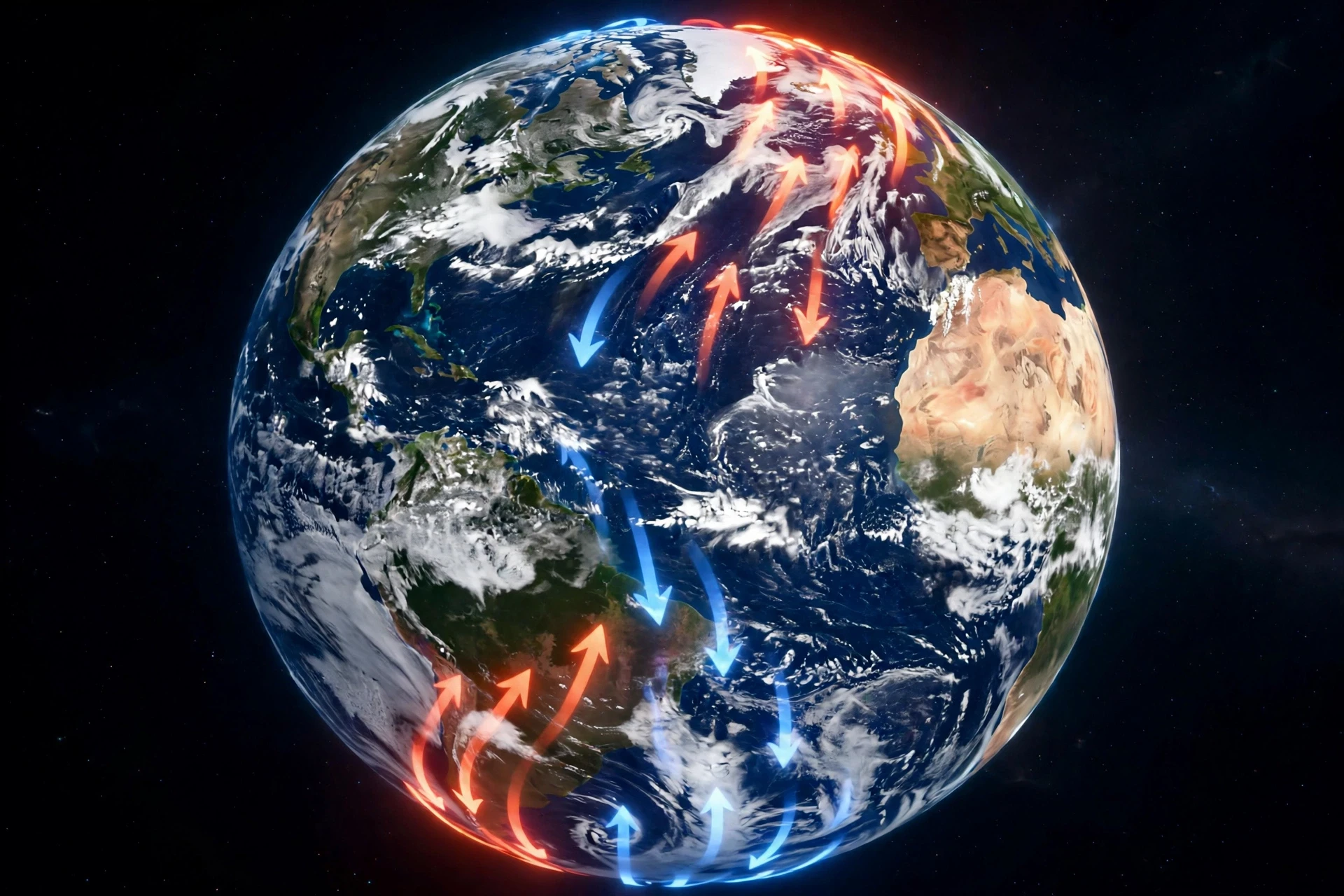
Ocean water also deserves a closer look: its currents, depth zones, and ecosystems are covered in our guide to oceanography.
11. What Most People Get Wrong About Water
Water is familiar, so people assume it is simple. A few common mistakes keep showing up, and they are worth correcting.
"Water is just H₂O — a simple molecule." Simple formula, yes. Simple behaviour, no. Water's properties are so anomalous that chemists still argue about the fine details of its structure — how many hydrogen bonds a typical molecule forms at any instant, and how the network rearranges as temperature changes. The formula fits on a fingernail; the physics fills textbooks.
"Ice floats because it is colder." Temperature is not the cause. Ice floats because freezing locks water into an open crystal lattice that takes up more space than the same molecules do as a liquid. Cold alone does not make things float — most frozen liquids sink.
"Water is a universal solvent, so it dissolves everything." It dissolves a remarkable range of polar and ionic substances, but nonpolar oils, fats, and waxes are untouched. That limit is what makes cell membranes possible.
"Pure water is the best thing to drink after exercise." For ordinary hydration, yes. But after very heavy sweating, plain water alone can dilute the salts in your blood faster than you replace them. Sports drinks exist for a reason: they replace electrolytes as well as water. Water is essential; it is not a magic potion.
12. What Researchers Are Still Learning
Water looks like a solved problem, but it keeps surprising researchers. In recent years, high-pressure experiments have confirmed exotic forms of ice — including "superionic ice," in which oxygen atoms lock into a crystal while hydrogen ions flow through it like a fluid — a state that may exist deep inside Neptune and Uranus. Space telescopes have detected water vapour in the atmospheres of distant exoplanets, and NASA missions continue to map water ice hidden in the permanently shadowed craters of the Moon, where it may one day support human outposts.
Closer to home, researchers are still debating the details of liquid water's structure: whether it is best described as a single shifting network or as a flickering mixture of two different local arrangements. The debate matters because it affects models of everything from protein folding to climate. After more than a century of study, the most common liquid on Earth still has open questions. That is not a failure of science. It is a measure of how deep this particular rabbit hole goes.
13. Why It All Matters
Step back and the picture is striking. A single molecular quirk — a bent shape, an uneven share of electrons — produces hydrogen bonding. Hydrogen bonding produces high heat capacity, floating ice, surface tension, and a solvent that can carry the chemistry of life. Those properties, scaled up, produce stable bodies, liquid oceans, mild climates, and a planet where life could start and persist for billions of years.
Change one detail and the story collapses. Make water's bonds a little stronger and it would be a solid at room temperature. Make them a little weaker and it would be a gas, boiling away into space. Make ice sink and the oceans would freeze from the bottom up. The habitable Earth we live on is balanced on a narrow set of molecular facts, and water sits at the centre of every one of them.
The next time you watch ice cubes bob in a glass, or feel sweat cool your skin, or see a water strider dimple the surface of a pond without breaking through, you are watching the same molecule do the same quiet trick it has been doing for four billion years: being just strange enough to make life possible.
Frequently Asked Questions
Why is water called the universal solvent?
Because it dissolves more substances than any other liquid. Water is polar, so its charged ends attract and surround ions and polar molecules, pulling them apart into hydration shells. It does not dissolve nonpolar substances like oils, so "universal" is a nickname, not a literal fact.
Why does ice float on water?
Ice is about 9% less dense than liquid water. When water freezes, hydrogen bonds lock the molecules into an open hexagonal crystal lattice with more empty space between them than in the liquid, so the same mass takes up more volume and floats.
What is a hydrogen bond in water?
A hydrogen bond is the weak attraction between the slightly positive hydrogen atom of one water molecule and the slightly negative oxygen atom of a neighbouring molecule. Each bond is about twenty times weaker than a covalent bond and lasts only a fraction of a second, but each molecule can form up to four at once, and their combined effect explains most of water's unusual properties.
Why does water have such a high specific heat capacity?
Heating water means breaking hydrogen bonds before the molecules can move faster. Much of the added energy goes into loosening the bond network rather than raising the temperature, so water needs 4.184 joules per gram per degree Celsius — far more than sand, iron, or air.
How does water help regulate Earth's climate?
The oceans absorb enormous amounts of heat without warming much, then release it slowly and move it around the planet through currents. The top few metres of the ocean store as much heat as the entire atmosphere, which softens coastal climates and slows the pace of global warming.
Why does water climb up a plant stem?
Through capillary action and transpiration pull. Adhesion draws water up the narrow vessels of the plant, cohesion holds the water column together, and evaporation from the leaves pulls the column upward — no pump required.
What percentage of the human body is water?
About 60% for an average adult, though it varies by tissue: the brain is roughly 73% water and blood is roughly 83%. Water is the medium for nearly every chemical reaction in the body.
Can water exist as a solid, liquid, and gas on Earth at the same time?
Yes — water is the only substance that naturally exists in all three states under Earth's normal range of temperatures and pressures: ice, liquid water, and water vapour are all common.
Why does sweat cool you down?
Evaporating water carries away a large amount of heat — about 2,260 joules per gram. When sweat evaporates from your skin, that energy leaves with it, lowering your skin temperature. This is why humid days feel hotter: sweat evaporates more slowly when the air is already full of moisture.
Is there water on other planets?
Yes. Water ice has been found on the Moon and Mars, liquid water is thought to exist beneath the icy shells of moons like Europa and Enceladus, and water vapour has been detected in the atmospheres of distant exoplanets. That is one reason the search for life elsewhere in the universe is, to a large extent, a search for water.
Sources
U.S. Geological Survey, Water Science School — Water Properties: https://www.usgs.gov/special-topics/water-science-school/science/water-properties
NASA Earth Observatory — Earth's Big Heat Bucket: https://science.nasa.gov/earth/earth-observatory/earths-big-heat-bucket/
NASA Science — How Are Earth's Ocean and Climate Connected?: https://science.nasa.gov/kids/earth/how-are-earths-ocean-and-climate-connected/
OpenStax, Biology 2e — 2.2 Water: https://openstax.org/books/biology-2e/pages/2-2-water
LibreTexts, Geosciences — 10.1 Properties of Water: https://geo.libretexts.org/Courses/Coastline_College/An_Introduction_To_Geology_(Ruppert)/10%3A_Water/10.01%3A_Properties_of_Water