

I was seven years old, lying on my back in a field behind my grandparents' house, when I asked the question out loud for the first time. The grass was damp, the clouds were drifting like slow ships, and the sky above me was so blue it almost hurt to look at. "Why is the sky blue?" Nobody around me had a good answer. My grandfather said it was the ocean, reflected upward. My teacher, a week later, said it was simply "the color of air." Both answers sounded reasonable. Both were wrong.
That question has followed me ever since, through physics lectures, through long nights in a laboratory, and through more sunsets than I can count. It turns out to be one of the best questions in all of science, because answering it honestly forces you to understand light, air, color, and even how your own eyes work. The answer also explains sunsets, the white of clouds, and the arc of a rainbow. One question, one chain of physics, and half the sky makes sense.
Why is the sky blue? The short answer is that sunlight is a mixture of all the colors of the rainbow, and the tiny molecules of air scatter the short blue wavelengths far more strongly than the long red ones. That scattered blue light reaches your eyes from every direction, so the whole dome of the sky glows blue. The effect is called Rayleigh scattering, after the British physicist Lord Rayleigh, who worked out its mathematics in 1871.
But the short answer leaves out the best parts: why the sky is blue instead of violet, why it turns red at sunset, why clouds stay white against it, and why a rainbow appears only when the Sun is at your back. This article follows that chain, step by step, with the people who figured it out along the way.
1. Sunlight Is Not One Color
1.1 The white light that hides a rainbow
Sunlight looks white. It looks white on a sheet of paper, white on a white wall, white on snow. Yet that whiteness is a trick of mixing. White light is every color of the visible spectrum arriving together, and your eye blends the mixture into white.
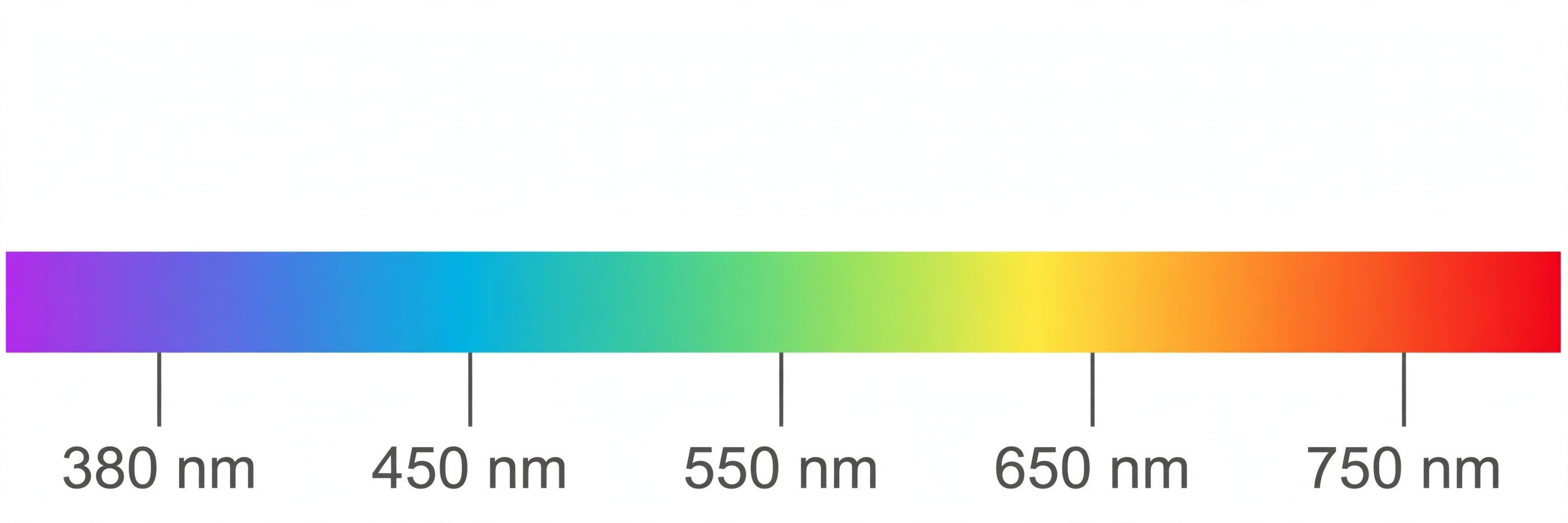
The visible spectrum runs from violet light, with a wavelength of about 380 to 450 nanometers, through blue, green, yellow, and orange, to red light at roughly 620 to 750 nanometers. A nanometer is a billionth of a meter. These are astonishingly small distances, yet the difference between them decides the color of the entire sky.
1.2 What a prism proves
The first time I watched a prism split sunlight, I was standing at the back of a crowded school laboratory, craning my neck over taller students. The teacher held a glass triangle up to a shaft of afternoon sun, and a band of color spilled across the white wall: red, orange, yellow, green, blue, indigo, violet. I remember thinking the glass must be painting the wall. It was not. The glass was sorting what was already there.
Isaac Newton performed that same experiment carefully in the 1660s and 1670s, and his conclusion was startling for its time. The prism does not create color. It bends each wavelength by a slightly different amount — violet the most, red the least — and the colors fan out because they were already mixed together in the beam. He proved it by passing the spread-out colors through a second prism and recombining them into white light again. Sunlight, Newton showed, is a rainbow folded into white.
That same sorting happens in the sky every time it rains, except the prism is replaced by millions of falling raindrops. We will come back to that in section 8, because the rainbow is the same physics wearing different clothes.
Keep one fact in mind as we go: in the physics of light, color is wavelength. Red light has long, lazy waves. Blue light has short, tight waves. And the length of the wave decides what the air does to it.
2. The Air Above Us: A Thin, Busy Ocean of Gas
We live at the bottom of an ocean of air about 100 kilometers deep, though most of its mass sits in the lowest 10 kilometers. The air is mostly nitrogen, about 78 percent, and oxygen, about 21 percent, with argon and trace gases making up the rest. None of these gases has any color of its own. A jar of clean air looks perfectly clear, and a lungful of it is invisible.
That invisibility is the first clue that the blue of the sky is not a property of the air itself, like the blue of a dye. It is a property of what light does while passing through the air. A short path through air — the jar on your desk — is far too short for the effect to show. But sunlight crossing tens of kilometers of atmosphere meets an enormous number of molecules, and the tiny effect of each one adds up to a sky full of color.
The molecules are far smaller than the wavelength of visible light. A nitrogen molecule is roughly 0.3 nanometers across; visible light waves are 400 to 700 nanometers long. That size difference is the whole story. When light meets something much smaller than its own wavelength, it is scattered — knocked off its straight path and sent in a new direction. And the shorter the wavelength, the harder it is knocked.
The atmosphere also holds bigger things: dust, smoke, salt crystals, pollen, and water droplets. Those particles are closer to the wavelength of light in size, or larger, and they scatter light in a different way. They matter too, and they explain clouds, haze, and the milky whiteness of a humid afternoon. We will meet them in section 7.
For a sense of scale, the same atmosphere that paints our sky is also the subject of weather science. If you want to see how this thin shell of gas drives storms, seasons, and forecasts, our guide to meteorology follows the air's motion rather than its color.
3. Rayleigh Scattering: The Short Answer in Full
3.1 The one-over-wavelength-to-the-fourth rule
Lord Rayleigh's great insight, published in 1871, was that the scattering is not random. Its strength follows a precise rule: the intensity of scattered light is inversely proportional to the fourth power of the wavelength. In symbols, scattered intensity is proportional to 1/λ⁴.
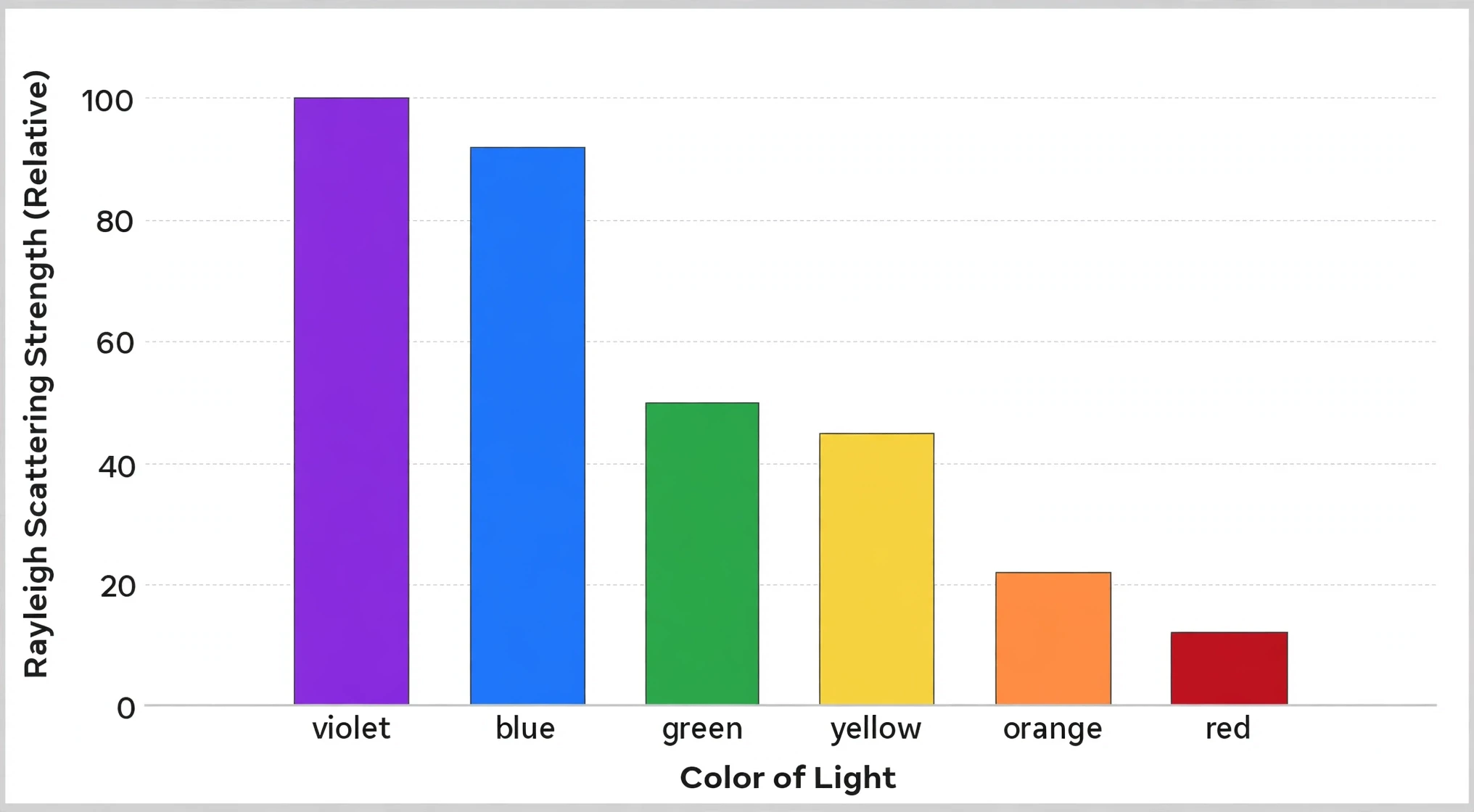
That little superscript four is doing enormous work. It means that halving the wavelength multiplies the scattering sixteen times over. Blue light at about 450 nanometers is scattered roughly 5.9 times more strongly than red light at about 700 nanometers, and violet light at 400 nanometers is scattered about 9.4 times more than red. The table below shows the comparison.
Color | Wavelength (approx.) | Scattering strength vs. red light |
|---|---|---|
Violet | 400 nm | ~9.4× |
Blue | 450 nm | ~5.9× |
Green | 550 nm | ~2.6× |
Yellow | 580 nm | ~2.1× |
Orange | 620 nm | ~1.6× |
Red | 700 nm | 1.0× (reference) |
The numbers come straight from the 1/λ⁴ law: take the ratio of the wavelengths, raise it to the fourth power, and you get the scattering ratio. No other ingredient is needed.
3.2 What actually happens to the light
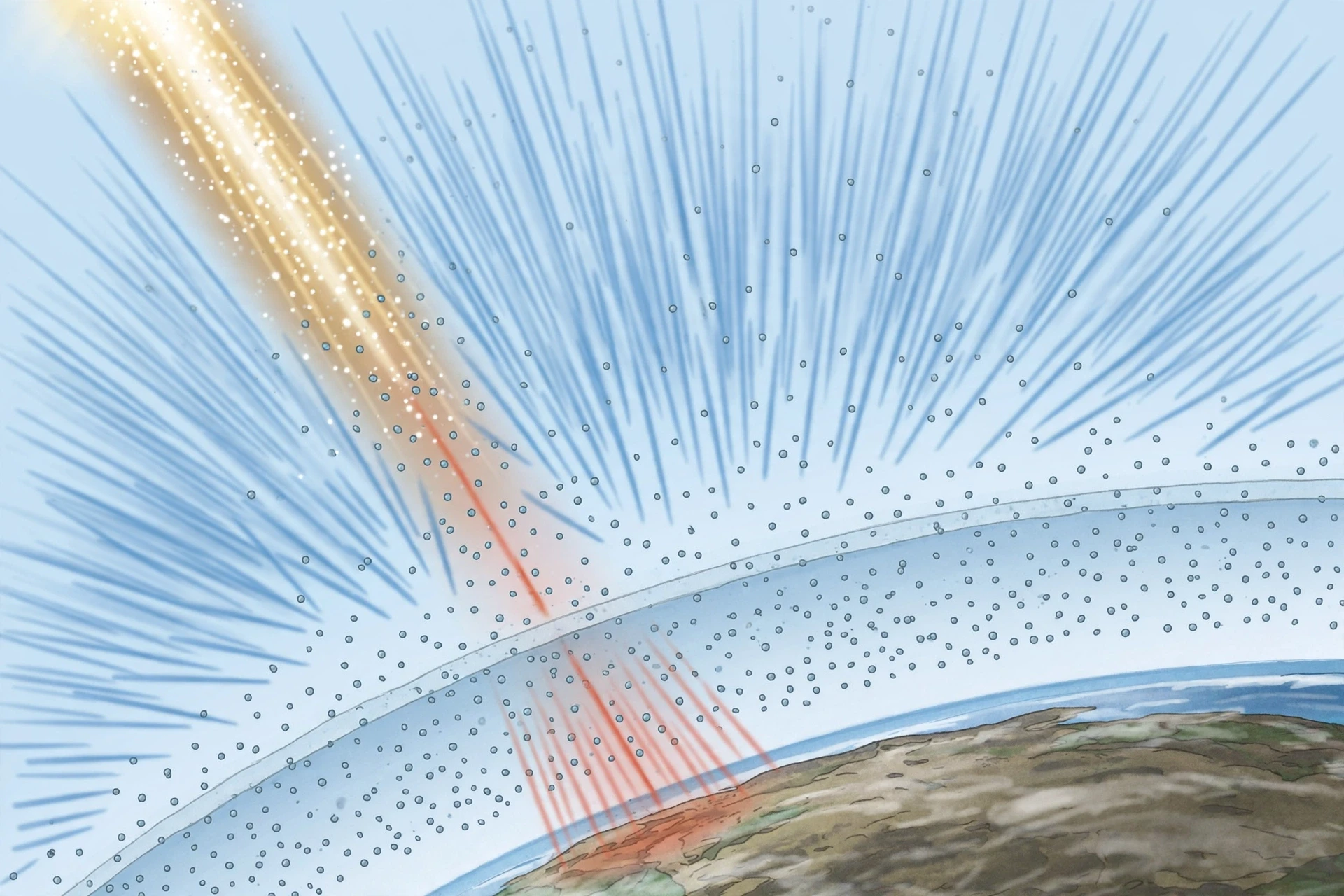
Picture a single sunbeam diving into the atmosphere. Most of its red, orange, and yellow light sails straight through, barely disturbed, and reaches the ground. Its blue and violet light, though, keeps colliding with air molecules and bouncing off in new directions — sideways, upward, downward, everywhere. Some of that scattered blue light eventually reaches your eye, not from the Sun's direction, but from whatever patch of sky you happen to be looking at.
So when you look up on a clear day, you are not seeing the Sun's light directly. You are seeing sunlight that has been detoured by the air and sent to you from all over the sky. The sky is blue because blue is the color the air scatters most effectively toward you.
NASA's atmospheric radiation lecture puts it plainly: the blue-violet end of the visible spectrum is Rayleigh-scattered more strongly than the red-orange end, and that is why the sky appears blue — while on the Moon, which has no atmosphere to scatter sunlight, astronauts see a black sky even in full daylight (NASA Goddard Space Flight Center).
3.3 The man who solved it: Lord Rayleigh
John William Strutt, the third Baron Rayleigh, was born in 1842 in Essex, England. He was a sickly child whose schooling at Eton and Harrow was repeatedly interrupted by poor health. He came to science sideways, through mathematics at Trinity College, Cambridge, where he graduated as Senior Wrangler — the top mathematics student of his year — in 1865.
Rayleigh did much of his best work not in a grand university laboratory but in a small laboratory he built on his family estate at Terling, using cheap, simple equipment. His biographers note that he got remarkable results with unsophisticated instruments, economizing wherever he could. In 1871, the same year he married Evelyn Balfour, he published his theory of scattering by small particles. The University of St Andrews' history of mathematics archive records it plainly: Rayleigh's theory of scattering, published in 1871, was the first correct explanation of why the sky is blue (MacTutor, University of St Andrews).
He went on to far greater fame — the discovery of argon in 1895, which earned him the Nobel Prize in Physics in 1904 — but the blue-sky paper came first, when he was 28 years old and working largely alone. It is a useful reminder that a question a seven-year-old asks in a field can take the best mind of a generation to answer properly.
Before Rayleigh, several explanations had been tried. Some scientists blamed dust in the air; others suggested the sky reflected the blue of the sea. Rayleigh's mathematics showed that clean air alone, with no dust and no ocean, would still make a blue sky. Dust can change the shade, but it is not the cause.
4. Why Blue and Not Violet?
Here is the puzzle that catches almost everyone. If shorter wavelengths scatter more strongly, and violet light has the shortest wavelength of all, why is the sky not violet? The physics, taken alone, says violet should win. Three things stop it.
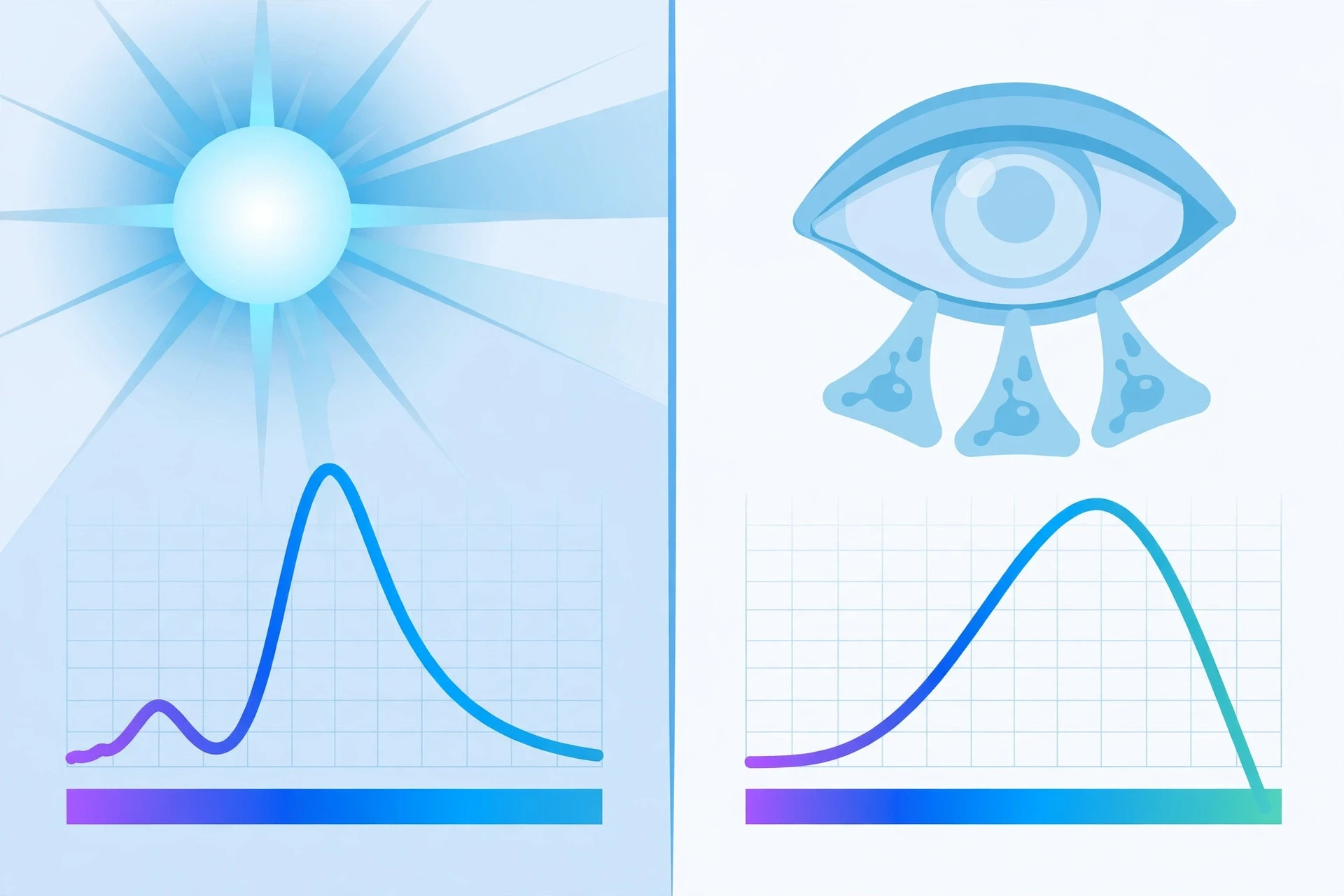
First, the Sun sends us less violet light than blue light. The Sun's output peaks in the blue-green part of the spectrum and falls off toward the violet end. There is simply less violet to scatter in the first place.
Second, some violet light is absorbed high in the atmosphere. Ozone and oxygen in the upper atmosphere soak up much of the shortest-wavelength light before it reaches the lower air where most scattering happens. The National Oceanic and Atmospheric Administration notes that much of the short violet light scatters very high in the atmosphere, where it is not readily seen, while blue light scatters lower down, where our eyes can catch it (NOAA).
Third, your eyes are poor violet detectors. The human retina has three types of cone cells for color vision, and their sensitivity falls off sharply in the violet. Your blue-sensitive cones respond to blue light far more vigorously than to true violet. On top of that, the scattered light reaching you is a mixture — blue plus violet plus a little of every other color — and your brain interprets that particular mixture as sky blue.
Most people assume the sky's color is decided entirely by physics in the air. What we actually see in the data is a three-way partnership: the Sun's spectrum, the atmosphere's scattering, and the biology of the human eye. Change any one of the three and the sky would look different. That is why the question "why is the sky blue?" is really three questions wearing one coat.
5. Why the Sky Changes Color Through the Day
5.1 Noon: deep blue overhead, pale at the horizon
Stand outside at noon on a clear day and look straight up. The sky overhead is a deep, rich blue. Now lower your gaze toward the horizon. The blue fades to a pale, washed-out whitish blue. The same sky, two different colors — and the reason is the length of the path the light has travelled.
Looking straight up, you are looking through the thinnest slice of atmosphere, roughly 10 kilometers of dense air. Looking toward the horizon, you are looking through a much longer, slanting slice — tens of kilometers of air, with more molecules, more dust, and more haze along the way. That long path scatters more light of all colors toward you, and the extra scattered light from dust and haze — which scatters all wavelengths more evenly — washes the blue out toward white.
I noticed this properly for the first time on a mountain hike, above a sea of cloud. The sky directly overhead was a blue I had never seen from the ground, almost violet at the edges, because there was so little air above me left to scatter anything. It was the same sky, seen through less of itself.
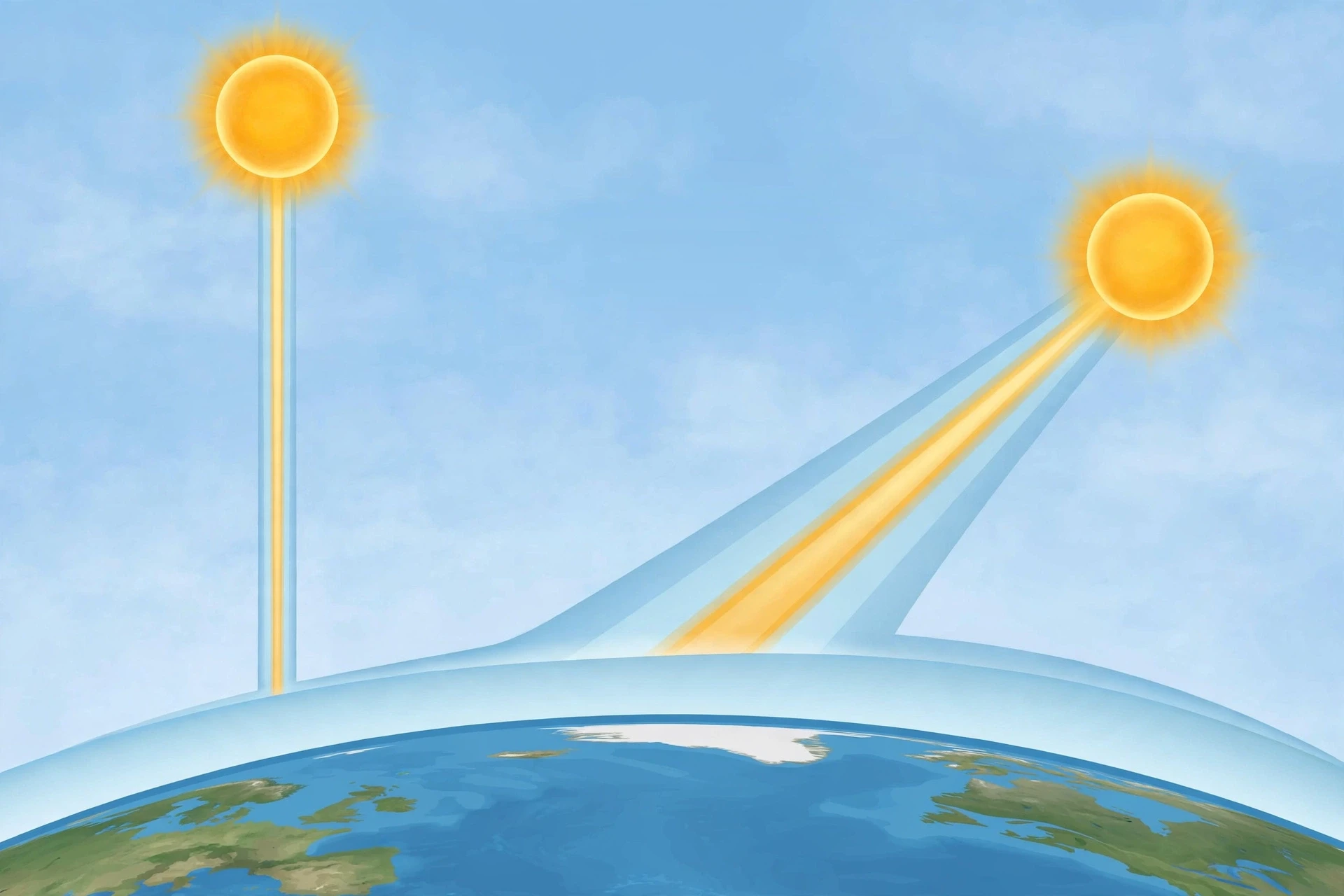
5.2 Sunset: the long road through air
Sunset is the same physics with the volume turned up. When the Sun sits low on the horizon, its light must cross a far longer stretch of atmosphere to reach you — up to roughly 30 to 40 times more air than at noon. Along that marathon journey, almost all of the blue and violet light is scattered away sideways, long before it arrives. What survives the trip is the light that scatters least: yellow, orange, and red.
So the Sun itself looks red at sunset not because the Sun has changed — it has not, and its distance from you has barely changed either — but because the blue has been removed from its beam on the way to your eyes. The clouds catch that leftover red and orange light and glow with it, which is why sunset clouds can look like they are on fire.
Dust, smoke, and tiny droplets in the lower air deepen the effect. That is why sunsets after a wildfire or a large volcanic eruption can look unusually fierce: extra particles in the air scatter away even more blue light and paint the sky in deeper reds. The eruption of Krakatau in 1883 famously produced vivid red sunsets around the world for months, and artists of the time — including Edvard Munch, whose blood-red sky in The Scream may owe something to those volcanic sunsets — recorded the strange light.
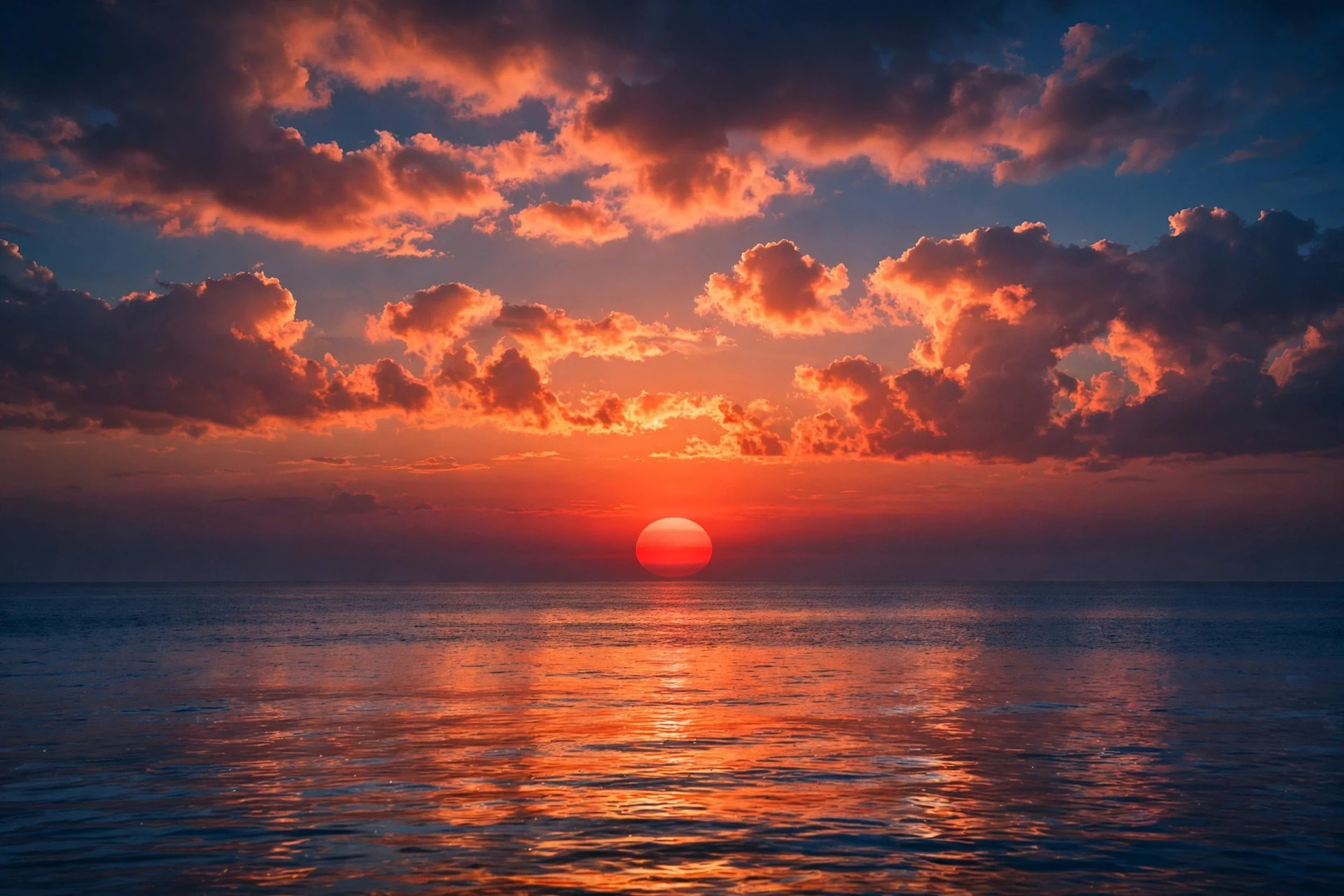
The same explanation covers sunrise, which is simply a sunset in reverse: the Sun's light is again crossing a long, low path through the air. Sunrise colors are often a little less vivid than sunset colors, because the overnight air has had hours to settle and holds less dust and haze than the air at the end of a busy day.
6. Why Clouds Are White and Haze Turns the Sky Milky
If air molecules scatter blue light best, why are clouds white? The answer is that cloud droplets play by different rules.
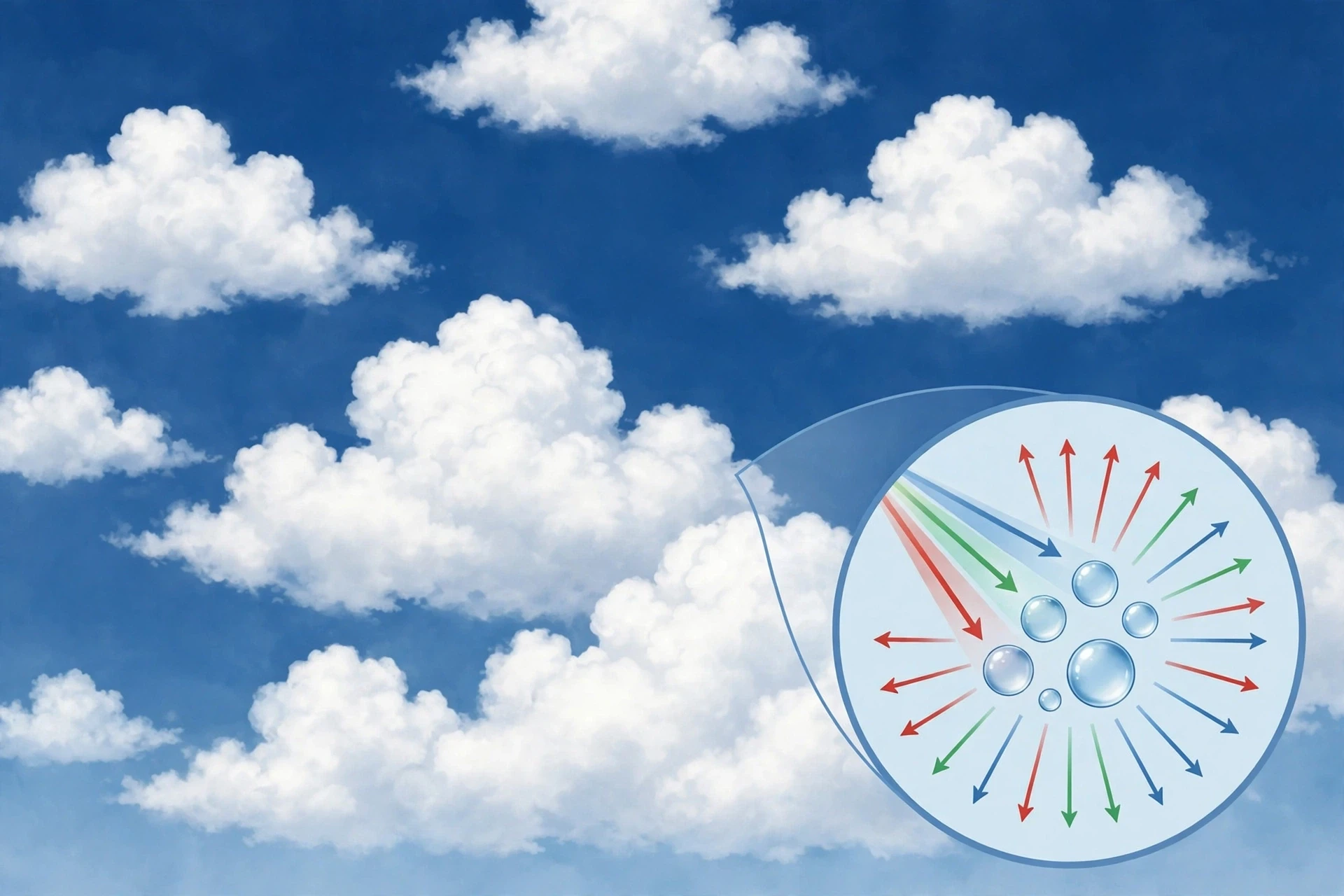
A cloud is made of water droplets and ice crystals that are roughly the same size as the wavelength of visible light, or larger — thousands of times bigger than an air molecule. When light meets particles of that size, the scattering is called Mie scattering, after the German physicist Gustav Mie. Mie scattering does not favor one color over another. It scatters red, green, and blue more or less equally, and equal scattering of all colors looks white. The National Oceanic and Atmospheric Administration explains it directly: cloud droplets are similar in size to the wavelength of sunlight, so Mie scattering occurs, scattering all wavelengths the same, and we perceive the equally scattered light as white (NOAA).
Thick clouds look gray for a different reason: so much light is scattered and absorbed inside the cloud that little reaches the bottom, and your eye reads the dimness as gray. A thin, high cloud at sunset can look pink or gold, because it is lit by sunlight that has already had its blue stripped away.
Haze works the same way on a larger scale. On a hot, humid afternoon, the air is full of water droplets, dust, and pollution particles big enough for Mie scattering. They scatter all colors equally, diluting the blue and turning the sky a milky pale blue-white. That is also why the sky looks bluer after rain: the rain has washed many of those particles out of the air, leaving mostly clean molecules and their clean blue scattering behind.
7. Rainbows: Sunlight Sorted by Raindrops
7.1 Inside a single raindrop
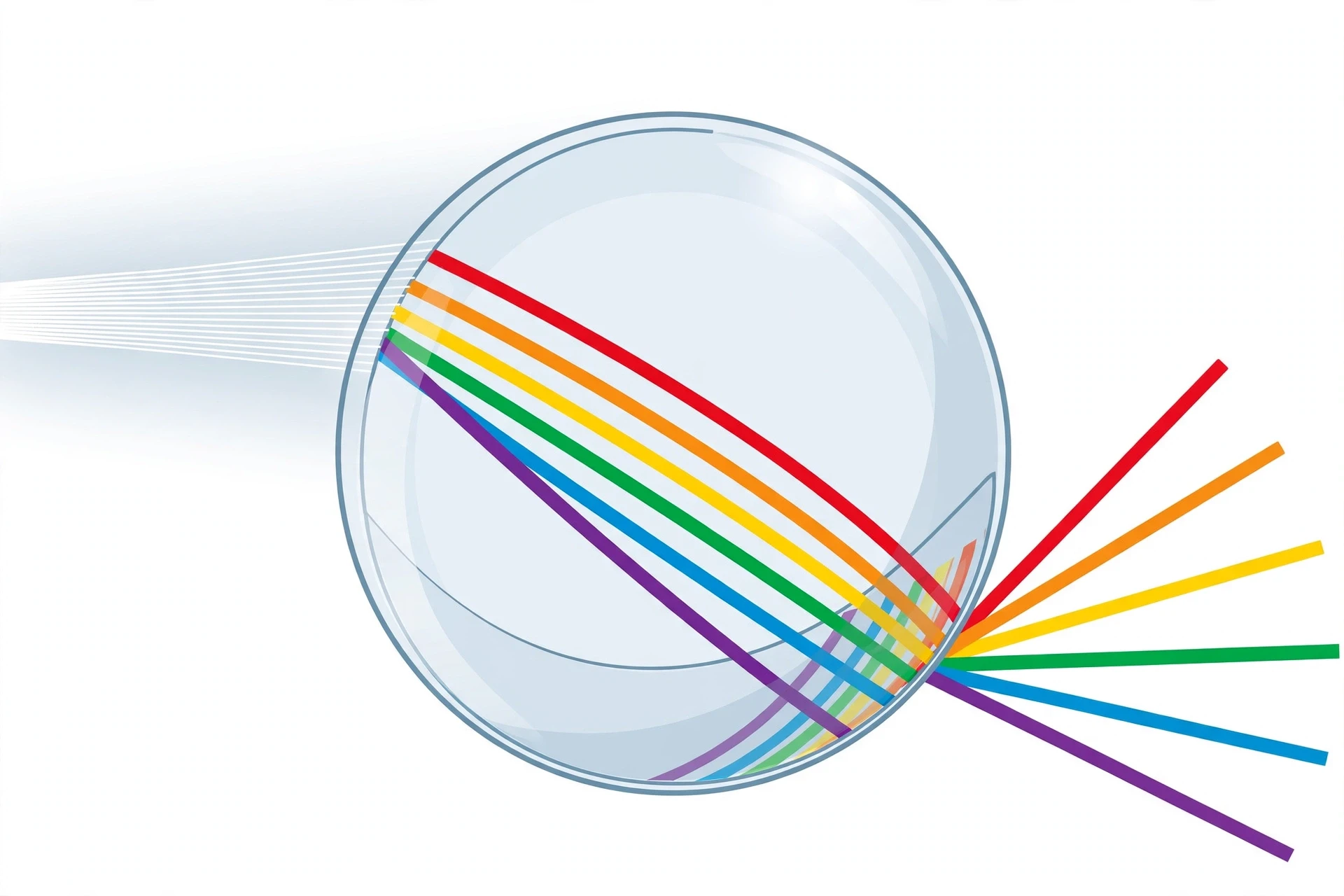
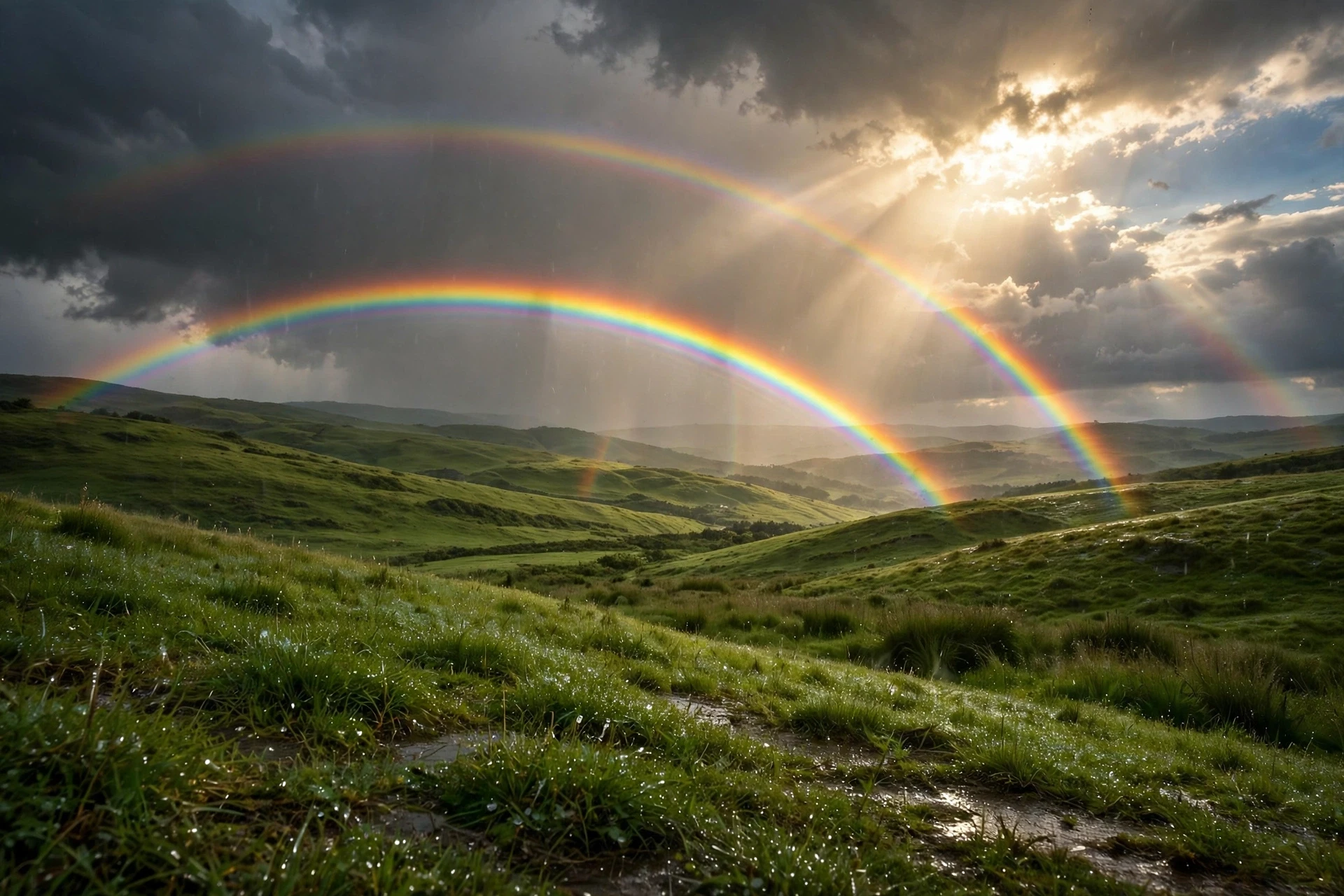
A rainbow is what happens when the prism experiment moves into the sky. After a rain shower, when the Sun is low behind you and rain is still falling ahead of you, each raindrop acts as a tiny prism, a mirror, and a prism again — three optical tricks in one drop.
Here is the sequence. Sunlight enters the front of a raindrop and slows down as it passes from air into denser water. Slowing down bends the light — this is refraction — and each color bends by a slightly different amount, violet the most and red the least. The light then hits the back of the drop and reflects, like a mirror, bouncing back the way it came. As it exits the front of the drop, it bends a second time, spreading the colors further apart. The National Oceanic and Atmospheric Administration describes exactly this three-step dance: light enters the droplet and bends, reflects off the inside, and separates into its component wavelengths as it exits (NOAA NESDIS).
Millions of raindrops each send you one color, depending on their position in the sky. The drops higher up send you red; the drops lower down send you violet. Your eye assembles those millions of single-color messages into a continuous arc. The rainbow is not an object sitting in the sky, and it has no fixed place. It is a pattern of light that exists only for your exact position, which is why you can never walk to the end of one.
7.2 Why the bow is an arc — and why there are sometimes two
A full rainbow is actually a complete circle. From the ground, the Earth blocks the lower half, so you see only the arc above the horizon. From an airplane, in the right conditions, you can see the whole circle. The primary bow always appears at 42 degrees from the point directly opposite the Sun, which is why rainbows show up when the Sun is low — morning or late afternoon — and never at noon in summer, when the Sun is too high for the geometry to work.
Look closely above a bright primary rainbow and you may spot a second, fainter bow. That is the double rainbow. It forms when sunlight reflects twice inside the raindrops instead of once. The extra reflection flips the color order — red on the inside, violet on the outside — and steals some light, which is why the secondary bow is dimmer. The band of sky between the two bows often looks darker than the sky on either side; this is Alexander's dark band, named after Alexander of Aphrodisias, who described it around 200 AD.
I still remember the first double rainbow I ever saw properly, standing in a wet car park after a summer storm, rain dripping off my sleeves. I had read about the reversed colors in a textbook and assumed it was a subtle effect I would never actually notice. It was not subtle at all. The second arc was plainly there, plainly reversed, and I stood there grinning like the seven-year-old in the field. Some parts of physics repay you on the spot.
A rainbow needs three ingredients at once: sunlight behind you, rain in front of you, and the Sun low enough in the sky. Change any one and the bow vanishes. That is why rainbows are common after afternoon showers and almost never seen at midday.
8. The Sky on Other Worlds
The blue sky is not a law of nature. It is an accident of Earth's particular atmosphere, and other worlds show how easily it changes.
The Moon has almost no atmosphere, so its sky is black even at noon, and the Sun hangs in darkness. Mars has a thin atmosphere full of fine red dust, and its sky is a butterscotch pink during the day, turning bluish around the setting Sun — the reverse of Earth's pattern, because the dust on Mars scatters red light forward. Venus is wrapped in thick clouds of sulfuric acid, and its sky is a permanent yellowish gloom. Titan, Saturn's largest moon, has a thick orange haze that hides its surface entirely.
Seen from space, Earth itself is the famous "pale blue dot" photographed by Voyager 1 in 1990 from 3.7 billion miles away. NASA's astrobiology researchers have studied whether that pale blue color could be used to identify life-friendly planets around other stars. Their answer is cautious: Rayleigh scattering makes a nitrogen atmosphere look blue from outside too, and lifeless planets could imitate the color. Earth's full spectrum, though, carries a subtle U-shaped signature — Rayleigh scattering in the blue, ozone absorption in the green, and vegetation's red reflection — that no lifeless world in their study could reproduce (NASA Astrobiology).
Our own Sun sits at the center of this story, and the light that paints our sky begins its journey there. To follow that light back to its source — how stars shine, live, and die — see our guide to the life cycle of stars. And the planets whose skies we have just compared all belong to the system described in our Solar System.
9. Common Misconceptions
A question this old collects wrong answers the way a windowsill collects dust. Here are the ones I hear most often, and what the evidence actually says.
Misconception | What the evidence shows |
|---|---|
The sky is blue because it reflects the blue ocean. | The ocean is mostly blue because it reflects the sky, not the other way around. The sky is blue over deserts, forests, and ice caps, far from any ocean — and it is blue for astronauts looking down at the atmosphere from above. |
Air itself is blue. | Clean air is colorless. A small jar of air shows no blue tint. The color appears only when light crosses kilometers of air and enough scattering adds up. |
The Sun changes color and turns red at sunset. | The Sun's output does not change. The long path through the atmosphere at sunset strips the blue out of its light before it reaches you; what is left looks red. |
Dust in the air makes the sky blue. | Dust changes the shade and can whiten or redden the sky, but Rayleigh showed clean air alone produces a blue sky. Dust is a modifier, not the cause. |
The sky should be violet, since violet scatters most. | Violet does scatter most, but the Sun emits less violet, ozone absorbs some of it high up, and human eyes are far less sensitive to violet than to blue — so we perceive blue. |
A rainbow is a physical object you can reach. | A rainbow is an optical pattern that depends on your position. Move, and the bow moves with you. Two people standing apart see two different rainbows. |
Most people assume the ocean paints the sky, but what we actually see in the data is the reverse: the sky paints the ocean. Water is a good mirror, and on a clear day it simply hands the sky's color back to you. The same goes for the idea that the Sun itself reddens at dusk. It is a natural guess — the Sun looks different, so the Sun must have changed — yet the change is entirely in the air between you and it. That is the quiet lesson of this whole subject: the sky is not a thing with a color. It is light, in transit, being sorted.
10. What Scientists Are Learning Now
Rayleigh's 1871 theory is settled science, but the sky is still an active research subject, because the atmosphere keeps changing and our instruments keep improving.
Laser sounding of the sky. Modern lidar instruments fire laser pulses into the atmosphere and time their scattered return, measuring dust, smoke, and cloud layers kilometer by kilometer. The same scattering physics that colors the sky now lets scientists map pollution plumes, volcanic ash, and wildfire smoke in real time.
Satellites that read the scattered light. NASA's atmospheric radiation research uses the light scattered back into space to measure ozone, aerosols, and other chemicals over the whole planet. The blue glow at Earth's limb — the thin sliver of light visible at the planet's edge from orbit — is scattered sunlight, and its spectrum is a fingerprint of the air below.
Rainbows and a warming climate. A 2022 study in Global Environmental Change modeled rainbow viewing around the world and found that the average place on land currently has about 117 days a year with conditions suitable for rainbows. Under future climate scenarios, changing rainfall and cloud cover could raise that by roughly 4 to 5 percent by 2100. The rainbow, in other words, is a small, visible symptom of a shifting climate system.
The color of distant worlds. As discussed in section 8, researchers are testing whether the pale blue of an Earth-like planet could betray the presence of life to future telescopes. The work is careful and skeptical — color alone can mislead — but the scattering physics behind it is the same physics that turns a summer sky blue over your head.
None of this overturns Rayleigh. It extends him. A theory written by a 28-year-old in a country-house laboratory now guides satellites, climate models, and the search for life on other worlds. That is what a good explanation does: it keeps working in places its author never imagined.
11. Practical Uses: From Weather Forecasts to Telescopes
The scattering of sunlight is not only beautiful. It is useful, in ways that touch daily life.
Weather and air quality. The color and clarity of the sky are a rough, instant readout of the air. A deep blue sky means clean, dry air with few large particles. A milky white sky means haze, humidity, or pollution. A red sun at noon can warn of smoke or dust high in the air. Forecasters use the same physics formally, reading aerosol levels from satellite measurements of scattered light — the science behind the meteorology that predicts tomorrow's weather.
Astronomy. Astronomers must correct for Rayleigh scattering every time they observe through the atmosphere, because the air steals blue light from starlight and adds its own scattered glow. That is one reason the largest telescopes sit on high, dry mountaintops, and why the Hubble and James Webb telescopes were placed above the atmosphere altogether.
Photography and art. Photographers use polarizing filters to cut scattered light and deepen a blue sky, because Rayleigh-scattered light is strongly polarized. Painters have used the same effect for centuries without naming it — the pale horizon and deep zenith in a landscape painting are Rayleigh scattering, observed by eye long before it was explained by mathematics.
Underwater light. The same scattering that colors the sky also colors the sea. Water scatters blue light more than red, and red light is absorbed quickly with depth, which is why the deep ocean is blue and why everything looks blue-green to a diver. Our guide to oceanography follows that light down through the ocean's depth zones.
Plants and the light they use. The scattered blue light that fills the sky is not wasted. Plants use blue light for growth and for timing their flowering, and the balance of direct and scattered light shapes how forests photosynthesize on cloudy days. The chemistry of that process is covered in our explainer on photosynthesis.
12. Looking Up With New Eyes
The next time you look up at a clear sky, you will know what you are seeing: sunlight, sorted by size. White light falls into the atmosphere, the smallest things in the air steal the blue and throw it in every direction, and your eyes — tuned by evolution to that blue — gather it up and call it the sky.
It is a modest chain of causes, and it explains a surprising amount of the world: the deep blue overhead at noon, the pale wash at the horizon, the red fire of sunset, the white of clouds, the arc of a rainbow after rain, and the black sky of the Moon. One question, asked by a child in a field, opens onto the whole physics of light.
Rayleigh answered it with a formula and a fourth power. Newton answered the earlier half with a prism. The raindrops answer the last part every time it rains. All that remains is to keep asking the question — and to keep looking up.
Frequently Asked Questions
Why is the sky blue?
The sky looks blue because of Rayleigh scattering. Air molecules, mostly nitrogen and oxygen, are far smaller than the wavelength of visible light, and they scatter short blue wavelengths much more strongly than long red ones — following the 1/λ⁴ rule. The scattered blue light reaches your eyes from every direction, so the whole sky glows blue.
Why is the sky not violet, since violet light scatters even more?
Violet light does scatter more strongly than blue, but three factors stop it from dominating. The Sun emits less violet light than blue light, ozone in the upper atmosphere absorbs some violet before it reaches the lower air, and human eyes are far less sensitive to violet than to blue. The mixture your brain receives reads as blue.
Why are sunsets red and orange?
At sunset, sunlight travels through a much longer stretch of atmosphere than at noon — up to 30 to 40 times more air. Along that long path, almost all the blue and violet light is scattered away, leaving mainly yellow, orange, and red in the beam that reaches your eyes. Dust and smoke in the lower air deepen the reds.
Why is the sky pale blue near the horizon and deep blue overhead?
Looking overhead, you look through the thinnest slice of atmosphere. Looking toward the horizon, you look through a much longer, slanting slice of air containing more molecules, dust, and haze. The extra scattering of all colors washes the blue toward pale white-blue at the horizon.
Why are clouds white if the sky is blue?
Cloud droplets are roughly the same size as the wavelength of visible light, so they scatter by Mie scattering, which treats all colors nearly equally. Equal scattering of all colors looks white. Air molecules are far smaller than the wavelength, so they scatter by Rayleigh scattering, which strongly favors blue.
What is Rayleigh scattering in simple terms?
Rayleigh scattering is the scattering of light by particles much smaller than the wavelength of the light — such as air molecules. Its strength follows the rule that scattered intensity is proportional to 1/λ⁴, so short wavelengths scatter far more than long ones. It is named after Lord Rayleigh, who worked out the theory in 1871.
Why does the sky look blue from space, but black on the Moon?
From space, Earth looks pale blue because the same Rayleigh scattering sends blue light outward in all directions, including into space. On the Moon, there is almost no atmosphere, so there is nothing to scatter sunlight — the sky stays black even in full daylight.
How does a rainbow form?
A rainbow forms when sunlight enters raindrops, bends (refracts) as it slows down in water, reflects off the back of the drop, and bends again as it exits. Each color bends by a different amount, so the white light splits into its spectrum. You see it when the Sun is behind you, rain is in front of you, and the Sun is low in the sky.
Why are there sometimes two rainbows?
A secondary rainbow appears when sunlight reflects twice inside the raindrops instead of once. The extra reflection reverses the color order — red on the inside, violet on the outside — and makes the second bow fainter. The darker band of sky between the two bows is called Alexander's dark band.
Does pollution change the color of the sky?
Yes. Smoke, dust, and other aerosol particles are large enough to scatter all colors more evenly (Mie scattering), which washes the blue toward milky white. The same particles can also deepen sunset reds by scattering away even more blue light. A deep blue sky generally means clean air; a pale, hazy sky means the air holds more particles.
Sources
NASA Goddard Space Flight Center, "Radiation and the Atmosphere" — Rayleigh scattering, Mie scattering, and why the sky appears blue: https://acd-ext.gsfc.nasa.gov/anonftp/acd/daac_ozone/Lecture4/Text/Semifinal/lec4intro.html
National Oceanic and Atmospheric Administration, "The Color of Clouds" — Rayleigh and Mie scattering, why the sky is blue and clouds are white: https://www.noaa.gov/jetstream/clouds/color-of-clouds
NOAA NESDIS / NASA Space Place, "What Causes a Rainbow?" — refraction, reflection, and dispersion in raindrops; primary and secondary rainbows: https://www.nesdis.noaa.gov/about/k-12-education/optical-phenomena/what-causes-rainbow
MacTutor History of Mathematics, University of St Andrews, "John William Strutt (Lord Rayleigh)" — biography; 1871 scattering theory as the first correct explanation of the blue sky: https://mathshistory.st-andrews.ac.uk/Biographies/Rayleigh/
NASA Astrobiology, "Could Earth's Light Blue Color Be a Signature of Life?" — Rayleigh scattering and Earth's pale blue color seen from space: https://astrobiology.nasa.gov/news/could-earths-light-blue-color-be-a-signature-of-life/