

The first time I rode in an electric car, I waited for the noise. I had spent years around petrol engines, and my brain had learned a simple rule: a car that moves makes a sound, a vibration, a smell of warm oil. This one did none of those things. The driver pressed a pedal, the car pulled away from the kerb, and the only sound was the tyres on wet tarmac and a faint hum that rose and fell like a held breath. I remember turning to the driver and asking the question that starts this article: how do electric cars work, really, underneath all that silence?
That question has a short answer and a long one. The short answer is that an electric car stores energy in a battery, turns that stored energy into a spinning magnetic field, and uses that spin to turn the wheels. The long answer — the one worth reading — is about chemistry, power electronics, heat, software, and a century of engineering that finally came together. Learning how electric cars work means following a single packet of energy from a wall socket, through a charger, into a battery pack, out through an inverter, into a motor, and down to the road. Every step changes the energy a little, and every step has a reason.
Most people assume an electric car is just a petrol car with a big battery swapped in where the fuel tank used to be. What the engineering actually shows is different. An electric car is a simpler machine in some ways and a more subtle one in others. It has far fewer moving parts than a petrol car, yet it depends on control systems that make thousands of decisions every second. Once you see that balance — simple mechanics, clever electronics — the whole vehicle starts to make sense.
This article follows that packet of energy from start to finish. It explains the battery, the inverter, the motor, the single-speed gear, regenerative braking, charging, range, and efficiency, and it compares battery-electric cars with hybrids and plug-in hybrids. Along the way it answers the questions drivers actually ask: how far will it go in winter, how long does charging take, why does it feel so quick, and what wears out. If you have ever wondered how electric cars work, this is the full picture, in plain language, with the science kept visible at every step.
1. The Quiet Revolution on Four Wheels
1.1 A car with no engine note
Stand beside a petrol car at idle and you feel it before you hear it properly: a low tremble through the bodywork, exhaust heat shimmering in the air, the faint smell of fuel. An electric car at a standstill does almost nothing. There is no idle. The motor draws no power when the car is not moving, apart from a small amount for the lights, the screens, and the heating or cooling. That stillness is the first clue to how electric cars work. A petrol engine must keep spinning to stay alive. An electric motor only spins when it is asked to.
I once watched a mechanic open the bonnet of an early electric car and laugh, not unkindly, at how empty it looked. Where he expected an engine block, a tangle of belts, and an exhaust manifold, there was a compact motor, a box of electronics, and a lot of clean, open space. The real bulk of the car — the battery — was hidden under the floor, out of sight entirely. That layout, a flat pack under the cabin and a small motor at one or both axles, is now the standard shape of the modern electric car, and it explains a lot about how these vehicles handle, how much room they have inside, and why they feel so planted on the road.
1.2 Why now, after more than a century?
Electric cars are not new. Battery-powered vehicles were on the roads in the late 1800s and early 1900s, and for a brief period they competed seriously with petrol cars. They lost that contest for reasons that had little to do with the idea itself. Petrol held far more energy per kilogram than the lead-acid batteries of the time, petrol stations spread quickly, and mass production made petrol cars cheap. The electric car waited for a better battery, and that battery arrived slowly, through decades of work on lithium chemistry in laboratories and in consumer electronics.
The turning point was not a single invention. It was a chain: lithium-ion cells became cheaper and denser, power electronics became small and reliable enough to fit in a car, and software learned to manage thousands of cells as one pack. By the 2010s, those three threads had braided together, and the modern electric car became practical for ordinary drivers rather than a curiosity for enthusiasts. That braid is the short history of how electric cars work today. The United States Department of Energy describes the basic layout in the same terms used throughout this article: a battery pack, an inverter, an electric motor, and a charging system, working together as one electric drivetrain.
1.3 What this article will show you
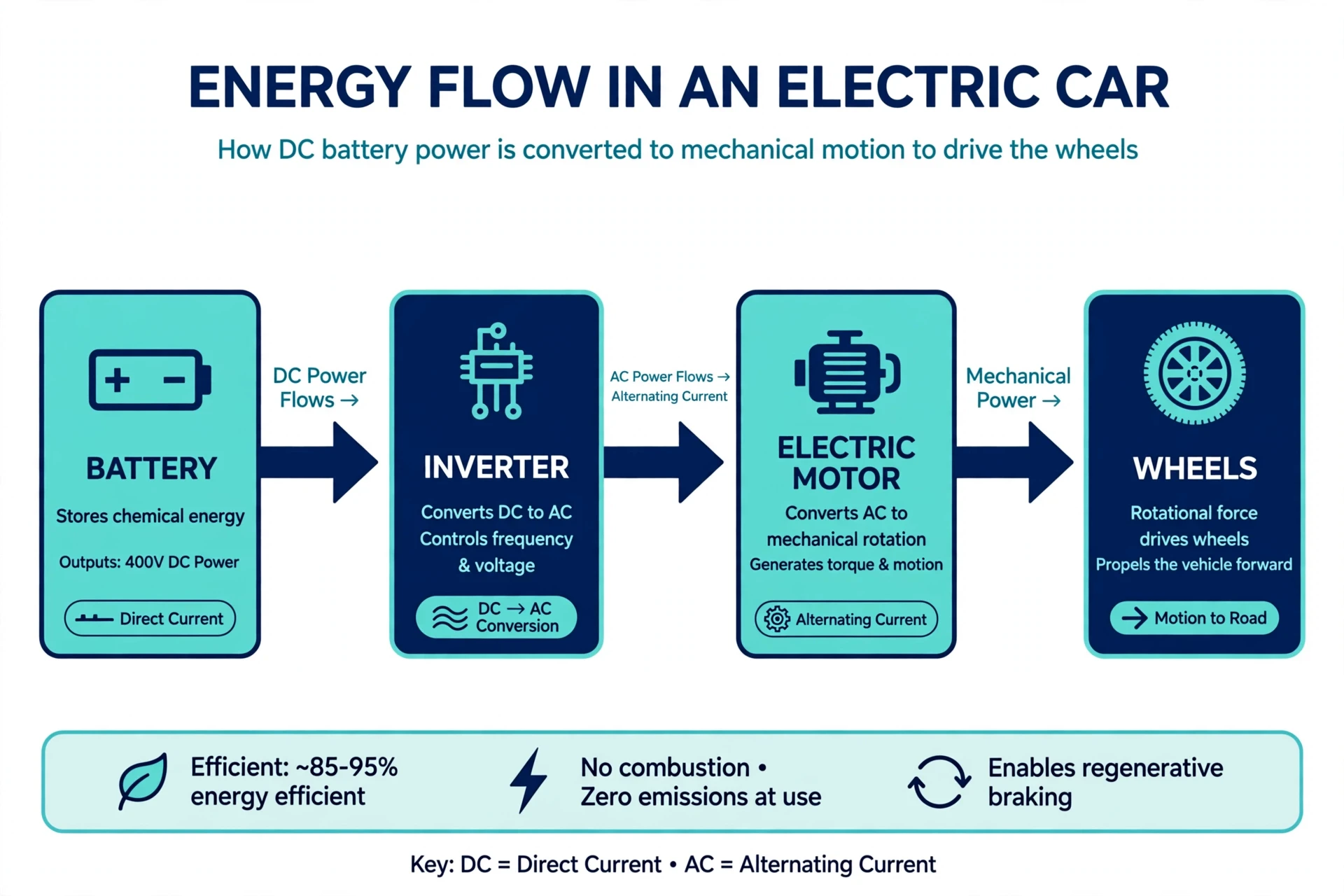
Think of the car as a chain of conversions. Chemical energy sits in the battery. The inverter turns the battery's direct current into alternating current. The motor turns that alternating current into rotation. A single-speed gear turns that rotation into road speed. When you slow down, the whole chain runs backwards, and the motor becomes a generator that puts energy back into the battery. Charging is the same chain in reverse from the outside: alternating current from the grid becomes direct current stored in the battery.
Each section below takes one link in that chain and opens it up, so that by the end you will see how electric cars work from socket to road. You do not need a physics degree to follow it. You need only the ideas this article builds step by step: that electricity is the flow of charge, that magnets can push and pull without touching, and that energy is never created or destroyed, only converted — sometimes usefully, sometimes into heat you would rather not have.
2. What an Electric Car Actually Is
2.1 The battery-electric vehicle, defined
A battery-electric vehicle, usually shortened to BEV, is a car that carries all of its energy in a rechargeable battery pack and drives its wheels using one or more electric motors. It has no petrol engine, no fuel tank, no exhaust pipe, and no gearbox in the usual sense. When people ask how electric cars work, they usually mean this kind of car, even though the word "electric" is also used for hybrids that still burn petrol. This article keeps the distinction sharp: a BEV runs on electricity alone, and everything in it is built around that fact.
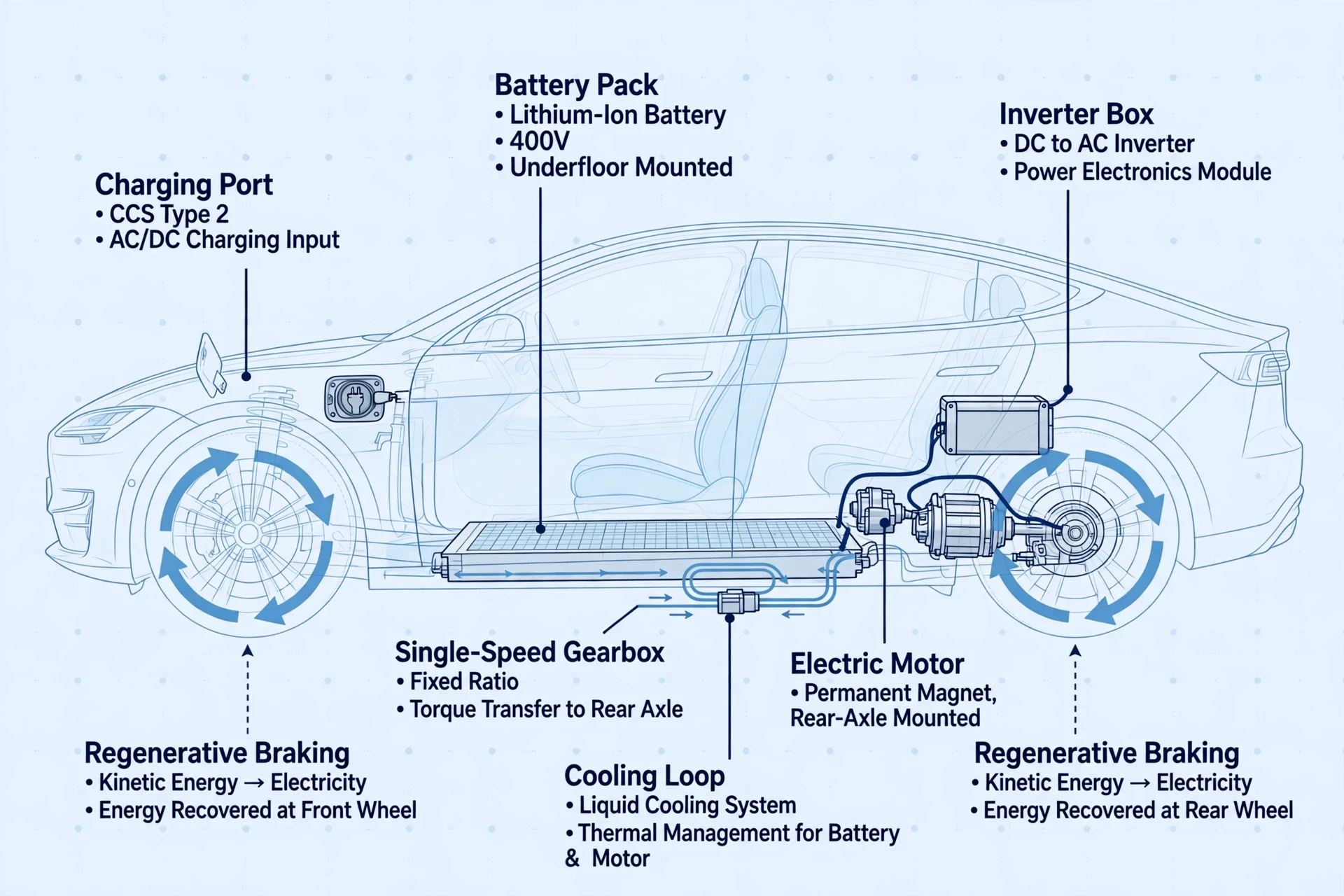
The simplest way to picture a BEV — and to grasp how electric cars work as a system — is as four parts that must agree with each other at all times. The battery stores energy. The power electronics — the inverter, the onboard charger, and the DC-to-DC converter — shape that energy into the right form at the right moment. The motor turns energy into motion. The thermal system keeps the battery and the electronics at temperatures where they work well and last long. Software ties the four together, watching cell voltages, temperatures, and the driver's foot, and adjusting hundreds of times per second.
2.2 The main parts at a glance
Before going deeper, it helps to meet the parts by name, because the rest of the article will use these names constantly.
Battery pack: a sealed case under the floor holding hundreds or thousands of individual cells, wired together, with cooling channels and a management system.
Inverter: the box that converts the battery's direct current (DC) into the alternating current (AC) the motor needs, and back again during regenerative braking.
Electric motor: the device that turns electrical energy into rotation using magnetic fields, usually mounted on or near an axle.
Single-speed reduction gear: a fixed set of gears that slows the motor's fast spin down to wheel speed while multiplying its turning force.
Onboard charger: the unit that takes AC power from a home or public charger and converts it to DC for the battery.
Charging port: the socket where the car connects to the grid, with different plugs for slow and fast charging.
Battery management system (BMS): the software and sensors that watch every cell, balance charge between them, and protect the pack from overheating, overcharging, and deep discharge.
Thermal system: liquid cooling loops, and sometimes a heat pump, that keep the battery in its comfortable temperature range.
2.3 How it differs from a petrol car, part by part
A petrol car turns chemical energy into motion through fire. Fuel and air are compressed in a cylinder, a spark ignites the mixture, the explosion pushes a piston, and a crankshaft turns that push into rotation. Most of the fuel's energy leaves as heat through the exhaust and the radiator; only a modest fraction reaches the wheels. The engine needs a multi-speed gearbox because it only makes useful power in a narrow band of speeds.
An electric car skips the fire. Its motor makes full turning force from a standstill, so it needs no clutch and no multi-speed gearbox. It has no pistons, no exhaust, no oil changes in the engine sense, and no idling. The trade-off is storage: a battery holds less energy per kilogram than a tank of petrol, so the car must be efficient with every unit of energy it carries. That single trade-off — heavy, finite storage against a very efficient motor — shapes every design decision in the vehicle, from the shape of the body to the software that decides when to warm the battery before a fast charge.
If you already understand the basics of voltage, current, and circuits, the rest of this article will feel familiar. If not, a short refresher helps: our companion article on the Fundamentals of Electricity explains circuits and electromagnetism in plain language, and the ideas there — charge flowing through a circuit, magnetic fields doing work — are the same ideas at work inside every electric car.
3. The Battery Pack: Where the Journey Begins
3.1 Lithium-ion chemistry in plain language
The battery is the heart of the car, and also its heaviest and most expensive part. Almost every modern electric car uses lithium-ion chemistry, the same family of chemistry that powers phones and laptops, scaled up enormously. To understand how electric cars work, you have to understand what a lithium-ion cell does, because every other system in the car exists to serve, protect, or exploit that cell.
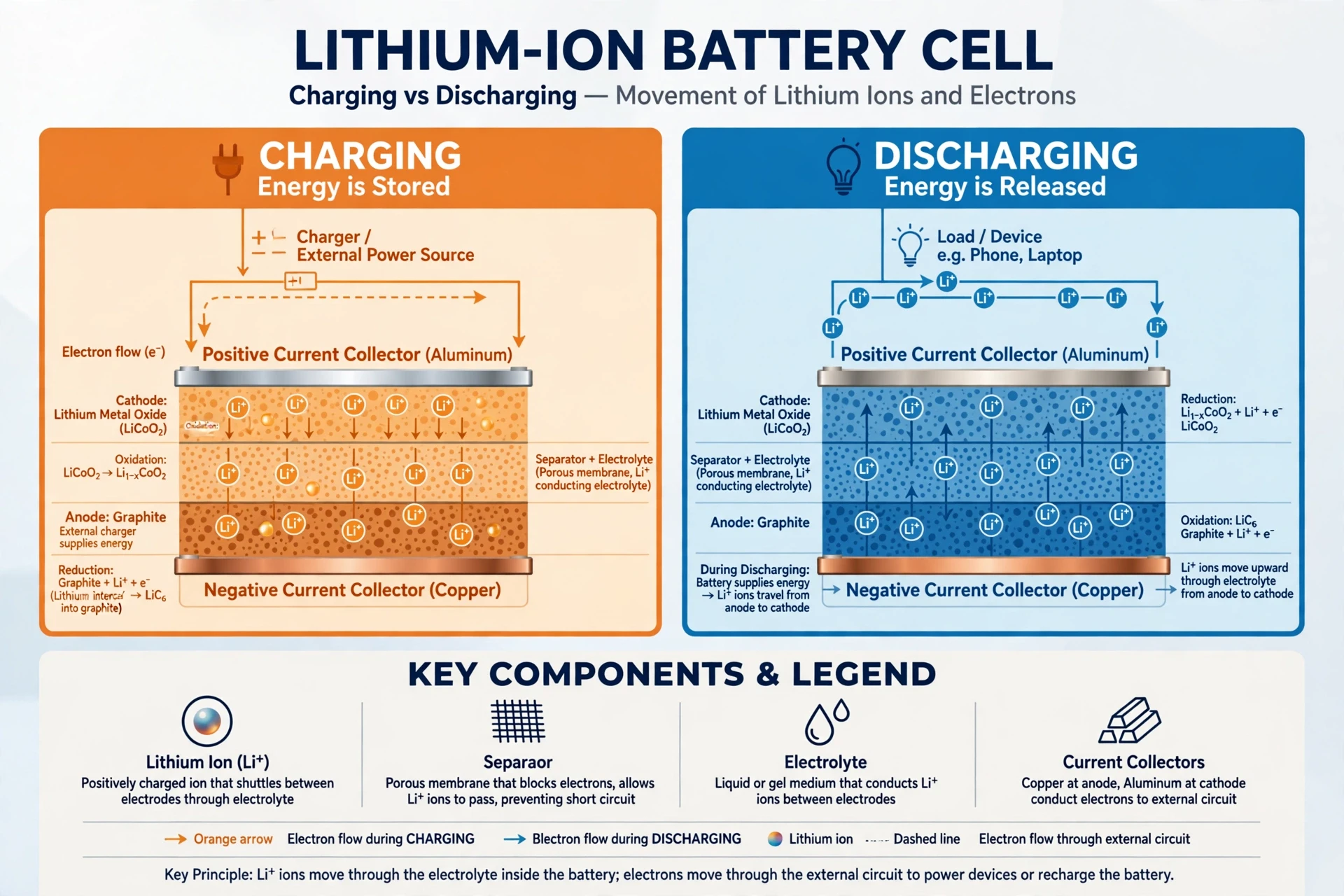
A lithium-ion cell has four main parts: a positive electrode called the cathode, a negative electrode called the anode, a separator between them, and an electrolyte that lets lithium ions move while keeping electrons on a separate path. When the battery discharges — when you drive — lithium ions move from the anode to the cathode through the electrolyte, while electrons flow the other way around the outside circuit, through the motor, doing useful work on the way. When the battery charges, the process reverses: the charger pushes ions back to the anode, storing energy as chemical potential, ready to be released again.
That separation matters, and it is central to how electric cars work. The ions travel inside the cell; the electrons travel outside it, through the wires. The motor is, in a sense, sitting in the path of those electrons, taking a share of their energy as they pass. A helpful analogy is a water system: the ions are like water pumped uphill into a reservoir, and the electrons are the water flowing downhill through a turbine. Charging pumps the water up. Driving lets it flow down.
The chemistry of the electrodes decides the battery's character. Most electric cars today use one of two cathode families. Nickel-manganese-cobalt (NMC) and nickel-cobalt-aluminium (NCA) cathodes pack more energy into a given weight, which means longer range. Lithium iron phosphate (LFP) cathodes hold a little less energy per kilogram but are cheaper, very durable, and more tolerant of being charged to full regularly. Neither is "better" in every sense; car makers choose between them the way a cook chooses between ingredients, weighing range, cost, lifespan, and safety. Our article on Chemical Reactions Explained looks at the reaction types behind this kind of chemistry, including the reversible reactions that make a rechargeable cell possible at all.
3.2 From one cell to a pack of thousands
A single lithium-ion cell holds only a few volts — about the same as a torch battery — and a modest amount of energy. A car needs hundreds of volts and tens of kilowatt-hours. So cells are grouped into modules, and modules are grouped into a pack. A typical pack might hold several thousand small cylindrical cells, or a few hundred larger pouch or prismatic cells, wired in series to raise the voltage and in parallel to raise the capacity. The pack voltage in many modern cars is around 400 volts; some newer designs run at 800 volts, which allows faster charging because the same power can be delivered at lower current, and lower current means less heat in the cables.
The pack is far more than a box of cells, and its design shapes how electric cars work in practice. It is a sealed, crash-protected structure that forms part of the car's floor, adding stiffness to the body and keeping the centre of gravity low. That low, flat weight is one reason electric cars often feel stable in corners: the heaviest part of the car sits between the axles, close to the ground, rather than high up at the front. Cooling channels run through the pack, carrying liquid that absorbs heat during fast charging and hard driving, and in cold weather the same system can warm the cells so they accept charge properly.
I remember standing beside a cut-open battery pack at a research open day and being struck by how orderly it looked inside — row after row of identical cells, each one monitored, each one a small part of a much larger whole. The engineer showing it to us tapped the pack's lid and said the real product was not the cells but the management: the pack is only as good as the system that watches it. That line has stayed with me, because it captures something drivers rarely see. The battery's performance is a software achievement as much as a chemistry one.
3.3 The battery management system
The battery management system, or BMS, is the pack's guardian. It measures the voltage and temperature of cell groups many times a second, estimates how much charge remains, and decides how much power the car may draw or accept at any moment. If one group of cells is running hotter than the rest, the BMS can limit power or call for more cooling. If the pack is nearly full, it tapers the charging rate so the last few percent arrive gently, protecting the cells from stress.
The BMS also balances the cells. No two cells are perfectly identical, and over many charge cycles small differences grow. Without balancing, the weakest cell would limit the whole pack, like the slowest walker setting the pace for a group. The BMS bleeds a little charge from the strongest cells or shuffles energy between groups so that all cells arrive at full or empty together, squeezing the most usable energy out of the pack while keeping every cell inside its safe limits.
One number the BMS produces is the state of charge, the percentage shown on the dashboard. It is an estimate, not a direct measurement, because there is no fuel gauge inside a chemical cell. The BMS infers it from voltage, current, temperature, and the pack's history, and it gets better at the estimate the more it learns about that particular pack. That is why the range estimate on the dashboard can shift after a software update or after a long trip: the car has learned something new about its own battery.
3.4 Why batteries lose range over time
Every rechargeable battery degrades a little with use. The most important cause is the slow growth of a layer called the solid electrolyte interphase on the anode, which traps a small amount of lithium on each cycle so it can no longer shuttle back and forth. Heat speeds this up, as does sitting for long periods at very high or very low charge, and very fast charging adds stress. The result is gradual capacity loss: after years of use, a pack may hold, say, nine-tenths of the energy it held when new.
Car makers design around this, and the way they do so is part of how electric cars work over years of ownership. Packs are built with a buffer — a small portion of the capacity that the driver never sees — so that the usable range stays steady for longer. Cooling systems keep the cells near their preferred temperature. And the BMS avoids the most damaging conditions where it can, for example by limiting charge speed when the battery is cold or nearly full. Most drivers will notice degradation as a slow, gentle decline in range over many years, not a sudden failure, and many packs are expected to outlast the car's first owner by a wide margin.
There is a common misunderstanding here worth correcting directly. Most people assume that a battery that has lost some capacity is "dead" or useless. What the data actually shows is a long, shallow decline followed by a long useful life at slightly reduced range, and after a car, the cells can often serve a second life in stationary storage, where weight matters less and a gentler duty extends their years further. Degradation is real, but it is a slope, not a cliff.
3.5 What comes next: solid-state and beyond
Researchers are working on several successors to today's liquid-electrolyte lithium-ion cell. The most discussed is the solid-state battery, which replaces the liquid electrolyte with a solid material. In principle, a solid electrolyte could allow a denser, safer cell with faster charging and less risk of fire, and it could work with a lithium-metal anode that stores more energy. Laboratories have demonstrated promising cells, but turning a laboratory cell into a mass-produced, affordable, long-lived car battery is a much harder problem, involving manufacturing at scale, cost, and durability over thousands of cycles.
Other lines of research include sodium-ion batteries, which swap scarce lithium for abundant sodium at some cost in energy density, and silicon-rich anodes, which can store more lithium than today's graphite anodes but swell as they do so, cracking over time. The honest position is that today's lithium-ion chemistry is very good and still improving, and its successors will arrive when they can beat it on cost and lifespan, not just on a single laboratory measurement. Drivers buying a car today are buying into a mature technology with a long road of incremental improvement ahead of it.
4. The Inverter: The Translator Between Battery and Motor
4.1 DC and AC, and why the car needs both
The battery stores direct current: charge flows in one direction, at a steady voltage. The motor, as the next section explains, works best on alternating current, where the direction of flow reverses many times a second and creates a rotating magnetic field. Something has to translate between the two, and that something is the inverter. If the battery is the heart of the electric car, the inverter is its interpreter, and no explanation of how electric cars work is complete without this translation.
The inverter is a box of power electronics, built around switches called transistors — usually insulated-gate bipolar transistors or, in newer designs, silicon carbide MOSFETs — that open and close thousands of times a second. By switching the battery's DC on and off in a carefully timed pattern, the inverter synthesises a smooth AC waveform that the motor can use. Change the timing and the frequency, and the motor spins faster or slower; change the pattern, and it produces more or less turning force. The driver's accelerator pedal is, in effect, a request sent to the inverter: more power, please, and the inverter answers by reshaping the electricity in real time.
4.2 How the inverter controls speed and torque
A petrol engine's speed is set by how much fuel and air it burns; an electric motor's speed is set by the frequency of the AC feeding it. That difference is a key part of how electric cars work. The inverter controls that frequency with precision. At low speed, it feeds the motor a low-frequency current, and the magnetic field inside the motor rotates slowly, turning the wheels gently. Press the pedal harder, and the inverter raises the frequency and the current, the field spins faster, and the car accelerates. The response is almost instant, because there is no air to suck in, no fuel to inject, no explosion to wait for — only switches opening and closing.
The inverter also controls torque, the turning force. By adjusting the strength of the current and the timing of the switches relative to the motor's rotor position, it can deliver a strong push at low speed and a gentler one at high speed. Sensors on the motor report the rotor's position many times per second, and the inverter uses that feedback to keep the magnetic field just ahead of the rotor, pulling it around like a magnet pulled along by another magnet held just out of reach. That pull is what you feel as instant acceleration from a standstill.
I once asked an engineer why electric cars feel so quick even when they are not particularly powerful on paper. She pointed at the inverter and said the secret was not the peak power but the shape of it: a petrol engine has to climb to its best speed before it gives its best push, while an electric motor gives its best push at the very first turn. The inverter makes that possible by delivering full current the moment the driver asks. It is a small box doing an enormous job, quietly, thousands of times a second, for the life of the car.
4.3 Silicon carbide and the quiet efficiency race
The switches inside the inverter lose a little energy every time they open and close, turning it into heat. Reducing that loss is one of the most active areas of electric-car engineering. Silicon carbide, a semiconductor material that can switch faster and run hotter than ordinary silicon, has become the material of choice in many newer inverters. It wastes less energy as heat, which means more of the battery's energy reaches the wheels, and it allows the inverter to be smaller and lighter.
This is the kind of improvement drivers never see but always feel, in the form of a little more range from the same battery. The United States Department of Energy's pages on electric-vehicle batteries and power electronics describe this steady refinement: each generation of inverter, motor, and battery squeezes a little more useful work from the same stored energy, and those small gains add up across a whole car and a whole lifetime of driving.
4.4 The other converters: onboard charger and DC-to-DC
The inverter is not the only translator in the car. The onboard charger converts AC from a home or public charger into DC for the battery, at a power level the car's maker has chosen — often around 7 to 11 kilowatts for home charging. A separate DC-to-DC converter steps the pack's high voltage down to 12 volts to run the lights, wipers, infotainment, and safety systems, the same 12-volt world that petrol cars have used for decades. These boxes are less glamorous than the inverter, but without them the car could neither charge at home nor keep its lights on. They are part of the same story: a car full of different voltages, all needing to be translated safely, all the time.
5. The Electric Motor: Turning Magnetism into Motion
5.1 How a motor spins without touching
An electric motor is a beautifully simple idea made precise. Inside it are two parts: a stationary outer ring called the stator, and a spinning inner part called the rotor. The stator holds coils of wire. When current flows through those coils in a timed sequence, they create a magnetic field that rotates around the inside of the motor. The rotor, which carries magnets or a structure that responds to magnetism, is pulled around by that rotating field, chasing it but never quite catching it. The rotor's shaft is connected to the wheels, so the chase becomes motion. There is no contact between the spinning part and the stationary part except at the bearings — no combustion, no explosion, no reciprocating pistons. That is the core of how electric cars work at the level of motion itself.
To feel the idea in your hands, imagine holding a magnet near a compass needle. The needle turns to follow the magnet. Now imagine moving the magnet in a circle around the needle, and the needle spins to keep following it. A motor does exactly this, with electromagnets switched on and off in sequence so the "magnet" appears to circle the rotor, and the rotor spins to follow. The inverter decides how fast the circle moves, and the rotor follows.
5.2 The three main motor types
Car makers use three main motor designs, each with its own strengths, and many cars use two different types at once — one on each axle — to get the best of both.
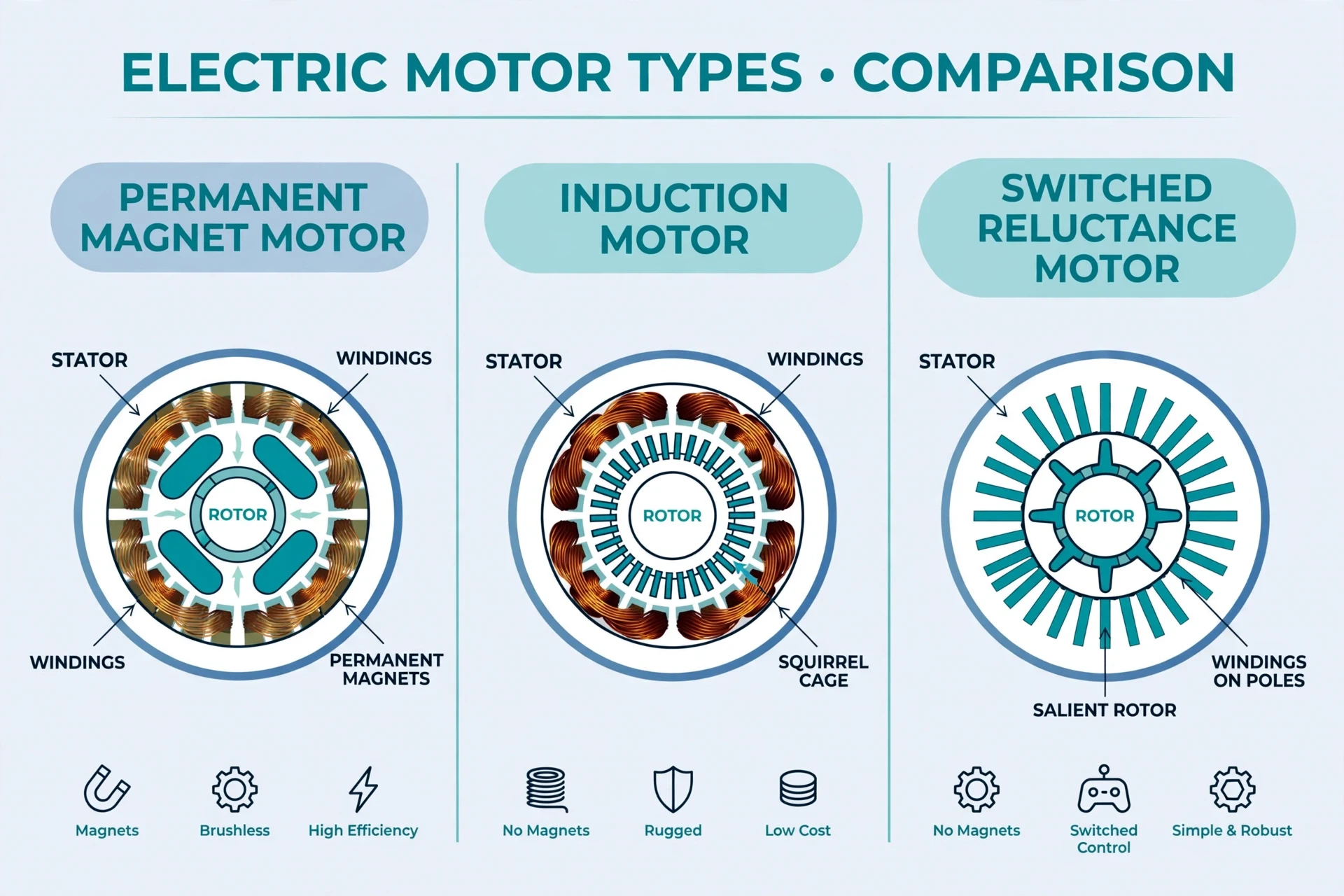
Permanent magnet motors carry strong magnets, usually made with rare-earth elements such as neodymium, on the rotor. The stator's rotating field pulls directly on those magnets, which makes the motor very efficient, especially at low and moderate speeds, and compact for its power. Most electric cars use a permanent magnet motor as their main drive unit because of that efficiency. The trade-off is cost and supply: rare-earth magnets are expensive and their supply chain is concentrated, and at very high speeds the magnets must be managed carefully so they do not weaken.
Induction motors carry no magnets on the rotor. Instead, the stator's rotating field induces a current in the rotor's bars, and that induced current creates its own magnetic field, which the stator then pulls around. The design is older — it goes back to Nikola Tesla — and it is rugged, cheap to build, and free of rare-earth magnets. It is slightly less efficient than a permanent magnet motor at low speed, but it can spin freely with almost no drag when it is not powered, which is useful for a second motor that only works part of the time.
Switched reluctance motors use a rotor made of shaped steel with no magnets and no windings. The stator pulls the rotor's steel teeth into alignment, switching from coil to coil in sequence. They are simple and robust, but they can be noisier and harder to control smoothly, so they appear in fewer production cars, though research continues because they avoid both rare-earth magnets and rotor windings.
A dual-motor car often pairs a permanent magnet motor at one axle with an induction motor at the other. Around town, the efficient permanent magnet motor does most of the work. On a motorway cruise, the induction motor can idle with almost no drag. When the driver asks for maximum acceleration, both motors pull together. It is a neat division of labour, decided by software hundreds of times a second.
5.3 Why electric cars feel so quick
Ask a driver what surprised them most about their first electric car, and the answer is almost always the same: the acceleration from a standstill. The reason is torque, the turning force the motor produces. A petrol engine produces its peak torque only in a narrow band of engine speeds, and it needs gears to keep it there. An electric motor produces its peak torque from zero speed, the moment current flows. The result is a smooth, silent surge that feels effortless, without the pause of a gear change or the rise and fall of engine note.
There is a second reason, too: the motor's power is easy to control precisely. The inverter can adjust the current in milliseconds, so traction control can react to a slipping wheel far faster than a petrol car's systems can cut engine power. On a wet road, that precision shows up as calm, confident grip rather than wheelspin and hesitation. The car feels quick not only because it is strong, but because it is precise.
5.4 One motor, two motors, and all-wheel drive
A single-motor car drives one axle, usually the rear, which gives balanced handling and good efficiency. A dual-motor car drives both axles, giving all-wheel drive without the mechanical complexity of a petrol all-wheel-drive system — no driveshaft running the length of the car, no centre differential, just a second motor and a second inverter, coordinated by software. Some performance cars add a third motor. The extra motors cost weight and money, but they add traction, acceleration, and a safety net: if one motor has a problem, the other can still move the car.
6. The Single-Speed Gear: Why There Is No Gearbox
6.1 A motor that does not need gears
One of the most surprising facts for new electric-car drivers is that the car has no gearbox in the familiar sense. There is no clutch pedal, no gear lever to move through ratios, and no moment where the car pauses to change gear. The reason is the motor's wide useful speed range — a fact that sits at the centre of how electric cars work. A petrol engine spins usefully between roughly one and six thousand revolutions per minute, and it needs gears to match that narrow band to road speeds from walking pace to motorway cruise. An electric motor spins usefully from zero to ten thousand revolutions per minute or more, producing strong torque across that whole range. It simply does not need multiple ratios.
What the car does have is a single-speed reduction gear, usually a fixed ratio of around eight or ten to one. The motor spins fast; the gear slows that spin down and multiplies the turning force on its way to the wheels. It is a small, quiet, sealed unit, often combined with a differential that lets the two driven wheels turn at different speeds in a corner. Because there is only one ratio, there is nothing to shift, nothing to wear out in the shifting sense, and nothing to hesitate. The car accelerates in one smooth, unbroken pull from a standstill to its top speed.
6.2 Reverse, without a reverse gear
Reverse is handled by software, not by a gear. The inverter simply reverses the sequence of the magnetic field, and the motor spins backwards. There is no reverse gear to engage, no clunk, no separate mechanism. The same trick is used in regenerative braking, as the next section explains: the motor's direction and role can change in an instant, because they are set by electronics, not by moving mechanical parts into a new position.
6.3 What this means for maintenance
Fewer moving parts means fewer things to wear out. An electric drivetrain has no spark plugs, no exhaust system, no timing belt, no clutch, and no multi-speed gearbox with synchronisers to wear. The parts that do wear — tyres, brakes, suspension, and the 12-volt battery that runs the accessories — are familiar from any car, and the brakes in particular last longer than in a petrol car, for a reason the next section explains. The motor itself, with only its bearings as a real wear item, can last the life of the car with little attention. That simplicity is a quiet part of the appeal: the car asks less of its owner, mechanically, than the machine it replaces.
7. Regenerative Braking: Getting Energy Back
7.1 Braking that charges the battery
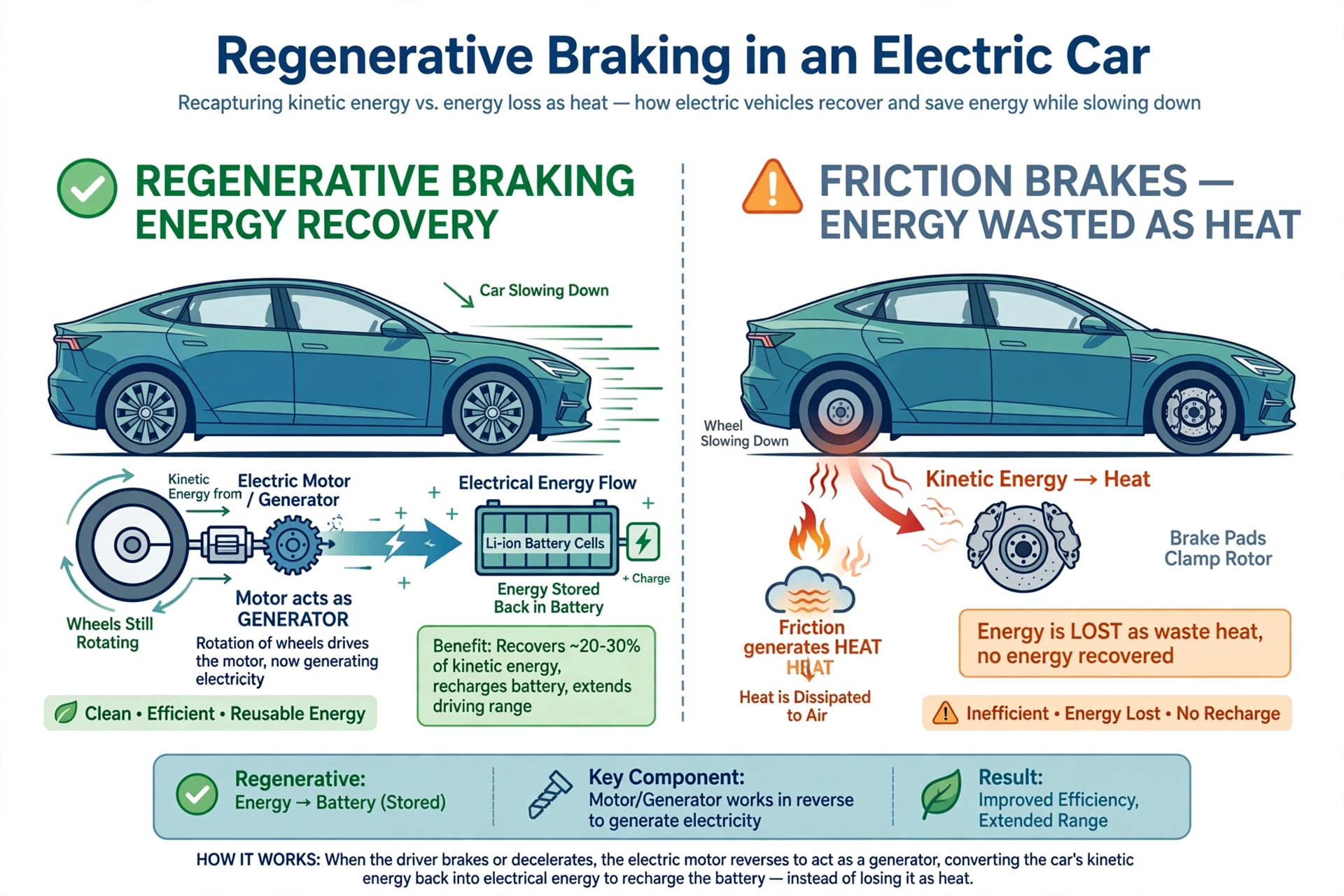
Every time a petrol car brakes, its kinetic energy — the energy of its motion — turns into heat in the brake discs and disappears into the air. It is gone. An electric car can do something cleverer. When the driver lifts off the accelerator or presses the brake pedal, the inverter reverses the motor's role: instead of using electricity to create motion, the motor uses motion to create electricity. The wheels turn the motor, the motor acts as a generator, and the current it produces flows back through the inverter and into the battery. The car slows down, and the battery gains a little charge. This is regenerative braking, and it is one of the most elegant ideas in the whole vehicle.
The physics is the same as the motor's normal operation, run backwards, and it is one of the most satisfying parts of how electric cars work. A spinning rotor moving through a magnetic field generates a current, just as a current moving through a coil generates a magnetic field. The drag the generator creates is what slows the car: the motor resists being turned, and that resistance is the braking force. The harder the generator works, the stronger the braking and the more energy returns to the battery. The driver feels this as a gentle slowing the moment they lift off the pedal, before they have even touched the brake.
7.2 One-pedal driving
Many electric cars let the driver choose how strong the regenerative braking feels when they lift off the accelerator. At its strongest, the car slows firmly enough for much of town driving to be done with one pedal: press to go, lift to slow, and only touch the brake pedal for a full stop or an emergency. Drivers often describe this as the single biggest change in how driving feels. At first it is strange — the car seems to brake by itself — and then, after a day or two, it becomes natural, and a petrol car starts to feel as if it is coasting wastefully whenever you lift off.
I remember my first hour with strong regenerative braking, in stop-start traffic on a rainy afternoon. I kept reaching for the brake pedal out of habit and finding I did not need it; the car was already slowing smoothly, and the dashboard showed a small green arrow feeding energy back into the battery at every junction. By the end of the journey I had stopped reaching. The car had taught my foot a new habit in a single trip, and that habit — lifting early, slowing gently — is also the most efficient way to drive, because gentle regeneration recovers more energy than hard braking, which must call on the friction brakes as well.
7.3 What regeneration cannot do
Regenerative braking is not free energy, and it cannot recover everything. Some energy is always lost as heat in the motor, the inverter, and the battery, and the friction brakes must still do the work when the driver needs to stop quickly, when the battery is already full and cannot accept more charge, or when the battery is very cold. In those cases the car blends friction braking in smoothly, so the driver feels one consistent pedal. The US Environmental Protection Agency's pages on electric-vehicle myths note that regenerative braking is one of the reasons electric cars are so efficient in town driving, where stop-start traffic gives the system many chances to recover energy that a petrol car would simply waste as heat.
7.4 Why brakes last longer
Because the motor does much of the everyday slowing, the friction brakes work less often and less hard. Brake discs and pads in an electric car can last far longer than in a petrol car, and some drivers go years without needing a pad change. There is a small irony here: brakes that are used too little can develop surface rust from disuse, especially in wet climates, so many cars occasionally use the friction brakes deliberately to keep them clean. It is a small maintenance quirk of a system that, on balance, saves its owner both energy and brake wear.
8. Charging: How Energy Gets In
8.1 Level 1, Level 2, and DC fast charging
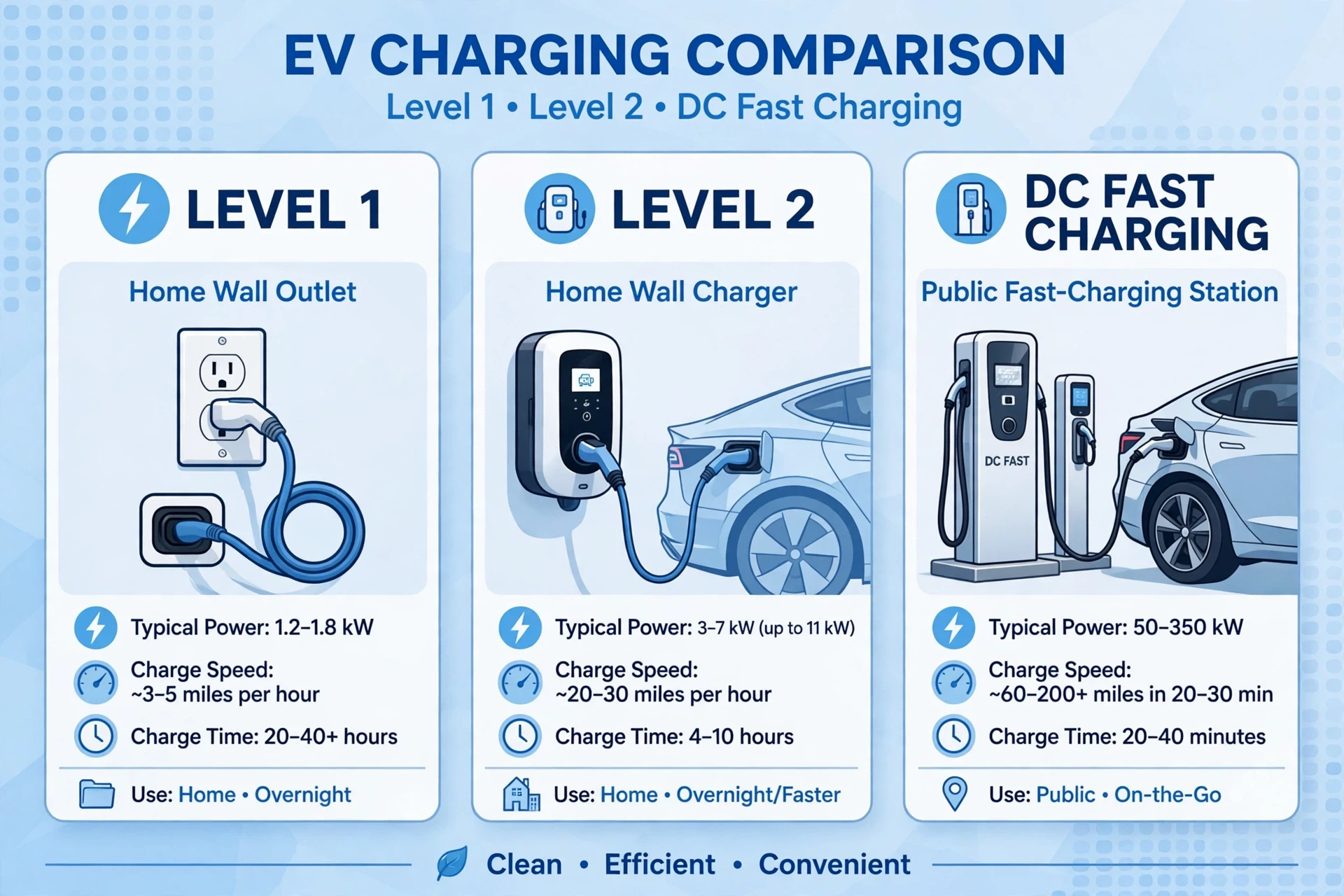
Charging is where the outside world meets the battery, and it comes in three speeds, usually called Level 1, Level 2, and DC fast charging. How long a charge takes is one of the first things people ask about when they ask how electric cars work. The names describe the power source, and the power decides how long a charge takes.
Level 1 uses an ordinary household outlet. It delivers a small amount of power, roughly enough to add a few miles of range per hour of charging. It is slow, but it needs no special equipment, and for a driver who covers a short distance each day and plugs in overnight, it can be enough.
Level 2 uses a dedicated home wall charger or a public charger, running at higher voltage and current. It delivers several times the power of Level 1, typically enough to add tens of miles of range per hour, and to fill an empty battery overnight. This is the workhorse of electric-car charging: most charging happens at home, overnight, at Level 2.
DC fast charging bypasses the car's onboard charger and feeds direct current straight into the battery at very high power, through a large cable at a public station. It can add a large amount of range in the time it takes to drink a coffee — often from a low charge to around four-fifths full in well under an hour, depending on the car and the station. It is the option for long journeys, not for every day.
The table below summarises the three levels. Exact speeds vary by car and by charger, and the figures here are typical ranges rather than promises for any particular model.
Charging level | Power source | Typical power | What it is best for |
|---|---|---|---|
Level 1 | Ordinary household outlet | Low, around 1 to 2 kilowatts | Overnight top-ups for short daily trips |
Level 2 | Home wall charger or public AC charger | Medium, around 7 to 22 kilowatts | Overnight full charges and daytime charging at work |
DC fast charging | Public fast-charging station | High, around 50 to 350 kilowatts | Long journeys and quick top-ups on the road |
8.2 Why fast charging slows down near full
A fast charge is not a straight line. It starts quickly, when the battery is low and can accept a high current, and it slows as the battery fills. The BMS tapers the power to protect the cells, so the last fifth of a charge takes much longer than the first fifth. That is why charging stops and road-trip planners often suggest charging to around four-fifths and driving on, rather than waiting for a full battery at every stop: the time saved by leaving early is usually worth more than the extra miles gained by staying.
Temperature matters just as much, and it is a practical detail of how electric cars work that every driver in a cold climate learns quickly. A cold battery accepts charge slowly, because the ions move sluggishly through a cold electrolyte. Many cars pre-heat, or precondition, the battery on the way to a fast charger, using a little energy to warm the pack so that it can accept a high charging rate on arrival. A warm battery charges faster and with less stress. It is another example of software doing quiet work the driver never sees: the car knows where it is going, and it prepares its battery for what is coming.
8.3 Home, work, and public charging
Most electric-car owners do most of their charging at home, overnight, while the car sits unused for hours. It is the cheapest and most convenient pattern: the car is always full in the morning, and the driver never visits a fuel station in daily life. Workplace charging is the next best option for many people, filling the car during the working day. Public charging fills the gaps: fast chargers along motorways for long trips, and slower chargers in car parks and on streets for drivers without a driveway.
The plugs and connectors vary by region, and the charging world is gradually settling on shared standards so that any car can use any station. The details differ between North America, Europe, and other markets, and they change as standards evolve, so a buyer should check which connector their car uses and which networks serve their area. The principle, though, is universal: the car and the charger talk to each other before any power flows, agreeing on a safe voltage and current, and either side can stop the charge instantly if something looks wrong.
8.4 Charging and the grid
An electric car is not only a load on the electricity grid; it is also a large, flexible battery that can charge when electricity is plentiful and cheap, for example overnight or when the wind is blowing, and wait when demand is high. Smart charging — where the car or the charger chooses the cheapest, cleanest hours to charge — already helps grids absorb more renewable energy. In the future, some cars may feed energy back to a home or to the grid at times of peak demand, a concept called vehicle-to-grid, though the standards, warranties, and business models for that are still settling. For now, the practical point is simple: charging overnight, when demand is low, is usually cheaper and gentler on the grid than charging at peak times, and many cars and chargers can schedule it automatically.
9. Range: How Far Will It Go?
9.1 What "range" really means
Range is the distance a car can travel on a full charge, and it is the number buyers ask about first and argue about most. The official figure for a car comes from a standardised laboratory test cycle, which gives a useful way to compare cars with each other, but no laboratory cycle can reproduce every driver's weather, roads, and habits. Real range is always a band, not a single number: longer on a mild day at moderate speed, shorter on a freezing day at motorway speed with the heater on full. Understanding how electric cars work means understanding why that band is so wide — and why no single range number can tell the whole story.
The battery's usable energy is the starting point. A car with a larger battery can, in principle, go further, just as a car with a larger fuel tank can go further. But efficiency decides how far each unit of stored energy takes you, and efficiency depends on the motor, the inverter, the aerodynamics, the tyres, and the weather. Two cars with the same size battery can have very different real ranges if one is a sleek saloon and the other is a tall, heavy SUV pushing a large frontal area through the air.
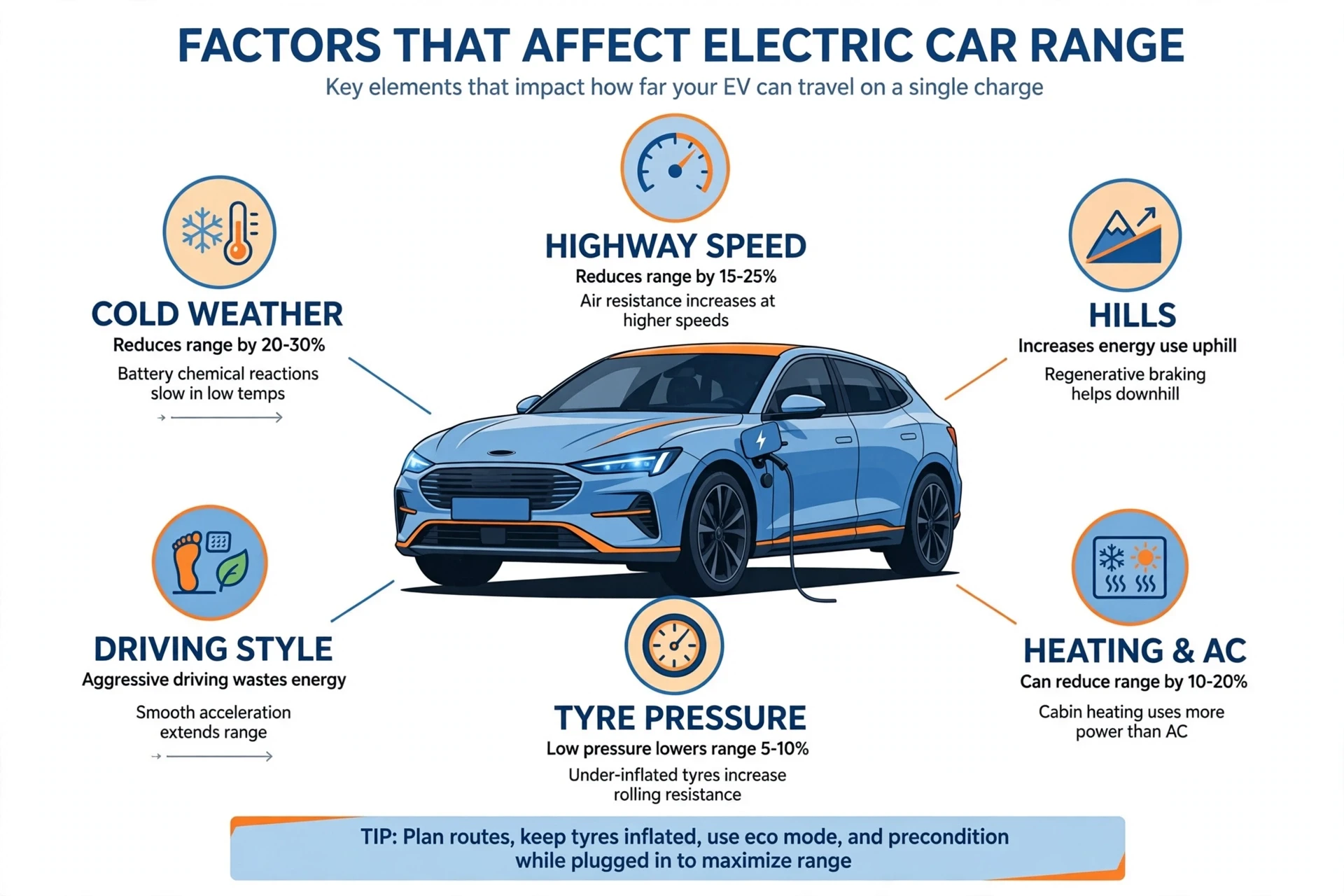
9.2 The factors that shrink or stretch range
Several factors move range up or down, and they are worth knowing because the driver controls most of them.
Speed. Air resistance rises sharply with speed, so motorway driving uses far more energy per mile than town driving. The difference is larger than in a petrol car, because the electric drivetrain is so efficient that aerodynamics becomes the dominant loss at speed.
Temperature. Cold weather thickens the battery's chemistry, reduces the energy the pack can deliver, and forces the car to spend energy heating the cabin and the battery. Hot weather costs energy for air conditioning, though usually less than winter heating costs.
Heating and cooling. Heating a cabin with resistive heaters uses a lot of energy. A heat pump, which moves heat rather than creating it, uses far less, and many newer cars include one. Heated seats and a heated steering wheel warm the driver directly and use much less energy than heating the whole cabin.
Hills and driving style. Climbing a hill costs energy, and descending gives some of it back through regeneration, but not all of it. Smooth, anticipatory driving — lifting early, braking gently — recovers more and wastes less than sharp acceleration and hard braking.
Tyres and load. Under-inflated tyres waste energy through rolling resistance, as does carrying heavy loads or roof boxes that disturb the airflow.
Accessories and towing. Towing a trailer increases both weight and drag, and it can cut range substantially, which is why towing figures deserve a close look before buying.
9.3 Winter range, honestly explained
Winter is the season that tests an electric car most. A driver who gets a comfortable range in summer may find a noticeably shorter range on the coldest days, and the reasons are physical, not a fault in the car. The battery's chemistry slows in the cold, the cabin needs heating, and the battery itself may need warming before it can charge quickly. The effect is real and worth planning for, especially on long winter journeys.
There are ways to soften it. Preconditioning the car while it is still plugged in — warming the cabin and the battery from the grid rather than from the battery — means the journey starts with a warm car and a full charge. Using heated seats instead of blasting hot air through the whole cabin saves energy. Parking in a garage, even an unheated one, keeps the battery a little warmer than parking outside in the wind. And a heat pump, where fitted, makes winter heating far cheaper in energy terms. None of these tricks removes the winter effect entirely, but together they make it manageable, and most drivers find that winter range, once understood, is simply a number to plan around, like fuel consumption in a petrol car in winter.
9.4 Reading the dashboard estimate
The range figure on the dashboard is an estimate based on recent driving, the battery's state of charge, and the temperature. It is sometimes called a "guess-o-meter" by drivers, affectionately, because it changes as conditions change. A long motorway run will pull the estimate down; a week of gentle town driving will push it up. The estimate is most useful as a trend, not as a promise: if it is falling faster than the miles are passing, slow down a little or plan a charge sooner. Over time, drivers learn their car's habits in each season, and the number becomes a familiar, trustworthy guide.
10. Battery-Electric, Hybrid, and Plug-in Hybrid: What Is the Difference?
10.1 Three ways to mix electricity and petrol
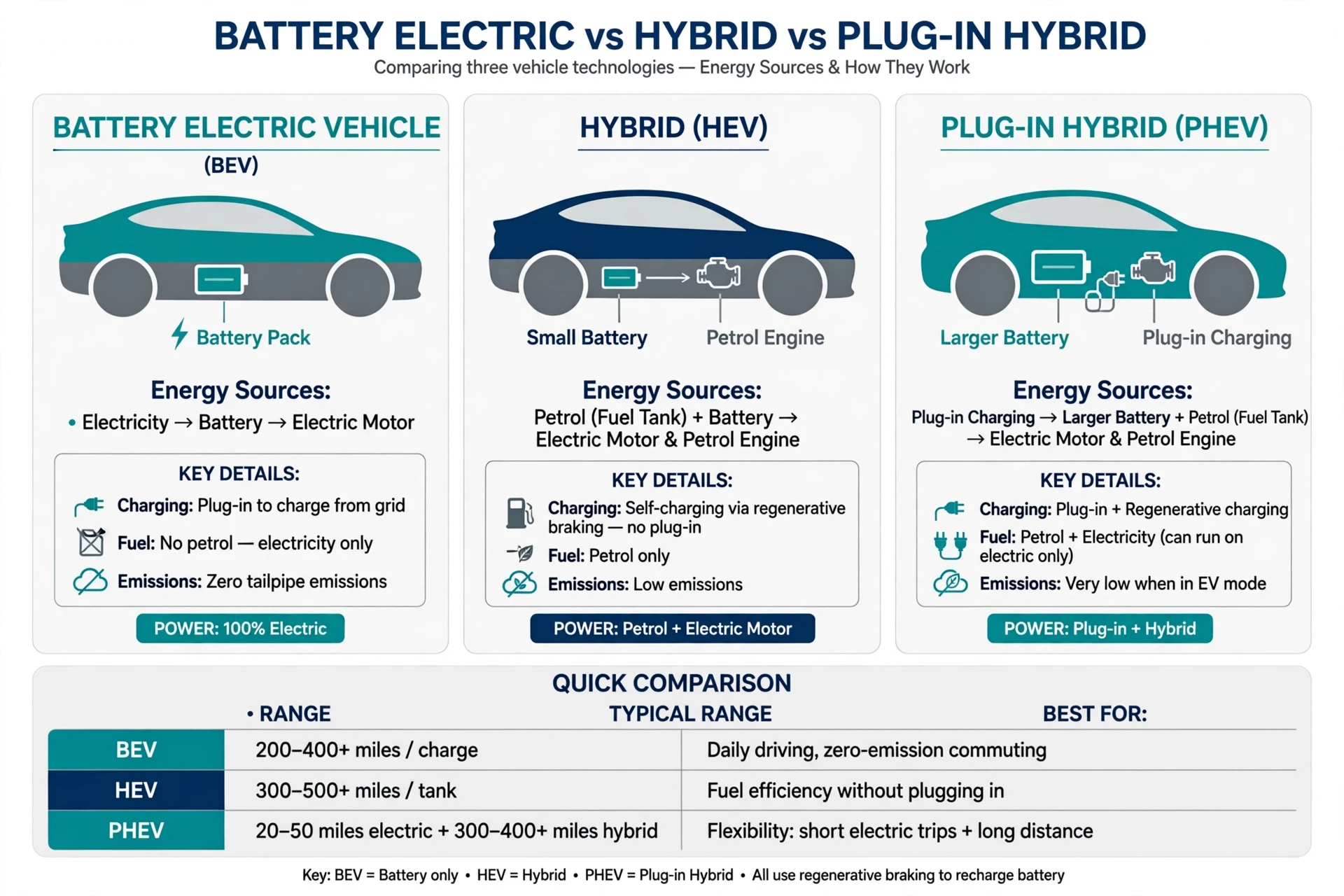
The word "electric" covers three different kinds of car, and confusing them is one of the most common mistakes buyers make. A battery-electric vehicle runs on electricity alone. A hybrid electric vehicle, or HEV, has a small battery and an electric motor that assist a petrol engine, but it cannot be plugged in and it cannot drive on electricity alone for more than a short distance. A plug-in hybrid, or PHEV, has a larger battery that can be charged from the grid, a petrol engine for longer trips, and an electric-only range that covers many daily journeys. All three use electric motors, but they use them in very different ways, and seeing which parts do the work in each case is essential to how electric cars work across the whole market.
10.2 A side-by-side comparison
Feature | Battery-electric (BEV) | Hybrid (HEV) | Plug-in hybrid (PHEV) |
|---|---|---|---|
Energy source | Electricity from the grid only | Petrol only; battery charged by the engine and braking | Electricity from the grid plus petrol |
Can it plug in? | Yes, always | No | Yes |
Electric-only driving | Always | Short distances at low speed | Daily trips, often tens of miles |
Exhaust pipe | None | Yes | Yes |
Long journeys | Needs charging stops | Refuel as usual | Refuel as usual when the battery runs out |
Best for | Drivers who can charge at home or work | Drivers who want lower fuel use without plugging in | Drivers with short daily trips and occasional long ones |
10.3 Which one fits which driver?
There is no single right answer, only a right answer for a particular life. A driver with a driveway and a regular commute will find a battery-electric car the simplest and cheapest to run day to day, because home charging is convenient and electricity costs less per mile than petrol. A driver without home charging, or one who regularly drives long distances through areas with few chargers, may find a plug-in hybrid a practical bridge, using electricity for daily trips and petrol for the long ones. A driver who wants lower fuel use without changing any habits at all may prefer a conventional hybrid, which asks nothing new of its owner. The honest advice is to match the car to the charging you can actually use, not to the charging you wish you had.
The International Energy Agency tracks how these choices are playing out worldwide, and its reports show electric cars — battery-electric and plug-in hybrid together — taking a growing share of new car sales in many markets, with battery-electric cars leading that growth. The trend is not uniform: it moves faster where charging is easy and electricity is clean, and slower where it is not. That unevenness is a reminder that the electric car is not only a vehicle but part of a system of chargers, grids, and policies, and its success depends on all of them maturing together.
11. Efficiency: Why Electric Cars Waste So Little
11.1 Tank-to-wheel, and well-to-wheel
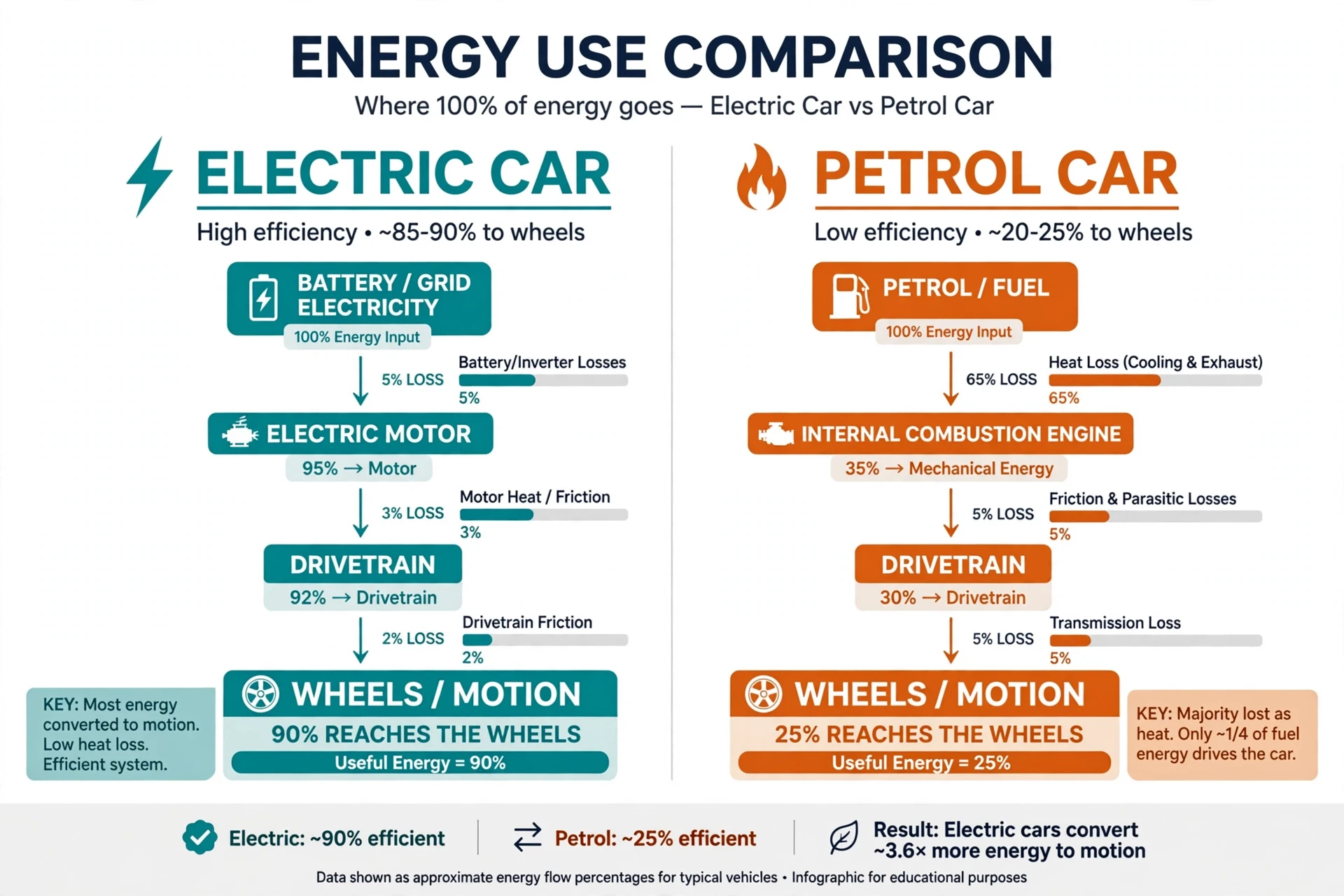
Efficiency can be measured in two ways, and both matter. Tank-to-wheel efficiency asks how much of the energy in the tank — or the battery — reaches the wheels. Well-to-wheel efficiency asks how much of the energy at the original source reaches the wheels, including the losses in producing and delivering the fuel or the electricity. An electric car wins the first measure by a wide margin and usually wins the second too, though the size of the win depends on how the electricity is made.
A petrol engine is a heat engine, and heat engines are bound by thermodynamics: much of the fuel's energy must leave as heat, through the exhaust and the cooling system, because the engine only converts a fraction of the heat into motion. A typical petrol car turns roughly a fifth to a third of the fuel's energy into motion at the wheels, with the rest lost as heat, noise, and friction. An electric drivetrain has no such limit, and that is the heart of how electric cars work so efficiently. Its motor routinely turns the large majority of the electrical energy it receives into motion, with only modest losses in the motor, the inverter, and the gear. Regenerative braking recovers some of what would otherwise be lost when slowing down, pushing the effective efficiency higher still in town driving.
The United States Department of Energy's fuel-economy pages explain this comparison in detail, and their figures are the standard reference for the claim that electric drivetrains convert a far higher share of their stored energy into motion than petrol drivetrains do. The exact numbers vary by car and by driving conditions, but the gap is large and robust: it is a consequence of the physics, not of a particular model or a generous test.
11.2 Where the remaining losses go
An electric car is efficient, not perfect. Some energy is lost as heat in the battery's internal resistance, especially during fast charging and hard acceleration. Some is lost in the inverter's switching. Some is lost in the motor's copper windings and iron core. Some is lost in the gear and the tyres, and some goes to running the accessories — the heating, the cooling, the lights, the computers. At motorway speed, the largest loss is aerodynamic drag, the energy spent pushing air aside, which no drivetrain can avoid.
Engineers attack each loss separately. Better cells with lower resistance, silicon carbide inverters with lower switching losses, motors with better magnetic materials, smoother body shapes, low-rolling-resistance tyres, and heat pumps for the cabin all chip away at the total. No single improvement transforms the car, but together they have pushed real-world efficiency forward year after year, which is why a modern electric car goes further on the same size battery than one from a decade ago.
"The electric motor is the most efficient converter of stored energy into motion that has ever been fitted to a road car at scale. The challenge was never the motor. It was carrying enough energy to feed it."
That observation, which I have heard in different words from several engineers, captures the history of the electric car in a sentence. The motor was ready long before the battery was. The last twenty years have been the story of the battery catching up, and of the power electronics learning to manage the marriage between the two.
11.3 Efficiency and the climate question
Efficiency matters for the climate as well as for the driver's wallet. A car that uses less energy per mile needs less energy to be generated in the first place, and it produces fewer emissions over its life, whatever the source of that energy. The emissions of an electric car depend on how its electricity is made: on a grid powered mostly by renewables or nuclear power, the lifetime emissions are far lower than a comparable petrol car; on a grid still dominated by coal, the advantage is smaller, though the car still benefits from its efficiency and from the grid getting cleaner over the car's life, which a petrol car cannot do.
That last point is worth lingering on. A petrol car's emissions are fixed at the day it is built: it will burn petrol for its whole life. An electric car's emissions fall as the grid decarbonises, because the same car, charged from a cleaner grid in ten years' time, produces fewer emissions per mile without any change to the car itself. Our article on Climate Change Explained sets out the greenhouse effect behind this question, and the Greenhouse Effect Explained article explains how gases in the atmosphere trap heat — the physical reason why cutting transport emissions matters at all.
12. What It Feels Like to Own and Drive One
12.1 The daily routine
The biggest change in daily life is not the driving but the refuelling — or rather, the absence of it. That change follows directly from how electric cars work: energy comes from a plug, not a pump. A driver who charges at home plugs in at night and unplugs in the morning, in seconds, and the car is full. There is no detour to a fuel station, no standing in the cold holding a pump, no smell of petrol on the hands. Long journeys need planning, and that planning is a real adjustment: checking charger locations, allowing time for a stop, and accepting that a journey takes a little longer than it would in a petrol car. For most drivers, the daily convenience outweighs the occasional long-trip stop, but the balance depends on how often those long trips happen.
12.2 Silence, and what it hides
The quiet of an electric car is a pleasure and a small responsibility. Without engine noise, wind and tyre noise become more noticeable, and car makers work hard on insulation and on quiet tyres to keep the cabin calm. Pedestrians, too, notice the quiet: at low speeds, electric cars in many markets are required to emit a soft artificial sound so that people nearby, especially those who cannot see well, can hear them coming. It is a reminder that a car's sound was never only for the driver; it was a signal to everyone around it, and the electric car has had to invent a new one.
I once drove an electric car through a quiet village early on a Sunday morning and felt almost guilty about how silently I passed the houses. A petrol car would have announced itself; this one slipped through like a bicycle with a motor. It was a small moment, but it stayed with me as an image of what these cars change about a street, not only about a journey. The silence is not a gimmick. It changes the texture of a neighbourhood.
12.3 Maintenance and longevity
An electric car's service schedule is shorter and simpler than a petrol car's. The items are familiar: tyres, brakes, suspension, cabin filters, wipers, coolant for the battery system, and the 12-volt battery. The high-voltage battery and the motor need little routine attention. Tyres deserve a special mention: electric cars are heavy, because of the battery, and they deliver strong torque from a standstill, so tyres can wear faster than in a lighter petrol car, especially if the driver enjoys the acceleration. Choosing the right tyres and keeping them at the correct pressure matters more, not less, in an electric car.
Battery longevity is the question every buyer asks, and the evidence so far is reassuring. Large studies of real cars on the road show slow, gradual capacity loss rather than sudden failure, and car makers warranty their packs for long periods — often eight years or more — against excessive degradation. The pack is the most expensive part of the car, so that warranty matters, and a buyer should read its terms carefully: what level of degradation it covers, and what it does not.
13. Common Mistakes and Misconceptions
13.1 "Electric cars have no emissions at all"
An electric car has no exhaust pipe, so it produces no tailpipe emissions while driving — a fact that surprises no one who already knows how electric cars work, but is often overstated. That is a real and important difference, especially for air quality in towns and cities. But the car still has a carbon footprint from manufacturing — above all from making the battery — and from generating the electricity it uses. The honest claim is that a battery-electric car produces far lower lifetime emissions than a comparable petrol car in most grids, and that its emissions fall as the grid gets cleaner. The dishonest claim is zero emissions full stop. The distinction matters, because it is the difference between a technology that helps and a technology that is presented as magic.
13.2 "The battery will need replacing after a few years"
Battery packs are designed to last the life of the car, and the evidence from cars on the road supports that: capacity fades gradually, over many years and many thousands of miles, rather than failing suddenly. A pack that has lost some capacity still drives the car, just a little less far per charge. Replacement is rare, expensive when it happens, and usually covered by a long warranty when it happens early. The more useful question for a buyer is not whether the battery will fail, but how much range the car will still offer after years of use — and the answer, for most modern cars, is most of it.
13.3 "Electric cars are slow, or only for short trips"
The first part of this was never true for long: electric motors deliver strong torque from a standstill, and many electric cars accelerate faster than petrol cars of similar size. The second part was once fair and is now a question of planning rather than possibility. Fast-charging networks have grown along major routes in many countries, and a long journey in an electric car is now a matter of stopping to charge, not a question of whether charging exists at all. The remaining gap is in rural areas and for drivers without home charging, where the infrastructure still needs to catch up.
13.4 "Charging takes hours, every time"
Charging at home overnight does take hours, but the driver is asleep, so the time costs nothing. Fast charging on a journey takes far less time, and the car charges while the driver rests, eats, or stretches. The mistake is to compare every charge with a petrol stop. A petrol car must be driven to a station for every fill; an electric car charged at home starts every day full, and only long journeys involve waiting at all. The US Environmental Protection Agency's myth-busting pages address several of these misunderstandings directly, and they are a good place to check a claim before repeating it.
"The question is not whether an electric car can do everything a petrol car can do, in exactly the same way. It is whether it can do the journeys its owner actually makes, in a way that fits their life. For most drivers, most of the time, the answer is now yes."
14. The Latest Research and What Comes Next
14.1 Better batteries, better motors
Research is moving on several fronts at once. Battery makers are raising energy density a little each year, cutting cost, and reducing the use of scarce materials such as cobalt — steady progress in how electric cars work, rather than a single breakthrough. Motor designers are finding ways to use fewer rare-earth magnets, or none at all, without losing efficiency. Power electronics are moving to silicon carbide and, in laboratories, to gallium nitride, which switches faster still. None of these is a revolution on its own. Together, they are the steady climb that has defined the technology for two decades: a little more range, a little faster charging, a little lower cost, every year.
14.2 Charging that gets out of the way
The next big change is not in the car but around it. Faster chargers, more of them, and simpler payment are making long journeys easier. Battery preconditioning, smarter route planning that builds charging stops into the journey, and chargers that communicate with the car to agree the fastest safe rate are all removing friction that early drivers had to manage themselves. The car is becoming less of a machine its owner must understand and more of an appliance that looks after itself — which is, after all, what a successful technology does.
14.3 The bigger picture
The electric car is one part of a larger shift in how energy is made and used. As grids add wind and solar power, the value of a large, flexible battery on wheels grows: cars can charge when renewable energy is abundant and cheap, and in time they may return energy when it is scarce. Whether that future arrives quickly depends on standards, warranties, and grid rules as much as on engineering. What is already certain is that the core of the technology — the battery, the inverter, the motor — is proven, improving, and here to stay.
15. Putting It All Together
Follow the energy one last time. It leaves the grid as alternating current, becomes direct current in the charger, and is stored as chemical energy in the battery pack. When you drive, the inverter turns it back into alternating current, the motor turns that current into rotation, and a single gear turns rotation into road speed. When you slow, the motor becomes a generator and returns some of that energy to the battery. Nothing burns. Nothing idles. The car is quiet because there is nothing to be loud about: no explosions, no exhaust, no gears clashing, only magnets pulling a rotor around in a circle, thousands of times a minute, under the control of software that never sleeps.
That is how electric cars work — not as a single trick, but as a chain of conversions, each one simple, each one done well. The battery stores, the inverter translates, the motor spins, the gear slows, the brakes recover. Learn the chain and you can understand any electric car, diagnose its quirks, and judge its claims. The silence that surprised me on that first ride was not emptiness. It was the sound of a machine doing its work without waste, and once you have heard it, the old noise starts to sound like exactly what it is: energy leaving as heat, on its way to nowhere.
Frequently Asked Questions
How do electric cars work in simple terms?
An electric car stores energy in a large battery pack, and an inverter converts the battery's direct current into alternating current for the motor. The motor uses magnetic fields to spin, and that spin turns the wheels through a single-speed gear. Pressing the accelerator tells the inverter to send more power to the motor, and lifting off lets the motor act as a generator, recovering energy as the car slows.
How long does it take to charge an electric car?
It depends on the charger and the car. A home Level 2 charger typically fills an empty battery overnight. A public DC fast charger can add a large amount of range in well under an hour, usually charging fastest when the battery is low and slowing as it fills. An ordinary household outlet is the slowest option and is best for overnight top-ups.
How far can an electric car go on one charge?
It depends on the battery size, the car's efficiency, the speed, the weather, and how the car is driven. Official test figures give a useful comparison between cars, but real range is a band: longer on mild days at moderate speed, shorter in cold weather or at sustained motorway speed. Preconditioning the battery and using a heat pump help in winter.
What is regenerative braking?
Regenerative braking is the process by which the electric motor acts as a generator when the car slows down, converting the car's motion back into electricity and storing it in the battery. It recovers energy that a petrol car would waste as heat in its brakes, and it is one reason electric cars are so efficient in stop-start town driving.
Do electric cars need oil changes or a gearbox service?
No, in the usual sense. An electric car has no engine oil, no exhaust, no clutch, and no multi-speed gearbox. Its service needs are mostly tyres, brakes, suspension, filters, and coolant, plus checks of the battery and power electronics. Brake pads often last longer than in a petrol car because regenerative braking does much of the slowing.
Are electric cars better for the environment?
Over their lifetime, battery-electric cars usually produce far lower greenhouse gas emissions than comparable petrol cars, because they are much more efficient and because the electricity grid gets cleaner over time. They produce no tailpipe emissions while driving. Their manufacturing emissions, above all from the battery, are higher than a petrol car's, but the driving savings typically outweigh that difference over the car's life.
What is the difference between a battery-electric car and a hybrid?
A battery-electric car runs on electricity alone and must be plugged in to charge. A hybrid has a petrol engine and a small battery that assists it, cannot be plugged in, and drives on electricity alone only for short distances. A plug-in hybrid sits between the two: it can be charged from the grid, drives on electricity for daily trips, and uses its petrol engine for longer journeys.