

1. The Day the Sun Went Out
It was a warm afternoon in April 2024 when I stood in a crowded field in upstate New York, eclipse glasses in one hand and a camera I had already decided to ignore in the other. For an hour, nothing much seemed to happen. The Sun, viewed through the dark filter, slowly lost a bite from one edge, the way a cookie loses a corner. People chatted. Someone's dog slept in the grass. Then, in the last minute before totality, the world began to change its mind.
The light turned strange — thin, silvery, and wrong, as if someone had dimmed the Sun with a household switch. Shadows sharpened into knife edges. The temperature fell so fast I could feel it on the back of my neck, and the birds went quiet all at once, as if a hand had been laid over the whole field. Then the last sliver of Sun vanished, and the sky tore open.
Where the Sun had been, there was now a black hole ringed by a crown of pearly white fire — the corona — streaming out into a dark blue sky. Stars were out at two in the afternoon. Along the whole horizon, a thin band of orange glowed like a sunset in every direction at once. Someone near me was crying. Someone else was laughing. I did neither. I just stood there, completely still, for two minutes and forty seconds that felt like ten seconds and ten years at the same time.
A solar eclipse is the most dramatic thing the sky ever does, and it is also one of the simplest. It is a shadow. Three bodies line up — Sun, Moon, Earth — and for a few minutes, the Moon's shadow sweeps across the face of our planet. The Moon does the same thing to itself in reverse during a lunar eclipse, when Earth steps between the Sun and the Moon and our planet's shadow swallows the Moon whole, turning it the color of old copper. Both events run on the same geometry, the same clockwork, and yet they feel utterly different: one is a private show for a narrow strip of Earth, and the other is a performance for half the planet at once.
This article is a field guide to both. We will look at why eclipses happen at all, why they do not happen every month, why the Sun and the Moon happen to look exactly the same size in our sky, what the different kinds of solar eclipse and lunar eclipse look like, what totality actually feels like, how to watch without damaging your eyes, how eclipses once stopped a battle and later proved Einstein right, and when the next great eclipses are coming — including the long total solar eclipse of August 2, 2027.
2. What an Eclipse Actually Is
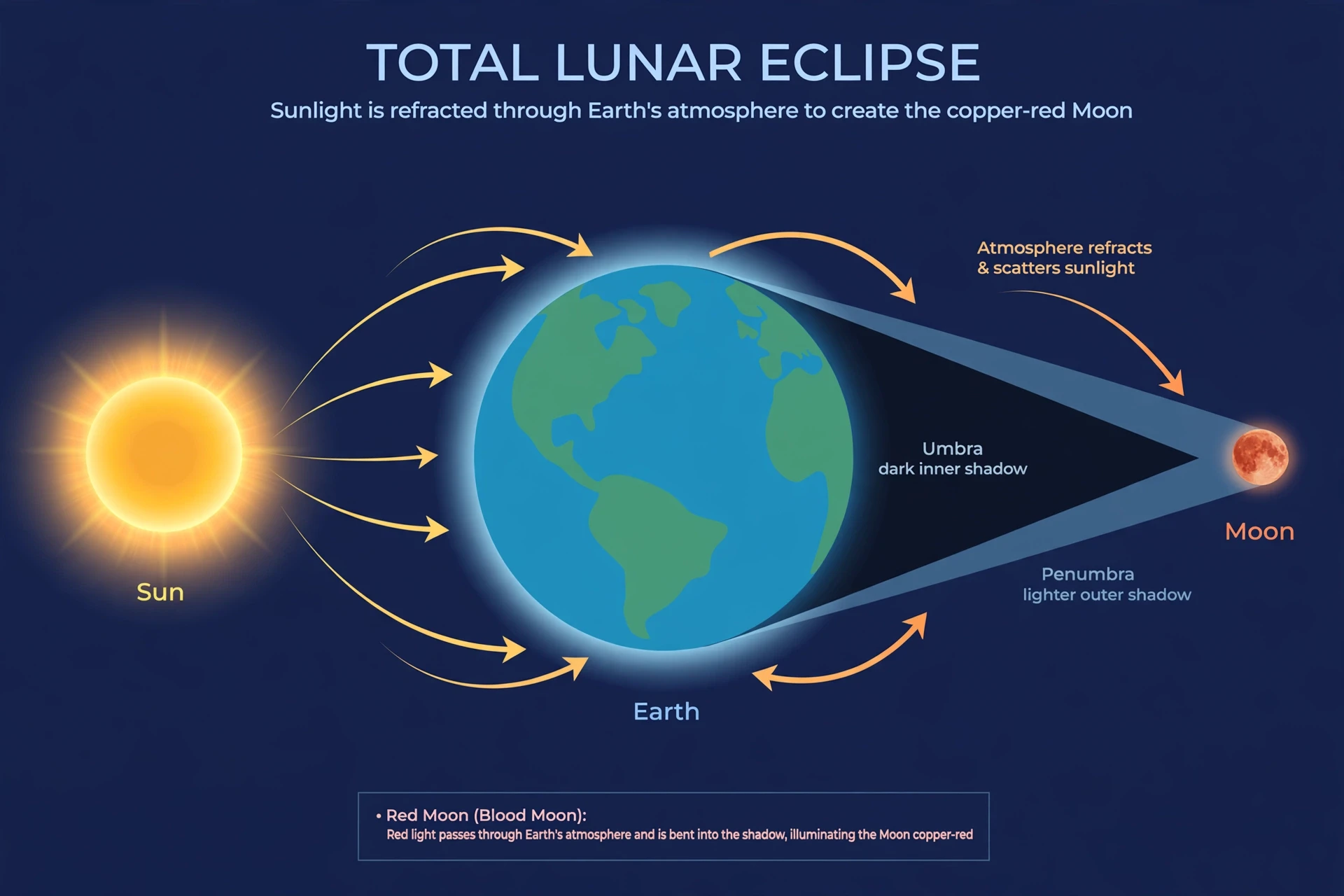
Strip away the drama and an eclipse is a shadow crossing a surface. Every solid object in the solar system casts one. Hold your hand up to a lamp and you will see two regions in the shadow on the wall: a dark center where the light is fully blocked, and a fuzzy edge where it is only partly blocked. Astronomers give those two regions names that you will meet again and again in this article: the umbra, the dark inner cone where the light source is completely hidden, and the penumbra, the lighter outer region where it is only partly hidden.
A solar eclipse happens when the Moon's shadow falls on Earth. That can only occur at new Moon, when the Moon sits between Earth and the Sun. If you are standing in the umbra, the Moon covers the Sun completely and you see a total solar eclipse. If you are standing in the penumbra, the Moon covers only part of the Sun and you see a partial solar eclipse. A lunar eclipse is the mirror image: Earth steps between the Sun and the Moon, and the Moon drifts into Earth's shadow. That can only happen at full Moon, when Earth sits between the Sun and the Moon.
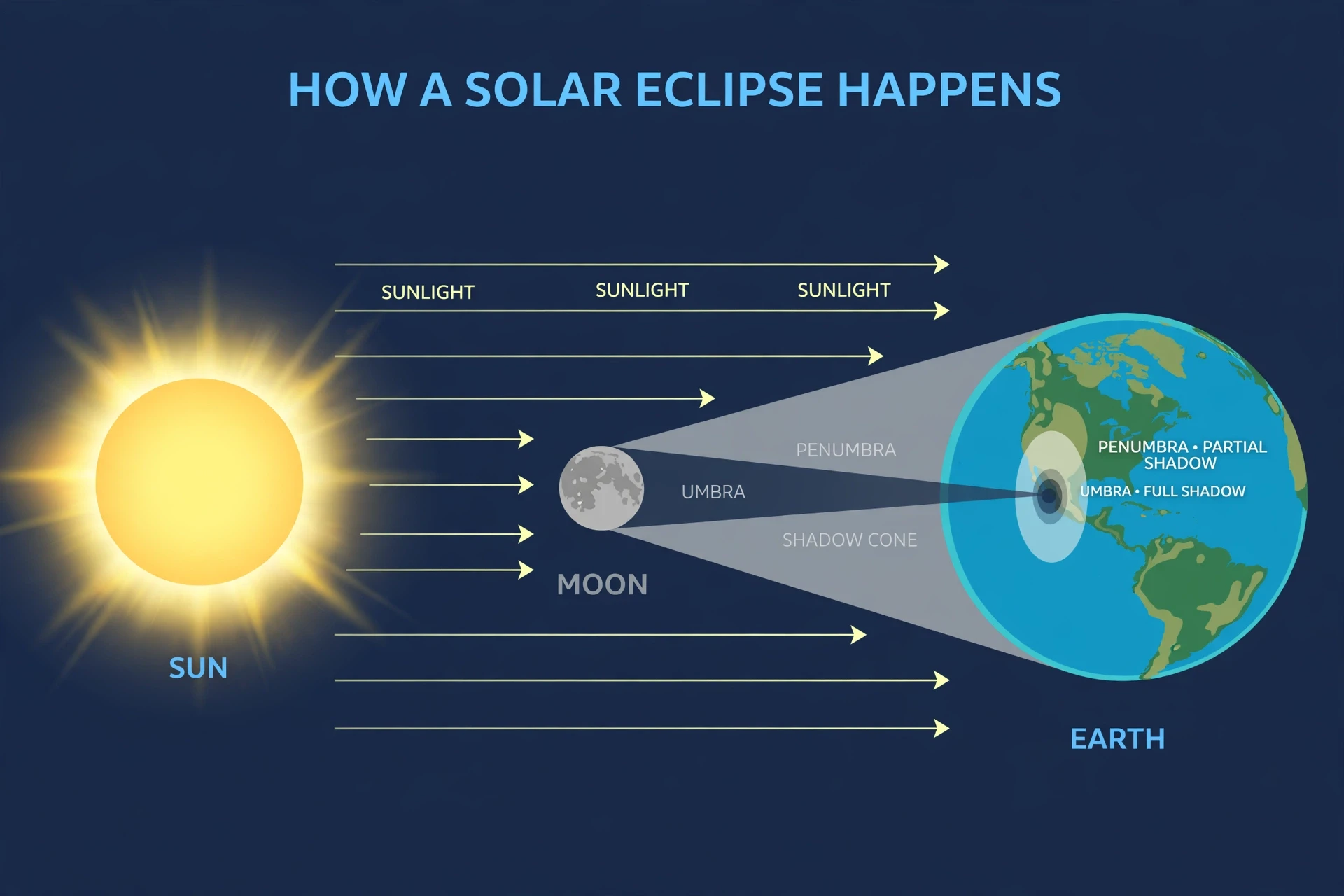
Notice what this means: a solar eclipse and a lunar eclipse are the same event seen from opposite sides. In one, the Moon's shadow touches Earth. In the other, Earth's shadow touches the Moon. The difference in how they look — and who gets to see them — comes entirely from the sizes of the two shadows and the distances involved. Earth's shadow at the Moon's distance is wide enough to swallow the whole Moon. The Moon's shadow at Earth's distance is a narrow cone that barely reaches us at all, and when it does, its tip paints a spot on the ground only about 100 miles wide.
There is a useful way to picture the scale. The Sun is so far away that its light arrives at Earth in nearly parallel rays. The Moon is close. So the Moon's shadow stretches out behind it as a long, tapering cone, and the cone's tip is what matters: if the tip reaches Earth's surface, we get a total solar eclipse along a thin track; if the tip falls short, the Moon looks too small to cover the Sun and we get a ring of fire instead. That single detail — whether the shadow's tip touches the ground — decides which kind of solar eclipse we see, and we will come back to it in Section 5.
One more fact belongs here, because it clears up a confusion I hear constantly. A solar eclipse is not the Moon going dark. The Moon is still there, lit by the Sun on the side facing away from us, exactly as it is at every new Moon. We cannot normally see a new Moon because its dark side faces us and it sits in the glare of the Sun. During a solar eclipse we see it only because it is silhouetted against the Sun itself — a black disk stamped onto the brightest thing in the sky.
3. Why Eclipses Do Not Happen Every Month
Here is the puzzle every beginner asks, and it is a good one. The Moon circles Earth once a month. It passes between Earth and the Sun at every new Moon and behind Earth at every full Moon. So why do we not get a solar eclipse and a lunar eclipse every single month?
The answer is tilt. The Moon's orbit around Earth is not lined up with Earth's orbit around the Sun. It is tilted by about 5 degrees. Five degrees sounds tiny, and on a diagram it looks like almost nothing, but at the Moon's distance of about 384,400 kilometers, five degrees is enough to lift the Moon thousands of kilometers above or below the Sun–Earth line. Most months, at new Moon, the Moon slides past just above or just below the Sun, and its shadow misses Earth entirely. Most months, at full Moon, the Moon slides past just above or below Earth's shadow, and nothing happens.
Eclipses can only occur when the Moon is near one of the two points where its tilted orbit crosses Earth's orbital plane. Astronomers call those crossing points nodes. The Moon passes through a node about every 27.2 days, but the Sun has to be near a node at the same time, and that only happens twice a year. Those two windows are called eclipse seasons. Each season lasts roughly 34 days, and the two seasons are about 173 days apart — a little less than six months.
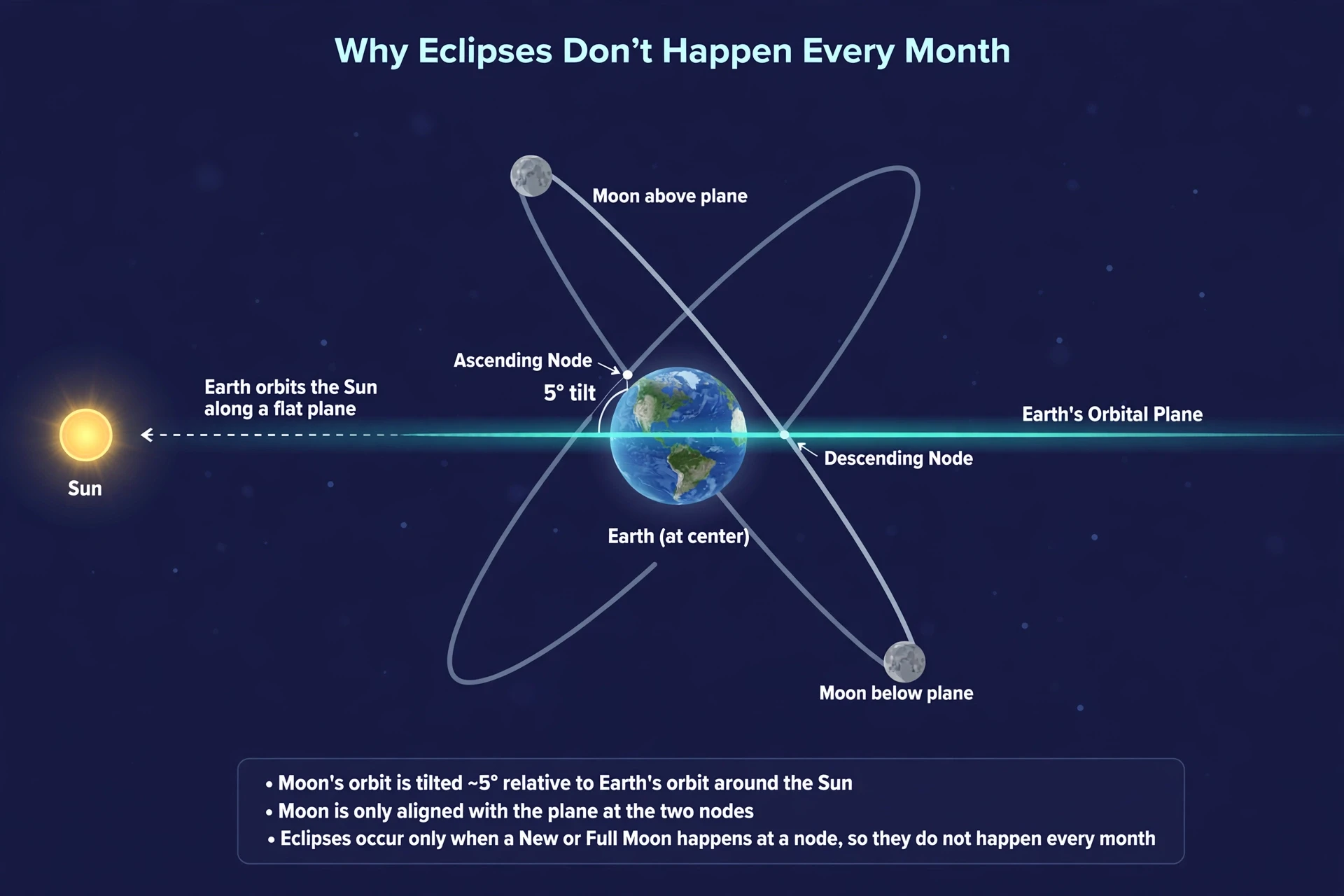
During an eclipse season, the alignment is close enough that at least one eclipse is guaranteed, and often two or three happen in a row — a solar eclipse at new Moon, a lunar eclipse at full Moon two weeks later, and sometimes another solar eclipse at the next new Moon. That is why eclipses come in clusters rather than spread evenly through the year. The year 2026 had two eclipse seasons: one in February and March, which brought an annular solar eclipse on February 17 and a total lunar eclipse on March 3, and one in August, which brought a total solar eclipse on August 12 and a partial lunar eclipse on August 28. The year 2027 follows the same rhythm, with an annular solar eclipse on February 6 and the great total solar eclipse of August 2.
The 5-degree tilt also explains something you may have noticed if you have ever watched the Moon for a few months: the Moon does not rise and set in the same place every month. Its path across the sky swings north and south as its orbit carries it above and below the plane of Earth's orbit. The eclipse seasons are simply the two times a year when that swinging path happens to cross the Sun's path — the ecliptic — and the geometry lines up.
I like to explain the tilt with a kitchen-table analogy. Imagine a dinner plate lying flat on the table: that is Earth's orbit around the Sun. Now hold a second, smaller plate tilted slightly, so one edge dips below the table's surface and the opposite edge rises above it. The Moon travels around the rim of the tilted plate. Most of the time it is either above or below the flat plate. It only crosses the flat plate at two points on opposite sides — the nodes. An eclipse needs the Moon at one of those crossing points while the Sun is standing in line with it. Everything else is a near miss, and near misses are what we get ten months out of twelve.
4. The Cosmic Coincidence: 400 Times Bigger, 400 Times Farther
There is a fact about eclipses that still stops me cold every time I think about it, and it is the reason total solar eclipses exist at all. The Sun is about 400 times wider than the Moon — roughly 1.39 million kilometers across, against the Moon's 3,474 kilometers. And the Sun is also about 400 times farther away — roughly 150 million kilometers, against the Moon's 384,400. Because the two ratios match, the Sun and the Moon appear almost exactly the same size in our sky: each spans about half a degree, about the width of your thumbnail held at arm's length.
That is a coincidence with no reason behind it. The Moon is slowly drifting away from Earth, about 3.8 centimeters a year, so in the distant past it looked bigger in the sky and total solar eclipses were longer and more common; in the far future it will look smaller, and total solar eclipses will stop happening altogether. We happen to live in the narrow window of Earth's history — a few hundred million years wide — when the match is nearly perfect. Astronomers sometimes call it the greatest coincidence in the solar system, and they are not exaggerating. Of all the planets and moons we know, Earth is the only place where a moon fits its sun so precisely that the sun's outer atmosphere is revealed.
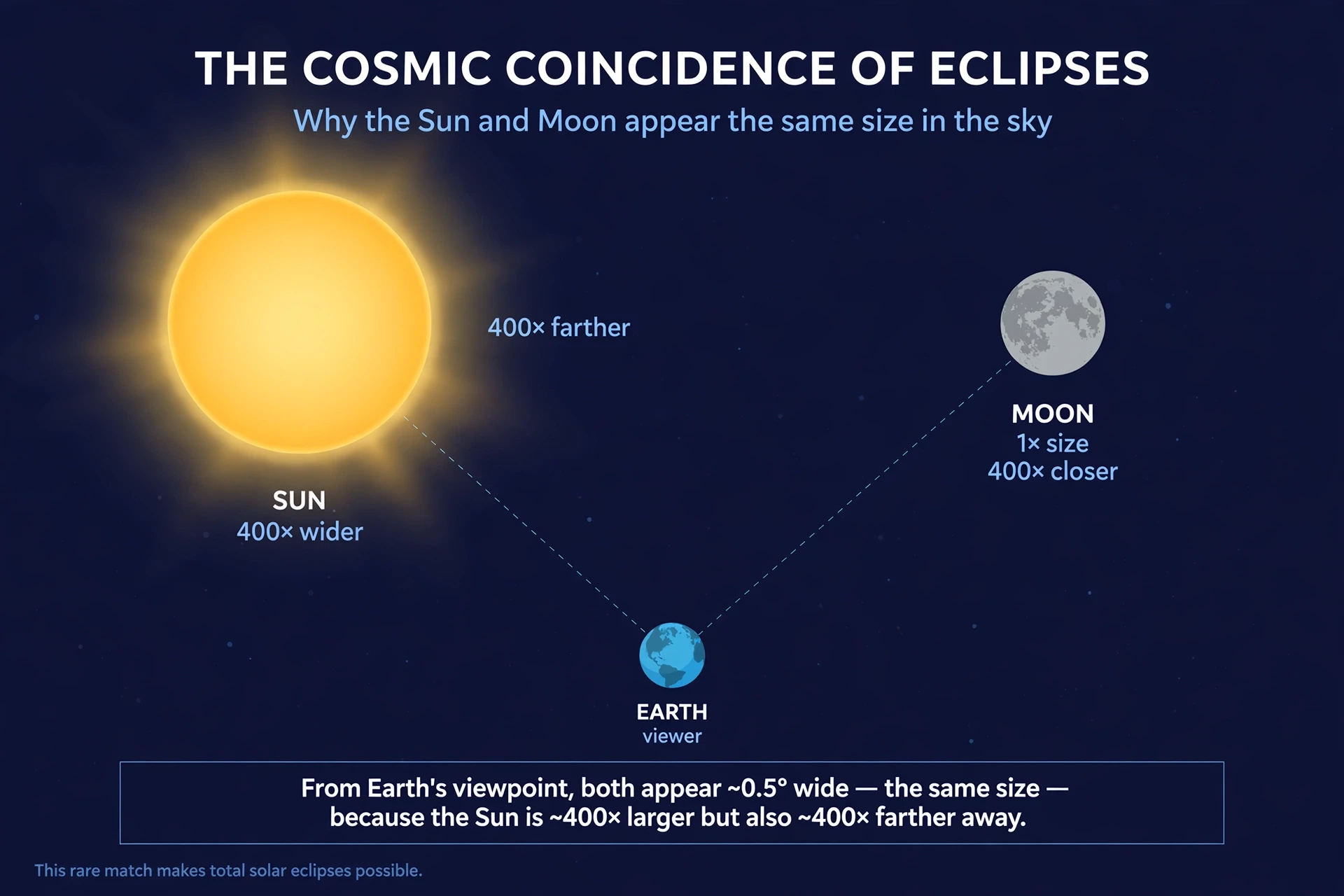
The match is not quite perfect, and that imperfection is what gives us the variety of solar eclipses. The Moon's orbit is not a circle but an ellipse, so its distance from Earth changes through the month. When the Moon is near its closest point, perigee, it looks slightly larger than the Sun and can cover it completely: a total solar eclipse. When the Moon is near its farthest point, apogee, it looks slightly smaller than the Sun, and a thin ring of sunlight remains visible around it: an annular solar eclipse, the famous "ring of fire." The difference between the two is less than a few percent in apparent size — a cosmic near-miss decided by where the Moon happens to be in its orbit that month.
This coincidence is also what makes a total solar eclipse scientifically precious. When the Moon covers the Sun's bright disk exactly, it acts like a perfect natural coronagraph — a mask that blocks the blinding surface and lets us see the Sun's outer atmosphere, the corona, which is normally drowned out by glare. The corona is a million-degree plasma that streams millions of kilometers into space and drives the solar wind. Without total solar eclipses, we would have had to wait for the invention of the coronagraph in the 1930s to see it at all, and even today, eclipse observations give us views of the inner corona that no spacecraft can match.
5. The Four Kinds of Solar Eclipse
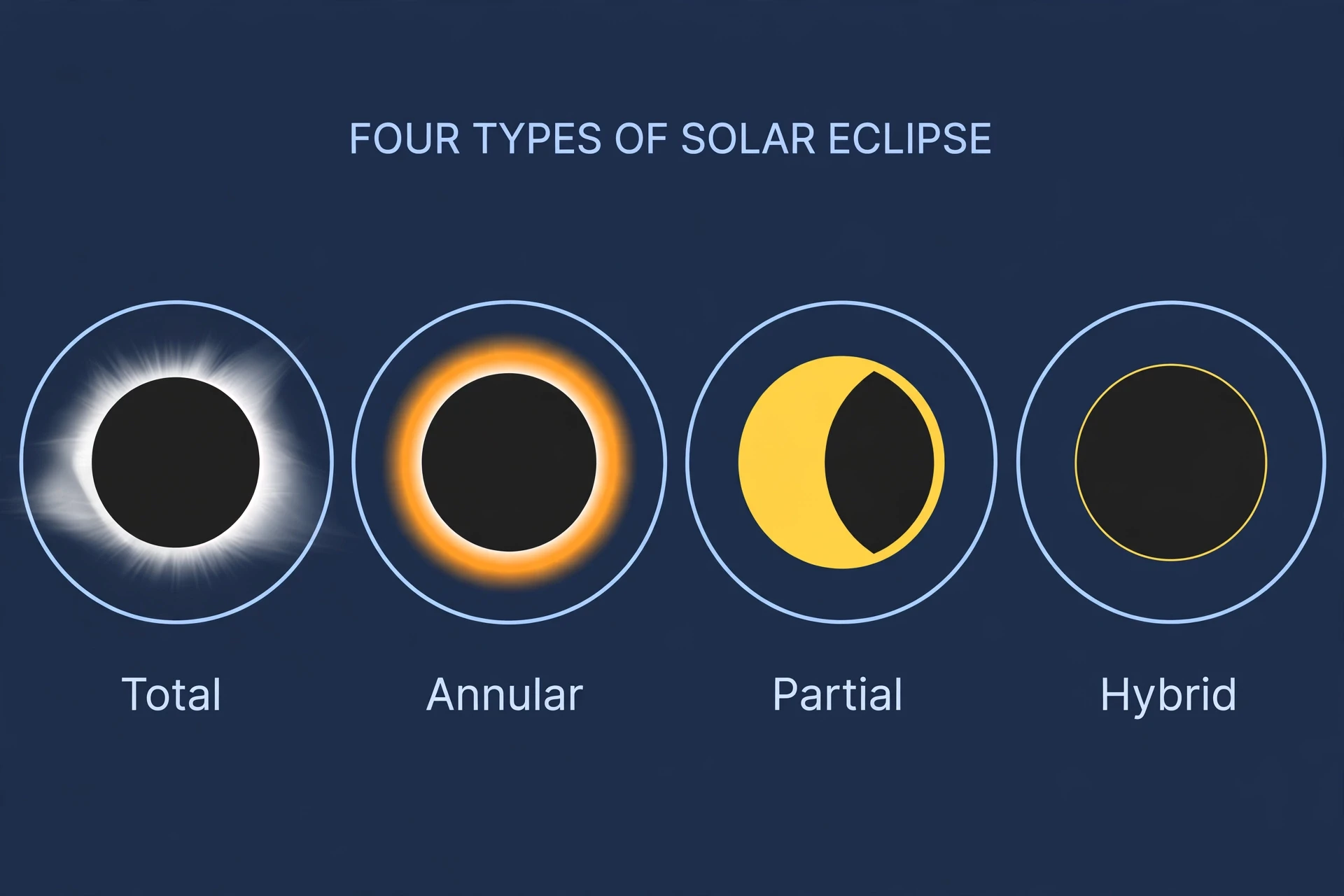
Not every solar eclipse is the same event. Depending on where the Moon is in its orbit and where you are standing on Earth, the Moon's disk either covers the Sun completely, leaves a ring, takes a bite, or does something in between. Astronomers recognize four types, and the table below lays out how they differ.
Type | What you see | Why it happens | How common it is |
|---|---|---|---|
Total | The Sun is completely covered; the corona blazes around a black disk | The Moon is near perigee and its umbra reaches Earth's surface | About 1 in 4 solar eclipses |
Annular | A bright "ring of fire" surrounds the dark Moon | The Moon is near apogee and looks slightly smaller than the Sun | About 1 in 3 solar eclipses |
Partial | A dark bite is taken out of the Sun's disk | You are in the penumbra, outside the path of totality or annularity | The most common view; seen over a wide area during every total or annular eclipse |
Hybrid | Annular in some places, total in others, along the same path | The curvature of Earth changes the Moon's apparent size along the path | Rare — only a few per century |
5.1 Total solar eclipse
A total solar eclipse is the one people cross oceans for. It happens when the Moon is close enough to Earth that its umbra — the dark core of its shadow — reaches the ground. Inside that narrow track, the Sun's disk is completely covered for a few minutes, the sky goes dark, and the corona appears. Totality never lasts long: the maximum possible is about 7 minutes 31 seconds, and most total eclipses give you between one and four minutes. The total solar eclipse of August 2, 2027, will be exceptional, with up to 6 minutes 23 seconds of totality in the Egyptian desert near Luxor — the longest totality of any total solar eclipse between 1991 and 2114.
5.2 Annular solar eclipse
An annular solar eclipse happens when the Moon is near apogee, its farthest point from Earth, and looks just a little too small to cover the Sun. The result is the "ring of fire": a thin, brilliant circle of sunlight around the Moon's black disk. It is beautiful, but it is not totality — the sky stays blue, the corona never appears, and you must keep your eclipse glasses on the whole time, because the ring is still blindingly bright. The annular solar eclipse of February 6, 2027, will carry a ring lasting up to 7 minutes 51 seconds across Chile, Argentina, the South Atlantic and southern Africa. Annular eclipses also have their own drama: the ring can break into beads of light, and the landscape takes on a strange, coppery light.
5.3 Partial solar eclipse
A partial solar eclipse is what most people actually see most of the time. If you are outside the path of totality or annularity but inside the penumbra — a region that can stretch about 3,000 kilometers on either side of the central path — the Moon covers only part of the Sun. The Sun looks like a cookie with a bite taken out of it, and the bite grows and shrinks over a couple of hours. A partial solar eclipse is worth watching with proper eye protection, but it does not darken the sky. The Sun is so bright that even with 90 percent of its disk covered, daylight looks almost normal; only when about 99 percent is covered does the light begin to feel wrong.
5.4 Hybrid solar eclipse
The rarest kind is the hybrid, also called an annular-total eclipse. Along a single path, the eclipse starts out annular, becomes total in the middle, and turns annular again before it ends. It happens because Earth is curved: as the Moon's shadow sweeps across the planet, the surface of Earth bulges toward the Moon in the middle of the path and falls away at the ends, changing the Moon's apparent size by just enough to flip the eclipse from one type to the other. The most recent hybrid solar eclipse crossed the remote waters and islands of the southern hemisphere on April 20, 2023. Only a handful of people saw its total phase from land.
One common mix-up is worth clearing up here. People sometimes say a solar eclipse is "rare." It is not. Between two and five solar eclipses happen somewhere on Earth every year. What is rare is a total solar eclipse at any one place: on average, a given town sees one only about once every 375 years. That is why eclipse chasers travel. The eclipse itself is common; being underneath it is not.
6. The Path of Totality: A Shadow Racing at 1,500 Kilometers per Hour
If you want to see a total solar eclipse, you have to go to it. That is the hard truth of eclipse chasing, and it follows directly from the geometry. The Moon's umbra is a cone whose tip is only about 100 miles wide when it touches Earth, and it races eastward across the surface at roughly 1,500 kilometers per hour — faster than a passenger jet. The strip of ground it crosses is the path of totality, and only the people standing inside that strip see the Sun fully covered. Everyone else, even a few dozen kilometers away, sees a partial solar eclipse in ordinary daylight.
The path is narrow, but it is long. A single total solar eclipse can cross an entire ocean and several countries, painting a track thousands of kilometers long and barely a hundred wide. The total solar eclipse of April 8, 2024, crossed Mexico, the United States and Canada in a band that ran from the Pacific coast to Newfoundland. The total solar eclipse of August 2, 2027, will cross southern Spain, Morocco, Algeria, Libya, Egypt, Saudi Arabia and Yemen. The total solar eclipse of July 22, 2028, will cross Australia and New Zealand.
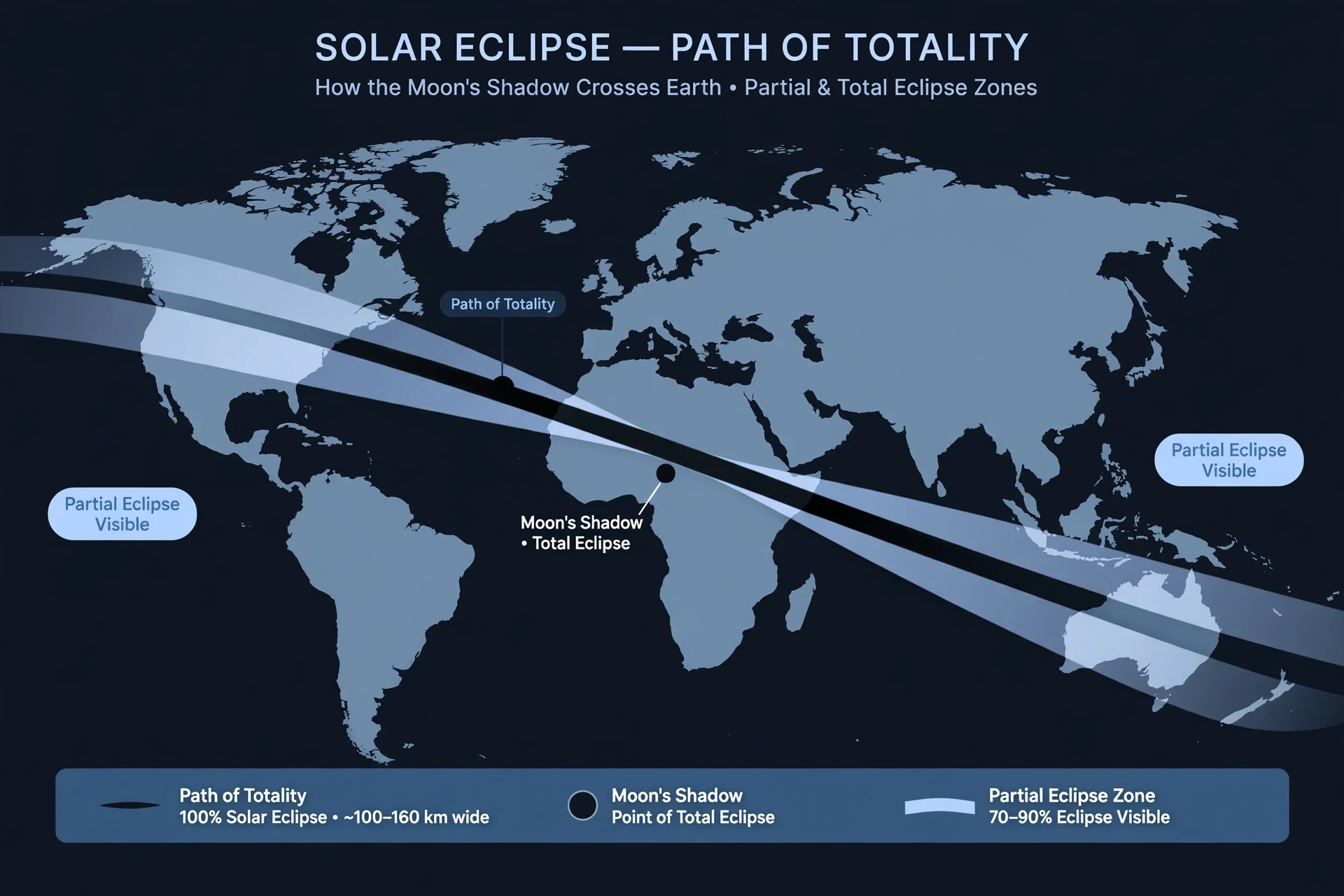
Standing on the centerline of the path matters more than most first-timers realize. Totality lasts longest at the center and shrinks toward the edges, where it can last only a few seconds. Eclipse veterans choose their spot with maps and weather forecasts the way sailors choose an anchorage, and they always keep a backup location in mind, because a single cloud sitting over the centerline at the wrong minute can erase years of planning. I learned this the hard way: for my first eclipse I picked a beautiful hilltop that the forecast had promised would be clear, and I watched the shadow arrive under a thin sheet of high cloud. The corona still glowed through the haze — a ghostly ring in a grey sky — but I have never again trusted a single forecast. Now I check three, and I keep the car fueled.
6.1 How long does the shadow take to cross a town?
The Moon's shadow moves so fast that it crosses a typical town in well under a minute — but that is not the same as the length of totality. Totality is the time the shadow spends over you, and it depends on the width of the path and the speed of the shadow. Near the centerline of a long eclipse, that can be several minutes. The shadow's speed is not constant either: it moves fastest near the equator, where Earth's surface is spinning fastest underneath it, and slowest at high latitudes, which is one reason some of the longest eclipses happen far north or far south.
6.2 What to expect as the shadow arrives
The approach of the shadow is itself a spectacle. In the last minute before totality, the light takes on a quality that experienced watchers call "the eerie light" — shadows become razor-sharp, colors drain out of the landscape, and the air cools noticeably. Just before the Sun disappears, you may see shadow bands: faint, rippling lines of light and dark racing across the ground, caused by turbulence in Earth's atmosphere bending the last thin sliver of sunlight. They look like the patterns on the bottom of a swimming pool, and they vanish the instant totality begins.
7. Totality: Two Minutes That Change People
Ask anyone who has seen a total solar eclipse what it was like, and you will get the same answer in different words: nothing else in the sky prepares you for it. Photographs help, but they miss the feeling, and they miss the fact that totality is a full-body event, not just a picture.
It begins with the diamond ring. As the last sliver of the Sun's disk disappears behind the Moon, a single brilliant point of light flares at the edge — sunlight streaming through a valley on the Moon's rugged limb — ringed by the glowing corona. It lasts a few seconds and it is the most photographed moment of any eclipse, and it is also the signal that it is safe to take your eclipse glasses off. Then the diamond fades, and the corona takes over: a crown of pearly white plasma, shaped by the Sun's magnetic field into streamers and plumes that reach millions of kilometers into space. The corona's shape changes with the Sun's eleven-year activity cycle — spiky and uneven near solar maximum, smooth and symmetrical near solar minimum — so no two total solar eclipses ever show quite the same crown.
Look closely at the edge of the Moon's disk and you may catch Baily's beads: a string of bright points where sunlight shines through the valleys between the Moon's mountains, named after the English astronomer Francis Baily, who described them in 1836. They appear just before and just after totality, and they are the last and first light of the partial phases.
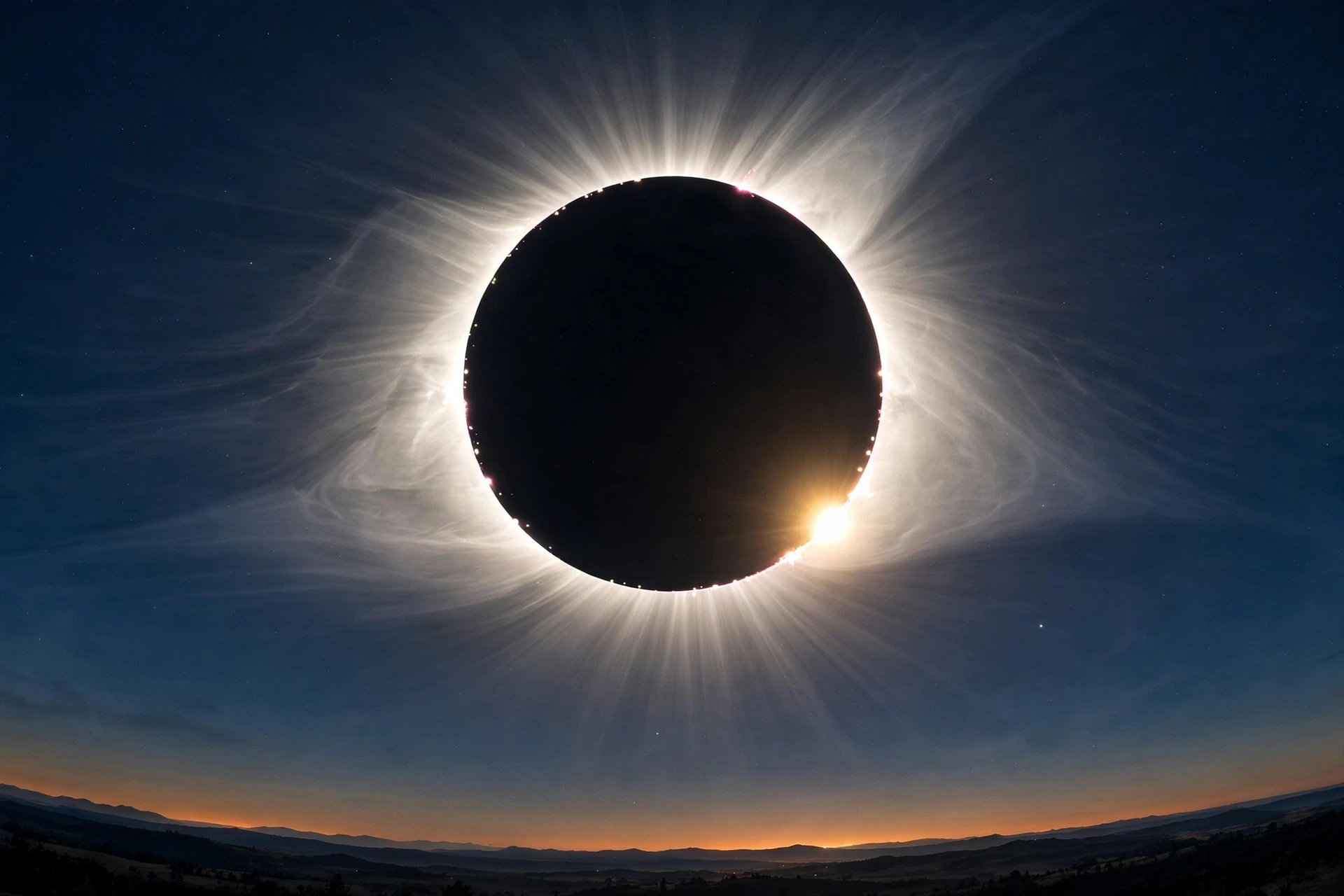
But the corona is only half the show. Look around you. The sky overhead turns a deep, starry blue, and the brightest stars and planets come out — during the 2024 eclipse, Venus and Jupiter were both plainly visible in the daytime sky. Around the whole horizon, in every direction at once, glows a band of orange and pink: a 360-degree sunset, because just beyond the edge of the Moon's shadow, the Sun is still shining, and the sky there is still in daylight. The temperature can drop by several degrees in minutes. Animals react as if night has fallen without warning: birds go quiet and head for their roosts, crickets start chirping, and farm animals have been seen heading for their barns. Humans react too, and often more dramatically than the animals. I have watched grown adults — engineers, pilots, people who do not impress easily — weep openly at totality, and I have done it myself. There is something about seeing the machinery of the solar system laid bare, in the middle of the day, that bypasses the thinking brain entirely.
"A total eclipse of the Sun is the most spectacular, awe-inspiring sight in all of nature. Those who have seen one never forget it, and those who have not seen one cannot fully imagine it."
That feeling is not new. Ancient peoples, who had no model of the solar system at all, experienced the same shock — and without any warning. For them, the Sun going out at noon was not a marvel of geometry; it was the world ending. We will come back to that in Section 11.
One practical note: totality ends as suddenly as it begins. The diamond ring flares on the opposite side of the Moon, and that is your signal to put your eclipse glasses back on immediately. The partial phases after totality are just as dangerous to look at as the ones before it.
8. Lunar Eclipses and the Blood Moon
A lunar eclipse is the gentler, more generous cousin of the solar eclipse. It happens when Earth moves between the Sun and the Moon, and the Moon passes through Earth's shadow. Because Earth's shadow at the Moon's distance is about 2.5 times wider than the Moon itself, the whole Moon can fit inside it with room to spare — and because the Moon is the thing being shadowed, everyone on the night side of Earth sees the same eclipse at the same time. No narrow path, no travel, no special glasses. You just step outside and look up.
There are three kinds of lunar eclipse, depending on how deeply the Moon enters Earth's shadow:
Total lunar eclipse. The entire Moon passes into Earth's umbra. The Moon does not vanish — it turns a deep coppery red, the famous blood moon. Totality can last up to about 1 hour 47 minutes, far longer than any total solar eclipse.
Partial lunar eclipse. Only part of the Moon enters the umbra. It looks as if a dark bite has been taken out of the Moon's disk, and the edge of the bite is curved — the curve of Earth's shadow, which is one of the oldest proofs that Earth is round.
Penumbral lunar eclipse. The Moon passes only through the penumbra, the faint outer shadow. The Moon dims slightly, like a lamp turned down a notch, and many people do not even notice it. Three penumbral lunar eclipses are expected in 2027 — on February 20, July 18 and August 17 — and none of them will be dramatic.
8.1 Why the Moon turns red
The red color is the part of the story I love most, because it is the same physics that makes sunsets red. During a total lunar eclipse, Earth blocks the direct light of the Sun from reaching the Moon. But Earth's atmosphere is a lens as well as a shield: it bends some sunlight around the edge of the planet and into the shadow, the way a glass of water bends a straw. As that sunlight passes through the atmosphere, the air scatters the blue light away — the same Rayleigh scattering that makes our sky blue — and lets mostly red and orange light through. That filtered, bent light falls on the Moon and paints it red.
The exact shade changes from eclipse to eclipse, and it tells us something about Earth's atmosphere at that moment. After a big volcanic eruption throws dust and ash into the stratosphere, the eclipsed Moon can turn almost black, because the dust blocks even the red light. In a clean atmosphere, it glows bright copper-orange. Astronomers grade the darkness on the Danjon scale, from 0 (nearly invisible) to 4 (bright copper-red), and comparing the observed brightness with predictions is a genuine piece of citizen science — anyone with a pair of eyes and a notebook can contribute.
8.2 My first blood moon
I still remember the first total lunar eclipse I watched properly. It was a cold, clear night, and I had dragged a folding chair into the backyard with a thermos of tea and no real plan except to watch. The Moon rose already half-eaten, and over the next hour the shadow crept across it until the whole disk was a dim red coin hanging in a sky full of stars I had never noticed before — because the Moon, usually so bright it washes out the faint stars, had turned its own light down. That is the quiet gift of a lunar eclipse: it darkens the Moon enough to let the rest of the sky show. I sat there until the red faded and the white light came back, and the whole thing had cost me nothing but an evening and a thermos of tea. That is the difference between the two kinds of eclipse in one memory: a solar eclipse is an expedition; a lunar eclipse is an invitation.
9. Why a Lunar Eclipse Is for Half the Planet and a Solar Eclipse Is for a Lucky Few
This is the question that ties the whole article together, so it is worth stating plainly. A lunar eclipse is visible from anywhere on the night side of Earth — roughly half the planet — because the thing being darkened is the Moon itself, and the Moon is visible from everywhere it is above the horizon. A solar eclipse is visible as a total eclipse only from the narrow strip where the Moon's small shadow touches Earth, because the thing being darkened is a patch of ground, and the shadow that darkens it is tiny.
The numbers make the point. Earth's shadow at the Moon's distance is about 9,000 kilometers wide, and the Moon is 3,474 kilometers across — the shadow is nearly three times wider than its target, so the Moon fits inside easily, and the eclipse lasts a long time. The Moon's shadow at Earth's distance is about 100 miles wide at most, and Earth is 12,742 kilometers across — the shadow is a pinprick on a continent, so the eclipse is brief and local. Same geometry, same three bodies, wildly different audience.
There is a second reason lunar eclipses feel more common: they last longer. A total lunar eclipse can keep the Moon red for more than an hour, and the whole event from first penumbral contact to last can take five or six hours. A total solar eclipse gives you a few minutes. That is why, in 2026, the total lunar eclipse of March 3 was watched by hundreds of millions of people across the Pacific, East Asia, Australia and the Americas, while the total solar eclipse of August 12 was seen in totality only by the people who had traveled to Greenland, Iceland and northern Spain. Both were total eclipses. One was for a hemisphere; the other was for a road.
"The Moon's shadow is a needle; Earth's shadow is a blanket. That single difference in size decides who gets to see which eclipse, and why one of them belongs to half the world while the other belongs to whoever happened to be standing in the right hundred miles."
10. How to Watch a Solar Eclipse Without Hurting Your Eyes
This section is the most important one in the article, so I will say it plainly first: never look directly at the Sun without certified protection, except during the brief minutes of totality in a total solar eclipse. The Sun's visible light is bright enough to hurt, but the real danger is the light you cannot feel. The Sun pours out infrared and ultraviolet radiation that can burn the retina — the light-sensitive tissue at the back of your eye — without triggering any pain, because the retina has no pain receptors. The damage is called solar retinopathy, and it can be permanent. People have lost central vision from a few seconds of careless looking.
The good news is that safe viewing is easy, cheap, and in one case completely free. Here is what works, and what does not.
10.1 What works
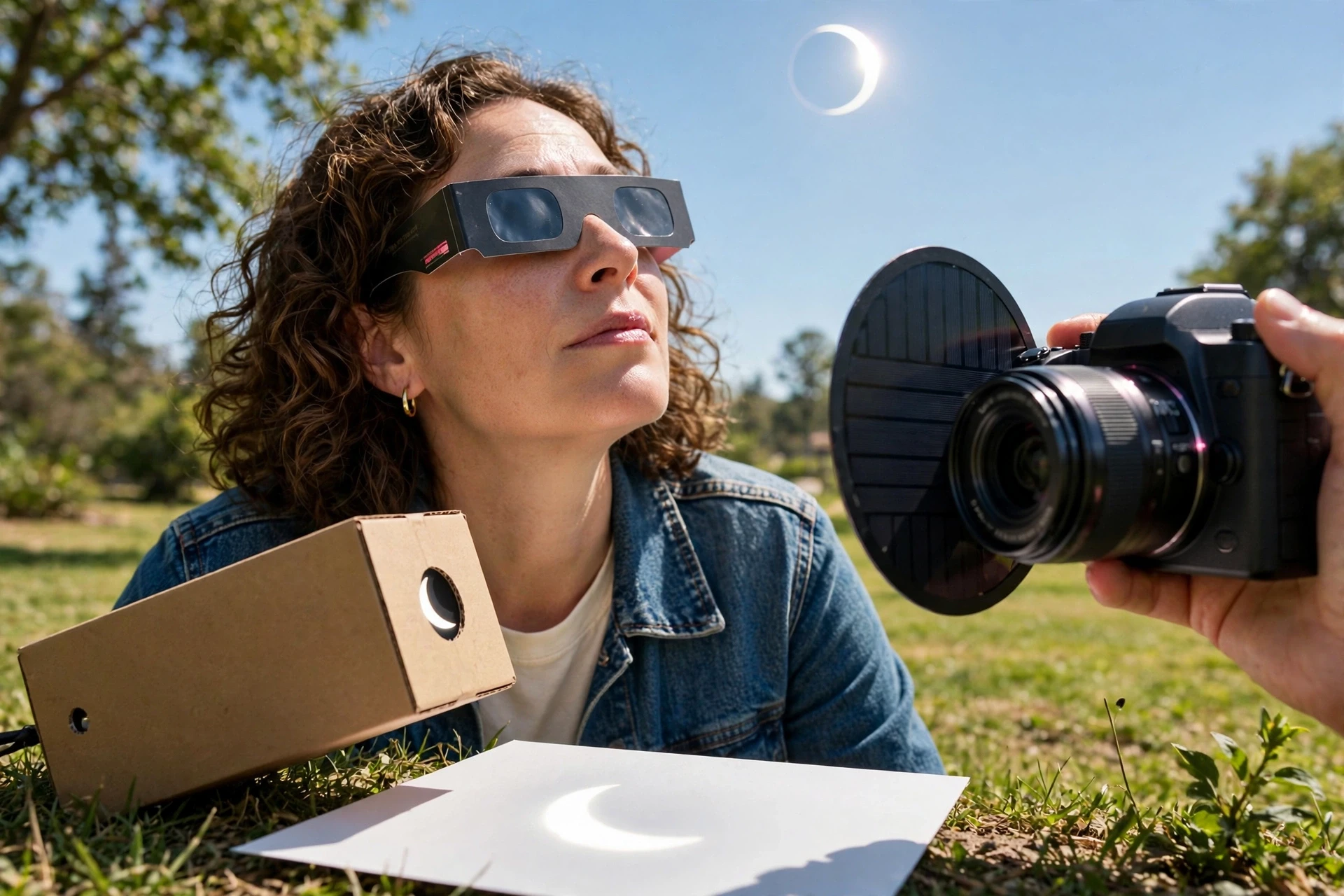
Certified eclipse glasses. Use glasses that meet the ISO 12312-2 international safety standard, bought from a reputable vendor. They look like flimsy cardboard glasses, but their filters are a thousand times darker than ordinary sunglasses. Check them before use: hold them up to a bright light and look for scratches, holes or damage. If they are damaged, throw them away. Put them on before you look at the Sun, and look away before you take them off.
A handheld solar viewer. The same ISO 12312-2 filter material, held in your hand instead of worn on your face. Useful for sharing with a group.
A solar filter on a telescope, binoculars or camera. The filter must go on the front of the instrument — over the objective lens — never at the eyepiece, where concentrated sunlight can crack it in an instant. If you are not sure your filter is the right kind, do not improvise.
A pinhole projector. The free option, and my favorite for children. Poke a small hole in a piece of card, hold it up with your back to the Sun, and let the sunlight pass through the hole onto a second white card held a meter or so below. You will see a perfect little image of the eclipsed Sun projected onto the card — safe, because you are looking at a projection, not at the Sun. A kitchen colander works the same way, and so do the gaps between leaves on a tree: during a partial solar eclipse, the dappled sunlight under a tree turns into hundreds of tiny crescents.
10.2 What does not work
Ordinary sunglasses. Not even several pairs stacked together. They cut visible light but let through enough infrared and ultraviolet radiation to damage your eyes, and they make the danger worse by letting your pupils open wider.
Smoked glass, photographic film, CDs, or a phone screen. None of these are safe filters, and some of them can shatter or focus light.
Looking through a camera viewfinder, binoculars or a telescope without a proper front filter. An unfiltered telescope concentrates the Sun's light and can burn your eye in less than a second. It can also melt the inside of a camera.
The "it feels fine" test. Your eyes will not warn you. Retinal burns are painless, and the symptoms — a blind spot in the center of your vision — can show up hours later.
10.3 The one exception: totality
During the few minutes of a total solar eclipse, when the Sun's disk is completely covered, it is safe — and essential — to look directly at the corona with the naked eye. That is the whole point of being there. But the window is exact: glasses off only after the diamond ring has faded and the disk is fully covered, and glasses back on the instant the diamond ring returns on the other side. If you are watching a partial solar eclipse or an annular solar eclipse, there is no safe moment at all — the glasses stay on for the entire event.
A lunar eclipse, by contrast, is completely safe to watch with the naked eye, with binoculars, or through a telescope. You are looking at the Moon, which shines only by reflected sunlight, and during totality it is dimmer than a normal full Moon. No filter is needed, and no eye protection of any kind is required. NASA's eclipse safety guidance makes the same point, and it is worth repeating to anyone who worries: a blood moon cannot hurt your eyes.
11. Eclipses in History: Omens, a Battle, and Einstein
For most of human history, an eclipse was not an astronomical event. It was an omen, a monster, or a message from the gods — and the records people left behind are some of the oldest astronomical observations we have.
11.1 Fear and omens
The ancient Chinese believed a dragon was devouring the Sun, and people banged drums and pots to frighten it away. In Norse myth, the wolf Skoll chased the Sun across the sky and caught it during an eclipse. In India, the demon Rahu was said to swallow the Sun or the Moon, and the eclipse ended only when the god's head was cut off and the light escaped. The pattern is the same everywhere: the Sun or the Moon going dark without warning was the most frightening thing the sky could do, and every culture invented a story to explain it.
The fear was not irrational. An unexpected total solar eclipse in a pre-scientific world would have been terrifying — the temperature dropping, the birds going silent, the stars coming out at noon, with no warning and no explanation. It is easy to forget, sitting with our eclipse maps and countdown apps, that for thousands of years nobody knew when the next one would come.
11.2 The eclipse that stopped a battle
The first eclipse in history that we can date with confidence is also one of the most famous. On May 28, 585 BCE, a total solar eclipse darkened the sky over Anatolia during a battle between the Lydians and the Medes. According to the Greek historian Herodotus, the two armies were fighting when day turned suddenly to night, and both sides were so shaken that they stopped fighting and made peace. The Greek philosopher Thales of Miletus is credited with having predicted the eclipse — probably by using the Saros cycle, which Babylonian astronomers had already worked out — and whether or not the prediction story is exactly true, the event is real: modern calculations confirm a total solar eclipse crossed Anatolia on that date. It is the earliest historical event whose date is fixed by an eclipse, and it marks the moment when eclipses began to change from omens into predictable phenomena.
11.3 The eclipse that proved Einstein right
The most consequential eclipse in the history of science came on May 29, 1919. Albert Einstein's general theory of relativity, published in 1915, predicted that the Sun's gravity would bend the light of distant stars passing near it — by about 1.75 arcseconds, twice the amount Newton's theory predicted. The only way to test that prediction was during a total solar eclipse, when the Sun's disk was covered and the stars near it became visible in daylight.
Two British expeditions set out to photograph the eclipse: one led by Arthur Eddington to the island of Principe off West Africa, and one to Sobral in Brazil. Both succeeded despite cloud and difficult conditions, and both measured the starlight bending by almost exactly the amount Einstein had predicted. When the results were announced in London in November 1919, Einstein became a world celebrity overnight, and general relativity moved from a speculative theory to the accepted description of gravity. The expedition's measurements were not perfect — later historians have argued about how selective Eddington was with his data — but the eclipse of 1919 remains the moment when a shadow cast by the Moon changed the course of physics. The story of that theory, and what gravity actually is, is told in more detail in our companion articles on Einstein's theory of relativity and how gravity works.
12. The Saros Cycle and the Eclipses Coming Next
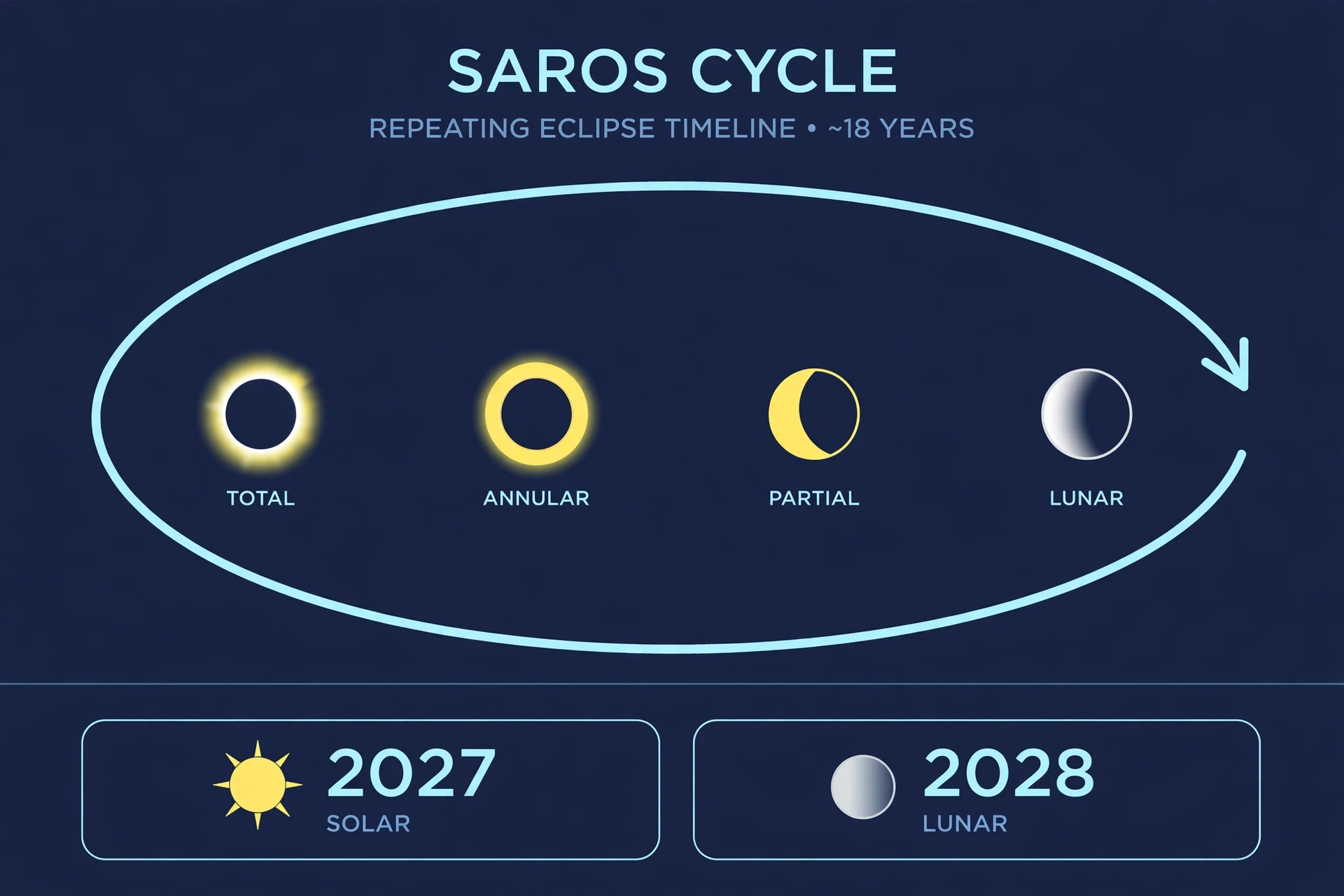
Eclipses repeat. Not randomly, and not exactly, but in a rhythm so regular that ancient Babylonian astronomers discovered it more than 2,500 years ago. The rhythm is called the Saros cycle, and it is one of the most beautiful pieces of clockwork in astronomy.
The cycle works because three different lunar rhythms line up almost perfectly after 223 lunar months — 18 years, 11 days and 8 hours. After one Saros, the Sun, Earth and Moon return to almost exactly the same relative positions, and an almost identical eclipse happens again. Almost identical, because the extra 8 hours means Earth has turned a third of the way around, so the repeat eclipse falls about 120 degrees of longitude to the west of the original. After three Saros cycles — 54 years and about a month — the eclipse returns to roughly the same part of the world.
Every eclipse belongs to a Saros series, a family of eclipses that runs for 1,200 to 1,500 years and contains 70 or more members. The total solar eclipse of August 2, 2027, belongs to Saros 136, a series that has been producing eclipses since the year 1360 and will keep going until 2622. The total lunar eclipse of March 3, 2026, belonged to Saros 133. The same series gave us the total lunar eclipse of February 21, 2008, and will give us another on March 14, 2044. If you saw an eclipse as a child, there is a good chance its Saros sibling is still on its way.
12.1 The eclipses to plan for
Here are the notable eclipses coming up, with dates and visibility taken from NASA's eclipse catalog. The 2026 eclipses have already happened, and they are included so you can see the rhythm of the seasons; the events from 2027 onward are the ones to put in your calendar.
Date | Type | Where it is visible | Notes |
|---|---|---|---|
February 17, 2026 | Annular solar eclipse | Antarctica; partial in southern South America and southern Africa | Already happened; ring lasted 2 minutes 20 seconds |
March 3, 2026 | Total lunar eclipse | Pacific, East Asia, Australia, the Americas | Already happened; totality lasted about 58 minutes |
August 12, 2026 | Total solar eclipse | Greenland, Iceland, northern Spain | Already happened; first total solar eclipse visible from mainland Europe since 1999 |
August 28, 2026 | Partial lunar eclipse | The Americas, Europe, Africa | Already happened; 93 percent of the Moon covered |
February 6, 2027 | Annular solar eclipse | Chile, Argentina, South Atlantic, southern Africa | Ring of fire lasting up to 7 minutes 51 seconds |
August 2, 2027 | Total solar eclipse | Southern Spain, Morocco, Algeria, Libya, Egypt, Saudi Arabia, Yemen | The big one — up to 6 minutes 23 seconds of totality |
January 26, 2028 | Annular solar eclipse | South America, Spain, Portugal; partial in the eastern United States | Ring of fire lasting up to 10 minutes 27 seconds |
July 22, 2028 | Total solar eclipse | Australia and New Zealand | Totality up to 5 minutes 10 seconds |
December 31, 2028 | Total lunar eclipse | Europe, Africa, Asia, Australia, the Pacific | A New Year's Eve blood moon |
November 25, 2030 | Total solar eclipse | Southern Africa, Australia | Totality up to 3 minutes 44 seconds |
A note for readers in North America: the next total solar eclipse visible from the contiguous United States is on August 12, 2045, when totality will sweep from California to Florida. That is a long wait, and it is the reason so many American eclipse chasers are booking flights to Spain for August 2027. The August 2, 2027 eclipse is the longest total solar eclipse most people alive today will ever have the chance to see, and its path crosses some of the most reliably clear skies on Earth — the Egyptian desert near Luxor, where the chance of cloud on that date is among the lowest anywhere on the planet.
If you are planning to travel for it, start early. Hotels in Luxor and southern Spain are already being booked years in advance, and the roads near the centerline will be crowded on the day. Pick a spot on the centerline, have a backup location a short drive away, check the weather the morning of the eclipse, and bring more water than you think you need. And bring eclipse glasses — even for a total solar eclipse, you need them for the partial phases that last an hour on either side of totality.
13. What People Get Wrong About Eclipses
Eclipses attract myths the way the Moon attracts tides, so here are the misunderstandings I hear most often, corrected in plain language.
"A solar eclipse is dangerous because the Sun gives off special harmful rays during the eclipse." No. The Sun is exactly as dangerous during an eclipse as it is on any other day. The danger is that people stare at it. During an ordinary day nobody looks at the Sun for long, because it hurts. During an eclipse, the Sun looks dimmer and less painful, so people stare — and the invisible infrared and ultraviolet light still does its damage.
"A lunar eclipse is dangerous to watch." No. A lunar eclipse is completely safe with the naked eye. You are looking at the Moon, and during totality it is dimmer than usual. The old warnings about not eating or drinking during an eclipse, or about pregnant women staying indoors, are folklore with no scientific basis.
"A total solar eclipse turns the whole world dark." Only inside the path of totality, and only for a few minutes. A few hundred kilometers away, the day stays bright. Even at 99 percent coverage, the sky looks almost normal.
"Eclipses happen every month." They cannot, because the Moon's orbit is tilted 5 degrees. Most new Moons pass above or below the Sun, and most full Moons pass above or below Earth's shadow. Eclipses only happen during the two eclipse seasons each year.
"The blood moon means something bad is about to happen." The red color is sunlight filtered through Earth's atmosphere — the same physics as a sunset. It happens at every total lunar eclipse, and it has happened thousands of times without the world ending.
"You need an expensive telescope to enjoy an eclipse." You do not. A total solar eclipse is best watched with the naked eye. A lunar eclipse is beautiful through binoculars, and a partial solar eclipse is perfectly enjoyable with a piece of cardboard and a pinhole. The most important equipment is a clear sky and a place to stand.
14. Why Eclipses Still Stop Us in Our Tracks
I have now watched several total solar eclipses and more lunar eclipses than I can count, and the strange thing is that the wonder has not worn off. If anything, knowing the geometry makes it stronger. I know exactly why the Moon's shadow is 100 miles wide. I know the Saros cycle by heart. I can tell you the date of the next total solar eclipse in Spain without looking it up. And still, when the light dies and the corona blooms, I feel the same shock I felt the first time — the shock of seeing, with my own eyes, that we live on a rock in space, and that the clockwork of the solar system is real and visible and happening right above our heads.
That is what an eclipse gives you that no photograph or planetarium show can: a direct, physical sense of scale. The Sun is 400 times wider than the Moon and 400 times farther away, and for a few minutes those two numbers cancel out and the universe lines up for you. The shadow that falls across your town is the same shadow that stopped a battle in 585 BCE and proved Einstein right in 1919. The red Moon you watch from your backyard is lit by every sunset happening on Earth at that moment, bent around the edge of our planet and thrown a quarter of a million miles through space onto the face of another world.
So mark the dates. August 2, 2027, for the long total solar eclipse across Spain, North Africa and Egypt. December 31, 2028, for the New Year's Eve blood moon. And if you are lucky enough to be under the path of totality one day, do what I did in that field in New York: put the camera down, take the glasses off at the right moment, and just watch. Two minutes of darkness at noon will stay with you for the rest of your life.
Frequently Asked Questions
How often does a total solar eclipse happen?
A total solar eclipse happens somewhere on Earth roughly every 18 months, and between two and five solar eclipses of all kinds occur every year. But a total solar eclipse is only visible from a narrow path about 100 miles wide, so any one place on Earth sees one only about once every 375 years on average. That is why eclipse watchers travel.
Can you look at a solar eclipse with the naked eye?
Only during the brief minutes of totality in a total solar eclipse, when the Sun's disk is completely covered. At every other moment — during the partial phases, during an annular solar eclipse, and during the diamond ring — you must use certified eclipse glasses meeting the ISO 12312-2 standard or another approved solar filter. Never look directly at the Sun without protection, and never use ordinary sunglasses.
Why does the Moon turn red during a lunar eclipse?
During a total lunar eclipse, Earth blocks direct sunlight from the Moon, but some sunlight bends through Earth's atmosphere and reaches the Moon anyway. The atmosphere scatters the blue light away and lets red and orange light through — the same effect that makes sunsets red — so the Moon glows copper-red. The exact shade depends on how much dust and cloud is in Earth's atmosphere at the time.
What is the difference between a solar eclipse and a lunar eclipse?
A solar eclipse happens at new Moon, when the Moon passes between the Sun and Earth and the Moon's shadow falls on Earth. A lunar eclipse happens at full Moon, when Earth passes between the Sun and the Moon and Earth's shadow falls on the Moon. A solar eclipse is visible only from a narrow path on Earth; a lunar eclipse is visible from everywhere on the night side of Earth.
When is the next total solar eclipse?
The next total solar eclipse is on August 2, 2027, with totality crossing southern Spain, Morocco, Algeria, Libya, Egypt, Saudi Arabia and Yemen, and lasting up to 6 minutes 23 seconds near Luxor, Egypt. After that, the next total solar eclipse is on July 22, 2028, across Australia and New Zealand. The next total solar eclipse visible from the contiguous United States is on August 12, 2045.
What is the path of totality?
The path of totality is the narrow strip of Earth's surface — typically about 100 miles wide — over which the Moon's dark inner shadow, the umbra, sweeps during a total solar eclipse. Only observers inside this path see the Sun completely covered and the corona. Outside it, observers see only a partial solar eclipse. The shadow races across the ground at roughly 1,500 kilometers per hour.
Is a lunar eclipse safe to watch?
Yes, completely. A lunar eclipse is safe to watch with the naked eye, with binoculars, or through a telescope, with no filter or eye protection of any kind. You are looking at the Moon, which shines only by reflected sunlight, and during totality it is dimmer than a normal full Moon. NASA's eclipse safety guidance confirms that no eye protection is needed for any lunar eclipse.
Sources
NASA Goddard Space Flight Center, Eclipse Web Site — Solar Eclipses: https://eclipse.gsfc.nasa.gov/solar.html
NASA Goddard Space Flight Center, Eclipse Web Site — Lunar Eclipses: https://eclipse.gsfc.nasa.gov/lunar.html
NASA Goddard Space Flight Center — Solar Eclipses: 2021 to 2030: https://eclipse.gsfc.nasa.gov/SEdecade/SEdecade2021.html
NASA — Eclipse Safety: https://science.nasa.gov/eclipses/safety/
NASA — March 2026 Total Lunar Eclipse: Your Questions Answered: https://science.nasa.gov/solar-system/moon/march-2026-total-lunar-eclipse-your-questions-answered/
OpenStax Astronomy 2e — 4.7 Eclipses of the Sun and Moon: https://openstax.org/books/astronomy-2e/pages/4-7-eclipses-of-the-sun-and-moon
For the scale of the solar system and the orbits of the planets, see our article on the solar system.